Water Desorption Governs Glass Transition Recovery in Aligner Polymers

 , , and
Abstract
1. Introduction
2. Materials and Methods
2.1. Material Selection and Sample Preparation
2.2. Specimen Fabrication and Preparation
2.3. Hygrothermally Conditioned Dynamic Mechanical Analysis
2.4. Water Absorption and Desorption Analysis
2.5. Statistical Analysis
3. Results
3.1. Baseline Thermomechanical Characteristics
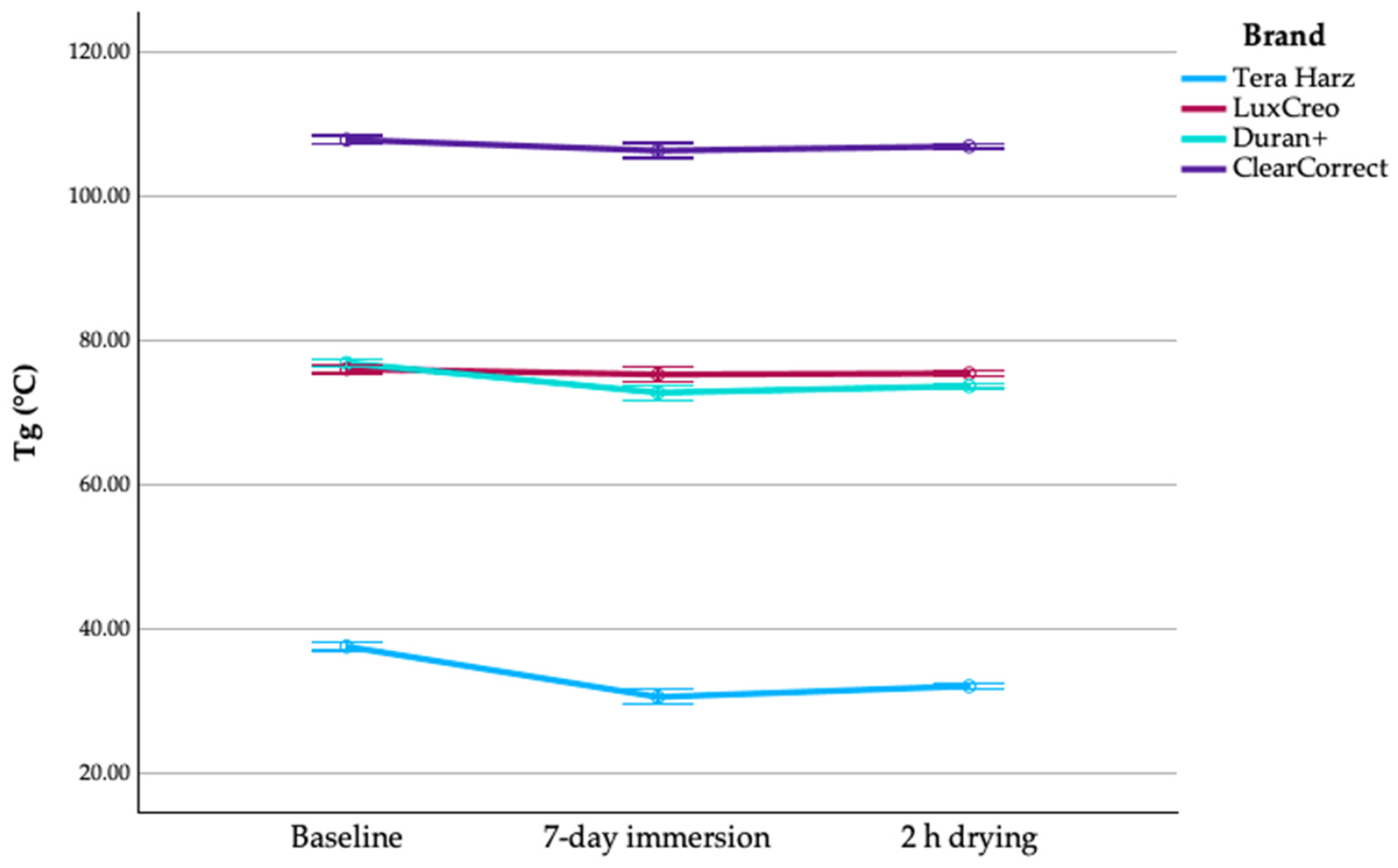
3.2. Glass Transition Temperature Dynamics During Immersion and Drying
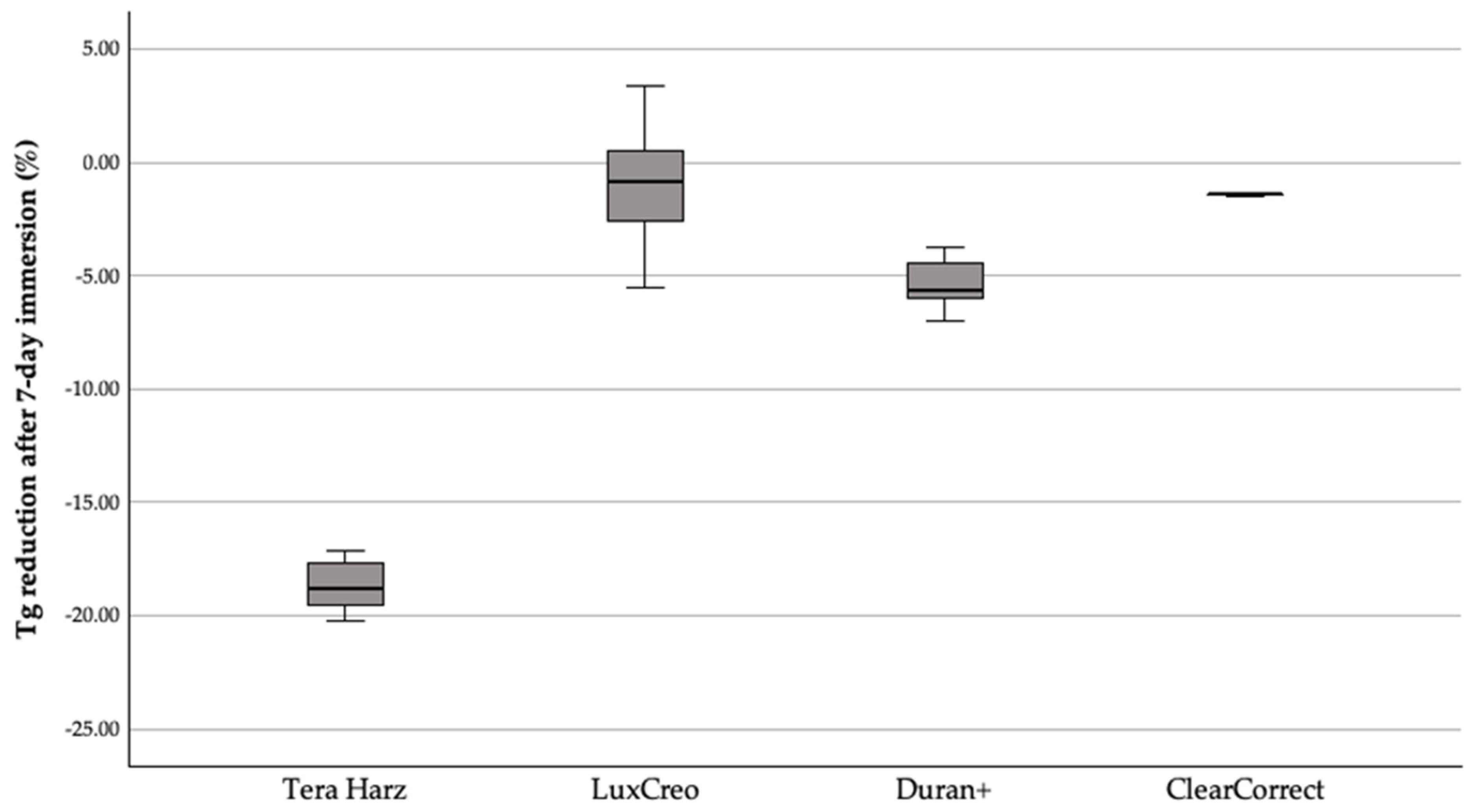
3.3. Relative Tg Depression
3.4. Water Sorption and Desorption Behaviour
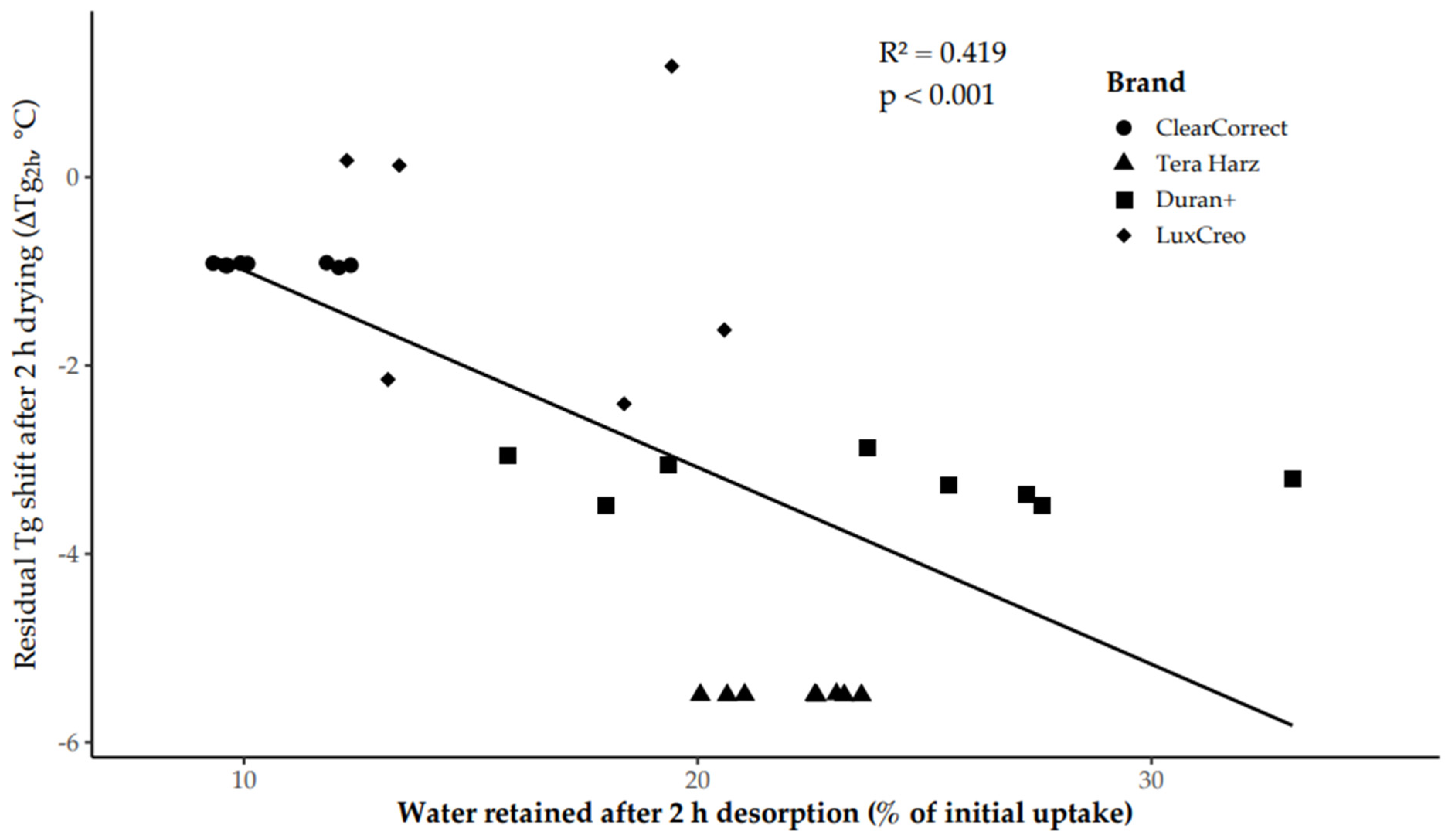
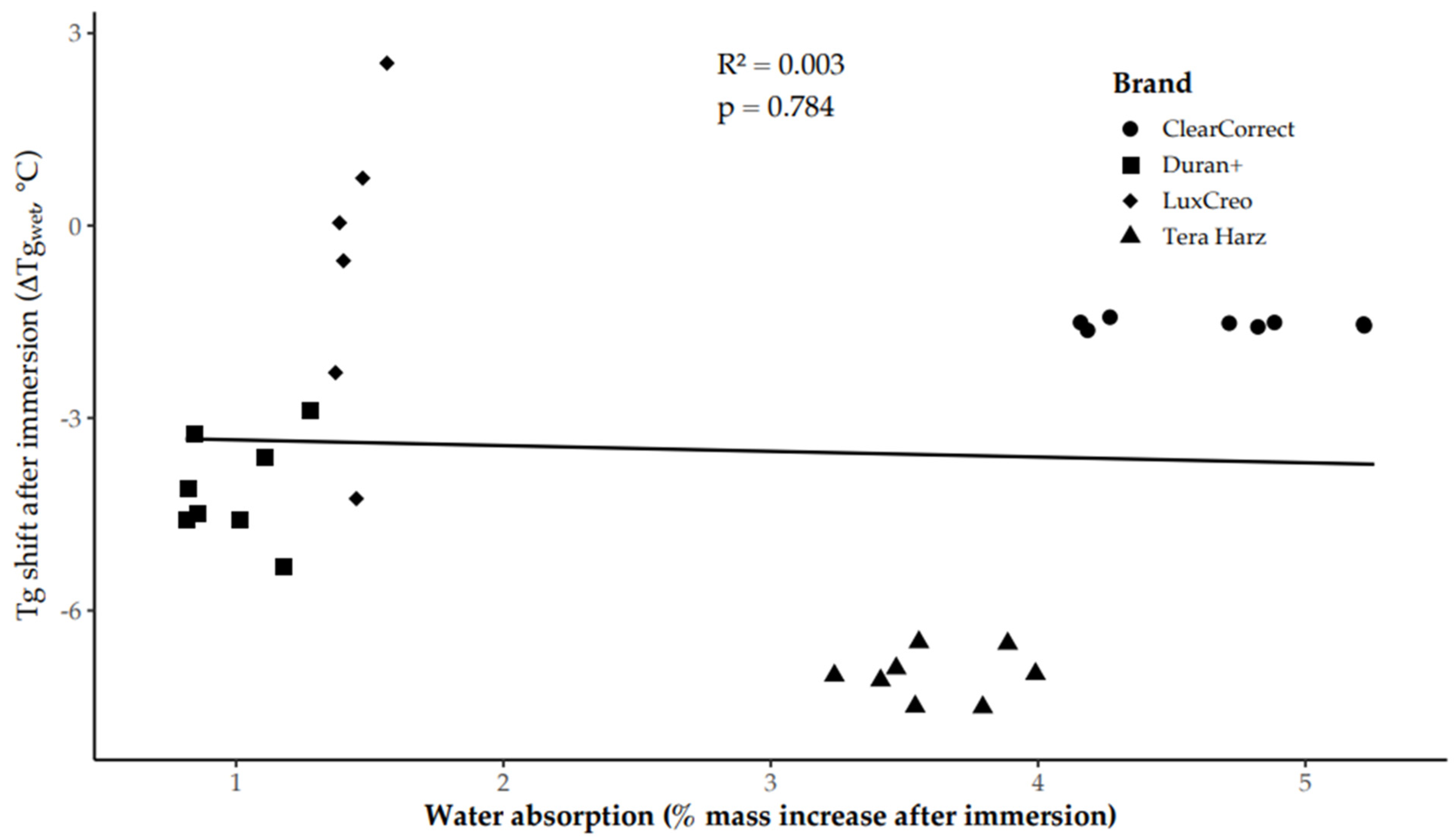
3.5. Association Between Residual Water and Thermal Recovery
4. Discussion
Author Contributions
Funding
Institutional Review Board Statement
Data Availability Statement
Conflicts of Interest
References
- Narongdej, P.; Hassanpour, M.; Alterman, N.; Rawlins-Buchanan, F.; Barjasteh, E. Advancements in Clear Aligner Fabrication: A Comprehensive Review of Direct-3D Printing Technologies. Polymers 2024, 16, 371. [Google Scholar] [CrossRef]
- Staderini, E.; Chiusolo, G.; Papi, M.; Palone, M.; Lombardo, L.; Cordaro, M. Chemical, Optical, and Morphological Properties of TPU and PET-G Samples after Aging in Artificial Saliva: An In Vitro Study. BMC Oral Health 2025, 25, 533. [Google Scholar] [CrossRef]
- Tamer, I.; Öztas, E.; Marsan, G. Orthodontic Treatment with Clear Aligners and the Scientific Reality behind Their Marketing: A Literature Review. Turk. J. Orthod. 2019, 32, 241–246. [Google Scholar] [CrossRef]
- AlMogbel, A.M. Clear Aligner Therapy: Up to Date Review Article. J. Orthod. Sci. 2023, 12, 37. [Google Scholar] [CrossRef]
- Macrì, M.; Murmura, G.; Varvara, G.; Traini, T.; Festa, F. Clinical Performances and Biological Features of Clear Aligners Materials in Orthodontics. Front. Mater. 2022, 9, 819121. [Google Scholar] [CrossRef]
- eddine Bouchema, T.S.; Saunier, J.; Mollier, L.; Mauriello, J.; Savard, B.; Yagoubi, N. Comparison of Three Dental Resins for 3D Printing of Orthodontic Appliances: Comparison of Leaching, Biocompatibility, and Thermo-Mechanical Properties after Post-Curing and Aging. Dent. Mater. 2025, 42, 381–402. [Google Scholar] [CrossRef]
- Bichu, Y.M.; Alwafi, A.; Liu, X.; Andrews, J.; Ludwig, B.; Bichu, A.Y.; Zou, B. Advances in Orthodontic Clear Aligner Materials. Bioact. Mater. 2023, 22, 384–403. [Google Scholar] [CrossRef]
- Shaukat, U.; Rossegger, E.; Schlögl, S. A Review of Multi-Material 3D Printing of Functional Materials via Vat Photopolymerization. Polymers 2022, 14, 2449. [Google Scholar] [CrossRef] [PubMed]
- Ricarte, R.G.; Shanbhag, S. A Tutorial Review of Linear Rheology for Polymer Chemists: Basics and Best Practices for Covalent Adaptable Networks. Polym. Chem. 2024, 15, 815–846. [Google Scholar] [CrossRef]
- Ge, S.; Tsao, Y.H.; Evans, C.M. Polymer Architecture Dictates Multiple Relaxation Processes in Soft Networks with Two Orthogonal Dynamic Bonds. Nat. Commun. 2023, 14, 7244. [Google Scholar] [CrossRef] [PubMed]
- Dantagnan, C.A.; Salem, C.; Charavet, C.; Bosco, J.; Nguyen, J.F. Trueness and Precision of Direct-Printed and Thermoformed Clear Aligners after Artificial Saliva Exposure: A Comparative in Vitro Study. Am. J. Orthod. Dentofac. Orthop. 2026, 169, 640–653. [Google Scholar] [CrossRef]
- Delgado, J.I.; Kehyaian, P.; Fernández-Blázquez, J.P. Thermoplastics for Clear Aligners: A Review. Polymers 2025, 17, 1681. [Google Scholar] [CrossRef]
- Iftekar, S.F.; Aabid, A.; Amir, A.; Baig, M. Advancements and Limitations in 3D Printing Materials and Technologies: A Critical Review. Polymers 2023, 15, 2519. [Google Scholar] [CrossRef] [PubMed]
- Liu, M.; Wang, Y.; Bian, C.; Han, Y.; Qin, X.; Sun, J.; Bai, Y.; Zhang, N. Comparative Mechanical Performance of Thermoplastic Materials for Clear Aligners under Simulated Oral Conditions. Korean J. Orthod. 2025, 55, 380–391. [Google Scholar] [CrossRef]
- Lucia, P.; Valentina, B.; Beatrice, G.; Jacopo, M.; Tihana, Z.B.; Gianluca, T.; Davide, P.; Luca, C. Mechanical Properties of Thermoplastic Materials for Clear Orthodontic Aligners: A New Three-Dimensional Experimental Setting. Orthod. Craniofac. Res. 2025, early view. [Google Scholar] [CrossRef]
- Staderini, E.; Chiusolo, G.; Guglielmi, F.; Papi, M.; Perini, G.; Tepedino, M.; Gallenzi, P. Effects of Thermoforming on the Mechanical, Optical, Chemical, and Morphological Properties of PET-G: In Vitro Study. Polymers 2024, 16, 203. [Google Scholar] [CrossRef]
- Cenzato, N.; Di Iasio, G.; Martìn Carreras-Presas, C.; Caprioglio, A.; Del Fabbro, M. Materials for Clear Aligners—A Comprehensive Exploration of Characteristics and Innovations: A Scoping Review. Appl. Sci. 2024, 14, 6533. [Google Scholar] [CrossRef]
- Šimunović, L.; Pečanić, P.; Marić, A.J.; Haramina, T.; Rakić, I.Š.; Meštrović, S. Impact of Various Cleaning Protocols on the Physical and Aesthetic Properties of 3D-Printed Orthodontic Aligners. Sci. Rep. 2025, 15, 19022. [Google Scholar] [CrossRef]
- Grabar, B.M.; Perica, H.; Anđela, B.; Mihalic, P.I. Design and Production of the Splint Using Reverse Engineering and Additive Manufacturing. Trans. FAMENA 2024, 48, 101–110. [Google Scholar] [CrossRef]
- Hassanpour, M.; Narongdej, P.; Alterman, N.; Moghtadernejad, S.; Barjasteh, E. Effects of Post-Processing Parameters on 3D-Printed Dental Appliances: A Review. Polymers 2024, 16, 2795. [Google Scholar] [CrossRef] [PubMed]
- Šimunović, L.; Brenko, L.; Marić, A.J.; Meštrović, S.; Haramina, T. Rheology of Dental Photopolymers for SLA/DLP/MSLA 3D Printing. Polymers 2025, 17, 2706. [Google Scholar] [CrossRef]
- Dabwan, A.; Ameen, W.; Alqahtani, K.N.; Kaid, H.; Al-Ahmari, A.; Aldoukhi, M. Post-Processing Tehniques of Additevely Manufactured Parts: A Review. Trans. FAMENA 2025, 49, 25–50. [Google Scholar] [CrossRef]
- Šimunović, L.; Čimić, S.; Meštrović, S. Three-Dimensionally Printed Splints in Dentistry: A Comprehensive Review. Dent. J. 2025, 13, 312. [Google Scholar] [CrossRef]
- Lee, S.Y.; Kim, H.; Kim, H.J.; Chung, C.J.; Choi, Y.J.; Kim, S.J.; Cha, J.Y. Thermo-Mechanical Properties of 3D Printed Photocurable Shape Memory Resin for Clear Aligners. Sci. Rep. 2022, 12, 6246. [Google Scholar] [CrossRef]
- Šimunović, L.; Miličević, A.M.; Brenko, L.; Haramina, T.; Meštrović, S. Absorption and Desorption Dynamics of Thermoformed and 3-Dimensional-Printed Orthodontic Aligners. Am. J. Orthod. Dentofac. Orthop. 2025, 168, 466–476. [Google Scholar] [CrossRef]
- Karoyo, A.H.; Wilson, L.D. A Review on the Design and Hydration Properties of Natural Polymer-Based Hydrogels. Materials 2021, 14, 1095. [Google Scholar] [CrossRef]
- Dalaie, K.; Fatemi, S.M.; Ghaffari, S. Dynamic Mechanical and Thermal Properties of Clear Aligners after Thermoforming and Aging. Prog. Orthod. 2021, 22, 15. [Google Scholar] [CrossRef] [PubMed]
- Chen, W.; Biehl, P.; Huang, C.; Zhang, K. Viscoelastic Response in Hydrous Polymers: The Role of Hydrogen Bonds and Microstructure. Nano Lett. 2024, 24, 3811–3818. [Google Scholar] [CrossRef] [PubMed]
- Choi, J.Y.; Kim, H.; Kim, S.H.; Kim, S.J.; Cha, J.Y.; Lee, S.Y.; Lee, J.; Min, J.; Jang, S.; Khan, T.A.; et al. Mechanical and Viscoelastic Properties of a Temperature-Responsive Photocurable Resin for 3D Printed Orthodontic Clear Aligners. Sci. Rep. 2025, 15, 23530. [Google Scholar] [CrossRef] [PubMed]
- Cintora-López, P.; Arrieta-Blanco, P.; Martin-Vacas, A.; Paz-Cortés, M.M.; Gil, J.; Aragoneses, J.M. In Vitro Analysis of the Influence of the Thermocycling and the Applied Force on Orthodontic Clear Aligners. Front. Bioeng. Biotechnol. 2023, 11, 1321495. [Google Scholar] [CrossRef]
- Chen, D.D.S.; Peng, T.Y.; Huang, P.Y.; Kaku, M.; Cheng, J.H.C. Advances in Clear Aligner Therapy: Comparative Evaluation of the Optical Properties and Bacterial Adhesion of 3D Direct-Printed and Thermoformed Aligners. Prog. Orthod. 2025, 26, 53. [Google Scholar] [CrossRef] [PubMed]
- Arabpour, F.; Aghili, H.A.; Javaheri Mahd, M.; Arabpour, Z.; Yasaei, S. Evaluation of Aging Effects on the Physical, Chemical, and Mechanical Properties of Thermoplastic Materials for Orthodontic Clear Aligners: An in Vivo Study. BMC Oral Health 2025, 25, 1557. [Google Scholar] [CrossRef]
- ISO 20795-2; Dentistry—Base Polymers—Part 2: Orthodontic Base Polymers. International Organization for Standardization (ISO): Geneva, Switzerland, 2013.
- Bouchema, T.S.E.; Saunier, J.; Mauriello, J.; Tfayli, A.; Savard, B.; Yagoubi, N. Chemical Analysis and Performance Evaluation of ClearCorrect® Aligners as Received and after Intraoral Use: Implications for Durability, Aesthetics, and Patient Safety. Dent. Mater. 2024, 40, 2135–2147. [Google Scholar] [CrossRef] [PubMed]
- Wang, C.; Xu, Z.; Xia, Y.; Zhang, C.; Fang, H.; Sun, K. Water Transport Mechanism and Performance Evaluation in Polyurethane Materials: A State-of-the-Art Review. Polym. Test. 2024, 138, 1085540. [Google Scholar] [CrossRef]
- Łukaszewska, I.; Bukowczan, A.; Raftopoulos, K.N.; Pielichowski, K. Water-Polymer Interactions and Mechanisms of Water-Driven Glass Transition Decrease in Non-Isocyanate Polyhydroxyurethanes with Varying Hydration Sites. Polymer 2024, 302, 127060. [Google Scholar] [CrossRef]
- Elshazly, T.M.; Keilig, L.; Nang, D.; Golkhani, B.; Weber, A.; Elattar, H.; Talaat, S.; Bourauel, C. Effect of Thermomechanical Aging on Force System of Orthodontic Aligners Made of Different Thermoformed Materials: An In Vitro Study. J. Orofac. Orthop. 2025, 86, 337–346. [Google Scholar] [CrossRef]
- Manoukakis, T.; Nikolaidis, A.K.; Koulaouzidou, E.A. Polymerization Kinetics of 3D-Printed Orthodontic Aligners under Different UV Post-Curing Conditions. Prog. Orthod. 2024, 25, 42. [Google Scholar] [CrossRef]
- Oyonarte, R.; Lagos, I.M.; Vidaurre, L.F.; Parada, B.T.; del Real, A.; Jang, S.; Jeong, H.; Lee, J.; Min, J.; Elshazly, T.M.; et al. Mechanical Properties of Thermoformed and Direct-Printed Aligner Materials after Immersion in 37 °C Water: A 14-Day in Vitro Study. Sci. Rep. 2026, 16, 5864. [Google Scholar] [CrossRef]
- Puchert, K.; Ritzert, P.; Wille, S.; Naim, J.; Şen, S. Influence of Water Storage on the Mechanical Properties of 3D-Printed Aligners: An In Vitro Study. Bioengineering 2025, 13, 21. [Google Scholar] [CrossRef] [PubMed]
- Retrouvey, J.M. Assessment of Active Memory of Photo-Curable Resins for LuxCreo DCA Direct-Printed 3D Aligners. APOS Trends Orthod. 2025, 15, 299–304. [Google Scholar] [CrossRef]
- Xu, J.; Ma, Y.; Qiang, R.; Fan, X.; Zhang, M.; Jin, Z. Force Comparison between Perfitalign 4D Aligners and Thermoformed Aligners for Mandibular Incisor Retraction: An in Vitro Study. Prog. Orthod. 2025, 26, 44. [Google Scholar] [CrossRef] [PubMed]
- Šimunović, L.; Jurela, A.; Sudarević, K.; Bačić, I.; Haramina, T.; Meštrović, S. Influence of Post-Processing on the Degree of Conversion and Mechanical Properties of 3D-Printed Polyurethane Aligners. Polymers 2024, 16, 17. [Google Scholar] [CrossRef] [PubMed]



| Material | Manufacturing Process | Equipment/Source | Key Processing Parameters | Post-Processing and Stabilization |
|---|---|---|---|---|
| Tera Harz | Direct 3D printing | SprintRay Pro 95 | 50 μm layer thickness | Centrifugation-based cleaning and UV post-curing under a nitrogen atmosphere |
| LuxCreo | Direct 3D printing | Supplied by manufacturer | Standardized specimens | None (tested as received) |
| Duran+ | Thermoforming | Biostar® unit | Heating to 200 °C | Cooling at room conditions to ambient temperature |
| ClearCorrect | Thermoforming | Supplied by manufacturer | Central incisor region | 10-day stabilization under a 10 kg constant weight |
| Material | DMA Temperature Range (°C) | Width [mm] | Thickness [mm] |
|---|---|---|---|
| Tera Harz | 20–85 | 2.925 ± 0.109 | 1 ± 0 |
| LuxCreo | 20–200 | 2.995 ± 0.017 | 1.033 ± 0.013 |
| Duran+ | 20–120 | 3.045 ± 0.055 | 1.023 ± 0.074 |
| ClearCorrect | 20–140 | 3.04 ± 0.105 | 0.878 ± 0.059 |
| Material | Baseline Tg (°C) | Tg After 7-Day Immersion (°C) | Tg After 2 h Drying (°C) | Absolute Tg Reduction (°C) | Relative Tg Reduction (%) | Tg Recovery After 2 h (°C) |
|---|---|---|---|---|---|---|
| Tera Harz | 37.50 ± 0.44 | 30.50 ± 0.76 | 32.00 ± 0.44 | −7.00 ± 0.38 | −18.68 ± 1.18 | +1.50 ± 0.38 |
| LuxCreo | 76.01 ± 1.35 | 75.24 ± 2.40 | 75.39 ± 0.06 | −0.77 ± 2.04 | −1.01 ± 2.67 | +0.15 ± 2.36 |
| Duran+ | 76.83 ± 0.42 | 72.73 ± 1.19 | 73.62 ± 0.61 | −4.11 ± 0.81 | −5.35 ± 1.08 | +0.90 ± 0.60 |
| ClearCorrect | 107.82 ± 0.58 | 106.29 ± 0.64 | 106.89 ± 0.59 | −1.53 ± 0.06 | −1.42 ± 0.06 | +0.60 ± 0.05 |
| Material | Water Uptake After 7 Days (%) | Residual Water Fraction After 2 h (%) | Water Retained After 2 h (% of Initial Uptake) |
|---|---|---|---|
| ClearCorrect | 4.74 ± 0.44 | 0.50 ± 0.03 | 10.57 ± 1.19 |
| Tera Harz TC85 | 3.55 ± 0.29 | 0.79 ± 0.02 | 22.33 ± 1.41 |
| Duran+ | 0.96 ± 0.17 | 0.23 ± 0.03 | 24.89 ± 6.32 |
| LuxCreo | 1.44 ± 0.07 | 0.23 ± 0.04 | 16.20 ± 3.65 |
Disclaimer/Publisher’s Note: The statements, opinions and data contained in all publications are solely those of the individual author(s) and contributor(s) and not of MDPI and/or the editor(s). MDPI and/or the editor(s) disclaim responsibility for any injury to people or property resulting from any ideas, methods, instructions or products referred to in the content. |
© 2026 by the authors. Licensee MDPI, Basel, Switzerland. This article is an open access article distributed under the terms and conditions of the Creative Commons Attribution (CC BY) license.
Share and Cite
Šimunović, L.; Brenko, L.; Miličević, A.M.; Haramina, T.; Meštrović, S. Water Desorption Governs Glass Transition Recovery in Aligner Polymers. Polymers 2026, 18, 1008. https://doi.org/10.3390/polym18081008
Šimunović L, Brenko L, Miličević AM, Haramina T, Meštrović S. Water Desorption Governs Glass Transition Recovery in Aligner Polymers. Polymers. 2026; 18(8):1008. https://doi.org/10.3390/polym18081008
Chicago/Turabian StyleŠimunović, Luka, Luka Brenko, Ana Marija Miličević, Tatjana Haramina, and Senka Meštrović. 2026. "Water Desorption Governs Glass Transition Recovery in Aligner Polymers" Polymers 18, no. 8: 1008. https://doi.org/10.3390/polym18081008
APA StyleŠimunović, L., Brenko, L., Miličević, A. M., Haramina, T., & Meštrović, S. (2026). Water Desorption Governs Glass Transition Recovery in Aligner Polymers. Polymers, 18(8), 1008. https://doi.org/10.3390/polym18081008