
Biostimulant Effects of Rich Mannuronate-Alginate and Their Thermic-Acidic Depolymerized Derivates on Triticum aestivum

 , ,
, , 
 ,
,  , ,
, ,  and
and 
Abstract
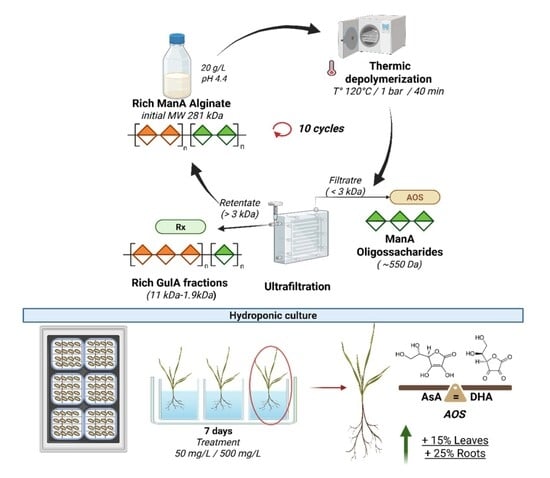
1. Introduction
2. Materials and Methods
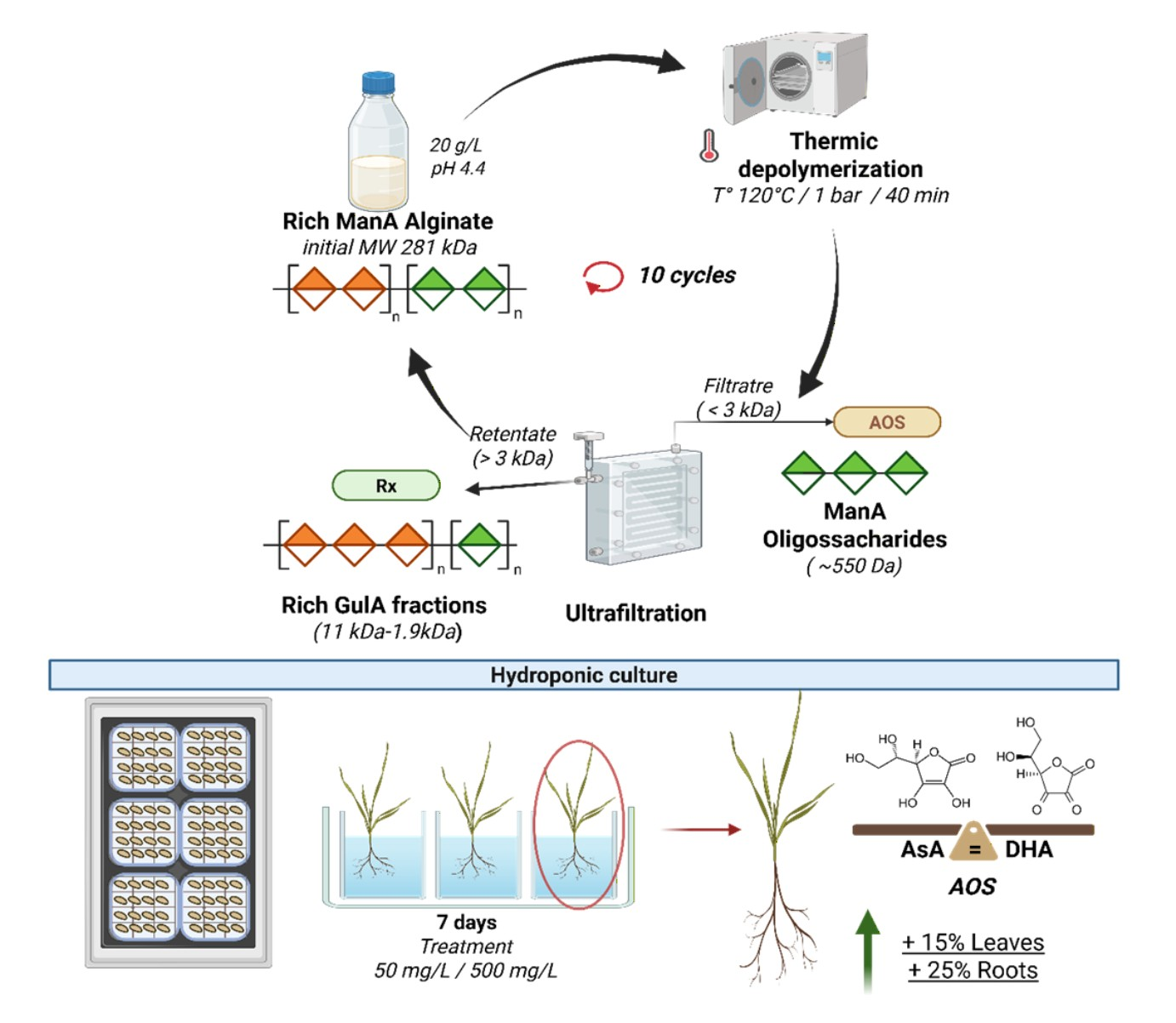
2.1. Alginates and Thermic-Acidic Depolymerized Alginates Preparation
2.2. Physico-Chemical Analysis
2.2.1. Sec-MALLS of Alginates and Its Derivates
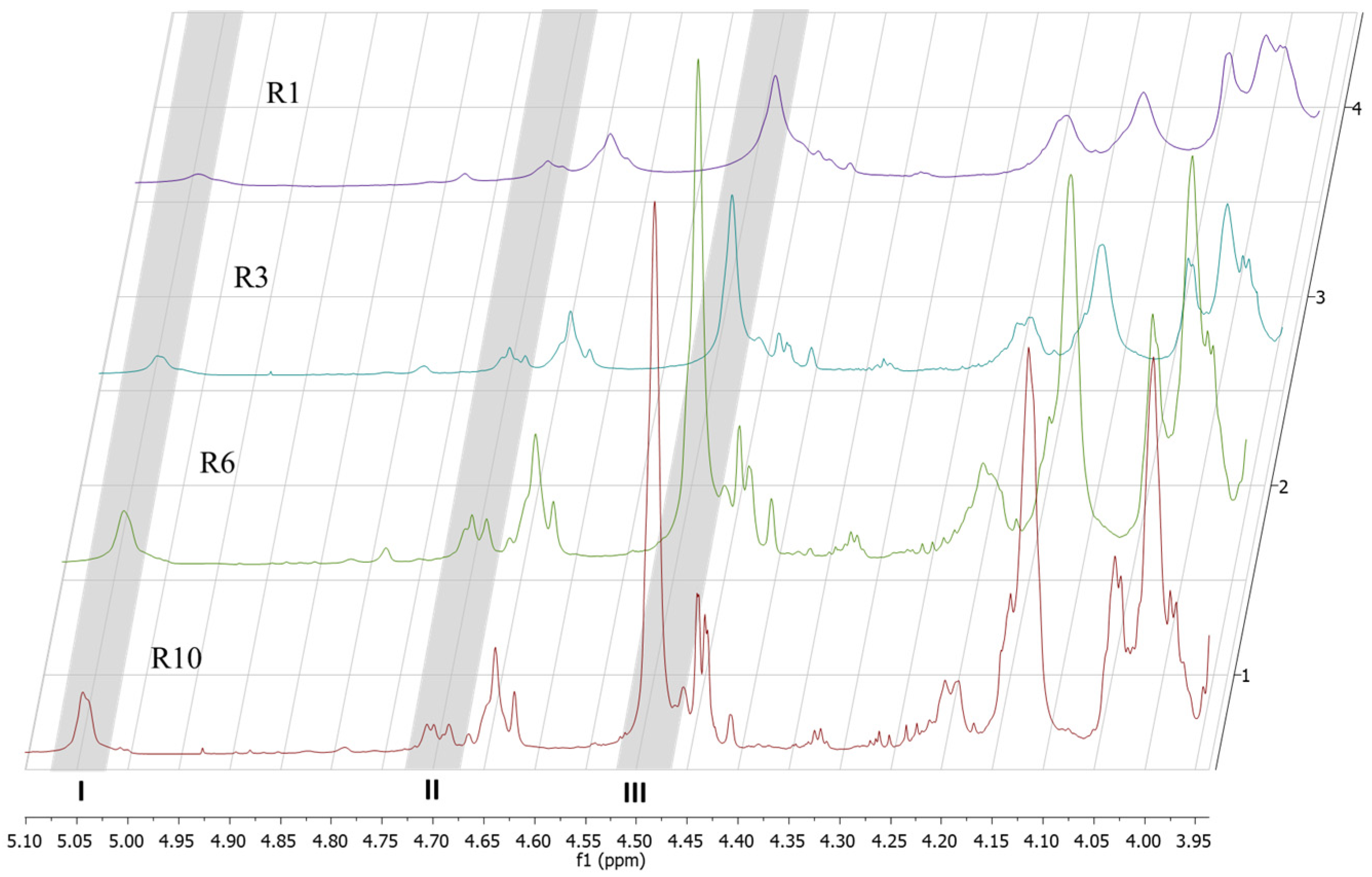
2.2.2. 1H NMR Spectroscopy Analysis for Guluronic and Mannuronic Fractions on Alginate and Its Depolymerized Derivates
2.3. Plant Biostimulation Assays
2.3.1. Experimental Device in Hydroponic System
2.3.2. Raw Materials Biological Activity Screening
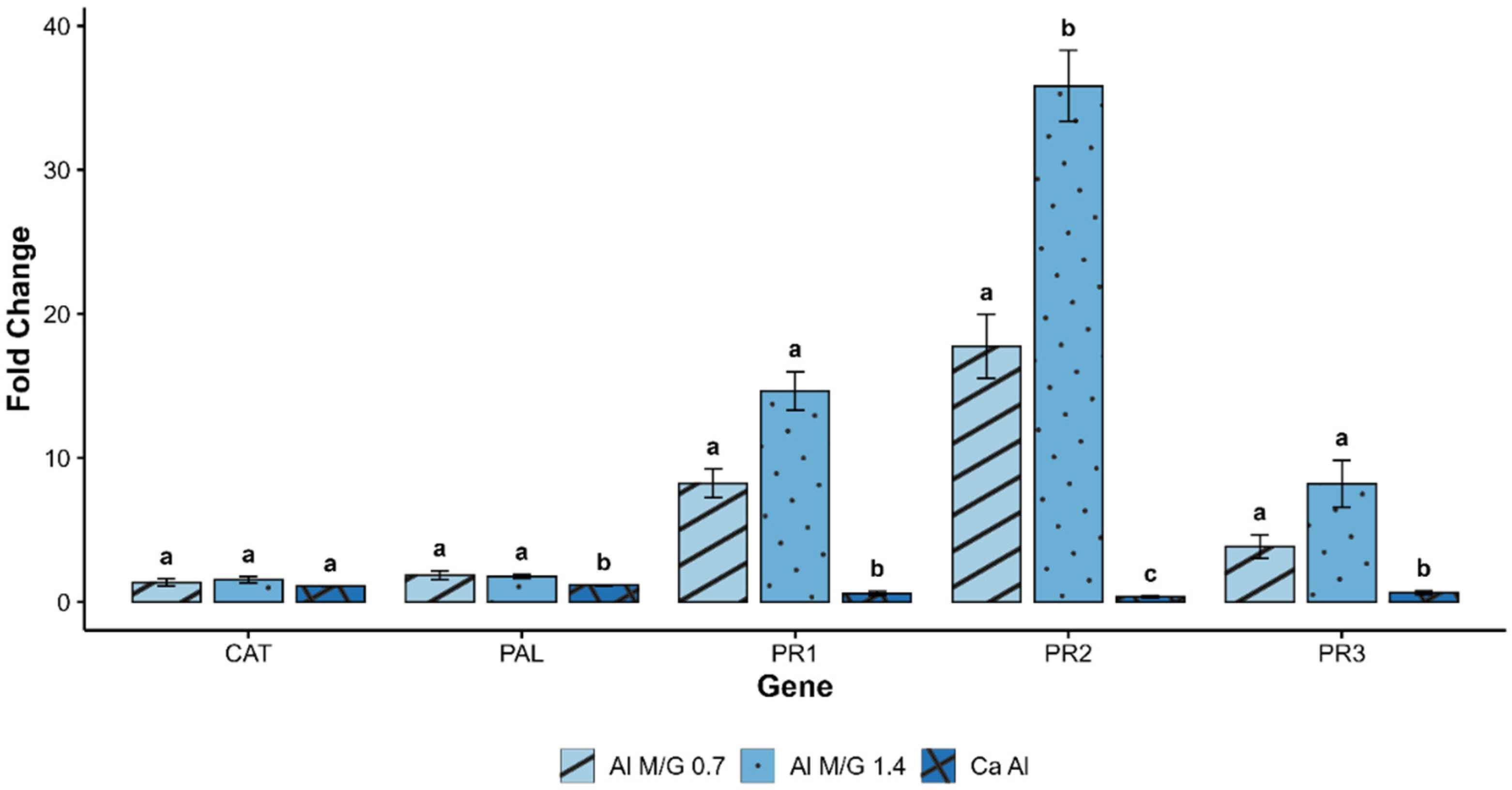
2.3.3. Immunostimulation Markers Screening Evaluation
2.3.4. Biostimulant Effect of Depolymerized Products
2.3.5. Biomass Evaluation and Root/Shoot Measurements
2.3.6. Antioxidant Activity of Depolymerized Alginate Fractions on Wheat
3. Results
3.1. Biological Activity Screening of Raw Alginates
3.1.1. Physicochemical Characterization by Sec-MALLs and 1HNMR
3.1.2. Biological Activity of Raw Alginates: Gene Expression Analysis and Physiological Analysis
3.2. Alginates Depolymerization and the Effect on Seedlings Development
3.2.1. Molecular Mass and Structural Characterization of the Depolymerized Alginates Obtained by Thermic-Acidic Depolymerization
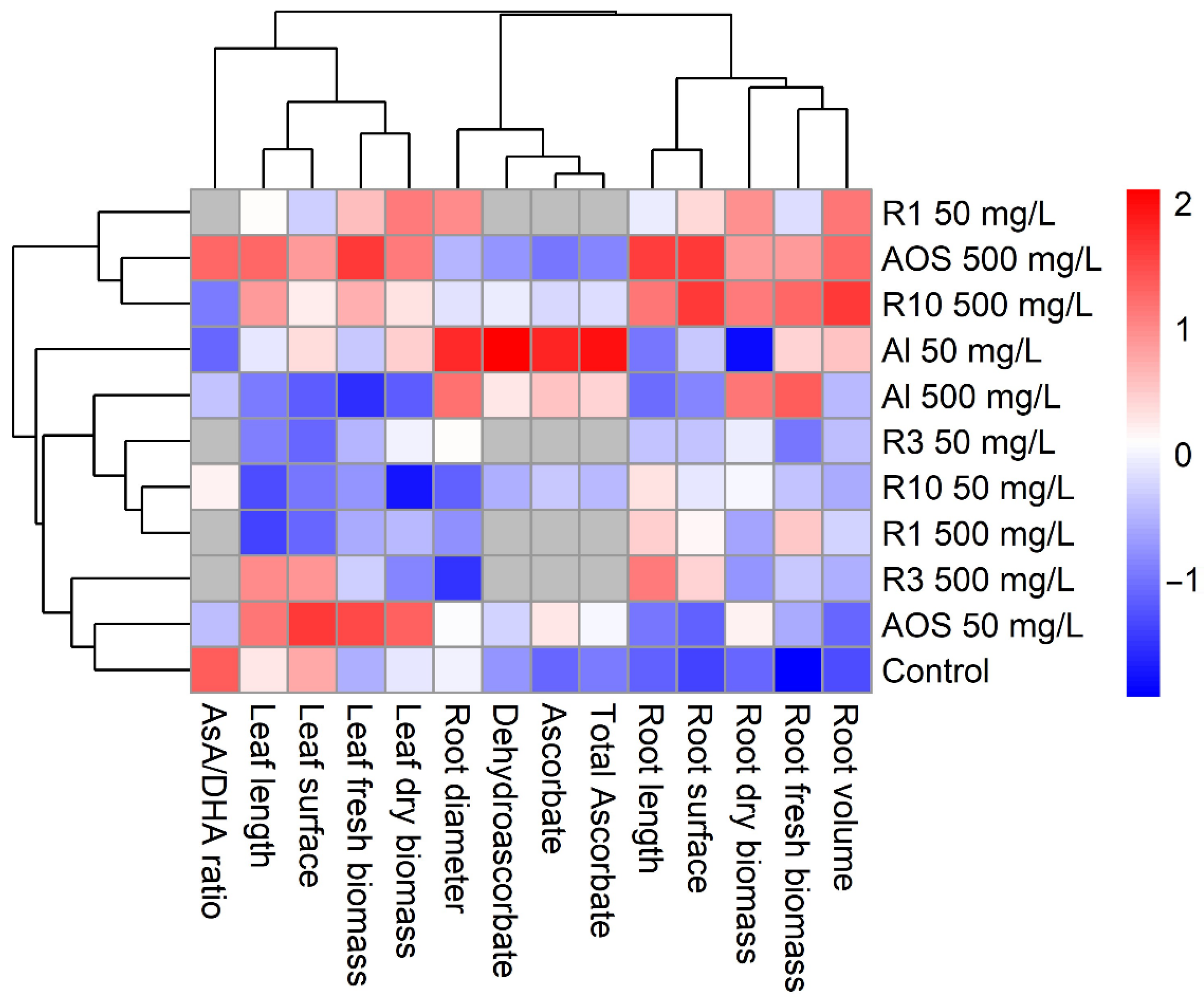
3.2.2. Biostimulant Effects of Depolymerized Fractions
Root and Shoots Biomass
Root Morphology


Shoot Morphology
Shoot Redox State
4. Discussion
5. Conclusions
Author Contributions
Funding
Institutional Review Board Statement
Data Availability Statement
Acknowledgments
Conflicts of Interest
Appendix A

| Roots | Leaves | ||||
|---|---|---|---|---|---|
| Dose (mg/L−1) | FW (g) | DW (g) | FW (g) | DW (g) | |
| Control | 0 | 0.38 ± 0.021 a | 0.04 ± 0.002 ab | 1.34 ± 0.051 a | 0.16 ± 0.004 a |
| Al | 50 | 0.47 ± 0.029 a | 0.04 ± 0.001 a | 1.35 ± 0.030 a | 0.16 ± 0.005 a |
| R 1 | 50 | 0.44 ± 0.020 a | 0.05 ± 0.002 ab | 1.44 ± 0.050 a | 0.17 ± 0.005 a |
| R 3 | 50 | 0.43 ± 0.014 a | 0.04 ± 0.001 ab | 1.33 ± 0.030 a | 0.16 ± 0.002 a |
| R 10 | 50 | 0.44 ± 0.033 a | 0.04 ± 0.004 ab | 1.31 ± 0.045 a | 0.14 ± 0.012 a |
| AOS | 50 | 0.41 ± 0.029 a | 0.04 ± 0.002 ab | 1.53 ± 0.031 a | 0.17 ± 0.004 a |
| Al | 500 | 0.50 ± 0.020 a | 0.05 ± 0.001 b | 1.23 ± 0.075 a | 0.15 ± 0.009 a |
| R 1 | 500 | 0.47 ± 0.007 a | 0.04 ± 0.001 ab | 1.32 ± 0.030 a | 0.15 ± 0.003 a |
| R 3 | 500 | 0.45 ± 0.020 a | 0.04 ± 0.002 ab | 1.35 ± 0.068 a | 0.15 ± 0.009 a |
| R 10 | 500 | 0.47 ± 0.040 a | 0.05 ± 0.002 b | 1.44 ± 0.050 a | 0.16 ± 0.003 a |
| AOS | 500 | 0.48 ± 0.017 a | 0.05 ± 0.001 b | 1.54 ± 0.049 a | 0.17 ± 0.004 a |
| Sr. No. | Primer Pairs | Forward Sequence | Reverse Sequence | Genes These Primers Code for | Reference |
|---|---|---|---|---|---|
| 1 | PR1 | 5′-CATGCACCTTCGTATGCCTAACT-3′ | 5′-TGGCTAATTACGGCATTCCTTT-3′ | Antifungal | [45,46,47] |
| 2 | PR2 | 5′-TCCTGGGTTCAGAACAATGTCC-3′ | 5′-TTGATGTTGACAGCCGGGTAGT-3′ | β-1,3-glucanase | [45,46,47] |
| 3 | PR3 | 5′-GGGTGGACCTGCTGAACAAT-3′ | 5′-AGAACCATATCGCCGTCTTGA-3′ | Chitinase (types I, II, IV, V, VI, VII) | [45,46,47] |
| 4 | PAL | 5′-GTCGATTGAGCGTGAGATCAAC-3′ | 5′-CACGGGAGACGTCGATGAG-3′ | Phenylalanine lyase | [45,46,47] |
| 5 | CAT | 5′-TGCCTGTGTTTTTTATCCGAGA-3′ | 5′-CTGCTGATTAAGGTGTAGGTGTT-3′ | Catalase | (Novel sequence—generated at a partner laboratory), [45,46,47] |
| 6 | TUB | 5′-GGAGTACCCTGACCGAATGATG-3′ | 5′-AACGACGGTGTCTGAGACCTTT-3′ | β-Tubulin (housekeeping gene) | [45,47,48] |
References
- du Jardin, P. Plant Biostimulants: Definition, Concept, Main Categories and Regulation. Sci. Hortic. 2015, 196, 3–14. [Google Scholar] [CrossRef]
- Abdul Malik, N.A.; Kumar, I.S.; Nadarajah, K. Elicitor and Receptor Molecules: Orchestrators of Plant Defense and Immunity. Int. J. Mol. Sci. 2020, 21, 963. [Google Scholar] [CrossRef]
- Bouissil, S.; Guérin, C.; Roche, J.; Dubessay, P.; El Alaoui-Talibi, Z.; Pierre, G.; Michaud, P.; Mouzeyar, S.; Delattre, C.; El Modafar, C. Induction of Defense Gene Expression and the Resistance of Date Palm to Fusarium oxysporum f. sp. Albedinis in Response to Alginate Extracted from Bifurcaria bifurcata. Mar. Drugs 2022, 20, 88. [Google Scholar] [CrossRef]
- El-Mohdy, H.L.A. Radiation-Induced Degradation of Sodium Alginate and Its Plant Growth Promotion Effect. Arab. J. Chem. 2017, 10, S431–S438. [Google Scholar] [CrossRef]
- Li, J.; Wang, X.; Lin, X.; Yan, G.; Liu, L.; Zheng, H.; Zhao, B.; Tang, J.; Guo, Y.-D. Alginate-Derived Oligosaccharides Promote Water Stress Tolerance in Cucumber (Cucumis sativus L.). Plant Physiol. Biochem. 2018, 130, 80–88. [Google Scholar] [CrossRef]
- Zhang, C.; Howlader, P.; Liu, T.; Sun, X.; Jia, X.; Zhao, X.; Shen, P.; Qin, Y.; Wang, W.; Yin, H. Alginate Oligosaccharide (AOS) Induced Resistance to Pst DC3000 via Salicylic Acid-Mediated Signaling Pathway in Arabidopsis Thaliana. Carbohydr. Polym. 2019, 225, 115221. [Google Scholar] [CrossRef]
- Liu, H.; Zhang, Y.-H.; Yin, H.; Wang, W.-X.; Zhao, X.-M.; Du, Y.-G. Alginate Oligosaccharides Enhanced Triticum aestivum L. Tolerance to Drought Stress. Plant Physiol. Biochem. 2013, 62, 33–40. [Google Scholar] [CrossRef] [PubMed]
- Kolbert, Z.; Lindermayr, C.; Loake, G.J. The Role of Nitric Oxide in Plant Biology: Current Insights and Future Perspectives. J. Exp. Bot. 2021, 72, 777–780. [Google Scholar] [CrossRef] [PubMed]
- Siddiqui, M.H.; Al-Whaibi, M.H.; Basalah, M.O. Role of Nitric Oxide in Tolerance of Plants to Abiotic Stress. Protoplasma 2011, 248, 447–455. [Google Scholar] [CrossRef] [PubMed]
- Zhang, Y.; Liu, H.; Yin, H.; Wang, W.; Zhao, X.; Du, Y. Nitric Oxide Mediates Alginate Oligosaccharides-Induced Root Development in Wheat (Triticum aestivum L.). Plant Physiol. Biochem. 2013, 71, 49–56. [Google Scholar] [CrossRef]
- Zhang, Y.; Yin, H.; Zhao, X.; Wang, W.; Du, Y.; He, A.; Sun, K. The Promoting Effects of Alginate Oligosaccharides on Root Development in Oryza sativa L. Mediated by Auxin Signaling. Carbohydr. Polym. 2014, 113, 446–454. [Google Scholar] [CrossRef]
- Ma, L.J.; Li, X.M.; Bu, N.; Li, N. An Alginate-Derived Oligosaccharide Enhanced Wheat Tolerance to Cadmium Stress. Plant Growth Regul. 2010, 62, 71–76. [Google Scholar] [CrossRef]
- Hu, X.; Jiang, X.; Hwang, H.; Liu, S.; Guan, H. Promotive Effects of Alginate-Derived Oligosaccharide on Maize Seed Germination. J. Appl. Phycol. 2004, 16, 73–76. [Google Scholar] [CrossRef]
- Zhao, X.; Zhang, R.; Wang, W.; Hong, B.; Zhang, S.; Yin, H. The Effects of Foliar Application of Alginate Oligosaccharide at Different Stage on Wheat Yield Components. Res. Sq. 2022, preprint. [Google Scholar] [CrossRef]
- He, J.; Li, R.; Sun, X.; Wang, W.; Hu, J.; Xie, H.; Yin, H. Effects of Calcium Alginate Submicroparticles on Seed Germination and Seedling Growth of Wheat (Triticum aestivum L.). Polymers 2018, 10, 1154. [Google Scholar] [CrossRef]
- Zhang, C.; Wang, W.; Zhao, X.; Wang, H.; Yin, H. Preparation of Alginate Oligosaccharides and Their Biological Activities in Plants: A Review. Carbohydr. Res. 2020, 494, 108056. [Google Scholar] [CrossRef] [PubMed]
- Aly, A.A.; Eliwa, N.E.; Safwat, G. Role of Gamma-Irradiated Sodium Alginate on Growth, Physiological and Active Components of Iceberg Lettuce (Lactuca sativa) Plant. BMC Plant Biol. 2024, 24, 185. [Google Scholar] [CrossRef]
- Girard, H. Mechanoenzymology as A Novel Method for the Generation of Alginate Oligosaccharides from Alginate. Master’s Thesis, McGill University, Montreal, QC, Canada, 2025. [Google Scholar]
- MubarakAli, D.; Lee, M.; Manzoor, M.A.; Lee, S.-Y.; Kim, J.-W. Production of Oligoalginate via Solution Plasma Process and Its Capability of Biological Growth Enhancement. Appl. Biochem. Biotechnol. 2021, 193, 4097–4112. [Google Scholar] [CrossRef]
- Nguyen Van, B.; Hoang Dang, S.; Tran Bang, D.; Tran Xuan, A.; Hoang Phuong, T.; Tran Minh, Q. Effects of Radiation Dose and Dose Rate on Alginate and the Use of Radiation Degraded Alginate for Peanut. Int. J. Biol. Macromol. 2024, 266, 131038. [Google Scholar] [CrossRef]
- Watthanaphanit, A.; Saito, N. Effect of Polymer Concentration on the Depolymerization of Sodium Alginate by the Solution Plasma Process. Polym. Degrad. Stab. 2013, 98, 1072–1080. [Google Scholar] [CrossRef]
- Dobruchowska, J.M.; Bjornsdottir, B.; Fridjonsson, O.H.; Altenbuchner, J.; Watzlawick, H.; Gerwig, G.J.; Dijkhuizen, L.; Kamerling, J.P.; Hreggvidsson, G.O. Enzymatic Depolymerization of Alginate by Two Novel Thermostable Alginate Lyases from Rhodothermus Marinus. Front. Plant Sci. 2022, 13, 981602. [Google Scholar] [CrossRef]
- Jeong, S.H.; Lee, P.H.; Moon, J.K.; Lee, S.; Koo, Y. Characterization of Alginate-Degrading Bacteria Isolated from Seaweed-Producing Areas of South Korean Territory and Verification of the Bacteria as Plant Growth-Promoting Biofertilizer. Microbiol. Spectr. 2025, 13, e03164-24. [Google Scholar] [CrossRef]
- Liang, T.; Chen, J.; Li, J.; Dong, M.; Han, Z.; Shan, F.; Gao, X.; Yan, D. Characterization of a Novel Alginate Lyase Alg0392 with Organic Solvent-Tolerance from Alteromonas sp. A1-6. Appl. Microbiol. Biotechnol. 2025, 109, 122. [Google Scholar] [CrossRef]
- Ryu, M.; Lee, E.Y. Saccharification of Alginate by Using Exolytic Oligoalginate Lyase from Marine Bacterium Sphingomonas sp. MJ-3. J. Ind. Eng. Chem. 2011, 17, 853–858. [Google Scholar] [CrossRef]
- Song, Y.H.; Woo, H.C.; Lee, J. Eco-Friendly Depolymerization of Alginates by H2O2 and High-Frequency Ultrasonication. Clean Technol. 2023, 5, 1402–1414. [Google Scholar] [CrossRef]
- Dodero, A.; Vicini, S.; Castellano, M. Depolymerization of Sodium Alginate in Saline Solutions via Ultrasonic Treatments: A Rheological Characterization. Food Hydrocoll. 2020, 109, 106128. [Google Scholar] [CrossRef]
- Zimoch-Korzycka, A.; Kulig, D.; Król-Kilińska, Ż.; Żarowska, B.; Bobak, Ł.; Jarmoluk, A. Biophysico-Chemical Properties of Alginate Oligomers Obtained by Acid and Oxidation Depolymerization. Polymers 2021, 13, 2258. [Google Scholar] [CrossRef]
- Holme, H.K.; Lindmo, K.; Kristiansen, A.; Smidsrød, O. Thermal Depolymerization of Alginate in the Solid State. Carbohydr. Polym. 2003, 54, 431–438. [Google Scholar] [CrossRef]
- Mellal, M.; Ding, L.H.; Jaffrin, M.Y.; Delattre, C.; Michaud, P.; Courtois, J. Separation and Fractionation of Oligouronides by Shear-Enhanced Filtration. Sep. Sci. Technol. 2007, 42, 349–361. [Google Scholar] [CrossRef]
- Grasdalen, H. High-Field, 1H-n.m.r. Spectroscopy of Alginate: Sequential Structure and Linkage Conformations. Carbohydr. Res. 1983, 118, 255–260. [Google Scholar] [CrossRef]
- Rao, X.; Huang, X.; Zhou, Z.; Lin, X. An Improvement of the 2ˆ(-Delta Delta CT) Method for Quantitative Real-Time Polymerase Chain Reaction Data Analysis. Biostat. Bioinforma. Biomath. 2013, 3, 71–85. [Google Scholar]
- Lobet, G.; Pagès, L.; Draye, X. A Novel Image-Analysis Toolbox Enabling Quantitative Analysis of Root System Architecture. Plant Physiol. 2011, 157, 29–39. [Google Scholar] [CrossRef]
- Gillespie, K.M.; Ainsworth, E.A. Measurement of Reduced, Oxidized and Total Ascorbate Content in Plants. Nat. Protoc. 2007, 2, 871–874. [Google Scholar] [CrossRef]
- Mao, S.; Zhang, T.; Sun, W.; Ren, X. The Depolymerization of Sodium Alginate by Oxidative Degradation. Pharm. Dev. Technol. 2012, 17, 763–769. [Google Scholar] [CrossRef] [PubMed]
- Chandía, N.P.; Matsuhiro, B.; Mejías, E.; Moenne, A. Alginic Acids in Lessonia Vadosa: Partial Hydrolysis and Elicitor Properties of the Polymannuronic Acid Fraction. J. Appl. Phycol. 2004, 16, 127–133. [Google Scholar] [CrossRef]
- Yang, J.; Shen, Z.; Sun, Z.; Wang, P.; Jiang, X. Growth Stimulation Activity of Alginate-Derived Oligosaccharides with Different Molecular Weights and Mannuronate/Guluronate Ratio on Hordeum vulgare L. J. Plant Growth Regul. 2021, 40, 91–100. [Google Scholar] [CrossRef]
- Lu, S.; Friesen, T.L.; Faris, J.D. Molecular Characterization and Genomic Mapping of the Pathogenesis-Related Protein 1 (PR-1) Gene Family in Hexaploid Wheat (Triticum aestivum L.). Mol. Genet. Genom. 2011, 285, 485. [Google Scholar] [CrossRef]
- Numan, M.; Bukhari, S.A.; Rehman, M.-; Mustafa, G.; Sadia, B. Phylogenetic Analyses, Protein Modeling and Active Site Prediction of Two Pathogenesis Related (PR2 and PR3) Genes from Bread Wheat. PLoS ONE 2021, 16, e0257392. [Google Scholar] [CrossRef]
- Jiang, Y.; Chang, Z.; Xu, Y.; Zhan, X.; Wang, Y.; Gao, M. Advances in Molecular Enzymology of β-1,3-Glucanases: A Comprehensive Review. Int. J. Biol. Macromol. 2024, 279, 135349. [Google Scholar] [CrossRef]
- Klarzynski, O.; Plesse, B.; Joubert, J.-M.; Yvin, J.-C.; Kopp, M.; Kloareg, B.; Fritig, B. Linear β-1,3 Glucans Are Elicitors of Defense Responses in Tobacco. Plant Physiol. 2000, 124, 1027–1038. [Google Scholar] [CrossRef] [PubMed]
- Fotopoulos, V.; Ziogas, V.; Tanou, G.; Molassiotis, A. Involvement of AsA/DHA and GSH/GSSG Ratios in Gene and Protein Expression and in the Activation of Defence Mechanisms Under Abiotic Stress Conditions. In Ascorbate-Glutathione Pathway and Stress Tolerance in Plants; Anjum, N.A., Chan, M.-T., Umar, S., Eds.; Springer: Dordrecht, The Netherlands, 2010; pp. 265–302. ISBN 978-90-481-9403-2. [Google Scholar]
- Miret, J.A.; Müller, M. AsA/DHA Redox Pair Influencing Plant Growth and Stress Tolerance. In Ascorbic Acid in Plant Growth, Development and Stress Tolerance; Hossain, M.A., Munné-Bosch, S., Burritt, D.J., Diaz-Vivancos, P., Fujita, M., Lorence, A., Eds.; Springer International Publishing: Cham, Switzerland, 2017; pp. 297–319. ISBN 978-3-319-74056-0. [Google Scholar]
- Martínez, J.P.; Araya, H. Regulation. In Ascorbate-Glutathione Pathway and Stress Tolerance in Plants; Anjum, N.A., Chan, M.-T., Umar, S., Eds.; Springer: Dordrecht, The Netherlands, 2010; pp. 303–322. ISBN 978-90-481-9403-2. [Google Scholar]
- Ali, S.; Ganai, B.A.; Kamili, A.N.; Bhat, A.A.; Mir, Z.A.; Bhat, J.A.; Tyagi, A.; Islam, S.T.; Mushtaq, M.; Yadav, P.; et al. Pathogenesis-Related Proteins and Peptides as Promising Tools for Engineering Plants with Multiple Stress Tolerance. Microbiol. Res. 2018, 212–213, 29–37. [Google Scholar] [CrossRef] [PubMed]
- Ors, M.E.; Randoux, B.; Selim, S.; Siah, A.; Couleaud, G.; Maumené, C.; Sahmer, K.; Halama, P.; Reignault, P. Cultivar-dependent Partial Resistance and Associated Defence Mechanisms in Wheat against Zymoseptoria tritici. Plant Pathol. 2018, 67, 561–572. [Google Scholar] [CrossRef]
- Tayeh, C.; Randoux, B.; Tisserant, B.; Khong, G.; Jacques, P.; Reignault, P. Are Ineffective Defence Reactions Potential Target for Induced Resistance during the Compatible Wheat-Powdery Mildew Interaction? Plant Physiol. Biochem. 2015, 96, 9–19. [Google Scholar] [CrossRef] [PubMed]
- Yang, Z.; Chen, Y.; Hu, B.; Tan, Z.; Huang, B. Identification and Validation of Reference Genes for Quantification of Target Gene Expression with Quantitative Real-Time PCR for Tall Fescue under Four Abiotic Stresses. PLoS ONE 2015, 10, e0119569. [Google Scholar] [CrossRef] [PubMed]


| Sample | SEC-MALLS | 1H NMR | ||||||||
|---|---|---|---|---|---|---|---|---|---|---|
| Mw (kDa) | PDI | AI | AII | AIII | M/G | |||||
| Alginate ratio M/G 1.4 HMW | 281.6 | 2.52 | 0.86 | 1.23 | 0.79 | 0.43 | 0.57 | 0.39 | 0.54 | 1.35 |
| Alginate ratio M/G 0.7 HMW | 234.3 | 2.41 | 2.73 | 3.12 | 1.45 | 0.60 | 0.40 | 0.32 | 0.12 | 0.67 |
| Sample | Root Length | Shoot Length |
|---|---|---|
| Control | 5.95 ± 0.22 c | 19.01 ± 0.23 a |
| Al M/G 0.7 | 9.43 ± 0.43 a | 18.16 ± 0.33 a |
| Al M/G 1.4 | 16.10 ± 0.84 b | 31.19 ± 1.34 b |
| Ca Al | 8.55 ± 0.31 a | 19.40 ± 0.25 a |
| Sample | Cycle | Mw (Da) | PDI | Uronic Acid Units | % Depolymerization |
|---|---|---|---|---|---|
| Alginate | 0 | 281,000 | 2.52 | 1606 | 0 |
| Retentate | |||||
| R-1 | 1 | 11,000 | 2.26 | 63 | 61 |
| R-2 | 2 | 6970 | 1.61 | 40 | 97.5 |
| R-3 | 3 | 4890 | 1.51 | 28 | 98.2 |
| R-4 | 4 | 3560 | 1.49 | 20 | 98.7 |
| R-5 | 5 | 3150 | 1.43 | 18 | 98.8 |
| R-6 | 6 | 2570 | 1.37 | 15 | 99 |
| R-10 | 10 | 1970 | 1.24 | 11 | 99.2 |
| Filtrate | |||||
| AOS | 1 | 586 ± 55 | 1.11 ± 0.08 | 3 | / |
| Cycle | Filtrate Mass (mg) | % Recovery | Cumulative % Recovery |
| 1 | 550.3 | 5.5 | 5.50 |
| 2 | 14.8 | 0.15 | 5.65 |
| 3 | 146.1 | 1.45 | 7.11 |
| 4 | 381 | 3.81 | 10.92 |
| 5 | 201 | 2.01 | 12.93 |
| 6 | 419 | 4.19 | 17.12 |
| 7 | 373.4 | 3.73 | 20.86 |
| 8 | 523.4 | 5.23 | 26.09 |
| 9 | 246 | 2.46 | 28.55 |
| 10 | 509.7 | 5.10 | 33.65 |
| Total | 3364.7 | 33.65 | 33.65 |
| Signal | Fractions | Ratio | ||||||
| Sample | AI | AII | AIII | FG | FM | FGG | FMM | M/G |
| Al M/G 1.4 | 0.86 | 1.23 | 0.79 | 0.43 | 0.57 | 0.39 | 0.54 | 1.35 |
| R 1 | 1 | 1.02 | 1.07 | 0.48 | 0.52 | 0.51 | 0.56 | 1.09 |
| R 2 | 1 | 0.73 | 0.84 | 0.64 | 0.36 | 0.53 | 0.26 | 0.57 |
| R 3 | 1 | 0.79 | 0.98 | 0.57 | 0.43 | 0.55 | 0.42 | 0.77 |
| R 4 | 1 | 0.7 | 0.96 | 0.61 | 0.39 | 0.58 | 0.37 | 0.65 |
| R 5 | 1 | 0.64 | 0.99 | 0.61 | 0.39 | 0.61 | 0.38 | 0.63 |
| R 6 | 1 | 0.63 | 0.99 | 0.62 | 0.38 | 0.61 | 0.38 | 0.62 |
| R 10 | 1 | 0.5 | 0.78 | 0.78 | 0.22 | 0.61 | 0.04 | 0.28 |
| Roots | Leaves | ||||||
|---|---|---|---|---|---|---|---|
| Dose (mg/L) | % FW Increase | % DW Increase | Water Content (%) | % FW Increase | % DW Increase | Water Content (%) | |
| Al | 50 | +24.6 ± 11.8 | −0.6 ± 5.1 | 92.1 ± 0.4 | +2.5 ± 0.3 | +3.6 ± 3.1 | 87.9 ± 0.3 |
| R 1 | 50 | +15.2 ± 4.5 | +27.9 ± 7.4 | 90.0 ± 0.3 | +11.9 ± 6.7 | +12.0 ± 5.1 | 88.1 ± 0.3 |
| R 3 | 50 | +4.6 ± 1.9 | +17.3 ± 5.5 | 90.0 ± 0.6 | +1.5 ± 2.7 | +3.7 ± 2.5 | 88.1 ± 0.3 |
| R 10 | 50 | +19.1 ± 12.4 | +24.4 ± 18.9 | 90.4 ± 0.4 | −1.6 ± 1.4 | −0.6 ± 5.2 | 89.3 ± 1.3 |
| AOS | 50 | +7.1 ± 9.5 | +16.8 ± 13.2 | 89.9 ± 0.3 | +7.2 ± 4.1 | +1.8 ± 4.8 | 88.8 ± 0.1 |
| Al | 500 | 30.1 ± 6.4 | +27.8 ± 6.8 | 90.7 ± 0.3 | +1.3 ± 3.7 | +1.6 ± 2.8 | 88.1 ± 0.1 |
| R 1 | 500 | 19.3 ± 3.7 | +16.2 ± 5.4 | 91.3 ± 0.4 | +5.0 ± 3.2 | +2.5 ± 1.2 | 88.4 ± 0.4 |
| R 3 | 500 | 16.4 ± 9.6 | +16.3 ± 3.5 | 90.9 ± 0.5 | +0.7 ± 6.4 | −6.4 ± 8.4 | 89.0 ± 0.2 |
| R 10 | 500 | 27.8 ± 13.1 | +29.2 ± 9.0 | 90.6 ± 0.4 | +11.8 ± 6.8 | +4.9 ± 3.9 | 89.0 ± 0.4 |
| AOS | 500 | 17.9 ± 6.6 | +31.2 ± 3.3 | 90.6 ± 0.4 | +26.8 ± 1.8 | +20.0 ± 5.5 | 89.0 ± 0.3 |
Disclaimer/Publisher’s Note: The statements, opinions and data contained in all publications are solely those of the individual author(s) and contributor(s) and not of MDPI and/or the editor(s). MDPI and/or the editor(s) disclaim responsibility for any injury to people or property resulting from any ideas, methods, instructions or products referred to in the content. |
© 2025 by the authors. Licensee MDPI, Basel, Switzerland. This article is an open access article distributed under the terms and conditions of the Creative Commons Attribution (CC BY) license (https://creativecommons.org/licenses/by/4.0/).
Share and Cite
Borjas, A.; Ahchouch, F.-Z.; Ghosh, N.; Rajasekaran, S.; Dupuits, C.; Mouzeyar, S.; El Boutachfaiti, R.; Petit, E.; Molinié, R.; Delattre, C.; et al. Biostimulant Effects of Rich Mannuronate-Alginate and Their Thermic-Acidic Depolymerized Derivates on Triticum aestivum. Polymers 2025, 17, 3261. https://doi.org/10.3390/polym17243261
Borjas A, Ahchouch F-Z, Ghosh N, Rajasekaran S, Dupuits C, Mouzeyar S, El Boutachfaiti R, Petit E, Molinié R, Delattre C, et al. Biostimulant Effects of Rich Mannuronate-Alginate and Their Thermic-Acidic Depolymerized Derivates on Triticum aestivum. Polymers. 2025; 17(24):3261. https://doi.org/10.3390/polym17243261
Chicago/Turabian StyleBorjas, Aldo, Fatima-Zahra Ahchouch, Niniva Ghosh, Surya Rajasekaran, Céline Dupuits, Said Mouzeyar, Redouan El Boutachfaiti, Emmanuel Petit, Roland Molinié, Cédric Delattre, and et al. 2025. "Biostimulant Effects of Rich Mannuronate-Alginate and Their Thermic-Acidic Depolymerized Derivates on Triticum aestivum" Polymers 17, no. 24: 3261. https://doi.org/10.3390/polym17243261
APA StyleBorjas, A., Ahchouch, F.-Z., Ghosh, N., Rajasekaran, S., Dupuits, C., Mouzeyar, S., El Boutachfaiti, R., Petit, E., Molinié, R., Delattre, C., & Roche, J. (2025). Biostimulant Effects of Rich Mannuronate-Alginate and Their Thermic-Acidic Depolymerized Derivates on Triticum aestivum. Polymers, 17(24), 3261. https://doi.org/10.3390/polym17243261