Article

Synthesis and Structures of Ru(II)-p-Cymene Sandwich Complexes with Electron-Withdrawing Cyclopentadienyl Ligands


1
Department of Mathematical, Applied & Physical Sciences, University of Houston Clear-Lake, Houston, TX 77058, USA
2
Department of Chemistry, University of Kentucky, Lexington, KY 40506, USA
*
Authors to whom correspondence should be addressed.
Crystals 2026, 16(3), 201; https://doi.org/10.3390/cryst16030201
Submission received: 17 February 2026 / Revised: 9 March 2026 / Accepted: 12 March 2026 / Published: 15 March 2026

Abstract

A modular synthetic route has been developed to prepare a new series of cationic ruthenium(II) complexes with electron-withdrawing 1,2-diacylcyclopentadienyl ligands. The 2-acyl-6-hydroxyfulvenes were synthesized from cyclopentadienide and acyl chlorides and converted to Tl(I) cyclopentadienyl salts using Tl2SO4/KOH. Transmetalation with [Ru(η6-p-cymene)(μ-Cl)Cl]2 followed by PF6 metathesis gives the complexes [Ru{η5-1,2-C5H3(CO–R)2}(η6-p-cymene)][PF6] (R = t-Bu, p-Tol, p-ClC6H4, p-IC6H4) in moderate to high yields. The new compounds were characterized by NMR and IR spectroscopy; mass spectrometry and elemental analysis were performed where applicable. X-ray analysis of one of the complexes confirms that electron-deficient Cp ligands retain η5-coordination and structural planarity within Ru(II)–arene sandwich architectures, highlighting their potential utility in electronically tunable organometallic frameworks.

1. Introduction

Cationic ruthenium(II) complexes bearing η6-coordinated arene ligand and ancillary neutral or anionic donor ligands have garnered widespread attention due to their robust structures and broad utility across diverse fields such as organic synthesis [1,2,3], medicinal chemistry [4,5], catalysis [6,7], transfer hydrogenation [8,9], and coordination-driven self-assembly [10]. Because their ligands can be readily exchanged or modified, these complexes offer a flexible platform for tuning reactivity and studying the influence of diverse ligand environments on metal-centered processes. While most examples involve neutral donor ligands paired with arenes [11,12], a less extensively explored subclass consists of mixed sandwich complexes with both η5–cyclopentadienyl (Cp) and η6–arene ligands, such as [Ru(η5-Cp)(η6–arene)]+ [13,14]. Their well-defined structures make them valuable systems for probing ligand effects on metal reactivity [15]. These complexes typically incorporate electron-rich Cp ligands, such as pentamethylcyclopentadienyl (Cp*), which donate substantial electron density to stabilize the low-spin d6 Ru(II) center [16]. In contrast, electron-poor Cp ligands, e.g., those bearing 1,2-diacyl groups, have received little attention in this context, despite their potential to modulate the electronic properties and reactivity of the cationic sandwich complexes.
Our research group has long been focused on extending the π-conjugation of metal-bound cyclopentadienyl (Cp) ligands by building fused-ring systems through functional group transformations. The central approach involves the installation of a ketone or ester at the 1,2-positions of the Cp ring, often via 2-acyl-6-hydroxyfulvenes. Wallace and Selegue first demonstrated this strategy by synthesizing a pyridazine-fused pentamethylruthenocene through the condensation of a 1,2-diacyl Cp ligand with hydrazine [17]. Snyder and Tice extended this methodology to group VII metals, reporting the synthesis of analogous pyridazine-fused and thiophene-fused complexes from 1,2-diacyl Cp ligands coordinated to Mn(CO)3 and Re(CO)3 cores [18,19,20]. In a complementary direction, we utilized a ruthenocene diacyl chloride derivative, [Ru{1,2-C5H3(COCl)2}(Cp*)], as a versatile synthon in Friedel–Crafts acylation reactions, generating ruthenocene-fused acenequinones [21]. These studies collectively established a robust modular platform for the synthesis of structurally complex metallocene-fused π-systems, particularly in neutral complexes.
In this work, we seek to extend this methodology into the domain of cationic ruthenium(II) sandwich complexes by combining diacylcyclopentadienyl ligands with η6-coordinated p-cymene. To our knowledge, this represents one of the first examples of such systems and serves as a foundation for future derivatization.

2. Experimental Section

2.1. General Procedures

All reactions were carried out under dry nitrogen using standard Schlenk techniques unless otherwise stated. Organic solvents were purified by distillation under nitrogen after drying as follows: ethyl ether and tetrahydrofuran (THF) from sodium/benzophenone ketyl; dichloromethane and acetonitrile from CaH2. Thallium(I) sulfate, α-phellandrene, dicyclopentadiene, and other reagents were obtained from commercial suppliers and used as received. RuCl3·3H2O was used to prepare [Ru(η6-p-cymene)(µ-Cl)Cl]2 according to the literature method [22]. Dicyclopentadiene was thermally cracked to cyclopentadiene at 250 °C under nitrogen immediately before use. Fulvene 1a [23] and thallium salts 2b and 2c [20] were prepared according to literature procedures. p-Iodobenzoyl chloride was prepared from p-iodobenzoic acid and oxalyl chloride [24]. Safety Note: Thallium(I) sulfate is highly toxic and should be handled with extreme care. All manipulations involving thallium compounds were performed using appropriate personal protective equipment and in a well-ventilated fume hood, following established institutional safety protocols. All thallium-containing waste was collected and disposed of according to hazardous waste regulations.
1H and 13C NMR spectra were recorded at 22 °C on a Varian Gemini-400 spectrometer (Varian, Inc., Palo Alto, CA, USA). Chemical shifts (δ) are reported in ppm relative to residual solvent resonances. Infrared spectra (Nujol mulls or KBr pellets) were recorded on an ATI-Mattson Galaxy Series 5000 FT-IR spectrometer (ATI Mattson Instruments, Inc., Madison, WI, USA); wavenumbers (ν) are given in cm−1. Electron ionization mass spectra (EI, 70 eV) were obtained on a Thermo Finnigan PolarisQ quadrupole ion trap instrument (Thermo Finnigan, San Jose, CA, USA) at the University of Kentucky Mass Spectrometry Facility using a heatable direct insertion probe. Melting points were determined in open capillaries on a Thomas Hoover apparatus and are uncorrected. Elemental analyses were performed by the University of Illinois Microanalysis Laboratory (Urbana–Champaign, Urbana, IL, USA).

2.2. X-Ray Crystallography

Single-crystal X-ray diffraction data were collected at 90 K using a Nonius KappaCCD diffractometer (Nonius B.V., Delft, The Netherlands). Data collection and reduction employed Nonius COLLECT [25] and DENZO-SMN [26] with absorption correction by XABS2 [27]. Structure solution was by direct methods (SHELXS-97 [28]) and refined by full-matrix least squares on F2 using SHELXL [29].

2.3. Experimental Procedures

2.3.1. Synthesis of 2-Acyl-6-Hydroxyfulvenes

1,2-C5H3(C(OH)C(CH3)3)(COC(CH3)3),1a. To a 500 mL three-necked round-bottom flask, cyclopentadiene (25.2 g, 381 mmol) was added dropwise to a stirred solution of n-butyllithium (160 mL, 2.5 M in hexane, 400 mmol) in anhydrous ethyl ether (150 mL) at 0 °C under nitrogen, a white precipitate of cyclopentadienyllithium that was stirred for 15 min. Pivaloyl chloride (30.6 g, 254 mmol) was added, and the resultant yellow suspension was stirred for an additional 2 h at room temperature. The reaction was quenched with 3% HCl (50 mL), and the organic layer was separated. The aqueous layer was extracted with ethyl ether (3 × 50 mL), and the combined organic layers were dried over MgSO4, filtered, and volatiles were removed under reduced pressure to give an orange semi-solid. The crude product was purified by silica gel column chromatography using hexane/ether (60/40) as eluent. The first fraction was crystallized from methanol to give 1a (7.65 g, 26%) as a yellow-orange powder. Mp: 88–89 °C (Lit. [17] 89–90 °C). 1H NMR (200 MHz, CDCl3, δ): 1.47 (s, 18H, C(CH3)3), 6.38 (t, 1H, J = 3.5 Hz, CHCHCH), 7.20 (d, 2H, J = 3.5 Hz, CHCHCH), 19.32 (s, 1H, OH).
1,2-C5H3(C(OH)-4-IC6H4)(CO-4-IC6H4), 1d. Synthesis of 1d was previously reported by Little and Koestler [30] without full characterization. Their procedure was followed with minor modifications. A 250 mL two-necked round-bottom flask was charged with sodium wire (0.94 g, 41 mmol) in ethyl ether (70 mL) at 0 °C under nitrogen. Cyclopentadiene (2.77 g, 42.0 mmol) was added dropwise, and the resultant suspension was stirred at room temperature for 2 h to generate cyclopentadienyl sodium. The mixture was cooled again to 0 °C, and a solution of p-iodobenzoyl chloride (6.24 g, 25.2 mmol) in ethyl ether (15 mL) was added. The mixture was allowed to warm to room temperature and stirred for an additional 1 h before quenching with 3 M HCl (100 mL). The organic layer was separated, and the aqueous layer was extracted with ethyl ether (3 × 50 mL). The combined organic extracts were dried over MgSO4, filtered, and volatiles were removed in vacuo to yield a yellow–brown semi-solid. Trituration with cold pentane and drying afforded 1d (4.45 g, 67%) as a dark-yellow solid. The product was further purified by recrystallization from acetone. 1H NMR (200 MHz, CDCl3, δ): 6.49 (t, 1H, J = 4 Hz, CHCHCH), 7.22 (d, 2H, J = 4 Hz, CHCHCH), 7.50 (dt, 4H, J = 8.4, 2.1 Hz, ArH), 7.84–7.85 (dt, 4H, J = 8.4, 2.1 Hz, ArH), 18.34 (s, 1H, OH). 13C{1H} NMR (50 MHz, CDCl3, δ): 98.8, 123.8, 124.6 (Cp), 131.5, 137.2, 137.8, 141.9 (Ar), 184.6 (CO). IR (Nujol mull, ν/cm−1): 1579 (C=O). Anal. Calcd for C19H12O2I2: C 43.38, H 2.30. Found: C 44.56, H 1.83.

2.3.2. Synthesis of Thallium(I) Salts

[Tl{1,2-C5H3(COC(CH3)3)2}], 2a. Tl2SO4 (1.07 g, 2.12 mmol) was added in one portion to a stirred solution of 1a (1.00 g, 4.27 mmol) in THF (50 mL) in a 200 mL Schlenk flask. Aqueous KOH (50 mL, 3.0 M) was then added, and the biphasic mixture was stirred at room temperature for 2 h. The resulting yellow suspension was filtered through a medium-porosity frit, and the solid was washed with deionized water until the filtrate was neutral, followed by ethyl ether (20 mL). The solid was dried under high vacuum overnight to afford 2a as a bright yellow solid (941 mg, 50%). Mp: 175–185 °C (dec.). 1H NMR (200 MHz, CDCl3, δ): 1.25 (s, 18H, C(CH3)3), 5.87 (t, 1H, J = 3.3 Hz, CHCHCH), 6.26 (d, 2H, J = 3.3 Hz, CHCHCH). 13C{1H} NMR (50 MHz, CDCl3, δ): 29.5 (C(CH3)3), 42.7 (C(CH3)3), 108.4, 110.4 (CHCHCH), 126.5 (CC), 206.5 (CO).
[Tl{1,2-C5H3(CO-4-IC6H4)2}], 2d. Compound 2d was synthesized using the same procedure as described for 2a, except that 1d (3.12 g, 5.93 mmol) was used as the starting material and ethanol was employed as the solvent. The reaction afforded 2d (2.75 g, 63.6%) as a dark-yellow solid. Mp: 200–230 °C (dec.). 1H NMR (200 MHz, DMSO-d6, δ): 5.68 (t, 1H, J = 3.6 Hz, CHCHCH), 6.23 (d, 2H, J = 3.6 Hz, CHCHCH), 7.37 (d, 4H, J = 8.0 Hz, ArH), 7.61 (d, 4H, J = 8.0 Hz, ArH). 13C{1H} NMR (50 MHz, DMSO-d6, δ): 96.1 (CHCHCH), 110.5 (CC), 123.2 (CHCHCH), 124.7, 130.8, 135.8, 142.7 (Ar), 187.4 (CO). IR (KBr, ν/cm−1): 1650 (C=O). MS (EI, 70 eV): m/z 729 (M+), 525 ([M − Tl]+). Anal. Calcd for C19H11I2O2Tl: C 31.28, H 1.52. Found: C 32.95, H 1.90.

2.3.3. Synthesis of Mixed-Sandwich [Ru{η5-1,2-C5H3(CO–R)2}(η6-p-Cymene)][PF6] Complexes

[Ru{η5-1,2-C5H3(COC(CH3)3)2}(η6-p-cymene)][PF6], 3a. In a 200 mL Schlenk flask, 1b (689 mg, 1.57 mmol) was added to a stirred solution of [Ru(η6-p-cymene)(μ-Cl)Cl]2 (482 mg, 0.78 mmol) in acetonitrile (70 mL), and the reaction mixture was stirred at room temperature for 24 h. The resulting suspension was filtered through a thin pad of Celite, and methanol (7 mL) and NH4PF6 (747 mg, 4.58 mmol) were added to the filtrate, and the mixture was stirred at room temperature for an additional 2 h. Water (15 mL) was then added, and the product was extracted with dichloromethane (3 × 15 mL). The combined organic layers were dried over MgSO4, and the volatiles were removed in vacuo to give a gummy residue, which was triturated with cold pentane to afford 3a (281 mg, 29%) as a yellow-reddish solid. Recrystallization by slow vapor diffusion of hexane into an ethyl ether solution of the complex using a cannula under nitrogen gave dark yellow crystals suitable for single-crystal X-ray analysis. Mp 125–127 °C. 1H NMR (200 MHz, acetone-d6, δ): 1.21 (s, 18H, C(CH3)3), 1.28 (d, 6H, 3J = 6.9 Hz, i-Pr CH3), 2.21 (s, 3H, ArCH3), 2.82 (sept, 1H, 3J = 6.9 Hz, i-Pr CH), 5.69 (t, 1H, 3J = 2.6 Hz, CHCHCH), 6.05 (d, 2H, 3J = 2.6 Hz, CHCHCH), 6.39–6.49 (m, 4H, Ar). 13C{1H} NMR (50 MHz, acetone-d6, δ): 18.7 (ArCH3), 23.3 (i-Pr CH3), 27.4 (CMe3), 32.7 (i-Pr CH), 45.4 (CMe3), 80.8, 83.0 (CHCHCH), 87.0, 90.6, 105.4, 114.8 (Ar), 99.5 (C=C), 205.2 (C=O). IR (Nujol mull, ν/cm−1): 1710 (C=O), 833 (PF6). MS (EI): m/z 468 (M+ − PF6). The complex was further characterized by single-crystal X-ray diffraction.
[Ru{η5-1,2-C5H3(CO-4-tol)2}(η6-p-cymene)][PF6], 3b. Complex 3b was prepared as described for 3a, using 2b (762 mg, 1.51 mmol) as the starting material. Reaction with [Ru(η6-p-cymene)(μ-Cl)Cl]2 (461 mg, 0.75 mmol) in MeCN (50 mL), followed by treatment with NH6PF6 (480 mg, 2.94 mmol), afforded 3b (430 mg, 42%) as a light-brown solid. Analytically pure material was obtained by slow crystallization from hexane/CH2Cl2 (3:1); however, the resulting crystals were not suitable for single-crystal X-ray diffraction analysis. Mp 122–125 °C. 1H NMR (200 MHz, CD2Cl2, δ): 1.20 (d, 6H, J = 6.8 Hz, i-Pr CH3), 2.22 (s, 3H, p-cymene CH3), 2.38 (s, 6H, p-tolyl CH3), 2.71 (sept, 1H, J = 6.8 Hz, i-Pr CH), 5.70 (t, 1H, J = 2.5 Hz, CHCHCH), 5.74 (d, 2H, J = 2.5 Hz, CHCHCH), 6.11–6.19 (m, 4H, p-cymene ArH), 7.26 (dt, 4H, J = 8.4, 1.7 Hz, ArH), 7.66 (dt, 4H, J = 8.4, 1.8 Hz, ArH). 13C{1H} NMR (100 MHz, CD2Cl2, δ): 19.2 (i-Pr CH), 22.0 (p-cymene CH3), 23.4 (i-Pr CH3), 32.2 (p-tolyl CH3), 82.1, 83.0 (CHCHCH), 87.5, 90.2, 104.6, 114.0 (p-cymene Ar), 99.9 (ipso Cp), 129.5, 130.2, 133.8, 146.5 (p-tolyl Ar), 189.8 (CO). IR (Nujol mull, ν/cm−1): 1698 (C=O), 832 (PF6). Anal. Calcd for C31H31F6O2PRu: C 54.63, H 4.58. Found: C 53.23, H 4.17.
[Ru{η5-1,2-C5H3(CO-4-ClC6H4)2}(η6-p-cymene)][PF6], 3c. Complex 3c was prepared as described for 3a, except using 2c (357 mg, 0.65 mmol) as starting material. Reaction with [Ru(η6-p-cymene)(µ-Cl)Cl]2 (200 mg, 0.33 mmol) in MeCN (15 mL), followed by treatment with NH4PF6 (200 mg, 1.22 mmol), afforded 3c as a dark-brown solid (281 mg, 59%). Analytically pure material was obtained by slow crystallization from hexane/CH2Cl2 (3:1); however, the resulting crystals were not suitable for single-crystal X-ray diffraction analysis. Mp 110–114 °C. 1H NMR (200 MHz, acetone-d6, δ): 1.26 (d, 6H, J = 6.8 Hz, i-Pr CH3), 2.29 (s, 3H, p-cymene CH3), 2.79 (sept, 1H, J = 6.8 Hz, i-Pr CH), 5.94 (t, 1H, J = 2.8 Hz, CHCHCH), 6.21 (d, 2H, J = 2.8 Hz, CHCHCH), 6.38–6.51 (m, 4H, p-cymene ArH), 7.54 (dt, 4H, J = 8.8, 1.6 Hz, ArH), 7.95 (dt, 4H, J = 8.8, 1.6 Hz, ArH). 13C{1H} NMR (100 MHz, acetone-d6, δ): 18.9 (i-Pr CH), 23.3 (i-Pr CH3), 32.6 (p-cymene CH3), 83.1, 84.1 (CHCHCH), 87.9, 90.9, 105.5, 114.8 (p-cymene Ar), 99.2 (ipso Cp), 130.1, 131.7, 135.9, 140.8 (C-Cl), 190.1 (CO). IR (Nujol mull, ν/cm−1): 1693 (C=O), 832 (PF6). Anal. Calcd for C29H25F6Cl2O2PRu: C 48.21, H 3.49. Found: C 46.84, H 3.24.
[Ru{η5-1,2-C5H3(CO-4-IC6H4)2}(η6-p-cymene)][PF6], 3d. Complex 3d was prepared as described for 3a, using 2d (405 mg, 0.56 mmol) as the starting material. Reaction with [Ru(η6-p-cymene)(µ-Cl)Cl]2 (225 mg, 0.40 mmol) in MeCN (40 mL), followed by treatment with NH4PF6 (245 mg, 1.50 mmol), afforded 3d (345 mg, 69%) as a dark-brown solid. Attempts to obtain single crystals suitable for X-ray diffraction by slow diffusion of hexane into a dichloromethane solution were unsuccessful. Mp 112–113 °C. 1H NMR (200 MHz, acetone-d6, δ): 1.26 (d, 6H, J = 6.9 Hz, i-Pr CH3), 2.29 (s, 3H, p-cymene CH3), 2.80 (sept, 1H, J = 6.9 Hz, i-Pr CH), 5.92 (t, 1H, J = 2.5 Hz, CHCHCH), 6.19 (d, 2H, J = 2.5 Hz, CHCHCH), 6.38–6.49 (m, 4H, p-cymene ArH), 7.68 (dt, 4H, J = 8.4, 1.8 Hz, ArH), 7.92 (dt, 4H, J = 8.4, 1.8 Hz, ArH). 13C{1H} NMR (50 MHz, CDCl3, δ): 19.1 (i-Pr CH), 23.3 (i-Pr CH3), 31.9 (ArCH3), 79.0, 83.2 (CHCHCH), 87.4, 90.0, 104.6, 114.6 (p-cymene Ar), 98.6 (ipso Cp), 103.4, 130.3, 135.0, 138.8 (C-I), 189.7 (CO). IR (Nujol mull, ν/cm−1): 1655 (C=O), 836 (PF6). Anal. Calcd for C29H25F6I2O2PRu: C 38.47, H 2.78. Found: C 38.23, H 2.34.
Attempted Synthesis of [Ru{η5-1,2-C5H3(C-4-tol)2S}(η6-p-cymene)][PF6]. In a 125 mL Schlenk flask, 3b (100 mg, 0.146 mmol) was added to a stirred suspension of P4S10 (500 mg, 1.03 mmol) and NaHCO3 (100 mg, 1.18 mmol) in dichloromethane (40 mL). The reaction mixture was allowed to stir for 2 h at room temperature. The color changed from pale yellow to deep purple. The reaction mixture was then filtered through a thick pad of alumina, and the solvent was evaporated to about 10 mL. Ethyl ether was added dropwise to give a precipitate, which was separated by filtration and dried overnight to give purple powder (100 mg). The 1H NMR spectrum of the product showed loss of the p-cymene ligand.

3. Results and Discussion

3.1. Synthesis and Spectroscopic Characterization

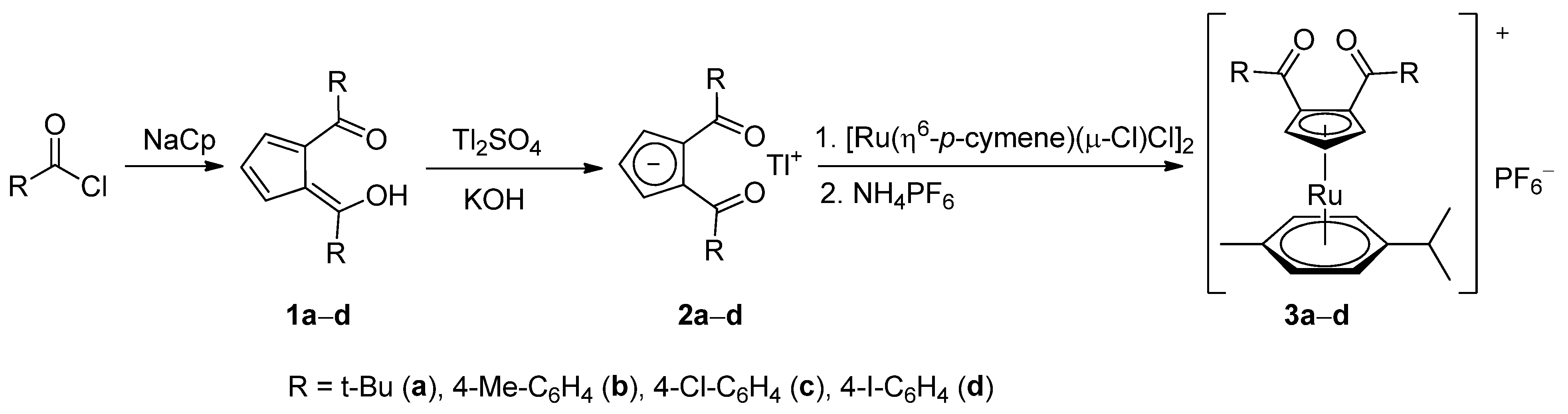
The syntheses of [Ru{η5-1,2-C5H3(COR)2}(η6-p-cymene)][PF6] (3ad) are shown in Scheme 1. The 2-acyl-6-hydroxyfulvenes (1ad) were conveniently synthesized by treating sodium or lithium cyclopentadiene with an acyl chloride in a 3:2 stoichiometric ratio [20,31]. The fulvenes exhibit intramolecular hydrogen bonding between the hydroxy group and the adjacent carbonyl oxygen as evidenced by the downfield signal (δ 16–20 ppm) of the enolic proton in their 1H NMR spectra. Further, the cyclopentadienyl protons display a characteristic 2:1 doublet:triplet pattern, consistent with a plane of symmetry. Their IR spectra show strong ν(C=O) bands in the 1580–1650 cm−1 region, indicative of conjugated carbonyl groups engaged in intramolecular hydrogen bonding.
Thallium reagents 2ad were conveniently prepared in moderate yield by using Tl2SO4/KOH in THF/H2O, rather than costly, thermally labile TlOEt [17,20,32]. The thallium salts are remarkably stable to air and moisture. Their formation is clearly evidenced by the complete disappearance of the enolic OH resonance in the 1H NMR spectra and by slight upfield shifts in the Cp proton resonances relative to the parent fulvenes, consistent with increased electron density in the cyclopentadienyl anion (Table 1).
The thallium(I) salts 2ad undergo clean transmetalation with [Ru(η6-p-cymene)(μ-Cl)Cl]2 [22] in a 2:1 stoichiometric ratio in acetonitrile at room temperature over 18–24 h. Subsequent anion metathesis with NH4PF6 in methanol affords the cationic ruthenium cyclopentadienyl–arene complexes 3ad in 30–70% yields. Reaction progress is conveniently monitored by the precipitation of thallium chloride, which is easily removed by filtration through Celite. Final purification is typically accomplished by trituration with cold pentane or ethyl ether or by slow crystallization from dichloromethane/hexane. The Cp proton chemical shifts range from 5.69 to 5.94 ppm for the outer protons and from 5.74 to 6.21 ppm for the inner protons (Table 1). The arene proton resonances appear in the range δ 5.81–6.51 ppm as AA′BB′ spin systems, clearly indicating η6 coordination. The corresponding 13C NMR resonances of the p-cymene ligand span the range 87–114 ppm. The IR spectra of 3ad show strong ν(C=O) absorptions in the 1655–1710 cm−1 range and medium-intensity ν(PF6) absorptions at 832–836 cm−1. Electron impact mass spectrometry of 3a shows a peak at m/z 468 corresponding to [M − PF6]+. In contrast, EI-MS measurements of 3bd did not display intact cation peaks ([M − PF6]+) under the same conditions; only fragment ions of low diagnostic value were observed, consistent with the reduced volatility and increased thermal fragility of the heavier aryl-substituted complexes. Elemental analyses of complexes 3bd consistently appeared slightly lower C and H values than calculated (ΔC up to 1.4%; ΔH up to 0.44%) despite repeated purification and drying. The observed deviations may arise from incomplete combustion during microanalysis or trace inorganic residues associated with these heavy-metal PF6 salts.

3.2. Molecular Structure of 3a

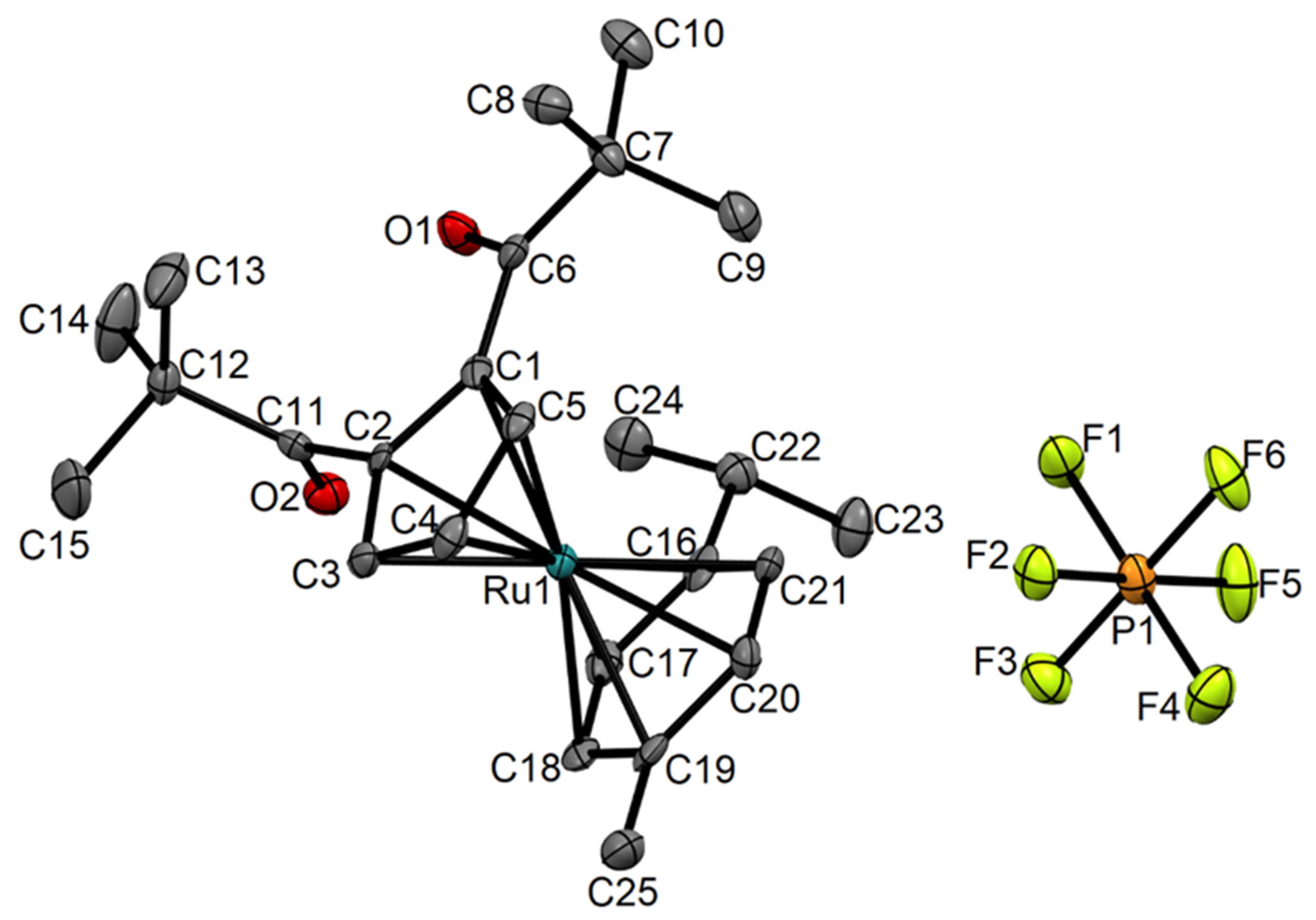
A thermal ellipsoid plot of the molecular structure of complex 3a is shown in Figure 1. Crystallographic and refinement parameters are summarized in Table 2, and the crystal packing along three axes is shown in Figures S1–S3. The compound crystallizes in an orthorhombic space group of type Pna21. The asymmetric unit contains one [Ru(η5-Cp)(η6-p-cymene)]+ cation and one hexafluorophosphate (PF6) counterion.
The cation of 3a is an η6p-cymene–η5–cyclopentadienyl ruthenium(II) sandwich complex, in which the Ru atom is positioned between two aromatic ligands. Ru1 is η5-coordinated to a substituted cyclopentadienyl ring (C1–C5) and η6-coordinated to the p-cymene ring (C16–C21). The η5-Cp and η6-p-cymene ligands are arranged in a near parallel fashion, with an interplanar angle of ca. 6.1° and a Ru-centered angle between their centroids of 175.1°, consistent with a well-aligned sandwich configuration. The Ru-centroid distances are 1.809 Å (Cp) and 1.710 Å (arene), in line with those observed in related Ru(II) sandwich complexes. Individual Ru–C bond distances reflect expected differences between η5- and η6-coordination. The Ru–C(Cp) distances span 2.164(4)–2.187(3) Å, whereas the Ru–C(p-cymene) distances are slightly longer, 2.196(3)–2.262(4) Å. The mean Ru–C(Cp) distance (ca. 2.180 Å) is therefore shorter than the mean Ru–C(arene) distance (ca. 2.218 Å). The results are consistent with trends observed in η6–arene–η5–cyclopentadienyl Ru(II) complexes and agree with the general expectation that the η5-bound Cp ligand forms slightly stronger metal–carbon contacts compared to η6–arene coordination [33].
The Ru–C distances to the two acyl-substituted cyclopentadienyl carbon atoms (C1 and C2) [2.186–2.187 Å] are slightly longer than those to the unsubstituted positions (C3–C5) [2.164–2.184 Å], reflecting the modest electron-withdrawing effect of the acyl groups. The carbonyl groups are well defined, with C=O distances of 1.225(4) and 1.215(5) Å, typical of localized ketone functionalities. Their orientations differ markedly: the C1–C6–O1 moiety is nearly coplanar with the Cp ring (interplanar angle ca. 2°), whereas the C2–C11–O2 fragment is nearly perpendicular (ca. 89°). The octahedral PF6 anion acts solely as a counterion. To the best of our knowledge, 3a represents the first crystallographically characterized Ru(II) complex combining a 1,2-diacylcyclopentadienyl ligand with a η6-p-cymene co-ligand.

3.3. Attempted Reactions of [Ru{η5-1,2-C5H3(COR)2}(η6-p-Cymene)][PF6] (3ad)

Attempts to convert the 1,2-diacylcyclopentadienyl ligands of 3ad to cyclopenta[c]thiophenes using established protocols [17,20,34] were unsuccessful. For example, a reaction of [Ru{η5-1,2-C5H3(CO-4-tol)2}(η6-p-cymene)][PF6] (3b) with P4S10 and NaHCO3 in CH2Cl2 gave a purple product, consistent with other cyclopenta[c]thiophene complexes. However, NMR analysis indicated loss of the p-cymene ligand and the presence of multiple unresolved signals, suggesting decomposition or formation of a mixture rather than a discrete cyclized product. No single, well-defined compound could be isolated for further characterization. Although the reactions were conducted under standard laboratory lighting, the possibility that partial photochemical ligand dissociation contributes to the observed cymene loss in 3b cannot be excluded.

4. Conclusions

We have developed a modular, three-step route to access a new family of cationic arene–ruthenium(II) complexes bearing electron-withdrawing 1,2-diacylcyclopentadienyl ligands. These results expand the range of electron-deficient Cp ligands compatible with Ru(II) half-sandwich frameworks, establishing a structural and synthetic foundation for future studies aimed at exploiting these electron-withdrawing Cp systems in organometallic reactivity and catalyst design. The successful synthesis and crystallographic characterization of representative complex 3a confirms that electron-withdrawing Cp frameworks can be incorporated into cationic Ru(II)–arene systems. While heterocycle formation was not achieved under the studied conditions, the present work expands the scope of ruthenium sandwich complexes and lays the foundation for future reactivity studies involving electron-deficient π-ligands.

Supplementary Materials

The following supporting information can be downloaded at: https://www.mdpi.com/article/10.3390/cryst16030201/s1. Figure S1: Packing diagram of 3a along a axis; Figure S2: Packing diagram of 3a along b axis; Figure S3: Packing diagram of 3a along c axis. CIF file of compound 3a.

Author Contributions

Conceptualization, J.P.S. and U.R.P.; synthesis and spectroscopic characterization, U.R.P.; X-ray crystallography, S.P.; writing—original draft preparation, U.R.P.; writing—review and editing, U.R.P., J.P.S. and S.P.; visualization, U.R.P.; project administration, J.P.S.; funding acquisition, J.P.S. All authors have read and agreed to the published version of the manuscript.

Funding

This research received no external funding.

Data Availability Statement

The original contributions of this study are included in the article; further inquiries can be directed to the corresponding authors.

Acknowledgments

The authors extend their appreciation to the Department of Chemistry, University of Kentucky, for providing funds for purchasing chemicals and characterization of the compounds.

Conflicts of Interest

The authors declare no conflicts of interest.

References

  1. Chen, K.; Shi, H. Nucleophilic aromatic substitution of halobenzenes and phenols with catalysis by arenophilic π acids. Acc. Chem. Res. 2024, 57, 2194–2206. [Google Scholar] [CrossRef]
  2. Pigge, F.; Coniglio, J.J. Stoichiometric applications of η6-Arene Ruthenium (II) complexes in organic chemistry. Curr. Org. Chem. 2001, 5, 757–784. [Google Scholar] [CrossRef]
  3. Moriarty, R.M.; Ku, Y.Y.; Gill, U. Synthesis and characterization of new (η6-substituted indole)(η5-cyclopentadienyl) ruthenium complexes. Nucleophilic displacement upon (η6-4 or η6-5 chloroindole)(η5-cyclopentadienyl) ruthenium (II) hexafluorophosphates. Organometallics 1988, 7, 660–665. [Google Scholar] [CrossRef]
  4. Clavel, C.M.; Pӑunescu, E.; Nowak-Sliwinska, P.; Griffioen, A.W.; Scopelliti, R.; Dyson, P.J. Modulating the anticancer activity of ruthenium (II)–arene complexes. J. Med. Chem. 2015, 58, 3356–3365. [Google Scholar] [CrossRef]
  5. Sonkar, C.; Sarkar, S.; Mukhopadhyay, S. Ruthenium (II)–arene complexes as anti-metastatic agents, and related techniques. RSC Med. Chem. 2022, 13, 22–38. [Google Scholar] [CrossRef]
  6. Geldbach, T.J.; Laurenczy, G.; Scopelliti, R.; Dyson, P.J. Synthesis of imidazolium-tethered ruthenium (II)-arene complexes and their application in biphasic catalysis. Organometallics 2006, 25, 733–742. [Google Scholar] [CrossRef]
  7. Rigby, J.H.; Kondratenko, M.A. Arene complexes as catalysts. In Transition Metal Arene π-Complexes in Organic Synthesis and Catalysis; Springer: London, UK, 2004; pp. 181–204. [Google Scholar]
  8. Gichumbi, J.M.; Friedrich, H.B.; Omondi, B. Application of arene ruthenium (II) complexes with pyridine-2-carboxaldimine ligands in the transfer hydrogenation of ketones. J. Mol. Catal. A Chem. 2016, 416, 29–38. [Google Scholar] [CrossRef]
  9. Colaiezzi, R.; Saviozzi, C.; di Nicola, N.; Zacchini, S.; Pampaloni, G.; Crucianelli, M.; Marchetti, F.; Di Giuseppe, A.; Biancalana, L. Ruthenium(II) arene complexes bearing simple dioxime ligands: Effective catalysts for the one-pot transfer hydrogenation/N-methylation of nitroarenes with methanol. Catal. Sci. Technol 2023, 13, 2160–2183. [Google Scholar] [CrossRef]
  10. Singh, A.K.; Pandey, D.S.; Xu, Q.; Braunstein, P. Recent advances in supramolecular and biological aspects of arene ruthenium (II) complexes. Coord. Chem. Rev. 2014, 270, 31–56. [Google Scholar] [CrossRef]
  11. Robertson, D.R.; Stephenson, T.; Arthur, T. Cationic, neutral and anionic complexes of ruthenium (II) containing η6-arene ligands. J. Organomet. Chem. 1978, 162, 121–136. [Google Scholar] [CrossRef]
  12. Mori, S.; Mochida, T. Organometallic ionic liquids from cationic arene–ruthenium complexes. Organometallics 2013, 32, 780–787. [Google Scholar] [CrossRef]
  13. Perekalin, D.S.; Kudinov, A.R. Cyclopentadienyl ruthenium complexes with naphthalene and other polycyclic aromatic ligands. Coord. Chem. Rev. 2014, 276, 153–173. [Google Scholar] [CrossRef]
  14. Wilkinson, L.A.; Pike, J.A.; Walton, J.W. C–H Activation of π-Arene Ruthenium Complexes. Organometallics 2017, 36, 4376–4381. [Google Scholar] [CrossRef]
  15. Schrenk, J.L.; McNair, A.M.; McCormick, F.B.; Mann, K.R. Effect of arene methylation on photochemical arene replacement reactions of the iron and ruthenium complexes [(η5-C5(CH3)5)M (η6-arene)]+ (M = Fe, Ru) complexes. Inorg. Chem. 1986, 25, 3501–3504. [Google Scholar] [CrossRef]
  16. McNair, A.M.; Mann, K.R. Synthesis and reactivity of ruthenium cyclopentadienyl [(η5-C5R5)Ru(η6-arene)]PF6 (R = H, CH3) complexes of naphthalene, anthracene, pyrene, chrysene and azulene. Kinetic studies of arene displacement reactions in acetonitrile solutions. Inorg. Chem. 1986, 25, 2519–2527. [Google Scholar] [CrossRef]
  17. Wallace, C.E.; Selegue, J.P.; Carrillo, A. Synthesis and Characterization of a 1,2-Dibenzoylruthenocene and a Derived Pyridazine. Organometallics 1998, 17, 3390–3393. [Google Scholar] [CrossRef]
  18. Tice, N.C.; Snyder, C.A.; Preston, A.Z.; Wieliczko, M.B.; Young, J.O.; Hinson, D.F. Synthesis and structure of some group VII 1, 2-diacylcyclopentadiene complexes and their pyridazine derivatives. Transit. Met. Chem. 2012, 37, 141–147. [Google Scholar] [CrossRef]
  19. Snyder, C.A.; Tice, N.C.; Maddox, J.B.; Emberton, E.D.; Vanover, E.S.; Hinson, D.F.; Jackson, D.C. Synthesis, structure, and electronic study of some group VII furoyl substituted complexes. J. Organomet. Chem. 2011, 696, 2220–2227. [Google Scholar] [CrossRef]
  20. Snyder, C.A.; Selegue, J.P.; Tice, N.C.; Wallace, C.E.; Blankenbuehler, M.T.; Parkin, S.; Allen, K.D.E.; Beck, R.T. Synthesis, Characterization, and Structure of Cyclopenta[c]thiophenes and Their Manganese Complexes. J. Am. Chem. Soc. 2005, 127, 15010–15011. [Google Scholar] [CrossRef]
  21. Pokharel, U.R.; Selegue, J.P.; Parkin, S. Ruthenocene 1,2-Dicarboxylic Acid, Carboxylic Anhydride, and Acid Chloride: A Facile Route to Metallocene-Fused Acenequinones. Organometallics 2011, 30, 3254–3256. [Google Scholar] [CrossRef]
  22. Bennett, M.A.; Smith, A.K. Arene ruthenium (II) complexes formed by dehydrogenation of cyclohexadienes with ruthenium (III) trichloride. J. Chem. Soc. Dalton Trans. 1974, 2, 233–241. [Google Scholar] [CrossRef]
  23. Tice, N.C.; Collins, E.M.; Smith, D.L.; Snyder, C.A.; Yan, B.; Stevens, E.D. Synthesis, Characterization, and Structure of Some 1,4-Disubstituted Cyclopenta[d][1,2]oxazines. J. Heterocycl. Chem. 2017, 54, 3235–3240. [Google Scholar] [CrossRef]
  24. Balbo Block, M.A.; Hecht, S. Poly(propylene oxide)-Poly(phenylene ethynylene) Block and Graft Copolymers. Macromolecules 2008, 41, 3219–3227. [Google Scholar] [CrossRef]
  25. Nonius COLLECT Software, Nonius B. V.: Delft, The Netherlands, 1998.
  26. Otwinowski, Z.; Minor, W. Processing of X-ray diffraction data collected in oscillation mode. In Methods in Enzymology; Academic Press: Cambridge, MA, USA, 1997; Volume 276, pp. 307–326. [Google Scholar]
  27. Parkin, S.; Moezzi, B.; Hope, H. XABS2: An empirical absorption correction program. Appl. Crystallogr. 1995, 28, 53–56. [Google Scholar] [CrossRef]
  28. Sheldrick, G. A short history of SHELX. Acta. Crystallogr. A 2008, 64, 112–122. [Google Scholar] [CrossRef]
  29. Sheldrick, G.M. Crystal structure refinement with SHELXL. Cryst. Struct. Commun. 2015, 71, 3–8. [Google Scholar] [CrossRef] [PubMed]
  30. Little, W.F.; Koestler, R.C. Preparation of Substituted Ferrocenes from Fulvenoid Compounds1. J. Org. Chem. 1961, 26, 3245–3247. [Google Scholar] [CrossRef]
  31. Linn, W.J.; Sharkey, W.H. The Benzoylation of Cyclopentadienyllithium. J. Am. Chem. Soc. 1957, 79, 4970–4972. [Google Scholar] [CrossRef]
  32. Blankenbuehler, M.T.; Selegue, J.P. The synthesis and characterization of 1-formyl-2-acylcyclopentadienylthallium compounds. J. Organomet. Chem. 2002, 642, 268–274. [Google Scholar] [CrossRef]
  33. Wylie, W.N.O.; Lough, A.J.; Morris, R.H. (η5-Pentamethylcyclopentadienyl)(η6-toluene)ruthenium(II) hexafluoridophosphate. Acta Crystallogr. E 2010, 66, m1264. [Google Scholar]
  34. Tice, N.C.; Little, D.J.; Mattern-Mondragon, V.; King, S.T.; Selegue, J.P.; Parkin, S. Synthesis, Characterization, and Electrochemical Polymerization of Some 5,5-Fused Ring Terthiophene Tricarbonyl Manganese Complexes. Organometallics 2025, 44, 54–67. [Google Scholar] [CrossRef]
Scheme 1. Synthesis of [Ru{η5-1,2-C5H3(COR)2}(η6-p-cymene)][PF6] (3ad).
Crystals 16 00201 sch001
Figure 1. The molecular structure of 3a, showing 50% probability displacement ellipsoids; H atoms omitted for clarity. Selected bond lengths (Å): Ru1–C1 2.187(3), Ru1–C2 2.186(4), Ru1–C3 2.184(4), Ru1–C4 2.164(4), Ru1–C5 2.178(3), Ru1–C16 2.262(4), Ru1–C17 2.211(4), Ru1–C18 2.196(3), Ru1–C19 2.210(3), Ru1–C20 2.211(4), Ru1–C21 2.218(4), C6-O1 1.225(5), C11-O2 1.215(5).
Crystals 16 00201 g001
Table 1. Chemical shift values (δ in ppm) of Cp protons and IR stretching (cm−1) of C=O in compounds 1d, 2d, and 3d.
Crystals 16 00201 i001
CompoundCp-H (triplet)Cp-H (doublet)IR (C=O)
1d i6.497.221579
2d ii5.686.231650
3d iii5.926.191655
i = CDCl3, ii = DMSO-d6, iii = acetone-d6.
Table 2. Crystal data and refinement parameters for compound 3a.
ParameterValue
Empirical formulaC25H35F6O2PRu
Mr613.57
Deposition numberCCDC2517689
Temperature (K)90.0(2)
Radiation typeMo Kα
Wavelength (Å)0.71073
Crystal systemOrthorhombic
Space groupPna21
a (Å)10.4848(2)
b (Å)23.8423(5)
c (Å)10.4241(2)
α (°)90
β (°)90
γ (°)90
V3)2605.83(9)
Z4
Calculated density, Dx (Mg m−3)1.564
μ (mm−1)0.727
Crystal size (mm)0.30 × 0.12 × 0.10
DiffractometerNonius KappaCCD
Absorption correctionMulti-scan, empirical
θ range (°)1.71–27.49
Reflections collected24,539
Independent reflections5947
Rint0.0564
Refinement methodFull-matrix least-squares on F2
Data/restraints/parameters5947/1/325
Goodness-of-fit on F21.055
Final R indexes [I > 2σ(I)]R1 = 0.0337, wR2 = 0.0584
Final R indexes (all data)R1 = 0.0590, wR2 = 0.0655
Largest diff. peak/hole (e·Å−3)1.434/−0.489
Disclaimer/Publisher’s Note: The statements, opinions and data contained in all publications are solely those of the individual author(s) and contributor(s) and not of MDPI and/or the editor(s). MDPI and/or the editor(s) disclaim responsibility for any injury to people or property resulting from any ideas, methods, instructions or products referred to in the content.