
Dual-Site Synergy of Ag/FeOOH Boosts Electrocatalytic Reduction of Nitrate

Abstract
1. Introduction
2. Results
2.1. Characterization of Catalysts
2.2. NO3RR Performance
2.3. Mechanism Analysis
2.4. Zn-NO3− Battery Application of Ag-FeOOH
3. Materials and Methods
3.1. Material Preparation
- (1)
- Hydrothermal Synthesis of FeOOH Catalyst
- (2)
- Electroplating of Ag onto FeOOH
3.2. Product Detection
- (1)
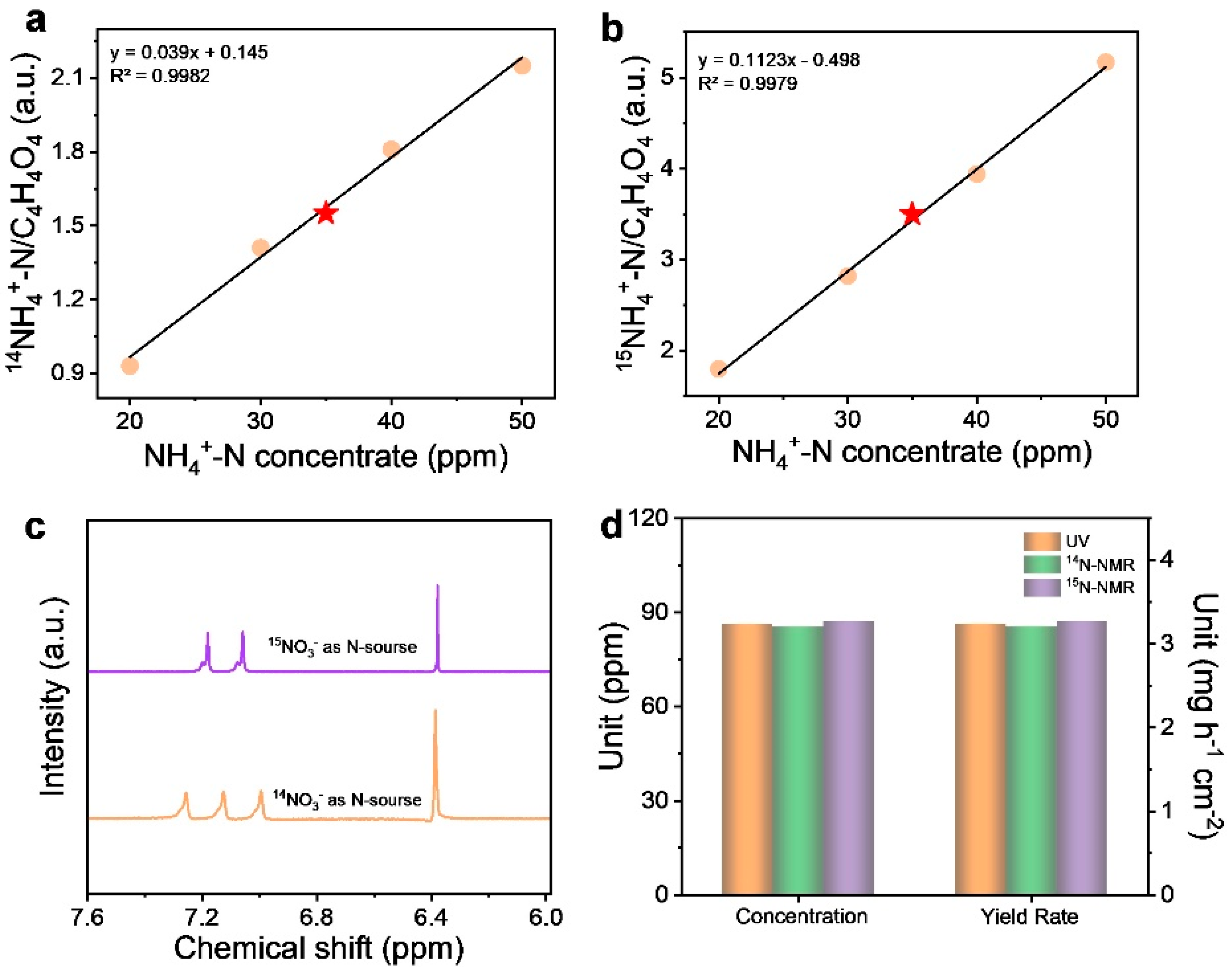
- Determination of NO3−-N Concentration: An appropriate amount of the electrolyte sample was pipetted into a centrifuge tube and diluted to 5 mL with deionized water. Then, 200 μL of NH3SO3 reagent (5 wt%) was added. The mixture was placed on a laboratory bench and allowed to react at room temperature in the dark for 15 min. After the color reaction was complete, the absorbance values at dual wavelengths of 220 nm and 275 nm were measured using a quartz cuvette in a UV-Vis spectrophotometer. During data processing, the dual-wavelength correction method was used to calculate the net absorbance value (A = A220 nm − 2 × A275 nm). The standard curve of NO3−-N (Figure 6a,b) was obtained by fitting the absorbance values corresponding to different concentrations of NO3−-N solutions [26].
- (2)
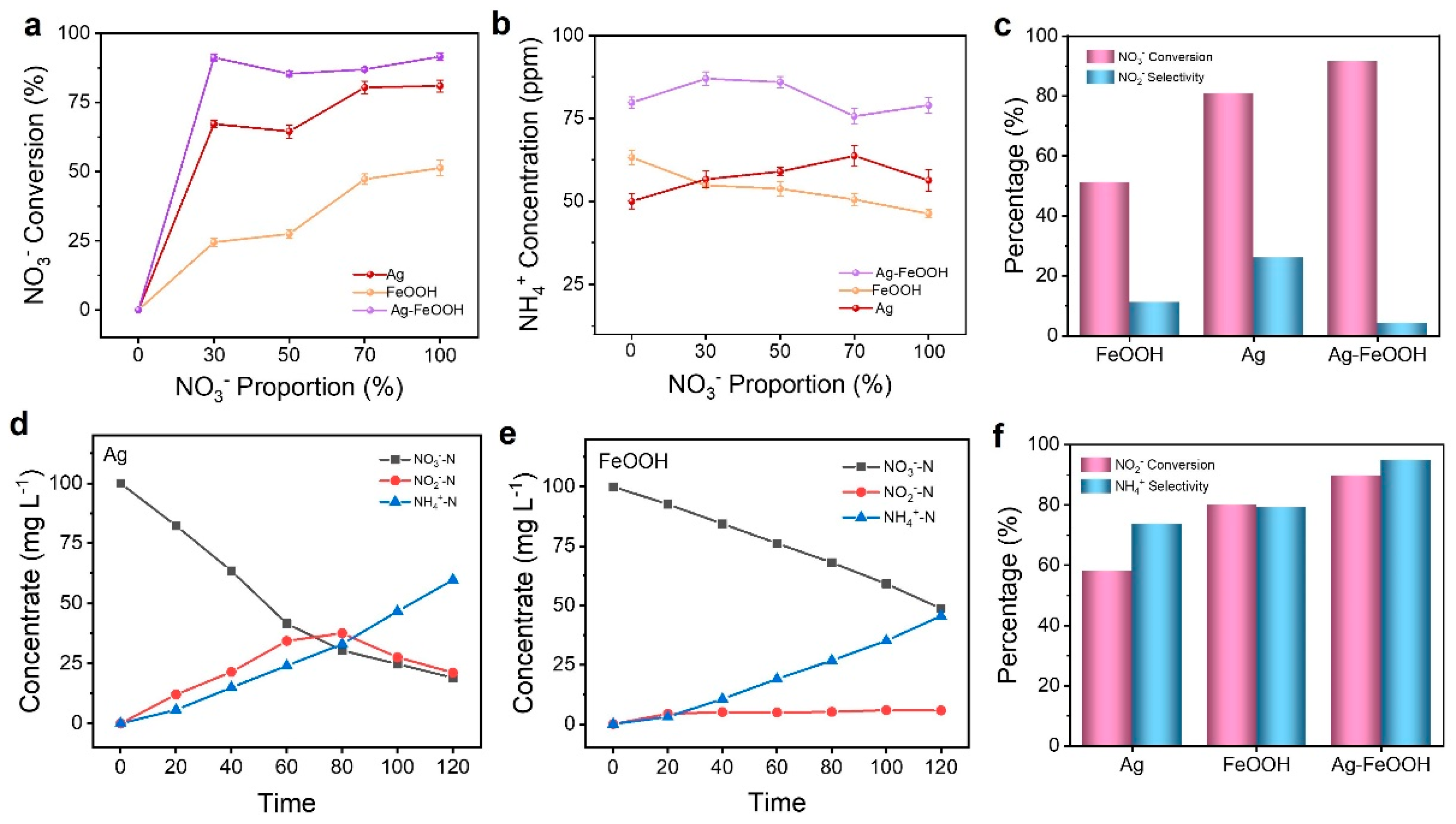
- Determination of NO2−-N Concentration: First, 25 mL of deionized water was placed in a beaker, followed by the sequential addition of 2 g of C6H8N2O2S reagent and 0.1 g of C12H14N2·2HCl while stirring. Then, 5 mL of H3PO4 was slowly added dropwise to form a transparent solution. An appropriate amount of the electrolyte sample to be tested was pipetted and diluted to 5 mL, mixed well, and then 100 μL of a freshly prepared color reagent was added. The mixture was placed in a dark box and allowed to stand in the dark for 20 min. The absorbance value of the colored solution was measured at the characteristic absorption wavelength of 540 nm using a UV-Vis spectrophotometer. The standard curve of NO2−-N (Figure 2 and Figure 3b) was obtained by fitting the absorbance values corresponding to different concentrations of NO2−-N solutions [27].
- (3)
- Determination of NH4+-N Concentration: The concentration of NH4+-N was detected using Nessler’s reagent colorimetric method. First, Nessler’s reagent was prepared by dissolving 0.8 g of NaOH in 5 mL of deionized water and allowing the solution to cool to room temperature. Then, 0.35 g of KI and 0.5 g of HgI2 were added, and the mixture was stirred until fully dissolved. Subsequently, an appropriate amount of the electrolyte sample was pipetted into a centrifuge tube and diluted to 5 mL with deionized water. After that, 100 µL of NaKC4H4O6 solution (0.5 g mL−1) and 100 µL of Nessler’s reagent were added sequentially. The mixture was placed in a dark box and allowed to stand in the dark for 30 min. The absorbance value of the colored solution was measured at the characteristic absorption wavelength of 420 nm using a UV-Vis spectrophotometer. The standard curve of NH4+-N (There is a typo in the original text; it should be NH4+-N instead of NO3−-N and NO2−-N here, Figure 2 and Figure 3c) was obtained by fitting the absorbance values corresponding to different concentrations of NH4+-N solutions [28]. Gaseous products (N2, N2O) were not quantitatively detected. The ammonia selectivity was calculated based on UV-Vis and 1H NMR results and may be subject to a certain degree of overestimation, which is an inherent limitation of the conventional methods in this field.
3.3. Characterization
4. Conclusions
Author Contributions
Funding
Data Availability Statement
Acknowledgments
Conflicts of Interest
References
- Han, H.S.; Li, H.J.; Li, T.L.; Chen, F.P.; Yang, R.; Yu, Y.F.; Zhang, B. Ultralow overpotential nitrate reduction to ammonia via a three-step relay mechanism. Nat. Catal. 2023, 6, 402–414. [Google Scholar] [CrossRef]
- Shi, Y.B.; Xu, S.X.; Li, F. Electrocatalytic nitrate reduction to ammonia via amorphous cobalt boride. Chem. Commun. 2022, 58, 8714–8717. [Google Scholar] [CrossRef]
- Sun, F.Q.; Gao, Y.F.; Li, M.J.; Wen, Y.K.; Fang, Y.J.; Meyer, T.J.; Shan, B. Molecular self-assembly in conductive covalent networks for selective nitrate electroreduction to ammonia. J. Am. Chem. Soc. 2023, 145, 21491–21501. [Google Scholar] [CrossRef] [PubMed]
- Wang, Y.L.; Xia, L.Y.; Xiang, X.L.; Yuan, R.; Wei, S.P. A new photoelectrochemical biosensor based on FeOOH and exonuclease III-aided dual recycling signal amplification for HPV-16 detection. Chem. Commun. 2021, 57, 6416–6419. [Google Scholar] [CrossRef]
- Wang, Z.; Zhou, N.; Wang, J.Z.; Wang, D.P.; Zeng, J.R.; Zhong, H.X.; Zhang, X.B. Highly efficient electrochemical ammonia synthesis via nitrate reduction over metallic Cu phase coupling sulfion oxidation. Chemsuschem 2024, 17, e202301050. [Google Scholar] [CrossRef]
- Zeng, F.; Mebrahtu, C.; Liao, L.F.; Beine, A.K.; Palkovits, R. Stability and deactivation of OER electrocatalysts: A review. J. Energy Chem. 2022, 69, 301–329. [Google Scholar] [CrossRef]
- Zeng, Y.; Li, C.; Li, B.; Liang, J.S.; Zachman, M.J.; Cullen, D.A.; Hermann, R.P.; Alp, E.E.; Lavina, B.B.; Kalakalos, S.; et al. Tuning the thermal activation atmosphere breaks the activity-stability trade-off of Fe-N-C oxygen reduction fuel cell catalysts. Nat. Catal. 2023, 6, 1215–1227. [Google Scholar] [CrossRef]
- Xiong, Y.C.; Wang, Y.H.; Zhou, J.W.; Liu, F.; Hao, F.K.; Fan, Z.X. Electrochemical nitrate reduction: Ammonia synthesis and the beyond. Adv. Mater. 2024, 36, 2304021. [Google Scholar] [CrossRef]
- Han, D.; Wang, P.; Huang, H.T.; Deng, J.H.; Chen, J.K.; Tang, W.J.; Wang, T.Y.; Li, B.B.; Zhang, L.L.; Lai, L.F. Super-elastic and temperature-tolerant hydrogel electrodes for supercapacitors via MXene enhanced ice-templating synthesis. Small 2024, 20, 2400690. [Google Scholar] [CrossRef]
- Xue, Y.; Zhao, J.; Huang, L.; Lu, Y.R.; Malek, A.; Gao, G.; Zhuang, Z.B.; Wang, D.S.; Yavuz, C.T.; Lu, X. Stabilizing ruthenium dioxide with cation- anchored sulfate for durable oxygen evolution in proton-exchange membrane water electrolyzers. Nat. Commun. 2023, 14, 8093. [Google Scholar] [CrossRef] [PubMed]
- Zhou, B.; Zhan, G.M.; Yao, Y.C.; Zhang, W.X.; Zhao, S.X.; Quan, F.J.; Fang, C.Y.; Shi, Y.B.; Huang, Y.; Jia, F.L.; et al. Renewable energy driven electroreduction nitrate to ammonia and in-situ ammonia recovery via a flow-through coupled device. Water Res. 2023, 242, 120256. [Google Scholar] [CrossRef]
- Zhu, X.F.; Wang, Z.L.; Ren, J.; ALMasoud, N.; EI-Bahy, Z.M.; ALomar, T.S.; Zhang, C.; Zhang, J.; Zhou, J.Y.; Li, M.F.; et al. Graphene/polyacrylamide interpenetrating structure hydrogels for wastewater treatment. Adv. Compos. Hybrid Mater. 2023, 6, 169. [Google Scholar] [CrossRef]
- Chen, J.; Peng, B.; Sun, W. Pure negative electrocaloric effect achieved by SiN/p-GaN composite substrate. Nano Energy 2022, 97, 107195. [Google Scholar] [CrossRef]
- Ji, S.; Shin, J.; Yoon, J.; Lim, K.H.; Sim, G.D.; Lee, Y.S.; Kim, D.H.; Cho, H.C.; Park, J.Y. Three-dimensional skin-type triboelectric nanogenerator for detection of two-axis robotic-arm collision. Nano Energy 2022, 97, 107225. [Google Scholar] [CrossRef]
- Niu, Y.; Dong, J.; He, Y.; Xu, X.W.; Li, S.; Wu, K.; Wang, Q.; Wang, H. Significantly enhancing the discharge efficiency of sandwich-structured polymer dielectrics at elevated temperature by building carrier blocking interface. Nano Energy 2022, 97, 107215. [Google Scholar] [CrossRef]
- Zhang, J.; Fu, X.; Kwon, S.; Chen, K.F.; Liu, X.Z.; Yang, J.; Sun, H.R.; Wang, Y.C.; Uchiyama, T.; Uchimoto, Y.; et al. Tantalum-stabilized ruthenium oxide electrocatalysts for industrial water electrolysis. Science 2025, 387, 48–55. [Google Scholar] [CrossRef]
- Gao, Z.R.; Li, A.W.; Liu, X.W.; Peng, M.; Yu, S.X.; Wang, M.L.; Ge, Y.Z.; Li, C.Y.; Wang, T.; Wang, Z.H.; et al. Shielding Pt/γ-Mo2N by inert nano-overlays enables stable H2 production. Nature 2025, 691, 690–696. [Google Scholar] [CrossRef] [PubMed]
- Wang, K.F.; Mao, R.; Liu, R.; Zhang, J.J.; Zhao, H.C.; Ran, W.; Zhao, X. Intentional Ccorrosion-Induced Reconstruction of Defective NiFe Layered Double Hydroxide Boosts Electrocatalytic Nitrate Reduction to Ammonia. Nat. Water 2023, 1, 1068–1078. [Google Scholar] [CrossRef]
- Zhang, Z.; Zhang, N.; Zhang, J.; Deng, B.Q.; Cao, Z.Y.; Wang, Z.B.; Wei, G.F.; Zhang, Q.B.; Jia, R.Y.; Xiang, P.Y.; et al. Critical Review in Electrocatalytic Nitrate Reduction to Ammonia Towards a Sustainable Nitrogen Utilization. Chem. Eng. J. 2024, 483, 148952. [Google Scholar] [CrossRef]
- Fan, K.; Xie, W.; Li, J.; Sun, Y.N.; Xu, P.C.; Tang, Y.; Li, Z.H.; Shao, M.F. Active Hydrogen Boosts Electrochemical Nitrate Reduction to Ammonia. Nat. Commun. 2022, 13, 7958. [Google Scholar] [CrossRef]
- Du, H.; Guo, H.; Wang, K.; Du, X.N.; Beshiwork, B.A.; Sun, S.J.; Luo, Y.S.; Liu, Q.; Li, T.S.; Sun, X.P. Durable Electrocatalytic Reduction of Nitrate to Ammonia over Defective Pseudobrookite Fe2TiO5 Nanofibers with Abundant Oxygen Vacancies. Angew. Chem. Int. Ed. 2023, 62, e202215782. [Google Scholar] [CrossRef] [PubMed]
- Zhang, H.; Wang, C.; Luo, H.; Chen, J.L.; Kuang, M.; Yang, J.P. Iron Nanoparticles Protected by Chainmail-structured Graphene for Durable Electrocatalytic Nitrate Reduction to Nitrogen. Angew. Chem. Int. Ed. 2023, 62, e202217071. [Google Scholar] [CrossRef]
- Song, Z.; Liu, Y.; Zhong, Y.; Guo, Q.; Zeng, J.; Geng, Z.G. Efficient Electroreduction of Nitrate into Ammonia at Ultralow Concentrations Via an Enrichment Effect. Adv. Mater. 2022, 34, e2204306. [Google Scholar] [CrossRef]
- Gu, Z.; Zhang, Y.; Wei, X.; Duan, Z.Y.; Gong, Q.Y.; Luo, K. Intermediates Regulation via Electron-Deficient Cu Sites for Selective Nitrate-to-Ammonia Electroreduction. Adv. Mater. 2023, 35, 2303107. [Google Scholar] [CrossRef] [PubMed]
- Li, H.K.; Zhong, J.; Long, Y.C.; Tang, X.X.; Zhou, B.B.; Li, Z.B.; Zhang, S.C.; Ma, N.G.; Fan, J.; Zhi, C.Y.; et al. In Situ Activated, Distorted, and Defective Cu for Nitrate Reduction Reaction. Adv. Funct. Mater. 2026, 36, e74570. [Google Scholar] [CrossRef]
- Zhang, X.; Wang, Y.T.; Liu, C.B.; Yu, Y.F.; Lu, S.Y.; Zhang, B. Recent advances in non-noble metal electrocatalysts for nitrate reduction. Chem. Eng. J. 2021, 403, 126269. [Google Scholar] [CrossRef]
- Zuo, L.B.; Lou, F.C.; Guo, J.T.; Wang, M.; Geng, S. Accelerating Active Hydrogen Generation for Boosting the Electroreduction of Nitrate to Ammonia. Chem. Eng. J. 2025, 517, 163630. [Google Scholar] [CrossRef]
- Zhang, Z.D.; Lv, Y.; Gu, Y.M.; Zhou, X.C.; Tian, B.L.; Zhang, A.Q.; Yang, Z.M.; Chen, S.Z.; Ma, J.; Ding, M.N.; et al. Dual Zn5-NiS4 Sites in a Redox-Active Metal-Organic Framework Enables Efficient Cascade Catalysis for Nitrate-to-Ammonia Conversion. Angew. Chem. Int. Ed. 2025, 64, e202418272. [Google Scholar] [CrossRef]




Disclaimer/Publisher’s Note: The statements, opinions and data contained in all publications are solely those of the individual author(s) and contributor(s) and not of MDPI and/or the editor(s). MDPI and/or the editor(s) disclaim responsibility for any injury to people or property resulting from any ideas, methods, instructions or products referred to in the content. |
© 2026 by the authors. Licensee MDPI, Basel, Switzerland. This article is an open access article distributed under the terms and conditions of the Creative Commons Attribution (CC BY) license.
Share and Cite
Xu, Y.; Xia, R.; Ji, X.; Hu, J.; Huang, F. Dual-Site Synergy of Ag/FeOOH Boosts Electrocatalytic Reduction of Nitrate. Catalysts 2026, 16, 533. https://doi.org/10.3390/catal16060533
Xu Y, Xia R, Ji X, Hu J, Huang F. Dual-Site Synergy of Ag/FeOOH Boosts Electrocatalytic Reduction of Nitrate. Catalysts. 2026; 16(6):533. https://doi.org/10.3390/catal16060533
Chicago/Turabian StyleXu, Yanhui, Rongjun Xia, Xingxing Ji, Jiwen Hu, and Fangzhi Huang. 2026. "Dual-Site Synergy of Ag/FeOOH Boosts Electrocatalytic Reduction of Nitrate" Catalysts 16, no. 6: 533. https://doi.org/10.3390/catal16060533
APA StyleXu, Y., Xia, R., Ji, X., Hu, J., & Huang, F. (2026). Dual-Site Synergy of Ag/FeOOH Boosts Electrocatalytic Reduction of Nitrate. Catalysts, 16(6), 533. https://doi.org/10.3390/catal16060533