Article

Dual-Site Synergy of Ag/FeOOH Boosts Electrocatalytic Reduction of Nitrate
1
Department of Pharmacy, Bozhou Vocational and Technical College, Bozhou 236800, China
2
Lab of Clean Energy & Environmental Catalysis, AnHui Province Key Laboratory of Chemistry for Inorganic/Organic Hybrid Functionalized Materials, School of Chemistry and Chemical Engineering, Anhui University, Hefei 230601, China
*
Authors to whom correspondence should be addressed.
Catalysts 2026, 16(6), 533; https://doi.org/10.3390/catal16060533 (registering DOI)
Submission received: 22 April 2026 / Revised: 29 May 2026 / Accepted: 5 June 2026 / Published: 9 June 2026
(This article belongs to the Section Electrocatalysis)

Abstract

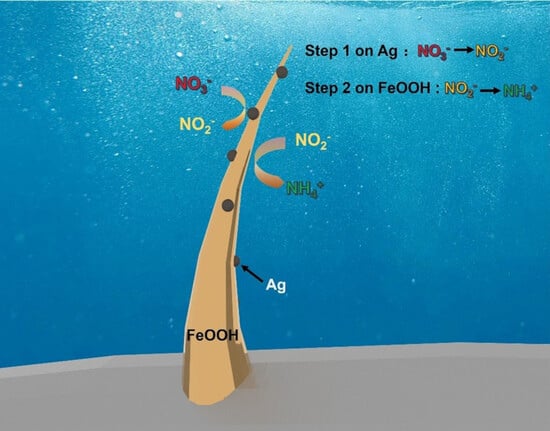
In nitrate electrochemical reduction reaction (NO3RR), competing side reactions like hydrogen evolution often lead to poor selectivity and subpar kinetics, limiting practical use. Herein, using iron oxyhydroxide nanoarrays grown on a titanium mesh as the substrate, silver nanoparticles were introduced onto the tips of the iron oxyhydroxide nanowires via electrochemical deposition, thereby forming an Ag/FeOOH heterojunction electrocatalyst. At −0.85 V, Ag/FeOOH demonstrates excellent performance, with 97.56% ammonium selectivity, 92.45% nitrate conversion rate, and an ammonium yield of 3.21 mg h−1 cm−2. Furthermore, the Zn-NO3 battery exhibited a power density of 1.28 mW cm−2. Ag/FeOOH’s structure enhances interfacial nitrate adsorption and reduces NO3RR energy barriers, accelerating reaction kinetics. It promotes NO3-to-NO2 conversion via dual-site synergy, boosting NH4+ yield and advancing electrocatalyst design.

Graphical Abstract

1. Introduction

Ammonia (NH3), as a vital chemical, finds extensive and indispensable applications across various industries, including agriculture, fertilizers, textiles, refrigeration, pharmaceuticals, and explosives [1,2,3]. However, current industrial-scale ammonia production primarily relies on the energy-intensive Haber–Bosch process [4,5]. Concurrently, the issue of nitrate pollution in water bodies is becoming increasingly severe [6,7]. Given the high solubility of nitrate ions (NO3) and the moderate dissociation energy (204 kJ mol−1) of the N=O bond in their molecular structure, the production of ammonia through the electrochemical nitrate reduction reaction (NO3RR) has emerged as a highly promising alternative pathway. This approach not only effectively mitigates nitrate pollution but also simultaneously generates valuable ammonia [8,9]. Despite its immense application potential, NO3RR still faces a fundamental challenge in practical applications. Specifically, competitive side reactions such as the hydrogen evolution reaction (HER) and the formation of nitrite ions (NO2) occur during the NO3RR process. The presence of these side reactions often leads to suboptimal selectivity and kinetic performance of NO3RR [10]. Therefore, developing effective strategies to precisely regulate the local electronic environment at the active sites of catalysts, thereby synergistically enhancing catalytic activity, holds crucial significance for achieving high-performance NO3RR.
The interaction between a metal and its support plays a pivotal role in regulating catalytic performance by modulating the electronic structure, geometric environment, and adsorption properties of active sites, thereby guiding the reaction pathway [11,12]. Introducing new catalytically active sites can create synergistic effects. For instance, anchoring metal atoms onto the surface of oxides or carbon materials enables atomic-level efficient utilization and introduces novel catalytically active sites [13,14,15]. These operations not only construct synergistic effects through strategies such as spatial separation and electronic modulation to enhance catalytic performance but also improve the corrosion resistance and cycle life of catalytic electrodes under harsh reaction conditions (e.g., high acidity and high potential) by regulating the surface structure, composition, and electronic properties of the catalysts. For example, Zhang et al. [16] incorporated Ta into RuO2, significantly suppressing Ru dissolution while enhancing the activity of the oxygen evolution reaction (OER). The introduction of Ta stabilized the surface structure of RuO2, reduced the corrosion rate, and rendered its stability in industrial water electrolysis close to that of IrO2, with an overpotential reduction of 330 mV and a lifespan exceeding 2800 h. Gao et al. [17] constructed a rare-earth oxide (e.g., La2O3) coating on the surface of a Pt/γ-Mo2N catalyst, effectively isolating the active sites from the corrosive environment and enabling the catalyst to achieve a lifespan exceeding 1000 h and a turnover number (TON) exceeding 15 million in methanol–water reforming for hydrogen production.
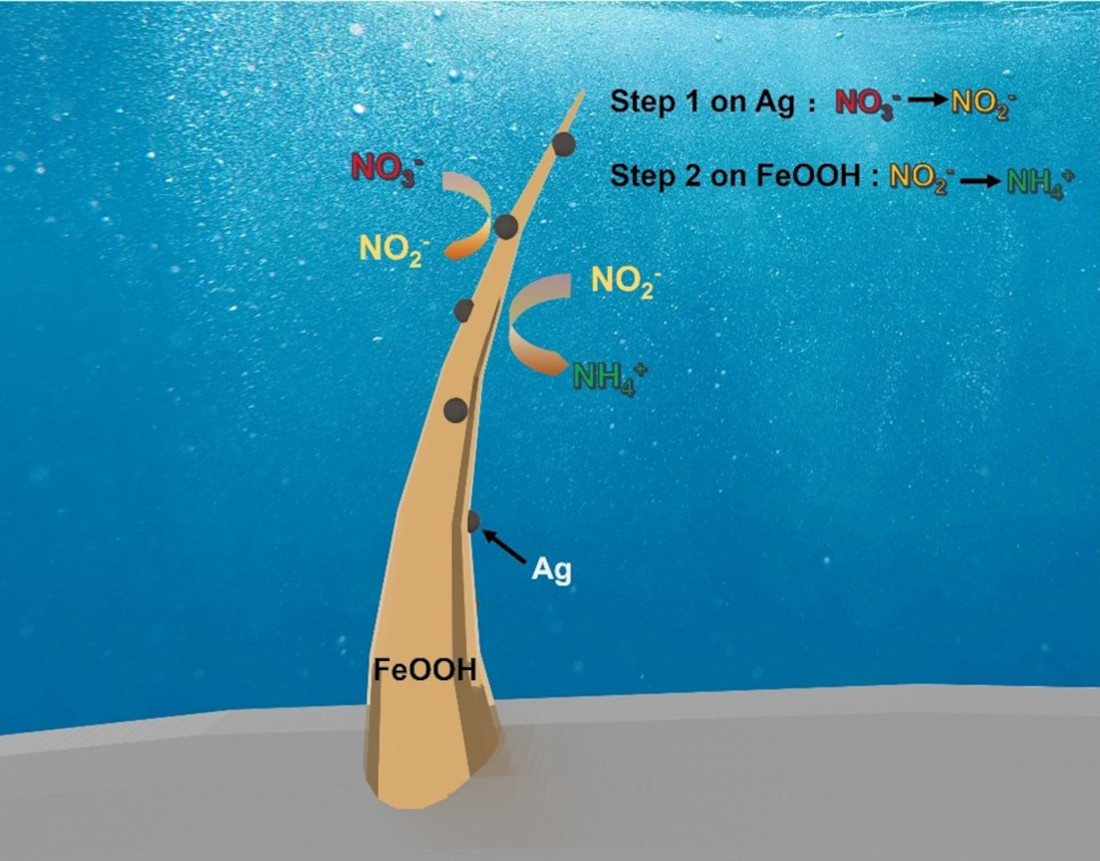
In this work, a facile electrochemical reduction method was employed to successfully introduce Ag nanoparticles onto the surface of FeOOH. Experimental results demonstrate that this composite material exhibits outstanding performance in both the electrocatalytic NO3 reduction system and the Zn-NO3 battery system. FeOOH with introduced Ag nanoparticles offers significant advantages: Firstly, the introduced Ag catalytically active sites can accelerate the conversion rate of NO3 to NO2 while synergistically cooperating with the conversion process of NO2 to NH4+ on FeOOH, thereby comprehensively enhancing the efficiency of the electrocatalytic NO3RR (nitrate reduction reaction) of the catalytic material. Secondly, based on mixed electrolytes with different feed ratios of NO3 and NO2, by leveraging the differences in the conversion efficiencies of NO3 and NO2 at the dual active sites of Ag and FeOOH, the electrocatalytic NO3RR process can be coordinated and optimized, ultimately achieving a superior ammonium yield. In conclusion, the Ag-FeOOH designed through the method of introducing active sites provides a novel approach for the design of electrocatalytic NO3 reduction catalysts. Moreover, the carefully designed metal interface modification and passivation treatment can induce an asymmetric charge distribution, facilitating electron transfer from Ag to FeOOH, accelerating the electron transfer process, and increasing ammonia production. This study focuses on the interface modification of metal particles and establishes the mutual synergy between metals and supports as a key principle for designing catalytic electric fields, significantly advancing the field of sustainable electrocatalysis for the nitrogen cycle.

2. Results

2.1. Characterization of Catalysts

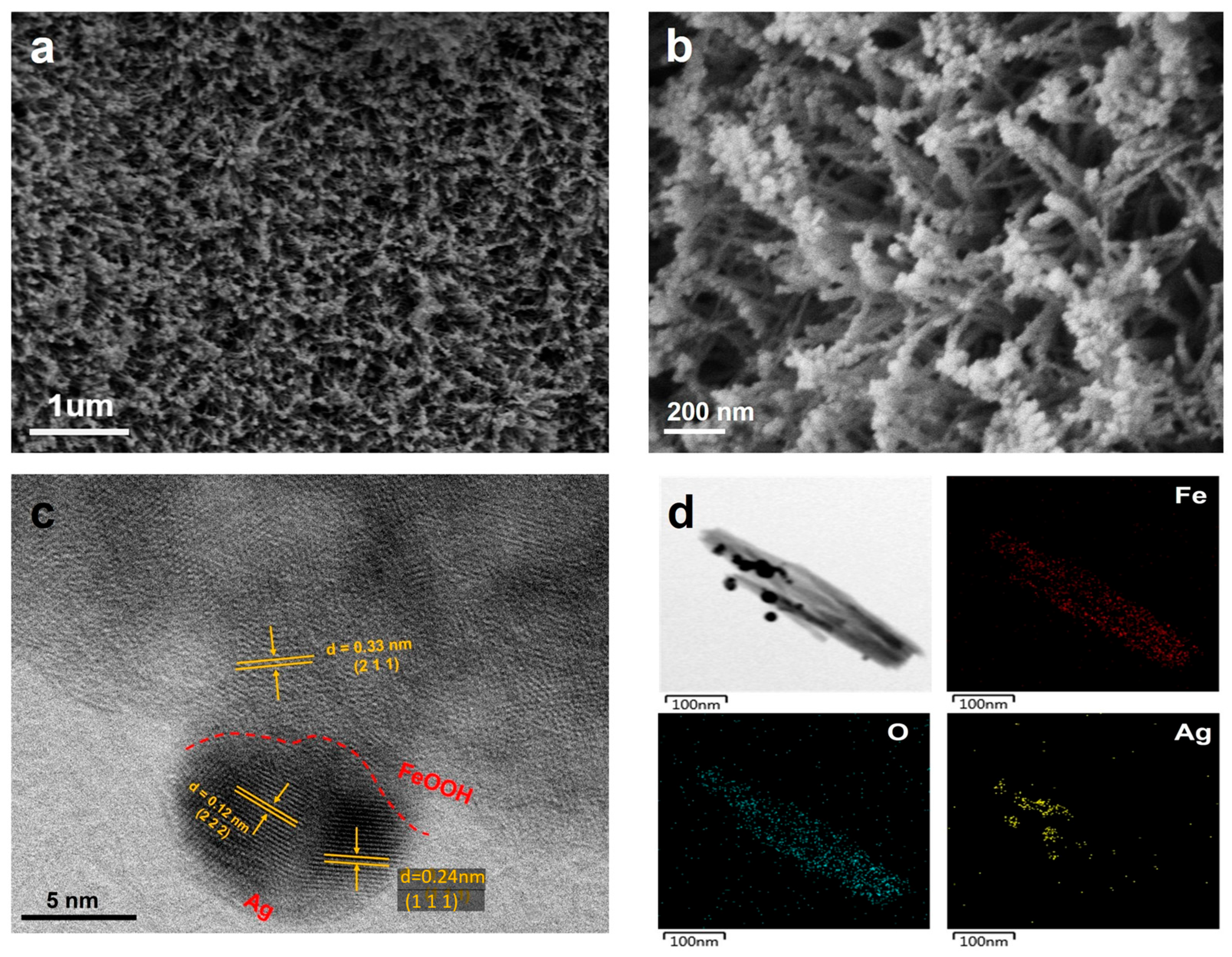
Silver (Ag) sites were introduced onto FeOOH through electrochemical reduction, resulting in the synthesis of the catalytic electrode material Ag-FeOOH. As depicted in Figure 1a,b, dense and uniform FeOOH nanowires grew on the Ti mesh. Moreover, Ag nanoparticles grew at the tips of these FeOOH nanowires, enhancing both electrical conductivity and catalytically active sites. Additionally, the high-resolution transmission electron microscopy (HRTEM) results of Ag-FeOOH are shown in Figure 1c, revealing that smaller-sized Ag nanoparticles grew on the FeOOH nanowires. Furthermore, the results in Figure 1c indicate that the lattice fringes of 0.12 nm and 0.24 nm correspond to the (2 2 2) and (1 1 1) crystal planes of Ag, respectively, while the lattice fringe of 0.33 nm corresponds to the (2 1 1) [18] crystal plane of FeOOH. Finally, from the energy-dispersive spectroscopy (EDS) analysis of Ag-FeOOH, we observe that the distribution of the Ag element corresponds to the transmission image, confirming the successful introduction of Ag sites.
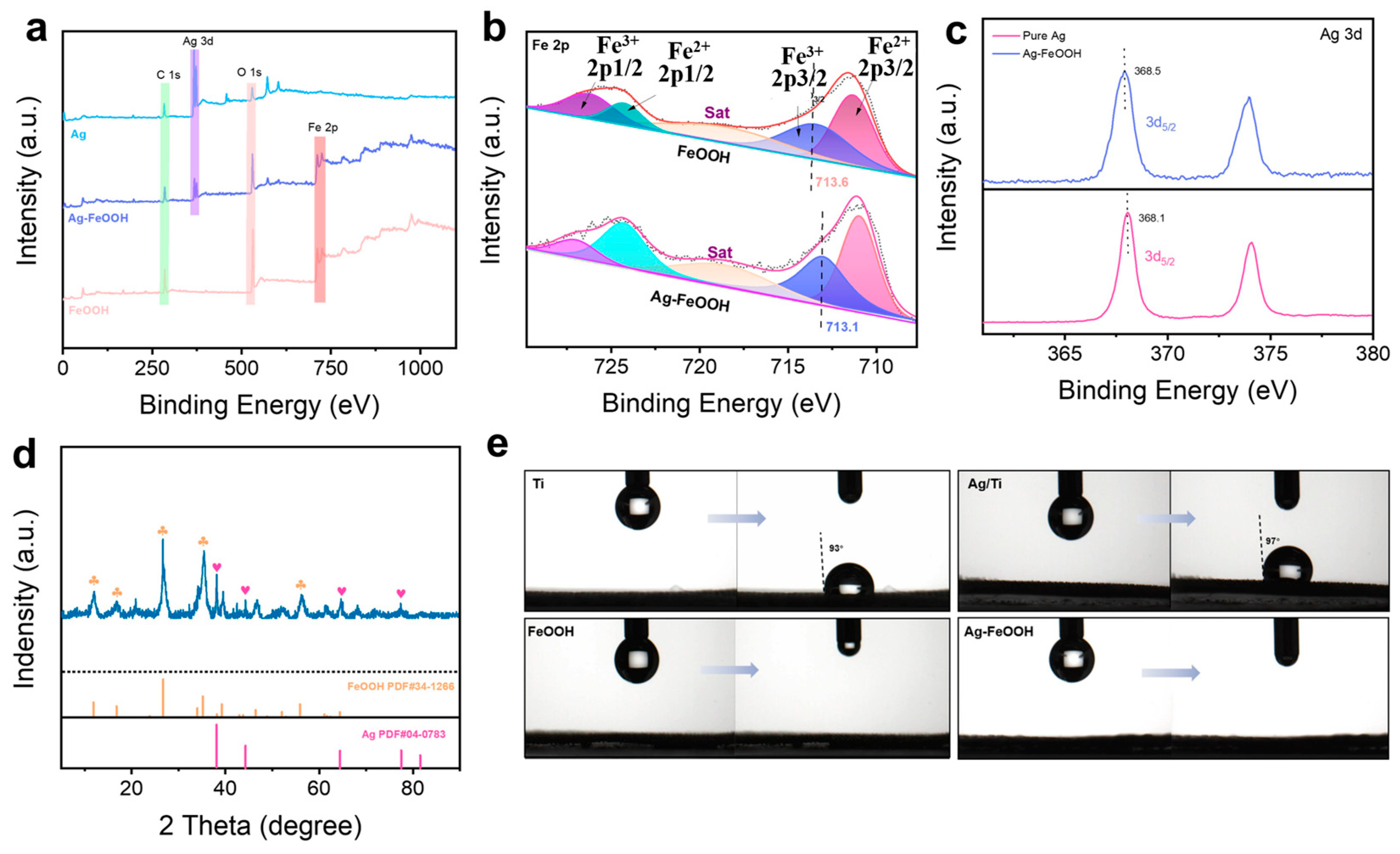
To gain insights into the electronic structure of the materials, we conducted X-ray photoelectron spectroscopy (XPS) tests on Ag, FeOOH, and Ag-FeOOH, as illustrated in Figure 2a–c. For Ag-FeOOH, the diffraction peak at a binding energy of 731.1 eV in the Fe 2p spectrum corresponds to Fe 2p3/2, whereas for FeOOH, the binding energy corresponding to Fe 2p3/2 is 731.6 eV. Additionally, in the Ag 3d spectrum of Ag-FeOOH, the binding energy of the Ag 3d5/2 diffraction peak is 368.5 eV, while for pure Ag, it is 368.1 eV. By comparing the Fe 2p3/2 binding energies of Ag-FeOOH and FeOOH, we observed a negative shift in the binding energy of Fe 2p3/2 after the introduction of Ag sites. Similarly, by comparing the Ag 3d5/2 binding energies of Ag-FeOOH and pure Ag, we found a positive shift in the binding energy of Ag 3d5/2 for Ag introduced onto the FeOOH surface. This indicates that the Ag introduced via electrochemical reduction on the FeOOH surface alters its original electronic structure. Specifically, electrons flow from FeOOH to Ag. The strong interaction between Fe and Ag modifies the electronic structure of the metal centers, thereby influencing the electrocatalytic activity of Ag-FeOOH. Furthermore, as shown in Figure 2e, the contact angles of Ti, Ag, FeOOH, and Ag-FeOOH are not identical. Ti and Ag are non-hydrophilic, whereas FeOOH is a hydrophilic material. Notably, the material obtained by introducing Ag onto the FeOOH surface via electrochemical reduction remains hydrophilic [19]. In studies on electrocatalytic nitrate reduction to ammonium, it has been found that the hydrophilicity of materials facilitates electrolyte transport and enhances the electrocatalytic rate. As depicted in Figure 2d, we performed X-ray diffraction (XRD) tests and analysis on the synthesized Ag-FeOOH. The results revealed diffraction peaks corresponding to both FeOOH and Ag, confirming the successful synthesis of our material.

2.2. NO3RR Performance

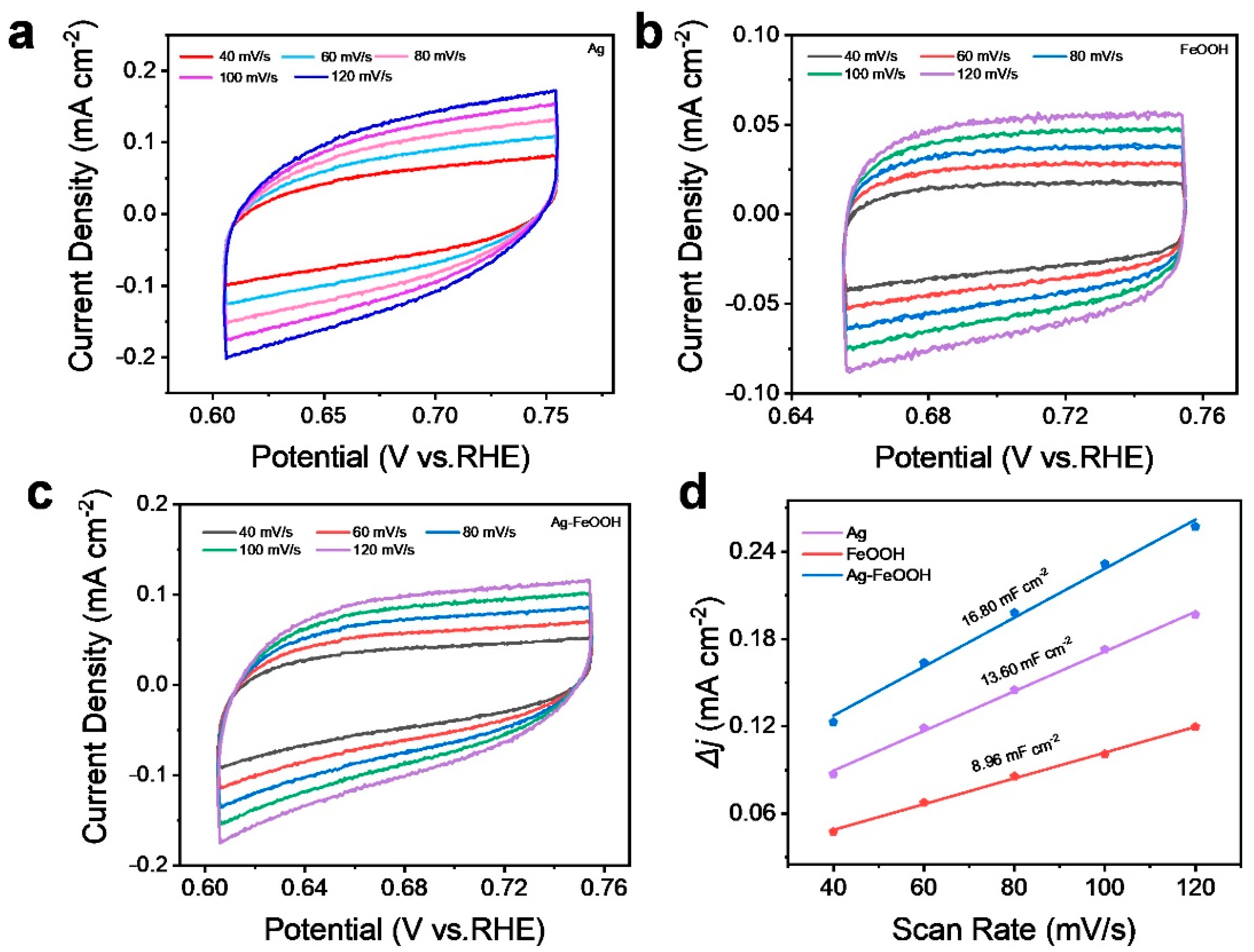
To evaluate the impact of introducing Ag nanoparticles via electrochemical reduction on the electrocatalytic activity of FeOOH, we utilized a single-chamber electrolytic cell to assess the nitrogen reduction reaction (NO3RR) activity of the catalysts. Initially, the double-layer capacitance (Cdl) and electrochemically active surface area (ECSA) of Ag, FeOOH, and Ag-FeOOH were evaluated through cyclic voltammetry curves obtained at different scan rates. As illustrated in Figure 3, the Cdl of Ag-FeOOH is 16.80 mF cm−2, which is higher than that of Ag (13.60 mF cm−2) and FeOOH (8.96 mF cm−2). Consequently, the ECSA of Ag-FeOOH is greater than that of both Ag and FeOOH, initially indicating that Ag-FeOOH possesses superior NO3RR performance.
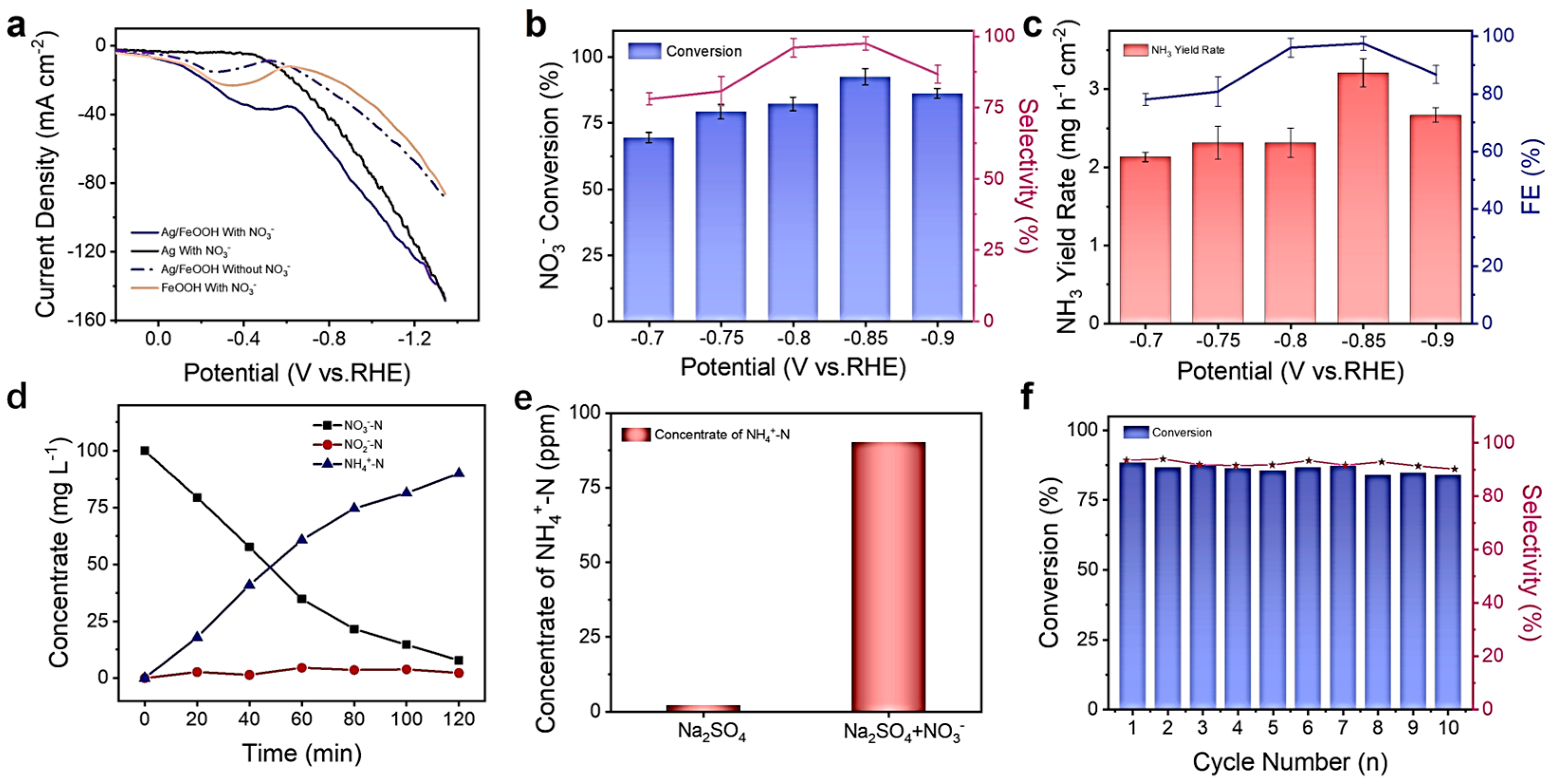
Subsequently, to preliminarily investigate the current response of the catalysts to the nitrate reduction reaction (NO3RR), linear sweep voltammetry (LSV) curves were measured for Ag, FeOOH, and Ag-FeOOH in solutions with and without the NO3-N electrolyte, as well as for Ag-FeOOH in a NO3-N-free electrolyte. As shown in Figure 4a, in the electrolyte solution containing NO3-N, Ag-FeOOH exhibited a stronger current response compared to both Ag and FeOOH, indicating that the Ag-FeOOH catalyst has a more pronounced response to NO3RR. Specifically, LSV tests were conducted for Ag, FeOOH, and Ag-FeOOH in an NO3-free electrolyte (0 ppm). The results show that under NO3-free conditions, the current responses of all three catalysts are significantly lower than those in NO3-containing electrolytes. Moreover, the current increment of Ag-FeOOH upon introducing NO3 is markedly larger than that of Ag and FeOOH, indicating that the enhanced current is primarily attributable to NO3RR rather than HER. Additionally, the contribution from NO2 to the total current was found to be negligible, further ruling out significant interference from intermediate product reduction. Furthermore, it is evident from the LSV curves that the current begins to deviate at −0.7 V vs. RHE, and this deviation becomes more pronounced with increasingly negative potential. This suggests that the catalyst starts to respond to the electrocatalytic reduction of NO3 at this potential. Therefore, we selected the voltage range of −0.7 V to −0.9 V vs. RHE as the window for subsequent performance tests. As depicted in Figure 4b,c, from −0.7 V vs. RHE to −0.9 V vs. RHE, the removal rate of NO3 and the ammonium yield gradually increased, reaching a peak at −0.85 V vs. RHE. At this potential, the NO3 removal rate, ammonium selectivity, Faradaic efficiency, and ammonium yield were 92.45%, 97.56%, 89.58%, and 3.21 mg h−1 cm−2, respectively. Subsequently, the changes in the concentrations of NO3-N, NO2-N, and NH4+-N over time were evaluated, with the curves presented in Figure 4d. When the voltage was held constant at −0.85 V vs. RHE, NO3-N rapidly decreased while NH4+-N rapidly increased, demonstrating the rapid conversion of nitrate to ammonium [20]. Meanwhile, the concentration of the NO2-N intermediate product initially rose and then declined during the reaction, with its concentration being almost negligible, indicating the excellent ammonium selectivity of the material. We conducted performance tests over 10 cycles on the same catalyst, as shown in Figure 4e. The results demonstrated that after multiple cycles of testing, the conversion rate of nitrate, ammonium selectivity, and ammonium yield did not exhibit significant degradation, confirming the excellent stability of the catalyst.
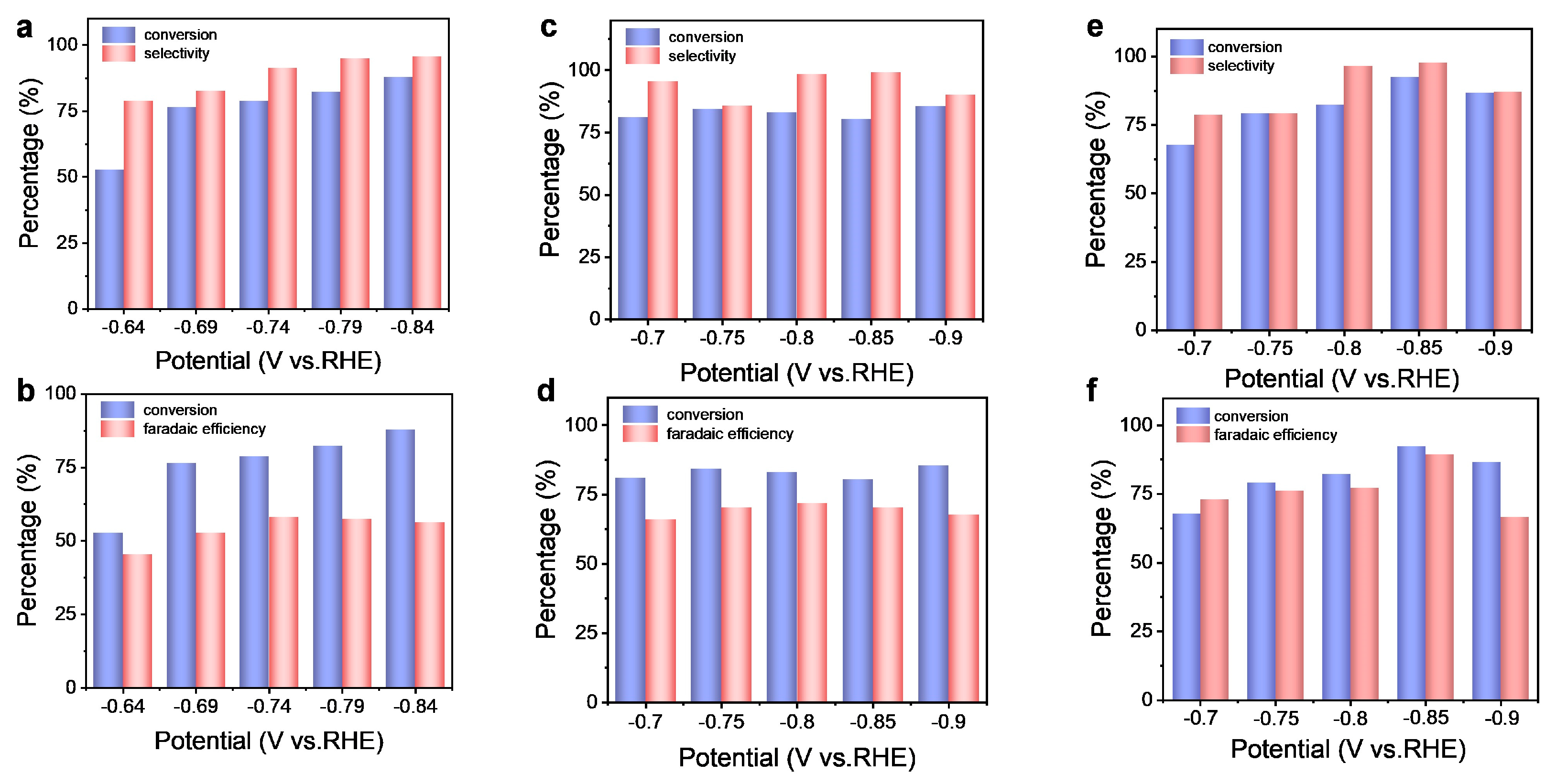
To investigate the performance of the catalytic material Ag-FeOOH under varying initial concentrations of NO3-N, we conducted electrolysis experiments at gradient potentials with initial concentrations of 50 ppm, 70 ppm, and 100 ppm, respectively. As illustrated in Figure 5, at an initial NO3-N concentration of 50 ppm, the removal rate and selectivity of NO3 by the Ag-FeOOH catalyst increased with rising potential, while the Faradaic efficiency exhibited a volcanic distribution, reaching its optimal overall performance at −0.84 V vs. RHE, with values of 87.61%, 92.56%, and 52.33% for removal rate, selectivity, and Faradaic efficiency, respectively. At an initial concentration of 70 ppm NO3-N, the removal rate and selectivity of NO3 also increased with the potential, but after reaching the optimal potential of −0.75 V vs. RHE, the Faradaic efficiency declined, showing a volcanic distribution and achieving its best overall performance at −0.85 V vs. RHE, with values of 80.11%, 95.32%, and 65.13%, respectively. At an initial concentration of 100 ppm NO3-N, the removal rate and selectivity of NO3 continued to increase with the potential, and after reaching the optimal potential of −0.85 V vs. RHE, the Faradaic efficiency also displayed a volcanic distribution, attaining its peak performance at the same potential, with values of 92.45%, 97.56%, and 89.58% (data adopted from Figure 5), respectively.
The results indicate that the catalytic material Ag-FeOOH demonstrates excellent removal rates of NO3 across various initial concentrations. Moreover, it exhibits superior selectivity and Faradaic efficiency at higher initial concentrations of NO3-N, suggesting that the reaction kinetics in the electrocatalytic NO3RR process can be enhanced by appropriately increasing the initial concentration of the reactant. In summary, the catalytic material Ag-FeOOH showcases outstanding catalytic performance across a wide range of initial concentrations.
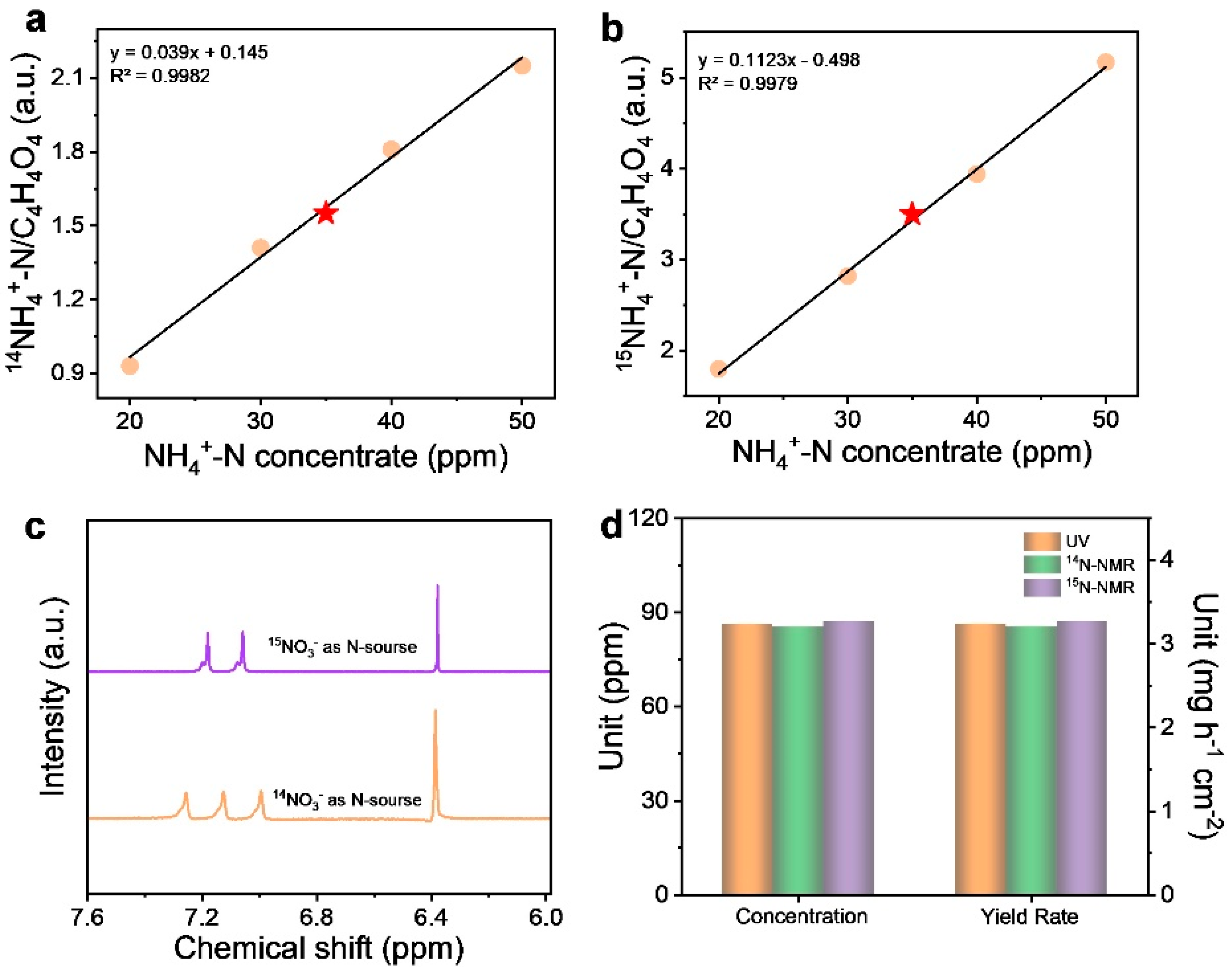
The source of ammonium was verified through blank control experiments and 15N isotope labeling experiments, while the ammonium yield was quantitatively analyzed using ultraviolet spectrophotometry and 1H nuclear magnetic resonance (1H NMR) spectroscopy [21]. As shown in Figure 6, the 1H NMR spectra from our isotope labeling experiments revealed that similar ammonium yields were obtained regardless of whether Na14NO3 or Na15NO3 was used as the nitrogen source. Furthermore, after conducting electrolysis experiments with Na14NO3 and Na15NO3, the electrolytes were subjected to 1H NMR testing. For more precise tracing, 1H NMR technology with 15N labeling was employed for analysis. In the 1H NMR spectra of standard electrolytes containing 14NH4Cl and 15NH4Cl, the 14NH4+ ion exhibited a triplet peak at δ = 7.14, 7.05, and 6.96 ppm, whereas the 15NH4+ ion displayed only a doublet peak at δ = 6.98 and 7.10 ppm. This further confirmed that the ammonium ions were produced through the electrocatalytic reduction of nitrate. The study further quantified the NH4+ concentration using an external standard method (Figure 5d) and compared the results with those obtained by colorimetry, thereby validating the accuracy of the data [22].

2.3. Mechanism Analysis

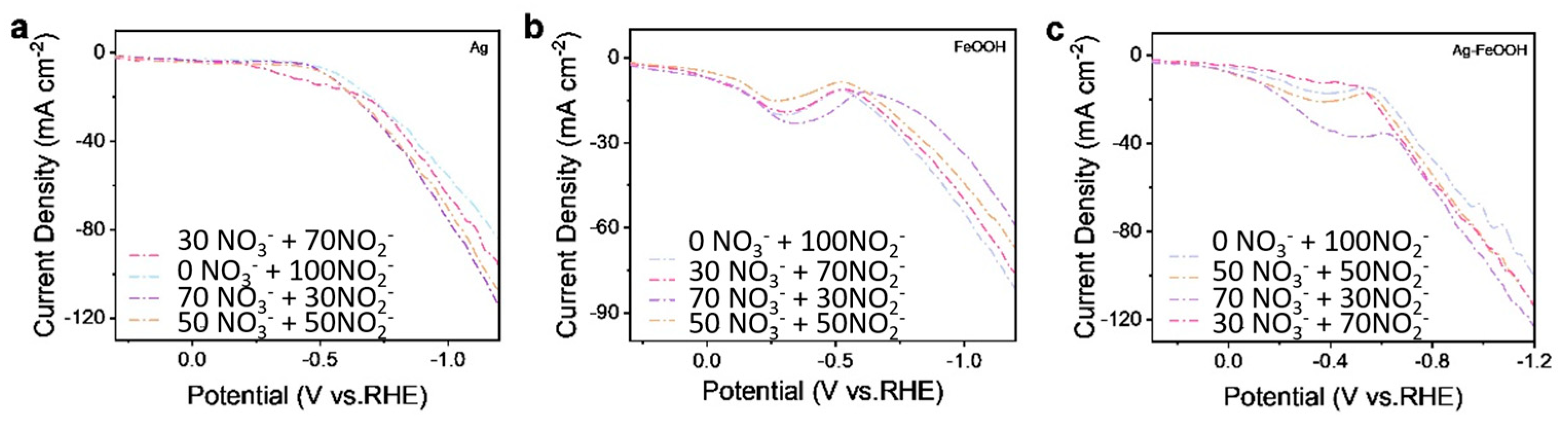
To investigate the role and mechanism of Ag nanoparticles introduced via electrochemical reduction on the FeOOH surface in the electrocatalytic NO3RR process, we designed mixed-feed experiments involving NO3 and NO2. We observed the linear sweep voltammetry (LSV) curves of Ag, FeOOH, and Ag-FeOOH under different mixed-feed ratios of NO3 and NO2 [23]. As illustrated in Figure 7a–c, the current responses of Ag varied under different ratios. Interestingly, as the NO3 content increased, the current response of the electrode gradually enhanced. Similarly, FeOOH exhibited different current responses under varying ratios, with its current response gradually increasing as the NO2 content rose. In contrast, Ag-FeOOH displayed irregular current responses under different feed ratios, with the mixed-feed ratio of 70:30 (NO3 to NO2) demonstrating the best current response. The optimal NO3:NO2 ratio of 70:30 likely arises from a balance between the two parallel reaction pathways. Although the two sites operate independently in terms of catalytic mechanism, the overall current response is still governed by the substrate availability at each site, which is concentration-dependent.
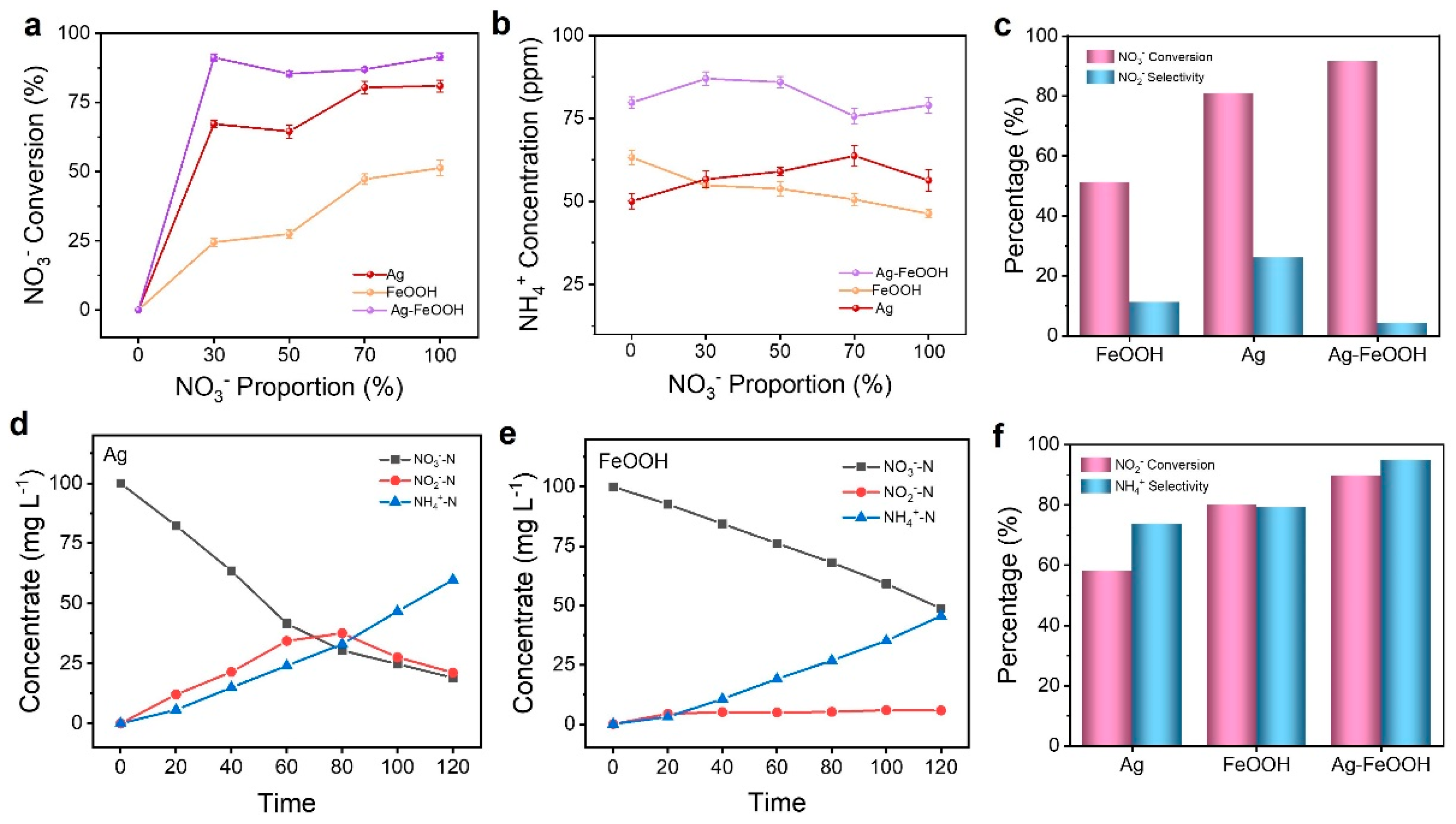
Consequently, we proposed the hypothesis of dual catalytically active sites. Subsequently, electrolysis experiments were conducted on Ag, FeOOH, and Ag-FeOOH in electrolytes with varying feed ratios at −0.85 V vs. RHE. As depicted in Figure 8a, the conversion rates of NO3 for the three different catalytic materials increased with the rising percentage of NO3, which aligns with kinetic theory. The results also revealed that FeOOH exhibited significantly lower NO3 conversion capabilities compared to Ag and Ag-FeOOH, suggesting that NO3 undergoes rapid conversion at Ag sites. Meanwhile, the concentrations of ammonium produced in the electrolyte after electrolysis experiments with electrode materials Ag, FeOOH, and Ag-FeOOH under different feed ratios are shown in Figure 8b. For FeOOH, the ammonium concentration decreased as the percentage of NO3 in the electrolyte increased. Conversely, for Ag, the ammonium concentration increased with the rising percentage of NO3, but a decline occurred when the NO3 percentage reached 100, compared to 70. This can be attributed to the rapid conversion of NO3 to NO2 on Ag, leading to the accumulation of a large amount of NO2 that occupied the active sites, thereby causing a slight decrease in ammonium yield. In contrast, Ag-FeOOH did not exhibit a linear relationship in performance across different electrolyte ratios, reaching its peak at a NO3 to NO2 ratio of 30:70. This indicates that during the electrocatalytic NO3RR process on the Ag-FeOOH catalyst, different NO3 to NO2 ratios result in varying utilization efficiencies of catalytic sites, with a 30:70 ratio being optimal.
Simultaneously, as shown in Figure 8c, the NO3 removal rates and NO2 selectivities of Ag, FeOOH, and Ag-FeOOH in electrolytes without NO2 were examined. The results revealed that Ag and Ag-FeOOH exhibited higher NO3 removal rates compared to FeOOH, with Ag demonstrating the highest NO2 selectivity. Furthermore, electrolysis experiments were conducted on Ag and FeOOH in a 100 ppm NO3 electrolyte, and the changes in different substances over time are illustrated in Figure 8d,e. For Ag, during the electrocatalytic NO3RR process, NO3 underwent rapid conversion, and NO2 continuously increased and accumulated within the first 80 min. In contrast, the conversion efficiency of NO3 for FeOOH was significantly lower than that of Ag. This implies that the conversion rate of NO3 to NO2 at Ag sites is extremely fast, and a substantial portion of NO2 fails to convert to NH4+ due to its slower conversion rate compared to that of NO3 to NO2, resulting in the accumulation of a considerable amount of NO2. It also indicates that NO3 is more prone to conversion to NO2 at Ag sites.
Finally, as shown in Figure 8d, Ag, FeOOH, and Ag-FeOOH were employed as electrocatalysts for the nitrite reduction to ammonium reaction. The results demonstrated that FeOOH exhibited significantly higher NO2 removal capabilities compared to Ag, with Ag-FeOOH displaying the highest NO2 removal ability. This suggests that NO2 is more readily converted to ammonium at FeOOH sites. In summary, the Ag catalytic sites on Ag-FeOOH are primarily responsible for the conversion of NO3 to NO2, while the FeOOH sites are responsible for the conversion of NO2 to NH3. Under the synergistic catalytic action of these dual sites, NO3 is rapidly converted to NH3, achieving highly efficient electrocatalytic NO3RR.

2.4. Zn-NO3 Battery Application of Ag-FeOOH

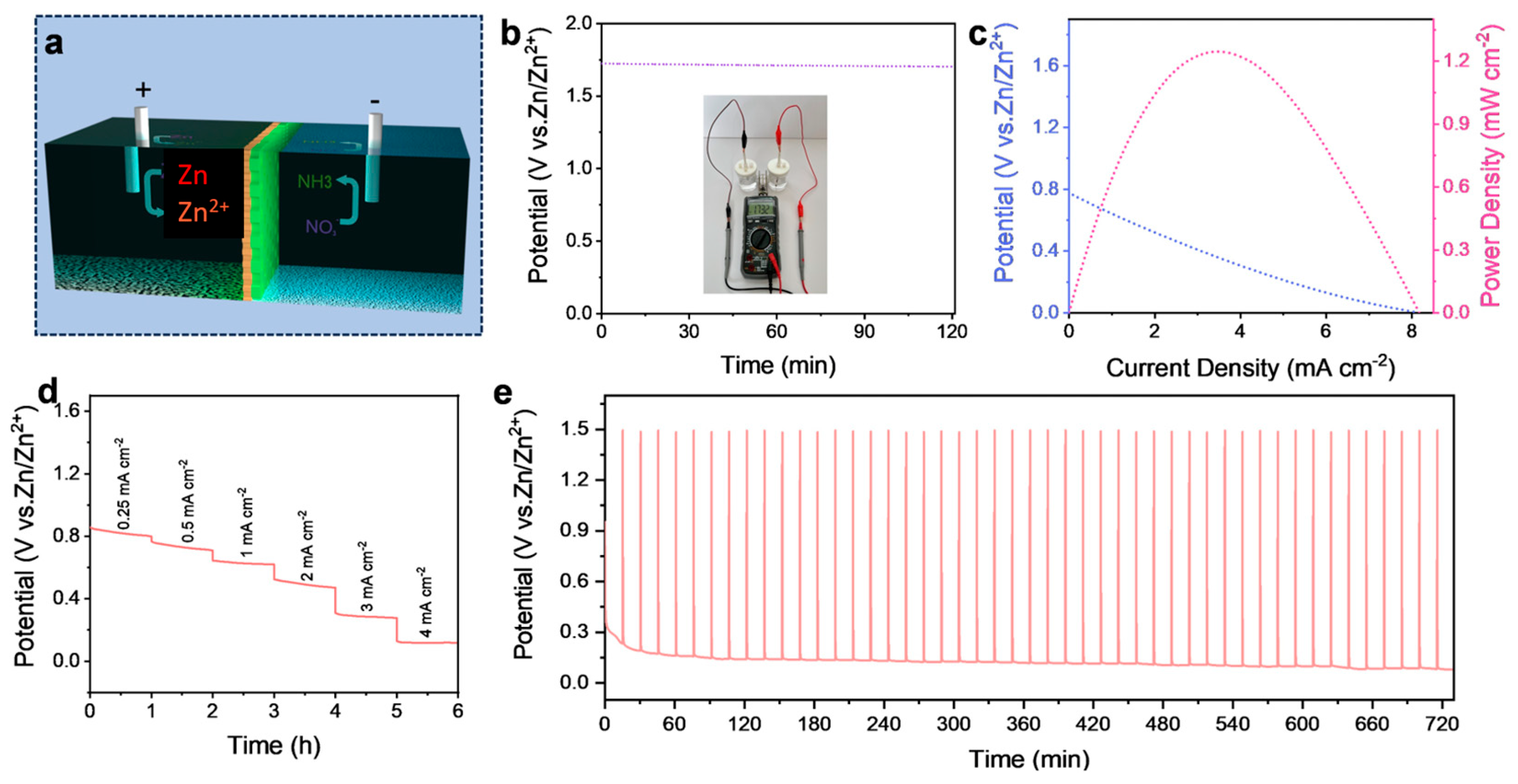
Motivated by the excellent NO3RR performance of Ag-FeOOH, a Zn–NO3 battery was assembled using Ag-FeOOH as the cathode and a polished zinc plate as the anode. The following presents the preliminary exploratory results. As illustrated in Figure 9a,b, the battery tested on an electrochemical workstation exhibited a constant open-circuit voltage (1.722 V vs. Zn/Zn2+), which was largely consistent with the open-circuit voltage measured using a multimeter. We evaluated the discharge and power density curves of the battery, as shown in Figure 9c. From the discharge curve, it can be observed that as the cathode potential decreased, the output current density exhibited an opposite trend. The power density curve displayed a volcanic shape, with a peak power density of 1.28 mW cm−2. Additionally, we conducted discharge tests at various current densities, as depicted in Figure 9c. At a current density of 0.5 mA cm−2, the discharge voltage of the Zn-NO3 battery tended to stabilize at 0.73 V. Similar stability was maintained at other current densities, indicating that the Zn-NO3 battery possesses excellent discharge stability. To comprehensively assess the repeatability of the Zn-NO3 battery, we performed charge–discharge cycle tests and presented the charge–discharge curves in Figure 9e. The results demonstrated that after multiple charge–discharge cycles, the battery’s output voltage remained within a specific range without significant deactivation, fully confirming the charge–discharge stability of the Zn-NO3 battery [24].

3. Materials and Methods

3.1. Material Preparation

Using a titanium mesh as the substrate, the Ag-FeOOH material was prepared via a two-step process combining hydrothermal synthesis and electroplating. The detailed steps are as follows.
(1)
Hydrothermal Synthesis of FeOOH Catalyst
Place the pre-treated titanium mesh into a 50 mL mixed solution containing 0.03 M FeCl3·6H2O and 0.03 M Na2SO4. Conduct a hydrothermal reaction at 60 °C under normal pressure for 12 h to obtain the FeOOH catalyst. Rinse the catalyst three times with deionized water and then dry it at 60 °C for subsequent use.
(2)
Electroplating of Ag onto FeOOH
Utilize the as-prepared FeOOH catalyst as the working electrode in a three-electrode system for electroplating. The plating solution is a 50 mL mixed solution containing 3.55 g Na2SO4, 0.32 g Na3C6H5O7, and 0.024 g AgNO3. Perform electroplating at a potential of −0.35 V vs. RHE using an I-t test for 30 s. By varying the concentration of AgNO3, electrode materials with different Ag contents can be synthesized. After electroplating, rinse the electrode three times with deionized water and dry it at 60 °C for further use.

3.2. Product Detection

All products were detected using a UV-Vis spectrophotometer [25]. Subsequently, the concentrations of the products in the electrolyte were calibrated using the corresponding standard curves.
(1)
Determination of NO3-N Concentration: An appropriate amount of the electrolyte sample was pipetted into a centrifuge tube and diluted to 5 mL with deionized water. Then, 200 μL of NH3SO3 reagent (5 wt%) was added. The mixture was placed on a laboratory bench and allowed to react at room temperature in the dark for 15 min. After the color reaction was complete, the absorbance values at dual wavelengths of 220 nm and 275 nm were measured using a quartz cuvette in a UV-Vis spectrophotometer. During data processing, the dual-wavelength correction method was used to calculate the net absorbance value (A = A220 nm − 2 × A275 nm). The standard curve of NO3-N (Figure 6a,b) was obtained by fitting the absorbance values corresponding to different concentrations of NO3-N solutions [26].
(2)
Determination of NO2-N Concentration: First, 25 mL of deionized water was placed in a beaker, followed by the sequential addition of 2 g of C6H8N2O2S reagent and 0.1 g of C12H14N2·2HCl while stirring. Then, 5 mL of H3PO4 was slowly added dropwise to form a transparent solution. An appropriate amount of the electrolyte sample to be tested was pipetted and diluted to 5 mL, mixed well, and then 100 μL of a freshly prepared color reagent was added. The mixture was placed in a dark box and allowed to stand in the dark for 20 min. The absorbance value of the colored solution was measured at the characteristic absorption wavelength of 540 nm using a UV-Vis spectrophotometer. The standard curve of NO2-N (Figure 2 and Figure 3b) was obtained by fitting the absorbance values corresponding to different concentrations of NO2-N solutions [27].
(3)
Determination of NH4+-N Concentration: The concentration of NH4+-N was detected using Nessler’s reagent colorimetric method. First, Nessler’s reagent was prepared by dissolving 0.8 g of NaOH in 5 mL of deionized water and allowing the solution to cool to room temperature. Then, 0.35 g of KI and 0.5 g of HgI2 were added, and the mixture was stirred until fully dissolved. Subsequently, an appropriate amount of the electrolyte sample was pipetted into a centrifuge tube and diluted to 5 mL with deionized water. After that, 100 µL of NaKC4H4O6 solution (0.5 g mL−1) and 100 µL of Nessler’s reagent were added sequentially. The mixture was placed in a dark box and allowed to stand in the dark for 30 min. The absorbance value of the colored solution was measured at the characteristic absorption wavelength of 420 nm using a UV-Vis spectrophotometer. The standard curve of NH4+-N (There is a typo in the original text; it should be NH4+-N instead of NO3-N and NO2-N here, Figure 2 and Figure 3c) was obtained by fitting the absorbance values corresponding to different concentrations of NH4+-N solutions [28]. Gaseous products (N2, N2O) were not quantitatively detected. The ammonia selectivity was calculated based on UV-Vis and 1H NMR results and may be subject to a certain degree of overestimation, which is an inherent limitation of the conventional methods in this field.

3.3. Characterization

X-ray diffraction (XRD) patterns were recorded on a Smart Lab X-ray diffractometer (Beijing Purxi General Instrument Co., Ltd., Beijing, China) operated at 40 KV and 40 mA with Cu Kα radiation in the 2θ range of 10–90°. Scanning electron microscope (SEM) images were obtained by a scanning electron microscope (S-4800, Hitachi High-Technologies Corporation, Tokyo, Japan), which was equipped with an energy-dispersive spectroscopy (EDS, Extreme) detector. Information on the microstructural features and lattice fringes was obtained via transmission electron microscope (TEM) and high-angle annular dark-field scanning TEM (JEM-F200, JEOL Ltd., Tokyo, Japan), while elemental distribution maps were acquired with the attached EDS detector. X-ray photoelectron spectroscopy (XPS) analysis was carried out using a scanning X-ray microprobe (ESCALAB 250Xi Thermo Fisher Scientific, Waltham, MA, USA). Ultraviolet–visible absorption spectra were recorded on a Tianmei UV2600 spectrophotometer (Techcomp Instrument Co., Ltd., Shanghai, China). 1H NMR was recorded on a JNM-ECZ600R NMR instrument (JEOL Ltd., Tokyo, Japan).

4. Conclusions

In summary, to boost FeOOH’s catalytic activity, we employed electrochemical reduction to deposit Ag nanoparticles on its surface, creating dual catalytic sites. This setup enabled a synergistic catalytic environment for nitrate reduction to ammonium (NO3RR), optimizing the sequential steps of NO3 → NO2 and NO2 → NH4+, thus enhancing Ag-FeOOH’s electrocatalytic efficiency. Tests using electrolytes with varied NO3/NO2 ratios confirmed distinct roles: Ag sites mainly drove NO3 to NO2 conversion, while FeOOH sites facilitated NO2 to NH4+ transformation. Under dual-site synergy, Ag-FeOOH significantly optimized NO3RR efficiency. The modified FeOOH showed exceptional performance across a wide NO3 concentration range. In a 100 ppm NO3-N electrolyte, at −0.85 V vs. RHE, 97.56% ammonium selectivity, 92.45% nitrate conversion, and 3.21 mg h−1 cm−2 ammonium yield were achieved. The Zn-NO3 battery with Ag-FeOOH cathode also exhibited excellent electrical performance and stability. This work, by introducing Ag nanoparticles to create dual active sites, effectively coordinated and optimized NO3RR processes under synergistic catalysis, offering a new strategy for catalyst design and application in electrocatalytic NO3RR.

Author Contributions

Conceptualization, F.H. and Y.X.; methodology, R.X.; software, X.J.; validation, Y.X., X.J. and J.H.; formal analysis, Y.X.; investigation, Y.X.; resources, J.H.; data curation, X.J.; writing—original draft preparation, Y.X.; writing—review and editing, F.H.; visualization, J.H.; supervision, Y.X.; project administration, F.H.; funding acquisition, Y.X. All authors have read and agreed to the published version of the manuscript.

Funding

This work is supported by the National Natural Science Foundation of China (Grant Nos. 52172174, 52372164 and 21771001), Key Research and Development Program of Bozhou (Project No. bzzc2024029), Special Fund for Drug Analysis and R&D Innovation Team of Bozhou Vocational and Technical College (BKTD202501), Scientific research project of colleges and universities in Anhui Province (2024AH050044), Major Teaching and Research Project of Anhui University (2025xjjyzd005), and Key Science & Technology Project of Anhui Province (202423110050043).

Data Availability Statement

The original contributions presented in this study are included in the article. Further inquiries can be directed to the corresponding authors.

Acknowledgments

The authors have reviewed and edited the output and take full responsibility for the content of this publication.

Conflicts of Interest

The authors declare no conflicts of interest.

References

  1. Han, H.S.; Li, H.J.; Li, T.L.; Chen, F.P.; Yang, R.; Yu, Y.F.; Zhang, B. Ultralow overpotential nitrate reduction to ammonia via a three-step relay mechanism. Nat. Catal. 2023, 6, 402–414. [Google Scholar] [CrossRef]
  2. Shi, Y.B.; Xu, S.X.; Li, F. Electrocatalytic nitrate reduction to ammonia via amorphous cobalt boride. Chem. Commun. 2022, 58, 8714–8717. [Google Scholar] [CrossRef]
  3. Sun, F.Q.; Gao, Y.F.; Li, M.J.; Wen, Y.K.; Fang, Y.J.; Meyer, T.J.; Shan, B. Molecular self-assembly in conductive covalent networks for selective nitrate electroreduction to ammonia. J. Am. Chem. Soc. 2023, 145, 21491–21501. [Google Scholar] [CrossRef] [PubMed]
  4. Wang, Y.L.; Xia, L.Y.; Xiang, X.L.; Yuan, R.; Wei, S.P. A new photoelectrochemical biosensor based on FeOOH and exonuclease III-aided dual recycling signal amplification for HPV-16 detection. Chem. Commun. 2021, 57, 6416–6419. [Google Scholar] [CrossRef]
  5. Wang, Z.; Zhou, N.; Wang, J.Z.; Wang, D.P.; Zeng, J.R.; Zhong, H.X.; Zhang, X.B. Highly efficient electrochemical ammonia synthesis via nitrate reduction over metallic Cu phase coupling sulfion oxidation. Chemsuschem 2024, 17, e202301050. [Google Scholar] [CrossRef]
  6. Zeng, F.; Mebrahtu, C.; Liao, L.F.; Beine, A.K.; Palkovits, R. Stability and deactivation of OER electrocatalysts: A review. J. Energy Chem. 2022, 69, 301–329. [Google Scholar] [CrossRef]
  7. Zeng, Y.; Li, C.; Li, B.; Liang, J.S.; Zachman, M.J.; Cullen, D.A.; Hermann, R.P.; Alp, E.E.; Lavina, B.B.; Kalakalos, S.; et al. Tuning the thermal activation atmosphere breaks the activity-stability trade-off of Fe-N-C oxygen reduction fuel cell catalysts. Nat. Catal. 2023, 6, 1215–1227. [Google Scholar] [CrossRef]
  8. Xiong, Y.C.; Wang, Y.H.; Zhou, J.W.; Liu, F.; Hao, F.K.; Fan, Z.X. Electrochemical nitrate reduction: Ammonia synthesis and the beyond. Adv. Mater. 2024, 36, 2304021. [Google Scholar] [CrossRef]
  9. Han, D.; Wang, P.; Huang, H.T.; Deng, J.H.; Chen, J.K.; Tang, W.J.; Wang, T.Y.; Li, B.B.; Zhang, L.L.; Lai, L.F. Super-elastic and temperature-tolerant hydrogel electrodes for supercapacitors via MXene enhanced ice-templating synthesis. Small 2024, 20, 2400690. [Google Scholar] [CrossRef]
  10. Xue, Y.; Zhao, J.; Huang, L.; Lu, Y.R.; Malek, A.; Gao, G.; Zhuang, Z.B.; Wang, D.S.; Yavuz, C.T.; Lu, X. Stabilizing ruthenium dioxide with cation- anchored sulfate for durable oxygen evolution in proton-exchange membrane water electrolyzers. Nat. Commun. 2023, 14, 8093. [Google Scholar] [CrossRef] [PubMed]
  11. Zhou, B.; Zhan, G.M.; Yao, Y.C.; Zhang, W.X.; Zhao, S.X.; Quan, F.J.; Fang, C.Y.; Shi, Y.B.; Huang, Y.; Jia, F.L.; et al. Renewable energy driven electroreduction nitrate to ammonia and in-situ ammonia recovery via a flow-through coupled device. Water Res. 2023, 242, 120256. [Google Scholar] [CrossRef]
  12. Zhu, X.F.; Wang, Z.L.; Ren, J.; ALMasoud, N.; EI-Bahy, Z.M.; ALomar, T.S.; Zhang, C.; Zhang, J.; Zhou, J.Y.; Li, M.F.; et al. Graphene/polyacrylamide interpenetrating structure hydrogels for wastewater treatment. Adv. Compos. Hybrid Mater. 2023, 6, 169. [Google Scholar] [CrossRef]
  13. Chen, J.; Peng, B.; Sun, W. Pure negative electrocaloric effect achieved by SiN/p-GaN composite substrate. Nano Energy 2022, 97, 107195. [Google Scholar] [CrossRef]
  14. Ji, S.; Shin, J.; Yoon, J.; Lim, K.H.; Sim, G.D.; Lee, Y.S.; Kim, D.H.; Cho, H.C.; Park, J.Y. Three-dimensional skin-type triboelectric nanogenerator for detection of two-axis robotic-arm collision. Nano Energy 2022, 97, 107225. [Google Scholar] [CrossRef]
  15. Niu, Y.; Dong, J.; He, Y.; Xu, X.W.; Li, S.; Wu, K.; Wang, Q.; Wang, H. Significantly enhancing the discharge efficiency of sandwich-structured polymer dielectrics at elevated temperature by building carrier blocking interface. Nano Energy 2022, 97, 107215. [Google Scholar] [CrossRef]
  16. Zhang, J.; Fu, X.; Kwon, S.; Chen, K.F.; Liu, X.Z.; Yang, J.; Sun, H.R.; Wang, Y.C.; Uchiyama, T.; Uchimoto, Y.; et al. Tantalum-stabilized ruthenium oxide electrocatalysts for industrial water electrolysis. Science 2025, 387, 48–55. [Google Scholar] [CrossRef]
  17. Gao, Z.R.; Li, A.W.; Liu, X.W.; Peng, M.; Yu, S.X.; Wang, M.L.; Ge, Y.Z.; Li, C.Y.; Wang, T.; Wang, Z.H.; et al. Shielding Pt/γ-Mo2N by inert nano-overlays enables stable H2 production. Nature 2025, 691, 690–696. [Google Scholar] [CrossRef] [PubMed]
  18. Wang, K.F.; Mao, R.; Liu, R.; Zhang, J.J.; Zhao, H.C.; Ran, W.; Zhao, X. Intentional Ccorrosion-Induced Reconstruction of Defective NiFe Layered Double Hydroxide Boosts Electrocatalytic Nitrate Reduction to Ammonia. Nat. Water 2023, 1, 1068–1078. [Google Scholar] [CrossRef]
  19. Zhang, Z.; Zhang, N.; Zhang, J.; Deng, B.Q.; Cao, Z.Y.; Wang, Z.B.; Wei, G.F.; Zhang, Q.B.; Jia, R.Y.; Xiang, P.Y.; et al. Critical Review in Electrocatalytic Nitrate Reduction to Ammonia Towards a Sustainable Nitrogen Utilization. Chem. Eng. J. 2024, 483, 148952. [Google Scholar] [CrossRef]
  20. Fan, K.; Xie, W.; Li, J.; Sun, Y.N.; Xu, P.C.; Tang, Y.; Li, Z.H.; Shao, M.F. Active Hydrogen Boosts Electrochemical Nitrate Reduction to Ammonia. Nat. Commun. 2022, 13, 7958. [Google Scholar] [CrossRef]
  21. Du, H.; Guo, H.; Wang, K.; Du, X.N.; Beshiwork, B.A.; Sun, S.J.; Luo, Y.S.; Liu, Q.; Li, T.S.; Sun, X.P. Durable Electrocatalytic Reduction of Nitrate to Ammonia over Defective Pseudobrookite Fe2TiO5 Nanofibers with Abundant Oxygen Vacancies. Angew. Chem. Int. Ed. 2023, 62, e202215782. [Google Scholar] [CrossRef] [PubMed]

  22. Zhang, H.; Wang, C.; Luo, H.; Chen, J.L.; Kuang, M.; Yang, J.P. Iron Nanoparticles Protected by Chainmail-structured Graphene for Durable Electrocatalytic Nitrate Reduction to Nitrogen. Angew. Chem. Int. Ed. 2023, 62, e202217071. [Google Scholar] [CrossRef]
  23. Song, Z.; Liu, Y.; Zhong, Y.; Guo, Q.; Zeng, J.; Geng, Z.G. Efficient Electroreduction of Nitrate into Ammonia at Ultralow Concentrations Via an Enrichment Effect. Adv. Mater. 2022, 34, e2204306. [Google Scholar] [CrossRef]
  24. Gu, Z.; Zhang, Y.; Wei, X.; Duan, Z.Y.; Gong, Q.Y.; Luo, K. Intermediates Regulation via Electron-Deficient Cu Sites for Selective Nitrate-to-Ammonia Electroreduction. Adv. Mater. 2023, 35, 2303107. [Google Scholar] [CrossRef] [PubMed]
  25. Li, H.K.; Zhong, J.; Long, Y.C.; Tang, X.X.; Zhou, B.B.; Li, Z.B.; Zhang, S.C.; Ma, N.G.; Fan, J.; Zhi, C.Y.; et al. In Situ Activated, Distorted, and Defective Cu for Nitrate Reduction Reaction. Adv. Funct. Mater. 2026, 36, e74570. [Google Scholar] [CrossRef]
  26. Zhang, X.; Wang, Y.T.; Liu, C.B.; Yu, Y.F.; Lu, S.Y.; Zhang, B. Recent advances in non-noble metal electrocatalysts for nitrate reduction. Chem. Eng. J. 2021, 403, 126269. [Google Scholar] [CrossRef]
  27. Zuo, L.B.; Lou, F.C.; Guo, J.T.; Wang, M.; Geng, S. Accelerating Active Hydrogen Generation for Boosting the Electroreduction of Nitrate to Ammonia. Chem. Eng. J. 2025, 517, 163630. [Google Scholar] [CrossRef]
  28. Zhang, Z.D.; Lv, Y.; Gu, Y.M.; Zhou, X.C.; Tian, B.L.; Zhang, A.Q.; Yang, Z.M.; Chen, S.Z.; Ma, J.; Ding, M.N.; et al. Dual Zn5-NiS4 Sites in a Redox-Active Metal-Organic Framework Enables Efficient Cascade Catalysis for Nitrate-to-Ammonia Conversion. Angew. Chem. Int. Ed. 2025, 64, e202418272. [Google Scholar] [CrossRef]
Figure 1. (a,b) SEM picture of Ag-FeOOH; (c) TEM electronic picture of Ag-FeOOH HRTEM image of Ag-FeOOH; and (d) TEM picture of Ag-FeOOH and EDS results of Ag-FeOOH, respectively, are distributed in Fe, O and Ag.
Catalysts 16 00533 g001
Figure 2. (a) XPS full spectrum of Ag, FeOOH, and Ag-FeOOH; (b) XPS spectrum of the Fe2p region for FeOOH and Ag-FeOOH; (c) XPS spectrum of the Ag3d region for FeOOH and Ag; (d) XRD image of Ag-FeOOH; (e) contact angle test results for Ti, Ag, FeOOH, and Ag-FeOOH.
Catalysts 16 00533 g002
Figure 3. CV curves of (a) Ag, (b) FeOOH and (c) Ag-FeOOH at different scan rates. (d) Double-layer capacitance (Cdl) of Ag, FeOOH and Ag-FeOOH samples.
Catalysts 16 00533 g003
Figure 4. (a) LSV curves of Ag, FeOOH and Ag-FeOOH in 0.5 M Na2SO4 electrolyte with 100 ppm NO3-N and Ag-FeOOH in 0.5 M Na2SO4 electrolyte without NO3-N; (b) nitrate conversion and ammonium selectivity of Ag-FeOOH at different potentials; (c) ammonium yield and Faraday efficiency of Ag-FeOOH at different potentials; (d) variation curves of NO3-N, NO2-N, NH4+-N concentrations with time during electrolysis experiments (−0.85 V vs. RHE); (e) ammonium yield of Ag-FeOOH in electrolytes with or without NO3-N; (f) NO3 removal rate and ammonia selectivity data from cyclic experiments of Ag-FeOOH at −0.85 V vs. RHE.
Catalysts 16 00533 g004
Figure 5. (a) NO3 removal efficiency and (b) ammonia selectivity of Ag-FeOOH in 0.5 M Na2SO4 electrolyte with 50 ppm NO3-N at different potentials; (c) NO3 removal efficiency and (d) ammonia selectivity of Ag-FeOOH in 0.5 M Na2SO4 electrolyte with 70 ppm NO3-N at different potentials; (e) NO3 removal efficiency and (f) ammonia selectivity of Ag-FeOOH in 0.5 M Na2SO4 electrolyte with 100 ppm NO3-N at different potentials.
Catalysts 16 00533 g005
Figure 6. The standard curves of (a) (14NH4)2SO4 and (b) (15NH4)2SO4 were measured by 1H NMR and the test results of the experimental group; (c) 1H NMR spectrum of the electrolyte after electrocatalytic NO3RR using Na14NO3-14N and Na15NO3-15N as nitrogen sources at −0.85 V vs. RHE, respectively; (d) NH4+-N yield plots for the same material under different quantification methods.
Catalysts 16 00533 g006
Figure 7. (a) LSV curves of Ag, (b) FeOOH, (c) Ag-FeOOH at different ratios of NO3 to NO2.
Catalysts 16 00533 g007
Figure 8. (a) Conversion of NO3 by Ag, FeOOH, and Ag-FeOOH in electrolytes with varying percentages of NO3 content; (b) ammonia concentrations in electrolytes with different NO3 percentages treated by Ag, FeOOH, and Ag-FeOOH; (c) conversion of NO3 and NO2 selectivity of Ag, FeOOH, and Ag-FeOOH in 100 ppm NO3 electrolyte; (d,e) concentration changes in various substances during the electrolysis experiment of Ag and FeOOH in a 100 ppm NO3 electrolyte solution. (f) Conversion of NO2 and NH4+ selectivity of Ag, FeOOH, and Ag-FeOOH in 100 ppm NO2 electrolyte.
Catalysts 16 00533 g008
Figure 9. (a) Schematic diagram of a Zn-NO3 cell using an Ag-FeOOH catalyst as a cathode in an H-type electrolyzer; Zn-NO3 cells using Ag-FeOOH catalyst as cathode; (b) open-circuit voltage of the cell; (c) discharge curves and power density curves of the battery; (d) discharge curves of the battery at different current densities; (e) the charging and discharging process of the battery at a constant current density of 8 mA cm−2.
Catalysts 16 00533 g009
Disclaimer/Publisher’s Note: The statements, opinions and data contained in all publications are solely those of the individual author(s) and contributor(s) and not of MDPI and/or the editor(s). MDPI and/or the editor(s) disclaim responsibility for any injury to people or property resulting from any ideas, methods, instructions or products referred to in the content.