Review

Beyond Cooperative Catalysis: Directly Light-Activated Chiral Phosphoric Acids in Stereoselective Photochemical Transformations


Department of Chemistry, University of Milan, Via Golgi 19, 20133 Milan, Italy
*
Author to whom correspondence should be addressed.
Catalysts 2026, 16(5), 435; https://doi.org/10.3390/catal16050435
Submission received: 1 April 2026 / Revised: 18 April 2026 / Accepted: 4 May 2026 / Published: 7 May 2026
(This article belongs to the Special Issue 15th Anniversary of Catalysts—Recent Advances in Photocatalysis)

Abstract

The combination of photochemistry with stereoselective catalysis has emerged as an effective strategy to achieve stereocontrol in light-driven transformations. Chiral phosphoric acids (CPAs) have recently attracted attention in this context due to their ability to activate substrates while providing a defined chiral environment. This minireview highlights recent developments in CPA-enabled asymmetric photochemical transformations, focusing on systems in which CPAs incorporate a chromophore on the chiral backbone or form light-absorbing CPA-substrate complexes that enable photoactivation without the presence of an external photocatalyst. The main catalytic strategies, mechanistic features, and current limitations are discussed.

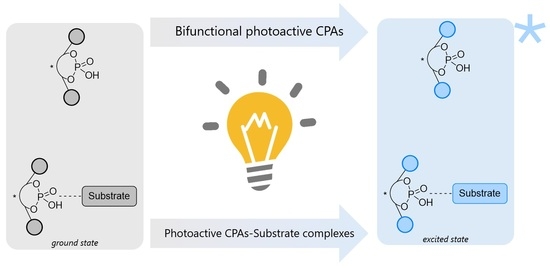
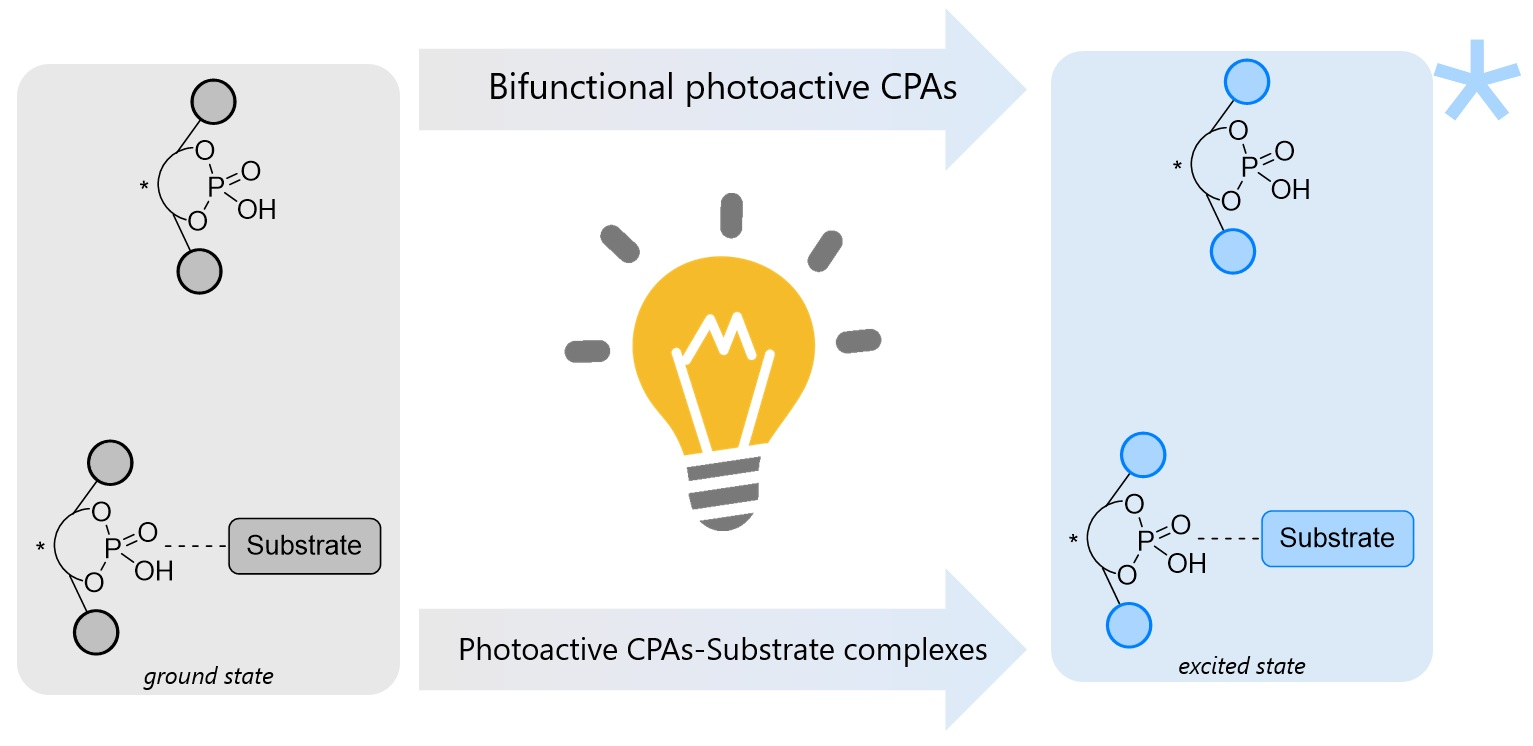
Graphical Abstract

1. Introduction

The combination of stereoselective catalysis and photochemistry has recently proven to be a powerful strategy for addressing one of the most persistent challenges in synthetic chemistry: achieving precise stereocontrol in highly reactive, photoinduced processes. Coupling light-driven generation of transient intermediates with catalytic systems capable of transferring stereochemical information enables the formation of enantioenriched products under conditions traditionally dominated by radical pathways and poor selectivity [1,2,3,4,5,6,7,8]. This great reactivity is generally achieved through the synergistic cooperation of two distinct catalytic cycles. A photoredox catalyst, such as a transition-metal complex or an organic sensitizer, initially generates reactive intermediates through a dedicated photoredox catalytic cycle. These transient species subsequently engage with a chiral organocatalyst operating within a complementary organocatalytic cycle, thereby enabling the stereocontrolled formation of a new chemical bond through cooperative catalysis.
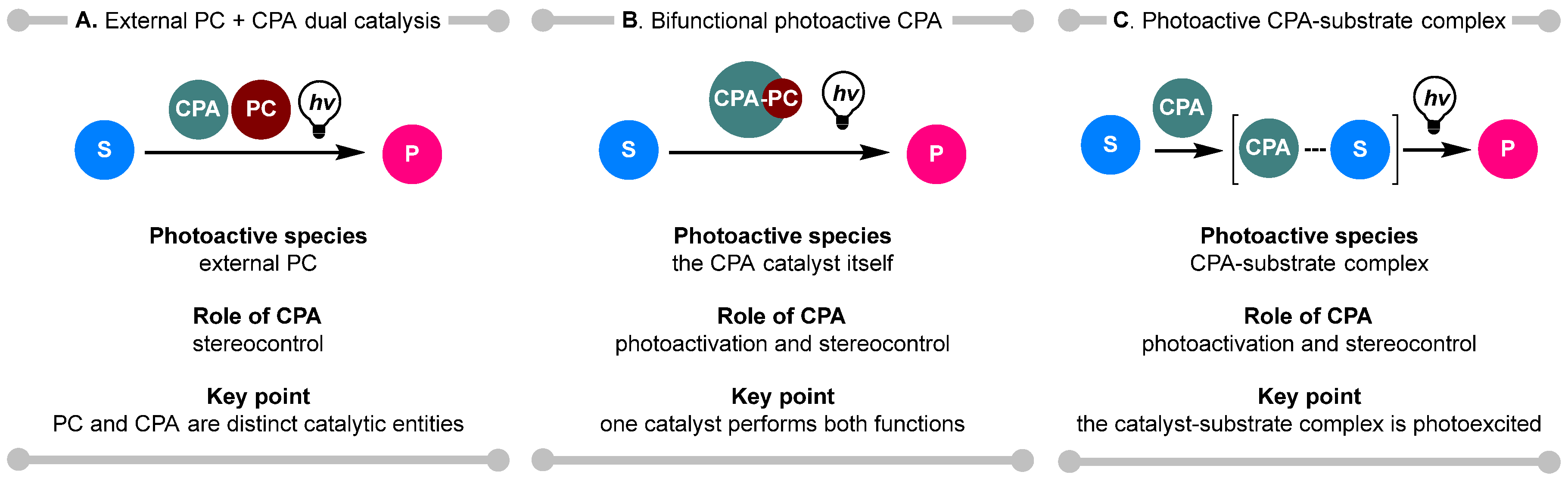
Since the seminal publication by MacMillan and co-workers [9], this dual-catalytic strategy has proven to be highly effective for the synthesis of high functionalized molecules in a stereoselective manner, and many contributions have been reported so far. In this context, chiral phosphoric acids (CPAs), a well-established class of Brønsted acid catalysts widely employed in stereoselective transformations [10,11,12,13,14,15,16,17,18] and in the synthesis of biological products [11,19], naturally emerged as ideal organocatalysts for combination with photoredox catalysis (Scheme 1A) [20,21,22,23].
The first example of a photochemical transformation through dual photoredox–chiral phosphoric acid catalysis was reported in 2009 from Knowles and co-workers, who developed a highly enantioselective intramolecular reductive pinacol coupling of ketones and hydrazones promoted by Ir(ppy)2(dtbpy)PF6 as a photocatalyst and 2,2′-binaphthol-based chiral phosphoric acid in the presence of Hantzsch ester under blue LED irradiation [24].
Taking inspiration from this example, many additional transformations exploiting cooperative photoredox-CPA catalysis have been disclosed [14,25,26]. Recent examples include enantioselective Minisci-type additions [27,28], stereoselective radical couplings [29,30], deoxygenative functionalizations of amides [31], olefin isomerizations [32], atroposelective heteroarene synthesis [33], and a variety of visible-light-driven cycloadditions and dearomative photocycloadditions [34,35,36], while hybrid catalyst design has further broadened the synthetic potential of these systems [37,38].
In a further evolution of this approach, the functional role of CPAs in light-driven transformations has extended far beyond their classical role as a source of stereochemical information, leading to the development of two distinct but conceptually related strategies that constitute the focus of this minireview.
In the first one, bifunctional chiral phosphoric acids bearing a photoactive moiety covalently linked to the chiral backbone were developed, enabling the design of single-component catalysts in which photoactivation and enantioselective control are integrated within the same molecular structure (Scheme 1B). In the second one, the presence of an external photocatalyst is no longer required; upon coordination with the chiral phosphoric acid, the substrate undergoes a modulation of its electronic structure that lowers its LUMO energy, thereby enabling direct photoexcitation. Under light irradiation, this activated complex can be directly excited, while the phosphoric acid is also responsible for the transfer of the stereogenic information (Scheme 1C). In both cases, the CPA operates not only as a simple chiral catalyst, but as an active contributor to the photoactivation event, whether by functioning as a sensitizer, by forming a photoactive complex, or by modulating the photophysical properties of the substrate.
These advances have paved the way for the next generation of CPA-enabled asymmetric photochemical strategies. Recent progress in this area, covering the period 2020–2026, is summarized in this minireview, with a particular focus on the main advantages and limitations of each strategy.

2. Bifunctional Photoactive Chiral Brønsted Acids

In contrast to dual catalytic approaches in which a chiral phosphoric acid is combined with a separate photocatalyst, bifunctional photoactive CPAs operate as single-component systems in which the chromophoric unit is covalently integrated into the chiral scaffold, making the CPA itself the photoactive species. Upon light excitation, these catalysts can generate reactive excited intermediates through single-electron transfer (SET), energy transfer (EnT) or proton-coupled electron transfer (PCET) processes. These newly generated species remain confined within a well-defined chiral environment, which ensures effective transfer of stereochemical information to the coordinated reaction partners.
The development of bifunctional organic photocatalysts has demonstrated that the synergistic integration of a sensitizing unit and a chiral control element within a single molecular scaffold constitutes a powerful and versatile strategy for promoting stereoselective photocatalytic transformations [39,40]. These applications can be broadly divided into two main areas: stereoselective bond-forming transformations, discussed in Section 2.1, and photocatalytic deracemization and related stereochemical control processes, covered in Section 2.2.

2.1. Photocatalytic Stereoselective Bond-Forming Transformations

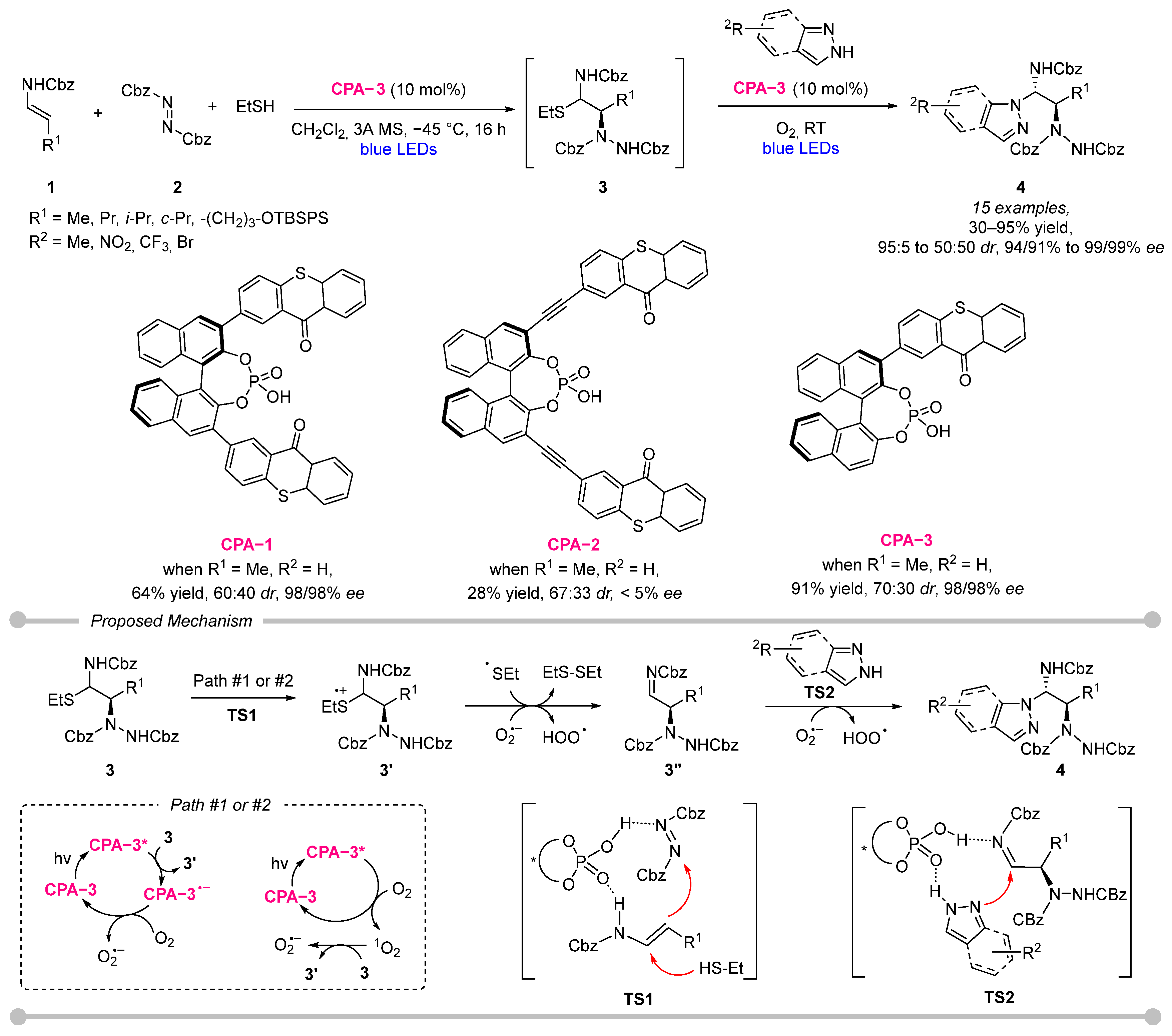
The earliest and most extensively developed applications of bifunctional chiral phosphoric acids have involved enantioselective photocatalyzed bond-forming reactions, in which the photoactive CPA promotes substrate activation while simultaneously controlling the stereochemical outcome through non-covalent interactions. One of the first examples in which this approach has been implemented was reported by Masson and co-workers, who developed a new class of photoactive organocatalysts based on BINOL-phosphoric acid backbone bearing one or two thioxanthone chromophores [41,42] in 3,3′ position for the synthesis of chiral 1,2-diamines [43].
Catalysts CPA-1, CPA-2 and CPA-3 exhibited absorption in the visible region up to 440 nm, with reduction peaks at −1.55, −1.46, and −1.53 V vs. SCE, respectively. However, only the C1-symmetric catalyst CPA-3, upon blue LEDs irradiation (7.2 W, 420–510 nm) was able to promote the one-pot, three-component electrophilic amination reaction followed by a photoinduced nucleophilic addition of various azoles and dibenzyl azodicarboxylate 2 in good yield and high level of diastereo- and enantioselectivity (Scheme 2).
Upon the coordination of CPA-3, α-unsubstituted enecarbamate 1 reacts with dibenzyl azodicarboxylate 2 in the presence of EtSH, which acts as a transient nucleophile to trap the imine intermediate formed after the electrophilic amination step and the presence of O2 for the oxidative regeneration of the catalyst. This thiol-mediated interception prevents both the undesired direct addition of the azole to the azodicarboxylate and the polymerization pathway arising from further reaction of the enecarbamate with the imine intermediate. Subsequent photoinduced C-S bond cleavage of compound 3′ regenerates the imine 3″ under controlled conditions, enabling the stereoselective nucleophilic addition of the azole ring leading to the formation of the desired product 4. The protocol tolerates a broad range of pyrazoles bearing either electron-donating or electron-withdrawing substituents, providing the desired substituted 1,2-diamine derivatives with consistently high enantioselectivities.
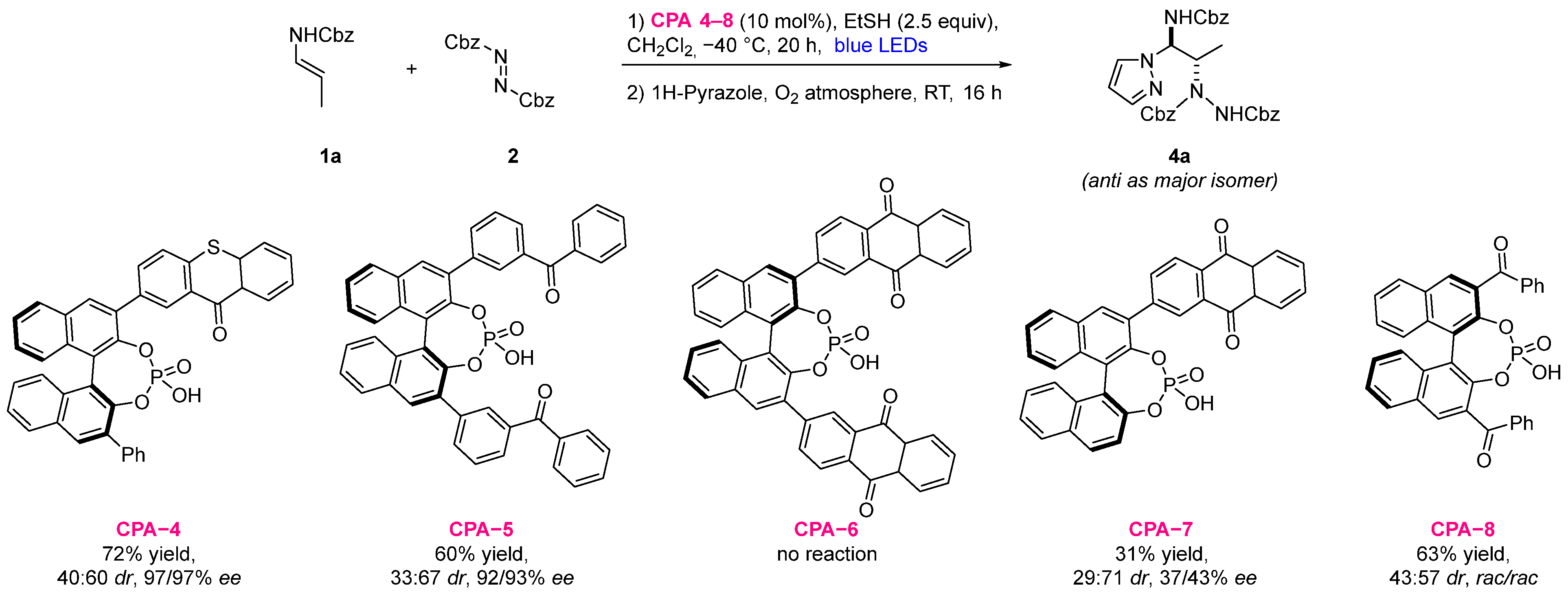
Based on these results, the same group subsequently developed a small library of BINOL-derived phosphoric acid photocatalysts bearing alternative aromatic ketone-based chromophores, including thioxanthone, benzophenone and anthraquinone derivatives [44]. Their spectroscopic and electrochemical properties were investigated, and their catalytic activity was evaluated in the same asymmetric tandem electrophilic amination of enecarbamates previously reported for thioxanthone-based systems (Scheme 3).
The photocatalytic activity of catalysts CPAs 4–8 was evaluated in the stereoselective tandem electrophilic amination of enecarbamates previously developed by the group.
In comparison to the earlier protocol, the reaction was performed under slightly modified conditions, employing longer reaction times and a larger excess of EtSH (2.5 equiv) in the electrophilic amination step to ensure efficient trapping of the imine intermediate. Under these conditions, CPA-4, a C1-symmetric thioxanthone catalyst obtained by modification of CPA-3 through the introduction of an additional phenyl substituent at the 3′ position afforded the desired product 4a in 72% yield, with a 40:60 diastereomeric ratio and 97% ee for both diastereomers. Compared with CPA-3, only marginal differences were observed, indicating that substitution at the 3′ position of the thioxanthone scaffold has a limited influence on the overall catalytic performance.
In contrast, the bis-anthraquinone catalyst CPA-6 displayed no reactivity, whereas the mono-anthraquinone derivative CPA-7 enabled the formation of the desired 1,2-diamine in moderate yield and enantioselectivity. Benzophenone-derived catalyst CPA-5 provided the product with good enantioselectivity, whereas catalyst CPA-8 led to the formation of the product in racemic form.
Overall, these results indicate that although alternative ketone-based chromophores can be successfully incorporated into the catalytic scaffold, the highest catalytic efficiency for this transformation is still achieved with the thioxanthone-derived catalyst CPA-3.
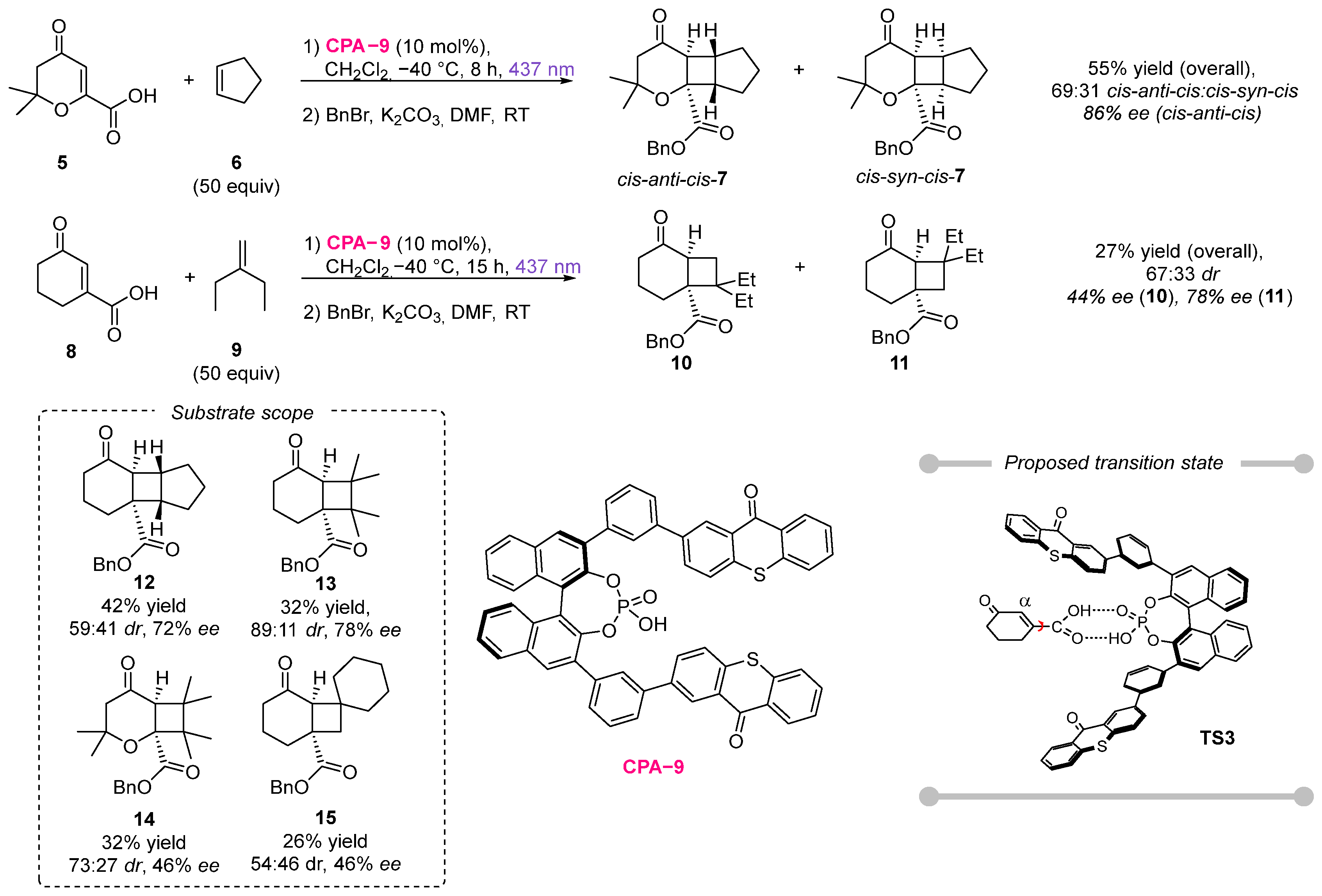
2,2′-binaphthol-based chiral phosphoric acids functionalized with a thioxanthone units have found applications also in different visible-light-mediated cycloadditions. In 2020, Bach and co-worker reported an intermolecular [2 + 2] photocycloaddition of β-carboxyl-substituted cyclic enones with cyclopentene or 2-ethyl-1-butene catalyzed by CPA-9 [45]. This sensitizing chiral phosphoric acid displays two C2-symmetrically positioned thioxanthone chromophores, which capture long wavelength light (λmax = 394 nm) and promote an energy transfer (triplet energy ET = 235 kJ mol−1, 77 K, CH2Cl2).
Although only a few substrate examples were reported and more than a stoichiometric amount of the dienophile was required, enantioenriched cyclic products were obtained in moderate yields and enantioselectivities. When 3,4-dihydro-2,2-dimethyl-4-oxo-2H-pyran-6-carboxylic acid 5 reacted with cyclopentene 6 in the presence of CPA-13 under irradiation at 437 nm, the cis-anti-cis cyclic diastereoisomer 7 was preferentially formed over the corresponding cis-syn-cis isomer and was obtained with an enantiomeric excess of 86%, after functionalization to the corresponding benzyl ester (Scheme 2). Interestingly, the use of catalyst CPA-1 did not induce any enantioselectivity in the same cyclization.
Under the same reaction conditions, the [2 + 2] cycloaddition of cyclohex-2-enone-3-carboxylic acid 8 with 2-ethyl-1-butene 9 afforded regioisomeric products 10 and 11 in a 67:33 diastereomeric ratio, with enantioselectivities of 44% and 78% ee, respectively (Scheme 4).
NMR studies and DFT calculations suggested that the catalyst–substrate coordination occurs through the formation of two hydrogen bonds between the carboxylic acid functionality of the substrate and the phosphoric acid moiety of the catalyst (TS3). This coordination not only enables an enantioface differentiation but also modulates the triplet energy of the substrates. However, due to the presence of multiple freely rotating conformers of the catalyst–substrate complex, no transition state responsible for the observed stereoselectivity was computed. Although the substrate scope remains limited, this study represents an important early example demonstrating how hydrogen-bonding interactions can be exploited to control both reactivity and stereoselectivity in visible-light-mediated cycloadditions.
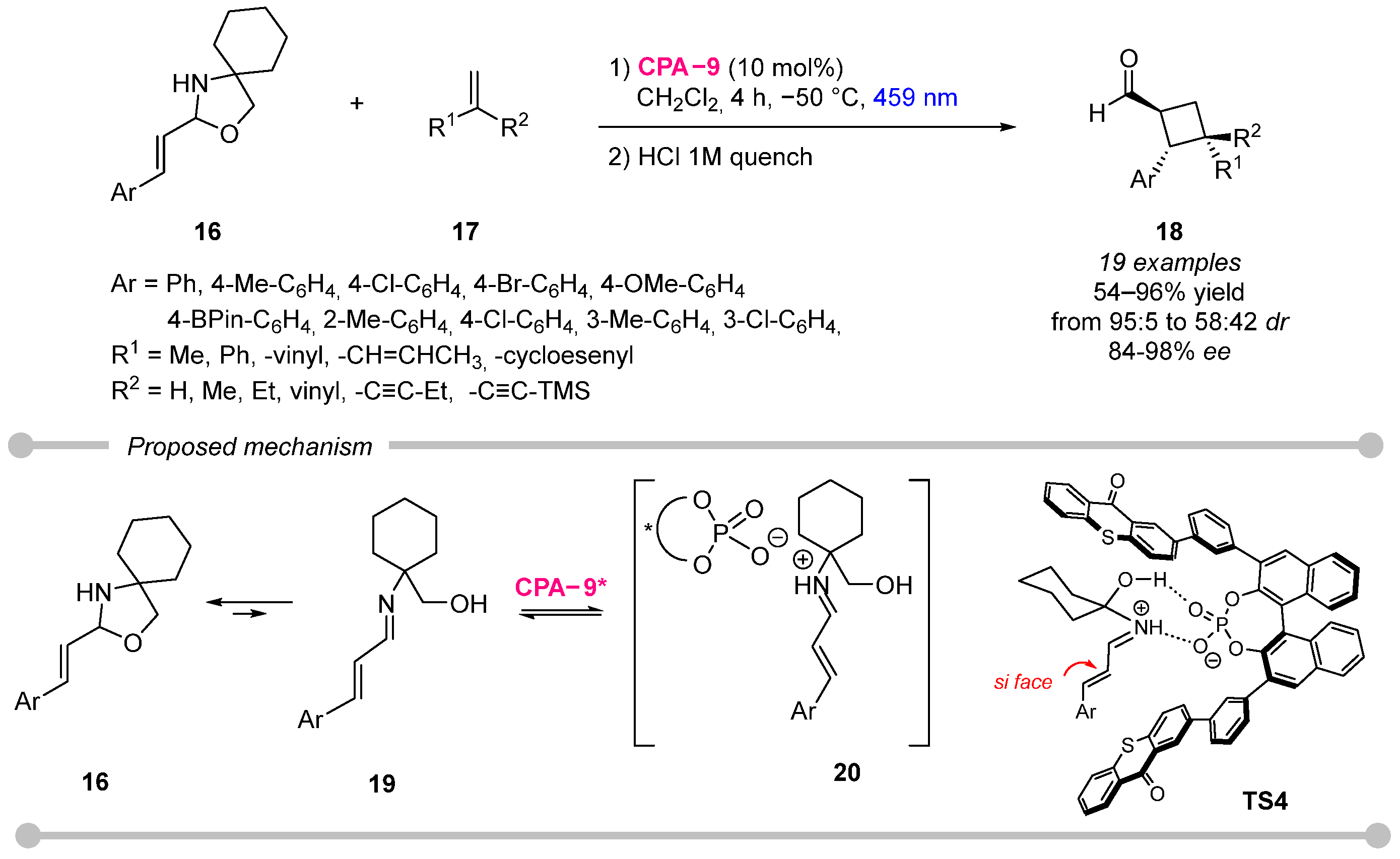
One year later, using the same BINOL-derived catalyst CPA-9, Bach and co-workers reported a further improvement, demonstrating that N,O acetals derived from α,β-unsaturated β-aryl substituted aldehydes and (1-aminocyclohexyl)methanol 18 are also suitable substrates for [2 + 2] photocycloadditions with a variety of olefins under visible light irradiation (459 nm) [46].
This acid-catalyzed [2 + 2] cycloaddition allows access to highly substituted cyclobutanecarbaldehydes with three contiguous stereocenters in good yield and high level of enantioselectivity. However, while the relative configuration between the aryl group in 2-position and the formyl group at C1 is consistently trans, the relative configuration between the stereogenic centers C2 and C3 varies upon the olefin used (Scheme 5).
Mechanistic studies indicate that catalyst CPA-9 promotes protonation of the N,O-acetal, generating iminium ion 16, which forms a hydrogen-bond-assisted ion pair with the chiral phosphate anion and thereby establishes a defined chiral environment. Notably, NMR studies revealed that the N,O-acetal exists in equilibrium between the closed acetal form and the open-chain form, with a slight preference for the closed structure (16:19 ratio of 2:1). After protonation, however, the open species 20 becomes the catalytically relevant intermediate. Upon visible-light irradiation, the thioxanthone units of the catalyst act as photosensitizers, enabling triplet energy transfer and promoting the intermolecular [2 + 2] photocycloaddition with substituted olefin 17 according to a Si face attack. Control experiments revealed that the phosphoric acid not only activates the substrate through iminium ion formation but also mediates the energy transfer step, thereby ensuring efficient enantioface differentiation during C-C bond formation.
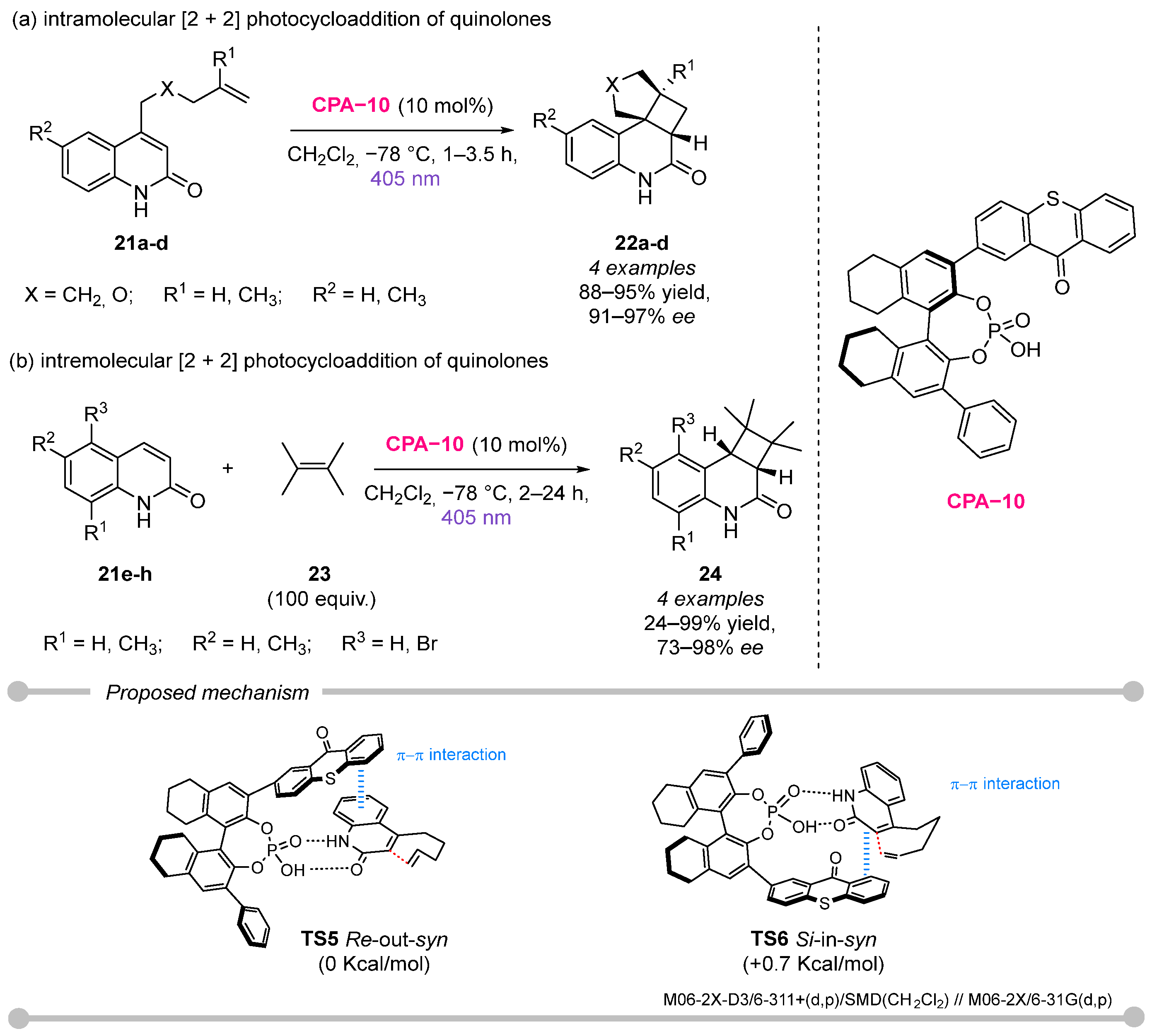
In 2022, Takagi and co-workers demonstrated that the H8-BINOL-derived CPA-9, monofunctionalized with a thioxanthone moiety at the ortho position of the phosphoric acid unit, is capable of promoting the [2 + 2] photocycloaddition of suitably designed quinolones [47]. In this case, a series of differently substituted quinolones 21 were dissolved in CH2Cl2 and irradiated at 405 nm at −78 °C in the presence of CPA-10, affording both intramolecular [2 + 2] cycloadducts 22 in good to excellent yields and high enantiomeric excesses (Scheme 6a). The same transformation was also performed in the presence of 2,3-dimethyl 2-butene 23 achieving desired cycloadducts 24 in good yields and ee, although 100 equiv. of olefin were necessary (Scheme 6b).
NMR studies revealed that CPA-10 and compound 21a (X = CH2, R1 = R2 = H) form a 1:1 complex. DFT calculations of the transition states revealed that the quinolone was faced with the thioxanthone ring of the catalyst in the energetically most favorable geometry, described as Re-out-syn. In this arrangement, the substrate approaches the catalyst with its Re face directed toward the thioxanthone moiety (Re), the carbonyl group of the thioxanthone unit is oriented away from the quinolone (out), and the quinolone overlaps directly with the thioxanthone ring in a parallel fashion (syn), as represented in TS5. This geometry is stabilized by two key non-covalent interactions: π−π stacking between the thioxanthone chromophore and the quinolone ring, and dual hydrogen bonding between the phosphate oxygens of the catalyst and the substrate. Distortion/interaction analysis on the transition states confirmed that these non-covalent interactions are the dominant factor in determining the stereochemical outcome, as Re-out-syn transition state is significantly lower in energy than the competing TS6 Si-in-syn counterpart.
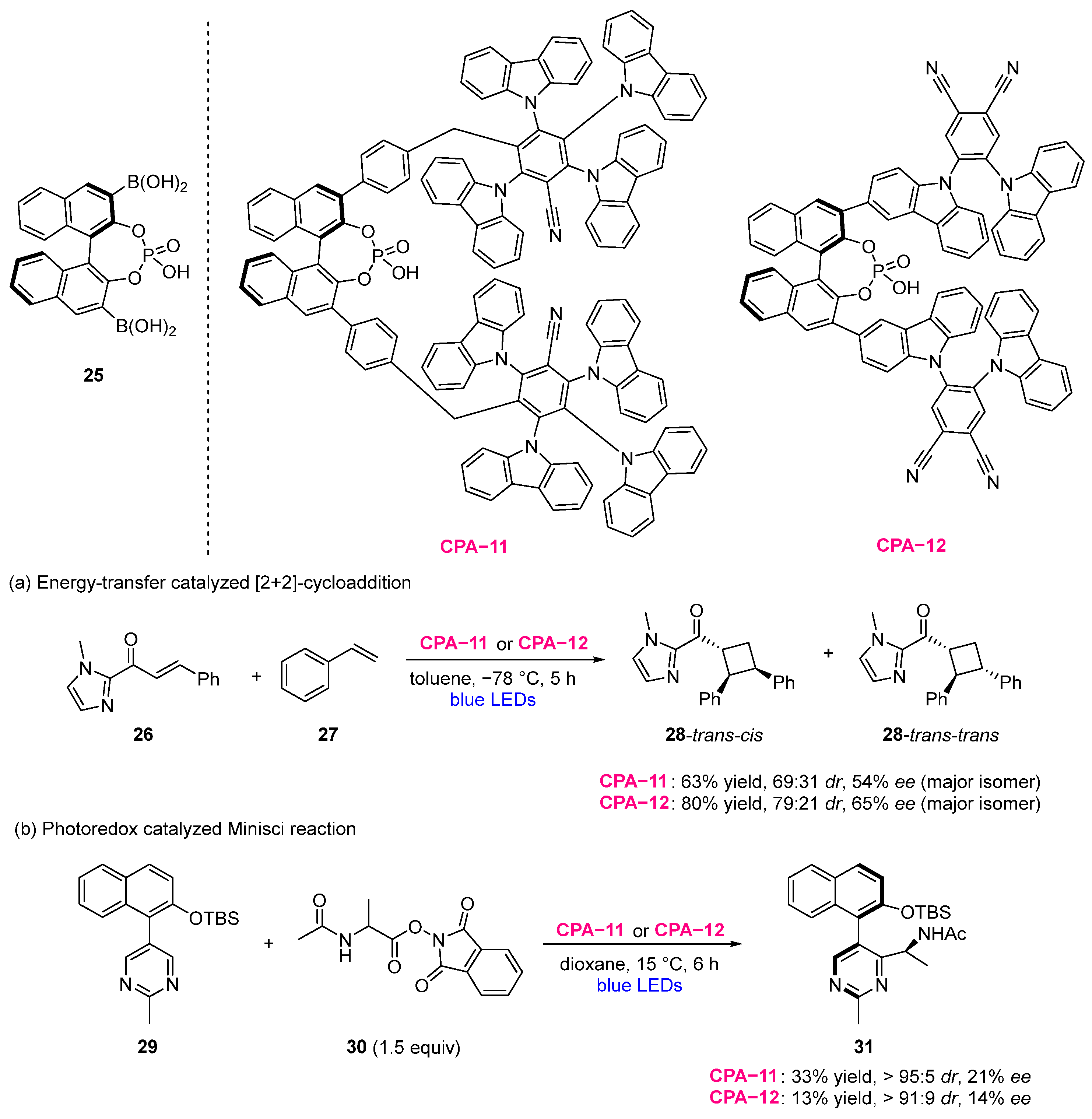
In an alternative strategy aimed at overcoming the limited tunability of the thioxanthone scaffold, König and Toste, instead of modifying the chiral backbone to access bifunctional photoactive chiral Brønsted acids, replaced the thioxanthone moiety with a cyanoarene-based donor–acceptor photocatalyst [48]. To this end, they selected 1,2,3,5-tetrakis(carbazol-9-yl)-4,6-dicyanobenzene (4CzIPN) [49,50], an organic dye originally developed for OLED research [51] that has since found widespread application in photoredox catalysis owing to its broad redox window, high photoluminescence quantum yield, and long excited-state lifetime.
CPA-11 and CPA-12 were then synthetized in a seven-step sequences starting from a BINOL-derived boronic acid 25, which was functionalized with the cyanoarene moiety via Suzuki cross-coupling, followed by demethylation and introduction of the phosphoric acid moiety. Notably, the 31P NMR spectrum of CPA-12 displayed three distinct singlet signals (31P NMR: 0.56, 0.76, and 0.92 ppm in DMSO-d6), which the authors attributed to conformational restrictions imposed by the more sterically congested 2CzPN-derived scaffold rather than to the presence of impurities or reaction intermediates—an assignment supported by HRMS and 1H NMR data, and by the observation that neither high-temperature NMR studies nor alternative purification protocols altered the signal ratio.
Both catalysts were evaluated in proof-of-concept reactions previously reported in the literature using separate photocatalyst/chiral acid dual catalytic systems. As an energy transfer process, the intermolecular [2 + 2] cycloaddition between C-cinnamoyl imidazoles 26 and styrene 27, originally developed in racemic form by Yoon and co-workers [52], was selected as a benchmark transformation. When operating at −78 °C under blue light irradiation, CPA-12 proved to be the superior catalyst, delivering cycloadduct 28 in 80% yield and 65% ee, while CPA-11 performed considerably worse, affording the same product in lower yield and enantioselectivity (63% yield, 54% ee) (Scheme 7a).
As second application, CzIPN-based chiral phosphoric acids were employed in the photoredox-catalyzed Minisci-type reaction of compounds 29 and 30 for the construction of axially chiral heterobiaryl scaffolds 31, originally reported by Xiao and co-workers [53]. In this context, CPA-11 afforded the product in 33% yield, >95:5 dr and 21% ee (Scheme 6b). Although only moderate enantioselectivities were achieved, these preliminary results demonstrate that CPA-11 and CPA-12 can operate as bifunctional catalysts in two distinct photochemical activation modes. Moreover, their modular architecture offers ample opportunities for further structural optimization. On the other hand, their high molecular weight (exceeding 2000 amu for CPA-11) represents a practical drawback, since catalyst loadings as high as 5 mol% correspond to relatively large amounts of catalyst per reaction.
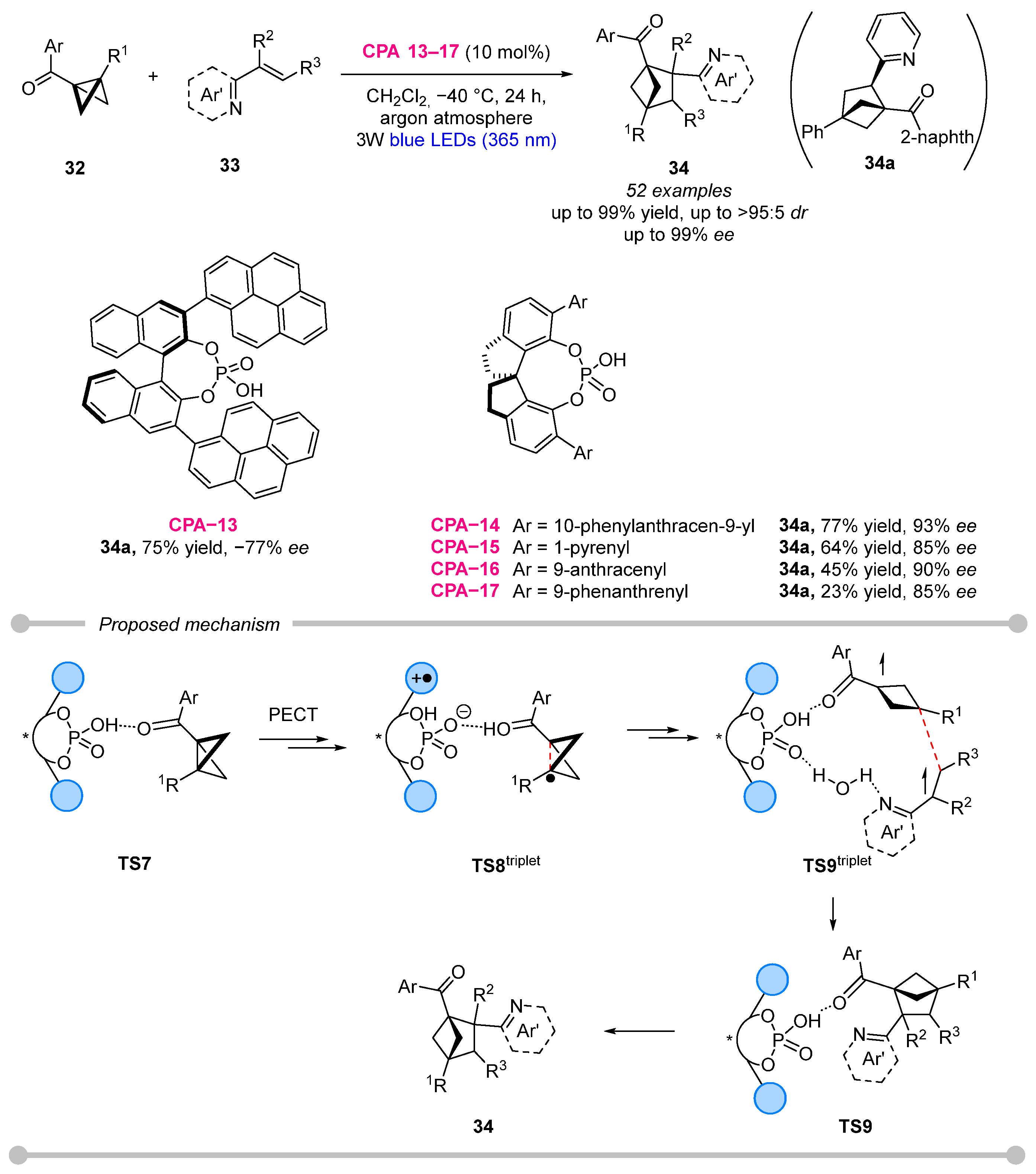
In 2024, Wang, Lv, Jiang and co-workers reported that a SPINOL-based chiral phosphoric acid CPA 13–17, and specifically CPA-14 functionalized at the 6,6′-positions with a 10-phenylanthracen-9-yl chromophore, enables enantioselective [2π + 2σ] photocycloadditions between bicyclo[1.1.0]butanes 32 and vinylazaarenes 33. This methodology affords pharmaceutically relevant bicyclo[2.1.1]hexanes 34 in high yields and with high enantioselectivities under irradiation at 365 nm at −40 °C for 24 h (Scheme 8) [54].
A broad range of 1-ketocarbonyl-3-substituted bicyclo[1.1.0]butanes bearing both electron-withdrawing and electron-donating groups, as well as heteroaryl substituents, were well tolerated, highlighting the broad functional-group compatibility at the ketone moiety. Moreover, both α-substituted vinylazaarenes (33, R3 = H) and β-substituted vinylazaarenes (33, R2 = H) were successfully employed: α-substituted vinylazaarenes afforded products bearing a quaternary stereocenter, while β-substituted vinylazaarenes led to the formation of two adjacent tertiary stereocenters, with the E-olefin configuration proving more reactive in the [2 + 2] photocycloaddition than the corresponding Z isomer.
Across 52 examples, a wide range of substituted bicyclo[2.1.1]hexanes 34 were obtained with broad structural diversity and consistently high levels of reactivity and enantiocontrol. Mechanistic studies, supported by Stern–Volmer quenching experiments, cyclic voltammetry measurements, and DFT calculations, indicate that the reaction proceeds through a proton-coupled electron transfer between the photoexcited triplet state of the chiral phosphoric acid CPA-14 and the bicyclobutane substrate. This process generates a neutral ketyl radical as an H-bonded adduct of the chiral phosphate (TS8triplet), which undergoes ring opening and subsequent radical addition to the vinylazaarene (TS9triplet) before a final triplet-to-singlet spin crossing (TS10) delivers the desired cycloaddition product 34. It must be noted that the reaction needs to be conducted under an inert argon atmosphere, as exposure to air completely suppresses product formation, consistent with the known quenching of triplet excited states and radical intermediates by molecular oxygen.
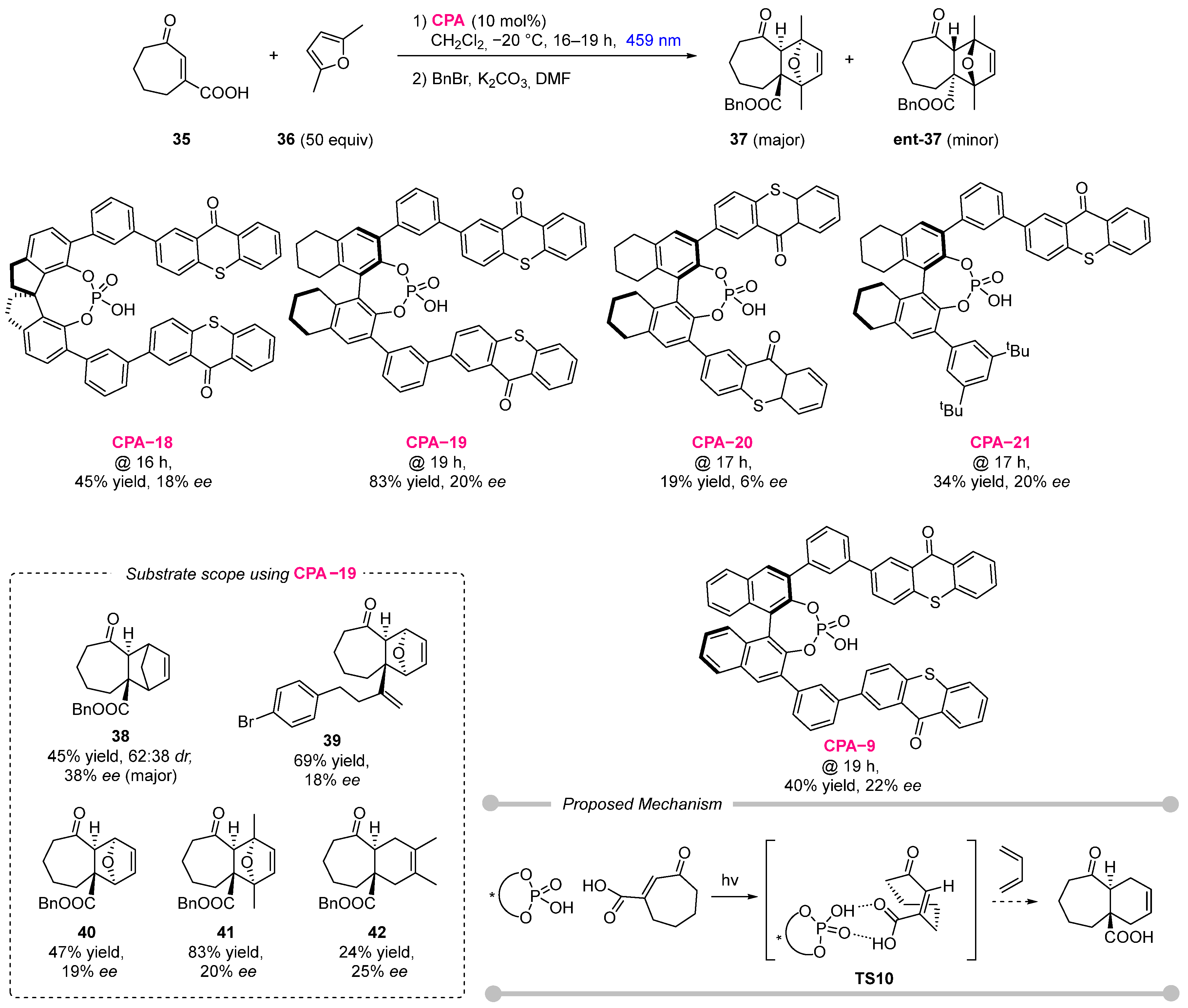
In 2025, chiral phosphoric acids functionalized with a thioxanthone photosensitizer found a novel application in the photochemical isomerization of cis cyclohept-2-enone-3-carboxylic acid 35 to its transient trans isomer. Stierle, Bach, and co-workers reported that upon triplet energy transfer from the catalyst, the resulting short-lived chiral trans intermediate (lifetime ca. 130 μs in CH2Cl2 at room temperature) can be generated enantioselectively and subsequently trapped by 2,5-dimethylfuran 36 in a Diels–Alder reaction to form corresponding tricyclic lactones 37 in an enantioselective manner (Scheme 9) [55,56].
Among the five thioxanthone-based CPAs evaluated, catalyst CPA-19 shows better chemical and stereochemical efficiency, and was applied across the substrate scope affording tricyclic lactones 38–42 in yields up to 83% and enantioselectivities of up to 38% ee under blue light irradiation (459 nm) at −20 °C. A comprehensive mechanistic model based on DFT calculations revealed that enantioselectivity originates from a conformational constrain imposed by the catalyst prior to the photoisomerization event (TS10). This preorganization dictates the direction of the one-bond flip, favoring the formation of one enantiomer of the transient trans-isomer.
Although this photoisomerization step is intrinsically enantioselective, a competing ground-state selectivity in the subsequent Diels–Alder reaction partially erodes the overall enantioselectivity. Specifically, CPA-19 favors cycloaddition of the minor enantiomer ent-37, thereby accounting for the reduced enantiomeric excess observed across different diene partners.
Altogether, these examples highlight the broad synthetic potential of bifunctional photoactive CPAs in photocatalytic stereoselective bond-forming transformations and demonstrate how covalent integration of the chromophore into the chiral backbone scaffold enables efficient coupling of photoactivation and stereoselectivity.

2.2. Photocatalytic Deracemization Processes

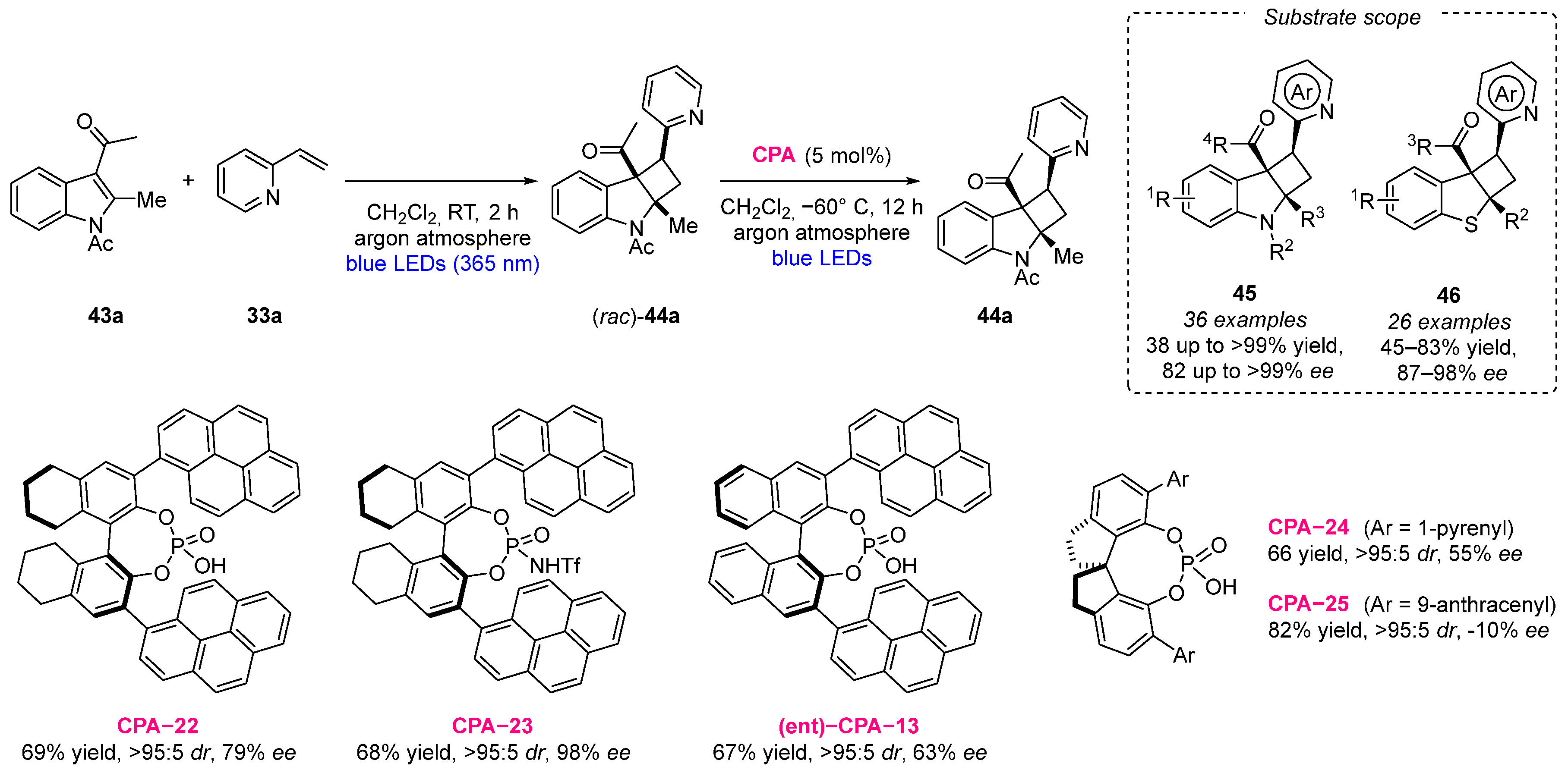
Beyond bond-forming processes, bifunctional photoactive CPAs have also been applied to photochemical deracemization and related transformations, in which the bifunctional catalyst does not perform the construction of new bonds, but instead controls the stereochemical outcome of photoinduced interconversion processes. According to this approach, Jang and co-workers reported a “de novo deracemization” strategy based on vinylazaarenes as partners in [2 + 2] photocycloadditions, in which the initial photocycloaddition furnishes racemic cyclobutanes, and enantioselectivity is achieved during the photocycloreversion step under the control of a chiral phosphoric acid (Scheme 10) [57].
The process is defined as de novo deracemization because enantioenriched products are generated directly from simple, achiral starting materials, without the need of using preformed racemic substrates, through a sequence of reversible photocycloaddition and enantioselective photocycloreversion steps. In this approach, benzoyl indoles or benzo[b]thiophenes reacts with vinylazaarenes 33 in an initial [2 + 2] photocycloaddition to give the corresponding racemic cyclobutanes 45 or 46, which then undergo reversible photocycloreversion under the control of the chiral catalyst, leading to the selective formation of the corresponding single enantiomer.
Although the chiral phosphoric acid is present throughout the reaction, the initial photocycloaddition proceeds with little stereocontrol, whereas enantioselectivity is established during the photocycloreversion step. In this step, differences in catalyst/substrate interactions and in the excitation properties of the diastereomeric complexes enable selective cleavage of one enantiomer, driving the system toward an enantioenriched product.
The transformation requires irradiation at 365 nm and proceeds efficiently in the presence of chiral phosphoric acids; even if better results have been obtained using chromophore-substituted N-triflylphosphoramide CPA-23. For instance, cyclobutane 44a is obtained in 69% yield with 79% ee when CPA-22 was employed, but in general a broad range of derivatives are accessible in 38–99% yield with up to >99% ee. This approach shows a broad substrate scope across various indoles and vinylazaarenes; however, the overall efficiency is influenced by the balance between photocycloaddition and photocycloreversion, which in some cases leads to moderate yields for less reactive substrates.
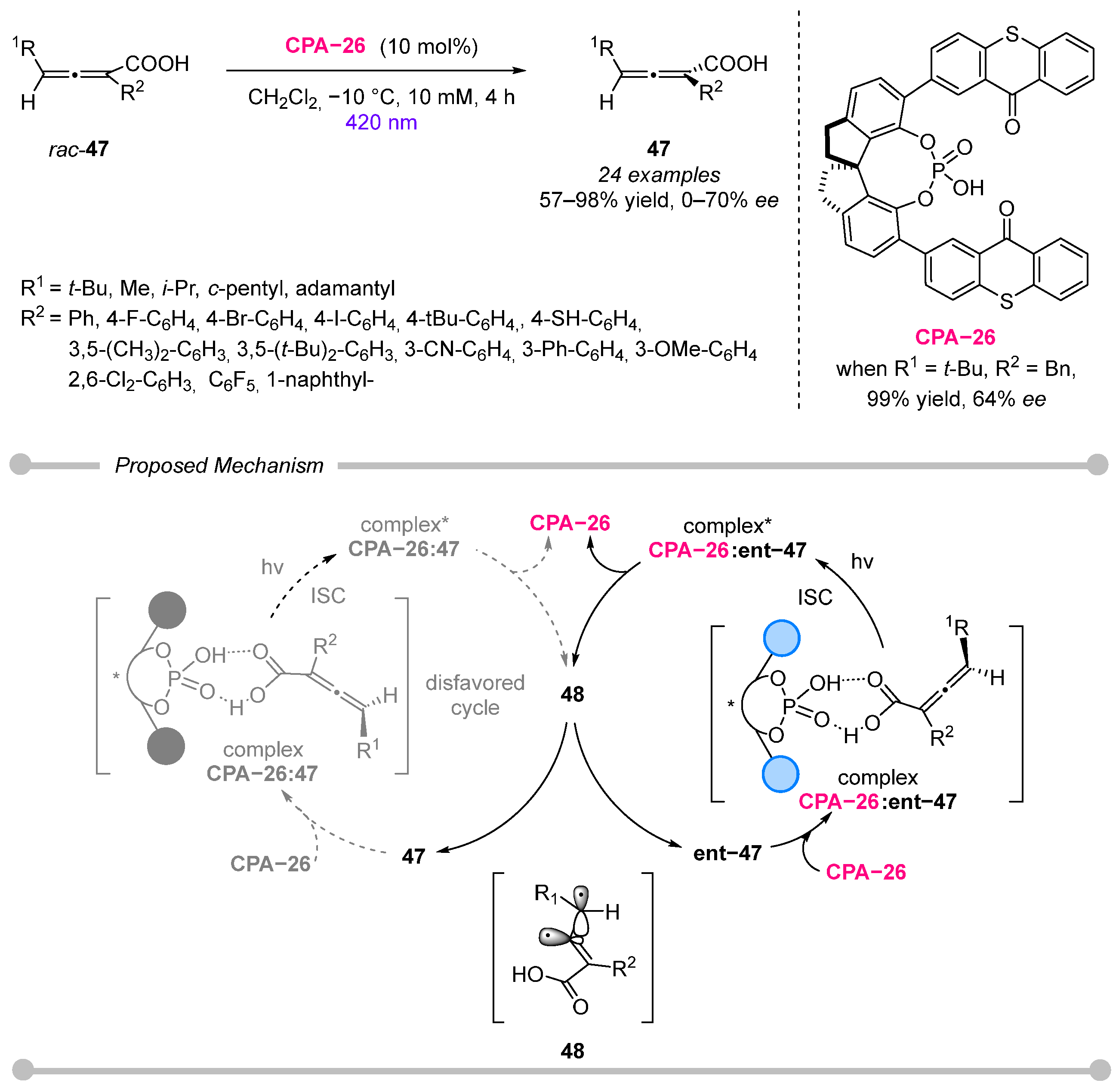
Alongside this de novo approach, Bach and co-workers further demonstrated that bifunctional chiral phosphoric acids bearing a thioxanthone chromophore can also promote direct photochemical deracemization of 2,3-allenoic acids (Scheme 11) [58].
Different CPAs based on different chiral scaffolds were investigated, but only the SPINOL-derived catalyst CPA-26 functionalized with two thioxanthone units proved to be effective for the deracemization of 2,4-disubstituted allenoic acids 47. Under irradiation at 420 nm for 4 h at −10 °C, CPA-26 afforded the enantioenriched acid 47 in high yields (57–98%) and moderate enantioselectivities (up to 70% ee), with preferential formation of 47 enantiomer over the ent-47 counterpart. The methodology shows good tolerance toward various substituted benzyl groups, although enantioselectivity is sensitive to steric effects at both termini of the allene.
Mechanistic studies revealed that, upon photoexcitation, CPA-26 populates its triplet excited state and subsequently transfers energy to the allene substrate, which is associated with the catalyst through hydrogen bonding to the COOH group, leading to the formation of the achiral diradical intermediate 48, which dissociates from the phosphoric acid and forms either one of the two enantiomers 47 or ent-47 of the allenoic acid. Because the efficiency of the energy transfer process is highly distance-dependent, the two diastereomeric catalyst/substrate complexes are processed at different rates, leading to the accumulation of the more slowly excited enantiomer at the photostationary state.
This mechanistic proposal is supported by control experiments and Boltzmann-weighted DFT calculations, which reveal a greater van der Waals overlap between the thioxanthone chromophore of the catalyst and the allene moiety of the substrate in one diastereomeric complex, consistent with its faster energy transfer and the observed enantioselectivity. While this work represents an elegant demonstration of a bifunctional CPA operating as a single-component photocatalyst for substrates previously inaccessible by this approach, the enantioselectivities remain moderate. This limitation is attributed to the conformational flexibility of both the catalyst and the substrate, which reduces the efficiency of enantiomer discrimination during the energy transfer step.
Overall, these studies highlight the remarkable versatility of bifunctional photoactive chiral phosphoric acids as single-component photocatalysts capable of promoting a wide range of stereoselective photochemical transformations. By covalently integrating a photoactive unit within the chiral scaffold, CPAs can operate through different activation modes while maintaining a well-defined chiral pocket suitable for performing enantioselective catalysis as well as deracemization and photoisomerization of transient intermediates. The thioxanthone moiety has emerged as the privileged chromophore, although cyanoarene- and anthracene-based systems have also shown potential in expanding the scope of accessible transformations and tuning the photophysical properties of these catalysts. Despite these advances, several limitations remain, including moderate enantioselectivities in some systems, restricted substrate scope in certain transformations, and the need for precise tuning of catalyst/substrate interaction to achieve efficient stereocontrol. Addressing this challenge, the development of more rigid catalyst architectures [59,60], improved substrate preorganization, or data-driven catalyst design strategies [61,62,63] will be crucial for advancing this approach and will likely define the next developments in the field.

3. Photoactive CPA–Substrate Complexes

In a conceptually different approach, chiral phosphoric acids have been used to promote the formation of photoresponsive catalyst/substrate complexes, rather than to act as photoactive catalysts themselves. Upon coordination through hydrogen bonding or ion pairing, the electronic properties of the substrate are modified, enabling direct excitation under light irradiation in the absence of an external photocatalyst. In this way, the CPA simultaneously controls the substrate activation and the stereochemical outcome of the reaction. This strategy provides a particularly elegant platform for stereoselective photochemical synthetic methodologies, as it merges molecular recognition, photoactivation, and enantiocontrol within a single catalyst/substrate assembly. In many other light-driven transformations, however, the role of the chiral phosphoric acid follows a classical pathway: rather than rendering the substrate itself photoactive, the CPA coordinates and stereochemically organizes reactive intermediates that are generated independently through an initial photochemical event [64,65,66]. Such cases fall outside the scope of the present section and will not be discussed.

3.1. Direct Excitation and Activation of CPA/Substrate Complexes

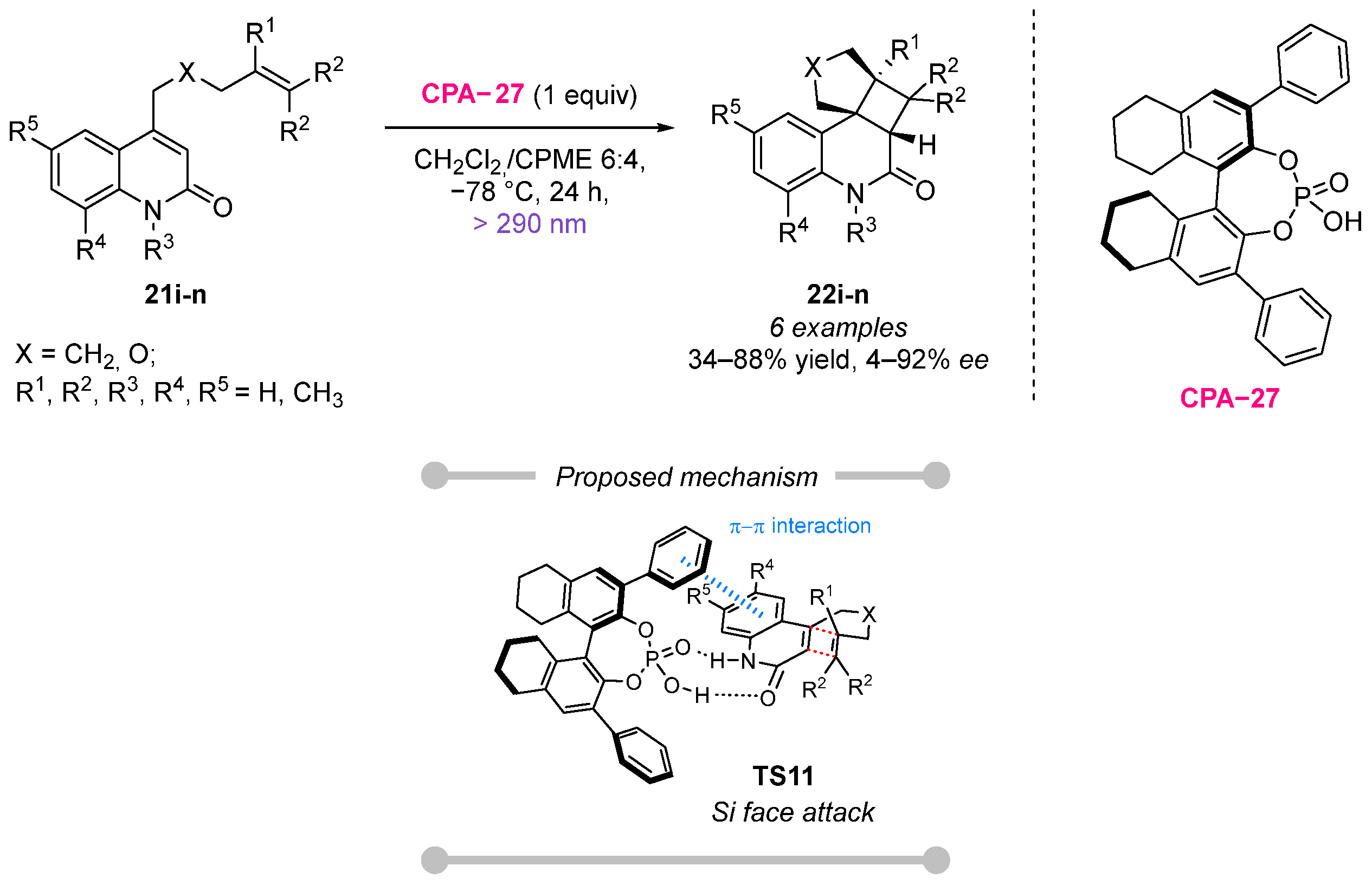
Studies on chiral Lewis acid-mediated photochemical reactions have shown that substrate binding can modulate photophysical properties and enable stereocontrolled excitation [67,68]. A first representative example in this field involving chiral phosphoric acids was reported in 2020 by Takagi and Tabuchi, who developed an enantioselective intramolecular [2 + 2] photocycloaddition of substituted 4-bishomoallyl-2-quinolones 22i–n using stoichiometric amounts of chiral phosphoric acid CPA-25 as a template for direct excitation of the CPA/substrate complex in CH2Cl2/CPME mixture at −78 °C for 78 h [69]. Upon these reaction conditions, desired cycloadducts 22i–n were formed in good yields and up to 92% ee (Scheme 12).
Mechanistic studies based on 1H and 31P NMR measurements supported the formation of a 1:1 complex between CPA-27 and quinolones 21. As observed in the analogous transformation promoted by the thioxanthone-functionalized H8-BINOL-derived catalyst CPA-10 (Scheme 6), the stereochemical outcome of the process was found to be primarily determined by π−π interactions between the 3,3′ substituent of the chiral phosphoric acid and the quinolinone substrate (TS11). Structural variation in substrate 21 further highlighted the importance of dual hydrogen bonding, as N-methylation or the introduction of competing hydrogen-bonding sites led to a marked decrease or complete loss of enantioselectivity.
Although this methodology can be considered more as a template-controlled direct excitation process rather than a photoactive CPA/substrate complex, it nevertheless represents an important early precedent showing that phosphoric acid can preorganize substrates for stereocontrolled photochemical activation. Catalytic variants of enantioselective [2 + 2] photocycloadditions were subsequently developed, although the optimal systems involved BINOL-derived chiral phosphoramides rather than classical chiral phosphoric acids [70,71,72].
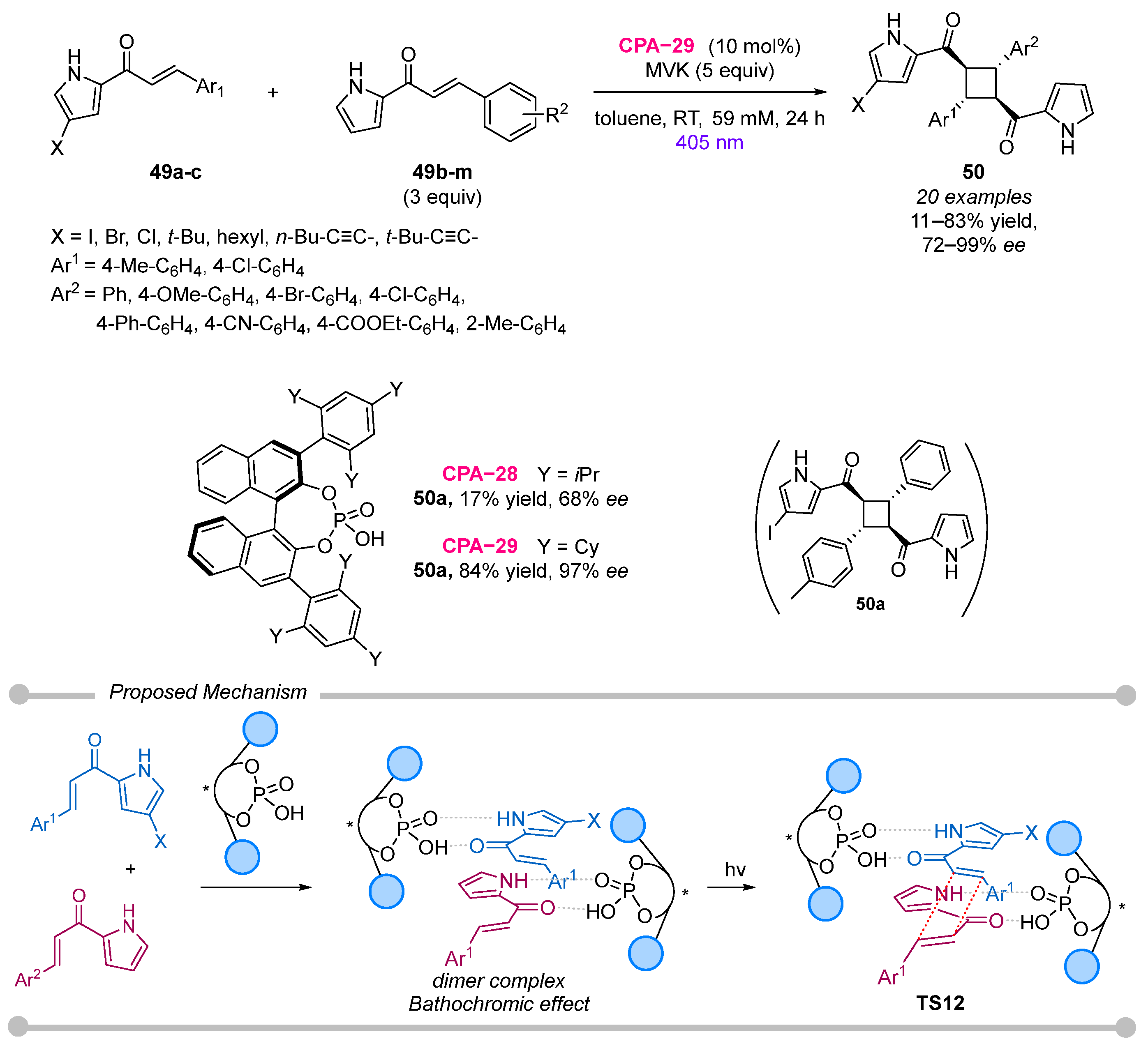
The first enantioselective [2 + 2] photocyclization specifically promoted by CPAs was reported in 2023 by Akiyama and co-workers. They developed an intermolecular [2 + 2] photocyclization of alkenyl 2-pyrrolyl ketones 49 using catalysts CPAs 28–29 to afford cyclobutanes 50. Among these catalysts, only the bathochromic shift induced by the chiral phosphoric acid CPA-29 enabled the synthesis of cyclobutanes with enantioselectivities in up to 99% ee (Scheme 13) [73].
It was found that mixing alkenyl 2-pyrrolyl ketones 51 with chiral phosphoric acid CPA-29 induced a bathochromic absorption shift, allowing the resulting complex to be excited upon violet LED irradiation at 405 nm. This excitation allows the formation of cyclobutane products in up to 85% yield and 98% ee. A broad substrate scope was demonstrated, including halo-, alkyl-, alkynyl-, and aryl-substituted enones, although yields and enantioselectivities are quite influenced by the electronic characteristics of the substituents.
Studies on the related mechanism suggested that the reaction proceeds through direct excitation of the CPA/substrate complex from the singlet excited state, rather than through a triplet pathway. A positive nonlinear effect further indicated that more than one phosphoric acid molecule is involved in the stereodetermining transition state. On this basis, the authors proposed transition state TS-12 composed of two molecules of CPA-28 and two molecules of substrate 49. DFT calculations supported this hypothesis, revealing that this dimeric complex is further stabilized by π−π stacking interactions between the pyrrole moieties.
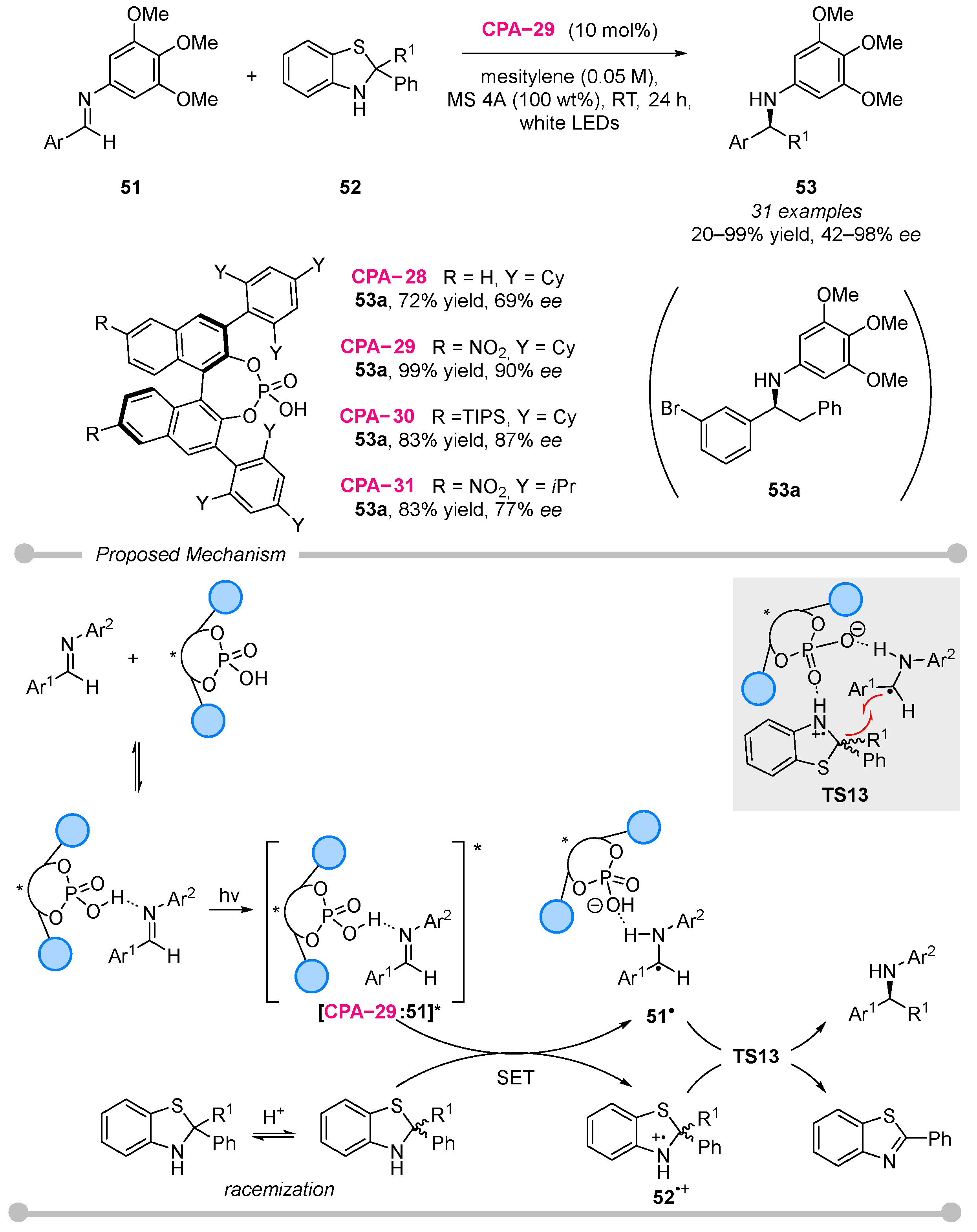
With a similar approach, the same research group also reported a visible-light-driven enantioselective radical addition to imines enabled by direct excitation of a chiral phosphoric acid–imine complex (Scheme 14) [74].
The reaction between N-3,4,5-trimethoxyphenyl substituted aldimines 51 and benzothiazolines 52 was carried out in mesitylene in the presence of the BINOL-derived chiral phosphoric acid CPA-29 bearing two nitro groups at the 6,6′-positions, under white LED irradiation, leading to the formation of chiral amines 53 in high yields and with enantioselectivities of up to 98% ee. Control experiments showed that the presence of CPA-29 and light is necessary, while the reaction was completely suppressed under air. The substrate scope included a broad range of aromatic and aliphatic imines, although aliphatic imines proved to be less reactive than their aromatic counterparts.
Mechanistic studies supported an alkyl radical pathway: visible-light excitation of the protonated imine generates a highly oxidizing chiral phosphoric acid–imine complex [CPA-29:51]*, which promotes single-electron transfer to benzothiazoline 52, affording the amino radical 51 and the benzothiazoline radical cation 51+. Their interaction with the chiral phosphate anion enables enantioselective radical transfer to give the desired enantiopure amine 53 and benzothiazole, while in situ racemization of benzothiazoline ensures selective reaction of the matched enantiomer.
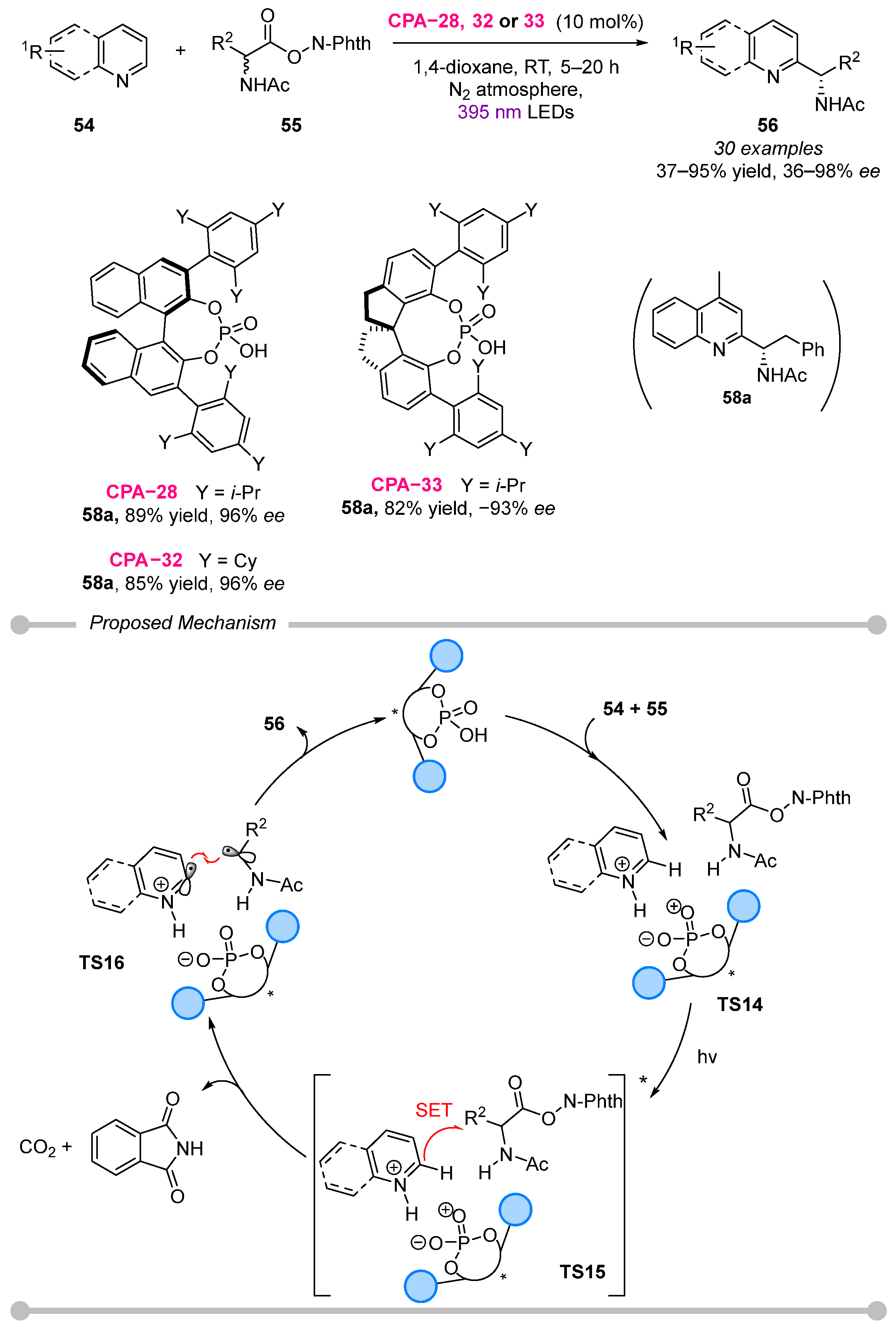
A further relevant contribution in this field was reported by Zheng and co-workers, with the development of an enantioselective Minisci-type alkylation of N-heteroarenes catalyzed by chiral phosphoric acids under 395 nm irradiation without the need for metals, photocatalysts, or other additives (Scheme 15) [75]. It was found that quinoline-, isoquinoline-, and pyridine-type substrates reacts with α-aminoalkyl radicals derived from redox-active esters, affording chiral aminoalkylated N-heteroarenes 54 in high yields and with enantioselectivities of up to 98% ee when irradiated at 395 nm in the presence of a chiral phosphoric acid (Scheme 14). Optimization studies identified the bulky BINOL-derived CPA-28 and CPA-32 as the most effective catalysts, although good results were also obtained with the spiro-phosphoric acid CPA-33. Notably, the addition of a conventional iridium-based photoredox catalyst did not improve the reaction outcome, supporting the hypothesis that the transformation does not rely on an external photocatalyst.
Mechanistic studies confirm the presence of radical intermediates, and ruled out both N-oxide intermediates and a simple EDA complex between the N-heteroarene and the redox-active ester. Irradiation at 395 nm of the hydrogen-bonded CPA/substrate complex TS14 generates the excited species TS15, which promotes intermolecular single-electron transfer to the redox-active ester. Subsequent chiral phosphoric acid-assisted enantioselective radical coupling (TS16) affords the aminoalkylated product 56 with high enantioselectivity.
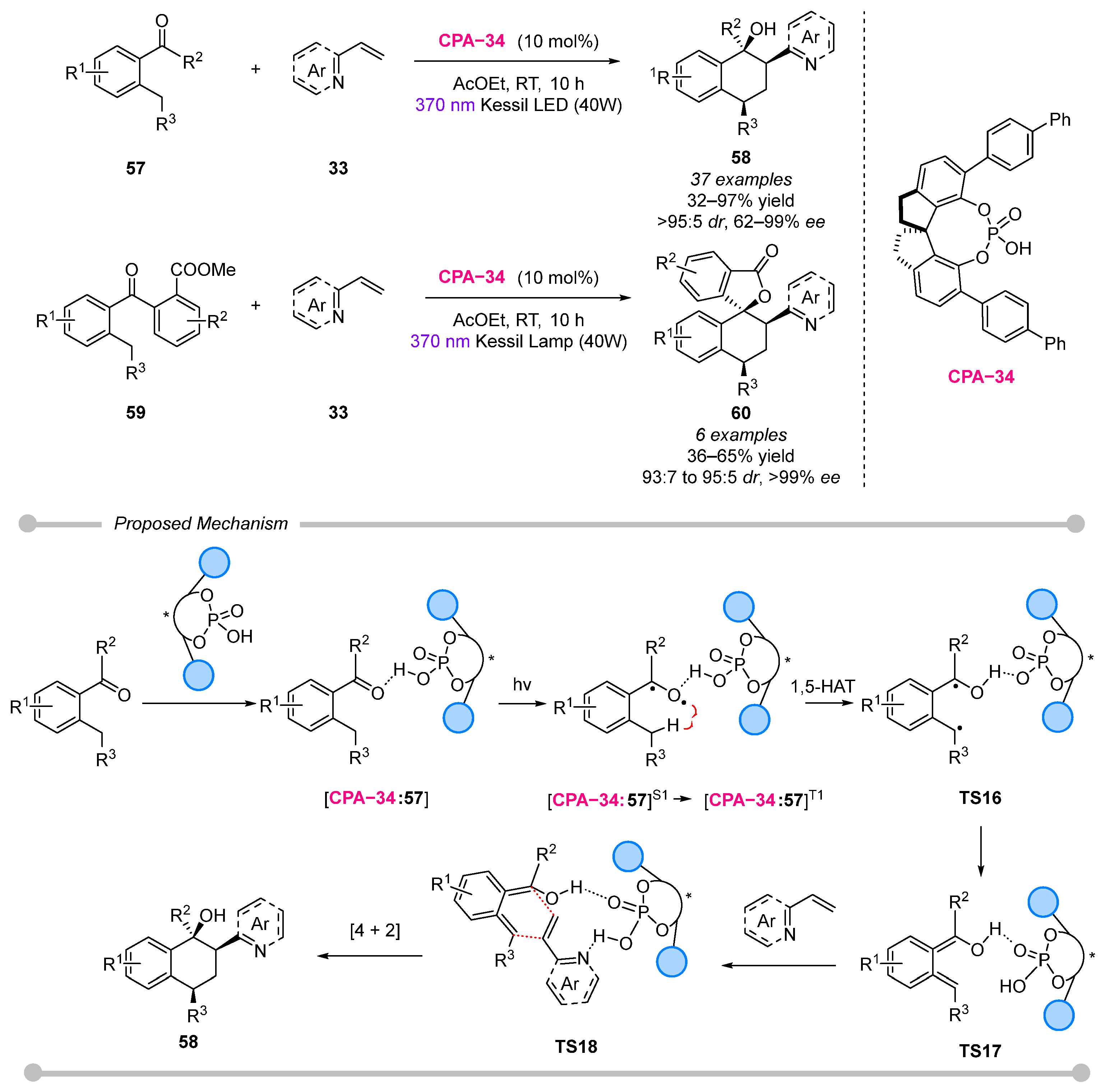
A further recent extension of the capability of chiral phosphoric acid to generate a photosensible complex was disclosed by Chen, Xiao and co-workers in an enantioselective photoenolization/Diels–Alder (PEDA) reaction between aryl ketones 57 and 59 and 2-vinyl-piridine 33 [76]. In this study, different BINOL- and SPINOL-derived chiral phosphoric acid were found to be effective in promoting highly stereoselective [4 + 2] cycloadditions between aryl ketones and vinylazaarenes under near-UV irradiation (370 nm) at room temperature, leading to the formation of azaarene-containing carbocyclic products 58 and spiro lactones 60 in good yields and excellent levels of enantio- and diastereoselectivity (Scheme 16).
Since UV-Vis analysis confirmed that [CPA-34:57] complex is the predominant light-absorbing species, the proposed mechanism involves initial hydrogen-bonding association of aryl ketone 57 with CPA-34. The complex formed acts as the photoactive species and upon excitation, it reaches singlet state [CPA-34:57]S1, then undergoes intersystem crossing to [CPA-34:57]T1, with the consequent formation of diradical TS16 through 1,5-HAT. This radical evolves in the corresponding CPA-stabilized photoenol TS17, which undergoes enantioselective Diels–Alder cycloaddition with the vinylazaarene through TS18, delivering the final adduct 58 in enantioenriched form.
As shown, these studies demonstrate that hydrogen-bonding association between a chiral phosphoric acid and the substrate can substantially modulate its photophysical properties, opening reaction pathways that would otherwise remain inaccessible without the presence of an external photocatalyst. Although only a limited number of synthetic applications have been developed so far, these studies clearly show that chiral phosphoric acids fulfill a dual and inseparable function: by engaging the substrate through hydrogen bonding or ion pairing, they simultaneously lower the LUMO energy of the resulting complex and create a well-defined chiral environment that controls the stereochemical outcome of the subsequent photochemical process. However, despite the remarkable enantioselectivities achieved in some cases, significant limitations are still present, which limit functional-group compatibility and restrict the broader generality of the methodology. For that reason, further progress will require both rational catalyst design and a deeper understanding of the CPA/substrate interactions that govern these transformations.

3.2. Multicomponent and Supramolecular Systems in CPA-Mediated Photoactivation

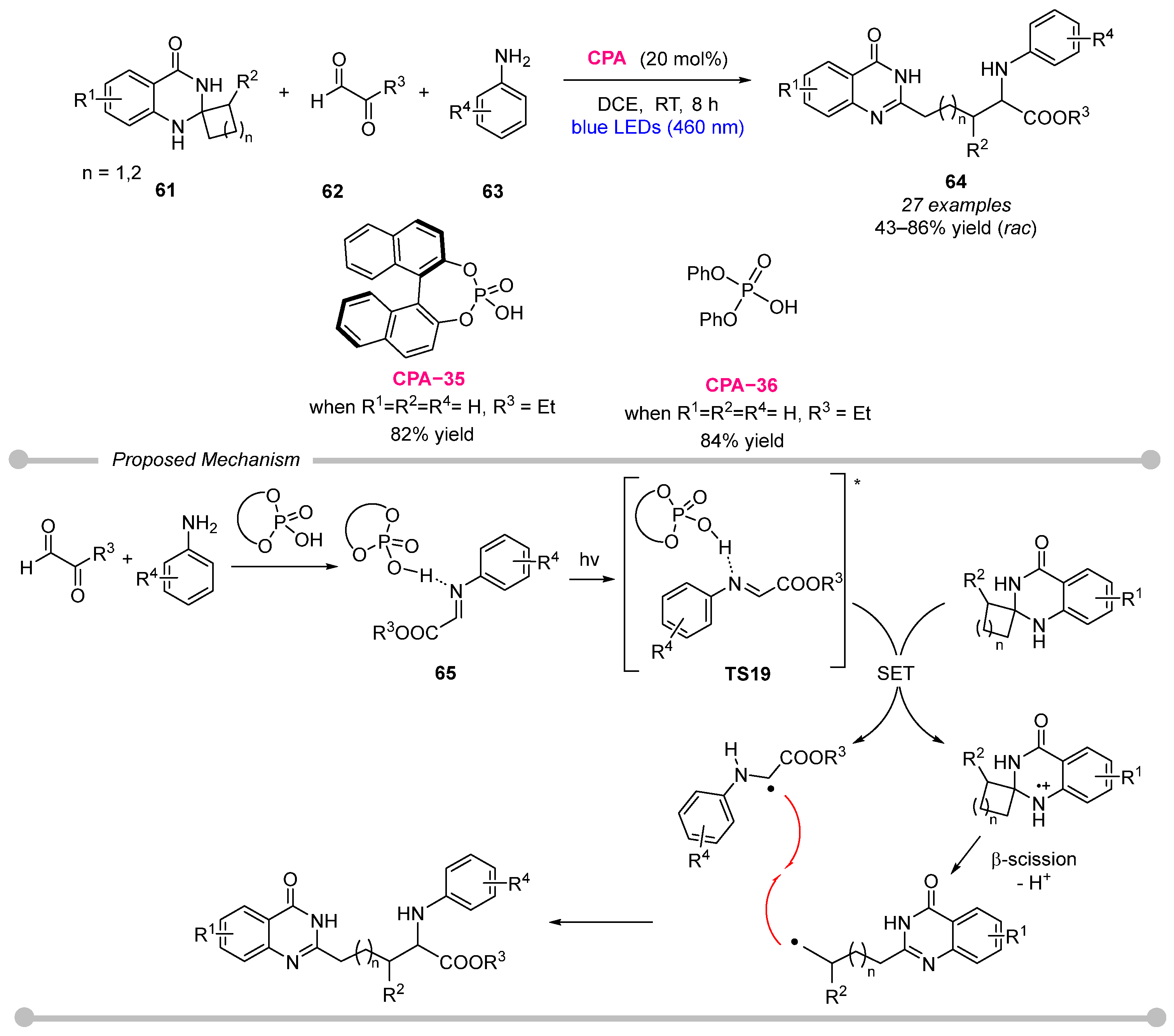
More recent developments have demonstrated that direct substrate photoactivation by phosphoric acid binding is not limited to simple CPA/substrate complexes, but can also be extended to multicomponent and supramolecular systems. In these more elaborate cases, the photoactive assembly is embedded within a broader network of non-covalent interactions, enabling radical generation and stereocontrol in structurally and mechanistically more complex settings. A representative example of this evolution was reported by Guo and co-workers, in a visible-light-driven three-component deconstructive aminoalkylation of spirodihydroquinazolones, in which the photoactive species is not a preformed binary CPA/substrate complex, but an in situ generated phosphoric acid/aldimine assembly operating within a multicomponent reaction system (Scheme 17) [77].
Spiro-dihydroquinazolinones 61, substituted glyoxylates 62, and aromatic amines 63 were reacted in dichloroethane (DCE) under 10 W blue LED irradiation (460 nm) at room temperature for 8 h, affording the corresponding unnatural N-aryl α-amino esters 64 containing a quinazolin-4(3H)-one fragment in up to 86% yield and with broad functional-group tolerance.
Although this transformation lacks in enantioselectivity (the radical is generated on the final stereogenic center), the importance of this study arises from the fact that an in situ generated acid/imine complex can act as a photoresponsive intermediate involved within a multicomponent radical cascade. According to the proposed mechanism, the phosphoric acid first promotes condensation between the aromatic amine and alkyl glyoxylate to form aldimine 65 in situ, and the resulting phosphoric acid/aldimine complex then acts as the key photoactive redox species under blue light irradiation.
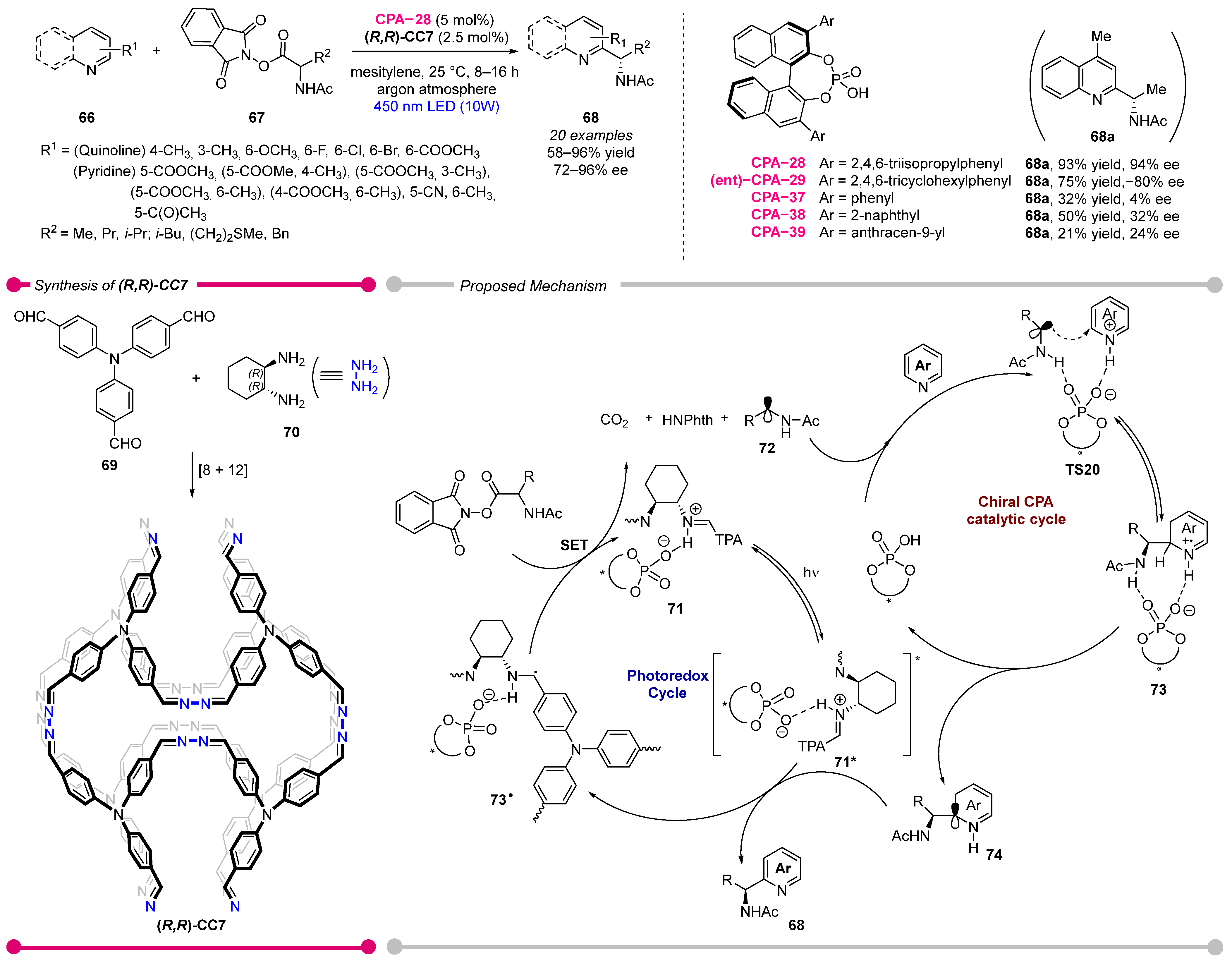
In another very recent contribution, Liu and co-workers reported a supramolecular extension of CPA-mediated photoactivation through an organic imine cage-mediated enantioselective Minisci addition of N-heteroarenes, in which a phosphoric acid/imine cage assembly acts as the photoactive species responsible for radical generation, while an additional chiral phosphoric acid molecule controls the stereoselective addition step [78]. (R,R)-CC7 cage was synthesized through an [8 + 12] imine condensation reaction between tris(4-formylphenyl)amine 69 and (R,R)-1,2-cyclohexanediamine 70 (Scheme 18).
Used in combination with CPA-28, this supramolecular system enabled the photocatalytic enantioselective Minisci reaction between N-heteroarenes 66 (quinolines, isoquinolines, pyridines) and redox-active esters 67 in mesitylene under 450 nm LED irradiation at 25 °C for 8–16 h, affording the corresponding chiral heteroarene derivatives 68 in high yields and enantioselectivities.
Mechanistic studies and control experiments support a radical reaction pathway involving the in situ formation of a CPA/imine adduct, in which the organic imine cage acts as a supramolecular scaffold that binds the phosphoric acid and provides the photoactive assembly responsible for radical generation under light irradiation.
Two distinct but cooperative catalytic cycles involving CPA-28 were hypothesized, in which the chiral phosphoric acid serves a dual function. One molecule of the catalyst interacts with the cage to form the CPA/imine complex responsible for the initial photocatalytic step, whereas a second molecule of CPA-28, not bound to the cage, mediates the enantioselective transformation.
In the photoredox cycle, one molecule of CPA-28 binds to the imine units of the (R,R)-CC7 cage through hydrogen bonding, generating the CPA/imine adduct 71, which upon light irradiation is excited to 71* which evolves into the reduced CPA/imine radical adduct 71. The resulting excited complex transfers an electron to the redox-active ester via SET process, ultimately leading to decarboxylation and formation of the α-aminoalkyl radical 72. The photoredox cycle is then completed by the regeneration of the ground-state CPA/imine complex 71, which allows catalyst turnover in the subsequent cycle. In the enantioselective cycle, a second molecule of CPA-28 protonates the N-heteroarene and organizes both reaction partners through hydrogen-bonding interactions, enabling enantioselective radical addition from the α-aminoalkylradical to the substrate through a TS20. The resulting radical cation 73 then undergoes deprotonation to give intermediate 74, which is further oxidized and deprotonated to give the final enantioenriched product 68.
Although examples of multicomponent and supramolecular systems in CPA-mediated photoactivation are still relatively few, these studies clearly demonstrate that this activation mode is not confined to simple binary catalyst/substrate complexes, but can also be extended to systems of substantially greater structural and mechanistic complexity. In such cases, the phosphoric acid does not simply interact with an individual substrate, but instead contributes to the formation of photoresponsive assemblies capable of generating reactive intermediates under light irradiation. These findings point to new opportunities for the future development of asymmetric photochemical catalysis.

4. Conclusions

The examples discussed herein illustrate that the role of chiral phosphoric acids is under continuous evolution; from classical Brønsted acid catalysts to photoactive components capable of both promoting and controlling stereoselective transformations under light irradiation. Depending on catalyst design and substrate class, they can operate as photosensitizers, photoredox-active catalysts, hydrogen-bonding templates, or components of photoactive supramolecular assemblies, while maintaining a defined chiral environment around highly reactive excited-state intermediates. In this context, CPA catalysis emerges as a powerful solution to one of the key challenges of photochemical synthesis: combining the high reactivity of excited-state intermediates with effective stereochemical control. The results gathered so far demonstrate that this strategy can be successfully extended to carbon–carbon bond-forming reactions, photocycloadditions, radical additions, deracemization processes, and more complex multicomponent transformations.
At the same time, however, several challenges in both approaches are still present. In bifunctional photoactive catalysts, further progress will depend on more precise tuning of the relationship between chromophore, catalyst geometry, and substrate recognition. In the case of photoactive CPA/substrate complexes, the main limitations arise from the strongly substrate-dependent nature of complex formation and from the often modest photophysical perturbation induced by acid binding, which can restrict generality and functional-group compatibility.
Future advances in this area will likely require a combination of rational catalyst design, improved substrate preorganization, and deeper mechanistic understanding of excited-state catalyst/substrate assemblies. In particular, greater insight into how catalyst structure influences absorption properties, excited-state lifetimes, intersystem crossing, energy- and electron transfer events should provide a more predictive basis for reaction development. If these challenges can be addressed, directly light-activated chiral phosphoric acids may evolve from a collection of elegant and mechanistically intriguing case studies into a broadly applicable strategy for asymmetric photochemical synthesis.

Author Contributions

Conceptualization, S.R.; writing—original draft preparation, S.R., M.G., F.M.; writing—review and editing, S.R., M.G., L.R., F.M.; supervision, S.R.; funding acquisition, S.R.; L.R. All authors have read and agreed to the published version of the manuscript.

Funding

This research was funded by PSR 2023 grant “Sustainable catalytic strategies for the preparation of fine chemicals” by the Università degli Studi di Milano.

Data Availability Statement

No new data were created or analyzed in this study. Data sharing is not applicable to this article.

Conflicts of Interest

The authors declare no conflicts of interest.

References

  1. Hopkinson, M.N.; Sahoo, B.; Li, J.L.; Glorius, F. Dual catalysis sees the light: Combining photoredox with organo-, acid, and transition-metal catalysis. Chemistry 2014, 20, 3874–3886. [Google Scholar] [CrossRef]
  2. Skubi, K.L.; Blum, T.R.; Yoon, T.P. Dual Catalysis Strategies in Photochemical Synthesis. Chem. Rev. 2016, 116, 10035–10074. [Google Scholar] [CrossRef]
  3. Hong, B.C. Enantioselective synthesis enabled by visible light photocatalysis. Org. Biomol. Chem. 2020, 18, 4298–4353. [Google Scholar] [CrossRef]
  4. Silvi, M.; Melchiorre, P. Enhancing the potential of enantioselective organocatalysis with light. Nature 2018, 554, 41–49. [Google Scholar] [CrossRef]
  5. Jiang, C.; Chen, W.; Zheng, W.H.; Lu, H. Advances in asymmetric visible-light photocatalysis, 2015–2019. Org. Biomol. Chem. 2019, 17, 8673–8689. [Google Scholar] [CrossRef]
  6. Wang, C.; Lu, Z. Catalytic enantioselective organic transformations via visible light photocatalysis. Org. Chem. Front. 2015, 2, 179–190. [Google Scholar] [CrossRef]
  7. Meggers, E. Asymmetric catalysis activated by visible light. Chem. Commun. 2015, 51, 3290–3301. [Google Scholar] [CrossRef]
  8. Brimioulle, R.; Lenhart, D.; Maturi, M.M.; Bach, T. Enantioselective catalysis of photochemical reactions. Angew. Chem. Int. Ed. Engl. 2015, 54, 3872–3890. [Google Scholar] [CrossRef]
  9. Nicewicz, D.A.; MacMillan, D.W. Merging photoredox catalysis with organocatalysis: The direct asymmetric alkylation of aldehydes. Science 2008, 322, 77–80. [Google Scholar] [CrossRef]
  10. Zhao, P.F.; Wang, K.; Wen, J.X.; Zhu, Z.M.; Zhang, H.; Wang, Z.H.; Liao, Y.X.; Da, C.S.; Du, Z.H. Recent advances in chiral phosphoric acids for asymmetric organocatalysis: A catalyst design perspective. Org. Biomol. Chem. 2025, 23, 7872–7913. [Google Scholar] [CrossRef]
  11. Mustafai, A.; Farooqi, R.; Woldegiorgis, A.G.; Lin, X. Emerging progress in chiral phosphoric acid-catalyzed asymmetric synthesis of unnatural α-amino acids. Catal. Sci. Technol. 2025, 15, 3465–3486. [Google Scholar] [CrossRef]
  12. Woldegiorgis, A.G.; Han, Z.; Lin, X. Recent advances in chiral phosphoric acid catalyzed asymmetric organic reactions: An overview. J. Mol. Struct. 2024, 1297, 136919. [Google Scholar] [CrossRef]
  13. Michelet, B.; Martin-Mingot, A.; Rodriguez, J.; Thibaudeau, S.; Bonne, D. Enantioselective Organocatalysis and Superacid Activation: Challenges and Opportunities. Chem.-Eur. J. 2023, 29, e202300440. [Google Scholar] [CrossRef]
  14. Jimenez, E.I. An update on chiral phosphoric acid organocatalyzed stereoselective reactions. Org. Biomol. Chem. 2023, 21, 3477–3502. [Google Scholar] [CrossRef] [PubMed]
  15. del Corte, X.; Martínez de Marigorta, E.; Palacios, F.; Vicario, J.; Maestro, A. An overview of the applications of chiral phosphoric acid organocatalysts in enantioselective additions to C=O and C=N bonds. Org. Chem. Front. 2022, 9, 6331–6399. [Google Scholar] [CrossRef]
  16. Palvolgyi, A.M.; Scharinger, F.; Schnurch, M.; Bica-Schroder, K. Chiral Phosphoric Acids as Versatile Tools for Organocatalytic Asymmetric Transfer Hydrogenations. Eur. J. Org. Chem. 2021, 2021, 5367–5381. [Google Scholar] [CrossRef] [PubMed]
  17. Garg, A.; Rendina, D.; Bendale, H.; Akiyama, T.; Ojima, I. Recent advances in catalytic asymmetric synthesis. Front. Chem. 2024, 12, 1398397. [Google Scholar] [CrossRef]
  18. Shao, Y.D.; Cheng, D.J. Chiral Phosphoric Acid: A Powerful Organocatalyst for the Asymmetric Synthesis of Heterocycles with Chiral Atropisomerism. ChemCatChem 2020, 13, 1271–1289. [Google Scholar] [CrossRef]
  19. Merad, J.; Lalli, C.; Bernadat, G.; Maury, J.; Masson, G. Enantioselective Bronsted Acid Catalysis as a Tool for the Synthesis of Natural Products and Pharmaceuticals. Chemistry 2018, 24, 3925–3943. [Google Scholar] [CrossRef]
  20. Selvakumar, S. Synergistic Dual Photoredox and Chiral Hydrogen Bonding Catalysis: Recent Advances. Asian J. Org. Chem. 2023, 12, e202300374. [Google Scholar] [CrossRef]
  21. Cao, Y.; Liu, G. Asymmetric Catalytic Synthesis by Synergistic Chiral Phosphoric Acid Photoredox Catalyzed Reactions. Adv. Synth. Catal. 2023, 365, 3044–3062. [Google Scholar] [CrossRef]
  22. Li, S.; Xiang, S.H.; Tan, B. Chiral Phosphoric Acid Creates Promising Opportunities for Enantioselective Photoredox Catalysis. Chin. J. Chem. 2020, 38, 213–214. [Google Scholar] [CrossRef]
  23. Prentice, C.; Morrisson, J.; Smith, A.D.; Zysman-Colman, E. Recent developments in enantioselective photocatalysis. Beilstein J. Org. Chem. 2020, 16, 2363–2441. [Google Scholar] [CrossRef]
  24. Rono, L.J.; Yayla, H.G.; Wang, D.Y.; Armstrong, M.F.; Knowles, R.R. Enantioselective photoredox catalysis enabled by proton-coupled electron transfer: Development of an asymmetric aza-pinacol cyclization. J. Am. Chem. Soc. 2013, 135, 17735–17738. [Google Scholar] [CrossRef]
  25. Moon, J.; Lee, S.; Shin, E.; Kwon, Y. Enantioselective Reactions of Redox-Active Esters Catalyzed via Cooperative Photoredox/Chiral Phosphoric Acid Catalysis. Synthesis 2025, 57, 3554–3564. [Google Scholar] [CrossRef]
  26. Yang, F.X.; Huang, T.; Lin, Y.M.; Gong, L. Advancements in organocatalysis for radical-mediated asymmetric synthesis: A recent perspective. Chem. Catal. 2024, 4, 100812. [Google Scholar] [CrossRef]
  27. Sun, Y.; Song, G.; Yan, Y.; Kang, T.; Dong, J.; Li, G.; Xue, D. Red-light-driven enantioselective Minisci-type addition to heteroarenes via recyclable semi-heterogeneous catalysis. Green Chem. 2025, 27, 5315–5321. [Google Scholar] [CrossRef]
  28. Gu, Y.J.; Luo, M.P.; Yuan, H.; Liu, G.K.; Wang, S.G. Photocatalytic Enantioselective Radical Cascade Multicomponent Minisci Reaction of beta-Carbolines Using Diazo Compounds as Radical Precursors. Adv. Sci. 2024, 11, e2402272. [Google Scholar] [CrossRef]
  29. He, Z.W.; Yuan, B.R.; Yu, X.Y.; Jiang, M.; Chen, J.R.; Xiao, W.J. Asymmetric Radical Coupling to Form beta(2,2,3)-Amino Acid Esters by Synergistic Chiral Phosphoric Acid and Photocatalysis. Angew. Chem. Int. Ed. Engl. 2025, 64, e202514155. [Google Scholar] [CrossRef]
  30. Kong, M.; Wang, Z.; Ban, X.; Zhao, X.; Yin, Y.; Zhang, J.; Jiang, Z. Radical Cross Coupling and Enantioselective Protonation through Asymmetric Photoredox Catalysis. Adv. Sci. 2024, 11, e2307773. [Google Scholar] [CrossRef]
  31. Deng, X.; Jiang, F.; Wang, X. Asymmetric Deoxygenative Functionalization of Secondary Amides with Vinylpyridines Enabled by a Triple Iridium-Photoredox-Chiral Phosphoric Acid System. Org. Lett. 2024, 26, 2483–2488. [Google Scholar] [CrossRef]
  32. Liu, Y.; Zhang, L.; Zhang, Y.; Cao, S.; Ban, X.; Yin, Y.; Zhao, X.; Jiang, Z. Asymmetric Olefin Isomerization via Photoredox Catalytic Hydrogen Atom Transfer and Enantioselective Protonation. J. Am. Chem. Soc. 2023, 145, 18307–18315. [Google Scholar] [CrossRef]
  33. Yamanomoto, K.; Yamamoto, K.; Yoshida, S.; Sato, S.; Akiyama, T. Enantioselective synthesis of 3-(N-indolyl)quinolines containing axial and central chiralities. Chem. Commun. 2024, 60, 582–585. [Google Scholar] [CrossRef]
  34. Tian, D.; Shi, W.; Sun, X.; Zhao, X.; Yin, Y.; Jiang, Z. Catalytic asymmetric [4 + 2] dearomative photocycloadditions of anthracene and its derivatives with alkenylazaarenes. Nat. Commun. 2024, 15, 4563. [Google Scholar] [CrossRef]
  35. Lu, Y.N.; Che, C.; Zhen, G.; Chang, X.; Dong, X.Q.; Wang, C.J. Visible-light-enabled stereoselective synthesis of functionalized cyclohexylamine derivatives via [4 + 2] cycloadditions. Chem. Sci. 2024, 15, 6507–6514. [Google Scholar] [CrossRef]
  36. Zhang, W.; Zhang, L.; Luo, S. Catalytic Asymmetric Visible-Light de Mayo Reaction by ZrCl(4)-Chiral Phosphoric Acid Complex. J. Am. Chem. Soc. 2023, 145, 14227–14232. [Google Scholar] [CrossRef] [PubMed]
  37. Ding, W.-W.; He, Z.-Y.; Sayed, M.; Zhou, Y.; Han, Z.-Y.; Gong, L.-Z. Enantioselective synthesis of β- and α-amino ketones through reversible alkane carbonylation. Nat. Synth. 2024, 3, 507–516. [Google Scholar] [CrossRef]
  38. Ma, C.; Shen, J.; Qu, C.; Shao, T.; Cao, S.; Yin, Y.; Zhao, X.; Jiang, Z. Enantioselective Chemodivergent Three-Component Radical Tandem Reactions through Asymmetric Photoredox Catalysis. J. Am. Chem. Soc. 2023, 145, 20141–20148. [Google Scholar] [CrossRef]
  39. Rolka, A.B.; König, B. Bifunctional organic photocatalysts for enantioselective visible-light-mediated photocatalysis. Nat. Synth. 2023, 2, 913–925. [Google Scholar] [CrossRef]
  40. Bian, B.J.; Yang, L.; Qiao, L.X.; Zhang, Q.; He, W. Asymmetric photoreactions catalyzed by chiral ketones. RSC Adv. 2025, 15, 2874–2889. [Google Scholar] [CrossRef]
  41. Demertzidou, V.P.; Skolia, E.; Kokotos, C.G. Thioxanthone: A Benchmark Photocatalyst for Organic Synthesis. ChemCatChem 2025, 17, e00760. [Google Scholar] [CrossRef]
  42. Nikitas, N.F.; Gkizis, P.L.; Kokotos, C.G. Thioxanthone: A powerful photocatalyst for organic reactions. Org. Biomol. Chem. 2021, 19, 5237–5253. [Google Scholar] [CrossRef]
  43. Lyu, J.; Claraz, A.; Vitale, M.R.; Allain, C.; Masson, G. Preparation of Chiral Photosensitive Organocatalysts and Their Application for the Enantioselective Synthesis of 1,2-Diamines. J. Org. Chem. 2020, 85, 12843–12855. [Google Scholar] [CrossRef]
  44. Lyu, J.; Leone, M.; Claraz, A.; Allain, C.; Neuville, L.; Masson, G. Syntheses of new chiral chimeric photo-organocatalysts. RSC Adv. 2021, 11, 36663–36669. [Google Scholar] [CrossRef]
  45. Pecho, F.; Zou, Y.Q.; Gramuller, J.; Mori, T.; Huber, S.M.; Bauer, A.; Gschwind, R.M.; Bach, T. A Thioxanthone Sensitizer with a Chiral Phosphoric Acid Binding Site: Properties and Applications in Visible Light-Mediated Cycloadditions. Chemistry 2020, 26, 5190–5194. [Google Scholar] [CrossRef]
  46. Pecho, F.; Sempere, Y.; Gramuller, J.; Hormann, F.M.; Gschwind, R.M.; Bach, T. Enantioselective [2 + 2] Photocycloaddition via Iminium Ions: Catalysis by a Sensitizing Chiral Bronsted Acid. J. Am. Chem. Soc. 2021, 143, 9350–9354. [Google Scholar] [CrossRef]
  47. Takagi, R.; Tanimoto, T. Enantioselective [2 + 2] photocycloaddition of quinolone using a C(1)-symmetric chiral phosphoric acid as a visible-light photocatalyst. Org. Biomol. Chem. 2022, 20, 3940–3947. [Google Scholar] [CrossRef]
  48. Rolka, A.B.; Archipowa, N.; Kutta, R.J.; Konig, B.; Toste, F.D. Hybrid Catalysts for Enantioselective Photo-Phosphoric Acid Catalysis. J. Org. Chem. 2023, 88, 6509–6522. [Google Scholar] [CrossRef]
  49. Shang, T.Y.; Lu, L.H.; Cao, Z.; Liu, Y.; He, W.M.; Yu, B. Recent advances of 1,2,3,5-tetrakis(carbazol-9-yl)-4,6-dicyanobenzene (4CzIPN) in photocatalytic transformations. Chem. Commun. 2019, 55, 5408–5419. [Google Scholar] [CrossRef]
  50. Garima, K.; Srivastava, V.; Singh, P.P.; Singh, P.K. Recent Advancement of 1,2,3,5-Tetrakis(Carbazol-9-yl)-4,6-Dicyanobenzene (4-CzIPN) in Photocatalyzed Synthesis of Heterocyclic Compounds. ChemistrySelect 2025, 10, e202501134. [Google Scholar] [CrossRef]
  51. Uoyama, H.; Goushi, K.; Shizu, K.; Nomura, H.; Adachi, C. Highly efficient organic light-emitting diodes from delayed fluorescence. Nature 2012, 492, 234–238. [Google Scholar] [CrossRef]
  52. Sherbrook, E.M.; Jung, H.; Cho, D.; Baik, M.H.; Yoon, T.P. Bronsted acid catalysis of photosensitized cycloadditions. Chem. Sci. 2019, 11, 856–861. [Google Scholar] [CrossRef]
  53. Liang, D.; Chen, J.R.; Tan, L.P.; He, Z.W.; Xiao, W.J. Catalytic Asymmetric Construction of Axially and Centrally Chiral Heterobiaryls by Minisci Reaction. J. Am. Chem. Soc. 2022, 144, 6040–6049. [Google Scholar] [CrossRef]
  54. Fu, Q.; Cao, S.; Wang, J.; Lv, X.; Wang, H.; Zhao, X.; Jiang, Z. Enantioselective [2π + 2σ] Cycloadditions of Bicyclo[1.1.0]butanes with Vinylazaarenes through Asymmetric Photoredox Catalysis. J. Am. Chem. Soc. 2024, 146, 8372–8380. [Google Scholar] [CrossRef]
  55. Stierle, M.; Jaschke, C.; Grenda, D.J.; Peschel, M.T.; Pickl, T.; Gessner, N.; Nuernberger, P.; Fingerhut, B.P.; Ochsenfeld, C.; de Vivie-Riedle, R.; et al. Enantioselective Photochemical Generation of a Short-Lived, Twisted Cycloheptenone Isomer: Catalytic Formation, Detection, and Consecutive Chemistry. Angew. Chem. Int. Ed. Engl. 2025, 64, e202501433. [Google Scholar] [CrossRef]
  56. List, B.; Merher, M. Enantioselective Photochemical Generation of a cis-Cycloheptenone Isomer. Synfacts 2025, 21, 732. [Google Scholar] [CrossRef]
  57. Wang, J.; Fu, Q.; Cao, S.; Lv, X.; Yin, Y.; Ban, X.; Zhao, X.; Jiang, Z. Enantioselective [2 + 2] Photocycloreversion Enables De Novo Deracemization Synthesis of Cyclobutanes. J. Am. Chem. Soc. 2024, 146, 22840–22849. [Google Scholar] [CrossRef]
  58. Stierle, M.; Bitterlich, D.; Westermayr, J.; Bach, T. Photochemical deracemization of 2,3-allenoic acids mediated by a sensitizing chiral phosphoric acid catalyst. Chem. Sci. 2025, 16, 19711–19719. [Google Scholar] [CrossRef]
  59. Gazzotti, M.; Orlandi, M.; Rossi, S.; Raimondi, L.; Benaglia, M. Next-Gen Catalysts: Introducing C2 Symmetrical Chiral Phosphoric Acids on a Decahydroquinoxaline Scaffold. ChemistryEurope 2025, 3, 202500234. [Google Scholar] [CrossRef]
  60. Gazzotti, M.; Abbinante, V.M.; Medici, F.; Ghirardi, S.; Rossi, S.; Benincori, T.; Cirilli, R.; Benaglia, M. Design and synthesis of thiophene-based C2-symmetric chiral phosphoric acids on a decahydroquinoxaline scaffold for stereoselective transformations. Org. Biomol. Chem. 2026, 24, 3490–3495. [Google Scholar] [CrossRef]
  61. Zahrt, A.F.; Henle, J.J.; Rose, B.T.; Wang, Y.; Darrow, W.T.; Denmark, S.E. Prediction of higher-selectivity catalysts by computer-driven workflow and machine learning. Science 2019, 363, eaau5631. [Google Scholar] [CrossRef] [PubMed]
  62. Liles, J.P.; Rouget-Virbel, C.; Wahlman, J.L.H.; Rahimoff, R.; Crawford, J.M.; Medlin, A.; O’Connor, V.; Li, J.; Roytman, V.A.; Toste, F.D.; et al. Data Science Enables the Development of a New Class of Chiral Phosphoric Acid Catalysts. Chem 2023, 9, 1518–1537. [Google Scholar] [CrossRef]
  63. Betinol, I.O.; Lai, J.; Thakur, S.; Reid, J.P. A Data-Driven Workflow for Assigning and Predicting Generality in Asymmetric Catalysis. J. Am. Chem. Soc. 2023, 145, 12870–12883. [Google Scholar] [CrossRef]
  64. Dai, L.; Zhou, X.; Guo, J.; Dai, X.; Huang, Q.; Lu, Y. Diastereo- and atroposelective synthesis of N-arylpyrroles enabled by light-induced phosphoric acid catalysis. Nat. Commun. 2023, 14, 4813. [Google Scholar] [CrossRef]
  65. Jurczyk, J.; Lux, M.C.; Adpressa, D.; Kim, S.F.; Lam, Y.H.; Yeung, C.S.; Sarpong, R. Photomediated ring contraction of saturated heterocycles. Science 2021, 373, 1004–1012. [Google Scholar] [CrossRef]
  66. Kim, S.F.; Liles, J.P.; Lux, M.C.; Park, H.; Jurczyk, J.; Soda, Y.; Yeung, C.S.; Sigman, M.S.; Sarpong, R. Interrogation of Enantioselectivity in the Photomediated Ring Contractions of Saturated Heterocycles. J. Am. Chem. Soc. 2025, 147, 1851–1866. [Google Scholar] [CrossRef]
  67. Brimioulle, R.; Bach, T. Enantioselective Lewis Acid Catalysis of Intramolecular Enone [2 + 2] Photocycloaddition Reactions. Science 2013, 342, 840–843. [Google Scholar] [CrossRef]
  68. Brenninger, C.; Jolliffe, J.D.; Bach, T. Chromophore Activation of alpha,beta-Unsaturated Carbonyl Compounds and Its Application to Enantioselective Photochemical Reactions. Angew. Chem. Int. Ed. Engl. 2018, 57, 14338–14349. [Google Scholar] [CrossRef] [PubMed]
  69. Takagi, R.; Tabuchi, C. Enantioselective intramolecular [2 + 2] photocycloaddition using phosphoric acid as a chiral template. Org. Biomol. Chem. 2020, 18, 9261–9267. [Google Scholar] [CrossRef]
  70. Sherbrook, E.M.; Genzink, M.J.; Park, B.; Guzei, I.A.; Baik, M.H.; Yoon, T.P. Chiral Bronsted acid-controlled intermolecular asymmetric [2 + 2] photocycloadditions. Nat. Commun. 2021, 12, 5735. [Google Scholar] [CrossRef] [PubMed]
  71. Plachinski, E.F.; Qian, R.Z.; Villanueva, R.; Poole, D.L.; Rosenthal, T.; Yoon, T.P. Enantioselective [2pi + 2sigma] Photocycloaddition Enabled by Bronsted Acid Catalyzed Chromophore Activation. J. Am. Chem. Soc. 2024, 146, 31400–31404. [Google Scholar] [CrossRef]
  72. Genzink, M.J.; Rossler, M.D.; Recendiz, H.; Yoon, T.P. A General Strategy for the Synthesis of Truxinate Natural Products Enabled by Enantioselective [2 + 2] Photocycloadditions. J. Am. Chem. Soc. 2023, 145, 19182–19188. [Google Scholar] [CrossRef] [PubMed]
  73. Uchikura, T.; Takahashi, K.; Oishi, T.; Akiyama, T. Visible-light-driven enantioselective intermolecular [2 + 2] photocyclization utilizing bathochromic excitation mediated by a chiral phosphoric acid. Org. Biomol. Chem. 2023, 21, 9138–9142. [Google Scholar] [CrossRef]
  74. Uchikura, T.; Kamiyama, N.; Mouri, T.; Akiyama, T. Visible-Light-Driven Enantioselective Radical Addition to Imines Enabled by the Excitation of a Chiral Phosphoric Acid-Imine Complex. ACS Catal. 2022, 12, 5209–5216. [Google Scholar] [CrossRef]
  75. Jin, S.; Li, Y.; Wang, R.; Zheng, K. Photocatalyst-Free Chiral Phosphoric Acid-Catalyzed Enantioselective Minisci-Type Alkylation of N-Heteroarenes. Eur. J. Org. Chem. 2024, 27, e202400798. [Google Scholar] [CrossRef]
  76. Chen, B.X.; He, X.K.; Yuan, B.R.; Lu, L.Q.; Cheng, Y.; Xiao, W.J. Enantioselective photoenolization/Diels-Alder reaction catalyzed by chiral Bronsted acid. Sci. Bull. 2026, 71, 1425–1432. [Google Scholar] [CrossRef]
  77. Yang, W.-P.; Miao, H.-J.; Li, J.-Y.; Duan, X.-H.; Guo, L.-N. Synergistic visible-light/Brønsted-acid promoted deconstructive aminoalkylation of spiro dihydroquinazolinones: Modular synthesis of α-functionalized unnatural amino acids. Green Chem. 2025, 27, 14507–14512. [Google Scholar] [CrossRef]
  78. Zhang, Y.; Gong, Y.; He, D.; Liu, R.; Tan, C.; Liu, G. Organic imine cage-mediated photocatalytic enantioselective Minisci addition of N-heteroarenes. J. Catal. 2026, 453, 116536. [Google Scholar] [CrossRef]
Scheme 1. Roles of chiral phosphoric acids (CPAs) in photocatalysis. S = substrate, PC = photocatalyst, P = product.
Catalysts 16 00435 sch001
Scheme 2. Representation of the key intermediates involved in the photocatalytic electrophilic amination-photoinduced nucleophilic addition sequence.
Catalysts 16 00435 sch002
Scheme 3. BINOL-derived chiral phosphoric acid photocatalysts bearing ketone-based chromophores evaluated in the asymmetric electrophilic amination of enecarbamates.
Catalysts 16 00435 sch003
Scheme 4. Enantioselective visible-light-mediated [2 + 2] photocycloadditions of β-carboxyl-substituted cyclic enones catalyzed by a thioxanthone-functionalized CPA-9.
Catalysts 16 00435 sch004
Scheme 5. Visible-light-induced [2 + 2] photocycloaddition of N,O-acetals with olefins via iminium ion activation mediated by CPA-9.
Catalysts 16 00435 sch005
Scheme 6. Enantioselective [2 + 2] photocycloaddition of quinolones under visible-light catalysis by CPA-10.
Catalysts 16 00435 sch006
Scheme 7. Application of cyanoarene-based bifunctional chiral phosphoric acid photocatalysts CPA-11 and CPA-12 in enantioselective energy transfer and photoredox catalysis.
Catalysts 16 00435 sch007
Scheme 8. Enantioselective [2 + 2] photocycloadditions of bicyclo[1.0.0]butanes with vinylazaarenes.
Catalysts 16 00435 sch008
Scheme 9. CPA-mediated enantioselective photoisomerization of cyclohept-2-enone-3-carboxylic acids to a chiral trans-intermediate and subsequent Diels–Alder trapping.
Catalysts 16 00435 sch009
Scheme 10. De novo deracemization of cyclobutanes via reversible [2 + 2] photocycloaddition/photocycloreversion.
Catalysts 16 00435 sch010
Scheme 11. Photochemical deracemization of 2,3-allenoic acids mediated by the SPINOL-derived catalyst CPA-26.
Catalysts 16 00435 sch011
Scheme 12. Enantioselective intramolecular [2 + 2] photocycloaddition of quinolinones promoted by phosphoric acids.
Catalysts 16 00435 sch012
Scheme 13. CPA-mediated enantioselective [2 + 2] photocycloaddition of alkenyl 2-pyrrolyl ketones.
Catalysts 16 00435 sch013
Scheme 14. Enantioselective radical addition to imines enabled by a photoactive CPA–imine complex under visible light.
Catalysts 16 00435 sch014
Scheme 15. Photocatalyst-free enantioselective Minisci-type alkylation of N-heteroarenes promoted by CPAs.
Catalysts 16 00435 sch015
Scheme 16. Enantioselective photoenolization/Diels–Alder reaction catalyzed by CPAs.
Catalysts 16 00435 sch016
Scheme 17. Deconstructive aminoalkylation for α-functionalized unnatural amino acids.
Catalysts 16 00435 sch017
Scheme 18. Supramolecular cage-enabled enantioselective Minisci addition of N-heteroarenes through CPA-mediated photoactivation.
Catalysts 16 00435 sch018
Disclaimer/Publisher’s Note: The statements, opinions and data contained in all publications are solely those of the individual author(s) and contributor(s) and not of MDPI and/or the editor(s). MDPI and/or the editor(s) disclaim responsibility for any injury to people or property resulting from any ideas, methods, instructions or products referred to in the content.