Article

UV-A LED Assisted Persulfate and Fenton Process for Efficient Sucralose Oxidation

1
Chemical Engineering Department, Autonomous University of Madrid, Cantoblanco, 28049 Madrid, Spain
2
Department of Preventive Veterinary Medicine, Veterinary School, Federal University of Minas Gerais, Belo Horizonte 31270-901, MG, Brazil
*
Author to whom correspondence should be addressed.
Catalysts 2026, 16(5), 414; https://doi.org/10.3390/catal16050414
Submission received: 5 February 2026 / Revised: 4 March 2026 / Accepted: 24 April 2026 / Published: 2 May 2026

Abstract

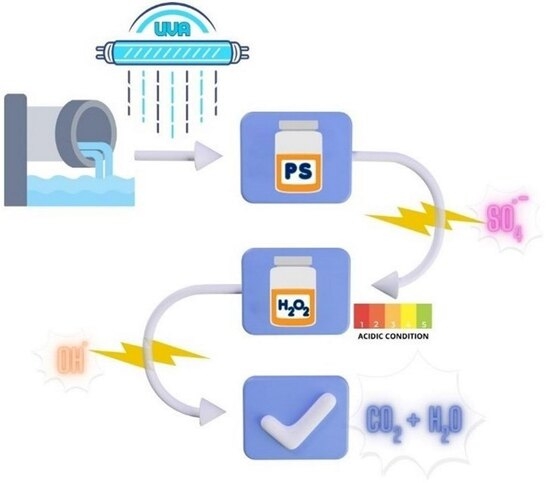
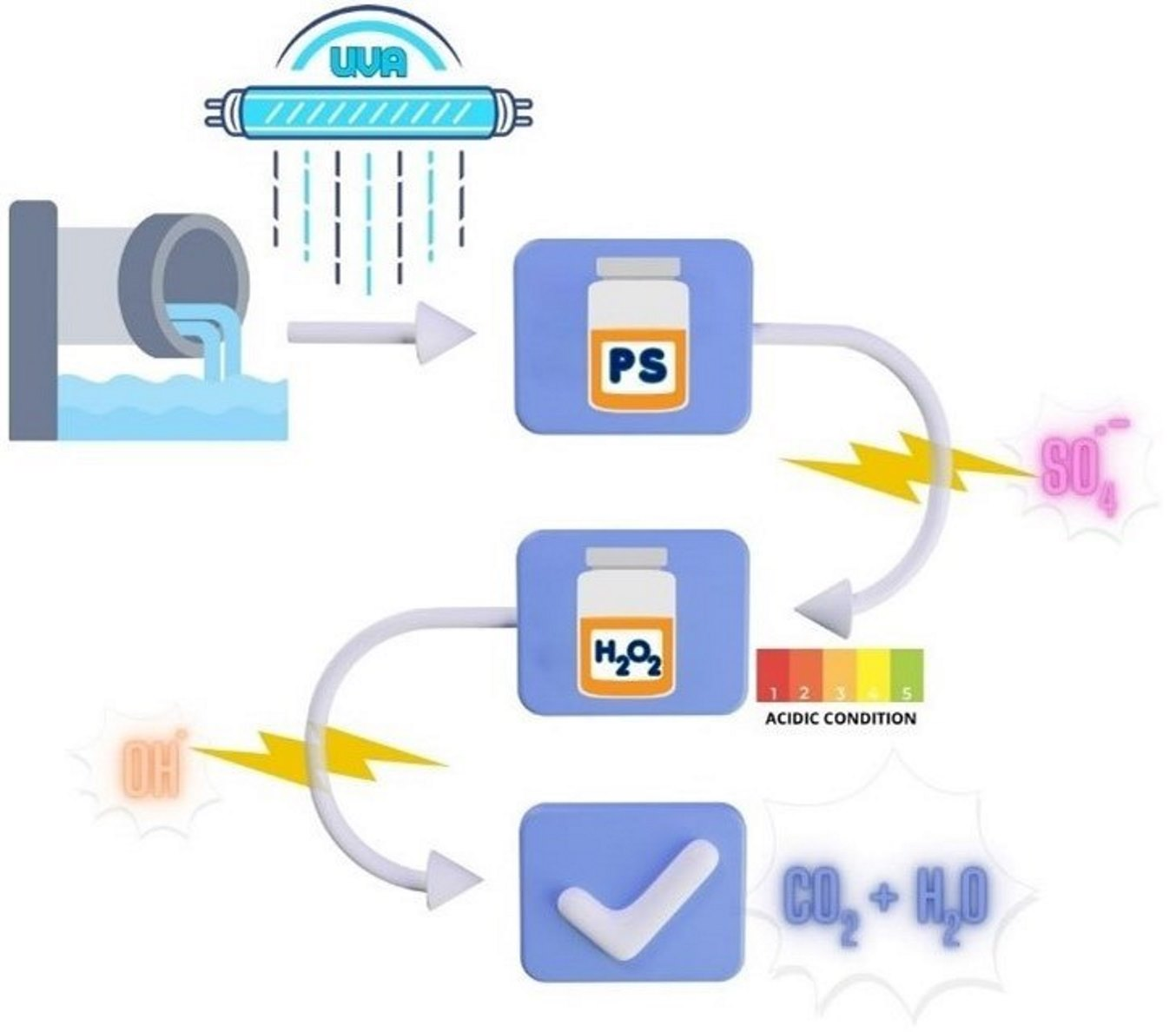
This study investigates a combined advanced oxidation process (AOP) utilizing UVA-LED irradiation (365 nm) for the degradation of sucralose (SUC), a complex artificial sweetener that poses a challenge for wastewater treatment due to its resistance to conventional methods. A sequential treatment strategy was employed. The initial step utilized UVA-activated persulfate (PS) at varying dosages (0.12–0.5 g/L) and UVA fluence rate (ranging from 20 to 100% of nominal output). The influence of natural water components (bicarbonate, chloride, sulfate, and nitrate) on PS activation was systematically analyzed. Notably, the substantial pH decrease during oxidation opened the possibility of replacing an amount of PS with the less expensive and more environmentally friendly hydrogen peroxide (H2O2) in the subsequent Fenton reaction. This second step employed a stoichiometric dosage of H2O2 (2.12 g/g COD) and varying Fe2+ concentrations (0.05–0.2 g/L), achieving a 95% overall mineralization within 60 min. The combined process incurred an approximate cost of 2.5€ per m3. This research contributes to the development of more effective and environmentally friendly wastewater treatment strategies for emerging contaminants.

Graphical Abstract

1. Introduction

Contaminants of emerging concern (CECs), originating from domestic, industrial, or medical sources, form a group of compounds lacking well-defined legislation, posing potential risks to the environment (aquatic and terrestrial ecosystems) and to human and animal health [1]. Sucralose (SUC), a widely approved artificial sweetener, stands out as a prime example of a CEC due to its extensive use in global food, beverages, pharmaceuticals, and animal feed. Beyond being a CEC, SUC serves as a valuable chemical indicator of the occurrence of human waste-associated pathogens, since both are consistently detected in urban wastewater and present a high correlation [2,3].
Investigations across diverse regions underscore the persistent occurrence of SUC in aquatic ecosystems, linked to its widespread usage, inadequate wastewater and sewage treatment, and subsequent discharge. In the USA, SUC has been identified in estuarine water [4]. Furthermore, it has been traced in source water at 15 out of 19 drinking water treatment plants [5]. China has also reported heightened SUC levels in wastewater treatment plants (WWTPs), where it prevails in all water samples [6]. Therefore, the presence of SUC in receiving water is a current problem, and sewage, wastewater, and water treatment facilities must deal with this challenge.
Diverse methodologies have been proposed to address the elimination of CECs, particularly sweeteners, from water, sewage, and wastewater. Generally, these methods encompass biological aerobic and anaerobic processes, along with chemical treatments like free chlorine and physical processes such as reverse osmosis. Traditional biological processes often fall short due to the hydrophilic and refractory nature of SUC, demonstrating less than 15% removal through biodegradation [2,3]. Activated sludge, the biological wastewater treatment process with the greatest versatility for degrading organic and semi-persistent compounds, was not able to efficiently remove sucralose [3]. A recent study by Alves et al. [7] investigated the efficiency of several Brazilian WWTPs in SUC removal, analyzing several treatment setups and combinations. As reported, both conventional biological treatment and ultrafiltration methods exhibited only partial efficiency in removing this sweetener. The complex molecular structure of SUC, characterized by chlorinated moieties, ether linkages, and hydroxyl groups, contributes to its resistance to conventional water and wastewater treatment methods.
To improve conventional treatment processes, physical and chemical-based technologies are presented as alternatives for water and wastewater treatment. However, such treatments also pose critical limitations. Effective methods like free chlorine oxidation can generate undesirable byproducts such as chlorinated organics, raising environmental concerns. While reverse osmosis achieves high removal rates, it comes at a relatively elevated cost, limiting widespread adoption [6].
Advanced Oxidation Processes (AOPs) are a broad class of treatment technologies characterized by the in situ generation of highly reactive species, particularly hydroxyl radicals (HO), which exhibit extremely high oxidation potential (E° ≈ 2.8 V). These radicals are non-selective and capable of rapidly attacking recalcitrant organic molecules, promoting their transformation and, ultimately, mineralization into CO2, H2O, and inorganic ions. Different types of AOPs rely on distinct mechanisms to generate HO radicals. Chemical oxidation processes, such as hydrogen peroxide-based systems and ozone oxidation, produce hydroxyl radicals through peroxide decomposition or ozone activation pathways. Photochemical processes, including UV/H2O2 and UV/ozone systems, enhance radical formation via photolytic cleavage under ultraviolet irradiation. Photocatalytic processes, typically employing semiconductor materials (e.g., TiO2), generate HO through photoinduced electron–hole pairs at the catalyst surface. Fenton-based processes, such as electro-Fenton and photo-Fenton, rely on iron-catalyzed decomposition of hydrogen peroxide, with light or electrical current intensifying radical production and catalyst regeneration. Additionally, supercritical water oxidation operates under extreme temperature and pressure conditions, enabling rapid oxidation of organic contaminants through radical-mediated pathways. Due to these characteristics, AOPs have emerged as highly effective strategies for the degradation of persistent artificial sweeteners [3,8,9,10].
Simultaneously, there is a surge of interest in AOPs with a central emphasis on sulfate radicals (SO4•−), reflecting a growing recognition of their substantial potential for degrading organic pollutants [11,12,13]. Exploration of persulfate (PS) activation reveals a range of strategies, including heat, UV light, transition metal ions, ultrasound, activated carbon, and base activation, extending to methods like microwave and natural mineral activation [14]. Notably, UVC radiation combined with PS has shown efficiency in degrading SUC, as highlighted recently by Fu et al. [15] and previous studies [3,8,16,17].
Although UVC activation of PS is theoretically more efficient due to its higher photon energy, which promotes more effective homolytic cleavage of the O–O bond in persulfate, UVA lamps offer substantial practical and economic advantages [18]. Their broad spectrum and cost-effectiveness position them as an economical and scalable option. Furthermore, UVA radiation has a lesser impact on both occupational health and the environment compared to UVC radiation.
Nevertheless, the PS treatment results in significant pH reduction, and this fact allows transitioning to a more environmentally friendly approach. In this context, this study explores the potential of employing Fe2+ and hydrogen peroxide (H2O2) as a subsequent auxiliary oxidant once the UVA/PS resulting pH falls within the suitable range for the Fenton process. This combined approach offers several advantages: (1) eliminates the need for excessive acidic correctors, mitigating their environmental impact; (2) minimizes sulfate release due to PS decomposition; and (3) utilizes H2O2, a readily available and cost-effective oxidant precursor. In previous studies, the feasibility of heat-activated PS combined with Fenton was investigated for treating landfill leachate under continuous flow conditions [19]. While this approach has proven effective for high-organic-load effluents, its application to sewage is less common and generally not used in conventional wastewater treatment practices.
This study highlights the effectiveness of UVA LED in activating persulfate and evaluates its sequential integration with photo Fenton polishing for sucralose degradation, a combination that, to our knowledge, has not yet been reported using 365 nm irradiation.

2. Results and Discussion

2.1. Influence of UVA-LED Fluence Rate on Photo-Activated PS

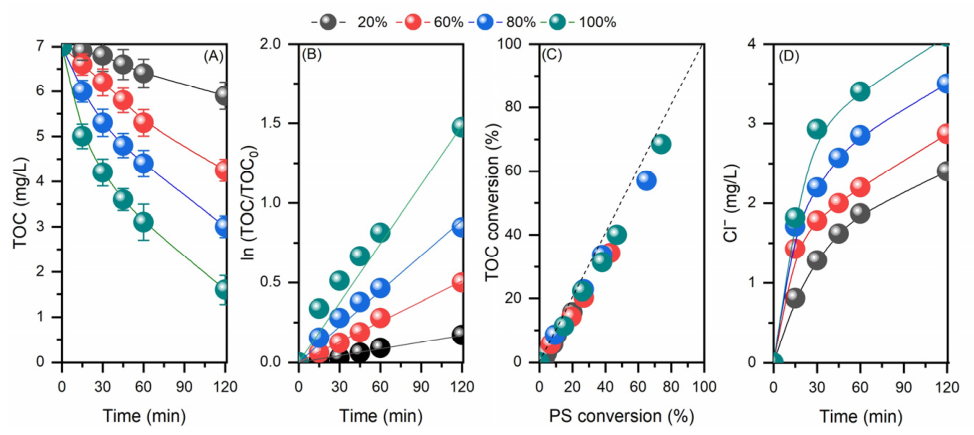
Figure 1A depicts the influence of varying UVA-LED power levels on SUC mineralization. Initial control experiments conducted under UV irradiation without oxidant (direct photolysis) and with persulfate in the absence of irradiation (dark conditions) both showed minimal TOC reduction (<3%) after 120 min. The introduction of PS significantly enhanced process efficiency. At an initial UV power level of 20%, TOC decreased by 16%. Increasing the power to 60% accelerated the process, resulting in a 42% reduction (from 7.2 to 4.2 mg L−1 TOC). Higher power levels of 80% and 100% further improved TOC removal efficiency, with the removal increasing from 56% to 77%, respectively.
Kinetic analysis based on a pseudo-first-order model revealed a clear dependence of the reaction rate on the UVA-LED power level. At a power setting of 20%, the apparent rate constant (k) was 1.4 × 10⁻³ min−1. Increasing the power to 60% resulted in a threefold increase in k (4.2 × 10⁻³ min−1), indicating a strong positive correlation between photon availability and reaction kinetics. Further increases to 80% and 100% led to progressively higher rate constants (7.4 × 10⁻³ min−1 and 12.4 × 10⁻³ min−1, respectively), reflecting accelerated SUC degradation. Overall, the nearly eightfold increase in k highlights the strong dependence of the degradation rate on the UVA-LED power level (Figure 1B). The higher kinetic rates obtained at elevated power settings also suggest more efficient persulfate activation and oxidant utilization (see Figure 1C).
To assess oxidant consumption, the PS yield (Ɛ) was calculated, representing the amount of TOC converted (mg) per gram of PS applied. The theoretical maximum Ɛ, assuming complete mineralization at the applied PS dose (0.25 g L−1), is approximately 28 mg TOC g−1 PS. At the highest UVA-LED output (100%), the experimental Ɛ reached 22.6 mg TOC g−1 PS. Under lower irradiation levels (20–60%), PS conversion remained below 45% after 120 min (Figure 1C), resulting in significantly lower Ɛ values. Increasing the LED output from 20% to 80% led to an increase in Ɛ from 5.4 to 16.8 mg TOC g−1 PS, confirming improved oxidant utilization with greater photon availability.
The observed trend underscores the pivotal role of irradiation in activating PS and consequently degrading organic matter. This highlights the significance of energy input for severing the PS bond and generating sulfate radicals (Equation (1)).
S2O82− + hν → 2SO4•−
The increase in chloride concentration during irradiation is consistent with the oxidative degradation of SUC, which contains three chlorinated moieties in its molecular structure. Chloride levels increased from 2.4 to 4.2 mg L−1 after 120 min as the UVA-LED output increased from 20% to 100% (Figure 1D).
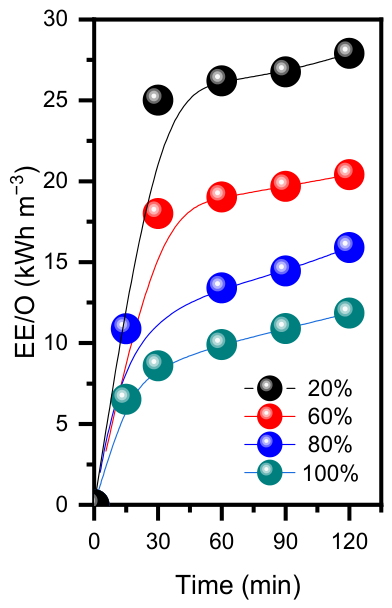
In terms of energy consumption (Figure 2), EE/O decreased from 28 to 12 kWh m−3 as the LED output increased from 20% to 100%. Although higher irradiation levels imply greater electrical input, the pronounced kinetic enhancement observed at higher photon availability resulted in substantially greater TOC removal within the same reaction time. As EE/O is inversely related to the logarithmic TOC reduction, this accelerated degradation ultimately leads to improved energy efficiency at higher irradiation levels.
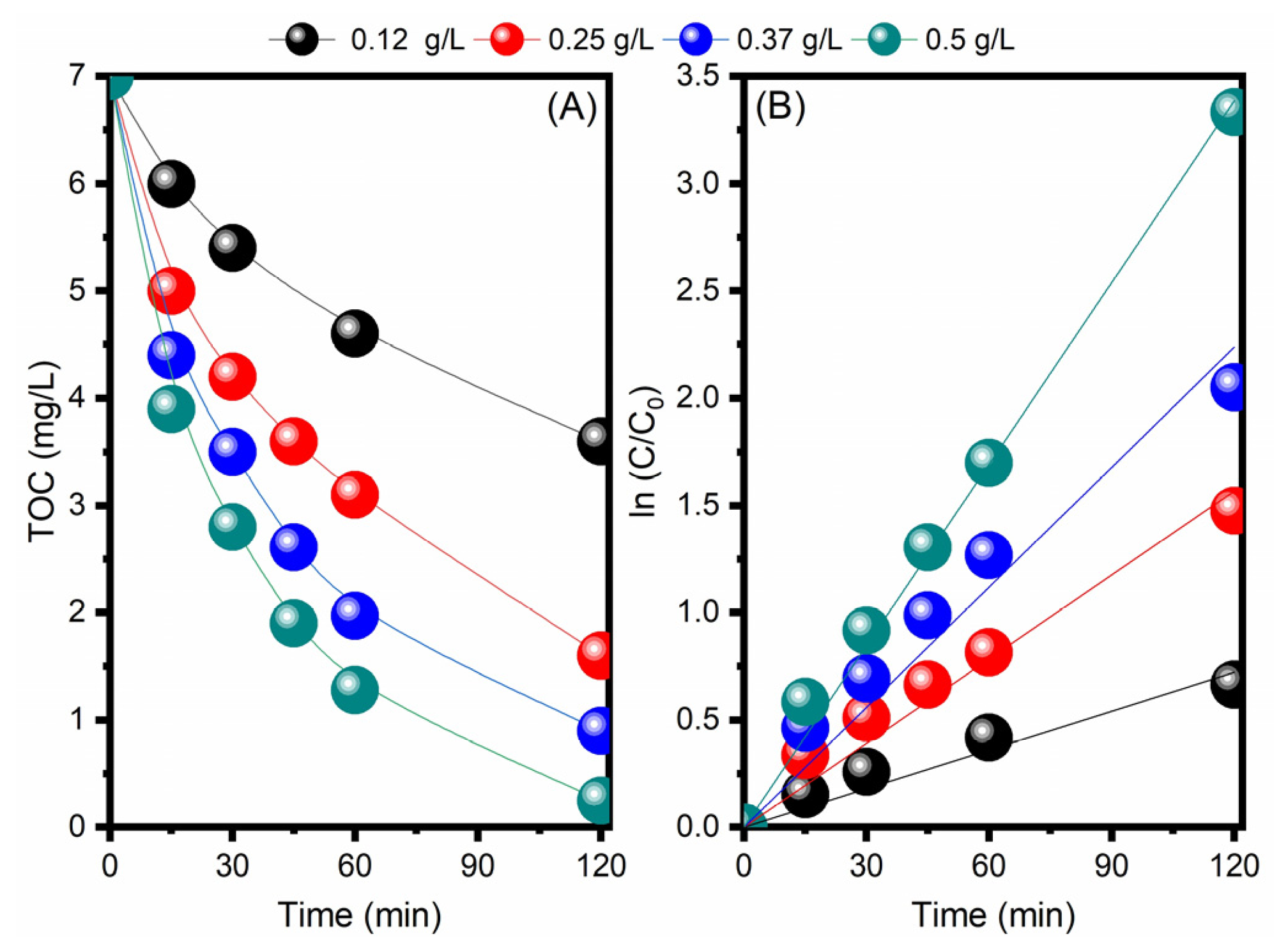
In Figure 3, a clear trend emerges as PS concentration increases from 0.12 to 0.25 g/L, showcasing a significant boost in removal efficiency from 50% to 77% (Figure 3A). This enhancement correlates with a simultaneous elevation in the TOC degradation rate constant, indicating an increased generation of SO4•−. As PS concentrations continued to rise, removal efficiencies peaked at 87% with 0.37 g/L PS (k = 18.6 × 10⁻³ min−1) and reached 96% at 0.5 g/L PS (k = 28.22 × 10⁻³ min−1) within the same timeframe.
Regarding energy consumption, a remarkable fivefold reduction in requirements per electrical energy was observed as the PS dose increased from 0.12 to 0.5 g/L, resulting in EE/O values of 26 and 5.1 kWh/m3, respectively. However, it is crucial to note that the escalating PS concentration faces constraints due to the simultaneous increase in conductivity and sulfate release into the medium.

2.2. The Effect of Natural Photosensitizers in the Photo-Activation of PS

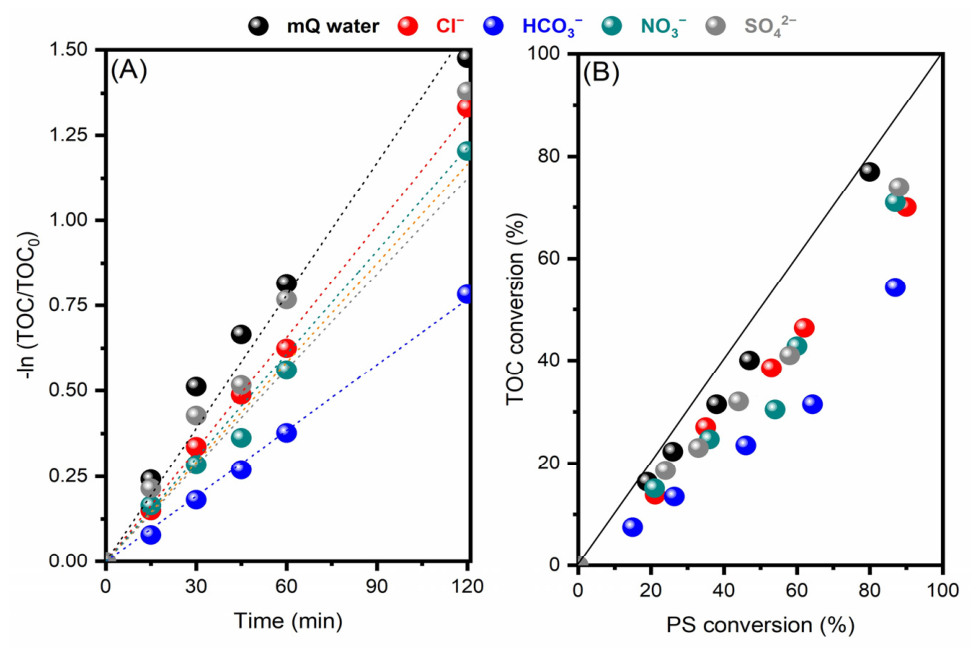
To elucidate the influence of natural water constituents on SUC removal kinetics, a series of experiments investigated the effects of selected ions: Cl, HCO3, NO3, and SO42−. The presence of HCO3 notably influenced the reaction rate, resulting in a pronounced decrease (Figure 4A). Introduction of bicarbonate ions into the solution, leading to an elevated initial pH, substantially reduced the reaction rate. Specifically, the constant reaction rate decreased from 13 × 10−3 min−1 to 6.4 × 10⁻³ min−1 in the presence of bicarbonate (Figure 4B).
This pH-dependent competition underscores the crucial consideration of natural water components in PS-based water treatment processes. Under alkaline conditions, reactive radicals such as HCO3, CO3•−, and HO with lower redox potentials are formed (Equations (2)–(4)).
Conversely, at a concentration of 2.26 mM of Cl, the rate constant noticeably decreased to 10.94 × 10⁻³ min−1. This decline may be attributed to the behavior of Cl in the UVA-LED/PS system, where Cl is generated by the reaction of SO4•− with Cl (Equation (5)), and subsequently, Cl can interact with additional Cl- species to form Cl2•− (Equation (6)).
Nitrate (NO3) exerted a moderating influence on SUC removal. At a concentration of 0.81 mM of NO3, the degradation rate decreased to 9.4 × 10⁻³ min−1, resulting in a TOC removal reduction from 77% to 71% compared to the control using ultrapure water. Nitrate can undergo UV photolysis, generating oxygen radicals. Additionally, NO3 can be generated in the presence of SO42− (Equation (7)). On the other hand, sulfate anion exhibited a minimal impact (less than 10% reduction in removal kinetics rate) on degradation at all concentrations, as sulfate ions are expected final products of PS oxidation and do not react with SO4•− [20,21,22].
SO4•− + HCO3 → HCO3 + SO42−
HO + HCO3 → CO3•− + H2O
SO4•− + HO → HSO5
Cl + SO4•− ⇆ Cl + SO42−
Cl + Cl ⇆ Cl2•−
SO4•− + NO3 → NO3 + SO42−
The presence of various ions also influences PS yield (Ɛ). These ions can act as scavengers for sulfate radicals or participate in secondary reactions, ultimately impacting the process efficiency. For example, at a concentration of 2.26 mM, chloride exhibits a higher Ɛ value (20.8) compared to bicarbonate (15.7), suggesting that these ions have differing effects on the oxidation process.
Chloride, bicarbonate and natural organic matter were also identified by Fu et al. [15] as major inhibitors of SUC degradation in the UVC/PS system. In fact, SUC degradation was more strongly affected by natural photosensitizers than acesulfame, indicating that a water and wastewater pretreatment step to remove these interfering species is recommended prior to the application of AOPs to improve the abatement of this persistent sweetener.

2.3. Sequential UVA-LED/PS and Photo-Fenton Degradation of SUC

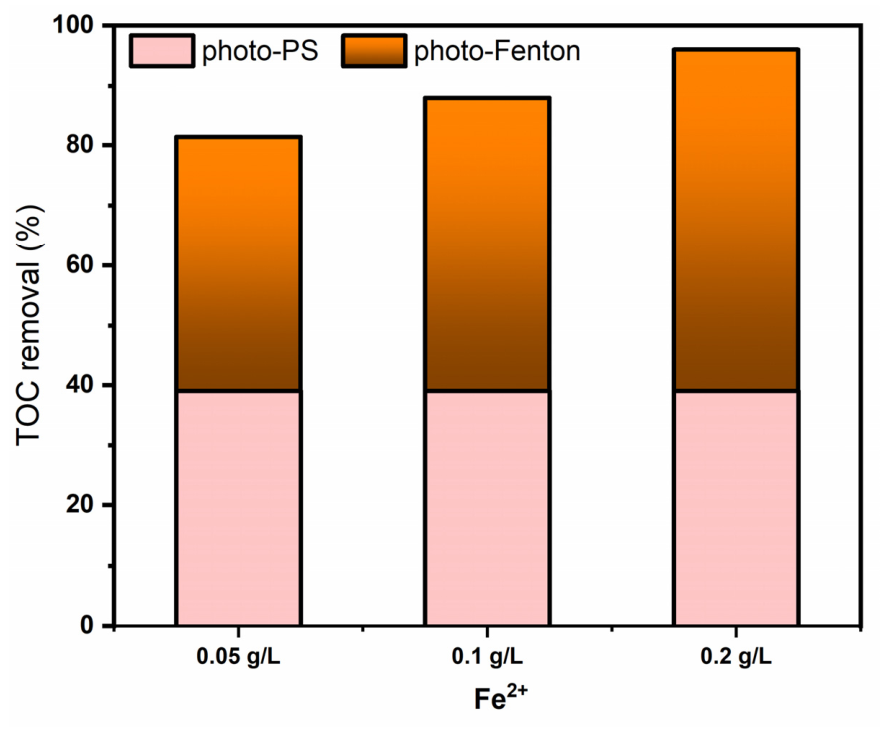
To apply the presented method in a realistic scenario, the lowest dose of oxidant that effectively acidified the sample was selected to minimize conductivity. The study utilized 0.12 g/L of PS in the presence of coexisting ions at fixed concentrations previously used, achieving nearly 39% mineralization after 120 min of reaction. The significant decrease in pH during oxidation (pH < 4) suggests the potential for replacing PS with a less expensive and more environmentally friendly alternative, H2O2, thereby potentially reducing operational costs and environmental impact. In the subsequent stage of the sequential treatment, a stoichiometric amount of H2O2 (2.12 g/g COD, corresponding to 28 mg/L) was introduced in the presence of Fe2+, with concentrations varying from 0.05 to 0.20 g/L. When integrated with the Fenton process, the system achieved overall efficiencies of 81%, 89%, and 94% for SUC removal after 60 min as the Fe2+ concentration increased from 0.05 to 0.10 and 0.20 g/L, respectively. This enhancement in degradation efficiency is attributed to the Fenton reaction, where Fe2+ catalyzes the decomposition of H2O2 to generate hydroxyl radicals (HO), which are highly reactive and effective in breaking down organic pollutants (Equation (8)). Notably, complete consumption of H2O2 was observed in all experimental conditions, indicating efficient utilization of the oxidant in the process (Figure 5).
Fe2+ + H2O2 → Fe3+ + OH + OH
To preliminarily assess the feasibility of the combined process for SUC removal, the operation costs were estimated based on specific conditions of this study, including the electrical consumption of LED lamps, PS, and hydrogen peroxide, with results presented in euros per cubic meter (Equation (9)). The initial phase of the treatment, involving the PS process, showed an energy consumption of 17.8 kWh/m3 with a PS dose at 0.12 g/L over a treatment duration of one hour, as PS was completely consumed under these conditions. In the photo-Fenton stage, electrical consumption decreased to 3.48 kWh/m3. Taking into account the consumption of oxidants (PS and H2O2) and the cost of electricity in Spain, the combined treatment process incurred an approximate cost of 2.5€ per m3 (Table 1). For comparison, Xu et al. [23] reported electrical energy per order (EE/O) values of 20.3 kWh/m3 for UV/PS and 0.006 $/g for PS, and 47.18 kWh/m3 for UV/H2O2 with costs of 5.482 $/g for H2O2 and 2.365 $/g for PS, utilizing a UVC lamp to remove SUC.

3. Materials and Methods

3.1. Chemicals

Sodium persulfate (Na2S2O8, 98%, Panreac, Barcelona, Spain) was used as the oxidant precursor. All other reagents were analytical grade and purchased from Sigma-Aldrich (Darmstadt, Germany).

3.2. Typical Reaction Procedure

Photochemical experiments were performed in a bench-scale LED photoreactor (Photolab LED365-16/450-16c, APRIA Systems, Cantabria, Spain) equipped with a cylindrical borosilicate reactor (total volume 1 L, working volume 600 mL). The irradiation system consists of four LED panels surrounding the reactor, providing 20 UVA emitters operating at 365 nm, each with a nominal radiant flux of 1200 mW, ensuring radial irradiation of the reaction medium. The LED output was controlled through the instrument interface as a percentage of nominal power (20–100%), corresponding to LED driver currents of 0.14–0.70 A. The incident UV irradiance at the reactor surface was measured using a calibrated radiometer (Delta OHM HD 2102.1, Gwacheon-si, South Korea) equipped with a 315–400 nm sensor, positioned at mid-height of the irradiation zone, yielding an irradiance of approximately 1100 W m−2 [24]. Based on the nominal radiant flux of the UVA emitters, the photon emission rate of the UV module was estimated to be 0.073 mmol photons s−1, assuming monochromatic emission at 365 nm.
The initial SUC (98% purity) concentration was maintained at 20 mg L−1, corresponding to 7.2 mg L−1 of total organic carbon (TOC). The investigated parameters included PS dosage (0.12–0.5 g/L) and UV power levels ranging from 20 to 100% of nominal output. All experiments were conducted at 20 ± 2 °C. Ultrapure water (UW) obtained from a Millipore Milli-Q system was used as the solvent to prepare solutions containing the main water matrix constituents: HCO3 (2.62 mM), SO42− (0.94 mM), Cl (2.26 mM), and NO3 (0.81 mM). These concentrations were selected to represent typical levels reported for natural waters and treated effluents [15]. This first experimental stage employing the UVA-LED/PS process focused on optimizing SUC degradation while minimizing sulfate generation, thereby maintaining pH and conductivity conditions suitable for the subsequent polishing treatment.
In the photo-Fenton step, H2O2 doses were determined based on stoichiometric amounts required for the mineralization of the initial organic matter, specifically at 2.12 g H2O2/g COD [25]. Following this, the necessary quantity of Fe2+, ranging from 50 to 200 mg/L, was added to the reaction medium. Table 2 summarizes the experimental conditions for the various degradation assays performed with the aqueous SUC solution.
The electrical energy per order (EE/O) was determined by Equation (9), outlining the methodology for calculating the efficiency of UV-based AOPs in terms of EE/O (kWh m3 order−1) for scenarios involving low organic concentrations. In this equation, P represents the UV lamp power (W), t is the exposure time (min), V is the total treated volume (L), and TOCi and TOCf denote the initial and final concentrations of Total Organic Carbon (TOC) in the solution (mg/L) [23].
EE / O = P t 60 V   l o g ( T O C i / T O C f )

3.3. Analytical Experiments

The parameter used to assess SUC degradation, was measured with a TOC analyzer (Shimadzu, Kyoto, Japan). Chloride, used complementary to track SUC degradation, was analyzed by ion chromatography with chemical suppression (Metrohm 790 IC, Herisau, Switzerland) using a conductivity detector. A more detailed analytical methodology is described elsewhere [26]. The pH was measured with a Hanna HI-221 pH meter, and conductivity was measured with an Orion model 115 conductivity meter. The residual concentrations of PS and H2O2 were assessed using a colorimetric method, following the procedures outlined by Liang et al. [27] and Eisenberg [28], respectively.

4. Conclusions

This study investigated a combined AOPs-based treatment utilizing UVA-LED irradiation for the degradation of SUC. An initial treatment step using UVA-activated PS achieved approximately 40% removal efficiency, as evidenced by TOC decay and chloride ion formation. However, the presence of inorganic anions, particularly bicarbonate, can decrease overall process efficiency.
Notably, the steeply decreasing pH as PS oxidation occurs opens the possibility of replacing an amount of PS with the less expensive and more environmentally friendly H2O2.
A subsequent oxidation step, employing the Fenton reaction (H2O2 at a stoichiometric amount with respect to the residual organic matter) under acidic conditions generated, significantly increased overall mineralization to above 95% after 60 min.
The use of UVA-LED has demonstrated feasibility and efficiency to activate persulfate and degrade SUC. This approach offers several advantages, including lower energy consumption and reduced occupational risks associated with UVC radiation.

Author Contributions

A.R.R.: Conceptualization, Writing—original draft, Methodology, Investigation, Writing—review and editing, Formal analysis. J.A.C.: Investigation, Writing—review and editing, Formal analysis, Funding acquisition. J.A.Z.: Writing—original draft, Supervision, Methodology, Investigation, Writing—review and editing, Funding acquisition, Formal analysis, Visualization. J.E.S.: Conceptualization, Writing—original draft, Supervision, Methodology, Investigation, Writing—review and editing, Formal analysis, Visualization. All authors have read and agreed to the published version of the manuscript.

Funding

This research was supported by project PDC-2022-133805-100, funded by the Ministry of Science, Innovation, and Universities of Spain. Financial support, in the form of scholarships, was also guaranteed by the Brazilian National Council for Scientific and Technological Development (CNPq) (CNPq 200863/2025-8 and CNPq 404907/2024-5), and the Coordination for the Improvement of Higher Education Personnel (CAPES) of Brazil (BEX-1046/13-6).

Data Availability Statement

All data will be made available on request.

Acknowledgments

Jefferson E. Silveira acknowledges support from the Coordination for the Improvement of Higher Education Personnel (CAPES) through the Science Without Borders Program, Ministry of Education, Brazil (grant BEX-1046/13-6). Alyson R. Ribeiro acknowledges financial support from the Brazilian National Council for Scientific and Technological Development (CNPq) through grant CNPq 404907/2024-5 and a scholarship (CNPq 200863/2025-8). The authors have reviewed and edited the output and take full responsibility for the content of this publication.

Conflicts of Interest

The authors declare no conflicts of interest.

References

  1. Marumure, J.; Simbanegavi, T.T.; Makuvara, Z.; Karidzagundi, R.; Alufasi, R.; Goredema, M.; Gufe, C.; Chaukura, N.; Halabowski, D.; Gwenzi, W. Emerging organic contaminants in drinking water systems: Human intake, emerging health risks, and future research directions. Chemosphere 2024, 356, 141699. [Google Scholar] [CrossRef]
  2. Berg, C.J.; Alderete, J.P.; Alderete, E.A. Human wastewater tracking in tropical Hawaiian island streams using qualitative and quantitative assessments of combined fecal indicating bacteria and sucralose, an organic micropollutant of emerging concern. Environ. Monit. Assess. 2023, 195, 966. [Google Scholar] [CrossRef] [PubMed]
  3. Jahani, R.; Dhib, R.; Mehrvar, M. Photochemical degradation of aqueous artificial sweeteners by UV/H2O2 and their biodegradability studies. J. Chem. Technol. Biotechnol. 2020, 95, 2509–2521. [Google Scholar] [CrossRef]
  4. Cantwell, M.G.; Katz, D.R.; Sullivan, J.; Kuhn, A. Evaluation of the artificial sweetener sucralose as a sanitary wastewater tracer in Narragansett Bay, Rhode Island, USA. Mar. Pollut. Bull. 2019, 146, 711–717. [Google Scholar] [CrossRef]
  5. Yang, Y.; Liu, Z.; Zheng, H.; Zhu, S.; Zhang, K.; Li, X.; Ma, X.; Dietrich, A.M. Sucralose, a persistent artificial sweetener in the urban water cycle: Insights into occurrence, chlorinated byproducts formation, and human exposure. J. Environ. Chem. Eng. 2021, 9, 105293. [Google Scholar] [CrossRef]
  6. Guo, W.; Li, J.; Liu, Q.; Shi, J.; Gao, Y. Tracking the fate of artificial sweeteners within the coastal waters of Shenzhen city, China: From wastewater treatment plants to sea. J. Hazard. Mater. 2021, 414, 125498. [Google Scholar] [CrossRef]
  7. Alves, P.D.C.C.; Rodrigues-Silva, C.; Ribeiro, A.R.; Rath, S. Removal of low-calorie sweeteners at five Brazilian wastewater treatment plants and their occurrence in surface water. J. Environ. Manag. 2021, 289, 112561. [Google Scholar] [CrossRef] [PubMed]
  8. Xu, Y.; Wu, Y.; Zhang, W.; Fan, X.; Wang, Y.; Zhang, H. Performance of artificial sweetener sucralose mineralization via UV/O3 process: Kinetics, toxicity and intermediates. Chem. Eng. J. 2018, 353, 626–634. [Google Scholar] [CrossRef]
  9. Moore, N.; Wang, C.; Andrews, S.; Hofmann, R. On the increasing competitiveness of UV/Cl to UV/H2O2 advanced oxidation as the organic carbon concentration increases. Water Res. 2023, 242, 120227. [Google Scholar] [CrossRef] [PubMed]
  10. Shen, G.; Lei, S.; Li, H.; Yu, Q.; Wu, G.; Shi, Y.; Xu, K.; Ren, H.; Geng, J. Occurrence and removal of four artificial sweeteners in wastewater treatment plants of China. Environ. Sci. Process. Impacts 2023, 25, 75–84. [Google Scholar] [CrossRef]
  11. Chen, N.; Lee, D.; Kang, H.; Cha, D.; Lee, J.; Lee, C. Catalytic persulfate activation for oxidation of organic pollutants: A critical review on mechanisms and controversies. J. Environ. Chem. Eng. 2022, 10, 107654. [Google Scholar] [CrossRef]
  12. Giannakis, S.; Lin, K.Y.A.; Ghanbari, F. A review of the recent advances on the treatment of industrial wastewaters by Sulfate Radical-based Advanced Oxidation Processes (SR-AOPs). Chem. Eng. J. 2021, 406, 127083. [Google Scholar] [CrossRef]
  13. Tian, K.; Hu, L.; Li, L.; Zheng, Q.; Xin, Y.; Zhang, G. Recent advances in persulfate-based advanced oxidation processes for organic wastewater treatment. Chin. Chem. Lett. 2022, 33, 4461–4477. [Google Scholar] [CrossRef]
  14. Silveira, J.E.; Paz, W.S.; Garcia-Munoz, P.; Zazo, J.A.; Casas, J.A. UV-LED/ilmenite/persulfate for azo dye mineralization: The role of sulfate in the catalyst deactivation. Appl. Catal. B Environ. 2017, 219, 314–321. [Google Scholar] [CrossRef]
  15. Fu, Y.; Wu, G.; Geng, J.; Li, J.; Li, S.; Ren, H. Kinetics and modeling of artificial sweeteners degradation in wastewater by the UV/persulfate process. Water Res. 2019, 150, 12–20. [Google Scholar] [CrossRef]
  16. Xu, Y.; Lin, Z.; Wang, Y.; Zhang, H. The UV/peroxymonosulfate process for the mineralization of artificial sweetener sucralose. Chem. Eng. J. 2017, 317, 561–569. [Google Scholar] [CrossRef]
  17. Lin, H.; Oturan, N.; Wu, J.; Zhang, H.; Oturan, M.A. Cold incineration of sucralose in aqueous solution by electro-Fenton process. Sep. Purif. Technol. 2017, 173, 218–225. [Google Scholar] [CrossRef]
  18. Guerra-Rodríguez, S.; Ribeiro, A.R.L.; Ribeiro, R.S.; Rodríguez, E.; Silva, A.M.; Rodriguez-Chueca, J. UV-A activation of peroxymonosulfate for the removal of micropollutants from secondary treated wastewater. Sci. Total Environ. 2021, 770, 145299. [Google Scholar] [CrossRef]
  19. Silveira, J.E.; Garbellini, L.R.; Ribeiro, A.R.; Yepez, A.; Furlanetto, T.; Oliveira, G.M.; Paz, W.; Pliego, G.; Zazo, J.A.; Casas, J.A. An approach to highly polluted wastewater management for zero liquid discharge: The case of landfill leachate. Process Saf. Environ. Prot. 2024, 184, 672–679. [Google Scholar] [CrossRef]
  20. Ding, X.; Gutierrez, L.; Croue, J.P.; Li, M.; Wang, L.; Wang, Y. Hydroxyl and sulfate radical-based oxidation of RhB dye in UV/H2O2 and UV/persulfate systems: Kinetics, mechanisms, and comparison. Chemosphere 2020, 253, 126655. [Google Scholar] [CrossRef]
  21. Sakulthaew, C.; Chokejaroenrat, C.; Satapanajaru, T.; Chirasatienpon, T.; Angkaew, A. Removal of 17β-estradiol using persulfate synergistically activated using heat and ultraviolet light. Water Air Soil. Pollut. 2020, 231, 247. [Google Scholar] [CrossRef]
  22. Lee, J.; Von Gunten, U.; Kim, J.H. Persulfate-based advanced oxidation: Critical assessment of opportunities and roadblocks. Environ. Sci. Technol. 2020, 54, 3064–3081. [Google Scholar] [CrossRef]
  23. Xu, Y.; Lin, Z.Y.; Zhang, H. Mineralization of sucralose by UV-based advanced oxidation processes: UV/PDS versus UV/H2O2. Chem. Eng. J. 2016, 285, 392–401. [Google Scholar] [CrossRef]
  24. Rodrigues, A.S.; Silveira, J.E.; Carbajo, J.; Zazo, J.A.; Casas, J.A.; Fernandes, A.; Pacheco, M.J.; Ciríaco, L.; Lopes, A. Diclofenac photodegradation with the Perovskites BaFeyTi1-yO3 as catalysts. Environ. Sci. Pollut. Res. 2021, 28, 23822–23832. [Google Scholar] [CrossRef]
  25. Carbajo, J.; Silveira, J.E.; Pliego, G.; Zazo, J.A.; Casas, J.A. Increasing photo-Fenton process efficiency: The effect of high temperatures. Sep. Purif. Technol. 2021, 271, 118876. [Google Scholar] [CrossRef]
  26. Silveira, J.E.; Claro, E.M.T.; Paz, W.S.; Oliveira, A.S.; Zazo, J.A.; Casas, J.A. Optimization of Disperse Blue 3 mineralization by UV-LED/FeTiO3 activated persulfate using response surface methodology. J. Taiwan Inst. Chem. Eng. 2018, 85, 66–73. [Google Scholar] [CrossRef]
  27. Liang, C.; Huang, C.F.; Mohanty, N.; Kurakalva, R.M. A rapid spectrophotometric determination of persulfate anion in ISCO. Chemosphere 2008, 73, 1540–1543. [Google Scholar] [CrossRef] [PubMed]
  28. Eisenberg, G. Colorimetric determination of hydrogen peroxide. Ind. Eng. Chem. Anal. Ed. 1943, 15, 327–328. [Google Scholar] [CrossRef]
Figure 1. UVA-LED/PS degradation of SUC. (A) Influence of UVA-LED output (20–100%) on TOC removal; (B) Pseudo-first order TOC removal; (C) Evolution of TOC vs. PS conversion; (D) Cl release as a function of LED output. Experimental conditions: [PS] = 0.25 g/L; initial SUC = 20 mg/L; T = 20 ± 2 °C.
Catalysts 16 00414 g001
Figure 2. Evolution of electrical energy per order (EE/O) as a function of irradiation time at different UVA-LED output levels.
Catalysts 16 00414 g002
Figure 3. Influence of PS concentration on the performance of UVA-LED activated PS. (A) TOC removal and (B) kinetics of abatement as a function of the applied PS dose.
Catalysts 16 00414 g003
Figure 4. Effect of isolated ions on the kinetic removal (A), and evolution of TOC vs. PS conversion (B). Experimental conditions: UVA-LED output 100%, [PS] = 0.25 g/L, [Cl] = 2.26 mM, [HCO3] = 2.62 mM, [NO3] = 0.81 mM, [SO42 −] = 0.94 mM.
Catalysts 16 00414 g004
Figure 5. Contribution of photo-PS and photo-Fenton reactions to TOC removal at different Fe2+ concentrations.
Catalysts 16 00414 g005
Table 1. Estimated operational costs for the combined process for SUC mineralization.
PricePhoto-PSPhoto-FentonPrice (€)
H2O2 (50% w/v)0.60 € kg a 0.027 kg0.016
Na2S2O8 (98%)1.20 € kg a0.126 kg 0.15
Energy0.108 kwh b18.3 kwh m−33.48 kwh m−32.36
Total 2.53
a Current average chemical market industrial prices: https://camachem.com/pt/sodium-persulfate.html (accessed on 17 July 2025). b Average electricity prices for non-household consumers in the EU-27. Eurostat: https://ec.europa.eu/eurostat/databrowser/view/NRG_PC_205/default/table?lang=en (accessed on 22 July 2025).
Table 2. Experimental conditions for the different degradation assays performed with an aqueous SUC solution.
ProcessPSUVClHCO3NO3SO42 −Fe2+H2O2
g/L%   mM                                        g/L
Photo-PS
(control)
0.1220
0.2560
0.3780
0.50100
Photo-PS0.251002.262.620.810.94
0.251002.262.620.810.94
0.251002.262.620.810.94
Photo- Fenton 1002.262.620.810.940.050.029
1002.262.620.810.940.10.029
1002.262.620.810.940.20.029
Disclaimer/Publisher’s Note: The statements, opinions and data contained in all publications are solely those of the individual author(s) and contributor(s) and not of MDPI and/or the editor(s). MDPI and/or the editor(s) disclaim responsibility for any injury to people or property resulting from any ideas, methods, instructions or products referred to in the content.