Article

Metal-Dependent Intermediate Evolution in Tandem Cu–M Catalysts for Electrocatalytic Ammonia Synthesis from Nitrate


1
Yangtze Delta Region Institute (Huzhou), University of Electronic Science and Technology of China, Huzhou 313001, China
2
Zhejiang Key Laboratory of Industrial Solid Waste Thermal Hydrolysis Technology and Intelligent Equipment, School of Engineering, Huzhou Normal University, Huzhou 313000, China
3
Department of Chemistry, Fudan University, Shanghai 200438, China
4
Department of Electrical Engineering and Electronics, University of Liverpool, Liverpool L69 3GJ, UK
*
Authors to whom correspondence should be addressed.
These authors contributed equally to this work.
Catalysts 2026, 16(5), 402; https://doi.org/10.3390/catal16050402
Submission received: 26 March 2026 / Revised: 22 April 2026 / Accepted: 28 April 2026 / Published: 30 April 2026
(This article belongs to the Special Issue Advanced Photo/Electrocatalysts for Environmental Purification)

Abstract

Electrocatalytic nitrate reduction to ammonia (NH3) offers a sustainable alternative to the Haber–Bosch process while enabling remediation of nitrate-contaminated water. However, the mechanistic origin of performance differences among bimetallic catalysts remains poorly understood, particularly regarding the metal-dependent evolution of reaction intermediates. Here, we construct a series of phase-pure tandem Cu–M catalysts (M = Co, Ni, Fe, Sn) by physically integrating commercial nanoparticles to examine the role of the secondary metal. In this architecture, Cu governs nitrate adsorption and its initial reduction to nitrite, whereas M dictates downstream hydrogenation toward NH3. Operando ATR–FTIR spectroscopy reveals that NH3 FE is determined by the hydrogenation kinetics of nitrite-derived intermediates rather than nitrate activation itself. Among the examined systems, Cu–Co achieves optimal kinetic matching, enabling rapid nitrite consumption and continuous hydrogenation, delivering an ammonia Faradaic efficiency of 91.2% with minimal nitrite accumulation (~1.0%) and a yield rate of 0.86 mmol h−1 cm−2 at −0.5 V vs. RHE. In contrast, Ni and Fe exhibit sluggish hydrogenation, while Sn induces pronounced intermediate buildup. These findings identify nitrite hydrogenation as the selectivity-determining step in tandem nitrate reduction and establish the chemical nature of the secondary metal as a decisive descriptor for rational catalyst design.

1. Introduction

Electrocatalytic ammonia (NH3) synthesis from nitrate (NO3) has emerged as an attractive strategy to simultaneously address sustainable nitrogen utilization and nitrate contamination in aqueous environments. Compared with the conventional Haber–Bosch process, NO3 electroreduction proceeds under ambient conditions and provides a direct pathway to NH3 through multi-electron and multi-proton transfer steps [1,2,3]. Despite increasing research activity, the fundamental origin of catalytic performance differences among various nitrate reduction catalysts remains insufficiently understood, particularly in terms of how catalyst composition governs the complete NO3-to-NH3 conversion [4,5,6].
The nitrate reduction reaction (NO3RR) involves a complex cascade of elementary steps, typically initiated by NO3 adsorption and reduction to nitrite (NO2), followed by sequential hydrogenation toward NH3 [7,8,9]. Among these steps, the fate of NO2 is widely recognized as a key determinant of both reaction efficiency and selectivity. Inadequate NO2 hydrogenation often leads to intermediate accumulation or incomplete reduction, thereby limiting NH3 formation [10,11,12]. Consequently, elucidating the mechanistic factors that control NO2 conversion is central to understanding the performance disparity observed across different catalyst systems.
Recent efforts have expanded the landscape of NO3RR electrocatalysts beyond conventional transition metals [13,14,15,16]. For instance, Kuznetsov et al. recently demonstrated that an intermetallic Co2Si phase can deliver an NH3 FE of 80.8%, illustrating how ordered bimetallic ensembles steer selectivity through well-defined active motifs [17,18]. In parallel, single-atom catalysts (SACs) featuring isolated Cu, Fe, or Co centers have garnered significant attention; as comprehensively reviewed by Bu et al., the tunable coordination sphere of SACs offers a promising lever to modulate intermediate binding energetics [17]. Despite these advances, a common limitation persists: the strong electronic coupling inherent to intermetallic or atomically dispersed structures obscures the individual contributions of each metal constituent, complicating mechanistic deconvolution. In this context, metallic copper occupies a distinctive position. Its unparalleled ability to catalyze the initial one-electron reduction of NO3 to NO2 remains a cornerstone of nitrate-to-ammonia conversion [19,20,21]. Nevertheless, the sluggish hydrogenation kinetics of NO2 on pristine Cu surfaces constitute a critical bottleneck, frequently resulting in incomplete reduction and diminished NH3 FE. This limitation has motivated the development of Cu–M bimetallic catalysts, wherein a secondary metal (e.g., Co, Ni, Fe, Sn) is introduced to facilitate downstream hydrogenation steps [22,23,24,25]. Although Cu–M systems can differ substantially in ammonia synthesis performance, it remains unclear how the identity of the secondary metal influences intermediate conversion and overall catalytic behavior. While these approaches can enhance catalytic performance, they often introduce concurrent electronic and structural effects that obscure the direct role of the secondary metal. As a result, it becomes difficult to distinguish metal-dependent effects from synthesis-induced artifacts, hindering the establishment of clear structure–activity relationships.
To address this knowledge gap, there is a pressing need for simplified catalytic platforms that allow comparative evaluation of how the identity of the secondary metal influences NH3 synthesis performance. Such platforms should reduce synthetic complexity while enabling mechanistic interrogation of reaction intermediates under operating conditions. Existing approaches to tandem Cu–M catalysts, however, typically rely on complex synthesis procedures such as alloying or heterostructure engineering. Although tandem Cu–M catalytic concepts have been explored previously, the role of the secondary metal remains difficult to assess clearly in these systems because alloying and structural engineering often introduce coupled electronic and structural effects. Furthermore, most existing studies focus on optimizing the performance of individual Cu–M systems, while a systematic comparison of multiple secondary metals under comparable conditions remains limited. Consequently, clear structure–activity relationships between metal identity and catalytic selectivity remain to be established.
Herein, we construct a series of tandem Cu–M catalysts by physically integrating commercially available Cu nanoparticles with commercial Co, Ni, Fe, or Sn nanoparticles. This design avoids the use of alloying and complex nanostructuring strategies, thereby largely suppressing the strong electronic coupling typically induced by such synthetic procedures. While physical contact between nanoparticles may permit localized interfacial perturbations, this simplified semi-model platform minimizes synthesis-derived artifacts and allows the hydrogenation role of M to be probed under diffusion-mediated conditions that mimic intermediate spillover in practical catalyst layers. Importantly, whereas prior Cu–M tandem studies have relied on electronically coupled alloys or heterostructures that obscure the discrete role of the secondary metal, our architecture with distinguishable metal phases provides a relatively clear basis for the systematic, side-by-side operando spectroscopic comparison of NO2 hydrogenation kinetics across Co, Ni, Fe, and Sn under comparable conditions. Crucially, this approach reveals that NH3 FE is governed not by NO3 activation on Cu, but by the metal-dependent hydrogenation kinetics on M, highlighting the chemical nature of M as a key descriptor for rational tandem catalyst design. In this configuration, Cu governs NO3 adsorption and initial reduction, while M modulates the subsequent hydrogenation of NO2 toward NH3. Operando infrared spectroscopy is employed to probe the evolution of surface-bound nitrogen intermediates during electrocatalytic NH3 synthesis from NO3. By correlating spectroscopic signatures with catalytic trends across different Cu–M systems, we show a clear correlation between NH3 synthesis performance and the role of the secondary metal in downstream hydrogenation. This mechanistic analysis helps explain why Cu–Co catalysts show more effective downstream hydrogenation toward NH3, whereas other Cu–M combinations exhibit less effective hydrogenation behavior. Overall, this work provides a mechanistic framework for understanding metal-dependent performance differences in tandem NO3 reduction catalysts and offers guidance for the rational design of practical electrocatalysts for NH3 synthesis.

2. Results and Discussion

2.1. Structural Characterization of Cu–M Tandem Catalysts

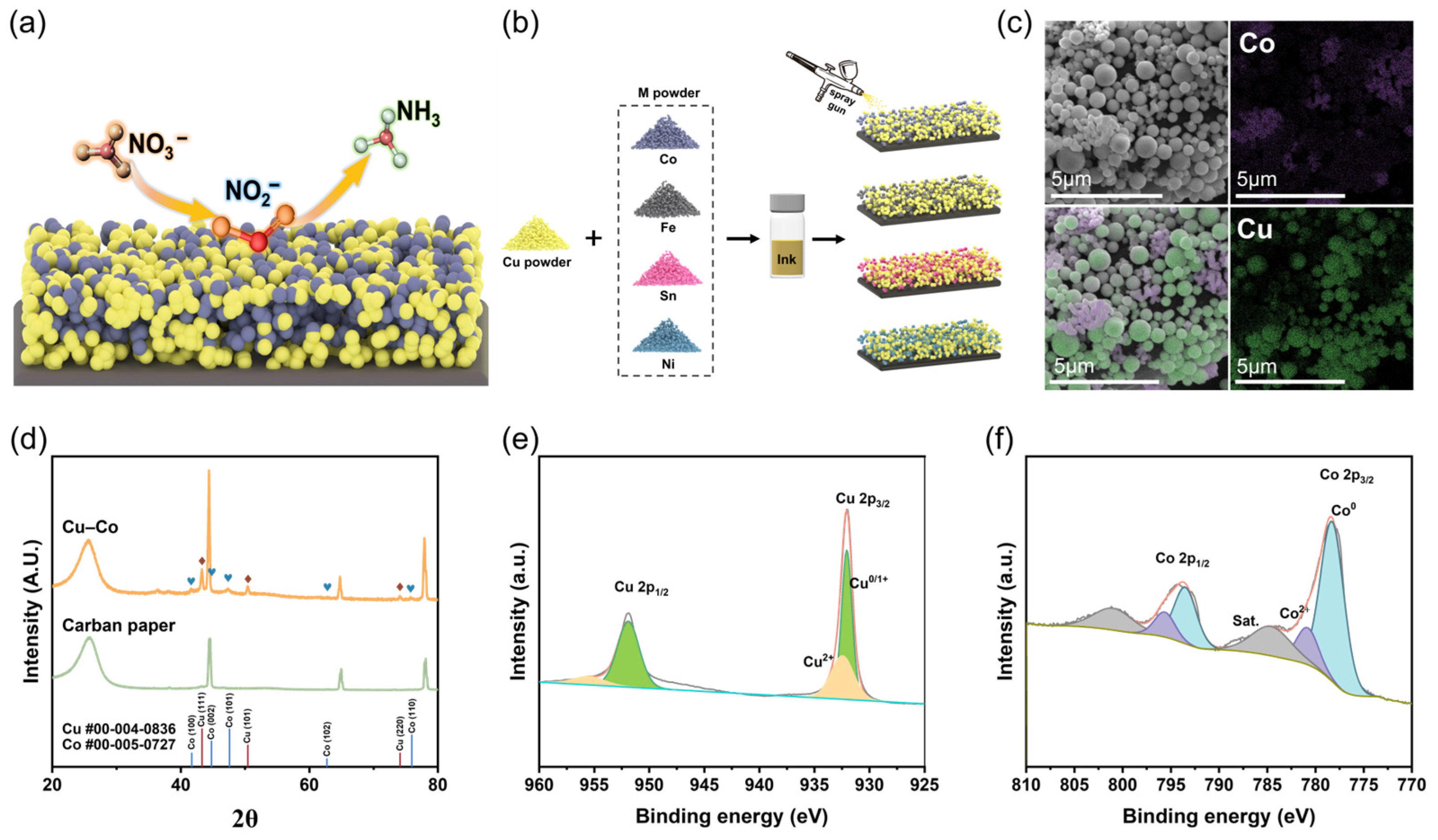
Constructing a simplified tandem architecture is important for comparing the roles of Cu and M and for understanding metal-dependent performance differences. Therefore, we first characterized the structural features of our physically mixed Cu–M (M = Co, Ni, Fe, Sn) catalysts through a combination of microscopic and spectroscopic techniques. Figure 1a schematically illustrates the proposed tandem pathway for NO3-to-NH3 conversion. In this design, the reaction is considered to proceed through two functionally distinct but closely coupled steps: (1) preferential adsorption and initial reduction of NO3 to NO2 on Cu sites, followed by (2) subsequent hydrogenation of the generated NO2 to NH3 on adjacent M sites. This design aims to address the key limitation of monometallic Cu, namely its relatively limited NO2 hydrogenation capability, by introducing a secondary metal site.
To implement this design, we adopted a straightforward physical mixing and spray-coating approach (Figure 1b). Commercial Cu and M nanoparticles were used as received, mixed in the catalyst ink, and co-deposited onto carbon paper without any high-temperature treatment that might promote alloying or structural reconstruction. This minimal-processing strategy helps reduce synthesis-induced structural complexity and provides a simplified platform for comparing the roles of different secondary metals. The morphology and elemental distribution of the catalysts were examined by scanning electron microscopy (SEM) and energy-dispersive X-ray spectroscopy (EDS) mapping. As exemplified by the Cu–Co system (Figure 1c), the catalyst layer exhibits a porous morphology with some local particle-size variation and slight aggregation, which is consistent with the use of commercial metal powders with different nominal particle sizes. Cross-sectional characterization of the representative Cu–Co electrode further shows that the spray-coated catalyst layer has a thickness of approximately 1.03 μm (Figure S1). The EDS maps reveal a generally overlapping distribution of Cu (green) and Co (purple) at the microscale, indicating close contact between the two metal components. Such interfacial contact may facilitate the transfer of NO2 intermediates between adjacent sites. X-ray diffraction (XRD) further shows that the diffraction patterns of the Cu–M catalysts are mainly superpositions of the characteristic peaks of the corresponding individual metals. As shown in Figure 1d, the Cu–Co catalyst exhibits the characteristic diffraction peaks of metallic Cu (JCPDS No. 04-0836) and Co (JCPDS No. 05-0727), with no obvious peak shifts or new crystalline phases detected. Similar phase features were observed for the other Cu–M pairs (Figure S2).
Because Cu–Co showed the best tandem catalytic performance among the four Cu–M systems, it was further selected as a representative sample for XPS and TEM/HR-TEM characterization. The Cu 2p spectrum indicates that Cu species are mainly present as Cu0/Cu+, with a characteristic peak at 932.0 eV assigned to Cu0/Cu+ species, accompanied by a small amount of Cu2+, suggesting slight surface oxidation upon air exposure (Figure 1e). In addition, the Cu LMM Auger spectrum (Figure S3) further supports the assignment of predominantly metallic Cu species on the catalyst surface. The Co 2p spectrum shows that Co is mainly present in the metallic state, with the characteristic peak at 778.4 eV assigned to Co0 (Figure 1f). HR-TEM images of the representative Cu–Co catalyst are provided in Figure S4. In the examined regions, lattice fringes attributable to Cu- and Co-related domains can still be identified, without direct evidence of obvious nanoscale alloy formation. These results, together with the XRD and XPS analyses, suggest that the Cu–Co catalyst mainly retains distinguishable Cu- and Co-related structural features, although local interfacial interactions cannot be completely excluded.
Overall, these characterizations suggest that the present preparation method avoids detectable bulk alloy formation and preserves distinguishable phase features of each metal component at the microscale. Therefore, although this catalyst system is not an idealized model, it provides a useful simplified platform for comparatively evaluating how the identity of the secondary metal influences catalytic behavior in tandem NO3 reduction.

2.2. Electrochemical Performance of Tandem Cu–M Catalysts

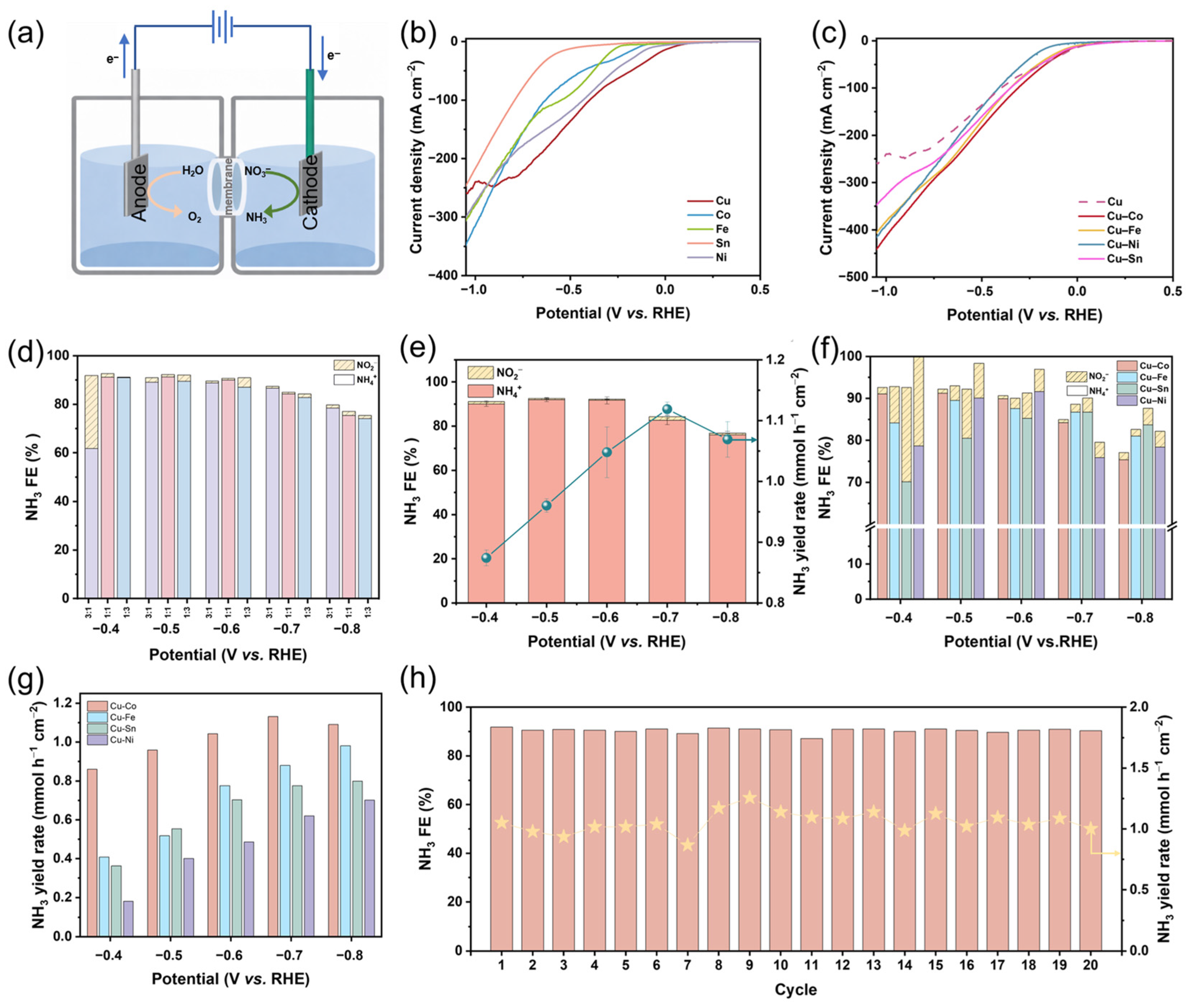
To quantitatively evaluate the metal-dependent behavior of tandem Cu–M catalysts, we investigated their electrocatalytic NO3 reduction performance in 0.1 M KNO3 + 1 M KOH using a divided H-type cell with a Nafion 117 membrane (Figure 2a). Linear sweep voltammetry (LSV) was first employed to probe electrocatalytic activity toward NO3RR. As shown in Figure 2b, the LSV results of the monometallic electrodes indicate that Cu exhibits a pronounced reduction current at relatively low overpotentials. In comparison, Ni, Fe, and Co show more negative onset potentials but deliver larger currents at higher overpotentials. By contrast, Sn requires much more cathodic potential to initiate a measurable response and maintains the lowest current density throughout the tested potential range. On this basis, bimetallic Cu–M catalysts were further constructed by combining Cu with the other metals. Figure 2c shows that, except for Cu–Ni, the remaining Cu–M systems exhibit onset potentials essentially consistent with that of Cu. Meanwhile, all Cu–M catalysts deliver substantially higher cathodic current densities than monometallic Cu over the potential range of −0.5 to −1 V (vs. RHE), indicating a general synergistic effect arising from the tandem architecture. Among them, Cu–Co exhibits the highest activity, reaching 231 mA cm−2 at −0.6 V vs. RHE, which is 1.4 times that of Cu and markedly exceeds other Cu–M combinations. This enhancement suggests that Cu plays an important role in initiating NO3 reduction, whereas the secondary metal strongly influences the downstream hydrogenation behavior.
Because tandem catalysis relies on the kinetic matching between NO3 reduction and subsequent hydrogenation steps, we systematically optimized the Cu-to-M mass ratio for each catalyst (Figure 2d and Figure S5). For Cu–Co, a 1:1 mass ratio yields the highest NH3 FE (91.2%) and minimal NO2 accumulation of 1.0% at −0.5 V vs. RHE. Deviating from this ratio leads to pronounced performance deterioration: excess Cu accelerates NO2 generation beyond the hydrogenation capacity of Co, while excess Co results in insufficient NO2 supply and reduced overall efficiency. Similar ratio-dependent behavior is observed for other Cu–M systems, yet with distinct optimal compositions. The best-performing Cu:Fe, Cu:Sn, and Cu:Ni ratios are identified as 1:1, 3:1, and 3:1, respectively, suggesting that the properties of the secondary metal play an important role in determining the balance point in the tandem sequence. These differences imply metal-specific capabilities in consuming nitrogen intermediates rather than a universal structural effect.
The applied potential further modulates this kinetic balance (Figure 2e). For the optimized Cu–Co (1:1) catalyst, NH3 FE increases sharply from 62% at −0.3 V to a maximum of 91.2% at −0.5 V vs. RHE, accompanied by a concomitant suppression of NO2 formation. The enhanced performance is consistent with accelerated multi-electron proton-coupled hydrogenation steps enabled at moderate overpotentials. At more cathodic potentials (−0.8 V vs. RHE), a slight decline in NH3 FE is observed, which is attributed to increased competition from hydrogen evolution on the secondary metal surface, rather than a loss of NO3 activation capability. A direct comparison of different Cu–M catalysts under their respective optimal conditions reveals a pronounced metal-dependent performance hierarchy (Figure 2f). At −0.5 V vs. RHE, Cu–Co achieves the highest NH3 FE (91.2%), followed by Cu–Ni and Cu–Fe, while Cu–Sn exhibits substantial NO2 accumulation and the lowest NH3 yield. This trend is further corroborated by the integrated NH3 yield rates (Figure 2g), where Cu–Co delivers an NH3 yield rate of 0.86 mmol h−1 cm−2 at −0.4 V vs. RHE, nearly twice that of Cu–Ni and more than threefold higher than Cu–Sn. These results indicate that the identity of the secondary metal plays an important role in controlling the efficiency of the hydrogenation sequence in tandem NO3RR.
To validate the tandem catalytic mechanism, control experiments using pure Cu and pure Co catalysts were conducted under identical conditions. The results show that the Cu catalyst exhibits moderate activity but relatively low NH3 FE, whereas the Co catalyst shows relatively high NH3 FE but limited overall activity toward NO3 reduction. These findings indicate that Cu is more favorable for the initial reduction of NO3 to NO2, while Co is more effective in promoting the subsequent hydrogenation steps toward NH3 formation. In contrast, the Cu–Co catalyst integrates both functionalities and exhibits higher activity and selectivity, further highlighting the advantage of tandem catalysis (Figure S6). In addition, Cdl and EIS measurements were performed to compare the electrochemical properties of the Cu, Co, and Cu–Co catalysts. The results show that, although Cu–Co does not exhibit the highest Cdl (Figure S7), it shows the lowest resistance and charge-transfer resistance (Rct, Figure S8), indicating more efficient interfacial charge transfer. Combined with its highest NH3 FE and NH3 yield rate, these results suggest that the superior performance of Cu–Co is more likely associated with faster interfacial charge transfer and the synergistic effect between Cu and Co sites. Finally, the durability of the Cu–Co catalyst was evaluated by consecutive chronoamperometric tests at −0.5 V vs. RHE (Figure 2h). Over 20 consecutive cycles, both the NH3 FE and yield rate remained largely stable, retaining more than 90% of their initial values. Post-reaction SEM and EDS observations show that the catalyst layer remains generally intact after electrolysis (Figure S9). Post-reaction XRD shows no obvious new crystalline phases or significant peak shifts after electrolysis (Figure S10), while post-reaction XPS indicates that the surface Cu- and Co-related features are largely preserved, although some surface-state variation cannot be completely excluded (Figure S11). These results suggest that the catalyst largely retains its phase characteristics and surface chemical features under the tested conditions, indicating good structural stability of the physically mixed Cu–Co tandem catalyst during NO3RR operation. In short, the electrochemical data are consistent with the tandem concept and suggest that NH3 FE is closely related to the downstream behavior of the secondary metal, in addition to the initial NO3 activation on Cu. The superior performance of Cu–Co suggests an important role of its more favorable hydrogenation behavior, providing a mechanistic basis for the following operando analysis.

2.3. Mechanism Study

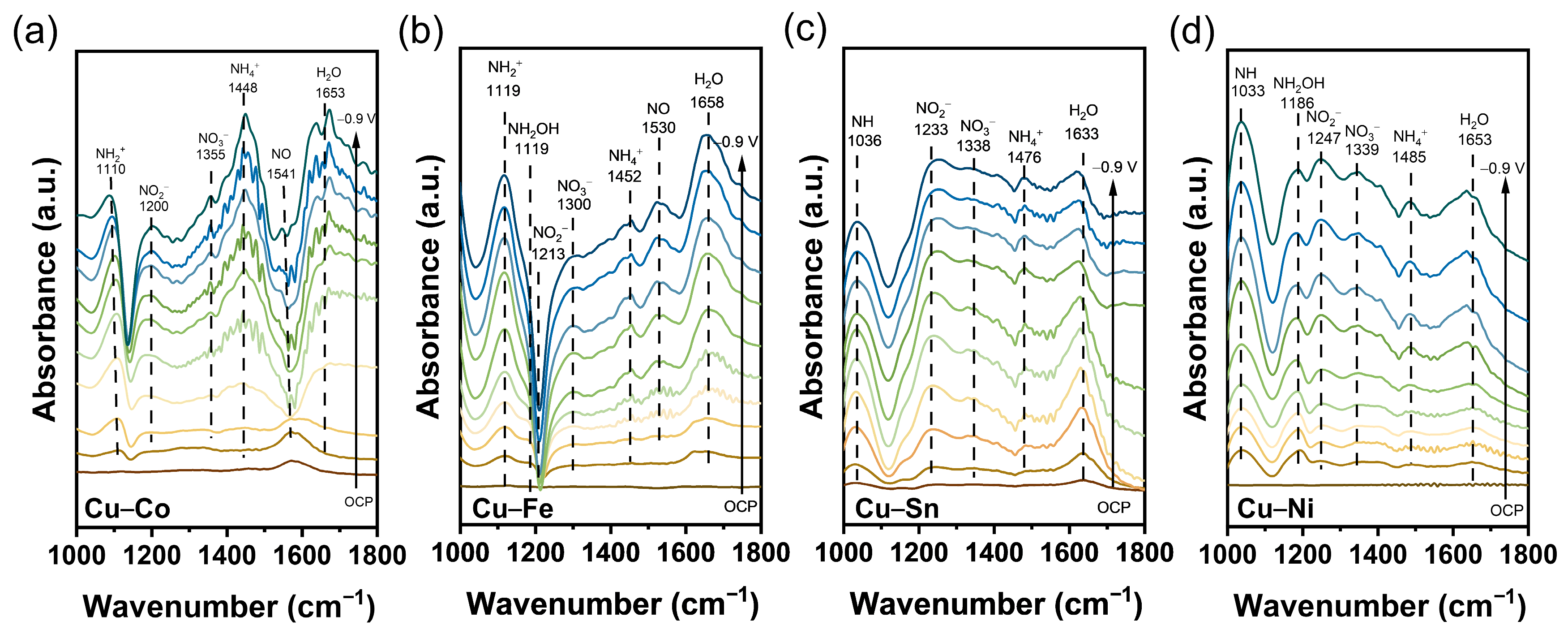
Operando ATR-FTIR spectroscopy provides direct insight into the role of the secondary metal M in governing the downstream reaction pathway of Cu–M tandem catalysts during electrocatalytic NO3 reduction. For all catalysts examined, the rapid attenuation of the NO3 vibration at 1355 cm−1 confirms that NO3 adsorption and its initial reduction to NO2 predominantly occur on Cu sites, consistent with the tandem reaction concept proposed in the Introduction [26]. In contrast, the subsequent evolution of NO2-derived intermediates varies markedly among different Cu–M systems, indicating that the fate of NO2, rather than NO3 activation itself, dictates NH3 FE.
Among the catalysts, Cu–Co exhibits a distinct spectral signature characterized by the rapid emergence and continuous growth of the NH4+ band at 1450 cm−1, accompanied by only a transient appearance of the NO2 band at ~1200 cm−1 [27]. The fast decay of the NO2 signal suggests that Cu-generated NO2 is efficiently transferred to adjacent Co sites and undergoes continuous hydrogenation without intermediate accumulation. This behavior is fully consistent with the superior NH3 FE and production rate observed for Cu–Co, indicating the establishment of an efficient “generation–consumption” tandem pathway (Figure 3a). In contrast, Cu–Fe displays rapid NO2 attenuation but limited growth of the ammonium signal, implying that although Fe effectively captures NO2, overly strong binding of downstream intermediates impedes further hydrogenation (Figure 3b). For Cu–Sn, the persistent and intense NO2 band throughout the reaction reflects inefficient NO2 conversion, leading to pronounced intermediate accumulation and suppressed NH3 formation (Figure 3c). Cu–Ni shows strong retention of NO3-related features and comparatively weak ammonium evolution, suggesting that although NO3 adsorption is enhanced, the subsequent hydrogenation steps toward NH3 are kinetically hindered (Figure 3d).
To further clarify whether the observed performance differences originate from differences in NO2 hydrogenation capability rather than NO3 activation, NO2 reduction was employed as a probe reaction. Under identical electrochemical conditions, Cu–Co delivers the highest NH3 Faradaic efficiency and formation rate, whereas Cu–Ni and Cu–Fe exhibit moderate activity, and Cu–Sn performs poorly. Notably, time-resolved measurements reveal that NO2 consumption on Cu–Co proceeds synchronously with NH3 generation, indicating a continuous and kinetically efficient hydrogenation pathway. In contrast, other Cu–M catalysts display a clear mismatch between NO2 depletion and NH3 formation, suggesting reaction stagnation due to either excessive intermediate stabilization or insufficient hydrogen supply.
Combining operando FTIR observations with NO2 reduction kinetics, the superior performance of Cu–Co can be attributed to the favorable chemical characteristics of Co, which provide a balanced interaction with NO2-derived intermediates and hydrogen species. Such balanced adsorption enables efficient capture of Cu-derived NO2 while avoiding intermediate trapping or competitive side reactions, thereby facilitating complete hydrogenation to NH3. These results unambiguously identify NO2 hydrogenation as the decisive step governing NH3 FE and highlight the chemical nature of the secondary metal as the key descriptor for rational design of high-efficiency Cu–M tandem catalysts for electrocatalytic NO3-to-NH3 conversion.

3. Experimental Methods

3.1. Chemicals and Materials

Commercial Cu powder (99.9%, 60–100 nm, Macklin, Shanghai, China), Co powder (99.9%, 30 nm, Macklin, Shanghai, China), Ni powder (99.9%, 20–100 nm, Macklin, Shanghai, China), Fe powder (99.9%, 50 nm, Macklin, Shanghai, China), and Sn powder (99.9%, 50 nm, Adamas, Shanghai, China) were used as received without further grinding. Hydrophilic carbon paper (CDS180S, Taiwan, China) was used as the substrate for catalyst deposition. A Nafion 117 membrane was used to separate the cathodic and anodic compartments. Sustainion XA-9 alkaline ionomer binder (Dioxide Materials, Boca Raton, FL, USA) was used for catalyst ink preparation. Potassium hydroxide (KOH, 95%, Macklin, Shanghai, China), potassium nitrate (KNO3, AR, ≥99.0%, Hushi, Shanghai, China), sodium hydroxide (NaOH, 98%, Macklin, Shanghai, China), ammonium chloride (NH4Cl, GR, ≥99.8%, Hushi, Shanghai, China), potassium nitrite (KNO2, ≥95%, Aladdin, Shanghai, China), salicylic acid (99.5%, Macklin, Shanghai, China), trisodium citrate (anhydrous, USP, Aladdin, Shanghai, China), isopropanol (ACS, ≥99.5%, Macklin, Shanghai, China), sodium hypochlorite solution (available chlorine 4.0%, Macklin, Shanghai, China), sodium nitroprusside (reagent grade, 99.0%, Macklin, Shanghai, China), N-(1-naphthyl)ethylenediamine dihydrochloride (AR, ≥97%, Hushi, Shanghai, China), sulfanilamide (AR, ≥99.8%, Hushi, Shanghai, China), and phosphoric acid (AR, ≥85.0%, Hushi, Shanghai, China) were used as received. Ultrapure water was used throughout all experiments.

3.2. Hybrid Spray Coating Method for Cu–M Bimetallic Catalytic Electrodes

After cutting the hydrophilic carbon paper, the spray coating area is confined to 1 cm × 1 cm. Cu powder and a second metal powder M (Co, Fe, Ni, or Sn) are weighed according to the set mass ratio and thoroughly mixed, with the total metal mass being 100 mg (Cu:M = 0:100, 25:75, 50:50, 75:25, 100:0). To the mixed powders, 10 mL of ultrapure water, 10 mL of isopropanol, and 250 μL of Sustainion XA-9 binder are added, followed by ultrasonic dispersion for 1 h to prepare a uniform catalyst ink. During spraying, the carbon paper is placed on a 60 °C heating plate, and a multi-layer spray coating process is applied to gradually build up the catalytic layer, allowing the solvent to evaporate during spraying and thus form an even coating. The spraying amount is controlled to achieve a total metal loading of 0.5 mg cm−2. After spraying, the sample is kept at 60 °C for about 30 s to further remove any residual solvent, yielding the Cu–M bimetallic spray-coated electrode.

3.3. Characterizations

SEM images were obtained using a ZEISS Gemini 300 field-emission scanning electron microscope (ZEISS, Oberkochen, Germany). XRD patterns were recorded on a Bruker D8 Advance X-ray diffractometer (Bruker, Billerica, MA, USA). UV–vis absorption spectra were measured using a UV-2600i ultraviolet–visible spectrophotometer (Shimadzu, Kyoto, Japan). XPS spectra were collected on a Thermo Scientific K-Alpha X-ray photoelectron spectrometer (Thermo Fisher Scientific, Waltham, MA, USA). HR-TEM images were obtained using a Tecnai F20 transmission electron microscope (FEI, Hillsboro, OR, USA).

3.4. Electrochemical Measurements

The NO3RR performance was evaluated in a Nafion 117 membrane-separated H-type cell using a standard three-electrode configuration, controlled by an electrochemical workstation (DH7001B, Jiangsu Donghua Analytical Instruments Co., Ltd., Taizhou, China). The Cu–M catalyst electrode served as the working electrode, with a Pt foil as the counter electrode and a Hg/HgO electrode (1 M KOH) as the reference electrode. The cathodic compartment was filled with 10 mL of electrolyte (1 M KOH + 0.1 M KNO3), and the anodic compartment was filled with 10 mL of 1 M KOH. All potentials were converted to the reversible hydrogen electrode (RHE) scale using the following equation:
E RHE = E Hg / HgO + 0.0592 × pH + 0.098
LSV was conducted from 0 to −2.0 V (vs. Hg/HgO) at a scan rate of 5 mV s−1 to evaluate the catalytic activity. CV was performed at different scan rates to estimate the Cdl of the Cu, Co, and Cu–Co catalysts, with scan rates of 10, 20, 40, 60, 80, and 100 mV s−1. The capacitive current density was calculated as half of the difference between the anodic and cathodic current densities at a selected potential within the non-faradaic region, and the slope of the linear fit of capacitive current density versus scan rate was taken as the Cdl value. EIS measurements of Cu, Co, and Cu–Co were carried out at open-circuit potential over a frequency range of 106–0.01 Hz, and the obtained Nyquist plots were fitted to extract the resistance associated with the high-frequency process and the charge-transfer resistance (Rct). Chronoamperometry was conducted at −0.7 V (vs. RHE) for 7200 s with electrolyte stirring at 300 rpm. The stability was evaluated over 20 consecutive cycles using the same working electrode.

3.5. Ammonia Quantification

The NH3 produced in the catholyte was quantified using the indophenol blue method (electrolyte: 1 M KOH + 0.1 M KNO3). The color-developing reagents consisted of an alkaline salicylic acid/sodium citrate solution (prepared from NaOH, salicylic acid, and sodium citrate), a 0.05 M NaClO solution (stored in the dark), and a 1 wt% sodium nitroprusside solution. For analysis, an appropriate volume of the catholyte sample was diluted to 2 mL, followed by the addition of 2 mL alkaline salicylic acid/sodium citrate solution, 1 mL 0.05 M NaClO solution, and 0.2 mL 1 wt% sodium nitroprusside solution. After thorough mixing, the mixture was incubated in the dark for 30 min. The absorption spectrum was then recorded on a UV–Vis spectrophotometer over 550–750 nm with the electrolyte as the blank for baseline correction, and the maximum absorbance (or the absorbance at the characteristic peak) was used for quantification. Calibration curves were constructed using NH4Cl standard solutions (0, 1, 2, 4, 6, 8, and 10 μg mL−1) measured under identical color development and UV–Vis conditions. Absorbance was plotted against concentration for linear fitting, and the fitting curve is shown in Figure S12. The NH3 concentration in the samples was determined from the calibration curve and further used to calculate the FE.
The NH3 yield rate and FE were calculated according to the following equations:
Y N H 3   =   c × V × 10 3 M N H 3 × t × A
FE N H 3 = n × F × c × V × 10 6 M N H 3 × Q × 100 %
where c is the concentration of NH3 in the product solution (μg mL−1), V is the volume of the reaction solution (mL), t is the electrolysis time (h), and A is the geometric area of the working electrode (cm2). The unit of Y N H 3 is mmol h−1 cm−2. M N H 3 is the molar mass of NH3 (17 g mol−1), n is the number of transferred electrons (8 for the formation of 1 mol NH3), F is the Faraday constant (96,485 C mol−1), and Q is the total charge consumed (C). The terms 10−3 and 10−6 are unit conversion factors.

3.6. Nitrite Quantification

The concentration of NO2 was quantified using the Griess colorimetric method. The color-developing reagent was prepared from N-(1-naphthyl)ethylenediamine dihydrochloride, sulfanilamide, and H3PO4 and stored in the dark. For analysis, 1 mL of the standard solution or appropriately diluted sample was mixed with 2 mL of deionized water and 1 mL of the color reagent, followed by color development at room temperature for 10 min. The absorption spectrum was then recorded using a UV–Vis spectrophotometer over 450–650 nm with the blank electrolyte as the baseline, and the maximum absorbance was used to construct the calibration curve. Calibration curves were established using a series of KNO2 standard solutions (0, 2, 4, 6, 8, and 10 μg mL−1); the fitting curve is shown in Figure S13. The NO2 concentration in the samples was determined from the calibration curve and further used to calculate the FE.
The NO2 FE was calculated according to the following equations:
F E N O 2 = n × F × c × V × 10 6 M N O 2 × Q × 100 %
where n is the number of transferred electrons (2 for the formation of 1 mol NO2).

4. Conclusions

To elucidate the correlation between NH3 synthesis performance and the properties of the secondary metal, we constructed a series of physically mixed tandem Cu–M catalysts (M = Co, Ni, Fe, Sn) with distinguishable metal phases. Structural characterizations confirm that Cu and M remain as distinct phases and are broadly co-distributed on the electrode, reducing complications associated with alloying or complex nanostructuring. In 0.1 M KNO3 + 1 M KOH, all Cu–M catalysts exhibit higher cathodic current responses than monometallic Cu, with Cu–Co showing the highest activity (231 mA cm−2 at −0.6 V vs. RHE). After optimizing the mass ratio, Cu:Co = 1:1 achieves an NH3 FE of 91.2% at −0.5 V (vs. RHE) with NO2 accumulation suppressed to ~1.0%, while retaining over 90% of its initial performance over 20 consecutive cycles. Operando ATR-FTIR further indicates that NO3 adsorption and the initial reduction predominantly occur on Cu sites, whereas the capability of the secondary metal to hydrogenate NO2 plays a major role in intermediate accumulation and ultimately NH3 production efficiency: Co rapidly consumes NO2 and promotes continuous hydrogenation, whereas Ni and Fe exhibit relatively less efficient hydrogenation, and Sn tends to induce NO2 buildup. Overall, NO2 hydrogenation constitutes the primary rate-/FE-controlling step in tandem NO3-to-NH3 conversion, and selecting a secondary metal with balanced intermediate binding and favorable hydrogenation kinetics is crucial for achieving high NH3 FE and productivity.

Supplementary Materials

The following supporting information can be downloaded at: https://www.mdpi.com/article/10.3390/catal16050402/s1.

Author Contributions

Conceptualization, B.D. and C.Z.; methodology, L.Z. and J.C.; validation, L.Z. and R.L.; formal analysis, J.C. and R.L.; investigation, J.C. and R.L.; resources, B.D. and C.Z.; data curation, L.Z.; writing—original draft preparation, L.Z.; writing—review and editing, L.Z., J.C., B.L., R.L., B.D. and C.Z.; visualization, L.Z.; supervision, B.D. and C.Z.; project administration, B.D. and C.Z.; funding acquisition, B.D. and C.Z. All authors have read and agreed to the published version of the manuscript.

Funding

This work was financially supported by the Key R&D Program of Zhejiang Province (No. 2024C03136).

Data Availability Statement

The raw data supporting the conclusions of this article will be made available by the authors on request.

Conflicts of Interest

The authors declare no conflicts of interest.

References

  1. Theerthagiri, J.; Park, J.; Das, H.T.; Rahamathulla, N.; Cardoso, E.S.F.; Murthy, A.P.; Maia, G.; Vo, D.V.N.; Choi, M.Y. Electrocatalytic conversion of nitrate waste into ammonia: A review. Environ. Chem. Lett. 2022, 20, 2929–2949. [Google Scholar] [CrossRef]
  2. Zhang, H.; Wang, H.; Cao, X.; Chen, M.; Liu, Y.; Zhou, Y.; Huang, M.; Xia, L.; Wang, Y.; Li, T.; et al. Unveiling cutting-edge developments in electrocatalytic nitrate-to-ammonia conversion. Adv. Mater. 2024, 36, 2312746. [Google Scholar] [CrossRef]
  3. Chen, G.-F.; Yuan, Y.; Jiang, H.; Ren, S.-Y.; Ding, L.-X.; Ma, L.; Wu, T.; Lu, J.; Wang, H. Electrochemical reduction of nitrate to ammonia via direct eight-electron transfer using a copper–molecular solid catalyst. Nat. Energy 2020, 5, 605–613. [Google Scholar] [CrossRef]
  4. Nawaz, M.Z.; Hasan, I.M.u.; Ahmad, W.; Gulzar, H.; Li, M.; Weng, B.; Chu, P.K.; Liu, N. A review of advanced nanomaterials for electrochemical nitrate reduction to ammonia. Coord. Chem. Rev. 2026, 550, 217401. [Google Scholar] [CrossRef]
  5. Yin, S.; Cao, R.; Han, Y.; Shang, J.; Zhang, J.; Jiang, W.; Liu, G. Electrocatalysts with atomic-level site for nitrate reduction to ammonia. J. Energy Chem. 2024, 96, 642–668. [Google Scholar] [CrossRef]
  6. Ouyang, X.; Qiao, W.; Yang, Y.; Xi, B.; Yu, Y.; Wu, Y.; Fang, J.; Li, P.; Xiong, S. Intensifying interfacial reverse hydrogen spillover for boosted electrocatalytic nitrate reduction to ammonia. Angew. Chem. Int. Ed. 2025, 64, e202422585. [Google Scholar] [CrossRef] [PubMed]
  7. Chen, S.; Zhu, Z.; Song, K.; Zhang, H.; Luo, D.; Cao, T.; Zou, Y.; Liu, C.; Gan, L.; Zhang, D.; et al. Engineering Cu/Ru heterointerface-shelled nanocavities by the Kirkendall effect for highly efficient nitrate electroreduction to ammonia. J. Am. Chem. Soc. 2025, 147, 36494–36507. [Google Scholar] [CrossRef]
  8. Chen, Y.; Liu, X.; Li, S.; Li, J.; Fan, M.; Shu, S. Crystalline-amorphous heterostructures with built-in electric fields enhance the tandem electroreduction of nitrate to ammonia. Adv. Funct. Mater. 2025, 36, e21409. [Google Scholar] [CrossRef]
  9. Li, Z.; Wang, Q.; Zhong, L.; Yan, C.; Shi, Z.; Ou, Y.; Shang, Y.; Zhang, C.; Tian, S.; Liu, H.; et al. Boosting ammonia electrosynthesis via interfacial tandem nitrate reduction enabled by an amorphous@crystalline electrocatalyst. Mater. Today 2025, 85, 49–59. [Google Scholar] [CrossRef]
  10. Dang, Y.; Zhang, R.; Ren, S.; Pitchaimuthu, S.; Liu, S.; Xing, R.; Yang, X. Balancing active hydrogen and NO2 for interfacial tandem nitrate electrocatalysis to ammonia. Chem. Eng. J. 2025, 520, 166370. [Google Scholar] [CrossRef]
  11. Chen, X.; Liang, Y.; Zhou, L.; Chen, F.; Ding, J.; Wang, M.; Zhang, L.; Su, J.; Jin, Z.; Jiang, M. Pulsed electrolysis controls sequential accumulation and conversion of key intermediates over zinc-based metal organic framework for enhanced nitrate electroreduction to ammonia. J. Colloid Interface Sci. 2026, 703, 139141. [Google Scholar] [CrossRef] [PubMed]
  12. Zhang, B.; Chen, Y.; Dai, Z.; Cheng, M.; Feng, P.; Ke, B.; Zhang, G. Intrinsic Ni0–Niδ+ pairs in anti-perovskite NiNNi3 act as hydrogen radical emitters for Cu enabling promoted electrocatalytic nitrate reduction. Angew. Chem. Int. Ed. 2026, 65, e21064. [Google Scholar] [CrossRef] [PubMed]
  13. Zhou, Y.; Duan, R.; Li, H.; Zhao, M.; Ding, C.; Li, C. Boosting electrocatalytic nitrate reduction to ammonia via promoting water dissociation. ACS Catal. 2023, 13, 10846–10854. [Google Scholar] [CrossRef]
  14. Liu, Y.; Zhang, X.; Feizpoor, S.; Chen, H.-C.; Li, L.; Zuo, Y.; Tian, S.; Liu, M.; Hu, W.; Humayun, M.; et al. Embedded Fe-Cu pairs enable tandem nitrate-to-ammonia electroreduction. Adv. Mater. 2026, 38, e14840. [Google Scholar] [CrossRef]
  15. Lv, T.; Yang, L.; Hong, C.; Zhu, Y.; Shen, J.; Li, C. Electronic interaction at Cu–O–Ni heterointerface promotes electrocatalytic nitrate reduction to ammonia and zinc-nitrate battery. Adv. Sci. 2026, 13, e21252. [Google Scholar] [CrossRef]
  16. Mei, W.; Chang, C.-W.; Li, Z.; Wang, X.; Qie, Y.; Liu, Q.; Davis, R.C.; Wu, Z.; Yue, Y.; Yang, C.; et al. Robust oxygen-vacancy-engineered Co(OH)2/Cu heterostructures boost nitrate electroreduction to ammonia beyond 2 A cm−2. Adv. Mater. 2025, 37, 2507363. [Google Scholar] [CrossRef]
  17. Yin, S.; Wang, Y. Single-atom catalysts for electrochemical nitrate reduction to ammonia: Rational design, mechanistic insights, and system perspectives. Catalysts 2025, 15, 1084. [Google Scholar] [CrossRef]
  18. Kuznetsova, I.; Kultin, D.; Lebedeva, O.; Nesterenko, S.; Murashova, E.; Kustov, L. Intermetallic compound and solid solutions of Co75Me25 (Me: Si, Fe, Cr) as catalysts for the electrochemical reaction of nitrate conversion to ammonia. Int. J. Mol. Sci. 2025, 26, 1650. [Google Scholar] [CrossRef]
  19. Du, J.; Loiudice, A.; Kumar, K.; Zaza, L.; Buonsanti, R. Well-defined Cu precatalysts indicate design rules for reactivity in nitrate electroreduction. J. Am. Chem. Soc. 2025, 147, 35438–35445. [Google Scholar] [CrossRef]
  20. Xu, Y.; Cheng, C.; Zhu, J.; Zhang, B.; Wang, Y.; Yu, Y. Sulphur-boosted active hydrogen on copper for enhanced electrocatalytic nitrate-to-ammonia selectivity. Angew. Chem. Int. Ed. 2024, 63, e202400289. [Google Scholar] [CrossRef] [PubMed]
  21. Chen, L.; Hao, Y.; Chu, J.; Liu, S.; Bai, F.; Luo, W. Electrocatalytic nitrate reduction to ammonia: A perspective on Fe/Cu-containing catalysts. Chin. J. Catal. 2024, 58, 25–36. [Google Scholar] [CrossRef]
  22. Bu, Y.; Wang, C.; Zhang, W.; Yang, X.; Ding, J.; Gao, G. Electrical pulse-driven periodic self-repair of Cu-Ni tandem catalyst for efficient ammonia synthesis from nitrate. Angew. Chem. Int. Ed. 2023, 62, e202217337. [Google Scholar] [CrossRef]
  23. Zheng, Y.; Jia, Y.; Cao, Q.; Li, L.; Yu, X.; Zeng, S.; Yao, H.; Guo, X. In situ evolution of Sn/Cu2O heterostructure catalysts for modulating selectivity in electrosynthesis of ammonia and urea. Nano Res. 2025, 18, 94907248. [Google Scholar] [CrossRef]
  24. Zhang, S.; Wu, J.; Zheng, M.; Jin, X.; Shen, Z.; Li, Z.; Wang, Y.; Wang, Q.; Wang, X.; Wei, H.; et al. Fe/Cu diatomic catalysts for electrochemical nitrate reduction to ammonia. Nat. Commun. 2023, 14, 3634. [Google Scholar] [CrossRef]
  25. Su, X.; Li, M.; Wen, Y.; Sun, F.; Shan, B. Atomically paired Cu–Co dual sites for near-unity ammonia selectivity in nitrate electroreduction. J. Am. Chem. Soc. 2025, 147, 46471–46482. [Google Scholar] [CrossRef]
  26. Fang, J.-Y.; Zheng, Q.-Z.; Lou, Y.-Y.; Zhao, K.-M.; Hu, S.-N.; Li, G.; Akdim, O.; Huang, X.-Y.; Sun, S.-G. Ampere-level current density ammonia electrochemical synthesis using CuCo nanosheets simulating nitrite reductase bifunctional nature. Nat. Commun. 2022, 13, 7899. [Google Scholar] [CrossRef]
  27. Wang, Y.; Zhang, W.; Wen, W.; Yu, X.; Du, Y.; Ni, K.; Zhu, Y.; Zhu, M. Atomically dispersed unsaturated Cu-N3 sites on high-curvature hierarchically porous carbon nanotube for synergetic enhanced nitrate electroreduction to ammonia. Adv. Funct. Mater. 2023, 33, 2302651. [Google Scholar] [CrossRef]
Figure 1. (a) Schematic illustration of the Cu–M tandem catalytic mechanism, where the yellow and gray regions represent Cu and Co, respectively. (b) Schematic of the spray-coating fabrication process for Cu–M catalysts. (c) Representative morphology and elemental distribution characterization of Cu–Co. (d) XRD phase identification of Cu–Co, the heart and diamond symbols denote metallic Co (JCPDS No. 05-0727) and metallic Cu (JCPDS No. 04-0836), respectively. (e) High-resolution Cu 2p XPS spectrum of Cu–Co. (f) High-resolution Co 2p XPS spectrum of Cu–Co.
Catalysts 16 00402 g001
Figure 2. (a) Schematic illustration of the divided H-type cell. (b) LSV comparison of monometallic electrodes (Cu, Co, Fe, Ni, and Sn) in a NO3-containing electrolyte. (c) LSV comparison of Cu–M (M = Co, Fe, Ni, and Sn) bimetallic catalysts with monometallic Cu under identical conditions. (d) FE of NH3 and NO2 for catalysts with different Cu:Co mass ratios (3:1, 1:1, 1:3), where the hatched and solid bars represent NO2 and NH3, respectively. (e) Potential-dependent NH3 FE and NH3 yield rate for the optimized Cu–Co (1:1) catalyst. (f) Comparison of NH3 FE for Cu–M catalysts at their respective optimal compositions, where the hatched and solid bars represent NO2 and NH3, respectively. (g) Comparison of NH3 yield rate for Cu–M catalysts at their respective optimal compositions. (h) Chronoamperometric stability test of the optimized Cu–Co (1:1) catalyst at −0.5 V (vs. RHE).
Catalysts 16 00402 g002
Figure 3. Electrochemical in situ FTIR spectra recorded during nitrate electroreduction for (a) Cu–Co, (b) Cu–Fe, (c) Cu–Sn, and (d) Cu–Ni.
Catalysts 16 00402 g003
Disclaimer/Publisher’s Note: The statements, opinions and data contained in all publications are solely those of the individual author(s) and contributor(s) and not of MDPI and/or the editor(s). MDPI and/or the editor(s) disclaim responsibility for any injury to people or property resulting from any ideas, methods, instructions or products referred to in the content.