
A Language for Modeling Declarative Knowledge Bases in the Context of Model-Driven Engineering


Abstract
1. Introduction
- We propose a visual language for modeling declarative knowledge bases, termed RVML, which supports mapping to core constructs of CLIPS/FuzzyCLIPS. These include fact templates; facts as elements of rule conditions and actions; rule nodes; operators for manipulating facts in working memory; linguistic (fuzzy) variables; and terms.
- We develop a supporting software tool, the Personal Knowledge Base Designer (PKBD), which enables the practical application of RVML.
- We evaluate the proposed approach through task-based assessment, a user study, and multiple case studies, demonstrating its effectiveness and applicability.
2. Related Works
- Textual, which provides direct manipulation of language constructs and is mainly aimed at programmers. Examples of the approach are specialized languages such as CLIPS [7] and DROOLS [8], as well as markup languages such as RuleML [11], SWRL [12,13], and R2ML [14]; implementation tools: specialized editors, for example, Visual JESS for JESS (Java Expert Systems Shell), supporting mechanisms for contextual assistance, and color highlighting of basic language constructions.
- Graphical, which provides manipulation of visual elements corresponding to the elements of language constructions, in some cases, followed by their direct mapping into program code or specifications. This approach enables end-users to be involved in the development process by supporting visual modeling/programming.
- Universal semantic structures [15] in the form of concept maps and ontologies; however, the lack of standardized relationship semantics complicates model transformation, limiting their adoption in intelligent system development. For example, VisiRule [16] and RULING [17] offer the color indication of nodes; Shigarov et al. [18] defined the rules for naming concepts and their properties; and Pavlov et al. [19] used a certain color scheme when naming arcs. Some of the languages in this group, for example, BiDaML [20], SCg (Semantic Code graphical) [21], and DESIRE [22], contain original graphic elements that are not widespread among domain specialists and software developers.
3. RVML: A Language for Modeling Declarative Knowledge Bases
3.1. Formal Semantics of RVML
3.2. The Meta-Model of RVML/FuzzyRVML
3.3. Visual Elements of RVML
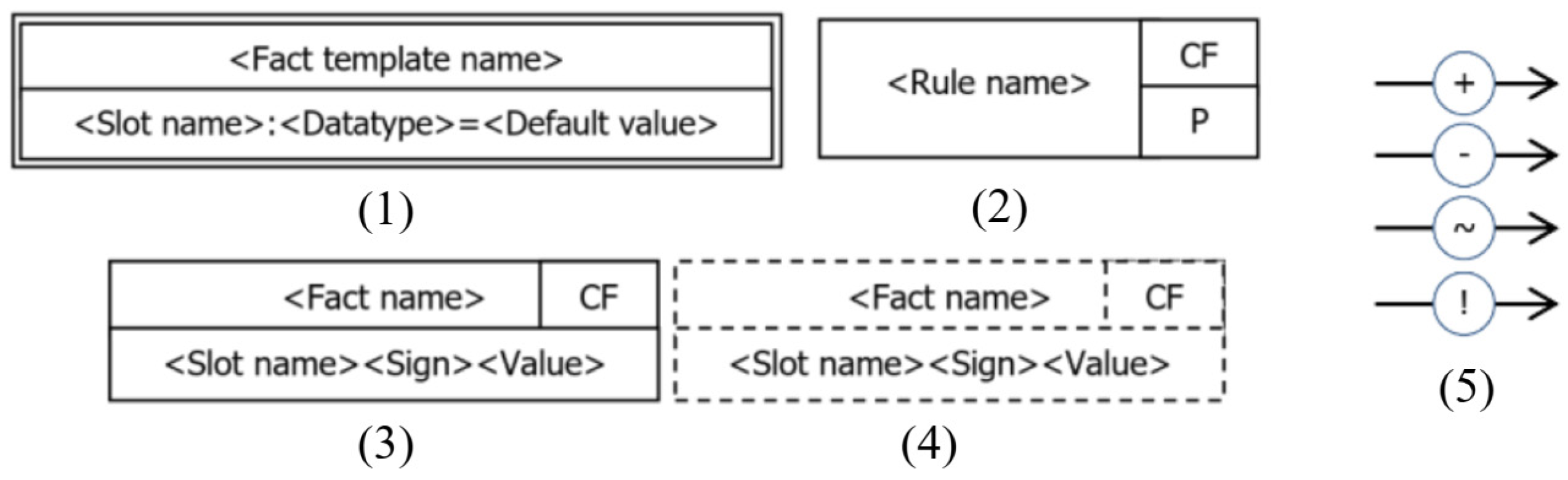
- The fact template (Figure 2, (1)) is used to describe fact templates and parts of generalized rules (rule templates), such as condition and action. It includes the name and description of the slots. Additionally, each slot contains its own name, data type, and default value.
- The nodal element (or core) of the rule (Figure 2, (2)) is the connecting conditions and actions in the form of facts. The nodal element allows one to represent the name of the rule, the confidence factor (CF), and the priority (P).
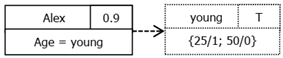
- The fact, as the action element (or the consequence) of the rule (Figure 2, (3)), is used to represent facts that are manipulated in working memory. This element enables representation of the name of the fact and its description through certain slots, as well as the confidence factor (CF).
- The fact, as the condition element (or the antecedent) of the rule (Figure 2, (4)), is used to represent the facts that activate the rules in the working memory. To indicate their controlling nature, and by analogy with control flow diagrams, a dotted image of all lines of a graphic element is used. This element enables representation of the name of the fact and its description through certain slots, along with the confidence factor (CF).
- The connection between the elements (Figure 2, (5)) is represented as an association containing a node for displaying an operation with facts in working memory: “+”—adding; “−”—deleting; “~”—changing; “!”—stopping logical inference.
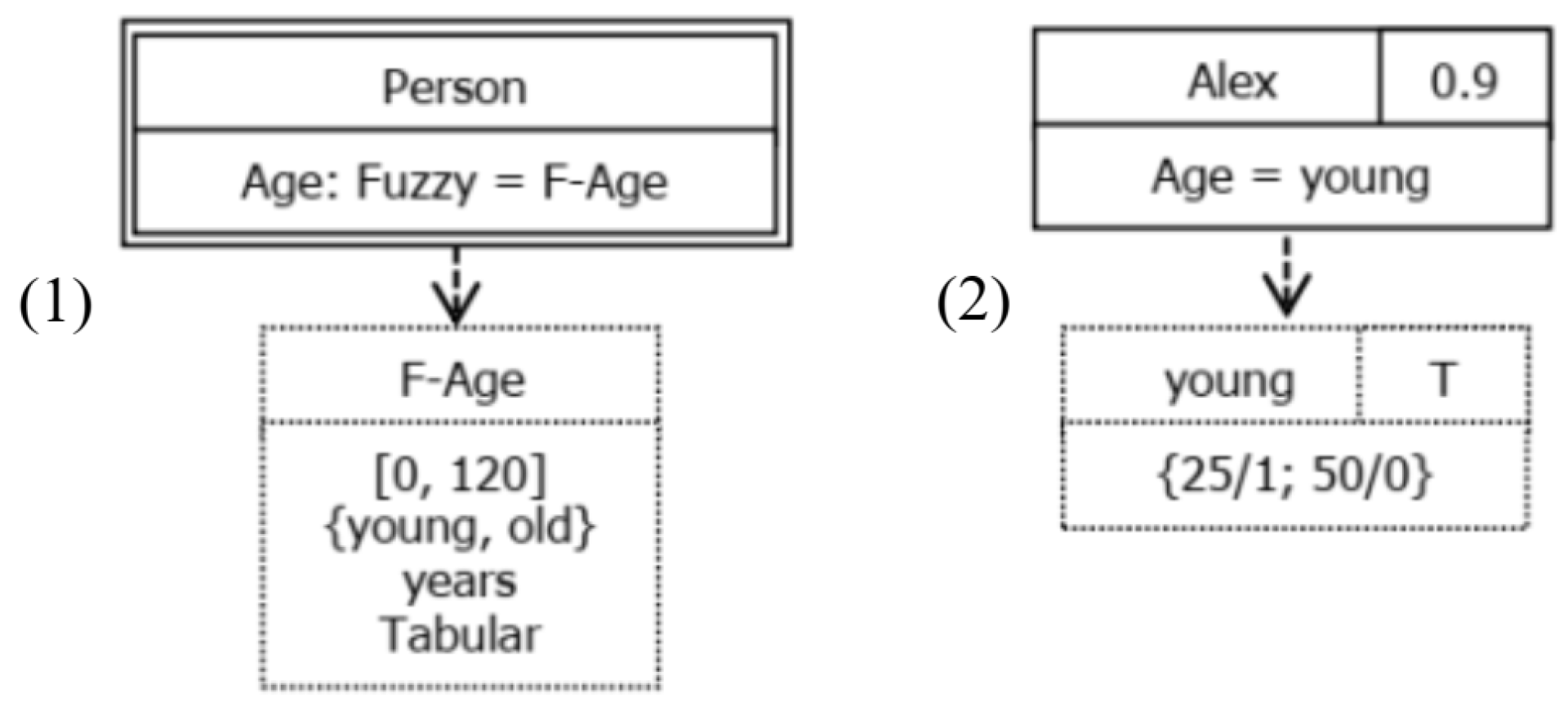
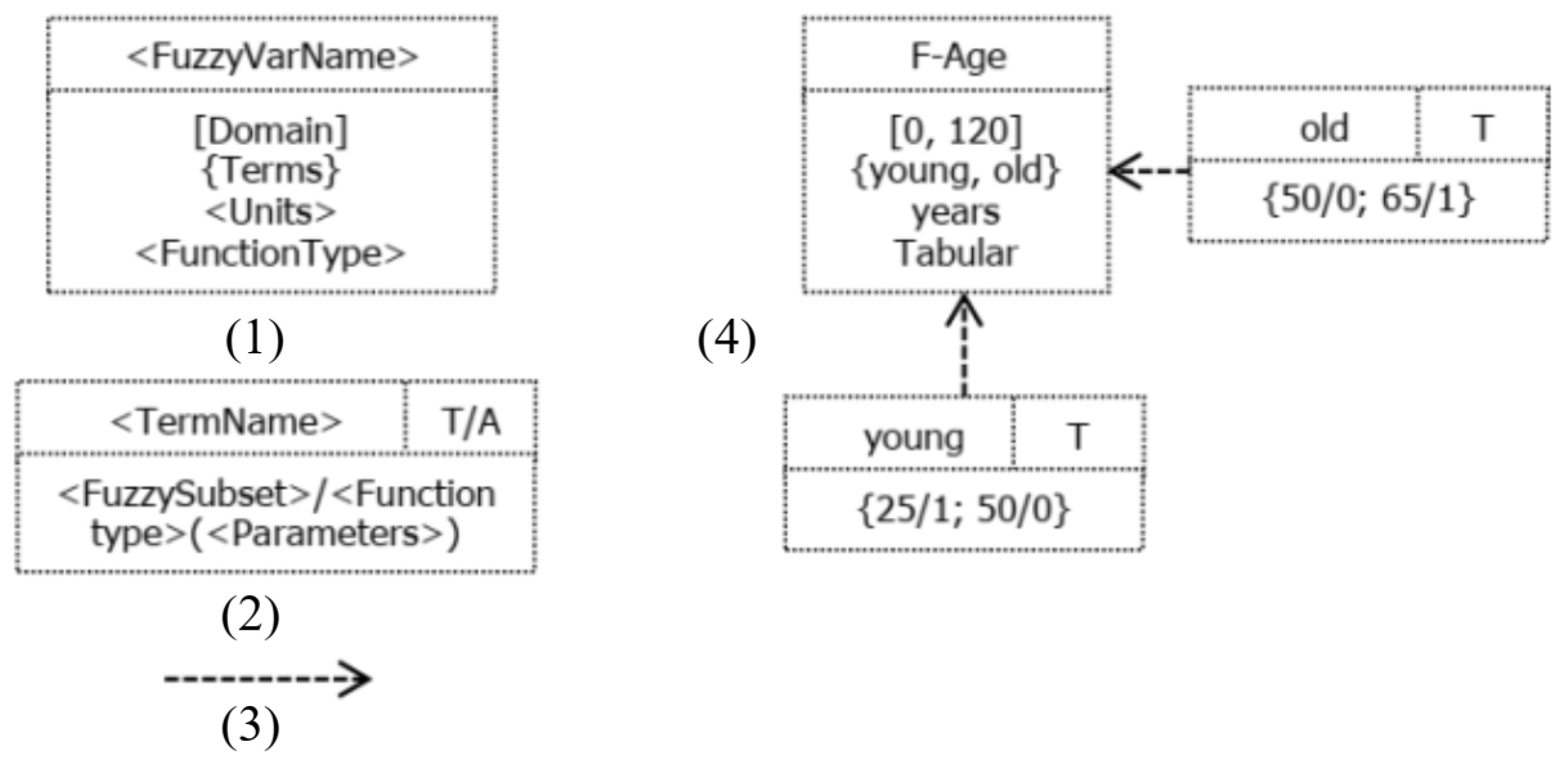
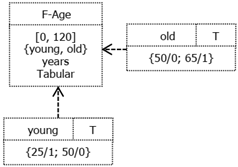
- A fuzzy or linguistic variable (Figure 3, (1)) contains information about the name of the variable, the range of possible values, units of measurement, the type of membership function, and terms.
- A term (Figure 3, (2)) defining the value of a certain fuzzy variable according to a membership function. It contains the name, type of membership function, and possible values indicating their probability.
3.4. The Transformation of RVML/FuzzyRVML Elements to Program Code
3.5. Advantages of RVML/FuzzyRVML and Comparison with Other Languages
- RVML uses specialized graphical elements for all components of the rules, rather than one typical element characterized by a stereotype (as in UML).
- It provides an unambiguous visual indication of the actions produced by the rules: adding, deleting, changing facts, and stopping logical inference.
- RVML provides setting priorities for rules, confidence factors, and constraints for property values without using OCL.
- It can be considered as a UML extension profile using the terminology of class diagrams (“class”, “association”, “dependency”) and focused on modeling logical rules.
- RVML abstracts away from specific knowledge representation and programming languages by expressing logical rules in a generalized form.
- It can be used to model incompleteness and fuzziness and contains specialized elements: a data type (Fuzzy); a linguistic (fuzzy) variable (FuzzyVar), a set of fuzzy terms as possible values of the linguistic variable, and a confidence factor.
- RVML can be used to generate program code (supports direct mapping of graphic elements to code) for CLIPS, FuzzyCLIPS, Drools, etc.
- Language Complexity: RVML reduces complexity through specialized graphical elements for each rule component (vs. UML’s stereotype-based approach).
- Intrinsic Motivation: Clear visual separation of rule components enhances perceived benefits.
- Visual Distance: Intentionally increased graphical distinction between symbols.
- Semantic Transparency: Elements directly represent their meaning (dotted lines for conditions, solid for actions).
4. Evaluation and Discussion
4.1. An Experiment to Check the RVML Completeness of Use
4.1.1. Data
4.1.2. Implementation Protocol
4.1.3. Results
4.2. Group User Study
4.2.1. Data
4.2.2. Implementation Protocol
4.2.3. Results
4.3. Industry Experiences with RVML
4.3.1. An Overview of the Software for RVML
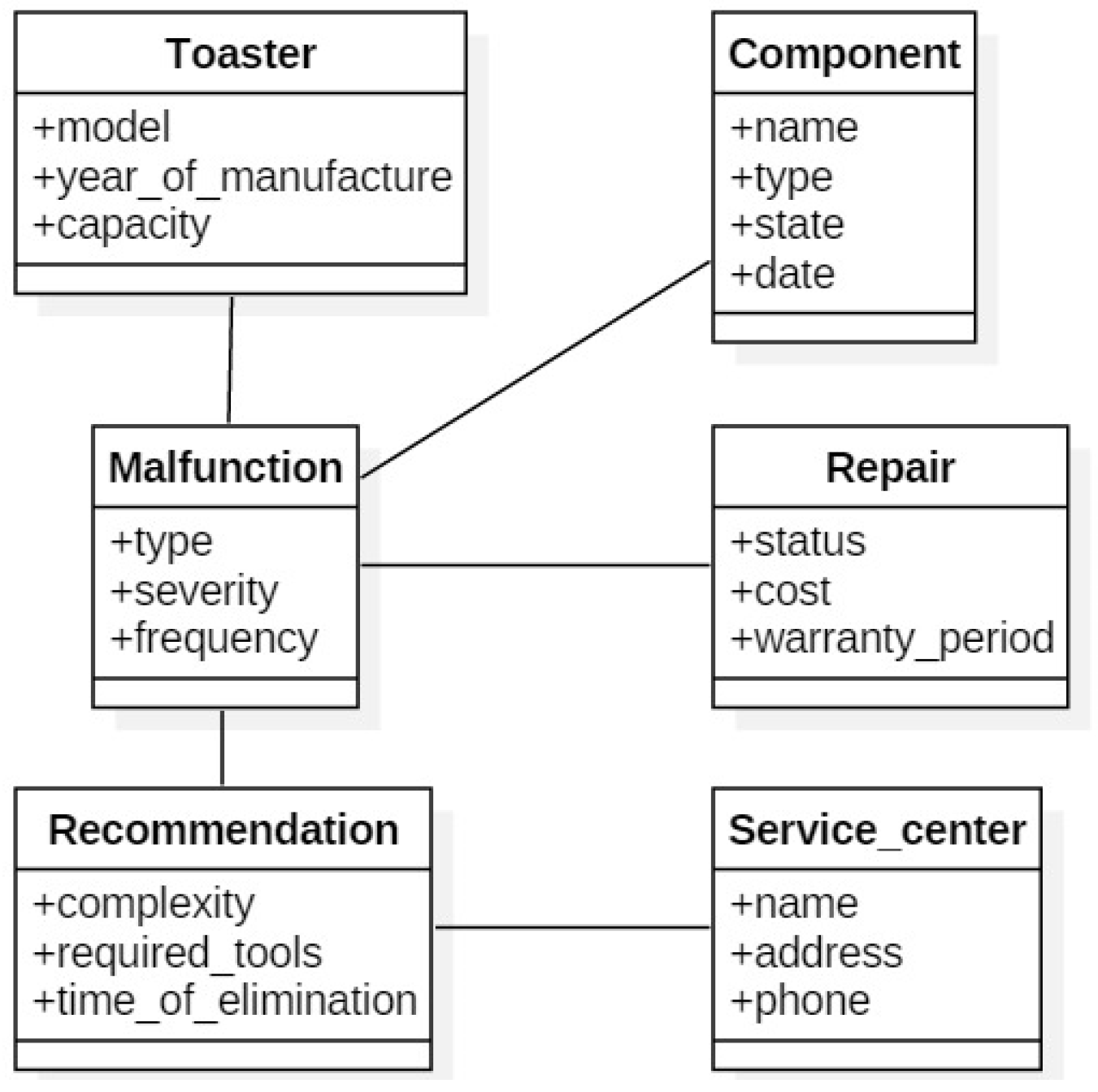
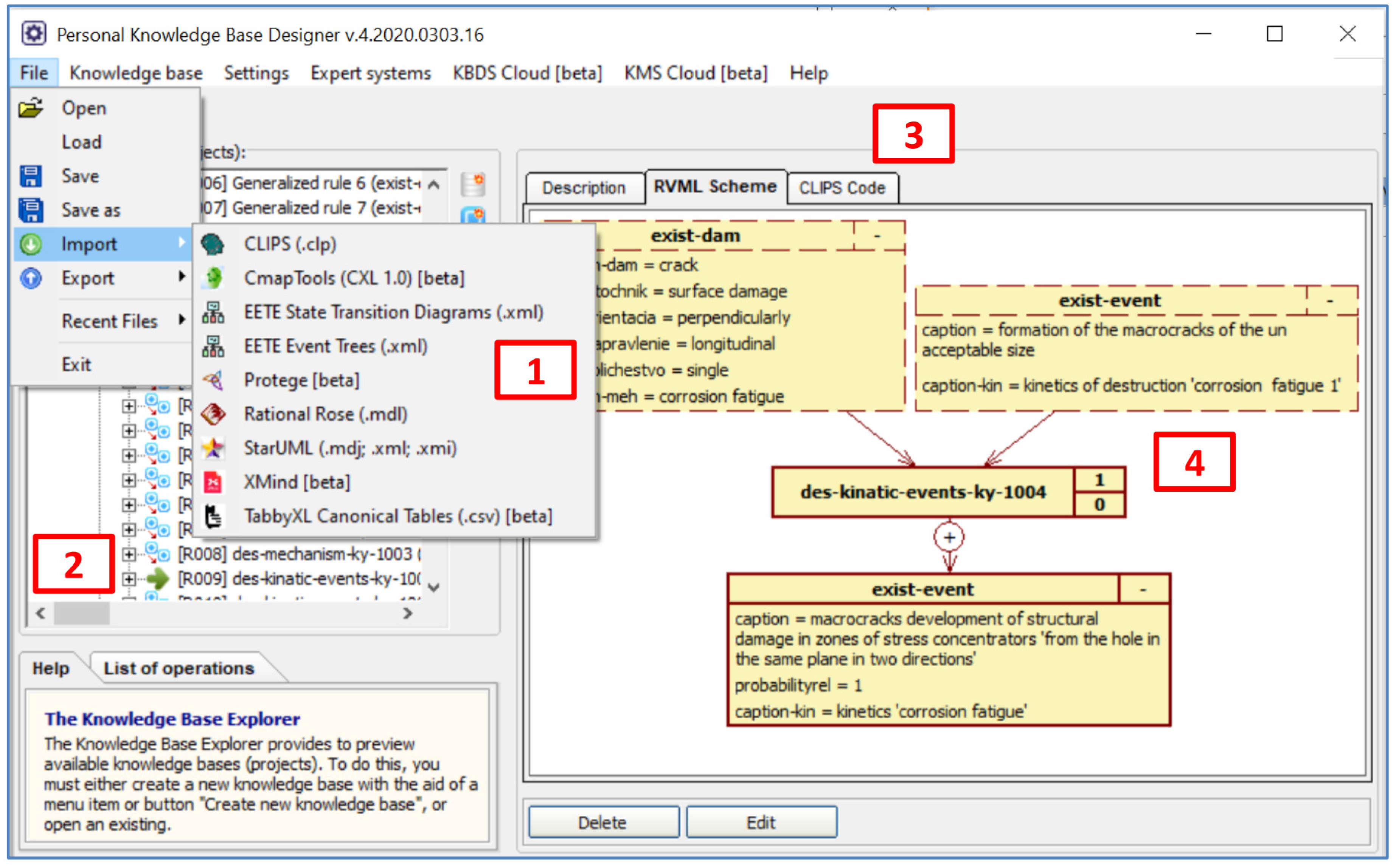
- loading/importing a computation-independent model in the form of concept maps (IHMC Cmap Tools) [45], state transition diagrams and event trees (Knowledge Base Development Service) [46], OWL ontologies (Protege), UML class diagrams (IBM Rational Rose, StarUML, XMind), and canonical spreadsheets (TabbyXL) [47];
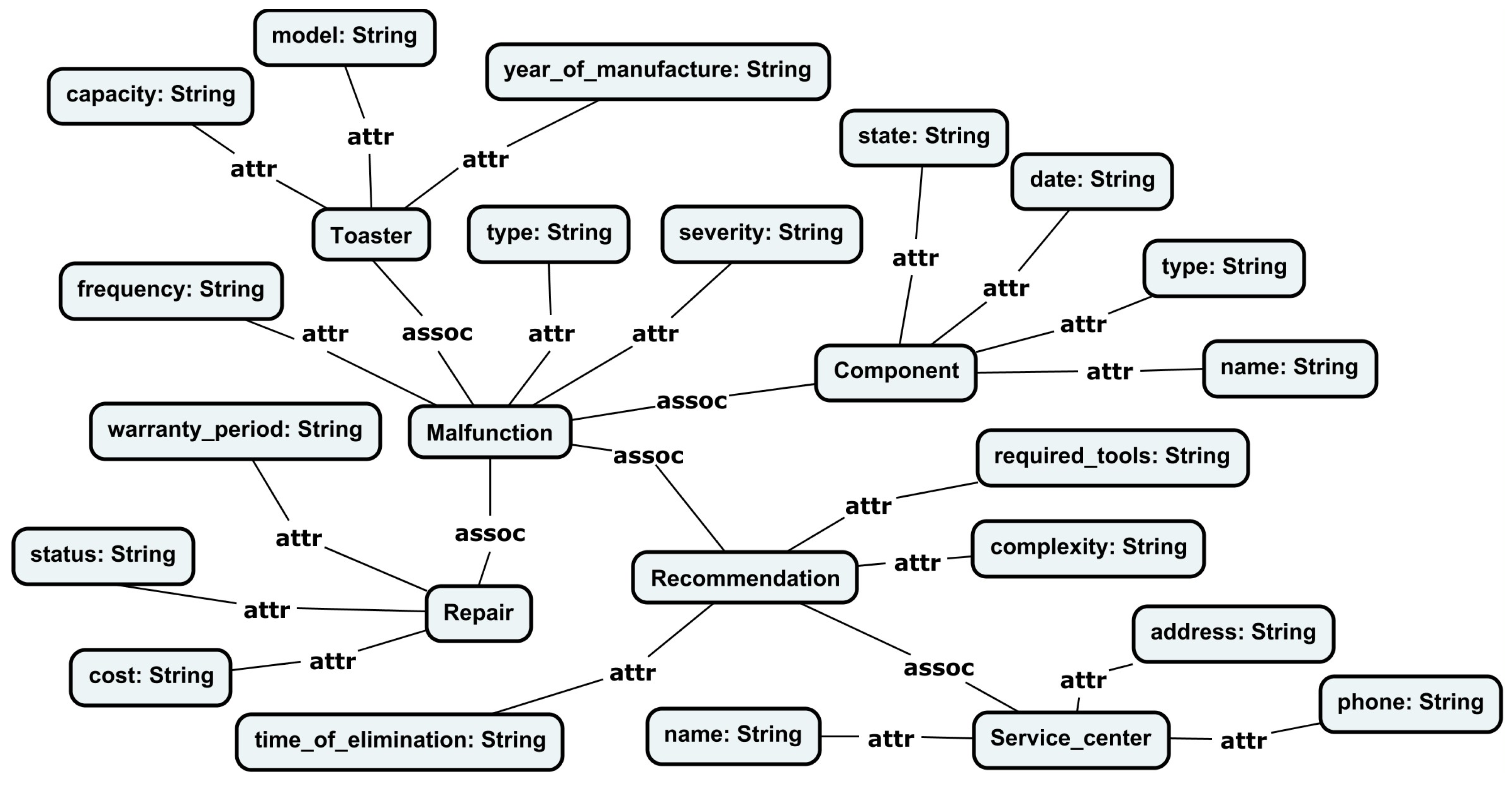
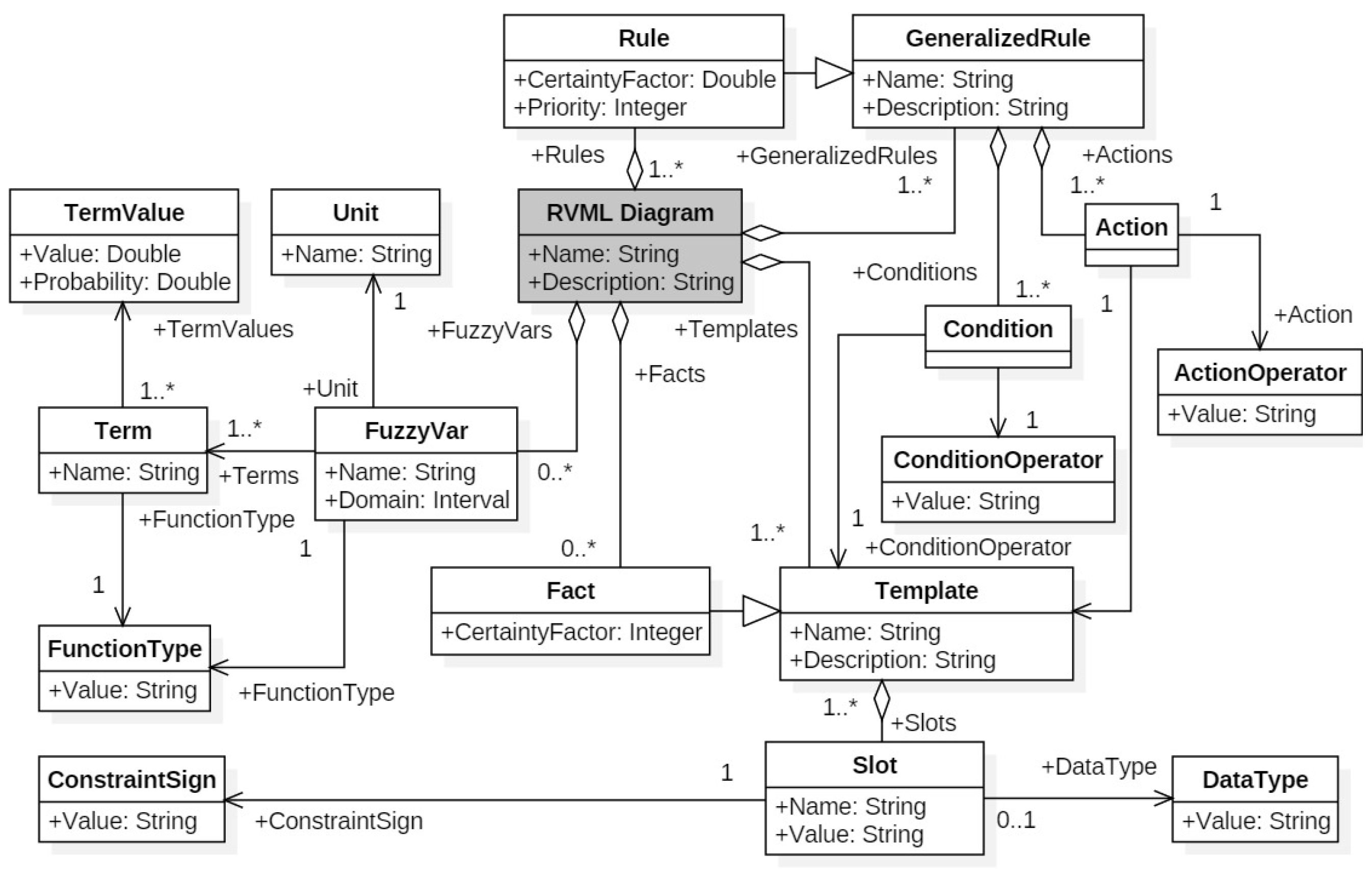
- automatic transformation of imported computation-independent models into platform-independent models, advising the RVML metamodel (Figure 1);
- representing knowledge base elements in RVML format and defining them for code generation;
- generation of program code for the following platforms: CLIPS, DROOLS, PHP.
4.3.2. Case 1: Designing a Knowledge Base for Interpretation of Emotion Signs
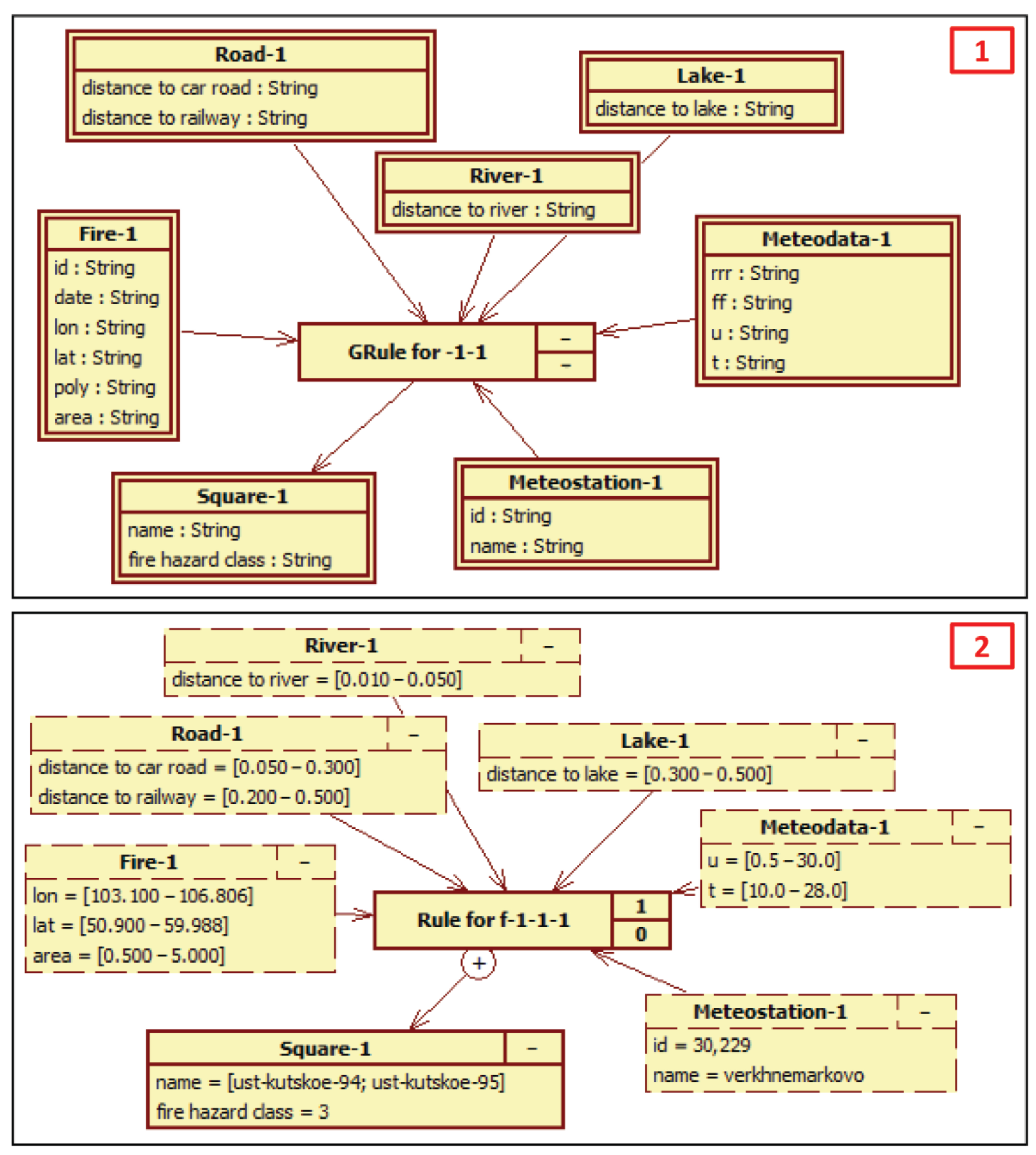
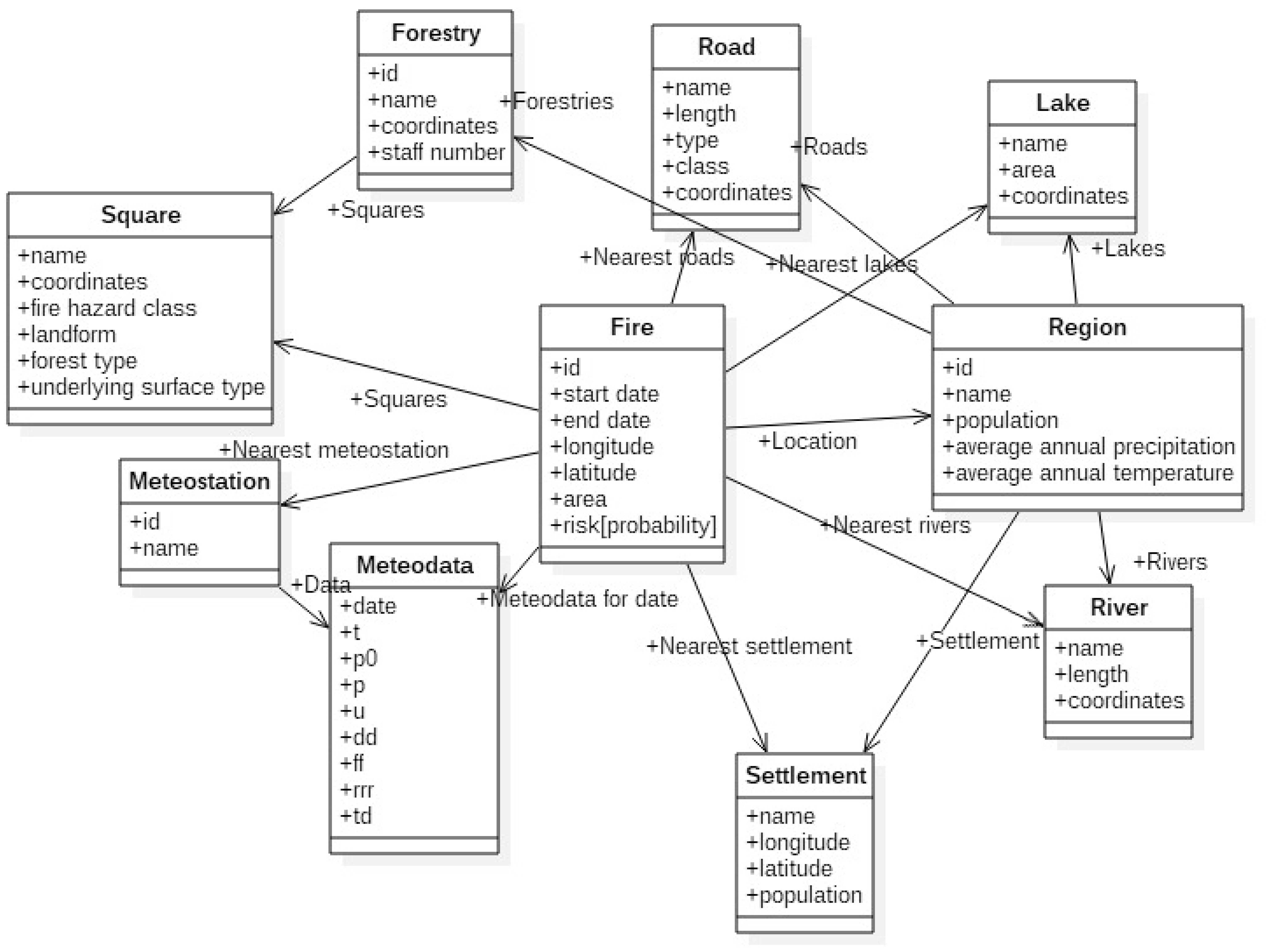
4.3.3. Case 2: Designing a Knowledge Base for Forecasting the Risk of a Forest Fire
- Based on a statistical analysis of information about fires in the previous period, taking into account a specific forest section and time interval.
- Based on classical artificial intelligence methods, in particular, rule-based and case-based expert systems [49]. These methods involve not only statistical processing of large amounts of data but also conceptual modeling and data mining in order to find patterns and formalize them subsequently in the form of logical rules and cases.
- Based on machine learning methods, in particular, Random Forest [50].
4.3.4. Analysis of RVML Usage Completeness in Case Studies
4.4. Threats to Validity
- The level of understanding of the principles of developing declarative knowledge bases: Despite initial training, some participants may have misunderstood RVML’s purpose, interpreting it as a language for static conceptual modeling rather than for defining cause-and-effect rules.
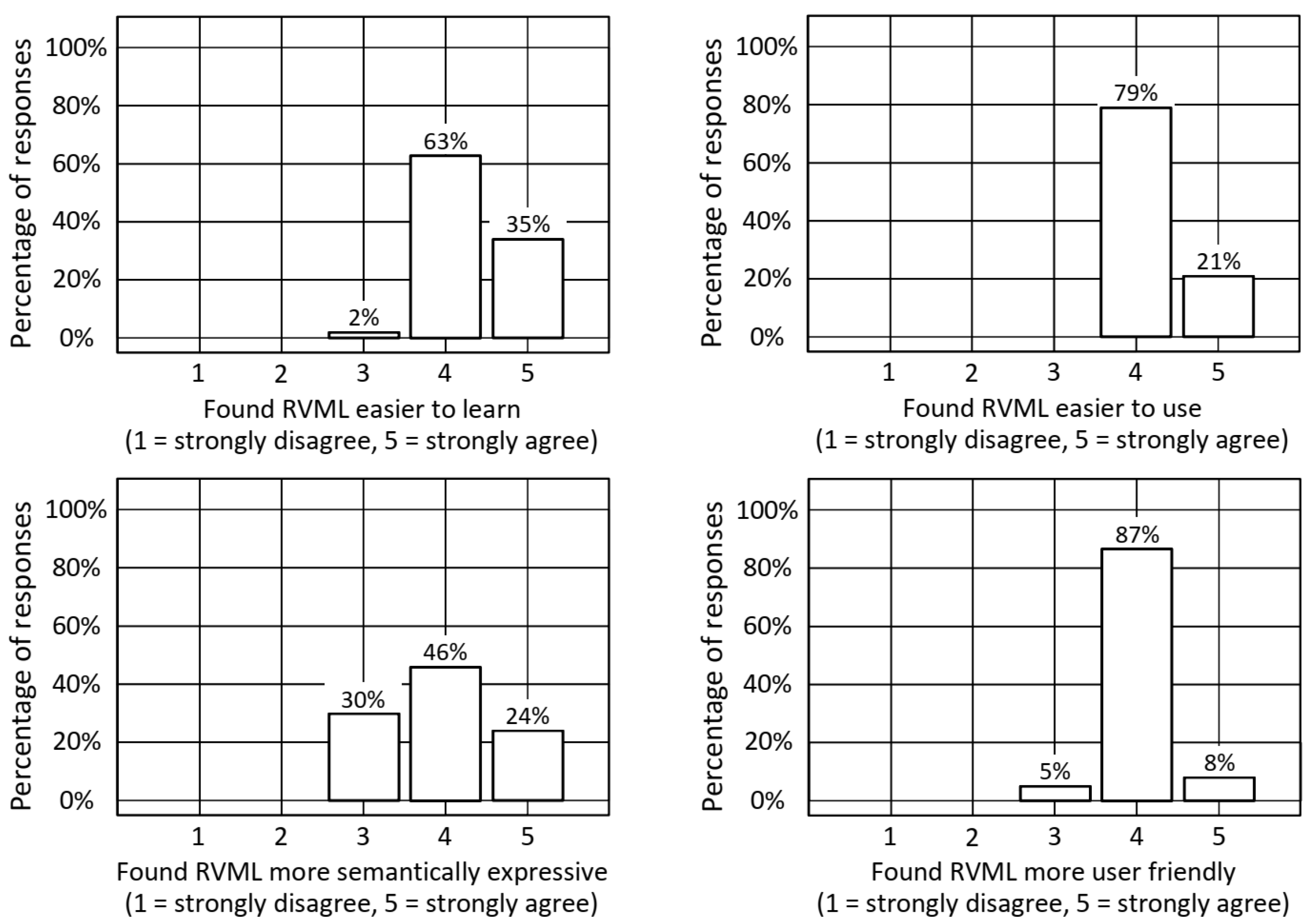
- Prior modeling expertise: Participants had completed courses in UML and expert systems, potentially biasing results toward UML-inspired notations and inflating perceived ease of learning. However, due to having certain preferences, some respondents maybe have found it quite difficult to perceive RVML ideas.
- Ease of representation when modeling: Case studies revealed that developers preferred simple rule constructions and actively avoided fuzzy logic elements. This preference significantly reduced the perceived relevance of the FuzzyRVML extension.
- Subjective evaluation metrics: User study relied primarily on Likert-scale self-reports rather than objective performance measures (task completion time, error rates, and model correctness).
- Homogeneous participant pool: All 464 participants were senior students from a single institution (INRTU), limiting demographic, cultural, and professional diversity.
5. Conclusions
- Advances DSL design theory: Demonstrates how UML-inspired visual elements can be systematically adapted for rule modeling while preserving semantic clarity and cognitive accessibility.
- Formalizes fuzzy rule semantics: Provides a structured approach to representing uncertainty through FuzzyRVML, integrating membership functions and confidence factors into visual rule modeling.
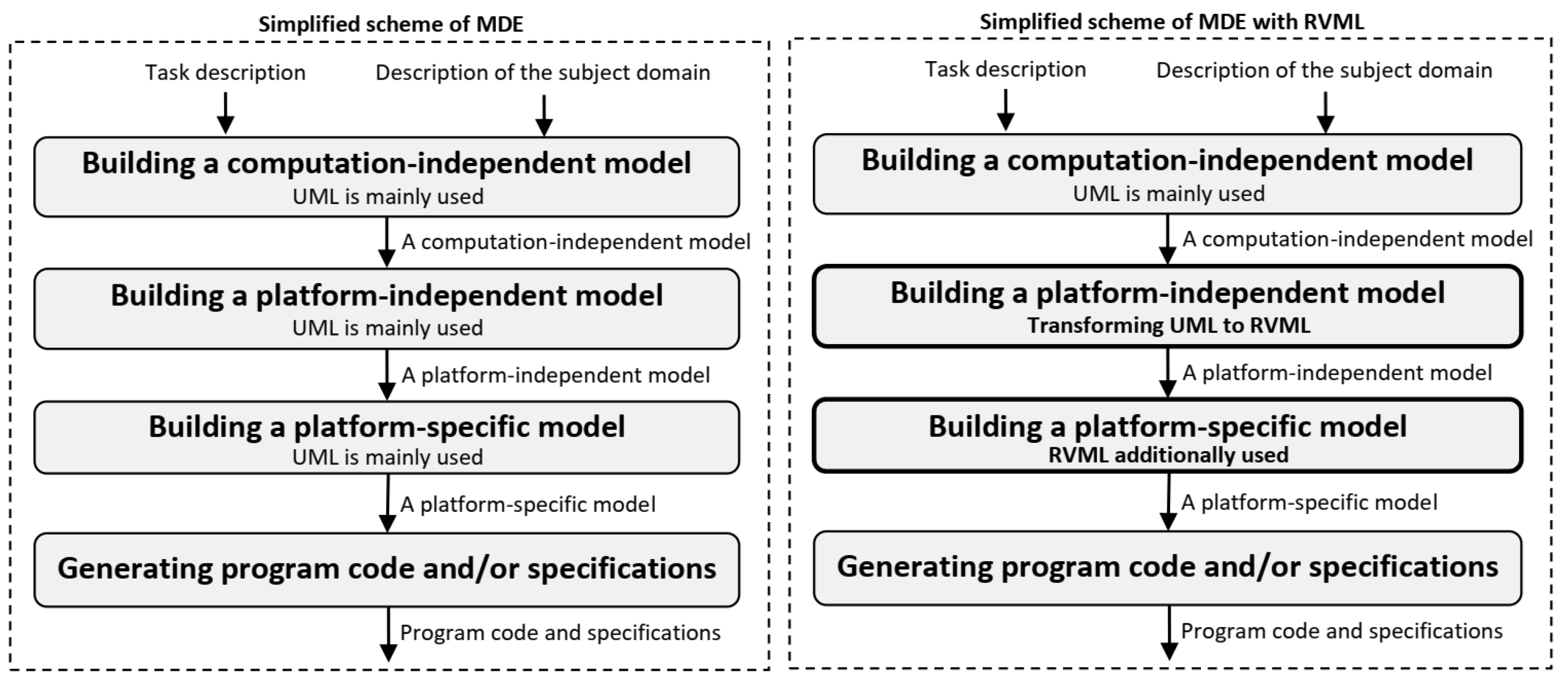
- Contributes to MDE methodology: Suggests a new formalism for building platform-independent and platform-specific models. Based on RVML’s features, we define its role within the standard MDE pipeline. The pipeline systematically transforms models across varying abstraction levels to generate executable code or specifications (Figure 14). This scheme is very often implemented in an abbreviated form, but in our case studies, we used exactly this sequence. We expand the stage of building a platform-independent model by creating specialized RVML models that describe the logical rules of declarative knowledge bases.
- Enables end-user development: Non-programming domain experts can construct declarative knowledge bases through intuitive visual modeling, reducing reliance on specialized developers. Moreover, our tool explicitly assumes a description of key abstractions in the form of a UML class diagram, followed by their automatic transformation into RVML structures that can guide end-users in constructing simple logical rules.
- Supports automated code generation: PKBD tool enables transformation from RVML models to executable code in CLIPS, FuzzyCLIPS, DROOLS, and PHP, facilitating deployment across platforms.
- Validated in industrial contexts: Case studies in HR analytics (emotion recognition) and environmental monitoring (wildfire risk forecasting) demonstrate real-world applicability and scalability.
- Integrate OCL support: Extend RVML syntax and semantics to support OCL for expressing complex property constraints without textual code.
- Extend to procedural knowledge: Evolve RVML to support hybrid knowledge representations combining declarative rules with procedural constructs (functions, loops, variables).
- Develop automated model validation: Create testing frameworks for RVML models to verify logical consistency, rule coverage, and transformation correctness prior to code generation.
Supplementary Materials
Author Contributions
Funding
Institutional Review Board Statement
Data Availability Statement
Acknowledgments
Conflicts of Interest
Abbreviations
| CLIPS | C Language Integrated Production System |
| DSL | Domain-Specific Language |
| EUD | End-User Development |
| MDE | Model-Driven Engineering |
| RVML | Rule Visual Modeling Language |
| UML | Unified Modeling Language |
References
- Esposito, A.; Calvano, M.; Curci, A.; Desolda, G.; Lanzilotti, R.; Lorusso, C.; Piccinno, A. End-User Development for Artificial Intelligence: A Systematic Literature Review. In Lecture Notes in Computer Science; Springer: Cham, Switzerland, 2023; Volume 13917, pp. 1–16. [Google Scholar] [CrossRef]
- Santos, M.; Villela, M.L.B. Characterizing end-user development solutions: A systematic literature review. In Lecture Notes in Computer Science; Springer: Cham, Switzerland, 2019; Volume 11566, pp. 194–209. [Google Scholar] [CrossRef]
- Rädler, S.; Berardinelli, L.; Winter, K.; Rahimi, A.; Rinderle-Ma, S. Bridging MDE and AI: A systematic review of domain-specific languages and model-driven practices in AI software systems engineering. Softw. Syst. Model. 2025, 24, 445–469. [Google Scholar] [CrossRef]
- Da Silva, A.R. Model-driven engineering: A survey supported by the unified conceptual model. Comput. Lang. Syst. Struct. 2015, 43, 139–155. [Google Scholar] [CrossRef]
- Ferko, E.; Berardinelli, L.; Bucaioni, A.; Behnam, M.; Wimmer, M. From engineering models to digital twins: Generating AAS from SysML v2 models. J. Syst. Softw. 2026, 233, 112688. [Google Scholar] [CrossRef]
- Khalajzadeh, H.; Grundy, J. Accessibility of low-code approaches: A systematic literature review. Inf. Softw. Technol. 2025, 177, 107570. [Google Scholar] [CrossRef]
- CLIPS: A Tool for Building Expert Systems. Available online: https://clipsrules.net/ (accessed on 28 January 2026).
- Apache KIE (Incubating). Available online: https://kie.apache.org/ (accessed on 28 January 2026).
- Shen, L.; Chen, X.; Liu, R.; Wang, H.; Ji, G. Domain-Specific Language Techniques for Visual Computing: A Comprehensive Study. Arch. Comput. Methods Eng. 2021, 28, 3113–3134. [Google Scholar] [CrossRef]
- Wąsowski, A.; Berger, T. Domain-Specific Languages. In Effective Modeling, Automation, and Reuse; Springer: Cham, Switzerland, 2023. [Google Scholar] [CrossRef]
- Makisha, E. RuleML-based mechanism of building information models verification. In E3S Web of Conferences; EDP Sciences: Les Ulis, France, 2019; Volume 132, p. 01014. [Google Scholar] [CrossRef]
- Reda, R.; Carbonaro, A.; de Boer, V.; Siebes, R.; van der Weerdt, R.; Nouwt, B.; Daniele, L. Supporting Smart Home Scenarios Using OWL and SWRL Rules. Sensors 2022, 22, 4131. [Google Scholar] [CrossRef] [PubMed]
- Semantic Web Rule Language. Available online: https://en.wikipedia.org/wiki/Semantic_Web_Rule_Language (accessed on 28 January 2026).
- Wang, X.; Sun, J.; Meng, X.; Chen, J. f-R2ML: A fuzzy Rule Markup Language. In Proceedings of the 2011 Eighth International Conference on Fuzzy Systems and Knowledge Discovery (FSKD), Shanghai, China, 26–28 July 2011; pp. 1275–1279. [Google Scholar] [CrossRef]
- Visual Rules BRM. Available online: https://get.alternative.to/visual-rules-brm/overview (accessed on 28 January 2026).
- VisiRule Expert System Decision Support Software. Available online: https://www.visirule.co.uk/ (accessed on 28 January 2026).
- You, Y.; Sun, J.; Zhao, R.; Tan, Y.; Jiang, J. A rule reasoning diagram for visual representation and evaluation of belief rule-based systems. Expert Syst. Appl. 2024, 255, 124806. [Google Scholar] [CrossRef]
- Shigarov, A.O.; Dorodnykh, N.O.; Yurin, A.Y. Conceptual Model Engineering for Industrial Safety Inspection Based on Spreadsheet Data Analysi. Commun. Comput. Inf. Sci. 2020, 1126, 51–65. [Google Scholar] [CrossRef]
- Pavlov, A.I.; Stolbov, A.B.; Lempert, A.A. Towards extensibility features of knowledge-based systems development platform. In CEUR Workshop Proceedings; CEUR-WS.org: Aachen, Germany, 2021; Volume 2984, pp. 87–94. [Google Scholar]
- Khalajzadeh, H.; Simmons, A.J.; Abdelrazek, M.; Grundy, J.; Hosking, J.; He, Q. An end-to-end model-based approach to support big data analytics development. J. Comput. Lang. 2020, 58, 100964. [Google Scholar] [CrossRef]
- Qian, L.; Li, W. Ontology-Based Natural Language Texts Generation from Knowledge Base. Commun. Comput. Inf. Sci. 2022, 1625, 222–241. [Google Scholar]
- Jonker, C.M.; Kremer, R.; van Leeuwen, P.; Pan, D.; Treur, J. Mapping visual to textual knowledge representation. Knowl.-Based Syst. 2005, 18, 367–378. [Google Scholar] [CrossRef]
- Moshkov, M. Common Decision Trees, Rules, and Tests (Reducts) for Dispersed Decision Tables. Procedia Comput. Sci. 2022, 207, 2503–2507. [Google Scholar] [CrossRef]
- Nalepa, G.J. Modeling with Rules Using Semantic Knowledge Engineering. Intell. Syst. Ref. Libr. 2018, 130, 435. [Google Scholar] [CrossRef]
- Lin, Y.; Weintrop, D. The landscape of Block-based programming: Characteristics of block-based environments and how they support the transition to text-based programming. J. Comput. Lang. 2021, 67, 101075. [Google Scholar] [CrossRef]
- Ihirwe, F.; Ruscio, D.D.; Gianfranceschi, S.; Pierantonio, A. CHESSIoT: A model-driven approach for engineering multi-layered IoT systems. J. Comput. Lang. 2024, 78, 101254. [Google Scholar] [CrossRef]
- Berenbach, B.; Schneider, F.; Naughton, H. The use of a requirements modeling language for industrial applications. In Proceedings of the 2012 20th IEEE International Requirements Engineering Conference (RE), Chicago, IL, USA, 24–28 September 2012; pp. 285–290. [Google Scholar] [CrossRef]
- Stokes, M. Managing Engineering Knowledge: MOKA: Methodology for Knowledge Based Engineering Applications, 6th ed.; ASME Press: New York, NY, USA, 2001. [Google Scholar]
- Zhang, F.; Ma, Z.M.; Yan, L. Representation and reasoning of fuzzy ER model with description logic. In Proceedings of the IEEE International Conference on Fuzzy Systems, Hong Kong, China, 1–6 June 2008; pp. 1358–1365. [Google Scholar]
- Abdelmadjid, L.; Mimoun, M. Uncertain decision-making requirements formalizing with complement fuzzy UML Model. Procedia Comput. Sci. 2022, 198, 317–322. [Google Scholar] [CrossRef]
- Yurin, A.Y.; Dorodnykh, N.O.; Nikolaychuk, O.A.; Grishenko, M.A. Designing rule-based expert systems with the aid of the model-driven development approach. Expert Syst. 2018, 35, 12291. [Google Scholar] [CrossRef]
- Yurin, A.Y.; Nikolaychuk, O.A.; Dorodnykh, N.O. Application of decision tables transformations for prototyping knowledge bases in the case of forest fire risk forecasting. In CEUR Workshop Proceedings; CEUR-WS.org: Aachen, Germany, 2021; Volume 2984, pp. 34–41. [Google Scholar]
- Yurin, A.Y.; Dorodnykh, N.O.; Nikolaychuk, O.A.; Stolbov, A.B. Transformation of Decision Tables for the Creation of a Knowledge Base for Interpreting Facial Signs of Emotions. In Proceedings of the 2022 Ural-Siberian Conference on Biomedical Engineering, Radioelectronics and Information Technology (USBEREIT), Yekaterinburg, Russia, 19–21 September 2022; pp. 200–203. [Google Scholar] [CrossRef]
- Dubois, D.; Prade, H.; Yager, R. Readings in Fuzzy Sets for Intelligent Systems; Elsevier: Amsterdam, The Netherlands, 2014. [Google Scholar]
- Moody, D. The “physics” of notations: Toward a scientific basis for constructing visual notations in software engineering. IEEE Trans. Softw. Eng. 2009, 35, 756–779. [Google Scholar] [CrossRef]
- About the Unified Modeling Language Specification Version 2.5.1. Available online: https://www.omg.org/spec/UML/2.5.1 (accessed on 10 March 2026).
- Knowledge Core. Available online: https://knowledge-core.ru/index.php?p=rvml&lan=en (accessed on 28 January 2026).
- Object Constraint Language (OCL) Version 2.4. Available online: http://www.omg.org/spec/OCL/2.4/ (accessed on 28 January 2026).
- Liebel, G.; Whittle, J.; Koziolek, A.; Gerasimou, S.; Gray, J.; Kappel, G.; Mussbacher, G.; Polack, F.; Sendall, S. Human Factors in Model-Driven Engineering: Future Research Goals and Initiatives for MDE. arXiv 2024, arXiv:2404.18682. [Google Scholar] [CrossRef]
- Gliem, J.A.; Gliem, R.R. Calculating, interpreting, and reporting Cronbach’s alpha reliability coefficient for Likert-type scales. In Midwest Research-to-Practice Conference in Adult, Continuing, and Community Education; The Ohio State University: Columbus, OH, USA, 2003. [Google Scholar]
- Moody, D.; van Hillegersberg, J. Evaluating the visual syntax of UML: An analysis of the cognitive effectiveness of the uml family of diagrams. In Software Language Engineering; Springer: Berlin/Heidelberg, Germany, 2009; pp. 16–34. [Google Scholar]
- Frank, U. Domain-Specific Modeling Languages: Requirements Analysis and Design Guidelines. In Domain Engineering; Reinhartz-Berger, I., Sturm, A., Clark, T., Cohen, S., Bettin, J., Eds.; Springer: Berlin/Heidelberg, Germany, 2013. [Google Scholar] [CrossRef]
- Personal Knowledge Base Designer. Available online: https://knowledge-core.ru/index.php?p=pkbd&lan=en (accessed on 28 January 2026).
- Yurin, A.Y.; Dorodnykh, N.O. Personal knowledge base designer: Software for expert systems prototyping. SoftwareX 2020, 11, 100411. [Google Scholar] [CrossRef]
- IHMC Cmap Tools. Available online: https://cmap.ihmc.us/ (accessed on 28 January 2026).
- Knowledge Base Development System. Available online: https://www.kbds.knowledge-core.ru/ (accessed on 28 January 2026).
- Paramonov, V.; Shigarov, A.; Vetrova, V. Rule Driven Spreadsheet Data Extraction from Statistical Tables: Case Study. In Communications in Computer and Information Science; Springer: Cham, Switzerland, 2021; Volume 1486, pp. 84–95. [Google Scholar] [CrossRef]
- Bychkov, I.V.; Ruzhnikov, G.M.; Fedorov, R.K.; Khmelnov, A.E.; Popova, A.K. Organization of digital monitoring of the Baikal natural territory. In IOP Conference Series: Earth and Environmental Science; IOP Publishing: Bristol, UK, 2021; Volume 629, p. 012067. [Google Scholar]
- Dorodnykh, N.O.; Nikolaychuk, O.A.; Pestova, J.V.; Yurin, A.Y. Forest Fire Risk Forecasting with the Aid of Case-Based Reasoning. Appl. Sci. 2022, 12, 8761. [Google Scholar] [CrossRef]
- Nikolaychuk, O.A.; Pestova, J.V.; Yurin, A.Y. Wildfire Susceptibility Mapping in Baikal Natural Territory Using Random Forest. Forests 2024, 15, 170. [Google Scholar] [CrossRef]








| RVML/FuzzyRVML | CLIPS/FuzzyCLIPS |
|---|---|
 |  |
 |  |
 |  |
 |  |
| The confidence factor in the rules |  |
| DSL | The Main Advantages | The Main Disadvantages | Software Support | Related Languages/Standards |
|---|---|---|---|---|
| URML | Standard UML elements are used: class and association. | A complex mechanism for denotation of conditions through associations; the use of a new graphical element for the rule node (non-UML); there is no code generation/transformation for knowledge base programming languages (only visualization of structures). | Yes | UML, OCL |
| DESIRE (DEsign and Specification of Interacting REasoning components) | The ability to form chains of actions (component execution). | The complexity of detailing the description of states and transition conditions; there is no code generation/transformation for knowledge base programming languages. | Yes | |
| Flowchart | The ability to form chains of actions in the form of tree-like structures. | The ability to describe only simple states and transition conditions; there is no code generation/transformation for knowledge base programming languages. | Yes | |
| XTT2 | The ability to form chains of actions. | There is no code generation/transformation for knowledge base programming languages | Yes | |
| MML | Standard UML elements are used: class and association. | There is no code generation/transformation for knowledge base programming languages. | No | UML |
| SCg | The ability to form chains of actions in the form of graphs. | Original node elements with additional semantics; interpretation of knowledge bases is carried out within the framework of the author’s platform. | Yes | SC (Semantic Code) |
| Concept maps | The ability to form structures describing logical dependencies (cause-and-effect relationships) in the form of graphs. | There is no code generation/transformation for knowledge base programming languages | Yes | |
| Fishbone diagrams | The ability to form structures describing logical dependencies (cause-and-effect relationships). | Limited popularity mainly among domain experts; there is no code generation/transformation for knowledge base programming languages (only visualization of structures). | Yes | |
| UML | It is widely used in software engineering; it contains diagrams both for describing static data structures and their dynamics. | The complexity of setting constraints for the values of properties (OCL is used) and conditions through associations and the mechanism of stereotypes; there is no code generation/transformation for knowledge base programming languages (only visualization of structures). | Yes | OCL |
| SysML | It is widely used in software and system engineering (as well as UML); it provides the description of static data structures and their dynamics. | The complexity of setting constraints for the values of properties (OCL is used) and conditions through associations and the mechanism of stereotypes; there is no code generation/transformation for knowledge base programming languages (only visualization of structures). | Yes | OCL |
| RVML | Elements based on standard UML elements are used: class, association, and dependency; the ability to set priorities for rules, confidence factors, and constraints for property values without using OCL; explicit support for fuzziness; code generation/transformation for knowledge base programming languages (CLIPS, DROOLS). | Limited popularity among specialists; the difference between the basic RVML elements and the standard elements of UML. | + | UML |
| No. Entities | No. Properties of Entities | No. Connections Between Entities | No. Cause-and-Effect Relationships (Possible Generalized Rules) | No. Instances of Cause-and-Effect Relationships (Possible Concrete Rules) |
|---|---|---|---|---|
| 4–8 | 1–3 | 3–9 | 2–5 | 10–15 |
| Task No. | Domain | No. Entities | No. Properties of Entities | No. Connections Between Entities | No. Cause-and-Effect Relationships (Possible Generalized Rules) | No. Instances of Cause-and-Effect Relationships (Possible Concrete Rules) |
|---|---|---|---|---|---|---|
| 01 | Diagnosis of a car | 8 | 28 | 9 | 5 | 10 |
| 02 | Diagnosis of TVs | 7 | 22 | 6 | 4 | 10 |
| 03 | Toaster troubleshooting | 6 | 19 | 5 | 4 | 10 |
| 04 | Computer troubleshooting | 5 | 15 | 5 | 3 | 11 |
| 05 | Diagnosis of the flu incidence rate | 7 | 17 | 6 | 3 | 12 |
| 06 | Diagnosis of angina | 5 | 14 | 4 | 4 | 10 |
| 07 | Electric kettle troubleshooting | 5 | 19 | 4 | 3 | 14 |
| 08 | Diagnosis of cell phone malfunctions | 4 | 11 | 3 | 3 | 14 |
| 09 | Diagnosis of the iron | 5 | 14 | 5 | 3 | 15 |
| 10 | Weather prognosis | 5 | 14 | 4 | 3 | 12 |
| 11 | Forecasting the currency exchange rate | 5 | 13 | 5 | 3 | 10 |
| 12 | Forecasting the price of gasoline | 5 | 11 | 5 | 3 | 10 |
| 13 | Crop forecasting | 6 | 13 | 7 | 3 | 10 |
| 14 | Forecasting public opinion | 5 | 10 | 7 | 4 | 10 |
| 15 | Mood forecasting | 6 | 12 | 5 | 4 | 10 |
| 16 | Forecasting the crime rate | 5 | 14 | 4 | 4 | 10 |
| 17 | Morbidity prediction | 6 | 18 | 5 | 2 | 10 |
| 18 | Wildfires prognosis | 6 | 15 | 7 | 3 | 10 |
| 19 | River flood hazard prognosis | 6 | 19 | 5 | 3 | 11 |
| 20 | Forecasting the birth rate | 6 | 20 | 7 | 3 | 12 |
| Task No. | No. Fact Templates | No. Nodal Elements | No. Fact Elements | No. Condition Elements | No. Connections | Semantic Correspondence |
|---|---|---|---|---|---|---|
| 01 | 8 | 15 | 16 | 12 | 42 | + |
| 02 | 7 | 14 | 20 | 16 | 36 | + |
| 03 | 6 | 14 | 19 | 15 | 35 | + |
| 04 | 5 | 14 | 14 | 14 | 34 | + |
| 05 | 7 | 15 | 11 | 21 | 39 | + |
| 06 | 5 | 14 | 10 | 10 | 36 | + |
| 07 | 5 | 17 | 10 | 14 | 34 | + |
| 08 | 4 | 17 | 10 | 10 | 16 | + |
| 09 | 5 | 18 | 10 | 17 | 35 | + |
| 10 | 5 | 15 | 20 | 10 | 35 | + |
| 11 | 5 | 13 | 13 | 13 | 34 | + |
| 12 | 5 | 13 | 13 | 13 | 34 | + |
| 13 | 6 | 13 | 16 | 16 | 42 | + |
| 14 | 5 | 14 | 14 | 13 | 38 | + |
| 15 | 6 | 14 | 12 | 10 | 31 | + |
| 16 | 5 | 14 | 10 | 10 | 28 | + |
| 17 | 6 | 12 | 10 | 25 | 42 | + |
| 18 | 6 | 13 | 16 | 16 | 42 | + |
| 19 | 6 | 14 | 13 | 14 | 27 | + |
| 20 | 6 | 15 | 16 | 16 | 42 | + |
| Statistic/Prompt. | I.1 | I.2 | I.3 | I.4 | II.1 | II.2 | II.3 |
|---|---|---|---|---|---|---|---|
| N | 464 | 464 | 464 | 464 | 464 | 464 | 464 |
| Mean | 4.33 | 4.21 | 3.94 | 4.03 | 1.34 | 2.64 | 4.66 |
| Median | 4 | 4 | 4 | 4 | 1 | 2 | 5 |
| Mode | 4 | 4 | 4 | 4 | 1 | 2 | 5 |
| Standard Deviation | 0.51 | 0.41 | 0.73 | 0.36 | 0.51 | 0.85 | 0.51 |
| Standard Error | 0.024 | 0.019 | 0.034 | 0.017 | 0.027 | 0.040 | 0.024 |
| One-sample t-test, t | 56.12 | 63.68 | 27.73 | 61.68 | −62.64 | −9.11 | 70.04 |
| Chi-square GOF, χ2 | 742.97 | 1089.10 | 367.91 | 1312.50 | 843.18 | 494.32 | 822.89 |
| Binomial test, z | 20.69 | 21.55 | 8.62 | 19.40 | 19.40 | 2.16 | 20.69 |
| Cohen’s d | 2.61 | 2.95 | 1.29 | 2.86 | −2.91 | −0.42 | 3.25 |
| Cramer’s V | 0.63 | 0.77 | 0.45 | 0.84 | 0.67 | 0.52 | 0.67 |
| Probability of Superiority, P | 0.98 | 1.00 | 0.70 | 0.95 | 0.95 | 0.87 | 0.98 |
Disclaimer/Publisher’s Note: The statements, opinions and data contained in all publications are solely those of the individual author(s) and contributor(s) and not of MDPI and/or the editor(s). MDPI and/or the editor(s) disclaim responsibility for any injury to people or property resulting from any ideas, methods, instructions or products referred to in the content. |
© 2026 by the authors. Licensee MDPI, Basel, Switzerland. This article is an open access article distributed under the terms and conditions of the Creative Commons Attribution (CC BY) license.
Share and Cite
Yurin, A.; Dorodnykh, N. A Language for Modeling Declarative Knowledge Bases in the Context of Model-Driven Engineering. Computers 2026, 15, 292. https://doi.org/10.3390/computers15050292
Yurin A, Dorodnykh N. A Language for Modeling Declarative Knowledge Bases in the Context of Model-Driven Engineering. Computers. 2026; 15(5):292. https://doi.org/10.3390/computers15050292
Chicago/Turabian StyleYurin, Aleksandr, and Nikita Dorodnykh. 2026. "A Language for Modeling Declarative Knowledge Bases in the Context of Model-Driven Engineering" Computers 15, no. 5: 292. https://doi.org/10.3390/computers15050292
APA StyleYurin, A., & Dorodnykh, N. (2026). A Language for Modeling Declarative Knowledge Bases in the Context of Model-Driven Engineering. Computers, 15(5), 292. https://doi.org/10.3390/computers15050292