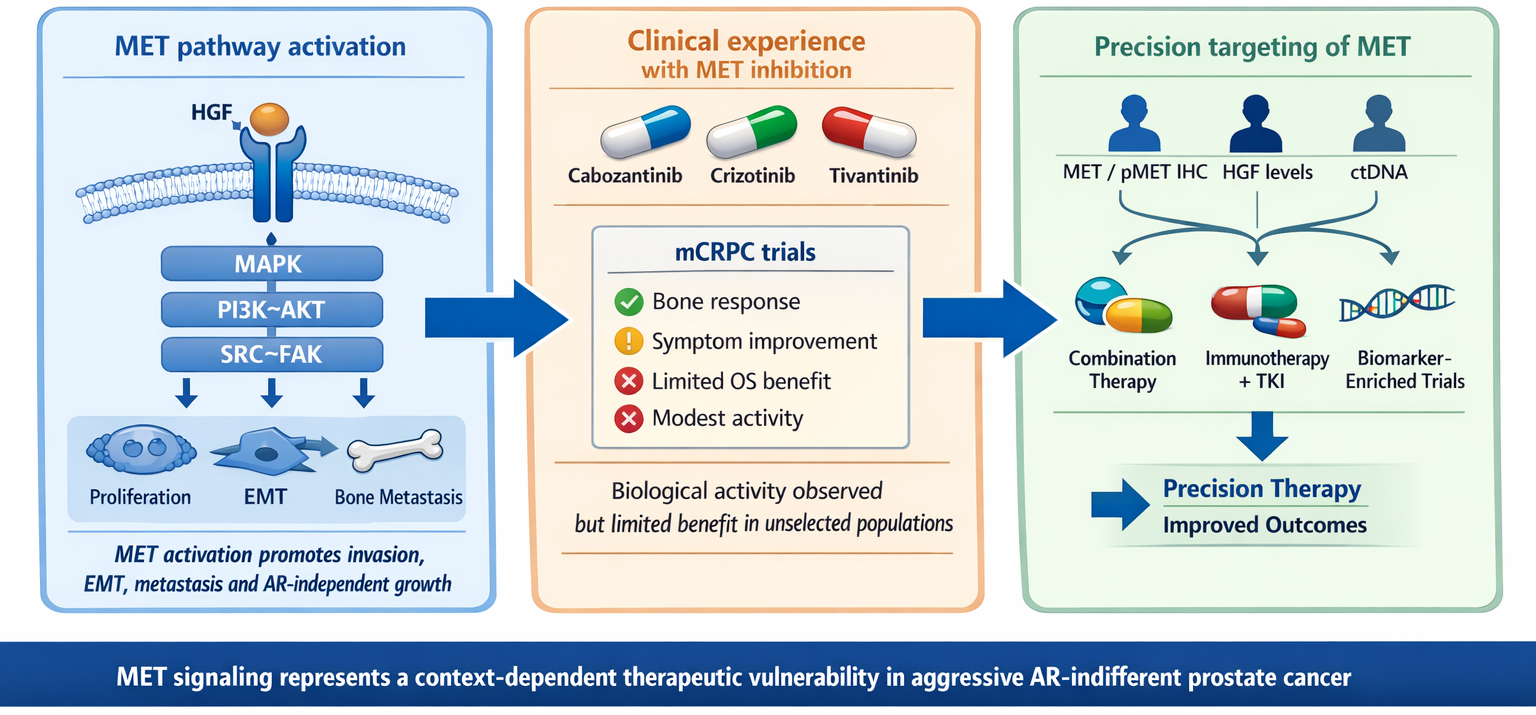
The HGF/MET Axis in Advanced Prostate Cancer: From Context-Dependent Biology to Biomarker-Driven Therapeutic Strategies

 , ,
, ,  ,
,
Simple Summary
Abstract
1. Introduction
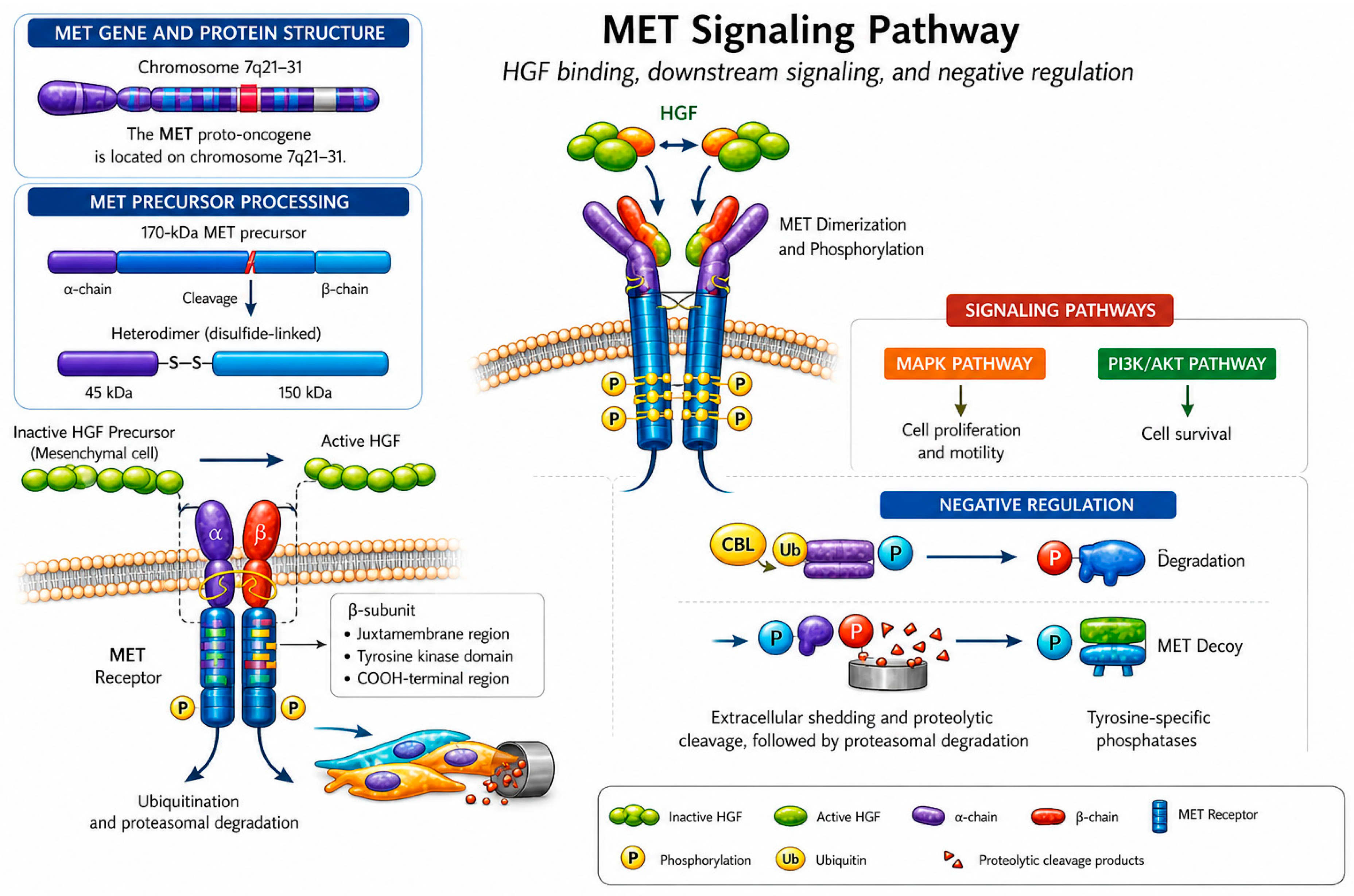
2. MET/HGF Pathway Structure and Canonical Function
3. MET Pathway in Cancer
3.1. Tumor-Intrinsic Genetic Mechanisms of MET Activation
3.2. Microenvironment-Dependent Mechanisms of MET Upregulation
4. MET Pathway in PCa
4.1. MET Expression Across Disease Stages
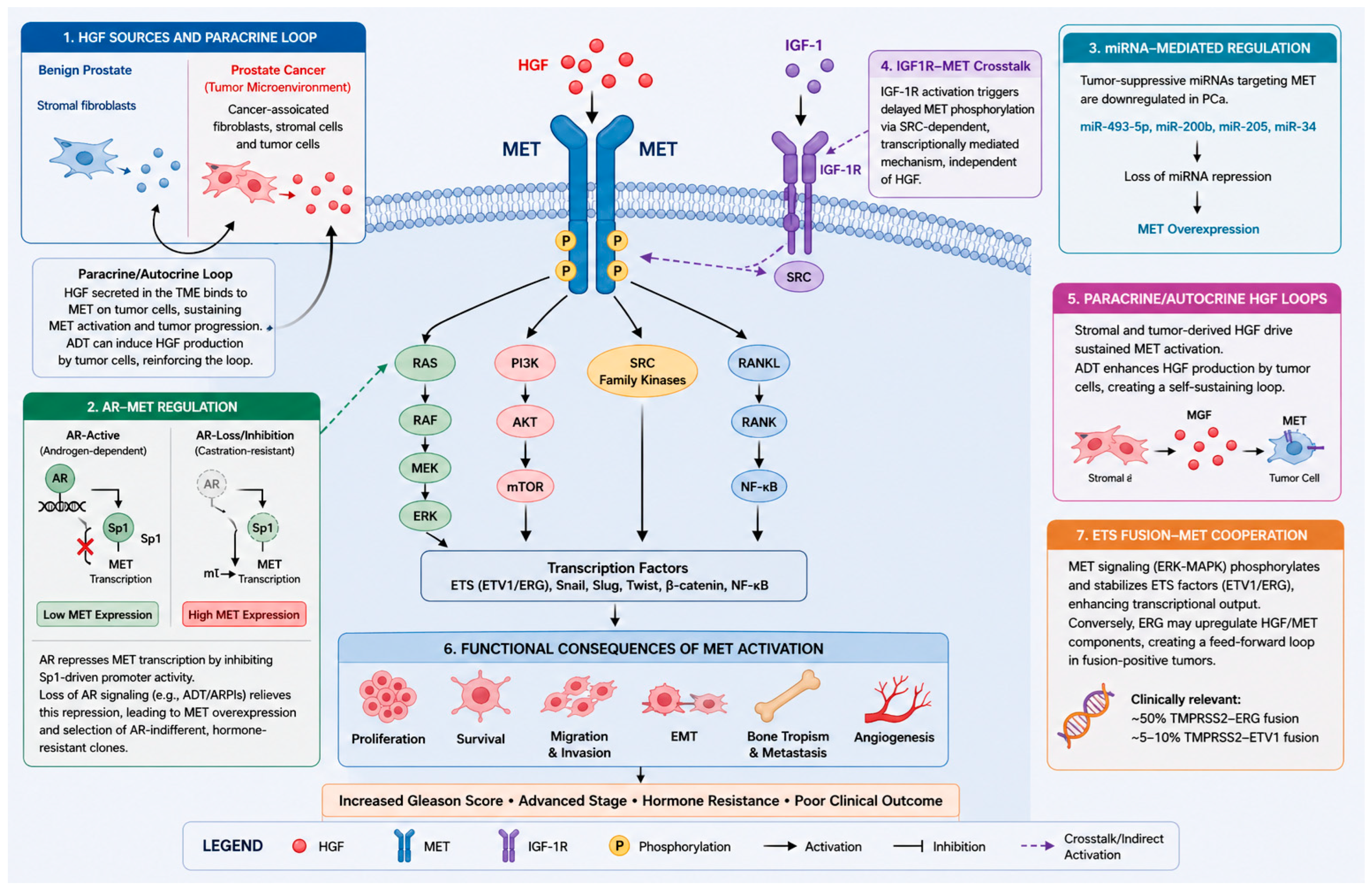
4.2. AR–MET Crosstalk and Regulation of Expression
4.3. MicroRNA–Mediated Regulation
4.4. IGF-1R–MET Crosstalk
4.5. Autocrine and Paracrine HGF Loops
4.6. Downstream Signaling and Functional Consequences
5. Clinical Associations
6. Targeting MET in PCa
6.1. Early Clinical Attempts: Dual AR/MET Blockade and Selective MET Inhibitors
6.2. Multikinase Inhibition: Sitravatinib and Cabozantinib Monotherapy
6.3. Earlier Disease Settings
6.4. Combination Strategies
7. Mechanisms of Resistance to MET Pathway Inhibition in PCa
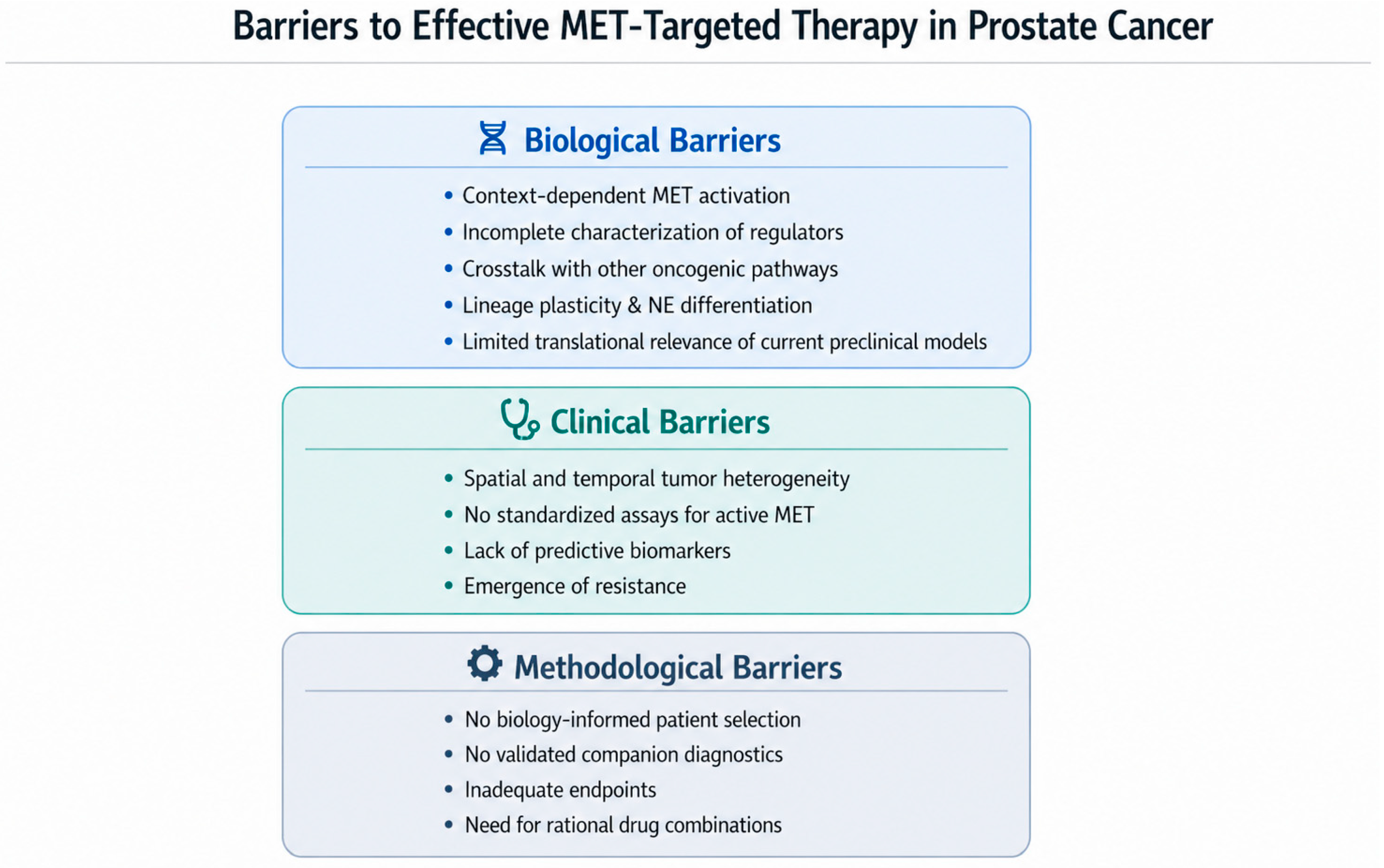
8. Current Limitations and Challenges
8.1. Biological Challenges
8.2. Clinical Challenges
8.3. Methodological Challenges
9. Future Perspectives on Targeting the MET Pathway in PCa
9.1. Biomarker Development and Patient Selection
9.2. Emerging Therapeutic Strategies
9.3. Trial Design Priorities
10. Conclusions
Author Contributions
Funding
Data Availability Statement
Acknowledgments
Conflicts of Interest
Abbreviations
| PCa | Prostate cancer |
| OS | Overall survival |
| AR | Androgen receptor |
| mCRPC | Metastatic castration-resistant prostate cancer |
| PSMA | Prostate-specific membrane antigen |
| PARP | Poly(ADP-ribose) polymerase |
| HGF | Hepatocyte growth factor |
| NE | Neuroendocrine |
| TKI | Inhibitors of tyrosine kinases |
| PI3K | Phosphoinositide 3-kinase |
| PLCγ1 | Phospholipase Cγ1 |
| GRB2 | Growth factor receptor-bound protein 2 |
| GAB1 | GRB2-associated binding protein 1 |
| STAT3 | Signal transducer and activator of transcription 3 |
| SHC | Src homology-2-containing |
| CRK | V-crk sarcoma virus CT10 oncogene homolog |
| CRKL | CRK-like |
| SRC | V-src sarcoma viral oncogene homolog |
| SHIP-2 | Src homology domain-containing 5′ inositol phosphatase |
| MAPK | Mitogen-activated protein kinase |
| FAK | Focal adhesion kinase |
| CBL | Casitas B lineage lymphoma |
| EGFR | Epidermal growth factor receptor |
| TME | Tumor microenvironment |
| HIF-1α | Hypoxia inducible factor 1-alpha |
| EMT | Epithelial-to-mesenchymal transition |
| PIN | Prostatic intraepithelial neoplasia |
| ADT | Androgen deprivation therapy |
| ARPIs | AR pathway inhibitors |
| miRNAs | MicroRNAs |
| ncRNAs | Non-coding RNAs |
| IGF-1R | Insulin-like growth factor 1 receptor |
| ETS | E26 transformation-specific |
| TMPRSS2 | Transmembrane Protease Serine 2 |
| RB1 | Retinoblastoma protein 1 |
| TP53 | Tumor protein p53 |
| AURKA | Aurora kinase A |
| MYCN | N-Myc |
| MP | Mitoxantrone and prednisone |
| CR | Complete response |
| PR | Partial response |
| ORR | Overall response rate |
| PFS | Progression-free survival |
| CTCs | Circulating tumor cells |
| AR-V7 | Androgen receptor splice variant 7 |
| ctDNA | Circulating tumor DNA |
| pMET | Phosphorylated-MET |
| FGFR1 | Fibroblast growth factor receptor 1 |
| YAP | Yes-associated protein |
| TBX5 | T-box transcription factor 5 |
References
- Siegel, R.L.; Kratzer, T.B.; Giaquinto, A.N.; Sung, H.; Jemal, A. Cancer statistics, 2025. CA Cancer J. Clin. 2025, 75, 10–45. [Google Scholar] [CrossRef] [PubMed]
- Koinis, F.; Chantzara, E.; Samarinas, M.; Xagara, A.; Kratiras, Z.; Leontopoulou, V.; Kotsakis, A. Emerging role of YAP and the Hippo pathway in prostate cancer. Biomedicines 2022, 10, 2834. [Google Scholar] [CrossRef]
- Kapoor, A.; Wu, C.; Shayegan, B.; Rybak, A.P. Contemporary agents in the management of metastatic castration-resistant prostate cancer. Can. Urol. Assoc. J. 2016, 10, 414–423. [Google Scholar] [CrossRef]
- Cicchetti, R.; Basconi, M.; Litterio, G.; Orsini, A.; Mascitti, M.; Digiacomo, A.; Salzano, G.; Tătaru, O.S.; Ferro, M.; Giulioni, C.; et al. Therapeutic advances in metastatic prostate cancer: A journey from standard of care to new emerging treatment. Int. J. Mol. Sci. 2025, 26, 11665. [Google Scholar] [CrossRef]
- Park, M.; Dean, M.; Cooper, C.S.; Schmidt, M.; O’Brien, S.J.; Blair, D.G.; Vande Woude, G.F. Mechanism of met oncogene activation. Cell 1986, 45, 895–904. [Google Scholar] [CrossRef]
- Bottaro, D.P.; Rubin, J.S.; Faletto, D.L.; Chan, A.M.L.; Kmiecik, T.E.; Vande Woude, G.F.; Aaronson, S.A. Identification of the hepatocyte growth factor receptor as the c-Met proto-oncogene product. Science 1991, 251, 802–804. [Google Scholar] [CrossRef] [PubMed]
- Giordano, S.; Ponzetto, C.; Di Renzo, M.F.; Cooper, C.S.; Comoglio, P.M. Tyrosine kinase receptor indistinguishable from the c-Met protein. Nature 1989, 339, 155–156. [Google Scholar] [CrossRef]
- Baldanzi, G.; Graziani, A. Physiological signaling and structure of the HGF receptor MET. Biomedicines 2014, 3, 1–31. [Google Scholar] [CrossRef]
- Gherardi, E.; Sandin, S.; Petoukhov, M.V.; Finch, J.; Youles, M.E.; Öfverstedt, L.-G.; Miguel, R.N.; Blundell, T.L.; Vande Woude, G.F.; Skoglund, U.; et al. Structural basis of hepatocyte growth factor/scatter factor and MET signalling. Proc. Natl. Acad. Sci. USA 2006, 103, 4046–4051. [Google Scholar] [CrossRef]
- Organ, S.L.; Tsao, M.-S. An overview of the c-MET signaling pathway. Ther. Adv. Med. Oncol. 2011, 3, S7–S19. [Google Scholar] [CrossRef] [PubMed]
- Nakamura, T.; Nishizawa, T.; Hagiya, M.; Seki, T.; Shimonishi, M.; Sugimura, A.; Tashiro, K.; Shimizu, S. Molecular cloning and expression of human hepatocyte growth factor. Nature 1989, 342, 440–443. [Google Scholar] [CrossRef]
- Trusolino, L.; Bertotti, A.; Comoglio, P.M. MET signalling: Principles and functions in development, organ regeneration and cancer. Nat. Rev. Mol. Cell Biol. 2010, 11, 834–848. [Google Scholar] [CrossRef]
- Ueki, T.; Kaneda, Y.; Tsutsui, H.; Nakanishi, K.; Sawa, Y.; Morishita, R.; Matsumoto, K.; Nakamura, T.; Takahashi, H.; Okamoto, E.; et al. Hepatocyte growth factor gene therapy of liver cirrhosis in rats. Nat. Med. 1999, 5, 226–230. [Google Scholar] [CrossRef]
- Duplaquet, L.; Kherrouche, Z.; Baldacci, S.; Jamme, P.; Cortot, A.B.; Copin, M.-C.; Tulasne, D. The multiple paths towards MET receptor addiction in cancer. Oncogene 2018, 37, 3200–3215. [Google Scholar] [CrossRef] [PubMed]
- Viticchie, G.; Muller, P.A.J. c-Met and other cell surface molecules: Interaction, activation and functional consequences. Biomedicines 2015, 3, 46–70. [Google Scholar] [CrossRef]
- Weidner, K.M.; Di Cesare, S.; Sachs, M.; Brinkmann, V.; Behrens, J.; Birchmeier, W. Interaction between Gab1 and the c-Met receptor tyrosine kinase is responsible for epithelial morphogenesis. Nature 1996, 384, 173–176. [Google Scholar] [CrossRef]
- Ponzetto, C.; Bardelli, A.; Zhen, Z.; Maina, F.; Dalla Zonca, P.; Giordano, S.; Graziani, A.; Panayotou, G.; Comoglio, P.M. A multifunctional docking site mediates signaling and transformation by the hepatocyte growth factor/scatter factor receptor family. Cell 1994, 77, 261–271. [Google Scholar] [CrossRef] [PubMed]
- Koch, A.; Mancini, A.; El Bounkari, O.; Tamura, T. The SH2-domain-containing inositol 5-phosphatase (SHIP)-2 binds to c-Met directly via tyrosine residue 1356 and involves hepatocyte growth factor (HGF)-induced lamellipodium formation, cell scattering and cell spreading. Oncogene 2005, 24, 3436–3447. [Google Scholar] [CrossRef] [PubMed]
- Sakkab, D.; Lewitzky, M.; Posern, G.; Schaeper, U.; Sachs, M.; Birchmeier, W.; Feller, S.M. Signaling of hepatocyte growth factor/scatter factor (HGF) to the small GTPase Rap1 via the large docking protein Gab1 and the adapter protein CRKL. J. Biol. Chem. 2000, 275, 10772–10778. [Google Scholar] [CrossRef]
- Paumelle, R.; Tulashe, D.; Kherrouche, Z.; Plaza, S.; Leroy, C.; Reveneau, S.; Vandenbunder, B.; Fafeur, V. Hepatocyte growth factor/scatter factor activates the ETS1 transcription factor by a RAS-RAF-MEK-ERK signaling pathway. Oncogene 2002, 21, 2309–2319. [Google Scholar] [CrossRef]
- Maroun, C.R.; Naujokas, M.A.; Park, M. Membrane targeting of Grb2-associated binder-1 (Gab1) scaffolding protein through Src myristoylation sequence substitutes for Gab1 pleckstrin homology domain and switches an epidermal growth factor response to an invasive morphogenic program. Mol. Biol. Cell 2003, 14, 1691–1708. [Google Scholar] [CrossRef]
- Xiao, G.H.; Jeffers, M.; Bellacosa, A.; Mitsuuchi, Y.; Vande Woude, G.F.; Testa, J.R. Anti-apoptotic signaling by hepatocyte growth factor/Met via the phosphatidylinositol 3-kinase/Akt and mitogen-activated protein kinase pathways. Proc. Natl. Acad. Sci. USA 2001, 98, 247–252. [Google Scholar] [CrossRef]
- Hui, A.Y.; Meens, J.A.; Schick, C.; Organ, S.L.; Qiao, H.; Tremblay, E.A.; Schaeffer, E.; Uniyal, S.; Chan, B.M.; Elliott, B.E. Src and FAK mediate cell–matrix adhesion-dependent activation of Met during transformation of breast epithelial cells. J. Cell. Biochem. 2009, 107, 1168–1181. [Google Scholar] [CrossRef]
- Zhu, H.; Naujokas, M.A.; Park, M. Receptor chimeras indicate that the Met tyrosine kinase mediates the motility and morphogenic responses of hepatocyte growth/scatter factor. Cell Motil. Cytoskeleton 1994, 5, 359–366. [Google Scholar]
- Matsumoto, K.; Umitsu, M.; De Silva, D.M.; Roy, A.; Bottaro, D.P. Hepatocyte growth factor/MET in cancer progression and biomarker discovery. Cancer Sci. 2017, 108, 296–307. [Google Scholar] [CrossRef]
- Zhang, J.; Babic, A. Regulation of the MET oncogene: Molecular mechanisms. Carcinogenesis 2016, 37, 345–355. [Google Scholar] [CrossRef] [PubMed]
- Mohapatra, B.; Ahmad, G.; Nadeau, S.; Zutshi, N.; An, W.; Scheffe, S.; Dong, L.; Feng, D.; Goetz, B.; Arya, P.; et al. Protein tyrosine kinase regulation by ubiquitination: Critical roles of Cbl-family ubiquitin ligases. Biochim. Biophys. Acta Mol. Cell Res. 2013, 1833, 122–139. [Google Scholar] [CrossRef]
- Chalupský, K.; Kanchev, I.; Žbodáková, O.; Buryová, H.; Jiroušková, M.; Kořínek, V.; Gregor, M.; Sedláček, R. ADAM10/17-dependent release of soluble c-Met correlates with hepatocellular damage. Folia Biol. 2013, 59, 76–86. [Google Scholar] [CrossRef] [PubMed]
- Danilkovitch-Miagkova, A.; Zbar, B. Dysregulation of Met receptor tyrosine kinase activity in invasive tumors. J. Clin. Investig. 2002, 109, 863–867. [Google Scholar] [CrossRef] [PubMed]
- Cooper, C.S.; Park, M.; Blair, D.G.; Tainsky, M.A.; Huebner, K.; Croce, C.M.; Vande Woude, G.F. Molecular cloning of a new transforming gene from a chemically transformed human cell line. Nature 1984, 311, 29–33. [Google Scholar] [CrossRef]
- Liang, T.J.; Reid, A.E.; Xavier, R.; Cardiff, R.D.; Wang, T.C. Transgenic expression of tpr-met oncogene leads to development of mammary hyperplasia and tumors. J. Clin. Investig. 1996, 97, 2872–2877. [Google Scholar] [CrossRef]
- Soman, N.R.; Correa, P.; Ruiz, B.A.; Wogan, G.N. The TPR-MET oncogenic rearrangement is present and expressed in human gastric carcinoma and precursor lesions. Proc. Natl. Acad. Sci. USA 1991, 88, 4892–4896. [Google Scholar] [CrossRef]
- Houldsworth, J.; Cordon-Cardo, C.; Ladanyi, M.; Kelsen, D.P.; Chaganti, R.S. Gene amplification in gastric and esophageal adenocarcinomas. Cancer Res. 1990, 50, 6417–6422. [Google Scholar]
- Tong, C.Y.K.; Hui, A.B.Y.; Yin, X.-L.; Pang, J.C.S.; Zhu, X.-L.; Poon, W.-S.; Ng, H.-K. Detection of oncogene amplifications in medulloblastomas by comparative genomic hybridization and array-based comparative genomic hybridization. J. Neurosurg. Pediatr. 2004, 100, 187–193. [Google Scholar] [CrossRef]
- Tsao, M.S.; Sholl, L.; Shiller, M.; Illei, P.; Wistuba, I.I.; Beasley, M.B.; Schalper, K.A.; Simmons, A.; Ansell, P.; Beruti, S.; et al. MET (c-Met) protein overexpression is an emerging protein biomarker in non-small cell lung cancer. npj Precis. Oncol. 2025, 9, 369. [Google Scholar] [CrossRef]
- Bean, J.; Brennan, C.; Shih, J.-Y.; Riely, G.; Viale, A.; Wang, L.; Chitale, D.; Motoi, N.; Szoke, J.; Broderick, S.; et al. MET amplification occurs with or without T790M mutations in EGFR mutant lung tumors with acquired resistance to gefitinib or erlotinib. Proc. Natl. Acad. Sci. USA 2007, 104, 20932–20937. [Google Scholar] [CrossRef]
- Olivero, M.; Valente, G.; Bardelli, A.; Longati, P.; Ferrero, N.; Cracco, C.; Terrone, C.; Rocca-Rossetti, S.; Comoglio, P.M.; Di Renzo, M.F. Novel mutation in the ATP-binding site of the MET oncogene tyrosine kinase in a HPRCC family. Int. J. Cancer 1999, 82, 640–643. [Google Scholar] [CrossRef]
- Schmidt, L.; Junker, K.; Nakaigawa, N.; Kinjerski, T.; Weirich, G.; Miller, M.; Lubensky, I.; Neumann, H.P.; Brauch, H.; Decker, J.; et al. Novel mutations of the MET proto-oncogene in papillary renal carcinomas. Oncogene 1999, 18, 2343–2350. [Google Scholar] [CrossRef]
- Schmidt, L.; Duh, F.-M.; Chen, F.; Kishida, T.; Glenn, G.; Choyke, P.; Scherer, S.W.; Zhuang, Z.; Lubensky, I.; Dean, M.; et al. Germline and somatic mutations in the tyrosine kinase domain of the MET proto-oncogene in papillary renal carcinomas. Nat. Genet. 1997, 16, 68–73. [Google Scholar] [CrossRef]
- Pennacchietti, S.; Michieli, P.; Galluzzo, M.; Mazzone, M.; Giordano, S.; Comoglio, P.M. Hypoxia promotes invasive growth by transcriptional activation of the met protooncogene. Cancer Cell 2003, 3, 347–361. [Google Scholar] [CrossRef]
- Kitajima, Y.; Ide, T.; Ohtsuka, T.; Miyazaki, K. Induction of hepatocyte growth factor activator gene expression under hypoxia activates the hepatocyte growth factor/c-Met system via hypoxia-inducible factor-1 in pancreatic cancer. Cancer Sci. 2008, 99, 1341–1347. [Google Scholar] [CrossRef]
- Matsumoto, K.; Nakamura, T. Hepatocyte growth factor and the Met system as a mediator of tumor–stromal interactions. Int. J. Cancer 2006, 119, 477–483. [Google Scholar] [CrossRef] [PubMed]
- Vadnais, J.; Nault, G.; Daher, Z.; Amraei, M.; Dodier, Y.; Nabi, I.R.; Noël, J. Autocrine activation of the hepatocyte growth factor receptor/Met tyrosine kinase induces tumor cell motility by regulating pseudopodial protrusion. J. Biol. Chem. 2002, 277, 48342–48350. [Google Scholar] [CrossRef]
- Pisters, L.L.; Troncoso, P.; Zhau, H.E.; Li, W.; von Eschenbach, A.C.; Chung, L.W. c-Met proto-oncogene expression in benign and malignant human prostate tissues. J. Urol. 1995, 154, 293–298. [Google Scholar] [CrossRef]
- Knudsen, B.S.; Gmyrek, G.A.; Inra, J.; Scherr, D.S.; Vaughan, E.; Nanus, D.M.; Kattan, M.W.; Gerald, W.L.; Vande Woude, G.F. High expression of the Met receptor in prostate cancer metastasis to bone. Urology 2002, 60, 1113–1117. [Google Scholar] [CrossRef]
- Verhoef, E.I.; Kolijn, K.; De Herdt, M.J.; van der Steen, B.; Hoogland, A.M.; Sleddens, H.F.; Looijenga, L.H.; van Leenders, G.J. MET expression during prostate cancer progression. Oncotarget 2016, 7, 31029–31036. [Google Scholar] [CrossRef]
- Verras, M.; Lee, J.; Xue, H.; Li, T.-H.; Wang, Y.; Sun, Z. The androgen receptor negatively regulates the expression of c-Met: Implications for a novel mechanism of prostate cancer progression. Cancer Res. 2007, 67, 967–975. [Google Scholar] [CrossRef]
- Varkaris, A.; Corn, P.G.; Gaur, S.; Dayyani, F.; Logothetis, C.J.; Gallick, G.E. The role of HGF/c-Met signaling in prostate cancer progression and c-Met inhibitors in clinical trials. Expert Opin. Investig. Drugs 2011, 20, 1677–1684. [Google Scholar] [CrossRef] [PubMed]
- Hagman, Z.; Haflidadottir, B.S.; Ansari, M.; Persson, M.; Bjartell, A.; Edsjö, A.; Ceder, Y. The tumour suppressor miR-34c targets MET in prostate cancer cells. Br. J. Cancer 2013, 109, 1271–1278. [Google Scholar] [CrossRef]
- Wang, S.; Wang, X.; Li, J.; Meng, S.; Liang, Z.; Xu, X.; Zhu, Y.; Li, S.; Wu, J.; Xu, M.; et al. c-Met, CREB1 and EGFR are involved in miR-493-5p inhibition of EMT via AKT/GSK-3β/Snail signaling in prostate cancer. Oncotarget 2017, 8, 82303–82313. [Google Scholar] [CrossRef] [PubMed]
- Williams, L.V.; Veliceasa, D.; Vinokour, E.; Volpert, O.V. miR-200b inhibits prostate cancer EMT, growth and metastasis. PLoS ONE 2013, 8, e83991. [Google Scholar] [CrossRef]
- Chauhan, N.; Manojkumar, A.; Jaggi, M.; Chauhan, S.C.; Yallapu, M.M. microRNA-205 in prostate cancer: Overview to clinical translation. Biochim. Biophys. Acta Rev. Cancer 2022, 1877, 188809. [Google Scholar] [CrossRef] [PubMed]
- Li, J.; Shen, H.; Xie, H.; Ying, Y.; Jin, K.; Yan, H.; Wang, S.; Xu, M.; Wang, X.; Xu, X.; et al. Dysregulation of ncRNAs located at the DLK1-DIO3 imprinted domain: Involvement in urological cancers. Cancer Manag. Res. 2019, 11, 777–787. [Google Scholar] [CrossRef]
- Varkaris, A.; Gaur, S.; Parikh, N.U.; Song, J.H.; Dayyani, F.; Jin, J.; Logothetis, C.J.; Gallick, G.E. Ligand-independent activation of MET through IGF-1/IGF-1R signaling. Int. J. Cancer 2013, 133, 1536–1546. [Google Scholar] [CrossRef] [PubMed]
- Han, Y.; Luo, Y.; Zhao, J.; Li, M.; Jiang, Y. Overexpression of c-Met increases the tumor invasion of human prostate LNCaP cancer cells in vitro and in vivo. Oncol. Lett. 2014, 8, 1618–1624. [Google Scholar] [CrossRef]
- van Leenders, G.J.L.H.; Sookhlall, R.; Teubel, W.J.; de Ridder, C.M.A.; Reneman, S.; Sacchetti, A.; Vissers, K.J.; van Weerden, W.; Jenster, G. Activation of c-MET induces a stem-like phenotype in human prostate cancer. PLoS ONE 2011, 6, e26753. [Google Scholar] [CrossRef]
- Mi, J.; Hooker, E.; Balog, S.; Zeng, H.; Johnson, D.T.; He, Y.; Yu, E.-J.; Wu, H.; Le, V.; Lee, D.-H.; et al. Activation of hepatocyte growth factor/MET signaling initiates oncogenic transformation and enhances tumor aggressiveness in the murine prostate. J. Biol. Chem. 2018, 293, 20123–20136. [Google Scholar] [CrossRef]
- Putzke, A.P.; Ventura, A.P.; Bailey, A.M.; Akture, C.; Opoku-Ansah, J.; Celiktas, M.; Hwang, M.S.; Darling, D.S.; Coleman, I.M.; Nelson, P.S.; et al. Metastatic progression of prostate cancer and E-cadherin regulation by ZEB1 and SRC family kinases. Am. J. Pathol. 2011, 179, 400–410. [Google Scholar] [CrossRef]
- Davies, G.; Jiang, W.G.; Mason, M.D. HGF/SF modifies the interaction between its receptor c-Met and the E-cadherin/catenin complex in prostate cancer cells. Int. J. Mol. Med. 2001, 7, 385–388. [Google Scholar] [CrossRef] [PubMed]
- Montanari, M.; Rossetti, S.; Cavaliere, C.; D’Aniello, C.; Malzone, M.G.; Vanacore, D.; Di Franco, R.; La Mantia, E.; Iovane, G.; Piscitelli, R.; et al. Epithelial–mesenchymal transition in prostate cancer: An overview. Oncotarget 2017, 8, 35376–35389. [Google Scholar] [CrossRef]
- Carouge, E.; Burnichon, C.; Figeac, M.; Sebda, S.; Vanpouille, N.; Vinchent, A.; Truong, M.; Duterque-Coquillaud, M.; Tulasne, D.; Chotteau-Lelièvre, A. Functional interaction between receptor tyrosine kinase MET and ETS transcription factors promotes prostate cancer progression. Mol. Oncol. 2024, 19, 474–495. [Google Scholar] [CrossRef] [PubMed]
- Qiao, Y.; Feng, F.Y.; Wang, Y.; Cao, X.; Han, S.; Wilder-Romans, K.; Navone, N.M.; Logothetis, C.; Taichman, R.S.; Keller, E.T.; et al. Mechanistic support for combined MET and AR blockade in castration-resistant prostate cancer. Neoplasia 2016, 18, 1–9. [Google Scholar] [CrossRef] [PubMed]
- Koinis, F.; Corn, P.; Parikh, N.; Song, J.; Vardaki, I.; Mourkioti, I.; Lin, S.-H.; Logothetis, C.; Panaretakis, T.; Gallick, G. Resistance to MET/VEGFR2 inhibition by cabozantinib is mediated by YAP/TBX5-dependent induction of FGFR1 in castration-resistant prostate cancer. Cancers 2020, 12, 244. [Google Scholar] [CrossRef]
- Varkaris, A.; Corn, P.G.; Parikh, N.U.; Efstathiou, E.; Song, J.H.; Lee, Y.-C.; Aparicio, A.; Hoang, A.G.; Gaur, S.; Thorpe, L.; et al. Integrating murine and clinical trials with cabozantinib to understand roles of MET and VEGFR2 as targets for growth inhibition of prostate cancer. Clin. Cancer Res. 2016, 22, 107–121. [Google Scholar] [CrossRef] [PubMed]
- Logothetis, C.J.; Gallick, G.E.; Maity, S.N.; Kim, J.; Aparicio, A.; Efstathiou, E.; Lin, S.-H. Molecular classification of prostate cancer progression: Foundation for marker-driven treatment of prostate cancer. Cancer Discov. 2013, 3, 849–861. [Google Scholar] [CrossRef]
- Li, Y.-F.; Su, S.; Luo, Y.; Wei, C.; He, J.; Song, L.-D.; Han, K.; Wang, J.; Gan, X.; Wang, D.-L. Widespread activation and critical role of EMT and stemness in the neuroendocrine differentiation of prostate cancer. Oncol. Rep. 2025, 54, 109. [Google Scholar] [CrossRef]
- Humphrey, P.A.; Halabi, S.; Picus, J.; Sanford, B.; Vogelzang, N.J.; Small, E.J.; Kantoff, P.W. Prognostic significance of plasma scatter factor/hepatocyte growth factor levels in patients with metastatic hormone-refractory prostate cancer: Results from Cancer and Leukemia Group B 150005/9480. Clin. Genitourin. Cancer 2006, 4, 269–274. [Google Scholar] [CrossRef]
- Gupta, A.; Karakiewicz, P.I.; Roehrborn, C.G.; Lotan, Y.; Zlotta, A.R.; Shariat, S.F. Predictive value of plasma hepatocyte growth factor/scatter factor levels in patients with clinically localized prostate cancer. Clin. Cancer Res. 2008, 14, 7385–7390. [Google Scholar] [CrossRef][Green Version]
- Russo, A.L.; Jedlicka, K.; Wernick, M.; McNally, D.; Kirk, M.; Sproull, M.; Smith, S.; Shankavaram, U.; Kaushal, A.; Figg, W.D.; et al. Urine analysis and protein networking identify Met as a marker of metastatic prostate cancer. Clin. Cancer Res. 2009, 15, 4292–4298. [Google Scholar] [CrossRef]
- Dayyani, F.; Zurita, A.J.; Nogueras-González, G.M.; Slack, R.; Millikan, R.E.; Araujo, J.C.; Gallick, G.E.; Logothetis, C.J.; Corn, P.G. The combination of serum insulin, osteopontin, and hepatocyte growth factor predicts time to castration-resistant progression in androgen-dependent metastatic prostate cancer: An exploratory study. BMC Cancer 2016, 16, 721. [Google Scholar] [CrossRef] [PubMed]
- van Leenders, G.; van Balken, B.; Aalders, T.; de Kaa, C.H.; Ruiter, D.; Schalken, J. Intermediate cells in normal and malignant prostate epithelium express c-MET: Implications for prostate cancer invasion. Prostate 2002, 51, 98–107. [Google Scholar] [CrossRef]
- Tripathi, A.; Supko, J.G.; Gray, K.P.; Melnick, Z.J.; Regan, M.M.; Taplin, M.-E.; Choudhury, A.D.; Pomerantz, M.M.; Bellmunt, J.; Yu, C.; et al. Dual blockade of c-MET and the androgen receptor in metastatic castration-resistant prostate cancer: A phase I study of concurrent enzalutamide and crizotinib. Clin. Cancer Res. 2020, 26, 6122–6131. [Google Scholar] [CrossRef]
- Ryan, C.J.; Rosenthal, M.; Ng, S.; Alumkal, J.; Picus, J.; Gravis, G.; Fizazi, K.; Forget, F.; Machiels, J.-P.; Srinivas, S.; et al. Targeted MET inhibition in castration-resistant prostate cancer: A randomized phase II study and biomarker analysis with rilotumumab plus mitoxantrone and prednisone. Clin. Cancer Res. 2013, 19, 215–224. [Google Scholar] [CrossRef]
- Hong, D.S.; Rosen, P.; Lockhart, A.C.; Fu, S.; Janku, F.; Kurzrock, R.; Khan, R.; Amore, B.; Caudillo, I.; Deng, H.; et al. A first-in-human study of AMG 208, an oral MET inhibitor, in adult patients with advanced solid tumors. Oncotarget 2015, 6, 18693–18706. [Google Scholar] [CrossRef]
- Monk, P.; Liu, G.; Stadler, W.M.; Geyer, S.; Huang, Y.; Wright, J.; Villalona-Calero, M.; Wade, J.; Szmulewitz, R.; Gupta, S.; et al. Phase II randomized, double-blind, placebo-controlled study of tivantinib in men with asymptomatic or minimally symptomatic metastatic castration-resistant prostate cancer (mCRPC). Investig. New Drugs 2018, 36, 919–926. [Google Scholar] [CrossRef] [PubMed]
- Bauer, T.; Cho, B.C.; Heist, R.; Bazhenova, L.; Werner, T.; Goel, S.; Kim, D.-W.; Adkins, D.; Carvajal, R.D.; Alva, A.; et al. First-in-human phase 1/1b study to evaluate sitravatinib in patients with advanced solid tumors. Investig. New Drugs 2022, 40, 990–1000. [Google Scholar] [CrossRef] [PubMed]
- Pant, S.; Cho, B.C.; Kyriakopoulos, C.E.; Spira, A.; Tannir, N.; Werner, T.L.; Yan, X.; Neuteboom, S.; Chao, R.; Goel, S. Targeting multiple receptor tyrosine kinases with sitravatinib: A phase 1b study in advanced renal cell carcinoma and castration-resistant prostate cancer. Investig. New Drugs 2024, 42, 547–558. [Google Scholar] [CrossRef] [PubMed]
- Smith, D.C.; Smith, M.R.; Sweeney, C.; Elfiky, A.A.; Logothetis, C.; Corn, P.G.; Vogelzang, N.J.; Small, E.J.; Harzstark, A.L.; Gordon, M.S.; et al. Cabozantinib in patients with advanced prostate cancer: Results of a phase II randomized discontinuation trial. J. Clin. Oncol. 2013, 31, 412–419. [Google Scholar] [CrossRef]
- Smith, M.R.; Sweeney, C.J.; Corn, P.G.; Rathkopf, D.E.; Smith, D.C.; Hussain, M.; George, D.J.; Higano, C.S.; Harzstark, A.L.; Sartor, A.O.; et al. Cabozantinib in chemotherapy-pretreated metastatic castration-resistant prostate cancer: Results of a phase II nonrandomized expansion study. J. Clin. Oncol. 2014, 32, 3391–3399. [Google Scholar] [CrossRef]
- Leibowitz-Amit, R.; Pintilie, M.; Khoja, L.; Azad, A.A.; Berger, R.; Laird, A.D.; Aftab, D.T.; Chi, K.N.; Joshua, A.M. Changes in plasma biomarkers following treatment with cabozantinib in metastatic castration-resistant prostate cancer: A post hoc analysis of an extension cohort of a phase II trial. J. Transl. Med. 2016, 14, 12. [Google Scholar] [CrossRef]
- Smith, D.C.; Daignault-Newton, S.; Grivas, P.; Reichert, Z.R.; Hussain, M.; Cooney, K.A.; Caram, M.; Alva, A.; Jacobson, J.; Yablon, C.; et al. Efficacy and effect of cabozantinib on bone metastases in treatment-naive castration-resistant prostate cancer. Clin. Genitourin. Cancer 2020, 18, 332–339.e2. [Google Scholar] [CrossRef]
- Smith, M.; De Bono, J.; Sternberg, C.; Le Moulec, S.; Oudard, S.; De Giorgi, U.; Krainer, M.; Bergman, A.; Hoelzer, W.; De Wit, R.; et al. Phase III study of cabozantinib in previously treated metastatic castration-resistant prostate cancer: COMET-1. J. Clin. Oncol. 2016, 34, 3005–3013. [Google Scholar] [CrossRef]
- Basch, E.M.; Scholz, M.; de Bono, J.S.; Vogelzang, N.; de Souza, P.; Marx, G.; Vaishampayan, U.; George, S.; Schwarz, J.K.; Antonarakis, E.S.; et al. Cabozantinib versus mitoxantrone–prednisone in symptomatic metastatic castration-resistant prostate cancer: A randomized phase 3 trial with a primary pain endpoint. Eur. Urol. 2019, 75, 929–937. [Google Scholar] [CrossRef]
- Corn, P.G.; Zhang, M.; Nogueras-Gonzalez, G.M.; Xiao, L.; Zurita, A.J.; Subudhi, S.K.; Tu, S.-M.; Aparicio, A.M.; Coarfa, C.; Rajapakshe, K.; et al. A phase II study of cabozantinib and androgen ablation in patients with hormone-naïve metastatic prostate cancer. Clin. Cancer Res. 2020, 26, 990–999. [Google Scholar] [CrossRef]
- Choudhury, A.D.; Gray, K.P.; Supko, J.G.; Harshman, L.C.; Taplin, M.-E.; Pace, A.F.; Farina, M.; Zukotynski, K.A.; Bernard, B.; Kantoff, P.W.; et al. A dose-finding clinical trial of cabozantinib (XL184) administered in combination with abiraterone acetate in metastatic castration-resistant prostate cancer. Prostate 2018, 78, 1053–1062. [Google Scholar] [CrossRef]
- Madan, R.A.; Karzai, F.H.; Al Harthy, M.; Petrylak, D.P.; Kim, J.W.; Arlen, P.M.; Rosner, I.; Theoret, M.R.; Cordes, L.; Bilusic, M.; et al. Cabozantinib plus docetaxel and prednisone in metastatic castration-resistant prostate cancer. BJU Int. 2020, 127, 435–444. [Google Scholar] [CrossRef] [PubMed]
- Agarwal, N.; Azad, A.A.; Carles, J.; Matsubara, N.; Oudard, S.; Saad, F.; Merseburger, A.S.; Soares, A.; McGregor, B.A.; Zurawski, B.; et al. Cabozantinib plus atezolizumab in metastatic prostate cancer (CONTACT-02): Final analyses from a phase 3, open-label, randomised trial. Lancet Oncol. 2025, 26, 860–876. [Google Scholar] [CrossRef] [PubMed]
- Agarwal, N.; McGregor, B.; Maughan, B.L.; Dorff, T.B.; Kelly, W.; Fang, B.; McKay, R.R.; Singh, P.; Pagliaro, L.; Dreicer, R.; et al. Cabozantinib in combination with atezolizumab in patients with metastatic castration-resistant prostate cancer: Results from an expansion cohort of a multicentre, open-label, phase 1b trial (COSMIC-021). Lancet Oncol. 2022, 23, 899–909. [Google Scholar] [CrossRef]
- Padda, S.; Neal, J.W.; Wakelee, H.A. MET inhibitors in combination with other therapies in non-small cell lung cancer. Transl. Lung Cancer Res. 2012, 1, 238–253. [Google Scholar] [CrossRef] [PubMed]
- Du, Y.; Yamaguchi, H.; Wei, Y.; Hsu, J.L.; Wang, H.-L.; Hsu, Y.-H.; Lin, W.-C.; Yu, W.-H.; Leonard, P.G.; Lee, G.R.; et al. Blocking c-Met-mediated PARP1 phosphorylation enhances anti-tumor effects of PARP inhibitors. Nat. Med. 2016, 22, 194–201. [Google Scholar] [CrossRef]



| Model System | Key Intervention | MET-Related Mechanism/Context | Major Finding | References |
|---|---|---|---|---|
| LNCaP (AR+) cells/xenograft | MET overexpression | Forced MET overexpression | Promotes epithelial-to-mesenchymal transition (EMT), tumorigenicity, and bone metastasis via PI3K activation; effects reversed by MET inhibition | Han c., 2014 [55] |
| DU145 (AR−) cells | MET knockdown/inhibition | Baseline MET-high expression state | MET inhibition reduces invasion and EMT in MET-high cells | Putzke et al., 2011 [58] |
| PC3, DU145 (AR−) cells | miRNA restoration (miR-493-5p, miR-200b, miR-205, miR-34c) | MET-high/miRNA-low expression state | Restoration suppresses MET and EMT via AKT/GSK-3β/Snail signaling; reduces metastatic potential | Hagman et al., 2013; Wang et al., 2017; Williams et al., 2013; Chauhan et al., 2022 [49,50,51,52] |
| Transgenic murine model | Prostate-specific MET overexpression | MET overactivation | Induces tumorigenesis, promotes progression and metastasis | Mi et al., 2018 [57] |
| LNCaP/castration-resistant prostate cancer (CRPC) cell lines | Cabozantinib ± enzalutamide | MET upregulation following AR suppression | Combined MET and AR inhibition more effectively suppresses tumor growth than either agent alone; delays emergence of resistant clones | Qiao et al., 2016 [62] |
| LNCaP, LREX, 905L, CRPC cell lines/xenograft | Cabozantinib | Adaptive resistance via FGFR1 bypass | YAP/TBX5-driven FGFR1 upregulation mediates resistance; VEGFR2-negative vessels sustain residual tumor cell survival | Koinis et al., 2020 [63] |
| Murine bone metastasis model | Cabozantinib | MET/VEGFR2 inhibition | Suppression of angiogenesis and osteoblastic niche; VEGFR2-negative vessels drive primary resistance | Varkaris et al., 2016 [64] |
| Reference | Country | Trial Phase | Title of the Trial | Intervention | Study Population | Response Rates | Study Status | Clinical Trial Identifier |
|---|---|---|---|---|---|---|---|---|
| Tripathi A. et al., Clinical Cancer Research, 2020 [72] | USA (1 location) | Phase I, non- randomized, Interventional | Crizotinib in Combination with Enzalutamide in Metastatic Castration-resistant Prostate Cancer | Fixed-dose enzalutamide 160 mg QD combined with crizotinib at three dose levels: Dose Level 1: 250 mg QD, Dose Level 2: 200 mg BID, Dose Level 3: 250 mg BID | -24 patients with metastatic castration-resistant prostate cancer (mCRPC) -ECOG performance status < 2 -Radiographic evidence of metastatic disease -Evidence of disease progression based on rising PSA levels -No limit on the number of prior lines of therapy | -PSA declines ≥ 50% observed in 33–38% of patients (≥90% in 25–27%), though not confirmed or durable -Best radiographic response: PR 12–13%, SD 40–46% -Median PFS: 5.5 months | Completed | NCT02207504 |
| Monk P. et al., Invest New Drugs, 2018 [75] | USA (20 locations) | Phase II, randomized, Interventional | Tivantinib in Treating Patients with Metastatic Prostate Cancer | Tivantinib 360 mg BID vs. placebo, randomized 2:1 | -Patients: 80 men with asymptomatic or minimally symptomatic mCRPC -ECOG performance status 0–1 -Radiographic evidence of metastatic disease (bone ± soft tissue) -Prior therapy: at least one androgen deprivation regimen, no prior chemotherapy for mCRPC | -Median PFS: 5.5 months (tivantinib) vs. 3.7 months (placebo), HR 0.55 (p = 0.02) -PSA response (≥50% decline): 7 patients (12%) vs. 3 patients (11%) -Objective radiographic response (RECIST 1.1): 4 patients (7%) vs. 2 patients (7%) -Disease control rate (SD + PR): 56% vs. 44% | Completed | NCT01519414 |
| Bauer T et al., Invest New Drugs, 2022 [76,77] | USA, South Korea, (International, 43 locations) | Phase 1/1b, non-randomized, Interventional | Phase 1/1b Study of MGCD516 in Patients with Advanced Cancer | Sitravatinib (MGCD516) 120 mg QD, oral, continuous 28-day cycles, administered until disease progression or unacceptable toxicity | -Cohorts: Advanced solid tumors (Phase 1a) and disease-specific expansions (Phase 1b) -n = 193 -Median age: 67 years -ECOG performance status: 0–1 -Median prior systemic regimens: 3 (range 1–6) -All had prior androgen-receptor pathway inhibition and/or chemotherapy | -Objective response rate (ORR): 0% (no confirmed partial or complete responses) -Stable disease (SD): 44% of CRPC patients achieved SD as best response -Median progression-free survival (PFS): 5.8 months -Median overall survival (OS): 10.1 months | Completed | NCT02219711 |
| Smith M et al., Journal of Clinical Oncology, 2016 [82] | USA, Europe, Australia (International, 264 locations) | A Phase 3, Randomized, Double-blind, Controlled Study, Interventional | Study of Cabozantinib (XL184) Versus Prednisone in Men with Metastatic Castration-resistant Prostate Cancer Previously Treated with Docetaxel and Abiraterone or MDV3100 (COMET-1) | Cabozantinib (XL184) 60 mg QD vs. Prednisone 5 mg BID, randomized 2:1, oral, continuous dosing until progression or toxicity | -n = 1.028 (682 cabozantinib, 346 prednisone) men with mCRPC -Progressive disease after docetaxel + abiraterone and/or enzalutamide -ECOG 0–2, median age 69 years -100% with bone metastases, 20% with visceral disease | -Bone scan response (BSR 12 weeks): 42% vs. 3% -Median rPFS: 5.6 vs. 2.8 months (HR 0.48) -Median OS: 11.0 vs. 9.8 months (HR 0.90) -PSA response ≥ 50%: 6% vs. 2% -circulating tumor cells conversion: 33% vs. 6% | Completed | NCT01605227 |
| Corn PG et al., Clinical Cancer Research, 2020 [84] | USA (1 location) | Phase II, Open-label, Single-arm, Interventional | Cabozantinib and Androgen Ablation in Patients with Androgen-Dependent Metastatic Prostate Cancer | Cabozantinib 60 mg QD combined with androgen deprivation therapy (ADT) in treatment-naïve metastatic prostate cancer (hormone-naïve). Continuous 28-day cycles until progression or toxicity | -n = 36 men with hormone-naïve metastatic prostate cancer (mHNPC) -ECOG 0–1, median age 65 years -Radiographic evidence of metastatic disease -No prior systemic therapy for metastatic disease (≤3 months ADT allowed) -Concurrent ADT (leuprolide or degarelix) in all patients | -PSA90 decline: 83% of evaluable patients -PSA50 decline: 94% of evaluable patients -Radiographic response: 90% (1 CR, 8 PR among 10 evaluable) -Bone scan improvement: 81% -Median time to CRPC: 16.1 months | Completed | NCT01630590 |
| Ryan CJ et al., Clinical Cancer Research, 2013 [73] | USA, Europe, Australia (international) * | Phase II, Double-blinded study Randomized, Interventional | AMG 102 in Combination with Mitoxantrone and Prednisone in Subjects with Previously Treated Castrate Resistant Prostate Cancer | Rilotumumab (AMG 102), a fully human monoclonal antibody against HGF, 7.5 mg/kg or 15 mg/kg IV every 3 weeks, combined with Mitoxantrone 12 mg/m2 IV day 1 and Prednisone 5 mg BID Randomized 1:1:1 (Rilotumumab 7.5 mg/kg + MP vs. 15 mg/kg + MP vs. placebo + MP), up to 12 cycles or until progression/toxicity | -n = 144 patients with taxane-refractory metastatic castration-resistant prostate cancer (mCRPC) -ECOG 0–1, median age 67 years (range 48–87) -Radiographic evidence of metastatic disease -Progressive disease by PSA, RECIST 1.0, or new bone lesions -Prior taxane-based chemotherapy required, ≤1 prior regimen for CRPC | -Median OS: 12.2 months (vs. 11.1 months control), HR 1.10 (80% CI 0.82–1.48) -Median PFS: 3.0 months (vs. 2.9 months control), HR 1.02 (80% CI 0.79–1.31) -PSA response (≥50% decline): 11% (vs. 14% control) -Objective response rate: 0%, Stable disease: 37% (vs. 43%) -No bone scan responses reported | Completed | NCT00770848 |
| Hong DS et al., Oncotarget, 2015 [74] | USA (3 locations) | Phase I, open-label, sequential dose escalation, Interventional | A Phase 1 Study of AMG 208 in Subjects with Advanced Solid Tumors | AMG 208 (oral MET inhibitor) dose-escalation 5 mg–40 mg QD until progression or unacceptable toxicity | -11 patients with mCRPC -ECOG 0–2, median age 63 years -All had progressive disease after standard therapy | In the CRPC subset: -1 complete response (CR) -2 partial responses (PR) -4 patients with stable disease (SD) | Completed | NCT00813384 |
| Smith MR et al., Journal of Clinical Oncology, 2014 [78,79,80] | USA, Europe, Asia (multi-center, 47 locations) | Phase 2, Randomized, Interventional | Study of Cabozantinib (XL184) in Adults with Advanced Malignancies | Cabozantinib 100 mg QD during 12-week open-label lead-in patients with stable disease randomized to cabozantinib vs. placebo (Randomized Discontinuation Trial) | -171 men with mCRPC -measurable disease (RECIST 1.0) -ECOG 0–1 -prior chemotherapy required -radiographic progression at baseline -exclusions: PSA-only progression, brain metastases | -Soft-tissue regression: 72%, ORR 5%, SD 75% -Bone scan improvement: 68% (12% CR) -Pain improvement: 67%, reduced narcotic use: 56% -Median PFS after randomization: 23.9 vs. 5.9 weeks (HR 0.12, p < 0.001) | Completed | NCT00940225 |
| Agarwal N et al., Lancet Oncology, 2025 [87] | USA, Europe, Asia- Pacific, Latin America, Australia (280 locations) | Phase 3, randomized, open-label, controlled study, Interventional | Study of Cabozantinib in Combination with Atezolizumab Versus Second NHT in Subjects With mCRPC (CONTACT-02) | Cabozantinib 40 mg QD + atezolizumab 1200 mg IV every 3 weeks vs. ARPI switch (abiraterone 1000 mg QD + prednisone 5 mg BID, or enzalutamide 160 mg QD) | -n = 575 men with mCRPC -Measurable extrapelvic soft-tissue metastases (lymph-node or visceral) per RECIST 1.1 -Progression on one prior ARPI (mostly in the mCRPC setting) -ECOG performance status 0–1, median age 71 years -Visceral metastases in 48%, liver metastases in 23%, bone metastases in 79% -Prior docetaxel for mHSPC allowed (~22% of patients) | -Median PFS: 6.3 vs. 4.2 months (HR 0.65, 95% CI 0.50–0.84; p = 0.0007) -Median OS: 14.8 vs. 15.0 months (HR 0.89, 95% CI 0.72–1.10; p = 0.30) -ORR: 13% vs. 6% -Disease control rate: 72% vs. 53% -PSA response ≥ 50%: 14% vs. 15% | Active, not recruiting | NCT04446117 |
| Agarwal N et al., Lancet Oncology, 2022 [88] | USA, Europe, Australia (International, 124 locations) | Phase 1/1b, non- randomized, open label, Interventional | Study of Cabozantinib Alone or in Combination with Atezolizumab to Subjects with Locally Advanced or Metastatic Solid Tumors (COSMIC-021) | Cabozantinib 40 mg QD (oral) + Atezolizumab 1200 mg IV every 3 weeks, continuous dosing until radiographic/clinical progression or unacceptable toxicity (Dose-escalation stage allowed 40–60 mg cabozantinib; expansion cohort used 40 mg) | -n = 132 men with mCRPC -Radiographic soft tissue progression on/after enzalutamide or abiraterone (or both) -Measurable soft tissue disease (RECIST 1.1 requirement) -ECOG 0–1 -Chemotherapy for mCRPC not allowed (prior docetaxel in hormone-sensitive setting permitted) | -Objective response rate (ORR): 23% (3% CR, 21% PR) -Disease control rate: 84% -Median duration of response: 8.3 months -Median progression-free survival (PFS): 5.5 months (95% CI 4.3–6.6) -Median overall survival (OS): 18.4 months -PSA decline ≥ 50%: 23% of evaluable patients | Active, not recruiting | NCT03170960 |
| Madan RA et al., BJU Int, 2022 [86] | USA (1 location) | Phase 1/2, Randomized, open-label, Interventional | Cabozantinib Plus Docetaxel and Prednisone for Advanced Prostate Cancer | Phase 1: Cabozantinib 20–40 mg QD (dose-escalation) + Docetaxel 75 mg/m2 IV + Prednisone 5 mg BID, continuous 28-day cycles. Phase 2: Cabozantinib 40 mg QD + Docetaxel 75 mg/m2 IV q3w + Prednisone 5 mg BID vs. Docetaxel/Prednisone alone, until disease progression or unacceptable toxicity | -Phase 1: 19 patients -Phase 2: 13 combination vs. 12 control -Median age: phase 1: 67 years, phase 2: 69 years -ECOG 0–2 (majority ECOG 1) -All with radiographic evidence of metastatic CRPC -Prior therapies: abiraterone and/or enzalutamide, chemotherapy (≤2 patients) | -Phase 1: Median TTP 13.6 months, Median OS 16.3 months -Phase 2: Median TTP 21.0 vs. 6.6 months (p = 0.035), Median OS 23.8 vs. 15.6 months (p = 0.072) favoring combination | Completed | NCT01683994 |
| Smith DC et al., Clin. Genitourin Cancer, 2020 [81] | USA (1 location) | Phase 2, non- randomized, Interventional | Trial of Cabozantinib (XL184) in Castrate-Resistant Prostate Cancer Metastatic to Bone | Cabozantinib 60 mg QD, oral, continuous 28-day cycles until progression or intolerable toxicity | -n = 22 evaluable men with treatment-naïve mCRPC (no prior docetaxel, abiraterone, or enzalutamide) -ECOG 0–1 -median age ~ 68 years -All had bone metastases | -12-week PFS rate: 77% -Median PFS: 43.7 weeks (95% CI 23.7–97.0) -Bone-scan improvement: 8/22 (36%) -PSA response ≥ 50%: 4 patients (18%) -Median time on treatment: 24 weeks | Terminated | NCT01428219 |
| Basch EM et al., European Urology Supplements, 2019 [83] | USA, Europe, Australia (International, 82 locations) | Phase 3, Randomized, Double-blind, Controlled Trial, Interventional | Study of Cabozantinib (XL184) Versus Mitoxantrone Plus Prednisone in Men with Previously Treated Symptomatic Castration-resistant Prostate Cancer (COMET-2) | Cabozantinib 60 mg QD (oral) vs. Mitoxantrone 12 mg/m2 IV q3w + Prednisone 5 mg BID, randomized 1:1 | -n = 119 patients with mCRPC presenting with clinically significant bone pain following prior therapies (docetaxel and abiraterone or enzalutamide) -ECOG 0–2, median age ~ 68 years -Radiographic bone metastases in all patients -Exclusion: visceral crisis or impending spinal-cord compression | -pain response: 15% (cabozantinib) vs. 17% (control) -Median PFS: 5.6 months (cabozantinib) vs. 2.8 months (control) (HR 0.50, p < 0.001) -Median OS: 9.0 months vs. 11.0 months (HR 1.05, p = 0.81) -Bone-scan improvement: 42% vs. 3% | Terminated | NCT01522443 |
Disclaimer/Publisher’s Note: The statements, opinions and data contained in all publications are solely those of the individual author(s) and contributor(s) and not of MDPI and/or the editor(s). MDPI and/or the editor(s) disclaim responsibility for any injury to people or property resulting from any ideas, methods, instructions or products referred to in the content. |
© 2026 by the authors. Licensee MDPI, Basel, Switzerland. This article is an open access article distributed under the terms and conditions of the Creative Commons Attribution (CC BY) license.
Share and Cite
Koinis, F.; Vlachou, M.S.; Nintos, G.; Christodoulopoulos, G.; Panagiotidis, E.; Eleftheropoulos, I.; Kallergi, G.; Samarinas, M.; Kotsakis, A. The HGF/MET Axis in Advanced Prostate Cancer: From Context-Dependent Biology to Biomarker-Driven Therapeutic Strategies. Cancers 2026, 18, 1463. https://doi.org/10.3390/cancers18091463
Koinis F, Vlachou MS, Nintos G, Christodoulopoulos G, Panagiotidis E, Eleftheropoulos I, Kallergi G, Samarinas M, Kotsakis A. The HGF/MET Axis in Advanced Prostate Cancer: From Context-Dependent Biology to Biomarker-Driven Therapeutic Strategies. Cancers. 2026; 18(9):1463. https://doi.org/10.3390/cancers18091463
Chicago/Turabian StyleKoinis, Filippos, Maria Smaragdi Vlachou, Georgios Nintos, Georgios Christodoulopoulos, Emmanouil Panagiotidis, Ioannis Eleftheropoulos, Galatea Kallergi, Michail Samarinas, and Athanasios Kotsakis. 2026. "The HGF/MET Axis in Advanced Prostate Cancer: From Context-Dependent Biology to Biomarker-Driven Therapeutic Strategies" Cancers 18, no. 9: 1463. https://doi.org/10.3390/cancers18091463
APA StyleKoinis, F., Vlachou, M. S., Nintos, G., Christodoulopoulos, G., Panagiotidis, E., Eleftheropoulos, I., Kallergi, G., Samarinas, M., & Kotsakis, A. (2026). The HGF/MET Axis in Advanced Prostate Cancer: From Context-Dependent Biology to Biomarker-Driven Therapeutic Strategies. Cancers, 18(9), 1463. https://doi.org/10.3390/cancers18091463