1. Introduction
TP53 is among the most intensively studied tumor-suppressor genes and is now understood as a master regulator of cellular stress responses and cell fate decisions. Although originally misclassified as an oncogene due to early studies examining mutant alleles,
TP53 was later redefined as a tumor suppressor when these transforming activities were traced to missense mutations [
1,
2]. Wild-type (WT) p53 protein levels are tightly controlled by a negative feedback loop involving the E3 ubiquitin ligase MDM2. Cellular stressors including DNA damage, oncogene activation, metabolic stress, and chemotherapy stabilize p53 and activate transcriptional programs governing cell-cycle arrest, DNA repair, apoptosis, ferroptosis, metabolism, senescence, immune regulation, and metastasis inhibition [
1].
TP53 is the most frequently altered tumor-suppressor gene in human cancer, with mutations present in ~50% of all malignancies and exceeding 90% in cancer types such as high-grade serous ovarian carcinoma (HGSOC), small cell lung cancer (SCLC), head and neck squamous cell carcinoma (HNSCC), and triple-negative breast cancer (TNBC) [
3,
4]. Over 70% of these alterations are missense mutations within the DNA-binding domain (DBD), generating proteins that can be transcriptionally incompetent, dominant-negative over residual WT p53, and/or oncogenic gain-of-function (GOF) drivers [
3,
4]. The
TP53 locus encodes at least twelve p53 isoforms, generated through alternative promoter usage, splicing, and translation initiation. These isoforms frequently modulate p53 activity independently of coding mutations, and through dominant-negative or neomorphic effects can render tumors with wild-type
TP53 functionally p53-deficient [
5,
6].
Considering its central role in tumor suppression and frequent mutations and pathway alterations in human cancer, the TP53 gene and its product p53 have been a target of therapeutic development to restore tumor-suppressive function of mutant p53. Despite decades of intensive effort, most p53-targeted therapies have failed to deliver durable clinical benefit. We argue that these failures reflect not only limitations in drug design, including insufficient potency and off-target effects, but also flawed biological stratification, treating p53 as a binary variable rather than a dynamic, state-dependent network.
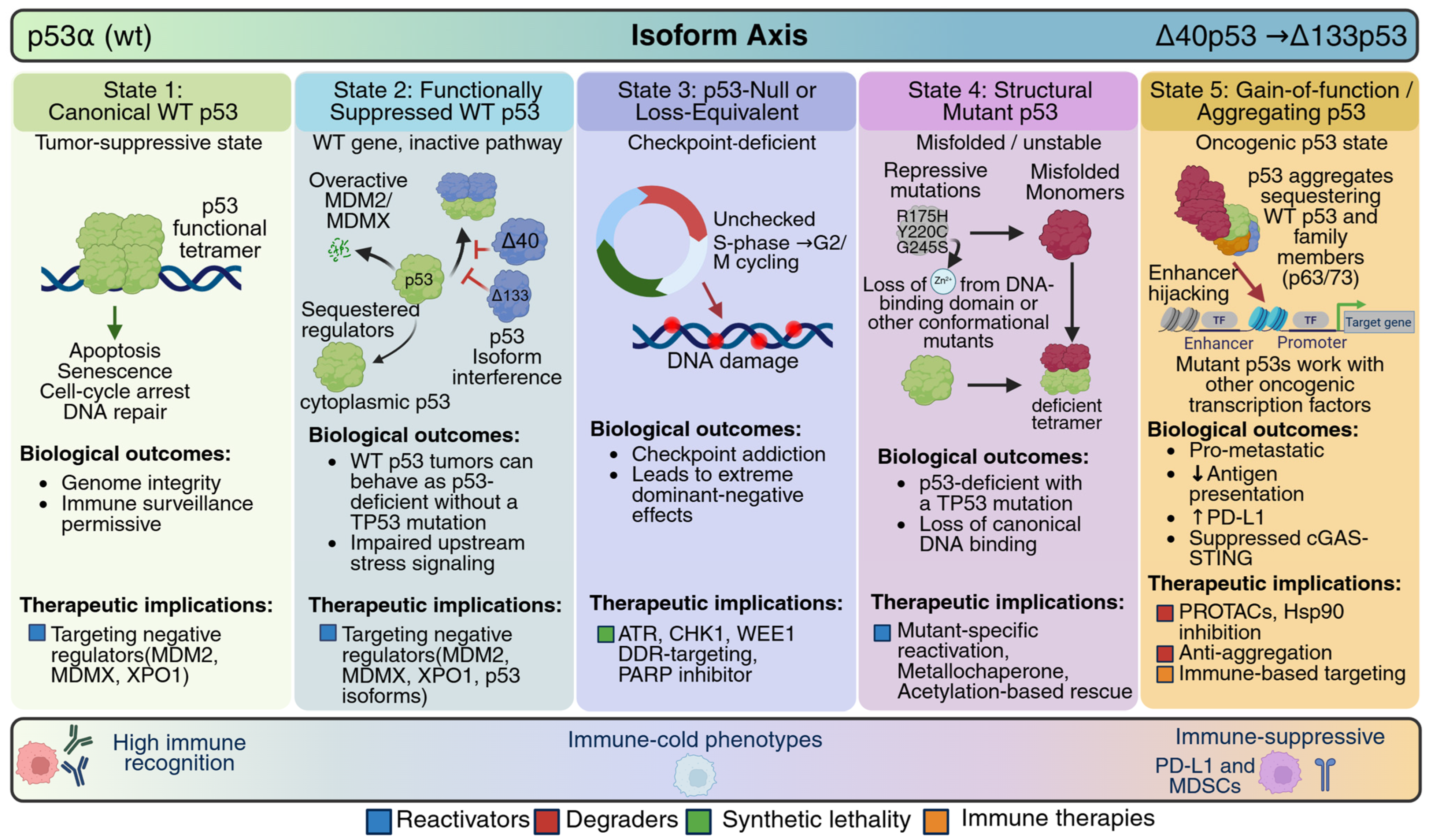
New treatment paradigms conceptualize p53 not as a binary WT–mutant variable, but as a spectrum of ‘functional states’ integrating output of mutation class, allelic dominance, isoform expression, aggregation behavior, pathway suppression, and immune context (
Figure 1). In this framework, a ‘p53 functional state’ is defined as an integrated biological condition reflecting the net output of the p53 network, determined by mutation class (e.g., contact vs. conformational), allelic status, isoform composition, protein stability and aggregation behavior, post-translational regulation, and tumor microenvironmental context. Distinct states are distinguished by measurable features such as transcriptional competency, dominant-negative or gain-of-function activity, aggregation propensity, immune-modulatory signaling, and checkpoint dependency. Clinically, assignment to a functional state can be approximated using a combination of next-generation sequencing (mutation type and allelic fraction), protein-level assays (IHC and aggregation markers), transcriptomic profiling (p53 target gene signatures and isoform expression), and immune biomarkers (e.g., PD-L1 and MHC expression). This operational definition is intended to guide biomarker-driven stratification and mechanism-matched therapeutic selection.
Therapeutic success will be determined by alignment between drug mechanism and this composite state. This expanded view helps reconcile decades of inconsistent therapeutic outcomes, in which
TP53 mutation status alone proved insufficient to predict response to p53-targeted agents [
1,
7]. In this new treatment paradigm, trial design, therapeutic mechanism, and biomarker selection are matched to the operative p53 network state-based p53 biology rather than to mutation status alone.
2. p53 Biology and Pathophysiology
The p53 protein comprises N terminal transactivation domains, a proline-rich region, a central DNA-binding domain, a tetramerization domain, and a C terminal regulatory tail. Tetrameric p53 binds sequence specific DNA response elements to regulate canonical targets such as CDKN1A (p21), BAX, and PUMA, integrating stress signals into arrest, repair, or death programs [
1]. Missense
TP53 mutations are highly enriched in the DBD and are commonly categorized as conformational (structural) mutants, which destabilize folding (e.g., R175H and Y220C), or contact mutants, which preserve global folding but disrupt DNA interactions (e.g., R248Q/W and R273H) [
3].
Beyond loss of tumor-suppressor activity, many p53 mutants exert dominant-negative effects on WT p53 tetramers and acquire GOF properties that include enhancer hijacking, chromatin remodeling, altered metabolism, invasion, metastasis, and immune modulation [
4,
7]. These oncogenic activities are highly context-dependent, varying with tissue lineage, cooperating mutations, and microenvironmental cues.
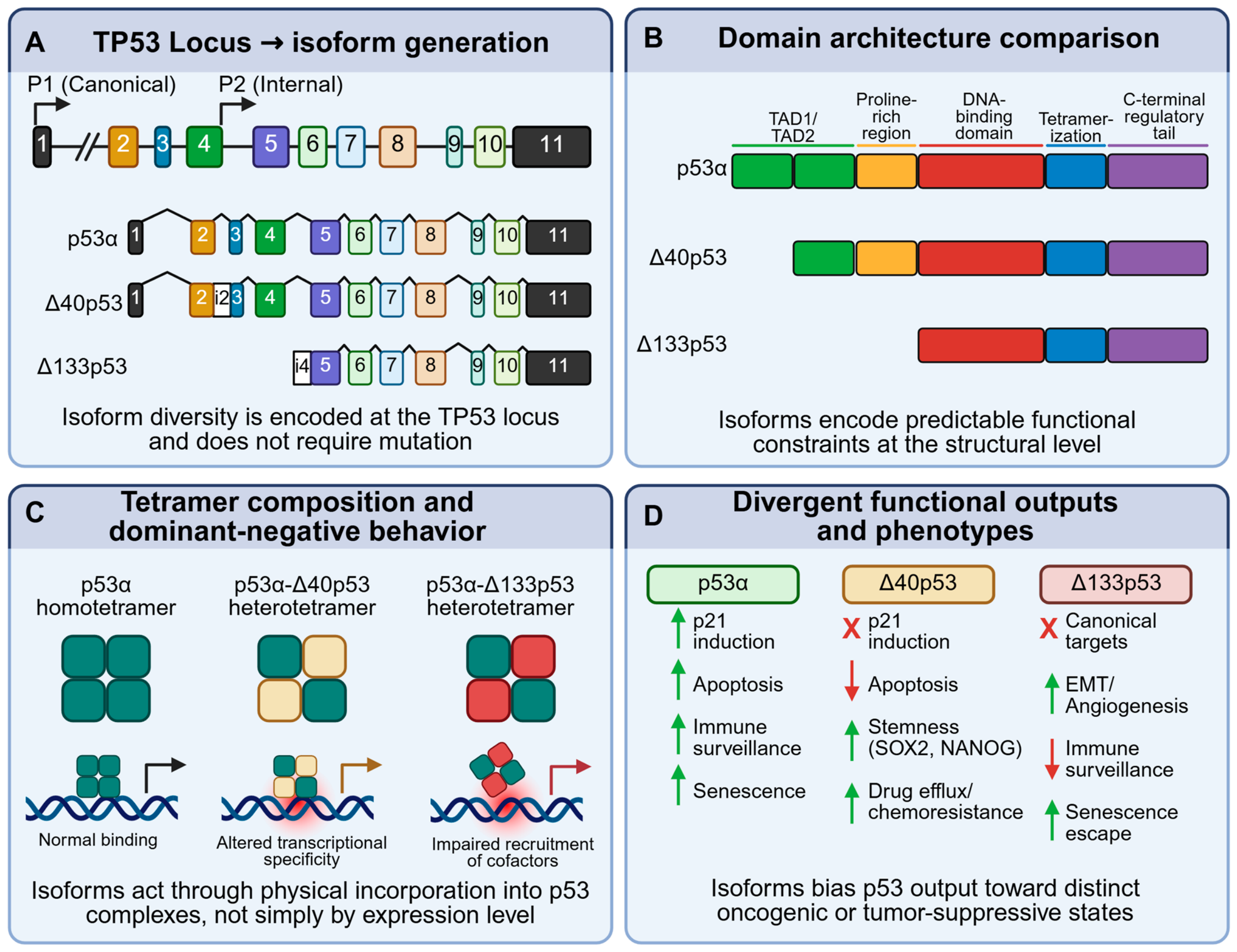
In addition to somatic mutations, the biological output of p53 signaling is also profoundly shaped by isoform expression (
Figure 2). Δ40p53 retains partial transactivation capacity yet selectively fails to induce CDKN1A, uncoupling apoptosis from cell-cycle arrest and promoting stem-like phenotypes, chemoresistance, and invasion [
6,
8]. In contrast, Δ133p53 isoforms lack canonical transactivation domains but drive non-canonical transcriptional programs linking p53 dysregulation to epithelial–mesenchymal transition, angiogenesis, and immune suppression [
5,
9].
In parallel, many structural p53 mutants undergo amyloid-like aggregation, forming oligomeric assemblies that sequester wild-type p53, p63, and p73, thereby amplifying dominant-negative and gain-of-function effects [
10,
11]. Aggregation thus represents a biophysical failure mode of the p53 network and defines a therapeutically actionable state distinct from transcriptional incompetence alone.
3. Mutant p53 and the Tumor Immune Microenvironment
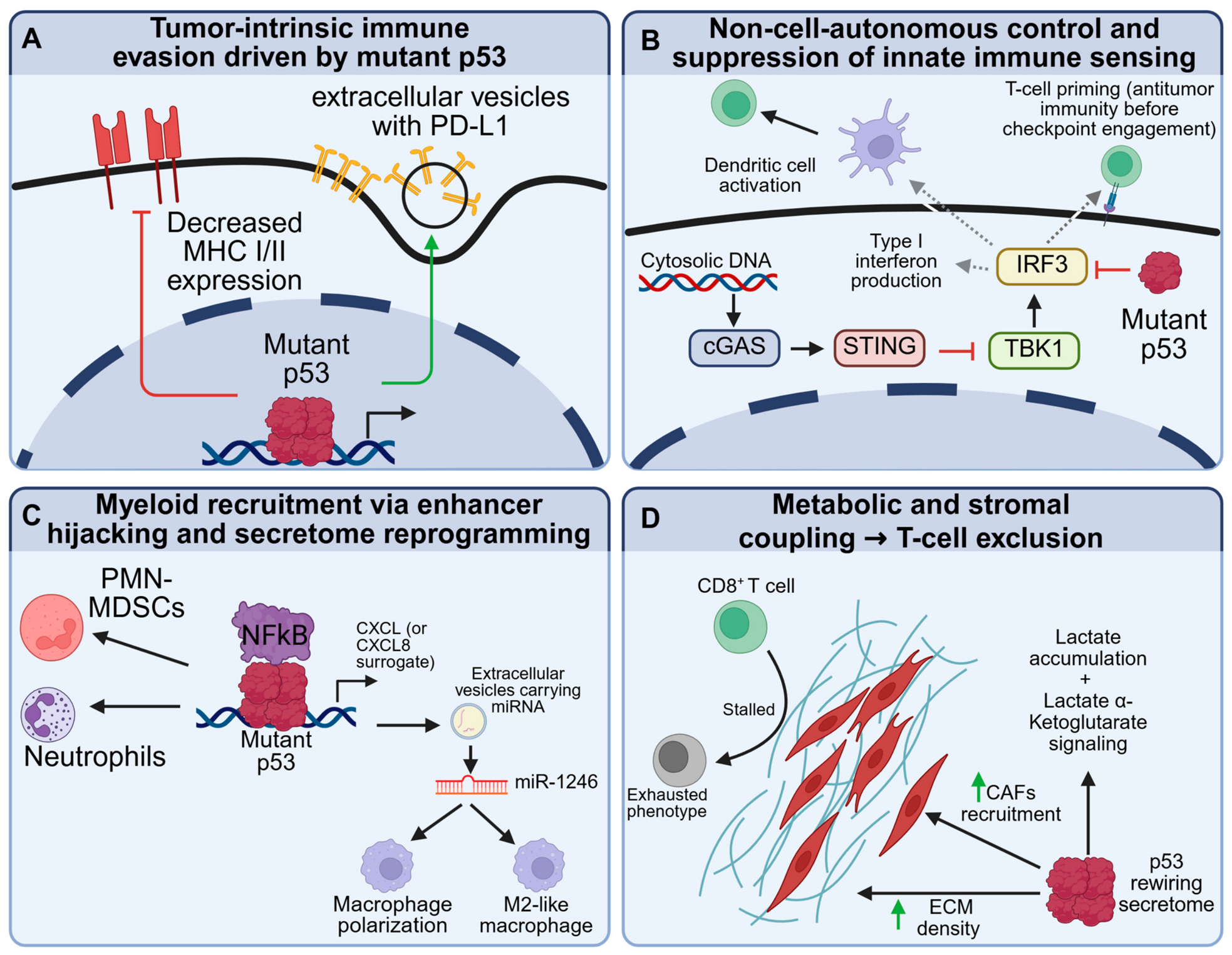
Mutant p53 is increasingly recognized as a central architect of an immunosuppressive tumor microenvironment, exerting effects across adaptive immunity, innate immunity, stromal compartments, and tumor cell-intrinsic signaling [
12,
13,
14,
15,
16] (
Figure 3).
TP53 mutations promote deficiencies in antigen-presentation machinery (MHC I/II), increase PD-L1 expression through relieving miRNA-mediated repression [
17,
18,
19] and through other pathways [
20,
21], and suppress innate immune sensing through the inhibition of the cGAS–STING–TBK1–IRF3 axis [
22], collectively reducing T-cell priming and activation. Chronic inflammatory signaling driven by GOF p53 mutants promotes T-cell exhaustion and immune escape.
Beyond tumor-intrinsic effects, mutant p53 reprograms stromal and immune compartments through enhancer hijacking and metabolic rewiring. GOF mutants bias macrophage polarization toward M2-like phenotypes, alter cancer-associated fibroblast behavior, and reshape extracellular-matrix composition, while metabolic byproducts such as lactate and α-ketoglutarate further modulate chromatin state and immune-gene expression [
14]. Mechanistically, certain p53 mutants hijack enhancers to activate chemokines such as CXCL1 in cooperation with NF-κB, selectively recruiting polymorphonuclear myeloid-derived suppressor cells (MDSCs) and neutrophils while excluding cytotoxic CD8
+ T cells; genetic ablation of
Cxcl1 reverses these immunosuppressive phenotypes in vivo [
15]. In parallel, mutant-p53-dependent secretome and extracellular-vesicle reprogramming, including export of miRNAs such as miR-1246, propagates immunosuppressive polarization across the tumor niche.
In hematologic malignancies,
TP53 mutations are associated with impaired antigen presentation, expansion of Tregs and MDSCs, NK-cell dysfunction, and poor responses to allogeneic hematopoietic stem cell transplantation and immunotherapy, reinforcing mutant p53 as a determinant of immune resistance across tumor classes [
16]. Gain-of-function p53 mutants actively sculpt an immunosuppressive tumor microenvironment through both tumor-intrinsic and non-cell-autonomous mechanisms. Mutant p53 represses antigen presentation via downregulation of MHC I/II, promotes immune checkpoint engagement through PD-L1 upregulation, and suppresses innate immune sensing by inhibiting the cGAS–STING–TBK1–IRF3 axis [
12,
22]. These immune-evasive programs provide a mechanistic explanation for the limited efficacy of p53 vaccines as monotherapies and motivate direct antigen-based strategies that bypass endogenous priming.
4. Therapeutic Strategies Targeting Mutant p53
4.1. p53 Gene-Replacement Strategies
Gene-replacement approaches represent the earliest clinical attempts to restore p53 function. Adenoviral delivery of wild-type p53 (Ad5CMV-p53, rAd-p53, commercially known as Gendicine) demonstrated safety and biological activity but rarely produced durable regressions as monotherapy in Western trials [
23,
24]. In contrast, Gendicine has been used clinically in China for head and neck cancer for over two decades, often in combination with radiotherapy [
25].
Second-generation delivery platforms such as SGT-53, a transferrin-targeted p53 nanocomplex, improve tumor uptake and exhibit synergy with chemotherapy and immune checkpoint inhibitors in preclinical models of pancreatic, lung, and breast cancer [
26,
27]. These advances support renewed interest in p53 gene therapy as part of combination regimens rather than standalone treatment.
4.2. Reactivation of Mutant p53
Reactivation strategies aim to restore WT-like conformation and transcriptional activity to mutant p53. Allele-specific, small-molecule stabilization of the Y220C mutant exploits a mutation-induced surface pocket which has been targeted since the late 2000s with compounds such as PhiKan083. PhiKan083 was identified as a Y220C stabilizer using in silico screening, and later as potentially rescuing the Y220S mutant too [
28,
29]. It was the precursor to additional small molecules such as PC14586, also known as Rezetapopt, and demonstrates strict genotype dependence in preclinical and early clinical studies [
30]. Unlike solid tumors, leukemias have a relatively higher frequency of Y220C p53 mutations, making them good candidates for treatment with PC14586. This highlights the feasibility of precision p53 rescue for defined patient subsets. Recent efforts to target the Y220C mutant by Coultreon Biopharma have yielded a group of small-molecule candidates that promise improved cellular potency and sustained activity compared to PC14586 [
31].
Although mutant p53 reactivation remains conceptually appealing, its clinical realization is constrained by fundamental stoichiometric and mechanistic barriers. Many p53 mutants oligomerize with residual mutant subunits, such that partial conformational rescue may be functionally silent in the presence of dominant-negative tetramers [
7]. Consequently, effective rescue requires near-complete engagement of the mutant pool at clinically achievable drug exposures. These challenges are exemplified by APR-246 (eprenetapopt), whose cytotoxicity is now appreciated to arise largely from p53-independent mechanisms rather than from systematic transcriptional reactivation of mutant p53 [
32,
33]. APR-246, also known as PRIMA-1(Met), is the derivative of PRIMA-1 and is converted intracellularly to methylene quinuclidinone (MQ). MQ depletes glutathione, perturbs redox homeostasis, induces ROS accumulation and ferroptotic cell death, and sensitizes tumors to chemotherapy regardless of
TP53 status [
34,
35,
36]. Consistently, therapeutic response to APR-246 correlates more strongly with redox markers such as SLC7A11/xCT expression than with structural rescue of mutant p53 [
32].
A mechanistically distinct class comprises zinc metallochaperones such as ZMC1, which restore Zn
2+ binding and stabilize zinc-deficient conformational mutants, particularly R175H. ZMC1 can also bind Cu
2+, which unlike Zn
2+, is a redox-active metal that induces the production of ROS [
37,
38,
39]. Interestingly, ROS production was found to be a key factor for the stabilization and restoration of p53 transcriptional activity upon ZMC1 treatment [
39]. Under wild-type p53 conditions, cellular stress signals, such as that of oxidative stress, promotes post-translational modification (PTM) of p53, which stabilizes it, protects it from degradation by MDM2, and allows it to become transcriptionally active. Functional rescue by ZMC1 is stress-dependent and coupled to post-translational modifications that activate downstream p53 transcriptional programs [
39,
40]. Collectively, reactivation strategies succeed only when mutant p53 abundance, aggregation state, and redox vulnerability align; and these factors must be prospectively assessed and stratified to improve the success of reactivation strategies in future clinical trials.
4.3. Degradation of Mutant p53
Targeted degradation of mutant p53 provides an orthogonal strategy that circumvents the stoichiometric constraints of conformational rescue and may be a preferred approach in mutant p53 biologic states dominated by gain-of-function effects, immune suppression, aggregation and dominant-negative effects. By selectively eliminating mutant proteins, degraders neutralize dominant-negative and neomorphic activities without relying on transcriptional reactivation [
7]. Peptide- and aptamer-based proteolysis-targeting chimeras (PROTACs) targeting hotspot alleles such as R175H demonstrate allele-specific degradation, inhibition of invasion and metastasis, and tumor regression in preclinical models [
41,
42]. However, degradation strategies do not restore canonical p53 tumor-suppressor function, underscoring a central trade-off between eliminating oncogenic activity and reinstating physiologic stress responses.
Early efforts focused on Hsp90 inhibitors, such as onalespib and ganetespib, exploiting the dependence of misfolded p53 mutants on chaperone support. Although these agents reduced mutant p53 levels and suppressed tumor growth in preclinical models [
43,
44], clinical performance was limited and therapeutic effects cannot be assigned solely to p53. In ovarian cancer, the phase 2 GANNET53 trial demonstrated that combining ganetespib with paclitaxel failed to improve progression-free survival and increased serious adverse events, underscoring the disconnect between biological rationale and therapeutic index for indirect degraders [
45].
More recently, mutation-selective degradation strategies have emerged. Peptide-based PROTACs and RNA or DNA aptamer-guided PROTACs have been designed to selectively target hotspot mutants, most notably p53 R175H, inducing proteasome-dependent degradation while sparing wild-type p53 [
41,
42]. These agents suppress migration, invasion, and clonogenic growth in vitro and reduce tumor burden in xenograft models, establishing proof-of-principle for allele-restricted degradation. However, their translation is limited by delivery challenges, mutant specificity that constrains patient coverage, and the conceptual limitation that degradation mitigates GOF phenotypes without restoring canonical p53 tumor-suppressor function [
7].
4.4. Anti-Aggregation Strategies
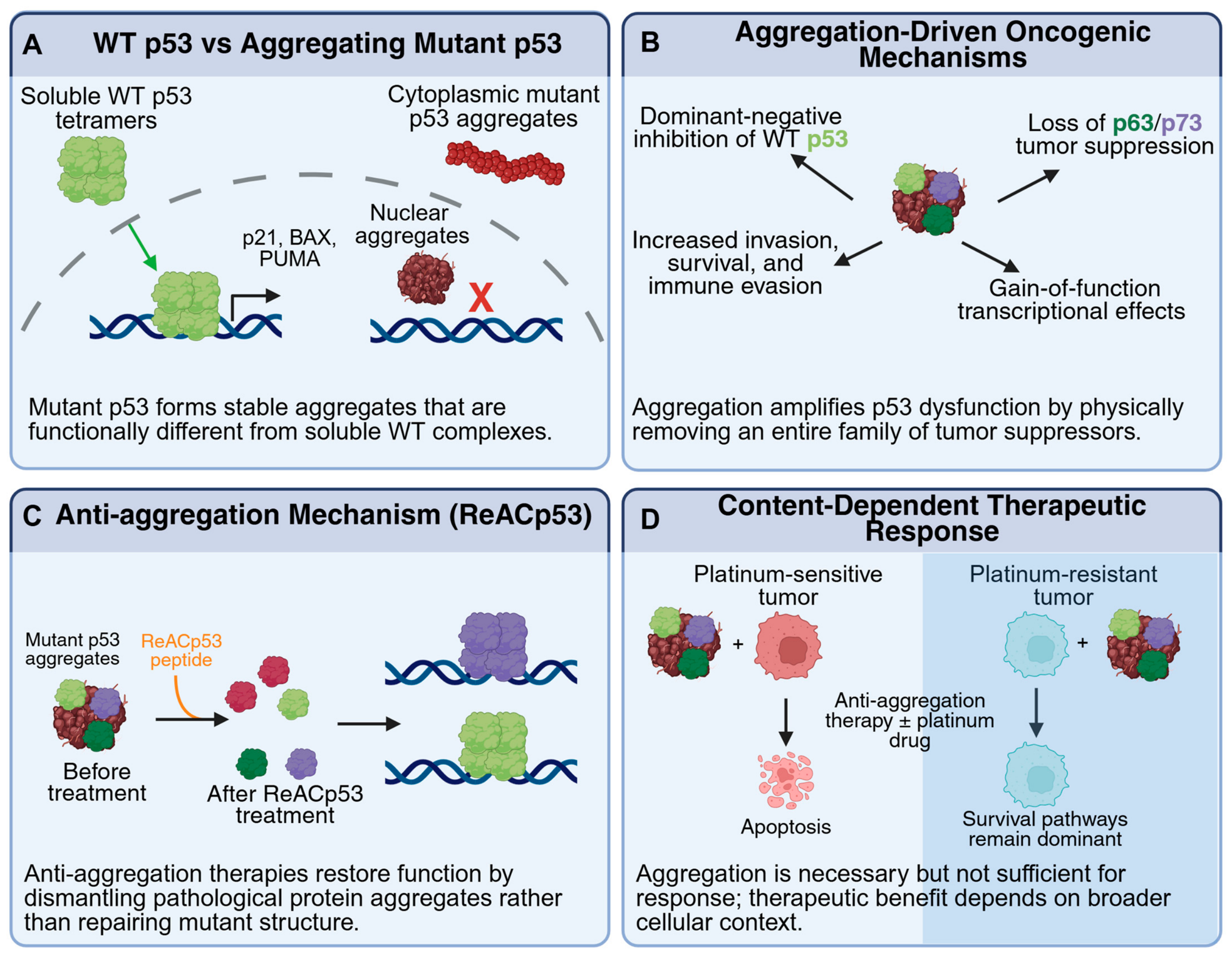
Anti-aggregation therapies target a fundamental biophysical pathology of mutant p53. A growing body of evidence indicates that many structural p53 mutants form amyloid-like aggregates that sequester wild-type p53, p63, and p73, exacerbating loss-of-function and GOF effects [
11,
46]. Anti-aggregation strategies aim to dissociate or prevent these assemblies and thereby restore transcriptional competence (
Figure 4).
The cell-penetrant peptide ReACp53 binds aggregation-prone motifs within the DNA-binding domain, shifting mutant p53 toward a soluble, transcriptionally competent state while preventing sequestration of wild-type family members [
11]. ReACp53 restores p53 target gene expression, induces apoptosis, and suppresses tumor growth in models of high-grade serous ovarian and prostate cancer [
11,
47]. Importantly, synergy with carboplatin has been observed predominantly in platinum-sensitive tumors, whereas platinum-resistant and p53-null contexts derive limited benefit, highlighting the dependence of therapeutic efficacy on mutation class and treatment history [
11,
48].
Additional aggregation-modulating mechanisms include regulation by the chaperone/disaggregase DAXX, bifunctional ligands that combine metallochaperone and anti-aggregation activity, and the emerging recognition that RNAs can influence mutant-p53 phase behavior and solubility. DAXX is a protein known to be involved in the regulation of p53 and MDM2 [
49,
50,
51]. DAXX has been characterized as a “disaggregase” and an “unfoldase” [
52]. It is a polyD/E protein that has been shown to prevent aggregation of R175H and R280K mutant p53 [
52]. This study suggests that upregulating DAXX expression in the context of mutant p53 could reduce aggregation and restore cell death activation by p53. However, it is important to note that this is highly context-dependent. Indeed, knockdown of DAXX in the context of the wild-type p53-expressing cell line SK-N-SH results in an increased induction of apoptosis [
49]. While knockdown may be beneficial for cells harboring wild-type p53, overexpression may provide restorative effects for mutant p53-expressing cells that undergo the formation of aggregates. Other approaches include the use of bifunctional ligands, L
I L
H, that act to both prevent aggregation and act as metallochaperones, as we previously discussed, to stabilize mutant p53 [
53,
54]. Additionally, there is evidence to suggest that the conversion of mutant p53 from a functional soluble form to an aggregate form is mediated by RNAs [
55]. This offers another set of targets for the modulation of p53 aggregates. Together, these findings support aggregation as both a pathogenic mechanism and a druggable vulnerability in a subset of p53-mutant cancers.
4.5. Synthetic Lethality in TP53-Deficient Tumors
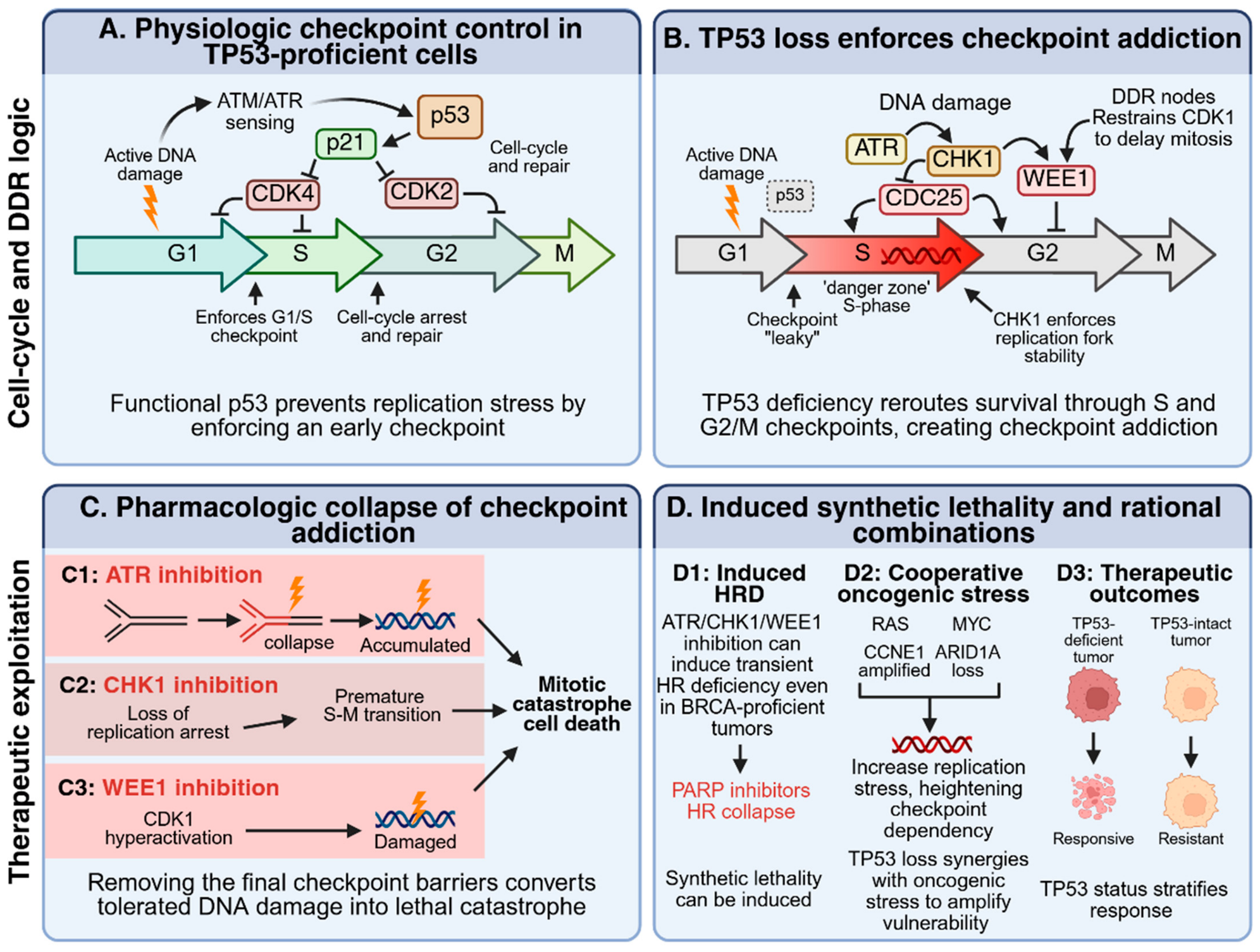
Loss of p53 disables the G1/S checkpoint by eliminating p21-mediated CDK inhibition and enforces reliance on S-phase and G2/M checkpoints, creating a state of checkpoint addiction that can be therapeutically exploited (
Figure 5). S- and G2/M-phase checkpoints are governed by ATR, CHK1, and WEE1, and the pharmacologic inhibition of this axis results in replication catastrophe and mitotic failure in
TP53-deficient cells.
Clinical validation is strongest for WEE1 inhibition with adavosertib, which improved progression-free survival in
TP53/RAS-mutant colorectal cancer and other high-replication-stress tumors [
56]. ATR inhibitors similarly demonstrate enriched activity in
TP53- and ATM-deficient contexts and can induce a transient homologous recombination deficiency, sensitizing tumors to PARP inhibitors [
57,
58,
59]. Co-alterations such as CCNE1 amplification, MYC overexpression, and ARID1A loss further heighten checkpoint addiction and refine patient selection [
58,
60,
61].
Recent work has demonstrated that distinct classes of mutant p53 proteins differentially regulate DNA replication dynamics and tumor immunogenicity, with important implications for therapy. In a study by Liu et al., contact mutations such as p53 R273H were shown to override normal replication checkpoint control by promoting persistent TopBP1–Treslin interactions, leading to excessive replication initiation and genomic instability [
62]. This replication “over-firing” results in increased formation of micronuclei and release of cytosolic DNA, which activates the cGAS–STING innate immune pathway and induces anti-tumor immune responses. In contrast, conformational mutants such as p53 R175H promote tumor growth without triggering comparable replication stress or immune activation, underscoring mutation-specific functional divergence. Importantly, tumors harboring contact mutant p53 exhibited increased immune cell infiltration and enhanced responsiveness to immune checkpoint inhibition in preclinical models, linking replication stress to immunogenicity. These findings define a replication stress-driven, immune-activated p53 functional state and support the concept that specific
TP53 mutations can predict response to immunotherapy and expose vulnerabilities to replication-targeting agents such as ATR or PARP inhibitors.
4.6. Immune-Directed Targeting of Mutant p53
Because mutant p53 is expressed at high levels and is tumor-restricted, it represents an attractive immunologic target. Vaccine-based approaches, including p53MVA, synthetic long peptide (SLPp53) vaccines, and adenovirus-transduced dendritic cell vaccines, reliably induce p53-specific T-cell responses but have shown limited clinical activity as monotherapies [
63,
64]. Clinical benefit improves when vaccines are combined with immune checkpoint inhibitors, particularly PD1 blockade, and when patients exhibit preserved peripheral immune competence [
65].
Adoptive T-cell therapies targeting mutant p53 neoantigens are emerging as a promising new modality for treating solid tumors that harbor recurrent
TP53 hotspot mutations. Unlike p53-reactivating drugs or traditional immune therapies, these approaches exploit the fact that many
TP53 missense mutations produce shared, tumor-specific neoantigens that can be targeted across patients, especially when paired with common HLA alleles (
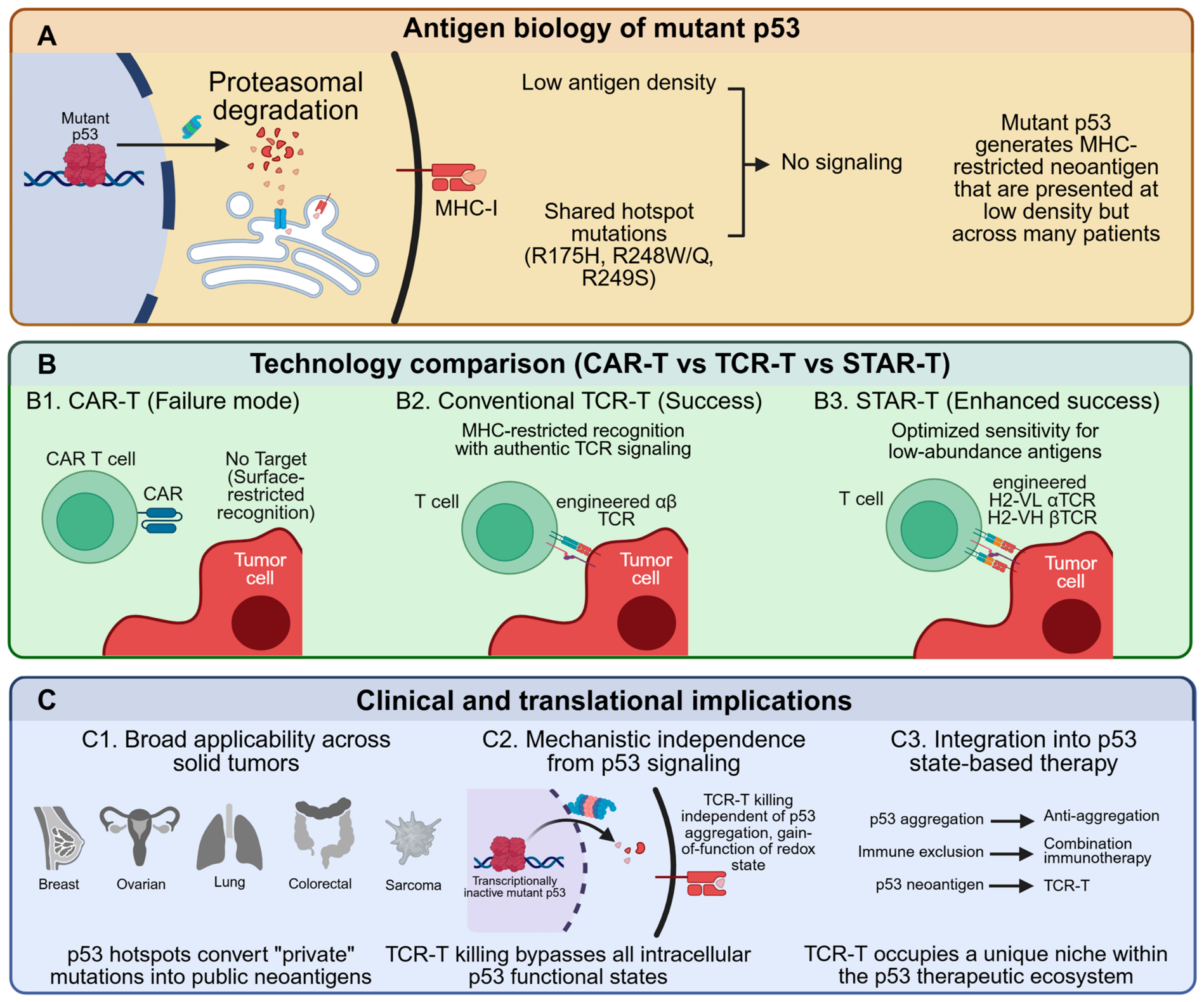
Figure 6). Engineered T cell receptor (TCR) therapies targeting shared p53 neoantigens represent the most mechanistically orthogonal p53-directed strategy to date.
Early foundational work [
66] demonstrated that
TP53 hotspot mutations generate immunogenic neoantigens across diverse epithelial cancers, with 18% of screened patients showing T-cell responses. Importantly, the immunogenicity extended across multiple hotspot mutations, including R175H, R248W/Q, and R249S, indicating that these recurrent mutations create a broad therapeutic landscape rather than isolated targets. The study also found that immunogenicity depended largely on mutant peptide-HLA structural features, establishing the feasibility of building a library of mutant-specific TCRs covering a substantial fraction of cancer patients [
66,
67].
Building on this foundation, the Rosenberg group from NCI provided the first clinical proof-of-concept that engineered TCR-T cells can target these shared p53 neoantigens [
68]. They analyzed 163 metastatic cancer patients, identifying 39 TCR recognizing
TP53 hotspot mutations, thus validating the concept of “public neoantigen” [
69]. They reported a landmark case: a woman with metastatic breast cancer harboring p53 R175H achieved 55% tumor regression lasting six months after receiving engineered peripheral T cells expressing an HLA-A*02:01-restricted anti-R175H TCR. This was the first demonstration that an off-the-shelf, mutation-specific TCR can produce meaningful tumor regression in a solid tumor. Mechanistically, the relapse in this patient was highly informative: the recurrent lesion exhibited loss of heterozygosity at HLA-A*02:01, providing that HLA loss is a direct resistance mechanism to TCR-T cell therapy.
This insight shaped the next wave of product engineering, where an armored R175H-specific TCR-T cell therapy incorporated (1) CRISPR knockout of endogenous TCRα/β (preventing mispairing), (2) knock-in of the high-affinity anti-R175H TCR, and (3) disruption of TGFBR2 to eliminate TGF-β-mediated immunosuppression. The first dedicated phase 1 trial building on this concept is NT-175, reported in preliminary form in a conference abstract [
70], and therefore represents early-stage clinical evidence. This trial enrolls HLA-A*02:01 patients with solid tumors harboring R175H, across multiple cancer types, highlight the pan-tumor potential of
TP53-hotspot-directed TCR therapy.
Conventional CAR-T cells are 10–100-fold less sensitive than TCR-T cells when targeting HLA class I-presented neoantigens at low density, because CARs lack the CD3 signaling complex and co-receptor components that amplify TCR signal transduction. To close this gap, Huang et al. engineered a Synthetic TCR and Antigen Receptor (STAR) [
71], a chimeric construct that pairs a TCR-mimicking single-chain variable fragment (scFv, derived from the H2 TCR-mimic antibody targeting the p53R175H/HLA-A*02:01 complex) with the intracellular signaling components of the endogenous TCR-CD3 complex rather than the CD28/4-1BB domains used by CARs. This enables STAR-T cells to activate via the full TCR signaling cascade upon neoantigen engagement. Preclinical studies suggest that STAR-T cells may exhibit improved sensitivity compared to CAR-T and TRuC-T (TCR fusion construct) platforms in low-neoantigen-density settings and better tumor control; however, these findings are currently limited to in vitro and xenograft models and require validation in immunocompetent and clinical contexts. The study directly addresses a fundamental limitation of applying established CAR-T technology to MHC-I-restricted intracellular neoantigens like mutant p53. Because p53 peptides are presented at low MHC-I density, authentic TCR signaling, rather than CAR-based recognition, is required for sufficient sensitivity. These STAR-T and TCR replacement platforms represent a viable approach to mutation-specific immunotherapy [
71].
4.7. Mechanism-Specific Resistance and Adaptive Responses
Therapeutic resistance across p53-targeted modalities reveals mechanistically distinct but conceptually convergent escape pathways that are consistent with a functional-state model of p53 biology. For MDM2 inhibitors, resistance is frequently driven by genetic selection, with multiple studies demonstrating the emergence and clonal expansion of
TP53-mutant cells during treatment, effectively converting tumors from a wild-type p53-dependent state into a functionally p53-deficient state that is intrinsically resistant to further pathway activation [
72]. In contrast, resistance to XPO1 inhibitors such as selinexor is largely mediated by adaptive signaling rewiring, including activation of ATR–CHK1-dependent DNA damage response pathways, NF-κB-driven survival signaling, and upregulation of XPO1 itself, which collectively restore tumor cell viability and limit sustained nuclear p53 activity [
73,
74]. Similarly, resistance to p53 reactivators such as APR-246 involves both pathway-level adaptation and network-level suppression, including activation of TGF-β–THBS1 signaling loops and increased nuclear export that attenuate effective p53 transcriptional reprogramming [
73,
75].
Recent studies have significantly revised the mechanistic basis of response to the p53-reactivating drug APR-246 (eprenetapopt), demonstrating that sensitivity is primarily determined by cellular redox state rather than
TP53 mutation status alone. In particular, the expression of the cystine/glutamate antiporter SLC7A11 (xCT), which regulates cystine uptake and glutathione biosynthesis, has emerged as a dominant predictor of response, outperforming
TP53 mutation status across large cancer cell line panels [
32]. High xCT expression promotes glutathione production and enhances cellular antioxidant capacity, thereby buffering the oxidative stress induced by APR-246 and conferring resistance. Conversely, low xCT expression results in reduced glutathione availability and increased susceptibility to oxidative damage. Mechanistically, APR-246 depletes glutathione and induces lipid peroxidation, triggering ferroptotic cell death in a manner that is partially independent of p53 reactivation [
34]. This process critically involves glutathione peroxidase 4 (GPX4), the central enzyme that detoxifies lipid hydroperoxides using glutathione as a cofactor; impairment of the xCT–glutathione–GPX4 axis therefore sensitizes tumors to ferroptosis. Consistent with this model, inhibition of SLC7A11 or GPX4 synergizes with APR-246 to enhance tumor cell killing. Although the extent to which the xCT-GSH-GPX4 axis plays a role in resistance to APR-246 in clinical setting has yet to be defined, it warrants further investigation.
Collectively, these findings illustrate that resistance to p53-targeted therapies does not arise from a single mechanism but rather depends on the drug mechanisms and p53 functional states, including genetic loss of p53 activity, adaptive checkpoint dependence, and suppression of p53 signaling output. This reinforces the need for mechanism-matched combination strategies that anticipate functional states and target both primary vulnerabilities and adaptive escape pathways.
5. Therapeutic Strategies Targeting the Wild-Type p53 Pathway
In tumors retaining wild-type
TP53 but exhibiting pathway suppression, therapeutic efforts focus on releasing negative regulation or enforcing nuclear function. MDM2 inhibitor Nutlin-3 was discovered in the early 2000s and is still considered the gold-standard positive control for confirming wild-type-like activity in the laboratory. However, due to poor PK/PD, it required re-engineering of the chemical structure to yield clinically viable candidates. These efforts resulted in compounds such as idasanutlin and milademetan, which stabilize p53 and induce cell-cycle arrest; however, their effects are frequently cytostatic rather than cytotoxic, and resistance commonly arises through
TP53 mutation, BCL-XL upregulation, or adaptive pathway rewiring [
76,
77,
78,
79,
80].
Dual inhibition of MDM2 and MDMX offer broader pathway release. Agents such as ALRN-6924 and APG-115 show enhanced activity in wild-type p53 settings and synergize with BCL-2 inhibitors or immune checkpoint blockade in preclinical models [
81,
82,
83]. Clinical development has increasingly emphasized combination strategies and biomarker-defined populations.
P53 proteostasis extends beyond classic MDM2 feedback loops to incorporate proteins involved in transcription-coupled repair and cellular stress recovery. Specifically, CSA and CSB proteins, frequently mutated in Cockayne syndrome, assemble with p53, MDM2, DDB1, and Cullin-4 ubiquitin ligase complexes to accelerate MDM2-dependent p53 degradation [
84]. Depletion of CSA or CSB prevents efficient p53 ubiquitination, inducing sustained p53 stabilization, elevated apoptotic cascades, and chronic stress signaling independent of
TP53 mutation status. Ultimately, these observations demonstrate that functional p53 signaling states can be driven by altered protein turnover and disrupted stress-adaptive networks rather than primary gene mutations alone.
Inhibition of nuclear export via XPO1 blockade (Selinexor) promotes nuclear retention of p53 and has demonstrated clinical benefit in wild-type-p53 endometrial cancer, with subgroup analyses revealing strong p53-status dependence [
85,
86]. Trials in other malignancies, including DLBCL, now explicitly incorporate p53 status into eligibility criteria, reflecting a maturation toward state-based trial design.
6. p53 Isoforms as Biomarkers and Therapeutic Targets
Emerging evidence indicates that distinct p53 isoforms exert functionally divergent and clinically relevant effects that help define tumor-specific p53 states beyond
TP53 mutation status alone. The canonical full-length p53α isoform remains the primary mediator of tumor-suppressive activity, driving transcriptional programs that induce cell-cycle arrest, apoptosis, and DNA repair; however, its activity is rarely isolated and is modulated by co-expressed isoforms, consistent with the concept that cellular responses reflect the integrated output of the p53 isoform network [
87]. Complementary integrated genomic studies further demonstrate that variability in isoform expression, linked to
TP53 sequence context and co-altered pathways, is associated with tumor behavior and clinical progression, supporting their role as independent or additive biomarkers [
88,
89].
Among alternative isoforms, p53γ retains partial transcriptional competency and has been associated with improved clinical outcomes, particularly in
TP53-mutant breast cancers where p53γ expression can partially restore tumor-suppressive signaling and improve prognosis relative to mutant p53 alone [
90]. In contrast, truncated isoforms generated by internal promoter usage exhibit distinct oncogenic properties. The Δ133p53 isoforms (Δp53α/β/γ) lack the first transactivation domain but retain partial regulatory function, and have been shown to promote tumor progression, inflammation, immune evasion, and metastasis while exerting dominant-negative effects on full-length p53. Clinically, elevated Δ133p53β is associated with poor prognosis and metastatic progression across multiple cancer types [
91,
92], particularly in tumors retaining wild-type
TP53 [
89]. Mechanistically, Δ133 isoforms engage in non-canonical transcriptional programs linked to invasion, epithelial–mesenchymal transition, and microenvironment modulation [
91,
92]. In comparison, the Δ160p53 isoforms (Δ160p53α/β/γ) are even more truncated, lacking both transactivation domains and part of the DNA-binding region, and display more pronounced GOF oncogenic activity characterized by enhanced proliferation, stemness, and resistance to apoptosis, along with stronger interference with p53α activity [
89,
92].
This progressive truncation from Δ133 to Δ160 defines a spectrum of increasing functional divergence from tumor-suppressive to oncogenic behavior. Functionally, these isoforms map onto distinct therapeutic vulnerabilities: tumors dominated by p53α-functional states may retain sensitivity to MDM2 inhibitors and DNA-damaging therapies; γ-enriched states may exhibit enhanced apoptotic priming and improved therapeutic responsiveness. Tumors expressing β isoforms linked to poor prognosis in otherwise
TP53 wild-type settings may benefit from interventions that enhance canonical p53 activity or disrupt dominant-negative isoform interactions. Inhibition of NMD rescues p53β/γ isoform expression and reactivates p53 signaling in MDM2-driven p53-deficient tumors [
93]. Mechanistically, β and γ isoforms are less susceptible to MDM2-mediated degradation [
93], and they can amplify residual p53 activities especially in wild-type or partial functional contexts [
94]. Similar to aggregation-prone missense mutants, the Δ133p53β isoform has higher propensity for aggregation [
95] and a dominant-negative effect on wild-type p53 [
94]. Interestingly, the p53 peptide (derived from truncated p53 sequence 107–129) can prevent the aggregation of Δ133p53β [
95]; thus, tumors with a high expression of Δ133p53β isoforms may be responsive to anti-aggregation strategies.
Δ133-driven states may also favor immune-modulatory or anti-metastatic strategies; whereas Δ160-dominant states, reflecting a more severe loss of canonical p53 activity and gain of oncogenic functions, may require alternative approaches such as targeting downstream signaling dependencies, ferroptosis-based therapies, or synthetic lethal vulnerabilities. Δ40p53-dominant states associated with impaired apoptosis and enhanced survival signaling may predict resistance to DNA-damaging chemotherapy and favor combination strategies that restore apoptotic competence.
These results indicate that p53 isoform expression patterns and ratios may, in some contexts, provide additional predictive and theranostic value beyond canonical mutation-based stratification. Collectively, they underscore the clinical importance of systematically measuring p53 isoform expression in tumor samples because such profiling has the potential to improve prognostic accuracy, explain discordance between TP53 mutation status and clinical outcomes, and enable more precise, mechanism-matched stratification of patients for targeted therapies.
7. Clinical Lessons and Future Directions
Various therapeutic classes, representative agents and approaches, target p53 states, primary mechanisms, key biomarkers for selection, clinical status and key lessons are outlined in
Table 1.
Three principles emerge from three decades of p53-targeted therapy development. First, monotherapies are rarely sufficient; durable benefit typically requires rational combinations. Second,
TP53 mutation status alone is inadequate. Allelic burden, zygosity, isoform expression, aggregation state, immune contexture, and co-occurring genomic alterations critically shape response. Third, the therapeutic mechanism must be matched to p53 functional state: reactivation faces stoichiometric and dominant-negative barriers, whereas degradation neutralizes GOF but does not restore tumor suppression [
7].
Collectively, these advances argue against universal p53 reactivation paradigms and instead support mechanism-matched, biomarker-stratified strategies tailored to defined p53 functional states. Durable benefit is most likely to arise from combinatorial approaches that integrate mutant-specific targeting, immune modulation, synthetic lethality, and isoform biology. Future trials must therefore evolve from mutation-based enrollment toward multi-parameter stratification frameworks that reflect the full complexity of the p53 regulatory network [
4,
7].
Recent computational and functional studies identify TGF-β–THBS1 signaling that blunts responses to p53 reactivator APR-246, and perturbation of these pathways restores sensitivity [
75]. Another study by Wang et al. reported that APR-246 activates multiple cell death mechanisms independent of p53 [
33]. Our recent studies indicate that off-target effects of APR-246 on ferroptosis often mask the on-target effect on rescuable mutant p53 such that ferroptosis-resistant cells may be needed to observe the on-target effect of APR-246 [
96]. These studies highlight the potential challenges of off-target therapeutic effects that may act independently of p53. Future progress will depend on integrating mutation-specific therapies, differentiating on-target therapeutic effects from off-target toxicity, synthetic lethal strategies, precision immunotherapy, isoform-aware biomarkers, and advanced delivery platforms into state-based, biomarker-stratified clinical trials.
8. Limitations
This review is subject to several limitations. First, much of the supporting evidence for the functional state framework derives from preclinical models and retrospective or correlative clinical studies rather than prospective biomarker-stratified trials. Second, the proposed classification of p53 functional states remains conceptual and requires standardized assays and validation across diverse tumor types. Third, many therapeutic strategies discussed exhibit context-dependent efficacy and may not be broadly generalizable. Finally, the complexity of the p53 network, including isoforms, post-translational regulation, and microenvironmental influences, presents ongoing challenges for clinical implementation and a limitation in clinical feasibility of p53 functional states as diagnostics.
Translation of the functional state framework into clinical practice will require robust and accessible diagnostic platforms. Currently, TP53 mutation status is routinely assessed using next-generation sequencing, while p53 protein levels can be approximated by immunohistochemistry. Emerging approaches include RNA sequencing for isoform profiling, gene expression signatures to measure transcriptional competency, and proteomic assays to assess post-translational modifications and aggregation. Immune context can be evaluated through PD-L1 staining, MHC expression, and tumor-infiltrating lymphocyte profiling. However, comprehensive functional state classification will likely require integrated multi-omics platforms, which are not yet standardized in routine pathology workflows. The development of scalable, clinically validated assays remains a critical prerequisite for implementing state-based therapeutic stratification.
9. Conclusions
Targeting p53 in cancer has long been a compelling yet elusive goal, with decades of effort yielding important biological insights but limited and inconsistent clinical success. This review highlights that these challenges stem not from a lack of druggable opportunities, but from an oversimplified view of p53 as a binary entity. Instead, p53 functions across a spectrum of dynamic states defined by mutation class, isoform composition, protein stability, aggregation behavior, and tumor context, each with distinct biological and therapeutic implications. Recognition of these functional state-dependent differences provides a unifying framework to interpret past failures and to rationally guide future therapeutic development. Moving forward, effective targeting of the p53 pathway must depend on mechanism-matched strategies, biomarker-driven patient stratification, and combination therapies that address both tumor-intrinsic and microenvironmental factors. Integrating mechanism-based diagnostics with emerging modalities, including selective reactivation, degradation, immune targeting, and synthetic lethality, offers a path toward realizing p53 as a central and actionable vulnerability in cancer.
Author Contributions
Writing—original draft preparation, A.S.; writing—review and editing, J.C., A.S. and A.K.; visualization, J.B. and J.C.; funding acquisition, A.S. and J.C. All authors have read and agreed to the published version of the manuscript.
Funding
This work is funded by the Department of Defense Ovarian Cancer Research Program pilot awards (W81XWH-22-1-0318, J.C.), (HT9425-24-1-0993, A.K.), and the NIGMS-funded Pharmacology Training Program (T32 144303, A.S.).
Institutional Review Board Statement
Not applicable.
Informed Consent Statement
Not applicable.
Data Availability Statement
No new data were created or analyzed in this study. Data sharing is not applicable to this article.
Conflicts of Interest
The authors declare no conflicts of interest.
Abbreviations
The following abbreviations are used in this manuscript:
| GOF | Gain-of-function |
| LOF | Loss-of-function |
| STAR | Synthetic TCR and antigen receptor |
| DBD | DNA-binding domain |
| HGSOC | High-grade serous ovarian carcinoma |
| SCLC | Small cell lung cancer |
| WT | Wild type |
| HNSCC | Head and neck squamous cell carcinoma |
| TNBC | Triple-negative breast cancer |
| PROTAC | Proteolysis-targeting chimera |
| MDSCs | Myeloid-derived suppressor cells |
| NK | Natural killer |
| PTMs | Post-translational modifications |
References
- Vousden, K.H.; Lane, D.P. p53 in health and disease. Nat. Rev. Mol. Cell Biol. 2007, 8, 275–283. [Google Scholar] [CrossRef]
- Levine, A.J.; Oren, M. The first 30 years of p53: Growing ever more complex. Nat. Rev. Cancer 2009, 9, 749–758. [Google Scholar] [CrossRef] [PubMed]
- Baugh, E.H.; Ke, H.; Levine, A.J.; Bonneau, R.A.; Chan, C.S. Why are there hotspot mutations in the TP53 gene in human cancers? Cell Death Differ. 2018, 25, 154–160. [Google Scholar] [CrossRef]
- Chen, X.; Zhang, T.; Su, W.; Dou, Z.; Zhao, D.; Jin, X.; Lei, H.; Wang, J.; Xie, X.; Cheng, B.; et al. Mutant p53 in cancer: From molecular mechanism to therapeutic modulation. Cell Death Dis. 2022, 13, 974. [Google Scholar] [CrossRef]
- Bourdon, J.C. p53 and its isoforms in cancer. Br. J. Cancer 2007, 97, 277–282. [Google Scholar] [CrossRef]
- Marcel, V.; Dichtel-Danjoy, M.L.; Sagne, C.; Hafsi, H.; Ma, D.; Ortiz-Cuaran, S.; Olivier, M.; Hall, J.; Mollereau, B.; Hainaut, P.; et al. Biological functions of p53 isoforms through evolution: Lessons from animal and cellular models. Cell Death Differ. 2011, 18, 1815–1824. [Google Scholar] [CrossRef] [PubMed]
- Mantovani, F.; Collavin, L.; Del Sal, G. Mutant p53 as a guardian of the cancer cell. Cell Death Differ. 2019, 26, 199–212. [Google Scholar] [CrossRef]
- Steffens Reinhardt, L.; Zhang, X.; Zhao, Y. Δ40p53 drives stemness and chemoresistance by uncoupling apoptotic and cell-cycle programs. Cancer Res. 2023, 83, 2140–2156. [Google Scholar]
- Aoubala, M.; Murray-Zmijewski, F.; Khoury, M.; Fernandes, K.; Perrier, S.; Bernard, H.; Prats, A.; Lane, D.; Bourdon, J. p53 directly transactivates Δ133p53α, promoting cell survival after DNA damage. Proc. Natl. Acad. Sci. USA 2011, 108, 18095–18100. [Google Scholar]
- Silva, J.L.; De Moura Gallo, C.V.; Costa, D.C.; Rangel, L.P. Prion-like aggregation of mutant p53 in cancer. Trends Biochem. Sci. 2014, 39, 260–267. [Google Scholar] [CrossRef]
- Soragni, A.; Janzen, D.M.; Johnson, L.M.; Lindgren, A.G.; Thai-Quynh Nguyen, A.; Tiourin, E.; Soriaga, A.B.; Lu, J.; Jiang, L.; Faull, K.F.; et al. A Designed Inhibitor of p53 Aggregation Rescues p53 Tumor Suppression in Ovarian Carcinomas. Cancer Cell 2016, 29, 90–103. [Google Scholar] [CrossRef] [PubMed]
- Wang, C.; Tan, J.Y.M.; Chitkara, N.; Bhatt, S. TP53 Mutation-Mediated Immune Evasion in Cancer: Mechanisms and Therapeutic Implications. Cancers 2024, 16, 3069. [Google Scholar] [CrossRef]
- Nian, Z.; Dou, Y.; Wei, H. p53: An Immune Ecosystem Manipulator. Clin. Cancer Res. 2025, 31, 5120–5127. [Google Scholar] [CrossRef]
- Liang, L.; Wang, W. The impact of p53 mutation on tumor immune evasion: Mechanistic insights and clinical implications. Front. Immunol. 2026, 17, 1753215. [Google Scholar] [CrossRef]
- Mahat, D.B.; Kumra, H.; Castro, S.A.; Metcalf, E.; Nguyen, K.; Morisue, R.; Ho, W.W.; Chen, I.; Sullivan, B.; Yim, L.H.; et al. Mutant p53 exploits enhancers to elevate immunosuppressive chemokine expression and impair immune checkpoint inhibitors in pancreatic cancer. Immunity 2025, 58, 1688–1705 e1689. [Google Scholar] [CrossRef]
- Albakri, M.M. TP53-mutated MDS and AML: Immune dysregulation, tumor microenvironment, and emerging therapeutic strategies. Front. Oncol. 2025, 15, 1655486. [Google Scholar] [CrossRef] [PubMed]
- Costa, C.; Indovina, P.; Mattioli, E.; Forte, I.M.; Iannuzzi, C.A.; Luzzi, L.; Bellan, C.; De Summa, S.; Bucci, E.; Di Marzo, D.; et al. P53-regulated miR-320a targets PDL1 and is downregulated in malignant mesothelioma. Cell Death Dis. 2020, 11, 748. [Google Scholar] [CrossRef]
- Cortez, M.A.; Ivan, C.; Valdecanas, D.; Wang, X.; Peltier, H.J.; Ye, Y.; Araujo, L.; Carbone, D.P.; Shilo, K.; Giri, D.K.; et al. PDL1 Regulation by p53 via miR-34. J. Natl. Cancer Inst. 2016, 108, djv303. [Google Scholar] [CrossRef] [PubMed]
- Izquierdo, E.; Vorholt, D.; Blakemore, S.; Sackey, B.; Nolte, J.L.; Barbarino, V.; Schmitz, J.; Nickel, N.; Bachurski, D.; Lobastova, L.; et al. Extracellular vesicles and PD-L1 suppress macrophages, inducing therapy resistance in TP53-deficient B-cell malignancies. Blood 2022, 139, 3617–3629. [Google Scholar] [CrossRef]
- Liu, N.; Jiang, X.; Guo, L.; Zhang, C.; Jiang, M.; Sun, Z.; Zhang, Y.; Mi, W.; Li, J.; Fu, Y.; et al. Mutant p53 achieved Gain-of-Function by promoting tumor growth and immune escape through PHLPP2/AKT/PD-L1 pathway. Int. J. Biol. Sci. 2022, 18, 2419–2438. [Google Scholar] [CrossRef]
- Yu, J.; Ling, S.; Hong, J.; Zhang, L.; Zhou, W.; Yin, L.; Xu, S.; Que, Q.; Wu, Y.; Zhan, Q.; et al. TP53/mTORC1-mediated bidirectional regulation of PD-L1 modulates immune evasion in hepatocellular carcinoma. J. Immunother. Cancer 2023, 11, e007479. [Google Scholar] [CrossRef]
- Ghosh, M.; Saha, S.; Bettke, J.; Nagar, R.; Parrales, A.; Iwakuma, T.; van der Velden, A.W.M.; Martinez, L.A. Mutant p53 suppresses innate immune signaling to promote tumorigenesis. Cancer Cell 2021, 39, 494–508.e495. [Google Scholar] [CrossRef]
- Buller, R.E.; Runnebaum, I.B.; Karlan, B.Y.; Horowitz, J.A.; Shahin, M.; Buekers, T.; Petrauskas, S.; Kreienberg, R.; Slamon, D.; Pegram, M. A phase I/II trial of rAd/p53 (SCH 58500) gene replacement in recurrent ovarian cancer. Cancer Gene Ther. 2002, 9, 553–566. [Google Scholar] [CrossRef]
- Cristofanilli, M.; Krishnamurthy, S.; Guerra, L.; Broglio, K.; Arun, B.; Booser, D.J.; Menander, K.; Van Wart Hood, J.; Valero, V.; Hortobagyi, G.N. A nonreplicating adenoviral vector that contains the wild-type p53 transgene combined with chemotherapy for primary breast cancer: Safety, efficacy, and biologic activity of a novel gene-therapy approach. Cancer 2006, 107, 935–944. [Google Scholar] [CrossRef]
- Zhang, W.W.; Li, L.; Li, D.; Liu, J.; Li, X.; Li, W.; Xu, X.; Zhang, M.J.; Chandler, L.A.; Lin, H.; et al. The First Approved Gene Therapy Product for Cancer Ad-p53 (Gendicine): 12 Years in the Clinic. Hum. Gene Ther. 2018, 29, 160–179. [Google Scholar] [CrossRef]
- Pirollo, K.F.; Nemunaitis, J.; Leung, P.K.; Nunan, R.; Adams, J.; Chang, E.H. Safety and Efficacy in Advanced Solid Tumors of a Targeted Nanocomplex Carrying the p53 Gene Used in Combination with Docetaxel: A Phase 1b Study. Mol. Ther. J. Am. Soc. Gene Ther. 2016, 24, 1697–1706. [Google Scholar] [CrossRef]
- Kim, S.S.; Harford, J.B.; Moghe, M.; Rait, A.; Chang, E.H. Combination with SGT-53 overcomes tumor resistance to a checkpoint inhibitor. Oncoimmunology 2018, 7, e1484982. [Google Scholar] [CrossRef] [PubMed]
- Boeckler, F.M.; Joerger, A.C.; Jaggi, G.; Rutherford, T.J.; Veprintsev, D.B.; Fersht, A.R. Targeted rescue of a destabilized mutant of p53 by an in silico screened drug. Proc. Natl. Acad. Sci. USA 2008, 105, 10360–10365. [Google Scholar] [CrossRef] [PubMed]
- Raghavan, V.; Agrahari, M.; Gowda, D.K. Virtual screening of p53 mutants reveals Y220S as an additional rescue drug target for PhiKan083 with higher binding characteristics. Comput. Biol. Chem. 2019, 80, 398–408. [Google Scholar] [CrossRef]
- Vu, B.T.; Dominique, R.; Fahr, B.J.; Li, H.H.; Fry, D.C.; Xu, L.; Yang, H.; Puzio-Kuter, A.; Good, A.; Liu, B.; et al. Discovery of Rezatapopt (PC14586), a First-in-Class, Small-Molecule Reactivator of p53 Y220C Mutant in Development. ACS Med. Chem. Lett. 2025, 16, 34–39. [Google Scholar] [CrossRef]
- Boon, R.; Alen, J.; Draoui, N.; Vandyck, K.; Behaeghel, E.; Lammens, G.; Vendeville, S.; Beke, L.; Peeters, P.; De Cesco, S.; et al. Discovery of a Best-in-Class small molecule p53 Y220C reactivator: Breaking through the potency ceiling. Cancer Res. 2026, 86, 4578. [Google Scholar] [CrossRef]
- Fujihara, K.M.; Corrales Benitez, M.; Cabalag, C.S.; Zhang, B.Z.; Ko, H.S.; Liu, D.S.; Simpson, K.J.; Haupt, Y.; Lipton, L.; Haupt, S.; et al. SLC7A11 Is a Superior Determinant of APR-246 (Eprenetapopt) Response than TP53 Mutation Status. Mol. Cancer Ther. 2021, 20, 1858–1867. [Google Scholar] [CrossRef]
- Wang, Z.; Hu, H.; Heitink, L.; Rogers, K.; You, Y.; Tan, T.; Suen, C.L.W.; Garnham, A.; Chen, H.; Lieschke, E.; et al. The anti-cancer agent APR-246 can activate several programmed cell death processes to kill malignant cells. Cell Death Differ. 2023, 30, 1033–1046. [Google Scholar] [CrossRef] [PubMed]
- Birsen, R.; Larrue, C.; Decroocq, J.; Johnson, N.; Guiraud, N.; Gotanegre, M.; Cantero-Aguilar, L.; Grignano, E.; Huynh, T.; Fontenay, M.; et al. APR-246 induces early cell death by ferroptosis in acute myeloid leukemia. Haematologica 2022, 107, 403–416. [Google Scholar] [CrossRef]
- Tessoulin, B.; Descamps, G.; Moreau, P.; Maiga, S.; Lode, L.; Godon, C.; Marionneau-Lambot, S.; Oullier, T.; Le Gouill, S.; Amiot, M.; et al. PRIMA-1Met induces myeloma cell death independent of p53 by impairing the GSH/ROS balance. Blood 2014, 124, 1626–1636. [Google Scholar] [CrossRef]
- Bykov, V.J.; Zhang, Q.; Zhang, M.; Ceder, S.; Abrahmsen, L.; Wiman, K.G. Targeting of Mutant p53 and the Cellular Redox Balance by APR-246 as a Strategy for Efficient Cancer Therapy. Front. Oncol. 2016, 6, 21. [Google Scholar] [CrossRef] [PubMed]
- Yu, X.; Vazquez, A.; Levine, A.J.; Carpizo, D.R. Allele-specific p53 mutant reactivation. Cancer Cell 2012, 21, 614–625. [Google Scholar] [CrossRef]
- Zaman, S.; Yu, X.; Bencivenga, A.F.; Blanden, A.R.; Liu, Y.; Withers, T.; Na, B.; Blayney, A.J.; Gilleran, J.; Boothman, D.A.; et al. Combinatorial Therapy of Zinc Metallochaperones with Mutant p53 Reactivation and Diminished Copper Binding. Mol. Cancer Ther. 2019, 18, 1355–1365. [Google Scholar] [CrossRef]
- Yu, X.; Blanden, A.R.; Narayanan, S.; Jayakumar, L.; Lubin, D.; Augeri, D.; Kimball, S.D.; Loh, S.N.; Carpizo, D.R. Small molecule restoration of wildtype structure and function of mutant p53 using a novel zinc-metallochaperone based mechanism. Oncotarget 2014, 5, 8879–8892. [Google Scholar] [CrossRef]
- Blanden, A.R.; Yu, X.; Loh, S.N.; Levine, A.J.; Carpizo, D.R. Reactivating mutant p53 using small molecules as zinc metallochaperones: Awakening a sleeping giant in cancer. Drug Discov. Today 2015, 20, 1391–1397. [Google Scholar] [CrossRef]
- Zhuang, X.; Guo, Y.; Sun, X.; Chen, J.; Xie, S.; Yang, F.; Li, J. Promising Proteolysis-Targeting Chimera for Mutant p53-R175H. ACS Omega 2024, 9, 45138–45146. [Google Scholar] [CrossRef]
- Kong, L.; Meng, F.; Zhou, P.; Ge, R.; Geng, X.; Yang, Z.; Li, G.; Zhang, L.; Wang, J.; Ma, J.; et al. An engineered DNA aptamer-based PROTAC for precise therapy of p53-R175H hotspot mutant-driven cancer. Sci. Bull. 2024, 69, 2122–2135. [Google Scholar] [CrossRef]
- Li, D.; Marchenko, N.D.; Schulz, R.; Fischer, V.; Velasco-Hernandez, T.; Talos, F.; Moll, U.M. Functional inactivation of endogenous MDM2 and CHIP by HSP90 causes aberrant stabilization of mutant p53 in human cancer cells. Mol. Cancer Res. 2011, 9, 577–588. [Google Scholar] [CrossRef]
- Alexandrova, E.; Yallowitz, A.; Li, D.; Xu, S.; Schulz, R.; Proia, D.; Lozano, G.; Moll, U. Improving survival by exploiting tumour dependence on stabilized mutant p53 for treatment. Nature 2015, 523, 352–356. [Google Scholar] [CrossRef]
- Concin, N.; Braicu, I.; Combe, P.; Berger, R.; Ray-Coquard, I.; Joly, F.; Harter, P.; Canzler, U.; Selle, F.; Mahner, S.; et al. GANNET53 Part II: A European Phase I/II Trial of the HSP90 Inhibitor Ganetespib in High-Grade Platinum-Resistant Ovarian Cancer-A Study of the GANNET53 Consortium. Clin. Cancer Res. 2025, 31, 3160–3174. [Google Scholar] [CrossRef]
- Silva, J.L.; Cino, E.A.; Soares, I.N.; Ferreira, V.F.; Oliveira, G.A.P.d. Targeting the Prion-like Aggregation of Mutant p53 to Combat Cancer. Acc. Chem. Res. 2018, 51, 181–190. [Google Scholar] [CrossRef]
- Bykov, V.J.N.; Eriksson, S.E.; Bianchi, J.; Wiman, K.G. Targeting mutant p53 for efficient cancer therapy. Nat. Rev. Cancer 2018, 18, 89–102. [Google Scholar] [CrossRef]
- Neal, A.; Lai, T.; Singh, T.; Rahseparian, N.; Grogan, T.; Elashoff, D.; Scott, P.; Pellegrini, M.; Memarzadeh, S. Combining ReACp53 with Carboplatin to Target High-Grade Serous Ovarian Cancers. Cancers 2021, 13, 5908. [Google Scholar] [CrossRef] [PubMed]
- Li, J.; Gu, L.; Zhang, H.; Liu, T.; Tian, D.; Zhou, M.; Zhou, S. Berberine represses DAXX gene transcription and induces cancer cell apoptosis. Lab. Investig. 2013, 93, 354–364. [Google Scholar] [CrossRef] [PubMed]
- Zhao, L.Y.; Liu, J.; Sidhu, G.S.; Niu, Y.; Liu, Y.; Wang, R.; Liao, D. Negative regulation of p53 functions by Daxx and the involvement of MDM2. J. Biol. Chem. 2004, 279, 50566–50579. [Google Scholar] [CrossRef] [PubMed]
- Mahmud, I.; Liao, D. DAXX in cancer: Phenomena, processes, mechanisms and regulation. Nucleic Acids Res. 2019, 47, 7734–7752. [Google Scholar] [CrossRef]
- Huang, L.; Agrawal, T.; Zhu, G.; Yu, S.; Tao, L.; Lin, J.; Marmorstein, R.; Shorter, J.; Yang, X. DAXX represents a new type of protein-folding enabler. Nature 2021, 597, 132–137. [Google Scholar] [CrossRef]
- Miller, J.J.; Blanchet, A.; Orvain, C.; Nouchikian, L.; Reviriot, Y.; Clarke, R.M.; Martelino, D.; Wilson, D.; Gaiddon, C.; Storr, T. Bifunctional ligand design for modulating mutant p53 aggregation in cancer. Chem. Sci. 2019, 10, 10802–10814. [Google Scholar] [CrossRef] [PubMed]
- Grcic, L.; Leech, G.; Kwan, K.; Storr, T. Targeting misfolding and aggregation of the amyloid-beta peptide and mutant p53 protein using multifunctional molecules. Chem. Commun. 2024, 60, 1372–1388. [Google Scholar] [CrossRef] [PubMed]
- Cordeiro, Y.; Vieira, T.; Kovachev, P.S.; Sanyal, S.; Silva, J.L. Modulation of p53 and prion protein aggregation by RNA. Biochim. Biophys. Acta Proteins Proteom. 2019, 1867, 933–940. [Google Scholar] [CrossRef]
- Seligmann, J.F.; Fisher, D.J.; Brown, L.C.; Adams, R.A.; Graham, J.; Quirke, P.; Richman, S.D.; Butler, R.; Domingo, E.; Blake, A.; et al. Inhibition of WEE1 Is Effective in TP53- and RAS-Mutant Metastatic Colorectal Cancer: A Randomized Trial (FOCUS4-C) Comparing Adavosertib (AZD1775) With Active Monitoring. J. Clin. Oncol. 2021, 39, 3705–3715. [Google Scholar] [CrossRef]
- Min, A.; Im, S.A.; Jang, H.; Kim, S.; Lee, M.; Kim, D.K.; Yang, Y.; Kim, H.J.; Lee, K.H.; Kim, J.W.; et al. AZD6738, A Novel Oral Inhibitor of ATR, Induces Synthetic Lethality with ATM Deficiency in Gastric Cancer Cells. Mol. Cancer Ther. 2017, 16, 566–577. [Google Scholar] [CrossRef]
- Kim, H.; Xu, H.; George, E.; Hallberg, D.; Kumar, S.; Jagannathan, V.; Medvedev, S.; Kinose, Y.; Devins, K.; Verma, P.; et al. Combining PARP with ATR inhibition overcomes PARP inhibitor and platinum resistance in ovarian cancer models. Nat. Commun. 2020, 11, 3726. [Google Scholar] [CrossRef]
- Kwok, M.; Davies, N.; Agathanggelou, A.; Smith, E.; Oldreive, C.; Petermann, E.; Stewart, G.; Brown, J.; Lau, A.; Pratt, G.; et al. ATR inhibition induces synthetic lethality and overcomes chemoresistance in TP53- or ATM-defective chronic lymphocytic leukemia cells. Blood 2016, 127, 582–595. [Google Scholar] [CrossRef]
- Williamson, C.T.; Miller, R.; Pemberton, H.N.; Jones, S.E.; Campbell, J.; Konde, A.; Badham, N.; Rafiq, R.; Brough, R.; Gulati, A.; et al. ATR inhibitors as a synthetic lethal therapy for tumours deficient in ARID1A. Nat. Commun. 2016, 7, 13837. [Google Scholar] [CrossRef]
- Middleton, F.K.; Pollard, J.R.; Curtin, N.J. The Impact of p53 Dysfunction in ATR Inhibitor Cytotoxicity and Chemo- and Radiosensitisation. Cancers 2018, 10, 275. [Google Scholar] [CrossRef] [PubMed]
- Liu, K.; Garan, L.A.W.; Lin, F.T.; Lin, W.C. Mutant p53 variants differentially impact replication initiation and activate cGAS-STING to affect immune checkpoint inhibition. Commun. Biol. 2025, 8, 1522. [Google Scholar] [CrossRef]
- Soliman, H.; Khambati, F.; Han, H.S.; Ismail-Khan, R.; Bui, M.M.; Sullivan, D.M.; Antonia, S. A phase-1/2 study of adenovirus-p53 transduced dendritic cell vaccine in combination with indoximod in metastatic solid tumors and invasive breast cancer. Oncotarget 2018, 9, 10110–10117. [Google Scholar] [CrossRef] [PubMed]
- Hardwick, N.R.; Frankel, P.; Ruel, C.; Kilpatrick, J.; Tsai, W.; Kos, F.; Kaltcheva, T.; Leong, L.; Morgan, R.; Chung, V.; et al. p53-Reactive T Cells Are Associated with Clinical Benefit in Patients with Platinum-Resistant Epithelial Ovarian Cancer After Treatment with a p53 Vaccine and Gemcitabine Chemotherapy. Clin. Cancer Res. 2018, 24, 1315–1325. [Google Scholar] [CrossRef]
- Chung, V.; Kos, F.J.; Hardwick, N.; Yuan, Y.; Chao, J.; Li, D.; Waisman, J.; Li, M.; Zurcher, K.; Frankel, P.; et al. Evaluation of safety and efficacy of p53MVA vaccine combined with pembrolizumab in patients with advanced solid cancers. Clin. Transl. Oncol. 2019, 21, 363–372. [Google Scholar] [CrossRef]
- Malekzadeh, P.; Pasetto, A.; Robbins, P.; Parkhurst, M.; Rosenberg, S. Neoantigen screening identifies TP53 mutant neoepitopes for adoptive cell therapy. J. Clin. Investig. 2019, 129, 1103–1118. [Google Scholar]
- Tran, E.; Robbins, P.; Rosenberg, S. “Final common pathway” of human cancer immunotherapy: Targeting shared tumor antigens. Nat. Med. 2020, 26, 124–131. [Google Scholar]
- Kim, S.P.; Vale, N.R.; Zacharakis, N.; Krishna, S.; Yu, Z.; Gasmi, B.; Gartner, J.J.; Sindiri, S.; Malekzadeh, P.; Deniger, D.C.; et al. Adoptive Cellular Therapy with Autologous Tumor-Infiltrating Lymphocytes and T-cell Receptor-Engineered T Cells Targeting Common p53 Neoantigens in Human Solid Tumors. Cancer Immunol. Res. 2022, 10, 932–946. [Google Scholar] [CrossRef]
- Klebanoff, C.A. T-cell Receptor Gene Therapy Clinically Targeting a TP53 Public Neoantigen. Cancer Immunol. Res. 2022, 10, 919. [Google Scholar] [CrossRef]
- Becerra, C.R.; Awad, M.M.; Hecht, J.R.; Paulson, A.S.; Lee, J.; Palluconi, G.; Dalton, J.; Patel, A.; Yan, Y.; Perez, A.; et al. Open-label, phase 1, multicenter study to evaluate the safety and preliminary anti-tumor activity of NT-175 in human leukocyte antigen-a*02:01-positive adult subjects with unresectable, advanced and/or metastatic solid tumors that are positive for the TP53 R175H mutation. J. Clin. Oncol. 2024, 42, e14514. [Google Scholar] [CrossRef]
- Huang, D.; Li, Y.; Rui, W.; Sun, K.; Zhou, Z.; Lv, X.; Yu, L.; Chen, J.; Zhou, J.; Liu, V.; et al. TCR-mimicking STAR conveys superior sensitivity over CAR in targeting tumors with low-density neoantigens. Cell Rep. 2024, 43, 114949. [Google Scholar] [CrossRef]
- Maslah, N.; Verger, E.; Giraudier, S.; Chea, M.; Hoffman, R.; Mascarenhas, J.; Cassinat, B.; Kiladjian, J.J. Single-cell analysis reveals selection of TP53-mutated clones after MDM2 inhibition. Blood Adv. 2022, 6, 2813–2823. [Google Scholar] [CrossRef]
- Kruer, T.L.; Quintana, A.; Newman, H.; Ferrall-Fairbanks, M.; Zhang, L.; McLemore, A.; Neupane, S.; Yang, Q.; Dankyi, N.A.; Balasis, M.E.; et al. XPO1 drives resistance to eprenetapopt and azacitidine and can be targeted in TP53-mutated myeloid malignancies. Blood 2025, 146, 2244–2258. [Google Scholar] [CrossRef] [PubMed]
- Inoue, A.; Robinson, F.S.; Minelli, R.; Tomihara, H.; Rizi, B.S.; Rose, J.L.; Kodama, T.; Srinivasan, S.; Harris, A.L.; Zuniga, A.M.; et al. Sequential Administration of XPO1 and ATR Inhibitors Enhances Therapeutic Response in TP53-mutated Colorectal Cancer. Gastroenterology 2021, 161, 196–210. [Google Scholar] [CrossRef]
- Lee, S.M.; Han, Y.; Cho, K.H. Deep learning untangles the resistance mechanism of p53 reactivator in lung cancer cells. iScience 2023, 26, 108377. [Google Scholar] [CrossRef]
- Nishida, Y.; Montoya, R.H.; Morita, K.; Tanaka, T.; Wang, F.; Takahashi, K.; Ishizawa, J.; Kumar, P.; Patel, P.; Dos Santos, C.E.; et al. Clonal Expansion of Mutant p53 Clones By MDM2 Inhibition in Acute Myeloid Leukemias. Blood 2020, 136, 27–28. [Google Scholar] [CrossRef]
- Skalniak, L.; Kocik, J.; Polak, J.; Skalniak, A.; Rak, M.; Wolnicka-Glubisz, A.; Holak, T.A. Prolonged Idasanutlin (RG7388) Treatment Leads to the Generation of p53-Mutated Cells. Cancers 2018, 10, 396. [Google Scholar] [CrossRef]
- Konopleva, M.; Martinelli, G.; Daver, N.; Papayannidis, C.; Wei, A.; Higgins, B.; Ott, M.; Mascarenhas, J.; Andreeff, M. MDM2 inhibition: An important step forward in cancer therapy. Leukemia 2020, 34, 2858–2874. [Google Scholar] [CrossRef]
- Gounder, M.M.; Bauer, T.M.; Schwartz, G.K.; Weise, A.M.; LoRusso, P.; Kumar, P.; Tao, B.; Hong, Y.; Patel, P.; Lu, Y.; et al. A First-in-Human Phase I Study of Milademetan, an MDM2 Inhibitor, in Patients With Advanced Liposarcoma, Solid Tumors, or Lymphomas. J. Clin. Oncol. 2023, 41, 1714–1724. [Google Scholar] [CrossRef] [PubMed]
- DiNardo, C.D.; Olin, R.; Wang, E.S.; Skikne, B.; Rosenthal, J.; Kumar, P.; Sumi, H.; Hizukuri, Y.; Hong, Y.; Patel, P.; et al. Phase 1 dose escalation study of the MDM2 inhibitor milademetan as monotherapy and in combination with azacitidine in patients with myeloid malignancies. Cancer Med. 2024, 13, e70028. [Google Scholar] [CrossRef] [PubMed]
- Zhang, X.; Wen, X.; Peng, R.; Pan, Q.; Weng, D.; Ma, Y.; Zhang, Y.; Yang, J.; Men, L.; Wang, H.; et al. A first-in-human phase I study of a novel MDM2/p53 inhibitor alrizomadlin in advanced solid tumors. ESMO Open 2024, 9, 103636. [Google Scholar] [CrossRef]
- Guerlavais, V.; Sawyer, T.K.; Carvajal, L.; Chang, Y.S.; Graves, B.; Ren, J.G.; Sutton, D.; Olson, K.A.; Packman, K.; Darlak, K.; et al. Discovery of Sulanemadlin (ALRN-6924), the First Cell-Permeating, Stabilized alpha-Helical Peptide in Clinical Development. J. Med. Chem. 2023, 66, 9401–9417. [Google Scholar] [CrossRef]
- Pearson, A.T.; Muzaffar, J.; Kirtane, K.; Bellile, E.; Suresh, K.; Rosenberg, A.J.; Worden, F.; Chung, C.H.; Vokes, E.; Brenner, J.C.; et al. MDM2 Inhibition with Alrizomadlin (APG-115) in TP53 wild-type salivary gland cancers: A phase I clinical trial. Nat. Commun. 2026, 17, 4240. [Google Scholar] [CrossRef]
- Latini, P.; Frontini, M.; Caputo, M.; Gregan, J.; Cipak, L.; Filippi, S.; Kumar, V.; Velez-Cruz, R.; Stefanini, M.; Proietti-De-Santis, L. CSA and CSB proteins interact with p53 and regulate its Mdm2-dependent ubiquitination. Cell Cycle 2011, 10, 3719–3730. [Google Scholar] [CrossRef] [PubMed]
- Makker, V.; Perez-Fidalgo, J.A.; Valabrega, G.; Hamilton, E.; Van Gorp, T.; Sehouli, J.; Reginacova, K.; Richardson, D.L.; Perri, T.; Oza, A.M.; et al. Long-term follow-up of efficacy and safety of selinexor maintenance treatment in patients with TP53wt advanced or recurrent endometrial cancer: A subgroup analysis of the ENGOT-EN5/GOG-3055/SIENDO study. Gynecol. Oncol. 2024, 185, 202–211. [Google Scholar] [CrossRef]
- Vergote, I.; Perez-Fidalgo, J.A.; Hamilton, E.P.; Valabrega, G.; Van Gorp, T.; Sehouli, J.; Cibula, D.; Levy, T.; Welch, S.; Richardson, D.L.; et al. Oral Selinexor as Maintenance Therapy After First-Line Chemotherapy for Advanced or Recurrent Endometrial Cancer. J. Clin. Oncol. 2023, 41, 5400–5410. [Google Scholar] [CrossRef] [PubMed]
- Joruiz, S.M.; Bourdon, J.C. p53 Isoforms: Key Regulators of the Cell Fate Decision. Cold Spring Harb. Perspect. Med. 2016, 6, a026039. [Google Scholar] [CrossRef]
- Tomas, F.; Roux, P.; Gire, V. Interaction of p53 with the Delta133p53alpha and Delta160p53alpha isoforms regulates p53 conformation and transcriptional activity. Cell Death Dis. 2024, 15, 845. [Google Scholar] [CrossRef]
- Steffens Reinhardt, L.; Groen, K.; Morten, B.C.; Bourdon, J.C.; Avery-Kiejda, K.A. Cytoplasmic p53beta Isoforms Are Associated with Worse Disease-Free Survival in Breast Cancer. Int. J. Mol. Sci. 2022, 23, 6670. [Google Scholar] [CrossRef]
- Bourdon, J.C.; Khoury, M.P.; Diot, A.; Baker, L.; Fernandes, K.; Aoubala, M.; Quinlan, P.; Purdie, C.A.; Jordan, L.B.; Prats, A.C.; et al. p53 mutant breast cancer patients expressing p53gamma have as good a prognosis as wild-type p53 breast cancer patients. Breast Cancer Res. 2011, 13, R7. [Google Scholar] [CrossRef] [PubMed]
- Jesus, A.N.B.; Taha, A.; Wang, D.; Mehta, P.M.; Mehta, S.; Reily-Bell, A.; Lekamlage, S.P.; Saraiva, A.M.; Tahmeedzaman, T.; Ziad, F.; et al. Increased Expression of the Delta133p53beta Isoform Enhances Brain Metastasis. Int. J. Mol. Sci. 2023, 24, 1267. [Google Scholar] [CrossRef] [PubMed]
- Arsic, N.; Slatter, T.; Gadea, G.; Villain, E.; Fournet, A.; Kazantseva, M.; Allemand, F.; Sibille, N.; Seveno, M.; de Rossi, S.; et al. Delta133p53beta isoform pro-invasive activity is regulated through an aggregation-dependent mechanism in cancer cells. Nat. Commun. 2021, 12, 5463. [Google Scholar] [CrossRef]
- Gudikote, J.P.; Cascone, T.; Poteete, A.; Sitthideatphaiboon, P.; Wu, Q.; Morikawa, N.; Zhang, F.; Peng, S.; Tong, P.; Li, L.; et al. Inhibition of nonsense-mediated decay rescues p53beta/gamma isoform expression and activates the p53 pathway in MDM2-overexpressing and select p53-mutant cancers. J. Biol. Chem. 2021, 297, 101163. [Google Scholar] [CrossRef]
- Bourdon, J.C.; Fernandes, K.; Murray-Zmijewski, F.; Liu, G.; Diot, A.; Xirodimas, D.P.; Saville, M.K.; Lane, D.P. p53 isoforms can regulate p53 transcriptional activity. Genes Dev. 2005, 19, 2122–2137. [Google Scholar] [CrossRef] [PubMed]
- Lei, J.; Qi, R.; Tang, Y.; Wang, W.; Wei, G.; Nussinov, R.; Ma, B. Conformational stability and dynamics of the cancer-associated isoform Delta133p53beta are modulated by p53 peptides and p53-specific DNA. FASEB J. 2019, 33, 4225–4235. [Google Scholar] [CrossRef] [PubMed]
- Saunders, A.; Tong, C.; Karnezis, A.N.; Leiserowitz, G.S.; Chien, J. Unbiased assessment of APR-246 responsive p53 mutants in ovarian cancer. Cell Death Discov. 2026. Epub ahead of printing. [Google Scholar] [CrossRef]
| Disclaimer/Publisher’s Note: The statements, opinions and data contained in all publications are solely those of the individual author(s) and contributor(s) and not of MDPI and/or the editor(s). MDPI and/or the editor(s) disclaim responsibility for any injury to people or property resulting from any ideas, methods, instructions or products referred to in the content. |