Longitudinal Patient-Reported Symptom Change Patterns and Prediction of Future Health-Related Quality of Life in Childhood Cancer Survivors: A Machine Learning Approach from the Childhood Cancer Survivor Study and the St. Jude Lifetime Cohort

 ,
,  , , , , , and
Simple Summary
Abstract
1. Introduction
2. Materials and Methods
2.1. Study Population
2.2. Measurement
2.2.1. HRQoL Outcomes
2.2.2. Non-Symptom Predictors
2.2.3. Symptom Predictors
2.3. Statistical Analysis
2.3.1. Preprocessing
2.3.2. Feature Engineering: Longitudinal Symptom Change Patterns
- (A)
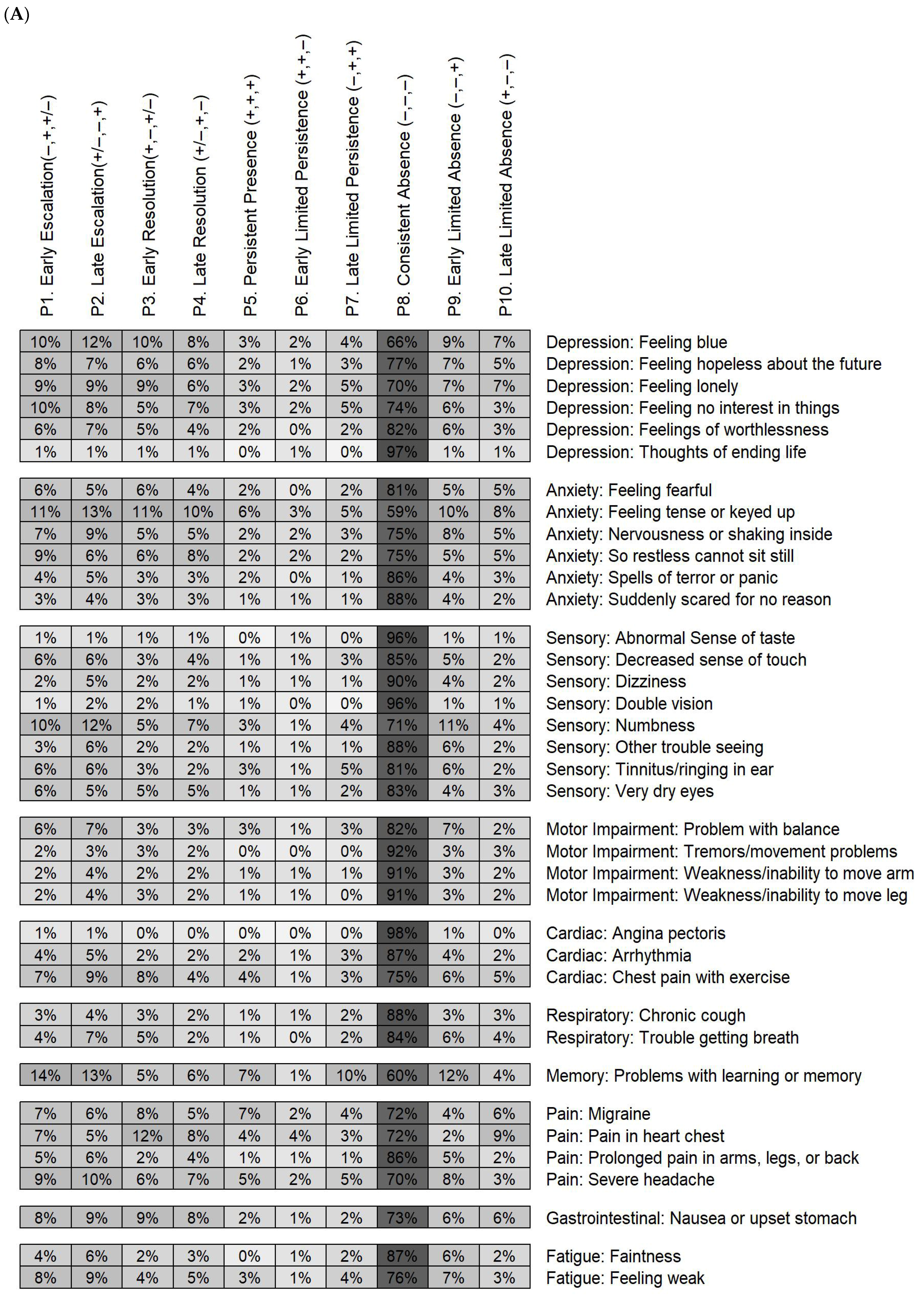
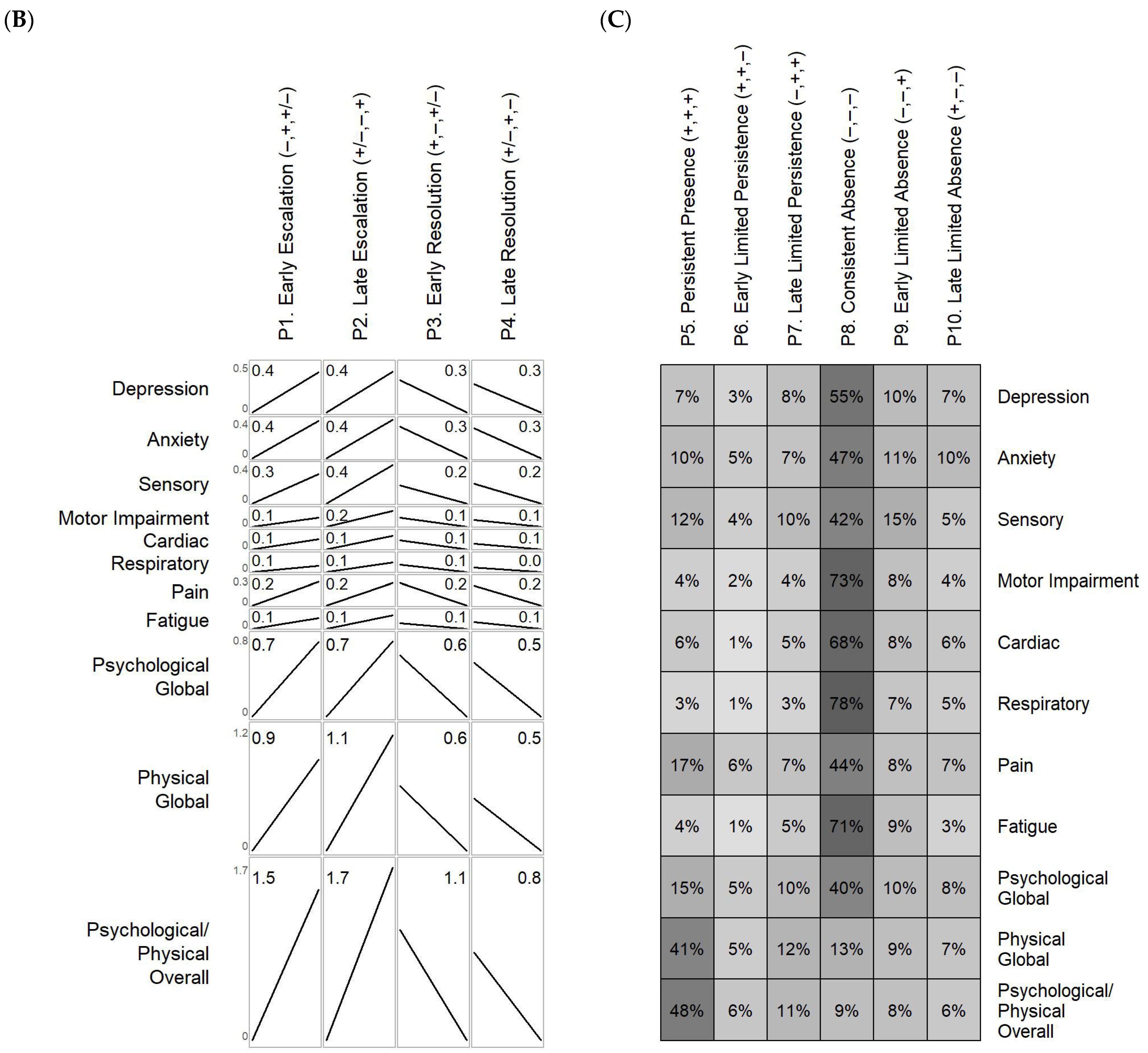
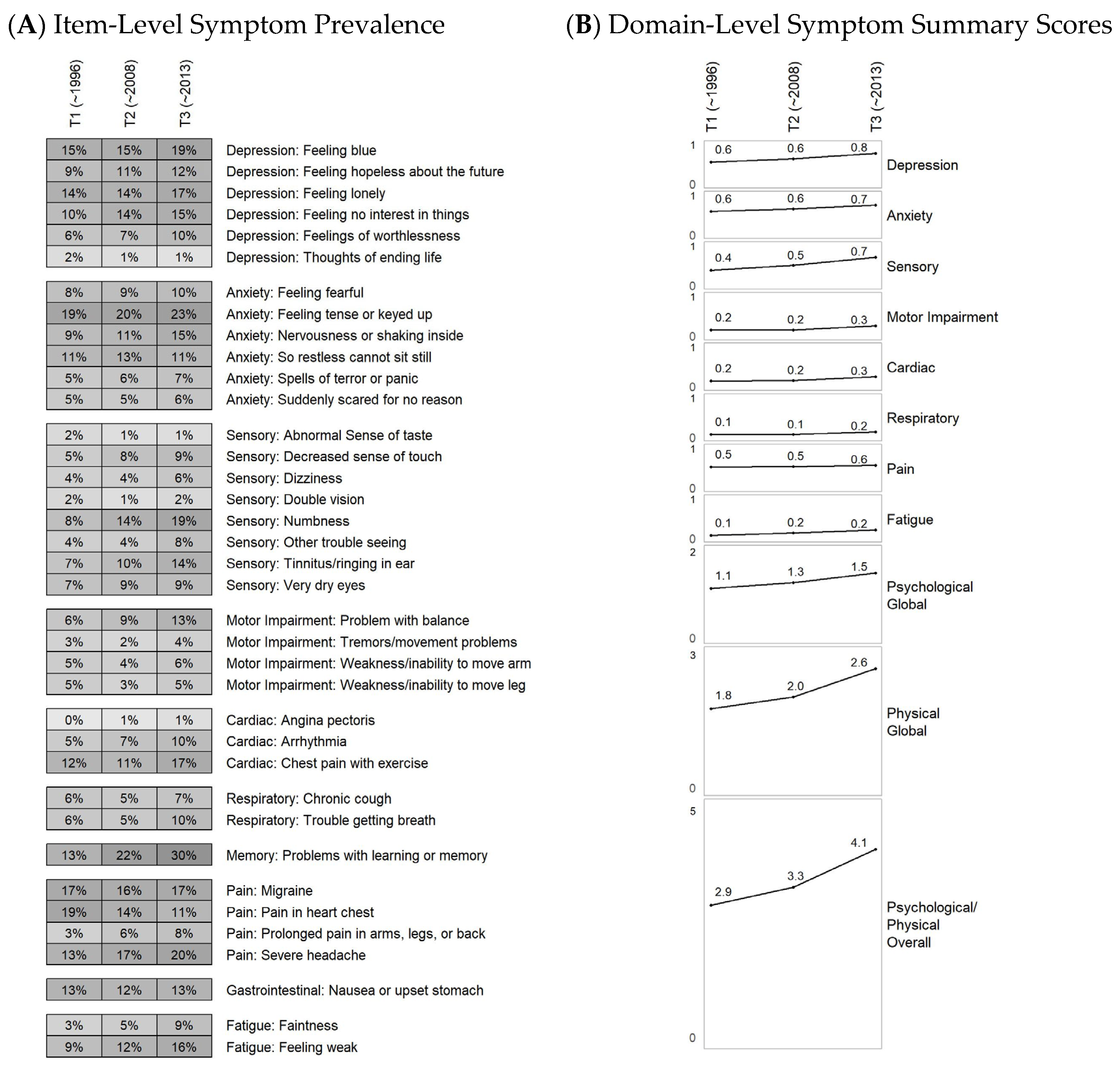
- Cross-sectional symptom summaries: To generate cross-sectional symptom summaries, the 37 symptom items were categorized into individual and global domains using a previously established classification [27]. Symptom items were first arranged into 10 individual domains: depression (thoughts of ending life, feeling lonely, feeling blue, feeling no interest in things, feeling hopeless about the future, and feelings of worthlessness), anxiety (nervousness or shaking inside, suddenly scared for no reason, feeling fearful, feeling tense or keyed up, spells of terror or panic, and so restless cannot sit still), sensory (decreased sense of touch, tinnitus/ringing in ear, dizziness, double vision, other trouble seeing, very dry eyes, abnormal sense of taste, and numbness), motor (problem with balance, tremors/movement problems, weakness/inability to move arm, and weakness/inability to move leg), cardiac (arrhythmia, angina pectoris, and chest pain with exercise), respiratory (chronic cough and trouble getting breath), memory (one symptom item of problems with learning or memory), pain (migraine, pain in heart chest, severe headache, and prolonged pain in arms, legs, or back), gastrointestinal (nausea or upset stomach), and fatigue (faintness and feeling weak). Individual symptom domains were further grouped into two global domains: “psychological domain” (symptom items corresponding to anxiety and depression domains) and “physical domain” (symptom items corresponding to the eight remaining domains). After organizing the symptoms into individual and global domains, cross-sectional symptom summaries were created by counting the number of symptoms present overall and within each individual and global domain. The memory and gastrointestinal domains were excluded from summarization because each contained only one symptom item. This process yielded 11 additional cross-sectional symptom measures, including the overall summary of all 37 symptom items, the global psychological domain of the 12 psychological symptoms, the global physical domain of the 25 physical symptoms, and eight for the eight individual domains containing more than one symptom item. These 11 aggregated symptom measures brought the total number of cross-sectional symptom measures to 48 at each of the three time points (Figure 1 and Supplementary Table S1).
- (B)
- Longitudinal symptom change patterns were engineered from the 48 cross-sectional symptom measures to capture clinically meaningful trajectories that may be associated with future suboptimal HRQoL. This feature engineering approach leverages domain expertise to construct meaningful predictors from observed data. Using this approach, we defined 10 meaningful longitudinal symptom change patterns (P1–P10). These patterns describe changes in symptom presence across the three time points and are not mutually exclusive:
- P1. Early Escalation: absent at T1, present at T2(i.e., a subject did not report the symptom at T1 but did at T2).
- P2. Late Escalation: absent at T2, present at T3(i.e., a subject did not report the symptom at T2 but did at T3).
- P3. Early Resolution: present at T1, absent at T2(i.e., a subject reported the symptom at T1 but not at T2).
- P4. Late Resolution: present at T2, absent at T3(i.e., a subject reported the symptom at T2 but not at T3).
- P5. Persistent Presence: present at T1, T2, and T3(i.e., a subject reported the symptom at T1, T2, and T3).
- P6. Early Limited Persistence: present at T1 and T2, absent at T3(i.e., a subject reported the symptom at T1 and T2 but not at T3).
- P7. Late Limited Persistence: absent at T1, present at T2 and T3(i.e., a subject did not report the symptom at T1 but did at T2 and T3).
- P8. Consistent Absence: absent at T1, T2, and T3(i.e., a subject did not report the symptom at T1, T2, or T3).
- P9. Early Limited Absence: absent at T1 and T2, present at T3(i.e., a subject did not report the symptom at T1 and T2 but did at T3).
- P10. Late Limited Absence: absent at T2 and T3, present at T1(i.e., a subject did not report the symptom at T2 and T3 but did at T1).
2.3.3. Modeling of HRQoL Outcomes Utilizing Non-Symptom Measures and Symptom Change Patterns
- (1)
- Predictor set generation (Elastic Net): Using Elastic Net, a penalized regression approach, this component generates a candidate set of predictors for a given pair of hyperparameter values, which jointly determine the magnitude and the form of regularization applied to control model complexity.
- (2)
- Model estimation (maximum likelihood): Utilizing maximum likelihood estimation, this component estimates the strengths of associations corresponding to each candidate predictor set.
- (3)
- Model scoring (Bayesian Information Criterion): Candidate models are evaluated using the Bayesian Information Criterion, which balances goodness of fit and complexity to produce a ranking score.
- (4)
- Model search (truncated grid search): A truncated grid search is conducted to efficiently identify a targeted set of penalty levels and penalty forms to be explored during predictor set generation.
- (5)
- Model refinement (pruning): The selected model is subsequently refined using backward elimination, iteratively removing predictors that do not contribute significantly to the model.
2.3.4. Post-Selection Inference and Stability Assessment
2.3.5. Prediction Performance Evaluation
2.4. Analytic Software
3. Results
4. Discussion
5. Conclusions
Supplementary Materials
Author Contributions
Funding
Institutional Review Board Statement
Informed Consent Statement
Data Availability Statement
Conflicts of Interest
Abbreviations
| AUC | Area Under the Receiver Operating Characteristic Curve |
| BIEN | Bayesian Information Criterion Elastic Net |
| CCSS | Childhood Cancer Survivor Study |
| CI | Confidence Interval |
| HRQoL | Health-Related Quality of Life |
| IQR | Interquartile Range |
| MCS | Mental Component Summary |
| PCS | Physical Component Summary |
| ROC | Receiver Operating Characteristic |
| SF-36 | 36-Item Short Form Health Survey |
| SJLIFE | St. Jude Lifetime Cohort Study |
References
- Miller, K.D.; Nogueira, L.; Devasia, T.; Mariotto, A.B.; Yabroff, K.R.; Jemal, A.; Kramer, J.; Siegel, R.L. Cancer Treatment and Survivorship Statistics, 2022. CA Cancer J. Clin. 2022, 72, 409–436. [Google Scholar] [CrossRef] [PubMed]
- Siegel, R.L.; Miller, K.D.; Wagle, N.S.; Jemal, A. Cancer Statistics, 2023. CA Cancer J. Clin. 2023, 73, 17–48. [Google Scholar] [CrossRef]
- Howlader, N.; Noone, A.M.; Krapcho, M.; Miller, D.; Brest, A.; Yu, M.; Ruhl, J.; Tatalovich, Z.; Mariotto, A.; Lewis, D.R.; et al. SEER Cancer Statistics Review, 1975–2018; National Cancer Institute: Bethesda, MD, USA, 2021. [Google Scholar]
- Oeffinger, K.C.; Mertens, A.C.; Sklar, C.A.; Kawashima, T.; Hudson, M.M.; Meadows, A.T.; Friedman, D.L.; Marina, N.; Hobbie, W.; Kadan-Lottick, N.S.; et al. Chronic Health Conditions in Adult Survivors of Childhood Cancer. N. Engl. J. Med. 2006, 355, 1572–1582. [Google Scholar] [CrossRef]
- Rosoff, P.M. The two-edged sword of curing childhood cancer. N. Engl. J. Med. 2006, 355, 1522–1523. [Google Scholar] [CrossRef][Green Version]
- Bhatia, S.; Constine, L.S. Late morbidity after successful treatment of children with cancer. Cancer J. 2009, 15, 174–180. [Google Scholar] [CrossRef] [PubMed]
- Wagle, N.S.; Nogueira, L.; Devasia, T.P.; Mariotto, A.B.; Yabroff, K.R.; Islami, F.; Jemal, A.; Alteri, R.; Ganz, P.A.; Siegel, R.L. Cancer treatment and survivorship statistics, 2025. CA Cancer J. Clin. 2025, 75, 308–340. [Google Scholar] [CrossRef]
- Biddell, C.B.; Spees, L.P.; Mayer, D.K.; Wheeler, S.B.; Trogdon, J.G.; Rotter, J.; Birken, S.A. Developing Personalized Survivorship Care Pathways in the United States: Existing Resources and Remaining Challenges. Cancer 2021, 127, 997–1004. [Google Scholar] [CrossRef] [PubMed]
- Nekhlyudov, L.; Ganz, P.A.; Arora, N.K.; Rowland, J.H. Going Beyond Being Lost in Transition: A Decade of Progress in Cancer Survivorship. J. Clin. Oncol. 2017, 35, 1978. [Google Scholar] [CrossRef]
- Tralongo, P.; McCabe, M.S.; Surbone, A. Challenge for Cancer Survivorship: Improving Care through Categorization by Risk. J. Clin. Oncol. 2017, 35, 3516–3517. [Google Scholar] [CrossRef]
- Basch, E.; Deal, A.M.; Kris, M.G.; Scher, H.I.; Hudis, C.A.; Sabbatini, P.; Rogak, L.; Bennett, A.V.; Dueck, A.C.; Atkinson, T.M.; et al. Symptom Monitoring with Patient-Reported Outcomes During Routine Cancer Treatment: A Randomized Controlled Trial. J. Clin. Oncol. 2016, 34, 557–565. [Google Scholar] [CrossRef]
- Basch, E.; Deal, A.M.; Dueck, A.C.; Scher, H.I.; Kris, M.G.; Hudis, C.; Schrag, D. Overall Survival Results of a Trial Assessing Patient-Reported Outcomes for Symptom Monitoring During Routine Cancer Treatment. JAMA 2017, 318, 197–198. [Google Scholar] [CrossRef]
- Denis, F.; Basch, E.; Septans, A.-L.; Bennouna, J.; Urban, T.; Dueck, A.C.; Letellier, C. Two-Year Survival Comparing Web-Based Symptom Monitoring Vs Routine Surveillance Following Treatment for Lung Cancer. JAMA 2019, 321, 306–307. [Google Scholar] [CrossRef] [PubMed]
- Ayanian, J.Z.; Jacobsen, P.B. Enhancing Research on Cancer Survivors. J. Clin. Oncol. 2006, 24, 5149–5153. [Google Scholar] [CrossRef] [PubMed]
- Emery, J.; Butow, P.; Lai-Kwon, J.; Nekhlyudov, L.; Rynderman, M.; Jefford, M. Management of Common Clinical Problems Experienced by Survivors of Cancer. Lancet 2022, 399, 1537–1550. [Google Scholar] [CrossRef] [PubMed]
- Landier, W.; Bhatia, S.; Eshelman, D.A.; Forte, K.J.; Sweeney, T.; Hester, A.L.; Darling, J.; Armstrong, F.D.; Blatt, J.; Constine, L.S.; et al. Development of Risk-Based Guidelines for Pediatric Cancer Survivors: The Children’s Oncology Group Long-Term Follow-up Guidelines from the Children’s Oncology Group Late Effects Committee and Nursing Discipline. J. Clin. Oncol. 2004, 22, 4979–4990. [Google Scholar] [CrossRef]
- Cantrell, M.A. A Narrative Review Summarizing the State of the Evidence on the Health-Related Quality of Life among Childhood Cancer Survivors. J. Pediatr. Oncol. Nurs. 2011, 28, 75–82. [Google Scholar] [CrossRef]
- Deshpande, P.R.; Rajan, S.; Sudeepthi, B.L.; Nazir, C.A. Patient-Reported Outcomes: A New Era in Clinical Research. Perspect. Clin. Res. 2011, 2, 137–144. [Google Scholar] [CrossRef]
- Steyerberg, E.W. Clinical Prediction Models; Springer Science+Business Media: New York, NY, USA, 2009. [Google Scholar]
- Robison, L.L.; Armstrong, G.T.; Boice, J.D.; Chow, E.J.; Davies, S.M.; Donaldson, S.S.; Green, D.M.; Hammond, S.; Meadows, A.T.; Mertens, A.C.; et al. The Childhood Cancer Survivor Study: A National Cancer Institute–Supported Resource for Outcome and Intervention Research. J. Clin. Oncol. 2009, 27, 2308–2318. [Google Scholar] [CrossRef]
- Howell, C.R.; Bjornard, K.L.; Ness, K.K.; Alberts, N.; Armstrong, G.T.; Bhakta, N.; Brinkman, T.; Caron, E.; Chemaitilly, W.; Green, D.M.; et al. Cohort Profile: The St. Jude Lifetime Cohort Study (Sjlife) for Paediatric Cancer Survivors. Int. J. Epidemiol. 2021, 50, 39–49. [Google Scholar] [CrossRef]
- Brazier, J.E.; Harper, R.; Jones, N.; O’Cathain, A.; Thomas, K.J.; Usherwood, T.; Westlake, L. Validating the Sf-36 Health Survey Questionnaire: New Outcome Measure for Primary Care. Br. Med. J. 1992, 305, 160–164. [Google Scholar] [CrossRef]
- Ware, J.E.; Kosinski, M.A.; Keller, S.D. SF-36 Physical and Mental Health Summary Scales: A User’s Manual; Health Inst., New England Med. Center: Boston, MA, USA, 1995; Available online: https://www.researchgate.net/publication/292390260_SF-36_Physical_and_Mental_Health_Summary_Scales_a_User’s_Manual/ (accessed on 30 April 2026).
- Schulte, F.; Chen, Y.; Yasui, Y.; Ruiz, M.E.; Leisenring, W.; Gibson, T.M.; Nathan, P.C.; Oeffinger, K.C.; Hudson, M.M.; Armstrong, G.T.; et al. Development and Validation of Models to Predict Poor Health-Related Quality of Life among Adult Survivors of Childhood Cancer. JAMA Netw. Open 2022, 5, e2227225. [Google Scholar] [CrossRef] [PubMed]
- Badr, H.; Chandra, J.; Paxton, R.J.; Ater, J.L.; Urbauer, D.; Cruz, C.S.; Demark-Wahnefried, W. Health-related quality of life, lifestyle behaviors, and intervention preferences of survivors of childhood cancer. J. Cancer Surviv. 2013, 7, 523–534. [Google Scholar] [CrossRef]
- Kull, C.E.; Vifian, L.; Leuppi, J.D.; Baumgartner, C.; Bösing, M.; Roser, K.; Michel, G.; Rössler, J.; Tinner, E.M.; Wertli, M.M. A prospective cohort study on the trajectory of health-related quality of life in adult childhood cancer survivors attending a follow-up care program. Sci. Rep. 2025, 15, 8332. [Google Scholar] [CrossRef] [PubMed]
- Shin, H.; Dudley, W.N.; Bhakta, N.; Horan, M.R.; Wang, Z.; Bartlett, T.R.; Srivastava, D.; Yasui, Y.; Baker, J.N.; Robison, L.L.; et al. Associations of Symptom Clusters and Health Outcomes in Adult Survivors of Childhood Cancer: A Report from the St Jude Lifetime Cohort Study. J. Clin. Oncol. 2023, 41, 497–507. [Google Scholar] [CrossRef] [PubMed]
- Bagherzadeh Khiabani, F.; Huang, I.; Martinez, J.M.M.; Izumi, S.; Mirzaei, S.; Zheng, T.; Dinu, I.; Yasui, Y. Associational Inference with Many Potential Covariates: Bayesian Information Criterion Elastic Net. In COBRA Preprint Series; Bepress: Berkeley, CA, USA, 2026. [Google Scholar]
- R Core Team. R: A Language and Environment for Statistical Computing; R Foundation for Statistical Computing: Vienna, Austria, 2021; Available online: https://www.R-project.org/ (accessed on 30 April 2026).
- Horan, M.R.; Liu, W.; Wang, M.; Srivastava, D.; Ehrhardt, M.J.; Mulrooney, D.A.; Chemaitilly, W.; Ness, K.K.; Baker, J.N.; Armstrong, G.T.; et al. Patient-Reported Symptoms in Predicting the Subsequent Progression of Chronic Health Conditions among Childhood Cancer Survivors. Commun. Med. 2026. [Google Scholar] [CrossRef]
- Alfano, C.M.; Mayer, D.K.; Bhatia, S.; Maher, J.; Scott, J.M.; Nekhlyudov, L.; Merrill, J.K.; Henderson, T.O. Implementing personalized pathways for cancer follow-up care in the United States: Proceedings from an American Cancer Society-American Society of Clinical Oncology summit. CA Cancer J. Clin. 2019, 69, 234–247. [Google Scholar] [CrossRef]
- Miotto, R.; Li, L.; Kidd, B.A.; Dudley, J.T. Deep Patient: An Unsupervised Representation to Predict the Future of Patients from the Electronic Health Records. Sci. Rep. 2016, 6, 26094. [Google Scholar] [CrossRef]
- Bengio, Y.; Courville, A.; Vincent, P. Representation Learning: A Review and New Perspectives. IEEE Trans. Pattern Anal. Mach. Intell. 2013, 35, 1798–1828. [Google Scholar] [CrossRef]
- Neil, P.; Laura, B.F.; Manolis, K.; Richard, M.; Ellen, A.N.; Marie-Elise, P.; Lorenzo, R. Selection bias and other miscellaneous biases. In Statistical Methods in Cancer Research Volume V: Bias Assessment in Case–Control and Cohort Studies for Hazard Identification; De González, A.B., Richardson, D.B., Schubauer-Berigan, M.K., Eds.; International Agency for Research on Cancer: Lyon, France, 2024; Chapter 5. Available online: https://www.ncbi.nlm.nih.gov/books/NBK612866/ (accessed on 30 April 2026).
- Savitz, D.A. 4 Selection Bias in Cohort Studies. Available online: https://academic.oup.com/book/27778/chapter-abstract/198020009?redirectedFrom=fulltext (accessed on 30 April 2026).




| Predictor | Number (%) or Median (IQR) |
|---|---|
| Demographic data | |
| Age at T1 Symptom Survey [Year] | 26.7 (23.0–30.4) |
| Time between T1 Symptom and HRQoL Surveys [Year] | 18.9 (7.8–20.1) |
| Age at T3 Symptom Survey [Year] | 39.5 (34.8–44.6) |
| Time between T3 Symptom and HRQoL Surveys [Year] | 2.3 (1.5–3.8) |
| Age at Cancer Diagnosis [Year] | 9.3 (4.5–14.1) |
| Sex (Female) | 298 (51.7%) |
| Race (White) | 517 (89.8%) |
| Educational Attainment at T1 Symptom Survey (college graduate or higher) | 193 (33.5%) |
| Cancer Diagnosis | |
| Leukemia | 234 (40.6%) |
| Hodgkin lymphoma | 115 (20.0%) |
| Non-Hodgkin lymphoma | 55 (9.5%) |
| Osteosarcoma | 44 (7.6%) |
| Wilms tumor | 36 (6.2%) |
| Central nervous system tumors | 29 (5.0%) |
| Neuroblastoma | 24 (4.2%) |
| Other malignancy | 39 (6.8%) |
| Cancer Treatment | |
| Chemotherapy Exposure | |
| Plant alkaloid | 448 (77.8%) |
| Alkylating agent | 373 (64.8%) |
| Anthracycline | 342 (59.4%) |
| Corticosteroid | 319 (55.4%) |
| Methotrexate | 307 (53.3%) |
| Intrathecal methotrexate | 255 (44.3%) |
| Cytarabine | 177 (30.7%) |
| High-dose methotrexate | 132 (22.9%) |
| Intrathecal cytarabine | 105 (18.2%) |
| Platinum | 37 (6.4%) |
| Bleomycin | 35 (6.1%) |
| High-dose cytarabine | 20 (3.5%) |
| Radiation Exposure | |
| Brain radiation | 234 (40.6%) |
| Chest radiation | 192 (33.3%) |
| Neck radiation | 187 (32.5%) |
| Abdomen radiation | 161 (28.0%) |
| Pelvis radiation | 140 (24.3%) |
| Surgery | |
| Amputation | 31 (5.4%) |
| Other surgery | 320 (55.6%) |
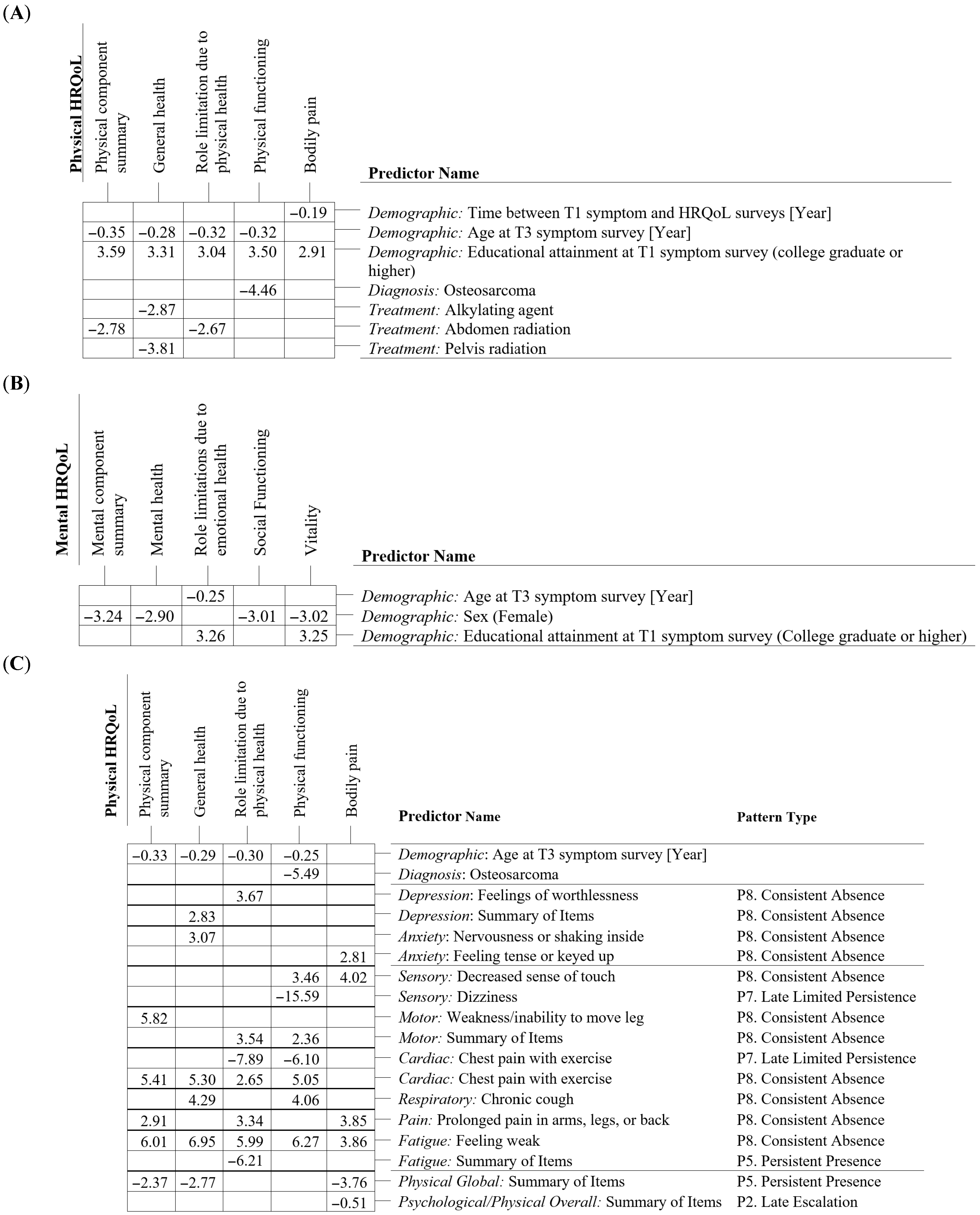
| Physical Component Summary | |||||
|---|---|---|---|---|---|
| A. Non-symptom Model (selecting predictors from the 35 non-symptom predictors) | |||||
| Predictor Name | Estimate * | 95% CI * | Bootstrap Selection % † | ||
| Lower | Upper | ||||
| (Intercept) | 61.09 | ||||
| Demographic: Age at T3 Symptom Survey [Year] | −0.35 | −0.45 | 0.00 | 90% | |
| Demographic: Educational Attainment at T1 Symptom Survey (college graduate or higher) | 3.59 | 0.00 | 5.38 | 83% | |
| Treatment: Abdomen radiation | −2.78 | −4.6 | 0.00 | 31% | |
| B. Symptom Model (selecting predictors from the 35 clinical predictors + 480 symptom change patterns) | |||||
| Predictor Name | Pattern Type | Estimate * | 95% CI * | Bootstrap Selection % † | |
| Lower | Upper | ||||
| (Intercept) | 46.10 | ||||
| Demographic: Age at T3 Symptom Survey [Year] | −0.33 | −0.38 | 0.00 | 90% | |
| Motor: Weakness/inability to move leg | P8. Consistent Absence | 5.82 | 0.00 | 7.50 | 39% |
| Cardiac: Chest pain with exercise | P8. Consistent Absence | 5.41 | 0.00 | 6.84 | 86% |
| Pain: Prolonged pain in arms, legs, or back | P8. Consistent Absence | 2.91 | 0.00 | 4.54 | 42% |
| Fatigue: Feeling weak | P8. Consistent Absence | 6.01 | 0.00 | 8.03 | 86% |
| Physical: Summary of Items | P5. Persistent Presence | −2.37 | −3.58 | 0.00 | 22% |
| Mental Component Summary | |||||
| C. Non-symptom Model (selecting predictors from the 35 non-symptom predictors) | |||||
| Predictor Name | Estimate * | 95% CI * | Bootstrap Selection % † | ||
| Lower | Upper | ||||
| (Intercept) | 50.13 | ||||
| Demographic: Sex (Female) | −3.24 | −5.05 | 0.00 | 82% | |
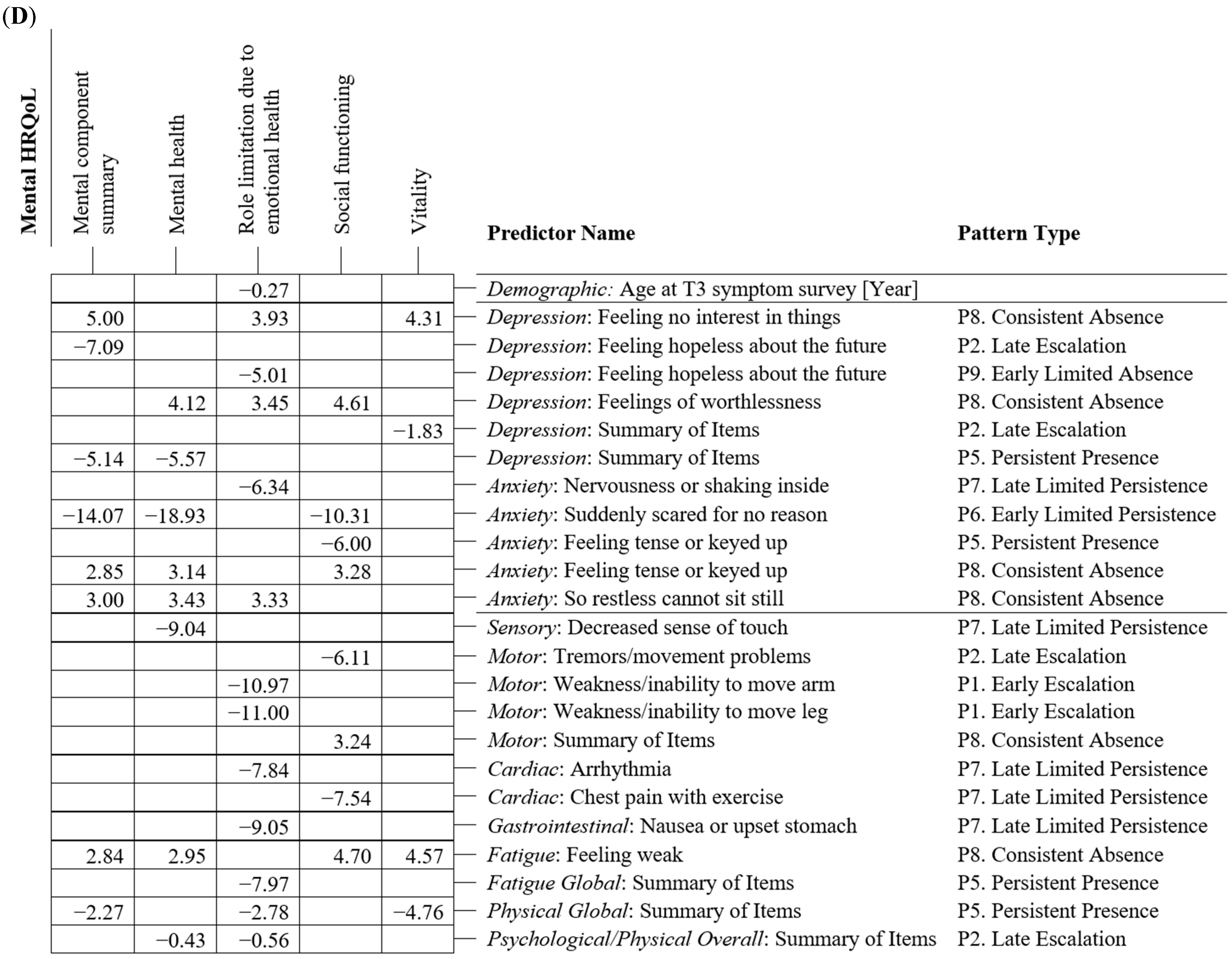
| D. Symptom Model (selecting predictors from the 35 clinical predictors + 480 symptom change patterns) | |||||
| Predictor Name | Pattern Type | Estimate * | 95% CI * | Bootstrap Selection % † | |
| Lower | Upper | ||||
| (Intercept) | 40.65 | ||||
| Depression: Feeling no interest in things | P8. Consistent Absence | 5.00 | 0.00 | 6.26 | 45% |
| Depression: Feeling hopeless about the future | P2. Late Escalation | −7.09 | −8.88 | 0.00 | 23% |
| Depression: Summary of Items * | P5. Persistent Presence | −5.14 | −9.71 | 0.00 | 37% |
| Anxiety: Suddenly scared for no reason | P6. Early Limited Persistence | −14.07 | −22.58 | 0.00 | 56% |
| Anxiety: Feeling tense or keyed up | P8. Consistent Absence | 2.85 | 0.00 | 3.96 | 28% |
| Anxiety: So restless cannot sit still | P8. Consistent Absence | 3.00 | 0.00 | 4.80 | 29% |
| Fatigue: Feeling weak | P8. Consistent Absence | 2.84 | 0.00 | 3.86 | 12% |
| Physical: Summary of Items * | P5. Persistent Presence | −2.27 | −3.07 | 0.00 | 15% |
Disclaimer/Publisher’s Note: The statements, opinions and data contained in all publications are solely those of the individual author(s) and contributor(s) and not of MDPI and/or the editor(s). MDPI and/or the editor(s) disclaim responsibility for any injury to people or property resulting from any ideas, methods, instructions or products referred to in the content. |
© 2026 by the authors. Licensee MDPI, Basel, Switzerland. This article is an open access article distributed under the terms and conditions of the Creative Commons Attribution (CC BY) license.
Share and Cite
Bagherzadeh-Khiabani, F.; Krull, K.R.; Izumi, S.; Mirzaei, S.; Zheng, T.; Martinez, J.M.M.; Ness, K.K.; Armstrong, G.T.; Hudson, M.M.; Robison, L.L.; et al. Longitudinal Patient-Reported Symptom Change Patterns and Prediction of Future Health-Related Quality of Life in Childhood Cancer Survivors: A Machine Learning Approach from the Childhood Cancer Survivor Study and the St. Jude Lifetime Cohort. Cancers 2026, 18, 1546. https://doi.org/10.3390/cancers18101546
Bagherzadeh-Khiabani F, Krull KR, Izumi S, Mirzaei S, Zheng T, Martinez JMM, Ness KK, Armstrong GT, Hudson MM, Robison LL, et al. Longitudinal Patient-Reported Symptom Change Patterns and Prediction of Future Health-Related Quality of Life in Childhood Cancer Survivors: A Machine Learning Approach from the Childhood Cancer Survivor Study and the St. Jude Lifetime Cohort. Cancers. 2026; 18(10):1546. https://doi.org/10.3390/cancers18101546
Chicago/Turabian StyleBagherzadeh-Khiabani, Farideh, Kevin R. Krull, Shizue Izumi, Sedigheh Mirzaei, Tiange Zheng, Jose Miguel Martinez Martinez, Kirsten K. Ness, Gregory T. Armstrong, Melissa M. Hudson, Leslie L. Robison, and et al. 2026. "Longitudinal Patient-Reported Symptom Change Patterns and Prediction of Future Health-Related Quality of Life in Childhood Cancer Survivors: A Machine Learning Approach from the Childhood Cancer Survivor Study and the St. Jude Lifetime Cohort" Cancers 18, no. 10: 1546. https://doi.org/10.3390/cancers18101546
APA StyleBagherzadeh-Khiabani, F., Krull, K. R., Izumi, S., Mirzaei, S., Zheng, T., Martinez, J. M. M., Ness, K. K., Armstrong, G. T., Hudson, M. M., Robison, L. L., Yasui, Y., & Huang, I.-C. (2026). Longitudinal Patient-Reported Symptom Change Patterns and Prediction of Future Health-Related Quality of Life in Childhood Cancer Survivors: A Machine Learning Approach from the Childhood Cancer Survivor Study and the St. Jude Lifetime Cohort. Cancers, 18(10), 1546. https://doi.org/10.3390/cancers18101546