




Cancers, Volume 17, Issue 21 (November-1 2025) – 199 articles
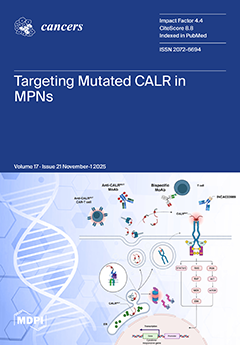
Cover Story (view full-size image):
Over a decade after its discovery, key advances have clarified the oncogenic role of mutant CALR in BCR::ABL1-negative myeloproliferative neoplasms (MPNs). CALR-mutant disease shows distinct biology, opening opportunities for targeted therapies. Among emerging strategies, immunotherapy is most advanced, with monoclonal antibodies against the CALR neoepitope (e.g., INCA033989) yielding promising hematologic and molecular responses. Other approaches include bispecific antibodies, antibody–drug conjugates, vaccines, and CAR T cells. Preclinical data support bispecific and CAR T-cell efficacy, while vaccination remains limited. Major challenges include monitoring clonal burden, overcoming immune escape, and redefining treatment goals beyond thrombotic risk reduction. View this paper
- Issues are regarded as officially published after their release is announced to the table of contents alert mailing list.
- You may sign up for e-mail alerts to receive table of contents of newly released issues.
- PDF is the official format for papers published in both, html and pdf forms. To view the papers in pdf format, click on the "PDF Full-text" link, and use the free Adobe Reader to open them.
Previous Issue
Next Issue
