One-Finger Gripper for Microobjects to Submillimeter-Sized Objects Based on Temperatures of Dew and Freezing Points


Abstract
1. Introduction
- Pick-up (grip) individual micro- or nanoparticles;
- Move particles in a 3D space;
- Position them with nanometer precision;
- Release them actively in a dedicated place so that they can bond, fuse, or assemble with other particles.
- Interaction with three forces: The proposed one-finger gripper is a single piece of equipment that can interact with three forces, i.e., vdW, capillary force, and coupling force due to ice, apart from the gravitational force.
- Greater versatility in terms of the shape and size of objects and, consequently, better reliability of gripping and releasing procedures due to interactions with the three forces (instead of the two forces listed in Table 1, which have even been tested separately for submillimeter-sized objects, 100–1000 µ, and microobjects, 1–100 µ).
- Insensibility of the shape and surface variability of the microobjects that are being gripped or released in dimensions from 5 µ to 300 µ, due to the ability of gripping objects by coupling force due to ice (again, the methods described in Table 1 were tested for spherical objects only).

| Refs. | Type | Medium | Gripping Force | Releasing Force | Object Dimensions |
|---|---|---|---|---|---|
| [8] | Multi-finger | Air/vacuum/water | Mechanical coupling | Gravity | 100–1000 µm * |
| [5,6,7] | Two-finger | Air/vacuum/water | Mechanical coupling | Gravity | 100–1000 µm * |
| [9,10,11,12] | One-finger | Air | Capillary | Gravity | 100–1000 µm * |
| [15] | One-finger | Air | Capillary | Capillary | |
| [16] | One-finger | Air | Capillary | Inertial | 20–100 µm |
| [17] | One-finger | Air | Capillary | Capillary | 100–1000 µm * |
| [18,20] | One-finger | Water | Ice coupling ** | Gravity | 100–1000 µm * |
| [18] | One-finger | Water | Ice coupling ** | Van der Waals | 10–100 µm * |
| [21,22] | One-finger | Air | Ice coupling ** | Gravity | 100–1000 µm * |
2. Materials and Methods
2.1. Materials
2.2. Laboratory Set-Up
Relative Humidity Control in the Chamber
3. Theoretical Background of Acting Forces
3.1. Capillary Force
3.2. Van Der Waals Force
3.3. Coupling Force Due to Ice
3.4. Theoretical Forces and Force Ratios Calculated
3.5. Methods
3.5.1. Pull-Off Force Measurement Method for Microobjects
3.5.2. Movement of Microobjects with a One-Finger Microgripper
- (a)
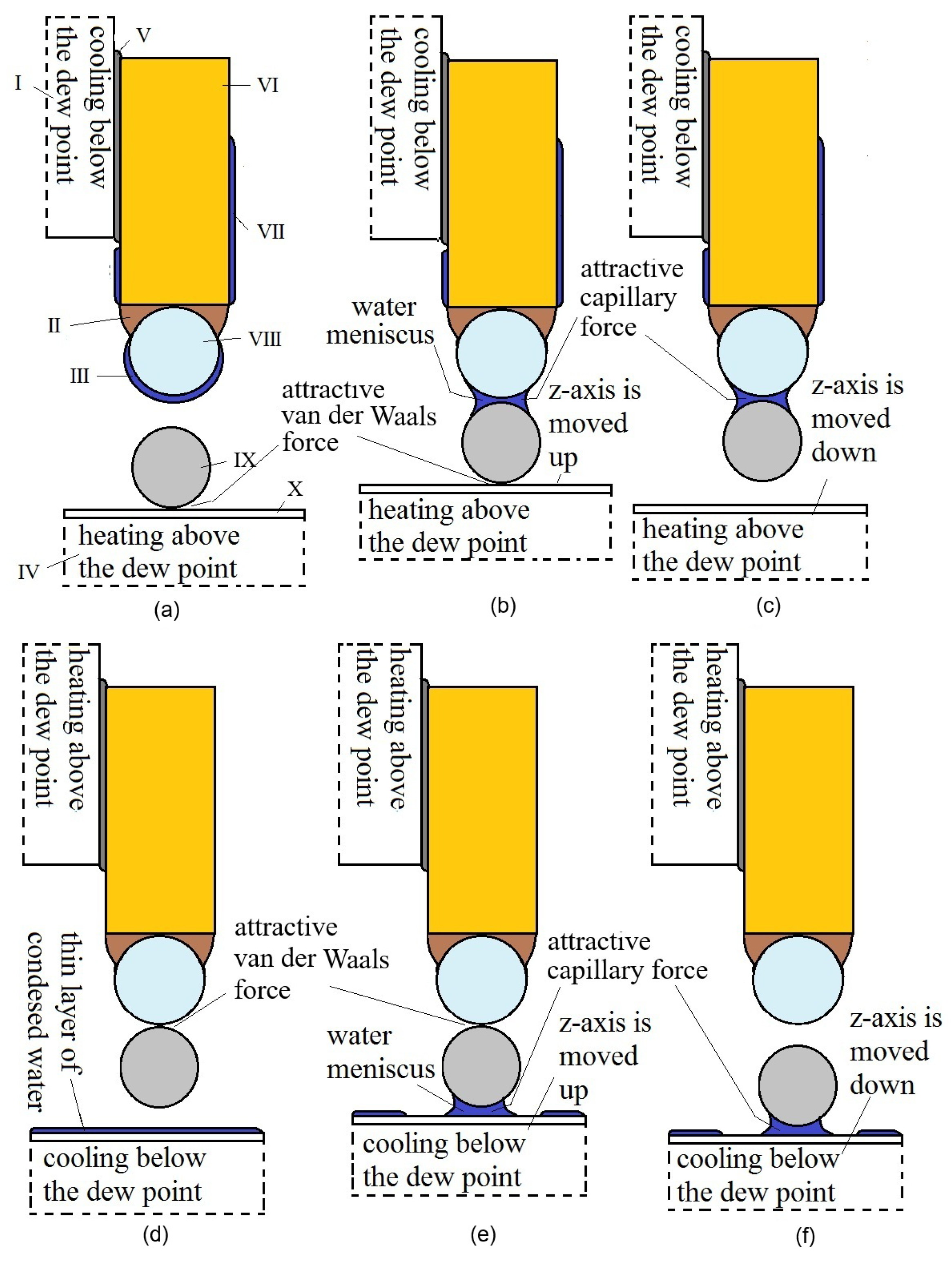
- Capillary–van der Waals forces: procedure for microobjects
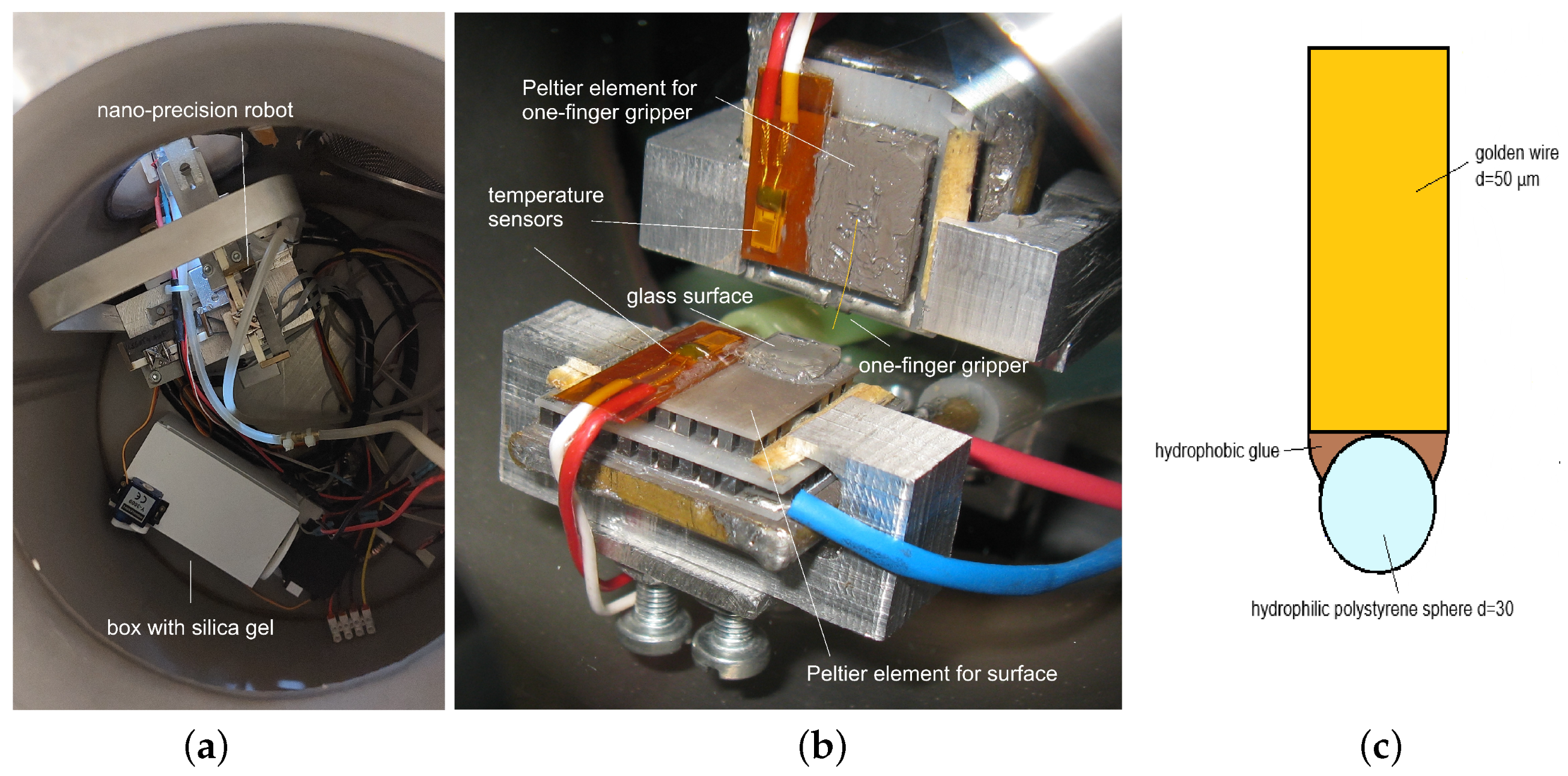
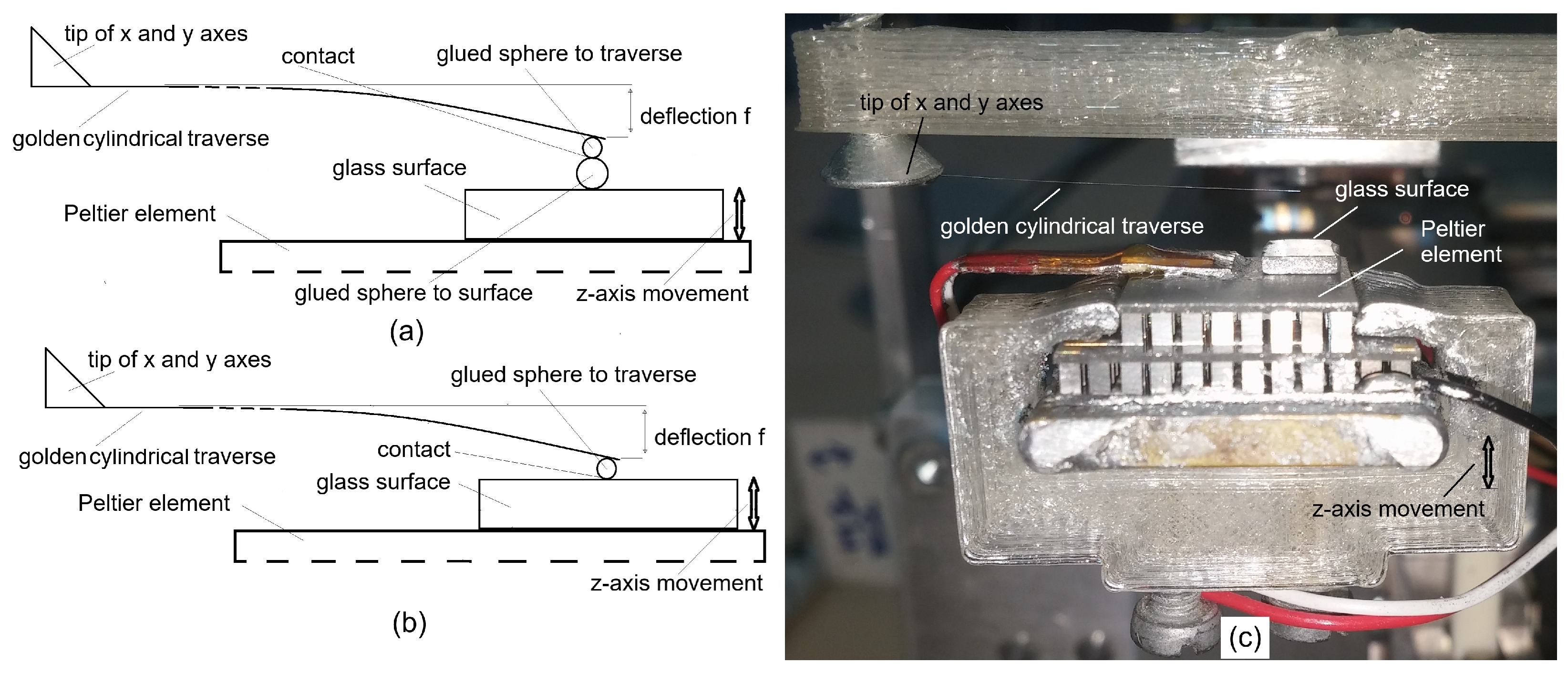
- The temperature of the one-finger gripper is decreased below that of the dew point by about 1 to 2 °C. The thin layer of water is condensed on the tip of the one-finger gripper. We could not measure the depth of the condensed water because it was seen on the top of the one-finger gripper only through reflections off the tip (at low intensities) due to condensed dew. At the same time, the object positioned on the surface plane has to be heated above the temperature of the dew point by 1 to 2 °C, so the parasitic capillary force disappears due to the evaporation of dew between the object and surface, if it exists. The thin layer of water that condensed in the golden trunk of the one-finger gripper cannot move through the hydrophobic epoxy adhesive due to its hydrophobic property (see Figure 6a).
- The z-axis with the microobject moves up and makes slight contact with the tip of the one-finger gripper. The thin layer of water on the tip produces a water meniscus between the microobject and the tip (see Figure 6b).
- The attractive capillary force between the microobject and the tip of a one-finger gripper is greater than the vdW between the microobject and surface plane, so when the z-axis is moved down, the microobject remains in contact with the tip of the one-finger gripper (see Figure 6c).
- The release procedure starts with increasing the temperature of the tip of the one-finger gripper above the dew point temperature by 1 to 2 °C, so all condensed water between the tip and microobject evaporates, and the parasitic capillary force is consequently eliminated. Only an attractive vdW exists between the microobject and tip. At the same time, the surface plane temperature is decreased below the dew point temperature, and a thin layer of water condenses on the surface (see Figure 6d).
- The z-axis is moved up. The condensed layer of water produces a meniscus between the microobject and surface, and consequently, the capillary force is created between them (see Figure 6e).
- The z-axis is moved down, and because the capillary force between the microobject and surface is greater than the vdW between the microobject and tip, the microobject attaches to the surface.
- (b)
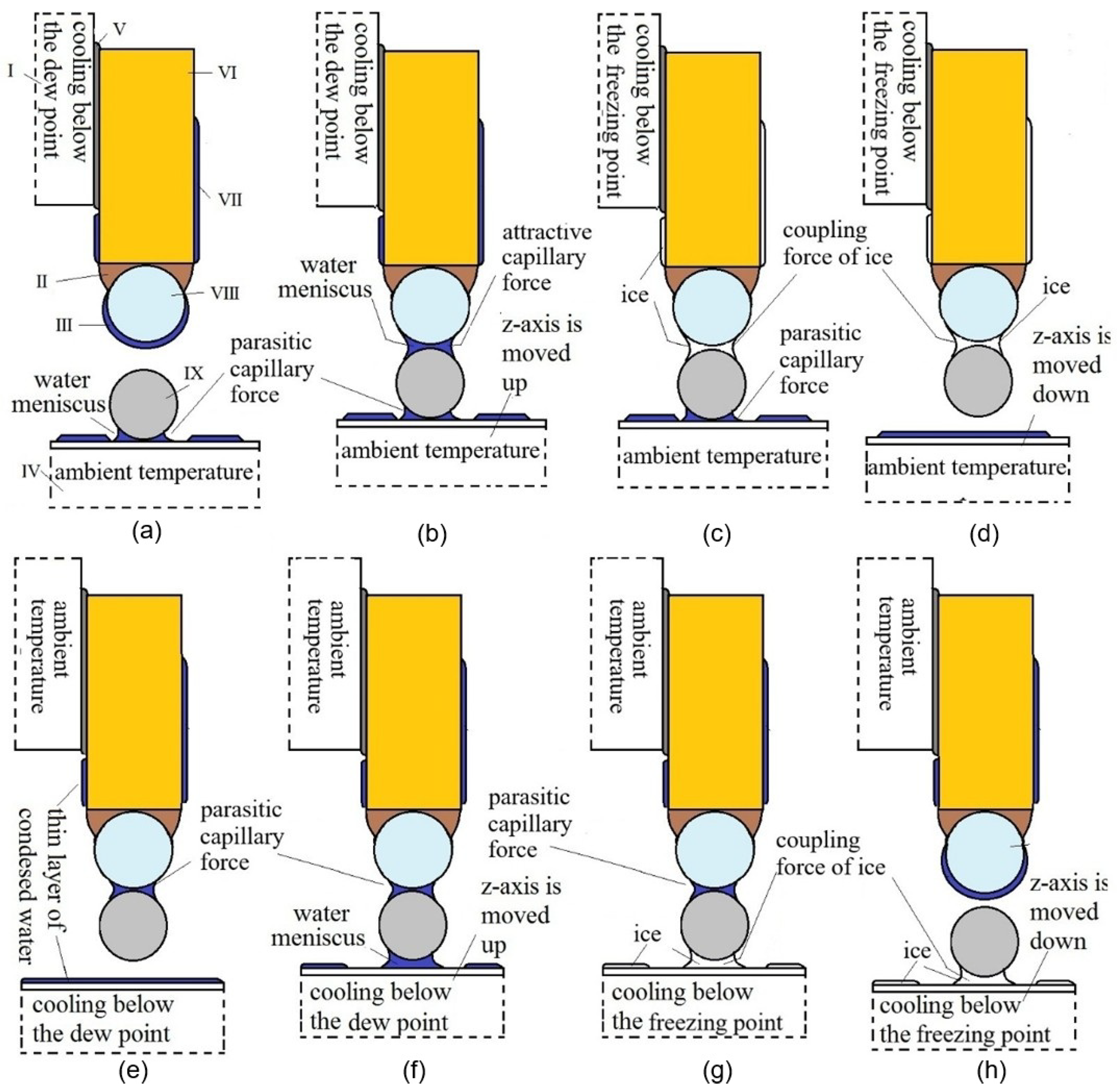
- Coupling force due to ice–capillary force: procedure for microobjects
- Despite the ambient temperature being below the dew point, we must set the temperature of the tip of the one-finger gripper above the dew point temperature, so an unknown quantity of water on the tip of the one-finger gripper evaporates. Later, we must decrease the temperature of the tip of the one-finger gripper below the dew point temperature by 1 to 2 °C for 1 s, so only a thin layer of water condenses on the tip of the one-finger gripper. Between the microobject and plane surface, there is a thin layer of water, so an attractive parasite capillary force exists between them (see Figure 7a).
- The z-axis is moved up, and a water meniscus is created between the tip of the one-finger gripper and the microobject. The attractive capillary force crated between the microobject and tip is usually not enough to overcome the parasitic capillary force between the microobject and surface (see Figure 7b).
- The temperature of the tip is cooled below the freezing point of water by 1 to 2 °C for another second, so the water meniscus between the microobject and tip is frozen, and consequently, the coupling force of ice is created between the microobject and the tip of the one-finger gripper (see Figure 7c).
- The coupling force due to ice between the microobject and tip is greater than the capillary force; thus, when the z-axis is moved down, the microobject remains attached to the tip of the one-finger gripper (see Figure 7d).
- The release part of the procedure starts with the heating of the plane surface above the dew point temperature to evaporate an unknown amount of water on the surface. The surface is then cooled below the temperature of the dew point by 1 to 2 °C for 1 s, so that the thin layer of water condenses on the surface of the plane. At the same time, the ambient temperature produces a water meniscus between the microobject and the tip of the one-finger gripper and, consequently, the parasitic capillary force between them (see Figure 7e).
- The z-axis is moved up, and another meniscus is created between the surface of the plane and the microobject. The capillary force between the plane’s surface and microobject is usually not enough to attach the object to the tip of a one-finger gripper (see Figure 7f).
- The surface plane is cooled below the freezing temperature of the water by 1 to 2 °C, so the meniscus of water between the microobject and the surface of the plane is frozen. This ice produces the coupling force due to ice between the microobject and plane surface, which is greater than the parasitic capillary force between the tip of the one-finger gripper and the microobject (see Figure 7g).
- The z-axis is moved down with the attached microobject (see Figure 7h).

4. Results
- The use of three different forces (vdW, capillary force, coupling force due to ice) with a single one-finger gripper;
- Reliable and fast gripping and release of microobjects and submillimeter-sized objects,
- Universal application to microobjects and submillimeter-sized spheres, as well as objects of irregular geometry.
4.1. Pull-Off Force Measurements
4.2. Experiments with the One-Finger Gripper
4.2.1. Experiments on Spherical Microobject Manipulation with the One-Finger Gripper
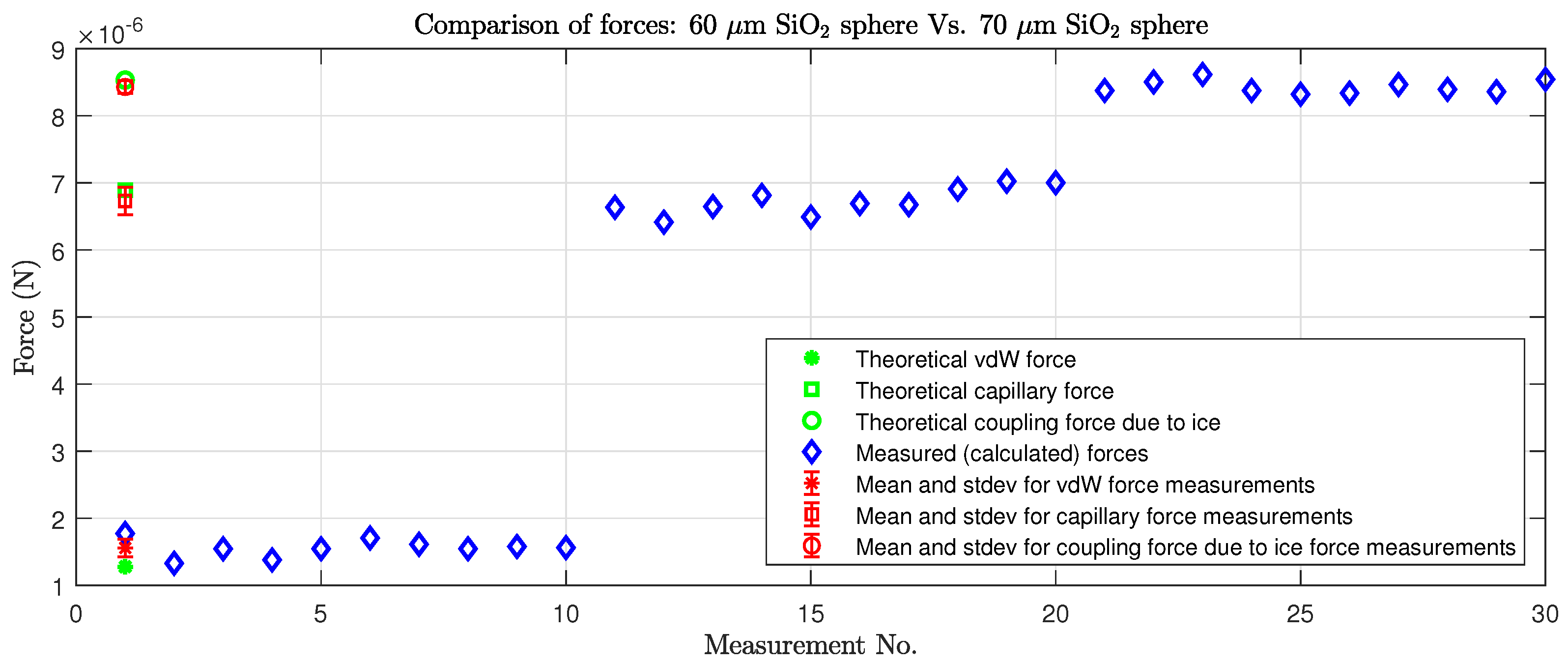
- Experiments with vdW and coupling force due to ice: All three experiments use the coupling force due to ice as a gripping force between the tip of the one-finger gripper and spherical object (contact temperature of −5 to −25 °C), and the vdW as the opposite force between the object and surface (contact temperature of 10 to 20 °C) during gripping. Releasing is performed with the coupling force due to ice between the surface and object (contact temperature of −5 to − 25°C) and vdW between the object and the tip of the one-finger gripper (contact temperature of 10 to 20 °C). Video S3 presents the movement of a spherical object with diameter d = 25 µm, Video S4 presents the movement of the spherical object with diameter d = 60 µm, and Video S5 presents the movement of the spherical object with diameter d = 100 µm.
- Experiments with a capillary force and coupling force due to ice: The experiment uses the coupling force due to ice as a gripping force between the tip of the one-finger gripper and the spherical object (contact temperature of −25 °C) and the capillary force as the opposite force between the object and surface (contact temperature of 5 °C) during gripping. Releasing is performed with the coupling force due to ice between the surface and object (contact temperature of −9 °C) and the capillary force between the object and the tip of the one-finger gripper (contact temperature of 5 °C). Video S6 presents the movement of the spherical object with a diameter greater than d = 60 µm.
- Experiments with capillary force and vdW: The experiment uses the movement resulting from the capillary force between the tip of the one-finger gripper and the spherical object (contact temperature of 5 °C), where vdW is the opposite force between the object and surface (contact temperature of 15 °C) during gripping. Releasing is performed with the capillary force between the surface and object (contact temperature of 5 °C), and the vdW between the object and the tip of the one-finger gripper (contact temperature of 5 °C). Video S7 presents the movement of the spherical object with the diameter described above d = 25 µm.
- Experiments with combinations of forces: Video S8 shows the experiment in which gripping is performed with the coupling force due to ice between the tip of the one-finger gripper and the capillary force between the object with diameter d = 60 µm and the gripper, while the release is performed with the coupling force due to ice between the surface and object and the vdW between the object and finger. Video S9 shows the experiment in which gripping is performed with coupling force due to ice between the tip of the one-finger gripper and the vdW between the object with diameter d = 50 µm and the gripper, while the release is performed with coupling force due to ice between the surface and object and capillary force between the object and finger.
- Experiment with the smallest object: Video S10 shows the movement of the smallest spherical object with diameter d = 5 µm.
4.2.2. Manipulation Experiments on Microobjects and Submillimeter-Sized Objects with Irregular Geometry Using the One-Finger Gripper
5. Discussion
5.1. Experiments on Pull-Off Force Measurements
5.2. Gripping and Release of Spherical and Irregular Geometry Objects
Supplementary Materials
Author Contributions
Funding
Institutional Review Board Statement
Informed Consent Statement
Data Availability Statement
Conflicts of Interest
Abbreviations
| RH | Relative humidity (given in per cent) |
| vdW | van der Waals force |
| cap | capillary force |
| ice | coupling force due to ice |
References
- Ashkin, A. Acceleration and Trapping of Particles by Radiation Pressure. Phys. Rev. Lett. 1970, 24, 156–159. [Google Scholar] [CrossRef]
- Ashkin, A.; Dziedzic, J.M.; Bjorkholm, J.E.; Chu, S. Observation of a single-beam gradient force optical trap for dielectric particles. Opt. Lett. 1986, 11, 288. [Google Scholar] [CrossRef] [PubMed]
- Zhang, Y.; Tang, X.; Zhang, Y.; Liu, Z.; Yang, X.; Zhang, J.; Yang, J.; Yuan, L. Optical attraction of strongly absorbing particles in liquids. Opt. Express 2019, 27, 12414. [Google Scholar] [CrossRef] [PubMed]
- Zhu, Q.; Li, N.; Su, H.; Li, W.; Hu, H. Dynamic Analysis and Simulation of an Optically Levitated Rotating Ellipsoid Rotor in Liquid Medium. Photonic Sens. 2022, 12, 105–116. [Google Scholar] [CrossRef]
- Zang, H.; Zhang, X. Design of a Microforce Sensing Gripper for Micro/Nano Manipulation Based on Optical Fiber Sensing. In Proceedings of the 2023 International Conference on Manipulation, Automation and Robotics at Small Scales (MARSS); IEEE: Piscataway, NJ, USA, 2023; Volume 10, pp. 1–5. [Google Scholar] [CrossRef]
- Mehrabi, H.; Hamedi, M.; Aminzahed, I. A novel design and fabrication of a micro-gripper for manipulation of micro-scale parts actuated by a bending piezoelectric. Microsyst. Technol. 2020, 26, 1563–1571. [Google Scholar] [CrossRef]
- Fontana, G.; Iacono, N.; Negri, S.P.; Papadia, G. Design of a Multi-Mode Hybrid Micro-Gripper for Surface Mount Technology Component Assembly. Micromachines 2023, 14, 1464. [Google Scholar] [CrossRef]
- Yang, H.; Lu, Y.; Ding, Y.; Zhang, Z.; Ren, A.; Wang, H.; Wang, X.; Li, J.; Zhang, S.; Xie, H. A microgripper based on electrothermal Al–SiO2 bimorphs. Microsyst. Nanoeng. 2024, 10, 195. [Google Scholar] [CrossRef] [PubMed]
- Kim, S.J.; Kim, T.; Ryu, H.J.; Jeong, J.; Hart, A.J.; Kim, S. Nanoporous Capillary Gripper for Ultragentle Micro-Object Manipulation. Adv. Sci. 2025, 12, e08338. [Google Scholar] [CrossRef]
- Fukuchi, E.; Sako, R.; Watanabe, N.; Kusui, E.; Fuchiwaki, O. Capillary Force Gripper with a Polygonal Nozzle for Pick & Place and Rotation of 1 mm Objects. In Proceedings of the Asian Society for Precision Engineering and Nanotechnology (ASPEN 2022); Research Publishing Services: Singapore, 2022; pp. 429–432. [Google Scholar] [CrossRef]
- Tanaka, K.; Ito, T.; Nishiyama, Y.; Fukuchi, E.; Fuchiwaki, O. Double-Nozzle Capillary Force Gripper for Cubical, Triangular Prismatic, and Helical 1-mm-Sized-Objects. IEEE Robot. Autom. Lett. 2022, 7, 1324–1331. [Google Scholar] [CrossRef]
- Iazzolino, A.; Tourtit, Y.; Chafaï, A.; Gilet, T.; Lambert, P.; Tadrist, L. Pick up and release of micro-objects: A motion-free method to change the conformity of a capillary contact. Soft Matter 2020, 16, 754–763. [Google Scholar] [CrossRef]
- Zhang, Q.; Ma, C.; Wang, H.; Aoyama, H. A release method of micro-objects based on the liquid bridge configuration. J. Micromech. Microeng. 2019, 29, 045006. [Google Scholar] [CrossRef]
- Lambert, P. Capillary Forces in Microassembly; Springer: New York, NY, USA, 2007. [Google Scholar] [CrossRef]
- Hagiwara, W.; Ito, T.; Tanaka, K.; Tokui, R.; Fuchiwaki, O. Capillary Force Gripper for Complex-Shaped Micro-Objects with Fast Droplet Forming by On–Off Control of a Piston Slider. IEEE Robot. Autom. Lett. 2019, 4, 3695–3702. [Google Scholar] [CrossRef]
- Fan, Z.; Rong, W.; Wang, L.; Sun, L. A single-probe capillary microgripper induced by dropwise condensation and inertial release. J. Micromech. Microeng. 2015, 25, 115011. [Google Scholar] [CrossRef]
- Uran, S.; Šafarič, R.; Bratina, B. Reliable and Accurate Release of Micro-Sized Objects with a Gripper that Uses the Capillary-Force Method. Micromachines 2017, 8, 182. [Google Scholar] [CrossRef]
- López-Walle, B.; Gauthier, M.; Chaillet, N. Dynamic modelling for a submerged freeze microgripper using thermal networks. J. Micromech. Microeng. 2010, 20, 025001. [Google Scholar] [CrossRef]
- Walle, B.; Gauthier, M.; Chaillet, N. Submerged Freeze Gripper to Manipulate Micro-objects. In Proceedings of the 2006 IEEE/RSJ International Conference on Intelligent Robots and Systems; IEEE: Piscataway, NJ, USA, 2006; Volume 10, pp. 784–789. [Google Scholar] [CrossRef]
- Liu, J.; Zhou, Y.X.; Yu, T.H. Freeze tweezer to manipulate mini/micro objects. J. Micromech. Microeng. 2004, 14, 269–276. [Google Scholar] [CrossRef]
- Yang, Y.; Liu, J.; Zhou, Y.X. A convective cooling enabled freeze tweezer for manipulating micro-scale objects. J. Micromech. Microeng. 2008, 18, 095008. [Google Scholar] [CrossRef]
- Ru, C.; Wan, X.; Ye, X.; Guo, S. A new ice gripper based on thermoelectric effect for manipulating micro objects. In Proceedings of the 2007 7th IEEE Conference on Nanotechnology (IEEE NANO); IEEE: Piscataway, NJ, USA, 2007; Volume 8, pp. 438–441. [Google Scholar] [CrossRef]
- Lukman, D.; Šafarič, R. Variable contact surface gripping technique for microsized objects. Micro Nano Lett. 2013, 8, 207–210. [Google Scholar] [CrossRef]
- Šafarič, R.; Lukman, D. One-finger gripper based on the variable van der Waals force used for a single nano/micro-sized object. J. Micromech. Microeng. 2014, 24, 085012. [Google Scholar] [CrossRef]
- Sears, F.W.; Zemansky, M.W. University Physics, 3rd ed.; Addison-Wesley: Reading, MA, USA, 1963; pp. 398–401. [Google Scholar]
- Bratina, B.; Safaric, J.; Uran, S.; Safaric, R. Determination of nano-roughness for micro-objects by measuring the van der Waals force. Adv. Prod. Eng. Manag. 2019, 14, 15–26. [Google Scholar] [CrossRef]
- Škorc, G.; Šafarič, R. Adaptive Positioning Of Mems Production System with Nano—Resolution. Intell. Autom. Soft Comput. 2012, 18, 381–398. [Google Scholar] [CrossRef]
- Lambert, P.; Chau, A.; Delchambre, A.; Régnier, S. Comparison between Two Capillary Forces Models. Langmuir 2008, 24, 3157–3163. [Google Scholar] [CrossRef]
- Rabinovich, Y.I.; Esayanur, M.S.; Moudgil, B.M. Capillary Forces between Two Spheres with a Fixed Volume Liquid Bridge: Theory and Experiment. Langmuir 2005, 21, 10992–10997. [Google Scholar] [CrossRef]
- Neeson, M.J.; Dagastine, R.R.; Chan, D.Y.C.; Tabor, R.F. Evaporation of a capillary bridge between a particle and a surface. Soft Matter 2014, 10, 8489–8499. [Google Scholar] [CrossRef]
- Israelachvili, J.N. Intermolecular and Surface Forces; Academic Press: Cambridge, MA, USA, 2011; p. 674. [Google Scholar]
- Saito, S.; Motokado, T.; Obata, K.J.; Takahashi, K. Capillary force with a concave probe-tip for micromanipulation. Appl. Phys. Lett. 2005, 87, 234103. [Google Scholar] [CrossRef]


| Sphere 1: d = 60 µm | Sphere 2 Diameter | |||
|---|---|---|---|---|
| = 5 µm | = 25 µm | = 60 µm | = 100 µm | |
| van der Waals force [µN] | ||||
| Capillary force [µN] | ||||
| Coupling force due to ice [µN] | ||||
| Ratio (capillary/v.d. Waals) | 10.74 | 8.37 | 7.12 | 6.56 |
| Ratio (ice/capillary) | 20.47 | 2.90 | 1.37 | 1.01 |
| Plane | Sphere Diameter | |||
|---|---|---|---|---|
| = 5 µm | = 25 µm | = 60 µm | = 100 µm | |
| van der Waals force [µN] | ||||
| Capillary force [µN] | ||||
| Coupling force due to ice [µN] | ||||
| Ratio (capillary/v.d. Waals) | 9.32 | 8.10 | 6.98 | 6.15 |
| Ratio (ice/capillary) | 4.01 | 1.83 | 1.22 | 0.97 |
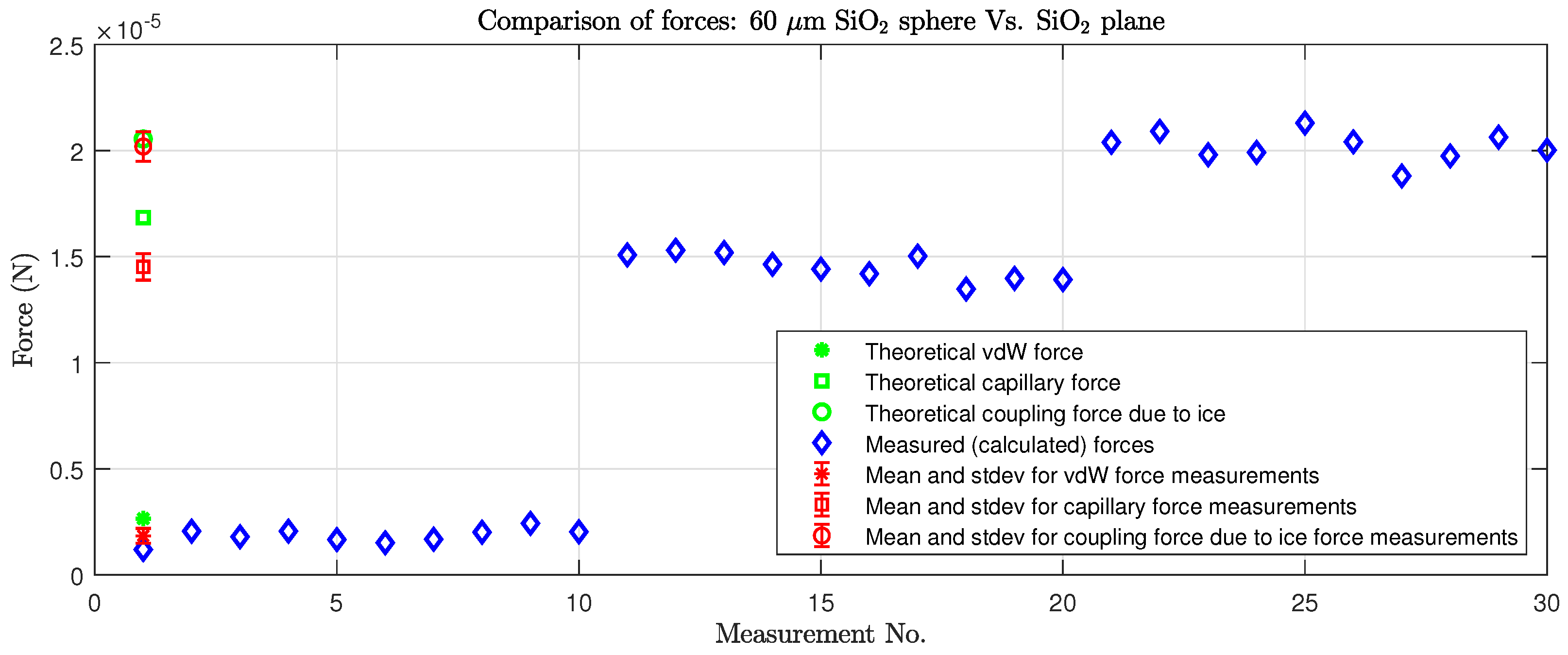
| Meas. No. | sp-sp Forces in µN | sp-pl Forces in µN | ||||
|---|---|---|---|---|---|---|
| vdW | Capillary | Ice * | vdW | Capillary | Ice * | |
| 1 | 1.774 | 6.636 | 8.377 | 1.198 | 15.080 | 20.390 |
| 2 | 1.331 | 6.415 | 8.505 | 2.062 | 15.300 | 20.910 |
| 3 | 1.547 | 6.647 | 8.616 | 1.796 | 15.190 | 19.800 |
| 4 | 1.381 | 6.814 | 8.377 | 2.062 | 14.640 | 19.910 |
| 5 | 1.547 | 6.492 | 8.322 | 1.663 | 14.410 | 21.300 |
| 6 | 1.708 | 6.692 | 8.338 | 1.514 | 14.190 | 20.410 |
| 7 | 1.613 | 6.675 | 8.466 | 1.680 | 15.020 | 18.800 |
| 8 | 1.547 | 6.908 | 8.394 | 2.013 | 13.470 | 19.740 |
| 9 | 1.580 | 7.024 | 8.361 | 2.428 | 13.970 | 20.630 |
| 10 | 1.563 | 7.002 | 8.544 | 2.029 | 13.920 | 20.020 |
| mean | 1.559 | 6.731 | 8.430 | 1.845 | 14.520 | 20.190 |
| median | 1.555 | 6.684 | 8.386 | 1.904 | 14.526 | 20.203 |
| stdev | 0.132 | 0.204 | 0.098 | 0.348 | 0.626 | 0.700 |
| Min. | Typ. | Max. | Note | |
|---|---|---|---|---|
| object size for cap * [µm] | 5 | 60 | 100 | small and medium spherical objects |
| object size for vdW [µm] | 5 | 60 | 100 | small and medium spherical objects |
| object size for ice ** [µm] | 5 | 60 | 300 | all objects, incl. objects of irregular shape |
| SR *** cap-vdW [%] | 90 | |||
| SR *** ice-cap [%] | 85 | |||
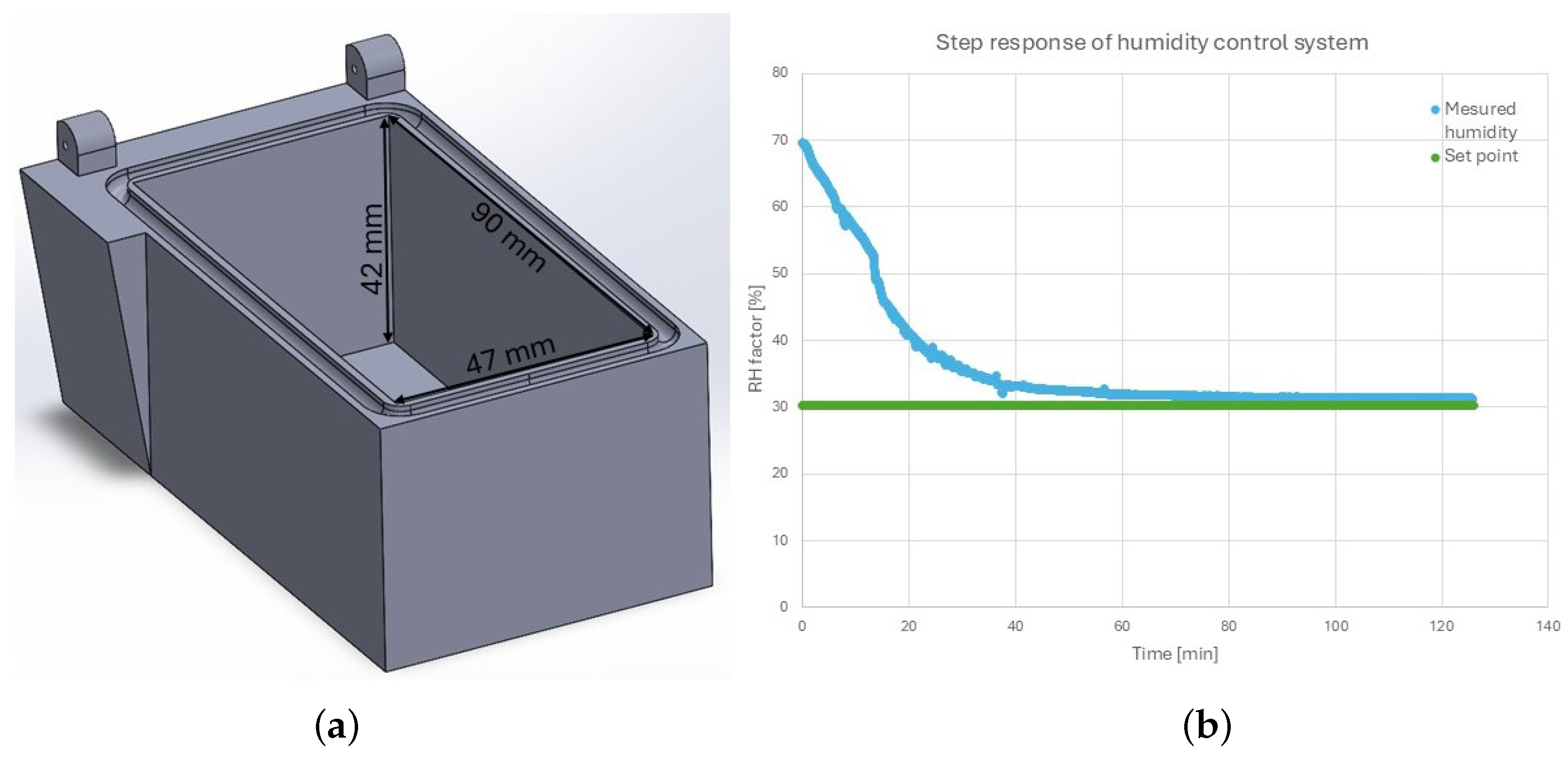
| RH [%] | 28 | 30 | 33 | defines freezing dynamics |
| Temp. range [°C] | 20 | 22 | 24 | ambient temperature |
Disclaimer/Publisher’s Note: The statements, opinions and data contained in all publications are solely those of the individual author(s) and contributor(s) and not of MDPI and/or the editor(s). MDPI and/or the editor(s) disclaim responsibility for any injury to people or property resulting from any ideas, methods, instructions or products referred to in the content. |
© 2026 by the authors. Licensee MDPI, Basel, Switzerland. This article is an open access article distributed under the terms and conditions of the Creative Commons Attribution (CC BY) license.
Share and Cite
Bratina, B.; Fister, D.; Nezman, J.; Šafarič, J.; Šafarič, R. One-Finger Gripper for Microobjects to Submillimeter-Sized Objects Based on Temperatures of Dew and Freezing Points. Micromachines 2026, 17, 573. https://doi.org/10.3390/mi17050573
Bratina B, Fister D, Nezman J, Šafarič J, Šafarič R. One-Finger Gripper for Microobjects to Submillimeter-Sized Objects Based on Temperatures of Dew and Freezing Points. Micromachines. 2026; 17(5):573. https://doi.org/10.3390/mi17050573
Chicago/Turabian StyleBratina, Božidar, Dušan Fister, Jernej Nezman, Jakob Šafarič, and Riko Šafarič. 2026. "One-Finger Gripper for Microobjects to Submillimeter-Sized Objects Based on Temperatures of Dew and Freezing Points" Micromachines 17, no. 5: 573. https://doi.org/10.3390/mi17050573
APA StyleBratina, B., Fister, D., Nezman, J., Šafarič, J., & Šafarič, R. (2026). One-Finger Gripper for Microobjects to Submillimeter-Sized Objects Based on Temperatures of Dew and Freezing Points. Micromachines, 17(5), 573. https://doi.org/10.3390/mi17050573