Single-Axis Rotational Inertial Navigation Systems for USVs: A Review of Key Technologies




Abstract
1. Introduction
2. Fundamentals
2.1. Coordinate Transformations and Reference Frames
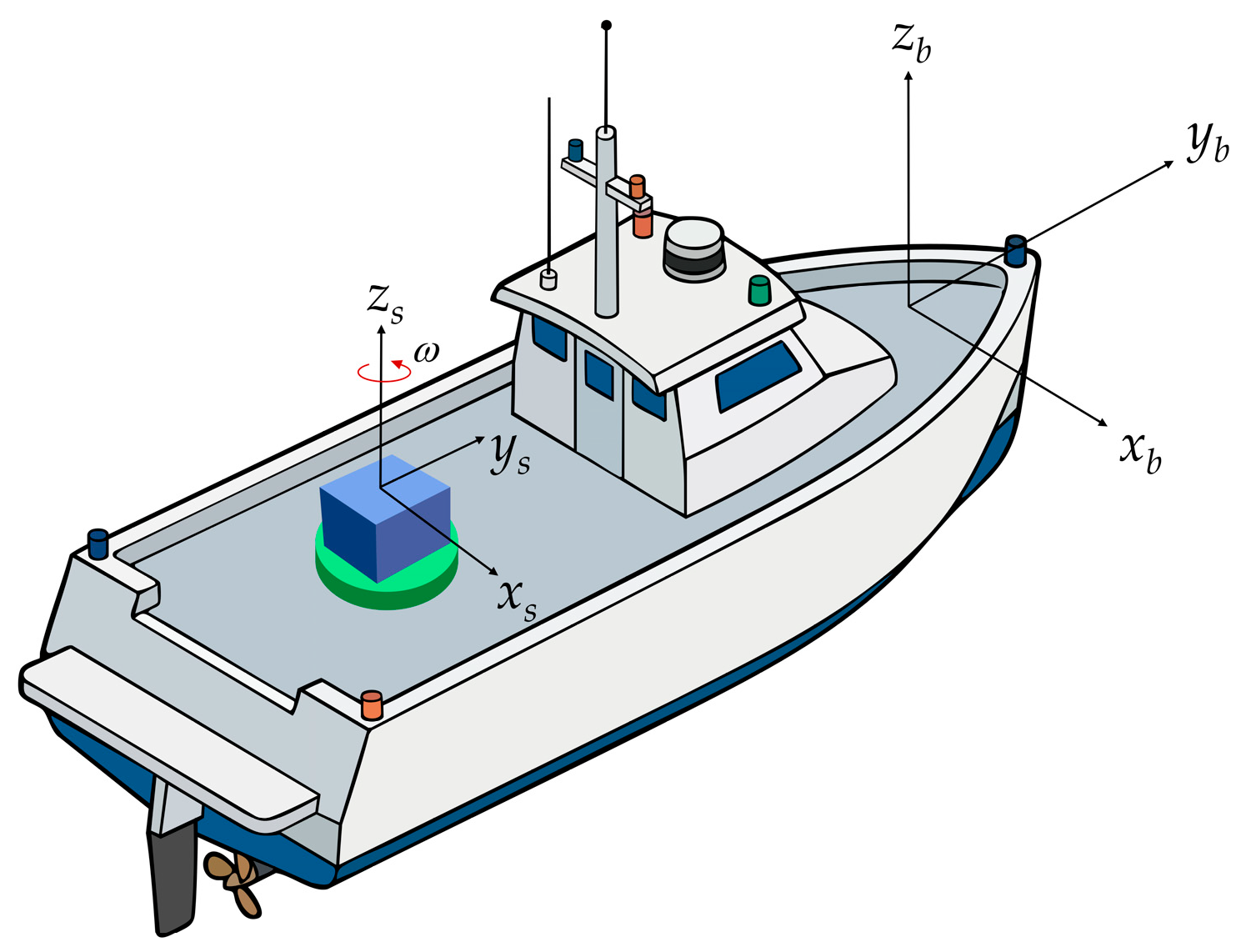
- Earth-centered inertial frame (-frame):
- 2.
- Earth-fixed frame (-frame):
- 3.
- Navigation frame (-frame):
- 4.
- Body frame (-frame):
- 5.
- Sensor/IMU frame (-frame):
- 6.
- Coordinate transformations:
2.2. Error Modulation Mechanisms
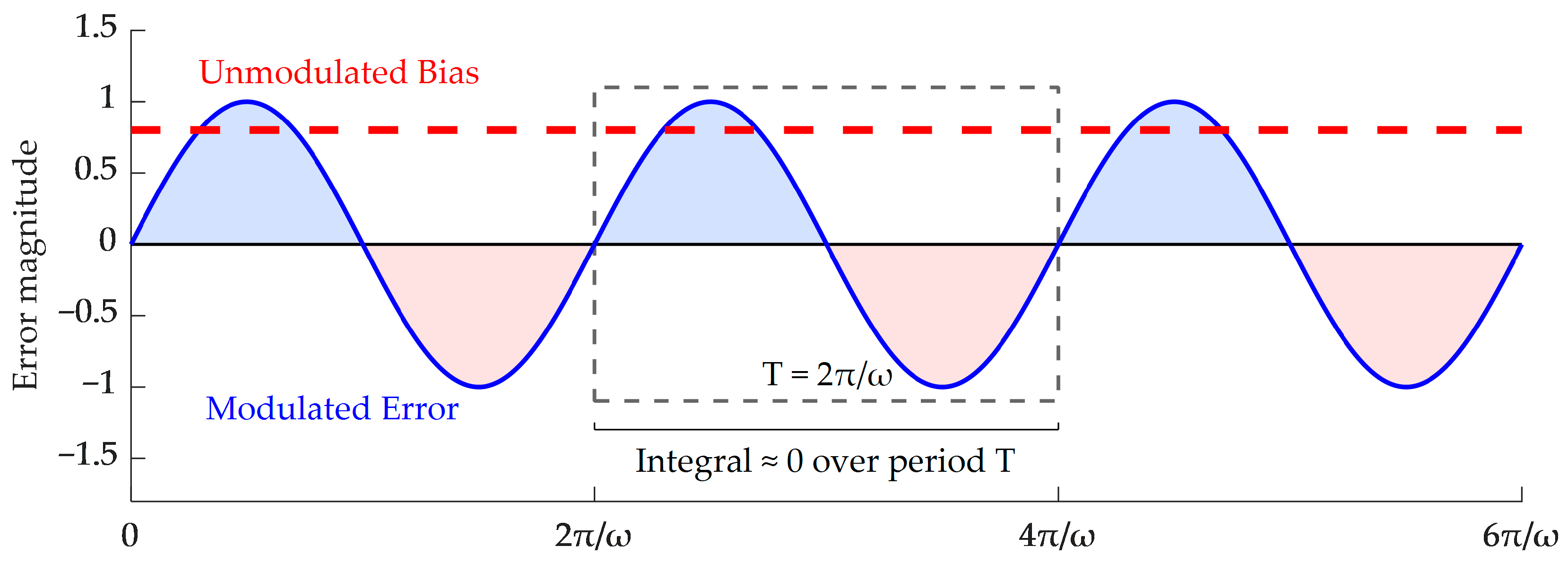
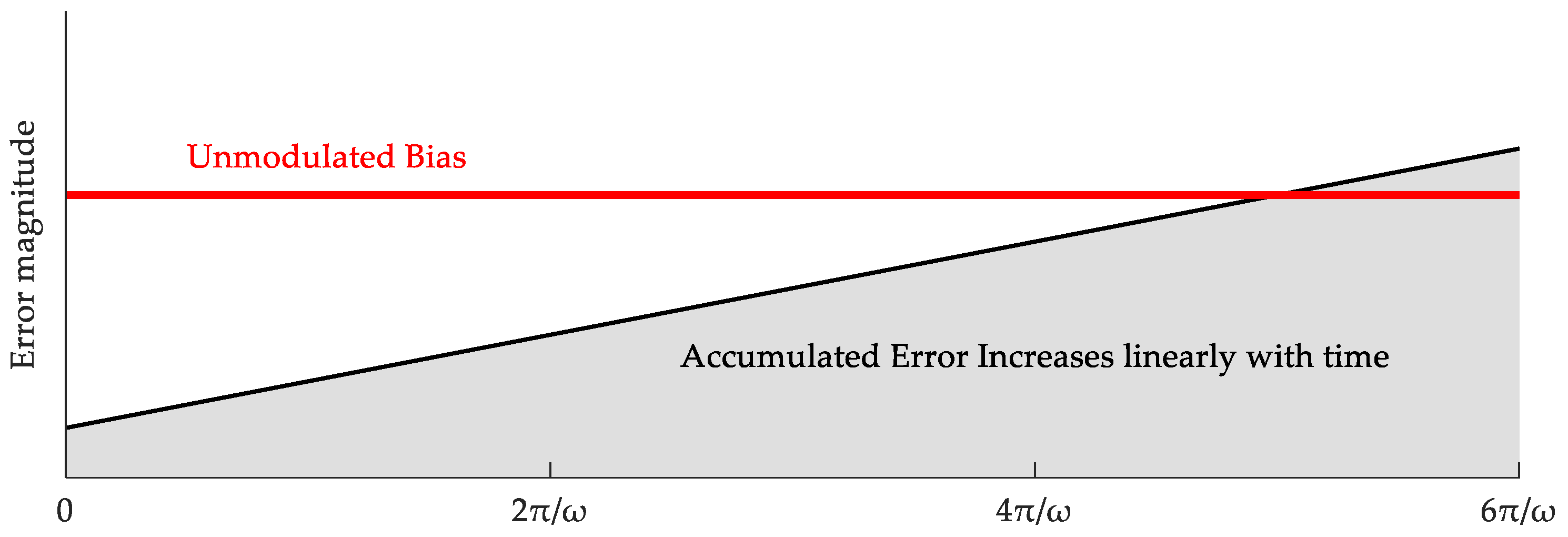
- Classical Modulation Mechanism and Limitations
- Rotation-Induced Errors
3. MEMS Gyroscope Error Compensation
3.1. Stochastic Error Denoising
3.1.1. Filtering Methods
3.1.2. Deep Learning Methods
3.2. Temperature Drift Compensation
3.2.1. Hardware Control
3.2.2. Algorithmic Compensation
4. Moving-Base Initial Alignment
4.1. Coarse Alignment
4.2. Fine Alignment
4.3. Multi-Source Aided Alignment
5. Azimuth Gyroscope Drift Online Calibration
5.1. Observability Analysis
5.2. Algorithmic Calibration
5.3. Mechanical Error Identification
6. Adaptive Robust GNSS/SINS Integration Method
6.1. Adaptive Filtering
6.2. Robust Estimation
6.3. Multi-Source Fusion Architectures
- Marine Multi-Source Augmentation: The core advantage of tight coupling lies in maintaining system observability even when the number of available observation satellites is insufficient for independent positioning. Constructing unified observation equations with DVL beam frequency shifts and USBL raw ranges ensures stable updates. This approach maintains system performance even when acoustic beams are limited [123]. A dual-transponder slant range differential architecture, aided by inertial navigation time backtracking, is proposed. This design cancels common array errors at the physical mechanism level [124]. However, this deep decoupling relies heavily on the strict deployment of external beacons, increasing the engineering costs of marine exploration.
- Error Lie Groups and Geometric Manifolds: The traditional linearized KF fails to handle the large misalignment angles and covariance distortions induced by severe sea states. This limitation is particularly evident during intense wave swaying of USVs. The iterated equivariant filter (I-EqF) is introduced into GNSS/SINS tight integration, leveraging the symmetry of Lie groups to decouple the error evolution from the true trajectories, significantly improving global consistency under large initial misalignment angles [125]. However, this improvement in manifold consistency comes at the cost of a high model derivation threshold and the computational overhead of computing the Jacobian matrix.
- Heterogeneous Sensing and GNSS-Denied Navigation: Targeting complex multi-sensor scheduling, a parallel architecture with decoupled measurement updates (interactive sensor-independent-update, ISIU) achieves soft cascading and fault-tolerant access of sensors [126]. Regarding the fault-tolerant discrimination mechanism, the combination of robust estimation and sliding window testing improves the detection capability of the tightly coupled system for small faults [127]. Additionally, the adaptive IIR/FIR fusion filtering architecture effectively enhances the system’s resistance to model uncertainty and transient noise by dynamically adjusting mixing probabilities based on the residual covariance [128]. Meanwhile, the GIMM framework uses Gaussian mixture models to capture nonstationary characteristics, enabling dual adaptive switching between motion and noise modes [113]. In GNSS-denied scenarios, a tightly coupled architecture integrates a single-axis rotation MEMS-INS with odometer increments. This design uses RMT to reconstruct heading angle observability, ensuring navigation for miniaturized platforms [7].
7. Discussion
7.1. Current Challenges
7.1.1. Hardware Limitations
7.1.2. Computational Burden
7.2. Future Trends
7.2.1. Factor Graph Optimization
7.2.2. Deep Learning Architectures
7.2.3. GNSS-Denied Navigation
8. Conclusions
Author Contributions
Funding
Institutional Review Board Statement
Informed Consent Statement
Data Availability Statement
Conflicts of Interest
References
- U.S. Department of Defense. Unmanned Systems Integrated Roadmap 2017–2042; AD1059546; U.S. Department of Defense: Washington, DC, USA, 2017.
- Wang, X.; Song, X.; Du, L. Review and Application of Unmanned Surface Vehicle in China. In Proceedings of the 2019 5th International Conference on Transportation Information and Safety (ICTIS), Liverpool, UK, 14–17 July 2019; pp. 1476–1481. [Google Scholar]
- Specht, M. Testing and Analysis of Selected Navigation Parameters of the GNSS/INS System for USV Path Localization during Inland Hydrographic Surveys. Sensors 2024, 24, 2418. [Google Scholar] [CrossRef] [PubMed]
- Jung, J.; Park, J.; Choi, J.; Choi, H.-T. Navigation of Unmanned Surface Vehicles Using Underwater Geophysical Sensing. IEEE Access 2020, 8, 208707–208717. [Google Scholar] [CrossRef]
- Levinson, E.; Ter Horst, J.; Willcocks, M. The next generation marine inertial navigator is here now. In Proceedings of the 1994 IEEE Position, Location and Navigation Symposium—PLANS’94, Las Vegas, NV, USA, 11–15 April 1994; pp. 121–127. [Google Scholar]
- Zhang, Y.; Zhou, B.; Song, M.; Hou, B.; Xing, H.; Zhang, R. A Novel MEMS Gyro North Finder Design Based on the Rotation Modulation Technique. Sensors 2017, 17, 973. [Google Scholar] [CrossRef] [PubMed]
- Wen, Z.; Yang, G.; Cai, Q. A Novel Design of Micro-Motor Based Rotational MEMS-INS/Dead Reckoning Increment Integrated Navigation System in Satellite-Denied Environments. IEEE Trans. Veh. Technol. 2025, 74, 17192–17203. [Google Scholar] [CrossRef]
- Jorge, V.A.M.; Granada, R.; Maidana, R.G.; Jurak, D.A.; Heck, G.; Negreiros, A.P.F.; Dos Santos, D.H.; Gonçalves, L.M.G.; Amory, A.M. A Survey on Unmanned Surface Vehicles for Disaster Robotics: Main Challenges and Directions. Sensors 2019, 19, 702. [Google Scholar] [CrossRef]
- Bai, X.; Li, B.; Xu, X.; Xiao, Y. A Review of Current Research and Advances in Unmanned Surface Vehicles. J. Mar. Sci. Appl. 2022, 21, 47–58. [Google Scholar] [CrossRef]
- Lewicka, O.; Specht, M.; Stateczny, A.; Specht, C.; Dardanelli, G.; Brčić, D.; Szostak, B.; Halicki, A.; Stateczny, M.; Widźgowski, S. Integration Data Model of the Bathymetric Monitoring System for Shallow Waterbodies Using UAV and USV Platforms. Remote Sens. 2022, 14, 4075. [Google Scholar] [CrossRef]
- Bae, I.; Hong, J. Survey on the Developments of Unmanned Marine Vehicles: Intelligence and Cooperation. Sensors 2023, 23, 4643. [Google Scholar] [CrossRef]
- Lv, Z.; Wang, X.; Wang, G.; Xing, X.; Lv, C.; Yu, F. Unmanned Surface Vessels in Marine Surveillance and Management: Advances in Communication, Navigation, Control, and Data-Driven Research. J. Mar. Sci. Eng. 2025, 13, 969. [Google Scholar] [CrossRef]
- Hashali, S.; Yang, S.; Xiang, X. Route Planning Algorithms for Unmanned Surface Vehicles (USVs): A Comprehensive Analysis. J. Mar. Sci. Eng. 2024, 12, 382. [Google Scholar] [CrossRef]
- Shang, X.; Zhang, G.; Lyu, H.; Tan, G. Research on Intelligent Navigation Technology: Intelligent Guidance and Path-Following Control of USVs. J. Mar. Sci. Eng. 2024, 12, 1548. [Google Scholar] [CrossRef]
- Engelsman, D.; Klein, I. Information-Aided Inertial Navigation: A Review. IEEE Trans. Instrum. Meas. 2023, 72, 8507418. [Google Scholar] [CrossRef]
- Chen, C.; Pan, X. Deep Learning for Inertial Positioning: A Survey. IEEE Trans. Intell. Transp. Syst. 2024, 25, 10506–10523. [Google Scholar] [CrossRef]
- Titterton, D.H.; Weston, J.L. Strapdown Inertial Navigation Technology, 2nd ed.; Institution of Electrical Engineers: Stevenage, UK, 2004; pp. 21–24. [Google Scholar]
- Wang, Z.; Cheng, X.; Du, J. Thermal Modeling and Calibration Method in Complex Temperature Field for Single-Axis Rotational Inertial Navigation System. Sensors 2020, 20, 384. [Google Scholar] [CrossRef]
- Bu, H.; Zha, F.; He, H.; Zhang, Q.; Zhang, C. Redundant Rotational Inertial Navigation System Attitude Information Fusion Method Based on Asynchronous Rotation Modulation. IEEE Trans. Instrum. Meas. 2026, 75, 8503412. [Google Scholar] [CrossRef]
- Du, S.; Sun, W.; Gao, Y. MEMS IMU Error Mitigation Using Rotation Modulation Technique. Sensors 2016, 16, 2017. [Google Scholar] [CrossRef]
- Sun, W.; Huang, H.; Sun, P.; Ding, W. MEMS strapdown inertial attitude measurement system using rotational modulation technology. PLoS ONE 2024, 19, e0298168. [Google Scholar] [CrossRef]
- Mohammadkarimi, H.; Mozafari, S.; Ghasemi, M.; Parhizkar, M.; Mobtaker, M. Analysis of IMU Rotation Effects on Inertial Navigation System Errors. Navigation 2025, 72, navi.680. [Google Scholar] [CrossRef]
- Wang, Y.; Chen, S.; Li, H.; Ben, Y. Analysis of the Effect of Slow-Varying Errors on Rotary Modulation Systems. Sensors 2024, 24, 5025. [Google Scholar] [CrossRef] [PubMed]
- Seo, Y.; Yu, H.; Ryu, K.; Lee, I.; Oh, J.; Kim, C.; Lee, S.; Park, C. Analysis of Gyro Bias Depending on the Position of Inertial Measurement Unit in Rotational Inertial Navigation Systems. Sensors 2022, 22, 8355. [Google Scholar] [CrossRef] [PubMed]
- Liu, R.; Lyu, P.; Lai, J.; Lu, J.; Hu, H. Mechanism and implementation of error suppression in MEMS inertial navigation system via rotational modulation and array. Meas. Sci. Technol. 2025, 36, 095113. [Google Scholar] [CrossRef]
- Chen, Z.; Zhao, N.; Zhao, W.; Xia, J. Numerical prediction of seakeeping and slamming behaviors of a trimaran in short-crest cross waves compared with long-crest regular waves. Ocean Eng. 2023, 285, 115314. [Google Scholar] [CrossRef]
- Song, J.; Shi, Z.; Du, B.; Han, L.; Wang, H.; Wang, Z. MEMS gyroscope wavelet de-noising method based on redundancy and sparse representation. Microelectron. Eng. 2019, 217, 111112. [Google Scholar] [CrossRef]
- Xiao, C.; Zhu, Q.; Hu, H.; Zhang, X.; Chen, X.; Song, X. Using AKF-PSR to Compensate Random Drift Errors of Low-Cost MEMS Gyroscopes. IEEE Sens. J. 2019, 19, 6802–6810. [Google Scholar] [CrossRef]
- Jiang, C.; Chen, S.; Chen, Y.; Bo, Y.; Han, L.; Guo, J.; Feng, Z.; Zhou, H. Performance Analysis of a Deep Simple Recurrent Unit Recurrent Neural Network (SRU-RNN) in MEMS Gyroscope De-Noising. Sensors 2018, 18, 4471. [Google Scholar] [CrossRef]
- Zhu, Z.; Bo, Y.; Jiang, C. A MEMS Gyroscope Noise Suppressing Method Using Neural Architecture Search Neural Network. Math. Probl. Eng. 2019, 2019, 5491243. [Google Scholar] [CrossRef]
- Liu, Y.; Cui, J.; Liang, W. A hybrid learning-based stochastic noise eliminating method with attention-Conv-LSTM network for low-cost MEMS gyroscope. Front. Neurorob. 2022, 16, 993936. [Google Scholar] [CrossRef] [PubMed]
- Han, S.; Meng, Z.; Zhang, X.; Yan, Y. Hybrid Deep Recurrent Neural Networks for Noise Reduction of MEMS-IMU with Static and Dynamic Conditions. Micromachines 2021, 12, 214. [Google Scholar] [CrossRef] [PubMed]
- Cong, L.; Yue, S.; Qin, H.; Li, B.; Yao, J. Implementation of a MEMS-Based GNSS/INS Integrated Scheme Using Supported Vector Machine for Land Vehicle Navigation. IEEE Sens. J. 2020, 20, 14423–14435. [Google Scholar] [CrossRef]
- Li, D.; Zhou, J.; Liu, Y. Recurrent-neural-network-based unscented Kalman filter for estimating and compensating the random drift of MEMS gyroscopes in real time. Mech. Syst. Sig. Process. 2021, 147, 107057. [Google Scholar] [CrossRef]
- Huo, Z.; Wang, F.; Shen, H.; Sun, X.; Zhang, J.; Li, Y.; Chu, H. Optimal Compensation of MEMS Gyroscope Noise Kalman Filter Based on Conv-DAE and MultiTCN-Attention Model in Static Base Environment. Sensors 2022, 22, 7249. [Google Scholar] [CrossRef]
- Zeng, X.; Wu, Z.; Zhou, T.; Yu, Z.; Liu, K. Real-time estimation and compensation of random drift in MEMS gyroscopes using cubature Kalman filter based on adaptive differencing Elman neural network. Mech. Syst. Sig. Process. 2025, 238, 113194. [Google Scholar] [CrossRef]
- Cui, J.; Zhao, Q. Thermal Stabilization of Quality Factor for Dual-Axis MEMS Gyroscope Based on Joule Effect In Situ Dynamic Tuning. IEEE Trans. Ind. Electron. 2024, 71, 1060–1068. [Google Scholar] [CrossRef]
- Erkan, D.; Tatar, E. Improving the Temperature Stability of MEMS Gyroscope Bias with on-chip Stress Sensors. In Proceedings of the 2024 IEEE International Symposium on Inertial Sensors and Systems, Inertial, Hiroshima, Japan, 25–28 March 2024. [Google Scholar]
- Zhang, H.; Chen, W.; Yin, L.; Fu, Q. Design of MEMS gyroscope interface ASIC with on-chip temperature compensation. Measurement 2023, 220, 113331. [Google Scholar] [CrossRef]
- Cui, M.; Huang, Y.; Wang, W.; Cao, H. MEMS Gyroscope Temperature Compensation Based on Drive Mode Vibration Characteristic Control. Micromachines 2019, 10, 248. [Google Scholar] [CrossRef]
- Cao, H.; Zhang, Y.; Han, Z.; Shao, X.; Gao, J.; Huan, K.; Shi, Y.; Tang, J.; Shen, C.; Liu, J. Pole-Zero Temperature Compensation Circuit Design and Experiment for Dual-Mass MEMS Gyroscope Bandwidth Expansion. IEEE-ASME Trans. Mechatron. 2019, 24, 677–688. [Google Scholar] [CrossRef]
- Wang, P.; Li, Q.; Zhang, Y.; Wu, Y.; Wu, X.; Xiao, D. Bias Thermal Stability Improvement of Mode-Matching MEMS Gyroscope Using Mode Deflection. J. Microelectromech. Syst. 2023, 32, 1–3. [Google Scholar] [CrossRef]
- Fontanella, R.; Accardo, D.; Lo Moriello, R.S.; Angrisani, L.; De Simone, D. MEMS gyros temperature calibration through artificial neural networks. Sens. Actuators A Phys. 2018, 279, 553–565. [Google Scholar] [CrossRef]
- Chong, S.; Rui, S.; Jie, L.; Xiaoming, Z.; Jun, T.; Yunbo, S.; Jun, L.; Huiliang, C. Temperature drift modeling of MEMS gyroscope based on genetic-Elman neural network. Mech. Syst. Sig. Process. 2016, 72–73, 897–905. [Google Scholar] [CrossRef]
- Zhang, Z.; Zhu, G.; Wu, J. Neural-Network-Based Temperature Drift Compensation for MEMS-IMU Systems. IEEE Sens. J. 2025, 25, 26353–26363. [Google Scholar] [CrossRef]
- Cai, Q.; Zhao, F.; Kang, Q.; Luo, Z.; Hu, D.; Liu, J.; Cao, H. A Novel Parallel Processing Model for Noise Reduction and Temperature Compensation of MEMS Gyroscope. Micromachines 2021, 12, 1285. [Google Scholar] [CrossRef]
- Zhang, Z.; Zhang, J.; Zhu, X.; Ren, Y.; Yu, J.; Cao, H. MEMS Gyroscope Temperature Compensation Based on Improved Complete Ensemble Empirical Mode Decomposition and Optimized Extreme Learning Machine. Micromachines 2024, 15, 609. [Google Scholar] [CrossRef] [PubMed]
- Hosseini-Pishrobat, M.; Tatar, E. Modeling Temperature Effects in a MEMS Ring Gyroscope: Toward Physics-Aware Drift Compensation. J. Microelectromech. Syst. 2025, 34, 150–163. [Google Scholar] [CrossRef]
- Kuang, Y.; Hou, Z.; Liu, G.; Xiao, D.; Wu, X. Real-Time Phase Compensation for Scale Factor Nonlinearity Improvement Over Temperature Variations for MEMS Gyroscope. J. Microelectromech. Syst. 2023, 32, 305–313. [Google Scholar] [CrossRef]
- Wang, J.; Yang, G.; Zhou, Y.; Zhang, J.; Liu, F.; Cai, Q. An In-Run Automatic Demodulation Phase Error Compensation Method for MEMS Gyroscope in Full Temperature Range. Micromachines 2024, 15, 825. [Google Scholar] [CrossRef]
- Wang, J.; Yang, G.; Liu, F.; Cai, Q.; Song, N.; Zhou, Y. An innovative multi-parameter fusion compensation algorithm for ZRO drift of MEMS gyroscope under full-temperature conditions. Measurement 2026, 257, 118892. [Google Scholar] [CrossRef]
- Wu, M.; Wu, Y.; Hu, X.; Hu, D. Optimization-based alignment for inertial navigation systems: Theory and algorithm. Aerosp. Sci. Technol. 2011, 15, 1–17. [Google Scholar] [CrossRef]
- Jameian, H.; Safarinejadian, B.; Shasadeghi, M. A robust and fast self-alignment method for strapdown inertial navigation system in rough sea conditions. Ocean Eng. 2019, 187, 106196. [Google Scholar] [CrossRef]
- Yao, Y.; Xu, X.; Zhang, T.; Hu, G. An Improved Initial Alignment Method for SINS/GPS Integration with Vectors Subtraction. IEEE Sens. J. 2021, 21, 18256–18262. [Google Scholar] [CrossRef]
- Xu, X.; Ning, X.; Yao, Y.; Li, K. In-Motion Coarse Alignment Method for SINS/GPS Integration in Polar Region. IEEE Trans. Veh. Technol. 2022, 71, 6110–6118. [Google Scholar] [CrossRef]
- Xu, X.; Sun, Y.; Yao, Y.; Zhang, T. A Robust In-Motion Optimization-Based Alignment for SINS/GPS Integration. IEEE Trans. Intell. Transp. Syst. 2022, 23, 4362–4372. [Google Scholar] [CrossRef]
- Liu, B.; Wei, S.; Lu, J.; Wang, J.; Su, G. Fast Self-Alignment Technology for Hybrid Inertial Navigation Systems Based on a New Two-Position Analytic Method. IEEE Trans. Ind. Electron. 2020, 67, 3226–3235. [Google Scholar] [CrossRef]
- Fu, Q.; Li, S.; Liu, Y.; Wu, F. Information-reusing alignment technology for rotating inertial navigation system. Aerosp. Sci. Technol. 2020, 99, 105747. [Google Scholar] [CrossRef]
- Wang, D.; Lv, H.; Wu, J. In-flight initial alignment for small UAV MEMS-based navigation via adaptive unscented Kalman filtering approach. Aerosp. Sci. Technol. 2017, 61, 73–84. [Google Scholar] [CrossRef]
- Cui, X.; Mei, C.; Qin, Y.; Yan, G.; Fu, Q. In-motion Alignment for Low-cost SINS/GPS under Random Misalignment Angles. J. Navig. 2017, 70, 1224–1240. [Google Scholar] [CrossRef]
- Shao, H.; Miao, L.; Gao, W.; Shen, J. Ensemble Particle Filter Based on KLD and Its Application to Initial Alignment of the SINS in Large Misalignment Angles. IEEE Trans. Ind. Electron. 2018, 65, 8946–8955. [Google Scholar] [CrossRef]
- Cui, B.; Wei, X.; Chen, X.; Li, J.; Wang, A. Robust cubature Kalman filter based on variational Bayesian and transformed posterior sigma points error. ISA Trans. 2019, 86, 18–28. [Google Scholar] [CrossRef]
- Xu, G.; Huang, Y.; Gao, Z.; Zhang, Y. A Computationally Efficient Variational Adaptive Kalman Filter for Transfer Alignment. IEEE Sens. J. 2020, 20, 13682–13693. [Google Scholar] [CrossRef]
- Guo, M.-Z.; Guo, C.; Zhang, C. SINS/GNSS-Integrated Navigation of Surface Vessels Based on Various Nonlinear Kalman Filters and Large Ship Dynamics. J. Electr. Eng. Technol. 2021, 16, 531–546. [Google Scholar] [CrossRef]
- Pei, F.; Yang, S.; Yin, S. In-motion initial alignment using state-dependent extended Kalman filter for strapdown inertial navigation system. IEEE Trans. Instrum. Meas. 2020, 70, 8500812. [Google Scholar] [CrossRef]
- Chang, L.; Qin, F.; Xu, J. Strapdown inertial navigation system initial alignment based on group of double direct spatial isometries. IEEE Sens. J. 2021, 22, 803–818. [Google Scholar] [CrossRef]
- Fan, Z.; Chai, H.; Liang, X.; Wang, H. Experimental Research on Shipborne SINS Rapid Mooring Alignment with Variance-Constraint Kalman Filter and GNSS Position Updates. Sensors 2024, 24, 3487. [Google Scholar] [CrossRef]
- Yao, P.; Yang, G.; Peng, X.; Peng, J. An Initial Alignment Algorithm Based on RSKF Single-Axis Rotational Inertial Navigation System. IEEE Sens. J. 2024, 24, 30749–30757. [Google Scholar] [CrossRef]
- Mohammadkarimi, H.; Mobtaker, M.; Alizadeh, M.H. Theoretical error modeling and analysis of strapdown inertial navigation system alignment under zero-velocity conditions. Sci. Rep. 2025, 15, 41320. [Google Scholar] [CrossRef]
- Chang, G. Fast two-position initial alignment for SINS using velocity plus angular rate measurements. Adv. Space Res. 2015, 56, 1331–1342. [Google Scholar] [CrossRef]
- Xu, X.; Lu, J.; Zhang, T. A Fast-Initial Alignment Method with Angular Rate Aiding Based on Robust Kalman Filter. IEEE Access 2019, 7, 51369–51378. [Google Scholar] [CrossRef]
- Liu, P.; Wang, B.; Hou, D.; Wang, K.; Zhu, Z. An Approach for DVL-Aided SINS In-Motion Alignment Based on Observability Analysis. IEEE Sens. J. 2021, 21, 17131–17143. [Google Scholar] [CrossRef]
- Mostafa, M.Z.; Khater, H.A.; Rizk, M.R.; Bahasan, A.M. A novel GPS/ RAVO/MEMS-INS smartphone-sensor-integrated method to enhance USV navigation systems during GPS outages. Meas. Sci. Technol. 2019, 30, 095103. [Google Scholar] [CrossRef]
- Wei, J.; Yu, F.; Fan, S.; Zhang, Y.; Wang, Y.; Wang, Y. A Robust In-Motion Alignment Method for a DVL-Aided SINS with Latitude Uncertainty. IEEE Trans. Instrum. Meas. 2024, 73, 8500616. [Google Scholar] [CrossRef]
- Shen, C.; Xiong, Y.; Zhao, D.; Wang, C.; Cao, H.; Song, X.; Tang, J.; Liu, J. Multi-rate strong tracking square-root cubature Kalman filter for MEMS-INS/GPS/polarization compass integrated navigation system. Mech. Syst. Sig. Process. 2022, 163, 108146. [Google Scholar] [CrossRef]
- Gao, B.; Hu, G.; Gao, S.; Zhong, Y.; Gu, C. Multi-Sensor Optimal Data Fusion Based on the Adaptive Fading Unscented Kalman Filter. Sensors 2018, 18, 488. [Google Scholar] [CrossRef]
- Gu, Y.; Wu, W.; Liu, C.; Wang, M.; Feng, G. State Transformation UKF Algorithm for MEMS-IMU-Based Rotary AHRS in USV with Large Gyro Bias and Initial Misalignment. IEEE Trans. Instrum. Meas. 2025, 74, 7503711. [Google Scholar] [CrossRef]
- Liang, Y.; Han, L.; Dong, X.; Li, Q.; Ren, Z. An quantitative method for observability analysis and its application in SINS calibration. Aerosp. Sci. Technol. 2020, 103, 105626. [Google Scholar] [CrossRef]
- Chen, T.; Yang, G.; Cai, Q.; Wen, Z.; Chen, Z. In-Flight Calibration for Outer-Azimuth Dual-Axis RINS Based on Incremental Azimuth Observation Method. IEEE Trans. Instrum. Meas. 2023, 72, 8507515. [Google Scholar] [CrossRef]
- Goshen-Meskin, D.; Bar-Itzhack, I.Y. Observability analysis of piece-wise constant systems. I. Theory. IEEE Trans. Aerosp. Electron. Syst. 1992, 28, 1056–1067. [Google Scholar] [CrossRef]
- Gao, W.; Zhang, Y.; Wang, J. Research on Initial Alignment and Self-Calibration of Rotary Strapdown Inertial Navigation Systems. Sensors 2015, 15, 3154–3171. [Google Scholar] [CrossRef]
- Pan, J.; Li, B.; Tian, G.; Lv, X.; Tong, Z.; Sun, X.; Zhou, G. In-Field Calibration of Gyroscope Biases Based on Self-Alignment and Attitude Tracking Information. IEEE Trans. Instrum. Meas. 2021, 70, 8505108. [Google Scholar] [CrossRef]
- Wei, Q.; Zha, F.; He, H.; Li, B. An Improved System-Level Calibration Scheme for Rotational Inertial Navigation Systems. Sensors 2022, 22, 7610. [Google Scholar] [CrossRef]
- Zhao, G.; Li, Q.; Liang, W.; Zhao, H. A System-Level Calibration Method for SINS Based on Observability Analysis. IEEE Sens. J. 2024, 24, 32871–32883. [Google Scholar] [CrossRef]
- Shen, K.; Wang, M.; Fu, M.; Yang, Y.; Yin, Z. Observability Analysis and Adaptive Information Fusion for Integrated Navigation of Unmanned Ground Vehicles. IEEE Trans. Ind. Electron. 2020, 67, 7659–7668. [Google Scholar] [CrossRef]
- Li, K.; Chen, Y.; Wang, L. Online self-calibration research of single-axis rotational inertial navigation system. Measurement 2018, 129, 633–641. [Google Scholar] [CrossRef]
- Qi, F.; Meng, Y.; Yu, Y.; Zhu, X. Research on a High-Precision Measurement Algorithm Using FOG-Based Single-Axis RINS for Core Drilling. IEEE Trans. Instrum. Meas. 2023, 72, 8502011. [Google Scholar] [CrossRef]
- Liu, J.; Chen, X.; Wang, J.; Mou, Y.; Li, T.; Wan, L. An adaptive robust method for azimuth gyro drift calibration in single-axis rotation MEMS-SINS. Measurement 2026, 257, 118745. [Google Scholar] [CrossRef]
- Xu, X.; Zheng, X.; Li, Y.; Yao, Y.; Zhou, H.; Zhu, L. An Improved In-Motion Alignment Method for SINS/GPS with the Sliding Windows Integration. IEEE Trans. Veh. Technol. 2023, 72, 12491–12499. [Google Scholar] [CrossRef]
- Xu, X.; Li, Y.; Zhu, L.; Yao, Y. Robust Attitude and Positioning Alignment Methods for SINS/DVL Integration Based on Sliding Window Improvements. IEEE Trans. Ind. Electron. 2024, 71, 8038–8046. [Google Scholar] [CrossRef]
- Jiao, Z.; Chen, X.; Zhong, Y.; Gao, N. Enhanced MCUSUM Control Chart-Based CKF for Fault Detection and Identification in Fault-Tolerant Integrated Navigation System. IEEE Sens. J. 2025, 25, 22629–22640. [Google Scholar] [CrossRef]
- Ban, J.; Wang, L.; Liu, Z.; Zhang, L. Self-calibration method for temperature errors in multi-axis rotational inertial navigation system. Opt. Express 2020, 28, 8909–8923. [Google Scholar] [CrossRef]
- Ren, C.; Liu, Q.; Fu, T. A Novel Self-Calibration Method for MIMU. IEEE Sens. J. 2015, 15, 5416–5422. [Google Scholar] [CrossRef]
- Al Jlailaty, H.; Celik, A.; Mansour, M.M.; Eltawil, A.M. IMU Hand Calibration for Low-Cost MEMS Inertial Sensors. IEEE Trans. Instrum. Meas. 2023, 72, 7505516. [Google Scholar] [CrossRef]
- Li, J.; Zhang, S.; Yang, H.; Jiang, Z.; Bai, X. Fast Self-Alignment and Self-Calibration Method for Rotational Inertial Navigation System Based on Environment Function Matrix. IEEE Trans. Instrum. Meas. 2024, 73, 9502813. [Google Scholar] [CrossRef]
- Li, J.; Zhang, S.; Yang, H.; Jiang, Z.; Bai, X. Fast Alignment and Calibration of Rotational Inertial System Based on Bilinear Embedding. IEEE Sens. J. 2024, 24, 10700–10713. [Google Scholar] [CrossRef]
- Liu, D.; Wang, W.; Li, Y. A self-calibration method for temperature errors of non-orthogonal angles between gimbals in rotational inertial navigation system. Meas. Sci. Technol. 2024, 35, 056306. [Google Scholar] [CrossRef]
- Wei, D.; Fu, Q.; Li, S.; Yuan, Y. A Novel Self-Calibration Scheme for Nonorthogonal Angles in Rotational Inertial Navigation System. IEEE Trans. Instrum. Meas. 2025, 74, 8515009. [Google Scholar] [CrossRef]
- Jia, Y.; Li, S.; Qin, Y.; Cheng, R. Error Analysis and Compensation of MEMS Rotation Modulation Inertial Navigation System. IEEE Sens. J. 2018, 18, 2023–2030. [Google Scholar] [CrossRef]
- Ye, J.; Wang, L.; Liu, D.; Yan, L. Analysis and compensation of residual gyro drifts on azimuth alignment accuracy in the RINS. Meas. Sci. Technol. 2023, 34, 025102. [Google Scholar] [CrossRef]
- Wen, Z.; Yang, G.; Cai, Q.; Chen, T. An Encoder-Based Relative Attitude Observation Method for Self-Calibration in Dual-Axis RINS. IEEE Trans. Ind. Electron. 2023, 70, 11784–11794. [Google Scholar] [CrossRef]
- Lin, Y.; Liu, K.; Wang, X. An adaptive square-root unscented Kalman filter for underwater Vehicle navigation. In Proceedings of the 2014 IEEE International Conference on Mechatronics and Automation (ICMA), Tianjin, China, 3–6 August 2014; pp. 717–722. [Google Scholar]
- Jo, K.; Chu, K.; Sunwoo, M. Interacting Multiple Model Filter-Based Sensor Fusion of GPS with In-Vehicle Sensors for Real-Time Vehicle Positioning. IEEE Trans. Intell. Transp. Syst. 2012, 13, 329–343. [Google Scholar] [CrossRef]
- Yao, Y.; Xu, X.; Li, Y.; Zhang, T. A Hybrid IMM Based INS/DVL Integration Solution for Underwater Vehicles. IEEE Trans. Veh. Technol. 2019, 68, 5459–5470. [Google Scholar] [CrossRef]
- Song, R.; Chen, X.; Fang, Y.; Huang, H. Integrated navigation of GPS/INS based on fusion of recursive maximum likelihood IMM and Square-root Cubature Kalman filter. ISA Trans. 2020, 105, 387–395. [Google Scholar] [CrossRef]
- Hou, L.; Xu, X.; Yao, Y.; Wang, D. An M-Estimation-Based Improved Interacting Multiple Model for INS/DVL Navigation Method. IEEE Sens. J. 2022, 22, 13375–13386. [Google Scholar] [CrossRef]
- Zhang, X.; He, B.; Gao, S.; Mu, P.; Xu, J.; Zhai, N. Multiple model AUV navigation methodology with adaptivity and robustness. Ocean Eng. 2022, 254, 111258. [Google Scholar] [CrossRef]
- Gao, B.; Hu, G.; Zhong, Y.; Zhu, X. Cubature Kalman Filter with Both Adaptability and Robustness for Tightly-Coupled GNSS/INS Integration. IEEE Sens. J. 2021, 21, 14997–15011. [Google Scholar] [CrossRef]
- Guo, Y.; Li, X.; Meng, Q. A Runs Test-Based Kalman Filter with Both Adaptability and Robustness with Application to INS/GNSS Integration. IEEE Sens. J. 2022, 22, 22919–22930. [Google Scholar] [CrossRef]
- Yin, X.; Chai, H.; Zhang, Y.; Xiang, M. Constrained Robust Unscented Kalman Filter for BDS Navigation in Dense Urban Areas. IEEE Sens. J. 2021, 21, 3077–3086. [Google Scholar] [CrossRef]
- Shen, H.; Wen, G.; Lv, Y.; Zhou, J. A Stochastic Event-Triggered Robust Unscented Kalman Filter-Based USV Parameter Estimation. IEEE Trans. Ind. Electron. 2024, 71, 11272–11282. [Google Scholar] [CrossRef]
- Chang, L.; Li, K.; Hu, B. Huber’s M-Estimation-Based Process Uncertainty Robust Filter for Integrated INS/GPS. IEEE Sens. J. 2015, 15, 3367–3374. [Google Scholar] [CrossRef]
- Wang, J.; He, J.; Peng, B.; Wang, G. Generalized interacting multiple model Kalman filtering algorithm for maneuvering target tracking under non-Gaussian noises. ISA Trans. 2024, 155, 148–163. [Google Scholar] [CrossRef]
- Huang, Y.; Zhang, Y.; Li, N.; Wu, Z.; Chambers, J.A. A Novel Robust Student’s t-Based Kalman Filter. IEEE Trans. Aerosp. Electron. Syst. 2017, 53, 1545–1554. [Google Scholar] [CrossRef]
- Liu, X.; Chen, W.; Tao, Z.; Tian, Y.; Leng, J.; Li, M.; Wu, D. Adaptive maximum correntropy UKF TDOA tracking algorithm based on multi-layer isogradient sound speed profile. Ocean Eng. 2024, 303, 117541. [Google Scholar] [CrossRef]
- Wang, B.; Wang, Z.; Yang, Y. A Variational Bayesian-Based Maximum Correntropy Adaptive Kalman Filter for SINS/USBL Integrated Navigation System. IEEE Sens. J. 2025, 25, 20147–20157. [Google Scholar] [CrossRef]
- Wang, B.; Wang, Z. Adaptive Kalman Filter Under Minimum Error Entropy with Fiducial Points for Strap-Down Inertial Navigation System/Ultra-Short Baseline Integrated Navigation Systems. J. Mar. Sci. Eng. 2025, 13, 990. [Google Scholar] [CrossRef]
- Caccia, M.; Bibuli, M.; Bono, R.; Bruzzone, G. Basic navigation, guidance and control of an Unmanned Surface Vehicle. Auton. Robot. 2008, 25, 349–365. [Google Scholar] [CrossRef]
- Zhao, D.; Liu, X.; Zhao, H.; Wang, C.; Tang, J.; Liu, J.; Shen, C. Seamless integration of polarization compass and inertial navigation data with a self-learning multi-rate residual correction algorithm. Measurement 2021, 170, 108694. [Google Scholar] [CrossRef]
- Sharifi, A.; Baniasad, A.; Mozafari, S. Applied an in-motion transfer alignment approach during global positioning system outages utilizing a recurrent neural network algorithm. Eng. Appl. Artif. Intell. 2025, 157, 111167. [Google Scholar] [CrossRef]
- Chu, H.; Sun, T.; Zhang, B.; Zhang, H.; Chen, Y. Rapid Transfer Alignment of MEMS SINS Based on Adaptive Incremental Kalman Filter. Sensors 2017, 17, 152. [Google Scholar] [CrossRef] [PubMed]
- Liu, J.; Achurra, A.; Zhang, C.; Bury, A.; Wang, X. A long short term memory network-based, global navigation satellite system/inertial navigation system for unmanned surface vessels. J. Mar. Eng. Technol. 2024, 23, 316–328. [Google Scholar] [CrossRef]
- Bian, Y.; Li, R.; Wang, G.; Qin, X.; Hu, M.; Ding, R. Tightly Coupled Information Fusion for SINS/DVL/USBL Integrated Navigation of UUV. IEEE Trans. Instrum. Meas. 2023, 72, 8503213. [Google Scholar] [CrossRef]
- Zhang, S.; Zhang, T.; Li, S.; Zhang, L.; Shi, Y. A Novel Underwater SINS/USBL Dual-Responder Integrated Navigation Algorithm Considering Motion Effects. IEEE Trans. Instrum. Meas. 2025, 74, 9525213. [Google Scholar] [CrossRef]
- Lu, W.; Luo, Y.; Guo, C.; Jiang, W. An Iterated Equivariant Filter and Its Application in Tightly Coupled SINS/GNSS Integrated Navigation. IEEE Trans. Instrum. Meas. 2025, 74, 9518314. [Google Scholar] [CrossRef]
- Meng, Q.; Hsu, L.-T. Resilient Interactive Sensor-Independent-Update Fusion Navigation Method. IEEE Trans. Intell. Transp. Syst. 2022, 23, 16433–16447. [Google Scholar] [CrossRef]
- Zhang, C.; Zhao, X.; Pang, C.; Wang, Y.; Zhang, L.; Feng, B. Improved Fault Detection Method Based on Robust Estimation and Sliding Window Test for INS/GNSS Integration. J. Navig. 2020, 73, 776–796. [Google Scholar] [CrossRef]
- Cho, S.Y.; Kim, B.D. Adaptive IIR/FIR fusion filter and its application to the INS/GPS integrated system. Automatica 2008, 44, 2040–2047. [Google Scholar] [CrossRef]
- Guo, Y.; Xu, B.; Wang, L. A Robust SINS/USBL Integrated Navigation Algorithm Based on Earth Frame and Right Group Error Definition. IEEE Trans. Instrum. Meas. 2022, 71, 8504716. [Google Scholar] [CrossRef]
- Batoš, M.; Mandić, L.; Kapetanović, N.; Nađ, Đ.; Mišković, N. Identifying IMU Noise Characteristics from USV Trajectories. In Proceedings of the OCEANS 2025 Brest, Brest, France, 16–19 June 2025; pp. 1–7. [Google Scholar]
- Dai, M.; Lai, X.; Zhang, C.; Pan, X.; Ding, H.; Zhang, S.; Li, H.; Dai, Y. Monocular Vision Aided Inertial Positioning Method based on Centroid Extraction Applicable to GNSS Denied Environments. In Proceedings of the 2023 Asia-Pacific Conference on Image Processing, Electronics and Computers (IPEC), Dalian, China, 14–16 April 2023; pp. 76–82. [Google Scholar]
- Zuo, S.; Shen, K.; Zuo, J. Robust Visual-Inertial Odometry Based on Deep Learning and Extended Kalman Filter. In Proceedings of the 2021 China Automation Congress (CAC), Beijing, China, 22–24 October 2021; pp. 1173–1178. [Google Scholar]
- Liu, X.; Hu, Z.; Sun, Z.; Lu, J.; Xie, W.; Zhang, W. A VIO-Based Localization Approach in GPS-denied Environments for an Unmanned Surface Vehicle. In Proceedings of the 2023 International Conference on Advanced Robotics and Mechatronics (ICARM), Sanya, China, 8–10 July 2023; pp. 912–917. [Google Scholar]
- Zhang, L.; Wen, W.; Hsu, L.-T.; Zhang, T. An Improved Inertial Preintegration Model in Factor Graph Optimization for High Accuracy Positioning of Intelligent Vehicles. IEEE Trans. Intell. Veh. 2024, 9, 1641–1653. [Google Scholar] [CrossRef]
- Zhang, L.; Zhang, T.; Wei, H. A Factor Graph Optimization-Based In-Motion Alignment Method for INS/DVL Integration. IEEE Trans. Veh. Technol. 2024, 73, 18452–18459. [Google Scholar] [CrossRef]
- Li, Z.; Tao, J.; Lei, Z.; Guo, J.; Zhao, Q.; Guo, X. Factor Graph Optimization-Based RTK/INS Integration with Raw Observations for Robust Positioning in Urban Canyons. IEEE Trans. Instrum. Meas. 2025, 74, 9523511. [Google Scholar] [CrossRef]
- Volden, O.; Stahl, A.; Fossen, T. Development and Experimental Validation of Visual-Inertial Navigation for Auto-Docking of Unmanned Surface Vehicles. IEEE Access 2023, 11, 45688–45710. [Google Scholar] [CrossRef]
- Zhou, Z.; Zhao, S.; Zhang, C.; Wu, J.; Huang, B. Factor Graph Optimization for Flexibly Modeled INS/GPS Navigation in Graphical State-Space. IEEE Trans. Ind. Inf. 2025, 21, 1048–1057. [Google Scholar] [CrossRef]
- Wang, K.; Wu, L.; Ben, Y.; Li, Q.; Lv, C.; Hou, L. Robust Factor Graph Optimization for GNSS/INS Tightly Coupled Integration: A Flexible Strategy for Urban Navigation Resilience. IEEE Sens. J. 2025, 25, 29296–29309. [Google Scholar] [CrossRef]
- Versano, G.; Klein, I. WMINet: A Wheel-Mounted Inertial Learning Approach for Mobile-Robot Positioning. IEEE Sens. J. 2026, 26, 10980–10988. [Google Scholar] [CrossRef]
- Kruzel, O.; Yampolsky, Z.; Klein, I. Optimizing Neural Inertial Classification: A Benchmark Study of Data-Driven Techniques. IEEE J. Indoor Seamless Position. Navig. 2026, 4, 53–64. [Google Scholar] [CrossRef]



| Category | Method | Innovation | Limitations | Application Scenarios |
|---|---|---|---|---|
| Traditional Filtering | Inverse compressed sensing combined with lag correction [27] | Divide-and-conquer optimization combining redundant and sparse representations; Low-frequency coefficient optimization for static drift suppression | Complex algorithmic chain involving OMP iterative solutions; High sensitivity to prior parameter settings; Unverified adaptability under high-dynamic maneuvering | Static drift suppression in controlled environments |
| PSR integrated with AKF [28] | Random drift mapping to finite-dimensional phase space; Bypassing strict stationarity assumptions; Reduction of offline preprocessing overhead | Strong dependence on single-step prior parameters; Limited generalization under variable temperatures and complex dynamic conditions | Online iterative compensation for non-stationary signals | |
| Deep Learning Architectures | Lightweight DSRU [29] | Significant reduction of network parameters via lightweight architecture; Retention of strong temporal modeling capabilities | Inadequacy in capturing local high-frequency transient features | Edge devices requiring low computational overhead |
| NAS optimizing RNN [30] | Automated topology search mitigating manual network design bias; Identification of structures maximizing denoising performance | High training complexity associated with automated search; Potential black-box interpretability issues | Automated optimization of network topology | |
| 1D-CNNs integrated with LSTM and soft attention mechanisms [31] | Extraction of local spatial features via convolutional layers; Dynamic error weighting via soft attention mechanisms handling temporal dependencies | High computational complexity induced by multi-module integration | Complex noise environments requiring spatiotemporal feature extraction | |
| Heterogeneous LSTM-GRU model [32] | Global optimality in balancing static and dynamic random noise suppression | Purely data-driven nature lacking physical interpretability | Scenarios requiring balanced performance in static and dynamic phases | |
| Wavelet pre-denoising combined with SVM [33] | System robustness enhancement against external signal interruptions via combined prediction models | Susceptibility to overfitting; Limited real-time recursive capability | Navigation reliability maintenance during GNSS signal outages | |
| Hybrid Paradigms | Dynamic RNN embedded as a NARMA model into UKF [34] | Equilibrium between nonlinear modeling and real-time filtering via state equation embedding | Increased computational load induced by embedded neural calculations | Real-time filtering requiring nonlinear approximation |
| Cascaded framework integrating Conv-DAE, MultiTCN-Attention, and PSO-KF [35] | Deep cascaded structure for comprehensive signal reconstruction and long-sequence modeling; Significant noise suppression improvement over traditional models | High architectural complexity and massive computational cost | High-precision static applications | |
| ADENN utilizing STE integrated into CKF [36] | Resolution of non-differentiable differencing orders; Strict mathematical consistency with physical time-series structures; Real-time ultra-low latency computation | Unverified performance under extreme temperature gradients and out-of-distribution impacts | Real-time engineering implementation in high-speed embedded systems |
| Category | Method | Innovation | Limitations | Application Scenarios |
|---|---|---|---|---|
| Physical Mechanism Layer | In situ dynamic regulation utilizing the Joule effect [37] | Active adjustment of energy dissipation compressing Q-factor fluctuations to 150 ppm; Direct suppression of physical thermal noise sources | Requirement for active energy input; Restriction by physical limits of analog circuits | Mitigation of drift induced by damping fluctuations at the source |
| Dual-dimensional temperature and stress sensing [38] | Integration of capacitive stress sensors at chip anchors capturing residual stress fields; Near threefold improvement in drift stability | Increased fabrication and packaging complexity accommodating stress sensors | Resolution of hysteresis nonlinearity caused by thermal expansion mismatch of packaging | |
| Circuit Sensing Layer | Virtual temperature sensor utilizing ASIC feedback [39] | Modification of scale factor and drift utilizing drive loop feedback voltage and lookup tables; Elimination of thermal conduction delay, achieving 1.9°/h drift instability | Dependence on accurate lookup table modeling; Limited capability against high-order nonlinear terms | ASIC designs requiring the elimination of external sensor coupling errors |
| Dynamic drive reference voltage adjustment [40] | Cancellation of scale factor drift to 1.5% variation utilizing temperature-variable resistors; Simple and cost-effective pure hardware structure | Lack of flexibility for complex error modeling; Susceptibility to analog process variations | Low-cost hardware implementations prioritizing scale factor stability | |
| Modal Control Layer | Pole-zero temperature compensation [41] | Dynamic configuration of closed-loop poles and zeros; Stabilization of bandwidth near 93 Hz across full temperature range | Controller design complexity; Strict bounding by analog circuit bandwidth limits | Dual-mass gyroscopes suffering from bandwidth narrowing at high temperatures |
| Mode deflection strategy [42] | Forcing of drive mode deflection to the damping principal axis; Physical nullification of damping azimuth influence, achieving 0.014°/h stability | High implementation difficulty; Inability to address long-term aging drift | Navigation-grade systems requiring superior raw signal foundations |
| Category | Method | Innovation | Limitations | Application Scenarios |
|---|---|---|---|---|
| Neural Networks and Optimization | ANN utilizing hidden layer mapping [43] | Characterization of hysteretic nonlinear relationships via nonlinear fitting; Superiority over static polynomial regression | Inherent black-box nature lacking physical interpretability; High reliance on offline calibration data | Extension of AHRS operational duration under severe temperature changes |
| Elman NN incorporating multidimensional inputs [44] | Incorporation of temperature change rates and coupling terms; Improvement of time-varying drift precision via dynamic memory capabilities | Susceptibility to local optima; Sensitivity to initial weight settings | Dynamic environments requiring precise characterization of time-varying thermal drift | |
| BP NN utilizing temperature gradient inputs [18] | Utilization of internal and external temperature differences as input features; Achievement of continuous global compensation avoiding step errors | High training complexity; Requirement for accurate gradient feature extraction | Complex thermal fields involving interaction between self-heating and cold starts | |
| GRU optimized by BKA [45] | Application of metaheuristic optimization ensuring stability; Significant reduction of network parameters | Computational overhead associated with metaheuristic optimization algorithms | Long-sequence temperature drift modeling requiring high stability | |
| Parallel Processing Architectures | Parallel architecture combining VMD, MOPSO, and BAS-optimized Elman NN [46] | Parallel separation of denoising and compensation; Prevention of low-frequency motion signal loss | High computational complexity hindering real-time embedded deployment | Signal processing scenarios susceptible to motion signal loss under traditional sequential paradigms |
| ICEEMDAN combined with ELM optimized by NSGA-II [47] | Cooperative optimization of high-frequency noise suppression and low-frequency drift compensation utilizing sample entropy classification | Significant processing latency; Highly complex algorithmic structural design | High-precision applications requiring simultaneous random noise reduction and nonlinear drift correction | |
| Physics-Driven and Sensorless Fusion | Geometric nonlinear variational framework [48] | Superposition of thermal displacement fields and nominal vibrations; Provision of genuinely physically interpretable drift predictions | High modeling complexity; Strict reliance on distributed capacitive hardware sensors | Prediction and compensation of frequency drifts and quadrature errors induced by thermal stress |
| Closed-loop phase adaptive compensation [49,50] | Online identification and compensation of demodulation phase errors; Complete elimination of external temperature sensors | Limitations to phase-related error sources; Requirement for highly precise circuit control logic | Real-time suppression of scale factor and ZRO drift caused by parasitic capacitance | |
| MPFC model [51] | Direct extraction and fusion of intrinsic electromechanical control parameters as temperature indicators; Achievement of ultra-low latency sensorless compensation | Requirement for deep access to underlying electromechanical control parameters | Real-time sensorless compensation implemented on FPGAs |
| Category | Method | Innovation | Limitations | Application Scenarios |
|---|---|---|---|---|
| Coarse Alignment | OBA [52,54] | Transformation of alignment into attitude determination via continuous vector observations; Establishment of a globally unified framework for large angular motions | Heavy reliance on external observation vector integrity; Failure of traditional FIR filtering under non-Gaussian impulsive interference | Large angular motions and high-frequency vibration environments |
| Adaptive robust estimation [56] | Decoupling of outlier detection from initial attitude via norm invariance; Elimination of time-varying errors utilizing robust parameter identification | Increased algorithmic complexity compared to standard OBA; Requirement for accurate threshold tuning for test statistics | Moving bases subject to non-Gaussian interference and GNSS velocity anomaly jumps | |
| Analytical self-alignment utilizing dual-position switching [57,58] | Direct suppression of interfering angular rates and accelerations at physical and analytical levels; Provision of data support via information-reusing mechanisms | Fundamental contradiction between required long observation times suppressing MEMS noise and real-time initialization requirements; Restriction to specific RMT INS configurations | Swaying platforms equipped with RMT INS | |
| Fine Alignment | EKF2 and EnPF optimized by KLD [60,61] | Fitting of true posterior probability distributions in non-Gaussian and strongly nonlinear scenarios | Massive computational complexity induced by Jacobian matrix derivations or kernel bandwidth optimization; Susceptibility to system noise amplification | Environments featuring large misalignment angles and strong measurement interference |
| Lie group geometric mapping and left-invariant error modeling [65,66] | Elimination of high-order coupling terms via Lie group topological mapping; Proof of global log-linear property achieving robust convergence under extreme misalignment angles | Extremely high mathematical derivation threshold based on differential geometry; Strict adherence requirement to group affine frameworks | Resource-constrained embedded systems facing extreme misalignment angles | |
| VCKF and multi-channel forward-backward filtering [67,68] | Injection of excitation effects via relative convergence variance lower bounds preventing state desensitization; Enhancement of robustness utilizing historical coarse alignment data | Reliance on heuristic variance lower bounds; Potential delayed processing logic associated with backtracking navigation | Moored swaying conditions exhibiting weakly observable states | |
| Theoretical analytical modeling under specific constraint conditions [69] | Establishment of explicit analytical mapping relationships between final fine alignment errors and initial IMU attitudes; Identification of Z-axis sensors possessing the highest attitude sensitivity | Functionality as a theoretical benchmark rather than a deployable real-time alignment algorithm | Sensor pose planning and a priori error budgeting for moving-base alignment | |
| Multi-Source Aided Alignment | Pseudo-measurement construction utilizing angular velocity and robust estimation [70,71] | Enhancement of heading and vertical channel convergence speeds without additional hardware; Resolution of angular velocity measurement noise correlation utilizing Huber M-estimation | Strong dependence on specific maneuvering trajectories; Limited universality on continuously moving vehicles lacking maneuvering authority | Direct and rapid acquisition under vehicle vibration or non-ideal stationary environments |
| Velocity-aided alignment combining trajectory optimization and CGV consistency checks [72,74] | Elimination of coupling between heading errors and velocity biases via 180-degree turn maneuvers; Transformation of DVL outlier detection into geometric consistency evaluation utilizing CGV | Operational constraints requiring specific turning maneuvers; Performance degradation under severe DVL contamination | GNSS-denied environments and extreme sea states missing latitude information | |
| ST-UKF [77] | Reconstruction of velocity error models replacing specific force terms with gravity terms; Suppression of large MEMS drift under large initial misalignment angles | Increased algorithmic computational complexity associated with unscented transformations | Low-cost sensor performance boundary extension under large initial misalignment angles |
| Category | Method | Innovation | Limitations | Application Scenarios |
|---|---|---|---|---|
| Observability Analysis | State-level OD analysis [78] | Diagnosis of near-zero observability of Z-axis drift under moored or stationary conditions | Passive analytical nature lacking constructive solutions for error suppression | Theoretical foundation identifying the necessity of RMT |
| PWCS theory combined with TOM and SOM [80] | Establishment of theoretical cornerstones for rotation sequence design | High theoretical complexity requiring specific trajectory segments for full rank | Scientific design of rotation sequences for navigation | |
| Global observability theory and joint design [81,83,84] | Transition from passive evaluation to active optimization of multiposition and continuous rotation paths | Heavy reliance on high-precision turntables and prolonged calibration cycles exacerbating nonlinear MEMS error coupling | High-precision laboratory or pre-mission system-level calibration | |
| Adaptive federated filtering utilizing dynamic OD [85] | Transformation of OD into information-sharing factors driving real-time filter adaptation | Dependence on the accuracy of the underlying OD calculation models | Complex time-varying and dynamic environments | |
| Algorithmic Calibration | Augmented KF incorporating horizontal attitude and heading measurements [86] | Enhancement of Z-axis drift observability | Restriction to stationary single-axis rotation conditions | Stationary SRINS calibration |
| ARKF combining VB and multi-factor robust optimization [88,90] | Suppression of filtering performance degradation and real-time rejection of external DVL outliers | High computational overhead and sensitivity to initial noise priors | Moored conditions and dynamic interference scenarios in complex marine environments | |
| 8-step continuous rotation scheme combined with KF [92] | Excitation and fitting of multiple parameters within ten minutes under non-constant temperature conditions | Limitation to specific temperature drift models | Rapid multi-parameter calibration for micro vehicles | |
| CFM theory transforming error propagation [95] | Elimination of KF parameter tuning reliance via transformation of complex integral terms into linear least-squares observation matrices | Requirement for buffering massive amounts of historical integral data | Systems rendering manual KF tuning impractical | |
| Bilinear embedding and adjoint transition matrix theory [96] | Mathematical elimination of nonlinear coupling terms enabling stable convergence under 60° initial attitude errors | Severe computational challenges for onboard MEMS hardware possessing strictly limited resources and single-axis rotation degrees of freedom | Large alignment error scenarios and robust initialization | |
| Mechanical Error Identification | Reciprocating rotation strategy [99] | Identification and physical suppression of unidirectional rotation coupling errors | Neglect of temperature-dependent variations of non-orthogonal angles and internal residual drifts | Suppression of mechanical coupling in single-axis RMT |
| Four-position analytical calibration [100] | Quantitative online compensation of heading effects caused by residual drift and electronic Fourier terms | Specificity to periodic error terms rendering it less effective for stochastic drift | Precision online compensation for azimuth alignment | |
| Periodic averaging combined with stationary physical constraint modeling [97,98] | Isolation of shaft swaying and PID control errors alongside simultaneous convergence of non-orthogonal angles utilizing quadratic temperature models | Confinement primarily to semi-offline preprocessing failing to improve intrinsic weak observability | High-accuracy attitude assurance and static IMU installation misalignment decoupling |
| Category | Method | Innovation | Limitations | Application Scenarios |
|---|---|---|---|---|
| Adaptive Filtering | Equivalent VB iteration [63] | Reduction of computational complexity while maintaining adaptive effectiveness in high-dimensional systems | Primary effectiveness confined to slow time-varying noise under Gaussian distribution assumptions | Highly dynamic alignment scenarios prioritizing real-time engineering feasibility |
| IMM and HIMM architectures [103,104,105,106] | Integration of kinematic and dynamic models adapting to abrupt velocity changes; Dynamic updating of transition probability matrices adapting to complex hydrological characteristics | Inherent reliance on model set design; Continuous increase in computational load correlating with model quantity | Dynamic vehicle maneuvers and time-varying complex hydrological environments | |
| Deeply coupled adaptive hybrid frameworks integrating VB, CKF, and IMM [107,108,109] | Parallel processing of time-varying noise estimation and dynamic model switching; Dynamic switching between measurement adaptive modes and hybrid robust modes utilizing runs test hypothesis determination | High algorithmic complexity requiring precise empirical tuning of switching thresholds | Unified suppression of process and measurement errors in shifting noise environments | |
| Robust Estimation | Cascaded iteration incorporating Huber M-estimation and GIMM-KF [112,113] | Adjustment of a priori covariance suppressing process uncertainties; Dual suppression of dynamic model and observation-level outliers | Reliance on empirical tuning of influence functions; Diminished effectiveness against extreme non-Gaussian multipath abrupt changes | Strong maneuvering conditions including severe wave impacts and dual non-Gaussian contamination |
| ISSMKF integrating heavy-tailed distributions and VB inference [114,129] | Utilization of Student’s t-distributions and adaptive degrees of freedom modeling process and measurement noise; Maintenance of closed-form recursion approximating Gaussian posteriors | Convergence lag susceptibility; Sensitivity to initialization parameters restricting operational stability | Severe heavy-tailed noise contamination and measurement outliers in extreme waters | |
| ITL criteria combining MCC, MEE, and AMEEF [115,116,117] | Capture of high-order error statistical characteristics; Cooperative suppression of measurement and model anomalies via adaptive kernel bandwidth adjustments and fiducial points | Introduction of highly nonlinear cost functions; Bottlenecks balancing empirical hyperparameter adjustment and real-time computational overhead | Extremely strong non-Gaussian noise and mixed interference in shallow-water and deep-water environments | |
| Multi-Source Fusion | Data-driven generative mechanisms utilizing CEEMD, CNN-LSTM, and AIKF [119,120,121,122] | High-fidelity prediction and self-learning of navigation states maintaining filtering update link continuity during external signal denial | Data-driven black-box fitting lacking physical observability; Divergence during long-term GNSS denial exceeding generalization boundaries | Short-term external signal denial and transient measurement limitation periods |
| Marine multi-source tightly coupled augmentation utilizing DVL and USBL [123,124] | Construction of unified observation equations utilizing acoustic beam frequency shifts and raw ranges; Cancellation of common array errors at the physical mechanism level utilizing time backtracking | High engineering costs and heavy reliance on the strict deployment of external beacons | Marine exploration facing insufficient available GNSS observation satellites or limited acoustic beams | |
| I-EqF leveraging error Lie groups and geometric manifolds [125] | Utilization of Lie group symmetry decoupling error evolution from true trajectories; Significant improvement of global consistency | Extremely high mathematical model derivation thresholds and complex Jacobian matrix computational overhead | Large attitude misalignment angles and covariance distortions generated by severe USV wave swaying | |
| Heterogeneous sensing tightly coupled architectures incorporating ISIU, GIMM, and RMT [7,113,126,127,128] | Parallel architecture achieving soft cascading of sensors; Reconstruction of heading angle observability in underlying physical dynamics combining single-axis RMT and odometer increments | Introduction of additional hardware complexity and severe cross-sensor scheduling constraints | Complex multi-sensor scheduling and complete GNSS denial scenarios for miniaturized platforms |
Disclaimer/Publisher’s Note: The statements, opinions and data contained in all publications are solely those of the individual author(s) and contributor(s) and not of MDPI and/or the editor(s). MDPI and/or the editor(s) disclaim responsibility for any injury to people or property resulting from any ideas, methods, instructions or products referred to in the content. |
© 2026 by the authors. Licensee MDPI, Basel, Switzerland. This article is an open access article distributed under the terms and conditions of the Creative Commons Attribution (CC BY) license.
Share and Cite
Su, E.; Wang, J.; Sheng, W.; Mou, Y.; Li, T.; Liu, J. Single-Axis Rotational Inertial Navigation Systems for USVs: A Review of Key Technologies. Micromachines 2026, 17, 557. https://doi.org/10.3390/mi17050557
Su E, Wang J, Sheng W, Mou Y, Li T, Liu J. Single-Axis Rotational Inertial Navigation Systems for USVs: A Review of Key Technologies. Micromachines. 2026; 17(5):557. https://doi.org/10.3390/mi17050557
Chicago/Turabian StyleSu, Enqing, Junwei Wang, Weijie Sheng, Yi Mou, Teng Li, and Jianguo Liu. 2026. "Single-Axis Rotational Inertial Navigation Systems for USVs: A Review of Key Technologies" Micromachines 17, no. 5: 557. https://doi.org/10.3390/mi17050557
APA StyleSu, E., Wang, J., Sheng, W., Mou, Y., Li, T., & Liu, J. (2026). Single-Axis Rotational Inertial Navigation Systems for USVs: A Review of Key Technologies. Micromachines, 17(5), 557. https://doi.org/10.3390/mi17050557