


Abstract
Botulinum neurotoxin type A (BoNT/A) has become one of the most widely utilized biologics today in both therapeutic and aesthetic applications. Alongside innovative explorations in BoNT/A use, advancements have also been made in manufacturing and formulation practices. The earliest concept of a “pure” BoNT/A referred to the successful isolation of the native neurotoxin complex from Clostridium botulinum, which enabled its clinical development. Subsequently, various definitions of the term “purity” have been applied to BoNT/A, encompassing distinct scientific, regulatory, clinical, and commercial interpretations. Formulation advances first emphasized the removal of non-toxic bacterial components in efforts to reduce protein load and immunogenicity. Increasingly, analytical methods such as SDS-PAGE and ELISA are also commonly cited to support claims for BoNT/A identity and quantity and define purity; however, these provide limited information regarding biological activity. Given that BoNT/A is not a single uniform molecular entity, differences in bacterial strains, manufacturing processes, and the presence or absence of complexing proteins have resulted in distinct product formulations that further complicate direct comparisons relating to purity. This review examines various working definitions of BoNT/A purity, discusses implications for clinicians and patients, and highlights emerging scientific and regulatory efforts to improve product comparability through standardized and biologically relevant measures of potency.
Key Contribution:
Our review traces the diverse interpretations of BoNT/A purity, from isolation of the native neurotoxin complex to modern concepts centered on formulation composition and analytical characterization. It emphasizes the need for standardized, functionally relevant measures of purity to support meaningful comparisons across BoNT/A products.
1. Introduction
The potent action of botulinum neurotoxin type A (BoNT/A) stems from its ability to cleave SNAP-25, a key component of the SNARE complex on the cytoplasmic side of the neuronal cell membranes, to prevent the docking and fusion of synaptic vesicles for neurotransmitter release. The discovery of BoNT/A was shaped by a series of significant milestone events in history—beginning from its identification as the causative agent behind foodborne botulism linked to the consumption of contaminated blood sausages [1,2,3]. Its clinical potential was later only recognized by ophthalmologist Alan Brown Scott, who recognized that its ability to induce temporary, localized muscle paralysis could be harnessed as treatments in conditions involving muscle hyperactivity. Subsequently, its experimental use for strabismus (characterized by misalignment of the eyes) was pioneered—wherein targeted injections were shown to be able to selectively weaken overactive extraocular muscles to improve the condition without requiring invasive surgery.
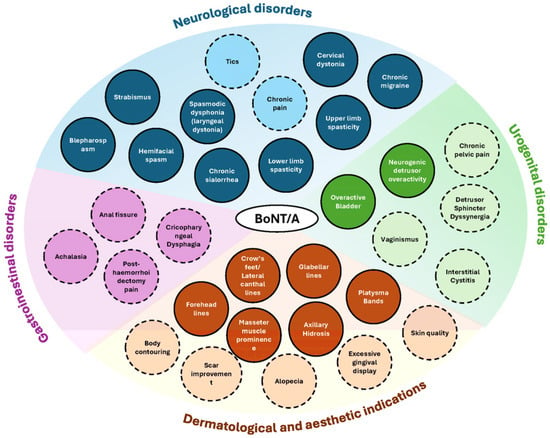
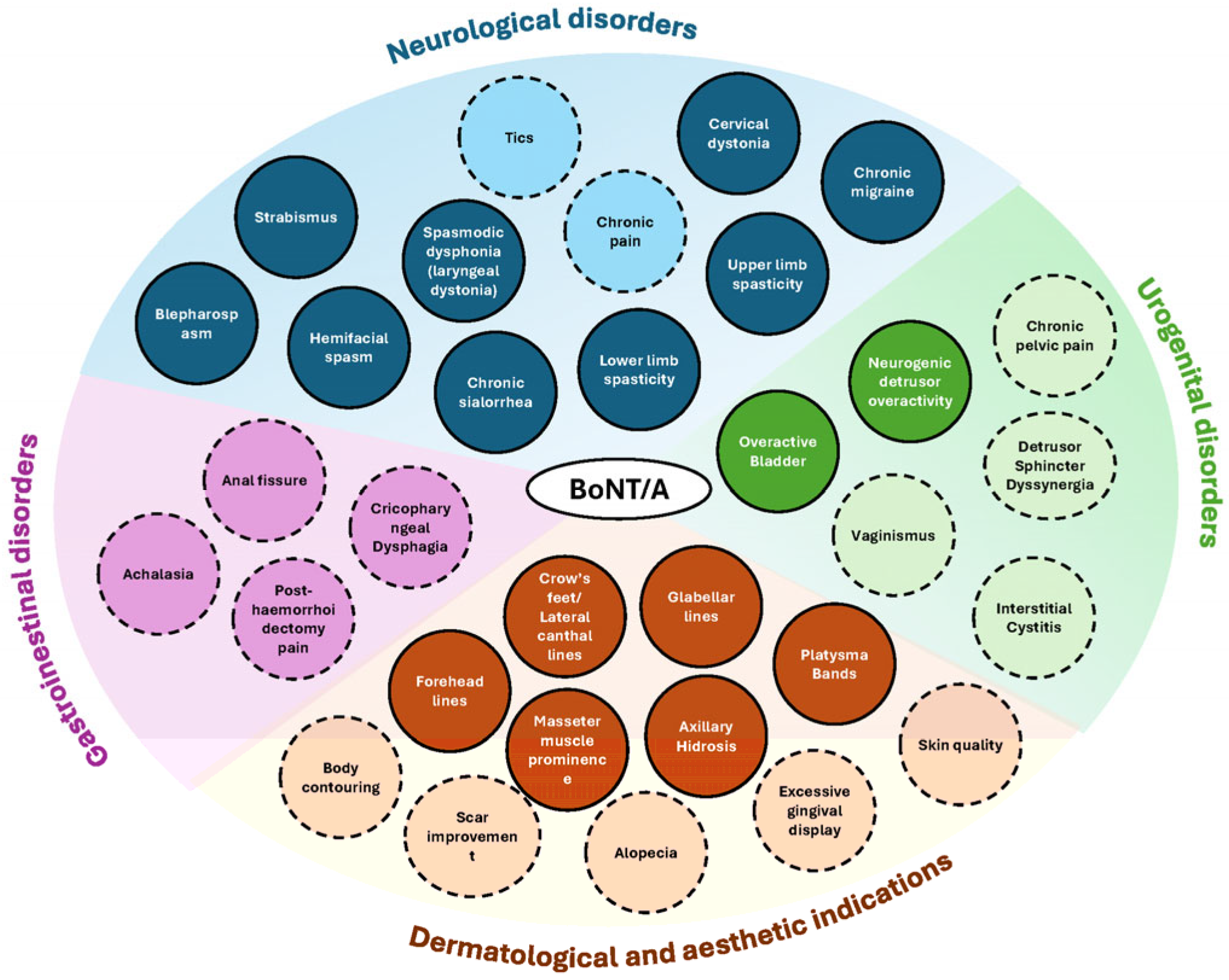
Today, BoNT/A is frequently described as a “wonder drug”, while remaining one of the most potent toxins known to humanity [1,2]. Since BoNT/A’s first therapeutic approval for strabismus and blepharospasm in 1989, there has been a growing expansion of its applications [3,4]. Due to its mechanistic versatility, its use has extended beyond neurological disorders—e.g., cervical dystonia, upper limb spasticity, and migraines—to include urological conditions—e.g., urinary incontinence—gastrointestinal indications, and dermatological and aesthetic indications—e.g., glabellar wrinkles, and excessive gingival display. An overview of the therapeutic landscape of BoNT/A is provided in Figure 1, with approved indications concentrated largely within neurological and aesthetic settings. Many established indications currently remain off label, although they have been well documented [5,6,7,8,9]. While the current expansion of indications certainly may not mirror the rate observed during the early years of BoNT/A development [4], considerable opportunities continue to broaden and refine its clinical use. Accumulating evidence through real-world experience, clinical research, and regulatory evaluation are likely to shape the future applications of BoNT/A through the identification of more indications and the refining of existing treatment protocols.
Figure 1.
Landscape overview of indications for which BoNT/A treatments are applied. Solid lines represent established approved therapeutic and aesthetic indications. Dotted lines represent emerging, investigational, or off-label applications. Categorization is intended as a high-level overview based on publicly available regulatory approvals for BoNT/A products and may vary according to product labeling and jurisdiction. BoNT/A: Botulinum neurotoxin type A.
In parallel, the number of distinct BoNT/A products on the market has also increased significantly in the past decade, particularly in the Asia Pacific region. In Korea alone, there are known to be 15 Korean manufacturers of 19 distinct BoNT/A products, five of which are registered for export use only [10]. Increased exports of BoNT/A are reported to have driven the expansion of manufacturing capacities at record speeds to match demand. It is forecasted that the global botulinum toxin market will grow to USD 24 billion by 2034 [11], driven almost equally by both therapeutic (presently accounting for slightly over 50% of the market share) and aesthetic indications. Globally, BoNT/A treatments are considered the most common cosmetic procedure performed [11]. With rising demand in minimally invasive treatments for cosmetic purposes, the frequency of treatments is also anticipated to grow.
Alongside new formulation developments, over time, distinct concepts of definitions for a “pure” BoNT/A have also been employed, each shaped by developments in manufacturing, scientific evidence, regulatory standards and industrial influences. These definitions are not interchangeable and have varying implications to practitioners and consumers. Our paper aims to examine the different definitions that have been applied to the concept of a “pure” BoNT/A product, commending past successes and outlining future considerations for product development.
2. Definitions of Product Purity in BoNT/A
Each of the following subsections discuss a particular aspect of BoNT/A product purity, showing how it has evolved over time, accompanied by observations in clinical and regulatory contexts.
2.1. Isolation of Native BoNT/A Complex from Clostridium botulinum
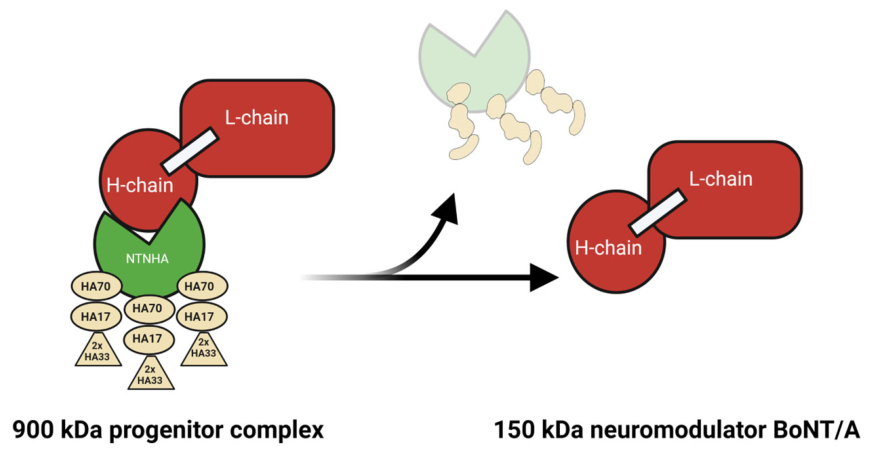
The initial concept of a purified BoNT/A refers to one that is extracted from the cell cultures of Clostridium botulinum bacteria. The successful isolation of BoNT/A on a batch scale is first attributed to Edward Schantz [12], whose work further built upon previous attempts to precipitate the crude toxin by the acidification of spent culture fluid [13]. The protocol described by Schantz consisted of multiple precipitation and washing steps, followed by eventual crystallization of the purified toxin as small white needle-shaped crystals [12]. Under acidic conditions, the core neurotoxic 150 kDa component is bound noncovalently to non-toxic proteins to form a complex, which preserves the second and tertiary structures of the toxin as it passes through the highly acidic gastrointestinal tract for intact release into general bloodstream [14]. Typically, the complex consists of BoNT/A associated with non-toxic nonhemagglutinin (NTNH) and multiple copies of haemaglutinnins (HA-17, HA-33, and HA-70) to form a 900 kDa progenitor complex [15]. The systematic production and isolation of BoNT/A from Schantz’s team paved the way for pilot animal experiments and clinical trials on BoNT/A for the treatment of strabismus—resulting in the eventual recognition of BoNT/A as a therapeutic drug.
The manufacturing processes of the first marketed BoNT/A product, onabotulinumtoxinA (Botox®; Allergan Inc., Irvine, CA, USA), were based on the same precipitation methodology developed by Schantz. Following this, chromatography columns instead of precipitation were employed for the purification of abobotolinumtoxinA (Dysport®; Ipsen Biopharmaceuticals, Wrexham, UK), resulting in a mixture of BoNT/A complexes (approximately 300 kDa and 500 kDa) with partially denatured complexing proteins [16]. Commercial formulations of the BoNT/A complex have differed in apparent molecular mass because the active 150 kDa neurotoxin can be associated with varying amounts of accessory complexing proteins, forming complexes of approximately 900 kDa, 500kDa or 300 kDa [17]. Across the industry, manufacturers have employed distinct patented combinations of separation methods, employing various chromatography methods and/or precipitation steps, resulting in a final BoNT/A product which may differ in mass [18].
2.2. Removal of Non-Toxic Bacterial Components
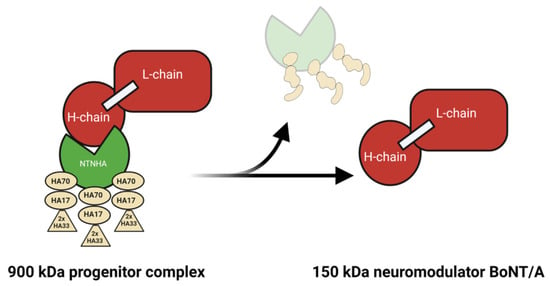
With the commercialization of the BoNT/A, secondary treatment failure due to the presence of neutralizing antibodies (NAbs) in the setting of long-standing repeated BoNT/A administrations emerged as a concern [19]. At the time, the role of non-toxic complexing proteins was identified as a potential contributor to immunogenicity [19]. Beyond complexing proteins, earlier observations by Edward Schantz had confirmed the presence of traces of nucleic acid material with absorbance at 260 nm, which could be further reduced with repeated crystallization processes, albeit at the cost of substantial product loss [12]; the presence of flagellin has also been reported in abobotulinumtoxinA preparations [16]. By removing accessory bacterial components such as complexing proteins, flagellin and clostridial DNA, to reduce risk of immunogenicity, incobotulinumtoxinA (Xeomin®; Merz Pharmaceuticals GmbH, Frankfurt am Main, Germany) was the first product developed with the aim to minimize foreign protein load [19,20]. To date, discourse on BoNT/A purity in BoNT/A literature has largely centered on complexing proteins, and within this context, formulations based on the core 150 kDa active di-chain protein is often termed the “naked neurotoxin”, and also a “pure” formulation (Figure 2) [21].
Figure 2.
Schematic diagram describing the further isolation of the 150 kDa BoNT/A from a 900 kDa progenitor complex. BoNT/A: Botulinum neurotoxin type A, NTNHA: non-toxic nonhemagglutinin, HA: hemagglutinins. The structural scheme is adapted from [22].
Quantitative differences in immunogenicity due to the presence of complexing proteins have been observed in preclinical experiments: the immunization of rabbits with the full BoNT/A complex resulted in production of antibodies with a greater neutralizing effect, compared with antibodies induced by immunization with the core neurotoxin alone [23]. Clinical data is more heterogeneous in this respect, as it can be confounded by differences in dose, indications, injection interval, non-comparability of NAb tests and limited duration of long-term follow-up data [24]. Previous studies have detected no significant differences in NAb formulation between formulations [25,26], while others point towards a lower incidence of NAbs and secondary treatment failure with the use of complexing protein-free incobotulinumtoxinA [24,27,28,29]. Overall, an industry-wide shift towards the development of a “pure” BoNT/A formulations without complexing proteins has been observed [22,30]. Several newer formulations based only on the 150 kDa molecule are now commercially available. Complexing protein-free formulations differ based on excipients and manufacturing methods, which may also influence efficacy and immunogenicity [10,22]. In vitro and in vivo studies suggest that these products may vary in inactive protein content and duration of effect, and such differences may not always be congruent with manufacturer claims [31].
The most recent development is the use of recombinant protein technology, whereby a genetically engineered host cell expression system, e.g., Escherichia coli (E. coli), rather than native Clostridium botulinum (C. botulinum), is used to produce the 150 kDa BoNT/A without complexing proteins. However, different host expression systems are accompanied by implications of distinct host-cell-derived impurities. For E. coli, a Gram-negative bacterium, the bacterial endotoxin lipopolysaccharide (LPS) emerges as a key host-cell-derived component of concern. LPS is a known potent TLR4 (toll-like receptor 4) agonist that activates human dendritic cells and macrophages [32]. Recognized as an innate immune response-modulating impurity, studies have documented its ability to enhance immune responses to biotherapeutics even in trace concentrations [32,33]. The removal of LPS from recombinant proteins expressed in E. Coli is necessary, before these products can be safely administered to humans, and can be a challenging and highly resource-intensive process [34]. While compendial specifications exist for endotoxins such as LPS, limits have been established based on potential risk of pyrogenic responses and may not account for potential immunological effects which could occur at even lower exposure levels [32,33,35].
The first recombinant BoNT/A to receive marketing approval is YY001 (Retoxin; Chongqing Claruvis Pharmaceutical Co., Ltd., Chongqing, China) with a Phase III study demonstrating its non-inferiority in efficacy to onabotolinumtoxinA based on a pre-specified non-inferiority margin of −10% [36]. As E. coli does not natively perform the specific protease-mediated nicking required to convert the 150 kDa single-chain precursor toxin into its active disulfide-linked di-chain form, the manufacturing approach is said to incorporate an additional novel in vitro enzyme action step to activate the toxin. Interestingly, Western blot data from preclinical studies on YY001 from its Phase I publication [37] indicates multiple additional bands below the major species at 150 kDa, 100 kDa and 50 kDa, potentially indicating inactive heavy- and light-chain breakdown products. It is not clear if this is influenced by uncontrolled enzymatic activity from the in vitro activation step. Inactive BoNT/A fragments, if present, may form immunogenic protein aggregates that dendritic cells may recognize as endogenous danger signals [22]. Ultimately, ongoing open-label and real-world studies will play a key role in defining long-term safety, immunogenicity and clinical durability across the pure, complexing protein-free 150 kDa formulations.
2.3. Physicochemical Identification and Quantification of BoNT/A
As the number of BoNT/A products and approved indications has expanded, regulatory specifications relating to quantity and identity have evolved into valuable quality attributes routinely assessed to ensure consistent manufacturing controls. Methods like SDS-PAGE, size exclusion high-performance liquid chromatography (SE-HPLC) and enzyme-linked immunosorbent assay (ELISA) are often used to quantify and identify biopharmaceuticals like BoNT/A (Table 1). These can be applied to both 150 kDa complexing protein-free formulations and higher-molecular-weight complexes to determine the presence and amount of product present in a sample. Specifications for these quality attributes are sometimes referred to as “analytical purity”; in the ‘Specification and Test Methods for Biologicals’ released by the Korea Ministry of Food and Drug Safety in 2022, the size exclusion chromatography method or SDS-PAGE are recommended tests for the purity of a BoNT/A product [38]. According to this guidance, a 900 kDa botulinum toxin complex should be at a ‘level of 95% of the total sample neurotoxin’ when eluted using a moderately buffered eluent and monitored absorbance at 278 nm using SE-HPLC. However, regulatory interpretations of these analytical attributes can differ. Notably, in the Europe Pharmacopeia, although similar requirements have been set out, they do not fall under the designation of purity, but rather as assessments of the protein identity profile [39]. Separately, the Chinese Pharmacopoeia specifies a potency of >1.0 × 10⁷ U (measured by the LD50 test) per mg of protein during crystallization of the neurotoxin complex, in addition to a ratio of absorbance at wavelength (A260/A280 ≤ 0.6) to indicate a low level of nucleic acid contamination [40].
Table 1.
Methods used to quantify and identify BoNT/A during manufacturing process.
Although analytical methods like SDS-PAGE and SE-HPLC can confirm the presence and estimate amount of a protein of a specific molecular mass or hydrodynamic size, they are inherently unable to ascertain the identity, or activity, of the protein. Therefore, a structurally intact but functionally inactive BoNT/A protein—e.g., a misfolded light chain that cannot cleave the target SNAP-25 protein or one that has yet to be nicked to form a di-chain, which retains the same molecular mass and weight—cannot be distinguished by elution or migration time. Using a Western blot analysis following SDS-PAGE enables the specific identification of BoNT/A and its associated degradation products using target-specific antibodies. Similarly, ELISA is also highly specific for BoNT/A and enables quantitative assessment. However, both methods provide no information about its functional activity, and cannot distinguish active BoNT/A from inactive BoNT/A. The distinction is important as inactive BoNT/A can contribute to the antigenic potential of the product and has been shown to be present in varying amounts across formulations [41,42].
Collectively, these considerations highlight the difficulty in meaningfully interpreting ‘purity’ data citing SE-HPLC values of “98%”, or “95%”, which are frequently present in product or marketing literature [18,43,44,45,46,47]. Limited information is provided by these datapoints, and incremental differences cannot be correlated with clinical outcomes. Yet, associations have sometimes been loosely made, with one example claiming that a product of “high purity of 98 percent… reduces resistance” [48]. It is unclear why 98% was chosen as a threshold, or the basis of comparison to substantiate a “reduction in resistance”. In general, these quantitative values offer limited insight for differentiation among BoNT/A products and do not necessarily reflect “purity” in a biologically relevant sense, and may be misleading to laypersons.
Moreover, these aforementioned methods do not provide information on the identity of additional components present. This is an important knowledge gap, as any downstream effects would be highly dependent on their molecular nature. For BoNT/A formulations, one relevant alternative species would be higher-order protein aggregates, which are frequently a concerning presence for biologicals as they are known to increase the risk of immunogenicity and adversely affect biological activity [49,50]. To assess such species, size exclusion chromatography coupled with multi-angle light scattering (SEC-MALS) may be used as a complementary or alternative approach to SEC-HPLC, providing additional characterization of high-molecular-weight species, including their molar mass and oligomeric state (e.g., dimer or trimer).
Beyond quantification and identification of BoNT/A, potency could be a more direct determinant of clinical effect and serves as a functional readout complementing analytical purity. Potency (in Units) with respect to BoNT/A is typically measured by the mouse lethality assay, or more increasingly, an established cell-based potency assay [51]. Specific potency, expressed as Units per ng of BoNT/A, bridges these analytical and functional measures by relating biological activity to the quantity of neurotoxin protein present. A BoNT/A product with a higher specific potency introduces less unnecessary protein (e.g., inactive BoNT/A) for a given level of biological activity, reducing associated protein and antigenic load [52,53]. However, objective data between products are not readily available due to the nonstandard criteria used by industry to measure potency/specific potency [20,54], highlighting the need for harmonized and biologically relevant standards.
3. Practitioner and Consumer Perspectives
3.1. Practitioner Perspectives
The definition of a pure BoNT/A product has evolved over time and continues to shape clinical practice. The initial isolation of native BoNT/A opened many new doors in therapeutics and even more in aesthetics. Experience with the molecule has developed in parallel with the willingness of practitioners to explore its broader applications in novel indications and treatment strategies. Much of the current efforts to explore innovative uses are piloted by practitioners in small-scale studies, providing valuable insights on injection techniques, target muscle groups, or narrowing ideal patient populations to address unmet needs [5,6,7,8,9].
The availability of a pure BoNT/A product with reduced protein load and lower immunogenic potential has expanded treatment options available to practitioners, offering a distinction that may be most relevant in situations where the risk of secondary treatment failure (often referred to as secondary non-response) is heightened due to long-term repeat and/or large doses. This aspect of purity has become an important point for consideration for practitioners when evaluating BoNT/A products and their potential implications for treatment outcomes [29]. Switching to (or restarting on) such a complexing protein-free product is often suggested as a treatment approach to manage patients who have developed treatment failure to BoNT/A [55,56,57,58]. Initiating BoNT/A therapy with a formulation containing only the 150 kDa core neurotoxin (without accessory bacterial proteins) with low immunogenic potential from the beginning has also been considered as a strategy to reduce the risk of NAb induction and to support optimal long-term outcomes [56,57,59]. In a recent meta-analysis of published BoNT/A studies for multiple therapeutic indications (cervical dystonia, spasticity, and blepharospasm), none of the patients exclusively treated with the complexing protein-free formulation incobotulinumtoxinA tested positive for NAbs, even when treated at very high doses [24].
At present, analytical measures of BoNT/A product quality, such as chromatographic purity determined by HPLC, do not directly translate into relevant endpoints for clinicians. Specific potency remains one of the more informative metrics currently as it provides a relative estimate of inactive neurotoxin present in a product. Future advances in bioassay methodologies, as well as further mechanistic studies, may enable more predictive and intuitive assessment of how specific product quality attributes influence clinical efficacy and immunogenic potential.
3.2. Consumer Perspectives
Patients seeking BoNT/A treatment—particularly in aesthetic indications—increasingly search for and are exposed to product-related information through modern channels (e.g., social media, clinic websites), despite restrictions on direct-to-consumer advertising of prescription medicines like BoNT/A in many jurisdictions. Information encountered through these sources may emphasize selected formulation characteristics using purity-related marketing descriptors such as “clean” or “purer” while providing limited context regarding their clinical relevance. The use of a single concept of purity to describe disparate attributes, including the absence of complexing proteins or internal analytical quantification standards, can generate confusion as to which product aspect is being communicated. Patients may arrive at consultations with pre-existing perceptions that are shaped by fragmented information. To illustrate this point, in a consumer survey of 363 BoNT/A recipients for aesthetic treatments in the Asia Pacific region, 61% of participants mistakenly thought that”all BoNT-A formulations” were “free of complexing proteins and unnecessary bacterial components”, although many existing formulations do not actually meet these criteria [56]. In extreme cases, patients may also be misled or influenced to receive illegal BoNT/A products, which can have safety risks [60]. These knowledge gaps highlight need for targeted patient education, and also suggest a role for healthcare professionals to address misconceptions regarding formulation differences during patient counseling.
More recently, there have also been notable commercial narratives associating “pure” with absence of human- or animal-derived products, further broadening the interpretation of the term. This perspective was conceived with the introduction of BoNT/A formulations intended to be manufactured without including “animal-derived components”, e.g., human serum albumin (HSA), such as Coretox (Medytoxin Inc., Cheongju, Republic of Korea), daxibotulinumtoxinA (DAXXIFY; Revance Inc., Nashville, TN, USA) and RelabotulinumtoxinA (Relfydess; Galderma, Uppsala, Sweden), which replaces the HSA stabilizer in conventional formulations with polysorbate as excipients [61,62,63,64]. In addition, NEWLUX (NUMECO, a subsidiary of Medytox Inc., Seoul, Republic of Korea), a 900kDa BoNT/A complex, which uses an animal component-free manufacturing process purported to “enhance safety” and “improve purity”, was recently made available [65,66]. In general, the introduction of these formulations is likely an effort to align with specific consumer preferences driven by personal beliefs or lifestyle choices but are not specifically associated with analytical or clinical outcomes. One commonly cited rationale for excluding animal-derived reagents or excipients in pharmaceuticals is potential health-related concerns and the risk of disease transmission [67], however these theoretical concerns have not been observed in practice, especially in the context of BoNT/A, as the human-derived human serum albumin (HSA) has a long-standing safety profile [68,69]. Conversely, the substitution of human-derived HSA with alternative excipients with more limited data in BoNT/A, such as polysorbates—which have been linked to immunogenicity and hypersensitive reactions—warrants careful evaluations and long-term follow-up [70].
4. Future Directions
Unlike monoclonal antibodies or hormones, BoNT/A as a bacterial-derived product lacks a universal potency standard, does not correspond to a single, well-defined molecular entity, and may exhibit molecular differences [52]. Considering the multi-step nature of its mechanism of action and its high potency, even minor changes in bacterial strain, fermentation conditions, purification processes, or formulation components can significantly influence biological activity. BoNT/A remains one of the most process-dependent biologics to manufacture. Taken together, a functional definition of purity becomes even more important.
The removal of complexing proteins to reduce protein load in BoNT/A formulations marked a further refinement of BoNT/A purity beyond the isolation of the neurotoxin complex. As technological advancements progress, the eventual availability of common and sensitive potency standards could pave the way for the measurement of active BoNT/A, allowing for more meaningful product comparisons linked to clinical outcomes. Efforts to do so are ongoing in both private and public sectors. In May 2024, a USD 2.0 million research grant was awarded from the National Center for Advancing Translational Sciences in partnership with the U.S. Food and Drug Administration to create an advanced, standardized testing platform that can evaluate the potency of BoNT/A without relying on animal testing [71]. More cell-based assay methods that can accurately capture the potency of BoNT/A and account for various steps, e.g., receptor binding, cell entry, and intracellular activity, are being developed [51,72]. In the long run, the availability of standard initiatives would also enable greater resolution in product comparability.
Ultimately, both product development and scientific understanding of BoNT/A continue to evolve in spite of its long history. As new analytical technologies and bioactivity-based standards emerge, our interpretation of attributes such as purity will likely continue to evolve, becoming increasingly informed by their relevance to clinical performance rather than by compositional characteristics alone.
5. Materials and Methods
This narrative review identified relevant sources through iterative, non-systematic searches of databases including PubMed, Google Scholar, and Embase with additional sources identified online, including relevant and publicly available official regulatory agency guidance, product-related materials and press releases. Sources published or publicly available up to September 2026 were considered according to their contribution to three working definitions of product purity encountered in the literature: (1) isolation of the native neurotoxin complex, (2) removal of non-toxic bacterial components, and (3) physicochemical identification and quantification of BoNT/A. These were synthesized narratively within the three thematic areas to contextualize scientific, regulatory, clinical, and commercial interpretations of purity.
Author Contributions
Conceptualization, M.U.M., J.F., N.C., J.-Y.P., L.X., C.M.T., W.Q.L.; original draft preparation, W.Q.L.; writing—review and editing, M.U.M., J.F., N.C., J.-Y.P., L.X., C.M.T., W.Q.L. All authors have read and agreed to the published version of the manuscript.
Funding
This research received no external funding.
Institutional Review Board Statement
Not applicable.
Informed Consent Statement
Not applicable.
Data Availability Statement
No new data were created or analyzed in this study. Data sharing is not applicable to this article.
Conflicts of Interest
Michael Uwe Martin serves as an ad hoc consultant and speaker for Merz Pharma GmbH & Co., KGaA. Jürgen Frevert serves as a consultant for Merz Pharma GmbH & Co., KGaA. Niamh Corduff is a clinical advisor to and speaker for Merz Aesthetics. Je-Young Park has received grants from Merz Aesthetics and serves as an advisory board member and speaker for Merz Aesthetics. Leihong Xiang has no conflict of interest to declare. Clifton Ming Tay and Wei Qi Loh are employees of Merz Asia Pacific Pte. Ltd.
Abbreviations
The following abbreviations are used in this manuscript:
| BoNT/A | Botulinum neurotoxin type A |
| ELISA | Enzyme-linked immunosorbent assay |
| E. coli | Escherichia coli |
| HA | Hemagglutinin |
| HSA | Human serum albumin |
| kDa | Kilodalton |
| LPS | Lipopolysaccharide |
| NAb | Neutralizing antibody |
| NTNH | Non-toxic nonhemagglutinin |
| SE-HPLC | Size exclusion high-performance liquid chromatography |
| SDS-PAGE | Sodium dodecyl sulfate-polyacrylamide gel electrophoresis |
| SNAP-25 | Synaptosomal-associated protein of 25 kDa |
| SNARE | Soluble N-ethylmaleimide-sensitive factor attachment protein receptor |
| TLR4 | Toll-like receptor 4 |
References
- França, K.; Kumar, A.; Fioranelli, M.; Lotti, T.; Tirant, M.; Roccia, M.G. The History of Botulinum Toxin: From Poison to Beauty. Wien. Med. Wochenschr. 2017, 167, 46–48. [Google Scholar] [CrossRef] [Scilit]
- Dong, J.; Helveston, E.M.; Hanke, C.W. The 200-Year Timeline on Botulinum Toxin: From Biologic Poison to Wonder Drug. J. Drugs Dermatol. 2024, 23, 1357–1359. [Google Scholar] [CrossRef] [Scilit]
- Wen, J.; Nadora, D.; Ansari, U.; Syed, B.; Shehabat, M.; Razick, D.I.; Razick, A.A.; Rajagopal, T. Exploring New and Potential Indications for Botulinum Toxin Treatment: An Updated Literature Review. Cureus 2024, 16, e75549. [Google Scholar] [CrossRef] [Scilit]
- Jost, W.H. Are We Heading into a Dead End, or Are We Treading Water? Toxins 2026, 18, 88. [Google Scholar] [CrossRef] [Scilit]
- Boyd, E.K.; Jiang, S.; Shi, R.B.; Rizek, P. Efficacy of IncobotulinumtoxinA (BoNT-A) Injections in Upper Limb Task-Specific and Position-Dependent Tremors. Mov. Disord. Clin. Pract. 2026, 13, mdc3.70732. [Google Scholar] [CrossRef] [Scilit]
- Bates, J.; Liaw, J.; Girling, K.; Banks, A.; Gannon, S.; Earnshaw, J.; Walker, A. A Phase 1 Research Trial to Evaluate the Safety and Effectiveness of Intranasal Botulinum Toxin Type A Spray for Patients with Rhinitis. Int. Forum Allergy Rhinol. 2026, 16, 162–169. [Google Scholar] [CrossRef] [Scilit]
- Karp, B.I.; Tandon, H.K.; Sinaii, N.; Aredo, J.V.; Phan, V.T.; Salmeri, N.; Shah, J.P.; Merideth, M.A.; Stratton, P. Botulinum Toxin for Endometriosis-Associated Chronic Pelvic Pain: A Randomised, Double-Masked, Parallel, Phase 2 Trial. eClinicalMedicine 2026, 91, 103740. [Google Scholar] [CrossRef] [Scilit]
- Ghareeb, P.A.; Westbrooks, T.J.; Conn, V.A.; Homan, C.R.; Brown, C.J.; Brown, O.H.; Chopra, K.N.; Hardrick, J.C.; Wagner, E.R.; Gottschalk, M.B. Botulinum Toxin in Raynaud’s Phenomenon: A Single Center Double-Blinded Randomized Controlled Trial. Plast. Reconstr. Surg. Glob. Open 2026, 14, 5. [Google Scholar] [CrossRef] [Scilit]
- Hufnagel, D.H.; Torosis, M.; Ackerman, A.L. Modified Delphi Consensus Guidelines for Pelvic Floor Botulinum Toxin Injection. Urogynecology 2026, 32, 312–320. [Google Scholar] [CrossRef] [Scilit]
- Dressler, D.; Kim, N.; Johnson, E.A.; Adib Saberi, F. Korean Botulinum Toxins. J. Neural Transm. 2026, 133, 971–975. [Google Scholar] [CrossRef] [Scilit]
- Botulinum Toxin Market Size, Share & Industry Analysis. Fortune Business Insights. Available online: https://www.fortunebusinessinsights.com/industry-reports/botulinum-toxin-market-100996 (accessed on 28 September 2026).
- Schantz, E.J.; Johnson, E.A. Properties and Use of Botulinum Toxin and Other Microbial Neurotoxins in Medicine. Microbiol. Rev. 1992, 56, 80–99. [Google Scholar] [CrossRef]
- Snipe, P.T.; Sommer, H. Studies on Botulinus Toxin: 3. Acid Precipitation of Botulinus Toxin. J. Infect. Dis. 1928, 43, 152–160. [Google Scholar] [CrossRef] [Scilit]
- Gu, S.; Jin, R. Assembly and Function of the Botulinum Neurotoxin Progenitor Complex. Curr. Top. Microbiol. Immunol. 2013, 364, 21–44. [Google Scholar] [CrossRef] [Scilit]
- Oguma, K.; Fujinaga, Y.; Inoue, K. Structure and Function of Clostridium Botulinum Toxins. Microbiol. Immunol. 1995, 39, 161–168. [Google Scholar] [CrossRef] [Scilit]
- Panjwani, N.; O’Keeffe, R.; Pickett, A. Biochemical, Functional and Potency Characteristics of Type A Botulinum Toxin in Clinical Use. Botulinum J. 2008, 1, 153. [Google Scholar] [CrossRef] [Scilit]
- Brin, M.; James, C.; Maltman, J. Botulinum Toxin Type A Products Are Not Interchangeable: A Review of the Evidence. Biologics 2014, 8, 227–241. [Google Scholar] [CrossRef] [Scilit]
- Kim, C.S.; Song, K.Y.; Min, K.M.; An, Y.D. Method for Production of Botulinum Toxin. U.S. Patent 9,512,418 B2, 6 December 2016. [Google Scholar]
- Benecke, R. Clinical Relevance of Botulinum Toxin Immunogenicity. BioDrugs 2012, 26, e1–e9. [Google Scholar] [CrossRef] [Scilit]
- Frevert, J. Response to Commentary by W. Jost on: Pharmaceutical, Biological, and Clinical Properties of Botulinum Neurotoxin Type A Products. Drugs R&D 2015, 15, 217–218. [Google Scholar] [CrossRef] [Scilit]
- Hasan, F. Manufacturing and Clinical Formulations of Botulinum Neurotoxins. In Botulinum Toxin Therapy; Whitcup, S.M., Hallett, M., Eds.; Handbook of Experimental Pharmacology; Springer International Publishing: Cham, Switzerland, 2019; Vol. 263, pp. 49–62. ISBN 978-3-030-66305-6. [Google Scholar]
- Martin, M.U.; Frevert, J.; Tay, C.M. Complexing Protein-Free Botulinum Neurotoxin A Formulations: Implications of Excipients for Immunogenicity. Toxins 2024, 16, 101. [Google Scholar] [CrossRef] [Scilit]
- Kukreja, R.; Chang, T.-W.; Cai, S.; Lindo, P.; Riding, S.; Zhou, Y.; Ravichandran, E.; Singh, B.R. Immunological Characterization of the Subunits of Type A Botulinum Neurotoxin and Different Components of Its Associated Proteins. Toxicon 2009, 53, 616–624. [Google Scholar] [CrossRef] [Scilit]
- Walter, U.; Albrecht, P.; Carr, W.; Hefter, H. Systematic Review and Meta-Analysis of Secondary Treatment Failure and Immunogenicity with Botulinum Neurotoxin A in Multiple Indications [CORRECTED]. Eur. J. Neurol. 2025, 32, e70289. [Google Scholar] [CrossRef] [Scilit]
- Mathevon, L.; Declemy, A.; Laffont, I.; Perennou, D. Immunogenicity Induced by Botulinum Toxin Injections for Limb Spasticity: A Systematic Review. Ann. Phys. Rehabil. Med. 2019, 62, 241–251. [Google Scholar] [CrossRef] [Scilit]
- Rahman, E.; Banerjee, P.S.; Asghar, A.; Gupta, N.K.; Mosahebi, A. Botulinum Toxin Type A Immunogenicity across Multiple Indications: An Overview Systematic Review. Plast. Reconstr. Surg. 2022, 149, 837–848. [Google Scholar] [CrossRef] [Scilit]
- Kerscher, M.; Wanitphakdeedecha, R.; de Almeida, A.T.; Maas, C.; Frevert, J. IncobotulinumtoxinA: A Highly Purified and Precisely Manufactured Botulinum Neurotoxin Type A. J. Drugs Dermatol. 2019, 18, 52–57. [Google Scholar]
- Hefter, H.; Rosenthal, D.; Jansen, A.; Brauns, R.; Ürer, B.; Bigalke, H.; Hartung, H.-P.; Meuth, S.G.; Lee, J.-I.; Albrecht, P.; et al. Significantly Lower Antigenicity of Incobotulinumtoxin than Abo- or Onabotulinumtoxin. J. Neurol. 2023, 270, 788–796. [Google Scholar] [CrossRef] [Scilit]
- Ho, W.W.S.; Albrecht, P.; Calderon, P.E.; Corduff, N.; Loh, D.; Martin, M.U.; Park, J.-Y.; Suseno, L.S.; Tseng, F.-W.; Vachiramon, V.; et al. Emerging Trends in Botulinum Neurotoxin A Resistance: An International Multidisciplinary Review and Consensus. Plast. Reconstr. Surg. Glob. Open 2022, 10, e4407. [Google Scholar] [CrossRef] [Scilit]
- Carr, W.W.; Jain, N.; Sublett, J.W. Immunogenicity of Botulinum Toxin Formulations: Potential Therapeutic Implications. Adv. Ther. 2021, 38, 5046–5064. [Google Scholar] [CrossRef] [Scilit]
- Honndorf, S.; Kühbach, K.; Eisele, K.-H.; Shokurova, A.; Buch, P.; Jatzke, C.; Taylor, H.V.; Fink, K. Comparative Analytics and Pharmacodynamics of the Complex Protein-Free Botulinum Toxin Type A Formulations DaxibotulinumtoxinA, IncobotulinumtoxinA and RelabotulinumtoxinA. Toxins 2026, 18, 142. [Google Scholar] [CrossRef] [Scilit]
- Schwarz, H.; Schmittner, M.; Duschl, A.; Horejs-Hoeck, J. Residual Endotoxin Contaminations in Recombinant Proteins Are Sufficient to Activate Human CD1c+ Dendritic Cells. PLoS ONE 2014, 9, e113840. [Google Scholar] [CrossRef] [Scilit]
- Verthelyi, D.; Wang, V. Trace Levels of Innate Immune Response Modulating Impurities (IIRMIs) Synergize to Break Tolerance to Therapeutic Proteins. PLoS ONE 2010, 5, e15252. [Google Scholar] [CrossRef] [Scilit]
- Shen, Y. Endotoxin Process Removal. In Endotoxin Detection and Control in Pharma, Limulus, and Mammalian Systems; Williams, K.L., Ed.; Springer International Publishing: Cham, Switzerland, 2019; pp. 403–417. ISBN 978-3-030-17148-3. [Google Scholar]
- United States Pharmacopeial Convention. ❬85❭ Bacterial Endotoxins Test; United States Pharmacopeial Convention: Rockville, MD, USA, 2017. [Google Scholar] [CrossRef] [Scilit]
- Wu, Y.; Long, X.; Yu, N.; Chen, J.; Lu, J.; Tan, L.; Lai, W.; Li, L.; Wu, S.; Wu, L.; et al. Therapeutic Efficacy and Safety of Recombinant Botulinum Toxin Type A for Moderate to Severe Glabellar Lines: A Randomized, Controlled, Double-Blind, Phase III Trial in Chinese Adults. Aesthet. Surg. J. 2026, 46, 672–679. [Google Scholar] [CrossRef] [Scilit]
- Li, Q.; Long, X.; Xu, C.; Hu, Z.; Xie, Y.; Yu, N.; Jiang, P.; Yang, W.; Sun, X. Safety and Efficacy of Recombinant Botulinum Toxin Type A for Moderate-to-Severe Glabellar Lines: A Multicenter Randomized Controlled Trial. Plast. Reconstr. Surg. 2026. [Google Scholar] [CrossRef] [Scilit]
- Ministry of Food and Drug Safety. Specifications and Test Methods for Biologicals (MFDS Notification, No.2022-58); Ministry of Food and Drug Safety: Cheongju, Republic of Korea, 2022.
- Council of Europe. European Pharmacopoeia. Botulinum Toxin Type A for Injection. Monograph 2113, 12th ed.; Council of Europe: Strasbourg, France, 2025. [Google Scholar]
- Chinese Pharmacopoeia Commission. Pharmacopoeia of the People’s Republic of China (Part III): 410-111; Chinese Pharmacopoeia Commission: Beijing, China, 2025. [Google Scholar]
- Naumann, M.; Boo, L.M.; Ackerman, A.H.; Gallagher, C.J. Immunogenicity of Botulinum Toxins. J. Neural Transm. 2013, 120, 275–290. [Google Scholar] [CrossRef] [Scilit]
- Park, J.Y.; Sunga, O.; Wanitphakdeedecha, R.; Frevert, J. Neurotoxin Impurities: A Review of Threats to Efficacy. Plast. Reconstr. Surg. Glob. Open 2020, 8, e2627. [Google Scholar] [CrossRef] [Scilit]
- Won, C.H.; Kim, H.K.; Kim, B.J.; Kang, H.; Hong, J.P.; Lee, S.; Kim, C. Comparative Trial of a Novel Botulinum Neurotoxin Type A versus Onabotulinumtoxin A in the Treatment of Glabellar Lines: A Multicenter, Randomized, Double-blind, Active-controlled Study. Int. J. Dermatol. 2015, 54, 227–234. [Google Scholar] [CrossRef] [Scilit]
- Choi, M. Daewoong Pharmaceutical Launches Nabota in Saudi Arabia. Business Korea. Available online: https://www.businesskorea.co.kr/news/articleView.html?idxno=234534 (accessed on 10 September 2026).
- Nabota (Product Homepage). Available online: https://www.nabotasea.com/ (accessed on 10 September 2026).
- Sihuan Pharmaceutical Holdings Group Ltd. Sihuan Pharmaceutical Receives Approval for Its Exclusive Medical Aesthetic Product Letybo (Botulinum Toxin), A Blockbuster Product in a Hundred-Billion Size Market. Available online: https://ir.sihuanpharm.com/en/investor-relations/latest-news/investor-news/sihuan-pharmaceutical-receives-approval-for-its-exclusive-medical-aesthetic-product-letybo-botulinum-toxin-a-blockbuster-product-in-a-hundred-billion-size-market/ (accessed on 10 September 2026).
- Rosetox 100 U (Product Homepage). Available online: https://biopharmakorea.com/product/rosetox-100u/?ckattempt=2 (accessed on 10 September 2026).
- Lee, H. Daewoong Launches Nabota in Ecuador. Korea Biomedical Review. Available online: https://www.koreabiomed.com/news/articleView.html?idxno=26852 (accessed on 10 September 2026).
- Pham, N.B.; Meng, W.S. Protein Aggregation and Immunogenicity of Biotherapeutics. Int. J. Pharm. 2020, 585, 119523. [Google Scholar] [CrossRef] [Scilit]
- Rojekar, S.; Gholap, A.D.; Jadhav, K.; Shevalkar, G.; Sugandhi, V.V.; Pai, R.; Parikh, K.; Prajapati, M.K.; Desai, N.; Vora, L.K.; et al. Exploring Protein Aggregation in Biological Products: From Mechanistic Understanding to Practical Solutions. AAPS PharmSciTech 2025, 26, 189. [Google Scholar] [CrossRef] [Scilit]
- Watkins, J.C.; Middelkoop, J.; Taylor, K.; Filipova, D.; Hartung, T.; Visseren-Hamakers, I.; Ritskes-Hoitinga, M.; Salvatori, D. Botulinum Neurotoxin: Tracking the Transition from Lethal Dose to in Vitro Models. NAM J. 2025, 1, 100040. [Google Scholar] [CrossRef] [Scilit]
- Dressler, D.; Frevert, J. Developing Botulinum Toxin Drugs: Unexpected Challenges. J. Neural Transm. 2026, 133, 959–964. [Google Scholar] [CrossRef] [Scilit]
- Dressler, D.; Hallett, M. Immunological Aspects of Botox®, Dysport® and MyoblocTM/NeuroBloc®. Eur. J. Neurol. 2006, 13, 11–15. [Google Scholar] [CrossRef] [Scilit]
- Jost, W.H. Similar To’ Is Not ‘Identical With’, and ‘Identical With’ Is Not ‘The Same As. Drugs R&D 2015, 15, 11–12. [Google Scholar] [CrossRef] [Scilit][Green Version]
- Hefter, H.; Hartmann, C.; Kahlen, U.; Moll, M.; Bigalke, H. Prospective Analysis of Neutralising Antibody Titres in Secondary Non-Responders under Continuous Treatment with a Botulinumtoxin Type A Preparation Free of Complexing Proteins—A Single Cohort 4-Year Follow-up Study. BMJ Open 2012, 2, e000646. [Google Scholar] [CrossRef] [Scilit]
- Corduff, N.; Park, J.-Y.; Calderon, P.E.; Choi, H.; Dingley, M.; Ho, W.W.S.; Martin, M.U.; Suseno, L.S.; Tseng, F.-W.; Vachiramon, V.; et al. Real-World Implications of Botulinum Neurotoxin A Immunoresistance for Consumers and Aesthetic Practitioners: Insights from ASCEND Multidisciplinary Panel. Plast. Reconstr. Surg. Glob. Open 2024, 12, e5892. [Google Scholar] [CrossRef] [Scilit]
- Hefter, H.; Ürer, B.; Brauns, R.; Rosenthal, D.; Meuth, S.G.; Lee, J.-I.; Albrecht, P.; Samadzadeh, S. Significant Long-Lasting Improvement after Switch to Incobotulinum Toxin in Cervical Dystonia Patients with Secondary Treatment Failure. Toxins 2022, 14, 44. [Google Scholar] [CrossRef] [Scilit]
- Martin, M.U.; Tay, C.M.; Siew, T.W. Continuous Treatment with IncobotulinumtoxinA Despite Presence of BoNT/A Neutralizing Antibodies: Immunological Hypothesis and a Case Report. Toxins 2024, 16, 422. [Google Scholar] [CrossRef] [Scilit]
- Hefter, H.; Ürer, B.; Brauns, R.; Rosenthal, D.; Meuth, S.G.; Lee, J.-I.; Albrecht, P.; Samadzadeh, S. The Complex Relationship between Antibody Titers and Clinical Outcome in Botulinum Toxin Type A Long-Term Treated Patients with Cervical Dystonia. J. Neurol. 2022, 269, 5991–6002. [Google Scholar] [CrossRef] [Scilit]
- Qiu, H.; Shen, J.; Tang, Y.; Ji, Q.; Lin, X.; Wu, D. A Retrospective Case Series Study of Illegal Cosmetic Iatrogenic Botulism: Outbreak Analysis and Response Lessons. Aesthet. Surg. J. 2025, 45, 936–946. [Google Scholar] [CrossRef] [Scilit]
- Byun, J.; Kwak, S.; Kwon, J.-H.; Shin, M.; Lee, D.-K.; Rhee, C.-H.; Kang, W.; Oh, J.-W.; Cruz, D.J.M. Comparative Pharmacodynamics of Three Different Botulinum Toxin Type A Preparations Following Repeated Intramuscular Administration in Mice. Toxins 2022, 14, 365. [Google Scholar] [CrossRef] [Scilit]
- So, J. Competition Heats up Among Korean Botox Makers to Develop ‘kDa’. Korea Biomedical Review. Available online: https://www.koreabiomed.com/news/articleView.html?idxno=3909 (accessed on 28 April 2026).
- Crous, C.; Pretorius, J.; Petzer, A. Overview of Popular Cosmeceuticals in Dermatology. Skin. Health Dis. 2024, 4, ski2.340. [Google Scholar] [CrossRef] [Scilit]
- Gold, M.H.; Donofrio, L.; Shridharani, S.; Moradi, A.; Biesman, B.; Chiang, M.; George, R.; Polder, K.; Solish, N.; Schwarcz, R.; et al. Patient-Reported Outcomes for Glabellar Line Improvement and Satisfaction with the RelabotulinumtoxinA Ready-to-Use Liquid Formulation: Data from the Phase 3 READY-1 Trial. Aesthet. Surg. J. 2025, 45, 828–835. [Google Scholar] [CrossRef] [Scilit]
- Lee, H. Medytox’s Affiliate Wins Approval for Freeze-Dried BTX in Korea. Korea Biomedical Review. Available online: https://www.koreabiomed.com/news/articleView.html?idxno=21978 (accessed on 10 September 2026).
- Park, G. Numeco’s Next-Generation Botulinum Toxin Newlux Lands in Europe. Korea Biomedical Review. Available online: https://www.koreabiomed.com/news/articleView.html?idxno=28686 (accessed on 10 September 2026).
- Tieu, L.; Uchi, J.; Patel, N.; Meghani, M.; Patel, P.; Nguyen, Y. Embracing Medication Needs of Patients Based on Ethical, Dietary, and Religious Preferences. Am. J. Lifestyle Med. 2024, 18, 351–363. [Google Scholar] [CrossRef] [Scilit]
- Sattler, S.; Gollomp, S.; Curry, A. A Narrative Literature Review of the Established Safety of Human Serum Albumin Use as a Stabilizer in Aesthetic Botulinum Toxin Formulations Compared to Alternatives. Toxins 2023, 15, 619. [Google Scholar] [CrossRef] [Scilit]
- Lee, J.; Chun, M.H.; Ko, Y.J.; Lee, S.-U.; Kim, D.Y.; Paik, N.-J.; Kwon, B.S.; Park, Y.G. Efficacy and Safety of MT10107 (Coretox) in Poststroke Upper Limb Spasticity Treatment: A Randomized, Double-Blind, Active Drug-Controlled, Multicenter, Phase III Clinical Trial. Arch. Phys. Med. Rehabil. 2020, 101, 1485–1496. [Google Scholar] [CrossRef] [Scilit]
- Martin, M.U.; Frevert, J.; Park, J.-Y.; Cui, H.; Curry, A.; Loh, W.Q. Immunological Considerations of Polysorbate as an Excipient in Botulinum Neurotoxin Type A Formulations: A Narrative Review. Toxins 2025, 17, 598. [Google Scholar] [CrossRef] [Scilit]
- NIH Awards Hesperos Research Grant to Develop Animal-Free Botox Testing Platform. Business Wire. Available online: https://www.businesswire.com/news/home/20240507373037/en/NIH-Awards-Hesperos-Research-Grant-to-Develop-Animal-Free-Botox-Testing-Platform (accessed on 10 September 2026).
- Dunning, F.M.; Hendrickson, S.; Wolfe, S.; Harding, D.; Geurs, T.; Piazza, T.M.; Little, T.A.; Tucker, W.C. A Cell-Based Potency Assay for Determining the Relative Potency of Botulinum Neurotoxin A Preparations Using Manual and Semi-Automated Procedures. Toxins 2026, 18, 45. [Google Scholar] [CrossRef] [Scilit]

Disclaimer/Publisher’s Note: The statements, opinions and data contained in all publications are solely those of the individual author(s) and contributor(s) and not of MDPI and/or the editor(s). MDPI and/or the editor(s) disclaim responsibility for any injury to people or property resulting from any ideas, methods, instructions or products referred to in the content. |
© 2026 by the authors. Licensee MDPI, Basel, Switzerland. This article is an open access article distributed under the terms and conditions of the Creative Commons Attribution (CC BY) license.