Food- and Nutrient-Based Dietary Patterns and Depression in Korean Adults: A Machine Learning Approach Using KNHANES 2016–2021



Abstract
1. Introduction
2. Materials and Methods
2.1. Study Population and Data Source
2.2. Assessment of Depression
2.3. Dietary Data and Preprocessing
2.4. Clustering Analysis Using Machine Learning
2.5. Covariates
2.6. Statistical Analysis
2.7. Model Performance Comparison Across Logistic Regression Models
3. Results
3.1. General Characteristics and Dietary Patterns Based on Food Group Clustering
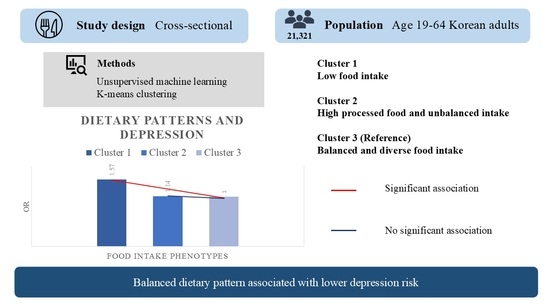
3.2. Association Between Food Group Clusters and Depression
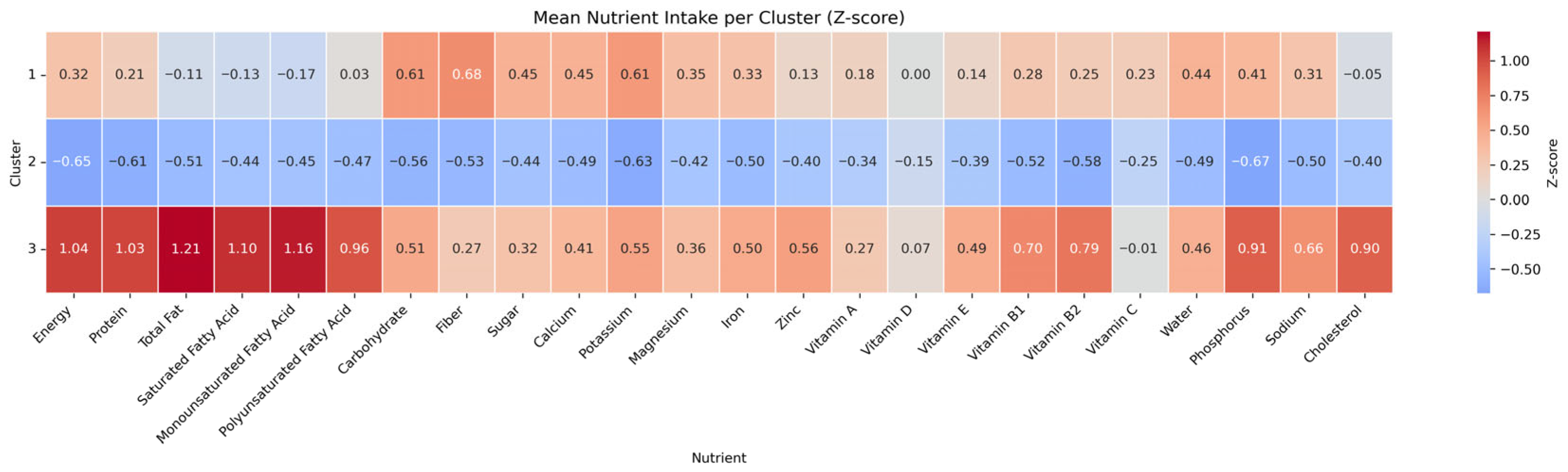
3.3. General Characteristics and Dietary Patterns Based on Nutrient Clustering
3.4. Association Between Nutrient Clusters and Depression
3.5. Predictive Performance Comparison of the Three Logistic Regression Models
4. Discussion
5. Conclusions
Author Contributions
Funding
Institutional Review Board Statement
Informed Consent Statement
Data Availability Statement
Conflicts of Interest
Abbreviations
| KNHANES | Korea National Health and Nutrition Examination Survey |
| BM | body mass index |
| OR | odds ratio |
| CI | confidence interval |
| AIC | Akaike Information Criterion |
| AUC | area under the receiver operating characteristic curve |
References
- World Health Organization. Depression and Other Common Mental Disorders: Global Health Estimates; World Health Organization: Geneva, Switzerland, 2017. [Google Scholar]
- Vos, T.; Lim, S.S.; Abbafati, C.; Abbas, K.M.; Abbasi, M.; Abbasifard, M.; Abbasi-Kangevari, M.; Abbastabar, H.; Abd-Allah, F.; Abdelalim, A. Global burden of 369 diseases and injuries in 204 countries and territories, 1990–2019: A systematic analysis for the Global Burden of Disease Study 2019. Lancet 2020, 396, 1204–1222. [Google Scholar] [CrossRef]
- Greenberg, P.E.; Fournier, A.A.; Sisitsky, T.; Pike, C.T.; Kessler, R.C. The economic burden of adults with major depressive disorder in the United States (2005 and 2010). J. Clin. Psychiatry 2015, 76, 155–162. [Google Scholar] [CrossRef] [PubMed]
- Bernal, M.; Haro, J.M.; Bernert, S.; Brugha, T.; de Graaf, R.; Bruffaerts, R.; Lépine, J.P.; de Girolamo, G.; Vilagut, G.; Gasquet, I.; et al. Risk factors for suicidality in Europe: Results from the ESEMED study. J. Affect. Disord. 2007, 101, 27–34. [Google Scholar] [CrossRef] [PubMed]
- Bodnar, L.M.; Kirkpatrick, S.I.; Naimi, A.I. Machine learning can improve the development of evidence-based dietary guidelines. Public Health Nutr. 2022, 25, 2566–2569. [Google Scholar] [CrossRef]
- Zhang, B.; Li, M.; Li, X. Plant-based diets especially healthy ones are negatively associated with depression: A cross-sectional study. BMC Public Health 2025, 26, 17. [Google Scholar] [CrossRef] [PubMed]
- Krogh, J.; Nordentoft, M.; Sterne, J.A.; Lawlor, D.A. The effect of exercise in clinically depressed adults: Systematic review and meta-analysis of randomized controlled trials. J. Clin. Psychiatry 2011, 72, 529–538. [Google Scholar] [CrossRef]
- Zhai, L.; Zhang, Y.; Zhang, D. Sedentary behaviour and the risk of depression: A meta-analysis. Br. J. Sports Med. 2015, 49, 705–709. [Google Scholar] [CrossRef]
- Wiesbeck, G.A.; Kuhl, H.C.; Yaldizli, O.; Wurst, F.M. Tobacco smoking and depression—Results from the WHO/ISBRA study. Neuropsychobiology 2008, 57, 26–31. [Google Scholar] [CrossRef]
- Sajjadi, S.S.; Foshati, S.; Haddadian-Khouzani, S.; Rouhani, M.H. The role of selenium in depression: A systematic review and meta-analysis of human observational and interventional studies. Sci. Rep. 2022, 12, 1045. [Google Scholar] [CrossRef]
- Bender, A.; Hagan, K.E.; Kingston, N. The association of folate and depression: A meta-analysis. J. Psychiatr. Res. 2017, 95, 9–18. [Google Scholar] [CrossRef]
- Anglin, R.E.; Samaan, Z.; Walter, S.D.; McDonald, S.D. Vitamin D deficiency and depression in adults: Systematic review and meta-analysis. Br. J. Psychiatry J. Ment. Sci. 2013, 202, 100–107. [Google Scholar] [CrossRef] [PubMed]
- Xie, F.; Huang, T.; Lou, D.; Fu, R.; Ni, C.; Hong, J.; Ruan, L. Effect of vitamin D supplementation on the incidence and prognosis of depression: An updated meta-analysis based on randomized controlled trials. Front. Public Health 2022, 10, 903547. [Google Scholar] [CrossRef] [PubMed]
- Wu, Y.; Zhang, L.; Li, S.; Zhang, D. Associations of dietary vitamin B1, vitamin B2, vitamin B6, and vitamin B12 with the risk of depression: A systematic review and meta-analysis. Nutr. Rev. 2022, 80, 351–366. [Google Scholar] [CrossRef] [PubMed]
- Bai, Z.G.; Bo, A.; Wu, S.J.; Gai, Q.Y.; Chi, I. Omega-3 polyunsaturated fatty acids and reduction of depressive symptoms in older adults: A systematic review and meta-analysis. J. Affect. Disord. 2018, 241, 241–248. [Google Scholar] [CrossRef]
- Grosso, G.; Micek, A.; Marventano, S.; Castellano, S.; Mistretta, A.; Pajak, A.; Galvano, F. Dietary n-3 PUFA, fish consumption and depression: A systematic review and meta-analysis of observational studies. J. Affect. Disord. 2016, 205, 269–281. [Google Scholar] [CrossRef]
- Yang, Y.; Kim, Y.; Je, Y. Fish consumption and risk of depression: Epidemiological evidence from prospective studies. Asia-Pac. Psychiatry 2018, 10, e12335. [Google Scholar] [CrossRef]
- Nucci, D.; Fatigoni, C.; Amerio, A.; Odone, A.; Gianfredi, V. Red and Processed Meat Consumption and Risk of Depression: A Systematic Review and Meta-Analysis. Int. J. Environ. Res. Public Health 2020, 17, 6686. [Google Scholar] [CrossRef]
- Saghafian, F.; Malmir, H.; Saneei, P.; Milajerdi, A.; Larijani, B.; Esmaillzadeh, A. Fruit and vegetable consumption and risk of depression: Accumulative evidence from an updated systematic review and meta-analysis of epidemiological studies. Br. J. Nutr. 2018, 119, 1087–1101. [Google Scholar] [CrossRef]
- Li, F.; Liu, X.; Zhang, D. Fish consumption and risk of depression: A meta-analysis. J. Epidemiol. Community Health 2016, 70, 299–304. [Google Scholar] [CrossRef]
- Zhang, X.Y.; Shu, L.; Si, C.J.; Yu, X.L.; Liao, D.; Gao, W.; Zhang, L.; Zheng, P.F. Dietary Patterns, Alcohol Consumption and Risk of Coronary Heart Disease in Adults: A Meta-Analysis. Nutrients 2015, 7, 6582–6605. [Google Scholar] [CrossRef]
- Ruusunen, A.; Lehto, S.M.; Mursu, J.; Tolmunen, T.; Tuomainen, T.P.; Kauhanen, J.; Voutilainen, S. Dietary patterns are associated with the prevalence of elevated depressive symptoms and the risk of getting a hospital discharge diagnosis of depression in middle-aged or older Finnish men. J. Affect. Disord. 2014, 159, 1–6. [Google Scholar] [CrossRef]
- Le Port, A.; Gueguen, A.; Kesse-Guyot, E.; Melchior, M.; Lemogne, C.; Nabi, H.; Goldberg, M.; Zins, M.; Czernichow, S. Association between dietary patterns and depressive symptoms over time: A 10-year follow-up study of the GAZEL cohort. PLoS ONE 2012, 7, e51593. [Google Scholar] [CrossRef]
- Gougeon, L.; Payette, H.; Morais, J.; Gaudreau, P.; Shatenstein, B.; Gray-Donald, K. Dietary patterns and incidence of depression in a cohort of community-dwelling older Canadians. J. Nutr. Health Aging 2015, 19, 431–436. [Google Scholar] [CrossRef] [PubMed]
- Chan, R.; Chan, D.; Woo, J. A prospective cohort study to examine the association between dietary patterns and depressive symptoms in older Chinese people in Hong Kong. PLoS ONE 2014, 9, e105760. [Google Scholar] [CrossRef]
- Nanri, A.; Kimura, Y.; Matsushita, Y.; Ohta, M.; Sato, M.; Mishima, N.; Sasaki, S.; Mizoue, T. Dietary patterns and depressive symptoms among Japanese men and women. Eur. J. Clin. Nutr. 2010, 64, 832–839. [Google Scholar] [CrossRef] [PubMed]
- Xia, Y.; Wang, N.; Yu, B.; Zhang, Q.; Liu, L.; Meng, G.; Wu, H.; Du, H.; Shi, H.; Guo, X.; et al. Dietary patterns are associated with depressive symptoms among Chinese adults: A case-control study with propensity score matching. Eur. J. Nutr. 2017, 56, 2577–2587. [Google Scholar] [CrossRef] [PubMed]
- Sugawara, N.; Yasui-Furukori, N.; Tsuchimine, S.; Kaneda, A.; Tsuruga, K.; Iwane, K.; Okubo, N.; Takahashi, I.; Kaneko, S. No association between dietary patterns and depressive symptoms among a community-dwelling population in Japan. Ann. Gen. Psychiatry 2012, 11, 24. [Google Scholar] [CrossRef]
- Tak, E.; Kim, J.; Lee, H.; Kang, M. Secular trends in dietary patterns among Korean adults: Using data from the 2007-2022 Korea National health and nutrition examination survey. Nutr. J. 2025, 24, 163. [Google Scholar] [CrossRef]
- Bae, S.; Park, H. Age-Stratified Trends in Nutrition and Lifestyle Transitions in Korea: Findings from KNHANES 2013-2022. Nutrients 2025, 17, 3282. [Google Scholar] [CrossRef]
- Lee, H.; Yim, Y.; Cho, Y.; Oh, J.; Kim, S.; Son, Y.; Jo, H.; Hong, S.; Rahmati, M.; Cho, H.; et al. Long-term trends and patterns in ultra-processed food consumption among Korean adults from 1998 to 2022. Sci. Rep. 2025, 15, 4131. [Google Scholar] [CrossRef]
- Hwang, Y.G.; Pae, C.; Lee, S.H.; Yook, K.H.; Park, C.I. Relationship between Mediterranean diet and depression in South Korea: The Korea National Health and Nutrition Examination Survey. Front. Nutr. 2023, 10, 1219743. [Google Scholar] [CrossRef]
- Park, S.J.; Kim, M.S.; Lee, H.J. The association between dietary pattern and depression in middle-aged Korean adults. Nutr. Res. Pract. 2019, 13, 316–322. [Google Scholar] [CrossRef] [PubMed]
- Kim, T.H.; Choi, J.Y.; Lee, H.H.; Park, Y. Associations between Dietary Pattern and Depression in Korean Adolescent Girls. J. Pediatr. Adolesc. Gynecol. 2015, 28, 533–537. [Google Scholar] [CrossRef] [PubMed]
- Zhao, J.; Li, Z.; Gao, Q.; Zhao, H.; Chen, S.; Huang, L.; Wang, W.; Wang, T. A review of statistical methods for dietary pattern analysis. Nutr. J. 2021, 20, 37. [Google Scholar] [CrossRef] [PubMed]
- Birben, E.; Sahiner, U.M.; Sackesen, C.; Erzurum, S.; Kalayci, O. Oxidative stress and antioxidant defense. World Allergy Organ. J. 2012, 5, 9–19. [Google Scholar] [CrossRef]
- Kim, J.M.; Stewart, R.; Kim, S.W.; Yang, S.J.; Shin, I.S.; Yoon, J.S. Predictive value of folate, vitamin B12 and homocysteine levels in late-life depression. Br. J. Psychiatry J. Ment. Sci. 2008, 192, 268–274. [Google Scholar] [CrossRef]
- Farooqui, A.A. n-3 fatty acid-derived lipid mediators in the brain: New weapons against oxidative stress and inflammation. Curr. Med. Chem. 2012, 19, 532–543. [Google Scholar] [CrossRef]
- Ortega, M.A.; Fraile-Martínez, Ó.; García-Montero, C.; Alvarez-Mon, M.A.; Lahera, G.; Monserrat, J.; Llavero-Valero, M.; Gutiérrez-Rojas, L.; Molina, R.; Rodríguez-Jimenez, R.; et al. Biological Role of Nutrients, Food and Dietary Patterns in the Prevention and Clinical Management of Major Depressive Disorder. Nutrients 2022, 14, 3099. [Google Scholar] [CrossRef]
- Costabile, A.; Klinder, A.; Fava, F.; Napolitano, A.; Fogliano, V.; Leonard, C.; Gibson, G.R.; Tuohy, K.M. Whole-grain wheat breakfast cereal has a prebiotic effect on the human gut microbiota: A double-blind, placebo-controlled, crossover study. Br. J. Nutr. 2008, 99, 110–120. [Google Scholar] [CrossRef]
- Ge, X.; Pan, J.; Liu, Y.; Wang, H.; Zhou, W.; Wang, X. Intestinal Crosstalk between Microbiota and Serotonin and its Impact on Gut Motility. Curr. Pharm. Biotechnol. 2018, 19, 190–195. [Google Scholar] [CrossRef]
- Cryan, J.F.; O'Riordan, K.J.; Cowan, C.S.M.; Sandhu, K.V.; Bastiaanssen, T.F.S.; Boehme, M.; Codagnone, M.G.; Cussotto, S.; Fulling, C.; Golubeva, A.V.; et al. The Microbiota-Gut-Brain Axis. Physiol. Rev. 2019, 99, 1877–2013. [Google Scholar] [CrossRef]
- Cardinali, D.P.; Srinivasan, V.; Brzezinski, A.; Brown, G.M. Melatonin and its analogs in insomnia and depression. J. Pineal Res. 2012, 52, 365–375. [Google Scholar] [CrossRef]
- Blok, W.L.; Katan, M.B.; van der Meer, J.W. Modulation of inflammation and cytokine production by dietary (n-3) fatty acids. J. Nutr. 1996, 126, 1515–1533. [Google Scholar] [CrossRef] [PubMed]
- Calder, P.C. Immunoregulatory and anti-inflammatory effects of n-3 polyunsaturated fatty acids. Braz. J. Med. Biol. Res. 1998, 31, 467–490. [Google Scholar] [CrossRef] [PubMed]
- Korea Center for Disease Control and Prevention. Korea National Health and Nutrition Examination Survey. 2017. Available online: https://knhanes.kdca.go.kr (accessed on 10 February 2017).
- Lopresti, A.L.; Hood, S.D.; Drummond, P.D. A review of lifestyle factors that contribute to important pathways associated with major depression: Diet, sleep and exercise. J. Affect. Disord. 2013, 148, 12–27. [Google Scholar] [CrossRef] [PubMed]
- Nicolaou, M.; Colpo, M.; Vermeulen, E.; Elstgeest, L.E.M.; Cabout, M.; Gibson-Smith, D.; Knuppel, A.; Sini, G.; Schoenaker, D.; Mishra, G.D.; et al. Association of a priori dietary patterns with depressive symptoms: A harmonised meta-analysis of observational studies. Psychol. Med. 2020, 50, 1872–1883. [Google Scholar] [CrossRef]
- Watanabe, F. Vitamin B12 sources and bioavailability. Exp. Biol. Med. 2007, 232, 1266–1274. [Google Scholar] [CrossRef]
- De Bie, T.H.; Eilander, A.; Wanders, A.J. Comparing the nutrient composition of plant-based meat with animal meat and legumes: A review of analytical data on 45 nutrients. J. Food Compos. Anal. 2025, 146, 107841. [Google Scholar] [CrossRef]
- Andrews, C.J.; Raubenheimer, D.; Simpson, S.J.; Senior, A.M. Associations between national plant-based vs animal-based protein supplies and age-specific mortality in human populations. Nat. Commun. 2025, 16, 3431. [Google Scholar] [CrossRef]
- Farhan, M.; Faisal, M. The Potential Role of Polyphenol Supplementation in Preventing and Managing Depression: A Review of Current Research. Life 2024, 14, 1342. [Google Scholar] [CrossRef]
- Shen, C.-L.; Hassan, T.; Presto, P.; Payberah, D.; Devega, R.; Wakefield, S.; Dunn, D.M.; Neugebauer, V. Novel insights into dietary bioactive compounds and major depressive disorders: Evidence from animal studies and future perspectives. J. Nutr. 2025, 155, 1583–1613. [Google Scholar] [CrossRef]



| Food Intake Phenotypes | ||||
|---|---|---|---|---|
| Cluster 1 a | Cluster 2 b | Cluster 3 c | ||
| Variables | N (%) or Mean (SE) | p | ||
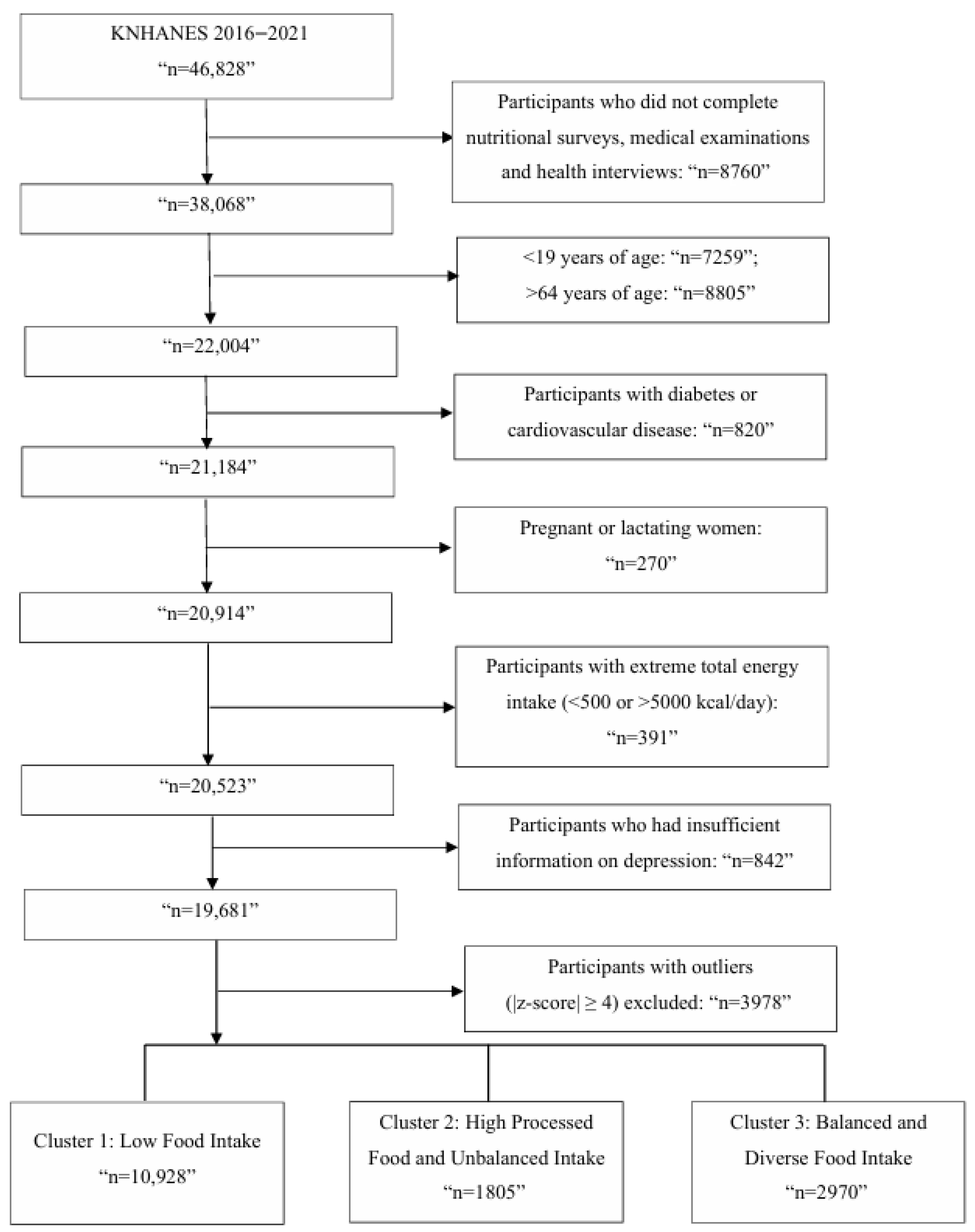
| Number of subjects | 10,928 | 1805 | 2970 | |
| Age (years) | 42.5 (0.2) | 38.6 (0.4) | 44.4 (0.3) | <0.001 |
| BMI (kg/m2) | 23.9 (0.05) | 23.4 (0.1) | 23.9 (0.1) | <0.001 |
| Education | ||||
| Less than or equal to middle school | 1574 (10.7) | 139 (6.0) | 517 (13.7) | <0.001 |
| High school | 4283 (40.3) | 629 (36.5) | 1096 (38.2) | |
| Greater than or equal to college | 5057 (49.0) | 1035 (57.5) | 1353 (48.2) | |
| Household income | ||||
| Lowest | 1054 (8.5) | 107 (6.7) | 241 (7.8) | 0.018 |
| Lower middle | 2550 (22.3) | 367 (20.0) | 683 (21.8) | |
| Upper middle | 3394 (31.6) | 555 (30.6) | 963 (33.3) | |
| Highest | 3898 (37.6) | 776 (42.8) | 1079 (37.0) | |
| Smoking | ||||
| Nonsmoker | 6988 (59.6) | 1266 (65.2) | 1739 (52.8) | <0.001 |
| Former smoker | 2044 (20.8) | 264 (16.4) | 617 (23.0) | |
| Current smoker | 1884 (19.6) | 275 (18.3) | 611 (24.2) | |
| Alcohol consumption | ||||
| Never/rarely | 4754 (40.4) | 724 (35.8) | 1108 (34.8) | <0.001 |
| 1-4 Times/month | 3936 (38.2) | 727 (43.0) | 1073 (37.2) | |
| ≥2 Times/week | 2228 (21.4) | 354 (21.2) | 787 (28.0) | |
| Physical activity d | ||||
| No | 5942 (52.5) | 902 (46.3) | 1599 (51.7) | <0.001 |
| Yes | 4965 (47.5) | 899 (53.7) | 1367 (48.3) | |
| Total energy intake (kcal) e | 1776.7 (8.8) | 2043.1 (16.3) | 2069.9 (13.6) | <0.001 |
| Food Intake Phenotypes | |||
|---|---|---|---|
| Cluster 1 a | Cluster 2 b | Cluster 3 c | |
| No. of cases/subjects | 510/10705 | 41/1379 | 158/4925 |
| OR (95% CI) | OR (95% CI) | OR (95% CI) | |
| Cluster 1 as reference | |||
| Age-adjusted OR (95% Cl) | 1.0 (ref.) | 0.72 (0.52–0.99) | 0.56 (0.42–0.77) |
| Multivariable-adjusted OR (95% CI) d | 1.0 (ref.) | 0.73 (0.53–1.01) | 0.64 (0.47–0.88) |
| Cluster 2 as reference | |||
| Age-adjusted OR (95% Cl) | 1.40 (1.02–1.93) | 1.0 (ref.) | 0.79 (0.52–1.20) |
| Multivariable-adjusted OR (95% CI) d | 1.37 (0.99–1.90) | 1.0 (ref.) | 0.87 (0.58–1.33) |
| Cluster 3 as reference | |||
| Age-adjusted OR (95% Cl) | 1.78 (1.31–2.41) | 1.27 (0.84–1.93) | 1.0 (ref.) |
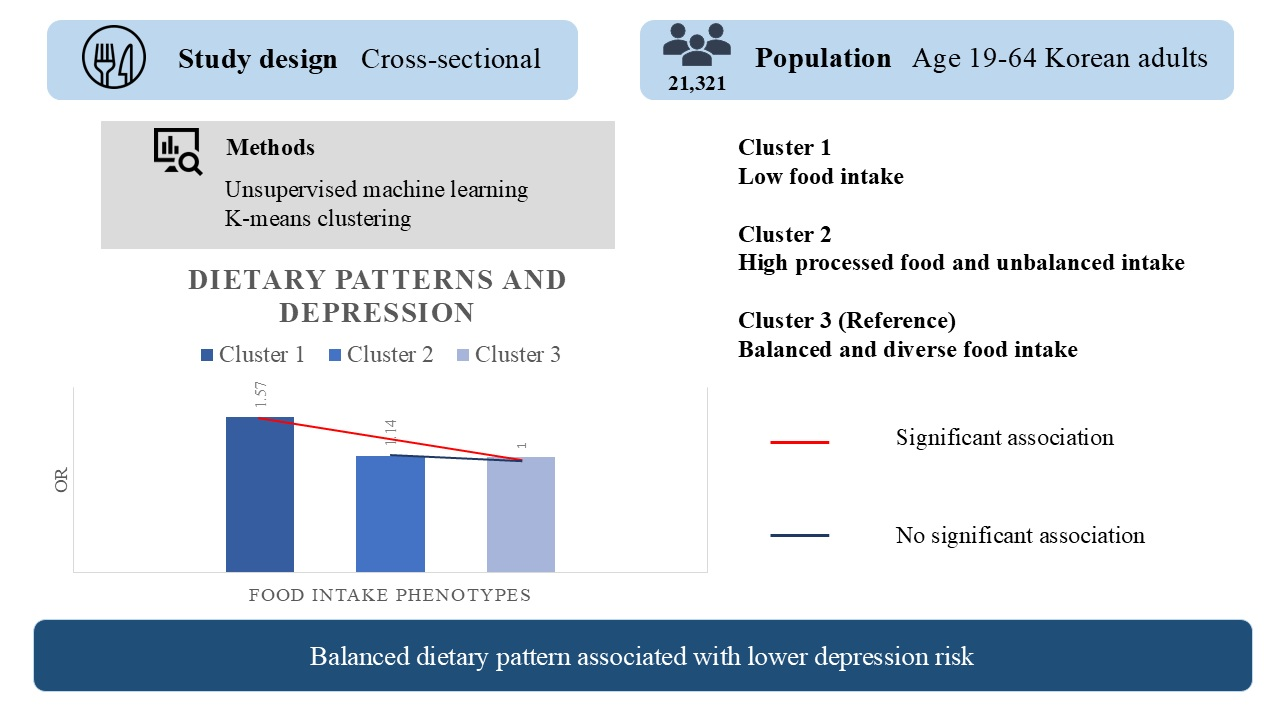
| Multivariable-adjusted OR (95% CI) d | 1.57 (1.14–2.15) | 1.14 (0.75–1.74) | 1.0 (ref.) |
| Nutrient Intake Phenotypes | ||||
|---|---|---|---|---|
| Cluster 1 a | Cluster 2 b | Cluster 3 c | ||
| Variables | N (%) or Mean (SE) | p | ||
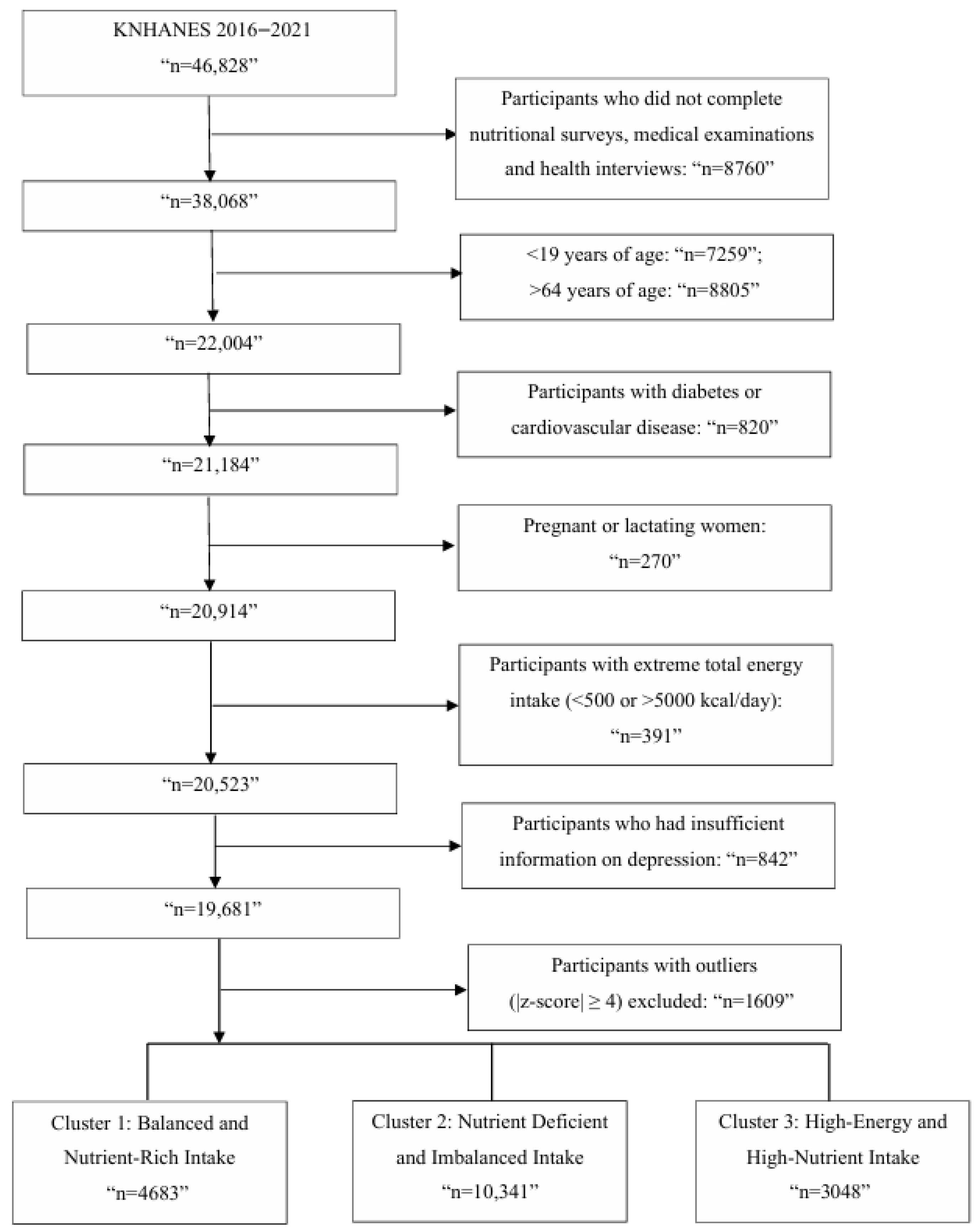
| Number of subjects | 4683 | 10,341 | 3048 | |
| Age (years) | 45.6 (0.2) | 41.6 (0.2) | 38.2 (0.2) | <0.001 |
| BMI (kg/m2) | 23.8 (0.1) | 23.8 (0.05) | 24.2 (0.1) | <0.001 |
| Education | ||||
| Less than or equal to middle school | 648 (10.7) | 1721 (12.7) | 163 (4.2) | <0.001 |
| High school | 1698 (37.0) | 4016 (40.6) | 1102 (37.3) | |
| Greater than or equal to college | 2332 (52.3) | 4589 (46.7) | 1780 (58.5) | |
| Household income | ||||
| Lowest | 350 (7.3) | 1073 (9.5) | 187 (6.1) | <0.001 |
| Lower middle | 989 (20.4) | 2537 (23.7) | 627 (19.4) | |
| Upper middle | 1482 (31.8) | 3218 (31.9) | 958 (31.7) | |
| Highest | 1855 (40.4) | 3484 (35.0) | 1273 (42.8) | |
| Smoking | ||||
| Nonsmoker | 2801 (55.9) | 7117 (64.5) | 1497 (45.3) | <0.001 |
| Former smoker | 1045 (23.9) | 1538 (16.5) | 812 (27.8) | |
| Current smoker | 837 (20.2) | 1669 (19.0) | 738 (26.9) | |
| Alcohol consumption | ||||
| Never/rarely | 2081 (41.3) | 4536 (41.0) | 950 (29.2) | <0.001 |
| 1–4 Times/month | 1624 (36.6) | 3693 (37.5) | 1249 (42.7) | |
| ≥2 Times/week | 978 (22.0) | 2098 (21.5) | 848 (28.1) | |
| Physical activity d | ||||
| No | 2440 (50.6) | 5683 (52.7) | 1493 (47.2) | <0.005 |
| Yes | 2237 (49.4) | 4635 (47.3) | 1550 (52.8) | |
| Total energy intake (kcal) e | 2213.7 (7.9) | 1485.9 (5.2) | 2734.9 (12.2) | <0.001 |
| Nutrient Intake Phenotypes | |||
|---|---|---|---|
| Cluster 1 a | Cluster 2 b | Cluster 3 c | |
| No. of cases/subjects | 195/5157 | 548/11,932 | 83/2661 |
| OR (95% CI) | OR (95% CI) | OR (95% CI) | |
| Cluster 1 as reference | |||
| Age-adjusted OR (95% Cl) | 1.0 (ref.) | 1.22 (1.00–1.49) | 0.81 (0.60–1.08) |
| Multivariable-adjusted OR (95% CI) d | 1.0 (ref.) | 0.88 (0.68–1.15) | 0.95 (0.70–1.30) |
| Cluster 2 as reference | |||
| Age-adjusted OR (95% Cl) | 0.82 (0.67–0.996) | 1.0 (ref.) | 0.66 (0.51–0.85) |
| Multivariable-adjusted OR (95% CI) d | 1.13 (0.87–1.47) | 1.0 (ref.) | 1.08 (0.74–1.57) |
| Cluster 3 as reference | |||
| Age-adjusted OR (95% Cl) | 1.52 (1.18–1.96) | 1.24 (0.93–1.66) | 1.0 (ref.) |
| Multivariable-adjusted OR (95% CI) d | 1.05 (0.77–1.43) | 0.93 (0.64–1.35) | 1.0 (ref.) |
| Model | Variables Included | −2 Log Likelihood | AIC | Max-Rescaled R2 | AUC |
|---|---|---|---|---|---|
| Model A | Covariates only | 7,620,357.9 | 7,620,381.9 | 0.0607 | 0.685 |
| Model B | Covariates + Food-based clusters | 7,607,534.0 | 7,607,562.0 | 0.0626 | 0.689 |
| Model C | Covariates + Nutrient-based clusters | 7,617,968.3 | 7,617,996.3 | 0.0611 | 0.685 |
Disclaimer/Publisher’s Note: The statements, opinions and data contained in all publications are solely those of the individual author(s) and contributor(s) and not of MDPI and/or the editor(s). MDPI and/or the editor(s) disclaim responsibility for any injury to people or property resulting from any ideas, methods, instructions or products referred to in the content. |
© 2026 by the authors. Licensee MDPI, Basel, Switzerland. This article is an open access article distributed under the terms and conditions of the Creative Commons Attribution (CC BY) license.
Share and Cite
Kim, E.; Je, Y. Food- and Nutrient-Based Dietary Patterns and Depression in Korean Adults: A Machine Learning Approach Using KNHANES 2016–2021. Nutrients 2026, 18, 1333. https://doi.org/10.3390/nu18091333
Kim E, Je Y. Food- and Nutrient-Based Dietary Patterns and Depression in Korean Adults: A Machine Learning Approach Using KNHANES 2016–2021. Nutrients. 2026; 18(9):1333. https://doi.org/10.3390/nu18091333
Chicago/Turabian StyleKim, Eunje, and Youjin Je. 2026. "Food- and Nutrient-Based Dietary Patterns and Depression in Korean Adults: A Machine Learning Approach Using KNHANES 2016–2021" Nutrients 18, no. 9: 1333. https://doi.org/10.3390/nu18091333
APA StyleKim, E., & Je, Y. (2026). Food- and Nutrient-Based Dietary Patterns and Depression in Korean Adults: A Machine Learning Approach Using KNHANES 2016–2021. Nutrients, 18(9), 1333. https://doi.org/10.3390/nu18091333