Investigation of Dietary Intake and Nutrient Adequacy of Adolescents in Institutional Care by Comparing with National Survey Data in Taiwan: A Cross-Sectional Study


 and
and
Abstract
1. Introduction
2. Materials and Methods
2.1. Study Population
2.2. Control Group and Propensity Score Matching
2.3. Study Design and Data Sources
2.4. Dietary and Nutrient Intake Calculation
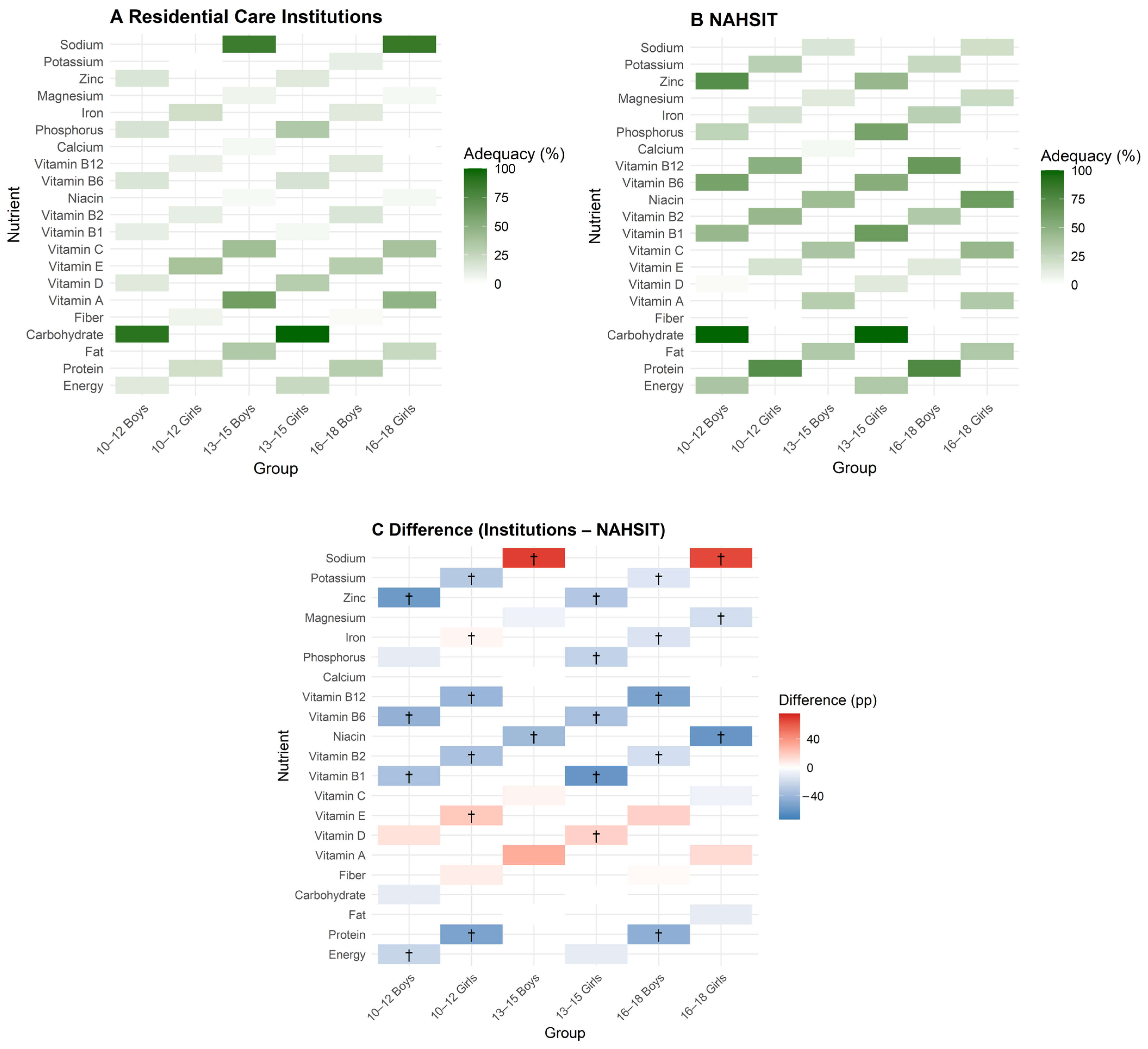
2.5. Nutrient Adequacy Definition and Heatmap Analysis
2.6. Propensity Score Matching
2.7. Statistical Analysis
2.8. Ethical Approval
3. Results
3.1. Baseline Characteristics of Adolescents in Residential Care Institutions
3.2. Baseline Characteristics After Propensity Score Matching
3.3. Sex-Stratified Differences in Dietary Intake
3.4. DRI Adequacy of Energy and Macronutrients
3.5. DRI Adequacy of Micronutrients
4. Discussion
4.1. Principal Findings Within a Structural Framework
4.2. Micronutrient Intake and Nutritional Quality
4.3. Mechanisms Linking Institutional Environments to Nutritional Inequality
4.4. Interpretation of Nutrient Patterns and Food Sources
4.5. Policy and Nutritional Implications
4.6. Life-Course Implications
4.7. Strengths and Limitations
5. Conclusions
Supplementary Materials
Author Contributions
Funding
Institutional Review Board Statement
Informed Consent Statement
Data Availability Statement
Acknowledgments
Conflicts of Interest
References
- Marmot, M. Social determinants of health inequalities. Lancet 2005, 365, 1099–1104. [Google Scholar] [CrossRef]
- Marmot, M.; Friel, S.; Bell, R.; Houweling, T.A.J.; Taylor, S. Closing the gap in a generation: Health equity through action on the social determinants of health. Lancet 2008, 372, 1661–1669. [Google Scholar] [CrossRef]
- Viner, R.M.; Ozer, E.M.; Denny, S.; Marmot, M.; Resnick, M.; Fatusi, A.; Currie, C. Adolescence and the social determinants of health. Lancet 2012, 379, 1641–1652. [Google Scholar] [CrossRef]
- Sawyer, S.M.; Afifi, R.A.; Bearinger, L.H.; Blakemore, S.-J.; Dick, B.; Ezeh, A.C.; Patton, G.C. Adolescence: A foundation for future health. Lancet 2012, 379, 1630–1640. [Google Scholar] [CrossRef] [PubMed]
- Das, J.K.; Salam, R.A.; Thornburg, K.L.; Prentice, A.M.; Campisi, S.; Lassi, Z.S.; Koletzko, B.; Bhutta, Z.A. Nutrition in adolescents: Physiology, metabolism, and nutritional needs. Ann. N. Y. Acad. Sci. 2017, 1393, 21–33. [Google Scholar] [CrossRef]
- Norris, S.A.; Frongillo, E.A.; Black, M.M.; Dong, Y.; Fall, C.; Lampl, M.; Liese, A.D.; Naguib, M.; Prentice, A.; Rochat, T.; et al. Nutrition in adolescent growth and development. Lancet 2022, 399, 172–184. [Google Scholar] [CrossRef] [PubMed]
- Patton, G.C.; Sawyer, S.M.; Santelli, J.S.; Ross, D.A.; Afifi, R.; Allen, N.B.; Arora, M.; Azzopardi, P.; Baldwin, W.; Bonell, C.; et al. Our future: A Lancet commission on adolescent health and wellbeing. Lancet 2016, 387, 2423–2478. [Google Scholar] [CrossRef] [PubMed]
- Popkin, B.M.; Corvalan, C.; Grummer-Strawn, L.M. Dynamics of the double burden of malnutrition and the changing nutrition reality. Lancet 2020, 395, 65–74. [Google Scholar] [CrossRef]
- Holliday, N.; Muhali, M.K.; Lembani, M.; Nonkeneza, H.; Feni, M.; Mchiza, Z.J.-R.; Hill, J.; Klinger, C.; Rehfuess, E.A.; von Philipsborn, P.; et al. Drivers and levers of the double burden of malnutrition in Cape Town, South Africa: Insights from in-depth interviews with multi-sectoral stakeholders. BMC Public Health 2025, 25, 2966. [Google Scholar] [CrossRef]
- Mbogori, T.; Kimmel, K.; Zhang, M.; Kandiah, J.; Wang, Y. Nutrition transition and double burden of malnutrition in Africa: A case study of four selected countries with different social economic development. AIMS Public Health 2020, 7, 425–439. [Google Scholar] [CrossRef]
- Bailey, R.L.; West, K.P., Jr.; Black, R.E. The epidemiology of global micronutrient deficiencies. Ann. Nutr. Metab. 2015, 66, 22–33. [Google Scholar] [CrossRef]
- Bird, J.K.; Murphy, R.A.; Ciappio, E.D.; McBurney, M.I. Risk of deficiency in multiple concurrent micronutrients in children and adults in the United States. Nutrients 2017, 9, 655. [Google Scholar] [CrossRef]
- Daly, A.N.; O’Sullivan, E.J.; Kearney, J.M. Considerations for health and food choice in adolescents. Proc. Nutr. Soc. 2022, 81, 75–86. [Google Scholar] [CrossRef]
- Popkin, B.M. Relationship between shifts in food system dynamics and acceleration of the global nutrition transition. Nutr. Rev. 2017, 75, 73–82. [Google Scholar] [CrossRef] [PubMed]
- Larson, N.; Story, M. A review of environmental influences on food choices. Ann. Behav. Med. 2009, 38, S56–S73. [Google Scholar] [CrossRef] [PubMed]
- Neumark-Sztainer, D.; Wall, M.; Story, M.; Perry, C.L. Correlates of unhealthy weight-control behaviors among adolescents: Implications for prevention programs. Health Psychol. 2003, 22, 88–98. [Google Scholar] [CrossRef] [PubMed]
- Keats, E.C.; Rappaport, A.I.; Shah, S.; Oh, C.; Jain, R.; Bhutta, Z.A. The dietary intake and practices of adolescent girls in low- and middle-income countries: A systematic review. Nutrients 2018, 10, 1978. [Google Scholar] [CrossRef]
- Sattler, K.M.P.; Herd, T.; Font, S.A. Foster care, kinship care, and the transition to adulthood: Do child welfare system processes explain differences in outcomes? Child. Youth Serv. Rev. 2023, 153, 107098. [Google Scholar] [CrossRef]
- Markert, J.; Herke, M.; Bartels, A.; Gosse, K.; Roick, J.; Herz-Jakoby, A.; Täubig, V.; Schröer, W.; Richter, M. Food practices and nutrition of children and adolescents in residential care: A scoping review. Appetite 2021, 167, 105640. [Google Scholar] [CrossRef]
- Pashley, A.; Young, A.; Wright, O. Foodservice systems and mealtime models in rehabilitation: Scoping review. J. Adv. Nurs. 2022, 78, 3559–3586. [Google Scholar] [CrossRef]
- Thomas, T.W.; Cankurt, M. Influence of food environments on dietary habits: Insights from a quasi-experimental research. Foods 2024, 13, 2013. [Google Scholar] [CrossRef] [PubMed]
- Pan, W.H.; Chang, Y.H.; Chen, J.Y.; Wu, S.J.; Tzeng, M.S.; Kao, M.D. Nutrition and health survey in Taiwan (NAHSIT) 1993–1996: Dietary nutrient intakes assessed by 24-hour recall. Nutr. Sci. J. 1999, 24, 11–39. [Google Scholar]
- Chen, Y.-C.; Huang, Y.-C.; Lo, Y.-T.C.; Wu, H.-J.; Wahlqvist, M.L.; Lee, M.-S. Secular trend towards ultra-processed food consumption and expenditure compromises dietary quality among Taiwanese adolescents. Food Nutr. Res. 2018, 62, 1565. [Google Scholar] [CrossRef] [PubMed]
- Huang, L.-Y.; Wahlqvist, M.L.; Lee, M.-S.; Chiang, P.-H. Dietary quality linkage to overall competence at school and emotional disturbance in representative Taiwanese young adolescents: Dependence on gender, parental characteristics, and personal behaviors. Nutr. J. 2018, 17, 29. [Google Scholar] [CrossRef]
- Health Promotion Administration, Ministry of Health and Welfare, Taiwan. Taiwan Dietary Reference Intakes, 8th ed.; Ministry of Health and Welfare: Taipei, Taiwan, 2022.
- Rosenbaum, P.R.; Rubin, D.B. The central role of the propensity score in observational studies for causal effects. Biometrika 1983, 70, 41–55. [Google Scholar] [CrossRef]
- Austin, P.C. An introduction to propensity score methods for reducing the effects of confounding in observational studies. Multivar. Behav. Res. 2011, 46, 399–424. [Google Scholar] [CrossRef]
- Black, R.E.; Victora, C.G.; Walker, S.P.; Bhutta, Z.A.; Christian, P.; de Onis, M.; Ezzati, M.; Grantham-McGregor, S.; Katz, J.; Martorell, R.; et al. Maternal and child undernutrition and overweight in low-income and middle-income countries. Lancet 2013, 382, 427–451. [Google Scholar] [CrossRef]
- Parajuli, J.; Prangthip, P. Adolescent nutrition and health: A critical period for nutritional intervention to prevent long-term health consequences. Curr. Nutr. Rep. 2025, 14, 116. [Google Scholar] [CrossRef]
- Luo, S.; Liao, S.; Luo, B.; Xiong, A.; Ma, W.; Zhao, L. Dietary patterns of Chinese children and adolescents and their associations with family characteristics and functioning: A multicenter cross-sectional study. BMC Public Health 2024, 24, 21068. [Google Scholar] [CrossRef] [PubMed]
- Food and Agriculture Organization of the United Nations (FAO); World Health Organization (WHO). Sustainable Healthy Diets—Guiding Principles; FAO: Rome, Italy; WHO: Rome, Italy, 2019; Available online: https://www.fao.org/3/ca6640en/ca6640en.pdf (accessed on 10 April 2026).
- Herforth, A.; Arimond, M.; Álvarez-Sánchez, C.; Coates, J.; Christianson, K.; Muehlhoff, E. A global review of food-based dietary guidelines. Adv. Nutr. 2019, 10, 590–605. [Google Scholar] [CrossRef]
- Trang, S.; Fraser, J.; Wilkinson, L.; Steckham, K.; Oliphant, H.; Fletcher, H.; Tzianetas, R.; Arcand, J. A multi-center assessment of nutrient levels and foods provided by hospital patient menus. Nutrients 2015, 7, 9256–9264. [Google Scholar] [CrossRef] [PubMed]


| North | Central | East | Total | p-Value | |
|---|---|---|---|---|---|
| N | 101 (40.7) | 82 (33.1) | 65 (26.2) | 248 (100.0) | |
| Sex, n (%) | 0.029 | ||||
| Boys | 52 (40.9) | 51 (40.2) | 24 (18.9) | 127 (51.2) | |
| Girls | 49 (40.5) | 31 (25.6) | 41 (33.9) | 121 (48.8) | |
| Age (years) | 14.22 ± 2.37 | 14.21 ± 2.08 | 14.17 ± 2.12 | 14.20 ± 2.20 | 0.990 |
| Height (cm) | 154.57 ± 11.85 | 155.72 ± 10.81 | 155.95 ± 10.73 | 155.31 ± 11.20 | 0.685 |
| Weight (kg) | 47.43 ± 12.51 | 48.79 ± 11.84 | 51.31 ± 13.15 | 48.90 ± 12.51 | 0.149 |
| BMI (kg/m2) | 19.55 ± 3.21 | 19.89 ± 3.24 | 20.83 ± 3.92 | 20.00 ± 3.45 | 0.061 |
| BMI category | 0.245 | ||||
| Underweight, n (%) | 15 (14.9) | 8 (9.8) | 6 (9.2) | 29 (11.7) | |
| Normal, n (%) | 67 (66.3) | 60 (73.2) | 38 (58.5) | 165 (66.5) | |
| Overweight, n (%) | 10 (9.9) | 6 (7.3) | 12 (18.5) | 28 (11.3) | |
| Obesity, n (%) | 9 (8.9) | 8 (9.8) | 9 (13.8) | 26 (10.5) |
| Boys | Girls | |||||||
|---|---|---|---|---|---|---|---|---|
| Nutrient | (RCIs, n = 127) | (NAHSIT, n = 127) | Mean Difference (95% CI) | p-Value | (RCIs, n = 121) | (NAHSIT, n = 121) | Mean Difference (95% CI) | p-Value |
| Energy (kcal/day) | 1963 ± 676 | 2699 ± 1066 | −736 (−957, −514) | <0.001 | 1775 ± 656 | 2035 ± 848 | −260 (−453, −68) | 0.008 |
| Protein (g/day) | 56.1 ± 21.5 | 106.3 ± 46.4 | −50.2 (−59.1, −41.2) | <0.001 | 50.9 ± 18.1 | 76.7 ± 34.0 | −25.9 (−32.8, −19.0) | <0.001 |
| Fat (g/day) | 79.1 ± 34.4 | 102.50 ± 58.5 | −23.4 (−35.2, −11.5) | <0.001 | 70.1 ± 27.1 | 78.1 ± 43.5 | −8.6 (−17.8, 0.6) | 0.066 |
| Monounsaturated fatty acids (g/day) | 26.5 ± 15.7 | 36.0 ± 23.0 | −9.4 (−14.3, −4.6) | <0.001 | 24.9 ± 13.6 | 28.1 ± 17.3 | −3.2 (−7.2, 0.7) | 0.109 |
| Polyunsaturated fatty acids (g/day) | 24.8 ± 17.3 | 31.0 ± 19.6 | −6.2 (−10.8, −1.7) | 0.008 | 23.6 ± 14.2 | 22.3 ± 13.5 | 1.3 (−2.2, 4.8) | 0.456 |
| Saturated fatty acids (g/day) | 14.1 ± 13.5 | 35.4 ± 22.5 | −21.2 (−25.8, −16.6) | <0.001 | 13.5 ± 19.1 | 26.7 ± 16.9 | −13.2 (−17.8, −8.7) | <0.001 |
| Carbohydrates (g/day) | 256.7 ± 94.8 | 340.0 ± 142.9 | −83.3 (−113.3, −53.4) | <0.001 | 235.1 ± 107.3 | 257.8 ± 109.2 | −22.7 (−50.1, 4.7) | 0.104 |
| Dietary fiber (g/day) | 16.5 ± 8.3 | 13.4 ± 8.7 | 3.1 (1.0, 5.2) | 0.004 | 15.6 ± 8.2 | 12.3 ± 8.8 | 3.2 (1.1, 5.4) | 0.003 |
| Vitamin A (µg RE/day) | 621.8 ± 481.2 | 686.6 ± 479.9 | −64.8 (−183.6, 54.0) | 0.283 | 644.0 ± 606.8 | 845.7 ± 441.6 | −201.7 (−336.2, −67.2) | 0.003 |
| Vitamin D (µg/day) | 5.0 ± 10.7 | 6.4 ± 7.7 | −1.4 (−3.7, 0.9) | 0.240 | 4.7 ± 5.6 | 8.1 ± 10.7 | −3.3 (−5.5, −1.1) | 0.003 |
| Vitamin E (mg α-TE/day) | 9.0 ± 4.1 | 10.1 ± 6.9 | −1.1 (−2.5, 0.2) | 0.117 | 7.8 ± 5.8 | 14.0 ± 4.7 | −6.3 (−7.6, −4.9) | <0.001 |
| Vitamin C (mg/day) | 83.8 ± 71.5 | 125.9 ± 126.7 | −42.1 (−67.6, −16.6) | 0.001 | 114.1 ± 73.7 | 126.7 ± 120.3 | −12.6 (−37.9, 12.7) | 0.328 |
| Vitamin B1 (mg/day) | 1.04 ± 0.56 | 1.87 ± 1.17 | −0.83 (−1.05, −0.60) | <0.001 | 1.04 ± 0.54 | 1.24 ± 0.77 | −0.20 (−0.37, −0.03) | 0.020 |
| Vitamin B2 (mg/day) | 0.97 ± 0.59 | 1.53 ± 0.74 | −0.56 (−0.72, −0.39) | <0.001 | 1.39 ± 0.59 | 1.35 ± 0.73 | −0.04 (−0.13, 0.21) | 0.650 |
| Niacin (mg/day) | 8.9 ± 3.7 | 23.7 ± 11.7 | −14.8 (−16.9, −12.6) | <0.001 | 8.4 ± 3.4 | 18.3 ± 11.2 | −9.3 (−11.4, −7.1) | <0.001 |
| Vitamin B6 (mg/day) | 1.03 ± 0.48 | 2.02 ± 1.03 | −0.99 (−1.19, −0.79) | <0.001 | 1.35 ± 0.48 | 1.63 ± 1.00 | −0.28 (−0.48, −0.08) | 0.006 |
| Vitamin B12 (µg/day) | 1.5 ± 1.0 | 6.1 ± 8.9 | −4.7 (−6.3, −3.1) | <0.001 | 1.7 ± 1.3 | 4.4 ± 5.4 | −2.9 (−3.9, −1.9) | <0.001 |
| Calcium (mg/day) | 364 ± 194 | 562 ± 354 | −197 (−268, −127) | <0.001 | 442 ± 237 | 451 ± 282 | −11 (−46, 18) | 0.784 |
| Iron (mg/day) | 8.7 ± 6.7 | 19.7 ± 9.7 | −11.1 (−13.1, −9.0) | <0.001 | 11.2 ± 7.6 | 14.6 ± 7.1 | −3.4 (−5.5, −1.4) | <0.001 |
| Potassium (mg/day) | 1710 ± 700 | 2724 ± 1200 | −1013 (−1257, −770) | <0.001 | 1717 ± 1041 | 2195 ± 1139 | −376 (−652, −99) | <0.001 |
| Magnesium (mg/day) | 154 ± 66 | 297 ± 136 | −143 (−169, −116) | <0.001 | 193 ± 79 | 231 ± 117 | −16 (−41, 9) | 0.198 |
| Phosphorus (mg/day) | 556 ± 191 | 1491 ± 676 | −935 (−1058, −812) | <0.001 | 669 ± 255 | 1090 ± 495 | −259 (−357, −160) | <0.001 |
| Zinc (mg/day) | 6.7 ± 2.7 | 14.2 ± 6.5 | −7.4 (−8.7, −6.2) | <0.001 | 7.2 ± 3.4 | 9.9 ± 4.8 | −2.6 (−3.7, −1.6) | <0.001 |
| Sodium (mg/day) | 1616 ± 1008 | 5252 ± 2878 | −3636 (−4159, −3113) | <0.001 | 1428 ± 841 | 3894 ± 2312 | −2107 (−2561, −1654) | <0.001 |
| Cholesterol (mg/day) | 209 ± 166 | 479 ± 324 | −270 (−334, −206) | <0.001 | 231 ± 187 | 387 ± 256 | −113 (−169, −58) | <0.001 |
| Nutrient | Criterion | Boys (10–12 Years) | Girls (10–12 Years) | Boys (13–15 Years) | Girls (13–15 Years) | Boys (16–18 Years) | Girls (16–18 Years) | ||||||||||||
|---|---|---|---|---|---|---|---|---|---|---|---|---|---|---|---|---|---|---|---|
| RCI | NAHSIT | p | RCI | NAHSIT | p | RCI | NAHSIT | p | RCI | NAHSIT | p | RCI | NAHSIT | p | RCI | NAHSIT | p | ||
| Energy | ≥EER | 7/33 (21.2%) | 13/33 (39.4%) | 0.180 | 6/41 (14.6%) | 9/41 (22.0%) | 0.569 | 6/50 (12.0%) | 28/50 (56.0%) | <0.001 | 12/51 (23.5%) | 16/51 (31.4%) | 0.506 | 6/44 (13.6%) | 16/44 (36.4%) | 0.025 | 7/29 (24.1%) | 10/29 (34.5%) | 0.565 |
| Protein | ≥RDA | 14/33 (42.4%) | 27/33 (81.8%) | 0.002 | 19/41 (46.3%) | 31/41 (75.6%) | 0.012 | 17/50 (34.0%) | 42/50 (84.0%) | <0.001 | 18/51 (35.3%) | 34/51 (66.7%) | 0.003 | 9/44 (20.5%) | 32/44 (72.7%) | <0.001 | 9/29 (31.0%) | 22/29 (75.9%) | 0.001 |
| Fat | AMDR 25–35% | 10/33 (30.3%) | 13/33 (39.4%) | 0.606 | 12/41 (29.3%) | 18/41 (43.9%) | 0.252 | 19/50 (38.0%) | 21/50 (42.0%) | 0.838 | 18/51 (35.3%) | 17/51 (33.3%) | 1.000 | 15/44 (34.1%) | 15/44 (34.1%) | 1.000 | 7/29 (24.1%) | 10/29 (34.5%) | 0.565 |
| Carbohydrate | ≥EAR | 33/33 (100.0%) | 32/33 (97.0%) | 1.000 | 41/41 (100.0%) | 41/41 (100.0%) | 1.000 | 50/50 (100.0%) | 50/50 (100.0%) | 1.000 | 51/51 (100.0%) | 49/51 (96.1%) | 0.495 | 44/44 (100.0%) | 44/44 (100.0%) | 1.000 | 26/29 (89.7%) | 29/29 (100.0%) | 0.237 |
| Dietary fiber | ≥AI | 2/33 (6.1%) | 1/33 (3.0%) | 1.000 | 1/41 (2.4%) | 1/41 (2.4%) | 1.000 | 1/50 (2.0%) | 0/50 (0.0%) | 1.000 | 3/51 (5.9%) | 2/51 (3.9%) | 1.000 | 1/44 (2.3%) | 0/44 (0.0%) | 1.000 | 2/29 (6.9%) | 0/29 (0.0%) | 0.491 |
| Vitamin D | ≥Ref. * | 2/33 (6.1%) | 8/33 (24.2%) | 0.082 | 13/41 (31.7%) | 1/41 (2.4%) | <0.001 | 8/50 (16.0%) | 10/50 (20.0%) | 0.795 | 5/51 (9.8%) | 9/51 (17.6%) | 0.389 | 6/44 (13.6%) | 1/44 (2.3%) | 0.050 | 9/29 (31.0%) | 4/29 (13.8%) | 0.207 |
| Calcium | ≥Ref. * | 1/33 (3.0%) | 3/33 (9.1%) | 0.613 | 0/41 (0.0%) | 2/41 (4.9%) | 0.494 | 0/50 (0.0%) | 3/50 (6.0%) | 0.242 | 0/51 (0.0%) | 1/51 (2.0%) | 1.000 | 2/44 (4.5%) | 2/44 (4.5%) | 1.000 | 0/29 (0.0%) | 0/29 (0.0%) | 1.000 |
| Sodium | ≤UL | 30/33 (90.9%) | 5/33 (15.2%) | <0.001 | 35/41 (85.4%) | 10/41 (24.4%) | <0.001 | 36/50 (72.0%) | 1/50 (2.0%) | <0.001 | 44/51 (86.3%) | 11/51 (21.6%) | <0.001 | 37/44 (84.1%) | 7/44 (15.9%) | <0.001 | 25/29 (86.2%) | 6/29 (20.7%) | <0.001 |
Disclaimer/Publisher’s Note: The statements, opinions and data contained in all publications are solely those of the individual author(s) and contributor(s) and not of MDPI and/or the editor(s). MDPI and/or the editor(s) disclaim responsibility for any injury to people or property resulting from any ideas, methods, instructions or products referred to in the content. |
© 2026 by the authors. Licensee MDPI, Basel, Switzerland. This article is an open access article distributed under the terms and conditions of the Creative Commons Attribution (CC BY) license.
Share and Cite
Kao, H.-N.; Chen, K.-S.; Liou, T.-H.; Kao, N.-J.; Liao, K.-W.; Lin, S.-H. Investigation of Dietary Intake and Nutrient Adequacy of Adolescents in Institutional Care by Comparing with National Survey Data in Taiwan: A Cross-Sectional Study. Nutrients 2026, 18, 1679. https://doi.org/10.3390/nu18111679
Kao H-N, Chen K-S, Liou T-H, Kao N-J, Liao K-W, Lin S-H. Investigation of Dietary Intake and Nutrient Adequacy of Adolescents in Institutional Care by Comparing with National Survey Data in Taiwan: A Cross-Sectional Study. Nutrients. 2026; 18(11):1679. https://doi.org/10.3390/nu18111679
Chicago/Turabian StyleKao, Hsin-Nung, Kuang-Shuo Chen, Tsan-Hon Liou, Ning-Jo Kao, Kai-Wei Liao, and Shyh-Hsiang Lin. 2026. "Investigation of Dietary Intake and Nutrient Adequacy of Adolescents in Institutional Care by Comparing with National Survey Data in Taiwan: A Cross-Sectional Study" Nutrients 18, no. 11: 1679. https://doi.org/10.3390/nu18111679
APA StyleKao, H.-N., Chen, K.-S., Liou, T.-H., Kao, N.-J., Liao, K.-W., & Lin, S.-H. (2026). Investigation of Dietary Intake and Nutrient Adequacy of Adolescents in Institutional Care by Comparing with National Survey Data in Taiwan: A Cross-Sectional Study. Nutrients, 18(11), 1679. https://doi.org/10.3390/nu18111679