Creatine Supplementation in Endurance and Mixed-Sport Contexts: A Scoping Review of Performance, Recovery, and Body Composition

 , and
, and
Abstract
1. Introduction
2. Methods
2.1. Search Strategy
2.2. Eligibility Criteria
2.3. Data Extraction
2.4. Methodological Characteristics
3. Characteristics of Included Studies
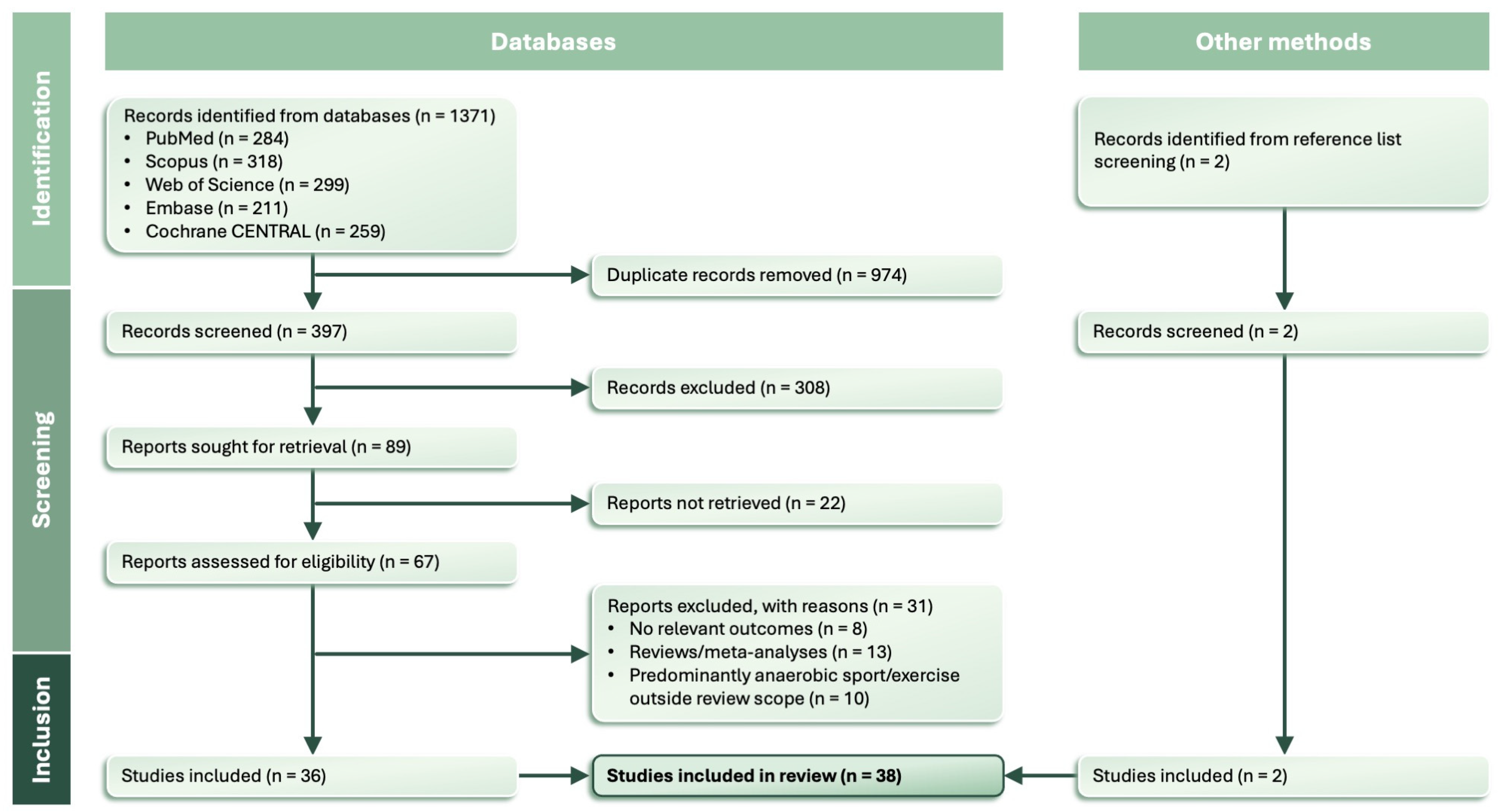
3.1. Study Selection
3.2. Publication Years and Geographic Distribution
3.3. Gender Distribution
3.4. Participant Training Status
3.5. Intervention Characteristics
3.6. Exercise Modalities and Disciplines
3.7. Study Design
4. Performance Effects of Creatine: Endurance Outcomes and Aerobic Capacity
4.1. Repeated-Sprint and High-Intensity Intermittent Tests
4.2. Rowing and Canoeing/Kayaking Performance Outcomes
4.3. Swimming and Sport-Specific Hydrodynamic Outcomes
4.4. End-Phase Sprinting During Prolonged Exercise
4.5. Strength and Power Tests in Mixed-Sport Contexts
4.6. Aerobic Capacity, Time Trials, and Steady-State Outcomes
5. Effects of Creatine on Biochemical Markers of Recovery and Exercise Stress
5.1. Muscle Creatine and Phosphocreatine Availability
5.2. Circulating Inflammatory Markers
5.3. Circulating Muscle Damage Markers
6. Effects of Creatine Supplementation on Body Composition
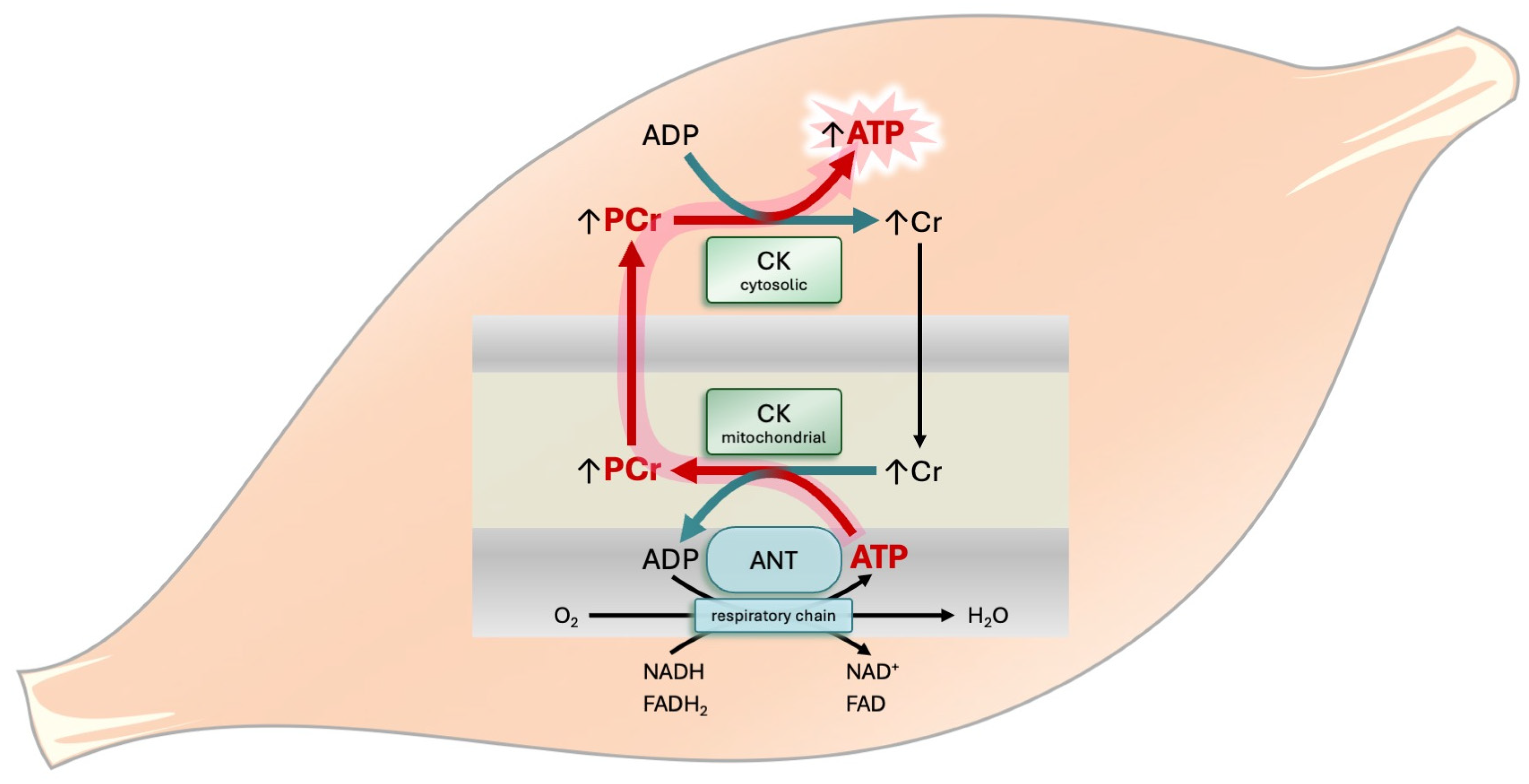
7. Mechanisms and Practical Implications
8. Final Remarks
8.1. Limitations
8.2. Future Research Directions
- Systematically evaluate sex-specific responses by including adequately powered cohorts of female participants, given known sex-related differences in muscle creatine content, hormonal milieu, and water balance.
- Investigate inter-individual variability and responder status by integrating molecular and genetic determinants of creatine uptake and storage.
- Use clearer sport classification systems that distinguish between steady-state endurance sports, intermittent endurance disciplines, mixed sports, combat sports, and team or racket sports with repeated high-intensity demands.
- Analyze and compare creatine-only interventions with combined supplementation protocols, particularly those involving carbohydrate co-ingestion, to better clarify the independent and additive effects of creatine.
- Standardize outcome reporting and assessment by using consistent definitions, measurement protocols, and sport-specific testing models for performance and body composition outcomes.
- Clarify the effects of creatine on inflammatory responses, circulating muscle damage markers, and recovery-related biochemical outcomes by using standardized protocols and consistent post-exercise sampling time points.
- Examine the long-term physiological and performance effects of creatine supplementation under real-world training conditions, particularly in trained and elite endurance or mixed-sport athletes.
- Assess the balance between potential ergogenic benefits and creatine-associated body mass gain in weight-sensitive disciplines and events to inform personalized supplementation strategies.
9. Conclusions
Supplementary Materials
Author Contributions
Funding
Institutional Review Board Statement
Informed Consent Statement
Data Availability Statement
Conflicts of Interest
Abbreviations
| ADP | Adenosine diphosphate |
| ANT | Adenine nucleotide translocator |
| ATP | Adenosine triphosphate |
| BIA | Bioelectrical impedance analysis |
| BL | Baseline |
| CK | Creatine kinase |
| Cr | Creatine |
| CRP | C-reactive protein |
| DB | Double-blind |
| FFM | Fat-free mass |
| IFN-α | Interferon α |
| IL-1β | Interleukin-1β |
| IL-6 | Interleukin-6 |
| LDH | Lactate dehydrogenase |
| MVC | Maximal voluntary contraction |
| ND | Not determined |
| NS | No significant difference |
| PCr | Phosphocreatine |
| PBW | Percentage body water |
| PFM | Percentage fat mass |
| PGE2 | Prostaglandin E2 |
| Plc | Placebo |
| PO | Power output |
| PPO | Peak power output |
| RCT | Randomized controlled trial |
| ROM | Range of motion |
| SB | Single-blind |
| TBM | Total body mass |
| TFM | Total fat mass |
| TNF-α | Tumor necrosis factor α |
| TWD | Total work done |
| XO | Crossover |
References
- Bassett, D.R.; Howley, E.T. Limiting Factors for Maximum Oxygen Uptake and Determinants of Endurance Performance. Med. Sci. Sports Exerc. 2000, 32, 70–84. [Google Scholar] [CrossRef] [PubMed]
- Joyner, M.J.; Coyle, E.F. Endurance Exercise Performance: The Physiology of Champions. J. Physiol. 2008, 586, 35–44. [Google Scholar] [CrossRef]
- Forbes, S.C.; Candow, D.G.; Neto, J.H.F.; Kennedy, M.D.; Forbes, J.L.; Machado, M.; Bustillo, E.; Gomez-Lopez, J.; Zapata, A.; Antonio, J. Creatine Supplementation and Endurance Performance: Surges and Sprints to Win the Race. J. Int. Soc. Sports Nutr. 2023, 20, 2204071. [Google Scholar] [CrossRef] [PubMed]
- Peake, J.M.; Neubauer, O.; Della Gatta, P.A.; Nosaka, K. Muscle Damage and Inflammation during Recovery from Exercise. J. Appl. Physiol. 2017, 122, 559–570. [Google Scholar] [CrossRef]
- Williams, M.H.; Kreider, R.B.; Branch, J.D. Creatine: The Power Supplement; Human Kinetics: Champaign, IL, USA, 1999. [Google Scholar]
- Huang, S.-H.S.; Johnson, K.; Pipe, A.L. The Use of Dietary Supplements and Medications by Canadian Athletes at the Atlanta and Sydney Olympic Games. Clin. J. Sport Med. 2006, 16, 27–33. [Google Scholar] [CrossRef]
- Kreider, R.B.; Kalman, D.S.; Antonio, J.; Ziegenfuss, T.N.; Wildman, R.; Collins, R.; Candow, D.G.; Kleiner, S.M.; Almada, A.L.; Lopez, H.L. International Society of Sports Nutrition Position Stand: Safety and Efficacy of Creatine Supplementation in Exercise, Sport, and Medicine. J. Int. Soc. Sports Nutr. 2017, 14, 18. [Google Scholar] [CrossRef]
- Fernández-Landa, J.; Santibañez-Gutierrez, A.; Todorovic, N.; Stajer, V.; Ostojic, S.M. Effects of Creatine Monohydrate on Endurance Performance in a Trained Population: A Systematic Review and Meta-Analysis. Sports Med. 2023, 53, 1017–1027. [Google Scholar] [CrossRef]
- Tricco, A.C.; Lillie, E.; Zarin, W.; O’Brien, K.K.; Colquhoun, H.; Levac, D.; Moher, D.; Peters, M.D.J.; Horsley, T.; Weeks, L.; et al. PRISMA Extension for Scoping Reviews (PRISMA-ScR): Checklist and Explanation. Ann. Intern. Med. 2018, 169, 467–473. [Google Scholar] [CrossRef]
- Page, M.J.; McKenzie, J.E.; Bossuyt, P.M.; Boutron, I.; Hoffmann, T.C.; Mulrow, C.D.; Shamseer, L.; Tetzlaff, J.M.; Akl, E.A.; Brennan, S.E.; et al. The PRISMA 2020 Statement: An Updated Guideline for Reporting Systematic Reviews. BMJ 2021, 372, n71. [Google Scholar] [CrossRef]
- Silva, A.J.; Machado Reis, V.; Guidetti, L.; Bessone Alves, F.; Mota, P.; Freitas, J.; Baldari, C. Effect of Creatine on Swimming Velocity, Body Composition and Hydrodynamic Variables. J. Sports Med. Phys. Fit. 2007, 47, 58–64. [Google Scholar]
- Yamaguchi, S.; Inami, T.; Nishioka, T.; Morito, A.; Ishiyama, K.; Murayama, M. The Effects of Creatine Monohydrate Supplementation on Recovery from Eccentric Exercise-Induced Muscle Damage: A Double-Blind, Randomized, Placebo-Controlled Trial Considering Sex and Age Differences. Nutrients 2025, 17, 1772. [Google Scholar] [CrossRef]
- Grindstaff, P.D.; Kreider, R.; Bishop, R.; Wilson, M.; Wood, L.; Alexander, C.; Almada, A. Effects of Creatine Supplementation on Repetitive Sprint Performance and Body Composition in Competitive Swimmers. Int. J. Sport Nutr. 1997, 7, 330–348. [Google Scholar] [CrossRef]
- Vanakoski, J.; Kosunen, V.; Meririnne, E.; Seppälä, T. Creatine and Caffeine in Anaerobic and Aerobic Exercise: Effects on Physical Performance and Pharmacokinetic Considerations. Int. J. Clin. Pharmacol. Ther. 1998, 36, 258–262. [Google Scholar] [PubMed]
- Mero, A.A.; Keskinen, K.L.; Malvela, M.T.; Sallinen, J.M. Combined Creatine and Sodium Bicarbonate Supplementation Enhances Interval Swimming. J. Strength Cond. Res. 2004, 18, 306–310. [Google Scholar] [CrossRef]
- Meixner, B.; Stegmaier, J.; Renner, P.; Koehler, K.; Yang, W.-H.; Sperlich, B. Supplementation of Creatine Monohydrate Improves Sprint Performance but Has No Effect on Glycolytic Contribution: A Nonrandomized, Placebo-Controlled Crossover Trial in Trained Cyclists. Curr. Dev. Nutr. 2025, 9, 104561. [Google Scholar] [CrossRef]
- Juhász, I.; Györe, I.; Csende, Z.; Rácz, L.; Tihanyi, J. Creatine Supplementation Improves the Anaerobic Performance of Elite Junior Fin Swimmers. Acta Physiol. Hung. 2009, 96, 325–336. [Google Scholar] [CrossRef] [PubMed]
- Chwalbińska-Moneta, J. Effect of Creatine Supplementation on Aerobic Performance and Anaerobic Capacity in Elite Rowers in the Course of Endurance Training. Int. J. Sport Nutr. Exerc. Metab. 2003, 13, 173–183. [Google Scholar] [CrossRef]
- Dalton, R.L.; Sowinski, R.J.; Grubic, T.J.; Collins, P.B.; Coletta, A.M.; Reyes, A.G.; Sanchez, B.; Koozehchian, M.; Jung, Y.P.; Rasmussen, C.; et al. Hematological and Hemodynamic Responses to Acute and Short-Term Creatine Nitrate Supplementation. Nutrients 2017, 9, 1359. [Google Scholar] [CrossRef] [PubMed]
- Roberts, P.A.; Fox, J.; Peirce, N.; Jones, S.W.; Casey, A.; Greenhaff, P.L. Creatine Ingestion Augments Dietary Carbohydrate Mediated Muscle Glycogen Supercompensation during the Initial 24 h of Recovery Following Prolonged Exhaustive Exercise in Humans. Amino Acids 2016, 48, 1831–1842. [Google Scholar] [CrossRef]
- Fernández-Landa, J.; Fernández-Lázaro, D.; Calleja-González, J.; Caballero-García, A.; Córdova, A.; León-Guereño, P.; Mielgo-Ayuso, J. Long-Term Effect of Combination of Creatine Monohydrate Plus β-Hydroxy β-Methylbutyrate (HMB) on Exercise-Induced Muscle Damage and Anabolic/Catabolic Hormones in Elite Male Endurance Athletes. Biomolecules 2020, 10, 140. [Google Scholar] [CrossRef]
- van Loon, L.J.C.; Oosterlaar, A.M.; Hartgens, F.; Hesselink, M.K.C.; Snow, R.J.; Wagenmakers, A.J.M. Effects of Creatine Loading and Prolonged Creatine Supplementation on Body Composition, Fuel Selection, Sprint and Endurance Performance in Humans. Clin. Sci. 2003, 104, 153–162. [Google Scholar] [CrossRef]
- Perret, C.; Mueller, G.; Knecht, H. Influence of Creatine Supplementation on 800 m Wheelchair Performance: A Pilot Study. Spinal Cord 2006, 44, 275–279. [Google Scholar] [CrossRef]
- Crisafulli, D.L.; Buddhadev, H.H.; Brilla, L.R.; Chalmers, G.R.; Suprak, D.N.; San Juan, J.G. Creatine-Electrolyte Supplementation Improves Repeated Sprint Cycling Performance: A Double Blind Randomized Control Study. J. Int. Soc. Sports Nutr. 2018, 15, 21. [Google Scholar] [CrossRef]
- Wang, C.-C.; Fang, C.-C.; Lee, Y.-H.; Yang, M.-T.; Chan, K.-H. Effects of 4-Week Creatine Supplementation Combined with Complex Training on Muscle Damage and Sport Performance. Nutrients 2018, 10, 1640. [Google Scholar] [CrossRef] [PubMed]
- Romer, L.M.; Barrington, J.P.; Jeukendrup, A.E. Effects of Oral Creatine Supplementation on High Intensity, Intermittent Exercise Performance in Competitive Squash Players. Int. J. Sports Med. 2001, 22, 546–552. [Google Scholar] [CrossRef] [PubMed]
- Delecluse, C.; Diels, R.; Goris, M. Effect of Creatine Supplementation on Intermittent Sprint Running Performance in Highly Trained Athletes. J. Strength Cond. Res. 2003, 17, 446–454. [Google Scholar] [CrossRef]
- Branch, J.D.; Schwarz, W.D.; Van Lunen, B. Effect of Creatine Supplementation on Cycle Ergometer Exercise in a Hyperthermic Environment. J. Strength Cond. Res. 2007, 21, 57–61. [Google Scholar] [CrossRef]
- Vandebuerie, F.; Vanden Eynde, B.; Vandenberghe, K.; Hespel, P. Effect of Creatine Loading on Endurance Capacity and Sprint Power in Cyclists. Int. J. Sports Med. 1998, 19, 490–495. [Google Scholar] [CrossRef] [PubMed]
- Deminice, R.; Rosa, F.T.; Franco, G.S.; Jordao, A.A.; de Freitas, E.C. Effects of Creatine Supplementation on Oxidative Stress and Inflammatory Markers after Repeated-Sprint Exercise in Humans. Nutrition 2013, 29, 1127–1132. [Google Scholar] [CrossRef]
- Dabidi Roshan, V.; Babaei, H.; Hosseinzadeh, M.; Arendt-Nielsen, L. The Effect of Creatine Supplementation on Muscle Fatigue and Physiological Indices Following Intermittent Swimming Bouts. J. Sports Med. Phys. Fit. 2013, 53, 232–239. [Google Scholar]
- Preen, D.; Dawson, B.; Goodman, C.; Lawrence, S.; Beilby, J.; Ching, S. Effect of Creatine Loading on Long-Term Sprint Exercise Performance and Metabolism. Med. Sci. Sports Exerc. 2001, 33, 814–821. [Google Scholar] [CrossRef]
- van Schuylenbergh, R.; van Leemputte, M.; Hespel, P. Effects of Oral Creatine-Pyruvate Supplementation in Cycling Performance. Int. J. Sports Med. 2003, 24, 144–150. [Google Scholar] [CrossRef]
- Wang, C.-C.; Lin, S.-C.; Hsu, S.-C.; Yang, M.-T.; Chan, K.-H. Effects of Creatine Supplementation on Muscle Strength and Optimal Individual Post-Activation Potentiation Time of the Upper Body in Canoeists. Nutrients 2017, 9, 1169. [Google Scholar] [CrossRef] [PubMed]
- De Andrade Nemezio, K.M.; Bertuzzi, R.; Correia-Oliveira, C.R.; Gualano, B.; Bishop, D.J.; Lima-Silva, A.E. Effect of Creatine Loading on Oxygen Uptake during a 1-Km Cycling Time Trial. Med. Sci. Sports Exerc. 2015, 47, 2660–2668. [Google Scholar] [CrossRef] [PubMed]
- Cornish, S.M.; Chilibeck, P.D.; Burke, D.G. The Effect of Creatine Monohydrate Supplementation on Sprint Skating in Ice-Hockey Players. J. Sports Med. Phys. Fit. 2006, 46, 90–98. [Google Scholar]
- Mendes, R.R.; Pires, I.; Oliveira, A.; Tirapegui, J. Effects of Creatine Supplementation on the Performance and Body Composition of Competitive Swimmers. J. Nutr. Biochem. 2004, 15, 473–478. [Google Scholar] [CrossRef] [PubMed]
- Dawson, B.; Vladich, T.; Blanksby, B.A. Effects of 4 Weeks of Creatine Supplementation in Junior Swimmers on Freestyle Sprint and Swim Bench Performance. J. Strength Cond. Res. 2002, 16, 485–490. [Google Scholar] [CrossRef]
- Bellinger, B.M.; Bold, A.; Wilson, G.R.; Noakes, T.D.; Myburgh, K.H. Oral Creatine Supplementation Decreases Plasma Markers of Adenine Nucleotide Degradation during a 1-h Cycle Test. Acta Physiol. Scand. 2000, 170, 217–224. [Google Scholar] [CrossRef]
- McNaughton, L.R.; Dalton, B.; Tarr, J. The Effects of Creatine Supplementation on High-Intensity Exercise Performance in Elite Performers. Eur. J. Appl. Physiol. Occup. Physiol. 1998, 78, 236–240. [Google Scholar] [CrossRef]
- Peyrebrune, M.C.; Nevill, M.E.; Donaldson, F.J.; Cosford, D.J. The Effects of Oral Creatine Supplementation on Performance in Single and Repeated Sprint Swimming. J. Sports Sci. 1998, 16, 271–279. [Google Scholar] [CrossRef]
- Lawrence, S.R.; Preen, D.B.; Dawson, B.T.; Beilby, J.; Goodman, C.; Cable, N.T. The Effect of Oral Creatine Supplementation on Maximal Exercise Performance in Competitive Rowers. Sports Med. Train. Rehabil. 1997, 7, 243–253. [Google Scholar] [CrossRef]
- Terrillion, K.A.; Kolkhorst, F.W.; Dolgener, F.A.; Joslyn, S.J. The Effect of Creatine Supplementation on Two 700-m Maximal Running Bouts. Int. J. Sport Nutr. 1997, 7, 138–143. [Google Scholar] [CrossRef]
- Burke, L.M.; Pyne, D.B.; Telford, R.D. Effect of Oral Creatine Supplementation on Single-Effort Sprint Performance in Elite Swimmers. Int. J. Sport Nutr. 1996, 6, 222–233. [Google Scholar] [CrossRef]
- Atashak, S.; Jafari, A. Effect of Short-Term Creatine Monohydrate Supplementation on Indirect Markers of Cellular Damage in Young Soccer Players. Sci. Sports 2012, 27, 88–93. [Google Scholar] [CrossRef]
- Bassit, R.A.; Curi, R.; Costa Rosa, L.F.B.P. Creatine Supplementation Reduces Plasma Levels of Pro-Inflammatory Cytokines and PGE2 after a Half-Ironman Competition. Amino Acids 2008, 35, 425–431. [Google Scholar] [CrossRef]
- Shi, D. Oligosaccharide and Creatine Supplementation on Glucose and Urea Nitrogen in Blood and Serum Creatine Kinase in Basketball Athletes. J. Huazhong Univ. Sci. Technol. Med. Sci. 2005, 25, 587–589. [Google Scholar] [CrossRef]
- Santos, R.V.T.; Bassit, R.A.; Caperuto, E.C.; Costa Rosa, L.F.B.P. The Effect of Creatine Supplementation upon Inflammatory and Muscle Soreness Markers after a 30km Race. Life Sci. 2004, 75, 1917–1924. [Google Scholar] [CrossRef] [PubMed]
- Finn, J.P.; Ebert, T.R.; Withers, R.T.; Carey, M.F.; Mackay, M.; Phillips, J.W.; Febbraio, M.A. Effect of Creatine Supplementation on Metabolism and Performance in Humans during Intermittent Sprint Cycling. Eur. J. Appl. Physiol. 2001, 84, 238–243. [Google Scholar] [CrossRef]
- Powers, M.E.; Arnold, B.L.; Weltman, A.L.; Perrin, D.H.; Mistry, D.; Kahler, D.M.; Kraemer, W.; Volek, J. Creatine Supplementation Increases Total Body Water Without Altering Fluid Distribution. J. Athl. Train. 2003, 38, 44–50. [Google Scholar] [PubMed]
- de Camargo, K.M.R.; Bruna-Mejías, A.; Valenzuela-Fuenzalida, J.J.; Gonzaga, L.A.; Barbalho, S.M.; Barroca, A.L.; Porto, A.A.; Raimundo, R.D.; de Abreu, L.C.; Valenti, V.E. Impact of Creatine Supplementation on Inflammation: Evidence from a Systematic Review and Meta-Analysis of Randomized Double-Blind Placebo Trials. Front. Immunol. 2026, 17, 1743603. [Google Scholar] [CrossRef]
- Wang, Y.; Wei, H.; Cheng, X.; Chen, Z. Synergistic Effects of Creatine, Carbs, Protein on Repeated Sprint Performance. Sci. Rep. 2026, 16, 10958. [Google Scholar] [CrossRef]
- Lang, F.; Busch, G.L.; Ritter, M.; Völkl, H.; Waldegger, S.; Gulbins, E.; Häussinger, D. Functional Significance of Cell Volume Regulatory Mechanisms. Physiol. Rev. 1998, 78, 247–306. [Google Scholar] [CrossRef]
- Vandenberghe, K.; Goris, M.; Van Hecke, P.; Van Leemputte, M.; Vangerven, L.; Hespel, P. Long-Term Creatine Intake Is Beneficial to Muscle Performance during Resistance Training. J. Appl. Physiol. 1997, 83, 2055–2063. [Google Scholar] [CrossRef]
- Balsom, P.D.; Harridge, S.D.; Söderlund, K.; Sjödin, B.; Ekblom, B. Creatine Supplementation per Se Does Not Enhance Endurance Exercise Performance. Acta Physiol. Scand. 1993, 149, 521–523. [Google Scholar] [CrossRef]
- Delany, L.V.; Costello, N.; Jones, B.; Backhouse, S.H. Dietary Recommendations for Body Mass and Composition Manipulation in Male and Female Athletes: A Scoping Review of Consensus Statements, Position Stands and Practice Guidelines from International Expert Groups. Sports Med. 2025, 55, 2445–2487. [Google Scholar] [CrossRef]



| Author, Year | Study Design | Intervention | Participants | Performance Outcomes |
|---|---|---|---|---|
| Yamaguchi et al., 2025 [12] | RCT DB | 33 d, 3 g/d, n = 20 (10 F/10 M) vs. Plc, n = 20 (11 F/9 M) | not regularly training | ROM (deg): vs. Plc −0.24% MVC (kgf): vs. Plc +0.66% Upper arm circumference (cm): vs. Plc −0.39% |
| Meixner et al., 2025 [16] | RCT XO | 5 d, 20 g/d, n = 25 (5 F/20 M) | cyclists | 15 s work (J): vs. BL +2.72% *; vs. Plc +3.25% |
| Crisafulli et al., 2018 [24] | RCT DB | 6 wk, 4 g/d, n = 12 (12 M) vs. Plc, n = 11 (11 M) | cyclists | PPO (W): vs. BL +4.16% *; vs. Plc +0.82% |
| Wang et al., 2018 [25] | RCT DB | 6 d, 20 g/d, then 22 d, 2 g/d, + glucose, n = 15 (15 M) vs. Plc, n = 15 (15 M) | baseball, basketball, and tchoukball athletes | 30 m sprint time (s): vs. BL −4.39% *; vs. Plc −1.19% Half squat 1-RM (kg): vs. BL +33.4% *; vs. Plc +7.65% Jump height (cm): vs. BL +19.7%; vs. Plc +1.24% PPO (W): vs. BL +11.7%; vs. Plc −2.2% |
| Dalton et al., 2017 [19] | RCT DB XO | 6 d, 6 g/d, n = 28 (10 F/18 M) | recreationally active | Cycling time (s): vs. BL +1.85%; vs. Plc +0.78% Mean power (W): vs. BL +3.17%; vs. Plc +0.78% |
| Wang et al., 2017 [34] | RCT DB | 6 d, 20 g/d, + glucose, n = 8 (8 M) vs. Plc, n = 9 (9 M) | canoeists | Optimal individual PAP time: vs. BL −16.7% *; vs. Plc NS |
| De Andrade Nemezio et al., 2015 [35] | RCT DB | 5 d, 20 g/d, + glucose, n = 10 (10 M) vs. Plc, n = 9 (9 M) | cyclists | 1 km time: vs. BL NS; vs. Plc +2.41% PO (W): vs. BL −0.13%; vs. Plc −3.11% PO relative to PPO: vs. BL +0.3%; vs. Plc −1.7% TWD over the trial (kJ): vs. BL +0.3%; vs. Plc −0.59% |
| Deminice et al., 2013 [30] | RCT DB | 7 d, 0.3 g/kg/d, n = 13 (13 M) vs. Plc, n = 12 (12 M) | soccer players | Average power (W): vs. BL +17.1%; vs. Plc +15.1% * Maximum power (W): vs. BL +11.4%; vs. Plc +18.8% * Minimum power (W): vs. BL +40.3%; vs. Plc +26.1% * Fatigue index (W/s): vs. BL −26.3%; vs. Plc −2.33% |
| Dabidi Roshan et al., 2013 [31] | RCT | 6 d, 20 g/d, n = 8 (8 M) vs. Plc, n = 8 (8 M) | swimmers | Speed decrement 60 s after the third 50 m sprint: vs. Plc −60.2% * Speed decrement 180 s after the third 50 m sprint: vs. Plc −17.3% |
| Juhász et al., 2009 [17] | RCT DB | 5 d, 20 g/d, + glucose, n = 8 (8 M) vs. Plc, n = 8 (8 M) | swimmers | 100 m fin swimming time, trial 1: vs. BL −3.61% *; vs. Plc −3.06% 100 m fin swimming time, trial 2: vs. BL −3.69% *; vs. Plc −3.21% |
| Branch et al., 2007 [28] | RCT DB XO | 5 d, 20 g/d, n = 7 (7 M) | cyclists and triathletes | PO (W) first 50 min: vs. BL NS; vs. Plc +1.67% PO (W) last 10 min: vs. BL −0.56%; vs. Plc +2.3% TWD (kJ): vs. BL −0.08%; vs. Plc +1.8% |
| Silva et al., 2007 [11] | RCT DB | 21 d, 20 g/d, + maltodextrin, n = 8 (8 F) vs. Plc, n = 8 (8 F) | swimmers | Swimming velocity MSV25 (m/s): vs. BL +0.68%; vs. Plc +2.07% Active drag force Df (N): vs. BL −16.2% *; vs. Plc +3.68% * Hydrodynamic coefficient Cx: vs. BL −20.4% *; vs. Plc −18.8% PO (W): vs. BL −18.8% *; vs. Plc +1.47% |
| Perret et al., 2006 [23] | RCT DB XO | 6 d, 20 g/d, n = 6 (2 F/4 M) | wheelchair athletes | Max. velocity (km/h): vs. BL +0.63%; vs. Plc −3.32% Time for 800 m (s): vs. BL −2.24%; vs. Plc +1.01% |
| Cornish et al., 2006 [36] | RCT DB | 5 d, 0.3 g/kg/d, + sucrose, n = 9 (9 M) vs. Plc, n = 8 (8 M) | ice-hockey players | Isokinetic average power (W) for knee extension at 60°: vs. BL +1.28%; vs. Plc −0.6% Isokinetic average power (W) for knee flexion at 60°: vs. BL +2.9%; vs. Plc +3.1% Isokinetic peak torque (Nm) for knee extension at 60°: vs. BL +1.59%; vs. Plc +3.51% Isokinetic peak torque (Nm) for knee flexion at 60°: vs. BL +1.58%; vs. Plc −2.36 |
| Mendes et al., 2004 [37] | RCT DB | 7 d, 20 g/d, + carbohydrates, n = 9 vs. Plc, n = 9 (6 F/12 M) | swimmers | 50 m time: vs. BL +1.85%; vs. Plc −3.87% 100 m time: vs. BL +0.5%; vs. Plc +2.56% |
| Mero et al., 2004 [15] | RCT DB XO | 6 d, 20 g/d, n = 16 (8 F/8 M) | swimmers | 100 m sprint times: vs. BL +0.16%; vs. Plc −1.56% |
| van Loon et al., 2003 [22] | RCT DB | 5 d, 20 g/d, then 37 d, 2 g/d, + glucose, n = 9 (9 M) vs. Plc, n = 10 (10 M) | untrained | PPO (W) day 6: vs. BL +7.3% PPO (W) day 42: vs. BL +6.47% |
| Chwalbińska-Moneta, 2003 [18] | RCT DB | 5 d, 20 g/d, n = 8 (8 M) vs. Plc, n = 8 (8 M) | rowers | Time to exhaustion during all-out anaerobic exercise: vs. BL +19.6% **; vs. Plc +21.6% |
| van Schuylenbergh et al., 2003 [33] | RCT DB | 7 d, 7 g/d, + maltodextrin, n = 7 (7 M) vs. Plc, n = 7 (7 M) | cyclists and triathletes | Sprint peak power (W): vs. BL +2.79% *; vs. Plc +14.0% Sprint mean power (W): vs. BL +3.67% *; vs. Plc +11.9% |
| Dawson et al., 2002 [38] | RCT SB | 5 d, 20 g/d, then 22 d, 5 g/d, + glucose, n = 10 (5 F/5 M) vs. Plc, n = 10 (5 F/5 M) | swimmers | 50 m time: vs. BL −1.53%; vs. Plc +0.5% 100 m time: vs. BL −2.93%; vs. Plc +0.66% |
| Romer et al., 2001 [26] | RCT DB XO | 5 d, 20 g/d, n = 9 (1 F/8 M) | squash players | Mean set sprint time: vs. BL −4.74%; vs. Plc −2.84% * |
| Preen et al., 2001 [32] | RCT DB | 5 d, 20 g/d, + glucose, n = 7 (7 M) vs. Plc, n = 7 (7 M) | cyclists | 5 × 6 s (24 s recovery) work (kJ): vs. BL +5.01%; vs. Plc +4.65% 6 × 6 s (54 s recovery) work (kJ): vs. BL +6.2% *; vs. Plc +6.46% * 6 × 6 s (84 s recovery) work (kJ): vs. BL +6.86% *; vs. Plc +6.21% * TWD during the 80-min test (kJ): vs. BL +6.0% *; vs. Plc +5.75% |
| Bellinger et al., 2000 [39] | RCT DB | 7 d, 20 g/d, n = 10 (10 M) vs. Plc, n = 10 (10 M) | cyclists | 1 h cycling trial distance: vs. BL +1.79%; vs. Plc +1.53% |
| McNaughton et al., 1998 [40] | RCT XO | 5 d, 20 g/d, + glucose, n = 8 (8 M) vs. Plc, n = 8 (8 M) | kayak paddlers | TWD (kJ) in 90 s: vs. Plc +16.2% ** TWD (kJ) in 150 s: vs. Plc +13.6% TWD (kJ) in 300 s: vs. Plc +6.63% * TWD (W) in 90 s: vs. Plc +0.68% TWD (W) in 150 s: vs. Plc +2.28% TWD (W) in 300 s: vs. Plc +2.31% |
| Peyrebrune et al., 1998 [41] | RCT DB | 5 d, 9 g/d, + glucose and maltodextrin, n = 7 (7 M) vs. Plc, n = 7 (7 M) | swimmers | 50-yard time (s): vs. BL +1.26%; vs. Plc −0.9% |
| Vanakoski et al., 1998 [14] | RCT DB XO | 3 d, 0.3 g/kg/d, n = 7 (2 F/5 M) | runners | Anaerobic bout 1: vs. Plc +0.7% Anaerobic bout 2: vs. Plc NS Anaerobic bout 3: vs. Plc NS |
| Vandebuerie et al., 1998 [29] | RCT DB XO | 5 d, 25 g/d, + maltodextrin, n = 12 (12 M) | cyclists | Sprint peak power (W): vs. Plc +8.2% * Sprint mean power (W): vs. Plc +9.29% * Fatigue (%): vs. Plc −9.57% |
| Lawrence et al., 1997 [42] | RCT DB | 5 d, 3.6–6.4 g/d, n = 10 (5 F/5 M) vs. Plc, n = 10 (5 F/5 M) | rowers | 2500 m rowing ergometer performance time: vs. BL −0.64%; vs. Plc +0.96% |
| Grindstaff et al., 1997 [13] | RCT DB | 9 d, 21 g/d, + maltodextrin, n = 10 (6 F/4 M) vs. Plc, n = 10 (5 F/5 M) | swimmers | Heat 1: 50 m time: vs. BL +0.44%; vs. Plc −1.85% Heat 1: 100 m time: vs. BL −0.43%; vs. Plc −2.37% * Heat 2: 50 m time: vs. BL −0.76%; vs. Plc −3.56% * Heat 2: 100 m time: vs. BL −1.39%; vs. Plc −3.52% * Heat 3: 50 m time: vs. BL +0.25%; vs. Plc −4.2% * Heat 3: 100 m time: vs. BL −0.55%; vs. Plc −4.37% * |
| Terrillion et al., 1997 [43] | RCT DB | 5 d, 20 g/d, + sucrose, n = 6 (6 M) vs. Plc, n = 6 (6 M) | runners | Trial 1 time: vs. BL +0.45%; vs. Plc NS Trial 2 time: vs. BL −1.73%; vs. Plc −0.28% |
| Burke et al., 1996 [44] | RCT DB | 5 d, 20 g/d, + sucrose, n = 16 (7 F/9 M) vs. Plc, n = 16 (7 F/9 M) | swimmers | 25 m sprint time: vs. BL +0.77%; vs. Plc +0.54 50 m sprint time: vs. BL +0.75%; vs. Plc +1.84% 100 m sprint time: vs. BL +0.66%; vs. Plc +2.5% |
| Author, Year | Study Design | Intervention | Participants | Muscle PCr (%) | Circulating Inflammatory Markers (%) | Circulating Muscle Damage Markers (%) |
|---|---|---|---|---|---|---|
| Fernández-Landa et al., 2020 [21] | RCT DB | 10 wk, 0.04 g/kg/d, n = 7 (7 M) vs. Plc, n = 7 (7 M) | rowers | ND | ND | CK: vs. BL −7.47 CK: vs. Plc +18.2 LDH: vs. BL +8.76 LDH: vs. Plc +0.01 |
| Wang et al., 2018 [25] | RCT DB | 6 d, 20 g/d, then 22 d, 2 g/d, n = 15 (15 M) vs. Plc, n = 15 (15 M) | baseball, basketball, and tchoukball athletes | ND | ND | CK: vs. Plc −20.4 * |
| Roberts et al., 2016 [20] | RCT | 6 d, 20 g/d, n = 7 (7 M) vs. Plc, n = 7 (7 M) | recreationally active | vs. BL +16.8 ** vs. Plc +16.0 ** | ND | ND |
| Dabidi Roshan et al., 2013 [31] | RCT | 6 d, 20 g/d, n = 8 (8 M) vs. Plc, n = 8 (8 M) | swimmers | ND | ND | CK: vs. BL +12.8 CK: vs. Plc 0.0 |
| Deminice et al., 2013 [30] | RCT DB | 7 d, 0.3 g/kg/d, n = 13 (13 M) vs. Plc, n = 12 (12 M) | soccer players | ND | CRP: vs. Plc −32.5 ** TNF-α: vs. Plc −23.8 * | CK: vs. BL +6.79 CK: vs. Plc +33.8 * LDH: vs. BL +2.43 LDH: vs. Plc +4.42 |
| Atashak & Jafari, 2012 [45] | RCT DB | 7 d, 20 g/d, + glucose, n = 9 (9 M) vs. Plc, n = 9 (9 M) | soccer players | ND | ND | CK: vs. BL +174 * CK: vs. Plc +109 * LDH: vs. BL +9.0 LDH: vs. Plc +6.86 |
| Bassit et al., 2008 [46] | RCT DB | 5 d, 20 g/d, n = 5 (5 M) vs. Plc, n = 6 (6 M) | triathletes | ND | IFN-α: vs. Plc −80.1 * IL-1β: vs. Plc −71 * IL-6: vs. Plc NS PGE2: vs. Plc −91 * TNF-α: vs. Plc −64 * | ND |
| Shi, 2005 [47] | RCT | 7 d, 20 g/d, n = 5 (5 M) vs. Plc, n = 5 (5 M) | basketball players | ND | ND | CK: vs. Plc −96.9 * U/L † |
| Santos et al., 2004 [48] | RCT DB | 5 d, 20 g/d, + maltodextrin, n = 18 (18 M) vs. Plc, n = 16 (16 M) | runners | ND | PGE2: vs. Plc −60.9 * TNF-α: vs. Plc −33.7 * | CK: vs. Plc −19.8 LDH: vs. Plc −38.0 * |
| van Loon et al., 2003 [22] | RCT DB | 5 d, 20 g/d, then 37 d, 2 g/d, n = 9 (9 M) vs. Plc, n = 10 (10 M) | untrained | vs. BL +20.9 * vs. Plc +30.3 * then vs. BL −0.51 vs. Plc +6.57 | ND | ND |
| Finn et al., 2001 [49] | RCT DB | 5 d, 20 g/d, n = 8 (8 M) vs. Plc, n = 8 (8 M) | triathletes | vs. BL +11.9 vs. Plc +13.4 | ND | ND |
| Preen et al., 2001 [32] | RCT DB | 5 d, 20 g/d, + glucose, n = 7 (7 M) vs. Plc, n = 7 (7 M) | cyclists | vs. BL +12.5 * vs. Plc +8.24 | ND | ND |
| Author, Year | Study Design /Methods | Intervention | Participants | TBM (%) | FFM (%) | TFM (%) | PFM (%) | PBW (%) |
|---|---|---|---|---|---|---|---|---|
| Yamaguchi et al., 2025 [12] | RCT DB BIA | 33 d, 3 g/d, n = 20 (10 F/10 M) vs. Plc, n = 20 (11 F/9 M) | not regularly training | vs. BL −0.34 vs. Plc −3.17 | ND | ND | vs. BL −2.60 vs. Plc −14.2 | ND |
| Meixner et al., 2025 [16] | RCT XO BIA | 5 d, 20 g/d, n = 25 (5 F/20 M) | cyclists | vs. BL +0.55 vs. Plc +0.83 | vs. BL +1.59 * vs. Plc +1.59 | ND | ND | ND |
| Fernández-Landa et al., 2020 [21] | RCT DB Scale | 10 wk, 0.04 g/kg/d, n = 7 (7 M) vs. Plc, n = 7 (7 M) | rowers | vs. BL −3.2 * vs. Plc −1.75 | ND | ND | ND | ND |
| Crisafulli et al., 2018 [24] | RCT DB Scale | 6 wk, 4 g/d, n = 12 (12 M) vs. Plc, n = 11 (11 M) | cyclists | vs. BL +2.23 * vs. Plc −1.34 | ND | ND | ND | ND |
| De Andrade Nemezio et al., 2015 [35] | RCT DB Scale and Skinfolds | 5 d, 20 g/d, + glucose, n = 10 (10 M) vs. Plc, n = 9 (9 M) | cyclists | vs. BL +1.14 * vs. Plc −3.15 | vs. BL +1.13 * vs. Plc −0.63 | ND | ND | ND |
| Juhász et al., 2009 [17] | RCT DB BIA | 5 d, 20 g/d, + glucose, n = 8 (8 M) vs. Plc, n = 8 (8 M) | swimmers | vs. BL +1.7 * | ND | ND | ND | ND |
| Branch et al., 2007 [28] | RCT DB XO Scale | 5 d, 20 g/d, n = 9 (9 M) | cyclists, triathletes | vs. BL +0.62 vs. Plc +0.12 | ND | ND | ND | ND |
| Silva et al., 2007 [11] | RCT DB BIA | 21 d, 20 g/d, + maltodextrin, n = 8 (8 F) vs. Plc, n = 8 (8 F) | swimmers | vs. BL −0.35 vs. Plc +10.9 | vs. BL +3.76 vs. Plc +31.3 | ND | vs. BL −3.58 vs. Plc +8.61 | vs. BL −1.90 vs. Plc −2.66 |
| Perret et al., 2006 [23] | RCT DB XO Scale | 6 d, 20 g/d, n = 6 (2 F/4 M) | wheelchair athletes | vs. BL 0 vs. Plc +0.16 | ND | ND | ND | ND |
| Cornish et al., 2006 [36] | RCT DB Scale | 5 d, 0.3 g/kg/d, + sucrose, n = 9 (9 M) vs. Plc, n = 6 (6 M) | ice-hockey players | vs. BL +1.03 vs. Plc −5.19 | ND | ND | ND | ND |
| van Loon et al., 2003 [22] | RCT DB Hydrodensitometry | 5 d, 20 g/d, then 37 d, 2 g/d, + glucose, n = 9 (9 M) vs. Plc, n = 10 (10 M) | untrained | vs. BL +1.50 * vs. Plc −4.53 | vs. BL +1.75 vs. Plc −4.90 | vs. BL 0 vs. Plc −2.11 | vs. BL −1.45 vs. Plc +4.62 | ND |
| Dawson et al., 2002 [38] | RCT SB Scale and Skinfolds | 5 d, 20 g/d, then 22 d, 5 g/d, + glucose, n = 10 (5 F/5 M) vs. Plc, n = 10 (5 F/5 M) | swimmers | vs. BL +0.31 vs. Plc −3.02 | ND | ND | ND | ND |
| Romer et al., 2001 [26] | RCT DB XO Scale and Skinfolds | 5 d, 20 g/d, n = 9 (1 F/8 M) | squash players | vs. BL +1.36 * | ND | ND | ND | ND |
| Finn et al., 2001 [49] | RCT DB Hydrodensitometry | 5 d, 20 g/d, n = 8 (8 M) vs. Plc, n = 8 (8 M) | triathletes | vs. BL +1.08 vs. Plc −3.51 | ND | ND | ND | ND |
| Preen et al., 2001 [32] | RCT DB Scale | 5 d, 20 g/d, + glucose, n = 7 (7 M) vs. Plc, n = 7 (7 M) | cyclists | vs. BL +1.22 | ND | ND | ND | ND |
| Bellinger et al., 2000 [39] | RCT DB Scale | 7 d, 20 g/d, n = 10 (10 M) vs. Plc, n = 10 (10 M) | cyclists | vs. BL +1.08 vs. Plc 0 | ND | ND | ND | ND |
| McNaughton et al., 1998 [40] | RCT XO Scale | 5 d, 20 g/d, + glucose, n = 8 (8 M) vs. Plc, n = 8 (8 M) | kayak paddlers | vs. BL +2.52 * vs. Plc +2.38 * | ND | ND | ND | ND |
| Lawrence et al., 1997 [42] | RCT DB Scale | 5 d, 3.6–6.4 g/d, n = 10 (5 F/5 M) vs. Plc, n = 10 (5 F/5 M) | rowers | vs. BL +0.26 vs. Plc −3.96 | ND | ND | ND | ND |
| Grindstaff et al., 1997 [13] | RCT DB Scale and Skinfolds | 9 d, 21 g/d, + maltodextrin, n = 10 (6 F/4 M) vs. Plc, n = 10 (5 F/5 M) | swimmers | vs. BL +0.81 vs. Plc +3.47 | vs. BL +1.15 vs. Plc −0.38 | vs. BL −2.02 vs. Plc +29.3 | vs. BL −1.94 vs. Plc +16.9 | vs. BL +2.02 vs. Plc +5.11 |
Disclaimer/Publisher’s Note: The statements, opinions and data contained in all publications are solely those of the individual author(s) and contributor(s) and not of MDPI and/or the editor(s). MDPI and/or the editor(s) disclaim responsibility for any injury to people or property resulting from any ideas, methods, instructions or products referred to in the content. |
© 2026 by the authors. Licensee MDPI, Basel, Switzerland. This article is an open access article distributed under the terms and conditions of the Creative Commons Attribution (CC BY) license.
Share and Cite
Wesołowski, I.; Dzienisiewicz, J.; Langa, D.; Ziółkowski, W.; Karbowska, J.; Kochan, Z. Creatine Supplementation in Endurance and Mixed-Sport Contexts: A Scoping Review of Performance, Recovery, and Body Composition. Nutrients 2026, 18, 1677. https://doi.org/10.3390/nu18111677
Wesołowski I, Dzienisiewicz J, Langa D, Ziółkowski W, Karbowska J, Kochan Z. Creatine Supplementation in Endurance and Mixed-Sport Contexts: A Scoping Review of Performance, Recovery, and Body Composition. Nutrients. 2026; 18(11):1677. https://doi.org/10.3390/nu18111677
Chicago/Turabian StyleWesołowski, Igor, Jacek Dzienisiewicz, Dorota Langa, Wiesław Ziółkowski, Joanna Karbowska, and Zdzislaw Kochan. 2026. "Creatine Supplementation in Endurance and Mixed-Sport Contexts: A Scoping Review of Performance, Recovery, and Body Composition" Nutrients 18, no. 11: 1677. https://doi.org/10.3390/nu18111677
APA StyleWesołowski, I., Dzienisiewicz, J., Langa, D., Ziółkowski, W., Karbowska, J., & Kochan, Z. (2026). Creatine Supplementation in Endurance and Mixed-Sport Contexts: A Scoping Review of Performance, Recovery, and Body Composition. Nutrients, 18(11), 1677. https://doi.org/10.3390/nu18111677