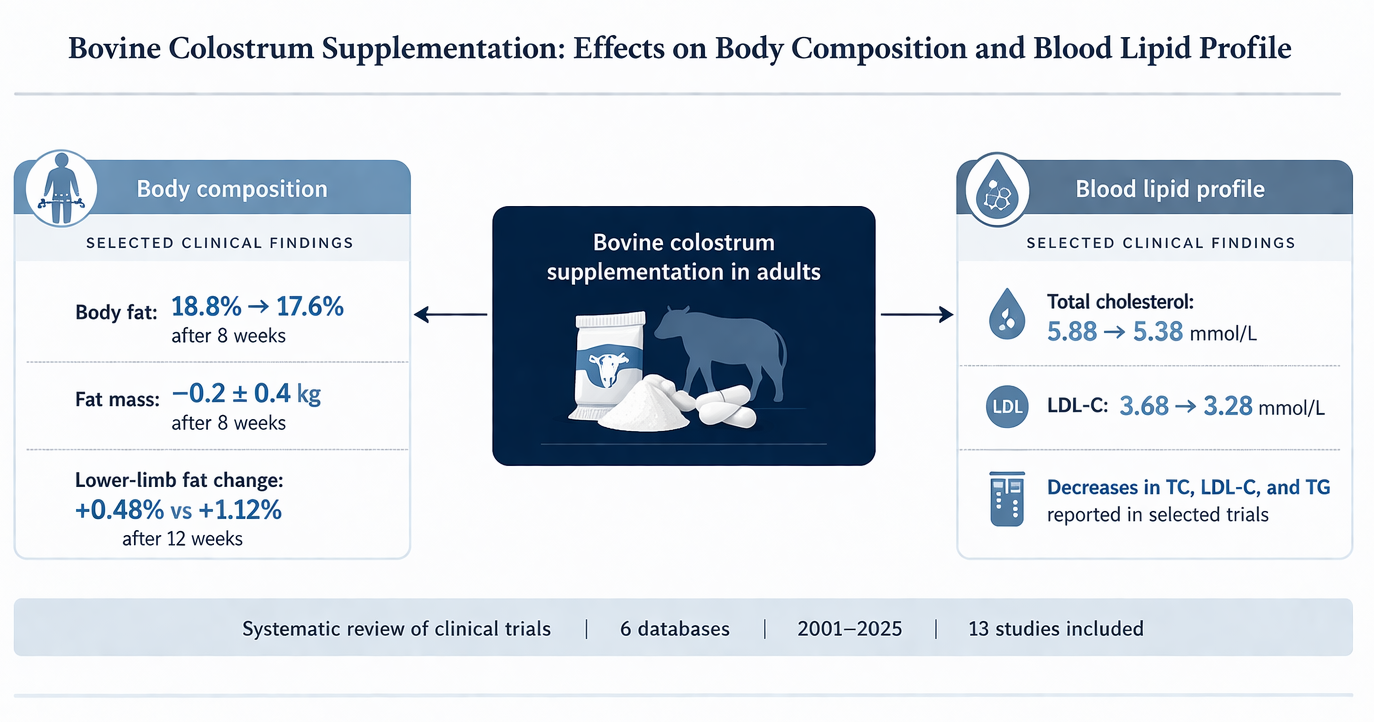
The Effects of Colostrum Bovinum Supplementation on Human Body Fat Content and/or Blood Lipid Profile: A Systematic Review of Clinical Trials

 ,
,  ,
,  , and
, and
Abstract
1. Introduction
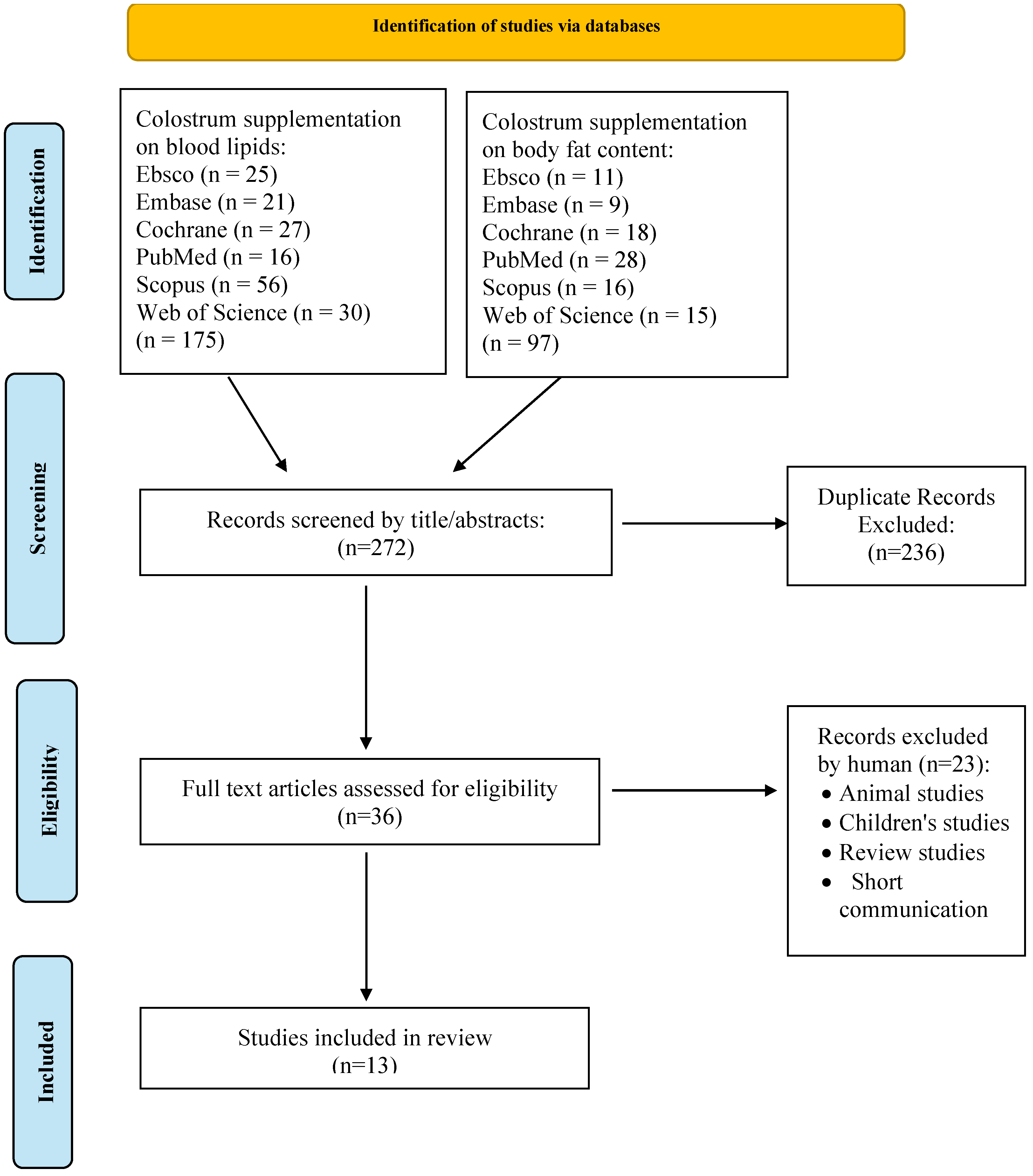
2. Materials and Methods
3. Results
3.1. Risk-of-Bias Assessment

| Study | Tool | D1 | D2 | D3 | D4 | D5 | D6 | Overall |
|---|---|---|---|---|---|---|---|---|
| Antonio et al. [36] | RoB 2 | Some concerns | N/A | Low | Some concerns | Low | Some concerns | Some concerns |
| Coombes et al. [32] | RoB 2 | Some concerns | N/A | Low | High | Low | Some concerns | High risk |
| Hofman et al. [37] | RoB 2 | Some concerns | N/A | Low | Low | Low | Some concerns | Some concerns |
| Kerksick et al. [38] | RoB 2 | Some concerns | N/A | Low | Low | Low | Some concerns | Some concerns |
| Lund et al. [33] | RoB 2 (crossover) | Some concerns | Some concerns | Low | High | Low | Some concerns | High risk |
| Duff et al. [39] | RoB 2 | Some concerns | N/A | Low | Low | Low | Some concerns | Some concerns |
| Al-Nimer et al. [34] | RoB 2 | High | N/A | Low | Low | Low | Some concerns | High risk |
| Ooi et al. [28] | RoB 2 | Some concerns | N/A | Low | High | Low | Low | High risk |
| Dukaew et al. [31] | RoB 2 | Low | N/A | Low | Low | Low | Some concerns | Some concerns |
| Durkalec-Michalski et al. [35] | RoB 2 (crossover) | Some concerns | High | Low | High | Low | Low | High risk |
| Study | Tool | D1 | D2 | D3 | D4 | D5 | D6 | Overall |
|---|---|---|---|---|---|---|---|---|
| Han et al. [29] | ROBINS-I | Critical | Low | Serious | Moderate | Moderate | Serious | Critical risk |
| Kim et al. [40] | ROBINS-I | Critical | Low | Serious | Moderate | Low | Serious | Critical risk |
| Mizrahi et al. [41] | ROBINS-I | Critical | Low | Serious | Moderate | Moderate | Serious | Critical risk |
| Study | Design | Overall Judgment | Rationale for Overall Risk-of-Bias Judgment |
|---|---|---|---|
| Antonio et al. [36] | Randomized, double-blind, placebo-controlled trial | Some concerns | The trial was described as randomized and double-blind, and the outcome assessment relied predominantly on objective measures, including DXA-derived body composition and standardized exercise testing. However, the report did not provide sufficient detail regarding the method used for sequence generation or the procedures for allocation concealment, precluding a low-risk judgment for bias arising from the randomization process. Furthermore, the publication did not clearly indicate whether the reported analyses were based on a prespecified statistical analysis plan or a predefined primary outcome, raising concerns about the selection of the reported results. No major concerns were identified regarding deviations from intended interventions, missing outcome data, or outcome measurement. |
| Coombes et al. [32] | Randomized, double-blind, placebo-controlled trial | High risk of bias | Although the study was reported as randomized, double-blind, and placebo-controlled, a substantial proportion of participants were excluded after randomization because of non-compliance with supplementation or training, and the final analysis was restricted to those who completed the protocol. This raises a high risk of bias due to missing outcome data, as the analytical sample may no longer have retained the balance conferred by randomization. In addition, insufficient detail was provided regarding the generation of the randomization sequence and the concealment of allocation, raising concerns in the randomization domain. Given the extent of post-randomization exclusion, the study was judged overall as being at high risk of bias. |
| Hofman et al. [37] | Randomized, double-blind, placebo-controlled trial | Some concerns | The study appeared adequately blinded and employed an active comparator with a comparable nutritional profile, with no major concerns identified regarding deviations from intended interventions, missing outcome data, or measurement of the outcome. Nevertheless, the report did not describe the methods used for sequence generation or allocation concealment in sufficient detail to support a low-risk judgment for the randomization process. In addition, it was unclear whether the reported analyses were prospectively specified. Accordingly, some concerns were raised about bias arising from the randomization process and the selection of the reported result. |
| Kerksick et al. [38] | Randomized, double-blind, placebo-controlled, multi-arm trial | Some concerns | This was a randomized, double-blind, multi-arm trial with standardized resistance training and objective assessments of body composition and performance. However, the publication did not explicitly describe the procedures used to conceal allocation, which resulted in some concerns regarding the randomization process. Moreover, multiple efficacy outcomes were reported across several physiological domains without a clearly stated prespecified hierarchy of primary and secondary outcomes. This raised concerns about selective reporting. As no major concerns were identified regarding deviations from intended interventions, missing data, or outcome measurement, the overall judgment was ‘some concerns’. |
| Lund et al. [33] | Randomized crossover trial | High risk of bias | In this randomized crossover trial, only 8 of the 12 enrolled participants were included in the final analysis, resulting in substantial attrition in a small clinical sample. This gave rise to a high risk of bias due to missing outcome data. In addition, the crossover design required consideration of period effects, washout adequacy, and possible carryover, and these issues could not be fully excluded on the basis of the information provided. Some concerns also remained regarding the randomization process, as the sequence generation and allocation procedures were insufficiently described. Taken together, these limitations justified an overall judgment of high risk of bias. |
| Duff et al. [39] | Randomized, double-blind trial | Some concerns | The study reported randomization and double-blinding, and the intervention was implemented alongside supervised resistance training, with repeated outcome assessment. No major concerns were identified for deviations from intended interventions, missing outcome data, or measurement of the outcome. However, the allocation concealment procedure was not described in sufficient detail, raising concerns about bias arising from the randomization process. In addition, the report did not fully clarify whether the reported outcomes and analyses were based on a prespecified analysis plan, raising concerns about the selection of the reported results. |
| Al-Nimer et al. [34] | Randomized, double-blind, placebo-controlled clinical study | High risk of bias | Although the trial was described as randomized and double-blind, the publication provided limited information regarding sequence generation and allocation concealment. Moreover, baseline imbalances were evident between the groups in several measured variables, raising concern that the randomization process may not have achieved adequate comparability or may have been insufficiently implemented or reported. The statistical presentation was also largely focused on within-group pre-post comparisons rather than robust between-group estimates, raising concerns about the reporting and interpretation of intervention effects. Because the randomization domain was judged to be at high risk, the overall study was judged to be at high risk of bias. |
| Ooi et al. [28] | Randomized, double-blind, placebo-controlled trial | High risk of bias | The study reported computerized randomization, blinding, and placebo control; however, 14 of the 66 randomized participants were excluded from the final analysis, and the published results were based solely on completers. Such attrition introduces a high risk of bias due to missing outcome data, particularly where the final estimates are not derived from a full intention-to-treat framework. Although no major concerns were identified regarding outcome measurement, the extent of attrition following randomization was sufficient to compromise confidence in the validity of the reported intervention effects. |
| Dukaew et al. [31] | Randomized, double-blind, placebo-controlled trial | Some concerns | This was the most methodologically rigorous randomized trial among the included studies. The authors reported computer-generated randomization, appropriate allocation concealment using sequentially numbered opaque sealed envelopes, double blinding, and prospectively defined endpoints. No major concerns were identified for bias arising from the randomization process, deviations from intended interventions, missing outcome data, or outcome measurement. However, because the full statistical analysis plan was not available in the published report, the possibility of selective reporting could not be excluded with complete certainty. Accordingly, the study was judged as presenting some concerns overall. |
| Durkalec-Michalski et al. [35] | Randomized, double-blind, placebo-controlled crossover study | High risk of bias | This crossover trial was strengthened by randomization, blinding, placebo control, and prospective trial registration. Nevertheless, substantial attrition occurred between enrollment and final analysis, resulting in a high risk of bias due to missing outcome data. In addition, crossover-specific methodological concerns, including period and sequence effects and the possibility of carryover despite the washout period, remained relevant and could materially affect the validity of the estimated treatment effect. As at least one key domain was judged at high risk, the overall study judgment was high risk of bias. |
| Han et al. [29] | Open-label, single-arm pilot intervention study | Critical risk of bias | This was an open-label, single-arm intervention study conducted without a concurrent control group. Under ROBINS-I, the absence of a valid comparator resulted in a critical risk of bias due to confounding, as any observed changes could not be distinguished from temporal trends, regression to the mean, co-interventions, or other uncontrolled influences. Additional concerns were identified regarding the selection of participants into the study and the selection of the reported results. In accordance with ROBINS-I guidance, the presence of critical risk in the confounding domain led to an overall judgment of critical risk of bias. |
| Kim et al. [40] | Single-arm before–and–after intervention study | Critical risk of bias | Although the article used the term ‘randomized’, the study was analytically equivalent to an uncontrolled single-arm before-and-after intervention, as no concurrent comparator group was included. Consequently, the study was judged at critical risk of bias due to confounding, because the observed metabolic changes could not be reliably attributed to the intervention rather than to time effects, behavioral changes, or other co-interventions. Additional concerns were present regarding participant selection and the selection of the reported result. In ROBINS-I terms, the absence of a valid counterfactual comparison is sufficient to justify an overall judgment of critical risk of bias. |
| Mizrahi et al. [41] | Open-label, single-arm phase I/II clinical trial | Critical risk of bias | This was a small, open-label, uncontrolled phase I/II clinical study involving only 10 participants. The absence of a concurrent control group resulted in a critical risk of bias due to confounding, as the reported improvements could not be disentangled from background temporal change or co-intervention effects. Further concerns arose regarding selection into the study and selection of the reported result, particularly because the interpretation emphasized favorable changes among subsets of participants. Consistent with ROBINS-I guidance, the study was therefore judged to be at critical risk of bias overall. |
3.2. Certainty of Evidence According to GRADE
3.3. The Effect of Colostrum Bovinum (COL) Supplementation on Human Body Fat Content
3.4. The Effects of Colostrum Bovinum (COL) Supplementation on Human Blood Lipid Profile
4. Discussion
5. Conclusions
Supplementary Materials
Author Contributions
Funding
Institutional Review Board Statement
Informed Consent Statement
Data Availability Statement
Acknowledgments
Conflicts of Interest
Abbreviations
References
- Castellote, C.; Casillas, R.; Ramírez-Santana, C.; Pérez-Cano, F.J.; Castell, M.; Moretones, M.G.; López-Sabater, M.C.; Franch, Í. Premature Delivery Influences the Immunological Composition of Colostrum and Transitional and Mature Human Milk. J. Nutr. 2011, 141, 1181–1187. [Google Scholar] [CrossRef]
- McGrath, B.A.; Fox, P.F.; McSweeney, P.L.H.; Kelly, A.L. Composition and Properties of Bovine Colostrum: A Review. Dairy Sci. Technol. 2016, 96, 133–158. [Google Scholar] [CrossRef]
- Playford, R.J.; Weiser, M.J. Bovine Colostrum: Its Constituents and Uses. Nutrients 2021, 13, 265. [Google Scholar] [CrossRef]
- Duan, H.; Sun, Q.; Chen, C.; Wang, R.; Yan, W. A Review: The Effect of Bovine Colostrum on Immunity in People of All Ages. Nutrients 2024, 16, 2007. [Google Scholar] [CrossRef] [PubMed]
- Kim, Y.J. Immunomodulatory Effects of Human Colostrum and Milk. Pediatr. Gastroenterol. Hepatol. Nutr. 2021, 24, 337. [Google Scholar] [CrossRef] [PubMed]
- Dinleyici, M.; Barbieur, J.; Dinleyici, E.C.; Vandenplas, Y. Functional Effects of Human Milk Oligosaccharides (HMOs). Gut Microbes 2023, 15, 2186115. [Google Scholar] [CrossRef]
- Yalçıntaş, Y.M.; Duman, H.; López, J.M.M.; Portocarrero, A.C.M.; Lombardo, M.; Khallouki, F.; Koch, W.; Bordiga, M.; El-Seedi, H.; Raposo, A.; et al. Revealing the Potency of Growth Factors in Bovine Colostrum. Nutrients 2024, 16, 2359. [Google Scholar] [CrossRef]
- Tzani, A.; Xixi, N.A.; Sokou, R.; Karapati, E.; Iliodromiti, Z.; Volaki, P.; Paliatsiou, S.; Iacovidou, N.; Boutsikou, T. Factors Influencing the Colostrum’s Microbiota: A Systematic Review of the Literature. Children 2025, 12, 1336. [Google Scholar] [CrossRef] [PubMed]
- Garofoli, F.; Civardi, E.; Pisoni, C.; Angelini, M.; Ghirardello, S. Anti-Inflammatory and Anti-Allergic Properties of Colostrum from Mothers of Full-Term and Preterm Babies: The Importance of Maternal Lactation in the First Days. Nutrients 2023, 15, 4249. [Google Scholar] [CrossRef]
- Szyller, H.; Antosz, K.; Batko, J.; Mytych, A.; Dziedziak, M.; Wrześniewska, M.; Braksator, J.; Pytrus, T. Bioactive Components of Human Milk and Their Impact on Child’s Health and Development, Literature Review. Nutrients 2024, 16, 1487. [Google Scholar] [CrossRef]
- Cingöz, A.; Yörükoğlu, T. Nutritional and Chemical Properties and Antioxidant Capacity of Freeze-Dried Cow, Sheep, Goat and Buffalo Colostrums. Int. Dairy J. 2024, 158, 106046. [Google Scholar] [CrossRef]
- Farooq, U.; Ahmed, S.; Liu, G.; Jiang, X.; Yang, H.; Ding, J.; Ali, M. Biochemical Properties of Sheep Colostrum and Its Potential Benefits for Lamb Survival: A Review. Anim. Biotechnol. 2024, 35, 2320726. [Google Scholar] [CrossRef]
- Kessler, E.C.; Bruckmaier, R.M.; Gross, J.J. Immunoglobulin G Content and Colostrum Composition of Different Goat and Sheep Breeds in Switzerland and Germany. J. Dairy Sci. 2019, 102, 5542–5549. [Google Scholar] [CrossRef]
- Agradi, S.; González-Cabrera, M.; Argüello, A.; Hernández-Castellano, L.E.; Castro, N.; Menchetti, L.; Brecchia, G.; Vigo, D.; Tuccia, E.; Curone, G. Colostrum Quality in Different Goat Breeds Reared in Northern Italy. Animals 2023, 13, 3146. [Google Scholar] [CrossRef]
- Jrad, Z.; Oussaief, O.; Khorchani, T.; El-Hatmi, H. Camel Colostrum Composition, Nutritional Value, and Nutraceuticals. In Research Anthology on Recent Advancements in Ethnopharmacology and Nutraceuticals; IGI Global: Palmdale, PA, USA, 2022; pp. 902–924. [Google Scholar]
- Arslan, A.; Kaplan, M.; Duman, H.; Bayraktar, A.; Ertürk, M.; Henrick, B.M.; Frese, S.A.; Karav, S. Bovine Colostrum and Its Potential for Human Health and Nutrition. Front. Nutr. 2021, 8, 651721. [Google Scholar] [CrossRef]
- El-Loly, M.M. Colostrum Ingredients, Its Nutritional and Health Benefits—An Overview. Clin. Nutr. Open Sci. 2022, 44, 126–143. [Google Scholar] [CrossRef]
- Abduku, H.; Eshetu, M. Physico-Chemical Properties and Processing Characteristics of Camel Milk as Compared with Other Dairy Species: A Review. Asian J. Dairy Food Res. 2024, 43, 1. [Google Scholar] [CrossRef]
- Polidori, P.; Rapaccetti, R.; Klimanova, Y.; Zhang, J.-J.; Santini, G.; Vincenzetti, S. Nutritional Parameters in Colostrum of Different Mammalian Species. Beverages 2022, 8, 54. [Google Scholar] [CrossRef]
- Li, R.; Zhou, Y.; Xu, Y. Comparative Analysis of Oligosaccharides in the Milk of Human and Animals by Using LC-QE-HF-MS. Food Chem. X 2023, 18, 100705. [Google Scholar] [CrossRef]
- Sangild, P.T.; Vonderohe, C.; Melendez Hebib, V.; Burrin, D.G. Potential Benefits of Bovine Colostrum in Pediatric Nutrition and Health. Nutrients 2021, 13, 2551. [Google Scholar] [CrossRef] [PubMed]
- Pawan Gusain Global Colostrum Market Size, Share and Trends Analysis Report—Industry Overview and Forecast to 2033. Available online: https://www.databridgemarketresearch.com/reports/global-colostrum-market (accessed on 27 February 2026).
- Karakülah, Y.S.; Yalçıntaş, Y.M.; Bechelany, M.; Karav, S. Clinical Applications of Bovine Colostrum in GastrointestinaI Disorders: Mechanisms, Evidence, and Therapeutic Potential. Int. J. Mol. Sci. 2025, 26, 10673. [Google Scholar] [CrossRef] [PubMed]
- Davison, G. The Use of Bovine Colostrum in Sport and Exercise. Nutrients 2021, 13, 1789. [Google Scholar] [CrossRef] [PubMed]
- Khan, T.S.; Akram, N.; Faisal, Z.; Saeed, F.; Rasheed, A.; Ahmed, F.; Afzaal, M. Bovine Colostrum: Therapeutic Potential and Clinical Evidence. Int. Dairy J. 2024, 157, 105996. [Google Scholar] [CrossRef]
- Struff, W.G.; Sprotte, G. Bovine Colostrum as a Biologic in Clinical Medicine: A Review—Part II: Clinical Studies. Int. J. Clin. Pharmacol. Ther. 2008, 46, 211–225. [Google Scholar] [CrossRef]
- Page, M.J.; McKenzie, J.E.; Bossuyt, P.M.; Boutron, I.; Hoffmann, T.C.; Mulrow, C.D.; Shamseer, L.; Tetzlaff, J.M.; Akl, E.A.; Brennan, S.E.; et al. The PRISMA 2020 Statement: An Updated Guideline for Reporting Systematic Reviews. BMJ 2021, 372, n71. [Google Scholar] [CrossRef]
- Ooi, T.C.; Ahmad, A.; Rajab, N.F.; Sharif, R. Effects of 12 Weeks Colostrum Milk Supplement among Older Adults: A Randomised, Double-Blind and Placebo-Controlled Trial. Int. Dairy J. 2024, 149, 105819. [Google Scholar] [CrossRef]
- Han, X.; Vaughan, B.; Vollmer, D. Safety and Efficacy of a Multivitamin, Multimineral, Bovine Colostrum-Containing Supplement: An Open-Label Pilot Intervention Trial in Healthy Adult Women and Men. Altern. Ther. Health Med. 2023, 29, 34–40. [Google Scholar]
- Higgins, J.P.T.; Thomas, J.; Chandler, J.; Cumpston, M.; Li, T.; Page, M.J.; Welch, V.A. (Eds.) Cochrane Handbook for Systematic Reviews of Interventions, 1st ed.; Wiley: Hoboken, NJ, USA, 2019. [Google Scholar]
- Dukaew, N.; Klinjan, P.; Inpan, R.; Na Takuathung, M.; Jiranusornkul, S.; Chaichit, S.; Taychaworaditsakul, W.; Aisara, J.; Karat, W.; Koonrungsesomboon, N. Effects of the Colostrum-Containing Multi-Nutrient Dietary Supplement on Immune, Muscle, Bone, and Cognitive Function Parameters in the Elderly: A Randomized, Double-Blind, Placebo-Controlled Trial. J. Funct. Foods 2025, 128, 106816. [Google Scholar] [CrossRef]
- Coombes, J.S.; Conacher, M.; Austen, S.K.; Marshall, P.A. Dose Effects of Oral Bovine Colostrum on Physical Work Capacity in Cyclists. Med. Sci. Sports Exerc. 2002, 34, 1184–1188. [Google Scholar] [CrossRef] [PubMed]
- Lund, P.; Sangild, P.T.; Aunsholt, L.; Hartmann, B.; Holst, J.J.; Mortensen, J.; Mortensen, P.B.; Jeppesen, P.B. Randomised Controlled Trial of Colostrum to Improve Intestinal Function in Patients with Short Bowel Syndrome. Eur. J. Clin. Nutr. 2012, 66, 1059–1065. [Google Scholar] [CrossRef]
- Al-Nimer, M.; Al-Basri, A.; Satmbekova, D.; DatKhayev, U. The Effects of Bovine Colostrum on the Stress-Hyperglycemia Ratio and the Triglyceride-Glucose Index in Exercise-Trained Healthy Subjects: A Double-Blind, Placebo-Controlled Clinical Study. Iraqi J. Pharm. Sci. 2023, 32, 104–109. [Google Scholar] [CrossRef]
- Durkalec-Michalski, K.; Główka, N.; Podgórski, T.; Wochna, K.; Woźniewicz, M.; Nowaczyk, P.M. Twelve-Week Colostrum Bovinum Supplementation Supports Aerobic Capacity but Has No Effect on Body Composition in Endurance-Trained Males: A Randomized Placebo-Controlled Crossover Study. Eur. J. Sport Sci. 2025, 25, e12288. [Google Scholar] [CrossRef] [PubMed]
- Antonio, J.; Sanders, M.S.; Van Gammeren, D. The Effects of Bovine Colostrum Supplementation on Body Composition and Exercise Performance in Active Men and Women. Nutrition 2001, 17, 243–247. [Google Scholar] [CrossRef] [PubMed]
- Hofman, Z.; Smeets, R.; Verlaan, G.; Lugt, R.V.D.; Verstappen, P.A. The Effect of Bovine Colostrum Supplementation on Exercise Performance in Elite Field Hockey Players. Int. J. Sport Nutr. Exerc. Metab. 2002, 12, 461–469. [Google Scholar] [CrossRef]
- Kerksick, C.M.; Rasmussen, C.; Lancaster, S.; Starks, M.; Smith, P.; Melton, C.; Greenwood, M.; Almada, A.; Kreider, R. Impact of Differing Protein Sources and a Creatine Containing Nutritional Formula after 12 Weeks of Resistance Training. Nutrition 2007, 23, 647–656. [Google Scholar] [CrossRef]
- Duff, W.R.D.; Chilibeck, P.D.; Rooke, J.J.; Kaviani, M.; Krentz, J.R.; Haines, D.M. The Effect of Bovine Colostrum Supplementation in Older Adults During Resistance Training. Int. J. Sport Nutr. Exerc. Metab. 2014, 24, 276–285. [Google Scholar] [CrossRef] [PubMed]
- Kim, J.H.; Jung, W.S.; Choi, N.-J.; Kim, D.-O.; Shin, D.-H.; Kim, Y.J. Health-Promoting Effects of Bovine Colostrum in Type 2 Diabetic Patients Can Reduce Blood Glucose, Cholesterol, Triglyceride and Ketones. J. Nutr. Biochem. 2009, 20, 298–303. [Google Scholar] [CrossRef]
- Ben Ya’acov, A.; Mizrahi, M.; Shabat, Y.; Lalazar, G.; Adar, T.; Wong, V.; Muller, B.; Rawlin, G.; Ilan, Y. Alleviation of Insulin Resistance and Liver Damage by Oral Administration of Imm124-E Is Mediated by Increased Tregs and Associated with Increased Serum GLP-1 and Adiponectin: Results of a Phase I/II Clinical Trial in NASH. J. Inflamm. Res. 2012, 5, 141–150. [Google Scholar] [CrossRef]
- Mero, A.; Miikkulainen, H.; Riski, J.; Pakkanen, R.; Aalto, J.; Takala, T. Effects of Bovine Colostrum Supplementation on Serum IGF-I, IgG, Hormone, and Saliva IgA during Training. J. Appl. Physiol. 1997, 83, 1144–1151. [Google Scholar] [CrossRef]
- Kerksick, C.M.; Rasmussen, C.J.; Lancaster, S.L.; Magu, B.; Smith, P.; Melton, C.; Greenwood, M.; Almada, A.L.; Earnest, C.P.; Kreider, R.B. The Effects of Protein and Amino Acid Supplementation on Performance and Training Adaptations during Ten Weeks of Resistance Training. J. Strength Cond. Res. 2006, 20, 643–653. [Google Scholar]
- Kim, H.; Kim, S.-E.; Sung, M.-K. Sex and Gender Differences in Obesity: Biological, Sociocultural, and Clinical Perspectives. World J. Men’s Health 2025, 43, 758. [Google Scholar] [CrossRef] [PubMed]
- Koceva, A.; Herman, R.; Janez, A.; Rakusa, M.; Jensterle, M. Sex- and Gender-Related Differences in Obesity: From Pathophysiological Mechanisms to Clinical Implications. Int. J. Mol. Sci. 2024, 25, 7342. [Google Scholar] [CrossRef]
- Ethun, K. Sex and Gender Differences in Body Composition, Lipid Metabolism, and Glucose Regulation. In Sex Differences in Physiology; Elsevier: Amsterdam, The Netherlands, 2016; pp. 145–165. [Google Scholar]
- Itan, Y.; Jones, B.L.; Ingram, C.J.; Swallow, D.M.; Thomas, M.G. A Worldwide Correlation of Lactase Persistence Phenotype and Genotypes. BMC Evol. Biol. 2010, 10, 36. [Google Scholar] [CrossRef] [PubMed]
- Gupta, V.K.; Paul, S.; Dutta, C. Geography, Ethnicity or Subsistence-Specific Variations in Human Microbiome Composition and Diversity. Front. Microbiol. 2017, 8, 1162. [Google Scholar] [CrossRef] [PubMed]
- Hajihashemi, P.; Haghighatdoost, F.; Kassaian, N.; Rahim Khorasani, M.; Hoveida, L.; Nili, H.; Tamizifar, B.; Adibi, P. Therapeutics Effects of Bovine Colostrum Applications on Gastrointestinal Diseases: A Systematic Review. Syst. Rev. 2024, 13, 76. [Google Scholar] [CrossRef]
- Kaplan, M.; Arslan, A.; Duman, H.; Karyelioğlu, M.; Baydemir, B.; Günar, B.B.; Alkan, M.; Bayraktar, A.; Tosun, H.İ.; Ertürk, M.; et al. Production of Bovine Colostrum for Human Consumption to Improve Health. Front. Pharmacol. 2022, 12, 796824. [Google Scholar] [CrossRef]
- Fatima, M.; Sajid, M.; Saima, H.; Nadeem, M.T.; Ahmad, R.S.; Mehmood, S.; Zubair Khalid, M.; Ali Alharbi, S.; Ansari, M.J.; Kasongo, E.L.M. In Vitro Evaluation of Spray and Freeze-Dried Bovine Colostrum Powder and Their Effects on the Nutritional and Functional Properties. Int. J. Food Prop. 2024, 27, 985–1002. [Google Scholar] [CrossRef]
- Buckley, J.D.; Butler, R.N.; Southcott, E.; Brinkworth, G.D. Bovine Colostrum Supplementation During Running Training Increases Intestinal Permeability. Nutrients 2009, 1, 224–234. [Google Scholar] [CrossRef]
- Jäger, R.; Kerksick, C.M.; Campbell, B.I.; Cribb, P.J.; Wells, S.D.; Skwiat, T.M.; Purpura, M.; Ziegenfuss, T.N.; Ferrando, A.A.; Arent, S.M.; et al. International Society of Sports Nutrition Position Stand: Protein and Exercise. J. Int. Soc. Sports Nutr. 2017, 14, 20. [Google Scholar] [CrossRef]
- Mero, A.; Nykänen, T.; Keinänen, O.; Knuutinen, J.; Lahti, K.; Alen, M.; Rasi, S.; Leppäluoto, J. Protein Metabolism and Strength Performance after Bovine Colostrum Supplementation. Amino Acids 2005, 28, 327–335. [Google Scholar] [CrossRef]
- Sillanpää, E.; Häkkinen, A.; Häkkinen, K. Body Composition Changes by DXA, BIA and Skinfolds during Exercise Training in Women. Eur. J. Appl. Physiol. 2013, 113, 2331–2341. [Google Scholar] [CrossRef] [PubMed]
- Wang, D.; Morton, J.I.; Salim, A.; Magliano, D.J.; Shaw, J.E. Comparison of DXA, BIA, and Anthropometry for Assessing Subcutaneous, Visceral, Liver, and Pancreas Fat Measured by MRI. Diabetes Obes. Metab. 2026, 28, 2795–2805. [Google Scholar] [CrossRef]
- De Oliveira, G.B.; Fernandes, L.V.; Amaral, T.F.; Vasques, A.C.J.; Corona, L.P. Evaluation of Skinfolds Based Predictive Equations for Estimating Body Fat Percentage in Older Adults: A Comparison Using Digital Adipometer (Lipowise) and Dual-Energy X-Ray Absorptiometry (DXA). Clin. Obes. 2026, 16, e70063. [Google Scholar] [CrossRef]
- Van Schijndel, N.; Weijer, V.; Van Loon, L.J.C.; Van Dijk, J.-W. Feasibility and Accuracy of Body-Fat Assessment Using Standardized Skinfold-Thickness Assessment Versus Dual-Energy X-Ray Absorptiometry in Paralympic Athletes. Int. J. Sports Physiol. Perform. 2026, 21, 241–251. [Google Scholar] [CrossRef]
- Ramani, A.; Taherabbas, S.; Manik, S. Bovine Colostrum as a Promising Nutraceutical: A Systematic Review. Sustain. Food Technol. 2024, 2, 531–547. [Google Scholar] [CrossRef]
- Mehra, R.; Garhwal, R.; Sangwan, K.; Guiné, R.P.F.; Lemos, E.T.; Buttar, H.S.; Visen, P.K.S.; Kumar, N.; Bhardwaj, A.; Kumar, H. Insights into the Research Trends on Bovine Colostrum: Beneficial Health Perspectives with Special Reference to Manufacturing of Functional Foods and Feed Supplements. Nutrients 2022, 14, 659. [Google Scholar] [CrossRef]
- Notarnicola, M.; Altomare, D.F.; Correale, M.; Ruggieri, E.; D’Attoma, B.; Mastrosimini, A.; Guerra, V.; Caruso, M.G. Serum Lipid Profile in Colorectal Cancer Patients with and without Synchronous Distant Metastases. Oncology 2005, 68, 371–374. [Google Scholar] [CrossRef] [PubMed]
- Zhu, Y.; Zhou, H.; Chen, H.; Zhang, J.; Liang, Y.; Yang, S.; Wang, X.; Chen, G.; Zhang, Q. Global Serum Metabolomic and Lipidomic Analyses Reveal Lipid Perturbations and Potential Biomarkers of the Colorectal Cancer by Adenoma-Carcinoma Sequence. Chin. J. Anal. Chem. 2023, 51, 100270. [Google Scholar] [CrossRef]
- Takanashi, Y.; Kahyo, T.; Sekihara, K.; Kawase, A.; Setou, M.; Funai, K. Prognostic Potential of Lipid Profiling in Cancer Patients: A Systematic Review of Mass Spectrometry-Based Studies. Lipids Health Dis. 2024, 23, 154. [Google Scholar] [CrossRef]
- Bagwe-Parab, S.; Yadav, P.; Kaur, G.; Tuli, H.S.; Buttar, H.S. Therapeutic Applications of Human and Bovine Colostrum in the Treatment of Gastrointestinal Diseases and Distinctive Cancer Types: The Current Evidence. Front. Pharmacol. 2020, 11, 01100. [Google Scholar] [CrossRef]
- Gasser, M.; Lissner, R.; Nawalaniec, K.; Hsiao, L.-L.; Waaga-Gasser, A.M. KMP01D Demonstrates Beneficial Anti-Inflammatory Effects on Immune Cells: An Ex Vivo Preclinical Study of Patients with Colorectal Cancer. Front. Immunol. 2020, 11, 684. [Google Scholar] [CrossRef] [PubMed]
- Alsayed, A.R.; Hasoun, L.Z.; Khader, H.A.; Basheti, I.A.; Permana, A.D. Bovine Colostrum Treatment of Specific Cancer Types: Current Evidence and Future Opportunities. Molecules 2022, 27, 8641. [Google Scholar] [CrossRef]
- Artym, J.; Zimecki, M. Colostrum Proteins in Protection against Therapy-Induced Injuries in Cancer Chemo- and Radiotherapy: A Comprehensive Review. Biomedicines 2023, 11, 114. [Google Scholar] [CrossRef] [PubMed]
- Iigo, M.; Alexander, D.B.; Xu, J.; Futakuchi, M.; Suzui, M.; Kozu, T.; Akasu, T.; Saito, D.; Kakizoe, T.; Yamauchi, K.; et al. Inhibition of Intestinal Polyp Growth by Oral Ingestion of Bovine Lactoferrin and Immune Cells in the Large Intestine. Biometals 2014, 27, 1017–1029. [Google Scholar] [CrossRef]
- Kozu, T.; Iinuma, G.; Ohashi, Y.; Saito, Y.; Akasu, T.; Saito, D.; Alexander, D.B.; Iigo, M.; Kakizoe, T.; Tsuda, H. Effect of Orally Administered Bovine Lactoferrin on the Growth of Adenomatous Colorectal Polyps in a Randomized, Placebo-Controlled Clinical Trial. Cancer Prev. Res. 2009, 2, 975–983. [Google Scholar] [CrossRef]
- Peters, G.; Gongoll, S.; Langner, C.; Mengel, M.; Piso, P.; Klempnauer, J.; Rüschoff, J.; Kreipe, H.; Von Wasielewski, R. IGF-1R, IGF-1 and IGF-2 Expression as Potential Prognostic and Predictive Markers in Colorectal-Cancer. Virchows Arch. 2003, 443, 139–145. [Google Scholar] [CrossRef]
- Gligorijević, N.; Dobrijević, Z.; Šunderić, M.; Robajac, D.; Četić, D.; Penezić, A.; Miljuš, G.; Nedić, O. The Insulin-like Growth Factor System and Colorectal Cancer. Life 2022, 12, 1274. [Google Scholar] [CrossRef]
- Altman, D.G.; Bland, J.M. Statistics Notes: Absence of Evidence Is Not Evidence of Absence. BMJ 1995, 311, 485. [Google Scholar] [CrossRef]
- Button, K.S.; Ioannidis, J.P.A.; Mokrysz, C.; Nosek, B.A.; Flint, J.; Robinson, E.S.J.; Munafò, M.R. Power Failure: Why Small Sample Size Undermines the Reliability of Neuroscience. Nat. Rev. Neurosci. 2013, 14, 365–376. [Google Scholar] [CrossRef]
- Guberti, M.; Botti, S.; Capuzzo, M.T.; Nardozi, S.; Fusco, A.; Cera, A.; Dugo, L.; Piredda, M.; De Marinis, M.G. Bovine Colostrum Applications in Sick and Healthy People: A Systematic Review. Nutrients 2021, 13, 2194. [Google Scholar] [CrossRef] [PubMed]

| Outcome | Participants (Studies) | Summary of Effect | Certainty of Evidence |
|---|---|---|---|
| Body fat/fat mass/% body fat | 257 (8 studies) | Most studies showed no significant advantage of COL over placebo or protein control for total fat mass or % body fat. | Very low |
| Skinfolds/adiposity proxy | 56 (2 studies) | No consistent reduction in skinfold thickness was observed compared with the control. | Very low |
| Regional fat mass | 80 (1 study) | One study showed a small reduction in lower-limb fat percentage; however, evidence was limited to a single trial. | Very low |
| Body weight/BMI/anthropometric parameters | 421 (11 studies) | Findings were inconsistent and cannot be clearly attributed to bovine colostrum supplementation. | Very low |
| Total cholesterol (TC) | 91 (4 studies) | Some studies reported reductions in TC, but findings were inconsistent across trials. | Very low |
| LDL-C | 75 (3 studies) | Possible reductions in LDL-C were observed in selected studies; however, the evidence was inconsistent and imprecise. | Very low |
| HDL-C | 65 (2 studies) | No reliable evidence of a beneficial improvement in HDL-C was identified. | Very low |
| Triglycerides (TG) | 81 (3 studies) | One study demonstrated TG reduction, whereas the remaining studies did not. | Very low |
| TyGI/triglyceride-glucose index | 50 (1 study) | One study assessed TyGI rather than the classical lipid profile, limiting comparability. | Very low |
| Participants | Group | Duration | Intervention | Analysis | Results | References |
|---|---|---|---|---|---|---|
| Adults; N = 22; age 18–35 years (mean 24 years); men (n = 14), women (n = 8); ethnicity: no data; country: USA | (1) COL (n = 9) (2) PLA (n = 13) | 8 weeks; aerobic training + heavy resistance training (3/week) | (1) COL 20 g (2) Whey 20 g, isocaloric, dissolved in water | Body composition (DXA); exercise performance (treadmill time to exhaustion; one repetition maximum (1RM) bench press; submaximal bench press endurance); energy and macronutrient intake (24 h dietary recall) | In the PLA group, BW ↑ (p < 0.05; 2.11 kg). In the COL group, BW ↑ (p < 0.05) and LBM ↑ (1.49 kg). No between-group differences were observed in FM. COL combined with training may promote greater gains in LBM than isocaloric whey protein. No significant differences were observed in strength or endurance outcomes between whey and placebo. | [36] |
| Adults; cyclists; N = 28; age 30 ± 10 years; men; BW 74 ± 21 kg; VO2max 61 ± 9 mL/kg/min; Σ7 skinfolds 67 ± 48 mm; ethnicity: no data; country: Australia | (1) PLA (n = 10) (2) COL (n = 9) (3) COL + WPC (n = 9) | 8 weeks | (1) PLA 60 g + WPC (2) COL 60 g/day (3) COL 20 g/day + WPC 40 g/day; morning: 20 g COL; evening: 40 g COL; dissolved in skim milk | Measure One: 2 tests of VO2max separated by 20 min; Measure Two: 2 h cycling at 65% VO2max followed by an IGF-1 questionnaire; energy and macronutrient intake | No significant between-group differences were found in Measure One. IGF-1, blood variables, nutrient intake, and fluid intake were unchanged. In Measure Two (time trial), pre- to post-supplementation performance improved significantly (p < 0.05): COL ↓ 158 s; COL + WPC ↓ 134 s; PLA ↓ 58 s. Changes in Σ7 skinfolds in the COL group were not statistically significant. | [32] |
| Adults; hockey players; N = 28; men (n = 14), women (n = 14); age 18–27 years; ethnicity: no data; country: Netherlands | (1) COL (males = 7; females = 7) (2) PLA (males = 7; females = 7) | 8 weeks; 4 training sessions/week | (1) COL 60 g/day (2) Whey protein 60 g/day (20 g morning; 40 g evening) | Anthropometric measurements; body composition (skinfolds); sprint; suicide run; vertical jump | In the PLA group, BW ↑ (p < 0.01), BF% ↓ by 0.1 ± 0.3 kg, and LBM ↑ by 1.2 ± 0.3 kg. In women, differences in FFM between PLA and COL were not significant. Sprint performance improved numerically in the COL group vs. PLA (−0.64 ± 0.09% vs. −0.33 ± 0.09%), although without statistical significance. No significant effects were observed for shuttle run, suicide run, or vertical jump, either within or between groups. | [37] |
| Adults; resistance-trained; N = 49; men (n = 36), women (n = 13); age 18–45 years; ethnicity: no data; country: USA | (1) PRO (2) PRO/COL (3) PRO/CR (4) COL/CR | 12 weeks; body resistance training program (4/week) | (1) PRO (casein/whey 60 g/day) (2) PRO/COL (3) PRO/CR (4) COL/CR; COL dissolved in water/juice/milk; CR loading dose 20 g/day for 5 days, then maintenance dose 5 g/day | Body composition (BIA, DXA); maximal strength (one repetition maximum 1RM bench press and leg press); endurance | No between-group differences were observed in energy intake or dietary composition. Resistance training increased 1RM strength, muscular endurance, sprint capacity, and FFM in all groups. Compared with PRO, PRO/CR and COL/CR elicited greater increases in DXA-derived FFM during training (p < 0.05). The addition of CR to either PRO or COL resulted in slightly greater FFM gains over 12 weeks. However, strength and anaerobic capacity improved irrespective of supplement type. No independent ergogenic effect of COL was confirmed. | [38] |
| Adults; healthy; N = 50 (final n = 13); men (n = 7), women (n = 6); age 18–45 years; ethnicity: 1 Asian, 8 Hispanic, 4 White; country: USA | (1) RiteStart® (2) COL + vitamins, minerals, botanical extracts, enzymes, omega-3 fatty acids | 12 weeks | RiteStart® 5 g twice daily (morning and evening) | Anthropometric measurements; body composition; blood biomarkers; salivary IgA | No significant effects of supplementation were observed on body composition, including FM, FFM, TBW, or BF% (p > 0.01). | [29] |
| Adults; endurance-trained; N = 58 (final n = 28); men; age 31.1 ± 10.2 years; ethnicity: no data; country: Poland | (1) COL (n = 13) (2) PLA (n = 15) | 28 weeks; 12-week supplementation; 4-week washout; 3–5 training sessions/week | (1) COL (2 × 12.5 g/day) (2) PLA (2 × 12.5 g/day); powder dissolved in 250 cm3 water | Anthropometric measurements; body composition (BIA); incremental rowing test; serum testosterone | No significant between-group changes were observed in BW, TBW, FFM, or FM. Time to VT ↓ significantly only in the COL group vs. baseline, but not vs. PLA. No differences were found in exercise-induced responses between COL and PLA. The optimal COL dose may need to be individualized based on the training cycle. | [35] |
| Adults; elderly; N = 40; men (n = 15), women (n = 25); age ≥ 59 years; ethnicity: no data; country: Canada | (1) COL (n = 12 women, n = 7 men) (2) PLA (n = 13 women, n = 8 men) | 8 weeks resistance training program (12 exercises, 3 sets of 8–12 reps, 3 days/week) | (1) COL 60 g/day (2) Whey protein 60 g/day; both provided as 3 × 20 g/day | Body composition (DXA); muscle thickness (ultrasound); muscle strength (1RM); cognitive function (TICS); creatinine and urinary K+; IGF-1 and CRP; 3-day food logs | Significant within-group increases were observed in BW, BMC, LBM, and biceps brachii thickness in both groups (p < 0.01). Significant between-group differences were detected only for walking distance. Total body K+ ↑ in the COL group. No between-group differences were found for IGF-1 or CRP. COL combined with resistance training improved leg press performance in older adults; however, the benefits over PLA were limited. No supplement group × sex × time interactions were observed. | [39] |
| Adults; elderly; N = 94 (final n = 80); men (n = 34), women (n = 46); age 55–70 years; ethnicity: no data; country: Thailand | (1) COL (n = 40; men = 18, women = 22) (2) PLA (n = 40; men = 16, women = 22) | 12 weeks | (1) COL 10 g (2) PLA; twice daily (morning and evening), dissolved in 180 cm3 water | Whey-derived immunological markers; cytokines; multidimensional body composition assessment; anthropometric parameters; bone metabolism markers; cognitive function (MoCA) | After 12 weeks, COL increased serum IgG and IGF-1 and decreased serum osteocalcin relative to baseline, with some sex-related variation. No significant changes were observed in tumor markers, muscle function, or cognitive outcomes. | [31] |
| Adults with SBS; N = 12 (final n = 8); men (n = 7), women (n = 5); age 55.7 ± 10.7 years; ethnicity: no data; country: Denmark | (1) COL (2) PLA | 4-week supplementation; 4-week washout; habitual diet | (1) COL 250 cm3/day (2) PLA 250 cm3/day, twice daily (morning and evening) | Physical examination; fluid and electrolyte balance; nutrient balance studies; body composition; urinary excretion; plasma GLP-2; maximal handgrip strength; lung function | Both COL and PLA increased energy and protein absorption; however, BW ↑ and LBM ↑ were observed only after PLA. No differences between interventions were found in body composition, physical function, or metabolic parameters. | [33] |
| Participants | Group | Duration | Intervention | Analysis | Results | References |
|---|---|---|---|---|---|---|
| Adults, type 2 diabetes; N = 16 Age: 35–65 y Sex: men (n = 8), women (n = 8) Ethnicity: Asian Country: South Korea | COL | 4 weeks | (1) COL (5 g/day), administered twice daily (morning and evening); powder | Blood analysis: glucose (fasting; 2 h and 8 h postprandially), TG, TC, β-hydroxybutyric acid | glucose ↓, TC↓, and TG↓ were significant. No significant changes were observed in β-hydroxybutyric acid. | [40] |
| Adults with type 2 diabetes and NASH; N = 10 Age: 18–60 y Sex: men, women Ethnicity: no data Country: Israel | Imm124-E with COL | 30 days; 60-day post-intervention observation | 600 mg, three times daily (1800 mg/day) | Physical examination; laboratory tests: complete blood counts (CBC), sedimentation rate (ESR), liver enzymes, lipid profile, CRP, IL-6, GLP-1, HbA1c, serum insulin, OGTT, HOMA-IR | HbA1c ↓ significantly (p < 0.03; ~14.8%). Tregs (CD4+CD25+HLA-DR+) ↑ significantly (p = 0.002; 2.3% to 3.8%). No significant improvement was observed in glucose, insulin, OGTT, HOMA-IR, GLP-1, IL-6, adiponectin, ALT, AST, AP, γ-GT, TC, or LDL-C. No effect on body mass was observed. | [41] |
| Adults, healthy; N = 50 (final n = 13) Sex: men (n = 7), women (n = 6) Age: 18–45 y Ethnicity: 1 Asian, 8 Hispanic, 4 White Country: USA | RiteStart® (COL + vitamins + minerals + botanical extracts + omega-3 fatty acids) | 12 weeks | RiteStart® 5 g, twice daily (morning and evening); powder | Anthropometric measurements; body composition; biomarkers in blood; sIgA in saliva | After supplementation, salivary IgA ↑ significantly, as did glucose, folic acid, and SHBG. RBC, MCV, and RDW ↓ significantly. No significant changes were observed in ALT, AST, GGT, hsCRP, iron, potassium, sodium, TG, TC, HDL-C, or LDL-C. No significant changes in body composition were found. | [29] |
| Adults, healthy, exercise-trained; N = 50 Sex: men (n = 50) Age: 18–25 y Ethnicity: no data Country: Iraq | (1) PLA (n = 24) (2) COL (n = 26) | 8 weeks; resistance training, 2 h, 3 sessions/week | (1) PLA (500 mg/day) (2) COL (500 mg/day); single oral dose; nutraceutical pill | Anthropometric measurements; hemodynamic parameters (blood pressure, RPP); morphology and biochemical blood markers (FBG, HbA1c%, TG); stress hyperglycemia ratio (SHR); triglyceride–glucose index (TyGI) | No between-group differences were observed for BMI or WC. FBG remained unchanged in both groups; HbA1c and TyGI were unchanged in the PLA group. MCV ↓ significantly, and RPP ↑ significantly, in the PLA group. In the COL group, Hb ↑ and HbA1c ↑ significantly. The COL group also showed significantly higher stress hyperglycemia-related indices, including FBG, SHR, and TyGI. | [34] |
| Adults, older; N = 66 (final n = 52) Sex: men (n = 23), women (n = 29) Age: 50–69 y Ethnicity: Asian Country: Malaysia | (1) PLA (n = 26) (2) COL (n = 26) | 12 weeks | (1) PLA (pasteurised milk powder) (2) COL (pasteurised milk powder providing 150 mg IgG in each sachet); 2 sachets twice daily; 15 g/day | Sociodemographic factors; anthropometric measurements; blood parameters (morphology, lipid profile, glucose); blood pressure; cognitive function (MMSE, RAVLT, Digit Span, Digit Symbol); physical fitness (TUG, grip strength); quality of life (WHOQOL-BREF) | In the COL group, TC ↓ and LDL-C ↓ significantly improved; monocytes, eosinophils, and basophils ↑; and verbal memory (RAVLT) improved. In the PLA group, waist circumference ↓ significantly and HDL-C ↓. In both groups, BMI ↓, hip circumference ↓, blood pressure ↓, and haemoglobin ↓ significantly; TUG performance improved. | [28] |
Disclaimer/Publisher’s Note: The statements, opinions and data contained in all publications are solely those of the individual author(s) and contributor(s) and not of MDPI and/or the editor(s). MDPI and/or the editor(s) disclaim responsibility for any injury to people or property resulting from any ideas, methods, instructions or products referred to in the content. |
© 2026 by the authors. Licensee MDPI, Basel, Switzerland. This article is an open access article distributed under the terms and conditions of the Creative Commons Attribution (CC BY) license.
Share and Cite
Goluch, Z.; Książek, E.; Wierzbicka-Rucińska, A.; Skawina, I.; Dudkowiak, R. The Effects of Colostrum Bovinum Supplementation on Human Body Fat Content and/or Blood Lipid Profile: A Systematic Review of Clinical Trials. Nutrients 2026, 18, 1579. https://doi.org/10.3390/nu18101579
Goluch Z, Książek E, Wierzbicka-Rucińska A, Skawina I, Dudkowiak R. The Effects of Colostrum Bovinum Supplementation on Human Body Fat Content and/or Blood Lipid Profile: A Systematic Review of Clinical Trials. Nutrients. 2026; 18(10):1579. https://doi.org/10.3390/nu18101579
Chicago/Turabian StyleGoluch, Zuzanna, Ewelina Książek, Aldona Wierzbicka-Rucińska, Ireneusz Skawina, and Robert Dudkowiak. 2026. "The Effects of Colostrum Bovinum Supplementation on Human Body Fat Content and/or Blood Lipid Profile: A Systematic Review of Clinical Trials" Nutrients 18, no. 10: 1579. https://doi.org/10.3390/nu18101579
APA StyleGoluch, Z., Książek, E., Wierzbicka-Rucińska, A., Skawina, I., & Dudkowiak, R. (2026). The Effects of Colostrum Bovinum Supplementation on Human Body Fat Content and/or Blood Lipid Profile: A Systematic Review of Clinical Trials. Nutrients, 18(10), 1579. https://doi.org/10.3390/nu18101579