The Impact of Fear of Missing out (FoMO) on Addictive Eating: A Moderated Mediation Model
 ,
,  , and
, and 
Abstract
1. Introduction
1.1. FoMO and Addictive Eating
1.2. Reward-Related Eating as a Mediator
1.3. Mental Health Status as a Moderator
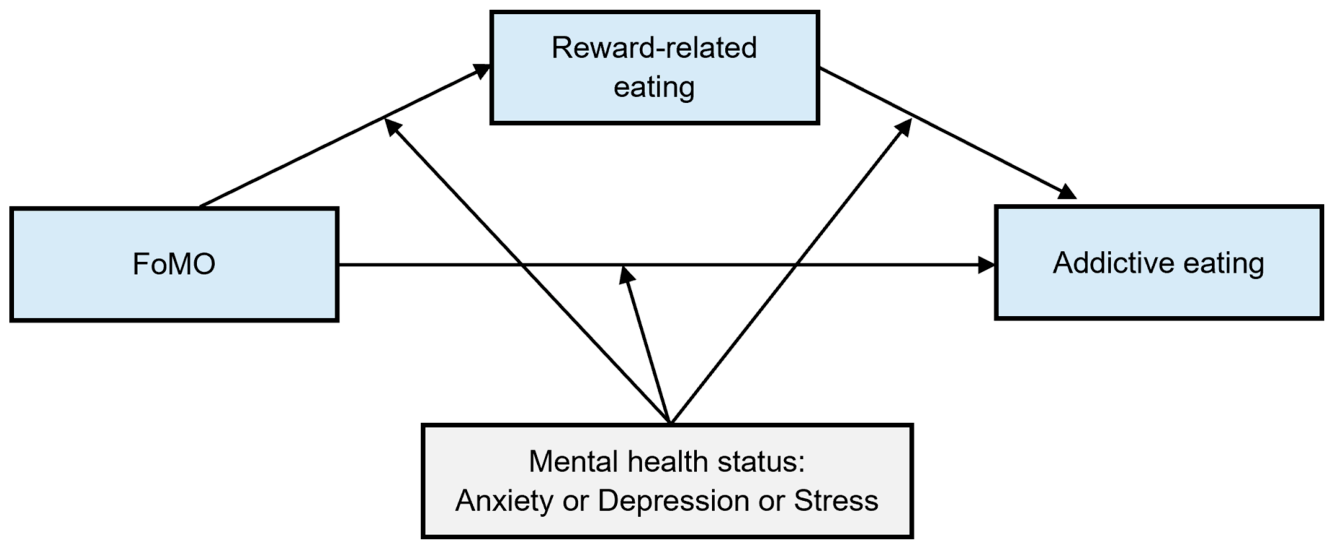
1.4. Hypotheses
2. Materials and Methods
2.1. Participants
2.2. Procedure
2.3. Measures
2.3.1. Demographic and Anthropometric
2.3.2. Addictive Eating
2.3.3. Reward-Related Eating
2.3.4. Fear of Missing out (FoMO)
2.3.5. Mental Health Status
2.4. Statistical Analysis
3. Results
3.1. Participant Characteristics
3.2. Correlation Analysis
3.3. Gender Differences
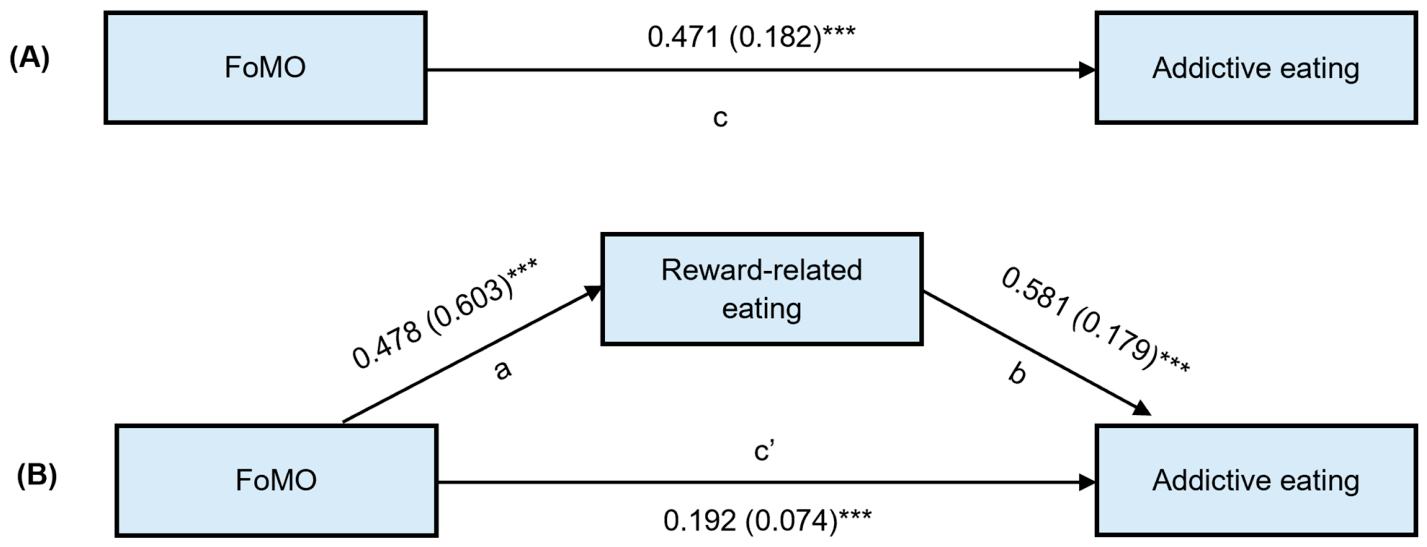
3.4. Mediation Analysis
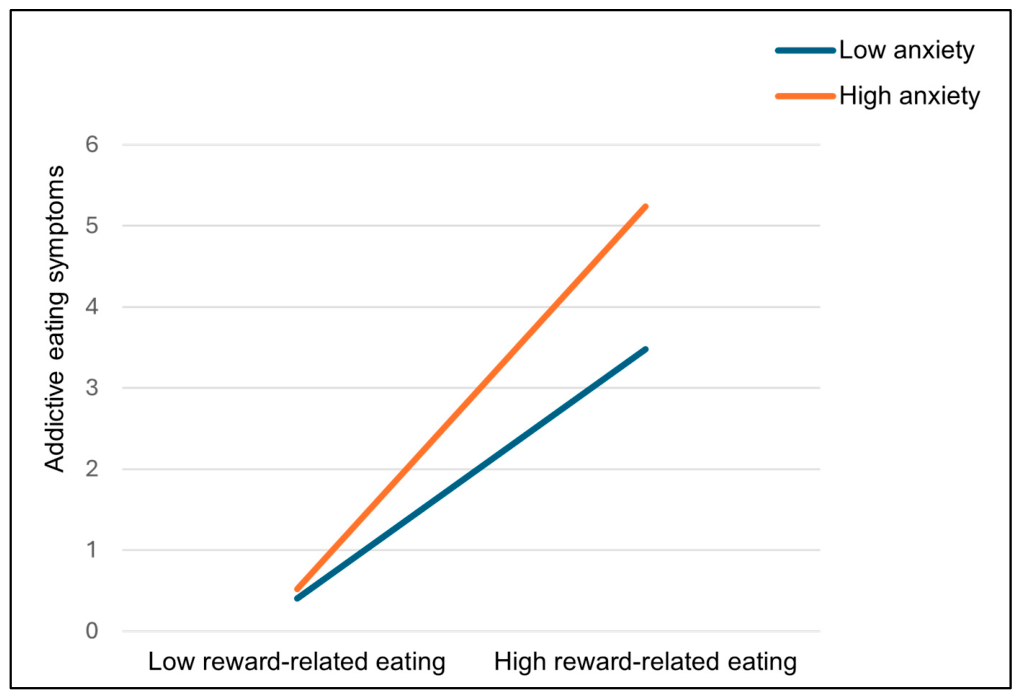
3.5. Moderated Mediation Analysis
4. Discussion
5. Conclusions
Author Contributions
Funding
Institutional Review Board Statement
Informed Consent Statement
Data Availability Statement
Acknowledgments
Conflicts of Interest
Abbreviations
| FoMO | Fear of Missing Out |
| ADHD | Attention Deficit Hyperactivity Disorder |
| IRSD | Index of Relative Socio-Economic Disadvantage |
| BMI | Body Mass Index |
| YFAS | Yale Food Addiction Scale |
| RED-13 | Reward-Based Eating Drive Scale-13 item |
| FoMOs | Fear of Missing Out Scale |
| GAD-7 | Generalised Anxiety Disorder-7 item |
| PHQ-8 | Patient Health Questionnaire-8 item |
| PSS-4 | Perceived Stress Scale-4 item |
Appendix A

| Moderator | Path | B | SE | t | p | 95%CI | |
|---|---|---|---|---|---|---|---|
| Anxiety | a | FoMO → Reward-related eating | 0.440 | 0.080 | 5.484 | <0.001 ** | [0.282, 0.599] |
| Anxiety | 0.605 | 0.119 | 5.087 | <0.001 ** | [0.371, 0.840] | ||
| FoMO × Anxiety | −0.015 | 0.011 | −1.415 | 0.159 | [−0.036, 0.006] | ||
| BMI | 0.429 | 0.069 | 6.196 | <0.001 ** | [0.293, 0.566] | ||
| Gender | 1.504 | 1.308 | 1.150 | 0.251 | [−1.074, 4.082] | ||
| b & c′ | Reward-related eating → Addictive eating | 0.172 | 0.018 | 9.400 | <0.001 ** | [0.136, 0.208] | |
| FoMO → Addictive eating, with RRE as a mediator | 0.021 | 0.023 | 0.923 | 0.357 | [−0.024, 0.065] | ||
| Anxiety | 0.082 | 0.034 | 2.419 | 0.016 * | [0.015, 0.149] | ||
| Reward-related eating × Anxiety | 0.006 | 0.003 | 2.005 | 0.046 * | [0.000, 0.012] | ||
| FoMO × Anxiety | 0.006 | 0.003 | 1.638 | 0.103 | [−0.001, 0.012] | ||
| BMI | 0.043 | 0.020 | 2.161 | 0.032 * | [0.004, 0.083] | ||
| Gender | 0.468 | 0.347 | 1.349 | 0.179 | [−0.216, 1.152] | ||
| Depression | a | FoMO → Reward-related eating | 0.378 | 0.075 | 5.021 | <0.001 ** | [−0.229, 0.526] |
| Depression | 0.715 | 0.103 | 6.934 | <0.001 ** | [0.512, 0.918] | ||
| FoMO × Depression | −0.011 | 0.010 | −1.189 | 0.236 | [−0.030, 0.008] | ||
| BMI | 0.389 | 0.067 | 5.818 | <0.001 ** | [0.259, 0.521] | ||
| Gender | 1.025 | 1.258 | 0.815 | 0.416 | [−1.454, 3.504] | ||
| b & c′ | Reward-related eating → Addictive eating | 0.150 | 0.019 | 8.043 | <0.001 ** | [0.114, 0.187] | |
| FoMO → Addictive eating, with RRE as a mediator | 0.026 | 0.022 | 1.208 | 0.228 | [−0.017, 0.070] | ||
| Depression | 0.119 | 0.033 | 3.653 | <0.001 ** | [0.055, 0.183] | ||
| Reward-related eating × Depression | 0.003 | 0.003 | 1.210 | 0.228 | [−0.002, 0.009] | ||
| FoMO × Depression | 0.006 | 0.003 | 1.850 | 0.066 | [0.000, 0.012] | ||
| BMI | 0.044 | 0.020 | 2.235 | 0.026 * | [0.005, 0.084] | ||
| Gender | 0.382 | 0.346 | 1.104 | 0.271 | [−0.300, 1.065] | ||
| Stress | a | FoMO → Reward-related eating | 0.504 | 0.077 | 6.499 | <0.001 ** | [0.351, 0.656] |
| Stress | 0.742 | 0.189 | 3.929 | <0.001 ** | [0.370, 1.115] | ||
| FoMO × Stress | −0.023 | 0.020 | −1.131 | 0.259 | [−0.063, 0.017] | ||
| BMI | 0.447 | 0.070 | 6.359 | <0.001 ** | [0.309, 0.586] | ||
| Gender | 2.251 | 1.323 | 1.701 | 0.090 | [−0.358, 4.859] | ||
| b & c′ | Reward-related eating → Addictive eating | 0.174 | 0.018 | 9.709 | <0.001 ** | [0.139, 0.209] | |
| FoMO → Addictive eating, with RRE as a mediator | 0.035 | 0.022 | 1.572 | 0.117 | [−0.009, 0.079] | ||
| Stress | 0.121 | 0.052 | 2.339 | 0.020 * | [0.019, 0.223] | ||
| Reward-related eating × Stress | 0.006 | 0.005 | 1.286 | 0.200 | [−0.003, 0.016] | ||
| FoMO × Stress | 0.013 | 0.007 | 1.956 | 0.052 | [0.000, 0.026] | ||
| BMI | 0.039 | 0.020 | 1.903 | 0.058 | [−0.001, 0.079] | ||
| Gender | 0.431 | 0.355 | 1.212 | 0.227 | [−0.270, 1.131] |
| Moderator | Path | B | SE | t | p | 95%CI | |
|---|---|---|---|---|---|---|---|
| Anxiety | a | FoMO → Reward-related eating | 0.458 | 0.084 | 5.437 | <0.001 ** | [0.292, 0.624] |
| Anxiety | 0.618 | 0.119 | 5.178 | <0.001 ** | [0.383, 0.854] | ||
| FoMO × Anxiety | −0.018 | 0.011 | −1.625 | 0.106 | [−0.039, 0.004] | ||
| BMI | 0.417 | 0.072 | 5.777 | <0.001 ** | [0.275, 0.560] | ||
| Age | 0.018 | 0.036 | 0.501 | 0.617 | [−0.053, 0.089] | ||
| b & c′ | Reward-related eating → Addictive eating | 0.174 | 0.018 | 9.493 | <0.001 ** | [0.138, 0.210] | |
| FoMO → Addictive eating, with RRE as a mediator | 0.029 | 0.024 | 1.214 | 0.226 | [−0.018, 0.075] | ||
| Anxiety | 0.086 | 0.034 | 2.525 | 0.012 | [0.019, 0.153] | ||
| Reward-related eating × Anxiety | 0.006 | 0.003 | 2.053 | 0.041 * | [0.000, 0.013] | ||
| FoMO × Anxiety | 0.005 | 0.003 | 1.332 | 0.184 | [−0.002, 0.011] | ||
| BMI | 0.036 | 0.021 | 1.770 | 0.078 | [−0.004, 0.077] | ||
| Age | 0.010 | 0.010 | 1.043 | 0.298 | [−0.009, 0.029] | ||
| Depression | a | FoMO → Reward-related eating | 0.389 | 0.079 | 4.933 | <0.001 ** | [0.234, 0.545] |
| Depression | 0.726 | 0.1036 | 7.060 | <0.001 ** | [0.523, 0.928] | ||
| FoMO × Depression | −0.013 | 0.010 | −1.348 | 0.179 | [−0.032, 0.006] | ||
| BMI | 0.379 | 0.070 | 5.446 | <0.001 ** | [0.242, 0.517] | ||
| Age | 0.015 | 0.035 | 0.422 | 0.674 | [−0.053, 0.083] | ||
| b & c′ | Reward-related eating → Addictive eating | 0.151 | 0.019 | 8.101 | <0.001 ** | [0.114, 0.188] | |
| FoMO → Addictive eating, with RRE as a mediator | 0.035 | 0.023 | 1.512 | 0.132 | [−0.010, 0.080] | ||
| Depression | 0.123 | 0.033 | 1.562 | 0.120 | [0.058, 0.187] | ||
| Reward-related eating × Depression | 0.003 | 0.003 | 1.285 | 0.200 | [−0.002, 0.009] | ||
| FoMO x Depression | 0.005 | 0.003 | 1.562 | 0.120 | [−0.001, 0.011] | ||
| BMI | 0.037 | 0.020 | 1.825 | 0.069 | [−0.003, 0.078] | ||
| Age | 0.011 | 0.009 | 1.147 | 0.253 | [−0.008, 0.029 | ||
| Stress | a | FoMO → Reward-related eating | 0.514 | 0.081 | 6.332 | <0.001 ** | [0.354, 0.674] |
| Stress | 0.725 | 0.190 | 3.816 | <0.001 ** | [0.350, 1.099] | ||
| FoMO × Stress | −0.024 | 0.021 | −1.189 | 0.236 | [−0.065, 0.016] | ||
| BMI | 0.445 | 0.073 | 6.072 | <0.001 ** | [0.301, 0.589] | ||
| Age | 0.003 | 0.036 | 0.076 | 0.940 | [−0.069, 0.075] | ||
| b & c′ | Reward-related eating → Addictive eating | 0.177 | 0.018 | 9.928 | <0.001 ** | [0.142, 0.212] | |
| FoMO → Addictive eating, with RRE as a mediator | 0.043 | 0.023 | 1.859 | 0.064 | [−0.003, 0.089] | ||
| Stress | 0.117 | 0.052 | 2.262 | 0.025 * | [0.015, 0.219] | ||
| Reward-related eating × Stress | 0.007 | 0.005 | 1.383 | 0.168 | [−0.003, 0.016] | ||
| FoMO × Stress | 0.012 | 0.007 | 1.839 | 0.067 | [−0.001, 0.025] | ||
| BMI | 0.031 | 0.021 | 1.501 | 0.135 | [−0.010, 0.072] | ||
| Age | 0.012 | 0.010 | 1.205 | 0.229 | [−0.007, 0.031] |
References
- McCausland, H.C.; Gearhardt, A.N.; Peralta, J.M.; LaFata, E.M. A Critical Evaluation of the Terms Used to Describe Foods Implicated in Addictive-Like Eating. Curr. Addict. Rep. 2025, 12, 71. [Google Scholar] [CrossRef]
- Davis, C. From Passive Overeating to ‘‘Food Addiction’’: A Spectrum of Compulsion and Severity. Int. Sch. Res. Not. 2013, 2013, 435027. [Google Scholar] [CrossRef]
- Gearhardt, A.N.; Corbin, W.R.; Brownell, K.D. Development of the Yale Food Addiction Scale Version 2.0. Psychol. Addict. Behav. 2016, 30, 113–121. [Google Scholar] [CrossRef]
- Gearhardt, A.N.; Davis, C.; Kuschner, R.; Brownell, K.D. The Addiction Potential of Hyperpalatable Foods. Curr. Drug Abus. Rev. 2011, 4, 140–145. [Google Scholar] [CrossRef] [PubMed]
- Lane, M.M.; Gamage, E.; Du, S.; Ashtree, D.N.; McGuinness, A.J.; Gauci, S.; Baker, P.; Lawrence, M.; Rebholz, C.M.; Srour, B.; et al. Ultra-processed food exposure and adverse health outcomes: Umbrella review of epidemiological meta-analyses. BMJ 2024, 384, e077310. [Google Scholar] [CrossRef]
- Burrows, T.; Kay-Lambkin, F.; Pursey, K.; Skinner, J.; Dayas, C. Food addiction and associations with mental health symptoms: A systematic review with meta-analysis. J. Hum. Nutr. Diet. 2018, 31, 544–572. [Google Scholar] [CrossRef] [PubMed]
- Piccinni, A.; Bucchi, R.; Fini, C.; Vanelli, F.; Mauri, M.; Stallone, T.; Cavallo, E.D.; Claudio, C. Food addiction and psychiatric comorbidities: A review of current evidence. Eat. Weight Disord. 2021, 26, 1049–1056. [Google Scholar] [CrossRef]
- Collins, R.; Haracz, K.; Leary, M.; Rollo, M.; Burrows, T. No control and overwhelming cravings: Australian adults’ perspectives on the experience of food addiction. Appetite 2021, 59, 105054. [Google Scholar] [CrossRef]
- Pursey, K.; Stanwell, P.; Gearhardt, A.; Collins, C.E.; Burrows, T.L. The prevalence of food addiction as assessed by the Yale Food Addiction Scale: A systematic review. Nutrients 2014, 6, 4552–4590. [Google Scholar] [CrossRef] [PubMed]
- Oliveira, J.; Colombarolli, M.S.; Cordás, T.A. Prevalence and correlates of food addiction: Systematic review of studies with the YFAS 2.0. Obes. Res. Clin. Pract. 2021, 15, 191–204. [Google Scholar] [CrossRef]
- Skinner, J.; Jebeile, H.; Burrows, T. Food addiction and mental health in adolescents: A systematic review. Lancet Child Adolesc. Health 2021, 5, 751–766. [Google Scholar] [CrossRef]
- Burrows, T.; Hides, L.; Brown, R.; Dayas, C.V.; Kay-Lambkin, F. Differences in Dietary Preferences, Personality and Mental Health in Australian Adults with and without Food Addiction. Nutrients 2017, 9, 285. [Google Scholar] [CrossRef]
- Loxton, N.J.; Tipman, R.J. Reward sensitivity and food addiction in women. Appetite 2017, 115, 28–35. [Google Scholar] [CrossRef] [PubMed]
- Collins, R.A.; Duncanson, K.; Skinner, J.A.; Hay, P.J.; Paxton, S.J.; Burrows, T.L. Exploring Psychological Constructs in People Receiving Treatment for Addictive Eating Behaviours: “I Hate Loving Food as Much as I Do”. Behav. Sci. 2023, 13, 817. [Google Scholar] [CrossRef] [PubMed]
- Przybylski, A.; Murayama, K.; DeHaan, C.R.; Gladwell, V. Motivational, emotional, and behavioral correlates of fear of missing out. Comput. Hum. Behav. 2013, 29, 1841–1848. [Google Scholar] [CrossRef]
- Elhai, J.D.; Yang, H.; Montag, C. Fear of missing out (FOMO): Overview, theoretical underpinnings, and literature review on relations with severity of negative affectivity and problematic technology use. Rev. Bras. Psiquiatr. 2021, 43, 203–209. [Google Scholar] [CrossRef] [PubMed]
- Gupta, M.; Sharma, A. Fear of missing out: A brief overview of origin, theoretical underpinnings and relationship with mental health. World J. Clin. Cases 2021, 9, 4881–4889. [Google Scholar] [CrossRef]
- Groenestein, E.; Willemsen, L.; van Koningsbruggen, G.M.; Ket, H.; Kerkhof, P. The relationship between fear of missing out, digital technology use, and psychological well-being: A scoping review of conceptual and empirical issues. PLoS ONE 2024, 19, e0308643. [Google Scholar] [CrossRef]
- Qutishat, M.G.; Dameery, K.A.I.; Omari, O.A.I.; Qadire, M.A.I. Correlation between Fear of Missing out and Night Eating Syndrome among University Students. Iran. J. Psychiatry 2022, 17, 224–229. [Google Scholar] [CrossRef]
- Riordan, B.C.; Conner, T.S.; Scarf, D.; Winter, T.; Mason, A.; Anderson-Luxford, A.; Kuntsche, E. FoMO predicts alcohol use and harms over and above the big five personality traits among university students. J. Subst. Use 2025, 30, 117–121. [Google Scholar] [CrossRef]
- Echeverri, B.; Kozak, A.T.; Gildner, D.J.; Pickett, S.M. Night eating syndrome subtypes: Differences in binge eating and food addiction symptoms. Eat. Weight. Disord.-Stud. Anorex. Bulim. Obes. 2023, 28, 3. [Google Scholar] [CrossRef]
- Bonder, R.; Davis, C. Associations Between Food Addiction and Substance-Use Disorders: A Critical Overview of their Overlapping Patterns of Consumption. Curr. Addict. Rep. 2022, 9, 326–333. [Google Scholar] [CrossRef]
- Kahler, C.W.; Strong, D.R.; Read, J.P. Toward efficient and comprehensive measurement of the alcohol problems continuum in college students: The brief young adult alcohol consequences questionnaire. Alcohol Clin. Exp. Res. 2005, 29, 1180–1189. [Google Scholar] [CrossRef]
- Li, L.; Griffiths, M.D.; Mei, S.; Niu, Z. The Mediating Role of Impulsivity and the Moderating Role of Gender Between Fear of Missing Out and Gaming Disorder Among a Sample of Chinese University Students. Cyberpsychol. Behav. Soc. Netw. 2021, 24, 550–557. [Google Scholar] [CrossRef]
- Elhai, J.D.; Levine, J.C.; Alghraibeh, A.M.; Alafnan, A.A.; Aldraiweesh, A.A.; Hall, B.J. Fear of missing out: Testing relationships with negative affectivity, online social engagement, and problematic smartphone use. Comput. Hum. Behav. 2018, 89, 289–298. [Google Scholar] [CrossRef]
- Yin, Y.; Cai, X.; Ouyang, M.; Li, S.; Li, X.; Wang, P. FoMO and the brain: Loneliness and problematic social networking site use mediate the association between the topology of the resting-state EEG brain network and fear of missing out. Comput. Hum. Behav. 2023, 141, 107624. [Google Scholar] [CrossRef]
- Wang, L.; Zhou, X.; Song, X.; Gan, X.; Zhang, R.; Liu, X.; Xu, T.; Jiao, G. Fear of missing out (FOMO) associates with reduced cortical thickness in core regions of the posterior default mode network and higher levels of problematic smartphone and social media use. Addict. Behav. 2023, 143, 107709. [Google Scholar] [CrossRef] [PubMed]
- Milyavskaya, M.; Saffran, M.; Hope, N.; Koestner, R. Fear of missing out: Prevalence, dynamics, and consequences of experiencing FOMO. Motiv. Emot. 2018, 42, 725–737. [Google Scholar] [CrossRef]
- Gearhardt, A.N.; Schulte, E.M. Is Food Addictive? A Review of the Science. Annu. Rev. Nutr. 2021, 41, 387–410. [Google Scholar] [CrossRef]
- Schulte, E.M.; Chao, A.M.; Allison, K.C. Advances in the Neurobiology of Food Addiction. Curr. Behav. Neurosci. Rep. 2021, 8, 103–112. [Google Scholar] [CrossRef]
- Moore, C.F.; Sabino, V.; Koob, G.F.; Cottone, P. Pathological Overeating: Emerging Evidence for a Compulsivity Construct. Neuropsychopharmacology 2017, 42, 1375–1389. [Google Scholar] [CrossRef]
- Vainik, U.; Eun Han, J.; Epel, E.S.; Tomiyama, A.J.; Dagher, A.; Mason, A.E. Rapid Assessment of Reward-Related Eating: The RED-X5. Obesity 2019, 27, 325–331. [Google Scholar] [CrossRef]
- Adam, T.C.; Epel, E.S. Stress, eating and the reward system. Physiol. Behav. 2007, 91, 449–458. [Google Scholar] [CrossRef]
- Mason, A.E.; Vainik, U.; Acree, M.; Tomiyama, A.J.; Dagher, A.; Epel, E.S.; Hecht, F.M. Improving Assessment of the Spectrum of Reward-Related Eating: The RED-13. Front. Psychol. 2017, 8, 795. [Google Scholar] [CrossRef]
- Epel, E.S.; Tomiyama, A.J.; Mason, A.E.; Laraia, B.A.; Hartman, W.; Ready, K.; Acree, M.; Adam, T.C.; St Jeor, S.; Kessler, D. The reward-based eating drive scale: A self-report index of reward-based eating. PLoS ONE 2014, 9, e101350. [Google Scholar] [CrossRef] [PubMed]
- Beylin, N.R.; Covarrubías, E.; Zawadzki, M.J. Mindfulness and Reward-Based Eating: Examining the Role of Trait Mindfulness and a Mobile Mindfulness Intervention. Mindfulness 2025, 16, 3314–3323. [Google Scholar] [CrossRef]
- Fitzgerald, H.E.; Lubin, R.E.; Duncan, T.; Hiserodt, M.; Otto, M.W. Underscoring the F in FoMO: How does anxiety sensitivity contribute to fear of missing out? Cogn. Behav. Ther. 2023, 52, 38–46. [Google Scholar] [CrossRef]
- Liu, X.; Liu, T.; Wan, F. The effect of fear of missing out on mental health: Differences in different solitude behaviors. BMC Psychol. 2023, 11, 141. [Google Scholar] [CrossRef] [PubMed]
- Buglass, S.L.; Binder, J.F.; Betts, L.R.; Underwood, J.D.M. Motivators of online vulnerability: The impact of social network site use and FOMO. Comput. Hum. Behav. 2017, 66, 248–255. [Google Scholar] [CrossRef]
- Chai, H.Y.; Niu, G.F.; Lian, S.L.; Chu, X.W.; Liu, S.; Sun, X.J. Why social network site use fails to promote well-being? The roles of social overload and fear of missing out. Comput. Hum. Behav. 2019, 100, 85–92. [Google Scholar] [CrossRef]
- Roberts, J.A.; David, M.E. The Social media party: Fear of missing out (FoMO), social media intensity, connection, and well-being. Int. J. Hum. Comput. Interact. 2020, 36, 386–392. [Google Scholar] [CrossRef]
- Holte, A.J.; Nixon, A.; Cooper, J. Attachment anxiety mediates the relationship of need to belong and Fear of Missing Out (FoMO). Discov. Psychol. 2024, 4, 141. [Google Scholar] [CrossRef]
- Skinner, J.A.; Leary, M.; Whatnall, M.; Collins, R.A.; Pursey, K.M.; Verdejo-Garcia, A.; Hay, P.J.; Baker, A.L.; Hides, L.; Paxton, S.J.; et al. A three-arm randomised controlled trial of a telehealth intervention targeting improvement in addictive eating for Australian adults (the TRACE program). Appetite 2024, 195, 107211. [Google Scholar] [CrossRef]
- von Elm, E.; Altman, D.G.; Egger, M.; Pocock, S.J.; Gøtzsche, P.C.; Vandenbroucke, J.P. STROBE Initiative. The Strengthening the Reporting of Observational Studies in Epidemiology (STROBE) statement: Guidelines for reporting observational studies. PLoS Med. 2007, 4, e296. [Google Scholar] [CrossRef]
- Harris, P.A.; Taylor, R.; Minor, B.; Elliott, V.; Fernandez, M.; O’Neal, L.; McLeod, L.; Delacqua, G.; Delacqua, F.; Kirby, J.; et al. The REDCap consortium: Building an international community of software platform partners. J. Biomed. Inform. 2019, 95, 103208. [Google Scholar] [CrossRef]
- Harris, P.A.; Taylor, R.; Thielke, R.; Payne, J.; Gonzalez, N.; Conde, J.G. Research electronic data capture (REDCap)—A metadata-driven methodology and workflow process for providing translational research informatics support. J. Biomed. Inform. 2009, 42, 377–381. [Google Scholar] [CrossRef] [PubMed]
- Australian Bureau of Statistics (ABS). Socio-Economic Indexes for Areas (SEIFA), Australia. Available online: https://www.abs.gov.au/statistics/people/people-and-communities/socio-economic-indexes-areas-seifa-australia/latest-release (accessed on 1 September 2025).
- World Health Organization (WHO). Body Mass Index (BMI). Available online: https://www.who.int/data/gho/data/themes/topics/topic-details/GHO/body-mass-index (accessed on 1 September 2025).
- Meule, A.; Gearhardt, A.N. Ten Years of the Yale Food Addiction Scale: A Review of Version 2.0. Curr. Addict. Rep. 2019, 6, 218–228. [Google Scholar] [CrossRef]
- Spitzer, R.L.; Kroenke, K.; Williams, J.B.W.; Löwe, B. A Brief Measure for Assessing Generalized Anxiety Disorder (The GAD-7). Arch. Intern. Med. 2006, 166, 1092–1097. [Google Scholar] [CrossRef]
- Kroenke, K.; Strine, T.W.; Spitzer, R.L.; Williams, J.B.; Berry, J.T.; Mokdad, A.H. The PHQ-8 as a measure of current depression in the general population. J. Affect. Disord. 2009, 114, 163–173. [Google Scholar] [CrossRef]
- Ingram, P.B., IV; Clarke, E.; Lichtenberg, J.W. Confirmatory Factor Analysis of the Perceived Stress Scale-4 in a Community Sample. Stress Health 2016, 32, 173–176. [Google Scholar] [CrossRef] [PubMed]
- Lee, J.H.; Huber, J.C., Jr. Evaluation of Multiple Imputation with Large Proportions of Missing Data: How Much Is Too Much? Iran J. Public Health 2021, 50, 1372–1380. [Google Scholar] [CrossRef]
- Hayes, A. Introduction to Mediation, Moderation, and Conditional Process Analysis, 3rd ed.; Guilford Press: New York, NY, USA, 2022. [Google Scholar]
- Kim, J.H. Multicollinearity and misleading statistical results. Korean J. Anesthesiol. 2019, 72, 558–569. [Google Scholar] [CrossRef]
- Jones, L.; Barnett, A.; Vagenas, D. Common misconceptions held by health researchers when interpreting linear regression assumptions, a cross-sectional study. PLoS ONE 2025, 20, e0299617. [Google Scholar] [CrossRef]
- Burrows, T.; Skinner, J.; McKenna, R.; Rollo, M. Food Addiction, Binge Eating Disorder, and Obesity: Is There a Relationship? Behav. Sci. 2017, 7, 54. [Google Scholar] [CrossRef] [PubMed]
- Preacher, K.; Hayes, A. SPSS and SAS procedures for estimating indirect effects in simple mediation models. Behav. Res. Methods 2004, 36, 717–731. [Google Scholar] [CrossRef]
- Gaskin, J. Stats Tools Package. 2016. Available online: http://statwiki.gaskination.com (accessed on 31 December 2025).
- Skinner, J.A.; Leary, M.; Whatnall, M.; Hay, P.; Paxton, S.J.; Collins, C.E.; Burrows, T.L. ‘Do no harm’—The impact of an intervention for addictive eating on disordered eating behaviours in Australian adults: Secondary analysis of the TRACE randomised controlled trial. J. Eat. Disord. 2025, 13, 65. [Google Scholar] [CrossRef]
- Tresna, I.C.; Usman, I.; Siswono, T.; Rachmah, N. Fear of Missing Out (FOMO) in Consumer Behaviour: A Systematic Literature Review on Antecedents, Consequences, and Moderating Factors. J. Inf. Syst. Eng. Manag. 2025, 10, 626–639. [Google Scholar] [CrossRef]
- Adams, R.C.; Sedgmond, J.; Maizey, L.; Chambers, C.D.; Lawrence, N.S. Food Addiction: Implications for the Diagnosis and Treatment of Overeating. Nutrients 2019, 11, 2086. [Google Scholar] [CrossRef]
- Ha, O.R.; Lim, S.L. The role of emotion in eating behavior and decisions. Front. Psychol. 2023, 14, 1265074. [Google Scholar] [CrossRef]
- Elhai, J.D.; Gallinari, E.F.; Rozgonjuk, D.; Yang, H. Depression, anxiety and fear of missing out as correlates of social, non-social and problematic smartphone use. Addict. Behav. 2020, 105, 106335. [Google Scholar] [CrossRef] [PubMed]
- Kenwood, M.M.; Kalin, N.H.; Barbas, H. The prefrontal cortex, pathological anxiety, and anxiety disorders. Neuropsychopharmacology 2022, 47, 260–275. [Google Scholar] [CrossRef]
- Liu, K. The Impact of Social Media on Teenagers—Take TikTok as an Example. Interdiscip. Humanit. Commun. Stud. 2025, 1, 1–4. [Google Scholar] [CrossRef]
- Cai, Y.; Xing, L.; Yang, T.; Chai, R.; Wang, J.; Bao, J.; Shen, W.; Ding, S.; Chen, G. The neurodevelopmental role of dopaminergic signaling in neurological disorders. Neurosci. Lett. 2021, 741, 135540. [Google Scholar] [CrossRef]
- Davis, A.C.; Albert, G.; Arnocky, S. The links between fear of missing out, status-seeking, intrasexual competition, sociosexuality, and social support. Curr. Res. Behav. Sci. 2023, 4, 100096. [Google Scholar] [CrossRef]
- Rinaldi, M.R. Fear of missing out (FoMO) and internet addiction among adolescence: The moderation effect of gender differences. Humanitas 2024, 21, 1–12. [Google Scholar] [CrossRef]
- Qutishat, M.G. Gender Differences in Fear of Missing out Experiences among Undergraduate Students in Oman. New Emir. Med. J. 2020, 1, 36–40. [Google Scholar] [CrossRef]
- Rozgonjuk, D.; Sindermann, C.; Elhai, J.D.; Montag, C. Individual differences in Fear of Missing Out (FoMO): Age, gender, and the Big Five personality trait domains, facets, and items. Pers. Individ. Differ. 2021, 171, 110546. [Google Scholar] [CrossRef]
- Stead, H.; Bibby, P.A. Personality, fear of missing out and problematic internet use and their relationship to subjective well-being. Comput. Hum. Behav. 2017, 76, 534–540. [Google Scholar] [CrossRef]
- Fioravanti, G.; Casale, S.; Bocci Benucci, S.; Prostamo, A.; Falone, A.; Ricca, V.; Rotella, F. Fear of missing out and social networking sites use and abuse: A meta-analysis. Comput. Hum. Behav. 2021, 122, 106839. [Google Scholar] [CrossRef]
- Lovibond, S.H.; Lovibond, P.F. Manual for the Depression Anxiety Stress Scales, 2nd ed.; Psychology Foundation: Sydney, Australia, 1995. [Google Scholar]
- Pursey, K.M.; Burrows, T.L.; Stanwell, P.; Collins, C.E. How accurate is web-based self-reported height, weight and body mass index in young adults? J. Med. Internet Res. 2014, 16, e4. [Google Scholar] [CrossRef] [PubMed]
- Fayyaz, K.; Bataineh, M.F.; Ali, H.I.; Al-Nawaiseh, A.M.; Al-Rifai’, R.H.; Shahbaz, H.M. Validity of Measured vs. Self-Reported Weight and Height and Practical Considerations for Enhancing Reliability in Clinical and Epidemiological Studies: A Systematic Review. Nutrients 2024, 16, 1704. [Google Scholar] [CrossRef]
- Hodge, J.M.; Shah, R.; McCullough, M.L.; Gapstur, S.M.; Patel, A.V. Validation of self-reported height and weight in a large, nationwide cohort of U.S. adults. PLoS ONE 2020, 15, e0231229. [Google Scholar] [CrossRef]
- White, M.A.; Masheb, R.M.; Grilo, C.M. Accuracy of self-reported weight and height in binge eating disorder: Misreport is not related to psychological factors. Obesity 2010, 18, 1266–1269. [Google Scholar] [CrossRef]
- Ambwani, S.; Chmielewski, J.F. Weighing the Evidence: Social Desirability, Eating Disorder Symptomatology, and Accuracy of Self-reported Body Weight Among Men and Women. Sex Roles 2013, 68, 474–483. [Google Scholar] [CrossRef]
- Alutaybi, A.; Al-Thani, D.; McAlaney, J.; Ali, R. Combating Fear of Missing Out (FoMO) on Social Media: The FoMO-R Method. Int. J. Environ. Res. Public Health 2020, 17, 6128. [Google Scholar] [CrossRef] [PubMed]
- Widadiyah, Z.; Wibowo, B.; Wahyuningsih, L. Group Counseling Cognitive Restructuring Techniques to Reduce Fear of Missing Out (FoMO) Behavior. Konseling Edukasi 2024, 8, 205. [Google Scholar] [CrossRef]
- Fitri, H.U.; Azizah, I.M.; Suryati, S. The effectiveness of group counseling cognitive restructuring techniques to reduce fear of missing out (FOMO) in adolescent social media users in Bayung Lencir. Counsenesia Indones. J. Guid. Couns. 2024, 5, 218–227. [Google Scholar] [CrossRef]


| Variable | n (%) or Mean ± SD (Range) |
|---|---|
| Gender | |
| Man | 42 (18.5) |
| Woman | 180 (79.3) |
| Other/non-binary | 5 (2.2) |
| Health condition | |
| No | 161 (70.9) |
| ADHD | |
| No | 207 (91.2) |
| Aboriginal or Torres Strait Islander descent | |
| No | 224 (98.7) |
| Decile (postcode) ^ | 6.6 ± 2.5 (1–10) n = 224 |
| Marital status | |
| Single, never married | 61 (26.9) |
| In a relationship, not married | 28 (12.3) |
| Married or in a domestic partnership | 104 (45.8) |
| Divorced or separated | 24 (10.6) |
| Widowed | 10 (4.4) |
| Current living situation | |
| Renting | 59 (26.0) |
| Own home | 133 (58.6) |
| Family home | 23 (10.1) |
| Supported accommodation or department of housing | 6 (2.6) |
| Other | 6 (2.6) |
| Currently living with ^^ | |
| Parent/s | 23 (10.1) |
| Sibling/s | 16 (7.0) |
| Partner | 116 (51.1) |
| Children | 55 (24.2) |
| Flatmates or friends | 15 (6.6) |
| Alone | 60 (26.4) |
| Other | 5 (2.2) |
| Highest qualification | |
| School certificate (Year 10 or equivalent) | 9 (4.0) |
| Higher school certificate (Year 12 or equivalent) | 25 (11.0) |
| Trade or diploma | 44 (19.4) |
| Undergraduate university degree | 75 (33.0) |
| Postgraduate university degree (e.g., Master’s) | 57 (25.1) |
| Higher research degree (e.g., PhD) | 16 (7.0) |
| Employment status | |
| Employed—Full time | 73 (32.2) |
| Employed—Part time | 35 (15.4) |
| Employed—Casual | 25 (11.0) |
| Student | 24 (10.6) |
| Unemployed—looking for work | 10 (4.4) |
| Unemployed—not looking for work | 60 (26.4) |
| Household income | |
| AUD 0–30 K | 33 (14.5) |
| AUD 31 K–60 K | 44 (19.4) |
| AUD 61 K–90 K | 22 (9.7) |
| AUD 91 K–120 K | 30 (13.2) |
| AUD 120 K + | 74 (32.6) |
| Prefer not to say | 24 (10.6) |
| Mean | SD | Range | 1 | 2 | 3 | 4 | 5 | 6 | 7 | |||
|---|---|---|---|---|---|---|---|---|---|---|---|---|
| 1 | YFAS 2.0 | 2.8 | 3.4 | 0–11 | – | |||||||
| 2 | RED-13 | 25.3 | 11.2 | 0–52 | 0.72 *** | – | ||||||
| 3 | FoMOs | 20.3 | 8.9 | 10–50 | 0.52 *** | 0.53 *** | – | |||||
| 4 | GAD7 | 6.9 | 5.6 | 0–21 | 0.54 *** | 0.52 *** | 0.55 *** | – | ||||
| 5 | PHQ8 | 7.7 | 6.2 | 0–24 | 0.62 *** | 0.60 *** | 0.54 *** | 0.81 *** | – | |||
| 6 | PSS-4 | 7.0 | 3.4 | 0–16 | 0.43 *** | 0.44 *** | 0.46 *** | 0.70 *** | 0.68 *** | – | ||
| 7 | BMI | 28.5 | 8.1 | 13.8–66.7 | 0.36 *** | 0.41 *** | 0.15 * | 0.15 * | 0.20 ** | 0.13 | – | |
| 8 | Age | 49.7 | 16.8 | 18–88 | 0.02 | 0.07 | 0.29 ** | 0.18 ** | 0.15 * | 0.13 | 0.20 * | – |
| Variable | Women (n = 150) | Men (n = 42) | Non-Binary (n = 5) |
|---|---|---|---|
| Mean ± SD (range) | |||
| BMI | 28.6 ± 8.5 (13.8–66.7) | 28.4 ± 6.5 (18.1–46.8) | 26.3 ± 6.5 (18.7–33.4) |
| Age | 49.1 ± 16.2 (18–88) | 53.6 ± 17.9 (18–76) | 24.8 ± 7.8 (18–35) |
| YFAS 2.0 | 3.0 ± 3.5 (0–11) | 1.9 ± 3.0 (0–11) | 2.6 ± 2.0 (0–5) |
| RED-13 | 25.5 ± 11.5 (0–52) | 23.7 ± 9.5 (6–41) | 32.0 ± 8.7 (21–44) |
| FoMOs | 20.3 ± 8.8 (10–50) | 20.1 ± 9.2 (10–43) | 24.8 ± 6.9 (14–33) |
| GAD-7 | 6.7 ± 5.6 (0–21) | 6.8 ± 5.8 (0–19 | 12.4 ± 4.5 (7–19) |
| PHQ-8 | 7.8 ± 6.3 (0–24) | 6.8 ± 5.9 (0–21) | 11.8 ± 3.6 (7–17) |
| PSS-4 | 6.9 ± 3.4 (0–16) | 7.5 ± 3.5 (1–15) | 9.0 ± 1.2 (8–11) |
| Moderator | Path | B | SE | t | p | 95%CI | |
|---|---|---|---|---|---|---|---|
| Anxiety | a | FoMO → Reward-related eating | 0.445 | 0.080 | 5.547 | <0.001 ** | [0.287, 0.604] |
| Anxiety | 0.614 | 0.119 | 5.164 | <0.001 ** | [0.380, 0.848] | ||
| FoMO × Anxiety | −0.017 | 0.011 | −1.566 | 0.119 | [−0.038, 0.004] | ||
| BMI | 0.427 | 0.069 | 6.168 | <0.001 ** | [0.291, 0.564] | ||
| b & c′ | Reward-related eating → Addictive eating | 0.174 | 0.018 | 9.538 | <0.001 ** | [0.138, 0.210] | |
| FoMO → Addictive eating, with RRE as a mediator | 0.022 | 0.023 | 0.953 | 0.341 | [−0.023, 0.066] | ||
| Anxiety | 0.083 | 0.034 | 2.445 | 0.015 * | [0.016, 0.150] | ||
| Reward-related eating × Anxiety | 0.007 | 0.003 | 2.078 | 0.039 * | [0.000, 0.013] | ||
| FoMO × Anxiety | 0.005 | 0.003 | 1.478 | 0.141 | [−0.002, 0.012] | ||
| BMI | 0.042 | 0.020 | 2.084 | 0.038 * | [0.002, 0.081] | ||
| Depression | a | FoMO → Reward-related eating | 0.379 | 0.075 | 5.050 | <0.001 ** | [0.231, 0.527] |
| Depression | 0.724 | 0.102 | 7.061 | <0.001 ** | [0.522, 0.926] | ||
| FoMO × Depression | −0.012 | 0.010 | −1.302 | 0.194 | [−0.031, 0.006] | ||
| BMI | 0.388 | 0.067 | 5.798 | <0.001 ** | [0.256, 0.519] | ||
| b & c′ | Reward-related eating → Addictive eating | 0.152 | 0.019 | 8.139 | <0.001 ** | [0.115, 0.189] | |
| FoMO → Addictive eating, with RRE as a mediator | 0.027 | 0.022 | 1.232 | 0.219 | [0-.016, 0.070] | ||
| Depression | 0.120 | 0.033 | 3.695 | <0.001 ** | [0.056, 0.185] | ||
| Reward-related eating × Depression | 0.004 | 0.003 | 1.327 | 0.186 | [−0.002, 0.009] | ||
| FoMO × Depression | 0.005 | 0.003 | 1.699 | 0.091 | [−0.001, 0.011] | ||
| BMI | 0.043 | 0.020 | 2.165 | 0.031 * | [0.004, 0.082] | ||
| Stress | a | FoMO → Reward-related eating | 0.513 | 0.078 | 6.603 | <0.001 ** | [0.360, 0.666] |
| Stress | 0.724 | 0.189 | 3.824 | <0.001 ** | [0.351, 1.098] | ||
| FoMO × Stress | −0.024 | 0.021 | −1.189 | 0.236 | [−0.065, 0.016] | ||
| BMI | 0.446 | 0.071 | 6.322 | <0.001 ** | [0.307, 0.586] | ||
| b & c′ | Reward-related eating → Addictive eating | 0.177 | 0.018 | 9.930 | <0.001 ** | [0.142, 0.212] | |
| FoMO → Addictive eating, with RRE as a mediator | 0.036 | 0.022 | 1.595 | 0.112 | [−0.008, 0.080] | ||
| Stress | 0.116 | 0.052 | 2.250 | 0.025 * | [0.014, 0.218] | ||
| Reward-related eating x Stress | 0.007 | 0.005 | 1.441 | 0.151 | [−0.003, 0.017] | ||
| FoMO × Stress | 0.012 | 0.007 | 1.850 | 0.066 | [−0.001, 0.025] | ||
| BMI | 0.037 | 0.020 | 1.835 | 0.068 | [−0.003, 0.077] |
Disclaimer/Publisher’s Note: The statements, opinions and data contained in all publications are solely those of the individual author(s) and contributor(s) and not of MDPI and/or the editor(s). MDPI and/or the editor(s) disclaim responsibility for any injury to people or property resulting from any ideas, methods, instructions or products referred to in the content. |
© 2026 by the authors. Licensee MDPI, Basel, Switzerland. This article is an open access article distributed under the terms and conditions of the Creative Commons Attribution (CC BY) license.
Share and Cite
Skinner, J.A.; Collins, R.A.; Duncanson, K.; Hay, P.J.; Burrows, T.L. The Impact of Fear of Missing out (FoMO) on Addictive Eating: A Moderated Mediation Model. Nutrients 2026, 18, 1493. https://doi.org/10.3390/nu18101493
Skinner JA, Collins RA, Duncanson K, Hay PJ, Burrows TL. The Impact of Fear of Missing out (FoMO) on Addictive Eating: A Moderated Mediation Model. Nutrients. 2026; 18(10):1493. https://doi.org/10.3390/nu18101493
Chicago/Turabian StyleSkinner, Janelle A., Rebecca A. Collins, Kerith Duncanson, Phillipa J. Hay, and Tracy L. Burrows. 2026. "The Impact of Fear of Missing out (FoMO) on Addictive Eating: A Moderated Mediation Model" Nutrients 18, no. 10: 1493. https://doi.org/10.3390/nu18101493
APA StyleSkinner, J. A., Collins, R. A., Duncanson, K., Hay, P. J., & Burrows, T. L. (2026). The Impact of Fear of Missing out (FoMO) on Addictive Eating: A Moderated Mediation Model. Nutrients, 18(10), 1493. https://doi.org/10.3390/nu18101493