

You are currently viewing a new version of our website. To view the old version click .

Nutrients, Volume 17, Issue 7

April-1 2025 - 194 articles

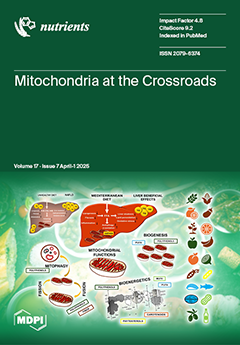
Cover Story: This narrative review explores how the MD and its bioactive compounds influence mitochondrial health in NAFLD, highlighting key pathways such as mitochondrial substrate control, dynamics, and energy efficiency. A literature search was conducted to identify relevant studies on the MD, mitochondria, and NAFLD. While the search was promising, our understanding remains incomplete due to the lack of mechanistic and comprehensive studies on the holistic impact of the MD. Future research that integrates innovative experimental approaches is needed to elucidate the intricate interactions between diet and mitochondria. A deeper understanding of how the MD influences mitochondrial health in NAFLD is essential for developing precision-targeted nutritional strategies that can effectively prevent and manage the disease. View this paper
  • Issues are regarded as officially published after their release is announced to the table of contents alert mailing list .
  • You may sign up for email alerts to receive table of contents of newly released issues.
  • PDF is the official format for papers published in both, html and pdf forms. To view the papers in pdf format, click on the "PDF Full-text" link, and use the free Adobe Reader to open them.

Articles (194)

  • Article
  • Open Access
7 Citations
12,089 Views
17 Pages

Branched-Chain Amino Acid Supplementation Enhances Substrate Metabolism, Exercise Efficiency and Reduces Post-Exercise Fatigue in Active Young Males

  • Chenglin Luan,
  • Yizhang Wang,
  • Junxi Li,
  • Nihong Zhou,
  • Guilin Song,
  • Zhen Ni,
  • Chunyan Xu,
  • Chunxue Tang,
  • Pengyu Fu and
  • Xintang Wang
  • + 2 authors

7 April 2025

Background: Branched-chain amino acids (BCAAs, isoleucine, leucine, and valine) are commonly applied to promote muscle protein synthesis. However, the effects of BCAAs on exercise-induced substrate metabolism, performance and post-exercise fatigue du...

  • Article
  • Open Access
1 Citations
1,173 Views
15 Pages

Associations of Metabolites Related Salt Sensitivity of Blood Pressure and Essential Hypertension in Chinese Population: The EpiSS Study

  • Xiaojun Yang,
  • Fengxu Zhang,
  • Bowen Zhang,
  • Han Qi,
  • Yunyi Xie,
  • Wenjuan Peng,
  • Bingxiao Li,
  • Fuyuan Wen,
  • Pandi Li and
  • Yuan Sun
  • + 2 authors

7 April 2025

Background: Salt sensitivity of blood pressure (SSBP) is an important risk factor for essential hypertension and cardiovascular diseases, and its metabolic mechanisms remain poorly understood. This study aimed to identify SSBP-associated metabolic bi...

  • Article
  • Open Access
1,355 Views
14 Pages

7 April 2025

Background/Objectives: To inform person-centred clinical practice, it is important to know what features may predict or moderate treatment outcomes. Thus, we investigated pre-treatment clinical features and mid-therapy reduction in loss of control ov...

  • Review
  • Open Access
2 Citations
11,978 Views
38 Pages

Exploring the Potential of Dietary Supplements to Alleviate Pain Due to Long COVID

  • Nicoletta Marchesi,
  • Massimo Allegri,
  • Giacomo Matteo Bruno,
  • Alessia Pascale and
  • Stefano Govoni

7 April 2025

Long COVID, characterized by persistent symptoms following COVID-19 infection, significantly impacts individuals’ health and daily functioning due to fatigue and pain. Focusing on pain, this review addresses nociplastic and chronic pain conditi...

  • Review
  • Open Access
1 Citations
4,732 Views
10 Pages

7 April 2025

Dietary folic acid supplementation is well known for playing a crucial role in the closure of the neural tube. Individuals have continued to increase dietary intake of folic acid in counties with mandatory fortication laws in place. Some studies have...

  • Article
  • Open Access
2,056 Views
11 Pages

7 April 2025

Background/Objectives: Retinal vein occlusion (RVO) is a major cause of vision loss globally. Although magnesium (Mg) is crucial for vascular health, its association with RVO risk is unknown. Thus, we aimed to further examine this association. Method...

  • Article
  • Open Access
3,557 Views
15 Pages

Parenteral Nutrition Containing Fish Oil for Hospitalized Non-Intensive Care Unit (ICU) Patients: A Systematic Review, Meta-Analysis, and Cost-Effectiveness Analysis

  • Lorenzo Pradelli,
  • Axel Rüdiger Heller,
  • Stanislaw Klek,
  • Konstantin Mayer,
  • Martin D. Rosenthal and
  • Maurizio Muscaritoli

7 April 2025

Background and aims: We investigated parenteral nutrition (PN) containing fish oil (FO-PN) vs. standard PN without fish oil (NF-PN) in adult patients hospitalized in the non-intensive care unit (general ward). Methods: Searches in Medline, Embase, an...

  • Article
  • Open Access
3,100 Views
12 Pages

Association Between Natural Lithium Exposure and Suicide Rate: An Ecological and Biomonitoring Study in Portugal

  • Carolina Gonçalves,
  • Rui Azevedo,
  • Cristina Couto,
  • Mary Duro,
  • Agostinho Santos,
  • Laura Cainé and
  • Agostinho Almeida

7 April 2025

Background/Objectives: Higher lithium (Li) levels in drinking water have been linked to lower suicide rates in the general population in several ecological studies, though this relationship is not always consistent. The main limitation of such studie...

  • Article
  • Open Access
4,132 Views
15 Pages

Association Between Dietary Soy Isoflavones Intake and the Risk of Hyperemesis Gravidarum: A Cross-Sectional Study in Chinese Pregnant Women

  • Siyang Chen,
  • Xinyu Zhang,
  • Lan Zhang,
  • Wenjie Cheng,
  • Yuan Jin,
  • Qian Ma,
  • Le Ma,
  • Shunming Zhang and
  • Jing Lin

7 April 2025

(1) Background: Diet plays a crucial role in the intake of phytoestrogens, which are closely related to the pathogenesis of some pregnancy complications. However, no studies have explored the potential association between soy isoflavones, a type of p...

  • Article
  • Open Access
1 Citations
1,298 Views
22 Pages

6 April 2025

Background/Objectives: Following gluten-free diet is challenging, due to risk of gluten cross-contamination. The study aimed to assess the non-cereal products gluten cross-contamination exposure risk in patients with coeliac disease. Methods: The stu...

of 20

Get Alerted

Add your email address to receive forthcoming issues of this journal.

XFacebookLinkedIn
Nutrients - ISSN 2072-6643