


Dietary Patterns in Portuguese Children and Adolescent Population: The UPPER Project
 ,
,  , , , , and
Abstract
:1. Introduction
2. Materials and Methods
2.1. Study Design and Subjects
2.2. Sociodemographic and Anthropometric Data Collection
2.3. Dietary Assessment and Food Processing Classification
2.4. Dietary Patterns Analyses
2.5. Statistical Analyses
3. Results
3.1. Dietary Patterns
3.2. Socioeconomic Characteristics and Nutritional Factors According to Dietary Patterns
4. Discussion
5. Conclusions
Author Contributions
Funding
Institutional Review Board Statement
Informed Consent Statement
Data Availability Statement
Conflicts of Interest
References
- Enes, C.C.; Slater, B. Obesidade na adolescência e seus principais fatores determinantes. Rev. Bras. Epidemiol. 2010, 13, 163–171. [Google Scholar] [CrossRef]
- Sahoo, K.; Sahoo, B.; Choudhury, A.K.; Sofi, N.Y.; Kumar, R.; Bhadoria, A.S. Childhood obesity: Causes and consequences. J. Fam. Med. Prim. Care 2015, 4, 187. [Google Scholar] [CrossRef]
- Pereira-da-Silva, L.; Rêgo, C.; Pietrobelli, A. The Diet of Preschool Children in the Mediterranean Countries of the European Union: A Systematic Review. Int. J. Environ. Res. Public Health 2016, 13, 572. [Google Scholar] [CrossRef] [PubMed] [Green Version]
- Lopes, C.; Torres, D.; Oliveira, A.; Severo, M.; Alarcão, V.; Guiomar, S.; Mota, J.; Teixeira, P.; Rodrigues, S.; Lobato, L.; et al. National Food, Nutrition, and Physical Activity Survey of the Portuguese General Population 2015–2016: Summary of Results; University of Porto: Porto, Portugal, 2018; ISBN 978-989-746-202-3. [Google Scholar]
- Bento, A.; Gonçalves, C.; Cordeiro, T.; Vaz de Almeida, M.D. Portugal nutritional transition during the last 4 decades: 1974–2011. Porto Biomed. J. 2018, 3, e25. [Google Scholar] [CrossRef] [PubMed]
- Popkin, B.M. Global nutrition dynamics: The world is shifting rapidly toward a diet linked with noncommunicable diseases. Am. J. Clin. Nutr. 2006, 84, 289–298. [Google Scholar] [CrossRef] [PubMed]
- Monteiro, C.A.; Cannon, G.; Levy, R.B.; Moubarac, J.-C.; Louzada, M.L.; Rauber, F.; Khandpur, N.; Cediel, G.; Neri, D.; Martinez-Steele, E.; et al. Ultra-processed foods: What they are and how to identify them. Public Health Nutr. 2019, 22, 936–941. [Google Scholar] [CrossRef] [PubMed]
- Pagliai, G.; Dinu, M.; Madarena, M.P.; Bonaccio, M.; Iacoviello, L.; Sofi, F. Consumption of ultra-processed foods and health status: A systematic review and meta-analysis. Br. J. Nutr. 2021, 125, 308–318. [Google Scholar] [CrossRef]
- Costa, C.S.; Del-Ponte, B.; Assunção, M.C.F.; Santos, I.S.; Santos Costa, C.; Del-Ponte, B.; Cecília, M.; Assunção, F.; Santos, I.S. Consumption of ultra-processed foods and body fat during childhood and adolescence: A systematic review. Public Health Nutr. 2018, 21, 148–159. [Google Scholar] [CrossRef] [PubMed] [Green Version]
- Melo, B.; Rezende, L.; Machado, P.; Gouveia, N.; Levy, R. Associations of ultra-processed food and drink products with asthma and wheezing among Brazilian adolescents. Pediatr. Allergy Immunol. 2018, 29, 504–511. [Google Scholar] [CrossRef] [PubMed]
- Rauber, F.; Campagnolo, P.D.B.; Hoffman, D.J.; Vitolo, M.R. Consumption of ultra-processed food products and its effects on children’s lipid profiles: A longitudinal study. Nutr. Metab. Cardiovasc. Dis. 2015, 25, 116–122. [Google Scholar] [CrossRef] [PubMed]
- Costa de Miranda, R.; Rauber, F.; de Moraes, M.M.; Afonso, C.; Santos, C.; Rodrigues, S.; Levy, R.B. Consumption of ultra-processed foods and non-communicable disease-related nutrient profile in Portuguese adults and elderly (2015–2016): The UPPER project. Br. J. Nutr. 2021, 125, 1177–1187. [Google Scholar] [CrossRef]
- Moubarac, J.-C.; Batal, M.; Louzada, M.L.; Martinez Steele, E.; Monteiro, C.A. Consumption of ultra-processed foods predicts diet quality in Canada. Appetite 2017, 108, 512–520. [Google Scholar] [CrossRef] [PubMed]
- Rauber, F.; da Costa Louzada, M.L.; Steele, E.M.; Millett, C.; Monteiro, C.A.; Levy, R.B. Ultra-processed food consumption and chronic non-communicable diseases-related dietary nutrient profile in the UK (2008–2014). Nutrients 2018, 10, 587. [Google Scholar] [CrossRef] [PubMed] [Green Version]
- Vandevijvere, S.; De Ridder, K.; Fiolet, T.; Bel, S.; Tafforeau, J. Consumption of ultra-processed food products and diet quality among children, adolescents and adults in Belgium. Eur. J. Nutr. 2019, 58, 3267–3278. [Google Scholar] [CrossRef] [PubMed]
- Parra, D.C.; Da Costa-Louzada, M.L.; Moubarac, J.-C.; Bertazzi-Levy, R.; Khandpur, N.; Cediel, G.; Monteiro, C.A. Association between ultra-processed food consumption and the nutrient profile of the Colombian diet in 2005. Salud Publica Mex. 2019, 61, 147. [Google Scholar] [CrossRef] [PubMed] [Green Version]
- Da Costa Louzada, M.L.; Ricardo, C.Z.; Steele, E.M.; Levy, R.B.; Cannon, G.; Monteiro, C.A. The share of ultra-processed foods determines the overall nutritional quality of diets in Brazil. Public Health Nutr. 2018, 21, 94–102. [Google Scholar] [CrossRef] [Green Version]
- Tucker, K.L. Dietary patterns, approaches, and multicultural perspective. Appl. Physiol. Nutr. Metab. 2010, 35, 211–218. [Google Scholar] [CrossRef]
- Araújo, J.; Teixeira, J.; Gaio, A.R.; Lopes, C.; Ramos, E. Dietary patterns among 13-y-old Portuguese adolescents. Nutrition 2015, 31, 148–154. [Google Scholar] [CrossRef] [Green Version]
- Pinto, A.; Santos, A.C.; Lopes, C.; Oliveira, A. Dietary patterns at 7 year-old and their association with cardiometabolic health at 10 year-old. Clin. Nutr. 2020, 39, 1195–1202. [Google Scholar] [CrossRef]
- Ambrosini, G.L.; Emmett, P.M.; Northstone, K.; Jebb, S.A. Tracking a dietary pattern associated with increased adiposity in childhood and adolescence. Obesity 2014, 22, 458. [Google Scholar] [CrossRef] [Green Version]
- Mikkilä, V.; Räsänen, L.; Raitakari, O.T.; Pietinen, P.; Viikari, J. Consistent dietary patterns identified from childhood to adulthood: The Cardiovascular Risk in Young Finns Study. Br. J. Nutr. 2005, 93, 923–931. [Google Scholar] [CrossRef]
- Sirkka, O.; Fleischmann, M.; Abrahamse-Berkeveld, M.; Halberstadt, J.; Olthof, M.R.; Seidell, J.C.; Corpeleijn, E. Dietary Patterns in Early Childhood and the Risk of Childhood Overweight: The GECKO Drenthe Birth Cohort. Nutrients 2021, 13, 2046. [Google Scholar] [CrossRef]
- Ambrosini, G.L.; Emmett, P.M.; Northstone, K.; Howe, L.D.; Tilling, K.; Jebb, S.A. Identification of a dietary pattern prospectively associated with increased adiposity during childhood and adolescence. Int. J. Obes. 2012, 36, 1299–1305. [Google Scholar] [CrossRef] [PubMed] [Green Version]
- Neves, M.E.A.; de Souza, M.R.; Gorgulho, B.M.; Cunha, D.B.; Muraro, A.P.; Rodrigues, P.R.M. Association of dietary patterns with blood pressure and body adiposity in adolescents: A systematic review. Eur. J. Clin. Nutr. 2021, 75, 1440–1453. [Google Scholar] [CrossRef] [PubMed]
- Jayedi, A.; Soltani, S.; Abdolshahi, A.; Shab-Bidar, S. Healthy and unhealthy dietary patterns and the risk of chronic disease: An umbrella review of meta-analyses of prospective cohort studies. Br. J. Nutr. 2020, 124, 1133–1144. [Google Scholar] [CrossRef] [PubMed]
- Lopes, C.; Torres, D.; Oliveira, A.; Severo, M.; Guiomar, S.; Alarcão, V.; Ramos, E.; Rodrigues, S.; Vilela, S.; Oliveira, L.; et al. National Food, Nutrition, and Physical Activity Survey of the Portuguese General Population (2015–2016): Protocol for Design and Development. JMIR Res. Protoc. 2018, 7, e42. [Google Scholar] [CrossRef] [PubMed]
- Lopes, C.; Torres, D.; Oliveira, A.; Severo, M.; Guiomar, S.; Alarcão, V.; Vilela, S.; Ramos, E.; Rodrigues, S.; Oliveira, L.; et al. National Food, Nutrition and Physical Activity Survey of the Portuguese general population. EFSA Support. Publ. 2017, 14, 1341E. [Google Scholar] [CrossRef] [Green Version]
- De Carvalho, C.A.; de Almeida, P.C.; Nobre, L.N.; Silva, M.A.; Pessoa, M.C.; Ribeiro, A.Q.; Priore, S.E.; Franceschini, S. Fatores associados aos padrões alimentares no segundo semestre de vida. Cienc. Saude Coletiva 2020, 25, 449–459. [Google Scholar] [CrossRef] [PubMed]
- The International Society for the Advancement of Kinanthropometry. International Standards for Anthropometric Assessment; The International Society for the Advancement of Kinanthropometry: Potchefstroom, South Africa, 2001; ISBN 0-620-36207-3. [Google Scholar]
- De Onis, M.; Onyango, A.; Borghi, E.; Siyam, A.; Pinol, A. WHO Child Growth Standards: Length/Height-for-Age, Weight-for-Age, Weight-for-Length, Weight-for-Height and Body Mass Index-for-Age: Methods and Development; World Health Organization: Geneva, Switzerland, 2006. [Google Scholar]
- De Onis, M.; Onyango, A.W.; Borghi, E.; Siyam, A.; Nishida, C.; Siekmann, J. Development of a WHO growth reference for school-aged children and adolescents. Bull. World Health Organ. 2007, 85, 660–667. [Google Scholar] [CrossRef]
- Moshfegh, A.J.; Rhodes, D.G.; Baer, D.J.; Murayi, T.; Clemens, J.C.; Rumpler, W.V.; Paul, D.R.; Sebastian, R.S.; Kuczynski, K.J.; Ingwersen, L.A.; et al. The US Department of Agriculture Automated Multiple-Pass Method reduces bias in the collection of energy intakes. Am. J. Clin. Nutr. 2008, 88, 32–332. [Google Scholar] [CrossRef]
- Instituto Nacional de Saúde Doutor Ricardo Jorge. Tabela da Composição de Alimentos; Instituto Nacional de Saúde Doutor Ricardo Jorge: Porto, Portugal, 2006.
- Guidance on the EU Menu methodology. EFSA J. 2014, 12, 3944. [CrossRef] [Green Version]
- Louie, J.C.Y.; Moshtaghian, H.; Boylan, S.; Flood, V.M.; Rangan, A.M.; Barclay, A.W.; Brand-Miller, J.C.; Gill, T.P. A systematic methodology to estimate added sugar content of foods. Eur. J. Clin. Nutr. 2015, 69, 154–161. [Google Scholar] [CrossRef] [PubMed]
- Marinho, A.R.; Severo, M.; Correia, D.; Lobato, L.; Vilela, S.; Oliveira, A.; Ramos, E.; Torres, D.; Lopes, C. Total, added and free sugar intakes, dietary sources and determinants of consumption in Portugal: The National Food, Nutrition and Physical Activity Survey (IAN-AF 2015–2016). Public Health Nutr. 2020, 23, 869–881. [Google Scholar] [CrossRef]
- Patterson, B.H.; Dayton, C.M.; Graubard, B.I. Latent Class Analysis of Complex Sample Survey Data. J. Am. Stat. Assoc. 2002, 97, 721–741. [Google Scholar] [CrossRef]
- González-Gil, E.M.; Tognon, G.; Lissner, L.; Intemann, T.; Pala, V.; Galli, C.; Wolters, M.; Siani, A.; Veidebaum, T.; Michels, N.; et al. Prospective associations between dietary patterns and high sensitivity C-reactive protein in European children: The IDEFICS study. Eur. J. Nutr. 2018, 57, 1397–1407. [Google Scholar] [CrossRef] [PubMed] [Green Version]
- Latorre-Millán, M.; Rupérez, A.I.; González-Gil, E.M.; Santaliestra-Pasías, A.; Vázquez-Cobela, R.; Gil-Campos, M.; Aguilera, C.M.; Gil, Á.; Moreno, L.A.; Leis, R.; et al. Dietary patterns and their association with body composition and cardiometabolic markers in children and adolescents: Genobox cohort. Nutrients 2020, 12, 3424. [Google Scholar] [CrossRef] [PubMed]
- Hinnig, P.D.F.; Monteiro, J.S.; de Assis, M.A.A.; Levy, R.B.; Peres, M.A.; Perazi, F.M.; Porporatti, A.L.; Canto, G.D.L. Dietary patterns of children and adolescents from high, medium and low human development countries and associated socioeconomic factors: A systematic review. Nutrients 2018, 10, 436. [Google Scholar] [CrossRef] [PubMed] [Green Version]
- De Almeida, A.M.; Alvarenga, P.; Fangueiro, D. The dairy sector in the Azores Islands: Possibilities and main constraints towards increased added value. Trop. Anim. Health Prod. 2020, 53, 40. [Google Scholar] [CrossRef]
- Bentham, J.; Di Cesare, M.; Bilano, V.; Bixby, H.; Zhou, B.; Stevens, G.A.; Riley, L.M.; Taddei, C.; Hajifathalian, K.; Lu, Y.; et al. Worldwide trends in body-mass index, underweight, overweight, and obesity from 1975 to 2016: A pooled analysis of 2416 population-based measurement studies in 128·9 million children, adolescents, and adults. Lancet 2017, 390, 2627–2642. [Google Scholar] [CrossRef] [Green Version]
- Bleiweiss-Sande, R.; Sacheck, J.M.; Chui, K.; Goldberg, J.P.; Bailey, C.; Evans, E.W. Processed food consumption is associated with diet quality, but not weight status, in a sample of low-income and ethnically diverse elementary school children. Appetite 2020, 151, 104696. [Google Scholar] [CrossRef]
- Da Costa Louzada, M.L.; Martins, A.P.B.; Canella, D.S.; Baraldi, L.G.; Levy, R.B.; Claro, R.M.; Moubarac, J.-C.; Cannon, G.; Monteiro, C.A. Ultra-processed foods and the nutritional dietary profile in Brazil. Rev. Saude Publica 2015, 49. [Google Scholar] [CrossRef]
- Martínez Steele, E.; Popkin, B.M.; Swinburn, B.; Monteiro, C.A. The share of ultra-processed foods and the overall nutritional quality of diets in the US: Evidence from a nationally representative cross-sectional study. Popul. Health Metr. 2017, 15, 6. [Google Scholar] [CrossRef] [PubMed] [Green Version]
- Nasreddine, L.; Tamim, H.; Itani, L.; Nasrallah, M.P.; Isma’eel, H.; Nakhoul, N.F.; Abou-Rizk, J.; Naja, F. A minimally processed dietary pattern is associated with lower odds of metabolic syndrome among Lebanese adults. Public Health Nutr. 2018, 21, 160–171. [Google Scholar] [CrossRef] [PubMed] [Green Version]
- Liberali, R.; Kupek, E.; Assis, M.A.A.D. Dietary Patterns and Childhood Obesity Risk: A Systematic Review. Child. Obes. 2020, 16, 70–85. [Google Scholar] [CrossRef]
- Rocha, N.P.; Milagres, L.C.; Longo, G.Z.; Ribeiro, A.Q.; Novaes, J.F.D. Association between dietary pattern and cardiometabolic risk in children and adolescents: A systematic review. J. Pediatr. 2017, 93, 214–222. [Google Scholar] [CrossRef]
- Bodega, P.; Fernández-Alvira, J.; Santos-Beneit, G.; de Cos-Gandoy, A.; Fernández-Jiménez, R.; Moreno, L.; de Miguel, M.; Carral, V.; Orrit, X.; Carvajal, I.; et al. Dietary Patterns and Cardiovascular Risk Factors in Spanish Adolescents: A Cross-Sectional Analysis of the SI! Program for Health Promotion in Secondary Schools. Nutrients 2019, 11, 2297. [Google Scholar] [CrossRef] [Green Version]
- Bjerregaard, L.G.; Jensen, B.W.; Ängquist, L.; Osler, M.; Sørensen, T.I.A.; Baker, J.L. Change in Overweight from Childhood to Early Adulthood and Risk of Type 2 Diabetes. N. Engl. J. Med. 2018, 378, 1302–1312. [Google Scholar] [CrossRef]
- Llewellyn, A.; Simmonds, M.; Owen, C.G.; Woolacott, N. Childhood obesity as a predictor of morbidity in adulthood: A systematic review and meta-analysis. Obes. Rev. 2016, 17, 56–67. [Google Scholar] [CrossRef]
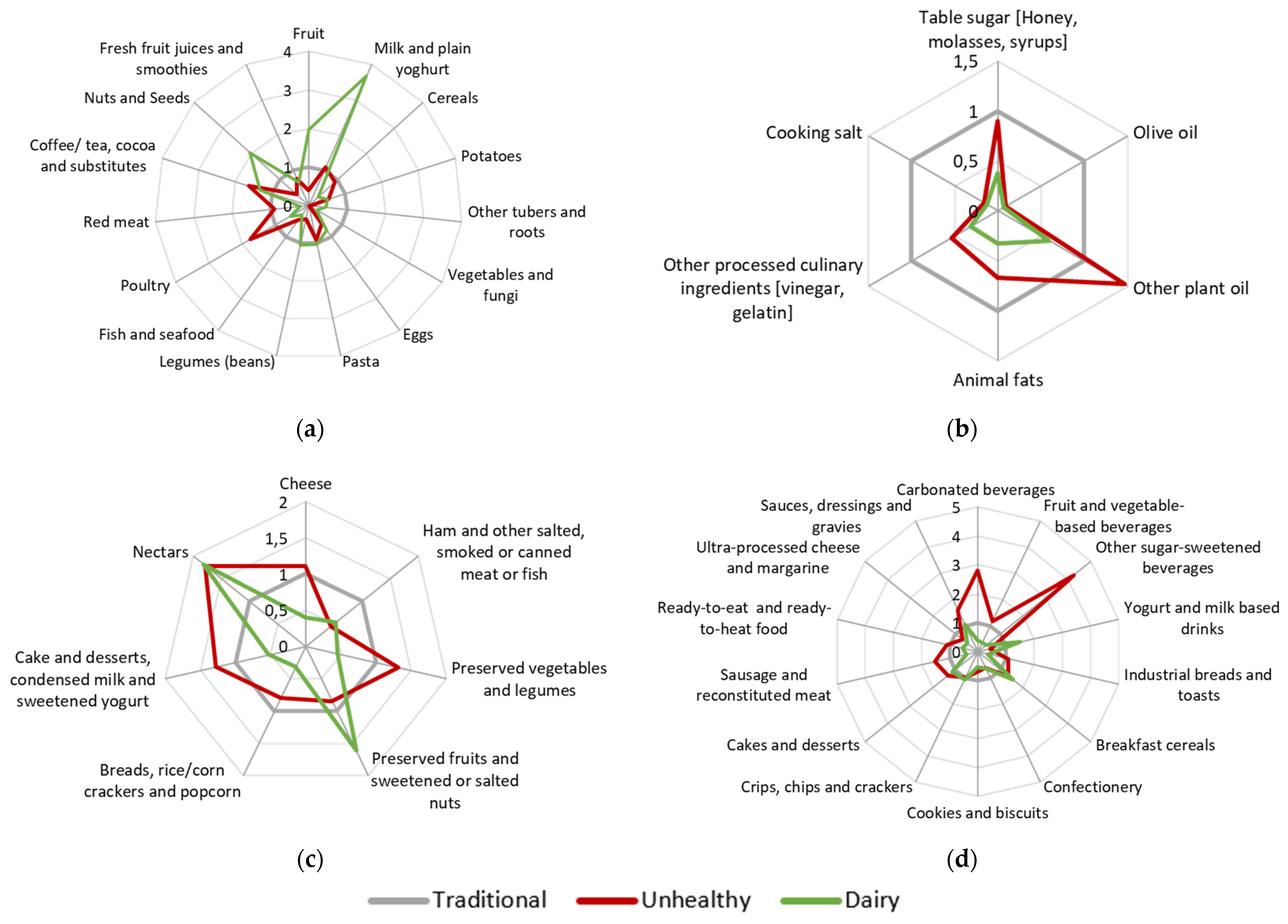

| DP 1 (Unhealthy) | DP 2 (Traditional) | DP 3 (Dairy) | ||
|---|---|---|---|---|
| Food Group | Consumption Category | n = 589 51.1% | n = 417 36.2% | n = 147 12.7% |
| Unprocessed or minimally processed foods | ||||
| Fruit | 1st tercile | 54.6 a | 29.0 b | 14.9 b |
| 3rd tercile | 18.4 a | 36.7 b | 53.3 b | |
| Milk and plain yoghurt | 1st tercile | 48.7 a | 47.6 a | 17.1 b |
| 3rd tercile | 19.7 a | 18.3 a | 45.2 b | |
| Cereals | 1st tercile | 37.5 a | 36.4 a | 68.6 b |
| 3rd tercile | 31.1 a | 32.8 a | 14.3 b | |
| Potatoes | 1st tercile | 48.6 a | 26.3 b | 21.9 b |
| 3rd tercile | 25.2 a | 38.3 b | 23.9 a,b | |
| Other tubers and roots | 1st tercile | 75.1 a | 15.1 b | 13.4 b |
| 3rd tercile | 4.3 a | 51.6 b | 32.2 b | |
| Vegetables and fungi | 1st tercile | 65.1 a | 1.4 b | 8.4 c |
| 3rd tercile | 4.6 a | 67.6 b | 33.1 c | |
| Eggs | No consumption | 44.6 a | 34.6 a | 43.4 a |
| ≥Median | 24.7 a | 35.8 a | 30.7 a | |
| Pasta | No consumption | 36.4 a | 35.8 a | 25.4 a |
| ≥Median | 31.5 a | 33.5 a | 34.3 a | |
| Legumes (beans) | No consumption | 64.7 a | 43.4 b | 31.2 b |
| ≥Median | 14.6 a | 32.3 b | 33.4 b | |
| Fish and seafood | No consumption | 61.1 a | 44.2 b | 39.8 b |
| ≥Median | 18.4 a | 33.1 b | 13.3 a | |
| Poultry | No consumption | 33.4 a | 41.5 a,b | 28.1 b |
| ≥Median | 39.6 a | 27.2 a,b | 17.1 b | |
| Red meat | No consumption | 21.8 a | 16.8 a | 16.0 a |
| ≥Median | 40.5 a | 43.1 a | 14.0 b | |
| Coffee/tea, cocoa, and substitutes | No consumption | 75.8 a | 80.2 a | 80.4 a |
| ≥Median | 13.0 a | 8.3 a | 10.7 a | |
| Nuts and Seeds | No consumption | 95.9 a | 90.8 a,b | 82.7 b |
| Consumption | 4.1 a | 9.2 a,b | 17.3 b | |
| Fresh fruit juices and smoothies | No consumption | 78.6 a | 69.2 a | 76.2 a |
| ≥Median | 10.9 a | 14.0 a | 9.6 a | |
| Processed culinary ingredients | ||||
| Table sugar [honey, molasses, syrups] | No consumption | 53.1 a | 55.4 a | 60.1 a |
| ≥Median | 24.1 a | 26.2 a | 11.9 a | |
| Olive oil | 1st tercile | 48.5 a | 5.0 b | 34.7 a |
| 3rd tercile | 16.0 a | 67.2 b | 12.3 a | |
| Other plant oil | No consumption | 29.3 a | 35.7 a | 42.8 a |
| ≥Median | 40.6 a | 31.8 a,b | 21.6 b | |
| Animal fats | No consumption | 44.1 a | 40.9 a | 36.8 a |
| ≥Median | 26.3 a,b | 34.8 a | 14.7 b | |
| Other processed culinary ingredients [vinegar, gelatine] | No consumption | 54.9 a,b | 38.3 a | 71.5 b |
| ≥Median | 22.5 a | 35.0 a | 14.4 a | |
| Cooking salt | 1st tercile | 45.5 a | 2.5 b | 47.6 a |
| 3rd tercile | 18.6 a | 59.5 b | 15.8 a | |
| Processed foods | ||||
| Cheese | No consumption | 43.2 a | 43.1 a | 44.3 a |
| ≥Median | 30.9 a | 28.8 a | 13.8 b | |
| Ham and other salted, smoked or canned meat or fish | No consumption | 76.6 a | 63.9 b | 73.3 a,b |
| ≥Median | 10.1 a | 20.3 b | 12.1 a,b | |
| Preserved vegetables and legumes | No consumption | 33.6 a | 20.7 b | 25.1 a,b |
| ≥Median | 39.3 a | 32.9 a,b | 18.3 b | |
| Preserved fruits and sweetened or salted nuts | No consumption | 91.8 a | 90.4 a | 85.3 a |
| Consumption | 8.2 a | 9.6 a | 14.7 a | |
| Breads, rice/corn crackers, and popcorn | 1st tercile | 43.8 a | 40.4 a | 42.1 a |
| 3rd tercile | 28.3 a,b | 33.1 a | 13.6 b | |
| Cake and desserts, condensed milk, and sweetened yogurt | No consumption | 93.0 a | 94.5 a | 97.0 a |
| Consumption | 7.0 a | 5.5 a | 3.0 a | |
| Nectars | No consumption | 77.6 a | 86.1 a | 77.3 a |
| Consumption | 22.4 a | 13.9 a | 22.7 a | |
| Ultra-processed foods | ||||
| Carbonated beverages | No consumption | 68.0 a | 82.9 b | 86.4 b |
| ≥Median | 16.4 a | 6.5 b | 2.7 b | |
| Fruit and vegetable-based beverages | No consumption | 83.0 a | 85.2 a,b | 94.2 b |
| Consumption | 17.0 a | 14.8 a,b | 5.8 b | |
| Other sugar-sweetened beverages | No consumption | 44.1 a | 62.1 b | 64.8 b |
| ≥Median | 34.9 a | 11.2 b | 4.5 b | |
| Yogurt and milk-based drinks | No consumption | 35.2 a | 23.2 b | 6.7 c |
| ≥Median | 29.3 a | 48.0 b | 58.3 b | |
| Industrial breads and toasts | No consumption | 46.9 a | 45.7 a | 47.5 a |
| ≥Median | 32.0 a | 30.3 a | 13.0 b | |
| Breakfast and baby cereals | No consumption | 47.3 a | 43.6 a | 20.9 b |
| ≥Median | 26.4 a | 20.9 a | 29.2 a | |
| Confectionery | No consumption | 47.2 a | 40.4 a | 47.0 a |
| ≥Median | 22.9 a | 32.6 a | 24.0 a | |
| Cookies and biscuits/Packaged sweet snacks | No consumption | 46.8 a | 33.3 a | 28.2 a |
| ≥Median | 25.6 a | 33.6 a | 20.8 a | |
| Crips, chips and crackers/Packaged savoury snacks | No consumption | 88.0 a | 87.7 a | 87.1 a |
| Consumption | 12.0 a | 12.3 a | 12.9 a | |
| Cakes and desserts | No consumption | 49.6 a | 55.1 a | 39.9 a |
| ≥Median | 26.1 a | 21.2 a | 23.2 a | |
| Sausage and reconstituted meat products | 1st tercile | 37.5 a | 47.4 a | 65.9 b |
| 3rd tercile | 32.3 a | 23.7 a | 10.9 b | |
| Ready-to-eat and ready-to-heat food | No consumption | 63.9 a | 73.2 a | 71.9 a |
| ≥Median | 18.6 a | 17.1 a | 9.9 a | |
| Ultra-processed cheese, margarine, and other spreads | No consumption | 52.2 a | 49.9 a | 59.0 a |
| ≥Median | 21.8 a | 28.6 a | 15.8 a | |
| Sauces, dressings, and gravies | No consumption | 65.3 a | 61.7 a | 73.5 a |
| ≥Median | 22.1 a | 15.0 a | 15.6 a | |
| n | DP 1 (Unhealthy) | DP 2 (Traditional) | DP 3 (Dairy) | |
|---|---|---|---|---|
| % (95% CI) | % (95% CI) | % (95% CI) | ||
| Sex | ||||
| Female | 581 | 45.6 (40.9–50.4) | 55.1 (49.6–60.6) | 43.1 (30.8–56.3) |
| Male | 572 | 54.4 (49.6–59.1) | 44.9 (39.4–50.4) | 56.9 (43.7–69.2) |
| Age group | ||||
| Children (3–9 years) | 521 | 24.4 (19.8–29.7) | 51.6 (45.9–57.2) | 100 |
| Adolescents (10–17 years) | 632 | 75.6 (70.3–80.2) | 48.4 (42.8–54.1) | - |
| Age (years)—mean (CI 95%) | - | 12.1 (11.7–12.6) | 9.8 (9.4–10.3) | 5.7 (5.2–6.1) |
| Region | ||||
| North | 187 | 30.9 (26.6–35.4) | 39.8 (32.3–47.8) | 33.6 (24.1–44.7) |
| Centre | 217 | 18.6 (15.1–22.6) | 20.3 (15.4–26.3) | 19.6 (12.8–28.9) |
| MA Lisbon | 176 | 31.5 (27.4–35.9) | 26.5 (20.2–34.0) | 30.1 (20.4–42.1) |
| Alentejo | 112 | 7.1 (5.3–9.6) | 4.9 (2.8–8.3) | 4.3 (2.4–7.5) |
| Algarve | 133 | 4.8 (3.6–6.3) | 3.8 (2.5–5.9) | 4.8 (2.8–8.3) |
| Madeira | 168 | 3.2 (2.5–4.1) | 3.0 (2.0–4.6) | 3.3 (2.2–5.1) |
| Azores | 160 | 4.0 (2.0–7.8) | 1.7 (1.1–2.6) | 4.2 (3.1–5.5) |
| Typology of the neighbourhood | ||||
| Predominantly rural area | 123 | 8.7 (4.7–15.5) | 7.7 (4.3–13.5) | 9.6 (4.6–19.1) |
| Medium urban area | 183 | 13.0 (7.6–21.2) | 13.9 (6.8–26.3) | 22. (11.5–38.0) |
| Predominantly urban area | 847 | 78.3 (70.1–84.8) | 78.3 (67.1–86.5) | 68.4 (53.9–80.0) |
| Parental education | ||||
| None/primary education | 155 | 15.1 (11.2–20.2) | 8.7 (6.6–14.0) | 12.0 (6.4–21.4) |
| Secondary/post-secondary education | 572 | 54.8 (48.4–61.0) | 44.6 (36.7–52.7) | 38.7 (29.3–49.0) |
| Higher education | 415 | 30.1 (23.5–37.7) | 45.7 (37.4–54.3) | 49.3 (38.6–60.1) |
| Body mass index | ||||
| Non-overweight | 797 | 64.5 (58.3–70.3) | 72.1 (66.4–77.1) | 79.6 (69.4–87.0) |
| Overweight | 351 | 35.5 (29.7–41.7) | 27.9 (22.9–33.6) | 20.4 (13.0–30.6) |
| Unhealthy DP | Dairy DP | |||
|---|---|---|---|---|
| Crude OR (95% CI) | Adjusted OR ‡ (95% CI) | Crude OR (95% CI) | Adjusted OR ‡ (95% CI) | |
| Sex | ||||
| Female | 0.68 (0.48–0.98) | 0.69 (0.47–1.03) | 0.62 (0.34–1.12) | 0.74 (0.38–1.46) |
| Male | 1 | 1 | 1 | 1 |
| Age | ||||
| Age (years) | 1.16 (1.10–1.23) | 1.17 (1.09–1.23) | 0.67 (0.62–0.73) | 0.66 (0.61–0.72) |
| Typology of the neighbourhood | ||||
| Predominantly rural area | 1.12 (0.59–2.14) | 0.98 (0.49–1.98) | 1.42 (0.69–2.92) | 2.08 (0.95–4.57) |
| Medium urban area | 0.93 (0.47–1.85) | 0.94 (0.44–2.00) | 1.81 (0.81–4.02) | 0.69 (0.36–1.30) |
| Predominantly urban area | 1 | 1 | 1 | 1 |
| Parental education | ||||
| None/primary education | 2.36 (1.28–4.35) | 1.71 (0.89–3.29) | 1.15 (0.48–2.74) | 2.02 (0.73–5.57) |
| Secondary/post-secondary education | 1.86 (1.13–3.08) | 1.82 (1.04–3.17) | 0.80 (0.44–1.47) | 0.71 (0.38–1.32) |
| Higher education | 1 | 1 | 1 | 1 |
| Body mass index | ||||
| Non-overweight | 1 | 1 | 1 | 1 |
| Overweight | 1.42 (0.99–1.56) | 1.41 (0.88–2.26) | 0.66 (0.36–1.24) | 0.98 (0.50–1.95) |
| Traditional DP | Unhealthy DP | Dairy DP | ||||
|---|---|---|---|---|---|---|
| Mean | Regression Coefficient | Regression Coefficient | ||||
| Crude | Adjusted a | Crude | Adjusted a | Crude | Adjusted a | |
| Total energy intake (kcal) | 1834.69 | 1850.12 | +124.67 ** | −11.39 | −349.62 * | −180.89 * |
| Energy density (kcal/grams) | 0.92 | 0.91 | −0.04 ** | −0.03 | −0.16 * | −0.18 * |
| Unprocessed or minimally processed foods (% kcal) | 41.86 | 42.72 | −4.15 * | −4.34 * | 2.77 * | +2.64 |
| Processed culinary ingredients (% kcal) | 10.45 | 10.16 | −2.41 * | −2.37 * | −2.90 * | −2.46 * |
| Processed foods (% kcal) | 13.50 | 13.98 | +2.03 * | +1.77 | −0.94 | −0.37 |
| Ultra-processed foods (% kcal) | 34.19 | 33.14 | +4.53 * | +4.94 * | +1.06 | +0.19 |
| Proteins (% of total energy intake) | 17.57 | 17.39 | +0.11 | −0.05 | +0.20 | +0.40 |
| Carbohydrates (% of total energy intake) | 50.51 | 51.22 | +1.65 * | +1.84 ** | +3.29 * | +2.40 * |
| Fats (% of total energy intake) | 31.87 | 31.32 | −1.79 * | −1.82 * | −3.45 * | −2.76 * |
| Saturated fats (% of total energy intake) | 10.88 | 10.62 | +0.07 | +0.04 | −0.62 ** | −0.43 |
| Free sugars (% of total energy intake) | 10.37 | 10.64 | +3.15 * | +3.28 * | +0.70 | +0.24 |
| Dietary fibre (g/1000 kcal) | 9.50 | 9.57 | −1.86 * | −1.71 * | +0.53 | +0.53 |
| Vitamin A (mcg/1000 kcal) | 497.77 | 473.70 | −193.20 * | −170.32 * | +9.88 | −9.42 |
| Vitamin C (mg/1000 kcal) | 54.05 | 54.56 | −10.13 * | −7.51 | −0.30 | −1.16 |
| Folates (mcg/1000 kcal) | 116.18 | 116.16 | −23.02 * | −21.73 * | +2.74 | +4.14 |
| Sodium (mg/1000 kcal) | 1611.80 | 1656.68 | −189.59 * | −221.96 * | −157.57 * | −105.76 |
| Potassium (mg/1000 kcal) | 1680.08 | 1672.16 | −264.47 * | −214.41 * | +236.49 * | +163.26 |
| Calcium (mg/1000 kcal) | 462.18 | 454.18 | −32.84 ** | −7.05 | +179.76 * | +124.46 * |
| Phosphorus (mg/1000 kcal) | 681.58 | 678.93 | −29.14 * | −18.99 | +88.80 * | +62.95 * |
| Magnesium (mg/1000 kcal) | 139.24 | 138.76 | −11.80 * | −9.56 * | +16.60 * | +14.66 * |
| Iron (mg/1000 kcal) | 5.63 | 5.59 | −0.48 * | −0.48 * | +0.28 | +0.27 |
| Zinc (mg/1000 kcal) | 5.12 | 5.00 | +0.09 | +0.08 | +0.35 * | +0.41 ** |
Publisher’s Note: MDPI stays neutral with regard to jurisdictional claims in published maps and institutional affiliations. |
© 2021 by the authors. Licensee MDPI, Basel, Switzerland. This article is an open access article distributed under the terms and conditions of the Creative Commons Attribution (CC BY) license (https://creativecommons.org/licenses/by/4.0/).
Share and Cite
de Moraes, M.M.; Oliveira, B.; Afonso, C.; Santos, C.; Torres, D.; Lopes, C.; Miranda, R.C.d.; Rauber, F.; Antoniazzi, L.; Levy, R.B.; et al. Dietary Patterns in Portuguese Children and Adolescent Population: The UPPER Project. Nutrients 2021, 13, 3851. https://doi.org/10.3390/nu13113851
de Moraes MM, Oliveira B, Afonso C, Santos C, Torres D, Lopes C, Miranda RCd, Rauber F, Antoniazzi L, Levy RB, et al. Dietary Patterns in Portuguese Children and Adolescent Population: The UPPER Project. Nutrients. 2021; 13(11):3851. https://doi.org/10.3390/nu13113851
Chicago/Turabian Stylede Moraes, Milena Miranda, Bruno Oliveira, Cláudia Afonso, Cristina Santos, Duarte Torres, Carla Lopes, Renata Costa de Miranda, Fernanda Rauber, Luiza Antoniazzi, Renata Bertazzi Levy, and et al. 2021. "Dietary Patterns in Portuguese Children and Adolescent Population: The UPPER Project" Nutrients 13, no. 11: 3851. https://doi.org/10.3390/nu13113851
APA Stylede Moraes, M. M., Oliveira, B., Afonso, C., Santos, C., Torres, D., Lopes, C., Miranda, R. C. d., Rauber, F., Antoniazzi, L., Levy, R. B., & Rodrigues, S. (2021). Dietary Patterns in Portuguese Children and Adolescent Population: The UPPER Project. Nutrients, 13(11), 3851. https://doi.org/10.3390/nu13113851

