Article

Attribution of Evapotranspiration Variation in the Yellow River Basin with a Simplified Water–Energy Partitioning Method Based on Multi-Source Datasets

1
College of Water Resources and Modern Agriculture, Nanyang Normal University, Nanyang 473061, China
2
School of Geography and Planning, Sun Yat-sen University, Guangzhou 510006, China
3
School of Hydrology and Water Resources, Nanjing University of Information Science and Technology, Nanjing 210044, China
4
Key Laboratory of Hydrometeorological Disaster Mechanism and Warning of Ministry of Water Resources, Nanjing University of Information Science & Technology, Nanjing 210044, China
5
School of Freshwater Science, University of Wisconsin-Milwaukee, Milwaukee, WI 53201, USA
*
Author to whom correspondence should be addressed.
Remote Sens. 2026, 18(9), 1429; https://doi.org/10.3390/rs18091429
Submission received: 12 March 2026 / Revised: 21 April 2026 / Accepted: 1 May 2026 / Published: 4 May 2026

Highlights

What are the main findings?
  • All multi-source ET datasets present consistent significant increasing trends with the rates of 0.82–2.04 mm/yr2 in the YRB during the period of 1982–2022.
  • ULCC dominates ET increases in the YRB but shows higher uncertainty among multi-source datasets, whereas CC, despite being a dominant driver only in the source region, exhibits lower sensitivity to data variability.
What are the implications of the main findings?
  • Anthropogenic underlying characteristic changes are profoundly influencing the ET variation mechanisms in the YRB, except for the source region, and spatially explicit water resource management strategies are imperative in the future.

Abstract

Terrestrial evapotranspiration (ET) serves as a critical nexus between the hydrological cycle and energy process, which is highly sensitive to climate change (CC) and underlying characteristic change (ULCC), particularly in the regions with rapid environmental changes. This study designed a data combination scheme for investigating the ET variation and quantifying its drivers in the Yellow River Basin (YRB), using a simplified water–energy partitioning (WEP) method based on nine multi-source ET, precipitation and potential ET datasets. Results reveal that all ET datasets demonstrate significant increasing trends with the rates of 0.82–2.04 mm/yr2 during the period of 1982–2022, and the ET increments are 13.4–45.2 mm/yr from the base period (1982–2000) to the change period (2001–2022). For the whole YRB, ULCC has slightly larger averaged absolute and relative contribution (15.8 mm/yr and 52.9%) than those of CC (12.2 mm/yr and 47.1%) to ET increases among the different dataset triplets. For most sub-basins, ULCC exhibits higher contributions than CC, with relative contributions of nearly two-thirds, although considerable variabilities exist in their absolute contributions. However, the opposite results occur in the source region of the YRB, where CC has a primary contribution to ET variation. In summary, while ULCC is the primary driver of ET increases, its estimated contributions entail substantial uncertainty. In contrast, CC acts as a secondary driver, exhibiting greater robustness and lower sensitivity to multi-source dataset variability. This study provides a valuable multi-source-dataset-based ET attribution framework with the WEP method that advances our understanding of hydrological responses to the changing environment in the YRB.

1. Introduction

Actual terrestrial evapotranspiration (ET) plays a critical role in linking hydrological processes with surface energy balance and ecological systems [1,2,3]. As the second-largest component of the global water cycle after precipitation, ET regulates water availability, influences regional climate through land–atmosphere feedback, and mediates the response of ecosystems to environmental change [4,5]. Therefore, understanding the driving mechanisms of ET variability is essential for predicting hydrological responses to climate change and guiding sustainable water resource management [6,7].
Over recent decades, significant changes in ET have been observed and documented across diverse climatic and geographic regions worldwide [8,9]. These changes, on the one hand, stem from the complex interaction of changes in climate. On the other hand, they arise from the intense anthropogenic modifications to underlying characteristics [10,11]. Climate change (CC) alters atmospheric water demand and energy availability through modifications in precipitation, air temperature, solar radiation, and vapor pressure deficit [10,12], while underlying characteristic change (ULCC), including land-use coverage conversion, vegetation restoration, water resource development and utilization, directly or indirectly modifies land surface properties to influence ET [13,14]. Consequently, separating and quantifying the contributions of these drivers to ET variation remains a fundamental challenge, particularly in regions experiencing rapid environmental transformation [15]. The Yellow River Basin (YRB), the second-largest river basin in China, is a strategic base for food security and energy production [16,17]. However, the YRB has undergone substantial environmental transformation over recent decades, including extensive vegetation restoration through the “Grain-for-Green” program, rapid urbanization, and the construction of major water conservancy projects [18,19]. These changes inevitably affect the hydrology process, causing significant variation in ET over the YRB. Therefore, the attribution analysis of ET variation in the YRB is of importance to understanding hydrological responses to changing environments.
There are different paths to address this issue. One path for estimating the contributions of CC and ULCC is a hydrological model coupled with a climatological model. Yet, it is challenging to quantify uncertainties stemming from the initial conditions, model parameters, and model structures [20,21,22]. Another path is the conceptual approach, and the typical method used is the Budyko-based framework, featuring the relationship among ET, climate conditions, and catchment underlying characteristics. Climate conditions were usually represented by potential evapotranspiration (PET) and precipitation (Pr). PET can be regarded as the maximum evapotranspiration rate without limitation in water supply, while Pr reflects the condition of water supply for evapotranspiration. The catchment underlying characteristics are generally represented by a dimensionless curve shape parameter. The Budyko-based framework has been widely applied to quantify the effect of climate and underlying characteristics on watershed streamflow and ET [20,21,23,24]. According to the Budyko hypothesis, Wang and Hejazi [25] proposed a decomposition method to quantify the impacts of climate and human activities on mean annual streamflow. Liu et al. [26] introduced an illustration to express the Budyko-Fu’s equation, based on PET, ET and Pr, and the expression was E T / P r = 1 + P E T / P r [ 1 + ( P E T / P r ) n ] 1 / n . In fact, the variation in watershed ET can be attributed to the identical influences of CC and ULCC. However, it may also be caused by opposite effects, that are either positive or negative. Therefore, both relative contribution and absolute contribution (positive and negative) of CC and ULCC to ET variation need to be quantified. To tackle this problem, Liu et al. [27] proposed a simple conceptual water–energy partitioning (WEP) framework to separate the CC contribution to the ET variation from ULCC contribution at the watershed scale. The principal advantage of this approach lies in its reliance on the simple two-dimensional geometric relationships to directly quantify the absolute contributions of CC and ULCC to ET variation. Using this framework, Liu et al. [27] investigated the individual contributions of CC and ULCC to change in watershed ET over 87 global basins. The study found that the WEP method presented comparable decomposition results to those obtained from the Budyko-based method and hydrological model simulations, yet with higher computational efficiency. Nonetheless, previous studies mostly adopted a single (e.g., Climatic Research Unit) gridded ET and PET dataset, thus neglecting the influence of uncertainty in data selection on ET attribution results. With the increasing availability of multi-source datasets, the remote sensing-based [28,29], model reanalysis-based [30], machine learning-based [31,32,33], and fused ET, Pr and PET datasets can be accessed and used to explore the influences of CC and ULCC on ET variation [3,31,34,35]. In addition, previous research perspectives were relatively broad and did not focus on a certain typical basin.
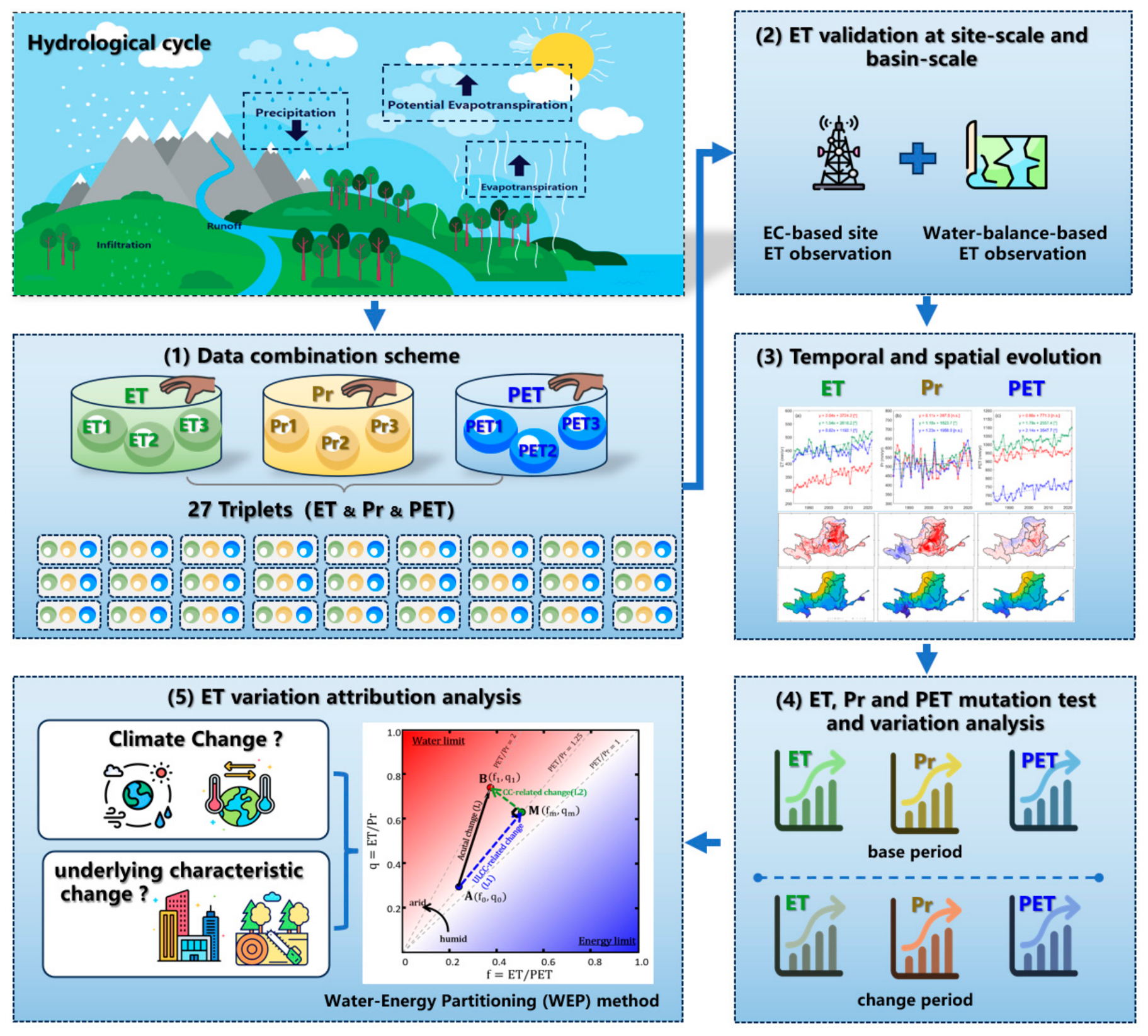
Here, we focused on the YRB and explored the attribution of ET variation based on multi-source datasets with the WEP method. The flowchart of this study is illustrated in Figure 1. Specifically, we firstly designed a data combination scheme, including three ET datasets, three Pr datasets and three PET datasets, to obtain 27 triplets. Secondly, the ET datasets were validated at both site and basin scale against the ET observations. Thirdly, the temporal evolutions and spatial patterns of ET, Pr and PET were analyzed. Then, the mutation points of all hydroclimatic variables were detected and the study period (1982–2022) was divided into two periods. Ultimately, the contributions of CC and ULCC were quantified and the attrition of ET variation was analyzed using the WEP method.

2. Materials and Methods

2.1. Study Area

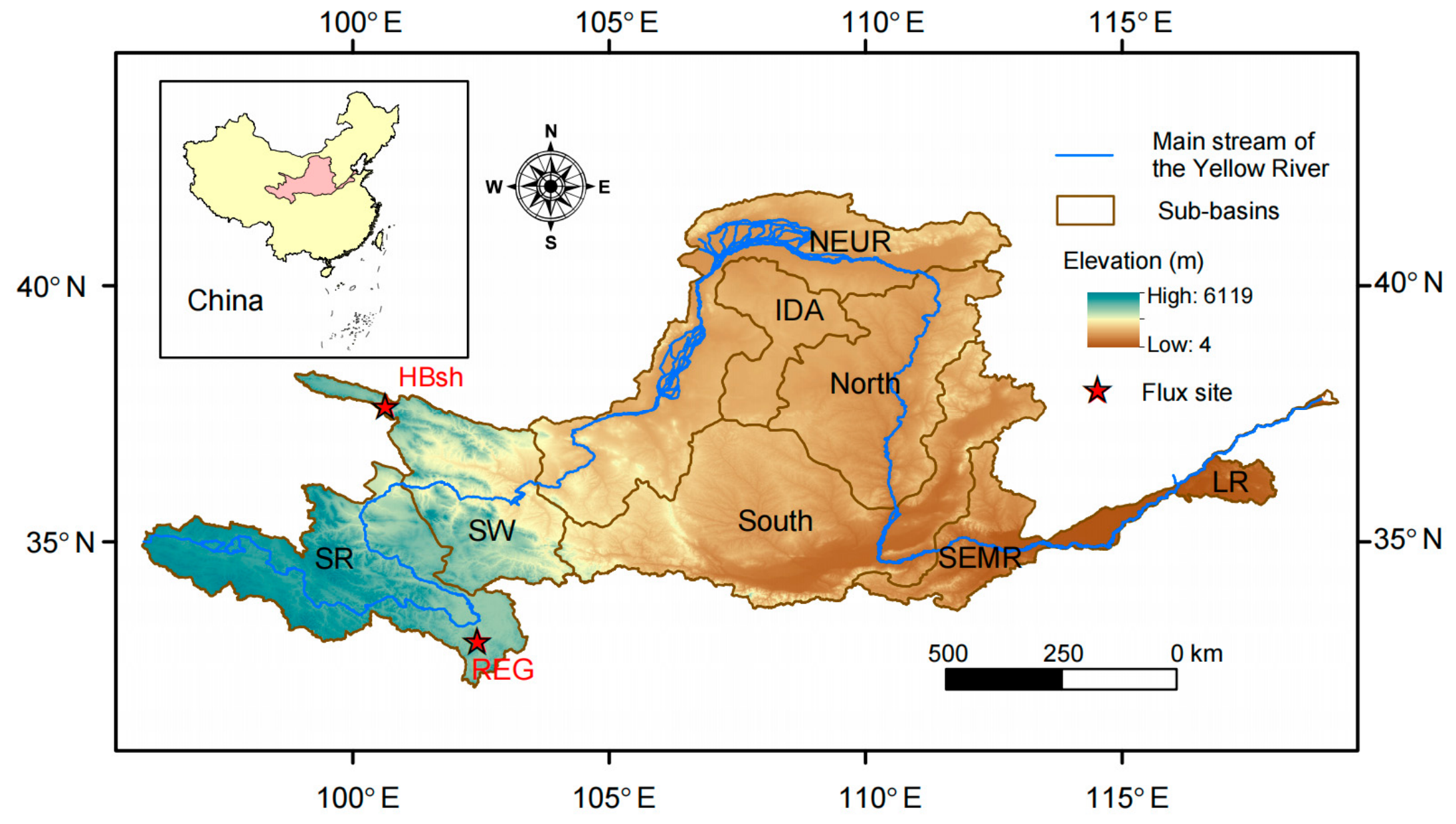
The YRB is located in northern–central China, spanning 32°10′N~41°50′N in latitude and 95°53′E~119°05′E in longitude. As the second-largest river basin in China, the YRB encompasses a total area of 7.95 × 10⁵ km2, accounting for approximately 8% of the total land area of China [36]. The topography of the YRB is complex and highly variable, characterized by a steep elevation gradient from west to east (Figure 2). Governed by atmospheric circulation and monsoons, the YRB presents a distinct spatial gradient of precipitation. Beyond that, the YRB also experiences high spatial and temporal variability in ET and PET. In this study, to explore the impacts of CC and ULCC on ET variation, the whole YRB was divided into eight sub-basins based on the secondary basin boundary in China (http://www.geodata.cn, accessed on 8 March 2026), including the source region (SR), southwest (SW), northeast of the upper reaches (NEUR), interior drainage areas (IDA), North, South, southeast of the middle reaches (SEMR), and the lower reaches (LR) [36]. It is worthy to note that the Loess Plateau is traversed by the upper–middle reaches of the YRB [37], covering an area of nearly 6.35 × 10⁵ km2.

2.2. Data

In order to investigate the attribution of ET variation and its uncertainty in the YRB, we used three ET datasets, including the Global Land Evaporation Amsterdam Model (GLEAM), Process-based Land Surface evapotranspiration/Heat fluxes algorithm (PLSH), Simple Terrestrial Hydrosphere model (SiTH), three PET datasets, namely the High-resolution Multi-element Meteorological Driving Dataset for China (i.e., ChinaMet_PETHG and ChinaMet_PETPM), and GLEAM PET, and three Pr datasets, including Rainfall Estimates from Rain Gauge and Satellite (CHIRPS), China Meteorological Forcing Dataset (CMFD), and Multi-Source Weighted-Ensemble Precipitation (MSWEP). These data were provided with different temporal resolutions (hourly, daily, monthly, and yearly). In this study, for validation, we used monthly ET data, and for attribution analysis of ET, we employed yearly data. The study period spanned from 1982 to 2022, and the spatial resolution was uniformly resampled to 0.1° grid cell. Detailed information on these datasets is listed in Table 1.

2.2.1. Evapotranspiration Dataset

GLEAM is one of the first prognostic approaches developed to estimate ET globally using remote sensing-based data, which has been widely used and continuously upgraded [38,39]. The previous version of GLEAM was derived using the Priestley and Taylor equation with the original motivation of minimum input requirements (i.e., net radiation and air temperature), which made it well-suited for satellite data applications. Up to date, the GLEAM version 4 employs Penman’s equation to explicitly describe the influence of wind speed, vegetation height, and vapor pressure deficit on ET.
PLSH is a satellite-based ET dataset originally developed by Zhang et al. [40], which was generated using the Process-based Land Surface evapotranspiration/Heat fluxes algorithm based on the Global Inventory Modeling and Mapping Studies Normalized Difference Vegetation Index (GIMMS NDVI) data, the National Centers for Environmental Prediction (NCEP) reanalysis meteorology data, and the Global Energy and Water Cycle Experiment (GEWEX) radiation data. It was recently updated to PLSH version 2 [41] by introducing an enhanced soil moisture constraint scheme that effectively captures soil moisture’s influence on vegetation transpiration and soil evaporation. The performance of the new version achieves notable improvements in ET estimation.
SiTH ET is a long-term dataset of global ET produced via using a Simple Terrestrial Hydrosphere model (SiTH), developed by Sun Yat-sen University [42]. This model was driven by multi-source satellite-observed meteorological variables and yielded a set of daily global ET-related estimates, including total ET, vegetation transpiration, soil evaporation, and intercepted evaporation. The validation results demonstrated robust performance of SiTH in both magnitude and temporal dynamics of ET at multiple scales, making it a valuable reference for research on the hydrologic cycle.

2.2.2. Potential Evapotranspiration Dataset

ChinaMet is a high-resolution (0.1° and 0.01°) and long-term (1980–2022) multi-source integrated meteorological forcing dataset in China developed by Zhang et al. [43] and Hu et al. [44] from the Chinese Academy of Sciences. It was created by fusing multiple remote sensing data, reanalysis data, and observations from more than 2000 meteorological stations. This treatment makes it particularly suitable for capturing localized fine-scale hydrology, ecology, and climate variation over China. It is noted that ChinaMet provides two versions of PET data, namely petHG and petPM, calculated using different methods. The petHG was obtained based on Hargreaves method, which was a temperature-based simplified empirical method. The petPM was derived from the Penman–Monteith (PM) method. In this study, both petHG (hereafter CMet_PETHG) and petPM (hereafter CMet_PETPM) were adopted.
The GLEAM-based PET data was also selected in this study. GLEAM provides PET as a key intermediate output in modeling its ET framework, and it has undergone a significant methodological transition in PET calculation. GLEAM version 3 and its predecessors adopted the Priestley–Taylor (PT) method to estimate the PET. Then, the PM method was introduced to GLEAM version 4, and this shift represented a major improvement as the PM accounts for both radiative and aerodynamic components of ET demand. Moreover, the approach separated the atmospheric demand from soil/vegetation supply constraint [38].

2.2.3. Precipitation Dataset

CHIRPS is a high-resolution quasi-global (60°S–60°N) rainfall dataset developed by the Climate Hazards Center at the University of California (UCSB) in collaboration with the United States Geological Survey (USGS) [45]. It was produced using daily to monthly infrared Cold Cloud Duration (CCD) Pr estimates as well as the spatial correlation structure of CCD, incorporated using a novel blending procedure. The new CHIRPS version 3 uses the Legates–Willmott correction factor to account for systematic biases in gauge measuring errors, and performs better than predecessors. This feature is especially useful for capturing high rainfall amounts of large, impactful, or out-of-season storms.
The CMFD is a meteorological forcing dataset specifically developed for terrestrial process studies in China, which was created by Tsinghua University and the Institute of Tibetan Plateau Research [46]. The CMFD has been in development for more than a decade, during which several major releases have been made. The latest version, CMFD v2, has merged remote sensing data, reanalysis data, and in situ station observations, and integrated radiation and Pr data using artificial intelligence (AI) techniques. Therefore, the accuracy of CMFD v2 is significantly improved compared with the previous generation.
MSWEP is a set of gridded Pr dataset derived through combining multi-source data, including gauge, satellite, and reanalysis Pr estimates. This dataset has enhanced the performance of Pr in densely gauged, convection-dominated and frontal-dominated regions [47]. MSWEP is one of the Pr datasets incorporating daily gauge observations, and the only one to account for gauge reporting times, which is crucial to minimize temporal mismatches between the satellite/reanalysis estimates and the gauge observations.

2.2.4. Validation Data

In this study, we selected the eddy covariance (EC) flux tower ET observations, combining data from ChinaFlux (https://chinaflux.org, accessed on 8 March 2026) and the National Ecosystem Research Network of China (CERN) (https://cnern.ac.cn, accessed on 8 March 2026) as reference data to evaluate the performance of three ET datasets at the site scale. According to the geographical location of the stations, only HBsh (37.62°N, 101.32°E) and REG (32.80°N, 102.55°E) sites are located in the YRB (Figure 2). The data periods for two stations are 2003–2017 and 2015–2017, respectively. The evaluations were conducted with monthly ET data. In addition, at the basin scale, the water balance-based ET observations were also employed to assess the performance of the ET datasets. The benchmarking ET dataset was obtained from the National Tibetan Plateau Data Center (https://data.tpdc.ac.cn, accessed on 8 March 2026) developed by Ma et al. [48]. This dataset was derived from observed runoff, four different precipitation datasets, and three types of terrestrial water storage change estimates using an optimally merged time-series framework based on the Bayesian three-cornered hat method. The relative uncertainty of this dataset is less than 10%, thus making it a reliable benchmark for ET assessment. Notably, since this dataset only provides the annual observed ET data with the domain area larger than 105 km2 during the period of 1983–2016, we conducted a basin-based ET validation for the entire YRB.

2.3. Methodology

2.3.1. Water–Energy Partitioning Method

In this study, we adopted a conceptual water–energy partitioning (WEP) framework, originally proposed by Tomer and Schilling [49], to separate the effects of CC and ULCC on watershed hydrology. The key concept of the WEP framework is to use two dimensionless ecohydrological variables to represent water and energy balance components, thereby encoding information on the partitioning of water and energy fluxes at the catchment scale [50]. Renner et al. [51] further modified the WEP framework to identify the effects of CC and ULCC on ET. Their framework assumed that the impacts of CC and ULCC on water–energy partitioning are independent, and that CC is orthogonal to ULCC. That is, climate change affects surface water and energy partitioning with equal magnitude but in opposite directions, which can be expressed as follows:
Δ ( E T / P E T ) = Δ ( E T / P r )
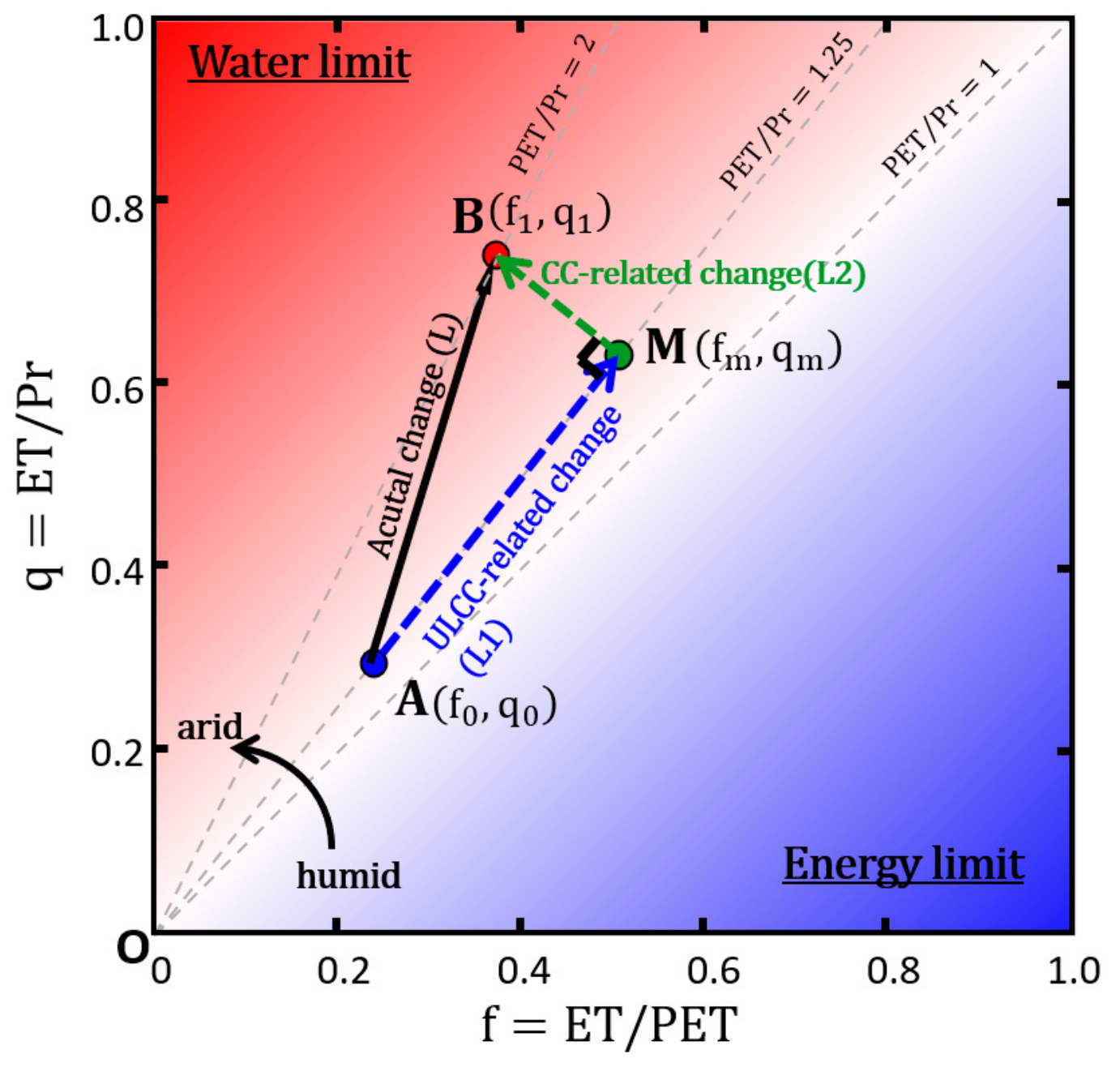
Renner et al. [51] introduced non-dimensional variables to individually describe water partitioning with q = E T / P r and energy partitioning with f = E T / P E T , as defined on the x - y axis in a Cartesian coordinate system. Liu et al. [27] refined this framework by transposing the coordinate axes, with f as the abscissa and q as the ordinate, which is illustrated in Figure 3. Based on this system, we can plot different lines from the origin where ET = 0 through a certain point ( f , q ) in this coordinate system. These lines denote different fixed aridity conditions, and the slope of a certain line represents the reciprocal value of the aridity index (i.e., P E T / P r ), which reflects the climate condition of a watershed. Changes in q - f (water-energy) states along with the fixed aridity condition (the blue dash line in Figure 3) can imply the changes in underlying characteristics over a basin, which may be related to many factors, such as land-use change, vegetation coverage, soil properties, topography, and human activities. Following Tomer and Schilling [49], under steady climate conditions (i.e., the constant aridity index), all other changes in ET can be attributed to ULCC. Thereafter, CC-related change in ET can be defined as the changes between different aridity condition lines and the climatic direction (the green dash line in Figure 3). It is worth noting that the blue dash line and the green dash line are perpendicular to each other, which follows the orthogonality assumption.
Based on the above assumption, actual change in ET ( L ) can be regarded as the transitions of state in the water–energy space, which are decomposed orthogonally into the ULCC-related component vector ( L 1 ) and CC-related component vector ( L 2 ). Obviously, we can easily deduce that L = L 1 + L 2 , based on the vector-product method in the principles of plane geometry. Specifically, as displayed in Figure 3, the two points A ( f 0 , q 0 ) and B ( f 1 , q 1 ) in the water–energy space in the Cartesian coordinate system indicate the two different hydroclimate states, namely initial state and transition state, respectively. Following the orthogonality assumption, we can introduce a new point, which can be denoted as the intermediate virtual state M ( f m , q m ) , making L 1 and L 2 perpendicular to each other. In this way, the state transition from A ( f 0 , q 0 ) to B ( f 1 , q 1 ) can be divided into two parts: (i) moving from the initial state A ( f 0 , q 0 ) to the intermediate virtual state M ( f m , q m ) ; (ii) moving from the intermediate state M ( f m , q m ) to the transition state B ( f 1 , q 1 ) . According to the theory of analytic geometry, O A and O M have the same slope, which can be expressed as
q m f m = q 0 f 0
Moreover, because of the orthogonality between L 1 and L 2 , the product of their slopes is equal to −1, which can be written as
q 1 q m f 1 f m q 0 f 0 = 1
By solving Equations (2) and (3), we can obtain the coordinates of M ( f m , q m ) :
( f m , q m ) = ( f 0 2 f 1 + q 0 q 1 f 0 q 0 2 + f 0 2 , q 0 2 q 1 + f 0 f 1 q 0 q 0 2 + f 0 2 )
According to the assumption, ULCC alters ET at constant aridity (i.e., the aridity index of P r / P E T is fixed); that is, the climatic condition does not change when underlying characteristics change. As a result, ET at point M can be derived from the initial climatic conditions: E T m = q m P m = q m P 0 . E T m is the ET in the intermediate virtual state associated with change in underlying characteristics.
The absolute differences between the intermediate virtual state E T m and original state E T 0 due to ULCC can be expressed as follows:
Δ E T U L C C = E T m E T 0
and the absolute difference between the transition state E T 1 and intermediate virtual state E T m due to CC-related change can be described as follows:
Δ E T C C = E T 1 E T m
Here, Δ E T C C and Δ E T U L C C represent the CC-induced and ULCC-induced ET changes, respectively. Notably, this approach is able to identify the absolute contributions of CC and ULCC to ET variation associated with the changing direction (either positive or negative). Furthermore, we can also calculate the relative contribution (i.e., contribution percentage, %), as below:
C U L C C = | Δ E T U L C C | | Δ E T U L C C | + | Δ E T C C | × 100 %
C C C = | Δ E T C C | | Δ E T U L C C | + | Δ E T C C | × 100 %
where C U L C C and C C C denote the relative contributions of CC and ULCC to the change in ET.

2.3.2. Trend Analysis Method

We applied the Mann–Kendall (M-K) trend detection [52,53] and Sen’s slope to explore the ET change trend during the study period. As a nonparametric test method, M-K trend detection can be used to evaluate the trend and significance of hydrometeorological time-series based on the correlation between the ranks of sequences [54]. For a certain given time-series { x t : t = 1 , 2 , , n } , the M-K test statistics S can be defined as
S = i = 1 n 1 j = i + 1 n s g n ( x j x i )
s g n ( x j x i ) = { 1 , x j > x i 0 , x j = x i 1 , x j < x i
where x i and x j represent the values at time i th and j th, respectively. S only relies on the ranks of the samples, and the statistic is distribution-free. For n > 10 , S can be approximately regarded as following a normal distribution with mean and variance:
E ( S ) = 0
V a r ( S ) = n ( n 1 ) ( 2 n + 5 ) 18
Z = { S 1 V a r ( S ) , S > 0 0 , S = 0 S + 1 V a r ( S ) , S < 0
At a given level of statistical significance α , if | Z | Z 1 α / 2 , the trend of the sequence is significant, and if | Z | < Z 1 α / 2 , the trend of the sequence is not significant. The confidence limit is α = 0.05 in this study, which corresponds Z 1 α / 2 = 1.96.
Sen’s slope [55] was employed to estimate the trend of change in every grid cell in a certain basin. The slope was estimated using the expression as follows:
S l o p e = M e d i a n ( x j x k j k )
where S l o p e is the estimate of the slope of the trend.

2.3.3. Evaluation Metrics

To assess the performance of three ET datasets at both site and basin scale, the root mean square error (RMSE), relative bias (RB), and coefficient of determination (R2) were adopted in this study. The RMSE and RB evaluate the accuracy of ET datasets from different perspectives, and the R2 quantifies the proportion of variability in ET observations explained by the ET datasets. These metrics can be expressed as follows:
R B = 1 n i = 1 n ( M i O i ) O i × 100 %
R M S E = 1 n i = 1 n ( M i O i ) 2
R 2 = 1 i = 1 n ( M i O i ) 2 i = 1 n ( O i O ¯ ) 2
where M i and O i denote the ET datasets and ET observations, respectively; n is the total number of grid cells or time-series. O ¯ represents the spatial or temporal average of the observed ET value.

3. Results

3.1. Validation of ET Datasets Based on ET Observations

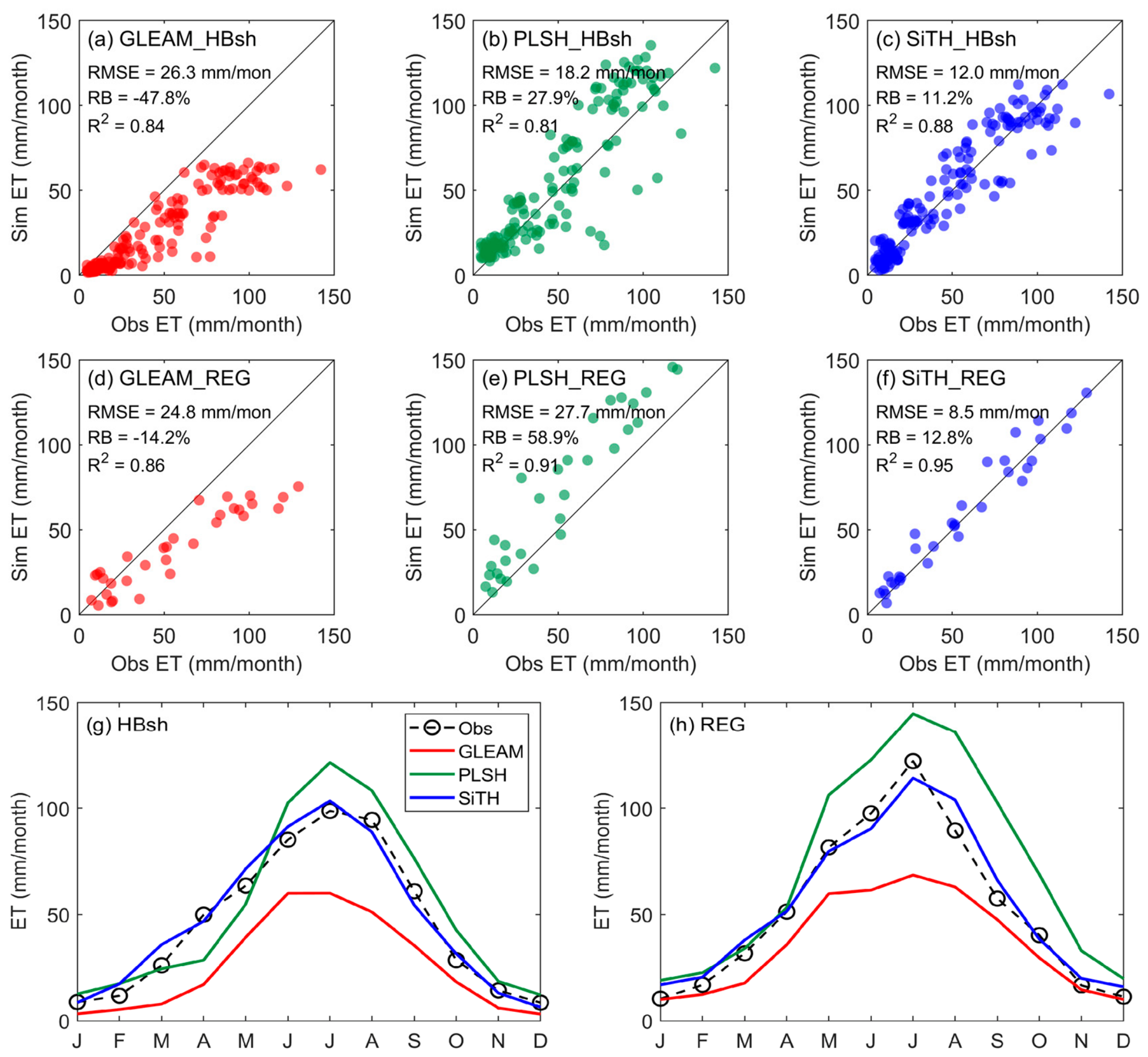
Figure 4 illustrates the performance of GLEAM, PLSH, and SiTH against the observed ET at HBsh and REG sites located in the YRB. Overall, SiTH exhibits the strongest agreement with site-based measurements, achieving the lowest RMSE values (12.0 and 8.5 mm/month), the lowest RB values (11.2% and 12.8%), and the highest R2 values (0.88 and 0.95) at HBsh and REG, respectively. By comparison, GLEAM underestimates ET at both sites, with substantial negative bias at HBsh (RB = −47.8%, RMSE = 26.3 mm/month), although it achieves reasonable correlation coefficients (R2 = 0.84–0.86). The RB is −14.2% at REG, which is less than that at HBsh. However, PLSH exhibits the opposite performance, markedly overestimating ET at both stations, with the positive bias of 27.9% at HBsh (RMSE = 18.2 mm/month) and 58.9% at REG (RMSE = 27.7 mm/month). As for the seasonal cycle (Figure 4g,h), all three ET datasets successfully capture the seasonal fluctuation of ET, characterized by higher values in summer and lower values in winter. However, critical differences in seasonal performance can also be found. At HBsh, SiTH closely tracks this seasonality with lower bias, while GLEAM substantially underestimates peak ET. PLSH overestimates the growing season ET, peaking earlier and higher than observations. At REG, similar patterns can also be seen; that is, SiTH effectively reproduces the observed ET peak, whereas GLEAM underestimates by nearly 30% and PLSH overestimates by approximately 25%. Among the three ET datasets, SiTH presents consistently robust performance at both sites, which probably provides confidence for its use in attribution analyses, while the complementary biases of GLEAM and PLSH offer diagnostic constraints on ET trend uncertainty bounds in the YRB.
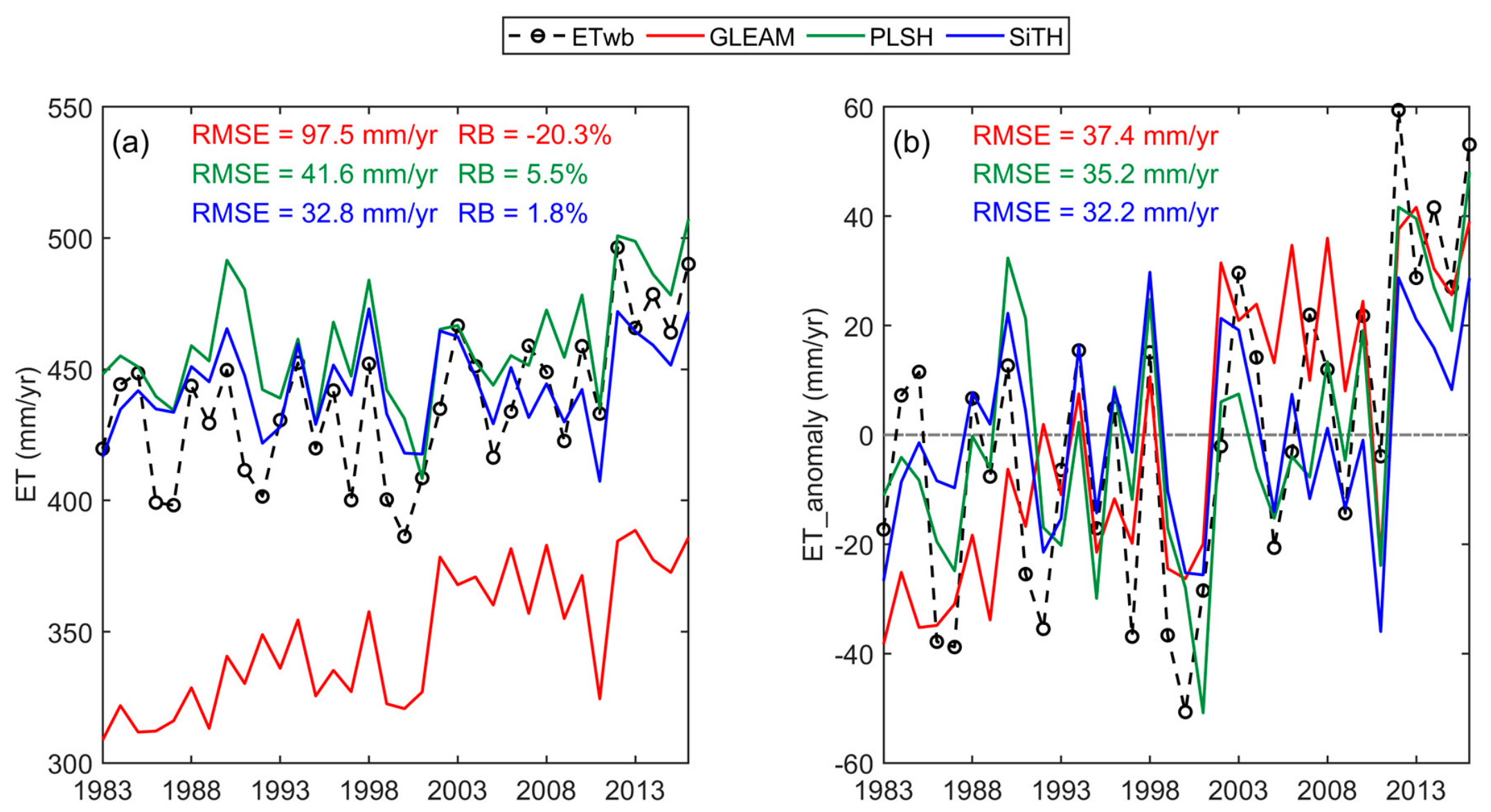
Figure 5 presents the ET validation results with water balance-based ET observations, which reveal disparities in the ability of the three ET datasets to reproduce water balance-derived ET estimates at the basin scale. Overall, SiTH demonstrates the closest agreement with ETwb, achieving the lowest RMSE (32.8 mm/yr) and smallest systematic bias (RB = 1.8%), effectively capturing both the magnitude and interannual variability of basin-scale ET. The performance of SiTH is in line with its performance at the site scale. In contrast, GLEAM presents pronounced systematic underestimation, with a negative bias of −20.3% and the highest RMSE (97.5 mm/yr) among the three products. In comparison, PLSH shows a moderate performance, displaying slight overestimation (RB = 5.5%, RMSE = 41.6 mm/yr) relative to the ETwb reference. Analysis of ET anomalies (Figure 5b) indicates improved performance for all datasets when the long-term mean bias is removed, with the RMSE values decreasing to 32.2–37.4 mm/yr. This convergence suggests that while systematic magnitude errors differ substantially among datasets, their representation of interannual ET variability is more consistent. SiTH stands out with the lowest anomaly RMSE (32.2 mm/yr), followed closely by PLSH (35.2 mm/yr), whereas GLEAM (37.4 mm/yr) exhibits the poorest performance.

3.2. Spatiotemporal Variations in ET, Pr and PET

3.2.1. Temporal Evolutions of ET, Pr and PET

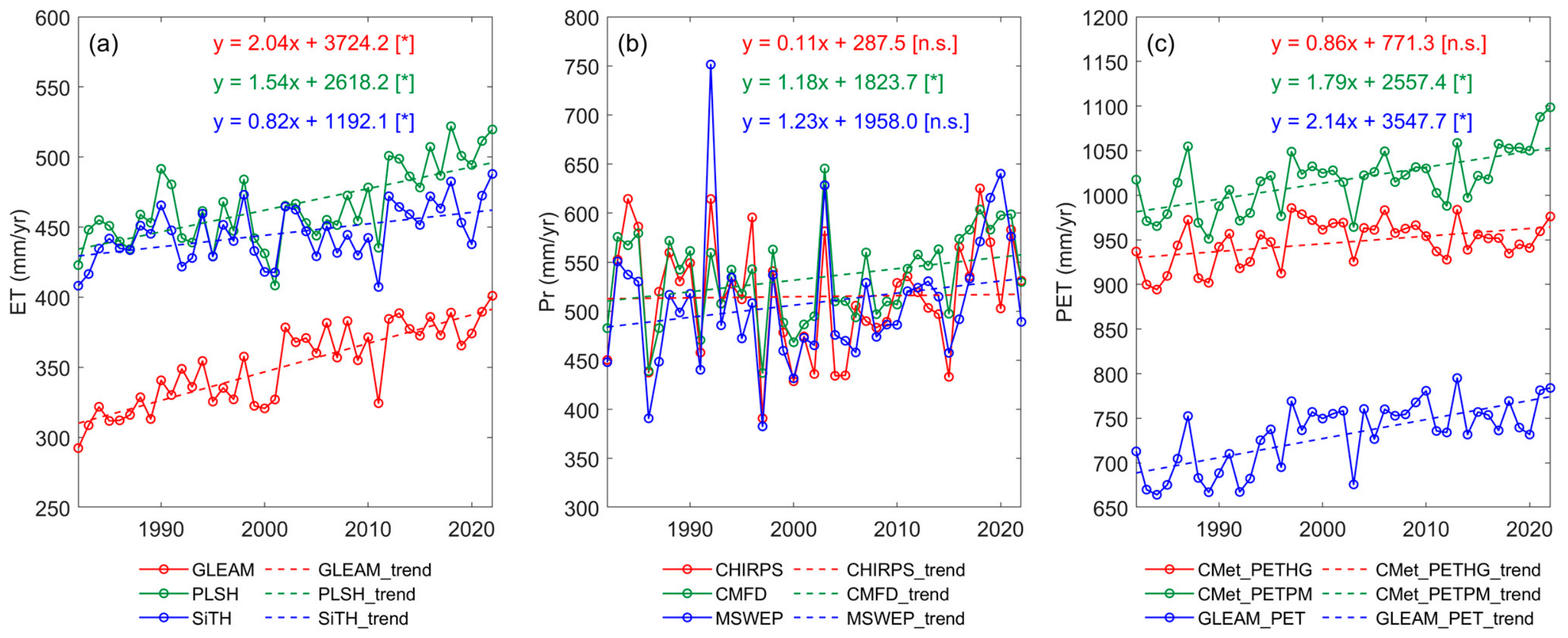
Figure 6 presents the interannual variability and long-term trends of ET, Pr, and PET derived from multiple datasets over the YRB from 1982 to 2022. In terms of ET (Figure 6a), all three ET datasets consistently show significant increasing trends (p < 0.05), but with different increasing rates. The ET increasing rate ranges from 0.82 to 2.04 mm/yr2, of which the largest comes from GLEAM, and the smallest comes from SiTH. Moreover, the general ET amounts of PLSH and SiTH are relatively close, and both are greater than that of GLEAM. As for Pr (Figure 6b), the three datasets generally demonstrate substantial interannual variability, but a relatively weak increasing trend. The increasing rates of Pr are 0.11, 1.18 and 1.23 mm/yr2 for CHIRPS, CMFD and MSWEP, respectively. However, only the CMFD presents a significant increasing trend at the 95% significance level. For PET (Figure 6c), CMet_PETHG and CMet_PETPM show relatively higher PET amounts than GLEAM_PET. Furthermore, like ET and Pr, all these three PET datasets exhibit increasing trends with different rates. Among them, GLEAM_PET shows the largest increasing rate (2.14 mm/yr2, p < 0.05), whereas CMet_PETHG shows the smallest increasing rate (0.86 mm/yr2) during the study period. Collectively, ET, Pr and PET generally display increasing trends with different rates and significance levels. This consistency in change trend may inadvertently obscure some signals and complicate the attribution of changes in ET over the YRB.

3.2.2. Spatial Distributions of Variations in ET, Pr and PET

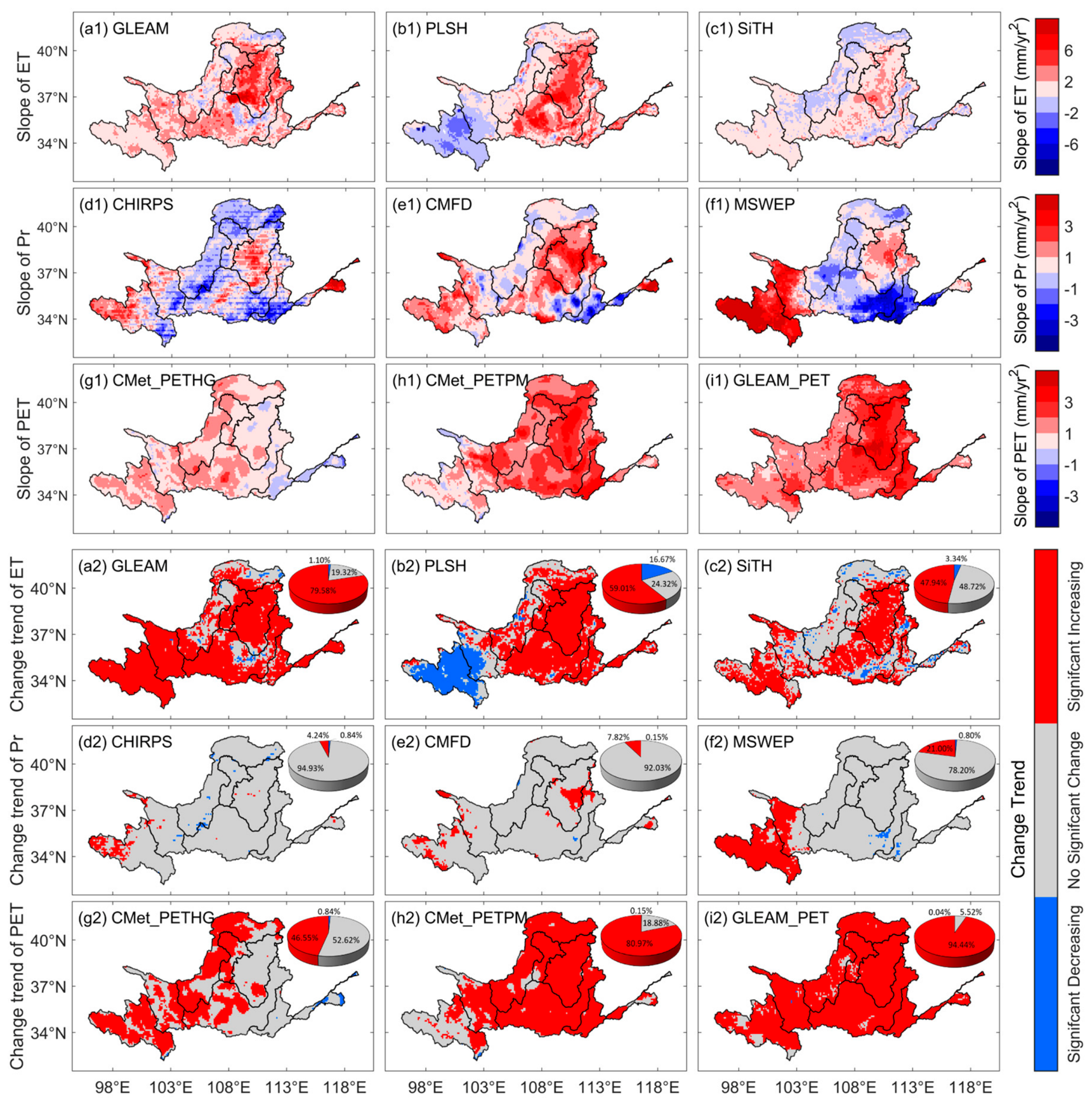
Figure 7 shows spatial patterns of change slopes in ET, Pr and PET and their significance in the YRB during 1982–2022. It can be observed that ET datasets consistently exhibit positive trends across most regions of the YRB, although magnitude and spatial coherence vary among datasets. Specifically, all three ET datasets indicate widespread ET increases, with the proportion of areas with a significant increasing trend reaching 79.58%, 59.01% and 47.94%, for GLEAM, PLSH, and SiTH, respectively. They are mainly located in the middle and lower reaches (e.g., North and South sub-basins), where the ET change slopes are greater than 6 mm/yr2. However, different from GLEAM and SiTH, PLSH shows a significant decreasing trend in the source region of the YRB (i.e., SR) with the area percentage of 16.67%, and the slopes of part regions are less than −2 mm/yr2. The slopes of spatial patterns of Pr change display stronger spatial heterogeneity. In general, the positive slope areas (i.e., Pr has an increasing trend but is not significant) are mainly distributed in the SR, North and LR. In contrast, the regions with a negative slope (i.e., Pr has a decreasing trend but is not significant) are located in the northern and southeastern YRB (e.g., NEUR and SEMR). Despite the highly heterogeneous increasing or decreasing slopes, most areas are not statistically significant with the proportion value ranging from 78.20% to 94.93%. In contrast to Pr, the slopes of PET show robust and spatially coherent positive values across nearly the entire YRB for all datasets, indicating increasing trends. The regions with a significant increasing trend account for 46.55%, 80.97% and 94.44% of the YRB for CMet_PETHG, CMet_PETPM and GLEAM_PET, respectively. Moreover, it should be noted that, although CMet_PETHG and CMet_PETPM come from the same dataset (i.e., ChinaMet), CMet_PETPM consistently shows closer spatial agreement with GLEAM_PET for both the slope and change trend of ET in spatial patterns, which may stem from the same estimation algorithm (i.e., the Penman–Monteith method).

3.3. Mutation Detection and Difference Analysis Between Two Periods

3.3.1. Mutation Year Test of ET, Pr and PET

In this study, we used four different statistical methods, including Pettitt test [56], Fisher optimal segmentation [57], Lee–Heghinan test [58], and Bai–Perron test methods [59], to detect the abrupt change years of ET, Pr, and PET variables, and the results are listed in Table 2. Generally, the abrupt change point analysis reveals a consistency across different methods and datasets, identifying the late 1990s to early 2000s as the critical transition period for hydroclimatic regimes in the YRB. In terms of ET, all three datasets (GLEAM, PLSH, SiTH) exhibit remarkable consistency across the Pettitt, Fisher, and Lee–Heghinan methods, uniformly indicating 2000 as the year of significant regime shift. The Bai–Perron method diverges somewhat, detecting later transitions that likely reflect its sensitivity to multiple structural breaks. Pr datasets also demonstrate comparable consistency, with the majority of methods identifying change points concentrated between 2000 and 2001 across CHIRPS, CMFD, and MSWEP. The Pettitt test uniformly detects mutations in 2000 for all Pr datasets, while the fewest deviations occur in the Fisher optimal segmentation and Lee–Heghinan methods for the CMFD (2001) and MSWEP (2001), suggesting that the transition in water supply inputs aligns temporally with the ET regime change. By comparison, the three PET datasets exhibit slightly diverse results and greater inter-product variability. ChinaMet_PETHG shows an earlier transition (1999) by Pettitt and Lee–Heghinan methods, and GLEAM_PET shows an even early shift (1997) under the Fisher optimal segmentation algorithm. In summary, 2000 can be considered the most robust change point across the majority of variable-method combinations.
To explore the ET variation and its drivers over the YRB, we divided the study period (1982–2022) into two sub-periods with the year of 2000 as the changing point based on the above detection results. Thus, 1982–2000 can be defined as the base period and 2001–2022 as the change period. Actually, previous studies on climate change point also reported that there was a significant shift in hydroclimate variables, such as temperature, precipitation, evapotranspiration, and streamflow, near the late 1990s/early 2000s in many regions over the world [60,61,62,63], and the similar period comparisons (e.g., pre- vs post-2000) were also applied in ET trend analyses [64]. These results demonstrated that the mutation of hydroclimate variables did exist. Consequently, this study conducted period segmentation and explored ET differences between the two sub-periods.

3.3.2. Difference in ET, Pr and PET Between the Base Period and Change Period

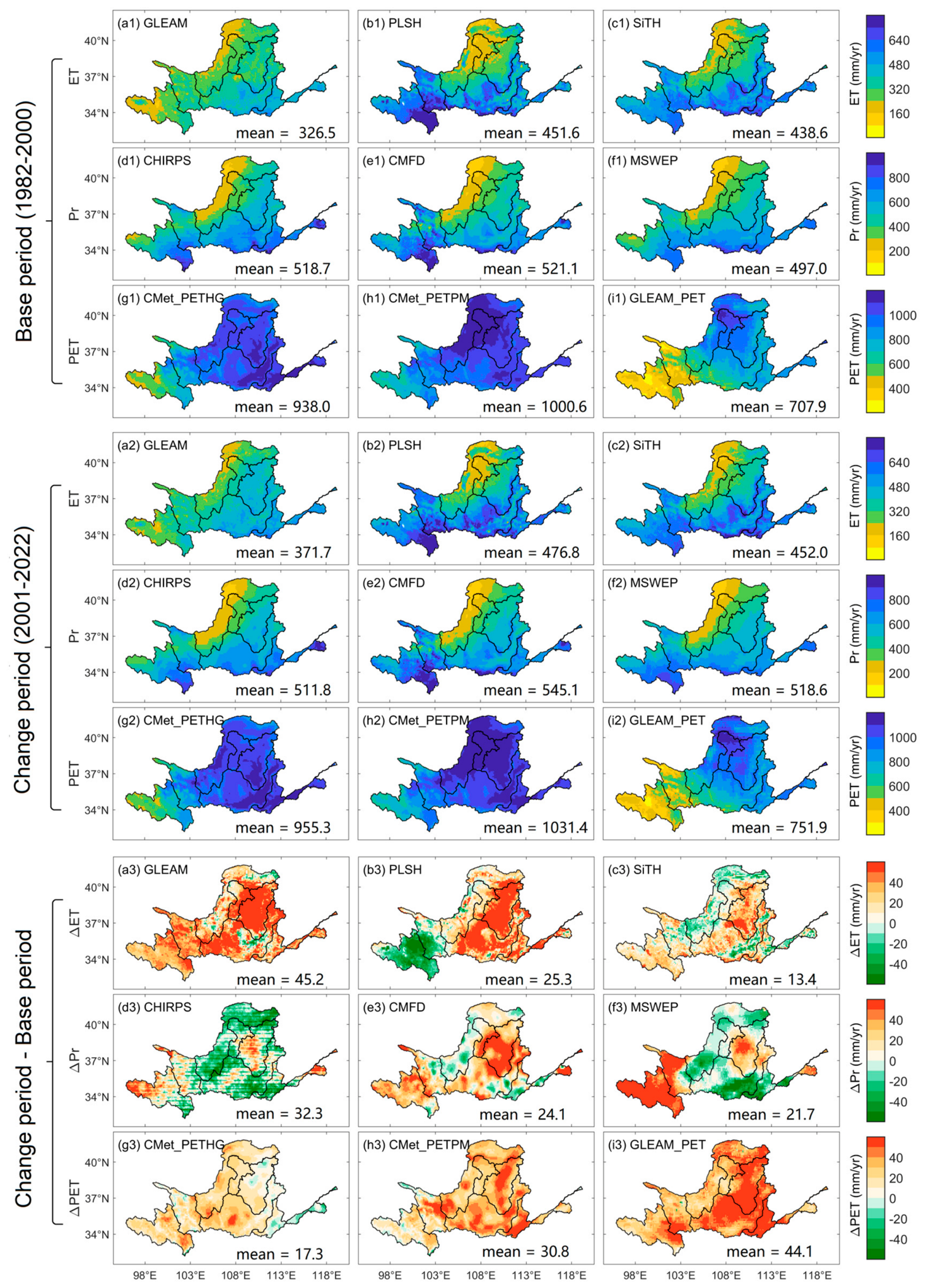
Figure 8 illustrates the spatial distributions of ET, Pr and PET in the YRB during the base period (1982–2000) and change period (2001–2022), as well as the differences between the two periods. As shown, during the base period, ET exhibits a clear southeast to northwest gradient across the YRB, with higher ET values concentrated in the middle and lower reaches, and lower values in the upper basin. These spatial patterns are consistently captured by all three ET datasets, although the absolute magnitudes differ slightly among datasets. Domain-averaged ET varies across datasets, ranging from 326.5 mm/yr (GLEAM) to 451.6 mm/yr (PLSH). By comparison, during the change period, ET increases across most of the basin while largely keeping its spatial patterns. Comparatively, domain-averaged ET values reach 371.7, 476.8, and 452.0 mm/yr, and the corresponding ET increases are 45.2, 25.3, and 13.4 mm/yr, for GLEAM, PLSH, and SiTH, respectively. Spatially, ET increases are widespread and pronounced in the middle and lower reaches of the YRB, whereas slightly negative changes are found in small portions of the source and northeast regions in the upper basin of the YRB. Pr shows a comparable spatial distribution to ET, with higher values in the southeast and lower values in the northwest, across both the base period and change period. However, the domain-averaged Pr values are relatively concentrated, spanning from 497.0 to 521.1 mm/yr for the base period, and 511.8 to 545.1 mm/yr for the change period. Nonetheless, the differences in Pr between the two periods show remarkable heterogeneity among the three datasets. For example, CHIRPS presents obvious Pr decreases in the northwestern YRB (e.g., NEUR), and the CMFD demonstrates Pr increases in the middle reaches (e.g., North), but MSWEP shows pronounced Pr increases in the source region of the YRB. As for PET, during both the base period and change period, the middle and lower reaches of the YRB show higher PET values than those in the upper reach in all three datasets. Quantitatively, compared with the base period, PET increases markedly and consistently across nearly the entire YRB in the change period, and the mean PET values rise by 17.3, 30.8, and 44.1 mm/yr for CMet_PETHG, CMet_PETPM, and GLEAM_PET, respectively.
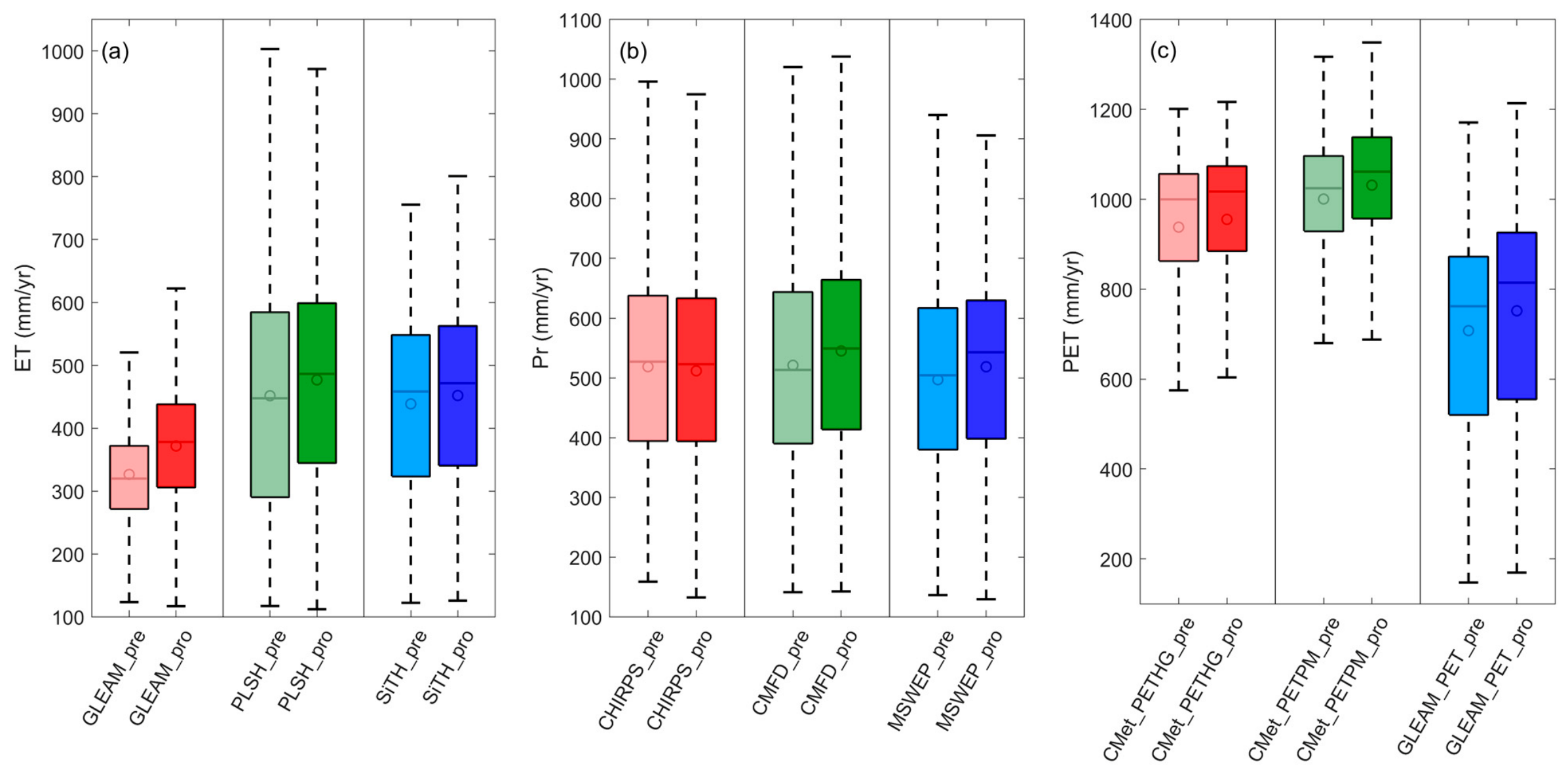
Figure 9 presents the boxplots of ET, Pr and PET during the base period (1982–2000) and change period (2001–2022) over the YRB. Across the three ET datasets, the median and mean values in the change period are consistently higher than those in the base period. Among them, PLSH shows the largest ET magnitude and a pronounced upward shift, while GLEAM exhibits comparatively lower values but a similarly apparent increase. The overall distribution suggests increasing ET during the change period, with slightly expanded upper whiskers in some datasets, implying more frequent high-ET-value years in the change period. For Pr, CHIRPS, CMFD, and MSWEP display a slight increase during the change period relative to the base period, indicating that a wetter atmospheric condition after 2000 is consistent across datasets. In terms of PET, the three datasets demonstrate a systematic increase in the change period, with medians and means shifting upward. In addition, there is a larger discrepancy and a wider interquartile range (IQR) existing among the PET datasets than that among the ET and Pr datasets. Essentially, the noticeable post-2000 intensification of the hydrological cycle over the YRB, characterized by visible increases in ET, Pr, and PET, suggests that both climate change and underlying characteristic change play a key role in driving ET variation during the change period.

3.4. Contribution of Climate Change and Underlying Characteristic Change to ET Variation

3.4.1. Transitions of Water–Energy States in the YRB

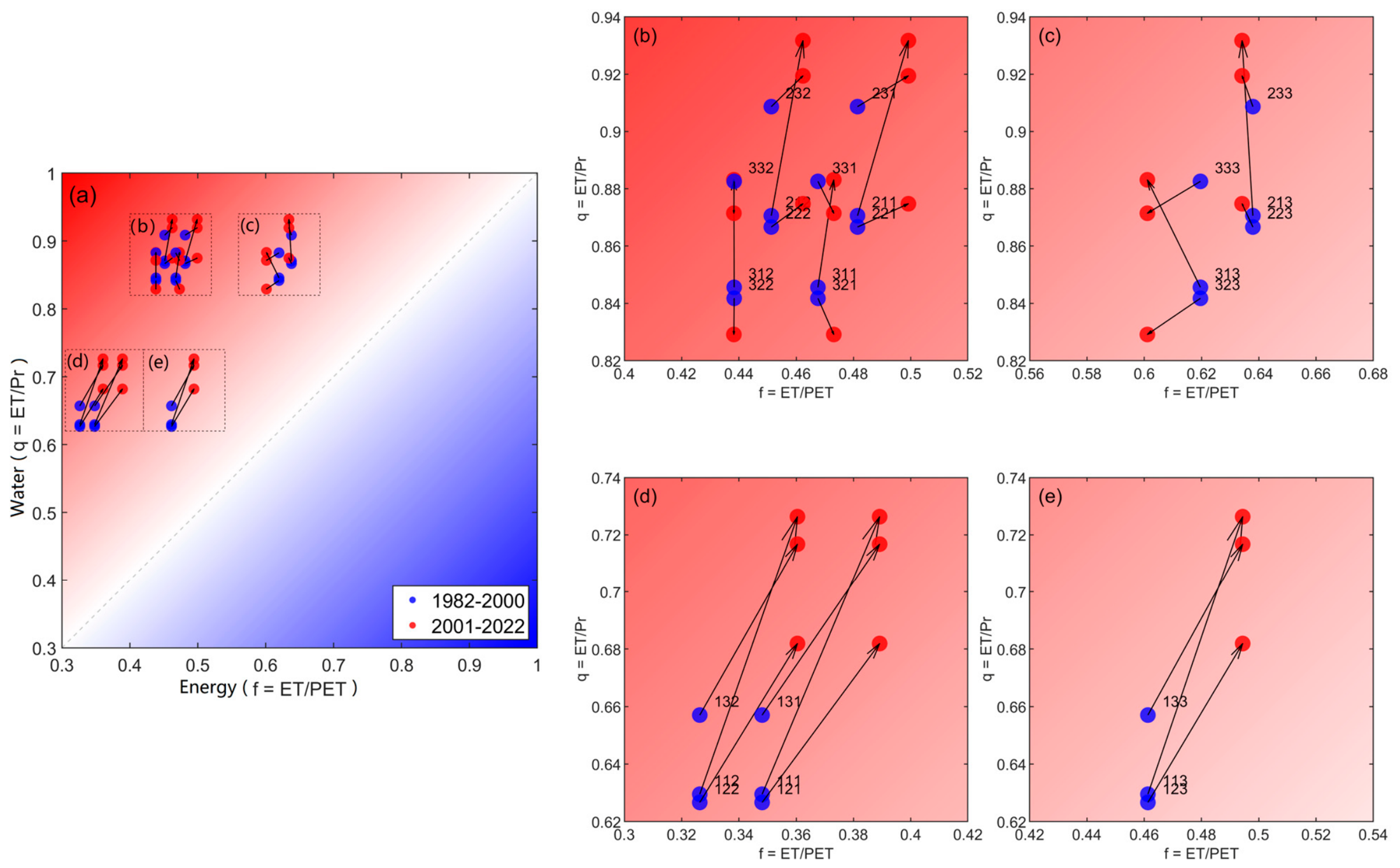
According to the data combination scheme designed in this study, there are 27 triplets in total, consisting of different ET, Pr and PET datasets. It should be noted that triplet IDs (e.g., 111, 121, 131) represent different combinations where the first digit denotes the ET dataset (1 = GLEAM, 2 = PLSH, 3 = SiTH), the second digit indicates the Pr dataset (1 = CHIRPS, 2 = CMFD, 3 = MSWEP), and the third digit represents the PET dataset (1 = CMet_PETHG, 2 = CMet_PETPM, 3 = GLEAM_PET). Then, we plotted the relationship of q (water) to f (energy) for the base period (1982–2000) and change period (2001–2022). By comparing the f - q space during two periods, we can distinguish the changes in water–energy partitioning over time associated with the changing directions. Figure 10 presents the changing directions (as marked with the black arrows) in the water–energy space between the two periods. Both q and f values in the lower-left corner suggest relatively low ET relative to Pr and PET. Conversely, the upper-right corner indicates that more water and energy are used for ET. Furthermore, the black arrow along the aridity line (shown in Figure 3) represents the ULCC-dominated effects on the changes in basin ET, while the direction of movement perpendicular to the aridity line indicates the CC-dominated impacts. It can also be observed that water and energy conditions (i.e., the q and f values) have experienced obvious changes for most triplets between the two periods in the YRB. Following the arrow directions, the impact of ULCC appears dominant for most triplets, as evidenced by the fact that most arrows align closely with the aridity lines. Over some of these triplets, such impacts can be seen to a great extent; for example, the points are accompanied by long arrow lines, such as triplet-112, triplet-122, triplet-111, triplet-121, triplet-132, triplet-131 (Figure 10d) and triplet-133, triplet-113 and triplet-123 (Figure 10e). However, there are also a few triplets showing arrow directions perpendicular to the aridity line (e.g., triplet-321, triplet-331, triplet-313, triplet-223 and triplet-233), suggesting that the CC-related impacts are dominant.

3.4.2. Attribution of ET Variation in the YRB

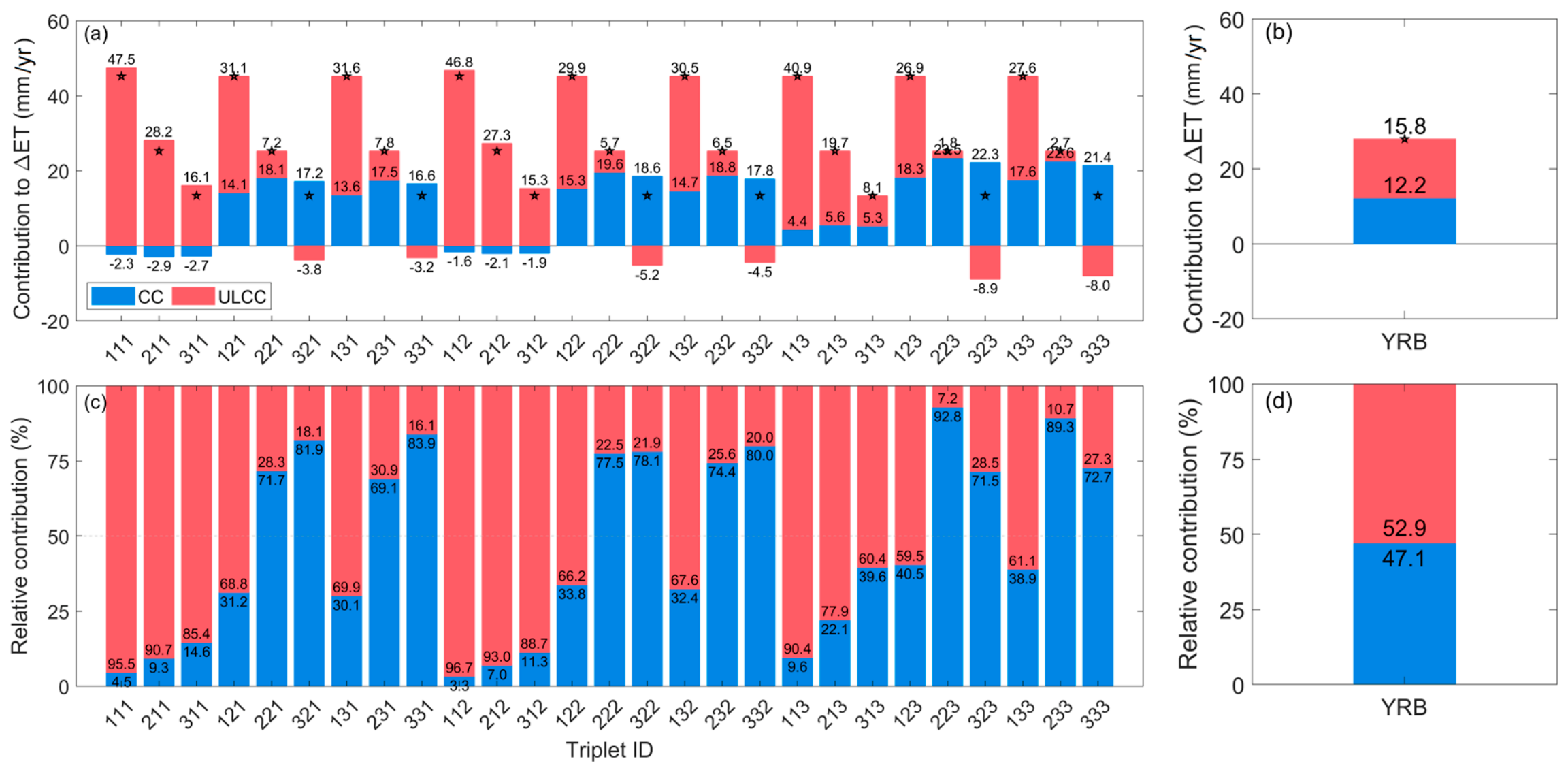
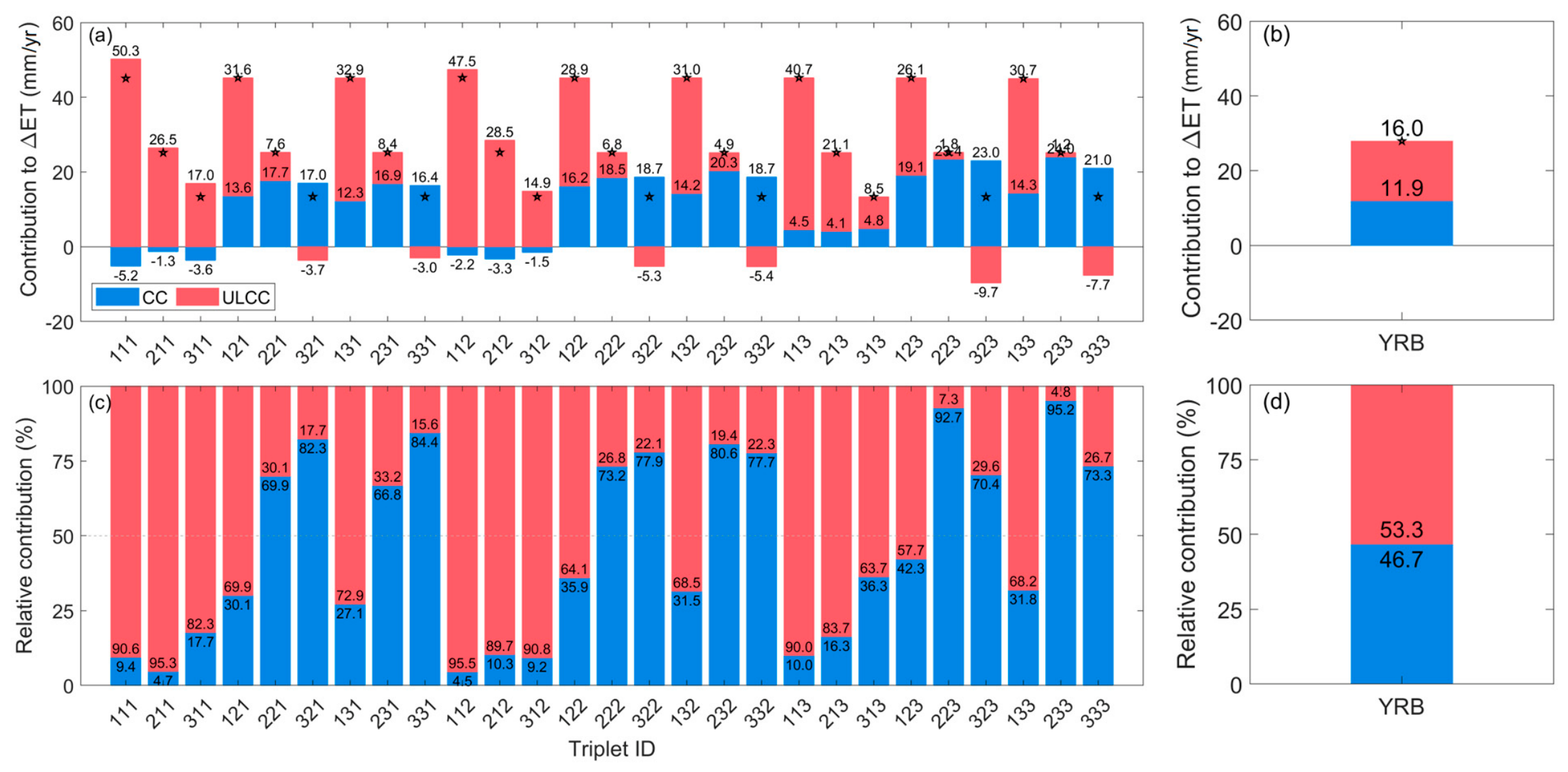
Figure 11 illustrates the absolute and relative contributions of CC and ULCC to ET variation separated using the WEP method across the 27 triplets. In general, both CC and ULCC have positive absolute contributions to the ET increases across most triplets, as shown by most positive bars in Figure 11a. The largest absolute contribution of ULCC comes from triplet 111 (47.5 mm/yr), while the largest contribution of CC is from triplet 223 (23.5 mm/yr). In comparison, the contribution of ULCC to ET variation is slightly greater than that of CC, with averaged values of 15.8 and 12.2 mm/yr, respectively. This result suggests that ULCC plays a moderately more dominant role than CC in driving ET increases across multi-source dataset combinations. As for the relative contribution, 12 of the 27 triplets (44.4%) show that CC contributes more to ET variation than ULCC, with contribution percentage values ranging from 3.3% to 92.8%. In contrast, 15 of the 27 triplets (55.6%) show that ULCC contributes more to ET variation than CC, with relative contribution values ranging from 7.2% to 96.7%. On the whole, the averaged relative contributions are 47.1% and 52.9% for CC and ULCC (Figure 11d), respectively.

3.4.3. Transitions of Water–Energy States over Sub-Basins in the YRB

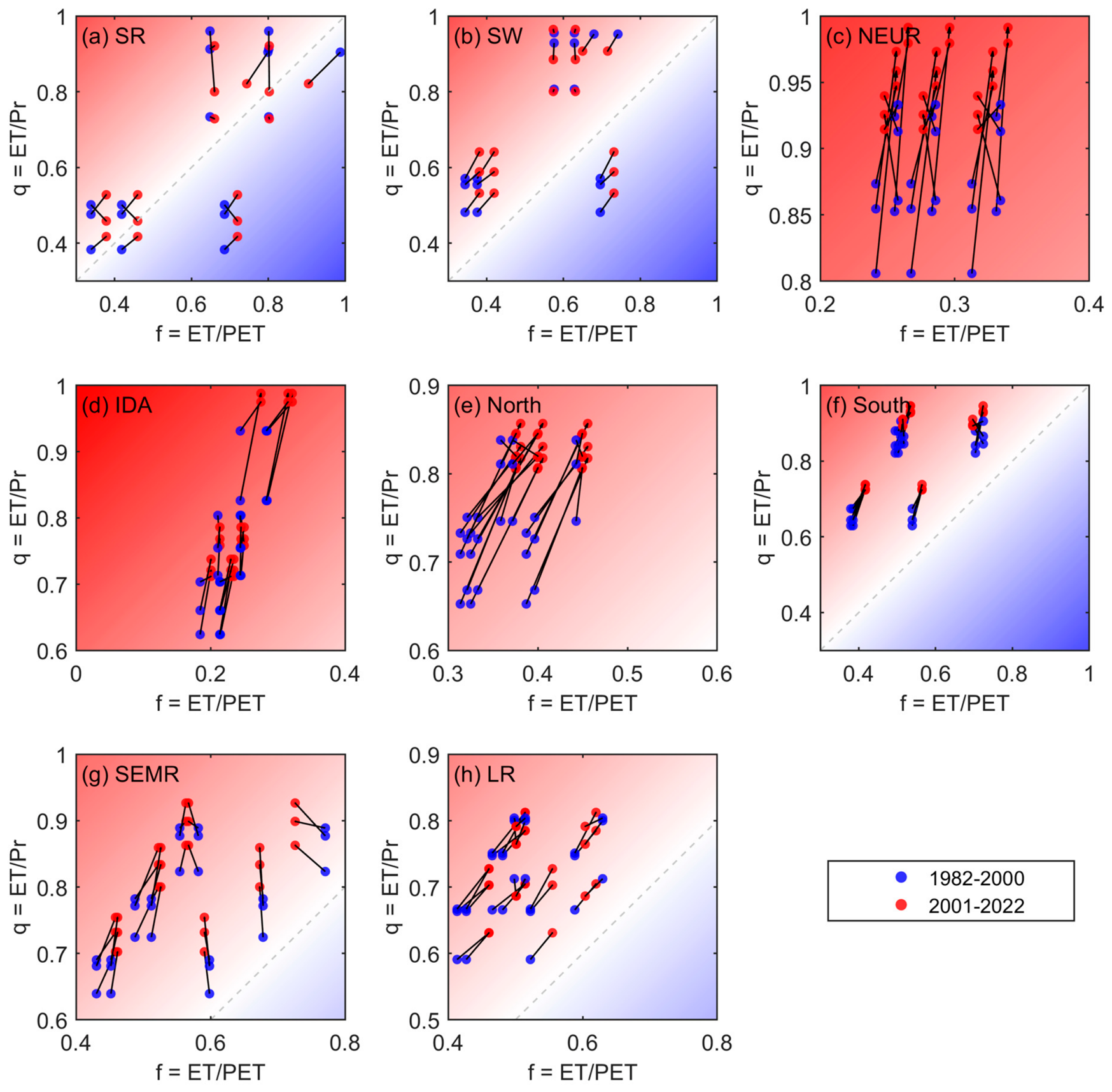
Figure 12 depicts the changing direction in the water–energy space over eight sub-basins in the YRB from the base period to the change period. Generally, most sub-basins present predominantly upper-right pointing arrows, which suggests that there is more water and energy used for ET during the change period relative to the base period. However, there are still many differences between sub-basins. For instance, clear and consistent shifting movements can be found in NEUR, IDA, North and LR (Figure 12c–e,h), whereas divergent shifting movements can be observed in SR, South, and SEMR (Figure 12a,f,g). It is noteworthy that transitions in water–energy space cross the divide between the water- and energy-limited boundary (1:1 line) in SR and SW, indicating that both water and energy evenly constrain ET and neither factor dominates. In other words, ET in these regions demonstrates comparable sensitivity to CC and ULCC. Additionally, the water–energy states in five sub-basins, namely SR, SW, South, SEMR, and LR, are closer to the boundary than the other three sub-basins (1:1 line), which may be related to their lower latitude and relatively humid conditions.

3.4.4. Attribution of ET Variation over Sub-Basins in the YRB

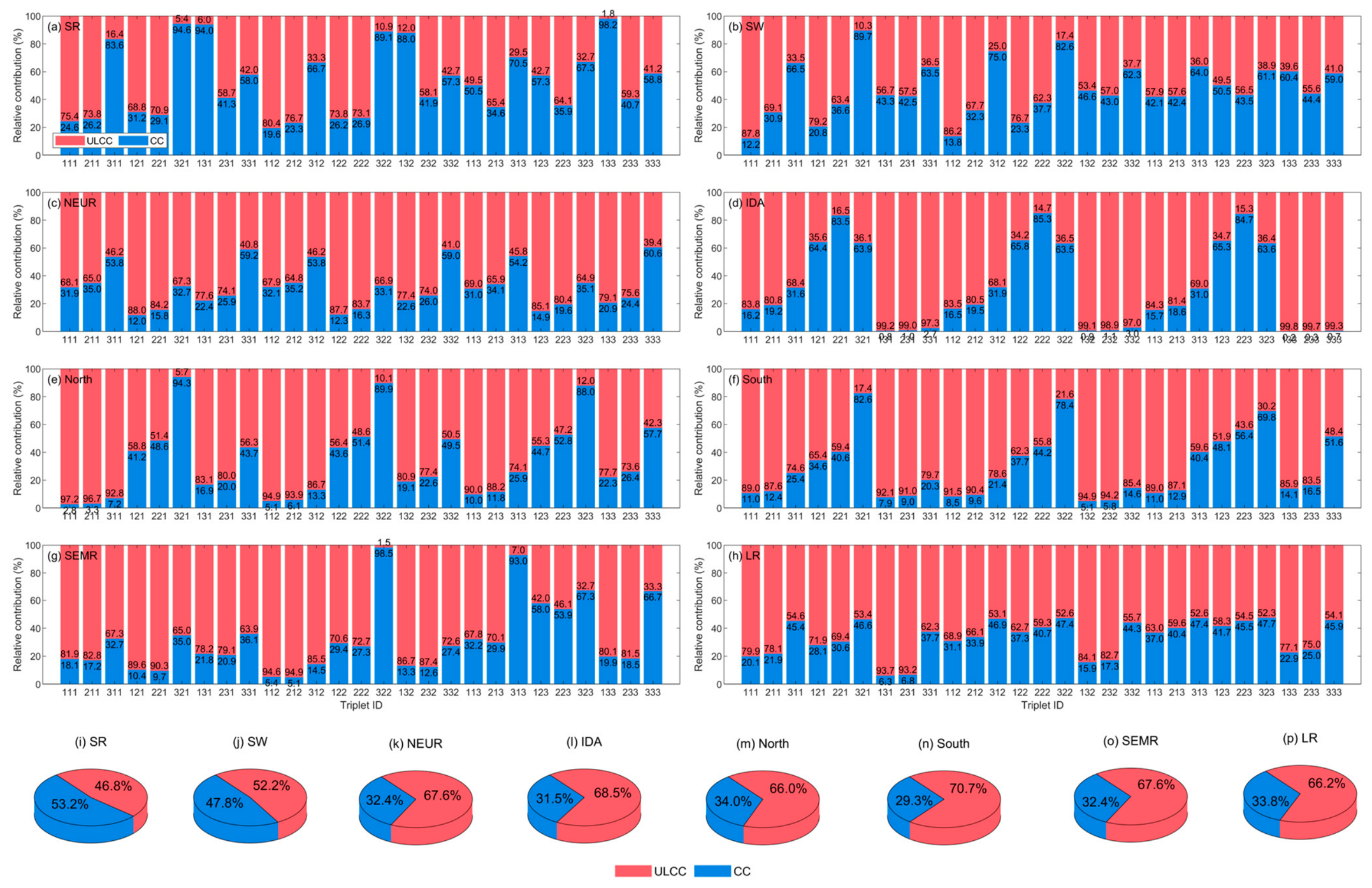
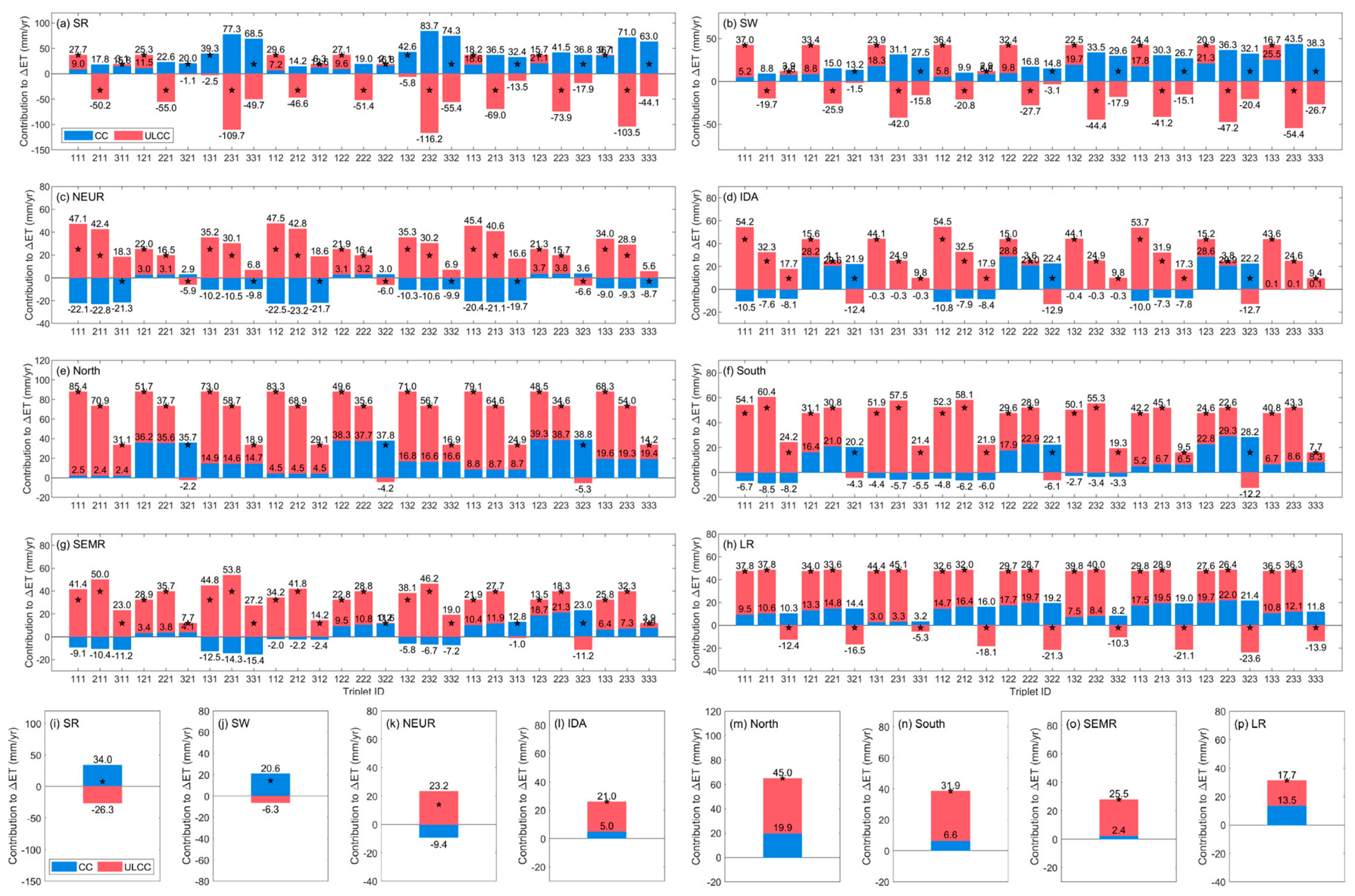
Figure 13 presents the contributions of CC and ULCC to ET variation across eight sub-basins in the YRB using the WEP method based on 27 dataset triplets. Overall, the results reveal obvious discrepancies. For most sub-basins, ULCC has a positive effect on ET variation, with the largest positive contribution value of 85.4 mm/yr (from triplet 111 in the North). In comparison, CC has a variable effect on ET variation. For instance, the contributions of CC are primarily positive in SR, SW, North, and LR, but they are basically negative in NEUR. The largest positive contribution of CC comes from triplet-232 in SR, with the value of 83.7 mm/yr, whereas the smallest negative contribution stems from triplet-212 in NEUR, with the value of −23.2 mm/yr. According to the spatial patterns of change slope of ET shown in Figure 7, there are significant increasing trends in ET existing in the North and South for all three ET datasets. Here, these ET increases can be attributed to ULCC and CC, and both of them mostly have positive contributions. Furthermore, in the source region of the YRB (i.e., SR and SW), since PLSH exhibits a significant decreasing trend in ET (Figure 7), approximately one-third of triplets have negative Δ ET. This reduction is predominantly driven by ULCC. Although CC contributes positively, its effect does not compensate the ET reduction induced by ULCC (Figure 13). From the perspective of the averaged contribution of all 27 triplets, CC makes a positive averaged absolute contribution to ET variation in all sub-basins, except for NEUR, with values ranging from −9.4 mm/yr (from NEUR) to 34.0 mm/yr (from SR). By comparison, ULCC makes a positive averaged contribution to ET variation over most sub-basins, except for SR and SW, with contribution values spanning from −26.3 mm/yr (from SR) to 45 mm/yr (from North).
We also calculated the relative contributions of CC and ULCC to avoid the influence of ET change magnitudes, which may differ across datasets (e.g., GLEAM, PLSH and SiTH), and the results are provided in Figure 14. In general, the relative contributions of CC and ULCC vary spatially across dataset triplets. For instance, the greatest contribution of CC can reach 98.5% (triplet 322 in SEMR), but the smallest is only 0.2% (triplet 133 in IDA). Correspondingly, the greatest and smallest contributions of ULCC are 99.8% and 1.5%, respectively. Nevertheless, in total, the contribution of ULCC surpasses that of CC in seven of the eight sub-basins, except for SR. Furthermore, ULCC contributes approximately two-thirds to the ET increase in NEUR (67.6%), IDA (68.5%), North (66.0%), SEMR (67.6%), and LR (66.2%), and the most significant dominance occurs in the South (70.7%). By contrast, CC basically contributes about one-third to the ET change. Notably, SR is the only basin where CC contribution (53.2%) slightly exceeds ULCC contribution (46.8%). Also, the smallest discrepancy in the two contributions comes from the SW, which exhibits nearly equal contributions (47.8% for CC and 52.2% for ULCC), indicating a near-balanced influence on ET variation between CC and ULCC.

4. Discussion

4.1. Uncertainty Analysis of the Contributions of CC and ULCC to ET Variation

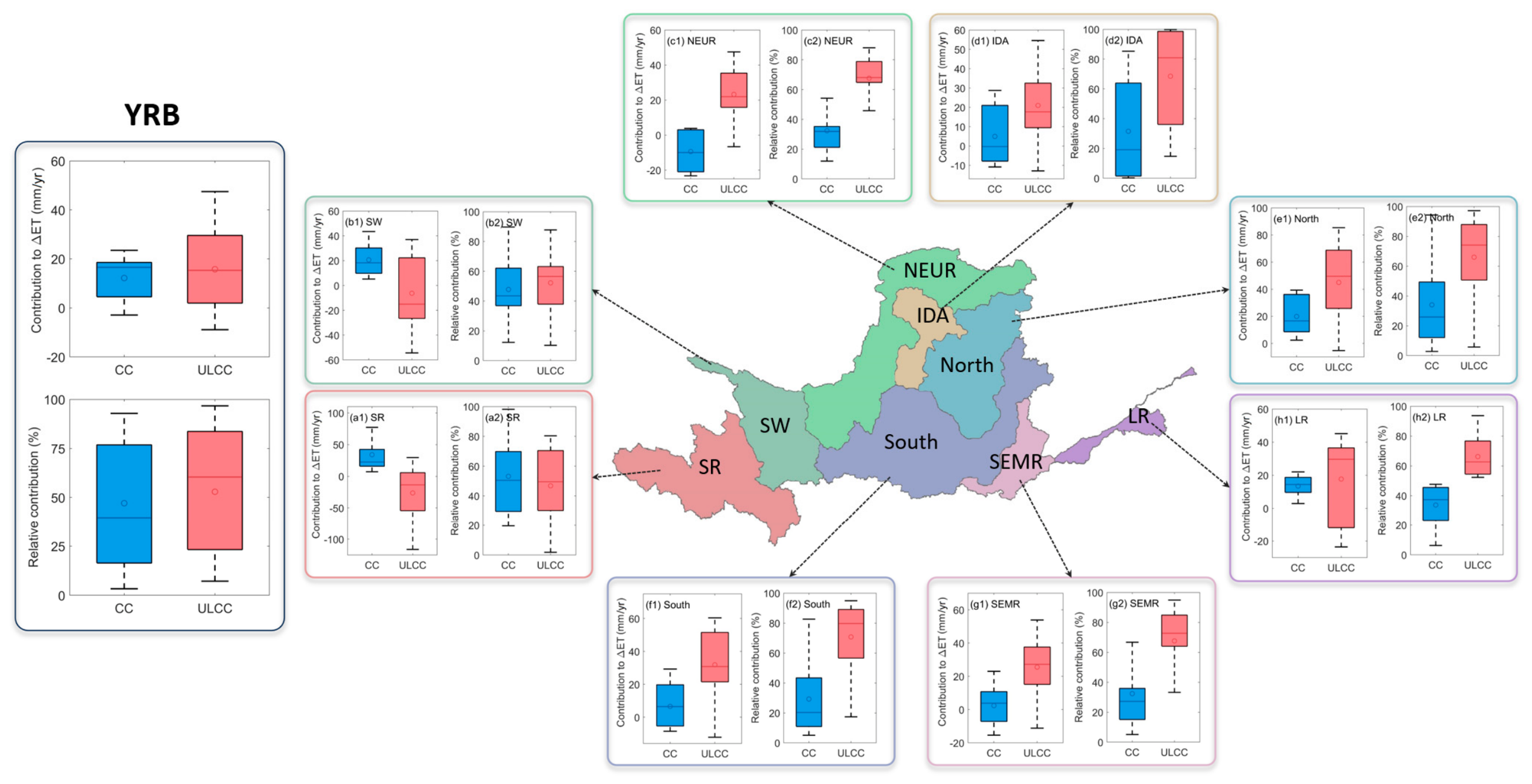
In this study, we designed an experiment to separate the contributions of CC and ULCC to ET variation based on multi-source datasets including 27 triplet combinations. To investigate the uncertainties of different contributions, we illustrated the boxplots of the absolute and relative contributions (Figure 15). For the YRB as a whole, both ULCC and CC contributed to the increases in ET, and ULCC presents slightly higher averaged absolute contribution and relative contribution values (15.8 mm/yr and 52.9%) than those of CC (12.2 mm/yr and 47.1%). However, the interquartile range (IQR) of ULCC (27.47 mm/yr) is wider than that of CC (13.92 mm/yr), indicating higher variability and uncertainty in estimating ULCC-related effects on ET variation. Indeed, ULCC tends to exhibit larger spread across datasets and model choices than CC-related components, because heterogeneous land-use trajectories, urbanization, agriculture irrigation, and water conservancy project construction are difficult to constrain, and these influences interact with each other, further complicating the sensitivity of ET to ULCC [65,66,67]. Comparatively, due to the complementarity of relative contributions between CC and ULCC, there is basically no difference in IQR between the two. For sub-basins in the upper reaches of the YRB (e.g., SR and SW), CC exhibits both larger contributions and a narrower IQR than ULCC, which suggests that CC plays a dominant and robust role in controlling ET variability. Similar dominance of climate controls with comparatively tight uncertainty ranges had been reported for the Yellow River headwaters and adjacent high-elevation regions [8,68]. In fact, the source region of the YRB, located in the Qinghai–Tibet Plateau, has experienced relatively limited anthropogenic land surface modification due to its high elevation, harsh climate, and restricted accessibility [66]. Hence, vegetation dynamics in these regions primarily tracked natural climate variability rather than human-induced land cover change. In contrast, the middle and lower reaches, particularly in the Loess Plateau, underwent unprecedented terrestrial transformation through the afforestation campaign (e.g., “Grain-for-Green” program) and reservoir construction (e.g., Xiaolangdi and Sanmenxia). These human interventions are able to simultaneously introduce substantial complexity and uncertainty into ULCC contribution [69,70,71]. Apart from them, in the other six sub-basins, ULCC shows the predominant role with greater contributions, even though wide IRQs are observed in some sub-basins. Especially, the largest difference in uncertainties can be found in LR, where the IQR of ULCC reaches 48.34 mm/yr, but it is only 8.99 mm/yr for CC. In addition, while relative contributions of CC and ULCC exhibit similar IQRs in any given sub-basin, substantial differences can also be found across different sub-basins, which implies that the regional hydroclimatic regimes may modulate attribution uncertainty more strongly than the local dataset selection.

4.2. The Dominant Driver of ET Increases over the YRB

Serving a critical role in linking the hydrological cycle and energy balance, ET is influenced by multiple and diverse factors. In general, they can be classified into two categories, namely climate change and underlying characteristic change [72,73]. CC-related factors usually include precipitation, air temperature, solar radiation, vapor pressure deficit, and wind speed [74,75], while ULCC-related factors mainly include vegetation greening (e.g., leaf area index (LAI), normalized difference vegetation index (NDVI), and Enhanced Vegetation Index (EVI)), land cover type, fraction of photosynthetically active radiation (FPAR), soil moisture, and human activities. In this study, all three ET datasets consistently show a significant increasing trend over the YRB, which is in line with the previous findings [9,76,77,78]. Moreover, most sub-basins show that ULCC contributes more than CC, which is also in agreement with previous studies in the YRB. Wang et al. [9] revealed that LAI was the dominant driver with a 51.16% relative contribution to ET increase in the YRB and 90% of the domain area showed ET increase due to LAI, which was comparable to the contribution percentage of ULCC in this study. Additionally, Liu et al. [76] found that LAI increase predominantly led to ET and transpiration increases in the middle reaches of the YRB; thus, underlying surface changes contributed 168.3% to ET increase.
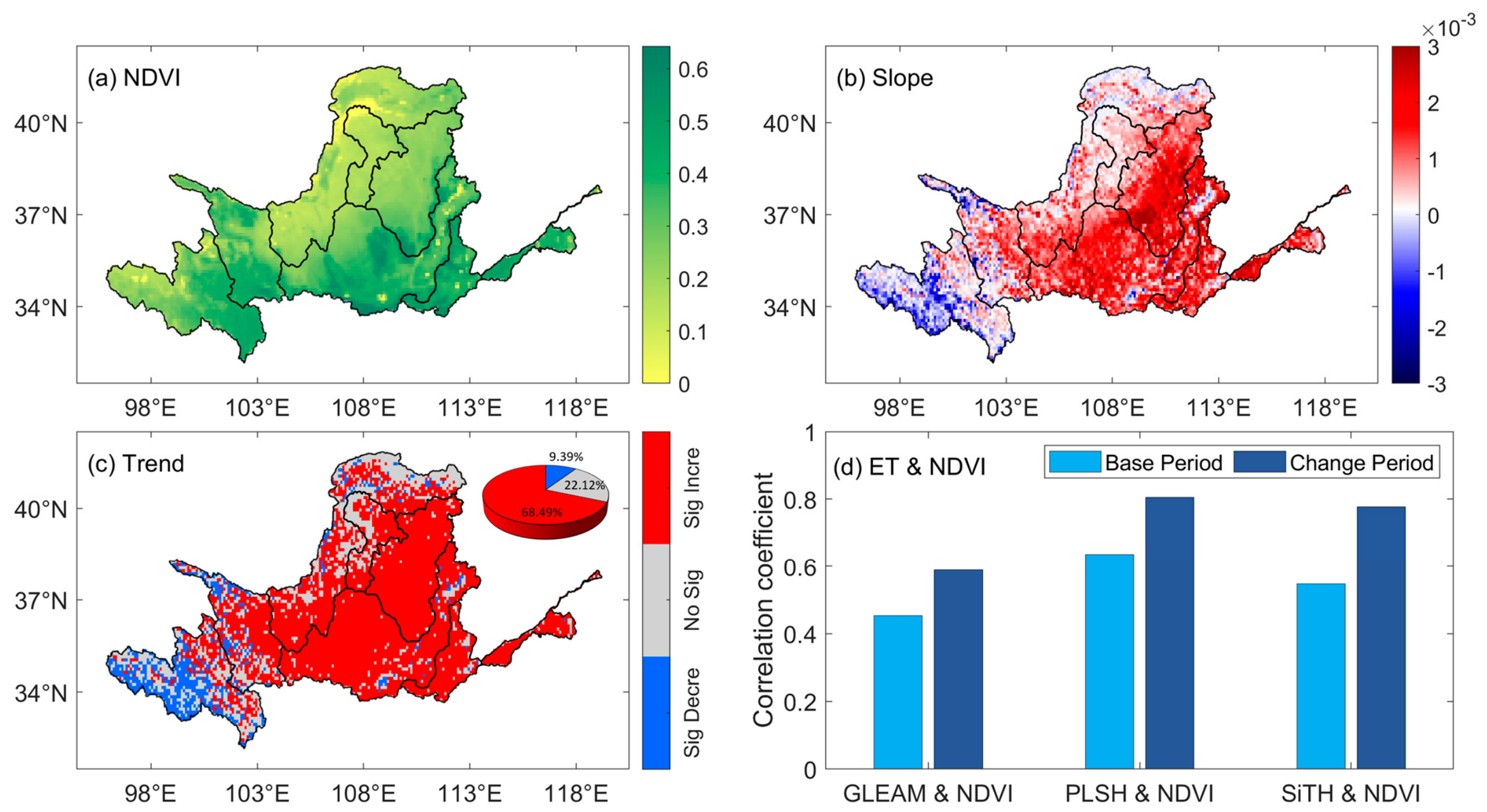
Actually, vegetation greening plays a paramount role in affecting ET increases in the YRB. It is worth noting that the Loess Plateau region is one of the main areas where ecological restoration projects were implemented in China [79,80]. In order to address the increasingly severe soil erosion on the Loess Plateau, China has carried various projects since the 1990s, such as “Grain-for-Green”. During the period of 1999–2013, the vegetation coverage in the Loess Plateau region increased from 31.6% to 59.6% due to the implementation of the reforestation project [80]. In this study, we investigated the spatial distributions of GIMMS NDVI and its change trend, as shown in Figure 16. It can be found that NDVI exhibits a pronounced southeast-to-northwest gradient, with the highest vegetation coverage (NDVI > 0.5) concentrated in the middle and lower reaches of the YRB, and progressively sparser vegetation toward the semi-arid northwest. In addition, most of the area of the YRB exhibits positive NDVI slopes, with the most pronounced greening (slopes > 2 × 10⁻³/yr2) occurring in the middle and lower reaches of the YRB, except for the source region of the YRB. This spatial concentration of vegetation recovery coincides with the core implementation areas of the “Grain-for-Green” program initiated in 1999 [80]. The change trend significance distribution (Figure 16c) confirms that 68.49% of the basin presents statistically significant increasing NDVI, with fewer areas of significant decreasing trend (9.39%), indicating robust and spatially coherent vegetation greening. Beyond that, by calculating the temporal evolution of ET-NDVI relationships, we further verified the contribution of ULCC (here mainly referring to vegetation greening) to the increase in ET (Figure 16d). During the base period (1982–2000), correlation coefficients between ET and NDVI were moderate (0.45–0.63). However, these correlation coefficients strengthened substantially across all ET products, reaching 0.59–0.81; during the change period (2001–2022). Therefore, it can be deduced that afforestation is certainly able to strengthen the ecological service functions of a regional ecosystem, including carbon sequestration and soil water conservation, but it can also weaken the water supply capacity because of the water extraction of the plant root system [81], resulting in an increase in ET (i.e., the soil water loss).

4.3. Validation, Strengths and Limitations of the WEP Method

In order to validate the effectiveness of the WEP method and its essential orthogonality assumption, we also used the widely recognized, physically based Budyko-Fu framework to derive the contributions of CC and ULCC based on the 27 dataset triplets. It can be considered as an independent analysis to cross-verify the attribution results obtained based on the WEP method. The results are provided in Figure 17. As for absolute contributions, the Budyko-Fu method estimates the averaged absolute contribution values of 16.0 and 11.9 mm/yr for ULCC and CC, respectively, which are very similar to the results of the WEP method (15.8 mm/yr for ULCC and 12.2 mm/yr for CC). Additionally, the relative contribution values calculated by Budyko-Fu (53.3% for ULCC and 46.7% for CC) also align closely with the WEP results (52.9% for ULCC and 47.1% for CC), indicating that both methods consistently identify ULCC as the slight dominant driver across the multi-source dataset combinations. In fact, the essential strength of the WEP method lies in its simplified geometric approach, which assumes that CC and ULCC are independent and orthogonal. The high degree of consistency between the geometric WEP results and the nonlinear Budyko-Fu analytical solutions suggests that the orthogonality assumption holds true for the YRB. These independent results demonstrate that the WEP framework can be taken as a reliable and efficient alternative to more complex hydrological models or Budyko-based decompositions.
The WEP method, of course, has its own distinct strengths, but it also inevitably comes with some limitations. As for the strengths, first, unlike the multiple regression analysis or partial correlation analysis [82,83], which are easy to employ but lack physical mechanisms [84,85], the WEP method provides an explicit graphical framework in the water–energy ( q f ) space (where q = E T / P r and f = A E T / P E T ) to visually distinguish CC-induced and ULCC-induced changes in ET. In addition, the orthogonal decomposition makes it straightforward to interpret how watersheds transition between different hydroclimatic states. Second, compared to complex hydrological models, the WEP method offers a simple analytical solution based on analytical geometry principles without requiring model calibration or parameter estimation [27], which reduces computational burden and avoids uncertainties associated with model structure and parameterization [86]. Third, the WEP framework can effectively identify the absolute contributions of CC and ULCC to ET change, preserving information about the direction of change, which is particularly valuable for detecting the compensating effects between two factors. Therefore, all of these merits excel the traditional Budyko-based approaches [27]. In terms of limitations, first, the key assumption of the WEP method is that CC direction is perpendicular to the aridity index line, which essentially represents the nonlinear Budyko relationship with a linear approximation. This treatment may fail to capture the true nonlinear partitioning behavior, especially under extreme conditions. In addition, the orthogonal projection may generate an out-of-bounds intermediate virtual state point; therefore, this method is not recommended for certain basins approaching extreme water-limited ( E T / P 1 ) or energy-limited ( E T / P E T 1 ) conditions, and it may lead to unreliable attribution results [49,51]. Second, the WEP method divides all drivers affecting ET into two parts, namely CC and ULCC, and calculates their individual contributions separately. This treatment constrains the diversity of driving factor categorization compared to methods such as multiple linear regression analysis and partial correlation analysis. Additionally, with the advancement of artificial intelligence (AI) technology, some explainable AI algorithms (XAI), such as the Kolmogorov–Arnold Network (KAN), SHAP (SHapley Additive exPlanations), and LIME (Local Interpretable Model-agnostic Explanations), have emerged recently and may precisely quantify the contribution of each driving factor to ET. Therefore, the combination of the physical mechanism-based approach and the XAI-based multi-factor analysis method may be able to provide more effective resolutions for this issue in the future. Third, in order to ensure an adequate sample size to use the WEP method, we adopted a single fixed breakpoint for the entire basin, which may introduce systematic biases in the estimated contributions of CC and ULCC to a certain extent. Hence, future studies could explore moving-window or locally adaptive breakpoint approaches to achieve more refined mutation and attribution results.

4.4. Challenges and Future Directions of Attribution Analysis of ET Variation

Although significant progress in ET attribution has been made in recent decades, some challenges regarding the robustness and reliability of ET attribution results still exist. First, the attribution of ET variation remains fundamentally challenging due to the intrinsic complexity of multiple sub-processes of ET and their interactions with each other [3,87]. Current attribution frameworks, including Budyko-based approaches and water–energy partitioning methods, inevitably oversimplify these complex processes into lumped parameters. For instance, the underlying characteristics encapsulate vegetation dynamics, soil properties, topography, and anthropogenic disturbances as a single integrated variable [88,89]. While this simplification enables practical application, it masks the differential responses of individual processes. Future attribution efforts should aim to partition ET into its component fluxes (e.g., transpiration, soil evaporation, and interception loss) using isotope techniques, eddy covariance partitioning, and remote sensing-based approaches, prior to conducting attribution analysis. Thus, this can enable a more mechanistic attribution of change drivers. Second, the diversity of influencing factors, combined with heterogeneous data availability across spatiotemporal scales, introduces substantial uncertainty into statistical attribution results. For example, for precipitation, the heterogeneity of spatial distribution, variety of estimation approaches, and uncertainty of the measurements may have substantial impacts on ET attrition [90,91,92]. Furthermore, different methods applied to the same catchment may yield divergent or even contradictory results. For example, Chang et al. [93] reported that soil moisture is the dominant driver of ET variation over the Tibetan Plateau, with the area proportion of 44.39%. However, Chen et al. [8] revealed that ET variation was primarily influenced by air temperature in the same region. Similar disagreements also occurred in the Yangtze River basin [15,94]. Additionally, the mismatch between process scales (e.g., instantaneous stomatal conductance but annual water balance) can also complicate the ET attribution analysis [95]. Therefore, multi-method ensemble ET attribution approaches, combing an analytic geometry method, sensitivity analysis, and hydrological simulation, may provide a superior alternative to address these challenges in the future. Third, despite great efforts on measurement networks, long-term ET observations over many basins remain limited, which makes it difficult to independently validate attribution results. Unlike runoff, which can be measured with relatively high accuracy at gauging stations, direct ET observation at the catchment scale is challenging [96,97]. Instead, it is typically derived as a residual of the water balance ( E T = P Q Δ S ) or estimated through remote sensing algorithms. However, this observational gap is even more problematic for anthropogenic influences such as reservoir evaporation, irrigation water consumption, and groundwater extraction, especially in the region with intense human activities [98,99]. The limitations of the independent observations have posed a series of challenges to the reliability of ET attribution to a certain extent. As a result, future research should prioritize multi-source data fusion approaches that assimilate diverse observational sources (e.g., in situ flux sites, gravimetric measurements, isotopic tracers, and remote sensing) to generate constrained observations for ET attribution validation. It will boost confidence in the reliability of ET attribution results, and facilitate practical application in water resource management.

4.5. Implications for Water Resources Management in the YRB

The ET attribution results of this study carry significant implications for sustainable water resource management in the YRB. Our findings indicate that underlying characteristic change, particularly vegetation greening, has emerged as the dominant driver of ET increases across most sub-basins. Although the predominant role of ULCC demonstrates the success of afforestation in enhancing ecosystem services, it also poses challenges to regional water security. Therefore, future restoration strategies should be spatially optimized. For instance, this may include prioritizing vegetation types with lower water demands in water-scarce regions (e.g., the middle reaches), while maintaining or increasing forest cover in areas with relatively abundant water resources [100]. In addition, the pronounced spatial heterogeneity in attribution results revealed by multi-source analysis necessitates region-specific management approaches (Figures S1–S4 in the supplementary materials). In the source region (SR), where CC dominates ET variability with relatively robust contributions across datasets, adaptation strategies should focus on climate-resilient water infrastructure and ecosystem-based adaptation measures that can accommodate warming-induced increases in evaporative demand. Conversely, for sub-basins where ULCC shows high uncertainty ranges, particularly the LR, management decisions should incorporate adaptive governance frameworks that can adjust to evolving understanding of human impacts [101]. Beyond that, it is necessary to enhance the monitoring network, including eddy covariance flux towers, gravimetric measurements, and isotope-based partitioning, because they would not only improve scientific attribution but also enable real-time water accounting systems. Finally, policy integration across sectors would also be helpful. The transboundary nature of the YRB, spanning nine provinces with competing water demands for agriculture, industry, urban supply, and ecosystem maintenance, requires coordinated governance [102]. Results that the effects of ULCC are both dominant and uncertain suggest that water allocation policies must be negotiated with explicit recognition of how upstream land management decisions affect downstream availability. Therefore, it is recommended to strengthen basin-scale water right frameworks that incorporate ET attribution insights, potentially including mechanisms for compensating upstream regions that implement water-efficient restoration practices in the future.

5. Conclusions

This study conducted a comprehensive attribution analysis of ET variation in the YRB using a simplified water–energy partitioning method based on multi-source datasets, including ET (GLEAM, PLSH and SiTH), Pr (CHIRPS, CMFD and MSWEP), and PET (CMet_PETHG, CMet_PETPM and GLEAM_PET). By integrating 27 triplet combinations of ET, Pr, and PET datasets during 1982–2022, we quantified the absolute and relative contributions of climate change and underlying characteristic change to ET variation across the entire YRB and its eight sub-basins. The major findings and implications are summarized as follows.
(1)
All three hydrological variables (ET, Pr, and PET) exhibit increasing trends over the YRB during 1982–2022, with pronounced spatial heterogeneity. The increasing rates are 0.82–2.04 mm/yr2 for ET, 0.11–1.23 mm/yr2 for Pr, and 0.86–2.14 mm/yr2 for PET, respectively, at varying significance levels. In addition, for ET, the proportions of area with significant increasing trend are from 47.9% to 79.58%. For PET, they range from 46.55% to 94.44%.
(2)
The hydrology cycle had experienced abrupt change in 2000, characterized by the concurrent mutation in the ET, Pr, and PET time-series. Compared with the base period (1982–2000), all three hydrological variables show higher values during the change period (2001–2022), and the increments of ET, Pr and PET are 13.4–45.2 mm/yr, 21.7–32.3 mm/yr, and 17.3–44.1 mm/yr for ET, Pr and PET, respectively, among various datasets.
(3)
There is a significant spatial divergence in the domain drivers of ET variation across the YRB. For the basin as a whole, most dataset triplets show comparable water–energy transforming directions, indicating that ULCC contributes more than CC to ET increases, and the averaged absolute contributions and relative contributions are 15.8 mm/yr and 52.9% for the former, and 12.2 mm/yr and 47.1% for the latter, respectively. For sub-basins, the similar predominant role of ULCC can be observed in many sub-basins, while the contrary results exist in the source region of the YRB (i.e., SR), where CC is a dominant driver of ET variation.
(4)
The uncertainty analysis reveals that the contribution of ULCC exhibits higher variability and greater uncertainty than CC across the 27 dataset triplets, with the IQR values of 27.47 mm/yr for ULCC and 13.92 mm/yr for CC over the YRB. Although the role of CC as a driver varies across sub-basins, it shows more robust contribution results than ULCC, especially in the source regions of the YRB (e.g., SR and SW).

Supplementary Materials

The following supporting information can be downloaded at: https://www.mdpi.com/article/10.3390/rs18091429/s1, Figure S1: The spatial patterns of contributions of climate change (CC) to the ET variation over the YRB using the water–energy partitioning (WEP) method based on the 27 triplets including different ET, Pr and PET datasets. Figure S2: Same as Figure S1, but for the contributions of underlying characteristic change (ULCC) to the ET variation. Figure S3: The spatial patterns of relative contributions of climate change (CC) to the ET variation over the YRB using water–energy partitioning (WEP) method based on 27 triplets including different ET, Pr and PET datasets. Figure S4: Same as Figure S3, but for the relative contributions of underlying characteristic change (ULCC) to ET variation.

Author Contributions

Conceptualization, D.W. and Y.H.; methodology, D.W. and Y.M.; software, D.W. and K.L.; validation, D.W., Y.M. and K.L.; formal analysis, D.W.; investigation, Y.H.; resources, Y.H. and K.L.; data curation, D.W. and S.L.; writing—original draft preparation, D.W. and Y.M.; writing—review and editing, D.W., Y.M., K.L. and X.M.; visualization, D.W., M.S. and Z.L.; supervision, Y.H.; project administration, D.W., Y.H., S.L. and X.M.; funding acquisition, D.W. and Y.H. All authors have read and agreed to the published version of the manuscript.

Funding

This study was financially supported by the National Natural Science Foundation Cultivation Project of the Nanyang Normal University (No. 2025PY009), the Nanyang Key Technology R&D Program (No. 25KJGG035), the Open Project of Laboratory of Nanyang Normal University (No. SYKF2025067), the High-Level Talent Introduction Research Project of the Nanyang Normal University (No. 2023ZX017), the Fundamental Research Funds for the Central Universities (No. B240201163), the Natural Science Foundation of Jiangsu Province (BK20230957), the National Natural Science Foundation of China (Grant No. 52579030), the Guangdong Natural Science Foundation (No. 2025A1515011666), the Henan Province’s Water Conservancy Science and Technology Research and Development (No. CG202453), and the Youth Project of Nanyang Normal University (2025QN009).

Data Availability Statement

The data presented in this study are available on request from the corresponding author for research purposes.

Acknowledgments

The authors especially acknowledge the authors of the datasets cited in the text, as well as the platforms and organizations for providing data support. Additionally, we gratefully thank the anonymous reviewers for their critical comments and constructive suggestions on the manuscript.

Conflicts of Interest

The authors declare no conflicts of interest.

References

  1. Zhu, Y.; Zheng, Z.; Zhao, G.; Zhu, J.; Zhao, B.; Sun, Y.; Gao, J.; Zhang, Y. Evapotranspiration increase is more sensitive to vegetation greening than to vegetation type conversion in arid and semi-arid regions of China. Glob. Planet. Change 2025, 244, 104634. [Google Scholar] [CrossRef]
  2. Zhou, S.; Yu, B. Neglecting land–atmosphere feedbacks overestimates climate-driven increases in evapotranspiration. Nat. Clim. Change 2025, 15, 1099–1106. [Google Scholar] [CrossRef]
  3. Wang, D.; Wang, D.; Liu, S.; Lin, Z.; Huang, Y.; Ma, X.; Wu, M.; Ma, Y.; Zhu, J.; Li, B.L. Multi-scale evaluation of six fused evapotranspiration products over mainland China: Accuracy, consistency and uncertainty. J. Hydrol. 2026, 664, 134371. [Google Scholar] [CrossRef]
  4. Yan, Y.; Liu, Z.; Chen, L.; Chen, X.; Lin, K.; Zeng, Z.; Lan, X.; Huang, L.; Wang, Y.; Yao, L.; et al. Earth greening and climate change reshaping the patterns of terrestrial water sinks and sources. Proc. Natl. Acad. Sci. USA 2025, 122, e2410881122. [Google Scholar] [CrossRef]
  5. Cai, Y.; Xu, Q.; Bai, F.; Cao, X.; Wei, Z.; Lu, X.; Wei, N.; Yuan, H.; Zhang, S.; Liu, S.; et al. Reconciling Global Terrestrial Evapotranspiration Estimates From Multi-Product Intercomparison and Evaluation. Water Resour. Res. 2024, 60, e2024WR037608. [Google Scholar] [CrossRef]
  6. Wang, Z.; Liu, Y.; Wang, Z.; Zhang, H.; Chen, X.; Wen, Z.; Lin, Z.; Han, P.; Xue, T. Quantifying the Spatiotemporal Changes in Evapotranspiration and Its Components Driven by Vegetation Greening and Climate Change in the Northern Foot of Yinshan Mountain. Remote Sens. 2024, 16, 357. [Google Scholar] [CrossRef]
  7. Cui, Z.; Zhang, Y.; Wang, A.; Wu, J. Forest evapotranspiration trends and their driving factors under climate change. J. Hydrol. 2024, 644, 132114. [Google Scholar] [CrossRef]
  8. Chen, X.; Yuan, L.; Ma, Y.; Chen, D.; Su, Z.; Cao, D. A doubled increasing trend of evapotranspiration on the Tibetan Plateau. Sci. Bull. 2024, 69, 1980–1990. [Google Scholar] [CrossRef]
  9. Wang, Z.; Cui, Z.; He, T.; Tang, Q.; Xiao, P.; Zhang, P.; Wang, L. Attributing the Evapotranspiration Trend in the Upper and Middle Reaches of Yellow River Basin Using Global Evapotranspiration Products. Remote Sens. 2021, 14, 175. [Google Scholar] [CrossRef]
  10. Zou, M.; Kang, S.; Niu, J.; Lu, H. Untangling the effects of future climate change and human activity on evapotranspiration in the Heihe agricultural region, Northwest China. J. Hydrol. 2020, 585, 124323. [Google Scholar] [CrossRef]
  11. Vahmani, P.; Jones, A.D.; Li, D. Will anthropogenic warming increase Evapotranspiration? Examining Irrigation Water Demand Implications of Climate Change in California. Earth’s Future 2021, 10, 2021EF002221. [Google Scholar] [CrossRef]
  12. Bejagam, V.; Sharma, A. Increasing Cumulative Impacts of Droughts Under Climate Change Does Not Alter the Ecosystem Resilience in India. Earth’s Future 2025, 13, e2024EF005888. [Google Scholar] [CrossRef]
  13. Du, Y.; Zhao, J.; Huang, Q. Quantitative driving analysis of climate on potential evapotranspiration in Loess Plateau incorporating synergistic effects. Ecol. Indic. 2022, 141, 109076. [Google Scholar] [CrossRef]
  14. Qiu, L.; Wu, Y.; Shi, Z.; Chen, Y.; Zhao, F. Quantifying the Responses of Evapotranspiration and Its Components to Vegetation Restoration and Climate Change on the Loess Plateau of China. Remote Sens. 2021, 13, 2358. [Google Scholar] [CrossRef]
  15. Li, X.; Zou, L.; Xia, J.; Dou, M.; Li, H.; Song, Z. Untangling the effects of climate change and land use/cover change on spatiotemporal variation of evapotranspiration over China. J. Hydrol. 2022, 612, 128189. [Google Scholar] [CrossRef]
  16. Wang, Y.; Zhao, W.; Wang, S.; Feng, X.; Liu, Y. Yellow River water rebalanced by human regulation. Sci. Rep. 2019, 9, 9707. [Google Scholar] [CrossRef]
  17. Wang, Y.; Zhu, G.; Huang, E.; Meng, G.; Liu, J.; Lu, S.; Qiu, D.; Chen, L.; Li, R.; Jiao, Y.; et al. Drought events are the primary cause of the decline in water storage in the Yellow River Basin. J. Hydrol. Reg. Stud. 2025, 62, 102876. [Google Scholar] [CrossRef]
  18. Sun, S.; Ma, A.; Liu, Y.; Mu, M.; Liu, Y.; Zhou, Y.; Li, J. Dissecting changes in evapotranspiration and its components across the Losses Plateau of China during 2001–2020. Int. J. Climatol. 2024, 44, 5207–5232. [Google Scholar] [CrossRef]
  19. Pu, J.; Zhao, X.; Huang, P.; Gu, Z.; Shi, X.; Chen, Y.; Shi, X.; Tao, J.; Xu, Y.; Xiang, A. Ecological risk changes and their relationship with exposed surface fraction in the karst region of southern China from 1990 to 2020. J. Environ. Manag. 2022, 323, 116206. [Google Scholar] [CrossRef]
  20. Ragettli, S.; Immerzeel, W.W.; Pellicciotti, F. Contrasting climate change impact on river flows from high-altitude catchments in the Himalayan and Andes Mountains. Proc. Natl. Acad. Sci. USA 2016, 113, 9222–9227. [Google Scholar] [CrossRef]
  21. Velázquez, J.A.; Schmid, J.; Ricard, S.; Muerth, M.J.; Gauvin St-Denis, B.; Minville, M.; Chaumont, D.; Caya, D.; Ludwig, R.; Turcotte, R. An ensemble approach to assess hydrological models’ contribution to uncertainties in the analysis of climate change impact on water resources. Hydrol. Earth Syst. Sci. 2013, 17, 565–578. [Google Scholar] [CrossRef]
  22. Hagemann, S.; Chen, C.; Clark, D.B.; Folwell, S.; Gosling, S.N.; Haddeland, I.; Hanasaki, N.; Heinke, J.; Ludwig, F.; Voss, F.; et al. Climate change impact on available water resources obtained using multiple global climate and hydrology models. Earth Syst. Dyn. 2013, 4, 129–144. [Google Scholar] [CrossRef]
  23. Gordon, B.L.; Crow, W.T.; Konings, A.G.; Dralle, D.N.; Harpold, A.A. Can We Use the Water Budget to Infer Upland Catchment Behavior? The Role of Data Set Error Estimation and Interbasin Groundwater Flow. Water Resour. Res. 2022, 58, 2021WR030966. [Google Scholar] [CrossRef]
  24. Cavalcante, R.B.L.; Pontes, P.R.M.; Souza-Filho, P.W.M.; de Souza, E.B. Opposite Effects of Climate and Land Use Changes on the Annual Water Balance in the Amazon Arc of Deforestation. Water Resour. Res. 2019, 55, 3092–3106. [Google Scholar] [CrossRef]
  25. Wang, D.; Hejazi, M. Quantifying the relative contribution of the climate and direct human impacts on mean annual streamflow in the contiguous United States. Water Resour. Res. 2011, 47, 2010WR010283. [Google Scholar] [CrossRef]
  26. Liu, Z.; Cheng, L.; Zhou, G.; Chen, X.; Lin, K.; Zhang, W.; Chen, X.; Zhou, P. Global Response of Evapotranspiration Ratio to Climate Conditions and Watershed Characteristics in a Changing Environment. J. Geophys. Res. Atmos. 2020, 125, e2020JD032371. [Google Scholar] [CrossRef]
  27. Liu, Z.; Miao, B.; Wang, X.; Chen, X.; Lin, K.; Jaramillo, F.; Cheng, L.; Yao, L. Compensating Effects Between Climate and Underlying Characteristics on Watershed Water Loss. J. Geophys. Res. Atmos. 2023, 128, e2022JD038353. [Google Scholar] [CrossRef]
  28. Xie, Z.; Yao, Y.; Tang, Q.; Liu, M.; Fisher, J.B.; Chen, J.; Zhang, X.; Jia, K.; Li, Y.; Shang, K.; et al. Evaluation of seven satellite-based and two reanalysis global terrestrial evapotranspiration products. J. Hydrol. 2024, 630, 130649. [Google Scholar] [CrossRef]
  29. Zeng, W.; Ding, X.; Sun, W.; Mu, X. Improvement of satellite-based rainfall product CHIRPS in estimating rainfall erosivity on the Loess Plateau. Land Degrad. Dev. 2023, 34, 4517–4528. [Google Scholar] [CrossRef]
  30. Munoz-Sabater, J.; Dutra, E.; Agusti-Panareda, A.; Albergel, C.; Arduini, G.; Balsamo, G.; Boussetta, S.; Choulga, M.; Harrigan, S.; Hersbach, H.; et al. ERA5-Land: A state-of-the-art global reanalysis dataset for land applications. Earth Syst. Sci. Data 2021, 13, 4349–4383. [Google Scholar] [CrossRef]
  31. Xu, Q.; Li, L.; Wei, Z.; Lu, X.; Wei, N.; Lee, X.; Dai, Y. A multimodal machine learning fused global 0.1° daily evapotranspiration dataset from 1950–2022. Agric. For. Meteorol. 2025, 372, 110645. [Google Scholar] [CrossRef]
  32. Shi, H.; Cai, X. Extrapolability improvement of machine learning-based evapotranspiration models via domain-adversarial neural networks. Environ. Model. Softw. 2025, 187, 106383. [Google Scholar] [CrossRef]
  33. Chen, H.; Yang, N.; Song, X.; Lu, C.; Lu, M.; Chen, T.; Deng, S. A novel agricultural drought index based on multi-source remote sensing data and interpretable machine learning. Agric. Water Manag. 2025, 308, 109303. [Google Scholar] [CrossRef]
  34. Li, X.; Zhang, W.; Vermeulen, A.; Dong, J.; Duan, Z. Triple collocation-based merging of multi-source gridded evapotranspiration data in the Nordic Region. Agric. For. Meteorol. 2023, 335, 109451. [Google Scholar] [CrossRef]
  35. Lyu, F.; Tang, G.; Behrangi, A.; Wang, T.; Tan, X.; Ma, Z.; Xiong, W. Precipitation Merging Based on the Triple Collocation Method Across Mainland China. IEEE Trans. Geosci. Remote Sens. 2021, 59, 3161–3176. [Google Scholar] [CrossRef]
  36. Wang, Y.; Wang, S.; Zhao, W.; Liu, Y. The increasing contribution of potential evapotranspiration to severe droughts in the Yellow River basin. J. Hydrol. 2022, 605, 127310. [Google Scholar] [CrossRef]
  37. Yang, Z.; Bai, P.; Li, Y. Quantifying the effect of vegetation greening on evapotranspiration and its components on the Loess Plateau. J. Hydrol. 2022, 613, 128446. [Google Scholar] [CrossRef]
  38. Miralles, D.G.; Bonte, O.; Koppa, A.; Baez-Villanueva, O.M.; Tronquo, E.; Zhong, F.; Beck, H.E.; Hulsman, P.; Dorigo, W.; Verhoest, N.E.C.; et al. GLEAM4: Global land evaporation and soil moisture dataset at 0.1 resolution from 1980 to near present. Sci. Data 2025, 12, 416. [Google Scholar] [CrossRef]
  39. Miralles, D.G.; Holmes, T.R.H.; De Jeu, R.A.M.; Gash, J.H.; Meesters, A.G.C.A.; Dolman, A.J. Global land-surface evaporation estimated from satellite-based observations. Hydrol. Earth Syst. Sci. 2011, 15, 453–469. [Google Scholar] [CrossRef]
  40. Zhang, K.; Kimball, J.S.; Nemani, R.R.; Running, S.W.; Hong, Y.; Gourley, J.J.; Yu, Z. Vegetation Greening and Climate Change Promote Multidecadal Rises of Global Land Evapotranspiration. Sci. Rep. 2015, 5, 15956. [Google Scholar] [CrossRef]
  41. Feng, J.; Zhang, K.; Chao, L.; Zhan, H.; Li, Y. P-LSHv2: A multi-decadal global daily evapotranspiration dataset enhanced with explicit soil moisture constraints. Earth Syst. Sci. Data 2025, 17, 5039–5064. [Google Scholar] [CrossRef]
  42. Zhang, K.; Chen, H.; Ma, N.; Shang, S.; Wang, Y.; Xu, Q.; Zhu, G. A global dataset of terrestrial evapotranspiration and soil moisture dynamics from 1982 to 2020. Sci. Data 2024, 11, 445. [Google Scholar] [CrossRef]
  43. Zhang, L.; Li, X.; Zheng, D.; Zhang, K.; Ma, Q.; Zhao, Y.; Ge, Y. Merging multiple satellite-based precipitation products and gauge observations using a novel double machine learning approach. J. Hydrol. 2021, 594, 125969. [Google Scholar] [CrossRef]
  44. Hu, Y.; Zhang, L. Added value of merging techniques in precipitation estimates relative to gauge-interpolation algorithms of varying complexity. J. Hydrol. 2024, 645, 132214. [Google Scholar] [CrossRef]
  45. Funk, C.; Peterson, P.; Landsfeld, M.; Pedreros, D.; Verdin, J.; Shukla, S.; Husak, G.; Rowland, J.; Harrison, L.; Hoell, A.; et al. The climate hazards infrared precipitation with stations--a new environmental record for monitoring extremes. Sci. Data 2015, 2, 150066. [Google Scholar] [CrossRef]
  46. He, J.; Yang, K.; Tang, W.; Lu, H.; Qin, J.; Chen, Y.; Li, X. The first high-resolution meteorological forcing dataset for land process studies over China. Sci. Data 2020, 7, 25. [Google Scholar] [CrossRef] [PubMed]
  47. Beck, H.E.; Wood, E.F.; Pan, M.; Fisher, C.K.; Miralles, D.G.; van Dijk, A.I.J.M.; McVicar, T.R.; Adler, R.F. MSWEP V2 Global 3-Hourly 0.1° Precipitation: Methodology and Quantitative Assessment. Bull. Am. Meteorol. Soc. 2019, 100, 473–500. [Google Scholar] [CrossRef]
  48. Ma, N.; Zhang, Y.; Szilagyi, J. Water-balance-based evapotranspiration for 56 large river basins: A benchmarking dataset for global terrestrial evapotranspiration modeling. J. Hydrol. 2024, 630, 130607. [Google Scholar] [CrossRef]
  49. Tomer, M.D.; Schilling, K.E. A simple approach to distinguish land-use and climate-change effects on watershed hydrology. J. Hydrol. 2009, 376, 24–33. [Google Scholar] [CrossRef]
  50. Renner, M.; Bernhofer, C. Applying simple water-energy balance frameworks to predict the climate sensitivity of streamflow over the continental United States. Hydrol. Earth Syst. Sci. 2012, 16, 2531–2546. [Google Scholar] [CrossRef]
  51. Renner, M.; Brust, K.; Schwärzel, K.; Volk, M.; Bernhofer, C. Separating the effects of changes in land cover and climate: A hydro-meteorological analysis of the past 60 yr in Saxony, Germany. Hydrol. Earth Syst. Sci. 2014, 18, 389–405. [Google Scholar] [CrossRef]
  52. Mann, H.B. Nonparametric tests against trend. Econometrica 1945, 13, 245–259. [Google Scholar] [CrossRef]
  53. Kendall, M.G.; Gibbons, J.D. Rank Correlation Methods; Oxford University Press: New York, NY, USA, 1962. [Google Scholar]
  54. Gupta, H.V.; Kling, H.; Yilmaz, K.K.; Martinez, G.F. Decomposition of the mean squared error and NSE performance criteria: Implications for improving hydrological modelling. J. Hydrol. 2009, 377, 80–91. [Google Scholar] [CrossRef]
  55. Sen, P.K. Estimates of the Regression Coefficient Based on Kendall’s Tau. J. Am. Stat. Assoc. 1968, 63, 1379–1389. [Google Scholar] [CrossRef]
  56. Pettitt, A.N. A non-parametric approach to the change-point problem. J. R. Stat. Soc. Ser. C (Appl. Stat.) 1979, 28, 126–135. [Google Scholar] [CrossRef] [PubMed]
  57. Fisher, W.D. On grouping for maximum homogeneity. J. Am. Stat. Assoc. 1958, 53, 789–798. [Google Scholar] [CrossRef]
  58. Lee, A.F.S.; Heghinian, S.M. A Shift of the mean level in a sequence of independent normal random variables—A Bayesian approach. Technometrics 1977, 19, 503–506. [Google Scholar] [CrossRef]
  59. Bai, J.; Perron, P. Computation and analysis of multiple structural change models. J. Appl. Econ. 2003, 18, 1–22. [Google Scholar] [CrossRef]
  60. Nazeri Tahroudi, M. Comprehensive global assessment of precipitation trend and pattern variability considering their distribution dynamics. Sci. Rep. 2025, 15, 22458. [Google Scholar] [CrossRef]
  61. Abeysinghe, U.; Balkissoon, S.; Aloysius, N. Assessment of hydroclimatic variability and aridity trends in the Mississippi River Basin using parametric and non-parametric techniques. Front. Clim. 2025, 7, 1481926. [Google Scholar] [CrossRef]
  62. Yang, C.-D.; Xu, M.; Kang, S.-C.; Fu, C.-S.; Zhang, W.; Hu, D.-D. Streamflow abrupt change and the driving factors in glacierized basins of Tarim Basin, Northwest China. Adv. Clim. Change Res. 2024, 15, 75–89. [Google Scholar] [CrossRef]
  63. Lee, D.; Kim, J.S.; Park, S.W.; Kug, J.S. An abrupt shift in gross primary productivity over Eastern China-Mongolia and its inter-model diversity in land surface models. Sci. Rep. 2023, 13, 22971. [Google Scholar] [CrossRef]
  64. Yuan, L.; Chen, X.; Ma, Y.; Han, C.; Wang, B.; Ma, W. Long-term monthly 0.05° terrestrial evapotranspiration dataset (1982–2018) for the Tibetan Plateau. Earth Syst. Sci. Data 2024, 16, 775–801. [Google Scholar] [CrossRef]
  65. Jin, L.; Chen, S.; Yang, H.; Zhang, C. Evaluation and Drivers of Four Evapotranspiration Products in the Yellow River Basin. Remote Sens. 2024, 16, 1829. [Google Scholar] [CrossRef]
  66. Zhuang, J.; Li, Y.; Bai, P.; Chen, L.; Guo, X.; Xing, Y.; Feng, A.; Yu, W.; Huang, M. Changed evapotranspiration and its components induced by greening vegetation in the Three Rivers Source of the Tibetan Plateau. J. Hydrol. 2024, 633, 130970. [Google Scholar] [CrossRef]
  67. Xu, T.; Wu, H. Spatiotemporal Analysis of Vegetation Cover in Relation to Its Driving Forces in Qinghai–Tibet Plateau. Forests 2023, 14, 1835. [Google Scholar] [CrossRef]
  68. Cao, Z.; Ji, G.; Yang, R.; Wang, X.; Li, F.; Zhang, Y.; Chen, W.; Huang, J. Multi-temporal scale attribution analysis of actual evapotranspiration and runoff changes in the source area of the Yellow River. Res. Soil Water Conser. 2025, 1, 209–217, (In Chinese with English Abstract). [Google Scholar]
  69. Tian, L.; Zhang, B.; Wang, X.; Chen, S.; Pan, B. Large-Scale Afforestation Over the Loess Plateau in China Contributes to the Local Warming Trend. J. Geophys. Res. Atmos. 2021, 127, e2021JD035730. [Google Scholar] [CrossRef]
  70. Chen, W.; Zhang, Y.; Zhang, R.; Liu, Z.; Wang, X.; Wang, N. Detecting and assessing the phased impacts of climate change and human activity on vegetation dynamics in the Loess Plateau, China. Environ. Earth Sci. 2025, 84, 66. [Google Scholar] [CrossRef]
  71. Yao, Z.; Huang, Y.; Zhang, Y.; Yang, Q.; Jiao, P.; Yang, M. Analysis of the Spatial–Temporal Characteristics of Vegetation Cover Changes in the Loess Plateau from 1995 to 2020. Land 2025, 14, 303. [Google Scholar] [CrossRef]
  72. Zhang, Y.; He, Y.; Song, J. Effects of climate change and land use on runoff in the Huangfuchuan Basin, China. J. Hydrol. 2023, 626, 130195. [Google Scholar] [CrossRef]
  73. Wang, Z.; Tang, Q.; Wang, D.; Xiao, P.; Xia, R.; Sun, P.; Feng, F. Attributing trend in naturalized streamflow to temporally explicit vegetation change and climate variation in the Yellow River basin of China. Hydrol. Earth Syst. Sci. 2022, 26, 5291–5314. [Google Scholar] [CrossRef]
  74. Fu, J.; Gong, Y.; Zheng, W.; Zou, J.; Zhang, M.; Zhang, Z.; Qin, J.; Liu, J.; Quan, B. Spatial-temporal variations of terrestrial evapotranspiration across China from 2000 to 2019. Sci. Total Environ. 2022, 825, 153951. [Google Scholar] [CrossRef]
  75. Zhang, H.; Wang, G.; Li, S.; Cabral, P. Understanding Evapotranspiration Driving Mechanisms in China With Explainable Machine Learning Algorithms. Int. J. Climatol. 2025, 45, e8774. [Google Scholar] [CrossRef]
  76. Liu, B.; Peng, S.; Ding, Y.; Han, Q. Spatial-temporal patterns and attribution of evapotranspiration in the Middle Yellow River Basin under changing environments. J. Hydrol. Reg. Stud. 2025, 60, 102594. [Google Scholar] [CrossRef]
  77. Yu, K.; Liu, J.; Zhang, X.; Li, P.; Li, Z.; Zhang, X.; Zhao, Y. Evapotranspiration fusion and attribution analysis in the upper and middle reaches of the Yellow River Basin. J. Hydrol. Reg. Stud. 2024, 53, 101773. [Google Scholar] [CrossRef]
  78. Zhao, F.; Ma, S.; Wu, Y.; Qiu, L.; Wang, W.; Lian, Y.; Chen, J.; Sivakumar, B. The role of climate change and vegetation greening on evapotranspiration variation in the Yellow River Basin, China. Agric. For. Meteorol. 2022, 316, 108842. [Google Scholar] [CrossRef]
  79. Han, Z.; Huang, S.; Huang, Q.; Bai, Q.; Leng, G.; Wang, H.; Zhao, J.; Wei, X.; Zheng, X. Effects of vegetation restoration on groundwater drought in the Loess Plateau, China. J. Hydrol. 2020, 591, 125566. [Google Scholar] [CrossRef]
  80. Yao, Z.; Wang, Z.; Xu, N.; Wu, J.; Cui, X. Interpretable multi-step ahead prediction of reference evapotranspiration using attention-based ensemble learning method. J. Hydrol. 2025, 663, 134084. [Google Scholar] [CrossRef]
  81. Sun, S.; Bi, Z.; Mu, M.; Liu, Y.; Zhang, Y.; Li, J.; Liu, Y.; Zhou, Y.; Zhou, B.; Chen, H. Quantifying Impacts of Vegetation Greenness Change on Drought Over Global Vegetation Zones. Geophys. Res. Lett. 2025, 52, e2024GL111634. [Google Scholar] [CrossRef]
  82. Liu, Y.; Lian, J.; Luo, Z.; Chen, H. Spatiotemporal variations in evapotranspiration and transpiration fraction following changes in climate and vegetation in a karst basin of southwest China. J. Hydrol. 2022, 612, 128216. [Google Scholar] [CrossRef]
  83. Jin, H.; Zhang, K.; Zhang, P.; Liu, G.; Liu, M.; Chen, X.; Willems, P. Spatiotemporal evolution of drought status and its driving factors attribution in China. Sci. Total Environ. 2025, 958, 178131. [Google Scholar] [CrossRef]
  84. Bai, P.; Liu, X.; Zhang, Y.; Liu, C. Assessing the Impacts of Vegetation Greenness Change on Evapotranspiration and Water Yield in China. Water Resour. Res. 2020, 56, 2019WR027019. [Google Scholar] [CrossRef]
  85. Li, Z.; Liu, W.-z.; Zhang, X.-c.; Zheng, F.-l. Impacts of land use change and climate variability on hydrology in an agricultural catchment on the Loess Plateau of China. J. Hydrol. 2009, 377, 35–42. [Google Scholar] [CrossRef]
  86. Ning, T.; Li, Z.; Feng, Q.; Liu, W.; Li, Z. Comparison of the effectiveness of four Budyko-based methods in attributing long-term changes in actual evapotranspiration. Sci. Rep. 2018, 8, 22458. [Google Scholar] [CrossRef]
  87. Wang, K.; Zhao, D.; Chen, Z.; Zheng, D. Evapotranspiration dominates vegetation cooling in drylands under hydrological limitations. J. Hydrol. 2026, 668, 134988. [Google Scholar] [CrossRef]
  88. Zheng, K.; Wei, J.Z.; Pei, J.Y.; Cheng, H.; Zhang, X.L.; Huang, F.Q.; Li, F.M.; Ye, J.S. Impacts of climate change and human activities on grassland vegetation variation in the Chinese Loess Plateau. Sci. Total Environ. 2019, 660, 236–244. [Google Scholar] [CrossRef]
  89. Zeng, H.; Elnashar, A.; Wu, B.; Zhang, M.; Zhu, W.; Tian, F.; Ma, Z. A framework for separating natural and anthropogenic contributions to evapotranspiration of human-managed land covers in watersheds based on machine learning. Sci. Total Environ. 2022, 823, 153726. [Google Scholar] [CrossRef]
  90. Nasonova, O.N. The effect of uncertainties in precipitation global datasets on the estimates of terrestrial water balance components. Water Resour. 2012, 39, 56–68. [Google Scholar] [CrossRef]
  91. Rouholahnejad Freund, E.; Fan, Y.; Kirchner, J.W. Global assessment of how averaging over spatial heterogeneity in precipitation and potential evapotranspiration affects modeled evapotranspiration rates. Hydrol. Earth Syst. Sci. 2020, 24, 1927–1938. [Google Scholar] [CrossRef]
  92. Li, X.; Long, D.; Han, Z.; Scanlon, B.R.; Sun, Z.; Han, P.; Hou, A. Evapotranspiration Estimation for Tibetan Plateau Headwaters Using Conjoint Terrestrial and Atmospheric Water Balances and Multisource Remote Sensing. Water Resour. Res. 2019, 55, 8608–8630. [Google Scholar] [CrossRef]
  93. Chang, Y.; Ding, Y.; Zhang, S.; Qin, J.; Zhao, Q. Variations and drivers of evapotranspiration in the Tibetan Plateau during 1982–2015. J. Hydrol. Reg. Stud. 2023, 47, 101366. [Google Scholar] [CrossRef]
  94. Sun, S.; Song, Z.; Chen, X.; Wang, T.; Zhang, Y.; Zhang, D.; Zhang, H.; Hao, Q.; Chen, B. Multimodel-based analyses of evapotranspiration and its controls in China over the last three decades. Ecohydrology 2020, 13, e2195. [Google Scholar] [CrossRef]
  95. Qiu, R.; Katul, G.G.; Zhang, L.; Qin, S.; Jiang, X. The Effects of Changing Environments, Abiotic Stresses, and Management Practices on Cropland Evapotranspiration: A Review. Rev. Geophys. 2024, 63, e2024RG000858. [Google Scholar] [CrossRef]
  96. Peng, K.; Zhang, Y.; Tang, Q.; Zhang, Y.; Li, Z.; Wang, G.; Cao, C. Decomposing the Effects of Changes in Catchment Characteristics on Runoff Into Chain Transmission Effects of Climate Change and Human Activities Using an Improved Budyko Framework. Earth’s Future 2025, 13, 2025EF006041. [Google Scholar] [CrossRef]
  97. Jin, T.; Gong, J.; Xu, T.; Ma, Y.; Rao, Y. Runoff Trends in the Yellow River Basin (1960–2020): Budyko-Based Attribution to Climate and Human Impacts. Earth Syst. Environ. 2025. [Google Scholar] [CrossRef]
  98. Khan, S.; Wang, H.; Boota, M.W.; Nauman, U.; Muhammad, A.; Wu, Z. Spatiotemporal dynamics of evapotranspiration in the Yellow River Basin: Implications of climate variability and land use change. Geomat. Nat. Hazards Risk 2025, 16, 2471021. [Google Scholar] [CrossRef]
  99. Li, C.; Yuan, X.; Jiao, Y.; Ji, P.; Huang, Z. High-resolution land surface modeling of the irrigation effects on evapotranspiration over the Yellow River basin. J. Hydrol. 2024, 633, 130986. [Google Scholar] [CrossRef]
  100. Liu, M.; Lin, K.; Tu, X. Increasing evapotranspiration in China: Quantifying the roles of CO2 fertilization, climate and vegetation changes. Water Resour. Res. 2025, 61, e2024WR038148. [Google Scholar] [CrossRef]
  101. Wang, S.; Song, S.; Zhang, H.; Lu, Y.; Jiao, C.; Li, C.; Wu, X.; Zhao, W.; Best, J.; Roberts, P.; et al. Anthropogenic impacts on the Yellow River Basin. Nat. Rev. Earth Environ. 2025, 6, 656–671. [Google Scholar] [CrossRef]
  102. Wang, H.; Ma, T. Optimal water resource allocation considering virtual water trade in the Yellow River Basin. Sci. Rep. 2024, 14, 79. [Google Scholar] [CrossRef]
Figure 1. Flowchart of this study.
Remotesensing 18 01429 g001
Figure 2. The elevation of the YRB and its eight sub-basins: source region (SR), southwest (SW), northeast of the upper reaches (NEUR), interior drainage areas (IDA), North, South, southeast of the middle reaches (SEMR), and the lower reaches (LR). The red stars denote the ChinaFlux station located in the YRB.
Remotesensing 18 01429 g002
Figure 3. Schematic identifying the individual ET change induced by climate change (CC) and underlying characteristics change (ULCC) in the water–energy partitioning space framework.
Remotesensing 18 01429 g003
Figure 4. Validation of three ET datasets against ET observations at (ac) HBsh and (df) REG sites according to the specific site period. The red, green, and blue scatters represent GLEAM, PLSH, and SiTH, respectively. Panels (g,h) represent the average monthly ET between ET datasets and ET observations.
Remotesensing 18 01429 g004
Figure 5. Validation of three ET datasets against basin-scale water balance observations over the YRB during the period of 1983–2016. Panels (a) and (b) represent the temporal evolution of ET and ET anomalies against water balance-based ET observations, respectively.
Remotesensing 18 01429 g005
Figure 6. Temporal evolution of (a) ET, (b) Pr and (c) PET in the YRB during the period of 1982–2022. In each panel, each solid line of a specific color represents a kind of dataset, and the dash line with the same color indicates the linear trend of the specific data. The linear fitting functions are also provided with a significance level ([*] denotes a change at the 95% significant level, [n.s.] denotes no significance).
Remotesensing 18 01429 g006
Figure 7. Spatial distributions of (a1i1) the change slope of ET, Pr and PET and (a2i2) change trends derived from multi-source datasets in the YRB during the period of 1982–2022. Pies in the panels (a2i2) represent the proportions of areas with significant decreasing, significant increasing and no significant change trends.
Remotesensing 18 01429 g007
Figure 8. Spatial distributions of ET, Pr and PET during (a1i1) the base period (1982–2000) and (a2i2) change period (2001–2022), and the (a3i3) difference between the two periods over the YRB.
Remotesensing 18 01429 g008
Figure 9. Boxplots of (a) ET, (b) Pr and (c) PET over the YRB during the base period (1982–2000) and change period (2001–2022). The boxes with light colors (red, green and blue) denote the base period, and the boxes with dark colors (red, green and blue) denote the change period.
Remotesensing 18 01429 g009
Figure 10. Changing direction in the water–energy partitioning space from the base period (1982–2000, denoted as blue dots) to change period (2001–2022, denoted as red dots) over the YRB. Panel (a) is the overall distribution of all triplets, and (be) zoom into four specific triplets. The triplet ID is also marked on the upper-right side of each blue dot.
Remotesensing 18 01429 g010
Figure 11. Absolute contributions and relative contributions of CC and ULCC to the ET variation over the YRB calculated using the WEP method based on the 27 triplets including different ET, Pr and PET datasets. Panels (a) and (c) represent the contributions and relative contributions of CC and ULCC to change in ET in each triplet, and panels (b) and (d) display the averaged values of contributions and relative contributions of all 27 triplets, respectively.
Remotesensing 18 01429 g011
Figure 12. Changing direction in the water–energy space from the base period (1982–2000, denoted as blue dots) to the change period (2001–2022, denoted as red dots) over the eight sub-basins in the YRB.
Remotesensing 18 01429 g012
Figure 13. Contributions of CC and ULCC to the ET variation over eight sub-basins in the YRB using the WEP method based on 27 triplets including different ET, Pr and PET datasets. Panels (ah) represent the contributions of CC and ULCC to ET variation in each triplet, and panels (ip) display the averaged contributions of all 27 triplets.
Remotesensing 18 01429 g013
Figure 14. Relative contributions of CC and ULCC to ET variation over eight sub-basins in the YRB using th eWEP method based on 27 triplets including different ET, Pr and PET datasets. Panels (ah) represent the relative contributions of CC and ULCC to change in ET in each triplet, and panels (ip) display the pie charts of averaged relative contributions of all 27 triplets.
Remotesensing 18 01429 g014
Figure 15. The boxplots of contributions and relative contributions of CC and ULCC to ET variation over the YRB and its sub-basins using the WEP method based on 27 triplets including different ET, Pr and PET datasets.
Remotesensing 18 01429 g015
Figure 16. Spatial patterns of vegetation greening and its relationship with ET in the YRB. Panels represent (a) the multi-year (1982–2022) averaged NDVI, (b) the change slope of NDVI, (c) the trend significance with the inset pie chart showing areal proportions, and (d) the Pearson correlation coefficients between ET datasets and NDVI for the base period (1982–2000) and change period (2001–2022), respectively.
Remotesensing 18 01429 g016
Figure 17. Absolute contributions and relative contributions of CC and ULCC to the ET variation over the YRB calculated using the Budyko-Fu method based on the 27 triplets including different ET, Pr and PET datasets. Panels (a) and (c) are the contributions and relative contributions of CC and ULCC to ET variation in each triplet, and panels (b) and (d) denote the averages of contributions and relative contributions of all 27 triplets, respectively.
Remotesensing 18 01429 g017
Table 1. Information on the ET, PET and Pr datasets used in this study.
VariableDatasetVersionSpatial Resolution/
Temporal Resolution
PeriodData Source
ETGLEAMv4.2a0.1°/daily, monthly, yearly1980–2024https://www.gleam.eu, accessed on 8 March 2026
PLSHv20.1°/daily, monthly, yearly1982–2023https://www.tpdc.ac.cn, accessed on 8 March 2026
SiTHv20.1°/daily, monthly, yearly1982–2022https://www.tpdc.ac.cn, accessed on 8 March 2026
PETChinaMet_PETHG-0.01°, 0.1°/daily, monthly, yearly1980–2022https://www.ncdc.ac.cn, accessed on 8 March 2026
ChinaMet_PETPM-0.1°/daily, monthly, yearly1980–2022https://www.ncdc.ac.cn, accessed on 8 March 2026
GLEAM_PETv4.2a0.1°/daily, monthly, yearly1980–2024https://www.gleam.eu, accessed on 8 March 2026
PrCHIRPSv30.05°, 0.1°/daily, monthly, yearly1981–2026https://data.chc.ucsb.edu, accessed on 8 March 2026
CMFDv2.00.1°/3 h, daily, monthly, yearly1951–2024https://www.tpdc.ac.cn, accessed on 8 March 2026
MSWEPv20.1°/hourly, daily, monthly, yearly1979–2023https://www.gloh2o.org, accessed on 8 March 2026
Table 2. Results of mutation point test for ET, Pr and PET using four detection methods.
VariableDatasetPettittFisherLee–HeghinanBai–PerronSummary
ETGLEAM20002000200020112000
PLSH20002000200020122000
SiTH20002000200020012000
PrCHIRPS20002000200120002000
CMFD20002001200020002000
MSWEP20002000200120002000
PETChInaMet_PETHG19992000199920001999, 2000
ChinaMet_PETPM20002000200019992000
GLEAM_PET20001997200020002000
Disclaimer/Publisher’s Note: The statements, opinions and data contained in all publications are solely those of the individual author(s) and contributor(s) and not of MDPI and/or the editor(s). MDPI and/or the editor(s) disclaim responsibility for any injury to people or property resulting from any ideas, methods, instructions or products referred to in the content.