Deciphering the Seasonal Thermal Environments in Kunming’s Central Urban Area Using LST and Interpretable Geo-Machine Learning
Highlights
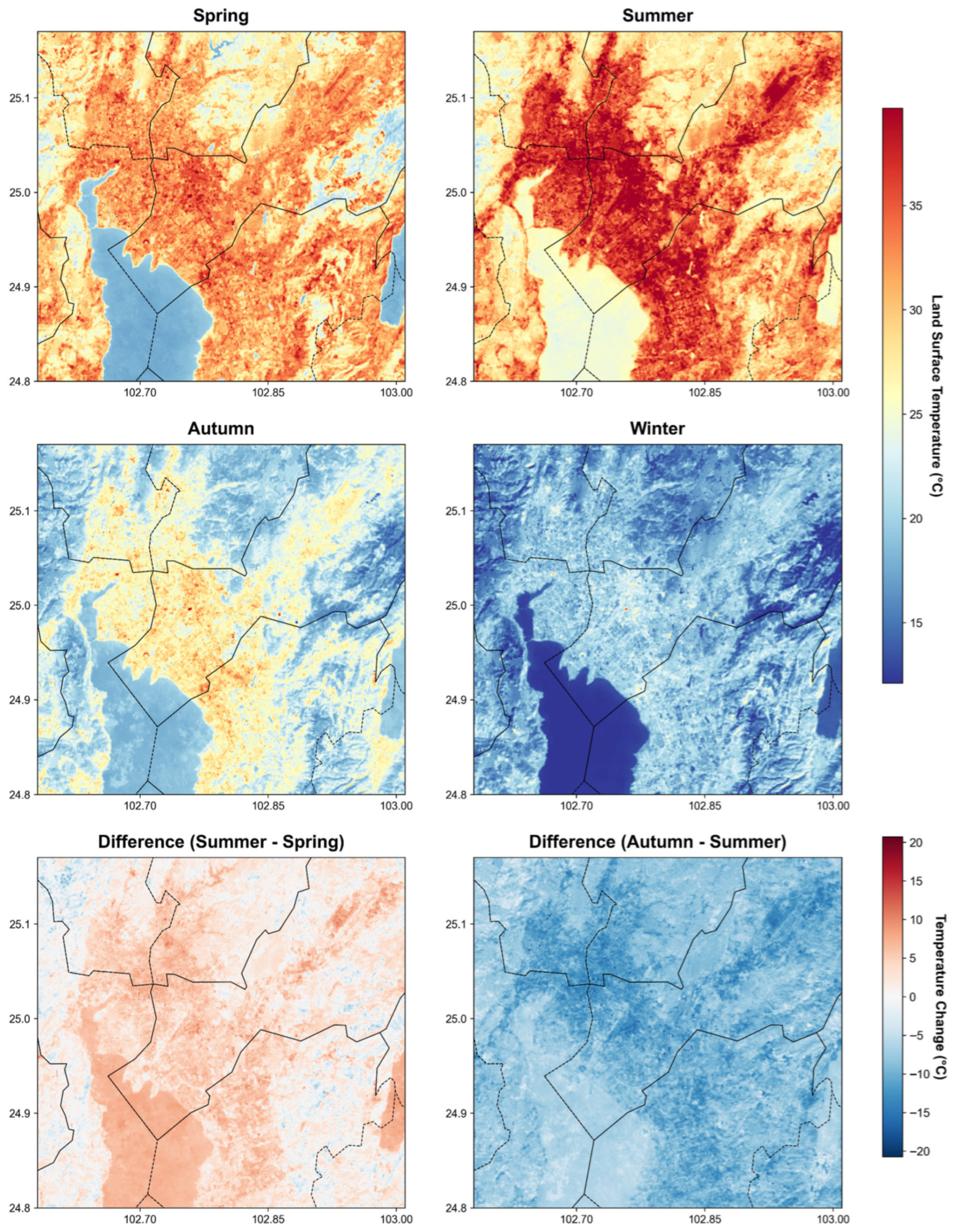
- Seasonal LST revealed a seasonal thermal dichotomy: extreme summer UHI in urban cores versus anomalous widespread spring heat in natural and vegetated landscapes.
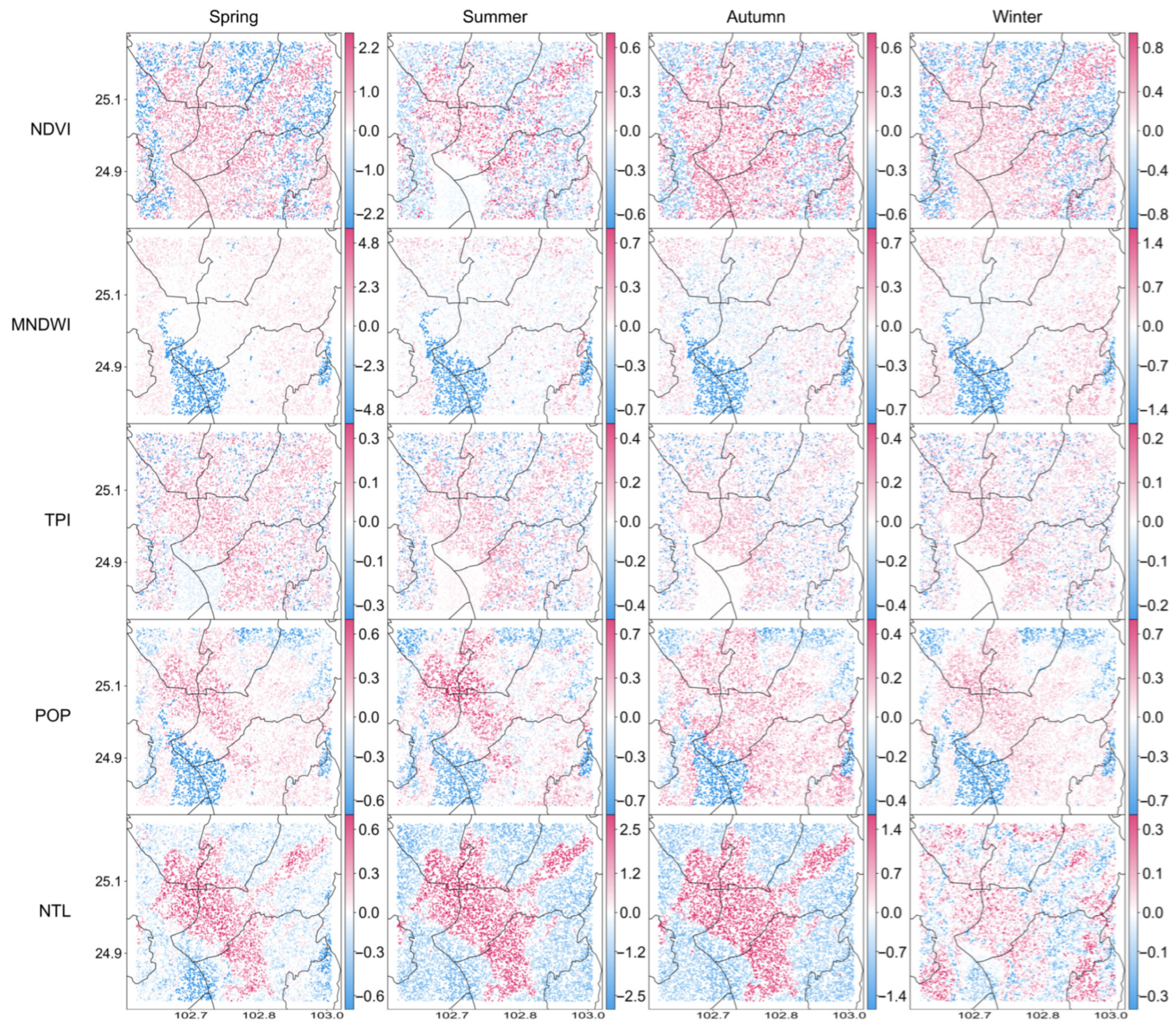
- Geo-machine learning uncovered a seasonal rotation of thermal drivers, showing that built environments dominate summer and autumn warming, while natural and topographic factors govern spring and winter.
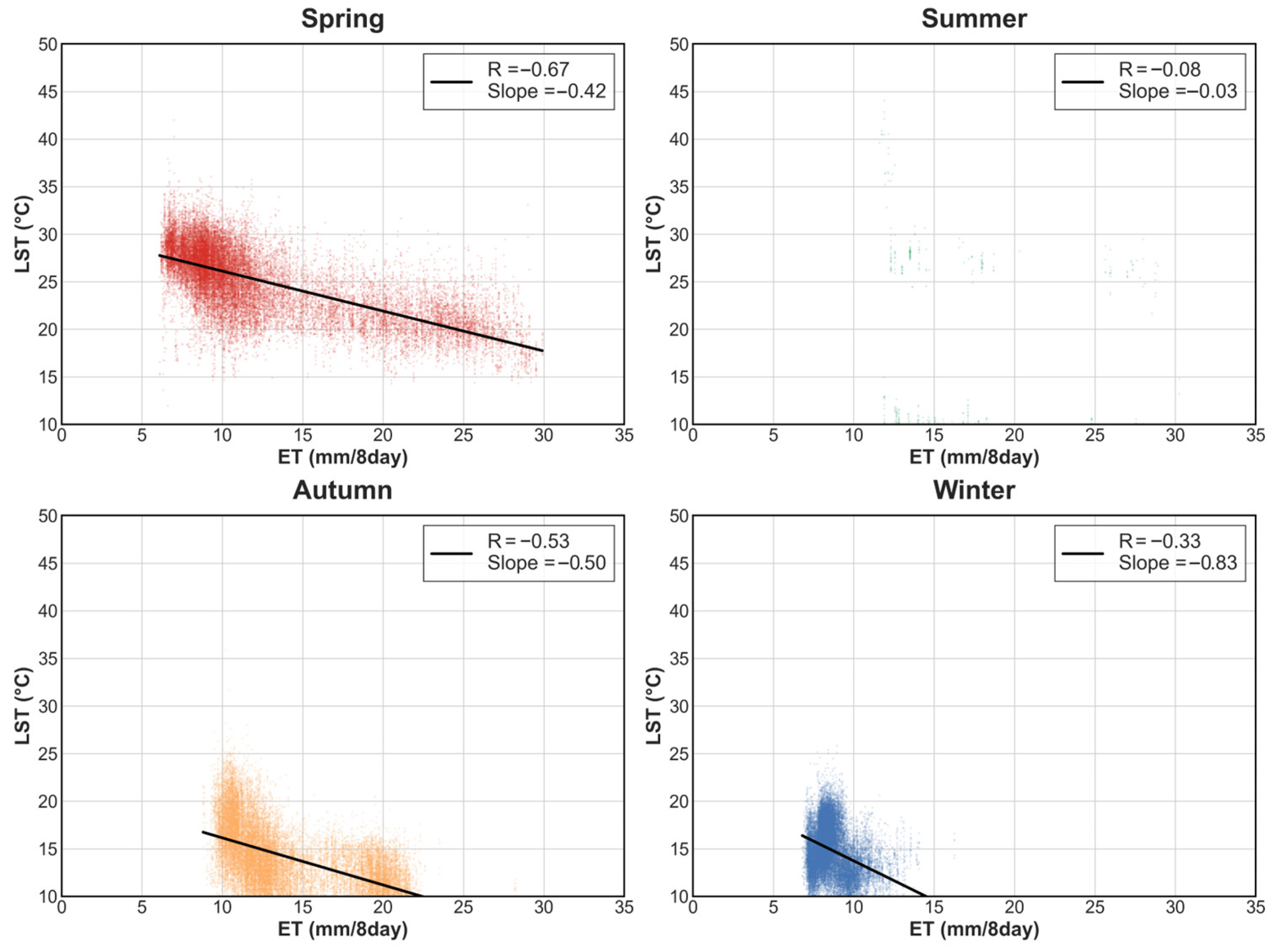
- The spring thermal anomaly highlights that drought-induced vegetation stress and peri-urban greenhouse agriculture act as major, localized heat sources.
- The strong spatial non-stationarity of thermal drivers proves that identical urban features behave differently depending on location, requiring spatially targeted climate-adaptive planning in plateau-basin cities.
Abstract
1. Introduction
2. Materials and Methods
2.1. Study Area
2.2. Data
2.2.1. Remote Sensing Dataset
2.2.2. Urban Morphology and Topographical Data
2.2.3. Socioeconomic Data
2.2.4. Evapotranspiration (ET) Data
2.3. Method
2.3.1. Calculation of Biophysical Indices
2.3.2. Seasonal LST Compositing and LCZ Analysis
2.3.3. Correlation Analysis and Non-Linear XGBoost Modeling
2.3.4. Global and Spatial Attribution via SHAP and GeoShapley
2.3.5. Seasonal Coupling Analysis of LST and ET
3. Results
3.1. Seasonal Distribution of LST and Thermodynamic Responses of LCZ
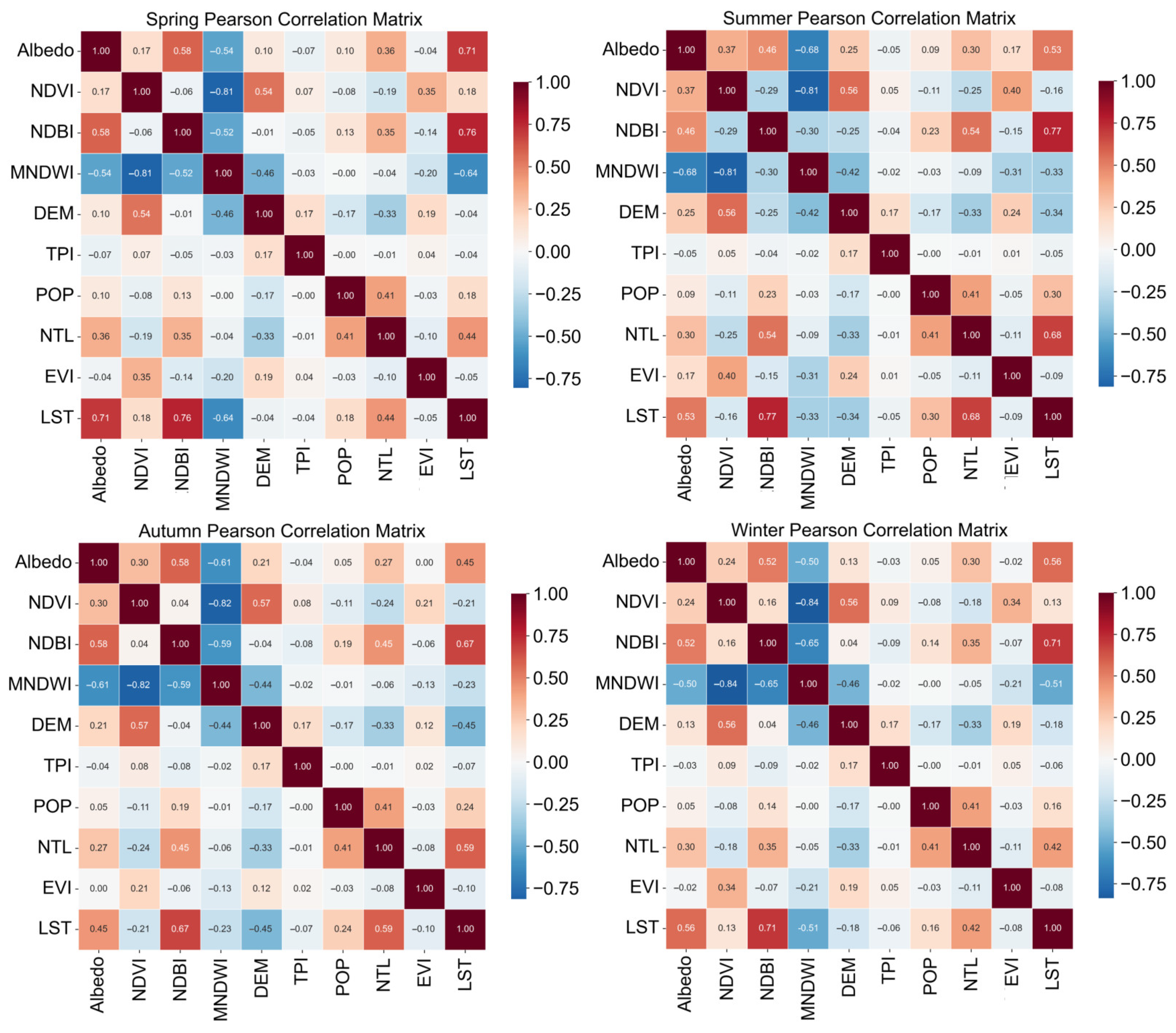
3.2. Linear Drivers and Multicollinearity in the Thermal Environment
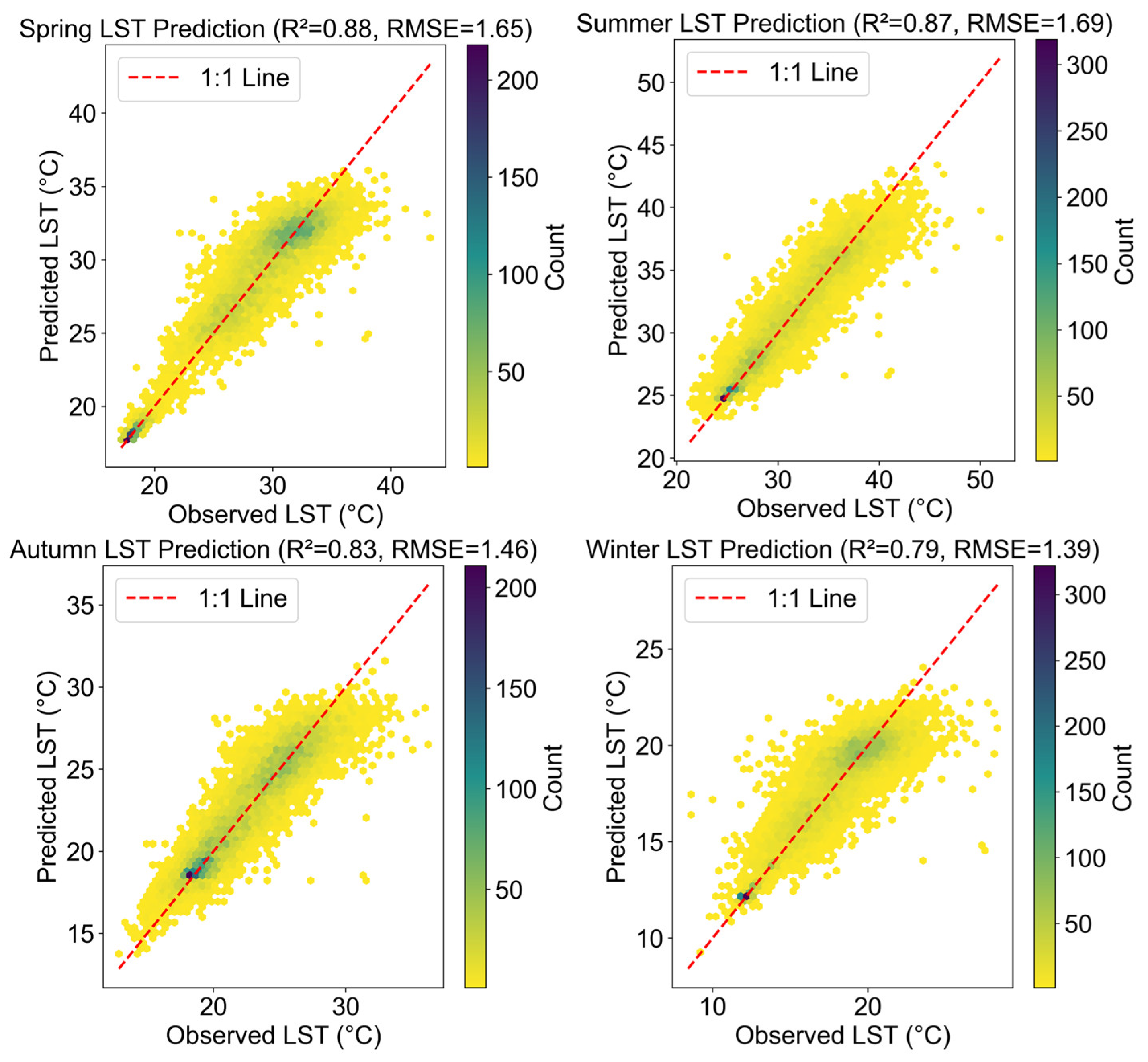
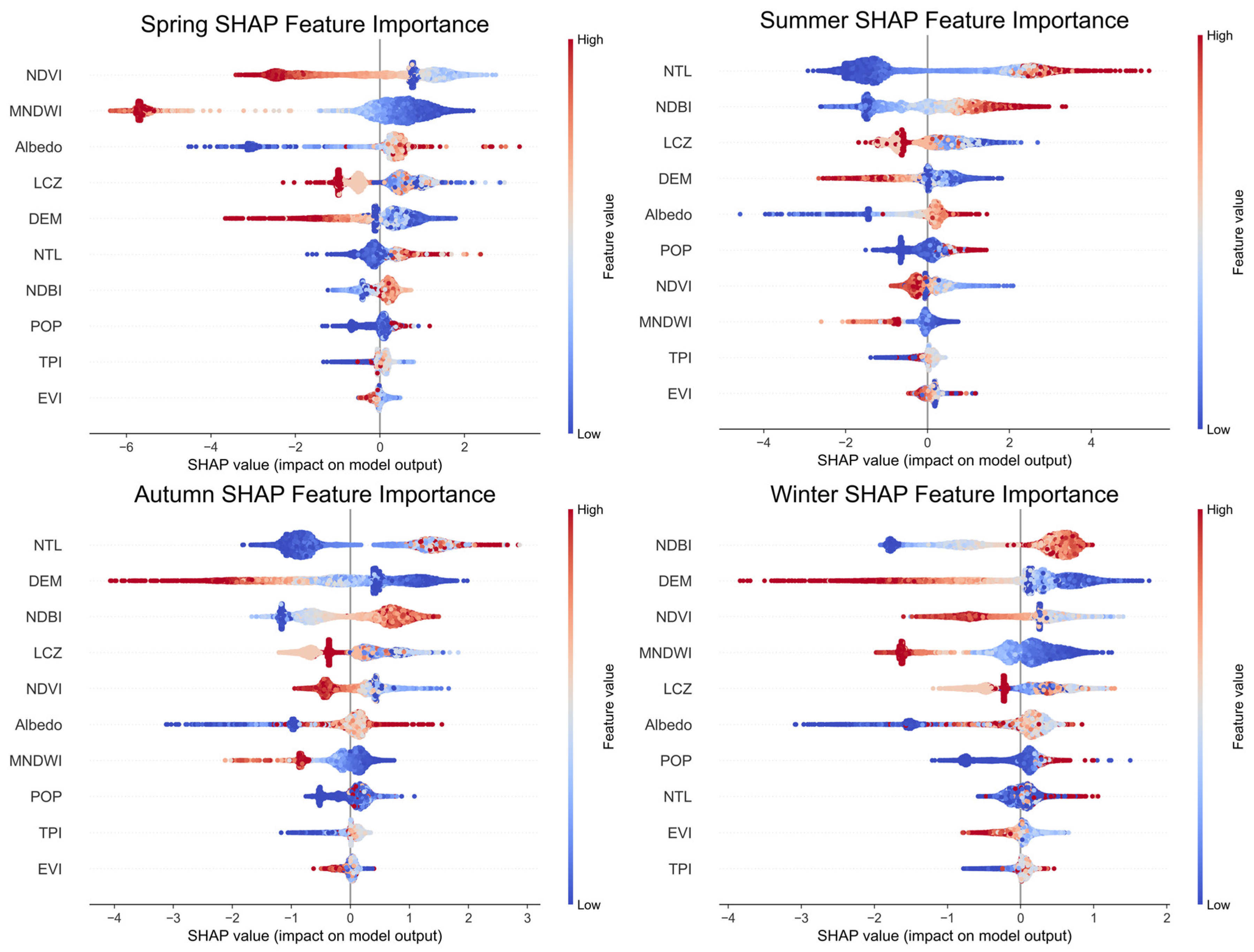
3.3. Non-Linear Modeling Performance and SHAP Global Attribution
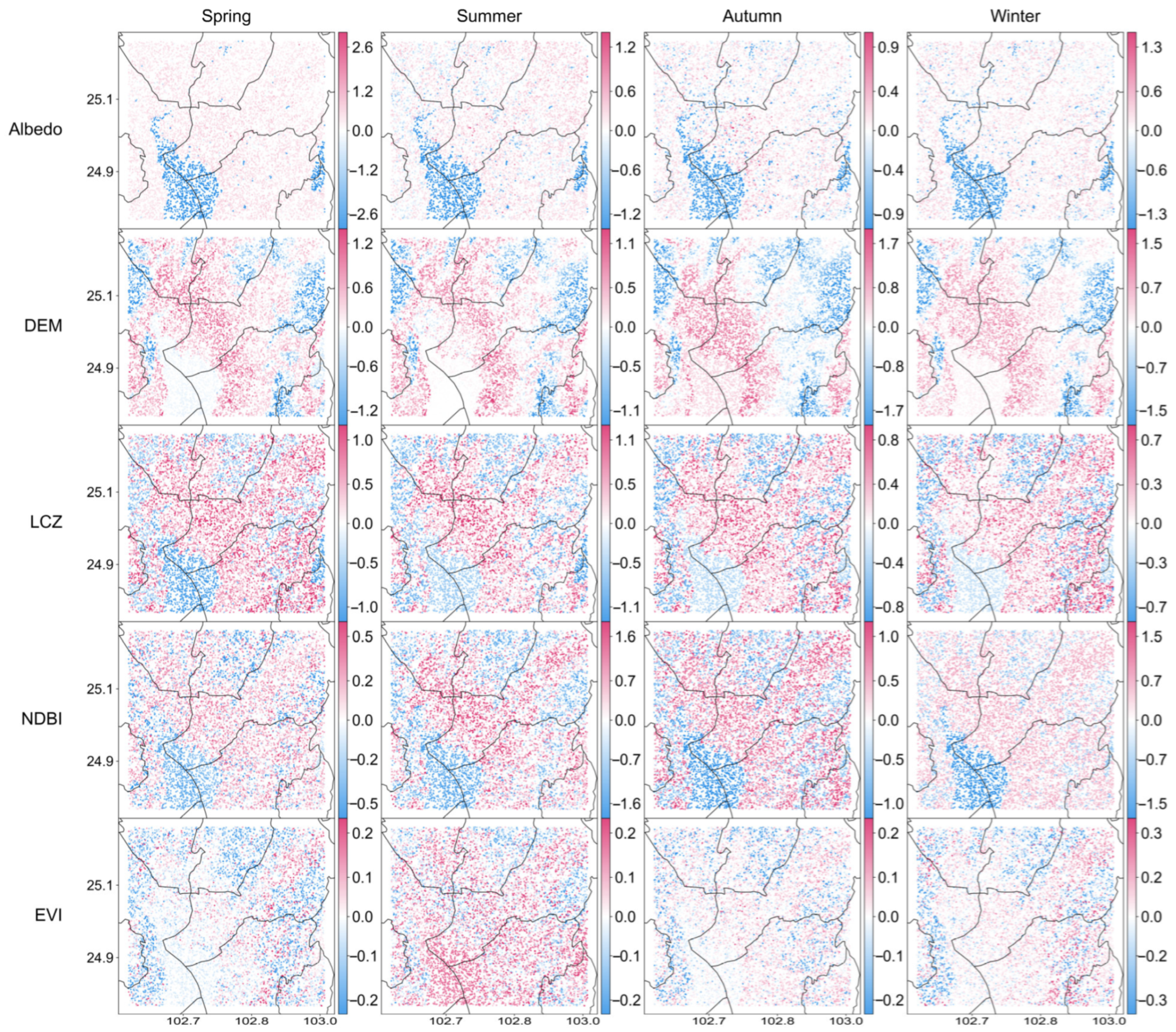
3.4. GeoShapley Spatial Deconstruction and Heterogeneity
3.4.1. Spatial Amplification of the Built Environment
3.4.2. Spatiotemporal Dynamics of Blue-Green Infrastructure
3.4.3. Topographic Effects in the Plateau-Basin
3.4.4. Seasonal Shifts in Dominant Drivers
4. Discussion
4.1. Vegetation Phenology and Drought Effects
4.2. Thermal Effects of Greenhouse Agriculture
4.3. Spatial Non-Stationarity and Microclimate Mechanisms
4.4. Limitations and Future Perspectives
5. Conclusions
Author Contributions
Funding
Data Availability Statement
Acknowledgments
Conflicts of Interest
References
- Diem, P.K.; Nguyen, C.T.; Diem, N.K.; Diep, N.T.H.; Thao, P.T.B.; Hong, T.G.; Phan, T.N. Remote Sensing for Urban Heat Island Research: Progress, Current Issues, and Perspectives. Remote Sens. Appl. Soc. Environ. 2024, 33, 101081. [Google Scholar] [CrossRef]
- Fu, H.; Wen, J.; Liu, Z.; Li, J.; Li, J.; Chen, Z. Contrasting Frequency of Global Canopy and Surface Urban Heat Island. Sustain. Cities Soc. 2025, 133, 106857. [Google Scholar] [CrossRef]
- Li, X.; Li, X.; Ma, H.; Zhou, J.; Ge, F.; Zhang, W.; Yan, Y.; Zhou, Y. Revisiting Urban Heat Island Effects in China: Multi-Satellite Evidence from the ESA-CCI Land Surface Temperature Product. Sustain. Cities Soc. 2025, 123, 106281. [Google Scholar] [CrossRef]
- Luo, S.; Gu, X.; Lv, N.; Guan, Y.; Kong, D.; Liu, J.; Zhang, X. Elevated Increases in Human-Perceived Winter Temperature in Urban Areas over China: Acceleration by Urbanization. Urban Clim. 2024, 55, 101979. [Google Scholar] [CrossRef]
- Song, Z.; Yang, H.; Huang, X.; Yu, W.; Huang, J.; Ma, M. The Spatiotemporal Pattern and Influencing Factors of Land Surface Temperature Change in China from 2003 to 2019. Int. J. Appl. Earth Obs. Geoinf. 2021, 104, 102537. [Google Scholar] [CrossRef]
- Oke, T.R. The Energetic Basis of the Urban Heat Island. Q. J. R. Meteorol. Soc. 1982, 108, 1–24. [Google Scholar] [CrossRef]
- Grimmond, S. Urbanization and Global Environmental Change: Local Effects of Urban Warming. Geogr. J. 2007, 173, 83–88. [Google Scholar] [CrossRef]
- Li, X.; Zhou, Y.; Yu, S.; Jia, G.; Li, H.; Li, W. Urban Heat Island Impacts on Building Energy Consumption: A Review of Approaches and Findings. Energy 2019, 174, 407–419. [Google Scholar] [CrossRef]
- Santamouris, M. Analyzing the Heat Island Magnitude and Characteristics in One Hundred Asian and Australian Cities and Regions. Sci. Total Environ. 2015, 512–513, 582–598. [Google Scholar] [CrossRef]
- Agarwal, M.; Tandon, A. Modeling of the Urban Heat Island in the Form of Mesoscale Wind and of Its Effect on Air Pollution Dispersal. Appl. Math. Model. 2010, 34, 2520–2530. [Google Scholar] [CrossRef]
- Tuholske, C.; Caylor, K.; Funk, C.; Verdin, A.; Sweeney, S.; Grace, K.; Peterson, P.; Evans, T. Global Urban Population Exposure to Extreme Heat. Proc. Natl. Acad. Sci. USA 2021, 118, e2024792118. [Google Scholar] [CrossRef]
- Yuan, Y.; Li, X.; Wang, H.; Geng, X.; Gu, J.; Fan, Z.; Wang, X.; Liao, C. Unraveling the Global Economic and Mortality Effects of Rising Urban Heat Island Intensity. Sustain. Cities Soc. 2024, 116, 105902. [Google Scholar] [CrossRef]
- Zhou, D.; Zhao, S.; Liu, S.; Zhang, L.; Zhu, C. Surface Urban Heat Island in China’s 32 Major Cities: Spatial Patterns and Drivers. Remote Sens. Environ. 2014, 152, 51–61. [Google Scholar] [CrossRef]
- Voogt, J.A.; Oke, T.R. Thermal Remote Sensing of Urban Climates. Remote Sens. Environ. 2003, 86, 370–384. [Google Scholar] [CrossRef]
- Weng, Q.; Lu, D.; Schubring, J. Estimation of Land Surface Temperature–Vegetation Abundance Relationship for Urban Heat Island Studies. Remote Sens. Environ. 2004, 89, 467–483. [Google Scholar] [CrossRef]
- Lu, H.; Li, X.; Zhao, L.; Liu, G.; Lu, Z.; Zhu, X.; Zhang, J. Are Industrial Areas the Main Culprit behind Urban Heat? A Study of Thermal Environment in Mountainous Cities Based on Downscaled LST Data. Sustain. Cities Soc. 2025, 135, 106980. [Google Scholar] [CrossRef]
- Wang, Z.; Ishida, Y.; Mochida, A. Effective Factors for Reducing Land Surface Temperature in Each Local Climate Zone Built Type in Tokyo and Shanghai. Remote Sens. 2023, 15, 3840. [Google Scholar] [CrossRef]
- Yang, J.-T.; Zhou, X.-W.; Chen, X.; Yao, X.; Li, M.; Yin, M.-H.; Dong, F.; Yan, S.-H.; Zhao, J.-L. Exploring the Main and Interactive Effects of Urban Morphology on Land Surface Temperature across Different Functional Zones: A Local Geoshapley Analysis Based on XAI. Sustain. Cities Soc. 2025, 134, 106913. [Google Scholar] [CrossRef]
- Stewart, I.D.; Oke, T.R. Local Climate Zones for Urban Temperature Studies. Bull. Am. Meteorol. Soc. 2012, 93, 1879–1900. [Google Scholar] [CrossRef]
- Cai, M.; Ren, C.; Xu, Y.; Lau, K.K.-L.; Wang, R. Investigating the Relationship between Local Climate Zone and Land Surface Temperature Using an Improved WUDAPT Methodology—A Case Study of Yangtze River Delta, China. Urban Clim. 2018, 24, 485–502. [Google Scholar] [CrossRef]
- Li, N.; Yang, J.; Qiao, Z.; Wang, Y.; Miao, S. Urban Thermal Characteristics of Local Climate Zones and Their Mitigation Measures across Cities in Different Climate Zones of China. Remote Sens. 2021, 13, 1468. [Google Scholar] [CrossRef]
- Zhao, J.; Chen, G.; Yu, L.; Ren, C.; Xie, J.; Chung, L.; Ni, H.; Gong, P. Mapping Urban Morphology Changes in the Last Two Decades Based on Local Climate Zone Scheme: A Case Study of Three Major Urban Agglomerations in China. Urban Clim. 2023, 47, 101391. [Google Scholar] [CrossRef]
- Zwolska, A.; Półrolniczak, M.; Kolendowicz, L. Urban Growth’s Implications on Land Surface Temperature in a Medium-Sized European City Based on LCZ Classification. Sci. Rep. 2024, 14, 8308. [Google Scholar] [CrossRef]
- Sun, R.; Chen, L. How Can Urban Water Bodies Be Designed for Climate Adaptation? Landsc. Urban Plan. 2012, 105, 27–33. [Google Scholar] [CrossRef]
- Peng, S.; Piao, S.; Ciais, P.; Friedlingstein, P.; Ottle, C.; Bréon, F.-M.; Nan, H.; Zhou, L.; Myneni, R.B. Surface Urban Heat Island Across 419 Global Big Cities. Environ. Sci. Technol. 2012, 46, 696–703. [Google Scholar] [CrossRef]
- He, B.-J.; Fu, X.; Zhao, Z.; Chen, P.; Sharifi, A.; Li, H. Capability of LCZ Scheme to Differentiate Urban Thermal Environments in Five Megacities of China: Implications for Integrating LCZ System Into Heat-Resilient Planning and Design. IEEE J. Sel. Top. Appl. Earth Obs. Remote Sens. 2024, 17, 18800–18817. [Google Scholar] [CrossRef]
- Lundberg, S.M.; Erion, G.; Chen, H.; DeGrave, A.; Prutkin, J.M.; Nair, B.; Katz, R.; Himmelfarb, J.; Bansal, N.; Lee, S.-I. From Local Explanations to Global Understanding with Explainable AI for Trees. Nat. Mach. Intell. 2020, 2, 56–67. [Google Scholar] [CrossRef] [PubMed]
- Chen, X.; Zhang, Y. Impacts of Urban Surface Characteristics on Spatiotemporal Pattern of Land Surface Temperature in Kunming of China. Sustain. Cities Soc. 2017, 32, 87–99. [Google Scholar] [CrossRef]
- Wang, Z.; He, Z.; Zhu, P.; Deng, S. Exploring the Thermal Environment of Kunming, China: Based on Local Climate Zones. In Climate-Resilient, Low-Carbon, and Sustainable Cities; He, B., Chen, T., Li, Y., Cheshmehzangi, A., Zeng, P., Zhai, G., Eds.; Lecture Notes in Civil Engineering; Springer: Singapore, 2026; Volume 754, pp. 253–266. ISBN 9789819521685. [Google Scholar]
- Li, N.; Wang, B.; Yao, Y.; Chen, L.; Zhang, Z. Thermal Contribution of the Local Climate Zone and Its Spatial Distribution Effect on Land Surface Temperature in Different Macroclimate Cities. Remote Sens. 2022, 14, 4029. [Google Scholar] [CrossRef]
- Zhao, F.; Zhang, M.; Zhu, S.; Zhang, X.; Ma, S.; Gao, Y.; Xia, J.; Wang, X.; Zhang, Y.; Zhang, S.; et al. Spatiotemporal Patterns of the Urban Thermal Environment and the Impact of Human Activities in Low-Latitude Plateau Cities. Int. J. Appl. Earth Obs. Geoinf. 2025, 142, 104703. [Google Scholar] [CrossRef]
- Ma, J.; Wang, J.; He, S.; Zhang, J.; Liu, L.; Zhong, X. Direct and Indirect Effects of Urbanization on Vegetation: A Survey of Yunnan Central Urban Economic Circle, China. Ecol. Indic. 2024, 166, 112536. [Google Scholar] [CrossRef]
- Wang, S.; Li, Z.; Long, Y.; Yang, L.; Ding, X.; Sun, X.; Chen, T. Impacts of Urbanization on the Spatiotemporal Evolution of Ecological Resilience in the Plateau Lake Area in Central Yunnan, China. Ecol. Indic. 2024, 160, 111836. [Google Scholar] [CrossRef]
- Cook, M.; Schott, J.R.; Mandel, J.; Raqueno, N. Development of an Operational Calibration Methodology for the Landsat Thermal Data Archive and Initial Testing of the Atmospheric Compensation Component of a Land Surface Temperature (LST) Product from the Archive. Remote Sens. 2014, 6, 11244–11266. [Google Scholar] [CrossRef]
- Main-Knorn, M.; Pflug, B.; Louis, J.; Debaecker, V.; Müller-Wilm, U.; Gascon, F. Sen2Cor for Sentinel-2. In Proceedings of the Image and Signal Processing for Remote Sensing XXIII, Warsaw, Poland, 11–13 September 2017; Bruzzone, L., Bovolo, F., Benediktsson, J.A., Eds.; SPIE: Warsaw, Poland, 2017; p. 3. [Google Scholar]
- Bonafoni, S.; Sekertekin, A. Albedo Retrieval From Sentinel-2 by New Narrow-to-Broadband Conversion Coefficients. IEEE Geosci. Remote Sens. Lett. 2020, 17, 1618–1622. [Google Scholar] [CrossRef]
- Gao, B. NDWI—A Normalized Difference Water Index for Remote Sensing of Vegetation Liquid Water from Space. Remote Sens. Environ. 1996, 58, 257–266. [Google Scholar] [CrossRef]
- McFeeters, S.K. The Use of the Normalized Difference Water Index (NDWI) in the Delineation of Open Water Features. Int. J. Remote Sens. 1996, 17, 1425–1432. [Google Scholar] [CrossRef]
- Tucker, C.J. Red and Photographic Infrared Linear Combinations for Monitoring Vegetation. Remote Sens. Environ. 1979, 8, 127–150. [Google Scholar] [CrossRef]
- Zha, Y.; Gao, J.; Ni, S. Use of Normalized Difference Built-up Index in Automatically Mapping Urban Areas from TM Imagery. Int. J. Remote Sens. 2003, 24, 583–594. [Google Scholar] [CrossRef]
- Huete, A.; Didan, K.; Miura, T.; Rodriguez, E.P.; Gao, X.; Ferreira, L.G. Overview of the Radiometric and Biophysical Performance of the MODIS Vegetation Indices. Remote Sens. Environ. 2002, 83, 195–213. [Google Scholar] [CrossRef]
- Xu, H. Modification of Normalised Difference Water Index (NDWI) to Enhance Open Water Features in Remotely Sensed Imagery. Int. J. Remote Sens. 2006, 27, 3025–3033. [Google Scholar] [CrossRef]
- Demuzere, M.; Kittner, J.; Martilli, A.; Mills, G.; Moede, C.; Stewart, I.D.; van Vliet, J.; Bechtel, B. A Global Map of Local Climate Zones to Support Earth System Modelling and Urban-Scale Environmental Science. Earth Syst. Sci. Data 2022, 14, 3835–3873. [Google Scholar] [CrossRef]
- Tatem, A.J. WorldPop, Open Data for Spatial Demography. Sci. Data 2017, 4, 170004. [Google Scholar] [CrossRef]
- Akiba, T.; Sano, S.; Yanase, T.; Ohta, T.; Koyama, M. Optuna: A next-Generation Hyperparameter Optimization Framework. In Proceedings of the 25th ACM SIGKDD International Conference on Knowledge Discovery & Data Mining, Anchorage, AK, USA, 4–8 August 2019; pp. 2623–2631. [Google Scholar]
- Lundberg, S.; Lee, S.-I. A Unified Approach to Interpreting Model Predictions. arXiv 2017, arXiv:1705.07874. [Google Scholar] [CrossRef]
- Li, Z. GeoShapley: A Game Theory Approach to Measuring Spatial Effects in Machine Learning Models. Ann. Am. Assoc. Geogr. 2024, 114, 1365–1385. [Google Scholar] [CrossRef]
- Guo, Z.; Esperon-Rodriguez, M.; Davin, E.; Huang, H.; Chen, B.; Hejazi, M.; Wu, J.; Wang, J.; Ge, Y.; Song, G.; et al. Global Urban Vegetation Exhibits Divergent Thermal Effects: From Cooling to Warming as Aridity Increases. Sci. Adv. 2026, 12, eaea9165. [Google Scholar] [CrossRef]
- Yang, D.; Chen, J.; Zhou, Y.; Chen, X.; Chen, X.; Cao, X. Mapping Plastic Greenhouse with Medium Spatial Resolution Satellite Data: Development of a New Spectral Index. ISPRS J. Photogramm. Remote Sens. 2017, 128, 47–60. [Google Scholar] [CrossRef]
- Arnfield, A.J. Two Decades of Urban Climate Research: A Review of Turbulence, Exchanges of Energy and Water, and the Urban Heat Island. Int. J. Climatol. 2003, 23, 1–26. [Google Scholar] [CrossRef]
- Bowler, D.E.; Buyung-Ali, L.; Knight, T.M.; Pullin, A.S. Urban Greening to Cool Towns and Cities: A Systematic Review of the Empirical Evidence. Landsc. Urban Plan. 2010, 97, 147–155. [Google Scholar] [CrossRef]
- Su, Y.; Wu, J.; Zhang, C.; Wu, X.; Li, Q.; Liu, L.; Bi, C.; Zhang, H.; Lafortezza, R.; Chen, X. Estimating the Cooling Effect Magnitude of Urban Vegetation in Different Climate Zones Using Multi-Source Remote Sensing. Urban Clim. 2022, 43, 101155. [Google Scholar] [CrossRef]
- Duan, S.-B.; Li, Z.-L.; Tang, B.-H.; Wu, H.; Tang, R. Generation of a Time-Consistent Land Surface Temperature Product from MODIS Data. Remote Sens. Environ. 2014, 140, 339–349. [Google Scholar] [CrossRef]
- Zhang, S.; Yang, Y.; Wang, H.; Fan, H.; Qi, J.; Lai, X. Dominant Role of Meteorology and Aerosols in Regulating the Seasonal Variation of Urban Thermal Environment in Beijing. Remote Sens. 2025, 17, 3921. [Google Scholar] [CrossRef]



| Data Category | Dataset | Variables/Applications | Spatial Resolution | Time Range | Data Source |
|---|---|---|---|---|---|
| Thermal Remote Sensing | Landsat-8/9 OLI/TIRS (Collection 2 Level-2) | Initial LST | 30 m | 2018–2025 | USGS |
| Multispectral Remote Sensing | Sentinel-2 MSI (Level-2A) | Surface reflectance and biophysical indices (NDVI, NDBI, NDWI, NDMI, Albedo, EVI, MNDWI) | 10 m | 2018–2025 | ESA |
| MOD16A2 V6.1 | Evapotranspiration (ET) | 500 m | 2018–2025 | LP DAAC | |
| Topographical Data | ALOS PALSAR DEM | Elevation, Topographic Position Index (TPI) | 12.5 m | - | JAXA |
| Urban Morphology | Global map of Local Climate Zones | 3D structural fabric, building density, and aerodynamic roughness proxy | 100 m | 2023 | WUDAPT protocol |
| Socioeconomic Data | WorldPop Database | Gridded population density (POP) | 100 m | 2021 | WorldPop |
| NPP-VIIRS | Nighttime Light (NTL) as a proxy for urbanization intensity and energy expenditure | 500 m | 2025 | NOAA |
Disclaimer/Publisher’s Note: The statements, opinions and data contained in all publications are solely those of the individual author(s) and contributor(s) and not of MDPI and/or the editor(s). MDPI and/or the editor(s) disclaim responsibility for any injury to people or property resulting from any ideas, methods, instructions or products referred to in the content. |
© 2026 by the authors. Licensee MDPI, Basel, Switzerland. This article is an open access article distributed under the terms and conditions of the Creative Commons Attribution (CC BY) license.
Share and Cite
Chao, J.; Li, Y.; Liu, J.; Fan, J.; Zhou, Y.; Li, M.; Xu, S. Deciphering the Seasonal Thermal Environments in Kunming’s Central Urban Area Using LST and Interpretable Geo-Machine Learning. Remote Sens. 2026, 18, 1395. https://doi.org/10.3390/rs18091395
Chao J, Li Y, Liu J, Fan J, Zhou Y, Li M, Xu S. Deciphering the Seasonal Thermal Environments in Kunming’s Central Urban Area Using LST and Interpretable Geo-Machine Learning. Remote Sensing. 2026; 18(9):1395. https://doi.org/10.3390/rs18091395
Chicago/Turabian StyleChao, Jiangqin, Yingyun Li, Jianyu Liu, Jing Fan, Yinghui Zhou, Maofen Li, and Shiguang Xu. 2026. "Deciphering the Seasonal Thermal Environments in Kunming’s Central Urban Area Using LST and Interpretable Geo-Machine Learning" Remote Sensing 18, no. 9: 1395. https://doi.org/10.3390/rs18091395
APA StyleChao, J., Li, Y., Liu, J., Fan, J., Zhou, Y., Li, M., & Xu, S. (2026). Deciphering the Seasonal Thermal Environments in Kunming’s Central Urban Area Using LST and Interpretable Geo-Machine Learning. Remote Sensing, 18(9), 1395. https://doi.org/10.3390/rs18091395