1. Introduction
Reclaimed airports, representing significant achievements in coastal engineering and land expansion, serve as a key solution for modern coastal cities to develop international aviation hubs and mitigate land scarcity [
1]. For reclaimed airports under construction, this phenomenon is characterized by severe and uneven post-construction subsidence, primarily resulting from the consolidation of fill materials induced by rapid placement, differential loading, and diverse ground treatment methods [
2]. Therefore, implementing high-precision, large-scale, and continuous subsidence monitoring is critical for safeguarding the construction safety and long-term operational integrity of such airports. Spaceborne Interferometric Synthetic Aperture Radar (InSAR) method, especially Time-Series InSAR (TS-InSAR), has become a fundamental tool in this field. It offers recognized advantages including all-weather operation, extensive area coverage, and high measurement precision, making it a core method for monitoring surface deformation [
3]. Traditional time-series InSAR techniques, such as the Persistent Scatterer Interferometry (PSI) method [
4], the Small Baseline Subset Interferometric Synthetic Aperture Radar (SBAS-InSAR) method [
5], the Stanford method for persistent scatterer (StaMPS/MTI) method [
6,
7], and the SqueeSAR approach [
8], have been widely applied in deformation monitoring. As a powerful geodetic technique, InSAR has been widely used for ground deformation monitoring with millimeter-level precision [
9,
10,
11,
12].
Conventional time-series InSAR techniques have now become a mature and established approach for monitoring subsidence at reclaimed airports. Extensive studies on operational airports, including Hong Kong International Airport [
13,
14], Shenzhen Bao’ an International Airport [
15], Singapore Changi Airport [
16], Incheon International Airport [
17,
18], Kansai International Airport [
19], and Nice Côte d’Azur Airport [
20], have consistently confirmed that such airports experience high-magnitude, uneven subsidence due to the consolidation of reclamation fill materials. Meanwhile, for reclaimed airports under construction, subsidence often manifests more severely and with greater spatiotemporal variability, posing a direct threat to engineering safety. For example, monitoring results from Xiamen Xiang’an International Airport show clear spatial heterogeneity in the subsidence of its reclaimed area, attributed to uneven construction progress [
21,
22,
23]. Similarly, research on the new third runway at Hong Kong International Airport, which combined PS and DS processing with independent component analysis, further revealed pronounced subsidence during the construction phase and identified multiple contributing physical mechanisms [
2]. In summary, these studies demonstrate that reclaimed airports face inevitable subsidence challenges, regardless of whether they are in operation or under construction. However, current subsidence monitoring methods for reclaimed airports predominantly rely on single-polarization SAR data, which struggle to adapt to the rapid and heterogeneous changes in surface scattering characteristics during construction. This often results in sparse monitoring points in low-coherence regions. In low-coherence regions, traditional methods based on persistent scatterers (PSs) often result in sparse monitoring points due to the scarcity of coherent targets. Techniques utilizing distributed scatterers (DSs) can supplement monitoring points to enhance coverage density [
24,
25]. Research on fusing multi-polarization information via InSAR methods [
26,
27] demonstrates that integrating multi-polarization data provides richer observation samples for phase optimization, representing a key approach to enhancing monitoring capabilities in low-coherence zones. These limitations are further amplified in extreme dynamic scenarios like reclaimed airports, where artificial modifications dominate and surface physical properties undergo drastic changes. Consequently, the development of time-series InSAR methods that fully leverage multi-polarization information is particularly urgent for achieving safe and reliable monitoring during the construction period.
Against this background this study focuses on DJBIA as a representative case. As a major reclaimed airport under construction in northern China, DJBIA also exhibits significant subsidence risks. Previous studies employing the SBAS-InSAR method to monitor data from 2017 to 2021 have preliminarily revealed severe subsidence trends in the airport’s reclaimed areas [
28]. However, as the airport project advances, ongoing changes in surface coverage and loading conditions render earlier single-period studies inadequate for comprehensively reflecting current and future subsidence dynamics. Therefore, developing continuous monitoring and analysis methods based on the latest time-series data is of significant practical importance for understanding the subsidence evolution patterns of this airport and ensuring engineering safety. This is particularly crucial for areas undergoing intense construction, such as DJBIA, where sequential processing methods capable of dynamically updating scattering characteristics are essential. The Sequential Estimation and Total Power-Enhanced Expectation Maximization Inversion (SETP-EMI) scheme offers a novel technical approach for handling scenarios involving long time series and drastic terrain changes [
29]. Although this method was originally designed for landslide monitoring, its sequential estimation framework is capable of effectively handling temporal variations in surface scattering characteristics, which closely resemble the rapidly changing environment of a reclaimed airport under construction, thereby demonstrating strong methodological transferability.
Given this, this study systematically conducted a three-stage analysis based on the construction cycle of DJBIA using Sentinel-1A dual-polarization (VV-VH) imagery from August 2022 to October 2025. First, the dataset was divided into three consecutive sub-periods (August 2022–December 2023, January–December 2024, and January–October 2025). The three sub-periods were defined according to the major construction phases of the airport (initial reclamation, terminal construction, and corridor development), as detailed in
Section 2 (Study Area and Data) and
Table 1. Subsidence was extracted using single-polarization PSI, single-polarization DSI, and the SETP-EMI method, respectively, to capture the subsidence corresponding to different reclamation stages. Subsequently, the SETP-EMI was employed to process the entire period, obtaining a complete deformation sequence. This study is arranged as follows: the first part is a general introduction; the second overviews the study area and data; the third part introduces the methodology and technical approach; the fourth part is the analysis and verification of the experimental results; and the fifth and sixth parts are the discussion and conclusions.
2. Research Area Overview and Data Introduction
DJBIA is China’s first offshore “artificial island” 4F-class airport. It is located in the eastern sea area of Jinzhou Bay in Dalian. The airport has a rectangular layout, with a length of 6183 m and width of 3440 m. The planned land reclamation area is approximately 20 square kilometers, and the minimum offshore distance is 3 km [
30]. The average water depth in Jinzhou Bay is 5–8 m, characterized by irregular semi-diurnal tides. While the seabed is generally stable, the regional geological risk is relatively high [
31]. This area features a typical coastal mountainous urban climate, dominated by southerly winds in summer and northerly winds in winter, with significant land–sea breeze circulation [
32]. The airport construction used approximately 300 million cubic meters of reclamation material. This material was primarily sourced from mountain excavation at nearby Mount Dahua and Mount Huang in the Jinzhou Bay area, consisting mainly of limestone, dolomite, and diabase rocks. It was supplemented by about 60 million cubic meters of dredged seabed silt for foundation treatment. These materials were used to construct the revetments, cofferdams, runway foundations, and terminal building bases for the artificial island, forming a total offshore airport land area of about 20 square kilometers [
33].
The first phase of DJBIA plans to construct two parallel runways (the North Runway is 3600 m long, and the South Runway is 3400 m long) and core facilities including the 500,000-square-meter Terminal 1 (T1). Long-term plans include the expansion of two additional runways and a 400,000-square-meter terminal building [
34]. The project held its commencement mobilization conference in October 2023, marking the full entry into the substantive construction phase of this offshore “artificial island” airport [
35]. To clearly illustrate the construction progress,
Table 1 summarizes the key progress data for selected core projects as of October 2025 [
36,
37].
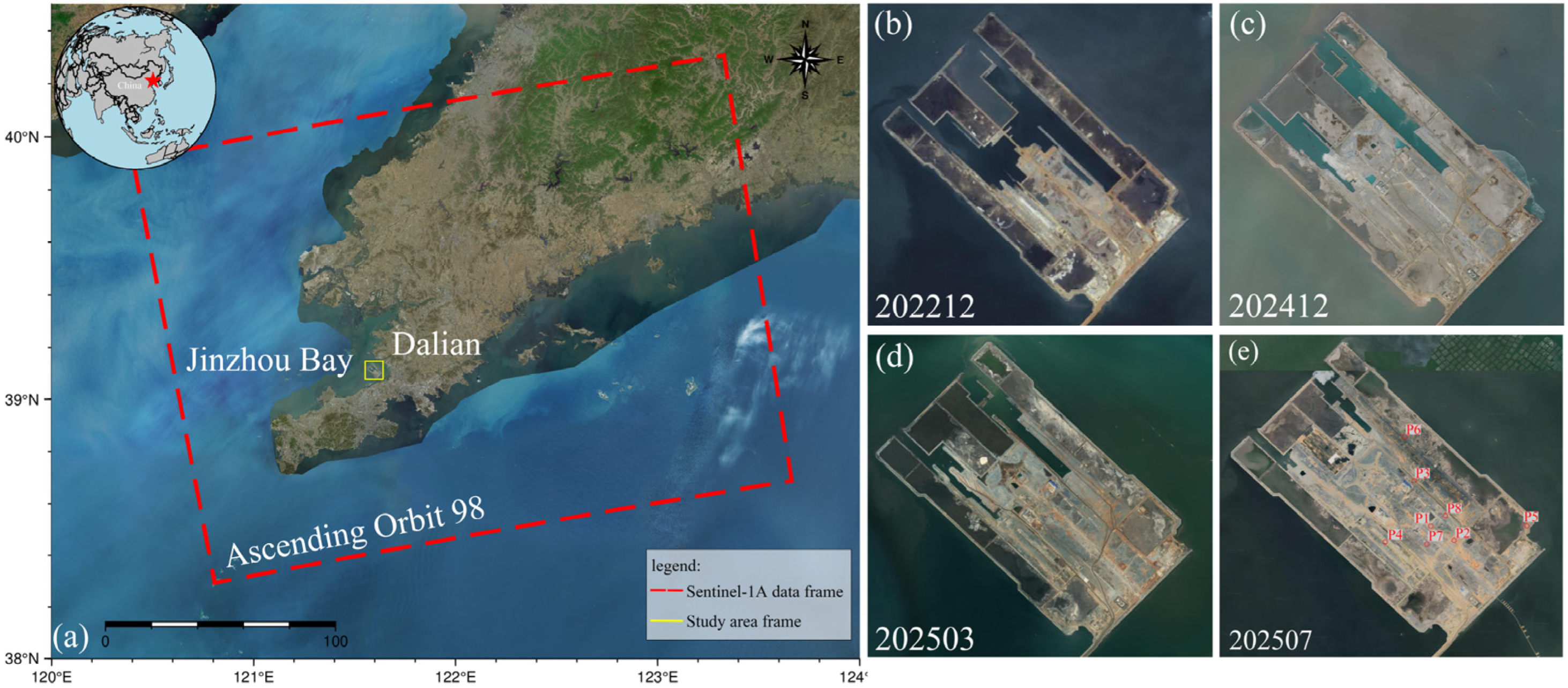
Figure 1 clearly illustrates the dynamic land reclamation process for the airport. Based on satellite imagery from July 2025 (
Figure 1e), in addition to the external access roads from the earliest reclamation phase, a central main channel crossing the sea is planned for construction in 2025. This channel will serve as one of the primary external access routes for the new airport. The main line spans approximately 2.85 km and will function as the future main artery connecting the mainland to the airport island.
For this study, 89 dual-polarization (VV/VH) Sentinel-1A images acquired from 31 August 2022 to 26 October 2025, were selected to monitor surface deformation at DJBIA. The specific parameters of the dataset are detailed in
Table 2. Since the airport area is newly reclaimed land, the publicly available 30 m resolution SRTM DEM data provided by the National Aeronautics and Space Administration (NASA) does not include updated topographic information for this region. Given that the impact of topographic phase residuals on deformation monitoring in such newly constructed areas is negligible, we assume that the airport area DEM is a constant. In the PSI processing, the amplitude dispersion index threshold was set to 0.4, whereas a threshold of 0.6 was adopted for the DSI method. The Hypothesis Testing of Confidence Interval (HTCI) algorithm was employed to identify statistically homogeneous pixels (SHPs) using a 10 × 5 pixel window at a 95% confidence level [
38]. According to the temporal distribution of the monitoring data, different reference images were selected for various time intervals: the image from 4 April 2023, was used as the reference for the period from 31 August 2022, to 24 December 2023; 20 August 2024, for the period from 5 January to 30 December 2024; and 29 April 2025, for the period from 11 January to 26 October 2025. For the processing of the entire time series, the image from 4 May 2024 was selected as the reference, imaging in strip mode with C-band electromagnetic waves.
3. Methodology
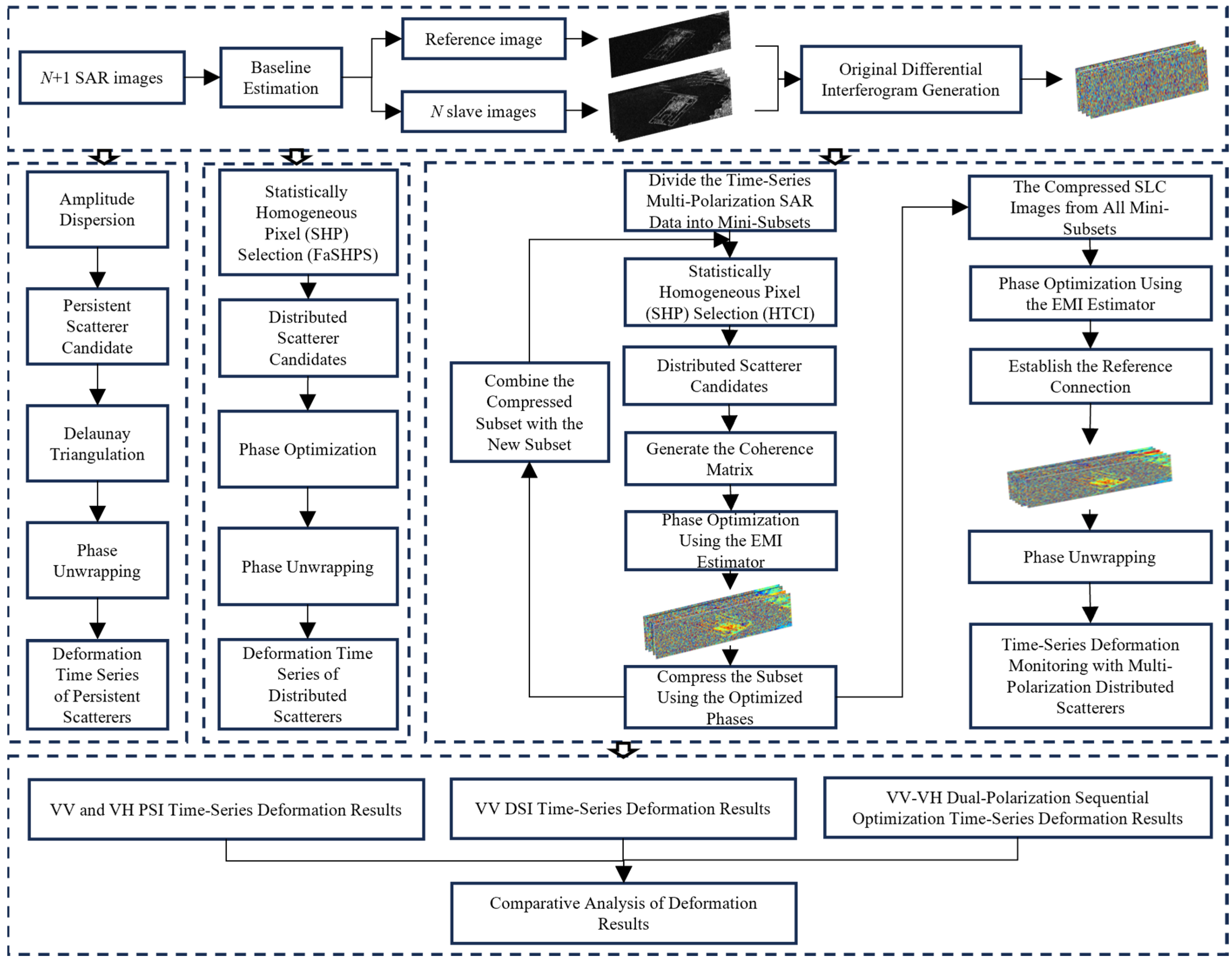
To fully evaluate the role of multi-polarization information fusion in dynamic deformation monitoring of reclaimed airports, this study systematically employs different techniques to obtain deformation results. First, PSI processing was applied to VV and VH polarization data separately, and the deformation results of PS under the two channels were compared. However, PS monitoring points were found to be extremely sparse. To address this, the DSI method based on the Fast Statistically Homogeneous Pixel Selection (FaSHPS) algorithm was then applied to VV polarization data to extract additional deformation information from distributed scatterers (DSs) [
39], thereby compensating for the spatial coverage limitations of PS points. Nevertheless, DSI results still suffered from severe decorrelation, and the monitoring points remained insufficient. To overcome these limitations, the SETP-EMI method was finally introduced for joint processing of dual-polarization (VV-VH) data. This method utilizes the HTCI algorithm to dynamically select statistically homogeneous pixels (SHPs) for each pixel within each subset, constructs a total power coherence matrix, and employs Eigendecomposition-based Maximum-likelihood-estimator of Interferometric phases (EMI) for phase optimization [
40]. The detailed technical workflow is shown in
Figure 2.
3.1. PSI
SAR images were used to form
interferograms. PS are pixels that maintain high phase coherence over time; thus, their phase composition corresponds directly to the pixel phase derived from differential interferometric processing. The procedure consists of two main steps: processing the differential interferograms, followed by extracting the phase term for the
th interferogram, which can be expressed as:
In this expression, the atmospheric delay phase over the study area
represents a linear model, while the noise in the image
corresponds to low-frequency signals exhibiting linear characteristics, which can reside within the atmospheric phase. The topographic phase and the deformation phase correspond to
and
, respectively. The deformation phase can be divided into two components: linear deformation and nonlinear deformation.
In Equation (2),
denotes the nonlinear deformation phase component,
represents the linear deformation rate of this PS point
is the temporal baseline for the
th interferogram, and
is the radar signal wavelength. Both the DEM error and the nonlinear deformation phase exhibit spatial correlation, which can be mitigated by differencing the phases of adjacent PS points. Therefore, in a differential interferogram, the differential interferometric phase residual between adjacent PS points can be calculated using the following formula, Equation (3):
Equation (3) establishes a linear relationship between the differential interferometric phase of adjacent PS points and their deformation velocity difference and elevation correction . Here, represents the phase component induced by DEM error; denotes the contribution from linear deformation; and is the residual phase containing nonlinear deformation and atmospheric effects.
This step establishes a model relating the phase difference to the increments of deformation rate and elevation anomaly. The deformation rate increment and elevation anomaly increment were then calculated using methods such as the two-dimensional periodogram or spatial search. To ensure reasonable baseline parameters in the PS network, these estimations should be performed based on the least squares method.
3.2. FaSHPS
The core idea of the FaSHPS algorithm is to average the time-series SAR intensity images. The averaged value of the reference pixel serves as the true value, while the neighboring pixels around it were treated as the values to be estimated. At a given confidence level, if the value of a neighboring pixel falls within the confidence interval constructed from this true value, it is considered statistically homogeneous with the central reference pixel [
39]. According to the Central Limit Theorem, the sample mean
of the SAR intensity images asymptotically follows a Gaussian distribution as the number of temporal images
increases, i.e.,
. This leads to the interval expression (4):
where
is the
quantile of the standard normal distribution function. Based on the statistical theory of SAR images, the amplitude of a single-look complex (SLC) image in a homogeneous region follows a Rayleigh distribution. The coefficient of variation for the Rayleigh distribution is constant, as expressed by Equations (5) and (6):
The complete confidence interval is formulated as follows.
where
denotes the number of looks in the SAR image. Although the FaSHPS algorithm significantly improves computational efficiency, its strict criterion for the tails of the Gaussian distribution can lead to Type I errors, thereby resulting in the omission of some SHPs. In this study, the traditional DSI method uses the FaSHPS algorithm to identify SHP points.
3.3. HTCI
To overcome the Type I error limitation of the FaSHPS algorithm described in
Section 3.2, the SETP-EMI method adopts the HTCI algorithm. HTCI incorporates a Generalized Likelihood Ratio Test (GLRT) into its core framework for preliminary screening to obtain an initial set of SHPs [
41]. The mean amplitude
of this initial SHP set is then used as a more reliable reference value to mitigate the heterogeneity and bias inherent in single-pixel estimates [
38]. Building on this, HTCI adopts a more precise statistical model where the sum of temporal amplitude data follows a Gamma distribution. The confidence interval estimation is subsequently expressed as Equation (8):
where
represents the quantile of the Gamma distribution at the confidence level
. The HTCI algorithm not only enhances computational efficiency and resolves the Type I error problem present in FaSHPS but also improves the reliability of SHP identification in small-sample scenarios.
3.4. SETP-EMI
Based on reciprocal backscattering, polarimetric data is represented using a complex scattering vector. The Pauli-basis scattering vector
for dual-polarization (VV-VH) data can be expressed as:
where
and
are the complex scattering signals of the VV polarization channel and the VH polarization channel, respectively.
The polarimetric interferometric scattering vector
can be expressed as
, where
is the Pauli-basis scattering vector of the reference image, and
is the Pauli-basis scattering vector of the slave image, as shown in (10):
where
denotes the polarimetric interferometric coherence matrix;
denotes the polarimetric coherence.
The time-series interferometric scattering vector
generated from N images is formed by averaging over SHP to create the time-series interferometric coherence matrix
. Further, the time-series total power (TP) coherence matrix is obtained through polarimetric stacking, as shown in (11):
where
denotes the number of polarization channels.
Ansari et al. proposed a sequential estimator algorithm [
42]. Building upon this, Wang et al. introduced improvements [
29]:
There are polarimetric channels, each containing SLC images. The dataset was divided into multiple subset groups with scenes per group, yielding subsets. Among these, the first subsets are full groups (each containing scenes), and the th subset contains the remaining scenes.
First, SHP identification was performed on the first raw data subset
. Based on the SHP samples, the total power (TP) coherence matrix
of the first subset was constructed. The EMI algorithm was executed to obtain the optimized phase sequence
for the first subset, where
is given by Equation (12):
After processing the first subset, its SAR data was compressed into a subset
. Using the optimized phase
as the transformation basis, the SAR data of the first subset was compressed into a representative SLC image
. This image was then combined with the new raw data
from the second subset for joint processing. Similarly, maximum likelihood estimation was performed to obtain the optimized phase
for the second subset itself, i.e.,
. The remaining subsets were processed analogously in sequence. This process cycles through to the
th subset for sequential processing. The EMI method was applied again to the dataset to calculate the phase of each sequence relative to its respective reference. Compressed SLC images were generated as a new subset of
. EMI was executed to determine the phase of each sequence relative to a new arbitrary and unique reference, as given by Equation (13):
The corrected phase
for the
th sequence is expressed as:
where
denotes the maximum likelihood estimated phase for the
th sequence,
denotes the calibrated phase for the
th sequence, and
denotes the final phase for the
th sequence.
4. Results, Verification and Analysis
4.1. Experimental Results
4.1.1. Interferogram Quality
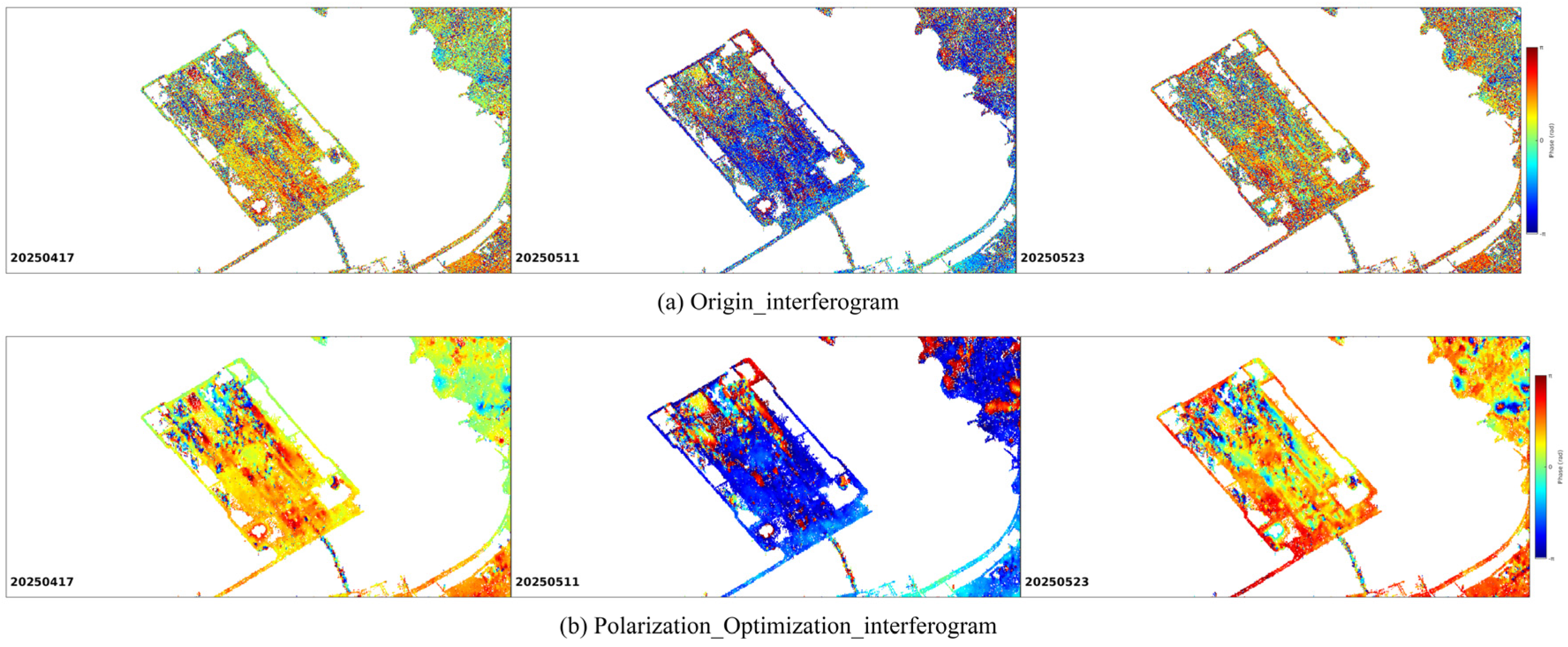
To evaluate the effectiveness of phase optimization, three differential interferometric pairs were selected from the monitoring period (11 January 2025 to 26 October 2025) for detailed quality comparison and analysis: these pairs share a common reference image acquired on 29 April 2025 and have slave images acquired on 17 April 2025, 11 May 2025, and 23 May 2025.
Figure 3 shows the original VV-polarization differential interferogram and the interferogram optimized through sequential polarimetric processing, respectively. The results indicate that the airport outline is clearer and the overall interferogram quality is improved after the SETP-EMI. For the quantitative assessment, we applied three well-established and conventional evaluation metrics to all 22 interferograms from this period [
43]: the Mean Phase Standard Deviation (MPSD), the Mean Phase Gradient (MPG), and the Residue Points Number (RPN). As shown in
Table 3, the results obtained via the SETP-EMI method show a significant reduction in the mean phase standard deviation and mean phase gradient by 34.1% and 32.2%, respectively. The SETP-EMI effectively suppresses random noise induced by decorrelation, yielding a smoother and more continuous interferometric phase that better reflects the true surface deformation signal. Concurrently, the number of residue points decreased by approximately 71.8%, which substantially reduces the difficulty and ambiguity of phase unwrapping. This outcome indirectly verifies the higher reliability of the optimized phase sequence, laying a solid foundation for subsequent retrieval of high-precision deformation results.
4.1.2. Time-Series Deformation
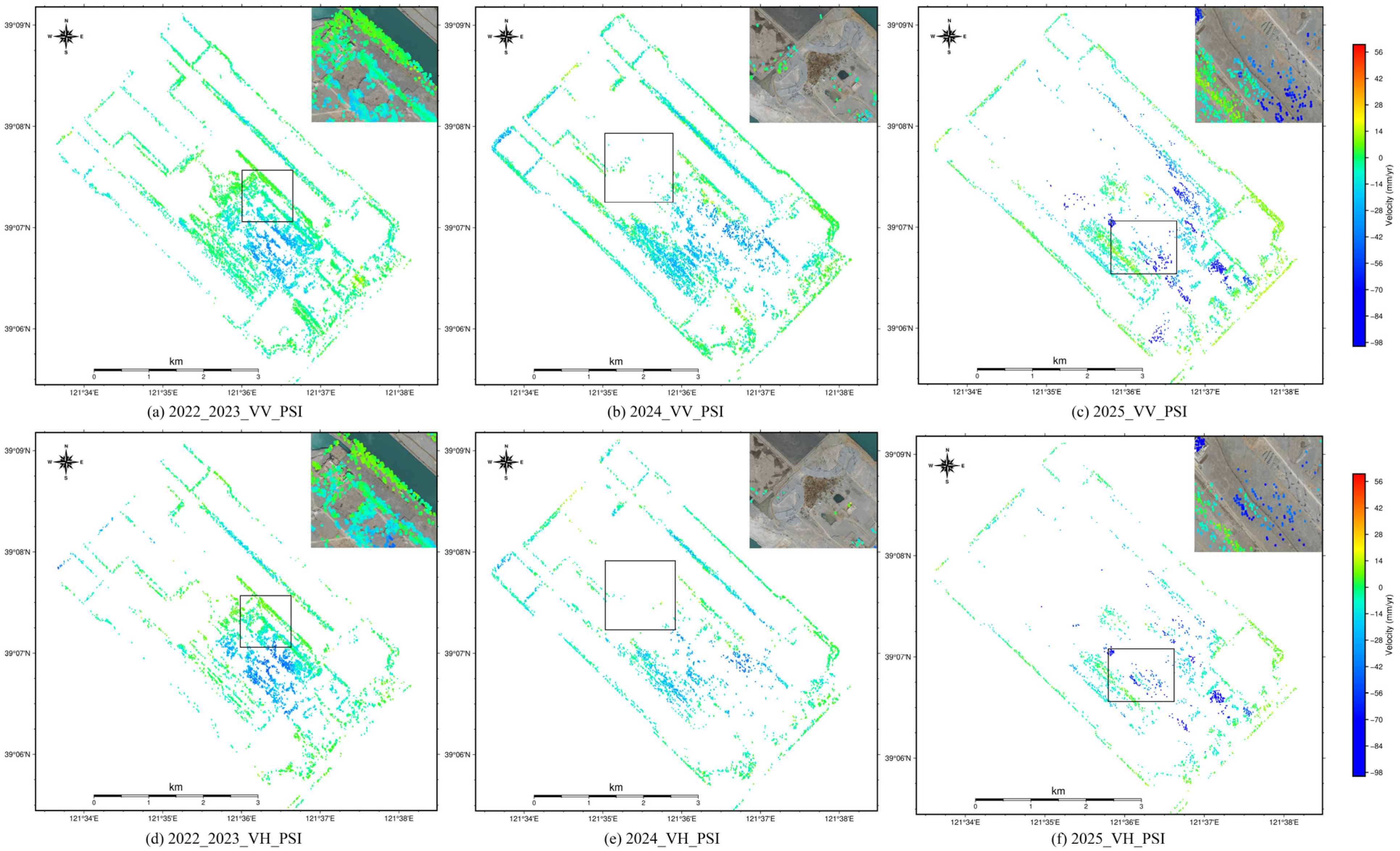
Figure 4a–c display the deformation results derived from VV polarization PSI for three distinct time periods, while
Figure 4d–f show the corresponding results from VH-polarization PSI. Enlarged regions in the upper-right corners are provided for comparative analysis. The results demonstrate that within the enlarged areas of
Figure 4a,d although the VV channel generally yields a higher overall density of deformation measurement points than the VH channel, the VH channel actually provides a greater point density in these specific sub-regions. This indicates that information from both polarization channels is essential for comprehensive deformation monitoring. The VH results effectively supplement the deformation data in certain areas, contributing to a more complete deformation monitoring outcome. The results in
Figure 4b,e reveal that during 2024, which corresponds to the core phase of terminal construction in this area, both the number of deformation measurement points and their spatial coverage were significantly lower compared to earlier periods. This phenomenon is primarily due to large-scale construction activities altering the surface scattering characteristics, causing severe temporal decorrelation and thus hindering the selection of high-quality, stable PS points. The enlarged areas in
Figure 4c,f display the deformation results for the final monitoring period in 2025. Unlike the significant polarization differences observed in construction-active zones during the earlier periods (2022–2023 and 2024), the deformation distribution in 2025 is more pronounced, with further increased subsidence magnitudes, reflecting the ongoing consolidation settlement of the reclamation area. Meanwhile, due to the continuous disturbance from construction machinery, the number of stable deformation monitoring points in 2025 decreased significantly compared to previous periods.
The analysis of time-series PSI results for DJBIA across different periods highlights the complementary characteristics of VV and VH polarization information. The VH channel not only compensates for the lack of measurement points from VV in stable areas but also uniquely captures significant surface changes caused by construction activities. Therefore, employing a multi-polarization collaborative observation strategy is an effective approach for obtaining a highly comprehensive deformation field and for gaining deeper insights into the physical mechanisms underlying the deformation.
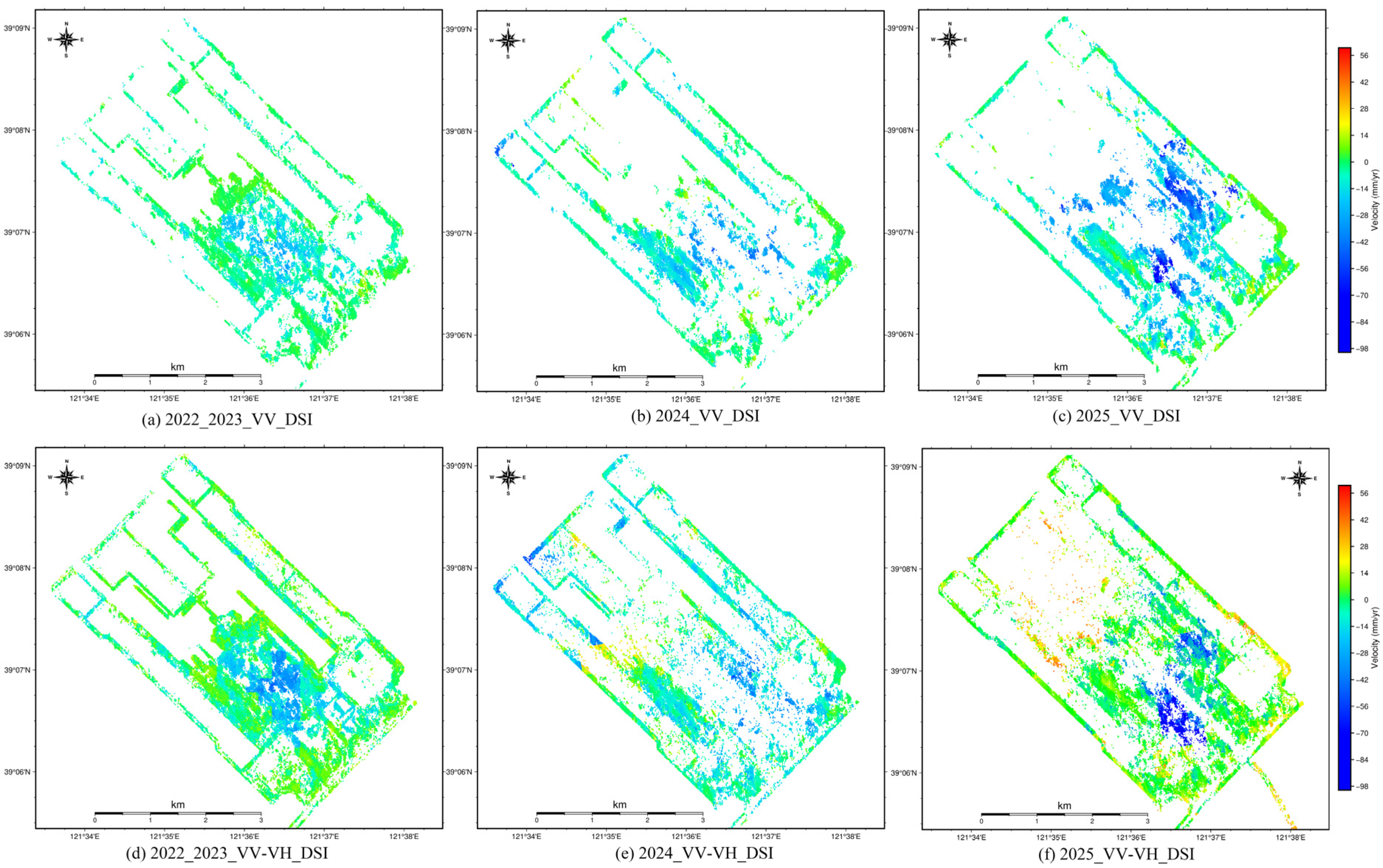
The number of deformation points obtained from PSI was still limited. To further analyze the deformation of the airport, the DSI method was employed using both single-polarization and dual-polarization data to acquire a more comprehensive deformation dataset. This study compares the deformation monitoring results across three periods: those derived from the traditional single-polarization DSI method based on the FaSHPS algorithm, and those obtained from the proposed SETP-EMI method, which utilizes the HTCI algorithm for statistically homogeneous pixel selection. The comparison focuses on evaluating the advantages of the latter in detecting low-coherence regions, increasing deformation point density, and enhancing spatial continuity.
Figure 5a,d present the deformation comparison for the period 31 August 2022 to 24 December 2023. Regarding point selection in the runway area, the traditional DSI already provided a sufficient number of deformation points compared to the PSI. The SETP-EMI results achieved further significant improvements in both point density and spatial continuity, thereby revealing more complete details of the runway deformation.
Figure 5b,e shows the subsidence comparison for the 2024 period. After the project entered a full-scale construction phase in 2024, marked by the start of the terminal building’s pile foundation works, rapid land reclamation progressed on both sides of the airport runways. The InSAR results clearly indicate significant uplift signals along the runway edges. However, deformation monitoring reveals substantial subsidence in the initially formed central core area. This observation indirectly indicates that even after temporary cessation of reclamation work, continued self-consolidation of the fill material can still cause extensive and persistent subsidence, highlighting the critical importance of long-term monitoring.
Figure 5c,f compare subsidence from 11 January 2025 to 26 October 2025. The lower right corner of the image corresponds to the cross-sea section of the central main corridor. In this area, both PSI and traditional DSI results failed to obtain valid deformation points due to severe decorrelation. In contrast, the SETP-EMI method based on the HTCI algorithm successfully captured the deformation signal, yielding sparse but trend-consistent uplift points. This result demonstrates the feasibility of the SETP-EMI method for effective deformation detection in low-coherence regions.
In summary, a visual comparison with single-polarization DSI results clearly indicates that the deformation field obtained via SETP-EMI exhibits significantly enhanced spatial point density and continuity. More importantly, in areas suffering from severe decorrelation caused by construction activities, where traditional methods are largely ineffective, the SETP-EMI method can still acquire valid deformation signals. This fully confirms its superior adaptability and detection capability in low-coherence, dynamically changing environments. This advantage stems from its core mechanisms: dynamic selection of statistically homogeneous pixels and the sequential fusion of multi-polarization information.
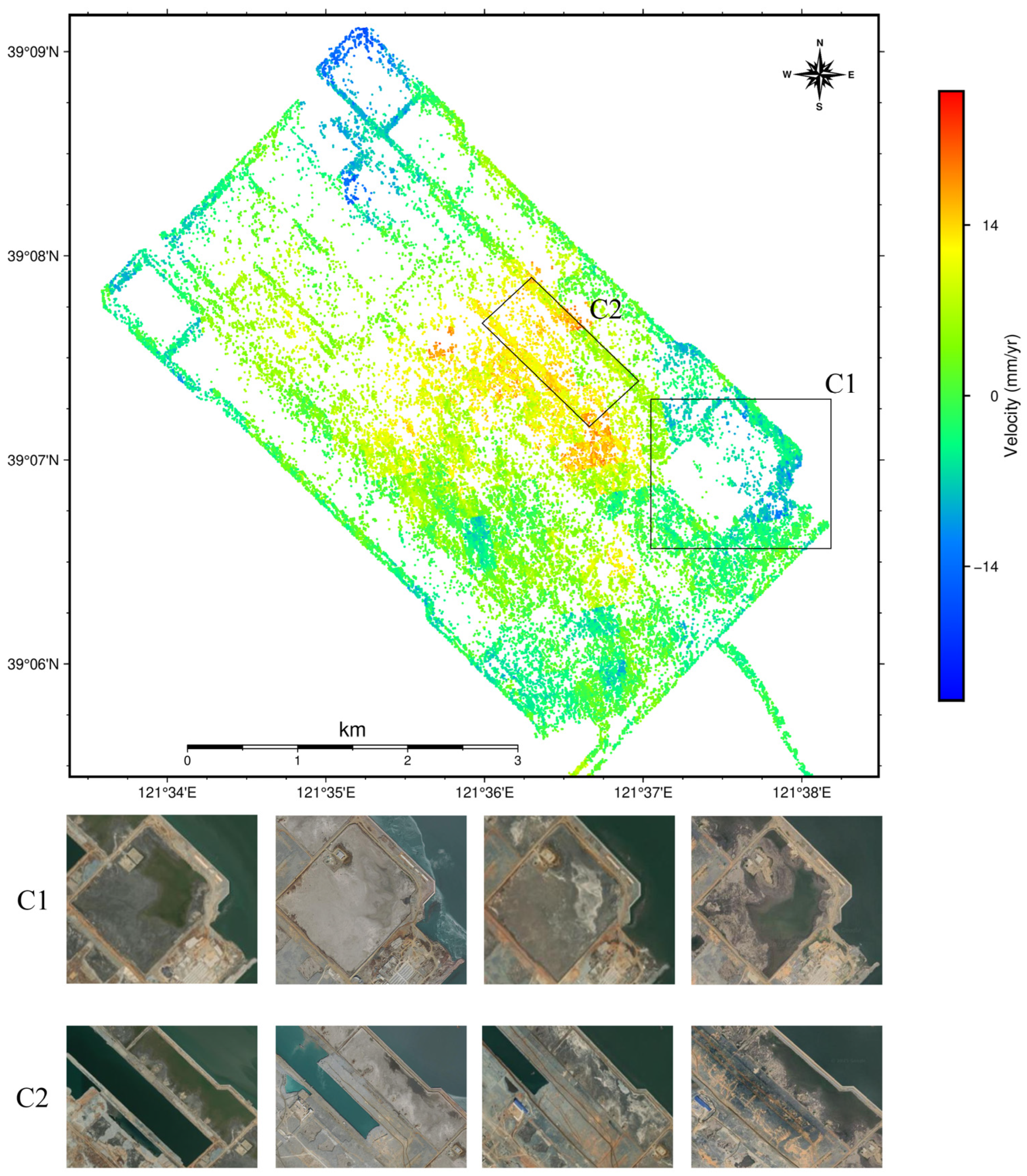
To comprehensively evaluate the performance of the SETP-EMI method over the complete observation period, this study integrated deformation results from the three periods spanning 2022 to 2025 to generate a long-term continuous deformation field (
Figure 6). Two representative areas, C1 and C2, were selected for analysis. Satellite imagery of Area C1 across different periods shows that the region was initially predominantly water. Subsequent land reclamation transformed the surface from water bodies into new land. However, InSAR time-series monitoring results indicate uneven subsidence in this area. This is primarily attributed to the expulsion of pore water from the soil under the combined effects of the fill material’s self-weight and engineering loads, leading to soil consolidation and compression. Consequently, the ground surface elevation became lower than the surrounding water level. In later optical imagery, localized water bodies reappeared in this area, which indirectly confirms that Area C1 exhibits typical consolidation subsidence following reclamation engineering. In contrast to Area C1, Area C2 was completely filled from its initial marine state into stable land during the monitoring period. InSAR monitoring results for this area also show uplift signals, consistent with the ongoing construction activities involving continuous deposition of reclamation material throughout the monitoring period. The significant increase in surface elevation further reflects that this area was a primary construction zone.
This result fully demonstrates that the SETP-EMI method proposed in this study not only enhances monitoring effectiveness within individual time periods but also, through its dynamic sequential processing strategy, effectively integrates multi-temporal data to construct a long-term deformation field with clear physical meaning and spatiotemporal continuity. This provides an unprecedented comprehensive perspective for interpreting the overall subsidence patterns and construction progress of reclamation projects.
4.2. Results Verification
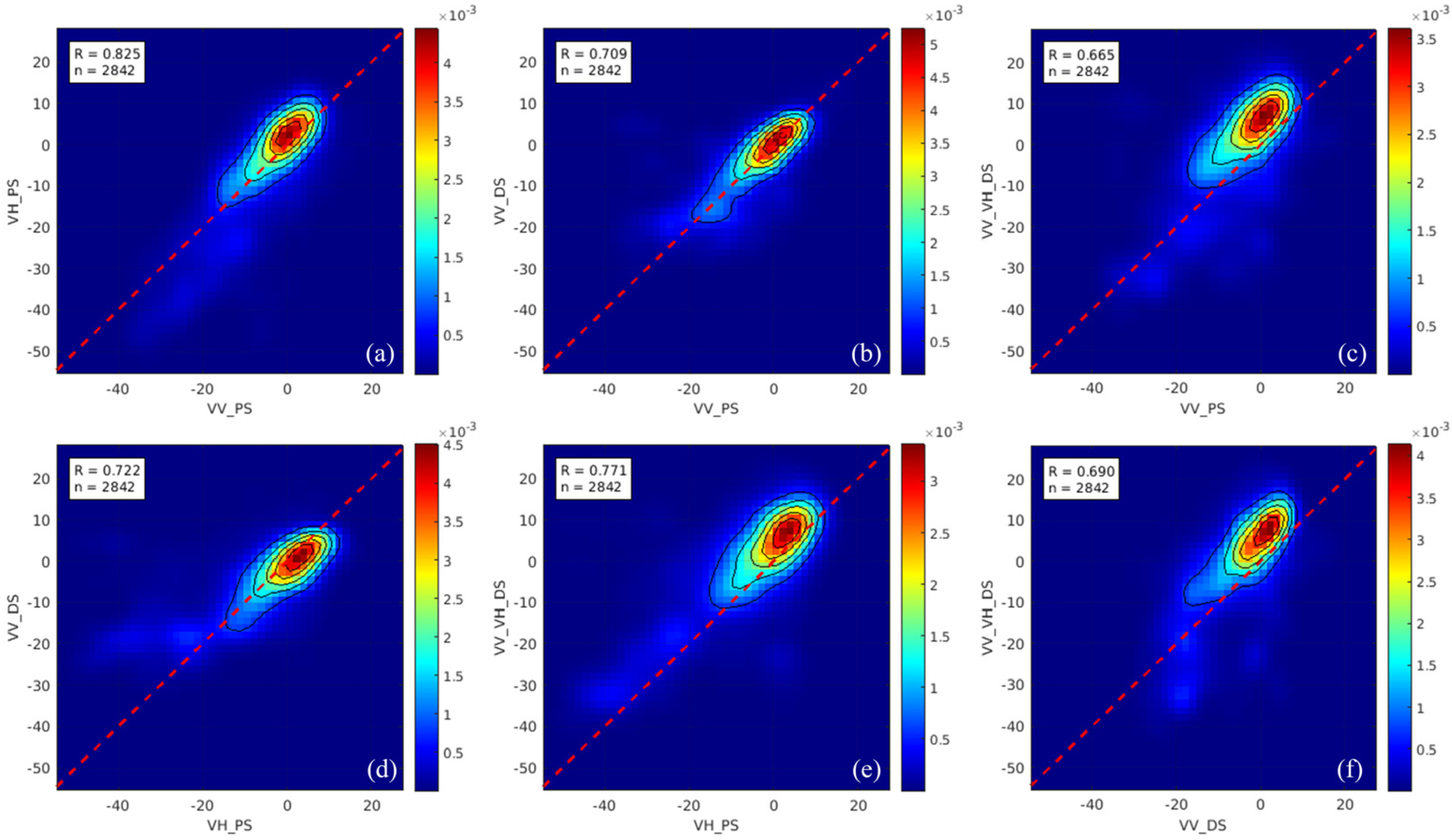
To investigate the correlations among deformation monitoring results derived from different polarizations and methods, this study selected the VV and VH-polarization PSI results, VV polarization DSI results, and SETP-EMI results (VV_VH_DS) for the period from 31 August 2022 to 24 December 2023. A total of 2842 collocated deformation points were extracted. Kernel density estimation was employed to conduct pairwise comparative analysis of the four result sets, with the results presented in
Figure 7.
Figure 7a–f show the kernel density distributions of deformation rates between the respective pairs. The horizontal and vertical axes represent the deformation rates (mm/yr) of the two methods or polarization channels being compared, with color intensity indicating point density.
Using the same PSI method, the correlation coefficient between VV and VH polarizations is R = 0.825, indicating a high degree of coordination between surface treatment quality (sensitive to VH) and the internal filling process (sensitive to VV) during the reclamation construction period. The kernel density distribution exhibits a slight shift relative to the diagonal, with the core density region biased toward the VH side. This systematic deviation reflects the differential response of different polarizations to the scattering characteristics of the fill material, corroborating the principle of polarimetric sensitivity. Under the same VV polarization condition, the correlation coefficient between PSI and DSI is R = 0.709. In the kernel density distribution, the high-density region is closely concentrated around the 1:1 reference line. This suggests that although PSI is based on persistent scatterers and DSI on distributed scatterers, both show good agreement in monitoring the overall consolidation process of the fill. The absence of a significant shift in the kernel density further verifies that, under consistent polarization, different methods possess similar capabilities in capturing consolidation behavior. Notably, the correlation between VV-polarization DSI results and VH-polarization PSI results (R = 0.722) is higher than that with the co-polarized VV-PSI results (R = 0.709). This counterintuitive finding stems from the fact that DSI prioritizes phase-stable scatterers during homogeneous sample selection. During reclamation construction, such stable areas often correspond to well-compacted surface fill zones, which are precisely the regions where VH polarization is sensitive and can provide accurate monitoring. This observation is further supported by the SETP-EMI results: the correlation between VV_VH_DS and VH-PSI (R = 0.771) is significantly higher than that with VV-PSI (R = 0.665). The SETP-EMI method automatically optimizes multi-polarization information through maximum likelihood estimation, and its results reveal a distinct preference for VH polarization. This indicates that, in reclamation construction environments, the phase information from the VH channel offers higher stability and reliability.
In summary, due to the inherent differences in sensitivity of various polarization channels to the scattering properties and geometry of surface features, significant variations naturally occur in the interferometric phase coherence and derived deformation results across polarization channels [
44]. Furthermore, this study demonstrates that in low-coherence areas typical of reclamation construction, the integration of multi-polarization information is essential for accurately capturing deformation patterns in complex engineering settings. The strength of VH polarization in monitoring surface quality provides vital technical support for construction quality control at airports under development.
To quantitatively assess the monitoring capabilities of the different methods,
Table 4 summarizes the number of deformation points obtained by each method across the periods. The results clearly show that the SETP-EMI method consistently yields a significantly higher number of deformation points than the traditional single-polarization methods in all periods. Specifically, compared to the traditional VV polarization DSI, the proposed method increased the number of deformation points by 76.4%, 46.3%, and 21.5% for the 2022–2023, 2024, and 2025 periods, respectively. This data conclusively demonstrates that the integration of multi-polarization information can substantially increase the number of valid observation targets. The improvement was most pronounced during the early construction phase (2022–2023), when surface scattering characteristics were relatively stable. As the project entered a large-scale construction phase in 2024, marked by the commencement of the terminal building’s pile foundation works, accelerated surface dynamics led to a decline in overall coherence. Consequently, the number of monitoring points decreased for all methods. Nonetheless, the SETP-EMI method maintained the highest point density, underscoring its robustness in dynamic scenarios.
To further validate the reliability of the deformation results, two representative points, P7 and P8 (locations marked in
Figure 1e), were selected from the 2025 dataset for detailed analysis (
Figure 8). The results show that the three time-series curves (VV-PSI, VH-PSI, and VV_VH_DS) at points P7 and P8 exhibit high consistency in their trends. Notably, the number of PS deformation points obtained by PSI technology in 2025 decreased significantly, reflecting the limitations of conventional single-polarization methods under intense construction disturbances. However, the SETP-EMI technology, through dynamically fusing dual-polarization information, still obtained more deformation points (as shown in
Table 4), demonstrating its superior monitoring capability in low-coherence regions.
4.3. Results Analysis
The SETP-EMI method presented in this study dynamically identifies pixels with similar scattering characteristics for a given period. Therefore, when changes in ground object backscatter occur, the update of SHP is conducted within the corresponding subsets. Should the backscatter intensity vary significantly within a subset, the SHP update may contain errors, which in turn reduces the accuracy of phase optimization. Consequently, employing smaller time-series subsets facilitates more timely detection of a larger number of backscatter intensity variations.
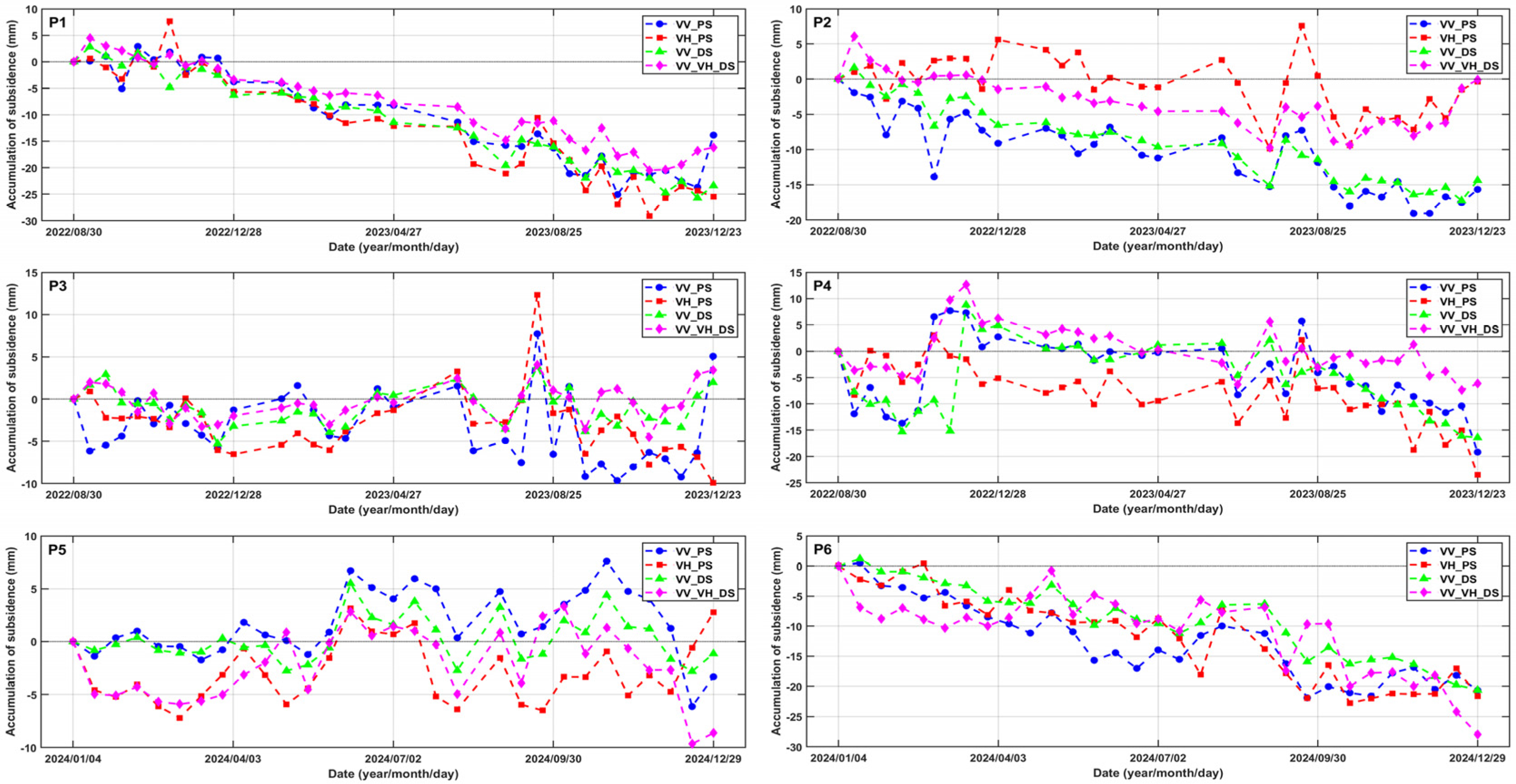
The spatial distribution of the six representative monitoring points (P1–P6) is shown in
Figure 1e. These points cover the central stable zone, the runway construction area, and the marginal zone of the artificial island. Integrating the time-series deformation analysis results (
Figure 9), the selected representative points from 2022 to 2024 display distinct temporal deformation characteristics under different scattering mechanisms. In areas where deformation patterns had initially formed by 2022–2023, the SETP-EMI curves for points P1, P3, and P4 are largely consistent with both VV- and VH-polarization curves, reflecting stable scattering characteristics in these areas where different techniques effectively captured coherent deformation histories. Among the representative points from 2024, the curves from different methods at P6 also exhibit good agreement. In contrast, the SETP-EMI curve for point P2 aligns more closely with the VH-polarization curve, indicating that VH polarization provided higher-quality and more stable scattering signals in this region. P5 exhibits a pattern similar to P2, where its VV-polarization subsidence curve diverges from both the VH-polarization and the SETP-EMI results. The time-series curves at different monitoring points exhibit a certain degree of channel preference. This stems from the fundamental difference in scattering sensitivity between VV and VH polarizations. VV polarization is more sensitive to volume scattering and internal consolidation of fill materials. VH polarization responds more strongly to surface roughness and geometric structural changes. When interpreted alongside multi-temporal optical imagery, this variability reflects the dynamic response mechanism of the SETP-EMI method under varying construction environments. The SETP-EMI curve dynamically favors either the VV or VH channel across different time intervals, demonstrating the method’s capability to adaptively switch the dominant polarization channel based on signal quality, thereby continuously selecting the most reliable signal source for phase optimization throughout the entire observation period.
In summary, the SETP-EMI method yields results that are significantly superior to single-polarization approaches in terms of spatial coverage and continuity. Furthermore, it uncovers finer details of deformation patterns associated with construction activities.




 ,
,