Article

Flood Susceptibility Mapping and Runoff Modeling in the Upper Baishuijiang River Basin, China

1
College of Earth and Environmental Sciences, Lanzhou University, Lanzhou 730030, China
2
School of Civil and Hydraulic Engineering, Lanzhou University of Technology, Lanzhou 730050, China
3
Emergency Mapping Engineering Research Center of Gansu, Lanzhou 730050, China
4
Academician Expert Workstation of Gansu Dayu Jiuzhou Space Information Technology Co., Ltd., Lanzhou 730050, China
5
Lanzhou Bowen College of Science and Technology, Lanzhou 730101, China
6
Institute of Geographic Sciences and Natural Resources Research, Chinese Academy of Sciences, Beijing 100101, China
*
Author to whom correspondence should be addressed.
Remote Sens. 2026, 18(9), 1270; https://doi.org/10.3390/rs18091270
Submission received: 2 March 2026 / Revised: 13 April 2026 / Accepted: 20 April 2026 / Published: 22 April 2026
(This article belongs to the Special Issue Remote Sensing for Planetary Geomorphology and Mapping)

Highlights

What are the main findings?
  • Medium-to-high flood susceptibility areas remain generally stable but exhibit a moderate expansion (+5.2% ± 0.8%) under future climate scenarios.
  • Runoff dynamics are mainly controlled by watershed properties, particularly infiltration capacity, recession behavior, and CN-related parameters, which regulate peak discharge and hydrological response.
What are the implications of the main findings?
  • Flood risk management should focus on areas with increasing susceptibility along river corridors and enhance infiltration and storage capacity to mitigate runoff concentration.
  • Integrating susceptibility mapping with physically based hydrological modeling provides a robust framework for improving flood prediction and climate adaptation strategies in mountainous basins.

Abstract

Mountain flood susceptibility in complex mountainous basins is strongly influenced by terrain–climate interactions; however, the linkage between spatial susceptibility patterns and hydrological processes remains poorly understood. This study proposes a process-oriented framework that explicitly links flood susceptibility patterns with hydrological processes, moving beyond conventional approaches that rely on independent model integration. The Baishuijiang River Basin, located in Wenxian County, southern Gansu Province, China, is selected as a representative mountainous watershed for this analysis. The specific conclusions are as follows: (1) Flood susceptibility was mapped using a Particle Swarm Optimization (PSO)-enhanced Maximum Entropy (MaxEnt) model based on multi-source environmental variables, including climatic, terrain, soil, land cover, and vegetation factors. The model achieved high predictive accuracy (Area Under the Receiver Operating Characteristic Curve (AUC) = 0.912), identifying precipitation of the driest month (bio14), elevation, and land use as dominant controlling factors. Medium-to-high-susceptibility areas account for approximately 22% of the basin and are mainly distributed along river valleys and flow convergence areas. These patterns are strongly associated with reduced infiltration capacity under dry antecedent conditions and enhanced flow concentration in steep terrain, and they exhibit clear nonlinear responses and threshold effects. (2) Hydrological simulations using Hydrologic Engineering Center–Hydrologic Modeling System (HEC-HMS) show good agreement with observed runoff (Nash–Sutcliffe Efficiency (NSE) = 0.74–0.85). Sensitivity analysis indicates that runoff dynamics are primarily controlled by the Curve Number (CN), recession constant, and ratio to peak, corresponding to infiltration capacity, recession processes, and peak discharge amplification. The spatial consistency between high-susceptibility areas and areas of strong runoff response demonstrates that susceptibility patterns can be physically explained through hydrological processes, providing a process-based interpretation rather than a purely statistical prediction. (3) Future projections indicate that medium–high-susceptibility areas remain generally stable but show a gradual expansion (+5.2% ± 0.8%) and increasing concentration along river corridors under climate change scenarios. This reflects intensified precipitation variability and enhanced runoff concentration processes, suggesting a climate-driven amplification of flood risk in hydrologically connected areas. Overall, this study goes beyond conventional susceptibility assessment by establishing a physically interpretable framework that provides a consistent linkage between environmental controls, susceptibility patterns, and hydrological responses. The proposed approach is transferable to similar mountainous basins with strong terrain–climate interactions, although uncertainties related to data limitations and single-basin application remain and require further investigation.

1. Introduction

Mountain floods are among the most destructive natural hazards worldwide, characterized by rapid onset, high flow velocity, and high destructive capacity, often resulting in severe socioeconomic losses [1]. In mountainous environments, steep terrain, strong topographic gradients, and highly variable precipitation patterns promote rapid runoff generation and flow concentration, significantly increasing flood risk [2,3].
Current research on flood hazards has largely evolved along two independent directions: data-driven susceptibility assessment and process-based hydrological simulation. Machine learning approaches have become dominant tools for flood susceptibility mapping due to their ability to capture nonlinear relationships between environmental variables and hazard occurrence [4,5,6]. Recent advances in deep learning and ensemble models have further improved predictive performance [7,8,9,10]. However, such approaches primarily emphasize prediction accuracy and often lack physical interpretability, thereby limiting their ability to explain the underlying mechanisms of flood generation. In contrast, hydrological models provide a physically based framework for simulating rainfall–runoff processes and understanding flood mechanisms. Models such as Soil and Water Assessment Tool (SWAT), Variable Infiltration Capacity (VIC) model and HEC-HMS are widely applied in watershed-scale hydrological simulations [11,12,13,14]. These models offer clear physical interpretability and can represent runoff generation, routing, and peak discharge processes. Nevertheless, they are not designed to explicitly describe the spatial heterogeneity of flood susceptibility, especially under complex terrain and heterogeneous environmental conditions.
This methodological separation highlights a fundamental contradiction in flood research: data-driven models provide accurate spatial predictions but lack physical interpretability, whereas process-based hydrological models effectively describe physical processes but have limited capability in spatial susceptibility mapping. As a result, the linkage between susceptibility patterns and hydrological processes remains insufficiently understood, and most existing studies either treat these approaches independently or combine them in a loosely integrated manner without establishing a clear process-based relationship [15,16,17,18]. Therefore, the key scientific challenge is not simply integrating different models, but developing a framework that enables physically interpretable connections between spatial susceptibility patterns and hydrological responses. To address this challenge, recent studies have attempted to improve model performance using optimization algorithms. PSO, known for its computational efficiency and global search capability [19,20,21], has been widely applied to enhance machine learning models by improving parameter optimization and reducing overfitting [22,23,24]. However, these studies still focus primarily on improving predictive accuracy, while paying limited attention to physical interpretability and process understanding. In addition, the selection of environmental variables in susceptibility modeling is typically guided by hydrological theory and prior empirical studies, including climatic factors controlling rainfall input, terrain variables governing flow concentration, and land surface conditions influencing infiltration and runoff generation. However, many existing studies lack explicit justification for variable selection and do not clearly relate these factors to hydrological processes, limiting the interpretability of model results. Therefore, this study proposes a structured analytical framework that integrates a PSO-enhanced MaxEnt model with a process-based HEC-HMS model, thereby establishing a physically interpretable linkage between environmental controls, susceptibility patterns, and runoff response mechanisms. Unlike previous studies that simply combine different models, the proposed framework uses hydrological process simulations to interpret the spatial patterns of flood susceptibility, thereby establishing a physically interpretable linkage between environmental controls, susceptibility distribution, and runoff response mechanisms. In this framework, PSO is used to optimize MaxEnt parameters to improve model robustness and reduce overfitting, while HEC-HMS is employed to simulate rainfall–runoff processes, enabling a process-based explanation of susceptibility patterns.
The study is conducted in the upper Baishuijiang River Basin, a representative mountainous watershed characterized by strong terrain–climate interactions, dense drainage networks, and frequent flash flood events. These characteristics are typical of many mountain regions in southwestern China and similar environments worldwide, making the study area suitable for evaluating both susceptibility modeling and hydrological process analysis. Therefore, as a typical mountainous rainfall-dominated basin, the study area provides a suitable case for exploring the linkage between flood susceptibility and hydrological processes and suggests that the proposed framework may be transferable to regions with similar hydrogeomorphic conditions.
The main objectives of this study are to: (1) identify dominant environmental controls on flood susceptibility using a PSO-enhanced MaxEnt model; (2) simulate rainfall–runoff processes using HEC-HMS; and (3) establish a process-oriented linkage between susceptibility patterns and hydrological dynamics. This study not only improves the reliability of susceptibility assessment, but also provides a physically interpretable framework for understanding flood generation mechanisms, offering insights that can be applied to similar mountainous regions.

2. Data and Methodology

2.1. Study Area Overview

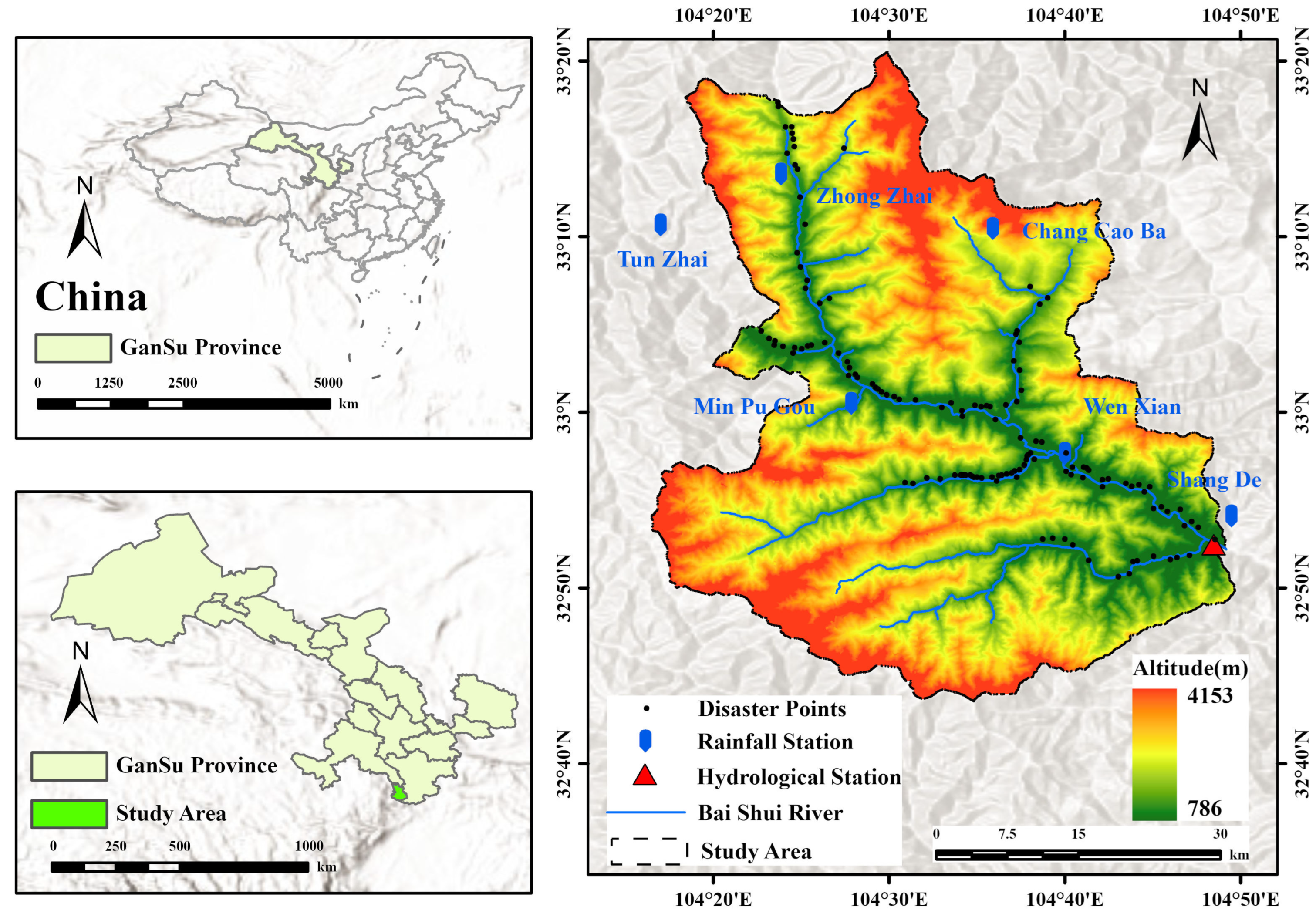
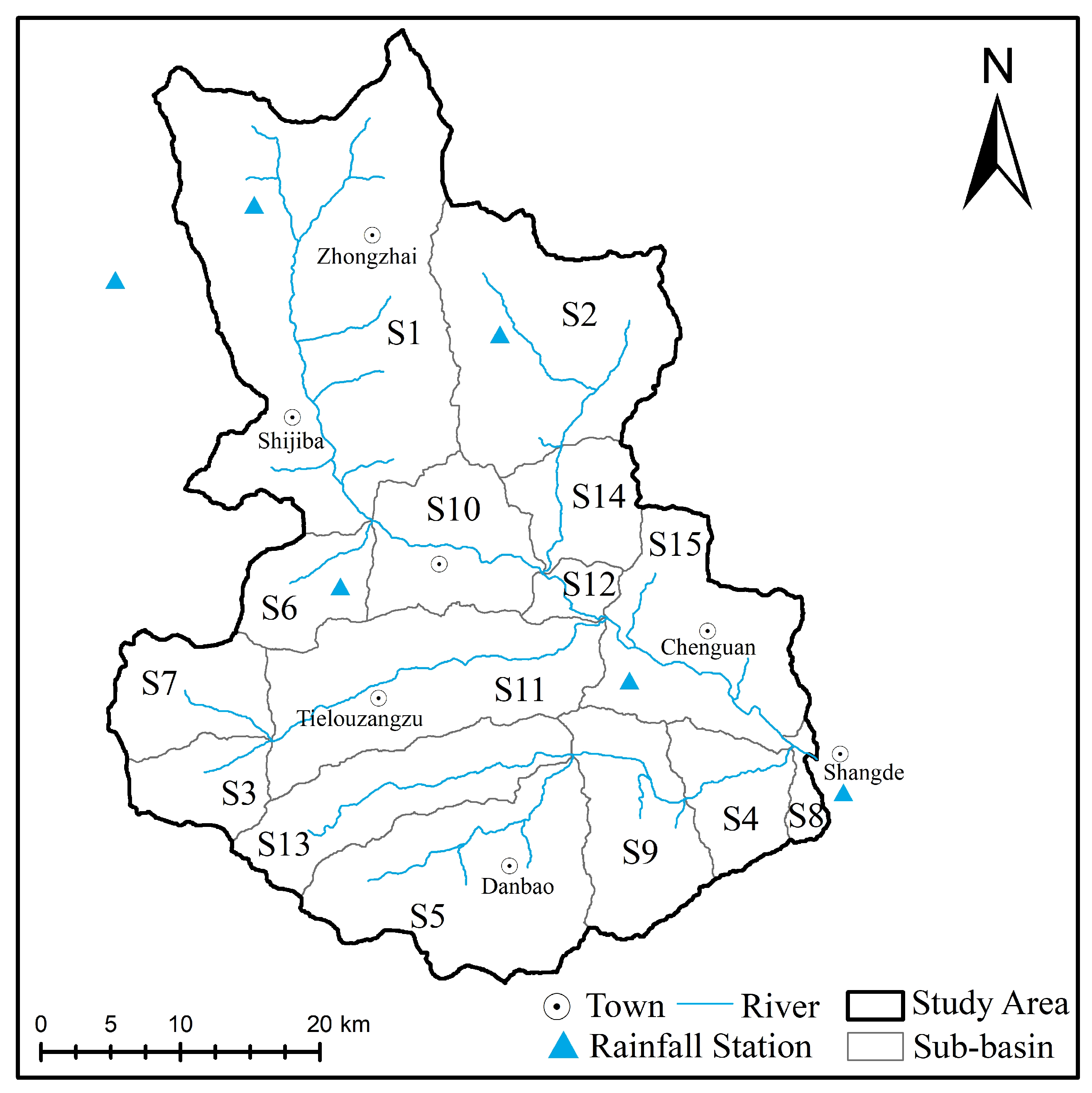
The study area is located in the upstream region of the Baishuijiang River Basin in Wenxian County, southern Gansu Province, China (Figure 1), extending from 104°19′E to 104°49′E and 32°20′N to 32°44′N. The basin is elongated (approximately 71.4 km in the north–south direction and 5.2 km in the east–west direction) and includes several towns and townships. As shown in Figure 1, the study area contains a dense river network, multiple rainfall stations, a hydrological station, and numerous recorded disaster points, providing essential data support for both flood susceptibility modeling and hydrological simulation [25]. The total area of the basin is approximately 2027 km2.
Geomorphologically, the basin is situated in the western Qinling Mountains and is characterized by steep terrain, deep valleys, and an elevation difference exceeding 3000 m. Under the influence of a subtropical montane climate, the region frequently experiences short-duration, high-intensity rainfall events during summer. These conditions favor rapid runoff generation and flow concentration, making the basin highly prone to flash floods [26].
The strong spatial heterogeneity in topography, land cover, and precipitation provides a solid suitable basis for integrating flood susceptibility assessment with hydrological modeling. Terrain controls flow concentration, climatic factors regulate rainfall input, and land surface conditions influence infiltration and runoff generation. In addition, the availability of rainfall and discharge observations enables model validation, making the study area well-suited for exploring the linkage between susceptibility patterns and watershed-scale hydrological responses.

2.2. Data Description

2.2.1. Historical Flood Inventory

The historical mountain flood disaster data were acquired through field surveys conducted by the Gansu Provincial Department of Natural Resources (GPDNR), China, from 2016 to 2022, using the BeiDou Navigation Satellite System (BDS) for precise geolocation of disaster points. The dataset comprises 132 documented flood events, which are predominantly distributed along the Baishuijiang River corridor (Figure 1). The inventory data were used as training and validation samples for the flood susceptibility modeling.

2.2.2. Hydrological Station Data

The hydrological station data used in this study were obtained from the Hydrological Yearbooks (2018–2020), covering the Baishuijiang River Basin within the Jialingjiang River system of the Yangtze River Basin. The dataset includes precipitation records from six rainfall stations (Changcaoping, Zhongzhai, Tunzhai, Minpugou, Wenxian, and Shangde) and runoff measurements from the Shangde Hydrological Station (Figure 1), which were used as input data for rainfall–runoff simulation in the HEC-HMS model. Runoff observations from the Shangde Hydrological Station were used for model calibration and validation.

2.2.3. Environmental Variables

The environmental variables analyzed in this study comprise four categories: (1) bioclimatic variables, (2) terrain characteristics, (3) soil properties, and (4) land cover types, which were selected based on their established roles in influencing runoff generation, flow concentration, and flood occurrence. Additionally, a vegetation index, the Normalized Difference Vegetation Index (NDVI), was also considered (Table 1, where the definitions, units, and data sources of all variables are summarized). Geological structure and soil thickness were considered but not included due to the lack of high-resolution and spatially consistent datasets in the study area. The coordinate system used in this study is the WGS-84 coordinate system. These variables were selected based on both previous studies and their established roles in hydrological processes.
(1)
Bioclimatic variables
This study utilized 19 bioclimatic variables representing temperature and precipitation patterns, which were selected to characterize climatic controls on flood generation, including rainfall input, temperature variability, and antecedent moisture conditions [27]. Specifically, precipitation-related variables (bio12–bio19) describe rainfall amount and seasonal distribution, whereas temperature-related variables (bio1–bio11) reflect thermal conditions affecting evapotranspiration and soil moisture dynamics. The variables included bio1 (annual mean temperature, °C × 10), bio2 (mean diurnal temperature range [monthly maximum minus minimum mean], °C × 10), bio3 (isothermality [bio2/bio7], unitless), bio4 (temperature seasonality [standard deviation × 100], unitless), bio5–bio7 (maximum temperature of the warmest month, minimum temperature of the coldest month, and annual temperature range, °C × 10), bio8–bio11 (mean temperatures of the wettest, driest, warmest, and coldest quarters, °C × 10), bio12 (annual precipitation, mm), bio13–bio14 (precipitation of the wettest and driest months, mm), bio15 (precipitation seasonality [coefficient of variation], unitless), and bio16–bio19 (precipitation of the wettest, driest, warmest, and coldest quarters, mm). These bioclimatic variables were obtained from the WorldClim database (CMIP6; https://worldclim.org), with a spatial resolution of 30 arc-seconds (~1 km). Future climate data were derived from CMIP6 scenarios, including SSP126, SSP245, and SSP370, representing low-, intermediate-, and high-emission pathways, respectively and were used to assess future mountain flood susceptibility under projected climatic conditions. Temperature-related variables (bio2 and bio5) from WorldClim were converted from their original units (°C × 10) to degrees Celsius (°C) by applying a scaling factor of 0.1 prior to model implementation, ensuring consistency with the response curve analysis. These scenarios reflect different trajectories of greenhouse gas concentrations and associated climate forcing, and were used to assess the potential impacts of climate change on mountain flood susceptibility, particularly through projected changes in precipitation patterns, temperature variability, and hydroclimatic conditions that influence runoff generation and flow concentration processes.
(2)
Terrain characteristics
Terrain characteristics data were acquired from the Geospatial Data Cloud platform (https://www.gscloud.cn), featuring a high-resolution (30 m) Digital Elevation Model (DEM), and were used to represent topographic controls on runoff concentration and flow pathways, which are key factors governing flow accumulation and hydrological connectivity in mountainous basins. Subsequent geomorphometric analyses were performed using Geographic Information System (GIS) technologies to derive six key topographic factors: slope gradient, aspect, plan curvature, profile curvature, topographic roughness, and distance to river.
(3)
Soil Texture
Soil texture data were obtained from the Harmonized World Soil Database (HWSD) developed by the Food and Agriculture Organization (FAO) and collaborators, a global composite dataset integrating multi-source pedological information at 1 km spatial resolution (https://www.fao.org), and were used to represent soil permeability and infiltration capacity affecting runoff generation, which directly controls the partitioning between infiltration and surface runoff. The classification system includes five United States Department of Agriculture (USDA) soil textural classes: loam, silt loam, sandy clay loam, clay loam, and loamy sand.
(4)
Land Cover Data
Land cover classification data were acquired from the European Space Agency (ESA) Climate Change Initiative (CCI) via the Google Earth Engine (GEE) platform (https://code.earthengine.google.com/), with a spatial resolution of 10 m and based on Sentinel-1 Synthetic Aperture Radar (SAR) and Sentinel-2 MultiSpectral Instrument (MSI) observations for 2020, and were used to characterize surface conditions influencing infiltration, interception, and runoff generation, thereby affecting flood susceptibility patterns. The classification scheme incorporated eight distinct land cover categories: forest, shrubland, grassland, cropland, urban/built-up, bare soil, water bodies, and moss/lichen.
(5)
Vegetation index
The primary vegetation index used in the study was the NDVI, obtained from the MOD13Q1 Version 6.1 product (250 m spatial resolution) through the Google Earth Engine (GEE) platform (https://code.earthengine.google.com), and was used to represent vegetation cover conditions influencing interception and soil moisture dynamics, as widely applied in hydrological and ecohydrological studies. The MODIS-derived dataset provides 16-day composite NDVI values with rigorous atmospheric correction. The NDVI dataset is based on 16-day composites, which partially reflect seasonal variability. However, it is treated as a static variable and may not fully capture interannual variability in vegetation dynamics.

2.3. Methodology

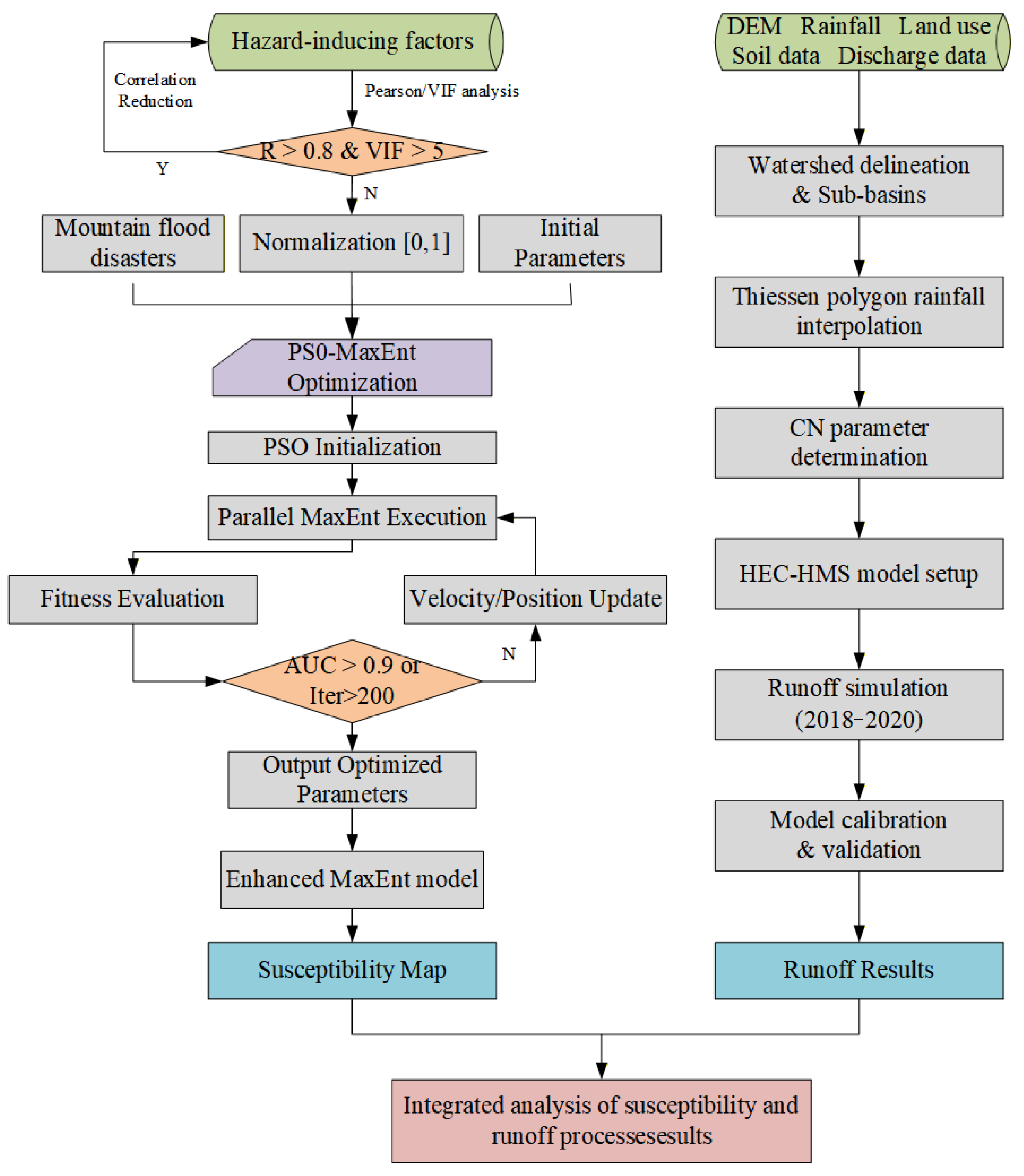
The overall workflow of this study is illustrated in Figure 2. The methodology consists of three main components: (1) flood susceptibility mapping using a PSO-optimized MaxEnt model, (2) projection of future susceptibility patterns under climate scenarios, and (3) runoff simulation using the HEC-HMS model to analyze hydrological responses. Finally, the flood susceptibility maps and runoff simulation results were jointly analyzed to explore the relationship between spatial susceptibility patterns and hydrological responses.

2.3.1. Enhanced MaxEnt Model Optimized with the PSO Algorithm

This study employs the MaxEnt model (version 3.4.1) to assess flood susceptibility based on historical flood inventory data (i.e., flood occurrence records used as presence samples in the MaxEnt model) and environmental variables [28,29]. Initial model parameters were defined based on default settings and previous studies. To further enhance model performance, the PSO algorithm was applied to optimize key parameters of the MaxEnt model, including the regularization multiplier and the background sampling strategy [23,30]. The optimized model was then used to generate flood susceptibility maps for the current period and under future climate scenarios. The resulting susceptibility maps were further analyzed to identify spatial patterns and key driving factors of flood occurrence.
Prior to modeling, multicollinearity among the hazard-inducing factors was evaluated using Pearson correlation coefficients and variance inflation factors (VIF) [31]. Variables with correlation coefficients greater than 0.8 or VIF values exceeding 5 were removed to ensure model robustness and avoid redundancy. All environmental variables were normalized to a range of [0, 1] prior to modeling.
The PSO algorithm was employed to iteratively search for optimal parameter combinations. During the optimization process, fitness evaluation was conducted based on model performance metrics to guide parameter updating. To improve computational efficiency, the MaxEnt model was executed in a parallel framework during the PSO process. Particles were initialized within predefined ranges, with the regularization multiplier β ∈ [0.1, 10] and normalized sampling weights in the range ∈ [0, 1]. During the optimization process, particle positions and velocities were updated according to the following equations:
v i k + 1 = w v i k + c 1 r 1 ( p b e s t i k x i k ) + c 2 r 2 ( g b e s t k x i k )
x i k + 1 = x i k + v i k + 1
where x i k represents the parameter combination of particle i at iteration k , and v i k represents its updating step in the parameter space. In this study, the particle position corresponds to a candidate set of MaxEnt parameters. The inertia weight w controls the search momentum, c 1 and c 2 represent the cognitive and social learning factors, respectively, and r 1 and r 2 are random numbers in [0, 1]. p b e s t i k denotes the best parameter combination found by particle i up to iteration k , whereas g b e s t k denotes the best parameter combination identified by the entire swarm up to iteration k .
The model was trained using the AUC curve, and flash flood inventory data were used as training samples. 70% of the data were used for training, and 30% were used for model validation to evaluate performance. The optimization process terminated when the AUC value stabilized or when the maximum number of iterations (200) was reached. The optimized parameters were then used to construct an enhanced MaxEnt model [32,33].

2.3.2. HEC-HMS Modeling

The HEC-HMS model (version 4.11) was used in this study to simulate rainfall–runoff processes in the upper Baishuijiang River Basin for the periods of 2018, 2019, and 2020. Fifteen sub-basins were delineated using the DEM-derived stream network, with the Shangde Hydrological Station defined as the watershed outlet. Rainfall inputs from the six rainfall stations were spatially distributed to each sub-basin using the Thiessen polygon method. Observed discharge at Shangde Hydrological Station was used for model calibration and validation [34].
(1)
Runoff generation
In this study, runoff generation was estimated using the Soil Conservation Service Curve Number (SCS-CN) method in HEC-HMS [35]. The runoff depth Q was calculated as follows:
Q t = ( P I a ) 2 P I a + S
where P is total precipitation (mm), I a is the initial abstraction, and S is the potential maximum retention (mm). In this study, I a was set as 0.2 S . The relationship between S and the C N is expressed as:
S = 25.4 × ( 1000 C N 10 )
The C N values were determined according to the land use type and soil characteristics of each sub-basin. The area-weighted C N value was calculated as:
C N = A i × C N i A i
where C N i is the C N value for soil type i and A i is the corresponding area. To account for antecedent moisture conditions (AMC), C N values were adjusted according to the cumulative rainfall during the previous five days.
(2)
Runoff Transformation
Runoff transformation was simulated using Snyder’s Synthetic Unit Hydrograph method in HEC-HMS [36]. The peak time T p and peak discharge Q p were calculated as follows:
T p = C t × ( L × L c ) 0.3
Q p = 2.78 × C p × A T p
where L is the longest flow path (km), L c is the centroidal flow path (km), C t is the regional coefficient, C p is the peak coefficient, and A is the sub-basin area.
(3)
Flow Routing
Channel routing was performed using the Muskingum method [37]. The routing equation is given as:
Q j + 1 = C 0 × I j + 1 + C 1 × I j + C 2 × Q j
C 0 = 0.5 × Δ t K × x K × ( 1 x ) + 0.5 × Δ t C 1 = 0.5 × Δ t + K × x K × ( 1 x ) + 0.5 × Δ t C 2 = 0.5 × Δ t K × Δ t K × ( 1 x ) + 0.5 × Δ t C 0 + C 1 + C 2 = 1
where C 0 , C 1 , and C 2 are routing coefficients determined by the storage time constant K , weighting factor x , and computational time step Δ t . The HEC-HMS model was calibrated and validated using observed discharge data from 2018 to 2020. Model performance was evaluated using the NSE, peak flow relative error, and total flood volume relative error.

3. Results

3.1. Accuracy Assessment for the PSO-Enhanced MaxEnt Model

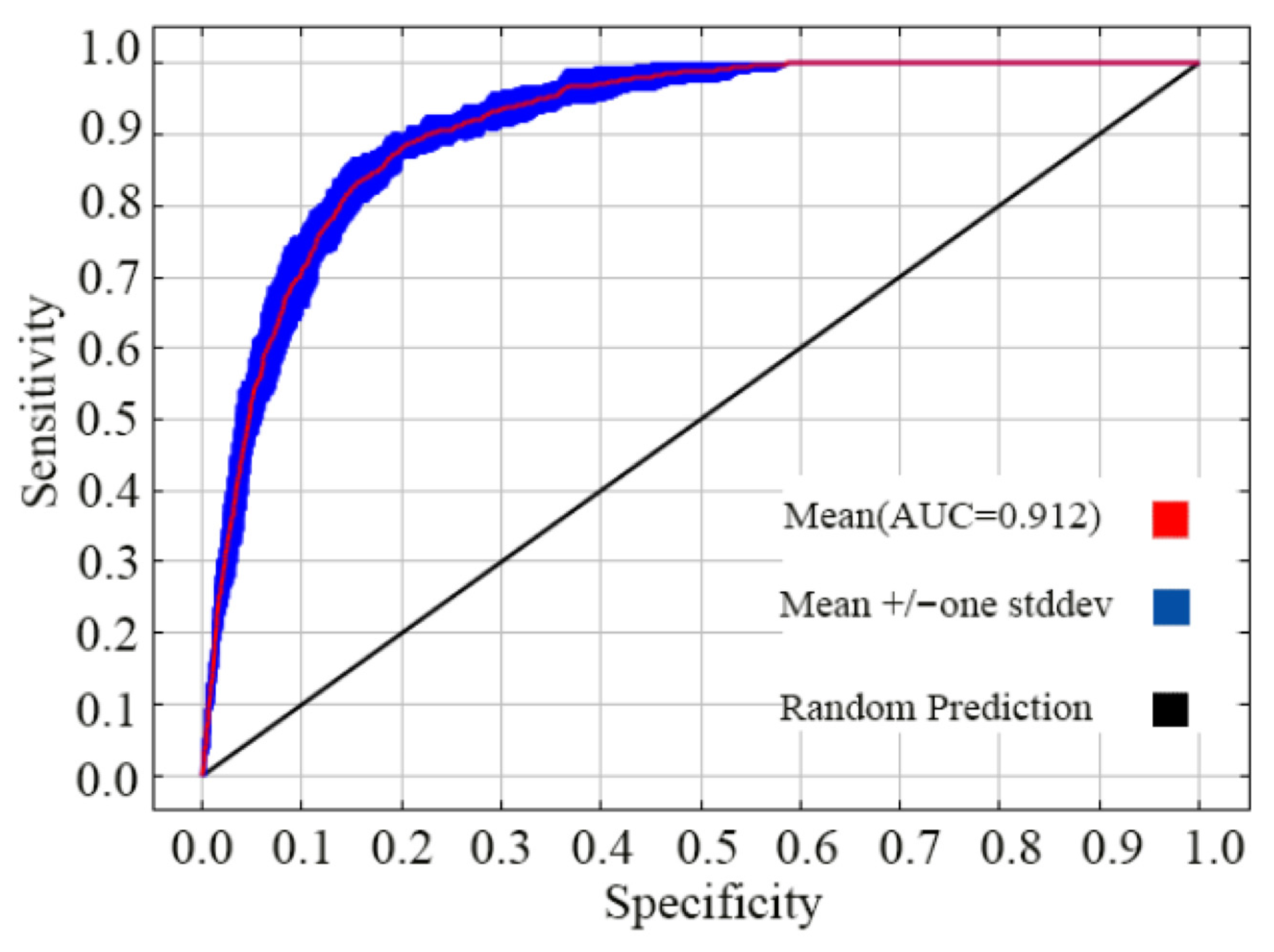
The predictive performance of the PSO-enhanced MaxEnt model was evaluated using the Receiver Operating Characteristic (ROC) curve (Figure 3). The ROC curve is clearly located above the random prediction line and approaches the upper-left corner, indicating that the model can effectively distinguish between areas with high and low flood occurrence probabilities [38].
The AUC value reached 0.912, suggesting that the model achieves a high level of predictive accuracy. This result indicates that the model effectively captures the relationships between key environmental variables (e.g., terrain, rainfall, and land use) and flood occurrence probabilities. Since 70% of the data were used for training and 30% for validation, the AUC value was calculated based on the validation dataset, reflecting the model’s generalization ability.
Overall, the PSO-enhanced MaxEnt model demonstrates a strong capability in identifying the spatial distribution of flood susceptibility, providing a reliable basis for subsequent susceptibility mapping and supporting further hydrological analysis.

3.2. Identification and Analysis of Key Flood Susceptibility Determinants

The predictive performance of the MaxEnt model is strongly influenced by the appropriate selection of hazard-inducing factors. In this study, key determinants of flood susceptibility were identified through a comprehensive evaluation of multiple statistical indicators, including the Pearson correlation coefficient, VIF, contribution rate, permutation importance, response curves, and jackknife test results [39].
These indicators not only quantify the statistical importance of each variable but also provide insight into their physical roles in flood generation processes, including climatic forcing, terrain-controlled flow concentration, and land surface controls on infiltration and runoff generation.

3.2.1. Correlation Analysis of Key Hazard-Inducing Factors

Based on the MaxEnt model, key hazard-inducing factors were identified by jointly evaluating contribution rates, permutation importance, Pearson correlation coefficients, and response characteristics. The selection process consisted of three main steps.
First, the flood inventory dataset and environmental variables were input into the model, and variables with contribution rates lower than 1% were excluded to eliminate weak predictors. Second, Pearson correlation and VIF analyses were conducted to remove redundant variables, excluding those with correlation coefficients greater than 0.8 or VIF values exceeding 5. Finally, the remaining variables were retained as key hazard-inducing factors influencing flood susceptibility. The selected hazard-inducing factors include bio14, land use, bio2, elevation, bio15, topographic roughness, bio5, distance to rivers, profile curvature, and soil texture. These variables are widely used in previous flood susceptibility studies. They represent key controlling factors of hydrological processes, ensuring both the physical interpretability and general applicability of the model.
As shown in Table 2, bio14 exhibits the highest contribution rate (49.9%), indicating that precipitation during the driest period plays a dominant role in controlling flood susceptibility in the study area. This suggests that mountainous catchments are highly sensitive to rainfall variability, where even relatively small precipitation inputs may trigger rapid runoff generation due to limited infiltration and storage capacity. In contrast, elevation shows the highest permutation importance (43.3%), highlighting the dominant role of terrain controls in shaping flood susceptibility patterns. Elevation influences slope gradients, flow pathways, and gravitational water movement, thereby regulating runoff concentration and flood formation processes. Climatic variables such as bio2 and bio5 also demonstrate relatively high permutation importance values, indicating that temperature-related factors may influence evapotranspiration, antecedent soil moisture, and ultimately runoff generation. Land use also contributes substantially (23%), reflecting the impact of surface conditions, such as vegetation cover and impervious areas, on infiltration capacity and surface runoff generation.
To further evaluate the relationships among variables, correlation analysis and variance inflation factor (VIF) analysis were conducted to assess the degree of association and multicollinearity among predictors. The results indicate that most variables exhibit weak correlations (|r| < 0.2), suggesting a high degree of independence among predictors. Moderate correlations were observed between certain climatic variables (e.g., bio2 and bio15); however, all correlation coefficients remain below the predefined threshold (|r| < 0.8), and VIF values are within acceptable limits, indicating that multicollinearity is effectively controlled.
This systematic screening ensures that the selected variables capture complementary aspects of flood generation mechanisms, including climatic forcing, terrain constraints, and land surface properties. As a result, the model avoids overfitting while maintaining strong explanatory power for flood susceptibility patterns.

3.2.2. Response Curve Analysis of Key Hazard-Inducing Factors

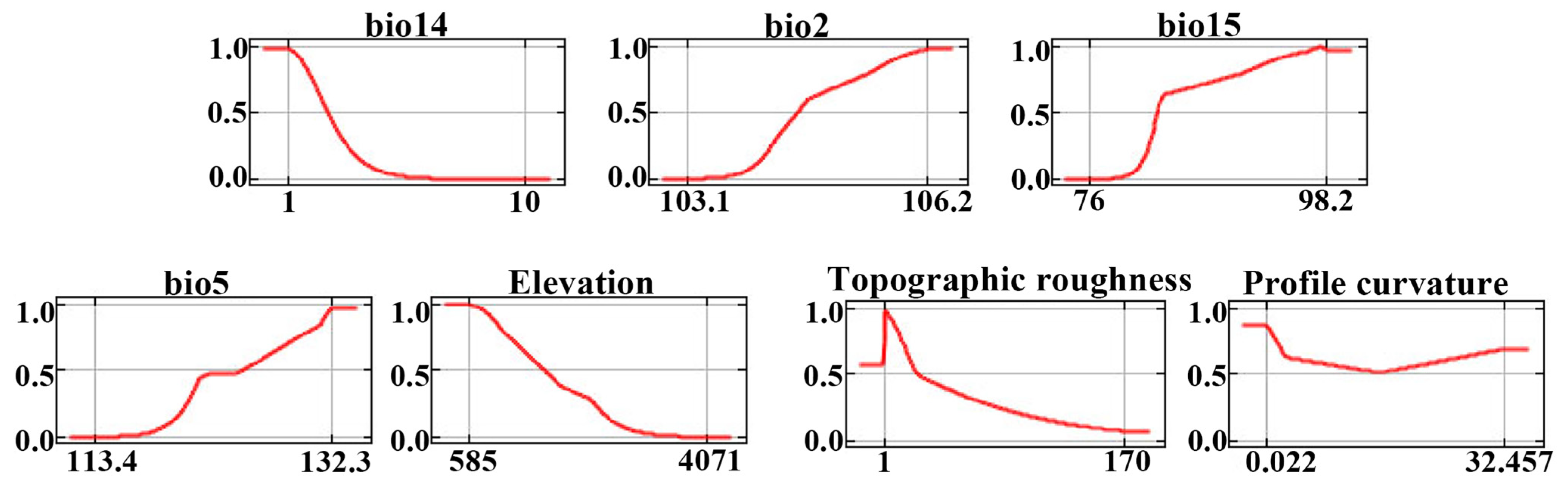
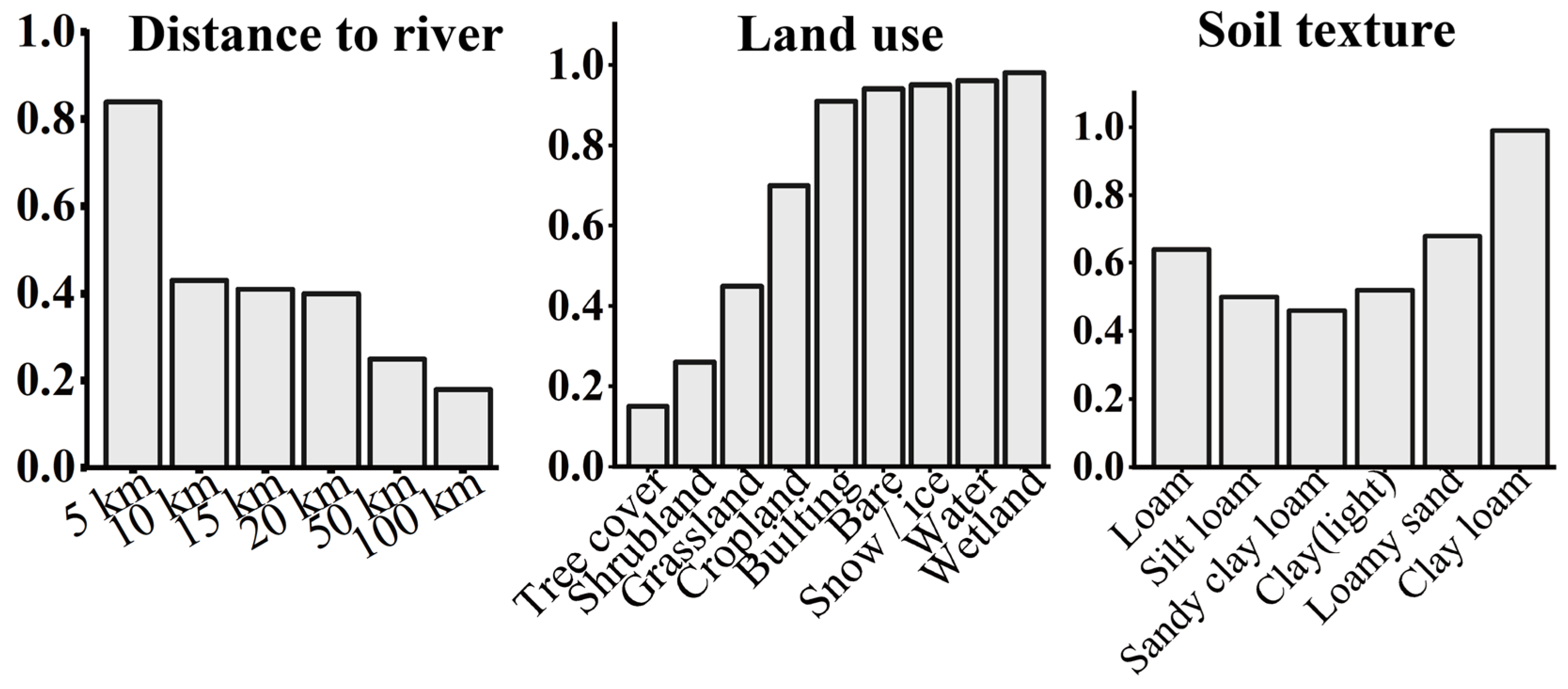
The PSO-enhanced MaxEnt model was constructed using the ten selected hazard-inducing factors, and their response curves (Figure 4) and frequency distribution histograms (Figure 5) were derived to quantify the relationships between environmental variables and flood occurrence probability. These response curves represent the marginal effects of individual variables while holding other variables constant. In Figure 4 and Figure 5, the vertical axis represents the predicted probability of flood occurrence, while the horizontal axis denotes the range of each environmental factor. Following established MaxEnt-based studies, a probability value exceeding 0.5 is considered indicative of conditions favorable for flood occurrence, representing environmental states where runoff generation and flow concentration processes are significantly enhanced. Temperature variables are presented in °C after rescaling [40].
Figure 4 illustrates the response curves of climatic and terrain factors, while Figure 5 presents the frequency distributions of distance to river, land use, and soil texture. Overall, the response curves reveal clear nonlinear relationships and threshold effects, highlighting the combined influence of climatic forcing, terrain configuration, and land surface properties on flood susceptibility.
Bio14 exhibits a strong negative relationship with flood probability. Flood susceptibility reaches its maximum under extremely low-precipitation conditions (approximately 1 mm) and decreases rapidly as precipitation increases, becoming negligible when precipitation exceeds 9 mm. The high-risk interval is concentrated within 0–3.5 mm, indicating that regions experiencing prolonged dry conditions are more prone to intense runoff generation once rainfall events occur, due to reduced soil infiltration capacity and limited antecedent moisture storage.
Elevation and distance to rivers also show clear negative relationships with flood probability. The highest flood susceptibility is observed at approximately 800 m elevation and within 5 km of rivers, with significant risk concentrated in the ranges of 300–1700 m and 5–10 km, respectively. Beyond 3500 m elevation or distances exceeding 100 km from rivers, flood probability approaches zero. This pattern reflects the combined effects of topographic gradients and hydrological connectivity, where moderate elevations and proximity to drainage networks facilitate rapid flow accumulation and downstream flood propagation.
Climatic variables such as bio2, bio5, and bio15 exhibit positive relationships with flood probability. Flood susceptibility remains low below thresholds of approximately 10.3 °C (bio2), 11.4 °C (bio5), and 77% (bio15), but increases sharply beyond these values, reaching peak levels at 10.6 °C, 13.3 °C, and 98%, respectively. High-risk intervals are concentrated within 10.45–10.65 °C for bio2, 12.5–13.4 °C for bio5, and 83–100% for bio15. These patterns indicate that elevated temperature variability and strong precipitation seasonality enhance flood potential by influencing evapotranspiration, soil moisture conditions, and rainfall intensity.
Terrain factors demonstrate pronounced nonlinear effects on flood susceptibility. For topographic roughness, flood probability increases initially and peaks around 1 m, maintaining relatively high-susceptibility (approximately 0.6) within the range of 1–20 m before declining sharply beyond this threshold. This suggests that moderate terrain heterogeneity promotes flow convergence, whereas excessive roughness may dissipate flow energy. Profile curvature exhibits a more complex relationship, with flood probability initially decreasing to a minimum near 15 and then increasing again within the range of 15–32, forming two distinct high-risk areas (0–5 and 25–35). These results indicate that specific curvature conditions can enhance runoff acceleration and flow concentration, thereby increasing flood susceptibility.
Land use and soil texture further modulate flood susceptibility through their control of surface permeability and runoff generation. Built-up areas, bare land, snow/ice, water bodies, and wetlands show particularly high flood probabilities (>0.85), reflecting low infiltration capacity and high surface runoff potential. In contrast, vegetation-covered areas exhibit relatively lower susceptibility due to enhanced infiltration and interception. Regarding soil texture, loamy sand, sandy loam, and clay loam soils are associated with higher flood probabilities (>0.7), indicating that soils with moderate to low permeability are more conducive to rapid runoff generation.
Overall, the response curve analysis reveals that flood susceptibility is controlled by the interaction of multiple environmental factors, with distinct threshold behaviors and nonlinear responses. These findings provide a physically interpretable basis for understanding flood generation mechanisms and further support the reliability of the PSO-enhanced MaxEnt model in capturing complex environmental controls on flood occurrence.

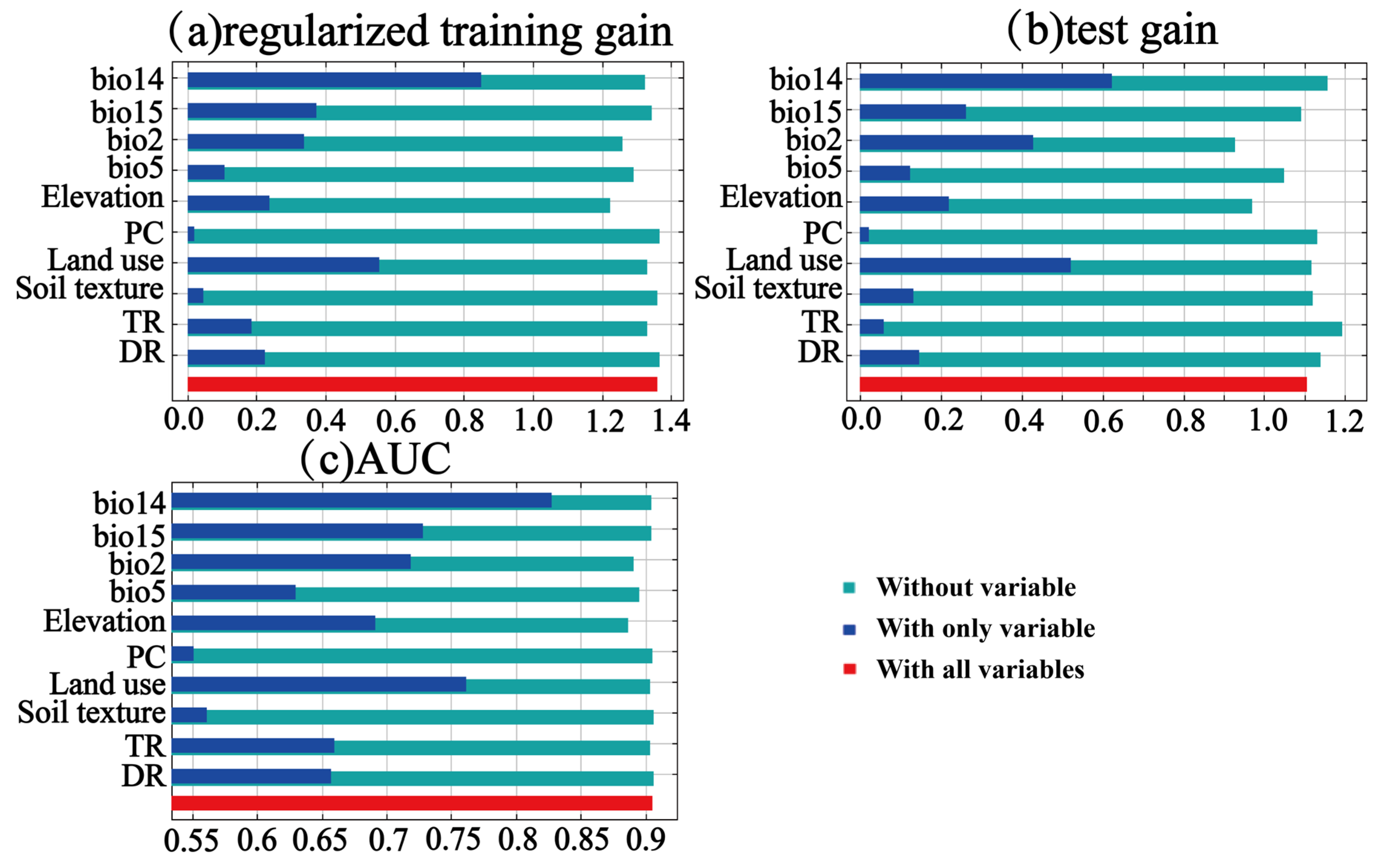
3.2.3. Jackknife Test Analysis for Key Hazard-Inducing Factors

The jackknife test was used to quantitatively evaluate the relative importance of each hazard-inducing factor based on three metrics: regularized training gain, test gain, and AUC value (Figure 6). For the complete set of variables, the model achieved a regularized training gain of approximately 1.40, a test gain of approximately 1.10, and an AUC value of approximately 0.90, indicating reliable predictive performance [41].
Among all variables, bio14 showed the highest individual contribution, with a training gain of approximately 0.85, a test gain of approximately 0.60, and an AUC value of approximately 0.82. This result indicates that dry-period precipitation conditions influence flood susceptibility, likely by affecting antecedent soil moisture and runoff generation.
Land use also exhibited strong predictive ability, with a training gain of approximately 0.60, a test gain of approximately 0.55, and an AUC value of approximately 0.75, indicating its influence on runoff generation through land cover changes.
Climatic variables including bio15 and bio2 showed moderate contributions, with training gains of approximately 0.40 and 0.38, respectively, and test gains of approximately 0.30–0.45, reflecting secondary climatic controls. These variables reflect temporal variability in hydroclimatic conditions, affecting runoff timing and intensity.
Topographic factors such as elevation and distance to river demonstrated relatively stable but moderate contributions across different metrics. Elevation showed a training gain of approximately 0.25 and AUC of approximately 0.70, while distance to river showed consistent influence with AUC values around 0.65–0.70, reflecting their control on flow accumulation and connectivity. In contrast, profile curvature and soil texture exhibited low individual predictive power (training gain < 0.10; AUC < 0.60), but their removal reduced overall model performance. This suggests that although these variables are weak predictors individually, they contribute through combined effects on flow and infiltration. Overall, the jackknife test indicates that while the combined use of all variables produces the best model performance, flood susceptibility in the study area is primarily controlled by hydroclimatic factors (especially bio14), followed by land surface characteristics (e.g., land use), with topographic variables acting as secondary controls on runoff routing and accumulation.

3.3. Mapping of Mountain Flood Susceptibility

3.3.1. Mountain Flood Susceptibility Areas

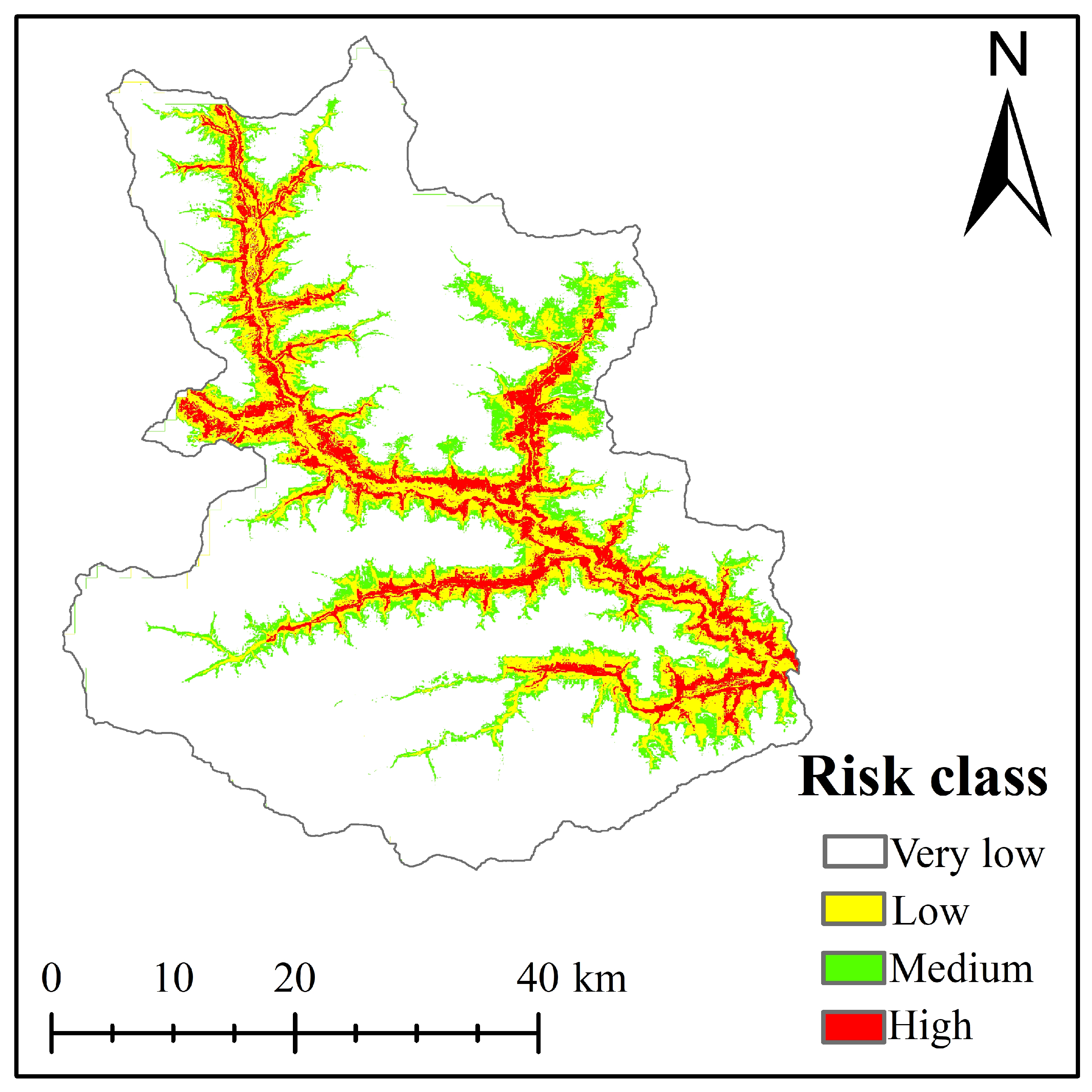
The mountain flood susceptibility map was generated using the PSO-enhanced MaxEnt model by integrating ten key hazard-inducing factors. To facilitate spatial interpretation, the continuous susceptibility values were classified into four categories, namely high, medium, low, and very low, using the natural breaks (Jenks) method, which maximizes inter-class differences while minimizing intra-class variance. The resulting susceptibility map reveals a clear, spatially coherent, and physically interpretable pattern in the study area (Figure 7). High-susceptibility areas occupy 154.88 km2, accounting for 7.59% of the total area, and are mainly distributed along the main stream of the Baishuijiang River and its major tributaries. These areas are characterized by strong topographic relief, short flow concentration paths, and close hydrological connectivity to the river network, which together favor rapid runoff convergence and increase the likelihood of mountain flood occurrence. Medium-susceptibility areas cover 294.02 km2 (14.40%) and are primarily distributed around the high-susceptibility belts, forming transitional areas between highly flood-prone valley corridors and more stable surrounding terrain. Taken together, the high- and medium-susceptibility areas account for 448.90 km2, or 21.99% of the watershed, suggesting that nearly one-fifth of the basin should be prioritized for flood risk mitigation and management. In contrast, low-susceptibility areas cover 192.42 km2 (9.43%), while very low-susceptibility areas occupy 1399.89 km2 (68.58%), together dominating most of the basin. These areas are mainly located away from the main river corridors and are generally associated with gentler terrain, weaker hydraulic connectivity, and relatively lower potential for rapid runoff concentration. The spatial distribution shown in Figure 7 therefore indicates that flood susceptibility in the study area is strongly controlled by the coupled effects of river proximity, valley confinement, and terrain gradient. In particular, the linear concentration of high-susceptibility classes along the trunk stream and tributary channels suggests that mountain floods are most likely to occur in narrow fluvial corridors where topographic and hydrological conditions jointly enhance flow accumulation. Overall, the susceptibility zoning results are consistent with the geomorphic and hydrological characteristics of mountainous river basins and show good agreement with the spatial distribution of recorded historical flood events in the study area (see Figure 1), which further supports the reliability of the susceptibility mapping results and indicates that the PSO-enhanced MaxEnt model can effectively capture the spatial heterogeneity of mountain flood susceptibility in the Baishuijiang River Basin.

3.3.2. Simulation Under Future Climate Scenarios

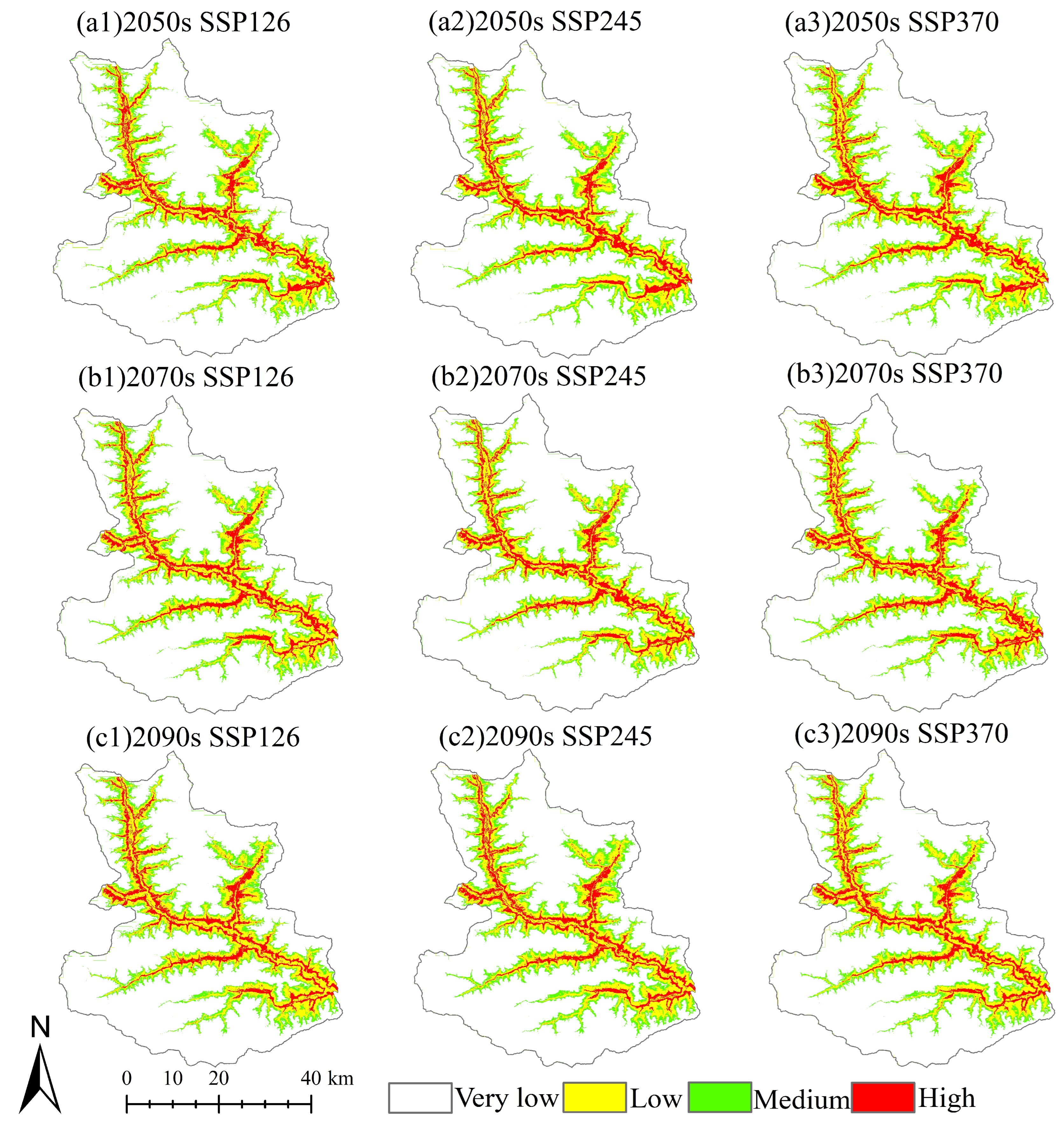
To assess future mountain flood susceptibility, we simulated three projection periods (2050s, 2070s, and 2090s) by integrating climate scenario data with the susceptibility model. Mountain flood susceptibility was mapped for each projection period, and the area of each susceptibility class was quantified under different climate scenarios (Figure 8; Table 3).
Under mid-century (2050s) climate scenarios, the modeling results reveal distinct spatial variations in flood susceptibility patterns across different emission scenarios (Figure 8), indicating that flood susceptibility is highly sensitive to the magnitude of climatic forcing even at mid-century. The spatial statistical analysis indicates a reduction in flood susceptibility under SSP126 (Figure 8(a1)), which may be associated with relatively moderate changes in precipitation intensity and temperature variability under low-emission conditions, resulting in weaker runoff generation and reduced flood potential. Under this scenario, medium–high-susceptibility areas contract to 440.73 km2 (Δ = −8.17 km2, 95% CI: ±2.3 km2), and high-susceptibility areas decrease to 138.51 km2 (Δ = −16.37 km2, 95% CI: ±3.1 km2) relative to baseline conditions. In contrast, SSP245 (Figure 8(a2)) shows marginal increases, with medium–high-susceptibility areas reaching 446.47 km2 and high-susceptibility areas reaching 138.61 km2, corresponding to increases of 5.74 km2 and 0.10 km2, respectively. This pattern suggests a balance between increased precipitation variability and partial hydrological buffering effects. The most pronounced expansion occurs under SSP370 (Figure 8(a3)), where medium–high-susceptibility areas increase to 476.76 km2 and high-susceptibility areas increase to 151.87 km2, representing increases of 36.03 km2 and 13.36 km2, respectively. This expansion is likely driven by intensified precipitation extremes and enhanced surface runoff generation under high-emission conditions. Across all 2050s scenarios, the average medium–high-susceptibility area reaches 454.65 km2, indicating a modest overall increase of 1.3% relative to baseline conditions.
For the 2070s, projected flood susceptibility patterns continue to exhibit significant variation across climate scenarios, with an average medium–high-susceptibility area of 453.49 km2, indicating increasing sensitivity of flood susceptibility to intensified climatic forcing over time. Under the SSP126 scenario (Figure 8(b1)), medium–high-susceptibility areas increase to 468.67 km2 (+27.94 km2), while high-susceptibility areas increase to 148.26 km2 (+9.75 km2), suggesting cumulative hydrological responses under prolonged low-emission conditions. Conversely, the SSP245 scenario (Figure 8(b2)) demonstrates moderate reductions in medium–high-susceptibility areas (433.56 km2, −7.17 km2) and high-susceptibility areas (144.71 km2, −6.20 km2), indicating complex and potentially non-monotonic hydrological responses under intermediate emission scenarios. The SSP370 projection (Figure 8(b3)) reveals intermediate increases, with medium–high-susceptibility areas expanding to 458.25 km2 (+17.52 km2) and high-susceptibility areas reaching 150.68 km2 (+12.17 km2), reflecting the combined influence of increased precipitation intensity and changes in evapotranspiration processes. These divergent trends highlight the strong scenario-dependence of future flood susceptibility, emphasizing the importance of considering multiple emission pathways (e.g., SSP126, SSP245, and SSP370) in flood risk assessment.
By the 2090s, mountain flood susceptibility shows consistent increases across all climate scenarios, with an average medium–high-susceptibility area of 488.49 km2, indicating a long-term amplification of flood risk under sustained climate change. Under SSP126 (Figure 8(c1)), both medium–high (497.33 km2, +56.60 km2) and high-susceptibility areas (150.89 km2, +12.38 km2) exhibit the largest expansion compared to baseline conditions, suggesting cumulative hydrological impacts even under low-emission pathways. Similarly, SSP245 (Figure 8(c2)) projects substantial growth in medium–high (493.02 km2, +52.29 km2) and high-susceptibility areas (148.01 km2, +9.50 km2), highlighting increasing sensitivity of runoff generation processes to climatic variability. While SSP370 (Figure 8(c3)) also demonstrates increases (medium–high: 475.12 km2, +34.39 km2; high-susceptibility: 148.27 km2, +9.76 km2), the magnitude of change is comparatively smaller, which may reflect nonlinear hydrological responses, including threshold effects in runoff generation and soil moisture dynamics under extreme warming conditions.
These end-century projections underscore a climate-driven amplification of flood susceptibility, with even low-emission scenarios showing significant susceptibility growth, while also highlighting inherent uncertainties and nonlinear responses in long-term climate–hydrology interactions.

3.3.3. Spatial Pattern Changes

To assess the spatiotemporal redistribution of flood risks under climate change, we quantified changes in susceptible areas across three future periods (Table 4), providing a basis for evaluating the evolution of flood susceptibility under different climate scenarios. From the current period to the future, the overall spatial pattern of mountain flood susceptibility areas in the study region exhibits a decreasing trend, despite fluctuations in the areas of reduction and expansion, indicating a redistribution of flood-prone areas rather than a uniform decline. In the 2050s, the average reduced area of mountain flood susceptibility areas was 123.734 km2, while the average expanded area was 140.793 km2, corresponding to average reduction and expansion rates of 6.12% and 6.96%, respectively. By the 2070s, the average reduction and expansion areas were 103.921 km2 and 107.467 km2, with rates of 5.140% and 5.315%, respectively. In the 2090s, the average area reduction decreased to 69.469 km2, and the average expansion increased to 144.565 km2, resulting in average reduction and expansion rates of 3.436% and 3.714%, respectively, indicating an increasing concentration of flood-prone areas.
Compared with the current period, the nine future scenarios exhibit significant variations in mountain flood susceptibility area dynamics. The 2050s_SSP126, 2050s_SSP245, and 2050s_SSP370 scenarios show the largest average reductions in susceptible areas (146.766 km2, 132.365 km2, and 92.070 km2, with reduction rates of 7.259%, 6.547%, and 4.554%, respectively), primarily concentrated in areas distant from the Baishuijiang River, indicating weaker hydrological connectivity in peripheral regions. Average expansions (131.141–164.480 km2; expansion rates of 6.486–8.135%) result in net change rates ranging from −3.581% to 0.773%. In the 2070s scenarios, average reductions range from 88.555 to 118.210 km2 (4.380–5.847%), with the smallest average expansions (74.717–126.369 km2; 3.695–6.250%). Notable net changes occur in SSP126 (−1.870%) and SSP245 (+2.151%), indicating significant spatial redistribution of susceptibility under different climate forcing conditions. The 2090s scenarios feature the smallest average reductions (66.783–73.665 km2; 3.303–3.643%) but the largest average expansions (118.412–181.148 km2; 5.857–8.959%), concentrated in areas near the Baishuijiang River, suggesting enhanced flow convergence along river corridors. Net changes range from −5.589% to −2.554%, reflecting a trend of flood susceptibility migration toward the river corridors, likely associated with increased runoff concentration and precipitation extremes.

3.4. Hydrological Simulation

3.4.1. Runoff Simulation with HEC-HMS Model

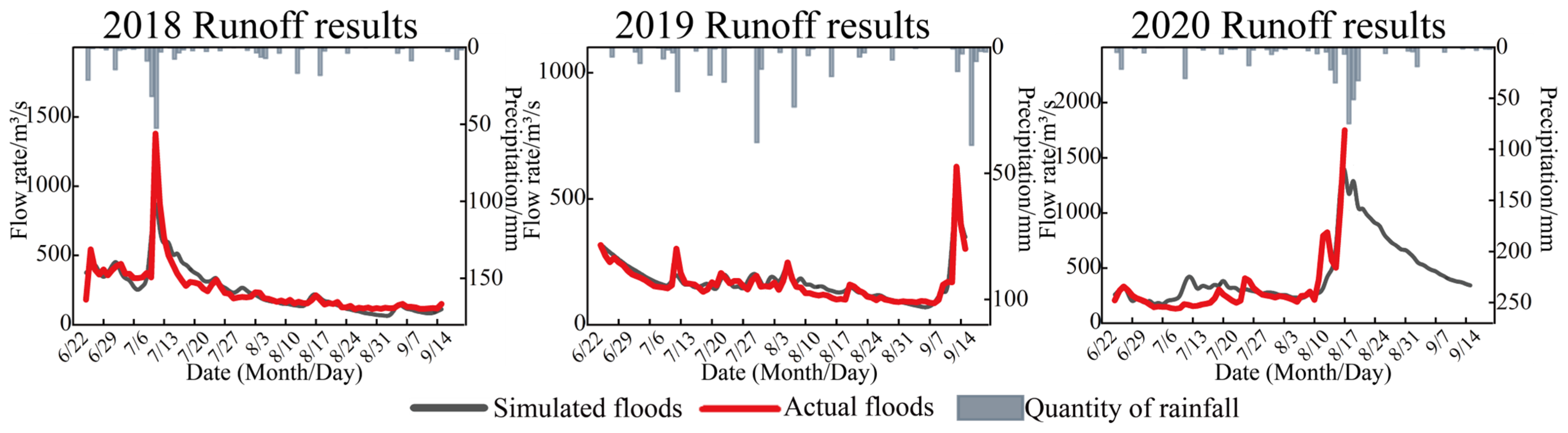
Hydrologic simulation was conducted using the HEC-HMS. The watershed was divided into 15 sub-basins based on DEM-derived flow direction, flow accumulation, extracted stream networks, and the designated outlet at Shangde hydrological station, with the upstream boundary located near Zhongzhai Town. Rainfall was spatially assigned to each sub-basin using the Thiessen polygon method (Figure 9), which shows the distribution of rainfall stations and sub-basin boundaries used in the model, illustrating how rainfall inputs are spatially allocated across the watershed. Runoff simulations were performed for the flood seasons of 2018–2020, from 25 July to 15 September, with Shangde Hydrological Station used as the outlet control point. The simulated runoff was validated against observed discharge at Shangde hydrological station, and the comparison results for 2018–2020 are shown in Figure 10, where the agreement between simulated and observed hydrographs and peak flow responses is presented. In 2020, observed runoff data were unavailable after 17 August, and model evaluation was therefore limited to the available observation period. Before this date, the simulated runoff increased steadily, peaked at 1489.3 m3/s on 17 August, and then receded. In 2019, runoff increased progressively and reached a peak of 628 m3/s on 13 September, followed by a recession phase. In 2018, runoff rose steadily to a peak of 984.7 m3/s on 11 July and then gradually decreased. In terms of peak discharge, the 2020 flood event was substantially stronger than the 2018 and 2019 events, with a peak runoff approximately 1.5 times that of 2018 and 2.4 times that of 2019, indicating considerable interannual variability in flood magnitude, which may be related to differences in rainfall intensity and accumulation patterns among years [34].

3.4.2. Sensitivity Analysis of HEC-HMS Model Parameters

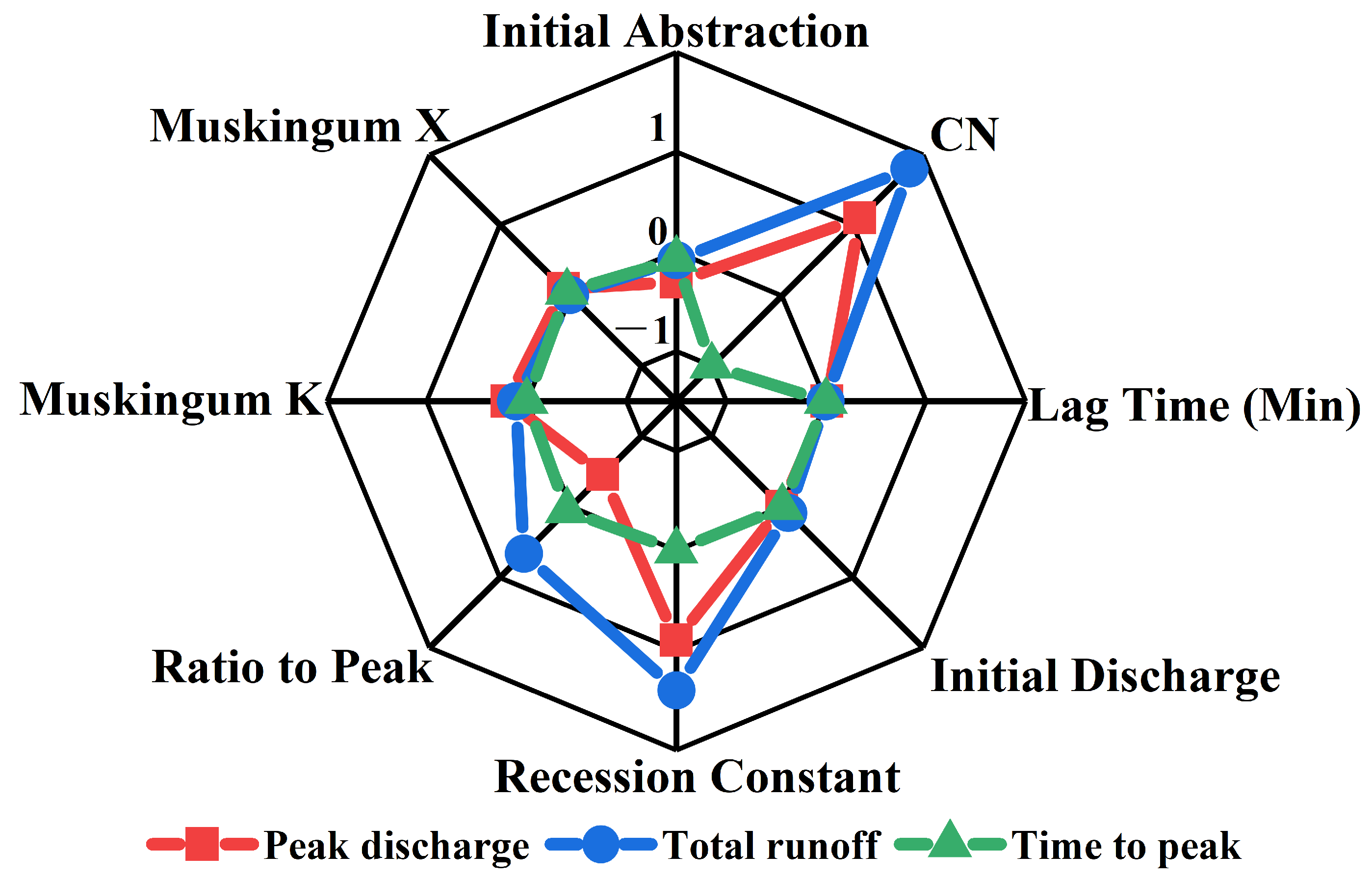
Taking sub-basin S15 during the 2020 “8.17” flood event as a representative case, we conducted a parameter sensitivity analysis using the Morris screening method, with parameter values varied within a ±20% range at a fixed 5% step size. The resulting sensitivity indices (Figure 11) quantify each parameter’s influence on peak discharge, total runoff, and peak timing, with Figure 11 presented as a radar chart illustrating the relative sensitivity patterns of different parameters. Our findings show that changes in total runoff were most sensitive to the CN, Recession Constant, and Ratio to Peak, exhibiting positive sensitivity responses, whereas the sensitivity indices of the other parameters remained close to zero, indicating negligible influence on runoff generation (Figure 11). Changes in peak discharge were highly sensitive to CN and the Recession Constant, showing positive relationships, whereas the Ratio to Peak parameter exhibited an inverse relationship with peak discharge; the sensitivity indices of the remaining parameters were consistently close to zero, indicating limited control on peak flow formation. Differences in peak timing remained relatively stable overall and showed only a weak inverse relationship with changes in CN, while the sensitivity indices of the other parameters were negligible, suggesting that peak timing is less sensitive to parameter perturbations. The CN parameter reflects watershed infiltration and storage capacity: a higher CN indicates reduced infiltration, a stronger runoff response, and greater precipitation-to-runoff conversion, whereas a lower CN suggests greater infiltration and lower runoff generation. The Recession Constant represents the rate of flow recession after precipitation events and is influenced by watershed topography, land cover, and hydrological conditions, thereby describing the gradual decline of runoff over time, which governs the attenuation of the flood hydrograph. The Ratio to Peak describes the relationship between peak flood discharge and a reference flow condition (e.g., precipitation input or initial flow), indicating that flood magnitude is strongly affected by watershed infiltration capacity, storage conditions, topography, and land use, thereby controlling peak amplification processes. Based on the above analysis, we further compared the simulated runoff from sub-basin S15 with the observed precipitation recorded at the Shangde hydrological station to evaluate the consistency between rainfall forcing and runoff response. The comparative analysis revealed that, in 2020, the simulated runoff showed a strong positive correlation with the observed rainfall at Shangde station (p < 0.01). In 2019 and 2018, the simulated runoff also demonstrated significant positive correlations with the observed rainfall at Shangde station (p < 0.05), consistent with the pattern observed in 2020. These results indicate that the simulated runoff exhibits strong consistency with the rainfall forcing observed at the hydrological station, highlighting rainfall as the dominant driver of runoff variability. This further supports the reliability of the parameter sensitivity analysis and the physical interpretability of the HEC-HMS simulation results, demonstrating consistency between model behavior and hydrological processes [42].

3.4.3. Accuracy Assessment

To assess the accuracy of runoff simulations from the HEC-HMS model, flood processes at the watershed outlet were evaluated using three performance metrics: peak flow relative error, total flood volume relative error, and the NSE coefficient (Table 5). During 2018–2020, peak flow relative errors ranged from 0.135 to 0.419, with the lowest value observed in 2019 (0.135), indicating relatively better model performance in peak-flow simulation for that year. Total flood volume relative error showed interannual variability, with the lowest value occurring in 2018 (0.667%), indicating closer agreement between simulated and observed flood volumes. The NSE values were 0.81 in 2018, 0.85 in 2019, and 0.74 in 2020, suggesting that model performance was generally better in 2018–2019 than in 2020. The relatively lower performance in 2020 may be partly related to the absence of observed runoff data at Shangde Hydrological Station after 17 August, which limited model evaluation during the recession period of the flood event.
Overall, the runoff simulations for 2018 and 2019 show good agreement with the observed hydrographs in terms of peak flow, total flood volume, and NSE, indicating that the HEC-HMS model is capable of reasonably reproducing the observed flood processes in the study basin [43].

4. Discussion

This study shows that mountain flood susceptibility in the Baishuijiang River Basin is jointly controlled by hydroclimatic forcing, terrain constraints, and land surface characteristics, and these controls can be quantitatively interpreted through hydrological simulation. The proposed framework establishes a process-oriented linkage between susceptibility mapping and hydrological modeling by organizing factor screening, susceptibility prediction, and runoff simulation into a coherent analytical workflow. This enables a consistent interpretation between spatial susceptibility patterns and watershed-scale hydrological responses, rather than through a simple parameter coupling. The PSO-MaxEnt model identified bio14, land use, and elevation as dominant controls. The quantitative results show that bio14 contributes 49.9% to the model, indicating that antecedent dry conditions strongly regulate soil infiltration capacity and subsequent runoff generation. Land use also shows a substantial contribution (23%), reflecting the influence of surface characteristics on infiltration and runoff processes. Although elevation has a relatively lower contribution rate (7.1%), it exhibits the highest permutation importance (43.3%), highlighting its dominant role in controlling flow concentration and hydrological connectivity. These findings are consistent with well-established rainfall–runoff mechanisms in mountainous basins, supporting the physical relevance of the susceptibility results [15,43]. In addition, sensitivity analysis of the HEC-HMS model shows that peak discharge and total runoff are particularly sensitive to CN and recession-related parameters, further suggesting the important roles of infiltration capacity and runoff regulation in the simulated flood response.
The integration of multi-source data, including terrain, climate, and land surface information, improves the representation of environmental heterogeneity, although its effectiveness still depends on data quality and spatial resolution. In particular, SAR data provide unique advantages in mountainous regions due to their all-weather observation capability and sensitivity to surface roughness and moisture conditions, which enhance the characterization of land surface properties relevant to flood generation. However, SAR data are generally more suitable for capturing dynamic surface processes through time-series analysis, such as soil moisture variation and flood inundation dynamics [44]. In contrast, this study focuses on static flood susceptibility assessment based on long-term environmental conditions; therefore, SAR-derived time-series indicators were not explicitly incorporated. Future work should consider integrating SAR-based dynamic information to further improve the representation of hydrological processes. In this study, susceptibility results were analyzed together with hydrological simulations based on sub-basin delineation, Thiessen rainfall interpolation, CN parameter determination, and HEC-HMS modeling. This integrated workflow enables a comparative interpretation between susceptibility patterns and simulated runoff responses. The general agreement between high-susceptibility areas and zones of runoff concentration suggests that the identified controlling factors are physically meaningful, highlighting the important roles of precipitation variability and terrain conditions in both susceptibility formation and runoff response. Therefore, the framework not only improves predictive performance but also enhances the interpretability of flood generation processes by linking statistical susceptibility assessment with process-based hydrological modeling [45].
The identified key controlling factors, including precipitation, terrain conditions, and land use, are generally consistent with previous studies on flood susceptibility assessment. Many studies have emphasized the dominant role of rainfall variability, topographic gradients, and land surface characteristics in controlling flood occurrence and runoff generation in mountainous regions [46]. For example, antecedent soil moisture has been shown to significantly influence runoff response in mountainous basins [47]. Similarly, terrain-driven flow concentration is widely recognized as a key control on flood occurrence [48]. Furthermore, land surface characteristics play a critical role in regulating infiltration and runoff generation processes [49]. In addition, the spatial distribution of high-susceptibility areas, mainly concentrated along river valleys and flow convergence zones, agrees well with commonly reported patterns in similar hydrological and geomorphological settings. This consistency with previous studies provides indirect evidence supporting the reliability of the model results [46]. Furthermore, the integration of susceptibility patterns with hydrological simulation results offers a process-based perspective that enhances the physical interpretability of susceptibility assessment. Compared with these studies, this work further provides a quantitatively supported interpretation linking susceptibility patterns and hydrological responses, rather than relying solely on qualitative interpretation.
Despite these advantages, several limitations should be noted. First, the framework is based on a single mountainous watershed, and its applicability to other environments still requires further validation. Although the study area represents a typical rainfall-dominated basin, factor importance and hydrological responses may differ in lowland, urban, or regulated systems. Second, uncertainties remain in input data, model structure, incomplete runoff observations, and climate projections, and these uncertainties may propagate through both susceptibility modeling and hydrological simulations. In particular, the incomplete runoff observations for the 2020 event may reduce the reliability of the simulation results. While the flood inventory does not fully capture extreme events, the model demonstrates stable performance and effectively identifies the dominant environmental controls on flood susceptibility, suggesting that the framework remains generally applicable under varying hydroclimatic conditions. Although a comprehensive quantitative uncertainty analysis was not conducted, partial insights into model behavior can still be obtained from the sensitivity of key hydrological parameters, such as CN, recession coefficient, and ratio to peak, which influence runoff generation and peak discharge characteristics. Furthermore, NDVI was treated as a static representation of vegetation conditions, and its seasonal and interannual variability was not explicitly incorporated, which may introduce additional uncertainty in representing dynamic vegetation–hydrology interactions. Future studies should therefore focus on cross-basin validation, quantitative uncertainty assessment, and the incorporation of dynamic environmental information.
The main contribution of this study lies in establishing a structured framework that connects susceptibility assessment with hydrological simulation through spatially consistent analysis, thereby providing a quantitatively supported and physically interpretable linkage between spatial susceptibility patterns and runoff processes. This contributes to bridging the gap between statistical susceptibility assessment and process-based hydrological analysis. Compared with previous studies that mainly rely on qualitative interpretation or focus primarily on prediction accuracy, this study provides a quantitatively supported process-based linkage [46]. However, direct comparisons with more advanced approaches, particularly recent deep learning and hybrid modeling frameworks, are still lacking, and this remains an important direction for testing the relative predictive performance and interpretability of the proposed framework in future studies [50]. Further research should focus on cross-regional validation, quantitative uncertainty analysis, and the incorporation of higher-resolution remote sensing data and dynamic climate inputs, so as to evaluate the transferability and robustness of the proposed framework beyond the present study area. This quantitative integration aligns with the latest international efforts to couple machine-learning susceptibility with process-based hydrology [51,52], advancing a transferable framework rather than a site-specific assessment.
Overall, although the spatial distribution of flood susceptibility is case-specific, the identified relationships between environmental controls (e.g., precipitation, terrain, and land surface conditions) and hydrological responses are consistent with widely recognized flood generation mechanisms. This supports the potential transferability of the proposed framework to similar mountainous regions.

5. Conclusions

This study develops a process-oriented framework that integrates a PSO-enhanced MaxEnt model with HEC-HMS hydrological simulation to investigate mountain flood susceptibility and its underlying mechanisms in the upper Baishuijiang River Basin. The main conclusions are summarized as follows:
(1)
Dominant controls and nonlinear responses; Flood susceptibility is primarily controlled by hydroclimatic, terrain, and land surface factors, with bio14 identified as the most influential variable. Medium-to-high-susceptibility areas account for approximately 22% of the basin and are mainly distributed along river valleys and flow convergence areas. These patterns are strongly associated with reduced infiltration capacity under dry antecedent conditions and enhanced flow concentration in steep terrain. The results further reveal clear nonlinear responses and threshold effects, indicating that flood occurrence is significantly amplified under specific hydroclimatic and geomorphic conditions.
(2)
Hydrological interpretation of susceptibility patterns; Hydrological simulations show good agreement with observed runoff (NSE = 0.74–0.85), confirming the reliability of the modeling framework. Sensitivity analysis indicates that CN, recession constant, and ratio to peak are the key parameters controlling runoff generation, recession processes, and peak discharge. High-susceptibility areas correspond spatially to areas with strong runoff response and flow concentration, demonstrating that susceptibility patterns can be physically interpreted by hydrological processes. This confirms that the proposed framework provides a consistent linkage between spatial susceptibility and watershed-scale runoff dynamics.
(3)
Climate change effects and framework implications; Future projections indicate that medium–high-susceptibility areas increase under climate change and become more concentrated along river corridors, reflecting intensified precipitation variability and enhanced runoff concentration. This suggests a climate-driven amplification of flood risk in hydrologically connected areas. More importantly, the proposed framework enables a physically interpretable understanding of susceptibility patterns by linking environmental controls with hydrological processes. The approach is transferable to similar mountainous basins with strong terrain–climate interactions. However, uncertainties related to data limitations and single-basin application remain, and future work should focus on multi-basin validation and uncertainty analysis.

Author Contributions

H.W.: Writing—original draft, Investigation, Formal analysis, Conceptualization. Q.N.: Writing—review and editing. J.L.: Formal analysis. W.C.: Supervision, Writing—review and editing. All authors have read and agreed to the published version of the manuscript.

Funding

This research was supported by the National Natural Science Foundation of China (grant number 42261069), and Key Program of Gansu Province Natural Science Foundation (grant number 25JRRA064).

Data Availability Statement

The authors declare that the data supporting the findings of this study are available within the paper.

Acknowledgments

The authors sincerely thank the anonymous reviewers for their constructive comments and valuable suggestions, which have significantly improved the quality and clarity of this manuscript.

Conflicts of Interest

Author Quanfu Niu was employed by the company Academician Expert Workstation of Gansu Dayu Jiuzhou Space Information Technology Co., Ltd. The remaining authors declare that the research was conducted in the absence of any commercial or financial relationships that could be construed as a potential conflict of interest.

References

  1. Baggio, T.; Martini, M.; Bettella, F.; D’Agostino, V. Debris flow and debris flood hazard assessment in mountain catchments. CATENA 2024, 245, 108338. [Google Scholar] [CrossRef]
  2. Borga, M.; Stoffel, M.; Marchi, L.; Marra, F.; Jakob, M. Hydrogeomorphic response to extreme rainfall in headwater systems: Flash floods and debris flows. J. Hydrol. 2014, 518, 194–205. [Google Scholar] [CrossRef]
  3. Bloeschl, G.; Kiss, A.; Viglione, A.; Barriendos, M.; Boehm, O.; Brazdil, R.; Coeur, D.; Demaree, G.; Llasat, M.; Macdonald, N.; et al. Current European flood-rich period exceptional compared with past 500 years. Nature 2020, 583, 560–566. [Google Scholar] [CrossRef]
  4. Khosravi, K.; Shahabi, H.; Pham, B.; Adamowski, J.; Shirzadi, A.; Pradhan, B.; Dou, J.; Ly, H.; Gróf, G.; Ho, H.; et al. A comparative assessment of flood susceptibility modeling using Multi-Criteria Decision-Making Analysis and Machine Learning Methods. J. Hydrol. 2019, 573, 311–323. [Google Scholar] [CrossRef]
  5. Mosavi, A.; Ozturk, P.; Chau, K. Flood Prediction Using Machine Learning Models: Literature Review. Water 2018, 10, 1536. [Google Scholar] [CrossRef]
  6. Hajji, S.; Boudhar, A.; Elaloui, A.; Merghadi, A.; Krimissa, S.; Namous, M.; Eloudi, H.; Ismaili, M.; El Bouzekraoui, M. A review of the literature on spatial prediction of floods using machine learning models. J. Coast. Conserv. 2025, 29, 85. [Google Scholar] [CrossRef]
  7. Bentivoglio, R.; Isufi, E.; Jonkman, S.; Taormina, R. Deep learning methods for flood mapping: A review of existing applications and future research directions. Hydrol. Earth Syst. Sci. 2022, 26, 4345–4378. [Google Scholar] [CrossRef]
  8. Ajin, R.; Costache, R.; Barbulescu, A.; Fanti, R.; Segoni, S. Flood Susceptibility Assessment Using Multi-Tier Feature Selection and Ensemble Boosting Machine Learning Models. Water 2025, 17, 2041. [Google Scholar] [CrossRef]
  9. Lu, Z.; Tian, Z.; Zhang, H.; Lu, Y.; Chen, X. Flood Susceptibility and Risk Assessment in Myanmar Using Multi-Source Remote Sensing and Interpretable Ensemble Machine Learning Model. ISPRS Int. J. Geo-Inf. 2026, 15, 45. [Google Scholar] [CrossRef]
  10. Najafzadeh, M.; Shahsavari, M. Assessment of flood susceptibility in Minab County, Iran, through the integration of topographic, climatic, and land-surface indices using ensemble machine learning models. J. Hydrol. Reg. Stud. 2026, 65, 103327. [Google Scholar] [CrossRef]
  11. Halwatura, D.; Najim, M. Application of the HEC-HMS model for runoff simulation in a tropical catchment. Environ. Model. Softw. 2013, 46, 155–162. [Google Scholar] [CrossRef]
  12. Goodarzi, M.; Poorattar, M.; Vazirian, M.; Talebi, A. Evaluation of a weather forecasting model and HEC-HMS for flood forecasting: Case study of Talesh catchment. Appl. Water Sci. 2024, 14, 34. [Google Scholar] [CrossRef]
  13. Peker, I.; Gülbaz, S.; Demir, V.; Orhan, O.; Beden, N. Integration of HEC-RAS and HEC-HMS with GIS in Flood Modeling and Flood Hazard Mapping. Sustainability 2024, 16, 1226. [Google Scholar] [CrossRef]
  14. El-Bagoury, H.; Gad, A. Integrated Hydrological Modeling for Watershed Analysis, Flood Prediction, and Mitigation Using Meteorological and Morphometric Data, SCS-CN, HEC-HMS/RAS, and QGIS. Water 2024, 16, 356. [Google Scholar] [CrossRef]
  15. Merz, B.; Blösch, G.; Vorogushyn, S.; Dottori, F.; Aerts, J.; Bates, P.; Bertola, M.; Kemter, M.; Kreibich, H.; Lall, U.; et al. Causes, impacts and patterns of disastrous river floods. Nat. Rev. Earth Environ. 2021, 2, 592–609. [Google Scholar] [CrossRef]
  16. Teng, J.; Jakeman, A.; Vaze, J.; Croke, B.; Dutta, D.; Kim, S. Flood inundation modelling: A review of methods, recent advances and uncertainty analysis. Environ. Model Softw. 2017, 90, 201–216. [Google Scholar] [CrossRef]
  17. Solomatine, D.; Ostfeld, A. Data-driven modelling: Some past experiences and new approaches. J. Hydroinform. 2008, 10, 3–22. [Google Scholar] [CrossRef]
  18. Reichstein, M.; Camps-Valls, G.; Stevens, B.; Jung, M.; Denzler, J.; Carvalhais, N.; Prabhat, F. Deep learning and process understanding for data-driven Earth system science. Nature 2019, 566, 195–204. [Google Scholar] [CrossRef]
  19. Clerc, M.; Kennedy, J. The particle swarm—Explosion, stability, and convergence in a multidimensional complex space. IEEE Trans. Evol. Comput. 2002, 6, 58–73. [Google Scholar] [CrossRef]
  20. Bonyadi, M.; Michalewicz, Z. Particle Swarm Optimization for Single Objective Continuous Space Problems: A Review. Evol. Comput. 2017, 25, 1–54. [Google Scholar] [CrossRef]
  21. Wang, D.; Tan, D.; Liu, L. Particle swarm optimization algorithm: An overview. Soft Comput. 2018, 22, 387–408. [Google Scholar] [CrossRef]
  22. Shafizadeh-Moghadam, H.; Valavi, R.; Shahabi, H.; Chapi, K.; Shirzadi, A. Novel forecasting approaches using combination of machine learning and statistical models for flood susceptibility mapping. J. Environ. Manag. 2018, 217, 1–11. [Google Scholar] [CrossRef] [PubMed]
  23. Bui, D.; Ngo, P.; Pham, T.; Jaafari, A.; Minh, N.; Hoa, P.; Samui, P. A novel hybrid approach based on a swarm intelligence optimized extreme learning machine for flash flood susceptibility mapping. CATENA 2019, 179, 184–196. [Google Scholar] [CrossRef]
  24. Bui, D.; Pradhan, B.; Nampak, H.; Bui, Q.; Tran, Q.; Nguyen, Q. Hybrid artificial intelligence approach based on neural fuzzy inference model and metaheuristic optimization for flood susceptibilitgy modeling in a high-frequency tropical cyclone area using GIS. J. Hydrol. 2016, 540, 317–330. [Google Scholar] [CrossRef]
  25. Zheng, J.; Zhao, Y.; Huo, F.; Li, Y.; Meng, X.; Yue, D.; Guo, F.; Zhang, Y. Quantitative assessment method for catastrophic debris flow risks in the Bailong River Basin, China. Geomat. Nat. Hazards Risk 2026, 17, 2653716. [Google Scholar] [CrossRef]
  26. Liu, S.; Xing, G.; Wang, T.; Zhang, S.; Xin, P.; Zhang, Y.; Wang, Y. Study on meteorological risk early warning for landslides based on analysis of extreme rainfall-induced clustering landslide events: A case of Bailong River Basin in China. Nat. Hazards 2026, 122, 122. [Google Scholar] [CrossRef]
  27. Fick, S.; Hijmans, R. WorldClim 2: New 1-km spatial resolution climate surfaces for global land areas. Int. J. Climatol. 2017, 37, 4302–4315. [Google Scholar] [CrossRef]
  28. Tehrany, M.; Pradhan, B.; Jebur, M. Flood susceptibility mapping using a novel ensemble weights-of-evidence and support vector machine models in GIS. J. Hydrol. 2014, 512, 332–343. [Google Scholar] [CrossRef]
  29. Phillips, S.; Anderson, R.; Schapire, R. Maximum entropy modeling of species geographic distributions. Ecol. Model. 2006, 190, 231–259. [Google Scholar] [CrossRef]
  30. Tavakoli, M.; Parizi, E.; Kanani-Sadat, Y.; Nikraftar, Z.; Delooei, A. An integrated framework for flood susceptibility assessment in rural areas using PSO-optimized machine learning and SHAP-based intelligent clustering. Environ. Impact Assess. Rev. 2026, 120, 108414. [Google Scholar] [CrossRef]
  31. Dormann, C.; Elith, J.; Bacher, S.; Buchmann, C.; Carl, G.; Carré, G.; Marquéz, J.; Gruber, B.; Lafourcade, B.; Leitao, P.; et al. Collinearity: A review of methods to deal with it and a simulation study evaluating their performance. Ecography 2013, 36, 27–46. [Google Scholar] [CrossRef]
  32. Rahman, Z.; Zhang, M.; Chen, F.; Ullah, S.; Ahmad, M.; Feroz, A.; Danhassan, S.; Azzam, A. Flood susceptibility mapping using supervised machine learning models: Insights into predictors’ significance and models’ performance. Geomat. Nat. Hazards Risk 2025, 16, 2516728. [Google Scholar] [CrossRef]
  33. Sundar, P.; Kundapura, S. Spatial Mapping of Flood Susceptibility Using Decision Tree-Based Machine Learning Models for the Vembanad Lake System in Kerala, India. J. Water Resour. Plan. Manag. 2023, 149, 04023052. [Google Scholar] [CrossRef]
  34. Oo, T.; Humphries, U.; Mone, M. Remote sensing-derived land use land cover for hydrological modelling of flood hydrographs in the Mun River Basin, Thailand. Geocarto Int. 2026, 41, 2620189. [Google Scholar] [CrossRef]
  35. Dimri, T.; Ahmad, S.; Sharif, M. Hydrological modelling of Bhagirathi River basin using HEC-HMS. J. Appl. Water Eng. Res. 2023, 11, 249–261. [Google Scholar] [CrossRef]
  36. Follosco, A.J.; Luyun, R.; Lampayan, R.; Gonzales, J. Development of Synthetic Unit Hydrographs Using Spatial Proximity Regionalization for the Makiling Forest Reserve, Philippines. J. Environ. Sci. Manag. 2023, 13, 1–13. [Google Scholar] [CrossRef]
  37. Yang, D.; Yan, B.; Gu, D.; Chang, J.; Du, S. A hybrid deep learning-Muskingum framework for enhanced runoff prediction: Model coupling and hydrological process integration. J. Hydrol. Reg. Stud. 2026, 63, 103077. [Google Scholar] [CrossRef]
  38. Hanley, J.; Mcneil, B. The meaning and use of the area under a receiver operating characteristic (ROC) curve. Radiology 1982, 143, 29–36. [Google Scholar] [CrossRef]
  39. Li, X.; Wu, K.; Hao, S.; Yue, Z.; Ran, Z.; Ma, J. Mapping cropland suitability in China using optimized MaxEnt model. Field Crops Res. 2023, 302, 109064. [Google Scholar] [CrossRef]
  40. Sun, Z.; Ye, H.; Kong, W.; Nie, C.; Bai, H. Impact of Climate Change on Oriental Migratory Locust Suitability: A Multi-Source Data and MaxEnt-Based Analysis in Hainan Island. Remote Sens. 2025, 17, 1329. [Google Scholar] [CrossRef]
  41. Zhang, Y.; Dong, Y.; Huang, W.; Guo, J.; Wang, N.; Ding, X. Extraction and Analysis of Grasshopper Potential Habitat in Hulunbuir Based on the Maximum Entropy Model. Remote Sens. 2024, 16, 746. [Google Scholar] [CrossRef]
  42. Peel, M.; McMahon, T. Historical development of rainfall-runoff modeling. Wiley Interdiscip. Rev.-Water 2020, 7, e1471. [Google Scholar] [CrossRef]
  43. Mo, C.; Li, N.; Huang, K.; Liu, Q.; Yang, Q.; Lei, X.; Lu, J. Simulation of flood processes under extreme precipitation scenarios based on an improved HEC-HMS model in a typical karst mountainous basin, southwest China. J. Hydrol. 2026, 669, 135154. [Google Scholar] [CrossRef]
  44. Matgen, P.; Hostache, R.; Schumann, G.; Pfister, L.; Hoffmann, L.; Savenije, H. Towards an automated SAR-based flood monitoring system: Lessons learned from two case studies. Phys. Chem. Earth 2011, 36, 241–252. [Google Scholar] [CrossRef]
  45. Refsgaard, J.; van der Sluijs, J.; Brown, J.; van der Keur, P. A framework for dealing with uncertainty due to model structure error. Adv. Water Resour. 2006, 29, 1586–1597. [Google Scholar] [CrossRef]
  46. Tehrany, M.; Pradhan, B.; Mansor, S.; Ahmad, N. Flood susceptibility assessment using GIS-based support vector machine model with different kernel types. CATENA 2015, 125, 91–101. [Google Scholar] [CrossRef]
  47. Brocca, L.; Moramarco, T.; Melone, F.; Wagner, W.; Hasenauer, S.; Hahn, S. Assimilation of Surface- and Root-Zone ASCAT Soil Moisture Products Into Rainfall-Runoff Modeling. IEEE Trans. Geosci. Remote Sens. 2012, 50, 2542–2555. [Google Scholar] [CrossRef]
  48. Tarboton, D. A new method for the determination of flow directions and upslope areas in grid digital elevation models. Water Resour. Res. 1997, 33, 309–319. [Google Scholar] [CrossRef]
  49. Beven, K.; Binley, A. The future of distributed models: Model calibration and uncertainty prediction. Hydrol. Process. 1992, 6, 279–298. [Google Scholar] [CrossRef]
  50. Pham, B.; Phong, T.; Nguyen, H.; Qi, C.; Al-Ansari, N.; Amini, A.; Ho, L.; Tuyen, T.; Yen, H.; Ly, H.; et al. A Comparative Study of Kernel Logistic Regression, Radial Basis Function Classifier, Multinomial Naive Bayes, and Logistic Model Tree for Flash Flood Susceptibility Mapping. Water 2020, 12, 239. [Google Scholar] [CrossRef]
  51. Ahmad, I.; Farooq, R.; Ashraf, M.; Waseem, M.; Shangguan, D. Improving flood hazard susceptibility assessment by integrating hydrodynamic modeling with remote sensing and ensemble machine learning. Nat. Hazards 2025, 121, 7839–7868. [Google Scholar] [CrossRef]
  52. Khoshkonesh, A.; Nazari, R.; Nikoo, M.; Karimi, M. Enhancing flood risk assessment in urban areas by integrating hydrodynamic models and machine learning techniques. Sci. Total Environ. 2024, 952, 175859. [Google Scholar] [CrossRef] [PubMed]
Figure 1. Study area overview.
Remotesensing 18 01270 g001
Figure 2. Overall workflow of the flood susceptibility and runoff simulation framework. Different colors indicate input data/factors, processing steps, optimization, outputs, and integrated analysis.
Remotesensing 18 01270 g002
Figure 3. ROC curve of the PSO-enhanced MaxEnt model based on the validation dataset.
Remotesensing 18 01270 g003
Figure 4. Response curve of climatic and terrain variables.
Remotesensing 18 01270 g004
Figure 5. Response histograms of distance to river, land use and soil texture factors.
Remotesensing 18 01270 g005
Figure 6. Jackknife test results (notes: PC represents Profile Curvature; TR represents Topographic Roughness; DR represents Distance to River).
Remotesensing 18 01270 g006
Figure 7. Mountain flood susceptibility zoning for the current period.
Remotesensing 18 01270 g007
Figure 8. Projections of mountain flood susceptibility under future scenarios.
Remotesensing 18 01270 g008
Figure 9. Sub-basins delineation.
Remotesensing 18 01270 g009
Figure 10. Runoff simulation at Shangde hydrological station.
Remotesensing 18 01270 g010
Figure 11. Parameter sensitivity analysis.
Remotesensing 18 01270 g011
Table 1. Environmental variables.
TypeEnvironmental VariablesData Sources
Bioclimatic variablesbio1–bio19Worldclim (https://www.worldclim.org)
Terrain characteristicsElevation (DEM)
Slope gradient
Aspect
Plan Curvature
Profile Curvature
Topographic Roughness
Distance to River
Geospatial Data Cloud (https://www.gscloud.cn); derived from DEM using GIS (ArcGIS 10.7)
Soil propertiesSoil TextureHarmonized World Soil Database (HWSD, FAO) (https://www.fao.org)
Land cover typesLand Use typeGoogle Earth Engine (GEE) (https://code.earthengine.google.com/)
Vegetation indexNDVI
Table 2. Contribution rates and permutation importance of key hazard-inducing factors.
No.FactorsContribution Rates/%Permutation Importance/%
1bio1449.911.8
2Land Use231.8
3bio2817.4
4Elevation (DEM)7.143.3
5bio153.22.3
6Topographic roughness2.82.1
7bio52.317.8
8Distance to River1.41.2
9Profile Curvature1.31.3
10Soil Texture11
Table 3. Area of mountain flood-prone areas in different periods (unit: km2).
Class2050s2070s2090s
SSP126SSP245SSP370SSP126SSP245SSP370SSP126SSP245SSP370
Very low1380.181375.641339.461374.671427.901387.781328.371324.811358.20
Low206.20204.95210.93198.98169.79195.16215.09223.32207.85
Medium302.22307.86324.89320.41288.85307.57346.44345.01326.85
High138.51138.61151.87148.26144.71150.68150.89148.01148.27
Table 4. Evolution of mountain flood susceptibility under climate change scenarios.
PeriodsArea/(Unit: km2)Charge Rate/(Unit: %)
ReduceStableExpandChargeReduceStableExpandCharge
2050s_SSP126146.7661748.922131.14115.6257.25986.5006.4860.773
2050s_SSP245132.3651768.613126.7585.6076.54787.4746.2960.277
2050s_SSP37092.0701700.300164.480−72.4104.55484.0958.135−3.581
Average123.7341739.278140.793−17.0596.12086.0236.964−0.844
2070s_SSP12688.5551826.220126.369−37.8144.38090.3236.250−1.870
2070s_SSP245118.2101848.05274.71743.4935.84791.4033.6952.151
2070s_SSP370104.9991814.076121.315−16.3165.19389.7236.000−0.807
Average1093.9211829.449107.467−3.5465.14090.4835.315−0.175
2090s_SSP12667.9601791.189181.148−113.1883.36188.5918.959−5.589
2090s_SSP24566.7831796.615118.412−51.6293.30388.8595.857−2.554
2090s_SSP37073.6651832.985134.136−60.4713.64390.6586.634−2.991
Average69.4691806.930144.565−75.0963.43689.3697.150−3.714
Table 5. Accuracy assessment of runoff simulations.
YearPeak Flow Relative ErrorTotal Flood Volume Relative Error (%)NSEModel Performance
20200.1758.7300.74Good
20190.1354.6690.85Very good
20180.4190.6670.81Very good
Disclaimer/Publisher’s Note: The statements, opinions and data contained in all publications are solely those of the individual author(s) and contributor(s) and not of MDPI and/or the editor(s). MDPI and/or the editor(s) disclaim responsibility for any injury to people or property resulting from any ideas, methods, instructions or products referred to in the content.