Article

Classifying Desert Urban Landscapes with Multi-Spectral Analysis Using Landsat 8–9 Imagery

School of the Environment, College of Science and Engineering, San Francisco State University, San Francisco, CA 94132, USA
*
Author to whom correspondence should be addressed.
Remote Sens. 2026, 18(8), 1241; https://doi.org/10.3390/rs18081241
Submission received: 1 January 2026 / Revised: 30 March 2026 / Accepted: 4 April 2026 / Published: 19 April 2026

Highlights

What are the main findings?
  • DULI outperforms all other indices in Phoenix and Ciudad Juarez, with OA values of 85% and 87%, respectively.
  • IISI outperforms all other indices except one in Riyadh, with an OA of 90%.
What are the implications of the main findings?
  • DULI demonstrates the ability to suppress landscape features such as mountains, canyons, and bare soil.
  • Both DULI and IISI can classify ISA in dry climates to a high degree of accuracy without the need for extra datasets and cumbersome methodologies, which saves time and money.

Abstract

Urban remote sensing provides an efficient and accessible way to monitor and assess the urban environment. However, the difficulty in classifying bare soil and built-up land is exacerbated in desert landscapes, due to the spectral confusion of bare soil and impervious surfaces. Therefore, urban remote sensing research in desert environments employs complex and time-consuming classification techniques, which cause difficulties in reliability when transferring these methods to other desert cities. This paper describes two new index-based approaches that can successfully detect and classify urban areas without the disruption of bare soil influences in desert environments using Landsat 8–9 satellite imagery. They are called the desert urban landscape index (DULI) and the isoline impervious surface index (IISI). The desert cities of Phoenix, Ciudad Juárez, and Riyadh were used as study areas for the development of these indices. The two proposed indices outperformed the dry built-up index (DBI), with overall accuracy rates of 85% in Phoenix using DULI, 87% in Ciudad Juárez using DULI, and 90% in Riyadh using IISI. DULI also demonstrates the ability to suppress landscape features such as bare soil, mountains, and canyons.

1. Introduction

Spectral enhancement is a fundamental tool used in urban remote sensing for the detection, classification, and extraction of urban features within geospatial imagery. Using discrete ranges of electromagnetic wavelengths, sensors from satellites, planes, or unmanned aerial vehicles receive information from the surrounding environment in the forms of visible light (VIS), near-infrared radiation (NIR), and short-wave infrared radiation (SWIR). One process of transforming remote sensing data into research-specific information consists of converting and augmenting matrices of pixel values using linear algebra and various forms of band math. The most common forms of band math, also known as indices, normalize two bands in order to highlight specific features of any given landscape, such as vegetation, soil, water, or urban land cover.
However, there exist two main problems when classifying land use in urban areas. First, the heterogenous nature of urban areas means that there can be confusion in classification, known as the mixed-pixel problem [1]. This has led to the development of the V-I-S model, which represents the types of landcover found in any given urban pixel: vegetation, impervious surface, and soil. Moreover, there exists high spectral similarity between impervious surface area (ISA) and soil. ISA refers to man-made features that are impenetrable to water, while soil can also refer to any type of bare land feature, such as sand, barren land, terrain, etc.
While the first index to detect urban features is known as the normalized difference built-up index (NDBI), the normalized difference impervious surface index (NDISI) was the first urban index to correlate land surface temperature (LST) and ISA [2,3]. This meant remotely sensed imagery could be used to monitor the urban heat island effect (UHI). Moreover, ISA-specific indices proved to be more flexible in the classification process due to the introduction of a thermal infrared band (TIR). Improvements upon previous urban indices continued with the band ratio for built-up area (BRBA) and the normalized built-up area index (NBAI), which showed that spectral response depends on land cover features that vary from region to region [4]. Numerous examples of research into ISA indices and bare soil indices exist that have been developed and assessed in a variety of climates and landscapes [5,6,7,8,9,10,11,12,13,14,15] However, only a small number have occurred in arid and desert-like environments [16,17,18,19,20,21] such as the dry built-up index (DBI), the modified built-up area index (MBAI), and perpendicular impervious surface index (PISI). There is also a general lack of classification of desert urban landscapes across other classification methods, including object-based, sub-pixel, linear transformation, and radar [22,23,24,25,26,27,28,29,30,31].
There exists a need for an analysis into the impacts of ISA and urban indices in desert climates, as well as a need for accurate and reliable ISA indices that are well-suited for use in desert cities. In addition to an analysis between urban indices in a desert city [32], or a published review of urban indices [33], this study proposes two novel approaches that will improve upon past research. Specifically, the purpose of this research is the development of an index-based approach for the classification of ISA in desert environments using easy-to-use and effective ISA indices with medium-resolution optical and thermal datasets from the widely available Landsat 8–9 Operational Land Imager and Thermal Infrared Sensors (OLI-TIRS).

2. Study Areas and Data

2.1. Study Areas

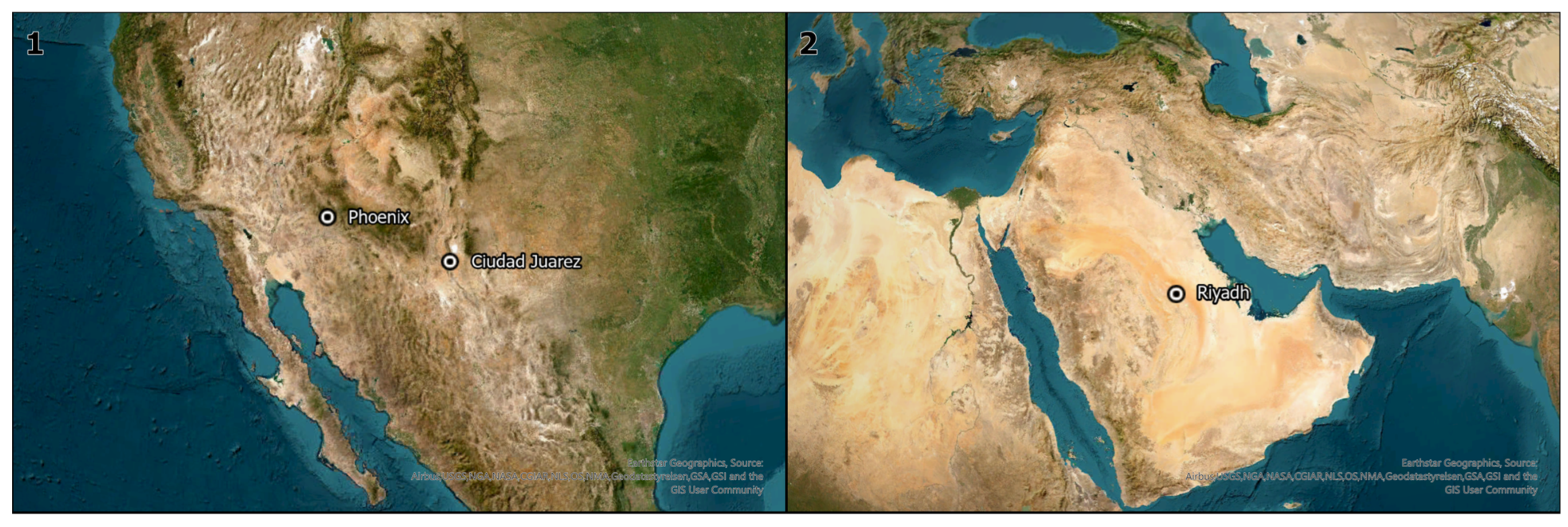
Three cities located in desert landscapes were chosen for comparative analysis (Figure 1). Each study area has its own unique characteristics and varying degrees of differences. These characteristics include population and developmental history, topography and geology, and variation in yearly and daily climate. The cities of Phoenix, Ciudad Juárez, and Riyadh were chosen due to their similarities in modern urban development, large sprawling populations, and relatively far distances from coastlines.
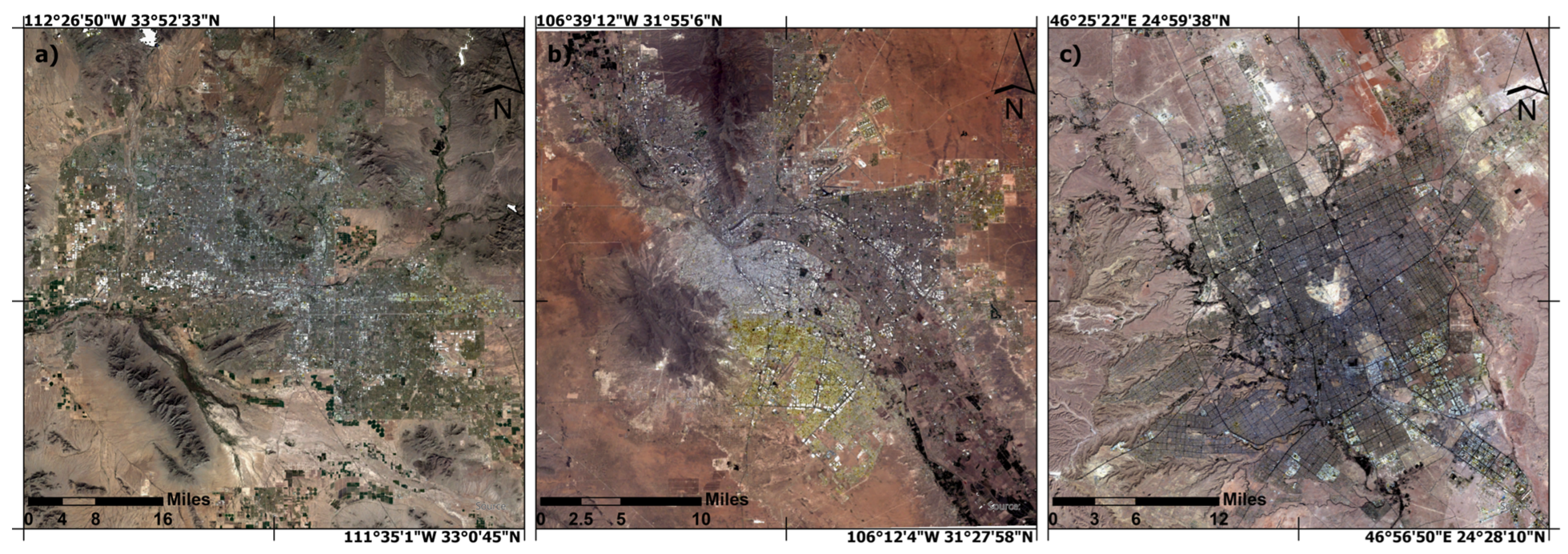
Phoenix is in the United States and is the capital of the state of Arizona (Figure 2a). The city’s coordinates are 33°26′54″ N and 112°4′27″ W, with an area of 1345 km2 and a metro population of over 4.8 million. The urban landscape is located within the Sonoran Desert of North America, which is classified as a hot, arid climate (BWh) under the Köppen climate classification system (See Appendix A) [34]. The average temperatures range from 41.7 °C to 7.2 °C, with an average yearly precipitation of 18.6 cm, and an average relative humidity of 30% [35].
Ciudad Juárez is in Mexico and sits at the northern border of the state of Chihuahua (Figure 2b). The city’s coordinates are 31°44′42″ N 106°29′06″ W, and it shares a transborder metro area with El Paso, Texas, with a total area of 992 km2 and a combined population of over 2.7 million people. The urban landscape is located within the Chihuahuan Desert of North America, and is classified as a cold, arid climate (BWk), with average temperatures ranging from 36.7 °C to 2.8 °C. Average annual precipitation is 17.4 cm, and average humidity is 34% [36].
Riyadh is the capital and largest city of Saudi Arabia (Figure 2c). The city’s coordinates are 24°38′ N 46°43′ E, with a total area of 1974 km2 and a metro population of over 7.8 million. The urban landscape is located within the Arabian Desert of Southwest Asia, which is classified as a hot, arid climate (BWh), with average temperatures ranging from 43.9 °C to 9.4 °C, average annual precipitation of 10.8 cm, and relative humidity of 26% [37].

2.2. Data

Collection 2 Level-2 data in the form of Landsat 8–9 (OLI-TIRS) was sourced from the U.S. Geological Survey website, EarthExplorer. Landsat 8–9 was chosen primarily because of its historical consistency, use of thermal infrared bend, and larger swath area. Two images were selected for each study site to include both the extent of the urban area and the surrounding landscape. Six spectral bands of surface reflectance at a 30 m resolution, and one thermal band of surface temperature at a 100 m resolution, were selected for use in analysis, as shown in Table 1. Further preprocessing took the form of cloud masking and water masking, where applicable. Table 2 provides data acquisition information for each of the six images. October was chosen, as it represented the time of year where the most similarities between each city would occur. Temperature, precipitation, vegetation, and cloud cover were found to have the least amount of variance during late summer and early autumn.

3. Methods

3.1. Published ISA Indices

Published indices chosen for this study were selected based on the assumption that the developed indices utilized at least one study area located within a climate that is classified as a desert or exhibits desert-like qualities, such as high aridity, little-to-no vegetation, and an excess of sandy terrain. Three published works were chosen that specifically highlighted desert-like environments for the development of ISA indices.
The NDISI was first published by Xu (2010) as an improvement to more efficiently detect and enhance impervious surfaces within built-up environments [3]. Through analysis of spectral signatures, ISA showed higher emission values in TIR (band 10) and lower reflectance in NIR (band 5). SWIR1 (band 6) was then used to further separate noise from sand and soil. In addition to showing a strong correlation between modeled ISA and actual ISA, this index was able to demonstrate a strong correlation between ISA and LST. However, since it was developed in a humid, subtropical environment (Cfa/Cwa), it is only being used as a proxy or standard for the rest of the ISA indices. It can be calculated as follows:
N D I S I =   T I R ( V I S B + N I R + S W I R 1 ) / 3 T I R + ( V I S B + N I R + S W I R 1 ) / 3
where TIR represents the thermal band and VIS represents the blue, green, and red bands. Replacing the blue band with a water index can help increase the contrast of the ISA and suppress any noise from bodies of water. So, it can also be calculated as follows:
N D I S I =   T I R ( M N D W I + N I R + S W I R 1 ) / 3 T I R + ( M N D W I + N I R + S W I R 1 ) / 3
where
M N D W I = G r e e n S W I R 1 G r e e n + S W I R 1
The DBI was developed by Rasul et al. (2018) as an ISA index for the purpose of distinguishing built-up land and bare soil [18]. Specifically, this index was one of the first efforts to do so for cities in dry climates using medium-resolution satellite imaging without any additional data sources. The index utilizes the blue band and thermal band, where the blue band shows higher reflectance on impervious surfaces of urban areas, and where the thermal band and impervious surfaces have a strong correlation. It should be noted, however, that the index was developed in a hot, summer, Mediterranean-like environment (Csa), and not an actual arid, nor semi-arid, climate. It is calculated as follows:
D B I = B l u e T I R B l u e + T I R N D V I
where blue is band 2 and TIR is band 10. The normalized difference vegetation index (NDVI) is used to further suppress any remaining noise from the sparsely vegetated landscape and surrounding areas. It can be calculated as follows:
N D V I = N I R R e d N I R + R e d
The PISI was proposed by Tian et al. (2018) as a novel ISA index using only the blue and NIR bands [19]. Unlike normalized ratios commonly found in the construction of remote sensing indices, this index uses a linear form equation (y = ax + b) to define a reference line within the blue and NIR feature space where ISA pixels are located below the reference line using the orthogonal distance formula. More specifically, ISA and bare soil fitting lines were created using least squares fitting, and then the reference line was found to be the bisector angle of the two lines. Of the four study areas used in the development of this index, only one was located within a dry climate. This climate is classified as a cold, semi-arid environment (BSk). The index is calculated as follows:
s f P I S I = 0.8192 B l u e 0.5735 N I R + 0.0750
where blue and NIR denote the reflectance values of bands 2 and 5, respectively. A scale factor (sf) is used to normalize the output values of the index to keep them within range with respect to other indices and to ensure a normalized range for the output raster. In this case, the output values are larger, so s f = 10 4 .
The MBAI was developed by Benkouider et al. (2019) and sought to approach classifying built-up land in an arid zone using higher-resolution imagery at a 10 m resolution per pixel [20]. Spectral signature analysis was conducted, which showed improved separation among the green, NIR, and SWIR bands. Specifically, the green band showed a higher spectral response for barren land than built-up land, while the SWIR shows high levels of both barren land and built-up land. This index was developed in regions that are classified as cold, desert (BWk) and cold, semi-arid. Although higher-resolution imagery was used, it can still be considered a similar resolution to this study. The index is calculated as follows:
s f M B A I = N I R + 1.57 G r e e n + 2.4 S W I R 1 + N I R
where NIR, green, and SWIR refer to bands 5, 3, and 6, respectively. A scale factor (sf) is used to normalize the output values of the index to keep them within range with respect to other indices and to ensure a normalized range for the output raster. In this case, since the output values are larger, s f = 10 6 .

3.2. Proposed ISA Indices

Two approaches for classifying desert ISA were developed to satisfy the variety of landscapes and environments that can be found amongst desert cities. The first approach, the desert urban landscape index (DULI), utilizes a “building blocks” method, in which normalized ratios of specific bands were subtracted from one another to enhance certain features of the remotely sensed image [38]. The second approach, the isoline impervious surface index (IISI), is influenced by the design of an index formula that optimizes the feature space of any two spectral bands, where minimal increases in the feature space result in maximum change in index value [39].
Three iterations of DULI were developed, each containing a certain number of normalized ratios to isolate certain band combinations that reference specific land cover types and their influences on ISA classification. For example, the first “block” is the normalized ratio between the blue and TIR bands. Then, the normalized ratio between the SWIR1 and NIR bands is used. This forms the basis for the detection of urban areas by suppressing the noise from the surrounding desert landscape, such as mountains, barren land, and fallow fields. From that point on, specific normalized ratios, such as a vegetation suppression and soil suppression, can be added on, depending on the needs of the research at hand. They can be composed as follows:
D U L I 1 = B l u e T I R B l u e + T I R N D B I N D V I
D U L I 2 = B l u e T I R B l u e + T I R N D B I
D U L I 3 = B l u e T I R B l u e + T I R N D B I N D V I S W I R 1 S W I R 2 S W I R 1 + S W I R 2
where blue, TIR, SWIR1, and SWIR2 represent bands 2, 10, 6, and 7, respectively. For DULI3, the normalized ratio between SWIR1 and SWIR2 serves as a novel soil suppression mechanism, while NDVI serves as the vegetation suppression. In addition, NDBI is initially used to further contrast urban areas from bare soil and the surrounding environment [2]. It is formulated as:
N D B I = S W I R 1     N I R S W I R 1   +   N I R
Spectral bands specific to the identification of ISA are used for IISI, and the formula selected was designed to compensate for the radiation transfer effect that occurs when light is affected by its interaction with any medium. The actual formula is based on isolines within a feature space and can be interchanged with any two bands. In this case, SWIR1 and NIR are used, which are the same bands used in NDBI. The index is formulated as follows:
s f I I S I = 1 N I R 2   +   ( 1     S W I R 1 ) 2
where NIR and SWIR1 refer to reflectance values in bands 5 and 6, respectively. A scale factor (sf) is used to normalize the output values of the index to keep them within range with respect to other indices and to ensure a normalized range for the output raster. In this case, since the output values are smaller, s f = 10 8 .

3.3. Correlation Analysis

The comparability of all the ISA indices in this study can be expressed through a correlation analysis. This is achieved by creating feature spaces in which pixel values are graphed as a scatter plot between any two indices. This process first involves stacking two indices for comparison and sampling them. In this case, a sample number of n = 10,000 was chosen not only to most accurately reflect the resulting statistics, but to also cut down on computing time. A simple linear regression was then used to find a regression line using ordinary least squares. Then, a correlation coefficient was computed using Spearman’s method [40]. This coefficient, if found to be a part of a statistically significant dataset that follows normal distribution, is used to rank the strength of the relationship between any two indices. In addition, Spearman’s rank correlation coefficient assesses monotonic relationships, or whether two variables are entirely non-decreasing or non-increasing. Whether the correlation is found to be weak or strong, positive or negative, it can provide analytical insight into the impact that the construction of each index has on detecting ISA features in a desert landscape.

3.4. Threshold Selection for ISA Classification

In order to extract ISA pixels from the surrounding environment, a threshold value must be selected. This threshold comes in the form of a carefully selected pixel value that can properly serve as a cutoff point for ISA classification towards an optimal degree of accuracy. However, because only a single value can be selected per index, threshold selection methods can produce different pixel values and levels of accuracy from one study area to another. Because of this, an automatic selection method was chosen over more conventional methods, such as manual selection or incremental selection through trial and error.
A multi-Otsu’s threshold method (MOT) was chosen to automatically calculate the necessary number of thresholds given the desired number of classes [41]. This is achieved by counting the number of pixels per index value in the form of a histogram, and then automatically scanning and selecting the optimal point of inter-class variance [42]. In this case, three classes were decided as the inputs, which would then produce two thresholds. This is because three classes of land cover are to exist in any given urban landscape according to the V-I-S model. Then, a threshold was chosen that best fits the urban area, while minimizing the misclassifications between ISA and soil. This threshold was then used to form the final binary ISA classification maps used for accuracy assessment.

3.5. Accuracy Assessment

A stratified random sampling technique using two strata was chosen to ensure a proportional ratio between ISA pixels and non-ISA pixels relative to the index and study area. A sample size of n = 385 was chosen based off of a 95% confidence binomial probability in accordance with the total number of cells per raster [43]. Not only were the ISA classification maps referenced to the original processed satellite imagery, but a cross-validation was conducted using Google Earth imagery as a way to affirm and assess classification results at a higher resolution. Despite this, there were instances in which a classified pixel was misclassified by the accuracy assessment, likely due to a geometric error or misregistration. At this point, the defunct sample was promptly deleted and replaced with a newly generated sample.
The accuracy assessment for each index is expressed in terms of a binary classification confusion matrix and evaluated using statistical measurements such as overall accuracy, recall, precision, and kappa (Table 3). Overall accuracy (OA) refers to the probability of correctly classified samples such that true positives and true negatives are normalized with respect to total sample size. Recall refers to the probability that the index has correctly classified the reference sites. In other words, it is a measure of the true positive rate (TPR) by taking into account false negatives. Precision refers to the probability that the index’s number of correct classifications reflects the number of classified reference sites. It instead considers false positives, a measure of the positive predictive value (PPV). Lastly, the kappa coefficient refers to how well the classification performed relative to chance. This is particularly useful when dealing with asymmetrical datasets, where sampling could lead to a higher apparent accuracy [44].

4. Results

4.1. Mapping of ISA Indices

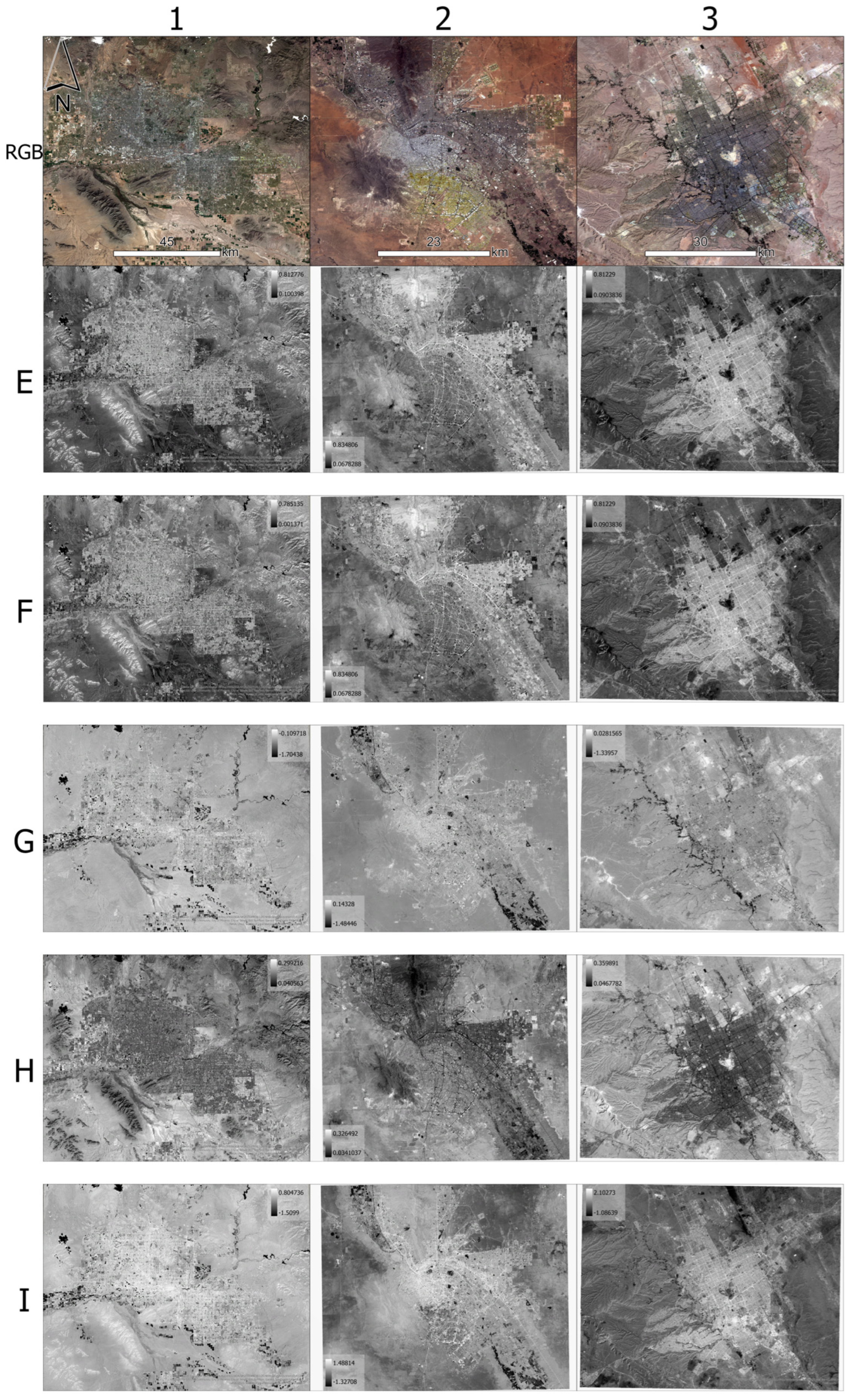
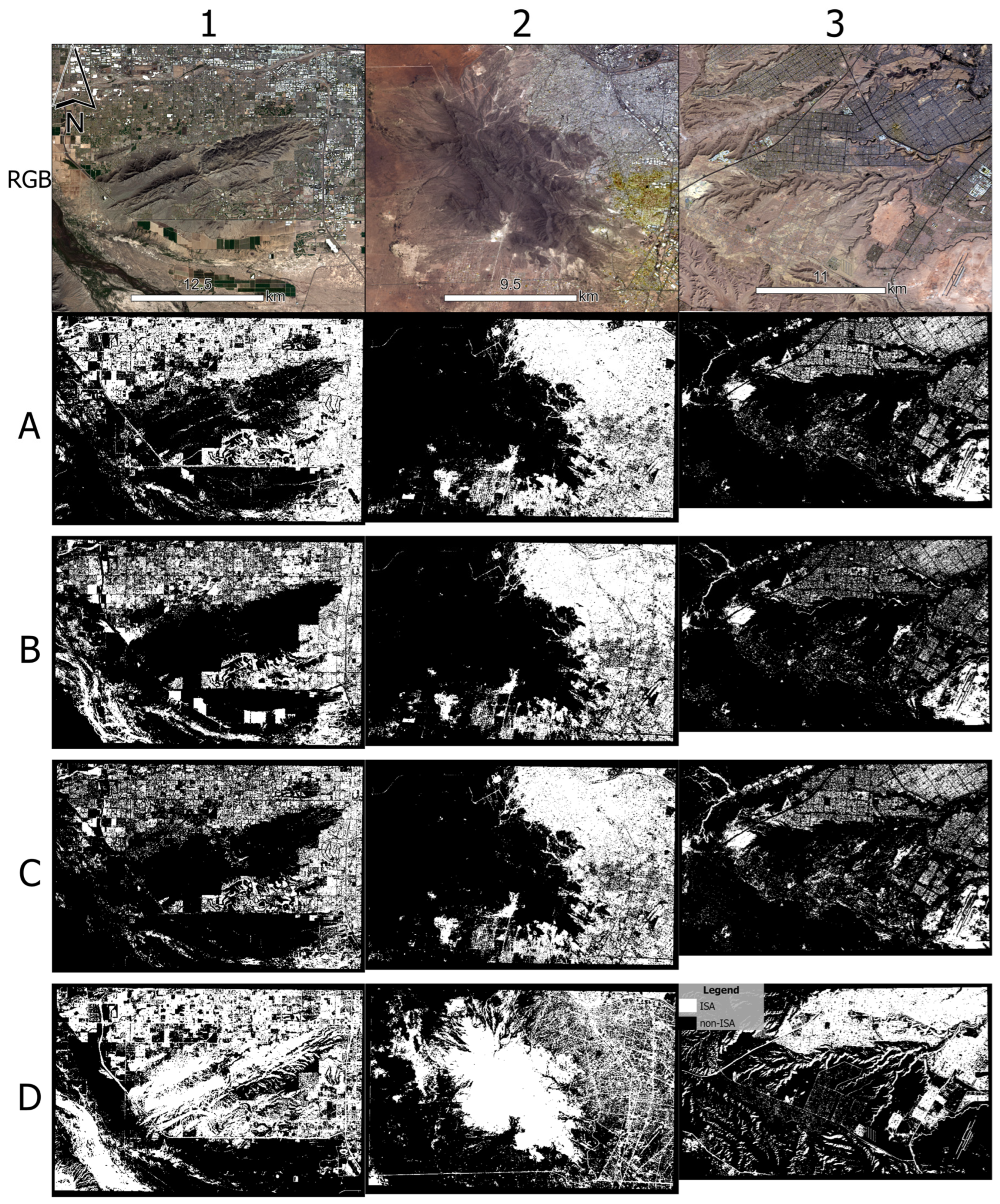
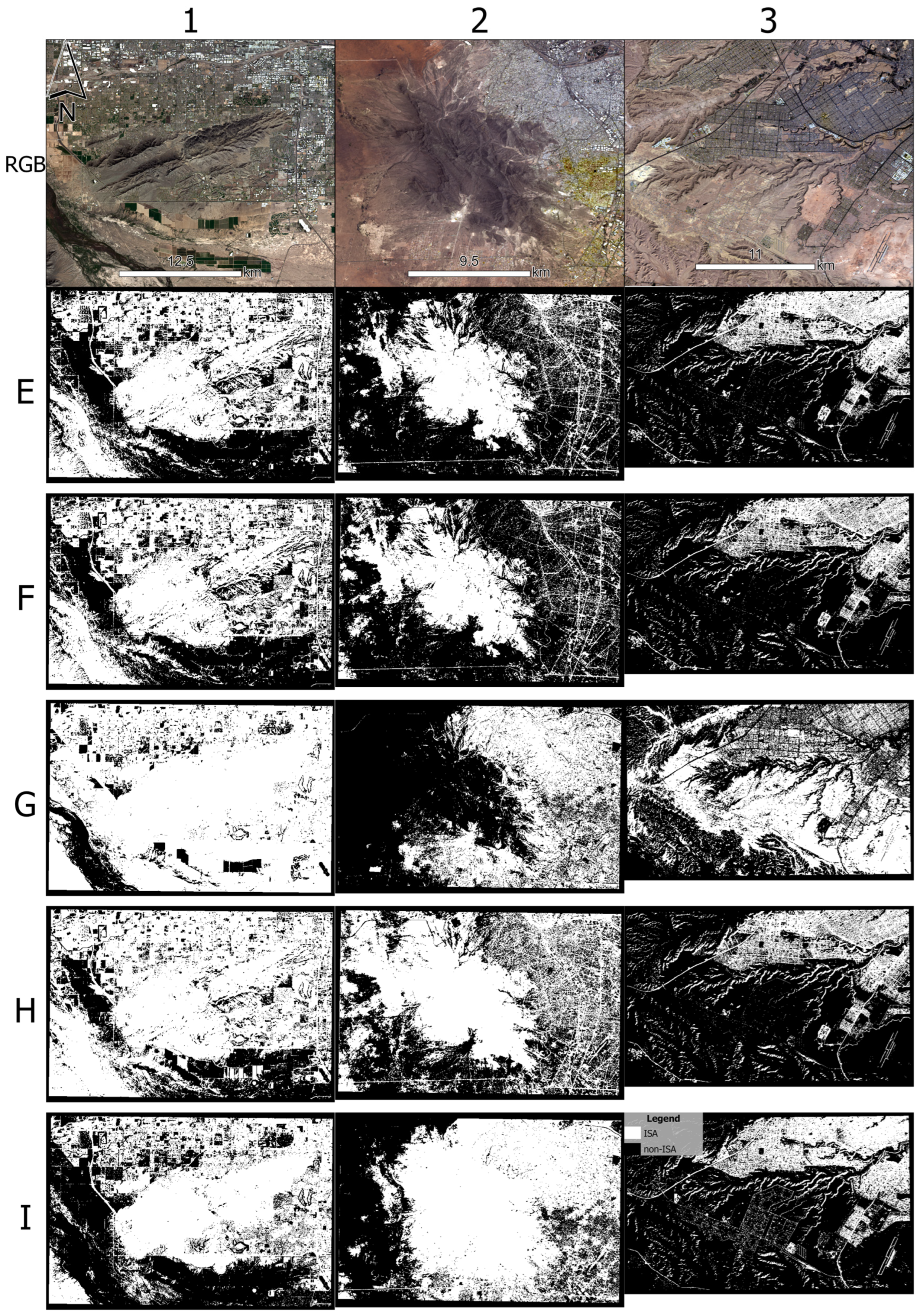
There are variety and diversity in ISA detection for each index across each study site shown in Figure 3 and Figure 4. However, key patterns do exist, primarily between Phoenix and Ciudad Juárez. On the other hand, Riyadh tended to show better ISA detection for the same indices that were found to underperform in the other study areas. The most noticeable feature is the ability of an index to suppress mountains and hills. All three iterations of the proposed DULI suppressed mountainous terrain for the study areas of Phoenix and Ciudad Juárez. For the suppression of the surrounding urban landscape, such as flat, barren land, all three iterations of DULI showed the highest levels of suppression in Phoenix and Ciudad Juárez, while IISI, both NDISI indices, MBAI, and PISI showed the highest levels of bare soil suppression in Riyadh. It should be noted, however, that DULI2 detects areas of denser vegetation, such as desert riparian zones and fertile agricultural fields. DBI was only able to successfully suppress the surrounding landscapes and mountains in Ciudad Juárez. It failed in the detection of ISA features in Phoenix and Riyadh. All three iterations of DULI dropped significantly in performance of ISA detection in Riyadh. IISI, both NDISI indices, MBAI, and PISI all failed to suppress the tops of mountains, resulting in the detection of mountains as ISA in both Phoenix and Ciudad Juárez.

4.2. Scatter Plots

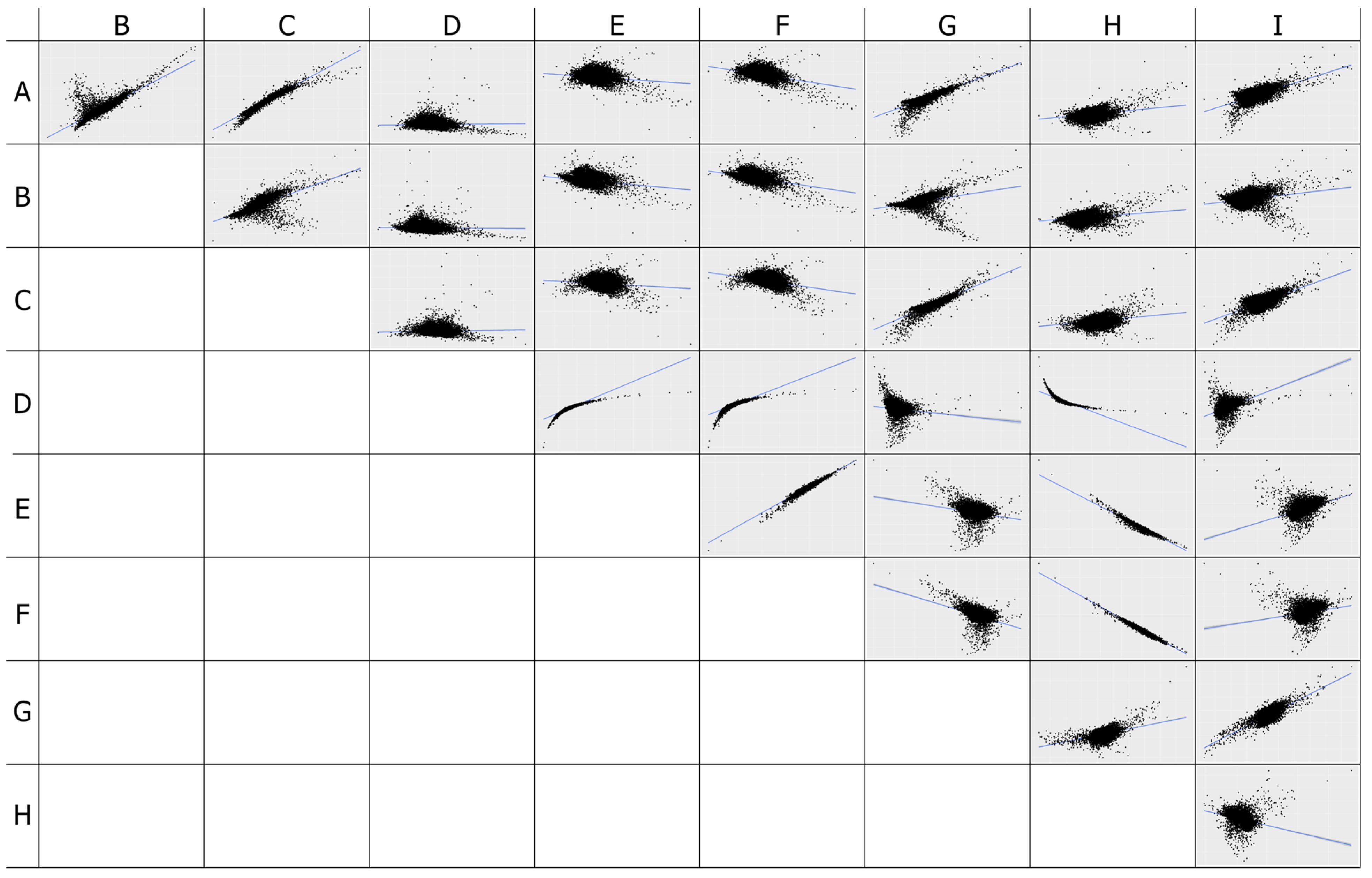
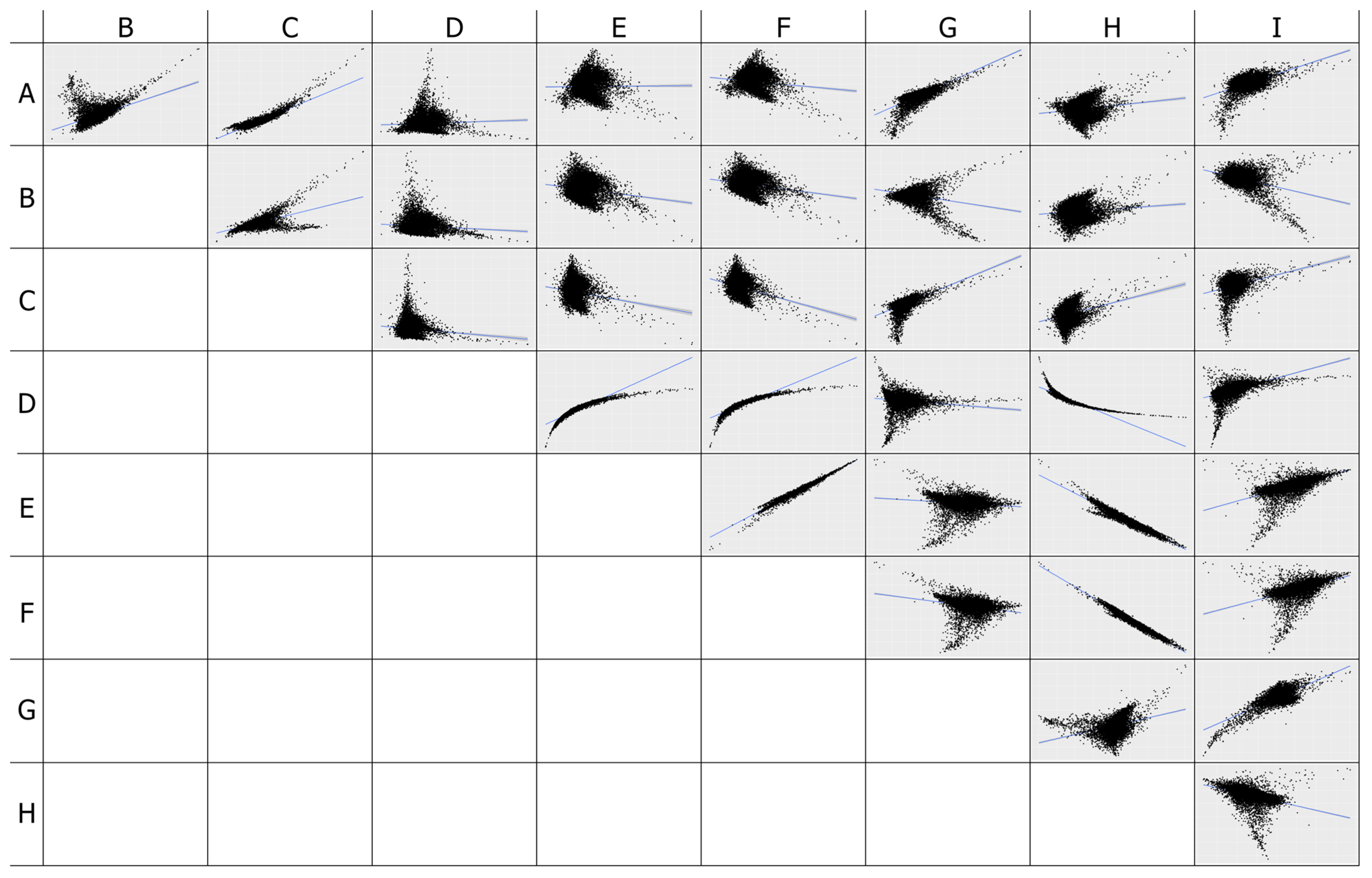
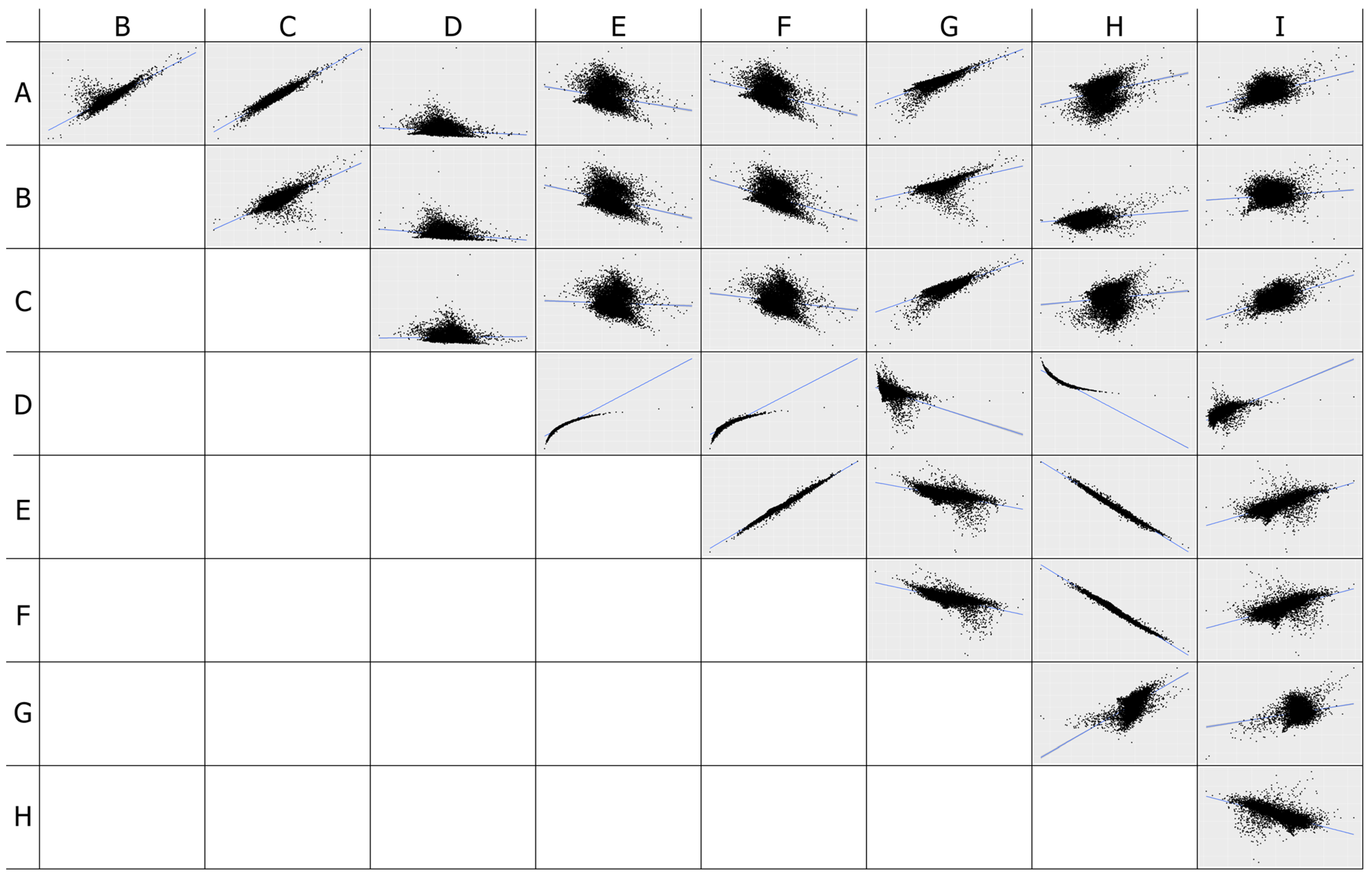
There exist 36 scatter plots per study area for every combination of the nine indices chosen for this study (Figure 5, Figure 6 and Figure 7, Table 4). These are the scatter plots with the highest and most consistent correlation ranks across the three study sites. DULI1, DULI2, and DULI3 all show high positive correlations with each other across all three study areas, with DULI1 and DULI3 showing a stronger correlation. IISI, NDISI_mndwi, and NDISI_visb show very strong positive correlations with each other. MBAI shows very strong negative correlations with IISI, NDISI_mndwi, and NDISI_visb.
Certain scatter plots also showed a tendency to favor two study sites over the other. In other words, the degree of correlation between two study areas matched each other, while the other study area had a different correlation rank. Some plots only show a slight difference in rank, such as DULI1 with DULI2 and DBI, where the rank decreases in Phoenix. Other plots show a more significant difference in rank, such as PISI with DULI1 and NDISI_mndwi decreasing in Ciudad Juárez, PISI and DULI3 decreasing in Phoenix, and PISI and MBAI decreasing in Riyadh.
This group of scatter plots scored different levels of correlation across each study site; however, they all showed noteworthy levels of correlation in at least one city. For example, the correlation of DBI with DULI2 and DULI3 had the weakest correlation rank in Phoenix. Next, DBI and MBAI scored the weakest rank in Ciudad Juárez, but at the same time, DBI with IISI, NDISI_mndwi, NDISI_visb, and PISI scored the strongest rank in Ciudad Juárez.
The last group showed levels of correlation across study sites that were closest to zero. In other words, none of their correlation ranks were significant, and they tended towards randomness. They include all three iterations of DULI with IISI, NDISI_mndwi, NDISI_visb, and MBAI. In addition, DULI2 and PISI also showed randomness across study sites.
Overall, scatter plots that show the highest likelihood of monotonic characteristics across all three study areas include IISI with NDISI_mndwi, NDISI_visb, and MBAI, but, because they are not also linear, they would require a logarithmic transformation in order to interpret regression metrics. Scatter plots DULI1, DULI3, and DBI also showed monotonic characteristics amongst each other. Scatter plots NDISI_mndwi, NDISI_visb, and MBAI all showed the highest likelihood of also being linear amongst each other.

4.3. Classification of ISA

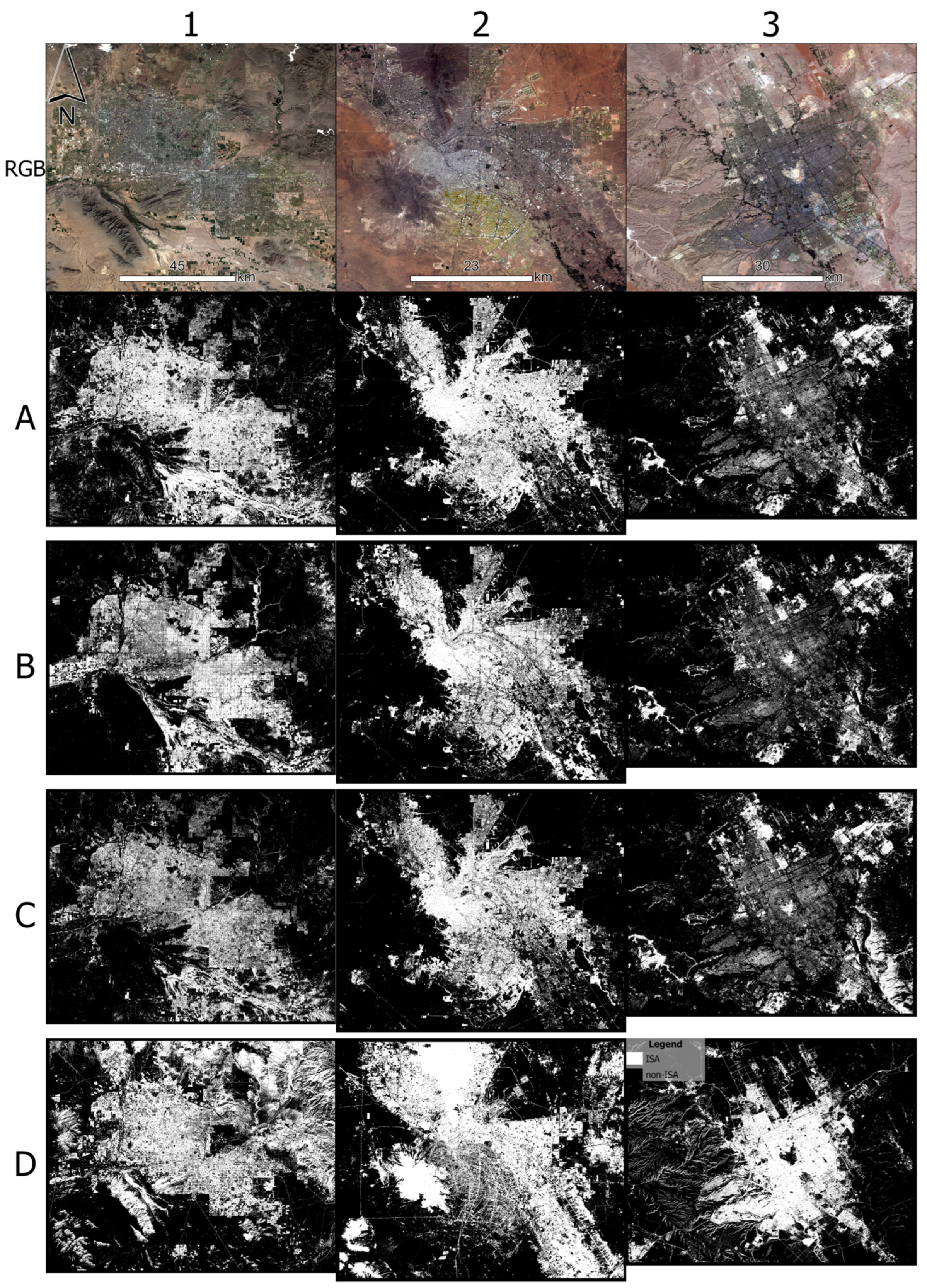
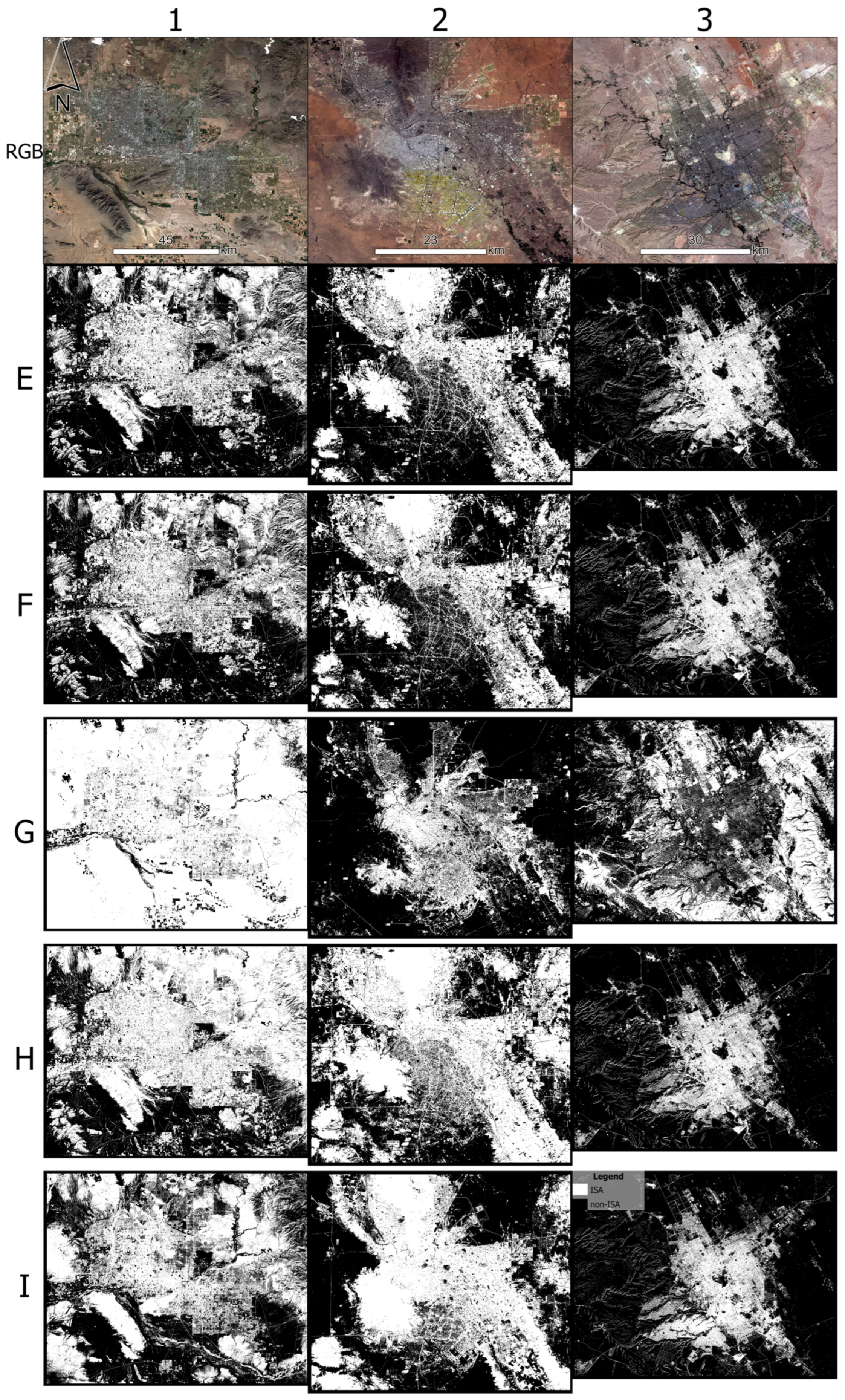
Table 5 shows the threshold values computed from MOT to produce the binary ISA classification maps. Key features of the ISA index maps were able to be captured once the threshold values were used; however, indices that failed to suppress non-ISA features like soil and vegetation are attributable to the effects of desert landscapes on ISA classification, the mixed-pixel problem, and the spectral confusion between soil and built-up areas. Indices that can rectify this issue, especially across multiple study sites, are more likely to achieve higher accuracy than those that cannot. Therefore, they would be more useful for the detection of ISA in desert landscapes. Binary classification maps were used to simplify the ability to analyze the indices at face value, which benefits the nature of a comparative analysis of nine indices and three study sites. Maps were, therefore, classified as either ISA or non-ISA, as shown in Figure 8 and Figure 9.
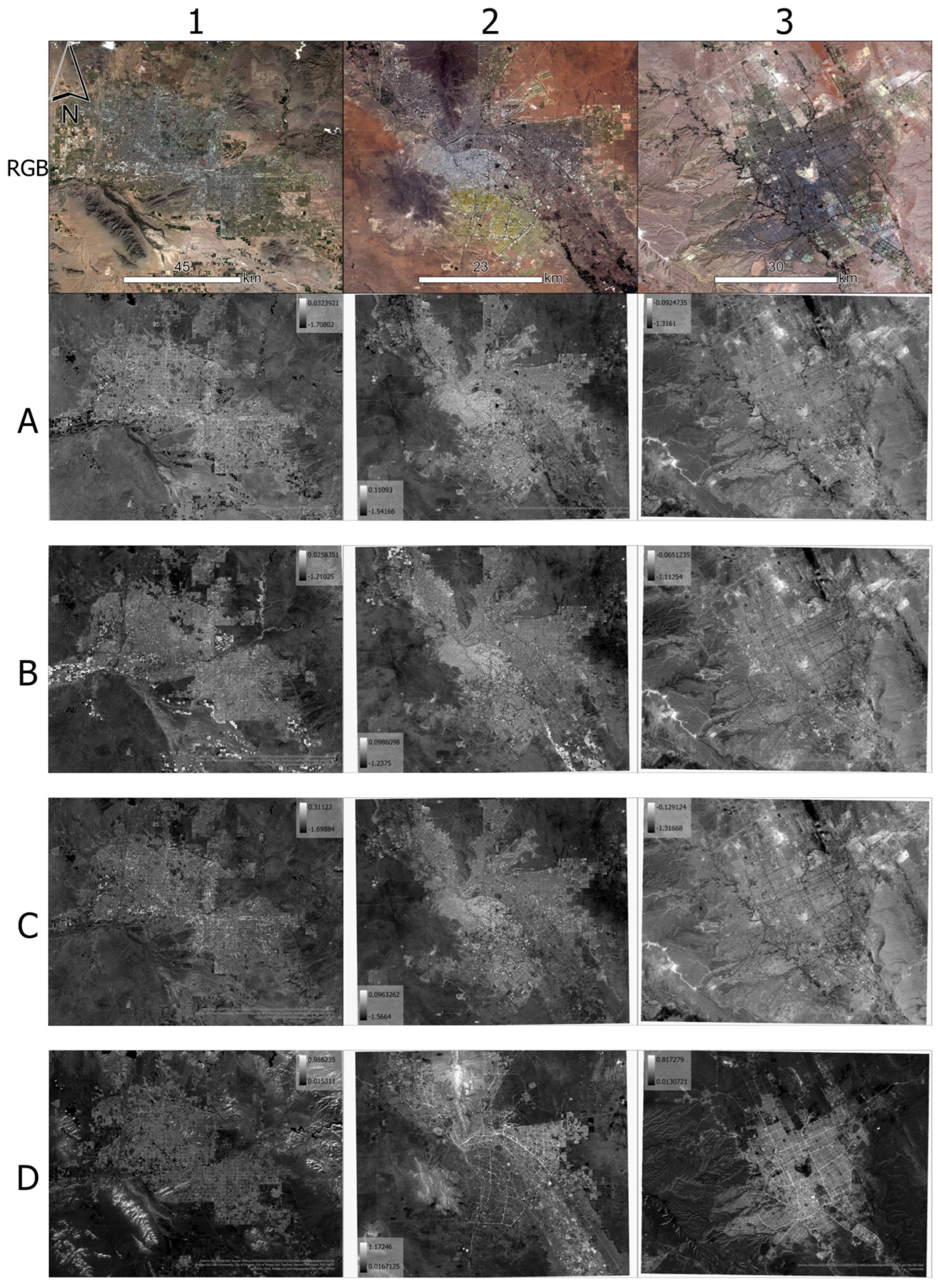
All three iterations of DULI demonstrated the ability to correctly classify the surrounding desert landscape as non-ISA (Figure 10). In Phoenix, each iteration showed a strong overall effect to not classify bare soil, mountains, or both with DULI3. In Ciudad Juárez, similar observations can be made; moreover, the non-classification of the surrounding desert landscape is even more apparent, with less confusion. All three appear to be most effective in Ciudad Juárez. In Riyadh, the non-classification of the surrounding desert landscape is still apparent to a certain extent, with some areas of bright sand incorrectly classified as ISA. At the same time, ISA in the urban area appears to not be robustly classified, or under-classified. It should also be noted that, despite its apparent ability to suppress the surrounding landscape, DULI2 shows a significant amount of dark ISA, such as roads and freeways that were not actually classified in all three study sites when they were supposed to. And, when applicable, it classifies agricultural fields and bright soils of riparian zones as ISA, most likely due to the lack of a vegetation index and soil index in its formula. DULI3 manages to improve the non-classification of the bright soils, although there is still some presence.
IISI, both versions of NDISI, MBAI, and PISI show similar patterns across the study areas, with only slight observable differences. The patterns include the inability to classify mountains, hills, and bare soils as non-ISA for both Phoenix and Ciudad Juárez. At the same time, urban areas were amply classified as ISA in all three cities. Moreover, Riyadh appears to have significant levels of both ISA classification for the urban area, as well as substantial levels of the surrounding desert landscape classified as non-ISA. However, there does appear to be misclassification of rocky features, such as the canyons, as ISA, when they should be classified as non-ISA (Figure 11). Despite this, IISA, NDISI_mndwi, NDISI_visb, MBAI, and PISI all appear to work best in the city of Riyadh, while showing significant problems in misclassification of mountains areas in Phoenix and Ciudad Juárez. Moreover, the misclassification of mountains and bare soil seems to be slightly more apparent with MBAI and PISI in Phoenix and Ciudad Juárez.
DBI shows varying degrees of classification across all three study areas, where no apparent pattern can be observed. For example, Phoenix shows no distinguishing features of classification between the urban area and surrounding desert landscape; mountains, bare soil, and urban areas have all been classified as ISA. Ciudad Juárez, on the other hand, shows the ability of this index to capture the urban area’s ISA, while seemingly classifying the mountains and bare soil as non-ISA. This, however, completely falls apart again when classifying ISA in Riyadh, where splotches of bare soil have been classified as ISA, while the urban area has been under-classified or underrepresented as ISA. This inconsistent behavior can serve as an argument against the use of DBI as a desert urban index.

4.4. Accuracy Assessment

The accuracy levels of nine ISA indices in three desert cities were evaluated using a stratified random sampling technique, in which pixels were selected relative to the proportion of ISA pixels and non-ISA pixels found in any given map. In total, 385 pixels were sampled per map and individually evaluated and compared to ground truth points from the original Landsat satellite imagery, as well as Google Earth imagery. As a result, a total of 10,395 points were evaluated for accuracy using an error matrix, accuracy metrics, and kappa statistics, as shown in Table 6.
Overall, all three iterations of DULI outperformed in Phoenix and Ciudad Juárez. DULI1 performed the best in Ciudad Juárez compared to the other indices, with an OA of 87.27% and a kappa score of 0.6867. IISI and PISI performed the best in Riyadh compared to other indices, with OA values of 90.13% and 90.91% and kappa scores of 0.7354 and 0.7301, respectively. On average, DULI2 index performed the best across all three study sites, with an average OA of 82.77% and an average kappa of 0.4775. The highest average kappa score, however, was DULI1, with an average kappa of 0.5114, while having an average OA of 82.41%. On average, DULI3 had the second highest performance across all three study sites.
DBI had the poorest performance, with an average OA of 54.29% and an average kappa score of 0.1777. While DBI scored the highest among the published indices in Ciudad Juárez with an OA of 81.04% and a kappa score of 0.4775, it had the poorest performance in Phoenix and Riyadh, with OA values of 28.57% and 53.25%, and kappa scores of 0.0395 and 0.0162, respectively. Even though MABI, PISI, NDISI_mndwi, and NDISI_visb performed well in Riyadh, they all performed poorly in Phoenix and Ciudad Juárez. MBAI had the poorest performance in Ciudad Juárez, with an OA of 55.06% and a kappa score of 0.2003. NIDIS_visb had the second poorest performance on average.

5. Discussion

The resulting maps and accuracy assessment indicate the abilities of DULI and IISI to detect and classify ISA features in a desert urban landscape. Using medium-resolution satellite imagery from Landsat 8–9 demonstrates that adequate extraction of ISA features is possible in desert urban landscapes without the use of additional data sources and classification methods such as machine learning, object-based, sub-pixel, linear transformation, or SAR [22,23,24,25,26,27,28,29,30,31]. Not only that, but the novel indices proposed in this research provide a very needed insight into the process of classification for urban remote sensing in an arid climate: depending on the topographical and spectral influences of any given desert landscape, there is a way to detect ISA features using only the novel indices proposed in this research to a high degree of accuracy.
The available published indices developed in arid and dry climates were assessed for their performance in various desert cities [16,17,18,19,20,21]. What was found still reflects the ability of the proposed indices to outperform other published indices across the various accuracy metrics. Moreover, DBI failed to perform in two of the three study areas and scored the lowest OA in both Phoenix and Riyadh [18,32]. Although it scored high in Ciudad Juárez, this reflects the inconsistency of DBI to detect urban features in dry climates. If an index is to be used for fast and efficient classification in dry climates, but cannot work effectively across different study areas, then other indices need to be developed to address this issue.
Influences such as climate and topography can play detrimental roles in how well an index performs in a dry environment. Therefore, it is important to categorize specifically what type of climate is being dealt with for each study area. For example, a place with dry features, such as the Mediterranean, are not necessarily classified as deserts [34]. However, the two most influential factors on the detection and classification of ISA features in desert urban landscapes are mountainous features and sandy features.
Mountains can drastically influence the efficacy of an ISA index. Changes in elevation appear to cause confusion between ISA and non-ISA, or, more specifically, ISA and bare soil [1]. Whether the elevation changes are due to gradual inclines or steep cliffs, these features are likely to be picked up by most of the ISA indices. This is reflected in the shift from the mountains of Phoenix and Ciudad Juárez to the plateaus of Riyadh, where IISI, NDISI_mndwi, NDISI_visb, MBAI, and PISI all failed at suppressing mountainous features in Phoenix and Ciudad Juárez, but then successfully classified ISA in the flat uplands of Riyadh.
Next, sandy features may drastically influence the performance of an index, especially when it is spectrally anomalous compared to the rest of the bare land in terms of brightness and color [32]. This problem is most noticeable with DULI, where bright sandy patches in Riyadh drastically shifted the range of ISA values, causing misclassification of barren land and the minor suppression of the actual urban area. This resulted in a roughly ten percent dip in performance when all three iterations were applied to Riyadh. Regardless, DULI still managed to perform the most consistently across all study sites.
Why the proposed indices were able to outperform the published indices may depend on many different factors. DULI performed best in Phoenix and Ciudad Juárez. This may be due to the use of the normalized ratio of the Blue and TIR bands, where higher values in the blue band connote rocky features and ISA, and higher values in the TIR represent areas of increased LST and can be a good indication of the UHI effect [3]. The novel inclusion of the NDBI index in DULI then helps solidify the urban area by suppressing the surrounding landscape. The outperformance of IISI over other indices in Riyadh can be attributed to the use of an exponential feature space of isolines, where values closer to ISA are much more pronounced [39].
For the most part, the building blocks approach in DULI showed minimal, yet visibly noticeable improvements in OA. Using both the vegetation and soil suppression indices employed in DULI3 seemed to have the best results. More research would need to be conducted to truly verify the benefits of each additional land cover suppression index, although DULI2 has more landscape suppression power if vegetation is masked. For now, using all available suppression indices appears to have, at best, an OA of up to 3% more than DULI1 and DULI2.
Only in Ciudad Juárez was DBI able to perform alongside DULI. This could be due to Ciudad Juárez being located in a cold desert climate, as opposed to a hot desert climate. DBI was developed in the hot, summer Mediterranean climate of Erbil, Iraq, which may have more similarities to the climate characteristics of Ciudad Juárez, making DBI perform according to its respective research results. Despite this, DBI showed the most unreliability across all three study areas, while DULI was the most consistent, especially in Phoenix and Ciudad Juárez.
Limitations in the research can impact the interpretation of results. The use of only 385 samples per accuracy assessment, using a stratified random sampling technique, may not have maximized the accuracy results. This is due to the tendency of the larger surrounding landscape to be favored over the urban area by sheer volume of available pixels. A narrower subset of images may bypass this limitation, but at the cost of removing landscape features such as mountains and canyons. A larger sample size may also help, but that would be very time- and energy-consuming, due to the nature of a multi-city, multi-index comparative analysis. An additional experiment can also be added, in which sample data can be utilized to statistically analyze the distribution of land cover types across the proposed indices. Next, expanding the breadth of the study areas by increasing the number of cities and utilizing multi-seasonal imagery could further develop the indices and give more insight into the complexity of urban index classification in desert environments. In addition, the use of Sentinel-2 data may be worth utilizing for exploring the impact, of the proposed indices on the study areas for comparison with Landsat 8–9. Lastly, Phoenix itself posed the most challenge in classification due to the complexity of its landscape features, the striking spectral similarities between the urban area and soil, and the difficulty in separating it with ISA. Another study can be conducted including similar complex arid landscapes to further test the proposed indices as a way to contrast and solidify the performances found in this research. Other datasets can be used that could improve upon the detection of ISA, such as digital elevation models or synthetic aperture radar.

6. Conclusions

Urban remote sensing can benefit from a more universal approach for detecting built-up features regardless of climate, especially when there is an abundance of bare soil that can cause spectral confusion and misclassification. Desert urban environments are a fundamental example of where the ISA and bare soil problem can play out in a drastically impactful way, to the point that more complicated measures are needed to create accurate classification maps. The methods proposed in this paper can circumvent this issue in a profound way, where no published indices have been able to. This will come into upmost importance in the following years, as desert regions face some of the most dire circumstances when it comes to the sustainability of man-made environments, both at local and global levels in an already inhospitable climate.
With more accurate and efficient means of ISA detection in desert environments, a more sustainable place can be developed to be protected and made resilient towards the UHI, urban sprawl, drought, fire, and desertification. Primarily exacerbated by the climate crisis and rising greenhouse gases, desert cities will be among the most impacted areas, where millions of people already live and where demand for the many amenities a city offers increases in this stress-prone environment. Clearly, policies of slower growth and degrowth will benefit these regions; however, to assess and monitor these urban areas, an easy-to-use urban index of high accuracy must be available for the policy makers, planners, and researchers in these regions to use.
This research not only proposes a novel index for desert ISA classification, but it also provides two options, depending on topographic features, that can influence ISA detection. If a desert urban landscape tends to show flatter features, and the spectral content of the bare soil tends to be homogenous, then IISI can satisfy ISA classification to up to a 4% improvement in accuracy than other published indices. And, if a desert urban landscape has canyons, mountains and other contrasts in elevation, DULI can satisfy ISA classification to a high degree while suppressing landscape features, where there has been no past research demonstrating this ability with multi-spectral band analysis alone. The encouraging findings of this study are not only important in the field of remote sensing, but can also have an impact on the much-needed future of urban and environmental studies of the high-risk environments of arid and desert landscapes.

Author Contributions

Conceptualization, M.J.M. and L.B.; Methodology, M.J.M.; Software, M.J.M.; Validation, M.J.M.; Formal analysis, M.J.M.; Investigation, M.J.M.; Data curation, M.J.M.; Writing—original draft, M.J.M.; Writing—review & editing, M.J.M., L.B. and X.L.; Visualization, M.J.M.; Supervision, L.B. and X.L. All authors have read and agreed to the published version of the manuscript.

Funding

This research received no external funding.

Data Availability Statement

Code and data will be provided upon request.

Conflicts of Interest

The authors declare that there are no financial interests, commercial affiliations, or other potential conflicts of interest that could have influenced the objectivity of this research or the writing of this paper.

Appendix A. Köppen Climate Classification Scheme

Climate GroupSeasonal Precipitation TypeTemperature Level
A (Tropical)f (Rainforest)
m (Monsoon)
w (Savanna, dry winter)
s (Savanna, dry summer)
B (Dry)W (Desert, arid)
S (Steppe, semi-arid)
h (hot)
k (cold)
C (Temperate)w (Subtropical, dry winter)
f (Humid, Oceanic)
s (Mediterranean, dry summer)
a (hot summer)
b (warm summer)
c (cold summer)
D (Continental)w (dry winter)
f (no dry season)
s (dry summer)
a (Humid, hot summer)
b (Humid, warm summer)
c (Boreal, cold summer)
d (Boreal, very cold winter)
E (Polar) T (Tundra)
F (Ice cap)

References

  1. Ridd, M.K. Exploring a V-I-S (vegetation-impervious surface-soil) model for urban ecosystem analysis through remote sensing: Comparative anatomy for cities. Int. J. Remote Sens. 1995, 16, 2165–2185. [Google Scholar] [CrossRef]
  2. Zha, Y.; Gao, J.; Ni, S. Use of normalized difference built-up index in automatically mapping urban areas from TM imagery. Int. J. Remote Sens. 2003, 24, 583–594. [Google Scholar] [CrossRef]
  3. Xu, H. Analysis of Impervious Surface and its Impact on Urban Heat Environment using the Normalized Difference Impervious Surface Index (NDISI). Photogramm. Eng. Remote Sens. 2010, 76, 557–565. [Google Scholar] [CrossRef]
  4. Waqar, M.M.; Mirza, J.F.; Mumtaz, R.; Hussain, E. Development of New Indices for Extraction of Built-Up Area & Bare Soil from Landsat Data. Open Access Sci. Rep. 2012, 1, 136. [Google Scholar] [CrossRef]
  5. As-syakur, A.R.; Adnyana, I.W.S.; Arthana, I.W.; Nuarsa, I.W. Enhanced Built-Up and Bareness Index (EBBI) for Mapping Built-Up and Bare Land in an Urban Area. Remote Sens. 2012, 4, 2957–2970. [Google Scholar] [CrossRef]
  6. Deng, Y.; Wu, C.; Li, M.; Chen, R. RNDSI: A ratio normalized difference soil index for remote sensing of urban/suburban environments. Int. J. Appl. Earth Obs. Geoinf. 2015, 39, 40–48. [Google Scholar] [CrossRef]
  7. Sun, Z.; Wang, C.; Guo, H.; Shang, R. A Modified Normalized Difference Impervious Surface Index (MNDISI) for Automatic Urban Mapping from Landsat Imagery. Remote Sens. 2017, 9, 942. [Google Scholar] [CrossRef]
  8. Faridatul, M.I.; Wu, B. Automatic Classification of Major Urban Land Covers Based on Novel Spectral Indices. ISPRS Int. J. Geo-Inf. 2018, 7, 453. [Google Scholar] [CrossRef]
  9. Chen, J.; Yang, K.; Chen, S.; Yang, C.; Zhang, S.; He, L. Enhanced normalized difference index for impervious surface area estimation at the plateau basin scale. J. Appl. Remote Sens. 2019, 13, 016502. [Google Scholar] [CrossRef]
  10. Chen, X.; Jia, X.; Pickering, M. A Nighttime Lights Adjusted Impervious Surface Index (NAISI) with Integration of Landsat Imagery and Nighttime Lights Data from International Space Station. Int. J. Appl. Earth Obs. Geoinf. 2019, 83, 101889. [Google Scholar] [CrossRef]
  11. Rouibah, K.; Belabbas, M. Applying Multi-Index Approach from Sentinel-2 Imagery to Extract Urban Areas in Dry Season (Semi-Arid Land in North East Algeria). Rev. Teledetección 2020, 56, 89–101. [Google Scholar] [CrossRef]
  12. Nguyen, C.T.; Chidthaisong, A.; Diem, P.K.; Huo, L.-Z. A Modified Bare Soil Index to Identify Bare Land Features during Agricultural Fallow-Period in Southeast Asia Using Landsat 8. Land 2021, 10, 231. [Google Scholar] [CrossRef]
  13. Guo, W.; Zhao, C.; Zhang, Y.; Gao, S. Mapping Impervious Surface Distribution and Dynamics in an Arid/Semiarid Area-A Case Study in Ordos, China. IEEE Access 2021, 9, 19659–19673. [Google Scholar] [CrossRef]
  14. Kebede, T.A.; Hailu, B.T.; Suryabhagavan, K.V. Evaluation of spectral built-up indices for impervious surface extraction using Sentinel-2A MSI imageries: A case of Addis Ababa city, Ethiopia. Environ. Chall. 2022, 8, 100568. [Google Scholar] [CrossRef]
  15. Javed, A.; Shao, Z.; Sumari, N.S.; Mardia; Bai, B.; Yu, Z.; Wang, J.; Ara, I.; Huq, E.; Ali, Y.; et al. Development of normalized soil area index for urban studies using remote sensing data. Geofizika 2023, 40, 29–49. [Google Scholar] [CrossRef]
  16. Liu, C.; Shao, Z.; Chen, M.; Luo, H. MNDISI: A multi-source composition index for impervious surface area estimation at the individual city scale. Remote Sens. Lett. 2013, 4, 803–812. [Google Scholar] [CrossRef]
  17. Qiu, B.; Zhang, K.; Tang, Z.; Chen, C.; Wang, Z. Developing soil indices based on brightness, darkness, and greenness to improve land surface mapping accuracy. GIScience Remote Sens. 2017, 54, 759–777. [Google Scholar] [CrossRef]
  18. Rasul, A.; Balzter, H.; Ibrahim, G.R.F.; Hameed, H.M.; Wheeler, J.; Adamu, B.; Ibrahim, S.; Najmaddin, P.M. Applying Built-Up and Bare-Soil Indices from Landsat 8 to Cities in Dry Climates. Land 2018, 7, 81. [Google Scholar] [CrossRef]
  19. Tian, W.; Chen, H.; Song, Q.; Zheng, K. A Novel Index for Impervious Surface Area Mapping: Development and Validation. Remote Sens. 2018, 10, 1521. [Google Scholar] [CrossRef]
  20. Benkouider, F.; Abdellaoui, A.; Hamami, L. New and Improved Built-Up Index Using SPOT Imagery: Application to an Arid Zone (Laghouat and M’Sila, Algeria). J. Indian Soc. Remote Sens. 2019, 47, 185–192. [Google Scholar] [CrossRef]
  21. Javed, A.; Shao, Z.; Ara, I.; Huq, M.E.; Ali, M.Y.; Saleem, N.; Ahmad, M.N. Development of Global Impervious Surface Area Index for Automatic spatiotemporal Urban Mapping. Preprints 2022, 2022070071. [Google Scholar] [CrossRef]
  22. Aimaiti, Y.; Kasimu, A.; Jing, G. Urban landscape extraction and analysis based on optical and microwave ALOS satellite data. Earth Sci. Inform. 2016, 9, 425–435. [Google Scholar] [CrossRef]
  23. Cablk, M.E.; Minor, T.B. Detecting and discriminating impervious cover with high-resolution IKONOS data using principal component analysis and morphological operators. Int. J. Remote Sens. 2003, 24, 4627–4645. [Google Scholar] [CrossRef]
  24. Galletti, C.S.; Myint, S.W. Land-Use Mapping in a Mixed Urban-Agricultural Arid Landscape Using Object-Based Image Analysis: A Case Study from Maricopa, Arizona. Remote Sens. 2014, 6, 6089–6110. [Google Scholar] [CrossRef]
  25. Ge, G.; Shi, Z.; Zhu, Y.; Yang, X.; Hao, Y. Land use/cover classification in an arid desert-oasis mosaic landscape of China using remote sensed imagery: Performance assessment of four machine learning algorithms. Glob. Ecol. Conserv. 2020, 22, e00971. [Google Scholar] [CrossRef]
  26. Halmy, M.W.; Gessler, P.E. The application of ensemble techniques for land-cover classification in arid lands. Int. J. Remote Sens. 2015, 36, 5613–5636. [Google Scholar] [CrossRef]
  27. Myint, S.W.; Okin, G.S. Modelling land-cover types using multiple endmember spectral mixture analysis in a desert city. Int. J. Remote Sens. 2009, 30, 2237–2257. [Google Scholar] [CrossRef]
  28. Namdar, M.; Adamowski, J.; Saadat, H.; Sharifi, F.; Khiri, A. Land-use and land-cover classification in semi-arid regions using independent component analysis (ICA) and expert classification. Int. J. Remote Sens. 2014, 35, 8057–8073. [Google Scholar] [CrossRef]
  29. Sugg, Z.P.; Finke, T.; Goodrich, D.C.; Moran, M.S.; Yool, S.R. Mapping Impervious Surfaces Using Object-oriented Classification in a Semiarid Urban Region. Photogramm. Eng. Remote Sens. 2014, 80, 343–352. [Google Scholar] [CrossRef]
  30. Zakeri, H.; Yamazaki, F.; Liu, W. Texture Analysis and Land Cover Classification of Tehran Using Polarimetric Synthetic Aperture Radar Imagery. Appl. Sci. 2017, 7, 452. [Google Scholar] [CrossRef]
  31. Zhang, C.; Chen, Y.; Lu, D. Mapping the land-cover distribution in arid and semiarid urban landscapes with Landsat Thematic Mapper imagery. Int. J. Remote Sens. 2015, 36, 4483–4500. [Google Scholar] [CrossRef]
  32. Almohamad, H.; Alshwesh, I.O. Evaluation of Index-Based Methods for Impervious Surface Mapping from Landsat-8 to Cities in Dry Climates; A Case Study of Buraydah City, KSA. Sustainability 2023, 15, 9704. [Google Scholar] [CrossRef]
  33. Javed, A.; Cheng, Q.; Peng, H.; Altan, O.; Li, Y.; Ara, I.; Huq, E.; Ali, Y.; Saleem, N. Review of Spectral Indices for Urban Remote Sensing. Photogramm. Eng. Remote Sens. 2021, 87, 513–524. [Google Scholar] [CrossRef]
  34. Peel, M.C.; Finlayson, B.L.; McMahon, T.A. Updated world map of the Köppen-Geiger climate classification. Hydrol. Earth Syst. Sci. 2007, 11, 1633–1644. [Google Scholar] [CrossRef]
  35. McAslan, D.; Buckman, S. Water and Asphalt: The Impacts of Canals and Streets on the Development of Phoenix, Arizona, and the Erosion of Modernist Planning. J. Southwest 2019, 61, 658–690. [Google Scholar] [CrossRef]
  36. Esparza, A.X.; Chávez, J.; Waldorf, B. Industrialization and land use change in Mexican border cities: The case of Ciudad Juárez, México. J. Borderl. Stud. 2001, 16, 15–30. [Google Scholar] [CrossRef]
  37. El Marazky, M.S.; Mohammad, F.S.; Al-Ghobari, H.M. Evaluation of Soil Moisture under Intelligent Irrigation Systems for Economical Crops in Arid Region. Am. J. Agric. Biol. Sci. 2011, 6, 287–300. [Google Scholar] [CrossRef]
  38. Bhatti, S.S.; Tripathi, N.K. Built-up area extraction using Landsat 8 OLI imagery. GIScience Remote Sens. 2014, 51, 445–467. [Google Scholar] [CrossRef]
  39. Verstraete, M.M.; Pinty, B. Designing Optimal Spectral Indexes for Remote Sensing Applications. IEEE Trans. Geosci. Remote Sens. 1996, 34, 1254–1265. [Google Scholar] [CrossRef]
  40. Spearman, C. The Proof and Measurement of Association between Two Things. Am. J. Psychol. 1904, 15, 72–101. [Google Scholar] [CrossRef]
  41. Otsu, N. A Threshold Selection Method from Gray-Level Histograms. IEEE Trans. Syst. Man Cybern. 1979, 9, 62–66. [Google Scholar] [CrossRef]
  42. Cai, H.; Yang, Z.; Cao, X.; Xia, W.; Xu, X. A New Iterative Triclass Thresholding Technique in Image Segmentation. IEEE Trans. Image Process. 2014, 23, 1038–1046. [Google Scholar] [CrossRef] [PubMed]
  43. Foody, G.M. Sample size determination for image classification accuracy assessment and comparison. Int. J. Remote Sens. 2009, 30, 5273–5291. [Google Scholar] [CrossRef]
  44. Chicco, D.; Warrens, M.J.; Jurman, G. The Matthews Correlation Coefficient (MCC) is More Informative Than Cohen’s Kappa and Brier Score in Binary Classification Assessment. IEEE Access 2021, 9, 78368–78381. [Google Scholar] [CrossRef]
Figure 1. Regional maps of the study areas: 1. Southwest North America (left), containing Phoenix and Ciudad Juárez, and 2. Southwest Asia (right), which contains Riyadh. Source: Esri, Maxar, Earthstar Geographics, and the GIS User Community.
Remotesensing 18 01241 g001
Figure 2. Study areas from left to right: (a) Phoenix, (b) Ciudad Juárez, and (c) Riyadh. Source: U.S. Geological Survey.
Remotesensing 18 01241 g002
Figure 3. Maps of proposed ISA indices with range of pixel values in three desert cities. 1. Phoenix, 2. Ciudad Juárez, and 3. Riyadh. (A) DULI1 1, (B) DULI2, (C) DULI3, and (D) IISI.
Remotesensing 18 01241 g003
Figure 4. Maps of published ISA indices with range of pixel values in three desert cities. 1. Phoenix, 2. Ciudad Juárez, and 3. Riyadh. (E) NDISI_mndwi, (F) NDISI_visb, (G) DBI, (H) MBAI, and (I) PISI.
Remotesensing 18 01241 g004
Figure 5. Scatter plots (black) with regression line (blue) for ISA desert indices in Phoenix. Sample size of n = 9908. (A) DULI1, (B) DULI2, (C) DULI3, (D) IISI, (E) NDISI_mndwi, (F) NDISI_visb, (G) DBI, (H) MBAI, and (I) PISI.
Remotesensing 18 01241 g005
Figure 6. Scatter plots (black) with regression line (blue) for ISA desert indices in Ciudad Juárez. Sample size of n = 9919. (A) DULI1, (B) DULI2, (C) DULI3, (D) IISI, (E) NDISI_mndwi, (F) NDISI_visb, (G) DBI, (H) MBAI, and (I) PISI.
Remotesensing 18 01241 g006
Figure 7. Scatter plots (black) with regression line (blue) for ISA desert indices in Riyadh. Sample size of n = 9856. (A) DULI1, (B) DULI2, (C) DULI3, (D) IISI, (E) NDISI_mndwi, (F) NDISI_visb, (G) DBI, (H) MBAI, and (I) PISI.
Remotesensing 18 01241 g007
Figure 8. Binary classification maps of ISA (white) and non-ISA (black) in three desert cities. 1. Phoenix, 2. Ciudad Juárez, and 3. Riyadh. (A) DULI1, (B) DULI2, (C) DULI3, and (D) IISI.
Remotesensing 18 01241 g008
Figure 9. Binary classification maps of ISA (white) and non-ISA (black) in three desert cities. 1. Phoenix, 2. Ciudad Juárez, and 3. and Riyadh. (E) NDISI_mndwi, (F) NDISI_visb, (G) DBI, (H) MBAI, and (I) PISI.
Remotesensing 18 01241 g009
Figure 10. Demonstration of landscape features under proposed ISA indices in three desert cities. RGB represents the natural color band combination. 1. Phoenix (mountain), 2. Ciudad Juárez (mountain), and 3. Riyadh (canyon). (A) DULI1, (B) DULI2, (C) DULI3, and (D) IISI.
Remotesensing 18 01241 g010
Figure 11. Demonstration of landscape features under published ISA indices in three desert cities. RGB represents the natural color band combination. 1. Phoenix (mountain), 2. Ciudad Juárez (mountain), and 3. Riyadh (canyon). (E) NDISI_mndwi, (F) NDISI_visb, (G) DBI, (H) MBAI, and (I) PISI.
Remotesensing 18 01241 g011
Table 1. Specifications on Landsat 8–9 (OLI-TIRS) spectral bands used in study.
BandNameRange (mm)Resolution (m)Layer
2Blue0.452–0.512301
3Green0.533–0.590302
4Red0.636–0.673303
5NIR0.851–0.879304
6SWIR11.566–1.651305
7SWIR22.107–2.294306
10TIR10.60–11.191007
Table 2. Landsat 8–9 (OLI-TIRS) data acquisition information for each study site used for ISA classification.
Study AreaScene IDAcquisition DateLandsat SatellitePathRowUTM Zone
PHXLC90370372023301LGN0028 October 20239373712
PHXLC80360372023302LGN0029 October 20238363712
JRZLC90330382023145LGN0016 October 20239333813
JRZLC80320382023290LGN0017 October 20238323813
RYDLC91650432023286LGN0013 October 202391654338
RYDLC81660432023285LGN0013 October 202381664338
Table 3. Statistics used in the evaluation of ISA indices. Binary classification confusion matrices were used to provide categorical outcomes between classified and referenced samples. TP = true positive, FN = false negative, FP = false positive, and TN = true negative.
Statistic TypeFormula
Overall AccuracyOA = (TP + TN)/(TP + FN + FP +TN)
RecallTPR = TP/(TP + FN)
PrecisionPPV = TP/(TP + FP)
Kappaĸ = 2 (TP ∗ TN − FP ∗ FN)/((TP + FP) ∗ (FP + TN) + (TP + FN) ∗ (FN + TN))
Table 4. Correlation and regression metrics for scatter plots of ISA desert indices. R-value (grey) refers to Spearman’s rank correlation coefficient and is the main metric in measuring strength of correlation between indices. Regression line can be modeled with the equation y = ax + b, where the slope is a, and the y-intercept is b when x = 0. (A) DULI1, (B) DULI2 (C) DULI3, (D) IISI, (E) NDISI_mndwi, (F) NDISI_visb, (G) DBI, (H) MBAI, and (I) PISI.
PhoenixCiudad JuárezRiyadh
PlotR-ValueSlope (a)Intercept (b)R-ValueSlope (a)Intercept (b)R-ValueSlope (a)Intercept (b)
(A,B)0.580.433−0.3260.820.677−0.1590.870.718−0.136
(A,C)0.910.82−0.07090.981.02−0.03050.941.110.0294
(A,D)0.0184.88 × 10−102.17 × 10−90.0220.01410.142−0.17−0.07890.0387
(A,E)0.0390.006990.612−0.065−0.07840.532−0.21−0.2030.377
(A,F)−0.057−0.0910.446−0.25−0.1980.35−0.29−0.3220.197
(A,G)0.690.913−0.04160.840.78−0.120.80.812−0.0701
(A,H)0.0730.02990.1180.120.04060.140.250.08320.19
(A,I)0.360.9770.6530.51.010.6540.290.790.372
(B,C)0.680.6−0.2990.760.853−0.2320.761.03−0.0884
(B,D)−0.011−9.21 × 10−101.2 × 10⁻⁹−0.019−0.010.125−0.25−0.1440.00203
(B,E)−0.06−0.130.522−0.14−0.1310.504−0.3−0.3330.306
(B,F)−0.092−0.160.41−0.29−0.2410.338−0.37−0.4490.136
(B,G)0.058−0.364−0.9670.520.406−0.4410.70.598−0.254
(B,H)0.00590.0250.1120.120.04120.1370.320.1160.206
(B,I)−0.16−0.766−0.5830.210.4610.1960.0390.27−0.00385
(C,D)−0.087−1.09 × 10−91.05 × 10−9−0.0170.01970.148−0.0180.0130.103
(C,E)−0.085−0.1220.523−0.0880.05510.548−0.039−0.03710.489
(C,F)−0.17−0.2240.36−0.27−0.1630.369−0.12−0.1310.322
(C,G)0.580.758−0.2070.850.78−0.08490.670.646−0.153
(C,H)0.160.06060.1370.160.03510.1380.0910.03090.155
(C,I)0.160.6040.3330.491.00450.6960.40.8350.445
(D,E)0.996.27 × 1070.4940.980.8930.4740.991.430.383
(D,F)0.986.39 × 1070.3990.920.8910.3840.971.470.283
(D,G)−0.39−1.68 × 10⁷−0.7−0.072−0.254−0.682−0.55−0.693−0.568
(D,H)−0.99−1.87 × 1070.129−0.98−0.2960.148−0.99−0.4690.176
(D,I)0.668.82 × 107−0.2430.631.52−0.3160.731.84−0.347
(E,F)0.991.02−0.1050.971.04−0.1130.991.03−0.111
(E,G)−0.34−0.231−0.589−0.12−0.472−0.435−0.59−0.516−0.365
(E,H)−0.97−0.2930.273−0.97−0.3290.304−0.99−0.3270.301
(E,I)0.71.47−0.9790.611.4−0.9450.71.23−0.813
(F,G)−0.43−0.421−0.513−0.31−0.799−0.315−0.66−0.573−0.392
(F,H)−0.98−0.2870.243−0.96−0.3060.262−0.99−0.3160.265
(F,I)0.631.17−0.6860.440.629−0.4310.631.06−0.619
(G,H)0.490.05480.1360.220.06630.1570.620.2020.26
(G,I)0.281.050.6860.61.240.7730.0120.3820.0668
(H,I)−0.59−3.450.246−0.52−2.820.193−0.68−3.540.293
Table 5. Selected ISA threshold values using MOT for desert cities.
ISA IndicesPhoenixCiudad JuárezRiyadh
DULI1−0.7392361−0.7444134−0.65409815
DULI2−0.6284224−0.6555611−0.5990594
DULI3−0.6663282−0.692818−0.6092486
IISI0.182545560.127321540.09946147
NDISI_mndwi0.611028550.59662380.554265
NDISI_visb0.51724710.50452410.4600103
DBI−0.82918334−0.6928429−0.6263211
MBAI0.100679580.113482620.11710638
PISI−0.0837448−0.12291083−0.10847827
Table 6. Accuracy assessment of nine ISA indices in three desert cities using a stratified random sampling technique using n = 385 samples. High-performing indices are highlighted in medium grey for accuracy and boldened for kappa. Low-performing indices are highlighted in light grey for accuracy and italicized for kappa.
ISA IndicesStatistic TypePhoenixCiudad JuárezRiyadhAverage
DULI1OA81.04%87.27%78.96%82.41%
Recall85.33%85.71%40.96%70.67%
Precision50.79%70.59%51.52%57.63%
Kappa0.51940.68670.32800.5114
DULI2OA84.68%84.38%79.74%82.93%
Recall76.92%79.01%37.50%64.48%
Precision59.41%59.81%38.71%52.64%
Kappa0.57270.58000.25990.4701
DULI3OA84.42%85.71%78.18%82.77%
Recall67.95%79.27%42.86%63.36%
Precision60.23%63.11%40.54%54.62%
Kappa0.53970.61030.28260.4775
IISIOA75.26%71.17%90.13%78.85%
Recall88.06%84.62%89.41%87.36%
Precision40.41%40.00%72.38%50.93%
Kappa0.41380.36980.73540.5063
NDISI_mndwiOA71.17%68.31%87.01%75.50%
Recall84.15%71.05%77.27%77.49%
Precision41.31%35.06%59.30%45.22%
Kappa0.37590.27900.59190.4156
NDISI_visbOA66.23%62.08%87.76%72.02%
Recall77.22%62.67%73.33%71.07%
Precision35.26%28.48%67.07%43.60%
Kappa0.28180.16910.62390.3583
DBIOA28.57%81.04%53.25%54.29%
Recall98.75%72.00%48.48%73.08%
Precision22.38%50.94%17.98%30.43%
Kappa0.03950.47750.01620.1777
MBAIOA55.58%55.06%88.83%66.49%
Recall89.53%86.21%70.73%82.16%
Precision32.22%31.78%75.32%46.44%
Kappa0.21640.20030.65930.3587
PISIOA61.72%65.45%90.91%72.69%
Recall89.19%89.89%76.47%85.18%
Precision32.20%39.22%81.25%50.89%
Kappa0.26500.33060.73010.4419
Disclaimer/Publisher’s Note: The statements, opinions and data contained in all publications are solely those of the individual author(s) and contributor(s) and not of MDPI and/or the editor(s). MDPI and/or the editor(s) disclaim responsibility for any injury to people or property resulting from any ideas, methods, instructions or products referred to in the content.