Article

Observed Effects of Near-Surface Relative Humidity on Rainfall Microphysics During the LIAISE Field Campaign


1
Department Applied Physics—Meteorology, Universitat de Barcelona, 08028 Barcelona, Spain
2
Water Research Institute, Universitat de Barcelona, 08028 Barcelona, Spain
3
Physics Department, Polytechnic School of Engineering of Vilanova i la Geltrú, Universistat Politècnica de Catalunya (UPC), 08800 Vilanova i la Geltrú, Spain
*
Author to whom correspondence should be addressed.
Remote Sens. 2026, 18(3), 509; https://doi.org/10.3390/rs18030509
Submission received: 18 December 2025 / Revised: 30 January 2026 / Accepted: 3 February 2026 / Published: 5 February 2026

Highlights

What are the main findings?
  • Near-surface relative humidity modulates early-stage stratiform rainfall, producing longer fall times and enhanced evaporation during dry events.
  • Evaporation effects were observed during initial minutes of rainfall in dry episodes, emphasizing the role of low-level humidity in shaping drop size distributions and radar reflectivity.
What are the implications of the main findings?
  • Low-level humidity must be considered when interpreting radar reflectivity and retrieving quantitative precipitation estimates, as surface signatures differ from those aloft.
  • Combining surface instruments and radar observations improves the characterization of evaporation effects and supports better correction schemes in operational weather radar products.

Abstract

This study, conducted in the framework of the LIAISE field campaign in NE Spain (May–September 2021), investigates how near-surface relative humidity influences early-stage rainfall characteristics when precipitation is most affected by temperature and relative humidity before rainfall onset. Two instrumented sites were examined, using disdrometers, Micro Rain Radar (MRR), C-band weather radar data, and automatic weather stations. Rainfall events were first classified as stratiform or convective using weather radar data based on a texture analysis of the reflectivity field. Then, only stratiform events were selected and further classified into dry and moist categories according to the upper and lower terciles of near-surface (2 m) relative humidity at the rainfall onset (dry < 54%; moist > 72%). Results show that during dry events, the time delay between the detection of precipitation at ~750 m above ground level (AGL) (by MRR or C-band radar) and its arrival at the surface (measured by the disdrometer) is consistently longer than during moist events, indicating possible evaporation of raindrops during their descent. Surface drop size distributions also differ: dry cases have generally fewer small drops (with diameters < 0.8 mm) but relatively more large drops, leading to higher radar reflectivity values despite similar surface rainfall amounts. However, reflectivity observed aloft by C-band radar and MRR does not present the dependence on relative humidity found at ground level. Findings reported here increase our understanding of the impact of low-level conditions on precipitation characteristics and microphysical associated processes and may contribute to improve correction schemes in operational weather radar quantitative precipitation estimates.

1. Introduction

Precipitation is a key component of the hydrological cycle and plays a crucial role in water resources, agriculture, and economic development. Understanding the microphysical processes that govern precipitation formation and evolution is essential for improving forecast accuracy and rainfall estimates [1]. Among these processes, the study of raindrop size distribution (DSD) has received considerable attention, focusing on its variability across regions [2], its characteristics under different precipitation types [3], and its vertical evolution [4]. Differences in DSD can also be influenced by local atmospheric conditions such as relative humidity (RH) [5], wind [6], or aerosols [7] for example. These atmospheric effects on DSD directly impact radar-based precipitation measurements and the accuracy of quantitative precipitation estimates.
Moreover, atmospheric influences on precipitation can arise from natural variability or human activities. Examples include extensive irrigated agricultural areas that increase regional humidity [8,9], big dams [10], or urban heat islands [8,11]. Identifying and quantifying these effects is essential for understanding precipitation dynamics.
Previous research has explored the link between vertical precipitation profiles and RH, including rainfall evaporation [12,13,14] and extreme cases leading to virga [15,16]. Other studies have highlighted the role of RH in estimating rainfall rates using commercial microwave links [17]. However, studies examining these topics in semi-arid regions prone to rainfall evaporation using multisource observational datasets (vertically pointing Doppler radar, disdrometer, C-band radar, and automatic weather stations) during a whole extended summer season are, to the best of our knowledge, non-existent.
To fill this gap, this study focuses on the relationship between near-surface RH and the microphysical characteristics of rainfall on a local scale thanks to observations obtained during six months in the framework of the LIAISE field campaign. Data used included disdrometer and Micro Rain Radar (MRR) observations and operational automatic weather station and C-Band weather radar data. These allowed the dependence on near-surface RH on radar reflectivity ( Z ) profiles and drop size distribution parameters to be quantified. Given their complementarity, data sources considered here allowed time differences to be found in rainfall detection aloft by MRR and C-band radar with disdrometer and rain gauge at ground level. These lags may be linked to variations in near-surface RH.
The rest of the article is organized as follows. Section 2 introduces the materials and methods employed, including a description of the region of study, datasets, and analysis techniques. Section 3 presents the results of the study. Section 4 provides a discussion of findings. Finally, Section 5 summarizes key conclusions and outlines possible future work.

2. Materials and Methods

2.1. Region of Study

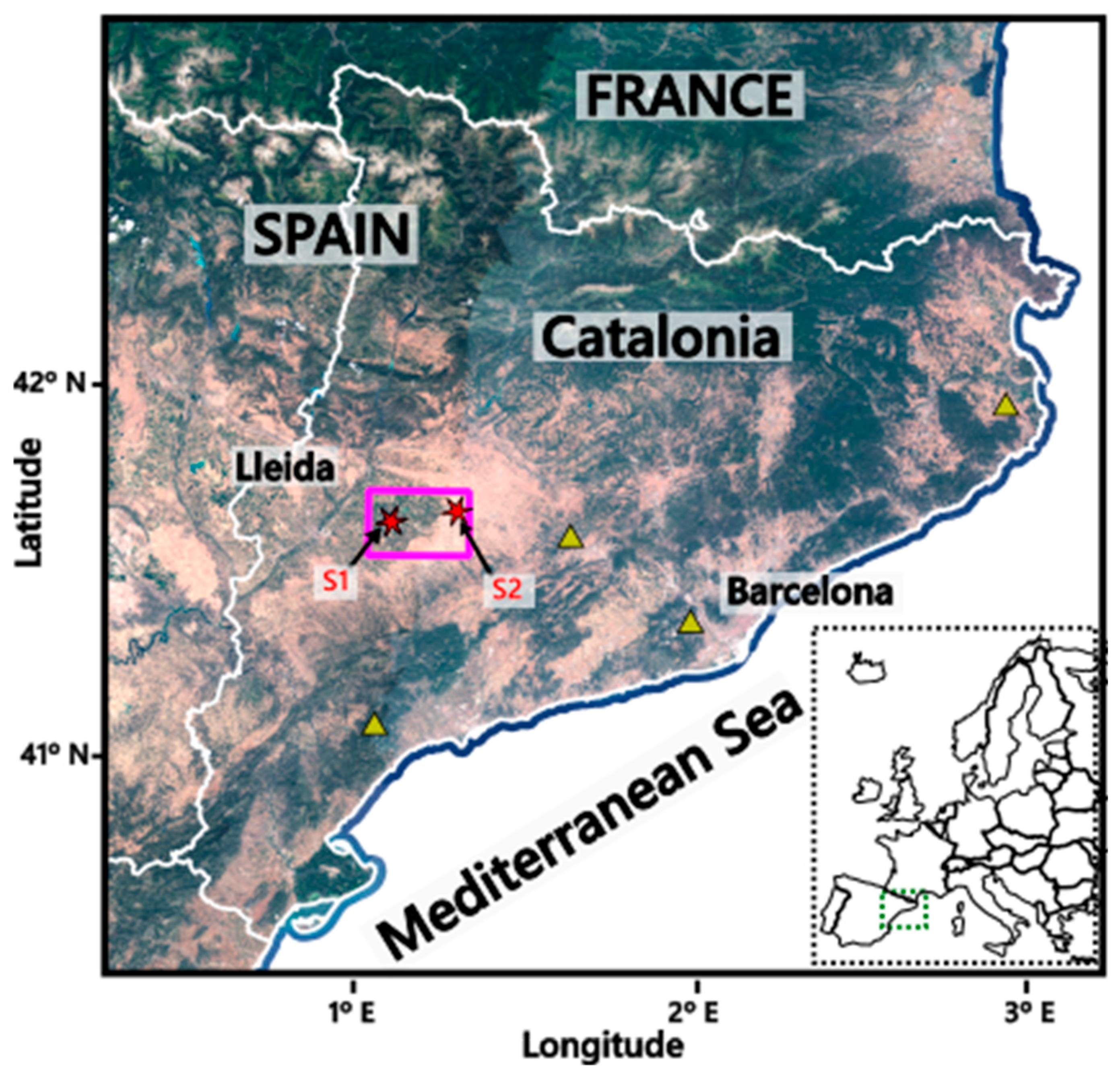
The study focuses on data from two study sites (S1 and S2) located approximately 20 km apart in an agricultural area located in the eastern Ebro River basin, in northeastern Spain (Figure 1). It has a Cold Semi-Arid (BSk) climate according to the Köppen climate classification [18,19]. The summer months (June, July, and August) are particularly dry, with an average precipitation of 57 mm and seven days with rainfall exceeding 1 mm during the reference period from 1981 to 2010, based on data from the Spanish Meteorological State Agency station in Lleida [20]. The study area features relatively flat terrain with a gentle east-to-west slope of less than 1%, which minimizes orographic effects on local meteorological conditions. This characteristic makes it an ideal location for investigating the influence of RH on precipitation without the confounding effects that can occur in regions affected by nearby mountains, large water bodies, or complex topography. Rainfall is largely influenced by mesoscale and synoptic circulations, which bring moisture to the Ebro valley either through western and northern airflows or from the Mediterranean Sea via southern and eastern airflows which can produce intense convective storms [21,22,23,24].
The study region includes both irrigated and non-irrigated agricultural areas and has been the subject of numerous previous studies within the framework of the LIAISE field campaign [9,25,26,27]. In a previous study [28], we analysed precipitation characteristics in this region over a six-year period prior to the LIAISE campaign using operational C-band radar and rain gauge data. Results revealed no significant differences in rainfall amounts or rainfall rates between irrigated and non-irrigated areas. This suggests that irrigation has, on average, a very limited impact on local precipitation characteristics across the LIAISE study region. Consequently, precipitation in both irrigated and non-irrigated areas behaves similarly in terms of rainfall accumulation and intensity.

2.2. Datasets

The study period covers an extended summer season, from May 2021 to September 2021, in the framework of the LIAISE-2021 field campaign [25]. All datasets utilized here belong to this time frame. Throughout this period, all precipitation at ground level fell in liquid phase (rainfall and drizzle) and the C-band weather radar observations at 1 km above sea level (ASL) also corresponded to liquid precipitation. Four datasets are included in this study: surface automatic weather station, disdrometer, Micro Rain Radar, and C-Band weather radar data.

2.2.1. Surface Automatic Weather Stations

Data from two surface automatic weather stations (AWS) of the Meteorological Service of Catalonia (SMC) are used, one at S1 (Mollerussa AWS, hereafter S1-AWS) and the other at S2 (Tàrrega AWS, hereafter S2-AWS). AWS datasets include rainfall with 1 min temporal resolution and 30 min averages of air temperature and RH (both at 1.5 m AGL), wind direction and velocity (at 10 m AGL). Total rainfall during the study period was 82.8 mm and 132.8 mm at S1-AWS and S2-AWS respectively. AWS data are provided by SMC after a number of quality control procedures have been carried out—see for example [29,30].

2.2.2. CERRA Reanalysis

Data from the European regional reanalysis product CERRA (CERRA sub-daily regional reanalysis data for Europe on height levels from 1984 to present) [31] is used. CERRA provides 3-hourly information at high spatial resolution (5.5 km) at 11 different levels (15, 30, 50, 75, 100, 150, 200, 250, 300, 400, and 500 m above surface level). In this work, the variables of RH and wind speed have been employed to check the consistency of the vertical profiles with surface observations from AWS. Specifically, the RH profiles have been compared to ensure a coherent evolution with the RH measured at 1.5 m AGL at the automatic stations.

2.2.3. Disdrometer

Two disdrometers model Ott Parsivel2 [32,33] located each at the two AWS were used (S1-DIS the one in S1, and S2-DIS the one in S2). Both disdrometers operated with a temporal resolution of 1 min and were used to obtain the rainfall drop size distribution (DSD) and its characteristics. The DSD represents the number concentration of raindrops as a function of their size and is fundamental to understand rainfall microphysics. During the period of study S1-DIS recorded a total of 341,654 min of data and S2-DIS 390,469 min.
A quality control (QC) was applied to the disdrometer data to filter out potential non-meteorological detections, such as insects or instrumental errors. This QC follows the methodology outlined in previous studies [34,35,36], which involves removing particles with a diameter greater than 8 mm and particles whose measured fall velocities deviate by more than 50% from the expected rain drop terminal velocity V for a given diameter D . For this purpose, the following relation was used [37,38]:
V = 9.5   1   e 0.6 D ,
where V is expressed in m s−1 and D in mm. Additional conditions included the selection of at least three consecutive minutes, each containing a minimum of 50 droplets and a rainfall rate of at least 0.025 mm h−1.
After applying the QC, the following parameters are calculated from the DSD distribution [39,40,41,42]. The number of concentration of raindrops N ( D ) expressed in m−3 mm−1:
N D i = i = 1 n n i j A   V i D i t ,
where D i is the mean volume-equivalent diameter for each diameter class, n i is the number of droplets recorded for each diameter and velocity class, V i is the measured fall speed of each droplet, A is the effective sampling area, and t is the sampling interval time in seconds; the rainfall rate R in mm h−1:
R = 3.6 · 10 3 π 6 i N ( D ) i D i 3 V ( D ) i D i ,
where V ( D ) i is the terminal fall speed calculated for each diameter class according to Equation (1). The mass of liquid water contained in the raindrops per unit volume of air known as liquid water content LWC in g m−3:
L W C = π ρ w 6 i N ( D ) i D i 3 D i ,
where ρ w is the water density (g mm−3). The Z expressed in dBZ:
Z   ( dBZ ) = 10 log 10 ( i N ( D ) i D i 6 D i ) ,
and the median volume diameter D 0 (mm) which represents the diameter at which half of the total liquid water volume is contained in drops smaller than D 0 and half in drops larger than D 0 :
D 0 = 3.67 + μ Λ .
Then, we calculated the η ,   μ , and Λ parameters of the gamma distribution, according to:
η = ( i N ( D ) i D i 4 D i ) 2 i N ( D ) i D i 2 D i i N ( D ) i D i 6 D i ,
μ = 7 11 η 7 11 η 2 4 η 1 30 η 12 1 2 2 ( η 1 ) ,
Λ = i N ( D ) i D i 2 D i μ + 4 μ + 3 i N ( D ) i D i 4 D i ) 1 2 ,
and the normalized intercept parameter N w , expressed in m−3 mm−1, reflects the concentration of drops within the distribution normalized by the drop size:
N w = 3.67 4 L W C π ρ w D 0 4 .
Additionally, a more detailed analysis was carried out to study the shape of the DSD and its evolution. For this purpose, a single normalization based on the rainfall rate is proposed [43]. This normalization aims to isolate the shape of the distribution from the rainfall intensity and to compare all spectra across the minutes of each event. Following the methodology proposed [44], the normalization of the DSD is expressed as:
N D , R = R α g D R β ,
where α , β are the scale parameters and g ( x ) is a function describing the normalized shape of the DSD. Using Equation (11), each moment M of order n of the DSD can be written as a power law of the scaling variable R :
M n = R α + β ( n + 1 ) 0 + x n g x d x   .
Considering that the rainfall rate is a moment of the DSD, two self-consistency relations reduce the degrees of freedom:
C r π c 6 0 + x 3 + d g x d x = 1   ,
4 + d β + α = 1 .
The shape parameters ( α , β ) are estimated in two steps: first, β is obtained as the slope of the regression line between the exponents of the nth-order moments of the DSD and the rainfall rate, according to Equation (12); then, α is computed using Equation (14). Here, c and d are the parameters of the power-law model for the terminal velocity [45]:
v D = c D d ,
where c = 3.78 and d = 0.67 . This power-law approximation of v D s adopted in order to simplify the integration and permit an analytical normalization. It should be noted that Equations (1) and (15) are very similar for most of the drop diameters considered (<4 mm) so the use of Equation (15) here does not produce inconsistencies with the fact that Equation (1) is used elsewhere.
Table 1 lists the total minutes of data and total rainfall for both disdrometer, before and after applying QC. It also includes the total rain gauge rainfall recorded at each AWS during the period when disdrometer was operational. After applying QC, the number of rain detections decreased approximately to 49% in S1-DIS and 50% in S2-DIS, respectively. This reduction is primarily due to the filtering of non-precipitating particles, such as insects or atmospheric noise, typically detected during dry periods. Consequently, the data loss is mostly associated with non-precipitating intervals and does not introduce a systematic bias across different RH conditions. Disdrometer rainfall accumulations were substantially reduced (30 to 50%), becoming more consistent with rain gauge records.

2.2.4. Micro Rain Radar

Data from two Micro Rain Radar (MRR) units, model MRR-Pro, are used, each co-located with the two AWS and disdrometer (S1-MRRand S2-MRR), both covering the full study period. The MRR is a K-band Doppler vertical profiler [46,47] and was configured with a temporal resolution of 10 s and a vertical resolution of 50 m, covering 128 levels from 100 m to 6450 m above the ground. Finally, data were aggregated to one-minute intervals. In total, the S1-MRR recorded a total of 26,458 min of data, while S2-MRR recorded 21,400 min.
MRR data was post processed with the RaProM-Pro methodology [48,49]. Afterwards, to ensure only rainfall data is considered, a second process is applied similar to other studies [50,51,52]. Precipitation is considered when there are at least three consecutive minutes with a minimum of 10 different equivalent radar reflectivity vertical levels with positive values. Note that equivalent radar reflectivity is considered, but for simplicity it is denoted Z . Observations that do not meet these conditions are excluded. Finally, the accumulated rainfall over 30 min intervals is compared with the AWS rain gauge data to calibrate the MRR. Calibration of the MRR with the rain gauge data is performed using the median value M of the ratio between the rainfall every 30 min by the MRR and the rain gauge (see Appendix A for details). This ratio, M, is used to recalculate the raw spectral Z of each MRR. Once the M value has been calculated, the RaProM-Pro methodology is applied again. Table 2 shows the number of rain minutes recorded by the MRRs before and after the QC. After QC, the number of rain detections decreased to 25% in S1-MRR and 32% in S2-MRR. In terms of rainfall accumulation, the values measured by the MRR were reduced. These spurious detections typically occurred during non-precipitating periods, and their removal is therefore not expected to introduce systematic biases related to RH conditions. Note that as MRR and disdrometer data availability are slightly different; AWS rainfall data is not exactly the same in Table 1 and Table 2.

2.2.5. C-Band Weather Radar

Weather radar data was provided by the Meteorological Service of Catalonia C-band weather radar (CWR) network [53]. The dataset comprises a composite of Constant Altitude Plan Position Indicator (CAPPI) product with 10 vertical levels of Z , 1 km vertical resolution, 2 km × 2 km horizontal resolution, and 6 min temporal resolution. The Z composite is produced with observations from the four single polarization radars shown in Figure 1. The composite product minimizes problems of topographic beam blockage and also the possibility of signal attenuation due to heavy rainfall, as illustrated by [54]. Radar data are quality-controlled routinely by the Meteorological Service of Catalonia, including monitoring of antenna pointing accuracy and receiver calibration using solar interferences as external references, along with additional automated quality assurance processes [55]. Over the study area, the CAPPI at 1 km ASL corresponds to approximately 750 m AGL relative to the location of the AWSs, considering that the nearest weather radar contributing to the composite product is located about 25 km from the study region. We selected the lowest CAPPI level available as it is the one most influenced by near-ground level RH conditions, regardless of other possible effects at higher levels.
In order to assess the rain regime (convective, stratiform, etc.) of the events studied, each radar pixel was classified according to the method proposed by [56]. Originally developed to examine rainstorm characteristics in tropical regions with S-band weather radar, this approach was modified to better suit the specific conditions of our study. Based on a texture analysis of the single-level CAPPI Z field, the method distinguishes six rainfall types: Stratiform, Convective, Mixed, Iso Convective Fringe, Convective Core, and Weak Echo. For the purpose of this analysis, these categories were grouped into two broader classes: Convective (including Convective, Fringe, and Core types) and Stratiform (encompassing the remaining types); an event was considered Convective if at least one pixel was classified as Convective.
The analysis considered the 1 km CAPPI height pixel that contained the S1 and S2 sites, discarding Z values below 5 dBZ to remove noisy pixels. Rain rate was calculated with a power-law Z-R relationship:
Z = a R b ,
which provides rainfall rate R (mm/h) from Z (mm6 m−3), considering a = 206 and b = 1.67. These values were fitted with the disdrometer data recorded during the LIAISE field campaign at the two sites considered here and are close to the standard Marshall and Palmer Z-R relation typically used for stratiform rainfall [57].

2.3. Definition of Rainfall Events

Rainfall events are defined here based on rainfall detection by at least one disdrometer with a Minimum Inter-Event Time (MIT) of at least 24 h, which means there was no detection of rain during the previous 24 h. This MIT is set to ensure that there is at least one diurnal cycle before each event, favouring the independence of two consecutive events. From the disdrometer-detected onset of precipitation, a time window of the previous 75 min was considered. This value was chosen after testing various windows between 60 and 90 min, in order to balance the continuity of each precipitation event with the total number of events. Within this 75 min window, the moment when the CWR and MRR detect their own onset of precipitation is analysed, following the criteria set for each instrument in Table 3.
Note that, as most studies focused on precipitation profiles, a Eulerian approach is adopted here, i.e., observations are taken at fixed locations. Therefore, the onset of precipitation studied here is referred to the arrival of the precipitation system but not necessarily to its initial stage in absolute terms. To observe the absolute DSD evolution of a precipitation system, which is out of the scope of this study, a Lagrangian approach would be needed, as recently performed by [58] for one convective case.
As done by [28], to evaluate the possible effects of near ground RH to precipitation, events are classified as dry or moist according to the value of the 30 min averaged RH measured 2 h before the rainfall onset: a dry event is defined when RH is below 54% and a moist event when RH is above 72%. These thresholds correspond to the first and second terciles of the RH distribution 2 h before the onset of rainfall events. Results presented in the following sections focus on the first 30 min of rainfall because, based on a regional multi-year analysis [28], near-surface RH typically increases rapidly after rainfall onset and converges toward high values within approximately 30 min, largely independent of the initial RH conditions. This early adjustment phase represents an order-of-magnitude timescale identified from the median behaviour across a large number of rainfall events analysed in the study region, rather than a universal or globally generalizable threshold. Note that this initial 30 min period may start differently depending on the data source considered (disdrometer, MRR, CWR) as described above.
To ensure independent data for the statistics if there is detection of rainfall in S1 and S2 with less than 24 h only one of the points is selected randomly. Only rainfall events for which all data types (AWS, disdrometer, MRR, and C-band radar) at each site were available were included in the analysis. This approach ensures consistency across instruments and avoids biases related to data availability differences.
According to the criteria described above, 18 rainfall events were found, 9 dry and 9 moist. Using the methodology proposed by [56], 3 of those 18 events were convective and the other 15 stratiform. Due to the limited number of convective events, we focus here only on the 15 stratiform cases, of which 8 were dry and 7 moist.
Given the small number of events considered, the analysis was performed using statistical methods appropriate for limited sample sizes. We used the median difference as a measure of central tendency, Cliff’s delta to quantify the effect size and the degree of overlap between the two distributions [59] and bootstrap 95% confidence intervals to estimate the uncertainty of the median difference [60]. These non-parametric methods are suitable for small datasets and allow us to characterise whether one group tends to exhibit systematically higher values than the other.

3. Results

3.1. Overview of Selected Events

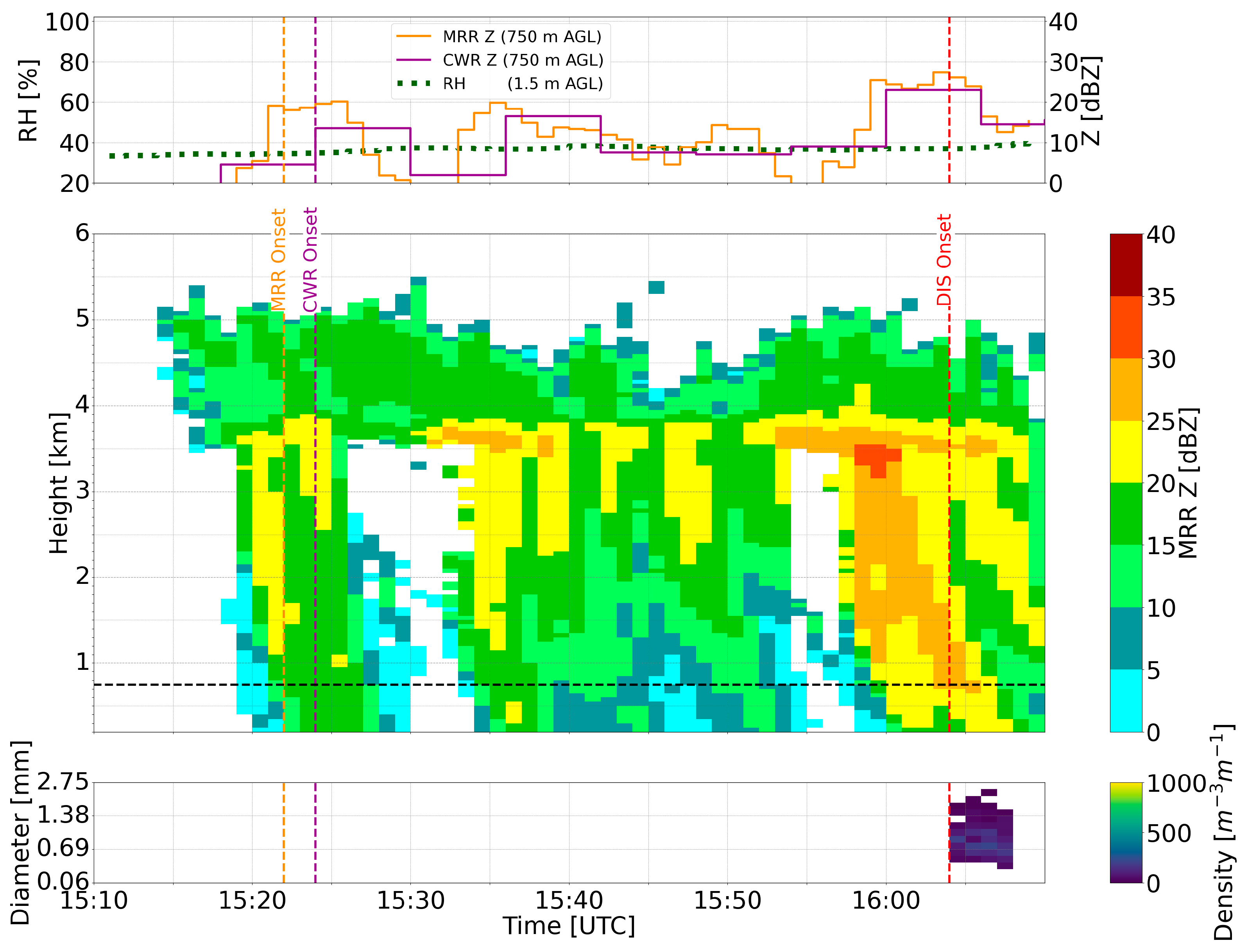
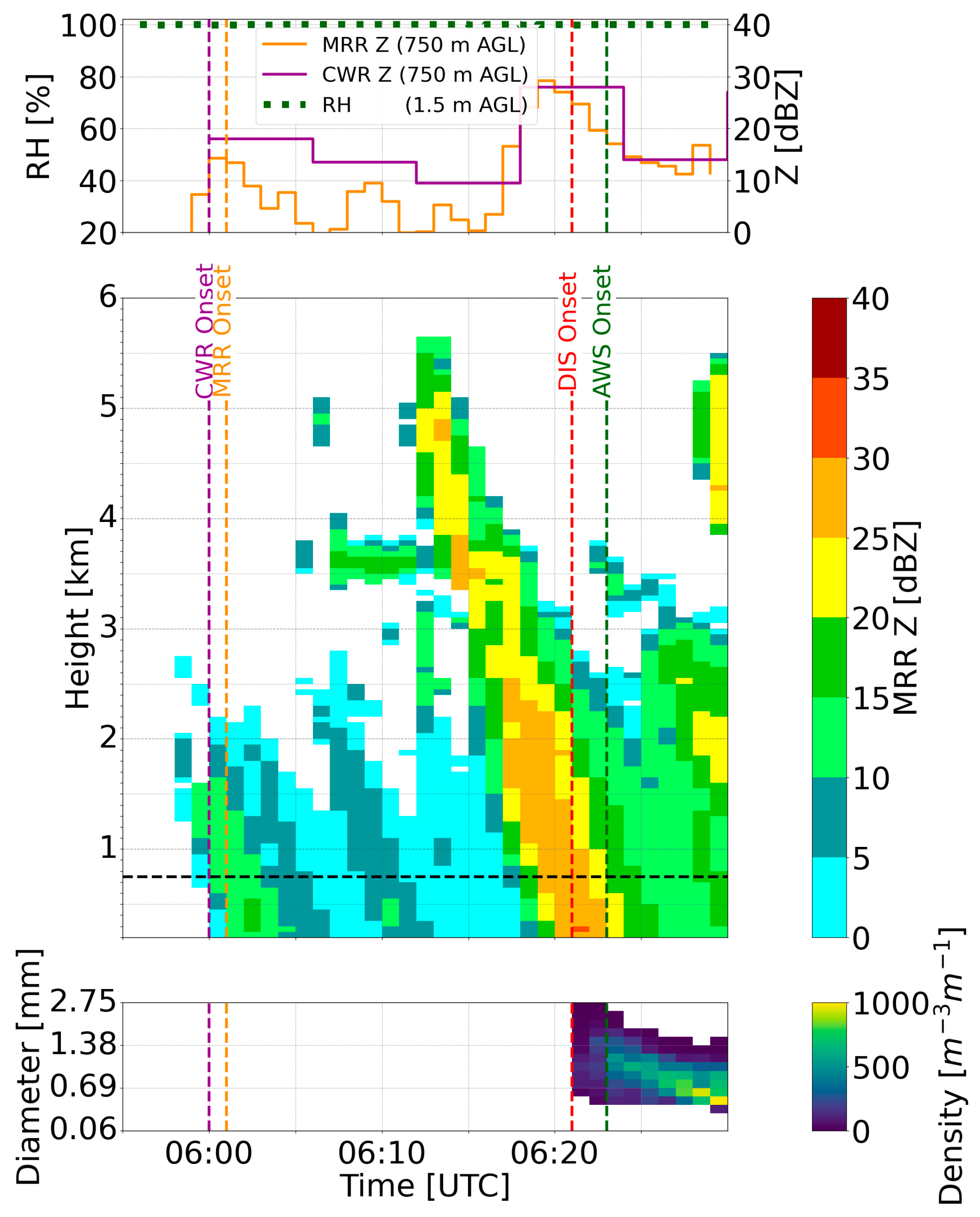
An example of a selected dry event on 16 June 2021, is shown in Figure 2. In this case the first instrument to detect precipitation was the MRR. Approximately 2 min later, the CWR registered the onset of precipitation, followed by the disdrometer after 42 min. On this occasion rainfall rates are so light that there is no tip of the rain gauge, during the period examined. The MRR Z profile shows a classical stratiform pattern, with a clear bright band at approximately 3.5 to 4.0 km AGL. Furthermore, the analysis of MRR Z with height reveals a decrease in Z from height toward the surface during the first minutes. Z values ranged from 10 to 20 dBZ at 1 to 2 km AGL and values of less than 10 dBZ below 0.5 km AGL. Additionally, the RH time series shows approximately constant values at around 40% until the disdrometer registered the onset of precipitation, after which RH began to increase. All this analysis, with a notable delay between aloft rainfall detection and delayed ground-level RH increase and rainfall detection, strongly suggests this was a case with substantial rainfall evaporation.
Another example corresponding to a moist event on 19 June 2021, is shown in Figure 3. In this case, the first instrument to detect precipitation was the CWR, followed approximately 7–8 min later by the MRR and the disdrometer. Similarly to Figure 2, the MRR Z profile shows a stratiform pattern; however, here, there is no decrease in Z at the lower levels. Additionally, the disdrometer at the surface detected the onset of precipitation about 8 min after it was first detected by the CWR, whereas in the dry case, this delay was more than 40 min. This suggests that evaporation was negligible in the moist case.
A similar analysis has been done for all 15 events, which are summarized in Table 4. The rainfall accumulation was calculated from the onset of rainfall for each instrument to the first bucket tipping of the rain gauge. In cases with no tipping, the rainfall accumulation is computed up to 5 min after the disdrometer rainfall onset.
The analysis of rainfall detection delays aloft and close to the ground might be affected by the presence of moderate or strong wind, which could be different during moist and dry events. We checked that during 75% of the temporal periods examined, wind speed measured at each AWS was lower than 3.6 m s−1. Furthermore, wind-profiler data (located about 10 km NE of the S1) did not exceed 10 m s−1 within the first 1 km AGL. Therefore, the wind effect was negligible and distributed similarly in both moist and dry conditions. Additionally, analysis of vertical profiles of CERRA data up to 500 m shows that during the studied episodes, wind speeds did not exceed 15 m s−1. The classification of episodes as dry or moist based on AWS data is also consistent with CERRA data at the surface and at 500 m altitude. Therefore, the classification made using AWS data is considered reliable.

3.2. Radar Z

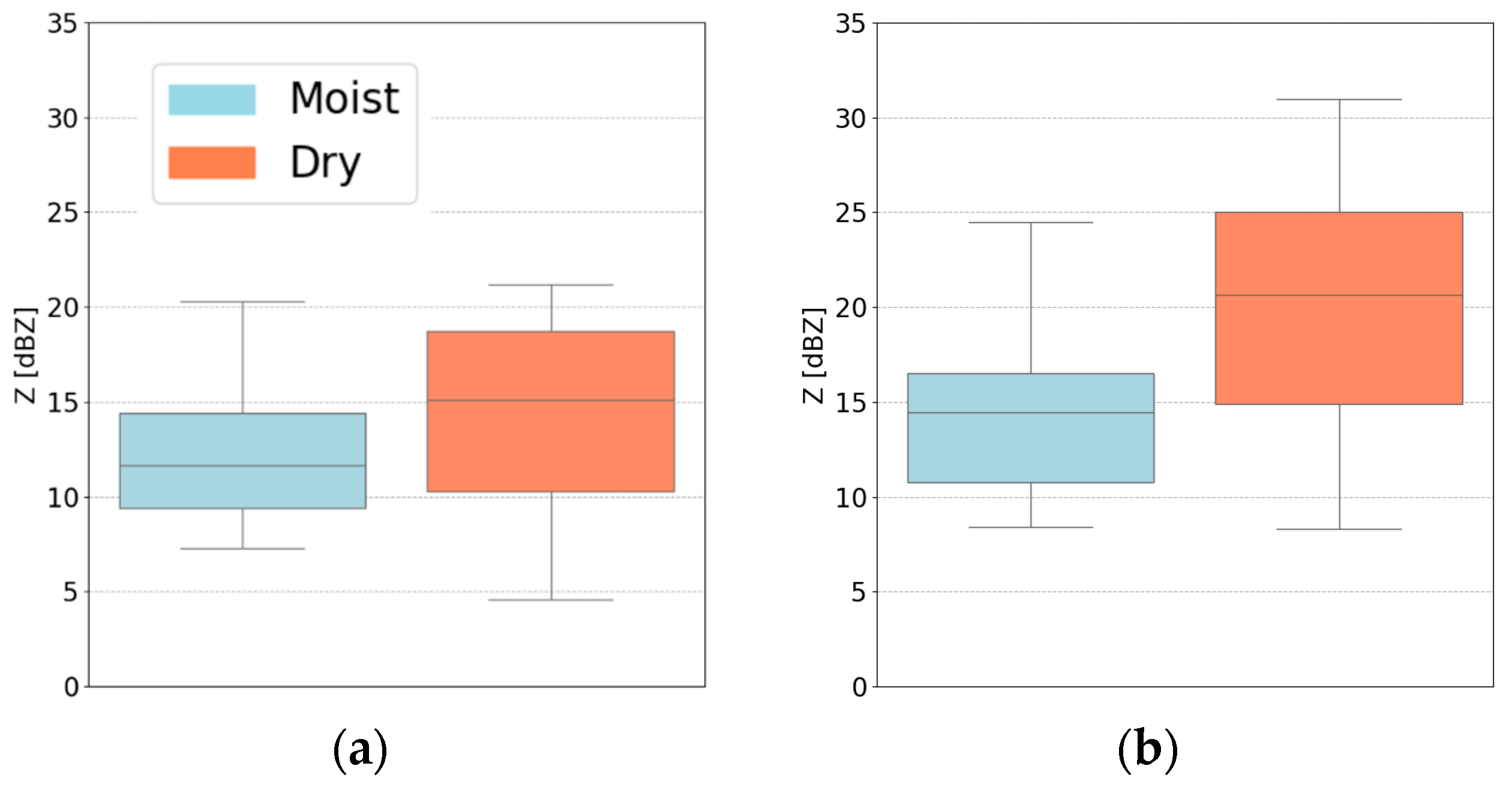
Figure 4 shows mean Z boxplots using CWR data for the first 30 min of each event. On one hand Figure 4a corresponds to Z data analysed according to first CWR detection criteria, at approximately 750 m AGL. The median Z values for moist and dry events are 11.6 dBZ and 15.1 dBZ, respectively, with a median difference of −3.45 dBZ. Cliff’s delta (−0.25), together with the bootstrap 95% confidence interval of the median difference [−9.60, 3.66], indicates that the differences are relatively small, with substantial overlap of distributions. On the other hand, Figure 4b shows the Z values of the first 30 min of each precipitation event but considering when disdrometer detected the onset of rainfall. In this case, the median Z values for moist and dry events increase to 14.47 dBZ and 20.63 dBZ, respectively, yielding a larger median difference of −6.16 dBZ. Both Cliff’s delta (−0.43) and the bootstrap 95% confidence interval [−14.41, 2.22] dBZ, together suggest stronger differences between moist and dry, with dry events tending to exhibit higher Z values. This small difference suggests that disdrometers detect rain at the surface at a different time than when the radar detects it aloft, indicating that the Z characteristics at that moment have changed.

3.3. Vertical Profile of Z

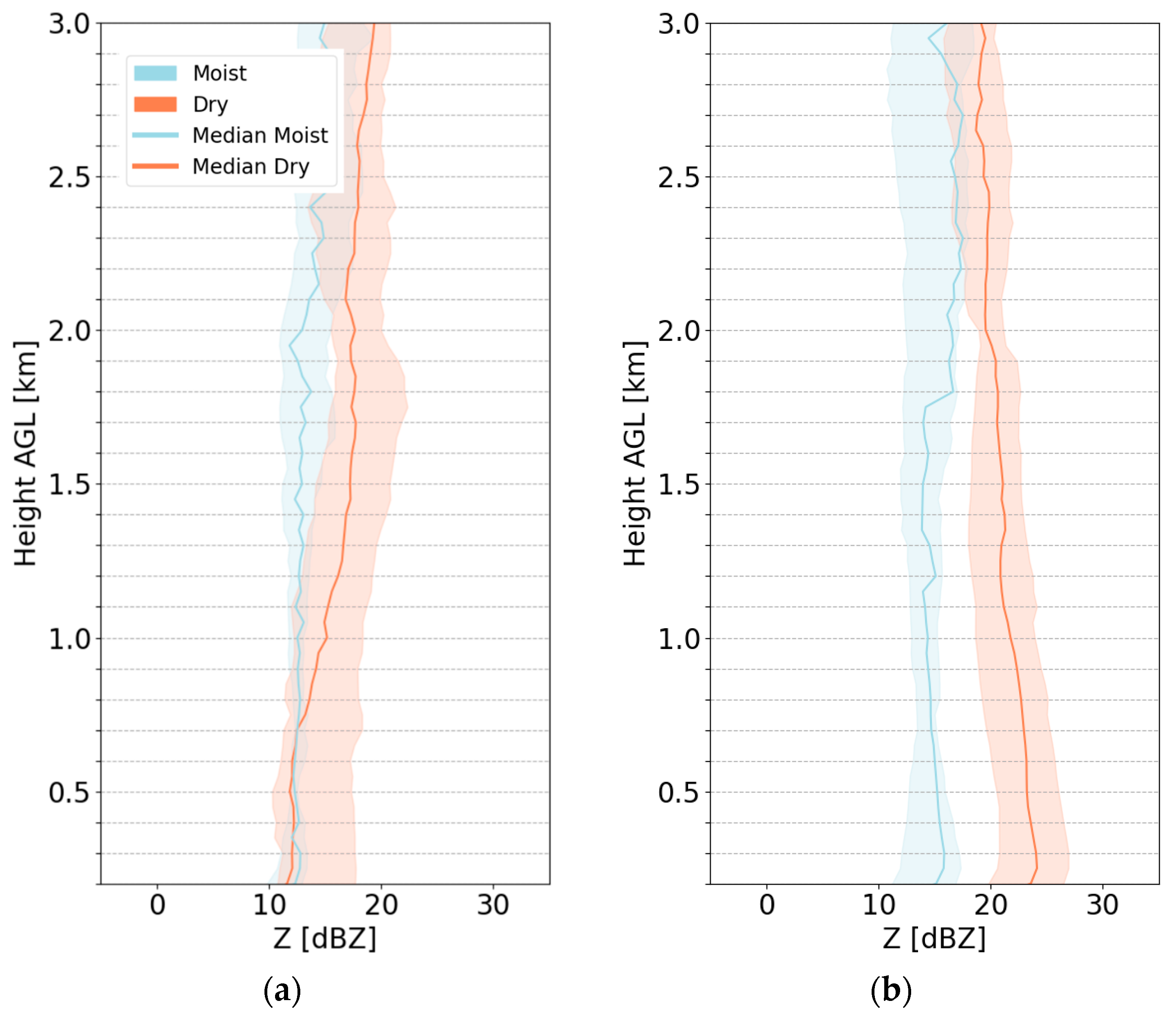
Figure 5 shows MRR vertical Z profiles for the first 30 min of precipitation for each event, classified as dry or moist. Figure 5a presents the classification according to MRR conditions, while Figure 5b shows the first 30 min to the moment when the disdrometer detected precipitation at the surface. When Z is analysed using the MRR first detection no clear differences are observed between moist and dry events at 750 m AGL. The median Z values are 12.67 dBZ for moist events and 13.24 dBZ for dry ones, resulting in a small median difference of −0.57 dBZ. Cliff’s delta of −0.25 indicates a high degree of overlap between both groups. The bootstrap 95% confidence interval of the median difference [−9.16, 3.80] dBZ includes zero, suggesting that differences are highly uncertain, and supports the absence of systematic differences at this level.
In contrast, when using the disdrometer onset time as reference dry cases tend to show higher Z values at the lowest levels. The median Z increases to 14.65 dBZ for moist events and 22.83 dBZ for dry events, yielding a larger median difference of −8.18 dBZ. This enhancement is consistent with the stronger effect size indicated by Cliff’s delta (−0.61). The bootstrap 95% confidence interval [−12.23, −2.20] dBZ, which does not include zero, suggests a more robust difference between the two groups.
Overall, the results from Section 3.2 and Section 3.3 point to a different behaviour of precipitation aloft compared to that at the surface. When analysing the first minutes of precipitation aloft (CWR or MRR first detections), differences between dry and moist events are small. However, when considering the first minutes of precipitation detected at the surface, dry events tend to exhibit higher Z values. This fact could indicate the possibility of liquid aggregation along the column for dry cases, although this seems unlikely, because these cases are usually associated to higher values of RH. Therefore, the next section will focus on the time differences between rainfall detection aloft by the MRR or the CWR vs. disdrometer at surface in order to see if this difference varies under dry and moist conditions which could be eventually associated to rainfall evaporation.

3.4. Time Differences

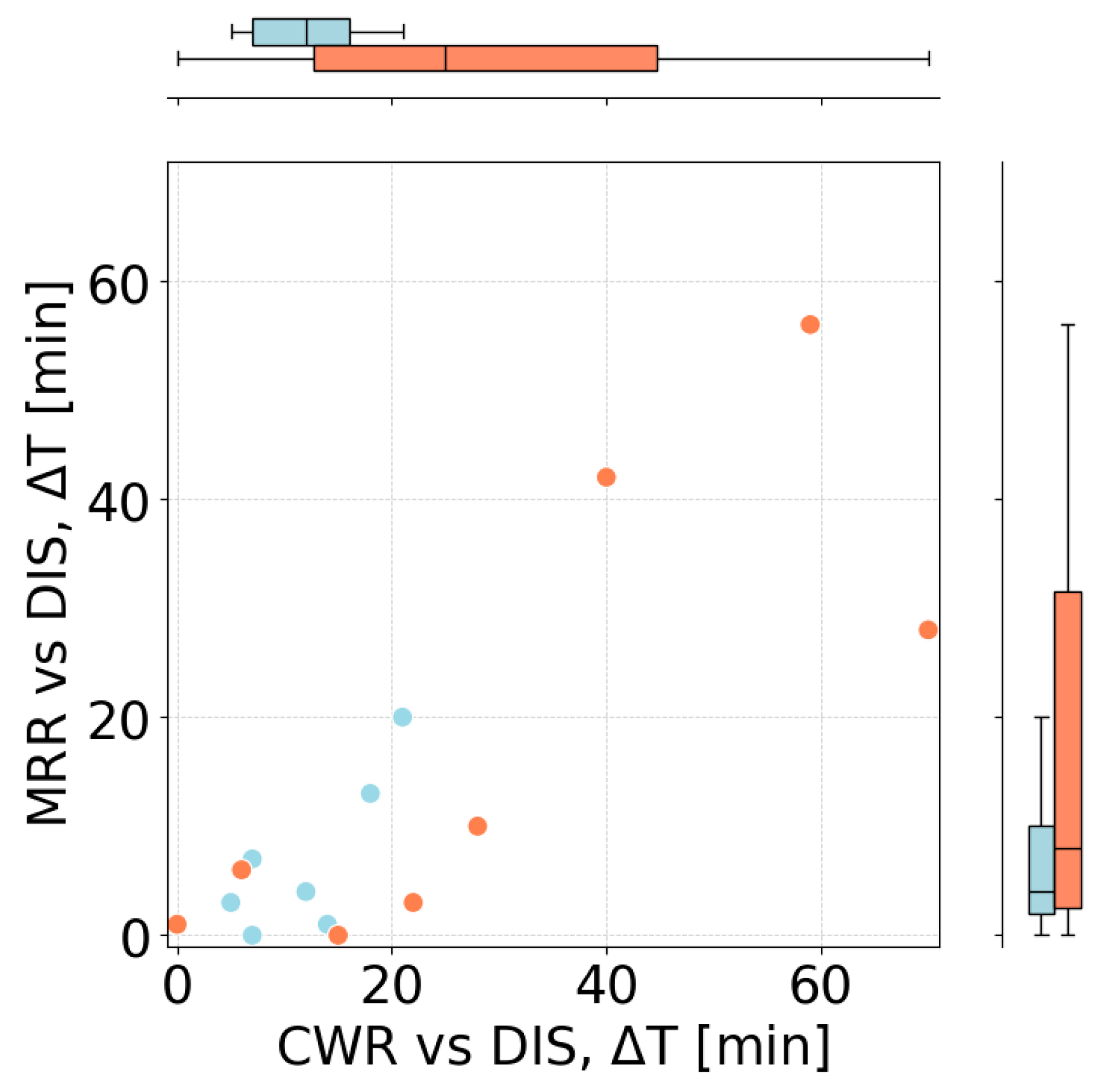
According to the previous results, Figure 6 shows the time delay between rainfall detection by the CWR and the disdrometer, and by the MRR and the disdrometer, for both dry and moist conditions. For the time difference between CWR and disdrometer onset, the median delay was 12.0 min (IQR: 7.0–16.0 min) for moist cases and 25.0 min (IQR: 12.8–44.8 min) for dry cases. For the differences between MRR and disdrometer detection, the median delay was 4.0 min (IQR: 2.0–10.0 min) for moist events and 8.0 min (IQR: 2.5–31.5 min) for dry conditions.
Figure 6 also presents a scatter plot of the individual events, illustrating that the time delays between radar detection aloft (both CWR and MRR) and disdrometer detection at the surface tend to be larger under dry conditions. These results suggest that precipitation takes longer to reach the surface in dry events. Assuming that precipitation aloft initially exhibits similar Z characteristics for both dry and moist cases (as suggested by the previous sections), these longer delays in dry conditions may imply that raindrops undergo partial evaporation while falling during the first minutes of rainfall onset and take longer to be detected at surface level.

3.5. Rainfall Differences

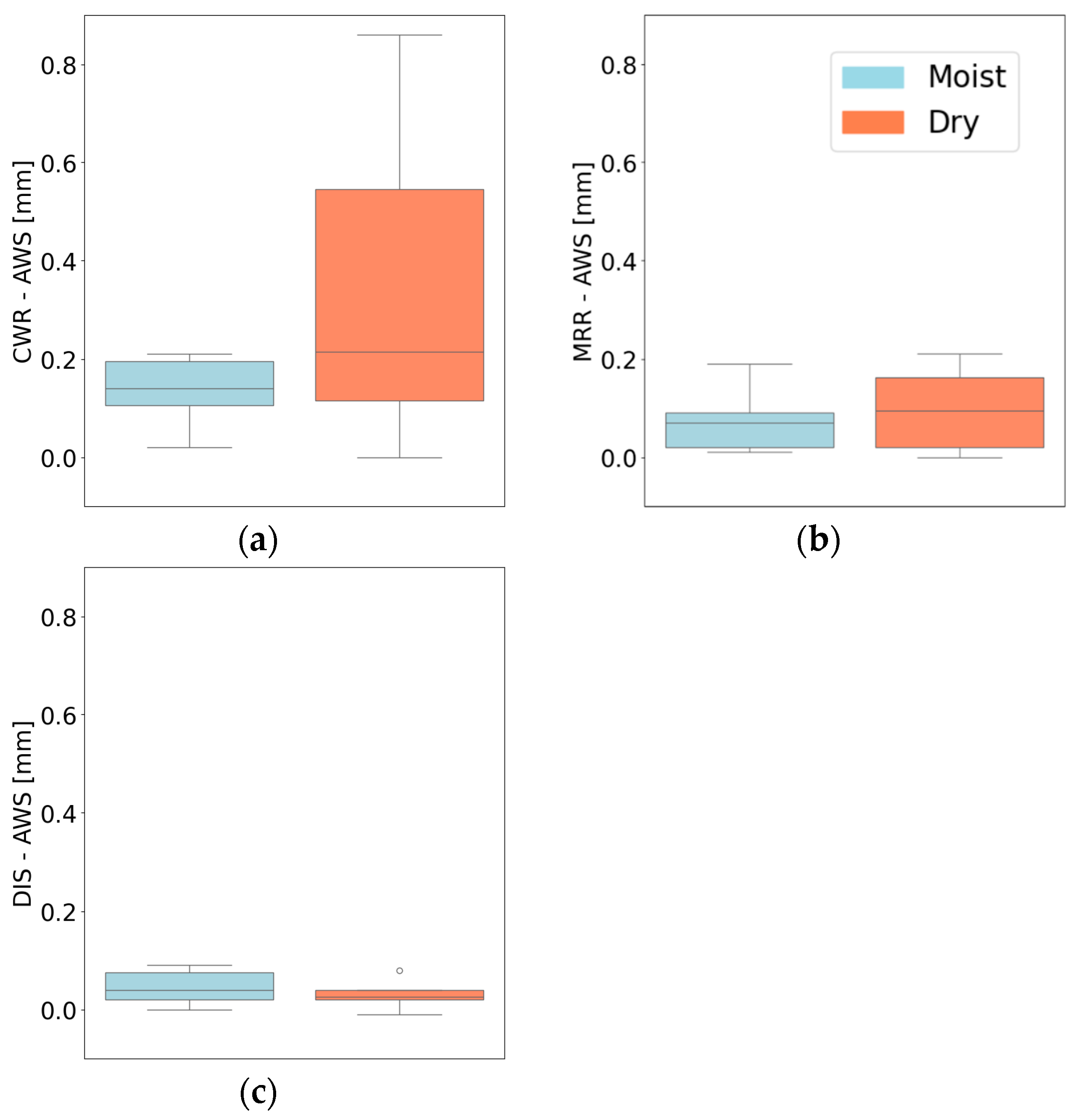
Figure 7 shows the distributions of difference of rainfall accumulation between each instrument (CWR, MRR and disdrometer) vs. rain gauge for dry and moist cases. The period considered extends from each instrument’s detection of rainfall onset until the first rain gauge bucket tipping (0.1 mm). If no tipping occurred, the end time was set to 5 min after the disdrometer detected rainfall. The results show similar values for dry and moist cases. However, in dry cases, for MRR and CWR the accumulations are higher than in moist cases, especially for CWR.
Statistical analysis confirms that the median differences in the three cases are close to zero, with values of −0.08 mm for CWR, −0.03 mm for MRR, and −0.01 mm for the disdrometer when comparing moist events against dry events. Despite these small differences, both MRR and CWR show a slight tendency to accumulate more precipitation aloft before the first tip of the rain-gauge bucket during dry events. Additionally, these dry events tend to take longer to be detected by the disdrometer. Together, these findings suggest a possible influence of rainfall evaporation in dry atmospheric conditions, but with only a small or negligible impact on the total accumulated rainfall.

3.6. DSD Parameters Differences

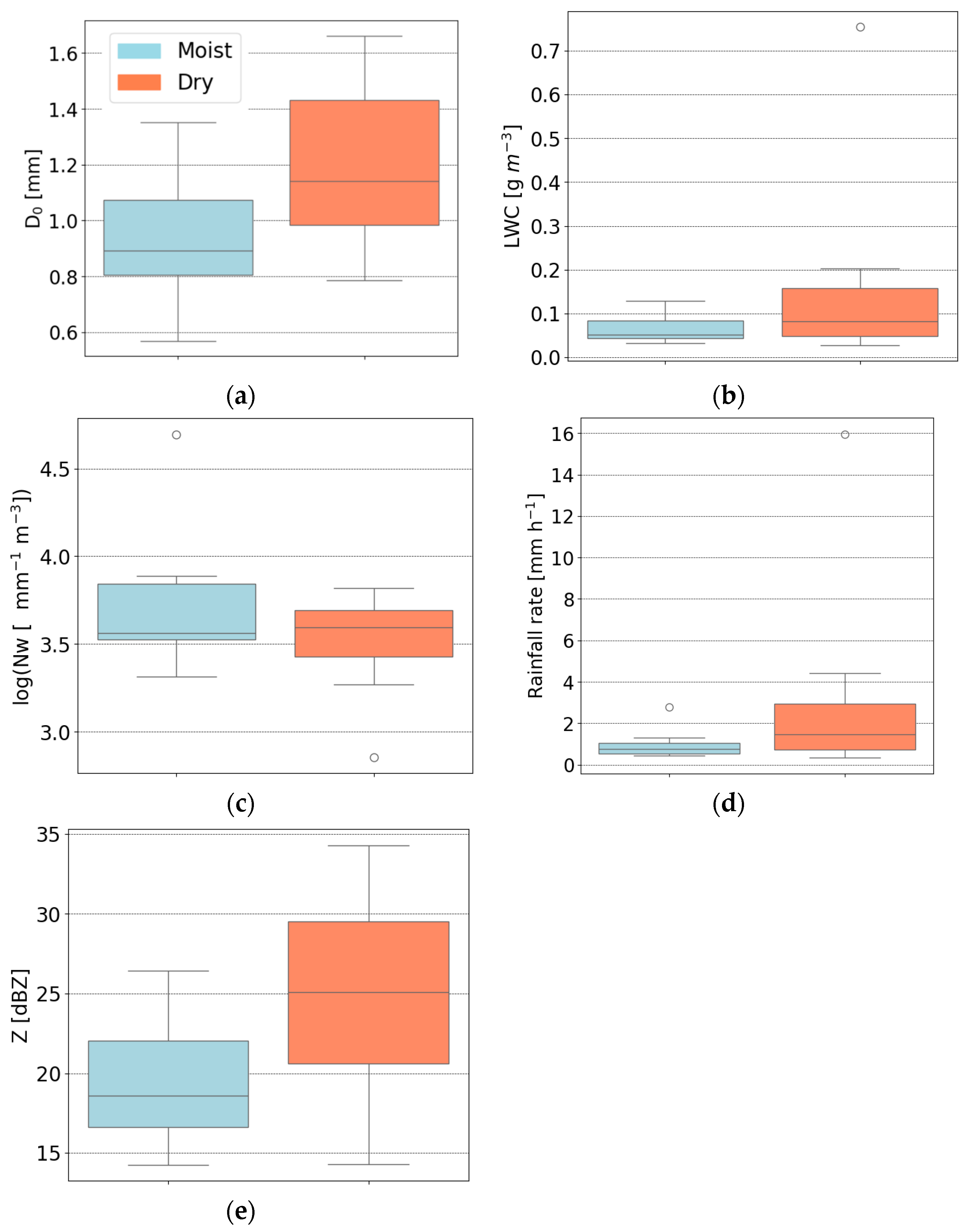
Figure 8 presents boxplots for D 0 , LWC, N w , R , and Z for moist and dry events during the first 30 min of rainfall based on the DSD using Equations (2)–(10). Analysis of the distributions shows small differences between moist and dry cases for LWC, N w , and R , with median differences of approximately −0.03 g m−3, −0.03 mm−1 m−3, and −0.70 mm h−1, respectively. These small shifts, together with the substantial overlap between the two distributions (Cliff’s delta = −0.28, 0.21, and −0.32), indicate that these DSD characteristics do not exhibit a clear separation between moist and dry events.
In contrast, the parameters Z and D 0 display more pronounced differences. The median Z is higher in dry cases, with a median difference of −6.49 dBZ between moist and dry conditions. The corresponding Cliff’s delta of −0.50 indicates that roughly 75% of the Z values in dry cases are higher than those in moist cases. Similarly, D 0 shows a median difference of −0.25 mm, with a Cliff’s delta of −0.46, pointing to a consistent tendency toward larger drop sizes in dry conditions.
The overall tendency suggests that R remains similar between moist and dry events, but the internal structure of the drop size distribution differs, particularly in Z and D 0 . The higher Z and larger D 0 observed in dry conditions imply the presence of larger or more dominant raindrops, consistent with the sixth-power dependence of Z on drop diameter. This pattern aligns with the expected effects of evaporation, whereby smaller droplets evaporate more rapidly due to their higher surface-to-volume ratio, leaving larger drops that disproportionately contribute to the Z field. Despite these microphysical differences, both LWC and R remain comparable between moist and dry events, suggesting a compensatory balance between drop size and concentration.
These results are consistent with previous studies linking ambient RH to modifications in DSD microphysics. For example, [61] showed that RH directly influences precipitation microphysics, leading to changes in drop size distribution, with high RH favouring temporary coalescence and the formation of small satellite droplets. This may explain the substantially higher number of small drops observed during moist events in our dataset. Similarly, [5] reported that under low-RH conditions, N w tends to be lower, while Z and D 0 are higher—consistent with our observations. In addition, [62] attributed decreases in small-drop concentration and increases in the median volume diameter to evaporation processes, reinforcing the interpretation derived from our results.

3.7. DSD Evolutions

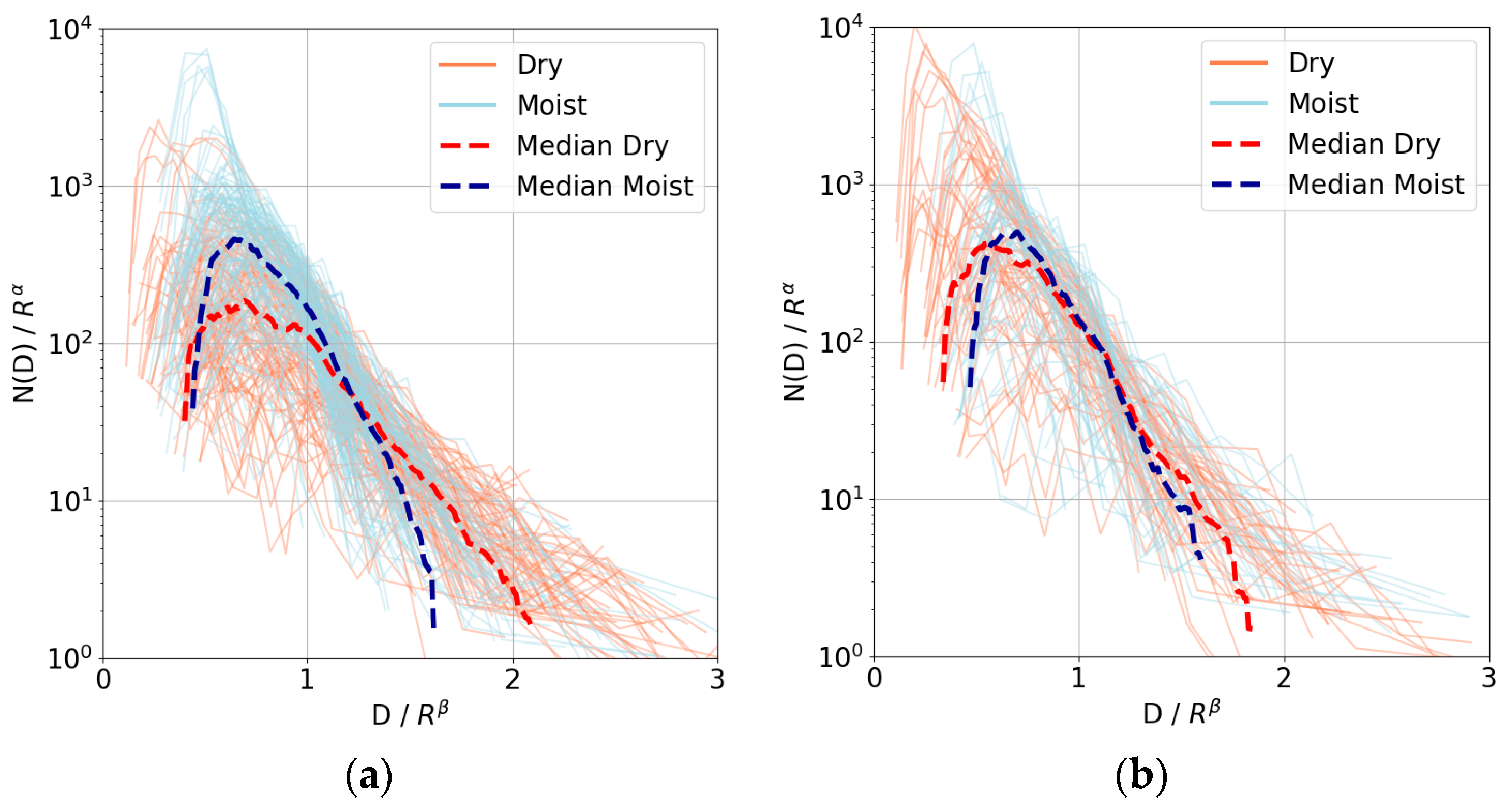
To complement the results analysed in Section 3.6, where different DSD parameters were studied and a difference between dry and wet cases was identified, we focus now on the evolution of the surface DSD. In particular, we compare the first and second 15 min time periods since disdrometer detection of rainfall onset for both dry and moist conditions. To ensure a proper comparison between distributions and to effectively compare their shapes, all DSDs were normalized by their rainfall rate, following Section 2.2.3. This normalization isolates the intrinsic shape of the DSD corresponding to a unit of rainfall rate.
Figure 9 shows the normalized DSDs for dry and moist cases for the two periods considered. It is worth noting that, in the moist cases, the mean RH remains nearly constant between the first and second 15 min intervals, ranging between 85% and 90%. In contrast, in the dry cases, RH increases markedly from values below 60% during the first interval to about 80% in the second, approaching the levels observed in the moist cases.
A visual analysis of the distributions reveals that, in Figure 9a, the median distributions of dry and wet episodes show clear differences. In dry cases, there are fewer small-diameter drops but a greater number of large-diameter drops. However, during the second 15 min time period (Figure 9b), as surface humidity in the initially dry cases increases and approaches higher values, the visual differences between the dry and wet distributions disappear, and both become very similar.
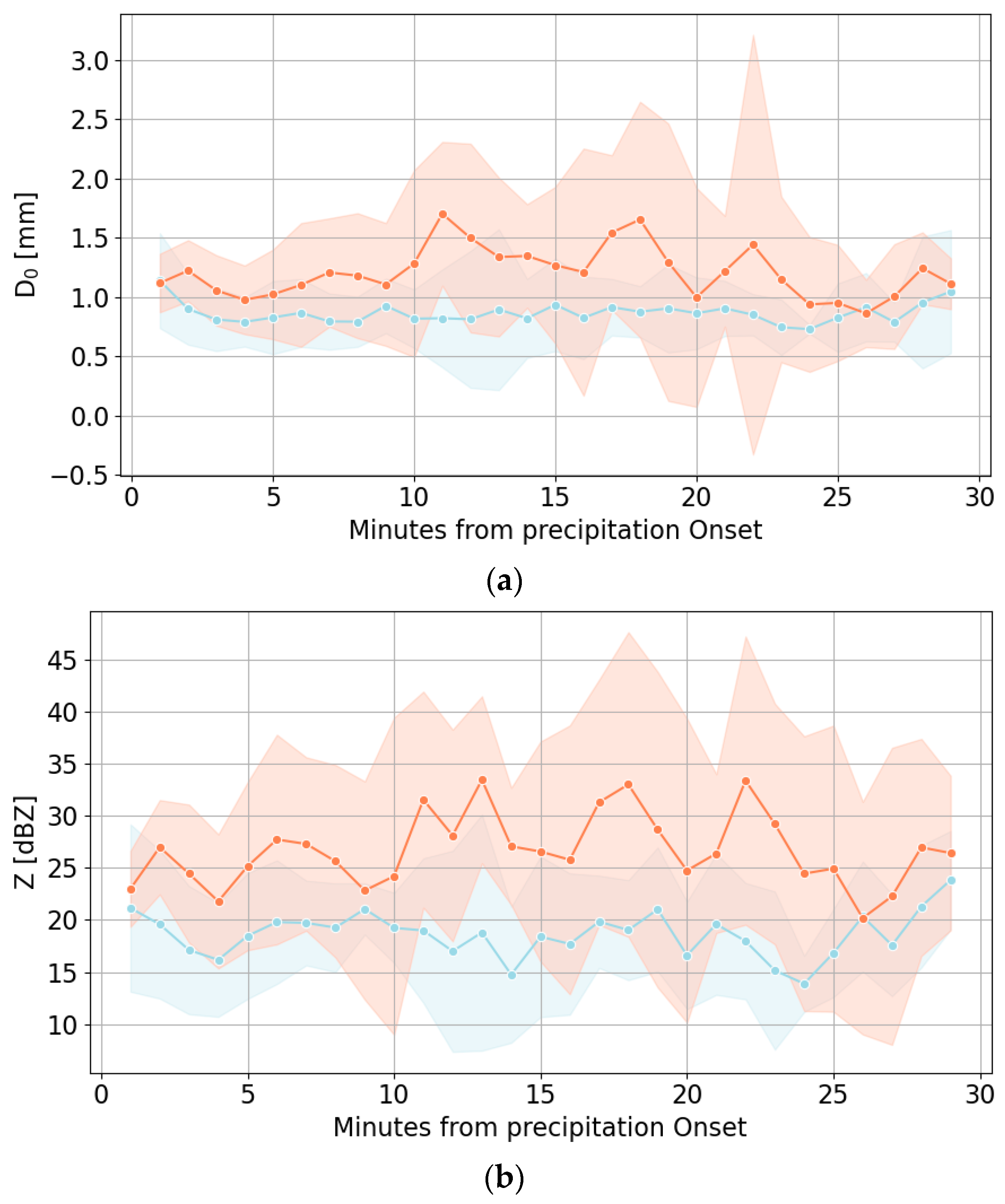
These differences were confirmed by a Mann–Whitney U test applied to the areas of each distribution, indicating statistically significant differences between the dry and wet regimes during the first 15 min (p-value = 0.01). However, in the subsequent 15 min interval, these differences are no longer significant (p-value = 0.51), suggesting that the DSD evolves with increasing near-surface RH, leading to a convergence of the two regimes. Further analysis of the minute-by-minute temporal evolution of normalized DSDs related variables during the 30 min window after rainfall onset shows clear differences between dry and moist events. In particular, D 0 and Z median values are mostly higher in dry events (see Appendix B).

4. Discussion

The results of this study, focused on stratiform rain observed during the LIAISE field campaign, are based on a total of 15 rainfall events, eight of which occurred under dry conditions and seven under moist conditions. We acknowledge that this sample size is relatively small, but despite this limitation, the statistical analysis of both median values and full distributions consistently reveals clear tendencies that differentiate the behaviour of moist and dry events. The results indicate that near-surface RH can influence rainfall microphysics during the initial stages of precipitation events. Under dry conditions, a reduced number of small drops and a relatively higher proportion of larger drops were observed. This behaviour is consistent with the possible effects of evaporation, which disproportionately affects smaller droplets due to their higher surface-area-to-volume ratio. Moreover, it has been observed that the differences in the shape of the DSD between dry and moist cases at the surface tend to disappear within the first 30 min of rainfall. As RH increases, the DSD in dry cases gradually becomes closer to that observed under moist conditions.
Additionally, higher values of D 0 , and Z were recorded during dry cases. These findings are in line with previous studies [5] and could be explained again by rainfall evaporation. However, these differences may also be related to changes in coalescence efficiency. For instance, [61] reported that in moist conditions, raindrop coalescence tends to produce a larger number of satellite droplets, thereby increasing the population of small drops. Conversely, the higher Z observed under dry conditions did not correspond to significantly higher surface rainfall, suggesting that the observed microphysical differences may not directly translate into differences in total rainfall accumulation. Recent studies, such as [14], have analysed the effects of RH and wind on the near-surface DSD, revealing that moister conditions favour raindrop coalescence and growth, and stronger winds promote raindrop breakup. Note that in our study we selected events with low wind speeds to minimize the possibility of advection effects to better interpret the effect of RH. Similarly, [63] studied different vertical Z profile slopes and ground level DSD. They found that decreasing Z profiles were associated with drier conditions and highest values of ground level median drop diameter. The latter four studies are consistent with our findings.
To determine the origin of differences between dry and moist cases observed here, one key observation was the delay in the detection of precipitation by the surface disdrometer compared to weather radar detection at 750 m AGL during dry events. This can be attributed to the evaporation of raindrops as they fall, causing them to reduce their volume and mass or even disappear completely before reaching the ground. In general, rainfall at a given point starts gradually reaching higher intensity after some time. If evaporation is important, the first raindrops that should arrive to the ground under wetter conditions will be evaporated. Studies such as [64] confirm that factors such as evaporation, drop drift, coalescence, or fragmentation during descent generate discrepancies between precipitation observed by radar aloft and surface records. Consequently, under strong evaporation, the rainfall event is likely detected at ground when it has entered a more advanced stage of its development. This interpretation is supported by comparisons of precipitation onset times at different altitudes: during dry events, the time lag between precipitation detection at ~750 m AGL (via MRR or CWR) and its arrival at the surface (measured by the disdrometer) was consistently longer than in moist events.
Although these processes affect the timing and microphysical characteristics of rainfall near the surface, the overall difference in total rainfall amount remains small. For instance, discrepancies between composite CWR data and surface rain gauge measurements during dry events were typically below 0.2 mm, indicating only a marginal impact on cumulative rainfall.
It is important to note that this study focuses on a specific summer period within a specific field campaign, including details such as the RH thresholds applied to discriminate between dry and moist events or the time-window considered before the onset of precipitation. As such, the results might not be broadly generalizable but may suggest potential patterns in other geographical or climatic contexts where surface RH plays a significant role and is less influenced by mesoscale dynamics. A relevant example is provided by [65], who identified a linear relationship between surface temperature variation and initial RH during precipitation onset.
A notable strength of this analysis lies in the integration of observations from four different instruments—disdrometer, Micro Rain Radar (MRR-Pro), C-band weather radar, and automatic weather station (AWS) data. The consistency and complementarity of these datasets reinforce the reliability of the findings and allow for a more comprehensive understanding of how surface humidity influences early-stage rainfall processes. Moreover, this study proposes a robust methodology for combining and statistically analysing precipitation data from multiple instruments, improving both the precision and interpretability of precipitation microphysics assessments.
When comparing our results with previous long-term studies such as [28], which analysed CWR and AWS data over a six-year period, no signs of evaporation under dry conditions were reported. However, that study relied solely on the lowest available CAPPI level (~1000 m ASL, or ~750 m AGL), whereas our findings emphasize the importance of high-resolution observations at lower altitudes (below 750 m AGL). The use of vertically profiling instruments like the MRR, combined with surface-level measurements from the disdrometer—both available during the LIAISE field campaign—proved critical in detecting evaporation effects at the early stages of rainfall.
Overall, our results highlight the significant role of near-surface atmospheric conditions—particularly RH—in shaping the microphysical characteristics of rainfall. They also underscore the importance of high-resolution, low-altitude observations for understanding evaporation processes, which could ultimately contribute to improved quantitative precipitation estimates. This includes refining correction schemes for evaporation in systems like the Multi-Radar Multi-Sensor (MRMS) framework, as proposed by [66].

5. Conclusions

These findings, based on stratiform precipitation events observed at two sites during the LIAISE campaign (May–September 2021), indicate the following characteristics:
  • During the first 30 min of stratiform precipitation, dry events at surface level exhibit higher values of Z and D 0 than moist events, despite the absence of significant differences in surface rainfall rates.
  • The surface DSD shows distinct early-stage shapes: dry events display a different distribution during the first 15 min, gradually evolving toward the moist-event DSD shape after ~30 min as RH increases.
  • Differences in Z observed at surface level are not present at 750 m AGL. Z measurements from the MRR and CWR show no significant distinctions between dry and moist cases during the initial 30 min period.
  • The time lag between the onset of precipitation detected at 750 m AGL for MRR or CWR and its arrival at the surface is longer for dry events, consistent with possible enhanced evaporation under lower humidity conditions.
Given that the present analysis is based on observations from only two sites and covers exclusively a summer period, the results should be interpreted as site- and season-specific. Further studies incorporating longer time periods and more diverse atmospheric conditions would be beneficial to assess the broader implications of the findings presented here and expand possible applications. Additionally, future plans include the use of a single-column drop size distribution model to assess the effects of rainfall evaporation on selected case studies, to allow a more precise quantification of evaporation implications, for example in terms of latent heat cooling effects.

Author Contributions

Conceptualization, F.P. and J.B.; methodology, F.P. and J.B.; formal analysis, F.P.; investigation, F.P. and J.B.; data curation, F.P.; writing—original draft preparation, F.P. and J.B.; writing—review and editing, A.G.-B., E.P., J.B., F.P. and M.U.; visualization, F.P.; supervision, J.B. All authors have read and agreed to the published version of the manuscript.

Funding

This research was partly funded by the projects WISE-PreP (RTI2018-098693-B-C32), ARTEMIS (PID2021-124253OB-I00 MINECO/FEDER), PANDORA (PDC2022-133207-I00), the Water Research Institute (IdRA) of the University of Barcelona, and AGAUR grant 2022 FISDU 00365.

Data Availability Statement

Part of the data used in this study are publicly available through the LIAISE data repository at https://liaise.aeris-data.fr/ (accessed on 1 July 2024). The disdrometer and Micro Rain Radar datasets are not yet publicly available but will be released in the repository in the coming months. The operational weather radar data are the property of the Meteorological Service of Catalonia and can be obtained upon request.

Acknowledgments

The authors thank the Meteorological Service of Catalonia for their support during the LIAISE field campaign and for the C-band weather radar data and AWS data provided, as well as Météo-France for the wind profile observations.

Conflicts of Interest

The authors declare no conflicts of interest.

Acronyms

The following abbreviations are used in this manuscript:
AGLHeight above ground level
ASLAbove sea level
AWSAutomatic weather station
CWRC-band weather radar
DSDDrop size distribution
MITMinimum Inter-Event Time
MRRMicro Rain Radar
QCQuality control
RHRelative humidity

Appendix A. MRR Calibration

MRR data were calibrated according to the methodology recommended by the manufacturer [67]. Each MRR was calibrated with the co-located rain gauge, computing the ratio M between MRR rainfall estimates of the lowest valid bin and rainfall from the rain gauge for all 30 min periods where both data sources were available and the rain gauge performed at least two bucket tips. Specifically:
M = R a i n f a l l M R R R a i n f a l l R a i n G a u g e ,
being M equal to 1 when the MRR and the rain-gauge rainfall are the same. The median value of M of all 30 min intervals is then used to re-calculate the spectral Z raw values of MRR. Note that the application of this procedure implies a change in the radar constant of the MRR so the radar reflectivity is modified but not the Doppler velocity.

Appendix B. Normalized D 0 and Z Evolution

Figure A1 presents how the normalized values of D 0 and Z evolve during the first 30 min after precipitation onset, based on normalized DSDs measured by the disdrometers. The comparison between moist and dry events shows that the median values of both D 0 and Z tend to be higher in dry cases.
Figure A1. Temporal evolution of D0 (panel a) and Z (panel b) computed from normalized DSDs observed by disdrometers after precipitation onset for moist (blue) and dry (red) events. Solid lines indicate median values and shaded areas standard deviation ranges.
Remotesensing 18 00509 g0a1

References

  1. Durbin, D.; Wang, Y.; Chang, P.-L. Drop Size Distribution Retrieval Using Dual-Polarization Radar at C-Band and S-Band. Atmos. Meas. Tech. 2024, 17, 5397–5411. [Google Scholar] [CrossRef]
  2. Bringi, V.N.; Chandrasekar, V.; Hubbert, J.; Gorgucci, E.; Randeu, W.L.; Schoenhuber, M. Raindrop Size Distribution in Different Climatic Regimes from Disdrometer and Dual-Polarized Radar Analysis. J. Atmos. Sci. 2003, 60, 354–365. [Google Scholar] [CrossRef]
  3. Tokay, A.; Short, D.A. Evidence from Tropical Raindrop Spectra of the Origin of Rain from Stratiform versus Convective Clouds. J. Appl. Meteorol. 1996, 35, 355–371. [Google Scholar] [CrossRef]
  4. Barthes, L.; Mallet, C. Vertical Evolution of Raindrop Size Distribution: Impact on the Shape of the DSD. Atmos. Res. 2013, 119, 13–22. [Google Scholar] [CrossRef]
  5. Sun, J.; Wan, R.; Zhou, Y. Effects of Relative Humidity on the Diurnal Variation of Raindrop Size Distribution in Southwest China. Front. Environ. Sci. 2022, 10, 948318. [Google Scholar] [CrossRef]
  6. Testik, F.Y.; Pei, B. Wind Effects on the Shape of Raindrop Size Distribution. J. Hydrometeorol. 2017, 18, 1285–1303. [Google Scholar] [CrossRef]
  7. Liu, F.; Rosenfeld, D.; Pan, Z.; Zang, L.; Mao, F. Combined Effects of Fine and Coarse Marine Aerosol on Vertical Raindrop Size Distribution. npj Clim. Atmos. Sci. 2024, 7, 182. [Google Scholar] [CrossRef]
  8. Ma, Y.; Ni, G.; Chandra, C.V.; Tian, F.; Chen, H. Statistical Characteristics of Raindrop Size Distribution during Rainy Seasons in the Beijing Urban Area and Implications for Radar Rainfall Estimation. Hydrol. Earth Syst. Sci. 2019, 23, 4153–4170. [Google Scholar] [CrossRef]
  9. Udina, M.; Peinó, E.; Polls, F.; Mercader, J.; Guerrero, I.; Valmassoi, A.; Paci, A.; Bech, J. Irrigation Impact on Boundary Layer and Precipitation Characteristics in Weather Research and Forecasting Model Simulations during LIAISE-2021. Q. J. R. Meteorol. Soc. 2024, 150, 3251–3273. [Google Scholar] [CrossRef]
  10. Zhou, H.; Qiu, J.; Li, M.; Lu, H.; Li, F. Assessment of Large-Scale Reservoirs’ Impact on the Local Precipitation. Water Resour. Res. 2025, 61, e2025WR039938. [Google Scholar] [CrossRef]
  11. Steensen, B.M.; Marelle, L.; Hodnebrog, Ø.; Myhre, G. Future Urban Heat Island Influence on Precipitation. Clim. Dyn. 2022, 58, 3393–3403. [Google Scholar] [CrossRef]
  12. Xie, X.; Evaristo, R.; Troemel, S.; Saavedra, P.; Simmer, C.; Ryzhkov, A. Radar Observation of Evaporation and Implications for Quantitative Precipitation and Cooling Rate Estimation. J. Atmos. Ocean. Technol. 2016, 33, 1779–1792. [Google Scholar] [CrossRef]
  13. Tridon, F.; Battaglia, A.; Watters, D. Evaporation in Action Sensed by Multiwavelength Doppler Radars. JGR Atmos. 2017, 122, 9379–9390. [Google Scholar] [CrossRef]
  14. Liu, Z.; Zhou, A.; Zhao, K.; Luo, H.; Wen, L.; Lin, Q.; Lu, Y.; Huang, H.; Wang, S.; Chen, G.; et al. Hundred-Meter-Scale In Situ Observations Reveal Joint Impact of Humidity and Wind on Raindrop Microphysics. Geophys. Res. Lett. 2025, 52, e2025GL116977. [Google Scholar] [CrossRef]
  15. Yang, F.; Luke, E.P.; Kollias, P.; Kostinski, A.B.; Vogelmann, A.M. Scaling of Drizzle Virga Depth With Cloud Thickness for Marine Stratocumulus Clouds. Geophys. Res. Lett. 2018, 45, 3746–3753. [Google Scholar] [CrossRef]
  16. Kalesse-Los, H.; Kötsche, A.; Foth, A.; Röttenbacher, J.; Vogl, T.; Witthuhn, J. The Virga-Sniffer—A New Tool to Identify Precipitation Evaporation Using Ground-Based Remote-Sensing Observations. Atmos. Meas. Tech. 2023, 16, 1683–1704. [Google Scholar] [CrossRef]
  17. Raich, R.; Alpert, P.; Messer, H. Vertical Precipitation Estimation Using Microwave Links in Conjunction with Weather Radar. Environments 2018, 5, 74. [Google Scholar] [CrossRef]
  18. Peel, M.C.; Finlayson, B.L.; McMahon, T.A. Updated World Map of the Köppen-Geiger Climate Classification. Hydrol. Earth Syst. Sci. 2007, 11, 1633–1644. [Google Scholar] [CrossRef]
  19. Peinó, E.; Bech, J.; Polls, F.; Udina, M.; Petracca, M.; Adirosi, E.; Gonzalez, S.; Boudevillain, B. Validation of GPM DPR Rainfall and Drop Size Distributions Using Disdrometer Observations in the Western Mediterranean. Remote Sens. 2024, 16, 2594. [Google Scholar] [CrossRef]
  20. AEMET. Standard Climate Values, Spanish State Meteorological Agency. 2024. Available online: https://www.aemet.es/en/serviciosclimaticos/datosclimatologicos/valoresclimatologicos (accessed on 12 October 2024).
  21. Bech, J.; Arús, J.; Castán, S.; Pineda, N.; Rigo, T.; Montanyà, J.; van der Velde, O. A Study of the 21 March 2012 Tornadic Quasi Linear Convective System in Catalonia. Atmos. Res. 2015, 158–159, 192–209. [Google Scholar] [CrossRef]
  22. Gonzalez, S.; Callado, A.; Werner, E.; Escribà, P.; Bech, J. Coastally Trapped Disturbances Caused by the Tramontane Wind on the Northwestern Mediterranean: Numerical Study and Sensitivity to Short-Wave Radiation. Q. J. R. Meteorol. Soc. 2018, 144, 1321–1336. [Google Scholar] [CrossRef]
  23. Lunel, T.; Jimenez, M.A.; Cuxart, J.; Martinez-Villagrasa, D.; Boone, A.; Le Moigne, P. The Marinada Fall Wind in the Eastern Ebro Sub-Basin: Physical Mechanisms and Role of the Sea, Orography and Irrigation. Atmos. Chem. Phys. 2024, 24, 7637–7666. [Google Scholar] [CrossRef]
  24. Navarro, A.; García-Ortega, E.; Merino, A.; Sánchez, J.L. Extreme Events of Precipitation over Complex Terrain Derived from Satellite Data for Climate Applications: An Evaluation of the Southern Slopes of the Pyrenees. Remote Sens. 2020, 12, 2171. [Google Scholar] [CrossRef]
  25. Boone, A.; Bellvert, J.; Best, M.; Brooke, J.K.; Canut-Rocafort, G.; Cuxart, J.; Hartogensis, O.; Moigne, P.L.; Miró, J.R.; Polcher, J.; et al. The Land Surface Interactions with the Atmosphere over the Iberian Semi-Arid Environment (LIAISE) Field Campaign. J. Eur. Meteorol. Soc. 2025, 2, 100007. [Google Scholar] [CrossRef]
  26. Dari, J.; Brocca, L.; Modanesi, S.; Massari, C.; Tarpanelli, A.; Barbetta, S.; Quast, R.; Vreugdenhil, M.; Freeman, V.; Barella-Ortiz, A.; et al. Regional Data Sets of High-Resolution (1 and 6 Km) Irrigation Estimates from Space. Earth Syst. Sci. Data 2023, 15, 1555–1575. [Google Scholar] [CrossRef]
  27. Mangan, M.R.; Hartogensis, O.; Boone, A.; Branch, O.; Canut, G.; Cuxart, J.; de Boer, H.J.; Le Page, M.; Martínez-Villagrasa, D.; Miró, J.R.; et al. The Surface-Boundary Layer Connection across Spatial Scales of Irrigation-Driven Thermal Heterogeneity: An Integrated Data and Modeling Study of the LIAISE Field Campaign. Agric. For. Meteorol. 2023, 335, 109452. [Google Scholar] [CrossRef]
  28. Polls, F.; Bech, J.; Udina, M.; Peinó, E.; Rigo, T. Local Influence of Surface Relative Humidity on Weather Radar Rainfall Observations over an Agricultural Semi-Arid Area. Remote Sens. 2025, 17, 439. [Google Scholar] [CrossRef]
  29. Llabrés-Brustenga, A.; Rius, A.; Rodríguez-Solà, R.; Casas-Castillo, M.C.; Redaño, A. Quality Control Process of the Daily Rainfall Series Available in Catalonia from 1855 to the Present. Theor. Appl. Clim. 2019, 137, 2715–2729. [Google Scholar] [CrossRef]
  30. Prohom, M.J.; Cunillera, J.; Domonkos, P.; Herrero, M.; Busto, M.; Barrera-Escoda, A.; Reynés, J. New Daily Homogenized Database for Catalonia Using ACMANTv5 (1950–2021). In Proceedings of the EMS Annual Conference, Bonn, Germany, 9 September 2022. [Google Scholar]
  31. Schimanke, S.; Ridal, M.; Le Moigne, P.; Berggren, L.; Undén, P.; Randriamampianina, R.; Andrea, U.; Bazile, E.; Bertelsen, A.; Brousseau, P.; et al. CERRA Sub-Daily Regional Reanalysis Data for Europe on Height Levels from 1984 to Present. Copernicus Climate Change Service (C3S) Climate Data Store (CDS) 2021. [CrossRef]
  32. Löffler-Mang, M.; Joss, J. An Optical Disdrometer for Measuring Size and Velocity of Hydrometeors. J. Atmos. Ocean. Technol. 2000, 17, 130–139. [Google Scholar] [CrossRef]
  33. Tokay, A.; Wolff, D.B.; Petersen, W.A. Evaluation of the New Version of the Laser-Optical Disdrometer, OTT Parsivel2. J. Atmos. Ocean. Technol. 2014, 31, 1276–1288. [Google Scholar] [CrossRef]
  34. Dolan, B.; Fuchs, B.; Rutledge, S.A.; Barnes, E.A.; Thompson, E.J. Primary Modes of Global Drop Size Distributions. J. Atmos. Sci. 2018, 75, 1453–1476. [Google Scholar] [CrossRef]
  35. Thompson, E.J.; Rutledge, S.A.; Dolan, B.; Thurai, M. Drop Size Distributions and Radar Observations of Convective and Stratiform Rain over the Equatorial Indian and West Pacific Oceans. J. Atmos. Sci. 2015, 72, 4091–4125. [Google Scholar] [CrossRef]
  36. Casanovas, C.; Salio, P.; Galligani, V.; Dolan, B.; Nesbitt, S.W. Drop Size Distribution Variability in Central Argentina during RELAMPAGO-CACTI. Remote Sens. 2021, 13, 2026. [Google Scholar] [CrossRef]
  37. Gunn, R.; Kinzer, G.D. The Terminal Velocity of Fall for Water Droplets in Stagnant Air. J. Meteor. 1949, 6, 243–248. [Google Scholar] [CrossRef]
  38. Serio, M.A.; Carollo, F.G.; Ferro, V. Raindrop Size Distribution and Terminal Velocity for Rainfall Erosivity Studies. A Review. J. Hydrol. 2019, 576, 210–228. [Google Scholar] [CrossRef]
  39. Guyot, A.; Pudashine, J.; Protat, A.; Uijlenhoet, R.; Pauwels, V.R.N.; Seed, A.; Walker, J.P. Effect of Disdrometer Type on Rain Drop Size Distribution Characterisation: A New Dataset for South-Eastern Australia. Hydrol. Earth Syst. Sci. 2019, 23, 4737–4761. [Google Scholar] [CrossRef]
  40. Loh, J.L.; Lee, D.I.; Kang, M.Y.; You, C.H. Classification of Rainfall Types Using Parsivel Disdrometer and S-Band Polarimetric Radar in Central Korea. Remote Sens. 2020, 12, 642. [Google Scholar] [CrossRef]
  41. Ulbrich, C.W.; Atlas, D. Rainfall Microphysics and Radar Properties: Analysis Methods for Drop Size Spectra. J. Appl. Meteor. 1998, 37, 912–923. [Google Scholar] [CrossRef]
  42. Vivekanandan, J.; Zhang, G.; Brandes, E. Polarimetric Radar Estimators Based on a Constrained Gamma Drop Size Distribution Model. J. Appl. Meteor. 2004, 43, 217–230. [Google Scholar] [CrossRef]
  43. Sempere-Torres, D.; Porrà, J.M.; Creutin, J. Experimental Evidence of a General Description for Raindrop Size Distribution Properties. J. Geophys. Res. 1998, 103, 1785–1797. [Google Scholar] [CrossRef]
  44. Chapon, B.; Delrieu, G.; Gosset, M.; Boudevillain, B. Variability of Rain Drop Size Distribution and Its Effect on the Z–R Relationship: A Case Study for Intense Mediterranean Rainfall. Atmos. Res. 2008, 87, 52–65. [Google Scholar] [CrossRef]
  45. Atlas, D.; Ulbrich, C.W. Path- and Area-Integrated Rainfall Measurement by Microwave Attenuation in the 1–3 Cm Band. J. Appl. Meteor. 1977, 16, 1322–1331. [Google Scholar] [CrossRef]
  46. Löffler-Mang, M.; Kunz, M.; Schmid, W. On the Performance of a Low-Cost K-Band Doppler Radar for Quantitative Rain Measurements. J. Atmos. Ocean. Technol. 1999, 16, 379–387. [Google Scholar] [CrossRef]
  47. Peters, G.; Fischer, B.; Andersson, T. Rain Observations with a Vertically Looking Micro Rain Radar (MRR). Boreal Environ. Res. 2002, 7, 353–362. [Google Scholar]
  48. Garcia-Benadi, A.; Bech, J.; Gonzalez, S.; Udina, M.; Codina, B.; Georgis, J.-F. Precipitation Type Classification of Micro Rain Radar Data Using an Improved Doppler Spectral Processing Methodology. Remote Sens. 2020, 12, 4113. [Google Scholar] [CrossRef]
  49. Garcia-Benadí, A.; Bech, J.; Gonzalez, S.; Udina, M.; Codina, B. A New Methodology to Characterise the Radar Bright Band Using Doppler Spectral Moments from Vertically Pointing Radar Observations. Remote Sens. 2021, 13, 4323. [Google Scholar] [CrossRef]
  50. Adirosi, E.; Baldini, L.; Tokay, A. Rainfall and DSD Parameters Comparison between Micro Rain Radar, Two-Dimensional Video and Parsivel2 Disdrometers, and S-Band Dual-Polarization Radar. J. Atmos. Ocean. Technol. 2020, 37, 621–640. [Google Scholar] [CrossRef]
  51. Jash, D.; Resmi, E.A.; Unnikrishnan, C.K.; Sumesh, R.K.; Sreekanth, T.S.; Sukumar, N.; Ramachandran, K.K. Variation in Rain Drop Size Distribution and Rain Integral Parameters during Southwest Monsoon over a Tropical Station: An Inter-Comparison of Disdrometer and Micro Rain Radar. Atmos. Res. 2019, 217, 24–36. [Google Scholar] [CrossRef]
  52. Reinoso-Rondinel, R.; Schleiss, M. Quantitative Evaluation of Polarimetric Estimates from Scanning Weather Radars Using a Vertically Pointing Micro Rain Radar. J. Atmos. Ocean. Technol. 2021, 38, 481–499. [Google Scholar] [CrossRef]
  53. Altube, P.; Bech, J.; Argemí, O.; Rigo, T.; Pineda, N. Intercomparison and Potential Synergies of Three Methods for Weather Radar Antenna Pointing Assessment. J. Atmos. Ocean. Technol. 2016, 33, 331–343. [Google Scholar] [CrossRef]
  54. Rigo, T.; Llasat, M.C.; Esbrí, L. The Results of Applying Different Methodologies to 10 Years of Quantitative Precipitation Estimation in Catalonia Using Weather Radar. Geomatics 2021, 1, 347–368. [Google Scholar] [CrossRef]
  55. Altube, P.; Bech, J.; Argemí, O.; Rigo, T. Quality Control of Antenna Alignment and Receiver Calibration Using the Sun: Adaptation to Midrange Weather Radar Observations at Low Elevation Angles. J. Atmos. Ocean. Technol. 2015, 32, 927–942. [Google Scholar] [CrossRef]
  56. Powell, S.W.; Houze, R.A.; Brodzik, S.R. Rainfall-Type Categorization of Radar Echoes Using Polar Coordinate Reflectivity Data. J. Atmos. Ocean. Technol. 2016, 33, 523–538. [Google Scholar] [CrossRef]
  57. Fabry, F. Radar Meteorology: Principles and Practice, 1st ed.; Cambridge University Press: Cambridge, UK, 2015; ISBN 978-1-107-07046-2. [Google Scholar]
  58. Shin, K.; Lee, G. Lagrangian Characteristics of Machine Learning-Based Drop Size Distributions in Convective Cells: A Case Study. IEEE Trans. Geosci. Remote Sens. 2025, 63, 1–11. [Google Scholar] [CrossRef]
  59. Meissel, K.; Yao, E. Using Cliff’s Delta as a Non-Parametric Effect Size Measure: An Accessible Web App and R Tutorial. Pract. Assess. Res. Eval. 2024, 29, 2. [Google Scholar] [CrossRef]
  60. Wilks, D.S. Statistical Methods in the Atmospheric Sciences, 2nd ed.; International Geophysics Series; Elsevier: Amsterdam, The Netherlands; Paris, France, 2006; ISBN 978-0-12-751966-1. [Google Scholar]
  61. Ochs, H.T.; Beard, K.V.; Laird, N.F.; Holdridge, D.J.; Schaufelberger, D.E. Effects of Relative Humidity on the Coalescence of Small Precipitation Drops in Free Fall. J. Atmos. Sci. 1995, 52, 3673–3680. [Google Scholar] [CrossRef]
  62. Das, S.K.; Konwar, M.; Chakravarty, K.; Deshpande, S.M. Raindrop Size Distribution of Different Cloud Types over the Western Ghats Using Simultaneous Measurements from Micro-Rain Radar and Disdrometer. Atmos. Res. 2017, 186, 72–82. [Google Scholar] [CrossRef]
  63. Li, Q.; Sun, X.; Liu, X.; Li, H. Linkage Between Radar Reflectivity Slope and Raindrop Size Distribution in Precipitation with Bright Bands. Remote Sens. 2025, 17, 2393. [Google Scholar] [CrossRef]
  64. Dai, Q.; Yang, Q.; Han, D.; Rico-Ramirez, M.A.; Zhang, S. Adjustment of Radar-Gauge Rainfall Discrepancy Due to Raindrop Drift and Evaporation Using the Weather Research and Forecasting Model and Dual-Polarization Radar. Water Resour. Res. 2019, 55, 9211–9233. [Google Scholar] [CrossRef]
  65. Liu, W.; Dong, S.; Zheng, J.; Liu, C.; Wang, C.; Shangguan, W.; Zhang, Y.; Zhang, Y. Quantifying the Rainfall Cooling Effect: The Importance of Relative Humidity in Guangdong, South China. J. Hydrometeorol. 2022, 23, 875–889. [Google Scholar] [CrossRef]
  66. Martinaitis, S.M.; Grams, H.M.; Langston, C.; Zhang, J.; Howard, K. A Real-Time Evaporation Correction Scheme for Radar-Derived Mosaicked Precipitation Estimations. J. Hydrometeorol. 2018, 19, 87–111. [Google Scholar] [CrossRef]
  67. Micro-Rain-Radar MRR-2 and MRR-PRO. A Tutorial, Metek. Available online: https://metek.de/wp-content/uploads/2016/12/2018-0206-MRR_tutorial.pdf (accessed on 10 March 2025).
Figure 1. Western Europe and northeast of the Iberian Peninsula (Catalonia, green dotted rectangle on bottom right insert), showing the two sites (S1 and S2), the LIAISE region of study (magenta), and C-band weather radars of the Meteorological Service of Catalonia (yellow triangles). The base map is a true-colour orthophoto from July 2021 by the Cartographic and Geological Institute of Catalonia; background colours represent natural surface colours.
Remotesensing 18 00509 g001
Figure 2. Dry event (16 June 2021) showing time series of (top) CWR Z at 1000 m ASL (magenta), MRR Z at 1000 m ASL (orange) and RH at surface (green); (middle) MRR Z profile from 250 m to 6000 m AGL; (bottom) DSD minute distribution. Vertical dashed lines indicate the time that CWR, MRR, and disdrometer detect the rainfall onset (magenta, orange, and red respectively) and horizontal black line the 750 m height AGL.
Remotesensing 18 00509 g002
Figure 3. Moist event (19 June 2021) showing time series of (top) CWR Z at 1000 m ASL (magenta), MRR Z at 1000 m ASL (orange) and RH at surface (green); (middle) MRR Z profile from 250 m to 6000 m AGL; (bottom) DSD minute distribution. Vertical dashed lines indicate the time that CWR, MRR, and disdrometer detect the rainfall onset (magenta, orange, and red respectively) and horizontal black line the 750 m height AGL.
Remotesensing 18 00509 g003
Figure 4. CWR Z boxplots for the first 30 min of each event according to CWR criteria (a) and for the first 30 min of rainfall when disdrometer detected rainfall at ground level (b) considering 7 moist (blue) and 8 dry (red) events. The whiskers of the boxplots show values of the distribution within 1.5 inter-quartile range; outliers are indicated by circle symbols.
Remotesensing 18 00509 g004
Figure 5. Vertical profiles of MRR Z during the first 30 min of each event, showing median values (thick lines) and variability given by the interquartile range (shaded areas) for moist (blue) and dry (red) events. Profiles are shown for: (a) events defined according to MRR conditions and (b) events defined based on rainfall onset at the surface from the disdrometer.
Remotesensing 18 00509 g005
Figure 6. Scatterplot and boxplots of time differences in rainfall detection between aloft observations (MRR and CWR) and ground-level disdrometer for dry (red) and moist (blue) events. The x-axis shows differences between CWR and disdrometer detection times, while the y-axis shows differences between MRR and disdrometer detection times. Boxplot whiskers represent values within 1.5 times the interquartile range.
Remotesensing 18 00509 g006
Figure 7. Rainfall differences (in mm) for moist (blue) and dry (red) events during the period spanning from the first detection of each instrument (CWR, MRR and disdrometer) to the rain gauge bucket first tipping showing CWR (a), MRR (b), and disdrometer (c). Boxplots are based on 7 moist events and 8 dry events. Whiskers represent values within 1.5 times the interquartile range, and outliers are indicated by circles.
Remotesensing 18 00509 g007
Figure 8. Box plots of selected variables derived from disdrometer data for moist (blue) and dry (red) events: D 0 (a), LWC (b), N w (c), R (d), and Z (e). Boxplots are based on 7 moist events and 8 dry events. Whiskers represent data within 1.5 times the interquartile range, and outliers are marked with circles.
Remotesensing 18 00509 g008
Figure 9. Normalized DSD distributions for (a) the first 15 min after rainfall onset (0–14 min) and (b) the following 15 min (15–29 min). Thin solid lines represent the normalized minute-by-minute DSDs for each episode, coloured in orange for dry cases and blue for moist cases. Thick dashed lines indicate the median DSD for each group: red for dry and dark blue for moist.
Remotesensing 18 00509 g009
Table 1. Disdrometer data with particle detection and rainfall, before and after quality control (QC), and automatic weather station (AWS) rain gauge rainfall.
SiteDisdrometer with Particle Detection Before QC [min]Disdrometer with Particle Detection After QC [min]Disdrometer Rainfall Before QC [mm]Disdrometer Rainfall After QC [mm]AWS Rainfall [mm]
S1297314631476860
S234201693193129115
Table 2. MRR-PRO minutes with particle detection and rainfall, before and after QC, and rainfall observed by the rain gauge of the AWS.
SiteMRR with Particle Detection Before QC [min]MRR with Particle Detection After QC [min]MRR Rainfall Before QC [mm]MRR Rainfall After QC [mm]AWS Rainfall [mm]
S126,45866161966270
S221,4006743272110113
Table 3. Criteria defining the onset of a rainfall event for each instrument (disdrometer, MRR, and CWR).
InstrumentCriteria According to Each Instrument
DisdrometerMinimum of 3 consecutive minutes with more than 50 particles and minimum rainfall rate of 0.025 mm/h, after a MIT of at least 24 h.
MRR Within   the   first   75   min   before   disdrometer   rainfall   detection ,   at   least   3   consecutive   minutes   with   Z at 1000 m ASL equal or exceeding 5 dBZ.
CWRWithin the first 75 min before disdrometer rainfall detection, two consecutive CWR observations equal or exceeding 5 dBZ at CAPPI 1 km over the pixel located over each AWS.
Table 4. Events analysed listing date, type (moist or dry), and rainfall from each instrument from the onset of rainfall according to the instrument (until the rain gauge does the first tipping). If there is no tipping, the rainfall is calculated up to 5 min after the onset of DIS rainfall.
DayTypePointCWR [mm]MRR [mm]DIS [mm]AWS [mm]
12 May 2021DryS20.100.100.180.10
25 May 2021DryS20.040.050.030.00
30 May 2021MoistS20.310.290.160.10
1 June 2021DryS20.690.120.090.10
11 June 2021DryS20.630.310.120.10
16 June 2021DryS20.210.140.020.00
17 June 2021DryS10.220.020.020.00
19 June 2021MoistS20.200.080.040.00
4 August 2021MoistS10.080.020.030.00
11 August 2021DryS10.860.160.040.00
30 August 2021MoistS10.130.010.010.00
14 September 2021DryS20.240.270.140.10
16 September 2021MoistS20.290.170.100.10
23 September 2021MoistS10.020.020.090.00
25 September 2021MoistS10.240.200.190.10
Disclaimer/Publisher’s Note: The statements, opinions and data contained in all publications are solely those of the individual author(s) and contributor(s) and not of MDPI and/or the editor(s). MDPI and/or the editor(s) disclaim responsibility for any injury to people or property resulting from any ideas, methods, instructions or products referred to in the content.