Article

A Large-Scale Evaluation of SWOT-Derived Water Surface Elevations: Precision Drivers and Strategies to Enhance Data Availability

by
Thiago Lappicy
1,2,*,
Daniel Beltrão
1,2,
Luana Oliveira Sales
1,
Tati Almeida
1,
Guilherme Gomes Pessoa
1,
Saulo Souza
3,
Renato Prata de Moraes Frasson
2 and
Rejane Ennes Cicerelli
1
1
Postgraduate Program in Applied Geosciences and Geodynamics (PPGGAG), University of Brasilia (UnB), Brasilia 70910-900, DF, Brazil
2
Jet Propulsion Laboratory (JPL), California Institute of Technology, Pasadena, CA 91109, USA
3
National Water and Sanitation Agency (ANA), Brasilia 70610-200, DF, Brazil
*
Author to whom correspondence should be addressed.
Remote Sens. 2026, 18(10), 1609; https://doi.org/10.3390/rs18101609
Submission received: 7 April 2026 / Revised: 6 May 2026 / Accepted: 7 May 2026 / Published: 17 May 2026
(This article belongs to the Topic Advances in Hydrological Remote Sensing)

Highlights

What are the main findings?
  • SWOT-derived WSE shows good agreement with in situ observations across 132 Brazilian lakes: Flag = 0 reduces the 68th percentile errors to below 12 cm but retains only 22% of observations, while Flag = 1 is affected by outliers (68th percentile errors below 21 cm).
  • A Random Forest analysis identifies cross-track distance and lake geometry as the dominant drivers of WSE precision across three SWOT products (vector and raster products).
What are the implications of the main findings?
  • The SQRTL filter combines all Flag = 0 with cross-track constrained Flag = 1 observations, more than tripling usable data relative to Flag = 0 and achieving comparable precision (68th percentile of errors below 16 cm).
  • This framework is transferable to other regions, showing potential to expand systematic lake monitoring for (un)gauged lakes.

Abstract

High-quality water surface elevation (WSE) measurements are critical in hydrological applications, yet no systematic evaluation of the Surface Water and Ocean Topography (SWOT) mission exists for Brazil’s diverse lake systems, where satellite observations are essential given limited in situ monitoring. We evaluated WSE from SWOT over 132 Brazilian lakes, comparing LakeSP, Raster_250m, and Raster_100m products against field measurements over a 20-month period. The 68th percentile errors were under 29 cm for the full dataset, below 12 cm for Flag = 0, and below 21 cm for Flag = 1, indicating good agreement but also the presence of outliers and the need for data screening. A Random Forest analysis identified quality flags, lake geometry, and cross-track distance as key drivers of WSE precision. Flag = 0 is overly restrictive, retaining only 22% of observations, while Flag = 1 contains anomalous data. The SWOT Quality-Range Threshold for Lakes (SQRTL) filter combines Flag = 0 with cross-track constrained Flag = 1 observations. SQRTL more than triples data availability relative to Flag = 0, maintaining comparable precision (68th percentile below 16 cm) and reducing median revisit from 88–123 days to 16–18 days for raster products and from 25 to 14 days for LakeSP. These results provide the first large-scale SWOT WSE evaluation over Brazilian lakes and a transferable filtering framework applicable wherever SWOT and field observations overlap, with potential to extend monitoring to over 100,000 water bodies in the SWOT Prior Lake Database.

1. Introduction

Lakes and reservoirs are essential components of water resource systems, supporting water supply, irrigation, livestock watering, hydropower generation, and recreation. Globally, estimates of the number of lakes range from tens to hundreds of millions [1,2,3], making comprehensive in situ monitoring impractical and motivating the use of satellite observations to assess inland water dynamics at broad spatial scales [4].
In Brazil, the National Water and Sanitation Agency (ANA) has mapped 236,302 lakes, of which 147,830 are larger than 0.01 km2 and 58,622 exceed the Surface Water and Ocean Topography (SWOT) detection limit of 0.0625 km2 [5]. Satellite-based inventories can provide a complementary perspective on these systems. The Prior Lake Database (PLD) [6] identifies over 6 million lakes globally, including 109,332 in Brazil fully covered by SWOT overpasses, representing nearly half of all lakes mapped nationally.
In addition, Brazil has 3361 officially mapped artificial reservoirs, with an estimated total storage capacity of 630.2 billion m3, of which 92.7% is associated with hydropower generation [5]. However, only 714 reservoirs (21%) are systematically monitored at the federal level with publicly available data [5,7], limiting the assessment of spatial and temporal variability in water levels and storage. This imbalance between the extent of inland waters and observational coverage highlights the importance of satellite observations for characterizing lake and reservoir dynamics at large scales [8,9,10,11].
Recent advances in satellite altimetry have improved the remote estimation of water surface elevation (WSE), with missions such as Sentinel-3, Sentinel-6/Jason-CS, ICESat-2, SARAL/AltiKa, and, most recently, SWOT [12,13,14,15,16,17]. Using lidar and radar remote sensing technologies, these missions have expanded the availability and quality of hydrological observations. SWOT differs from previous altimetry missions by enabling wide-swath radar observations of lakes and rivers, providing spatially distributed estimates of WSE, river discharge, and lake storage dynamics [12].
These capabilities create new opportunities for lake and reservoir monitoring [18,19,20,21,22], hydrological modeling/data assimilation [23,24], river and discharge-related analyses [25,26,27,28], flood and river-network studies [17,29,30], and broader large-scale hydrological assessments [31,32,33,34].
Studies using SWOT data report the promising accuracy of SWOT-derived WSE over inland waters, with errors below 20 cm after applying quality flags [35,36]. Flag-based filtering has been applied across different SWOT products, including pixel cloud, vector, and raster datasets [21,35,36,37,38,39,40,41,42], with many studies combining it with ancillary variables from the SWOT products, such as the backscatter coefficient sig0 [37], WSE uncertainty estimates [22,38], dark water fraction [20,39,40], and cross-track distance [39], as well as with statistical outlier removal methods [21,22,38,40,41,42]. However, most of these studies focus on specific regions or individual products, limiting direct comparison across SWOT products and leaving open questions regarding the potential to generalize the filtering strategies.
Thus, relying solely on quality flags, either by retaining noisy observations or discarding a substantial fraction of the available observations, has often proven insufficient, leaving the trade-off between improved accuracy and data availability unresolved. Recent studies have explored alternatives to strict quality-flag screening [28], but no broadly adopted strategy has yet emerged for balancing reliability and data retention. This remains a key challenge in the practical use of SWOT data, particularly across large and diverse regions.
To address these limitations, we propose the SQRTL (SWOT Quality-Range Threshold for Lakes) filter, which combines SWOT quality flags, already widely used in the literature [21,35,36,37,38,39,40,41,42], with cross-track distance. By relying on variables provided in SWOT products themselves, the SQRTL approach can be readily integrated into existing frameworks, remains physically interpretable, and is intended as a replicable strategy that may be applied across regions and scales, rather than a filter tailored to a specific study or dataset.
Our study addresses these gaps by providing a nationwide evaluation of SWOT-derived WSE precision using in situ observations from 132 lakes across Brazil. We explore the factors controlling WSE precision and variability in the LakeSP, Raster_250m, and Raster_100m products, with particular emphasis on geometric and orbital influences, using a Random Forest (RF) approach. Based on these results, we propose an auxiliary filtering strategy that complements the current flagging system. Together, these analyses provide a large-scale comparison of three SWOT products and a practical framework for improving data screening.

2. Materials and Methods

2.1. Materials

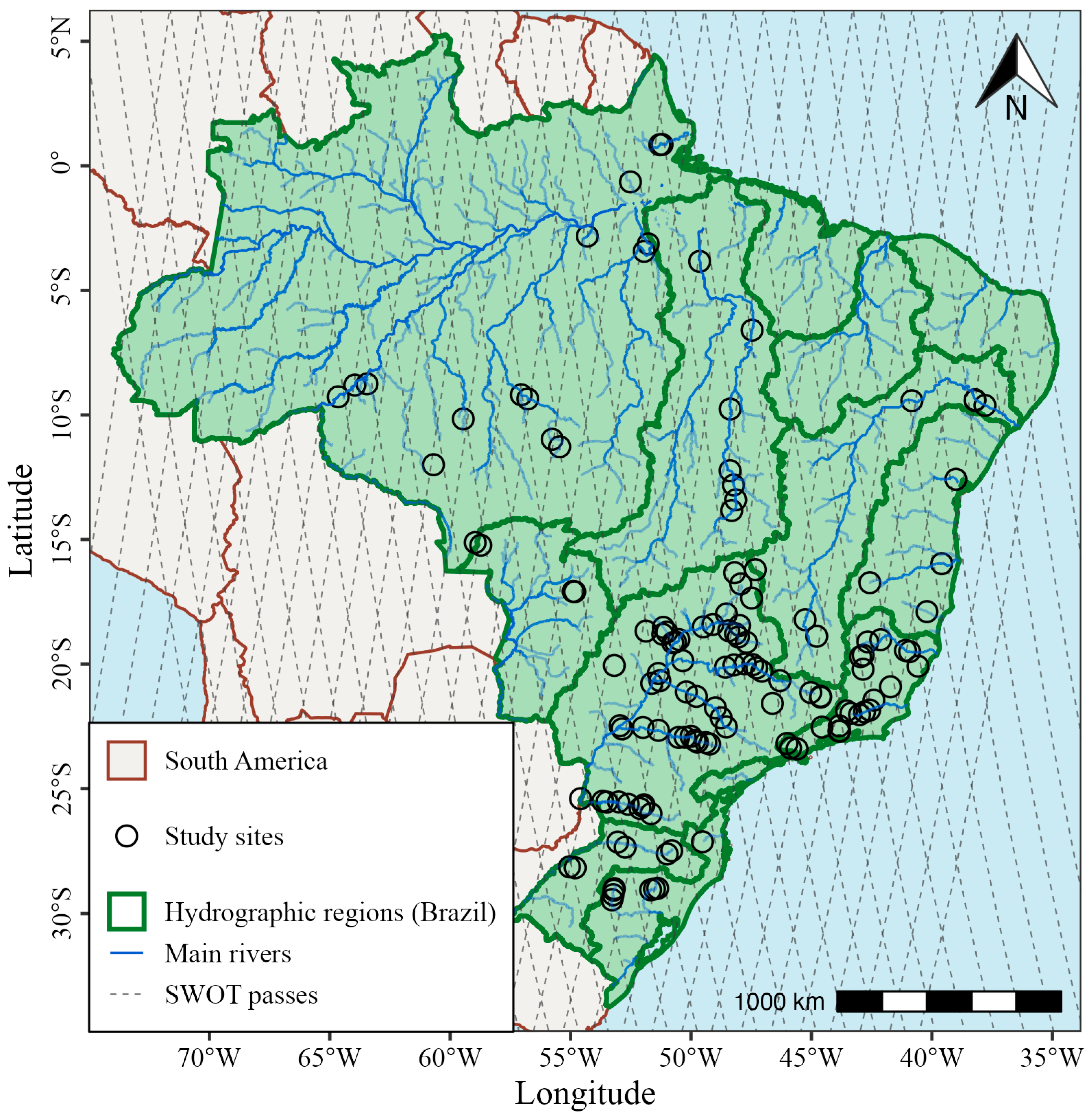
The data sources used were: (i) in situ water level measurements provided by the Brazilian National Operator for the Electric System—ONS [43]; (ii) SWOT WSE observations from three distinct products: LakeSP, Raster_250m, and Raster_100m; and (iii) lake shape and size information for each hydroelectric power plant (HEPP) calculated using the ANA database [44]. The studied sites are illustrated in Figure 1. They are well distributed across Brazil’s 12 hydrographic regions [45], with latitudes ranging from 29.45°S to 0.92°N and longitudes between 64.65°W and 37.80°W, covering approximately 3360 km north–south and 2950 km east–west.

2.1.1. ONS In Situ Observations

To evaluate SWOT-derived WSE, hourly water level observations from ONS were used as the in situ reference dataset. ONS operates approximately 180 hydroelectric power plants across Brazil, of which 132 intersected SWOT observations at least once during the study period (26 July 2023 to 31 March 2025) [43].
To address possible mismatches in vertical datum between SWOT and ONS observations, we paired the SWOT and the ONS WSE measurements, calculated the differences in the WSEs, and removed the median SWOT-ONS difference from each paired series, resulting in WSE anomalies. The adjusted series were used to quantify the precision of SWOT WSE measurements.

2.1.2. SWOT Data for Lakes

The SWOT mission carries a Ka-band Radar Interferometer (KaRIn), designed to measure water surface extent and elevation for lakes with surface areas larger than 250 × 250 m [31]. SWOT collects data in swaths, repeating its orbit every 20.86 days, since 21 July 2023 [46], with most water bodies being observed between 1 and 3 times per cycle [31]. Three products are used in this study, with data from version C: the Lake Single Pass (LakeSP), and the rasters with 250 m (Raster_250m) and 100 m (Raster_100m) resolution.
SWOT data referenced to EGM2008 [47,48] were retrieved from 26 July 2023 to 31 March 2025 (“science” or “nominal” orbit), resulting in 4443 observations for LakeSP, 7766 for Raster_250m, and 7678 for Raster_100m, all matched with a corresponding value from ONS. Matching was performed both temporally, by pairing each SWOT observation to the closest hourly ONS record, and spatially, using the intersecting lake feature for LakeSP_Obs and a 3 × 3 pixel window for the raster products. For the HEPPs analyzed, this sampling corresponds to roughly three observations per month, with the median revisit intervals of ~10 days for the raster products and 13 days for LakeSP.
The LakeSP product is a vector dataset derived from the PLD [6]. The observation-oriented product (LakeSP_Obs) was used in this study, as it has one element per observed lake feature, allowing flexibility for merging multiple PLD lakes or breaking up a PLD lake into smaller ones [46,48].
Throughout this study, the term “lake” refers specifically to water-surface features represented within the SWOT PLD, reflecting the SWOT data model rather than a geomorphological classification.
The Raster_250m and Raster_100m products only differ in spatial resolution (250 m and 100 m), distributed in 64 km × 64 km tiles [46,47]. These products were selected due to processing considerations for a multitemporal and national-scale analysis, which would make the use of the pixel cloud more complex and computationally demanding.
Each SWOT product provides WSE values with ancillary data that can be helpful in selecting better quality data or provide insight into data anomalies, explored with an RF algorithm in Section 2.2.2 and Section 2.2.3. Notable examples are the summary quality flags for each observation [46], which can be: 0 (Good), 1 (Suspect), 2 (Degraded), or 3 (Bad), determined by multiple factors [46,47,48].

2.1.3. Brazilian Database for Water Bodies

To calculate geometry parameters of each HEPP, we used ANA’s water body database, “Massas d’Água” [44]. Previous studies have indicated that lake size correlates with surface area variability, suggesting smaller lakes experience greater variability and more extreme values [8]. This relation could extend to WSE precision, as evaluated in this study.

2.2. Methods

This study compares SWOT-derived WSE with in situ ONS observations to quantify their anomalies. These differences should not be interpreted solely as measurement errors, as ONS data also contain uncertainty. Nevertheless, they provide a useful basis for assessing disagreement and its main drivers. An RF model was used to rank the explanatory variables associated with WSE differences, including both SWOT-derived metrics from the satellite products and non-SWOT information such as lake geometry and shape [49,50,51].
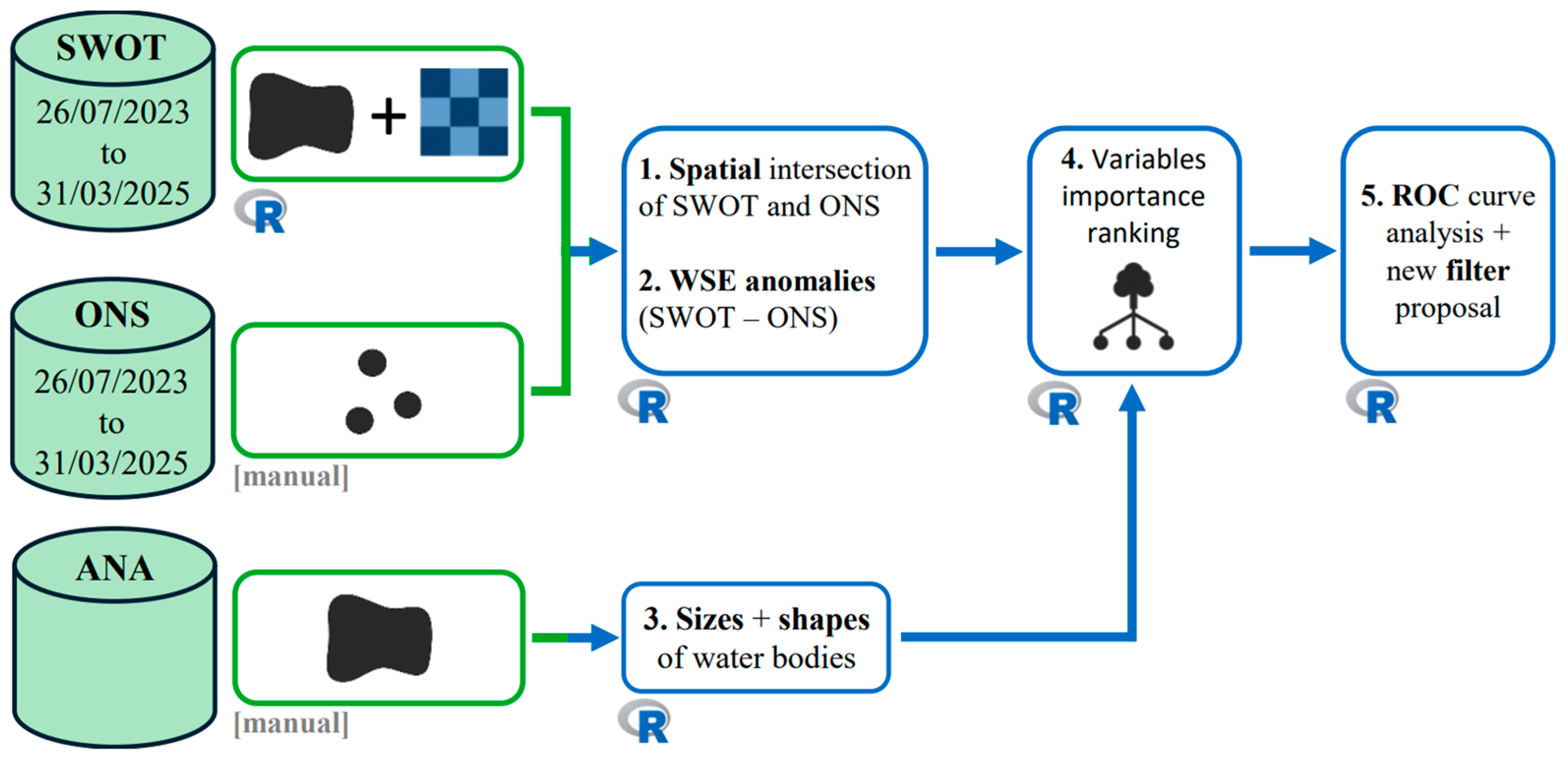
Based on these results, a Receiver Operating Characteristic (ROC) analysis was used to evaluate auxiliary filtering strategies using the key variables from the RF, resulting in the proposed SQRTL filter. Five differently sized lakes (four monitored and one unmonitored) were used as examples to illustrate the potential of this filter for gauged and ungauged systems. Figure 2 summarizes the workflow, from data collection to filter development.

2.2.1. Selection of ONS and SWOT Locations for WSE Anomalies Assessment

The geographic coordinates of the HEPPs typically correspond to dam structures, which are usually located near land. This can introduce biases when using SWOT data, as significant elevation gradients, transitions between the upstream reservoir and downstream river reach, and edge effects often occur near dams, while land contamination can further degrade SWOT-derived WSE estimates. To reduce these effects, the geographic position was shifted approximately 500 m upstream.
This offset was defined based on the lowest spatial resolution pixel (250 m), for which the maximum distance from the center of a 3 × 3 pixel window to its farthest point is less than 500 m. This displacement reduces the inclusion of pixels located downstream from dams and near-shore observations, limits land contamination effects, and helps ensure that the extracted pixels are representative of the lake environment. These shifted locations were also manually verified for all 132 HEPPs to confirm that the selected points remained within the water body and avoided any obvious contamination from the dam structure, nearby land, or downstream reach.
No additional filtering to remove land contamination pixels was applied, as excessive removal may introduce additional noise [26]. Next, we filtered SWOT data to retain only HEPP-intersecting observations. For LakeSP_Obs, the intersection determined the WSE value used, whereas for raster products, the median of a 3 × 3 pixel window centered on the 500 m upstream point was used, similar to [36], but we used the median instead of the mean to reduce sensitivity to extreme values.

2.2.2. Evaluating Potential Drivers of WSE Precision

To better understand SWOT’s WSE precision, we selected known sources of measurement error [18,26,50], as shown in Table 1. We used the static lake geometries from ANA [44] as shapefiles to calculate six parameters that characterize the lake geometry: (i) area, A (km2); (ii) perimeter, P (km); (iii) circularity index, Ci, calculated as 3.545√A/P [51]; (iv) compactness coefficient, Cc, calculated as 0.2841P/√A [51]; (v) minimum shore-to-shore distance and (vi) maximum shore-to-shore distance (km) estimated from the lake area and perimeter assuming a characteristic rectangular lake shape [49].
SWOT-specific metrics such as cross-track distance, quality flags, and additional ancillary variables (Table 1) were also considered. All variables in italic are named exactly as given in the SWOT product and can be found in the user handbook or in the product manuals [46,47,48].

2.2.3. Identifying Key Drivers of WSE Precision via Random Forests

An RF classifier implemented in R with the randomForest package [52,53] was used to investigate the relationship between the absolute WSE anomaly (target variable) and the explanatory variables listed in Table 1. We chose the RF classifier because it is robust to correlation among explanatory variables and is well suited for capturing complex, non-linear relationships between explanatory and target variables [52,54,55]. Moreover, RF is relatively robust to noise and outliers and does not rely on linearity or distributional assumptions, while providing established measures of variable relative importance that enable the identification of dominant drivers of WSE precision [52,54].
The absolute anomaly was treated as a categorical variable representing six intervals: ≤0.1 m, 0.1–0.3 m, 0.3–0.5 m, 0.5–0.8 m, 0.8–1.0 m, >1.0 m. Subsequently, we evaluated the Mean Decrease Accuracy (MDA) metric to quantify the relative importance of the explanatory variables in the composition of the WSE measurement error, with higher values indicating a higher sensitivity and thus a greater influence [53,56,57]. The evaluated lake-geometry variables represent similar measurements of lake size and shape; hence, their MDA values are interpreted comparatively and collectively.
The data were split 70/30 for training and testing, while maintaining representativeness, with the parameters being tuned via a grid search (number of trees = 1500, node size = 4, max. number of nodes = 500, and number of sampled variables per split = 4). These values also aid in the use of correlated variables in RF.

2.2.4. Auxiliary Filtering Strategy Based on ROC Analysis

As filtering strategies inherently involve trade-offs between data availability and reliability, we adopted a parsimonious approach. Based on the error distributions shown in Section 3.3, Flag = 0 measurements consistently exhibit low errors and do not require additional filtering, while Flag = 3 observations are dominated by large errors and were excluded. Flag = 2 data contain only a small fraction of high-quality measurements and a high proportion of large errors; hence, they were also excluded.
Consequently, we propose an auxiliary filter to allow the inclusion of observations flagged as suspect (Flag = 1) in addition to all observations flagged as good (Flag = 0). Rather than including all observations flagged as 1, we aim to only retain a subset of points with the highest likelihood of having good agreement with in situ WSE observations. Therefore, we only include suspect points if they lie within an optimal part of the swath. We made use of the ROC [58] curve to identify the optimal threshold for the filtering.
The ROC curve plots the hit rate (true positive rate) against the false alarm rate (false positive rate). We used the same threshold values used in the RF classifier (0.1 m, 0.3 m, 0.5 m, 0.8 m, 1.0 m) for the construction of the curves. These threshold values are defined in terms of the absolute difference between the SWOT and the in situ data with a bias removal (WSE anomaly). With a grid search calibration, the optimal cross-track lower and upper boundaries are identified. This optimization increases the number of retained observations, while also minimizing the addition of anomalous observations. We then illustrate the application of this filter for an unmonitored lake.

3. Results

3.1. Water Surface Elevation (WSE) from SWOT

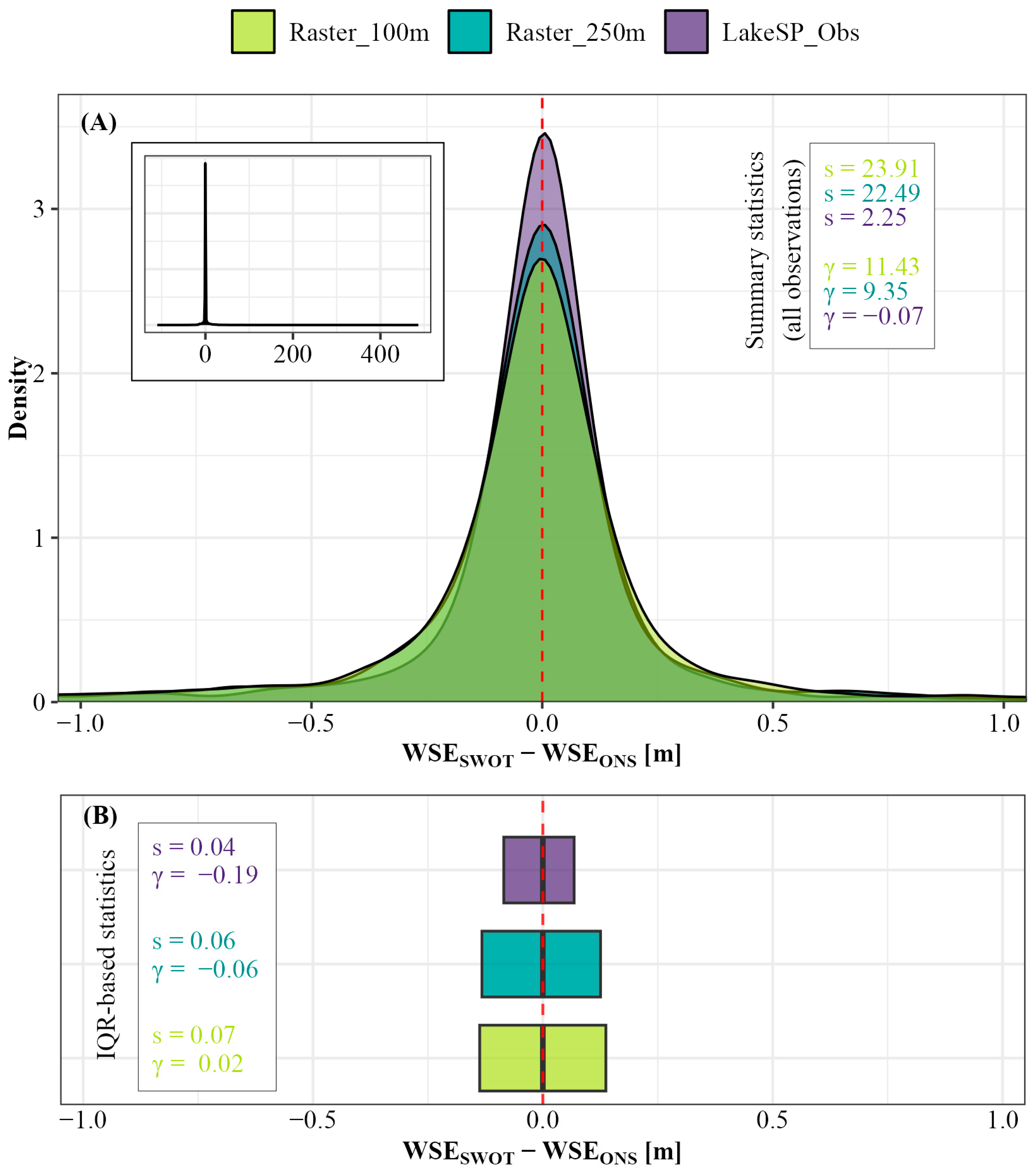
Initial results include density plots (Figure 3A) and interquartile range (IQR) boxplots (Figure 3B) of WSE differences between SWOT and ONS. The smaller panel shows the full distribution, highlighting the presence of a small number of anomalous values, likely representing erroneous measurements. The existence of anomalous data has been documented and merits further attention [20,21,22,34,35,36,37,39,40,41,42], motivating the use of a zoomed-in plot and IQR-based analyses aimed at characterizing the central tendencies and dispersion. The main panel focuses on differences ranging from −1.0 m to +1.0 m, encompassing most valid observations, while the boxplots only show values within the IQR (middle 50% of the dataset) for each product. The red dotted line denotes the optimal value, where SWOT and ONS measurements coincide.
The two statistical metrics calculated for each product were the standard deviation (s) and skewness coefficient (γ), considering both the full dataset and only values within the IQR. The standard deviation is calculated by the square root of the second central moment and the skewness by the Fisher–Pearson standardized moment coefficient. For the raster products, the WSE value used is the median over a 3 × 3 pixel window.
When restricting the analysis to the IQR, thereby focusing on the most representative portion of the distributions and not on the outliers (Figure 3B), the standard deviation is significantly smaller and closer between products, with 4 cm for LakeSP_Obs and 6 to 7 cm for both raster products. These results are in agreement with the current literature regarding the presence of spurious WSE data from SWOT.
The raster products exhibit positive skewness, indicating that the data are more prevalently overestimating the WSE from SWOT relative to ONS (Figure 3), also observed in Australian water bodies [37]. LakeSP_Obs shows greater stability, possibly because its WSE values represent a spatially aggregated water body, reducing localized variability and noise. When constraining to the IQR, all products have a near-zero skewness, reinforcing greater stability in central values and highlighting the importance of targeted screening to improve hydrological interpretation.
The spatial distribution of the WSE anomalies observed reveals little geographic structure (Supplementary Material Figure S1). Higher differences tend to occur in coastal and southern regions, whereas lower median errors are more frequent in central Brazil, but are also observed elsewhere.

3.2. Explanatory Variables Associated with WSE Precision from SWOT

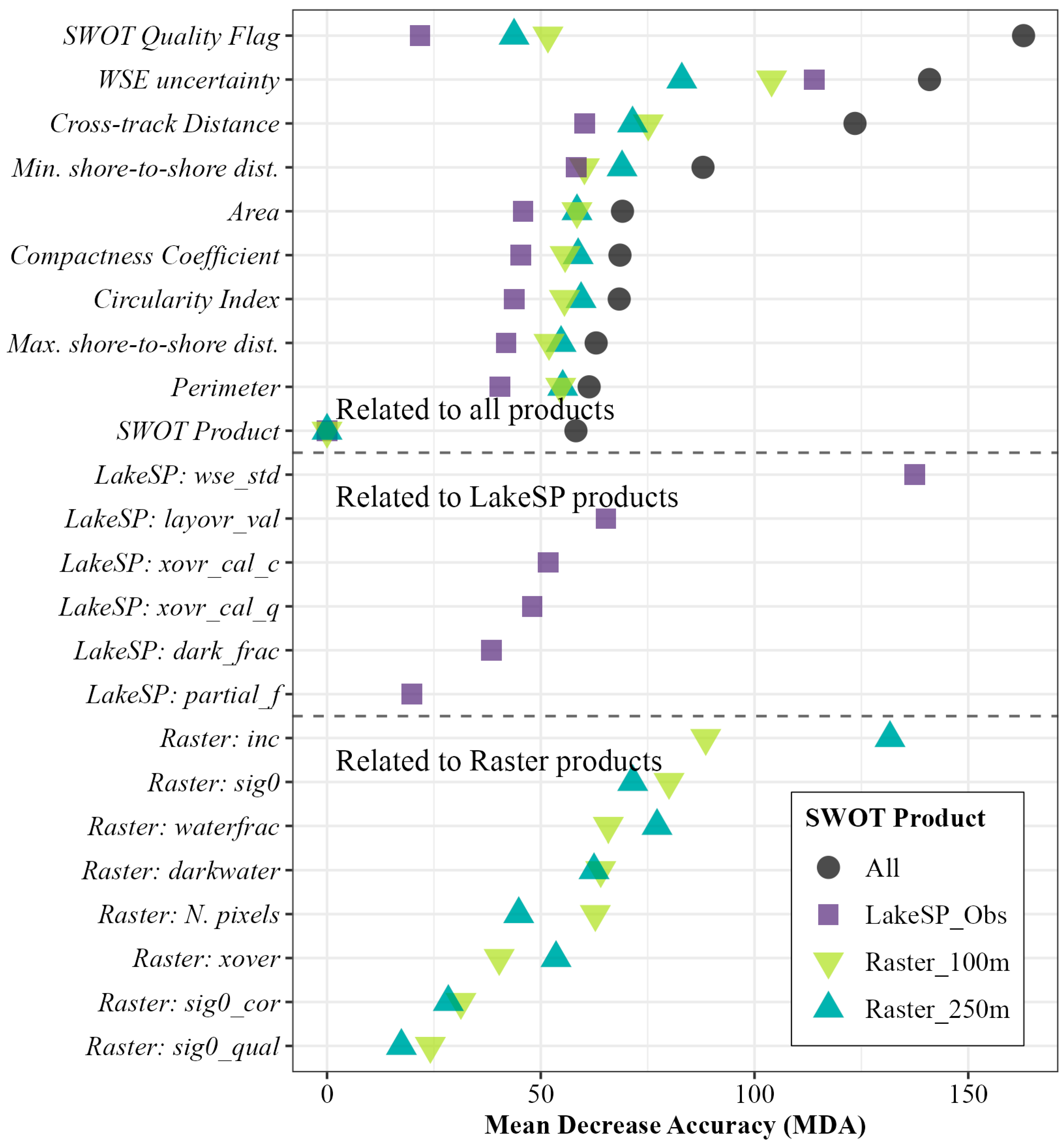
The RF analysis (Figure 4) ranks the explanatory variables (Table 1) according to their contribution to classify WSE error magnitude. The “All” product in the legend key corresponds to the pooled dataset including LakeSP_Obs, Raster_100m, and Raster_250m. Here, we ranked the importance of the variables according to the MDA metric [52,53,56,57]. On the test datasets, the models achieved success rates of approximately 60%, outperforming a random classifier expected to correctly identify 16% of cases (1/6).
Higher MDA values imply a greater influence of a variable on model performance, thus being able to categorize (within the thresholds used) the magnitude of the difference between SWOT and ONS measurements. Even though the importance values vary depending on the model, i.e., the SWOT product used, due to differing explanatory variables available, some consistent patterns emerge.
The higher MDA of the SWOT quality flag when using “All” three products may occur due to the lack of many ancillary variables that are product specific (only available in product-specific models), thus acting as a strong discriminator of the errors, when little additional information is given.
As anticipated, variables representing measurement uncertainty (WSE uncertainty and wse_std) have considerable importance, confirming that SWOT’s uncertainty metrics effectively aid in characterizing the magnitude of measurement errors. Furthermore, SWOT quality flags also showed considerable importance, along with the cross-track distance, wse_std and layovr_val (for LakeSP_Obs) and inc (for both raster products).
Notably, minimum shore-to-shore distance is the most influential non-SWOT variable across all products, with other shape and geometry parameters (area, perimeter, circularity index, compactness coefficient, and maximum shore-to-shore distance) clustered together in their importance. Their relative order should not be overinterpreted, as correlated predictors may redistribute importance within the RF model. This overall importance indicates that lake geometry (size and shape) is relevant to WSE precision.
It is worth noting that a lower MDA does not indicate a lack of importance, rather it suggests that within this RF model, these variables have a lesser impact than other, more influential, variables. Therefore, filtering strategies based on the most influential variables may yield better results. Subsequent sections further explore the influence of the top-ranked variables on WSE precision, specifically the flags, geometry parameters, cross-track distance, layover error and incidence angle.

3.3. Performance and Limitations of SWOT Quality Flags

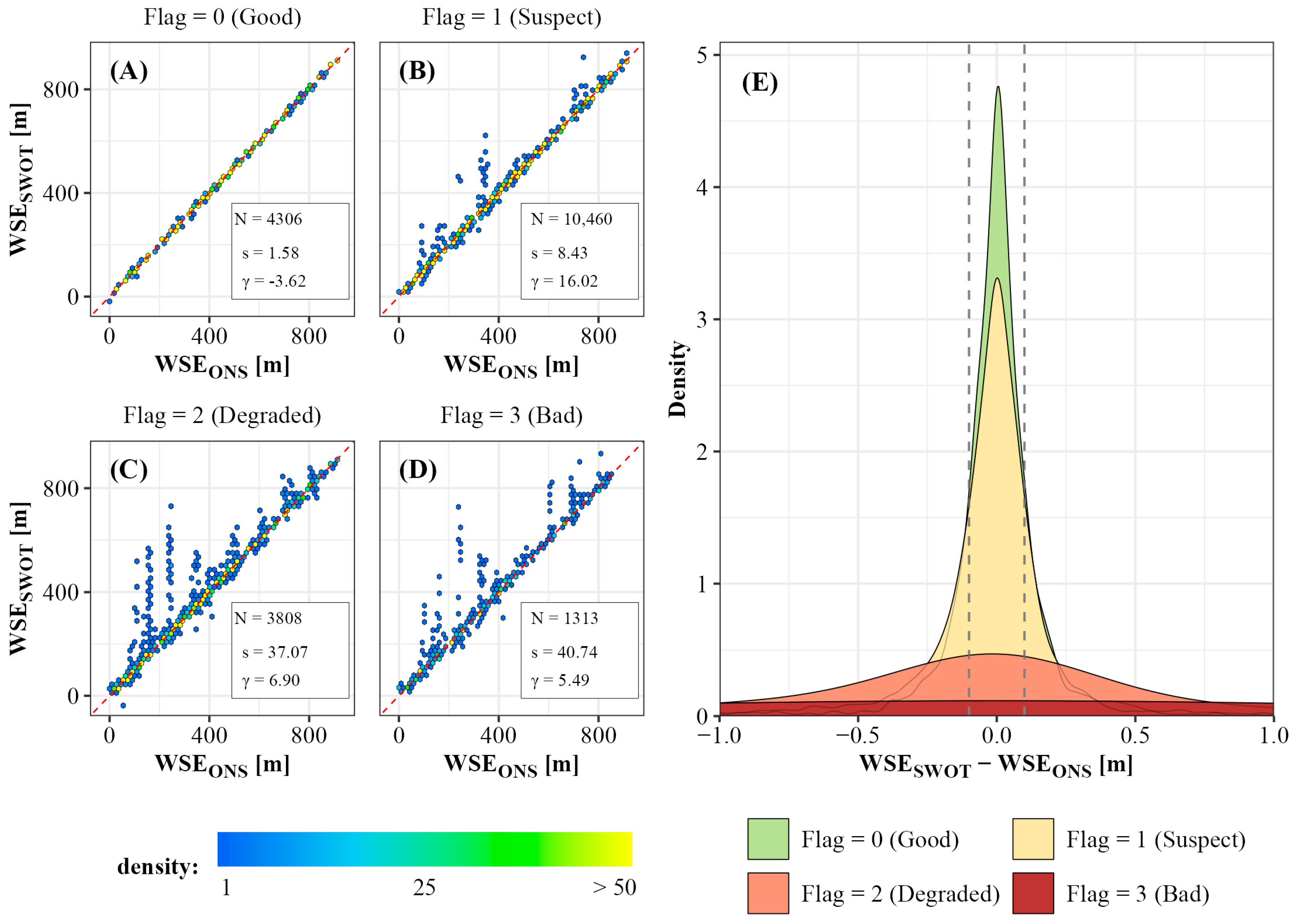
With several studies using SWOT quality flags as a filter, we analyzed them, ranging from 0 (“Good”) to 3 (“Bad”). Figure 5A–D display heatmaps of the 19,887 WSE observations separated by their assigned quality flags. Flags 2 (“Degraded”) and 3 (“Bad”) clearly identify a substantial fraction of the poor-quality data, indicated by their high error standard deviations (s) of 37.07 m and 40.74 m, respectively. The lower performance of measurements flagged as degraded and bad is also visible in Figure 5E, which shows the histogram of the measurement error categorized per quality flag value. While Flags 0 and 1 are mostly concentrated near 0, measurements classified as degraded and bad have a less clear peak and considerably higher density around high error values.
However, while Flag = 0 significantly filters poor-quality data, resulting in a closer alignment with in situ measurements, it still has a high standard deviation of 1.58 m. From Figure 5E, we can see that this value is probably due to the presence of outliers within this flag, as its histogram clearly shows a concentration of data inside these boundaries and near zero. Moreover, this flag only contains 22% (4306 out of 19,887 points) of available data; hence, most of the information gathered from SWOT does not fall within this criterion, suggesting that filtering only Flag = 0 might be overly restrictive (Table 2).
In addition, Flag = 1 contains most of the data points, including 53% of the total, or 10,460 observations (Table 2). Despite exhibiting higher variability than those points flagged as good, i.e., a standard deviation of 8.43 m, it still retains a significant number of reliable observations near optimal values. Table 2 presents the number and percentage of observations within absolute WSE difference thresholds (0.1 m, 0.3 m, 0.5 m, 0.8 m, 1.0 m) across flagging criteria, allowing performance evaluation under different tolerance levels. The SQRTL column reflects an alternative filtering strategy proposed in Section 3.6. This strategy retains 66% of the dataset, with 13,070 measurements (more than three times that of Flag = 0), while maintaining a similar proportion of accurate observations.

3.4. Influence of Lake Geometry on WSE Anomalies

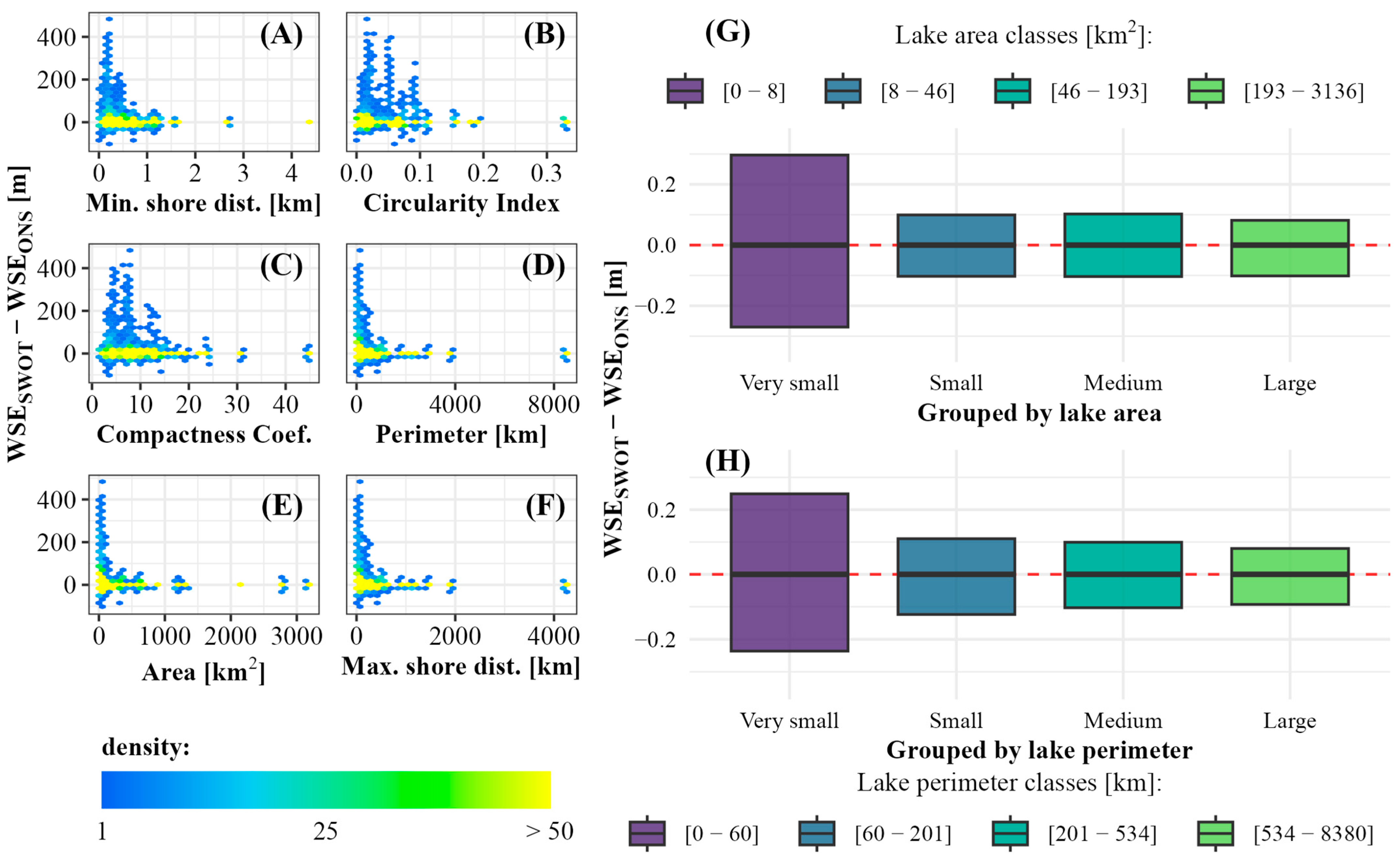
We examined the relationship between the geometry variables, identified by the RF analysis, with WSE precision for each parameter: area [km2], perimeter [km], circularity index [nondimensional], compactness coefficient [nondimensional], and minimum and maximum shore-to-shore distance [km] (Figure 6). Higher variance and difference values between SWOT and ONS were observed for smaller lakes, across all parameters in the heatmaps of Figure 6A–F and in the IQR boxplots (Figure 6G,H).
The lakes were grouped into four equally sized categories, ranging from very small to large, with 33 in each one. For each group, an IQR-based boxplot was drawn, only displaying the data within the 25th and 75th percentile. This excluded extreme values (Figure 6G,H) and showed a decrease in error variability with the increase in lake size (by both area and perimeter), with all IQR limits being under 25 cm. Designing groups with an equal number of lakes resulted in size classes with heterogeneous ranges.
Individual lake-geometry assessments were repeated separately for the three studied products (LakeSP_Obs, Raster_250m, and Raster_100m), showing the same overall patterns across them, but with a more pronounced effect for the raster products, particularly for the very small lakes and short perimeters (Supplementary Material Figure S2).

3.5. SWOT-Specific Drivers of WSE Precision: Cross-Track, Angle, and Layover Effects

The precision of SWOT WSE measurements is influenced not only by the geometry of water bodies, but also by the observation geometry. Among these, three were found to be important according to the RF analysis (Figure 4), such as the relative position of an observation within the SWOT swath, the radar incidence angle, and the estimated error due to the layover effect. By examining these SWOT-specific drivers, we can better understand their influence on errors and broaden the understanding of the physical characteristics of radar-based observations and their interaction with Earth’s water surface.
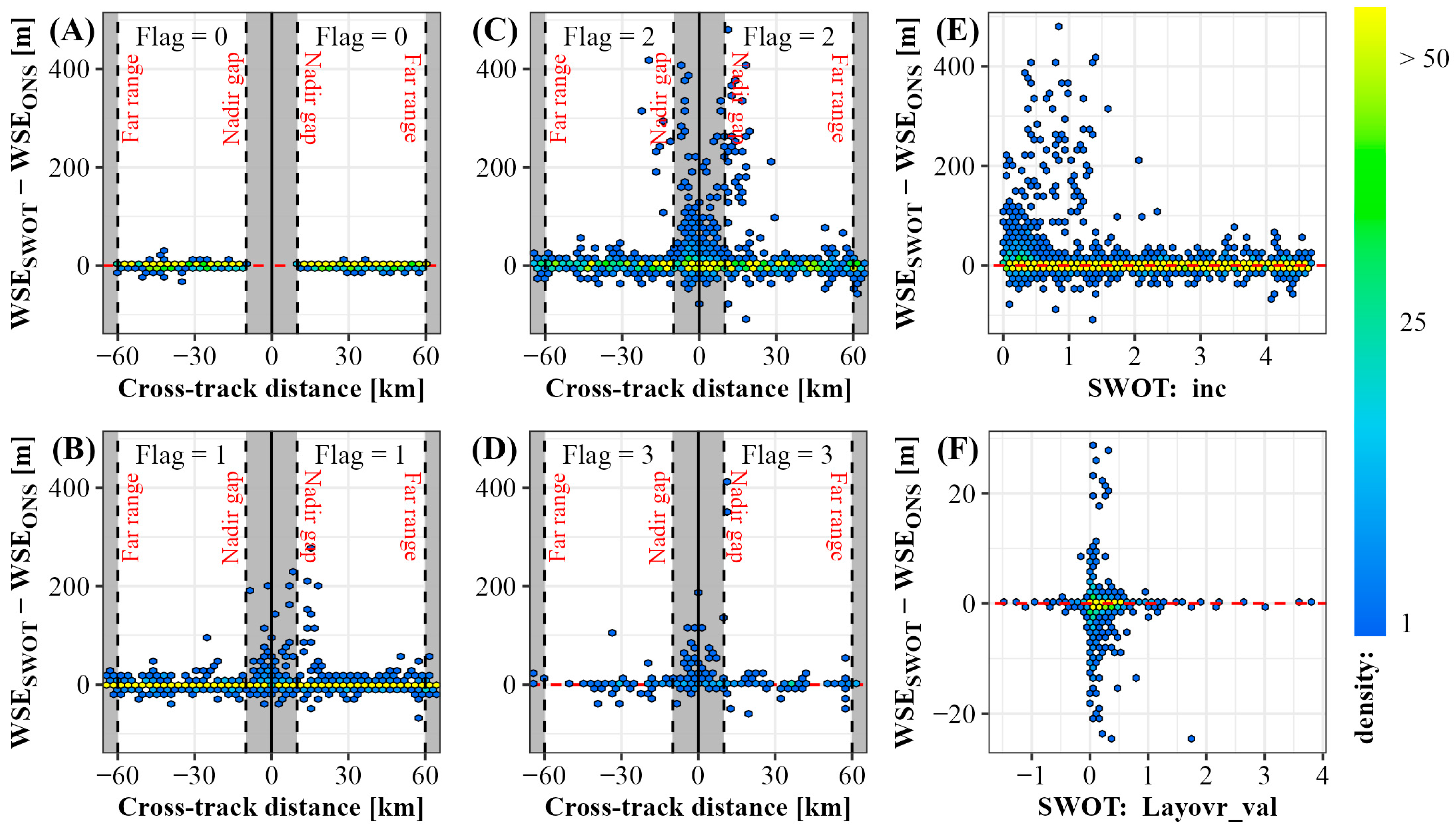
Figure 7 illustrates the relationship between WSE (SWOT–ONS) precision and cross-track distance. Our approach shows that the poorer-quality data are concentrated in the near range, although most observations have differences that are comparable to those observed in the mid-range of the KaRIn sensor (optimal range). The heatmap shows that most data points in flags 0, 1, and 2 (Figure 7A–C) are around the optimal line (difference = 0), although Flag = 2 has a much higher variance.
Two product-specific variables (layovr_val and inc) are shown as influencing WSE precision from the RF analysis. Layovr_val estimates WSE error due to layover and is only available in LakeSP, whereas inc is the incidence angle of the satellite for the measurement and is only available for the rasters. Figure 7E,F present heatmaps of the WSE differences between SWOT and ONS as a function of these variables. As expected, raster data (Figure 7E) exhibits greater variability (higher values for the differences) with more observations, while the vector data (Figure 7F) has greater stability at the cost of fewer data points.
As the incidence angle is related to the cross-track distance, the observed effects of the cross-track distance are extended to this variable. In contrast, the apparent relationship between layovr_val and measurement performance does not necessarily imply a direct causal effect, as layover effects may be less pronounced under the relatively low topographic relief conditions of the large lakes analyzed in this study. Therefore, even though layovr_val was identified by the RF as a potentially important variable, it was not considered a sufficiently robust standalone indicator of measurement quality in this context, and we chose not to include the layover error estimate in the proposed filtering strategy.
The cross-track distance, incidence angle, and the layovr_val were also evaluated separately for each of the three studied products (LakeSP_Obs, Raster_250m, and Raster_100m), showing the same overall patterns across them and confirming that near-nadir observations are consistently more problematic across the products, particularly for the raster products (Supplementary Material Figure S3).

3.6. Proposal of Filtering Based on the Key Drivers

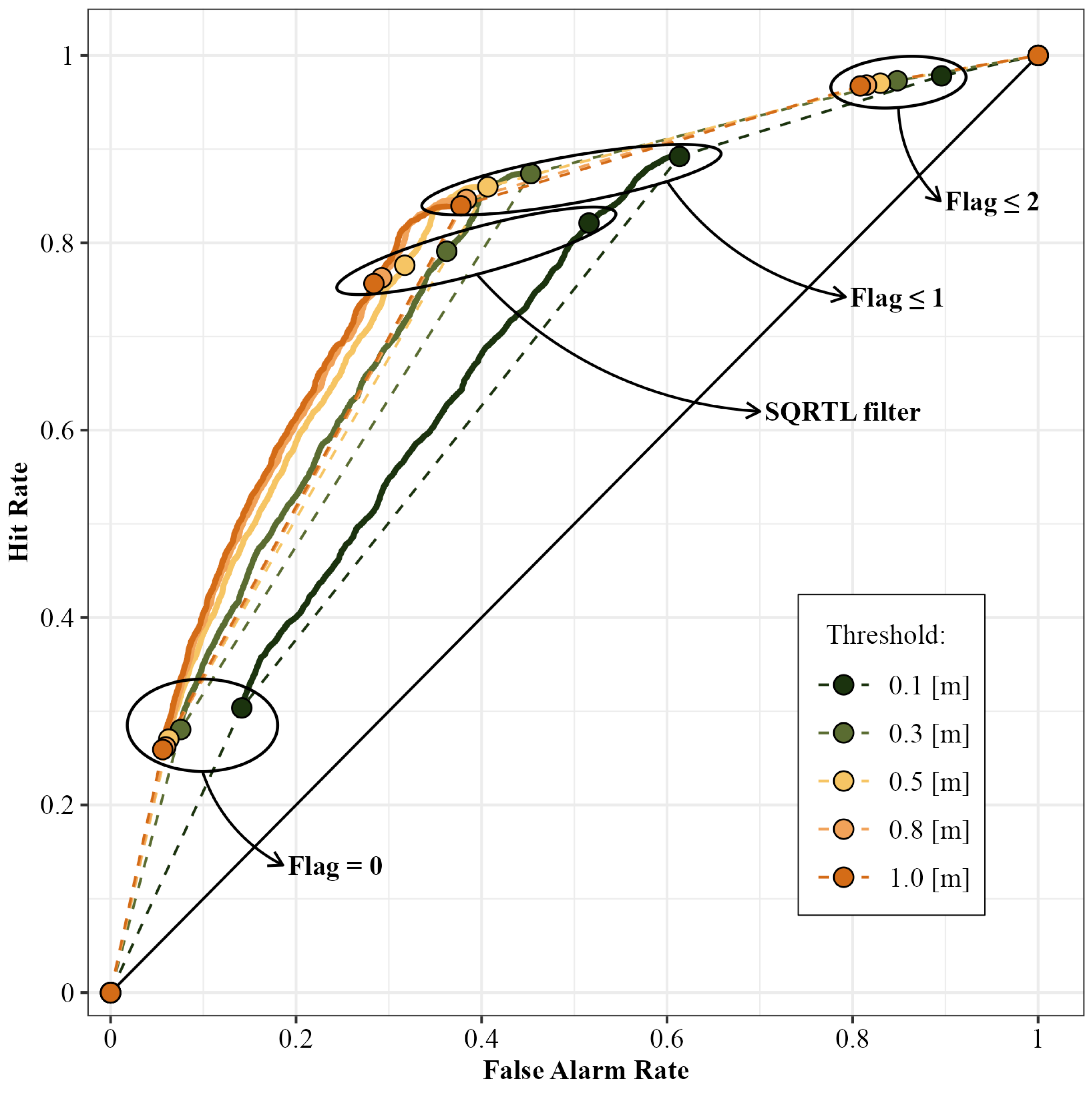
Based on the SWOT-derived variables assessed in the RF analysis, cross-track distance emerged as a key factor influencing WSE precision. Therefore, we propose its integration with the current flagging system to improve data availability while preserving the overall precision. The resulting SQRTL filter combines quality flags and observation range (cross-track distance), with ROC curves shown in Figure 8.
Figure 8 displays ROC curves (hit rate vs. false alarm rate) across selected thresholds (Table 2). Dashed lines represent increments in the performance of increasingly permissive flag combinations (e.g., Flag ≤ 0, 1, 2, 3), with solid lines forming the Pareto front, i.e., the optimal result from a grid search calibration of cross-track distance boundaries. Highlighted points correspond to the use of specific flags or the proposed filtering method (i.e., SQRTL).
Across all thresholds, Flag = 0 consistently exhibits low hit rates due to its restrictive nature, although with even lower false alarm rates, while Flag = 1 achieves substantially higher hit rates, but at the cost of an also substantial increase in false alarm rates. To refine the selection within Flag = 1, we performed a grid search to identify the cross-track distance range that maximized the Euclidean distance from a ROC point (Hit Rate, False Alarm Rate) to the 45° line, optimizing the balance between sensitivity and specificity. The optimal range found was between 8100 m and 58,100 m, differing from the nominal 10 km to 60 km overall recommended window.
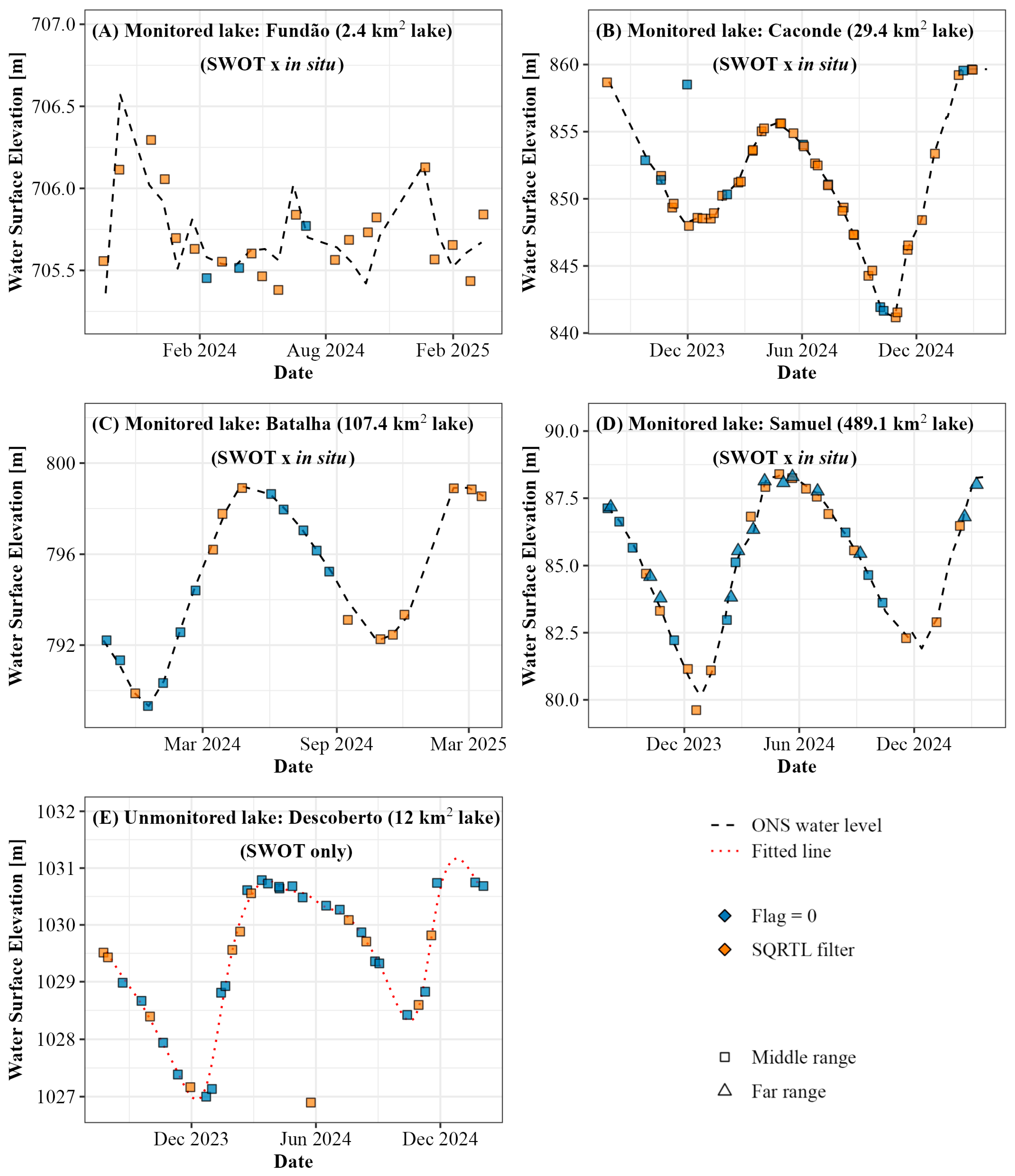
Figure 9 shows the potential of the proposed filter approach for SWOT lake water level monitoring, including in the absence of in situ data. The panels in Figure 9A–D show monitored lakes with different sizes (very small, small, medium, and large) and cross-track distances (near range below 10 km, middle range between 10 and 60 km, and far range above 60 km). This enables direct comparison between SWOT and in situ measurements.
Figure 9A shows a “very small lake” (Fundão; 2.4 km2; 25.70°S, 52.00°W), Figure 9B a “small lake” (Caconde; 29.4 km2; 21.61°S, 46.58°W), Figure 9C a “medium-sized lake” (Batalha; 107.4 km2; 17.35°S, 47.49°W), and Figure 9D a “large lake” (Samuel; 489.1 km2; 8.75°S, 63.45°W). These sites were selected as representative of the overall dataset in terms of mean SWOT–ONS differences and revisit intervals. Figure 9E presents an unmonitored 12 km2 lake (Descoberto; 15.75°S, 48.20°W), for which water levels are derived exclusively from SWOT observations.

4. Discussion

Compared with conventional nadir altimeters (e.g., Jason-3, Sentinel-3, SARAL/AltiKa), SWOT represents a fundamental shift in inland water observation capability. Nadir missions are limited by narrow ground tracks and larger radar footprints, reducing their effectiveness for small and medium-sized lakes and increasing susceptibility to land contamination and topographic effects [16,59,60]. Although SAR processing and Ka-band altimetry have improved nadir performance [61,62], spatial coverage remains constrained by the nadir track sampling strategy. In contrast, SWOT provides two-dimensional spatial coverage and enables the monitoring of lakes that are inaccessible to nadir altimeters, while maintaining strong consistency with independent satellite sources [31,40,63].
From our statistical analysis, it was shown that there is a key limitation of relying solely on global statistics for assessing measurement performance, as well as of the unadvised use of SWOT data without any screening. Nevertheless, the density distributions from Figure 3 show that most observations are concentrated near zero differences, indicating that most SWOT observations can capture accurate water level variations. For the LakeSP product, 59% of the observations fall within ±10 cm, 82% within ±30 cm, and 90% within ±1 m without any filtering. Raster products show a similar behavior with lower precision, with approximately 43% of observations within ±10 cm and 65% within ±30 cm.
In the same analysis, the raster products contained approximately 73% more observations than LakeSP_Obs during the 20-month study period, potentially introducing greater variability due to inclusion of lower-quality measurements, which are less frequent in LakeSP_Obs since it employs different, often stricter, filtering [46,48]. Therefore, the higher variance observed in the raster products does not necessarily imply that the vector product is more reliable. When restricting analysis to dates when all three products were populated, raster standard deviations notably decreased from 4.12 m for Raster_100m and 6.94 m for Raster_250m in the full dataset to 5 cm and 4 cm, respectively, when restricted to those same dates and evaluated within the IQR. This suggests that significant variability is attributed to non-overlapping data.
For the RF evaluation, it is worth noting that the numerical values are relative rather than absolute and should be interpreted comparatively rather than quantitatively, e.g., a variable that is double the value of another does not imply that it is twice as important. From this analysis, the SWOT quality flag was shown to be a key variable in understanding WSE precision, emphasizing its role in SWOT-related data filtering. Other important variables were also identified, such as the cross-track distance and incidence angle (Figure 4). This aligns with known radar limitations at near and far ranges [50], especially within SWOT mission’s Nadir gap (within 10 km of the satellite’s center) and far range (beyond 60 km). Therefore, filtering strategies based on these variables (mainly quality flags and cross-track distances) may yield better results.
SWOT’s KaRIn collects data across two swaths, each approximately 64 km wide. However, measurement performance is not uniform along the swath, with optimal precision expected within a 10 to 60 km range from the satellite’s centerline [46,48]. The dependency of the WSE uncertainty on the position within the swath is included in some error models [26,29,49]. Consequently, more processed products (i.e., LakeSP) exclude data from the 10 km near range (Nadir gap), around the centerline and in far range areas beyond 60 km [48]. Figure 7 highlights the substantial amount of potentially useful data within the Nadir gap, which might be recovered with improved filtering criteria.
Far range observations do not appear to significantly impact WSE quality. This is expected since the main problem at that range is signal strength, not measurement precision. Additionally, the current 10 km Nadir gap might be insufficiently conservative for flags greater than 0 (suggested by Figure 7), as unreliable points appear outside this range, also noted by [35], who observed outliers up to 25 km from the nadir track. However, further investigation is necessary to optimize boundaries for both ranges. Even though users do not have control over the position of the lake in relation to the satellite ground track, they may have a choice of different passes, selecting those that offer more favorable viewing geometry in cases where a lake is observed by multiple passes. Thus, it is important to be aware that measurements in the near range are more likely to be affected by considerable measurement errors.
Because the incidence angle is intrinsically related to the cross-track distance, the observed effects of the cross-track distance can be extended to the incidence angle. Hence, as expected, values closer to 0° have more problematic measurements, with observations having inc < 2° consistently showing a higher variance. Therefore, filtering methods based on this variable may improve data quality, similarly to the discussion of the cross-track distance. This can be particularly useful when analyzing an area that falls within multiple orbits, each having distinct incidence angles, with a possibility of relying more on those observations with higher angles.
The geometry of the lakes has been shown to be related to WSE precision as well. This aligns with [8], who noted that smaller lakes tend to have a greater surface area variability. Building on this, our results suggest a similar pattern but extended to WSE precision. A similar behavior, but less prominent, is found for the compactness coefficient and circularity index, implying a more accurate WSE from SWOT for more circular-shaped lakes (Figure 6). Therefore, the geometry and shape of the lake are important factors and should be noted before utilizing SWOT. However, unlike SWOT quality flags, one may not use them for screening strategies (a lake size and shape is mostly fixed).
Many studies using SWOT data rely on their quality flags to identify reliable measurements. Some studies use filters strictly based on them, using “good” or “suspect” flags, leading to limited data availability [35,36,37], while others further emphasized that flag-based filtering alone is often insufficient [21,22,34,39,40,42]. A potentially more robust strategy may be to use the factors influencing WSE alongside the quality flags.
Our results confirm that quality flags effectively categorize data by reliability, but the distribution of observations across flags is highly uneven. Flag = 0 retains only 22% of observations (a small fraction for many monitoring applications) with the 68th percentile errors below 12 cm, while Flag = 1 contains a large proportion of reliable measurements alongside higher variance data, increasing the 68th percentile errors up to 21 cm. For the full dataset, the 68th percentile errors are below 29 cm.
This suggests that targeted additional screening can recover meaningful observations without compromising overall precision. Compared to existing filtering approaches, SQRTL is intentionally minimalist in design. Studies that combine quality flags with statistical outlier removal [21,22,38,40,41,42] effectively reduce error variance but require paired in situ records or additional procedures, limiting their use over ungauged systems. In contrast, SQRTL relies only on two variables provided in every SWOT product (quality flag and cross-track distance).
By combining all Flag = 0 with cross-track constrained Flag = 1 observations, the SQRTL filter more than triples data availability while maintaining precision levels comparable to Flag = 0 alone (Table 2, Figure 8). The result is a subset of 66% of all observations with the 68th percentile errors below 16 cm, thus with the benefit of Flag = 1 data availability, but near Flag = 0 accuracy.
It becomes evident that a well-defined filtering strategy can improve the reliability of SWOT WSE estimates for hydrological applications. Studies report satisfactory performance only after discarding a significant fraction of available observations through quality flag screening and additional filtering procedures [21,22,34,35,36,37,39,40,42]. Collectively, these findings show that SWOT can provide accurate hydrological information when observations are carefully filtered and selected.
Studies using other satellite missions have also reported satisfactory results in WSE evaluation. Sentinel-6 RMSE values ranging from 5 to 50 cm have been reported [64], and RMSE values ranging from 4 to 36 cm have been reported for ICESat-1, ICESat-2, and GEDI [65]. Nevertheless, all these missions rely on much narrower sampling geometries than SWOT’s wide-swath capability. Therefore, SWOT can achieve comparable precision (with 68th percentile errors below 16 cm using the SQRTL filter) while having a broader spatial coverage and shorter revisit time.
The thresholds applied in the proposed framework here are not assumed to be universal, but instead reflect the hydrological, geomorphological, and orbital conditions of the study area. However, the framework itself demonstrates potential for transfer to wherever SWOT observations and reliable in situ water level data are available. Regional differences in geomorphology, shoreline complexity, hydrological regime, and SWOT pass geometry may lead to different optimal threshold values. Because the proposed filter is intentionally conservative, it may also serve as a baseline approach in regions where in situ data are sparse or unavailable.
The proposed SQRTL filter strategy inevitably reduces the number of retained data overall. However, it substantially increases data availability to using only Flag = 0 observations, with the average revisit time remaining adequate and proximate to the optimal values. With all available data, from which 54% of the measurements have errors in excess of 10 cm (Table 2), the median revisit times were 11, 10 and 13 days for the Raster_100m, Raster_250m and LakeSP products, respectively. However, using only Flag = 0, these revisit times increased to 88, 123 and 25 days, respectively. After applying the proposed filter, the median revisit times are 18, 16 and 14 days for Raster_100m, Raster_250m and LakeSP, respectively, showing a major improvement in contrast to Flag = 0, affording higher measurement quality with a modest decrease in temporal sampling.
As expected, the LakeSP product is more stable, as it showed only a small change relative to the unfiltered case, whereas the raster products exhibit a larger increase in revisit intervals. Even with filtering, the effective temporal sampling remains close to two observations per month on average. Given that the study period spans both major flood events and drought conditions in Brazil, the revisit frequency remains suitable for hydrological monitoring of reservoir water levels.
However, these gains in spatial detail come with a more complex observational geometry. SWOT’s wide-swath interferometric design introduces error dependencies related to incidence angle, cross-track position, and surface characteristics [46,50,66,67,68]. Consequently, data quality assessment should not rely solely on conservative flag-based strategies when the objective is to balance precision and data availability for hydrological applications. Instead, filtering approaches must explicitly account for the physical and orbital factors governing when SWOT observations are most reliable.
The application of the proposed filter for monitored and unmonitored lakes (Figure 9) showed positive results for different sized lakes (2.4 km2 to 489.1 km2) and different overpasses with varying distances from the Nadir gap (near to far range). The smooth temporal evolution captured demonstrates the ability of SWOT, when combined with the proposed filtering strategy, to characterize seasonal water level variability without any in situ measurements. Spurious data remain evident in panels 9B and 9E across quality flags 0 and 1, indicating that occasional anomalous observations persist and complementary outlier-removal or smoothing remains encouraged. However, the additional number of WSE observations is clear, showcasing the filter’s potential.
By providing both a validated filtering strategy and a reproducible framework, this study contributes a practical foundation for expanding systematic lake monitoring, particularly in data-scarce regions where SWOT may represent the only available source of continuous water level information.

5. Conclusions

This study describes a scalable quality control and data filtering technique designed to facilitate the use of SWOT for monitoring (un)gauged lakes and evaluating the expected quality of WSE measurements. Here we evaluated the performance of these measurements across Brazil, demonstrating good precision with low standard deviations when focusing on the values within the IQR. As a novel satellite mission, SWOT significantly expands the spatial and temporal coverage of hydrological monitoring, especially for ungauged lakes and rivers. Importantly, it also delivers a rich set of supporting variables that can assist users in evaluating data quality.
An RF analysis identified key drivers of WSE precision based on the MDA metric. Among the top-ranked variables were some SWOT-derived variables (particularly the quality flags, the WSE uncertainty, and the cross-track distance), and geometric characteristics of lakes, with smaller and less circular lakes associated with higher WSE variability. These findings suggest that the PLD, which already characterizes each lake, could be enhanced to include shape-based indicators to support the current quality flagging process.
Most critically, this study highlights existing limitations in relying solely on SWOT’s quality flags for filtering high-quality WSE data. Flag = 0 (“Good”) may be overly restrictive for many hydrological applications, including only 22% of all observations, while still retaining anomalous data. Although the flags remain a useful starting point, they can be refined with improved filtering strategies. Here, we proposed the inclusion of observations with quality flags 0 and 1, retaining a subset of Flag = 1 observations constrained by a cross-track distance between 8.1 km and 58.1 km. Using these targeted filters as a complement to the existing flagging system provided better results, enhancing both data availability and reliability. While this threshold is regionally derived, the proposed framework could be transferable to wherever SWOT and in situ data are available or can be used as a baseline where only limited in situ data are available.
The proposed filter (SQRTL) strategy is particularly valuable for timeseries hydrology applications, where occasional extreme errors can dominate derived signals such as storage change estimates, anomaly detection, and model calibration, yet sufficient temporal sampling is required to resolve seasonal dynamics. With major improvements in revisit intervals (from 1 to 2 observations per month in LakeSP), effective sampling is adequate for many water resource applications. By enabling the systematic use of SWOT observations in poorly monitored systems, this framework has the potential to substantially expand lake and reservoir monitoring globally. For Brazil, it may increase the current coverage from 714 reservoirs to more than 100,000 lakes identified in the PLD, increasing the monitoring and availability of the data. An example over an ungauged lake showed the feasibility of this approach, with promising results.
Although the SQRTL framework can be applied elsewhere, the threshold values derived in this study are specific to the Brazilian dataset and should not be interpreted as universal. In addition, future work should evaluate the framework under different hydrological and geomorphological settings to assess its broader applicability.
Overall, this work demonstrates the value of advanced data screening techniques and strategic use of explanatory variables in strengthening the validity of satellite-derived hydrological data. While this study contributes to the current state of the art regarding radar use for hydrological applications, further research is needed on outlier detection and systematic bias assessment. More importantly, the results provide a practical foundation for incorporating SWOT WSE estimates into hydrological analysis and reservoir monitoring, particularly in poorly gauged regions where reliable water level information has previously been unavailable.

Supplementary Materials

The following supporting information can be downloaded at: https://www.mdpi.com/article/10.3390/rs18101609/s1, Figure S1: Spatial distribution of the median WSE anomalies (SWOT–ONS) for the analyzed lakes. Figure S2: WSE precision related to the lake geometry for the three products (LakeSP_Obs, Raster_250m, and Raster_100m). Figure S3: WSE precision related to the cross-track distance, incidence angle and layovr_val for the three products (LakeSP_Obs, Raster_250m, and Raster_100m).

Author Contributions

Conceptualization, T.L., D.B., L.O.S., R.P.d.M.F., R.E.C. and T.A.; methodology, T.L., G.G.P. and R.P.d.M.F.; software, T.L.; validation, T.L., G.G.P. and R.P.d.M.F.; resources, T.L., D.B., T.A., S.S. and R.E.C.; writing—original draft preparation, T.L.; writing—review and editing, T.L., D.B., L.O.S., T.A., G.G.P., R.P.d.M.F. and R.E.C.; visualization, T.L., T.A., R.P.d.M.F. and R.E.C.; supervision, T.A., R.P.d.M.F. and R.E.C.; project administration, T.A., S.S. and R.E.C.; funding acquisition, T.L., D.B., T.A., S.S. and R.E.C. All authors have read and agreed to the published version of the manuscript.

Funding

This research was funded by ANA, grant number 04687620240003, and in part by the Coordenação de Aperfeiçoamento de Pessoal de Nível Superior—Brasil (CAPES)—Finance Code 001.

Data Availability Statement

All data used in this study are available at https://github.com/Lappicy/RS-manuscript, accessed on 1 April 2026.

Acknowledgments

The authors thank the Brazilian National Water and Sanitation Agency (ANA) for its support and cooperation, as well as CAPES, CNPq, and FAPDF (grant numbers 23547.93.27555.30052018 and 00193.00000335/2026-19). R.P.d.M. Frasson would like to acknowledge the support received through the NASA Earth Action Water Resources program (Award number 21-WATER21-2-0004). A portion of this work was performed at the Jet Propulsion Laboratory, California Institute of Technology, under contract with NASA. The authors thank the reviewers for their feedback, which helped improve this paper.

Conflicts of Interest

The authors declare no conflicts of interest. The funders had no role in the design of the study; in the collection, analyses, or interpretation of data; in the writing of the manuscript; or in the decision to publish the results.

Abbreviations

The following abbreviations are used in this manuscript:
ANABrazilian Water and Sanitation Agency
HEPPHydroelectric Power Plant
IQRInterquartile Range
KaRInKa-band Radar Interferometer
MDAMean Decrease Accuracy
ONSBrazilian National Operator for the Electric System
PLDPrior Lake Database
RFRandom Forest
ROCReceiver Operating Characteristic
SQRTLSWOT Quality-Range Threshold for Lakes
SWOTSurface Water and Ocean Topography
WSEWater Surface Elevation

References

  1. Downing, J.A.; Prairie, Y.T.; Cole, J.J.; Duarte, C.M.; Tranvik, L.J.; Striegl, R.G.; McDowell, W.H.; Kortelainen, P.; Caraco, N.F.; Melack, J.M.; et al. The global abundance and size distribution of lakes, ponds, and impoundments. Limnol. Oceanogr. 2006, 51, 2388–2397. [Google Scholar] [CrossRef]
  2. Verpoorter, C.; Kutser, T.; Seekell, D.A.; Tranvik, L.J. A global inventory of lakes based on high-resolution satellite imagery. Geophys. Res. Lett. 2014, 41, 6396–6402. [Google Scholar] [CrossRef]
  3. Messager, M.L.; Lehner, B.; Grill, G.; Nedeya, I.; Schmitt, O. Estimating the volume and age of water stored in global lakes using a geo-statistical approach. Nat. Commun. 2016, 7, 13603. [Google Scholar] [CrossRef]
  4. Pi, X.; Luo, Q.; Feng, L.; Xu, Y.; Tang, J.; Liang, X.; Ma, E.; Cheng, R.; Fensholt, R.; Brandt, M.; et al. Mapping global lake dynamics reveals the emerging roles of small lakes. Nat. Commun. 2022, 13, 5777. [Google Scholar] [CrossRef]
  5. ANA, Agência Nacional de Águas e Saneamento Básico. Conjuntura dos Recursos Hídricos do Brasil 2025: Dados Análises, Tendências e Governança dos Recursos Hídricos. Relatório Pleno. Available online: https://www.snirh.gov.br/portal/centrais-de-conteudos/conjuntura-dos-recursos-hidricos (accessed on 1 April 2026).
  6. Wang, J.; Pottier, C.; Cazals, C.; Battude, M.; Sheng, Y.; Song, C.; Sikder, M.S.; Yang, X.; Ke, L.; Gosset, M.; et al. The Surface Water and Ocean Topography Mission (SWOT) Prior Lake Database (PLD): Lake mask and operational auxiliaries. Water Resour. Res. 2025, 61, e2023WR036896. [Google Scholar] [CrossRef]
  7. ANA, Agência Nacional de Águas e Saneamento Básico. System for Monitoring Reservoirs (SAR). Available online: https://www.ana.gov.br/sar/ (accessed on 1 April 2026).
  8. Bonnema, M.; David, C.H.; Frasson, R.P.d.M.; Oaida, C.; Yun, S.H. The global surface area variations of lakes and reservoirs as seen from satellite remote sensing. Geophys. Res. Lett. 2022, 49, e2022GL098987. [Google Scholar] [CrossRef]
  9. Cheng, C.; Zhang, F.; Li, X.; Tan, M.L.; Kumar, P.; Johnson, B.A.; Shi, J.; Zhao, Q.; Liu, C. Variations in water storage of Bosten Lake, China, over the last two decades based on multi-source satellite data. J. Hydrol. Reg. Stud. 2023, 49, 101496. [Google Scholar] [CrossRef]
  10. Farouk, M.I.H.Z.; Jamil, Z.; Latip, M.F.A. Towards online surface water quality monitoring technology: A review. Environ. Res. 2023, 238, 117147. [Google Scholar] [CrossRef] [PubMed]
  11. Huang, Z.; Sun, R.; Wang, H.; Wu, X. Trends and Innovations in Surface Water Monitoring via Satellite Altimetry: A 34-Year Bibliometric Review. Remote Sens. 2024, 16, 2886. [Google Scholar] [CrossRef]
  12. Beltrão, D.; Cicerelli, R.E.; Lappicy, T.; Sales, L.O.; Teixeira, A.A.; Cunha, L.S.; Andrade, A.C.F.; Almeida, T. SWOT: Reviewing challenges and opportunities in hydrological applications to inland waters. IEEE Access 2026, early access. [Google Scholar] [CrossRef]
  13. Vignudelli, S.; Scozzari, A.; Abileah, R.; Gómez-Enri, J.; Benveniste, J.; Cipollini, P. Water Surface Elevation in Coastal and Inland Waters Using Satellite Radar Altimetry. In Extreme Hydroclimatic Events and Multivariate Hazards in a Changing Environment: A Remote Sensing Approach; Elsevier: Amsterdam, The Netherlands, 2019; pp. 87–127. [Google Scholar] [CrossRef]
  14. Du, B.; Li, J.C.; Jin, T.Y.; Zhou, M.; Gao, X.W. Synthesis Analysis of SWOT KaRIn-Derived Water Surface Heights and Local Cross-Calibration of the Baseline Roll Knowledge Error Over Lake Baikal. Earth Space Sci. 2021, 8, e2021EA001990. [Google Scholar] [CrossRef]
  15. Enguehard, P.; Frappart, F.; Zeiger, P.; Blarel, F.; Satgé, F.; Bonnet, M.P. Contribution of automatically generated radar altimetry water levels from unsupervised classification to study hydrological connectivity within Amazon floodplains. J. Hydrol. Reg. Stud. 2023, 47, 101397. [Google Scholar] [CrossRef]
  16. Le Traon, P.Y.; Dibarboure, G.; Lellouche, J.M.; Pujol, M.I.; Benkiran, M.; Drevillon, M.; Drillet, Y.; Faugère, Y.; Remy, E. Satellite altimetry and operational oceanography: From Jason-1 to SWOT. Ocean Sci. 2025, 21, 1329–1347. [Google Scholar] [CrossRef]
  17. Bonassies, Q.; Fatras, C.; Peña-Luque, S.; Dubois, P.; Piacentini, A.; Cassan, L.; Ricci, S.; Nguyen, T.H. A comprehensive study of Surface Water and Ocean Topography (SWOT) Pixel Cloud data for flood extent extraction. Remote Sens. Environ. 2026, 333, 115101. [Google Scholar] [CrossRef]
  18. Solander, K.C.; Reager, J.T.; Famiglietti, J.S. How well will the Surface Water and Ocean Topography (SWOT) mission observe global reservoirs? Water Resour. Res. 2016, 52, 2123–2140. [Google Scholar] [CrossRef]
  19. Xiong, J.; Jiang, L.; Qiu, Y.; Wongchuig, S.; Abhishek, G.S.; Chen, J. On the Capabilities of the SWOT Satellite to Monitor the Lake Level Change over the Third Pole. Environ. Res. Lett. 2023, 18, 044008. [Google Scholar] [CrossRef]
  20. Riggs, R.M.; Dickinson, J.E.; Brinkerhoff, C.B.; Sikder, M.S.; Wang, J.; Gao, H.; Allen, G.H. Characterizing operational signatures of reservoirs with the SWOT satellite by comparing natural lake and reservoir dynamics. Environ. Res. Lett. 2026, 21, 044008. [Google Scholar] [CrossRef]
  21. Jing, R.; Liao, J.; Ma, S.; Liu, X.; Wu, Y. Exploring the performance of SWOT satellite to monitor lake volumes: A case study of Chinese lakes. J. Remote Sens. 2026, 6, 1026. [Google Scholar] [CrossRef]
  22. Zhan, P.; Wang, J.; Chen, T.; Luo, S.; Liu, K.; Ke, L.; Fan, C.; Lin, Y.; Song, C. Integrating SWOT with multi-source satellite observations for near-daily reservoir water level monitoring. Water Resour. Res. 2026, 62, e2024WR039711. [Google Scholar] [CrossRef]
  23. Wongchuig-Correa, S.; Paiva, R.C.D.; Biancamaria, S.; Collischonn, W. Assimilation of future SWOT-based river elevations, surface extent observations and discharge estimations into uncertain global hydrological models. J. Hydrol. 2020, 590, 125473. [Google Scholar] [CrossRef]
  24. Lubczynski, M.W.; Leblanc, M.; Batelaan, O. Remote sensing and hydrogeophysics give a new impetus to integrated hydrological models: A review. J. Hydrol. 2024, 633, 130901. [Google Scholar] [CrossRef]
  25. Domeneghetti, A.; Schumann, G.P.; Frasson, R.P.M.; Wei, R.; Pavelsky, T.M.; Castellarin, A.; Brath, A.; Durand, M.T. Characterizing water surface elevation under different flow conditions for the upcoming SWOT mission. J. Hydrol. 2018, 561, 848–861. [Google Scholar] [CrossRef]
  26. Durand, M.; Chen, C.; Frasson, R.P.M.; Pavelsky, T.M.; Williams, B.; Yang, X.; Fore, A. How will radar layover impact SWOT measurements of water surface elevation and slope, and estimates of river discharge? Remote Sens. Environ. 2020, 247, 111883. [Google Scholar] [CrossRef]
  27. Durand, M.; Dai, C.; Moortgat, J.; Yadav, B.; Frasson, R.P.M.; Li, Z.; Wadkwoski, K.; Howat, I.; Pavelsky, T.M. Using river hypsometry to improve remote sensing of river discharge. Remote Sens. Environ. 2024, 315, 114455. [Google Scholar] [CrossRef]
  28. Meem, T.H.; Rhoads, B.L.; Wang, J.; Frasson, R.P.M. Detecting water-surface superelevation in meandering rivers using Surface Water and Ocean Topography (SWOT) satellite data. Geophys. Res. Lett. 2026, 53, e2025GL119167. [Google Scholar] [CrossRef]
  29. Frasson, R.P.M.; Schumann, G.J.P.; Kettner, A.J.; Brakenridge, G.R.; Krajewski, W.F. Will the Surface Water and Ocean Topography (SWOT) Satellite Mission Observe Floods? Geophys. Res. Lett. 2019, 46, 10435–10445. [Google Scholar] [CrossRef]
  30. Altenau, E.H.; Pavelsky, T.M.; Durand, M.T.; Yang, X.; Frasson, R.P.M.; Bendezu, L. The Surface Water and Ocean Topography (SWOT) Mission River Database (SWORD): A Global River Network for Satellite Data Products. Water Resour. Res. 2021, 57, e2021WR030054. [Google Scholar] [CrossRef]
  31. Biancamaria, S.; Lettenmaier, D.P.; Pavelsky, T.M. The SWOT mission and its capabilities for land hydrology. In Survey in Geophysics; Springer International Publishing: Cham, Switzerland, 2016; pp. 117–147. [Google Scholar] [CrossRef]
  32. Moreira, D.; Papa, F.; Fassoni-Andrade, A.; Fleischmann, A.; Wongchuig, S.; Paiva, R.; Paris, A.; Frappart, F.; Melo, J.; Crétaux, J.F.; et al. Widespread and exceptional reduction in river water levels across the Amazon Basin during the 2023 extreme drought revealed by satellite altimetry and SWOT. Geophys. Res. Lett. 2025, 52, e2025GL116180. [Google Scholar] [CrossRef]
  33. Yao, J.; Xu, N.; Wang, M.; Liu, T.; Lu, H.; Cao, Y.; Tang, X.; Mo, F.; Chang, H.; Gong, H.; et al. SWOT satellite for global hydrological applications: Accuracy assessment and insights into surface water dynamics. Int. J. Digit. Earth 2025, 18, 2472924. [Google Scholar] [CrossRef]
  34. Xu, Y.; Frappart, F.; Tang, G.; Zhang, G.; Lin, P.; Jiang, L.; Papalexiou, S.; Yao, F.; Han, X.; Xia, J. A global intercomparison of SWOT and traditional nadir radar altimetry for monitoring river water surface elevation. Remote Sens. Environ. 2026, 334, 115219. [Google Scholar] [CrossRef]
  35. Kica, S.; Pavelsky, T.M.; Fayne, J.V.; Williams, B.A. SWOT Water Surface Elevation in Herbaceous Wetlands of Florida’s Everglades. Geophys. Res. Lett. 2025, 52, e2025GL114956. [Google Scholar] [CrossRef]
  36. Laipelt, L.; de Paiva, R.C.; Fan, F.M.; Collischonn, W.; Papa, F.; Ruhoff, A. SWOT reveals how the 2024 disastrous flood in South Brazil was intensified by increased water slope and wind forcing. Geophys. Res. Lett. 2025, 52, e2024GL111287. [Google Scholar] [CrossRef]
  37. Maubant, L.; Dodd, L.; Tregoning, P. Assessing the accuracy of SWOT measurements of water bodies in Australia. Geophys. Res. Lett. 2025, 52, e2024GL114084. [Google Scholar] [CrossRef]
  38. Das, P.; Hossain, F. Multi-satellite tracking of surface water storage change in the era of Surface Water and Ocean Topography (SWOT) satellite mission. Earth Space Sci. 2025, 12, e2024EA004178. [Google Scholar] [CrossRef]
  39. Patidar, G.; Indu, J.; Karmakar, S. Performance assessment of Surface Water and Ocean Topography (SWOT) mission for WSE measurement across India. Geophys. Res. Lett. 2025, 52, e2025GL115804. [Google Scholar] [CrossRef]
  40. Wu, S.; Cai, Y.; Ke, C.Q.; Xiao, Y.; Li, H.; He, Z.; Duan, Z. SWOT mission enables high-precision and wide-coverage lake water levels monitoring on the Tibetan Plateau. J. Hydrol. Reg. Stud. 2025, 59, 102357. [Google Scholar] [CrossRef]
  41. Hamoudzadeh, A.; Ravanelli, R.; Crespi, M. SWOT Level 2 Lake Single-Pass Product: The L2_HR_LakeSP Data Preliminary Analysis for Water Level Monitoring. Remote Sens. 2024, 16, 1244. [Google Scholar] [CrossRef]
  42. Sales, L.O.; Lappicy, T.; Beltrão, D.; Teixeira, A.A.; Cicerelli, R.; Almeida, T. SWOT Satellite Nodes as Virtual Stations During the 2024 Extreme Flood in Southern Brazil. Hydrology 2025, 12, 248. [Google Scholar] [CrossRef]
  43. ONS, Operador Nacional do Sistema Elétrico. Brazilian National Operator for the Electric System. Hydraulic Data by Reservoir–Hourly Basis. Available online: https://dados.ons.org.br/dataset/dados_hidrologicos_ho (accessed on 1 April 2026).
  44. ANA, Agência Nacional de Águas e Saneamento Básico. Massas d’água. Brazilian National Water and Sanitation Agency’s (ANA) Metadata Catalog. Available online: https://metadados.snirh.gov.br/geonetwork/srv/eng/catalog.search#/metadata/7d054e5a-8cc9-403c-9f1a-085fd933610c (accessed on 1 April 2026).
  45. Brazil. Conselho Nacional de Recursos Hídricos. Resolução nº 32, de 15 de Outubro de 2003. Dispõe Sobre as Regiões Hidrográficas do Brasil. Available online: https://metadados.snirh.gov.br/geonetwork/srv/eng/catalog.search#/metadata/fb87343a-cc52-4a36-b6c5-1fe05f4fe98c (accessed on 1 April 2026).
  46. JPL. SWOT Science Data Products User Handbook; Jet Propulsion Laboratory Internal Document: Pasadena, CA, USA, 2026. [Google Scholar]
  47. JPL. SWOT Product Description. Level 2 KaRIn High Rate Raster Product Short Name: L2_HR_Raster. Revision C; Internal Document; Jet Propulsion Laboratory: Pasadena, CA, USA, 2026. [Google Scholar]
  48. SWOT. SWOT Product Description. Level 2 KaRIn High Rate Lake Single Pass Vector Product. Short Name: L2_HR_LakeSP Revision C; Internal Document SWOT-TN-CDM-0673-CNES; Jet Propulsion Laboratory: Pasadena, CA, USA, 2024. [Google Scholar]
  49. Frasson, R.P.M.; Ardila, D.R.; Pease, J.; Hestir, E.; Bright, C.; Carter, N.; Dekker, A.G.; Thompson, D.R.; Green, R.O.; Held, A. The impact of spatial resolution on inland water quality monitoring from space. Environ. Res. Commun. 2024, 6, 101003. [Google Scholar] [CrossRef]
  50. JPL. SWOT Project Mission Performance and Error Budget, Revision A; Jet Propulsion Laboratory: Pasadena, CA, USA, 2017; 117p. [Google Scholar]
  51. Das, B.C.; Islam, A.; Sarkar, B. Drainage basin shape indices to understanding channel hydraulics. Water Resour. Manag. 2022, 36, 2523–2547. [Google Scholar] [CrossRef]
  52. Breiman, L. Random forests. Mach. Learn. 2001, 45, 5–32. [Google Scholar] [CrossRef]
  53. Breiman, L.; Cutler, A.; Liaw, A.; Wiener, M. Package ‘Randomforest’; University of California: Berkeley, CA, USA, 2018. [Google Scholar]
  54. James, G.; Witten, D.; Hastie, T.; Tibshirani, R. An Introduction to Statistical Learning: With Applications in R, 2nd ed.; Springer: New York, NY, USA, 2021. [Google Scholar] [CrossRef]
  55. Mushagalusa, C.A.; Fandohan, A.B.; Kakaï, R.G. Random forest and spatial cross-validation performance in predicting species abundance distributions. Environ. Syst. Res. 2024, 13, 23. [Google Scholar] [CrossRef]
  56. Liu, H.; Xia, R.; Chen, Y.; Jia, R.; Wei, Y.; Yan, C.; Li, L.; Zhang, K.; Wang, Y.; Li, X. Spatial patterns of hydroecological health in the semi-arid yellow river basin: Revelations from machine learning models. Ecol. Indic. 2024, 168, 112799. [Google Scholar] [CrossRef]
  57. Zhou, Y.; Wei, G.; Wang, Y.; Wang, B.; Quan, Y.; Wu, Z.; Liu, J.; Bian, S.; Li, M.; Fan, W.; et al. Estimating Regional Forest Carbon Density Using Remote Sensing and Geographically Weighted Random Forest Models: A Case Study of Mid-to High-Latitude Forests in China. Forests 2025, 16, 96. [Google Scholar] [CrossRef]
  58. Fawcett, T. An introduction to ROC analysis. Pattern Recognit. Lett. 2006, 27, 861–874. [Google Scholar] [CrossRef]
  59. Michailovsky, C.I.; McEnnis, S.; Berry, P.A.M.; Smith, R.; Bauer-Gottwein, P. River monitoring from satellite radar altimetry in the Zambezi River basin. Hydrol. Earth Syst. Sci. 2012, 16, 2181–2192. [Google Scholar] [CrossRef]
  60. Schwatke, C.; Dettmering, D.; Bosch, W.; Seitz, F. DAHITI–an innovative approach for estimating water level time series over inland waters using multi-mission satellite altimetry. Hydrol. Earth Syst. Sci. 2015, 19, 4345–4364. [Google Scholar] [CrossRef]
  61. Nair, A.S.; Kumar, N.; Indu, J.; Vivek, B. Monitoring lake levels from space: Preliminary analysis with SWOT. Front. Water 2021, 3, 717852. [Google Scholar] [CrossRef]
  62. Nair, A.S.; Soman, M.K.; Girish, P.; Karmakar, S.; Indu, J. Evaluating SWOT water level information using a large scale hydrology simulator: A case study over India. Adv. Space Res. 2022, 70, 1362–1374. [Google Scholar] [CrossRef]
  63. Morrow, R.; Fu, L.L.; Ardhuin, F.; Benkiran, M.; Chapron, B.; Cosme, E.; d’Ovidio, F.; Farrar, J.T.; Gille, S.T.; Lapeyre, G.; et al. Global Observations of Fine-Scale Ocean Surface Topography with the Surface Water and Ocean Topography (SWOT) Mission. Front. Mar. Sci. 2019, 6, 232. [Google Scholar] [CrossRef]
  64. Domingo, X.; Gilbert, F.; Molina, R.; Escorihuela, M.J. Improved Inland Water Level Estimates with Sentinel-6 Fully Focused SAR Processing: A Case Study in the Ebre River Basin. Remote Sens. 2025, 17, 531. [Google Scholar] [CrossRef]
  65. Xiang, J.; Li, H.; Zhao, J.; Cai, X.; Li, P. Inland water level measurement from spaceborne laser altimetry: Validation and comparison of three missions over the Great Lakes and lower Mississippi River. J. Hydrol. 2021, 597, 126312. [Google Scholar] [CrossRef]
  66. Fjørtoft, R.; Gaudin, J.M.; Pourthie, N.; Lalaurie, J.C.; Mallet, A.; Nouvel, J.F.; Martinot-Lagarde, J.; Oriot, H.; Borderies, P.; Ruiz, C.; et al. KaRIn on SWOT: Characteristics of Near-Nadir Ka-Band Interferometric SAR Imagery. IEEE Trans. Geosci. Remote Sens. 2014, 52, 2172–2185. [Google Scholar] [CrossRef]
  67. Desrochers, N.M.; Peters, D.L.; Siles, G.; Charest, E.C.; Trudel, M.; Leconte, R. A Remote Sensing View of the 2020 Extreme Lake-Expansion Flood Event into the Peace-Athabasca Delta Floodplain-Implications for the Future SWOT Mission. Remote Sens. 2023, 15, 1278. [Google Scholar] [CrossRef]
  68. Salameh, E.; Desroches, D.; Deloffre, J.; Fjørtoft, R.; Mendoza, E.T.; Turki, I.; Froideval, L.; Levaillant, R.; Déchamps, S.; Picot, N.; et al. Evaluating SWOT’s interferometric capabilities for mapping intertidal topography. Remote Sens. Environ. 2024, 314, 114401. [Google Scholar] [CrossRef]
Figure 1. Location of 132 study sites across Brazilian hydrographic regions, with overlapping SWOT passes.
Remotesensing 18 01609 g001
Figure 2. Methodological workflow for WSE data processing and analysis.
Remotesensing 18 01609 g002
Figure 3. WSE differences (SWOT–ONS) after bias correction. (A) Histogram, with inset plot showing full range; and (B) Boxplots. Symbols s and γ represent the standard deviation and skewness.
Remotesensing 18 01609 g003
Figure 4. Mean Decrease Accuracy (MDA) in the random forest (higher values have higher influence), with each variable meaning described in Table 1. “All” refers to the RF model fitted to the dataset containing all three SWOT products.
Remotesensing 18 01609 g004
Figure 5. WSE comparisons (SWOT–ONS). (AD) Heatmaps of the WSE observed for each Flag; and (E) Distribution of the errors in each flag, with the ±10 cm error mark as gray dashed lines.
Remotesensing 18 01609 g005
Figure 6. (AF) WSE anomalies heatmap by lake’s geometry parameters; and (G,H) IQR boxplots (no whiskers or outliers) of this difference grouped by area and perimeter (33 lakes per group).
Remotesensing 18 01609 g006
Figure 7. Heatmap of WSE differences (SWOT–ONS) against SWOT-derived factors. (AD) Cross-track distance by quality flags; (E) Incidence angle of the measurements, in degrees; and (F) SWOT’s estimated WSE error due to layover.
Remotesensing 18 01609 g007
Figure 8. ROC curves for different accepted thresholds, for the current flagging system and the proposed filter (SQRTL), which includes Flag = 0 and Flag = 1 constrained by cross-track distance.
Remotesensing 18 01609 g008
Figure 9. Illustrative example of SWOT temporal sampling and measurement quality for reservoir WSE monitoring using the LakeSP_Obs product after applying the SQRTL filter with observations grouped into cross-track distance classes. (AD) Four differently sized monitored lakes with in situ measurements from ONS (black dashed line); and (E) A 12 km2 unmonitored lake, with only SWOT-derived WSE, and a dotted line representing a spline-based fit.
Remotesensing 18 01609 g009
Table 1. Explanatory variables used in the random forest algorithm.
VariableDescription of VariableData Source
cross_trackDistance to the satellite’s cross-track [m]LakeSP/Raster
wse_uUncertainty in the WSE measurement [m]LakeSP/Raster
wse_qualQuality Flag assigned by SWOTLakeSP/Raster
SWOT ProductLakeSP, Raster_100m or Raster_250mLakeSP/Raster
layovr_valEstimate of the WSE error due to layoverLakeSP
wse_stdStandard deviation of WSE from lake’s pixelsLakeSP
dark_fracFraction of the lake covered by dark waterLakeSP
partial_fFlag that indicates partial lake coverageLakeSP
xovr_cal_cCross-over calibration applied to wse [m]LakeSP
xovr_cal_qQuality flag for the cross-over calibrationLakeSP
incIncidence angle of radar measurement [deg.]Raster
darkwaterFraction of water_area covered by dark waterRaster
water_fracEstimated fraction of pixel covered by waterRaster
sig0Normalized radar cross section, or σ 0 [dB]Raster
sig0_cor_atmos_modelAtmos. correction model applied to σ 0 [dB]Raster
sig0_qualQuality flag for the σ 0 at water pixelsRaster
xoverHeight correction to WSE [m]Raster
Number of pixelsNumber of pixels with data in 3 × 3 windowRaster
AreaSurface area of the lake [km2]ANA
PerimeterPerimeter of the lake outline [km]ANA
Min. shore-to-shore dist.Parameter for shape and size of lake [km]ANA
Max. shore-to-shore dist.Parameter for shape and size of lake [km]ANA
Circularity indexSimilarity to a circular shapeANA
Compactness coefficientDeviation from circularityANA
Table 2. Number of SWOT observations within different thresholds per filter (e.g., Flags).
ThresholdTotalFlag = 0Flag ≤ 1Flag ≤ 2Flag ≤ 3SQRTL
n%n%n%n%n%n%
≤|0.1 m|921246279665821956901149921246756458
>|0.1 m|10,6755415103565474495635110,67554550642
≤|0.3 m|13,6816938378911,9558113,3117213,6816910,82183
>|0.3 m|62063146911281119526328620631224917
≤|0.5 m|14,7387439839212,6728614,3017714,7387411,43788
>|0.5 m|5149263238209414427323514926163312
≤|0.8 m|15,4297840419413,0568814,9418015,4297811,76790
>|0.8 m|4458222656171012363320445822130310
≤|1.0 m|15,7107940719513,1888915,1988215,7107911,88491
>|1.0 m|417721235515781133761841772111869
Total19,887-4306-14,766-18,574-19,887-13,070-
Disclaimer/Publisher’s Note: The statements, opinions and data contained in all publications are solely those of the individual author(s) and contributor(s) and not of MDPI and/or the editor(s). MDPI and/or the editor(s) disclaim responsibility for any injury to people or property resulting from any ideas, methods, instructions or products referred to in the content.