MDD-VIR: Vis-to-IR Remote Sensing Image Generation Method Based on Mechanism-Data Dual-Driven Strategy

Highlights
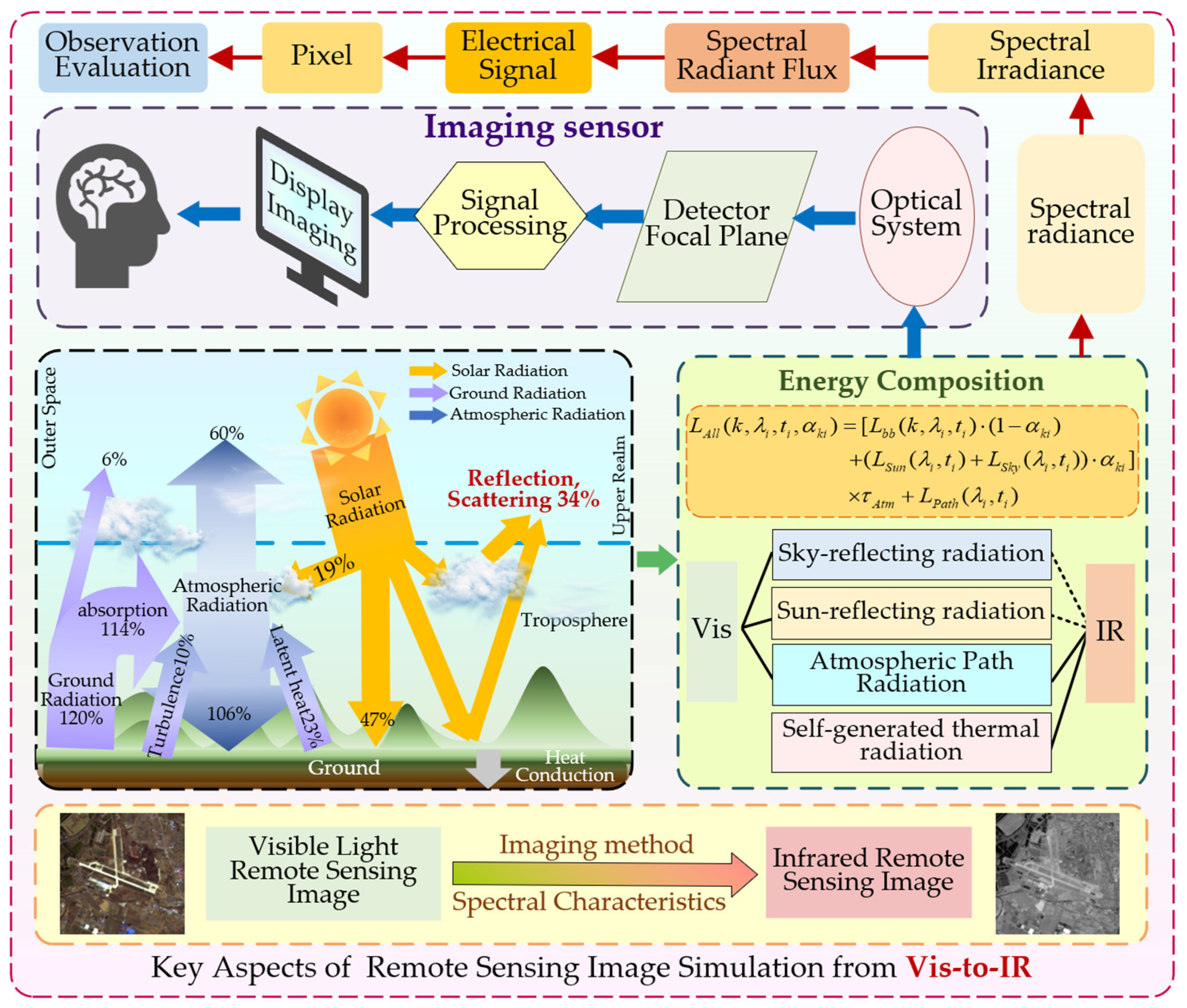
- A Vis-to-IR remote sensing image generation method based on mechanism-data dual-driven strategy (MDD-VIR) is proposed, which couples the global radiation scattering mechanism of cross-band remote sensing imagery with a deep generative model for infrared remote sensing images.
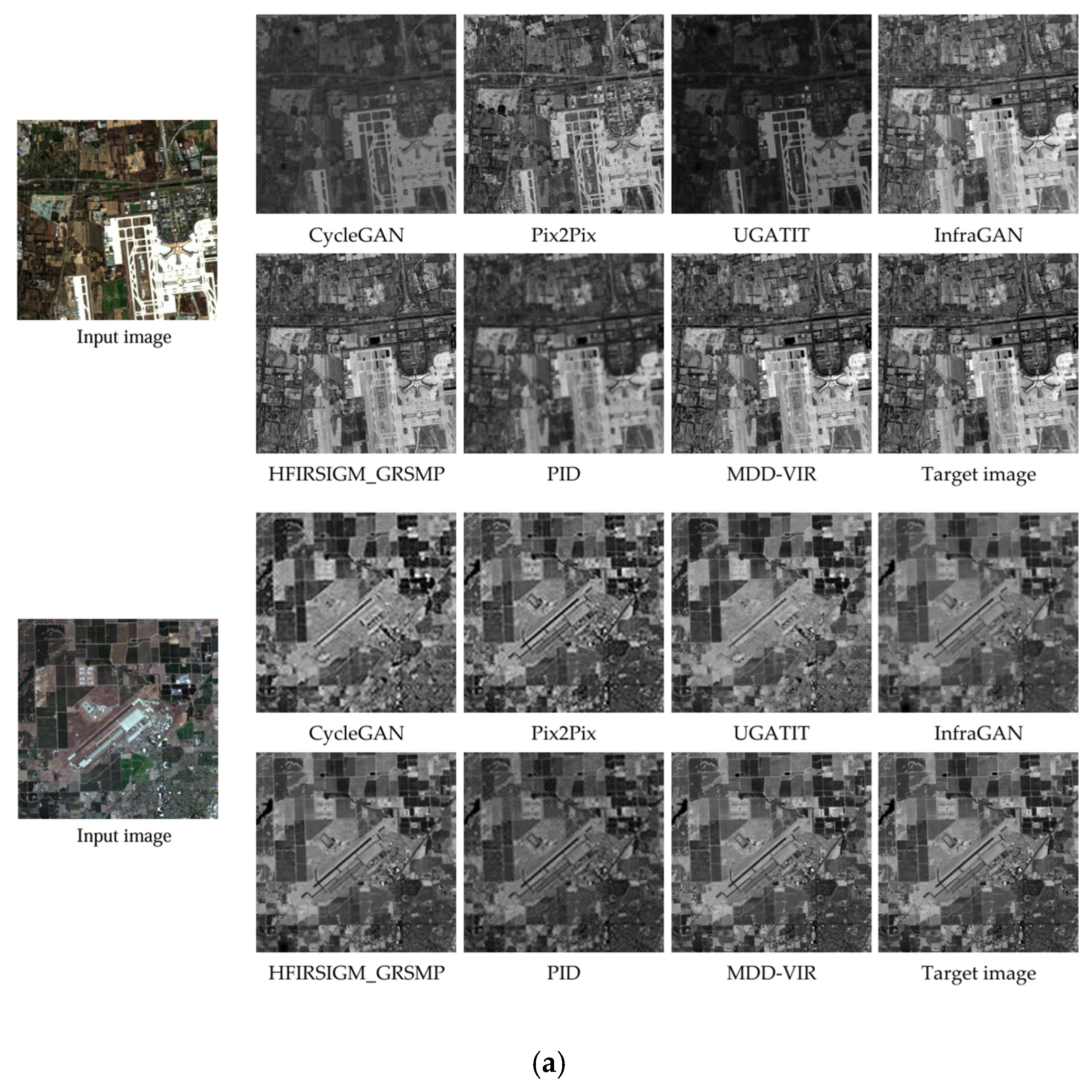
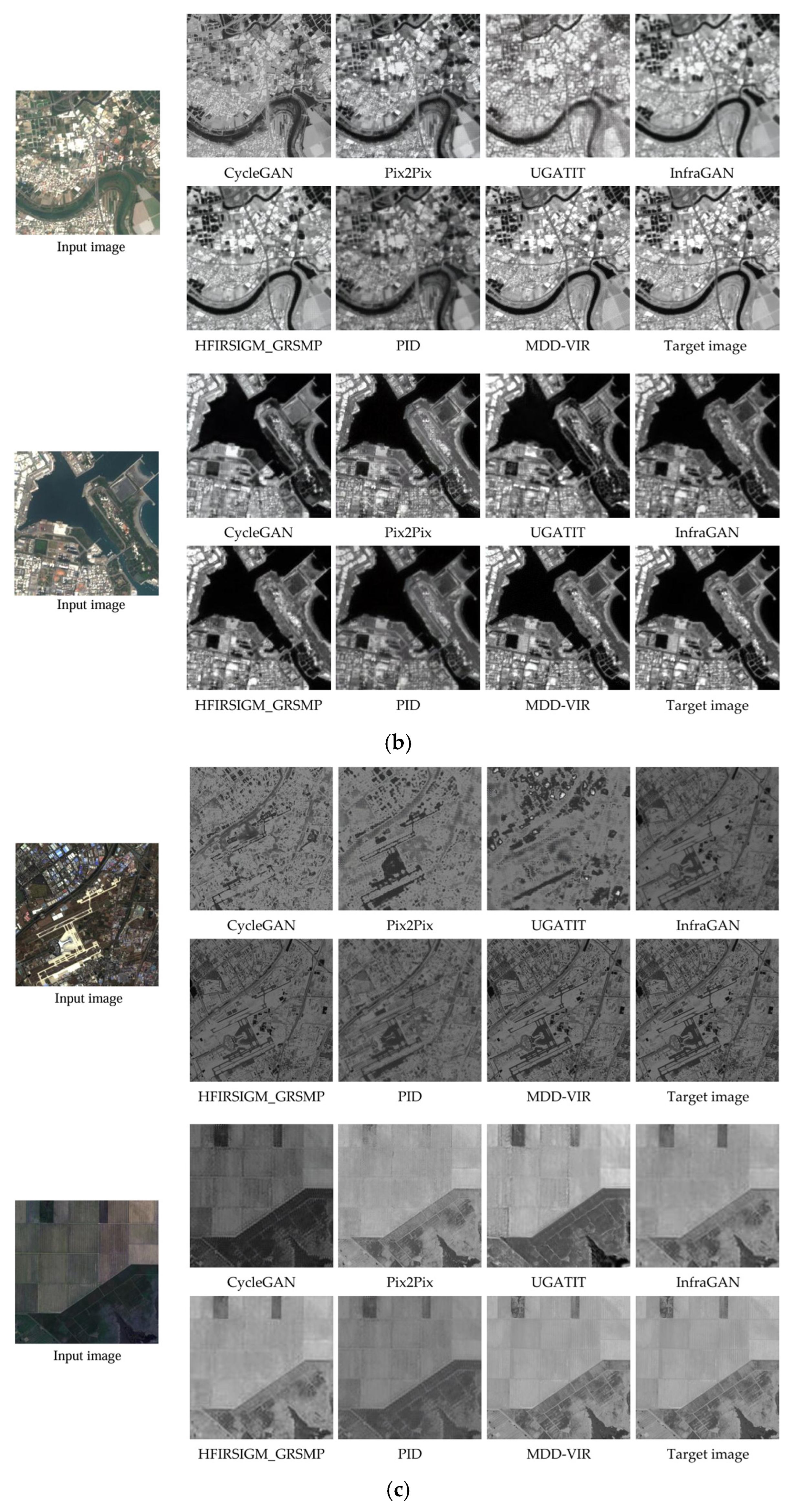
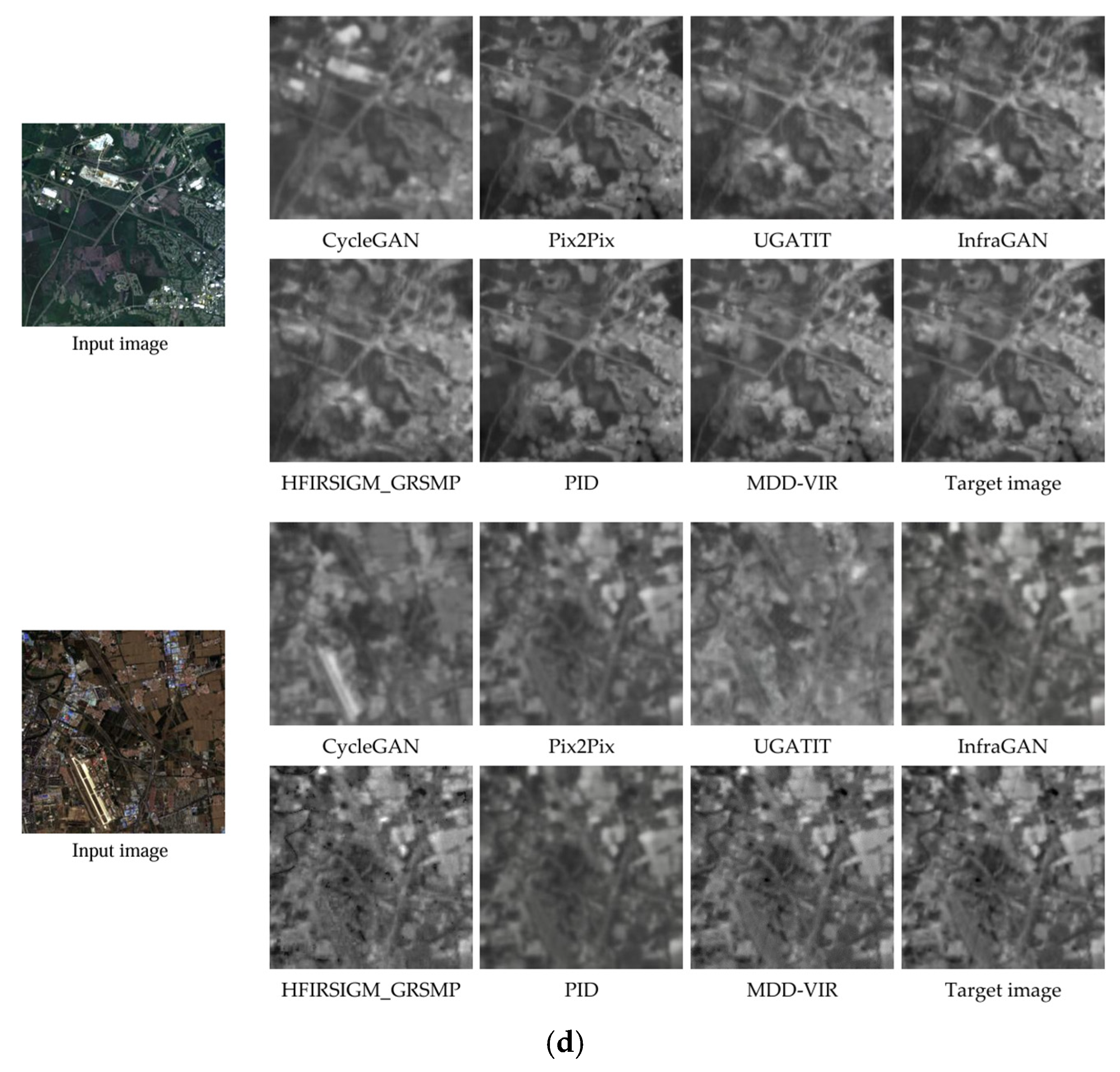
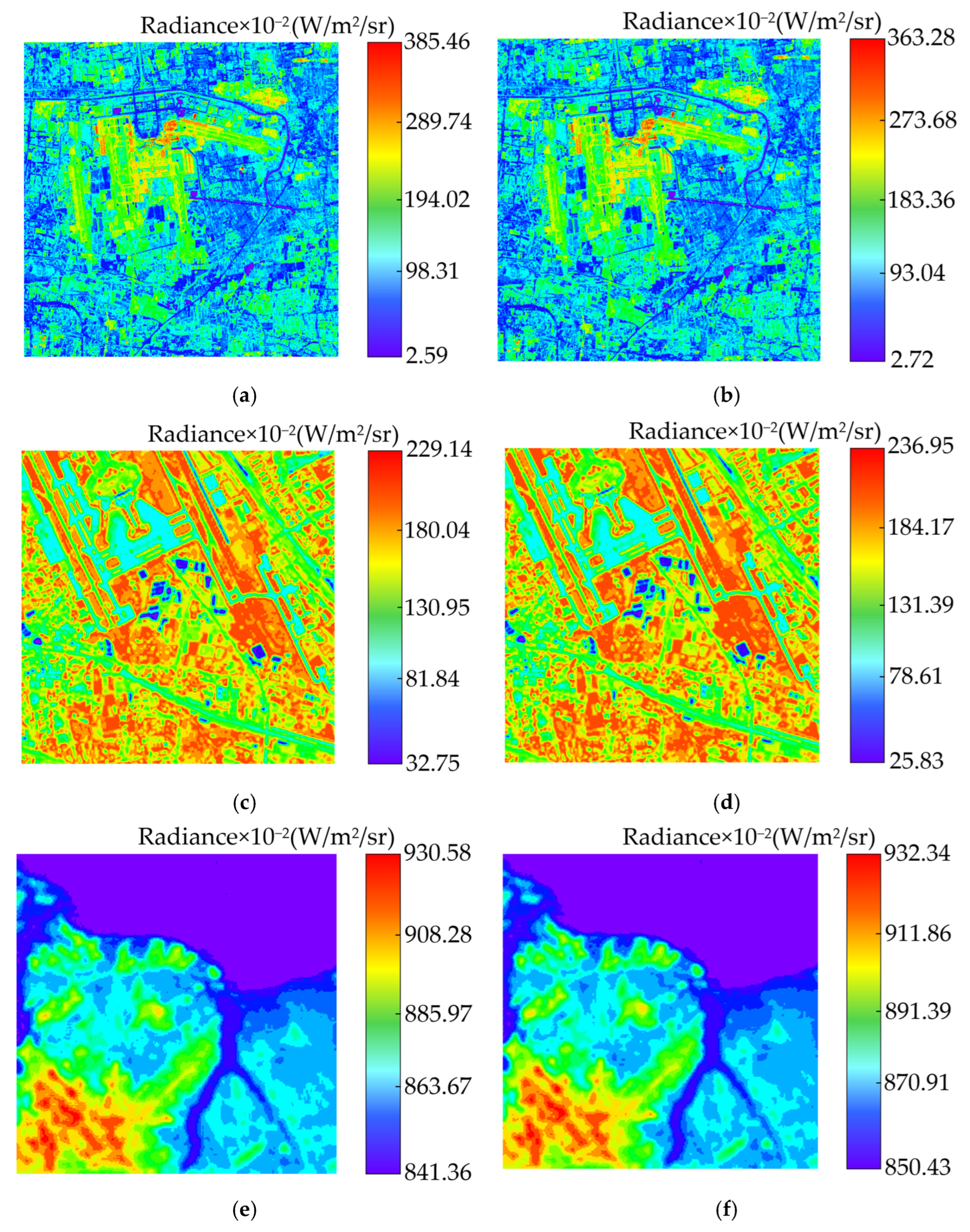
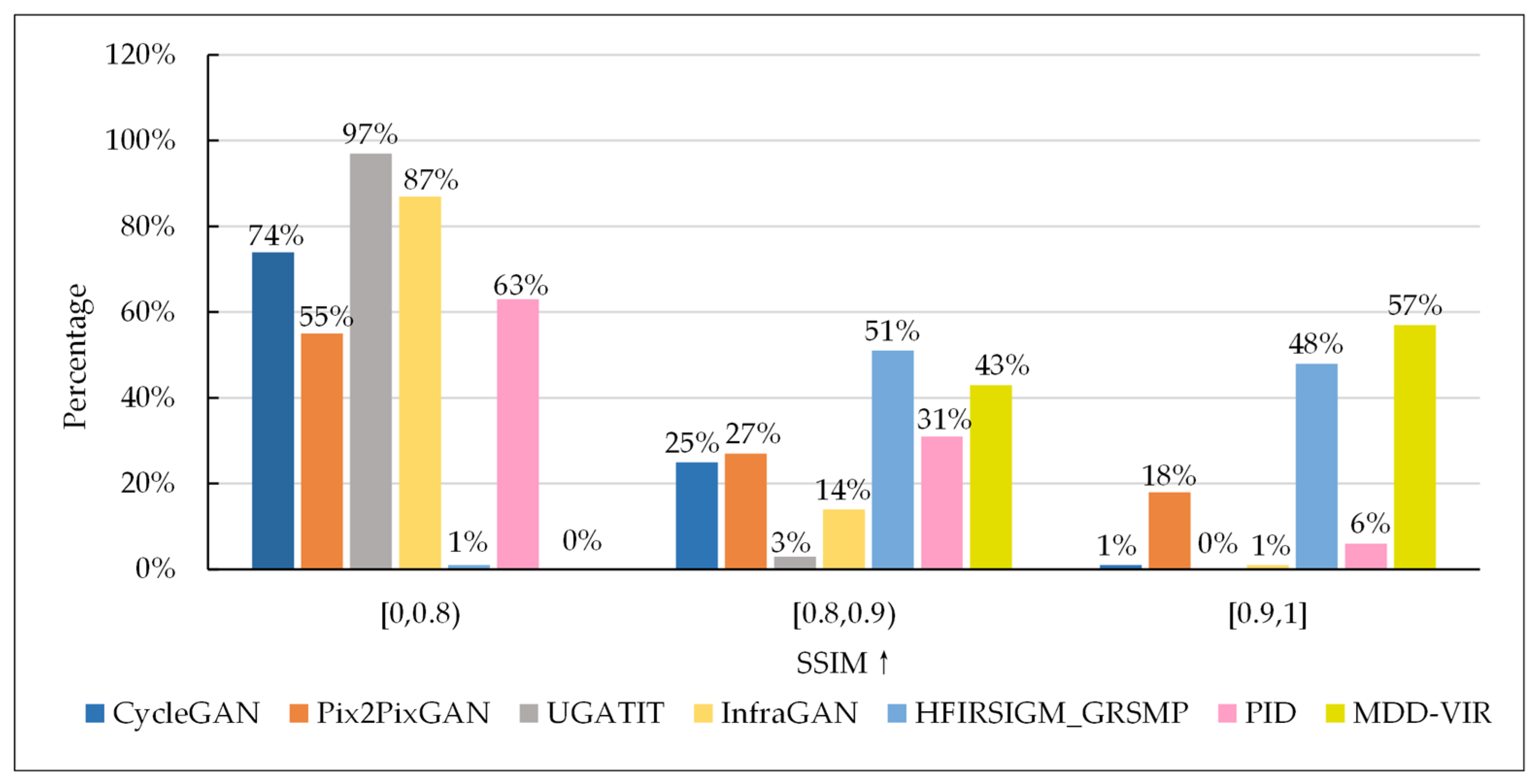
- Diverse experimental results demonstrate that MDD-VIR exhibits outstanding accuracy and effectiveness in complex terrain scenarios and multi-band infrared remote sensing image generation tasks, with the generated images achieving an average structural similarity index measure (SSIM) value of 91.07%.
- This method addresses critical challenges limiting the accuracy and fidelity of traditional simulation models through a synergistic mechanism-data dual-driven design, and achieves multiple objectives encompassing strong physical consistency, high fidelity, and high efficiency.
- This method synergistically exploits the unique advantages of mechanism-driven and data-driven paradigms, significantly improves the overall performance of generative models and providing an interpretable, more comprehensive solution for remote sensing image generation across visible to infrared wavelengths.
Abstract
1. Introduction
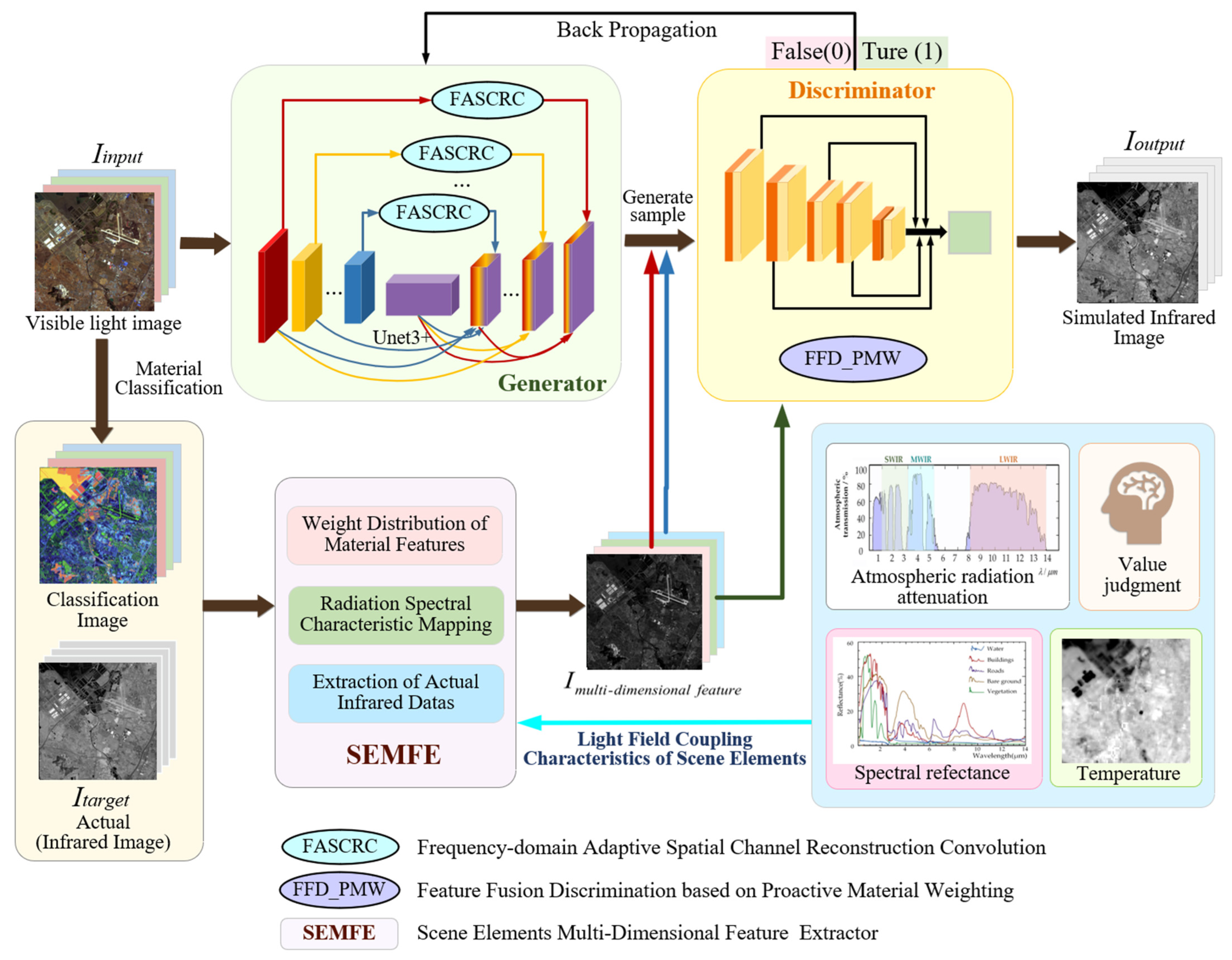
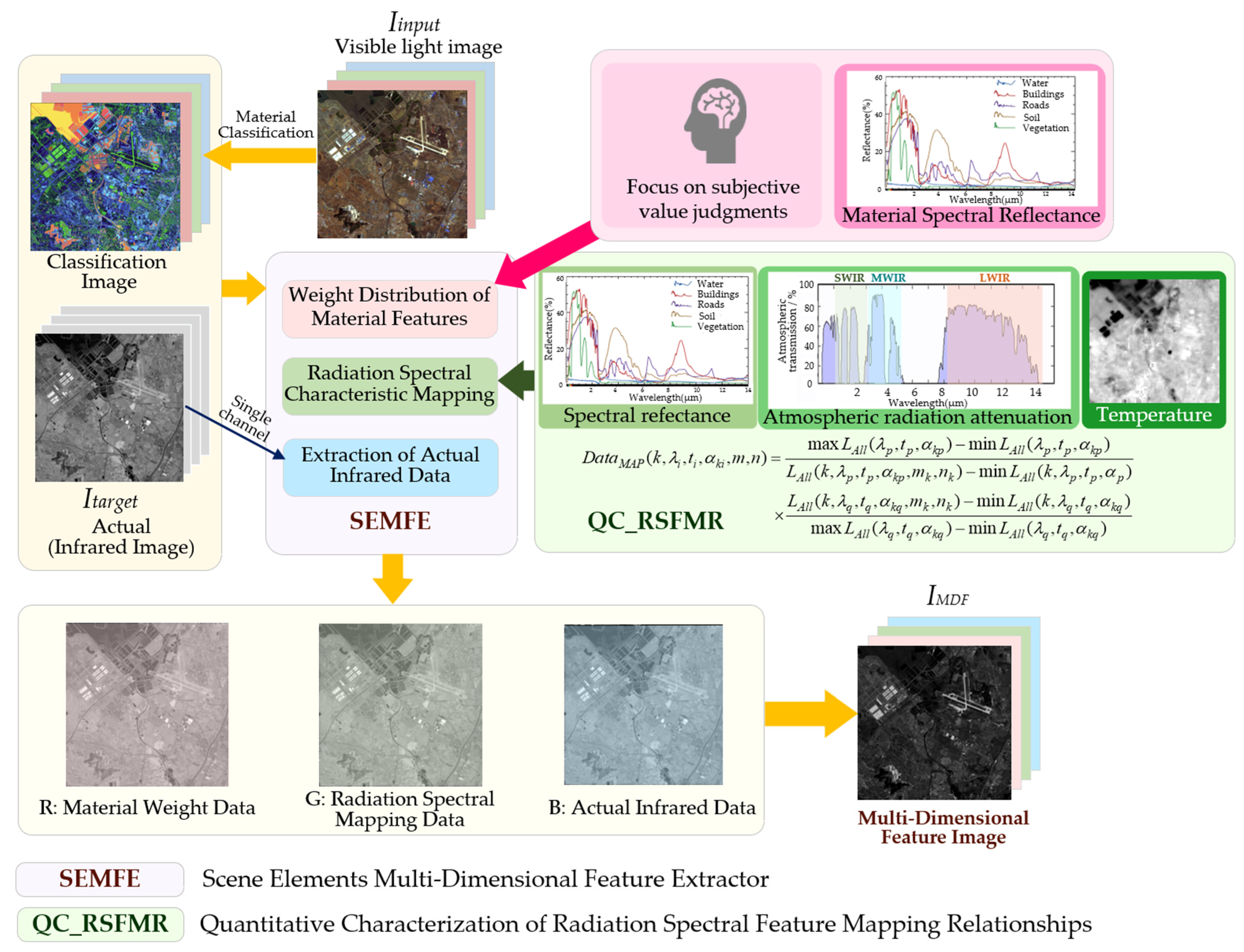
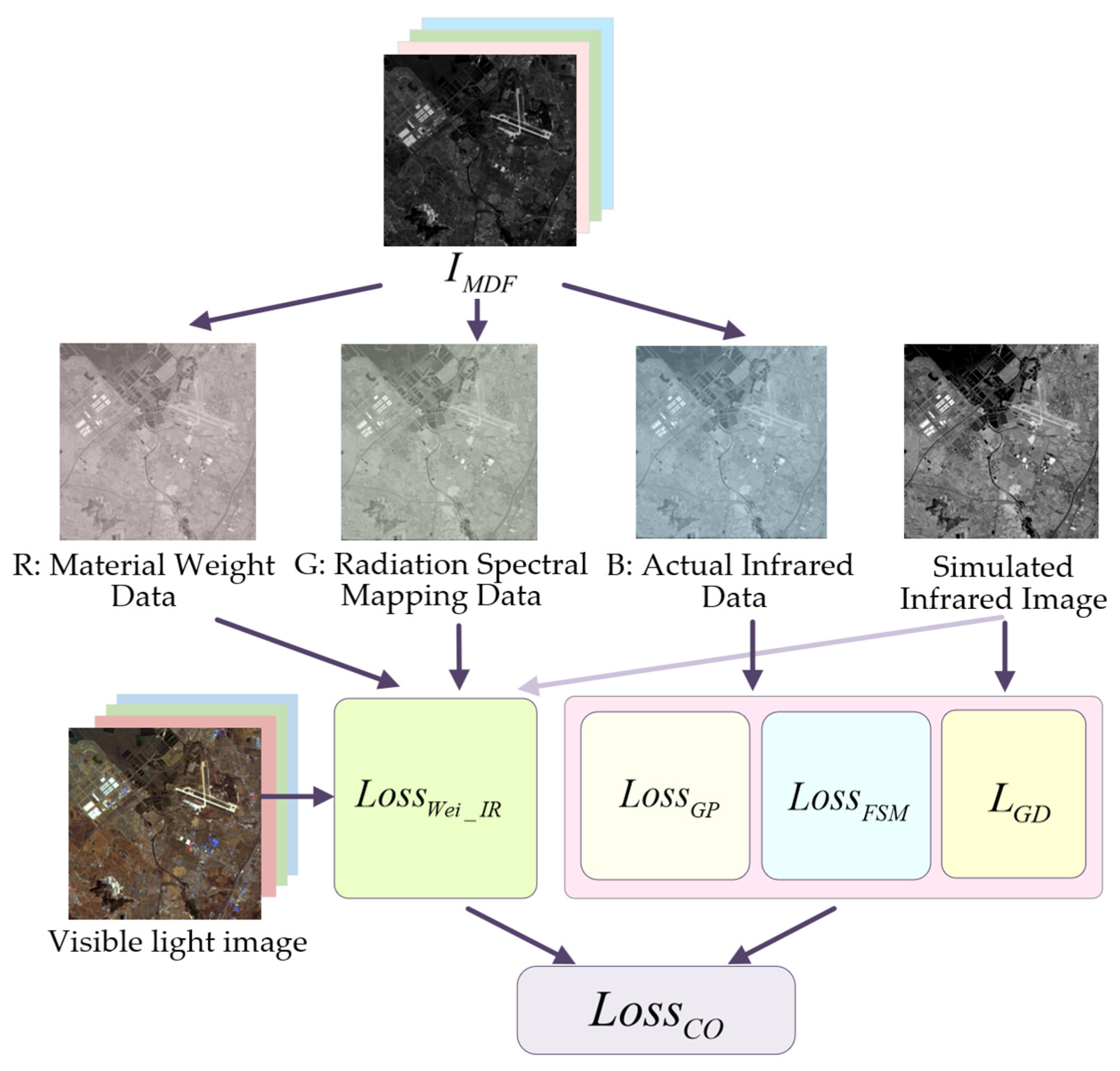
- The SEMFE module bridges the gap between physical mechanisms and intelligent learning.
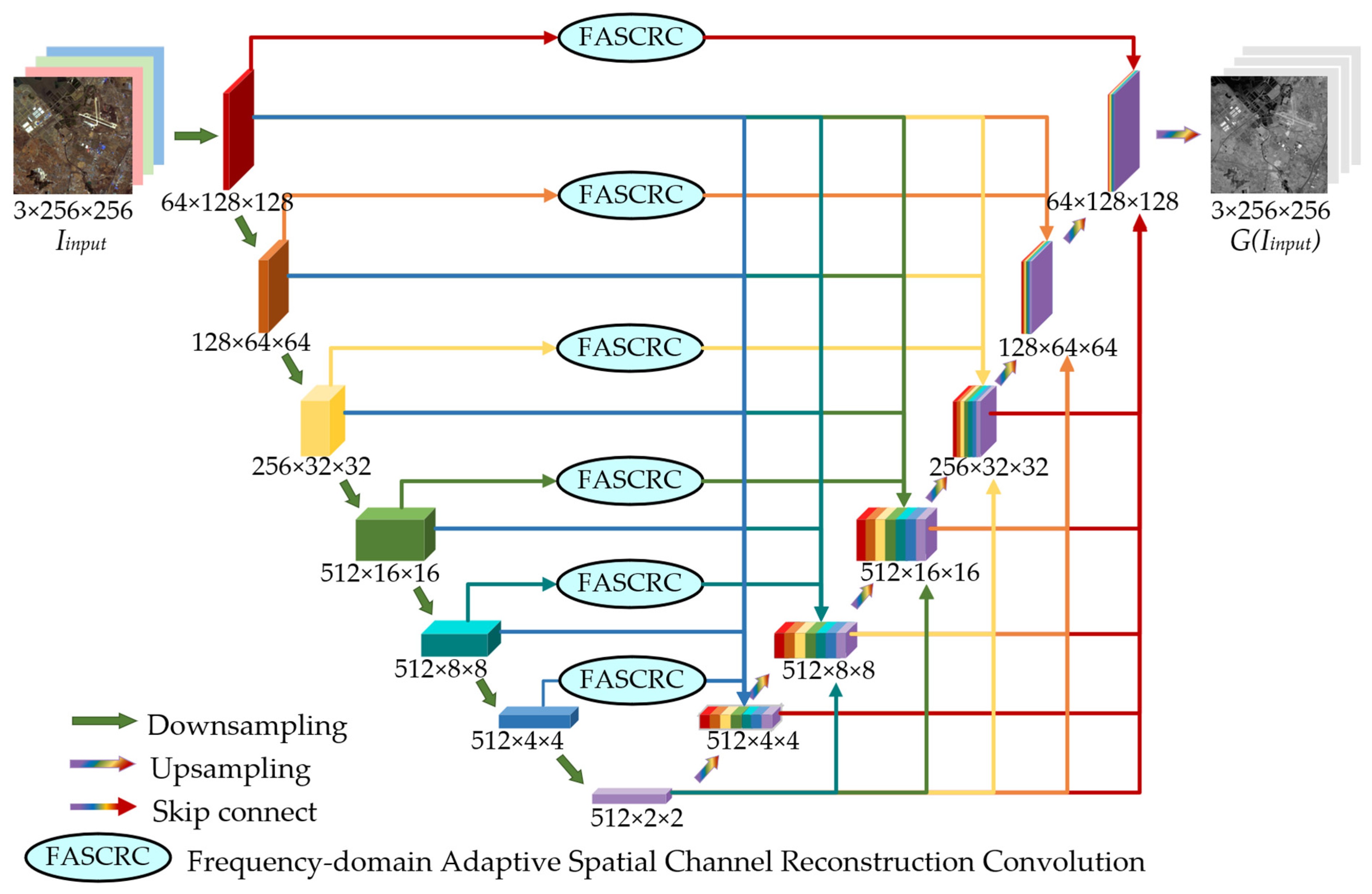
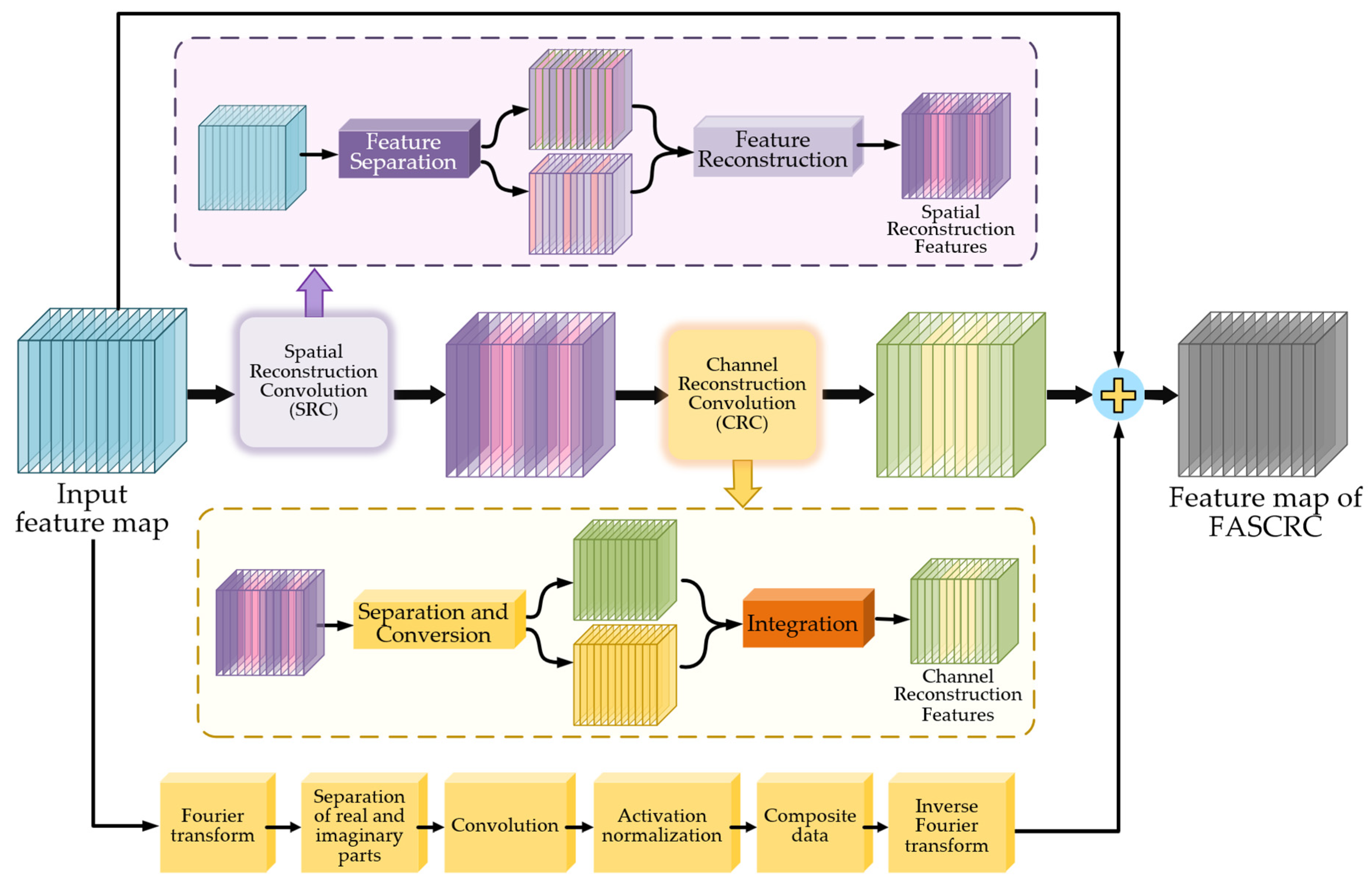
- The FASCRC_Unet3+ module enhances the generator’s ability to extract multi-scale features of complex terrain;
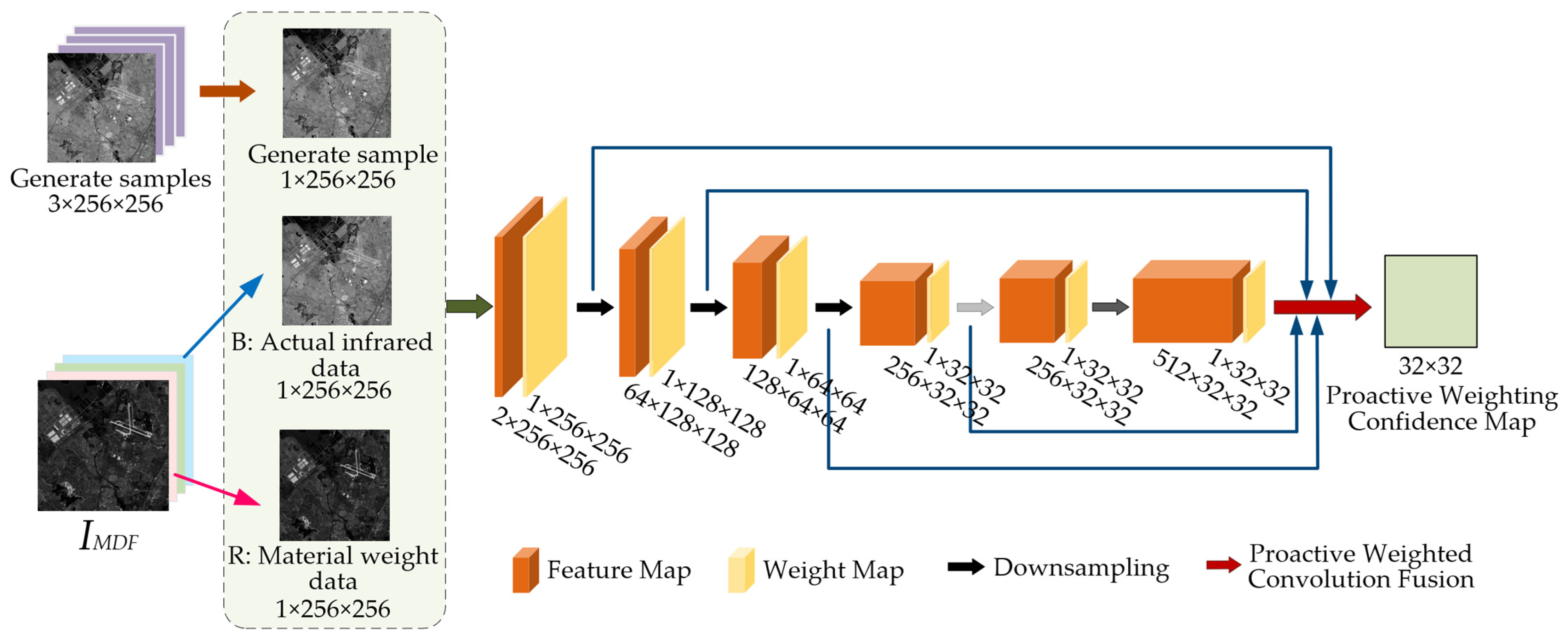
- The FFD_PMW module improves the discriminator’s ability to learn features of high-value objects across multiple scales and improves its classification accuracy;
- The significantly enhances the overall performance of the generative model through intelligent computing fusion inference strategies.
- The MDD-VIR achieves the multiple objectives of strong physical consistency, high fidelity, and high efficiency through a synergistic mechanism-data dual-driven strategy.
2. Materials and Methods
2.1. Problem Analysis
2.2. Overall Architecture of the MDD-VIR
2.3. SEMFE
2.4. Generator
2.5. Discriminator
2.6. Collaborative Loss Module
3. Results
3.1. Experimental Setup
3.2. Datasets
3.3. Evaluation Indicators
- Peak Signal-to-Noise Ratio (PSNR) [56]
- Structural Similarity Index Measure (SSIM) [57]
- Universal Quality Index (UQI) [58]
- Fréchet Inception Distance (FID) [59]
- Learned Perceptual Image Patch Similarity (LPIPS) [60]
3.4. Experiment Analysis
3.4.1. Ablation Experiment Analysis
- The baseline group (Experiment 1) exhibited mediocre performance, with all evaluation metrics at relatively low levels, confirming the limitations of the original Pix2Pix model in shortwave infrared remote sensing image generation tasks.
- Compared with the baseline group, the SSIM of the -incorporated group (Experiment 2) increased by 4.41%, respectively, with significant improvements also observed in PSNR, FID, and LPIPS. This finding indicates that incorporating L effectively enhances the accuracy and detail representation capability of feature mapping, thereby improving the realism and quality of the generated images, which further validates the core value and practical efficacy of the innovative fusion paradigm between physical mechanisms and deep learning in infrared remote sensing image generation tasks.
- The generator module optimization group (Experiment 3) achieved improvements across all metrics; specifically, the UQI rose by 4.75%, respectively, compared to the baseline group. This demonstrates that the embedding of the FASCRC_Unet3+ module can effectively strengthen the model’s ability to transform and generate key image features, significantly boosting the precision of feature learning.
- For the discriminator module optimization group (Experiment 4), the SSIM was 4.03% higher than that of the baseline group, respectively. This reveals that the combined optimization strategy of FASCRC_Unet3+ and FFD_PMW exerts a positive gain effect on model performance, enhancing the model’s ability to learn complex image features and adapt to scenarios, and further improving its feature representation adaptability in complex remote sensing scenes.
- The SEMFE module contribution group (Experiment 5) achieved a 3.67% improvement in the SSIM metric compared to the baseline group, while the FID metric decreased by 19.7653 compared to the baseline group. The synergistic effect of the combination of and FFD_AMW directly reflects the SEMFE module’s contribution to model optimization. The results demonstrate that the SEMFE module can effectively enhance the similarity between simulated and measured images, and its optimization of model performance metrics is comparable to the combined optimization strategy of the generator and discriminator modules, effectively validating the advantages of the SEMFE-based mechanism-data dual-drive strategy.
- The full strategy fusion group (Experiment 6) saw SSIM and UQI improve by 10.67% and 9.59%, respectively, compared to the baseline group, with PSNR reaching 30.2602 dB, FID 83.0685, and LPIPS 0.1405.
3.4.2. Subjective Experimental Analysis
3.4.3. Objective Experimental Analysis
4. Discussion
5. Conclusions
Author Contributions
Funding
Data Availability Statement
Conflicts of Interest
References
- Teng, Y.; Ren, H.; Hu, Y.; Dou, C. Land surface temperature retrieval from SDGSAT-1 thermal infrared spectrometer images: Algorithm and validation. Remote Sens. Environ. 2024, 315, 114412. [Google Scholar] [CrossRef]
- Wang, D.; Cao, L.; Du, Y.; Xiong, H.; Ye, F.; Zhong, Y. Tow noise-resilient retrieval of land surface temperature and emissivity using airborne thermal infrared hyperspectral imagery. ISPRS J. Photogramm. Remote Sens. 2026, 231, 532–551. [Google Scholar] [CrossRef]
- Kanneh, J.E.; Wang, J.; Li, C.; Ma, Y.; Li, S.; Zhong, D.; Wang, Z.; Kpalari, D.F.; Collela, M.B.E. Novel indices and multi-source data fusion for monitoring plant moisture stress in winter wheat fields. Sci. Rep. 2026, 16, 3836. [Google Scholar] [CrossRef]
- Zhou, Z.; Majeed, Y.; Naranjo, G.D.; Gambacorta, E.M.T. Assessment for crop water stress with infrared thermal imagery in precision agriculture: A review and future prospects for deep learning applications. Comput. Electron. Agric. 2021, 182, 106019. [Google Scholar] [CrossRef]
- Robinson, A.J.; Lesage, F.J.; Reilly, A.; McGranaghan, G.; Byrne, G.; O’Hegarty, R.; Kinnane, O. A new transient method for determining thermal properties of wall sections. Energy Build. 2017, 142, 139–146. [Google Scholar] [CrossRef]
- Li, Z.L.; Tang, B.H.; Wu, H.; Zhao, W.; Duan, S.B.; Ren, H.Z.; Zhao, E.Y.; Tang, R.L.; Si, M.L.; Leng, P.; et al. Development and prospects of thermal infrared remote sensing. Natl. Remote Sens. Bull. 2025, 29, 1529–1550. [Google Scholar] [CrossRef]
- Takodjou Wambo, J.D.; Nomo Negue, E.; Traore, M.; Asimow, P.D.; Ganno, S.; Beiranvand Pour, A.; Ngounouno, F.Y.; Nzenti, J.P. Integrating multispectral remote sensing and geological investigation for gold prospecting in the Borongo-Mborguene gold field, eastern Cameroon. Adv. Space Res. 2024, 74, 4574–4597. [Google Scholar] [CrossRef]
- Scafutto, R.D.M.; Lievens, C.; Hecker, C.; van der Meer, F.D.; de Souza Filho, C.R. Detection of petroleum hydrocarbons in continental areas using airborne hyperspectral thermal infrared data (SEBASS). Remote Sens. Environ. 2021, 256, 112323. [Google Scholar] [CrossRef]
- Sharif, S.S.; Banad, Y.M. Revolutionizing infrared detection in defense applications: A nanophotonic approach leveraging 2D materials for enhanced mid-IR absorption. In Proceedings of the 2024 IEEE Research and Applications of Photonics in Defense Conference (RAPID), Miramar Beach, FL, USA, 13–15 May 2024; pp. 1–2. [Google Scholar] [CrossRef]
- Kumar, N.; Singh, P. Small and dim target detection in infrared imagery: A review, current techniques and future directions. Neurocomputing 2025, 630, 129640. [Google Scholar] [CrossRef]
- Han, Z.; Zhang, Z.; Zhang, S.; Zhang, G.; Mei, S. Aerial visible-to-infrared image translation: Dataset, evaluation, and baseline. J. Remote Sens. 2023, 3, 96. [Google Scholar] [CrossRef]
- Pu, R.; Bonafoni, S. Thermal infrared remote sensing data downscaling investigations: An overview on current status and perspectives. Remote Sens. Appl. Soc. Environ. 2023, 29, 100921. [Google Scholar] [CrossRef]
- Wang, S.; Xu, W.; Guo, T. Advances in thermal infrared remote sensing technology for geothermal resource detection. Remote Sens. 2024, 16, 1690. [Google Scholar] [CrossRef]
- Rogalski, A. Infrared detectors: Status and trends. Prog. Quantum Electron. 2003, 27, 59–210. [Google Scholar] [CrossRef]
- Bioucas-Dias, J.M.; Plaza, A.; Camps-Valls, G.; Scheunders, P.; Nasrabadi, N.; Chanussot, J. Hyperspectral remote sensing data analysis and future challenges. IEEE Geosci. Remote Sens. Mag. 2013, 1, 6–36. [Google Scholar] [CrossRef]
- Wang, Y. Research on Infrared Image Expansion Methods Based on Actual Measurement Data. Master’s Thesis, Xidian University, Xi’an, China, 2021. [Google Scholar]
- Zhang, R.G. Simulation Research on Infrared Remote Sensing Images from Space-Based Platforms. Master’s Thesis, Harbin Institute of Technology, Harbin, China, 2022. [Google Scholar]
- Sohl-Dickstein, J.; Weiss, E.A.; Maheswaranathan, N.; Ganguli, S. Deep unsupervised learning using nonequilibrium thermodynamics. arXiv 2015. [Google Scholar] [CrossRef]
- Weng, L. Background Simulation Methods for Space-Based Infrared Imaging of Earth. Master’s Thesis, University of Electronic Science and Technology of China, Chengdu, China, 2024. [Google Scholar]
- Zhang, X.; Huang, J.; Zhang, L. Any2RSI: Controllable remote sensing text-to-image generation via any control and enriched description. In Proceedings of the AAAI 2026, Singapore, 20–27 January 2026. [Google Scholar] [CrossRef]
- Zhang, X.; Ma, J.; Wang, G.; Zhang, Q.; Zhang, H.; Zhang, L. Perceive-IR: Learning to perceive degradation better for all-in-one image restoration. IEEE Trans. Image Process. 2025, 35, 2018–2033. [Google Scholar] [CrossRef]
- Chen, S.; Zhang, L.; Zhang, L. Cross-scope spatial-spectral information aggregation for hyperspectral image super-resolution. IEEE Trans. Image Process. 2024, 33, 5878–5891. [Google Scholar] [CrossRef]
- Willers, C.J.; Willers, M.S.; Lapierre, F. Signature modelling and radiometric rendering equations in infrared scene simulation systems. In Proceedings of SPIE Security + Defence, Prague, Czech Republic, 6 October 2011; SPIE: Cergy-Pontoise, France, 2011; Volume 8187, p. 81870R. [Google Scholar] [CrossRef]
- Li, M.; Xu, Z.; Xie, H.; Xing, Y. Infrared image generation method and detail modulation based on visible light images. Infrared Technol. 2018, 40, 34–38. Available online: http://hwjs.nvir.cn/en/article/id/hwjs201801007 (accessed on 25 May 2025).
- Mirza, M.; Osindero, S. Conditional generative adversarial nets. arXiv 2014. [Google Scholar] [CrossRef]
- Cao, X.; Zou, H.; Li, J.; Chen, H.; Ying, X.; He, S.; Wang, Y.; Pan, L. Multimodal image generation and fusion through content-style hybrid disentanglement. Knowl.-Based Syst. 2025, 330, 114597. [Google Scholar] [CrossRef]
- Ma, D.; Xian, Y.; Su, J.; Li, S.; Li, B. Visible-to-infrared image translation based on an improved conditional generative adversarial nets. Acta Photonica Sin. 2023, 52, 0410003. [Google Scholar] [CrossRef]
- Wang, S.; Sun, G.; Dong, L.; Zheng, B. PAS-GAN: A GAN based on the pyramid across-scale module for visible-infrared image transformation. Infrared Phys. Technol. 2024, 139, 105314. [Google Scholar] [CrossRef]
- Liu, M.Z. Research on Shore Target and Environmental Characteristics Based on Physical Material Rendering and Full-Path Infrared Imaging Simulation. Master’s Thesis, Nanjing University of Science and Technology, Nanjing, China, 2023. [Google Scholar]
- Rankin-Parobek, D.; Salvaggio, C.; Gallagher, T.W.; Schott, J.R. Instrumentation and procedures for validation of synthetic infrared image generation models. In Proceedings of SPIE, Los Angeles, CA, USA, 19–20 January 1993; SPIE: Cergy-Pontoise, France; Volume 1762, pp. 584–600. [CrossRef]
- Goodenough, A.A.; Brown, S.D. DIRSIG5: Next-generation remote sensing data and image simulation framework. IEEE J. Sel. Top. Appl. Earth Obs. Remote Sens. 2017, 10, 4818–4833. [Google Scholar] [CrossRef]
- RIT DIRS Laboratory. Digital Imaging and Remote Sensing Laboratory Fiscal Year 2024–2025 Annual Report; College of Science, Rochester Institute of Technology: Rochester, NY, USA, 2025; Available online: https://www.rit.edu/dirs/DIRS_Annual_Report_24-25 (accessed on 3 January 2026).
- Yang, X.; Liu, H.; Lv, M.; Shi, L.; Weng, L.; Hu, L.; Li, Q. AGMD-GAN: Attention-based generator with multi-scaled feature extraction discriminator for unpaired visible to infrared image translation. Infrared Phys. Technol. 2026, 152, 106266. [Google Scholar] [CrossRef]
- Özkanoğlu, M.A.; Ozer, S. InfraGAN: A GAN architecture to transfer visible images to infrared domain. Pattern Recognit. Lett. 2022, 155, 69–76. [Google Scholar] [CrossRef]
- Ran, L.; Wang, L.; Wang, G.; Wang, P.; Zhang, Y. DiffV2IR: Visible-to-infrared diffusion model via vision-language understanding. arXiv 2025. [Google Scholar] [CrossRef]
- Liu, Y.; Yue, J.; Xia, S.; Ghamisi, P.; Xie, W.; Fang, L. Diffusion models meet remote sensing: Principles, methods, and perspectives. IEEE Trans. Geosci. Remote Sens. 2024, 62, 4708322. [Google Scholar] [CrossRef]
- Yang, L.; Zhang, Z.; Song, Y.; Hong, S.; Xu, R.; Zhao, Y.; Zhang, W.; Cui, B.; Yang, M.-H. Diffusion models: A comprehensive survey of methods and applications. ACM Comput. Surv. 2023, 56, 105. [Google Scholar] [CrossRef]
- Han, Y.; Han, A.; Huang, W.; Lu, C.; Zou, D. Can diffusion models learn hidden inter-feature rules behind images? arXiv 2025. [Google Scholar] [CrossRef]
- Hu, X.; Liu, X.; Duan, Q.; Hong, D.; Jiang, L.; Yang, H.; Zhan, D. Recent advances in diffusion models for hyperspectral image processing and analysis: A review. arXiv 2025. [Google Scholar] [CrossRef]
- Jia, X. Research on Infrared Image Generation Algorithm Based on GAN and Physical Model. Master’s Thesis, Beijing University of Posts and Telecommunications, Beijing, China, 2022. [Google Scholar]
- Wang, D.-Y.; Bie, S.-H.; Chen, X.-H.; Yu, W.-K. Physics-driven generative adversarial networks empower single-pixel infrared hyperspectral imaging. arXiv 2023. [Google Scholar] [CrossRef]
- Berman, O.; Oz, N.; Mendlovic, D.; Sochen, N.; Cohen, Y.; Klapp, I. PETIT-GAN: Physically enhanced thermal image-translating generative adversarial network. In Proceedings of the 2024 IEEE/CVF Winter Conference on Applications of Computer Vision (WACV), Waikoloa, HI, USA, 3–8 January 2024; pp. 1607–1616. [Google Scholar] [CrossRef]
- Mao, F.; Mei, J.; Lu, S.; Liu, F.; Chen, L.; Zhao, F.; Hu, Y. PID: Physics-informed diffusion model for infrared image generation. Pattern Recognit. 2026, 169, 111816. [Google Scholar] [CrossRef]
- Li, Y.; Wang, X.; Zhang, C.; Zhang, Z.; Ren, F. High-fidelity infrared remote sensing image generation method coupled with the global radiation scattering mechanism and Pix2PixGAN. Remote Sens. 2024, 16, 4350. [Google Scholar] [CrossRef]
- Goodfellow, I.J.; Pouget-Abadie, J.; Mirza, M.; Xu, B.; Warde-Farley, D.; Ozair, S.; Courville, A.; Bengio, Y. Generative adversarial networks. arXiv 2014. [Google Scholar] [CrossRef]
- Isola, P.; Zhu, J.-Y.; Zhou, T.; Efros, A.A. Image-to-image translation with conditional adversarial networks. In Proceedings of the 2017 IEEE Conference on Computer Vision and Pattern Recognition (CVPR), Honolulu, HI, USA, 21–26 July 2017; pp. 5967–5976. [Google Scholar] [CrossRef]
- Zhu, J.-Y.; Park, T.; Isola, P.; Efros, A.A. Unpaired image-to-image translation using cycle-consistent adversarial networks. In Proceedings of the 2017 IEEE International Conference on Computer Vision (ICCV), Venice, Italy, 22–29 October 2017; pp. 2242–2251. [Google Scholar] [CrossRef]
- Huang, H.; Lin, L.; Tong, R.; Hu, H.; Zhang, Q.; Iwamoto, Y. UNet 3+: A full-scale connected UNet for medical image segmentation. In Proceedings of the 2020 IEEE International Conference on Acoustics, Speech and Signal Processing (ICASSP), Barcelona, Spain, 4–8 May 2020; pp. 1055–1059. [Google Scholar] [CrossRef]
- Li, G.W.; Shi, Z.G.; Zhang, Y. Image transformation technology based on generative adversarial networks. J. Terahertz Sci. Electron. Inf. Technol. 2021, 19, 724. [Google Scholar] [CrossRef]
- Ye, M.; Shi, C.; Hao, Y.; Li, D. Infrared image conversion technology based on improved pix2pix. Laser Infrared 2024, 54, 1157–1163. [Google Scholar] [CrossRef]
- Ronneberger, O.; Fischer, P.; Brox, T. U-Net: Convolutional networks for biomedical image segmentation. In Medical Image Computing and Computer-Assisted Intervention—MICCAI 2015; Lecture Notes in Computer Science; Springer: Cham, Switzerland, 2015; Volume 9351, pp. 234–241. [Google Scholar] [CrossRef]
- Li, J.; Wen, Y.; He, L. SCConv: Spatial and channel reconstruction convolution for feature redundancy. In Proceedings of the 2023 IEEE/CVF Conference on Computer Vision and Pattern Recognition (CVPR), Vancouver, BC, Canada, 17–24 June 2023; pp. 6153–6162. [Google Scholar] [CrossRef]
- Cooley, J.W.; Tukey, J.W. An algorithm for the machine calculation of complex Fourier series. Math. Comput. 1965, 19, 297–301. [Google Scholar] [CrossRef]
- Roy, D.P.; Wulder, M.A.; Loveland, T.R.; Woodcock, C.E.; Allen, R.G.; Anderson, M.C.; Helder, D.; Irons, J.R.; Johnson, D.M.; Kennedy, R.; et al. Landsat-8: Science and product vision for terrestrial global change research. Remote Sens. Environ. 2014, 145, 154–172. [Google Scholar] [CrossRef]
- Drusch, M.; Del Bello, U.; Carlier, S.; Colin, O.; Fernandez, V.; Gascon, F.; Hoersch, B.; Isola, C.; Laberinti, P.; Martimort, P.; et al. Sentinel-2: ESA’s optical high-resolution mission for GMES operational services. Remote Sens. Environ. 2012, 120, 25–36. [Google Scholar] [CrossRef]
- Press, W.H.; Teukolsky, S.A.; Vetterling, W.T.; Flannery, B.P. Numerical Recipes: The Art of Scientific Computing, 3rd ed.; Cambridge University Press: Cambridge, UK, 2007; pp. 28–735. [Google Scholar]
- Wang, Z.; Bovik, A.C.; Sheikh, H.R.; Simoncelli, E.P. Image quality assessment: From error visibility to structural similarity. IEEE Trans. Image Process. 2004, 13, 600–612. [Google Scholar] [CrossRef]
- Wang, Z.; Bovik, A.C. A universal image quality index. IEEE Signal Process. Lett. 2002, 9, 81–84. [Google Scholar] [CrossRef]
- Heusel, M.; Ramsauer, H.; Unterthiner, T.; Nessler, B.; Hochreiter, S. GANs trained by a two time-scale update rule converge to a local nash equilibrium. arXiv 2017. [Google Scholar] [CrossRef]
- Zhang, R.; Isola, P.; Efros, A.A.; Shechtman, E.; Wang, O. The unreasonable effectiveness of deep features as a perceptual metric. In Proceedings of the 2018 IEEE/CVF Conference on Computer Vision and Pattern Recognition (CVPR), Salt Lake City, UT, USA, 18–23 June 2018; pp. 586–595. [Google Scholar] [CrossRef]
- Kim, J.; Kim, M.; Kang, H.; Lee, K. U-GAT-IT: Unsupervised generative attentional networks with adaptive layer-instance normalization for image-to-image translation. arXiv 2019. [Google Scholar] [CrossRef]



| Num | Experiment | PSNR↑ | SSIM↑ | UQI↑ | FID↓ | LPIPS↓ |
|---|---|---|---|---|---|---|
| 1 | Pix2Pix (baseline) | 24.3028 | 0.8095 | 0.8226 | 109.0354 | 0.2515 |
| 2 | 1 + | 29.0275 | 0.8536 | 0.8812 | 87.9927 | 0.2029 |
| 3 | 1 + FASCRC_Unet3+ | 28.3216 | 0.8334 | 0.8701 | 90.6418 | 0.2058 |
| 4 | 3 + FFD_PMW | 29.1084 | 0.8498 | 0.8755 | 88.3576 | 0.1797 |
| 5 | 1 + FFD_PMW + | 28.9516 | 0.8462 | 0.8793 | 89.1701 | 0.2164 |
| 6 | MDD-VIR | 30.2602 | 0.9162 | 0.9185 | 83.0685 | 0.1405 |
| Landsat8 | PSNR↑ | SSIM↑ | UQI↑ | FID↓ | LPIPS↓ |
| CycleGAN | 21.2918 | 0.7386 | 0.7741 | 114.9850 | 0.2834 |
| Pix2Pix | 24.3028 | 0.8095 | 0.8226 | 109.0354 | 0.2515 |
| UGATIT | 19.1432 | 0.6599 | 0.7169 | 138.3082 | 0.3712 |
| InfraGAN | 26.3268 | 0.8662 | 0.8673 | 111.7826 | 0.2798 |
| HFIRSIGM_GRSMP | 29.3215 | 0.8814 | 0.8706 | 88.1474 | 0.1726 |
| PID | 21.7167 | 0.7862 | 0.8091 | 102.0756 | 0.2359 |
| MDD-VIR | 30.2602 | 0.9162 | 0.9185 | 83.0685 | 0.1405 |
| Sentinel-2 | PSNR↑ | SSIM↑ | UQI↑ | FID↓ | LPIPS↓ |
| CycleGAN | 21.0985 | 0.7206 | 0.7298 | 132.5103 | 0.3698 |
| Pix2Pix | 26.6589 | 0.8218 | 0.8798 | 91.9159 | 0.2084 |
| UGATIT | 20.0148 | 0.6727 | 0.7180 | 139.0348 | 0.4507 |
| InfraGAN | 28.7611 | 0.8259 | 0.8329 | 130.2104 | 0.3826 |
| HFIRSIGM_GRSMP | 30.0163 | 0.8882 | 0.8813 | 85.4927 | 0.1714 |
| PID | 23.6948 | 0.8038 | 0.8435 | 94.3284 | 0.2482 |
| MDD-VIR | 31.8324 | 0.9073 | 0.9156 | 80.1642 | 0.1316 |
| Model | PSNR↑ | SSIM↑ | UQI↑ | FID↓ | LPIPS↓ |
|---|---|---|---|---|---|
| CycleGAN | 20.6425 | 0.7204 | 0.7812 | 138.5219 | 0.4299 |
| Pix2Pix | 25.1128 | 0.7745 | 0.8238 | 109.6057 | 0.2703 |
| UGATIT | 16.7854 | 0.6391 | 0.7506 | 144.9924 | 0.4435 |
| InfraGAN | 25.8432 | 0.7856 | 0.8304 | 109.2356 | 0.2918 |
| HFIRSIGM_GRSMP | 29.9417 | 0.8752 | 0.8293 | 83.2494 | 0.1886 |
| PID | 21.0254 | 0.7463 | 0.7990 | 112.4027 | 0.3015 |
| MDD-VIR | 31.6625 | 0.8991 | 0.9075 | 80.1126 | 0.1603 |
| Model | PSNR↑ | SSIM↑ | UQI↑ | FID↓ | LPIPS↓ |
|---|---|---|---|---|---|
| CycleGAN | 21.7352 | 0.7941 | 0.8026 | 114.1687 | 0.2911 |
| Pix2Pix | 26.4836 | 0.8192 | 0.8257 | 112.0376 | 0.2687 |
| UGATIT | 17.1358 | 0.6094 | 0.6773 | 150.1583 | 0.5842 |
| InfraGAN | 28.9641 | 0.8375 | 0.8529 | 99.8452 | 0.2719 |
| HFIRSIGM_GRSMP | 31.0156 | 0.9011 | 0.9134 | 80.1225 | 0.1603 |
| PID | 23.8043 | 0.8057 | 0.8121 | 117.0687 | 0.3348 |
| MDD-VIR | 31.1025 | 0.9203 | 0.9424 | 78.1073 | 0.1406 |
Disclaimer/Publisher’s Note: The statements, opinions and data contained in all publications are solely those of the individual author(s) and contributor(s) and not of MDPI and/or the editor(s). MDPI and/or the editor(s) disclaim responsibility for any injury to people or property resulting from any ideas, methods, instructions or products referred to in the content. |
© 2026 by the authors. Licensee MDPI, Basel, Switzerland. This article is an open access article distributed under the terms and conditions of the Creative Commons Attribution (CC BY) license.
Share and Cite
Li, Y.; Sun, D.; Wang, X.; Ren, F.; Zhang, C. MDD-VIR: Vis-to-IR Remote Sensing Image Generation Method Based on Mechanism-Data Dual-Driven Strategy. Remote Sens. 2026, 18, 1502. https://doi.org/10.3390/rs18101502
Li Y, Sun D, Wang X, Ren F, Zhang C. MDD-VIR: Vis-to-IR Remote Sensing Image Generation Method Based on Mechanism-Data Dual-Driven Strategy. Remote Sensing. 2026; 18(10):1502. https://doi.org/10.3390/rs18101502
Chicago/Turabian StyleLi, Yue, Dechang Sun, Xiaorui Wang, Fafa Ren, and Chao Zhang. 2026. "MDD-VIR: Vis-to-IR Remote Sensing Image Generation Method Based on Mechanism-Data Dual-Driven Strategy" Remote Sensing 18, no. 10: 1502. https://doi.org/10.3390/rs18101502
APA StyleLi, Y., Sun, D., Wang, X., Ren, F., & Zhang, C. (2026). MDD-VIR: Vis-to-IR Remote Sensing Image Generation Method Based on Mechanism-Data Dual-Driven Strategy. Remote Sensing, 18(10), 1502. https://doi.org/10.3390/rs18101502