An Explainable Ensemble Machine Learning Framework for Flood Susceptibility Mapping Using Social Media Data: A Case Study of Guangzhou, China
Highlights
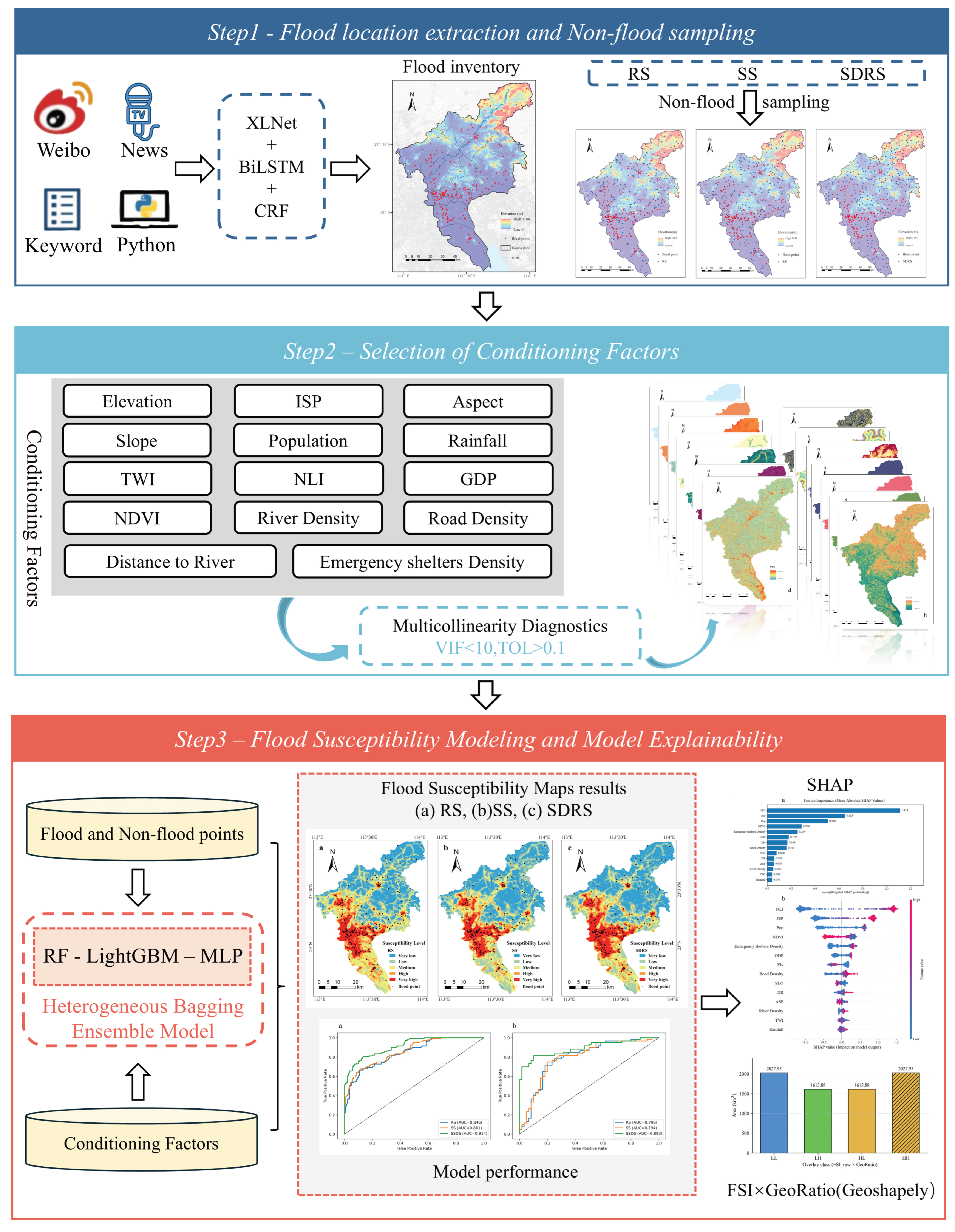
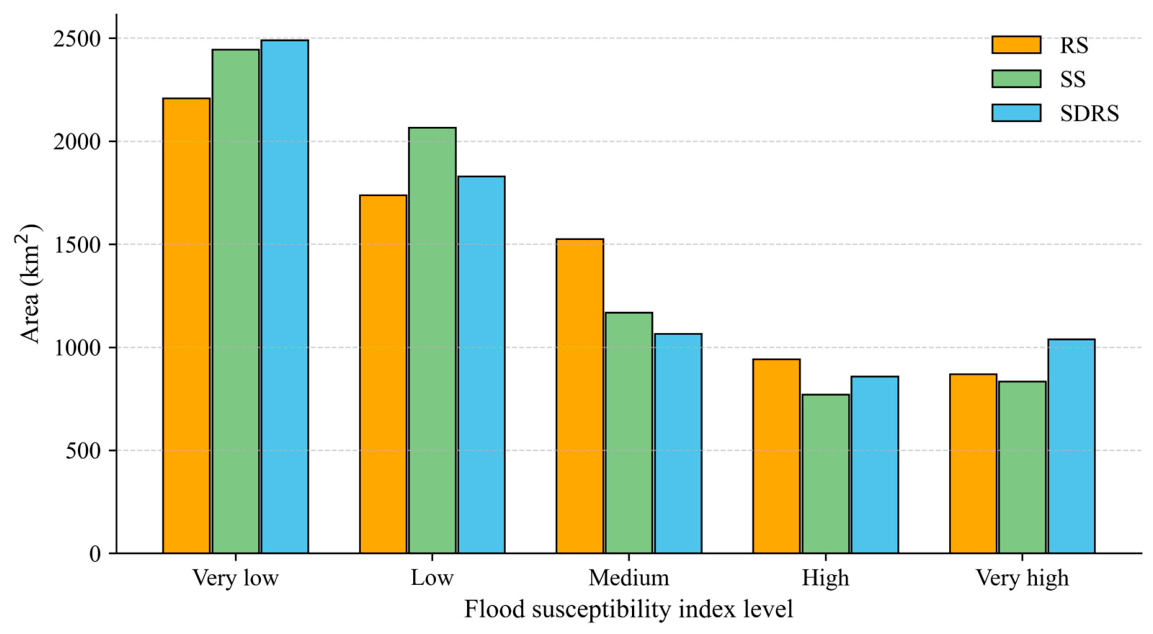
- An interpretable ensemble machine-learning framework integrating social media–derived flood inventories, optimized non-flood sampling, and GeoShapley-based explainability achieved strong flood susceptibility mapping performance in Guangzhou, with an AUC of 0.893 and a precision of 0.859.
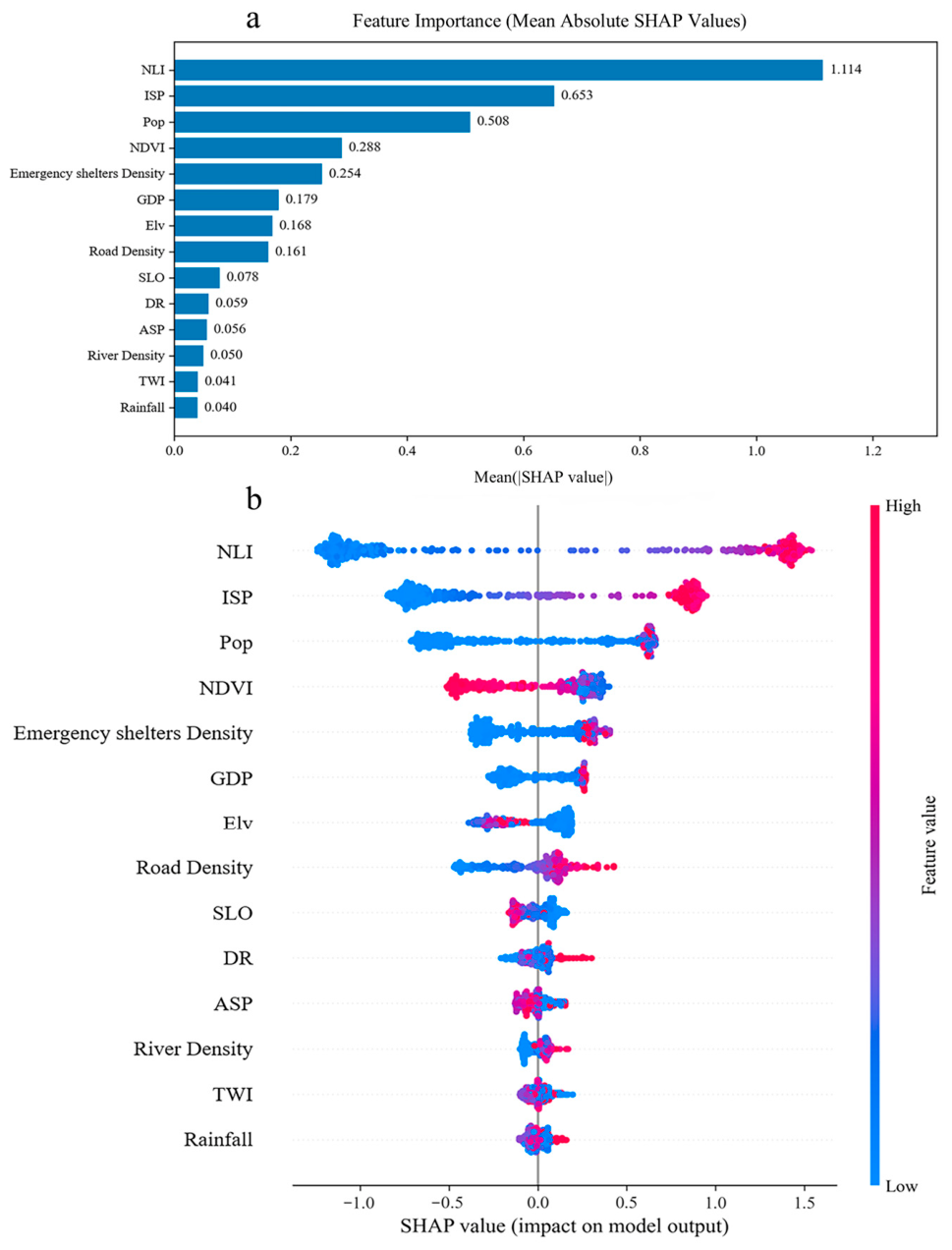
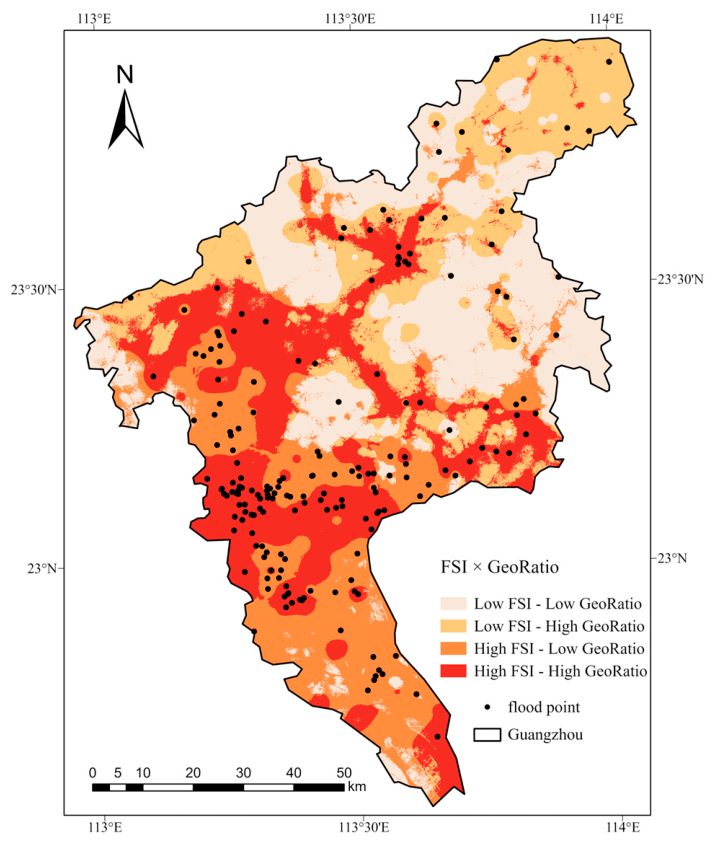
- The flood susceptibility map produced in this study indicates that areas with High and Very-high susceptibility together cover about 26% of the study area (1897.23 km2). Interpretability analysis identifies the nighttime light index, impervious surface percentage, and population density as the most strongly associated positive factors in the model.
- A non-flood sampling strategy that jointly considers sample similarity and diversity can significantly improve model performance and generalization ability in flood susceptibility mapping.
- By improving both predictive accuracy and model interpretability, the proposed framework provides scientific support for flood risk identification, spatial planning, and targeted urban flood mitigation strategies.
Abstract
1. Introduction
2. Study Area and Data
2.1. Study Area
2.2. Datasets
2.2.1. Flood Inventory
2.2.2. Conditioning Factors
3. Methodology
3.1. Flood Location Extraction from Social Media Text Using XLNet-BiLSTM-CRF
3.2. Non-Flood Sampling
3.2.1. Random Sampling (RS)
3.2.2. Stratified Sampling (SS)
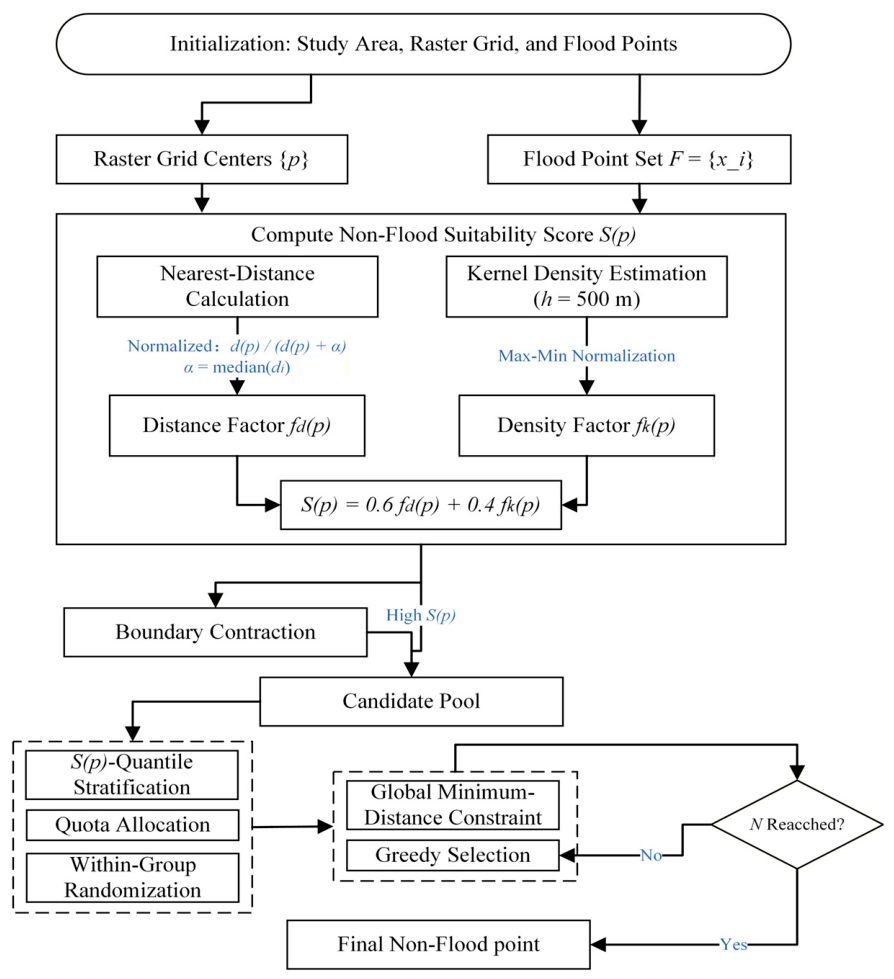
3.2.3. Similarity- and Diversity-Based Representative Sampling (SDRS)
- (1)
- Distance Factor
- (2)
- Density Factor
- (3)
- Integrated Suitability Score
3.3. Flood Susceptibility Modeling
3.3.1. Selection of Conditioning Factors
- (1)
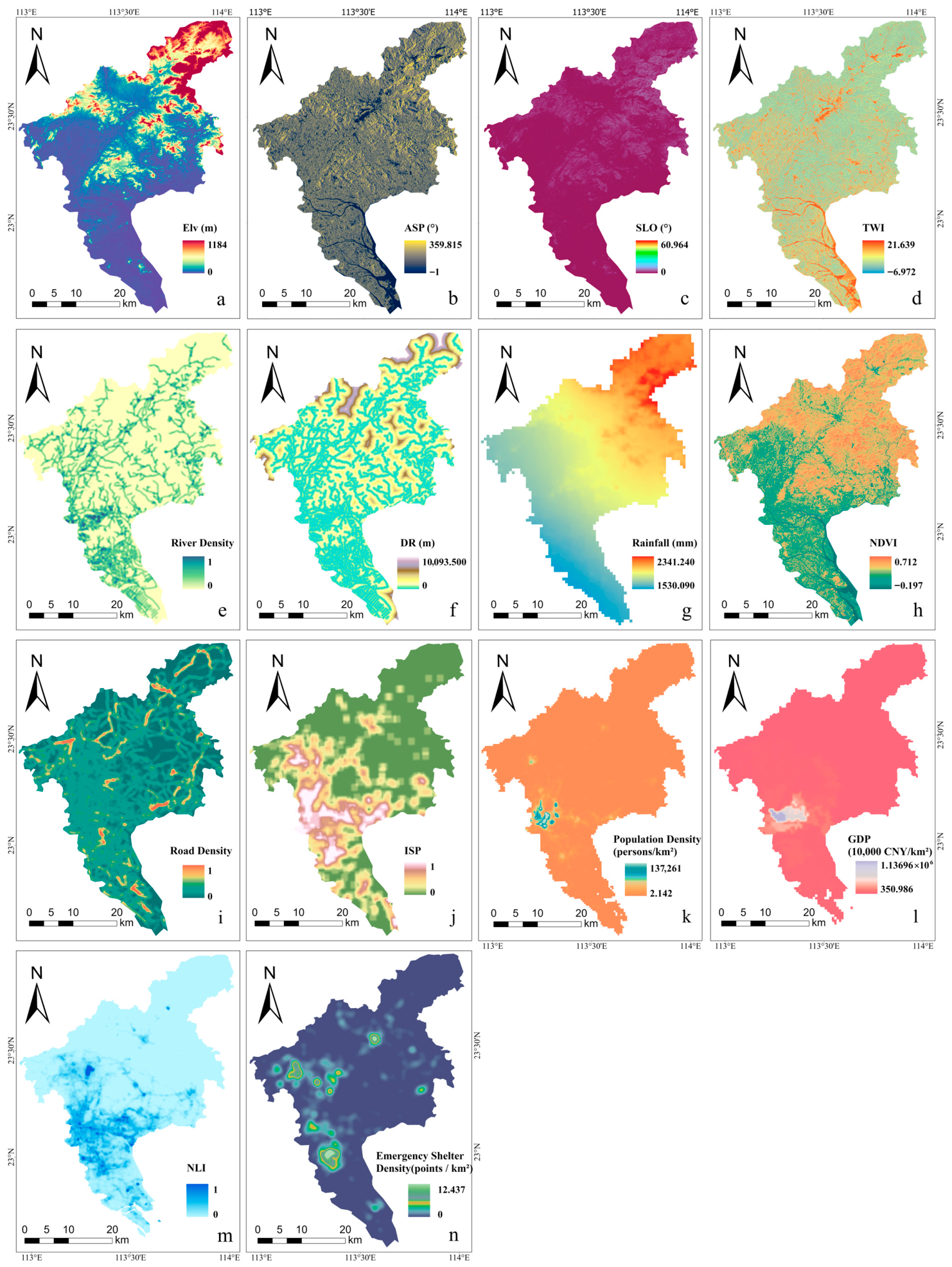
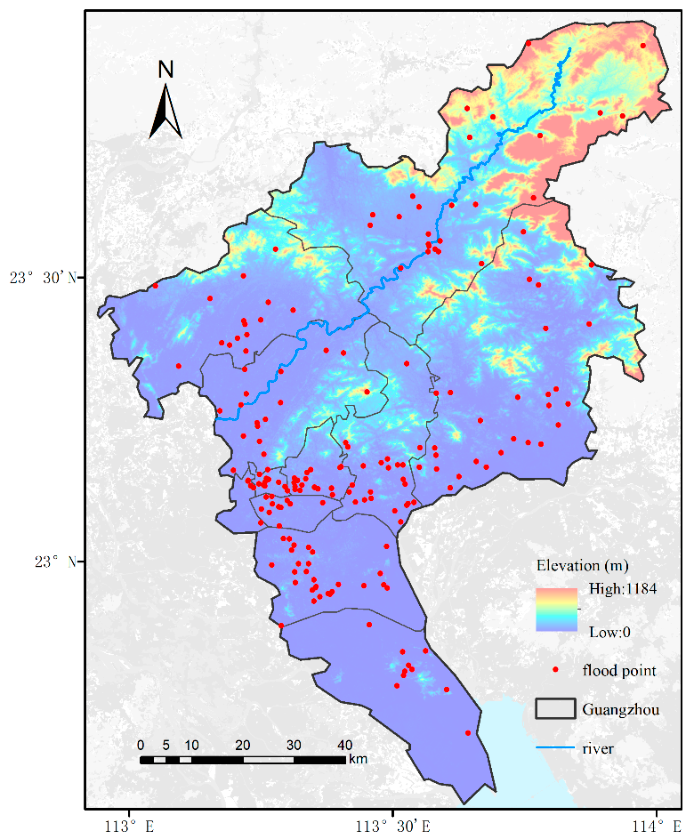
- Topographic factors. Elevation (Elv) was directly acquired from ASTER GDEM data. Slope (SLO) and aspect (ASP) were then derived from the DEM in ArcMap 10.8 to characterize the potential energy conditions of surface runoff and flow-direction characteristics; in this study, ASP was retained as a continuous variable to maintain a consistent preprocessing scheme for topographic factors, although this treatment may not fully represent its circular directional property. The TWI was used to characterize topographic convergence and potential water accumulation conditions.
- (2)
- Hydrological factors. River Density was used to characterize the development of flow-conveyance pathways and runoff connectivity. Based on river network line features from OSM, a continuous raster was generated using kernel density estimation. Distance to River (DR) was used to quantify the strength of river-channel influence, and the Euclidean distance algorithm was applied to calculate the distance from any point in the study area to the nearest river channel.
- (3)
- Vegetation and meteorological factors. Rainfall was represented by annual precipitation in 2024 and was used to describe the external triggering conditions for flood occurrence. Vegetation conditions were represented by NDVI, which was calculated from Landsat 8 imagery and used to characterize the regulating effects of vegetation cover on infiltration, runoff generation, and flow concentration.
- (4)
- Urbanization and socioeconomic factors. Based on road distribution data from OSM, Road Density was generated using the Line Density tool in ArcMap 10.8 to characterize urban transportation connectivity and its potential influence on surface runoff organization. Impervious Surface Percentage (ISP) was derived by extracting the built-up land category from land-use data and calculating its area proportion within each grid cell to reflect the runoff-enhancing effect of the underlying surface. Population Density and GDP were obtained, respectively, from the China population spatial distribution kilometer-grid dataset and the China GDP spatial distribution kilometer-grid dataset. Both were then uniformly processed to a 30 m spatial resolution for use as proxy variables of urban activity intensity and asset concentration. Nighttime Light Index (NLI) was used to reflect urban economic vitality and the intensity of human activities and was derived by standardizing nighttime light radiance. Emergency Shelter Density was generated from shelter-related POIs obtained from Amap, including explicitly designated emergency shelters and potentially convertible shelter-carrying spaces, such as parks and squares, schools, and sports venues. After category screening and spatial deduplication, kernel density estimation was performed in ArcMap 10.8 to derive this factor, which was used to characterize the spatial supply intensity of emergency shelter resources and was incorporated as an auxiliary indicator of urban emergency support and adaptive capacity.
3.3.2. Multicollinearity Analysis of Conditioning Factors
3.3.3. Ensemble Machine Learning and Model Training
3.3.4. Model Performance Evaluation
3.4. GeoShapley-Based Model Explainability
4. Results
4.1. Validation of Social-Media-Derived Flood Locations
4.2. Multicollinearity Diagnostics of Conditioning Factors
4.3. Model Performance Results
4.4. Flood Susceptibility Mapping Results
4.5. Feature Importance and Model Explainability Results
5. Discussion
5.1. Policy Implications
5.2. Contribution to Flood Susceptibility Mapping
5.3. Research Limitations and Prospects
6. Conclusions
- (1)
- Social media texts provided reliable support for urban flood inventory construction. On the test set, the XLNet-BiLSTM-CRF-based location-entity recognition model achieved an F1-score of 0.822 and a Recall of 0.852, demonstrating that it was able to extract flood-related location entities with satisfactory accuracy and meet the requirements of flood sample geolocation, providing credible samples for subsequent FSM.
- (2)
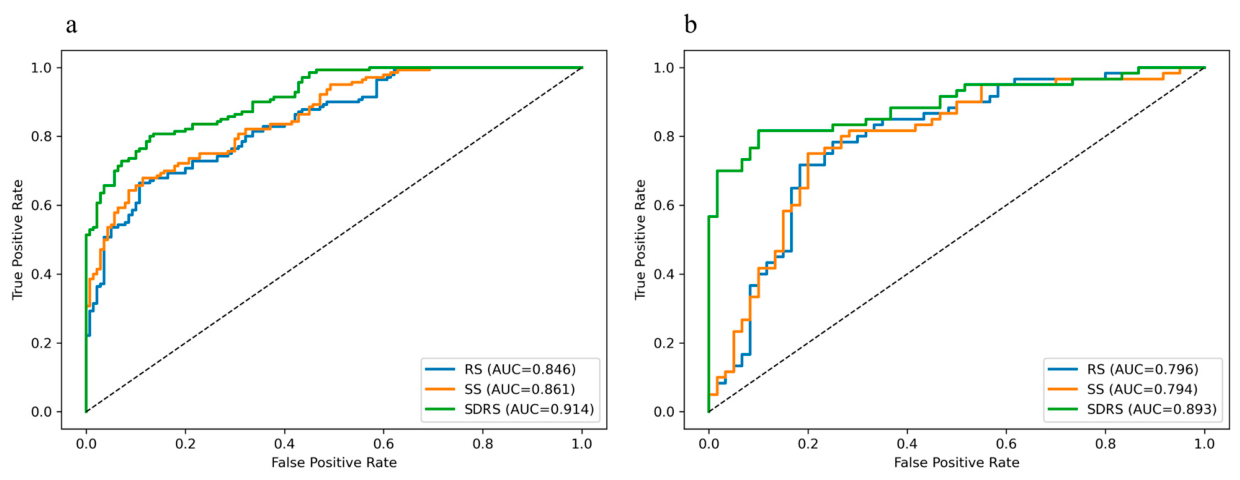
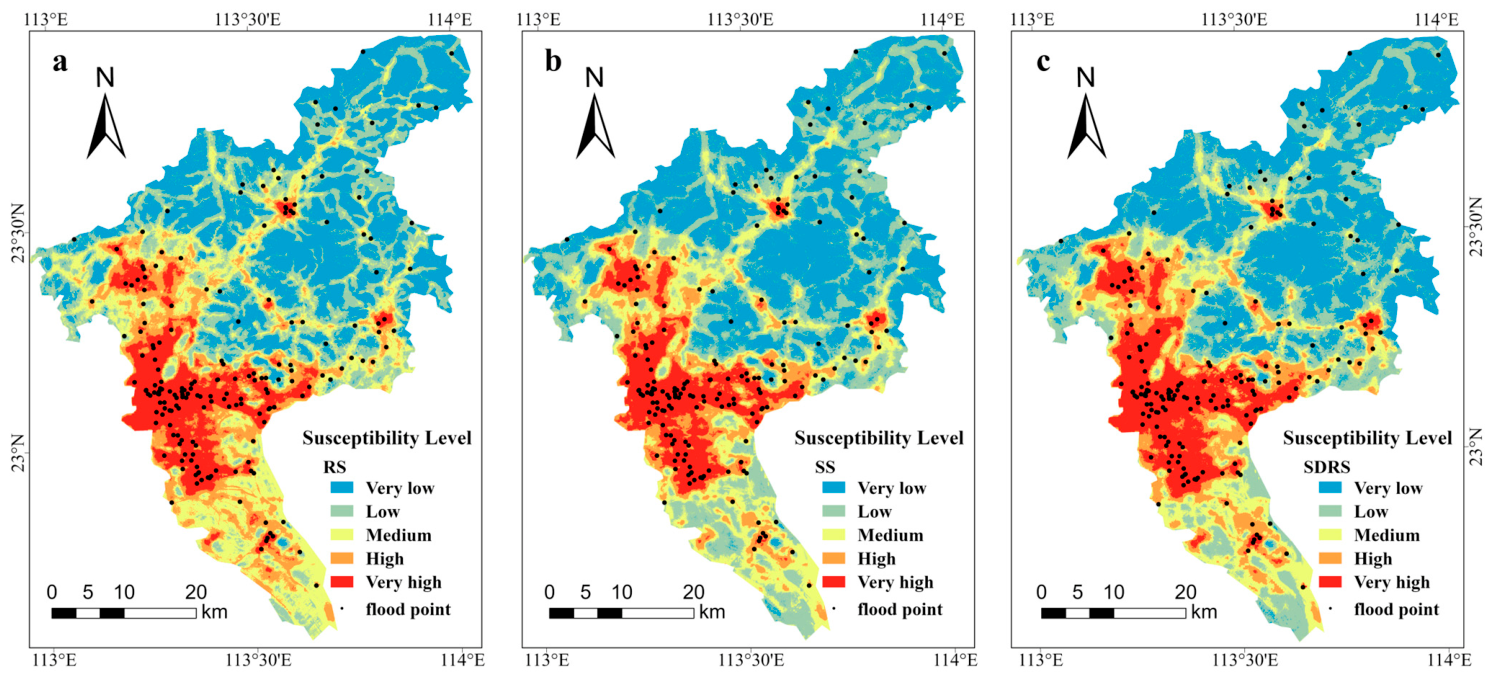
- Among the three non-flood sampling approaches, the proposed SDRS performed best in flood susceptibility modeling. Its AUC on the test set reached 0.893, representing increases of 0.097 and 0.099 over RS and SS, respectively. Its Precision reached 0.859, representing increases of 0.137 and 0.132 over RS and SS, respectively. These results indicate that a non-flood sample construction approach that jointly considers sample similarity and diversity can substantially improve the model’s discriminative ability and generalization performance.
- (3)
- The final flood susceptibility map showed a clear spatial differentiation pattern, with higher susceptibility in the south, lower susceptibility in the north, and evident hotspot clustering. Very-low- and Low-susceptibility zones together made up about 59% of the study area, Medium-susceptibility zones accounted for approximately 15%, and High- and Very-high-susceptibility zones accounted for approximately 26%. Among them, the combined area of High and Very-high susceptibility reached 1897.23 km2 and was mainly distributed across the southern, southwestern, and south-central parts of the study area. Meanwhile, the northern and northeastern parts were dominated by Very-low and Low susceptibility.
- (4)
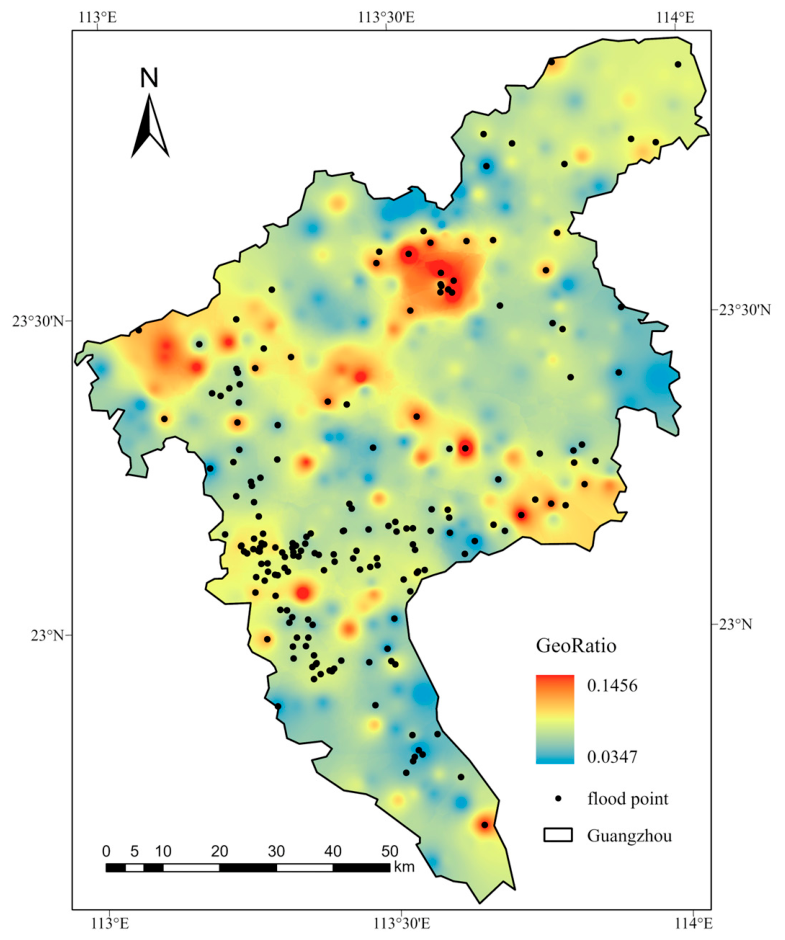
- The interpretability analysis showed that flood susceptibility in Guangzhou was primarily associated with urban development intensity and population exposure. The SHAP results indicated that NLI, ISP, and Population Density were the most important positive factors, whereas NDVI showed a negative effect. The GeoShapley results showed that the Global Spatial Share was 7.18%, indicating that the spatial differentiation of flood susceptibility was still mainly associated with attribute factors, while local spatial dependence provided only relatively limited supplementary explanation.
Author Contributions
Funding
Data Availability Statement
Acknowledgments
Conflicts of Interest
References
- Wang, Y.; Li, C.; Liu, M.; Cui, Q.; Wang, H.; Lv, J.; Li, B.; Xiong, Z.; Hu, Y. Spatial Characteristics and Driving Factors of Urban Flooding in Chinese Megacities. J. Hydrol. 2022, 613, 128464. [Google Scholar] [CrossRef]
- Lu, Z.; Tian, Z.; Zhang, H.; Lu, Y.; Chen, X. Flood Susceptibility and Risk Assessment in Myanmar Using Multi-Source Remote Sensing and Interpretable Ensemble Machine Learning Model. ISPRS Int. J. Geo-Inf. 2026, 15, 45. [Google Scholar] [CrossRef]
- Wu, Z.; Chen, L.; Shi, L. When the Bordering Levee Breaks: The Impact of Floods on Corporate Financialization in China. Econ. Model. 2026, 155, 107432. [Google Scholar] [CrossRef]
- Liu, J.; Shao, W.; Xiang, C.; Mei, C.; Li, Z. Uncertainties of Urban Flood Modeling: Influence of Parameters for Different Underlying Surfaces. Environ. Res. 2020, 182, 108929. [Google Scholar] [CrossRef]
- Kaya, C.M.; Derin, L. Parameters and Methods Used in Flood Susceptibility Mapping: A Review. J. Water Clim. Change 2023, 14, 1935–1960. [Google Scholar] [CrossRef]
- Allafta, H.; Opp, C. GIS-Based Multi-Criteria Analysis for Flood Prone Areas Mapping in the Trans-Boundary Shatt al-Arab Basin, Iraq-Iran. Geomat. Nat. Hazards Risk 2021, 12, 2087–2116. [Google Scholar] [CrossRef]
- Duan, C.; Zhang, J.; Chen, Y.; Lang, Q.; Zhang, Y.; Wu, C.; Zhang, Z. Comprehensive Risk Assessment of Urban Waterlogging Disaster Based on MCDA-GIS Integration: The Case Study of Changchun, China. Remote Sens. 2022, 14, 3101. [Google Scholar] [CrossRef]
- Sharma, A.; Poonia, M.; Rai, A.; Biniwale, R.B.; Tügel, F.; Holzbecher, E.; Hinkelmann, R. Flood Susceptibility Mapping Using GIS-Based Frequency Ratio and Shannon’s Entropy Index Bivariate Statistical Models: A Case Study of Chandrapur District, India. ISPRS Int. J. Geo-Inf. 2024, 13, 297. [Google Scholar] [CrossRef]
- de Brito, M.M.; Evers, M. Multi-Criteria Decision-Making for Flood Risk Management: A Survey of the Current State of the Art. Nat. Hazards Earth Syst. Sci. 2016, 16, 1019–1033. [Google Scholar] [CrossRef]
- Yang, H.; Yao, R.; Dong, L.; Sun, P.; Zhang, Q.; Wei, Y.; Sun, S.; Aghakouchak, A. Advancing Flood Susceptibility Modeling Using Stacking Ensemble Machine Learning: A Multi-Model Approach. J. Geogr. Sci. 2024, 34, 1513–1536. [Google Scholar] [CrossRef]
- Gudiyangada Nachappa, T.; Tavakkoli Piralilou, S.; Gholamnia, K.; Ghorbanzadeh, O.; Rahmati, O.; Blaschke, T. Flood Susceptibility Mapping with Machine Learning, Multi-Criteria Decision Analysis and Ensemble Using Dempster Shafer Theory. J. Hydrol. 2020, 590, 125275. [Google Scholar] [CrossRef]
- Tien Bui, D.; Hoang, N.-D.; Martínez-Álvarez, F.; Ngo, P.-T.T.; Hoa, P.V.; Pham, T.D.; Samui, P.; Costache, R. A Novel Deep Learning Neural Network Approach for Predicting Flash Flood Susceptibility: A Case Study at a High Frequency Tropical Storm Area. Sci. Total Environ. 2020, 701, 134413. [Google Scholar] [CrossRef] [PubMed]
- Janizadeh, S.; Kim, D.; Jun, C.; Bateni, S.M.; Pandey, M.; Mishra, V.N. Impact of Climate Change on Future Flood Susceptibility Projections under Shared Socioeconomic Pathway Scenarios in South Asia Using Artificial Intelligence Algorithms. J. Environ. Manag. 2024, 366, 121764. [Google Scholar] [CrossRef]
- Arora, A.; Durga, G.P.; Pandey, M.; Arabameri, A. Machine Learning Model Optimization for Flood Susceptibility Zonation over the Kosi Megafan, Himalayan Foreland Basin, India. Sci. Rep. 2025, 15, 32757. [Google Scholar] [CrossRef]
- Shafizadeh-Moghadam, H.; Valavi, R.; Shahabi, H.; Chapi, K.; Shirzadi, A. Novel Forecasting Approaches Using Combination of Machine Learning and Statistical Models for Flood Susceptibility Mapping. J. Environ. Manag. 2018, 217, 1–11. [Google Scholar] [CrossRef]
- Breiman, L. Bagging Predictors. Mach. Learn. 1996, 24, 123–140. [Google Scholar] [CrossRef]
- Shahabi, H.; Shirzadi, A.; Ghaderi, K.; Omidvar, E.; Al-Ansari, N.; Clague, J.J.; Geertsema, M.; Khosravi, K.; Amini, A.; Bahrami, S.; et al. Flood Detection and Susceptibility Mapping Using Sentinel-1 Remote Sensing Data and a Machine Learning Approach: Hybrid Intelligence of Bagging Ensemble Based on K-Nearest Neighbor Classifier. Remote Sens. 2020, 12, 266. [Google Scholar] [CrossRef]
- Pham, B.T.; Jaafari, A.; Phong, T.V.; Yen, H.P.H.; Tuyen, T.T.; Luong, V.V.; Nguyen, H.D.; Le, H.V.; Foong, L.K. Improved Flood Susceptibility Mapping Using a Best First Decision Tree Integrated with Ensemble Learning Techniques. Geosci. Front. 2021, 12, 101105. [Google Scholar] [CrossRef]
- Fu, S.; Lyu, H.; Wang, Z.; Hao, X.; Zhang, C. Extracting Historical Flood Locations from News Media Data by the Named Entity Recognition (NER) Model to Assess Urban Flood Susceptibility. J. Hydrol. 2022, 612, 128312. [Google Scholar] [CrossRef]
- Plataridis, K.; Mallios, Z. Flood Susceptibility Mapping Using Hybrid Models Optimized with Artificial Bee Colony. J. Hydrol. 2023, 624, 129961. [Google Scholar] [CrossRef]
- Lu, H.; Zhang, S.; Gao, Y.; Jin, H.; Zhao, P.; Gao, Y.; Li, Y.; Wang, W.; Zhang, Y. Using Social Media Data to Construct and Analyze Knowledge Graph for “7.20” Henan Rainstorm Flood Event. Int. J. Disaster Risk Reduct. 2025, 116, 105129. [Google Scholar] [CrossRef]
- Tehrany, M.S.; Pradhan, B.; Jebur, M.N. Flood Susceptibility Mapping Using a Novel Ensemble Weights-of-Evidence and Support Vector Machine Models in GIS. J. Hydrol. 2014, 512, 332–343. [Google Scholar] [CrossRef]
- Zhao, G.; Pang, B.; Xu, Z.; Peng, D.; Xu, L. Assessment of Urban Flood Susceptibility Using Semi-Supervised Machine Learning Model. Sci. Total Environ. 2019, 659, 940–949. [Google Scholar] [CrossRef] [PubMed]
- Huang, H.; Tao, Z.; Zhan, J.; Wang, C. Contrast or Diversity: Non-Flood Sampling in Urban Flood Susceptibility Modelling. J. Hydrol. 2025, 656, 133053. [Google Scholar] [CrossRef]
- Ruan, J.; Chen, Y.; Yang, Z. Assessment of Temporal and Spatial Progress of Urban Resilience in Guangzhou under Rainstorm Scenarios. Int. J. Disaster Risk Reduct. 2021, 66, 102578. [Google Scholar] [CrossRef]
- Li, Y.; Wang, W.; Chang, M.; Wang, X. Impacts of Urbanization on Extreme Precipitation in the Guangdong-Hong Kong-Macau Greater Bay Area. Urban Clim. 2021, 38, 100904. [Google Scholar] [CrossRef]
- Wang, C.; Lin, Y.; Tao, Z.; Zhan, J.; Li, W.; Huang, H. An Inverse-Occurrence Sampling Approach for Urban Flood Susceptibility Mapping. Remote Sens. 2023, 15, 5384. [Google Scholar] [CrossRef]
- Tehrany, M.S.; Jones, S.; Shabani, F. Identifying the Essential Flood Conditioning Factors for Flood Prone Area Mapping Using Machine Learning Techniques. CATENA 2019, 175, 174–192. [Google Scholar] [CrossRef]
- Rafiei-Sardooi, E.; Azareh, A.; Choubin, B.; Mosavi, A.H.; Clague, J.J. Evaluating Urban Flood Risk Using Hybrid Method of TOPSIS and Machine Learning. Int. J. Disaster Risk Reduct. 2021, 66, 102614. [Google Scholar] [CrossRef]
- Arora, A.; Arabameri, A.; Pandey, M.; Siddiqui, M.A.; Shukla, U.K.; Bui, D.T.; Mishra, V.N.; Bhardwaj, A. Optimization of State-of-the-Art Fuzzy-Metaheuristic ANFIS-Based Machine Learning Models for Flood Susceptibility Prediction Mapping in the Middle Ganga Plain, India. Sci. Total Environ. 2021, 750, 141565. [Google Scholar] [CrossRef]
- Rahman, M.; Ningsheng, C.; Mahmud, G.I.; Islam, M.M.; Pourghasemi, H.R.; Ahmad, H.; Habumugisha, J.M.; Washakh, R.M.A.; Alam, M.; Liu, E.; et al. Flooding and Its Relationship with Land Cover Change, Population Growth, and Road Density. Geosci. Front. 2021, 12, 101224. [Google Scholar] [CrossRef]
- Islam, T.; Zeleke, E.B.; Afroz, M.; Melesse, A.M. A Systematic Review of Urban Flood Susceptibility Mapping: Remote Sensing, Machine Learning, and Other Modeling Approaches. Remote Sens. 2025, 17, 524. [Google Scholar] [CrossRef]
- Zhang, T.; Wu, K.; Wang, X.; Li, X.; Li, L.; Chen, L. Impact of Land Use Patterns on Flood Risk in the Chang-Zhu-Tan Urban Agglomeration, China. Remote Sens. 2025, 17, 2889. [Google Scholar] [CrossRef]
- Choudhury, S.; Basak, A.; Biswas, S.; Das, J. Flash Flood Susceptibility Mapping Using GIS-Based AHP Method. In Spatial Modelling of Flood Risk and Flood Hazards; Pradhan, B., Shit, P.K., Bhunia, G.S., Adhikary, P.P., Pourghasemi, H.R., Eds.; GIScience and Geo-Environmental Modelling; Springer International Publishing: Cham, Switzerland, 2022; pp. 119–142. [Google Scholar]
- Qin, X.; Wang, S.; Meng, M.; Long, H.; Zhang, H.; Shi, H. Enhancing Urban Resilience through Machine Learning-Supported Flood Risk Assessment: Integrating Flood Susceptibility with Building Function Vulnerability. npj Urban Sustain. 2025, 5, 19. [Google Scholar] [CrossRef]
- Wu, M.; Wei, X.; Ge, W.; Chen, G.; Zheng, D.; Zhao, Y.; Chen, M.; Xin, Y. Analyzing the Spatial Scale Effects of Urban Elements on Urban Flooding Based on Multiscale Geographically Weighted Regression. J. Hydrol. 2024, 645, 132178. [Google Scholar] [CrossRef]
- Hu, Y.; Liu, Y.; Zeng, H. Whole Process Assessment of Flood Resilience in Urban and Rural Communities Based on Nighttime Lights: A Case Study of Zhuozhou Flood. Urban Clim. 2025, 61, 102438. [Google Scholar] [CrossRef]
- Wang, Z.; Chen, X.; Qi, Z.; Cui, C. Flood Sensitivity Assessment of Super Cities. Sci. Rep. 2023, 13, 5582. [Google Scholar] [CrossRef]
- Zhu, S.; Jiang, Y.; Zhang, J.; Dai, Q.; Yang, X. Evaluating the Effect of Urban Flooding on Spatial Accessibility to Emergency Shelters Based on Social Sensing Data. Trans. GIS 2024, 28, 23–39. [Google Scholar] [CrossRef]
- Breiman, L. Random Forests. Mach. Learn. 2001, 45, 5–32. [Google Scholar] [CrossRef]
- Ke, G.; Meng, Q.; Finley, T.; Wang, T.; Chen, W.; Ma, W.; Ye, Q.; Liu, T.-Y. LightGBM: A Highly Efficient Gradient Boosting Decision Tree. In Advances in Neural Information Processing Systems; Curran Associates, Inc.: Red Hook, NY, USA, 2017; Volume 30, pp. 3146–3154. [Google Scholar]
- Roberts, D.R.; Bahn, V.; Ciuti, S.; Boyce, M.S.; Elith, J.; Guillera-Arroita, G.; Hauenstein, S.; Lahoz-Monfort, J.J.; Schröder, B.; Thuiller, W.; et al. Cross-Validation Strategies for Data with Temporal, Spatial, Hierarchical, or Phylogenetic Structure. Ecography 2017, 40, 913–929. [Google Scholar] [CrossRef]
- Zhao, G.; Pang, B.; Xu, Z.; Peng, D.; Zuo, D. Urban Flood Susceptibility Assessment Based on Convolutional Neural Networks. J. Hydrol. 2020, 590, 125235. [Google Scholar] [CrossRef]
- Pham, B.T.; Tien Bui, D.; Dholakia, M.B.; Prakash, I.; Pham, H.V. A Comparative Study of Least Square Support Vector Machines and Multiclass Alternating Decision Trees for Spatial Prediction of Rainfall-Induced Landslides in a Tropical Cyclones Area. Geotech. Geol. Eng. 2016, 34, 1807–1824. [Google Scholar] [CrossRef]
- Li, Z. GeoShapley: A Game Theory Approach to Measuring Spatial Effects in Machine Learning Models. Ann. Am. Assoc. Geogr. 2024, 114, 1365–1385. [Google Scholar] [CrossRef]
- Ke, E.; Zhao, J.; Zhao, Y. Investigating the Influence of Nonlinear Spatial Heterogeneity in Urban Flooding Factors Using Geographic Explainable Artificial Intelligence. J. Hydrol. 2025, 648, 132398. [Google Scholar] [CrossRef]





| Data | Source | Resolution | Time |
|---|---|---|---|
| DEM | ASTER GDEM | 30 m | 2020 |
| River network | OpenStreetMap | - | 2020 |
| NDVI | Landsat 8 | 30 m | 2020 |
| Annual precipitation | Resource and Environmental Science Data Center (RESDC) | 1 km | 2024 |
| Road distribution | OpenStreetMap | - | 2020 |
| Land use | RESDC | 30 m | 2020 |
| Population density | RESDC | 1 km | 2020 |
| GDP | RESDC | 1 km | 2020 |
| Nighttime light | RESDC | 0.0083° | 2020 |
| Emergency shelters | Amap | - | 2020 |
| Conditioning Factors | Descriptions | References |
|---|---|---|
| Elevation (Elv) | Reflects the topographic conditions related to surface potential energy, flow accumulation, and waterlogging. | [28] |
| Slope (SLO) | Affects overland flow velocity and the time of concentration. | [29] |
| Aspect (ASP) | Influences local precipitation receipt and incoming solar radiation conditions. | [30] |
| TWI | Characterizes topographic convergence and the propensity for water accumulation, thereby identifying terrain prone to waterlogging. | [28,30] |
| River Density | Indicates the degree of development of drainage pathways and is associated with runoff connectivity and flood propagation routes. | [31,32] |
| Distance to River (DR) | Areas closer to river channels are more susceptible to overflow influence and are therefore more prone to flooding. | [28,31] |
| NDVI | Vegetation affects runoff generation and water accumulation by intercepting rainfall, enhancing infiltration, and increasing surface roughness. | [32,33] |
| Rainfall | Greater rainfall intensity or amount is associated with a higher likelihood of flood occurrence. | [30] |
| Road Density | Roads are commonly associated with increased imperviousness and the reconfiguration of runoff pathways. | [31,34] |
| Impervious Surface Percentage (ISP) | Impervious surfaces reduce infiltration, amplify peak runoff, and increase drainage pressure. | [35] |
| Population Density | Represents the intensity of urban human activities. | [36,37] |
| GDP | Serves as a proxy for economic activity and development intensity, reflecting the level of urbanization and potential exposure. | [37] |
| Nighttime Light Index (NLI) | Depicts the spatial distribution of human activity intensity and socioeconomic vitality. | [38] |
| Emergency Shelter Density | Represents the spatial supply of emergency shelter resources and adaptive capacity. | [39] |
| Index | Precision | Recall | F1-Score |
|---|---|---|---|
| XLNet-BiLSTM-CRF | 0.794 | 0.852 | 0.822 |
| Conditioning Factors | VIF | TOL |
|---|---|---|
| Elv | 1.392 | 0.718 |
| ASP | 1.190 | 0.840 |
| SLO | 1.537 | 0.651 |
| TWI | 1.341 | 0.746 |
| River Density | 1.655 | 0.604 |
| DR | 1.404 | 0.712 |
| Rainfall | 1.440 | 0.694 |
| NDVI | 1.545 | 0.647 |
| Road Density | 1.092 | 0.916 |
| ISP | 3.180 | 0.314 |
| Population Density | 1.914 | 0.523 |
| GDP | 1.937 | 0.516 |
| NLI | 3.616 | 0.277 |
| Emergency Shelter Density | 1.333 | 0.750 |
| Sampling Approach | Accuracy | Precision | Recall | F1-Score |
|---|---|---|---|---|
| RS | 0.728 | 0.722 | 0.740 | 0.731 |
| SS | 0.738 | 0.727 | 0.760 | 0.743 |
| SDRS | 0.833 | 0.859 | 0.795 | 0.826 |
Disclaimer/Publisher’s Note: The statements, opinions and data contained in all publications are solely those of the individual author(s) and contributor(s) and not of MDPI and/or the editor(s). MDPI and/or the editor(s) disclaim responsibility for any injury to people or property resulting from any ideas, methods, instructions or products referred to in the content. |
© 2026 by the authors. Licensee MDPI, Basel, Switzerland. This article is an open access article distributed under the terms and conditions of the Creative Commons Attribution (CC BY) license.
Share and Cite
Zhou, Y.; Lu, H.; Liu, S.; Zhang, S. An Explainable Ensemble Machine Learning Framework for Flood Susceptibility Mapping Using Social Media Data: A Case Study of Guangzhou, China. Remote Sens. 2026, 18, 1495. https://doi.org/10.3390/rs18101495
Zhou Y, Lu H, Liu S, Zhang S. An Explainable Ensemble Machine Learning Framework for Flood Susceptibility Mapping Using Social Media Data: A Case Study of Guangzhou, China. Remote Sensing. 2026; 18(10):1495. https://doi.org/10.3390/rs18101495
Chicago/Turabian StyleZhou, Yuhan, Haipeng Lu, Sicen Liu, and Shuliang Zhang. 2026. "An Explainable Ensemble Machine Learning Framework for Flood Susceptibility Mapping Using Social Media Data: A Case Study of Guangzhou, China" Remote Sensing 18, no. 10: 1495. https://doi.org/10.3390/rs18101495
APA StyleZhou, Y., Lu, H., Liu, S., & Zhang, S. (2026). An Explainable Ensemble Machine Learning Framework for Flood Susceptibility Mapping Using Social Media Data: A Case Study of Guangzhou, China. Remote Sensing, 18(10), 1495. https://doi.org/10.3390/rs18101495