Quantifying the Link Between 3D Vegetation Structure and Plant Diversity in Urban Parks Using Fused Multi-Platform LiDAR Data
Highlights
- Fusing Unmanned Aerial Vehicle (UAV) and handheld LiDAR precisely captures the complete 3D vegetation structure from understory to canopy in urban parks.
- Vertical structural complexity (Hstd) and 3D vegetation density (VDI) synergistically drive plant diversity, exhibiting significant non-linear relationships and ecological thresholds.
- The stronger predictive power of 3D structure for species richness (R) over the Shannon–Wiener index (H) indicates that physical structural metrics alone struggle to fully capture the spatial variation of community species relative abundance.
- The multi-platform LiDAR fusion framework provides methodological references for urban green space management, transitioning from traditional ‘2D green quantity’ to precise ‘3D green quality’ for biodiversity conservation.
Abstract
1. Introduction
- (1)
- What are the most effective 3D structural metrics for predicting plant diversity in an urban park environment?
- (2)
- What is the quantitative relationship between key 3D structural metrics and plant diversity, and do ecological thresholds exist?
- (3)
- Do the driving mechanisms of 3D structure differ across various diversity dimensions and different plant strata?
2. Materials and Methods
2.1. Study Area
2.2. 3D Point Cloud Model Construction and Pre-Processing
2.3. Vegetation Information Acquisition
2.3.1. Quadrat Setup
2.3.2. LiDAR-Based Vegetation Information Extraction
2.3.3. Species Identification and Accuracy Validation Data Collection
2.3.4. Individual Tree Segmentation Accuracy Validation
2.4. Calculation of Diversity Indices
2.5. Acquisition of 3D Structural Metrics
2.6. Statistical Analysis
3. Results
3.1. Overview of Community Characteristics
3.2. Relationship Between 3D Vegetation Structure and Diversity
3.3. Importance Ranking of Driving Factors
3.4. Relationship Patterns of Key Factors and Diversity
4. Discussion
4.1. Applicability of LiDAR Technology
4.2. Driving Mechanisms of 3D Vegetation Structure on Plant Diversity
4.3. Limitations and Future Outlook
5. Conclusions
- (1)
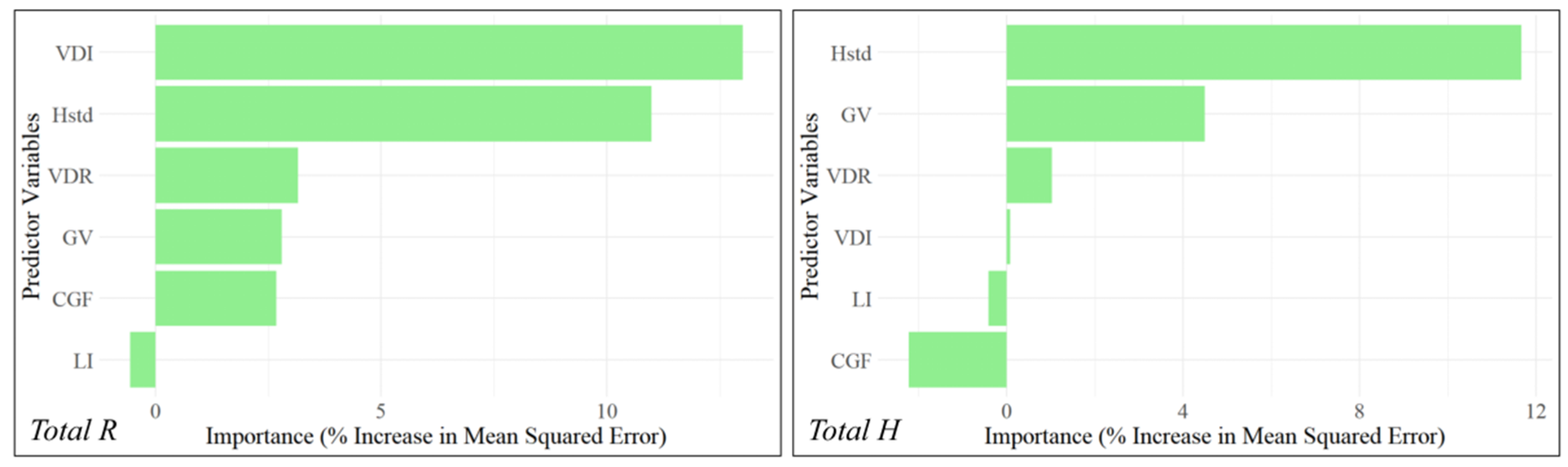
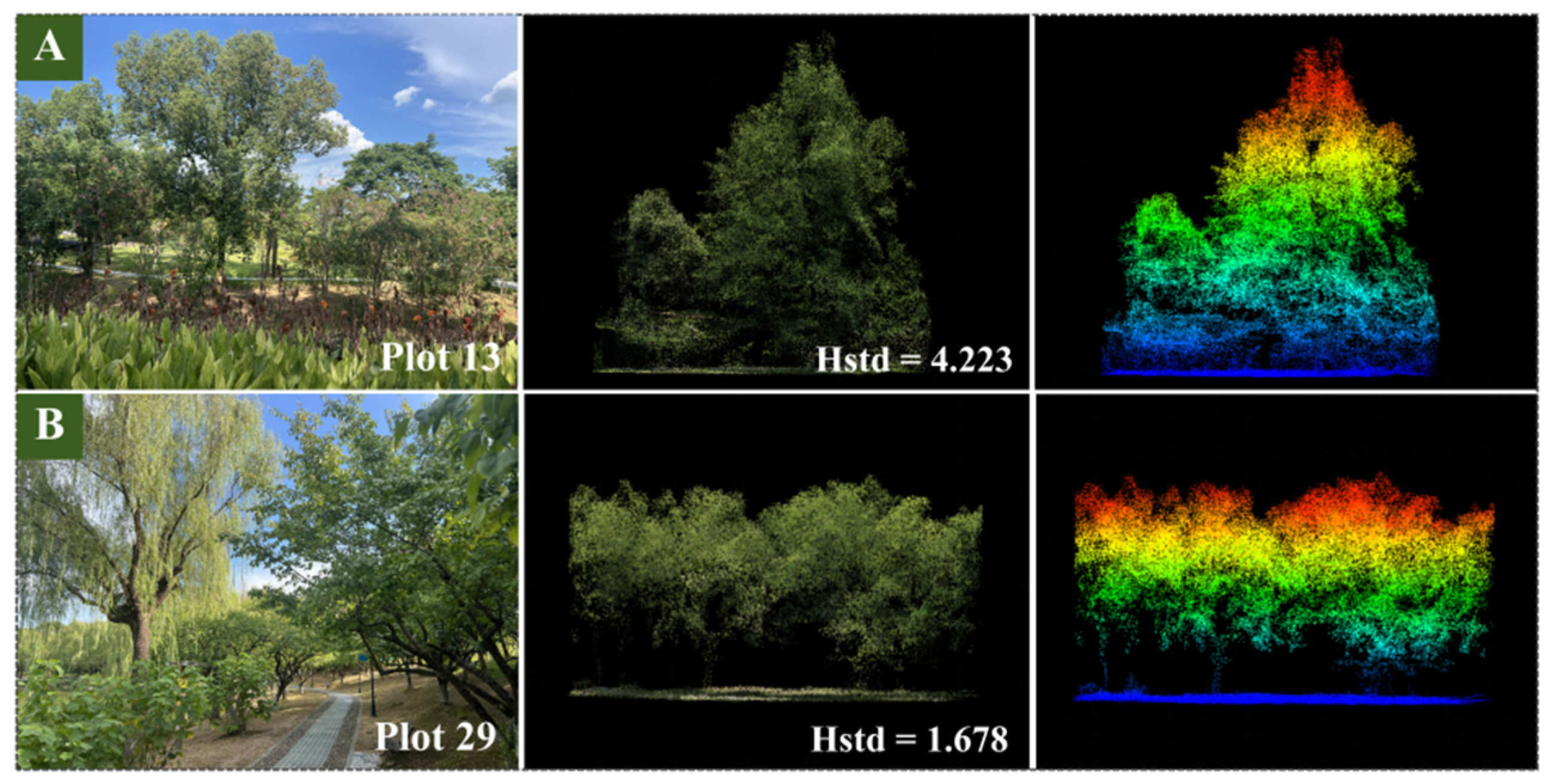
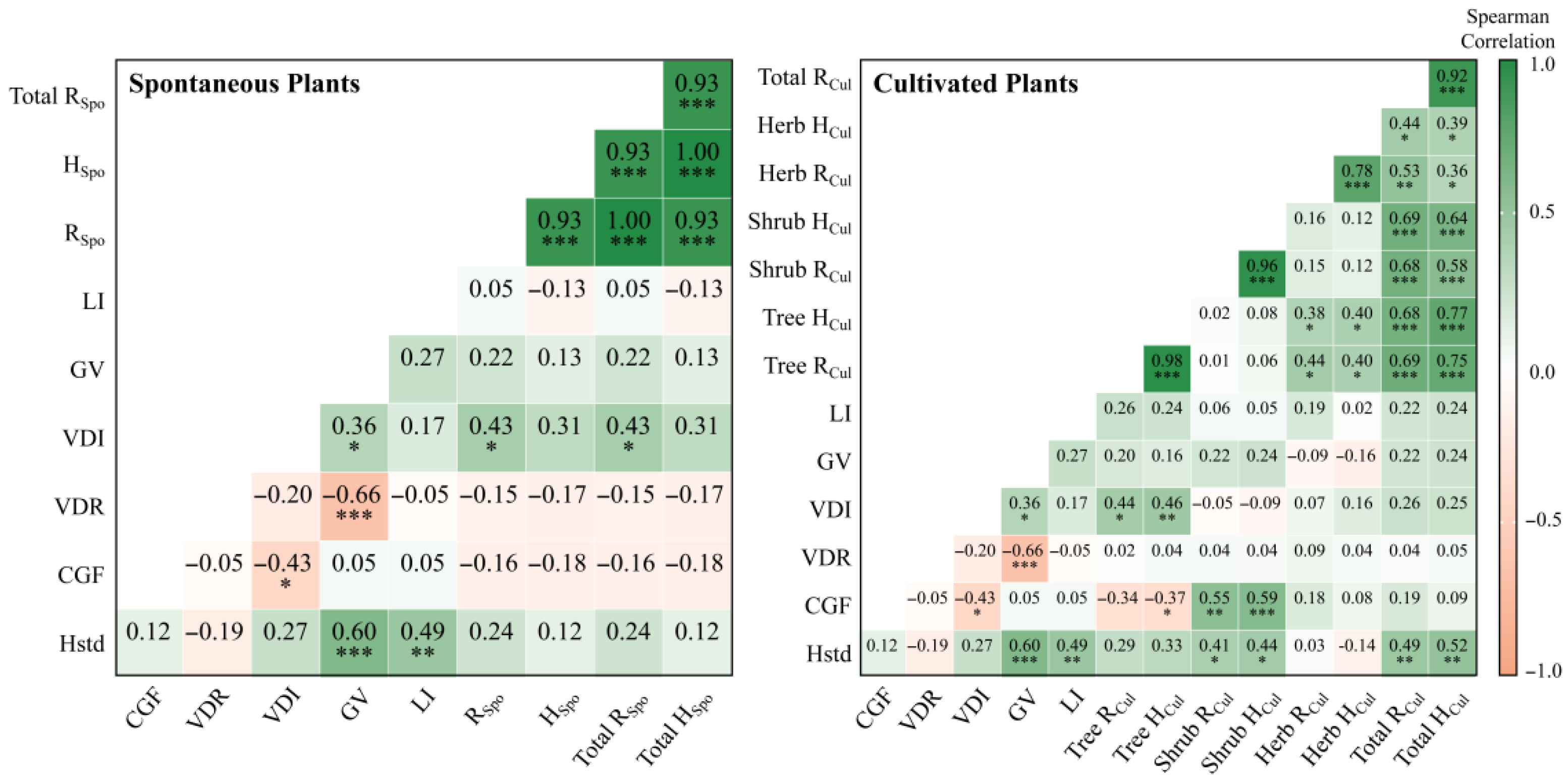
- Habitats with high vertical structural complexity and high 3D spatial density are fundamental for maintaining high biodiversity. The standard deviation of canopy height (Hstd) and the vegetation density index (VDI) are the most critical structural factors driving plant diversity in urban parks, but their driving pathways differ: Hstd primarily influences the diversity of cultivated plants by representing the complexity of anthropogenic design, whereas VDI affects the diversity of spontaneous plants by reflecting resource availability. This finding specifies the classic ‘habitat heterogeneity hypothesis’ in the context of urban parks as a superposition of ‘design’ and ‘ecological’ processes.
- (2)
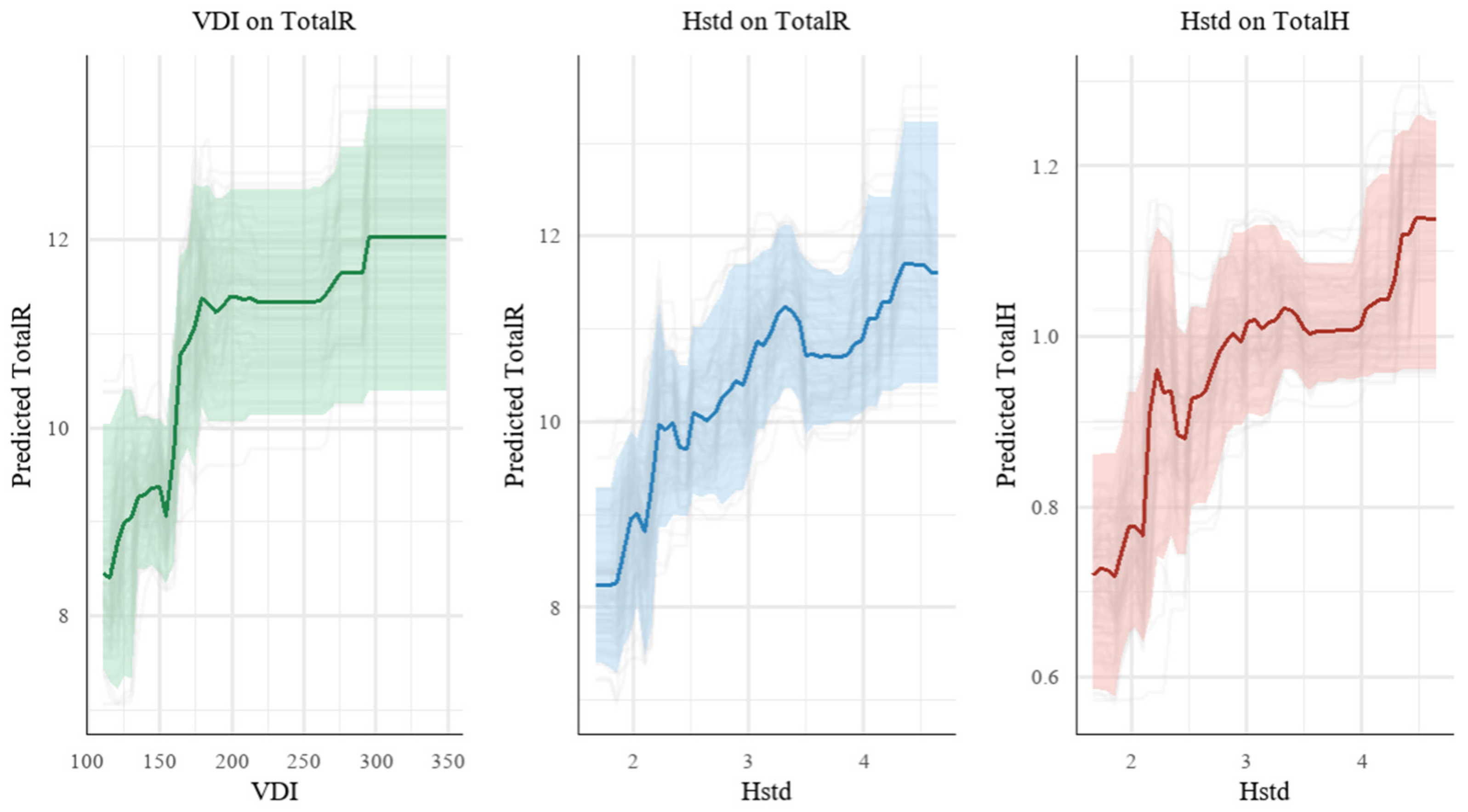
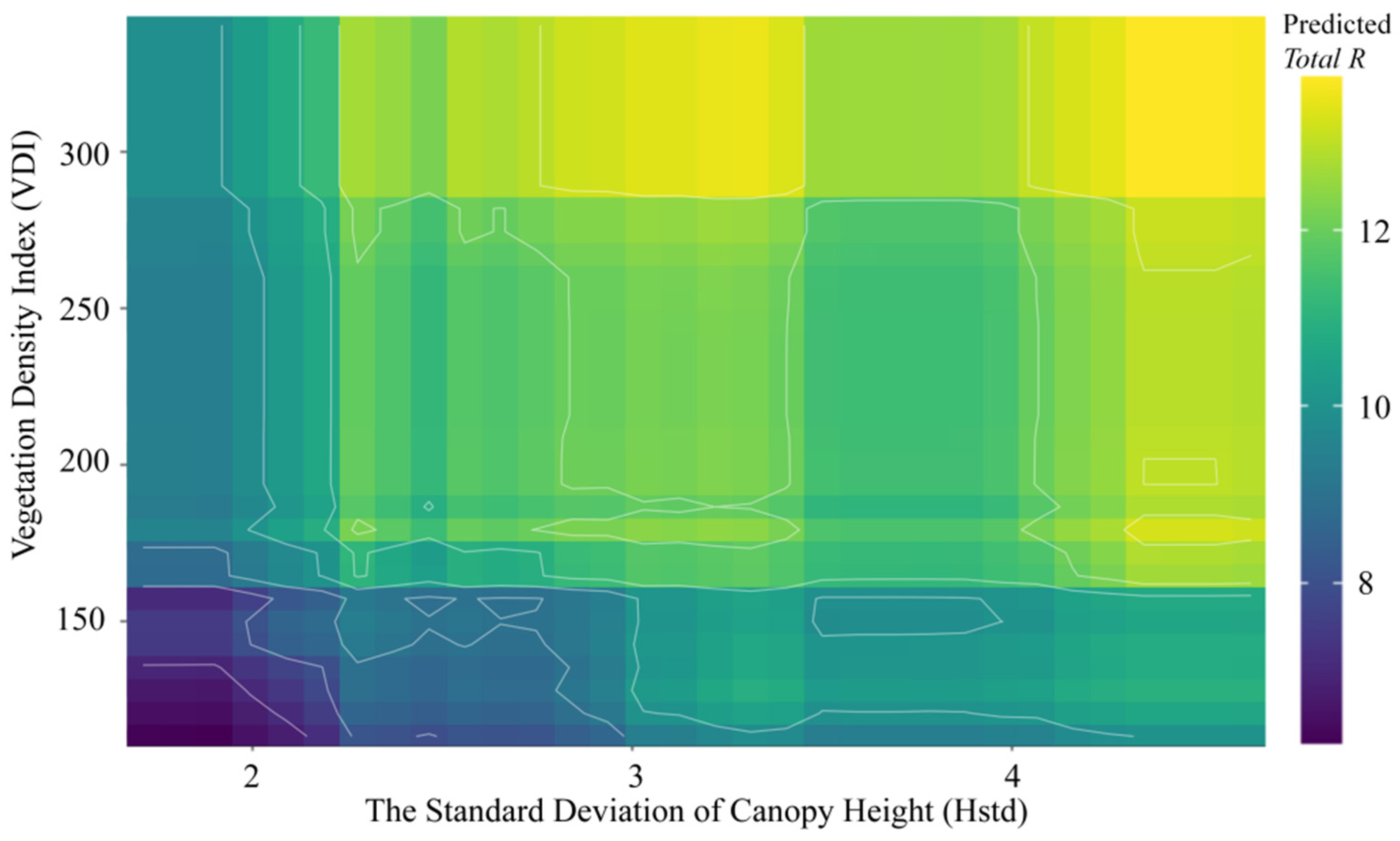
- The influence of key structural factors on plant diversity is significantly non-linear, exhibiting potential ecological thresholds suggested by the current dataset alongside synergistic effects. The study quantitatively identified a synergistic effect between Hstd and VDI on plant diversity, demonstrating that the coupling of high ‘design diversity’ and high ‘resource abundance’ is a prerequisite for maximizing total diversity. Based on the current model analysis, the predicted plant diversity tends to be maximized and stabilized only when both VDI and Hstd reach high-level ranges.
- (3)
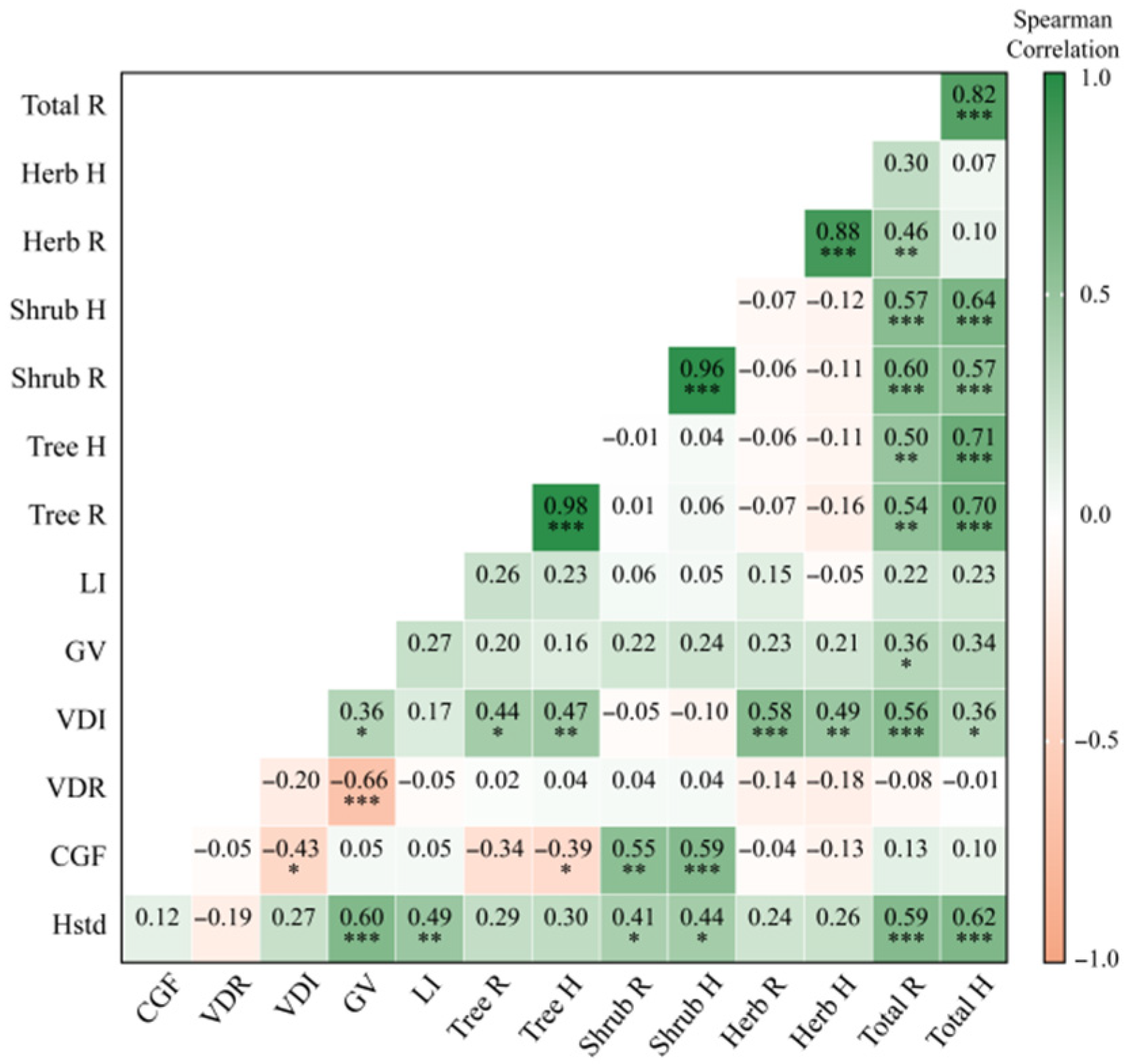
- The driving mechanisms of 3D structure differ across various diversity dimensions, plant origins, and vegetation strata. In the context of urban parks, the predictive power of 3D structure for species richness (R) is far superior to that for the Shannon–Wiener index (H). This indicates that 3D physical structural metrics struggle to fully capture the spatial variation in relative species abundance (evenness), and their independent predictive power for comprehensive diversity indices is relatively limited. Furthermore, different structural metrics exhibit trade-offs or even antagonistic effects on different plant strata; for example, the canopy gap fraction is beneficial for shrubs but potentially detrimental for trees.
Supplementary Materials
Author Contributions
Funding
Data Availability Statement
Conflicts of Interest
References
- Elmqvist, T.; Andersson, E.; Frantzeskaki, N.; McPhearson, T.; Olsson, P.; Gaffney, O.; Takeuchi, K.; Folke, C. Sustainability and Resilience for Transformation in the Urban Century. Nat. Sustain. 2019, 2, 267–273. [Google Scholar] [CrossRef]
- Simkin, R.D.; Seto, K.C.; McDonald, R.I.; Jetz, W. Biodiversity Impacts and Conservation Implications of Urban Land Expansion Projected to 2050. Proc. Natl. Acad. Sci. USA 2022, 119, e2117297119. [Google Scholar] [CrossRef] [PubMed]
- Yan, Z.; Teng, M.; He, W.; Liu, A.; Li, Y.; Wang, P. Impervious Surface Area Is a Key Predictor for Urban Plant Diversity in a City Undergone Rapid Urbanization. Sci. Total Environ. 2019, 650, 335–342. [Google Scholar] [CrossRef]
- Finnerty, P.B.; Carthey, A.J.R.; Banks, P.B.; Brewster, R.; Grueber, C.E.; Houston, D.; Martin, J.M.; McManus, P.; Roncolato, F.; Van Eeden, L.M.; et al. Urban Rewilding to Combat Global Biodiversity Decline. Bioscience 2025, 75, 545–558. [Google Scholar] [CrossRef]
- Huang, Z.; Su, K.; Yu, S.; Jiang, X.; Li, C.; Chang, S.; You, Y. Reconciling Urban Expansion with Biodiversity: Habitat Dynamics and Ecological Connectivity in Xiong’an New Area’s Full-Cycle Development. Land 2025, 14, 533. [Google Scholar] [CrossRef]
- Marselle, M.R.; Stadler, J.; Korn, H.; Irvine, K.N.; Bonn, A. (Eds.) Biodiversity and Health in the Face of Climate Change; Springer International Publishing: Cham, Switzerland, 2019. [Google Scholar]
- Puppim De Oliveira, J.A.; Balaban, O.; Doll, C.N.H.; Moreno-Peñaranda, R.; Gasparatos, A.; Iossifova, D.; Suwa, A. Cities and Biodiversity: Perspectives and Governance Challenges for Implementing the Convention on Biological Diversity (CBD) at the City Level. Biol. Conserv. 2011, 144, 1302–1313. [Google Scholar] [CrossRef]
- Brahimi, M.; Benabbas, M.; Altan, H.; Nocera, F.; Costanzo, V. Enhancing Urban Microclimates: Potential Benefits of Greenery Strategies in a Semi-Arid Environment. Sustainability 2023, 15, 16380. [Google Scholar] [CrossRef]
- Ma, Z.; Zhang, P.; Hu, N.; Wang, G.; Dong, Y.; Guo, Y.; Wang, C.; Fu, Y.; Ren, Z. Understanding the Drivers of Woody Plant Diversity in Urban Parks in a Snow Climate City of China. J. For. Res. 2023, 34, 1021–1032. [Google Scholar] [CrossRef]
- Ren, Y.; Ge, Y.; Ma, D.; Song, X.; Shi, Y.; Pan, K.; Qu, Z.; Guo, P.; Han, W.; Chang, J. Enhancing Plant Diversity and Mitigating BVOC Emissions of Urban Green Spaces through the Introduction of Ornamental Tree Species. Urban For. Urban Green. 2017, 27, 305–313. [Google Scholar] [CrossRef]
- Stroud, S.; Peacock, J.; Hassall, C. Vegetation-Based Ecosystem Service Delivery in Urban Landscapes: A Systematic Review. Basic Appl. Ecol. 2022, 61, 82–101. [Google Scholar] [CrossRef]
- Reyes-Riveros, R.; Altamirano, A.; De La Barrera, F.; Rozas-Vásquez, D.; Vieli, L.; Meli, P. Linking Public Urban Green Spaces and Human Well-Being: A Systematic Review. Urban For. Urban Green. 2021, 61, 127105. [Google Scholar] [CrossRef]
- Hao, J.; Gao, T.; Qiu, L. How Do Species Richness and Colour Diversity of Plants Affect Public Perception, Preference and Sense of Restoration in Urban Green Spaces? Urban For. Urban Green. 2024, 100, 128487. [Google Scholar] [CrossRef]
- Van Den Bosch, M.; Ode Sang, Å. Urban Natural Environments as Nature-Based Solutions for Improved Public Health—A Systematic Review of Reviews. Environ. Res. 2017, 158, 373–384. [Google Scholar] [CrossRef]
- Haahtela, T.; Holgate, S.; Pawankar, R.; Akdis, C.A.; Benjaponpitak, S.; Caraballo, L.; Demain, J.; Portnoy, J.; Von Hertzen, L. The Biodiversity Hypothesis and Allergic Disease: World Allergy Organization Position Statement. World Allergy Organ. J. 2013, 6, 3. [Google Scholar] [CrossRef] [PubMed]
- Finizio, M.; Pontieri, F.; Bottaro, C.; Di Febbraro, M.; Innangi, M.; Sona, G.; Carranza, M.L. Remote Sensing for Urban Biodiversity: A Review and Meta-Analysis. Remote Sens. 2024, 16, 4483. [Google Scholar] [CrossRef]
- Rega-Brodsky, C.C.; Aronson, M.F.J.; Piana, M.R.; Carpenter, E.-S.; Hahs, A.K.; Herrera-Montes, A.; Knapp, S.; Kotze, D.J.; Lepczyk, C.A.; Moretti, M.; et al. Urban Biodiversity: State of the Science and Future Directions. Urban Ecosyst. 2022, 25, 1083–1096. [Google Scholar] [CrossRef]
- Knapp, S.; Aronson, M.F.J.; Carpenter, E.; Herrera-Montes, A.; Jung, K.; Kotze, D.J.; La Sorte, F.A.; Lepczyk, C.A.; MacGregor-Fors, I.; MacIvor, J.S.; et al. A Research Agenda for Urban Biodiversity in the Global Extinction Crisis. BioScience 2021, 71, 268–279. [Google Scholar] [CrossRef]
- McDonald, R.I.; Mansur, A.V.; Ascensão, F.; Colbert, M.; Crossman, K.; Elmqvist, T.; Gonzalez, A.; Güneralp, B.; Haase, D.; Hamann, M.; et al. Research Gaps in Knowledge of the Impact of Urban Growth on Biodiversity. Nat. Sustain. 2019, 3, 16–24. [Google Scholar] [CrossRef]
- Whittaker, R.H. Vegetation of the Siskiyou Mountains, Oregon and California. Ecol. Monogr. 1960, 30, 279–338. [Google Scholar] [CrossRef]
- Ford, H.V.; Schrodt, F.; Zieritz, A.; Exton, D.A.; Van Der Heijden, G.; Teague, J.; Coles, T.; Field, R. A Technological Biodiversity Monitoring Toolkit for Biocredits. J. Appl. Ecol. 2024, 61, 2007–2019. [Google Scholar] [CrossRef]
- Whittaker, R.H. Evolution and Measurement of Species Diversity. Taxon 1972, 21, 213–251. [Google Scholar] [CrossRef]
- Jarahizadeh, S.; Salehi, B. Advancing Tree Detection in Forest Environments: A Deep Learning Object Detector Approach with UAV LiDAR Data. Urban For. Urban Green. 2025, 105, 128695. [Google Scholar] [CrossRef]
- Levin, S.A. The Problem of Pattern and Scale in Ecology: The Robert H. MacArthur Award Lecture. Ecology 1992, 73, 1943–1967. [Google Scholar] [CrossRef]
- Martinez, A.D.L.I.; Labib, S.M. Demystifying Normalized Difference Vegetation Index (NDVI) for Greenness Exposure Assessments and Policy Interventions in Urban Greening. Environ. Res. 2023, 220, 115155. [Google Scholar] [CrossRef]
- Li, W.; Saphores, J.-D.M.; Gillespie, T.W. A Comparison of the Economic Benefits of Urban Green Spaces Estimated with NDVI and with High-Resolution Land Cover Data. Landsc. Urban Plan. 2015, 133, 105–117. [Google Scholar] [CrossRef]
- Dobbs, C.; Nitschke, C.; Kendal, D. Assessing the Drivers Shaping Global Patterns of Urban Vegetation Landscape Structure. Sci. Total Environ. 2017, 592, 171–177. [Google Scholar] [CrossRef]
- Jin, H.; Xu, J.; Peng, Y.; Xin, J.; Peng, N.; Li, Y.; Huang, J.; Zhang, R.; Li, C.; Wu, Y.; et al. Impacts of Landscape Patterns on Plant Species Diversity at a Global Scale. Sci. Total Environ. 2023, 896, 165193. [Google Scholar] [CrossRef]
- Fan, M.; Wang, Q.; Mi, K.; Peng, Y. Scale-Dependent Effects of Landscape Pattern on Plant Diversity in Hunshandak Sandland. Biodivers. Conserv. 2017, 26, 2169–2185. [Google Scholar] [CrossRef]
- Li, X.; Li, X.; Zhang, M.; Luo, Q.; Li, Y.; Dong, L. Urban Park Attributes as Predictors for the Diversity and Composition of Spontaneous Plants—A Case in Beijing, China. Urban For. Urban Green. 2024, 91, 128185. [Google Scholar] [CrossRef]
- Liu, Y.; Wang, Y.; Qian, Z.; Liu, J.; Deng, C. Unveiling Multifactorial Driving Mechanisms of Plant Diversity in Coastal Island Urban Parks: A Case in Fujian Province, China. Glob. Ecol. Conserv. 2025, 61, e03686. [Google Scholar] [CrossRef]
- Zhang, J.; Wang, X.; Xie, Y. Implication of Buffer Zones Delineation Considering the Landscape Connectivity and Influencing Patch Structural Factors in Nature Reserves. Sustainability 2021, 13, 10833. [Google Scholar] [CrossRef]
- Chang, C.-R.; Chen, M.-C.; Su, M.-H. Natural versus Human Drivers of Plant Diversity in Urban Parks and the Anthropogenic Species-Area Hypotheses. Landsc. Urban Plan. 2021, 208, 104023. [Google Scholar] [CrossRef]
- Nielsen, A.B.; Van Den Bosch, M.; Maruthaveeran, S.; Van Den Bosch, C.K. Species Richness in Urban Parks and Its Drivers: A Review of Empirical Evidence. Urban Ecosyst. 2014, 17, 305–327. [Google Scholar] [CrossRef]
- Stein, A.; Gerstner, K.; Kreft, H. Environmental Heterogeneity as a Universal Driver of Species Richness across Taxa, Biomes and Spatial Scales. Ecol. Lett. 2014, 17, 866–880. [Google Scholar] [CrossRef]
- Connell, J.H. Diversity in Tropical Rain Forests and Coral Reefs: High Diversity of Trees and Corals Is Maintained Only in a Nonequilibrium State. Science 1978, 199, 1302–1310. [Google Scholar] [CrossRef] [PubMed]
- Turner, M.G. Landscape Ecology: The Effect of Pattern on Process. Annu. Rev. Ecol. Syst. 1989, 2, 171–197. [Google Scholar] [CrossRef]
- Zimble, D.A.; Evans, D.L.; Carlson, G.C.; Parker, R.C.; Grado, S.C.; Gerard, P.D. Characterizing Vertical Forest Structure Using Small-Footprint Airborne LiDAR. Remote Sens. Environ. 2003, 87, 171–182. [Google Scholar] [CrossRef]
- Bjerke, T.; Østdahl, T.; Thrane, C.; Strumse, E. Vegetation Density of Urban Parks and Perceived Appropriateness for Recreation. Urban For. Urban Green. 2006, 5, 35–44. [Google Scholar] [CrossRef]
- Fuller, R.A.; Irvine, K.N.; Devine-Wright, P.; Warren, P.H.; Gaston, K.J. Psychological Benefits of Greenspace Increase with Biodiversity. Biol. Lett. 2007, 3, 390–394. [Google Scholar] [CrossRef] [PubMed]
- Caynes, R.J.C.; Mitchell, M.G.E.; Wu, D.S.; Johansen, K.; Rhodes, J.R. Using High-Resolution LiDAR Data to Quantify the Three-Dimensional Structure of Vegetation in Urban Green Space. Urban Ecosyst. 2016, 19, 1749–1765. [Google Scholar] [CrossRef]
- Tews, J.; Brose, U.; Grimm, V.; Tielbörger, K.; Wichmann, M.C.; Schwager, M.; Jeltsch, F. Animal Species Diversity Driven by Habitat Heterogeneity/Diversity: The Importance of Keystone Structures. J. Biogeogr. 2004, 31, 79–92. [Google Scholar] [CrossRef]
- Threlfall, C.G.; Mata, L.; Mackie, J.A.; Hahs, A.K.; Stork, N.E.; Williams, N.S.G.; Livesley, S.J. Increasing Biodiversity in Urban Green Spaces through Simple Vegetation Interventions. J. Appl. Ecol. 2017, 54, 1874–1883. [Google Scholar] [CrossRef]
- Beninde, J.; Veith, M.; Hochkirch, A. Biodiversity in Cities Needs Space: A Meta-analysis of Factors Determining Intra-urban Biodiversity Variation. Ecol. Lett. 2015, 18, 581–592. [Google Scholar] [CrossRef]
- Lerman, S.B.; Contosta, A.R.; Milam, J.; Bang, C. To Mow or to Mow Less: Lawn Mowing Frequency Affects Bee Abundance and Diversity in Suburban Yards. Biol. Conserv. 2018, 221, 160–174. [Google Scholar] [CrossRef]
- Groffman, P.M.; Baron, J.S.; Blett, T.; Gold, A.J.; Goodman, I.; Gunderson, L.H.; Levinson, B.M.; Palmer, M.A.; Paerl, H.W.; Peterson, G.D.; et al. Ecological Thresholds: The Key to Successful Environmental Management or an Important Concept with No Practical Application? Ecosystems 2006, 9, 1–13. [Google Scholar] [CrossRef]
- Huggett, A.J. The Concept and Utility of ‘Ecological Thresholds’ in Biodiversity Conservation. Biol. Conserv. 2005, 124, 301–310. [Google Scholar] [CrossRef]
- Ferreira, M.P.; Martins, G.B.; De Almeida, T.M.H.; Da Silva Ribeiro, R.; Da Veiga Júnior, V.F.; Da Silva Rocha Paz, I.; De Siqueira, M.F.; Kurtz, B.C. Estimating Aboveground Biomass of Tropical Urban Forests with UAV-Borne Hyperspectral and LiDAR Data. Urban For. Urban Green. 2024, 96, 128362. [Google Scholar] [CrossRef]
- Guo, Q.; Su, Y.; Hu, T.; Guan, H.; Jin, S.; Zhang, J.; Zhao, X.; Xu, K.; Wei, D.; Kelly, M.; et al. Lidar Boosts 3D Ecological Observations and Modelings: A Review and Perspective. IEEE Geosci. Remote Sens. Mag. 2021, 9, 232–257. [Google Scholar] [CrossRef]
- Dassot, M.; Constant, T.; Fournier, M. The Use of Terrestrial LiDAR Technology in Forest Science: Application Fields, Benefits and Challenges. Ann. For. Sci. 2011, 68, 959–974. [Google Scholar] [CrossRef]
- Vierling, K.T.; Vierling, L.A.; Gould, W.A.; Martinuzzi, S.; Clawges, R.M. Lidar: Shedding New Light on Habitat Characterization and Modeling. Front. Ecol. Environ. 2008, 6, 90–98. [Google Scholar] [CrossRef]
- Hirschmugl, M.; Lippl, F.; Sobe, C. Assessing the Vertical Structure of Forests Using Airborne and Spaceborne LiDAR Data in the Austrian Alps. Remote Sens. 2023, 15, 664. [Google Scholar] [CrossRef]
- Kimes, D.S.; Ranson, K.J.; Sun, G.; Blair, J.B. Predicting Lidar Measured Forest Vertical Structure from Multi-Angle Spectral Data. Remote Sens. Environ. 2006, 100, 503–511. [Google Scholar] [CrossRef]
- Simonson, W.D.; Allen, H.D.; Coomes, D.A. Applications of Airborne Lidar for the Assessment of Animal Species Diversity. Methods Ecol. Evol. 2014, 5, 719–729. [Google Scholar] [CrossRef]
- Liu, K.; Shen, X.; Cao, L.; Wang, G.; Cao, F. Estimating Forest Structural Attributes Using UAV-LiDAR Data in Ginkgo Plantations. ISPRS J. Photogramm. Remote Sens. 2018, 146, 465–482. [Google Scholar] [CrossRef]
- Hu, T.; Sun, X.; Su, Y.; Guan, H.; Sun, Q.; Kelly, M.; Guo, Q. Development and Performance Evaluation of a Very Low-Cost UAV-Lidar System for Forestry Applications. Remote Sens. 2020, 13, 77. [Google Scholar] [CrossRef]
- Puliti, S.; Ene, L.T.; Gobakken, T.; Næsset, E. Use of Partial-Coverage UAV Data in Sampling for Large Scale Forest Inventories. Remote Sens. Environ. 2017, 194, 115–126. [Google Scholar] [CrossRef]
- Wang, D.; Xin, X.; Shao, Q.; Brolly, M.; Zhu, Z.; Chen, J. Modeling Aboveground Biomass in Hulunber Grassland Ecosystem by Using Unmanned Aerial Vehicle Discrete Lidar. Sensors 2017, 17, 180. [Google Scholar] [CrossRef] [PubMed]
- Chisholm, R.A.; Cui, J.; Lum, S.K.Y.; Chen, B.M. UAV LiDAR for Below-Canopy Forest Surveys. J. Unmanned Veh. Syst. 2013, 1, 61–68. [Google Scholar] [CrossRef]
- Yao, X.; Kim, M.; Dronova, I.; McBride, J.R.; Kondolf, G.M.; Radke, J.D. Community-Scale Microclimate Simulation Using Airborne Laser Scanning and Object-Based Urban Tree Classification. Landsc. Urban Plan. 2025, 263, 105420. [Google Scholar] [CrossRef]
- Tang, L.; He, J.; Peng, W.; Huang, H.; Chen, C.; Yu, C. Assessing the Visibility of Urban Greenery Using MLS LiDAR Data. Landsc. Urban Plan. 2023, 232, 104662. [Google Scholar] [CrossRef]
- Zięba-Kulawik, K.; Skoczylas, K.; Wężyk, P.; Teller, J.; Mustafa, A.; Omrani, H. Monitoring of Urban Forests Using 3D Spatial Indices Based on LiDAR Point Clouds and Voxel Approach. Urban For. Urban Green. 2021, 65, 127324. [Google Scholar] [CrossRef]
- Zhou, L.; Li, X.; Huang, Z.; Tan, C.; Huang, H.; Du, H. Enhanced Interpretation of Green Space Surface for Land Surface Temperature through a Novel Voxel-Based Landscape Index from UAV LiDAR. Urban For. Urban Green. 2025, 104, 128623. [Google Scholar] [CrossRef]
- Shafaat, O.B.; Kauhanen, H.; Julin, A.; Jaalama, K.; Vaaja, M.T. Comparing Airborne Laser Scanning and UAV Photogrammetry for Estimating Aboveground Biomass of Individual Urban Trees in Helsinki. Urban For. Urban Green. 2025, 112, 128936. [Google Scholar] [CrossRef]
- Lee, Y.; Son, B.; Im, J.; Zhen, Z.; Quackenbush, L.J. Two-Step Carbon Storage Estimation in Urban Human Settlements Using Airborne LiDAR and Sentinel-2 Data Based on Machine Learning. Urban For. Urban Green. 2024, 94, 128239. [Google Scholar] [CrossRef]
- Bhatnagar, S.; Gill, L.; Ghosh, B. Drone Image Segmentation Using Machine and Deep Learning for Mapping Raised Bog Vegetation Communities. Remote Sens. 2020, 12, 2602. [Google Scholar] [CrossRef]
- Dong, W.; Zeng, Y.; Zhao, Y.; Zhao, D.; Zheng, Z.; Yi, H. Forest Species Diversity Mapping Using Airborne LiDAR and Hyperspectral Data. Natl. Remote Sens. Bull. 2018, 22, 833–847. [Google Scholar] [CrossRef]
- Xie, Y.; Wang, B.; Yao, Y.; Yang, L.; Gao, Y.; Zhang, Z.; Lin, L. Quantification of Vertical Community Structure of Subtropical Evergreen Broad-Leaved Forest Community Using UAV-Lidar Data. Acta Ecol. Sin. 2020, 40, 940–951. [Google Scholar] [CrossRef]
- Han, W.; Zhao, S.; Feng, X.; Chen, L. Extraction of Multilayer Vegetation Coverage Using Airborne LiDAR Discrete Points with Intensity Information in Urban Areas: A Case Study in Nanjing City, China. Int. J. Appl. Earth Obs. Geoinf. 2014, 30, 56–64. [Google Scholar] [CrossRef]
- Höfle, B.; Hollaus, M.; Hagenauer, J. Urban Vegetation Detection Using Radiometrically Calibrated Small-Footprint Full-Waveform Airborne LiDAR Data. ISPRS J. Photogramm. Remote Sens. 2012, 67, 134–147. [Google Scholar] [CrossRef]
- Ruas, R.D.B.; Costa, L.M.S.; Bered, F. Urbanization Driving Changes in Plant Species and Communities—A Global View. Glob. Ecol. Conserv. 2022, 38, e02243. [Google Scholar] [CrossRef]
- Hu, X.; Li, L.; Huang, J.; Zeng, Y.; Zhang, S.; Su, Y.; Hong, Y.; Hong, Z. Radar Vegetation Indices for Monitoring Surface Vegetation: Developments, Challenges, and Trends. Sci. Total Environ. 2024, 945, 173974. [Google Scholar] [CrossRef] [PubMed]
- Man, Q.; Yang, X.; Liu, H.; Zhang, B.; Dong, P.; Wu, J.; Liu, C.; Han, C.; Zhou, C.; Tan, Z.; et al. Comparison of UAV-Based LiDAR and Photogrammetric Point Cloud for Individual Tree Species Classification of Urban Areas. Remote Sens. 2025, 17, 1212. [Google Scholar] [CrossRef]
- Weber, C. Ecosystem Services Provided by Urban Vegetation: A Literature Review. In Urban Environment; Rauch, S., Morrison, G., Norra, S., Schleicher, N., Eds.; Springer: Dordrecht, The Netherlands, 2013; pp. 119–131. [Google Scholar]
- Chen, S.; Liu, H.; Feng, Z.; Shen, C.; Chen, P. Applicability of Personal Laser Scanning in Forestry Inventory. PLoS ONE 2019, 14, e0211392. [Google Scholar] [CrossRef]
- Fekry, R.; Yao, W.; Cao, L.; Shen, X. Ground-Based/UAV-LiDAR Data Fusion for Quantitative Structure Modeling and Tree Parameter Retrieval in Subtropical Planted Forest. For. Ecosyst. 2022, 9, 100065. [Google Scholar] [CrossRef]
- Panagiotidis, D.; Abdollahnejad, A.; Slavík, M. 3D Point Cloud Fusion from UAV and TLS to Assess Temperate Managed Forest Structures. Int. J. Appl. Earth Obs. Geoinf. 2022, 112, 102917. [Google Scholar] [CrossRef]
- Kowarik, I. Novel Urban Ecosystems, Biodiversity, and Conservation. Environ. Pollut. 2011, 159, 1974–1983. [Google Scholar] [CrossRef]
- Duan, G.; Zhu, Y. Review on the Effects of Tourism Disturbance on Soil Ecosystem. Acta Ecol. Sin. 2019, 39, 8338–8345. [Google Scholar] [CrossRef]
- Hobbs, R.J.; Higgs, E.; Harris, J.A. Novel Ecosystems: Implications for Conservation and Restoration. Trends Ecol. Evol. 2009, 24, 599–605. [Google Scholar] [CrossRef]
- Yang, J.; Yuan, W.; Lu, H.; Liu, Y.; Wang, Y.; Sun, L.; Li, S.; Li, H. Assessing the Performance of Handheld Laser Scanning for Individual Tree Mapping in an Urban Area. Forests 2024, 15, 575. [Google Scholar] [CrossRef]
- Rusu, R.B.; Marton, Z.C.; Blodow, N.; Dolha, M.; Beetz, M. Towards 3D Point Cloud Based Object Maps for Household Environments. Robot. Auton. Syst. 2008, 56, 927–941. [Google Scholar] [CrossRef]
- Zhang, K.; Chen, S.C.; Whitman, D.; Shyu, M.L.; Yan, J.; Zhang, C. A Progressive Morphological Filter for Removing Nonground Measurements from Airborne LIDAR Data. IEEE Trans. Geosci. Remote Sens. 2003, 41, 872–882. [Google Scholar] [CrossRef]
- Brodu, N.; Lague, D. 3D Terrestrial Lidar Data Classification of Complex Natural Scenes Using a Multi-Scale Dimensionality Criterion: Applications in Geomorphology. ISPRS J. Photogramm. Remote Sens. 2012, 68, 121–134. [Google Scholar] [CrossRef]
- Weinmann, M.; Jutzi, B.; Hinz, S.; Mallet, C. Semantic Point Cloud Interpretation Based on Optimal Neighborhoods, Relevant Features and Efficient Classifiers. ISPRS J. Photogramm. Remote Sens. 2015, 105, 286–304. [Google Scholar] [CrossRef]
- Lague, D.; Brodu, N.; Leroux, J. Accurate 3D Comparison of Complex Topography with Terrestrial Laser Scanner: Application to the Rangitikei Canyon (N-Z). ISPRS J. Photogramm. Remote Sens. 2013, 82, 10–26. [Google Scholar] [CrossRef]
- Congalton, R.G. A Review of Assessing the Accuracy of Classifications of Remotely Sensed Data. Remote Sens. Environ. 1991, 37, 35–46. [Google Scholar] [CrossRef]
- Li, X.-P.; Fan, S.-X.; Guan, J.-H.; Zhao, F.; Dong, L. Diversity and Influencing Factors on Spontaneous Plant Distribution in Beijing Olympic Forest Park. Landsc. Urban Plan. 2019, 181, 157–168. [Google Scholar] [CrossRef]
- Zhang, J. Quantitative Ecology, 3rd ed.; Science Press: Beijing, China, 2018. [Google Scholar]
- Camarretta, N.; Harrison, P.A.; Bailey, T.; Potts, B.; Lucieer, A.; Davidson, N.; Hunt, M. Monitoring Forest Structure to Guide Adaptive Management of Forest Restoration: A Review of Remote Sensing Approaches. New For. 2020, 51, 573–596. [Google Scholar] [CrossRef]
- Yan, W.; Guan, H.; Cao, L.; Yu, Y.; Gao, S.; Lu, J. An Automated Hierarchical Approach for Three-Dimensional Segmentation of Single Trees Using UAV LiDAR Data. Remote Sens. 2018, 10, 1999. [Google Scholar] [CrossRef]
- Wilkes, P.; Lau, A.; Disney, M.; Calders, K.; Burt, A.; Gonzalez de Tanago, J.; Bartholomeus, H.; Brede, B.; Herold, M. Data Acquisition Considerations for Terrestrial Laser Scanning of Forest Plots. Remote Sens. Environ. 2017, 196, 140–153. [Google Scholar] [CrossRef]
- Xu, Z.; Shen, X.; Cao, L. Extraction of Forest Structural Parameters by the Comparison of Structure from Motion (SfM) and Backpack Laser Scanning (BLS) Point Clouds. Remote Sens. 2023, 15, 2144. [Google Scholar] [CrossRef]
- Larrinaga, A.; Brotons, L. Greenness Indices from a Low-Cost UAV Imagery as Tools for Monitoring Post-Fire Forest Recovery. Drones 2019, 3, 6. [Google Scholar] [CrossRef]
- Hyyppä, E.; Yu, X.; Kaartinen, H.; Hakala, T.; Kukko, A.; Vastaranta, M.; Hyyppä, J. Comparison of Backpack, Handheld, under-Canopy UAV, and above-Canopy UAV Laser Scanning for Field Reference Data Collection in Boreal Forests. Remote Sens. 2020, 12, 3327. [Google Scholar] [CrossRef]
- Jiang, N.; Xu, W.; Zhao, J.; Li, M. An overview of urban plants ground investigation methods. J. Yunnan Univ. (Nat. Sci. Ed.) 2021, 43, 587–597. [Google Scholar]
- Zhou, D.; Zhao, S.; Zhang, L.; Liu, S. Remotely Sensed Assessment of Urbanization Effects on Vegetation Phenology in China’s 32 Major Cities. Remote Sens. Environ. 2016, 176, 272–281. [Google Scholar] [CrossRef]
- Chinese Academy of Sciences. Flora of China; Science Press: Beijing, China, 2004. [Google Scholar]
- Nowak, D.; Crane, D. The Urban Forest Effects (UFORE) Model: Quantifying Urban Forest Structure and Function. In Integrated Tools for Natural Resources Inventories in the 21st Century; U.S. Department of Agriculture, Forest Service, North Central Forest Experiment Station: St. Paul, MN, USA, 1998; pp. 714–720. [Google Scholar]
- Survey & Planning Institute of State Forestry Administration. Technical Regulation of Research on Wild Plant Resources; Survey & Planning Institute of State Forestry Administration: Beijing, China, 2009.
- Zhao, J.; Ouyang, Z.; Zheng, H.; Xu, W.; Wang, X.; Ni, Y. Proposed procedure in designing and planning stratified random selection investigation of urban vegetation. Chin. J. Ecol. 2009, 28, 1431–1436. [Google Scholar]
- Li, W.; Guo, Q.; Jakubowski, M.K.; Kelly, M. A New Method for Segmenting Individual Trees from the Lidar Point Cloud. Photogramm. Eng. Remote Sens. 2012, 78, 75–84. [Google Scholar] [CrossRef]
- Lindberg, E.; Holmgren, J.; Olofsson, K.; Olsson, H. Estimation of Stem Attributes Using a Combination of Terrestrial and Airborne Laser Scanning. Eur. J. For. Res. 2012, 131, 1917–1931. [Google Scholar] [CrossRef]
- Wallace, L.; Lucieer, A.; Watson, C.; Turner, D. Development of a UAV-LiDAR System with Application to Forest Inventory. Remote Sens. 2012, 4, 1519–1543. [Google Scholar] [CrossRef]
- Wei, P.; Sun, B.; Hu, S.; Zhu, S.; Fei, Y.; Hu, D. Plant diversity analysis and spatial structure characteristics of Nanyue mountain Forest Park in Jianghan Plain. J. Hebei Univ. (Nat. Sci. Ed.) 2019, 39, 643–651. [Google Scholar]
- Næsset, E. Predicting Forest Stand Characteristics with Airborne Scanning Laser Using a Practical Two-Stage Procedure and Field Data. Remote Sens. Environ. 2002, 80, 88–99. [Google Scholar] [CrossRef]
- Guariguata, M.R.; Ostertag, R. Neotropical Secondary Forest Succession: Changes in Structural and Functional Characteristics. For. Ecol. Manag. 2001, 148, 185–206. [Google Scholar] [CrossRef]
- Maltamo, M.; Mustonen, K.; Hyyppä, J.; Pitkänen, J.; Yu, X. The Accuracy of Estimating Individual Tree Variables with Airborne Laser Scanning in a Boreal Nature Reserve. Can. J. For. Res. 2004, 34, 1791–1801. [Google Scholar] [CrossRef]
- Ehbrecht, M.; Seidel, D.; Annighöfer, P.; Kreft, H.; Köhler, M.; Zemp, D.C.; Puettmann, K.; Nilus, R.; Babweteera, F.; Willim, K.; et al. Global Patterns and Climatic Controls of Forest Structural Complexity. Nat. Commun. 2021, 12, 519. [Google Scholar] [CrossRef] [PubMed]
- Schneider, F.D.; Morsdorf, F.; Schmid, B.; Petchey, O.L.; Hueni, A.; Schimel, D.S.; Schaepman, M.E. Mapping Functional Diversity from Remotely Sensed Morphological and Physiological Forest Traits. Nat. Commun. 2017, 8, 1441. [Google Scholar] [CrossRef] [PubMed]
- Jucker, T.; Hardwick, S.R.; Both, S.; Elias, D.M.O.; Ewers, R.M.; Milodowski, D.T.; Swinfield, T.; Coomes, D.A. Canopy Structure and Topography Jointly Constrain the Microclimate of Human-modified Tropical Landscapes. Glob. Change Biol. 2018, 24, 5243–5258. [Google Scholar] [CrossRef] [PubMed]
- Du, L.; Pang, Y. Identifying Regenerated Saplings by Stratifying Forest Overstory Using Airborne LiDAR Data. Plant Phenomics 2024, 6, 145. [Google Scholar] [CrossRef]
- Goetz, S.J.; Steinberg, D.; Betts, M.G.; Holmes, R.T.; Doran, P.J.; Dubayah, R.; Hofton, M. Lidar Remote Sensing Variables Predict Breeding Habitat of a Neotropical Migrant Bird. Ecology 2010, 91, 1569–1576. [Google Scholar] [CrossRef]
- Penner, M.; White, J.C.; Woods, M.E. Automated Characterization of Forest Canopy Vertical Layering for Predicting Forest Inventory Attributes by Layer Using Airborne LiDAR Data. For. Int. J. For. Res. 2024, 97, 59–75. [Google Scholar] [CrossRef]
- Bienert, A.; Hess, C.; Maas, H.-G.; Von Oheimb, G. A Voxel-Based Technique to Estimate the Volume of Trees from Terrestrial Laser Scanner Data. Int. Arch. Photogramm. Remote Sens. Spat. Inf. Sci. 2014, XL–5, 101–106. [Google Scholar] [CrossRef]
- Snee, R.D. A Quarterly Journal of Methods, Applications, and Related Topics. IEEE Trans. Reliab. 1985, R-34, 174. [Google Scholar] [CrossRef]
- Valavi, R.; Elith, J.; Lahoz-Monfort, J.J.; Guillera-Arroita, G. Modelling Species Presence-only Data with Random Forests. Ecography 2021, 44, 1731–1742. [Google Scholar] [CrossRef]
- Gregorutti, B.; Michel, B.; Saint-Pierre, P. Correlation and Variable Importance in Random Forests. Stat. Comput. 2017, 27, 659–678. [Google Scholar] [CrossRef]
- Apley, D.W.; Zhu, J. Visualizing the Effects of Predictor Variables in Black Box Supervised Learning Models. arXiv 2019, arXiv:1612.08468. [Google Scholar] [CrossRef]
- Ghanbari Parmehr, E.; Amati, M. Individual Tree Canopy Parameters Estimation Using UAV-Based Photogrammetric and LiDAR Point Clouds in an Urban Park. Remote Sens. 2021, 13, 2062. [Google Scholar] [CrossRef]
- Yun, T.; Jiang, K.; Li, G.; Eichhorn, M.P.; Fan, J.; Liu, F.; Chen, B.; An, F.; Cao, L. Individual Tree Crown Segmentation from Airborne LiDAR Data Using a Novel Gaussian Filter and Energy Function Minimization-Based Approach. Remote Sens. Environ. 2021, 256, 112307. [Google Scholar] [CrossRef]
- Bolton, D.K.; White, J.C.; Wulder, M.A.; Coops, N.C.; Hermosilla, T.; Yuan, X. Updating Stand-Level Forest Inventories Using Airborne Laser Scanning and Landsat Time Series Data. Int. J. Appl. Earth Obs. Geoinf. 2018, 66, 174–183. [Google Scholar] [CrossRef]
- Yang, S.; Yuan, Z.; Ye, B.; Zhu, F.; Chu, Z.; Liu, X. Impacts of Landscape Pattern on Plants Diversity and Richness of 20 Restored Wetlands in Chaohu Lakeside of China. Sci. Total Environ. 2024, 906, 167649. [Google Scholar] [CrossRef]
- Chen, Y.; Cao, Y. Response of Tree Regeneration and Understory Plant Species Diversity to Stand Density in Mature Pinus Tabulaeformis Plantations in the Hilly Area of the Loess Plateau, China. Ecol. Eng. 2014, 73, 238–245. [Google Scholar] [CrossRef]
- Zhou, L.; Li, X.; Zhang, B.; Xuan, J.; Gong, Y.; Tan, C.; Huang, H.; Du, H. Estimating 3D Green Volume and Aboveground Biomass of Urban Forest Trees by UAV-Lidar. Remote Sens. 2022, 14, 5211. [Google Scholar] [CrossRef]
- Connell, J.H.; Slatyer, R.O. Mechanisms of Succession in Natural Communities and Their Role in Community Stability and Organization. Am. Nat. 1977, 111, 1119–1144. [Google Scholar] [CrossRef]
- Carrasco, L.; Giam, X.; Papeş, M.; Sheldon, K. Metrics of Lidar-Derived 3D Vegetation Structure Reveal Contrasting Effects of Horizontal and Vertical Forest Heterogeneity on Bird Species Richness. Remote Sens. 2019, 11, 743. [Google Scholar] [CrossRef]
- Runkle, J.R. Patterns of Disturbance in Some Old-growth Mesic Forests of Eastern North America. Ecology 1982, 63, 1533–1546. [Google Scholar] [CrossRef]
- Chávez, V.; Macdonald, S.E. The Influence of Canopy Patch Mosaics on Understory Plant Community Composition in Boreal Mixedwood Forest. For. Ecol. Manag. 2010, 259, 1067–1075. [Google Scholar] [CrossRef]
- Chen, C.; Wang, R.; Chen, M.; Zhao, J. The Post-Effects of Landscape Practices on Spontaneous Plants in Urban Parks. Urban For. Urban Green. 2025, 107, 128744. [Google Scholar] [CrossRef]
- Morgenroth, J.; La Sorte, F.A.; Samaha, J. A Multiscale Assessment of the Diversity of New Zealand’s Nursery Trees. Urban For. Urban Green. 2022, 68, 127468. [Google Scholar] [CrossRef]
- Aronson, M.F.J.; Nilon, C.H.; Lepczyk, C.A.; Parker, T.S.; Warren, P.S.; Cilliers, S.S.; Goddard, M.A.; Hahs, A.K.; Herzog, C.; Katti, M.; et al. Hierarchical Filters Determine Community Assembly of Urban Species Pools. Ecology 2016, 97, 2952–2963. [Google Scholar] [CrossRef]
- Fassnacht, F.E.; Latifi, H.; Stereńczak, K.; Modzelewska, A.; Lefsky, M.; Waser, L.T.; Straub, C.; Ghosh, A. Review of Studies on Tree Species Classification from Remotely Sensed Data. Remote Sens. Environ. 2016, 186, 64–87. [Google Scholar] [CrossRef]
- Gong, Y.; Zhu, D.; Li, X.; Lv, L.; Zhang, B.; Xuan, J.; Du, H. Using UAV LiDAR Intensity Frequency and Hyperspectral Features to Improve the Accuracy of Urban Tree Species Classification. IEEE J. Sel. Top. Appl. Earth Obs. Remote Sens. 2024, 17, 2849–2865. [Google Scholar] [CrossRef]
- Lenoir, J.; Hattab, T.; Pierre, G. Climatic Microrefugia under Anthropogenic Climate Change: Implications for Species Redistribution. Ecography 2017, 40, 253–266. [Google Scholar] [CrossRef]
- Wei, L.; Bergeron, Y.; De Frenne, P.; Verheyen, K.; Tian, L.; Ren, H.; Jian, S. Above- and Belowground Composition and Diversity of Subtropical Plantations and Their Relationships with Soil Nutrient Stocks. Plant Soil 2024, 495, 235–252. [Google Scholar] [CrossRef]





Disclaimer/Publisher’s Note: The statements, opinions and data contained in all publications are solely those of the individual author(s) and contributor(s) and not of MDPI and/or the editor(s). MDPI and/or the editor(s) disclaim responsibility for any injury to people or property resulting from any ideas, methods, instructions or products referred to in the content. |
© 2026 by the authors. Licensee MDPI, Basel, Switzerland. This article is an open access article distributed under the terms and conditions of the Creative Commons Attribution (CC BY) license.
Share and Cite
Liu, Y.; Shen, Y.; Yao, X.; Yuan, Z.; Xu, W. Quantifying the Link Between 3D Vegetation Structure and Plant Diversity in Urban Parks Using Fused Multi-Platform LiDAR Data. Remote Sens. 2026, 18, 1458. https://doi.org/10.3390/rs18101458
Liu Y, Shen Y, Yao X, Yuan Z, Xu W. Quantifying the Link Between 3D Vegetation Structure and Plant Diversity in Urban Parks Using Fused Multi-Platform LiDAR Data. Remote Sensing. 2026; 18(10):1458. https://doi.org/10.3390/rs18101458
Chicago/Turabian StyleLiu, Yang, Yan Shen, Xingda Yao, Zheng Yuan, and Wenhui Xu. 2026. "Quantifying the Link Between 3D Vegetation Structure and Plant Diversity in Urban Parks Using Fused Multi-Platform LiDAR Data" Remote Sensing 18, no. 10: 1458. https://doi.org/10.3390/rs18101458
APA StyleLiu, Y., Shen, Y., Yao, X., Yuan, Z., & Xu, W. (2026). Quantifying the Link Between 3D Vegetation Structure and Plant Diversity in Urban Parks Using Fused Multi-Platform LiDAR Data. Remote Sensing, 18(10), 1458. https://doi.org/10.3390/rs18101458