Article

Beyond the Cognitive: The Role of Social and Personal Norms in Children’s Recycling Behavior Across School Contexts

by
Raquel Barreto
1,2 and
Fátima Bernardo
1,2,*
1
Instituto Superior Técnico, Universidade de Lisboa, Av. Rovisco Pais 1, 1049-001 Lisboa, Portugal
2
Departamento de Psicologia, Universidade de Évora, Largo dos Colegiais 2, 7004-516 Évora, Portugal
*
Author to whom correspondence should be addressed.
Sustainability 2026, 18(6), 2906; https://doi.org/10.3390/su18062906
Submission received: 3 February 2026 / Revised: 8 March 2026 / Accepted: 12 March 2026 / Published: 16 March 2026

Abstract

Despite sustained efforts in environmental education, a persistent value–action gap remains: gains in knowledge and attitudes do not necessarily translate into sustainable practices, particularly among school-aged children. This cross-sectional study examined the role of school-based social norms in shaping personal norms and self-reported recycling-related behavior among 214 sixth-grade pupils (aged 10–12) from three public schools in Évora, Portugal, including Eco-School and non-Eco-School contexts. Data were collected through self-report questionnaires assessing social norms, personal norms, preservation and utilization attitudes toward nature, and self-reported recycling-related behavior. Structural equation modeling showed a good overall fit and explained 53% of the variance in self-reported recycling-related behavior. Social norms had both direct effects on behavior and indirect effects through personal norms. Personal norms were the strongest predictor and partially mediated the influence of preservation attitudes. In non-Eco-Schools, the direct effect of social norms was stronger. Among children participating in environmental groups, the association between social norms and preservation attitudes was more pronounced. Utilization attitudes did not significantly predict behavior. Findings refer specifically to self-reported recycling-related behavior rather than pro-environmental behavior more generally and suggest that school norms may be associated with children’s recycling-related behavior at this age, particularly when internalized as personal norms.

1. Introduction

Environmental education is widely recognized as a central instrument for promoting sustainability and achieving the Sustainable Development Goals [1], thereby responding to many of the environmental challenges of the 21st century [2,3]. However, several criticisms have highlighted that educational programs remain excessively focused on the transmission of environmental knowledge, neglecting the social and psychological mechanisms that underpin lasting behavioral change [4]. Research shows that such programs tend to produce clear gains in terms of knowledge and attitudes [3], but these advances do not always translate into consistent practices, revealing the well-known value–action gap [4].
This study seeks to address that gap by analyzing the role of social norms in the school context as central mechanisms in shaping personal norms and pro-environmental behaviors. Schools participating in the Eco-Schools program—where environmental norms may become more visible through institutional practices such as environmental projects, recycling routines, symbolic elements, and collective activities—are compared with schools not formally participating in the program, where such practices may be less systematically organized or less explicitly framed within an environmental program.
In the literature, the study of pro-environmental behaviors has been structured around three theoretical perspectives. The Theory of Planned Behavior argues that intentions, the direct predictors of behavior, result from attitudes, subjective norms, and perceived control [5]. The Norm Activation Model adds that pro-social or pro-environmental behaviors emerge when people activate personal norms, experiencing a moral obligation to act, which depends on awareness of consequences and the attribution of responsibility [6,7]. The Value–Belief–Norm Theory integrates these contributions by showing that values (e.g., biospheric), through environmental beliefs, lead to the activation of personal norms, which in turn guide behavior [8,9]. Complementarily, the Focus Theory of Normative Conduct distinguishes between descriptive and injunctive norms, emphasizing that their influence depends on contextual salience [10]. Although this distinction is well established in adult research, its direct application to children in late childhood may require caution. Developmental and social learning perspectives suggest that children often acquire normative guidance through the integrated observation of significant others’ behaviors, expectations, and feedback, rather than through clearly differentiated normative categories. In this sense, what adults analytically distinguish as descriptive versus injunctive norms may be experienced more holistically by children as a unified social signal about how one is expected to behave in a given context. This possibility is particularly relevant in school settings, where peers and authority figures provide repeated, salient, and socially reinforced cues about appropriate conduct. Taken together, these approaches suggest that social norms may be especially important for initiating pro-environmental action, whereas the consolidation of such behavior may depend more strongly on the internalization of personal norms.
Attitudes also play an important role in this process, interacting with social norms to reinforce or inhibit their internalization [11]. One of the most influential approaches distinguishes between preservation and utilization attitudes toward natural resources. While the former reflects valuing and protecting nature as an end in itself, the latter expresses the perception of the environment primarily as a resource to be exploited for human benefit [12]. This dichotomy is close to the ecocentric and anthropocentric views described in the literature and is operationalized in the 2-MEV Model, used in environmental education research [13,14]. In parallel, the New Ecological Paradigm (NEP) assesses broader views on the human–environment relationship, distinguishing ecocentric perspectives from more anthropocentric ones [15]. Although often treated as opposites, studies using the 2-MEV model demonstrate that preservation and utilization attitudes can coexist without a linear or strictly negative relationship [12,16]. This coexistence suggests that, in certain educational contexts, utilization attitudes do not necessarily undermine pro-environmental predispositions.
The interaction between attitudes, norms, and pro-environmental behaviors can also be moderated by sociodemographic variables. Meta-analyses show that girls tend to express greater affective concern for the environment and greater adherence to caring behaviors, whereas boys display greater interest in technological dimensions and practical activities [17,18,19]. Empirical studies reinforce these patterns: boys reveal more utilization values toward nature and report fewer environmental behaviors, whereas girls show lower utilization values and greater adherence to pro-environmental practices [20].
This framework gains relevance in school contexts, which function as privileged spaces of normative socialization: explicit norms (regulations, Eco-Codes) and implicit norms (teachers’ and peers’ practices) shape students’ daily experiences, influencing the conversion of social norms into personal pro-environmental norms [21,22]. Research shows that the influence of peers and authority figures plays a central role in this process [23], especially when accompanied by consistent opportunities for practice and social feedback [24]. Furthermore, schools provide unique opportunities to simultaneously address attitudes and values, integrating cognitive, affective, and behavioral dimensions [25,26].
Structured environmental education programs, such as Eco-Schools, make social norms more visible and shared through institutional symbols, collective rules, and everyday activities [27]. However, evaluations of these programs have produced mixed results: although consistent gains in environmental knowledge and attitudes are reported, behavioral effects are less robust and often depend on the type of motivation involved. Evidence suggests that pro-environmental practices may be sustained primarily by controlled (external) motivations—acting because others expect it—rather than by autonomous ones grounded in personal conviction [28]. This distinction indicates that while social norms can exert a strong influence when salient, lasting behavioral change depends on their internalization as personal norms. Similar patterns emerge in other contexts, such as Turkey, where improvements in environmental literacy have been observed, but the sustainability of behavioral changes remains uncertain [29].
Empirical evidence further indicates that participatory environmental experiences, when structured and recurring, have more consistent effects than informative or occasional interventions [25,30,31]. It is therefore important to distinguish between exposure to institutional programs such as Eco-Schools and active participation in environmental groups (eco-brigades, i.e., school-based student groups involved in environmental activities, often within Eco-Schools initiatives, scouts, and nature clubs). Whereas the former ensures regular contact with sustainability norms and symbols, the latter involves deeper social participation and collective practice and may strengthen personal norms through processes of group identity [23,32,33].
Considering this international evidence, the Portuguese context is used as a case study. Portugal represents a particularly relevant scenario, as environmental education has been integrated transversally into the school curriculum through the Environmental Education for Sustainability Framework and has been widely reinforced by the Eco-Schools program, especially in primary and lower secondary levels [34,35]. This configuration allows the comparison of groups exposed to the same national curriculum but differing in their schools’ involvement in the Eco-Schools program, thereby providing a context to explore the potential role of school-based social norms associated with the program. Children aged 10–12 occupy a developmental stage in which parental influence remains important, but sensitivity to peer norms increases sharply, making them particularly responsive to social and normative cues [33]. At this age, children also begin to form more stable moral judgments about environmental issues and internalize personal and social norms [36,37]. They are additionally midway through Portugal’s environmental education curriculum, which makes this group well suited for examining how social norms shape pro-environmental behavior.
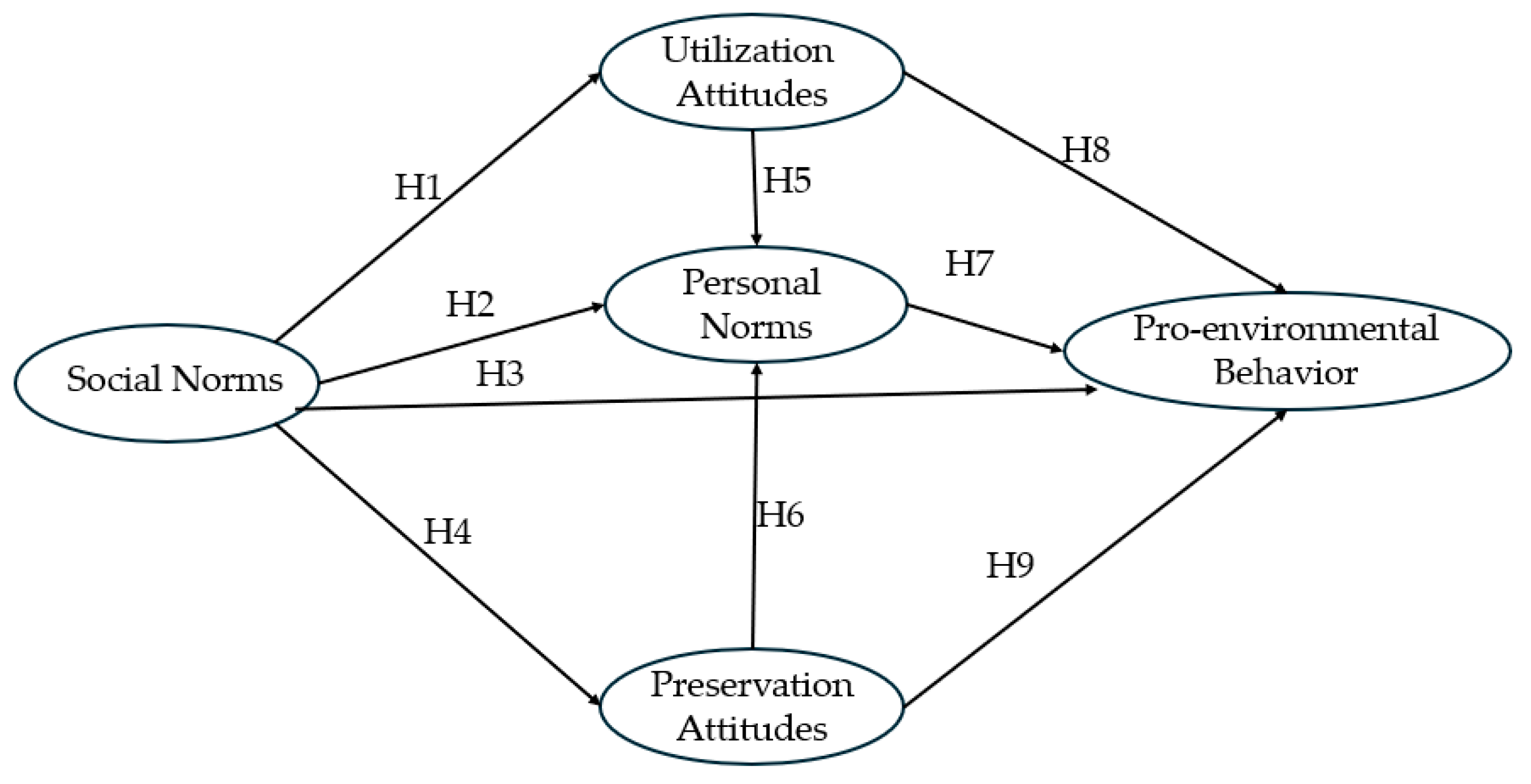
The present study aims to examine how school-based social norms influence pro-environmental behavior among sixth-grade pupils, directly and indirectly through personal norms, while considering the role of attitudes and contextual factors (school type, group membership, and gender). Based on the Norm Activation Model, we hypothesized that school-based social norms influence pro-environmental behavior both directly and indirectly through personal norms. The hypothesized structural model is presented in Figure 1. The model includes the following direct paths: social norms predicting utilization attitudes (H1), personal norms (H2), pro-environmental behavior (H3), and preservation attitudes (H4); utilization attitudes predicting personal norms (H5); preservation attitudes predicting personal norms (H6); and personal norms (H7), utilization attitudes (H8), and preservation attitudes (H9) predicting pro-environmental behavior.
H1. 
Social norms predict utilization attitudes.
H2. 
Social norms predict personal norms.
H3. 
Social norms predict pro-environmental behavior.
H4. 
Social norms predict preservation attitudes.
H5. 
Utilization attitudes predict personal norms.
H6. 
Preservation attitudes predict personal norms.
H7. 
Personal norms predict pro-environmental behavior.
H8. 
Utilization attitudes predict pro-environmental behavior.
H9. 
Preservation attitudes predict pro-environmental behavior.
Beyond these direct paths represented in Figure 1, two mediation hypotheses were also tested:
H10: 
Personal norms mediate the relationship between social norms and pro-environmental behavior.
H11: 
Personal norms mediate the relationship between preservation attitudes and pro-environmental behavior.
Finally, three exploratory questions (EQs) were examined through multi-group analyses to assess potential moderating effects. Specifically, we examined whether the structural relationships of the hypothesized model differed across groups defined by school type (Eco-Schools vs. non-Eco-Schools; EQ1), membership in environmental groups (EQ2), and gender (EQ3).

2. Materials and Methods

2.1. Sample

Four public schools in the municipality of Évora, Portugal, were initially contacted, of which three agreed to participate in the study. Across these schools, approximately 432 sixth-grade pupils were eligible to participate. The convenience sample comprised 217 sixth-grade pupils (aged 10–12). Three responses were excluded due to more than 10% missing data, resulting in a final sample of 214 pupils. Children with special educational needs were not included to ensure comparability in questionnaire comprehension.
This age group was selected because they are midway through the national Environmental Education Framework and at the end of a school cycle. Their transition from smaller first-cycle schools to larger institutions, together with prior experience in Year 5, provides the cognitive and social maturity needed to reflect more critically on environmental issues. Children at this stage also show an increasing awareness of others’ expectations, which supports the study of normative influences [33].
The final sample (N = 214) was fairly balanced by sex (48.1% boys, 51.9% girls) and included pupils from Eco-Schools (61.2%) and a non-Eco-School (38.8%). Pupils were recruited from three schools in the municipality of Évora: two participating in the Eco-Schools program (n = 115 and n = 16) and one not participating (n = 83). Regarding environmental group participation, 21.5% belonged to Eco-brigades, 9.3% were Scouts, 11.2% took part in other groups, and 57.9% reported no involvement.

2.2. Data Collection Procedure

Data were collected in classroom settings between October and December 2023, at the beginning of the school year. Questionnaires were administered in a paper-and-pencil format by trained researchers in collaboration with classroom teachers. Pupils completed the instrument in approximately 20 min under standardized instructions, ensuring anonymity and confidentiality.

2.3. Measures

The paper-based questionnaire, developed for this study, collected demographic information (residence area, age, school year, gender, environmental involvement, and parents’ education and occupation) and the scales described below.

2.3.1. Environmental Attitudes

Environmental attitudes were assessed using an abbreviated set of items derived from the New Ecological Paradigm (NEP) [38] and the 2-MEV model [12]. Given the length of the original instruments, and considering the age of the sample (10–12 years) and the documented conceptual overlap between both frameworks [39,40], a reduced item set was adopted to improve developmental appropriateness and reduce response burden in the school-based survey context. For analytical purposes, the items were structured into two composite dimensions reflecting contrasting orientations (see Appendix A for the full list of items): an ecocentric/preservation dimension (2 items: “When people harm nature, it has bad consequences”; “People must obey the laws of nature”) and an anthropocentric/utilization dimension (4 items: “Humans have the right to change nature as they wish”; “We only need to protect plants and animals that are worth money”; “Nature is strong enough to cope with the negative effects of our modern lifestyle”; “People should rule over the rest of nature”). In line with the bidimensional structure of the 2-MEV model, these two dimensions were conceptualized as independent factors rather than opposite poles of a single continuum, allowing the coexistence of different orientations. Confirmatory factor analysis indicated acceptable factor loadings and supported the discriminant validity of the two dimensions. Convergent validity was satisfactory for the preservation dimension (CR = 0.664; AVE = 0.502), whereas the utilization dimension showed only modest internal consistency (CR = 0.68) and weak convergent validity (AVE = 0.38). Although the retained utilization items improved composite reliability relative to alternative abbreviated solutions, the construct remained psychometrically limited and was therefore retained for exploratory purposes only. Accordingly, all findings involving this dimension are interpreted with particular caution. Although this abbreviated solution reduced comparability with studies using the full scale, it preserved conceptual clarity and relevance for younger respondents.

2.3.2. Personal Norms

Based on Van der Werff and Steg [41], the initial pool included 10 items covering domains such as water use, energy saving, and nature conservation (e.g., “I feel guilty if…”/“I feel proud if…”). However, during validation, several items referring to more abstract or less familiar practices (e.g., saving energy, conserving nature) showed weak loadings and reduced discriminant validity. This result is consistent with developmental research showing that self-conscious moral emotions (e.g., guilt, pride, regret) in late childhood are more readily elicited by concrete and recurrent behaviors than by abstract, collective environmental issues [42]. For children aged 10–12, recycling is a highly salient practice, frequently reinforced at school and at home, and thus more easily linked to moral self-evaluations. The final structure, therefore, retained two items focused on recycling (“I will feel sorry if I do not separate waste for recycling”; “I will feel guilty if I do not separate waste”). This abbreviated version ensured conceptual clarity and psychometric adequacy (CR = 0.778; AVE = 0.637) while maximizing ecological validity and comprehensibility for the age group.

2.3.3. Social Norms

Adapted from Van der Linden [43], the original pool included three descriptive norm items (what others do) and three injunctive norm items (what others expect one to do). Although theoretically distinct, the two dimensions did not yield a stable second-order structure in our sample of 10–12-year-olds. This finding is consistent with developmental research suggesting that children in late childhood may not clearly distinguish between what significant others do and what they expect, often interpreting both as general social guidance rather than as separate normative categories [44]. Accordingly, the validated model retained a one-dimensional structure with three items that capture this integrated perception of social norms: “In general, it is expected that I do my part to reduce environmental problems,” “Most of the people who are important to me are personally doing something to reduce environmental problems,” and “Most of the people I like are contributing to reducing environmental problems.” This abbreviated solution ensured adequate psychometric properties (CR = 0.765; AVE = 0.527) while preserving conceptual relevance. By reflecting how children in this age group naturally experience norms—through a blended perception of both descriptive and prescriptive elements—the final scale maximized ecological validity and developmental appropriateness.

2.3.4. Pro-Environmental Behaviors

Based on Spanish studies with children [30,38], the initial scale included five items addressing everyday environmental practices. However, the confirmatory factor analysis supported a more parsimonious final structure. The validated model retained two items—“At school, I talk with my teachers and classmates about the importance of doing things to protect the environment (for example, recycling)” and “At home, I help to separate and recycle”—with CR = 0.634 and AVE = 0.464. This reduction was supported on both statistical and developmental grounds. From a measurement perspective, the excluded items showed weak loadings and compromised construct validity. From a developmental perspective, children in late childhood may be more likely to report and engage in concrete and recurrent behaviors such as recycling, which are consistently reinforced in school and family contexts, than more abstract or less frequent pro-environmental actions [30]. Accordingly, focusing on self-reported recycling-related behavior yielded an age-appropriate and ecologically valid measure, although the construct showed only acceptable, though limited, psychometric performance. Although the broader conceptual framework of the study concerned pro-environmental behavior, the final validated behavioral indicators retained in the model referred specifically to recycling-related practices. Accordingly, the interpretation of the findings was restricted to this specific behavioral domain.
The factorial structure of the instruments was assessed through confirmatory factor analysis (CFA; see Appendix A), which indicated a good overall fit (CFI = 1.000; RMSEA = 0.000; PClose = 0.984; χ2/df = 0.987). Discriminant validity was supported across constructs (square root of AVE > inter-factor correlations), whereas convergent validity was satisfactory for some constructs and weaker for others, particularly the abbreviated Utilization and PEB measures. Overall, the retained instruments were considered appropriate for exploratory use in this target population, although some constructs should be interpreted with caution.

2.4. Statistical Procedure

Statistical analyses were conducted using IBM SPSS Statistics for Windows, Version 27.0 (IBM Corp., Armonk, NY, USA) and IBM SPSS Amos, Version 27.0 (IBM Corp., Armonk, NY, USA), employing the maximum likelihood (ML) estimation method. Confirmatory factor analysis (CFA) was used to validate the measurement model and assess goodness of fit. Items with factor loadings below 0.50 were removed [45], as well as those compromising convergent or discriminant validity, in accordance with Fornell and Larcker’s [46] guidelines. Convergent and discriminant validity were assessed using the “Master Validity Tool” plugin for AMOS by Gaskin [47]. Convergent validity was determined by the average variance extracted (AVE ≥ 0.50) and composite reliability (CR ≥ 0.70) [47]. Composite reliability values between 0.60 and 0.70 may be considered acceptable in exploratory research, although values above 0.70 are generally preferred in more established measurement models [46]. In addition, when AVE is below 0.50, but composite reliability exceeds 0.60, convergent validity may still be considered acceptable, albeit with caution [46]. This caution is particularly relevant in child self-report research, where psychometric difficulties at the item and subscale level may arise, and scale refinement or abbreviation may be necessary to achieve developmentally appropriate measurement [48]. Discriminant validity was confirmed when the square root of the AVE was greater than the inter-construct correlations [43]. Model refinement was conducted iteratively, balancing statistical criteria and theoretical coherence. Detailed CFA results and model refinement steps are reported in Appendix A. Abbreviated two-indicator constructs were retained as latent variables rather than collapsed into observed composite scores, as two-indicator latent constructs may be acceptable in SEM when theoretically coherent [49]. This specification also allowed shared variance to be estimated while explicitly accounting for measurement error [50].
Model fit was evaluated through several indices: CFI ≥ 0.90, RMSEA ≤ 0.06, and SRMR ≤ 0.08, as recommended by Hu and Bentler [51]. Direct and indirect effects were tested using bias-corrected bootstrapping (BCa) with 1000 resamples and 95% confidence intervals [52,53,54]. Effect sizes (f2) were also calculated using the Stats Tools Package by Gaskin [55].
Moderation hypotheses were tested through multi-group analysis in AMOS, comparing structural paths across groups defined by gender, school type (Eco-School vs. Non-Eco-School), and participation in environmental groups. Model invariance was tested at the configural, metric, structural, and residual levels. Significant differences between groups were identified using Critical Ratios for Differences between Parameters (z-scores outside the ±1.96 range; p < 0.05), available in the Pairwise Parameter Comparisons section of AMOS.
A priori power was estimated using Soper’s SEM calculator [56], based on the final specification of five latent variables and 13 observed indicators. The calculator indicated a minimum sample size of N = 150 to detect medium effects (f2 = 0.30, α = 0.05, power = 0.80). The final sample (N = 214) exceeded this threshold. However, more conservative recommendations for SEM models of this complexity may indicate the need for larger samples. For this reason, the sample was considered sufficient for estimating the overall model, but the findings should be interpreted with caution, particularly with regard to smaller effects and multi-group comparisons.

3. Results

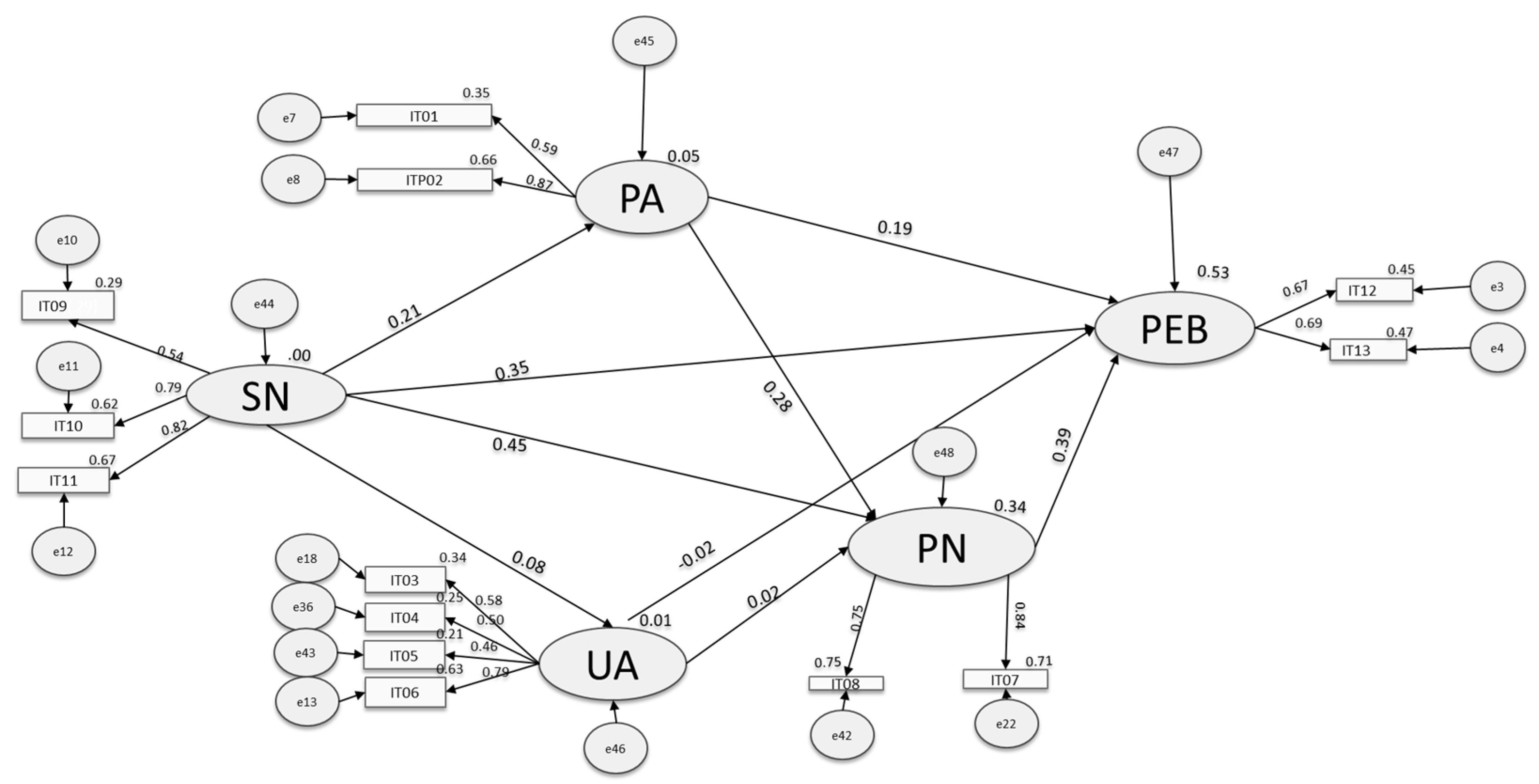
The structural model (Figure 2) showed a good fit to the data (χ2/df = 0.987; RMSEA = 0.000; PCLOSE = 0.987; CFI = 1.000; see Table 1 for the complete set of fit indices). Although some constructs presented AVE values below the recommended threshold of 0.50, composite reliability remained within acceptable limits (CR ≈ 0.66–0.68), indicating acceptable internal consistency according to SEM guidelines, although convergent validity remained limited for some abbreviated constructs. In these cases, item removal was tested but did not substantially improve convergent validity and would have reduced the conceptual coverage of the constructs. Multicollinearity diagnostics based on variance inflation factors (VIFs) indicated no collinearity concerns, with values ranging from 1.007 to 1.268, well below the recommended threshold of 5.
The high fit indices observed in the final model reflect the progressive refinement of the measurement model. Indicators with low factor loadings were removed, and constructs were specified to ensure conceptual alignment between predictors and behavioral outcomes. In particular, refining the personal norms construct to focus exclusively on recycling behaviors improved compatibility between the normative construct and the behavioral indicators included in the model, following the principle of correspondence in attitude–behavior models [57]. These refinements resulted in a more parsimonious and conceptually coherent measurement structure, which is consistent with the strong global fit indices observed.
These results suggest that the model provides an adequate representation of the relationships among the variables and can be used as a baseline for the subsequent multigroup comparisons (Table 2). The model explained 53% of the variance in pro-environmental behavior, 34% in personal norms, and 4.5% in preservation attitudes. Social norms had significant and positive direct effects on behavior (β = 0.346; p < 0.01), on personal norms (β = 0.454; p < 0.001), and on preservation attitudes (β = 0.21; p = 0.04). Personal norms were the strongest predictor of behavior (β = 0.394; p < 0.001), partially mediating the effects of social norms and attitudes. Use-related attitudes did not show significant direct effects. The f2 values indicated small effects of social norms (f2 = 0.087) and personal norms (f2 = 0.072) on behavior and a moderate effect of social norms on personal norms (f2 = 0.202). Significant indirect effects were also found, with personal norms mediating the influence of social norms (β = 0.240) and preservation attitudes (β = 0.110) on behavior.
Multi-group invariance tests supported configural and metric invariance across the examined groups (Table 3). However, stricter levels of invariance (structural and residual constraints) were not consistently supported, as some ΔCFI values exceeded the recommended threshold of 0.01. These results suggest that the general measurement structure is comparable across groups, while some structural relations may vary.
The multi-group analysis revealed significant differences in two paths between Eco-Schools and non-Eco-Schools. The relationship between use-related attitudes and personal norms differed significantly between groups (z = 2.123), with a stronger coefficient observed in Eco-Schools. The direct effect of social norms on pro-environmental behavior was stronger in non-Eco-Schools (z = −2.208). No significant differences were found for the remaining paths.
Regarding membership in environmental groups, the multi-group analysis did not reveal significant differences in most paths. However, a significant difference was identified in the path between social norms and preservation attitudes, which was stronger among children belonging to environmental groups (β = 0.578; p = 0.015) than among those who did not (β = 0.057; n.s.; z = 2.088). For the remaining paths, including the relationship between personal norms and behavior (no group: β = 0.507; p < 0.01; with group: β = 0.400; n.s.; z = −0.676), no statistically significant differences were observed.
In the multi-group analysis by gender, no statistically significant differences were found between boys and girls. Nonetheless, some descriptive differences in coefficients were observed. The path between personal norms and behavior was higher among boys (β = 0.582; p = 0.001) than among girls (β = 0.212; n.s.; z = −1.46). Use-related attitudes showed coefficients with opposite signs across genders (UA → PN: boys β = −0.049; girls β = 0.048; UA → PEB: boys β = −0.008; girls β = 0.033), although these differences did not reach statistical significance. For the remaining paths, estimates were similar across both groups.

4. Discussion

The results suggest that social norms may act as important predictors of self-reported recycling-related behavior in children aged 10–12, both directly and through the activation of personal norms. This pattern is broadly consistent with classical normative models [6,7,8,9], suggesting that socially salient cues in the school context may be associated with recycling-related practices. The strong association between social and personal norms is also compatible with the Focus Theory of Normative Conduct, according to which normative influence depends on contextual salience [10]. At the same time, the findings invite a cautious developmental interpretation. Prior developmental research suggests that children may not always clearly distinguish descriptive from injunctive normative information and may instead experience others’ behaviors and expectations as a more integrated social signal [44]. From this perspective, the difficulty in confirming a stable second-order structure may reflect not only a limitation of the present measure but also a more limited fit between adult-derived normative distinctions and children’s normative understanding at this age [44]. Although recycling is often considered a relatively routine pro-environmental practice, national data indicate that recycling rates in Portugal remain below policy targets, suggesting that this behavior is not yet fully established and therefore remains relevant for behavioral research. Nonetheless, because these constructs were assessed through abbreviated self-report scales, and some dimensions showed only modest psychometric performance, their strength should be interpreted with caution.
Personal norms emerged as the strongest predictor of self-reported recycling-related behavior, partially mediating the influence of social norms and preservation attitudes. This finding is consistent with the central role of personal norms in models of normative activation [6,7,8,9], suggesting that children in this age group may begin to internalize normative expectations related to environmentally relevant behaviors such as recycling. The mediation effect indicates that the association between social norms and attitudes with behavior may become stronger when these influences are internalized as feelings of personal obligation, as proposed in value–belief–norm models [9]. Still, because personal norms were assessed with only two recycling-related items, this effect may be domain-specific rather than fully generalizable to broader environmental behaviors.
Preservation attitudes were significantly associated with the formation of personal norms, suggesting their relevance as value-based orientations that may support the development of moral obligations related to environmental practices such as recycling [12]. However, their direct effect on recycling-related behavior was only marginal, which may illustrate the well-known value–action gap: positive attitudes do not always translate into consistent practices unless they are internalized as personal norms [4]. This limited direct effect should also be interpreted with caution, since the attitudinal constructs were measured using a reduced set of items drawn from both the 2-MEV and NEP instruments.
Utilization attitudes, in turn, did not show significant direct or indirect associations with recycling-related behavior, which is consistent with previous research suggesting that anthropocentric or utilization-oriented attitudes may coexist with pro-environmental dispositions without necessarily showing a straightforward behavioral relationship [12,16]. At the same time, this null finding may also partly reflect the psychometric limitations of the abbreviated utilization construct used in the present study. It is also possible that utilization-oriented items, which tap broader and more abstract beliefs about human–nature relations, were less developmentally accessible to children aged 10–12 than more concrete and recurrent environmental practices. However, this interpretation was not directly tested and should therefore be treated with caution.
Eco-Schools have been presented as privileged contexts for the socialization of environmental norms, making such norms more visible through regulations, symbols, and collective practices [21]. However, empirical research has shown mixed results: while clear gains in knowledge and attitudes are recorded, behavioral effects are not always consistent [29]. The present findings contribute to this discussion, suggesting that the role of norms may vary according to the school context. Yet, given the cross-sectional design, it is not possible to determine whether school contexts produced these differences or whether pupils with stronger pro-environmental dispositions were already more likely to attend or perceive such schools.
The effect of social norms on self-reported recycling-related behavior was significantly stronger in non-Eco-Schools. This pattern may suggest a closer association between perceived social norms and self-reported recycling-related behavior in those school contexts. This interpretation is consistent with the Focus Theory of Normative Conduct, which posits that social norms influence behaviors when they are made salient [10]. In Eco-Schools, where environmental practices may be more consistently embedded in daily routines, the direct influence of social norms may become less salient, possibly because such practices are more normalized within everyday school life. These contextual differences should be interpreted cautiously, and replication with larger and more diverse samples would be necessary to assess the stability of these patterns.
Another noteworthy result concerns utilization attitudes. In non-Eco-Schools, a marginally significant negative trend was observed, suggesting that more instrumental perceptions of nature may be associated with a lower internalization of personal norms related to recycling. In Eco-Schools, this association disappeared, remaining weak and non-significant. The significant difference between the two contexts indicates that the presence of regulations, codes, and institutional practices typical of the Eco-Schools program may mitigate or neutralize this negative pattern. Nevertheless, such an institutional framework may differ from participatory and consistent experiences—such as membership in environmental groups—that the literature identifies as particularly effective for consolidating pro-environmental dispositions [25,30,31]. Still, as the reliability of the utilization scale was modest (α = 0.65), this interaction should be viewed as tentative.
Regardless of differences between institutional contexts, personal norms remained a consistent predictor of self-reported recycling-related behavior in both settings, suggesting that normative internalization is not exclusive to Eco-Schools. This result must be considered in light of the Portuguese context: environmental education is integrated into the national curriculum through the Environmental Education Framework for Sustainability, and primary education shows the highest rate of adherence to the Eco-Schools program. It is therefore likely that many pupils had already been exposed to consistent environmental education practices—such as recycling, water saving, or waste management—during primary school. Such early exposure may contribute to the development of personal norms related to everyday environmental practices [24,25]. This context may help explain why normative internalization appeared as a relevant predictor in both Eco-Schools and non-Eco-Schools. Nevertheless, longitudinal data would be necessary to confirm whether these early exposures have lasting causal effects.
Membership in environmental groups may represent another important pathway for normative socialization, as it involves active participation, group identity, and collective practice [32,33]. Unlike the institutional exposure offered by Eco-Schools, participation in eco-brigades, scouts, or nature clubs often involves deeper and voluntary engagement, which may facilitate the internalization of pro-environmental norms.
The results of this study are consistent with this interpretation: the relationship between social norms and preservation attitudes was stronger among children who belonged to environmental groups, suggesting that normative influence may be reinforced when embedded in contexts of social belonging. This finding can be interpreted in light of Social Identity Theory, which suggests that individuals tend to adopt the values and normative behaviors of the groups with which they identify [32]. In this sense, membership in pro-environmental groups may increase the salience of ecological norms, potentially supporting their translation into consistent attitudes and practices [10].
Although the effects observed in this study were not significant across all paths, the patterns found may suggest that group membership is associated with a context potentially conducive to the internalization of norms and attitudes, which may support pro-environmental trajectories initiated within schools. It is important to note, however, that membership was assessed dichotomously (yes/no) without accounting for the intensity or frequency of involvement. Previous studies emphasize that different levels of participation or group identification may produce differentiated effects [23]. Future research should therefore employ more fine-grained measures and longitudinal approaches to clarify whether membership in environmental groups promotes pro-environmental attitudes and behaviors, or whether more predisposed pupils are those who tend to join such groups.
Regarding gender, no statistically significant differences were observed in the structural paths. Still, some descriptive patterns emerged that are worth noting. Among boys, recycling-related behavior was mainly explained by the internalization of personal norms, with a strong and significant effect of personal norms on self-reported recycling-related behavior. Among girls, the direct effect of social norms on behavior seemed more pronounced, while the impact of personal norms was weaker and non-significant. These patterns should, however, be interpreted with caution, as they merely indicate possible trends. Moreover, statistical power for gender subgroup analyses was limited, so these results cannot be generalized.
This result partially contrasts with the literature, which has shown that girls tend to express greater affective concern for the environment and report more pro-environmental behaviors, whereas boys show higher utilization values and fewer environmental practices [17,19,20]. In the present study, however, no significant differences in utilization attitudes were observed, with mean scores remaining very similar across genders.
This study has some limitations that should be considered. One limitation concerns the composition of the school groups. While two schools participating in the Eco-Schools program were included in the study, the comparison group consisted of students from a single non-Eco-School. Consequently, differences attributed to school type should be interpreted with caution, as they may partly reflect context-specific characteristics of that particular school rather than the effect of participation in the Eco-Schools program itself.
A second limitation is that the use of abbreviated and combined attitude measures reduces comparability with studies using the full NEP or 2-MEV instruments. Some constructs, such as personal norms and self-reported recycling-related behavior, were measured with only two items, which constrains reliability and breadth of coverage. In addition, some constructs presented AVE values below the recommended threshold, indicating limited convergent validity and suggesting that the corresponding results should be interpreted with caution. In particular, the utilization dimension showed weak convergent validity, suggesting that the retained items did not capture shared variance as strongly as desired. Its inclusion was maintained on exploratory and theoretical grounds, but findings involving this construct should be regarded as provisional.
The results raise the possibility that the descriptive/injunctive distinction commonly used in adult norm research may be less developmentally appropriate for children in late childhood, which should be considered when interpreting the social norms construct in the present study.
In addition, the cross-sectional, self-reported design in a single Portuguese municipality limits causal inference and generalization, and subgroup analyses should be interpreted as exploratory given modest statistical power. Moreover, because the behavioral indicators focused primarily on recycling-related practices, the findings should be interpreted as referring to this specific domain of pro-environmental behavior rather than to environmental behavior more broadly.
Despite these limitations, several aspects support the internal consistency of the analytical framework. The factorial structure of the constructs was assessed through CFA, and the final model showed a satisfactory overall fit to the data, while convergent and discriminant validity indicators (CR, AVE) generally supported the measurement structure, although some constructs showed weaker convergent validity. Multi-group analyses suggested that the general structure of the model was comparable across groups at the metric level, and the model explained a substantial proportion of variance in pro-environmental behavior. These results should be interpreted as providing preliminary empirical support for the proposed relationships, rather than as definitive evidence, suggesting that the model offers a useful exploratory framework for understanding how social norms may relate to children’s environmental behavior.

5. Conclusions

This study explored the associations between key psychosocial factors and self-reported recycling-related behavior in school-aged children, with particular attention to the role of social and personal norms. The proposed model showed a satisfactory fit to the data across groups, suggesting that norms may relate to behavior both directly and through their internalization as personal obligations. Preservation attitudes appeared to contribute indirectly through personal norms, while utilization attitudes were not significant, which may reflect the persistence of the value–action gap observed in environmental behavior research. Importantly, the behavioral indicators examined in this study referred specifically to recycling practices rather than to pro-environmental behavior more broadly. Although recycling is often considered a routine behavior, national data indicate that recycling rates in Portugal remain far from complete (e.g., approximately 58.6% of packaging waste is recycled), suggesting that even widely promoted environmental practices still leave substantial room for improvement.
In addressing the guiding question, the findings suggest that school-based norms may play an important role in children’s self-reported recycling-related behavior, particularly among those in the 10–12 age range, although the cross-sectional design does not allow causal conclusions. The results are consistent with the idea that knowledge and positive attitudes alone may be insufficient: norms seem to become more influential when they are made salient, internalized, and reinforced through consistent practice and participatory experiences.
These results also point to the possible relevance of educational contexts such as Eco-Schools and environmental groups, which may contribute to shaping normative expectations and opportunities for pro-environmental engagement. Such contexts may help expose children to external expectations while potentially supporting the internalization of ecological values. Accordingly, educational initiatives may benefit from integrating social and personal norms into everyday school activities, supported by practical experiences and group participation.
Ultimately, this study suggests that children are not merely passive recipients of environmental knowledge but may respond actively to normative cues within their social contexts. By linking social expectations with personal commitments, schools may contribute to recycling-related normative engagement in early adolescence.

Author Contributions

Conceptualization, F.B. and R.B.; methodology, F.B. and R.B.; software, R.B.; validation, F.B. and R.B.; formal analysis, R.B.; investigation, R.B.; resources, F.B. and R.B.; data curation, F.B. and R.B.; writing—original draft preparation, R.B.; writing—review and editing, F.B. and R.B.; visualization, R.B.; supervision, F.B.; project administration, F.B. and R.B. All authors have read and agreed to the published version of the manuscript.

Funding

This research received no external funding.

Institutional Review Board Statement

The study was conducted in accordance with the Declaration of Helsinki and approved by the Ethics Committee of the University of Évora (protocol code: 22177 and date of approval: 21 June 2023). Authorization to conduct the study was obtained from the Directorate-General for Education (approval no. 1287800001), the participating school boards, and parents or legal guardians. Written informed consent was obtained from parents or legal guardians, and verbal assent was obtained from all participating pupils. Results were not returned to individual participants or families. The study reports only aggregated data to ensure confidentiality, which is standard practice in school-based survey research.

Informed Consent Statement

Informed consent was obtained from parents or legal guardians, and verbal assent was obtained from all participating pupils.

Data Availability Statement

The data presented in this study are available upon request from the corresponding author due to ethical restrictions related to the participation of minors and the conditions of informed consent.

Acknowledgments

The authors gratefully acknowledge the support of the participating school boards and schools, as well as the collaboration of teachers and pupils who took part in this study.

Conflicts of Interest

The authors declare no conflicts of interest.

Appendix A

Table A1. Confirmatory factor analysis results for the final measurement model (Model 4).
ItemsEstimate Model 1Estimate Model 2Estimate Model 3Estimate Model 4
UAWe only need to protect plants and animals that are worth money.0.7070.7060.7660.791
Humans have the right to change nature as they please.0.6110.6120.5980.586
Our planet has resources that never run out.0.4020.402--
People worry too much about pollution.0.4570.460--
Being concerned about the environment usually delays development projects.0.4020.401--
People should dominate the rest of nature.0.5130.5120.5110.504
Nature is strong enough to deal with the bad effects of our modern lifestyle.0.5210.5210.4760.463
AVE0.280.280.360.36
CR0.720.720.680.68
SNMost of the people important to me are personally doing something to reduce environmental problems.0.7310.7660.7830.788
Most of the people important to me are doing their part to reduce environmental problems.0.7750.8110.8220.816
In general, it is expected that I do my part to reduce environmental problems.0.368---
People whose opinion I value think that I should personally act to reduce environmental problems.0.5180.477--
People important to me support me if I decide to help reduce environmental problems.0.5570.5350.5440.542
AVE0.370.440.530.53
CR0.730.750.770.76
PNI will feel sorry if I do not separate waste for recycling.0.6580.6580.6570.842
I will feel proud if I protect the environment.0.5790.5730.571-
I will feel sorry if I do not make an effort to save energy.0.6660.6650.663 *-
I will feel guilty if the TV is on while I am playing on my phone or computer.0.6380.6370.634-
I will feel proud if I always turn off the lights at home.0.5690.5680.567-
I will feel guilty if I leave a tap dripping.0.6570.6560.654-
I will feel sorry if I spend too much time in the shower.0.6280.6340.639-
I will feel guilty if I do not separate waste.0.6980.7040.7090.752
I will feel proud if I reduce water consumption.0.5110.5080.507-
AVE0.390.390.390.64
CR0.850.850.850.78
PAPlants and animals have as much right to live as people.0.378
People have to obey the laws of nature.0.7140.7710.8100.805
When people harm nature, it has bad results.0.6040.5940.5930.596
People are treating nature badly.0.236
If things do not change, soon we will have a big environmental disaster.0.4070.354
The dirty smoke from factory chimneys makes me feel irritated.0.,4010.398
I always turn off the light when it is not needed.0.395
AVE0.220.310.50.5
CR0.640.620.660.66
PEBI do activities to protect the environment.0.5160.5100.506
To save water, I use less water when I take a shower or a bath.0.346
At school, I talk with my teachers and classmates about the importance of doing things to protect the environment (for example, recycling).0.5930.6140.6160.674
At home, I help separate and recycle waste.0.6870.7080.7070.688
To save energy, I turn off electrical devices when I am not using them.0.5390.5300.533
AVE0.300.350.350.46
CR0.670.680.680.63
CMIN870.462612.04360.55455.156
DF48534019955
P0000.469
CMIN/DF1.7951.8001.8121.003
CFI 0.7880.8310.8791.000
TLI 0.7690.8120.8601.000
RMSEA 0.0610.0610.0620.004
PCLOSE0.0030.010.0310.984
AIC1022.462744.04468.554127.156
ECVI4.83.4932.20.597
HOELTER 0.05132134138284
HOELTER 0.01138141147318
Discriminant validityPEBPNPASNUA
PEB0.678
PN0.6400.800
PA0.4080.3770.707
SN0.5870.5160.2140.728
UA0.0260.05
6
−0.0180.0810.600
Note. Items with factor loadings below 0.50 were removed during model refinement. When necessary, CR was prioritized over AVE to preserve construct reliability. The item marked with * was removed to ensure conceptual correspondence between personal norms and the recycling-related behavioral indicators included in the model.

References

  1. United Nations. Transforming Our World: The 2030 Agenda for Sustainable Development (A/RES/70/1); United Nations: New York, NY, USA, 2015; Available online: https://sdgs.un.org/2030agenda (accessed on 24 April 2023).
  2. Bascopé, M.; Perasso, P.; Reiss, K. Systematic review of education for sustainable development at an early stage: Cornerstones and pedagogical approaches for teacher professional development. Sustainability 2019, 11, 719. [Google Scholar] [CrossRef]
  3. Monroe, M.C.; Plate, R.R.; Oxarart, A.; Bowers, A.; Chaves, W.A. Identifying effective climate change education strategies: A systematic review of the research. Environ. Educ. Res. 2019, 25, 791–812. [Google Scholar] [CrossRef]
  4. Portus, R.; Aarnio-Linnanvuori, E.; Dillon, B.; Fahy, F.; Gopinath, D.; Mansikka-Aho, A.; Williams, S.-J.; Reilly, K.; McEwen, L. Exploring environmental value–action gap and education research: A semi-systematic literature review. Environ. Educ. Res. 2024, 30, 833–863. [Google Scholar] [CrossRef]
  5. Ajzen, I. The theory of planned behavior. Organ. Behav. Hum. Decis. Process. 1991, 50, 179–211. [Google Scholar] [CrossRef]
  6. Schwartz, S.H. Normative influences on altruism. In Advances in Experimental Social Psychology; Berkowitz, L., Ed.; Academic Press: New York, NY, USA, 1977; Volume 10, pp. 221–279. [Google Scholar] [CrossRef]
  7. Schwartz, S.H.; Howard, J.A. A normative decision-making model of altruism. In Altruism and Helping Behaviour: Social, Personality and Developmental Perspectives; Rushton, J.P., Ed.; Erlbaum: Hillsdale, NJ, USA, 1981; pp. 189–211. [Google Scholar]
  8. Stern, P.C. Toward a coherent theory of environmentally significant behavior. J. Soc. Issues 2000, 56, 407–424. [Google Scholar] [CrossRef]
  9. Stern, P.C.; Dietz, T.; Abel, T.; Guagnano, G.A.; Kalof, L. A value-belief-norm theory of support for social movements: The case of environmentalism. Hum. Ecol. Rev. 1999, 6, 81–97. Available online: http://www.jstor.org/stable/24707060 (accessed on 17 March 2023).
  10. Cialdini, R.B.; Reno, R.R.; Kallgren, C.A. A focus theory of normative conduct: Recycling the concept of norms to reduce littering in public places. J. Pers. Soc. Psychol. 1990, 58, 1015–1026. [Google Scholar] [CrossRef]
  11. Eilam, E.; Trop, T. Environmental attitudes and environmental behavior—Which is the horse and which is the cart? Sustainability 2012, 4, 2210–2246. [Google Scholar] [CrossRef]
  12. Bogner, F.X.; Wiseman, M. Adolescents’ attitudes towards nature and environment: Quantifying the 2-MEV model. Environmentalist 2006, 26, 247–254. [Google Scholar] [CrossRef]
  13. Bogner, F.X.; Johnson, B.; Buxner, S.; Felix, L. The 2-MEV model: Constancy of adolescent environmental values within an 8-year framework. Int. J. Sci. Educ. 2015, 37, 1938–1952. [Google Scholar] [CrossRef]
  14. Manoli, C.C.; Johnson, B.; Buxner, S.; Bogner, F.X. 2-MEV model: Values, environmental education, and pro-environmental behaviour. In Handbook of Environmental Education; Thomas, K.D., Sheffield, S.D., Mrazek, A.M., Eds.; Routledge: London, UK, 2019; pp. 189–204. [Google Scholar]
  15. Dunlap, R.E.; Van Liere, K.D.; Mertig, A.G.; Jones, R.E. Measuring endorsement of the New Ecological Paradigm: A revised NEP scale. J. Soc. Issues 2000, 56, 425–442. [Google Scholar] [CrossRef]
  16. Kibbe, A.; Bogner, F.X.; Kaiser, F.G. Exploitative versus appreciative use of nature—Two interpretations of utilization and their relevance for environmental education. Stud. Educ. Eval. 2014, 41, 106–112. [Google Scholar] [CrossRef]
  17. Zelezny, L.C.; Chua, P.; Aldrich, C. Elaborating on gender differences in environmentalism. J. Soc. Issues 2000, 56, 443–457. [Google Scholar] [CrossRef]
  18. Eagly, A.H.; Wood, W. The nature–nurture debates: 25 years of challenges in understanding the psychology of gender. Perspect. Psychol. Sci. 2013, 8, 340–357. [Google Scholar] [CrossRef]
  19. Duarte, R.; Escario, J.J.; Sanagustín, M.V. The influence of the family, the school, and the group on the environmental attitudes of European students. Environ. Educ. Res. 2017, 23, 23–42. [Google Scholar] [CrossRef]
  20. Boeve-de Pauw, J.; Jacobs, K.; Van Petegem, P. Gender differences in environmental values: An issue of measurement? Environ. Behav. 2014, 46, 373–397. [Google Scholar] [CrossRef]
  21. Bertoldo, R.; Castro, P. The outer influence inside us: Exploring the relation between social and personal norms. Environ. Behav. 2016, 112, 45–53. [Google Scholar] [CrossRef]
  22. De Groot, J.I.M.; Bondy, K.; Schuitema, G. Making the invisible visible: A systematic review of social norm interventions in pro-environmental behaviours. J. Clean. Prod. 2021, 313, 127995. [Google Scholar] [CrossRef]
  23. Collado, S.; Staats, H.; Sancho, P. Normative influences on adolescents’ self-reported pro-environmental behaviors: The role of parents and friends. Environ. Behav. 2019, 51, 288–314. [Google Scholar] [CrossRef]
  24. Farrow, K.; Grolleau, G.; Ibanez, L. Social norms and pro-environmental behavior: A review of the evidence. Ecol. Econ. 2017, 140, 1–13. [Google Scholar] [CrossRef]
  25. Chawla, L.; Cushing, D.F. Education for strategic environmental behavior. Environ. Educ. Res. 2007, 13, 437–452. [Google Scholar] [CrossRef]
  26. Evans, G.W.; Otto, S.; Kaiser, F.G. Childhood origins of young adult environmental behavior. Psychol. Sci. 2018, 29, 679–687. [Google Scholar] [CrossRef]
  27. Boeve-de Pauw, J.; Van Petegem, P. Eco-school evaluation beyond labels: The impact of environmental policy, didactics and nature at school on student outcomes. Environ. Educ. Res. 2018, 24, 1250–1267. [Google Scholar] [CrossRef]
  28. Boeve-de Pauw, J.; Van Petegem, P. Because my friends insist or because it makes sense? Adolescents’ motivation towards the environment. Sustainability 2017, 9, 750. [Google Scholar] [CrossRef]
  29. Özsoy, S.; Ertepınar, H.; Sağlam, N. Can eco-schools improve elementary school students’ environmental literacy levels? Asia-Pac. Forum Sci. Learn. Teach. 2012, 13, 1–25. [Google Scholar]
  30. Collado, S.; Evans, G.W.; Corraliza, J.A.; Sorrel, M.A. The role played by age on children’s pro-environmental behaviors: An exploratory analysis. J. Environ. Psychol. 2015, 44, 85–94. [Google Scholar] [CrossRef]
  31. Asah, S.T.; Bengston, D.N.; Westphal, L.M. The influence of childhood: Operational pathways to adulthood participation in nature-based activities. Environ. Behav. 2018, 50, 807–836. [Google Scholar] [CrossRef]
  32. Tajfel, H.; Turner, J.C. The social identity theory of intergroup behavior. In Psychology of Intergroup Relations; Worchel, S., Austin, W.G., Eds.; Nelson-Hall: Chicago, IL, USA, 1986; pp. 7–24. [Google Scholar]
  33. Collado, S.; Evans, G.W.; Sorrel, M.A. The role of parents and best friends in children’s pro-environmentalism: Differences according to age and gender. J. Environ. Psychol. 2017, 54, 27–37. [Google Scholar] [CrossRef]
  34. Direção-Geral da Educação. Referencial de Educação Ambiental para a Sustentabilidade; Ministério da Educação: Lisboa, Portugal, 2012. Available online: https://www.dge.mec.pt/sites/default/files/ECidadania/Educacao_Ambiental/documentos/referencial_ambiente.pdf (accessed on 24 April 2023).
  35. Schmidt, L.; Guerra, J. Do Ambiente ao Desenvolvimento Sustentável: Contextos e Protagonistas da Educação Ambiental em Portugal; Universidade de Lisboa: Lisboa, Portugal, 2013; Available online: https://repositorio.ulisboa.pt/bitstream/10451/11317/1/ICS_LSchmidt_JGuerra_DoAmbiente_ARN.pdf (accessed on 7 March 2023).
  36. Kahn, P.H., Jr. Developmental psychology and the biophilia hypothesis: Children’s affiliation with nature. Dev. Rev. 1997, 17, 1–61. [Google Scholar] [CrossRef]
  37. Hussar, K.M.; Horvath, J.C. Do children play fair with Mother Nature? Understanding children’s judgments of environmentally responsible actions. J. Environ. Psychol. 2011, 31, 309–317. [Google Scholar] [CrossRef]
  38. Corraliza, J.A.; Collado, S.; Bethelmy, L. Spanish version of the New Ecological Paradigm scale for children. Span. J. Psychol. 2013, 16, E27. [Google Scholar] [CrossRef][Green Version]
  39. Milfont, T.L.; Duckitt, J. The environmental attitudes inventory: A valid and reliable measure to assess the structure of environmental attitudes. J. Environ. Psychol. 2010, 30, 80–94. [Google Scholar] [CrossRef]
  40. Liu, W.; Chen, J. Modified Two Major Environmental Values scale for measuring Chinese children’s environmental attitudes. Environ. Educ. Res. 2020, 26, 130–147. [Google Scholar] [CrossRef]
  41. Van der Werff, E.; Steg, L. The psychology of participation and interest in smart energy systems: Comparing the value–belief–norm theory and the theory of planned behavior. Renew. Sustain. Energy Rev. 2016, 41, 138–147. [Google Scholar] [CrossRef]
  42. Ongley, S.F.; Nola, M.; Malti, T. Children’s giving: Moral reasoning and moral emotions in the development of donation behaviors. Front. Psychol. 2014, 5, 458. [Google Scholar] [CrossRef] [PubMed]
  43. Van der Linden, S. The social-psychological determinants of climate change risk perceptions: Towards a comprehensive model. J. Environ. Psychol. 2015, 41, 112–124. [Google Scholar] [CrossRef]
  44. Deutchman, P.; Sansom, E.; Marshall, J.; Lee, Y.-E.; Warneken, F.; McAuliffe, K. Descriptive norms influence children’s injunctive and moral norm beliefs. J. Exp. Child Psychol. 2026, 265, 106468. [Google Scholar] [CrossRef]
  45. Hair, J.F.; Black, W.C.; Babin, B.J.; Anderson, R.E. Multivariate Data Analysis, 8th ed.; Cengage: Boston, MA, USA, 2019. [Google Scholar]
  46. Fornell, C.; Larcker, D.F. Evaluating structural equation models with unobservable variables and measurement error. J. Mark. Res. 1981, 18, 39–50. [Google Scholar] [CrossRef]
  47. Gaskin, J. Master Validity Tool [AMOS Plugin]. 2019. Available online: https://statwiki.gaskination.com/ (accessed on 20 June 2023).
  48. Hagquist, C. The psychometric properties of the self-reported SDQ—An analysis of Swedish data based on the Rasch model. Pers. Individ. Dif. 2007, 43, 1289–1301. [Google Scholar] [CrossRef]
  49. Hayduk, L.A.; Littvay, L. Should researchers use single indicators, best indicators, or multiple indicators in structural equation models? BMC Med. Res. Methodol. 2012, 12, 159. [Google Scholar] [CrossRef] [PubMed]
  50. Kline, R.B. Structural equation modeling. In The Cambridge Handbook of Research Methods and Statistics for the Social and Behavioral Sciences: Volume 1: Building a Program of Research; Nichols, A.L., Edlund, J., Eds.; Cambridge University Press: Cambridge, UK, 2023; pp. 535–558. [Google Scholar]
  51. Hu, L.-T.; Bentler, P.M. Fit indices in covariance structure modeling: Sensitivity to underparameterized model misspecification. Psychol. Methods 1998, 3, 424–453. [Google Scholar] [CrossRef]
  52. Preacher, K.J.; Hayes, A.F. SPSS and SAS procedures for estimating indirect effects in simple mediation models. Behav. Res. Methods Instrum. Comput. 2004, 36, 717–731. [Google Scholar] [CrossRef]
  53. Biesanz, J.C.; Falk, C.F.; Savalei, V. Assessing mediational models: Testing and interval estimation for indirect effects. Multivar. Behav. Res. 2010, 45, 661–701. [Google Scholar] [CrossRef]
  54. Chen, F.; Fritz, M.S. Comparing Alternative Corrections for Bias in the Bias-Corrected Bootstrap Test of Mediation. Eval. Health Prof. 2021, 44, 416–427. [Google Scholar] [CrossRef] [PubMed]
  55. Gaskin, J. Validity Master: Stats Tools Package; Information Systems Department, Brigham Young University: Provo, UT, USA, 2016; Available online: https://statwiki.gaskination.com/ (accessed on 20 June 2023).
  56. Soper, D.S. A-Priori Sample Size Calculator for Structural Equation Models [Software]. 2021. Available online: https://www.danielsoper.com/statcalc (accessed on 5 March 2026).
  57. Ajzen, I.; Fishbein, M. Attitude–behavior relations: A theoretical analysis and review of empirical research. Psychol. Bull. 1977, 84, 888–918. [Google Scholar] [CrossRef]
Figure 1. Proposed theoretical model and tested hypotheses.
Sustainability 18 02906 g001
Figure 2. Structural equation model with predictors of pro-environmental behavior (PEB). Note: UA—utilization attitude; PA—preservation attitude; SN—social norm; PN—personal norm; PEB—pro-environmental behavior (in the present study, PEB refers specifically to self-reported recycling-related behavior).
Sustainability 18 02906 g002
Table 1. Structural results.
IndexValue
χ255.295
df56
p0.502
χ2/df0.987
CFI1.000
TLI1.000
RMSEA0.000
PCLOSE0.987
AIC125.295
ECVI0.588
Hoelter (0.05)287
Hoelter (0.01)322
Table 2. Structural results of the general model and multi-group moderation models (gender, school type, and group membership).
General Model MaleFemale Non-Eco-SchoolEco-School No Belonging Environ. GroupBelonging Environ. Group
PathβLUHβpβpz-ScoreEQ3βpβpz-ScoreEQ1βpβpz-ScoreEQ2
UA ← SN0.079−0.0680.196H1 ✗0.1240.311−0.0060.961−0.8540.1090.4580.1170.3010.4860.1290.281−0.020.883−0.589
PA← SN0.2120.0340.297H4 ✓0.2960.0580.130.347−0.617−0.0630.6590.412*1.7120.0570.6160.578*2.088
PN← SN0.4540.2620.595H2 ✓0.491**0.495***0.5680.521***0.52***−0.1010.559***0.1960.285−0.991
PN← PA0.2790.0610.704H6 ✓0.243*0.2830.0550.2840.373**0.1130.329−0.8770.318**0.3360.1180.243
PN← UA0.022−0.130.14H5 ✗−0.0490.6440.0480.6660.603−0.2560.0560.0960.3232.123−0.0480.6630.1050.3430.912
PEB ← PA0.1850.0540.492H9 ✗0.0830.5060.3290.05612120.2720.080.324*0.6640.0870.4810.3000.2510.735
PEB← UA−0.023−0.2010.141H8 ✗−0.0080.9470.0330.7780.2780.1910.179−0.1520.193−1.690.0940.413−0.1680.230−1.38
PEB← PN0.3940.1450.61H7 ✓0.582**0.2120.202−1.460.2370.1890.537**10230.507**0.400*−0.676
PEB← SN0.3460.1010.461H3 ✓0.3220.0580.349*0.5000.572**0.0680.682−2.2080.2080.1520.3780.1070.792
PEB ← PN ← SN0.2400.1250.429H10 ✓
PEB ← PN ← PA0.1100.0300.249H11 ✓
UA r20.006
PA r20.045
PN r20.34
PEB r20.53
Note: β = standardized coefficient; p = significance level; r2 = explained variance; z = group difference test value (|z| > 1.96 indicates a significant difference). UA = utilization attitude; PA = preservation attitude; SN = social norm; PN = personal norm; PEB = pro-environmental behavior (in the present study, PEB refers specifically to self-reported recycling-related behavior). * p < 0.05; ** p < 0.01; *** p < 0.001. ✓ supported hypothesis; ✗ unsupported hypothesis.
Table 3. Multi-group invariance tests.
DFCMINpCFI
Delta
GenderMeasurement weights814.7060.0650.01
Structural weights1721.5480.2030.003
Structural residuals2227.2910.20.001
Measurement residuals3555.3820.0160.024
School TypeMeasurement weights811.1650.1930.005
Structural weights1730.9090.020.017
Structural residuals2245.5460.0020.014
Measurement residuals3557.0450.0110.002
Belonging Environ. groupMeasurement weights85.6690.6840.004
Structural weights1717.7880.4020.005
Structural residuals2237.7540.020.023
Measurement residuals3565.6540.0010.023
Disclaimer/Publisher’s Note: The statements, opinions and data contained in all publications are solely those of the individual author(s) and contributor(s) and not of MDPI and/or the editor(s). MDPI and/or the editor(s) disclaim responsibility for any injury to people or property resulting from any ideas, methods, instructions or products referred to in the content.