The Impact of Implementing Kinetic Interior Techniques on the Functional Performance of Office Spaces Using Space Syntax



Abstract
1. Introduction
Research Questions
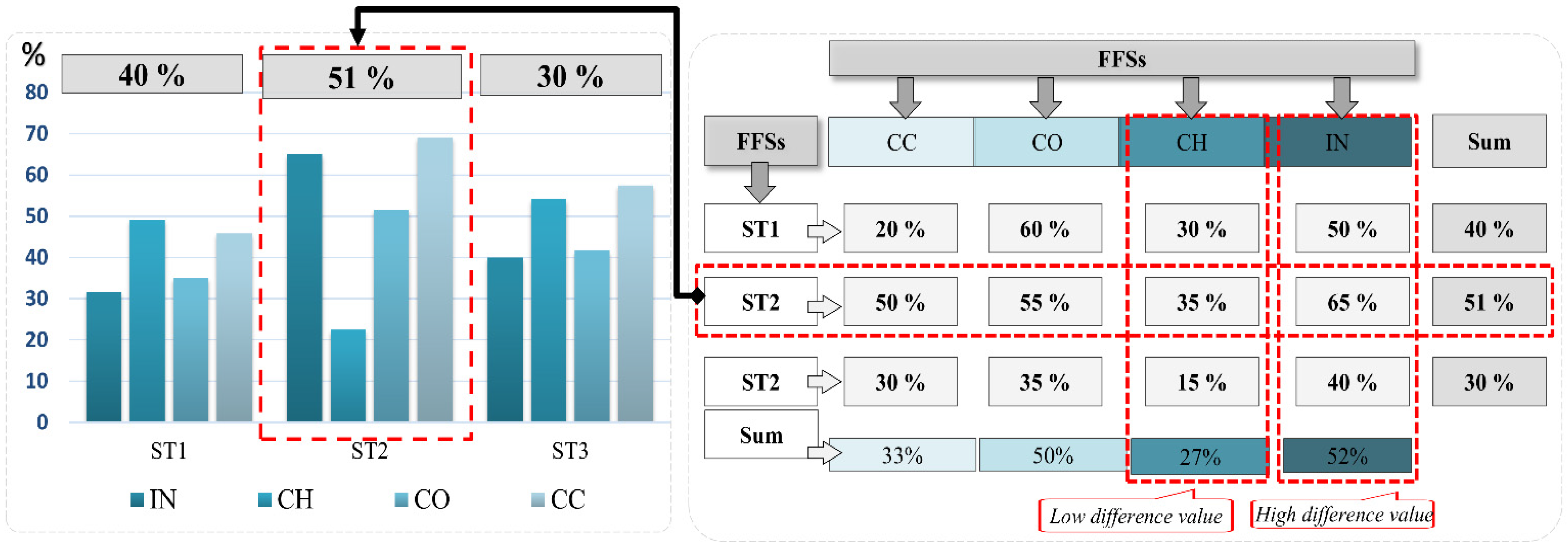
- RQ1: How do different kinetic interior design strategies affect the configurational properties of office spaces as measured by space syntax indicators (integration, choice, connectivity, and clustering coefficient)?
- RQ2: How much can kinetic office design options’ functional spatial performance be evaluated using space syntax metrics as a comparison evaluation tool?
- RQ3: How can the measured configurational changes inform a structured decision-making process for selecting appropriate kinetic interior strategies in office environments?
2. Literature Review
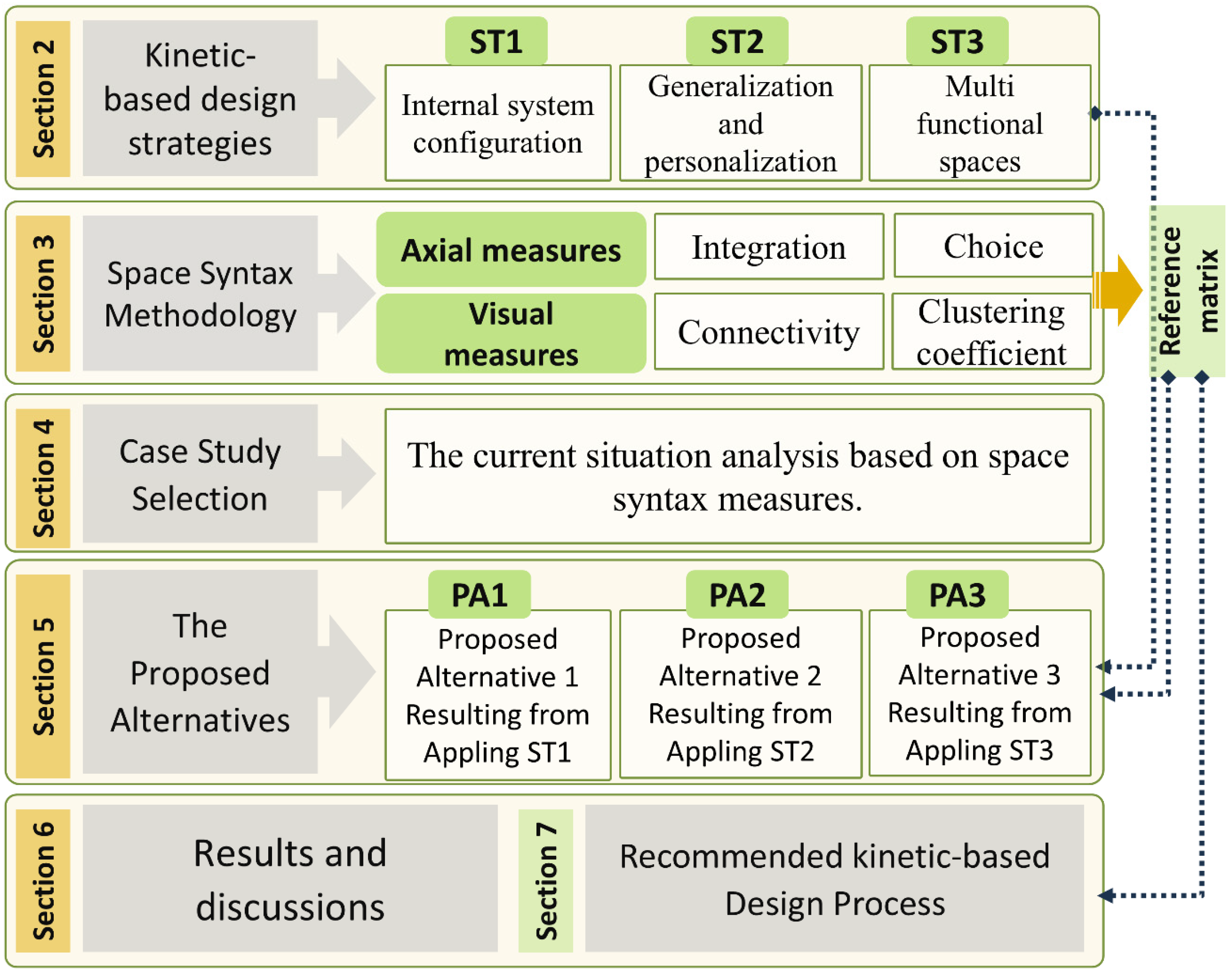
3. Methodology and Methods
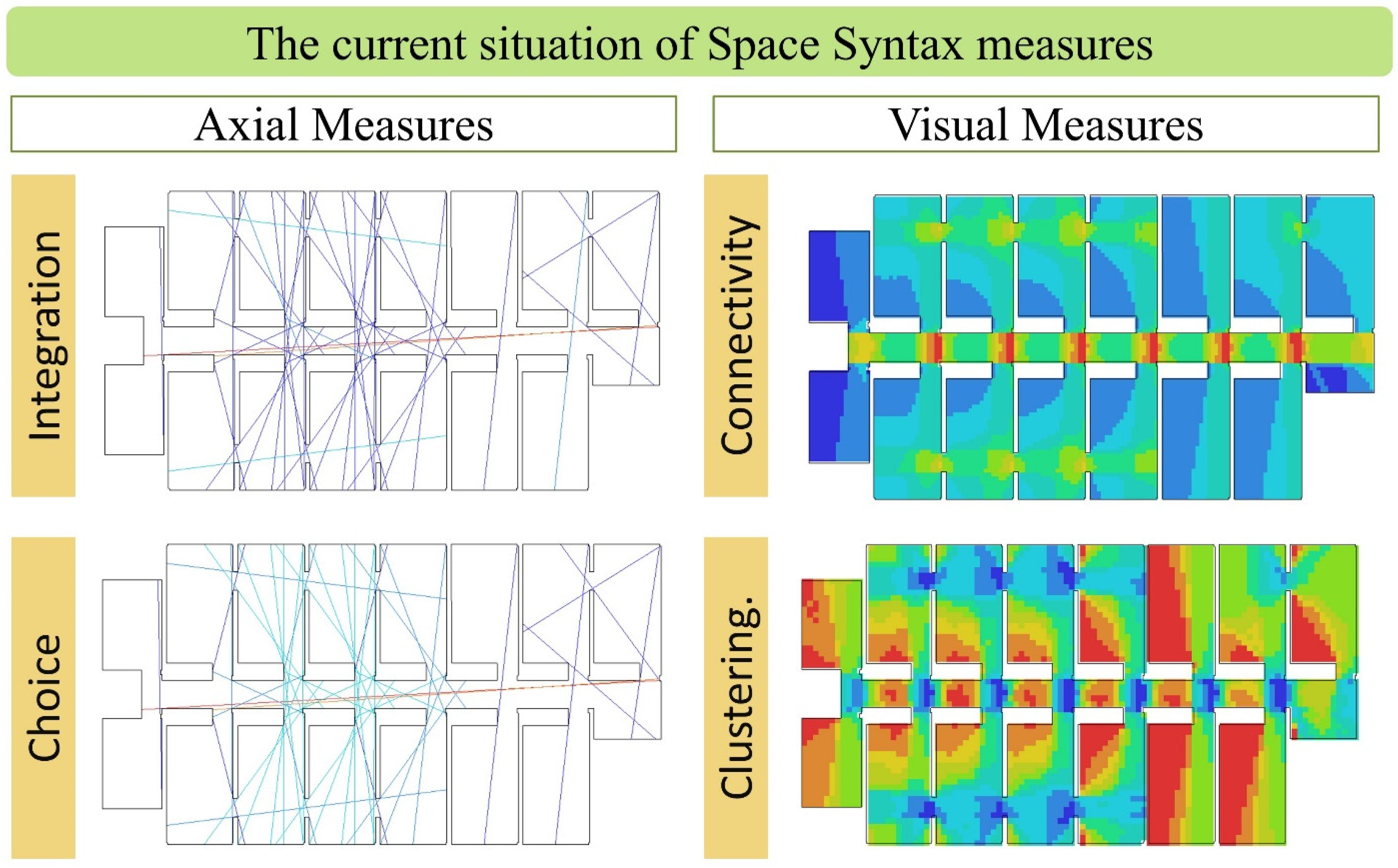
4. Case Study Selection
- The case study should be a building that correctly represents traditional methods of building.
- The analytical process can be greatly improved by having photographic documentation and pertinent data readily accessible, as well as by collaborating effectively with government agencies.
- It was built ten or more years ago to enable the observation of two essential elements: the difficulties presented by people using space over time and any modifications made to the structure while it is in use.
5. The Proposed Alternatives Using Kinetic-Based Design Strategies
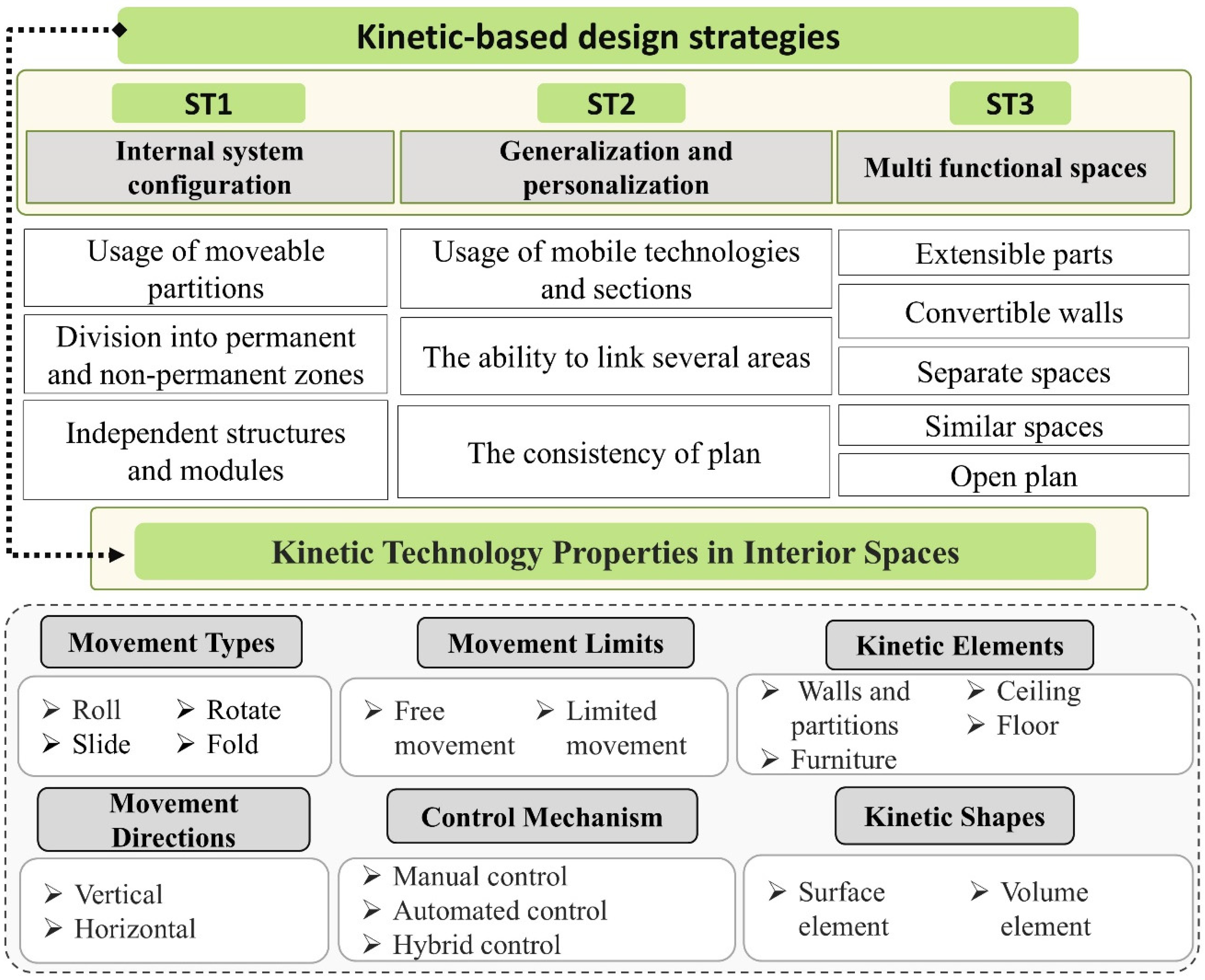
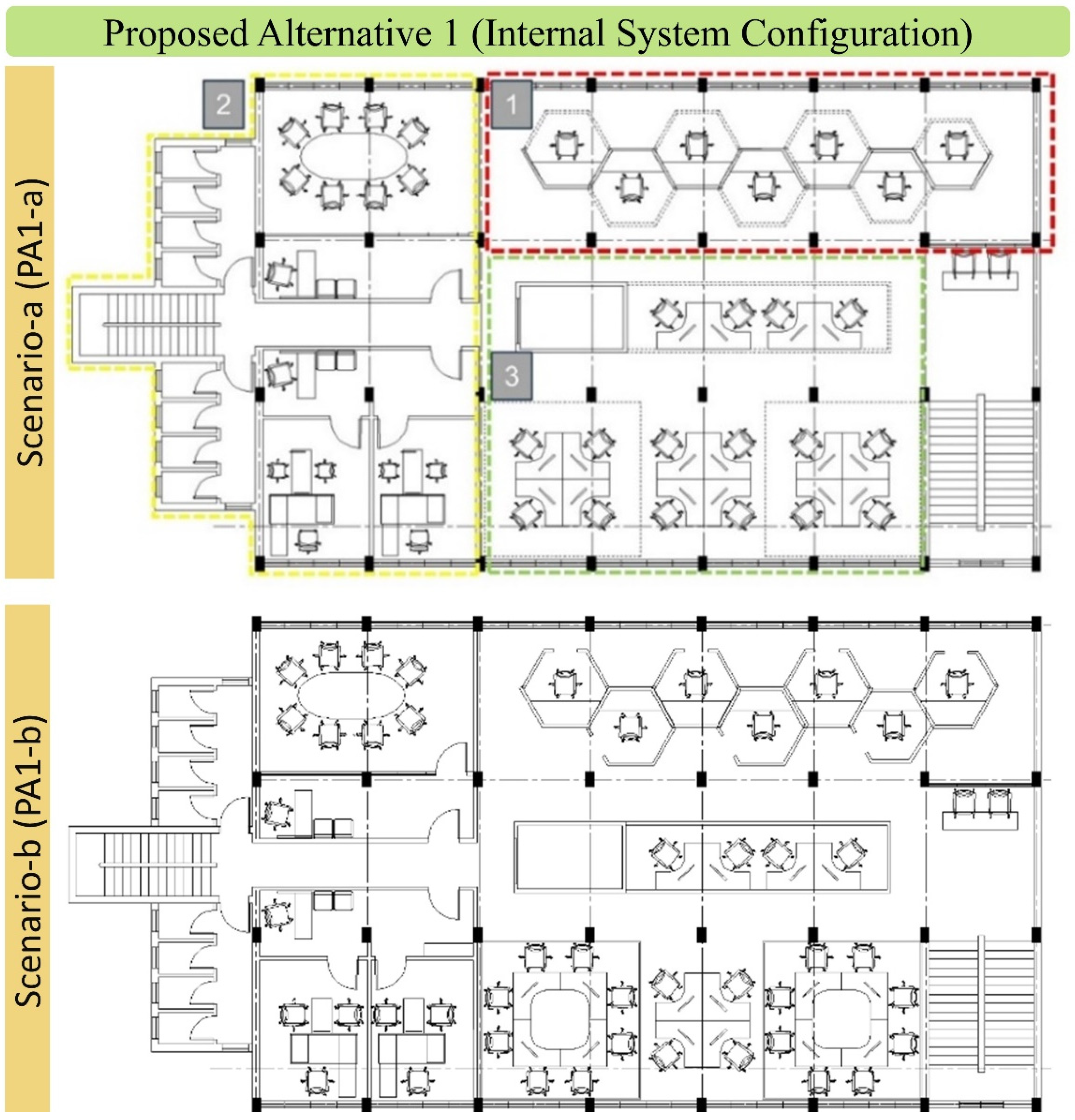
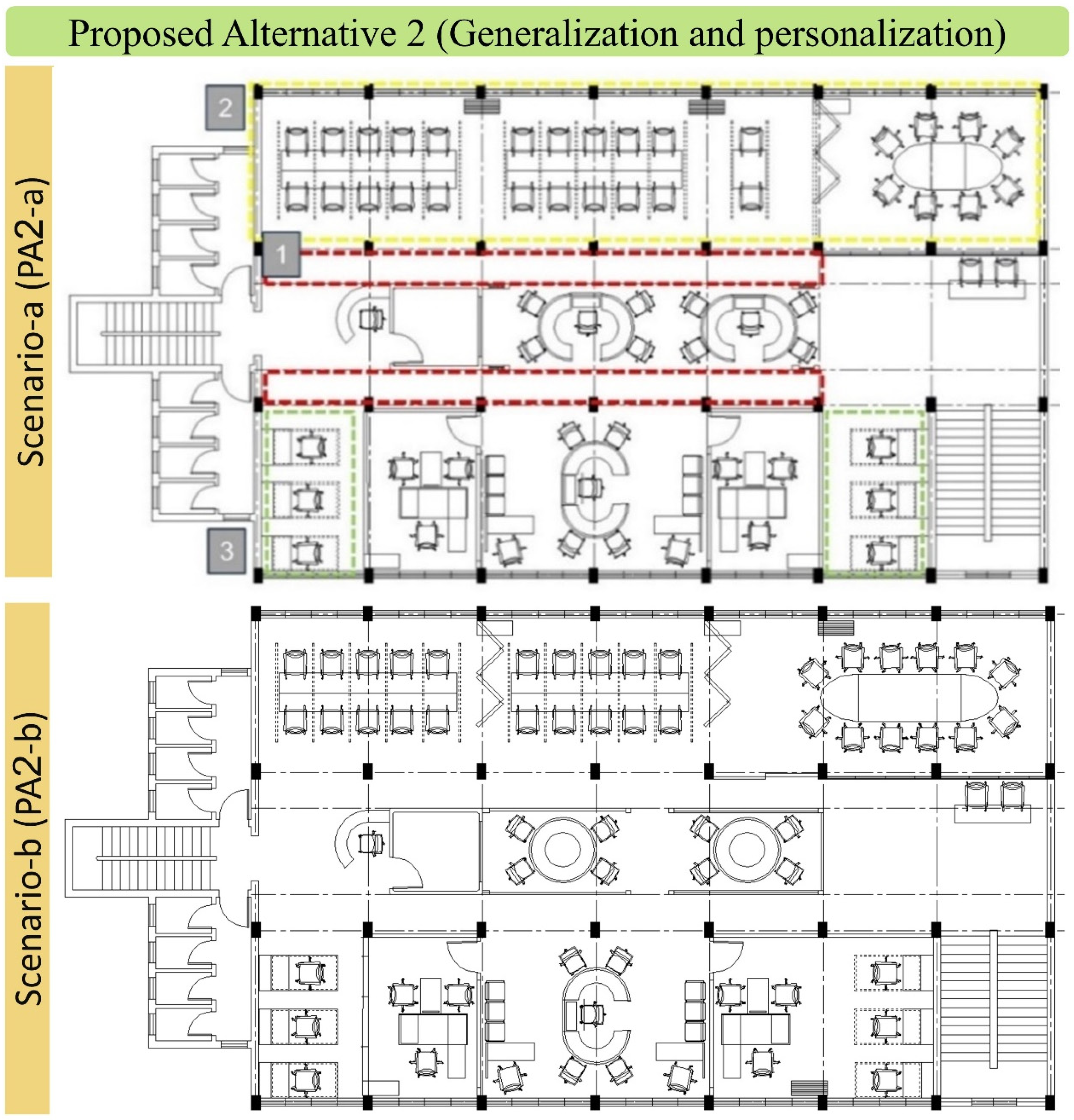
- Independent structures and modules: using sliding partitions that are not related to the main structure of the building. Using rolled fabrics to isolate the collaborative workspace.
- The division into permanent and non-permanent zones: fixed permanent zones for management, meeting, and service areas, while open, private, and collaborative workspaces offer flexibility to accommodate diverse user needs.
- Usage of movable partitions and furniture: The incorporation of foldable partitions between office units facilitates a seamless transformation from open-plan layouts to private work environments.
- The consistency of the plan: the spatial layout adopts a strip design, where spaces are consistently distributed on both sides of the main corridors.
- The ability to link several areas with one another: foldable walls expand usable space by connecting adjacent areas, allowing for flexible configurations to accommodate additional functions.
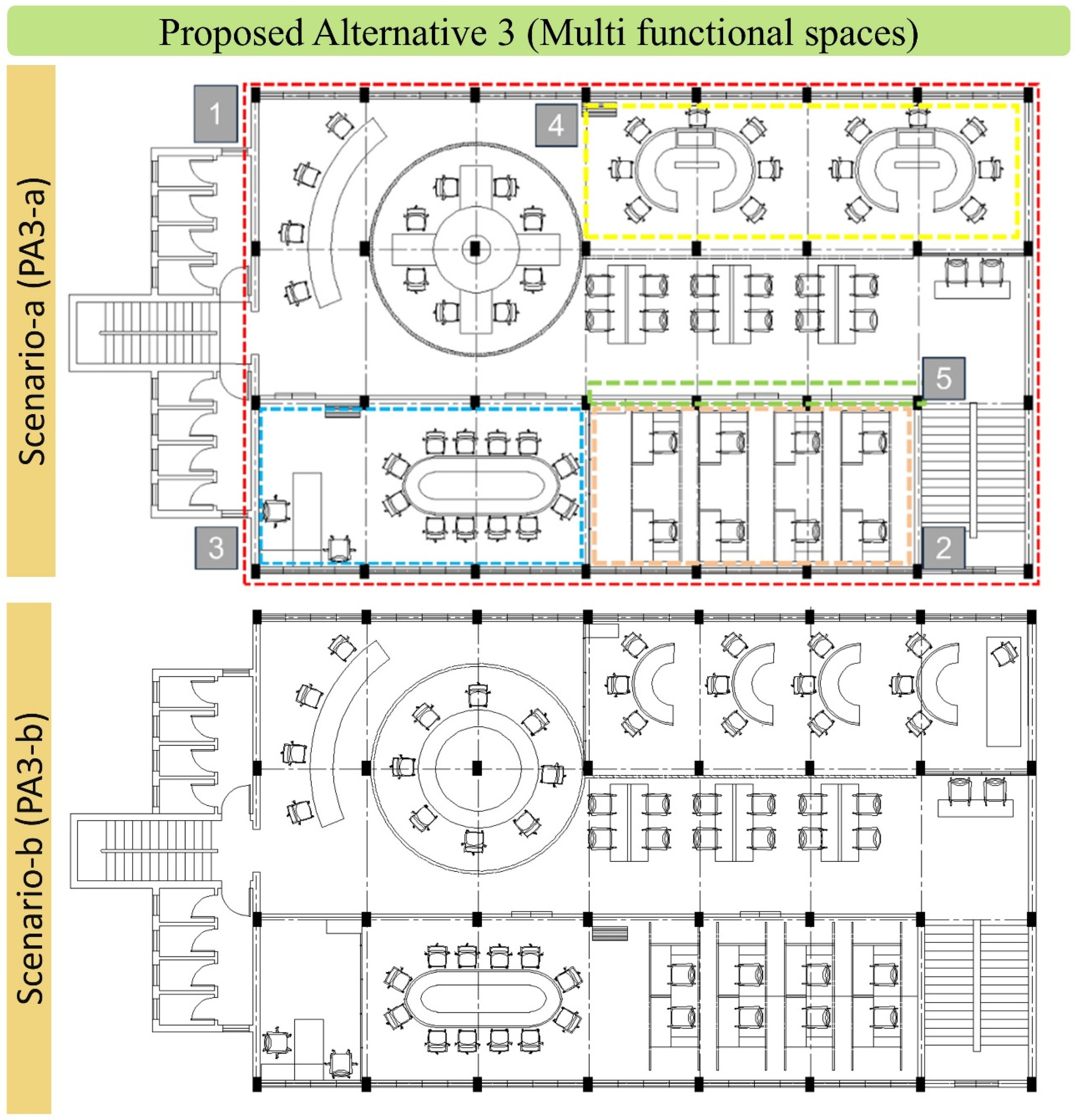
- Open plan: The office design adopts an open-plan layout, eschewing fixed walls to promote spatial connectivity and foster a sense of collaboration.
- Similar spaces: symmetrical design of flexible and adjustable furniture to accommodate workspace needs based on demand.
- Separating adjacent parts: employing sliding flexible partitions on a ceiling-mounted track to separate adjacent spaces.
- Extensible parts: flexible and expandable furniture to accommodate a larger number of employees.
- Convertible walls: sliding walls capable of transforming into temporary bases to provide break areas for employees during work.
6. Results
7. Discussions
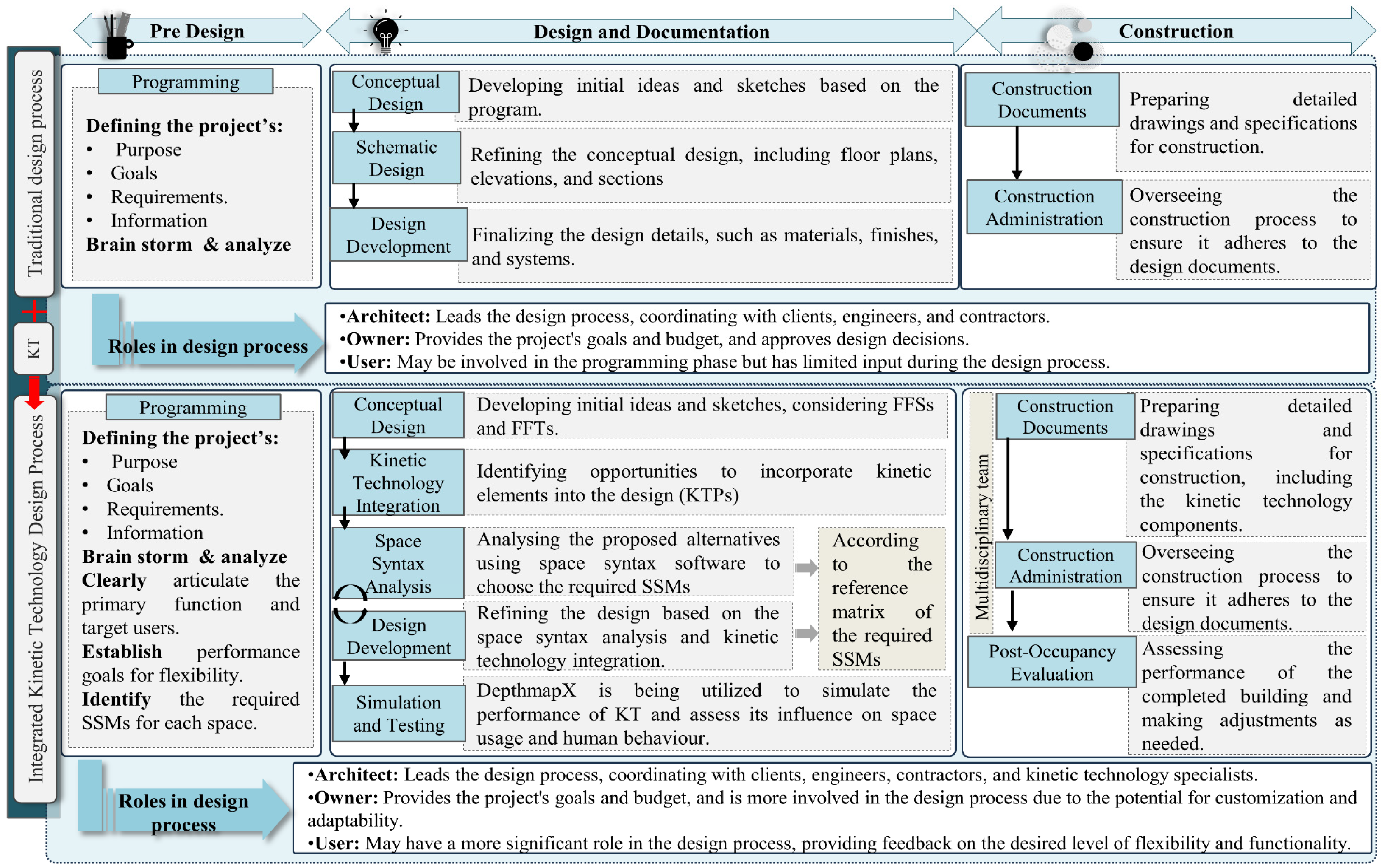
8. Recommended Kinetic-Based Design Process
Author Contributions
Funding
Institutional Review Board Statement
Informed Consent Statement
Data Availability Statement
Conflicts of Interest
References
- Almajidi, B.H.; Marqus, R.W.; Mudhaffar Yacoub, G. Functional flexibility as a criticism mechanism in contemporary architecture. In IOP Conference Series: Materials Science and Engineering; IOP Publishing: Bristol, UK, 2021; Volume 1105, p. 012088. [Google Scholar] [CrossRef]
- Estaji, H. A Review of Flexibility and Adaptability in Housing Design. Int. J. Contemp. Archit. 2017, 4, 37–49. [Google Scholar]
- Mohamed, A. Space Syntax Theory and Its Contribution to Urban Design. In Handbook of Research on Digital Research Methods and Architectural Tools in Urban Planning and Design; IGI Global Scientific Publishing: Palmdale, PA, USA, 2019; pp. 203–222. [Google Scholar] [CrossRef]
- Hou, H.; Sing, M. Transformative Response in Office Workplace: A Systematic Review of Post-Pandemic Changes. Buildings 2025, 15, 1519. [Google Scholar] [CrossRef]
- Peng, Z.; Rojas, A.P.; Kropff, E.; Bahnfleth, W.; Buonanno, G.; Dancer, S.; Kurnitski, J.; Li, Y.; Loomans, M.; Marr, L.; et al. Practical Indicators for Risk of Airborne Transmission in Shared Indoor Environments and Their Application to COVID-19 Outbreaks. Environ. Sci. Technol. 2022, 56, 1125–1137. [Google Scholar] [CrossRef] [PubMed]
- Bedi, T.K.; Bhattacharya, S.P. An Investigative Study on Perceived Indoor Air Quality During COVID-19 Lockdown in India. J. Inst. Eng. Ser. A 2021, 102, 885–900. [Google Scholar] [CrossRef]
- Stockman, T.; Zhu, S.; Kumar, A.; Wang, L.; Patel, S.; Weaver, J.; Spede, M.; Milton, D.K.; Hertzberg, J.; Toohey, D.; et al. Measurements and Simulations of Aerosol Released while Singing and Playing Wind Instruments. ACS Environ. Au 2021, 1, 71–84. [Google Scholar] [CrossRef] [PubMed]
- Bulle, B.G.; Shen, D.; Shah, D.; Hosoi, A.E. Public health implications of opening National Football League stadiums during the COVID-19 pandemic. Proc. Natl. Acad. Sci. USA 2022, 119, e2114226119. [Google Scholar] [CrossRef] [PubMed]
- Alkhayyat, J.M.J. Design Strategy for Adaptive Kinetic Patterns: Creating a Generative Design for Dynamic Solar Shading Systems. Master’s Thesis, University of Salford, Salford, UK, 2013. [Google Scholar]
- Nashaat, B. Kinetic Architecture: Concepts, History and Applications. Int. J. Sci. Res. 2018, 7, 750–758. [Google Scholar]
- Rodriguez, C.S. Morphological Principles of Current Kinetic Architectural Structures; Building Centre Trust and the University of Nottingham: London, UK, 2011. [Google Scholar]
- Özerol Özman, G.; Arslan Selçuk, S. Transformation of geometry from 2D to 3D: Revisiting origami in a digital design course. Nexus Netw. J. 2024, 26, 197–212. [Google Scholar] [CrossRef]
- Abdulpader, O.Q.; Sabah, O.A. Imp act of Flexibility Principle on the Efficiency of Interior Design—IMPRESSO. In International Transaction Journal of Engineering, Management, & Applied Sciences & Technologies; TuEngr Group: Khlong Luang, Thailand, 2014; pp. 195–212. Available online: http://tuengr.com (accessed on 5 June 2023).
- Celadyn, M. Interior architectural design for adaptive reuse in application of environmental sustainability principles. Sustainability 2019, 11, 3820. [Google Scholar] [CrossRef]
- Sasaki, N.; Kuroda, R.; Tsuno, K.; Kawakami, N. Workplace responses to COVID-19 associated with mental health and work performance of employees in Japan. J. Occup. Health 2020, 62, e12134. [Google Scholar] [CrossRef] [PubMed]
- Fachrudin, H.T.; Fachrudin, K.A.; Pane, I.F. Workplace Design Concept Based on Indoor Environmental Quality Analysis to Prevent Coronavirus Transmission. Civ. Eng. Archit. 2022, 10, 121–130. [Google Scholar] [CrossRef]
- Hessari, P.; Chegeni, F. Measuring the relationship between spatial configuration concept variables and flexibility components. J. Archit. Urban. 2022, 46, 89–99. [Google Scholar] [CrossRef]
- Hassanein, H. Utilization of “Multiple Kinetic Technology KT” in Interior Architecture Design as Concept of Futuristic Innovation. Acad. Res. Commun. Publ. 2019, 2, 331. [Google Scholar] [CrossRef]
- Wang, J.; Beltrán, L.O.; Kim, J. From static to kinetic: A review of acclimated kinetic building envelopes. In World Renewable Energy Forum, WREF 2012; Including World Renewable Energy Congress XII and Colorado Renewable Energy Society (CRES) Annual Conference; American Solar Energy Society: Denver, CO, USA, 2012; pp. 4022–4029. [Google Scholar]
- Lee, J.D. Adaptable, Kinetic, Responsive, and Transformable Architecture: An Alternative Approach to Sustainable Design. Master’s Thesis, University of Texas Libraries, Austin, TX, USA, 2012; p. 175. [Google Scholar]
- Sevtsuk, A.; Chancey, B.; Basu, R.; Mazzarello, M. Spatial structure of workplace and communication between colleagues: A study of E-mail exchange and spatial relatedness on the MIT campus. Soc. Netw. 2022, 70, 295–305. [Google Scholar] [CrossRef]
- Aksamija, A.; Milosevic, S. Post-pandemic Office Spaces: Considerations and Design Strategies for Hybrid Work Environments. Enq. ARCC J. Archit. Res. 2023, 20, 41–64. [Google Scholar] [CrossRef]
- Leite, P.W.d.L.; Silva, C.C.O.d.A.; Moro, L.D.; Bodah, B.W.; Mores, G.d.V.; Junior, D.P.; Engel, A.; Santosh, M.; Neckel, A. Space Syntax at Expression of Science on User Flows in Open and Closed Spaces Aimed at Achieving the Sustainable Development Goal: A Review. Architecture 2024, 4, 170–187. [Google Scholar] [CrossRef]
- Ali Mustafa, F.; Abdullah Azeez, S. Role of office layout typology in saving time and distance spent by users: Case of office buildings in Erbil city. Ain Shams Eng. J. 2022, 13, 101742. [Google Scholar] [CrossRef]
- Cellucci, C.; Di Sivo, M. The Flexible Housing: Criteria and Strategies for Implementation of the Flexibility. J. Civ. Eng. Archit. 2015, 9, 845–852. [Google Scholar] [CrossRef]
- Gharavi Alkhansari, M. Toward a convergent model of flexibility in architecture. J. Archit. Urban. 2018, 42, 120–133. [Google Scholar] [CrossRef]
- Nakib, F. Toward an Adaptable Architecture Guidelines to integrate Adaptability in the Building. In Building a Better World: CIB World Congress; CIB: Delft, The Netherlands, 2010; Volume 3, pp. 1–11. [Google Scholar]
- Atef, E.; Megahed, N.; Elgheznawy, D.; Nashaat, B. Adaptive office buildings: Improving functional flexibility in response to shifting needs using kinetic technology. Archit. Eng. Des. Manag. 2024, 20, 946–971. [Google Scholar] [CrossRef]
- Megahed, N.A. Origami Folding and its Potential for Architecture Students. Design J. 2017, 20, 279–297. [Google Scholar] [CrossRef]
- van Nes, A.; Yamu, C. Introduction to Space Syntax in Urban Studies; Springer: Berlin/Heidelberg, Germany, 2021; pp. 1–250. [Google Scholar] [CrossRef]
- Arnold, T. Using Space Syntax to Design an Architecture of Visual Relations. J. Space Syntax 2011, 2, 274–281. Available online: https://access.portico.org/stable?au=pjb405b92pn (accessed on 15 July 2024).
- Edgü, E.; Ünlü, A. Relation of domestic space preferences with Space Syntax parameters. In Proceedings of the 4th International Space Syntax Symposium, London, UK, 1 June 2003. [Google Scholar]
- Karimi, K. A configurational approach to analytical urban design: Space syntax methodology. Urban Des. Int. 2012, 17, 297–318. [Google Scholar] [CrossRef]
- Park, K.; Ergan, S.; Feng, C. Quality assessment of residential layout designs generated by relational Generative Adversarial Networks (GANs). Autom. Constr. 2024, 158, 105243. [Google Scholar] [CrossRef]
- Hay, R.; Samuel, F.; Watson, K.J.; Bradbury, S. Post-occupancy evaluation in architecture: Experiences and perspectives from UK practice. Build. Res. Inf. 2018, 46, 698–710. [Google Scholar] [CrossRef]
- Susanto, D.; Ilmiani, A.N. Flexible Furniture: A Design Strategy for Multiuse yet Limited Space in the Urban Kampung. In Proceedings of the 2nd International Conference on Smart Grid and Smart Cities, ICSGSC 2018, Kuala Lumpur, Malaysia, 12–14 August 2018; pp. 26–31. [Google Scholar] [CrossRef]
- El-agouri, F.; Karakale, V. Privacy regulation, Spatial culture and Communities in a communally diverse city: Ghadames, Libya. J. World Archit. 2018, 1, 16–25. [Google Scholar] [CrossRef]
- Dawes, M.; vOstwald, M.J. Precise Locations in Space: An Alternative Approach to Space Syntax Analysis Using Intersection Points. Archit. Res. 2013, 3, 1–11. [Google Scholar] [CrossRef]
- Nubani, L.; Wineman, J. The Role of Space Syntax in Identifying the Relationship Between Space and Crime. Available online: https://www.researchgate.net/publication/268413844 (accessed on 11 February 2026).
- Alitajer, S.; Molavi Nojoumi, G. Privacy at home: Analysis of behavioral patterns in the spatial configuration of traditional and modern houses in the city of Hamedan based on the notion of space syntax. Front. Archit. Res. 2016, 5, 341–352. [Google Scholar] [CrossRef]
- Koch, D.; Marcus, L.; Steen, J. Spatial and Social Configurations in Offices. In Proceedings of the 7th International Space Syntax Symposium; KTH Royal Institute of Technology: Stockholm, Sweden, 2009. [Google Scholar]
- Maleki, M.; MOFIDI, S.S.; Heidari, A. Desirability factors of work desk arrangement from the viewpoint of employees by the analysis of space syntax indices. Int. J. Architect. Eng. Urban Plan. 2017, 27, 29–41. [Google Scholar] [CrossRef]
- El Samaty, H.S.; Feidi, J.Z.; Refaat, A.M. The impact of glazed barriers on the visual and functional performance of transition spaces in college buildings using space syntax. Ain Shams Eng. J. 2023, 14, 102119. [Google Scholar] [CrossRef]
- Koohsari, M.J.; Oka, K.; Owen, N.; Sugiyama, T. Natural movement: A space syntax theory linking urban form and function with walking for transport. Health Place 2019, 58, 102072. [Google Scholar] [CrossRef] [PubMed]
- Pezzica, C.; Cutini, V. Linking space syntax and cluster analysis to design and plan temporary housing neighborhoods: A taxonomy of sites in Norcia. J. Des. Resil. Archit. Plan. 2021, 2, 89–114. [Google Scholar] [CrossRef]
- Natapov, A.; Kuliga, S.; Dalton, R.; Dalton, R.C.; Hölscher, C. Building Circulation Typology and Space Syntax Predictive Measures. 2015. Available online: https://www.researchgate.net/publication/281839434 (accessed on 11 February 2026).
- Yenel Güler, G.; Demirkan, H. Evaluating the relationship between visual privacy and work-process interactions in open-plan offices: A space syntax approach. Archnet IJAR Int. J. Archit. Res. 2024, 20, 75–99. [Google Scholar] [CrossRef]
- Batty, M. Integrating space syntax with spatial interaction. Urban Inform. 2022, 1, 4. [Google Scholar] [CrossRef]
- Mourad, H.; Shafik, Z.; El-Husseiny, M. Space-time mapping of co-working spaces in Cairo: Shifting paradigms from openness to technologically controlled spaces. J. Eng. Appl. Sci. 2021, 68, 39. [Google Scholar] [CrossRef]
- Azadi, S.; Bai, N.; Nourian, P. Ergonomics of spatial configurations: A voxel-based modelling framework for accessibility and visibility simulations. Front. Built Environ. 2023, 9, 1300843. [Google Scholar] [CrossRef]
- Gil, J.; Karimi, K.; Penn, A.; Varoudis, T. The Space Syntax Toolkit: Integrating DepthmapX and Exploratory Spatial Analysis Workflows in QGIS. 2015. Available online: https://en.wikipedia.org/wiki/Spatial_network_analysis_software (accessed on 5 July 2024).
- Monokrousou, K.; Giannopoulou, M. Interpreting and Predicting Pedestrian Movement in Public Space through Space Syntax Analysis. Procedia Soc. Behav. Sci. 2016, 223, 509–514. [Google Scholar] [CrossRef]
- Pinelo, J.; Turner, A. Introduction to Depthmap. UCL Bartlett School of Graduate Studies, University College London: London, UK. Available online: https://www.spacesyntax.net/software/ (accessed on 5 March 2024).





| Space | Behavioral/Functional Intent | Design Considerations and Spatial Characteristics |
|---|---|---|
| Open Office Workspace | Supports awareness and distributed interaction while maintaining acceptable distraction control and team visibility | High visual connectivity and moderate-to-high integration support awareness and spontaneous interaction. Movement permeability should be balanced to reduce cross-traffic distraction. Controlled clustering and graded depth from the main circulation enhance concentration performance. |
| Private Offices | Enhances privacy, cognitive focus, and controlled access; reduces unintended movement penetration | Lower global integration and limited connectivity improve privacy and cognitive focus. Increased topological depth from main routes supports acoustic and visual control. Low choice values reduce unintended penetration and interruption. |
| Meeting Rooms | Enables planned gatherings with controlled accessibility and a clear spatial hierarchy | Moderate integration with selective accessibility is preferred. Connectivity should support wayfinding without through-movement. Entrance visibility and functional clustering with team zones improve usability and booking efficiency. |
| Collaborative/Informal Areas | Maximizes encounter probability, co-presence, and knowledge exchange near movement nodes | High local integration and high choice values increase encounter probability and knowledge exchange. Strong co-visibility and adjacency to movement nodes enhance interaction frequency. Amenity-based clustering increases dwell time. |
| Circulation Spaces | Acts as the primary movement distributor and orientation structure within the layout | High choice and connectivity values define the primary movement structure. Integration hierarchy should differentiate main and secondary routes. Visual continuity improves spatial cognition and navigation efficiency. |
| Support Spaces | Provides operational support functions with minimal social occupancy; reduces interference with primary work and collaboration areas; supports short-duration, task-oriented use. | Prefer low integration and low choice values to limit through-movement; moderate connectivity for accessibility without attracting flow; greater topological depth from primary work zones; controlled visibility and partial enclosure to reduce noise and visual distraction; clustered near but not within primary circulation spines. |
| Space Type | Space Syntax Measures | |||
|---|---|---|---|---|
| IN | CH | CO | CC | |
| Open office space | High | Moderate | High | Moderate |
| To ensure these primary work areas are accessible and well-connected. | To balance accessibility with the need for focused individual work. | To promote movement and interaction between workstations and teams. | To balance integration and separation between work areas. | |
| Close offices | Moderate | Moderate | Low | Moderate |
| To balance privacy and accessibility. | To balance accessibility with the need for focused individual work. | To maintain a sense of enclosure and minimize disturbance. | To preserve a sense of seclusion while minimizing interruption. | |
| Meeting Rooms | High | Moderate | Moderate | Moderate |
| To make these spaces easily accessible from the main office areas. | To ensure meeting rooms are on key circulation paths. | To allow for controlled access and privacy during meetings. | To encourage focused interaction within the meeting space. | |
| Collaborative spaces | High | Moderate | High | High |
| To encourage spontaneous interactions and serendipitous encounters. | Suitable for spaces used by smaller teams or those requiring a balance between focus and adaptability | To facilitate movement and social exchange between employees. | To create a sense of community and cohesion. | |
| Support spaces | Moderate | Low | Moderate | low |
| To balance accessibility with the need for focused work. | These spaces are not intended to be on primary circulation routes. | To allow for efficient access while maintaining some privacy. | To allow for efficient movement and access. | |
| Circulation spaces | High | High | High | low |
| To seamlessly connect different functional areas, fostering a sense of openness. | To cater to individual preferences and activity needs. | To ensure smooth and efficient movement within the office. | These spaces are designed for movement. | |
| Space Syntax Measures | Low | Moderate | High | Notes on Interpretation |
|---|---|---|---|---|
| Integration | 0.40–0.79 | 0.80–1.19 | ≥1.20 | Higher values indicate greater configurational accessibility and shallower topological depth. Values are relative to system size and normalization method. |
| Choice | 0.00–0.49 | 0.50–1.49 | ≥1.50 | Represents movement potential and through-movement probability. High values typically correspond to primary circulation routes. |
| Connectivity | 1–3 | 4–6 | ≥7 | Indicates the number of directly connected spaces. Higher values reflect stronger local permeability. |
| Clustering Coefficient | 0.00–0.29 | 0.30–0.59 | ≥0.60 | Reflects local enclosure and grouping tendency. Higher values indicate stronger spatial clustering. |
| Type | Office Building of Port Said University |
|---|---|
| Position | The third floor of the building. (constructed in the 1970s) |
| Geometrical properties |  |
| Notes |
|
| SSMs | PA1 Graphs | ||
| PA1-a | PA1-b | ||
| Axial measures | IN |  |  |
| CH |  |  | |
| Visual measures | CO |  |  |
| CC |  |  | |
| SSMs | PA2 Graphs | ||
| PA2-a | PA2-b | ||
| Axial measures | IN |  |  |
| CH |  | 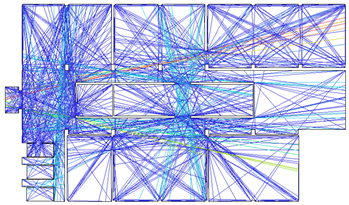 | |
| Visual measures | CO | 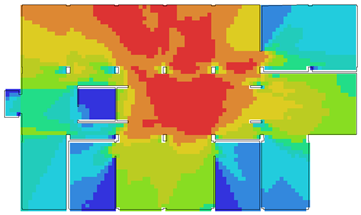 |  |
| CC | 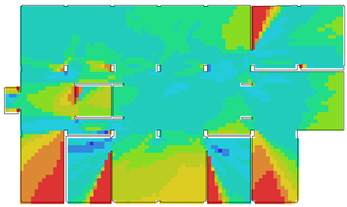 |  | |
| SSMs | PA3 Graphs | ||
| PA3-a | PA3-b | ||
| Axial measures | IN |  |  |
| CH |  | 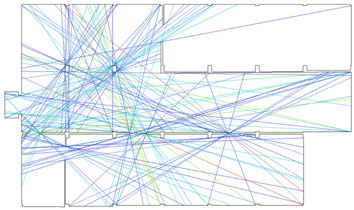 | |
| Visual measures | CO |  |  |
| CC |  | 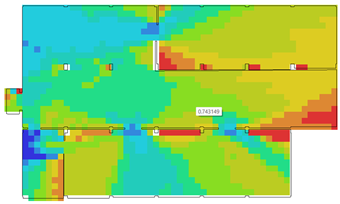 | |
| PAs | Scenario | Space Syntax Measures | ||||
|---|---|---|---|---|---|---|
| Spaces | Axial Measures | Visual Measures | ||||
| IN | CH | CO | CC | |||
| PA1 | PA1-a | Open office | 0.35 | 1.10 | 6 | 0.45 |
| Close offices | 0.40 | 0.25 | 2.50 | 0.7 | ||
| Meeting rooms | 1.00 | 0.34 | 2.50 | 0.45 | ||
| Collaborative | 0.50 | 0.45 | 7.20 | 0.33 | ||
| Support | 0.4 | 0.30 | 7 | 0.50 | ||
| Circulation | 0.80 | 2 | 3 | 0.5 | ||
| PA1-b | Close offices | 0.85 | 3 | 2.75 | 0.75 | |
| Meeting rooms | 1 | 0.8 | 5.75 | 0.44 | ||
| Collaborative | 0.5 | 0.32 | 4.30 | 0.68 | ||
| Support | 0.4 | 0.22 | 2.0 | 0.4 | ||
| Circulation | 1.15 | 1 | 5.45 | 0.21 | ||
| PA2 | PA2-a | Close offices | 0.75 | 0.25 | 0.88 | 0.86 |
| Meeting rooms | 1.10 | 1.18 | 4.50 | 0.45 | ||
| Collaborative | 0.5 | 0.35 | 7.15 | 0.77 | ||
| Support | 0.39 | 0.66 | 0.25 | 0.43 | ||
| Circulation | 0.5 | 2.10 | 8.0 | 0.25 | ||
| PA2-b | Open office | 1.85 | 3.0 | 6.10 | 0.45 | |
| Close offices | 0.85 | 3 | 2.75 | 0.86 | ||
| Meeting rooms | 1.32 | 0.34 | 2.50 | 0.44 | ||
| Collaborative | 0.50 | 0.35 | 5.75 | 0.55 | ||
| Support | 1.2 | 0.24 | 0.27 | 0.45 | ||
| Circulation | 1.46 | 1.35 | 3.1 | 0.44 | ||
| PA3 | PA3-a | Open office | 1.99 | 1.15 | 6.80 | 0.51 |
| Close offices | 0.40 | 3.1 | 0.78 | 0.76 | ||
| Meeting rooms | 1.12 | 1.15 | 4.45 | 0.47 | ||
| Collaborative | 0.56 | 0.34 | 5.66 | 0.58 | ||
| Support | 1.21 | 0.25 | 0.28 | 0.45 | ||
| Circulation | 1.15 | 1.35 | 5.45 | 0.44 | ||
| PA3-b | Open office | 1.87 | 1.15 | 6.78 | 1.5 | |
| Close offices | 0.85 | 0.89 | 2.75 | 0.86 | ||
| Meeting rooms | 1.12 | 1.15 | 3.85 | 0.62 | ||
| Collaborative | 0.5 | 0.68 | 7.15 | 0.33 | ||
| Support | 0.39 | 0.66 | 0.27 | 0.31 | ||
| PAs | Scenarios | Space Syntax Measures | ||||
|---|---|---|---|---|---|---|
| Spaces | Axial Measures | Visual Measures | ||||
| IN | CH | CO | CC | |||
| PA1 | PA1-a | Open office |  |  | | |
| Close offices |  | | | | ||
| Meeting rooms | | | | | ||
| Collaborative | | | | | ||
| Support | | | | | ||
| Circulation | | | | | ||
| PA1-b | Close offices | | | | | |
| Meeting rooms | | | | | ||
| Collaborative | | | | | ||
| Support | | | | | ||
| Circulation | | | | | ||
| PA2 | PA2-a | Close offices | | | | |
| Meeting rooms | | | | | ||
| Collaborative | | | | | ||
| Support | | | | | ||
| Circulation | | | | | ||
| PA2-b | Open office | | | | | |
| Close offices | | | | | ||
| Meeting rooms | | | | | ||
| Collaborative | | | | | ||
| Support | | | | | ||
| Circulation | | | | | ||
| PA3 | PA3-a | Open office | | | | |
| Close offices | | | | | ||
| Meeting rooms | | | | | ||
| Collaborative | | | | | ||
| Support | | | | | ||
| Circulation | | | | | ||
| PA3-b | Open office | | | | | |
| Close offices | | | | | ||
| Meeting rooms | | | | | ||
| Collaborative | | | | | ||
| Support | | | | | ||
| Achieved | Semi-achieved | Not-achieved | ||||
Disclaimer/Publisher’s Note: The statements, opinions and data contained in all publications are solely those of the individual author(s) and contributor(s) and not of MDPI and/or the editor(s). MDPI and/or the editor(s) disclaim responsibility for any injury to people or property resulting from any ideas, methods, instructions or products referred to in the content. |
© 2026 by the authors. Licensee MDPI, Basel, Switzerland. This article is an open access article distributed under the terms and conditions of the Creative Commons Attribution (CC BY) license.
Share and Cite
Megahed, N.; Atef, E.; Nashaat, B.; Elgheznawy, D. The Impact of Implementing Kinetic Interior Techniques on the Functional Performance of Office Spaces Using Space Syntax. Sustainability 2026, 18, 2832. https://doi.org/10.3390/su18062832
Megahed N, Atef E, Nashaat B, Elgheznawy D. The Impact of Implementing Kinetic Interior Techniques on the Functional Performance of Office Spaces Using Space Syntax. Sustainability. 2026; 18(6):2832. https://doi.org/10.3390/su18062832
Chicago/Turabian StyleMegahed, Naglaa, Eman Atef, Basma Nashaat, and Dalia Elgheznawy. 2026. "The Impact of Implementing Kinetic Interior Techniques on the Functional Performance of Office Spaces Using Space Syntax" Sustainability 18, no. 6: 2832. https://doi.org/10.3390/su18062832
APA StyleMegahed, N., Atef, E., Nashaat, B., & Elgheznawy, D. (2026). The Impact of Implementing Kinetic Interior Techniques on the Functional Performance of Office Spaces Using Space Syntax. Sustainability, 18(6), 2832. https://doi.org/10.3390/su18062832