Machine Learning for Outdoor Thermal Comfort Assessment and Optimization: Methods, Applications and Perspectives

 ,
,  ,
,  , ,
, ,  and
and
Abstract
1. Introduction
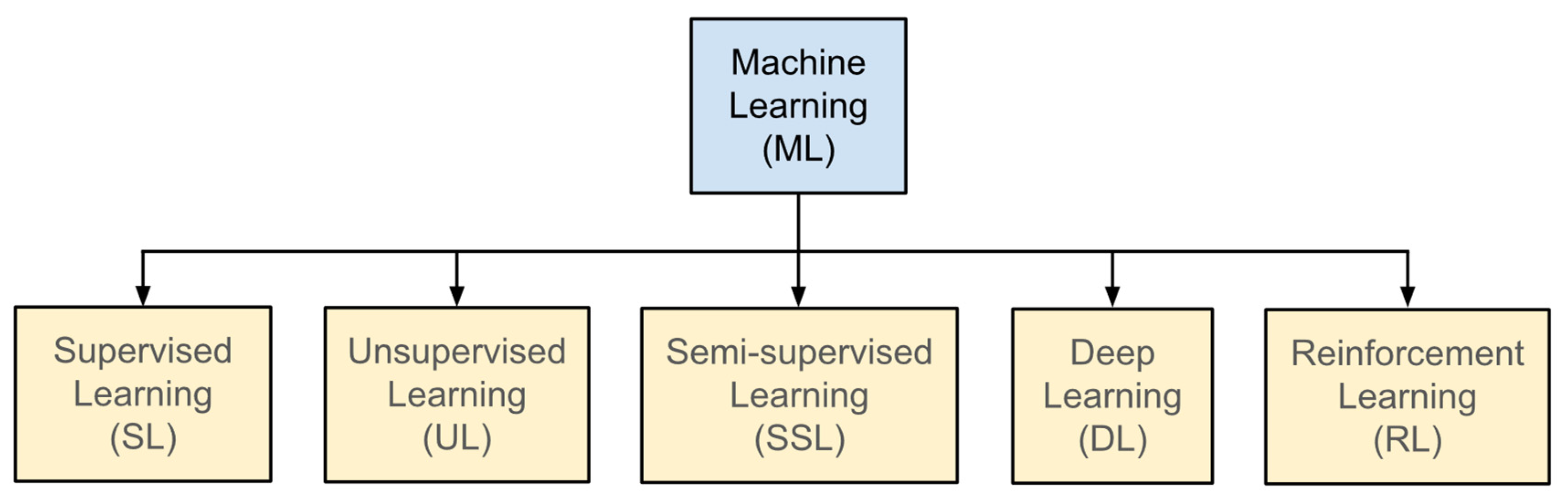
- Synthesize ML methodologies used in OTC research, across supervised, unsupervised, deep learning, semi-supervised, and reinforcement learning paradigms;
- Explore the integration of ML with SBO, surrogate modeling, and scenario-based design strategies;
- Propose a roadmap for scalable, intelligent, and thermally adaptive urban design informed by ML capabilities.
- (a)
- Interdisciplinary synthesis: This study bridges urban climatology, environmental modeling, and artificial intelligence to build a cohesive understanding of ML-driven OTC assessment.
- (b)
- Systematic classification of ML techniques: A structured taxonomy of ML paradigms is developed, covering theoretical principles, input-output variables, performance metrics, and their contextual application in real-world case studies.
- (c)
- Integration with optimization workflows: A central innovation of this review is its focus on ML-optimization coupling. Through selected case studies, it highlights how ML can enhance SBO, evolutionary algorithms, and surrogate modeling in support of multi-objective and adaptive design strategies.
- (d)
- Proposal of a practical framework for OTC optimization: Drawing from state-of-the-art applications, the review formulates a transferable, context-sensitive framework that links climate analysis, parametric modeling, and ML-based optimization. This framework offers guidance on selecting appropriate indices, algorithms, and design parameters to support computationally efficient and implementation-ready OTC interventions across different urban and climatic contexts.
- (i)
- Relevance: priority to studies addressing ML-driven prediction, classification, or optimization of OTC in diverse urban contexts;
- (ii)
- Quality: inclusion of rigorously validated, peer-reviewed studies;
- (iii)
- Diversity: coverage of a broad but representative range of ML algorithms and optimization techniques;
- (iv)
- Applicability: emphasis on case studies demonstrating practical implementation, scalability, or integration into design workflows.
2. Machine Learning Approaches
2.1. Supervised Learning
2.1.1. Regression Algorithms
2.1.2. Classification Algorithms
2.2. Unsupervised Learning
2.3. Semi-Supervised Learning
2.4. Deep Learning
2.5. Reinforcement Learning
3. Real-World Applications
4. A Practical Framework for Optimizing Outdoor Thermal Comfort
- ➢
- Decision variables: building position, spacing, orientation, and rotation within a high-rise residential layout.
- ➢
- Objective functions: maximization of daylight availability, annual sunlight hours, sky view factor (SVF), and improvement of OTC (UTCI-based metric).
- ➢
- Constraints: regulatory spacing requirements between buildings, minimum daylight thresholds, geometric feasibility of high-rise typologies, and climatic boundary conditions defined by local weather data.
- ➢
- Optimization algorithm: multi-objective evolutionary algorithm (NSGA-II).
- ➢
- ML integration: a trained ANN surrogate model was used to approximate simulation outputs and accelerate performance evaluation.
- ➢
- Verification: optimized solutions were re-evaluated through high-fidelity simulations; surrogate model performance was validated using prediction accuracy (89.9%), and Pareto-optimal layouts were compared against a baseline configuration, demonstrating approximately 21% improvement in combined performance metrics.
- ➢
- Decision variables: stadium geometric and morphological parameters.
- ➢
- Objective: maximizing the percentage of thermally comfortable seats (PCave, UTCI-based).
- ➢
- Constraints: architectural feasibility of stadium form and predefined spatial envelope.
- ➢
- Algorithm: genetic algorithm coupled with ANN surrogate modeling.
- ➢
- Verification: improvement of 8.96% in comfort metric relative to baseline, with predictive error quantified through MAE reduction.
- (i)
- Re-simulation of Pareto-optimal solutions using high-fidelity microclimate tools (e.g., ENVI-met, EnergyPlus);
- (ii)
- Statistical validation of surrogate models using RMSE, MAE, or cross-validation techniques;
- (iii)
- Comparison with baseline or regulatory reference configurations.
- From geometric tuning to high-dimensional optimization: Early studies focused on adjusting geometric variables (e.g., building height, spacing, orientation) to reduce PET or UTCI [172,173,190]. More recent works [194,195,196] adopt multi-parametric optimization strategies incorporating energy efficiency, daylight, and visual comfort—marking a shift toward data-driven, performance-oriented design.
- Hybrid and surrogate-based methodologies as emerging standards: Studies [136,185,186] showcase hybrid workflows combining surrogate models (e.g., ANN) with formal optimizers (e.g., GA, NSGA-II). Study [186] reported 89.9% accuracy across 150 configurations, demonstrating significant speed and accuracy benefits.
- Sensitivity to climatic and socio-spatial contexts: Design objectives vary by climate: Guangzhou [188] emphasized shading and vegetation; Sydney [196] balanced summer cooling and winter sunlight; Shenyang and Beijing [186,191] prioritized solar gain and wind protection. Study [189] tailored optimization to user groups (e.g., hospital patients vs. healthy users), underscoring the need for inclusive design.
- Demonstrated performance gains and implementation potential: Comfort gains ranged from 2 °C to 6 °C in PET or UTCI—improvements with tangible public health and livability implications. Tools like Grasshopper [198], Ladybug [199], and Galapagos [200] enable integration into design workflows, even at early planning stages [194,197], enhancing regulatory and participatory potential.
- The reviewed literature demonstrates that optimization applications have matured from simple geometric manipulations into robust, multi-objective and multi-scalar design approaches. Although SBO is currently dominant, ML-assisted methods—particularly surrogate modeling—hold considerable promise for future development. As urban areas grapple with climatic stressors, the convergence of optimization algorithms, parametric design tools, and data-driven surrogates offers a scalable and effective pathway toward thermally comfortable, climate-resilient urban environments.
5. Discussion and Conclusions
Funding
Institutional Review Board Statement
Informed Consent Statement
Data Availability Statement
Conflicts of Interest
Abbreviations
| ANN | Artificial Neural Network |
| AR | Aspect Ratio |
| ASHRAE | American Society of Heating, Refrigerating and Air-conditioning Engineers |
| BMI | Body Mass Index |
| BPNN | Backpropagation Neural Network |
| CatBoost | Categorical Boosting |
| CEI | Coupling Effect Intensity |
| CFD | Computational Fluid Dynamics |
| CNN | Convolutional Neural Network |
| DI | Discomfort Index |
| DL | Deep Learning |
| DNN | Deep Neural Network |
| DT | Decision Tree |
| DTR | Decision Tree Regression |
| ELM | Extreme Learning Machine |
| FFNN | Feedforward Neural Network |
| GA | Genetic Algorithm |
| GAN | Generative Adversarial Network |
| GBM | Gradient Boosting Machine |
| GBT | Gradient Boosting Trees |
| GP | Genetic Programming |
| GVI | Green View Index |
| HII | Heat Island Intensity |
| KNN | K-Nearest Neighbors |
| LDA | Linear Discriminant Analysis |
| LightGBM | Light Gradient Boosting Machine |
| LR | Linear Regression |
| LST | Land Surface Temperature |
| LSTM | Long Short-Term Memory |
| LULC | Land Use/Land Cover |
| MAE | Mean Absolute Error |
| MAPE | Mean Absolute Percentage Error |
| MET | Metabolic Rate (in Metabolic Equivalents of Task) |
| ML | Machine Learning |
| MLP | Multiple Layer Perception |
| MLR | Multiple Linear Regression |
| MOGA | Multi-Objective Genetic Algorithm |
| MOO | Multi-Objective Optimization |
| mPET | Modified Physiological Equivalent Temperature |
| MRT | Mean Radiant Temperature |
| NB | Naive Bayes |
| NBI | New Built-up Index |
| NDBI | Normalized Difference Built-up Index |
| NDVI | Normalized Difference Vegetation Index |
| NDWI | Normalized Difference Water Index |
| NET | Net Effective Temperature |
| NSGA | Non-dominated Sorting Genetic Algorithms |
| OTC | Outdoor Thermal Comfort |
| PCA | Principal Component Analysis |
| PET | Physiological Equivalent Temperature |
| PMV | Predicted Mean Vote |
| RF | Random Forest |
| RFR | Random Forest Regressor |
| RH | Relative Humidity |
| RL | Reinforcement Learning |
| RMSE | Root Mean Square Error |
| ROC | Receiver Operating Characteristic |
| SBO | Simulation-Based Optimization |
| SSL | Semi-supervised Learning |
| SHAP | Shapley Additive Explanations |
| SL | Supervised Learning |
| SVF | Sky View Factor |
| SVM | Support Vector Machine |
| TA | Thermal Acceptability |
| Ta | Air Temperature |
| TAV | Thermal Acceptance Vote |
| TC | Thermal Comfort |
| TCV | Thermal Comfort Vote |
| TD | Thermal Discomfort |
| THI | Temperature-Humidity Index |
| TSV | Thermal Sensation Vote |
| UHI | Urban Heat Island |
| UL | Unsupervised Learning |
| UTCΙ | Universal Thermal Climate Index |
| UTFVI | Urban Thermal Field Variance Index |
| UWG | Urban Weather Generator |
| WWR | Window-to-Wall Ratio |
| XGBoost | Extreme Gradient Boosting |
References
- Kong, D.; Gu, X.; Li, J.; Ren, G.; Liu, J. Contributions of Global Warming and Urbanization to the Intensification of Human-Perceived Heatwaves Over China. J. Geophys. Res. Atmos. 2020, 125, e2019JD032175. [Google Scholar] [CrossRef]
- Guo, Y.; Ren, Z.; Dong, Y.; Hu, N.; Wang, C.; Zhang, P.; Jia, G.; He, X. Strengthening of surface urban heat island effect driven primarily by urban size under rapid urbanization: National evidence from China. GIScience Remote Sens. 2022, 59, 2127–2143. [Google Scholar] [CrossRef]
- Oke, T.R. Boundary Layer Climates; Routledge: Abingdon, UK, 1987. [Google Scholar] [CrossRef]
- ASHRAE. Standard 55–Thermal Environmental Conditions for Human Occupancy. American Society of Heating, Refrigerating and Air-Conditioning Engineers 2020. Available online: https://www.ashrae.org/technical-resources/bookstore/standard-55-thermal-environmental-conditions-for-human-occupancy (accessed on 16 September 2025).
- Lin, Y.; Huang, T.; Yang, W.; Hu, X.; Li, C. A Review on the Impact of Outdoor Environment on Indoor Thermal Environment. Buildings 2023, 13, 2600. [Google Scholar] [CrossRef]
- Liu, T.; Wang, Y.; Zhang, L.; Xu, N.; Tang, F. Outdoor Thermal Comfort Research and Its Implications for Landscape Architecture: A Systematic Review. Sustainability 2025, 17, 2330. [Google Scholar] [CrossRef]
- Requena-Ruiz, I.; Siret, D.; Stavropulos-Laffaille, X.; Leduc, T. Designing thermally sensitive public spaces: An analysis through urban design media. J. Urban. Des. 2023, 28, 44–65. [Google Scholar] [CrossRef]
- Founda, D. Urban Thermal Risk. Atmosphere 2021, 12, 466. [Google Scholar] [CrossRef]
- Cohen, P.; Potchter, O.; Matzarakis, A. Human thermal perception of Coastal Mediterranean outdoor urban environments. Appl. Geogr. 2013, 37, 1–10. [Google Scholar] [CrossRef]
- Perivoliotis, D.; Arvanitis, I.; Tzavali, A.; Papakostas, V.; Kappou, S.; Andreakos, G.; Fotiadi, A.; Paravantis, J.A.; Souliotis, M.; Mihalakakou, G. Sustainable Urban Environment through Green Roofs: A Literature Review with Case Studies. Sustainability 2023, 15, 15976. [Google Scholar] [CrossRef]
- Huang, X.; Yao, R.; Halios, C.H.; Kumar, P.; Li, B. Integrating green infrastructure, design scenarios, and social-ecological-technological systems for thermal resilience and adaptation: Mechanisms and approaches. Renew. Sustain. Energy Rev. 2025, 212, 115422. [Google Scholar] [CrossRef]
- Morales, R.D.; Audenaert, A.; Verbeke, S. Thermal comfort and indoor overheating risks of urban building stock-A review of modelling methods and future climate challenges. Build. Environ. 2025, 269, 112363. [Google Scholar] [CrossRef]
- Demuzere, M.; Orru, K.; Heidrich, O.; Olazabal, E.; Geneletti, D.; Orru, H.; Bhave, A.G.; Mittal, N.; Feliu, E.; Faehnle, M. Mitigating and adapting to climate change: Multi-functional and multi-scale assessment of green urban infrastructure. J. Environ. Manag. 2014, 146, 107–115. [Google Scholar] [CrossRef]
- Kumar, P.; Debele, S.E.; Khalili, S.; Halios, C.H.; Sahani, J.; Aghamohammadi, N.; Andrade, M.d.F.; Athanassiadou, M.; Bhui, K.; Calvillo, N.; et al. Urban heat mitigation by green and blue infrastructure: Drivers, effectiveness, and future needs. Innovation 2024, 5, 100588. [Google Scholar] [CrossRef] [PubMed]
- Qin, H.; Cheng, X.; Han, G.; Wang, Y.; Deng, J.; Yang, Y. How thermal conditions affect the spatial-temporal distribution of visitors in urban parks: A case study in Chongqing, China. Urban For. Urban Green. 2021, 66, 127393. [Google Scholar] [CrossRef]
- Li, X.; Li, X.; Tang, N.; Chen, S.; Deng, Y.; Gan, D. Summer Outdoor Thermal Perception for the Elderly in a Comprehensive Park of Changsha, China. Atmosphere 2022, 13, 1853. [Google Scholar] [CrossRef]
- Alexandri, E.; Jones, P. Temperature decreases in an urban canyon due to green walls and green roofs in diverse climates. Build. Environ. 2008, 43, 480–493. [Google Scholar] [CrossRef]
- Johansson, E.; Emmanuel, R. The influence of urban design on outdoor thermal comfort in the hot, humid city of Colombo, Sri Lanka. Int. J. Biometeorol. 2006, 51, 119–133. [Google Scholar] [CrossRef]
- Ali-Toudert, F.; Mayer, H. Effects of asymmetry, galleries, overhanging façades and vegetation on thermal comfort in urban street canyons. Sol. Energy 2007, 81, 742–754. [Google Scholar] [CrossRef]
- Andreou, E. Thermal comfort in outdoor spaces and urban canyon microclimate. Renew. Energy 2013, 55, 182–188. [Google Scholar] [CrossRef]
- Fanger, P.O. Thermal Comfort Analysis and Applications in Environmental Engineering; McGraw-Hill Book Company: New York, NY, USA, 1972. [Google Scholar]
- Mihalakakou, G.; Souliotis, M.; Papadaki, M.; Menounou, P.; Dimopoulos, P.; Kolokotsa, D.; Paravantis, J.A.; Tsangrassoulis, A.; Panaras, G.; Giannakopoulos, E.; et al. Green roofs as a nature-based solution for improving urban sustainability: Progress and perspectives. Renew. Sustain. Energy Rev. 2023, 180, 113306. [Google Scholar] [CrossRef]
- Kappou, S.; Souliotis, M.; Papaefthimiou, S.; Panaras, G.; Paravantis, J.A.; Michalena, E.; Hills, J.M.; Vouros, A.P.; Ntymenou, A.; Mihalakakou, G. Cool Pavements: State of the Art and New Technologies. Sustainability 2022, 14, 5159. [Google Scholar] [CrossRef]
- Oke, T.R.; Mills, G.; Christen, A.; Voogt, J.A. Urban Climates; Cambridge University Press: Cambridge, UK, 2017; pp. 1–525. [Google Scholar] [CrossRef]
- Oke, T.R. Street design and urban canopy layer climate. Energy Build. 1988, 11, 103–113. [Google Scholar] [CrossRef]
- Ali-Toudert, F. Exploration of the thermal behaviour and energy balance of urban canyons in relation to their geometrical and constructive properties. Build. Environ. 2021, 188, 107466. [Google Scholar] [CrossRef]
- Bowler, D.E.; Buyung-Ali, L.; Knight, T.M.; Pullin, A.S. Urban greening to cool towns and cities: A systematic review of the empirical evidence. Landsc. Urban Plan. 2010, 97, 147–155. [Google Scholar] [CrossRef]
- Gaitani, N.; Mihalakakou, G.; Santamouris, M. On the use of bioclimatic architecture principles in order to improve thermal comfort conditions in outdoor spaces. Build. Environ. 2007, 42, 317–324. [Google Scholar] [CrossRef]
- Givoni, B. Man, Climate & Architecture, 2nd ed.; Applied Science Publishers, Ltd.: London, UK, 1976. [Google Scholar]
- Erell, E.; Pearlmutter, D.; Williamson, T. Urban Microclimate: Designing the Spaces Between Buildings; Routledge: London, UK, 2015. [Google Scholar]
- Höppe, P. The physiological equivalent temperature-A universal index for the biometeorological assessment of the thermal environment. Int. J. Biometeorol. 1999, 43, 71–75. [Google Scholar] [CrossRef]
- Jendritzky, G.; de Dear, R.; Havenith, G. UTCI-Why another thermal index? Int. J. Biometeorol. 2012, 56, 421–428. [Google Scholar] [CrossRef]
- Gagge, A.; Fobelets, A.; Berglund, L. A standard predictive index of human response to the thermal environment. Ashrae Trans. 1986, 92, 709–731. [Google Scholar]
- Ole Fanger, P.; Toftum, J. Extension of the PMV model to non-air-conditioned buildings in warm climates. Energy Build. 2002, 34, 533–536. [Google Scholar] [CrossRef]
- Meng, F.; Qin, M.; Gao, Z.; Wang, H.; Xu, X.; Xu, F. A review of RayMan in thermal comfort simulation: Development, applications and prospects. Build. Environ. 2025, 270, 112547. [Google Scholar] [CrossRef]
- Johansson, E.; Thorsson, S.; Emmanuel, R.; Krüger, E. Instruments and methods in outdoor thermal comfort studies–The need for standardization. Urban Clim. 2014, 10, 346–366. [Google Scholar] [CrossRef]
- Bruse, M.; Fleer, H. Simulating surface–plant–air interactions inside urban environments with a three dimensional numerical model. Environ. Model. Softw. 1998, 13, 373–384. [Google Scholar] [CrossRef]
- Matzarakis, A.; Rutz, F.; Mayer, H. Modelling radiation fluxes in simple and complex environments: Basics of the RayMan model. Int. J. Biometeorol. 2010, 54, 131–139. [Google Scholar] [CrossRef] [PubMed]
- Toparlar, Y.; Blocken, B.; Maiheu, B.; van Heijst, G.J.F. A review on the CFD analysis of urban microclimate. Renew. Sustain. Energy Rev. 2017, 80, 1613–1640. [Google Scholar] [CrossRef]
- Nikolopoulou, M.; Lykoudis, S. Thermal comfort in outdoor urban spaces: Analysis across different European countries. Build. Environ. 2006, 41, 1455–1470. [Google Scholar] [CrossRef]
- Luo, T.; Chen, M. Advancements in supervised machine learning for outdoor thermal comfort: A comprehensive systematic review of scales, applications, and data types. Energy Build. 2025, 329, 115255. [Google Scholar] [CrossRef]
- Feng, Y.; Liu, S.; Wang, J.; Yang, J.; Jao, Y.L.; Wang, N. Data-driven personal thermal comfort prediction: A literature review. Renew. Sustain. Energy Rev. 2022, 161, 112357. [Google Scholar] [CrossRef]
- Qavidel Fard, Z.; Zomorodian, Z.S.; Korsavi, S.S. Application of machine learning in thermal comfort studies: A review of methods, performance and challenges. Energy Build. 2022, 256, 111771. [Google Scholar] [CrossRef]
- Ding, X.; Zhao, Y.; Fan, Y.; Li, Y.; Ge, J. Machine learning-assisted mapping of city-scale air temperature: Using sparse meteorological data for urban climate modeling and adaptation. Build. Environ. 2023, 234, 110211. [Google Scholar] [CrossRef]
- Chen, G.; Hua, J.; Shi, Y.; Ren, C. Constructing air temperature and relative humidity-based hourly thermal comfort dataset for a high-density city using machine learning. Urban Clim. 2023, 47, 101400. [Google Scholar] [CrossRef]
- Guo, R.; Yang, B.; Guo, Y.; Li, H.; Li, Z.; Zhou, B.; Hong, B.; Wang, F. Machine learning-based prediction of outdoor thermal comfort: Combining Bayesian optimization and the SHAP model. Build. Environ. 2024, 254, 111301. [Google Scholar] [CrossRef]
- Jeong, J.; Jeong, J.; Lee, M.; Lee, J.; Chang, S. Data-driven approach to develop prediction model for outdoor thermal comfort using optimized tree-type algorithms. Build. Environ. 2022, 226, 109663. [Google Scholar] [CrossRef]
- Pantavou, K.; Delibasis, K.K.; Nikolopoulos, G.K. Machine learning and features for the prediction of thermal sensation and comfort using data from field surveys in Cyprus. Int. J. Biometeorol. 2022, 66, 1973–1984. [Google Scholar] [CrossRef] [PubMed]
- Liu, X.; Gou, Z.; Yuan, C. Application of human-centric digital twins: Predicting outdoor thermal comfort distribution in Singapore using multi-source data and machine learning. Urban Clim. 2024, 58, 102210. [Google Scholar] [CrossRef]
- Mitchell, T.M. Machine Learning; McGraw-Hill Science/Engineering/Math: New York, NY, USA, 1999; Volume 9. [Google Scholar]
- Alpaydin, E. Introduction to Machine Learning in Adaptive Computation and Machine Learning Series; Massachusetts Institute of Technology: Cambridge, MA, USA, 2020; pp. 1–712. [Google Scholar]
- Bishop, C.M. Pattern Recognition and Machine Learning; Springer: New York, NY, USA, 2006. [Google Scholar]
- Goodfellow, I.; Courville, A.; Bengio, Y. Deep Learning; The MIT Press: Cambridge, MA, USA, 2016. [Google Scholar]
- Zhu, X.; Goldberg, A.B. Introduction to Semi-Supervised Learning; Springer Nature: Durham, NC, USA, 2009. [Google Scholar] [CrossRef]
- Sutton, R.S.; Barto, A.G. Reinforcement Learning: An Introduction; The MIT Press: Cambridge, MA, USA, 2018. [Google Scholar]
- James, G.; Witten, D.; Hastie, T.; Tibshirani, R. An Introduction to Statistical Learning; Springer: New York, NY, USA, 2021. [Google Scholar] [CrossRef]
- Acero, J.A.; Koh, E.J.K.; Pignatta, G.; Norford, L.K. Clustering weather types for urban outdoor thermal comfort evaluation in a tropical area. Theor. Appl. Climatol. 2020, 139, 659–675. [Google Scholar] [CrossRef]
- Li, Y.; Nian, X.; Gu, C.; Deng, P.; He, S.; Hong, B. Assessing children’s outdoor thermal comfort with facial expression recognition: An efficient approach using machine learning. Build. Environ. 2024, 258, 111556. [Google Scholar] [CrossRef]
- Tanoori, G.; Soltani, A.; Modiri, A. Machine Learning for Urban Heat Island (UHI) Analysis: Predicting Land Surface Temperature (LST) in Urban Environments. Urban Clim. 2024, 55, 101962. [Google Scholar] [CrossRef]
- Geron, A. Hands-On Machine Learning with Scikit-Learn, Keras, and TensorFlow, 2nd ed.; O’Reilly Media, Inc.: Sebastopol, CA, USA, 2019. [Google Scholar]
- Weisberg, S. Applied Linear Regression, 3rd ed.; John Wiley & Sons, Inc.: Hoboken, NJ, USA, 2005; pp. 1–310. [Google Scholar] [CrossRef]
- Gilmour, S.G. The interpretation of Mallows’s Cp-statistic. J. R. Stat. Soc. Ser. D (Stat.) 1996, 45, 49–56. [Google Scholar] [CrossRef]
- Burnham, K.P.; Anderson, D.R. Multimodel Inference. Sociol. Methods Res. 2004, 33, 261–304. [Google Scholar] [CrossRef]
- Cortes, C.; Vapnik, V. Support-Vector Networks. Mach. Learn. 1995, 20, 273–297. [Google Scholar] [CrossRef]
- Wang, J.; Li, Q.; Zhu, G.; Kong, W.; Peng, H.; Wei, M. Recognition and prediction of elderly thermal sensation based on outdoor facial skin temperature. Build. Environ. 2024, 253, 111326. [Google Scholar] [CrossRef]
- Cheng, C.Y.; Lin, T.P. Decision tree analysis of thermal comfort in the courtyard of a senior residence in hot and humid climate. Sustain. Cities Soc. 2024, 101, 105165. [Google Scholar] [CrossRef]
- Schölkopf, B.; Smola, A.J. Learning with Kernels: Support Vector Machines, Regularization, Optimization, and Beyond; The MIT Press: Cambridge, MA, USA, 2001; p. 1. [Google Scholar] [CrossRef]
- Drucker, H.; Burges, C.J.C.; Kaufman, L.; Smola, A.; Vapoik, V. Support Vector Regression Machines. In Proceedings of the Advances in Neural Information Processing Systems 9, Denver, CO, USA, 2–5 December 1996; pp. 155–161. [Google Scholar]
- Diz-Mellado, E.; Rubino, S.; Fernández-García, S.; Gómez-Mármol, M.; Rivera-Gómez, C.; Galán-Marín, C. Applied Machine Learning Algorithms for Courtyards Thermal Patterns Accurate Prediction. Mathematics 2021, 9, 1142. [Google Scholar] [CrossRef]
- Friedman, J.H. Greedy function approximation: A gradient boosting machine. Ann. Stat. 2001, 29, 1189–1232. [Google Scholar] [CrossRef]
- Natekin, A.; Knoll, A. Gradient boosting machines, a tutorial. Front. Neurorobotics 2013, 7, 21. [Google Scholar] [CrossRef]
- Avci, A.B.; Balci, G.A.; Basaran, T. Exercise and resting periods: Thermal comfort dynamics in gym environments. Build. Simul. 2024, 17, 1557–1578. [Google Scholar] [CrossRef]
- Breiman, L. Random forests. Mach. Learn. 2001, 45, 5–32. [Google Scholar] [CrossRef]
- Nguyen, C.; Wang, Y.; Nguyen, H.N. Random forest classifier combined with feature selection for breast cancer diagnosis and prognostic. J. Biomed. Sci. Eng. 2013, 6, 551–560. [Google Scholar] [CrossRef]
- Hastie, T.; Tibshirani, R.; Friedman, J. The Elements of Statistical Learning: Data Mining, Inference, and Prediction; Springer Science & Business Media: New York, NY, USA, 2009. [Google Scholar] [CrossRef]
- Zhou, Z.H. Ensemble methods: Foundations and Algorithms; CRC Press: Boca Raton, FL, USA, 2012. [Google Scholar] [CrossRef]
- Mohite, S.; Surawar, M. Assessment and prediction of pedestrian thermal comfort through machine learning modelling in tropical urban climate of Nagpur City. Theor. Appl. Climatol. 2024, 155, 5607–5628. [Google Scholar] [CrossRef]
- Fox, E.W.; Ver Hoef, J.M.; Olsen, A.R. Comparing spatial regression to random forests for large environmental data sets. PLoS ONE 2020, 15, e0229509. [Google Scholar] [CrossRef]
- Jing, W.; Liu, J.; Qin, Z.; Mu, T.; Ge, Z.; Dong, Y. Evaluating and enhancing the applicability of thermal comfort indices in diverse outdoor environments using Bayesian and random forest regression. Energy Build. 2024, 324, 114858. [Google Scholar] [CrossRef]
- Hornik, K.; Stinchcombe, M.; White, H. Multilayer feedforward networks are universal approximators. Neural Netw. 1989, 2, 359–366. [Google Scholar] [CrossRef]
- Haykin, S. Neural Networks and Learning Machines, 3rd ed.; Pearson Education, Inc.: Hoboken, NJ, USA, 2009. [Google Scholar]
- Chakraborty, K.; Mehrotra, K.; Mohan, C.K.; Ranka, S. Forecasting the Behavior of Multivariate Time Series Using Neural Networks. Neural Netw. 1992, 5, 961–970. [Google Scholar] [CrossRef]
- Rumelhart, D.E.; Hinton, G.E.; Williams, R.J. Learning representations by back-propagating errors. Nature 1986, 323, 533–536. [Google Scholar] [CrossRef]
- Xi, T.; Wang, M.; Cao, E.; Li, J.; Wang, Y.; Sa’ad, S.U. Preliminary Research on Outdoor Thermal Comfort Evaluation in Severe Cold Regions by Machine Learning. Buildings 2024, 14, 284. [Google Scholar] [CrossRef]
- Shah, R.; Pandit, R.K.; Gaur, M.K. Urban physics and outdoor thermal comfort for sustainable street canyons using ANN models for composite climate. Alex. Eng. J. 2022, 61, 10871–10896. [Google Scholar] [CrossRef]
- Jović, S.; Arsić, N.; Vilimonović, J.; Petković, D. Thermal sensation prediction by soft computing methodology. J. Therm. Biol. 2016, 62, 106–108. [Google Scholar] [CrossRef]
- Huang, G.B.; Zhu, Q.Y.; Siew, C.K. Extreme learning machine: Theory and applications. Neurocomputing 2006, 70, 489–501. [Google Scholar] [CrossRef]
- Breiman, L.; Friedman, J.H.; Olshen, R.A.; Stone, C.J. Classification and Regression Trees; Routledge: Boca Raton, FL, USA, 2017; pp. 1–368. [Google Scholar] [CrossRef]
- Cover, T.M.; Hart, P.E. Nearest Neighbor Pattern Classification. IEEE Trans. Inf. Theory 1967, 13, 21–27. [Google Scholar] [CrossRef]
- Zhang, H. The Optimality of Naive Bayes. In Proceedings of the Seventeenth International Florida Artificial Intelligence Research Society Conference (FLAIRS 2004), Miami Beach, FL, USA, 12–14 May 2004. [Google Scholar]
- Aggarwal, C.C.; Reddy, C.K. Data Clustering: Algorithms and Applications; Chapman and Hall/CRC: New York, NY, USA, 2014. [Google Scholar] [CrossRef]
- Murphy, K.P. Machine Learning: A Probabilistic Perspective; MIT Press: Cambridge, MA, USA, 2012; p. 1067. [Google Scholar]
- Jain, A.K. Data clustering: 50 years beyond K-means. Pattern Recognit. Lett. 2010, 31, 651–666. [Google Scholar] [CrossRef]
- Van der Maaten, L.; Hinton, G. Visualizing Data using t-SNE. J. Mach. Learn. Res. 2008, 9, 2579–2605. [Google Scholar]
- Jollife, I.T.; Cadima, J. Principal component analysis: A review and recent developments. Philos. Trans. R. Soc. A Math. Phys. Eng. Sci. 2016, 374, 20150202. [Google Scholar] [CrossRef] [PubMed]
- Miller, C.; Nagy, Z.; Schlueter, A. A review of unsupervised statistical learning and visual analytics techniques applied to performance analysis of non-residential buildings. Renew. Sustain. Energy Rev. 2018, 81, 1365–1377. [Google Scholar] [CrossRef]
- Johnson, S.C. Hierarchical Clustering Schemes. Psychometrika 1967, 32, 241–254. [Google Scholar] [CrossRef]
- Mijani, N.; Alavipanah, S.K.; Firozjaei, M.K.; Arsanjani, J.J.; Hamzeh, S.; Weng, Q. Modeling outdoor thermal comfort using satellite imagery: A principle component analysis-based approach. Ecol. Indic. 2020, 117, 106555. [Google Scholar] [CrossRef]
- Kurihana, T.; Mastilovic, I.; Wang, L.; Meray, A.; Praveen, S.; Xu, Z.; Memarzadeh, M.; Lavin, A.; Wainwright, H. Identifying Climate Patterns Using Clustering Autoencoder Techniques. Artif. Intell. Earth Syst. 2024, 3, e230035. [Google Scholar] [CrossRef]
- Chapelle, O.; Schölkopf, B.; Zien, A. Semi-Supervised Learning; MIT Press: Cambridge, MA, USA, 2010. [Google Scholar]
- Yarowsky, D. Unsupervised Word Sense Disambiguation Rivaling Supervised Methods. In Proceedings of the 33rd Annual Meeting on Association for Computational Linguistics, Cambridge, MA, USA, 26–30 June 1995; pp. 189–196. [Google Scholar] [CrossRef]
- Blum, A.; Mitchell, T. Combining labeled and unlabeled data with co-training. In Proceedings of the Eleventh Annual Conference on Computational Learning Theory, Madison, WI, USA, 24–26 July 1998; pp. 92–100. [Google Scholar] [CrossRef]
- Zhou, D.; Bousquet, O.; Lal, T.N.; Weston, J.; Schölkopf, B. Learning with Local and Global Consistency. In Proceedings of the Advances in Neural Information Processing Systems 16: Proceedings of the 2003 Conference, Vancouver, BC, Canada, 8–13 December 2003; Volume 16. [Google Scholar]
- Sajjadi, M.; Javanmardi, M.; Tasdizen, T. Regularization with Stochastic Transformations and Perturbations for Deep Semi-Supervised Learning. In Proceedings of the 30th International Conference on Neural Information Processing Systems, Barcelona, Spain, 5–10 December 2016; p. 29. [Google Scholar] [CrossRef]
- Kingma, D.P.; Rezende, D.J.; Mohamed, S.; Welling, M. Semi-supervised Learning with Deep Generative Models. In Proceedings of the 28th International Conference on Neural Information Processing Systems, Montreal, QC, Canada, 8–13 December 2014; p. 2. [Google Scholar]
- Lecun, Y.; Bengio, Y.; Hinton, G. Deep learning. Nature 2015, 521, 436–444. [Google Scholar] [CrossRef]
- Paravantis, J.A.; Malefaki, S.; Nikolakopoulos, P.; Romeos, A.; Giannadakis, A.; Giannakopoulos, E.; Mihalakakou, G.; Souliotis, M. Statistical and machine learning approaches for energy efficient buildings. Energy Build. 2025, 330, 115309. [Google Scholar] [CrossRef]
- Lecun, Y.; Bottou, L.; Bengio, Y.; Haffner, P. Gradient-based learning applied to document recognition. Proc. IEEE 1998, 86, 2278–2324. [Google Scholar] [CrossRef]
- Fukushima, K. Neocognitron: A hierarchical neural network capable of visual pattern recognition. Neural Netw. 1988, 1, 119–130. [Google Scholar] [CrossRef]
- Alom, M.Z.; Taha, T.M.; Yakopcic, C.; Westberg, S.; Sidike, P.; Nasrin, M.S.; Hasan, M.; Van Essen, B.C.; Awwal, A.A.S.; Asari, V.K. A State-of-the-Art Survey on Deep Learning Theory and Architectures. Electronics 2019, 8, 292. [Google Scholar] [CrossRef]
- Elman, J.L. Finding Structure in Time. Cogn. Sci. 1990, 14, 179–211. [Google Scholar] [CrossRef]
- Jordan, M.I. Serial Order: A Parallel Distributed Processing Approach. Adv. Psychol. 1997, 121, 471–495. [Google Scholar] [CrossRef]
- Hochreiter, S.; Schmidhuber, J. Long Short-Term Memory. Neural Comput. 1997, 9, 1735–1780. [Google Scholar] [CrossRef] [PubMed]
- Chung, J.; Gulcehre, C.; Cho, K.; Bengio, Y. Empirical Evaluation of Gated Recurrent Neural Networks on Sequence Modeling. arXiv 2014, arXiv:1412.3555. [Google Scholar] [CrossRef]
- Hinton, G.E. Training Products of Experts by Minimizing Contrastive Divergence. Neural Comput. 2002, 14, 1771–1800. [Google Scholar] [CrossRef] [PubMed]
- Bengio, Y. Learning Deep Architectures for, A.I. Found. Trends® Financ. 2009, 2, 1–127. [Google Scholar] [CrossRef]
- Hinton, G.E.; Osindero, S.; Teh, Y.W. A Fast Learning Algorithm for Deep Belief Nets. Neural Comput. 2006, 18, 1527–1554. [Google Scholar] [CrossRef]
- Creswell, A.; White, T.; Dumoulin, V.; Arulkumaran, K.; Sengupta, B.; Bharath, A.A. Generative Adversarial Networks: An Overview. IEEE Signal Process Mag. 2018, 35, 53–65. [Google Scholar] [CrossRef]
- Mnih, V.; Kavukcuoglu, K.; Silver, D.; Rusu, A.A.; Veness, J.; Bellemare, M.G.; Graves, A.; Riedmiller, M.; Fidjeland, A.K.; Ostrovski, G.; et al. Human-level control through deep reinforcement learning. Nature 2015, 518, 529–533. [Google Scholar] [CrossRef]
- Han, D.; Mulyana, B.; Stankovic, V.; Cheng, S. A Survey on Deep Reinforcement Learning Algorithms for Robotic Manipulation. Sensors 2023, 23, 3762. [Google Scholar] [CrossRef]
- Vázquez-Canteli, J.R.; Nagy, Z. Reinforcement learning for demand response: A review of algorithms and modeling techniques. Appl. Energy 2019, 235, 1072–1089. [Google Scholar] [CrossRef]
- Wang, Z.; Hong, T. Reinforcement learning for building controls: The opportunities and challenges. Appl. Energy 2020, 269, 115036. [Google Scholar] [CrossRef]
- Azuatalam, D.; Lee, W.L.; de Nijs, F.; Liebman, A. Reinforcement learning for whole-building HVAC control and demand response. Energy AI 2020, 2, 100020. [Google Scholar] [CrossRef]
- Chen, Y.; Norford, L.K.; Samuelson, H.W.; Malkawi, A. Optimal control of HVAC and window systems for natural ventilation through reinforcement learning. Energy Build. 2018, 169, 195–205. [Google Scholar] [CrossRef]
- Bertsekas, D.P.; Tsitsiklis, J.N. Neuro-Dynamic Programming; Athena Scientific: Belmont, MA, USA, 1996. [Google Scholar] [CrossRef]
- Li, Z.; Tian, J.; Ji, G.; Cheng, T.; Loftness, V.; Han, X. Reinforcement Learning-Enabled Adaptive Control for Climate-Responsive Kinetic Building Facades. Buildings 2025, 15, 2977. [Google Scholar] [CrossRef]
- Zeng, T.; Ma, X.; Luo, Y.; Yin, J.; Ji, Y.; Lu, S. Improving outdoor thermal environmental quality through kinetic canopy empowered by machine learning and control algorithms. Build. Simul. 2025, 18, 699–720. [Google Scholar] [CrossRef]
- Ji, Y.; Wang, J.; Xu, J.; Fang, X.; Zhang, H. Real-Time Energy Management of a Microgrid Using Deep Reinforcement Learning. Energies 2019, 12, 2291. [Google Scholar] [CrossRef]
- Waseem, M.; Fahad, S.; Goudarzi, A.; Muqeet, H.A.; Guo, G.; Gong, Y. Multi-Microgrid Energy Management Strategy Based on Multi-Agent Deep Reinforcement Learning with Prioritized Experience Replay. Appl. Sci. 2023, 13, 2865. [Google Scholar] [CrossRef]
- Krizhevsky, A.; Sutskever, I.; Hinton, G.E. ImageNet classification with deep convolutional neural networks. Commun. ACM 2017, 60, 84–90. [Google Scholar] [CrossRef]
- Jiang, J.; Li, Z.; Bedra, K.B.; Long, C.; Wu, J.; Zhong, Q. Predicting outdoor thermal comfort in traditional villages: An explainable machine learning framework integrating model optimization, seasonal variability, and tourist-resident insights. Build. Environ. 2025, 282, 113315. [Google Scholar] [CrossRef]
- Bröde, P.; Fiala, D.; Błażejczyk, K.; Holmér, I.; Jendritzky, G.; Kampmann, B.; Tinz, B.; Havenith, G. Deriving the operational procedure for the Universal Thermal Climate Index (UTCI). Int. J. Biometeorol. 2012, 56, 481–494. [Google Scholar] [CrossRef]
- Kántor, N.; Égerházi, L.; Unger, J. Subjective estimation of thermal environment in recreational urban spaces-Part 1: Investigations in Szeged, Hungary. Int. J. Biometeorol. 2012, 56, 1075–1088. [Google Scholar] [CrossRef] [PubMed]
- Zheng, G.; Zhang, Y.; Yue, X.; Li, K. Interpretable prediction of thermal sensation for elderly people based on data sampling, machine learning and SHapley Additive exPlanations (SHAP). Build. Environ. 2023, 242, 110602. [Google Scholar] [CrossRef]
- Zhang, H.; Ao, M.; Ardabili, N.G.; Xu, Z.; Wang, J. Impact of urban sunken square design on summer outdoor thermal comfort using machine learning. Urban Clim. 2024, 58, 102214. [Google Scholar] [CrossRef]
- Xie, Y.; Ishida, Y.; Hu, J.; Mochida, A. A backpropagation neural network improved by a genetic algorithm for predicting the mean radiant temperature around buildings within the long-term period of the near future. Build. Simul. 2022, 15, 473–492. [Google Scholar] [CrossRef]
- Zumwald, M.; Knüsel, B.; Bresch, D.N.; Knutti, R. Mapping urban temperature using crowd-sensing data and machine learning. Urban Clim. 2021, 35, 100739. [Google Scholar] [CrossRef]
- Briegel, F.; Wehrle, J.; Schindler, D.; Christen, A. High-resolution multi-scaling of outdoor human thermal comfort and its intra-urban variability based on machine learning. Geosci. Model Dev. 2024, 17, 1667–1688. [Google Scholar] [CrossRef]
- Liu, K.; Nie, T.; Liu, W.; Liu, Y.; Lai, D. A machine learning approach to predict outdoor thermal comfort using local skin temperatures. Sustain. Cities Soc. 2020, 59, 102216. [Google Scholar] [CrossRef]
- Prasad, H.P.S.; Satyanarayana, A.N.V. Assessment of Outdoor Thermal Comfort Using Landsat 8 Imageries with Machine Learning Tools over a Metropolitan City of India. Pure Appl. Geophys. 2023, 180, 3621–3637. [Google Scholar] [CrossRef]
- Fei, F.; Wang, Y.; Wang, L.; Fukuda, H.; Yao, W.; Zhou, Y.; Dong, X. Mechanisms of urban blue-green infrastructure on winter microclimate using artificial neural network. Energy Build. 2023, 293, 113188. [Google Scholar] [CrossRef]
- Chan, S.Y.; Chau, C.K. Development of artificial neural network models for predicting thermal comfort evaluation in urban parks in summer and winter. Build. Environ. 2019, 164, 106364. [Google Scholar] [CrossRef]
- Zhong, G. Convolutional Neural Network Model to Predict Outdoor Comfort UTCI Microclimate Map. Atmosphere 2022, 13, 1860. [Google Scholar] [CrossRef]
- Kariminia, S.; Shamshirband, S.; Motamedi, S.; Hashim, R.; Roy, C. A systematic extreme learning machine approach to analyze visitors׳ thermal comfort at a public urban space. Renew. Sustain. Energy Rev. 2016, 58, 751–760. [Google Scholar] [CrossRef]
- Lai, D.; Chen, C. Comparison of the linear regression, multinomial logit, and ordered probability models for predicting the distribution of thermal sensation. Energy Build. 2019, 188–189, 269–277. [Google Scholar] [CrossRef]
- Eslamirad, N.; Malekpour Kolbadinejad, S.; Mahdavinejad, M.; Mehranrad, M. Thermal comfort prediction by applying supervised machine learning in green sidewalks of Tehran. Smart Sustain. Built Environ. 2020, 5, 511–528. [Google Scholar] [CrossRef]
- Kariminia, S.; Shamshirband, S.; Hashim, R.; Saberi, A.; Petković, D.; Roy, C.; Motamedi, S. A simulation model for visitors’ thermal comfort at urban public squares using non-probabilistic binary-linear classifier through soft-computing methodologies. Energy 2016, 101, 568–580. [Google Scholar] [CrossRef]
- Wei, D.; Yang, L.; Bao, Z.; Lu, Y.; Yang, H. Variations in outdoor thermal comfort in an urban park in the hot-summer and cold-winter region of China. Sustain. Cities Soc. 2022, 77, 103535. [Google Scholar] [CrossRef]
- Xie, X.; Liu, M.; Yang, Y.; Gou, Z. Optimizing green exposure for summer outdoor thermal comfort in subtropical campus environments: A machine learning approach integrating climatic and physiological factors. Urban Clim. 2025, 62, 102518. [Google Scholar] [CrossRef]
- Huang, C.H.; Wang, C.H.; Chen, S.H. Quantifying influence of rainfall events on outdoor thermal comfort in subtropical dense urban areas. Geocarto Int. 2024, 39, 2306276. [Google Scholar] [CrossRef]
- Zhang, J.; Zhang, F.; Gou, Z.; Liu, J. Assessment of macroclimate and microclimate effects on outdoor thermal comfort via artificial neural network models. Urban Clim. 2022, 42, 101134. [Google Scholar] [CrossRef]
- Shahrestani, S.S.; Zomorodian, Z.S.; Karami, M.; Mostafavi, F. A novel machine learning-based framework for mapping outdoor thermal comfort. Adv. Build. Energy Res. 2023, 17, 53–72. [Google Scholar] [CrossRef]
- Eslamirad, N.; De Luca, F.; Sakari Lylykangas, K.; Ben Yahia, S. Data generative machine learning model for the assessment of outdoor thermal and wind comfort in a northern urban environment. Front. Archit. Res. 2023, 12, 541–555. [Google Scholar] [CrossRef]
- Lundberg, S.M.; Lee, S.I. A Unified Approach to Interpreting Model Predictions. Adv. Neural Inf. Process. Syst. 2017, 30, 4766–4775. [Google Scholar]
- Nocedal, J.; Wright, S.J. Numerical Optimization; Springer Series in Operations Research and Financial Engineering; Springer Science and Business Media: New York, NY, USA, 2006; pp. 1–664. [Google Scholar] [CrossRef]
- Arani, S. Optimizing Energy Performance of Building Renovation Using Traditional and Machine Learning Approaches. Ph.D. Thesis, Concordia University, Montreal, QC, Canada, 2020. [Google Scholar]
- Castrejon-Esparza, N.M.; González-Trevizo, M.E.; Martínez-Torres, K.E.; Santamouris, M. Optimizing urban morphology: Evolutionary design and multi-objective optimization of thermal comfort and energy performance-based city forms for microclimate adaptation. Energy Build. 2025, 342, 115750. [Google Scholar] [CrossRef]
- Li, J.; Liu, N. The perception, optimization strategies and prospects of outdoor thermal comfort in China: A review. Build. Environ. 2020, 170, 106614. [Google Scholar] [CrossRef]
- Hou, G.; Kuai, Y.; Yin, L.; Li, Y.; Shu, P. A comprehensive review of thermal comfort related design strategy of semi-outdoor transitional spaces. Energy Build. 2025, 345, 116116. [Google Scholar] [CrossRef]
- Steuer, R.E. Multiple Criteria Optimization; Theory, Computation, and Application; Wiley: Hoboken, NJ, USA, 1989; Volume 10. [Google Scholar] [CrossRef]
- Miettinen, K. Nonlinear Multiobjective Optimization; Kluwer Academic Publishers: Dordrecht, The Netherlands, 1999. [Google Scholar]
- Cohon, J.L. Multiobjective Programming and Planning; Dover Publications: New York, NY, USA, 2003. [Google Scholar]
- Mavrotas, G. Effective implementation of the ε-constraint method in Multi-Objective Mathematical Programming problems. Appl. Math. Comput. 2009, 213, 455–465. [Google Scholar] [CrossRef]
- Nguyen, A.T.; Reiter, S.; Rigo, P. A review on simulation-based optimization methods applied to building performance analysis. Appl. Energy 2014, 113, 1043–1058. [Google Scholar] [CrossRef]
- Arora, R.K. Optimization: Algorithms and Applications, 1st ed.; Chapman and Hall/CRC: Boca Raton, FL, USA, 2015. [Google Scholar] [CrossRef]
- U. S. Department of Energy. EnergyPlus Energy Simulation Software 2008. Available online: https://apps1.eere.energy.gov/buildings/energyplus/ (accessed on 3 March 2026).
- Bueno, B.; Norford, L.; Hidalgo, J.; Pigeon, G. The urban weather generator. J. Build. Perform. Simul. 2013, 6, 269–281. [Google Scholar] [CrossRef]
- Goldberg, D.E. Genetic Algorithms in Search, Optimization, and Machine Learning; Publishing Co., Inc.: Boston, MA, USA, 1989. [Google Scholar]
- Holland, J.H. Adaptation in Natural and Artificial Systems: An Introductory Analysis with Applications to Biology, Control, and Artificial Intelligence; The MIT Press: Cambridge, MA, USA, 1992. [Google Scholar] [CrossRef]
- Deb, K. Multi-Objective Optimization Using Evolutionary Algorithms; John Wiley & Sons, Inc.: Hoboken, NJ, USA, 2001; Volume 20. [Google Scholar]
- Wang, Y.; Yan, X.; Zhang, X.; Zhang, D. A multi-objective optimization framework for designing residential green space between buildings considering outdoor thermal comfort, indoor daylight and Green View Index. Sustain. Cities Soc. 2025, 119, 106045. [Google Scholar] [CrossRef]
- Mousaeipour, M.; Sanaieian, H.; Faizi, M.; Alafchi, A.; Hosseini, S.M.A. Multi-objective optimization of urban block configuration to enhance outdoor thermal comfort: A case study of district 12, Tehran. Results Eng. 2025, 27, 106012. [Google Scholar] [CrossRef]
- Sun, R.; Liu, J.; Lai, D.; Liu, W. Building form and outdoor thermal comfort: Inverse design the microclimate of outdoor space for a kindergarten. Energy Build. 2023, 284, 112824. [Google Scholar] [CrossRef]
- Gurney, K. An Introduction to Neural Networks, 1st ed.; CRC Press: Boca Raton, FL, USA, 2018. [Google Scholar] [CrossRef]
- Cervantes, J.; Garcia-Lamont, F.; Rodríguez-Mazahua, L.; Lopez, A. A comprehensive survey on support vector machine classification: Applications, challenges and trends. Neurocomputing 2020, 408, 189–215. [Google Scholar] [CrossRef]
- Khalil, M.; McGough, A.S.; Pourmirza, Z.; Pazhoohesh, M.; Walker, S. Machine Learning, Deep Learning and Statistical Analysis for forecasting building energy consumption—A systematic review. Eng. Appl. Artif. Intell. 2022, 115, 105287. [Google Scholar] [CrossRef]
- Hardy, R.L. Multiquadric equations of topography and other irregular surfaces. J. Geophys. Res. 1971, 76, 1905–1915. [Google Scholar] [CrossRef]
- Cherkassky, V.; Ma, Y. Practical selection of SVM parameters and noise estimation for SVM regression. Neural Netw. 2004, 17, 113–126. [Google Scholar] [CrossRef]
- Broemeling, L.D. Bayesian Analysis of Time Series; Chapman and Hall/CRC: New York, NY, USA, 2019. [Google Scholar] [CrossRef]
- Forrester, A.I.J.; Sóbester, A.; Keane, A.J. Engineering Design via Surrogate Modelling: A Practical Guide; John Wiley & Sons, Ltd.: Hoboken, NJ, USA, 2008; pp. 1–223. [Google Scholar] [CrossRef]
- Kleijnen, J.P.C. Statistical Tools for Simulation Practitioners; M. Dekker: New York, NY, USA, 1987. [Google Scholar]
- Han, Z.-H.; Zhang, K.-S. Surrogate-Based Optimization. In Real-World Applications of Genetic Algorithms; IntechOpen: London, UK, 2012. [Google Scholar] [CrossRef]
- Wang, X.; Yue, Y.R.; Faraway, J.J. Bayesian Regression Modeling with INLA; Chapman and Hall/CRC, Taylor & Francis Group: Oxfordshire, UK, 2018. [Google Scholar] [CrossRef]
- Abdulrahman, M.L.; Ibrahim, K.M.; Gital, A.Y.; Zambuk, F.U.; Ja’Afaru, B.; Yakubu, Z.I.; Ibrahim, A. A Review on Deep Learning with Focus on Deep Recurrent Neural Network for Electricity Forecasting in Residential Building. Procedia Comput. Sci. 2021, 193, 141–154. [Google Scholar] [CrossRef]
- Zhang, R.; Liu, D.; Shi, L. Thermal-comfort optimization design method for semi-outdoor stadium using machine learning. Build. Environ. 2022, 215, 108890. [Google Scholar] [CrossRef]
- Wang, S.S.; Yi, Y.K.; Liu, N.X. Multi-objective optimization (MOO) for high-rise residential buildings’ layout centered on daylight, visual, and outdoor thermal metrics in China. Build. Environ. 2021, 205, 108263. [Google Scholar] [CrossRef]
- Ji, Y.; Li, Z.; Chang, Y.; Feng, T. Enhancing urban thermal comfort during heat waves: Exploring hierarchical optimization strategies through integration of network and patch morphology. Sustain. Cities Soc. 2024, 115, 105869. [Google Scholar] [CrossRef]
- Liu, L.; Zhang, Z.; Lan, S.; Tian, X.; Liu, J.; Liao, W.; Wang, D. Developing a spatial optimization design approach towards energy-saving and outdoor thermal comfortable densely-built residential blocks using a dynamic local energy balance model. Energy Build. 2025, 328, 115194. [Google Scholar] [CrossRef]
- Zhen, M.; Xia, W.; Sun, G.; Huang, C.; Ji, J. Optimized design of hospital open space based on outdoor thermal comfort: The case of Shaanxi People’s Hospital in China. Energy Build. 2025, 337, 115703. [Google Scholar] [CrossRef]
- Liu, J.; She, X.; Wang, J. Comprehensive optimization of urban building cluster morphology based on microclimate: A two-level optimization approach. Sustain. Cities Soc. 2024, 100, 105005. [Google Scholar] [CrossRef]
- Xu, X.; Liu, Y.; Wang, W.; Xu, N.; Liu, K.; Yu, G. Urban Layout Optimization Based on Genetic Algorithm for Microclimate Performance in the Cold Region of China. Appl. Sci. 2019, 9, 4747. [Google Scholar] [CrossRef]
- Xu, X.; Yin, C.; Wang, W.; Xu, N.; Hong, T.; Li, Q. Revealing Urban Morphology and Outdoor Comfort through Genetic Algorithm-Driven Urban Block Design in Dry and Hot Regions of China. Sustainability 2019, 11, 3683. [Google Scholar] [CrossRef]
- Ibrahim, Y.; Kershaw, T.; Shepherd, P.; Elwy, I. A parametric optimisation study of urban geometry design to assess outdoor thermal comfort. Sustain. Cities Soc. 2021, 75, 103352. [Google Scholar] [CrossRef]
- Ibrahim, Y.; Kershaw, T.; Shepherd, P.; Coley, D. On the Optimisation of Urban form Design, Energy Consumption and Outdoor Thermal Comfort Using a Parametric Workflow in a Hot Arid Zone. Energies 2021, 14, 4026. [Google Scholar] [CrossRef]
- Ibrahim, Y.; Kershaw, T.; Shepherd, P.; Elkady, H. Multi-objective optimisation of urban courtyard blocks in hot arid zones. Sol. Energy 2022, 240, 104–120. [Google Scholar] [CrossRef]
- Abdollahzadeh, N.; Biloria, N. Urban microclimate and energy consumption: A multi-objective parametric urban design approach for dense subtropical cities. Front. Archit. Res. 2022, 11, 453–465. [Google Scholar] [CrossRef]
- Maged, A.; Abdelalim, A.; Mohamed, A.F.A. Generative design optimization of tree distribution for enhanced thermal comfort in communal spaces with special reference to hot arid climates. Sci. Rep. 2025, 15, 16659. [Google Scholar] [CrossRef]
- Robert McNeel & Associates. Grasshopper: Algorithmic Modeling for Rhino [Software]. 2025. Available online: https://www.grasshopper3d.com (accessed on 16 September 2025).
- Roudsari, M.S.; Pak, M. Ladybug: A Parametric Environmental Plugin For Grasshopper To Help Designers Create An Environmentally-conscious Design. In Proceedings of the BS2013: 13th Conference of International Building Performance Simulation Association, Chambéry, France, 26–28 August 2013; Volume 13, pp. 3128–3135. [Google Scholar] [CrossRef]
- Rutten, D. Galapagos, Evolutionary Principles Applied to Problem Solving. Grasshopper: Algorithmic Modeling for Rhino, 2010. Available online: https://www.grasshopper3d.com/profiles/blogs/evolutionary-principles (accessed on 16 September 2025).


| Learning Paradigm | Algorithm | Main Advantages | Main Disadvantages |
|---|---|---|---|
| Supervised learning (regression) | LR [56,61,62,97] | Simplicity; interpretability; speed of training and evaluation; and usefulness as a baseline | Linearity assumption; sensitivity to multicollinearity; influence of outliers on performance; homoscedasticity; and normally distributed and uncorrelated errors |
| DTR [56,61,64,88] | Non-parametric nature; interpretability; capability for modeling nonlinear relationships; and suitability for both numerical and categorical data | Tendency for overfitting; sensitivity to data noise and small changes | |
| SVR [64,67,68] | Effectiveness in high-dimensional spaces; robustness against overfitting; use of the kernel trick for modeling nonlinearity; and flexibility through hyperparameter tuning | Computational intensity; requirement for careful kernel and parameter tuning; and low interpretability | |
| RFR [73,74,75,76] | Reduction of overfitting; modeling of nonlinear relationships and high-dimensional data; and robustness and accuracy | Lower interpretability than single trees; high computational intensity and resource demand compared to simpler models | |
| GBR [70,71] | High prediction accuracy; ability to handle complex nonlinear patterns; customizability of loss functions; robustness to overfitting; and capacity to process both numerical and categorical data | Tendency for overfitting without regularization; sensitivity to hyperparameters; low interpretability; and high memory requirement | |
| ANNs (regression) [52,53,75,81,82,83] | Capability to capture complex nonlinear relationships; and scalability to large datasets | Large data requirements; high computational demand; and risk of overfitting | |
| Supervised learning (classification) | DTC [88] | Transparency; ease of visualization; capability to handle both numerical and categorical data as well as nonlinear relationships; and suitability for small- and medium-sized datasets | Overfitting on noisy data; instability with small changes |
| SVM [64,67] | Effectiveness in high-dimensional spaces; flexibility through the use of kernels; and robustness to overfitting | Increasing computational cost with dataset size; limited interpretability | |
| KNN [89] | Simplicity; absence of a training phase; and intuitiveness | Computationally costly during inference; sensitivity to data scaling and noise; and high storage requirements due to keeping all training data in memory | |
| NB [90] | Speed; efficiency; effectiveness in high-dimensional spaces; and usefulness as a baseline | Strong independence assumption rarely holding; limitation to linear boundaries | |
| RFC [73] | Reduction of overfitting; robustness to noise; and effectiveness in handling imbalanced data | Low interpretability; high resource demand; and high storage requirements due to keeping multiple trees in memory | |
| ANNs (classification) [53,81] | Capability to capture complex decision boundaries; adaptability to various data types | Significant data and tuning requirements; low transparency | |
| Unsupervised learning | k-means clustering [93] | Simplicity; efficiency; wide usage; and scalability | Requirement for predefined k; sensitivity to initialization and outliers; and influence of distance metric choice on results |
| Hierarchical clustering [97] | Absence of a predefined number of clusters; provision of multi-scale insights; and generation of a dendrogram offering a visual representation of data groupings | High computational cost; sensitivity to noise, outliers, and linkage criteria | |
| PCA [95] | Reduction in dimensionality; enhancement of interpretability; improvement of performance; and production of uncorrelated components | Linearity of the method; difficulty in interpreting components | |
| t-SNE [94] | Excellence for visualization; preservation of local structure | Limited scalability to very large datasets; variability of results between runs | |
| Autoencoders [53,92,96] | Effectiveness for dimensionality reduction; denoising; and unsupervised feature learning | Requirement for careful tuning; low interpretability; and sensitivity to noise or small datasets | |
| Semi-supervised learning | Self-training [101] | Simplicity and ease of implementation; extension of supervised models; and leveraging of unlabeled data | Sensitivity to confidence threshold; variability in performance |
| Co-training [102] | Effective exploitation of feature redundancy through multiple, conditionally independent views of the data; and reduction of overfitting | Requirement for input features to be naturally split into distinct and sufficient subsets (views); and increased computational complexity | |
| Graph-based methods [103] | Efficient utilization of both labeled and unlabeled data through modeling of relationships as graph structures; and capability to model complex topologies and nonlinear manifolds in the input space | High computational intensity for large datasets due to construction and label propagation; and susceptibility to noise in graph connectivity | |
| Consistency regularization [104] | Encouragement of model robustness through enforcement of stable predictions under input perturbations such as noise or augmentation; and compatibility with modern neural network architectures and training pipelines | Sensitivity to the type and magnitude of perturbations; negative impact of poorly chosen augmentations on performance | |
| Generative models [105] | Simultaneous modeling of data distribution and classification; and capture of complex latent structures | High computational intensity and implementation complexity compared to simpler SSL methods; and a requirement for careful balancing of supervised and unsupervised loss components | |
| Deep learning | CNNs [106,107,108,109,130] | High effectiveness for spatially structured data, such as images or grids | Limited capability for long-term temporal dependencies; and a requirement for significant training data and computational resources |
| RNNs [53,106,107,109,110,111,112,113,114] | Tailoring for sequential/time-series data; capture of temporal dependencies in input signals; and usefulness for microclimate prediction, human behavior modeling, and control systems | Proneness to vanishing or exploding gradients during training; slow training due to sequential computation; and limited ability to retain long-term dependencies | |
| DBNs [116,117] | A combination of unsupervised pretraining with supervised fine-tuning; and the capability to learn hierarchical feature representations | Difficulty in training and tuning; lower prevalence compared to CNNs and RNNs; and high computational cost | |
| GANs [118] | Generation of realistic synthetic data, such as for environmental data augmentation; and usefulness in missing data reconstruction and simulation | Difficulty and instability in training (mode collapse and convergence issues) | |
| Reinforcement learning | Value-based methods [55,119] | Well-established theoretical foundation; suitability for discrete action spaces; and effectiveness in tabular and low-dimensional settings | Scalability issues in large or continuous action spaces; and the requirement for full value function estimation |
| Policy-based methods [55,119] | Direct optimization of the policy; effectiveness in continuous or stochastic environments; and capability to handle high-dimensional spaces | High variance in gradient estimates; sample inefficiency and slow convergence |
| Reference | Location/Investigation Method | SL Method | Input Parameters | Output Parameters | Main Results |
|---|---|---|---|---|---|
| [144] | An open urban space at Naghsh-e Jahan Square, located in Isfahan, Iran. Measurements and survey data. | ELM (single-layer feedforward network with random hidden layer parameters and analytically computed output weights) | Microclimatic and demographic parameters: air temperature, relative humidity, solar radiation, wind speed, clothing insulation, gender, reason for visiting, frequency of attendance | Thermal sensation vote (TSV), MRT, PMV, PET | ELM outperformed ANN and Genetic Programming (GP) in predicting TSV, PMV, PET, and MRT, achieving its highest accuracy for MRT (R2 = 0.99) and TSV (R2 = 0.94), thereby demonstrating superior predictive performance and computational efficiency |
| [145] | Open park in Tianjin, China. Field measurements and questionnaire surveys conducted. | LR, multinomial logit model, and ordered probability model (supervised statistical models used for TSV prediction) | Air temperature, water vapor pressure, metabolic heat generation, and clothing insulation | TSV | Ordered probability and multinomial logit models outperformed LR in predicting TSVs, achieving 10–30% higher accuracy; multinomial logit was slightly better for individual TSVs, whereas ordered probability better captured TSV distributions under specific conditions |
| [139] | Tianjin, China, and West Lafayette, USA/Outdoor human subject experiments with 26 participants exposed to varying microclimates. Environmental conditions, skin temperatures, and thermal sensation votes were monitored through instrumentation and questionnaires. | SVM | Environmental parameters (air temperature, relative humidity, global solar radiation, wind speed), Physiological variables (skin temperatures, mean skin temperature, thermal load) and clothing | Cool discomfort, comfort, and warm discomfort, derived from the TSV scale | An SVM model using local skin temperature and thermal load predicted thermal sensation categories (cool discomfort, comfort, warm discomfort), with a highest 91.5% prediction accuracy using hand and head skin temperature points; the model improved up to 6.9% when combining multiple inputs and demonstrated strong generalization across different climates and seasons |
| [146] | Tehran, Iran, specifically along green sidewalks. Data were collected through field investigations, including on-site microclimatic measurements and questionnaire-based surveys to capture subjective thermal comfort responses. | Supervised ML techniques were applied to predict outdoor thermal comfort, although the specific algorithm was not disclosed. | Air temperature, relative humidity, wind speed, global solar radiation, and PMV values calculated using both ENVI-met simulations and a mathematical formula. | PMV | The supervised ML model effectively predicted thermal comfort from measured environmental conditions, offering a human-centered approach for green sidewalk design optimization, and enhancing urban outdoor quality of life |
| [137] | A case study in Zürich, Switzerland, crowd-sensing data collected via smartphones to map urban air temperature; validation with fixed weather stations. | Quantile Regression Forest (QRF), an extension of RF used for predicting conditional quantiles of urban temperature distributions. | Smartphone temperature readings, location coordinates, time of day, land use data, surface cover, elevation, and meteorological parameters. | Urban air temperature maps at high spatial resolution | Crowd-sourced sensor data enabled high-resolution urban temperature mapping despite uncertainties, with RF models accurately estimating spatial temperature using few reference stations for validation, offering a cost-efficient and scalable alternative to CFD models for urban heat mitigation and planning |
| [69] | Southwestern Spain (Mérida, Córdoba, Seville); field monitoring of 22 courtyards during the warm season using on-site environmental measurements and morphological analysis. | SVR | Geometric and environmental features such as courtyard AR, location coordinates (longitude, latitude), height above sea level, and climatic classification of the site | Predicted indoor air temperature within the courtyard environments | The SVM model predicted courtyard microclimates ~1 °C RMSE and <0.05% relative error during peak overheating, matching CFD accuracy at lower computational cost and highlighting ML’s potential for energy-efficient courtyard design |
| [47] | The study developed a data-driven thermal comfort prediction model using optimized tree-type ML algorithms, including Extreme Gradient Boosting (XGBoost), RF, and DT. | 5 ML algorithms: DT, RF, XGBoost, AdaBoost, Bayesian Ridge Regression | Air temperature, relative humidity, MRT, wind speed, solar radiation, and PET calculated using Rayman | PET | A user-friendly data-driven model predicted OTC using optimized tree-based ML algorithms, with XGBoost achieving the highest accuracy (95.21%), validated via five-fold cross-validation, enabling accurate PET prediction from publicly accessible input data, making it suitable for non-experts and practical applications like construction site management |
| [44] | Guangzhou, China. High-resolution air temperature mapping using sparse weather station data (321 stations), remote sensing (land cover), and socio-economic variables. | Eight ML models, regression kriging, multiple linear regression (MLR), RF, XGBoost, ANN, etc. | Air temperature data from stations, Land cover (1 m resolution, from DL), Socio-economic variables, Geographic coordinates: latitude, longitude, altitude, time variables (hour, day) | Hourly air temperature distribution at neighborhood/building scale (∼200 m resolution) | Among eight spatial prediction models for urban air temperature, the integration of Regression Kriging (RK) combined with MLR achieved the highest predictive accuracy (R2 = 0.959, RMSE = 0.92 °C, Mean Absolute Error or MAE = 0.70 °C) over one month of hourly data, with high-resolution land cover and observed spatial-temporal variability strongly enhancing performance, although residuals increased under high variability |
| [45] | Hong Kong, a high-density city used as a case study for fine-scale, hourly thermal environment mapping during the summer season. RF algorithm was applied to generate 100 m resolution maps of air temperature, relative humidity, and net effective temperature, incorporating meteorological variables, topography, and local climate zone-based landscape features. | RF | Meteorological drivers, Topographic variables, Local Climate Zone (LCZ)-based landscape drivers: | Hourly air temperature (Ta) and relative humidity (RH) at 100 m spatial resolution; and Net Effective Temperature (NET), a thermal comfort index that combines Ta and RH to estimate perceived heat stress | A high-resolution (100 m) hourly thermal comfort dataset for Hong Kong (2008–2018) analyzed with RF achieved high accuracy for air temperature (R2 = 0.87, RMSE = 1.12 °C) and RH (R2 = 0.80, RMSE = 5.38%), while incorporating NET revealed intensified nighttime heat stress in dense urban areas, underscoring the relevance of fine-scale modeling |
| [140] | Hyderabad, India, a major metropolitan area with a tropical wet and dry climate. The study utilized Landsat 8 imagery integrated with meteorological data to estimate OTC indices. | SVM | Inputs were derived from Landsat 8 imagery and used to assess spatial variations in thermal comfort across Hyderabad (Normalized Difference Vegetation Index or NDVI, Normalized Difference Water Index or NDWI, New Built-up Index or NBI, last surface temperature or LST, etc.) | Temperature–Humidity Index (THI), which is used as an indicator of outdoor thermal comfort, quantifying the combined effect of temperature and humidity on human well-being. | Distinct spatial variations in THI across Hyderabad showed highest mean values over barren lands (27.3), followed by built-up (26.9), vegetation (24.1), and water (20.7), with LST ranging from 27.39 °C (water) to 31.94 °C (vegetation); mean THI exceeded 25 °C in most land cover classes during the summer, and SVM effectively identified high thermal stress areas for targeted urban cooling strategies |
| [46] | Xi’an, China (cold climate zone; Köppen BSk/Cwa). Field study combining in situ microclimatic measurements and subjective thermal comfort surveys (questionnaires) during the summer. The dataset was divided into two categories (with shading and without shading) and used to train nine ML models. | Nine supervised machine learning models were evaluated: XGBoost, Light Gradient Boosting Machine (LightGBM), Categorical Boosting (CatBoost) with Bayesian optimization, RF, SVM, DT, KNN, Logistic Regression, NB | Environmental variables (air temperature, relative humidity, wind speed, MRT, solar radiation) and human-related features (age, gender, clothing, body mass index or BMI, metabolic rate, emotional state) | TSV (scale of how hot/cold a person feels), thermal acceptability (TA, i.e., whether the person finds the thermal condition acceptable), and thermal comfort vote (TCV, i.e., overall comfort level expressed by the participant) | Interpretable ML models predicted TSV, TA, and TCV from microclimate and physiological data, with shading-based dataset division improving accuracy by 9.2%, 9.31%, and 6.16% in unshaded spaces, and Bayesian optimization further enhancing performance by 6.83%, 4.05%, and 2.55%, respectively |
| [58] | Xi’an, China. Real-time meteorological measurements and questionnaire surveys conducted in three urban park environments: water-side square, pavilion, and tree-shaded space, differing in SVF and landscape features | Classification (KNN, SVM, DT, AdaBoost, RF, MLP) and regression approaches (Ridge Regression, Least Angle Regression, and Bayesian Ridge Regression) were employed to predict children’s outdoor thermal sensation by linking physiological indices and facial expression data. | (a) Environmental parameters (air temperature, relative humidity, SVF, landscape type) (b) Physiological indices (Mean ear skin temperature, Mean cheek temperature, Heart rate) (c) Facial expression metrics (Proportion of negative emotions) (d) Activity intensity level | TSV, TCV | A highly accurate (97.1%) ML model predicted children’s outdoor thermal sensation from facial expressions, ear skin temperature, and heart rate, identifying ear skin temperature and negative emotions (sadness, disgust) as key non-invasive indicators across thermal stress and activity levels |
| [59] | Shiraz, Iran—a rapidly urbanizing city experiencing UHI effects. Use of Landsat satellite imagery and machine learning to predict LST variations linked to urban land use/land cover changes. | RF, SVM, DT, XGBoost, and DL | (a) NDVI, Normalized Difference Built-up Index (NDBI), NDWI (b) Land use/land cover (LULC) categories (vegetation, soil, built-up) (c) Elevation, slope (d) Air temperature, humidity, wind speed, solar radiation (e) Configuration/urban morphology metrics | LST | Urban landscape configuration strongly influenced LST, with built-up and vegetated areas showing lower LSTs at the urban boundary; among six ML models, XGBoost performed best, followed by DL, while LULC transformation and urban expansion drove UHI intensification over 2006–2021 |
| [84] | Shenyang, Northeast China (Severe Cold Zone). Field measurements and continuous questionnaire surveys during spring (April 2023) in two microenvironments: open grassland and shaded rest area on a university campus. | RF, Gradient Boosting Trees (GBTs), XGBoost, and ANN | (a) Environmental factors: air temperature, wind speed, relative humidity, radiation temperature (b) Individual factors: gender, age, height, weight, time in Shenyang, clothing insulation | TCV (based on questionnaire responses and representing the subjective thermal comfort level reported by participants); treated as the dependent variable in all ML models applied in the study | XGBoost achieved the highest OTC prediction accuracy (r = 0.9313), outperforming GBT (0.7693), RF (0.7291), and ANN (0.5311), with comfort influenced by environmental and individual factors, showing significant differences across climate origins and clothing insulation levels |
| [77] | Nagpur City, Maharashtra, India—a city with a tropical wet and dry climate. Investigation methods: (a) Field measurements of microclimatic parameters; (b) Surveys of pedestrian thermal sensation using questionnaires; (c) Urban morphological analysis using remote sensing. | Two RF models were developed. Model included all microclimate and street geometry parameters, while model 2 used only the following most important features: air temperature, solar radiation, and selected street geometry parameters | (a) Microclimatic parameters: air temperature, solar radiation, relative humidity, wind speed (b) Street geometry parameters: AR, orientation, SVF | Modified Physiological Equivalent Temperature (mPET) | RFR models accurately predicted pedestrian thermal comfort (mPET) in tropical urban streets (up to 98% accuracy), while a simplified RFR using only air temperature, solar radiation, and street geometry retained high predictive power, supporting practical urban planning applications for thermal comfort |
| [138] | Freiburg, Germany. Microclimate data from stationary and mobile measurements were used, combined with high-resolution 3D urban morphology data. | Both SL (RF) and DL (MLP with three hidden layers) | Meteorological parameters Land use factors (vegetation, impervious surface, buildings, water, etc.) Surface characteristics (albedo, emissivity, etc.) Building density SVF | Ta, RH, wind speed, MRT, and UTCI at street-level (and the final output) | An ML framework using RF and MLP predicted high-resolution UTCI with MAE of 2.3 °K, enabling fast, city-wide hourly mapping at 1 m resolution and capturing strong spatial-temporal thermal comfort variability |
| [131] | Fenghuang County, Hunan Province, China—Field measurements and questionnaire surveys. | Eight ML models were tested: SVM, MLP, Logistic Regression, KNN, DT, XGBoost, NB, RF. | (a) Environmental parameters: air temperature, relative humidity, wind speed, global solar radiation, SVF (b) non-meteorological (questionnaire-based): gender, age, clothing, metabolic rate, time of exposure, etc. | TSV, TCV, thermal acceptance vote (TAV) | XGBoost outperformed empirical and deterministic models in predicting TSV, providing high accuracy, stability, and explainability; TAV achieved the highest prediction accuracy; TCV was less reliable due to subjective variability; and tourists adapted better with longer exposure and fulfilled expectations, while residents were more sensitive to metabolic rate |
| [65] | Guangzhou, China. Field experiment conducted at a nursing home for elderly residents using outdoor thermal monitoring and facial infrared thermography during 6.5 days of summer. Thermal comfort votes and facial skin temperature from 34 participants (avg. age 83) were collected under varied activity levels and conditions. | Six algorithms: RF, SVM, DT, Logistic Regression, AdaBoost (AB), and Gradient Boosting (GB); models trained on labeled facial and environmental data to predict thermal sensation votes (TSV) | Facial skin temperatures at five landmarks (forehead, left/right cheeks, nose, jaw) measured via infrared thermography, environmental parameters (air temperature, relative humidity, wind speed, solar radiation), and individual characteristics (age, gender, clothing insulation, activity level) | TSV recorded on a 7-point ASHRAE scale ranging from −3 (cold) to +3 (hot) | An RF model achieved the highest accuracy (79.6%) and area under the Receiver Operating Characteristic (ROC) curve (0.889) in predicting TSV; facial skin temperatures, especially on the nose and forehead, were the most influential features; the feasibility of using non-contact infrared thermography and ML models to assess elderly thermal sensation in real-time outdoor conditions was demonstrated |
| [147] | Isfahan, Iran. Field study in two urban public squares under hot-dry summer conditions, 500 visitors surveyed alongside microclimatic data collection at four distinct points using portable weather stations. | Supervised classification using a Binary Linear Classifier trained via Genetic Algorithm (GA); implemented within a soft-computing framework to distinguish between thermally comfortable and uncomfortable conditions based on labeled field data | Environmental parameters (air temperature, relative humidity, wind speed, solar radiation), clothing insulation (in clo), metabolic rate (MET), and Mean Radiant Temperature. All measured or estimated on-site in urban squares. | PET | A GA-trained binary-linear classifier accurately predicted thermal comfort in urban squares using PET-based thresholds, showing high agreement with actual comfort classes and demonstrating the feasibility of soft-computing for climate-responsive outdoor design |
| [85] | Gwalior, India. Field measurements in four urban street canyons during the winter, spring, and summer were used to train and validate ANN models for predicting thermal comfort indices in a composite climate. | Supervised regression using FFNN with a single hidden layer. Model parameters optimized using backpropagation with a 70-15-15 train validation test split. | Meteorological data (air temperature, wind speed, relative humidity, solar radiation), urban canyon geometry parameters (AR, orientation, canyon surface materials), temporal features (hour of day, month) | PET, UTCI | ANN models accurately predicted hourly PET and UTCI with high correlation and low RMSE; the best used full meteorological inputs, while a reduced-input model with only air temperature remained acceptably accurate; supporting ANN use for comfort forecasting with limited microclimatic data |
| [148] | Chengdu, China. Field surveys conducted in People’s Park during the hottest (July) and coldest (January) months involved on-site meteorological measurements and thermal comfort questionnaires at four sites with different landscape typologies, and with 419 valid responses collected. | RF | Meteorological variables (air temperature, relative humidity, wind speed, globe temperature, solar radiation), landscape type, personal attributes (age, gender, clothing insulation, activity level), seasonal context (summer vs. winter) | TSV (subjective thermal comfort reported by participants) on a 7-point ASHRAE scale from −3 (cold) to +3 (hot) | RF identified RH and Ta as dominant TSV predictors, varying seasonally (Ta in summer, RH in winter), while landscape type significantly influenced thermal comfort, with woods preferred in summer and lakeside/lawn in winter |
| [66] | Tainan City, Taiwan. ENVI-met simulations conducted for the courtyard of a senior residence under construction to assess OTC under hot and humid summer conditions. | DT algorithm to identify and rank the influence of 11 design parameters on thermal comfort. | Eleven courtyard design parameters including green coverage ratio, tree planting configuration, courtyard width-to-height (W/H) ratio, orientation, pavement material, floor reflectance, tree height, tree spacing, grass planting, and building layout. | Binary thermal comfort classification: comfortable or uncomfortable based on PET thresholds for senior courtyard users under hot-humid summer conditions simulated by ENVI-met | DT classification identified key courtyard design parameters affecting elderly thermal comfort; simulations reduced areas with PET > 38 °C by 14.3% and increased thermally acceptable areas (PET 30–34 °C) to over 54% by late afternoon, showing that vegetation and courtyard geometry modifications significantly enhance outdoor comfort in hot-humid conditions |
| [49] | Singapore. Year-long, city-scale field study leveraging smartwatches to collect thermal comfort perception and physiological data | Supervised classification using XGBoost optimized via Bayesian methods. Shapley Additive Explanations (SHAP) analysis was applied to interpret feature contributions | Physiological data (heart rate, skin temperature) from smartwatches, geolocation (GPS), time of day, activity level, environmental variables (air temperature, relative humidity, wind speed, solar radiation), urban characteristics (green view index or GVI, land use type, building density) | Thermal comfort levels | XGBoost with Bayesian optimization achieved 66% accuracy in predicting real-time thermal comfort preferences, with heart rate, GPS location, and solar variables as key features, and SHAP analysis confirming nonlinear physiological and environmental impacts, supporting user-aware thermal planning |
| [135] | Chongqing, China. Field measurements and ENVI-met simulations conducted for sunken urban squares during the summer. | Supervised regression using XGBoost, trained to predict PET from simulation-derived microclimate and geometric features. SHAP analysis was applied to interpret the relative influence of environmental and design variables. | Microclimatic parameters: global horizontal radiation, solar altitude, air temperature, wind speed, relative humidity; Geometric/design parameters: SVF, slope angle, orientation, width-to-height ratio (W/H), square depth | PET | XGBoost predicted PET in sunken squares with high accuracy (R2 = 0.991); SHAP analysis identified SVF, slope angle, and orientation as key nonlinear design parameters, with PET positively correlated with SVF and AR, negatively with slope angle, W/H ratio, and depth, while greening (especially shrubs) unenhanced thermal comfort more than material choices |
| [86] | Nis, Serbia. Field data collected at the Observatory Nis during the summer months. | Three soft computing models: ANN, ELM, and GP; trained to predict thermal sensation votes based on meteorological inputs. | Meteorological parameters, including air temperature, relative humidity, wind speed, globe temperature, and solar radiation | PET | Among ANN, ELM, and GP, ELM achieved the highest PET prediction accuracy, providing robust results despite environmental complexity, and supporting its use for assessing OTC in urban spaces |
| [48] | Republic of Cyprus (Nicosia, Limassol, Larnaca, Pafos, Ammochostos). Field surveys conducted in public squares, pedestrian streets, and promenades between July 2019 and February 2020. Simultaneous environmental monitoring and questionnaires were used to collect meteorological and physiological data and thermal sensation votes. | RF, SVM, MLP-ANN with 2 hidden layers, and Linear Discriminant Analysis (LDA) | Environmental variables: air temperature, mean radiant temperature, relative humidity, wind speed, globe temperature, solar radiation and PET. Personal parameters: gender, age, clothing insulation (in clo), metabolic rate (activity level), location and time of day. | Thermal sensation | Τhe RF classifier outperformed MLP, SVM, and LDA in predicting TSV, providing more accurate classifications than PET-based methods, especially for extreme sensations, highlighting PET’s value as input while demonstrating ML’s superior ability to capture complex comfort patterns across urban sites and seasons |
| [136] | Sendai, Japan. MRT Data at pedestrian height (1.5 m) were obtained from radiative heat balance simulations over the summer of 2019. These were combined with historical weather data (2014–2018) from the Japan Meteorological Agency. | Supervised regression using three ANN approaches: (a) FFNN, (b) Backpropagation Neural Networks or BPNN, and (c) GA–optimized BPNN (GA-BPNN); trained to predict MRT based on weather and solar geometry inputs. PCA and K-means clustering were applied to reduce the training dataset size while maintaining prediction accuracy. | Meteorological and solar parameters: solar altitude, solar azimuth, air temperature at true solar time, minimum daily air temperature, and global solar radiation | MRT at pedestrian height (1.5 m), predicted as a continuous thermal comfort index using supervised neural network models | The GA-optimized BPNN outperformed FFNN and BPNN, achieving the highest MRT prediction accuracy (Mean Absolute Percentage Error or MAPE < 1%), while PCA and k-means clustering reduced the training dataset by ~70% while preserving accuracy |
| [149] | Shenzhen, China. Field measurements + on-site thermal comfort surveys + machine learning analysis (XGBoost + SHAP). | Extreme Gradient Boosting (XGBoost) with SHAP analysis for model interpretability | (a) Climatic factors (air temperature, wind speed, solar radiation, black globe temperature, relative humidity; (b) physiological factors (respiratory rate, BMI); and (c) environmental and morphological factors (GVI, SVF, vegetation density) | Thermal comfort | Green exposure significantly improved OTC in subtropical environments, with optimal comfort at GVI 20–56%; low BMI and respiratory rate further improve comfort, amplified by moderate air velocity (0.5–1 m/s) and SVF (12–20%) |
| Reference | Location/Investigation Method | UL Method | Input Parameters | Output Parameters | Main Results |
|---|---|---|---|---|---|
| [98] | Tehran, Iran, where OTC was assessed using satellite imagery and ground-based climatic data | PCA was applied to reduce dimensionality and inter-correlation among input features derived from surface biophysical indices and meteorological variables | Landsat-derived LST, NDVI, NDWI, land-cover, DEM, in situ meteorological data (air temperature, relative humidity, wind speed) | Principal components forming a composite comfort index calibrated to the Discomfort Index (DI) | The PCA model demonstrated strong predictive performance (correlation up to 0.89, RMSE = 1.15 °C), revealing that DI was on average 8.5 °C higher in the warm season, with bare land being the most uncomfortable surface and water bodies the most comfortable, while the approach proved efficient for large-scale thermal comfort modeling |
| [150] | Taipei, Taiwan (subtropical dense urban area) with meteorological big data from the Taipei Weather Station covering June–August (2011–2020). | K-means clustering was applied to categorize rainfall weather patterns and assess their impact on apparent temperature (AT) and physiological equivalent temperature (PET) under different rainfall scenarios | Hourly meteorological data (temperature, RH, wind speed, precipitation, cloud cover) | Apparent temperature (AT) and PET under different rainfall scenarios | In subtropical oceanic climates, summer rainfall significantly influences urban OTC, with 37.7% of rainfall events improving comfort and 62.3% leading to its deterioration |
| Reference | Location/Investigation Method | DL Method | Input Parameters | Output Parameters | Main Results |
|---|---|---|---|---|---|
| [143] | Simulation-based study using 2400 synthetic residential block configurations generated in Grasshopper, with building layouts inspired by Shenzhen planning guidelines (China). | Deep CNNs were tested in 12 model variations with different layer depths and kernel sizes, with the best model using six convolutional layers (3 × 3 kernels) followed by fully connected layers | Building geometry and meteorological data, including Ta, RH, and wind speed | UTCI | The best model (6-layer CNN, Group B) achieved R2 = 0.960 and MSE = 0.022, significantly outperforming ANNs; spatially invariant convolutional layers enhanced generalization, and hidden-layer visualization revealed how spatial features were extracted for UTCI prediction |
| [141] | Tianjin, China, where field measurements and questionnaire surveys were conducted in four Urban Blue-Green Infrastructure (UBGI) spaces during the winter. | MLP with feed-forward back-propagation using hyperbolic tangent activation in the hidden layer and softmax activation in the output layer | Time of day, distance from water, and air temperature at waterfront greenery sites, based on 3848 samples collected from eight sites on 19 December 2021 | Heat Island Intensity (HII), Coupling Effect Intensity (CEI), and UTCI | The ANN model showed high predictive performance, with a relative area under the ROC curve of 95.3–99.2% for HII and 72.0–95.9% for CEI; air temperature was the most influential factor for HII and time of day for CEI, supporting the development of a Microclimate Influence model and identifying an optimal thermal comfort range of Ta = 9.07–14.75 °C |
| [58] | Xi’an, China, where real-time field measurements, thermal imaging, and questionnaires were conducted in an urban park with 405 children (aged 7–14) participating under three thermal stress levels and three activity intensities. | Deep CNN was used for facial expression recognition and combined with RFR to predict children’s TCV | Facial expression images captured via real-time video, individual characteristics (age, gender), environmental parameters (air temperature, globe temperature, relative humidity, wind speed), physical activity levels, and clothing insulation | Children’s TCVs on a 7-point scale (−3 = cold to +3 = hot), used as ground truth for model prediction and validation | The CNN effectively extracted emotional features from children’s facial expressions, which, when combined with RF, yielded R2 = 0.825 for TCV prediction; the DL model outperformed manual scoring methods and traditional ML classifiers, demonstrating potential for real-time, non-contact OTC assessment based on facial images |
| [59] | Shiraz, Iran, where a spatiotemporal analysis of the UHI was conducted using 2006–2021 Landsat imagery and urban configuration metrics, with LST predictions across built-up, soil, and vegetation areas. | A Deep Neural Network (DNN) with three hidden layers was trained on geospatial features to predict LST, with performance compared against five other ML models, including RF, XGBoost, and KNN | Normalized indices (NDVI, NDBI, NDWI), LST, LULC, elevation, slope, aspect, proximity to roads and water bodies, and climatic parameters (Ta, humidity, and wind speed) | LST | Among six ML models tested, the DNN achieved the highest predictive performance for LST (R2 = 0.94, RMSE = 1.71 °C), accurately capturing spatial LST distributions across urban surfaces, with vegetation and NDVI as the most influential features, supporting DL-based urban heat modeling for climate-resilient planning |
| [138] | Freiburg, Germany, where citywide thermal comfort was modeled using urban sensor network data, high-resolution GIS layers, and ML emulation of numerical climate models over 2018–2022. | A hybrid DL human thermal comfort neural network (HTC-NN) combined two MLPs (each with three hidden layers) for air temperature and relative humidity, a U-Net CNN for MRT, and RF for wind speed estimation | Meteorological parameters (Ta, RH, wind speed, radiation, precipitation), geospatial data (land cover, building and vegetation height), and surface characteristics (SVF, albedo, population density) | UTCI at 1 × 1 m spatial resolution, derived from ML-predicted Ta, RH, wind speed (U), and MRT fields | HTC-NN achieved UTCI prediction accuracy of RMSE = 3.0 K and R2 = 0.92 against street-level sensor data, outperforming the numerical model |
| [142] | Hong Kong, where in situ microclimatic monitoring and questionnaire surveys were conducted in three urban parks across summer and winter, and neural network models were trained on subjective and objective variables to predict thermal comfort. | ANN with two hidden layers, optimized via the Levenberg–Marquardt algorithm, and trained separately for summer (17 input neurons) and winter (14 input neurons) | Microclimatic variables (Ta, MRT, wind speed, RH, solar radiation), physiological variables (clo, MET), psychological inputs (thermal, solar, wind, humidity sensations), perceptions of park features bodies(trees, shade, water), and personal traits (age, purpose of visit, thermal sensitivity) | Thermal Comfort Evaluation: self-rated comfort score from a field survey on a continuous scale | The optimized ANN with two hidden layers achieved R2 = 0.653 (summer) and R2 = 0.771 (winter) on the validation set; the DL model significantly outperformed PMV and PET models, with the inclusion of perception and psychological variables improving prediction accuracy by over 30% |
| [151] | A multi-site analysis using data from 43 previously published OTC studies conducted across diverse climate zones worldwide. | ANN models with three hidden layers, trained using backpropagation, were applied to predict TSV based on microclimatic and macroclimatic variables across global datasets | Meteorological parameters (Ta, RH, wind speed, globe temperature), subjective variables (clothing insulation, metabolic rate, gender), microclimatic modifiers (shade, surface material, tree coverage), and macroclimatic classification (climate zone index) | PET | ANN models with three hidden layers successfully predicted PET based on macro- and microclimatic variables across diverse urban settings; analysis showed that macroclimate factors (latitude, altitude, distance from the sea) and microclimate features (albedo, H/W, SVF, LAI) contributed similarly to OTC, with PET in equatorial regions ~13 °C higher than in polar regions during the summer, highlighting the need to integrate microclimate-sensitive design in cities with unfavorable macroclimates |
| [152] | Tehran, Iran, where image-based DL models were developed using ENVI-met simulation data. | DL using a conditional GAN (pix2pix) | Urban geometry, greening configuration, and façade materials | UTCI map simulated by ENVI-met and predicted using a conditional GAN | The conditional GAN model accurately predicted UTCI maps from urban configuration images with a Structural Similarity Index (SSIM) of 96%, generating results in ~3 s compared to 30 min for ENVI-met, thus providing a fast and reliable alternative for urban design evaluations |
| [153] | Tallinn, Estonia, where CFD-based thermal and wind simulations were combined with deep generative surrogate modeling. | DL using a generative surrogate model | Urban geometry, building shape and orientation, surface material properties, and boundary wind conditions | UTCI and wind comfort maps | A predictive and generative ML model, trained on CFD simulation data, reliably classified and generated outdoor thermal and wind comfort indicators across various configurations, offering a fast and scalable alternative for urban planning and design |
| Reference | Location | Optimization Method | Design Variables | Objectives | Main Results |
|---|---|---|---|---|---|
| [136] | Sendai, Japan | GA was applied to optimize the training of a backpropagation-based ANN, adjusting weights and thresholds to predict MRT | Meteorological and solar parameters: solar altitude; solar azimuth; air temperature at true solar time; minimum daily air temperature; and global solar radiation | MRT | The GA-optimized ANN significantly improved the prediction accuracy of MRT under future climate conditions in Sendai, Japan, while the hybrid optimized model more reliably captured long-term seasonal variations and microclimatic dynamics than the standard ANN, with reduced MAE |
| [185] | Tianjin Tuanbo tennis center, Tianjin, China (semi-outdoor space) | ANN and GA | Stadium geometric and morphological parameters | Maximize thermal comfort, expressed in (average percentage of comfortable seats with UTCI between 9 °C and 26 °C) | The study proposed a surrogate-based optimization method combining ANN and GA to improve semi-outdoor stadium design, introduced as a new comfort evaluation metric, and achieved an 8.96% improvement in thermal comfort, demonstrating the feasibility of AI-driven morphological design |
| [187] | Shenyang, China | Two-stage SBO was performed using a hierarchical GA: Stage 1 optimized network morphology, while Stage 2 refined patch-level configuration, without the use of surrogate models | Stage 1: network-level morphology (street orientation, road network density, intersection spacing, block size and layout); Stage 2: patch-level morphology (vegetation distribution, green space configuration, patch shape and size) | Urban thermal field variance index (UTFVI) | UTFVI was reduced by up to 35% in key areas, with optimization identifying 20 TC sources, 20 thermal discomfort (TD) sources, and 78 thermal corridors; barrier points and core areas were spatially mapped; and network-level design was found to be the most effective |
| [171] | Beijing, China | Simulation-based multi-objective optimization was conducted using NSGA-II, integrated with parametric modeling | Tree parameters: height, crown diameter, spacing, layout pattern, species selection, and greenbelt width | Minimize UCLI for thermal comfort; maximize daylight factor; maximize GVI | UCLI was reduced by 12.7%, daylight factor improved by 26.3%, GVI increased by 35.8%, and trade-offs between shading and daylight were effectively balanced through tree layout optimization |
| [188] | Guangzhou, China (hot and humid climate) | Deterministic SBO was conducted using a dynamic local energy balance model | Land-use configuration: building layout and spacing; vegetation coverage; and road orientation | Minimize cooling energy demand and improve OTC (PET, MRT) | A parametric optimization strategy using a dynamic energy balance model identified optimal ranges for building density (0.45–0.5), building height (10–20 floors), and greenland/woodland ratios (0.25–0.4); building density and floor number were the most influential factors on a comprehensive indicator (CI) combining cooling demand and PET; and the study demonstrated that spatial configuration significantly affects energy and thermal performance, offering guidance for high-density residential design in hot-humid regions |
| [189] | Xi’an, China | Parametric spatial optimization was performed based on TSV and UTCI evaluations | Vegetation arrangement, surface materials, user type (patients vs. healthy), and microclimate characteristics | Maximize OTC for different user groups in hospital open spaces | Patients have higher neutral UTCI (18.8 °C) than healthy individuals (16.9 °C); thermal comfort design should be tailored by user type; and the key drivers are air temperature and black globe temperature |
| [172] | District 12, Tehran, Iran | Multi-Objective Genetic Algorithm (MOGA) optimization was performed using NSGA-II implemented via the Wallacei plugin in Grasshopper | Block orientation, height, spacing, and vegetation percentage | Minimize MRT and UTCI; and maintain RH within a comfortable range | Optimized block orientation (+35°), spacing (6 m alleys), and H/W ratio reduced MRT by 3.34 °C, UTCI by 2.91 °C, and PET by 0.52 °C; peak thermal stress shifted earlier in the day, enhancing OTC |
| [173] | Various kindergartens located in high-density residential areas, China | GA optimization was implemented using the Galapagos plugin in Grasshopper | Building shape, façade orientation, and location | Minimize outdoor thermal stress, expressed by UTCI | Optimization reduced thermal stress from 6.53 °C to 5.37 °C in Tianjin and from 3.57 °C to 2.87 °C in Shanghai; ladder-shaped buildings with context-sensitive orientations were most effective; solar radiation was more influential than wind in improving thermal comfort; and the framework offers actionable guidance for early-stage building design focused on OTC |
| [190] | Nanjing, China (subtropical monsoon climate) | Two-level parametric and enumeration-based optimization | Building orientation, height, spacing, layout type, and site coverage | Improve UTCI-based thermal comfort across seasons: reduce summer heat stress and mitigate winter cold stress | The two-level optimization framework improved OTC by modifying both the layout and form of urban building clusters; compared to the base case, the optimized plan reduced mean UTCI by 0.73 °C at noon in the summer and increased it by 1.91 °C at night in the winter, indicating better thermal comfort in both cooling and heating seasons; layout had a stronger effect in the winter, while lower-level refinements (e.g., wind corridors, solar access) further improved local microclimate conditions |
| [191] | Shenyang City, China (cold climate) | GA via Galapagos in Grasshopper, coupled with UTCI-based simulation using Ladybug | Urban block type (e.g., multistory vs. high-rise); street width; building placement layout; and north-side building configuration | Maximize OTC by increasing the percentage of time during which the UTCI remains within the acceptable range (−17 °C to 20 °C) during daytime hours on a typical winter day | Optimization achieved 87.7% UTCI compliance at the block level and 90.3% at the street level; multistory blocks outperformed high-rise and open layouts in cold climates; and placing dense block enclosures on the north side was effective for wind protection and thermal comfort enhancement |
| [192] | Kashgar, China (hot and dry climate) | SBO using GA via Galapagos in Grasshopper, coupled with Ladybug, Butterfly (Computational Fluid Dynamics), and OpenFOAM for microclimate simulation | Building height, orientation, length and width; open space layout; and street orientation | Minimize outdoor thermal stress by reducing UTCI and MRT through the optimization of urban block form and spatial layout | Average UTCI decreased from 31.17 °C to 27.43 °C (−3.74 °C) and mean MRT reduced from 43.94 °C to 41.29 °C (−2.65 °C); the optimization framework effectively improved OTC in a hot-dry urban setting by adjusting urban form parameters |
| [186] | Beijing, China (cold climate) | Multi-objective optimization (MOO) integrating daylight, sunlight hours, SVF, and OTC metrics for high-rise residential layouts in cold climates; a parametric model-controlled building layout; and simulation outputs were accelerated using a trained ANN as a surrogate model | Building layout parameters, including position; spacing; orientation; and rotation of high-rise residential buildings on a large urban site | Multi-objective optimization: maximize daylight; maximize annual sunlight hours; maximize SVF; and improve OTC | The MOO framework identified the top 10 building layout solutions (out of 150) that improved combined performance metrics by approximately 21% compared to the baseline; ANN surrogate modeling accelerated performance evaluation with an average prediction accuracy of 89.9%; and the optimized layouts offered balanced improvements across daylight, sunlight hours, SVF, and UTCI, demonstrating the potential of integrated optimization for sustainable high-rise residential design |
| [193] | Greater Cairo region, Egypt (hot-arid climate) | Parametric SBO using Ladybug tools in Grasshopper 3D; variations in building height, street width, and orientation were simulated to assess and optimize UTCI across different urban canyon configurations | Building height; street width; street orientation; symmetrical and asymmetrical height-to-width (H/W) ratios | Maximize OTC by minimizing diurnal average UTCI through the optimization of canyon geometry in hot-arid urban environments | UTCI reductions of up to ~6 °C were achieved through optimized H/W ratio and orientation; a strong negative correlation was found between UTCI and H/W ratio (R2 = 0.71 and R2 = 0.91, excluding E–W orientations); and optimized asymmetrical canyons outperformed regulatory baselines, supporting climate-adaptive planning in hot-arid cities |
| [194] | Cairo, Egypt (hot-arid climate) | Parametric SBO, a Design of Experiments approach, evaluated 3430 hypothetical urban configurations based on three typologies (scattered, linear, and courtyard) in a hot-arid climate with Ladybug Tools integrated in Grasshopper, aiming to identify optimal trade-offs between OTC (UTCI and PET) and energy consumption | Urban typology (scattered, linear, courtyard); building height; street width; plot ratio (density); block orientation; building spacing; footprint dimensions; and arrangement and distribution of open spaces | Simultaneously enhance OTC and reduce building energy consumption across diverse urban forms in hot-arid climates | (a) Strong correlation found between design parameters and combined performance (UTCI + EUI), with R2 = 0.84. (b) Urban density had the highest impact on both thermal comfort (R2 = 0.70) and energy use (R2 = 0.95). |
| [195] | Cairo, Egypt | MOGA implemented via Octopus in Grasshopper, using Pareto-based evolutionary optimization | Courtyard block orientation; building height; courtyard proportions (W/L); and interspace dimensions | Minimize outdoor thermal stress (UTCI) and reduce summer weekly cooling loads | Optimal layouts reduced UTCI by up to 1.6 °C and cooling loads by 31.7% compared to the baseline; preferred orientations were 45° for square blocks and 135° for elongated blocks; minimum interspaces were consistently favored; and solar exposure increased by ~4%, offering winter heating potential |
| [196] | Western Sydney, Australia | A MOO parametric framework was employed, integrating urban- and building-scale design variables within Grasshopper, with environmental performance metrics—OTC (PET) and energy demand for cooling and heating—simulated using EnergyPlus Version 8.8 via Honeybee and Ladybug plugins | Urban grid rotation (street layout angle); AR; building typology; building use; and window-to-wall ratio (WWR) | Minimize simulated annual building cooling and heating energy loads, and maximize OTC (evaluated using PET) | The optimization framework achieved up to 25.85% improvement in OTC and reductions of 72.76% in cooling loads and 93.67% in heating loads compared to the baseline; optimal solutions typically featured compact urban forms with lower AR, north–south grid orientation, and moderate window-to-wall ratios |
| [197] | Madinaty, New Cairo, Egypt | A generative design tool using a mutation-based evolutionary algorithm via Dynamo in the Revit/Autodesk environment was coupled with Ladybug and Grasshopper for simulation-informed iteration to evaluate OTC via UTCI | Tree count and spatial distribution, and neighborhood morphology types (clustered, semi-clustered, fully open) | Minimize UTCI in outdoor communal areas by optimizing vegetation layout (tree distribution) | Optimized tree distributions improved UTCI across all neighborhood types, with clustered layouts reducing UTCI from 38.0 °C to 37.55 °C using fewer trees, decreasing from 43 to 33; semi-clustered layouts improving UTCI from 39.40 °C to 38.01 °C with more trees, increasing from 27 to 45; and fully open layouts showing a slight UTCI reduction from 39.60 °C to 39.55 °C using fewer trees, reduced from 31 to 25 |
Disclaimer/Publisher’s Note: The statements, opinions and data contained in all publications are solely those of the individual author(s) and contributor(s) and not of MDPI and/or the editor(s). MDPI and/or the editor(s) disclaim responsibility for any injury to people or property resulting from any ideas, methods, instructions or products referred to in the content. |
© 2026 by the authors. Licensee MDPI, Basel, Switzerland. This article is an open access article distributed under the terms and conditions of the Creative Commons Attribution (CC BY) license.
Share and Cite
Mihalakakou, G.; Paravantis, J.A.; Romeos, A.; Malefaki, S.; Georgiou, P.N.; Giannadakis, A. Machine Learning for Outdoor Thermal Comfort Assessment and Optimization: Methods, Applications and Perspectives. Sustainability 2026, 18, 2600. https://doi.org/10.3390/su18052600
Mihalakakou G, Paravantis JA, Romeos A, Malefaki S, Georgiou PN, Giannadakis A. Machine Learning for Outdoor Thermal Comfort Assessment and Optimization: Methods, Applications and Perspectives. Sustainability. 2026; 18(5):2600. https://doi.org/10.3390/su18052600
Chicago/Turabian StyleMihalakakou, Giouli, John A. Paravantis, Alexandros Romeos, Sonia Malefaki, Paraskevas N. Georgiou, and Athanasios Giannadakis. 2026. "Machine Learning for Outdoor Thermal Comfort Assessment and Optimization: Methods, Applications and Perspectives" Sustainability 18, no. 5: 2600. https://doi.org/10.3390/su18052600
APA StyleMihalakakou, G., Paravantis, J. A., Romeos, A., Malefaki, S., Georgiou, P. N., & Giannadakis, A. (2026). Machine Learning for Outdoor Thermal Comfort Assessment and Optimization: Methods, Applications and Perspectives. Sustainability, 18(5), 2600. https://doi.org/10.3390/su18052600