


Abstract
While culture is recognized as a foundational informal institution, quantifying its causal impact on corporate outcomes remains a challenge. This study focuses on place-based social culture, specifically using a firm’s local Intangible Cultural Heritage (ICH) as the core cultural variable. We aim to identify its causal effect on firm performance (measured by ROA) and contrast it with another pivotal cultural force—the Spirit of the Long March. Leveraging the Double Machine Learning (DML) method, we find that ICH exerts a significant positive effect on ROA, with the estimated coefficient ranging from 0.0018 to 0.0020 (p < 0.01). In contrast, the effect of the Spirit of the Long March is statistically insignificant. Cross-validation using multiple machine learning algorithms confirms the robustness of our findings. Heterogeneity analysis reveals that the effect of ICH is more pronounced in state-owned enterprises and firms with older CEOs. Mechanism analysis further uncovers that ICH enhances performance primarily by fostering financial conservatism, specifically through a reduction in corporate leverage. Our study provides robust causal evidence on how place-based traditional culture shapes corporate financial policies and underscores the economic value of preserving intangible cultural assets.
1. Introduction
A foundational tenet of institutional economics posits that informal institutions—particularly culture—exert a profound influence on economic development and organizational efficacy by shaping individual mental models and behavioral norms (North, 1990) [1]. Within the domain of corporate finance, this proposition has spawned a rich spectrum of inquiry. Early research focused on national-level cultural dimensions (Hofstede, 2001) [2], revealing the broad impact of macro-cultural values on corporate governance. In recent years, scholarly perspective has shifted towards greater granularity, examining how specific, operationalizable cultural forms—such as religious traditions (Hilary & Hui, 2009) [3] and geographically bounded social capital (Li et al., 2013) [4]—concretely guide strategic choices and risk preferences of firms. However, a fundamental challenge persists in this field: establishing robust causal linkages between specific cultural elements and corporate financial performance after controlling for complex confounders, and systematically unveiling the underlying channels of influence.
To address this challenge with precision, this study focuses on a specific, place-based dimension of social culture: the local Intangible Cultural Heritage (ICH). We define ICH as the living traditions, practices, and knowledge embedded within a firm’s geographic locale, distinct from internal organizational culture. Our objective is to examine how this external, locally rooted informal institution causally influences firm performance.
China presents a valuable social laboratory for deepening this inquiry. Its unique institutional environment blends a long-standing traditional civilizational heritage with a modern revolutionary political culture. Existing research has progressed along two distinct veins: one exploring the governance functions of traditional philosophies, exemplified by Confucianism, on corporate behaviors such as curbing over-investment and fostering innovation (Chen et al., 2019; Yan et al., 2021) [5,6]; the other examining the shaping influence of revolutionary culture (e.g., “red” traditions) on corporate financial policies like cash holdings and leverage (Li et al., 2023; Zhang & Zheng, 2025) [7,8]. Nevertheless, a crucial yet long-overlooked cultural form is Intangible Cultural Heritage (ICH). ICH does not constitute an abstract ideological system but rather encompasses “living” practical knowledge embedded in local crafts, rituals, and oral traditions, transmitted intergenerationally through master-apprentice relationships and community interactions. It represents a mode of “practical governance” rooted in everyday productive life, whose potential economic and corporate finance value remains largely unexplored in the extant literature.
This oversight highlights four interrelated research gaps: First, there is a lack of theoretical attention and empirical examination regarding how embodied, skill-oriented informal institutions like ICH influence the operations of modern firms. Second, cultural studies are generally plagued by endogeneity issues, such as omitted variable bias and reverse causality, casting doubt on the reliability of causal inferences. Third, the specific transmission mechanisms through which culture affects performance often remain a “black box,” with few studies clearly validating the financial pathways. Fourth, existing literature frequently treats culture as a homogeneous concept, lacking comparative analysis of the governance functions of different cultural types, thereby obscuring the distinct operational logics of various cultural forms.
This study aims to address these shortcomings systematically. We focus on ICH to investigate its causal effect on firm performance (measured by Return on Assets, ROA). To more clearly delineate the governance attributes of ICH, we introduce the Spirit of the Long March as a comparative referent. The Spirit of the Long March represents an ideological revolutionary culture formed in modern China, emphasizing perseverance, discipline, and collectivism. Through this contrast, we construct a theoretical comparative framework to test whether the economic efficacy of culture varies according to its inherent nature and transmission logic (“practical transmission” vs. “value internalization”). To overcome the core difficulties in causal identification, we employ the advanced Double Machine Learning (DML) estimation method (Chernozhukov et al., 2018) [9]. DML can flexibly handle high-dimensional control variables and complex non-linear relationships, thereby more effectively isolating confounding factors and providing a cleaner, more robust estimate of the cultural effects of interest.
The contributions of this study are threefold. Methodologically, we pioneer the application of the DML framework in cultural finance, offering a more rigorous and powerful analytical tool to address the field’s inherent endogeneity challenges, thereby enhancing the credibility of causal inference. Theoretically, we introduce ICH as a key independent variable into corporate finance research for the first time and innovatively propose a dichotomous cultural typology based on “utilitarian-practical” versus “ideological-revolutionary” attributes, deepening theoretical understanding of how heterogeneity in informal institutions shapes corporate behavior. Mechanistically, we move beyond the generalized discussions of prior research by empirically testing and confirming that financial conservatism (specifically manifested as reduced corporate leverage) serves as a key mediating pathway through which ICH enhances firm performance, thereby partially illuminating the financial “black box” of cultural influence on corporate decision-making.
The remainder of this paper is structured as follows: Section 2 reviews the relevant literature and develops the research hypotheses. Section 3 elaborates on the research design, data sources, and DML model specification. Section 4 reports the empirical results, including tests of the main effects, robustness checks, heterogeneity analysis, mechanism validation test and robustness test. Section 5 provides an in-depth discussion of the findings, explaining their theoretical implications and practical significance. Section 6 concludes the paper, outlines its limitations, and suggests directions for future research.
2. Literature Review and Research Hypotheses
2.1. Informal Institutions, Culture, and Corporate Governance
Institutional economic theory posits that informal constraints (e.g., customs, traditions, culture), together with formal rules, constitute an institutional matrix that shapes long-term economic performance (North, 1990) [1]. In the micro-realm of corporate finance, the mechanisms through which culture—as a deep-seated informal institution—exerts its influence have been increasingly scrutinized. Early research primarily employed cross-country data to examine the effects of macro-level indicators, such as Hofstede’s cultural dimensions, on corporate governance and risk-taking (Hofstede, 2001) [2]. To mitigate confounding factors arising from country-level heterogeneity, the recent literature has shifted focus towards subnational cultures or specific cultural elements within countries, such as geographically based religious adherence (Hilary & Hui, 2009) [3] or regional social capital (Li et al., 2013) [4], aiming to identify a cleaner effect of culture on corporate decisions. Collectively, these studies reveal that culture primarily influences strategic and financial choices by shaping managers’ cognitive frameworks, risk preferences, and ethical norms (Guiso et al., 2006) [10].
China, with its profound traditional civilization and unique modern historical trajectory, provides a fertile context for exploring cultural governance. Existing research has converged along two distinct strands: one focuses on traditional philosophical culture, exemplified by Confucianism, demonstrating its role in curbing corporate over-investment (Chen et al., 2019, Ma et al., 2025) [5,11] and stimulating innovation inputs (Yan et al., 2021; Huang et al., 2024) [6,12]; the other examines ideological culture rooted in revolutionary history, finding its influence on corporate cash-holding policies (Li et al., 2023) [7] and financial leverage decisions (Zhang & Zheng, 2025) [8]. However, a parallel cultural system—Intangible Cultural Heritage (ICH), which is grounded in localized, practice-based knowledge—and its potential corporate governance and financial implications remain a blind spot in mainstream literature.
Synthesizing this body of work reveals four critical and interconnected gaps that collectively underpin the motivation for this study. First, there exists a significant missing variable problem: ICH, as a “living” and practice-oriented informal institution, has not yet been systematically integrated into the analytical framework of corporate finance. Second, research in this domain grapples with a persistent endogeneity conundrum, as cultural variables are frequently correlated with unobserved regional or firm-level characteristics, thereby casting doubt on the reliability of causal inferences. Third, the black box of mechanisms remains largely unopened—the specific financial channels through which culture influences firm performance are still predominantly theoretical and lack rigorous econometric validation. Finally, the literature suffers from a deficiency in typology, often treating “culture” as a homogeneous construct rather than distinguishing and comparing the governance logics and economic effects of different cultural types, such as utility- or skill-based traditions versus ideology- or value-driven forms.
2.2. The Governance Effects of Intangible Cultural Heritage
Although direct studies are scarce, integrating institutional theory, the resource-based view, and social capital theory allows for the construction of a three-tiered framework to understand the governance effects of ICH.
- (1)
- Cognitive and Behavioral Shaping Mechanism
The core carrier of ICH is the “artisan spirit,” emphasizing the pursuit of technical excellence, persistent dedication, and reverence for quality (Xiao & Liu, 2015) [13]. Through community ethos and socialization, this spiritual core subtly shapes the mental models of managers operating within these regions, cultivating a decision-making preference characterized by long-term orientation and prudence. Behavioral finance indicates that managers’ personal traits and local cultural environments profoundly influence their risk perception (Malmendier & Nagel, 2011) [14]. The principles of “continuous improvement” and “century-long inheritance” embedded in ICH are likely to reduce managers’ tolerance for high-volatility, high-leverage financial strategies, prompting more conservative financing and investment policies.
- (2)
- Resource and Signaling Mechanism
From the resource-based view perspective, ICH can be regarded as a unique strategic resource—local cultural capital—possessing value, rarity, and inimitability. Firms located in ICH-rich areas can embed these distinctive cultural symbols into product design, brand narratives, and corporate identity (Ginesti et al., 2018) [15]. This not only facilitates product differentiation and premium pricing but also builds profound customer loyalty and brand moats based on cultural identification. This unique competitive advantage can directly enhance the sustainability of profitability and potentially reduce firms’ reliance on high-risk, short-term debt financing.
- (3)
- Informal Monitoring and Constraint Mechanism
The survival of ICH depends on tight-knit community networks and shared industry norms, which naturally incubate high levels of social capital and reputation-based constraint mechanisms (Dong et al., 2018) [16]. Firms operating within such communities face informal monitoring from peers, inheritor groups, and the local public. Any myopic or risky behavior (e.g., aggressive financial manipulation or excessive leverage) that could jeopardize the firm’s long-term survival and, by extension, tarnish the local cultural reputation, will incur higher social sanction costs. This invisible community pressure constitutes an effective informal governance mechanism, constraining managerial opportunism and guiding the adoption of socially responsible and more financially sound policies.
Preliminary empirical evidence supports the economic influence of ICH. For instance, Pan et al. (2023) [17] found that artistic ICH significantly promotes corporate innovation, revealing its role in enhancing long-term dynamic capabilities. Based on the above theoretical reasoning and initial evidence, we propose the first core hypothesis:
H1:
Intangible Cultural Heritage (ICH) has a positive impact on corporate performance.
2.3. The Spirit of the Long March and Corporate Performance
In contrast to the “utilitarian” nature of ICH, the Spirit of the Long March represents a significant form of ideological revolutionary culture in modern China, emphasizing arduous struggle, discipline, and collectivism. Existing literature presents a theoretical tension regarding its impact on corporate financial performance. on one hand, its inherent discipline may strengthen internal control and improve operational efficiency (Wang et al., 2023; Wu et al.,2024) [18,19]; on the other hand, its advocacy of sacrifice and collective priority may lead firms to deviate somewhat from pure profit maximization, shifting focus towards political and social responsibilities (Shen et al., 2025) [20].
We argue that this tension stems from the fundamental difference in the inherent attributes and operational logics between the Spirit of the Long March and ICH. The Spirit of the Long March is a political ethic inculcated through propaganda and education, centered on shaping beliefs and loyalty; whereas ICH is a practical knowledge system transmitted intergenerationally through skill imitation and community practice, centered on enhancing skills and sustaining livelihoods. This divergence suggests their primary channels of influence differ. The governance effect of the Spirit of the Long March should be more pronounced in non-financial domains, such as strengthening corporate compliance (Wu & Hong, 2024) [19], enhancing ESG performance (Shen et al., 2025) [20], or increasing organizational resilience, rather than directly affecting accounting profitability (ROA) under normal circumstances. Any potential impact on ROA is more likely to be indirect, context-dependent, and statistically difficult to detect. Therefore, we propose the following comparative hypothesis:
H2:
The Spirit of the Long March has no significant direct impact on corporate performance (ROA).
2.4. The Mediating Role of Financial Conservatism
To illuminate the “black box” of cultural influence on performance, we further investigate specific transmission channels. Based on the “artisan spirit” and “sustainable development” philosophy embedded in ICH (Dai, 2025) [21], we posit that financial conservatism (specifically manifested in prudent capital structure decisions) is a key mediating mechanism through which ICH enhances performance.
The long-term orientation and risk-aversion culture inherent in ICH becomes internalized as a firm’s pursuit of financial soundness. The financial risks, agency costs, and constraints on investment flexibility associated with excessive debt (Myers, 1977) [22] contradict the sustainable and self-controlled philosophy advocated by ICH. Consequently, firms more deeply immersed in ICH are expected to exhibit a lower preference for financial leverage. Extensive empirical research has robustly confirmed that high leverage is generally detrimental to firm performance (Frank & Goyal, 2009; Akhtar et al., 2022; Yang et al., 2016) [23,24,25]. Therefore, ICH may indirectly improve firm performance by guiding firms to adopt more conservative financing policies (i.e., reducing leverage), thereby lowering financial distress costs and interest burdens. This leads to our mechanism hypothesis:
H3:
Intangible Cultural Heritage enhances corporate performance indirectly by reducing corporate leverage.
3. Research Design
3.1. Data Sources and Sample Selection
Our analysis draws upon a comprehensive dataset of Chinese A-share listed companies spanning the period from 2011 to 2019. The initial sample was subjected to a rigorous screening process: (1) firms in the financial sector were excluded due to their unique regulatory and reporting frameworks; (2) observations with missing data for key variables were omitted. This procedure yielded an unbalanced panel dataset comprising 23,052 firm-year observations. All financial and corporate governance data were obtained from the China Stock Market & Accounting Research (CSMAR) database. To mitigate the influence of outliers, all continuous variables were winsorized at the 1st and 99th percentiles.
3.2. Variables and Measurement
3.2.1. Dependent Variable
Corporate Performance (ROA). This is measured by Return on Assets and calculated as net profit divided by the average balance of total assets. This serves as our core indicator of a firm’s operational profitability and asset utilization efficiency.
3.2.2. Treatment Variable
Intangible Cultural Heritage (Culture). Following the measurement approach of Wu and Hong (2024) [19], we construct this variable as the natural logarithm of one plus the number of national-level intangible cultural heritage projects located in the prefecture-level city where a firm is registered. This metric captures the intensity and depth of regional traditional culture embedded in the firm’s operational environment.
Quantifying this cultural construct is a key innovation of our study. In line with the authoritative design of Wu and Hong (2024) [19], we manually identified prefecture-level cities that host scenic spots officially recognized as part of the Red Army’s Long March route, based on the National Red Tourism Classic Scenic Areas Catalog. A dummy variable, Treat, is set to 1 if a firm is registered in such a city, and 0 otherwise. This design leverages historical-geographical variation to approximate the influence of the Long March spirit, providing a plausible foundation for causal identification.
3.2.3. Control Variables
To isolate the net effect of our cultural variables, we include a vector of firm-level controls identified as potential confounders through causal discovery algorithms (detailed in Section 3.3.1). Table 1 provides a complete list of all variables, their symbols, and definitions.
Table 1.
Variable Definitions.
3.3. Double Machine Learning Model
Double/Debiased Machine Learning (DML) theoretically overcomes the core bottlenecks faced by traditional econometric models in handling high-dimensional controls and nonlinear relationships. Its foundational work (Chernozhukov et al., 2018) [9] introduced the Neyman orthogonalization and cross-fitting framework, which systematically isolates regularization bias from causal estimation. This ensures that while leveraging any machine learning algorithm (such as random forests or neural networks) to fit complex data-generating processes, the core treatment effect estimator retains -consistency and asymptotic normality. Compared to the limitations of traditional OLS, which is susceptible to model misspecification and omitted variable bias (Imbens & Wooldridge, 2009) [26], and methods like LASSO, which suffer from endogenous selection bias due to regularization (Belloni et al., 2014) [27], DML demonstrates significant advantages in empirical applications. For instance, in asset pricing, it can robustly identify effective factors from hundreds of candidate factors (Feng et al., 2020) [28]; in policy evaluation, it provides unbiased effect estimates even after controlling for a vast number of covariates (Chen et al., 2021; Zhang et al., 2025; Ma et al., 2025; Athey & Imbens, 2015) [29,30,31,32]. Therefore, by integrating the predictive power of cutting-edge machine learning tools with the causal identification logic of traditional econometrics, DML offers a unified analytical framework for modern empirical research that combines flexibility, robustness, and interpretability.
3.3.1. Causal Discovery for Variable Selection
Prior to implementing the DML model, we utilize causal discovery algorithms to scientifically select our control set, W. Specifically, we employ both constraint-based (PC and FCI) and score-based (GES) algorithms for causal structure learning on our dataset. This data-driven approach identifies Size, Lev, Age, Ins, Con, Ind, and Soe as common causes of both the treatment (Culture/Treat) and outcome (Roa) variables, justifying their inclusion as confounders. This step enhances the objectivity and robustness of our model specification.
3.3.2. Model Specification
The DML framework is implemented through the following partially linear model:
where
Y = θX + g(W) + ε
X = m(W) + υ
- Y is the outcome variable, ROA.
- X is the treatment variable, either Culture or Treat.
- W is the vector of control variables identified above, along with year fixed effects.
- θ is the causal parameter of interest—the average treatment effect of X on Y.
- g(W) and m(W) are complex, non-parametric functions of the controls, estimated using machine learning methods.
- ε and υ are stochastic error terms.
3.3.3. Estimation Procedure and Robustness
We implement the following steps to obtain a consistent estimate of θ:
Orthogonalization via Cross-Fitting. The sample is randomly split into multiple folds. The ML models for g(W) and m(W) are trained on separate folds to generate out-of-sample predictions, effectively orthogonalizing the treatment variable against the controls. This step is critical to prevent overfitting and to ensure the robustness of the estimator.
Flexible ML Estimation. We employ four distinct ML methods—Random Forests, LASSO, Gradient Boosting, and Neural Networks—to estimate the functions g(W) and m(W). This approach allows us to capture complex non-linear relationships and interactions among controls without imposing strong functional form assumptions.
Causal Effect Estimation. The final estimate of θ is obtained by regressing the orthogonalized outcome on the orthogonalized treatment.
This DML design offers three key advantages: (1) it provides a data-driven rationale for control variable selection, minimizing subjective bias; (2) it flexibly accounts for high-dimensional confounding, substantially mitigating omitted variable bias; and (3) it ensures the robustness of our findings through the use of multiple, diverse machine learning estimators.
3.3.4. Implement Environment
To ensure transparent and robust identification of confounders, we employed three established causal discovery algorithms: the constraint-based PC algorithm, the FCI algorithm (which accounts for potential latent confounders), and the score-based GES algorithm. These algorithms were implemented using the causal-learn library in Python (Python 3.9.13). For the subsequent causal estimation, we applied a Double Machine Learning (DML) framework through the ddml package in Stata (Stata17), adopting a 5-fold cross-fitting design to mitigate overfitting and enhance the robustness of the estimator. Throughout both the causal discovery and DML estimation stages, all relevant algorithmic parameters were maintained at their default system values to ensure reproducibility and minimize subjective tuning.
4. Empirical Findings
4.1. Summary Statistics
Table 2 presents the descriptive statistics for all variables. The mean value of return on assets (ROA) is 0.043, indicating an average profitability level for the sample firms. The standard deviation of 0.064, along with the negative skewness (−1.077) and high kurtosis (8.301), suggests a left-skewed and leptokurtic distribution, implying that while most firms cluster around the mean, a non-trivial number experience significantly lower performance.
Table 2.
Descriptive Statistics.
The treatment variable for Intangible Cultural Heritage (Culture) has a mean of 2.314, showing variation across firms’ locations. For the Spirit of the Long March (Treat), the mean of 0.175 reveals that 17.5% of the firm-year observations are situated in cities imbued with this revolutionary heritage. The control variables exhibit distributions consistent with prior research on Chinese listed companies. For instance, the average leverage ratio (Lev) is 42.1%, and the mean institutional ownership (Ins) is 43.94%. All variables fall within reasonable value ranges after winsorization, confirming the high quality of our data.
4.2. Causal Discovery and Variable Selection
To establish a robust causal inference framework, we employed causal discovery algorithms (the PC algorithm, FCI algorithm, and GES algorithm) to scientifically identify the set of control variables. As summarized in Table 3, the results from all three algorithms (Figure 1, Figure 2 and Figure 3) demonstrate a strong consensus: firm size (Size), leverage ratio (Lev), firm age (Age), institutional ownership ratio (Ins), and Ownership Concentration (CEO duality) (Con) were consistently identified as common causes of both the treatment variables (Culture/Treat) and the outcome variable (Roa), confirming their role as key confounders. The proportion of independent directors (Ind) and the nature of property rights (Soe) were also identified as relevant variables within specific causal pathways. Based on these data-driven findings, we incorporated all the aforementioned variables into the control set W. This approach enhances the objectivity and robustness of our model specification. The theoretical rationale for each control variable is clear: for example, firm size and age simultaneously influence a firm’s geographic location choices, capacity for cultural investment, and operational performance.
Table 3.
Confounding Variable Identification Results.
Figure 1.
PC Algorithm for Causal Discovery.
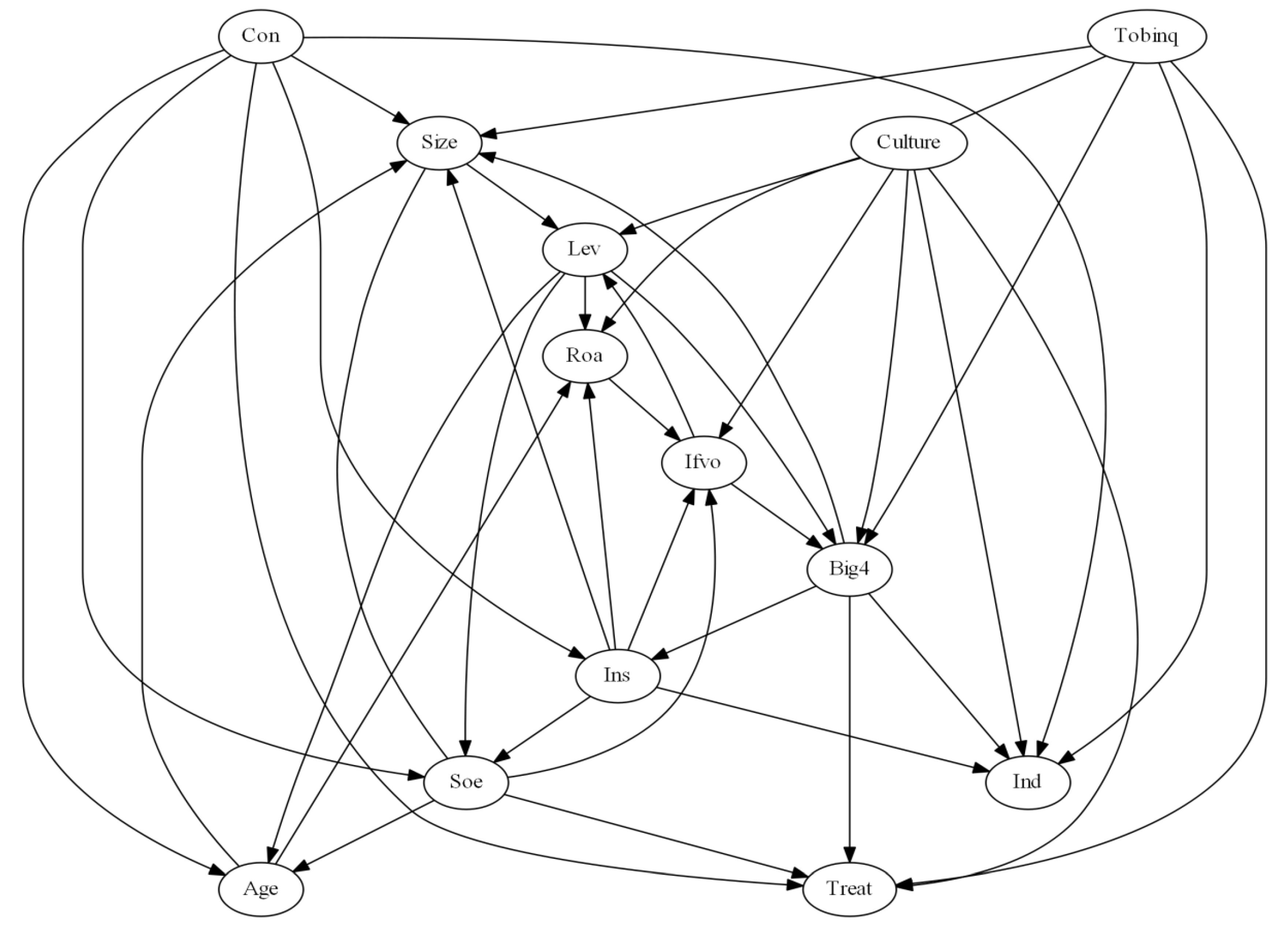
Note: Arrows indicate the direction of causal influence.
Figure 2.
FCI Algorithm for Causal Discovery.
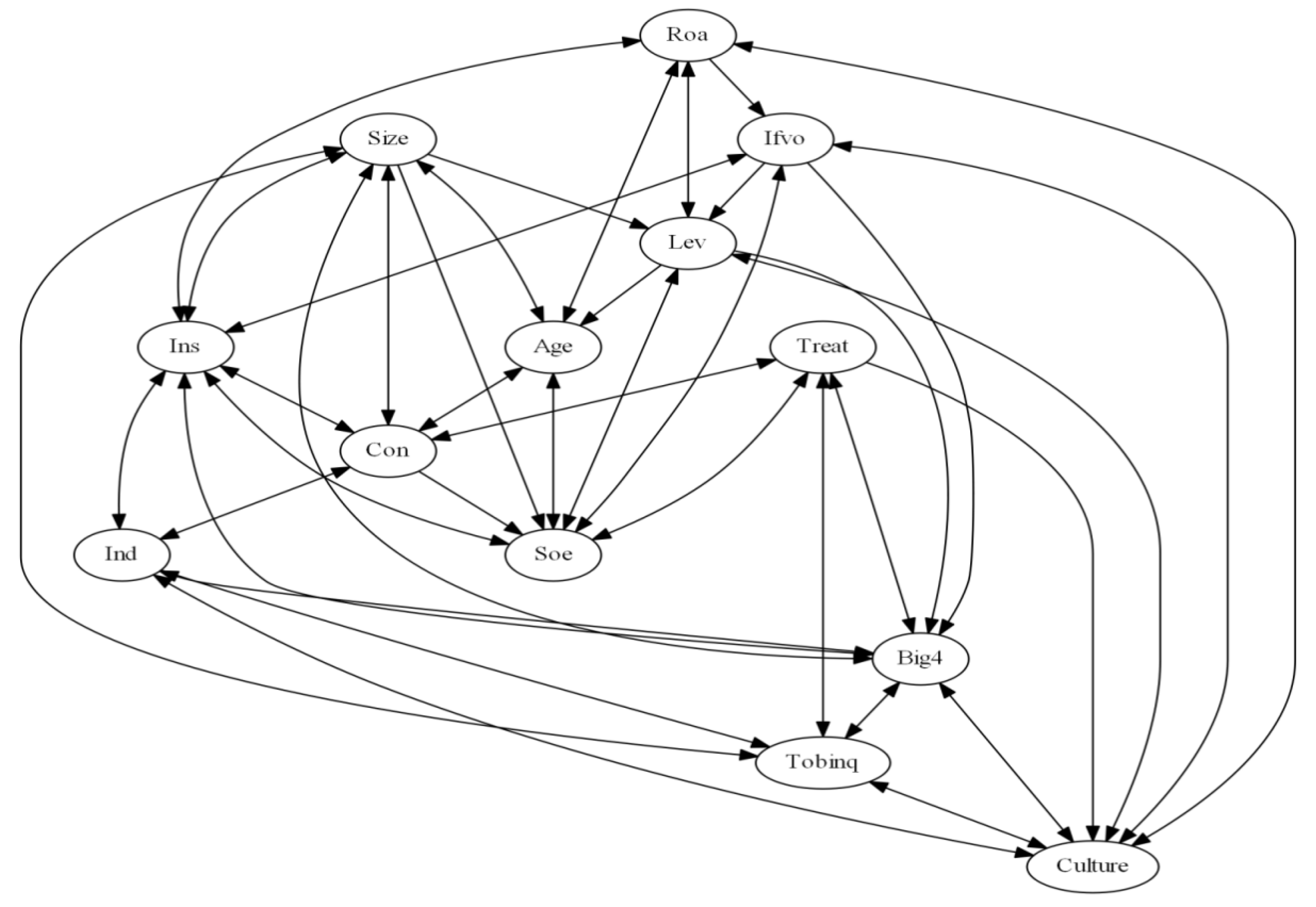
Note: Arrows indicate causal relationships. Bidirectional arrows (↔) suggest potential latent confounders.
Figure 3.
GES Algorithm for Causal Discovery.
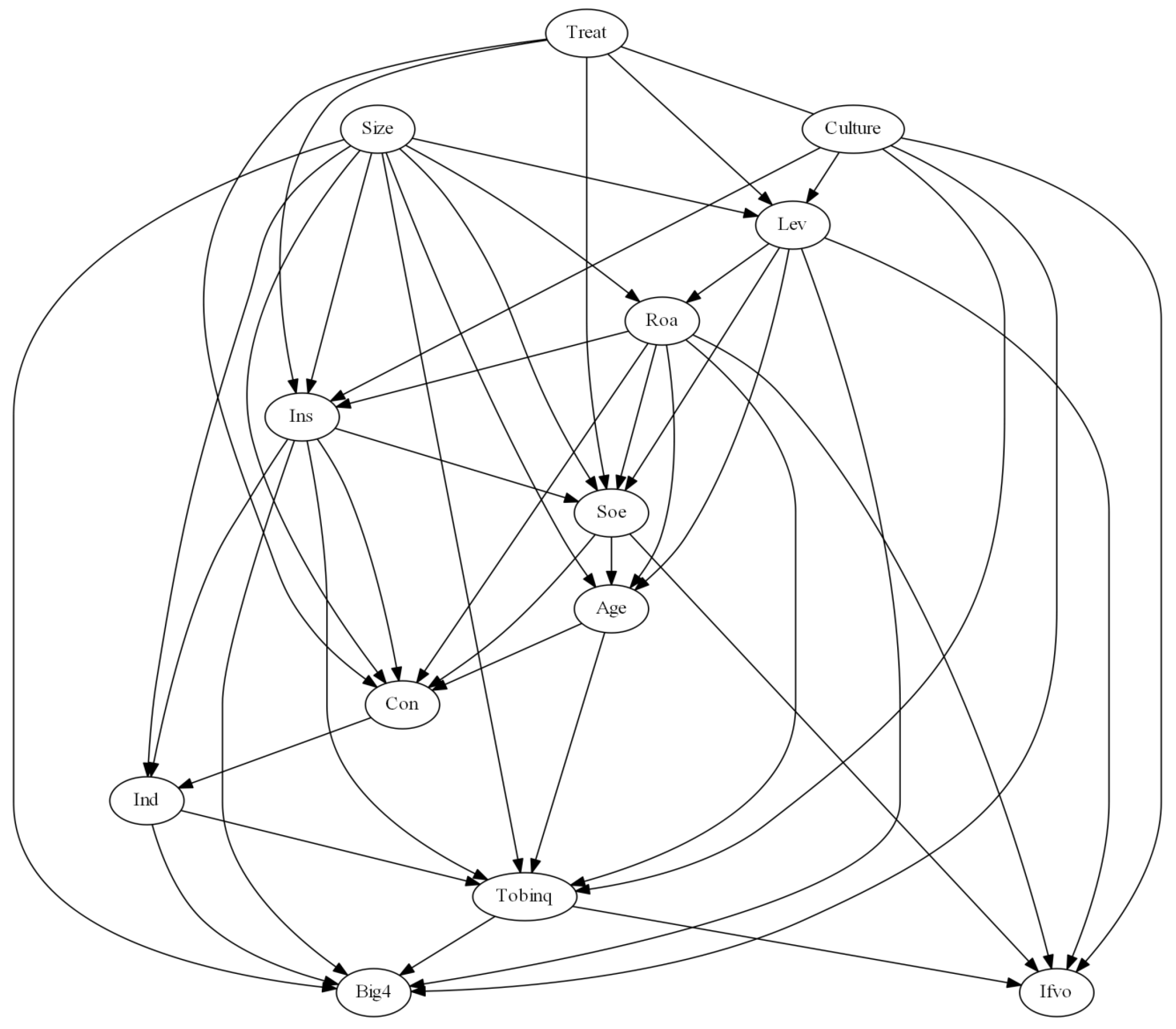
Note: Directed arrows (→) indicate causal relationships. Undirected edges (—) indicate association with uncertain direction.
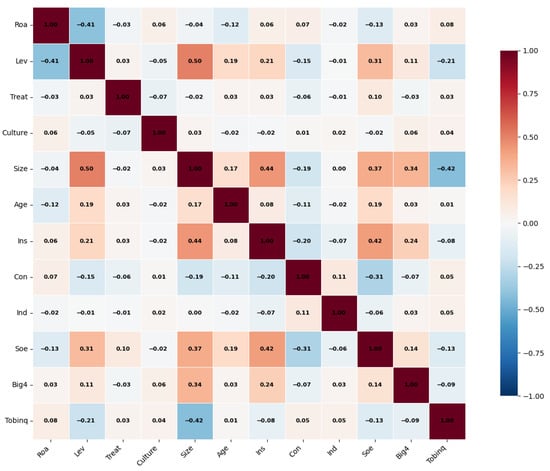
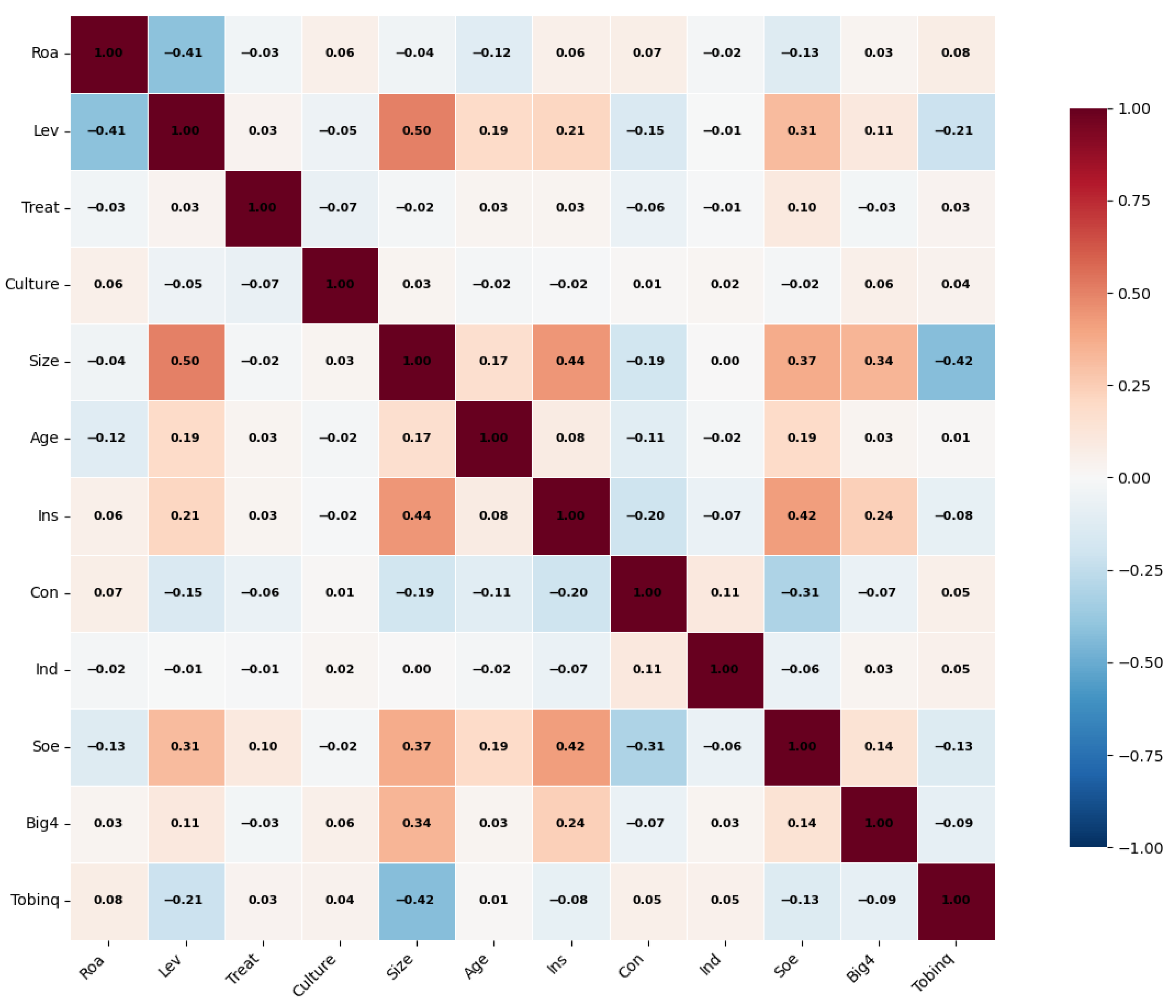
Furthermore, the correlation matrix (Figure 4) shows no signs of severe multicollinearity. Most pair-wise correlations are low, with the highest observed between Size and Lev (0.50), which is within acceptable limits for regression analysis.
Figure 4.
Correlation Matrix.
4.3. Main Results
The core findings from the Double Machine Learning analysis are presented in Table 4 and Table 5. The results provide strong and consistent evidence regarding our hypotheses.
Table 4.
Main Effects with Different Covariate Sets (Random Forest Estimator).
Table 5.
Robustness Across Machine Learning Methods.
While the statistical significance of ICH is clear, assessing its economic magnitude is crucial. Our DML estimate indicates that a one-unit increase in the ICH index is associated with an increase in ROA of about 0.16 to 0.20 percentage points (coefficient range: 0.0016–0.0020). To contextualize this effect, consider that the standard deviation of ROA in our sample is 0.064. The ICH effect thus accounts for roughly 2.8% to 3.3% of one standard deviation change in ROA. This magnitude is economically meaningful. For comparison, seminal studies in cultural finance find effects of similar order (Hilary & Hui (2009) [3]. Our estimated effect for ICH is also comparable to the documented impact of certain internal governance reforms in emerging markets. This confirms that ICH is not merely a statistical artifact but a cultural force with tangible, non-trivial consequences for firm profitability. In contrast, the consistently null effect for the Treat variable (Long March Spirit) aligns with our theoretical expectation and underscores that not all cultural forms directly translate into short-term financial performance.
4.4. Heterogeneity Analysis
The impact of intangible cultural heritage is not uniform across all firms. Our heterogeneity analysis reveals important boundary conditions.
Ownership structure significantly moderates cultural heritage effects, with state-owned enterprises demonstrating stronger performance benefits from intangible cultural heritage. The ICH coefficient reaches 0.0028–0.0029 (p < 0.01) for SOEs versus 0.0013–0.0016 for non-SOEs in Table 6, indicating that institutional alignment enhances cultural value conversion. This supports the view that SOEs’ social and political mandates facilitate more effective utilization of traditional cultural resources. The Long March spirit consistently shows no significant effect across ownership types, confirming its limited direct financial impact.
Table 6.
Corporate Heterogeneity Analysis.
CEO age significantly moderates intangible cultural heritage’s effect on firm performance, with older CEOs demonstrating stronger cultural transmission capability. The ICH coefficient reaches 0.0023–0.0027 (p < 0.01) for older CEOs versus only 0.0013–0.0014 (p < 0.05) for younger CEOs in Table 7, indicating that managerial experience and cultural embeddedness enhance heritage value conversion. Meanwhile, the Long March spirit remains statistically insignificant across both age groups, confirming its limited direct influence on financial performance regardless of leadership characteristics.
Table 7.
CEO Heterogeneity Analysis.
Market attention reveals a nonlinear moderating pattern for cultural heritage effects, as neither intangible cultural heritage nor Long March spirit shows significant impacts in either high or low media attention subsamples in Table 8. This suggests media scrutiny may simultaneously diminish cultural advantages while intensifying operational constraints, creating competing effects that cancel out measurable performance differences.
Table 8.
Analysis of Attention Heterogeneity.
The heterogeneity analysis establishes crucial boundary conditions for cultural governance, confirming stronger effects in state-owned enterprises and older-led firms while revealing media attention’s complex dual role. These findings highlight the contextual nature of cultural value conversion and suggest organizations should align cultural strategies with their specific institutional and leadership characteristics.
4.5. Mechanism Analysis
Building on H3, we posit that financial conservatism (proxied by lower leverage, Lev) is a key channel through which ICH enhances ROA. We go beyond simple correlation by formally testing the statistical significance of the mediation effect using a DML-based mediation framework. This method extends the DML logic to estimate the Average Causal Mediation Effect—the portion of the total effect that operates through the mediator—while robustly controlling for confounders.
Intangible cultural heritage consistently promotes financial conservatism, significantly reducing corporate leverage across all machine learning methods (coefficients: −0.0076 to −0.0090, p < 0.01) in Table 9. This robust deleveraging effect persists after controlling for time trends, confirming that traditional cultural values lead to more prudent capital structure choices. Conversely, the Long March spirit demonstrates opposite financial implications, increasing leverage by 0.0065–0.0085, possibly reflecting enhanced debt financing capacity from policy support in revolutionary heritage regions.
Table 9.
ICH Reduces Leverage.
Financial leverage significantly constrains corporate performance, with coefficients consistently ranging from −0.1310 to −0.1329 across all specifications in Table 10. This robust negative relationship confirms capital structure theory’s prediction that excessive debt impairs profitability through increased financial risk and funding costs.
Table 10.
Mechanism Analysis (Impact of Lev on Roa).
This finding provides robust, statistically validated support for H3. However, we emphasize the partial explanatory nature of this mechanism. The proportion mediated is roughly 66% suggests that while reducing leverage is an important pathway, other plausible channels are likely at play. These may include, but are not limited to: enhanced product quality and brand value stemming from the “artisan spirit” (resource-signaling channel), improved stakeholder trust and employee morale fostered by community-based social capital (informal governance channel), or increased innovation as shown by Pan et al. (2023) [17]. Future research should formally model and test these alternative channels. Our analysis therefore establishes financial conservatism as one validated, significant mechanism, but cautions against overgeneralizing it as the exclusive pathway linking ICH to corporate performance.
4.6. Robustness Test
To address potential endogeneity concerns and to further validate the robustness of our core findings, we conduct a series of sensitivity analyses. A primary critique in cultural economics is that observed correlations between cultural variables and firm outcomes may be driven by unobserved heterogeneity or model misspecification. Specifically, (1) omitted variable bias may arise if factors influencing both regional cultural endowment and corporate performance are not adequately controlled for; (2) spatial or temporal confounding might inflate the estimated cultural effect; and (3) the choice of machine learning estimators and control variable sets could influence the stability of the results. In response to these methodological concerns—and as suggested during the review process—we systematically examine the sensitivity of our results to alternative model specifications, including the incorporation of additional control variables, year-fixed effects, and diverse machine learning algorithms. These tests are designed not only to confirm the reliability of our causal claims but also to demonstrate that the positive effect of Intangible Cultural Heritage (ICH) is not an artifact of particular modeling choices or neglected confounders.
To further enhance the robustness of our causal inference and account for potential confounding from macroeconomic shocks and time-specific trends that may simultaneously affect regional cultural vibrancy and corporate performance, we incorporate year-fixed effects into our DML model. The control set now expands to W = {Lev, Size, Age, Ins, Con, Ind, Soe, I.year}, where I.year denotes a set of year dummies.
Table 11 presents the estimation results for both cultural variables under different machine learning estimators after including year-fixed effects. The coefficient for Culture (ICH) remains positive and statistically significant at the 1% level across all four methods, with estimates ranging from 0.0019 to 0.0020. This stability, in both magnitude and significance, reinforces the reliability of our core finding. Notably, the point estimate shows a slight increase relative to the baseline specifications without time effects (e.g., from 0.0018 to approximately 0.0020). This suggests that after purging the influence of aggregate time-varying factors (e.g., business cycles, nationwide policy shifts), the genuine positive effect of ICH on firm performance is, if anything, more pronounced.
Table 11.
Robustness Test: Controlling for Time-fixed Effects.
Conversely, the coefficient for Treat (the Spirit of the Long March) remains statistically insignificant across all specifications, with point estimates close to zero. This result further corroborates Hypothesis H2, indicating the absence of a direct financial performance effect from this ideological cultural force, even after controlling for temporal shocks.
The robustness tests presented in Table 12 yield several consistent and noteworthy conclusions regarding the causal effects of cultural variables on firm performance. First and foremost, the positive impact of Intangible Cultural Heritage (ICH) on Return on Assets (ROA) demonstrates a high degree of robustness across multiple model specifications. The coefficient for Culture remains statistically significant at the 1% or 5% levels under all four machine learning estimators—Random Forest, LASSO, Gradient Boosting, and Neural Networks—and across four distinct sets of control variables. Although the point estimates exhibit a slight decline, from approximately 0.0017 to around 0.0009, as additional controls such as audit quality (Big4), growth opportunities (TobinQ), and ownership structure (Soe) are incrementally included, the significance and positive direction of the effect remain stable. This pattern suggests that while factors like growth prospects and firm ownership may partially mediate or confound the relationship, the independent, positive influence of ICH on firm performance is robustly preserved. These results provide strong and consistent support for Hypothesis H1.
Table 12.
Robustness of Main Results Across Different Machine Learning Methods and Control Variable Sets.
In clear contrast, the coefficient for the Spirit of the Long March (Treat) is statistically insignificant across nearly all model configurations. Its estimates are consistently close to zero and lack statistical significance, with only isolated instances of marginal significance at the 10% level in certain specifications. This systematic absence of a significant direct effect strongly corroborates Hypothesis H2, indicating that this form of ideological revolutionary culture does not exert a measurable direct impact on corporate financial performance as captured by ROA.
Furthermore, the stability of these findings across diverse machine learning methods underscores that the conclusions are not sensitive to the choice of estimation technique. The consistent results produced by models with differing underlying assumptions and functional forms—from tree-based ensembles to regularized linear models and neural networks—enhance the credibility of the causal inferences. The gradual attenuation of the ICH coefficient with the inclusion of TobinQ and Soe points to the nuanced nature of the relationship, hinting that part of ICH’s beneficial effect may operate through channels such as enhancing growth opportunities or being more effectively leveraged within certain ownership structures, a fruitful avenue for further mechanistic exploration.
In summary, the battery of robustness checks confirms that the promotive effect of ICH on firm performance is a reliable finding, while the null effect of the Long March Spirit is equally stable. The core results withstand variations in both the set of control variables and the machine learning methodology employed for estimation.
5. Discussion
5.1. Theoretical Interpretation and Contributions of Key Findings
This study leverages a Double Machine Learning model to provide robust evidence for the causal effect of Intangible Cultural Heritage (ICH) on corporate financial performance. The core findings indicate that ICH has a significant positive impact on firm ROA, while the Spirit of the Long March shows no significant direct effect. These results not only validate our main hypotheses but also offer new theoretical insights for interdisciplinary research at the intersection of cultural economics and corporate finance.
First, the positive effect of ICH deepens our understanding of “informal institutions as corporate governance mechanisms.” Unlike the universal values emphasized in traditional literature, such as religion or Confucianism (Guiso et al., 2006; Hilary & Hui, 2009) [3,10], ICH represents a unique form of localized, practical, and embedded cultural capital. Our results suggest that this cultural form, transmitted through community practices, apprenticeships, and practical wisdom, can effectively shape managers’ risk perceptions and long-term orientation (Xiao & Liu, 2015) [13], thereby translating into more prudent corporate decisions. This aligns with the conclusions of Li et al. (2013) [4] regarding the influence of culture on risk-taking but advances the analysis from national cultural dimensions to more specific and actionable local cultural heritage.
Second, the divergence in effects between different types of culture (utilitarian traditional culture vs. ideological revolutionary culture) introduces an important theoretical distinction. Our finding that the Spirit of the Long March has no significant impact on ROA differs from some studies focusing on the effects of revolutionary culture on specific financial behaviors (e.g., reducing cash holdings) (Li et al., 2023; Zhang & Zheng, 2025) [7,8]. This discrepancy may stem from the theoretical logic of the “domain specificity” of cultural influence. As a political ideology, the governance function of the Long March Spirit may be more focused on shaping normative behaviors (e.g., discipline, collectivism) and non-financial objectives (e.g., ESG performance, crisis resilience) (Shen et al., 2025) [20] rather than directly driving short-term accounting profits. This aligns with North’s (1990) [1] discussion on the scope of institutional constraints on behavior. Therefore, through comparative analysis, this study advocates that future cultural research should move beyond the assumption that “culture is a monolithic construct” and instead explore the differentiated governance pathways and boundary conditions of different cultural types.
5.2. Exploring the Mechanisms and Boundary Conditions of Heterogeneous Findings
The heterogeneity analysis reveals the boundary conditions under which the ICH effect operates, providing important contextualization for theory.
The stronger ICH effect in State-Owned Enterprises (SOEs) can be explained by theories of institutional isomorphism and resource complementarity. Due to their ownership nature, SOEs are more deeply embedded in local socio-political networks and have a natural affinity with ICH as a form of local social capital. This institutional fit allows SOEs to more effectively absorb and translate the trust networks and reputation mechanisms inherent in ICH (Dong et al., 2018) [16], leading to more pronounced performance improvements. This finding complements the existing literature on how ownership structure moderates cultural effects (Chen et al., 2019) [5], suggesting that in the presence of strongly embedded informal institutions like ICH, SOEs’ “disadvantages” may transform into unique resource advantages.
The amplifying effect of older CEOs on the ICH effect resonates with the Upper Echelons Theory perspective on how managers’ cognitive bases influence strategic choices. Older CEOs typically possess richer local social experience, deeper internalization of traditional values, and a stronger concern for long-term reputation. This makes them more adept at interpreting and utilizing the “artisan spirit” and sustainable development philosophy conveyed by ICH and translating them into conservative financial policies (reducing leverage). This finding extends cultural influence research from the macro-regional level to the micro-level of managerial characteristics, revealing a “human capital channel” for cultural value conversion.
5.3. Theoretical Significance of the Financial Conservatism Mediation Mechanism
The mechanism analysis confirms that reducing financial leverage is a key transmission channel through which ICH enhances performance. This finding has dual theoretical significance.
On one hand, it opens the “black box” of how culture influences corporate financial decision-making. Previous studies often stopped at correlational conclusions about “culture affecting performance,” lacking tests of the intermediate economic decision-making processes. We demonstrate that the values of focus, prudence, and risk aversion advocated by ICH are concretely manifested in capital structure choices (Myers, 1977) [22], namely lower debt ratios. This provides a solid empirical link in the “culture-behavior-performance” chain.
On the other hand, it expands capital structure theory. Beyond traditional explanations based on trade-off theory, pecking order theory, and market perfection, our research shows that local informal cultural norms are an important yet overlooked factor influencing corporate leverage decisions. Firms do not make financial decisions in a vacuum; the “cultural air” they inhabit subtly shapes management’s risk preferences and financing inclinations.
5.4. Synthesis of Research Contributions
In summary, the contributions of this study are multidimensional:
It systematically introduces ICH into corporate finance research for the first time and empirically distinguishes the different economic consequences of utilitarian traditional culture versus ideological revolutionary culture, enriching and refining the theoretical map of culture as an informal institution.
It pioneers the application of a DML framework combined with causal discovery in the field of cultural finance, providing a more rigorous causal inference solution for addressing the endogeneity inherent in cultural variables.
It not only validates the causal effect of ICH on performance but also reveals its contextual conditions (ownership, CEO age) and a specific financial transmission path (leverage reduction), making the findings more profound and actionable.
The study indicates that for firms, ICH is not merely an object to be protected but also a utilizable governance resource and strategic asset. For policymakers, differentiated strategies should be designed to harness the unique potential of different cultural types in promoting high-quality economic development.
6. Conclusions
6.1. Summary of Key Findings
This study employs a Double Machine Learning framework to provide robust evidence for the causal effect of Intangible Cultural Heritage (ICH) on firm performance in the Chinese context. The core findings are as follows: First, ICH exerts a significant positive causal effect on Return on Assets (ROA). Second, this effect is realized primarily through the channel of guiding firms to adopt more prudent financial policies, specifically manifested as a reduction in leverage. Third, the effect is heterogeneous, being more pronounced in state-owned enterprises and firms led by older CEOs. Fourth, comparative analysis reveals fundamental differences in the mechanisms and effects of “utilitarian” ICH versus “ideological” revolutionary culture (the Spirit of the Long March) on firm financial performance, highlighting the importance of cultural typology in explaining corporate behavior.
6.2. Limitations and Avenues for Future Research
This study acknowledges several limitations, which also illuminate promising directions for future inquiry.
6.2.1. Limitations
Macro-level Variable Measurement. This study employs the number of Intangible Cultural Heritage (ICH) projects at the city level as a proxy for the regional cultural environment. While this approach effectively measures the concentration of cultural resources across regions, it cannot precisely capture the extent to which individual firms actively utilize, internalize, or strategically prioritize these ICH resources.
Challenges in Causal Identification. Although the Double Machine Learning method effectively controls for high-dimensional observable confounders, unobservable omitted variables—such as difficult-to-quantify local informal institutions, unique social capital, or tacit knowledge networks—may still pose a potential threat to the causal estimates.
Neglect of Spatial Dependence. This study assumes spatial independence in firm performance across the sample. However, in reality, factors like cultural diffusion, regional economic linkages, or policy imitation may lead to spatial autocorrelation in firm performance. Ignoring this spatial dependency structure could result in misestimated standard errors, thereby compromising the rigor of statistical inference.
Incomplete Mechanism Exploration. This study confirms financial conservatism (deleveraging) as one effective mediating pathway, but this is likely only one among multiple parallel mechanisms. The potential impacts of ICH on corporate brand value, stakeholder trust, and even craftsmanship-driven innovation have not been fully examined, leaving the complete picture of the transmission mechanisms to be fully mapped.
6.2.2. Avenues for Future Research
Building upon these limitations, future research can advance in the following directions:
Developing Micro-level Measurement Tools. Future studies could attempt to construct firm-level indicators of cultural embeddedness or utilization by employing textual analysis (mining references to specific cultural elements in annual reports or CSR reports), survey questionnaires (measuring the cultural values of management and employees), or case studies. This would deepen the measurement from “regional cultural environment” to “firm-specific cultural capital.”
Expanding Causal Identification Strategies. To mitigate omitted variable bias, future research could seek cleaner exogenous policy shocks for identification, such as exploiting the quasi-natural experiment of a successful designation on the “Representative List of the Intangible Cultural Heritage of Humanity.” Concurrently, future work should develop and apply a “Spatial Double Machine Learning” model. By incorporating a spatial weight matrix, this model would explicitly control for the spatial spillover effects of both performance and culture, thereby yielding more robust causal estimates while accommodating complex functional forms and high-dimensional controls.
Systematically Testing Multiple Mechanisms. It is recommended to adopt more systematic mediation analysis frameworks (e.g., multiple mediation models or causal mediation analysis) to concurrently test the various parallel pathways through which ICH might affect firm performance—such as “brand enhancement,” “trust building,” and “innovation incentive”—and to quantify the relative importance of each path.
6.3. Theoretical and Practical Implications
The theoretical contributions are threefold. First, it provides micro-level causal evidence based on a specific cultural carrier (ICH) for the classic proposition of “how culture influences the economy.” Second, by distinguishing between “utilitarian” and “ideological” cultures, it deepens the typological theory of how culture influences corporate financial behavior. Third, it formally incorporates informal institutions (culture) into the theoretical explanation of corporate capital structure decisions, expanding the research boundaries of finance.
The practical implications are more specific. For corporate managers, the ICH of their location should be viewed as a utilizable form of “strategic cultural capital.” Actively drawing on the artisan spirit and long-term orientation embedded within it can help cultivate a prudent risk culture, optimize financial decisions, and potentially empower product differentiation and brand storytelling. For policymakers, it is recommended to incorporate the effectiveness of ICH protection and transmission into consideration within regional development plans and corporate evaluation systems. For instance, designing “culture-friendly” green credit indicators or ESG assessment modules, and providing financing facilities or tax incentives to firms adept at innovatively integrating ICH, can guide financial resources to irrigate cultural fields, achieving synergistic development of economic benefits and cultural heritage.
In summary, this study not only confirms the vitality of traditional culture in the modern commercial world but also, through methodological innovation and mechanism exploration, provides a rigorous and insightful analytical paradigm for understanding the micro-economic value of informal institutions.
Author Contributions
Conceptualization, F.X. and Y.W.; methodology, F.X.; software, F.X.; validation, F.X. and Y.W.; formal analysis, F.X.; investigation, F.X. and Y.W.; resources, Y.W.; data curation, F.X.; writing—original draft preparation, F.X. and Y.W.; writing—review and editing, F.X.; visualization, F.X.; supervision, F.X.; project administration, F.X.; funding acquisition, F.X. All authors have read and agreed to the published version of the manuscript.
Funding
The Min-Shi Program (Grant No. Z20001.24.0103.01).
Institutional Review Board Statement
Not applicable.
Informed Consent Statement
Not applicable.
Data Availability Statement
The data that support the findings of this study are available on request from the corresponding author.
Acknowledgments
We thank the editor and anonymous reviewers for their constructive comments.
Conflicts of Interest
Author Yuxia Wang was employed by the company Shanghai Zhixin Electric Co., Ltd. The remaining authors de-clare that the research was conducted in the absence of any commercial or financial relationships that could be construed as a potential conflict of interest.
References
- North, D.C. Institutions, Institutional Change and Economic Performance; Cambridge University Press: Cambridge, UK, 1990. [Google Scholar]
- Hofstede, G. Culture’s Consequences: Comparing Values, Behaviors, Institutions and Organizations Across Nations, 2nd ed.; Sage Publications: Thousand Oaks, CA, USA, 2001. [Google Scholar]
- Hilary, G.; Hui, K.W. Does religion matter in corporate decision making in America? J. Financ. Econ. 2009, 93, 455–473. [Google Scholar] [CrossRef] [Scilit]
- Li, K.; Griffin, D.; Yue, H.; Zhao, L. How does culture influence corporate risk-taking? J. Corp. Financ. 2013, 23, 1–22. [Google Scholar] [CrossRef] [Scilit]
- Chen, S.; Ye, Y.; Jebran, K. Does Confucianism reduce corporate over-investment? Evidence from China. Asia-Pac. J. Financ. Stud. 2019, 48, 210–235. [Google Scholar] [CrossRef] [Scilit]
- Yan, Y.; Xu, X.; Lai, J. Does Confucian culture influence corporate R&D investment? Evidence from Chinese private firms. Financ. Financ. Res. Lett. 2021, 40, 101719. [Google Scholar]
- Li, Z.; Chen, X.; Yang, B. How does red culture affect corporates’ cash holdings? Evidence from China. Heliyon 2023, 9, e15435. [Google Scholar] [CrossRef] [Scilit] [PubMed]
- Zhang, M.; Zheng, D. The power of cultural governance: The red prescription for corporate excess leverage. Financ. Res. Lett. 2025, 73, 106626. [Google Scholar] [CrossRef] [Scilit]
- Chernozhukov, V.; Chetverikov, D.; Demirer, M.; Duflo, E.; Hansen, C.; Newey, W.; Robins, J. Double/debiased machine learning for treatment and structural parameters. Econom. J. 2018, 21, C1–C68. [Google Scholar] [CrossRef] [Scilit]
- Guiso, L.; Sapienza, P.; Zingales, L. Does Culture Affect Economic Outcomes? J. Econ. Perspect. 2006, 20, 23–48. [Google Scholar] [CrossRef] [Scilit]
- Ma, P.; Li, C.; Ni, Z. The Confucian constraint: Does conservative culture inhibit strategic aggressiveness? Evidence from China. Cross Cult. Strateg. Manag. 2025, 32, 721–744. [Google Scholar] [CrossRef] [Scilit]
- Huang, M.; Li, M.; Huang, C. Confucianism culture and green innovation: Evidence from Chinese industrial firms. Corp. Soc. Responsib. Environ. Manag. 2024, 31, 4862–4877. [Google Scholar] [CrossRef] [Scilit]
- Xiao, Q.; Liu, Y. The artisan spirit and its contemporary value. Hunan Soc. Sci. 2015, 6, 6–10. [Google Scholar]
- Malmendier, U.; Nagel, S. Depression babies: Do macroeconomic experiences affect risk taking? Q. J. Econ. 2011, 126, 373–416. [Google Scholar] [CrossRef] [Scilit]
- Ginesti, G.; Caldarelli, A.; Zampella, A. Exploring the impact of intellectual capital on company reputation and performance. J. Intellect. Cap. 2018, 19, 915–934. [Google Scholar] [CrossRef] [Scilit]
- Dong, W.; Han, H.; Ke, Y.; Chan, K.C. Social trust and corporate misconduct: Evidence from China. J. Bus. Ethics 2018, 151, 539–562. [Google Scholar] [CrossRef] [Scilit]
- Pan, Y.; Yang, L.; Xiao, J. The innovation effects of cultural inheritance: Evidence from artistic intangible cultural heritage. Econ. Dyn. 2023, 7, 3–24. [Google Scholar]
- Wang, P.; Bu, H.; Liu, B. Red culture and corporate internal control: Impact effects and empirical testing. Stat. Decis. 2023, 39, 173–177. [Google Scholar]
- Wu, W.; Hong, Z. The contemporary value of revolutionary culture: Evidence from the Long March spirit in curbing corporate noncompliance. World Econ. 2024, 3, 3–29. [Google Scholar]
- Shen, J.; Wu, D.; Wang, J. Study on corporate ESG performance from the perspective of Chinese red culture. Asia-Pac. J. Account. Econ. 2025, 32, 727–750. [Google Scholar] [CrossRef] [Scilit]
- Dai, J. Intangible Cultural Heritage Empowers Local Economic and Social Development. China Intang. Cult. Herit. 2025, 5, 8–16. [Google Scholar]
- Myers, S.C. Determinants of corporate borrowing. J. Financ. Econ. 1977, 5, 147–175. [Google Scholar] [CrossRef] [Scilit]
- Frank, M.; Goyal, V. Capital structure decisions: Which factors are reliably important? Financ. Manag. 2009, 38, 1–37. [Google Scholar] [CrossRef] [Scilit]
- Akhtar, M.; Yusheng, K.; Haris, M.; Ain, Q.U.; Javaid, H.M. Impact of financial leverage on sustainable growth, market performance, and profitability. Econ. Change Restruct. 2022, 55, 737–774. [Google Scholar] [CrossRef] [Scilit]
- Yang, R.; Xia, K.; Wen, H. Venture capital, financial leverage and enterprise performance. Procedia Comput. Sci. 2016, 91, 114–121. [Google Scholar] [CrossRef] [Scilit]
- Imbens, G.W.; Wooldridge, J.M. Recent developments in the econometrics of program evaluation. J. Econ. Lit. 2009, 47, 5–86. [Google Scholar] [CrossRef] [Scilit]
- Belloni, A.; Chernozhukov, V.; Hansen, C. Inference on treatment effects after selection among high-dimensional controls. Rev. Econ. Stud. 2014, 81, 608–650. [Google Scholar] [CrossRef] [Scilit]
- Feng, G.; Giglio, S.; Xiu, D. Taming the factor zoo: A test of new factors. J. Financ. 2020, 75, 1327–1370. [Google Scholar] [CrossRef] [Scilit]
- Chen, J.; Huang, C.; Tien, J. Debiased/Double Machine Learning for Instrumental Variable Quantile Regressions. Econometrics 2021, 9, 15. [Google Scholar] [CrossRef] [Scilit]
- Zhang, S.; Niu, Y.; Zhang, J.; Li, J.; Wang, S.; Guan, Y. Effects of Supply Chain Digitization on Different Types of Corporate Green Innovation: Empirical Evidence from Double Machine Learning (DML). Sustainability 2025, 17, 7509. [Google Scholar] [CrossRef] [Scilit]
- Ma, Y.; Li, Z.; He, L. Data Elements Marketization and Corporate Investment Efficiency: Causal Inference via Double Machine Learning. Systems 2025, 13, 609. [Google Scholar] [CrossRef] [Scilit]
- Athey, S.; Imbens, G.W. Machine learning methods for estimating heterogeneous causal effects. Stat 2015, 1050, 1–26. [Google Scholar]

Disclaimer/Publisher’s Note: The statements, opinions and data contained in all publications are solely those of the individual author(s) and contributor(s) and not of MDPI and/or the editor(s). MDPI and/or the editor(s) disclaim responsibility for any injury to people or property resulting from any ideas, methods, instructions or products referred to in the content. |
© 2026 by the authors. Licensee MDPI, Basel, Switzerland. This article is an open access article distributed under the terms and conditions of the Creative Commons Attribution (CC BY) license.