


Abstract
Frugal innovation is an important area of academic research for organizations seeking to create value with limited resources. However, one important theoretical issue remains unclear: the available literature does not clarify how environmental orientations produce frugal innovation outcomes or how leadership capabilities determine this relationship within the resource-based view. Specifically, the processes by which both external and internal environmental orientations contribute to frugal innovation in resource-constrained environments, and the way transformational leadership is viewed as an intangible strategic resource, are not developed in theory. Therefore, the objective of this study is to explain the importance of frugal innovation in telecom companies in Saudi Arabia and to examine its theoretical link to the resource-based view. Furthermore, this study aims to investigate the relationship between environmental orientation and frugal innovation. Environmental orientation is estimated using both internal and external orientations. Furthermore, this study examines the moderating role of transformational leadership in the relationship between external and internal environmental orientation and frugal innovation in telecom companies in Saudi Arabia. For the empirical analysis, data were collected via a well-developed questionnaire sent to employees of three leading telecom companies: Zain, Mobily, and Saudi Telecom Company (STC). The sample size consisted of 436 employees. Furthermore, SmartPLS 4 software was used for PLS-SEM modeling to test hypotheses and assess model validity. After the data analysis, it was found that external environmental orientation has a positive and significant relationship with frugal innovation, and internal environmental orientation also shows a positive relationship. Furthermore, it was found that transformational leadership positively moderates the relationship between external and internal environmental orientations with frugal innovation in the telecommunications company. Furthermore, this study concluded that the telecommunications sector makes a significant contribution to economic development and that executives’ transformational leadership skills are an important moderator in analyzing environmental orientation and in enhancing employees’ abilities to utilize limited resources to achieve maximum benefits. This study is highly relevant to policymakers and researchers in the context of frugal innovation, in support of the organization’s objective.
1. Introduction
Frugal innovation has played a key role in organizational development. The frugal innovation approach has gained popularity in recent decades due to resource scarcity and environmental variability [1]. It is a reality that impulsiveness in economic and ecological conditions has greatly exaggerated organizations’ strategic activities worldwide [2], and all kinds of organizations face the challenge of limited resources. Innovative strategies in goods and services are needed to enhance performance by utilizing the current limited available resources; therefore, the best solution in resource scarcity is the development of a business model that includes the strategies of frugal innovation that provide cheaper and high-quality products than rival organizations and give the consumer a variety of choices, which otherwise could be limited [3].
Moreover, innovation is closely related to a company’s environment; this environmental orientation enables the organization to pursue sustainable development. The environmental orientation is known as the organization’s pro-environmental culture and innovative posture [4]. The internal and external environments stimulate society and organizations to introduce novelty into daily activities to enhance performance and address ecological issues [5]. The internal environment of the organization enhances employees’ and executives’ ability to adopt innovation not only in the production process but also in services [6]. In the context of organizational divergence, the external environment provides the administration with perceptions for setting targets and recognizing the organization’s capacity to meet the demands of society or the marketplace [7].
Along with environmental orientation, frugal innovation without leadership is meaningless [8] as the organization’s leader fosters innovation and drives ecological performance [9]. Leadership, and most importantly, transformational leadership, not only has a direct influence on innovation but also directs organizational activity towards modernization [10,11].
Frugal innovation has provided new insights across sectors by enabling sustainable development across the whole sector [12]. In the context of telecom companies, internal and external environmental orientation plays an important role in development; the coordination of leaders with innovative environments enhances this sector’s performance. However, telecom companies have limited resources, and it is very challenging for the administration to collaborate with internal and external environments with these constraints [13]. In Saudi Arabia, telecom companies are undergoing significant changes as the country’s ‘Vision 2030′ emerges as a vital driver of economic expansion and a digital revolution. Beyond telecom, various industries benefiting from digital transformation are experiencing the ripple effects of this profound transition.
There are several studies [14,15,16] on frugal innovation, exploring its perception from the standpoint of specific goods or services and their particular research and development procedures [17], as well as from the perspectives of market access strategies and business models or product characteristics [15,18]. However, some studies left gaps in variable selection and in empirical and theoretical aspects. For example, in most studies, frugal innovation is taken as a dependent variable [3] or mediator [14] in healthcare innovation or manufacturing. Most studies, such as Mishra et al. [19] and Adjanor-Doku [20], have used empirical analysis to examine the relationship between environmental orientation and organizational performance; however, no study has examined the impact of environmental orientation on an organization’s frugal innovation. There are some current studies [1,10,21] that show a positive relationship between leadership and frugal innovation, whereas [22] argues that previous studies have flaws, underscoring the need further to explore leadership, innovation, and the environment. Moreover, in earlier studies, environmental orientation is a strategic capability that helps firms gain sustainability and innovation benefits, grounded to a great extent in the resource-based view and the natural resource-based view [23]. At the same time, the frugal innovation literature focuses on the creation of low-cost, resource-efficient innovations, especially in emerging and resource-constrained settings [24]. Although they are conceptually aligned on resource efficiency and sustainability, the two bodies of literature have not been combined in many ways. Thus, the mechanisms by which environmental orientation drives frugal innovation remain poorly understood.
The majority of prevailing research assumes the directness of the environmental orientation-innovation relationship [25,26], without considering the circumstances under which the relationship is direct and how it varies across firms. This poses a theoretical issue: similar organizations with similar environmental orientations exhibit varying frugal innovation performance, and this is not adequately addressed by the theories currently used.
Although studies have shown that transformational leadership promotes innovation and pro-environmental behaviors [27,28], previous research has primarily focused on leadership as an antecedent or mediator rather than as a moderator of the effectiveness of strategic orientations. Therefore, the role of leadership in fostering an environmental orientation to frugal innovation remains theoretically underdeveloped. Therefore, this study has addressed all queries related to environmental orientation and novelty in the service or production process.
Therefore, the objective of this study is to explain the importance of frugal innovation in telecom companies in Saudi Arabia and to examine its theoretical link to the resource-based view. Furthermore, this study aims to investigate the relationship between environmental orientation and frugal innovation. The environmental orientation is estimated using both internal and external factors. Furthermore, this study examines the moderating role of transformational leadership in the relationship between external and internal environmental orientations and frugal innovation among employees working in telecom companies.
The main reason for selecting telecom companies in Saudi Arabia is “Saudi Arabian Vision 2030”; like other oil-producing nations, Saudi Arabia is in the process of development, trying to reduce dependence on oil and gas by bringing in new products and services because it has become a necessity to stay present in the world market [29]. The Saudi Arabian administration has given much attention to telecom companies over the last few years; “Saudi Arabian Vision 2030” clearly outlines their importance, prospects, and development [30]. The research on this industry thus offers new insights into how frugal innovation is created not only under scarcity but also under the strategic necessity of an industry that is developed, competitive, and resource-intensive in terms of investment. Besides, Saudi telecom operators are exposed to stiff regional competition and to high regulatory pressure to enhance efficiency, broaden coverage, and operate sustainably. The above elements provide a suitable context to examine the joint effects of environmental orientations and transformational leadership on frugal innovation performance in a technologically advanced yet resource-intensive environment. Therefore, the Saudi telecom market is not merely economically significant but, in theory, valuable for expanding the scope of frugal innovation studies to non-traditional markets with limited resources.
On the one hand, the conceptual framework of this study will align with the “Saudi Arabian Vision 2030” and demonstrate the importance of telecom companies to policymakers, researchers, and society in this country. On the other hand, the empirical and theoretical implications of this study indicate that any organization in Saudi Arabia can achieve frugality in production and services through internal and external environmental orientations and transformational leadership.
2. Literature Review and Hypothesis Development
2.1. Resource-Based View and Resource Patchwork Theory
The resource-based view theory plays an important role in managing internal resources and enhancing competitive capabilities. This theory is also known as resource capability theory [31,32]. This theory emphasizes that the organization’s leaders must use all resources efficiently and in unique ways to meet market demand. A resource can be tangible, such as physical infrastructure, or intangible, such as organizational knowledge, patents, and brand reputation. This theory significantly influences the organization’s internal resource allocation and decision-making to sustain success.
The resource-based view conceptualizes environmental orientation as a strategic intangible resource that shapes an organization’s sustainability, efficiency, and resource-conscious decision-making [33]. However, the availability of such a resource alone does not lead to frugal innovation; rather, the extent to which environmental awareness translates into frugal innovation solutions depends on a firm’s dynamic capabilities. Transformational leadership is one such capability because it helps firms identify sustainability-related opportunities, organize employees to adopt resource-efficient practices, and reorganize existing routines to generate cost-cutting and simplified innovations [34]. Transformational leadership reinforces internal processes through which environmental orientation can affect operational behavior by articulating a strong vision and fostering employee creativity. Therefore, transformational leadership moderates the relationship between environmental orientation and frugal innovation by enhancing the firm’s ability to translate environmental priorities into frugal, action-oriented innovation directions. This theoretical integration strengthens the model’s conceptual coherence and clarifies its causal logic.
Resource patchwork theory offers a solid theoretical basis for explaining how organizations convert environmental orientation into frugal innovation [35]. Companies that are highly environmentally oriented are motivated to minimize waste and resource consumption and to adopt sustainable practices [36]. According to the resource patchwork theory, those firms will be better positioned to make innovative use of underutilized, available, and cheaper resources to develop environmentally friendly, cost-effective solutions. Instead of depending on new or costly technology, environmentally focused organizations will patch together available internal capacity, recycled materials, personnel information, and external networks to produce frugal innovations that meet environmental as well as economic goals [37,38].
2.2. Frugal Innovation
The organization adopts frugal innovation as a strategy that enables innovative manufacturing and service delivery [39]. Some studies, such as [40,41], show that frugal innovation is a vital goal for organizations pursuing comprehensive innovation, as it enables them to meet market demands and grow within the resources available to them. In the past few years, frugal innovation has been associated with achieving performance with scarce resources and has attracted practitioners’ attention [41]. A business model incorporating a frugal innovation strategy is currently being trialed and applied by global firms in existing markets. Furthermore, the ability of frugal innovation to reduce complexity and production costs has drawn the attention of major stakeholders, given its relevance to addressing significant challenges such as environmental change, poverty, and pandemics like COVID-19 [42,43,44].
Although frugal innovation has historically been linked with resource-limited settings and bottom-of-the-pyramid markets [45], the concept has gained broader application over the last few years. In modern literature, frugal innovation is understood not only as low-cost product development but also as a strategic approach that emphasizes efficiency, simplification, and value maximization, even in highly advanced, resource-rich industries. The Saudi telecom industry is a highly competitive, fast-changing business environment characterized by high capital investment, rising customer expectations, and intense regulatory pressure to meet the national sustainability targets outlined in Vision 2030. Telecom operators are under continuous pressure to lower operational costs, maximize the use of spectrum and networks, and adopt more environmentally friendly practices, despite limited access to financial and technological resources [46,47]. These pressures result in a kind of organizational resource scarcity, in which the emphasis shifts from financial capital to smarter, leaner, more sustainable resource utilization. Thus, frugal innovation is relevant as a tool for process streamlining, waste reduction, energy efficiency, and for delivering high value with the least resources [48]. This broad meaning balances the traditional concept of frugality with the high technology, highly capital-intensive environment of the Saudi Arabian telecom industry.
2.3. Environmental Orientation
The environmental orientation is the degree to which top management analyzes the importance of environmental issues in the organization [49,50]. There are two types of environmental orientations: internal and external [49]. Furthermore, key factors such as ethical standards, effort, and internal values relate to the organization’s internal environmental orientation. External environmental orientation is the company’s approach to environmental protection, which may shape its interactions with external parties, such as suppliers, the government, and the community. Environmental orientation is a unique concept in resource management that explains how organizations integrate environmental concerns into their operations to address environmental issues and satisfy consumers with eco-friendly goods and services. The core objective of environmental orientation is to reduce an organization’s negative environmental impact [51].
2.4. Transformational Leadership
Transformational leadership is a relatively new approach to management that emphasizes how leaders can inspire employees to change in meaningful and optimistic ways. This concept of leadership is very powerful [10,52]. Transformational leadership rewards the adoption of innovative methods and is used to stress “converting” others to create an environment of collaboration, support, and association. Followers of transformational leaders respond with a sense of interdependence, gratitude, loyalty, and appreciation, motivating them to exert greater effort than anticipated. [53]. According to Juhro et al. [54], transformational leadership promotes frugality in the organization by assembling and concentrating resources on essential functions to deliver high-quality, cost-effective products or services tailored to consumer needs.
2.5. Environmental Orientation and Frugal Innovation
Recently, enterprises have been reluctant to participate in environmental initiatives, especially if they increase costs and/or lower performance. As a result, businesses tend to follow the rules themselves and outsource their environmentally reckless behavior to other organizations [55,56]. However, in reality, environmental orientation positively affects an organization’s performance by enhancing its capabilities and providing ideas for innovating its products and services. In other words, being environmentally friendly creates new opportunities for management to promote frugality in activities. According to Hossain [57], frugal innovation is the best approach to resource scarcity, having been recognized and used more than pecuniary, technological, material, or other resource constraints. In other words, frugality is a defining concept that encompasses four dimensions: basic quality, cost of depletion, ease, and sustainability. Additionally, it is emphasized that the evaluation of frugal products should incorporate both low cost and sustainability as integral factors [18]. In this area, the concept of environmental orientation compels an organization to incorporate frugality into its products, which is advantageous not only for that specific institution but also for the environment [58].
2.5.1. External Environmental Orientation and Frugal Innovation
An external environmental orientation indicates that management is empowered to address stakeholders’ environmental concerns. By integrating frugality into the innovation process and considering external environmental factors, the organization innovates to meet the market demand and provide social benefits. These stakeholders may exert formal or informal pressure on organizations, which tend to implement innovation to regain market acceptance [49]. Consequently, external environmental orientation concerns an organization’s relationships with external stakeholders [59,60] that are conducive to the accomplishment of long-term, risky objectives [61]. Organizations that adopt an external approach to the external environment and apply the concepts of the resource-based view are better placed to identify the specific resources needed to pursue frugal innovation, technological capabilities, knowledge networks, and adaptive processes. There are significant innovations and technological revolutions in the telecommunications sector. Therefore, organizations must monitor and track technological innovations such as the Internet of Things, cloud computing, and 5G networks [41]. Therefore, it is important to monitor the external environment to ensure the long-term survival of companies. Thus, it is proposed that external environmental orientation has a grander influence on frugal innovation. The study develops the following hypotheses:
H1.
External environmental orientation positively affects frugal innovation.
2.5.2. Internal Environmental Orientation and Frugal Innovation
Many organizations focus on the internal environment to keep innovating their products or services [50,62]. The environmental orientation can be considered a significant source of benefits for the organization, enabling it to achieve sustainable market progress [63]. This internal alignment with frugal principles leads to the development of products and procedures that not only meet market demands but also enhance an organization’s reputation and bottom line. Enhancing collaboration inside the organization can protect the environment. This commitment goes beyond regulatory compliance by fostering a culture of environmental responsibility among employees and leads to an improved company image and cost savings. Consequently, internal environmental orientation is expected to have a higher impact on frugal innovation [6,59,64]. Furthermore, an organization can focus on its internal environment to nurture a culture of learning, thereby significantly enhancing management’s learning capabilities. Furthermore, telecom companies must meet internal demands to make innovative services available to consumers. Closely monitoring the internal environment of an organization enables telecom companies’ management to set their strategies and differentiate their offerings to retain customers and attract new ones [65]. Therefore, the study makes the following propositions:
H2.
Internal environmental orientation is positively related to frugal innovation.
2.6. Transformational Leadership as a Moderator Between the External Environment Orientation and Frugal Innovation
Transformational leadership plays an important role in improving a company’s market position [66]. This leadership style develops the connection between external and internal factors to meet market demands. Therefore, transformational leadership is considered the best moderator for reducing product and service costs through environmental orientation. Transformational leadership cultivates a dynamic and adaptable organizational culture, a critical factor for success in the constantly evolving external environment. This leadership style provides the necessary motivational drive for frugal innovation by fostering a mindset centered on efficiency, creativity, and collaboration [66].
It also empowers organizations to navigate challenges and capitalize on opportunities effectively and resourcefully. An organization’s leaders have an imperative responsibility to analyze the internal and external environments to introduce novelty [67]. Resource-based theory plays a significant role in linking transformational leadership, the environment, and frugal innovation. Resource-based view theory recognizes that competitive advantage stems from unique resources and capabilities [68] and that transformational leadership facilitates the identification and utilization of resources for frugal innovation by promoting creativity and empowering workers [69]. In the telecom industry, leadership plays a vital role in analyzing external dynamics, including technologies such as 5G networks and the Internet of Things. The study develops the following propositions:
H3.
Transformational leadership strengthens the positive relationship between external environmental orientation and frugal innovation.
2.7. Transformational Leadership as a Moderator Between the Internal Environment Orientation and Frugal Innovation
Transformational leadership is closely linked to an environment where workers have innovation competence, fostered by establishing a supportive and collaborative culture and motivating staff to spontaneously debate and try out innovative ideas and attitudes [70]. In an organization, employees are encouraged by the culture, which also increases their ability to do their work. Some studies demonstrated that transformational leadership practices enable firms to improve frugal innovation and innovative performance by leveraging their constructive assets to categorize, allocate, and relocate information and data on accessible assets and the local market conditions for frugal innovation [71]. A specific report indicated that transformational leadership improves workers’ self-esteem, motivation, and performance, thereby effectively maintaining organizational objectives and fostering competencies in frugal innovation [72]. Furthermore, the resource-based view accentuates the dynamic nature of resources. Transformational leadership, in line with the resource-based view, collaboratively evaluates and adjusts resources within the organization. So, transformational leadership is not merely directly connected with innovation through its inclusive influences on the entire organization’s operations, but is also connected to novelty through the encouragement of inventiveness and innovation [73].
In the resource-based view, transformational leadership is a higher-order dynamic capability that enables organizations to arrange, discover, and reorganize resources to achieve frugal outcomes [66]. Transformational leadership enhances the firm’s understanding of internal priorities and external sustainability pressures and translates them into strategic directions that promote resource efficiency and innovation. It motivates staff to rethink processes, eliminate waste, and develop cost-effective solutions by inspiring a shared vision, encouraging experimentation, and fostering a culture of lifelong learning. This dynamic capability enables the organization to realign its practices, reorganize resource distribution, and incorporate environmental orientation into its operations [74]. Therefore, transformational leadership is the key mechanism by which environmental orientation is translated into frugal innovation, helping firms create high value with minimal resources and remain competitive and sustainable. In any organization, transformational leaders empower employees to meet targets and foster an environment of continuous learning. The study develops the following propositions:
H4.
Transformational leadership strengthens the positive relationship between internal environmental orientation and frugal innovation.
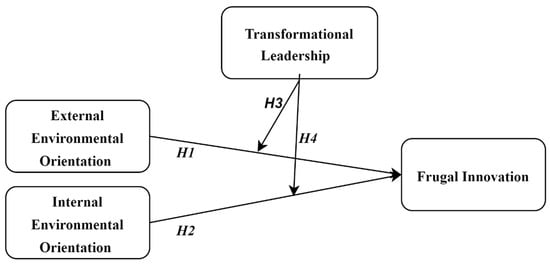
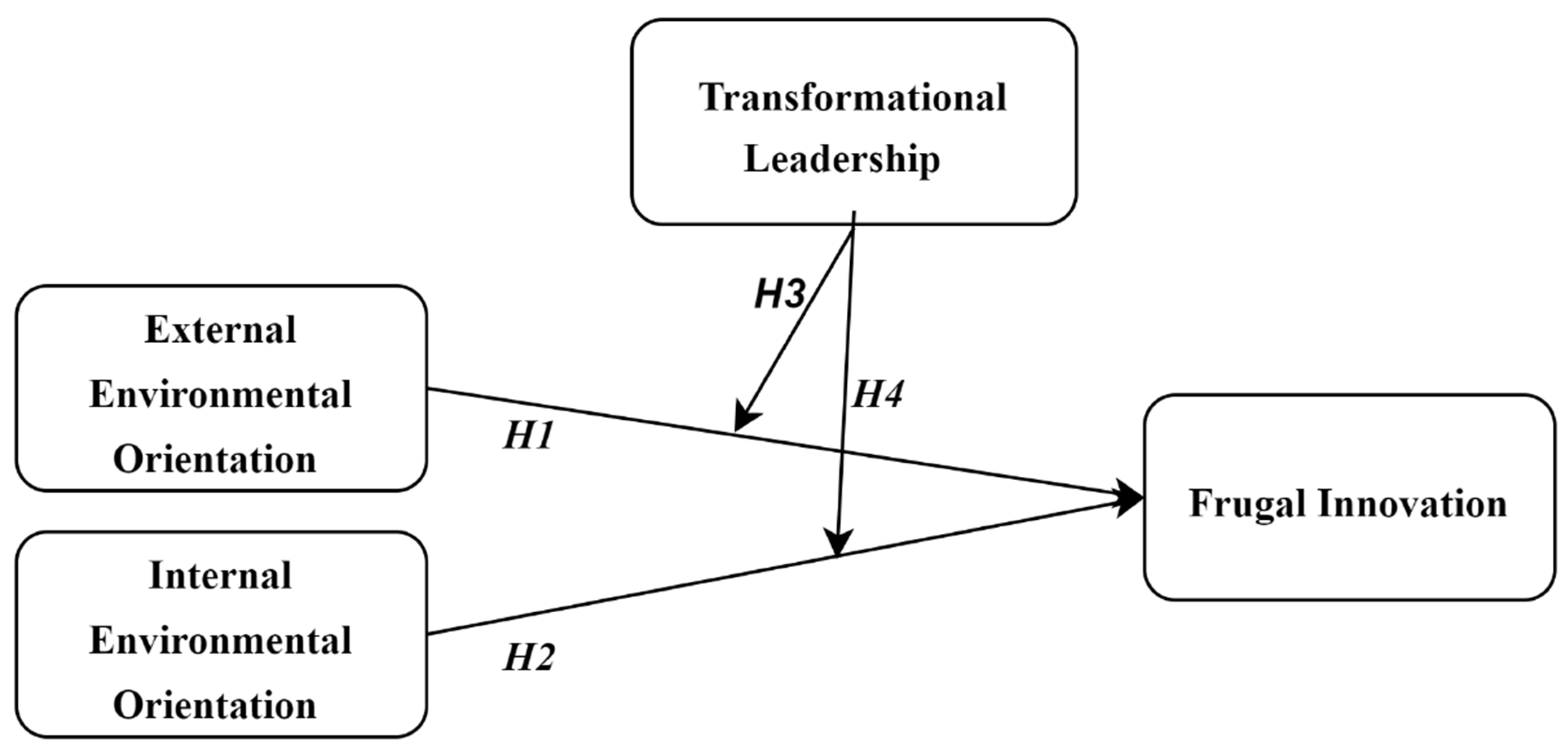
Based on the above discussion, this study has developed hypotheses related to Figure 1 below.
Figure 1.
Research model.
3. Methodology
The current study explains that the environment is a very important aspect of frugal innovation. In this study, the relationship between environmental orientation (external and internal) and frugal innovation is explored. Furthermore, transformational leadership is used as a moderator to strengthen the relationship between external environmental orientation, internal environmental orientation, and frugal innovation in the telecommunications sector of Saudi Arabia. This industry was selected because of its importance to the country’s economic development. Furthermore, the union of the telecom sector and frugal innovation is not merely about increasing effectiveness but is also essential for expanding communication services to different inhabitants across the country. The telecommunications sector benefits from the frugal innovation approach by using low-cost base stations to develop innovative models, extending service to remote areas with limited resources, and producing cost-effective, user-friendly devices. There are 10 telecommunication companies in Saudi Arabia; this study selected three of the major ones: Zain, Mobily, and Saudi Telecom Company (STC) due to their having 100% national coverage of telephone service and international calls. Additionally, these companies play an imperative role in the development of the entire telecommunications sector [75].
The current study used convenient sampling techniques for data collection, which is quick and very effective. Before collecting data, the author obtained approval and participant consent from the Human Resources departments of the three companies. To ensure clarity and cultural sensitivity, the survey was translated by a native Arabic and English speaker and reviewed by three experienced researchers familiar with Saudi culture. Their feedback led to adjustments in terminology to better fit the local context. Finally, a pilot test with a small group of managers from the companies verified the survey’s comprehensibility and gathered feedback on its design and content. The survey was distributed via email, encouraging participants to complete it fully and provide feedback before the deadline. The sample size was determined using Krejcie and Morgan’s [76] formula, and 600 questionnaires were distributed. The author received and validated 436 responses from 600 employees, representing a remarkable 72.7% response rate, exceeding typical rates for similar surveys in the telecom industry. According to the Krejcie and Morgan [76] formula, these minimum requirements are sufficient for further analysis. Participant demographics are summarized in Table 1.
Table 1.
Profile of the participants (n = 436).
3.1. Measures
This study used two types of environments, external and internal, and transformational leadership, to check the relationship with frugal innovation (see Appendix A). Four survey questions were used to measure the companies’ internal environmental orientation, such as “Our firm exerts concerted efforts to allow each employee to understand the importance of environmental preservation.” An additional four questions were used to measure the companies’ external environmental orientation, such as “The developments in the natural environment affect our firm’s business activities.” All these questions were taken from a study by Bu et al. [55]. This study examines transformational leadership as a moderator between external and internal environmental orientations and frugal innovation; the questions regarding transformational leadership were adapted from Lei et al. [77]. Eight survey questions regarding transformational leadership were asked, such as “My leader encourages us to make efforts towards fulfilling the company vision.” The scale for frugal innovation was measured using ten questions developed by Yousaf et al. [78], such as “Our firm finds effective and efficient ways/solutions to meet environmental needs.” All the variables were measured on a five-point Likert scale, where 1 indicates “strongly agree” and 5 indicates “strongly disagree”.
3.2. Data Analysis
This study employed Smart PLS to analyze the data using PLS-SEM. Hair et al. [79] explained that when the research objective is to estimate a confirmatory composite analysis, then it might be the most sound technique. Moreover, this is a helpful technique for theory development and extension [79]. Thus, in the present study, the author evaluated the measurement and structural models using SmartPLS 4 software.
4. Results
4.1. Assessing the Measurement Model
In the first stage of the measurement model, the author used the PLS algorithm to measure the reliability and validity of the latent variables. The advocated threshold criterion for indicator reliability, comprising factor loading greater than 0.50, was recognized as significant. Another study recommended a threshold greater than 0.70 [79]. Table 2 shows that all loading values exceeded the 0.70 threshold. The internal consistency reliability (Cronbach’s alpha) and the composite reliability (CR) are to be 0.70 or higher Hair et al., [79]. The results show that Cronbach’s alpha ranged from 0.873 to 0.946, and CR values ranged from 0.913 to 0.953, which met the standard for internal consistency reliability (see Table 2). Lastly, for convergent validity, the average variance extracted (AVE) must exceed 0.50. This study’s results indicate that all AVE values range from 0.671 to 0.754, which are sound and valid. Thus, the author established that all constructs have satisfied the threshold criteria and are valid and reliable.
Table 2.
Measurement model.
The present study’s data were gathered from a single source, i.e., employees, so common method bias (CMB) may exist. To alleviate the existing concern, the author employed Harman’s single-factor examination. The study’s findings showed that a single factor accounted for 35% of the total variance, which is lower than the standard criterion of 50% [80]. The finding shows that no CBM concerns exist that affect the results.
Table 3 shows that discriminant validity (Fornell–Larcker Criterion) is not a concern in the current study, as all values exceed the threshold for the other dimensions [79]. Table 3 presents the results of the Fornell–Larcker discriminant validity test. All square roots of the average variance extracted (AVE) values displayed on the diagonal exceed the inter-construct correlations. In particular, the AVE values for external environmental orientation (0.869), frugal innovation (0.819), internal environmental orientation (0.851), and transformational leadership (0.821) exceed the correlations among these variables. This indicates that each construct has more variance among its indicators than among indicators of other constructs in the model. The findings affirm that all latent variables are empirically distinct and that the measurement model demonstrates strong discriminant validity, attesting to the strength and reliability of the constructs used in the study.
Table 3.
Discriminant Validity (Fornell–Larcker Criterion).
4.2. Assessing the Structural Model
In the second stage, the author scrutinized the structural model to assess predictive relevance and the relationships among the proposed hypotheses. The results are presented in Table 4 and Table 5. The predictive power of the model can be measured by R2 [79]. An R2 between 0 and 1 is considered acceptable. Table 4 shows that the predicted variable (frugal innovation) has an R2 of 0.938, indicating the strongest explanatory power. The standards for effect size (f2) are 0.02–0.15, 0.15–0.35, and 0.35 or above, corresponding to small, medium, and large, respectively [79]. The model accounted for a significant proportion of the variance in frugal innovation (R2 = 0.938), indicating high explanatory power, consistent with the theoretical model [81]. To ensure the model was not over-fitted, predictive relevance (Q2) was measured using the blindfolding procedure, yielding a value of 0.910, indicating good predictive ability [79]. Inner VIF values were used to examine multicollinearity among predictor constructs; all were below 5.0, which does not warrant concern [79]. The evaluation of common method bias (CMB) was conducted using Harman’s one-factor test and full collinearity VIFs, both of which were below 5.0. These findings establish that the high R2 is due to strong theoretical and empirical explanatory power, rather than overfitting, multicollinearity, or method bias [82].
Table 4.
Effect size, determination of coefficient, predictive relevance.
Table 5.
Hypotheses of the structural model.
Table 4 shows a medium effect size for environmental orientation on frugal innovation (f2 = 0.15). Finally, the Stone-Geisser (Q2) blindfolding procedure was used to assess the model’s predictive relevance [78]. Given the present study’s reflective constructs, the author assessed the predictive relevance of the endogenous construct using the Q2 test. Q2 criteria are 0.02–0.25 (small), 0.25–0.50 (medium), and >0.50 (large). This study found that the Q2 value was 0.910, indicating strong predictive relevance.
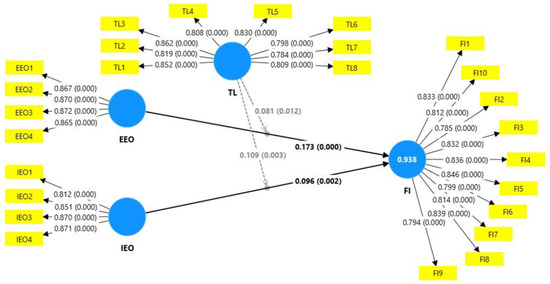
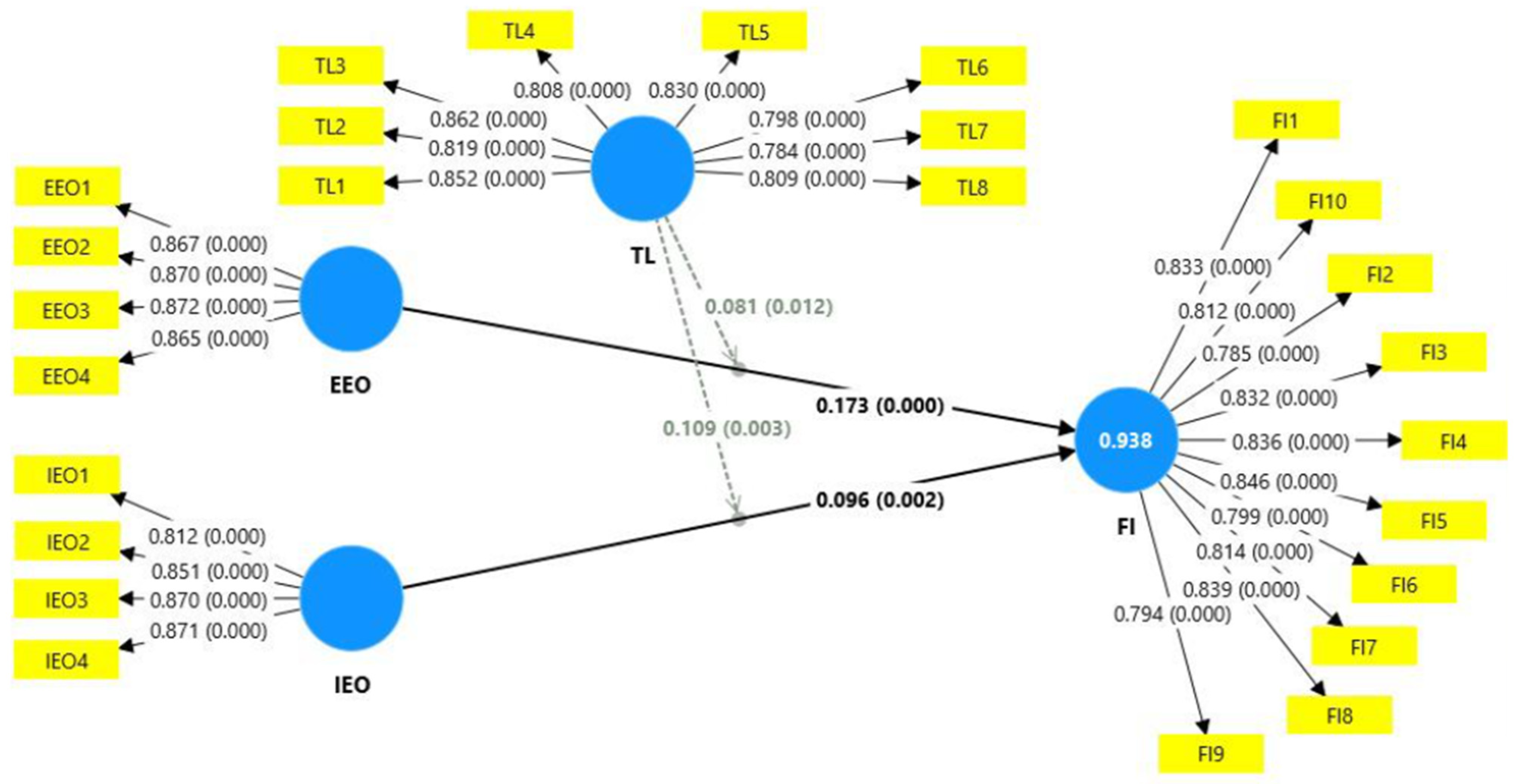
Furthermore, the results of the structural model in Table 5 and Figure 2 indicate that both independent variables, IEO and EEO, are positively related to the dependent variable FI. This conclusion is based on the p-values. The beta for EEO is 0.173 (p < 0.000), indicating a positive relationship with FI, whereas the beta for IEO is 0.96 (p < 0.002), also indicating a positive relationship with FI. The results further indicate that TL positively moderates the relationship between EEO and FI, with a beta of 0.081 (p < 0.012). In addition, TL is a positive and significant moderator, strengthening the relationship between IEO and FI (beta = 0.109, p < 0.003). The values in Table 5 and Figure 2 indicate that all hypotheses are accepted.
Figure 2.
Structural model.
The results of the PLS-SEM structural model are shown in Figure 2. The loadings of all measurement items are high and statistically significant, confirming good construct reliability and convergent validity. The structural paths indicate that both external environmental orientation (EEO) and internal environmental orientation (IEO) are positively associated with frugal innovation (EEO: β = 0.173, p < 0.001; IEO: β = 0.096, p = 0.002). Transformational leadership (TL) plays a significant moderating role in both relationships (EEO × TL: 0.081, p = 0.012; IEO × TL: 0.109, p = 0.003). This means that higher levels of transformational leadership reinforce the role of environmental orientations in driving frugal innovation. The model explains 93.8 percent of the variance in frugal innovation (R2 = 0.938), indicating that environmental orientations and transformational leadership are the two focal points in shaping frugal innovation outcomes in the Saudi telecom sector.
5. Discussion
This study is unique and has both empirical and theoretical importance for all organizations, whether private or public. However, this study was conducted only in Saudi Arabia’s telecom sector. Based on the author’s knowledge, the combination of variables used in the study is unique and has not been examined before. Four hypotheses were developed based on a literature review and the study’s objective. The explanation of these hypotheses is as follows:
The first hypothesis (H1) posits that external environmental orientation is positively related to frugal innovation. An external environmental orientation is very important for an organization’s administration to progress. An organization’s orientation to the external environment provides strategic flexibility [70]. The external environmental orientation focuses on external stakeholders and on analysis of investors and investment [83]. This kind of orientation enhances knowledge that supports frugal innovation in the production process.
The second hypothesis (H2) explains that internal environmental orientation also has a positive relationship with frugal innovation. The internal environmental orientation enhances a firm’s capability to create sustainable competitive advantage and helps the organization provide a strategic vision to workers. The organization’s internal environmental orientation highly influences working strategies [84] and frugal innovation in the production process [83]. Internal environmental orientation, along with frugal innovation within telecom companies, entails developing strategically by implementing cost-effective solutions that optimize efficiency and performance while minimizing costs. The primary objective is to address the distinct challenges and requirements of telecom companies effectively and resource-efficiently. By prioritizing simplicity and affordability across both technology and service offerings, frugal innovation enables telecom companies to expand their reach into underserved markets, narrow the digital divide, and meet the diverse needs of consumers [85].
This study’s third hypothesis (H3) is accepted, which elaborates that transformational leadership strengthens the positive relationship between external environmental orientation and frugal innovation. Leadership is the ability of an organization’s leaders to develop strategies [68], implement them, expand product or service offerings to stakeholders, and increase the value of the business. So, transformational leadership improves the quality of the organization’s products, processes, or service provision. It provides information on external market conditions. Moreover, for long-term external environmental orientation, the organization needs transformational leaders. Therefore, the ideas of transformational leadership increase creativity and frugal innovation within an organization by reallocating the information [69].
The fourth hypothesis (H4) is accepted after data analysis; it explains that transformational leadership strengthens the positive relationship between internal environmental orientation and frugal innovation. Transformational leadership is an important bridge that connects the internal orientation of the environment to frugality in production processes or service provision. The organization’s leadership has an imperative responsibility to analyze both the internal and external environments to introduce new ideas [66]. Therefore, transformational leadership fosters reforms in employees’ self-confidence, encouragement, and performance, enabling them to professionally maintain organizational goals and validate the competencies of frugal innovation. Therefore, transformational leadership is identified as the greatest moderator [86] for improving frugality in products and services through environmental orientation.
Furthermore, the results of this research are consistent with the emerging literature, which shows that environmental orientation has a positive impact on innovation outcomes, particularly on resource efficiency and sustainability. In line with the above-mentioned findings, it confirms that green-oriented firms tend to embrace frugal, cost-efficient innovation practices. However, the quality of the relationship, as evident in the Saudi telecom industry, seems to be stronger compared to the manufacturing or low-tech sectors, which may be attributed to the high alignment between the industry regulatory framework and the national sustainability targets as laid out in the Vision 2030 and its high degree of digital maturity. Moreover, the moderating effect of transformational leadership observed in our study aligns with previous literature on leadership’s role in promoting innovation-driven cultures. However, unlike the literature, which has studied the moderating effect of transformational leadership in Western environments, the effect size in the present study is larger, which can be attributed to the hierarchical and collectivist culture of Gulf companies. These comparisons emphasize that, on the one hand, our findings confirm the validity of current theories, but, on the other hand, they also reveal context-specific dynamics that help better understand the impact of environmental and leadership factors on frugal innovation in technology-intensive industries.
6. Contributions
6.1. Theoretical Contributions
This study makes strong theoretical contributions to the field of research by reducing the gap left by previous studies on frugal innovation and by using the best combination of variables (internal environmental orientation, external environmental orientation, frugal innovation, and transformational leadership). Second, this study addresses prior studies [66,83,85] that ignored the organization’s internal environmental orientation and focused solely on sales. Third, this study aligns with Saudi Arabia’s Vision 2030 and sought to attract investors to telecom companies, encouraging greater investment in and administration of these companies to enhance their environmental orientation through support for transformational leadership. Fourth, this study used the resource-based view and resource patchwork theory, which enhances executives’ ability to manage the organization’s performance, gain a competitive advantage in the market, and introduce innovation into the production process and service provision by leveraging its limited resources.
6.2. Practical Contributions
For practical contributions, the current study can serve as a reference. This study has strengthened and broadened the perception of frugality in production and service provision. First, this study will prompt management and policymakers to pay closer attention to telecom companies and to reduce the country’s GDP dependency on oil and gas production. So, this study can provide a strong path to “Saudi Vision 2030” for the development of the country’s telecom sector. Second, telecom company executives can gain valuable insights from this study; for example, by leveraging transformational leadership and the environment’s orientation to enhance performance and introduce novelty, even with limited resources. The study results explain that leaders play an important role in collaboration between internal and external environments. Therefore, the study’s findings are not limited to the telecom sector but can also provide guidelines for other services and production sectors. Third, this study places greater emphasis on external environmental orientation; as a result, telecom companies can gain a large market share, expand into new markets, and deliver high customer satisfaction.
7. Limitations and Future Research
Despite its contributions, this study has several limitations that present opportunities for future research. First, the study is cross-sectional, limiting the ability to draw causal conclusions about the relationships among environmental orientation, transformational leadership, and frugal innovation. Future research should consider longitudinal or panel designs, which will not only capture temporal dynamics but also establish stronger causal pathways. Mixed-methods approaches (e.g., qualitative interviews or case studies) could also be used to triangulate results and further explore how leadership potential develops over time and affects frugal innovation.
Second, the research is limited to telecommunications organizations in Saudi Arabia, which may limit the external validity of the findings. Although the sector provides a meaningful backdrop for study, as it is technologically intensive and under sustainability pressure, further studies should replicate the model in other nations and industries, such as manufacturing, heavy industries, and other service industries, to confirm the robustness of the results in other environments.
Third, the theoretical perspective of the current research is based on the resource-based view and resource patchwork theory. Even though it is suitable for the variables under study, it can be proposed to researchers in the future that other theoretical perspectives, such as contingency theory, inter-organizational theory, situational leadership theory, or environmental determinism, may be used to offer alternative explanations and add to the theoretical discussion.
Lastly, this paper examined a specific combination of variables, with transformational leadership as the moderator. Future scholars can further develop the model by considering alternative leadership styles (e.g., sustainable, visionary, or ethical leadership) or by adding mediators (e.g., organizational agility, dynamic capabilities, or green human resource practices) to reveal additional mechanisms underlying frugal innovation.
Funding
This research received no external funding.
Institutional Review Board Statement
This study was waived for ethical review as it was classified as exempt research involving an anonymous survey of participants working at organizations, with no collection of personally identifiable or sensitive data and posing no physical, psychological, social, legal, or economic risk to participants, confirmed by the Research Ethics Committee for Living Creatures at the University of Hafr Al Batin.
Informed Consent Statement
Informed consent was obtained from all subjects involved in the study.
Data Availability Statement
The data supporting the findings of this study are available upon request from the author.
Conflicts of Interest
The author declares no conflicts of interest.
Appendix A
Table A1.
Questionnaire.
References
- Iqbal, Q.; Ahmad, N.H.; Li, Z.; Li, Y. To walk in beauty: Sustainable leadership, frugal innovation and environmental performance. Manag. Dec. Econ. 2022, 43, 738–750. [Google Scholar] [CrossRef] [Scilit]
- Hossain, M.; Agarwal, N.; Bhatti, Y.; Levänen, J. Frugal innovation: Antecedents, mediators, and consequences. Creat. Innov. Manag. 2022, 31, 521–540. [Google Scholar] [CrossRef] [Scilit]
- AlMulhim, A.F. The role of internal and external sources of knowledge on frugal innovation: Moderating role of innovation capabilities. Int. J. Innov. Sci. 2021, 13, 341–363. [Google Scholar] [CrossRef] [Scilit]
- Chavez, R.; Malik, M.; Ghaderi, H.; Yu, W. Environmental orientation, external environmental information exchange and environmental performance: Examining mediation and moderation effects. Int. J. Product. Econ. 2021, 240, 108222. [Google Scholar] [CrossRef] [Scilit]
- Zhao, L.; Gu, J.; Abbas, J.; Kirikkaleli, D.; Yue, X.-G. Does quality management system help organizations in achieving environmental innovation and sustainability goals? A structural analysis. Econ. Res.-Ekon. Istraživanja 2022, 36, 2484–2507. [Google Scholar] [CrossRef] [Scilit]
- Jum’a, L.; Ikram, M.; Alkalha, Z.; Alaraj, M. Factors affecting managers’ intention to adopt green supply chain management practices: Evidence from manufacturing firms in Jordan. Environ. Sci. Pollut. Res. 2022, 29, 5605–5621. [Google Scholar] [CrossRef] [Scilit] [PubMed]
- Luo, X.; Yu, S.-C. The Regulatory Effect of Firm Size on Digital Transformation: An Empirical Study of Pharmaceutical Companies in China. Comput. Intell. Neurosci. 2022, 2022, 7731174. [Google Scholar] [CrossRef] [Scilit] [PubMed]
- Iqbal, Q.; Piwowar-Sulej, K. Sustainable leadership and heterogeneous knowledge sharing: The model for frugal innovation. Eur. J. Innov. Manag. 2023, 26, 655–673. [Google Scholar] [CrossRef] [Scilit]
- Wang, C.; Hu, Q. Knowledge sharing in supply chain networks: Effects of collaborative innovation activities and capability on innovation performance. Technovation 2020, 94, 102010. [Google Scholar] [CrossRef] [Scilit]
- Le, P.B.; Tran, D.T.; Phung, T.M.; Vu, K.D. Leadership and knowledge management practices for frugal innovation of firms in the emerging market: Moderating role of collaborative culture. Asia-Pac. J. Bus. Adm. 2024, 16, 637–654. [Google Scholar] [CrossRef] [Scilit]
- Son, T.T.; Phong, L.B.; Loan, B.T.T. Transformational leadership and knowledge sharing: Determinants of firm’s operational and financial performance. Sage Open 2020, 10, 2158244020927426. [Google Scholar] [CrossRef] [Scilit]
- Yousaf, Z.; Radulescu, M.; Sinisi, C.I.; Serbanescu, L.; Păunescu, L.M. Towards sustainable digital innovation of SMEs from the developing countries in the context of the digital economy and frugal environment. Sustainability 2021, 13, 5715. [Google Scholar] [CrossRef] [Scilit]
- Hassounah, M.; Raheel, H.; Alhefzi, M. Digital response during the COVID-19 pandemic in Saudi Arabia. J. Med. Internet Res. 2020, 22, e19338. [Google Scholar] [CrossRef] [Scilit]
- Cuevas-Vargas, H.; Parga-Montoya, N.; Fernández-Escobedo, R. The adoption of ICT as an enabler of frugal innovation to achieve customer satisfaction. The mediating effect of frugal innovation. Procedia Comput. Sci. 2022, 199, 198–206. [Google Scholar] [CrossRef] [Scilit]
- Lim, C.; Fujimoto, T. Frugal innovation and design changes expanding the cost-performance frontier: A Schumpeterian approach. Res. Policy 2019, 48, 1016–1029. [Google Scholar] [CrossRef] [Scilit]
- Melkas, H.; Oikarinen, T.; Pekkarinen, S. Understanding frugal innovation: A case study of university professionals in developed countries. Innov. Dev. 2019, 9, 25–40. [Google Scholar] [CrossRef] [Scilit]
- Annala Tesfaye, L.; Fougère, M. Frugal innovation hijacked. J. Bus. Ethics 2021, 180, 439–454. [Google Scholar] [CrossRef] [Scilit]
- Von Janda, S.; Kuester, S.; Schuhmacher, M.C.; Shainesh, G. What frugal products are and why they matter: A cross-national multi-method study. J. Clean. Prod. 2020, 246, 118977. [Google Scholar] [CrossRef] [Scilit]
- Mishra, A.K.; Thakur, R.K.; Dhakal, S. The influence of environmental sustainability orientations on organizational performance: A review. J. Product. Discourse 2024, 2, 121–136. [Google Scholar] [CrossRef] [Scilit]
- Adjanor-Doku, C.; Ellis, F.Y.; Affum-Osei, E. Environmental performance: A systematic review of literature and directions for future studies. Corp. Soc. Responsib. Environ. Manag. 2025, 32, 71–87. [Google Scholar] [CrossRef] [Scilit]
- Dima, A.; Bugheanu, A.-M.; Dinulescu, R.; Potcovaru, A.-M.; Stefanescu, C.A.; Marin, I. Exploring the Research Regarding Frugal Innovation and Business Sustainability through Bibliometric Analysis. Sustainability 2022, 14, 1326. [Google Scholar] [CrossRef] [Scilit]
- Arici, H.E.; Uysal, M. Leadership, green innovation, and green creativity: A systematic review. Serv. Ind. J. 2022, 42, 280–320. [Google Scholar] [CrossRef] [Scilit]
- Makhloufi, L.; Laghouag, A.A.; Meirun, T.; Belaid, F. Impact of green entrepreneurship orientation on environmental performance: The natural resource-based view and environmental policy perspective. Bus. Strategy Environ. 2022, 31, 425–444. [Google Scholar] [CrossRef] [Scilit]
- Llach, J.; Palau-Pinyana, E.; Lei, L.; Perramon, J. Key enablers for energy firms in implementing the SDGs: Lessons based on a resource-based view approach. Technol. Forecast. Soc. Change 2025, 213, 124011. [Google Scholar] [CrossRef] [Scilit]
- Maffiola, K.P.; D’Angelo, V.; Capo, F.; Scali, E. Environmental orientation, regional innovation, and equity crowdfunding campaigns’ outcomes: Evidence from two Italian platforms. Financ. Res. Lett. 2025, 71, 106402. [Google Scholar] [CrossRef] [Scilit]
- Li, C.; Sampene, A.K.; Khan, A.; Wiredu, J. Environmental orientations to Innovation Ecosystem: The role of green transition, perceived environmental uncertainty and green transformational leadership. Oper. Manag. Res. 2025, 18, 48–71. [Google Scholar] [CrossRef] [Scilit]
- Zhong, L.; Hahn, J. Green Transformational Leadership and Value–Action Barrier on Employees’ Pro-Environmental Behavior: The Moderating Role of Green Brand Image in Chinese Food Manufacturing Enterprises. Behav. Sci. 2026, 16, 71. [Google Scholar] [CrossRef] [Scilit]
- Ayad, T.H.; Hasanein, A.M. Investigating the impact of green transformational leadership on pro-environmental behavior in tour operators. Testing the mediating role of employer attractiveness. Geo J. Tour. Geosites 2025, 59, 835–843. [Google Scholar] [CrossRef] [Scilit]
- Alshammari, A. Exploring Frugal Innovation and Reverse Innovation in Saudi Arabia: A Case Study. Ph.D. Thesis, University of Portsmouth, Portsmouth, UK, 2019. [Google Scholar]
- Aldiab, A.; Chowdhury, H.; Kootsookos, A.; Alam, F.; Alluhaybi, A.; Aloufi, H. Telecommunication infrastructure in Saudi Arabia: Is it ready for eLearning? AIP Conf. Proc. 2022, 2681, 020088. [Google Scholar] [CrossRef] [Scilit]
- Taher, M. Resource-based view theory. In Information Systems Theory: Explaining and Predicting Our Digital Society; Springer: Berlin/Heidelberg, Germany, 2011; Volume 1, pp. 151–163. [Google Scholar]
- Willie, M. Leveraging digital resources: A resource-based view perspective. Gold. Ratio Hum. Resour. Manag. 2025, 5, 1–14. [Google Scholar] [CrossRef] [Scilit]
- Qenbaragha, Z. Digital Transformation for Sustainability in Real Estate Companies in Malmö: Implications for Leadership. Master’s Thesis, Malmö University, Malmö, Sweden, 2025. [Google Scholar]
- Gabelaia, I. The Role of Transformational Leaders in Enhancing Corporate Social Responsibility and Sustainable Entrepreneurship: A Case Study Approach to the Green Leadership Paradigm. In Navigating Corporate Social Responsibility Through Leadership and Sustainable Entrepreneurship; IGI Global Scientific Publishing: Hershey, PA, USA, 2025; pp. 279–312. [Google Scholar]
- Chen, J.; Zhang, F. The innovation paradox: The role of knowledge heterogeneity in frugal innovation. Cogent Bus. Manag. 2024, 11, 2431646. [Google Scholar] [CrossRef] [Scilit]
- Sengura, J.D.; Renyan, M. The role of entrepreneurial orientation and entrepreneurial bricolage on frugal innovation and SMEs sustainable performance in emerging markets. Int. J. Manag. Sci. Bus. Adm. 2024, 10, 19–37. [Google Scholar]
- Haueis, P. A generalized patchwork approach to scientific concepts. Br. J. Philos. Sci. 2024, 75, 741–768. [Google Scholar] [CrossRef] [Scilit]
- Kim, M.; Song, J.; Triche, J. Toward an integrated framework for innovation in service: A resource-based view and dynamic capabilities approach. Inf. Syst. Front. 2015, 17, 533–546. [Google Scholar] [CrossRef] [Scilit]
- Nassani, A.A.; Sinisi, C.; Paunescu, L.; Yousaf, Z.; Haffar, M.; Kabbani, A. Nexus of Innovation Network, Digital Innovation and Frugal Innovation towards Innovation Performance: Investigation of Energy Firms. Sustainability 2022, 14, 4330. [Google Scholar] [CrossRef] [Scilit]
- Fisac-Garcia, R.; Rasool, F.; Morales-Alonso, G.; Schiuma, G. Examining the potential of frugal innovation in services: Lessons from an NGO. Eur. J. Innov. Manag. 2025, 28, 4806–4826. [Google Scholar] [CrossRef] [Scilit]
- Abbas, J.; Bresciani, S.; Subhani, G.; De Bernardi, P. Nexus of ambidexterity and frugal innovation for enhanced ESG performance of entrepreneurial firms. Role Organ. Capab. Int. Entrep. Manag. J. 2025, 21, 47. [Google Scholar] [CrossRef] [Scilit]
- Agarwal, N.; Brem, A.; Dwivedi, S. Frugal and reverse innovation for harnessing the business potential of emerging markets—The case of a Danish MNC. Int. J. Innov. Manag. 2020, 24, 2050009. [Google Scholar] [CrossRef] [Scilit]
- Brem, A.; Nylund, P.A. Maneuvering the bumps in the New Silk Road: Open innovation, technological complexity, dominant design, and the international impact of Chinese innovation. RD Manag. 2021, 51, 293–308. [Google Scholar] [CrossRef] [Scilit]
- Sahasranamam, S. How Coronavirus Sparked a Wave of Innovation in India; World Economic Forum: Geneva, Switzerland, 2020; pp. 1–12. [Google Scholar]
- Oscar, S.M.F.; Efrain, R.O.G.; Torrez, M.H. The Frugal Scalability Paradox in Emerging Innovation Ecosystems. Adm. Sci. 2025, 15, 455. [Google Scholar] [CrossRef] [Scilit]
- Bisanda, M.P. Sustainable Management of Mobile Telecommunications Systems. Ph.D. Thesis, University of Pretoria, Pretoria, South Africa, 2024. [Google Scholar]
- Chauhan, D.; Mewada, H.; Gondalia, V.; Almalki, F.A.; Patel, S.; Modi, H.; Kavaiya, S.; Trivedi, Y.; Mujlid, H.M. Balancing technological innovation and environmental sustainability: A lifecycle analysis of 6G wireless communication technology. Sustainability 2024, 16, 6533. [Google Scholar] [CrossRef] [Scilit]
- Jayabalan, J.; Dorasamy, M. Revitalizing higher education institutions: Embracing frugal innovation for transformation. Procedia Comput. Sci. 2024, 234, 1305–1312. [Google Scholar] [CrossRef] [Scilit]
- Aboelmaged, M. Direct and indirect effects of eco-innovation, environmental orientation and supplier collaboration on hotel performance: An empirical study. J. Clean. Prod. 2018, 184, 537–549. [Google Scholar] [CrossRef] [Scilit]
- Feng, L.; Zhao, W.; Li, H.; Song, Y. The effect of environmental orientation on green innovation: Do political ties matter? Sustainability 2018, 10, 4674. [Google Scholar] [CrossRef] [Scilit]
- Hirunyawipada, T.; Xiong, G. Corporate environmental commitment and financial performance: Moderating effects of marketing and operations capabilities. J. Bus. Res. 2018, 86, 22–31. [Google Scholar] [CrossRef] [Scilit]
- Nguyen, T.N.; Shen, C.H.; Le, P.B. Influence of transformational leadership and knowledge management on radical and incremental innovation: The moderating role of collaborative culture. Kybernetes 2021, 51, 2240–2258. [Google Scholar] [CrossRef] [Scilit]
- Begum, S.; Ashfaq, M.; Xia, E.; Awan, U. Does green transformational leadership lead to green innovation? The role of green thinking and creative process engagement. Bus. Strategy Environ. 2022, 31, 580–597. [Google Scholar] [CrossRef] [Scilit]
- Juhro, S.M.; Aulia, A.F.; Aliandrina, D.; Hadiwaluyo, D.; Lavika, E. The Role of Catalytic Collaboration in Leveraging Transformational Leadership Competencies to Generate Sustainable Innovation. Int. J. Organ. Leadersh. 2019, 9, 48–66. [Google Scholar] [CrossRef] [Scilit]
- Bu, X.; Dang, W.V.; Wang, J.; Liu, Q. Environmental orientation, green supply chain management, and firm performance: Empirical evidence from chinese small and medium-sized enterprises. Int. J. Env. Res. Public Health 2020, 17, 1199. [Google Scholar] [CrossRef] [Scilit]
- Keszey, T. Environmental orientation, sustainable behaviour at the firm-market interface and performance. J. Clean. Prod. 2020, 243, 118524. [Google Scholar] [CrossRef] [Scilit]
- Hossain, M. Frugal innovation: A review and research agenda. J. Clean. Prod. 2018, 182, 926–936. [Google Scholar] [CrossRef] [Scilit]
- Corral-Verdugo, V.; Mireles-Acosta, J.F.; Tapia-Fonllem, C.; Fraijo-Sing, B. Happiness as correlate of sustainable behavior: A study of pro-ecological, frugal, equitable and altruistic actions that promote subjective wellbeing. Hum. Ecol. Rev. 2011, 18, 95–104. [Google Scholar]
- Gabler, C.B.; Panagopoulos, N.; Vlachos, P.A.; Rapp, A. Developing an environmentally sustainable business plan: An international B2B case study. Corp. Soc. Responsib. Environ. Manag. 2017, 24, 261–272. [Google Scholar] [CrossRef] [Scilit]
- López-Sánchez, J.Á.; Santos-Vijande, M.L. Key capabilities for frugal innovation in developed economies: Insights into the current transition towards sustainability. Sustain. Sci. 2022, 17, 191–207. [Google Scholar] [CrossRef] [Scilit]
- Albort-Morant, G.; Leal-Rodríguez, A.L.; De Marchi, V. Absorptive capacity and relationship learning mechanisms as complementary drivers of green innovation performance. J. Knowl. Manag. 2018, 22, 432–452. [Google Scholar] [CrossRef] [Scilit]
- Gabler, C.B.; Richey, R.G., Jr.; Rapp, A. Developing an eco-capability through environmental orientation and organizational innovativeness. Ind. Mark. Manag. 2015, 45, 151–161. [Google Scholar] [CrossRef] [Scilit]
- Portillo-Tarragona, P.; Scarpellini, S.; Moneva, J.M.; Valero-Gil, J.; Aranda-Usón, A. Classification and measurement of the firms’ resources and capabilities applied to eco-innovation projects from a resource-based view perspective. Sustainability 2018, 10, 3161. [Google Scholar] [CrossRef] [Scilit]
- Jiang, W.; Wang, L.; Zhou, K.Z. Green Practices and Customer Evaluations of the Service Experience: The Moderating Roles of External Environmental Factors and Firm Characteristics. J. Bus. Ethics 2022, 183, 237–253. [Google Scholar] [CrossRef] [Scilit]
- Singh, S.K.; Rao, S.; Harish, N.; Guduru, P. Business Organization and Management; RK Publication: Delhi, India, 2025. [Google Scholar]
- Harsono, T.W.; Hidayat, K.; Iqbal, M.; Abdillah, Y. Exploring the effect of transformational leadership and knowledge management in enhancing innovative performance: A mediating role of innovation capability. J. Manuf. Technol. Manag. 2025, 36, 227–250. [Google Scholar] [CrossRef] [Scilit]
- Kuenzi, M.; Mayer, D.M.; Greenbaum, R.L. Creating an ethical organizational environment: The relationship between ethical leadership, ethical organizational climate, and unethical behavior. Pers. Psychol. 2020, 73, 43–71. [Google Scholar] [CrossRef] [Scilit]
- Perdana, M.S. The Effect of Transformational Leadership Values on Worker Performance. Res. Horiz. 2025, 5, 125–132. [Google Scholar] [CrossRef] [Scilit]
- Nabi, M.N.; Zhiqiang, L.; Akter, M. Transformational leadership and radical innovation for sustainability: Mediating role of knowledge management capability and moderating role of competitive intensity. Innov. Manag. Rev. 2022, 20, 298–310. [Google Scholar] [CrossRef] [Scilit]
- Althnayan, S.; Alarifi, A.; Bajaba, S.; Alsabban, A. Linking environmental transformational leadership, environmental organizational citizenship behavior, and organizational sustainability performance: A moderated mediation model. Sustainability 2022, 14, 8779. [Google Scholar] [CrossRef] [Scilit]
- Lei, H.; Khamkhoutlavong, M.; Le, P.B. Fostering exploitative and exploratory innovation through HRM practices and knowledge management capability: The moderating effect of knowledge-centered culture. J. Knowl. Manag. 2021, 25, 1926–1946. [Google Scholar] [CrossRef] [Scilit]
- Hoang, T.N.; Le, P.B. The influence of transformational leadership on self-efficacy and knowledge sharing of teachers: Moderating role of knowledge-oriented school culture. VINE J. Inf. Knowl. Manag. Syst. 2025, 55, 828–845. [Google Scholar] [CrossRef] [Scilit]
- Saleh, S.S.; Auso, K.A. The role of transformational leadership in enhancing competitive advantage for E-business analysis in organisational practices. Expert Syst. 2025, 42, e13307. [Google Scholar] [CrossRef] [Scilit]
- Oyewole, C. The role of transformational leadership in enhancing knowledge behaviour and organizational competitiveness. CogNexus 2025, 1, 134–153. [Google Scholar] [CrossRef] [Scilit]
- Abdel-Halim, A.; Al Khars, M.; Alnasser, A. Evaluating the technical efficiency of Saudi Arabian telecommunications companies using window DEA and AHP techniques. Int. J. Islam. Middle East. Financ. Manag. 2023, 16, 1306–1325. [Google Scholar] [CrossRef] [Scilit]
- Krejcie, R.V.; Morgan, D.W. Sample size determination table. Educ. Psychol. Meas. 1970, 30, 607–610. [Google Scholar] [CrossRef] [Scilit]
- Lei, H.; Gui, L.; Le, P.B. Linking transformational leadership and frugal innovation: The mediating role of tacit and explicit knowledge sharing. J. Knowl. Manag. 2021, 25, 1832–1852. [Google Scholar] [CrossRef] [Scilit]
- Yousaf, Z.; Mihai, D.; Tanveer, U.; Brutu, M.; Toma, S.; Zahid, S.M. Organizational innovativeness in the circular economy: The interplay of innovation networks, frugal innovation, and organizational readiness. Sustainability 2022, 14, 6501. [Google Scholar] [CrossRef] [Scilit]
- Hair, J.F., Jr.; Howard, M.C.; Nitzl, C. Assessing measurement model quality in PLS-SEM using confirmatory composite analysis. J. Bus. Res. 2020, 109, 101–110. [Google Scholar] [CrossRef] [Scilit]
- Podsakoff, P.M.; MacKenzie, S.B.; Lee, J.-Y.; Podsakoff, N.P. Common method biases in behavioral research: A critical review of the literature and recommended remedies. J. Appl. Psychol. 2003, 88, 879. [Google Scholar] [CrossRef] [Scilit]
- Gefen, D.; Straub, D.; Boudreau, M.-C. Structural equation modeling and regression: Guidelines for research practice. Commun. Assoc. Inf. Syst. 2000, 4, 7. [Google Scholar] [CrossRef] [Scilit]
- Ozili, P.K. The acceptable R-square in empirical modelling for social science research. In Social Research Methodology and Publishing Results: A Guide to Non-Native English Speakers; IGI Global: Hershey, PA, USA, 2023; pp. 134–143. [Google Scholar]
- Amankwah-Amoah, J.; Danso, A.; Adomako, S. Entrepreneurial orientation, environmental sustainability and new venture performance: Does stakeholder integration matter? Bus. Strategy Environ. 2019, 28, 79–87. [Google Scholar] [CrossRef] [Scilit]
- Al-Hazmi, N. Internal marketing policies and procedures at Prince Sattam Bin Abdulaziz University and the extent of workers’ satisfaction. Manag. Sci. Lett. 2020, 10, 1427–1436. [Google Scholar] [CrossRef] [Scilit]
- Hsu, B.-X.; Chen, Y.-M. The relationship between corporate social responsibility, external orientation, and environmental performance. Technol. Forecast. Soc. Change 2023, 188, 122278. [Google Scholar] [CrossRef] [Scilit]
- Shafi, M.; Lei, Z.; Song, X.; Sarker, M.N.I. The effects of transformational leadership on employee creativity: Moderating role of intrinsic motivation. Asia Pac. Manag. Rev. 2020, 25, 166–176. [Google Scholar] [CrossRef] [Scilit]

Disclaimer/Publisher’s Note: The statements, opinions and data contained in all publications are solely those of the individual author(s) and contributor(s) and not of MDPI and/or the editor(s). MDPI and/or the editor(s) disclaim responsibility for any injury to people or property resulting from any ideas, methods, instructions or products referred to in the content. |
© 2026 by the author. Licensee MDPI, Basel, Switzerland. This article is an open access article distributed under the terms and conditions of the Creative Commons Attribution (CC BY) license.