


Abstract
Given the increasing uncertainty in the global economy, enhancing urban economic resilience is now paramount to advancing coordinated regional development. As a key force reshaping factor allocation and economic structures, the digital economy’s role in empowering urban economic resilience holds significant theoretical and practical value, especially for closely linked riverine urban agglomeration. Using 2010–2022 panel data of 41 Yangtze River Delta cities, this paper constructs a multidimensional economic resilience evaluation system. Employing two-way fixed effects, instrumental variables, and Spatial Durbin Model, it systematically examines the impact mechanism, heterogeneity, and spatial spillover of the digital economy on urban economic resilience. The findings indicate the following: (1) The digital economy significantly enhances urban economic resilience. (2) Its empowering effect exhibits notable regional disparities, with metropolitan areas and core cities benefiting more substantially. (3) The digital economy strengthens surrounding cities through spatial spillovers, yet some peripheral cities remain trapped in “low–low” agglomeration. This paper offers important insights for global riverine urban agglomerations: promoting the digital economy should prioritize cross-regional governance, enhancing core cities’ leading role, and boosting targeted investment in digital infrastructure and innovation in peripheral areas. This approach is essential for narrowing regional differences and improving overall resilience and sustainability.
1. Introduction
The growing global economic uncertainty, coupled with widespread digital transformation across major economies, has made enhancing urban economic resilience a critical agenda worldwide. In the United States and the European Union, policies such as the “Digital Decade” and substantial investments in smart infrastructure underscore the strategic role of the digital economy in fostering adaptive and robust urban systems. Similarly, Japan and South Korea have integrated digital strategies into regional development plans to mitigate economic vulnerabilities. Against this international backdrop, China’s transition to high-quality development has also placed urban economic resilience at the forefront of its sustainable regional development policy. The 2025 National Urban Work Conference of China explicitly called to “enhance the resilience of urban development and modernize urban governance,” highlighting the strategic importance of a robust urban economy in mitigating major risks and achieving sustainable development. Economic resilience encompasses not only a city’s ability to withstand and rebound from external shocks but also its capacity to refine industrial structure, aggregate innovation resources, and reinforce long-term adaptability [1]. Meanwhile, the digital economy, propelled by big data, artificial intelligence, and cloud computing, is reshaping factor allocation and interregional collaboration. This transformation empowers cities to break away from conventional pathways and pursue higher-quality development [2]. In this context, a systematic investigation into the mechanisms through which the digital economy enhances urban economic resilience is warranted, aligning with both global trends and China’s national strategic priorities.
As one of China’s most economically dynamic, open, and innovative regions, the Yangtze River Delta (YRD) holds a leading position in digital economy development [3]. Accelerated construction of computing facilities and digital industrial clusters has laid a solid foundation for resilience. However, the region still faces challenges such as insufficient stability in industrial and supply chains, uneven progress in digitalization across sub-regions, and obstacles to synergistic resilience enhancement [4]. These characteristics make the YRD an ideal empirical setting for examining the nexus between the digital economy and urban economic resilience. Its well-defined “core–periphery” structure, varying levels of digital infrastructure, and integrated regional governance initiatives provide a rich context to explore heterogeneous effects and spatial spillovers. While existing research acknowledges the digital economy’s positive impact on economic efficiency, systematic analyses of its structural mechanisms, regional heterogeneity, and spatial linkages—especially within a core–periphery framework—remain limited. Therefore, this study seeks to clarify the internal mechanisms through which the digital economy influences urban economic resilience and to uncover how these effects vary across cities based on their positions in metropolitan and core–periphery hierarchies. The findings are expected to inform digital infrastructure planning and cross-regional collaborative governance in the YRD, while providing insights for other regions pursuing coordinated digitalization and resilience.
2. Literature Review
Against the background of deepening economic globalization, the global economy frequently faces the impact of financial crises. The 2008 financial crisis, in particular, had a huge adverse effect on economic development, causing academia to prioritize research on how economic entities deal with external shocks. Consequently, research perspectives have expanded from focusing merely on post-shock recovery to encompassing the entire process of resistance, recovery, and renewal [1,5,6]. Simultaneously, the conceptualization of resilience has evolved from a static equilibrium approach to a dynamic evolutionary perspective. For instance, Chen [7] proposed constructing resilience indicators based on the dual views of equilibrium and evolutionary theory, while Ding et al. [8] emphasized the capacity to withstand, adapt, and reshape. Crucially, the international literature has begun to link these adaptive capacities to digital capabilities. Scholars such as Papadopoulos et al. [9] and Ivanov et al. [10] argue that digital technologies, particularly big data analytics and digital supply networks, significantly enhance resilience by improving information visibility and enabling agile decision-making under uncertainty. Despite these theoretical advancements, existing empirical studies often overlook the specific transmission mechanisms of these technological forces within the context of urban economic systems.
The digital economy, characterized by the deep fusion of Internet technology and finance, brings about a transformational impact on economic structures through technical innovation. In recent years, China’s digital economy has developed vigorously, showing significant accomplishments in optimizing resource allocation, creating flexible employment, and potentially enhancing economic resilience. According to the China Academy of Information and Communications Technology, the scale of China’s digital economy reached over 45.5 trillion yuan in 2021, accounting for more than 39.8% of GDP. It has deeply integrated itself into the national economic system, becoming a significant pillar. Therefore, it has significant theoretical and practical implications to carry out an in-depth study of the digital economy. While existing studies have examined the digital economy’s role in reducing corporate financing constraints and promoting innovation [11,12], its systematic impact on macro-urban resilience requires further exploration.
Building on the separate analyses of resilience and the digital economy, the recent literature has begun to explore their intersection. One strand of research points out that the digital economy has a positive effect on economic resilience. The digital economy shows different empowering effects at various resilience stages: it reinforces the early-warning system during the risk resistance stage, encourages industrial chain collaboration during the recovery stage, and helps in exploring new growth directions during the reorientation and renewal stage [13]. In terms of the development effect, Chen and Wang [14] showed that the digital economy has not only promoted local economic resilience but also created significant positive spillover effects, driving development in surrounding areas. Additionally, Zhu et al. [15] argued that the digital economy improves resilience by facilitating talent agglomeration and optimal allocation, while Zhang [16] pointed out the digital economy drives the urban resilience network system construction by improving technological iteration.
In summary, the existing literature has laid a solid foundation by revealing that the digital economy enhances urban economic resilience, primarily through technological innovation and industrial collaboration. However, the alignment between the theoretical characteristics of the digital economy and the empirical methods used to analyze them requires further extension. Specifically, a primary limitation in prior studies is the reliance on traditional econometric models (such as OLS) that assume urban independence. This methodological approach overlooks the high connectivity and spatial externality that are inherent to the digital economy, thereby neglecting how one city’s digitalization influences its neighbors and leading to potential estimation biases. To address this issue, this paper explicitly selects the Spatial Durbin Model (SDM) as the primary analytical tool. The rationale for this selection is that the SDM incorporates spatial lag terms, allowing for a precise measurement of the complex spatial spillover effects that traditional models fail to capture. Furthermore, distinct from studies that treat all cities uniformly, this paper contributes by systematically differentiating between ‘core’ and ‘peripheral’ cities. By employing the SDM alongside a heterogeneity analysis, this study clarifies the asymmetric response mechanisms within the agglomeration, providing empirical evidence on the direct impacts, spatial spillovers, and regional disparities of the digital economy in the Yangtze River Delta.
3. Theoretical Mechanism and Research Hypotheses
3.1. Direct Impact of the Digital Economy on Urban Economic Resilience
The digital economy directly improves the urban economy’s resilience through many paths. Firstly, the technology empowerment and efficiency enhancement mechanism uses non-linearly increasing marginal effects, etc. Digital economy’s technology spillover and efficient use of resources greatly improve the economic system’s supply–demand matching ability and operational efficiency [17], which can directly improve the resource allocation efficiency and systemic stability of a city in the face of external shock. Second is the transaction cost reduction and factor optimization mechanism. It relies on big data platforms and internet-based tools to lower transaction costs in terms of both time and space, to minimize distortions in the factor market, and to lay the groundwork for resilience [18]. This mechanism directly shortens the recovery time of the economic system after a disturbance. The third one is the innovation-driven and network building mechanism with disruptive innovation, platform economy, and network effects that drive economic dynamics and facilitate the formation of robust network systems [19]. Due to the decentralized nature of its structure, external risks are therefore distributed and improved. Fourth is the financial inclusion and resource allocation mechanism, which shows that digital finance strengthens economic resilience through narrowing the urban–rural income gap, optimizing capital allocation, and promoting consumption upgrades [20]. This mechanism directly enhances the risk-bearing capacity of micro-entities. Fifthly, the measurement optimization and system feedback mechanism uses various measurement indicators such as the added value of the digital economy, the index, and satellite account to comprehensively measure and optimize the positive effect of the digital economy on resilience, providing an accurate decision basis for building resilience [21]. Based on this theoretical foundation, the following hypothesis is proposed:
Hypothesis 1:
The digital economy exerts a significant positive direct impact on urban economic resilience.
3.2. Heterogeneous Impact of the Digital Economy on Urban Economic Resilience
The reinforcing impact of digital economy development on the resilience of cities’ economic resilience is not uniform; it is uneven in terms of strength and path, mainly due to different geographical locations, resources, and developmental stages of the cities. There are mainly specific mechanisms from the two dimensions [18]. First, the heterogeneity mechanism of metropolitan hierarchy assumes that the cities in the metropolitan area can obtain advanced digital infrastructure, a dense network of innovations, and a highly coordinated industrial chain. These advantages give strong support to fast penetration and deep application of digital technologies, making industrial upgrading, resource allocation improvement, and risk response ability enhancement efficient and systematic, so as to improve urban economic resilience. Non-metropolitan cities are different, constrained by a lack of sufficient financial investment, shortage of technical talent, and relatively weaker industrial foundations; they tend to have digital technology applications that are merely skin deep. This limited application prevents the deep, comprehensive transformation of the urban economic system, leading to a less significant impact of the digital economy on improving the industrial chain’s ability to withstand risks, innovative vitality, and resilience. Second, the heterogeneity mechanism of core–periphery structure [22] holds that core area cities, by taking advantage of first-mover advantages and agglomeration effects, produce powerful siphon-spillover effects. By technology spreading and capital clustering, core areas can not only improve their own resilience but also radiate to and promote the development of surrounding areas, forming a regional industrial chain resilience network. This is a special, effective channel for the digital economy to have an impact in core areas. On the contrary, non-core area cities are confronted with difficulties such as backward digital infrastructure and inadequate ability to absorb technology, and it is difficult for them to make full use of technology spillover effects from core areas, thus increasing the risk of digital divide. Even though the policy support is supposed to narrow this gap, the short-term situation of uneven resource distribution greatly restricts how much non-core cities can enjoy the full benefits of the digital economy, which hinders or makes it weaker to boost the resilience. Therefore, the metropolitan and core area cities can take advantage of their better foundation conditions and network locations to use the digital economy more deeply and effectively to promote economic resilience. Non-metropolitan and non-core area cities have inferior development compared to others; therefore, their resilience enhancement effect of digital economy is also lower. Significant heterogeneous characteristics can be seen. Compensating for the diversity needs targeted policies. Based on this analysis, the following hypothesis is proposed:
Hypothesis 2:
The impact of the digital economy on urban economic resilience exhibits significant regional heterogeneity.
3.3. Spatial Spillover Effects of the Digital Economy on Urban Economic Resilience
Spatial spillover effects of the digital economy on urban economic resilience are achieved through three major channels. First, the technology diffusion effect: Marshall [23] proposed that there is a closer geographical proximity, which is good for knowledge sharing, and Glaeser et al. [24] pointed out that there exists a spatial decay nature on the knowledge spillover. In the Yangtze River Delta area, the e-commerce technology from Hangzhou is diffused into cities such as Jiaxing and Huzhou via corporate branches and the mobility of talents, driving the upgrading of local digital services and forming a resilience network with core-hinterland links. Second, infrastructure interconnection effect: cross-regional integration of digital infrastructure, such as 5G networks, computing centers, and the industrial internet, cuts down on obstacles to the flow of production factors. Baldwin [25] pointed out that infrastructure interconnection increases the efficiency of factor allocation. Coordinated planning of new digital infrastructure in the Yangtze River Delta region promotes the cross-regional optimal allocation of talents, capital, and data. For example, the digital finance center of Shanghai gives supply chain finance to small and medium enterprises in Suzhou and Nantong on the cloud to ease the risks of the capital chains being interrupted due to local shocks. This not only increases the risk resistance of each city but also builds a regional risk buffer pool by sharing resources [26]. Third, there is the policy coordination effect. Regional integration policies help to lower institutional transaction costs and to foster integrated industrial chain for resilience. Williamson [27] observed that collaboration can lower market segmentation friction cost. The Digital Yangtze River Delta Construction Alliance, which aims to unify data standards and make electronic certificates mutually recognized across the Yangtze River Delta. This allows companies like information technology firms in Kunshan to take on orders from Shanghai, forming multi-centered backup of industrial chains. Institutional coordination intensifies the digital economy’s economies of scale [28] and builds a cross-administrative boundary resilience redundancy system. Based on this theoretical reasoning, the following hypothesis is proposed:
Hypothesis 3:
The digital economy exerts significant positive spatial spillover effects on urban economic resilience.
4. Overview of the Study Area
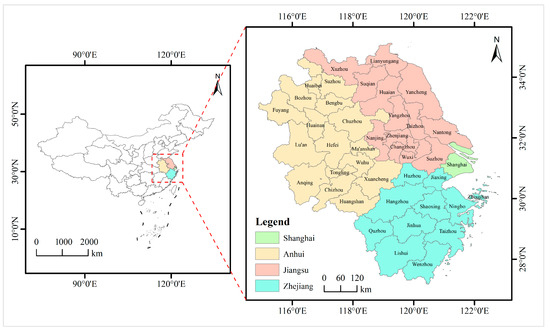
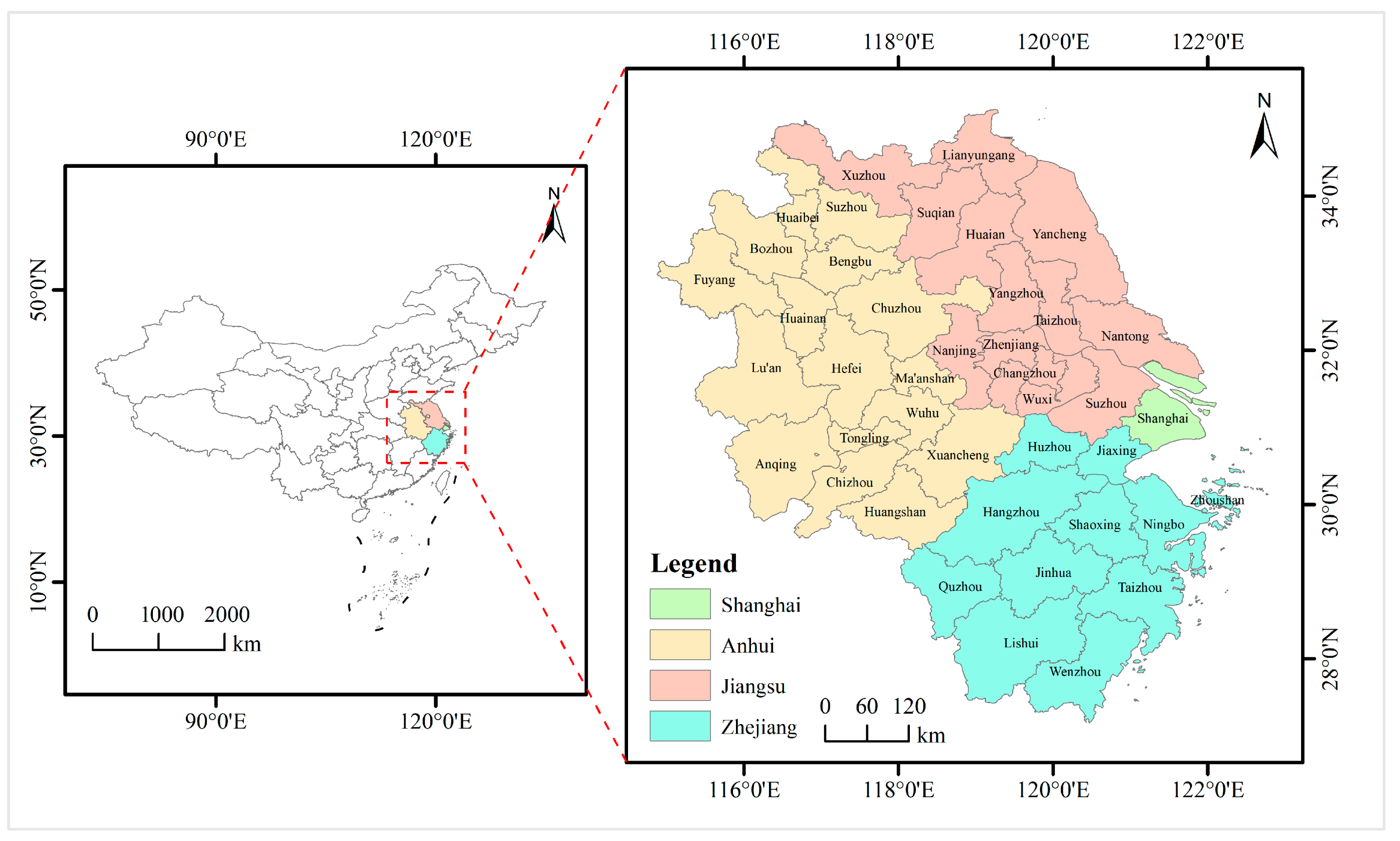
The Yangtze River Delta region covers the entire administrative areas of Shanghai Municipality, Jiangsu Province, Zhejiang Province, and Anhui Province, including 41 prefecture-level cities and spanning a total area of approximately 358,000 km2, as shown Figure 1.
Figure 1.
Spatial distribution map of the study area.
This area is famous for having a lively economy, lots of sources for new ideas, and good digital tools, so it is a big center for China’s economy and how it changes with new technology. But, it also has distinct “core–periphery” divergence and a spatial development pattern of higher levels in the east and lower levels in the west. It results in an uneven distribution of digital resources and differences in economic development across the cities, which ultimately creates large differences in economic resilience among the cities. So, studying the changes and processes by which the digital economy impacts the economic resilience of cities in the Yangtze River Delta area is very practical for promoting the high-quality integrated development of the Yangtze River Delta region. This finding can also provide lessons for other similar regions around the world in developing a more resilient urban economy by developing the digital economy.
5. Research Methods and Data Sources
5.1. Research Methods
5.1.1. Benchmark Model
To verify the direct effect of the digital economy on urban economic resilience, this paper constructs a benchmark regression model with two-way fixed effects:
In Equation (1), UERit represents the urban economic resilience of region i at time t; deit represents the development level of the digital economy; Xit is the set of control variables, including economic development level (gdp), population density (pop), urbanization level (urb), and degree of government intervention (gov); α0, α1, and α2 are coefficients to be estimated; μi and δt control for region and year fixed effects, respectively; and εit is the random error term.
5.1.2. Global Moran’s I Index
This index is a commonly used indicator to measure spatial autocorrelation, laying the foundation for spatial econometric analysis [29]. This paper uses this index to examine the overall spatial distribution characteristics of the digital economy development level and urban economic resilience in the Yangtze River Delta region, judging whether they show significant spatial agglomeration. The calculation formula for the Global Moran’s I index is as follows:
In Equation (2), n represents the 41 cities in the Yangtze River Delta region; S2 represents the sample variance; Wij represents the spatial weight; xi and xj represent the digital economy development level and urban economic resilience index of city i and j, respectively; and is the sample mean of x.
The value range of the Global Moran’s I is [−1, 1]. If the index value falls within [−1, 0), it indicates a spatial negative correlation; if it is 0, there is no spatial correlation; and if it falls within (0, 1], there is a spatial positive correlation. The statistical significance of spatial autocorrelation is tested by the standardized statistic Z. At the 95% confidence level, if |Z| > 1.96, it indicates that the spatial autocorrelation pattern is not formed randomly. The calculation formula for the Global Moran’s I index is as follows:
5.1.3. Spatial Econometric Model
This paper constructs a Spatial Durbin Model to test the spatial spillover effects of digital economy development on urban economic resilience. This model incorporates the spatial lag terms of the digital economy variable, the urban economic resilience variable, and their control variables based on the benchmark model (1), aiming to empirically examine the linkage mechanism between digital economy development and urban economic resilience enhancement from a spatial dimension. In the context of this paper, the SDM is as follows:
In Equation (4), W is the spatial weight matrix, ρ is the spatial autoregressive coefficient under the adjacency weight matrix. φ1 and φ2 are the coefficients of the spatial interaction terms for the explanatory variables and control variables, respectively. The meanings of other variables are consistent with Equation (1).
5.2. Data Sources
This paper takes 41 prefecture-level cities in the Yangtze River Delta region as sample units, with the time span from 2010 to 2022. Data mainly come from the provincial statistical yearbooks of Shanghai, Jiangsu, Zhejiang, and Anhui, as well as the respective statistical yearbooks of the sample cities. For individual missing data, deduction and synthesis are first performed based on the logical relationships between relevant indicators; secondly, linear interpolation is used to fill the remaining missing values.
5.3. Variable Description
5.3.1. Explained Variable
Urban economic resilience (UER): Drawing on the evolutionary resilience framework [1] and the specific indicator system established by Zhang and Yao [30], the urban economic resilience (UER) index is constructed to capture a region’s dynamic capacity to withstand shocks, adjust structures, and evolve. The index comprises three dimensions: resistance and recovery, adaptation and adjustment, and transformation and development (Table 1). Specifically, indicators such as per capita GDP, household savings, and registered unemployment rates are selected to reflect the immediate defense capability (resistance). To measure structural flexibility and market regulation, the proportion of tertiary industry, total retail sales, and government revenue are employed (adaptation). Furthermore, consistent with the emphasis on innovation in the digital era, patent grants and science expenditure are included to represent the potential for long-term renewal (transformation). The entropy method is utilized to synthesize these standardized indicators into a composite index.
Table 1.
Comprehensive evaluation index system for urban economic resilience.
5.3.2. Explanatory Variable
Digital economy development level (de). To accurately measure the digital economy development level, a comprehensive evaluation system is adopted based on the theoretical framework of Zhao et al. [7] and the measurement methodology of Liu et al. [31]. This index evaluates the digital ecosystem through five core aspects: (1) internet penetration (internet users per 100 people) and (2) mobile connectivity (mobile phone users per 100 people) represent the physical network foundation; (3) information output (per capita telecom business volume) reflects the scale of information services; (4) industrial input (proportion of employees in computer and software services) measures the human capital support; and (5) digital depth (Digital Financial Inclusion Index) captures the integration of digital technology with the real economy. This multidimensional approach ensures a robust assessment of the digital economy’s operational vitality.
5.3.3. Control Variables
To more comprehensively analyze the mechanism of the digital economy’s impact on urban economic resilience, this paper introduces the following four control variables: economic development level (gdp), measured by the logarithm of per capita regional GDP; population density (pop), measured by the ratio of the region’s permanent population to the urban land area; urbanization level (urb), measured by the ratio of the urban permanent population to the total permanent population; and government intervention degree (gov), measured by the ratio of government general public budget expenditure to GDP. Among them, economic development level (gdp) and population density (pop) jointly characterize the foundation of urban economic development; urbanization level (urb) reflects the comprehensive status of regional urbanization process; and government intervention degree (gov) reflects the government’s resource investment in regional economic development.
6. Result Analysis
6.1. Spatiotemporal Pattern Analysis of Urban Economic Resilience
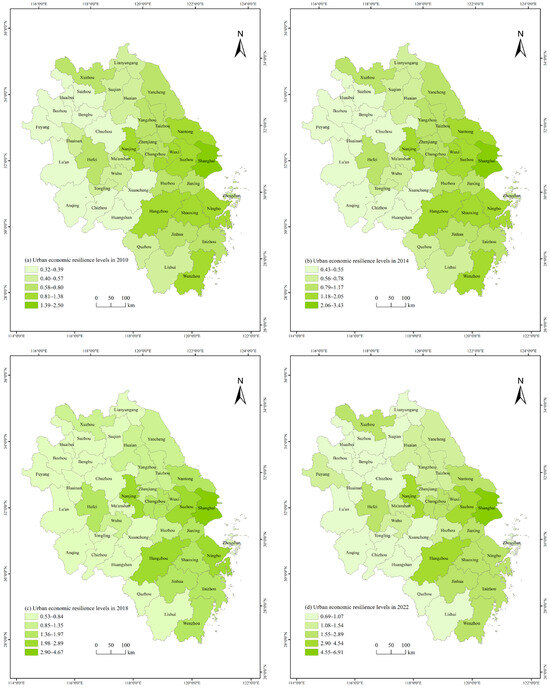
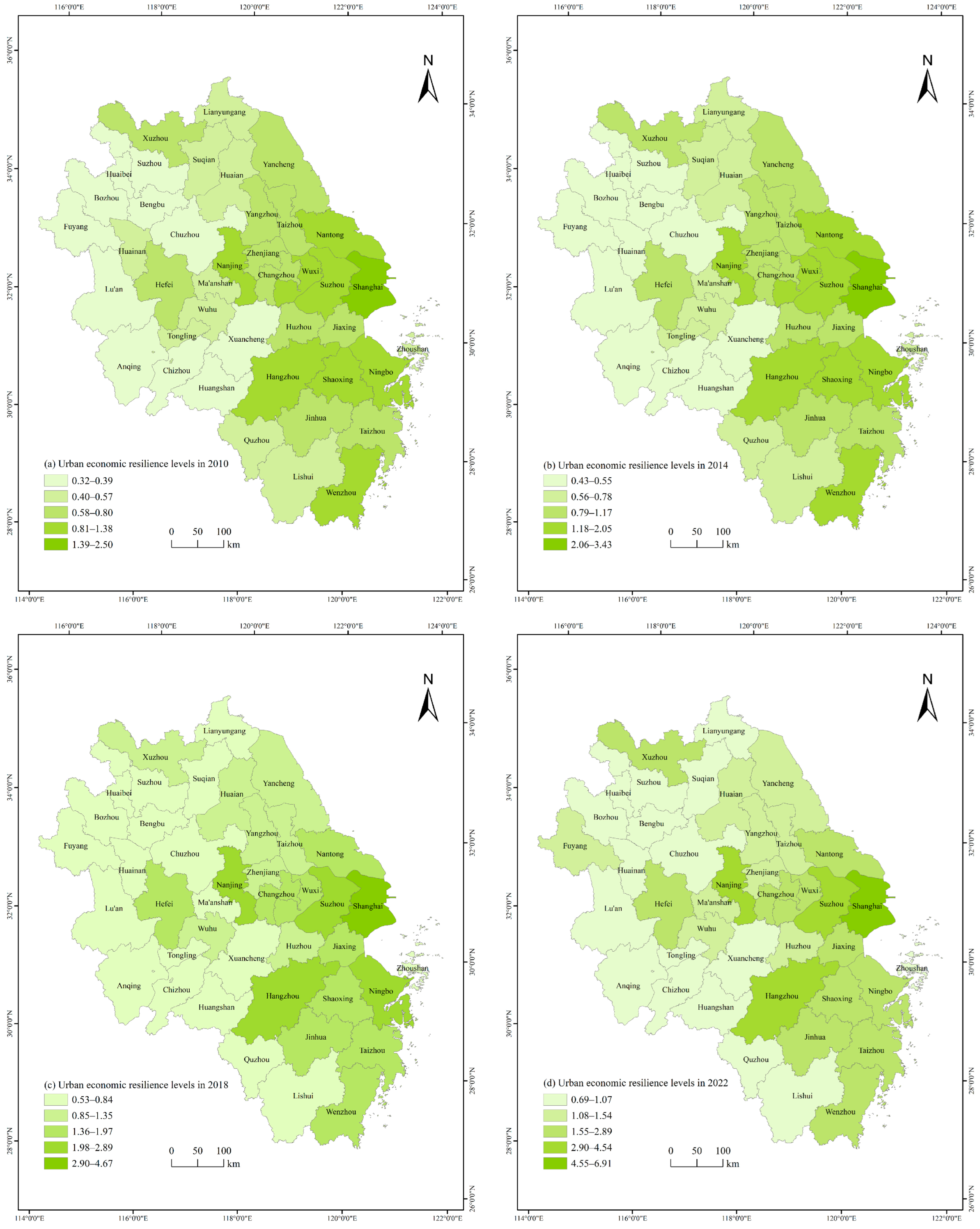
To clearly depict the dynamic evolution of urban economic resilience, this paper employs the Jenks natural breaks method in ArcGIS 10.8 to classify urban economic resilience into five tiers and generate corresponding spatial distribution maps. Figure 2 presents the spatial patterns of urban economic resilience levels in the Yangtze River Delta region for the years 2010, 2014, 2018, and 2022. The results indicate a distinct “east-high, west-low, core–periphery” spatial differentiation in urban economic resilience. Furthermore, the overall resilience level improved over time, accompanied by an increasingly evident spatial agglomeration effect.
Figure 2.
Spatial patterns of urban economic resilience levels in the Yangtze River Delta region in 2010, 2014, 2018, and 2022.
In 2010, the high economic resilience areas were mainly concentrated in core cities like Shanghai, Hangzhou, Nanjing, and Suzhou. They have strong industrial bases, rich innovation resources, and advanced digital facilities, which can greatly improve the system of economic system to resist risks and change. In the same period, some cities in northern Anhui and northern Jiangsu were also identified as low-resilience regions, which can be mainly attributed to their relatively limited industrial structure and slow development of digital technology.
By 2014, with the further implementation of the Twelfth Five-Year Plan in China and the initial rollout of digital infrastructure, urban economic resilience in the Yangtze River Delta region began to exhibit a “point-axis” expansion pattern. Core cities such as Shanghai, Hangzhou, and Nanjing maintained high resilience and started to demonstrate noticeable spillover effects into neighboring areas. This was reflected in the upgraded resilience tiers of cities such as Ningbo, Wuxi, and Nantong. Nevertheless, significant intra-regional disparities persisted, with many cities in northern Anhui and northern Jiangsu still classified in the medium-to-low resilience range, highlighting how uneven development in the digital economy continued to constrain overall resilience improvement.
By 2018, when the Yangtze River Delta integration strategy was upgraded to a national-level initiative, urban economic resilience became even more multi-centered and networked. High-resilience cities’ spatial distribution became much larger. Along with the established core cities, some cities like Hefei and Ningbo also exhibited great increases in resilience and formed a number of regional resilience nodes. The synergistic effects of core cities with their surrounding areas grew, beginning to form a resilience spatial pattern of core–periphery cooperation. At the same time, some peripheral cities such as part of northern Anhui and part of northern Jiangsu had a few signs of improvements but still lagged far behind the eastern core region. This is a sign that we are still facing the issue of unbalanced regional development.
By 2022, the Yangtze River Delta region had become increasingly integrated, and the digital economy continues to advance, making the scope of high-resilience cities greatly expanded. The core city was not only resilient by itself but also emitted radiations to its surroundings cities like Hefei, Ningbo, Wuxi, and so on, and caused other cities to be resilient. Thus, a series of “core–periphery” linked sectors gradually came into being, and the regional development pattern transitioned from single point leadership to multi-center networked collaboration.
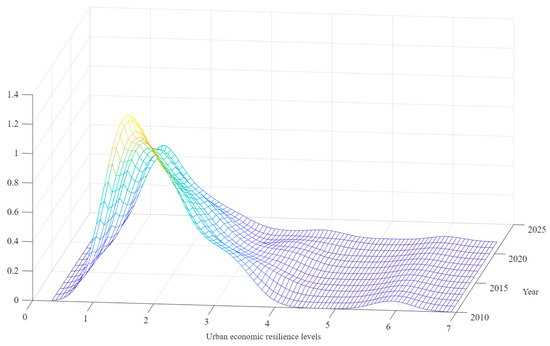
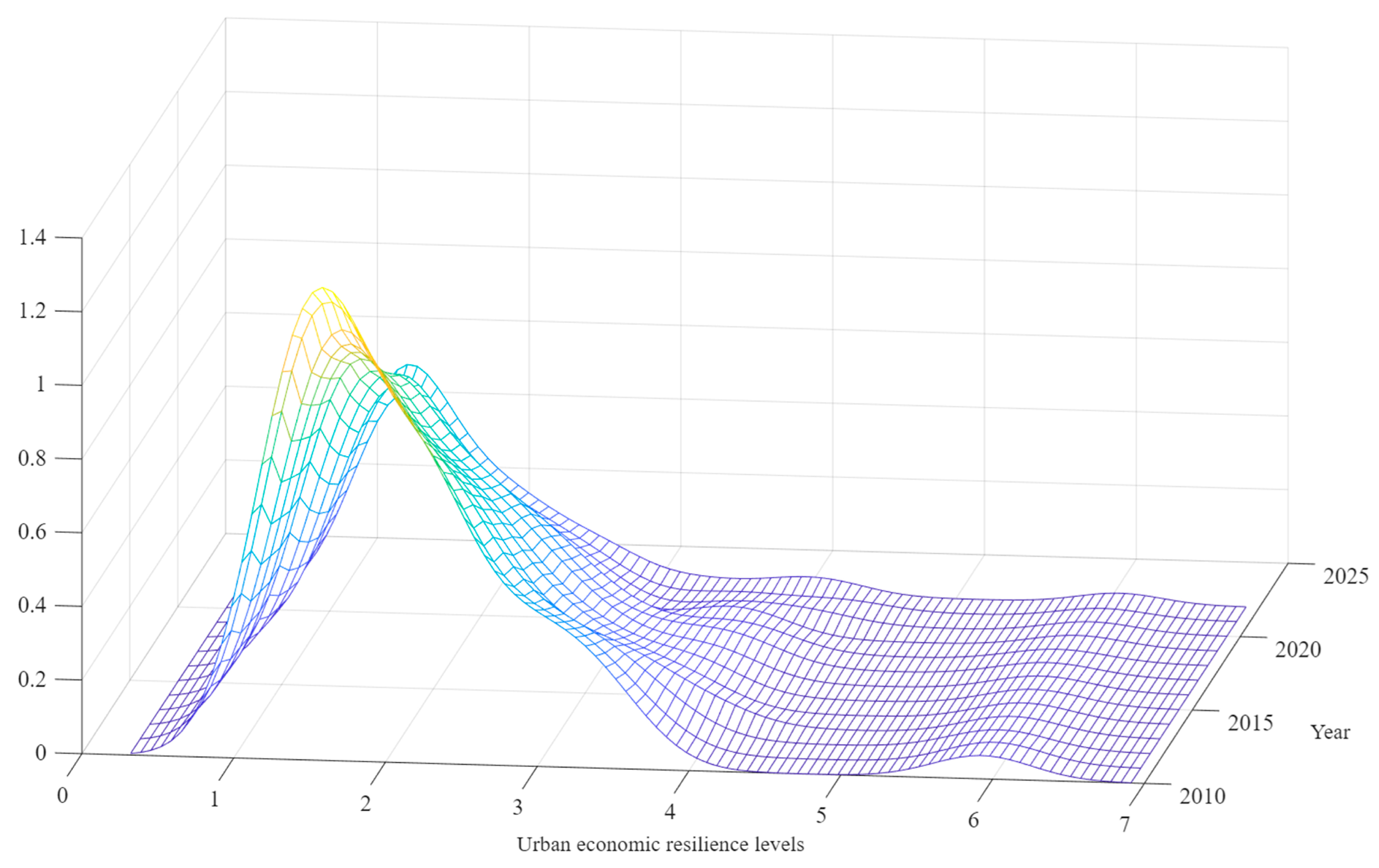
Furthermore, Figure 3 shows the kernel density curve of the urban economic resilience index from 2010 to 2022. The analysis indicates that the highest peak of the kernel density curves has gradually shifted toward the right side, moving from a value close to 1.5 into the 2.5–6.0 range, showing some overall improvement in regional resilience. It is consistent with the observed spatial expansion of high-value areas and formation of a multi-centered network. The shape of the curve transformed from a sharply peaked, slightly right-skewed shape to a single-peaked, relatively flat-topped shape as peak height decreased and distribution range narrowed while shifting upward. It represents a healthy upgrade in the regional economic resilience’s transition, from “low-level agglomeration” to “medium–high level of convergence”. The evolution shows that the digital economy has helped to narrow the intra-region gap with the help of the technology spillover effect and spatial spillover effect and forms a pattern of resilience enhancement of “core radiation and peripheral collaboration”. This highlights the critical role played by the digital economy in pushing forward the coordinated development of regional economic resilience.
Figure 3.
Kernel density curve of urban economic resilience levels.
6.2. Benchmark Regression
The regression analysis results based on Equation (1) are shown in Table 2. Among them, column (1) does not include control variables, while column (2) includes control variables. The data show that the coefficient of the digital economy (de) is significantly positive at the 1% level. This result empirically supports the important role of the digital economy in enhancing urban economic resilience, highlighting its strategic value in strengthening cities’ abilities to resist risks, adapt to changes, and transform and develop. Therefore, the benchmark regression results support Hypothesis 1, that is, the digital economy has a significant positive direct impact on urban economic resilience.
Table 2.
Instrumental variable regression results.
6.3. Endogeneity Test
To alleviate potential endogeneity issues, this paper uses the Two-Stage Least Squares method for estimation. The selection of instrumental variables needs to meet the conditions of relevance and exogeneity. Drawing on the method [32], the interaction terms between each city’s number of fixed telephones per 100 people in 1984 (tel) and the number of post offices per million people in 1984 (post) with the previous year’s national internet user number are used as instrumental variables.
The results in Table 2 show that the coefficients of the digital economy (de) are 1.438 and 0.913, respectively, both significant at the 1% level, indicating that the digital economy has a robust promoting effect on urban economic resilience. In addition, the LM test p-value is 0.000, rejecting the null hypothesis of “under-identification of instrumental variables”; the Wald F statistic is much larger than the critical value of the Stock–Yogo weak identification test at the 10% level, ruling out the weak instrument problem. In summary, the instrumental variables are valid, alleviating endogeneity bias and enhancing the credibility of the conclusions.
6.4. Robustness Test
To test the reliability of the model results, Table 3 lists the results of benchmark regression and robustness tests. Column (3) shows the regression results with the digital economy development level lagged by one period, and column (4) re-estimates using the prefecture-level city sample from 2010 to 2019 (excluding the impact of the pandemic). The results show that whether the explanatory variable is lagged by one period or the sample range is adjusted, the estimated coefficients of the digital economy variable are highly consistent with the benchmark regression, indicating that the research conclusions have good robustness.
Table 3.
Results of benchmark regression and robustness tests.
6.5. Heterogeneity Test
The previous analysis, based on the overall sample of the Yangtze River Delta region, confirms that digital economy development has a significant promoting effect on urban economic resilience. Considering the differences among cities in economic focus, infrastructure, livelihood security, and industrial structure, the impact of the digital economy may have regional heterogeneity. For this purpose, this paper divides the sample into “metropolitan area vs. non-metropolitan area” and “core area vs. non-core area” comparison groups to deeply explore the differential characteristics.
According to the development planning of the Yangtze River Delta urban agglomeration, 26 cities are classified as metropolitan area cities, and the remaining 15 are non-metropolitan area cities. The results in Table 4 show that the regression coefficients of the digital economy on the economic resilience of both types of cities are significantly positive at the 1% level, but the strength differs significantly. Specifically, the empowering effect in metropolitan areas (coefficient = 0.447) is more than four times that of non-metropolitan areas (coefficient = 0.107). This finding aligns with the “Urban Leadership” hypothesis proposed by Forman et al. [33], which suggests that digital technologies do not diffuse evenly but exhibit a bias towards urban areas with dense human capital and complementary infrastructure. Metropolitan cities benefit from “agglomeration externalities,” where the high density of digital enterprises and talent facilitates faster knowledge spillover and resource matching. In contrast, non-metropolitan cities face a “digital divide” not merely in access but in usage capability, limiting their ability to fully translate digital inputs into resilience outcomes.
Table 4.
Results of the heterogeneity test.
Further, according to the regional planning of the Yangtze River Delta, 16 cities are identified as core areas, and the remaining 25 are non-core areas. The results in Table 4 show that the promoting effect of the digital economy on the economic resilience of core area cities is stronger (coefficient 0.357, significant at the 1% level), while the impact on non-core areas is weaker (coefficient 0.070, significant at the 5% level). This pronounced heterogeneity (0.357 vs. 0.070) can be explained by the theory of regional “absorptive capacity” [34,35]. Core cities possess advanced industrial structures and high-end talent pools, which serve as necessary complementary assets to absorb and utilize digital technologies efficiently. As noted by Martin and Sunley [1], the resilience of a region depends on its ability to reconfigure resources in response to shocks. Core areas leverage the digital economy to accelerate this reconfiguration, whereas non-core areas, constrained by a lack of complementary high-tech industries, have not yet triggered the network externalities required for significant resilience enhancement. In summary, Hypothesis 2 is verified.
6.6. Spatial Effect Test
6.6.1. Correlation Analysis
Before constructing the spatial econometric model, it is necessary to test the spatial autocorrelation of digital economy development level and urban economic resilience. This paper uses the adjacency matrix as the spatial weight matrix, where adjacent spatial units take the value of 1, otherwise 0. The rationale is that despite the virtual nature of digital technology, its spillover effects, such as knowledge diffusion and industrial coordination, still rely heavily on geographical proximity in the Yangtze River Delta. Neighboring cities share closer policy linkages and supply chain networks, making the adjacency matrix a robust baseline for capturing these direct interactions [36]. Based on this matrix, the Global Moran’s I is used to analyze the spatial correlation of the two variables in the Yangtze River Delta region.
The results in Table 5 show that from 2010 to 2022, under the adjacency weight, the Global Moran’s I indices of the digital economy development level and urban economic resilience of the 41 cities in the Yangtze River Delta region are significantly positive at the 1% level, indicating that the two variables have obvious spatial positive autocorrelation, and the spatial distribution shows agglomeration characteristics.
Table 5.
Moran’s I of digital economy development level and urban economic resilience.
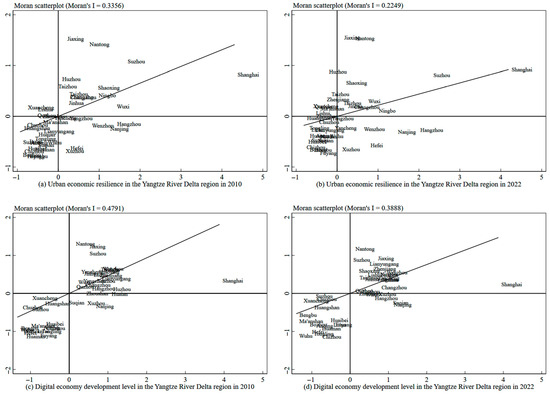
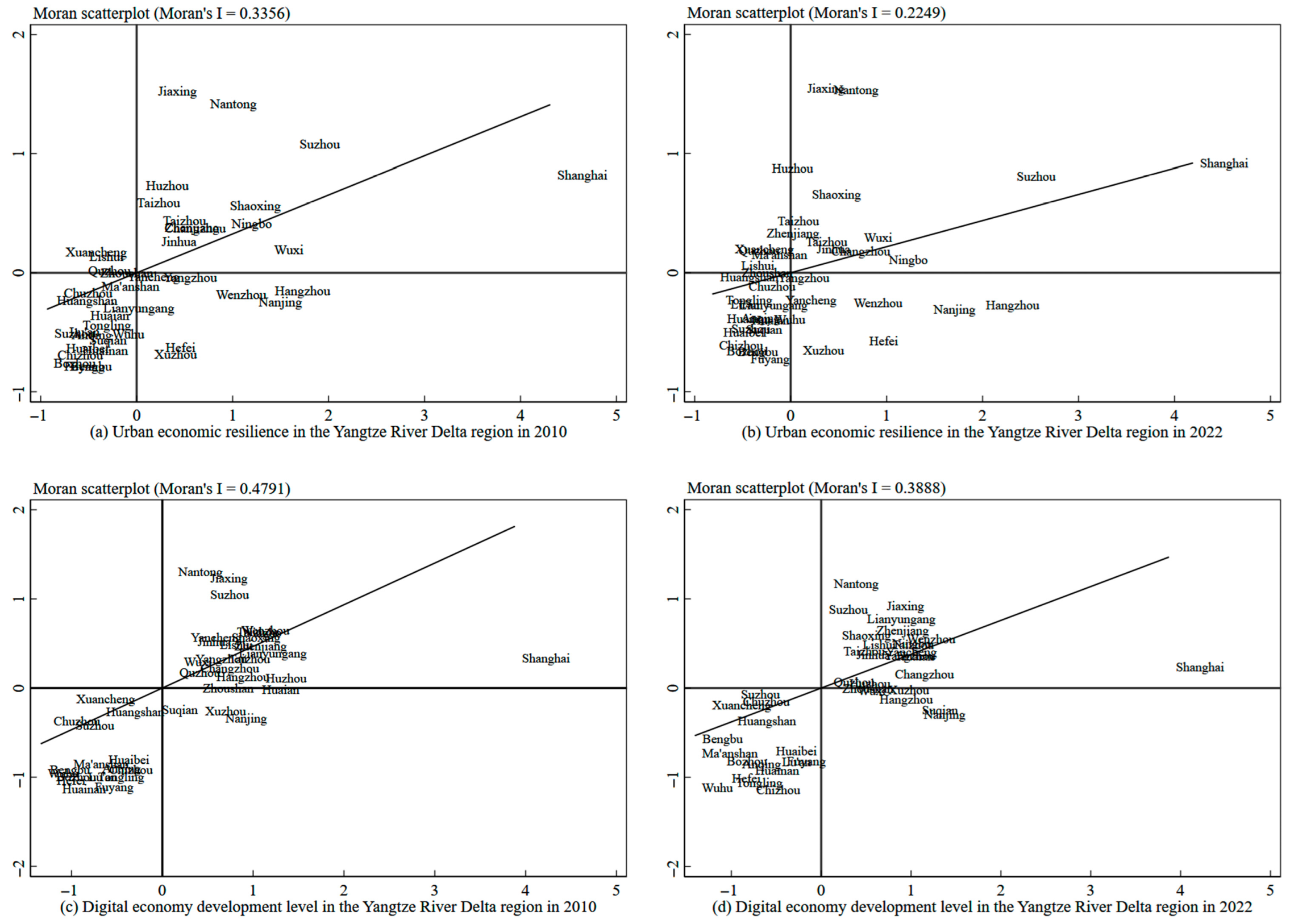
Furthermore, the scatter plot of the Global Moran’s I of the two variables is drawn in Figure 4, intuitively presenting the spatial positive correlation structure: core cities such as Shanghai and Suzhou and their surrounding areas are mostly located in the first quadrant (“high–high” agglomeration area), while some cities in northern Anhui are concentrated in the third quadrant (“low–low” agglomeration area). This unbalanced pattern reflects the spatial interdependence of the digital economy and economic resilience; that is, core cities drive the development of surrounding areas through technology spillover and radiation effects, while some peripheral cities, limited by digital resources and infrastructure, have not yet fully integrated into the regional resilience collaborative network.
Figure 4.
Moran scatter plot of urban economic resilience and digital economy development level.
6.6.2. Spatial Econometric Model Test
Before constructing the spatial econometric model, this paper conducted systematic tests, including the Lagrange Multiplier test (LM), Hausman test, Wald test, and Likelihood Ratio test (LR). The results in Table 6 show that the LM-error, LM-lag, Robust-LM-error, and Robust-LM-lag statistics are all significant, indicating that both the Spatial Error Model (SEM) and the Spatial Lag Model (SLM) are applicable; the Hausman test supports the fixed effects model; in the Wald test, both SEM and SLM are significant at the 5% level, indicating model robustness; and the LR test further confirms that both have good fitting effects with a significance at the 1% level. Based on the above results, this paper finally adopts the Spatial Durbin Model with two-way fixed effects for empirical analysis.
Table 6.
Results of spatial econometric model specification tests.
6.6.3. Analysis of Spatial Durbin Model Regression Results
The regression results of the Spatial Durbin Model, as presented in Table 7, indicate that the direct, indirect, and total effects of the digital economy on urban economic resilience are all statistically significant at the 1% level. Specifically, the direct effect coefficient is 0.313, implying that a one-unit increase in the level of local digital economy development leads to a 0.313-unit enhancement in local economic resilience. The coefficient for the indirect effect, also known as the spatial spillover effect, is 0.470, suggesting that development of the local digital economy also exerts a positive spillover effect on the economic resilience of neighboring cities, increasing it by 0.470 units. The total effect is 0.783, reflecting the overall contribution of the digital economy to strengthening the regional resilience network. These findings not only confirm the positive impact of the digital economy on local economic resilience but also reveal its significant spatial spillover effects on surrounding regions, likely facilitated by factor flows, technology diffusion, and resource sharing. Therefore, Hypothesis 3 is supported.
Table 7.
Spatial Durbin Model regression results.
7. Discussion
This paper provides empirical evidence that the digital economy significantly enhances urban economic resilience in the Yangtze River Delta region. It also reveals considerable disparities in this impact across cities of different tiers, alongside noticeable spatial spillover effects. These findings are consistent with core theoretical frameworks such as technology diffusion and network externalities, while underscoring the complexities of digital economy empowerment amid China’s regional disparities.
Firstly, the empirical results confirm a robust direct positive effect of the digital economy on urban economic resilience. This finding aligns with the theoretical mechanisms proposed in Section 3 and is consistent with previous studies [37]. While the benchmark model captures the aggregate impact, the underlying pathways can be interpreted through multiple dimensions identified in the literature. Beyond the optimization of resources and reduction in transaction costs [18], the resilience-enhancing effect is also supported by financial and measurement-related mechanisms discussed theoretically. Specifically, the development of digital finance acts as a stabilizer by easing financing constraints [38], while improved measurement capabilities through big data allow for more precise governance and rapid feedback in the face of shocks [16]. Thus, the observed resilience is not the result of a single channel, but rather the outcome of the interaction and complementarity of these systemic mechanisms. Synergistically, they bolster the stability, adaptability, and transformative power of the urban economic system, eventually facilitating speedy recovery and structural upgrading [19].
Secondly, the resilience-enhancing effect of the digital economy shows marked spatial heterogeneity: it is more pronounced in metropolitan areas and core cities but relatively limited in non-metropolitan and peripheral cities. This outcome corresponds with the “siphon effect” observed in early stages of digital economy development [39]. Core regions, with their advanced infrastructure, dense innovation networks, and strong technological absorptive capacity, can more effectively translate digital inputs into resilience gains. In contrast, peripheral cities, constrained by less developed digital infrastructure, thinner talent pools, and weaker industrial chain coordination, often remain at a stage of superficial digital application, failing to penetrate deeper economic structures, which results in weaker resilience improvement. Such divergence implies that promoting the digital economy requires caution against “one-size-fits-all” policies that could exacerbate regional imbalances; instead, differentiated and targeted strategies are needed.
Thirdly, it is found that digital economy produces a positive spatial spillover effect; it can improve the resilience of neighboring cities by means of factor mobility, knowledge spread, and network connection, especially in the radiating influence from core city to adjacent areas. However, some peripheral cities are still trapped in the “low–low” agglomeration trap, indicating that there is neither a natural occurrence of spatial spillovers nor an even distribution of spatial spillovers. Their real effect is restricted by the local infrastructure, institutional environment, and absorptive capacity of the receiving region [40]. Therefore, when taking advantage of the leading effect of core cities, policy guidance must increase digital access, institutional adjustment, and innovation absorption in periphery areas so as to prevent the formation of a “core–periphery” gap and promote the development of synergistic resilience of regions.
Methodologically, different from previous studies mostly based on traditional econometric models, this paper uses the Spatial Durbin Model to better capture the spatial correlation and spillover channel of inter-city digital economy development. This provides a more fine-grained analytical instrument to understand the creation of regional resilience networks. But, it is still true that this paper keeps to linear assumptions and might not show all the non-linear or threshold effects that could happen under different development times, institutions, or structures [41]. Future research can develop non-linear models to study more precisely under what conditions specific dimensions like digital finance, industrial digitalization, and digital governance have the most resilience-enhancing effect, which can then inform more targeted policy design.
In summary, the impact of the digital economy on urban economic resilience is a complex process that is multi-path, heterogeneous, and inter-connected. Future research might proceed in many ways, one being comparing how much different kinds of enablers matter and fit into different contexts; things like digital finance, smart governance, and industrial digitalization are examples. Also, looking at how urban governance capability, deeper financial systems, and social capital work together with the digital economy to affect resilience results would be another area to explore, and making comparisons between places or countries to see if the findings made here apply broadly and in what situations they do not would give some ideas on how digitally guided resilience is formed in other parts of the world with similar traits.
8. Conclusions and Recommendations
This paper develops empirical models to assess the influence of the digital economy on urban economic resilience in the Yangtze River Delta region. The principal findings are as follows:
- (1)
- The digital economy significantly increases the resilience of urban economies. The results show that a one-unit improvement in the level of digital economy development will lead to an average increase of 0.342 units in local economic resilience, which is statistically significant at the 1% level. The underlying mechanism is mainly embodied in the optimization of resource allocation, the reduction in transaction costs, and the promotion of innovation network development.
- (2)
- Distinct regional heterogeneity is observed. The empowering effect of the digital economy is more pronounced in metropolitan areas and core cities. In contrast, inadequate infrastructure and factor endowments in non-metropolitan and peripheral cities limit their ability to build resilience.
- (3)
- Significant, but not balanced, spatial spillover effects are observed. Estimation based on the Spatial Durbin Model shows that local digital economy development produces positive spillovers to neighboring city’s economic resilience through technology diffusion and factor mobility, forming a “core–periphery” resilience network. But, the periphery cities still face a “low–low” agglomeration dilemma, and the regional coordination mechanism is in need of improvement.
Building on these findings, this paper proposes the following policy recommendations:
- (1)
- Local governments should accelerate the construction of “balanced digital infrastructure” to lower institutional transaction costs in peripheral cities. Specifically, a “Digital Infrastructure Equalization Fund” should be established to prioritize the deployment of 5G networks and gigabit optical fibers in the industrial parks of non-metropolitan cities. By narrowing the “hard infrastructure” gap, these regions can reduce the information search and matching costs for local enterprises, thereby enhancing their flexibility and ability to respond to external economic shocks.
- (2)
- Policymakers should deepen the application of digital inclusive finance to fully activate the “financial inclusion and resource allocation mechanism” verified in this study. It is recommended to guide the digital transformation of financial services to lower financing thresholds and transaction costs, thereby reducing information asymmetry in the financial market. By optimizing the allocation efficiency of credit resources, policymakers can ensure that funds flow more precisely to high-potential SMEs and innovative entities. This approach not only alleviates financing constraints for market entities but also strengthens the material foundation for resisting external shocks at the micro level, ultimately enhancing the overall resilience of the urban economy.
- (3)
- A cross-regional “Digital Innovation Community” should be fostered to maximize positive spatial spillover effects and upgrade regional innovation networks. To overcome the regional heterogeneity and the “core–periphery” divide, the Yangtze River Delta should implement a “Data in the Core, Production in the Periphery” industrial collaboration model. Core cities like Shanghai and Hangzhou should open their high-performance computing centers and digital technology platforms to enterprises in neighboring cities, reducing the R&D threshold for the latter. Simultaneously, a unified regional data standard interface should be formulated to break data silos. This facilitates the smooth diffusion of technology and knowledge from core to peripheral areas, transforming the region from a simple geographic agglomeration into a resilient, interconnected digital ecosystem.
- (4)
- Building on these insights, the applicability of the findings can be extended to other riverine regions globally. For major river basins in China, such as the Pearl River Delta, spatially targeted digital development approaches are recommended to promote synergistic growth between upstream and downstream cities. For developed regions like the Mississippi River Delta and the Rhine Basin, policymakers should explore cross-border digital governance frameworks to align data policies. For developing regions such as the Mekong, Amazon, and Nile deltas, which face similar challenges of uneven regional development, leveraging the digital economy can help overcome physical infrastructure constraints. By establishing “digital corridors” and fostering connecting networks between core cities and peripheral areas, these riverine regions can reduce economic fragmentation and better leverage the resilience-building potential of the digital economy against external shocks.
Author Contributions
Writing—original draft, Z.L. (Zhixuan Lyu); Writing—review and editing, Z.L. (Zhenqiang Li) and C.Z. All authors have read and agreed to the published version of the manuscript.
Funding
This research is supported by The Hunan Provincial Natural Science Foundation of China (grant No. 2026JJ80249) and Hunan Institute of Science and Technology Postgraduate Research and Innovation Project (grant No. YCX2025A40).
Institutional Review Board Statement
Not applicable.
Informed Consent Statement
Not applicable.
Data Availability Statement
All relevant data are included in this paper.
Acknowledgments
The authors thank the editors and reviewers for their valuable time giving comments and support.
Conflicts of Interest
The authors declare no conflicts of interest.
References
- Martin, R.; Sunley, P. On the notion of regional economic resilience: Conceptualization and explanation. J. Econ. Geogr. 2015, 15, 1–42. [Google Scholar] [CrossRef] [Scilit]
- Goldfarb, A.; Tucker, C. Digital economics. J. Econ. Lit. 2019, 57, 3–43. [Google Scholar] [CrossRef] [Scilit]
- You, X.; Li, Z.; Yi, Y. Carbon constraints, industrial structure upgrading, and green total factor productivity: An empirical study based on the Yangtze River Economic Belt. J. Water Clim. Change 2023, 14, 3010–3026. [Google Scholar] [CrossRef] [Scilit]
- Guo, Y. Comprehensively improving the supply chain resilience and security level of the Yangtze River Delta region industrial chain: Based on the perspective of serving the whole country. Price Theory Pract. 2023, 9, 31–36. [Google Scholar] [CrossRef]
- Rose, A.; Krausmann, E. An economic framework for the development of a resilience index for business recovery. Int. J. Disaster Risk Reduct. 2013, 5, 73–83. [Google Scholar] [CrossRef] [Scilit]
- Bristow, G.; Healy, A. Regional resilience: An agency perspective. Reg. Stud. 2014, 48, 923–935. [Google Scholar] [CrossRef] [Scilit]
- Chen, M. An international literature review of regional economic resilience: Theories and practices based on the evolutionary perspective. Prog. Geogr. 2017, 36, 1435–1444. [Google Scholar] [CrossRef] [Scilit]
- Ding, J.; Wang, Z.; Liu, Y.; Yu, F. Measurement of economic resilience of contiguous poverty-stricken areas in China and influencing factor analysis. Prog. Geogr. 2020, 39, 924–937. [Google Scholar] [CrossRef] [Scilit]
- Papadopoulos, T.; Gunasekaran, A.; Dubey, R.; Altay, N.; Childe, S.J.; Fosso-Wamba, S. The role of Big Data in explaining disaster resilience in supply chains for sustainability. J. Clean. Prod. 2017, 142, 1108–1118. [Google Scholar] [CrossRef] [Scilit]
- Ivanov, D.; Dolgui, A.; Sokolov, B. The impact of digital technology and Industry 4.0 on the ripple effect and supply chain risk analytics. Int. J. Prod. Res. 2019, 57, 829–846. [Google Scholar] [CrossRef] [Scilit]
- Huang, R.; Lai, X.; Tang, S. How can fintech affect corporate financing constraints? Dynamic effects, heterogeneity characteristics and macro-micro mechanism test. Financ. Theory Policy 2020, 6, 25–33. [Google Scholar] [CrossRef]
- Zhang, X.; Dong, Z. Digital transformation and corporate technological innovation: Mechanism identification, safeguard condition analysis and heterogeneity test. Econ. Rev. 2023, 1, 3–18. [Google Scholar] [CrossRef]
- Wang, J.; Fu, X. Digital economy, industrial structure and urban economic resilience. Reg. Econ. Rev. 2023, 2, 70–78. [Google Scholar] [CrossRef]
- Chen, S.; Wang, D. The effect and mechanism of digital economy on economic resilience. J. Ind. Technol. Econ. 2022, 41, 26–34. [Google Scholar] [CrossRef]
- Zhu, J.; Sun, H. Does digital economy improve urban economic resilience? Mod. Econ. Res. 2021, 10, 1–13. [Google Scholar] [CrossRef]
- Zhang, C. The institutional basis, evolution mechanism and practical path of resilient city construction in digital transformation. Guizhou Soc. Sci. 2021, 7, 123–130. [Google Scholar] [CrossRef]
- Zhao, T.; Zhang, Z.; Liang, S. Digital economy, entrepreneurship, and high-quality economic development: Empirical evidence from urban China. J. Manag. World 2020, 36, 65–76. [Google Scholar] [CrossRef]
- Hu, Y.; Chen, Y.; Li, Y. The impact of digital economy on urban economic resilience in the Yangtze River Delta region. J. East China Norm. Univ. (Humanit. Soc. Sci.) 2022, 54, 143–154. [Google Scholar] [CrossRef]
- Yan, Z.; Xu, Z.; Zhang, J. The “resilience code” in the digital age: Virtual agglomeration and urban economic resilience. China J. Econ. 2025, 51, 49–63. [Google Scholar] [CrossRef]
- Cui, G. Can digital finance enhance China’s economic resilience? J. Shanxi Univ. Financ. Econ. 2021, 43, 29–41. [Google Scholar] [CrossRef]
- Xu, X.; Zhang, M. Research on the scale measurement of China’s digital economy: Based on the perspective of international comparison. China Ind. Econ. 2020, 5, 23–41. [Google Scholar] [CrossRef]
- Tang, R. Effect and mechanism of the digital economy enabling high-quality synergistic development of the cultural and tourism industry: Empirical evidence from the Yangtze River Delta. Prog. Geogr. 2024, 43, 1929–1942. [Google Scholar] [CrossRef] [Scilit]
- Marshall, A. Principle of Economics; Macmillan: London, UK, 1890. [Google Scholar]
- Glaeser, E.L.; Kallal, H.D.; Scheinkman, J.A.; Shleifer, A. Growth in cities. J. Political Econ. 1992, 100, 1126–1152. [Google Scholar] [CrossRef] [Scilit]
- Baldwin, R. The Great Convergence: Information Technology and the New Globalization; Crossref: Lynnfield, MA, USA, 2017. [Google Scholar] [CrossRef] [Scilit]
- Martin, R. Regional economic resilience, hysteresis and recessionary shocks. J. Econ. Geogr. 2012, 12, 1–32. [Google Scholar] [CrossRef] [Scilit]
- Williamson, O. The economic institutions of capitalism: Firms, markets, relational contracting. In Das Summa Summarum des Management; Free Press: New York, NY, USA, 1985. [Google Scholar] [CrossRef] [Scilit]
- Krugman, P. Increasing returns and economic geography. J. Political Econ. 1991, 99, 483–499. [Google Scholar] [CrossRef] [Scilit]
- Zhang, S.; Zhang, K. Contrast study on moran and getis–ord indexes of local spatial autocorrelation indices. J. Geod. Geodyn. 2007, 3, 31–34. [Google Scholar] [CrossRef]
- Zhang, L.; Yao, L. Research on the impact of digital technology innovation on urban economic resilience: Empirical evidence from 278 cities at prefecture level and above in China. J. Manag. 2023, 36, 38–59. [Google Scholar] [CrossRef]
- Liu, J.; Yang, Y.; Zhang, S. Research on the measurement and driving factors of China’s digital economy. Shanghai J. Econ. 2020, 6, 81–96. [Google Scholar] [CrossRef]
- Nunn, N.; Qian, N. US food aid and civil conflict. Am. Econ. Rev. 2014, 104, 1630–1666. [Google Scholar] [CrossRef] [Scilit]
- Forman, C.; Goldfarb, A.; Greenstein, S. How did location affect adoption of the commercial Internet? Global village vs. urban leadership. J. Urban Econ. 2005, 58, 389–420. [Google Scholar] [CrossRef] [Scilit]
- Boschma, R. Towards an evolutionary perspective on regional resilience. Reg. Stud. 2015, 49, 733–751. [Google Scholar] [CrossRef] [Scilit]
- Cohen, W.; Levinthal, D. Absorptive capacity: A new perspective on learning and innovation. Adm. Sci. Q. 1990, 35, 128–152. [Google Scholar] [CrossRef] [Scilit]
- Pan, W.; Xie, T.; Wang, Z.; Ma, L. Digital economy: An innovation driver for total factor productivity. J. Bus. Res. 2022, 139, 303–311. [Google Scholar] [CrossRef] [Scilit]
- Sun, X.; Luo, S.; Cheng, L. Theoretical interpretation and implementation path of digital economy empowering the resilience enhancement of urban agglomerations. Reg. Econ. Rev. 2025, 2, 103–112. [Google Scholar] [CrossRef]
- Tang, S.; Wu, X.; Zhu, J. Digital finance and enterprise technology innovation: Structural feature, mechanism identification and effect difference under financial supervision. J. Manag. World 2020, 36, 52–66+9. [Google Scholar] [CrossRef]
- Ji, X.; Zhou, Q. Research on the impact of digital economy development on the economic gap between central and peripheral cities in Yangtze River Delta Region: Analysis based on the perspective of center-periphery. Urban Probl. 2024, 9, 4–14. [Google Scholar] [CrossRef]
- Yang, H.; Jiang, L. Digital economy, spatial effects and total factor productivity. Stat. Res. 2021, 38, 3–15. [Google Scholar] [CrossRef]
- Ge, H.; Wu, F. Digital economy enables high-quality economic development: Theoretical mechanisms and empirical evidence. Nanjing Soc. Sci. 2021, 1, 24–33. [Google Scholar] [CrossRef]

Disclaimer/Publisher’s Note: The statements, opinions and data contained in all publications are solely those of the individual author(s) and contributor(s) and not of MDPI and/or the editor(s). MDPI and/or the editor(s) disclaim responsibility for any injury to people or property resulting from any ideas, methods, instructions or products referred to in the content. |
© 2026 by the authors. Licensee MDPI, Basel, Switzerland. This article is an open access article distributed under the terms and conditions of the Creative Commons Attribution (CC BY) license.