Article

Mapping Grassland Suitability Through GIS and AHP for Sustainable Management: A Case Study of Hunedoara County, Romania


by
Luminiţa L. Cojocariu
1,2,
Nicolae Marinel Horablaga
1,2,*,
Cosmin Alin Popescu
3,
Adina Horablaga
3,
Monica Bella-Sfîrcoci
4 and
Loredana Copăcean
3,*
1
Department of Agricultural Technologies, Faculty of Agriculture, University of Life Sciences “King Mihai I” from Timisoara, 300645 Timisoara, Romania
2
Laboratory for Pratology and Forage Crop Improvement, Agricultural Research and Development Station Lovrin, 307250 Lovrin, Romania
3
Department of Sustainable Development and Environmental Engineering, Faculty of Agriculture, University of Life Sciences “King Mihai I” from Timisoara, 300645 Timisoara, Romania
4
Romanian Grassland Society, 400372 Cluj-Napoca, Romania
*
Authors to whom correspondence should be addressed.
Sustainability 2026, 18(3), 1155; https://doi.org/10.3390/su18031155
Submission received: 17 December 2025 / Revised: 15 January 2026 / Accepted: 20 January 2026 / Published: 23 January 2026

Abstract

Grasslands represent an essential resource for rural economies and for the provision of ecosystem services, yet they are increasingly affected by anthropogenic pressures, functional land-use changes, and institutional constraints. This study develops a geospatial decision-support framework for assessing grassland suitability in Hunedoara County, Romania, by integrating the Analytic Hierarchy Process (AHP) and Weighted Overlay Analysis (WOA) within a GIS environment. The assessment is based on nine criteria thematically grouped into three dimensions: (A) physical-geographical, including topographic suitability, climatic pressure, and hydrological risk exposure; (B) ecological and conservation-related, reflected by ecological conservation value, ecological carrying capacity, and the anthropic pressure index; and (C) socio-economic and functional, represented by spatial accessibility, recreational value, and policy support mechanisms. Suitability is defined as the integrated capacity of grasslands to sustain productive and multifunctional uses compatible with ecological conservation and the existing policy framework. Results indicate that 0.43% of the grassland area exhibits very high suitability (Class 1), 44.51% high suitability (Class 2), and 54.75% moderate suitability (Class 3), while unfavorable areas account for only 0.31% of the total (Class 4). The proposed methodology is reproducible and transferable, providing support for prioritizing management interventions, agri-environmental payments, and rural planning in mountainous and hilly regions.

1. Introduction

In the rural landscapes of Europe, natural and semi-natural grasslands hold an essential role both in terms of agricultural production and ecosystem services [1,2]. These areas provide fodder resources for livestock, serve as habitats for rare wildlife species, and contribute to biodiversity conservation and hydrological regulation, carbon storage, and also offer cultural and recreational value (provisioning, regulating, supporting, and cultural services) [2,3,4,5,6]. Moreover, grasslands are vital to the economic structure of extensive pastoral farms and to the resilience of rural territories, especially in mountainous and hilly regions [7,8,9], a context highly relevant for the study area.
However, in recent decades many grasslands have been subjected to increasing pressures: abandonment of traditional agriculture, overgrazing, land fragmentation, changes in land use, along with environmental and climatic drivers [10]. These trends threaten the ecosystem services provided by grasslands and the stability of agro-pastoral systems [11,12,13]. In response, agricultural policies, including agri-environmental payments and subsidies under national and European frameworks, have increasingly aimed to support the conservation and sustainable management of grasslands [14,15,16].
In Central, Eastern, and Southern Europe, the abandonment of traditional agriculture is often driven by structural socio-demographic processes, such as rural depopulation and ageing, labor migration, and the low economic attractiveness of agricultural activities in marginal or mountainous areas [10,17,18,19]. These dynamics contribute to the underutilization or abandonment of grasslands and highlight the need for spatial tools capable of distinguishing between areas with high functional potential and those requiring differentiated support and management measures, including in Hunedoara County [20].
In this context, land-use sustainability can no longer be addressed solely as a normative principle or a general policy objective, but requires an operational translation capable of capturing spatial differences in functional land potential. In the scientific literature, such operationalization is achieved through the integration of biophysical, anthropogenic, and institutional criteria within spatial analytical frameworks, enabling differentiated assessments of land-use suitability and compatibility, including in mountainous regions [21,22,23]. In this study, sustainability is approached from a spatial perspective through measurable criteria relevant to grassland use, reflecting biophysical constraints, anthropogenic pressures, accessibility, and institutional compatibility, thereby providing the basis for spatial evaluation and decision-support tools [24].
Although agriculture is often broadly associated with environmental pressures, its impacts vary depending on intensity, management practices, and spatial context. In many cases, unsustainable land use reflects a mismatch between land use and its underlying biophysical and socio-institutional characteristics, thereby justifying the need for models capable of differentiating levels of land-use favorability and suitability.
To address current challenges in land-use planning and environmental protection, numerous studies have combined Multi-Criteria Decision Analysis (MCDA) with Geographic Information Systems (GIS), particularly through GIS-AHP (Analytic Hierarchy Process) integration, as a reliable support framework for assessing land suitability for agricultural purposes or conservation objectives [25,26,27]. This integration is driven by the need to manage increasingly complex decision-making contexts, where land-use patterns are influenced simultaneously by biogeographical, ecological, socio-economic and institutional factors that are difficult to evaluate through traditional approaches [21,28,29].
MCDA provides a systematic framework based on multiple criteria, enabling the integration of quantitative and qualitative information to support complex decision-making processes [30,31,32,33,34]. Among MCDA techniques, the AHP method is widely used due to its ability to structure decision problems and to estimate the relative importance of criteria, making it suitable for territorial assessments involving heterogeneous factors [35,36].
At the applied level, the integration of GIS-MCDA enables the generation of spatial favorability or suitability maps that support territorial planning, sustainable resource management, and public policy formulation [37,38,39,40]. Beyond spatial analysis per se, these models function as decision-support tools by facilitating the comparison of alternatives and the prioritization of interventions in contexts characterized by multiple constraints and dynamic pressures [37,41,42].
Within the field of grassland studies, GIS-MCDA/AHP methodologies have been applied to favorability zoning for biodiversity conservation as well as for identifying sustainable agricultural approaches such as controlled grazing or the maintenance of ecosystem services [41,43,44,45]. These applications highlight the importance of integrating both environmental factors (soil, climate, topography) and socio-economic dimensions (accessibility, local practices, agricultural policies) within decision-making processes to ensure the long-term sustainability of grassland resources [37,38,39,46].
Recent literature also points to a shift from static suitability models toward Spatial Decision Support Systems (SDSS) capable of integrating policies, costs and management scenarios. Applications range from agricultural and conservation planning to future land-use forecasting and rural development strategy formulation [39,47,48]. In this context, the use of MCDA and geospatial sciences is expanding beyond mere spatial mapping, becoming an integral part of planning and policy-making processes, including within the context of Common Agricultural Policy (CAP) implementation.
Nevertheless, in Romania, GIS-based suitability assessments remain largely focused on general agricultural land/crop potential, rather than treating grasslands as a distinct functional land-use category and linking results to management and policy instruments. For instance, national-scale digital suitability mapping has been developed for major crops, but without an explicit grassland-oriented and policy-targeting SDSS framing [26]. At the same time, although grasslands are widely acknowledged as key targets for agri-environmental and biodiversity-related measures under CAP-type schemes [15,46], few studies operationalise this policy dimension through integrated spatial decision-support outputs for grassland prioritisation. This gap is particularly pronounced in mountainous and hilly counties, where grasslands represent a central component of rural identity and local economies. Beyond the geographical dimension, this gap also reflects conceptual and methodological limitations in the existing literature, related to the fragmented integration of analytical criteria and the lack of explicit links to decision-making processes and public policies. In this respect, the contribution of the present study lies not only in its application to an underexplored regional context, but also in the proposal of an integrated analytical framework explicitly oriented toward functional grassland prioritization and decision support for land management and rural planning.
Based on these considerations, the central research question of this study is whether and how a GIS-AHP-based geospatial model can support spatially explicit decision-making processes related to grassland management and rural planning. Specifically, the model is designed to inform land-use zoning decisions, the prioritisation of agri-environmental and compensatory payments, the identification of areas requiring grazing intensity regulation or ecological restoration interventions, as well as the targeting of rural development measures. In this context, the working hypothesis is that the integration of biophysical, ecological, socio-economic, and institutional criteria within a GIS-AHP multicriteria framework, followed by weighted aggregation and spatial classification of the results, generates differentiated spatial patterns of grassland favourability. These patterns reflect distinct combinations of environmental constraints, anthropogenic pressures, and the policy-institutional context, thereby enabling the identification of priority areas for agricultural management, ecological conservation, and rural development interventions.
In line with this hypothesis, the aim of the study is to develop a geospatial decision-support tool for the evaluation and prioritization of grassland favorability, intended to support grassland resource management and rural planning processes at the level of Hunedoara County, Romania. To achieve this aim, the research pursues the following objectives: (1) to select and operationalize relevant biophysical, ecological, and socio-economic criteria for grassland favorability assessment; (2) to integrate these criteria into a GIS-based AHP multicriteria model in order to estimate the spatial favorability of grassland resources; (3) to classify and map grassland favorability and identify priority areas for management interventions; and (4) to analyze the distribution of priority areas in relation to administrative units and to derive applicable intervention directions for rural planning and sustainable grassland management.
The originality of this study lies in the integration, within a unified GIS-AHP framework, of biophysical, ecological, socio-economic, and institutional factors influencing the functionality and patterns of grassland use in a mountainous and hilly county of Romania. The proposed methodology is replicable, relies on open-source geospatial data, and enables the integrated spatial representation of the analyzed factors in the form of comprehensive or site-specific favorability maps, providing cartographic outputs relevant for prioritizing management measures and agricultural support.

2. Materials and Methods

The adopted methodology is based on a conceptual model for the spatial assessment of grassland favorability, in which sustainability is interpreted as the result of interactions between physico-geographical constraints, anthropogenic pressures, and the institutional framework. The sequence of methodological steps represents not merely a technical GIS processing workflow, but an analytical logic intended to translate these dimensions into a coherent multicriteria framework capable of revealing spatial patterns relevant to land management and territorial planning.

2.1. Study Area

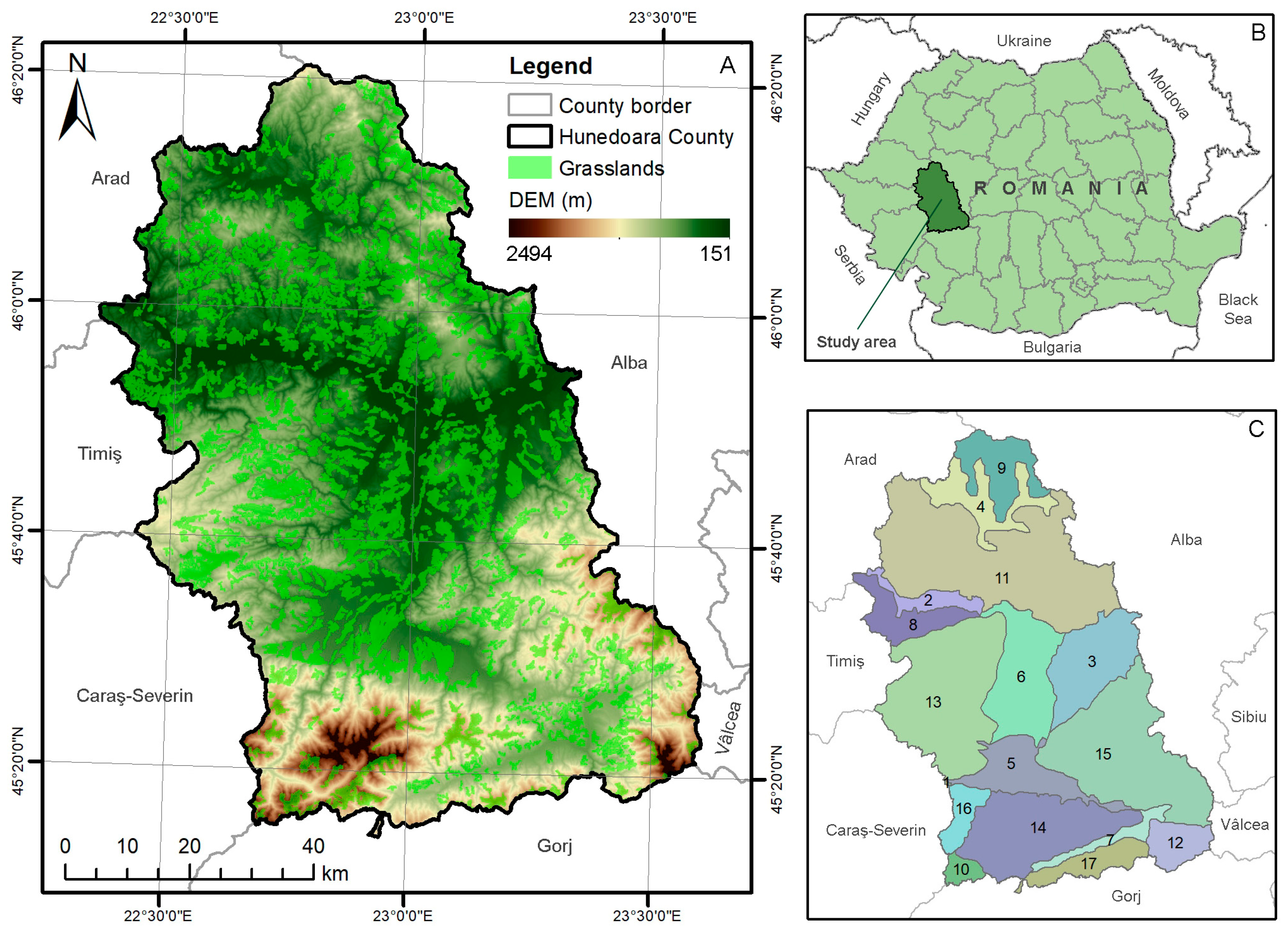
The study area (Figure 1) is located in the central-western part of Romania and corresponds to the administrative territory of Hunedoara County. The county lies approximately between 45°30′ N and 46°20′ N latitude and 22°20′ E and 23°40′ E longitude, occupying a transitional position between the Apuseni Mountains of the Western Carpathians and the Southern Carpathians of Romania [49]. Hunedoara County covers a total area of 706,034 ha and is characterized by predominantly mountainous and hilly relief, with elevations ranging from 151 m in river floodplains and depressions to 2494 m along high mountain ridges, resulting in a wide diversity of environmental conditions.
The climate of Hunedoara County is classified as moderately temperate-continental, with a multiannual average air temperature of approximately 9.8 °C and mean annual precipitation of about 1048 mm. Rainfall is distributed throughout the year, with maximum values occurring in early summer (June) [53]. Variability in precipitation and temperature contributes to the development of diverse soil conditions, including Cambisols, Luvisols, and Regosols, which influence grassland productivity and use [54]. According to demographic data from the National Institute of Statistics [55], Hunedoara County has a population of 361,657 inhabitants, with a declining trend over recent decades, reflecting socio-demographic changes that also affect land-use dynamics.
Hunedoara County was selected as the study area due to its high representativeness for the Romanian Carpathian region in terms of relief diversity, grassland distribution, and agro-pastoral land-use systems. The county occupies a transitional position between the Western and Southern Carpathians and encompasses a wide altitudinal range, multiple relief units, and heterogeneous climatic and ecological conditions [49]. This complexity generates a broad spectrum of grassland types [7,12], management intensities, and institutional contexts, typical for mountainous and hilly Carpathian regions [11,46,56]. Consequently, Hunedoara County provides an appropriate case study for testing the applicability of GIS-AHP-based spatial decision-support models, with results that can be transferred to other Carpathian areas facing similar environmental and socio-economic conditions.
Within the study area, 873 grassland entities were identified, with a total cumulative area of 129,118 ha [51]. The smallest grassland patch covers 0.12 ha, while the largest reaches 3344 ha, with an average area of 147.90 ha. Grassland distribution is characterized by a predominance of small-sized patches, most of them being under 500 ha. Grasslands in Hunedoara County are distributed across all major relief units (Figure 1), and this extensive spatial coverage, combined with the diversity of altitudinal, climatic, and pedological conditions, confers a complex and heterogeneous character to grassland ecosystems in the region.

2.2. Geospatial Data and Preprocessing

The study relied exclusively on free (open-source) geospatial datasets obtained from official european and national sources, used to characterize grassland resources in Hunedoara County. All datasets were harmonized within a common projection system (Stereographic 1970) and processed to enable integration into the multicriteria modelling framework.
1. Grassland delineation and characterization. Grasslands were extracted from the Corine Land Cover dataset [51], then validated through cross-referencing with Sentinel-2 satellite imagery [57], orthophotos, and cadastral information provided by the National Agency for Cadastre and Land Registration (NACLR) [58]. The final polygon geometries served as the spatial basis for all derived thematic analyses.
In this study, “grasslands” are defined as a land-use/land-cover category derived from Corine Land Cover (CLC 2018) [51], corresponding to permanent grassland classes (231 and 321 code). The analysis therefore treats grasslands as a functional spatial category for territorial assessment and decision support, rather than as a detailed typology of habitat or vegetation communities. We acknowledge that this category may include heterogeneous ecological and floristic conditions; however, the aim of the study is to capture county-scale spatial favourability patterns based on comparable, reproducible open datasets.
2. Physical-geographical data. Topographic conditions were obtained from a Digital Elevation Model (25 m spatial resolution) [50], from which slope and aspect were derived. The climatic variable was expressed through the Lang index, calculated for each meteorological station based on multiannual mean temperature and precipitation data for the period 2014–2023, recorded at 17 stations [53]. The point-based Lang index values were subsequently interpolated using inverse distance weighting (IDW) to generate a continuous raster surface, which was resampled to the common spatial resolution of 25 m used in the GIS-AHP analysis. To estimate hydrological risk affecting grasslands, a planar (2D) Euclidean distance raster to the hydrographic network [52] was generated in a GIS environment. This proximity-based indicator was used as a proxy to identify areas potentially exposed to flooding, water stagnation, or excess moisture in the vicinity of watercourses, without explicitly modelling hydrological flow or runoff processes.
3. Ecological data. The ecological value of grasslands was determined by intersecting grassland polygons with protected area polygons [59], in order to identify grassland surfaces located within protected perimeters. This approach allows the identification of grasslands subject to conservation-related constraints and associated with higher ecological value due to their inclusion in protected areas. while grazing capacity was evaluated based on livestock density (Livestock Units-LU/ha) reported at administrative-territorial unit level [52,55,60].
4. Socio-economic and functional data. Anthropogenic pressure was calculated using the Grassland Anthropic Impact Index (GAII) [10]-the ratio between grassland areas and human population [55]. Territorial accessibility was derived from the Euclidean distance from the road network, initially provided in vector format [52]. Recreational potential was estimated using spatial data on catalogued tourist sites [61], and institutional support for grasslands was mapped based on eligibility zones corresponding to National Programme of Rural Development (NPRD) measures M10 (Agri-environment and climate) and M13 (Mountain zone) [62,63]. All indicators used in the analysis were operationalised as raster layers at a spatial resolution of 25 m.
5. GIS preprocessing. All geospatial datasets were resampled, standardized, and converted to raster format at a common spatial resolution of 25 m using ArcGIS Desktop 10.8 (Esri, Redlands, CA, USA) [64]. The resulting thematic raster layers formed the basis for subsequent multicriteria spatial integration. Climatic and socio-economic datasets, originally available at coarser spatial resolutions or administrative-unit levels, were adapted using standard GIS interpolation and rasterization procedures, assuming spatial homogeneity within the original reporting units. This harmonization to a common resolution enabled consistent cell-by-cell integration in the weighted overlay analysis while preserving the relative spatial patterns of each factor at the county scale.
The use of a uniform spatial resolution aimed to ensure analytical consistency for multicriteria integration at a regional scale, being suitable for capturing general grassland favourability patterns while acknowledging the limitations related to spatial generalization and loss of local variability.

2.3. Criteria Selection and Hierarchical Structuring

For the multidimensional assessment of grassland potential, nine relevant factors were selected, reflecting the complex interaction between natural conditions, anthropogenic pressures, and socio-economic opportunities. These factors were grouped into three main dimensions (A-C): physical-geographical, ecological, and socio-economic (Table 1), with this structuring serving a thematic and interpretative purpose only. Factor selection was based on a review of the relevant literature, data availability, and the practical applicability of each criterion in the context of sustainable grassland management. Within the AHP framework, all nine factors are evaluated at the same decision level, without a formal multi-level hierarchical structure.
The selection of variables was guided by their ecological and functional relevance to grassland use, their ability to capture meaningful spatial variation at the regional scale, and their alignment with agricultural policy and territorial planning instruments. Variable choice was informed by the relevant literature, the institutional framework, and the availability of official, comparable, and reproducible geospatial data. It is acknowledged that some datasets entail inherent limitations, such as spatial resolution or temporal lag; however, these do not affect the main objective of the analysis, which focuses on identifying territorial patterns of grassland favorability.
Within the proposed model, criteria were selected and interpreted according to their analytical role, distinguishing between suitability factors (enhancing functional potential), constraint criteria (limiting use), and indicators of anthropogenic pressure or institutional context. This conceptual distinction enables a coherent integration of criteria within the AHP hierarchy and reduces ambiguity between suitability and restriction. Potential thematic overlaps among criteria were assessed at a conceptual level, and the hierarchical structure was defined to ensure that each criterion contributes distinctly to the spatial favourability assessment.
Each factor was operationalised as a raster layer at a spatial resolution of 25 m, derived from the processing of the corresponding raw datasets (DEM, hydrographic network, protected areas, statistical and institutional data) in accordance with the GIS procedures described above. The resulting values were subsequently standardised to a common scale in order to enable coherent integration of the criteria within the multicriteria analysis.
A. The physical-geographical dimension reflects the natural constraints and vulnerabilities that influence the usability and ecological stability of grasslands:
A.1. Topographic suitability (A1-TS) was assessed through slope and aspect; it influences accessibility, slope processes, and vegetation type;
A.2. Climatic vulnerability (A2-CP), quantified using the Lang index (precipitation/temperature ratio), indicates the climatic favorability for grassland vegetation. The index was used due to its ability to synthetically express the relationship between water availability and thermal conditions, which is relevant for regional-scale spatial analyses;
A.3. Hydrological Risk Exposure (A3-HRE) expresses the flood risk that may compromise grassland functionality;
B. The ecological and conservation dimension includes factors describing ecological value, ecosystem resilience, and anthropogenic pressures:
B.1. Ecological Conservation Value (B1-ECV) reflects the degree to which grasslands overlap protected natural areas (High Nature Value-HNV grasslands);
B.2. Ecological Carrying Capacity (B2-ECC) was expressed through livestock density (LU/ha), influencing ecological balance and the risk of under-or overgrazing;
B.3. Anthropic Pressure Index (B3-API) was calculated as the grassland area/population ratio, indicating the intensity of human use;
C. The socio-economic and functional dimension targets accessibility, economic use, and institutional-policy support provided for grassland areas:
C.1. Spatial Accessibility (C1-SA) was represented through distance from the road network, influencing the logistics of pastoral activities;
C.2. Recreational Valuation (C2-RV) was expressed through proximity to tourist attractions, highlighting opportunities for diversifying grassland-based economic functions;
C.3. Policy Support Mechanism (C3-PSM) was defined through eligibility for support measures (M10, M13 under NPRD), emphasizing the policy context that enables sustainable use.

2.4. Analytic Hierarchy Process (AHP) Analysis for Determining Factor Weights

The application of the AHP method allows the quantification of relative importance relationships among the selected criteria, reflecting the differentiated roles of environmental factors, accessibility, and the institutional context in shaping grassland favorability. The spatial integration of the derived weights aims to highlight territorial patterns resulting from this interaction, providing the analytical basis for evaluating the research hypothesis.
To determine the relative importance of the nine factors, the AHP method was applied [30], enabling pairwise comparison of criteria and the calculation of their weights within a hierarchical model, where the pairwise comparison matrix (Table 2) reflects the prioritization of factors according to their relevance for sustainable grassland evaluation, and the consistency check, performed through the consistency index (CI = 0.0206) and the consistency ratio (CR = 0.0142), both below the acceptability threshold (CR < 0.10), which confirms the consistency of the evaluations reached by consensus within the author team.
In this study, the term “expert judgement” refers to the structured evaluation performed by the author team, based on their domain expertise in grassland management, GIS-based spatial analysis, and rural policy, and implemented following the standard AHP procedure. The subjectivity inherent to pairwise comparisons is controlled through the formal consistency assessment (CI and CR), which ensures the internal coherence and traceability of the weighting process.
The factor weights were applied in the Weighted Overlay Analysis (WOA) to integrate the nine factors into the final grassland potential map.

2.5. Spatial Modelling and GIS-Based Multicriteria Analysis

The nine factors selected for assessing grassland potential were integrated into a multicriteria analysis within a GIS environment [38], structured as a SDSS. For each factor, standardized thematic raster layers were generated, in which values were reclassified on an ordinal scale from 1 to 5, corresponding to the level of potential impact on the agro-pastoral use of grasslands (Table 3).
In this study, the ordinal scale (1–5) expresses the degree to which a given factor constrains or conditions the sustainable use and management of grasslands, rather than implying direct metric equivalence between heterogeneous variables. Higher scores indicate stronger limiting effects or higher functional risk, depending on the nature of the factor. For physical and ecological variables, higher scores reflect increased environmental constraints, whereas for socio-demographic indicators such as GAII, higher scores are interpreted as signals of functional vulnerability related to depopulation, labour shortages, and the risk of underuse or abandonment.
In this study, reclassification thresholds were either directly adopted from the literature and existing normative standards or adjusted based on local data distributions and the functional context of the analysed grasslands.
The reclassification thresholds presented in Table 3 were established using two complementary approaches, depending on the nature of each indicator. For continuous variables with a well-defined statistical distribution, reclassification was performed using the Natural Breaks (Jenks) [64]. method in order to identify dominant internal thresholds. For indicators with functional or normative relevance, such as spatial accessibility, carrying capacity, or institutional support, manual classifications were applied, adapted to local conditions and the objectives of the analysis. For example, for factor C1-SA, distances were calculated from the national road network, and increasing distance was interpreted as a progressively stronger limiting constraint.
It is acknowledged that discretizing continuous variables into classes may introduce uncertainty and generalization effects; however, this step is necessary for multicriteria integration and consistent interpretation at the analysis scale.
The internal classification of values was based on processed raw geospatial data, field observations, the methodological expertise of the author team, and thresholds validated in the scientific literature [46,56,67,68]. The weights assigned to the nine factors were calculated using the AHP, and the decision consistency was verified through the Consistency Index (CI) and Consistency Ratio (CR), the latter remaining below the acceptable threshold of 0.10 (Table 2), confirming the methodological robustness of the pairwise comparisons and the stability of the weighting structure adopted for the model.
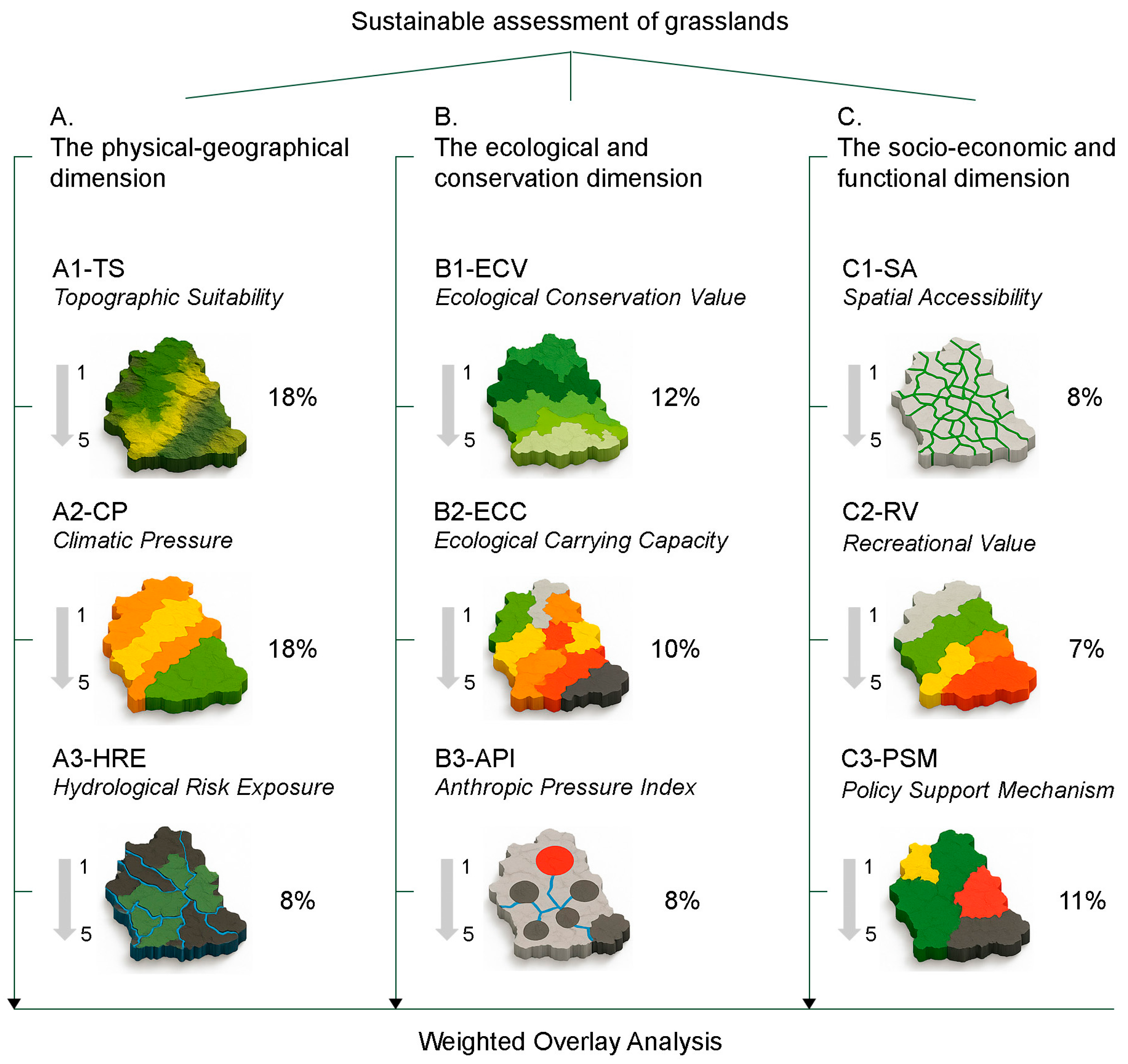
In the spatial integration stage, the weighted thematic raster layers corresponding to each criterion were combined by means of the WOA tool in ArcGIS, resulting in a composite suitability score for every grassland polygon. The integration process, illustrated conceptually in Figure 2, shows how the three main decision dimensions, physical-geographical (A), ecological and conservation (B), and socio-economic and functional (C), converge into a unified model that synthesizes spatial variability and assigns differentiated suitability levels to each grassland unit. The final composite values were classified using the Natural Breaks (Jenks) method into four potential categories: very high, high, moderate and unfavourable, allowing a clear hierarchical separation of grassland suitability across the entire study area.
To evaluate the robustness of the model, Pearson correlation analyses were performed between the included factors, alongside internal comparisons of factor values across the four suitability classes. The results confirmed the distinct internal composition of the classes, reinforcing the internal validity of the spatial decision structure and suggesting that the combination of natural, ecological and socio-economic variables performs reliably in discriminating areas with contrasting management potential.
The resulting model provides a coherent spatial distribution of grassland favorability, enabling the identification of overused, underutilized, or vulnerable sectors and offering decision support for sustainable management and the targeting of interventions within the CAP. In this sense, the model not only maps existing conditions but also highlights strategic areas where conservation measures, grazing regulation or agri-environmental payments may yield the greatest long-term benefit.

3. Results

The spatial distribution of grasslands in Hunedoara County was analysed using statistical and geospatial indicators employed as exploratory tests of spatial structure, with the aim of assessing whether the observed patterns are driven by spatial proximity or by the local combination of criteria integrated within the GIS-AHP analysis. In this context, the global spatial autocorrelation analysis (Moran’s I) applied to grassland areas in Hunedoara County yielded an index value of 0.0191, a z-score of 1.37, and a p-value of 0.1699. These results indicate a slightly clustered spatial distribution that is not statistically significant (p > 0.05), suggesting the absence of a clear global tendency toward significant clustering or dispersion of grassland areas.

3.1. Results of the Influencing Factor Assessment

3.1.1. Physico-Geographical Constraints and Conditioning Factors

Topographic Suitability (A1-TS)
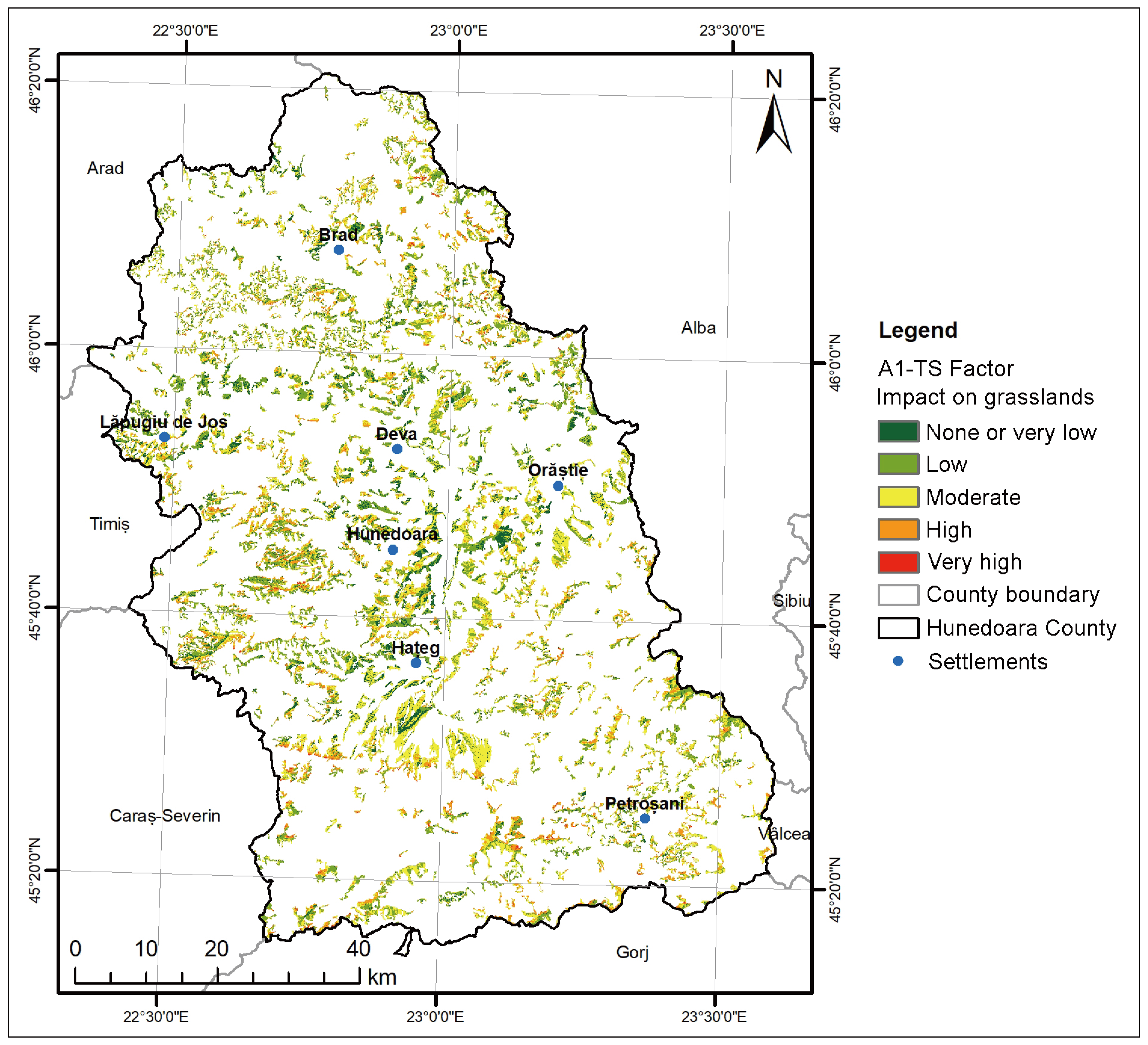
The spatial analysis applied to the study area (Figure 3) shows that 14,176 ha of grasslands, representing 11% of the total, fall within very favourable zones, where topographic impact is negligible or very low, with slopes between 0–5° and an east-southeast aspect. These areas provide excellent conditions for mowing and grazing, without exploitation constraints or risks of physical degradation.
A total of 36% of the grasslands, equivalent to 45,135 ha, are slightly affected by topographic conditions (impact class 2), corresponding to slopes of 5.1–10° and S-SW aspects, yet generally remaining favourable for pastoral use. Approximately 43,236 ha, representing 34%, are moderately affected by the A1-TS factor (class 3), located on slopes of 10.1–20° with western exposure, where local difficulties may arise in the application of mechanized maintenance work, along with risks of reduced soil fertility and vegetation productivity. Meanwhile, 22,068 ha of grasslands (18%) are strongly constrained by the same factor (class 4), situated on slopes of 20.1–35° and NW-NE aspects, where erosion vulnerability is high and requires special management interventions. Finally, 973 ha (1%) fall within highly unfavourable areas, strongly influenced by A1-TS (class 5), characterized by slopes exceeding 35.1° and northern exposure, representing the most limited and ecologically fragile terrains regarding use and stability.
Overall, 47% of the grasslands (59,310 ha) lie in favourable or relatively favourable topographic conditions, highlighting a valuable potential for pastoral utilisation. In contrast, grasslands significantly affected by this factor (impact classes 4 and 5) sum up to 23,041 ha (19%), representing areas where adaptive management interventions and institutional support are required.
Spatially, grasslands belonging to the favourable and relatively favourable A1-TS classes are predominantly concentrated in the Mureș, Orăștie and Bistra corridors, as well as in the Hunedoara and Hațeg depressions, where gentler relief supports pastoral use. In contrast, strongly and very strongly constrained classes are mainly located in the Retezat, Parâng, Țarcu and Vâlcan mountain ranges, where steep slopes and unfavourable exposure limit accessibility and management intensity.
Climatic Pressure (A2-CP)
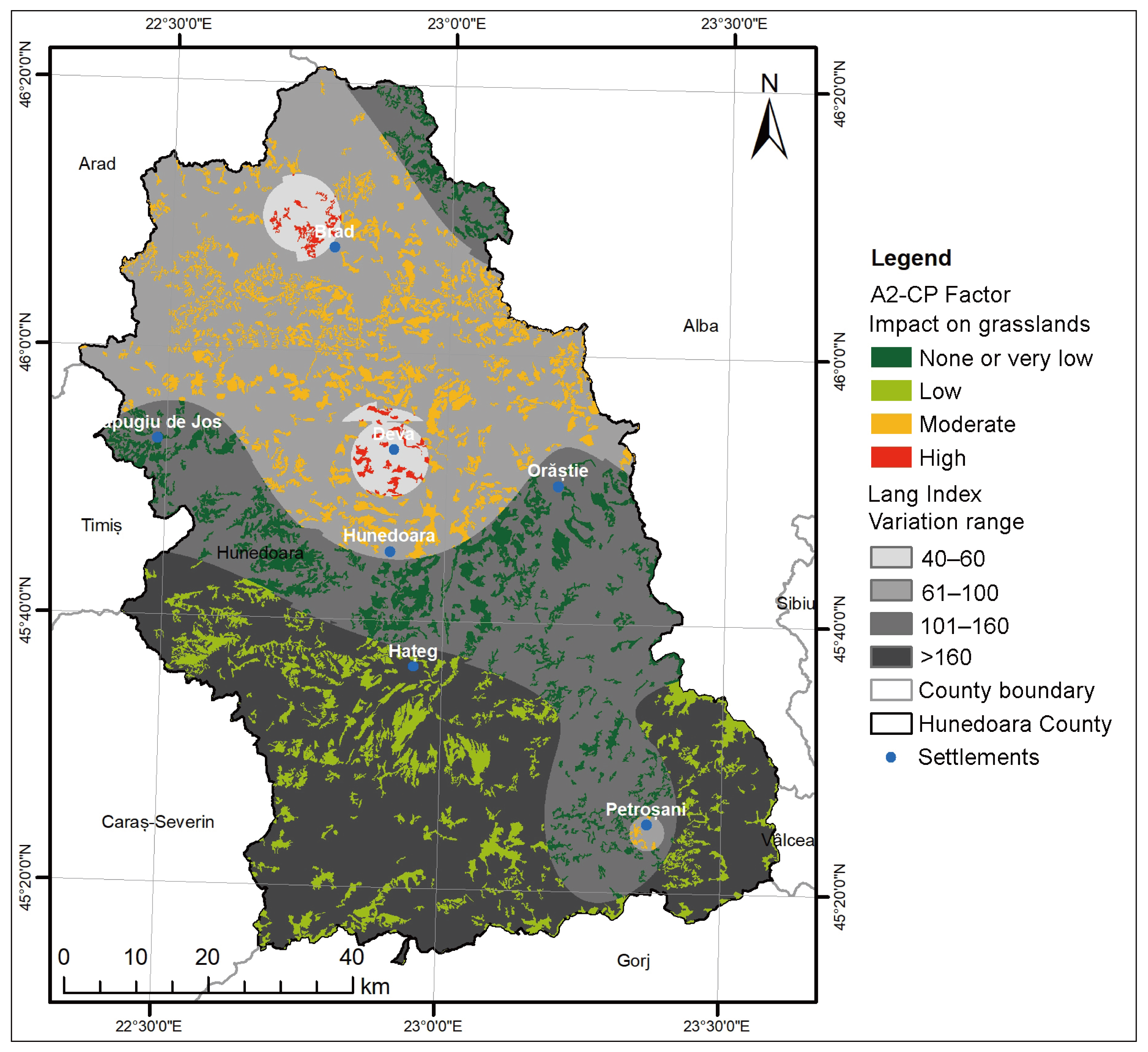
Based on Lang Index values and therefore on climatic impact, grasslands were grouped into four classes, distributed as shown in Figure 4.
Results indicate that 81,781 ha of grasslands, representing 63% of the total area, occur under favourable climatic conditions, being very weakly or weakly affected by climatic pressure. Of these, 40,053 ha (31%) fall within class 1, defined by temperate-humid climatic conditions with no major climatic constraints, while 41,728 ha (32%) belong to class 2, specific to a humid climate, slightly more sensitive to seasonal variations yet still favourable for vegetation development (Figure 4).
Additionally, 34% of the grasslands (44,542 ha) are moderately affected by climatic conditions (class 3. warm temperate climate), where episodes of thermal or hydric stress may become relevant during certain seasons, particularly in lowland and hilly areas.
The area under high climatic pressure (class 4) is very limited, totalling only 3161 ha (≈2%). These grasslands are located in semi-arid zones (R = 40–60), where reduced water availability and elevated temperatures can restrict vegetation development and lower production capacity, requiring monitoring and adaptive management measures.
Overall, the spatial distribution of grasslands according to the A2-CP factor indicates a clear predominance of favourable climatic conditions for sustainable grassland development and use. Thus, 98% of grassland surfaces occur in areas with null/low or moderate climatic pressure, supporting the stability of these ecosystems and their agricultural potential within the socio-economic context of rural communities.
The spatial distribution of climatic vulnerability classes highlights a concentration of favourable conditions within intramontane depressions and low-altitude corridors (Hunedoara, Hațeg, Mureș), while higher climatic pressure classes are associated with high mountain areas of the Retezat, Parâng and Șureanu ranges, where altitude and exposure intensify thermal and hydric stress.
Hydrological Risk Exposure (A3-HRE)
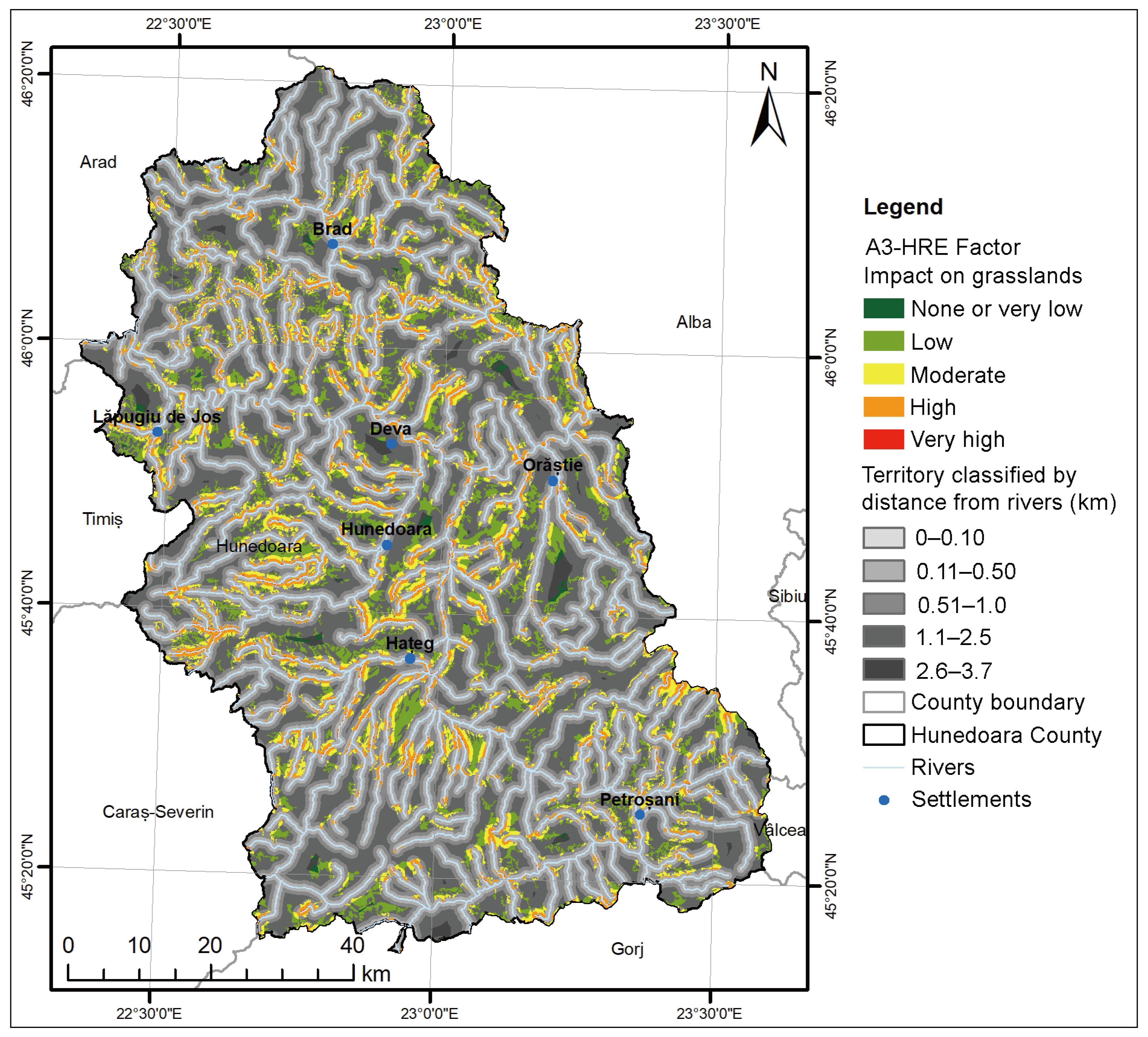
From the perspective of the A3-HRE factor, grasslands in the study area were classified into five impact classes based on their distance from rivers, as illustrated in Figure 5.
In this context, A3-HRE should be interpreted as a proximity-based indicator reflecting relative exposure to moisture-related constraints in the vicinity of watercourses, rather than as a direct representation of flood hazard or hydrological processes. The spatial pattern therefore highlights areas potentially affected by excess soil moisture or management limitations associated with river proximity, without implying detailed differentiation of floodplain morphology or hydrodynamic behaviour.
Spatial analysis results show that most of the grasslands included in the study are located at safe distances from watercourses, and are therefore less exposed to flood risk. Only 1% of the total surface (1176 ha) falls within class 1, characterised by null or very low hydrological impact, located more than 2.6 km from the hydrographic network. A proportion of 35% of grasslands, totalling 45,604 ha, falls within class 2, where hydrological impact is low and distances from rivers range between 1.1 and 2.5 km. Additionally, 42,744 ha (33% of the total) correspond to the moderate-risk class, situated 0.51–1.0 km from the river network.
Grasslands belonging to these three categories amount to 69% of the total (89,524 ha) and define the most favourable areas in terms of hydrological exposure (Figure 5).
Conversely, 5% of the grassland area (6611 ha) lies within less than 100 m from watercourses (class 5), representing highly vulnerable zones where flood events may significantly impact vegetation; meanwhile, 26% of grasslands (33,350 ha) are located 101–500 m from rivers, exhibiting a high level of exposure and requiring continuous monitoring and, in some cases, protection and mitigation measures.
Spatially, grasslands with low A3-HRE exposure are mainly located on interfluves and mountain slopes, whereas higher exposure classes are concentrated along major river corridors, particularly within the Mureș corridor and the Hunedoara and Hațeg depressions, where proximity to watercourses imposes additional management constraints.

3.1.2. Ecological Values and Conservation

Ecological Conservation Value (B1-ECV)
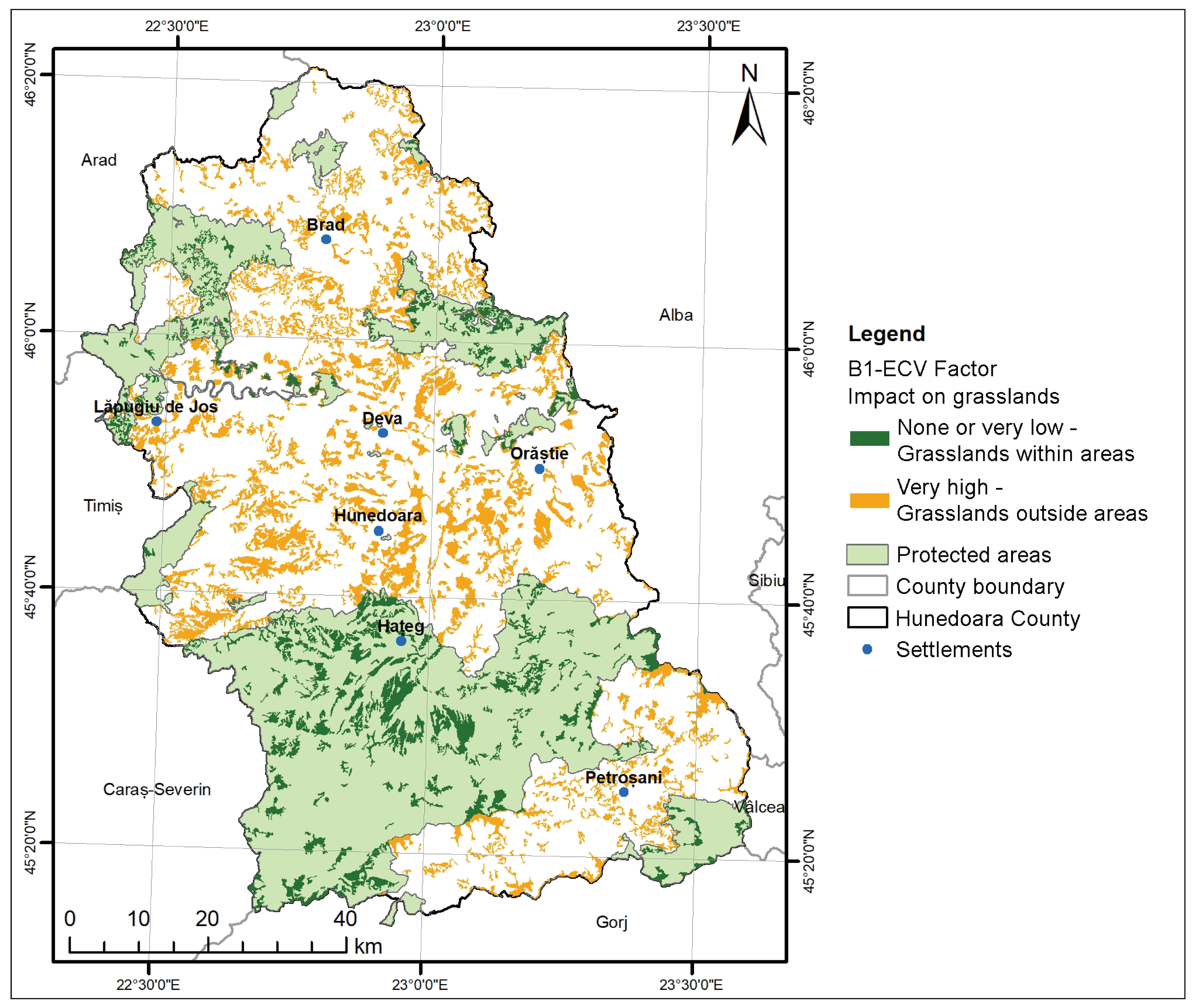
Overlay analysis results indicate that 42,041 ha of grasslands (32%) fall within protected areas (Figure 6), zones in which human activities are strictly regulated and ecological processes enjoy formal protection. These areas are considered highly favourable in terms of ecological value, playing a key role in maintaining ecosystem integrity.
Of the total grassland area analysed, 68% (87,481 ha) lies outside protected natural areas, which makes these surfaces more vulnerable to conversion, degradation or intensification in the absence of clear ecological protection measures.
The spatial distribution of grasslands according to the B1-ECV factor illustrates a contrasting reality: although a significant proportion of grasslands is included within protected areas, the majority of the surface (over two thirds) does not benefit from an institutional conservation framework. In this sense, the B1-ECV factor enables the identification of ecologically favourable grasslands while simultaneously signalling the need for additional sustainable management measures for those located outside the protected area network.
Grasslands overlapping protected areas are mainly concentrated within the Retezat, Țarcu, Parâng and Vâlcan mountain ranges, reflecting the spatial coincidence between high ecological value grasslands and major conservation units. In contrast, grasslands outside protected areas dominate corridors and depressions, where land-use pressures are generally higher.
Ecological Carrying Capacity (B2-ECC)
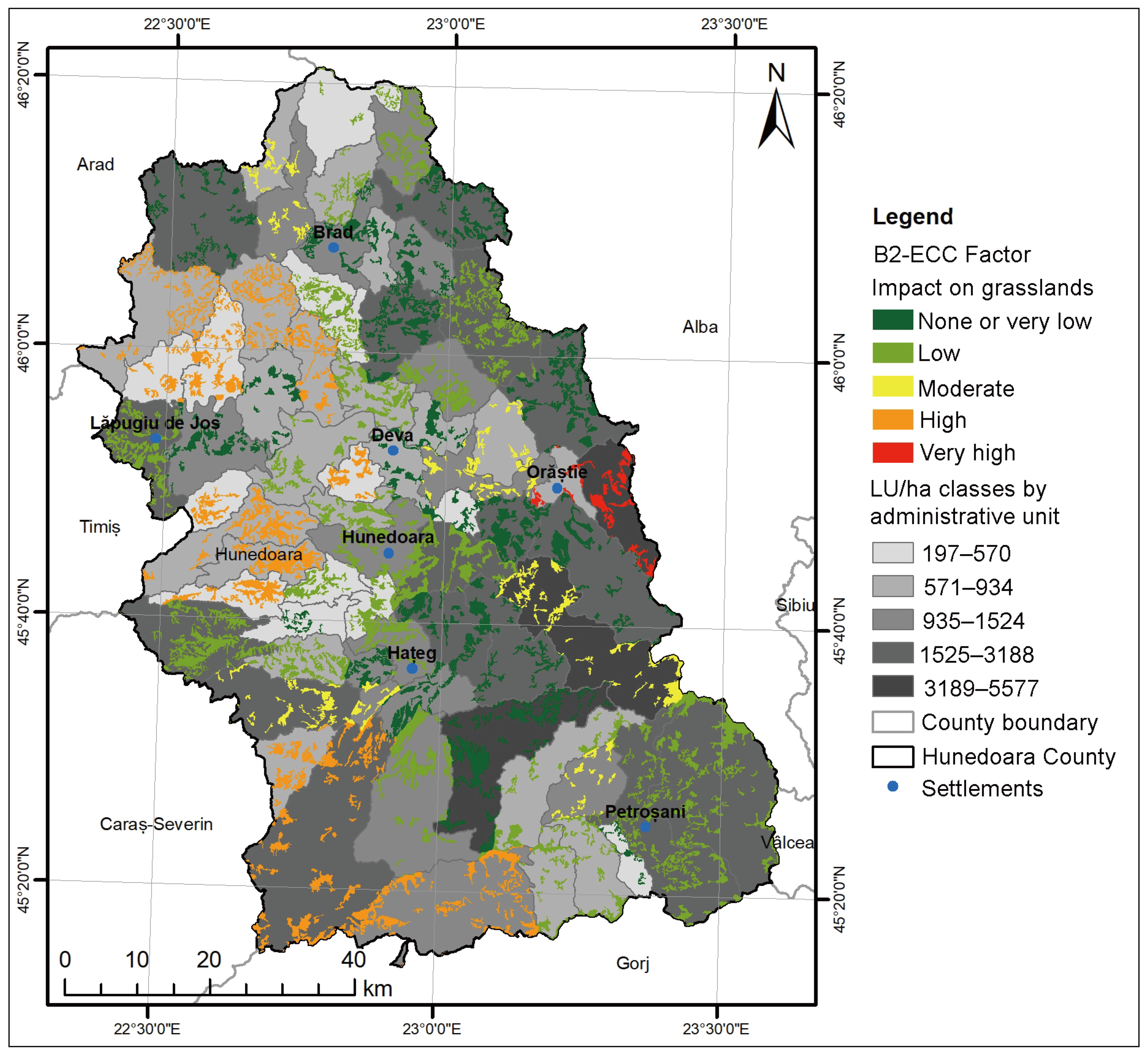
The results of the B2-ECC-based assessment (Figure 7) show that the most favourable grasslands, from the perspective of zoopastoral balance, are those with optimal utilisation or low-pressure regimes. Thus, 37,540 ha, representing 29% of the total surface, fall into the category of optimal use, approaching the natural support capacity, while 51,541 ha (40%) lie within the low-impact class, characterised by low but sustainable grazing pressure, allowing efficient vegetation regeneration.
Together, these two categories account for approximately 70% of the grasslands, indicating a general trend of moderate and balanced use across the study area.
However, clear dysfunctions are also present. A total of 9563 ha (7%) fall into the class of grasslands moderately affected by the B2-ECC factor, where livestock load ranges between 1.10 and 2.00 LU/ha and the risk of overgrazing becomes significant. Additionally, 28,536 ha (22%) were classified in the high-impact class due to underutilisation, defined by less than 0.40 LU/ha, reflecting sectors where pastoral resources are insufficiently exploited. Furthermore, 2335 ha (2% of the total) belong to class 5, where livestock pressure exceeds 2.10 LU/ha, indicating excessive grazing impact with degrading effects on vegetation cover and soil stability.
The spatial pattern of B2-ECC reflects the administrative aggregation of livestock density data and therefore highlights differences in grazing pressure and management intensity between territorial units rather than fine-scale ecological gradients. The resulting geometry is an inherent characteristic of the underlying statistical data and should be interpreted as an indicator of management-related pressure on grasslands, complementing the physically continuous variables included in the model.
The spatial pattern of the B2-ECC indicator shows more balanced grassland use in mountain and submontane areas, particularly in the Poiana Ruscă, Șureanu and Metaliferi units, while underuse is more frequent in peripheral and poorly accessible areas, and overgrazing occurs locally in depressions and corridors with high livestock density.
Anthropic Pressure Index (B3-API)
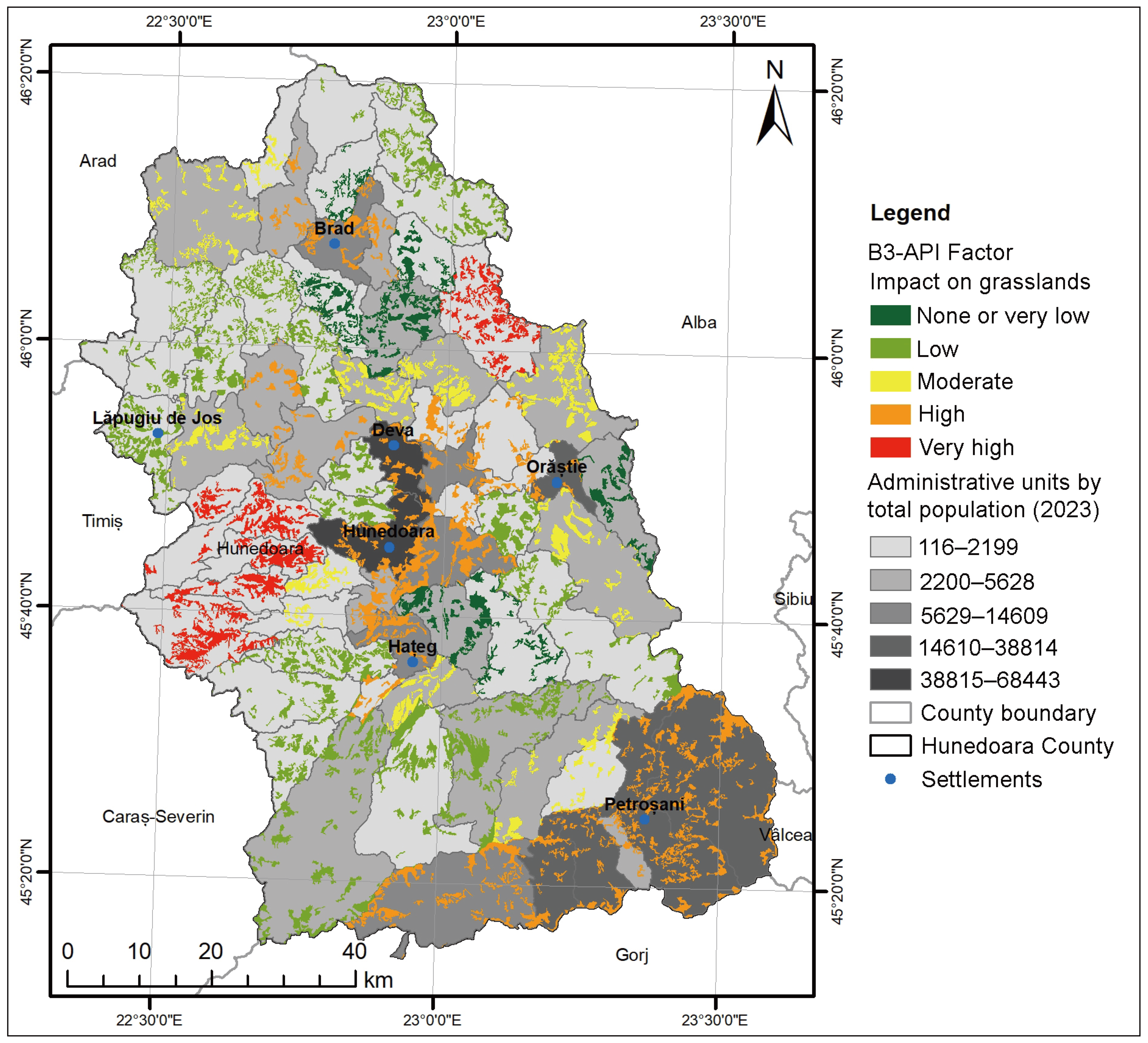
The distribution of grasslands according to the B3-API factor (Figure 8) highlights major differences in the anthropogenic pressure exerted on pastoral resources. Thus, 13,813 ha (11% of the total) fall into the class where B3-API impact is null or very low, corresponding to GAII values between 0.71–1.0 ha/inhabitant, reflecting an optimal ratio between available resources and the potential user population. On 44,947 ha (35%), pressure is low, indicated by GAII values between 1.1 and 4.0 ha/inhabitant, which favours the maintenance of a balance between use and conservation. A proportion of 15% (20,036 ha) lies within the moderate-impact class (GAII 0.51–0.70 ha/inhabitant), where anthropogenic pressure becomes visible and may gradually reduce the vegetation’s regenerative capacity.
Furthermore, 35,539 ha (27%) fall into the high-impact category, with GAII values between 0.10–0.50 ha/inhabitant; these grasslands are located in densely populated areas or in regions with insufficient pastoral resources, indicating overexploitation and increased degradation risk. Finally, 15,179 ha (12%) exhibit very high B3-API impact (GAII 4.1–7.7 ha/inhabitant), representing areas where grassland availability is high but risks of underuse, abandonment or establishment of low-value forage vegetation are significant.
The results show a large variation in anthropogenic pressure depending on the local socio-demographic context. Nearly 40% of grasslands (classes 3 and 4) occur in areas where the ratio between population and pastoral resource is unbalanced and requires protective measures.
Spatially, grasslands characterised by null or low B3-API impact are mainly concentrated in mountain and submontane areas, particularly within the Retezat, Țarcu, Godeanu and Vâlcan ranges, where population density is low and pastoral use is extensive or seasonal. In contrast, high and very high impact classes are predominantly located in the Hunedoara and Hațeg depressions, as well as in the Mureș and Orăștie corridors, where population concentration and land fragmentation generate increased socio-ecological pressure on grassland resources.

3.1.3. Accessibility, Functionality and Institutional Support

Spatial Accessibility (C1-SA)
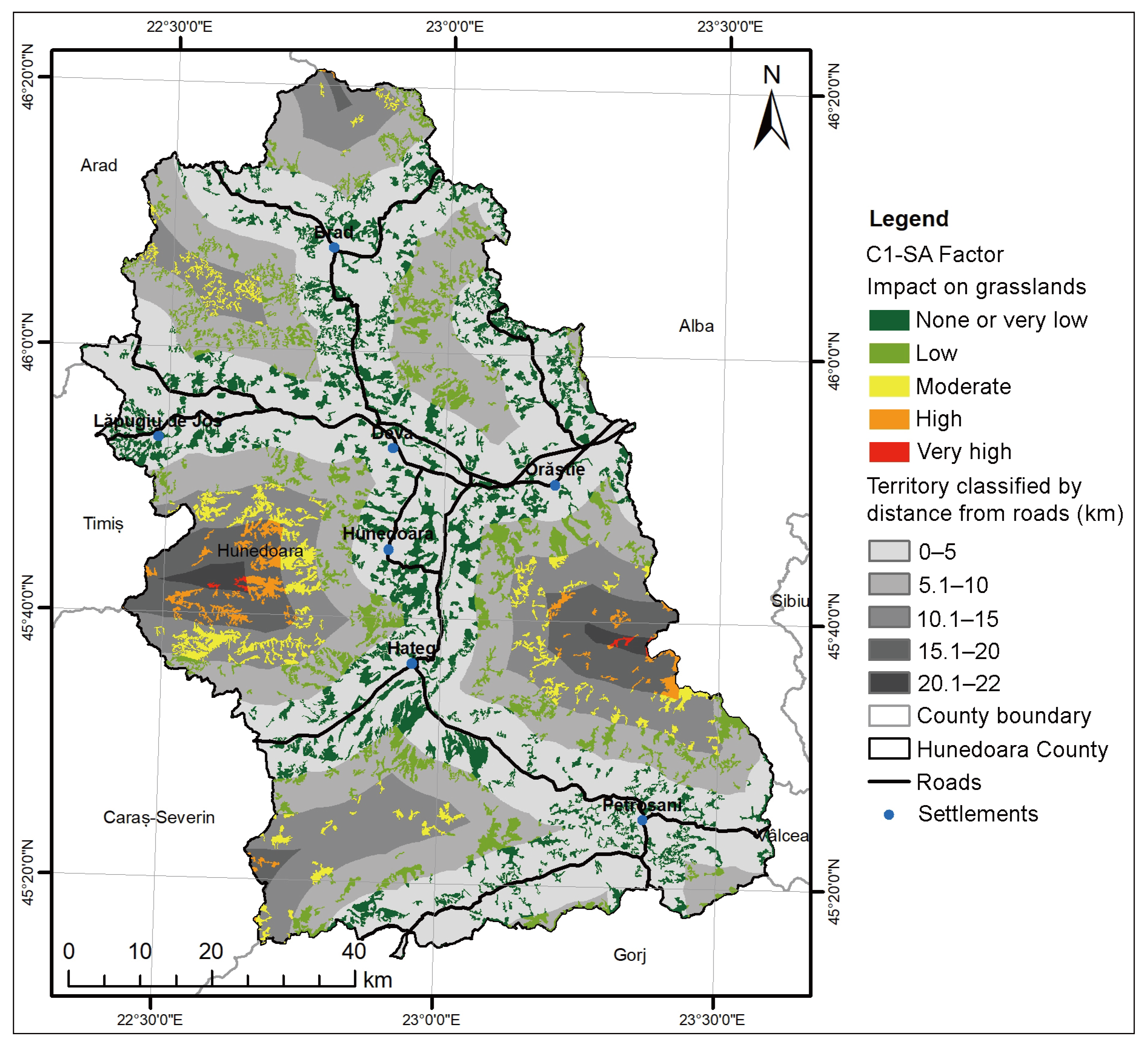
Spatial analysis results show that most grasslands included in the study benefit from good connectivity to the road network. A total of 65,426 ha (51% of the surface) lie within less than 5 km of road infrastructure, the most favourable category, where rapid access facilitates efficient and economically viable exploitation. Additionally, 39,497 ha (31%) are located 5.1–10 km from road networks, which indicates generally good accessibility but with slightly increased logistical constraints (Figure 9).
Together, the two categories previously mentioned account for more than 80% of the total grassland area (104,923 ha), confirming the generally favourable role of the road network in supporting the utilisation of these resources.
Regarding less accessible areas, 24,128 ha of grasslands (18%) are located 10.1–20 km from roads, often situated in mountainous or marginal zones where pastoral activities may be more costly or seasonally restricted. Only 434 ha (<1%) lie more than 20 km from the road network, representing isolated grasslands with limited accessibility and low agricultural potential according to this indicator-unless infrastructural improvements are implemented.
Spatially, grasslands with high accessibility are concentrated in the Mureș, Orăștie and Hunedoara corridors, where road network density facilitates regular use. In contrast, grasslands with low accessibility are mainly located in the Retezat, Godeanu, Țarcu and Parâng mountain ranges, where infrastructure is limited and use is often seasonal or extensive.
Recreational Valuation (C2-RV)
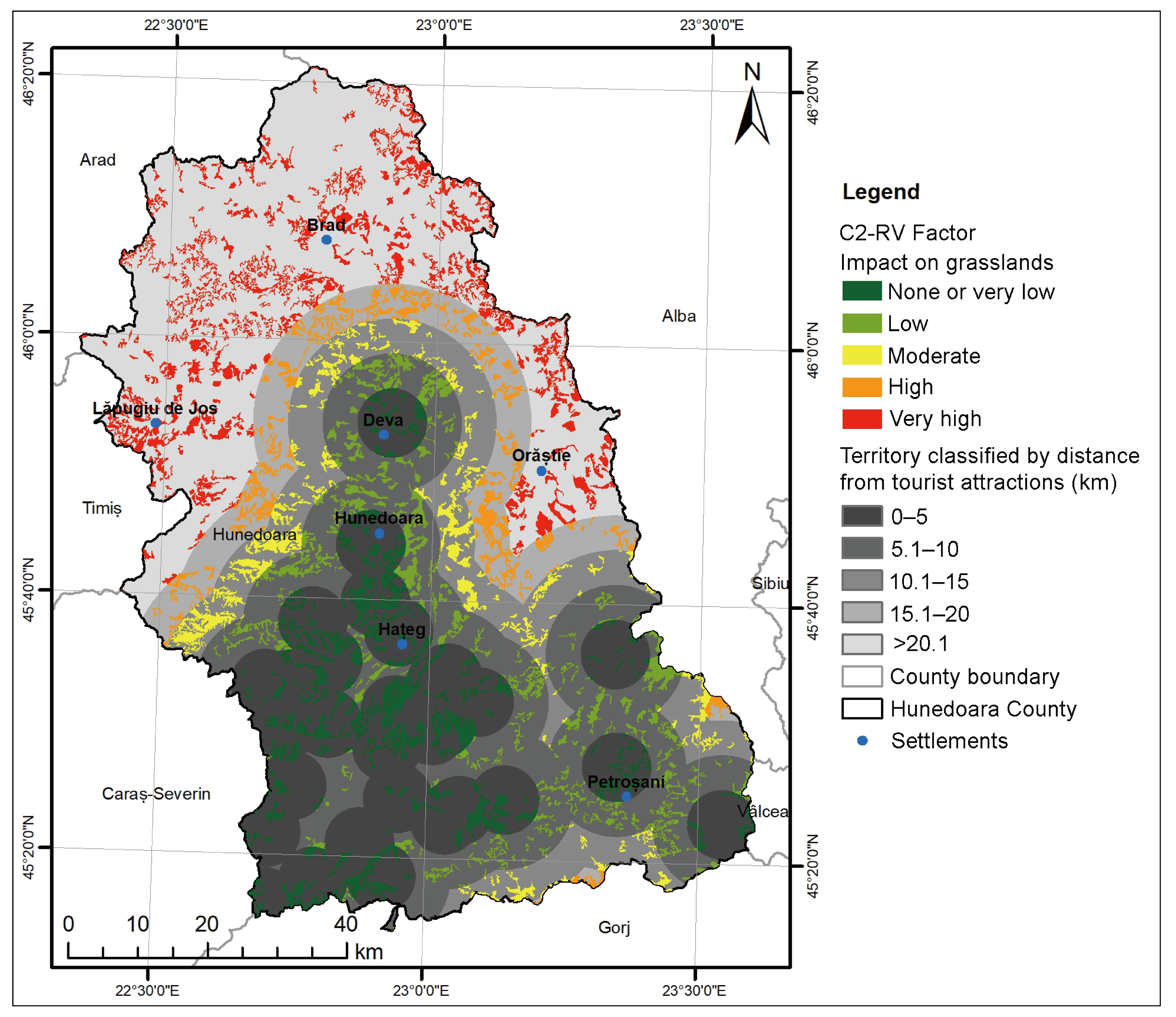
Following geospatial layer interpretation, results show that 57,495 ha of grasslands (45%) are located less than 10 km from areas of tourist interest (Figure 10).
Grasslands located at medium to long distances from tourist attractions show a gradual decrease in recreational potential: 15,601 ha (12%) lie 15.1–20 km away, while 37,572 ha (29%) are situated more than 20 km from tourism sites, in areas with minimal tourist influence, where integration into visitation circuits or rural tourism projects would require additional investment. This distribution highlights that a substantial proportion of grasslands (more than one third) benefit from good or very good recreational accessibility, opening opportunities for economic diversification in rural communities, reducing pressure from exclusive agricultural use, and enhancing their social value.
Grasslands with high recreational potential are predominantly located near the Retezat, Parâng and Șureanu mountain ranges, as well as within the Hunedoara and Hațeg depressions, where major tourist attractions and related infrastructure are concentrated. In contrast, grasslands situated in peripheral or weakly connected areas, particularly in the southern and south-western parts of the county, exhibit low recreational potential.
Policy Support Mechanism (C3-PSM)
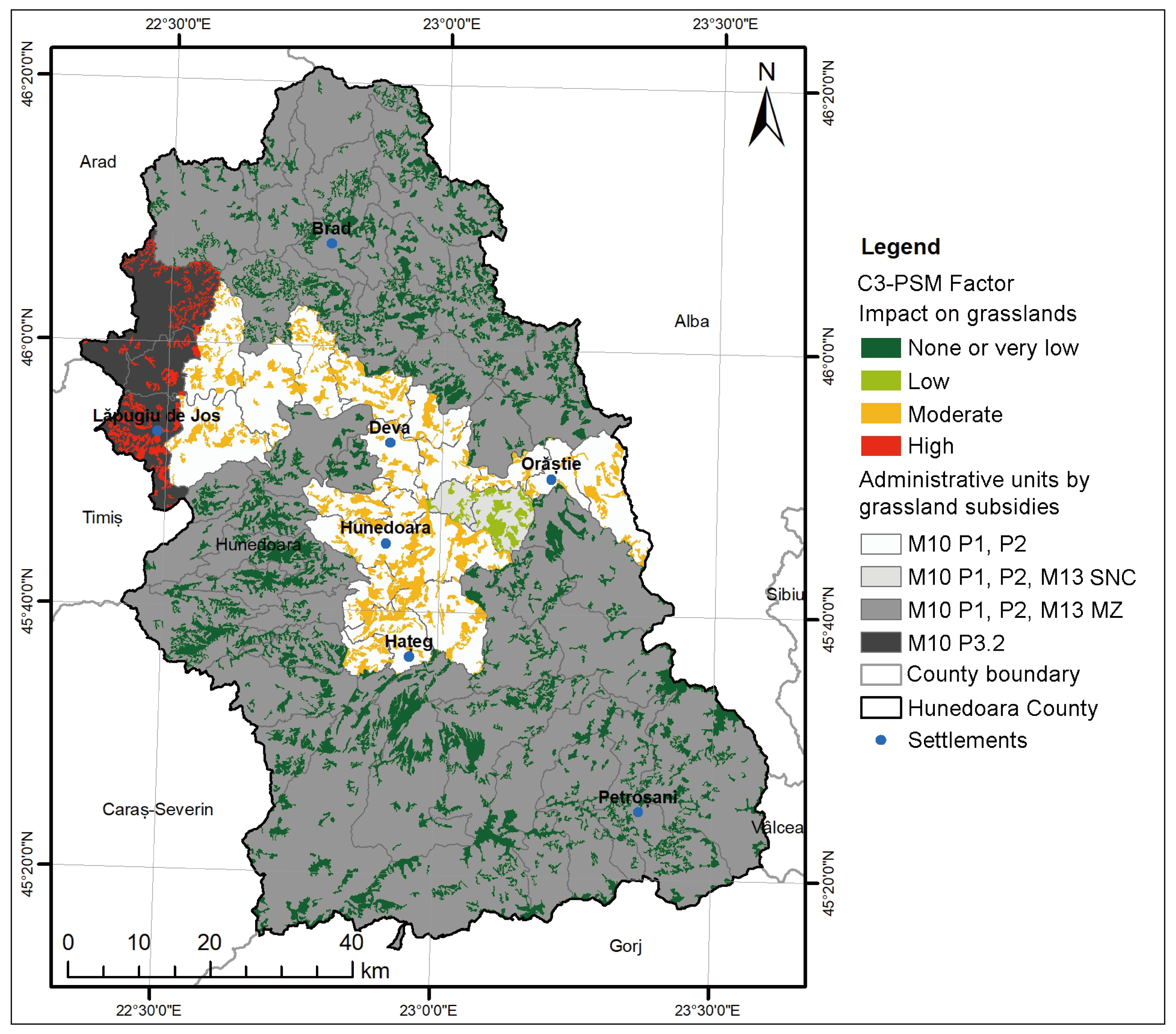
The results show that a large proportion of the grassland surface benefits from effective support schemes (Figure 11). A total of 92,181 ha, representing 71% of the total, fall under cumulative support through M10 and M13-MZ measures, contributing significantly to maintaining ecological quality and productivity, particularly in mountain regions or areas with high natural value. Additionally, 28,027 ha of grasslands (22%) benefit exclusively from M10-P1 and P2 support, which provides partial but still effective assistance for preserving agro-ecological functions.
Areas where support is more specific or limited occupy comparatively reduced surfaces. A total of 6257 ha (5%) fall under M10-P3.2 measures aimed at bird habitat conservation, with moderate influence on direct grassland use. Moreover, 3049 ha (2%) benefit from support targeted especially toward areas severely affected by natural constraints (M13-SNC), in combination with M10.
The spatial distribution of institutional support shows a concentration of cumulative measures (M10 and M13) in mountain and submontane areas, particularly within the Retezat, Țarcu, Parâng and Vâlcan ranges, where natural constraints justify stronger support. In contrast, partial or limited support schemes are more frequent in lowland corridors and depressions, where socio-economic pressures are higher and eligibility for compensatory measures is more restricted.
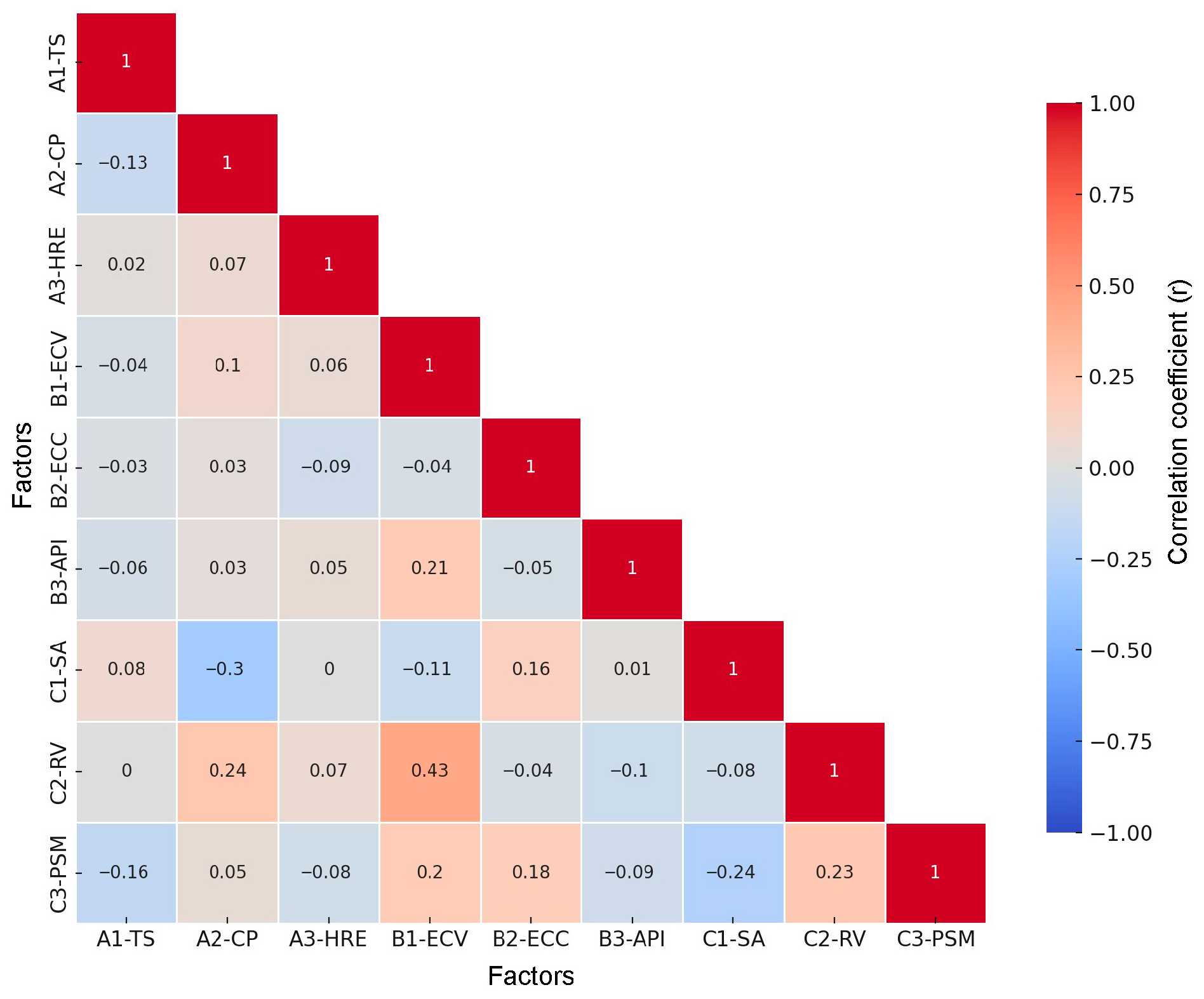
Before integrating the nine factors into the multicriteria evaluation through the WOA method, a correlation analysis was performed to avoid possible informational overlaps that might affect the validity of the weights established through AHP. Thus, a Pearson correlation matrix was generated based on reclassified values extracted from a random sample of 500 points distributed across the study area and visualised as a heatmap (Figure 12).
The results indicate a low correlation between most factor pairs (r < 0.3), suggesting distinct spatial variability and a low degree of redundancy.
The analysis of relative factor contributions indicates that the resulting suitability is not driven by a single dominant factor, but rather by interactions and trade-offs between biogeophysical constraints, anthropogenic pressures, and the institutional framework. In some cases, favorable natural conditions are partially offset by accessibility or institutional limitations, leading to differentiated positioning within the suitability classes.

3.2. Composite Grassland Potential Score

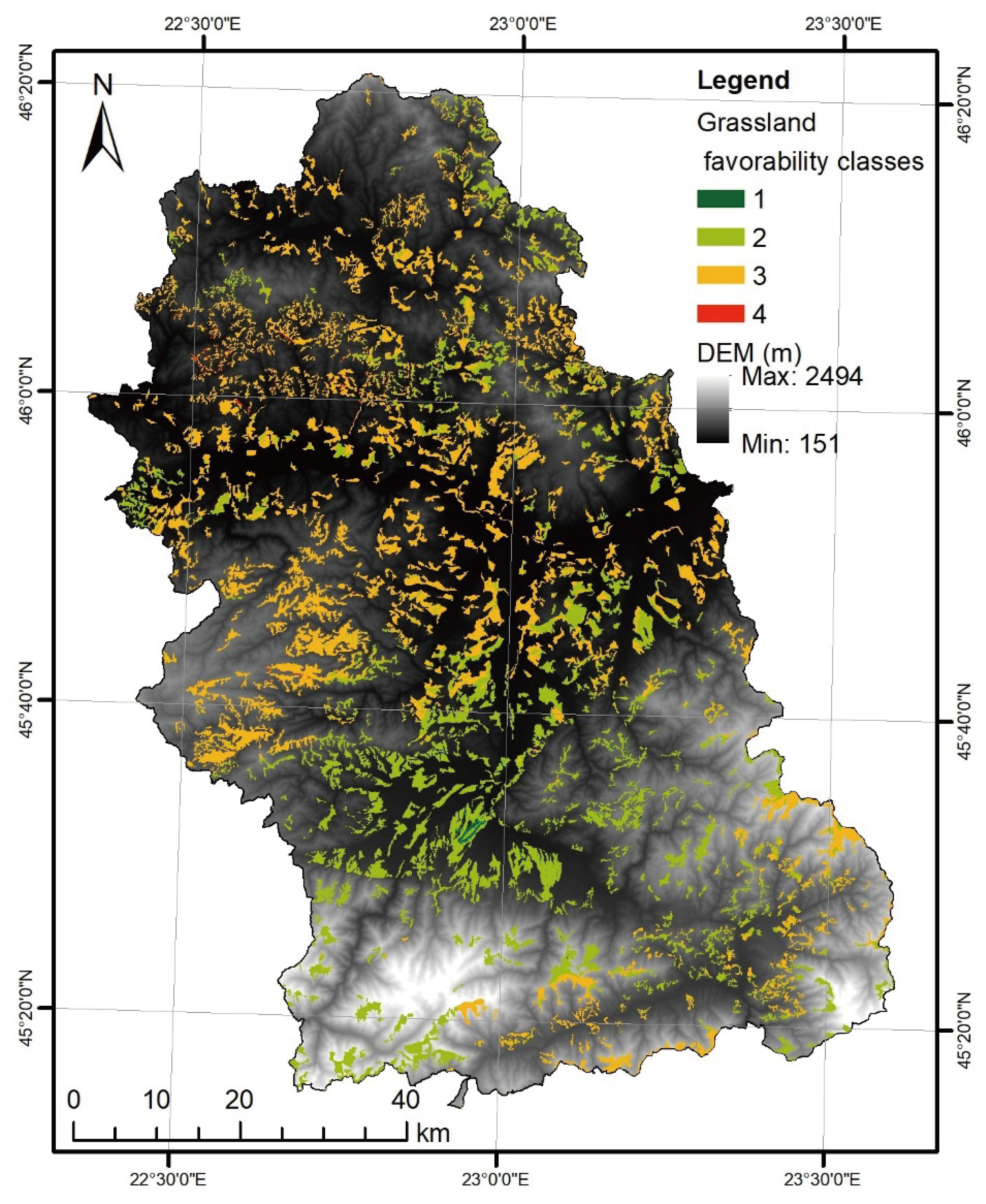
Following the WOA multicriteria analysis, the total grassland surface was classified into four favourability (potential) classes (Figure 13).
1. Class 1-grasslands with very high potential; this class includes 498 grassland entities, covering a total area of 503 ha (0.43% of the total). The average size of these units is 1.01 ha, with a maximum of 252.39 ha and a standard deviation of 11.34 ha.
Grasslands in this category are characterised by a low level of overall limitations resulting from the integration of factors, driven primarily by favourable physical-geographical conditions and the presence of a conservation-related institutional framework. The very high potential reflects low anthropogenic pressure and a regulatory regime rather than conditions of socio-economic intensification.
2. Class 2-grasslands with high potential; this is the most extensive class, comprising 6842 grassland entities and a total area of 52,221 ha (44.51%). The average area is 7.63 ha, with moderate variability (standard deviation of 46.40 ha).
These grasslands correspond to areas with a relatively low combined influence of limiting factors within the integrated index. The classification reflects the outcome of weighted multicriteria integration of the analysed factors, rather than the process-based accumulation of individual constraints, indicating generally favourable conditions with moderate limitations arising from different groups of factors.
3. Class 3-Moderate-potential grasslands: includes 5717 units, totalling 64,229 ha (54.75% of the analysed surface). The mean area is 11.23 ha and the standard deviation is 65.34 ha, indicating a more heterogeneous distribution. Grasslands in this class are subject to moderate limitations and require targeted interventions to improve suitability.
4. Class 4-Unfavourable grasslands: the least represented category, with only 459 grassland units covering 362 ha (0.31%). The mean surface is 0.79 ha, with a standard deviation of 1.76 ha, showing a predominance of small, scattered plots. Unfavourable grasslands are characterised by high cumulative impact and require restoration, rehabilitation or potential land-use reconversion.
From a spatial perspective, grasslands with very high and high potential are predominantly concentrated in lowland corridors and intramontane depressions (Mureș, Orăștie, Hunedoara, Hațeg), as well as in submontane areas of the Poiana Ruscă, Metaliferi and Șureanu ranges, where favourable physical conditions coincide with good accessibility and institutional support. In contrast, grasslands with moderate potential dominate extensive mountain areas, reflecting trade-offs between topographic constraints, ecological pressures, and accessibility limitations. Unfavourable classes are scarce and spatially fragmented, mainly associated with peripheral, poorly accessible or strongly constrained areas, where the cumulative effect of limiting factors significantly reduces pastoral functionality.
Although the results are presented as discrete suitability classes, these classes aggregate continuous multicriteria scores, implying a notable degree of internal heterogeneity. In particular, areas located at the boundaries between moderate and high suitability reflect gradual transitions in environmental conditions, accessibility, and institutional support rather than sharp spatial thresholds.
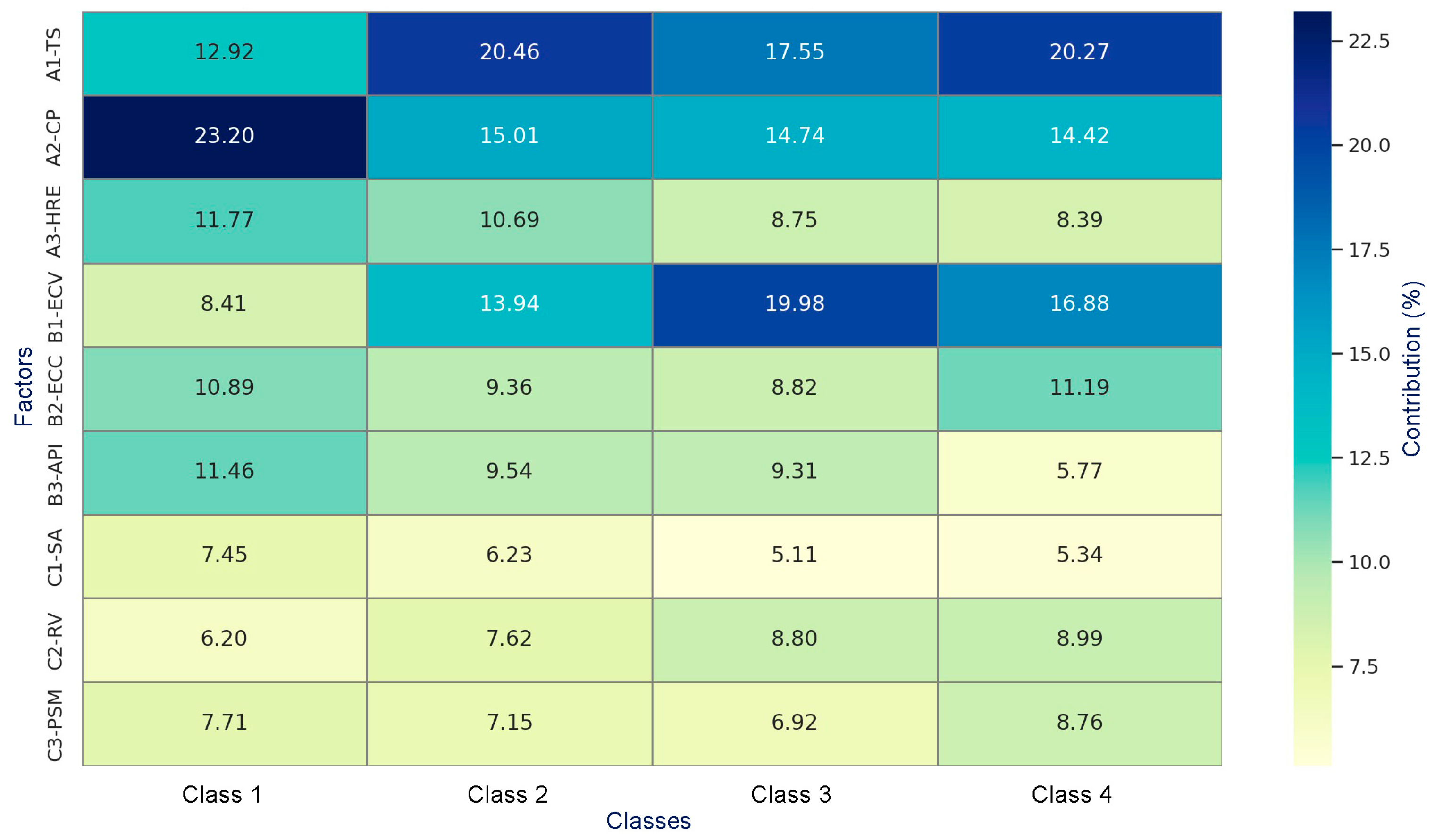
The integrated analysis of the absolute values and relative proportions associated with the nine factors included in the WOA model revealed notable variations among the four grassland suitability classes.
The mean favourability score, computed as a weighted sum of the reclassified factor values (via WOA), ranges from 1.43 in Class 1 (very high-potential grasslands) to 3.55 in Class 4 (unfavourable grasslands). This gradient reflects a gradual deterioration of ecological and territorial conditions, expressed through the cumulative influence of limiting factors (Figure 14).
Regarding the relative contribution of each factor to the total score per class (Figure 14), several distinctive patterns can be observed.
In Class 1, representing grasslands with very high potential, factor A2-CP shows the highest contribution (23.20%), followed by topographic conditioning A1-TS (12.92%) and hydrological exposure A3-HRE (11.77%). This configuration indicates that the most favourable grasslands occur in areas with optimal physico-geographical conditions and low anthropogenic pressure.
In Class 2, corresponding to high-potential grasslands, the influence of A1-TS increases substantially (20.46%), while the weight of B1-ECV doubles compared to Class 1 (13.94%), suggesting a shift towards areas with slightly more restrictive physical geography but with stronger ecological protection due to the presence of natural protected areas.
In Class 3, which includes grasslands with moderate potential, B1-ECV becomes dominant (19.98%), signalling increased ecological pressure. At the same time, the contribution of socio-economic factors (C2-RV and C3-PSM) rises slightly, indicating that anthropogenic influences become more apparent.
In Class 4, which comprises unfavourable grasslands, the influence of topographic factors reaches its maximum (20.27%), while the role of institutional and tourism-related factors continues to increase. This trend is generally associated with the peripheral location of these grasslands and insufficient infrastructure in the most disadvantaged areas.
Overall, the combined interpretation of absolute values and relative weights shows that A1-TS, A2-CP and B1-ECV are the primary determinants of grassland favourability. By contrast, socio-ecological variables, C1-SA, C2-RV and C3-PSM, exert a lower influence across the overall study area, yet become increasingly relevant in marginal zones where grasslands are less functional and involve greater limitations for productive use.
The results should be interpreted in light of the inherent limitations of multicriteria aggregation, which involves the generalization of complex spatial processes and the discretization of continuous variables. In this context, the suitability map represents a synthetic decision-support tool, while a more detailed interpretation of spatial patterns, marginal areas, and policy implications is developed in the Section 4.

4. Discussion

4.1. Grassland Suitability as a Result of the Interaction Between Natural Constraints, Ecological Pressures, and the Socio-Institutional Context

The suitability map obtained through the integration of WOA analysis with AHP weights highlights a distribution dominated by intermediate suitability classes, reflecting the heterogeneous territorial conditions of Hunedoara County. More than 99% of the analyzed grassland area falls within the moderate, high, and very high suitability classes, while areas classified as unsuitable have a limited spatial extent. This distribution is consistent with findings reported in other GIS-MCDA applications conducted in mountainous or hilly regions, where the integration of biogeophysical, ecological, and socio-economic criteria commonly results in a concentration of scores in the mid-range rather than in extreme polarizations [32,36,39,44,46,69,70,71,72].
The interpretation of these results requires methodological caution. Within the MCDA framework, factor weights and contributions indicate their relative importance in differentiating suitability classes rather than the direct intensity of pressures or the absolute degree of constraint. Accordingly, factors such as topographic conditioning (A1-TS) and climatic pressure (A2-CP), which have high weights (18% each), primarily act as structural factors, explaining the spatial variation in suitability without necessarily implying degradation or severe limitations. For instance, although 19% of grasslands are located on slopes steeper than 20° (A1-TS classes 4 and 5), these areas are not inherently excluded from use but rather require adapted management practices and differentiated access, as also reported in other GIS-AHP applications carried out in complex relief settings [39,44].
The distribution of physical-geographical factors confirms the existence of clear territorial thresholds. From a climatic perspective, approximately 98% of grasslands fall into classes characterized by null, low, or moderate climatic pressure (Lang index > 60), indicating a generally favorable framework for vegetation development and for grazing and mowing use. Areas with high climatic pressure (≈2% of the total area) are spatially limited and do not significantly influence the overall suitability structure at the county scale, a situation comparable to that reported in similar studies conducted in European mountainous regions [32,73].
The ecological dimension introduces important functional differentiations. Approximately 32% of grasslands are located within protected natural areas, conferring high ecological value but also additional constraints on use. At the same time, carrying-capacity analysis shows that about 70% of grasslands operate under optimal or low-pressure use regimes (≤1 LU/ha), while nearly 24% are characterized by underutilization (<0.40 LU/ha), and around 9% indicate values associated with overgrazing risk (>1.10 LU/ha). Such functional imbalances are frequently reported in the literature on mountainous grasslands and highlight the need to link suitability assessments with conservation objectives and adaptive management strategies [32,41,44].
Socio-economic and institutional factors further refine the interpretation of suitability. More than 80% of grasslands are located within 10 km of the road network, indicating good accessibility; however, the distribution of socio-demographic pressure is highly contrasting. Approximately 39% of grasslands fall within classes of high and very high socio-ecological pressure, reflecting either resource overexploitation in densely populated areas or underutilization in areas affected by depopulation. In this context, institutional support (weighted at 11%) plays a key role in the functional differentiation of grasslands, particularly in mountainous and peripheral areas [62], where eligibility for measures M10 and M13 can offset accessibility constraints and demographic pressures, in line with European approaches to High Nature Value farmland and the compensation of natural constraints [74,75,76,77].
Recent studies emphasize the usefulness of integrating GIS and multicriteria analyses into territorial planning processes and the design of agricultural policy instruments, especially in vulnerable rural or mountainous contexts, where natural and socio-economic constraints require spatially differentiated, decision-oriented approaches [24,78,79,80,81,82].
Therefore, the suitability derived from the model should not be interpreted as a simple hierarchy of grassland “quality”, but rather as an expression of territorial compatibility among environmental conditions, use intensity, and the support framework. Similar to other GIS-AHP applications functioning as spatial decision-support systems, the results enable the identification of distinct patterns: areas with high suitability but vulnerable to underutilization; areas with moderate suitability where adaptive management is critical; and areas where cumulative constraints suggest prioritizing conservation or restoration interventions [37,39,80,83].
This integrated interpretation provides the suitability map with operational value for rural planning and sustainable grassland management and is aligned with recent trends in the development of Spatial Decision Support Systems for agricultural and territorial policies [38,48,84,85,86,87,88].

4.2. Contribution of Factors and the Decision-Support Value of the GIS-AHP-WOA Model

The analysis of the weights derived from the application of the Analytic Hierarchy Process (AHP) highlights the differentiated role of the selected factors in structuring the composite suitability score and, implicitly, the model’s capacity to spatially discriminate between distinct grassland types.
In this context, it is essential to emphasize that these weights do not express the direct intensity of environmental or socio-economic pressures. Instead, they reflect the relative importance of each factor within the multicriteria process used to differentiate alternatives, in accordance with MCDA logic [28,30,37].
Physical-geographical factors, particularly topographic conditioning (A1-TS) and climatic pressure (A2-CP), which recorded the highest weights (18% each), act as structural elements of the model, controlling the baseline spatial variation of suitability. This observation is consistent with the results of other GIS-MCDA applications conducted in mountainous and hilly regions, where topography and climate are recognized as dominant factors in delineating land functional potential through their cumulative influence on accessibility, ecological stability, and use-related costs [21,35,36,39]. However, their high weight within the model does not imply a direct causal relationship with degradation or use limitation, but rather reflects their capacity to spatially differentiate suitability classes within a territory characterized by complex relief.
Ecological factors (B1-ECV and B2-ECC), weighted at 12% and 10%, respectively, introduce an essential qualitative dimension into the interpretation of results, related to conservation value and the balance of livestock use relative to grassland carrying capacity. The integration of these criteria makes it possible to identify situations in which suitability derived from natural conditions is moderate or high but is accompanied by institutional constraints or functional risks associated with underutilization or overuse. This approach is consistent with studies emphasizing the need to link suitability assessments with conservation objectives and the maintenance of ecosystem services, particularly in mountainous grasslands [41,43,44,45,89,90,91].
Socio-economic and institutional factors (C1-SA, C2-RV, and C3-PSM), although characterized by lower individual weights (between 7% and 11%), play an important role in refining the interpretation of suitability and in transforming the resulting map into a decision-support tool. In particular, institutional support (C3-PSM), with a weight of 11%, highlights how policy frameworks can modulate the feasibility of grassland use, especially in areas characterized by physical-geographical constraints or limited accessibility. This finding is consistent with literature emphasizing the role of agricultural and rural development policies in maintaining the functional use of grasslands and reducing the risk of abandonment in marginal areas [15,38,40,92,93,94,95].
From a decision-making perspective, the main value of the GIS-AHP-WOA model does not lie in the simple ranking of grasslands into suitability classes, but in its ability to highlight distinct combinations of factors that lead to similar or contrasting outcomes. Thus, grasslands assigned to the same suitability class may exhibit different functional profiles: some are predominantly constrained by natural conditions, while others are limited by socio-demographic pressures or institutional constraints. This differentiation is essential for using the model as a Spatial Decision Support System (SDSS), enabling the adaptation of management interventions, support measures, and planning objectives to local contexts [37,40,41,42,93,95].
In this respect, the proposed model aligns with contemporary approaches in the GIS-MCDA literature that go beyond static suitability mapping and aim to support decision-making processes in contexts characterized by multiple constraints and potentially conflicting objectives [29,41,96]. By coherently integrating physical-geographical, ecological, and socio-institutional criteria, the GIS-AHP-WOA framework provides a transparent analytical basis for prioritizing interventions and facilitating dialogue between land-use, conservation, and rural development objectives, without assuming simplified causal relationships between factors and outcomes.

4.3. Uncertainties, Limitations, and Directions for Future Research

As with any spatial multicriteria analysis, the proposed GIS-AHP-WOA model is subject to a set of uncertainties and limitations that must be considered when interpreting the results and using them for decision support. A first source of uncertainty is related to the quality and spatial resolution of the input data. The exclusive use of open-source datasets ensured the reproducibility and transferability of the methodology, but it also imposed spatial generalizations, particularly for variables available at the administrative level (e.g., livestock density and socio-demographic pressure). These generalizations may mask fine-scale local variations and should therefore be interpreted as contextual indicators rather than as detailed representations of parcel-level processes [37,86,96].
A second limitation arises from the process of criteria selection and weighting using the AHP method. Although the evaluations were conducted by consensus and validated through consistency indicators (CR < 0.10), the assignment of weights remains inherently dependent on expert judgment [30,93,96]. Consequently, the results should not be interpreted as absolute values, but rather as the outcome of a coherent analytical framework designed to highlight relative spatial differentiation. The sensitivity of the model to moderate variations in weights was not explored exhaustively, representing an important direction for future research.
The discretization of continuous variables into ordinal classes and their aggregation through Weighted Overlay Analysis constitute another potential source of uncertainty. Although the reclassification thresholds were established based on the literature and local data distributions, this step involves an inherent loss of information and may influence the boundaries between suitability classes [37,39]. Accordingly, transitions between classes should be interpreted as zones of functional continuity rather than as abrupt breaks in grassland quality or usability.
In addition, the model adopts a static approach based on multiannual average conditions and relatively stable territorial structures. As a result, it does not capture the temporal dynamics of grassland use, rapid changes in socio-economic pressures, or the short-term effects of extreme climatic events. The integration of dynamic components or prospective scenarios could improve the explanatory and decision-support capacity of the model.
Despite these limitations, the GIS-AHP-WOA framework provides a coherent and transparent representation of relative grassland suitability at the county scale. Explicitly acknowledging uncertainties does not diminish the value of the results; rather, it clarifies their domain of applicability and emphasizes that the suitability map should be used as a strategic, decision-support and guidance tool, complementary to detailed analyses and field-based assessments.
In this context, future research may focus on testing the sensitivity of the model to variations in weights and reclassification thresholds, integrating higher-resolution or temporally explicit data (e.g., multiannual time series derived from remote sensing), and exploring alternative land-use and institutional support scenarios, with the aim of strengthening the role of the model as an adaptive decision-support tool for rural planning and sustainable grassland management.

5. Conclusions

This study demonstrates the applicability of integrating the Analytic Hierarchy Process (AHP) within a GIS framework, combined with Weighted Overlay analysis, for the spatial assessment of grassland suitability and for supporting sustainable management decisions at the regional scale. The application of the GIS-AHP-WOA model in Hunedoara County highlights differentiated territorial patterns resulting from the interaction between physical-geographical constraints, ecological values, and the socio-institutional context.
The results indicate that more than 99% of the grassland area falls within moderate, high, and very high suitability classes, suggesting a generally favorable potential for use. However, the integrated analysis of factors reveals significant functional imbalances: approximately 24% of grasslands are characterized by underutilization (<0.40 LU/ha), while about 9% show risks associated with overgrazing (>1.10 LU/ha), underscoring the need for differentiated management interventions.
Topographic conditioning and climatic pressure, which recorded the highest weights in the model (18% each), act as structural drivers of spatial suitability, while ecological and socio-institutional factors further refine use feasibility at the local level. In this context, institutional support (11%) plays a key role in maintaining the functional use of grasslands, particularly in mountainous and peripheral areas, where natural constraints and demographic pressures are more pronounced.
The main contribution of the study lies in treating grasslands as functional decision units and in positioning the GIS-AHP-WOA model as a spatial decision-support system capable of supporting the prioritization of management, conservation, and rural planning interventions. The methodology is reproducible, based on open-source geospatial data, and transferable to other regions characterized by complex relief and multiple constraints.
The explicit acknowledgment of methodological limitations and uncertainties emphasizes that the results should be used as a strategic guidance tool, complementary to detailed analyses. Future research may focus on testing the sensitivity of the model to variations in weights and on integrating dynamic components, with the aim of strengthening its role in supporting sustainable grassland management.

Author Contributions

Conceptualization, L.L.C., N.M.H. and L.C.; methodology, L.L.C. and L.C.; software, C.A.P., N.M.H., A.H. and L.C.; validation, L.L.C., N.M.H., C.A.P., A.H., M.B.-S. and L.C.; formal analysis, N.M.H., C.A.P., A.H. and M.B.-S.; investigation, L.L.C., A.H., M.B.-S. and L.C.; resources, N.M.H., C.A.P. and A.H.; data curation, N.M.H. and M.B.-S.; writing-original draft preparation, L.L.C., N.M.H., M.B.-S. and L.C.; writing-review and editing, L.L.C. and L.C.; visualization, L.L.C., N.M.H., C.A.P., A.H., M.B.-S. and L.C.; supervision, L.L.C., C.A.P. and A.H.; project administration, L.L.C., N.M.H. and L.C.; funding acquisition, N.M.H., C.A.P. and A.H. All authors have read and agreed to the published version of the manuscript.

Funding

The publication of the present paper was supported by the University of Life Sciences “King Mihai I” from Timisoara, Romania.

Institutional Review Board Statement

Not applicable.

Informed Consent Statement

Not applicable.

Data Availability Statement

The raw data supporting the conclusions of this article will be made available by the authors on request.

Acknowledgments

The authors thank the GEOMATICS Research Laboratory, University of Life Sciences “King Mihai I” from Timişoara, for the facility of software used for this study.

Conflicts of Interest

The authors declare no conflicts of interest.

References

  1. Török, P.; Janišová, M.; Kuzemko, A.; Rūsiņa, S.; Dajić Stevanović, Z. Grasslands, Their Threats and Management in Eastern Europe. In Grasslands of the World: Diversity, Management and Conservation; Squires, V.R., Dengler, J., Hua, L., Feng, H., Eds.; CRC Press: Boca Raton, FL, USA, 2018; pp. 64–88. [Google Scholar] [CrossRef]
  2. Păcurar, F.S.; Rotar, I.; Vaida, I.; Gaga, I.; Costantea, D. Ecological and Agronomical Value of Agrostis capillaris-Festuca rupicola Grasslands. Rom. J. Grassl. Forage Crops 2020, 22, 55–62. [Google Scholar]
  3. Bengtsson, J.; Bullock, J.M.; Egoh, B.; Everson, C.; Everson, T.; O’Connor, T.; O’Farrell, P.J.; Smith, H.G.; Lindborg, R. Grasslands-More Important for Ecosystem Services than You Might Think. Ecosphere 2019, 10, e02582. [Google Scholar] [CrossRef]
  4. Pergola, M.; De Falco, E.; Cerrato, M. Grassland Ecosystem Services: Their Economic Evaluation Through a Systematic Review. Land 2024, 13, 1143. [Google Scholar] [CrossRef]
  5. Stanciu, A. Sustainable Forage Yield Improvement Through Perennial Grass-Legume Intercropping in Degraded Grasslands. Turk. J. Agric. For. 2025, 49, 215–241. [Google Scholar] [CrossRef]
  6. Canișag, E.; Samuil, C.; Sîrbu, C.; Nazare, A.-I.; Grigoraş, B.-I.; Vîntu, V. The Effect of Fertilization on Floristic Composition and Biodiversity of Montane Grasslands (HNV) in the Eastern Carpathians. Plants 2026, 15, 80. [Google Scholar] [CrossRef]
  7. Samuil, C.; Stavarache, M.; Sîrbu, C.; Vîntu, V. Influence of Sustainable Fertilization on Yield and Quality Food of Mountain Grassland. Not. Bot. Horti Agrobot. Cluj-Napoca 2018, 46, 410–417. [Google Scholar] [CrossRef]
  8. Ghețe, I.; Rotar, I.; Pleșa, A.; Ghețe, A.; Șerban, C.; Stoian, V. Effect of Mineral Fertilization on Vegetation of HNV Pastures in the Apuseni Mountains (Romania). Plants 2025, 14, 3564. [Google Scholar] [CrossRef]
  9. Janišová, M.; Škodová, I.; Magnes, M.; Iuga, A.; Biro, A.-S.; Ivașcu, C.M.; Ďuricová, V.; Buzhdygan, O.Y. Role of Livestock and Traditional Management Practices in Maintaining High Nature Value Grasslands. Biol. Conserv. 2025, 309, 111301. [Google Scholar] [CrossRef]
  10. Cojocariu, L.L.; Copăcean, L.; Ursu, A.; Sărăţeanu, V.; Popescu, C.A.; Horablaga, M.N.; Bordean, D.-M.; Horablaga, A.; Bostan, C. Assessment of the Impact of Population Reduction on Grasslands with a New “Tool”: A Case Study on the “Mountainous Banat” Area of Romania. Land 2024, 13, 134. [Google Scholar] [CrossRef]
  11. Călușeru, A.L.; Cojocariu, L.; Horablaga, M.N.; Bordean, D.M.; Horablaga, A.; Cojocariu, A.; Borozan, A.B.; Iancu, T. Romanian national strategy for the conservation of biodiversity 2013–2020: Integration of European environmental policies. In Proceedings of the SGEM 2013 Conference Proceedings, Albena, Bulgaria, 16–22 June 2013; Volume 2, pp. 723–728. Available online: https://www.proquest.com/docview/1462397524?pq-origsite=gscholar&fromopenview=true&sourcetype=Conference%20Papers%20&%20Proceedings (accessed on 24 November 2015).
  12. Vaida, I.; Păcurar, F.; Rotar, I.; Tomoș, L.; Stoian, V. Changes in Diversity Due to Long-Term Management in a High Natural Value Grassland. Plants 2021, 10, 739. [Google Scholar] [CrossRef]
  13. Dey, R.; Sharma, S.B.; Thakkar, M.G. Maximising Ecological Value and Assessing Land Suitability for Sustainable Grassland Management in Asia’s Largest Tropical Grassland, Western India. Sci. Rep. 2024, 14, 13658. [Google Scholar] [CrossRef]
  14. Călușeru, L.A.; Cojocariu, L.; Borlea, F.; Bordean, D.M.; Horablaga, A. Rural development of mountain areas in Romania: Challenges and targets for the year 2020. In Proceedings of the SGEM 2015 Conference Proceedings, Albena, Bulgaria, 18–24 June 2015; Volume 5, pp. 791–798. [Google Scholar]
  15. Ravetto Enri, S.; Nucera, E.; Lonati, M.; Alberto, P.F.; Probo, M. The Biodiversity Promotion Areas: Effectiveness of Agricultural Direct Payments on Plant Diversity Conservation in the Semi-Natural Grasslands of the Southern Swiss Alps. Biodivers. Conserv. 2020, 29, 4155–4172. [Google Scholar] [CrossRef]
  16. Morán-Alonso, N.; Viedma-Guiard, A.; Simón-Rojo, M.; Córdoba-Hernández, R. Agricultural Land Suitability Analysis for Land Use Planning: The Case of the Madrid Region. Land 2025, 14, 134. [Google Scholar] [CrossRef]
  17. Navarro, L.M.; Pereira, H.M. Rewilding Abandoned Landscapes in Europe. Ecosystems 2012, 15, 900–912. [Google Scholar] [CrossRef]
  18. van der Zanden, E.H.; Verburg, P.H.; Schulp, C.J.E.; Verkerk, P.J. Trade-Offs of European Agricultural Abandonment. Land Use Policy 2017, 62, 290–301. [Google Scholar] [CrossRef]
  19. Pawlewicz, A.; Pawlewicz, K. The Risk of Agricultural Land Abandonment as a Socioeconomic Challenge for the Development of Agriculture in the European Union. Sustainability 2023, 15, 3233. [Google Scholar] [CrossRef]
  20. Dolton-Thornton, N. Viewpoint: How Should Policy Respond to Land Abandonment in Europe? Land Use Policy 2021, 102, 105269. [Google Scholar] [CrossRef]
  21. Bozdağ, A.; Yavuz, F.; Dönertaş, A. AHP and GIS-Based Land Suitability Analysis for Cihanbeyli (Turkey) County. Environ. Earth Sci. 2016, 75, 555. [Google Scholar] [CrossRef]
  22. D’Adamo, I.; Gastaldi, M. Sustainable Development Goals: A Regional Overview Based on Multi-Criteria Decision Analysis. Sustainability 2022, 14, 9779. [Google Scholar] [CrossRef]
  23. Gherdan, A.E.M.; Bacter, R.V.; Maerescu, C.M.; Iancu, T.; Ciolac, R.; Ungureanu, A. Sustainable Tourism Development in Mountain Regions: A Case Study of Peștera Village, Brasov County, Applying the Analytic Hierarchy Process. Sustainability 2025, 17, 1452. [Google Scholar] [CrossRef]
  24. Heydari, R.; Fathololoumi, S.; Soltanbeygi, M.; Firozjaei, M.K. A Sustainability-Oriented Spatial Multi-Criteria Decision Analysis Framework for Optimizing Recreational Ecological Park Development. Sustainability 2025, 17, 731. [Google Scholar] [CrossRef]
  25. Chandio, I.A.; Matori, A.N.B.; Wan Yusof, K.B.; Talpur, M.A.H.; Balogun, A.L.; Lawal, D.U. GIS-Based Analytic Hierarchy Process as a Multicriteria Decision Analysis Instrument: A Review. Arab. J. Geosci. 2013, 6, 3059–3066. [Google Scholar] [CrossRef]
  26. Patriche, C.V.; Roșca, B.; Pîrnău, R.G.; Vasiliniuc, I.; Irimia, L.M. Digital Mapping of Land Suitability for Main Agricultural Crops in Romania. Agronomy 2024, 14, 2828. [Google Scholar] [CrossRef]
  27. Yegizbayeva, A.; Aitekeyeva, N.; Konstantinova, K.; Bekmukhamedov, N.; Zhumabay, N.; Balgabayev, N. Geospatial Technology Utilization for Evaluating Land Suitability for Irrigation. Sustainability 2025, 17, 10131. [Google Scholar] [CrossRef]
  28. Tudes, S.; Yigiter, N.D. Preparation of Land Use Planning Model Using GIS Based on AHP: Case Study Adana-Turkey. Bull. Eng. Geol. Environ. 2010, 69, 235–245. [Google Scholar] [CrossRef]
  29. AbdelRahman, M.A.E.; Yossif, T.M.H.; Metwaly, M.M. Enhancing land suitability assessment through integration of AHP and GIS-based for efficient agricultural planning in arid regions. Sci. Rep. 2025, 15, 31370. [Google Scholar] [CrossRef] [PubMed]
  30. Saaty, T.L.; Tran, L.T. On the Invalidity of Fuzzifying Numerical Judgments in the Analytic Hierarchy Process. Math. Comput. Model. 2007, 46, 962–975. [Google Scholar] [CrossRef]
  31. Gbanie, S.P.; Tengbe, P.B.; Momoh, J.S.; Medo, J.; Kabba, V.T.S. Modelling Landfill Location Using Geographic Information Systems (GIS) and Multi-Criteria Decision Analysis (MCDA): Case Study Bo, Southern Sierra Leone. Appl. Geogr. 2013, 36, 3–12. [Google Scholar] [CrossRef]
  32. Souissi, D.; Zouhri, L.; Hammami, S.; Msaddek, M.H.; Zghibi, A.; Dlala, M. GIS-Based MCDM-AHP Modeling for Flood Susceptibility Mapping of Arid Areas, Southeastern Tunisia. Geocarto Int. 2019, 35, 991–1017. [Google Scholar] [CrossRef]
  33. Abdullah, M.F.; Siraj, S.; Hodgett, R.E. An Overview of Multi-Criteria Decision Analysis (MCDA) Application in Managing Water-Related Disaster Events: Analyzing 20 Years of Literature for Flood and Drought Events. Water 2021, 13, 1358. [Google Scholar] [CrossRef]
  34. Hammami, S.; Zouhri, L.; Souissi, D.; Souei, A.; Zghibi, A.; Marzougui, A.; Dlala, M. Application of the GIS-Based Multi-Criteria Decision Analysis and Analytical Hierarchy Process (AHP) in Flood Susceptibility Mapping (Tunisia). Arab. J. Geosci. 2019, 12, 653. [Google Scholar] [CrossRef]
  35. Vegad, U.; Pokhrel, Y.; Mishra, V.; Ghosh, A.; Kar, S.K. Application of Analytical Hierarchy Process (AHP) for Flood Risk Assessment: A Case Study in Malda District of West Bengal, India. Nat. Hazards 2018, 94, 349–368. [Google Scholar] [CrossRef]
  36. Kumar, R.; Kumar, M.; Tiwari, A.; Majid, S.I.; Bhadwal, S.; Sahu, N.; Avtar, R. Assessment and Mapping of Riverine Flood Susceptibility (RFS) in India through Coupled Multicriteria Decision Making Models and Geospatial Techniques. Water 2023, 15, 3918. [Google Scholar] [CrossRef]
  37. Geneletti, D. An Approach Based on Spatial Multi-Criteria Analysis to Map the Nature Conservation Value of Agricultural Land. J. Environ. Manag. 2007, 83, 228–235. [Google Scholar] [CrossRef] [PubMed]
  38. Nguyen, T.; Verdoodt, A.; Tran, Y.; Delbecque, N.; Tran, T.; Van Ranst, E. Design of a GIS and Multi-Criteria Based Land Evaluation Procedure for Sustainable Land-Use Planning at the Regional Level. Agric. Ecosyst. Environ. 2014, 200, 1–11. [Google Scholar] [CrossRef]
  39. Yalew, S.G.; van Griensven, A.; Mul, M.L.; van der Zaag, P. Land Suitability Analysis for Agriculture in the Abbay Basin Using Remote Sensing, GIS and AHP Techniques. Model. Earth Syst. Environ. 2016, 2, 101. [Google Scholar] [CrossRef]
  40. Kazemi, H.; Akinci, H. A Land Use Suitability Model for Rainfed Farming by Multi-Criteria Decision-Making Analysis (MCDA) and Geographic Information System (GIS). Ecol. Eng. 2018, 116, 1–6. [Google Scholar] [CrossRef]
  41. Ennaji, W.; Barakat, A.; El Baghdadi, M.; Oumenskou, H.; Aadraoui, M.; Karroum, L.A.; Hilali, A. GIS-Based Multi-Criteria Land Suitability Analysis for Sustainable Agriculture in the Northeast Area of Tadla Plain (Morocco). J. Earth Syst. Sci. 2018, 127, 79. [Google Scholar] [CrossRef]
  42. Xu, J.; Jiao, C.; Zheng, D.; Li, L. Agricultural Land Suitability Assessment at the County Scale in Taiyuan, China. Agriculture 2024, 14, 16. [Google Scholar] [CrossRef]
  43. Memarbashi, E.; Azadi, H.; Barati, A.A.; Mohajeri, F.; Passel, S.V.; Witlox, F. Land-Use Suitability in Northeast Iran: Application of AHP-GIS Hybrid Model. ISPRS Int. J. Geo-Inf. 2017, 6, 396. [Google Scholar] [CrossRef]
  44. Vázquez-Quintero, G.; Prieto-Amparán, J.A.; Pinedo-Alvarez, A.; Valles-Aragón, M.C.; Morales-Nieto, C.R.; Villarreal-Guerrero, F. GIS-Based Multicriteria Evaluation of Land Suitability for Grasslands Conservation in Chihuahua, Mexico. Sustainability 2020, 12, 185. [Google Scholar] [CrossRef]
  45. Ozsahin, E.; Ozdes, M. Agricultural Land Suitability Assessment for Agricultural Productivity Based on GIS Modeling and Multi-Criteria Decision Analysis: The Case of Tekirdağ Province. Environ. Monit. Assess. 2022, 194, 41. [Google Scholar] [CrossRef] [PubMed]
  46. Cojocariu, L.; Hoancea, L.; Horablaga, N.M.; Copăcean, L.; Bordean, D.M. Assessment of the Physical and Socio-Economic Potential of the Grasslands in Banat, Romania in a Holistic Approach. Sci. Pap. Ser. Manag. Econ. Eng. Agric. Rural Dev. 2024, 24, 329–339. [Google Scholar]
  47. Nyeko, M. GIS and Multi-Criteria Decision Analysis for Land Use Resource Planning. J. Geogr. Inf. Syst. 2012, 4, 341–348. [Google Scholar] [CrossRef]
  48. Kouriati, A.; Tafidou, A.; Lialia, E.; Prentzas, A.; Moulogianni, C.; Dimitriadou, E.; Bournaris, T. A Multicriteria Decision Analysis Model for Optimal Land Uses: Guiding Farmers under the New European Union’s Common Agricultural Policy (2023-2027). Land 2024, 13, 788. [Google Scholar] [CrossRef]
  49. Posea, G.; Badea, I. România. Unitățile de Relief (Regionarea Geomorfologică) (Relief Units-Geomorphological Region); Editura Științifică și Enciclopedică: București, Romania, 1984.
  50. European Environment Agency. EU-DEM-European Environment Agency Dataset. 2015. Available online: https://www.eea.europa.eu/en/datahub/datahubitem-view/d08852bc-7b5f-4835-a776-08362e2fbf4b (accessed on 10 December 2015).
  51. Copernicus Land Monitoring Service. Corine Land Cover (CLC). 2025. Available online: https://land.copernicus.eu/pan-european/corine-land-cover (accessed on 15 March 2025).
  52. Geospatial. România: Seturi de Date Vectoriale Generale; Geospatial: Bucharest, Romania, 2021; Available online: http://geo-spatial.org/vechi/download/romania-seturi-vectoriale (accessed on 12 December 2021).
  53. Climatic Databases. 2025. Available online: https://rp5.ru/Weather_in_Romania (accessed on 25 March 2025).
  54. Bunea, A.; Mălinaș, A.; Ilieș, D.C.; Baias, Ș.; Herman, G.V. Emphasizing the Main Soil Classes and Types Located in Bradului Depression, Romania. Environ. Eng. Manag. J. 2020, 19, 409–417. [Google Scholar] [CrossRef]
  55. Institutul Național de Statistică (INS). Tempo Online. 2023. Available online: http://statistici.insse.ro:8077/tempo-online/#/pages/tables/insse-table (accessed on 20 March 2025).
  56. Sfîrcoci, M. Multidimensional Study of Grasslands in Hunedoara County Through Integrated Approaches and Analyses. Ph.D. Thesis, University of Life Sciences “King Michael I”, Timișoara, Romania, 2024. Available online: https://www.usab-tm.ro/utilizatori/universitate/file/doctorat/sustinere_td/2024/sfircoci%20monica/Rezumatul%20tezei.pdf (accessed on 15 March 2025).
  57. Copernicus Data Space Ecosystem. Sentinel-2 Level-2A Data; European Commission, European Space Agency (ESA): Darmstadt, Germany, 2023; Available online: https://dataspace.copernicus.eu (accessed on 30 November 2025).
  58. Agenția Națională de Cadastru și Publicitate Imobiliară (ANCPI). Geoportal ANCPI. Available online: https://geoportal.ancpi.ro/portal/home/ (accessed on 15 December 2024).
  59. Ministerul Mediului; Apelor și Pădurilor. Arii Naturale Protejate de Interes Național și Internațional. Available online: https://mmediu.ro/portal-gis/date-spatiale/arii-naturale-protejate-de-interes-national-si-international/ (accessed on 14 September 2025).
  60. Romania’s Government. Data Sets. 2023. Available online: https://data.gov.ro/ (accessed on 22 March 2022).
  61. Evropski Pokret U Banatu. Developing Cultural Tourism in Banat Region—A Cross-Border Challenge. Available online: https://www.epuszr.org.rs/b23.html (accessed on 2 February 2024).
  62. Ministry of Agriculture and Rural Development. National Programme of Rural Development (NPRD) 2014-2020, Version December 2018. Available online: https://madr.ro/docs/dezvoltare-rurala/2018/PNDR-2014-2020-versiunea-VIII-aprobata-10-decembrie-2018.pdf (accessed on 11 February 2023).
  63. Payment and Intervention Agency for Agriculture (APIA). Maps for the Distribution of the Eligible Zones at the County and Local Center Level. Available online: https://apia.org.ro/materiale-de-informare/materiale-de-informare-anul-2019/ (accessed on 20 April 2022).
  64. Esri. ArcGIS Desktop Documentation: ArcMap (Including ArcCatalog, ArcScene, ArcGlobe). Available online: https://desktop.arcgis.com/en/documentation/ (accessed on 15 June 2025).
  65. Satmări, A. Lucrări Practice de Biogeografie; Editura Eurobit: Timișoara, Romania, 2010; p. 85. Available online: https://www.academia.edu/9909429/05_indici_ecometrici (accessed on 10 March 2020).
  66. Iacob, T.; Vîntu, V.; Samuil, C.; Dumitrescu, N. Pajiștea. Caracterizare-Îmbunătățire-Folosire; Ion Ionescu de la Brad: Iași, România, 2015. [Google Scholar]
  67. Copăcean, L.; Man, E.T.; Herban, S.; Popescu, C.A.; Cojocariu, L. Estimating Flood Susceptibility Based on GIS and Remote Sensing. Case Study: Hydrographic Basin of Crișul Alb River. Present Environ. Sustain. Dev. 2024, 18, 121–140. [Google Scholar] [CrossRef]
  68. Dias, A.A.V.; Gunathilake, A.A.J. Analytical Hierarchical Process (AHP) Prioritization of Landslide-Causing Factors. In Progress in Landslide Research and Technology; Abolmasov, B., Alcántara-Ayala, I., Arbanas, Ž., Huntley, D., Konagai, K., Arbanas, S.M., Mikoš, M., Ramesh, M.V., Sassa, K., Sassa, S., et al., Eds.; Springer: Cham, Switzerland, 2025; Volume 3. [Google Scholar] [CrossRef]
  69. Cengiz, T.; Akbulak, C. Application of Analytical Hierarchy Process and Geographic Information Systems in Land-Use Suitability Evaluation: A Case Study of Dümrek Village (Çanakkale, Turkey). Int. J. Sustain. Dev. World Ecol. 2009, 16, 286–294. [Google Scholar] [CrossRef]
  70. Mendas, A.; Delali, A. Integration of MultiCriteria Decision Analysis in GIS to develop land suitability for agriculture: Application to durum wheat cultivation in the region of Mleta in Algeria. Comput. Electron. Agric. 2012, 83, 117–126. [Google Scholar] [CrossRef]
  71. Torrieri, F.; Batà, A. Spatial Multi-Criteria Decision Support System and Strategic Environmental Assessment: A Case Study. Buildings 2017, 7, 96. [Google Scholar] [CrossRef]
  72. Aldababseh, A.; Temimi, M.; Maghelal, P.; Branch, O.; Wulfmeyer, V. Multi-Criteria Evaluation of Irrigated Agriculture Suitability to Achieve Food Security in an Arid Environment. Sustainability 2018, 10, 803. [Google Scholar] [CrossRef]
  73. Wang, Z.; Ma, Y.; Zhang, Y.; Shang, J. Review of Remote Sensing Applications in Grassland Monitoring. Remote Sens. 2022, 14, 2903. [Google Scholar] [CrossRef]
  74. Wiśniewski, P.; Rudnicki, R.; Kistowski, M.; Wiśniewski, Ł.; Chodkowska-Miszczuk, J.; Niecikowski, K. Mapping of EU Support for High Nature Value Farmlands, from the Perspective of Natural and Landscape Regions. Agriculture 2021, 11, 864. [Google Scholar] [CrossRef]
  75. Sarvia, F.; De Petris, S.; Borgogno-Mondino, E. Mapping Ecological Focus Areas within the EU CAP Controls Framework by Copernicus Sentinel-2 Data. Agronomy 2022, 12, 406. [Google Scholar] [CrossRef]
  76. Zhang, X.; Zhu, W.; Yan, N.; Wei, P.; Zhao, Y.; Zhao, H.; Zhu, L. Research on Service Value and Adaptability Zoning of Grassland Ecosystem in Ethiopia. Remote Sens. 2022, 14, 2722. [Google Scholar] [CrossRef]
  77. Zieliński, M.; Gołębiewska, B.; Jadczyszyn, J.; Adamski, M.; Tyburski, J. Importance of Environmental Measures Under the CAP 2023-2027 on High Nature Value Farmlands: Evidence from Poland. Sustainability 2025, 17, 7763. [Google Scholar] [CrossRef]
  78. Ursu, A.; Jitariu, V.; Ciutea, A. Estimating the Impact of Human Activities on the Environment in Moldova Region (HI Index). Present Environ. Sustain. Dev. 2017, 11, 129–140. [Google Scholar] [CrossRef][Green Version]
  79. Abd El Karim, A.; Alogayell, H.M.; Alkadi, I.I.; Youssef, I. Mapping of GIS-Land Use Suitability in the Rural-Urban Continuum between Ar Riyadh and Al Kharj Cities, KSA Based on the Integrating GIS Multi Criteria Decision Analysis and Analytic Hierarchy Process. Environments 2020, 7, 75. [Google Scholar] [CrossRef]
  80. Yuan, Z.; Wen, B.; He, C.; Zhou, J.; Zhou, Z.; Xu, F. Application of Multi-Criteria Decision-Making Analysis to Rural Spatial Sustainability Evaluation: A Systematic Review. Int. J. Environ. Res. Public Health 2022, 19, 6572. [Google Scholar] [CrossRef]
  81. Măgureanu, M.; Sfîrcoci, M.; Copăcean, L.; Cojocariu, L. Monitoring the vegetation coverage of grasslands in the Poiana Ruscă Mountains using different remote sensing indices. Present Environ. Sustain. Dev. 2023, 17, 189–199. [Google Scholar] [CrossRef]
  82. Niyogakiza, A.; Liu, Q. GIS-Driven Multi-Criteria Assessment of Rural Settlement Patterns and Attributes in Rwanda’s Western Highlands (Central Africa). Sustainability 2025, 17, 6406. [Google Scholar] [CrossRef]
  83. Oncia, S.; Herbei, M.; Popescu, C. Study of Territorial and Infrastructure Development in the Petrosani City, the Hunedoara County, Using GIS Elements. J. Environ. Prot. Ecol. 2013, 14, 225–231. [Google Scholar]
  84. Wang, X.; Yu, S.; Huang, G.H. Land Allocation Based on Integrated GIS-Optimization Modeling at a Watershed Level. Landsc. Urban Plan. 2004, 66, 61–74. [Google Scholar] [CrossRef]
  85. Terribile, F.; Agrillo, A.; Bonfante, A.; Buscemi, G.; Colandrea, M.; D’Antonio, A.; De Mascellis, R.; De Michele, C.; Langella, G.; Manna, P.; et al. A Web-Based Spatial Decision Supporting System for Land Management and Soil Conservation. Solid Earth 2015, 6, 903–928. [Google Scholar] [CrossRef]
  86. Schillaci, C.; Panagos, P.; Marechal, A.; Montanarella, L.; Birli, B.; Munafò, M.; di Leginio, M.; Pump, J.; Stankovics, P.; Zugfil-Maletics, V.; et al. LANDSUPPORT Decision Support Systems: Performance at EU, Country, Regional and Local Scale; Publications Office of the European Union: Luxembourg, 2022. [Google Scholar]
  87. Manna, P.; Agrillo, A.; Bancheri, M.; Di Leginio, M.; Ferraro, G.; Langella, G.; Mileti, F.A.; Riitano, N.; Munafò, M. A Geospatial Decision Support System for Supporting the Assessment of Land Degradation in Europe. Land 2024, 13, 89. [Google Scholar] [CrossRef]
  88. LANDSUPPORT Consortium. LANDSUPPORT: Web-Based Integrated Geospatial Decision Support System for Sustainable Land Management. Available online: https://www.landsupport.eu (accessed on 1 September 2025).
  89. Paul, M.; Negahban-Azar, M.; Shirmohammadi, A.; Montas, H. Assessment of Agricultural Land Suitability for Irrigation with Reclaimed Water Using Geospatial Multi-Criteria Decision Analysis. Agric. Water Manag. 2020, 231, 105987. [Google Scholar] [CrossRef]
  90. Everest, T.; Sungur, A.; Özcan, H. Determination of Agricultural Land Suitability with a Multiple-Criteria Decision-Making Method in Northwestern Turkey. Int. J. Environ. Sci. Technol. 2021, 18, 1073. [Google Scholar] [CrossRef]
  91. Sathiyamurthi, S.; Saravanan, S.; Karuppannan, S.; Balakumbahan, R.; Sivasakthi, M.; Praveen Kumar, S.; Ramya, M.; Hussain, S.; Tariq, A. Agricultural Land Suitability of Manimutha Nadhi Watershed Using AHP and GIS Techniques. Discov. Sustain. 2024, 5, 270. [Google Scholar] [CrossRef]
  92. Yalew, S.G.; van Griensven, A.; van der Zaag, P. AgriSuit: A Web-Based GIS-MCDA Framework for Agricultural Land Suitability Assessment. Comput. Electron. Agric. 2016, 128, 1–8. [Google Scholar] [CrossRef]
  93. Demesouka, O.E.; Anagnostopoulos, K.P.; Siskos, E. Spatial Multicriteria Decision Support for Robust Land-Use Suitability: The Case of Landfill Site Selection in Northeastern Greece. Eur. J. Oper. Res. 2019, 272, 574–586. [Google Scholar] [CrossRef]
  94. Lazoglou, M.; Angelides, D. Development of a Spatial Decision Support System for Land-Use Suitability Assessment: The Case of Complex Tourism Accommodation in Greece. Res. Glob. 2020, 2, 100022. [Google Scholar] [CrossRef]
  95. Krügel, F.; Mäs, S.; Hindorf, P.; Buthmann, E. An Online Multicriteria-Spatial Decision Support System for Public Services Planning. Appl. Sci. 2024, 14, 1526. [Google Scholar] [CrossRef]
  96. Malczewski, J. GIS-Based Multicriteria Decision Analysis: A Survey of the Literature. Int. J. Geogr. Inf. Sci. 2006, 20, 703–726. [Google Scholar] [CrossRef]
Figure 1. Geographical context of the study area-Hunedoara County. (A)-Digital Elevation Model and distribution of grassland areas; (B)-Location of Hunedoara County within Romania; (C)-Main relief units of Hunedoara County: 1-Bistra Corridor; 2-Mureș Corridor; 3-Orăștie Corridor; 4-Brad-Hălmagiu Depression; 5-Hațeg Depression; 6-Hunedoara Depression; 7-Petroșani Depression; 8-Bega Hills; 9-Bihor Mountains; 10-Godeanu Mountains; 11-Metaliferi Mountains; 12-Parâng Mountains; 13-Poiana Ruscă Mountains; 14-Retezat Mountains; 15-Șureanu Mountains; 16-Țarcu Mountains; 17-Vâlcan Mountains (processed after [49,50,51,52]).
Sustainability 18 01155 g001
Figure 2. Conceptual structure of the multicriteria evaluation framework for grasslands.
Sustainability 18 01155 g002
Figure 3. Spatial distribution of grasslands according to the A1-TS factor.
Sustainability 18 01155 g003
Figure 4. Spatial distribution of grasslands according to the A2-CP factor.
Sustainability 18 01155 g004
Figure 5. Spatial distribution of grasslands according to the A3-HRE factor.
Sustainability 18 01155 g005
Figure 6. Spatial distribution of grasslands according to the B1-ECV factor.
Sustainability 18 01155 g006
Figure 7. Spatial distribution of grasslands according to the B2-ECC factor.
Sustainability 18 01155 g007
Figure 8. Spatial distribution of grasslands according to the B3-API factor.
Sustainability 18 01155 g008
Figure 9. Spatial distribution of grasslands according to the C1-SA factor.
Sustainability 18 01155 g009
Figure 10. Spatial distribution of grasslands according to the C2-RV factor.
Sustainability 18 01155 g010
Figure 11. Spatial distribution of grasslands according to the C3-PSM factor.
Sustainability 18 01155 g011
Figure 12. Heatmap of correlation coefficients between the assessment factors (lower-triangle values displayed).
Sustainability 18 01155 g012
Figure 13. Grassland favorability map in Hunedoara County (WOA results).
Sustainability 18 01155 g013
Figure 14. Factors contribution to grassland favorability classes.
Sustainability 18 01155 g014
Table 1. Multidimensional criteria used for grassland suitability assessment.
Dimension (Thematic Grouping)DimensionFactor IdentifierFactorIndicator Type
APhysical-geographicalA1-TSTopographic SuitabilityNatural
A2-CPClimatic PressureNatural
A3-HREHydrological Risk ExposureNatural
BEcological and conservationB1-ECVEcological Conservation ValueEcological
B2-ECCEcological Carrying CapacityEcological
B3-APIAnthropic Pressure IndexSocio-ecological
CSocio-economic and functionalC1-SASpatial AccessibilityInfrastructural
C2-RVRecreational ValueEconomic
C3-PSMPolicy Support MechanismPolitical-institutional
Table 2. Analytic Hierarchy Process (AHP) pairwise comparison matrix and derived factor weight coefficients for grassland potential evaluation.
MatrixA1-TSA2-CPA3-HREB1-ECVB2-ECCB3-APIC1-SAC2-RVC3-PSMWeight (%)
A1-TS13/2222322118
A2-CP2/31222333118
A3-HRE1/31/310.811.21.21.20.88
B1-ECV1/21/21.2513/2222112
B2-ECC1/21/212/313/23/23/2110
B3-API1/31/30.81/22/313/23/218
C1-SA1/21/30.81/22/32/313/218
C2-RV1/21/30.81/22/32/32/3117
C3-PSM111.2511111111
Table 3. Criteria, thresholds and scores used in the GIS-AHP multicriteria analysis.
Factor/Score-Impact LevelA1-TSA2-CP 1A3-HREB1-ECVB2-ECC 2B3-API 3C1-SAC2-RVC3-PSM 4
Slope (40%)Aspect (60%)
Unitdegrees--km-LU/haha/
inhabitant
kmkm-
1-None or very low0–5E-SE100–1602.6–3.7Presence of prot. areas0.71–1.000.71–1.000–50–5a
2-Low5.1–10S-SV˃160 1.1–2.5 0.41–0.701.01–4.005.1–105.1–10b
3-Moderate10.1–20V60–1000.51–1.0 1.10–2.000.51–0.7010.1–1510.1–15c
4-High20.1–35NV-NE40–600.11–0.5 0.10–0.400.10–0.5015.1–2015.1–20d
5-Very high35.1–58N20–400–0.1Absence of prot. areas2.10–3.004.10–8.0020.1–2520.1–25e
Legend
1A2-CP, expressed through the Lang Index (R = P/T), where P = mean annual precipitation (mm) and T = mean annual temperature (°C).
Climate classes: 20–40 = steppe, 40–60 = semi-arid, 60–100 = warm temperate, 100–160 = humid temperate, >160 = wet [65].
3B3-API, calculated as
GAII = grassland surface area/inhabitants (ha/inhabitant) [10].
2B2-ECC, expressed as LU/grassland surface area (ha), where LU = number of animals × livestock conversion coefficient: 1 for cattle, 0.14 for goats and sheep [66].4C3-PSM, based on differentiated subsidy eligibility categories *: a-M10-P1, P2.1, P2.2, M13-MZ; b-M10-P1, P2.1, P2.2, M13-SNC; c-M10-P1, P2.1, P2.2; d-M10-P11.2.1, P11.2.2, P11.2.3, P3.2.1, P3.2.2, M13-SNC; e-grasslands without M10 subsidy
* Package 1 (P1)-HNV grasslands; Package 2 (P2)-Traditional agricultural practices-variant 2.1/2.2: manual operations/light machinery on permanent grasslands used as hay meadows; Package 3 (P3)-Grasslands of high importance for bird species-variant 3.2.1/3.2.2: manual operations/light machinery on grasslands important for Lanius minor and Falco vespertinus; Sub-package 11.2-Grasslands important for the Great Bustard (Otis tarda)-variant 11.2.1/11.2.2/11.2.3: manual operations/light machinery/heavy machinery on grasslands of critical relevance for Otis tarda; M13 MZ-Compensatory payments in mountain zones; M13 SNC-Compensatory payments for areas facing Significant Natural Constraints (SNC) [62,63].
Disclaimer/Publisher’s Note: The statements, opinions and data contained in all publications are solely those of the individual author(s) and contributor(s) and not of MDPI and/or the editor(s). MDPI and/or the editor(s) disclaim responsibility for any injury to people or property resulting from any ideas, methods, instructions or products referred to in the content.