


Abstract
The paper presents a comparative economic and environmental assessment of high-temperature steam turbine technologies (subcritical, supercritical, ultra-supercritical, and advanced ultra-supercritical cycles) within the energy transition. The research employs a model-based analysis to evaluate the cost of electricity production across countries with divergent environmental, social and governance (ESG) strategies, reflected in their carbon pricing mechanisms. The developed model estimates the economic feasibility and optimal timing for the transition to high-efficiency technologies, based on the projected fuel cost dynamics. Within the framework of the model, the optimal energy transition timings for implementing advanced ultra-supercritical steam turbine technologies were established: 2031 for the energy transition model in the Russian Federation (a country with developing ESG principles) and 2018 for the model in the Czech Republic (a country with an emerging ESG strategy). The results indicate that while carbon pricing mechanisms influence economic feasibility, hydrocarbon fuel costs remain the predominant factor. The study concludes that the enhancement of conventional generation technologies aligns with all three pillars of the ESG framework and facilitates the transition to a sustainable development model for the energy sector and the national economy.
1. Introduction
The pursuit of meeting the needs of the present without compromising the ability of future generations to meet their own needs constitutes a central global agenda, a concept embedded within the strategic framework of sustainable development [1,2,3]. Achieving this goal hinges on a harmonious integration of socio-economic growth and environmental protection, founded upon the prudent management of human, economic, and natural resources. However, the escalating demands of humanity inevitably lead to increased industrial output, which is invariably associated with the generation of harmful waste and the depletion of mineral resources. The exponential consumption of the latter, coupled with observable negative global climate patterns, has heightened the focus on the environmental dimension of this issue. This heightened concern has driven the development of systems and mechanisms that, while aiming to improve environmental quality, often overlook the economic viability and social impact of the industrial sector.
To promote balanced and coherent progress across all three pillars of sustainable development at the national level, the ESG framework is employed [4,5]. Guided by the principles of environmental and social responsibility, as well as effective governance, countries with well-defined ESG strategies are typically oriented toward long-term growth [6,7]. This orientation is reflected in the implementation of a range of regulatory instruments designed to advance sustainability objectives. Consequently, national programs and long-term socio-economic development strategies are formulated, with the global energy transition occupying a central role [8,9,10]. Indeed, the energy sector’s connection to all three pillars of sustainable growth, combined with its significant environmental impact—manifested through atmospheric pollution and the depletion of natural resources—establishes the transition to generation technologies based on carbon-free and low-carbon energy sources as a cornerstone of the ESG concept [11,12,13,14]. Simultaneously, this shift towards a low-carbon energy system must be accompanied by the maintenance of necessary levels of efficiency and reliability within the energy sector, given its direct impact on national security, public welfare, and the development of other economic sectors [15,16].
Currently, the annual combustion of hydrocarbon fuels results in the emission of 21.3 billion tons of CO2, which significantly contributes to global warming [17]. In this context, two primary pathways for the transition to more advanced energy production technologies are identified. The first pathway involves the utilization of renewable energy sources, which is an effective measure for addressing the challenges of decarbonizing the energy system and mitigating climate change [18,19,20,21]. However, contemporary alternative energy sources, such as wind, solar, and tidal energy, cannot fully meet the demands of large-scale power systems due to their inherent intermittent operation and limited geographical applicability [22]. Consequently, the second pathway entails enhancing the energy efficiency of conventional generation technologies, which can be both economically viable and environmentally sustainable [23,24,25]. Furthermore, this approach of upgrading conventional assets contributes to preserving existing employment, thereby addressing the social dimension of the energy transition.
An analysis of existing conventional generation technologies has identified high-temperature steam turbine plants (STPs) as the most suitable for facilitating the energy transition [26,27]. Given the widespread deployment of STPs, enhancing their fuel efficiency by transitioning to higher initial steam parameters would not only significantly reduce the carbon footprint but also preserve a substantial number of existing jobs without necessitating extensive retraining of power plant personnel [28]. Furthermore, the long service life of STPs, combined with lower and less frequent maintenance costs, distinguishes steam turbine plants from gas turbine and combined-cycle power plants on economic grounds alone. Thus, an energy transition based on improving the energy efficiency of steam turbine technologies aligns with all three pillars of the ESG framework, thereby contributing to the achievement of sustainability.
The viability of the energy transition to more advanced generation technologies largely depends on the degree of integration of ESG principles at the national level. Consequently, countries with a well-defined ESG framework place greater emphasis on managing financial and climate-related risks, thereby enhancing the economic efficiency of energy sector modernization projects. Simultaneously, the central element of ESG strategy that determines the characteristics of the energy transition is atmospheric protection policy.
Indeed, the observed trends in enhancing the energy efficiency and environmental safety of energy systems are largely attributed to the rapid development of carbon pricing mechanisms, which create economic incentives for the industrial sector to reduce anthropogenic greenhouse gas emissions [29,30,31]. The most advanced of such mechanisms operates in the European Union, where carbon allowance pricing is established through a specially organized market driven by supply and demand forces. In contrast, many countries with emerging ESG institutions, including the Russian Federation, are in the experimental stages of developing state-administered carbon credit and quota compliance systems, which typically involve a fixed carbon tax for exceeding emission thresholds.
Despite the existence of numerous studies assessing the impact of carbon regulation mechanisms on the economic viability of operating innovative power equipment, the problem of conducting a comparative assessment of energy transition pathways in countries with established and developing ESG regulation remains unaddressed. Consequently, the aim of this study is to conduct a comparative model-based analysis of how divergent ESG strategies at the national level impact the economic viability of the energy transition, specifically in the context of adopting high-temperature steam turbine technologies such as ultra-supercritical and advanced ultra-supercritical cycles.
For the purposes of this study, the Czech Republic was selected as a country with deeply integrated ESG principles. Given the dominance of hydrocarbon-fueled generating facilities in the Czech energy system [32], this choice allows for the exclusion of significant differences in the generation mix compared to the Russian energy system from the comparative analysis while preserving the specifics of national approaches to organizing atmospheric protection measures. Consequently, this enhances the quality of assessing the economic and environmental efficiency of high-temperature generation technologies under divergent ESG strategies.
2. Materials and Methods
In modeling the energy transition, the cost of electricity generation was used as the efficiency criterion for steam turbine technologies operating at different initial steam parameters. The cost per unit of electricity was assessed for equipment of corresponding technological levels: subcritical (SubC), supercritical (SC), ultra-supercritical (USC), and advanced ultra-supercritical (A-USC).
It is evident that changes in fuel price directly affect the specific cost of electricity generation. Therefore, the cost per kilogram of standard fuel equivalent was selected as a key model parameter. It should be noted that to ensure the comparability of the modeling results, a single power unit is considered for each technology. The electrical capacity of the power unit is also a varying parameter in the model, changing in accordance with the initial steam parameters of the power plant.
The annual cost of electricity generation can be generally determined according to the expression:
where P is the fuel cost, $/kg of standard fuel equivalent; CF(P) is the fuel cost function, $; CD is depreciation charges, $; CW is labor cost and social insurance contributions; CR is repair and maintenance costs, $; CO is other costs, $.
The selected costing approach simplifies the calculation of an energy enterprise’s annual requirements for material and financial resources. On the one hand, this significantly limits the ability to conduct operational management of industrial production, but on the other hand, it allows for the exclusion of non-essential cost items from the comparative analysis of economic efficiency, thereby focusing on the long-term horizon of energy planning.
The most significant component of energy production costs is fuel expenditure:
where b is the standard fuel equivalent consumption, 0.1228 t of standard fuel equivalent/1000 kWh; η is the energy conversion efficiency of the power generation technology; N is the installed electrical capacity of the power unit, kW; T is the annual number of full-load operating hours, h.
For depreciation calculation, the straight-line method over a 30-year period was applied, representing the total technical service life of steam turbine units.
In turn, labor costs and social insurance contributions can be represented by the following relation:
where n is the staff size of the steam turbine power plant, determined in accordance with the staffing standard of OAO TsOTenergo, Moscow, the Russian Federation [33]; Wav is the average annual wage level in the industry, $; α is the social insurance contribution rate.
The staff size, determined by these standards, shows a direct dependence on the installed capacity of the power unit, increasing as the capacity grows. This approach enables the model to capture the impact of the energy transition toward high-temperature generation technologies on the social pillar of the ESG framework.
The repair and maintenance costs depend on the composition of metals and alloys used in the construction of the power equipment. The manufacturing of power units designed for high initial steam parameters requires higher-quality and more expensive materials and components, which increases both the installation cost and subsequent maintenance expenses. Furthermore, as the installed capacity of the power unit increases, so does the scope of repair work, consequently raising the labor costs for maintenance personnel. Therefore, repair and maintenance costs for the generating equipment are estimated as a fraction of the power unit’s capital cost according to the expression:
where β is the maintenance fund contribution rate; cap is the specific capital investment, $/kW.
Other costs refer to those expenses not included in the previously listed cost items. These include costs associated with workplace safety, specialized protective clothing, general administrative expenses, and heating of both production facilities and administrative buildings. These costs are dependent on the power unit’s capacity and can be estimated as a portion of the fixed costs:
where γ is the share of other costs.
Thus, the cost to produce 1 kWh of electricity is given by the expression:
By pairwise equating the specific cost functions, the fuel price points at which the cost of electricity generation becomes equal for different levels of steam turbine technology can be identified. This method determines the break-even fuel prices that justify the transition from existing power plant configurations to those utilizing higher initial steam parameters.
The calculation of environmental costs, which primarily depend on specific fuel consumption (plant efficiency) that determines specific combustion product emissions, is based on the formula:
where GCO2 is the specific CO2 emissions, m3/kWh; kCO2 is the conversion factor from m3 CO2 to tCO2, equal to 1.848 × 10⁻³; PCO2 is the carbon price rate or exceeding the emission quota, $/tCO2.
The impact of environmental costs on the cost of electricity generation is incorporated into the annual cost function (1) through an additional term:
Due to the more developed climate regulation framework, the approach to accounting for environmental costs in the energy transition model differs for the European Union. Whereas the cost per ton of carbon dioxide emissions in the Russian Federation is a fixed rate of 10 $/tCO2 [34], the CO2 emission costs for the Czech Republic are more appropriately treated as a function of the market-driven carbon allowance prices within the European Union Emissions Trading System (EU ETS). Consequently, when modeling the energy transition under market-based carbon regulation mechanisms, both the annual costs and the specific cost of electricity generation become functions of two arguments:
where is the price of CO2 emission allowances in the EU ETS, $/tCO2.
This modification also changes the interpretation of the modeling results. The market conditions that yield equal specific costs of electricity generation for two different steam turbine technology levels now constitute a set of ordered pairs of values representing thermal power plant fuel costs and carbon price rates for exceeding greenhouse gas emission quotas. Consequently, price signals for transitioning to higher steam parameters can be described by curves defined by the function of carbon allowance prices relative to the fuel price levels.
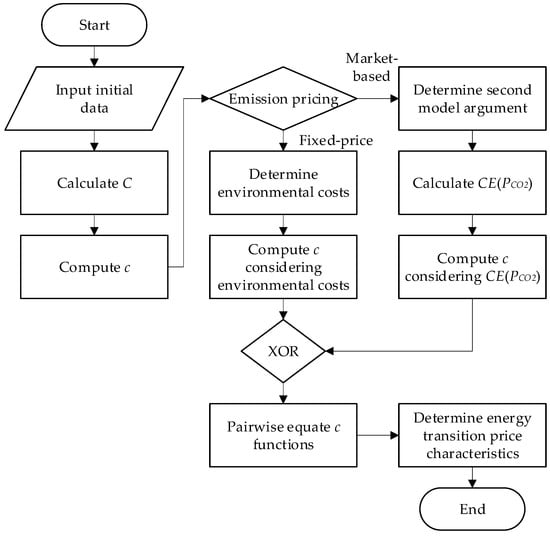
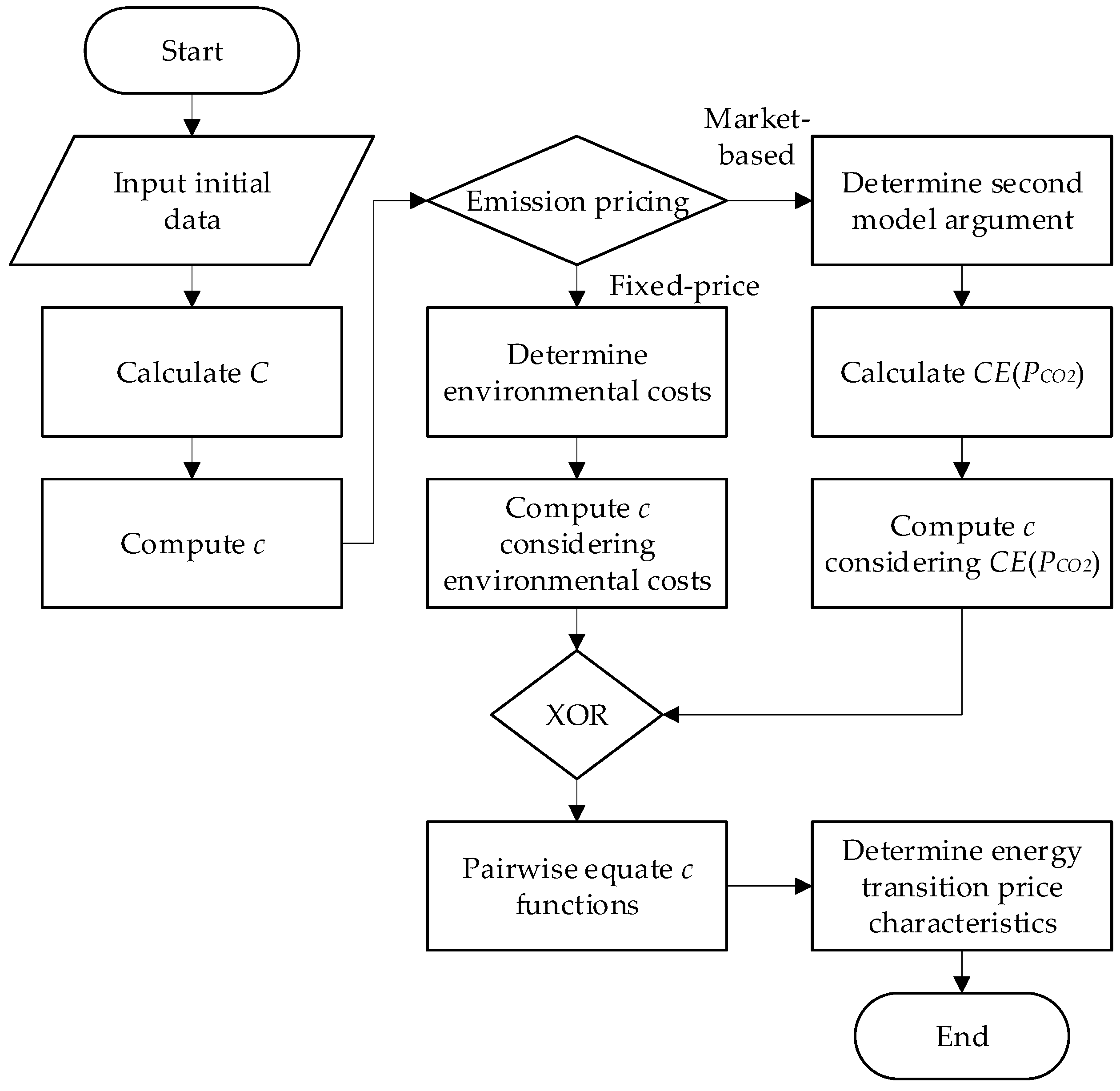
The computational algorithm underlying the economic-mathematical model for assessing how the development level of climate regulation systems influences the energy transition is presented in Figure 1.
Figure 1.
Algorithm of the developed economic-mathematical model for the energy transition.
The algorithm implementation provides a quantitative assessment of the efficiency of each steam turbine technology level under the influence of external factors—fuel costs and environmental regulation approaches. This enables the identification of combinations of external conditions under which transitioning to more advanced thermal power plants becomes economically viable.
To determine the optimal timing of the energy transition, natural gas was selected as the modeled fuel. This choice is justified by the focus on this energy resource in both the Russian Federation and the European Union, due to its lower emissions of harmful substances when combusted compared to the amount of CO2 released from burning coal or fuel oil. This consideration is particularly relevant in the context of implementing climate policy objectives.
Thus, when natural gas is utilized as the primary energy source in steam turbine-based thermal power plant in the Russian Federation and European Union, the fuel cost function takes the form of Equations (11) and (12), respectively:
where Q1 is the calorific value of standard fuel equivalent, 7000 kcal/kg; Q2 is the calorific value of natural gas, kcal/m3; Pgas is the cost of natural gas, $/thousand m3; kkWh is the conversion factor from m3 of natural gas to kWh based on its calorific value, equal to 10.55; is the natural gas price time series in the Czech Republic, $/kWh.
The modeling process analyzed natural gas prices in the Russian Federation and the European Union (using the Czech Republic as an example), along with the monthly dynamics of European carbon allowance prices since January 2015. Approximating functions were derived from these time series analyses and incorporated into the model as parameters to represent the temporal evolution of electricity generation costs. The specific cost of electricity generation for the Russian Federation and the European Union is represented by Expressions (13) and (14), respectively:
where Pgas(t) is the exponential regression equation approximating the natural gas price time series in the Russian Federation, $/thousands m3; is the linear regression equation approximating the natural gas price time series in the Czech Republic, $/kWh; is the linear regression equation approximating the CO2 emission price time series, $/tCO2.
By repeating the pairwise equating procedure for specific cost functions, timing break-even points were identified—specific timeframes at which transitioning to more advanced power plants become economically justified under given natural gas price and carbon price trajectories. All parameters used in the model calculations are presented in Table 1.
Table 1.
Initial data for modeling [24,33,35,36].
3. Results and Discussion
3.1. Break-Even Fuel Price Modeling
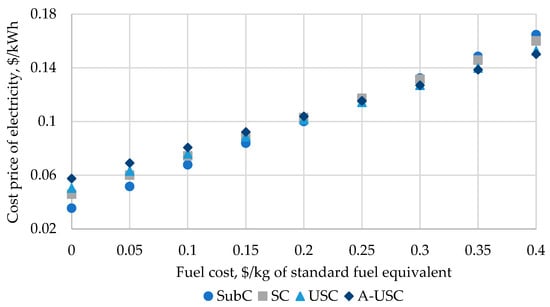
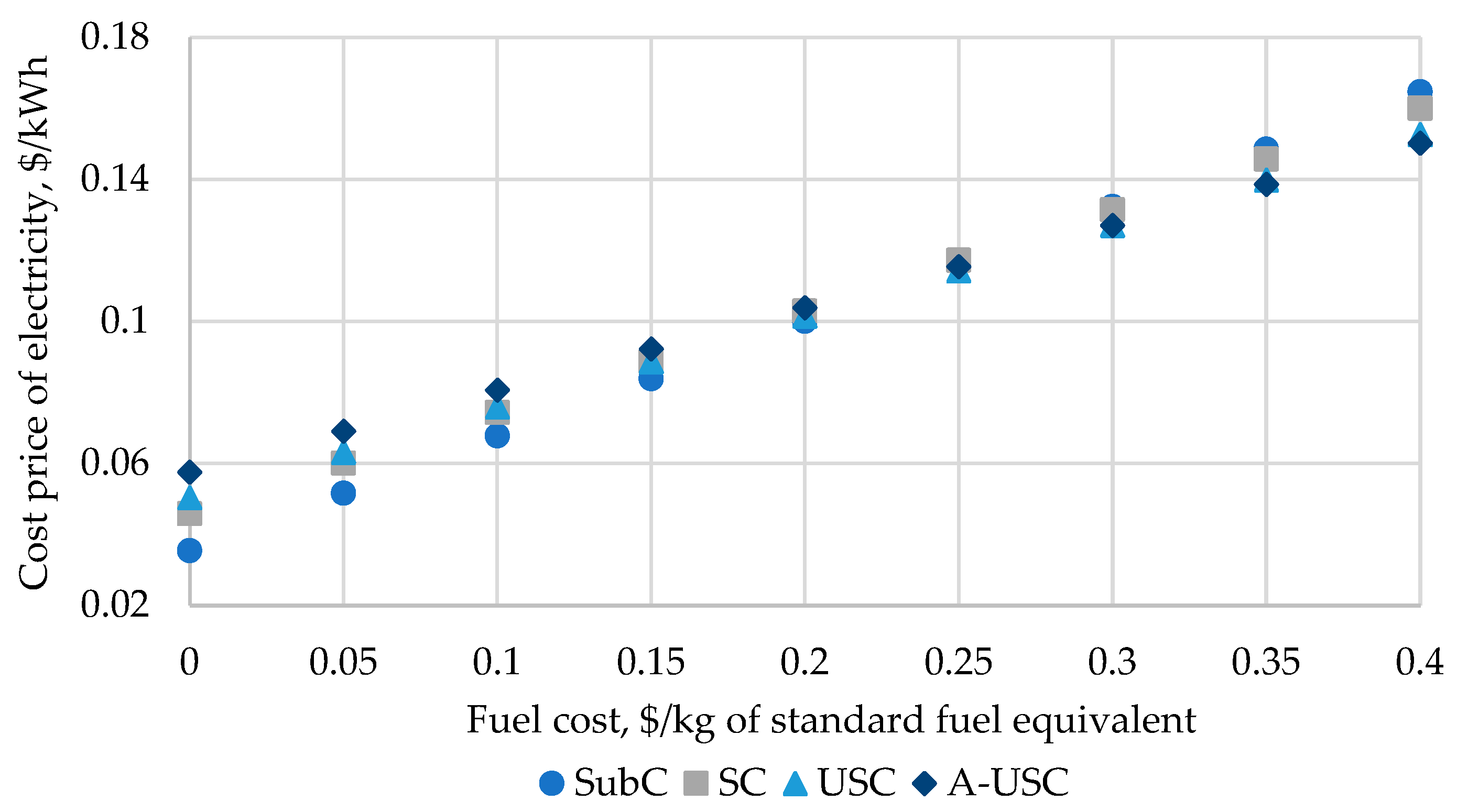
Using Expressions (1)–(6), the relationships between the specific cost of electricity generation and fuel cost were derived for the considered energy transition models. The modeling results for the Russian Federation are presented in Figure 2.
Figure 2.
Economic efficiency assessment of steam turbine technology levels as a function of fuel cost in the Russian Federation.
The graph demonstrates that as fuel prices increase, steam turbine technologies operating at higher parameters become the most economically efficient, as they are characterized by lower specific electricity generation costs. This can be attributed to the enhanced energy conversion efficiency of more advanced steam turbine plants, which reduces specific fuel consumption and consequently lowers specific fuel costs. Furthermore, the modeling results indicate that supercritical steam turbine technology is not the most economically viable option at any fuel price level; thus, selecting SC-based generation units is inefficient. In this regard, additional calculations were performed, showing that within the considered price interval, the operation of SC power plants becomes viable only if their electrical efficiency exceeds 44.47%.
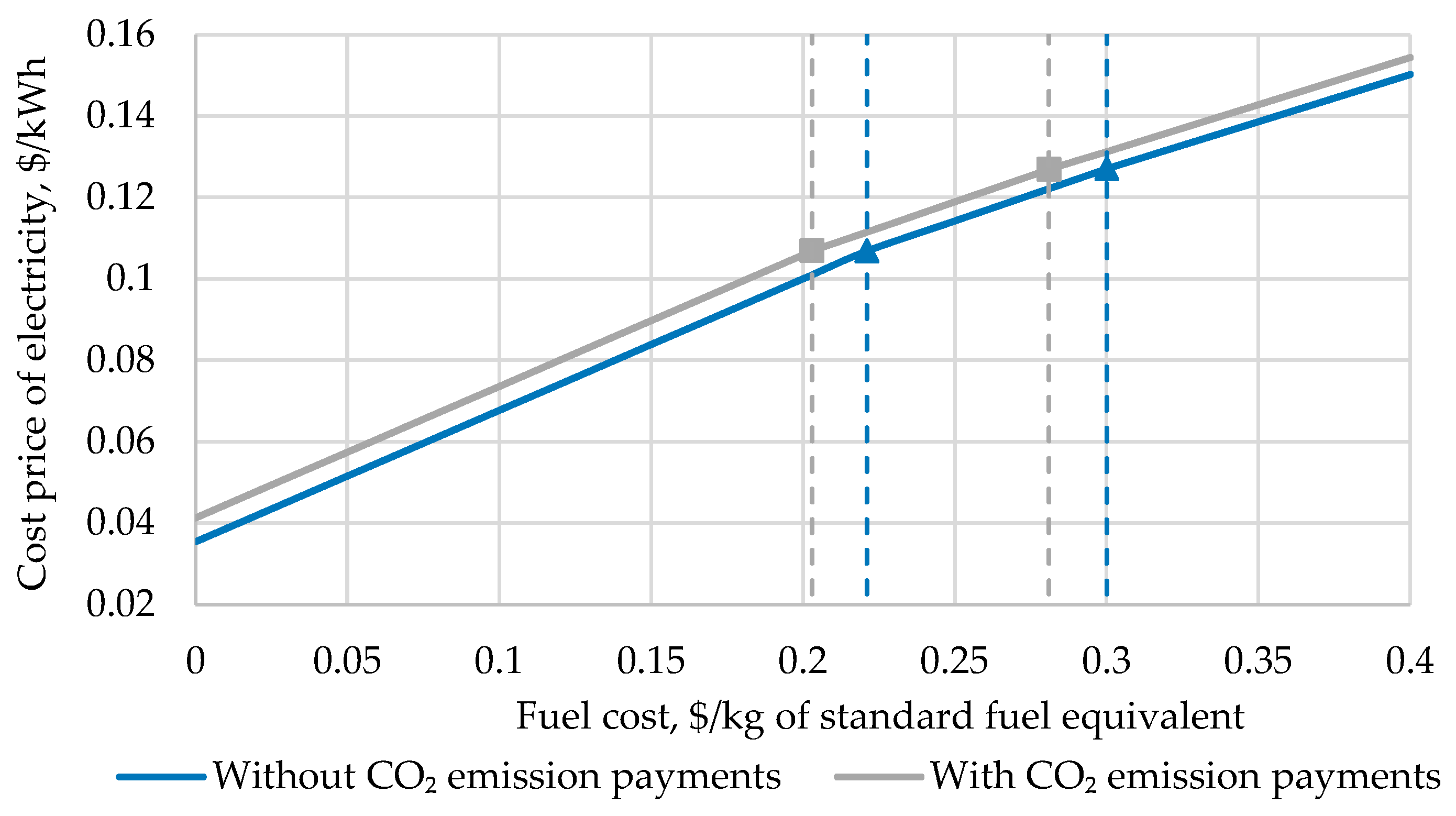
The introduction of a carbon regulation system into the energy transition model for Russia, which requires generating companies to purchase emission allowances for each ton of carbon dioxide released, shifts the break-even fuel price points (points of equal specific electricity generation costs) for advanced generation technologies toward lower values. This shift occurs because the utilization of more advanced steam turbine plants reduces specific environmental costs due to their advantage in lower specific fuel consumption and, consequently, lower specific greenhouse gas emissions. Thus, generating companies operating power plants with ultra-supercritical and advanced ultra-supercritical steam parameters will pay less per kWh of electricity generated for carbon dioxide emissions compared to plants using less advanced steam turbine technologies. The modeling results for the minimum specific cost of electricity generation in Russia, both with and without CO2 emission payments, are presented in Figure 3.
Figure 3.
Comparison of cost characteristics for the energy transition with and without CO2 emission payments.
The modeling results identified new break-even points, determining the standard fuel equivalent cost at which transitioning from the current thermal power plant configurations to plants operating at higher steam parameters becomes economically viable. A comparative analysis of the results is presented in Table 2.
Table 2.
Cost characteristics of the energy transition with and without CO2 emission payments.
The presented estimates establish that implementing a carbon regulation system in the Russian Federation shifts the fuel price ranges for the minimum specific cost of electricity generation toward lower values. Against the backdrop of continuously rising energy prices, this generates market signals for thermal power plant owners to invest in more advanced generating equipment. Such power units reduce atmospheric emissions of harmful substances and promote more efficient utilization of non-renewable natural resources. This approach aligns with sustainable development principles and establishes a foundation for long-term growth in both the energy sector and the national economy as a whole.
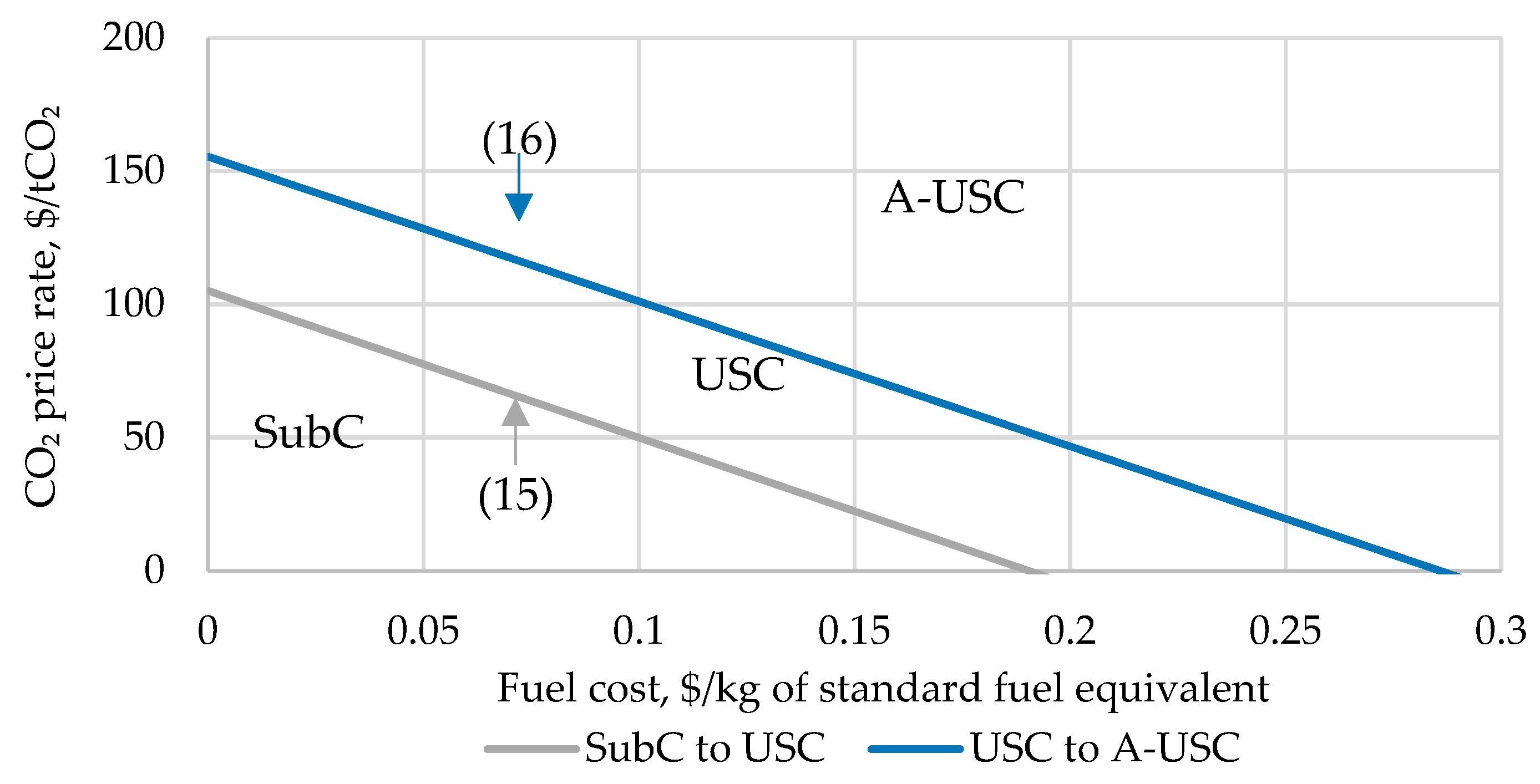
In contrast, when modeling the energy transition in the European Union, the impact of carbon regulation mechanisms on transition parameters directly depends on the price of carbon allowances traded within the EU ETS. Based on Expression (10), the functional relationships between the carbon price per ton of CO2 emissions and the standard fuel equivalent cost were determined for four levels of steam turbine technology. These relationships define the cost characteristics of the energy transition to ultra-supercritical (15) and advanced ultra-supercritical (16) steam turbine equipment under market-based carbon regulation mechanisms:
The presented formulas demonstrate that as the carbon price per ton of CO2 emissions increases, the advantage of more environmentally efficient steam turbine plants operating at higher initial steam parameters becomes more pronounced, as evidenced by the modeling results presented in Figure 4.
Figure 4.
Modeling results of cost characteristics for the energy transition in the EU (using Czech Republic data as an example).
3.2. Modeling of the Optimal Energy Transition Timing
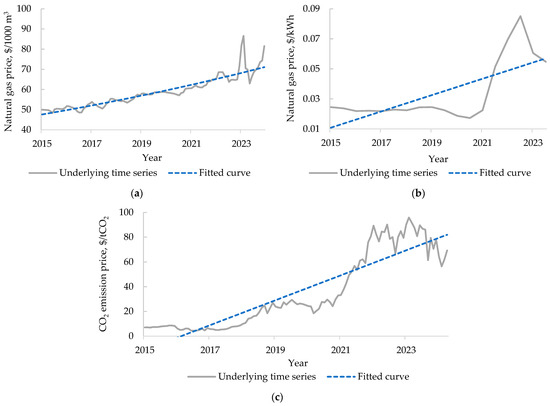
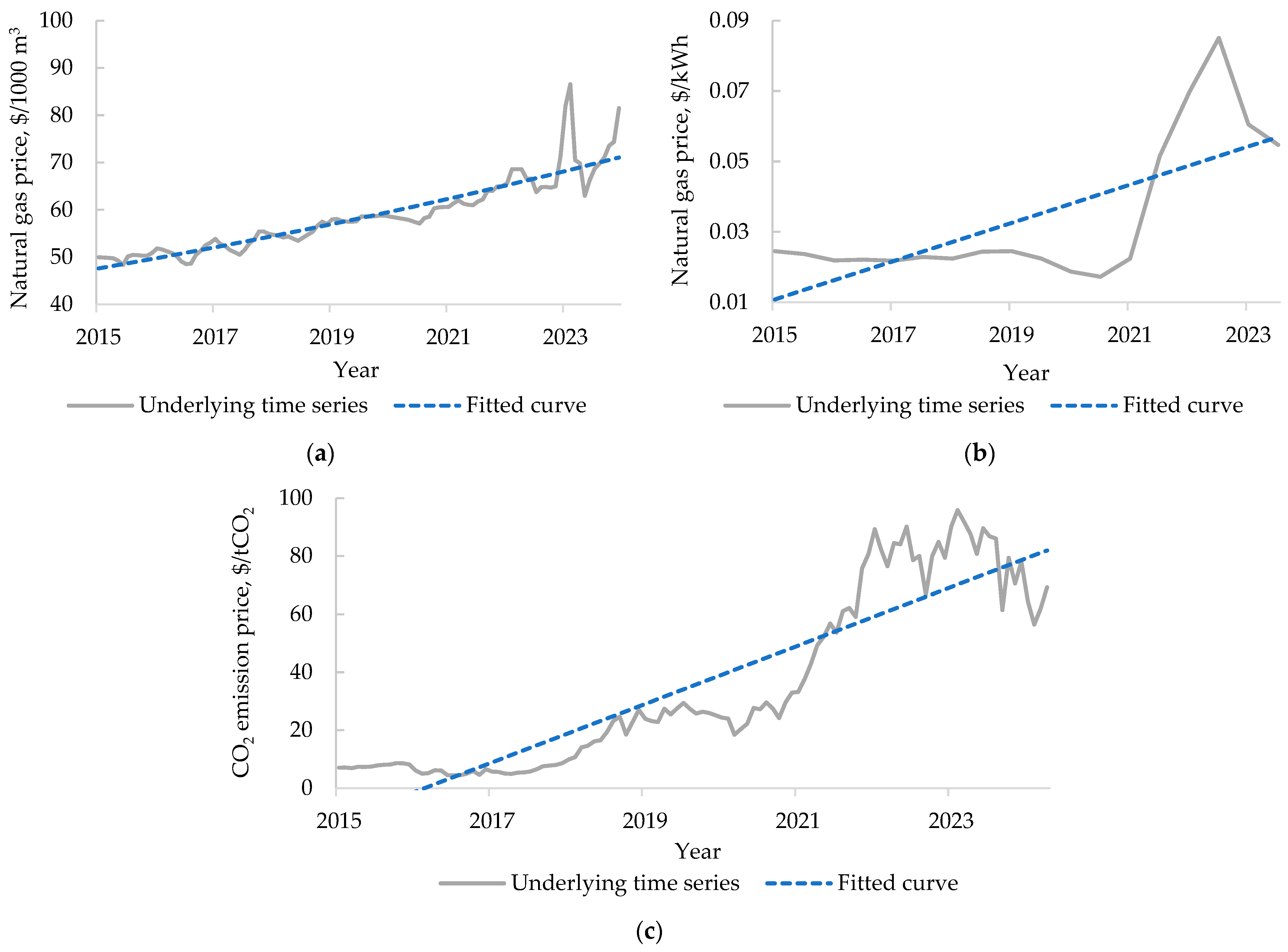
The timing analysis for the energy transition yielded approximating functions for the time series of natural gas prices in the Russian Federation and the European Union, as well as for carbon dioxide allowance prices in the EU ETS. The original time series with the corresponding fitted curves are presented in Figure 5.
Figure 5.
Results of time series analysis: (a) natural gas cost time series in the Russian Federation; (b) natural gas cost time series in the Czech Republic; (c) carbon allowance price time series in the EU ETS.
The presented graphs demonstrate that the constructed regression dependencies—particularly models (a) and (c)—accurately capture the underlying temporal trend of the analyzed price indicators despite their simplicity and lack of scenario-based approach. However, the time series of natural gas prices in the Czech Republic exhibited clear structural breaks associated with the 2021 energy crisis and the sharp transition to liquefied natural gas in 2022–2023. Nevertheless, the coefficients of determination for the constructed regression models were 0.85, 0.5, and 0.82, respectively, indicating strong to moderate relationships between the independent and dependent variables and validating the application of these results in the modeling process.
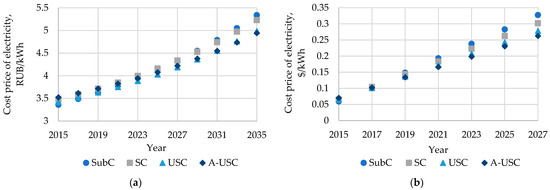
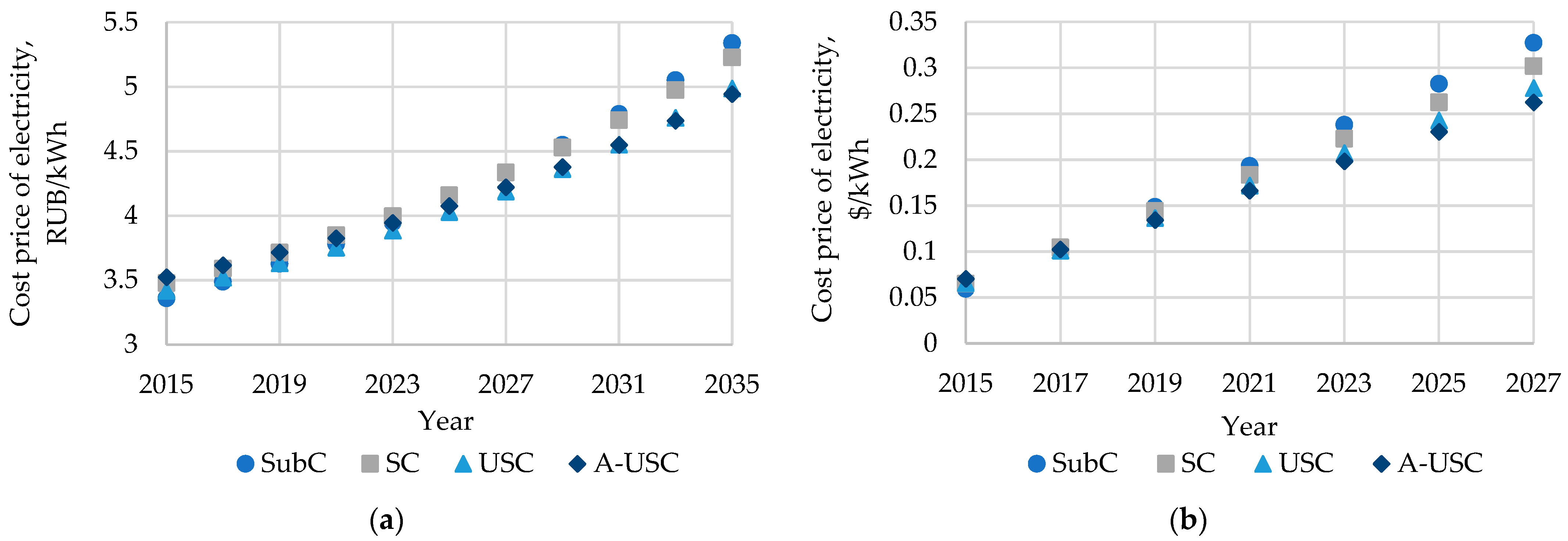
The modeling results of the time-dependent specific cost of electricity generation for the Russian Federation and the European Union (using the Czech Republic as an example) are presented in Figure 6.
Figure 6.
Dependence of the cost price of electricity on time: (a) for the Russian Federation; (b) for the EU (Czech Republic).
The modeling results identified specific dates when transitioning to more advanced steam turbine technology levels at thermal power plants becomes economically viable. The optimal timeframes for the energy transition are summarized in Table 3.
Table 3.
Transition timing to more advanced steam turbine-based thermal power plants.
The presented estimates, derived from the model’s projections of fuel and carbon price trajectories (as opposed to historical deployment data), show that countries with advanced ESG frameworks should transition to high-parameter steam turbine plants earlier than states with developing ESG principles, which aligns with previous studies [37,38]. However, the timing of the energy transition in the EU is primarily driven by high fuel costs rather than by elevated carbon prices per ton of CO2 emissions. At the same time, the current price level of carbon allowances in Europe enables steam turbine plants operating at higher parameters to remain the most efficient alternatives even if natural gas prices decline, thereby facilitating an earlier energy transition to more advanced steam turbine equipment.
It should also be noted that the presented analysis is based exclusively on operational cost factors and does not encompass the overall investment attractiveness of constructing high-temperature steam turbine units. Specifically, deploying ultra-supercritical power plants involves significant technological risks and regulatory uncertainties, which complicate their real-world implementation at power generation facilities. To mitigate this challenge, various policy measures to incentivize the adoption of high-temperature steam turbine units at thermal power plants could be introduced, such as granting additional tax incentives, higher capacity payments, and rights to accelerated depreciation.
3.3. Sensitivity Analysis
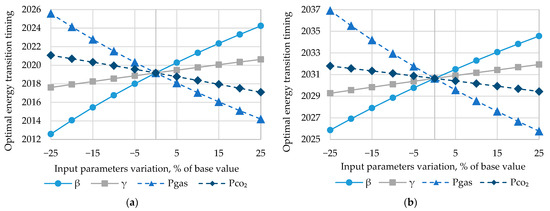
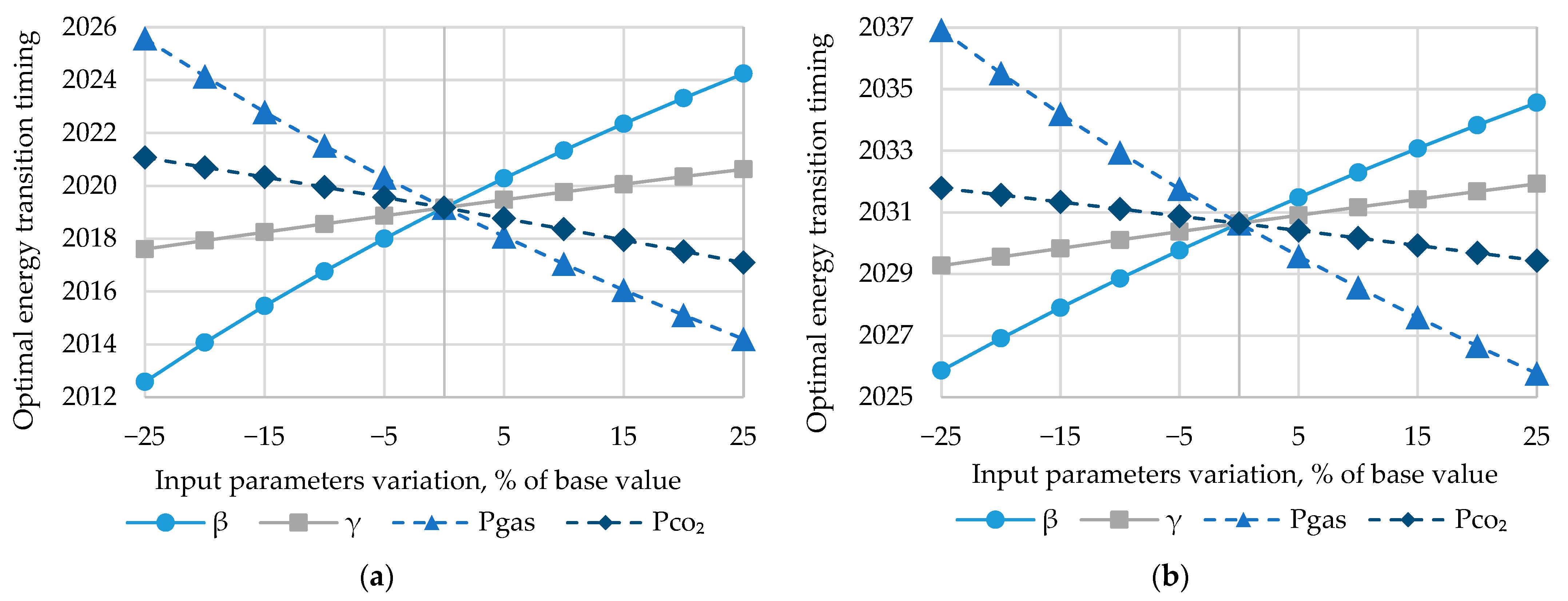
When assessing the economic viability of the energy transition to more advanced steam turbine generation technologies, it is essential to account for the influence of input parameters in the developed economic-mathematical model on the target modeling outcomes. In this context, a sensitivity analysis of the energy transition model for the Russian Federation was conducted to determine the optimal energy transition timing on parameters such as: maintenance fund contribution rate (β), other costs coefficient (γ), natural gas cost (Pgas), and carbon price rate for exceeding the emission quota in the Russian Federation (PCO2). The sensitivity analysis results are presented in Figure 7.
Figure 7.
Sensitivity analysis results for the energy transition model in the Russian Federation: (a) transition from SubC to USC; (b) transition from USC to A-USC.
The presented graphs demonstrate that changes in natural gas prices have a more substantial impact on energy transition characteristics compared to carbon dioxide emission costs. Specifically, a 25% increase in natural gas prices accelerates the optimal timing for transitioning from SubC to USC and from USC to A-USC steam turbine plants by 5 years. In contrast, a 25% increase in CO2 emission costs in the Russian Federation advances the energy transition by only 2 and 1.25 years, respectively.
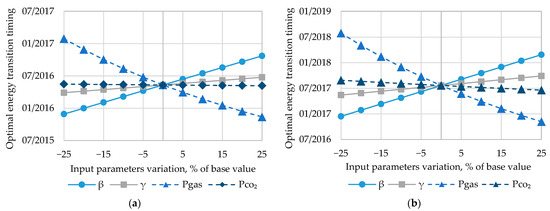
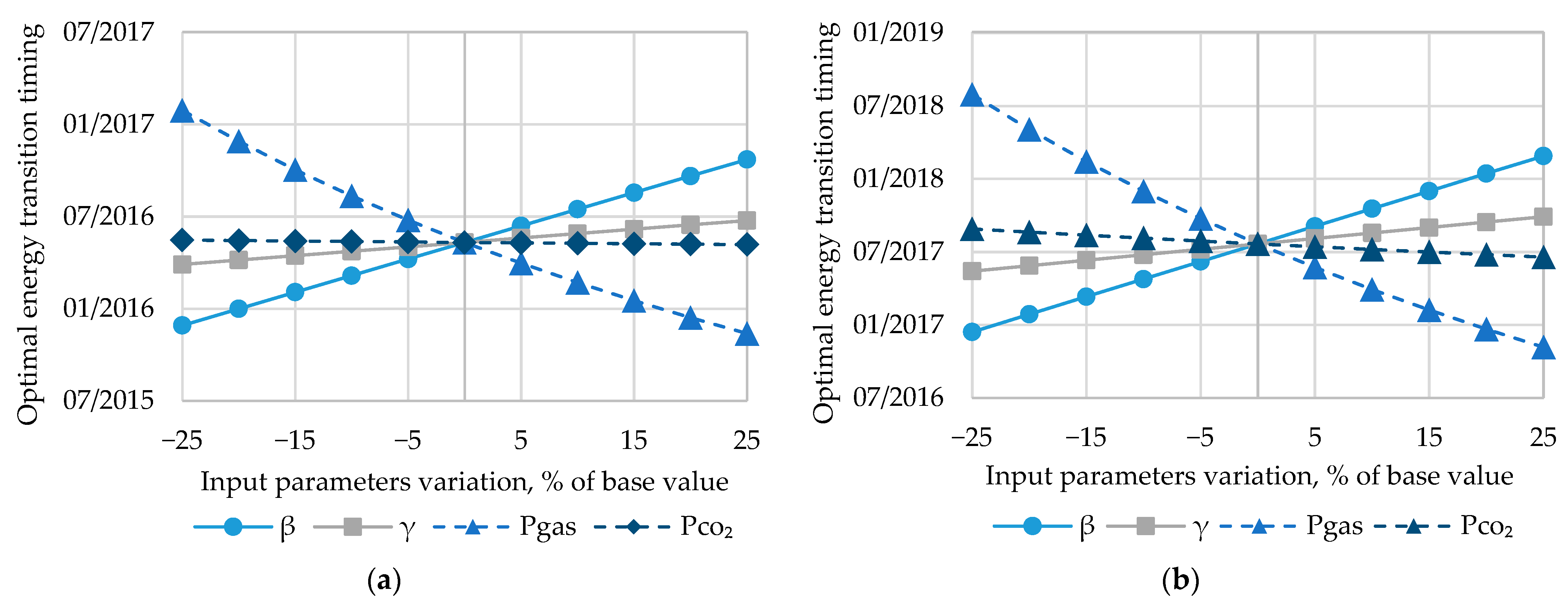
Qualitatively similar dependencies were observed for the energy transition model in the European Union (using the Czech Republic as an example), as shown in Figure 8.
Figure 8.
Sensitivity analysis results for the energy transition model in the EU (using the Czech Republic as an example): (a) transition from SubC to USC; (b) transition from USC to A-USC.
It should also be noted that in both cases, the optimal energy transition timing exhibited high sensitivity to the maintenance fund contribution rate (β). Specifically, significant improvement in the competitiveness of more advanced steam turbine plants can be achieved not through increasing fuel costs, but rather through effective management of repair and maintenance expenses for power equipment.
4. Conclusions
This study presents a comparative analysis of how divergent ESG strategies influence the economic viability of the energy transition, using the adoption of different levels of high-temperature steam turbine technologies as a case study. The assessment is based on evaluating annual electricity generation costs and modeling the dependence of its specific cost on fuel prices under scenarios both with and without carbon pricing mechanisms.
Based on the results of the scenario modeling, the following conclusions can be drawn:
- Increasing fuel costs incentivize energy companies to adopt more advanced generation technologies, driven by the reduction in electricity generation costs when transitioning to steam turbine plants with higher initial steam parameters;
- The implementation of carbon pricing mechanisms shifts the market signals for optimal transition to high-parameter steam turbine plants toward lower fuel price thresholds;
- The extent to which carbon regulation systems influence energy transition parameters is directly dependent on carbon allowance prices. Specifically, as the carbon price per ton of CO2 emissions increases, both the cost and timing characteristics of the energy transition shift toward lower and earlier thresholds, respectively;
- The implementation and enhancement of ESG principles at the national level accelerates the adoption of more advanced energy production technologies. However, fuel prices play a more decisive role in determining the economic viability of the energy transition.
The proposed economic-mathematical model enables the assessment of the economic viability of transitioning to different levels of high-temperature steam turbine technologies, thereby providing justification for prioritizing development directions in domestic power engineering based on projected fuel costs and planned carbon pricing mechanisms. Furthermore, enhancing the energy efficiency of steam turbine-based thermal power plants has comprehensive benefits, contributing not only to reduced electricity generation costs but also to employment growth and decreased atmospheric greenhouse gas emissions. This demonstrates the economic, social, and environmental effectiveness of energy transition scenarios based on conventional generation technology improvements, ultimately supporting sustainable development in both the energy sector and the national economy.
To enhance the methodology described above for more accurate analysis of the economic viability of steam turbine technology levels, future research should primarily focus on developing tools for assessing the cost of the considered power equipment. Creating such an economic-mathematical framework based on studying steam turbine components and the composition of metals and alloys used in their manufacturing would enable a more precise evaluation of cost calculation items dependent on the power unit’s price, while accounting for factors such as changes in unit configuration and fluctuations in prices of steel grades used.
Furthermore, the existing model should be supplemented with more advanced time series analysis techniques, capable of accounting for structural breaks and random fluctuations in the data (e.g., Holt’s linear trend method, Holt–Winters method). Applying such tools would not only improve forecasting accuracy but also enable the integration of simulation modeling into the present study. This approach would allow for a more in-depth analysis of the sensitivity of the economic performance of high-temperature generation technologies to potential risks, such as: long-term fuel price decline, energy crises and sanctions in fuel and carbon markets, and decreased plant electrical efficiency accounting for projected load and equipment wear.
Author Contributions
Conceptualization, E.L.; methodology, E.L. and A.M.; software, I.L.; vali-dation, O.Z. and I.L.; formal analysis, E.L. and A.M.; investigation, E.L. and I.L.; resources, A.M.; data curation, O.Z. and I.L.; writing—original draft preparation, E.L. and I.L.; writing—review and editing, E.L.; visualization, O.Z. and I.L.; supervision, E.L.; project administration, O.Z.; funding acquisition, A.M. All authors have read and agreed to the published version of the manuscript.
Funding
This study conducted by Moscow Power Engineering Institute was financially supported by the Ministry of Science and Higher Education of the Russian Federation (project no. FSWF-2023-0014, contract no. 075-03-2023-383 dated 18 January 2023).
Institutional Review Board Statement
Not applicable.
Informed Consent Statement
Not applicable.
Data Availability Statement
Data are contained within the article.
Conflicts of Interest
The authors declare no conflicts of interest.
References
- Hariram, N.P.; Mekha, K.B.; Suganthan, V.; Sudhakar, K. Sustainalism: An integrated socio-economic-environmental model to address sustainable development and sustainability. Sustainability 2023, 15, 10682. [Google Scholar] [CrossRef] [Scilit]
- Huang, Z.; Huang, Y.; Zhang, S. The possibility and improvement directions of achieving the Paris agreement goals from the perspective of climate policy. Sustainability 2024, 16, 4212. [Google Scholar] [CrossRef] [Scilit]
- Azmat, F.; Lim, W.M.; Moyeen, A.; Voola, R.; Gupta, G. Convergence of business, innovation, and sustainability at the tipping point of the sustainable development goals. J. Bus. Res. 2023, 167, 114170. [Google Scholar] [CrossRef] [Scilit]
- Puttachai, W.; Phadkantha, R.; Yamaka, W. The threshold effects of ESG performance on the energy transitions: A country-level data. Energy Rep. 2022, 8, 234–241. [Google Scholar] [CrossRef] [Scilit]
- Lu, J.; Li, H. The impact of ESG ratings on low carbon investment: Evidence from renewable energy companies. Renew. Energy 2024, 223, 119984. [Google Scholar] [CrossRef] [Scilit]
- Wittmayer, J.M.; de Geus, T.; Pel, B.; Avelino, F.; Hielscher, S.; Hoppe, T.; Mühlemeier, S.; Stasik, A.; Oxenaar, S.; Rogge, K.S.; et al. Beyond instrumentalism: Broadening the understanding of social innovation in socio-technical energy systems. Energy Res. Soc. Sci. 2020, 70, 101689. [Google Scholar] [CrossRef] [Scilit]
- Hoppe, T.; De Vries, G. Social innovation and the energy transition. Sustainability 2018, 11, 141. [Google Scholar] [CrossRef] [Scilit]
- Kabeyi, M.J.B.; Olanrewaju, O.A. Sustainable energy transition for renewable and low carbon grid electricity generation and supply. Front. Energy Res. 2022, 9, 743114. [Google Scholar] [CrossRef] [Scilit]
- Gürsan, C.; de Gooyert, V. The systemic impact of a transition fuel: Does natural gas help or hinder the energy transition? Renew. Sustain. Energy Rev. 2021, 138, 110552. [Google Scholar] [CrossRef] [Scilit]
- Halawa, E. Sustainable energy: Concept and definition in the context of the energy transition—A critical review. Sustainability 2024, 16, 1523. [Google Scholar] [CrossRef] [Scilit]
- Kasinathan, P.; Pugazhendhi, R.; Elavarasan, R.M.; Ramachandaramurthy, V.K.; Ramanathan, V.; Subramanian, S.; Kumar, S.; Nandhagopal, K.; Raghavan, R.R.V.; Rangasamy, S.; et al. Realization of sustainable development goals with disruptive technologies by integrating industry 5.0, society 5.0, smart cities and villages. Sustainability 2022, 14, 15258. [Google Scholar] [CrossRef] [Scilit]
- Zakari, A.; Khan, I.; Tan, D.; Alvarado, R.; Dagar, V. Energy efficiency and sustainable development goals (SDGs). Energy 2022, 239, 122365. [Google Scholar] [CrossRef] [Scilit]
- Siciliano, G.; Wallbott, L.; Urban, F.; Dang, A.N.; Lederer, M. Low-carbon energy, sustainable development, and justice: Towards a just energy transition for the society and the environment. Sustain. Dev. 2021, 29, 1049–1061. [Google Scholar] [CrossRef] [Scilit]
- Udemba, E.N.; Tosun, M. Energy transition and diversification: A pathway to achieve sustainable development goals (SDGs) in Brazil. Energy 2022, 239, 122199. [Google Scholar] [CrossRef] [Scilit]
- Liu, P.; Zhu, B.; Yang, M.; Chu, X. ESG and financial performance: A qualitative comparative analysis in China’s new energy companies. J. Clean. Prod. 2022, 379, 134721. [Google Scholar] [CrossRef] [Scilit]
- Baran, M.; Kuźniarska, A.; Makieła, Z.J.; Sławik, A.; Stuss, M.M. Does ESG reporting relate to corporate financial performance in the context of the energy sector transformation? Evidence from Poland. Energies 2022, 15, 477. [Google Scholar] [CrossRef] [Scilit]
- Xu, X.; Zainordin, N.S.; Sharaai, A.H.; Nik Ab Rahim, N.N.R. Consumers’ Perspectives on Government-Oriented Integrated Energy Services: A Case Study of Pilot Areas in China. Sustainability 2025, 17, 10158. [Google Scholar] [CrossRef] [Scilit]
- Qadir, S.A.; Al-Motairi, H.; Tahir, F.; Al-Fagih, L. Incentives and strategies for financing the renewable energy transition: A review. Energy Rep. 2021, 7, 3590–3606. [Google Scholar] [CrossRef] [Scilit]
- Akarsu, B.; Genç, M.S. Optimization of electricity and hydrogen production with hybrid renewable energy systems. Fuel 2022, 324, 124465. [Google Scholar] [CrossRef] [Scilit]
- Galimova, T.; Ram, M.; Breyer, C. Mitigation of air pollution and corresponding impacts during a global energy transition towards 100% renewable energy system by 2050. Energy Rep. 2022, 8, 14124–14143. [Google Scholar] [CrossRef] [Scilit]
- Seminario-Córdova, R.; Rojas-Ortega, R. Renewable energy sources and energy production: A bibliometric analysis of the last five years. Sustainability 2023, 15, 10499. [Google Scholar] [CrossRef] [Scilit]
- Naseem, K.; Khalid, F.; Fei, Q.; Suo, G.; Khan, A.A.; Jabeen, T.; Karamat, S.; Shah, B.A. Role of carbon-based materials to promote the hydrolysis performance of magnesium-based materials. Renew. Sustain. Energy Rev. 2025, 219, 115864. [Google Scholar] [CrossRef] [Scilit]
- Rogalev, A.; Rogalev, N.; Komarov, I.; Kindra, V.; Osipov, S. Methods for competitiveness improvement of high-temperature steam turbine power plants. Inventions 2022, 7, 44. [Google Scholar] [CrossRef] [Scilit]
- Lisin, E.; Rogalev, A.; Strielkowski, W.; Komarov, I. Sustainable modernization of the Russian power utilities industry. Sustainability 2015, 7, 11378–11400. [Google Scholar] [CrossRef] [Scilit]
- Sterkhov, K.V.; Khokhlov, D.A.; Zaichenko, M.N.; Pleshanov, K.A. A zero carbon emission CCGT power plant and an existing steam power station modernization scheme. Energy 2021, 237, 121570. [Google Scholar] [CrossRef] [Scilit]
- Chen, C.; Liu, M.; Li, M.; Wang, Y.; Wang, C.; Yan, J. Digital twin modeling and operation optimization of the steam turbine system of thermal power plants. Energy 2024, 290, 129969. [Google Scholar] [CrossRef] [Scilit]
- Polski, C.; Polski, T.; Roman, J.; Wróblewski, R.; Bartoszewicz, J.; Ceran, B. A novel concept to improve the flexibility of steam power plants using an electric feedwater heater. Appl. Therm. Eng. 2024, 236, 121661. [Google Scholar] [CrossRef] [Scilit]
- Apostolopoulos, N.; Kakouris, A.; Liargovas, P.; Borisov, P.; Radev, T.; Apostolopoulos, S.; Anastasopoulou, E.E. Just transition policies, power plant workers and green entrepreneurs in Greece, Cyprus and Bulgaria: Can education and retraining meet the challenge? Sustainability 2023, 15, 16307. [Google Scholar] [CrossRef] [Scilit]
- Wang, R.; Wen, X.; Wang, X.; Fu, Y.; Zhang, Y. Low carbon optimal operation of integrated energy system based on carbon capture technology, LCA carbon emissions and ladder-type carbon trading. Appl. Energy 2022, 311, 118664. [Google Scholar] [CrossRef] [Scilit]
- Zhou, Y. Worldwide carbon neutrality transition? Energy efficiency, renewable, carbon trading and advanced energy policies. Energy Rev. 2023, 2, 100026. [Google Scholar] [CrossRef] [Scilit]
- Yang, M.; Liu, Y. Research on multi-energy collaborative operation optimization of integrated energy system considering carbon trading and demand response. Energy 2023, 283, 129117. [Google Scholar] [CrossRef] [Scilit]
- Żak, K.; Pyra, M. Comparison of Trends in Sustainable Energy Development in the Czech Republic and Poland. Sustainability 2024, 16, 8822. [Google Scholar] [CrossRef] [Scilit]
- Standard of OAO TsOTenergo. Available online: https://esistems.ru/?page_id=5478 (accessed on 10 November 2025).
- Artemenkov, A.; Medvedeva, O.E.; Pavlov, A.N.; Ganiev, O. The issues of carbon pricing in the Russian Federation: The local and international perspectives under the cost approach and the role of afforestation projects. Sustainability 2025, 17, 1088. [Google Scholar] [CrossRef] [Scilit]
- Łukowicz, H.; Dykas, S.; Rulik, S.; Stępczyńska, K. Thermodynamic and economic analysis of a 900 MW ultra-supercritical power unit. Arch. Thermodyn. 2011, 32, 231–245. [Google Scholar] [CrossRef] [Scilit]
- Mohamed, O.; Khalil, A.; Wang, J. Modeling and control of supercritical and ultra-supercritical power plants: A review. Energies 2020, 13, 2935. [Google Scholar] [CrossRef] [Scilit]
- Azam, I.; Guo, Y.; Lau, C.K.M. Green Finance and ESG Readiness: Bridging the Gaps in Sustainability Transitions. Corp. Soc. Responsib. Environ. Manag. 2025. [Google Scholar] [CrossRef] [Scilit]
- Kindra, V.; Rogalev, A.; Lisin, E.; Osipov, S.; Zlyvko, O. Techno-economic analysis of the oxy-fuel combustion power cycles with near-zero emissions. Energies 2021, 14, 5358. [Google Scholar] [CrossRef] [Scilit]

Disclaimer/Publisher’s Note: The statements, opinions and data contained in all publications are solely those of the individual author(s) and contributor(s) and not of MDPI and/or the editor(s). MDPI and/or the editor(s) disclaim responsibility for any injury to people or property resulting from any ideas, methods, instructions or products referred to in the content. |
© 2026 by the authors. Licensee MDPI, Basel, Switzerland. This article is an open access article distributed under the terms and conditions of the Creative Commons Attribution (CC BY) license.