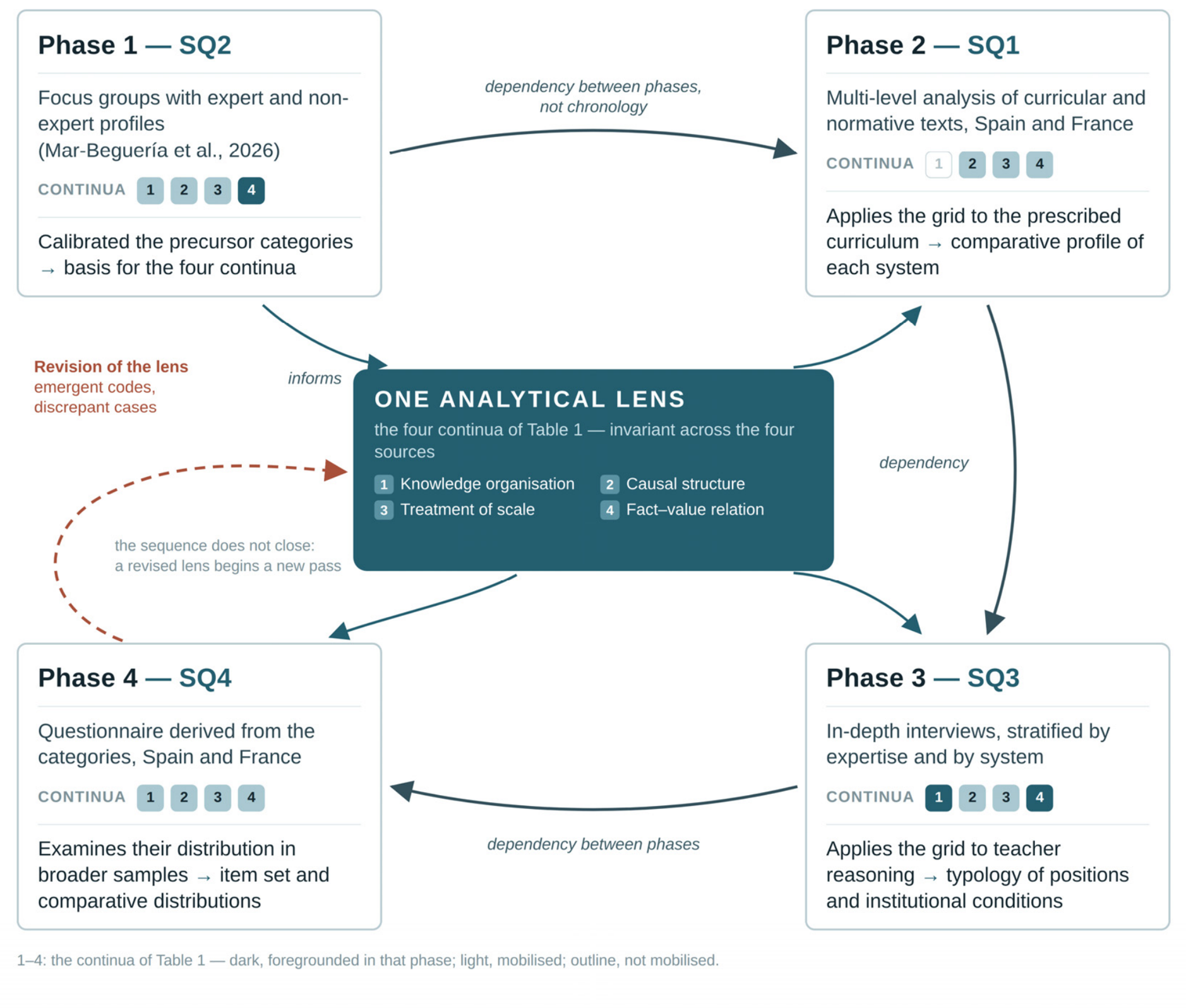


An Integrated Mixed-Methods Framework for Studying Expert Geographical Reasoning in Climate Change Education: A Spain–France Comparative Design

 , ,
Abstract
1. Introduction, Statement of the Problem and Aim of the Study
2. Theoretical Framework: An Integrated Apparatus for a Complex Object
2.1. Geographical Thinking and Powerful Geographical Knowledge as the Overarching Framework of the Study
2.2. Alternative Conceptions and Expert Conceptions from Geographical Perspectives
2.3. Systems Thinking: The “Grammar” of Geographical Complexity
2.4. The Concept of Risk, Citizenship and Values, and the Epistemic Regulation of Values
2.5. Convergence in a Single System of Categories
3. Methodological Framework: Establishing an Integrated Research Design
3.1. Epistemic Coherence: Mixed Methods with a Qualitative Emphasis
3.2. The Completed Phase: Deductive Construction and Focus-Group Calibration of the Analytical Continua Precursor Categories
3.3. Multi-Level Analysis of Curricula, Official and Enacted, in Relation to Geography Education
3.4. The Operationalisation of Geographical Competences in the Design

| Source and Unit of Analysis | Continuum | Observable Indicators (Expert End/Non-Expert End) | Inclusion and Exclusion | Kind of Evidence |
|---|---|---|---|---|
| Curricular and normative texts. Unit: the normative segment with complete sense within its structural unit (specific competence, item of basic knowledge, assessment criterion, objective, article, theme) | E1 Organisation of knowledge | Conceptual hierarchy; anchoring in the body of knowledge of the subject; dedicated curricular space; problematised formulation/purposive, attitudinal or organisational statement; isolated mention | In: prescriptive or officially recommended texts in force for the secondary levels at which geography is taught that address climate, global change or education for sustainable development. Out: primary and vocational texts, commercial textbooks, procedural preambles, repeated boilerplate | A prescription: what the system requires or recommends, and not what teachers believe or do |
| E2 Causal structure | Concurrence of factors of different nature; society–environment interaction; feedback; temporal depth; explicit non-linearity/simple chain; isolated consequence; unidirectional anthropisation | |||
| E3 Treatment of scale | Articulation of levels; change of scale prescribed as a skill; territorial inequality of risk; regional effects of a global process/statement at a single level | |||
| E4 Fact–value relation | Distinction of epistemic statuses; object presented for analysis; value thematised; judgement tied to an explicit criterion (intermediate position)/attitudinal prescription; militant framing; action as outcome | |||
| Focus-group discourse [21]. Unit: the intervention, delimited by change of speaker and subdivided where it develops two distinct claims | E1 Organisation of knowledge | Hierarchisation of claims; theoretical relevance; recognition of prior conceptions; method invoked as warrant/theoretical confusion; oversimplification; complexity named as an obstacle | In: substantive contributions on the teaching of climate change. Out: organisational talk, moderator questions, unattributable fragments | An interactional claim, produced before peers able to contest it |
| E2 Causal structure | Interdependence between factors; indirect or deferred effect; reinforcing loop/linear description; attribution to a single agent | |||
| E3 Treatment of scale | Change of scale doing analytical work; glocal articulation; local scale as entry point/one level throughout the passage | |||
| E4 Fact–value relation | Evidence-based argumentation; use of official sources; theoretical prudence; metacognitive regulation; value stated with its criterion (intermediate position)/moralisation of action; ethnocentric framing; single solution pathway | |||
| Interview discourse. Unit: the thematic passage, a stretch of talk sustaining one line of reasoning across one or more turns | E1 Organisation of knowledge | The discourse indicators, and the justification of the sequence of content by conceptual dependency/sequence justified by the availability of materials | In: reasoning about content, its didactic treatment, territory and controversy. Out: biographical framing without analytical content; talk about the interview itself; passages the informant withdraws | A declaration about the informant’s own reasoning and practice, and not that practice |
| E2 Causal structure | The discourse indicators, applied to the explanation of the phenomenon and of its teaching | |||
| E3 Treatment of scale | The discourse indicators, and the articulation of the proximate territory with wider processes | |||
| E4 Fact–value relation | The discourse indicators, coded separately for the settled scientific core and for the socio-political dimension (Section 3.5) | |||
| Questionnaire responses. Unit: the item response | E1 Organisation of knowledge | Item family on the structure of explanations: subordination of propositions/accumulation of unrelated facts | In: complete responses to items retained after expert judgement, cognitive interviewing and piloting. Out: items failing the pilot criteria; non-differentiated response patterns | A response to a closed stimulus, interpretable only through the code from which the item derives |
| E2 Causal structure | Item family on accumulation and flow and on indirect and deferred effects; reversed items required | |||
| E3 Treatment of scale | Item family on the relation between levels: relating levels/recognising a single level | |||
| E4 Fact–value relation | Item family on the epistemic status of assertions and on settled as against legitimately controversial questions; reversed items required |
3.5. Conducting In-Depth Interviews to Address Conceptions and Tensions Surrounding Expert Thinking
| Teacher Stance [55] | Teacher Conduct | In the Face of the Scientific Core (Anthropogenic Consensus) | In the Face of the Socio-Political and Axiological Dimension |
|---|---|---|---|
| Exclusive neutrality | Avoids the issue | Risk that the problem disappears from the classroom | Evades the civic and ethical implications of the phenomenon |
| Exclusive partiality | Imposes a position without admitting alternatives | Risk of indoctrination if aligned with denial; legitimate transmission of knowledge if confined to established evidence | Risk of moralisation or indoctrination: undifferentiated register |
| Neutral impartiality | Presents opposing positions and withholds their own | Risk of false balance: presenting as open what is settled | Plurality is possible, although it may evade the teacher’s mediating function |
| Committed impartiality | Makes a reasoned position explicit and presents the alternatives equitably | Inappropriate as “balance”: knowledge is taught as knowledge, not as opinion in dispute | Stance consistent with the objectivity/neutrality distinction: a grounded position and openness to dissent |
3.6. The Quantitative Questionnaire
4. Discussion
4.1. Internal Coherence of the Design
4.2. Limitations
5. Conclusions
Author Contributions
Funding
Institutional Review Board Statement
Informed Consent Statement
Data Availability Statement
Conflicts of Interest
References
- Bendl, T.; Storrøsæter, H.; Madsen, L.M.; Trokšiar, D.; de la Martinière, R.; Liu, S.; Serame, S.; Mitchell, J.T.; Bagoly-Simó, P.; Duan, Y.; et al. An international perspective on geography curricula: Paving a way forward for geographical thinking. Int. Res. Geogr. Environ. Educ. 2025, 34, 294–317. [Google Scholar] [CrossRef] [Scilit]
- Enke, K.A.; Budke, A. Preparing students for a changing world: How geography curricula in Europe are tackling climate change. Front. Educ. 2023, 8, 1216780. [Google Scholar] [CrossRef] [Scilit]
- Eilam, E. Climate change education: The problem with walking away from disciplines. Stud. Sci. Educ. 2022, 58, 231–264. [Google Scholar] [CrossRef] [Scilit]
- Clark, H.F. Critical climate awareness as a science education outcome. Sci. Educ. 2024, 108, 1670–1697. [Google Scholar] [CrossRef] [Scilit]
- Leininger-Frézal, C.; Sprenger, S.; de Lázaro Torres, M.L.; Rodríguez Domenech, M.Á.; Heidari, N.; Pigaki, M.; Naudet, C.; Lecomte, A.; Gallardo, M. Global change challenge in the higher education curriculum on the approach of blended learning. Eur. J. Geogr. 2023, 14, 1–14. [Google Scholar] [CrossRef] [Scilit]
- Morote, Á.-F.; Olcina, J. Cambio climático y educación. Una revisión de la documentación oficial. Doc. Anàl. Geogr. 2023, 69, 107–134. [Google Scholar] [CrossRef] [Scilit]
- Ho, L.C.; Seow, T. Teaching controversial issues in geography: Climate change education in Singaporean schools. Theory Res. Soc. Educ. 2015, 43, 314–344. [Google Scholar] [CrossRef] [Scilit]
- Butt, G. Which methods are best suited to the production of high-quality research in geography education? Int. Res. Geogr. Environ. Educ. 2010, 19, 103–107. [Google Scholar] [CrossRef] [Scilit]
- López Carrión, A.E.; Llorca-Abad, G. Desinformación durante la crisis producida por la DANA de 2024 en España: Análisis, características, tipologías y desmentidos. Rev. Mediterr. Comun. 2025, 16, e29303. [Google Scholar] [CrossRef] [Scilit]
- IPCC. Climate Change 2023: Synthesis Report. Contribution of Working Groups I, II and III to the Sixth Assessment Report of the Intergovernmental Panel on Climate Change; IPCC: Geneva, Switzerland, 2023. [Google Scholar]
- Hmelo-Silver, C.E.; Marathe, S.; Liu, L. Fish swim, rocks sit, and lungs breathe: Expert–novice understanding of complex systems. J. Learn. Sci. 2007, 16, 307–331. [Google Scholar] [CrossRef] [Scilit]
- Sterman, J.D.; Sweeney, L.B. Understanding public complacency about climate change: Adults’ mental models of climate change violate conservation of matter. Clim. Change 2007, 80, 213–238. [Google Scholar] [CrossRef] [Scilit]
- Uhlenwinkel, A.; Béneker, T.; Bladh, G.; Tani, S.; Lambert, D. GeoCapabilities and curriculum leadership: Balancing the priorities of aim-based and knowledge-led curriculum thinking in schools. Int. Res. Geogr. Environ. Educ. 2017, 26, 357–370. [Google Scholar] [CrossRef] [Scilit]
- Legardez, A.; Simonneaux, L. L’École à l’Épreuve de l’Actualité: Enseigner les Questions Vives; ESF: Paris, France, 2006. [Google Scholar]
- Simonneaux, L. Questions socialement vives and socio-scientific issues: New trends of research to meet the training needs of postmodern society. In Topics and Trends in Current Science Education; Bruguière, C., Tiberghien, A., Clément, P., Eds.; Springer: Dordrecht, The Netherlands, 2014; pp. 37–54. [Google Scholar] [CrossRef] [Scilit]
- Dearden, R.F. Controversial issues and the curriculum. J. Curric. Stud. 1981, 13, 37–44. [Google Scholar] [CrossRef] [Scilit]
- González Gaudiano, E.J.; Meira Cartea, P.Á. Educación para el cambio climático: ¿Educar sobre el clima o para el cambio? Perfiles Educ. 2020, 42, 157–174. [Google Scholar] [CrossRef] [Scilit]
- Jasanoff, S. (Ed.) The idiom of co-production. In States of Knowledge: The Co-Production of Science and the Social Order; Routledge: London, UK, 2004; pp. 1–12. [Google Scholar] [CrossRef] [Scilit]
- Catling, S.; Martin, F. Contesting powerful knowledge: The primary geography curriculum as an articulation between academic and children’s (ethno-)geographies. Curric. J. 2011, 22, 317–335. [Google Scholar] [CrossRef] [Scilit]
- Maude, A. Geography and powerful knowledge: A contribution to the debate. Int. Res. Geogr. Environ. Educ. 2018, 27, 179–190. [Google Scholar] [CrossRef] [Scilit]
- Mar-Beguería, J.; Sebastián-López, M.; Kratochvíl, O.; De Miguel González, R. Climate change and geography education: A qualitative study of expert and novice teachers’ conceptions and geographical thinking. Eur. J. Geogr. 2026, 17, 200–220. [Google Scholar] [CrossRef] [Scilit]
- Favier, T.; Duindam, Y.; Wansink, B.; Béneker, T. Teacher orientations in climate change education. Environ. Educ. Res. 2024, 30, 1913–1948. [Google Scholar] [CrossRef] [Scilit]
- Morote, Á.-F.; Sebastiá-Alcaraz, R.; Ferrero-Punzano, S.M.; Miguel-Revilla, D.; Moreno-Vera, J.R.; Rodríguez-Pizzinato, L.A.; Jerez García, Ó. Climate change, education, training, and perception of pre-service teachers. Soc. Sci. 2025, 14, 236. [Google Scholar] [CrossRef] [Scilit]
- Real Decreto 217/2022, de 29 de Marzo, por el que se Establece la Ordenación y las Enseñanzas Mínimas de la Educación Secundaria Obligatoria. Boletín Oficial del Estado, Núm. 76. 30 March 2022. Available online: https://www.boe.es/eli/es/rd/2022/03/29/217 (accessed on 5 June 2026).
- Shulman, L.S. Those who understand: Knowledge growth in teaching. Educ. Res. 1986, 15, 4–14. [Google Scholar] [CrossRef]
- Smit, E.; Tuithof, H.; Savelsbergh, E.; Béneker, T. Geography teachers’ pedagogical content knowledge: A systematic review. J. Geogr. 2023, 122, 20–29. [Google Scholar] [CrossRef] [Scilit]
- Krishna, K.; King, H. Climate change education in Indian schooling: Examining the perspectives of environmental educators. Int. Res. Geogr. Environ. Educ. 2025, 1–15. [Google Scholar] [CrossRef] [Scilit]
- Posner, G.J.; Strike, K.A.; Hewson, P.W.; Gertzog, W.A. Accommodation of a scientific conception: Toward a theory of conceptual change. Sci. Educ. 1982, 66, 211–227. [Google Scholar] [CrossRef] [Scilit]
- Schubatzky, T.; Wildbichler, S.; Haagen-Schützenhöfer, C.; Wackermann, R.; Wöhlke, C. Navigating the complexities of student understanding: Exploring the coherency of students’ conceptions about the greenhouse effect. Sci. Educ. 2024, 108, 1134–1161. [Google Scholar] [CrossRef] [Scilit]
- Vosniadou, S. Capturing and modeling the process of conceptual change. Learn. Instr. 1994, 4, 45–69. [Google Scholar] [CrossRef] [Scilit]
- Havelková, L.; Hanus, M. Misconceptions and conceptual change in geography teacher education. In Geography Teacher Education and Professionalization; Springer: Cham, Switzerland, 2022; pp. 181–197. [Google Scholar] [CrossRef] [Scilit]
- Leininger-Frézal, C. Une rhétorique des images du risque dans la géographie scolaire. M@ppemonde 2014, 114, 1–19. [Google Scholar]
- Pourqué, H.; Clarimont, S. La Géographie dans l’Éducation au Développement Durable en France: Discours, Territoire(s) et Actions; L’Harmattan: Paris, France, 2024. [Google Scholar] [CrossRef] [Scilit]
- Creswell, J.W.; Creswell, J.D. Research Design: Qualitative, Quantitative, and Mixed Methods Approaches, 6th ed.; SAGE: Thousand Oaks, CA, USA, 2023. [Google Scholar]
- Arnold, R.D.; Wade, J.P. A definition of systems thinking: A systems approach. Procedia Comput. Sci. 2015, 44, 669–678. [Google Scholar] [CrossRef] [Scilit]
- Peretz, R. Integrating systems thinking into sustainability education: An overview with educator-focused guidance. Educ. Sci. 2025, 15, 1685. [Google Scholar] [CrossRef] [Scilit]
- De Miguel González, R. Powerful geography and the future of geographic education. Dialogues Hum. Geogr. 2024, 14, 5–8. [Google Scholar] [CrossRef] [Scilit]
- Béneker, T.; Bladh, G.; Lambert, D. Exploring ‘Future three’ curriculum scenarios in practice: Learning from the GeoCapabilities project. Curric. J. 2024, 35, 396–411. [Google Scholar] [CrossRef] [Scilit]
- Jackson, P. Thinking geographically. Geography 2006, 91, 199–204. [Google Scholar] [CrossRef] [Scilit]
- Kerski, J.J. Teaching and learning geography with a Web GIS approach. In Re-Visioning Geography; Klonari, A., de Lázaro y Torres, M.L., Kizos, A., Eds.; Springer: Cham, Switzerland, 2023; pp. 113–135. [Google Scholar] [CrossRef] [Scilit]
- Lambert, D.; Graves, N.; Slater, F. Editorial: Geography and powerful knowledge. Int. Res. Geogr. Environ. Educ. 2016, 25, 189–194. [Google Scholar] [CrossRef] [Scilit]
- Lambert, D.; Solem, M.; Tani, S. Achieving human potential through geography education: A capabilities approach to curriculum making in schools. Ann. Assoc. Am. Geogr. 2015, 105, 723–735. [Google Scholar] [CrossRef] [Scilit]
- Driver, R.; Asoko, H.; Leach, J.; Scott, P.; Mortimer, E. Constructing scientific knowledge in the classroom. Educ. Res. 1994, 23, 5–12. [Google Scholar] [CrossRef]
- Chang, C.-H.; Pascua, L. Singapore students’ misconceptions of climate change. Int. Res. Geogr. Environ. Educ. 2016, 25, 84–96. [Google Scholar] [CrossRef] [Scilit]
- Chi, M.T.H.; Feltovich, P.J.; Glaser, R. Categorization and representation of physics problems by experts and novices. Cogn. Sci. 1981, 5, 121–152. [Google Scholar] [CrossRef] [Scilit] [PubMed]
- Conde, J.J.; García-Vinuesa, A.; Meira-Cartea, P.Á. A quantitative perspective on the limitations of transversal approaches to climate change in Spanish secondary education. Int. Res. Geogr. Environ. Educ. 2026, 1–18. [Google Scholar] [CrossRef] [Scilit]
- Von Bertalanffy, L. General System Theory: Foundations, Development, Applications; George Braziller: New York, NY, USA, 1968. [Google Scholar]
- Bertrand, G.; Tricart, J. Paysage et géographie physique globale: Esquisse méthodologique. Rev. Géogr. Pyrén. Sud-Ouest 1968, 39, 249–272. [Google Scholar] [CrossRef] [Scilit]
- Jacobson, M.J.; Wilensky, U. Complex systems in education: Scientific and educational importance and implications for the learning sciences. J. Learn. Sci. 2006, 15, 11–34. [Google Scholar] [CrossRef] [Scilit] [PubMed]
- Trott, C.D.; Lam, S.; Roncker, J.; Gray, E.S.; Courtney, R.H.; Even, T.L. Justice in climate change education: A systematic review. Environ. Educ. Res. 2023, 29, 1535–1572. [Google Scholar] [CrossRef] [Scilit]
- Beck, U. La Sociedad del Riesgo: Hacia una Nueva Modernidad; Paidós: Barcelona, Spain, 2006. [Google Scholar]
- Renn, O. Concepts of risk: An interdisciplinary review—Part 1: Disciplinary risk concepts. GAIA Ecol. Perspect. Sci. Soc. 2008, 17, 50–66. [Google Scholar] [CrossRef] [Scilit]
- Weber, M. The Methodology of the Social Sciences; Shils, E.A., Finch, H.A., Eds.; Free Press: Glencoe, IL, USA, 1949. [Google Scholar]
- Mitchell, J.T. Wicked from the start: Educational impediments to teaching about climate change (and how geography education can help). Educ. Sci. 2023, 13, 1174. [Google Scholar] [CrossRef] [Scilit]
- Kelly, T.E. Discussing controversial issues: Four perspectives on the teacher’s role. Theory Res. Soc. Educ. 1986, 14, 113–138. [Google Scholar] [CrossRef] [Scilit]
- Miles, M.B.; Huberman, A.M.; Saldaña, J. Qualitative Data Analysis: A Methods Sourcebook, 3rd ed.; SAGE: Thousand Oaks, CA, USA, 2014. [Google Scholar]
- Fetters, M.D.; Curry, L.A.; Creswell, J.W. Achieving integration in mixed methods designs—Principles and practices. Health Serv. Res. 2013, 48, 2134–2156. [Google Scholar] [CrossRef] [Scilit] [PubMed]
- Guetterman, T.C.; Fetters, M.D.; Creswell, J.W. Integrating quantitative and qualitative results in health science mixed methods research through joint displays. Ann. Fam. Med. 2015, 13, 554–561. [Google Scholar] [CrossRef] [Scilit] [PubMed]
- Lincoln, Y.S.; Guba, E.G. Naturalistic Inquiry; SAGE: Beverly Hills, CA, USA, 1985. [Google Scholar]
- Braun, V.; Clarke, V. Using thematic analysis in psychology. Qual. Res. Psychol. 2006, 3, 77–101. [Google Scholar] [CrossRef] [Scilit]
- Saldaña, J. The Coding Manual for Qualitative Researchers; SAGE: London, UK, 2009. [Google Scholar]
- Jakobsson, A.; Mäkitalo, Å.; Säljö, R. Conceptions of knowledge in research on students’ understanding of the greenhouse effect: Methodological positions and their consequences for representations of knowing. Sci. Educ. 2009, 93, 978–995. [Google Scholar] [CrossRef] [Scilit]
- Bray, M.; Thomas, R.M. Levels of comparison in educational studies: Different insights from different literatures and the value of multilevel analyses. Harv. Educ. Rev. 1995, 65, 472–491. [Google Scholar] [CrossRef] [Scilit]
- Real Decreto 243/2022, de 5 de Abril, por el que se Establecen la Ordenación y las Enseñanzas Mínimas del Bachillerato. Boletín Oficial del Estado, Núm. 82. 6 April 2022. Available online: https://www.boe.es/eli/es/rd/2022/04/05/243 (accessed on 2 June 2026).
- De Miguel González, R. The discipline of geography and geography education. In Handbook of Geography Education; Bednarz, S.W., Mitchell, J.T., Eds.; Springer International Handbooks of Human Geography; Springer: Cham, Switzerland, 2025. [Google Scholar] [CrossRef] [Scilit]
- Guallart Moreno, C. Competencia espacial, pensamiento geográfico y ciudadanía crítica: Un enfoque integrado en educación secundaria. Espac. Tiempo Forma Ser. VI Geogr. 2025, 18, 151–180. [Google Scholar] [CrossRef] [Scilit]
- Moreno-Vera, J.R.; Alvén, F. Concepts for historical and geographical thinking in Sweden’s and Spain’s primary education curricula. Humanit. Soc. Sci. Commun. 2020, 7, 7. [Google Scholar] [CrossRef] [Scilit]
- Malterud, K.; Siersma, V.D.; Guassora, A.D. Sample size in qualitative interview studies: Guided by information power. Qual. Health Res. 2016, 26, 1753–1760. [Google Scholar] [CrossRef] [Scilit] [PubMed]
- López Facal, R. Los conflictos sociales candentes en el aula. In Les Qüestions Socialment Vives i l’Ensenyament de les Ciències Socials; Pagès, J., Santisteban, A., Eds.; Universitat Autònoma de Barcelona: Barcelona, Spain, 2011; pp. 65–76. [Google Scholar]
- Cotton, D.R.E. Teaching controversial environmental issues: Neutrality and balance in the reality of the classroom. Educ. Res. 2006, 48, 223–241. [Google Scholar] [CrossRef] [Scilit]
- García-Vinuesa, A.; Meira, P.Á.; Caride, J.A.; Bachiorri, A. El cambio climático en la educación secundaria: Conocimientos, creencias y percepciones. Enseñ. Cienc. 2022, 40, 25–48. [Google Scholar] [CrossRef] [Scilit]
- Hess, D.E.; McAvoy, P. The Political Classroom: Evidence and Ethics in Democratic Education; Routledge: New York, NY, USA, 2015. [Google Scholar]
- Morote, Á.F. La enseñanza del cambio climático y las inundaciones en la geografía escolar. Experiencias a partir del profesorado en activo de Ciencias Sociales. Profr. Rev. Curric. Form. Profr. 2025, 29, 1–25. [Google Scholar] [CrossRef] [Scilit]
- Boateng, G.O.; Neilands, T.B.; Frongillo, E.A.; Melgar-Quiñonez, H.R.; Young, S.L. Best practices for developing and validating scales for health, social, and behavioral research: A primer. Front. Public Health 2018, 6, 149. [Google Scholar] [CrossRef] [Scilit] [PubMed]
- Putnick, D.L.; Bornstein, M.H. Measurement invariance conventions and reporting: The state of the art and future directions for psychological research. Dev. Rev. 2016, 41, 71–90. [Google Scholar] [CrossRef] [Scilit] [PubMed]
- Wolf, E.J.; Harrington, K.M.; Clark, S.L.; Miller, M.W. Sample size requirements for structural equation models: An evaluation of power, bias, and solution propriety. Educ. Psychol. Meas. 2013, 73, 913–934. [Google Scholar] [CrossRef] [Scilit] [PubMed]
- Li, C.-H. Confirmatory factor analysis with ordinal data: Comparing robust maximum likelihood and diagonally weighted least squares. Behav. Res. Methods 2016, 48, 936–949. [Google Scholar] [CrossRef] [Scilit] [PubMed]
- McNeish, D. Thanks coefficient alpha, we’ll take it from here. Psychol. Methods 2018, 23, 412–433. [Google Scholar] [CrossRef] [Scilit] [PubMed]
- Wu, H.; Estabrook, R. Identification of confirmatory factor analysis models of different levels of invariance for ordered categorical outcomes. Psychometrika 2016, 81, 1014–1045. [Google Scholar] [CrossRef] [Scilit] [PubMed]
- Gómez-Carrasco, C.J.; Rodríguez-Medina, J.; López-Facal, R.; Monteagudo-Fernández, J. A review of literature on history education: An analysis of the conceptual, intellectual and social structure of a knowledge domain (2000–2019). Eur. J. Educ. 2022, 57, 497–511. [Google Scholar] [CrossRef] [Scilit]

| Analytical Continuum | Expert End of the Continuum | Non-Expert End of the Continuum | Theoretical Anchoring |
|---|---|---|---|
| Knowledge organisation | Hierarchical and coherent explanation | Isolated propositions, alternative conceptions | Chi et al. [45]; Driver et al. [43]; Posner et al. [28] |
| Causal structure | Systemic (multiple causality, feedback) | Linear (simple cause-and-effect, simplification) | Hmelo-Silver et al. [11]; Sterman & Sweeney [12] |
| Treatment of scale (and of phenomena in relation to scale) | Multi-scalar (global–local articulation) | Single-scale (a single scale) | Jackson [39]; Uhlenwinkel et al. [13] |
| Fact–value relation | Epistemically regulated (facts, interpretations and value judgements distinguished, and their status made explicit) | Undifferentiated (moralisation, opinion and prescription conflated with empirical claims) | Dearden [16]; Jasanoff [18]; Weber [53] |
| Dimension | Spain | France | Relevance to the Design |
|---|---|---|---|
| Curriculum governance | State framework of minimum requirements, developed by the autonomous communities and concretised by the school | National programmes by cycle and subject, with accompanying resources and regulation through the inspectorate and the académies | Determines the number of levels the curricular analysis must cover and the interpretive scope left to teachers |
| Knowledge and competence | Specific competences and basic knowledge; ecosocial purpose stated explicitly | Disciplinary architecture of histoire-géographie; capacities and methods subordinated to disciplinary content | Conditions where an expert treatment is expected to be made explicit in the prescribed text |
| Model of school geography | Multi-scalarity approached through the competence framework | Multi-scalarity installed as method through the case study | Bears directly on the continuum concerning the treatment of scale |
| Framing of climate change | Climate emergency within an ecosocial and axiologically explicit approach | Changement global within a transversal education for sustainable development | Bears directly on the continuum concerning the fact–value relation |
| Norm governing the teacher position | No general norm of reserve; citizenship education with explicit commitments | Laïcité and devoir de réserve as institutional norms of neutrality | Frames how the stances of Table 3 and stances of Table 4 can be expressed in each system |
Disclaimer/Publisher’s Note: The statements, opinions and data contained in all publications are solely those of the individual author(s) and contributor(s) and not of MDPI and/or the editor(s). MDPI and/or the editor(s) disclaim responsibility for any injury to people or property resulting from any ideas, methods, instructions or products referred to in the content. |
© 2026 by the authors. Licensee MDPI, Basel, Switzerland. This article is an open access article distributed under the terms and conditions of the Creative Commons Attribution (CC BY) license.
Share and Cite
Mar-Beguería, J.; de Miguel González, R.; Clarimont, S.; Sebastián-López, M. An Integrated Mixed-Methods Framework for Studying Expert Geographical Reasoning in Climate Change Education: A Spain–France Comparative Design. Sustainability 2026, 18, 10122. https://doi.org/10.3390/su181910122
Mar-Beguería J, de Miguel González R, Clarimont S, Sebastián-López M. An Integrated Mixed-Methods Framework for Studying Expert Geographical Reasoning in Climate Change Education: A Spain–France Comparative Design. Sustainability. 2026; 18(19):10122. https://doi.org/10.3390/su181910122
Chicago/Turabian StyleMar-Beguería, Juan, Rafael de Miguel González, Sylvie Clarimont, and María Sebastián-López. 2026. "An Integrated Mixed-Methods Framework for Studying Expert Geographical Reasoning in Climate Change Education: A Spain–France Comparative Design" Sustainability 18, no. 19: 10122. https://doi.org/10.3390/su181910122
APA StyleMar-Beguería, J., de Miguel González, R., Clarimont, S., & Sebastián-López, M. (2026). An Integrated Mixed-Methods Framework for Studying Expert Geographical Reasoning in Climate Change Education: A Spain–France Comparative Design. Sustainability, 18(19), 10122. https://doi.org/10.3390/su181910122