


Abstract
Contemporary career sustainability increasingly depends on workers’ capacity to continuously develop their competencies and on organizations’ ability to support this process. Drawing on the sustainable career framework and Conservation of Resources theory, this study examines how career commitment translates into outcomes relevant to career sustainability and under which organizational conditions this process is strengthened. Specifically, we test the mediating role of continuous learning in the relationships between career commitment and subjective career success and work-role performance, as well as the moderating role of organizational career management. Data were collected through an online survey from 203 employees. The proposed moderated mediation model was tested through path analysis using robust maximum likelihood estimation and bootstrapping. Results showed that career commitment was both directly and indirectly associated with career success and work-role performance, with continuous learning mediating these relationships. Organizational career management moderated the relationship between career commitment and continuous learning, resulting in stronger conditional indirect effects at higher levels of organizational career management. These findings are consistent with continuous learning representing a potential developmental pathway linking individual career commitment with sustainable career outcomes and highlight organizational career management as an important contextual condition associated with the strength of this pathway. Organizations should therefore complement employees’ career motivation dynamics with formal and informal career-development practices that enable continuous learning and support sustainable career outcomes.
1. Introduction
Contemporary careers develop within work environments characterized by organizational restructuring, evolving employment relationships, and increasingly flexible and less predictable professional paths [1,2,3]. In this context, workers are increasingly expected to take greater responsibility for their career development, maintaining and renewing their competencies to adapt to evolving work demands [3,4,5]. At the same time, organizations are called upon to create conditions that allow employees to remain productive, satisfied, and capable of developing throughout their working lives [6]. These challenges have increased scholarly and practical interest in career sustainability, understood as the possibility of maintaining positive career experiences and outcomes over time through the interaction between individuals and the contexts in which their careers unfold [2].
This perspective recognizes individuals as active agents who influence their professional trajectories through their motivations and behaviors. At the same time, it emphasizes that individual efforts are embedded in organizational and broader contextual conditions that may support or constrain career development. Therefore, career sustainability cannot be considered exclusively an individual responsibility, but rather as the result of an interaction between employees’ investments and the opportunities provided by their organizations [2,6].
One individual factor that may lead to positive career outcomes is career commitment, defined as individuals’ attachment and dedication to their chosen profession or occupational field [7]. It may contribute to career sustainability because employees who are more committed to their careers are more likely to invest in employability-enhancing activities and report higher levels of subjective career success [8,9]. Accordingly, previous research has associated career commitment with favorable outcomes such as career success, work performance, and positive professional functioning [10,11,12].
However, evidence of these associations does not fully explain how and why career commitment is translated into positive career and work outcomes. In particular, although career commitment may provide the motivation to invest in one’s career, less is known about the mechanism that converts this motivational orientation into outcomes relevant to career sustainability. This omission is theoretically relevant because focusing primarily on direct relationships provides limited insight into the behaviors and developmental processes through which committed employees build the resources required for their careers. From a practical perspective, it may lead organizations to assume that employees’ commitment is sufficient to produce favorable results, while overlooking the processes that enable such commitment to relate to actual improvements.
A potential mechanism linking career commitment to its career and work correlates is continuous learning, defined as the ongoing acquisition and development of knowledge and competencies through work experiences and learning activities [13]. Employees who are strongly committed to their careers may perceive learning as a valuable investment in their professional future and may consequently devote greater effort to updating and expanding their competencies [14,15]. In turn, continuous learning can support employees’ ability to respond to changing professional requirements, adapt to new work demands, and proactively improve how they perform their roles [5,16,17]. It may therefore contribute both to subjective career success and to effective work-role performance, representing a process through which career commitment is translated into happiness- and productivity-related sustainable outcomes [16,18].
However, career development does not depend solely on employees’ motivation and behaviors. A further gap concerns the limited integration of individual and organizational perspectives in explaining career sustainability. Previous research has examined individual career orientations, such as career commitment and self-directed career management, as predictors of career outcomes [10,19]. Other studies have focused on organizational career practices and support as separate antecedents of employee development and career success [19,20,21]. Although this literature has established the relevance of both perspectives, individual and organizational factors have frequently been treated as separate or additive predictors. Consequently, less is known about whether organizational support influences the extent to which employees can convert their career commitment into continuous learning. Addressing this gap is theoretically important because person–context interaction represents a central assumption of the sustainable career framework proposed by De Vos, Van der Heijden, and Akkermans [2]. An exclusively individual perspective may provide an incomplete account of career sustainability by overlooking the contextual conditions that enable or constrain employees’ investments. It is also practically relevant because emphasizing workers’ responsibility without considering organizational support risks placing the burden of career sustainability primarily on employees, including those who may have limited access to development opportunities or guidance.
One organizational factor that may contribute to this process is organizational career management, which encompasses formal and informal practices such as development plans, career advice, developmental feedback, and information about career opportunities [19]. These practices can provide employees with the resources needed to pursue their professional goals and have been associated with positive career and organizational outcomes [19,20,22]. In the present study, organizational career management is proposed as a moderator because it may create conditions that allow employees to act upon their career commitment. By offering access to development opportunities and career-related support, organizational career management may strengthen the extent to which individual commitment is translated into continuous learning.
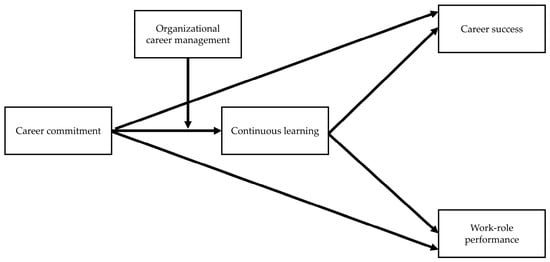
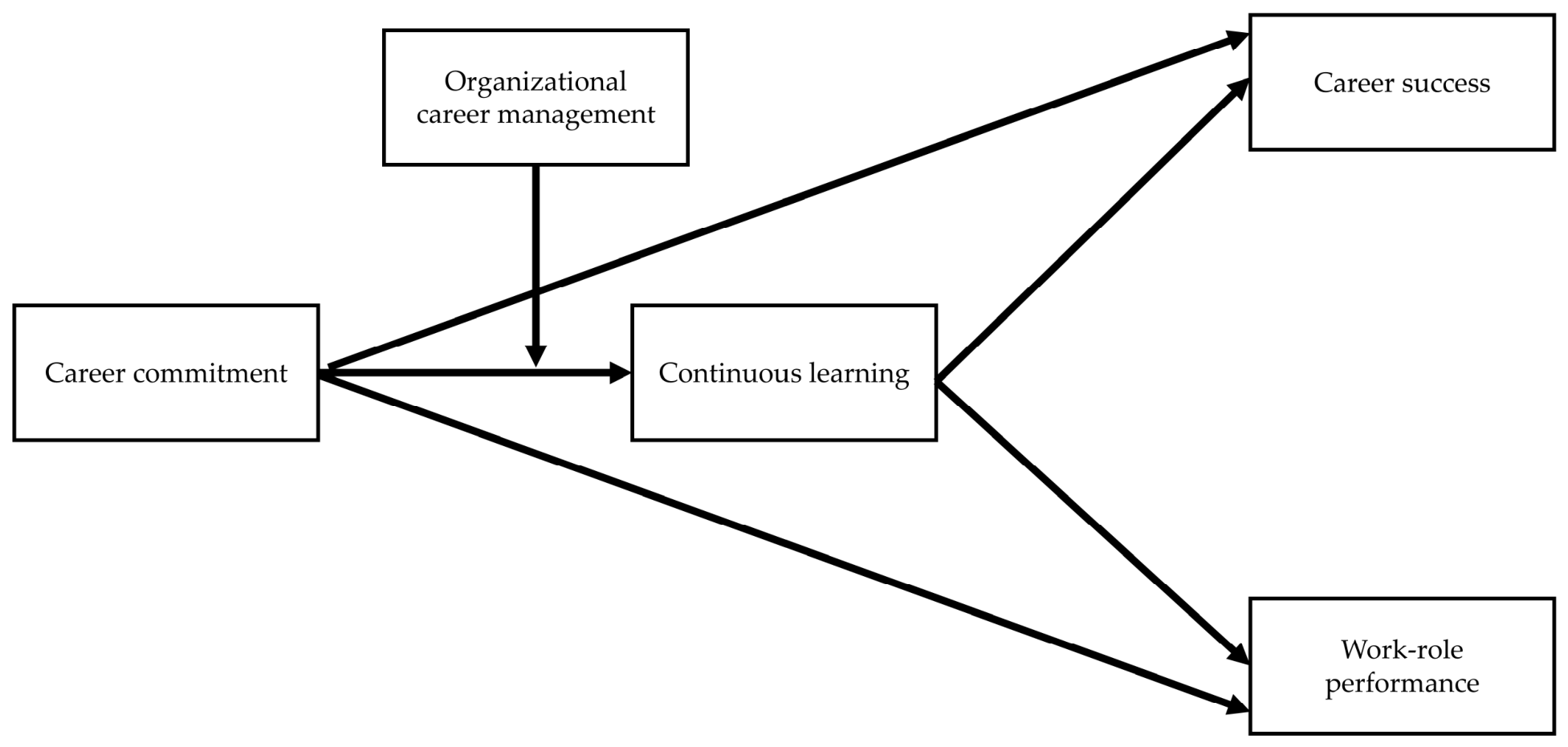
Therefore, the present study aims to examine how career commitment is associated with outcomes relevant to career sustainability by identifying continuous learning as a potential mediating pathway and organizational career management as a moderating condition. The proposed mediation is theoretically based on the assumption that commitment may provide the motivation to invest in one’s professional development, whereas continuous learning may represent a behavioral pathway linking such motivation with career-relevant resources. The moderation is proposed because organizational practices may facilitate employees’ access to opportunities required to convert their commitment into learning behaviors. As illustrated in Figure 1, the study proposes a moderated mediation model in which continuous learning mediates the relationship between career commitment and sustainable career outcomes, while organizational career management moderates the relationship between career commitment and continuous learning.
Figure 1.
The proposed moderated mediation model.
Theoretically, the study extends previous research in three main ways. First, rather than examining career commitment primarily as a direct predictor of career outcomes, it conceptualizes continuous learning as a developmental pathway through which career commitment may be associated with both subjective career success and work-role performance. Second, it moves beyond considering organizational career management as an independent antecedent of employee outcomes by examining it as a contextual condition that may strengthen the association between individual career motivation and continuous learning. Third, by integrating these relationships within a single moderated mediation model, the study connects individual motivation, developmental behavior, and organizational support and examines their joint relevance for both happiness- and productivity-related indicators of career sustainability. Practically, this perspective highlights the need for organizations to complement employees’ career motivation with accessible formal and informal career-development practices that support continuous learning and sustainable career outcomes.
2. Theoretical Background
2.1. From Career Commitment to Sustainable Outcomes
Career commitment refers to individuals’ identification with and attachment to their chosen profession, as well as their willingness to invest effort in developing within that professional field [7]. Unlike organizational commitment, which concerns attachment to a specific employer, career commitment reflects a more enduring dedication to one’s occupation and professional trajectory. Career-committed employees are therefore likely to regard their career as an important component of their identity and to persist in pursuing career-related goals.
In the present study, subjective career success and work-role performance are considered outcomes relevant to career sustainability. Subjective career success concerns individuals’ positive evaluations of their career achievements and progress toward personally meaningful goals, including advancement, income, and competence development [23]. Work-role performance refers to the extent to which employees effectively fulfill their work responsibilities and comprises proficiency, adaptivity, and proactivity, namely the ability to perform core tasks, respond effectively to change, and initiate improvements in work processes [24]. These constructs are not intended as direct measures of career sustainability itself, but as career- and work-related outcomes that are theoretically relevant to its happiness- and productivity-related dimensions.
The rationale for the proposed relationships is grounded in the sustainable career framework, according to which sustainable careers develop through the dynamic interaction of individual agency, contextual conditions, and time and can be assessed through the indicators of happiness, health, and productivity [2]. Recent developments of this framework have further emphasized that sustainable careers depend on the reciprocal investments made by employees and organizations and on the resources that enable individuals to remain successful and productive over time [25]. From this perspective, subjective career success represents a happiness-related outcome because it captures satisfaction with and positive evaluations of one’s career trajectory. Work-role performance represents a productivity-related outcome because it reflects employees’ capacity to contribute effectively, adaptively, and proactively to their work context.
Career commitment is consistent with the individual-agency component of this framework. Employees who are strongly committed to their careers are more likely to persist in pursuing professional objectives, devote effort to career advancement, and interpret difficulties as challenges to be addressed rather than reasons to disengage. Such sustained career investment should contribute to both a more positive evaluation of one’s career progress and more effective functioning in the work role.
Recent empirical evidence supports the relationship between career commitment and career success. Ref. [9] found that career commitment was associated with both objective and subjective career success among university employees, with different employability dimensions contributing to these relationships. Ref. [8] similarly found a positive relationship between career commitment and subjective career success among veterinary professionals and showed that this relationship was stronger among employees with higher career self-efficacy. In the hospitality sector, ref. [26] confirmed a strong positive association between career commitment and subjective career success and identified career resilience and self-efficacy as mechanisms explaining this relationship.
Recent studies have devoted less attention to the direct relationship between career commitment and multidimensional work-role performance. Nevertheless, contemporary research shows that sustained investments in career development and professional resources are associated with employees’ work performance [27]. Moreover, occupational commitment, a closely related conceptualization of attachment to one’s professional field, has been associated with work-related behaviors such as job crafting and active investment in work activities [28]. Together, these findings suggest that employees who are dedicated to their careers are more likely to direct effort toward effective, adaptive, and proactive work-role behaviors. Examining this relationship consequently extends recent career-commitment research, which has predominantly focused on career success, employability, and retention rather than on multidimensional work-role performance.
Considering these theoretical arguments and previous empirical evidence, the present study hypothesizes that:
H1.
Career commitment is directly related to career success (H1a) and work performance (H1b).
2.2. The Mediating Role of Continuous Learning
Although career commitment may contribute to sustainable outcomes, commitment represents primarily a motivational orientation and does not, by itself, explain how employees acquire the resources required to achieve those outcomes. The present study proposes continuous learning as a potential behavioral pathway linking career commitment with subjective career success and work-role performance.
Continuous learning refers to employees’ ongoing and self-initiated efforts to acquire, update, and apply the knowledge and competencies required for their current and future work activities [13]. It includes learning through formal developmental activities as well as through work experiences, reflection, independent study, experimentation, and the application of knowledge acquired from previous events. Continuous learning therefore represents a proactive and enduring investment in competence development rather than participation in isolated training activities.
The proposed mediating role of continuous learning can be explained through conservation of resources theory. According to its resource-investment principle, individuals invest their existing resources to protect against resource loss, respond to demands, and acquire additional resources [29]. In the present model, career commitment represents a motivational resource that makes the investment of time and effort in professional development more personally valuable. Because their career constitutes an important part of their identity and future goals, highly committed employees should be more willing to identify competence gaps, search for new knowledge, reflect on their experiences, and prepare for emerging occupational requirements.
Within this theoretical frame, continuous learning is the behavioral process through which this motivation can generate further career resources. Learning allows employees to expand their knowledge, refine their skills, strengthen their professional confidence, and develop a greater capacity to manage change. Career commitment may therefore initiate a resource-gain process: commitment encourages learning investments, while learning produces competencies that contribute to favorable career evaluations and effective work functioning.
Recent workplace-learning research supports the importance of motivational resources for learning behavior. Ref. [30] found that personal resources, including proactive personality and learning self-efficacy, were associated with employees’ motivation and intention to learn. Ref. [16] showed that employees’ achievement goals were related to their engagement in informal workplace learning, confirming that motivational orientations influence whether workers actively learn from their daily activities. Moreover, the systematic review conducted by [31] identified career motivation, learning orientation, self-efficacy, perceived value, and developmental goals among the most consistent individual antecedents of workplace learning. In line with these findings, career commitment should provide employees with a career-related reason to invest persistently in the acquisition and renewal of competencies.
Evidence also indicates that learning and development contribute to outcomes relevant to career sustainability. Continuous workplace learning equips employees with resources that improve their capacity to anticipate future demands, adapt to new responsibilities, and remain employable. Ref. [9] showed that career commitment related to employability dimensions such as anticipation and optimization, personal flexibility, and corporate sense, all of which require ongoing competence development. Research on workplace learning further indicates that informal learning is associated with the acquisition of knowledge and skills and with favorable performance-related outcomes [16,31]. Similarly, ref. [27] found that training and career-development processes were positively associated with work performance.
Continuous learning should also contribute to subjective career success. By developing new competencies and preparing for future requirements, employees increase their ability to pursue meaningful career goals and recognize opportunities for advancement and development. Learning may consequently strengthen perceptions of career progress even when success is not reflected exclusively in promotions or salary increases. Recent career research has increasingly emphasized the role of human and career capital in connecting developmental activities with subjective career success, employability, and innovative work behavior [32].
Taken together, conservation of resources theory and recent empirical evidence suggest that career commitment encourages employees to invest in continuous learning and that the resources developed through learning subsequently contribute to subjective career success and work-role performance. Accordingly, the present study hypothesizes that:
H2.
Career commitment is indirectly related to career success (H2a) and work performance (H2b) through continuous learning.
2.3. The Moderating Role of Organizational Career Management
Employees’ commitment to their careers may not necessarily translate into continuous learning under all organizational conditions. Even strongly committed employees may be unable to act upon their developmental motivation when they have limited access to training, developmental assignments, feedback, career information, or professional guidance. The relationship between career commitment and continuous learning may therefore depend on the career-development resources provided by the organization.
Organizational career management encompasses the formal and informal practices through which organizations support employees’ career development [2,25]. Formal practices include career-related training, personal development plans, developmental assignments, performance feedback, and information about internal career opportunities. Informal practices include mentoring, career advice, networking opportunities, and developmental support from supervisors and other organizational members. These practices provide employees with the opportunities, information, relationships, and guidance needed to pursue their career goals.
The proposed moderating role of organizational career management is consistent with Lent and Brown’s [33] social cognitive model of career self-management. This model suggests that adaptive career behaviors are shaped by the interaction between personal agency and contextual support or barriers [33]. Individuals may possess strong career goals and motivations, but their capacity to translate these orientations into concrete behaviors depends partly on whether their environment provides the opportunities and support required to act.
Applied to the present study, career commitment represents individual motivational orientation, continuous learning represents adaptive career behavior, and organizational career management represents a source of contextual support. Organizational career practices can enable committed employees to identify relevant learning objectives, access developmental experiences, receive information about competence requirements, and obtain feedback on their progress. Accordingly, organizational career management should increase the extent to which career commitment is converted into continuous-learning behavior.
This argument is also consistent with the sustainable career framework, which maintains that sustainable outcomes cannot be attributed solely to individual responsibility but emerge from the interaction between individuals and their career contexts [6,25]. When organizational career support is high, employees’ motivation to develop is accompanied by concrete opportunities and guidance. Conversely, when such support is limited, even highly committed employees may struggle to determine which competencies to develop or to access the experiences required for learning. Organizational career management should therefore function as an enabling condition rather than merely as an additional independent predictor of continuous learning.
Recent evidence confirms the importance of organizational career management as a contextual career resource. In their systematic review of 85 studies, ref. [34] concluded that organizational career-management practices are consistently associated with positive employee attitudes, behaviors, and career outcomes, while also emphasizing the need to investigate the conditions under which these practices are most effective. Ref. [32] found that organizational career management was positively associated with subjective career success, employability, and innovative work behavior and that these relationships were explained by the development of employees’ career capital. These findings indicate that organizational career practices generate resources that allow employees to pursue and enact their career goals.
More recent evidence also highlights the interdependence between organizational support and individual agency. Ref. [35] showed that proactive organizational career support contributed to employee thriving by reducing perceptions of job-content plateau and that its effects varied according to employees’ political skill. Because thriving comprises both learning and vitality, this evidence suggests that the developmental effects of career support depend on employees’ capacity to use the resources provided by the organization. Ref. [36] similarly found that organizational career management promoted career growth through the satisfaction of employees’ basic psychological needs and their individual career-management activities. These studies do not test the exact interaction proposed here, but they provide convergent evidence that organizational career support and individual career resources operate jointly in producing developmental outcomes.
Accordingly, organizational career management is expected to strengthen the positive relationship between career commitment and continuous learning. When formal and informal career-management practices are readily available, career-committed employees should be better able to transform their professional dedication into concrete learning investments. Because continuous learning is proposed as the mechanism connecting career commitment with sustainable outcomes, the indirect effects on subjective career success and work-role performance should also become stronger as organizational career management increases.
Considering these theoretical arguments, recent empirical evidence, and the preceding hypotheses, the present study hypothesizes that:
H3.
Organizational career management moderates the positive indirect relationships of career commitment with subjective career success (H3a) and work-role performance (H3b) through continuous learning, such that these indirect relationships are stronger at higher levels of organizational career management.
3. Materials and Methods
3.1. Procedure and Participants
This study adopted a cross-sectional design and relied on a non-probability convenience sampling procedure. Participants were employees working in Italy and were recruited between April and September 2024. The survey link was disseminated through social networks and the researchers’ personal and professional contacts, allowing the study to reach employees working across organizations of different sizes and sectors. Data were collected through an online self-report questionnaire. Before accessing the survey, participants received information about the aims of the study, the voluntary nature of participation, the anonymity and confidentiality of their responses, and their right to withdraw at any time without consequences. All participants provided informed consent before completing the questionnaire. The study was conducted in accordance with the ethical principles of the Declaration of Helsinki. Ethical approval was obtained from the Ethics Committee of the University of Bari (protocol code ET-23-06).
The final sample comprised 203 Italian employees. The participants had a mean age of 40.72 years (SD = 12.30), with ages ranging from 24 to 63 years. Regarding gender, 55% identified as women and 45% as men. In terms of educational attainment, 53% held a university degree, whereas 47% had completed upper-secondary education.
Participants were employed in organizations of different sizes and sectors. Specifically, 51% worked in small- and medium-sized enterprises, whereas 49% worked in large organizations. Moreover, 56% were employed in the private sector and 44% in the public sector. Considering employment arrangements, 77% held a permanent contract, while 23% had a fixed-term contract. Given the non-probability recruitment procedure, the sample was not intended to be representative of the Italian working population, and this should be considered when evaluating the external validity of the findings.
3.2. Measures
All study variables were assessed using previously validated self-report measures translated into Italian for the purposes of the present study. We followed a back-translation procedure to translate the original scales into Italian. The original English items were first translated into Italian by one member of the research team and then back-translated into English by a bilingual member who had not participated in the initial translation. The two English-language versions were compared to identify any discrepancies, and the Italian translations were refined through minor adjustments where necessary. Unless otherwise specified, participants responded using a five-point Likert-type scale ranging from 1 (strongly disagree) to 5 (strongly agree). For each measure, item scores were averaged, with higher scores indicating higher levels of the corresponding construct. The reliability coefficients reported below were calculated using the present sample.
Career commitment was assessed using the eight-item Career Commitment Scale developed by Blau [7]. The scale measures individuals’ attachment and dedication to their current profession, as well as their willingness to continue investing in that occupational field. A sample item is: “If I had all the money I needed without working, I would probably continue in my current profession.” Negatively worded items were reverse-coded before calculating the overall score. Higher scores indicated stronger career commitment. The scale showed satisfactory internal consistency, with Cronbach’s α = 0.83.
Continuous learning was assessed using the seven-item scale developed by Watanabe, Tareq, and Kanazawa [13]. The scale evaluates employees’ voluntary and ongoing efforts to acquire, update, and apply the knowledge and competencies required for their current and future work activities. It includes learning through work experience, autonomous study, reflection on previous experiences, and preparation for future professional requirements. A sample item is: “I continuously improve my knowledge through work experiences.” An overall continuous-learning score was calculated by averaging the item responses, with higher scores indicating greater engagement in continuous learning. The scale showed satisfactory internal consistency, with Cronbach’s α = 0.84.
Organizational career management was assessed using the ten-item measure developed by Sturges, Guest, Conway, and Davey [19]. The measure comprises formal and informal organizational career-management practices. Formal career-management practices were assessed through six items referring to structured organizational initiatives intended to support employees’ career development, including career-related training, personal development plans, developmental work assignments, and performance feedback. A sample item is: “I have been given a personal development plan.” The formal-practices subscale showed excellent internal consistency, with Cronbach’s α = 0.90. Informal career-management practices were assessed through four items referring to less structured forms of career support, including career advice, mentoring, networking opportunities, and developmental support from supervisors and other organizational members. A sample item is: “I have been given impartial career advice when I needed it.” The informal-practices subscale showed satisfactory internal consistency, with Cronbach’s α = 0.85. The overall organizational career-management score showed excellent internal consistency (Cronbach’s α = 0.92). For the path analysis, the ten items were combined to obtain an overall organizational career-management score. Higher scores indicated a stronger perception that the organization provided formal and informal opportunities and support for employees’ career development.
Subjective career success was assessed using the eight-item scale included in the study by Rothwell and Arnold [23]. The measure evaluates employees’ subjective perceptions of their career achievements and progress toward personally relevant career goals, including professional advancement, income, responsibility, and competence development. A sample item is: “I am satisfied with the success I have achieved in my career.” An overall score was calculated by averaging the item responses, with higher scores indicating greater subjective career success. The scale demonstrated excellent internal consistency, with Cronbach’s α = 0.93.
Work-role performance was assessed using the nine-item Work Role Performance Scale developed by Griffin, Neal, and Parker [24]. Participants were asked to indicate how frequently they had engaged in each behavior during the previous month, using a five-point response scale ranging from 1 (never) to 5 (always). The measure comprises three dimensions: task proficiency, task adaptivity, and task proactivity. Task proficiency was assessed through three items measuring the extent to which employees effectively fulfilled the core requirements of their work role. A sample item is: “I carried out the core parts of my job well.” The subscale showed satisfactory internal consistency, with Cronbach’s α = 0.81. Task adaptivity was assessed through three items measuring employees’ ability to respond effectively to changes in their tasks and work requirements. A sample item is: “I adapted well to changes in my core tasks.” The subscale showed satisfactory internal consistency, with Cronbach’s α = 0.87. Task proactivity was assessed through three items measuring employees’ self-initiated efforts to improve the way in which their work was performed. A sample item is: “I came up with ideas to improve the way in which my core tasks are done.” The subscale showed satisfactory internal consistency, with Cronbach’s α = 0.85. The overall score showed excellent internal consistency (Cronbach’s α = 0.92). For the path analysis, the nine items were combined to obtain an overall work-role performance score encompassing proficient, adaptive, and proactive work behaviors. Higher scores indicated more frequent enactment of effective, adaptive, and self-initiated behaviors in the work role.
3.3. Analysis
Data analyses were conducted using jamovi (Version 2.6 [37]) with the PATHj module [38]. Preliminary analyses included the examination of univariate distributions, multivariate normality, descriptive statistics, internal consistency coefficients, and zero-order correlations among the study variables. Cronbach’s alpha coefficients were calculated to assess the internal consistency of all measures and subscales. Before testing the hypothesized structural model, a confirmatory factor analysis (CFA) was conducted at the item level to examine whether the measurement structure of the study variables was adequately represented in the present sample. Model fit was evaluated using the chi-square statistic (χ2), CFI, TLI, RMSEA, and SRMR. To assess the potential influence of common method variance, an additional single-factor confirmatory factor analysis was conducted in which all study items were specified to load on a single latent factor. This model was examined to determine whether the covariance among the measures could be adequately accounted for by a single common factor.
The hypothesized moderated mediation model was tested through path analysis using observed composite scores. Path analysis was selected because the hypothesized model involved the simultaneous estimation of direct, indirect, and conditional indirect associations among observed variables. Given the cross-sectional design, the mediation and moderated mediation analyses were interpreted as patterns of indirect association consistent with the hypothesized model rather than as evidence of temporal or causal processes. All variables included in the model showed acceptable univariate distributions, with absolute skewness values below 0.60 and absolute excess kurtosis values below 0.70, and therefore well below the conventional thresholds of 2 and 7, respectively [39]. However, Mardia’s test [40] indicated significant multivariate skewness, χ2(35) = 87.88, p < 0.001, whereas multivariate kurtosis was not significant, z = 0.84, p = 0.401. Given the significant multivariate skewness observed in the data, robust maximum likelihood estimation was used to obtain standard errors and test statistics that were robust to deviations from multivariate normality. Bias-corrected bootstrapping with 5000 resamples and 95% confidence intervals was used to evaluate indirect and conditional indirect effects because it provides confidence intervals for these effects without relying on the assumption of normality of their sampling distribution. An indirect effect was considered statistically significant when its confidence interval did not include zero. The same bootstrapping procedure was used to estimate confidence intervals for the conditional indirect effects.
Standardized parameter estimates were reported to facilitate the interpretation of the strength of the relationships included in the model. The mediating role of continuous learning was examined by estimating the indirect effects of career commitment on subjective career success and work-role performance. The statistical significance of the indirect effects was assessed through bias-corrected bootstrapping with 5000 resamples and 95% confidence intervals. The hypothesized moderated mediation was examined by estimating the conditional indirect effects of career commitment on subjective career success and work-role performance through continuous learning at different levels of organizational career management. Career commitment and organizational career management were mean-centered before computing their interaction term. The Johnson–Neyman technique was used to identify the range of values of organizational career management for which the conditional indirect associations were statistically significant, thereby providing a more informative assessment of moderation than examining only selected values of the moderator. Statistical significance was set at p < 0.05.
4. Results
Prior to testing the hypothesized path models, the measurement structure was examined through confirmatory factor analysis. The hypothesized measurement model showed an acceptable fit to the data, χ2(781) = 1264.07, p < 0.001, CFI = 0.92, TLI = 0.91, RMSEA = 0.06, 90% CI [0.05, 0.06], and SRMR = 0.06, providing support for the adequacy of the measurement structure used in the subsequent analyses. In addition, a single-factor model in which all study items loaded on one latent factor showed a poor fit to the data, χ2(819) = 3922.11, p < 0.001, CFI = 0.46, TLI = 0.43, RMSEA = 0.14, 90% CI [0.13, 0.14], and SRMR = 0.14. Thus, the covariance among the study measures was not adequately represented by a single common factor, providing no indication that a single common source accounted for the observed relationships.
Descriptive statistics, internal consistency coefficients, and bivariate correlations among the study variables are presented in Table 1. All correlations were statistically significant and in the expected positive direction. Career commitment was positively associated with continuous learning, organizational career management, subjective career success, and work-role performance. Continuous learning was also positively related to both subjective career success and work-role performance.
Table 1.
Descriptive statistics, Cronbach’s alpha coefficients, and Pearson’s correlations among the study variables.
To test the hypothesized direct and indirect relationships of career commitment with subjective career success and work-role performance (H1 and H2), we first estimated a mediation model that included the direct paths from career commitment to the two outcomes and the indirect paths through continuous learning. Because the model was just-identified, global fit indices were not informative.
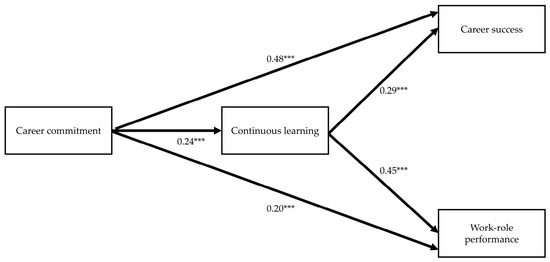
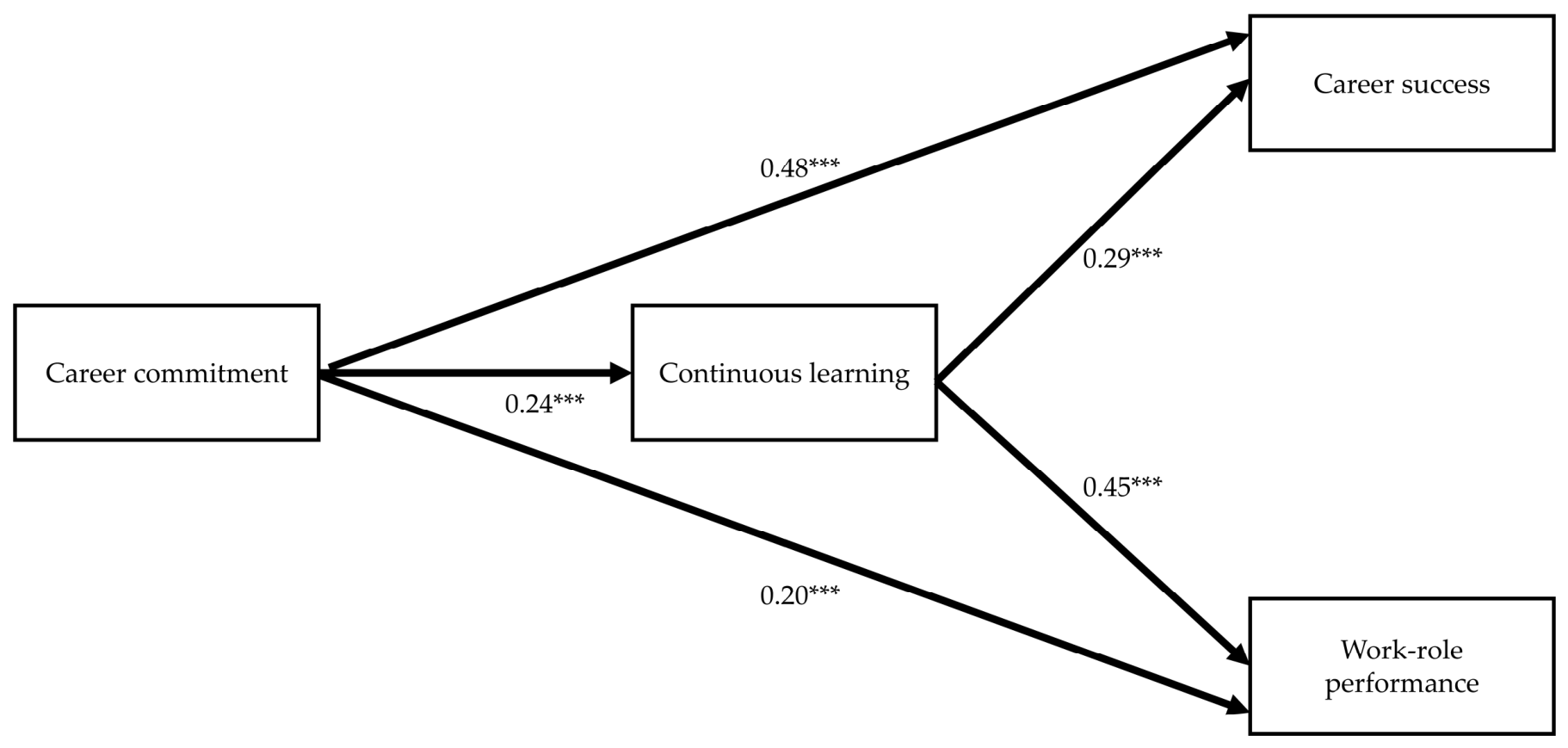
As shown in Figure 2, career commitment was positively related to continuous learning (B = 0.18, SE = 0.05, β = 0.24, p < 0.001). Career commitment also had significant direct relationships with subjective career success (B = 0.51, SE = 0.06, β = 0.48, p < 0.001) and work-role performance (B = 0.14, SE = 0.05, β = 0.20, p = 0.003), supporting Hypotheses 1a and 1b. Continuous learning was, in turn, positively related to subjective career success (B = 0.41, SE = 0.09, β = 0.29, p < 0.001) and work-role performance (B = 0.42, SE = 0.07, β = 0.45, p < 0.001). The bootstrapping procedure showed that the indirect effect of career commitment on subjective career success through continuous learning was statistically significant (B = 0.07, SE = 0.02, 95% CI [0.03, 0.13], β = 0.07). The indirect effect on work-role performance was also significant (B = 0.08, SE = 0.03, 95% CI [0.03, 0.13], β = 0.11). These findings supported Hypotheses 2a and 2b. The model explained 6% of the variance in continuous learning, 39% of the variance in subjective career success, and 28% of the variance in work-role performance.
Figure 2.
Standardized parameter estimates for the mediation model. Note. *** p < 0.001.
To test the moderating role of organizational career management, we first estimated the complete moderated mediation model, including direct paths from organizational career management to both subjective career success and work-role performance. This initial model was just-identified; therefore, its global fit indices were not informative. The direct relationship between organizational career management and work-role performance was not statistically significant (B = 0.02, SE = 0.04, β = 0.03, p = 0.626). After examining the results, we made a post hoc decision to remove this nonsignificant path for reasons of model parsimony, and the model was re-estimated. The resulting model demonstrated an excellent fit to the data, χ2(3) = 3.20, p = 0.362, CFI = 1.00, TLI = 1.00, RMSEA = 0.02, 95% CI [0.00, 0.12], SRMR = 0.02.
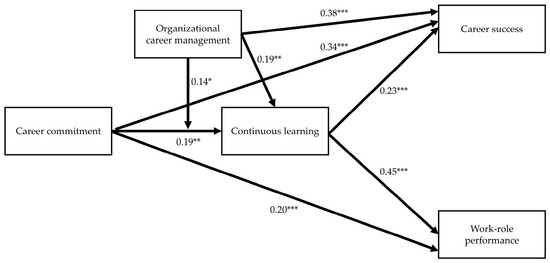
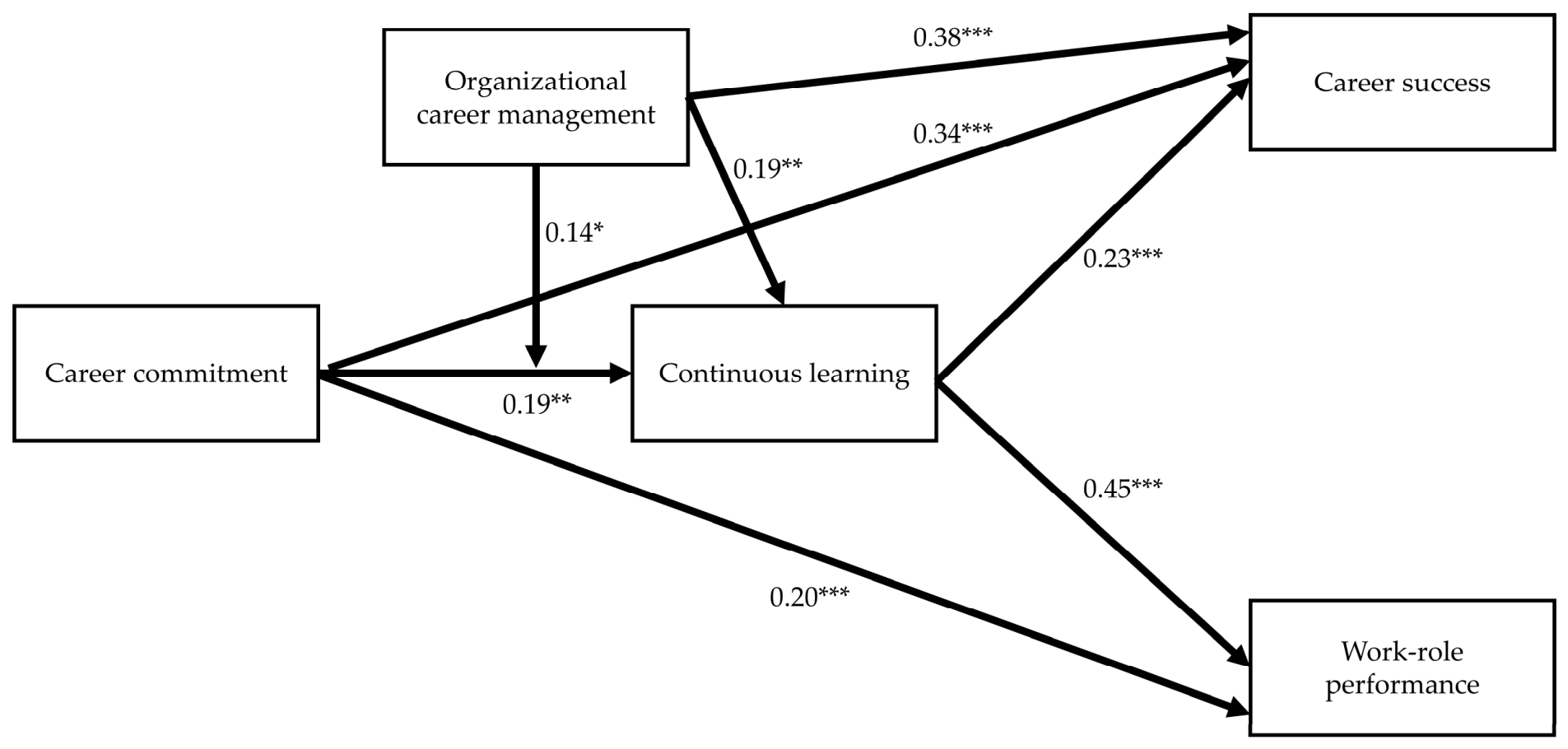
Career commitment (B = 0.14, SE = 0.05, β = 0.19, p = 0.007) and organizational career management (B = 0.13, SE = 0.05, β = 0.19, p = 0.010) were both positively related to continuous learning. More importantly, their interaction was statistically significant (B = 0.10, SE = 0.05, β = 0.14, p = 0.034), indicating that the positive relationship between career commitment and continuous learning became stronger as organizational career management increased.
Within the final model shown in Figure 3, continuous learning remained positively related to subjective career success (B = 0.32, SE = 0.09, β = 0.23, p < 0.001) and work-role performance (B = 0.42, SE = 0.07, β = 0.45, p < 0.001). Career commitment retained significant direct relationships with subjective career success (B = 0.36, SE = 0.06, β = 0.34, p < 0.001) and work-role performance (B = 0.14, SE = 0.05, β = 0.20, p = 0.003). Organizational career management was also directly related to subjective career success (B = 0.37, SE = 0.06, β = 0.38, p < 0.001). The model explained 11% of the variance in continuous learning, 51% of the variance in subjective career success, and 28% of the variance in work-role performance.
Figure 3.
Standardized parameter estimates for the moderated mediation model. Note. * p < 0.05; ** p < 0.01; *** p < 0.001.
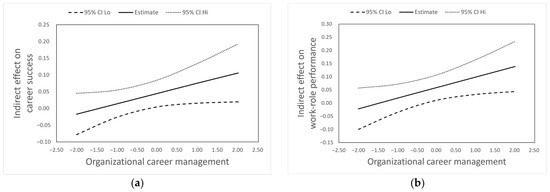
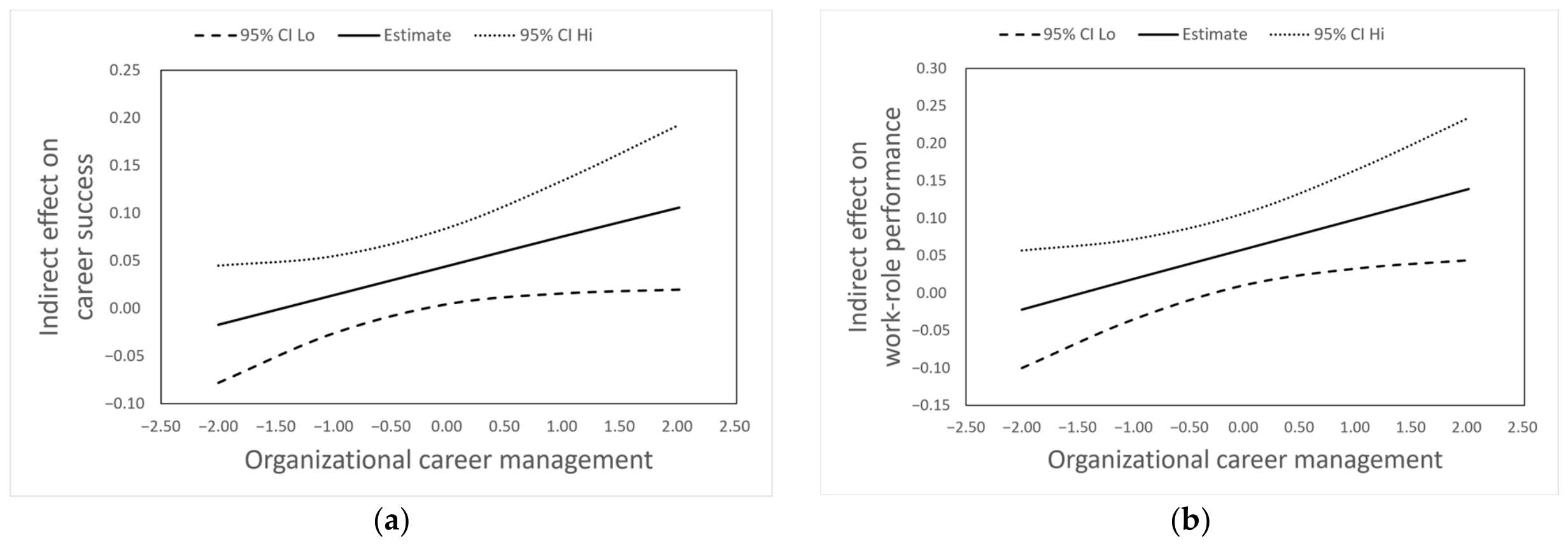
To examine whether the interaction also conditioned the indirect relationships between career commitment and the two outcomes, we inspected the conditional indirect effects across the observed range of organizational career management using the Johnson–Neyman technique. As illustrated in Figure 4, the solid lines represent the estimated indirect effects of career commitment on subjective career success and work-role performance through continuous learning, whereas the surrounding lines represent their 95% confidence intervals.
Figure 4.
Conditional indirect effects of career commitment on subjective career success (a) and work-role performance (b) through continuous learning across levels of organizational career management. Note. The moderator was mean-centered. Solid lines represent the estimated conditional indirect effects, while dashed and dotted lines represent the lower and upper limits of the 95% confidence intervals, respectively. Conditional indirect effects are statistically significant where the confidence interval does not include zero.
The estimated conditional indirect effects increased in magnitude as organizational career management increased and were statistically significant only at values of the moderator for which the confidence interval did not include zero. The Johnson–Neyman analysis showed a pattern in which the indirect associations through continuous learning were more pronounced at higher levels of organizational career management. Thus, the figure shows that the positive indirect associations of career commitment with subjective career success and work-role performance through continuous learning were stronger at higher levels of organizational career management. Consistent with this pattern, at one standard deviation below the mean of organizational career management, the indirect effects were not statistically significant for either subjective career success (B = 0.014, 95% CI [−0.030, 0.058]) or work-role performance (B = 0.019, 95% CI [−0.037, 0.078]). In contrast, at one standard deviation above the mean, both indirect effects were positive and statistically significant, for subjective career success (B = 0.075, 95% CI [0.024, 0.146]) and work-role performance (B = 0.099, 95% CI [0.039, 0.177]). Taken together, these findings were consistent with the hypothesized conditional pattern described in H3a and H3b.
5. Discussion
This study aimed to examine the relationship between career commitment and career sustainability, measured as subjective career success and work-role performance, testing continuous learning as a potential mediating pathway and organizational career management as a moderating condition. The findings provide empirical support for the proposed moderated mediation model and are consistent with the sustainable career framework [2], according to which sustainable careers emerge from the continuous interaction between individual agency, developmental processes, and contextual resources. Specifically, employees reporting stronger career commitment tend to engage in continuous learning, which is associated with higher levels of subjective career success and work-role performance. Moreover, these indirect relationships become stronger when employees perceive higher levels of organizational career management.
Consistent with our first hypothesis, career commitment showed positive direct associations with both subjective career success and work-role performance. These findings are consistent with previous evidence linking career commitment to favorable career outcomes [8,9,10]. Career commitment may serve as a meaningful expression of individual agency, motivating employees to pursue career-related goals while maintaining effective and adaptive work behaviors that contribute to both happiness- and productivity-related career outcomes [2].
As hypothesized, significant indirect associations between career commitment and both subjective career success and work-role performance through continuous learning were observed, while the corresponding direct associations remained significant. This evidence suggests that the association of career commitment with sustainable outcomes may arise from employees’ active engagement in learning behaviors that enable them to acquire and continually renew the competencies required to respond to changing work demands. This interpretation is consistent with the resource-investment principle of Conservation of Resources theory [29], according to which individuals invest existing personal resources to acquire new ones. In this sense, career commitment may provide the motivation to engage in developmental activities, whereas continuous learning is the behavioral mechanism by which this motivation is transformed into valuable career resources. This interpretation is also consistent with recent workplace-learning research showing that personal and motivational resources, including achievement goals, learning self-efficacy, and career-related motives, encourage employees to engage in learning behaviors [16,30,31,41]. Moreover, previous studies indicate that learning and career-development processes are associated with employability, subjective career success, and work performance [9,17,27,32]. The fact that the direct relationships between career commitment and both outcomes remained significant after accounting for continuous learning further suggests that learning constitutes an important, although not exclusive, pathway linking career commitment to sustainable career outcomes.
Finally, and consistent with our third hypothesis, organizational career management strengthened the relationship between career commitment and continuous learning. The conditional indirect effects of career commitment on both subjective career success and work-role performance were stronger at higher levels of organizational career management. These findings are consistent with the assumptions of the career self-management model within Social Cognitive Career Theory [33], according to which adaptive career behaviors emerge from the interaction between personal agency and contextual opportunities. At the same time, they provide empirical support for one of the central propositions of the sustainable career framework, namely that career sustainability cannot be attributed solely to employees’ individual motivation but depends on the reciprocal contribution of individuals and organizations. Career commitment may be linked to employees’ willingness to learn, yet formal and informal career-development practices, including developmental feedback, mentoring, career guidance, and access to learning opportunities, may represent contextual resources associated with the extent to which career motivation is accompanied by sustained competence development. This interpretation is consistent with previous evidence showing that organizational career management contributes to the processes of career growth, employability, and employee thriving, and that its developmental benefits are intertwined with employees’ individual resources and activities [32,34,35,36]. Organizational career management is not simply an antecedent of career outcomes. Instead, it seems to be a contextual resource associated with stronger links between career motivation, sustained learning, and outcomes relevant to career sustainability.
5.1. Theoretical Implications
The findings of the present study offer several implications for research on sustainable careers. A first contribution concerns the role of continuous learning within career sustainability. Although learning has traditionally been examined as a developmental outcome or as a consequence of training initiatives [16,31], the present results suggest that continuous learning could be considered as one of the potential process involved in defining career sustainability. From our perspective, continuous learning may represent the mechanism through which employees continually renew the resources needed to maintain positive career trajectories in increasingly dynamic work environments. This interpretation highlights learning as a process that links individual action to long-term career sustainability.
A second contribution concerns how career commitment is conceptualized in the career literature. Career commitment should not be viewed as a sufficient condition for achieving sustainable career outcomes. Instead, its value lies in fostering behaviors that enable employees to build and update their competencies over time [7,30,31]. Continuous learning therefore represents the pathway through which a motivational orientation toward one’s career is linked to resources that support both subjective career success and effective work-role performance. By identifying this process, the study moves beyond documenting direct associations and provides a more process-oriented perspective on how career commitment may be associated with outcomes relevant to career sustainability.
Finally, the study emphasizes the importance of viewing career sustainability as a process shaped jointly by employees and organizations. The potential for developing individual motivation may depend largely on the opportunities and support available within the organizational context [2,25]. The interaction involving organizational career management shows that the positive association between career commitment and continuous learning is stronger when employees report greater access to formal and informal career-development practices. Rather than acting as an additional predictor of career outcomes, organizational career management may therefore represent a contextual condition under which the association between individual career motivation and developmental behaviors is stronger. The contribution of the model therefore lies not simply in linking constructs that have individually been associated with career outcomes, but in specifying how their theoretical functions may operate jointly: career commitment as a motivational resource, continuous learning as a developmental pathway, and organizational career management as a boundary condition that may amplify this pathway. In this respect, the findings bring together three complementary theoretical perspectives. The sustainable career framework explains why sustainable careers depend on the interaction between individuals and context [2]; Conservation of Resources theory clarifies how career commitment generates new resources through continuous learning [29]; and the career self-management perspective of Social Cognitive Career Theory helps explain when this process is more likely to occur [33]. Bringing these perspectives together provides a more comprehensive view of career sustainability and highlights how sustainable careers arise from the interplay between autonomy, development-oriented behaviors, and supportive organizational environments.
5.2. Practical Implications
The findings of this study provide several practical implications for organizations aiming to promote sustainable careers. First, our results highlight the importance of fostering continuous learning as a key mechanism through which employees’ career commitment is associated with positive career and work outcomes. Organizations should therefore create environments that encourage continuous competence development through both formal and informal learning opportunities. Training programs, professional development initiatives, access to learning resources, and opportunities for knowledge exchange and team learning can support employees in maintaining and updating their skills throughout their careers, thereby enhancing their adaptability and long-term employability [42,43].
Second, our findings highlight the role of organizational career management in creating a supportive context where employees could translate their career commitment into continuous learning. Organizations should adopt career management practices that actively support employees’ individual career development processes [44]. Formal practices, such as structured career planning, training pathways, and development programs, should be complemented by informal practices, including mentoring, career advice, coaching, and regular developmental conversations with supervisors. Such practices can help employees identify relevant learning needs, access appropriate developmental opportunities, and integrate learning activities into their ongoing career development. In this way, organizational career management can create the contextual conditions that enable career commitment to be translated into sustained learning and competence development. These practices can strengthen the connection between employees’ career motivations and learning behaviors by providing the resources and support necessary for continuous development.
Finally, organizations should consider career development as a strategic process that contributes not only to employees’ career satisfaction but also to their effectiveness at work [44]. By supporting the development of employees’ proficiency, adaptivity, and proactivity, organizations can promote sustainable careers while simultaneously enhancing individual and organizational performance. Therefore, organizational career management represents an important contextual resource that supports employees to continuously learn and successfully navigate changing career demands. Investing in career management practices may therefore generate benefits at both individual and organizational levels, helping employees in maintaining their employability, in achieving positive career outcomes, and in performing effectively in their current work roles.
5.3. Limitations and Future Research
This study has some limitations that should be considered when interpreting the findings. First, the cross-sectional design prevents conclusions about temporal relationships and causal mechanisms among the variables examined. Accordingly, the indirect effects observed in the present study should be interpreted as statistical associations consistent with the hypothesized mediation model rather than as evidence of temporal or causal mediation. Although the proposed model is theoretically grounded and tested through mediation analyses, future research should adopt longitudinal designs (e.g., cross-lagged panel models; [45]) to better capture the dynamic processes through which career commitment, organizational career management, continuous learning, and sustainable career outcomes develop over time. Moreover, the present study does not directly assess career sustainability as a longitudinal or multidimensional construct. Instead, it examines subjective career success and work-role performance as outcomes theoretically relevant to the sustainable career framework. Future research should incorporate more comprehensive and longitudinal indicators of career sustainability, including happiness, health, and productivity across time.
Second, all variables were assessed through online self-report measures, which may have increased the risk of common method bias and may have inflated some of the observed associations [46]. Although the poor fit of the single-factor model suggests that the covariance among the study variables cannot be adequately accounted for by a single common factor, this analysis does not rule out the possibility of common method variance. Future studies could address this limitation by incorporating multiple sources of information, such as evaluations from supervisors and peers, or by combining self-reported measures with more objective indicators of career and work outcomes. In particular, work-role performance could be assessed using supervisor ratings, while career outcomes could be complemented with more objective or externally validated indicators where available. Combining multiple sources of information would provide a more robust assessment of the relationships proposed in the model and reduce potential concerns associated with relying exclusively on self-reported data.
Third, the use of a convenience sample and the specific characteristics of the participants may limit the generalizability of the findings. Participants recruited through an online procedure may differ systematically from employees who are not reached through this type of recruitment, and the specific composition of the sample may not adequately represent the broader working population. Therefore, caution is warranted when generalizing the findings to employees working in different occupations, organizational contexts, or cultural settings. Moreover, the relationships observed in the present study may vary depending on the nature of the occupation, organizational practices and resources, and broader cultural and institutional contexts. For example, the extent to which organizational career management facilitates continuous learning may depend on the learning opportunities available within specific organizations or occupational settings, while cultural differences may shape employees’ career orientations and responses to organizational support. Future research should replicate these findings across different occupational groups, organizational contexts, and cultural settings, using more diverse samples and, where feasible, probability-based recruitment procedures.
Fourth, although continuous learning represents the main mediator in the proposed model, our findings suggest that career commitment and organizational career management are not the only factors contributing to employees’ continuous learning. Other individual and organizational factors may also play an important role in shaping employees’ learning behaviors. Future research could therefore examine additional antecedents of continuous learning, including other individual resources and organizational conditions, to provide a more comprehensive understanding of the factors that promote sustained learning throughout employees’ careers.
Moreover, future studies could extend the present model by involving multiple organizations and adopting multilevel approaches [47,48] to examine how organizational-level career practices interact with individual career processes. Finally, further research could investigate additional sustainable career outcomes, such as employability, career adaptability, well-being, engagement, and long-term career resilience, to provide a more comprehensive understanding of how individual and organizational resources contribute to sustainable career development.
6. Conclusions
This study examined how career commitment contributes to outcomes relevant to career sustainability by considering continuous learning as a potential mediating pathway and organizational career management as a moderating condition. The findings showed that higher career commitment was associated with greater continuous learning, which, in turn, was associated with higher levels of subjective career success and work-role performance. Moreover, the indirect associations were stronger when employees perceived greater organizational support for their career development.
Taken together, the results are consistent with the evidence according to which career sustainability cannot be understood in terms of individual motivation alone. Career commitment may be associated with greater investment in development, while continuous learning may represent a pathway linking career motivation with career-relevant resources. At the same time, organizational career management may provide the opportunities and conditions supporting these associations. By highlighting the interplay between individual commitment, learning behaviors, and organizational career practices, this study reinforces the view of career sustainability as a shared responsibility between employees and organizations.
Author Contributions
Conceptualization, C.G.G., P.P., F.S., A.D.R., G.S. and A.M.; methodology, C.G.G. and F.S.; software, C.G.G. and F.S.; formal analysis, C.G.G. and F.S.; investigation, C.G.G. and A.M.; data curation, C.G.G. and A.M.; writing—original draft preparation, C.G.G., P.P., F.S., A.D.R. and G.S.; writing—review and editing, C.G.G., P.P., F.S., A.D.R., G.S. and A.M.; supervision, A.M.; project administration, C.G.G. and A.M. All authors have read and agreed to the published version of the manuscript.
Funding
This research received no external funding.
Institutional Review Board Statement
The study was conducted in accordance with the Declaration of Helsinki and approved by the Ethics Committee of the University of Bari (protocol code ET-23-06, 19 April 2023).
Informed Consent Statement
Informed consent was obtained from all subjects involved in the study.
Data Availability Statement
The data that support the findings of this study are available from the corresponding author upon reasonable request.
Conflicts of Interest
The authors declare no conflicts of interest.
References
- Baruch, Y.; Rousseau, D.M. Integrating Psychological Contracts and Ecosystems in Career Studies and Management. Acad. Manag. Ann. 2019, 13, 84–111. [Google Scholar] [CrossRef] [Scilit]
- De Vos, A.; Van Der Heijden, B.I.J.M.; Akkermans, J. Sustainable Careers: Towards a Conceptual Model. J. Vocat. Behav. 2020, 117, 103196. [Google Scholar] [CrossRef] [Scilit]
- Hirschi, A.; Koen, J. Contemporary Career Orientations and Career Self-Management: A Review and Integration. J. Vocat. Behav. 2021, 126, 103505. [Google Scholar] [CrossRef] [Scilit]
- Hall, D.T. The Protean Career: A Quarter-Century Journey. J. Vocat. Behav. 2004, 65, 1–13. [Google Scholar] [CrossRef] [Scilit]
- Maurer, T.J. Career-Relevant Learning and Development, Worker Age, and Beliefs about Self-Efficacy for Development. J. Manag. 2001, 27, 123–140. [Google Scholar] [CrossRef]
- Van Der Heijden, B.; De Vos, A.; Akkermans, J.; Spurk, D.; Semeijn, J.; Van Der Velde, M.; Fugate, M. Sustainable Careers across the Lifespan: Moving the Field Forward. J. Vocat. Behav. 2020, 117, 103344. [Google Scholar] [CrossRef] [Scilit]
- Blau, G.J. The Measurement and Prediction of Career Commitment. J. Occup. Psychol. 1985, 58, 277–288. [Google Scholar] [CrossRef] [Scilit]
- Schultheiss, A.J.; Koekemoer, E.; Masenge, A. Career Commitment and Subjective Career Success: Considering the Role of Career Resilience and Self-Efficacy. Aust. J. Career Dev. 2023, 32, 135–146. [Google Scholar] [CrossRef] [Scilit]
- Van Der Heijden, B.I.J.M.; Davies, E.M.M.; Van Der Linden, D.; Bozionelos, N.; De Vos, A. The Relationship between Career Commitment and Career Success among University Staff: The Mediating Role of Employability. Eur. Manag. Rev. 2022, 19, 564–580. [Google Scholar] [CrossRef] [Scilit]
- Jackson, D.; Tomlinson, M. Investigating the Relationship between Career Planning, Proactivity and Employability Perceptions among Higher Education Students in Uncertain Labour Market Conditions. High. Educ. 2020, 80, 435–455. [Google Scholar] [CrossRef] [Scilit]
- Mrayyan, M.T.; Al-Faouri, I. Career Commitment and Job Performance of Jordanian Nurses. Nurs. Forum 2008, 43, 24–37. [Google Scholar] [CrossRef] [Scilit] [PubMed]
- Tabiu, A.; Pangil, F.; Othman, S.Z. Does Training, Job Autonomy and Career Planning Predict Employees’ Adaptive Performance? Glob. Bus. Rev. 2020, 21, 713–724. [Google Scholar] [CrossRef] [Scilit]
- Watanabe, S.; Tareq, M.; Kanazawa, Y. When Openness to Experience and Conscientiousness Affect Continuous Learning: A Mediating Role of Intrinsic Motivation and a Moderating Role of Occupation: Psychological Paths from Traits to Learning. Jpn. Psychol. Res. 2011, 53, 1–14. [Google Scholar] [CrossRef] [Scilit]
- Colquitt, J.A.; LePine, J.A.; Noe, R.A. Toward an Integrative Theory of Training Motivation: A Meta-Analytic Path Analysis of 20 Years of Research. J. Appl. Psychol. 2000, 85, 678–707. [Google Scholar] [CrossRef] [Scilit] [PubMed]
- Kim, H.; Kang, D.; Lee, S.; McLean, G. Career Commitment as a Mediator between Organization-Related Variables and Motivation for Training and Turnover Intentions. J. Career Dev. 2016, 43, 130–144. [Google Scholar] [CrossRef] [Scilit]
- Decius, J.; Knappstein, M.; Klug, K. Which Way of Learning Benefits Your Career? The Role of Different Forms of Work-Related Learning for Different Types of Perceived Employability. Eur. J. Work Organ. Psychol. 2024, 33, 24–39. [Google Scholar] [CrossRef] [Scilit]
- Gemmano, C.G.; Giancaspro, M.L.; Galiotto, S.; Manuti, A. A Flight Path to Well-Being: The Mediating Role of Continuous Learning between Burnout and Work Performance in Aviation Professionals. Soc. Sci. 2024, 13, 513. [Google Scholar] [CrossRef] [Scilit]
- Na-Nan, K.; Sanamthong, E. Self-Efficacy and Employee Job Performance: Mediating Effects of Perceived Workplace Support, Motivation to Transfer and Transfer of Training. Int. J. Qual. Reliab. Manag. 2019, 37, 1–17. [Google Scholar] [CrossRef] [Scilit]
- Sturges, J.; Guest, D.; Conway, N.; Davey, K.M. A Longitudinal Study of the Relationship between Career Management and Organizational Commitment among Graduates in the First Ten Years at Work. J. Organ. Behav. 2002, 23, 731–748. [Google Scholar] [CrossRef] [Scilit]
- De Vos, A.; Dewettinck, K.; Buyens, D. The Professional Career on the Right Track: A Study on the Interaction between Career Self-Management and Organizational Career Management in Explaining Employee Outcomes. Eur. J. Work Organ. Psychol. 2009, 18, 55–80. [Google Scholar] [CrossRef] [Scilit]
- Khan, M.L.; Salleh, R.; Bin Hemdi, M.A. Effect of Protean Career Attitudes on Organizational Commitment of Employees with Moderating Role of Organizational Career Management. Int. Rev. Manag. Mark. 2016, 6, 155–160. [Google Scholar]
- Khan, F.; Zahra, T.; Bilal, H.; Sufyan, M.; Naz, A. Does Job Engagement Mediate the Relationship between Job Demands and Organizational Commitment of Academicians at Institutions of Higher Education Commission in Pakistan? Ilkogr. Online 2021, 20, 3533. [Google Scholar]
- Rothwell, A.; Arnold, J. Self-perceived Employability: Development and Validation of a Scale. Pers. Rev. 2007, 36, 23–41. [Google Scholar] [CrossRef] [Scilit]
- Griffin, M.A.; Neal, A.; Parker, S.K. A New Model of Work Role Performance: Positive Behavior in Uncertain and Interdependent Contexts. Acad. Manag. J. 2007, 50, 327–347. [Google Scholar] [CrossRef] [Scilit]
- Donald, W.E.; Van Der Heijden, B.I.J.M.; Baruch, Y. Introducing a Sustainable Career Ecosystem: Theoretical Perspectives, Conceptualization, and Future Research Agenda. J. Vocat. Behav. 2024, 151, 103989. [Google Scholar] [CrossRef] [Scilit]
- Bhawna; Sharma, S.K.; Shah, M.A. The Influence of Career Commitment on Subjective Career Success in the Context of Media Industry: Mediating Role of Career Resilience. Cogent Bus. Manag. 2024, 11, 2296148. [Google Scholar] [CrossRef] [Scilit]
- Hosen, S.; Hamzah, S.R.; Arif Ismail, I.; Noormi Alias, S.; Faiq Abd Aziz, M.; Rahman, M.M. Training & Development, Career Development, and Organizational Commitment as the Predictor of Work Performance. Heliyon 2024, 10, e23903. [Google Scholar] [CrossRef] [Scilit] [PubMed]
- Lin, Z.; Wu, W.; Zhang, H.; He, Z.; Han, M.; Li, J. Patterns of Occupational Commitment among Nurses: A Latent Profile Analysis. Front. Psychol. 2024, 15, 1331425. [Google Scholar] [CrossRef] [Scilit] [PubMed]
- Hobfoll, S.E.; Halbesleben, J.; Neveu, J.-P.; Westman, M. Conservation of Resources in the Organizational Context: The Reality of Resources and Their Consequences. Annu. Rev. Organ. Psychol. Organ. Behav. 2018, 5, 103–128. [Google Scholar] [CrossRef] [Scilit]
- Froehlich, D.E.; Raemdonck, I.; Beausaert, S. Resources to Increase Older Workers’ Motivation and Intention to Learn. Vocat. Learn. 2023, 16, 47–71. [Google Scholar] [CrossRef] [Scilit]
- Wijga, M.; Beausaert, S.; Kyndt, E. What Drives Workplace Learning: A Systematic Review of Key Antecedents. J. Workplace Learn. 2025, 37, 90–113. [Google Scholar] [CrossRef] [Scilit]
- Yildiz, D.; Bozbura, F.T.; Tatoglu, E.; Zaim, S. How do Organizational Career Management Activities Influence Employees’ Career Outcomes? The Mediating Role of Career Capital. Int. J. Organ. Anal. 2024, 32, 1805–1832. [Google Scholar] [CrossRef] [Scilit]
- Lent, R.W.; Brown, S.D. Social Cognitive Model of Career Self-Management: Toward a Unifying View of Adaptive Career Behavior across the Life Span. J. Couns. Psychol. 2013, 60, 557–568. [Google Scholar] [CrossRef] [Scilit] [PubMed]
- Zhao, Q.; Cai, Z.; Zhou, W.; Zang, L. Organizational Career Management: A Review and Future Prospect. Career Dev. Int. 2022, 27, 343–371. [Google Scholar] [CrossRef] [Scilit]
- Jiang, Y.; Yan, H.; Wang, Z.; Jiang, Z.; Hu, X.; Zhao, C. Proactive Career Support and Employee Thriving: The Mediating Role of Job Content Plateau and the Moderating Role of Political Skill. Appl. Psychol. 2025, 74, e70021. [Google Scholar] [CrossRef] [Scilit]
- Ni, Y.-X.; Li, J.-P.; Huang, M.-J. Organizational Career Management and Nurse Career Growth: A Serial Multiple Mediation Model of Basic Psychological Needs and Individual Career Management. BMC Nurs. 2025, 24, 824. [Google Scholar] [CrossRef] [Scilit] [PubMed]
- The Jamovi Project. Jamovi, version 2.6. [Computer Software]. Jamovi: Sydney, Australia, 2024.
- Gallucci, M. PATHj: Jamovi Path Analysis [Jamovi Module]. 2021. Available online: https://pathj.github.io/ (accessed on 14 September 2026).
- West, S.G.; Finch, J.F.; Curran, P.J. Structural Equation Models with Nonnormal Variables: Problems and Remedies; Sage: Thousand Oaks, CA, USA, 1995. [Google Scholar]
- Mardia, K.V. Measures of Multivariate Skewness and Kurtosis with Applications. Biometrika 1970, 57, 519–530. [Google Scholar] [CrossRef]
- Signore, F.; Carlo, E.D.; Guglielmi, D.; Ingusci, E.; Mazzetti, G. A Multiperspective Study on the Role of Support and Self-Efficacy in Middle School Students Using the CTCM Method. Acta Psychol. 2026, 266, 106894. [Google Scholar] [CrossRef] [Scilit] [PubMed]
- Gemmano, C.G.; Giancaspro, M.L.; Manuti, A. Linking Team Support for Learning to Performance and Results: The Role of Informal Transfer Activities. J. Workplace Learn. 2026, 38, 110–126. [Google Scholar] [CrossRef] [Scilit]
- Sánchez Ramírez, J.M.; Iñigo, V.; Marcano, B.; Romero-García, C. Evaluation of a Training Programme to Foster Employability Skills in Professional Training: A Case Study. Educ. + Train. 2024, 66, 692–715. [Google Scholar] [CrossRef] [Scilit]
- De Rosa, A.; Akkermans, J.; Khapova, S.N.; Lo Presti, A. Career Competencies: A Meta-Analysis of Their Antecedents and Outcomes. Career Dev. Int. 2026, 31, 609–626. [Google Scholar] [CrossRef] [Scilit]
- Orth, U.; Clark, D.A.; Donnellan, M.B.; Robins, R.W. Testing Prospective Effects in Longitudinal Research: Comparing Seven Competing Cross-Lagged Models. J. Personal. Soc. Psychol. 2021, 120, 1013–1034. [Google Scholar] [CrossRef] [Scilit] [PubMed]
- Podsakoff, P.M.; MacKenzie, S.B.; Podsakoff, N.P. Sources of Method Bias in Social Science Research and Recommendations on How to Control It. Annu. Rev. Psychol. 2012, 63, 539–569. [Google Scholar] [CrossRef] [Scilit] [PubMed]
- Peugh, J.L. A Practical Guide to Multilevel Modeling. J. Sch. Psychol. 2010, 48, 85–112. [Google Scholar] [CrossRef] [Scilit] [PubMed]
- Signore, F.; Pasca, P.; Valente, W.; Ciavolino, E.; Ingusci, E. Social Resources and Emotional Exhaustion: The Role of Communication in Professional Relationships. Intelekt. Ekon. 2022, 15, 205–220. [Google Scholar]

Disclaimer/Publisher’s Note: The statements, opinions and data contained in all publications are solely those of the individual author(s) and contributor(s) and not of MDPI and/or the editor(s). MDPI and/or the editor(s) disclaim responsibility for any injury to people or property resulting from any ideas, methods, instructions or products referred to in the content. |
© 2026 by the authors. Licensee MDPI, Basel, Switzerland. This article is an open access article distributed under the terms and conditions of the Creative Commons Attribution (CC BY) license.