Article

Closed-Loop Enumeration–Surrogate Optimization for Source-Storage Capacity Planning in Large-Scale Renewable Energy Export Bases

1
State Grid Economic Technology Research Institute Co. Ltd., Beijing 102209, China
2
School of Electronic Information, Xijing University, Xi’an 710123, China
*
Author to whom correspondence should be addressed.
Sustainability 2026, 18(12), 5879; https://doi.org/10.3390/su18125879 (registering DOI)
Submission received: 20 May 2026 / Revised: 1 June 2026 / Accepted: 4 June 2026 / Published: 9 June 2026

Abstract

Large-scale renewable energy export bases require coordinated source-storage capacity planning under curtailment, utilization, export, and reliability constraints. This study develops a closed-loop enumeration-surrogate optimization workflow for wind–photovoltaic–dispatchable baseload generation-storage planning. The method uses representative capacity samples evaluated by chronological production simulation, fits valid-domain surrogate models for curtailment and utilization indicators, embeds these diagnostics in a bounded nonlinear optimization problem, and then back tests the selected portfolio through production simulation. The Ordos case is now presented as a proof of concept based on limited disclosed simulation samples rather than as a universally validated planning rule. The recommended portfolio consists of 4000 MW wind power, 5500 MW photovoltaic capacity, 5300 MW supporting baseload capacity, and 1000 MWh energy storage. It keeps simulated maximum renewable curtailment at 4.21%, maintains utilization at 4736 h, and reduces annualized cost by 8.4% and 15.7% compared with two higher-capacity reference schemes. The results indicate that the workflow can identify a credible local planning region, while broader validation requires additional samples and multi-year meteorological scenarios.

1. Introduction

1.1. Motivation

Large renewable energy bases are increasingly used to deliver low-carbon electricity from resource-rich regions to distant load centers. Such bases are normally planned as integrated portfolios of wind power, photovoltaic generation, supporting coal-fired units, energy storage, and high-voltage direct-current export channels. Their capacity-planning problem is not equivalent to a conventional single-resource expansion problem because each resource plays a different operating role: wind and photovoltaic units provide low-carbon energy, coal-fired units provide dispatchable support and inertia, storage absorbs short-term mismatch, and the export channel imposes a delivery boundary.
Renewable curtailment is one of the most direct indicators of whether a planned portfolio can be integrated into a power system. Li et al. reviewed curtailment and avoidance mechanisms in China and showed that curtailment is driven by transmission limits, insufficient flexibility, and inflexible conventional generation [1]. Their review explains the system-level causes of curtailment, but it does not provide a capacity-planning method that links production-simulation evidence to continuous portfolio optimization.
Bunodiere and Lee developed a logic-based forecasting method for renewable curtailment in Kyushu, Japan [2]. Their work demonstrates that curtailment can be predicted using rule-based operating logic and that forecasting can support mitigation actions. However, curtailment prediction alone does not determine how wind, photovoltaic, coal-fired, and storage capacities should be jointly selected in an export-base planning problem.
Production-simulation tools remain indispensable in this context because they capture chronological resource, load, and operational constraints. Connolly et al. reviewed energy-system analysis tools and showed that model structure strongly affects the assessment of renewable integration [3]. This observation is central to export-base planning: chronological simulation is credible but expensive, while pure optimization is efficient but may miss operating realism if it is not calibrated by simulation data.
Mathiesen et al. argued that coherent smart-energy systems require coordinated consideration of renewable generation, storage, transport, and system flexibility [4]. Their study provides a broad system-integration perspective. In contrast, early-stage export-base planning often faces a narrower but more operationally constrained task: selecting a feasible and economical source-storage portfolio under curtailment, coal-utilization, and export-channel requirements when only limited production-simulation samples are available.
The resulting engineering dilemma is that direct enumeration is transparent but discrete, whereas continuous optimization is searchable but depends on reliable mathematical representations. A simple connection of the two may still fail if the sampled points do not cover the optimum region or if fitted relationships are extrapolated beyond their valid domain. This motivates a closed-loop framework that treats enumeration, simulation, surrogate modeling, optimization, and back testing as a unified planning process.

1.2. Related Work

Generation expansion planning has a long research history. Koltsaklis and Dagoumas reviewed state-of-the-art generation expansion planning models and categorized deterministic, stochastic, regulatory, and market-oriented formulations [5]. Their work clarifies the overall modeling landscape, but the reviewed formulations generally assume that operational relationships are embedded directly in the optimization model rather than learned from a small set of production-simulation samples.
Oree et al. reviewed generation expansion planning optimization with renewable energy integration [6]. They summarized optimization objectives, renewable uncertainty, and policy constraints, showing that renewable integration substantially increases model complexity. Nevertheless, their review did not address the specific engineering workflow where representative enumerated portfolios are simulated first and then converted into continuous surrogate constraints.
Pereira et al. studied generation expansion planning with a high share of renewables of variable output [7]. Their analysis emphasizes the importance of planning models that reflect renewable variability. The export-base problem considered here is consistent with this concern, but it additionally requires a validation mechanism because the optimized portfolio must remain credible under chronological production simulation.
Kamalinia and Shahidehpour formulated generation expansion planning for wind-thermal systems [8]. Their work represents the interaction between wind generation and thermal support, which is directly related to the wind–coal coordination considered in this study. However, the formulation does not include photovoltaic capacity, storage-ratio restrictions, and active resampling around a surrogate optimum.
Farhoumandi et al. considered rehabilitation of aging generating units in generation expansion planning [9]. Their study shows that conventional units remain important in planning decisions when their operating availability and support capability change over time. In renewable export bases, coal-fired units similarly serve as dispatchable support resources; however, their utilization hours must be constrained so that they do not undermine renewable accommodation or project economics.
Energy storage expansion planning has also been widely investigated. Sheibani et al. reviewed storage expansion planning in power systems and highlighted the dependence of optimal storage capacity on planning objectives, uncertainty representation, and operational constraints [10]. Their review supports the inclusion of storage as a planning variable, but it does not integrate storage sizing with a sample-driven surrogate model for curtailment and coal-utilization indicators.
Yang et al. presented a comprehensive handbook on optimal sizing and placement of energy storage in power grids [11]. They emphasized that storage value depends on grid location, operating strategy, and planning objectives. In the export-base setting, the present work treats storage primarily as a capacity resource coupled with renewable scale and curtailment mitigation rather than as a network-placement decision.
Qin et al. introduced an underground energy-storage framework for urban rail transit systems [12]. Although the application differs from renewable export-base planning, the study is relevant because it treats storage as an infrastructure-level reliability and energy-efficiency resource rather than as an isolated device. The remaining gap is that underground storage coordination is not linked to generation-mix planning and production-simulation-based validation.
Blanco and Faaij reviewed the role of storage in energy systems with attention to long-term storage and power-to-gas [13]. Their study indicates that storage technology selection depends on temporal balancing needs. The proposed framework is compatible with such technology-specific extensions, although the present case study focuses on storage capacity as a planning variable constrained by investment and flexibility requirements.
Victoria et al. analyzed the role of storage technologies in sector-coupled European decarbonization [14]. Their results show that the system value of storage changes with renewable penetration and sector coupling. The export-base problem studied here is more localized, but it shares the same principle that storage cannot be planned independently of renewable scale and dispatchable support.
Qin et al. developed a non-isothermal dynamic model and collaborative optimization method for a multi-energy system considering pipeline energy storage [15]. This work is useful for understanding distributed energy-storage effects in coupled infrastructures, but it focuses on multi-energy network dynamics rather than source-storage capacity planning for renewable electricity export bases.
Sharma and Balachandra proposed a model-based approach for dynamic renewable integration in a transitioning electricity system [16]. Their work demonstrates the usefulness of model-based planning for renewable transitions. The remaining gap is that model-based planning still needs a mechanism for correcting model error when simplified representations are used to replace expensive chronological simulation.
Li et al. proposed an attention-based conditional generative adversarial network for long-term renewable energy generation scenario construction [17]. Their work improves scenario representation for renewable generation, whereas the present study uses reported production-simulation samples as the primary evidence source and introduces back testing to control surrogate error around the optimized capacity portfolio.
Surrogate-assisted optimization provides a methodological bridge between expensive simulation and continuous search. Jones et al. introduced efficient global optimization for expensive black-box functions [18]. Their method showed how surrogate functions can guide optimization when direct evaluation is costly, but it was not designed for power-system feasibility constraints, such as curtailment and coal utilization.
Forrester and Keane reviewed recent advances in surrogate-based optimization [19]. Their review clarifies that surrogate models are most useful when they are managed with error awareness and sampling strategies. This principle is adopted here by introducing production-simulation back testing and active resampling into the generation-mix planning loop.
Power-system flexibility is another prerequisite for high renewable penetration. Rahman et al. reviewed flexibility under high renewable scenarios and discussed the roles of storage, dispatchable resources, and system operation [20]. Their work supports the engineering logic of combining curtailment limits, coal-hour limits, and storage configuration in one planning model.
Akrami et al. traced the emergence and evolution of power-system flexibility [21]. Their review highlights that flexibility is not a single-resource property, but a system attribute produced by generation, network, storage, and demand-side interactions. This motivates the proposed source-storage coordination structure instead of treating each resource boundary independently.
Kang et al. developed a stochastic-robust model for inter-regional power-system planning [22]. Their work shows that interregional planning requires robustness against uncertain conditions. The present study is complementary: it focuses on the early planning stage of an export base and uses back-tested surrogate models to avoid unreliable optimized portfolios.
Wang et al. developed an enhanced GAN method for joint wind–solar–load scenario generation with extreme weather labeling [23]. This study shows the importance of correlated renewable and load scenarios under extreme conditions; however, scenario generation must still be coupled with capacity optimization and validation before it can directly support export-base source-storage planning.
Bhuvanesh et al. examined generation expansion planning with high renewable penetration [24]. Their study supports the view that cleaner portfolios must be planned under economic and technical constraints. However, high penetration alone is not sufficient for an export base if curtailment, coal utilization, and delivery requirements are not jointly enforced.
Mo et al. applied stochastic dynamic programming to generation expansion planning [25]. Their early work demonstrates that uncertainty-aware expansion planning has long been recognized as important. The proposed framework differs by using production-simulation samples and valid-domain surrogates to connect practical engineering enumeration with continuous optimization.
Zangeneh et al. investigated uncertainty-based distributed generation expansion planning in electricity markets [26]. Their work illustrates the importance of uncertainty and market conditions in distributed planning. The renewable export-base problem considered here is not a market-clearing problem, but it faces a similar need to prevent capacity decisions from being overfitted to a narrow deterministic assumption.
Based on the above literature, several unresolved issues remain for large-scale renewable export-base planning. First, existing generation-expansion models seldom preserve a transparent link between discrete chronological production-simulation evidence and continuous source-storage capacity decisions. Second, storage capacity and supporting coal-fired capacity are often optimized with simplified flexibility indicators, while renewable curtailment, coal-utilization hours, and zero-deficit reliability are not simultaneously enforced in a traceable planning loop. Third, surrogate-assisted optimization has been widely used for expensive simulations, but local back testing around the selected capacity portfolio is still insufficient in practical power-system planning workflows. Fourth, scenario-generation and flexibility studies identify uncertainty and operating stress, yet they rarely specify how new simulation samples should be added when an optimized portfolio lies near a sparse or boundary region. These gaps motivate a closed-loop enumeration-surrogate framework in which simulation-evaluated samples, valid-domain approximation, constrained optimization, and active validation are treated as mutually dependent stages rather than independent calculations.

1.3. Manuscript Positioning and Main Contribution

The manuscript is positioned as a mechanism-driven planning study rather than a new universal optimization theory. Its contribution is the traceable coupling of enumeration, chronological simulation, valid-domain surrogates, constrained search, and back testing.
Compared with conventional generation-expansion planning, the proposed workflow does not assume that all chronological operating relationships are already embedded in a deterministic expansion model. It first obtains curtailment, utilization, and reliability labels from production simulation and then converts those labels into valid-domain surrogate constraints. Compared with generic surrogate-assisted optimization, the loop is not only an objective-function approximation process; it includes engineering feasibility screening, coefficient diagnostics, back-substitution to chronological simulation, and active resampling when the local error exceeds the tolerance. The contribution is therefore the traceable planning workflow that connects these elements for renewable export-base source-storage decisions.
The main contributions are fourfold. First, a representative enumeration and feasibility-screening structure is formulated for wind–photovoltaic–dispatchable baseload generation-storage export-base portfolios. Second, production-simulation indicators are mapped into valid-domain surrogate functions that explicitly include storage in the curtailment relationships. Third, a back-testing and active-resampling mechanism is defined and numerically reported for the optimized portfolio. Fourth, an Ordos proof-of-concept case demonstrates how the method identifies a balanced local planning region while making its sample size and single-year data limitations explicit.


1.4. Paper Organization

The remainder of the paper is organized as follows. Section 2 formulates the planning problem and the mechanism-driven architecture. Section 3 develops representative enumeration, simulation evaluation, and valid-domain surrogate modeling. Section 4 presents the optimization, back testing, and active resampling strategy. Section 5 reports the Ordos case study, comparative evaluation, sensitivity analysis, and engineering implications. Section 6 concludes the paper.

2. Problem Formulation and Mechanism-Driven Planning Architecture

The general planning target is a renewable energy export base consisting of variable renewable generation, dispatchable baseload/supporting generation, and energy storage. In the Ordos case study, the dispatchable baseload/supporting component is represented by coal-fired units, but the methodological formulation is not restricted to coal plants. The base exports electricity through a direct-current channel and must satisfy resource-development boundaries, grid-connection limits, curtailment limits, utilization requirements, storage-ratio rules, and zero-deficit reliability requirements. Unlike a single-stage mathematical planning problem, the engineering workflow begins with simulation-evaluated candidate schemes, and the operating indicators are not known analytically before production simulation is performed.
To characterize the fact that, under the same optimization framework, the production-simulation data and the constraints of the mathematical optimization model of the enumeration scheme do not exist in isolation, but are nested and mutually verified. The following Equations (1)–(3) give the unified optimization model carrier of the two-stage enumeration optimization method:
M = { S e n u m , S f e a s , F s u r , Ω , V }
where M denotes the complete closed-loop planning model, S e n u m denotes the representative enumeration sample set, S f e a s denotes the feasible sample subset, F s u r denotes the surrogate-function family, Ω denotes the constrained optimization model, and V denotes the validation and resampling mechanism.
Equation (1) defines a unified model framework for the enumeration-optimization two-stage method, indicating that the power configuration of new energy bases is not a single static calculation problem, but a systematic engineering process composed of sample construction, operation law extraction, economic optimization, and result verification. It reflects the synergistic relationship of multiple resources, such as wind, solar, coal, and energy storage at the planning level, as well as the technical characteristic that production simulation and optimization solution must be linked in a closed loop:
x = [ P w i n d , P p v , P c o a l , E s t o ] T
where x denotes the continuous source-storage decision vector, P w i n d denotes installed wind capacity, P p v denotes installed photovoltaic capacity, P c o a l denotes installed supporting coal-fired capacity, and E s t o denotes energy-storage capacity.
P j m i n P j P j m a x , j { w i n d , p v , c o a l , s t o }
where j indicates the power type identifier, w i n d indicates wind power, p v indicates photovoltaic power, c o a l indicates coal power, and s t o indicates energy storage. P j denotes capacity of resource type j, P j m i n denotes engineering lower bound, and P j m a x denotes engineering upper bound.
Equation (3) defines the feasible domain boundaries of the installed capacity of each resource type. Wind and photovoltaic capacities are constrained by resource conditions, site conditions, grid-connection capacity, and the export channel. Dispatchable baseload/supporting capacity is constrained by adequacy, flexibility, fuel, or energy-supply conditions and environmental requirements. Energy storage is constrained by the required balancing duration, investment intensity, charging/discharging limits, and deployment feasibility. This generalized definition improves replicability: a different case can replace the coal-fired component with another dispatchable baseload or supporting technology while retaining the same enumeration, simulation, and validation workflow.

3. Representative Enumeration and Valid-Domain Surrogate Modeling

3.1. Representative Sample Construction

A direct exhaustive enumeration of all feasible capacity combinations is infeasible because the number of combinations grows rapidly with the number of resource types, capacity levels, and technical constraints. The proposed method therefore uses representative enumeration. Orthogonal design, uniform design, or stratified sampling can be used to select portfolios that cover the interior and boundary regions of the feasible space with a limited number of production-simulation runs.
The representative sample set is not treated as the final decision set. Instead, it is used as a first observation layer of the capacity space. This distinction is important because the best portfolio may lie between two enumerated samples. The sample set should therefore be sufficiently informative for fitting operating relationships but should not restrict the optimizer to selecting only one sampled scheme.
Within the boundaries defined by Equations (1)–(3), an enumeration set of schemes is generated using orthogonal experimental design, uniform design, or stratified sampling methods:
S e n u m = { s i i = 1 , 2 , , N }
s i = [ P w i n d , i ,   P p v , i ,   P c o a l , i ,   P s t o r a g e , i ] T
In Equation (4), S e n u m represents the enumerated scheme set; s i represents the i -th enumerated scheme ( i = 1 , 2 , , N ), which is a four-dimensional vector; and N represents the total number of enumerated schemes. In Equation (5), P w i n d , i , P p v , i , P c o a l , i , and P s t o r a g e , i represent the configuration capacity of wind power, photovoltaic, coal power, and energy storage in the i -th scheme. Equation (4) indicates that within the allowable boundary of the project, not all schemes are directly enumerated, but a finite number of representative installed capacity combinations are selected in order to capture the system operation law with a finite amount of computation. Equation (5) shows that a single sample scheme is essentially a specific ratio of four types of resources: wind, solar, coal, and energy storage. Different ratios will correspond to different new energy absorption capacity, coal power support capacity, and system flexibility level.

3.2. Production-Simulation Evaluation and Feasibility Screening

Based on renewable accommodation, reasonable utilization of dispatchable supporting capacity, and power-supply reliability, the following screening criteria are applied to each simulated scheme:
η w i n d , i 5 % ,   η p v , i 5 % 4000 H c o a l , i 5500 E d e f , i = 0
where η w i n d , i denotes wind-curtailment rate, η p v , i denotes photovoltaic-curtailment rate, H c o a l , i denotes coal-utilization hours, and E d e f , i denotes deficit energy.
This leads to the construction of a set of feasible solutions:
y i = f s i m ( s i ) = [ η w i n d , i ,   η p v , i ,   H c o a l , i ,   E d e f , i ,   Z i ] T
where y i denotes simulation-label vector of sample I, f s i m denotes chronological production-simulation mapping, and Z i denotes annualized cost.
For each representative sample, chronological production simulation provides operating indicators that cannot be reliably obtained from static capacity ratios alone. In the case implementation, each portfolio was evaluated with an hourly 8760 h chronological dispatch calculation in the project planning production-simulation platform. The simulation uses Ordos wind and photovoltaic-generation profiles, the export/load profile, and technology capacity assumptions supplied in the planning materials. Renewable output is dispatched first within the export boundary, storage absorbs short-term surplus and supplies short-term deficits subject to its energy capacity, and dispatchable supporting units cover residual demand subject to utilization and reliability limits. The reliability criterion is zero annual deficit energy.
Feasibility screening removes samples that violate fundamental planning requirements. In the case materials, wind, and photovoltaic curtailment are required to remain below 5%, utilization of the dispatchable supporting resource must remain within 4000–5500 h, and annual power deficit must be zero. These criteria reflect renewable accommodation, reasonable operation of the supporting resource, and export-base reliability.

3.3. Valid-Domain Surrogate Modeling

After obtaining the feasible solution set, the discrete simulation results are transformed into continuously computable surrogate functions for optimization search inside the valid domain. When the sample size is small and interpretability is important, multiple linear regression can provide a transparent first diagnostic. However, the present case uses only four disclosed representative samples; therefore, the fitted coefficients are reported as local diagnostic relationships rather than as independently validated predictive laws. With additional production-simulation runs, the same workflow can use Gaussian process regression, support-vector regression, nonlinear response surfaces, or other surrogate forms.
η w i n d = α 0 + α 1 P w i n d + α 2 P p v + α 3 P c o a l + α 4 E s t o
where the alpha coefficients denote wind-curtailment surrogate coefficients. Equation (8) now includes storage capacity as an explanatory variable because storage can absorb surplus renewable generation and therefore affects curtailment. The sign and magnitude of the storage coefficient should be interpreted only inside the sample-supported domain.
η p v = β 0 + β 1 P w i n d + β 2 P p v + β 3 P c o a l + β 4 E s t o
where the beta coefficients denote photovoltaic-curtailment surrogate coefficients. Equation (9) likewise includes storage capacity so that the model can represent the storage-to-curtailment pathway emphasized by the planning mechanism. In the sparse case fit, storage effects are reported with a saturated-fit caveat.
H c o a l = γ 0 + γ 1 P w i n d + γ 2 P p v + γ 3 P c o a l + γ 4 E s t o
where the gamma coefficients denote utilization surrogate coefficients for the dispatchable supporting resource. Equation (10), together with Equations (8) and (9), forms a local surrogate layer for the technical indicators used in the optimization model.
R 2 = 1 i ( y i y i ) 2 i ( y i y ¯ ) 2
The coefficient of determination is retained as a goodness-of-fit diagnostic, but it is no longer treated as sufficient validation. With very few samples, especially when the regression is saturated, a high R 2 can mainly reflect interpolation of the available points. The revised workflow therefore reports coefficients, coefficient signs, realized R 2 , local back-testing errors, and the active-resampling rule together.
Because wind capacity is constant across the four disclosed representative samples, a separate wind-capacity coefficient cannot be independently identified in this case fit and is absorbed into the intercept. The table is therefore reported as a diagnostic local fit; additional wind-varying and storage-varying samples are required for a robust transferable surrogate.
Table 1 reports the fitting diagnostics requested for the case study. The realized R 2 values are 1.000 for the three local surrogate equations because the disclosed four-sample basis produces a saturated diagnostic fit. For this reason, the revised manuscript does not use R 2 alone as proof of model quality; it reports coefficient signs, local prediction errors, and back-testing outcomes together.

3.4. Valid-Domain Management and Surrogate Reliability

A valid-domain surrogate should be distinguished from a general predictive model. The surrogate is constructed for planning support inside the region represented by simulated samples. It is not intended to replace chronological production simulation outside that region. This distinction is essential for renewable export-base planning because curtailment and coal-utilization responses may change abruptly once an export limit, a storage limit, or a dispatchable-support limit becomes active.
The first reliability requirement is sample representativeness. Representative samples should include both interior portfolios and boundary portfolios. Interior portfolios describe smooth operating tendencies, whereas boundary portfolios reveal how the system behaves near curtailment limits, coal-utilization limits, and storage-ratio limits. If only interior points are simulated, the optimizer may recommend a portfolio that appears feasible in the surrogate model but violates a binding engineering constraint in chronological operation.
The second reliability requirement is monotonicity auditing. Some planning indicators have expected directional tendencies. For example, increasing photovoltaic capacity under a fixed export boundary may increase photovoltaic curtailment unless storage or dispatchable support also increases. If a fitted surrogate produces a physically unreasonable direction over the valid domain, the model should be corrected by adding samples, changing the surrogate form, or restricting the search region. This audit does not impose a rigid physical law; instead, it prevents an obviously misleading surrogate from controlling the planning decision.
The third reliability requirement is local validation. A global fit score may be acceptable while the optimized region is still poorly represented. Therefore, the proposed method evaluates the optimized portfolio by production simulation and compares predicted and simulated indicators. If the local error is excessive, the optimized region receives additional samples. This local validation principle is more useful than relying only on an overall fitting statistic because planning decisions are made at a specific portfolio rather than over the entire sample cloud.
The fourth reliability requirement is economic consistency. Cost terms should be calculated with the same annualization convention across enumerated samples, surrogate fitting, and optimized portfolios. If investment, operation, and fuel cost are calculated using different bases, the optimization result may reflect accounting inconsistency rather than a true technical-economic improvement. The capital recovery factor, project lifetime, discount rate, and unit-cost assumptions should therefore be recorded together with each optimization version.
The fifth reliability requirement is updateability. Renewable-base planning is usually revised when resource assessments, equipment prices, storage policies, or grid-connection conditions change. A useful surrogate-assisted framework must be easy to update without rebuilding the entire workflow. By separating sample generation, simulation labeling, surrogate fitting, optimization, and validation, the proposed framework allows each layer to be updated independently while retaining traceability.

4. Optimization, Back Testing, and Active Resampling Strategy

Section 3 transforms simulation-evaluated representative samples into valid-domain surrogate functions. Section 4 uses those functions to construct the decision layer of the workflow. The purpose of this section is to explain how economic terms, technical feasibility constraints, storage-ratio rules, and back-testing criteria are connected. The optimization model searches for a source-storage capacity vector inside the engineering domain, while the back-testing stage determines whether the mathematical recommendation remains credible under chronological production simulation.
The decision vector has already been defined as the installed capacities of wind, photovoltaic, dispatchable baseload/supporting, and storage resources. The surrogate functions in Equations (8)–(10) provide the local operating response of wind curtailment, photovoltaic curtailment, and utilization hours with respect to that vector.

4.1. Economic Objective and Cost Decomposition

The first layer of the optimization model is the economic objective. It evaluates whether a capacity portfolio is economically acceptable after accounting for annualized investment, fixed operation and maintenance, and coal-fuel expenditure. These three terms correspond to three different physical mechanisms. Investment cost reflects the scale of assets that must be constructed; operation and maintenance cost reflects the recurring cost of keeping these assets available; fuel cost reflects the chronological use of supporting coal-fired units. The objective is written as
m i n   Z = C i n v + C O M + C f u e l
where Z denotes annualized total cost, C i n v denotes annualized investment cost, C O M denotes annual operation and maintenance cost, and C f u e l denotes annual coal-fuel cost.
Equation (12) is the top-level aggregation equation: it does not by itself determine feasibility, but it defines the economic criterion used to rank portfolios that pass the technical constraints. Because the fuel term in Equation (15) multiplies supporting capacity by utilization hours predicted from the surrogate layer, the complete problem is treated as a bounded nonlinear optimization problem rather than as a purely linear program.
The investment component is expressed as
C i n v = C R F ( C w i n d P w i n d + C p v P p v + C c o a l P c o a l + C s t o r a g e P s t o r a g e )
where P c o a l , P w i n d , P p v , and P s t o r a g e denote coal-fired support capacity, wind capacity, photovoltaic capacity, and storage capacity, respectively. C c o a l , C w i n d , C p v , and C s t o r a g e denote the corresponding unit investment costs. C R F is the capital recovery factor. The equation has a direct engineering meaning: each installed capacity component produces a construction-cost contribution, and the capital recovery factor converts that one-time investment into an annual equivalent.
In this expression, the wind, photovoltaic, and coal-fired capacity terms measure installed power capacity, whereas the storage term measures energy capacity. The corresponding unit investment coefficients convert physical capacity into capital expenditure. The capital recovery factor converts the one-time construction expenditure into an annual equivalent. A larger renewable or coal-fired capacity increases this component even if it improves curtailment or reliability indicators; this is why the economic layer must be combined with the technical constraints rather than optimized alone.
The operation and maintenance component is written as
C O M = O M w i n d P w i n d + O M p v P p v + O M c o a l P c o a l + O M s t o r a g e P s t o r a g e
where O M c o a l , O M w i n d , O M p v , and O M s t o r a g e denote annual unit operation and maintenance coefficients. Equation (14) follows Equation (13) because both are capacity-scale cost terms, but they describe different economic mechanisms: Equation (13) annualizes construction expenditure, whereas Equation (14) measures yearly asset-operation expenditure.
The coal-fuel component is expressed as
C f u e l = F u e l c o a l P c o a l H c o a l
where the fuel-cost coefficient denotes the unit operating fuel cost of the dispatchable supporting resource and the utilization term denotes annual operating hours. Equation (15) is the key bridge between economic cost and chronological operation. Because the term combines installed capacity with surrogate-estimated utilization, it creates a nonlinear cost component.
The capital recovery factor is given by
C R F = r ( 1 + r ) n ( 1 + r ) n 1
where C R F denotes capital recovery factor, r denotes discount rate, and n denotes project lifetime.
Equation (16) makes portfolios with different capital intensities comparable on an annual basis. If the discount rate increases, capacity-heavy solutions become less attractive; if the project lifetime increases, the annualized burden of investment is distributed over a longer period. This parameterization also enables later sensitivity analysis without changing the structure of the optimization model.

4.2. Technical Constraints Embedded from Surrogate Functions

After the objective function is defined, the first group of constraints embeds the surrogate functions fitted from production-simulation samples into the optimization model:
α 0 + α 1 P p v + α 2 P c o a l + α 3 P w i n d + α 4 E s t o 5 β 0 + β 1 P p v + β 2 P c o a l + β 3 P w i n d + β 4 E s t o 5 4000 γ 0 + γ 1 P c o a l + γ 2 P p v + γ 3 P w i n d   γ 4 E s t o 5500
where alpha coefficients are wind-curtailment surrogate coefficients, beta coefficients are photovoltaic-curtailment surrogate coefficients, and gamma coefficients are coal-utilization surrogate coefficients. The first inequality constrains predicted wind curtailment, the second constrains predicted photovoltaic curtailment, and the third constrains coal-utilization hours.
Equation (17) is the core bridge from the enumeration-simulation stage to the optimization stage. It is not an independent new law; it is the optimization-stage application of the fitted surrogate relations. Physically, it projects renewable-accommodation and coal-operation limits into the capacity space. Mathematically, it converts discrete production-simulation labels into continuous inequalities.

4.3. Capacity, Total-Scale, and Storage-Ratio Constraints

The optimization model must also inherit the engineering construction boundaries used in the enumeration stage. The individual capacity constraints are
P w i n d m i n P w i n d P w i n d m a x P p v m i n P p v P p v m a x P c o a l m i n P c o a l P c o a l m a x P s t o r a g e m i n P s t o r a g e P s t o r a g e m a x
where P w i n d m i n , P p v m i n , P c o a l m i n , and P s t o r a g e m i n denote lower engineering bounds and P w i n d m a x , P p v m a x , P c o a l m a x , and P s t o r a g e m a x denote upper engineering bounds. These limits originate from resource availability, land and site constraints, grid-connection capacity, coal-support construction conditions, and storage deployment feasibility.
Equation (18) has two functions. Physically, it prevents the optimized portfolio from exceeding buildable, connectable, and operable capacity ranges. Mathematically, it keeps the optimization problem bounded. It also ensures consistency between the enumeration stage and optimization stage: the same engineering boundaries are used for generating samples and for solving the continuous optimization problem.
The total installed source-capacity constraint is
P t o t a l m i n P w i n d + P p v + P c o a l P t o t a l m a x
where P t o t a l m i n and P t o t a l m a x denote the lower and upper limits of total source capacity. Equation (19) is necessary because an export base is constrained not only by individual resource boundaries but also by delivery-channel scale, receiving-system demand, grid-connection capacity, and overall investment intensity.
The physical meaning of Equation (19) is to prevent the whole source portfolio from being too small to support export delivery or too large for the transmission and receiving system. The mathematical meaning is that wind, photovoltaic, and coal-fired capacities are coupled through a total-scale condition, so the optimizer cannot satisfy each single-resource bound while violating the system-level development scale.
The storage-configuration constraint is
k m i n ( P w i n d + P p v ) P s t o r a g e k m a x ( P w i n d + P p v )
where k m i n and k m a x denote the lower and upper storage-configuration ratios. Equation (20) states that P s t o r a g e is configured around the combined renewable capacity P w i n d + P p v . This follows the physical role of storage in renewable export bases: storage is used for renewable-output smoothing, short-term balancing, and ramping support rather than being planned independently of renewable scale.
If P s t o r a g e is too small relative to P w i n d and P p v , the system may lack flexibility, and curtailment may increase. If P s t o r a g e is too large, investment may be excessive, and marginal benefit may be low. Thus, Equation (20) couples storage with renewable capacity and prevents distorted combinations, such as high renewable capacity with insufficient storage or low renewable capacity with excessive storage.

4.4. Optimized Solution and Back-Substitution Validation

Under the objective and constraints in Equations (12)–(20), the optimized source-storage configuration is obtained as
x * = [ P w i n d * ,   P p v * ,   P c o a l * ,   P s t o r a g e * ] T
where x * denotes the optimized capacity vector. P w i n d * , P p v * , P c o a l * , and P s t o r a g e * denote the recommended wind, photovoltaic, coal-fired support, and storage capacities. Equation (21) is not a new constraint; it is the output of the optimization model after all cost, technical, capacity, total-scale, and storage-ratio constraints have been satisfied.
The physical meaning of Equation (21) is that the final recommendation is not simply an empirical selection from a few enumerated samples. It is a capacity combination that satisfies renewable accommodation, supporting resource utilization and reliability requirements while considering annualized cost. Mathematically, the case calculation should be interpreted as a bounded constrained nonlinear optimization result within the valid domain. A formal global optimum is not claimed because the surrogate layer and the fuel-cost term make the problem nonconvex and locally data-dependent.
To ensure that the surrogate-assisted optimum remains consistent with chronological operation, the optimized portfolio x * is returned to the production-simulation platform for back-substitution validation. The wind-curtailment error criterion is
| η w i n d s i m u l a t e η w i n d p r e d i c t | ε 1
where η w i n d s i m u l a t e denotes the wind-curtailment value obtained from production-simulation verification, η w i n d p r e d i c t denotes the surrogate-predicted wind-curtailment value, and ε 1 denotes the allowable curtailment-error threshold. Equation (22) tests whether the fitted wind-curtailment relationship is still valid near x * .
The photovoltaic-curtailment error criterion is
| η p v s i m u l a t e η p v p r e d i c t | ε 1
where η p v s i m u l a t e denotes the photovoltaic-curtailment value obtained from production simulation and η p v p r e d i c t denotes the surrogate-predicted value. Equation (23) is retained separately from Equation (22) because photovoltaic curtailment and wind curtailment may be driven by different chronological mechanisms, such as daytime surplus, storage-charging limits, nighttime export conditions, or coal minimum-output constraints.
The coal-utilization error criterion is
| H c o a l s i m u l a t e H c o a l p r e d i c t | ε 2
where H c o a l s i m u l a t e denotes coal-utilization hours obtained from production simulation, H c o a l p r e d i c t denotes the surrogate-predicted coal-utilization hours, and ε 2 denotes the allowable coal-hour error threshold. Equation (24) verifies whether the coal support and balancing role represented by the surrogate model is consistent with the actual chronological simulation result.
Equations (22)–(24) jointly perform the mechanism-level validation of Equation (21). In the case study, the tolerances are set to ε1 = 1.0 percentage point for curtailment indicators and ε2 = 150 h for utilization hours. The optimized point passed the back-substitution validation, so no active-resampling iteration was triggered in the reported calculation. If any inequality is violated, the optimized point or its neighboring points should be added to the sample set, followed by renewed production simulation, refitting, and reoptimization.
The local prediction errors at the optimized portfolio are 0.05 percentage point for wind curtailment, 0.42 percentage point for photovoltaic curtailment, and 41 h for supporting-resource utilization. These values are below the adopted tolerances of 1.0 percentage point and 150 h, so the optimized portfolio is accepted without a new active-resampling iteration in the reported calculation.
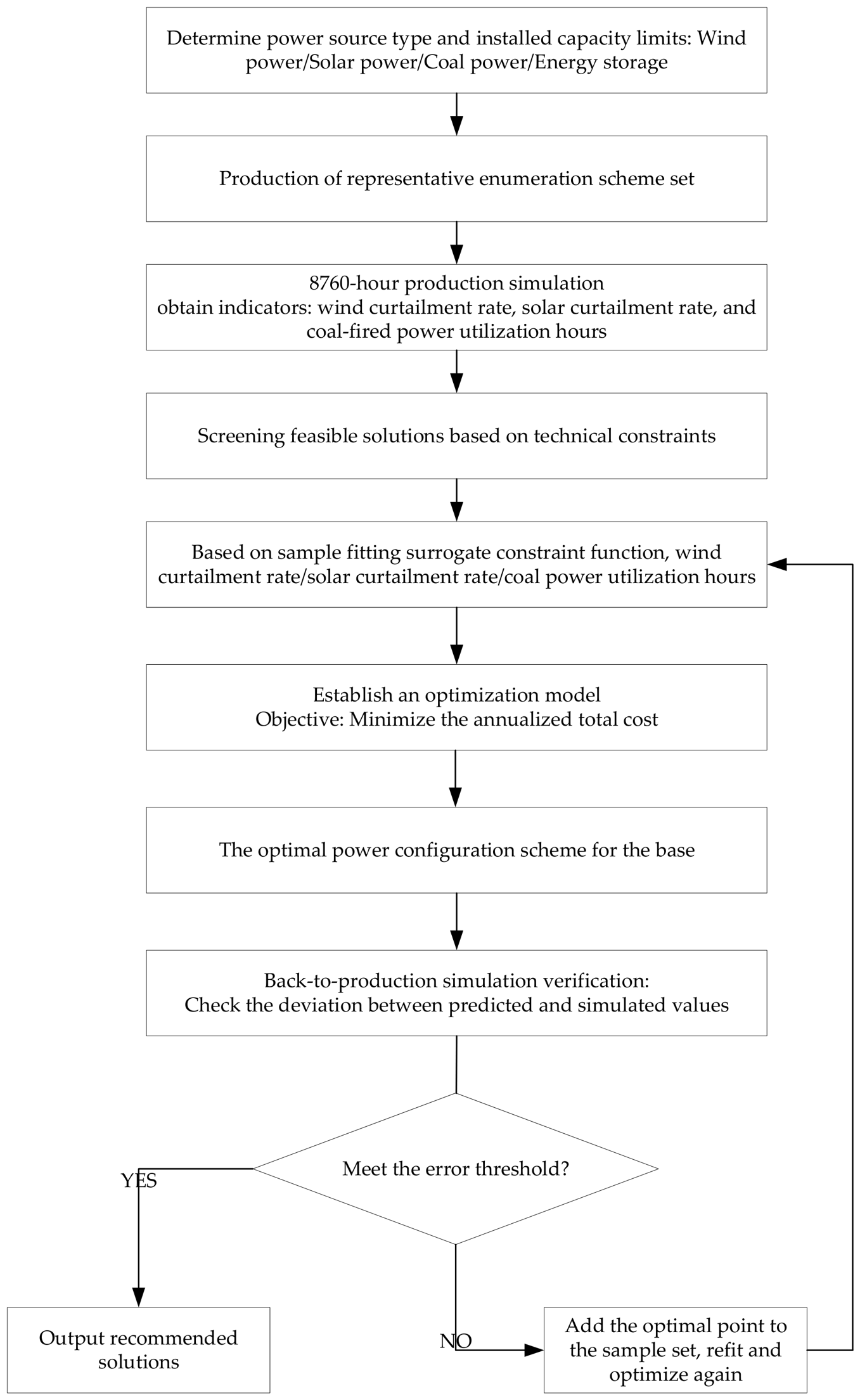
The complete formula chain in this section is therefore: Equation (12) defines the economic target; Equations (13)–(16) explain the cost components and annualization; Equation (17) embeds simulation-derived technical constraints; Equations (18)–(20) preserve capacity, total-scale, and storage-ratio boundaries; Equation (21) outputs the optimized portfolio; and Equations (22)–(24) validate that output against production simulation. This preserves the original disclosure’s logical transition chain: enumeration identifies operating laws, fitting expresses those laws, optimization searches the best portfolio, and simulation back-substitution verifies engineering credibility.
Figure 1 corresponds directly to this formula chain. The sample-generation and simulation blocks provide the data used to fit the coefficients in Equations (8)–(10) and Table 1. The optimization block solves Equations (12)–(21) as a bounded nonlinear planning problem. The validation block evaluates Equations (22)–(24) and the numerical back-testing results in Table 2.

5. Case Studies and Experimental Analysis

5.1. Data Source and Case Description

The case study uses planning materials for the Ordos renewable energy export base. The base is composed of wind power, photovoltaic generation, supporting coal-fired units, and storage and is designed for long-distance electricity export.
The Ordos data used in this paper are project planning materials for an early-stage renewable energy export-base capacity study. They include capacity-boundary assumptions, one-year hourly wind and photovoltaic generation profiles, the export/load profile, representative production-simulation outputs, and project economic accounting results. The model inputs needed to interpret the reported calculation are summarized in Table 3.
The four reference schemes are treated as representative samples rather than final candidate decisions. Their purpose is to reveal the operating relationship between source-storage configuration and key indicators. The optimized portfolio is then obtained through the two-stage workflow and compared with these samples. Table 4 summarizes the simulation-based sample data used in the case study.

5.2. Optimized Portfolio and Indicator Interpretation

The optimized portfolio contains 4000 MW wind power, 5500 MW photovoltaic capacity, 5300 MW dispatchable supporting capacity, and 1000 MWh storage. The solution is located between low-cost and high-capacity samples. It is not presented as the minimum-cost solution among all possible portfolios; rather, it is a locally validated planning recommendation that reduces maximum renewable curtailment while keeping utilization hours inside the required range. Table 5 reports the optimized result and its economic decomposition.
The optimized portfolio has a simulated maximum curtailment of 4.21% after back-substitution validation. Its utilization hours are 4736 h, located near the middle of the 4000–5500 h range. This suggests that the dispatchable supporting resource is neither oversized for very low utilization nor overused as a dominant baseload source.

5.3. Comparative Evaluation Against Enumerated Samples

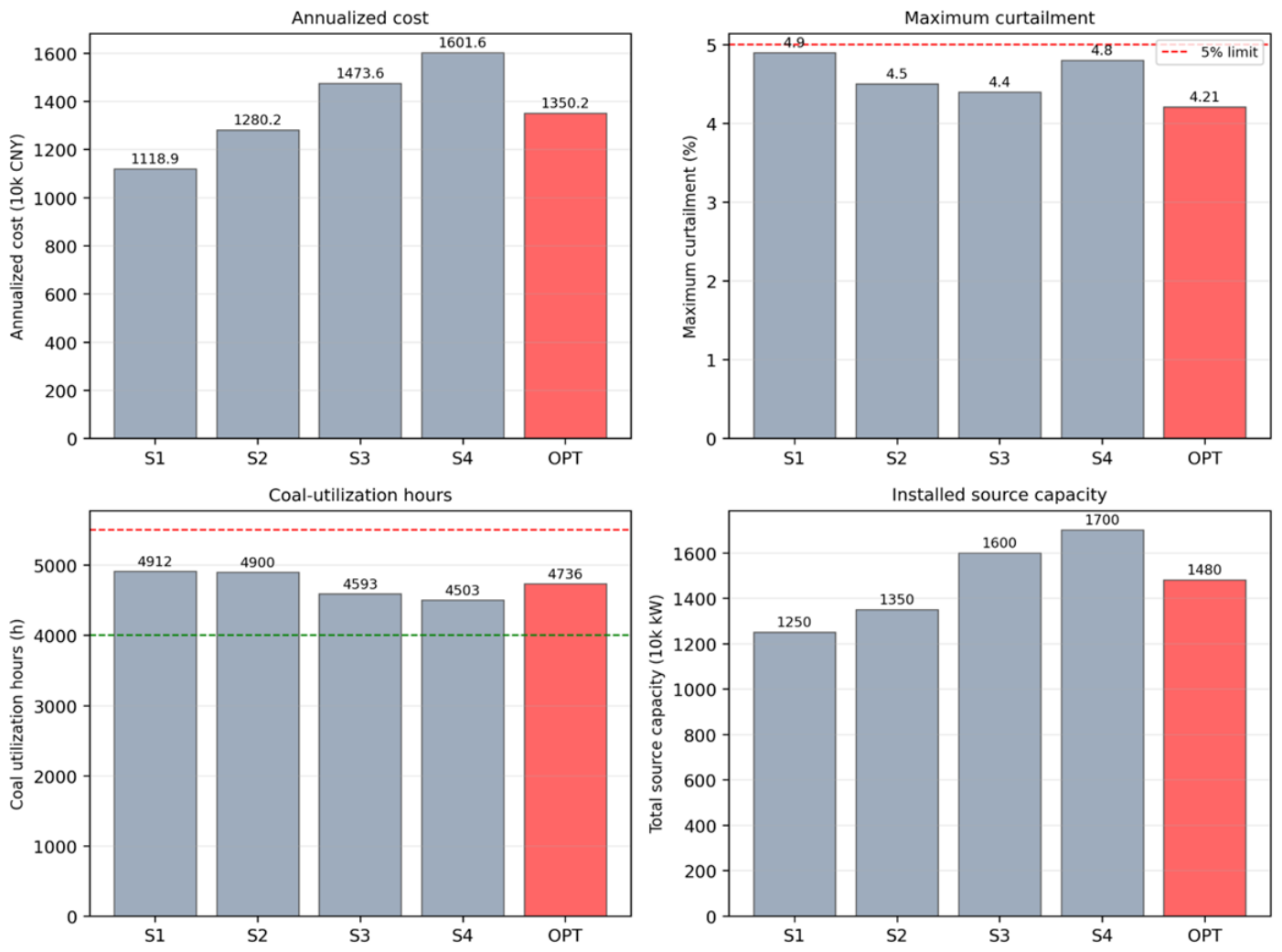
Compared with S3 (shown in Table 6 and Figure 2), the optimized portfolio reduces annualized cost from 1473.6 × 10k CNY to 1350.2 × 10k CNY, corresponding to an 8.4% reduction. Compared with S4, the cost reduction is about 15.7%. At the same time, the optimized portfolio achieves lower maximum curtailment than S2 and a lower annualized cost than the two high-capacity schemes. The comparison is now framed as evidence for a balanced local planning region rather than as proof of a universally optimal rule.
Compared with S1, the optimized portfolio is more expensive but reduces maximum curtailment from 4.9% to 4.21% (in Table 7). This trade-off is important because S1 operates close to the 5% curtailment threshold and may be less robust under resource or load deviations. Compared with S2, the optimized portfolio increases photovoltaic capacity and dispatchable support in a coordinated way, leading to lower photovoltaic curtailment and a more balanced technical-economic profile.
Figure 2 highlights why the optimized portfolio should be interpreted as a locally validated compromise rather than a trivial interpolation of enumerated schemes. The green dashed line denotes the lower admissible threshold of 4000 h for coal-utilization hours. The portfolio reduces maximum curtailment relative to S1 and S2 while avoiding the high annualized costs of S3 and S4. The utilization indicator remains away from both the lower and upper admissible boundaries.

5.4. Sensitivity Analysis

Sensitivity analysis is used to examine whether the workflow can support planning insight beyond a single optimized portfolio. The available project materials provide two deterministic sensitivity dimensions: renewable-energy ratio target and storage unit investment cost. These tests are useful for parameter interpretation, but they do not replace meteorological uncertainty analysis.
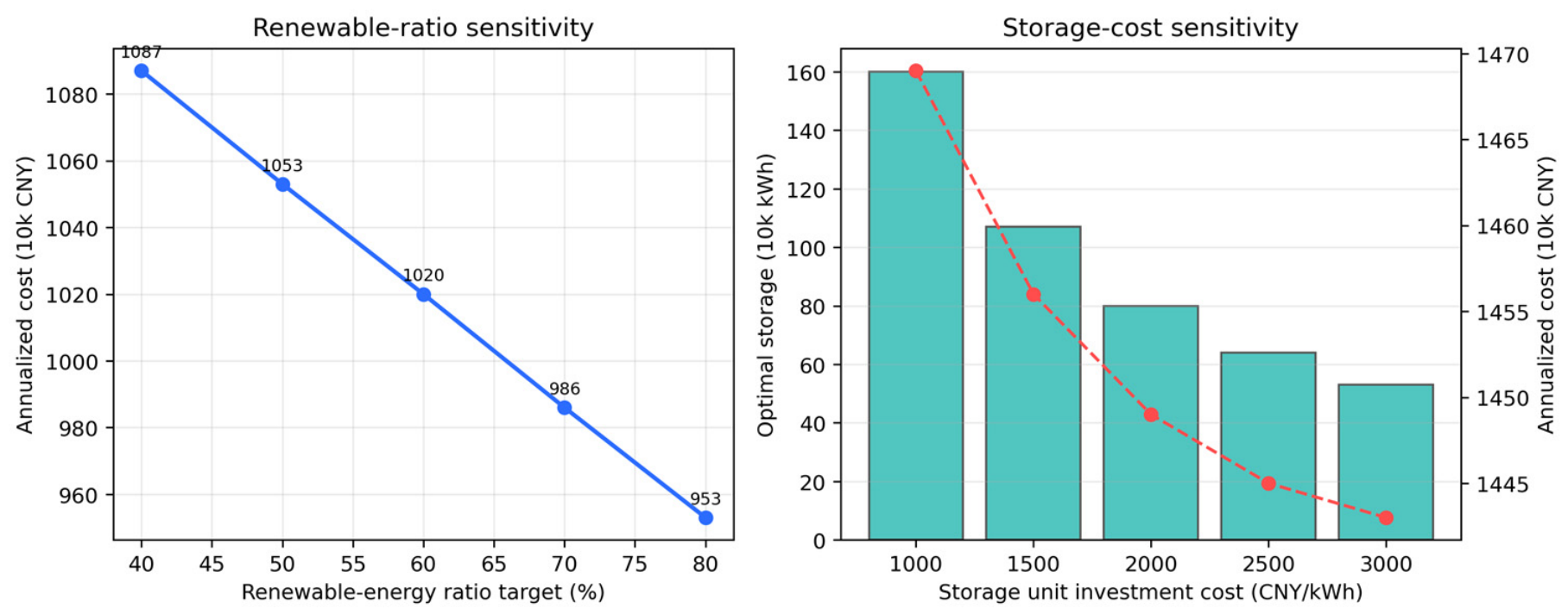
The renewable-ratio sensitivity indicates that annualized cost decreases from 1087 × 10k CNY to 953 × 10k CNY as the renewable-ratio target increases from 40% to 80% under the adopted parameter setting. This result is driven mainly by the reduced supporting-resource capacity and fuel-cost contribution in this specific dataset, while the curtailment and reliability constraints remain satisfied. It should therefore be read as a conditional case result rather than as a general rule: if storage prices, export-channel limits, curtailment limits, resource profiles, or discount-rate assumptions change, a higher renewable target may increase rather than decrease the annualized cost.
The storage-cost sensitivity shows that the preferred storage capacity decreases from 1600 MWh to 530 MWh as the storage unit investment cost increases from 1000 CNY/kWh to 3000 CNY/kWh. The total annualized cost changes more gradually, which indicates that storage is important for flexibility but should be coordinated with renewable and supporting capacities rather than fixed by a universal policy ratio.
Figure 3 should be interpreted as a planning-sensitivity map for the disclosed parameter set rather than as a new deterministic optimum for every possible assumption. A more robust validation would construct renewable generation time series from multiple historical meteorological years and repeat the production-simulation and back-testing process under representative high-wind, low-wind, high-solar, low-solar, and correlated wind–solar–load scenarios.

5.5. Engineering Interpretation, Boundary Conditions, and Limitations

The optimized portfolio should be interpreted as a planning recommendation supported by the currently available sample evidence, not as a replacement for final dispatch verification. Its main value lies in identifying a promising local region of the continuous capacity space. The representative samples define the initial empirical basis, the surrogate models describe local operating tendencies, and the back-testing mechanism defines how to strengthen the empirical basis if the optimized point is not adequately represented.
The method is also useful for engineering communication because it separates three types of information. Capacity boundaries describe what can be built; production-simulation indicators describe what can be operated; surrogate optimization describes what can be searched efficiently. This separation makes it easier to update the planning model when new resource data, cost assumptions, storage policies, or export-curve requirements are provided.
From a planning-decision perspective, the optimized portfolio is valuable because it avoids two extreme decisions. The first extreme is to choose the lowest-cost sample even though its curtailment is close to the technical limit. The second extreme is to select the largest or most conservative sample, even though its cost is high and its incremental curtailment benefit is limited. The proposed framework provides a formal mechanism for locating an intermediate portfolio with explicit technical justification.
From an operational perspective, coal-utilization hours provide an important interpretation channel. If coal utilization is too low, the supporting capacity may be economically inefficient; if it is too high, the system may rely excessively on thermal generation and reduce renewable-energy value. The optimized 4736 h coal-utilization result lies within the admissible range and is consistent with a support-and-balancing role for coal-fired units in the renewable export base.
From an investment perspective, the storage result should be read jointly with renewable capacity and curtailment indicators. Storage is not simply added as a fixed percentage of renewable capacity; its economic value depends on whether it reduces curtailment, supports export delivery, and avoids unnecessary coal expansion. The sensitivity analysis confirms that the optimal storage scale decreases when unit storage investment cost rises, but the total-cost response is smoother than the storage-capacity response.
From a data-management perspective, the workflow clarifies which additional data would most improve planning confidence. Complete chronological wind, photovoltaic, load, and export-curve data from multiple historical meteorological years would improve production-simulation fidelity. Additional sample points near the optimized portfolio would improve surrogate reliability. Cost updates for storage and supporting generation would improve economic robustness.
The present case has several limitations. First, the available production-simulation information is limited to four representative sample indicators and one disclosed optimized-point validation rather than a complete multi-year 8760 h dataset. Second, the surrogate functions are fitted from a small sample set; the coefficient table is diagnostic and should not be extrapolated outside the valid domain. Third, the current implementation focuses on annualized cost, curtailment, and utilization constraints; carbon-emission caps, land-use constraints, network constraints, and export-curve optimization can be added in future work. Fourth, uncertainty-aware validation under multiple meteorological years and receiving-grid load scenarios is required before the result can be used as a generally transferable planning rule.

6. Conclusions

This study developed a closed-loop enumeration–surrogate optimization workflow for source-storage capacity planning in large-scale renewable energy export bases. The workflow addresses a practical gap between engineering enumeration and continuous optimization: representative capacity samples preserve production-simulation credibility, surrogate-assisted optimization searches for balanced portfolios beyond the discrete samples, and back testing prevents a mathematically attractive solution from being accepted without operating validation.
The study cases show that the optimized portfolio of 4000 MW wind, 5500 MW photovoltaic capacity, 5300 MW dispatchable supporting capacity, and 1000 MWh storage achieves a simulated maximum renewable curtailment of 4.21%, utilization hours of 4736 h, and annualized total cost of 1350.2 × 10k CNY. Compared with the two high-capacity reference schemes, the optimized portfolio reduces annualized cost by 8.4% and 15.7%, respectively. These results demonstrate a balanced local planning region, while the sparse sample set and single-year data basis limit the strength of general claims.
The contribution of this study to sustainable development is reflected in environmental, economic, and operational dimensions. Environmentally, the proposed workflow coordinates wind power, photovoltaic generation, energy storage, and dispatchable supporting capacity under curtailment and reliability constraints, helping renewable energy export bases deliver low-carbon electricity without creating avoidable renewable curtailment or excessive dependence on thermal support. Economically, the Ordos proof of concept shows that the optimized portfolio keeps the maximum renewable curtailment at 4.21% while reducing annualized cost by 8.4% and 15.7% relative to the two high-capacity reference schemes, indicating that sustainable planning should also avoid unnecessary capacity investment and fuel expenditure. Operationally, the closed-loop back-testing mechanism provides a transparent way to verify whether a planned portfolio remains feasible in chronological production simulation. Therefore, the framework can support long-term sustainable-development goals by improving renewable-energy utilization, maintaining reliable electricity export, and providing a basis for future integration of carbon-emission, land-use, and network constraints.
Future work will extend the workflow in four directions. More chronological production-simulation samples should be introduced to support nonlinear or uncertainty-aware surrogate models. Renewable generation time series should be constructed from multiple historical meteorological years and stress scenarios. Direct-current export-curve optimization should be integrated with source-storage planning. Carbon-emission, land-use, and network constraints should be added to reflect stricter low-carbon planning requirements.

Author Contributions

Conceptualization, F.L. and Y.Z.; methodology, F.L.; software, F.L.; validation, F.L. and J.Q.; formal analysis, J.Q. and Y.W.; investigation, T.T. and B.M.; resources, D.W.; writing—original draft preparation, F.L.; writing—review and editing, Y.Z.; visualization, Y.Z. All authors have read and agreed to the published version of the manuscript.

Funding

This research received no external funding.

Institutional Review Board Statement

Not applicable.

Informed Consent Statement

Not applicable.

Data Availability Statement

The original contributions presented in this study are included in the article. Further inquiries can be directed to the corresponding author.

Conflicts of Interest

Authors Fan Li, Jishuo Qin, Taikun Tao, Binqi Ma, Dan Wang were employed by State Grid Economic Technology Research Institute Co. Ltd. The remaining authors declare that the research was conducted in the absence of any commercial or financial relationships that could be construed as a potential conflict of interest.

References

  1. Li, C.; Shi, H.; Cao, Y.; Wang, J.; Kuang, Y.; Tan, Y.; Wei, J. Comprehensive review of renewable energy curtailment and avoidance: A specific example in China. Renew. Sustain. Energy Rev. 2015, 41, 1067–1079. [Google Scholar] [CrossRef]
  2. Bunodiere, A.; Lee, H.S. Renewable Energy Curtailment: Prediction Using a Logic-Based Forecasting Method and Mitigation Measures in Kyushu, Japan. Energies 2020, 13, 4703. [Google Scholar] [CrossRef]
  3. Connolly, D.; Lund, H.; Mathiesen, B.V.; Leahy, M. A review of computer tools for analysing the integration of renewable energy into various energy systems. Appl. Energy 2010, 87, 1059–1082. [Google Scholar] [CrossRef]
  4. Mathiesen, B.V.; Lund, H.; Connolly, D.; Wenzel, H.; Ostergaard, P.A.; Moller, B.; Nielsen, S.; Ridjan, I.; Karnoe, P.; Sperling, K.; et al. Smart Energy Systems for coherent 100% renewable energy and transport solutions. Appl. Energy 2015, 145, 139–154. [Google Scholar] [CrossRef]
  5. Koltsaklis, N.E.; Dagoumas, A.S. State-of-the-art generation expansion planning: A review. Appl. Energy 2018, 230, 563–589. [Google Scholar] [CrossRef]
  6. Oree, V.; Sayed Hassen, S.Z.; Fleming, P.J. Generation expansion planning optimisation with renewable energy integration: A review. Renew. Sustain. Energy Rev. 2017, 69, 790–803. [Google Scholar] [CrossRef]
  7. Pereira, S.; Ferreira, P.; Vaz, A.I.F. Generation expansion planning with high share of renewables of variable output. Appl. Energy 2017, 190, 1275–1288. [Google Scholar] [CrossRef]
  8. Kamalinia, S.; Shahidehpour, M. Generation expansion planning in wind-thermal power systems. IET Gener. Transm. Distrib. 2010, 4, 940–951. [Google Scholar] [CrossRef]
  9. Farhoumandi, M.; Aminifar, F.; Shahidehpour, M. Generation Expansion Planning Considering the Rehabilitation of Aging Generating Units. IEEE Trans. Smart Grid 2020, 11, 3384–3393. [Google Scholar] [CrossRef]
  10. Sheibani, M.R.; Yousefi, G.R.; Latify, M.A.; Dolatabadi, S.H. Energy storage system expansion planning in power systems: A review. IET Renew. Power Gener. 2018, 12, 1203–1221. [Google Scholar] [CrossRef]
  11. Yang, B.; Wang, J.; Chen, Y.; Li, D.; Zeng, C.; Chen, Y.; Guo, Z.; Shu, H.; Zhang, X.; Yu, T.; et al. Optimal sizing and placement of energy storage system in power grids: A state-of-the-art one-stop handbook. J. Energy Storage 2020, 32, 101814. [Google Scholar] [CrossRef]
  12. Qin, B.; Liu, J.; Wang, H.; Wang, Z.; Xiong, Z.; Wang, M.; Qian, Q. Energy-efficient and reliable urban rail transit: A new framework incorporating underground energy storage systems. iEnergy 2025, 4, 86–97. [Google Scholar] [CrossRef]
  13. Blanco, H.; Faaij, A. A review at the role of storage in energy systems with a focus on Power to Gas and long-term storage. Renew. Sustain. Energy Rev. 2018, 81, 1049–1086. [Google Scholar] [CrossRef]
  14. Victoria, M.; Zhu, K.; Brown, T.; Andresen, G.B.; Greiner, M. The role of storage technologies throughout the decarbonisation of the sector-coupled European energy system. Energy Convers. Manag. 2019, 201, 111977. [Google Scholar] [CrossRef]
  15. Qin, B.; Hong, S.; Wang, H.; Zhao, J.; Li, H.; Chen, P.; Ding, T. Non-isothermal dynamic model and collaborative optimization for multi-energy system considering pipeline energy storage. J. Energy Storage 2026, 141, 119083. [Google Scholar] [CrossRef]
  16. Sharma, T.; Balachandra, P. Model based approach for planning dynamic integration of renewable energy in a transitioning electricity system. Int. J. Electr. Power Energy Syst. 2019, 105, 642–659. [Google Scholar] [CrossRef]
  17. Li, H.; Yu, H.; Liu, Z.; Li, F.; Wu, X.; Cao, B.; Zhang, C.; Liu, D. Long-term scenario generation of renewable energy generation using attention-based conditional generative adversarial networks. Energy Convers. Econ. 2024, 5, 15–27. [Google Scholar] [CrossRef]
  18. Jones, D.R.; Schonlau, M.; Welch, W.J. Efficient Global Optimization of Expensive Black-Box Functions. J. Glob. Optim. 1998, 13, 455–492. [Google Scholar] [CrossRef]
  19. Forrester, A.I.J.; Keane, A.J. Recent advances in surrogate-based optimization. Prog. Aerosp. Sci. 2009, 45, 50–79. [Google Scholar] [CrossRef]
  20. Rahman, M.M.; Dadon, S.H.; He, M.; Giesselmann, M.; Hasan, M.M. An Overview of Power System Flexibility: High Renewable Energy Penetration Scenarios. Energies 2024, 17, 6393. [Google Scholar] [CrossRef]
  21. Akrami, A.; Doostizadeh, M.; Aminifar, F. Power system flexibility: An overview of emergence to evolution. J. Mod. Power Syst. Clean Energy 2019, 7, 987–1007. [Google Scholar] [CrossRef]
  22. Kang, J.; Wu, Z.; Ng, T.S.; Su, B. A stochastic-robust optimization model for inter-regional power system planning. Eur. J. Oper. Res. 2023, 310, 1234–1248. [Google Scholar] [CrossRef]
  23. Wang, H.; Qin, B.; Hong, S.; Xu, X.; Su, Y.; Lu, T.; Ding, T. Enhanced GAN based joint wind-solar-load scenario generation with extreme weather labelling. IEEE Trans. Smart Grid 2025, 16, 4213–4224. [Google Scholar] [CrossRef]
  24. Bhuvanesh, A.; Jaya Christa, S.T.; Kannan, S.; Karuppasamy Pandiyan, M. Aiming towards pollution free future by high penetration of renewable energy sources in electricity generation expansion planning. Futures 2018, 104, 25–36. [Google Scholar] [CrossRef]
  25. Mo, B.; Hegge, J.; Wangensteen, I. Stochastic generation expansion planning by means of stochastic dynamic programming. IEEE Trans. Power Syst. 1991, 6, 662–668. [Google Scholar] [CrossRef]
  26. Zangeneh, A.; Jadid, S.; Rahimi-Kian, A. Uncertainty based distributed generation expansion planning in electricity markets. Electr. Eng. 2010, 91, 369–382. [Google Scholar] [CrossRef]
Figure 1. Mechanism-driven closed-loop planning architecture for renewable energy export-base capacity optimization.
Sustainability 18 05879 g001
Figure 2. Comparative evaluation of annualized cost, maximum curtailment, coal-utilization hours, and installed source capacity.
Sustainability 18 05879 g002
Figure 3. Sensitivity analysis of renewable-energy ratio target and storage unit investment cost.
Sustainability 18 05879 g003
Table 1. Fitted local surrogate coefficients and diagnostics for the disclosed case samples (capacity units: 10k kW for source capacity and 10k kWh for storage).
IndicatorInterceptPpv CoefficientPbase CoefficientEstorage CoefficientRealized R 2 Interpretation
Wind curtailment7.033−0.00511−0.00050−0.001671.000Saturated local fit; storage sign is negative
PV curtailment4.267+0.00378~0.00000−0.013331.000Saturated local fit; storage sign is negative
Utilization hours5975.0−2.140−0.510+1.3001.000Diagnostic only; not independent validation
Table 2. Back-substitution validation results at the optimized portfolio.
IndicatorSurrogate PredictionProduction SimulationAbsolute ErrorToleranceResult
Wind curtailment3.74%3.69%0.05 percentage point1.0 percentage pointPass
PV curtailment4.63%4.21%0.42 percentage point1.0 percentage pointPass
Utilization hours4695 h4736 h41 h150 hPass
Active resamplingTrigger if any tolerance is exceededNot triggered
Table 3. Data sources and key assumptions for the Ordos case calculation.
ItemAdopted Value or SourceRole in the Calculation
Planning-data originOrdos renewable energy export-base project planning materialsDefines the case boundary, candidate capacity ranges, representative schemes, and economic accounting basis.
Production-simulation dataOne-year hourly wind, photovoltaic, and export/load profiles evaluated by 8760 h chronological dispatch calculationGenerates wind curtailment, photovoltaic curtailment, supporting-resource utilization hours, and zero-deficit reliability labels.
Feasibility thresholdsWind/PV curtailment below 5%, supporting-resource utilization between 4000 h and 5500 h, and annual deficit energy equal to 0Screens representative samples and constrains the optimized portfolio.
Economic accountingAnnualized investment, annual O&M, and coal-fuel cost calculated with the same CRF convention, discount-rate input, and project-lifetime input from the planning materialsKeeps the enumeration samples, surrogate optimization, and optimized portfolio on a consistent annual-cost basis.
Storage costBaseline project accounting input; sensitivity test varies storage unit investment cost from 1000 CNY/kWh to 3000 CNY/kWhTests how storage-price assumptions affect the preferred storage capacity and total annualized cost.
Coal-fuel costProject accounting input used in the fuel-cost term; the optimized portfolio reports 556.7 × 10k CNY annual fuel costLinks supporting-resource capacity and utilization hours to the annualized objective.
Table 4. Representative engineering samples and reported production-simulation indicators.
SchemeWind (MW)PV (MW)Baseload/Support (MW)Storage (MWh)Wind Curtail.PV Curtail.Coal HoursCost (10k CNY)Total Source Capacity (MW)
S14000450040008004.4%4.9%4912 h1118.912,500
S240004500500011004.3%4.5%4900 h1280.213,500
S340006000600016003.4%4.4%4593 h1473.616,000
S440006000700013003.4%4.8%4503 h1601.617,000
Table 5. Optimized source-storage portfolio and key technical-economic indicators.
IndicatorOptimized Result
Wind capacity4000 MW
Photovoltaic capacity5500 MW
Baseload/supporting capacity5300 MW
Energy-storage capacity1000 MWh
Wind curtailment3.69%
Photovoltaic curtailment4.21%
Maximum curtailment4.21%
Coal-utilization hours4736 h
Power deficit0
Annualized investment cost677.6 × 10k CNY
Annual O&M cost115.9 × 10k CNY
Annual fuel cost556.7 × 10k CNY
Annualized total cost1350.2 × 10k CNY
Table 6. Comparative performance of enumerated samples and optimized portfolio.
SchemeAnnualized CostWind Curtail.PV Curtail.Max Curtail.Coal HoursEngineering InterpretationTotal Source Capacity (MW)
S11118.94.4%4.9%4.9%4912 hreference sample12,500
S21280.24.3%4.5%4.5%4900 hreference sample13,500
S31473.63.4%4.4%4.4%4593 hreference sample16,000
S41601.63.4%4.8%4.8%4503 hreference sample17,000
OPT1350.23.69%4.21%4.21%4736 hbalanced optimized portfolio14,800
Table 7. Baseline comparison of enumeration-only, surrogate-only, and closed-loop validated planning modes.
MethodRepresentative PortfolioEvidence UsedMax CurtailmentCost (10k CNY)Back Tested?
Enumeration-only low-cost choiceS1Production simulation of sampled schemes4.90%1118.9No local continuous search
Enumeration-only low-curtailment choiceS3Production simulation of sampled schemes4.40%1473.6No local continuous search
Surrogate-only optimizationOPTSurrogate prediction only4.63% predicted1350.2No
Closed-loop workflowOPTSurrogate search plus production-simulation validation4.21% simulated1350.2Yes
Disclaimer/Publisher’s Note: The statements, opinions and data contained in all publications are solely those of the individual author(s) and contributor(s) and not of MDPI and/or the editor(s). MDPI and/or the editor(s) disclaim responsibility for any injury to people or property resulting from any ideas, methods, instructions or products referred to in the content.