Article

Urbanization-Driven Water Demand Outpacing Climate-Induced Supply Gains in Xiong’an New Area: A Coupled SD-PLUS-InVEST Assessment

1
School of Geomatics, Zhejiang University of Water Resources and Electric Power, Hangzhou 310018, China
2
Institute of Atmospheric Physics, Chinese Academy of Sciences, Beijing 100029, China
3
Zhejiang Institute of Meteorological Sciences, Hangzhou 310008, China
4
Zhejiang Provincial Meteorological Observatory, Hangzhou 310017, China
*
Author to whom correspondence should be addressed.
Sustainability 2026, 18(12), 5870; https://doi.org/10.3390/su18125870 (registering DOI)
Submission received: 22 April 2026 / Revised: 26 May 2026 / Accepted: 29 May 2026 / Published: 8 June 2026

Abstract

Rapid urbanization and climate change are exerting unprecedented pressure on regional water resources, particularly in emerging megacities. This study examines the Xiong’an New Area (XNA) in the water-stressed North China Plain, where high-intensity urbanization coincides with rigorous ecological restoration mandates. To overcome the limitations of single-model assessments, a coupled SD–PLUS–InVEST framework was developed, integrating System Dynamics for socio-economic and policy drivers, Patch-Generating Land-Use Simulation for fine-scale urban expansion, and InVEST for hydrological process assessment. Projecting spatiotemporal water dynamics to 2035 under three Shared Socio-Economic Pathways (SSPs), results reveal that urbanization-driven water demand growth consistently outpaces climate-induced supply gains. While precipitation increases are projected to raise water yield by 8.91–19.58% by 2035, demand surges by up to ~26% under the extensive expansion scenario (SSP5–8.5), driven predominantly by impervious surface proliferation. External water transfers are projected to sustain 40–45% of total supply by 2035, yet this dependency introduces systemic vulnerabilities. Quantitative assessment further indicates severe spatiotemporal mismatches, with Seasonal Water Shortage Rates of 26.1–27.3% and a Spatial Mismatch Index rising from 0.44 to 0.98. These findings indicate that climate-driven precipitation increments alone cannot offset water deficits induced by unregulated urban sprawl, and that integrating strategic land-use planning, resilient infrastructure, and adaptive governance is essential for water security in rapidly developing regions.

1. Introduction

The balance between water supply and demand constitutes the cornerstone of socio-economic systems and represents a critical challenge in achieving the Sustainable Development Goals (SDGs) [1,2,3]. Since the beginning of the 21st century, the intertwining of global climate change and rapid urbanization has exerted unprecedented pressure on the sustainable management of regional water resources [4]. On one hand, anthropogenic climate change has intensified the variability of precipitation patterns and the frequency of extreme weather events, thereby disrupting the natural hydrological cycle. On the other hand, urban expansion—characterized by a surge in impervious surface areas and intensive socio-economic activities—has driven an exponential increase in water demand [5,6,7]. Deciphering the complex interactions within the human–land–atmosphere nexus under various future development pathways has become a prerequisite for effective urban water management [8,9,10]. The Xiong’an New Area (XNA), located in the Hai River Basin of the North China Plain, experiences pronounced climate change impacts while simultaneously facing immense developmental pressures from high-intensity urbanization, thus providing an ideal research platform to address such global challenges.
Positioned as the “City of the Future,” XNA embodies China’s new-era urbanization philosophy; despite being situated in the severely water-stressed hinterland of the North China Plain within the Hai River Basin, it is undergoing unprecedented, top-down rapid urbanization while bearing the rigorous ecological restoration mandate of “restoring the Baiyangdian Wetland” and confronting extreme water resource vulnerability [11,12]. Numerous scholars have investigated the water resource carrying capacity of this region [13,14,15,16,17]. For example, Feng [18] evaluated the carrying capacity of population, water, and soil resources from a system resilience perspective; Wang [19] systematically assessed extreme climate risks, revealing warming and drought trends, and indicated that the imbalance between water supply and demand will persist long-term; similarly, Jiang Luguang [20] and Li [21] emphasized the critical role of multi-scenario trade-offs and multi-source water replenishment in the sustainable development of XNA. However, while some studies suggest an increasing trend in precipitation across regions like North China within the Hai River Basin under climate change, a definitive research gap remains regarding whether the potential water supply gains (the “climate dividend”) from this warming and moistening trend can offset the water deficits induced by extreme urbanization. This is particularly true in the context of emerging megacities like XNA, which combine national strategic positioning with extreme water resource vulnerability [22,23,24,25]. Elucidating this issue requires a fundamental examination of the core drivers of water supply–demand dynamics and their corresponding simulation methodologies.
Since the beginning of the 21st century, climate change and socio-economic development have emerged as the primary drivers influencing land-use change and water supply–demand relationships, especially in rapidly urbanizing regions [26,27]. To accurately project water resource dynamics, the scientific community has continually advanced the development of climate modeling and spatial simulation tools. Addressing climate uncertainty, the Coupled Model Intercomparison Project Phase 6 (CMIP6), which incorporates Shared Socio-Economic Pathways (SSPs) and Representative Concentration Pathways (RCPs), has become the international standard for evaluating future climate impacts [28,29,30]. A substantial body of research has utilized SSP-RCP scenario data to forecast future shifts in water supply and demand [31,32]. Nevertheless, due to the relatively coarse spatial resolution of SSP-RCP data, most of these studies focus on national or larger scales. Consequently, they struggle to effectively account for the persistent impacts of local environmental factors—such as regional-scale climate, population, economic and land-use changes—making it difficult to accurately predict the dynamic changes in regional water supply and demand [33]. Mounting evidence suggests that the dynamic simulation of land-use change—a key input parameter for water yield—is crucial for understanding shifts in regional water supply and demand [34,35,36]. Consequently, researchers have proposed an integrated approach combining System Dynamics (SD) models, which capture socio-economic and policy drivers, with bottom-up Patch-Generating Land-Use Simulation (PLUS) models to dynamically simulate land-use transitions [37,38,39].
To address these challenges, researchers have developed a variety of land-use simulation models and land area prediction models since the early 21st century, including: the FLUS model [40], the CFLUS model [41], the OS-CA model [42] (System Dynamics (SD) module, OS simulation module), the Markov model [43], and the PLUS model [44], amongst others. Among these, the SD model accounts for feedback loops and non-linear interactions within climatic, socio-economic, and land-use systems, making it highly suitable for projecting land-use demand across diverse regional scales [45,46]. The PLUS model, integrating a rule-based Cellular Automata (CA) model and a Land Expansion Analysis Strategy (LEAS) module, partially overcomes the limitations of traditional CA–Markov and FLUS models, enabling high-fidelity simulations of spatial heterogeneity under complex policy constraints [34,47,48]. Simultaneously, studies have demonstrated that the InVEST model effectively translates land-use data into potential eco-hydrological service indicators [49,50]. Synthesizing the strengths of these models, this study constructs a coupled SD-PLUS-InVEST modeling framework. This framework establishes a complete analytical chain—from total volume projection and spatial allocation to eco-hydrological effect assessment [28,39]. It not only overcomes the limitations of single models in scale, mechanism, or dimensionality, but also systematically uncovers the transmission effects of land-use change on regional water balances, thereby providing robust methodological support and scientific grounding for a more systematic and refined assessment of future water supply and demand in XNA.
Furthermore, building upon this model framework, this study further innovates at the scenario-setting level by proposing a “Global Climate Pathway–Local Policy Cascade” framework, mitigating the limitations of simply extrapolating traditional SSPs. Anchored in the strict spatial development red lines and water-use efficiency quotas mandated by the Outline Plan for the Xiong’an New Area, this framework conducts deep parameterization of global CMIP6 climate projections. The core rationale of this study is as follows: amid rapid urbanization, XNA faces complex water supply–demand challenges driven by both climate and policy. Scientifically characterizing the evolutionary trajectories of water resources under multiple scenarios and elucidating the impact mechanisms of key drivers remains a critical, unresolved issue in current research. To this end, utilizing the coupled SD-PLUS-InVEST framework, this study systematically conducts dynamic simulations of XNA’s water supply and demand processes under varied scenarios. It quantifies the differential contributions of climate change and anthropogenic drivers to the regional water balance. Based on these simulation results, it explores how external water transfer projects and water management strategies can support regional sustainable development, ultimately providing a scientific basis for future water resource planning and adaptive management in XNA.

2. Materials and Methods

2.1. Research Area

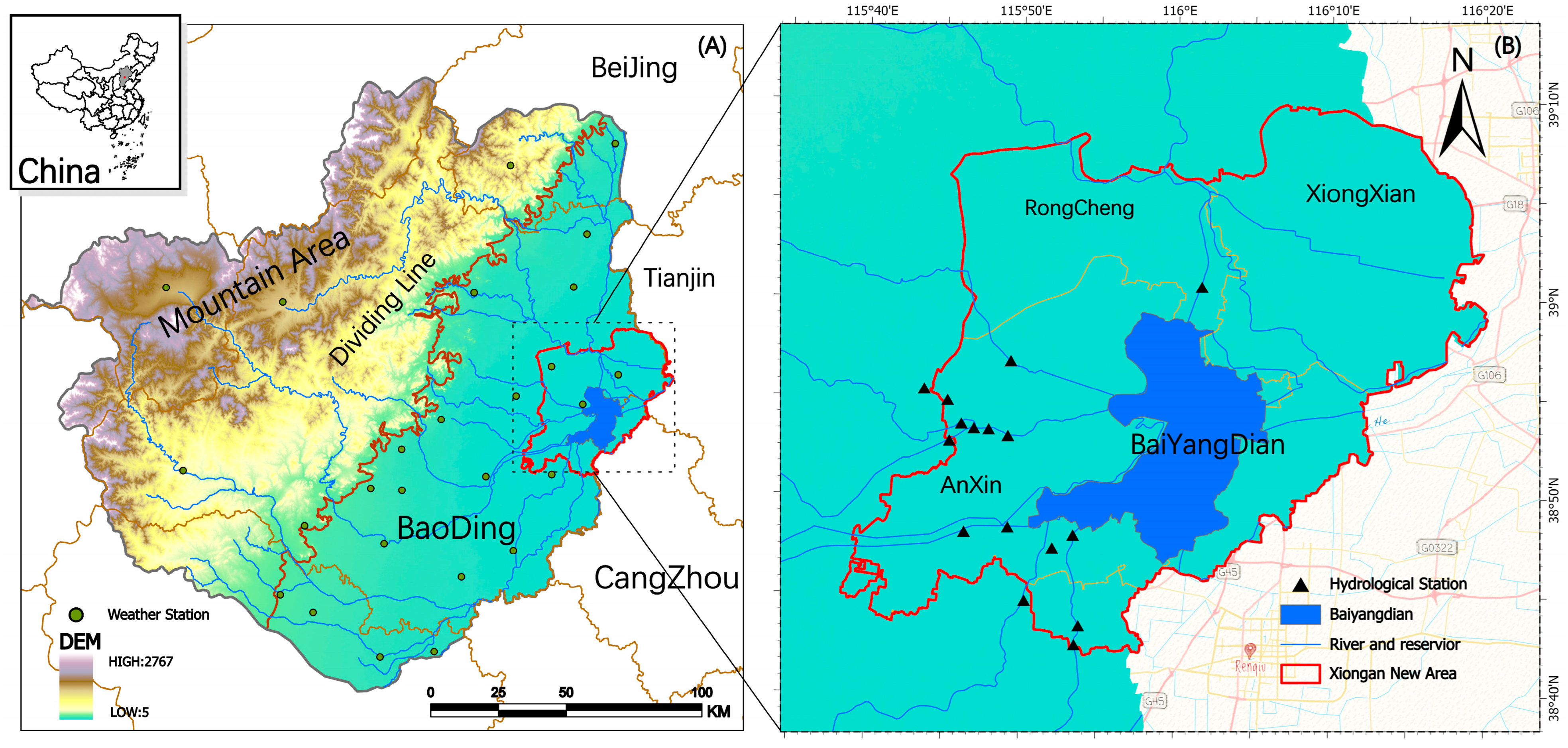
The Xiong’an New Area (XNA; 115°37′52″–116°21′17″ E, 38°40′2″–39°12′15″ N), spanning a planned area of approximately 1770 km2 and primarily encompassing Xiong, Rongcheng, and Anxin counties, is strategically located in central Hebei Province within the hinterland of the Beijing–Tianjin–Hebei (Jing-Jin-Ji) region (Figure 1). Situated on the Daqing River alluvial fan, the region is widely recognized as a severely water-stressed zone within the North China Plain of the Hai River Basin [20]. The multi-year average annual precipitation is approximately 495.1 mm—with roughly 80% concentrated during the flood season from June to September—whereas the mean annual evaporation reaches 1369 mm, vastly exceeding natural precipitation inputs. Baiyangdian Lake (366 km2), the largest freshwater body in North China, serves as a critical ecological asset within XNA; however, the maintenance of its ecological functions and water levels is currently highly dependent on external water diversion megaprojects, such as the South-to-North Water Diversion and the Yellow River-to-Baiyangdian transfers [51,52]. Designated as the “City of the Future” to absorb non-capital functions from Beijing, XNA is currently undergoing rapid, high-quality urbanization, with a resident population of approximately 1.3 million and an urbanization rate reaching 70% as of 2023 [53].
Water scarcity remains a pronounced bottleneck in XNA, primarily manifesting as an acute conflict between ecological water requirements and socio-economic developmental demands. This paradigm, characterized by a consumption rate that outstrips the natural replenishment capacity of the Baiyangdian catchment, constitutes the fundamental driver of regional water deficits [54]. Pervasive groundwater over-extraction, compounded by the multi-faceted pressures of climate change, urban expansion, and demographic–economic growth, further exacerbates these water security challenges, rendering XNA a quintessential case study for sustainable water resource management [14].

2.2. Data Sources

A heterogeneous array of spatial and non-spatial datasets was integrated to construct the System Dynamics (SD- Vensim PLE 10.3.2, Ventana Systems, Harvard, MA, USA) and Patch-Generating Land-Use Simulation (PLUS) models(PLUS 1.0, China University of Geosciences, Wuhan, China), thereby driving the land-use change simulations (Table 1). These datasets were classified into geographic, environmental, demographic, and socio-economic dimensions, ensuring a comprehensive analytical scope. Comprehensive road network vectors—comprising railways, expressways, and primary/secondary arterial roads—were extracted from OpenStreetMap. Land-use and land-cover (LULC) datasets were acquired from the Zenodo open research repository [55]. These data feature a spatial resolution of 30 m. Gridded demographic data were obtained from WorldPop, whereas Gross Domestic Product (GDP) rasters were sourced from the Resource and Environment Science and Data Center, Chinese Academy of Sciences (RESDC).
Meteorological variables—encompassing monthly precipitation, temperature, and evaporation records spanning from 1985 to 2020—were acquired from the National Tibetan Plateau Data Center (TPDC) at a spatial resolution of 1 km. Climate projection datasets from CMIP6 were downloaded via the Earth System Grid Federation (ESGF) data node, establishing the baseline for future climate scenarios. A 30 m resolution Digital Elevation Model (DEM) was derived from the NASA SRTM v3.0 mission, from which topographical slope was computed utilizing ArcMap 10.2(Environmental Systems Research Institute-ESRI, Redlands, CA, USA). Additional corollary datasets—including soil typologies (Harmonized World Soil Database, HWSD), river networks (OpenStreetMap), the Normalized Difference Vegetation Index (NDVI) (RESDC), and administrative boundaries (National Public Service Platform for Geographic Information)—were seamlessly integrated as detailed in Table 1, thereby providing the requisite socioeconomic and administrative context.

2.3. Method

2.3.1. Coupled Modeling Framework

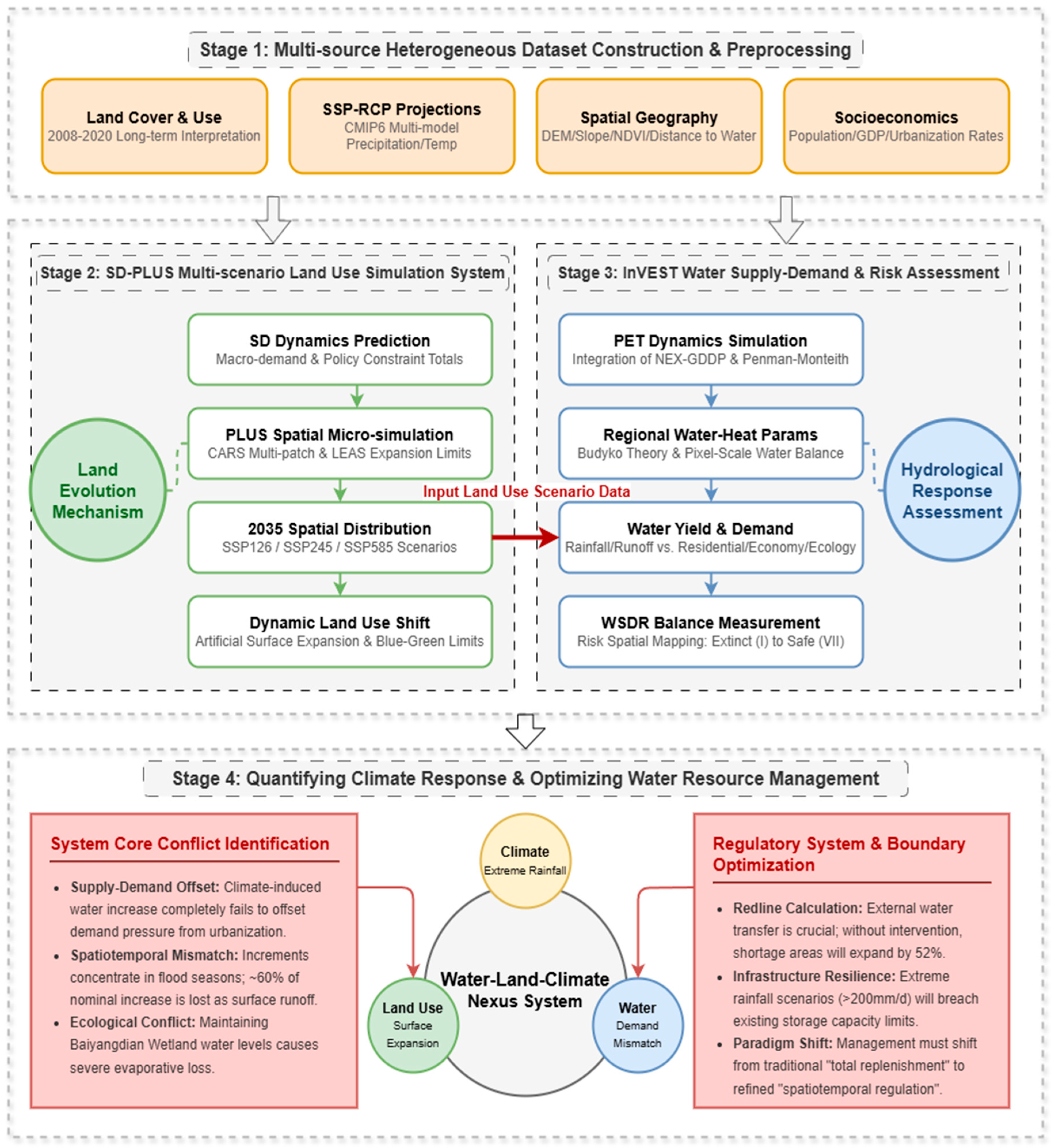
A coupled modeling framework integrating System Dynamics (SD), Patch-Generating Land-Use Simulation (PLUS), and the Integrated Valuation of Ecosystem Services and Trade-Offs (InVEST- InVEST 3.13.0, Natural Capital Project, Stanford, CA, USA) was employed to simulate land-use transitions and evaluate water supply–demand dynamics in the Xiong’an New Area (XNA) across diverse climate change scenarios. The core logic of this integrated framework follows a cascading sequence linking macro-level policies to environmental outcomes: macro-policy → land-use/cover change (LUCC) → water resources (Figure 2). This hierarchical structure facilitates a holistic assessment of complex interactions within the human–environment system.

2.3.2. System Dynamics (SD) Model

System Dynamics (SD) posits that complex systems comprise multiple information feedback loops among subsystems, which can be computationally simulated [56]. Here, an SD model was developed to forecast land-use demand by integrating traditional economic, demographic, climatic, and land-use subsystems. Critically, a macro-policy constraint subsystem was innovatively introduced to translate mandatory ecological indicators from the Outline Plan for the Xiong’an New Area into explicit model boundary conditions. This integration ensures that simulated land-use demands precisely reflect XNA’s unique top-down planning and policy-driven development trajectory—a hallmark of this research.
The model architecture encompasses four primary subsystems: economy, population, climate, and land use. Feedback mechanisms among these subsystems were analyzed using regression equations established via SPSS (IBM SPSS Statistics 26.0, IBM Corporation, Armonk, NY, USA) software to ensure statistical robustness. Subsequently, the SD model was constructed using Vensim PLE 10.3.2 (Ventana Systems, Harvard, MA, USA) software. Drawing on historical climatic and socio-economic data [47,57,58,59], key parameters for scenario settings—including growth rates for population and GDP, urbanization rates, and annual rates of change for temperature and precipitation—were meticulously calibrated (Table 2), providing a rigorous foundation for future projections.

2.3.3. Patch-Generating Land-Use Simulation (PLUS) Model

The PLUS model, integrating a multi-type random patch-seed Cellular Automata (CARS) and a Land Expansion Analysis Strategy (LEAS), was employed to simulate spatial land-use patterns with high fidelity [44]. Drawing on established research [56,60] and incorporating stipulations from the Outline Plan for the Xiong’an New Area, 14 drivers of land-use change were selected. These drivers encompass environmental conditions (e.g., NDVI, elevation, slope, aspect, soil type, and mean annual precipitation/temperature), socio-economic variables (e.g., GDP, population density), and transport accessibility (e.g., proximity to roads, water bodies, and infrastructure). Prior to model calibration, multicollinearity among the 14 driving factors was assessed using Variance Inflation Factor (VIF) diagnostics to ensure predictor independence. All VIF values ranged from 1.02 to 1.40, well below the conventional critical threshold of 10, indicating no severe multicollinearity among the selected variables (Table 3). The Baiyangdian Ecological Protection Zone and permanent basic farmland were designated as constraints and integrated into the transition cost matrix as policy-driven configurations. This methodology reflects the stringent spatial controls within XNA and is vital for simulating realistic, policy-compliant land-use patterns.

2.3.4. Scenario Setting and Parameterization

This research diverges from conventional methodologies that rely on simple extrapolations of global Shared Socio-Economic Pathways (SSPs) into unregulated local expansion. Given XNA’s designation as a “National Core Development Zone” and a “Millennium Project,” we developed a “Global Climate Pathway–Local Policy Cascading Evolution Framework” (Figure 2). By synergizing CMIP6 global narratives with the stringent spatial development intensities, blue–green space ratios, and water-use efficiency mandates defined in the Outline Plan for the Xiong’an New Area [28,60], we established three distinct evolutionary scenarios to provide a robust analytical spectrum:
(1) SSP1–2.6 (Ecological Civilization-Led Scenario): Aligned with a sustainable, ultra-low-emission pathway, this scenario simulates the vision of “ecological priority and green development.” It evaluates the self-sufficiency of the regional hydrological cycle under maximum ecological intervention, representing an idealized sustainable future.
(2) SSP2–4.5 (Coordinated Robust Development Scenario): Serving as the baseline, this scenario corresponds to a medium-emission pathway. It simulates steady progress within the existing policy framework, adhering to the principle of “coordinating urban development with ecological conservation.”
(3) SSP5–8.5 (Extreme Development Stress Test Scenario): Representing a fossil-fueled high-emission pathway, this scenario simulates the compounded stress of intensive urbanization and extreme climatic events on XNA’s water system, providing a “worst-case” benchmark for risk prevention under extreme uncertainty.
As illustrated in Figure 2, the downscaling process is not a linear extrapolation of isolated variables. Instead, the SD model (encompassing economic, demographic, and climatic subsystems) first determines total land demand under macro-level policy constraints. This then drives the PLUS model to translate policy objectives into micro-scale transition cost matrices and spatial constraints, ensuring a coherent and spatially explicit integration of policy mandates into future projections.

2.3.5. Scenario-Model Pairing

This study employed a “scenario-specific representative modeling” strategy to encompass the uncertainty range across multiple models. A targeted multi-model ensemble comprising three Global Climate Models (GCMs)—EC-Earth3, GFDL-ESM4, and MRI-ESM2–0—was selected for its robust performance in capturing the evaporation–precipitation dynamics (P/PET ratio) and extreme weather events characteristic of the semi-arid North China Plain (Table 4):
(1) GFDL-ESM4 (low sensitivity): Its precipitation projections are relatively conservative, making it appropriate for assessing minimum water-risk scenarios under the low-emission SSP1–2.6 pathway. Prior studies have shown that this model exhibits smaller bias in low-humidity-index regions [61].
(2) EC-Earth3 (moderate sensitivity): It demonstrates strong capability in simulating mid-latitude precipitation seasonality and the evaporation-to-precipitation ratio, rendering it suitable for the robust-development scenario under the medium-emission SSP2–4.5 pathway [61].
(3) MRI-ESM2–0 (high sensitivity): It most effectively captures extreme hydrological events such as drought–pluvial alternation in North China, making it suitable for stress-testing under the extreme-emission SSP5–8.5 pathway [62].
By pairing scenarios with models spanning the full spectrum of CMIP6 climate sensitivities—from conservative to extreme—this study effectively brackets the inter-model uncertainty range and ensures a comprehensive assessment of future water risk.

2.3.6. Model Validation

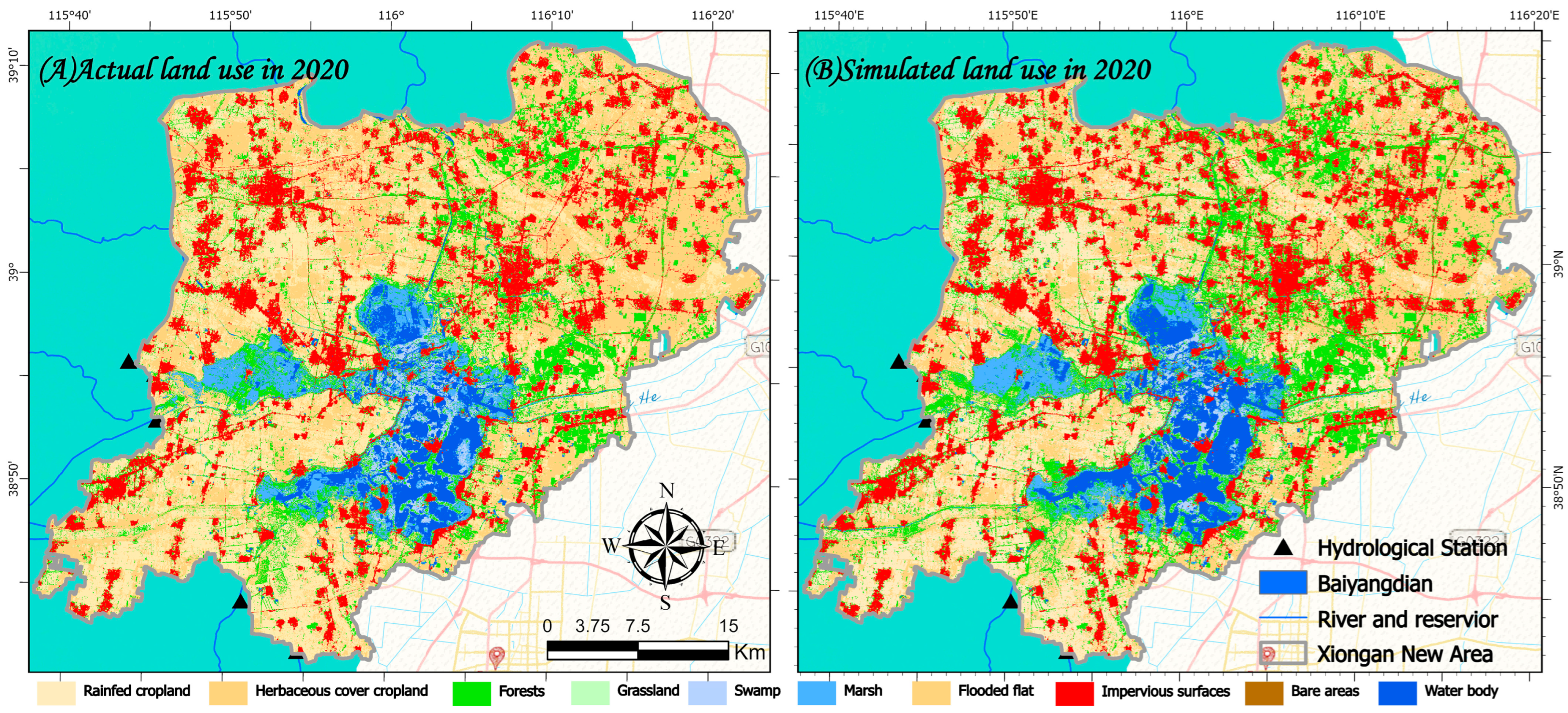
To benchmark the predictive robustness of the PLUS model, overall accuracy (OA), the Kappa coefficient, and the Figure of Merit (FOM) were employed for quantitative evaluation [63]. The established literature suggests that values of FOM > 0.21, Kappa ≥ 0.75, and OA ≥ 0.80 signify high simulation reliability [64]. In this study, the PLUS model was utilized to reconstruct the 2020 land-use spatial distribution for comparison with empirical observations (Figure 3).
The validation yielded a Kappa of 0.83, an OA of 0.87, and an FOM of 0.214, confirming the model’s satisfactory performance. Minor discrepancies between the simulated and observed maps were primarily localized at the interfaces between wetlands and water bodies. Furthermore, significant variations in artificial surfaces were observed, attributable to the accelerated pace of development in the New Area, where active construction sites were occasionally modeled as arable land—highlighting the inherent challenges of capturing rapidly evolving urban landscapes.

2.3.7. The InVEST Water Yield Module and Its Limitations

The InVEST water yield module leverages the principles of water balance and the Budyko hydrothermal coupling framework [65]. It quantifies annual runoff at a pixel scale using precipitation and actual evapotranspiration (AET) data, effectively mapping the spatial distribution of water resources under varying land-use and climatic conditions. The annual water yield Y ( x ) (mm) for pixel x is given by Equation (1) as follows:
Y ( x ) = 1 A E T ( x ) P ( x ) × P ( x )
where A E T ( x ) is the annual actual evapotranspiration (mm) for pixel x , and P ( x ) is the annual precipitation (mm) for pixel x . Actual evapotranspiration is calculated using Equation (2):
A E T ( x ) P ( x ) = 1 + P E T ( x ) P ( x ) 1 + P E T ( x ) P ( x ) w 1 / w
Here, P E T ( x ) represents the potential evapotranspiration (mm) for pixel x , and ω is the empirical parameter [66], which represents natural climate and soil properties. The parameter ω ( x ) is determined by Equation (3):
ω ( x ) = Z × A W C ( x ) P ( x ) + 1.25
In Equation (3), Z is an empirical constant, sometimes referred to as the seasonal factor, representing hydrological characteristics such as regional precipitation distribution. The accurate determination of the value Z is crucial, as it serves as a core parameter of the InVEST water yield module and significantly influences the simulation accuracy of water yield [67].
Z value calibration: To ensure high-fidelity localization of the InVEST simulations, the seasonal factor (Z-parameter) was meticulously calibrated. Given the topographical and climatic homogeneity between XNA and eastern Baoding, a downscaling approach was applied. Through iterative optimization, the optimal fitting parameter Z for XNA was determined to be 7.8. This calibration achieved a relative error of less than 0.37% during the validation period, ensuring robust reliability for the localized simulation [50].
The parameter Z can also be derived from Equation (4):
Z = P ( x ) × ( ω 1.25 ) A W C ( x )
Furthermore, A W C ( x ) (the effective water content of pixel x ) is calculated using Equation (5):
A W C ( x ) = m i n ( M a x S o i l D e p t h ( x ) , R o o t D e p t h ( x ) ) × P A W C ( x )
where M a x S o i l D e p t h ( x ) is the maximum soil depth, R o o t D e p t h ( x ) is the root depth of pixel x , and P A W C ( x ) is the plant available water content of pixel x , determined by Equation (6):
P A W C ( x ) = 54.509 0.132 S A N D ( x ) 0.003 ( S A N D ( x ) ) 2 0.055 S I L T ( x ) 0.006 ( S I L T ( x ) ) 2 0.738 C L A Y ( x ) + 0.007 ( C L A Y ( x ) ) 2 2.699 O M ( x ) + 0.501 ( O M ( x ) ) 2
In Equation (6), S A N D ( x ) , S I L T ( x ) , C L A Y ( x ) and O M ( x ) represent the sand, silt, clay and organic matter contents of pixel x , respectively.
Future potential evapotranspiration ( P E T ) is based on the NEX-GDDP CMIP6 dataset [68]. The Penman–Monteith equation is widely regarded as a reliable method for calculating P E T due to its improved physical calculation process [69], as shown in Equation (7):
P E T = 0.408 Δ R n G + γ 900 T a + 273 u 2 e s e a Δ + γ 1 + 0.34 u 2
Here, Δ represents the slope of the saturated vapor pressure curve; T a represents the daily mean air temperature; e s represents the saturated vapor pressure; R n represents net radiation; e a represents the actual vapor pressure; G represents the soil heat flux; and u 2 represents the daily mean wind speed at a height of 2 m.
Differences in water yield across land-use types: Different land-use types exhibit significant variations in water yield due to their unique hydrological characteristics [70]. For example, forests and grasslands with high vegetation cover have higher evapotranspiration rates; by retaining and consuming water, they inhibit the generation of runoff, resulting in lower overall water yield [71]. Conversely, developed areas have a high proportion of impervious surfaces, which significantly impede rainwater infiltration and promote the rapid formation and accumulation of surface runoff; consequently, water yield in these areas is relatively high. This understanding is crucial when undertaking land-use planning in water-stressed regions.

2.3.8. Multi-Dimensional Water Demand Accounting Module

Diverging from conventional urban water demand assessments, the total water requirement for XNA, denoted as W D t o t a l ( x ) , is decomposed into two pivotal components: “urban socio-economic demand” and “mandatory ecological demand.” This multidimensional approach facilitates a more comprehensive understanding of regional water dynamics. The integrated water demand at the grid scale is formulated as shown in Equation (8):
W D t o t a l = W D s o c i o e c o + W D e c o
(A) Urban socio-economic water demand ( W D s o c i o e c o ( x ) )
This component is quantified utilizing a consumption quota methodology. It synthesizes historical water demand data from the Baoding Water Resources Bulletin with forward-looking projections derived from scenario-based analysis. The framework encompasses domestic consumption, industrial and agricultural developmental requirements, and generalized ecological compensation. Calculations are executed through Equations (9)–(11) [58,72,73]:
P O P i j = p ( i j ) j = 1 n p ( i j ) × P O P t
G D P i j = g ( i j ) j = 1 n g ( i j ) × G D P t
W D i j = P O P i j × Q l i f e + G D P i j × Q g d p + A G R i j × Q a g r + E L Y i j × Q l e y
In these equations, W D i j denotes the water demand for the j th pixel in year i .   P O P i j and G D P i j represent the adjusted population and GDP for the j th pixel in year i , respectively. Q l i f e , Q g d p , Q a g r and Q l e y represent the per capita domestic water consumption, water consumption per 10,000 yuan of GDP, irrigation water consumption per mu of arable land, and ecological conservation water consumption per mu of planted forest land in year i , respectively. For each SSP scenario, these coefficients were derived from established policy documents and peer-reviewed studies [14,58], subject to an aggregate water-saving cap of 4.54 × 10⁸ m3 mandated by the Ministry of Water Resources for XNA. Three high-guarantee eco-environmental development paradigms were formulated accordingly [58]: Model 1 (high-standard development), Model 2 (efficient water use and ecological protection), and Model 3 (ecological conservation priority). The sectoral water-use quotas under these scenarios are summarized in Table 5.
(B) Baiyangdian’s rigid ecological water demand ( W D e c o )
The stringent mandates stipulated in the Outline Plan for the Xiong’an New Area—to restore Baiyangdian’s surface area to 360 km2 and maintain water levels between 6.5 and 7.0 m—coupled with extensive afforestation under the “Millennium Forest” project, are projected to drive a significant increase in evapotranspiration-led water consumption. Given the inherent complexities of simulating fine-scale water level dynamics, this study simplifies Baiyangdian’s ecological demand to water losses primarily driven by evaporation. This simplification is methodologically justified by the overwhelming dominance of evaporative losses in Baiyangdian’s water budget. Hu et al. [46] analyzed water-balance data for 1973–2020 and showed that, since 1980, open-water evaporation has accounted for 78.89% of total water loss, whereas seepage/leakage constituted only 8.92%, with the evaporative share increasing markedly since the twenty-first century. Wang et al. [74] further confirmed through in situ experiments that lake evaporation is the primary hydraulic sink, with summer evaporation reaching 6.6 mm day−1. While seepage, ecological baseflow, and groundwater recharge are omitted here, the evaporation-based estimate represents a conservative lower bound; incorporating the omitted components would intensify rather than mitigate the projected deficit. Drawing on established findings that evaporation constitutes the primary hydraulic sink for the wetland, ecological demand is calculated via Equation (12):
W D e c o = w a t e r 2020 × E i E 2020 × A 2020
where w a t e r 2020 represents the total water consumption for ecological protection of the Baiyangdian wetland in 2020, E i represents the evaporation rate of Baiyangdian in the year i , E 2020 represents the evaporation rate of Baiyangdian in 2020, and A 2020 represents the wetland area of Baiyangdian in 2020.

2.3.9. Water Resource Supply and Demand Risk Assessment

The evaluation of water supply–demand risks is an intricate process involving uncertainty characterization, future scenario modeling, and the implementation of management paradigms. McIntyre [75] underscores the inherent uncertainties in water resource planning and the necessity of risk assessment methodologies focused on the disparities between supply and demand capacities. Based on prior studies [76], this study measures water supply and demand risk using four indicators—the water supply–demand ratio (WSDR), WSDR trend, water supply trend and water demand trend—providing a comprehensive assessment framework.
The water supply–demand ratio (WSDR) for pixel x ( W S D R x ) is given by Equation (13):
W S D R x = W Y x W D x
where W Y x and W D x represent the annual water yield and water demand for pixel x , respectively.
The trend in the water supply–demand ratio ( W S D R t r ) is given by Equation (14):
W S D R t r = W S D R j W S D R i
where W S D R j and W S D R i denote the water supply–demand ratios for years j and i , respectively.
Furthermore, the water supply trend ( S t r ) and the water demand trend ( D t r ) represent the absolute changes in water supply and water demand, respectively, yielding Equations (15) and (16):
S t r = W Y j W Y i
D t r = W D j W D i
Here, S t r and D t r represent the difference between water supply and water demand services; W Y j and W Y i represent water supply services in the years j and i ; and W D j and W D i represent water demand in the years j and i . If S t r or D t r < 0 , this indicates a downward trend; otherwise, it indicates a stable or upward trend.
By integrating these four dimensions, water supply–demand risks are categorized into seven hierarchical grades (Table 6), providing a granular classification for assessing regional hydro-ecological security [34].

2.3.10. Quantitative Indicators for Spatiotemporal Mismatch

To quantitatively assess the temporal and spatial mismatches between water supply and demand, two indicators are introduced.
(A) Seasonal Water Shortage Rate (SWSR)
Although the InVEST module yields only annual water yield totals, precipitation in North China is highly seasonal. Systematic analyses indicate that 65–85% of annual rainfall is concentrated in the flood season (June–September) [77]. Based on the regional water-use structure, domestic and industrial demands are assumed to be stable throughout the year, whereas agricultural irrigation demand is concentrated in the crop-growing season (April–September) [78]. Ecological water demand, driven mainly by evapotranspiration, peaks under high summer temperatures [79]. Consequently, off-season (October–May) water demand is estimated to account for approximately 42% of total annual demand. Using simulated annual water yield and demand for 2035, the SWSR was calculated for each SSP scenario (Equation (17)):
S W S R = W O F F S e a s o n   D e m a n d W O F F S e a s o n   S u p p l y W A n n u a l   D e m a n d
where W O F F S e a s o n   D e m a n d is the total water demand during the non-flood season (October–May), W O F F S e a s o n   S u p p l y is the local natural water yield during the same period, and W A n n u a l   D e m a n d is the total annual water demand.
(B) Spatial Mismatch Index (SMI)
The Spatial Mismatch Index is defined as the coefficient of variation (CV) of the pixel-scale Water Supply–Demand Ratio (WSDR; Equation (13)):
S M I = C V = σ ( S W D R ) μ ( S W D R )
The coefficient of variation is widely employed to quantify spatial heterogeneity, dispersion, and regional matching characteristics in resource-allocation studies [80,81]. In water resource research, CV-based mismatch indices are commonly used to evaluate the spatial coordination and alignment of water supply–demand systems [80,81]. Here, denotes the standard deviation and the mean of WSDR across all grid cells. A larger CV indicates greater disparities in the supply–demand ratio among pixels, signifying more severe spatial mismatch.

3. Results

3.1. Scenario-Based Land-Use Simulation for 2035

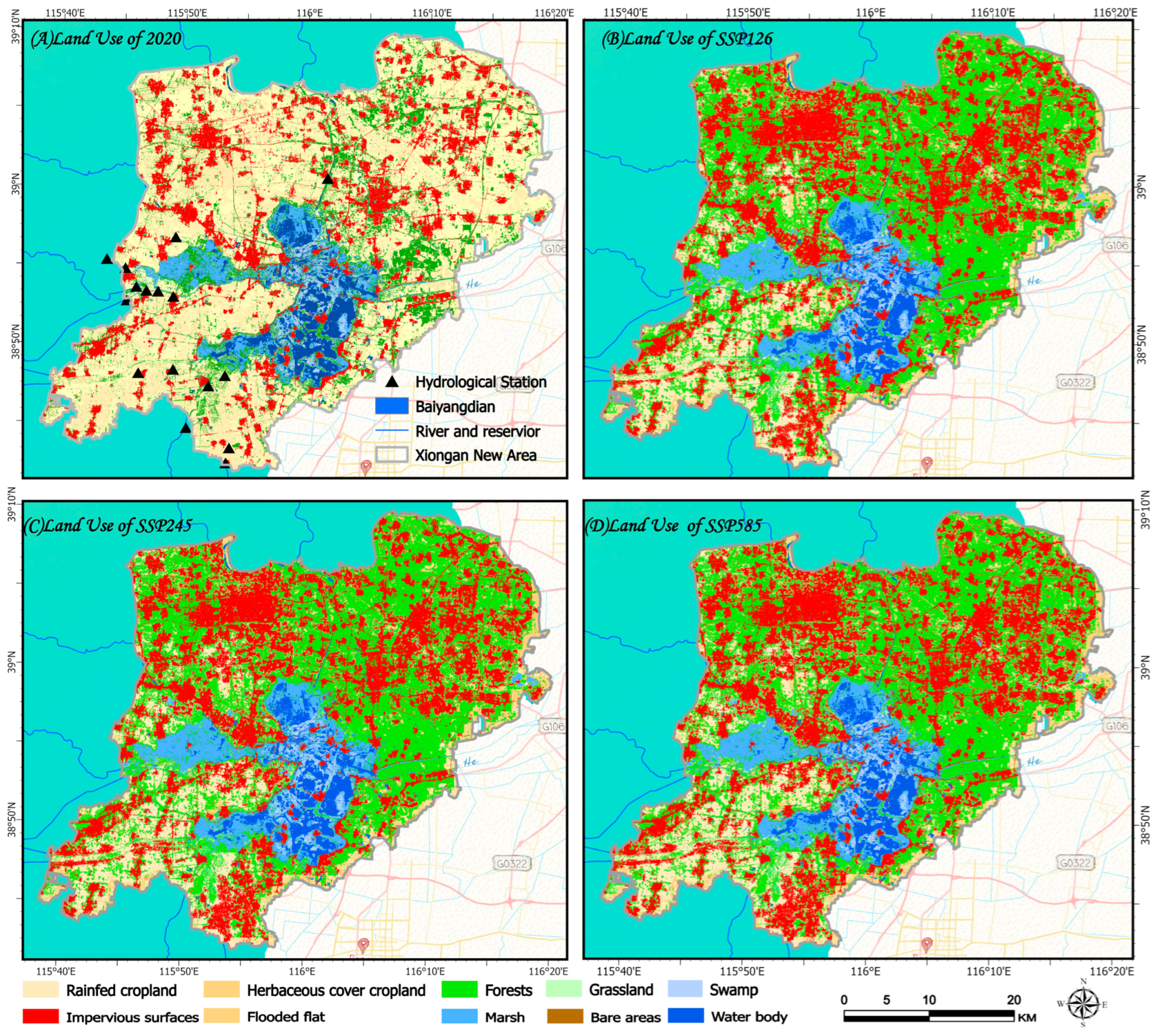
The coupled SD-PLUS model, having integrated macro-policy parameters with the Outline Plan for the Xiong’an New Area acting as the primary constraint, was deployed to simulate future land-use configurations across diverse Shared Socio-Economic Pathways (SSPs) for the year 2035. The simulation outcomes (Figure 4) compellingly substantiate the profound spatial imprints exerted by rigid policy enforcement on regional developmental trajectories.
Under the SSP1–2.6 (Ecological Priority) scenario—which strictly operationalizes planning directives—the model successfully safeguarded the dual policy red lines of “30% development intensity” and “70% blue–green space.” Between 2020 and 2035, the proliferation of artificial surfaces was effectively curtailed, expanding by 180.7 km2 (a 56% increase) to reach 503 km2 by 2035. Concurrently, forested domains exhibited a substantial surge of 456.4 km2 (a 206.8% increase), while wetland extents broadened by 49 km2 (a 24.8% increase), predominantly clustering in the northern sector and the Baiyangdian periphery. This delineates a critical paradigm shift in land-use architecture from an “economy-centric” model to an “eco-social synergy,” effectively harmonizing urban agglomeration with ecological restoration.
In stark contrast, the SSP5–8.5 (Extensive Expansion) scenario, propelled by unfettered economic growth, precipitates an explosive sprawl of artificial surfaces. This built-up extent surges dramatically by 220.7 km2 (a 68.4% increase relative to 2020), culminating at 543 km2 by 2035. Such disorderly expansion inflicts a massive attrition of arable land—depleting it by 698 km2 (a 66.8% reduction)—and severely encroaches upon potential ecological restoration zones surrounding Baiyangdian Lake, underscoring the acute trade-off between rapid urbanization and environmental integrity. The SSP2–4.5 (Coordinated Robust Development) scenario represents an intermediate trajectory, marked by an artificial surface expansion of 199.8 km2 (a 62% increase) and an arable land reduction of 684.8 km2 (a 65.5% decrease); compared to SSP1–2.6, it reflects a more balanced yet relatively less ambitious developmental paradigm. This quantitative juxtaposition clearly demonstrates the paramount importance of strictly enforcing spatial controls within XNA to attain sustainable development goals.

3.2. Sustainable Water Resources Assessment

3.2.1. Spatiotemporal Variation in Water Supply

The water supply results simulated via the InVEST module were meticulously refined using aggregate water resource data from the Hebei Province Water Resources Bulletin. Given that XNA was formally established in 2017, historical water resource totals for 2005, 2010, and 2015 were derived through area-weighted interpolation from the respective totals of Baoding and Cangzhou. This downscaling methodology falls within an acceptable margin of error due to the high topographical and climatic homogeneity between XNA and eastern Baoding. The empirical parameter in the InVEST water yield module, which characterizes the seasonal distribution of precipitation and potential evapotranspiration, was calibrated against historical runoff records. Through iterative optimization, the optimal value for XNA was determined to be 7.8. During the validation period (2005–2020), the relative error between simulated water yield and observed values from the Hebei Province Water Resources Bulletin was constrained to within 0.37% (Table 7, 2020). This value has been shown to be applicable to the relatively arid climate of the North China Plain and is highly consistent with independent simulation results for XNA [13].
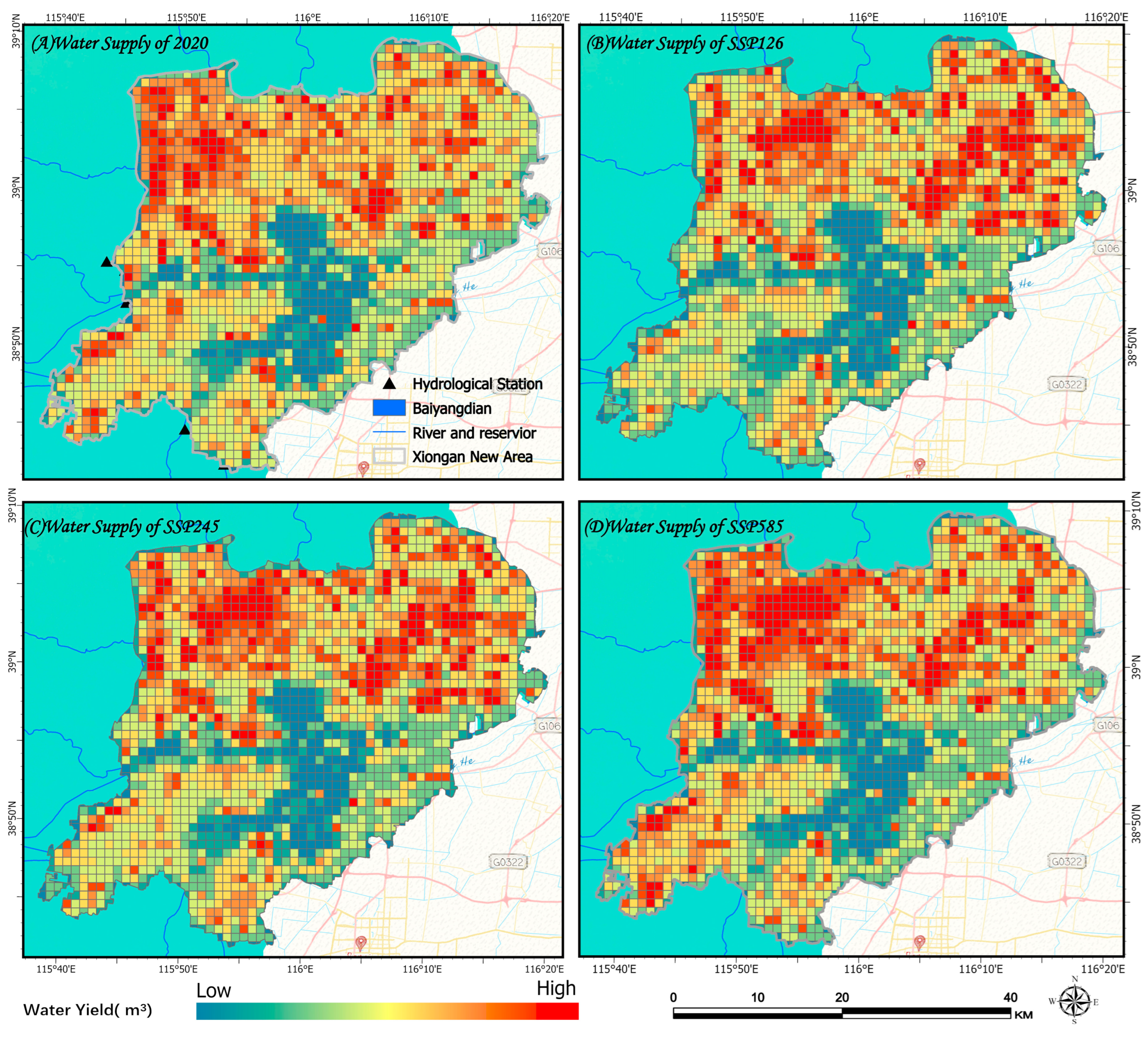
In 2020, the surface water yield simulated using the InVEST model was 2.148 × 10⁸ m3, with a total error of 0.37% (Table 7), closely matching the actual water resources. According to different scenario projections, water yield in 2035 is expected to show an overall increasing trend compared to 2020. Specifically, under the SSP1–2.6 scenario, yield increases by 8.91% (reaching 2.34 × 10⁸ m3), under the SSP2–4.5 scenario it increases by 12.5% (reaching 2.41 × 10⁸ m3), and under the SSP5–8.5 scenario it rises significantly by 19.58% (reaching 2.57 × 10⁸ m3). This increase is primarily attributed to the rise in total precipitation under future climate change scenarios (such as CMIP6), particularly more frequent and intense extreme precipitation events, which lead to increased surface runoff and consequently higher total water yield.
Spatial analysis reveals that simulated water yield is predominantly concentrated in the northern sector of the New Area, with mean annual yields ranging from 120 to 200 mm (Figure 5). A distinct decreasing gradient is observed from north to south, reaching its nadir in the Baiyangdian region. Yield in Baiyangdian remains consistently low, primarily due to substantial evaporation losses from its expansive water surface (estimated at 1400–1600 mm annually), rendering the ecological maintenance of this critical zone highly dependent on external water diversions. While spatial patterns under SSP1–2.6 and SSP2–4.5 are comparable, the SSP5–8.5 scenario exhibits more pronounced fluctuations within the XNA urban corridor, where local peaks exceed 575 mm/year due to impervious surface expansion and rapid runoff generation. Notably, although total yield increases, this increment is heavily skewed toward the flood season (June–September), accounting for 70–80% of the annual total. Without enhanced seasonal storage and stormwater utilization infrastructure, these increments are liable to be lost as rapid surface runoff, complicating efforts to ensure long-term water security.

3.2.2. Spatial Variations in Water Demand

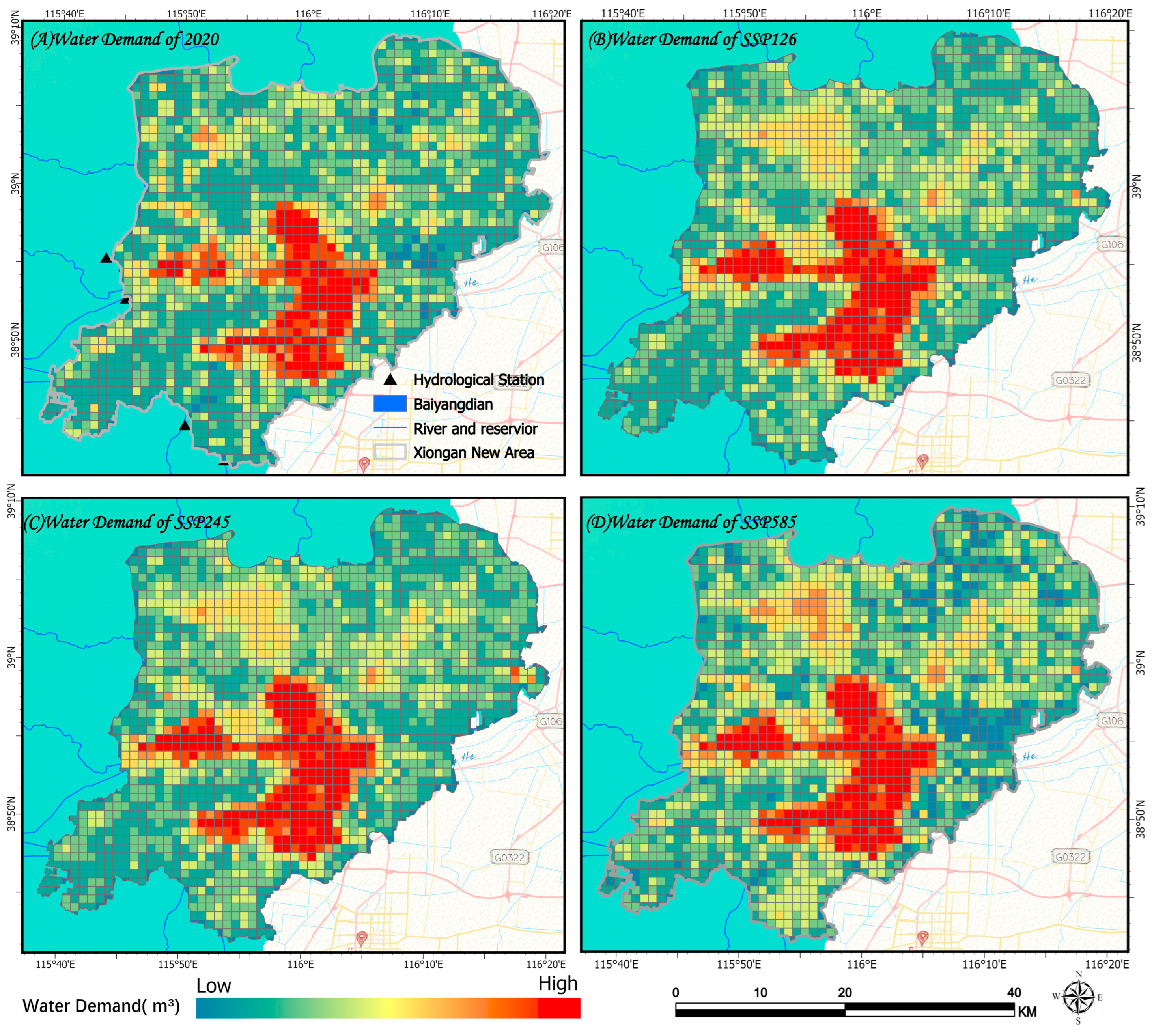
Water demand trends exhibit marked divergence across distinct consumption categories (agricultural irrigation, domestic use, and economic development) and developmental scenarios. Under all three scenarios, total water demand (across agricultural irrigation, domestic use and economic development) continues to rise, increasing from 3.48 × 10⁸ m3 in 2020 to 3.703 × 10⁸ m3 in 2035 (SSP1–2.6), 3.794 × 10⁸ m3 (SSP2–4.5) and 4.386 × 10⁸ m3 (SSP5–8.5). It should be noted that the sectoral quotas in Table 5 represent administrative caps, whereas these spatially explicit simulations incorporate local GDP and population distributions and therefore yield higher aggregate figures. These figures represent increases of 6.41%, 9.02% and 26.03% respectively compared to the 2020 baseline (Figure 6). This surge is not a mere product of linear population growth but is primarily driven by radical shifts in spatial land-use patterns. Large-scale urban expansion, particularly under the SSP5–8.5 scenario, displaces existing agricultural and natural landscapes, substituting low-water-use natural surfaces with high-demand socio-economic systems, thereby fundamentally restructuring the regional hydrological consumption profile.
Future demand growth is localized within urban expansion and forest development zones, especially in the Rongcheng and Anxin districts. Conversely, cultivated areas exhibit a downward demand trend due to the implementation of water-saving agricultural practices. A significant spatial mismatch persists between demand hotspots (the southern XNA urban cluster, with demand exceeding 300 mm/year) and high-yield areas (yielding below 200 mm/year) (see Figure 5).
Under the SSP1–2.6 scenario, while urbanization-related consumption is strictly curtailed through robust water-saving mandates, the mandatory targets set by the Outline Plan—such as “restoring Baiyangdian to 360 km2” and large-scale afforestation—drive a substantial increase in rigid ecological demand. In this scenario, ecological demand for Baiyangdian constitutes approximately 50–60% of total demand, reflecting the stringent restoration mandates under the Outline Plan.

3.2.3. Quantitative Assessment of Spatiotemporal Mismatch

(A) Seasonal Water Shortage Rate (SWSR)
Table 8 presents the Seasonal Water Shortage Rate (SWSR) for the three SSP scenarios in 2035. Across all scenarios, SWSR remains stable in the range of 26.1–27.3%, indicating limited inter-scenario fluctuation. This implies that even when annual water supply and demand appear balanced, natural precipitation during the non-summer period fails to cover more than one-quarter of local water demand owing to the seasonal distribution of rainfall. Notably, the SSP5–8.5 scenario registers the highest SWSR at 27.3%, underscoring how urbanization-driven demand escalation further aggravates regional supply burdens.
(B) Spatial Mismatch Index (SMI)
Under the SSP5–8.5 scenario, the SMI increases progressively from 0.44 in 2020 to 0.98 (Table 9). This monotonic upward trend quantitatively demonstrates that urbanization-driven land-use change significantly intensifies the spatial heterogeneity of water resource availability. Under the extreme-expansion scenario, high-demand urban core zones (southern XNA) coincide with areas of low local water yield, whereas water-abundant regions (northern XNA) exhibit far lower demand, creating a pronounced spatial disconnect that cannot be resolved by aggregate supply augmentation alone.

3.3. Water Supply–Demand Risk Analysis

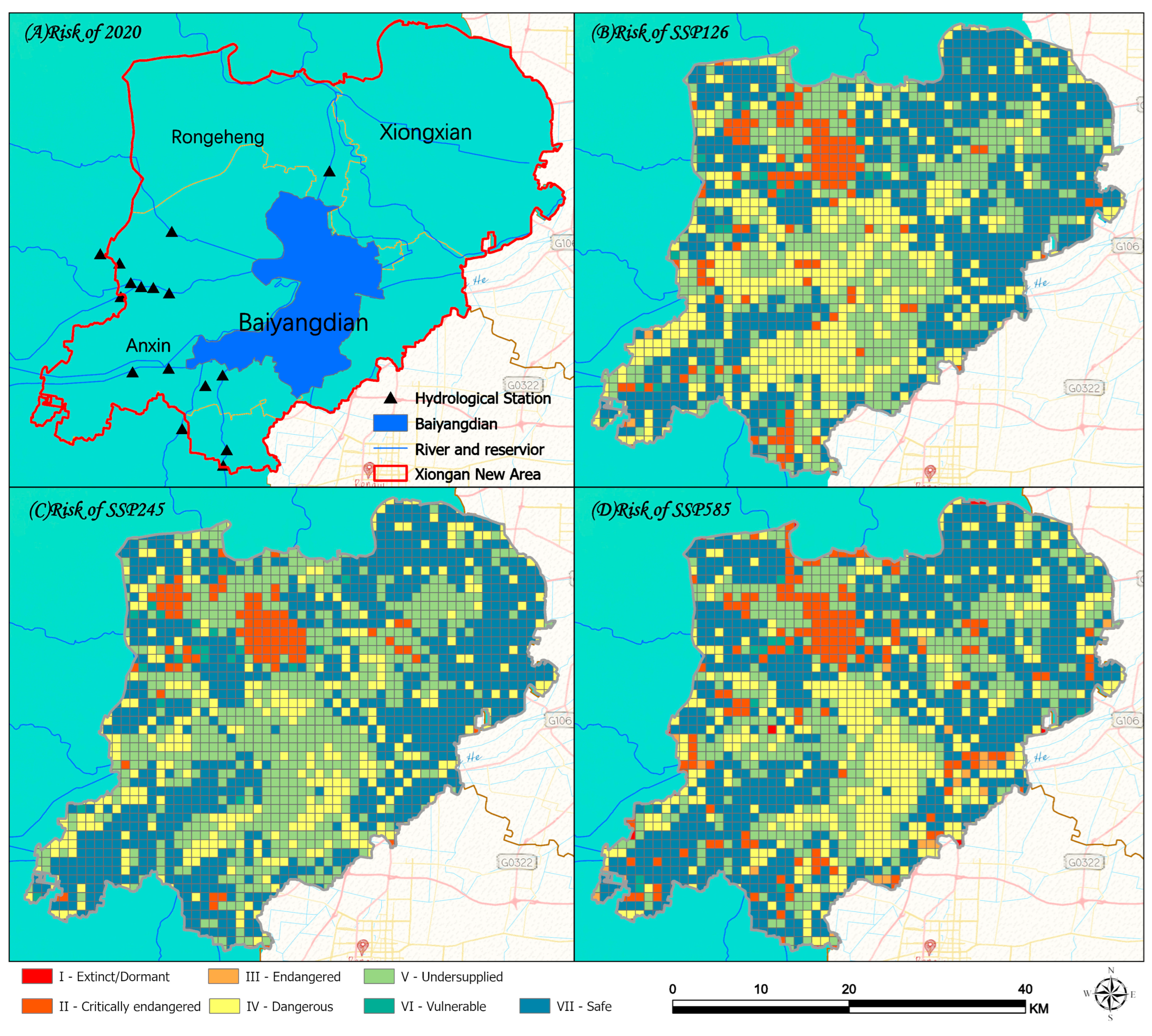
The spatial distribution of the water supply–demand ratio (WSDR) exhibits pronounced regularity, albeit with localized variations across different scenarios; notably, a stark demarcation exists between the Baiyangdian region and its surrounding areas (Figure 7). This illuminates the unique and intractable water resource predicament confronting XNA. In 2020, approximately 10% of the territory was classified as “Extinct/Dormant” (Grade I) or “Critically Endangered” (Grade II)—predominantly concentrated within the economic hubs of XNA—while the vast majority of the remaining areas persisted in an “Undersupplied” (Grade V) state.
Substantial water provisioning has been sustained through a confluence of policy interventions, encompassing upstream reservoir replenishments via the Yellow River-to-Baiyangdian diversion policy initiated in 2000, alongside strategic allocations from the Middle Route of the South-to-North Water Diversion Project (requiring 1.32 × 10⁸ m3, 2.10 × 10⁸ m3 and 3.38 × 10⁸ m3 during wet, normal, and dry years, respectively, to ensure a single annual turnover for Baiyangdian) [46]. These external water transfers are projected to contribute 40–45% of the aggregate water supply by 2035, serving as the critical linchpin for regional water security. Owing to these comprehensive policy interventions, the WSDR remains within a manageable threshold across all SSP scenarios (Figure 7), with only 6% to 20% of the area falling into Grades I or II, thereby underscoring the critical role of external water subsidies.
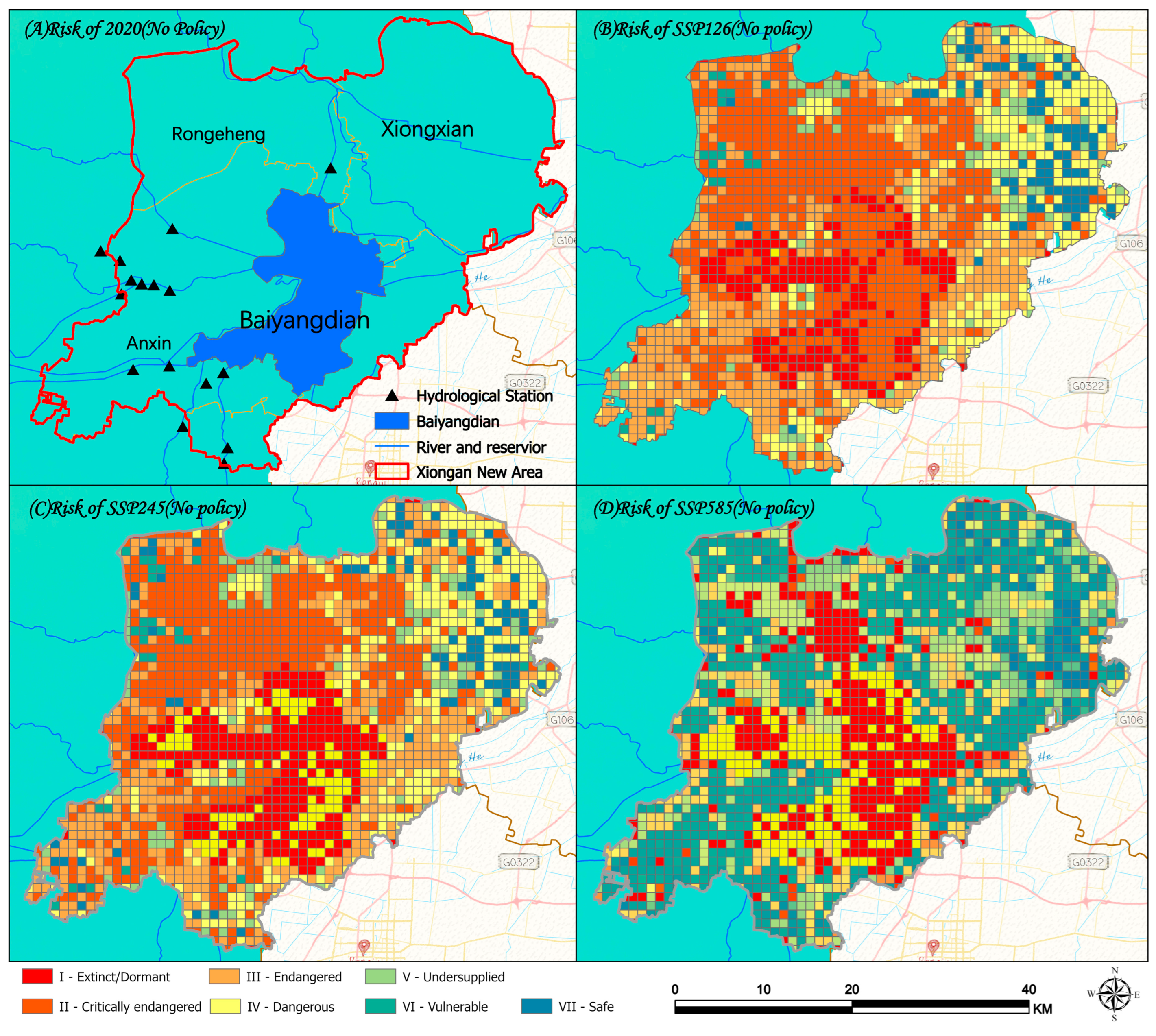
However, as illustrated in Figure 8, the landscape of water supply–demand risk undergoes a drastic deterioration under a hypothetical counterfactual devoid of these critical water allocation policies. Under this “no-policy” scenario, SSP1–2.6 and SSP2–4.5 would trigger an alarming expansion of severely water-deficient zones (Grades I and II) to 31.5–34.1%, representing an additional expanse of 447.6–503.1 km2 compared to the transfer-enabled scenarios (excluding the Baiyangdian Nature Reserve). Consequently, vast swaths of territory—particularly the northwestern urban agglomeration and the Baiyangdian ecological cluster—would plummet into a “Critically Endangered” (Grade II) state. Only under the SSP5–8.5 scenario—despite severe flood risks induced by extreme precipitation events—do certain localized areas exhibit relatively adequate water resources, a paradox driven by disproportionately elevated precipitation coupled with diminished ecological consumption in undeveloped zones. This heavy reliance on external sources simultaneously lays bare the systemic vulnerability of the region’s internal hydrological self-regulation capacity. The spatial convergence of regions experiencing diminished water yield (the northern sector, impacted by climate-driven local water imbalances) and regions with escalating water demand (the southern urban expansion zones) further exacerbates the supply–demand disequilibrium, foreshadowing an elevated risk of severe water scarcity across broader expanses. This marked disparity clearly shows that relying solely on localized precipitation increments is fundamentally inadequate to sustain XNA’s dual ambitious mandates of “high-quality urbanization and high-standard ecological restoration,” absent an uninterrupted influx of external water subsidies.

4. Discussions

The coupled SD–PLUS–InVEST projections reveal a consistent pattern across all SSP scenarios: urbanization-driven water demand growth overwhelmingly outpaces climate-induced supply gains. Despite projected precipitation increases raising water yield by 8.91–19.58% by 2035, this climatic dividend is insufficient to offset escalating demands. Under SSP5–8.5, demand surges by ~26% driven by a 220.7 km2 expansion of impervious surfaces, whereas SSP1–2.6 demonstrates that stringent “dual red line” controls (development intensity ≤ 30%, blue–green space ≥ 70%) can harmonize growth with ecological conservation. This disequilibrium indicates that erratic precipitation increases cannot compensate for unregulated urban sprawl, underscoring that strategic spatial planning remains essential for sustainable water management.

4.1. External Water Transfers: Necessity, Systemic Vulnerability and Spatiotemporal Mismatches

Given that local natural supply cannot close this gap, external transfers become essential, sustaining 40–45% of total supply by 2035. Without them, water-deficient zones would expand dramatically across most of the territory under all scenarios (Figure 8). Yet reliance on transferred water introduces systemic vulnerabilities across engineering, economic, water-quality, and institutional dimensions. The Middle Route of the South-to-North Water Diversion main canal spans approximately 1432 km, where winter ice-jam and ice-dam hazards threaten continuous operation [82]. Although a comprehensive monitoring and emergency-response system has been deployed, residual operational risks persist. Economically, external transfers impose sustained fiscal pressure: supporting infrastructure investment in Hebei Province exceeds 90 billion RMB, and XNA’s annual external water purchase costs are estimated at 77–277 million RMB [46]. Zhang and Chen [83] further report that relying solely on local water sources in the Beijing–Tianjin–Hebei region would yield water-scarcity risk rates of 0.846–0.923, underscoring the cost of dependency. Water-quality risks are partially mitigated by a monitoring system maintaining Class II or above standards [84], yet summer algal blooms and organic sedimentation remain latent threats. Institutional resilience is buffered by a multi-source complementary supply pattern incorporating upstream reservoir water, Yellow River diversion, South-to-North transfer water, and reclaimed water [85]. The XNA regulation reservoir provides approximately 1.94 × 10⁸ m3 with supply reliability exceeding 97%, and dynamic ecological water-supply schemes have been formulated for wet, normal, and dry years to maintain Baiyangdian’s ecological water level within the 6.5–7.0 m target range [86]. Nevertheless, these safeguards do not eliminate the structural dependency on cross-jurisdictional infrastructure.
Quantitative assessment further reveals severe spatiotemporal mismatches. The Seasonal Water Shortage Rate (SWSR) remains at 26.1–27.3% across all scenarios, indicating that over one-quarter of annual demand cannot be met locally outside the flood season. The Spatial Mismatch Index (SMI) rises from 0.44 in 2020 to 0.98 under SSP5–8.5, confirming that urbanization intensifies the disconnect between high-yield northern zones and high-demand southern agglomerations. Because precipitation increments are concentrated in June–September, mismatched with year-round demand, water governance must shift from simple supply augmentation toward adaptive frameworks emphasizing seasonal storage, stormwater retention, and intelligent allocation. Reclaimed water offers a critical buffer: at a population of 2.5 million, annual production could reach 3.76 × 10⁸ m3, with roughly 50% available for Baiyangdian ecological replenishment [46], thereby alleviating pressure on transferred sources.

4.2. Methodological Considerations, Integrated Validation and Groundwater Realities

The robustness of these findings rests on multi-dimensional validation. The PLUS model reconstructed the 2020 land-use distribution with Kappa = 0.83, OA = 0.87, and FOM = 0.214, satisfying established reliability thresholds (FOM > 0.21, Kappa ≥ 0.75, OA ≥ 0.80) [64]. The InVEST water yield module was localized through rigorous calibration of the seasonal factor Z = 7.8 against historical runoff records (2005, 2010, 2015, 2018, 2020) from the Hebei Province Water Resources Bulletin, achieving relative errors <2% and 0.37% for 2020 (Table 7), consistent with independent XNA assessments [13]. Climate uncertainty was bracketed via a scenario-specific representative modeling strategy, pairing conservative GFDL-ESM4 (SSP1–2.6), moderate EC-Earth3 (SSP2–4.5), and high-sensitivity MRI-ESM2–0 (SSP5–8.5), rather than masking inter-model spread through equal-weight averaging. Demand projections align with peer-reviewed localized quotas [14,46,57], independent SD simulations (~4.31 × 10⁸ m3 under optimized development) [87], and Copula-based multi-source supply estimates ([5.20, 12.10] × 108 m3) [88], confirming consistent shortage trends.
Several structural limitations warrant contextual interpretation. The InVEST annual Budyko framework cannot distinguish exploitable baseflow from unrecoverable surface runoff, nor can it capture intra-annual seasonal dynamics [71,89]. Because the core conclusion—that demand overwhelmingly outpaces supply—is derived under optimistic water yield assumptions, any underestimation of seasonal variability or overestimation of runoff would only strengthen deficit severity. The 1 km climate data represent the current standard for regional-scale CMIP6 products [68,90,91]; further downscaling would risk information loss.
Regarding groundwater, the omission of explicit dynamics in InVEST does not inflate sustainable supply estimates in XNA’s specific policy context. Natural recharge was independently estimated using the precipitation–infiltration coefficient method [92,93]. For XNA (area ≈ 1770 km2, mean annual precipitation ≈ 495 mm), regional coefficients range from 0.11 to 0.13 [94,95]; adopting a conservative range of 0.10–0.20 yields theoretical recharge of 0.88 × 10⁸ m3 to 1.75 × 10⁸ m3. This upper bound aligns closely with the documented sustainable exploitation potential of 1.80 × 10⁸ m3 yr−1 reported by Li et al. [96] (Table 10). The groundwater abstraction volumes by county are summarized in Table 11. Historical water-level data (1996–2014) indicate that the shallow groundwater table declined at ~0.83 m yr−1 [96,97,98], yielding an annual deficit of ~1.47 × 10⁸ m3 yr−1 with a unit yield of 0.10. Even the maximum sustainable groundwater contribution (1.80 × 10⁸ m3 yr−1) could cover only ~40% of projected demand (3.70–4.39 × 10⁸ m3 yr−1). Because external transfers already provide 40–45% of supply, they effectively substitute the full theoretical groundwater potential [99]. Further, it has been noted that the North China Plain aquifer is severely over-exploited with virtually no additional potential. Under XNA’s prevailing policy regime—where strict extraction caps are enforced from inception under the Outline Plan and the North China Plain Groundwater Over-Extraction Comprehensive Treatment Action Plan, and where field evidence shows groundwater levels rebounded by 0.76 m (shallow) and 0.56 m (deep) by 2020 following prohibition measures [96,98]—the sustainable groundwater contribution approaches zero [100]. Studies also show that this recovery itself depends on artificial recharge by external diverted water, validating the “replace groundwater with transferred water” strategy.

4.3. Policy Implications, Model Limitations and Future Directions

These quantitative findings—40–45% external-transfer dependency, SWSR of 26–27%, and SMI rising from 0.44 to 0.98—offer tangible reference points for adaptive governance. Three integrated directions emerge. First, diversifying the supply portfolio: Containing the external-transfer ratio near or below 45% would help manage systemic dependency, while expanding emergency storage from 1.94 × 10⁸ m3 toward 3.0 × 10⁸ m3 would improve interruption resilience. Reclaimed water offers substantial buffering potential (3.76 × 10⁸ m3 annually at 2.5 million population) [46], requiring multi-source dispatching platforms and augmented treatment capacity. Second, strengthening demand-side efficiency: A 40% reduction in water consumption per unit GDP by 2035 (relative to 2020) and guiding per capita domestic use toward 120 L person−1 day−1 (progressive target 100 L) appear feasible under aggressive efficiency scenarios, supported by tiered pricing and smart-meter deployment. Third, mitigating spatiotemporal mismatches: Reducing SWSR to below 15% would require ~0.8 × 10⁸ m3 additional seasonal storage, while reducing SMI to below 0.6 would necessitate enhanced conveyance from northern surplus zones (WSDR > 1.5) to southern deficit zones (WSDR < 0.5), complemented by decentralized reclaimed-water systems. These figures are planning heuristics subject to engineering refinement.
It should be emphasized that this study is designed as a policy stress-test of the legislated XNA master plan, which operates under a supply-guaranteed paradigm. The unidirectional cascade (SD → PLUS → InVEST) is therefore intentional: introducing endogenous feedback loops where water scarcity constrains socio-economic growth would contradict the institutional reality that the state commits to meeting planned demand regardless of local hydrological conditions. Future research could usefully develop bidirectional coupling, allowing water resource carrying capacity to dynamically constrain SD trajectories, calibrated via stakeholder workshops and machine learning sensitivity analyses. Localized micro-scale policies—strict impervious-surface controls, sponge-city mandates, and building-scale water reuse—were beyond the present scope because their explicit modeling requires fine-resolution empirical physical parameters (e.g., permeability of porous pavements, storage capacity of rain gardens) [101] that are still evolving during XNA’s rapid construction.

5. Conclusions

Deploying a coupled SD–PLUS–InVEST framework, this study investigated water supply–demand dynamics in the Xiong’an New Area across three SSP scenarios through 2035. The analyses reveal increasingly acute water scarcity driven predominantly by urbanization. The principal conclusions are threefold.
First, urbanization-driven demand growth eclipses climate-induced supply gains. Although elevated precipitation is projected to augment water yield by 8.91–19.58% by 2035, this climatic dividend is insufficient to offset the urbanization-driven surge in water demand. The imbalance is most pronounced under SSP5–8.5, where a ~26% demand spike is driven by a 220.7 km2 expansion of impervious surfaces. Climate-driven precipitation increments alone cannot offset water deficits catalyzed by unregulated urban sprawl.
Second, external water transfers are critical yet introduce systemic vulnerability. The simulations project that external transfers will sustain 40–45% of total supply by 2035. In the absence of such transfers, severely water-deficient zones would expand dramatically across most of the territory under all scenarios (Figure 8). This heavy reliance exposes the region to engineering, economic, water-quality, and cross-jurisdictional risks that cannot be eliminated by infrastructure safeguards alone. Diversifying the supply portfolio—particularly through reclaimed-water integration and expanded emergency storage—is essential to mitigate this dependency.
Third, pervasive spatiotemporal mismatches underscore the need for adaptive governance. Seasonal Water Shortage Rates (SWSR) of 26.1–27.3% indicate that more than one-quarter of annual demand cannot be met locally outside the flood season. The Spatial Mismatch Index (SMI) rises from 0.44 in 2020 to 0.98 under SSP5–8.5, confirming that urbanization intensifies the disconnect between high-demand urban cores and low-supply regions. Because precipitation increases are concentrated in the flood season and mismatched with year-round demand, governance should move beyond aggregate supply augmentation toward strategic temporal regulation and targeted infrastructure deployment.
All findings above are contingent upon two preconditions: strict enforcement of the Master Plan mandates (development intensity ≤ 30%, blue–green space ≥ 70%) and continuous, stable operation of external water-transfer projects. Any substantial relaxation of these preconditions would significantly worsen the supply–demand gap.
In summary, sustainable urban development in XNA requires an integrated approach that prioritizes strategic land-use management to curb unplanned urbanization, ensures the resilience of external water sources, and implements adaptive strategies to address spatiotemporal variability and extreme weather events.

Author Contributions

Conceptualization, J.-H.M. and F.P.; methodology, X.-H.D. and J.-H.M.; software, X.-H.D.; formal analysis, X.-H.D.; data curation, X.-H.D.; writing—original draft preparation, X.-H.D.; writing—review and editing, J.-H.M., F.P., T.-H.T., N.W. and R.-K.Y.; visualization, X.-H.D.; investigation and validation, Y.-X.J.; supervision, J.-H.M.; funding acquisition, J.-H.M. All authors have read and agreed to the published version of the manuscript.

Funding

This research was supported by the Zhejiang Provincial Natural Science Foundation of China (Grant Nos. LZJMY24D050002 and LZJMY25D050010), the Open Research Project of Key Open Laboratory of Hydrometeorology, China Meteorological Administration (Grant No. 24SWQXZ025), the National Key Research and Development Program of China (Grant No. 2023YFC3007700), and the Zhejiang Province “JianBingLingYan + X” Research and Development Plan (Grant No. 2025C02028).

Institutional Review Board Statement

Not applicable.

Informed Consent Statement

Not applicable.

Data Availability Statement

The data that support the findings of this study are provided within the article.

Acknowledgments

The authors would like to thank all individuals and institutions that provided support and assistance during this research. We also appreciate the valuable suggestions from the reviewers and editors for improving this manuscript.

Conflicts of Interest

The authors declare no conflicts of interest.

References

  1. Durán-Sánchez, A.; Álvarez-García, J.; Del Río-Rama, M.D.l.C. Sustainable Water Resources Management: A Bibliometric Overview. Water 2018, 10, 1191. [Google Scholar] [CrossRef]
  2. Rodell, M.; Famiglietti, J.S.; Wiese, D.N.; Reager, J.T.; Beaudoing, H.K.; Landerer, F.W.; Lo, M.-H. Emerging Trends in Global Freshwater Availability. Nature 2018, 557, 651–659. [Google Scholar] [CrossRef] [PubMed]
  3. Yang, D.; Yang, Y.; Xia, J. Hydrological Cycle and Water Resources in a Changing World: A Review. Geogr. Sustain. 2021, 2, 115–122. [Google Scholar] [CrossRef]
  4. Koop, S.H.A.; van Leeuwen, C.J. The Challenges of Water, Waste and Climate Change in Cities. Environ. Dev. Sustain. 2017, 19, 385–418. [Google Scholar] [CrossRef]
  5. Pasquier, U.; Vahmani, P.; Jones, A.D. Quantifying the City-Scale Impacts of Impervious Surfaces on Groundwater Recharge Potential: An Urban Application of WRF–Hydro. Water 2022, 14, 3143. [Google Scholar] [CrossRef]
  6. McGrane, S.J. Impacts of Urbanisation on Hydrological and Water Quality Dynamics, and Urban Water Management: A Review. Hydrol. Sci. J. 2016, 61, 2295–2311. [Google Scholar] [CrossRef]
  7. Sanchez, G.M.; Terando, A.; Smith, J.W.; García, A.M.; Wagner, C.R.; Meentemeyer, R.K. Forecasting Water Demand across a Rapidly Urbanizing Region. Sci. Total Environ. 2020, 730, 139050. [Google Scholar] [CrossRef]
  8. Pan, H.; Deal, B.; Destouni, G.; Zhang, Y.; Kalantari, Z. Sociohydrology Modeling for Complex Urban Environments in Support of Integrated Land and Water Resource Management Practices. Land Degrad. Dev. 2018, 29, 3639–3652. [Google Scholar] [CrossRef]
  9. Bao, C.; He, D. Scenario Modeling of Urbanization Development and Water Scarcity Based on System Dynamics: A Case Study of Beijing–Tianjin–Hebei Urban Agglomeration, China. Int. J. Environ. Res. Public Health 2019, 16, 3834. [Google Scholar] [CrossRef]
  10. McDonald, R.I.; Green, P.; Balk, D.; Fekete, B.M.; Revenga, C.; Todd, M.; Montgomery, M. Urban Growth, Climate Change, and Freshwater Availability. Proc. Natl. Acad. Sci. USA 2011, 108, 6312–6317. [Google Scholar] [CrossRef]
  11. Wu, F.; Guo, N.; Kumar, P.; Niu, L. Scenario-based Extreme Flood Risk Analysis of Xiong’an New Area in Northern China. J. Flood Risk Manag. 2021, 14, e12707. [Google Scholar] [CrossRef]
  12. Wei, Y.; Sun, B. Optimizing Water Use Structures in Resource-Based Water-Deficient Regions Using Water Resources Input–Output Analysis: A Case Study in Hebei Province, China. Sustainability 2021, 13, 3939. [Google Scholar] [CrossRef]
  13. Wan, H.; Wang, F.; Li, J.; Zhang, L.; Zhang, W.; Guo, F.; Zhang, H. Analysis of Spatiotemporal Changes and Trade-Offs/Synergies of Ecosystem Services Driven by Land Use Change in Xiong’an New Area. Prog. Geophys. 2023, 38, 1978–1998. [Google Scholar] [CrossRef]
  14. Xia, J.; Zhang, Y. Water Resource and Pollution Safeguard for Xiongan New Area Construction and Its Sustainable Development. Bull. Chin. Acad. Sci. 2017, 32, 1199–1205. [Google Scholar] [CrossRef]
  15. Ge, Q.; Yang, L.; Jin, F.; Zhu, H. Carrying Capacity of Resource and Environment of Xiongan New Area: Evaluation, Regulation, and Promotion. Bull. Chin. Acad. Sci. 2017, 32, 1206–1215. [Google Scholar] [CrossRef]
  16. Yang, Z.; Hu, P.; Zhao, Y.; Zeng, Q. Study on Ecological Water Demand and Safeguard Measures of Baiyangdian Lake and Inflowing Rivers Under the Background of Xiong’an New Area. J. China Inst. Water Resour. Hydropower Res. 2018, 16, 563–570. [Google Scholar] [CrossRef]
  17. Zhu, M.; Wang, S.; Kong, X.; Zheng, W.; Feng, W.; Zhang, X.; Yuan, R.; Song, X.; Sprenger, M. Interaction of Surface Water and Groundwater Influenced by Groundwater Over-Extraction, Waste Water Discharge and Water Transfer in Xiong’an New Area, China. Water 2019, 11, 539. [Google Scholar] [CrossRef]
  18. Feng, Z.; Yang, Y.; You, Z. The Population and Water and Land Resource Carrying Capacity of Xiongan New Area. Bull. Chin. Acad. Sci. 2017, 32, 1216–1223. [Google Scholar] [CrossRef]
  19. Wang, Y.; Song, L.; Han, Z.; Liao, Y.; Xu, H.; Zhai, J.; Zhu, R. Climate-Related Risks in the Construction of Xiongan New Area, China. Theor. Appl. Climatol. 2020, 141, 1301–1311. [Google Scholar] [CrossRef]
  20. Jiang, L.; Yang, C.; Feng, Z.; Liu, Y. Multi-scenario trade-off on water resources utilization in the Daqing River Basin. Resour. Sci. 2021, 43, 1649–1661. [Google Scholar] [CrossRef]
  21. Li, W.; Jiang, S.; Zhao, Y.; Li, H.; Zhu, Y.; Ling, M.; Qi, T.; He, G.; Yao, Y.; Wang, H. Comprehensive Evaluation and Scenario Simulation of Water Resources Carrying Capacity: A Case Study in Xiong’an New Area, China. Ecol. Indic. 2023, 150, 110253. [Google Scholar] [CrossRef]
  22. Zhang, D.; Gao, X. Climate change of the 21st century over China from the ensemble of RegCM4 simulations. Chin. Sci. Bull. 2020, 65, 2516–2526. [Google Scholar] [CrossRef]
  23. Chen, W.; Piao, J.; Chen, S.; Wang, L.; Zhao, W.; Wang, Z.; Wang, Q. Multi-Scale Variations and Future Projections of Dry-Wet Conditions over the Monsoon Transitional Zone in East Asia: A Review. Fundam. Res. 2025, 5, 1597–1606. [Google Scholar] [CrossRef] [PubMed]
  24. Wu, H.; Long, B.; Huang, N.; Lu, N.; Qian, C.; Pan, Z.; Men, J.; Zhang, Z. Impacts of Climate Change on Ecological Water Use in the Beijing–Tianjin–Hebei Region in China. Water 2024, 16, 319. [Google Scholar] [CrossRef]
  25. Su, Y.; Guo, B.; Zhou, Z.; Zhong, Y.; Min, L. Spatio-Temporal Variations in Groundwater Revealed by GRACE and Its Driving Factors in the Huang-Huai-Hai Plain, China. Sensors 2020, 20, 922. [Google Scholar] [CrossRef] [PubMed]
  26. Li, J.; Chen, X.; Kurban, A.; Van De Voorde, T.; De Maeyer, P.; Zhang, C. Coupled SSPs-RCPs Scenarios to Project the Future Dynamic Variations of Water-Soil-Carbon-Biodiversity Services in Central Asia. Ecol. Indic. 2021, 129, 107936. [Google Scholar] [CrossRef]
  27. Wu, J.; Luo, J.; Zhang, H.; Qin, S.; Yu, M. Projections of Land Use Change and Habitat Quality Assessment by Coupling Climate Change and Development Patterns. Sci. Total Environ. 2022, 847, 157491. [Google Scholar] [CrossRef] [PubMed]
  28. Yuan, C.; Weng, Y.; Xiong, K.; Rong, L. Projections of Land Use Change and Water Supply–Demand Assessment Based on Climate Change and Socioeconomic Scenarios: A Case Study of Guizhou Province, China. Land 2024, 13, 194. [Google Scholar] [CrossRef]
  29. Liu, J.; Yang, K.; Zhang, S.; Zeng, W.; Yang, X.; Rao, Y.; Ma, Y.; Bi, C. Carbon Storage Response to Land Use/Land Cover Changes and SSP-RCP Scenarios Simulation: A Case Study in Yunnan Province, China. Ecol. Evol. 2025, 15, e70780. [Google Scholar] [CrossRef]
  30. Eyring, V.; Bony, S.; Meehl, G.A.; Senior, C.A.; Stevens, B.; Stouffer, R.J.; Taylor, K.E. Overview of the Coupled Model Intercomparison Project Phase 6 (CMIP6) Experimental Design and Organization. Geosci. Model Dev. 2016, 9, 1937–1958. [Google Scholar] [CrossRef]
  31. Liu, J.; Li, D.; Chen, H.; Wang, H.; Wada, Y.; Kummu, M.; Gosling, S.N.; Yang, H.; Pokhrel, Y.; Ciais, P. Timing the First Emergence and Disappearance of Global Water Scarcity. Nat. Commun. 2024, 15, 7129. [Google Scholar] [CrossRef]
  32. Eekhout, J.P.C.; Delsman, I.; Baartman, J.E.M.; Van Eupen, M.; Van Haren, C.; Contreras, S.; Martínez-López, J.; De Vente, J. How Future Changes in Irrigation Water Supply and Demand Affect Water Security in a Mediterranean Catchment. Agric. Water Manag. 2024, 297, 108818. [Google Scholar] [CrossRef]
  33. Singh, R.; Kumar, R. Climate versus Demographic Controls on Water Availability across India at 1.5 °C, 2.0 °C and 3.0 °C Global Warming Levels. Glob. Planet. Change 2019, 177, 1–9. [Google Scholar] [CrossRef]
  34. Liu, X.; Liu, Y.; Wang, Y.; Liu, Z. Evaluating Potential Impacts of Land Use Changes on Water Supply–Demand under Multiple Development Scenarios in Dryland Region. J. Hydrol. 2022, 610, 127811. [Google Scholar] [CrossRef]
  35. Yang, S.; Yang, D.; Zhao, B.; Ma, T.; Lu, W.; Santisirisomboon, J. Future Changes in High and Low Flows under the Impacts of Climate and Land Use Changes in the Jiulong River Basin of Southeast China. Atmosphere 2022, 13, 150. [Google Scholar] [CrossRef]
  36. Chen, D.; Li, J.; Yang, X.; Zhou, Z. Quantifying Water Provision Service Supply, Demand and Spatial Flow for Land Use Optimization: A Case Study in the YanHe Watershed. Ecosyst. Serv. 2020, 43, 101117. [Google Scholar] [CrossRef]
  37. Wang, Z.; Li, X.; Mao, Y.; Li, L.; Wang, X.; Lin, Q. Dynamic Simulation of Land Use Change and Assessment of Carbon Storage Based on Climate Change Scenarios at the City Level: A Case Study of Bortala, China. Ecol. Indic. 2022, 134, 108499. [Google Scholar] [CrossRef]
  38. Su, Y.; Feng, Q.; Liu, W.; Zhu, M.; Xia, H.; Ma, X.; Cheng, W.; Zhang, J.; Zhang, C.; Yang, L.; et al. Improved Understanding of Trade-Offs and Synergies in Ecosystem Services via Fine Land-Use Classification and Multi-Scale Analysis in the Arid Region of Northwest China. Remote Sens. 2023, 15, 4976. [Google Scholar] [CrossRef]
  39. Xing, X.; Wang, Q.; Meng, F.; Liu, P.; Huang, L.; Zhuo, W. Assessing the Land Use-Carbon Storage Nexus Along G318: A Coupled SD-PLUS-InVEST Model Approach for Spatiotemporal Coordination Optimization. Land 2025, 14, 2067. [Google Scholar] [CrossRef]
  40. Shao, Z.; Chen, C.; Liu, Y.; Cao, J.; Liao, G.; Lin, Z. Impact of Land Use Change on Carbon Storage Based on FLUS-InVEST Model: A Case Study of Chengdu–Chongqing Urban Agglomeration, China. Land 2023, 12, 1531. [Google Scholar] [CrossRef]
  41. Zhu, X.; Wang, Z.; Gu, T.; Zhang, Y. Multi–Scenario Prediction of Land Cover Changes and Habitat Quality Based on the FLUS–InVEST Model in Beijing. Land 2024, 13, 1163. [Google Scholar] [CrossRef]
  42. Guo, P.; Wang, H.; Qin, F.; Miao, C.; Zhang, F. Coupled MOP and PLUS-SA Model Research on Land Use Scenario Simulations in Zhengzhou Metropolitan Area, Central China. Remote Sens. 2023, 15, 3762. [Google Scholar] [CrossRef]
  43. Wang, S.; Zhang, Z.; Wang, X. Land Use Change and Prediction in the Baimahe Basin Using GIS and CA-Markov Model. IOP Conf. Ser. Earth Environ. Sci. 2014, 17, 012074. [Google Scholar] [CrossRef]
  44. Liang, X.; Guan, Q.; Clarke, K.C.; Liu, S.; Wang, B.; Yao, Y. Understanding the Drivers of Sustainable Land Expansion Using a Patch-Generating Land Use Simulation (PLUS) Model: A Case Study in Wuhan, China. Comput. Environ. Urban Syst. 2021, 85, 101569. [Google Scholar] [CrossRef]
  45. Liu, X.; Liang, X.; Li, X.; Xu, X.; Ou, J.; Chen, Y. A Future Land Use Simulation Model (FLUS) for Simulating Multiple Land Use Scenarios by Coupling Human and Natural Effects. Landsc. Urban Plan. 2017, 168, 94–116. [Google Scholar] [CrossRef]
  46. Hu, S.; Wang, X.; Song, X. Could the Hydrological Conditions of Lake Baiyangdian Support a Booming Metropolis? Sci. Total Environ. 2023, 869, 161764. [Google Scholar] [CrossRef] [PubMed]
  47. Li, G.; Wang, W.; Li, B.; Duan, Z.; Hu, L.; Liu, J. Spatiotemporal Simulation of Blue-Green Space Pattern Evolution and Carbon Storage under Different SSP-RCP Scenarios in Wuhan. Sci. Rep. 2025, 15, 4017. [Google Scholar] [CrossRef] [PubMed]
  48. Zhao, X.; Wang, P.; Gao, S.; Yasir, M.; Islam, Q.U. Combining LSTM and PLUS Models to Predict Future Urban Land Use and Land Cover Change: A Case in Dongying City, China. Remote Sens. 2023, 15, 2370. [Google Scholar] [CrossRef]
  49. Wang, R.; Zhao, J.; Chen, G.; Lin, Y.; Yang, A.; Cheng, J. Coupling PLUS–InVEST Model for Ecosystem Service Research in Yunnan Province, China. Sustainability 2023, 15, 271. [Google Scholar] [CrossRef]
  50. Redhead, J.W.; Stratford, C.; Sharps, K.; Jones, L. Empirical Validation of the InVEST Water Yield Ecosystem Service Model at a National Scale. Sci. Total Environ. 2016, 569–570, 1418–1426. [Google Scholar] [CrossRef]
  51. Gao, Y.; Shen, J.; Chen, L.; Li, X.; Jin, S.; Ma, Z.; Meng, Q. Influence of Underground Space Development Mode on the Groundwater Flow Field in Xiong’an New Area. J. Groundw. Sci. Eng. 2023, 11, 68–80. [Google Scholar] [CrossRef]
  52. Wang, C.; Masoudi, A.; Wang, M.; Yang, J.; Yu, Z.; Liu, J. Land-Use Types Shape Soil Microbial Compositions under Rapid Urbanization in the Xiong’an New Area, China. Sci. Total Environ. 2021, 777, 145976. [Google Scholar] [CrossRef]
  53. Zhu, S. Path Selection for Carbon Neutrality in Xiong’an New Area Based on Structural Optimization and Evolution. China Popul. Resour. Environ. 2023, 33, 115–124. [Google Scholar] [CrossRef]
  54. Shi, Y.; Zhang, L.; Zhang, J. Impact Analysis of Inter-Basin Water Transfer on Water Shortage Risk in the Baiyangdian Area. Water 2025, 17, 2311. [Google Scholar] [CrossRef]
  55. Yang, J.; Huang, X. The 30 m Annual Land Cover Datasets and Its Dynamics in China from 1985 to 2022. Earth Syst. Sci. Data 2023, 13, 3907–3925. [Google Scholar] [CrossRef]
  56. Han, Z.; Li, B.; Han, Z.; Wang, S.; Peng, W.; Liu, X.; Benson, D. Dynamic Simulation of Land Use and Habitat Quality Assessment in Baiyangdian Basin Using the SD-PLUS Coupled Model. Water 2024, 16, 678. [Google Scholar] [CrossRef]
  57. Li, J.; Zhang, G.; Zhang, P.; Jing, S.; Dong, J. Simulation and Zoning Research on the Ecosystem Service in the Beijing–Tianjin–Hebei Region Based on SSP–RCP Scenarios. Land 2023, 12, 1536. [Google Scholar] [CrossRef]
  58. Lü, L.; Jiang, B.; Geng, L.; Zhang, H.; Yu, X. Water use intensity and water demand prediction of Xiongan New Area under different development scenarios. Hydro-Sci. Eng. 2021, 39, 18–25. [Google Scholar] [CrossRef]
  59. Yao, S.; Li, Y.; Jiang, H.; Wang, X.; Ran, Q.; Ding, X.; Wang, H.; Ding, A. Predicting Land Use Changes under Shared Socioeconomic Pathway–Representative Concentration Pathway Scenarios to Support Sustainable Planning in High-Density Urban Areas: A Case Study of Hangzhou, Southeastern China. Buildings 2024, 14, 2165. [Google Scholar] [CrossRef]
  60. Zhu, J.; Hu, X.; Xu, W.; Shi, J.; Huang, Y.; Yan, B. Regional Carbon Stock Response to Land Use Structure Change and Multi-Scenario Prediction: A Case Study of Hunan Province, China. Sustainability 2023, 15, 12178. [Google Scholar] [CrossRef]
  61. Rosa, L.; Sangiorgio, M. Global Water Gaps under Future Warming Levels. Nat. Commun. 2025, 16, 1192. [Google Scholar] [CrossRef]
  62. Yan, J.; Huang, F.; Xu, S. Future Changes of the Western North Pacific Tropical Cyclone Characteristics: Results from a CMIP6 High-Resolution Model. Clim. Change Res. Lett. 2024, 13, 896–906. [Google Scholar] [CrossRef]
  63. Huo, J.; Shi, Z.; Zhu, W.; Xue, H.; Chen, X. A Multi-Scenario Simulation and Optimization of Land Use with a Markov–FLUS Coupling Model: A Case Study in Xiong’an New Area, China. Sustainability 2022, 14, 2425. [Google Scholar] [CrossRef]
  64. Pontius, R.G.; Millones, M. Death to Kappa: Birth of Quantity Disagreement and Allocation Disagreement for Accuracy Assessment. Int. J. Remote Sens. 2011, 32, 4407–4429. [Google Scholar] [CrossRef]
  65. Reheman, R.; Kasimu, A.; Duolaiti, X.; Wei, B.; Zhao, Y. Research on the Change in Prediction of Water Production in Urban Agglomerations on the Northern Slopes of the Tianshan Mountains Based on the InVEST–PLUS Model. Water 2023, 15, 776. [Google Scholar] [CrossRef]
  66. Zhang, L.; Hickel, K.; Dawes, W.R.; Chiew, F.H.S.; Western, A.W.; Briggs, P.R. A Rational Function Approach for Estimating Mean Annual Evapotranspiration. Water Resour. Res. 2004, 40, W02502. [Google Scholar] [CrossRef]
  67. Donohue, R.J.; Roderick, M.L.; McVicar, T.R. Roots, Storms and Soil Pores: Incorporating Key Ecohydrological Processes into Budyko’s Hydrological Model. J. Hydrol. 2012, 436–437, 35–50. [Google Scholar] [CrossRef]
  68. Thrasher, B.; Wang, W.; Michaelis, A.; Melton, F.; Lee, T.; Nemani, R. NASA Global Daily Downscaled Projections, CMIP6. Sci. Data 2022, 9, 262. [Google Scholar] [CrossRef]
  69. Allen, R.G.; Pruitt, W.O.; Wright, J.L.; Howell, T.A.; Ventura, F.; Snyder, R.; Itenfisu, D.; Steduto, P.; Berengena, J.; Yrisarry, J.B.; et al. A Recommendation on Standardized Surface Resistance for Hourly Calculation of Reference ETo by the FAO56 Penman-Monteith Method. Agric. Water Manag. 2006, 81, 1–22. [Google Scholar] [CrossRef]
  70. Wei, P.; Chen, S.; Wu, M.; Deng, Y.; Xu, H.; Jia, Y.; Liu, F. Using the InVEST Model to Assess the Impacts of Climate and Land Use Changes on Water Yield in the Upstream Regions of the Shule River Basin. Water 2021, 13, 1250. [Google Scholar] [CrossRef]
  71. Yin, G.; Wang, X.; Zhang, X.; Fu, Y.; Hao, F.; Hu, Q. InVEST Model-Based Estimation of Water Yield in North China and Its Sensitivities to Climate Variables. Water 2020, 12, 1692. [Google Scholar] [CrossRef]
  72. Liu, G.; Jin, Q.; Li, J.; Li, L.; He, C.; Huang, Y.; Yao, Y. Policy Factors Impact Analysis Based on Remote Sensing Data and the CLUE-S Model in the Lijiang River Basin, China. Catena 2017, 158, 286–297. [Google Scholar] [CrossRef]
  73. Xiang, H.; Zhang, J.; Mao, D.; Wang, Z.; Qiu, Z.; Yan, H. Identifying Spatial Similarities and Mismatches between Supply and Demand of Ecosystem Services for Sustainable Northeast China. Ecol. Indic. 2022, 134, 108501. [Google Scholar] [CrossRef]
  74. Wang, X.; Yin, D.; Wang, Y. Research on in-situ test of lake evaporation in the Baiyangdian Lake. Hydrogeol. Eng. Geol. 2023, 50, 204–212. [Google Scholar] [CrossRef]
  75. McIntyre, N.; Lees, M.; Wheater, H.; Onof, C.; Connorton, B. Evaluation and Visualisation of Risk to Water Resources. Proc. Inst. Civ. Eng.—Water Marit. Eng. 2003, 156, 1–11. [Google Scholar] [CrossRef]
  76. Li, D.; Wu, S.; Liu, L.; Liang, Z.; Li, S. Evaluating Regional Water Security through a Freshwater Ecosystem Service Flow Model: A Case Study in Beijing-Tianjian-Hebei Region, China. Ecol. Indic. 2017, 81, 159–170. [Google Scholar] [CrossRef]
  77. Zhang, H.; Feng, L. Spatiotemporal Variation of Precipitation in North China Over the Past 50 Years. J. Nat. Resour. 2010, 25, 270–279. [Google Scholar] [CrossRef]
  78. Zhang, Y.; Lei, H.; Zhao, W.; Shen, Y.; Xiao, D. Comparison of the Water Budget for the Typical Cropland and Pear Orchard Ecosystems in the North China Plain. Agric. Water Manag. 2018, 198, 53–64. [Google Scholar] [CrossRef]
  79. Xu, Z.; Chen, X.; Wu, S.R.; Gong, M.; Du, Y.; Wang, J.; Li, Y.; Liu, J. Spatial-Temporal Assessment of Water Footprint, Water Scarcity and Crop Water Productivity in a Major Crop Production Region. J. Clean. Prod. 2019, 224, 375–383. [Google Scholar] [CrossRef]
  80. Du, J.; Yang, Z.; Wang, H.; Yang, G.; Li, S. Spatial–Temporal Matching Characteristics between Agricultural Water and Land Resources in Ningxia, Northwest China. Water 2019, 11, 1460. [Google Scholar] [CrossRef]
  81. Liu, X.; Hu, Z.; Wang, Y.; Wang, M.; Hou, W. Spatial Scale Effects on the Response Strength of Water Resources Supply-Demand Balance to Driving Factors. Ecol. Indic. 2025, 173, 113431. [Google Scholar] [CrossRef]
  82. Sun, W.; Guan, G.; Xiong, F.; Guo, X.; Wu, Y. Research on the Dispatch Mode of Alleviating the Ice Condition by Water Inflow in the Main Canal of the Mid-Route of South-to-North Water Transfer Project. China Rural Water Hydropower 2024, 2024, 200–210. [Google Scholar] [CrossRef]
  83. Zhang, S.; Chen, J. Research on Water Scarcity Risk in North China. J. Nat. Resour. 2009, 24, 1192–1199. [Google Scholar]
  84. Su, Q.; Chang, H.-S.; Chen, X.; Xiao, J. Metacoupling of Water Transfer: The Interaction of Ecological Environment in the Middle Route of China’s South-North Project. Int. J. Environ. Res. Public Health 2022, 19, 10555. [Google Scholar] [CrossRef] [PubMed]
  85. Cui, Z. Ecological Water Replenishment for Baiyangdian to Ensure Water Security in Xiong’an New Area. China Water Resour. 2020, 2020, 62–64. [Google Scholar]
  86. Zhou, L.; Chang, T.; Ma, C.; Sun, W.; Han, Q.; Yi, Z.; Jia, J. Optimization of Minimum Ecological Water Allocation for Baiyangdian Under Ecological Water Level Targets. Water Resour. 2024, 39, 2345–2360. [Google Scholar]
  87. Sun, B.; Yang, X. Simulation of Water Resources Carrying Capacity in Xiong’an New Area Based on System Dynamics Model. Water 2019, 11, 1085. [Google Scholar] [CrossRef]
  88. Wei, C.; Wang, X.; Fang, J.; Wang, Z.; Li, C.; Liu, Q.; Yu, J. A New Method for Estimating Multi-Source Water Supply Considering Joint Probability Distributions under Uncertainty. Front. Earth Sci. 2023, 10, 929613. [Google Scholar] [CrossRef]
  89. Zhang, T.; Shao, Q.; Huang, H. Understanding the Efficiency and Uncertainty of Water Supply Service Assessment Based on the Budyko Framework: A Case Study of the Yellow River Basin, China. Ecol. Indic. 2025, 173, 113395. [Google Scholar] [CrossRef]
  90. Lafferty, D.C.; Sriver, R.L. Downscaling and Bias-Correction Contribute Considerable Uncertainty to Local Climate Projections in CMIP6. npj Clim. Atmos. Sci. 2023, 6, 158. [Google Scholar] [CrossRef]
  91. Mianabadi, A.; Davary, K.; Pourreza-Bilondi, M.; Coenders-Gerrits, A.M.J. Budyko Framework; towards Non-Steady State Conditions. J. Hydrol. 2020, 588, 125089. [Google Scholar] [CrossRef]
  92. Tarka, R.; Olichwer, T.; Staśko, S. Evaluation of Groundwater Recharge in Poland Using the Infiltration Coefficient Method. Geol. Q. 2017, 61. [Google Scholar] [CrossRef]
  93. Andualem, T.G.; Demeke, G.G.; Ahmed, I.; Dar, M.A.; Yibeltal, M. Groundwater Recharge Estimation Using Empirical Methods from Rainfall and Streamflow Records. J. Hydrol. Reg. Stud. 2021, 37, 100917. [Google Scholar] [CrossRef]
  94. Min, L.; Qi, Y.; Shen, Y.; Wang, P.; Wang, S.; Liu, M. Groundwater Recharge under Irrigated Agro-Ecosystems in the North China Plain: From a Critical Zone Perspective. J. Geogr. Sci. 2019, 29, 877–890. [Google Scholar] [CrossRef]
  95. Camara, S.F.; Zhou, J.; Zhang, Y. Unstructured Modflow Model for Numerical Simulations of Groundwater Flow in Three-Dimensional Quaternary Aquifer of Beijing Plain, China. Water 2025, 17, 3162. [Google Scholar] [CrossRef]
  96. Li, H.; Feng, W.; Wang, K.; Zhao, K.; Li, G.; Zhang, Y.; Li, M.; Sun, L.; Chen, Y.; You, B. Groundwater Resources in Xiong’an New Area and Its Exploitation Potential. Geol. China 2021, 48, 1112–1126. [Google Scholar] [CrossRef]
  97. Du, J.; Laghari, Y.; Wei, Y.-C.; Wu, L.; He, A.-L.; Liu, G.-Y.; Yang, H.-H.; Guo, Z.-Y.; Leghari, S.J. Groundwater Depletion and Degradation in the North China Plain: Challenges and Mitigation Options. Water 2024, 16, 354. [Google Scholar] [CrossRef]
  98. Yang, H.; Cao, W.; Zhi, C.; Li, Z.; Bao, X.; Ren, Y.; Liu, F.; Fan, C.; Wang, S.; Wang, Y. Evolution of Groundwater Level in the North China Plain in the Past 40 Years and Suggestions on Its Overexploitation Treatment. Geol. China 2021, 48, 1142–1155. [Google Scholar] [CrossRef]
  99. Sun, J.; Hu, L.; Zhang, J.; Wang, P. Integrated Groundwater Monitoring Wells and GRACE Satellite Data for Groundwater Dynamics Analysis in the Beijing–Tianjin–Hebei Region. J. Beijing Norm. Univ. Nat. Sci. 2025, 61, 844–858. [Google Scholar] [CrossRef]
  100. Zhou, L.; Shu, L.; Yang, P.; Yin, X.; Zhou, T.; Liu, B.; Lu, C. Water Balance Dynamics Reshape Baiyangdian Wetland Landscapes in Xiong’an New Area: A Stochastic Uncertainty Framework. Appl. Water Sci. 2026, 16, 50. [Google Scholar] [CrossRef]
  101. Zhu, R.; Zhang, X.; Chen, W.; Wan, Z.; Zheng, M. Study on Surface Runoff Control Effect of Permeable Pavement in Sponge City. J. Highw. Transp. Res. Dev. 2022, 39, 41–49. [Google Scholar] [CrossRef]
Figure 1. Geographical location map of Xiong’an New Area. (A) The location of XNA; (B) the distribution of water systems in XNA.
Sustainability 18 05870 g001
Figure 2. SD-PLUS-InVEST coupled model: technical flowchart showing data flow from macro-policy to land-use change to water resources assessment.
Sustainability 18 05870 g002
Figure 3. Spatial distribution of land use in the XNA in 2020. (A) Observed values for 2020; (B) PLUS results.
Sustainability 18 05870 g003
Figure 4. Spatial distribution of land-use simulations for the XNA under different scenarios in 2035. (A) Actual land use in 2020; (B) under the SSP1–2.6 scenario; (C) under the SSP2–4.5 scenario; (D) under the SSP5–8.5 scenario.
Sustainability 18 05870 g004
Figure 5. Spatial distribution of water yield simulated by InVEST model in XNA under different scenarios. (A) Water yield distribution in 2020; (B) under SSP126 scenario; (C) under SSP245 scenario; (D) under SSP585 scenario.
Sustainability 18 05870 g005
Figure 6. Spatial distribution of water demand in the XNA under different scenarios. (A) Water demand distribution in 2020; (B) under the SSP1–2.6 scenario; (C) under the SSP2–4.5 scenario; (D) under the SSP5–8.5 scenario.
Sustainability 18 05870 g006
Figure 7. Spatial distribution of water supply–demand risks in XNA under different SSP scenarios: (A) 2020 administrative boundaries; (B) SSP1–2.6 scenario; (C) SSP2–4.5 scenario; (D) SSP5–8.5 scenario.
Sustainability 18 05870 g007
Figure 8. Spatial distribution of water supply–demand risks in XNA under a scenario devoid of external water transfers: (A) 2020 administrative boundaries; (B) SSP1–2.6 scenario (no policy); (C) SSP2–4.5 scenario (no policy); (D) SSP5–8.5 scenario (no policy).
Sustainability 18 05870 g008
Table 1. Datasets and sources utilized in the study.
Data TypeNameSourcesTypeAccuracy
Land-use dataLand use and land coverZenodo
(https://zenodo.org/, accessed on 15 April 2025)
Raster30 m
Natural
environment data
DEMNASA Earth Science
(https://lpdaac.usgs.gov, accessed on 15 April 2025)
Raster30 m
SoilHarmonized World Soil Database (https://gaez.fao.org/pages/hwsd, accessed on 15 April 2025)Raster1 km
River networkOpen Street Map
(https://www.openstreetmap.org, accessed on 15 April 2025)
Vector-
NDVIResource and Environmental Science Data
Platform
(https://www.resdc.cn/, accessed on 15 April 2025)
Raster30 m
CMIP6 dataEarth System Grid Federation
(https://esgf.github.io/, accessed on 15 April 2025)
Raster1 km
Meteorological data (Temp, Pre, Evap)National Qinghai-Xizang Plateau Science Data Center
(https://data.tpdc.ac.cn, accessed on 15 April 2025)
Raster1 km
Social and
economic data
GDP
Nighttime light data
Data Center for Resources and Environmental Sciences, Chinese Academy of Sciences (https://www.resdc.cn, accessed on 15 April 2025)Raster1 km
POPWorld Pop
(https://www.worldpop.org, accessed on 15 April 2025)
Raster100 m
RoadOpen Street Map
(https://www.openstreetmap.org, accessed on 15 April 2025)
Vector-
Municipal and township boundary dataNational Geographic Information Public Service Platform (TianDiTu)
(https://cloudcenter.tianditu.gov.cn, accessed on 15 April 2025)
Vector-
Pop, economy, food, animal husbandry, etc.National Bureau of Statistics
(https://www.stats.gov.cn, accessed on 15 April 2025)
--
Table 2. Key parameter settings for multi-scenario simulations.
Parameter Type (Annual Growth)2020–2035
SSP126SSP245SSP585
POP1.05%1.25%1.72%
GDP Rate6.13%7.13%8.75%
Temp Rate0.0830.0310.056
Pre Rate6.17 mm6.32 mm12.8 mm
Urbanization Rate0.86%1.03%1.26%
Table 3. Collinearity diagnostics (VIF values) for the 14 PLUS model driving factors.
CategoryFactorVIF Value
Socio-economic variablesPOP1.34
GDP1.15
Night Light1.06
Transport accessibilityWater Distance1.40
River Distance1.37
Road Distance1.11
Environmental conditionsPrecipitation1.28
Temperature1.25
Soil Type1.21
Evaporation1.17
NDVI1.16
Aspect1.06
Slope1.04
Elevation1.02
Table 4. Selected CMIP6 GCMs and scenario-specific pairing rationale.
ModelCountry/InstitutionScenarioRationale for Selection
GFDL-ESM4USA/NOAA-GFDLSSP1–2.6Long-term climate change; conservative precipitation sensitivity suitable for low-emission pathways
EC-Earth3European consortiumSSP2–4.5Regional climate and dynamical downscaling; moderate sensitivity for baseline robust-development scenarios
MRI-ESM2–0Japan/MRISSP5–8.5Extreme events; high sensitivity for stress-testing intensive urbanization and high-emission futures
Table 5. Water-use quotas by sector under different SSP scenarios (unit: 108 m3).
Scenario FrameworkDevelopment Model [58]DomesticIndustrialAgriculturalWoodlandBaiyangdian
SSP1–2.6Model 11.4000.6600.3960.7433.80
SSP2–4.5Model 21.0770.6000.4400.7433.86
SSP5–8.5Model 31.2051.4200.6160.7433.73
Table 6. Risk levels for water ecosystem service supply and demand.
Grade CodeRisk GradeWater Supply–Demand RatioTrend of Supply–Demand RatioTrend of Water Supply and Demand
IExtinct/DormantWSDRx = 0
IICritically Endangered0 < WSDRx < 1WSDRtr < 0Str < 0, Dtr ≥ 0
IIIEndangered0 < WSDRx < 1WSDRtr < 0Str < 0, Dtr < 0 or Str ≥ 0, Dtr ≥ 0
IVDangerous0 < WSDRx < 1WSDRtr ≥ 0Str < 0, Dtr < 0 or Str ≥ 0, Dtr ≥ 0
VUndersupplied0 < WSDRx < 1WSDRtr ≥ 0Str ≥ 0, Dtr < 0
VIVulnerableWSDRx ≥ 1WSDRtr < 0
VIISafeWSDRx ≥ 1WSDRtr ≥ 0
Table 7. Comparison of actual and InVEST-simulated water yield volumes.
YearActual Water Yield Volume (108 m3)InVEST-Simulated Water Yield (108 m3)Relative Error (%)
20051.281.2931.02%
20101.471.446−1.63%
20151.891.866−1.27%
20181.961.947−0.66%
20202.142.1480.37%
Table 8. Seasonal Water Shortage Rates (SWSRs) under different SSP scenarios (Unit: 108 m3).
ScenarioAnnual Water ProductionAnnual Water RequirementWater Supply Outside the Flood SeasonWater Demand Outside the Flood SeasonSeasonal Water ShortagesSWSR
SSP1262.343.7030.5851.5550.97026.2%
SSP2452.413.7940.60251.5930.990526.1%
SSP5852.574.3860.64251.8421.199527.3%
Table 9. Spatial Mismatch Index (SMI) under different scenarios.
ScenarioMean WSDR (μ)Std Dev (σ)SMI
20200.730.320.44
SSP1261.090.770.70
SSP2451.180.950.81
SSP5851.031.010.98
Table 10. Groundwater exploitation potential by aquifer type in the Xiong’an New Area (108 m3).
ItemAnxinRongchengXiongTotal
Volume of shallow groundwater abstraction0.390.400.711.50
Volume of deep groundwater extraction0.130.100.070.30
Subtotal0.520.500.781.80
Table 11. Groundwater abstraction and extraction by county in the Xiong’an New Area (108 m3).
CountyShallow Groundwater Abstraction (108 m3)Deep Groundwater Extraction (108 m3)Subtotal (108 m3)
Anxin0.390.130.52
Rongcheng0.400.100.50
Xiong0.710.070.78
Total1.500.301.80
Disclaimer/Publisher’s Note: The statements, opinions and data contained in all publications are solely those of the individual author(s) and contributor(s) and not of MDPI and/or the editor(s). MDPI and/or the editor(s) disclaim responsibility for any injury to people or property resulting from any ideas, methods, instructions or products referred to in the content.