Article

Digital Leadership and Sustainable Digital Innovation in SMEs: The Strategic Roles of Digital Capabilities, Digital Orientation, and Agility

by
Maher Mostafa El Ozon
* and
Asieh AkhlaghiMofrad
Faculty of Business and Economics, Girne American University, Kyrenia 99320, Turkey
*
Author to whom correspondence should be addressed.
Sustainability 2026, 18(12), 5867; https://doi.org/10.3390/su18125867 (registering DOI)
Submission received: 22 February 2026 / Revised: 2 June 2026 / Accepted: 4 June 2026 / Published: 8 June 2026

Abstract

In the digital economy, small and medium-sized enterprises (SMEs) face growing pressure to align digital transformation with sustainability-oriented value creation. Yet, it remains unclear how and through which mechanisms digital leadership is associated with sustainable digital innovation in resource-constrained and turbulent contexts. This study investigates whether digital leadership is associated with sustainable digital innovation directly and indirectly through digital capabilities and digital orientation, and whether strategic agility strengthens these relationships. Drawing on the Resource-Based View (RBV) and Dynamic Capability Theory (DCT), the study develops an integrated framework that explains sustainable digital innovation as a strategically managed outcome of digital economy transformation rather than a simple result of technology adoption. Using survey data from 423 employees in Lebanese SMEs, the hypotheses were tested through partial least squares structural equation modeling (PLS-SEM). The findings show that digital leadership is positively associated with sustainable digital innovation both directly and indirectly, with digital orientation emerging as the stronger mediating pathway compared to digital capabilities. In addition, strategic agility strengthens the association between digital orientation and sustainable digital innovation, while its moderating role on the digital capabilities path is not significant. These findings contribute to the literature by identifying dual transformation mechanisms and revealing an asymmetric boundary role of agility in sustainability-oriented digital transformation. The study also offers practical implications for SME leaders seeking to align digital strategy with long-term environmental, social, and economic value creation.

1. Introduction

In today’s digital economy, organizations operate in an environment shaped by rapid technological disruption, platform-based competition, and growing sustainability pressures. Digital transformation has evolved from a technological upgrade into a core strategic management imperative, redefining how firms create, deliver, and capture value. At the same time, sustainability has moved beyond compliance to become a strategic driver of long-term competitiveness and legitimacy [1,2,3]. This convergence has increased pressure on firms not only to digitalize their operations, but also to ensure that digital transformation produces enduring economic, environmental, and social value. Within this context, digital technologies function as strategic enablers of resource optimization, environmental efficiency, stakeholder transparency, and innovative value creation [4,5].
The concept of sustainable digital innovation (SDI) captures this convergence by referring to innovation activities that leverage digital technologies to generate economic, environmental, and social value simultaneously [6,7]. SDI therefore reflects a higher-order strategic outcome of digital economy transformation, not merely the adoption of digital tools or the improvement of conventional innovation performance. Achieving such an outcome requires more than technical implementation. It requires leadership, internally developed digital resources, and the capacity to adapt strategically under uncertainty [8,9].
These challenges are especially pronounced for small and medium-sized enterprises (SMEs). SMEs are central to economic growth, innovation, and employment, yet they often face limited access to financial capital, technological infrastructure, and specialized digital talent [10,11]. As a result, many SMEs adopt digital technologies without successfully converting them into sustainability-oriented innovation outcomes [12,13]. This is the central research problem addressed in this study: why some SMEs are able to transform digital initiatives into sustainable digital innovation, whereas others remain limited to fragmented or efficiency-oriented digital change. The problem becomes even more acute in emerging and crisis-prone contexts such as Lebanon, where firms operate under economic instability, infrastructural fragility, and institutional uncertainty [14,15]. In such environments, digital transformation is not merely a growth option but a strategic necessity whose success depends heavily on internal managerial and organizational mechanisms.
Within this setting, digital leadership (DL) becomes particularly important. Digital leadership refers to leaders’ ability to envision, integrate, and strategically leverage digital technologies to transform organizational processes, foster innovation, and align digital initiatives with long-term strategic goals [16,17]. From a Resource-Based View (RBV) perspective, DL can be understood as a valuable and inimitable intangible resource that enables firms to mobilize and align internal assets toward strategic renewal [18,19]. However, the value of digital leadership is unlikely to lie in a strong direct link with SDI alone. Rather, its importance is expected to depend on the internal pathways through which leadership mobilizes organizational transformation [20].
Two such pathways are digital capabilities (DC) and digital orientation (DO). Digital capabilities refer to a firm’s ability to acquire, integrate, and deploy digital technologies effectively [21], whereas digital orientation reflects the strategic mindset that prioritizes digital opportunities and embeds digital thinking into organizational decision-making [22]. These constructs are related but theoretically distinct. DC captures operational readiness and technological execution, while DO captures strategic intent and cognitive commitment toward digital transformation. Their combined development determines whether digital transformation produces sustainable innovation or remains limited to incremental efficiency improvements [23]. In addition, because SMEs in turbulent environments must continually respond to technological and market shifts, strategic agility (SA), defined as the ability to sense, seize, and reconfigure opportunities rapidly, may shape how effectively these internal pathways are converted into sustainable outcomes [24,25,26].
Despite growing research on digital transformation and sustainability, three issues remain insufficiently resolved in the existing literature. First, although prior studies have established that digital leadership is associated with innovation performance, digital transformation success, and organizational learning, its specific relationship with sustainable digital innovation as a distinct, higher-order outcome remains underexplored, particularly in SME and emerging-economy contexts [6,27]. SDI is not equivalent to digital transformation or general innovation performance; it requires the simultaneous generation of economic, environmental, and social value, and it is not yet clear how leadership drives this specific outcome. Second, prior research has not clarified whether digital leadership operates through a single dominant internal mechanism or through multiple theoretically distinct pathways. In particular, digital capabilities and digital orientation have typically been studied separately or treated as interchangeable elements of digital readiness, leaving unresolved whether they function as parallel, additive, or independent mediating mechanisms between leadership and sustainable innovation outcomes [28]. Third, although strategic agility is widely recognized as an adaptive strength, its contingent role across these two pathways has not been empirically examined. It remains unclear whether agility uniformly amplifies both operational capability and strategic orientation, or whether its boundary-setting function is selective, particularly in resource-constrained SMEs facing environmental turbulence [25]. Taken together, these gaps mean that current research still offers only a partial explanation of how leadership-driven digital transformation is converted into sustainability-oriented innovation.
Grounded in RBV and Dynamic Capability Theory (DCT), this study develops an integrative framework to address these gaps by explaining how digital leadership is associated with sustainable digital innovation through digital capabilities and digital orientation, and how strategic agility conditions these relationships. The study advances the literature in three specific ways that go beyond prior leadership-capability-outcome models. First, it treats SDI as a theoretically distinct strategic outcome of digital economy transformation, not a generic proxy for innovation or performance, thereby requiring a more precise explanation of the mechanisms through which leadership produces this higher-order result. Second, rather than treating digital capabilities and digital orientation as equivalent or interchangeable, it examines them jointly as two theoretically distinct internal transformation pathways, one reflecting operational execution and the other reflecting strategic intent, to clarify whether their mediating functions are parallel or differentiated. Third, rather than assuming that strategic agility uniformly strengthens digital transformation outcomes, it tests whether agility plays a non-uniform boundary role across these two pathways, thereby resolving whether adaptability matters more for strategic orientation than for operational capability in turbulent SME contexts. In doing so, the study moves beyond existing frameworks by specifying what remains theoretically unresolved and demonstrating why this particular combination of constructs is needed to explain how digital leadership generates sustainable digital innovation in emerging-economy SMEs.
Accordingly, this study aims to: (1) examine the direct association between digital leadership and sustainable digital innovation; (2) investigate the mediating roles of digital capabilities and digital orientation; and (3) test the moderating role of strategic agility. By doing so, the study contributes to the literature on digital transformation strategy, sustainable innovation, and SMEs by explaining not only whether digital leadership matters, but also through which internal pathways and under which adaptive conditions it is associated with sustainable digital innovation.

2. Theoretical Framework and Hypotheses Development

2.1. Underpinning Theories: RBV and DCT

The theoretical logic of this study rests on the joint use of the Resource-Based View (RBV) and Dynamic Capability Theory (DCT). Rather than treating these theories as parallel background lenses, the study integrates them as a connected explanatory chain. RBV explains what internal resources and transformation pathways matter for sustainable digital innovation, whereas DCT explains how those resources are mobilized and adaptively converted into innovation outcomes under turbulence.
From an RBV perspective, firms achieve sustained advantage through resources that are valuable, rare, inimitable, and non-substitutable [18]. In digitally transforming SMEs, such an advantage depends increasingly on intangible strategic resources rather than on easily replicated physical assets [19,25]. Within this study, digital leadership (DL) is conceptualized as the initiating strategic resource because it helps firms align digital technologies with organizational priorities, mobilize internal knowledge, and orient transformation toward sustainability-related value creation [6,29]. In a resource-constrained context such as Lebanese SMEs, where firms often face limited capital, fragile infrastructure, and institutional volatility [14], this type of leadership becomes especially important because it helps convert scarce assets into strategic value.
However, DL is not treated as a self-sufficient source of sustainable digital innovation. Its importance lies in the internal pathways it activates [20]. Those pathways are digital capabilities (DC) and digital orientation (DO), and they are theoretically distinct rather than interchangeable. DC refers to the firm’s operational ability to acquire, integrate, and deploy digital technologies effectively. DO refers to the firm’s strategic and cognitive commitment to identifying, prioritizing, and pursuing digital opportunities [6,22]. In other words, DC captures what the firm can do with digital technologies, whereas DO captures how the firm thinks about and strategically approaches digital transformation. This distinction matters for understanding sustainable digital innovation because operational execution and strategic intent make different contributions to sustainability-oriented outcomes. A firm may deploy digital tools competently without embedding a sustainability-oriented digital logic, and it may hold strong digital intent without yet having the technological execution capacity to convert that intent into concrete innovation [20,23,30]. Both dimensions are therefore necessary, but they do not substitute for one another.
DCT complements RBV by explaining how these resources and pathways are adaptively mobilized under conditions of uncertainty [26]. DCT focuses on firms’ abilities to sense opportunities, seize them, and reconfigure resources in response to environmental change [9,24]. In the present model, strategic agility (SA) represents this adaptive capability. SA reflects the firm’s capacity to respond rapidly to shifting technological, market, and competitive conditions, thereby affecting how effectively internal digital pathways are associated with sustainable digital innovation [31,32]. In this sense, SA is not modeled as another parallel predictor or as a direct outcome of DL. Instead, it is treated as a conditional capability that affects the strength of the DC–SDI and DO–SDI relationships. Because DO reflects strategic intent and opportunity recognition, its contribution to SDI is more likely to depend on the adaptive sensing and reconfiguration that agility enables. By contrast, DC reflects a more operational and technology-oriented base whose contribution may depend more on structured execution and resource coordination than on adaptive flexibility alone [33,34,35]. This theoretical asymmetry is the basis for expecting SA to play a stronger boundary role on the DO pathway than on the DC pathway.
Taken together, the study uses RBV and DCT as an integrated transformation architecture. RBV explains DL as the initiating intangible strategic resource and DC and DO as the internal pathways through which that resource is translated into value. DCT explains how the effectiveness of those pathways depends on adaptive responsiveness through SA. This integration is particularly relevant in emerging and crisis-prone contexts, where firms must not only possess digital resources but also align and reconfigure them in ways that support sustainability-oriented innovation.

2.2. Sustainable Digital Innovation (SDI)

Sustainable digital innovation (SDI) refers to innovation initiatives enabled by digital technologies that simultaneously advance economic, environmental, and social value [36]. In this study, SDI is not treated as a generic digital innovation performance or as a simple indicator of competitive superiority. Rather, it is interpreted as innovation generated through digital transformation that is conceptually aligned with broader sustainability objectives [6,7]. This framing follows prior work that views digital innovation as sustainable when digital solutions contribute not only to efficiency and market value, but also to resource optimization, resilience, inclusiveness, and longer-term societal or environmental improvement [11,37].
This distinction is important because not all digital innovation is necessarily sustainable. A firm may introduce a digitally enhanced product or process that improves speed, cost, or differentiation without generating broader sustainability value. By contrast, SDI implies that digital solutions are evaluated within a wider value-creation logic that includes responsible resource use, reduced waste, improved transparency, or more inclusive and resilient business practices [38]. Consistent with this conceptualization, SDI is treated in this study as a unidimensional construct reflecting the degree to which a firm’s digital solutions are distinctive, sustainability-relevant, and oriented toward creating value beyond conventional competitive performance. This includes the extent to which digital solutions address social, economic, and ecological dimensions of business activity, not merely their technological novelty or market positioning relative to competitors [39]. For SMEs, this is especially relevant because digital transformation can support both competitiveness and sustainability when digital initiatives are strategically aligned with long-term organizational and stakeholder value [40,41]. In this study, SDI is therefore treated as the focal outcome variable representing the extent to which firms convert digital transformation efforts into sustainability-oriented innovation outcomes.

2.3. Digital Leadership and Sustainable Digital Innovation

Digital leadership refers to leaders’ ability to envision, integrate, and strategically leverage digital technologies to transform business models, empower employees, and foster innovation [6,42]. In the context of this study, DL is viewed as the managerial force that aligns technological initiatives with sustainability-oriented strategic priorities, helping firms move beyond basic digital adoption toward more meaningful innovation outcomes [43,44]. Prior studies suggest that digitally capable leaders encourage data-driven decision-making, experimentation, and organizational learning, all of which are relevant for firms seeking innovation that creates long-term strategic value [8,25,45].
Existing evidence suggests that digital leadership is positively associated with innovation-related outcomes because it shapes the strategic direction of transformation rather than merely supporting technological implementation [46,47]. In SMEs, where resource constraints limit large-scale transformation, this role becomes especially important because leadership is associated with the coordination of limited technological and organizational resources toward more coherent and sustainability-relevant innovation efforts [48,49,50]. Accordingly, this study proposes the following hypothesis:
H1: 
Digital leadership is positively associated with sustainable digital innovation.

2.4. Digital Leadership and Digital Capabilities

Digital capabilities refer to a firm’s ability to acquire, integrate, and apply digital technologies in ways that improve processes, support innovation, and strengthen organizational responsiveness [6]. For SMEs, these capabilities are reflected in the effective use of digital infrastructure, data, and technology-enabled routines that support both operational and strategic activities [34,51,52]. Prior research suggests that such capabilities do not emerge automatically from technology investment alone. They depend on leadership support, strategic direction, and the coordination of organizational resources [16,23,42].
Digital leadership is therefore expected to be positively associated with digital capabilities because leaders guide technology-related investments, encourage digital learning, and align human and technological resources with transformation goals [29,43,53]. Prior studies indicate that leadership oriented toward digitalization is associated with stronger firm readiness to integrate technology into core activities and with improved ability to renew and apply digital resources effectively [6,46,54]. Accordingly, this study proposes the following hypothesis:
H2: 
Digital leadership is positively associated with digital capabilities.

2.5. Digital Leadership and Digital Orientation

Digital orientation reflects an organization’s strategic intent to use digital technologies to support innovation, competitiveness, and long-term value creation [6,22]. It captures the extent to which a firm adopts a digital-first mindset and embeds digital thinking into strategic decisions, routines, and opportunity recognition [55,56,57]. For SMEs, this orientation is important because digital transformation depends not only on technological resources but also on whether firms are strategically prepared to recognize and prioritize digital opportunities [47,58,59].
Digital leadership is expected to be positively associated with digital orientation because leaders articulate a clear digital vision, encourage experimentation, and embed digital priorities into organizational decision-making [53,60,61]. Prior studies suggest that leaders play a central role in shaping digital mindset, innovation culture, and openness to technological change [22,25,47]. When leaders actively promote digital thinking, firms are more likely to align technology-related efforts with broader innovation and sustainability objectives. Accordingly, this study proposes the following hypothesis:
H3: 
Digital leadership is positively associated with digital orientation.

2.6. Digital Capabilities and Sustainable Digital Innovation

Digital capabilities are expected to be positively associated with sustainable digital innovation because they enable firms to deploy digital technologies in ways that support process improvement, innovation, and sustainability-oriented value creation [6]. When effectively developed, such capabilities help firms optimize resource use, improve efficiency, and implement technology-enabled solutions that contribute to economic resilience and responsible operational performance [62]. For SMEs, this is particularly important because digital capabilities help convert limited technological assets into practical innovation outcomes with broader sustainability relevance [38].
Prior research suggests that firms with stronger digital capabilities are better positioned to develop sustainability-oriented innovations because they can use digital tools to improve decision-making, resource efficiency, and process integration [39,63,64]. In this sense, digital capabilities provide the operational foundation through which digital transformation can be linked to broader sustainability objectives. Accordingly, this study proposes the following hypothesis:
H4: 
Digital capabilities are positively associated with sustainable digital innovation.

2.7. Digital Orientation and Sustainable Digital Innovation

Digital orientation is also expected to be positively associated with sustainable digital innovation because it reflects the strategic mindset through which firms proactively use digital technologies to support innovation, competitiveness, and sustainability [22]. It captures whether firms treat digital technologies not merely as operational tools, but as strategic enablers of long-term value creation [65]. For SMEs, a strong digital orientation is especially important because it helps align digital transformation with broader sustainability-oriented innovation priorities [58,66].
Prior research indicates that firms with stronger digital orientation are more likely to translate digital initiatives into innovation outcomes because they are more willing to experiment, recognize digital opportunities, and embed digital thinking into strategic decision-making [22,25,47,67,68]. When this orientation is aligned with sustainability goals, firms are better positioned to generate digital innovations that support both long-term value creation and stakeholder responsiveness. Accordingly, this study proposes the following hypothesis:
H5: 
Digital orientation is positively associated with sustainable digital innovation.

2.8. Mediating Roles of Digital Capabilities and Digital Orientation

Digital leadership is expected to be associated with sustainable digital innovation, not only directly, but also indirectly through internal transformation pathways [23,69,70,71]. In this study, digital capabilities represent the firm’s operational pathway, whereas digital orientation represents its strategic and cognitive pathway [6,57,72]. These pathways are complementary but distinct. DC captures the ability to deploy digital technologies effectively, while DO captures the strategic mindset that determines how digital opportunities are interpreted and prioritized. Together, they provide two theoretically distinguishable mechanisms through which leadership-driven digital transformation may be linked to sustainability-oriented innovation outcomes, one grounded in operational execution and the other in strategic intent [47].
Prior research suggests that leadership is associated with innovation indirectly by building organizational capabilities and shaping strategic orientation rather than by generating innovation outcomes in isolation [53,56,73]. This implies that the association between digital leadership and SDI may operate through both pathways, each contributing a distinct dimension of internal organizational transformation. Accordingly, this study proposes the following hypotheses:
H6a: 
Digital capabilities mediate the relationship between digital leadership and sustainable digital innovation.
H6b: 
Digital orientation mediates the relationship between digital leadership and sustainable digital innovation.

2.9. Moderating Role of Strategic Agility

Strategic agility refers to an organization’s ability to sense emerging opportunities, respond rapidly, and reconfigure resources under changing conditions [25]. In this study, SA is treated as a boundary condition rather than an outcome variable because the model focuses on how existing digital pathways are associated with sustainable digital innovation, not on what determines agility itself. This positioning is consistent with the role of SA as a higher-order adaptive capability that affects the strength of relationships within the model rather than serving as a direct consequence of digital leadership [69].
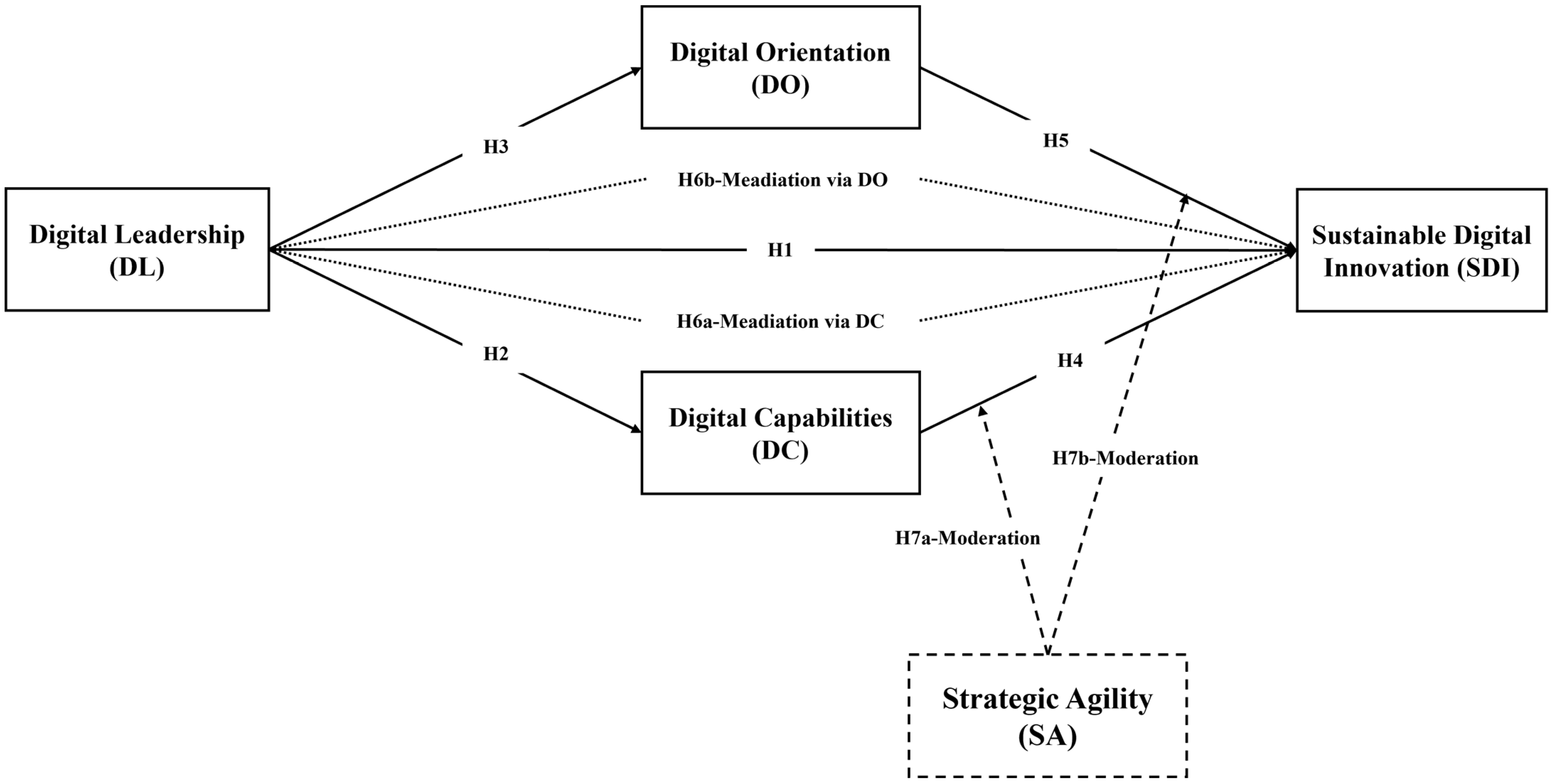
SA is expected to strengthen the associations between DC and SDI and between DO and SDI, because agile firms are better able to deploy digital resources in a timely and flexible manner under environmental turbulence [9,74,75,76]. As illustrated in Figure 1, the theoretical basis for expecting a stronger moderating effect on the DO pathway than on the DC pathway reflects the different dependence of each construct on adaptive flexibility. Because DO captures strategic intent and opportunity recognition, its association with SDI is more likely to be conditioned by the adaptive sensing and reconfiguration that agility enables. DC, by contrast, reflects a more operational and technology-oriented base that may depend more on structured execution and resource coordination, making its contribution to SDI less contingent on agility alone. Prior research supports the broader argument that agile firms show stronger links between digital resources and sustainability-related innovation outcomes [25,77,78]. Accordingly, this study proposes the following hypotheses:
H7a: 
Strategic agility positively moderates the relationship between digital capabilities and sustainable digital innovation.
H7b: 
Strategic agility positively moderates the relationship between digital orientation and sustainable digital innovation.

3. Research Design and Methods

3.1. Research Context

This study was conducted in the context of Lebanese SMEs, which account for around 90% of businesses in the country and employ more than half of the national workforce [15,79]. This empirical setting is appropriate because Lebanese SMEs operate under resource constraints, economic volatility, and infrastructural limitations, conditions that make internal managerial and organizational capabilities particularly important for sustaining competitiveness and innovation [14]. In such conditions, digital transformation is not merely a growth initiative but a strategic response to uncertainty, and sustainable digital innovation becomes especially relevant for long-term resilience and value creation.
The target population consisted of employees working in Lebanese SMEs across multiple sectors. The sampling frame was informed by prior Lebanese SME studies relying on national and Chamber of Commerce records covering firms from different sectors [80,81]. The study focused on SMEs operating in services, manufacturing, retail, and related activities in Beirut, Mount Lebanon, Tripoli, Saida, and Zahle, because these regions host a high concentration of SMEs and provide sectoral and geographical diversity relevant to digital transformation practices [14,15,82]. This context allowed the study to capture variation in digital practices while remaining focused on firms exposed to similar transformation pressures.

3.2. Data Collection and Sample

To examine the proposed relationships, this study adopted a quantitative, cross-sectional survey design using a structured questionnaire. This design was appropriate because the study aimed to test a theory-driven model involving direct, mediating, and moderating relationships among latent constructs. Given the limited availability of archival data on digital leadership, digital orientation, and sustainable digital innovation in Lebanese SMEs, primary survey data were considered the most suitable source of evidence.
The target population comprised employees working in Lebanese SMEs across services, manufacturing, retail, and related sectors, particularly those exposed to leadership practices, digital processes, and innovation-related activities within their firms. The sampling process focused on SMEs operating in Beirut, Mount Lebanon, Tripoli, Saida, and Zahle, as these regions host a high concentration of Lebanese SMEs and have been used in prior SME research in Lebanon because of their economic and sectoral diversity [14,15,82]. The sampling frame included 604 SMEs employing approximately 3200 employees. To improve representation across sectors, a stratified sampling approach was used, whereby firms were first grouped by sector and then proportionally approached based on their relative presence in the selected regions.
Data collection took place between August 2025 and October 2025, providing approximately three months of field coverage across sectors and locations. The survey was administered using a mixed-mode approach, combining paper-based questionnaires distributed during on-site visits with online questionnaires shared when firms preferred digital completion. Participation was limited to respondents with at least one year of organizational tenure and regular interaction with supervisors, so that they could provide informed assessments of leadership behavior, digital orientation, and innovation-related practices. Participation was entirely voluntary, informed consent was obtained from all respondents, anonymity and confidentiality were assured, and participants were informed of their right to withdraw at any stage without penalty [83]. Surveys were distributed during working hours, with prior managerial approval to minimize disruption while preserving voluntary participation [84].
To determine the minimum required sample size, the Slovin formula was applied to the employee population of approximately 3200, using a 5% margin of error. This yielded a minimum threshold of 355 respondents. A total of 1000 questionnaires were distributed, 485 were returned, and 62 were excluded because of incomplete or inconsistent responses. The final sample therefore consisted of 423 valid responses, which was sufficient for structural equation modeling.
As shown in Table 1, the final sample reflects variation in demographic and organizational characteristics. Of the 423 respondents, 286 (67.6%) reported that their firms were implementing a digital transformation strategy, while 86 (20.3%) indicated that such a strategy was absent, and 51 (12.1%) were unsure. Rather than being treated as invalid responses, this pattern was interpreted as evidence of heterogeneous digital maturity across Lebanese SMEs, which is consistent with the empirical context of the study [14].

3.3. Measurement of Variables

All constructs were measured using validated multi-item scales adopted from prior studies in digital innovation and strategic management. The questionnaire was prepared in English because the target respondents were employees in Lebanese SMEs working in formal business settings where English business and technology terminology is widely used. In addition, most respondents held at least a diploma or bachelor’s degree, supporting their ability to understand the instrument. To further ensure clarity and contextual appropriateness, the questionnaire was reviewed by 10 academic experts and 5 SME managers, and then pilot-tested with 30 SME employees in Lebanon. The pilot confirmed that the wording was understandable and that no major revisions were required. All scales used a five-point response format, although the anchors varied slightly depending on the construct being measured. To improve readability in the main text while preserving replicability, only the source, number of items, response scale, and one sample item are summarized here. The full item wording is provided in Appendix A for transparency and replicability.
Digital leadership (DL) was measured using a nine-item scale adapted from Büyükbeşe et al. [42]. The original scale was developed with two dimensions, innovative leadership (6 items) and supportive leadership (3 items). A sample item is: “My leader has an innovative vision.” Responses ranged from 1 = strongly disagree to 5 = strongly agree.
Digital orientation (DO) was measured using a four-item scale from Khin and Ho [6]. The scale captures the firm’s strategic commitment to using digital technologies for innovation. A sample item is: “We are committed to using digital technologies in developing our new solutions.” Responses ranged from 1 = strongly disagree to 5 = strongly agree.
Digital capabilities (DC) were measured using a five-item scale adapted from Khin and Ho [6]. The scale assesses the firm’s ability to acquire, integrate, and deploy digital technologies for innovation and responsiveness. A sample item is: “Identifying new digital opportunities.” Responses ranged from 1 = very low to 5 = very high.
Strategic agility (SA) was measured using an eight-item scale adapted from Mollah et al. [25]. The scale captures the firm’s capacity to respond rapidly to changes in demand, competition, markets, and technology. A sample item is: “Our company responds to changes in aggregate consumer demand.” Responses ranged from 1 = never to 5 = always.
Sustainable digital innovation (SDI) was measured using a six-item scale adapted from Khin and Ho [6] and previously applied in sustainability-oriented SME research by Yousaf et al. [11]. In this study, the scale is interpreted through a sustainability-oriented conceptual framing rather than as a generic measure of competitive innovation performance. The items are treated as reflecting the extent to which digitally enabled solutions create distinctive value across economic, social, and environmental dimensions, consistent with the study’s definition of SDI as a higher-order strategic outcome. In particular, the final item, which addresses whether digital solutions launched by the firm are new to the market and address social, economic, and ecological business issues, anchors the sustainability interpretation of the construct and distinguishes it from items that capture only technological differentiation or market positioning. A sample item is: “The quality-price ratio of our digital solutions is superior compared to our competitors’.” Responses ranged from 1 = strongly disagree to 5 = strongly agree. This operationalization captures the sustainability dimension indirectly through a broader value-creation logic rather than through explicit environmental or social performance indicators.

3.4. Common Method Bias and Statistical Controls

Given that the study variables were collected from the same respondents using a self-report questionnaire, common method bias (CMB) was considered a potential concern. Consistent with prior methodological recommendations, both procedural and statistical remedies were applied to reduce and assess the likelihood of CMB [84].
At the procedural level, several steps were taken during questionnaire design and administration. Participation was voluntary, anonymous, and based on informed consent, and respondents were informed that they could withdraw at any time without consequence. They were also assured that there were no right or wrong answers and that responses would be used only for academic purposes [83]. In addition, the questionnaire items were carefully worded to improve clarity and reduce ambiguity, and the response formats were varied slightly across constructs to reduce response patterning and consistency bias. Because employees were used as single informants, they were selected on the basis that they were directly exposed to leadership behavior, organizational digital practices, and innovation-related routines within their firms, making them appropriate respondents for perceptual assessment of the focal constructs.
At the statistical level, CMB was examined using two post hoc tests. First, Harman’s single-factor test was conducted through exploratory factor analysis, and the first unrotated factor explained 38.8% of the total variance, which is below the commonly used 50% threshold [85]. Second, variance inflation factor (VIF) values were assessed using the full collinearity approach. As shown in Table 2, the VIF values ranged from 1.022 to 2.828, remaining well below the conservative threshold of 3.3 [86]. These results suggest that common method bias is unlikely to dominate the variance in the data. However, these checks reduce rather than eliminate the concern, because procedural remedies and post hoc tests cannot fully rule out same-source inflation, particularly in a model where several perceptual constructs are conceptually related. The reported associations should therefore be interpreted with appropriate caution regarding residual shared-method variance.

3.5. Data Analysis Strategy

The proposed research model was analyzed using partial least squares structural equation modeling (PLS-SEM) with SmartPLS version 4.1.1.7, which is appropriate for prediction-oriented research involving complex mediation and moderation relationships and latent constructs [87,88]. Following established guidelines, the analysis was conducted in two stages. First, the measurement model was assessed by examining internal consistency reliability (Cronbach’s alpha and composite reliability), convergent validity (average variance extracted), and discriminant validity using the HTMT criterion and the Fornell–Larcker criterion. Second, the structural model was evaluated by estimating path coefficients through a bootstrapping procedure with 5000 resamples, assessing explanatory power (R2), effect sizes (f2), and collinearity diagnostics (VIF) [89]. The mediating effects of digital capabilities and digital orientation were tested using bootstrapped indirect effects, while the moderating role of strategic agility was examined through interaction terms within SmartPLS. Overall model adequacy was assessed using SRMR and complementary fit indicators, interpreted cautiously as supplementary evidence rather than definitive global fit criteria in PLS-SEM.
The heterogeneity in digital transformation strategy status across respondents (286 firms with a strategy, 86 without, and 51 unsure) raised a question about whether the main structural relationships might differ across these groups. A multi-group analysis (MGA) was considered to address this. However, PLS-MGA requires sufficient and reasonably balanced group sizes to produce stable and interpretable estimates [90]. The two smaller groups (n = 86 and n = 51) fall below the level typically recommended for reliable group-level PLS estimation, and the pronounced imbalance relative to the primary group (n = 286) makes formal MGA results difficult to interpret with confidence. Accordingly, group-comparative analysis was not pursued as a primary analytical objective in this study, and the main model was estimated on the full sample. The structural conclusions are interpreted as reflecting the general pattern of associations across Lebanese SMEs at varying stages of digital maturity.

4. Results

4.1. Measurement Model Assessment

Prior to testing the structural relationships, the measurement model was evaluated to assess the reliability and validity of all latent constructs. Consistent with established partial least squares structural equation modeling (PLS-SEM) procedures, internal consistency reliability, convergent validity, discriminant validity, and supplementary indicative fit measures were examined using SmartPLS 4 [91].
Internal consistency reliability was assessed using Cronbach’s alpha and composite reliability (CR). As reported in Table 2, all constructs exceeded the recommended threshold of 0.70, indicating satisfactory reliability [89]. Composite reliability values ranged from 0.839 to 0.966, further supporting acceptable internal consistency across the constructs.
Convergent validity was assessed through outer loadings and average variance extracted (AVE). As shown in Table 2, most indicator loadings exceeded the preferred threshold of 0.70 [92]. A small number of items showed loadings above 0.70 but below stronger levels, and they were retained because their inclusion did not reduce AVE below 0.50 or composite reliability below 0.70, while also preserving the theoretical content of the construct [87]. AVE values for all constructs exceeded the recommended threshold of 0.50 [93], indicating that each construct explained more than half of the variance in its indicators. Collectively, these results support adequate convergent validity.
Discriminant validity was examined using both the heterotrait to monotrait ratio (HTMT) and the Fornell–Larcker criterion [94]. As shown in Table 3, all HTMT values were below the conservative threshold of 0.85, indicating satisfactory discriminant validity [95]. In addition, the square root of the AVE for each construct was greater than its corresponding inter-construct correlations, indicating that each construct shared more variance with its own indicators than with other constructs [93]. This provides further support for discriminant validity under the Fornell–Larcker criterion.
Although PLS-SEM is primarily prediction-oriented, supplementary model assessment indices were also reported to provide additional information about model adequacy. As presented in Table 4, the SRMR values for both the saturated and estimated models were below the recommended threshold of 0.08, while the NFI exceeded 0.90. These values offer supplementary, indicative support for model adequacy. However, in PLS-SEM, SRMR and NFI do not carry the same inferential weight as global fit indices in covariance-based SEM, and they should not be interpreted as definitive evidence of overall model fit [96]. They are reported here as additional descriptive information alongside the primary reliability and validity evidence.
The measurement model therefore demonstrates satisfactory internal consistency, adequate convergent validity, and acceptable discriminant validity. These results provide a reasonable basis for proceeding to the structural model analysis and hypothesis testing.

4.2. Structural Model Results

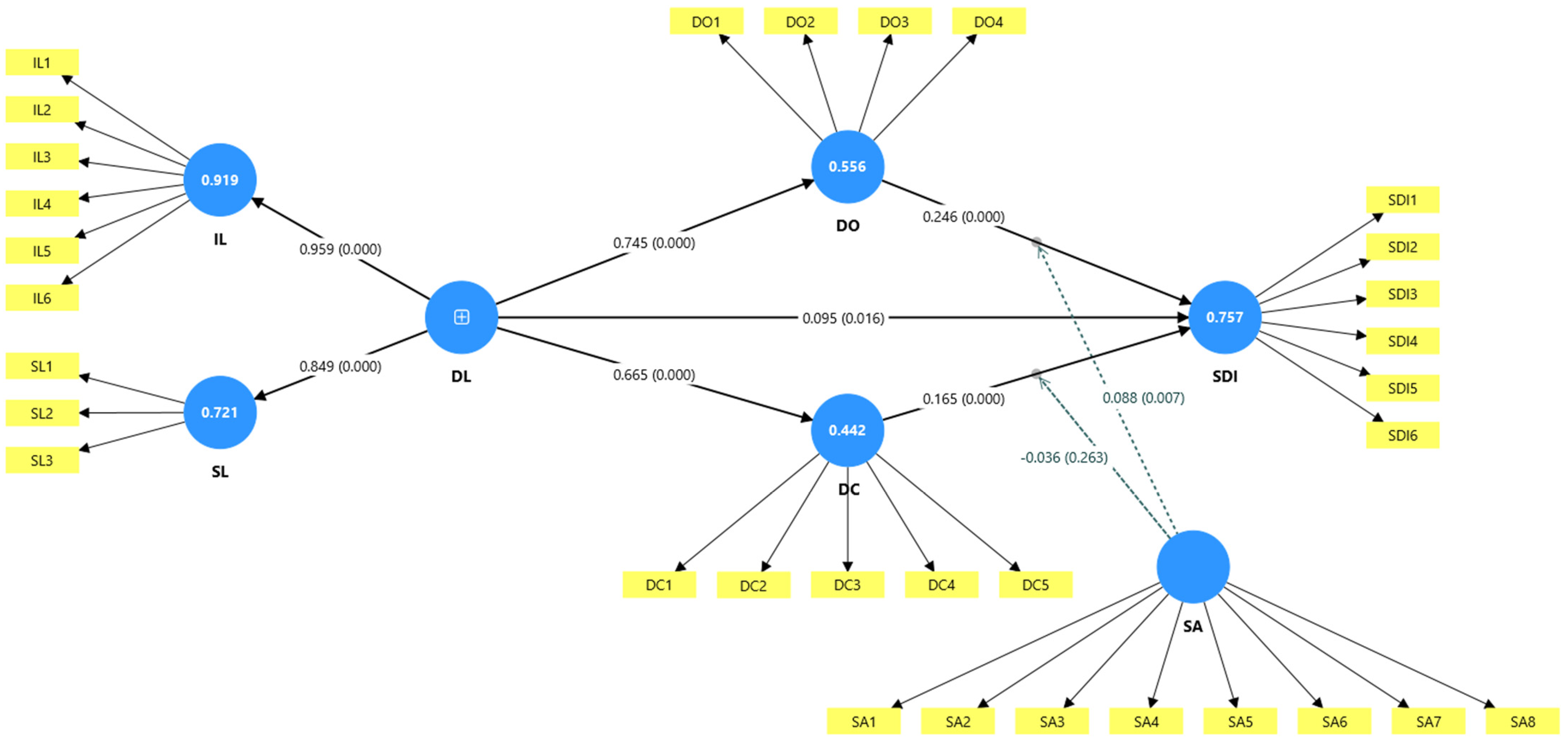
To test the hypothesized relationships, the structural model was assessed using PLS-SEM in SmartPLS 4 with a bootstrapping procedure based on 5000 resamples [89]. The evaluation focused on path coefficients (β), t-values, and p-values to assess the significance of the direct, mediating, and moderating relationships shown in Figure 2. Prior to hypothesis testing, multicollinearity was assessed using variance inflation factors (VIFs). As reported in Table 5, all VIF values ranged between 1.000 and 2.330, remaining well below the conservative threshold of 3.3, indicating that multicollinearity is unlikely to threaten the stability or interpretability of the structural estimates [86].

4.2.1. Direct Effects

The results indicate that digital leadership is positively associated with sustainable digital innovation (β = 0.095, t = 2.421, p = 0.016), providing support for H1. However, the practical contribution of this association is modest, as reflected by its small effect size (f2 = 0.044). This result indicates that the direct association between digital leadership and SDI, while statistically reliable, explains only a limited portion of variance in the outcome when considered in isolation. This pattern suggests that digital leadership is better understood as an enabling condition whose association with SDI operates largely through indirect mechanisms rather than through a strong direct path alone.
Digital leadership is also positively associated with both mediating variables. Specifically, digital leadership is associated with digital capabilities (β = 0.665, t = 14.923, p < 0.001), supporting H2, and with digital orientation (β = 0.745, t = 15.944, p < 0.001), supporting H3. The corresponding effect sizes indicate a large association with digital capabilities (f2 = 0.493) and a large association with digital orientation (f2 = 0.350), suggesting that digital leadership is strongly associated with both the operational and strategic dimensions of digital transformation.
With respect to the outcome variable, digital capabilities are positively associated with sustainable digital innovation (β = 0.165, t = 4.631, p < 0.001), supporting H4, while digital orientation is also positively associated with sustainable digital innovation (β = 0.246, t = 5.731, p < 0.001), supporting H5. Yet the effect sizes for these paths remain in the small range (f2 = 0.085 for DC and f2 = 0.106 for DO). These associations are therefore statistically meaningful but should not be interpreted as indicating strong practical contributions when each path is considered independently. The direct-effect results are presented in Table 5.

4.2.2. Mediation Effects

To examine the mediating roles of digital capabilities and digital orientation, indirect effects were tested using bias-corrected bootstrapping, which is widely recommended for mediation analysis in PLS-SEM [97]. The results show that digital capabilities significantly mediate the relationship between digital leadership and sustainable digital innovation (β = 0.110, t = 4.517, p < 0.001), supporting H6a. This result suggests that part of the association between digital leadership and SDI is transmitted through the development and deployment of firm-level digital capabilities.
Similarly, digital orientation shows a significant mediating role in the relationship between digital leadership and sustainable digital innovation (β = 0.184, t = 5.625, p < 0.001), supporting H6b. Because the indirect association through digital orientation is stronger than that through digital capabilities, the results suggest that strategic digital intent may represent the more prominent internal pathway linking digital leadership with sustainable digital innovation. The mediation and moderation results are summarized in Table 6.

4.2.3. Moderation Effects

The moderating role of strategic agility was assessed by introducing interaction terms into the structural model. The results indicate that strategic agility is not significantly associated with a change in the relationship between digital capabilities and sustainable digital innovation (β = −0.036, t = 1.120, p = 0.263). Therefore, H7a is not supported. This suggests that the positive association between digital capabilities and SDI does not appear to depend on strategic agility in a statistically meaningful way.
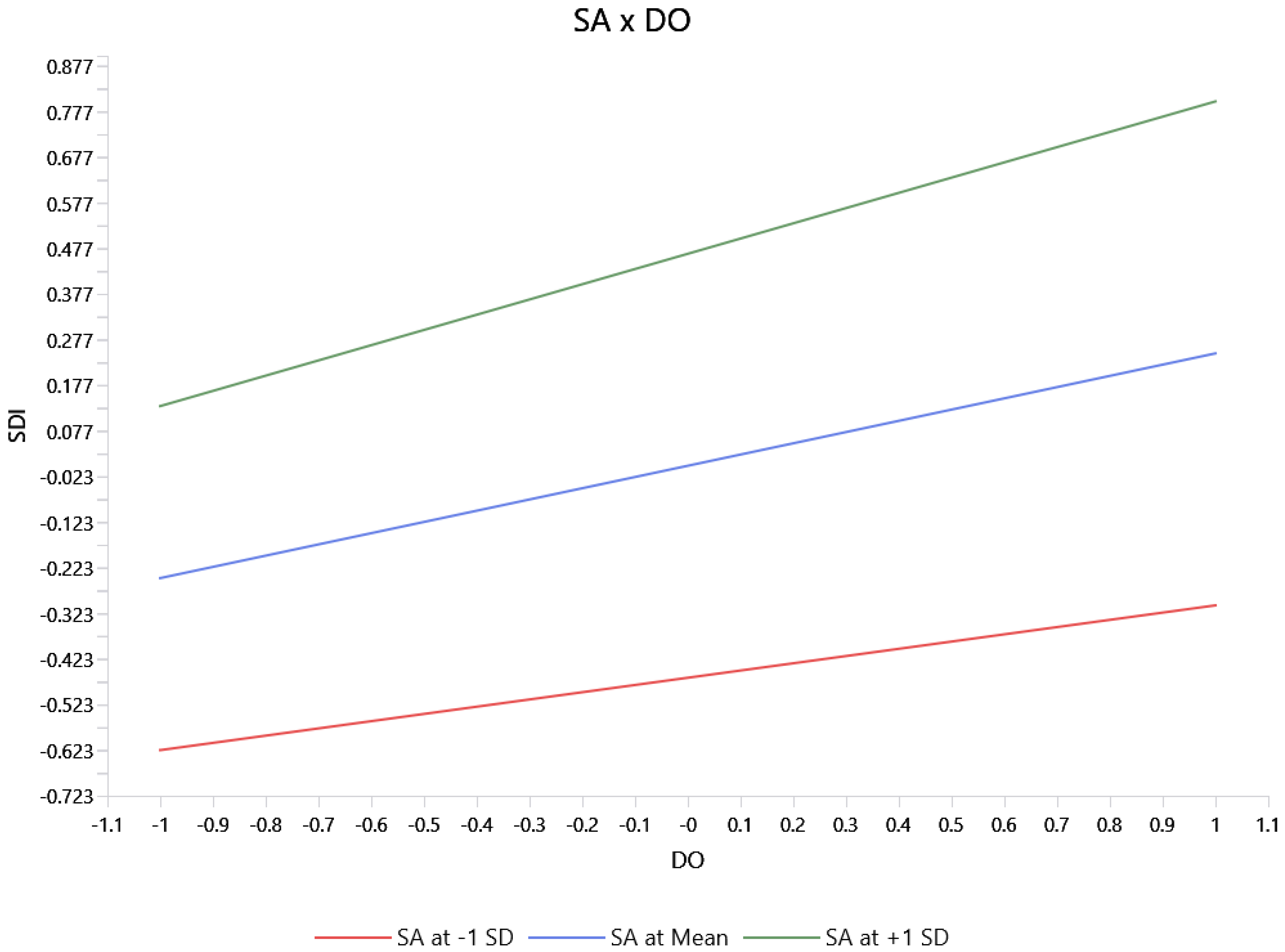
In contrast, strategic agility is positively associated with the strength of the relationship between digital orientation and sustainable digital innovation (β = 0.088, t = 2.726, p = 0.006), supporting H7b. This result indicates that firms with higher strategic agility show a stronger positive association between digital orientation and SDI. As illustrated in Figure 3, strategic agility strengthens the relationship between digital orientation and sustainable digital innovation, suggesting that firms with greater adaptive responsiveness are better positioned to convert digital strategic intent into sustainability-oriented innovation outcomes.
Taken together, the structural results indicate that statistical significance and practical magnitude reflect different aspects of the findings and should not be equated. Several paths are statistically reliable while contributing only modestly to the explained variance in SDI when considered individually. The substantive interpretation of the model therefore rests on the combined pattern of direct, indirect, and moderating associations rather than on the strength of any single path.

4.3. Model Predictive Strength

The structural model explains a meaningful proportion of variance in the focal constructs. The R2 values indicate that the model accounts for 55.6% of the variance in digital orientation (R2 = 0.556), 44.2% of the variance in digital capabilities (R2 = 0.442), and 75.7% of the variance in sustainable digital innovation (R2 = 0.757). These values reflect the collective explanatory contribution of all paths in the model rather than the strength of any individual association.
Predictive relevance, assessed through Stone–Geisser’s Q2, further supports the model’s usefulness, with all values above zero (Q2 = 0.555 for DO, 0.440 for DC, and 0.691 for SDI), suggesting adequate out-of-sample predictive relevance [89].
Effect size values provide additional insight into the practical contribution of specific paths. Following conventional thresholds, values of 0.02, 0.15, and 0.35 indicate small, medium, and large effects, respectively [98]. The results show that digital leadership has a large association with digital capabilities (f2 = 0.493) and a large to moderate association with digital orientation (f2 = 0.350), whereas its direct association with sustainable digital innovation is small (f2 = 0.044). Likewise, the direct contributions of digital capabilities and digital orientation to SDI, although statistically significant, remain in the small effect-size range. This pattern confirms that the model’s explanatory strength for SDI derives primarily from the accumulation of indirect pathways rather than from individually strong direct effects. Significance indicates that these associations are unlikely to be zero in the sample, but the effect size confirms that their individual practical contributions are modest. The overall R2 for SDI should therefore be understood as reflecting the combined operation of multiple pathways rather than as evidence that any single direct path is practically dominant.

4.4. Post Hoc Multi-Group Analysis

To examine whether the main structural associations varied according to firms’ digital transformation strategy status, a post hoc multi-group analysis was conducted within the PLS-SEM framework [99]. This additional step was motivated by the recognition that firms with a formally articulated digital transformation strategy may differ from those without one, or from those uncertain about it, in the strength or pattern of the proposed associations. Given that the “No” group (n = 86) and the “Not sure” group (n = 51) were considerably smaller than the “Yes” group (n = 286), this comparison was approached as an exploratory robustness exercise rather than as an inferentially equivalent group comparison.
The results, summarized in Table 7, indicate that most path differences across groups were not statistically significant. For the comparison between firms reporting a digital transformation strategy (“Yes”) and those reporting no such strategy (“No”), no significant differences emerged across the direct effects, indirect pathways, or moderating relationships. This suggests that the general pattern of associations in the main model is broadly stable between these two categories.
The comparison between the “Yes” and “Not sure” groups produced a largely similar picture, with one exception. The path from digital orientation to sustainable digital innovation differed significantly between these groups (coefficient difference = 0.306, p = 0.037), indicating that this association was more strongly positive among firms with a formal transformation strategy than among firms whose strategic status was ambiguous. The indirect path from digital leadership to sustainable digital innovation through digital orientation also approached significance in this comparison (difference = 0.229, p = 0.054), pointing in the same direction. These findings suggest that the contribution of digital orientation to sustainability-oriented innovation may be more pronounced when firms operate with a clearer strategic transformation posture. All other paths remained statistically comparable across groups.
Taken together, the post hoc analysis provides exploratory evidence that the core model is reasonably robust across digital strategy status categories. The one notable difference, concentrated on the digital orientation pathway, is consistent with the theoretical expectation that strategic intent requires an organizational context in which digital priorities are explicitly recognized and pursued. These findings should be interpreted with appropriate caution, given the group size imbalance and the exploratory nature of the comparison.

5. Implications and Conclusions

5.1. Discussion of Findings

This study examined how digital leadership is associated with sustainable digital innovation in Lebanese SMEs and through which internal mechanisms and boundary conditions this relationship unfolds. The findings indicate that sustainable digital innovation is not simply a technological outcome, but a strategically conditioned result of how leadership mobilizes digital resources and how those resources are converted into innovation under turbulence [20,100]. More specifically, the results show that the association between digital leadership and sustainable digital innovation is better understood through two distinct internal pathways, digital capabilities and digital orientation, rather than through a strong direct link alone. The findings also show that these pathways are not conditioned uniformly by strategic agility.
The direct association between digital leadership and sustainable digital innovation is statistically significant but practically modest. This is an important interpretive point rather than a weakness of the model. It suggests that digital leadership functions primarily as an initiating strategic resource, not as a standalone generator of sustainable innovation outcomes [70,71]. In line with RBV, leadership provides direction, legitimacy, and mobilization, but its value lies mainly in activating complementary internal resources rather than producing innovation in isolation [18,19,20]. This interpretation is consistent with prior work suggesting that sustainability-oriented digital transformation depends on capability development and strategic alignment rather than symbolic leadership commitment alone [23]. Accordingly, digital leadership appears to matter because it organizes and channels transformation, not because it independently explains a large share of sustainable digital innovation on its own.
A second key finding is that digital leadership is strongly associated with both digital capabilities and digital orientation, with the stronger association observed for digital orientation. This suggests that leadership may matter more for shaping the strategic logic of digital transformation than for shaping technological readiness alone [44,53,72]. Digitally capable leaders appear especially important in embedding a digital mindset, encouraging experimentation, and aligning digital initiatives with sustainability-related priorities [49]. This distinction is theoretically meaningful because it shows that leadership does not activate a single generic digitalization process. Instead, it is associated with two related but distinct transformation pathways. Digital capabilities reflect operational and technological readiness, whereas digital orientation reflects strategic intent and organizational commitment toward digital opportunity.
The results further show that both digital capabilities and digital orientation are positively associated with sustainable digital innovation, although digital orientation exerts a stronger association. At the same time, the practical magnitudes of these direct associations remain modest and should be interpreted accordingly. This pattern is theoretically meaningful because it indicates that successful digital transformation depends not only on whether firms possess digital tools, but also on whether they are strategically prepared to use them in ways that support sustainability-oriented value creation [10,38]. In a volatile context such as Lebanon, where firms face infrastructural and financial constraints [14,82], strategic direction may therefore matter more than technological sophistication alone. The findings therefore suggest that sustainable digital innovation is not an automatic result of digitalization. It is more accurately understood as a strategic alignment outcome in which digital technologies become sustainability-relevant only when guided by an appropriate organizational logic.
The mediation results reinforce this interpretation. Both digital capabilities and digital orientation significantly transmit the association between digital leadership and sustainable digital innovation, but the indirect role of digital orientation is stronger. This is one of the study’s clearest contributions because it shows that the leadership and innovation relationship is not only capability-based, but also orientation-based [23,48,70]. Leadership appears to be most effective when it shapes how firms interpret digital opportunities and aligns them with long-term sustainability priorities, not merely when it strengthens technical readiness. This finding helps clarify what remained unresolved in earlier research. Prior studies had already linked leadership with digital innovation, digital transformation, or organizational outcomes, but they offered less clarity on whether leadership works mainly through operational capability, through strategic orientation, or through both simultaneously [17,63,71]. The present findings suggest that both pathways matter, but that the strategic and cognitive pathway is comparatively more influential in this context.
The moderation results add further nuance. Strategic agility strengthens the relationship between digital orientation and sustainable digital innovation, but does not significantly moderate the relationship between digital capabilities and sustainable digital innovation. This asymmetry reflects a theoretically grounded difference in how each pathway depends on adaptive responsiveness [25,69,101]. Digital orientation represents a firm’s strategic intent, opportunity recognition, and cognitive commitment to digital transformation. Because these properties must be sensed, prioritized, and reconfigured in response to shifting conditions before they can produce innovation outcomes, their effectiveness is more contingent on adaptive capacity. By contrast, digital capabilities represent a more routinized technological and operational base whose contribution depends more on structured deployment, coordination, and investment continuity than on flexibility alone. From a DCT perspective, this means that agility primarily supports the adaptive conversion of strategic intent into innovation under uncertainty, rather than uniformly intensifying all digital mechanisms [76,102,103,104]. Strategic agility therefore operates as a selective boundary condition, one that amplifies orientation-driven transformation but does not add meaningfully to capability-driven pathways that are already stabilized through operational routines.
Taken together, the findings deepen the integration between RBV and DCT. RBV explains what internal resources and transformation mechanisms are central in the model: digital leadership as the initiating strategic resource, and digital capabilities and digital orientation as the distinct pathways through which that resource is converted into value. DCT explains how and under what conditions these pathways become more or less effective through strategic agility. The study’s contribution lies in showing that resource possession, resource transformation, and adaptive conversion are analytically distinct but complementary stages of the same digital transformation process, and that these stages do not operate with equal dependence on environmental adaptability.
Overall, the findings portray sustainable digital innovation as the outcome of a structured transformation process rather than a direct consequence of digitalization. The main added value of the study lies in showing that digital leadership is associated with sustainable digital innovation mainly through dual internal pathways, and that strategic agility strengthens these pathways selectively rather than uniformly. In this way, the results position sustainable digital innovation as a strategically managed outcome of digital economy transformation, especially in turbulent SME environments.

5.2. Theoretical Implications

This study advances digital transformation strategy research by positioning sustainable digital innovation as a strategically managed outcome of digital economy transformation rather than a simple consequence of technology adoption. Its main theoretical contribution is not merely that it tests mediation and moderation together, but that it addresses three issues that remained insufficiently resolved in prior research. Earlier studies had already linked digital leadership with innovation, digital transformation, and performance outcomes, and had emphasized the relevance of digital capabilities, strategic orientation, and agility. What remained less clear was, first, whether sustainable digital innovation should be treated as a distinct strategic outcome rather than a proxy for general innovation or competitive performance; second, whether digital leadership operates through one dominant internal pathway or through multiple theoretically distinct pathways simultaneously; and third, whether strategic agility conditions these pathways in the same way or selectively. The present study addresses these questions by showing that sustainable digital innovation is associated with leadership through two distinct transformation pathways, and that strategic agility conditions them asymmetrically.
First, the study extends the resource-based view by positioning digital leadership as an initiating strategic resource that activates other internal digital resources [18,20]. While earlier studies often emphasized infrastructure or technological capability as the main sources of digital innovation [6,19], the present findings suggest that leadership is the more foundational intangible asset because it shapes both capability development and strategic orientation. This refines RBV by showing that the value of digital leadership lies not in direct innovation output, but in its ability to orchestrate complementary internal resources that subsequently support sustainable digital innovation.
Second, the study strengthens the contribution of dynamic capability theory by clarifying the role of strategic agility as a conditional conversion mechanism rather than merely a general predictor of performance [26]. More specifically, DCT explains how internal digital resources are mobilized under turbulence, whereas RBV explains what resources and pathways matter in the first place [69]. The finding that strategic agility strengthens the effect of digital orientation on sustainable digital innovation, but not the effect of digital capabilities, refines DCT by showing that dynamic capabilities do not uniformly amplify all internal resources. Instead, agility operates more strongly on strategic intent than on operational capability, which adds a more differentiated understanding of adaptive conversion in sustainability-oriented digital transformation.
Third, the study contributes to the broader digital transformation literature by explaining what this model adds beyond a standard leadership, capability, and outcome framework. Specifically, the framework distinguishes between operational readiness, represented by digital capabilities, and strategic-cognitive readiness, represented by digital orientation, and then shows that these pathways are not equally sensitive to adaptive responsiveness. This distinction is not captured in prior models that treat digital capabilities and digital orientation as interchangeable or additive elements of digital readiness [20,44,53,70]. By showing that the two pathways make different contributions and respond differently to agility, the study clarifies why the specific combination of these constructs is needed to explain sustainable digital innovation in turbulent SME contexts. Digital leadership acts as the initiating strategic resource, digital capabilities and digital orientation function as internal transformation pathways, and strategic agility affects how effectively these pathways are converted into sustainable innovation under environmental uncertainty. This responds to recent calls to bridge resource-based and dynamic perspectives when explaining long-term digital competitiveness and sustainability [2,9,23,48,100].
Fourth, the study contributes to sustainable innovation scholarship by showing that sustainability is not external to digital transformation but internally embedded within it. The stronger mediating role of digital orientation indicates that strategic mindset, value alignment, and digital intent are especially important in linking digital transformation with sustainability-oriented innovation outcomes. This point is particularly relevant given that the SDI construct could be interpreted as capturing generic digital innovation performance. The present study instead treats SDI through a sustainability-oriented conceptual framing in which digitally enabled innovation is evaluated in relation to broader economic, social, and environmental value creation, not only in terms of market or competitive outcomes. This framing is theoretically necessary because sustainability-oriented innovation requires that digital solutions be assessed not only for their technological novelty or market impact, but also for their contribution to resilience, resource efficiency, and inclusive value creation [105,106,107].
Finally, by focusing on Lebanese SMEs, the study extends the boundary conditions of both RBV and DCT to a crisis-prone emerging-economy context [14,82,108]. In such settings, where external support structures are weaker and constraints are more visible, internal leadership, strategic orientation, and adaptive responsiveness become especially important. This contextual contribution strengthens the external relevance of the RBV–DCT integration by showing that the framework remains useful not only in stable and resource-abundant environments, but also in volatile contexts where digital transformation is pursued under constraint.
Overall, the study contributes theoretically by demonstrating that sustainable digital innovation is best understood as the outcome of leadership-driven resource orchestration and selectively conditioned adaptive conversion. Its main added value lies in clarifying what remained theoretically unresolved in prior research and in demonstrating why this specific combination of constructs, treated as analytically distinct rather than interchangeable, advances understanding of sustainable digital innovation in SMEs facing turbulence and constraint.

5.3. Managerial Implications

The findings provide a structured roadmap for SME leaders seeking to operationalize sustainable digital transformation as a strategic growth mechanism rather than a technological upgrade. First, digital transformation must be leadership-anchored. The modest direct effect of digital leadership on sustainable digital innovation, combined with strong indirect effects, indicates that leadership’s primary role is architectural rather than operational. SME leaders should position themselves as digital transformation architects who define the firm’s digital and sustainability trajectory. This requires articulating a coherent strategic narrative that links digital investments to long-term environmental and social value creation. Rather than delegating digitalization to technical units, leaders must embed sustainability objectives into digital strategy formulation, resource allocation, and performance evaluation systems.
Second, cultivating digital orientation should precede large-scale technology investment. The stronger mediating role of digital orientation suggests that strategic intent and digital mindset are more strongly associated with sustainable innovation than infrastructure alone. SME executives should therefore prioritize shaping a digital culture, encouraging experimentation, strategic risk-taking, and opportunity recognition within digital domains. Mechanisms such as innovation labs, cross-functional digital task forces, and sustainability-linked digital performance indicators can institutionalize digital orientation. Without this cognitive and cultural alignment, digital investments may become fragmented or compliance-driven.
Third, digital capabilities must be developed as coordinated organizational competencies rather than isolated information technology upgrades. Sustainable digital innovation becomes more likely when firms combine technical infrastructure, analytics capacity, and knowledge-sharing routines into an integrated capability system. SME managers should invest in continuous upskilling, digital literacy development, and partnerships with technology providers, universities, and innovation ecosystems. The objective is not technological sophistication in itself, but the ability to deploy digital tools to redesign processes, improve resource efficiency, and develop sustainability-oriented offerings.
Fourth, strategic agility should be institutionalized as a transformation accelerator. The moderation results indicate that agility strengthens the conversion of digital orientation into sustainable digital innovation. This implies that ambitious digital strategies are more likely to produce stronger sustainability outcomes when supported by rapid decision-making and resource reconfiguration. SMEs should adopt flexible organizational structures, iterative planning cycles, agile project management methods, and decentralized authority systems that allow swift experimentation and pivoting. In volatile digital economies, speed of strategic adaptation becomes a meaningful competitive differentiator.
Fifth, policymakers and ecosystem actors should move beyond subsidy-driven digitalization programs toward capability-driven transformation initiatives. Leadership development programs, digital strategy workshops, and agility-oriented training can generate more durable transformation outcomes than isolated technology grants. Creating digital and sustainability innovation hubs and SME collaboration networks can further strengthen collective learning and resilience.
Ultimately, sustainable digital innovation should be reframed as a strategic survival and competitiveness mechanism. For SMEs operating under economic volatility, integrating digital transformation with sustainability principles can improve operational efficiency, strengthen stakeholder legitimacy, and facilitate access to global markets increasingly shaped by ESG expectations. By synchronizing digital leadership, strategic orientation, capability development, and agility, SMEs can convert digital disruption into structured, sustainability-oriented growth.

5.4. Limitations and Future Research Directions

This study should be interpreted within several methodological boundaries. First, the cross-sectional design limits temporal inference, meaning that the reported associations should be interpreted as reflecting relationships among constructs at a single point in time rather than as evidence of directional or causal effects. Future longitudinal or multi-wave studies would allow researchers to examine how digital leadership, digital capabilities, digital orientation, and strategic agility evolve over time and how sustainable digital innovation develops as an ongoing transformation process rather than a single observed outcome. Second, although procedural and statistical remedies were applied to reduce common method bias, the use of self-reported survey data from the same respondents may still introduce shared-method variance that the applied checks cannot fully eliminate. This residual risk is particularly relevant because the model includes several perceptual constructs that are conceptually related, and same-source measurement cannot be ruled out as a partial contributor to the observed associations. Future research could strengthen robustness by combining perceptual responses with objective indicators such as digital investment intensity, ESG metrics, patent activity, or sustainability disclosures.
Third, the study relied on single-informant data, which was appropriate because employees were well positioned to evaluate leadership behavior and organizational digital practices, but this design may still restrict perspective diversity. Future studies could adopt multi-source designs by combining employee responses with managerial, archival, or supervisor-reported data. In addition, the pronounced imbalance across digital transformation strategy subgroups limited the feasibility of a multi-group analysis in the present study. Future research could employ more balanced subsamples to examine whether the structural relationships differ systematically across firms at different stages of digital maturity, providing a more precise group-comparative assessment. Finally, the focus on Lebanese SMEs provides valuable insight into a crisis-prone and resource-constrained context, yet comparative research across different institutional settings would help clarify how national ecosystems, regulatory stability, and digital infrastructure shape sustainability-oriented digital transformation. Future work may also refine the measurement of sustainable digital innovation by incorporating more explicit environmental and social performance indicators, thereby strengthening the distinction between sustainability-oriented innovation outcomes and broader digital innovation or competitive performance measures.


Author Contributions

Writing—original draft, M.M.E.O.; Supervision, A.A.; Validation, M.M.E.O. and A.A.; Writing—review and editing, M.M.E.O. All authors have read and agreed to the published version of the manuscript.

Funding

This research received no external funding.

Institutional Review Board Statement

The study was conducted in accordance with the Declaration of Helsinki and approved by the Girne American University, Social Sciences Ethics Committee [Approval Code: 2024-2025/047, Approval Date: 7 July 2025].

Informed Consent Statement

Informed consent was obtained from all subjects involved in the study. Participation was voluntary and anonymous, and respondents were informed of their right to withdraw at any time without consequence.

Data Availability Statement

The data from this study can be requested from the corresponding author, Maher Mostafa El Ozon.

Conflicts of Interest

The authors declare no conflicts of interest.

Abbreviations

The following abbreviations are used in this manuscript:
DCDigital Capabilities
DCTDynamic Capability Theory
DLDigital Leadership
DODigital Orientation
ESGEnvironmental, Social, and Governance
PLS-SEMPartial Least Squares Structural Equation Modeling
RBVResource-Based View
SAStrategic Agility
SDISustainable Digital Innovation
SMEsSmall and Medium-Sized Enterprises

Appendix A

Table A1. Measurement Items.
Construct/Item CodeItem WordingSource
Digital Leadership (DL)Büyükbeşe et al. [42]
Supportive Leadership (SL)
SL1My leader encourages employees when encountering difficulties in the digital transformation process.
SL2My leader acts as a guide and role model during digital transformation.
SL3My leader focuses on employees’ wellbeing during digital transformation.
Innovative Leadership (IL)
IL1My leader has an innovative vision.
IL2My leader has the ability to build and coordinate teams quickly.
IL3My leader has up-to-date knowledge and skills about digital technologies and digital transformation.
IL4My leader acts proactively in the digital transformation process in the organization.
IL5My leader balances new and existing business areas, modern trends and past traditions, and innovation and integration.
IL6My leader finds ways to attract new digital talent to the organization.
Digital Capabilities (DC)Khin and Ho [6]
DC1Acquiring important digital technologies.
DC2Identifying new digital opportunities.
DC3Responding effectively to digital transformation.
DC4Mastering state-of-the-art digital technologies.
DC5Developing innovative products/services/processes using digital technology.
Digital Orientation (DO)Khin and Ho [6]
DO1We are committed to using digital technologies in developing our new solutions.
DO2Our solutions incorporate superior digital technology.
DO3New digital technology is readily accepted in our organization.
DO4We actively seek opportunities to use digital technology in innovation.
Strategic Agility (SA)Mollah et al. [25]
SA1Our company responds to changes in aggregate consumer demand.
SA2Our company customizes products or services to suit individual customers.
SA3Our company reacts to new product or service launches by competitors.
SA4Our company adjusts pricing in response to competitors’ pricing changes.
SA5Our company expands into new regional or international markets.
SA6Our company changes the variety of products/services offered.
SA7Our company adopts new technologies to improve products and services.
SA8Our company switches suppliers for lower costs, better quality, or faster delivery.
Sustainable Digital Innovation (SDI)Khin and Ho [6]; Yousaf et al. [11]
SDI1The quality-price ratio of our digital solutions is superior compared to our competitors’.
SDI2The features of our digital solutions are superior compared to our competitors’.
SDI3The applications of our digital solutions are totally different from our competitors’.
SDI4Our digital solutions are different from our competitors in terms of product platform.
SDI5Our new digital solutions are minor improvements of existing products, at lower costs.
SDI6Some of our digital solutions are new to the market at the time of launching, and they address social, economic, and ecological business issues.

References

  1. Aldoseri, A.; Al-Khalifa, K.N.; Hamouda, A.M. AI-Powered Innovation in Digital Transformation: Key Pillars and Industry Impact. Sustainability 2024, 16, 1790. [Google Scholar] [CrossRef]
  2. George, G.; Merrill, R.K.; Schillebeeckx, S.J.D. Digital Sustainability and Entrepreneurship: How Digital Innovations Are Helping Tackle Climate Change and Sustainable Development. Entrep. Theory Pract. 2021, 45, 999–1027. [Google Scholar] [CrossRef]
  3. Zeng, B.; Chotia, V.; Ghosh, V.; Cheng, J. Digital Antecedents and Mechanisms towards Sustainable Digital Innovation Ecosystems: Examining the Role of Circular Supply Chain Resilience. Technol. Forecast. Soc. Change 2025, 218, 124220. [Google Scholar] [CrossRef]
  4. John, H.B.; Agrawal, M.; Nema, P.; Hasan, A.; Rakhra, I.K.; Singh, A. Green Growth: A Bibliometric Analysis of Digital Innovation and Sustainable Development Goals (SDGs). J. Innov. Entrep. 2025, 14, 15. [Google Scholar] [CrossRef]
  5. Kumar, S.; Kumar, V.; Chaudhuri, R.; Chatterjee, S.; Vrontis, D. AI Capability and Environmental Sustainability Performance: Moderating Role of Green Knowledge Management. Technol. Soc. 2025, 81, 102870. [Google Scholar] [CrossRef]
  6. Khin, S.; Ho, T.C. Digital Technology, Digital Capability and Organizational Performance: A Mediating Role of Digital Innovation. Int. J. Innov. Sci. 2019, 11, 177–195. [Google Scholar] [CrossRef]
  7. Xu, G.; Hou, G.; Zhang, J. Digital Sustainable Entrepreneurship: A Digital Capability Perspective through Digital Innovation Orientation for Social and Environmental Value Creation. Sustainability 2022, 14, 11222. [Google Scholar] [CrossRef]
  8. Lyu, J. How Does Digital Leadership Improve Organizational Sustainability: Theory and Evidence. J. Clean. Prod. 2024, 434, 140148. [Google Scholar] [CrossRef]
  9. Malik, M.; Andargoli, A.; Tallon, P.; Wickramasinghe, N. An Organizational Sensemaking Theorizing of How Firms Construct Digitally Enabled Strategic Agility. Inf. Manag. 2025, 62, 104130. [Google Scholar] [CrossRef]
  10. Nasiri, M.; Saunila, M.; Rantala, T.; Ukko, J. Sustainable Innovation among Small Businesses: The Role of Digital Orientation, the External Environment, and Company Characteristics. Sustain. Dev. 2022, 30, 703–712. [Google Scholar] [CrossRef]
  11. Yousaf, Z.; Radulescu, M.; Sinisi, C.I.; Serbanescu, L.; Păunescu, L.M. Towards Sustainable Digital Innovation of SMEs from the Developing Countries in the Context of the Digital Economy and Frugal Environment. Sustainability 2021, 13, 5715. [Google Scholar] [CrossRef]
  12. Yesuf, Y.M.; Fields, Z. SMEs, Digital Transformation and Sustainable Development: A Systematic Review of Barriers, Enablers and Outcomes. Cogent Bus. Manag. 2026, 13, 2631198. [Google Scholar] [CrossRef]
  13. Abdul Basit, S.; Gharleghi, B.; Batool, K.; Hassan, S.S.; Jahanshahi, A.A.; Kliem, M.E. Review of Enablers and Barriers of Sustainable Business Practices in SMEs. J. Econ. Technol. 2024, 2, 79–94. [Google Scholar] [CrossRef]
  14. EL Abiad, Z.; El Chaarani, H.; Omar Binsaddig, R.; El Nemar, S.; Thrassou, A. The Impact of Innovation and Digitalization on the International Performance of SMEs. EuroMed J. Bus. 2025. [Google Scholar] [CrossRef]
  15. Wahab, M.D.A.; Radmehr, M. The Impact of AI Assimilation on Firm Performance in Small and Medium-Sized Enterprises: A Moderated Multi-Mediation Model. Heliyon 2024, 10, e29580. [Google Scholar] [CrossRef]
  16. Held, P.; Heubeck, T.; Meckl, R. Boosting SMEs’ Digital Transformation: The Role of Dynamic Capabilities in Cultivating Digital Leadership and Digital Culture. Rev. Manag. Sci. 2025, 20, 1687–1715. [Google Scholar] [CrossRef]
  17. Lobo, C.A.; Marinho, A.; Santos Pereira, C.; Azevedo, M.; Moreira, F. The Role of Leadership and Strategic Alliances in Innovation and Digital Transformation for Sustainable Entrepreneurial Ecosystems: A Comprehensive Analysis of the Existing Literature. Sustainability 2025, 17, 6182. [Google Scholar] [CrossRef]
  18. Barney, J. Firm Resources and Sustained Competitive Advantage. J. Manag. 1991, 17, 99–120. [Google Scholar] [CrossRef]
  19. Cuthbertson, R.W.; Furseth, P.I. Digital Services and Competitive Advantage: Strengthening the Links between RBV, KBV, and Innovation. J. Bus. Res. 2022, 152, 168–176. [Google Scholar] [CrossRef]
  20. Abed Alhameed, A.A.; Emeagwali, O.L. Strategic Digital Leadership for Sustainable Transformation: The Roles of Organizational Agility, Digitalization, and Culture in Driving Superior Performance. Sustainability 2026, 18, 837. [Google Scholar] [CrossRef]
  21. Aghazadeh, H.; Zandi, F.; Amoozad Mahdiraji, H.; Sadraei, R. Digital Transformation and SME Internationalisation: Unravelling the Moderated-Mediation Role of Digital Capabilities, Digital Resilience and Digital Maturity. J. Enterp. Inf. Manag. 2024, 37, 1499–1526. [Google Scholar] [CrossRef]
  22. Martínez-Caro, E.; Cegarra-Navarro, J.G.; Alfonso-Ruiz, F.J. Digital Technologies and Firm Performance: The Role of Digital Organisational Culture. Technol. Forecast. Soc. Change 2020, 154, 119962. [Google Scholar] [CrossRef]
  23. Cheng, Z.; Jin, X.; Kwak, W.J. Using the New Positive Aspect of Digital Leadership to Improve Organizational Sustainability: Testing Moderated Mediation Model. Acta Psychol. 2025, 255, 104963. [Google Scholar] [CrossRef] [PubMed]
  24. Guo, R.; Lu, P.; Zhang, J.; Feng, Z. How Does Digital New Venture’s Customer Orientation Enhance Strategic Agility? The Roles of Strategic Learning. Long. Range Plan. 2025, 58, 102527. [Google Scholar] [CrossRef]
  25. Mollah, M.A.; Al Masud, A.; Chowdhury, M.S. How Does Digital Leadership Boost Competitive Performance? The Role of Digital Culture, Affective Commitment, and Strategic Agility. Heliyon 2024, 10, e40839. [Google Scholar] [CrossRef]
  26. Teece, D.J.; Pisano, G.; Shuen, A. Dynamic Capabilities and Strategic Management. Strateg. Manag. J. 1997, 18, 509–533. [Google Scholar] [CrossRef]
  27. Benitez, J.; Arenas, A.; Castillo, A.; Esteves, J. Impact of Digital Leadership Capability on Innovation Performance: The Role of Platform Digitization Capability. Inf. Manag. 2022, 59, 103590. [Google Scholar] [CrossRef]
  28. Sarfraz, M.; Khawaja, K.F.; Waheed, Z. Business Process Innovation through Digital Strategy: Unveiling the Adoption of Big Data Analytics and the Evolution of Digital Culture. Bus. Process. Manag. J. 2025, 32, 290–315. [Google Scholar] [CrossRef]
  29. Lin, Q. Digital Leadership: A Systematic Literature Review and Future Research Agenda. Eur. J. Innov. Manag. 2024, 28, 2469–2488. [Google Scholar] [CrossRef]
  30. Aljuhmani, H.Y.; Awwad, R.I.; Albuhisi, B.; Hamdan, S. The Impact of Digital Transformation Leadership Competencies on Firm Performance Through the Lens of Organizational Creativity and Digital Strategy. In Innovative and Intelligent Digital Technologies; Towards an Increased Efficiency; Al Mubarak, M., Hamdan, A., Eds.; Springer Nature: Cham, Switzerland, 2024; Volume 1, pp. 283–293. [Google Scholar]
  31. Doz, Y.L.; Kosonen, M. Embedding Strategic Agility: A Leadership Agenda for Accelerating Business Model Renewal. Long. Range Plan. 2010, 43, 370–382. [Google Scholar] [CrossRef]
  32. Satar, M.S.; Alenazy, A.; Alarifi, G.; Alharthi, S.; Omeish, F. Digital Capabilities and Green Entrepreneurship in SMEs: The Role of Strategic Agility. Innov. Dev. 2024, 15, 709–738. [Google Scholar] [CrossRef]
  33. de la Torre, A.; De la Vega, I. Dynamic Capabilities and Digital Innovation: Pathways to Competitive Advantage through Responsible Innovation. J. Responsible Innov. 2025, 12, 2500154. [Google Scholar] [CrossRef]
  34. Durman, S.; Iyiola, K.; Alzubi, A.B.; Aljuhmani, H.Y. Dynamic Capabilities in Action: Digital Capability, Business Model Innovation and Absorptive Capacity. Manag. Decis. 2025, 1–36. [Google Scholar] [CrossRef]
  35. Dooranov, A.; Kang, F.; Rasulova, N.; Botobekov, A.; Kumskov, G. Adaptation of Strategic Innovation Management to Regional Sustainable Development: Lessons from Global SMEs and the DCT Approach. Soc. Sci. Humanit. Open 2026, 13, 102658. [Google Scholar] [CrossRef]
  36. Park, Y.W.; Hong, P. A Research Framework for Sustainable Digital Innovation: Case Studies of Japanese Firms. Sustainability 2022, 14, 9218. [Google Scholar] [CrossRef]
  37. de la Torre, A.; De la Vega, I. Responsible Digital Innovation: The New Business Challenges in the Digital Era. Kybernetes 2025, 55, 1434–1458. [Google Scholar] [CrossRef]
  38. Abbas, S.M.; Latif, M.; Sarwar, F. Digital Leadership and Innovative Work Behavior in IT Sector: The Mediating Role of Digital Entrepreneurial Orientation and Digital Organizational Culture. Empl. Responsib. Rights J. 2024, 1–22. [Google Scholar] [CrossRef]
  39. Martínez-Peláez, R.; Escobar, M.A.; Félix, V.G.; Ostos, R.; Parra-Michel, J.; García, V.; Ochoa-Brust, A.; Velarde-Alvarado, P.; Félix, R.A.; Olivares-Bautista, S.; et al. Sustainable Digital Transformation for SMEs: A Comprehensive Framework for Informed Decision-Making. Sustainability 2024, 16, 4447. [Google Scholar] [CrossRef]
  40. Li, Y.; Chen, Y.; Wang, J.; Zhou, Y.; Wang, C. Digital Platform Capability and Innovation Ambidexterity: The Mediating Role of Strategic Flexibility. J. Bus. Res. 2025, 186, 114971. [Google Scholar] [CrossRef]
  41. Martínez-Falcó, J.; Sánchez-García, E.; Marco-Lajara, B.; Millán-Tudela, L.A. Enhancing Employee Wellbeing and Happiness Management in the Wine Industry: Unveiling the Role of Green Human Resource Management. BMC Psychol. 2024, 12, 203. [Google Scholar] [CrossRef]
  42. Büyükbeşe, T.; Dikbaş, T.; Klein, M.; Ünlü, S.B. A Study on Digital Leadership Scale (Dls) Development. Kahramanmaraş Sütçü İmam. Üniversitesi Sos. Bilim. Derg. 2022, 19, 740–760. [Google Scholar] [CrossRef]
  43. Hariyani, D.; Hariyani, P.; Mishra, S. The Role of Leadership in Sustainable Digital Transformation of the Organization. Sustain. Futur. 2025, 10, 101130. [Google Scholar] [CrossRef]
  44. Qiao, G.; Li, Y.; Hong, A. The Strategic Role of Digital Transformation: Leveraging Digital Leadership to Enhance Employee Performance and Organizational Commitment in the Digital Era. Systems 2024, 12, 457. [Google Scholar] [CrossRef]
  45. Braojos, J.; Weritz, P.; Matute, J. Empowering Organisational Commitment through Digital Transformation Capabilities: The Role of Digital Leadership and a Continuous Learning Environment. Inf. Syst. J. 2024, 34, 1466–1492. [Google Scholar] [CrossRef]
  46. Faiz, M.; Sarwar, N.; Tariq, A.; Memon, M.A. Mastering Digital Leadership Capabilities for Business Model Innovation: The Role of Managerial Decision-Making and Grants. J. Small Bus. Enterp. Dev. 2024, 31, 574–597. [Google Scholar] [CrossRef]
  47. Sahibzada, U.F.; Aslam, N.; Muavia, M.; Shujahat, M.; Rafi-ul-Shan, P.M. Navigating Digital Waves: Unveiling Entrepreneurial Leadership toward Digital Innovation and Sustainable Performance in the Chinese IT Industry. J. Enterp. Inf. Manag. 2025, 38, 474–501. [Google Scholar] [CrossRef]
  48. Hamza, P.; Karadas, G. Digital Leadership, AI Integration, and Cyberloafing: Pathways to Sustainable Innovation in SMEs Within Resource-Constrained Economies. Sustainability 2025, 17, 9171. [Google Scholar] [CrossRef]
  49. Imran, M.; Hamid, R.A.; Haque, A. ul Driving SME Growth Through Digital Leadership: Exploring Tenure and Transformation Dynamics. Adm. Sci. 2025, 15, 104. [Google Scholar] [CrossRef]
  50. Deeb, H.; Aldehayyat, J. The Effect of Digital Leadership on SMEs’ Digital Transformation: The Roles of Digital Culture and Innovation. J. Econ. Adm. Sci. 2025, 1–20. [Google Scholar] [CrossRef]
  51. Saeedikiya, M.; Salunke, S.; Kowalkiewicz, M. Toward a Dynamic Capability Perspective of Digital Transformation in SMEs: A Study of the Mobility Sector. J. Clean. Prod. 2024, 439, 140718. [Google Scholar] [CrossRef]
  52. Hafeez, S.; Shahzad, K.; De Silva, M. Enhancing Digital Transformation in SMEs: The Dynamic Capabilities of Innovation Intermediaries within Ecosystems. Long. Range Plan. 2025, 58, 102525. [Google Scholar] [CrossRef]
  53. Sacavém, A.; de Bem Machado, A.; dos Santos, J.R.; Palma-Moreira, A.; Belchior-Rocha, H.; Au-Yong-Oliveira, M. Leading in the Digital Age: The Role of Leadership in Organizational Digital Transformation. Adm. Sci. 2025, 15, 43. [Google Scholar] [CrossRef]
  54. Ding, X. Digital Leadership, Digital Platform Capability and Digital Business Model Innovation of Start-Ups. J. Innov. Knowl. 2026, 14, 100970. [Google Scholar] [CrossRef]
  55. Zheng, X. The Impact of Digital Orientation on New Product Development Performance: Does Knowledge Intensity Matter? Sustainability 2024, 16, 3420. [Google Scholar] [CrossRef]
  56. Zhang, X.; Wang, Z.; Luo, W.; Guo, F.; Wang, P. How Digital Orientation Affects Innovation Performance? Exploring the Role of Digital Capabilities and Environmental Dynamism. Systems 2025, 13, 346. [Google Scholar] [CrossRef]
  57. Barba-Sánchez, V.; Meseguer-Martínez, A.; Gouveia-Rodrigues, R.; Raposo, M.L. Effects of Digital Transformation on Firm Performance: The Role of IT Capabilities and Digital Orientation. Heliyon 2024, 10, e27725. [Google Scholar] [CrossRef]
  58. Antenozio, L.; Marques, P.; Bikfalvi, A. Digital Orientation and Performance in Innovative SMEs: Exploring the (Curvi)Linear Effects. Technovation 2026, 151, 103478. [Google Scholar] [CrossRef]
  59. Escoz Barragan, K.; Becker, F.S.R. Keeping Pace with the Digital Transformation—Exploring the Digital Orientation of SMEs. Small Bus. Econ. 2025, 64, 1361–1385. [Google Scholar] [CrossRef]
  60. Alam, M.M.D.; Razzak, M.R.; Khreis, S.H.A.; Al Balushi, M.K.; Al Lawati, H. Digital Leadership Orientation and Organizational Resilience: Strategic Foresight, Agility, and Flexibility. Manag. Decis. 2025, 1–31. [Google Scholar] [CrossRef]
  61. Tigre, F.B.; Henriques, P.L.; Curado, C. The Digital Leadership Emerging Construct: A Multi-Method Approach. Manag. Rev. Q. 2025, 75, 789–836. [Google Scholar] [CrossRef]
  62. Al-Husain, R.A.; Jasim, T.A.; Mathew, V.; Al-Romeedy, B.S.; Khairy, H.A.; Mahmoud, H.A.; Liu, S.; El-Meligy, M.A.; Alsetoohy, O. Optimizing Sustainability Performance through Digital Dynamic Capabilities, Green Knowledge Management, and Green Technology Innovation. Sci. Rep. 2025, 15, 24217. [Google Scholar] [CrossRef]
  63. Ji, Z.; Zhou, T.; Zhang, Q. The Impact of Digital Transformation on Corporate Sustainability: Evidence from Listed Companies in China. Sustainability 2023, 15, 2117. [Google Scholar] [CrossRef]
  64. Belyamani, I.; Mfarrej, M.F.B.; Ahmad, S.Z.; Abu Bakar, A.R. Pathways Linking Green Digital Transformation to Sustainable Development through Knowledge Sharing and Dynamic Capabilities. Discov. Sustain. 2025, 6, 1183. [Google Scholar] [CrossRef]
  65. Kessler, A.; Frank, H.; Fuetsch, E. Conceptualizing Digitalization Orientation as a Strategic Posture—How to Boost the Impact of Digital Technologies in Businesses: A Qualitative Good Practices Approach. Technol. Forecast. Soc. Change 2025, 213, 123997. [Google Scholar] [CrossRef]
  66. Ardito, L.; Raby, S.; Albino, V.; Bertoldi, B. The Duality of Digital and Environmental Orientations in the Context of SMEs: Implications for Innovation Performance. J. Bus. Res. 2021, 123, 44–56. [Google Scholar] [CrossRef]
  67. He, K.; Bouncken, R.B.; Kiani, A.; Kraus, S. The Role of Strategic Orientations for Digital Innovation: When Entrepreneurship Meets Sustainability. Technol. Forecast. Soc. Change 2024, 205, 123503. [Google Scholar] [CrossRef]
  68. Neiroukh, S.; Emeagwali, O.L.; Aljuhmani, H.Y. Artificial Intelligence Capability and Organizational Performance: Unraveling the Mediating Mechanisms of Decision-Making Processes. Manag. Decis. 2025, 63, 3501–3532. [Google Scholar] [CrossRef]
  69. Khan, A.N.; Khan, N.A.; Mehmood, K. Management of Green Innovation: The Influence of Digital Leadership on Employee Behavior in an Empirical Investigation. Balt. J. Manag. 2025, 20, 675–694. [Google Scholar] [CrossRef]
  70. Zada, M.; Zada, S.; Dhar, B.K.; Ping, C.; Sarkar, S. Digital Leadership and Sustainable Development: Enhancing Firm Sustainability Through Green Innovation and Top Management Innovativeness. Sustain. Dev. 2025, 33, 6704–6716. [Google Scholar] [CrossRef]
  71. Chen, Z.; Wang, Y.; Park, J. Research on the Impact of Digital Transformational Leadership on Digital Innovation Performance. Sci. Rep. 2026, 16, 4992. [Google Scholar] [CrossRef]
  72. Mandre, J.; Nannono, Z. The Relationships between Digital Capability, Digital Orientation, Digital Innovation and Firm Performance: A Study on Savings and Credit Cooperative Societies (SACCOs). J. Econ. Adm. Sci. 2026, 1–24. [Google Scholar] [CrossRef]
  73. Alblooshi, M.; Shamsuzzaman, M.; Haridy, S. The Relationship between Leadership Styles and Organisational Innovation: A Systematic Literature Review and Narrative Synthesis. Eur. J. Innov. Manag. 2020, 24, 338–370. [Google Scholar] [CrossRef]
  74. Arici, T.; Gok, M.S. Examining Environmental Turbulence Intensity: A Strategic Agility and Innovativeness Approach on Firm Performance in Environmental Turbulence Situations. Sustainability 2023, 15, 5364. [Google Scholar] [CrossRef]
  75. Abuseta, H.; Iyiola, K.; Aljuhmani, H.Y. Digital Technologies and Business Model Innovation in Turbulent Markets: Unlocking the Power of Agility and Absorptive Capacity. Sustainability 2025, 17, 5296. [Google Scholar] [CrossRef]
  76. Mueller-Saegebrecht, S.; Walter, A.-T. Strategic Agility—An Urgent Capability for Successful Business Model Innovation? A Conceptual Process Model and Theoretical Framework. Strateg. Change 2025, 34, 407–428. [Google Scholar] [CrossRef]
  77. Bouguerra, A.; Hughes, M.; Rodgers, P.; Stokes, P.; Tatoglu, E. Confronting the Grand Challenge of Environmental Sustainability within Supply Chains: How Can Organizational Strategic Agility Drive Environmental Innovation? J. Prod. Innov. Manag. 2024, 41, 323–346. [Google Scholar] [CrossRef]
  78. Alyahya, M.; Aliedan, M.; Agag, G.; Abdelmoety, Z.H. Understanding the Relationship between Big Data Analytics Capabilities and Sustainable Performance: The Role of Strategic Agility and Firm Creativity. Sustainability 2023, 15, 7623. [Google Scholar] [CrossRef]
  79. Nasrallah, N.; El Khoury, R. Is Corporate Governance a Good Predictor of SMEs Financial Performance? Evidence from Developing Countries (the Case of Lebanon). J. Sustain. Financ. Invest. 2022, 12, 13–43. [Google Scholar] [CrossRef]
  80. Omar, M.H. Economic Resilience of SME Businesses in Post-Crisis Lebanon: Challenges, Strategies, and Opportunities for Entrepreneurs. J. Cult. Anal. Soc. Change 2025, 10, 352–363. [Google Scholar] [CrossRef]
  81. Skafi, M.; Yunis, M.M.; Zekri, A. Factors Influencing SMEs’ Adoption of Cloud Computing Services in Lebanon: An Empirical Analysis Using TOE and Contextual Theory. IEEE Access 2020, 8, 79169–79181. [Google Scholar] [CrossRef]
  82. Ramadan, M.; Zakhem, N.B.; Baydoun, H.; Daouk, A.; Youssef, S.; Fawal, A.E.; Elia, J.; Ashaal, A. Toward Digital Transformation and Business Model Innovation: The Nexus between Leadership, Organizational Agility, and Knowledge Transfer. Adm. Sci. 2023, 13, 185. [Google Scholar] [CrossRef]
  83. Chang, S.-J.; van Witteloostuijn, A.; Eden, L. From the Editors: Common Method Variance in International Business Research. J. Int. Bus. Stud. 2010, 41, 178–184. [Google Scholar] [CrossRef]
  84. Podsakoff, P.M.; MacKenzie, S.B.; Lee, J.-Y.; Podsakoff, N.P. Common Method Biases in Behavioral Research: A Critical Review of the Literature and Recommended Remedies. J. Appl. Psychol. 2003, 88, 879–903. [Google Scholar] [CrossRef]
  85. Harman, H.H. Modern Factor Analysis, 3rd ed., Revised.; University of Chicago Press: Chicago, IL, USA, 1976. [Google Scholar]
  86. Kock, N. Common Method Bias: A Full Collinearity Assessment Method for PLS-SEM. In Partial Least Squares Path Modeling: Basic Concepts, Methodological Issues and Applications; Latan, H., Noonan, R., Eds.; Springer International Publishing: Cham, Switzerland, 2017; pp. 245–257. [Google Scholar]
  87. Hair, J.F.; Sarstedt, M.; Ringle, C.M.; Gudergan, S.P. Advanced Issues in Partial Least Squares Structural Equation Modeling, 2nd ed.; SAGE Publications, Inc.: Thousand Oaks, CA, USA, 2024. [Google Scholar]
  88. Vaithilingam, S.; Ong, C.S.; Moisescu, O.I.; Nair, M.S. Robustness Checks in PLS-SEM: A Review of Recent Practices and Recommendations for Future Applications in Business Research. J. Bus. Res. 2024, 173, 114465. [Google Scholar] [CrossRef]
  89. Hair, J.F.; Risher, J.J.; Sarstedt, M.; Ringle, C.M. When to Use and How to Report the Results of PLS-SEM. Eur. Bus. Rev. 2019, 31, 2–24. [Google Scholar] [CrossRef]
  90. Henseler, J. PLS-MGA: A Non-Parametric Approach to Partial Least Squares-Based Multi-Group Analysis. In Proceedings of the Challenges at the Interface of Data Analysis, Computer Science, and Optimization; Gaul, W.A., Geyer-Schulz, A., Schmidt-Thieme, L., Kunze, J., Eds.; Springer: Berlin/Heidelberg, Germany, 2012; pp. 495–501. [Google Scholar]
  91. Ringle, C.M.; Wende, S.; Becker, J.-M. SmartPLS 4; SmartPLS: Oststeinbek, Germany, 2022. [Google Scholar]
  92. Hair, J.; Hult, G.T.M.; Ringle, C.M.; Sarstedt, M. A Primer on Partial Least Squares Structural Equation Modeling, 3rd ed.; SAGE Publications, Inc.: Los Angeles, CA, USA, 2021. [Google Scholar]
  93. Fornell, C.; Larcker, D.F. Evaluating Structural Equation Models with Unobservable Variables and Measurement Error. J. Mark. Res. 1981, 18, 39–50. [Google Scholar] [CrossRef]
  94. Franke, G.; Sarstedt, M. Heuristics versus Statistics in Discriminant Validity Testing: A Comparison of Four Procedures. Internet Res. 2019, 29, 430–447. [Google Scholar] [CrossRef]
  95. Henseler, J.; Ringle, C.M.; Sarstedt, M. A New Criterion for Assessing Discriminant Validity in Variance-Based Structural Equation Modeling. J. Acad. Mark. Sci. 2015, 43, 115–135. [Google Scholar] [CrossRef]
  96. Hu, L.; Bentler, P.M. Cutoff Criteria for Fit Indexes in Covariance Structure Analysis: Conventional Criteria versus New Alternatives. Struct. Equ. Model. A Multidiscip. J. 1999, 6, 1–55. [Google Scholar] [CrossRef]
  97. Sarstedt, M.; Hair, J.F.; Nitzl, C.; Ringle, C.M.; Howard, M.C. Beyond a Tandem Analysis of SEM and PROCESS: Use of PLS-SEM for Mediation Analyses! Int. J. Mark. Res. 2020, 62, 288–299. [Google Scholar] [CrossRef]
  98. Cohen, J. Statistical Power Analysis for the Behavioral Sciences, 2nd ed.; Routledge: Hillsdale, NJ, USA, 1988. [Google Scholar]
  99. Hollenbeck, J.R.; Wright, P.M. Harking, Sharking, and Tharking: Making the Case for Post Hoc Analysis of Scientific Data. J. Manag. 2017, 43, 5–18. [Google Scholar] [CrossRef]
  100. Cai, Q.; Wu, J.; Wu, T.; Chang, P.-C.; Mardani, A. The Impact of Digital Leadership on Hidden Champions’ Competitive Advantage: A Moderated Mediation Model of Ambidextrous Innovation and Value Co-Creation. J. Bus. Res. 2024, 182, 114819. [Google Scholar] [CrossRef]
  101. Battour, M.; Barahma, M.; Al-Awlaqi, M. The Relationship between HRM Strategies and Sustainable Competitive Advantage: Testing the Mediating Role of Strategic Agility. Sustainability 2021, 13, 5315. [Google Scholar] [CrossRef]
  102. Paulino, E.P.; Manalo, M.T.; Romero, R.P. The Bridge to Business Evolvability: Strategic Agility’s Mediating Role for Innovation and Collaboration. Futur. Bus. J. 2025, 11, 53. [Google Scholar] [CrossRef]
  103. Aloulou, W.J.; Alsadi, A.K.; Ayadi, F.M.; Alaskar, T.H. Exploring the Effects of Entrepreneurial and Digital Orientations on the Competitive Advantage of Saudi Firms: Is Strategic Agility the Missing Link? Adm. Sci. 2024, 14, 306. [Google Scholar] [CrossRef]
  104. Aswan, A. Moderation Role of Strategic Agility in the Relationship between Entrepreneurial Orientation and Competitive Advantage in SMEs. J. Manaj. Bisnis 2023, 14, 125–142. [Google Scholar] [CrossRef]
  105. Abbes, I. Strategic Pathways for Innovation and Sustainability in Digital Transformation: Insights from Leading Global Companies. Soc. Sci. Humanit. Open 2025, 12, 101906. [Google Scholar] [CrossRef]
  106. Saxena, P.K.; Seetharaman, A.; Shawarikar, G. Factors That Influence Sustainable Innovation in Organizations: A Systematic Literature Review. Sustainability 2024, 16, 4978. [Google Scholar] [CrossRef]
  107. Mäkitie, T.; Hanson, J.; Damman, S.; Wardeberg, M. Digital Innovation’s Contribution to Sustainability Transitions. Technol. Soc. 2023, 73, 102255. [Google Scholar] [CrossRef]
  108. El Nemar, S.; El-Chaarani, H.; Dandachi, I.; Castellano, S. Resource-Based View and Sustainable Advantage: A Framework for SMEs. J. Strateg. Mark. 2025, 33, 798–821. [Google Scholar] [CrossRef]
Figure 1. Research model. Note: Solid arrows represent direct effects, while dashed arrows represent moderating effects and dotted arrows represent mediating effects.
Sustainability 18 05867 g001
Figure 2. Structural Model Results.
Sustainability 18 05867 g002
Figure 3. Moderation analysis results for the relationship between strategic agility, digital orientation, and sustainable digital innovation.
Sustainability 18 05867 g003
Table 1. Demographic and Organizational Characteristics of Respondents (N = 423).
CharacteristicCategoryFrequency (n)Percentage (%)
GenderMale25560.3
Female16138.1
Prefer not to say71.6
Age Group18–24 years4811.3
25–34 years16438.8
35–44 years13231.2
45–54 years6114.4
55 years and above184.3
Education LevelHigh School4711.1
Diploma7217.0
Bachelor’s Degree20648.7
Master’s Degree8921.0
Doctorate92.1
Position in the CompanyStaff19646.3
Supervisor10424.6
Middle Manager8620.3
Senior Manager378.8
Years of ExperienceLess than 1 year399.2
1–3 years14133.3
4–6 years12329.1
More than 6 years12028.4
Company Size10–49 employees17240.7
50–99 employees10324.3
100–149 employees7718.2
150–250 employees7116.8
Industry SectorManufacturing12128.6
Services19145.2
Retail7918.7
Other327.6
Digital Transformation StrategyYes28667.6
No8620.3
Not sure5112.1
Table 2. Measurement Model Results: Reliability and Convergent Validity.
Construct/ItemOuter LoadingsVIFCronbach’s AlphaCRAVE
Digital Leadership (DL) 0.9340.9420.646
Supportive Leadership (SL) 0.8970.9360.820
SL10.9202.093
SL20.9242.586
SL30.8872.550
Innovative Leadership (IL) 0.9300.9420.730
IL10.8672.295
IL20.9012.447
IL30.9092.588
IL40.8932.750
IL50.7502.249
IL60.7932.723
Digital Capabilities (DC) 0.8770.8390.592
DC10.8682.133
DC20.8281.991
DC30.8932.746
DC40.8372.828
DC50.7612.793
Digital Orientation (DO) 0.9540.9660.878
DO10.9112.094
DO20.9561.987
DO30.9451.022
DO40.9362.780
Strategic Agility (SA) 0.9230.9330.636
SA10.8312.765
SA20.8262.772
SA30.7411.915
SA40.8901.747
SA50.8372.378
SA60.7982.368
SA70.7592.686
SA80.7811.993
Sustainable Digital Innovation (SDI) 0.8950.9090.628
SDI10.8421.960
SDI20.8732.304
SDI30.8722.563
SDI40.7671.467
SDI50.7262.634
SDI60.7532.679
Notes: SL1–SL3 refer to the Supportive Leadership items, and IL1–IL6 refer to the Innovative Leadership items. Both dimensions together form the higher-order construct of Digital Leadership (DL). VIF = Variance Inflation Factor; CR = Composite Reliability; AVE = Average Variance Extracted.
Table 3. Discriminant Validity Assessment.
ConstructsDCSDIDLDOSA
HTMT Criterion
DC
SDI0.755
DL0.6500.630
DO0.7920.7600.590
SA0.4490.3350.3620.281
Fornell–Larcker Criterion
DC0.770
SDI0.6310.793
DL0.5400.5200.804
DO0.6800.6600.5000.937
SA0.3600.2700.3100.2400.798
Notes: DC = Digital Capabilities; SDI = Sustainable Digital Innovation; DL = Digital Leadership; DO = Digital Orientation; SA = Strategic Agility. All HTMT values are below 0.85, and the diagonal values (in bold) in the Fornell–Larcker matrix exceed the corresponding inter-construct correlations.
Table 4. Supplementary Model Assessment Indices.
Fit IndexSaturated ModelEstimated ModelRecommended Threshold
SRMR0.0620.054≤0.08
d_ULS2.5954.645Lower values indicate better fit
d_G1.2141.381Lower values indicate better fit
Chi-square4489.8554868.964
NFI0.9010.984≥0.90
Table 5. Direct Effects and Hypotheses Testing.
HypothesisPathβt-Valuef2VIFp-ValueResult
H1DL → SDI0.0952.4210.0442.1810.016Supported
H2DL → DC0.66514.9230.4931.000<0.001Supported
H3DL → DO0.74515.9440.3501.000<0.001Supported
H4DC → SDI0.1654.6310.0852.023<0.001Supported
H5DO → SDI0.2465.7310.1062.330<0.001Supported
Note: Following conventional guidelines, f2 values of 0.02, 0.15, and 0.35 indicate small, medium, and large effect sizes, respectively. Thus, statistical significance and effect size should be interpreted jointly: a path may be statistically significant while still showing only a small practical contribution.
Table 6. Mediation and Moderation Analysis Results.
HypothesisIndirect Pathβt-Valuep-ValueResult
H6aDL → DC → SDI0.1104.517<0.001Supported
H6bDL → DO → SDI0.1845.625<0.001Supported
H7aSA × DC → SDI−0.0361.1200.263Not Supported
H7bSA × DO → SDI0.0882.7260.006Supported
Table 7. Post hoc multi-group analysis by digital transformation strategy status.
PathβYes—NoβYes—Not Surep-Value
(Yes vs. No)
p-Value
(Yes vs. Not Sure)
DL → SDI−0.024−0.0420.7830.745
DL → DC−0.002−0.0290.9590.671
DL → DO−0.029−0.0830.4780.080
DC → SDI0.092−0.1560.3010.221
DO → SDI−0.0900.3060.4200.037
DL → DC → SDI0.061−0.1130.3020.235
DL → DO → SDI−0.0750.2290.3810.054
SA × DC → SDI0.022−0.0150.8180.967
SA × DO → SDI−0.020−0.0900.8290.475
Disclaimer/Publisher’s Note: The statements, opinions and data contained in all publications are solely those of the individual author(s) and contributor(s) and not of MDPI and/or the editor(s). MDPI and/or the editor(s) disclaim responsibility for any injury to people or property resulting from any ideas, methods, instructions or products referred to in the content.