Review

Advances in Biochar Production and Performance for Sustainable Environment and Energy Applications

1
School of Chemical and Environmental Engineering, Anhui Polytechnic University, Wuhu 241000, China
2
School of Textile and Garment, Anhui Polytechnic University, Wuhu 241000, China
3
Centre of Excellence in Water Resources Engineering, University of Engineering and Technology (UET), Lahore 54890, Pakistan
4
Water Science and Environmental Engineering Research Center, College of Chemical and Environmental Engineering, Shenzhen University, Shenzhen 518060, China
*
Authors to whom correspondence should be addressed.
Sustainability 2026, 18(12), 5865; https://doi.org/10.3390/su18125865 (registering DOI)
Submission received: 4 March 2026 / Revised: 16 April 2026 / Accepted: 29 May 2026 / Published: 8 June 2026

Abstract

The urgent demand for sustainable carbon management and environmental remediation has accelerated research on biochar as a multifunctional material. This review critically evaluated over 250 peer-reviewed studies to elucidate the relationships between feedstock composition, thermochemical conversion processes, and the resulting physicochemical properties of biochar. The analysis revealed that pyrolysis temperature is the dominant parameter governing biochar yield and structure, contributing up to ~50% of the variability, while feedstock composition strongly influences surface functionality and pore architecture. Low-temperature biochar (300–400 °C) exhibits higher cation exchange capacity and functional group density, whereas high-temperature biochar (>600 °C) demonstrates enhanced aromaticity, stability, and carbon sequestration potential. Advanced modification strategies significantly improve the adsorption capacity, catalytic activity, and energy applications. Despite these advances, major challenges remain, including lack of process standardization, limited long-term field validation, and uncertainties in carbon stability. This review identifies key research gaps and proposes future directions focusing on scalable production, life-cycle assessment, and integration into circular economy systems, thereby providing a comprehensive framework for the development of high-performance biochar technologies.

1. Introduction

Global agriculture is increasingly threatened by climate change, rising atmospheric carbon dioxide concentrations, prolonged droughts, extreme weather events, and accelerated soil degradation [1,2]. In 2024, for the first time in history, the global temperature crossed the 1.5 °C limit set by the Paris agreement [3]. According to the Intergovernmental Panel on Climate Change (IPCC), global temperatures could rise by an additional 3.2 °C by the end of the century, severely disrupting agricultural systems worldwide [4]. Soil degradation, another consequence of these climatic factors, compromises soil fertility, which is critical for crop growth. These challenges diminish soil organic matter and substantially reduce crop productivity, thereby endangering food security for a rapidly expanding global population. A recent report by the World Bank highlights that these severe socio-economic consequences could push an additional 100 million people into extreme poverty by 2030 [5]. This complex crisis requires innovative, multifunctional strategies that restore soil health and support climate change mitigation through reduced emissions and sustainable resource management [6].
Biochar is a carbon-rich, porous material produced through the thermochemical conversion of organic biomass under oxygen-limited conditions via pyrolysis at elevated temperatures [7]. This engineered form of charcoal is more advantageous for environmental applications, including soil amendment, carbon sequestration, pollution remediation and climate change mitigation. The performance of biochar is closely linked to physiochemical properties that can be tuned through the feedstock type and pyrolysis conditions [8]. Biochar improves soil health in salt-affected soils by enhancing the aggregate stability by 15.0–34.9% and reducing the electrical conductivity through sodium ion adsorption, thereby ameliorating soil salinity stress in agronomic systems [9]. Its ability to change the pH through oxygen-containing functional groups increases the water-holding capacity. This is beneficial for root enlargement with fungal hyphae, creating a more favorable rhizosphere environment [9,10]. These modifications improve plant growth, biomass production, and resilience to abiotic stresses such as drought. Biochar derived from acai agro-industrial waste and applied at 10% (w/w) increased the relative water content in soybean leaves by up to 60%, thereby mitigating the water deficit stress through enhanced stomatal regulation and improved gas exchange [10]. In microbial biofertilizers and biopesticides, biochar serves as a carrier matrix, extending their shelf life. It enhances the nutrient use efficiency by providing protective microhabitats and enabling slow-release mechanisms [11]. For climate mitigation, IPCC considered biochar as a central CO2 removal strategy, incorporating it into all modeled scenarios aimed at achieving net zero emissions [12]. However, significant uncertainty persists over biochar carbon stability in soils, with persistence estimates ranging from decades to millennia [13]. This underscores the need for harmonized experimental protocols and context-specific calibration. Biochar effectively immobilizes heavy metals in contaminated environments, including lead (Pb), cadmium (Cd), copper (Cu), and arsenic (As), via ion exchange, complexation, precipitation, and electrostatic adsorption [13]. Iron-oxide-, sulfide- or polymer-modified biochar offers enhanced selectivity and sorption, enabling pollutant containment, metal recovery, and circular economy applications [14]. Similarly, it removes emerging contaminants like pharmaceuticals, pesticides, and microplastics from aqueous environments through π-π interactions and pore-filling, lowering their bioavailability and ecological risks [15]. Additionally, microalgae-derived biochar exploits the high photosynthetic efficiency and rapid growth of microalgae to yield nitrogen-rich material ideal for carbon sequestration and slow-release fertilization [7].
Despite rapid progress in biochar research, significant challenges persist that limit its large-scale implementation. These include variability in physicochemical properties arising from diverse feedstocks and process conditions, lack of standardized production protocols, and insufficient long-term field validation of carbon stability and environmental performance. Moreover, existing reviews primarily focus on descriptive summaries rather than establishing integrated relationships between production parameters, structural properties, and application-specific performance.
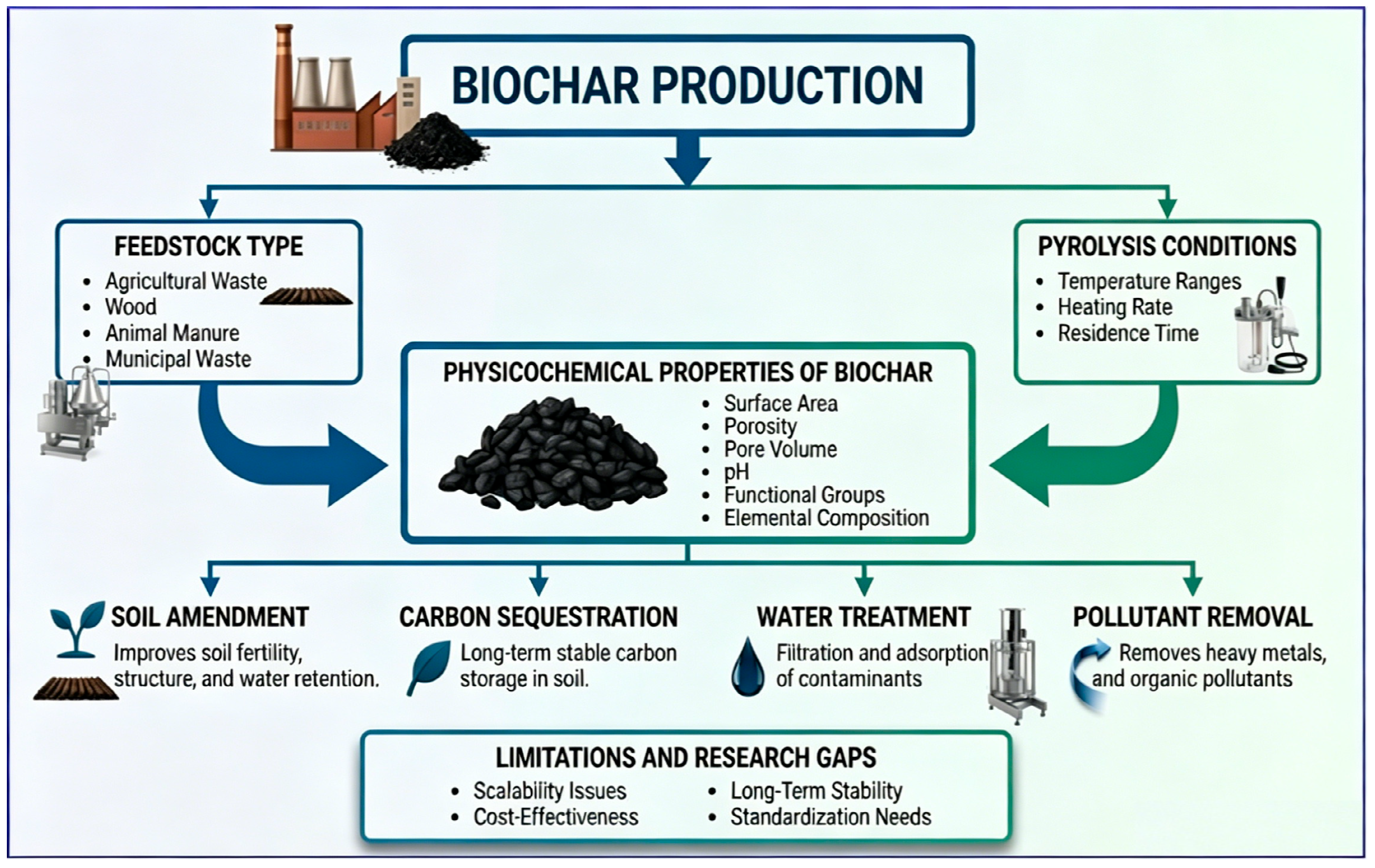
To bridge these gaps, the present review integrates feedstock, process, property, and application relationships across >250 studies. Novel contributions include an (1) explicit comparison of conventional (slow/fast pyrolysis, gasification) and advanced (microwave-assisted and thermal plasma) thermochemical routes, (2) author-driven synthesis and critical perspective in every subsection rather than simple literature listing, and (3) evaluation of its potential within a true closed-loop circular bioeconomy. As shown in Figure 1, this review outlines the major research trends and structural organization of biochar studies from 2017 to 2026, providing actionable frameworks for researchers and policymakers to accelerate industrial deployment.
Table 1 presents a critical comparison of recent biochar production studies, integrating process conditions, physicochemical properties, and key research gaps to highlight current limitations and the need for more systematic, application-oriented approaches.

2. Biochar Production

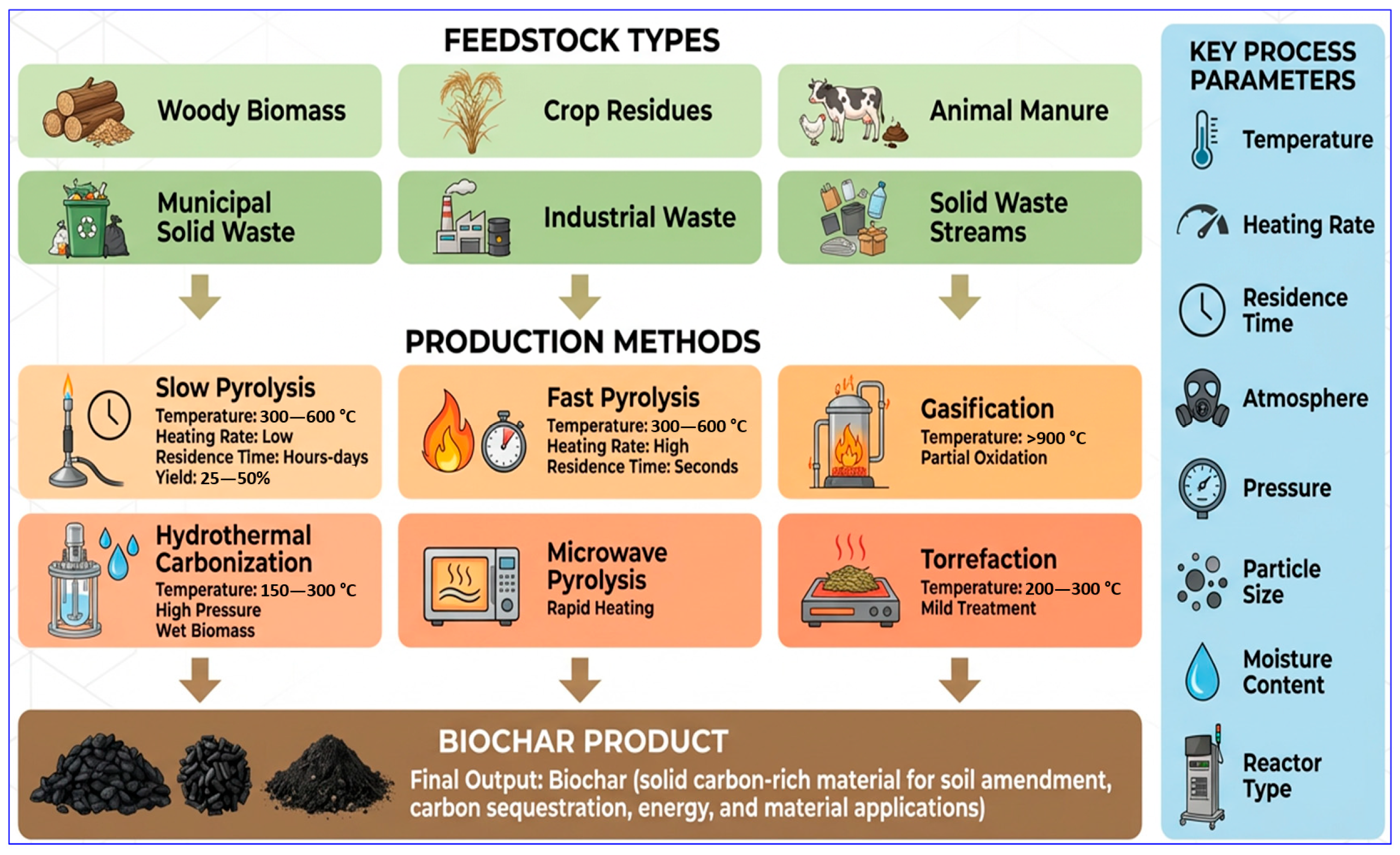
Biochar production is influenced by several factors, including the type of feedstock used and the conditions under which pyrolysis is carried out. Different feedstock types, such as woody biomass, crop residues, and animal manure, can impact the final properties of the biochar. Additionally, the pyrolysis method, including variations in temperature, heating rate, and residence time, plays a decisive role in determining the yield and characteristics of the biochar. These factors, along with other process parameters, like atmosphere, pressure conditions, and particle size, collectively influence the efficiency and suitability of biochar for applications in soil enhancement, carbon sequestration, and energy production (Figure 2).

2.1. Feedstock Selection

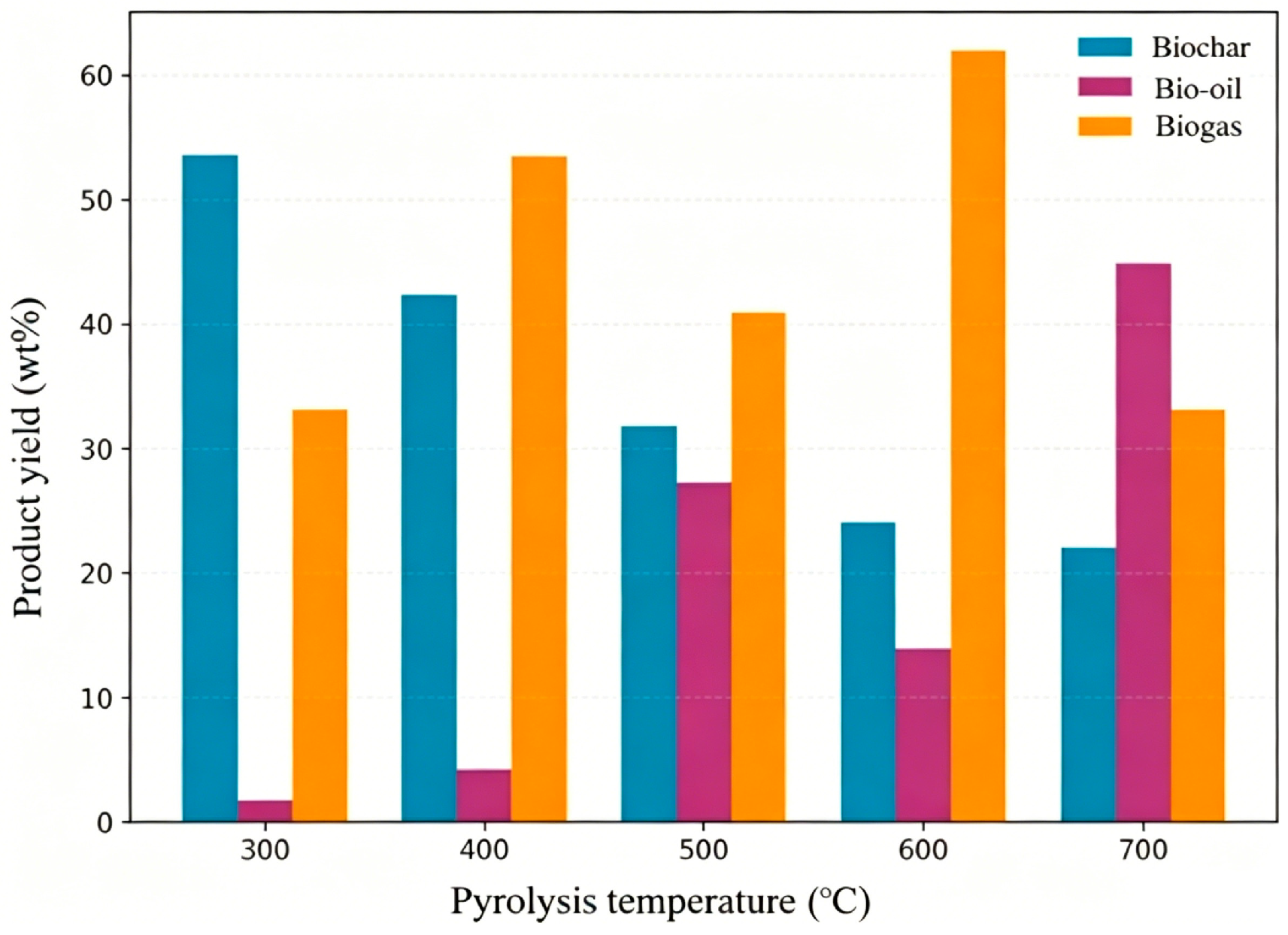
The choice of feedstock is a key factor determining the biochar yield and characteristics. Agricultural residues constitute a major feedstock category, including wheat straw, rice husks, corn cobs, and lychee waste [33]. Forestry materials such as wood chips, wood bark, and pine wood have been extensively utilized [34]. Waste materials, particularly sewage sludge [35] and food waste, represent promising feedstocks that simultaneously address waste management challenges while producing functional biochar. Higher fixed carbon and lignin content increase char yields. Including fixed carbon and temperature in models markedly improves the prediction accuracy, with experiments confirming a strong fixed-carbon influence [36]. Larger particle sizes slow heat and mass transfer and typically increase the biochar yield, though the precise optimum depends on feedstock (examples: optimal sizes reported near 0.7–2.5 mm in different studies) [37,38]. In this regard, Selvarajoo A. et al. [39] investigated the effect on biochar production of dried citrus peels feedstock via slow pyrolysis. As shown in Figure 3, biochar yields decreased with increasing pyrolysis temperature at 100 °C intervals, declining from 53.62 wt% at 300 °C to 42.32, 31.81, 24.06, and 22.01 wt% at 400, 500, 600, and 700 °C, respectively. In comparison, the corresponding bio-oil yields were 1.72, 4.22, 27.26, 13.92, and 44.88 wt%, while the biogas yields varied between 33.12 and 62.03 wt% across the same temperature range. Results indicate that citrus peel waste is highly recommended to generate a large solid fraction of biochar, particularly at low temperatures.
Sarpong, A.K. et al. [40] investigated the effects of feedstock type (corn cob (CC), coconut husk (CCH), and empty fruit bunch (EFB)) and kiln type (Elsa barrel and top-lit updraft (TLUD) kiln) on biochar (BC) production under slow pyrolysis. They found that pyrolysis temperature increased by 4% and 30% for CC-BC compared with EFB-BC using the Elsa barrel and TLUD kilns, respectively. The BC yields were 71% and 49% higher for EFB using the Elsa barrel and TLUD kiln compared with CC. The Elsa barrel produced an 11% higher burn rate for EFB-BC, while the TLUD kiln showed a 70% higher burn rate for EFB-BC relative to CC. Additionally, CC-BC in the Elsa barrel had a 1.7% higher pH, 4.8% higher EC, 16.8% more TN, and 4.2% higher FC compared with CC-BC in the TLUD kiln. Karlvin et al. [33] compared six different feedstocks (bamboo, dried leaves, wood shavings, rice husk, tree branches, and wood chips) and identified bamboo as the most suitable precursor for water treatment applications, achieving a BET surface area of 317 m2/g and demonstrating favorable adsorption characteristics comparable with commercial activated carbon.
Sun Y. et al. [41] reported that biochar and hydrochar yields strongly depend on the feedstock type. Using hickory wood, bagasse, and bamboo, the biochar yields obtained via slow pyrolysis (300–600 °C) ranged from 22.7 to 43.7 wt%, while hydrothermal carbonization at 200 °C produced higher yields of 27.8–48.4 wt%. Increasing the pyrolysis temperature from 300 to 600 °C consistently reduced the biochar yield due to enhanced thermal decomposition. Among feedstocks, bamboo-derived hydrochar showed the highest yield (48.4 wt%), whereas biochars produced at 600 °C exhibited the lowest yields (~22–26 wt%), highlighting feedstock- and process-dependent optimization of biochar production. From the literature, it was concluded that feedstock lignin content and particle size critically govern biochar yield and quality, yet most studies remain limited to single feedstock evaluations. We argue that systematic multi feedstock comparisons under standardized conditions are urgently needed to bridge this gap and enable regionally optimized production strategies.

2.2. Pyrolysis Conditions and Process Parameters

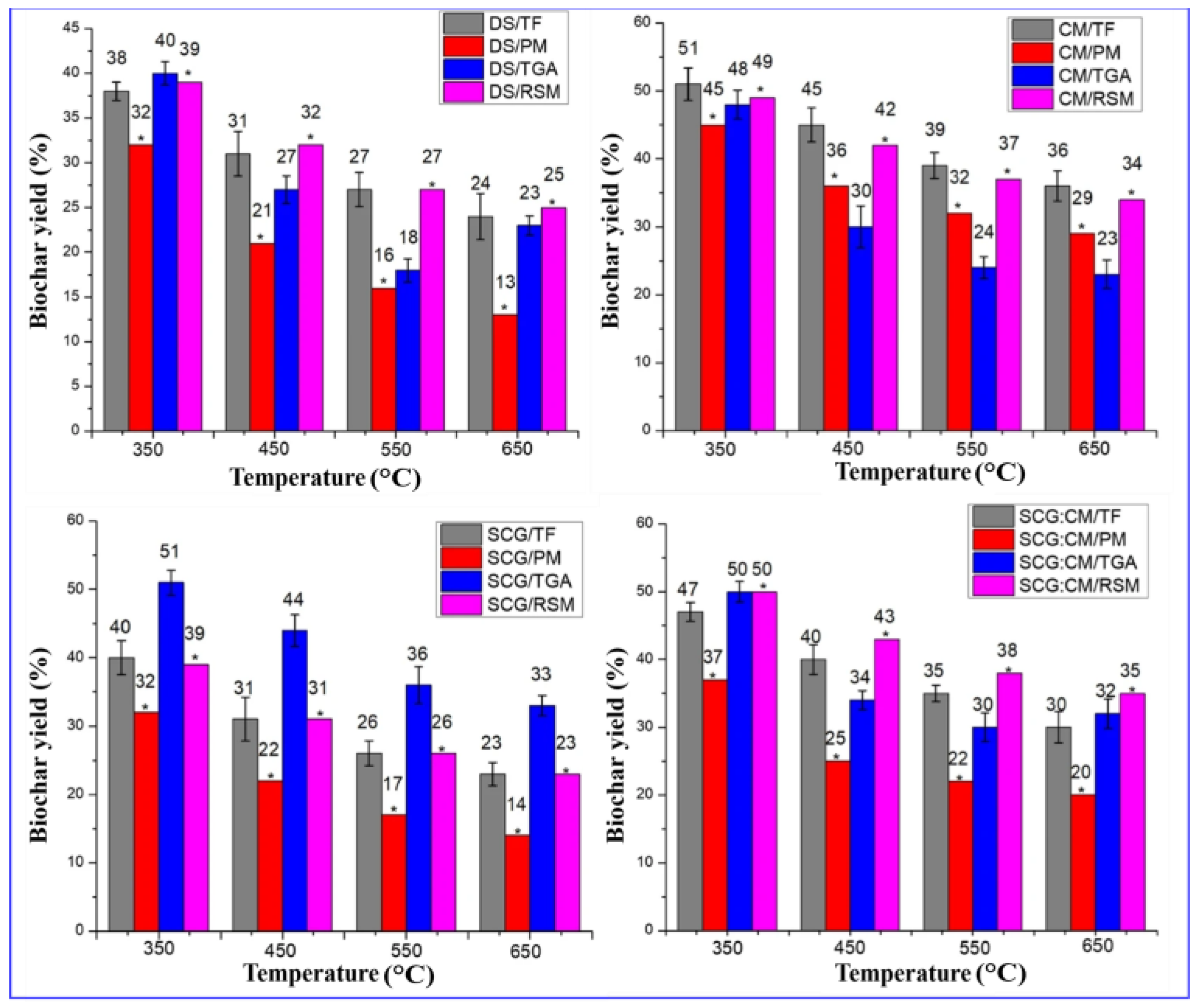
The pyrolysis temperature emerges as the most critical production parameter affecting biochar characteristics. Studies report pyrolysis temperatures ranging from 300 °C to 850 °C, with distinct property profiles emerging at different temperature ranges [42]. Machine learning and experimental data show a strong negative correlation (Pearson ≈ −0.75) between pyrolysis temperature and yield. Temperature is the dominant factor, explaining ~50% of the modeled importance for yield prediction. Mariyam S. et al. [43] studied the effect of pyrolysis temperature (350–750 °C) on biochar yield governed by feedstock fixed carbon content (14–22%), with a secondary influence from heating rate (5–10 °C min−1). Biochar yields ranged from 23 to 54 wt% with different feedstocks, including date stones, spent coffee grounds, and cow manure. The highest yield (~54 wt%) was obtained at 350 °C and 5 °C min−1, while the lowest (~23 wt%) occurred at 750 °C and 7.5 °C min−1. Increasing the temperature consistently reduced the biochar yield due to enhanced devolatilization, whereas the heating rate showed minimal impact, with yields varying only from 37.27 to 38.02 wt% when increased from 5 to 10 °C min−1 at 550 °C (Figure 4). Experimental studies have reported concrete examples: almond shell yields peaked at 65% at 300 °C and fell markedly at higher temperatures with pilot yields near 39.5% at unspecified higher temperatures, while very high activation temperatures (e.g., 850 °C) produced low yields (~15%) despite high surface areas [38,44]. Several response-surface and optimization studies report higher yields under slow or moderate heating rates (e.g., 5–15 °C min−1) and short-to-intermediate residence times (minutes to a few tens of minutes) depending on feedstock [45,46]. Low heating rates (e.g., 5–15 °C min−1 used in experimental RSM studies) retain more solids versus fast ramps that promote rapid devolatilization and lower yields [26]. Short residence times reduce secondary cracking of volatiles back into gas-phase products, and thus, increase the char yield; optimized yields in experimental studies were obtained with short pyrolysis times (e.g., 5–30 min in sugarcane bagasse and almond shell tests), whereas long residence times (tens to hundreds of minutes) often reduced the yield [47].
Similarly, Premchand P. et al. [48] observed a decrease in biochar yields under slow pyrolysis (400–600 °C) of food waste, rice husk, and grape wood with heating rates of 5–15 °C min−1. However, replacing N2 with CO2 consistently enhanced the biochar production. In a CO2 atmosphere, the biochar yield was increased by up to 4.84% at 400 °C (rice husk), with the enhancement diminishing to ~0.1% at 600 °C, indicating that lower pyrolysis temperatures and heating rates favor carbon retention. These findings highlight CO2-assisted pyrolysis as an effective strategy for improving biochar yield under controlled thermal conditions. Shen Q. et al. [49] produced biochar via the slow and fast pyrolyses of mallee wood (150–250 µm) at different heating rates (10 °C/s and ∼400 °C/s, respectively). At 500 °C, slow pyrolysis yielded 20.16 wt% biochar, which is higher than fast pyrolysis at the same temperature, producing 16.23 wt%. During subsequent rapid pyrolysis at 1300 °C, char yields from both biochars decreased slightly from ~77% to ~75% as the residence time increased from 0.45 to 1.4 s. However, fast-pyrolysis biochar showed marginally higher early-stage yields due to a higher ash content.
This implies that slow pyrolysis enhances the initial biochar yield, while the heating rate has a limited impact on char stability under high-temperature conditions. Potnuri R. et al. [50] reported that biochar yield was significantly enhanced by torrefaction of sawdust followed by microwave-assisted pyrolysis. Torrefaction at 125, 150, and 175 °C produced 24–48 wt% biochar however, the yield decreased with increasing catalyst loading (5–15 g KOH). Using 20 g of feedstock and 5 g KOH, the biochar yield increased from 39.2 wt% (125 °C) to 41.9 wt% (150 °C) and 48.1 wt% (175 °C), whereas it declined to 24.2–35.0 wt% at 15 g KOH. The highest yield (48.1 wt%) was obtained at 175 °C with 5 g KOH, while the lowest (24.2 wt%) occurred at 125 °C with 15 g KOH. While the pyrolysis temperature predominantly governs biochar yield and properties, while other parameters show secondary effects. However, the lack of integrated and scalable optimization limits predictive control, necessitating coupled process design approaches.

2.3. Advanced Pyrolysis Techniques

Beyond conventional methods, advanced thermochemical technologies like microwave-assisted pyrolysis (MWP) and thermal plasma pyrolysis (TPP) have emerged to optimize biochar properties through non-traditional heating mechanisms. Recent studies have utilized MWP at temperatures ranging from 250 to 900 °C, with power levels typically between 100 and 900 W [51]. According to Khelfa et al. [52], microwave power between 350–550 W can reduce residence times to 10–20 min, while Fodah & Abdelwahab, [53] identified an optimal power of 700 W (integrated with 10 wt% activated carbon) for maximizing the efficiency in solar-powered MWP systems. TPP operates at extreme thermal regimes, often exceeding 1000 °C, using plasma torches or radiofrequency (RF) systems. Muvhiiwa et al. [54] and Tang & Huang [55] employed nitrogen and air plasma torches with power inputs ranging from 0.1 kW to 20 kW. Their results show that these high-energy environments facilitate near-complete decomposition, producing biochar with a carbon content as high as 93% at 1000 °C. Despite their advantages, these advanced techniques face challenges related to energy efficiency, scalability, and economic feasibility.

3. Physicochemical Properties

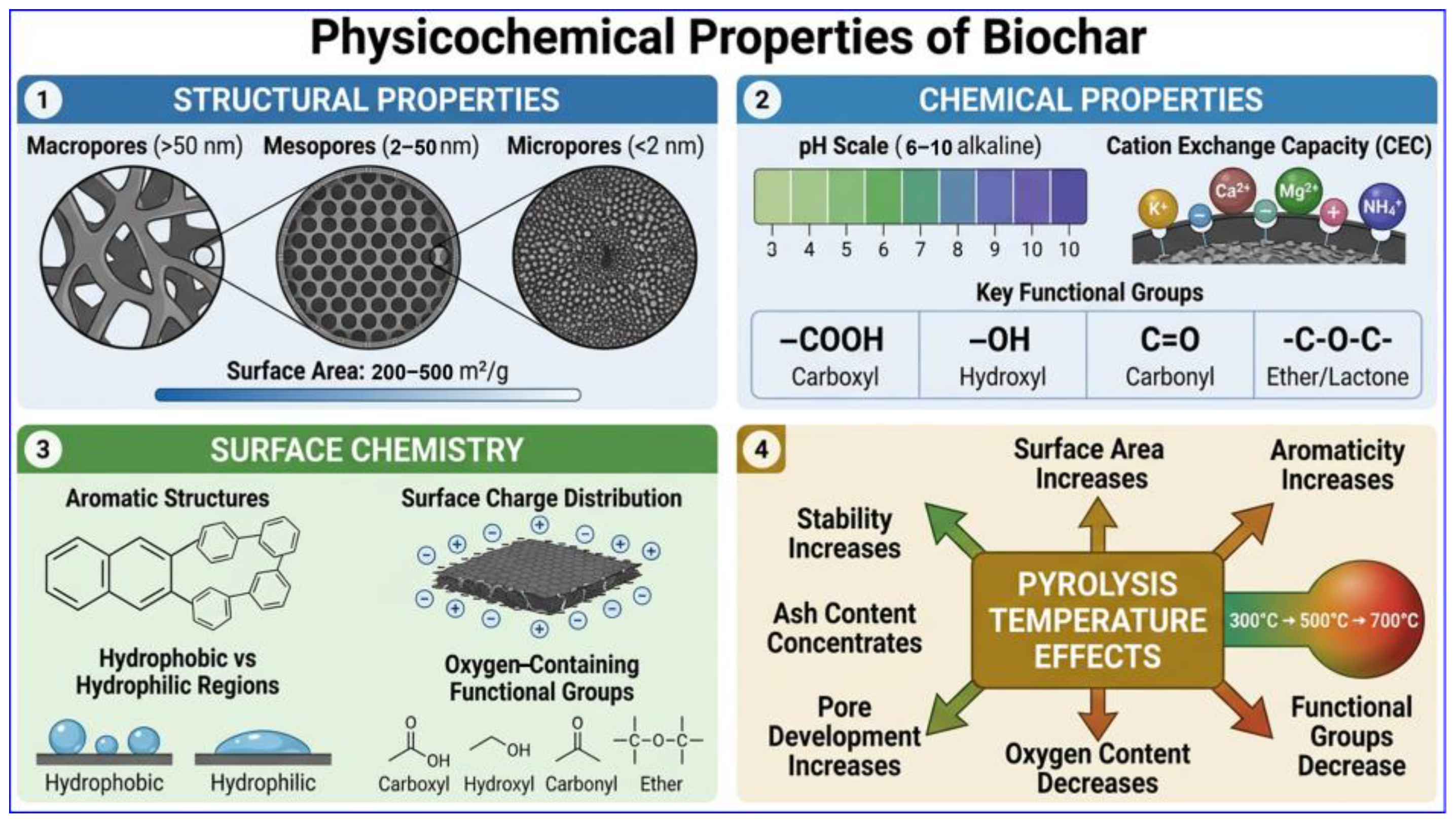
The physicochemical properties of biochar include the surface area, porosity, surface functional groups, pH, electrical conductivity (EC), and cation exchange capacity (CEC), which are fundamentally important as they dictate its efficacy across various agricultural and environmental applications (Figure 5). These properties directly influence biochar ability to improve soil health, enhance crop productivity, mitigate climate change through carbon sequestration, and remediate contaminated environments [15,56,57]. A high pH in biochar is advantageous for ameliorating acidic soils [58], while a large surface area and porous structure are crucial for its function as a sorbent for pollutants [56]. A high CEC resulting from negatively charged surfaces promotes nutrient retention and soil fertility by reducing Ca, K, and Mg leaching [56]. Furthermore, carbon stability determines biochar persistence and sequestration potential in soils. Therefore, understanding and manipulating these properties are key to optimizing biochar for specific purposes.

3.1. Structural Properties and Pore Architecture

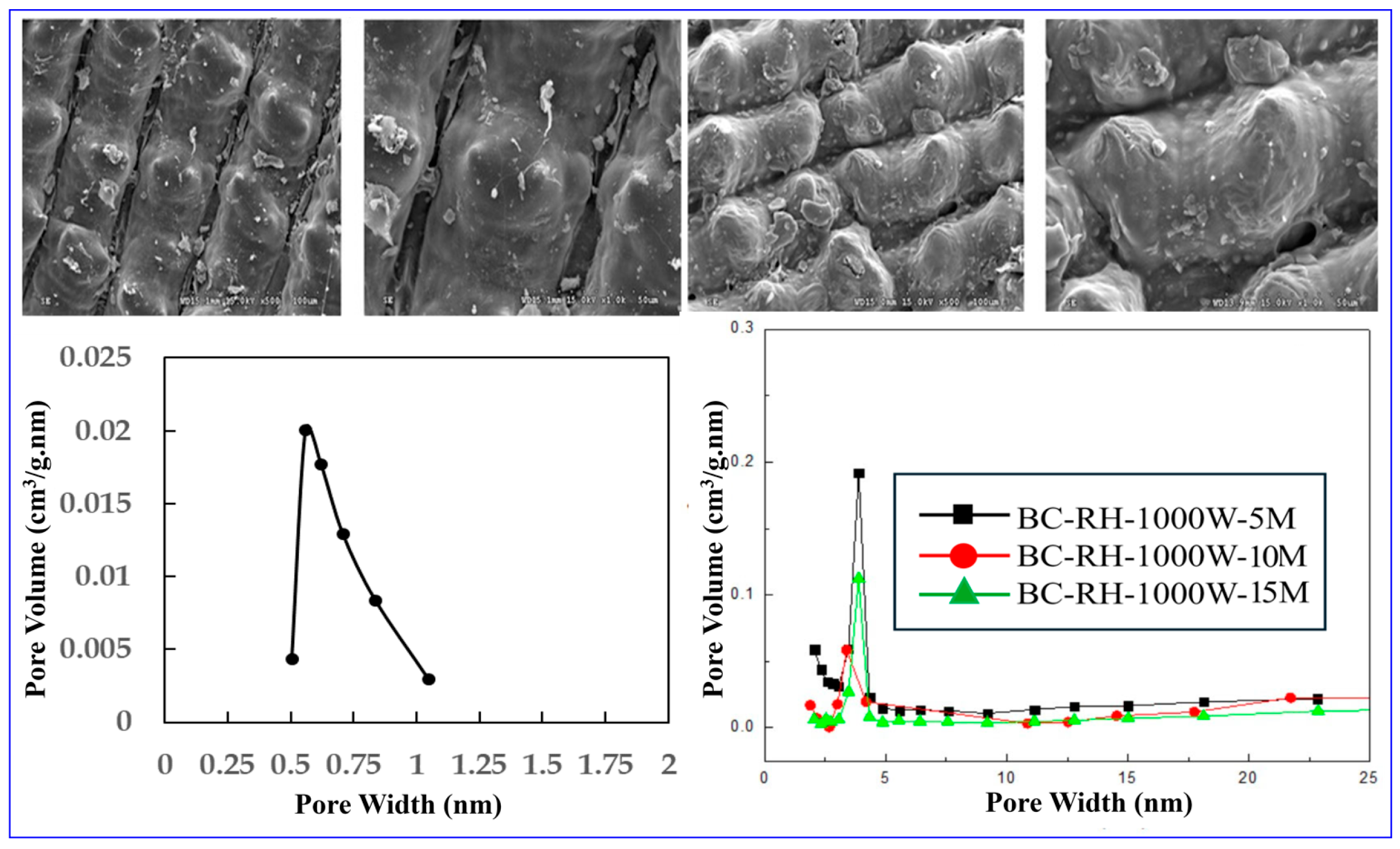
Biochar pore structures vary widely, with specific (BET) surface areas ranging from <1 to several hundred m2 g−1 and pore sizes spanning macropores (µm) to micro-/mesopores (nm), depending on the feedstock and pyrolysis conditions. The temperature dependence of a BET surface area is central to the adsorption capacity and varies strongly with both feedstock and pyrolysis conditions. N2 adsorption–desorption hysteresis patterns (H4 type) indicated combined micro/mesoporous structures in some high-temperature chars [59]. Kuo L.A. et al. [60] examined the textural properties of biochar produced by microwave-assisted pyrolysis of rice husk (RH) at temperatures > 450 °C using output powers of 300–1000 W and residence times of 5–15 min. According to the results, pore development markedly improved with increasing microwave power (300 → 1000 W) at a residence time of 5 min, achieving the highest BET surface area (172.04 m2/g) and total pore volume (0.1229 cm3/g) at 1000 W for 5 min. Prolonged residence times (10–15 min) at 1000 W diminished these values. N2 adsorption desorption isotherms (77 K) displayed hybrid Type I/IV behavior with H4 hysteresis, signifying slit-shaped micropores and mesopores. BJH analysis indicated a mesopore peak at ~3.8 nm, while Horváth–Kawazoe evaluation of the optimal biochar revealed dominant micropores at ~0.6 nm. SEM micrographs showed increased surface roughness and porosity after pyrolysis due to thermal decomposition of the biomass structure (Figure 6). Li H. et al. [61] utilized machine learning to predict and optimize the specific surface area (SSA) and total pore volume (TPV) of biochar derived from biomass pyrolysis based on a dataset of 169 samples incorporating biomass proximate/elemental compositions and pyrolysis parameters. Gradient-boosting regression (GBR) achieved superior performance over random forest, with test R2 values of 0.89–0.94. Feature importance analysis identified pyrolysis temperature, biomass ash content, and volatile matter as the primary determinants of SSA and TPV. Multi-target GBR optimization of pyrolysis conditions and binary biomass mixing ratios facilitated experimental validation of high-SSA/TPV biochar, underscoring the machine learning efficacy for the targeted engineering of biochar textural properties in adsorption and porous carbon applications.
Lu S. et al. [62] characterized pore structures of biochar from different feedstock types (herbaceous, coniferous, and broad-leaf biomass) pyrolyzed at 550 °C using nitrogen adsorption and mercury intrusion porosimetry (MIP). According to the findings, the BET specific surface area (SSA) ranged from 1.06 to 70.22 m2/g (mean 10.61 m2/g), exposing primarily nanoscale pores (<0.1 μm). The total pore volumes revealed by MIP were 1.28–3.68 cm3/g, with porosities of 57.8–79.7%, while herbaceous biochars (HBs) exhibited a higher average total pore volume and porosity, among others. The MIP pore size distribution was bimodal in the micrometer range (peaks ~1.5–5 μm and 5–25 μm), dominated by storage pores (0.5–50 μm, ~85% of volume). The feedstock type had a greater influence on the pore characteristics than pyrolysis conditions (350–550 °C, 2–5 h). These hierarchical pores support biochar functions in soil water storage, microbial habitats, and pollutant sorption. Biochar pore structure is governed by feedstock and pyrolysis conditions. While limited understanding of structure-property relationships hinders its targeted design for specific applications.

3.2. Surface Chemistry and Functional Groups

Biochar surfaces present a complex ensemble of oxygenated, nitrogenous and sulfur-bearing moieties that arise during thermochemical conversion and subsequent oxidation; these groups determine chemical reactivity toward metals, organics and nutrients. Carboxyl, hydroxyl (alcohol/phenolic), carbonyl (quinone/ketone), lactonic and ether functionalities are commonly reported on biochar surfaces and are collectively termed OCFGs in recent reviews [63]. Phenolic -OH bound to aromatic rings and conjugated carbonyls frequently occur on lower-temperature chars and after surface oxidation. Pyridinic, pyrrolic, amine and amide-type N functionalities occur when N-rich feedstocks or amination treatments are used and influence basicity and coordination chemistry [64]. Thiols, sulfides, sulfonic and sulfate species appear mainly from S-containing feedstocks or sulfonation treatments and can introduce redox and acid sites. Quinone-like and phenoxyl structures contribute to electron transfer and catalytic redox behavior on biochar surfaces [65].
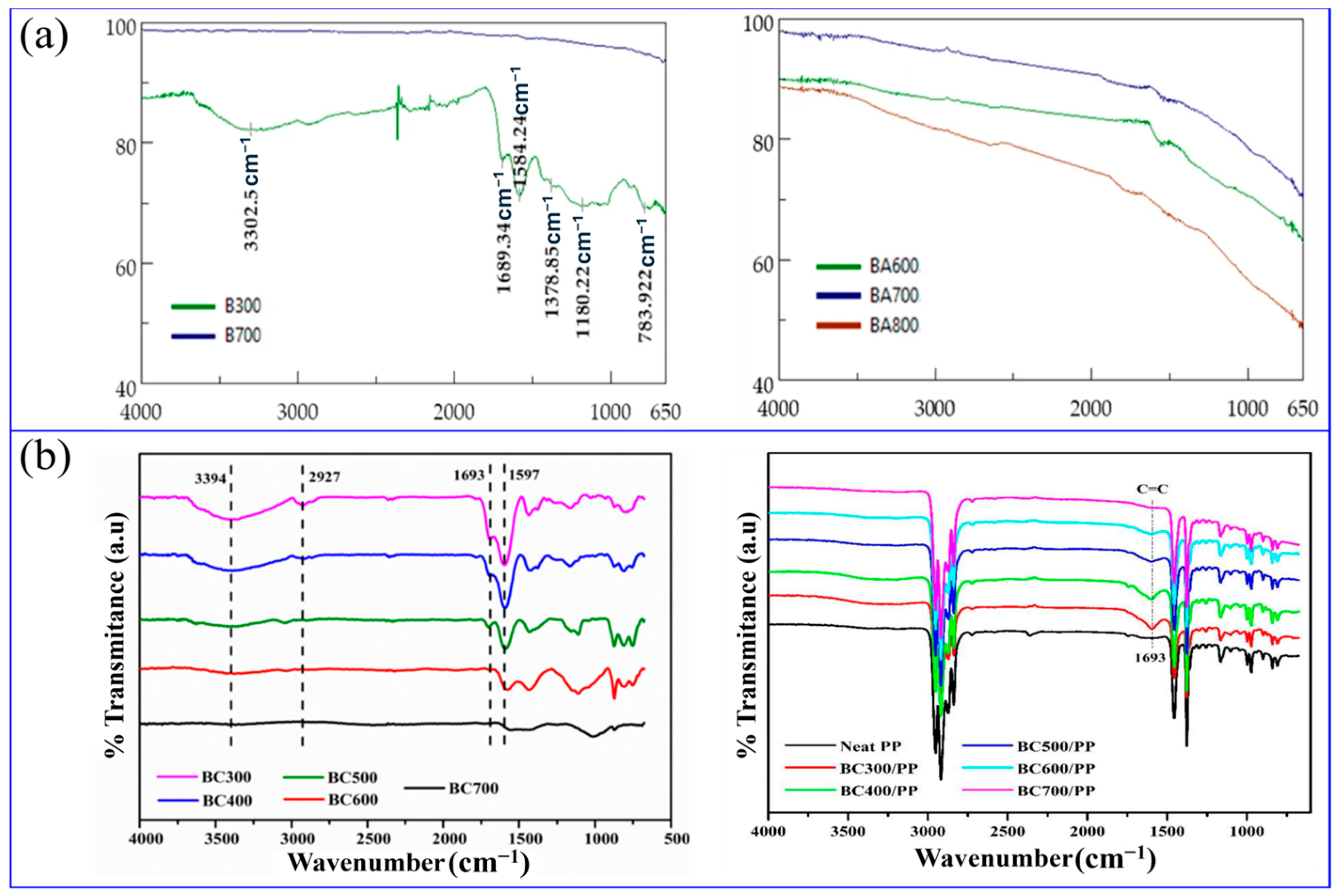
Barszcz W. et al. [66] demonstrated that the surface functional groups of biochar are highly dependent on pyrolysis temperature. Low-temperature biochar (~300 °C) exhibits abundant oxygen- and hydrogen-containing functionalities, such as -OH, C=O, and C-O groups derived from cellulose and hemicellulose decomposition; with increases in pyrolysis temperature above 600 °C, these functional groups progressively diminish due to dehydration and deoxygenation reactions, accompanied by enhanced aromatization and the formation of condensed polycyclic aromatic carbon structures (Figure 7a).
Luo Q. et al. [67] investigated the effect of pyrolysis temperature (250–700 °C) on the surface chemistry of corn-stover-derived biochar. The surface carbon content increased from 63.10% to 80.58% by increasing the temperature, while the oxygen content decreased from 26.42% to 9.20%, along with an increase in biochar pH from 6.60 to 10.66. XPS spectra showed a pronounced enhancement of the C1s signal from 79.42% to 91.02% and a subsequent decrease in the O1s signal from 20.58% to 8.98%. Deconvolution of C1s and O1s peaks revealed an increasing proportion of C-C and O=C-O species, whereas oxygenated functional groups such as O-H, C-O-C, and C-OOH declined markedly with temperature. These results indicate progressive dehydration, deoxygenation, and enhanced surface aromaticity, consistent with FTIR and Boehm titration results.
Elnour A.Y. et al. [68] produced date-palm-biomass-derived biochar at 300–700 °C and investigated the evolution of surface functional groups. At low temperatures, FTIR spectra show a strong band at ~3394 cm−1 associated with -OH stretching, as well as aliphatic C-H vibrations at ~2927 cm−1. With an increase in temperature, the spectra gradually weakened and became negligible at 700 °C due to intensified carbonization and volatile removal. Carbonyl (C=O, ~1693 cm−1) and aliphatic C=C (~1597 cm−1) vibrations also decreased markedly with temperature, indicating cracking of aliphatic chains and deoxygenation reactions. At temperatures above 600 °C, most aliphatic functional groups disappeared, accompanied by the formation of more condensed aromatic and graphite-like structures, consistent with reduced O/C and H/C ratios and diminished FTIR peak intensities (Figure 7b). Biochar surface functional groups decrease with higher pyrolysis temperatures, increasing the aromaticity. However, systematic studies linking chemistry to reactivity are limited.
Figure 7. FTIR spectra showing the effect of pyrolysis temperature on surface functional groups of biochar. (a) Biochar produced at 300–800 °C showing the progressive loss of oxygenated functional groups with increasing temperature; reproduced with permission from [66]. (b) Date palm biomass derived biochar at 300–700 °C, highlighting the decreases in -OH (3394 cm−1), C-H (2927 cm−1), and C=O (1693 cm−1) groups along with the formation of aromatic structures; reproduced with permission from [68].
Sustainability 18 05865 g007

3.3. pH, Ash Content, and Ion Exchange Behavior

Surface charge and pH behavior link functional group acid–base chemistry, ash/mineral content, and the point of zero charge to sorption outcomes and electrostatic interactions. Many chars are alkaline in bulk aqueous suspension because of mineral ash (carbonates, oxides) that impart basicity, although acid biochar can be produced by oxidation or acid treatments [64]. The pHpzc of biochar varies widely with the feedstock, temperature and modification; surface acidity from oxygenated groups lowers pHpzc, while ash/basic minerals raise it, causing pHpzc shifts that alter whether the surface is net positive or negative at a given solution pH [69]. The surface charge as measured by the zeta potential tracks pH and surface group deprotonation; deprotonation of carboxyl and phenolic groups produces negative charge and promotes cation uptake.
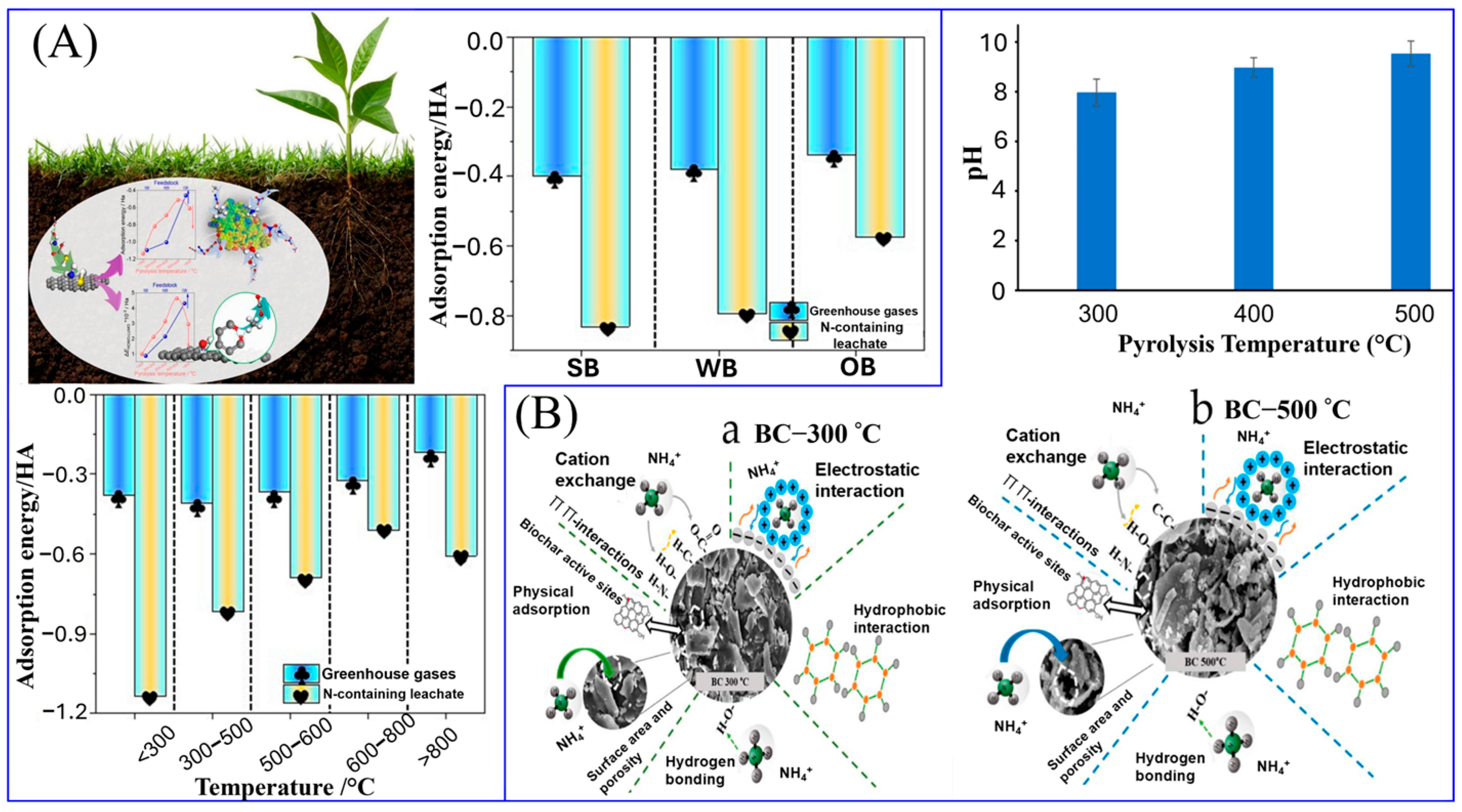
Furthermore, alkaline conditions in biochar systems promote lignocellulosic breakdown via cleavage of ester and ether linkages, enhancing solubilization of organic matter, while acidic conditions favor proton-driven hydrolysis of hemicellulose. Moreover, pH regulates microbial and enzymatic activities, thereby controlling the decomposition rates and nutrient mineralization. Thus, biochar-induced pH governs both sorption behavior and biomass degradation pathways. He et al. [70] meta-analyzed 465 studies on the biochar mitigation of soil greenhouse gas (GHG) emissions and nutrient losses, complemented by DFT calculations, to assess feedstock (straw/SB, wood/WB, other/OB) and pyrolysis temperature effects on properties relevant to pH, ash, and ion exchange. Wood-based biochar showed superior porosity and specific surface area, while straw-based/low-temperature biochar retained higher O, N, and H contents and functional groups (e.g., -OH, -COOH, -NH2), enhancing the surface charge density, charge transfer, bonding orbitals, active adsorption sites, and adsorption energy/stability for soil ions/leachates (e.g., NH4+, NO3). The pH increased with temperature (e.g., ~9.424 > 800 °C for SB; overall SB highest at 9.261 vs. WB 8.695), the ash content was the highest in OB (31.053%) vs. WB (15.236%), and the cation exchange capacity (CEC) decreased with temperature (highest 55.717 cmol kg−1) (Figure 8A).
Pantoja et al. [71] examined non-modified banana leaf biochar produced by slow pyrolysis at 300 °C, 400 °C, and 500 °C. Higher pyrolysis temperatures led to elevated ash levels (from mineral enrichment as volatiles escaped) and a pH increase from ~8.0 (at 300 °C) to ~9.5 (at 500 °C), driven by alkaline ash accumulation and deprotonation effects. This dramatic increase in pH was due to enhanced alkalinity from alkaline ash accumulation and deprotonation of residual functional groups. Zeta potential measurements (at 0.01 M NaCl) showed more negative surface charge at lower pyrolysis temperatures (e.g., reaching ~−50 to −55 mV in the pH 6–10 range for 300 °C biochar), facilitating stronger electrostatic attraction and cation exchange for NH4+, whereas higher-temperature biochar exhibited a less negative charge and reduced ion retention capacity.
This contributed to the highest NH4+ adsorption (7.0 mg/g) at 300 °C, decreasing to 6.1 mg/g (400 °C) and 5.6 mg/g (500 °C), which is linked to preservation of oxygen-containing functional groups at lower temperatures that support surface charge and ion exchange sites. Equilibrium data fitted the Harkins–Jura isotherm best, indicating multilayer adsorption on heterogeneous surfaces influenced by these charge/pH dynamics (Figure 8B). Nguyen et al. [72] prepared sugarcane bagasse biochar (SB-BC) via H3pO4 pretreated with slow pyrolysis and modified with KOH to produce oxygen-containing functional groups (OCFGs) for enriched NH4+ adsorption from aqueous solutions. According to the findings, the OCFGs increased around fourfold after the KOH modification, boosting the maximum Langmuir adsorption capacity from 27.1 mg/g (SB-BC) to 53.1 mg/g (SB-MBC). Optimal NH4+ uptake occurred at pH 7.0 using 3.0 g/L of biochar and 50 mg/L initial NH4+ at 25 ± 2 °C over a 180 min equilibration period. The adsorption process followed Elovich kinetics, with equilibrium data fitting the Langmuir and Sips isotherm models best, consistent with monolayer chemisorption as the primary mechanism. Mechanisms included cation exchange, electrostatic attraction, and surface complexation, as confirmed by pre- and post-adsorption characterizations. Biochar alkalinity and ash content drive the surface charge and cation exchange, but their effects are feedstock- and temperature-dependent. More comparative studies are needed to optimize these properties for targeted adsorption.

4. Applications of Biochar

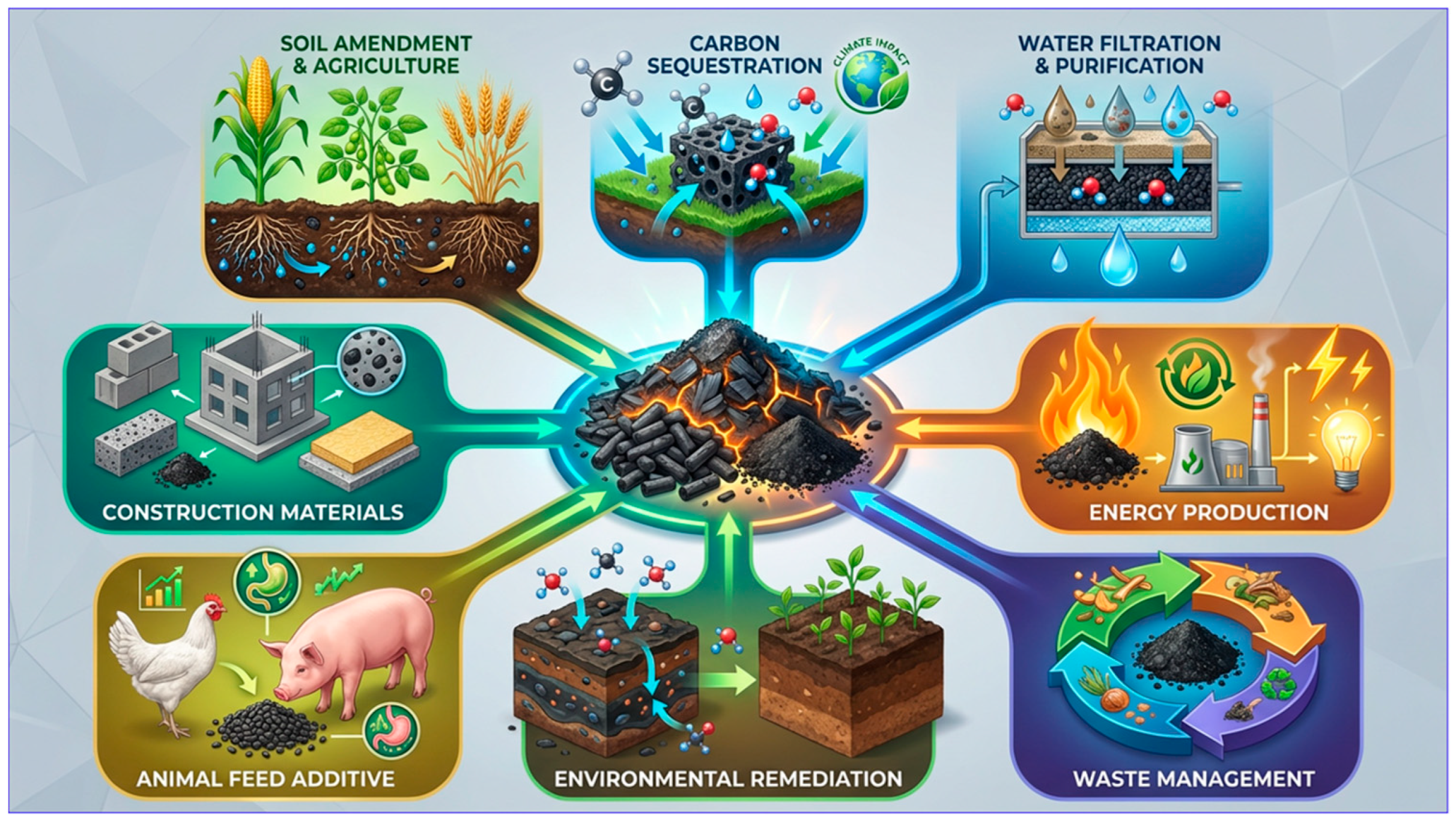
Biochar has emerged as a highly versatile material with a wide range of applications in environmental management, agriculture, and sustainable development, as illustrated in Figure 9. The tunable surface chemistry, porous structure, high surface area, and long-term stability of biochar make it suitable for multiple applications. In the agriculture sector, it enhances soil fertility and crop resilience through enhanced water retention, nutrient availability, and pH buffering [73]. In climate mitigation, it works for carbon sequestering by storing recalcitrant carbon in soils [74,75], removing contaminants (heavy metals, ammonium, organics) from water and soil via adsorption, ion exchange, and complexation [76,77]. It supports waste valorization and energy co-production, acting as a carrier in biofertilizers and animal feed additives [78], thus contributing to construction materials and circular economy strategies [79]. These diverse functions position biochar as a key tool for addressing soil degradation, food security, water quality, and net-zero emissions goals in a changing climate.

4.1. Agricultural Applications and Soil Amendment

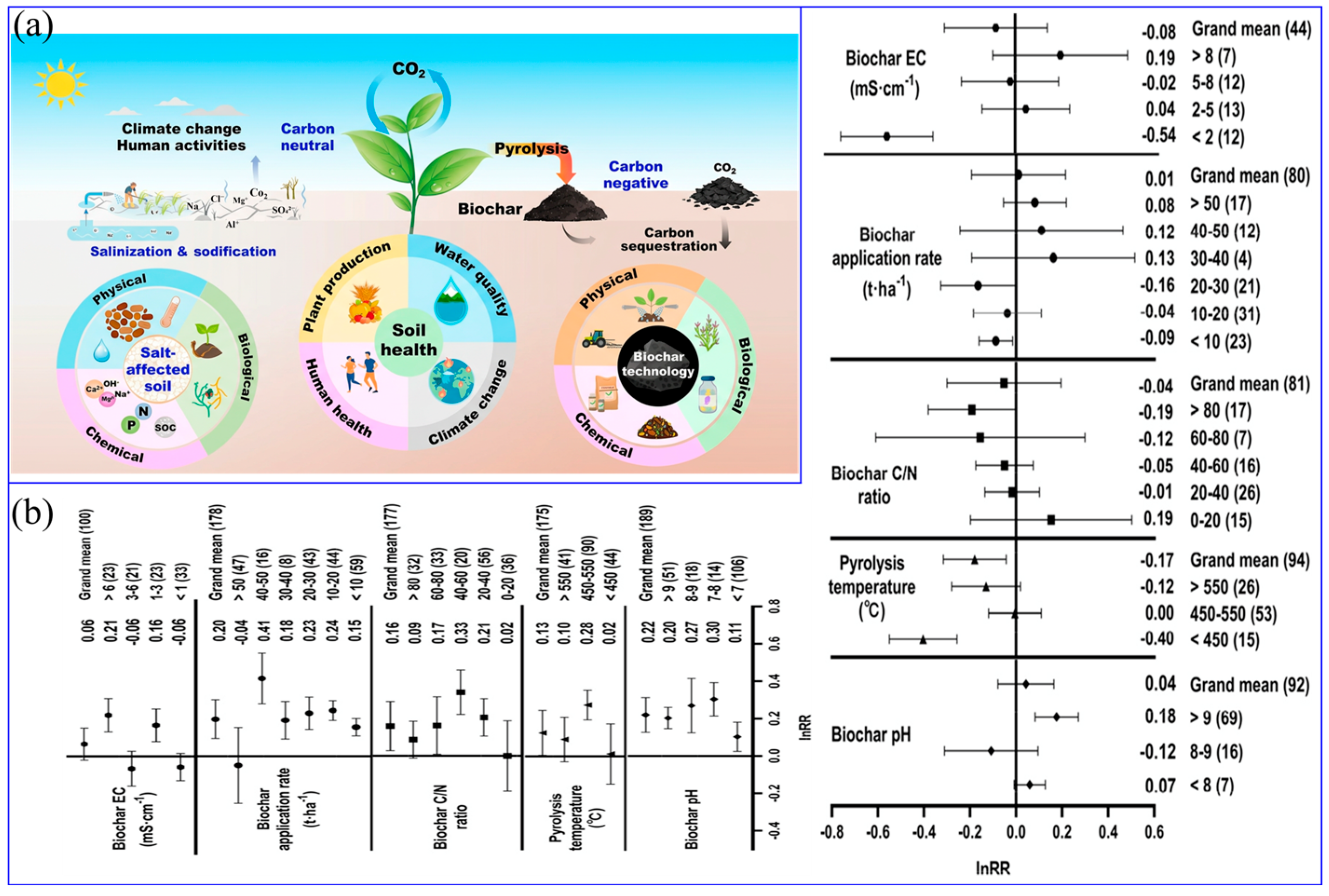
In agricultural systems, biochar amendment has been widely investigated for its potential to improve soil structure, water retention, and overall soil health. Yuan et al. [9] conducted a global meta-analysis to quantify the effects of biochar amendment on the health of salt affected soils. They reported that with the addition of biochar, soil physicochemical properties, including aggregate stability (15.0–34.9%), porosity (8.9%), and water retention capacity (7.8–18.2%), were significantly enhanced by increasing the cation exchange capacity (21.1%), soil organic carbon (63.1%), and nutrient availability (31.3–39.9%), while the bulk density (6.0%) and salt stress alleviation (4.1–40.0%) were decreased. Following biochar incorporation, soil biological health can also be improved, particularly enhancing microbial biomass (7.1–25.8%), facilitating enzyme activity (20.2–68.9%), and ultimately increasing plant growth, as shown in Figure 10a. Farhangi-Abriz S. et al. [80] reported that biochar application significantly increased the grain yields in maize (by 14–35%) and wheat (by 13.5%), with the greatest improvements observed in coarse-textured and acidic soils. Biochar derived from animal waste outperformed that from crop residues and wood waste as a feedstock. Yield enhancements were more pronounced under subtropical climates, whereas high application rates (>30 t ha−1) did not substantially affect the crop yield.
According to Wu B. et al. [81], biochar is an effective soil amendment for salt-affected soils, with a meta-analysis showing crop productivity increases of 13–37% and soil salinity changes ranging from −20% to 20%. Optimal improvements in productivity were achieved with biochar applied at 40–50 t ha−1, with a C/N ratio of 40–60, pyrolysis temperatures of 450–550 °C, and pH 7–8. Meanwhile, reductions in soil salinity were associated with biochar having an EC < 2 mS cm−1, application rates of 20–30 t ha−1, higher C/N ratios (>80), or pyrolysis temperatures < 450 °C. The strongest combined benefits for crop productivity and salinity management were observed in sulfate-dominated saline soils, particularly under salinity > 3 g kg−1 and soil pH 7–9, highlighting the importance of tailoring biochar properties to soil constraints (Figure 10b). Han H. et al. [82] conducted 381 datasets from 63 studies and reported biochar application as a soil amendment increased crop yield by 14.45%, water use efficiency by 14.28%, and nitrogen use efficiency by 13.97%. The efficacy of biochar was dominated by soil organic carbon, total nitrogen, bulk density, biochar total carbon content, and C:N ratio. Optimal synergistic improvements in crop productivity and resource use efficiency were achieved using biochar with lower carbon content (TC ≤ 200 g kg−1, C: N 50–100). These effects were most pronounced in compacted soils with high bulk densities (>1.4 g cm−3) and low nutrient levels (SOC 10–15 g kg−1, TN ≤ 0.5 g kg−1). Overall, the results offer practical guidance for tailoring biochar application strategies to specific soil conditions in agricultural systems.
Sewage sludge biochar application improved the soil pH from 5.8 (control) to 6.5 (2% biochar) in strongly acidic soils, demonstrating its liming effect. This pH amelioration is particularly valuable for acidic soils, where aluminum toxicity and nutrient deficiencies limit crop production [74]. de Sousa Lima J.R. et al. [83] reported a 29% increase in soil water content in Regosol soils of the Caatinga biome following biochar application, demonstrating its potential for improving water availability in semi-arid regions. This enhanced water retention stems from porous structure and high surface area of biochar, which create additional water storage sites within the soil matrix. The total organic carbon (TOC) increased from 5.5 g kg−1 to 6.2 g kg−1 following biochar application in Regosol soils. Shi S. et al. [84] provided long-term evidence from a decade-long field experiment, statistically verifying that consecutive biochar application greatly enhanced soil organic carbon (SOC) sequestration, building upon earlier 4-year experiments showing significant SOC increases with wood biochar.
According to Iqbal M. et al. [85], wood bark biochar demonstrated particularly strong effects on maize growth, increasing the plant height by 48.75% and chlorophyll content by 21.07%. The study also documented enhanced nutrient uptake, with N, P, and K uptakes increasing by 21.6%, 31.25%, and 45%, respectively, compared with control treatments.
Madari et al. [86] investigated biochar effects on soybean grain yield in a five-year field trial on the sandy clay loam Haplic Ferralsol, providing valuable long-term agricultural performance data. Strock J. et al. [87] found that biochar alone removed 86% of NH4+ and 77% of NO3 from aqueous solution, though only 52% and 33% showed significant sorption isotherms, respectively. When mixed with soil, only 18% of biochar increased the NH4+ adsorption, and none increased the NO3 removal, indicating that biochar–soil interactions can reduce the nutrient removal efficiency. In the literature, the optimal effects of biochar depends on the feedstock type, pyrolysis temperature, and application rate, with animal waste biochar often outperforming crop residue or wood-derived biochars.

4.2. Water Treatment and Pollutant Removal

Recent studies highlight the effectiveness of biochar in pollutant removal from contaminated environments, driven by its high surface area and abundant functional groups. Beigmohammadi F. et al. [88] worked on grape-residue-derived biochar and found it highly effective for immobilizing potentially toxic elements due to its high surface area and functional groups. Contaminated soils samples were collected from agricultural, urban, and industrial lands and biochar was applied at 5% (w/w). Biochar reduced the diethylenetriamine-penta-acetic-acid-extractable Cu, Ni, Pb, and Co concentrations from 7.26 to 5.54 mg/kg, 1.83 to 0.86 mg/kg, 5.82 to 4.06 mg/kg, and 0.25 to 0.18 mg/kg, respectively, corresponding to reductions of 24–79% after two months of incubation. The study, based on 110 surface soil samples and supported by high characterization techniques, highlighted that metal immobilization was primarily controlled by negatively charged functional groups, the high specific surface area, and improvements in soil organic matter and microbial respiration. This study highlights biochar-based materials for heavy-metal removal applications in water and wastewater treatment systems. Piscitelli L. et al. [78] demonstrated that biochar-amended green roof substrates enhance the retention of pollutants in urban runoff, reducing contaminant loads to wastewater systems. Column experiments with biochar from olive husks (450 °C) and forest waste (850 °C) mixed with peat or volcanic rock showed superior sorption of phenanthrene and heavy metals compared with conventional substrates.
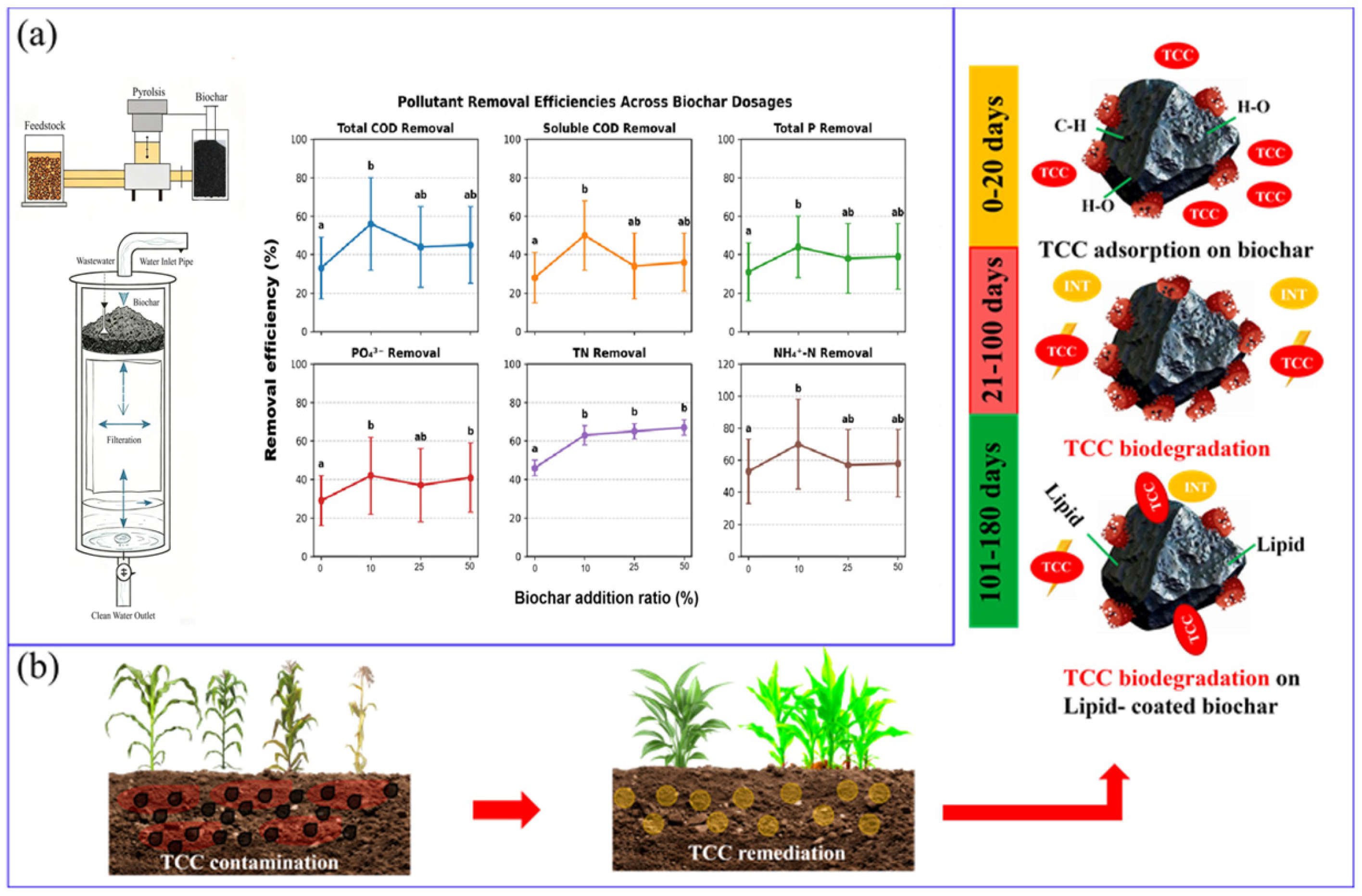
El Barkaoui S. et al. [89] used lab-scale column filtration systems to evaluate the performance of biochar-based filtration systems for wastewater treatment, incorporating biochar at 0%, 10%, 25%, and 50%. Biochar produced from exhausted olive pomace (temperature 590 °C, time 2 h, heating rate 10 °C min−1) significantly enhanced the pollutant removal. The total removal efficiencies were 64–65% for nitrogen, 75–77% for Kjeldahl nitrogen, 39–44% for phosphorus, 78–87% for organic nitrogen, 44–56% for total chemical oxygen demand, and 33–51% for chemical oxygen demand. Meanwhile, 57–69% for NH4+-N, 38–42% for PO43−, and 87–92% for total suspended solids were observed. Microbial indicators including total and fecal coliforms, fecal streptococci, Staphylococcus, and total aerobic mesophilic flora were most effectively removed at a biochar addition rate of 10%. This study concluded that a low biochar content (10%) provides optimal wastewater treatment performance and economic feasibility (Figure 11a).
Jenjaiwit S. et al. [91] investigated the removal of triclocarban (TCC), an emerging endocrine disruptor, from municipally treated wastewater. Pseudomonas fluorescens MC46 was identified as an effective TCC-degrading bacterium for wastewater treatment. The study evaluated microbial cells immobilized on waste biochar (derived from wood vinegar production) as a highly effective advanced wastewater treatment unit for TCC removal. Wastewater samples were treated using biochar alone, cell-immobilized biochar, and free bacterial cells, under batch (short-term) and semi-batch (long-term) operational modes. In the semi-batch system, cell-immobilized biochar achieved high TCC removal efficiency (up to 65%). Furthermore, reused cell-immobilized biochar exhibited more stable TCC removal performance than biochar alone and free MC46 cells. Sonsuphab K. et al. [90] also investigated the remediation of TCC-contaminated water using biochar-immobilized bacterial cells. After long-term operation (160 days), TCC removal performance was significantly improved. The TCC removal efficiency of biochar-immobilized cells reached 84–97%, whereas degradation by free Pseudomonas fluorescens strain MC46 was 76–94%. MC46 produced extracellular polymeric substances (EPSs), which enhanced TCC adsorption. Cell shrinkage further improved TCC resistance, contributing to effective water detoxification. However, after 100 days of operation, detachment of MC46 cells from the immobilized cell column was observed. The study concluded that emerging contaminants such as TCC can be removed efficiently and economically in a manner consistent with sustainable development through the value-added utilization of waste materials (Figure 11b). High surface area and functional groups lead to biochar providing effective heavy-metal and organic pollutant removal, while biochar-amended systems and immobilized microbes enhance the long-term wastewater treatment efficiency.

4.3. Nutrient Management and Greenhouse Gas Mitigation

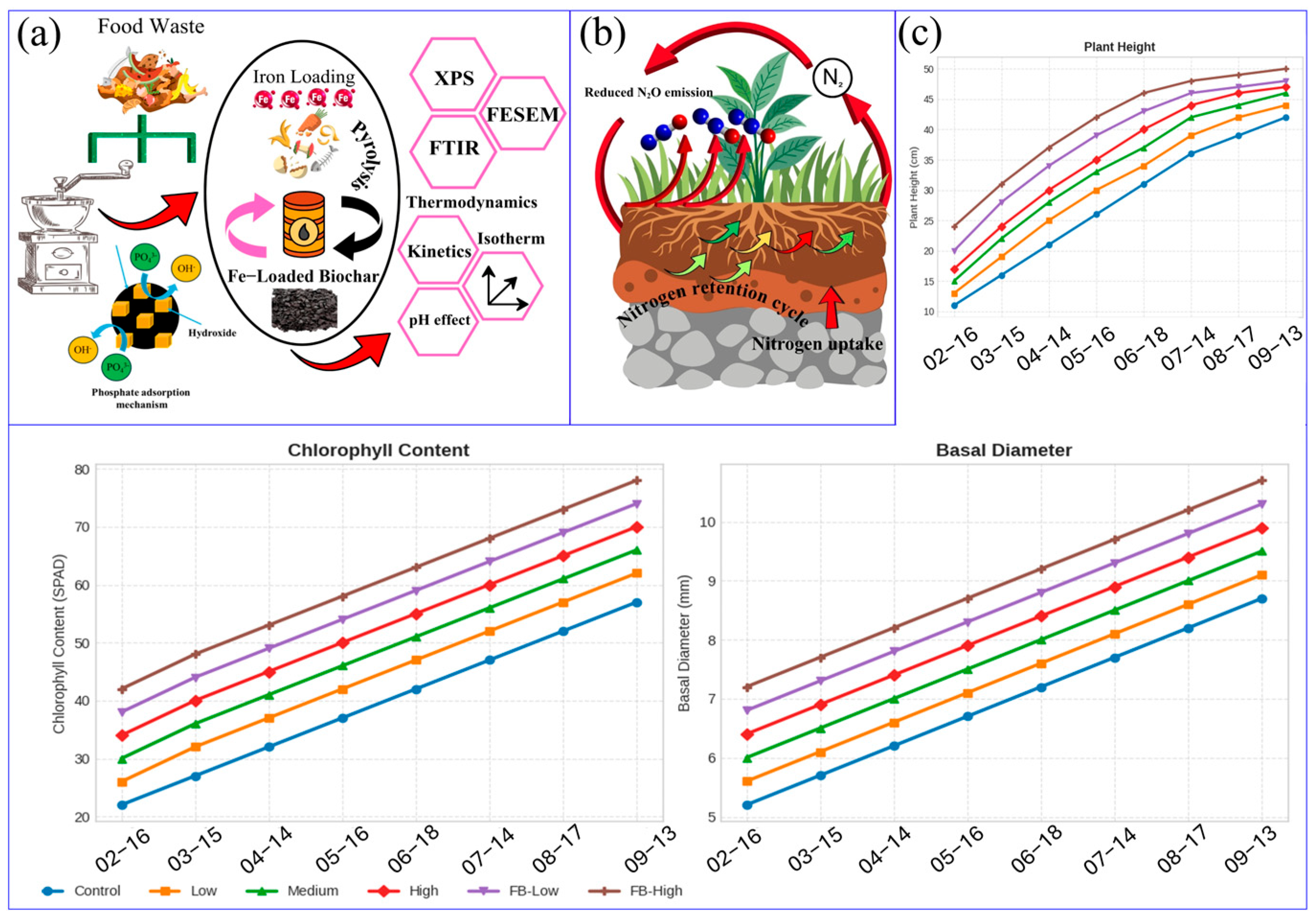
Modified chars have shown enhanced nutrient adsorption capabilities, making them promising materials for nutrient management and emission control strategies. In a study by Kang J.K. et al. [92] synthesized Fe-loaded food waste biochar (Fe-FWB) via blending food waste with Fe (0.1, 0.3, and 0.5 M) and optimized the pyrolysis time and temperature (2–4 h, and 300–600 °C) using the response surface methodology. Phosphate uptake followed pseudo-second-order and Elovich kinetic models, indicating diffusion and surface-controlled sorption. Phosphate adsorption was better described by Freundlich and Redlich–Peterson isotherms than the Langmuir model. Thermodynamic analysis revealed positive ΔG0 values, indicating non-spontaneous adsorption, while positive ΔH0 and ΔS0 values confirmed an endothermic and entropy-driven process. Phosphate adsorption decreased as the pH increased from 3 to 11 and was inhabited by coexisting anions (HCO3, SO42−, and NO3), demonstrating the potential of Fe-FWB as a sustainable adsorbent for phosphate removal (Figure 12a). Liao X. et al. [93] applied three-year aged biochar at 12 t/ha on sandy loam soil in the North China Plain. This study influenced fertilizer nitrogen retention and N2O emissions during the maize growing season. According to the results, maize took up roughly 25.6–26.2% of the applied urea nitrogen as 15N-labeled urea in microplots, while biochar had no noticeable impact on the crop yield or overall fertilizer nitrogen recovery. In the top 40 cm of soil, the residual fertilizer nitrogen was similar between treatments (around 20–22%), while biochar increased the retention by about 10% in the surface 0–20 cm layer and reduced it by 37% in the 20–40 cm layer. Noticeably, N2O emissions dropped from 2.06 to 1.89 kg N ha−1 and fertilizer-derived N2O from 0.78 to 0.74 kg N ha−1 with biochar addition. Fertilizer nitrogen contributed 38–39% of the total N2O, while priming soil organic nitrogen mineralization accounted for 34% under control conditions and 30% with biochar (Figure 12b).
Zhang C. et al. [94] evaluated the effects of biochar amendment (0, 2, 4, and 6 kg m−2) on nitrogen (N) and phosphorus (P) loss in barren karst yellow soil using indoor leaching simulations and field runoff observations under different rainfall intensities. The impact of biochar application on oil peony growth was further assessed through comparative growth experiments. Biochar application increased the soil pH, total N, total P, and available nutrients while reducing nutrient leaching, with 2 kg m−2 achieving the lowest losses of TP, TN, nitrate N, and ammonium N in leachate. Under natural rainfall, 4 kg m−2 biochar most effectively reduced the TP, TN, and ammonium N losses in surface runoff, whereas the nitrate N loss remained high under rainstorm, heavy, and moderate rainfall events. Biochar at 4 kg m−2 (fertilized soil) and 6 kg m−2 (unfertilized soil) most effectively enhanced the plant height, basal diameter, leaf SPAD, and tissue N and P contents, demonstrating that biochar improves soil fertility, mitigates N and P losses, and promotes oil peony growth in karst systems (Figure 12c). Zhao Y. et al. [95] conducted a two-year experiment on biochar for the reduction of pollutants in agricultural runoff at various temperatures (350–650 °C) for the enhancement of soil fertility. The results show that the biochar significantly reduced the concentrations of total nitrogen and total phosphorus in farmland runoff. Among rice-straw-based biochar (RB350 °C, and RB650 °C), RB650 exhibited the best performance, with total reductions of nitrogen and phosphorus output loads by 29.31–30.67% and 21.92–25.21%, respectively. Higher-temperature biochar is more conducive to the accumulation of soil nutrients. This was accompanied by higher soil organic matter; increased nutrient availability; and significant (p < 0.05) increases in pH, organic matter, total nitrogen, and total phosphorus in the second year after biochar application. In a recent study by Brtnicky M. et al. [96], all soil amendments positively influenced soil health parameters, including soil enzymes and basal and substrate-induced respiration, leading to enhanced nutrient-acquiring enzymes (C, N, and P), improved soil fertility, and increased lettuce biomass. Although the plant nutrient content was largely determined by mineral fertilization, activated biochar also contributed to higher nutrient accumulation in the biomass. Modified biochar improves nutrient retention, reduces nitrogen and phosphorus losses, and lower N2O emissions, supporting sustainable soil and climate management.

4.4. Energy Production

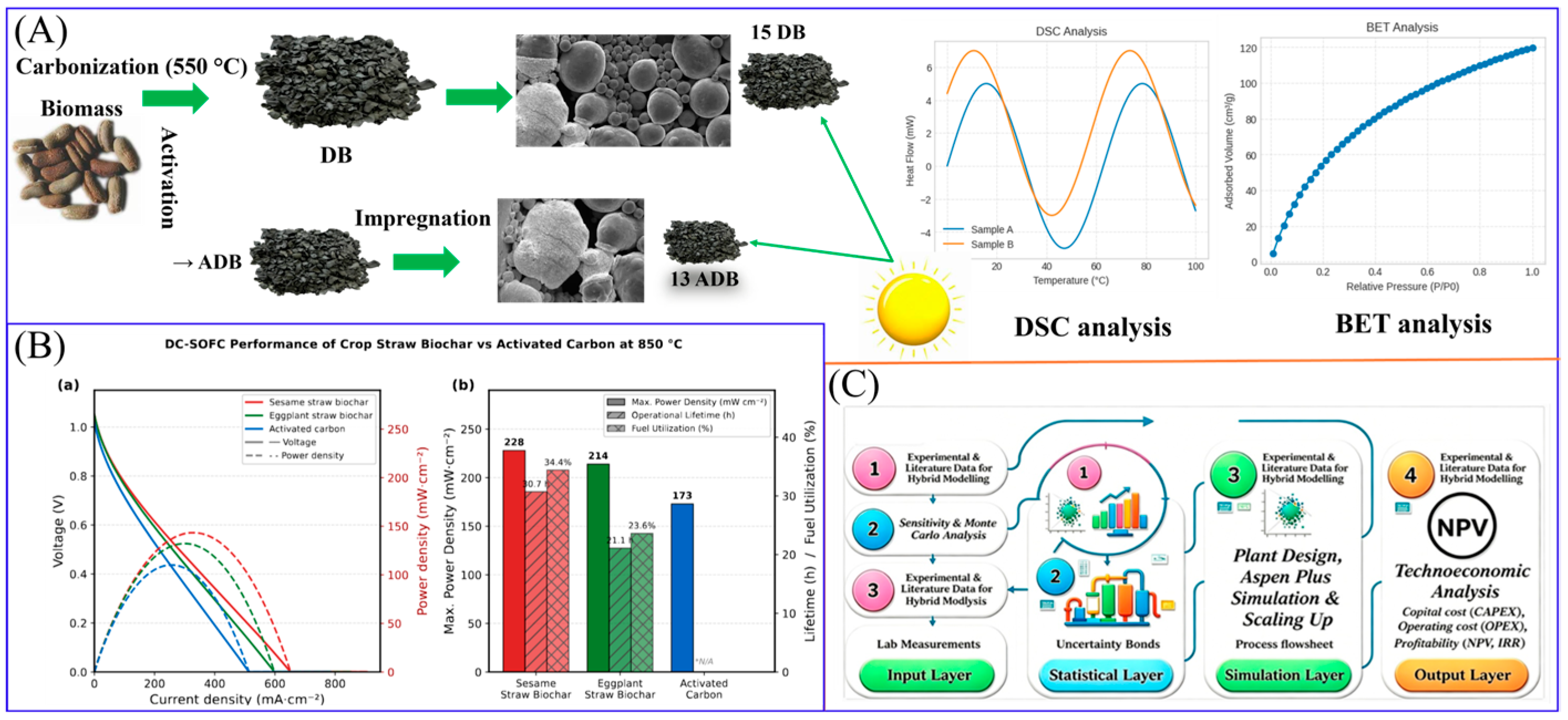
The utilization of biochar as a support material in energy production and storage systems has emerged as a promising strategy to enhance thermal performance. Gowthami D. et al. [97] developed leak-resistant form-stable phase-change materials (FSPCMs) for solar energy storage using date seed biochar as a porous support matrix. Date seed biochar (DB) and chemically activated biochar (ADB) were prepared via pyrolysis at 550 °C, exhibiting BET surface areas of 82 and 197 m2/g, respectively. Both chars were used to encapsulate eutectic phase-change material (PA-PEG6000), with ADB showing a higher PCM loading capacity due to its larger surface area. The physical integration of biochar and PCM was confirmed by FTIR, XRD, and FESEM analyses. The ADB/PA-PEG6000 composite exhibited a higher latent heat (210.51 J/g) and melting temperature (56.4 °C) than the DB-based composite (202.43 J/g, 55.3 °C), while maintaining thermal and chemical stability over 500 thermal cycles, demonstrating strong potential for solar water- and air-heating applications (Figure 13A).
Patwa D. et al. [98] optimized biochar production for engineered thermal backfill applications in crude oil pipelines designed for 25–50 years of service life. Water hyacinth and sugarcane bagasse feedstocks were used to produce biochar via pyrolysis at 300–700 °C. The biochar was then evaluated for thermal conductivity, energy consumption, yield, and soil stability. The thermal conductivity of all samples ranged narrowly between 0.10 and 0.13 W m−1 K−1, which implies that the pyrolysis temperature has a limited effect on the heat insulation performance. The lowest energy consumption and highest yield were obtained for biochar produced at 300 °C, while it exhibited insufficient carbon stability in soil. A higher energy efficiency of 60% was achieved at 400 °C among all temperatures while meeting the stability requirements for long-term thermal backfill applications.
Figure 13. (A) Form-stable phase-change materials based on activated date seed biochar for solar thermal energy storage; reproduced with permission from [97]. (B) Current–voltage and current–power density curves (a), with performance comparison of DC-SOFCs powered by different carbon fuels (b); reproduced with permission from [99]. (C) Techno-economic and sensitivity analysis of a biochar-based slurry fuel production plant; reproduced with permission from [100]. Note: Figure enhanced via AI (Gemini 3 Pro, April 2026). Final content is author-validated.
Sustainability 18 05865 g013
Miao K. et al. [99] evaluated crop-straw-derived biochar from sesame and eggplant straw as fuels for direct carbon solid oxide fuel cells (DC-SOFCs) at 850 °C. The sesame straw biochar achieved a maximum power density of 228 mW cm−2 and an operational lifetime of 30.7 h with 34.4% fuel utilization at 50 mA, while eggplant straw biochar delivered 214 mW cm−2, a 21.1 h lifetime, and 23.6% fuel utilization, both outperformed activated carbon (173 mW cm−2). The enhanced DC-SOFC performance was attributed to the porous structure, higher surface area, disordered carbon, and inherent metal catalysts of biochar, which promoted the reverse Boudouard reaction and improved the cell stability and efficiency (Figure 13B). Zepeda L.C. et al. [100] assessed the economic feasibility of producing biochar-based slurry fuels from rice straw at processing capacities of 10 and 40 t h−1. For slurries containing 40 wt% biochar, the minimum selling prices of water-based (CS-W100) and ethanol-based (CS-E100) fuels were A$ 0.07 and A$ 0.052 MJ−1, respectively, with the most cost-effective scenario achieved at 40 t h−1 producing CS-E100 at A$ 1434.30 t−1 (A$ 0.052 MJ−1). A sensitivity analysis showed that increasing CS-E100 prices to A$ 1476.04 and A$ 1566.63 t−1 resulted in payback periods of 14 and 8 years and internal rates of return of 14% and 22%, respectively. A Monte Carlo analysis indicated 74.73% and 98.79% probabilities of positive net present value (A$ 44.44 and 140.90 million), demonstrating the potential of biochar slurry fuels as economically viable waste to energy solutions (Figure 13C). Uddin M.M. et al. [101] assessed the economic and environmental benefits of adding corn stover biochar to anaerobic digestion for renewable natural gas (RNG) production from beef manure. Process modeling showed that biochar increased the biogas yield and reduced the minimum RNG selling price by 15%, with additional reductions of up to 22% when digestate revenue and Renewable Identification Number (RIN) credits were included. Life cycle assessment indicated a 32% decrease in greenhouse gas emissions, mainly due to avoided manure emissions and carbon sequestration when biochar-amended digestate was applied to soil. Tsui T.H. et al. [102] examined biochar-enabled direct interspecies electron transfer (DIET), showing it can improve the sustainability of anaerobic digestion by reducing hydrogen sulfide formation in sulfur-rich wastes. Reactor experiments showed that biochar redirected about 26.6% of electrons from sulfide production to methane generation without suppressing sulfate-reducing bacteria. Life cycle assessment further highlighted the environmental benefits of this electron diversion for biogas desulfurization and bioenergy recovery, underscoring biochar role in enhancing AD efficiency and sustainability. In short biochar enhances energy storage, fuel cells, and waste-to-energy systems via its porosity, stability, and catalytic properties.

4.5. Carbon Sequestration and Climate Change Mitigation

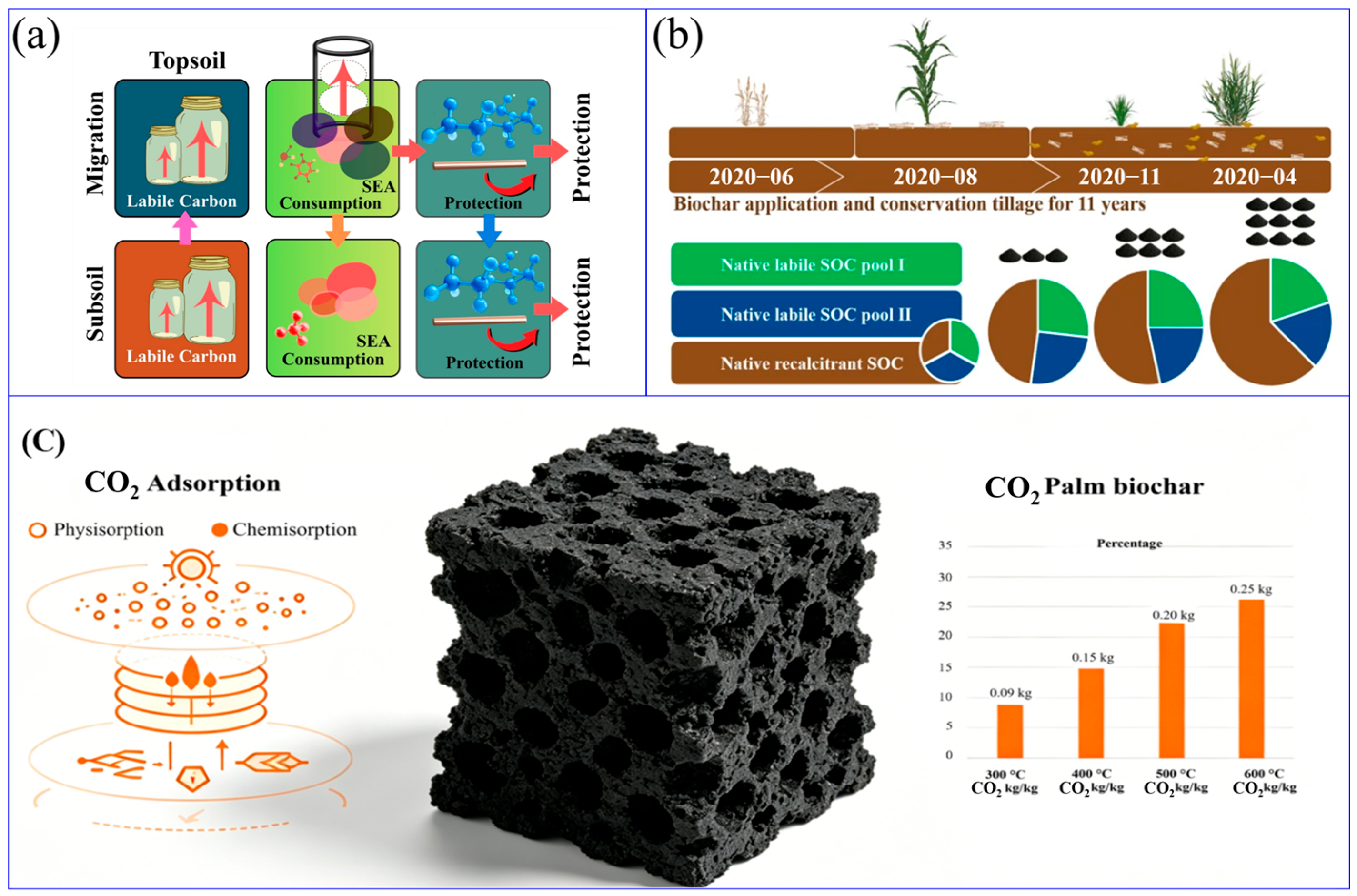
The long-term stability of biochar carbon in soils positions it as an effective tool for carbon sequestration and climate change mitigation. One of the primary advantages of biochar in climate change mitigation is its ability to sequester carbon durably within soil environments. The global potential for biochar-mediated carbon sequestration is substantial. Current estimates suggest that widespread biochar application could offset 12% of global anthropogenic greenhouse gas emissions, equivalent to approximately 1.8 Gt CO2 per year [103]. Wang Y. et al. [104] conducted decade-long field experiments and showed that applying biochar to calcareous farmland topsoil increased the soil organic carbon (SOC) by 33%. Subsoil DOC contents were increased by 162%, while a 5% increase in dissolved organic carbon (DOC) content was observed in the topsoil. A 24% increment in humic substances was observed in the topsoil and a 142% increase in molecular-weight water-extracted DOC in the subsoil. The application of biochar significantly increased the contents of SOC, DOC, and microbial biomass carbon (MBC) in the topsoil, as well as SOC and DOC contents in the subsoil. However, a slight decrease was observed in the MBC content in the subsoil. Biochar-amended soil significantly suppressed enzyme activity in the topsoil and decreased α diversity in both the topsoil and subsoil, while increasing the content of mineral-associated soil organic matter (MAOM) (Figure 14a). Ding X. et al. [105] reported an 11-year field experiment to evaluate biochar application rates of 0, 30, 60, and 90 Mg ha−1 on native soil organic carbon (SOC) fractions and microbial activity in calcareous soil under a winter wheat–maize rotation. After 11 years, 39–51% of the applied biochar remained in the top 0–30 cm soil layer. Biochar increased the native SOC and recalcitrant SOC contents but reduced the proportion of native labile SOC pools I and II, dissolved organic carbon, and microbial biomass carbon. Higher biochar rates (60 and 90 Mg ha−1) significantly increased the C4-derived CO2 contribution to soil basal respiration and enhanced native SOC mineralization, with effects confined to the 0–15 cm layer. Soil depth increased the labile SOC pools and reduced the metabolic quotient (qCO2), indicating that the biochar rate and soil depth jointly regulate long-term SOC turnover and sequestration (Figure 14b). Guo F. et al. [106] investigated the effects of a 7-year biochar application on native soil organic carbon (n-SOC) dynamics in woodland, lawn, and greenhouse soils. After 7 years, 67.12%, 87.50%, and 88.13% of the applied biochar remained in woodland, lawn, and greenhouse soils, respectively. Biochar increased n-SOC by 2.07, 3.07, and 0.22 times in the three ecosystems, primarily through enhancement of the native humin content. Biochar increased large aggregate proportions and aggregate-associated total SOC in woodland and lawn soils, while only increasing aggregate SOC in greenhouse soil without altering aggregate distribution. Native easily oxidizable carbon and microbial biomass carbon increased across all soils; however, elevated microbial biomass in woodland and lawn soils accelerated hot-water-extractable organic carbon depletion and CO2 emissions. Biochar reduced microbial respiration quotient (qCO2) in woodland and greenhouse soils but had no effect on lawn soil, while the carbon use efficiency declined in lawn soil due to reduced fungal-to-bacterial ratios.
Salem I.B. et al. [107] evaluated the potential use of date palm leaf biochar for CO2 capture and sequestration for climate change. They used different pyrolysis temperatures from 300 to 600 °C, with an increment of 100 °C at each step. The physicochemical characteristics of the synthesized biochar were examined through advanced techniques. According to the results, date palm biochar as a porous carbon-based material exhibited high CO2 adsorption capacity through physisorption and chemisorption progressions. The CO2 capture percentage increased with pyrolysis temperature, with 0.09 kg, 0.15 kg, 0.20 kg, and 0.25 kg CO2/kg palm biochar synthesized at 300, 400, 500, and 600 °C, respectively (Figure 14c).
Biochar application reduces net greenhouse gas emissions from soil through multiple mechanisms, effectively enhancing the climate mitigation benefit beyond direct carbon sequestration. Biochar significantly reduces nitrous oxide (N2O) emissions of greenhouse gas, which is 300 times more potent than CO2, by 12–84% depending on application rate, soil type, and environmental conditions [108]. While biochar sequestration aims to stabilize atmospheric carbon captured by plants, the literature shows that it does not create a perfectly closed carbon loop. During pyrolysis, a large part of the biomass carbon is lost as CO2, CO, and CH4 [109]. Even though biochar carbon stays in the soil much longer than raw biomass (about 74% remains after 100 years), it still slowly breaks down over centuries [110,111]. Therefore, biochar is better described as a negative-emission technology whose real effectiveness depends on minimizing emissions during production and using low-carbon energy. Table 2 provides experimental applications of biochar in environmental and energy systems, highlighting the sources, target applications, measured performance metrics, and the main benefits observed. Only studies with quantified experimental results are included.

5. Conclusions

This review synthesizes a decade of advances (2017–2026) in biochar production and applications, highlighting that its performance can be strategically engineered through feedstock choice and pyrolysis conditions. Key findings indicate that agricultural residues yield oxygen-rich, functional material ideal for nutrient retention and soil amendment, while woody biomass produces stable, aromatic char suitable for long-term carbon sequestration and CO2 capture. Manure- and sludge-derived chars offer high alkalinity and cation exchange capacity, which is beneficial for fertilization and wastewater treatment, though with trade-offs in stability.
Low-temperature products (300–400 °C) excel at heavy-metal complexation and cation exchange. Intermediate temperatures (400–600 °C) balance stability and reactivity for agricultural and wastewater applications. High-temperature chars (>600 °C) deliver superior aromaticity, surface area, and long-term recalcitrance for carbon sequestration, catalysis, and energy systems. Surface area, porosity, functional groups, ash content, and pH collectively govern sorption mechanisms and biomass degradation.
Despite significant progress, inherent trade-offs remain. High-temperature chars exhibit reduced surface functionality and lower CEC, limiting nutrient retention and certain metal complexations. Low-temperature products retain abundant functional groups and high CEC but decompose faster, constraining long-term sequestration potential. Excessive ash and alkalinity, particularly in manure- and sludge-derived materials, can be advantageous for acidic soil remediation but may induce salinity stress or operational issues in electrochemical systems. Activation and doping strategies enhance the performance but increase the cost, complexity, and scalability concerns. These findings underscore that no single approach is universally optimal, and performance is strongly application-specific.
Future research should prioritize application-specific design rather than generic production. Targeted studies are needed to optimize pH-dependent biomass degradation. Alkaline high-temperature chars could be engineered to accelerate lignocellulosic breakdown in anaerobic digestion or composting while minimizing nutrient loss. Moderate-temperature products with preserved functional groups may support controlled microbial and enzymatic activity for balanced decomposition and nutrient mineralization. Additional priorities include standardized, comparative experiments across feedstocks and pyrolysis conditions, long-term field trials evaluating carbon stability and microbial effects, techno-economic and life-cycle assessments of scalable production, and development of hybrid or co-engineered materials (e.g., with microbes or mineral amendments) to overcome single-temperature limitations. Addressing these gaps through controlled, application-oriented approaches is essential to translate laboratory advances into reliable, sustainable technologies for environmental remediation, energy production, and climate mitigation.

Author Contributions

A.A.: Conceptualization, methodology, software, validation, formal analysis, data curation, and writing—original draft preparation; S.A.: software, validation, formal analysis, data curation, and writing—original draft preparation; M.W. and M.A.: formal analysis, data curation, visualization, and writing—review and editing; D.X.: supervision, project administration, funding acquisition, and writing—review and editing. All authors have read and agreed to the published version of the manuscript.

Funding

This work was supported by the Major Program of Natural Science Foundation for Higher Education Institutions of Anhui Province (2024AH040021).

Institutional Review Board Statement

Not applicable.

Informed Consent Statement

Not applicable.

Data Availability Statement

The original contributions presented in this study are included in the article. Further inquiries can be directed to the corresponding author.

Acknowledgments

The authors acknowledge the use of Gemini 3 Pro (April, 2026) for the visual enhancement of the Graphical Abstract, Figure 1, Figure 2, Figure 5, Figure 9, Figure 11, Figure 12, Figure 13 and Figure 14. All final content was reviewed and validated by the authors.

Conflicts of Interest

The authors have no relevant financial or non-financial interests to disclose.

Abbreviations

BCBiocharSSASpecific surface area
CECCation exchange capacityGHGGreenhouse gas
ADBActivated date seed biocharADAnaerobic digestion
DBDate seed biocharDC-SOFCDirect carbon solid oxide fuel cell
OCFGsOxygen-containing functional groupsPCMPhase-change material
pHpzcpH at the point of zero chargeRINRenewable Identification Number
SOCSoil organic carbonTOCTotal organic carbon
BETBrunauer–Emmett–TellerFTIRFourier-transform infrared
XPSX-ray photoelectron spectroscopySEMScanning electron microscopy
MIPMercury intrusion porosimetryGBRGradient-boosting regression
RSMResponse surface methodologyIPCCIntergovernmental Panel on Climate Change
MAOMMineral-associated organic matterqCO2Metabolic quotient
DIETDirect interspecies electron transferFSPCMForm-stable phase-change material
ECElectrical conductivity
TPPThermal plasma pyrolysisMWPMicrowave-assisted pyrolysis

References

  1. Thamarai, P.; Deivayanai, V.; Saravanan, A.; Vickram, A.; Yaashikaa, P. Carbon mitigation in agriculture: Pioneering technologies for a sustainable food system. Trends Food Sci. Technol. 2024, 147, 104477. [Google Scholar] [CrossRef]
  2. Lal, R. Soil carbon sequestration impacts on global climate change and food security. Science 2004, 304, 1623–1627. [Google Scholar] [CrossRef] [PubMed]
  3. Gebremedhin, M.; Coyne, M.S.; Sistani, K.R. How much margin is left for degrading agricultural soils? The coming soil crises. Soil Syst. 2022, 6, 22. [Google Scholar] [CrossRef]
  4. Waidelich, P.; Batibeniz, F.; Rising, J.; Kikstra, J.S.; Seneviratne, S.I. Climate damage projections beyond annual temperature. Nat. Clim. Change 2024, 14, 592–599. [Google Scholar] [CrossRef]
  5. Jafino, B.A.; Walsh, B.; Rozenberg, J.; Hallegatte, S. Revised Estimates of the Impact of Climate Change on Extreme Poverty by 2030; World Bank: Washington, DC, USA, 2020. [Google Scholar]
  6. Praveen, B.; Sharma, P. A review of literature on climate change and its impacts on agriculture productivity. J. Public Aff. 2019, 19, e1960. [Google Scholar] [CrossRef]
  7. Leong, Y.K.; Chang, J.-S. Microalgae-based biochar production and applications: A comprehensive review. Bioresour. Technol. 2023, 389, 129782. [Google Scholar] [CrossRef]
  8. Sun, L.M.; McIntyre, S.R.; Iacomi, P.; Everden, K.; Williams, P.T.; Zong, S.; Liu, X.; Zhu, X.; Yang, Y.; Li, S.; et al. Biochar production, activation, and applications: A comprehensive technical review. Carbon Capture Sci. Technol. 2025, 16, 100421. [Google Scholar] [CrossRef]
  9. Yuan, Y.; Liu, Q.; Zheng, H.; Li, M.; Liu, Y.; Wang, X.; Peng, Y.; Luo, X.; Li, F.; Li, X.; et al. Biochar as a sustainable tool for improving the health of salt-affected soils. Soil Environ. Health 2023, 1, 100033. [Google Scholar] [CrossRef]
  10. Gonçalves, M.A.F.; da Silva, B.R.S.; Nobre, J.R.C.; Batista, B.L.; Lobato, A.K.d.S. Biochar mitigates the harmful effects of drought in Soybean through changes in leaf development, stomatal regulation, and gas exchange. J. Soil Sci. Plant Nutr. 2024, 24, 1940–1951. [Google Scholar] [CrossRef]
  11. Bhattacharyya, P.N.; Sandilya, S.P.; Sarma, B.; Pandey, A.K.; Dutta, J.; Mahanta, K.; Lesueur, D.; Nath, B.C.; Borah, D.; Borgohain, D.J. Biochar as soil amendment in climate-smart agriculture: Opportunities, future prospects, and challenges. J. Soil Sci. Plant Nutr. 2024, 24, 135–158. [Google Scholar] [CrossRef]
  12. Soares de Souza, D.C.; Vieira de Assis Freire, J.; Fernandes da Silva, L.; Pinheiro da Silva, P.; de Sousa Antunes, L.F.; de Luna Souto, A.G.; Valença, R.D.; Fernandes, B.C.C.; de Oliveira Lima, A.E.; Santos, J.C.S.D.; et al. Carbon Sequestration with Biochar: Global Trends, Knowledge Gaps, and Future Directions. ACS ES&T Water 2025, 5, 6479–6502. [Google Scholar] [CrossRef]
  13. Azzi, E.S.; Li, H.; Cederlund, H.; Karltun, E.; Sundberg, C. Modelling biochar long-term carbon storage in soil with harmonized analysis of decomposition data. Geoderma 2024, 441, 116761. [Google Scholar] [CrossRef]
  14. Hasan, M.; Chakma, S.; Liang, X.; Sutradhar, S.; Kozinski, J.; Kang, K. Engineered Biochar for Metal Recycling and Repurposed Applications. Energies 2024, 17, 4674. [Google Scholar] [CrossRef]
  15. Abhishek, K.; Shrivastava, A.; Vimal, V.; Gupta, A.K.; Bhujbal, S.K.; Biswas, J.K.; Singh, L.; Ghosh, P.; Pandey, A.; Sharma, P.; et al. Biochar application for greenhouse gas mitigation, contaminants immobilization and soil fertility enhancement: A state-of-the-art review. Sci. Total Environ. 2022, 853, 158562. [Google Scholar] [CrossRef] [PubMed]
  16. Tu, P.; Zhang, G.; Wei, G.; Li, J.; Li, Y.; Deng, L.; Yuan, H. Influence of pyrolysis temperature on the physicochemical properties of biochars obtained from herbaceous and woody plants. Bioresour. Bioprocess. 2022, 9, 131. [Google Scholar] [CrossRef]
  17. Sathyabama, K.; Firdous, S. Effect of pyrolysis temperature on the physicochemical properties and structural characteristics of agricultural wastes-derived biochar. ACS Omega 2025, 10, 37013–37024. [Google Scholar] [CrossRef]
  18. Ali, L.; Palamanit, A.; Techato, K.; Ullah, A.; Chowdhury, S.; Phoungthong, K. Characteristics of biochars derived from the pyrolysis and co-pyrolysis of rubberwood sawdust and sewage sludge for further applications. Sustainability 2022, 14, 3829. [Google Scholar] [CrossRef]
  19. Sahoo, S.S.; Vijay, V.K.; Chandra, R.; Kumar, H. Production and characterization of biochar produced from slow pyrolysis of pigeon pea stalk and bamboo. Clean. Eng. Technol. 2021, 3, 100101. [Google Scholar] [CrossRef]
  20. Pariyar, P.; Kumari, K.; Jain, M.K.; Jadhao, P.S. Evaluation of change in biochar properties derived from different feedstock and pyrolysis temperature for environmental and agricultural application. Sci. Total Environ. 2020, 713, 136433. [Google Scholar] [CrossRef]
  21. Jiang, T.-J.; Morgan, H.M.; Tsai, W.-T. Optimization of Vertical Fixed-Bed Pyrolysis for Enhanced Biochar Production from Diverse Agricultural Residues. Materials 2024, 17, 3030. [Google Scholar] [CrossRef]
  22. Shakerizadeh, S.; Mobasherpour, I.; Salahi, E.; Razavi, M.; Sabzehmeidani, M.M.; Takalo, M. Platanus orientalis L. leaves residue-derived biochar: Investigating the effects of synthesis temperature. Biomass-Convers. Biorefinery 2025, 15, 15305–15310. [Google Scholar] [CrossRef]
  23. Behnam, H.; Firouzi, A.F. Effects of synthesis method, feedstock type, and pyrolysis temperature on physicochemical properties of biochar nanoparticles. Biomass-Convers. Biorefinery 2023, 13, 13859–13869. [Google Scholar] [CrossRef]
  24. Pidlisnyuk, V.; Herts, A.; Kononchuk, O.; Khomenchuk, V.; Horyn, O.; Markiv, V.; Mamirova, A. Comprehensive study of biochars from different vegetative feedstocks: Influence on soil properties and development of Zea mays L. Environ. Sci. Eur. 2025, 37, 77. [Google Scholar] [CrossRef]
  25. Chaudhary, H.; Dinakaran, J.; Rao, K.S. Comparative analysis of biochar production methods and their impacts on biochar physico-chemical properties and adsorption of heavy metals. J. Environ. Chem. Eng. 2024, 12, 113003. [Google Scholar] [CrossRef]
  26. Birhanu, A.; Hailu, A.M.; Worku, Z.; Tessema, I.; Angassa, K.; Tibebu, S. Optimization of pyrolysis conditions for Catha edulis waste-based biochar production using response surface methodology. Bioresour. Bioprocess. 2025, 12, 62. [Google Scholar] [CrossRef]
  27. Sait, H.H.; Kanthasamy, R.; Ayodele, B.V. Hybrid Analysis of Biochar Production from Pyrolysis of Agriculture Waste Using Statistical and Artificial Intelligent-Based Modeling Techniques. Agronomy 2025, 15, 181. [Google Scholar] [CrossRef]
  28. Suliman, W.; Harsh, J.B.; Abu-Lail, N.I.; Fortuna, A.-M.; Dallmeyer, I.; Garcia-Perez, M. Influence of feedstock source and pyrolysis temperature on biochar bulk and surface properties. Biomass-Bioenergy 2016, 84, 37–48. [Google Scholar] [CrossRef]
  29. Song, S.; Cong, P.; Wang, C.; Li, P.; Liu, S.; He, Z.; Zhou, C.; Liu, Y.; Yang, Z. Properties of biochar obtained from tropical crop wastes under different pyrolysis temperatures and its application on acidic soil. Agronomy 2023, 13, 921. [Google Scholar] [CrossRef]
  30. Ghorbani, M.; Amirahmadi, E.; Bernas, J.; Bárta, J. From Feedstock to Function: How Pyrolysis and Oxidation Shape Biochar Performance in Soil–Plant Interactions. Plants 2025, 14, 3278. [Google Scholar] [CrossRef]
  31. Zhang, J.; Huang, B.; Chen, L.; Li, Y.; Li, W.; Luo, Z. Characteristics of biochar produced from yak manure at different pyrolysis temperatures and its effects on the yield and growth of highland barley. Chem. Speciat. Bioavailab. 2018, 30, 57–67. [Google Scholar] [CrossRef]
  32. Sarfraz, R.; Li, S.; Yang, W.; Zhou, B.; Xing, S. Assessment of physicochemical and nutritional characteristics of waste mushroom substrate biochar under various pyrolysis temperatures and times. Sustainability 2019, 11, 277. [Google Scholar] [CrossRef]
  33. Tsantopoulos, G.; Karasmanaki, E. Energy Transition and Climate Change in Decision-Making Processes. Sustainability 2021, 13, 13404. [Google Scholar] [CrossRef]
  34. Cowie, A.; Azzi, E.; Weng, Z.H.; Woolf, D. Biochar, greenhouse gas accounting, and climate change mitigation. In Biochar for Environmental Management; Routledge: Oxfordshire, UK, 2024; pp. 759–784. [Google Scholar]
  35. Matthews, H.D.; Zickfeld, K.; Dickau, M.; MacIsaac, A.J.; Mathesius, S.; Nzotungicimpaye, C.-M.; Luers, A. Temporary nature-based carbon removal can lower peak warming in a well-below 2 °C scenario. Commun. Earth Environ. 2022, 3, 65. [Google Scholar] [CrossRef]
  36. Jamal, M.U.; Fletcher, A.J. Design of experiments study on Scottish wood biochars and process parameter influence on final biochar characteristics. BioEnergy Res. 2023, 16, 2342–2355. [Google Scholar] [CrossRef]
  37. Nyoni, K.; Kelebopile, L. Multivariate optimization of pyrolysis process parameters for bi-ochar production derived from demineralized poultry litter us-ing response surface methodology. Paliva 2023, 15, 101–115. [Google Scholar] [CrossRef]
  38. Ola, F.; Jekayinfa, S. Pyrolysis of sandbox (Hura crepitans) shell: Effect of pyrolysis parameters on biochar yield. Res. Agric. Eng. 2015, 61, 170–176. [Google Scholar] [CrossRef]
  39. Selvarajoo, A.; Wong, Y.L.; Khoo, K.S.; Chen, W.-H.; Show, P.L. Biochar production via pyrolysis of citrus peel fruit waste as a potential usage as solid biofuel. Chemosphere 2022, 294, 133671. [Google Scholar] [CrossRef]
  40. Sarpong, A.K.; Kumi, F.; Ofori-Manfo, P.; Sewu, D.D.; Opoku, V.A.; Toku, M.; Frimpong, K.A. Biochar production, yield and quality characterization from different feedstocks and kilns. J. Anal. Appl. Pyrolysis 2025, 193, 107401. [Google Scholar] [CrossRef]
  41. Sun, Y.; Gao, B.; Yao, Y.; Fang, J.; Zhang, M.; Zhou, Y.; Chen, H.; Yang, L. Effects of feedstock type, production method, and pyrolysis temperature on biochar and hydrochar properties. Chem. Eng. J. 2014, 240, 574–578. [Google Scholar] [CrossRef]
  42. Aldana, G.O. Biochar Use for Reducing Agrochemical Leaching in Tropical Agricultural Soils. Doctoral Dissertation, Newcastle University, Newcastle upon Tyne, UK, 2020. [Google Scholar]
  43. Mariyam, S.; Alherbawi, M.; Pradhan, S.; Al-Ansari, T.; McKay, G. Biochar yield prediction using response surface methodology: Effect of fixed carbon and pyrolysis operating conditions. Biomass-Convers. Biorefinery 2024, 14, 28879–28892. [Google Scholar] [CrossRef]
  44. Yadav, K.; Jagadevan, S. Influence of Process Parameters on Synthesis of Biochar by Pyrolysis of Biomass: An Alternative Source of Energy, in Recent Advances in Pyrolysis; IntechOpen: Rijeka, Croatia, 2019. [Google Scholar]
  45. El Mashad, H.M.; Edalati, A.; Zhang, R.; Jenkins, B.M. Production and characterization of biochar from almond shells. Clean Technol. 2022, 4, 854–864. [Google Scholar] [CrossRef]
  46. Anthony, O.O.; Rotimi, I.A.; Emmanuel, A.S.A.; Ejiroghene, O.; Omoniyi, E.B.; Benjamin, A.E.; Samuel, A.J.; Kingsley, I.U. Optimization of process parameters for intermediate pyrolysis of sugarcane bagasse for biochar production using response surface methodology. In 2023 International Conference on Science, Engineering and Business for Sustainable Development Goals (SEB-SDG); IEEE: New York, NY, USA, 2023. [Google Scholar]
  47. Doti, B.; Nyaanga, D.; Nyakach, S.; Nyaanga, J.; Ingasia, O. Effect of selected pyrolysis parameters on the production and quality of biochar and pyroligneous acid from biomass. J. Eng. Agric. Environ. 2022, 8, 15–36. [Google Scholar] [CrossRef]
  48. Premchand, P.; Demichelis, F.; Chiaramonti, D.; Bensaid, S.; Fino, D. Study on the effects of carbon dioxide atmosphere on the production of biochar derived from slow pyrolysis of organic agro-urban waste. Waste Manag. 2023, 172, 308–319. [Google Scholar] [CrossRef]
  49. Shen, Q.; Wu, H. Rapid pyrolysis of biochar prepared from slow and fast pyrolysis: The effects of particle residence time on char properties. Proc. Combust. Inst. 2022, 39, 3371–3378. [Google Scholar] [CrossRef]
  50. Potnuri, R.; Rao, C.S.; Surya, D.V.; Sridevi, V.; Kulkarni, A. Two-step synthesis of biochar using torrefaction and microwave-assisted pyrolysis: Understanding the effects of torrefaction temperature and catalyst loading. J. Anal. Appl. Pyrolysis 2023, 175, 106191. [Google Scholar] [CrossRef]
  51. Qiu, T.; Cao, W.; Pan, R.; Zhao, W.; Zhang, Y. Porous Biochar Production from Microwave-Assisted Pyrolysis of Biomass. In 2024 9th International Conference on Smart and Sustainable Technologies (SpliTech); IEEE: New York, NY, USA, 2024. [Google Scholar]
  52. Khelfa, A.; Rodrigues, F.A.; Koubaa, M.; Vorobiev, E. Microwave-assisted pyrolysis of pine wood sawdust mixed with activated carbon for bio-oil and bio-char production. Processes 2020, 8, 1437. [Google Scholar] [CrossRef]
  53. Fodah, A.E.M.; Abdelwahab, T.A.M. Process optimization and technoeconomic environmental assessment of biofuel produced by solar powered microwave pyrolysis. Sci. Rep. 2022, 12, 12572. [Google Scholar] [CrossRef]
  54. Muvhiiwa, R.; Kuvarega, A.; Llana, E.M.; Muleja, A. Study of biochar from pyrolysis and gasification of wood pellets in a nitrogen plasma reactor for design of biomass processes. J. Environ. Chem. Eng. 2019, 7, 103391. [Google Scholar] [CrossRef]
  55. Tang, L.; Huang, H. Plasma pyrolysis of biomass for production of syngas and carbon adsorbent. Energy Fuels 2005, 19, 1174–1178. [Google Scholar] [CrossRef]
  56. Otoni, J.P.; Matoso, S.C.G.; Pérez, X.L.O.; da Silva, V.B. Potential for agronomic and environmental use of biochars derived from different organic waste. J. Clean. Prod. 2024, 449, 141826. [Google Scholar] [CrossRef]
  57. Muema, F.M.; Richardson, Y.; Keita, A.; Sawadogo, M. An interdisciplinary overview on biochar production engineering and its agronomic applications. Biomass-Bioenergy 2024, 190, 107416. [Google Scholar] [CrossRef]
  58. Lataf, A.; Jozefczak, M.; Vandecasteele, B.; Viaene, J.; Schreurs, S.; Carleer, R.; Yperman, J.; Marchal, W.; Cuypers, A.; Vandamme, D. The effect of pyrolysis temperature and feedstock on biochar agronomic properties. J. Anal. Appl. Pyrolysis 2022, 168, 105728. [Google Scholar] [CrossRef]
  59. Pituello, C.; Francioso, O.; Simonetti, G.; Pisi, A.; Torreggiani, A.; Berti, A.; Morari, F. Characterization of chemical–physical, structural and morphological properties of biochars from biowastes produced at different temperatures. J. Soils Sediments 2015, 15, 792–804. [Google Scholar] [CrossRef]
  60. Kuo, L.-A.; Tsai, W.-T.; Yang, R.-Y.; Tsai, J.-H. Production of high-porosity biochar from rice husk by the microwave pyrolysis process. Processes 2023, 11, 3119. [Google Scholar] [CrossRef]
  61. Li, H.; Ai, Z.; Yang, L.; Zhang, W.; Yang, Z.; Peng, H.; Leng, L. Machine learning assisted predicting and engineering specific surface area and total pore volume of biochar. Bioresour. Technol. 2023, 369, 128417. [Google Scholar] [CrossRef]
  62. Lu, S.; Zong, Y. Pore structure and environmental serves of biochars derived from different feedstocks and pyrolysis conditions. Environ. Sci. Pollut. Res. 2018, 25, 30401–30409. [Google Scholar] [CrossRef]
  63. Yang, Y.; Piao, Y.; Wang, R.; Su, Y.; Liu, N.; Lei, Y. Nonmetal function groups of biochar for pollutants removal: A review. J. Hazard. Mater. Adv. 2022, 8, 100171. [Google Scholar] [CrossRef]
  64. Chen, J.; Zhou, J.; Zheng, W.; Leng, S.; Ai, Z.; Zhang, W.; Yang, Z.; Yang, J.; Xu, Z.; Cao, J.; et al. A complete review on the oxygen-containing functional groups of biochar: Formation mechanisms, detection methods, engineering, and applications. Sci. Total Environ. 2024, 946, 174081. [Google Scholar] [CrossRef]
  65. North Carolina A & T State University; Xiu, S.; Shahbazi, A.; Li, R. Characterization, modification and application of biochar for energy storage and catalysis: A review. Trends Renew. Energy 2017, 3, 86–101. [Google Scholar] [CrossRef]
  66. Barszcz, W.; Łożyńska, M.; Molenda, J. Impact of pyrolysis process conditions on the structure of biochar obtained from apple waste. Sci. Rep. 2024, 14, 10501. [Google Scholar] [CrossRef]
  67. Luo, Q.; Deng, Y.; Li, Y.; He, Q.; Wu, H.; Fang, X. Effects of pyrolysis temperatures on the structural properties of straw biochar and its adsorption of tris-(1-chloro-2-propyl) phosphate. Sci. Rep. 2024, 14, 25711. [Google Scholar] [CrossRef]
  68. Elnour, A.Y.; Alghyamah, A.A.; Shaikh, H.M.; Poulose, A.M.; Al-Zahrani, S.M.; Anis, A.; Al-Wabel, M.I. Effect of pyrolysis temperature on biochar microstructural evolution, physicochemical characteristics, and its influence on biochar/polypropylene composites. Appl. Sci. 2019, 9, 1149. [Google Scholar] [CrossRef]
  69. Li, X.; Xu, C.; Zhu, L.; Wang, Y.; Chen, Y.; Cai, J. A Systematic Review on Modification Technology of Agricultural and Forestry Waste Biochar: From Raw Material Characteristics to Heavy Metal Adsorption Mechanisms. ChemistrySelect 2025, 10, e02585. [Google Scholar] [CrossRef]
  70. He, D.; Luo, Y.; Zhu, B. Feedstock and pyrolysis temperature influence biochar properties and its interactions with soil substances: Insights from a DFT calculation. Sci. Total Environ. 2024, 922, 171259. [Google Scholar] [CrossRef]
  71. Pantoja, F.; Beszédes, S.; Gyulavári, T.; Illés, E.; Kozma, G.; László, Z. Impact of pyrolysis temperature on the physical and chemical properties of non-modified biochar produced from banana leaves: A case study on ammonium ion adsorption. Materials 2024, 17, 3180. [Google Scholar] [CrossRef]
  72. Nguyen, L.H.; Kha, V.-P.; Van Thai, N. Sugarcane bagasse-derived biochar modified by alkali for enriching surface functional groups to effectively treat ammonium-contaminated water. Environ. Geochem. Health 2024, 46, 474. [Google Scholar] [CrossRef]
  73. Jeffery, S.; Verheijen, F.G.A.; van der Velde, M.; Bastos, A.C. A quantitative review of the effects of biochar application to soils on crop productivity using meta-analysis. Agric. Ecosyst. Environ. 2011, 144, 175–187. [Google Scholar] [CrossRef]
  74. Junior, A.; Guo, M. Efficacy of sewage sludge derived biochar on enhancing soil health and crop productivity in strongly acidic soil. Front. Soil Sci. 2023, 3, 1066547. [Google Scholar] [CrossRef]
  75. Karlvin, J.; Lik-Pueh, L.; Ai-Wie, T. Determination of suitable biochar precursor as alternative for enabling access to clean water supply in rural areas. J. Sust. Sci. Manag. 2022, 17, 66–78. [Google Scholar] [CrossRef]
  76. Zhang, L.; Jing, Y.; Chen, C.; Xiang, Y.; Rashti, M.R.; Li, Y.; Deng, Q.; Zhang, R. Effects of biochar application on soil nitrogen transformation, microbial functional genes, enzyme activity, and plant nitrogen uptake: A meta-analysis of field studies. GCB Bioenergy 2021, 13, 1859–1873. [Google Scholar] [CrossRef]
  77. Hussein, E.B.; Rasheed, F.A.; Mohammed, A.S.; Kayani, K.F. Emerging nanotechnology approaches for sustainable water treatment and heavy metals removal: A comprehensive review. RSC Adv. 2025, 15, 41061–41107. [Google Scholar] [CrossRef] [PubMed]
  78. Piscitelli, L.; Rivier, P.-A.; Mondelli, D.; Miano, T.; Joner, E.J. Assessment of addition of biochar to filtering mixtures for potential water pollutant removal. Environ. Sci. Pollut. Res. 2018, 25, 2167–2174. [Google Scholar] [CrossRef]
  79. Gao, Y.; Li, T.; Fu, Q.; Li, H.; Liu, D.; Ji, Y.; Li, Q.; Cai, Y. Biochar application for the improvement of water-soil environments and carbon emissions under freeze-thaw conditions: An in-situ field trial. Sci. Total Environ. 2020, 723, 138007. [Google Scholar] [CrossRef]
  80. Farhangi-Abriz, S.; Torabian, S.; Qin, R.; Noulas, C.; Lu, Y.; Gao, S. Biochar effects on yield of cereal and legume crops using meta-analysis. Sci. Total Environ. 2021, 775, 145869. [Google Scholar] [CrossRef]
  81. Wu, B.; Yang, H.; Li, S.; Tao, J. The effect of biochar on crop productivity and soil salinity and its dependence on experimental conditions in salt-affected soils: A meta-analysis. Carbon Res. 2024, 3, 56. [Google Scholar] [CrossRef]
  82. Han, M.; Zhang, J.; Zhang, L.; Wang, Z. Effect of biochar addition on crop yield, water and nitrogen use efficiency: A meta-analysis. J. Clean. Prod. 2023, 420, 138425. [Google Scholar] [CrossRef]
  83. Lima, J.R.d.S.; Oliveira, J.E.d.S.; Hammecker, C.; Duda, G.P.; de Medeiros, É.V.; Antonino, A.C.D.; Souza, R.M.S.; de Souza, E.S. Biochar increases soil water content and total organic carbon but has no effects on soil respiration in a Regosol of Caatinga. Rev. Bras. Geogr. Física 2020, 13, 3448–3458. [Google Scholar] [CrossRef]
  84. Shi, S.; Zhang, Q.; Lou, Y.; Du, Z.; Wang, Q.; Hu, N.; Wang, Y.; Gunina, A.; Song, J. Soil organic and inorganic carbon sequestration by consecutive biochar application: Results from a decade field experiment. Soil Use Manag. 2021, 37, 95–103. [Google Scholar] [CrossRef]
  85. Iqbal, M.; Yasir, M.; Javed, A.; Tausif, S. Comparative effects of different types of biochar on physical properties of soil and growth of maize. J. Bioresour. Manag. 2020, 7, 55–62. [Google Scholar] [CrossRef]
  86. Madari, B.E.; Silva, M.A.; Carvalho, M.T.; Maia, A.H.; Petter, F.A.; Santos, J.L.; Tsai, S.M.; Leal, W.G.; Zeviani, W.M. Properties of a sandy clay loam Haplic Ferralsol and soybean grain yield in a five-year field trial as affected by biochar amendment. Geoderma 2017, 305, 100–112. [Google Scholar] [CrossRef]
  87. Strock, J.; Ranaivoson, A.; Feyereisen, G.; Spokas, K.; Mulla, D.J.; Roser, M. Nutrient Removal in Agricultural Drainage Ditches; Minnesota Department of Agriculture: St Paul, MN, USA, 2017.
  88. Beigmohammadi, F.; Solgi, E.; Besalatpour, A.A.; Soleimani, M. Immobilization of potentially toxic elements by grape waste biochar in contaminated soils. Geoderma Reg. 2024, 39, e00900. [Google Scholar] [CrossRef]
  89. El Barkaoui, S.; Mandi, L.; Fichera, M.; Ryah, H.; Baçaoui, A.; Del Bubba, M.; Ouazzani, N. Optimizing biochar-based column filtration systems for enhanced pollutant removal in wastewater treatment: A preliminary study. Chemosphere 2025, 372, 144067. [Google Scholar] [CrossRef]
  90. Sonsuphab, K.; Toomsan, W.; Soontharo, S.; Supanchaiyamat, N.; Hunt, A.J.; Ngernyen, Y.; Nasompag, S.; Kiattisaksiri, P.; Ratpukdi, T.; Siripattanakul-Ratpukdi, S. Integrated remediation and detoxification of triclocarban-contaminated water using waste-derived biochar-immobilized cells by long-term column experiments. Environ. Pollut. 2024, 357, 124456. [Google Scholar] [CrossRef]
  91. Jenjaiwit, S.; Supanchaiyamat, N.; Hunt, A.J.; Ngernyen, Y.; Ratpukdi, T.; Siripattanakul-Ratpukdi, S. Removal of triclocarban from treated wastewater using cell-immobilized biochar as a sustainable water treatment technology. J. Clean. Prod. 2021, 320, 128919. [Google Scholar] [CrossRef]
  92. Kang, J.-K.; Seo, E.-J.; Lee, C.-G.; Park, S.-J. Fe-loaded biochar obtained from food waste for enhanced phosphate adsorption and its adsorption mechanism study via spectroscopic and experimental approach. J. Environ. Chem. Eng. 2021, 9, 105751. [Google Scholar] [CrossRef]
  93. Liao, X.; Liu, D.; Niu, Y.; Chen, Z.; He, T.; Ding, W. Effect of field-aged biochar on fertilizer N retention and N2O emissions: A field microplot experiment with 15N-labeled urea. Sci. Total Environ. 2021, 773, 145645. [Google Scholar] [CrossRef] [PubMed]
  94. Zhang, C.; Huang, X.; Zhang, X.; Wan, L.; Wang, Z. Effects of biochar application on soil nitrogen and phosphorous leaching loss and oil peony growth. Agric. Water Manag. 2021, 255, 107022. [Google Scholar] [CrossRef]
  95. Zhao, Y.; Lu, Y.; Zhuang, H.; Shan, S. In-situ retention of nitrogen, phosphorus in agricultural drainage and soil nutrients by biochar at different temperatures and the effects on soil microbial response. Sci. Total Environ. 2023, 904, 166292. [Google Scholar] [CrossRef]
  96. Brtnicky, M.; Mustafa, A.; Hammerschmiedt, T.; Kintl, A.; Trakal, L.; Beesley, L.; Ryant, P.; Omara-Ojungu, C.; Baltazar, T.; Holatko, J. Pre-activated biochar by fertilizers mitigates nutrient leaching and stimulates soil microbial activity. Chem. Biol. Technol. Agric. 2023, 10, 57. [Google Scholar] [CrossRef]
  97. Gowthami, D.; Sharma, R.; Tyagi, V.; Rathore, P.K.S.; Sarı, A. Development of a novel form-stable phase change material based on alkali activated date seed biochar to harvest solar thermal energy. J. Energy Storage 2024, 83, 110699. [Google Scholar] [CrossRef]
  98. Patwa, D.; Bordoloi, U.; Dubey, A.A.; Ravi, K.; Sekharan, S.; Kalita, P. Energy-efficient biochar production for thermal backfill applications. Sci. Total Environ. 2022, 833, 155253. [Google Scholar] [CrossRef]
  99. Miao, K.; Han, T.; Wu, Y.; Yu, L.; Xie, Y.; Zhang, J.; Yu, F.; Yang, N. Highly efficient utilization of crop straw-derived biochars in direct carbon solid oxide fuel cells for electricity generation. Int. J. Hydrogen Energy 2024, 61, 39–46. [Google Scholar] [CrossRef]
  100. Zepeda, L.C.; Al-Waili, I.; Griffin, G.; Shah, K.; Bhargava, S.; Parthasarathy, R. Techno-economic assessment (TEA) and sensitivity analysis for a biochar-based slurry fuel plant. Energy Convers. Manag. 2024, 306, 118297. [Google Scholar] [CrossRef]
  101. Uddin, M.; Wen, Z.; Wright, M.M. Techno-economic and environmental impact assessment of using corn stover biochar for manure derived renewable natural gas production. Appl. Energy 2022, 321, 119376. [Google Scholar] [CrossRef]
  102. Tsui, T.-H.; Zhang, L.; Zhang, J.; Dai, Y.; Tong, Y.W. Engineering interface between bioenergy recovery and biogas desulfurization: Sustainability interplays of biochar application. Renew. Sustain. Energy Rev. 2022, 157, 112053. [Google Scholar] [CrossRef]
  103. Chhetri, N.B. Leveraging Current Knowledge and Exploring Future Potential of Biochar. Int. J. Environ. Sci. Nat. Resour. 2020, 24, 9–12. [Google Scholar] [CrossRef]
  104. Wang, Y.; Yin, Y.; Joseph, S.; Flury, M.; Wang, X.; Tahery, S.; Li, B.; Shang, J. Stabilization of organic carbon in top- and subsoil by biochar application into calcareous farmland. Sci. Total Environ. 2023, 907, 168046. [Google Scholar] [CrossRef]
  105. Ding, X.; Li, G.; Zhao, X.; Lin, Q.; Wang, X. Biochar application significantly increases soil organic carbon under conservation tillage: An 11-year field experiment. Biochar 2023, 5, 28. [Google Scholar] [CrossRef]
  106. Guo, F.; Wang, C.; Wang, S.; Zhao, X.; Li, G.; Sun, Z. The native SOC increase in woodland and lawn soil amended with biochar surpassed greenhouse—A seven-year field trial. Sci. Total Environ. 2023, 907, 167924. [Google Scholar] [CrossRef] [PubMed]
  107. Salem, I.B.; El Gamal, M.; Sharma, M.; Hameedi, S.; Howari, F.M. Utilization of the UAE date palm leaf biochar in carbon dioxide capture and sequestration processes. J. Environ. Manag. 2021, 299, 113644. [Google Scholar] [CrossRef] [PubMed]
  108. Ma, C.; Li, G.; Yue, X.; Chen, X.; Yang, Y.; Lam, S.S.; Gu, H.; Peng, W.; Dang, Y. Advancement of Climate Mitigation through Biochar Applications in Agriculture. Eng. Sci. 2025, 36, 1619. [Google Scholar] [CrossRef]
  109. Kapoor, R.T.; Ahmad, P.; Rafatullah, M. Insights into biochar applications: A sustainable strategy toward carbon neutrality and circular economy. In Catalytic Applications of Biochar for Environmental Remediation: Sustainable Strategies Towards a Circular Economy; ACS Publications: Washington, DC, USA, 2024; Volume 2, pp. 1–30. [Google Scholar]
  110. Jia, W.; Li, S.; Wang, J.; Lee, J.T.E.; Lin, C.S.K.; Mašek, O.; Zhang, H.; Yuan, X. Sustainable valorisation of food waste into engineered biochars for CO 2 capture towards a circular economy. Green Chem. 2024, 26, 1790–1805. [Google Scholar] [CrossRef]
  111. Cheng, H.-W.; Bonnet, S.; Gheewala, S.H. Life cycle assessment of bamboo residue management pathways: Biochar and alternatives for carbon sequestration and circular economy. Sustain. Prod. Consum. 2026, 63, 86–102. [Google Scholar] [CrossRef]
  112. Gan, S.; Chen, B.; Li, L.; Sushkova, S.; Garg, A. Effect of three different types of biochar on bioelectricity generated from plant microbial fuel cells under unsaturated soil condition. ACS Appl. Bio Mater. 2024, 7, 6554–6567. [Google Scholar] [CrossRef] [PubMed]
  113. Chicaiza-Ortiz, C.; Zhang, P.; Zhang, J.; Zhang, T.; Yang, Q.; He, Y. Co2-Enhanced Methane Production by Integration of Bamboo Biochar During Anaerobic Co-Digestion. J. Environ. Manag. 2025, 373, 123603. [Google Scholar] [CrossRef]
  114. Ning, X.; Deng, C.; Kang, X.; O’SHea, R.; Wall, D.M.; Lin, R.; Murphy, J.D. Biochar facilitates biofuel production through batch single-stage and two-stage digestion of grass silage and cattle slurry. J. Clean. Prod. 2023, 426, 139155. [Google Scholar] [CrossRef]
  115. Maćerak, A.S.L.; Žmukić, D.S.; Duduković, N.S.; Slijepčević, N.S.; Mandić, A.Z.K.; Pilipović, D.D.T.; Kerkez, Đ.V. Advances in Biochar-Assisted Anaerobic Digestion: Effects on Process Stability, Methanogenic Pathways, and Digestate Properties. Separations 2025, 13, 18. [Google Scholar] [CrossRef]
  116. Wei, W.; Guo, W.; Ngo, H.H.; Mannina, G.; Wang, D.; Chen, X.; Liu, Y.; Peng, L.; Ni, B.-J. Enhanced high-quality biomethane production from anaerobic digestion of primary sludge by corn stover biochar. Bioresour. Technol. 2020, 306, 123159. [Google Scholar] [CrossRef]
  117. Bhujbal, S.K.; Preeti; Joshi, A.; Ghosh, P.; Vijay, V.K. Investigating role of corn stover biochar supplementation on continuous pilot scale anaerobic digestion: Performance and microbial community dynamics. Bioresour. Technol. 2025, 416, 131767. [Google Scholar] [CrossRef]
  118. Yu, Q.; Sun, C.; Liu, R.; Yellezuome, D.; Zhu, X.; Bai, R.; Liu, M.; Sun, M. Anaerobic co-digestion of corn stover and chicken manure using continuous stirred tank reactor: The effect of biochar addition and urea pretreatment. Bioresour. Technol. 2021, 319, 124197. [Google Scholar] [CrossRef]
  119. Yu, F.; Wang, Y.; Xie, Y.; Zhang, W.; Zhang, J.; Meng, X.; Xiao, J.; Yang, N. A microtubular direct carbon solid oxide fuel cell operated on the biochar derived from pepper straw. Energy Technol. 2020, 8, 1901077. [Google Scholar] [CrossRef]
  120. Hou, J.; Hong, J.; He, J.; Yang, F.; Li, Y.; Ma, J.; Xiao, J.; Yu, F.; Xie, Y.; Cai, W. Significant impact of intrinsic catalysts in biochar on the performance of direct biochar fuel cell with solid electrolyte. Int. J. Hydrogen Energy 2025, 124, 59–66. [Google Scholar] [CrossRef]
  121. Qiu, Q.; Zhou, M.; Cai, W.; Zhou, Q.; Zhang, Y.; Wang, W.; Liu, M.; Liu, J. A comparative investigation on direct carbon solid oxide fuel cells operated with fuels of biochar derived from wheat straw, corncob, and bagasse. Biomass-Bioenergy 2019, 121, 56–63. [Google Scholar] [CrossRef]
  122. Shahzaib, M. Zero-Waste Biorefinery: Pyrolysis of Fermentation Residues into Catalytic Biochar for Circular Biohydrogen Systems. arXiv 2025, arXiv:2512.03426. [Google Scholar] [CrossRef]
  123. Shahzaib, M. Nano-capattery: Taming electron traffic for a 367% leap in biohydrogen surge through suppressing competing pathways in photo photo-fermentative system. arXiv 2025, arXiv:2512.04103. [Google Scholar]
  124. Su, X.; Qu, J.; Huang, Y.; Liu, W.; Sun, Y. Enhancing biogas production of corn stover by biogas slurry reflux based on microfiltration membrane filtration and biochar adsorption. Agriculture 2022, 12, 2040. [Google Scholar] [CrossRef]
  125. Salem, I.B.; Saleh, M.B.; Iqbal, J.; El Gamal, M.; Hameed, S. Date palm waste pyrolysis into biochar for carbon dioxide adsorption. Energy Rep. 2021, 7, 152–159. [Google Scholar] [CrossRef]
  126. Ambaye, T.G.; Rene, E.R.; Dupont, C.; Wongrod, S.; van Hullebusch, E.D. Anaerobic digestion of fruit waste mixed with sewage sludge digestate biochar: Influence on biomethane production. Front. Energy Res. 2020, 8, 31. [Google Scholar] [CrossRef]
  127. Zhang, L.; Li, F.; Kuroki, A.; Loh, K.-C.; Wang, C.-H.; Dai, Y.; Tong, Y.W. Methane yield enhancement of mesophilic and thermophilic anaerobic co-digestion of algal biomass and food waste using algal biochar: Semi-continuous operation and microbial community analysis. Bioresour. Technol. 2020, 302, 122892. [Google Scholar] [CrossRef] [PubMed]
  128. Mutuma, B.K.; Sylla, N.F.; Bubu, A.; Ndiaye, N.M.; Santoro, C.; Brilloni, A.; Poli, F.; Manyala, N.; Soavi, F. Valorization of biodigestor plant waste in electrodes for supercapacitors and microbial fuel cells. Electrochim. Acta 2021, 391, 138960. [Google Scholar] [CrossRef]
  129. Kumar, A.; Sharma, K.; Pandit, S.; Mathuriya, A.S.; Prasad, R. Evaluation of the algal-derived biochar as an anode modifier in microbial fuel cells. Bioresour. Technol. Rep. 2023, 22, 101414. [Google Scholar] [CrossRef]
  130. Noor, N.N.M.; Kyunghoi, K. Boosting bioelectricity performance in sediment microbial fuel cells with raw bamboo biochar as a sustainable energy source. Renew. Energy 2025, 251, 123457. [Google Scholar] [CrossRef]
  131. Peter, D.; Mohammed, A.; Esenowo, J.K.; Shaba, M.I.; Abdulkarim, A. Effect of Biochar Application on Biogas Production From Cattle Paunch Content. ACS Omega 2025, 10, 26975–26983. [Google Scholar] [CrossRef]
  132. Sun, F.; Chen, J.; Sun, Z.; Zheng, X.; Tang, M.; Yang, Y. Promoting bioremediation of brewery wastewater, production of bioelectricity and microbial community shift by sludge microbial fuel cells using biochar as anode. Sci. Total Environ. 2024, 929, 172418. [Google Scholar] [CrossRef]
  133. Sun, B.; Xie, W.; Zhang, X.; Zhou, Y.; Yang, Z.; Wang, L.; Zhou, J.; Ren, G. Promoting Electricity Production and Cr (VI) Removal Using a Light–Rutile–Biochar Cathode for Microbial Fuel Cells. Catalysts 2024, 14, 648. [Google Scholar] [CrossRef]
Figure 1. Schematic representation of the conceptual framework, principal thematic areas, and evolving research trends addressed in this comprehensive review of biochar studies published between 2017 and 2026. Note: Figure enhanced via AI (Gemini 3 Pro, April 2026). Final content is author-validated.
Sustainability 18 05865 g001
Figure 2. Biochar production process, highlighting feedstock types, production methods, and key process parameters. Note: Figure enhanced via AI (Gemini 3 Pro, April 2026). Final content is author-validated.
Sustainability 18 05865 g002
Figure 3. Variations in biochar, bio-oil and biogas yields from citrus peel waste under different pyrolysis temperatures; adapted from [39].
Sustainability 18 05865 g003
Figure 4. Effect of pyrolysis temperature (350–650 °C) and heating rate (5 and 15 °C min−1) on experimental char yield from various feedstocks (date stones, spent coffee grounds, and cow manure) using single, binary, and ternary feed approaches; * denotes statistically significant difference (p < 0.05) compared with corresponding groups at identical pyrolysis temperature, reproduced with permission from [43].
Sustainability 18 05865 g004
Figure 5. Physicochemical properties of biochar, illustrating the interaction between structural features, surface chemistry, physical characteristics, and the effects of pyrolysis temperature. Note: Figure enhanced via AI (Gemini 3 Pro, April 2026). Final content is author-validated.
Sustainability 18 05865 g005
Figure 6. SEM micrographs of rice husk feedstock and the resulting biochar produced by microwave-assisted pyrolysis (BC-RH-1000W-5M), along with pore size distribution, pore volume, and textural properties of the optimal biochar; reproduced with permission from [60].
Sustainability 18 05865 g006
Figure 8. (A) Biochar adsorption energies for greenhouse gases and N-leachates by feedstock and pyrolysis temperature; reproduced with permission from [70]. (B) pH of biochar suspensions versus pyrolysis temperature; reproduced with permission from [71].
Sustainability 18 05865 g008
Figure 9. Multifunctional applications of biochar across environmental, agricultural, and industrial domains. Note: Figure enhanced via AI (Gemini 3 Pro, April 2026). Final content is author-validated.
Sustainability 18 05865 g009
Figure 10. (a) Schematic representation of biochar as a sustainable strategy for improving salt-affected soil health; reproduced with permission from [9]. (b) Effects of biochar properties on crop productivity and soil salinity; reproduced with permission from [81].
Sustainability 18 05865 g010
Figure 11. (a) Optimization of biochar-based column filtration systems for wastewater pollutant removal, lowercase letters indicate biochar dosage, a (0%), b (10%), ab (25−50%); reproduced with permission from [89]. (b) Detoxification of triclocarban-contaminated water using biochar-immobilized cells; reproduced with permission from [90]. Note: Figure enhanced via AI (Gemini 3 Pro, April 2026). Final content is author-validated.
Sustainability 18 05865 g011
Figure 12. (a) Phosphate adsorption performance and mechanism of Fe-loaded food waste biochar; reproduced with permission from [92]. (b) Effects of field-aged biochar on fertilizer N retention and N2O emissions based on a 15N-labeled field microplot experiment; reproduced with permission from [93]. (c) Effects of biochar application on plant growth parameters, including plant height, basal diameter, and leaf chlorophyll content; reproduced with permission from [94]. Note: Figure enhanced via AI (Gemini 3 Pro, April 2026). Final content is author-validated.
Sustainability 18 05865 g012
Figure 14. (a) Mechanism illustrating biochar effects on SOC composition, microbial activity, and stabilization in calcareous topsoil and subsoil after 10 years (SEA—specific enzyme activity); reproduced with permission from [104]. (b) Long-term enhancement of SOC under conservation tillage in an 11-year field experiment; reproduced with permission from [105]. (c) CO2-capture performance of palm-leaf-derived biochar at different pyrolysis temperatures; reproduced with permission from [107]. Note: Figure enhanced via AI (Gemini 3 Pro, April 2026). Final content is author-validated.
Sustainability 18 05865 g014
Table 1. Critical comparison of recent studies on biochar production from various biomass feedstocks under different pyrolysis conditions, highlighting key physicochemical properties (yield, pH, ash content, and BET surface area), along with identified research gaps and limitations.
No.FeedstockPyrolysis ConditionsPhysiochemical Properties
TypeT (°C)Yield (%)pHAsh (%)BET (m2 g−1)EC (mS m−1)Limitations/GapsRef.
1Herbaceous and woody plantsSlow300–700-Herbaceous plants
7.68–11.29
Herbaceous plants
21.79–32.71
2.88–301.67 (woody)6.5–13.2Lack of standardization of biochar properties across studies[16]
2Agricultural wasteSlow250–35050% drop4.0–7.739.12-56–456.7Yield–performance trade-off not resolved[17]
3Rubberwood sawdust and sewage sludgeSlow550-Rubberwood sawdust
8.41–10.02
Sewage sludge
65.61
2.15–18.42-Mechanisms of co-pyrolysis unclear[18]
4Bamboo and pigeon pea stalkSlow400–60032.2–27.00Pigeon pea stalk
5.40
1.58–2.0016.90–307.10-Weak property-application linkage[19]
5Pine saw dust, rice husk, food waste, poultry litter, and paper sludgeSlow350–650 Poultry litter
6.2–10.3
Poultry litter
57.20
Saw dust
3.39–443.79
Rice husk
11.61–280.97
-No unified evaluation framework[20]
6Coconut shells, rice husks, and cattle manureSlow300–80061–68-Rice husk
13.38
202.39-Energy cost rarely considered[21]
7Platanus orientalis L leafSlow500–60041.2–438.4–8.7-7.5–8.3-Multi-objective optimization lacking[22]
8Corn (Zea mays L.) and Conocarpus erectus L. woodSlow400–700Conocarpus wood 63.3Corn residues
9.56
Conocarpus wood 17.9Conocarpus wood
167.73
-Lack of field validation[23]
9Biomass waste, wood wasteSlow350-Biomass waste
7.40
Biomass waste
3.63–7.77 
190.36–0.59Feedstock effects not fully understood[24]
10Sugarcane bagasse, brinjal stem, and citrus peelSlow500–60040.526–753360.91-Reactor effects not well studied[25]
11Catha edulis wasteSlow350–65052.268.4–11.538.8–14.5221.5718.24No predictive models available[26]
12Palm kernel shellsSlow400–80037.87--178.13-Models lack real validation[27]
13Douglas fir wood, Douglas fir bark, and hybrid poplar woodFast623–87347.9 ± 37.9–10.4Douglas fir bark
2.4
145–50038Lifecycle impacts unclear[28]
14Pineapple leaf, banana stem, sugarcane bagasse and horticultural substrateSlow300–700Horticultural substrate 50.809.69–10.3013.9334.670.95Inconsistent experimental results[29]
15Wheat straw and wood residueSlow350–450-8.8916.59159.8216Limited parameter range studied; broader optimization required[30]
16Yak manureSlow300–70041.611.8-82.9-Environmental risks (e.g., salinity, heavy metals) insufficiently evaluated[31]
17Waste mushroom substrateSlow600–700 -10.2854.343.36-Trade-off between stability and nutrient retention not resolved[32]
- Denotes the unavailable data.
Table 2. Experimental applications of biochar in environmental and energy systems, showing key metrics, functional roles, and associated benefits; only experimental studies with quantified results are included, with references.
No.Source & PreparationApplicationMetrics (Measured)Significance of StudyRef.
1Reed straw, apple wood, and corn straw biocharPMFC power enhancementPeak power density of ~1608 mW m−2 in PMFCDemonstrated substantial enhancement of electricity generation in plant microbial fuel cells[112]
2Bamboo biochar added to AcoDAnaerobic co-digestion methane enhancementSpecific methane production ↑ 42.56% with biochar and CO2 additionBoosts methane yield and microbial stability[113]
3Biochar at 10 g/L with grass silage + cattle slurryMethane yield in two-stage ADCH4 yield 253 L/kg VS (2-stage) and 218 L/kg VS (single-stage)Improves biomethane production efficiency[114]
4Corn stover & varied biocharEnhanced methane from multiple biocharMaximum methane yield of 218.45 ± 9.55 L kg−1 VS, up to 86.14% higher than controlSignificantly increases biogas energy output[115]
5Corn stover biochar (biochar dose 1.82 −3.06 g g−1 TS)Enhanced biogas from ADMethane content increased from ~67.5% to 81.3–87.3%; VS destruction improved by 14.9%Enhances methane concentration and digestion stability[116]
6Corn stover biocharPilot-scale enhanced ADBiogas production of 368.6 L kg−1 VS and methane yield of 230 L kg−1 VS (35–37% increase)Demonstrates improved methane productivity at pilot scale[117]
7Corn stover + chicken manure biocharCo-AD with urea pretreatmentVolumetric methane production increased by 32.8–96.4% with combined biochar and urea treatmentEnables high-loading anaerobic co-digestion with improved gas yield[118]
8Pepper straw biocharDC-SOFC fuelPeak power density of 217 mW cm−2, fuel utilization of 44.4%, and operational lifetime ~21 hConfirms feasibility of biomass-derived biochar as a DC-SOFC fuel[119]
9Rice & corn straw biocharDC-SOFC improved performancePeak power density reaching up to 338 mW cm−2Improves electrochemical performance of DC-SOFC systems[120]
10DC-SOFC comparative fuelsWheat straw, corncob, and bagasse charPower density ranging from 187 to 260 mW cm−2 at 800 °CValidates agricultural biochar as alternative high-temperature fuel cell fuels[121]
11Fermentation residue Biohydrogen catalystCumulative hydrogen production of 570 mL using BC3Enhances biohydrogen generation efficiency[122]
12Co-Fe-N doped biocharBiohydrogen surgeHydrogen production increased by 367% (151 to 589 mL)Promotes hydrogen-producing metabolic pathways[123]
13Corn stover slurryCo-digestion with membrane + biocharCumulative methane production of 137.14 mL g−1 VS, representing a 26.5% increaseImproves methane recovery from digestion slurry systems[124]
14Date palm leaf biochar (300–600 °C)CO2 captureCO2 adsorption capacity of ~0.017 g g−1 at 500 °CDemonstrates potential for carbon dioxide capture and sequestration[125]
15Sewage biocharSewage SS biochar ADMethane production increased by 10–31%Improves anaerobic digestion efficiency of sewage sludge[126]
16Long-term AD methane gainsAlgal & food waste biocharMethane yield enhancement of up to 54% during long-term digestionSupports sustained improvement in methane production[127]
17Biochar electrodesSupercapacitorsSpecific capacitance of approximately 114 F g−1Enhances charge storage performance in energy storage devices[128]
18Algal biomass biochar electrodeAlgal biochar MFC anodePower density of 6.8 W m−3 and coulombic efficiency of 9.33%Integrates electricity generation with wastewater treatment[129]
19Bamboo biochar SMFCSMFC biochar boostInternal resistance reduced by 29.8–57.5% and output voltage increased up to 3.2-foldEnhances sediment microbial fuel-cell performance[130]
20Sorghum biocharSorghum stalk ADBiogas production of ~22.8 mL g−1 VS compared with 11.7 mL g−1 VS in controlDemonstrates effective waste-to-energy conversion[131]
21Biochar-modified anodeMFC brewery wastewaterMaximum power density of 108.05 mW m−2Enables simultaneous bioelectricity generation and organic matter removal[132]
22Biochar–rutile cathodeBiochar MFC with rutilePower density of 10.44 mW m−2Achieves combined electricity generation and heavy-metal removal[133]
Denotes significant increase in measured metrics.
Disclaimer/Publisher’s Note: The statements, opinions and data contained in all publications are solely those of the individual author(s) and contributor(s) and not of MDPI and/or the editor(s). MDPI and/or the editor(s) disclaim responsibility for any injury to people or property resulting from any ideas, methods, instructions or products referred to in the content.