The Synergistic Transition of China’s Manufacturing Industry Towards Digitalisation and Green Development: A Study on Level Measurement, Analysis of Influencing Factors and Interactive Effects


Abstract
1. Introduction
2. Literature Review
2.1. Theoretical Implications of the Coordinated Digital and Green Transformation of the Manufacturing Industry
2.2. Measurement Methods and Testing of Interactions in the Coordinated Digital and Green Transformation of the Manufacturing Industry
2.3. Literature Review
3. Research Design
3.1. Development of the Indicator System
3.2. Research Methods
3.2.1. Improving the Distance-Coordination Model
3.2.2. The XGboost-SHAP Model
3.2.3. PVAR Model
3.3. Data Sources
4. Empirical Results
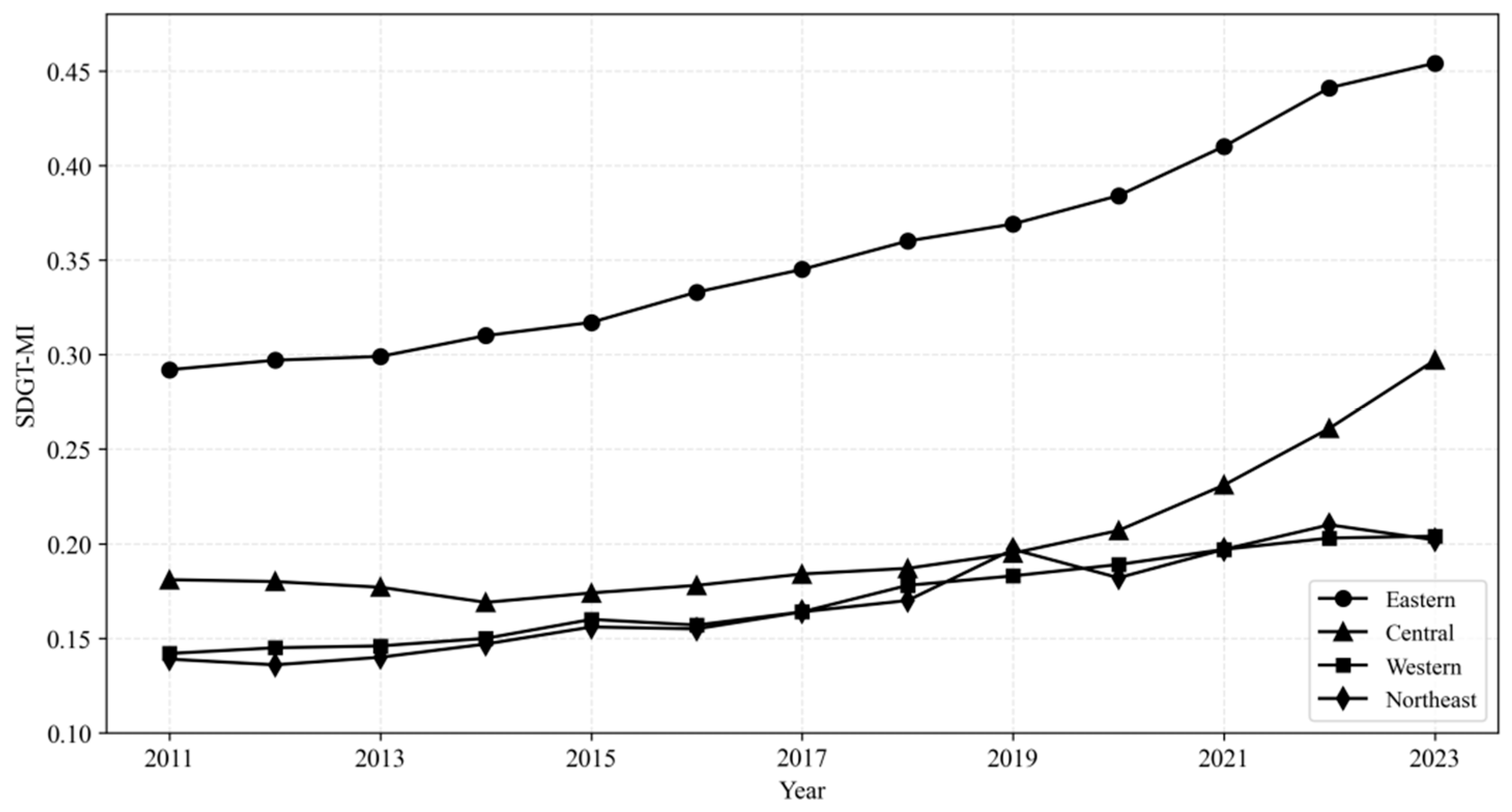
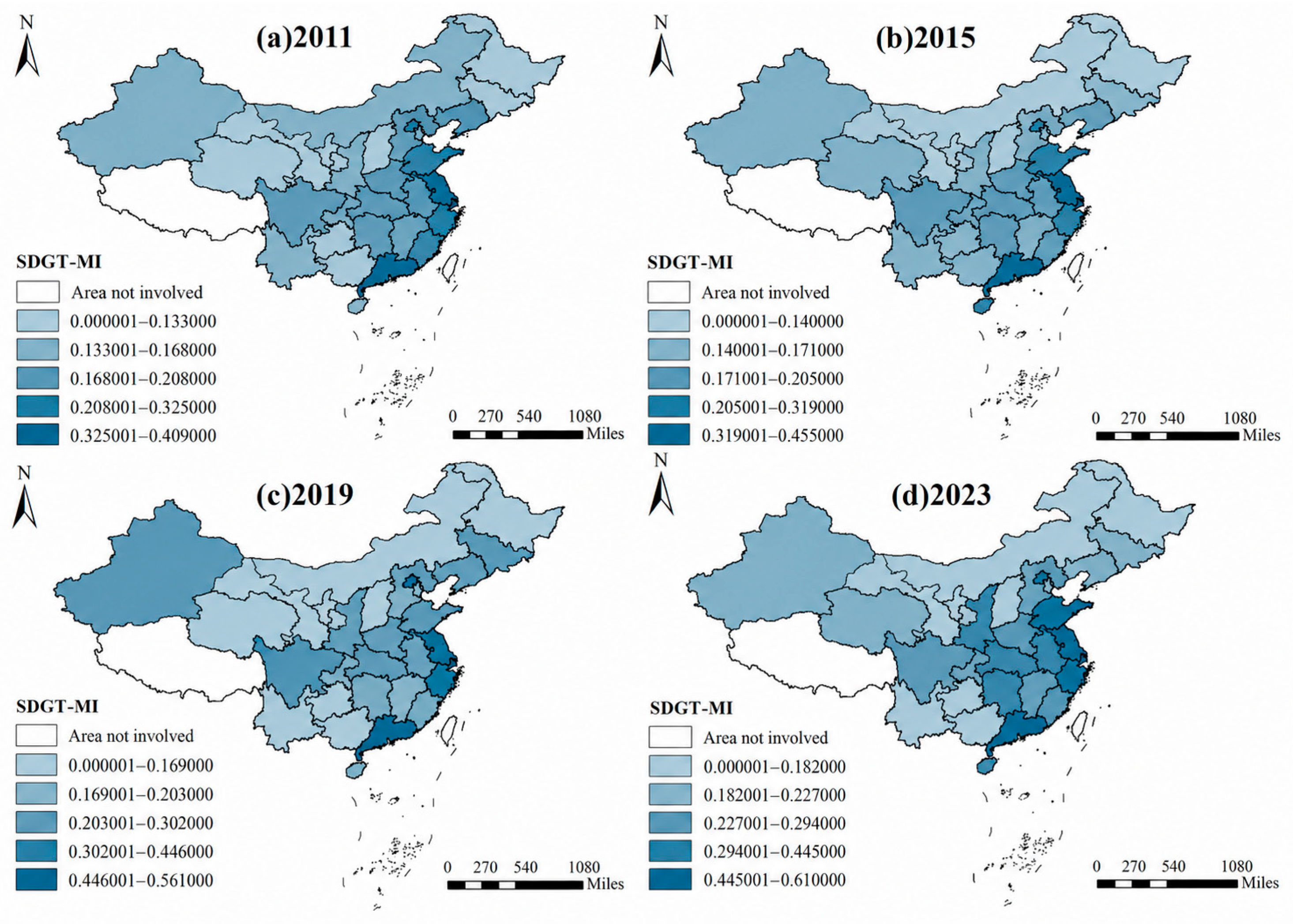
4.1. Measurement of Coordination Levels and Analysis of Spatio-Temporal Evolution
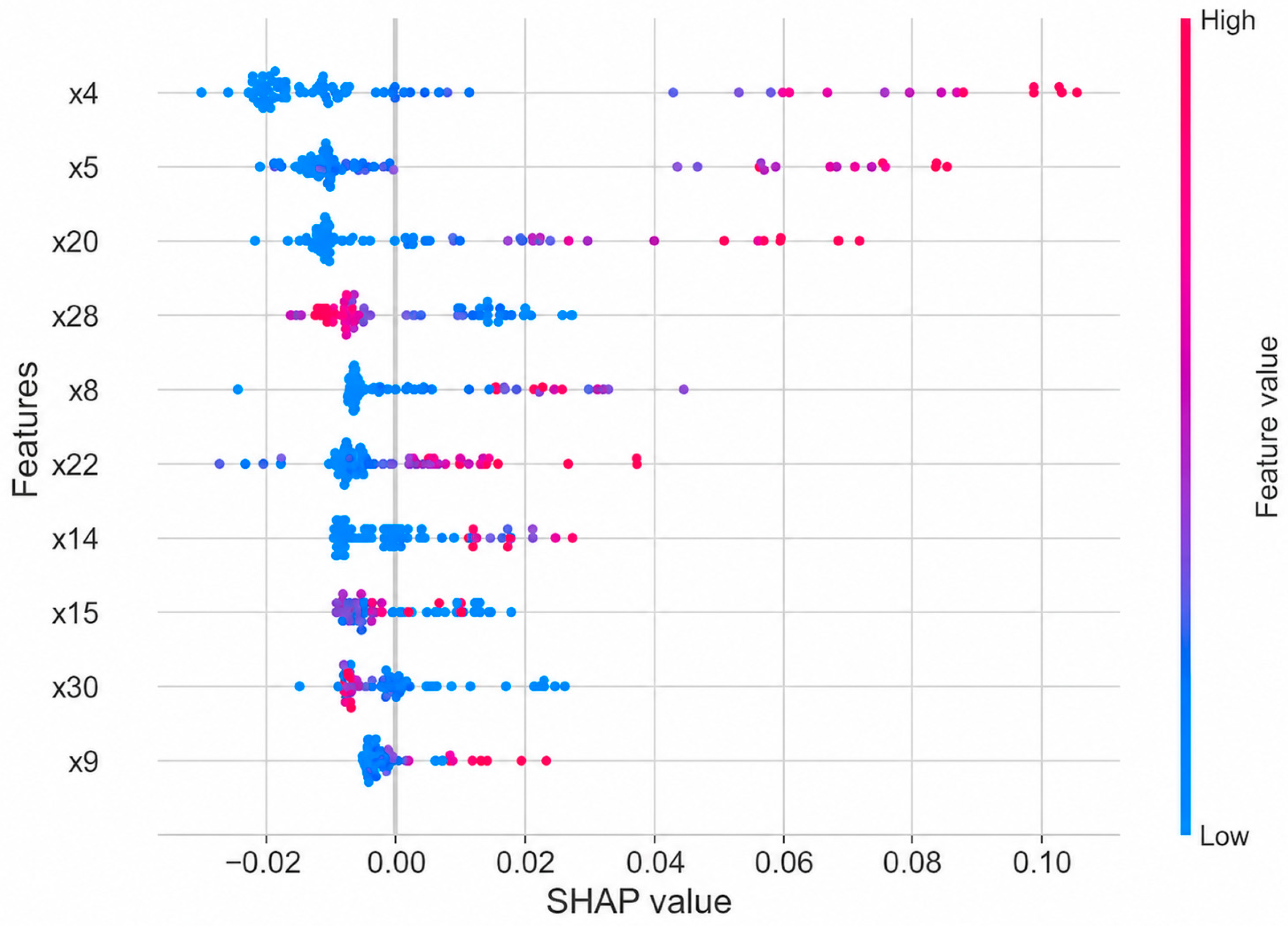
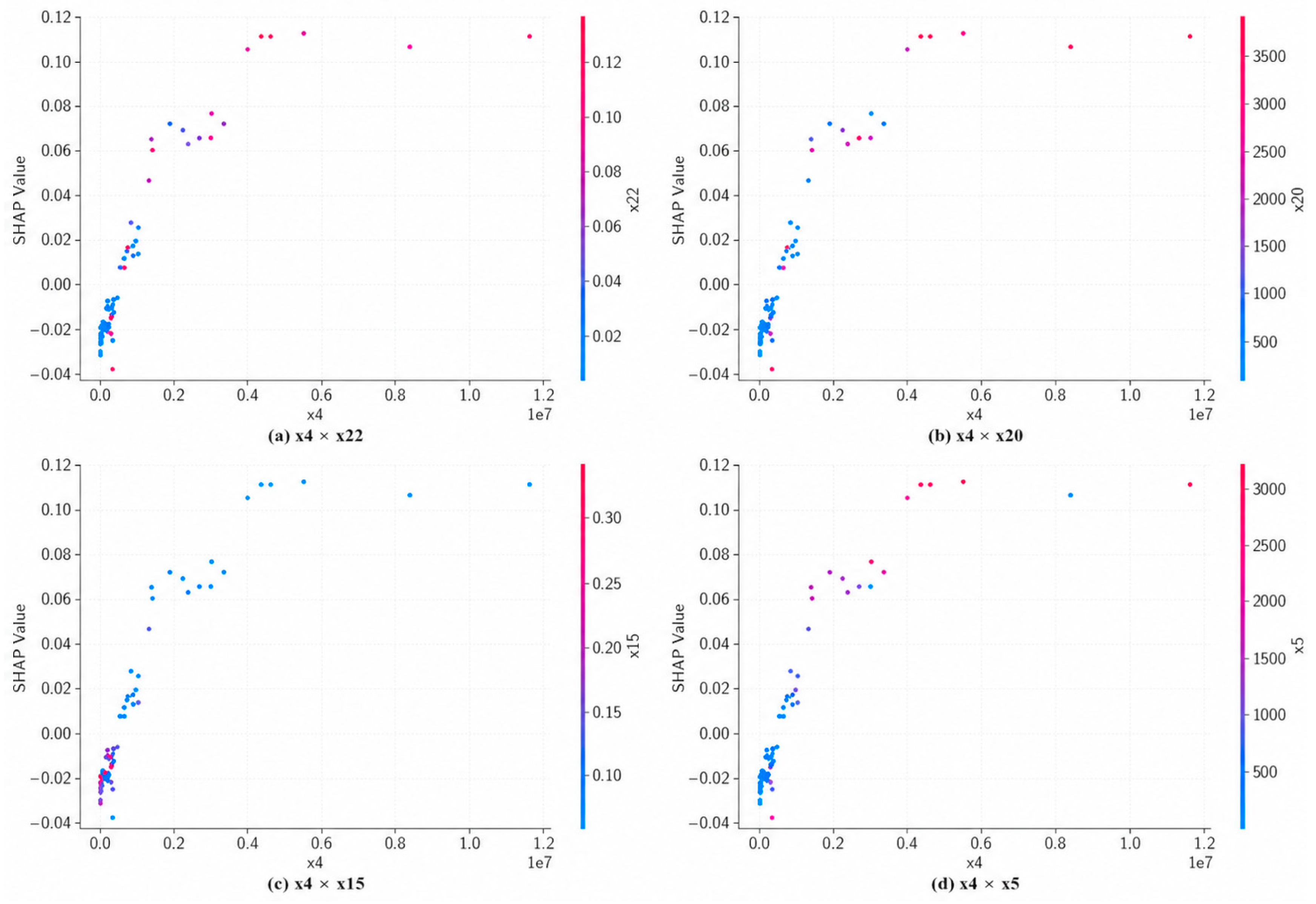
4.2. Analysis of Influencing Factors
4.3. Analysis of the Synergistic Effects of Digital and Green Transformation in the Manufacturing Industry
4.3.1. Stability Testing
4.3.2. Determination of the Order of Lag
4.3.3. GMM Regression
4.3.4. Granger Causality Test
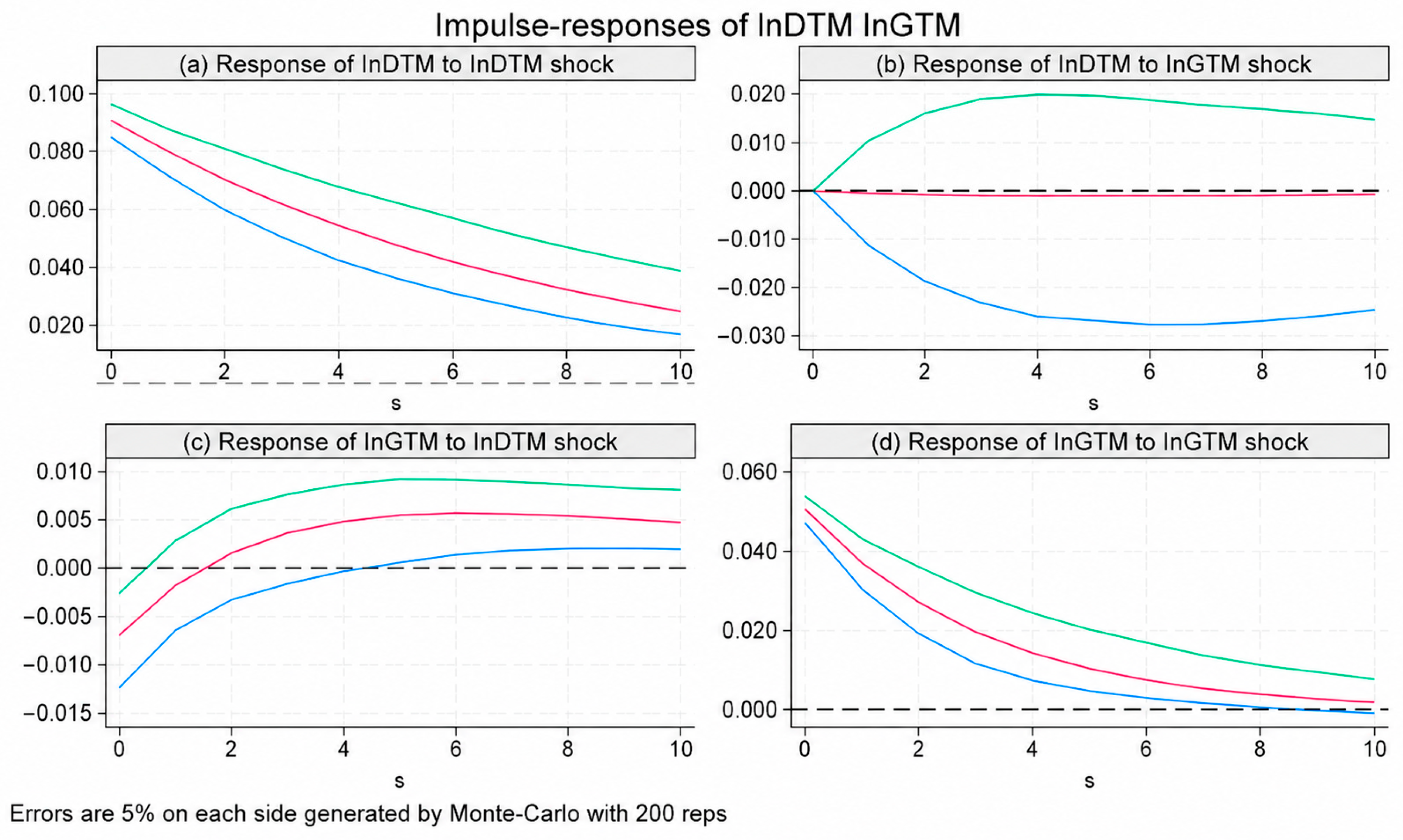
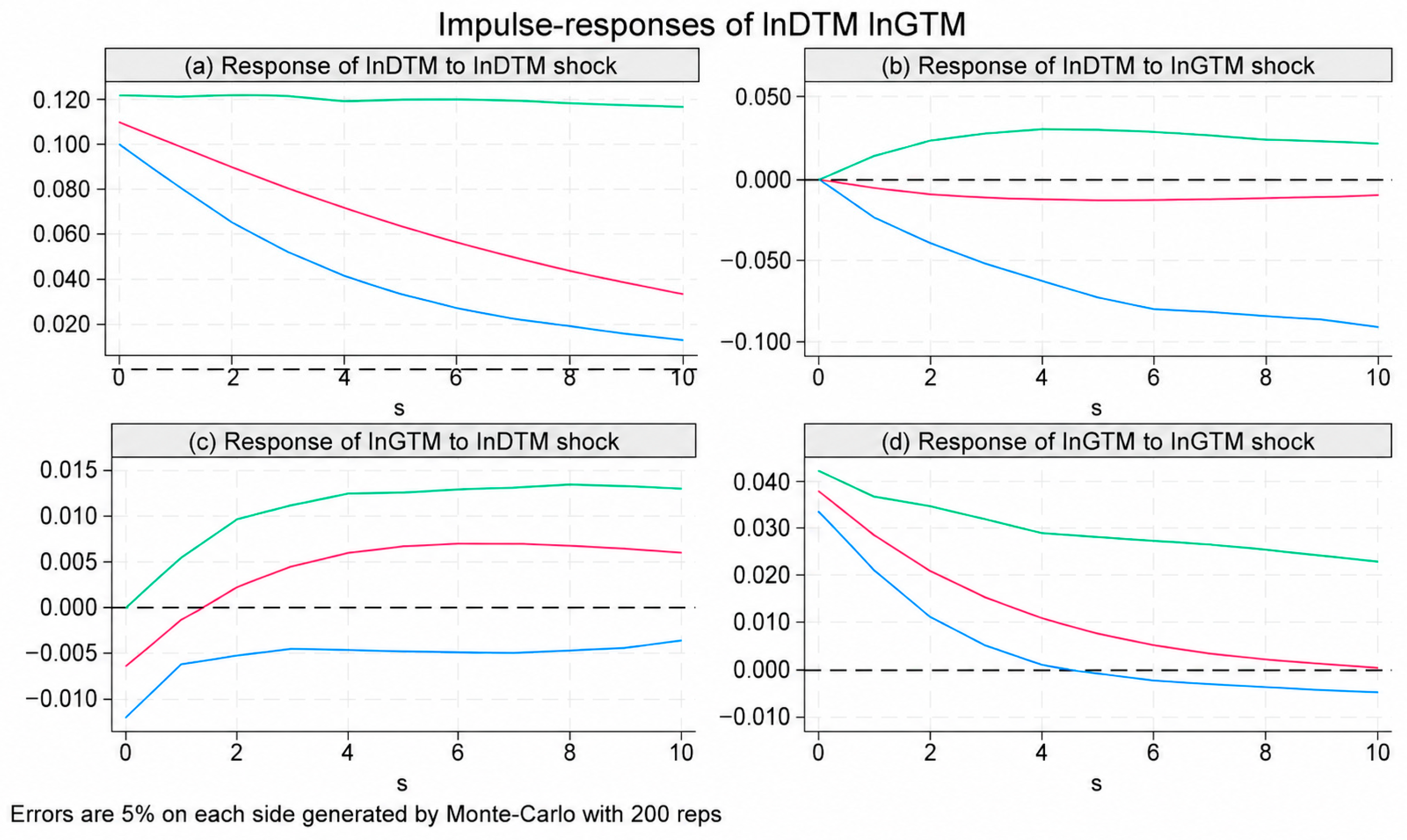
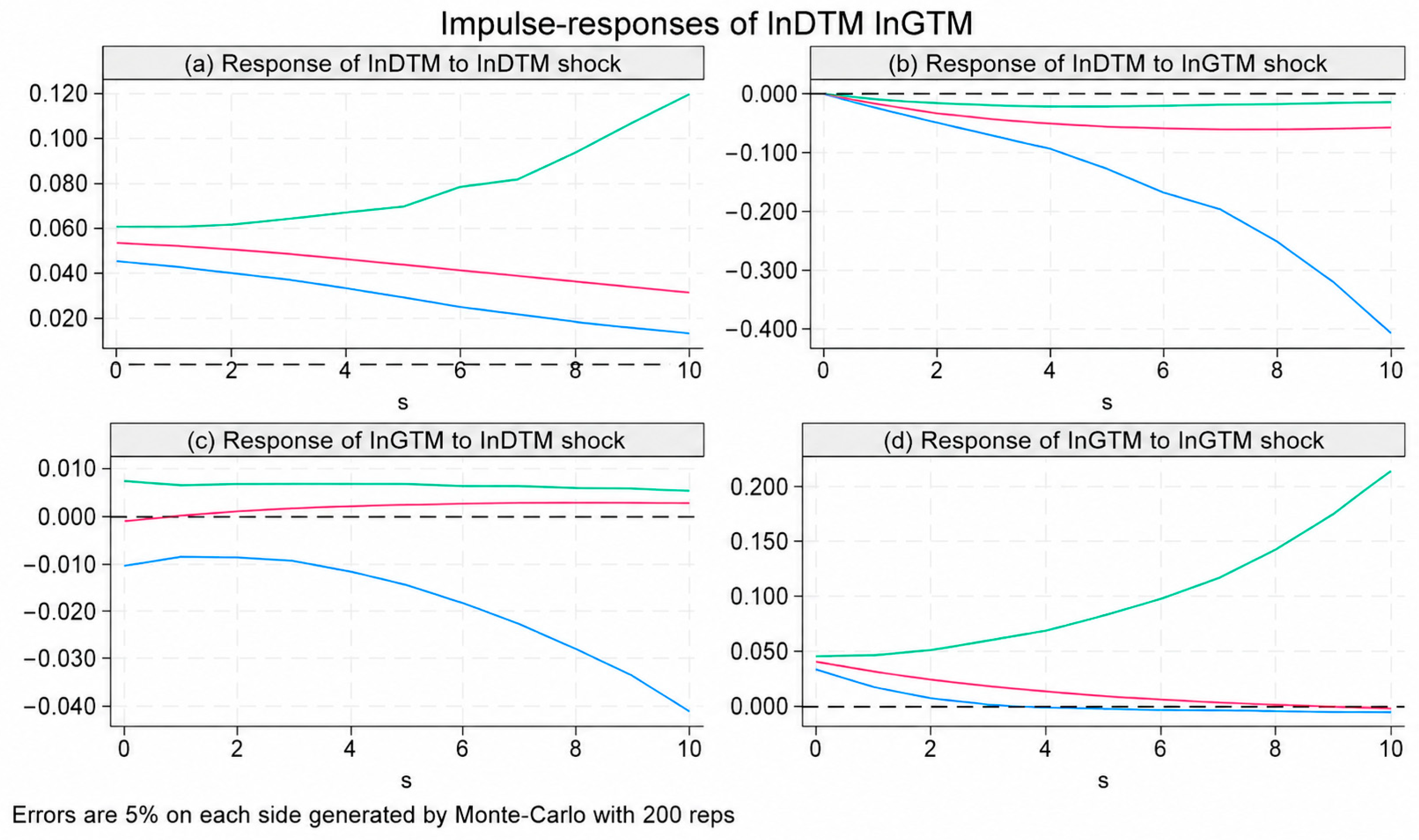
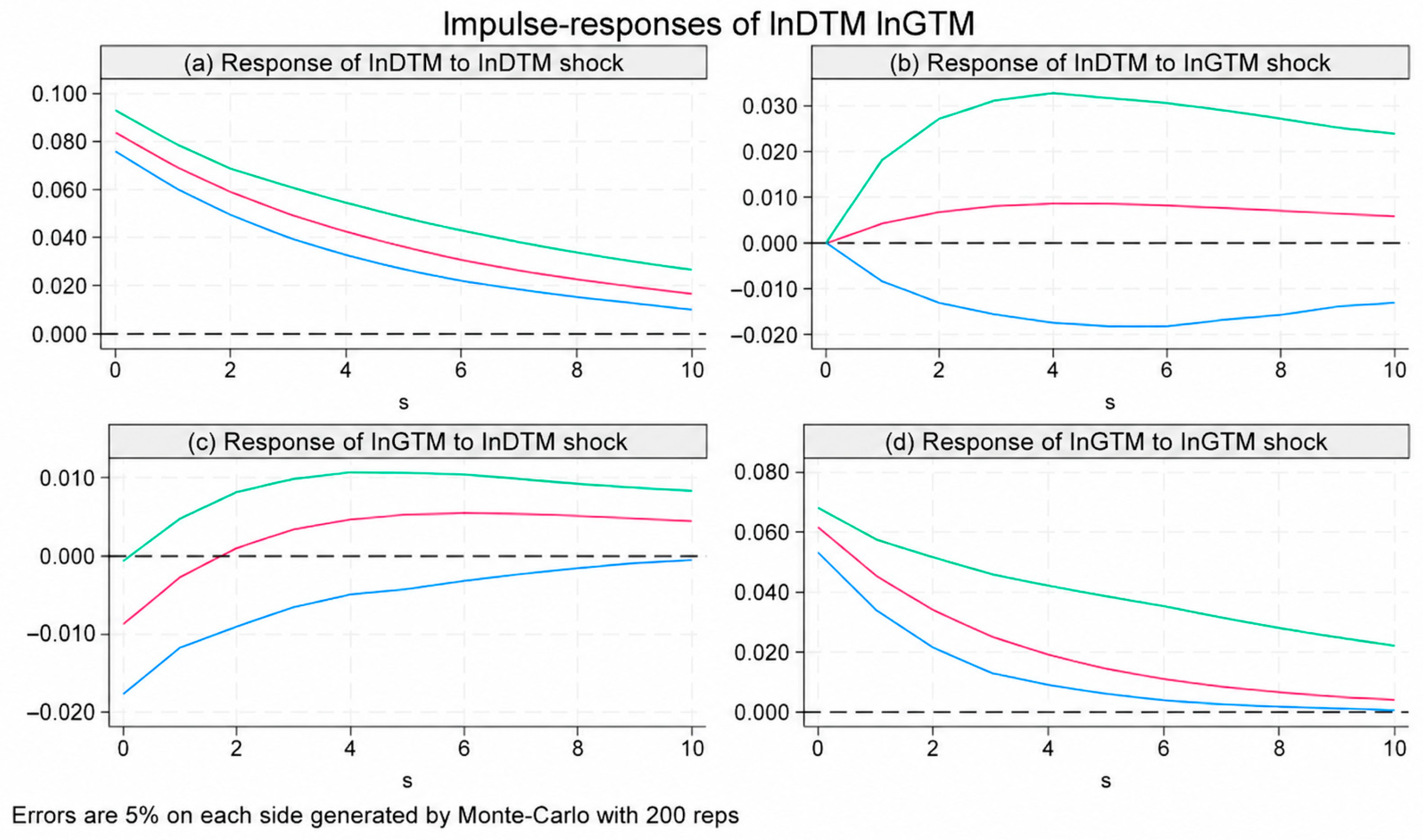
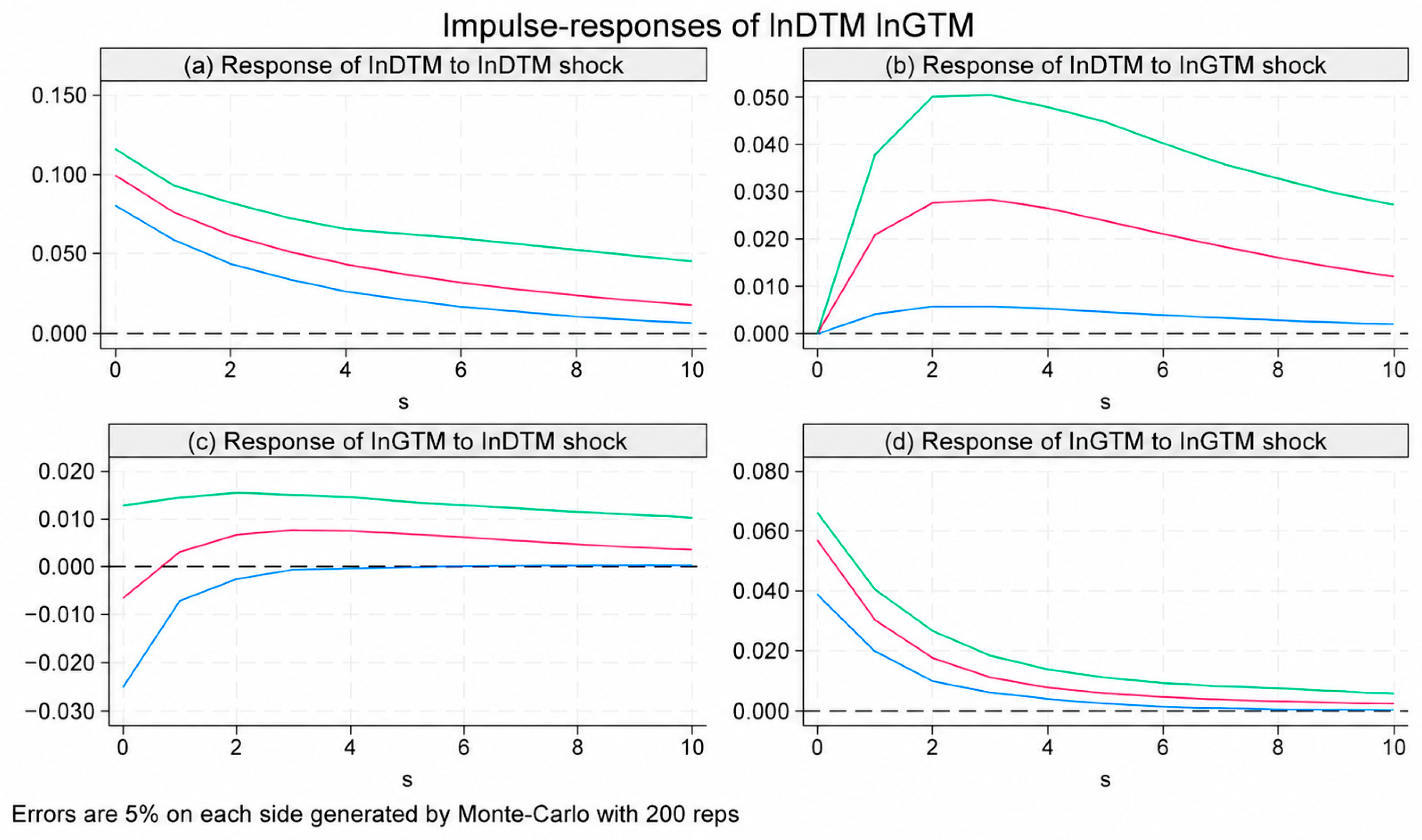
4.3.5. Impulse Response
- (1)
- The impact of digital transformation in the manufacturing industry on its own development
- (2)
- The impact of digital transformation in manufacturing on green transformation
- (3)
- The impact of the green transition in manufacturing on the development of digital transformation
- (4)
- The impact of the green transition in manufacturing on its own development
4.3.6. Analysis of Variance
5. Discussion
6. Conclusions and Implications
6.1. Conclusions
6.2. Practical Significance
6.3. Limitations and Future Prospects
Author Contributions
Funding
Data Availability Statement
Conflicts of Interest
References
- George, G.; Merrill, R.K.; Schillebeeckx, S.J. Digital sustainability and entrepreneurship: How digital innovations are helping tackle climate change and sustainable development. Entrep. Theory Pract. 2021, 45, 999–1027. [Google Scholar] [CrossRef]
- Green, F. Green New Deals in comparative perspective. Wiley Interdiscip. Rev. Clim. Change 2024, 15, e885. [Google Scholar]
- Stefanis, C.; Stavropoulos, A.; Stavropoulou, E.; Tsigalou, C.; Constantinidis, T.C.; Bezirtzoglou, E. A spotlight on environmental sustainability in view of the European Green Deal. Sustainability 2024, 16, 4654. [Google Scholar] [CrossRef]
- Broeders, D.; Cristiano, F.; Kaminska, M. In search of digital sovereignty and strategic autonomy: Normative power Europe to the test of its geopolitical ambitions. JCMS J. Common Mark. Stud. 2023, 61, 1261–1280. [Google Scholar] [CrossRef]
- Heidebrecht, S. From market liberalism to public intervention: Digital sovereignty and changing European union digital single market governance. JCMS J. Common Mark. Stud. 2024, 62, 205–223. [Google Scholar] [CrossRef]
- Ma, S.; Ding, W.; Liu, Y.; Zhang, Y.; Ren, S.; Kong, X.; Leng, J. Industry 4.0 and cleaner production: A comprehensive review of sustainable and intelligent manufacturing for energy-intensive manufacturing industries. J. Clean. Prod. 2024, 467, 142879. [Google Scholar] [CrossRef]
- Ortega-Gras, J.J.; Bueno-Delgado, M.V.; Puche-Forte, J.F.; Garrido-Lova, J.; Martínez-Fernández, R. Exploring Industry 4.0 Technologies Implementation to Enhance Circularity in Spanish Manufacturing Enterprises. Sustainability 2025, 17, 7648. [Google Scholar] [CrossRef]
- Bistline, J.; Blanford, G.; Brown, M.; Burtraw, D.; Domeshek, M.; Farbes, J.; Zhao, A. Emissions and energy impacts of the Inflation Reduction Act. Science 2023, 380, 1324–1327. [Google Scholar] [CrossRef]
- Bang, G. The US Inflation Reduction Act: Climate policy as economic crisis response. Environ. Polit. 2025, 34, 1216–1237. [Google Scholar]
- Sharma, K.; Tyagi, S.; Bhardwaj, V.; Tyagi, D.; Gautam, Y.K.; Singh, B.P. Greenhouse gas emissions from the industries. In Advances and Technology Development in Greenhouse Gases: Emission, Capture and Conversion; Elsevier: Amsterdam, The Netherlands, 2024; pp. 165–181. [Google Scholar]
- Yang, Z.; Gao, W.; Han, Q.; Qi, L.; Cui, Y.; Chen, Y. Digitalization and Carbon Emissions: How Does Digital City Construction Affect China’s Carbon Emission Reduction? Sustain. Cities Soc. 2022, 87, 104201. [Google Scholar]
- Zhang, R.; Wang, S. Can the Development of the Digital Economy Reduce Industrial Solid Waste Pollution? J. Environ. Manag. 2025, 386, 125775. [Google Scholar]
- Bagherian, A.; Gershon, M.; Kumar, S.; Mishra, M.K. Analyzing the Relationship between Digitalization and Energy Sustainability: A Comprehensive ISM-MICMAC and DEMATEL Approach. Expert Syst. Appl. 2024, 236, 121193. [Google Scholar] [CrossRef]
- Liu, Z.; Deng, Z.; He, G.; Wang, H.; Zhang, X.; Lin, J.; Liang, X. Challenges and opportunities for carbon neutrality in China. Nat. Rev. Earth Environ. 2022, 3, 141–155. [Google Scholar] [CrossRef]
- Hu, Y.; Jia, X. Empowering the intelligent transformation of the manufacturing sector through new quality productive forces: Value implications, theoretical analysis, and empirical examination. Sustainability 2025, 17, 7006. [Google Scholar] [CrossRef]
- Jiang, H.; Murmann, J.P. The rise of China’s digital economy: An overview. Manag. Organ. Rev. 2022, 18, 790–802. [Google Scholar]
- Zhou, X.; Fan, S.; Sun, H.; Tang, L.; Ma, F. Practices of environmental protection, technological innovation, economic promotion and social equity in hydropower development: A case study of cascade hydropower exploitation in China’s Dadu River basin. Clean Technol. Environ. Policy 2021, 23, 2827–2841. [Google Scholar] [CrossRef]
- Li, G.; Zhang, R.; Feng, S.; Wang, Y. Digital finance and sustainable development: Evidence from environmental inequality in China. Bus. Strategy Environ. 2022, 31, 3574–3594. [Google Scholar] [CrossRef]
- Li, B. Digital infrastructure and regional economic disparities: Evidence from the broadband China strategy. Econ. Innov. New Technol. 2025, 1–20. [Google Scholar] [CrossRef]
- Verma, P.; Kumar, V.; Daim, T.; Sharma, N.K.; Mittal, A. Identifying and prioritizing impediments of industry 4.0 to sustainable digital manufacturing: A mixed method approach. J. Clean. Prod. 2022, 356, 131639. [Google Scholar] [CrossRef]
- Kraus, S.; Durst, S.; Ferreira, J.J.; Veiga, P.; Kailer, N.; Weinmann, A. Digital transformation in business and management research: An overview of the current status quo. Int. J. Inf. Manag. 2022, 63, 102466. [Google Scholar] [CrossRef]
- Zhang, W.; Zhao, J.; Li, H.; Chen, S. Does digital transformation empower green innovation? Evidence from listed companies in heavily polluting industries in China. Financ. Res. Lett. 2024, 66, 105685. [Google Scholar] [CrossRef]
- Topaloglu, E.E.; Nur, T.; Yilmaz Ozekenci, S.; Aydingulu Sakalsiz, S. How ICT and Green Technologies Shape the Nexus Between Financial Development and Carbon Footprint: Evidence from an N-Shaped EKC. Sustainability 2025, 17, 10191. [Google Scholar] [CrossRef]
- Li, G.; Cheng, Y.; Chen, Y.; Zhang, Q. Can the Synergy of Digitalization and Greening Boost Manufacturing Industry Chain Resilience? Evidence from China’s Provincial Panel Data. Sustainability 2024, 16, 9866. [Google Scholar] [CrossRef]
- Yu, P.; Zhao, X.; Yang, J. From trade-offs to strategic synergy: How digitalization–greenization synergy drives innovation efficiency in manufacturing. J. Manuf. Technol. Manag. 2026, 37, 837–860. [Google Scholar] [CrossRef]
- Ansoff, H.I. Corporate Strategy: An Analytic Approach to Business Policy for Growth and Expansion; McGraw Hill: New York, NY, USA, 1965; pp. 154–196. [Google Scholar]
- Li, Q.; Ge, J.; Fan, H. Unveiling the impact of synergy between digitalization and greening on urban employment in China. Sci. Rep. 2024, 14, 27773. [Google Scholar] [CrossRef] [PubMed]
- Coll-Martínez, E.; Kedjar, M.; Renou-Maissant, P. (Green) Knowledge spillovers and regional environmental support: Do they matter for the entry of new green tech-based firms? Ann. Reg. Sci. 2022, 69, 119–161. [Google Scholar] [CrossRef]
- Burström, T.; Parida, V.; Lahti, T.; Wincent, J. AI-enabled business-model innovation and transformation in industrial ecosystems: A framework, model and outline for further research. J. Bus. Res. 2021, 127, 85–95. [Google Scholar] [CrossRef]
- Yaqub, M.Z.; Alsabban, A. Industry-4.0-enabled digital transformation: Prospects, instruments, challenges, and implications for business strategies. Sustainability 2023, 15, 8553. [Google Scholar] [CrossRef]
- Liu, Y.; Zhang, Y.; Xie, X.; Mei, S. Affording digital transformation: The role of industrial Internet platform in traditional manufacturing enterprises digital transformation. Heliyon 2024, 10, e28772. [Google Scholar] [CrossRef]
- Xing, Y.; Zhang, J.Z.; Wang, X. Digital innovation and transformation process in business growth: A systematic literature review and research agenda. Technovation 2026, 151, 103396. [Google Scholar] [CrossRef]
- Leso, B.H.; Cortimiglia, M.N.; Ghezzi, A. The contribution of organizational culture, structure, and leadership factors in the digital transformation of SMEs: A mixed-methods approach. Cogn. Technol. Work 2023, 25, 151–179. [Google Scholar] [CrossRef]
- Shahzad, K.; Imran, F.; Butt, A. Digital Transformation and Changes in Organizational Structure: Empirical Evidence from Industrial Organizations. Res.-Technol. Manag. 2025, 68, 25–40. [Google Scholar] [CrossRef]
- Yang, X.; Xu, Y.; Hossain, M.E.; Ran, Q.; Haseeb, M. The path to sustainable development: Exploring the impact of digitization on industrial enterprises’ green transformation in China. Clean Technol. Environ. Policy 2025, 27, 2497–2511. [Google Scholar] [CrossRef]
- Ma, Z.; Ding, C.; Wang, X.; Huang, Q. Carbon emission reduction development, digital economy, and green transformation of China’s manufacturing industry. Int. Rev. Financ. Anal. 2025, 102, 104149. [Google Scholar] [CrossRef]
- Shu, Z.; Peng, S.; Huang, X. How does service trade openness promote the green transformation of manufacturing firms? Evidence from China. Energy Econ. 2025, 144, 108347. [Google Scholar] [CrossRef]
- Zhu, C.H.; Wang, M.L.; Gu, H.J.; Fang, Y.Q.; Chen, H.R. The impact of carbon emissions trading policy on green transformation of manufacturing industry: A test based on a time-varying DID model. Clean Technol. Environ. Policy 2025, 27, 1373–1386. [Google Scholar] [CrossRef]
- Qiu, L.; Jie, X.; Wang, Y.; Zhao, M. Green product innovation, green dynamic capability, and competitive advantage: Evidence from Chinese manufacturing enterprises. Corp. Soc. Responsib. Environ. Manag. 2020, 27, 146–165. [Google Scholar] [CrossRef]
- Liang, Z.; Shen, Y.; Yang, K.; Kuang, J. The impact of high-tech enterprise certification on green innovation: Evidence from listed companies in China. Sustainability 2025, 17, 147. [Google Scholar] [CrossRef]
- Demirel, P.; Martinez-Ros, E.; Quatraro, F. Innovation for the green transition: Challenges and future perspectives. Eurasian Bus. Rev. 2025, 15, 631–645. [Google Scholar] [CrossRef]
- Chen, Z.; Xing, R. Digital economy, green innovation and high-quality economic development. Int. Rev. Econ. Financ. 2025, 99, 104029. [Google Scholar] [CrossRef]
- Liu, L.; Gu, T.; Wang, H. The coupling coordination between digital economy and industrial green high-quality development: Spatio-temporal characteristics, differences and convergence. Sustainability 2022, 14, 16260. [Google Scholar] [CrossRef]
- Zhong, X.; Duan, Z.; Liu, C.; Chen, W. Research on the coupling mechanism and influencing factors of digital economy and green technology innovation in Chinese urban agglomerations. Sci. Rep. 2024, 14, 5150. [Google Scholar] [CrossRef] [PubMed]
- Yu, L.; Zhang, Q. Measurement of new qualitative productivity kinetic energy from the perspective of digital and green collaboration--comparative study based on European countries. J. Clean. Prod. 2024, 476, 143787. [Google Scholar] [CrossRef]
- Kaushal, L.A.; Dwivedi, A. Human capital, digital transition and carbon emissions: Investigating non-linear dynamics for sustainable and human-centric future. J. Environ. Manag. 2026, 398, 128449. [Google Scholar] [CrossRef]
- Zhu, Q.; Ma, D.; He, X. Digital transformation and firms’ pollution emissions. Technol. Forecast. Soc. Chang. 2023, 197, 122910. [Google Scholar] [CrossRef]
- Wang, L.; Li, X. Government Digitalisation Initiatives and Corporate Green Investment. Financ. Res. Lett. 2025, 88, 109209. [Google Scholar] [CrossRef]
- Song, Y.; Zhang, J.; Song, Y.; Fan, X.; Zhu, Y.; Zhang, C. Can industry-university-research collaborative innovation efficiency reduce carbon emissions? Technol. Forecast. Soc. Chang. 2020, 157, 120094. [Google Scholar] [CrossRef]
- Kovacic, Z.; García Casañas, C.; Argüelles, L.; Yáñez Serrano, P.; Ribera-Fumaz, R.; Prause, L.; March, H. The twin green and digital transition: High-level policy or science fiction? Environ. Plan. E Nat. Space 2024, 7, 2251–2278. [Google Scholar] [CrossRef]
- Hambye-Verbrugghen, J.; Bianchini, S.; Brockway, P.E.; Aramendia, E.; Heun, M.K.; Marshall, Z. From twin transition to twice the burden? Digitalisation, energy demand, and economic growth. Ecol. Econ. 2026, 239, 108747. [Google Scholar] [CrossRef]
- Mai, W.; Xiong, L.; Liu, B.; Liu, S. Spatial–temporal evolution, drivers, and pathways of the synergistic effects of digital transformation on pollution and carbon reduction in heavily polluting enterprises. Sci. Rep. 2025, 15, 11963. [Google Scholar] [CrossRef]
- Dou, Q.; Gao, X. The double-edged role of the digital economy in firm green innovation: Micro-evidence from Chinese manufacturing industry. Environ. Sci. Pollut. Res. 2022, 29, 67856–67874. [Google Scholar] [CrossRef]
- Lan, M.; Liu, Y.; Yang, M.; Du, Z. Spatial-temporal characteristics and influencing factors of the coupling and coordination between the digital economy and low-carbon development in the construction industry. Environ. Dev. Sustain. 2025, 1–25. [Google Scholar] [CrossRef]
- Hao, X.; Li, Y.; Ren, S.; Wu, H.; Hao, Y. The role of digitalization on green economic growth: Does industrial structure optimization and green innovation matter? J. Environ. Manag. 2023, 325, 116504. [Google Scholar] [CrossRef]
- Dian, J.; Song, T.; Li, S. Facilitating or inhibiting? Spatial effects of the digital economy affecting urban green technology innovation. Energy Econ. 2024, 129, 107223. [Google Scholar] [CrossRef]
- Yang, S.; Xu, J.; Lei, T.; Wang, M. How to improve the efficiency of green development? The role of digital finance. Financ. Res. Lett. 2024, 63, 105296. [Google Scholar] [CrossRef]
- Liu, X.; Zuo, Z.; Han, J.; Zhang, W. Is digital-green synergy the future of carbon emission performance? J. Environ. Manag. 2025, 375, 124156. [Google Scholar] [CrossRef] [PubMed]
- Rao, C.; Gao, Y. Evaluation mechanism design for the development level of urban-rural integration based on an improved TOPSIS method. Mathematics 2022, 10, 380. [Google Scholar] [CrossRef]
- Dong, H.; Yang, K.; Bai, G. Evaluation of TPGU using entropy-improved TOPSIS-GRA method in China. PLoS ONE 2022, 17, e0260974. [Google Scholar] [CrossRef] [PubMed]
- Liu, Y.; She, J.; Wang, L.; Li, Z.; Guo, Z. Decoding urban flood resilience in the Henan section of the Yellow River Basin: Insights from an XGBoost–SHAP analysis. J. Environ. Manag. 2025, 394, 127632. [Google Scholar] [CrossRef]
- Li, Y.; He, Y.; Yang, F.; An, H.; Li, J.; Xie, Y. An XGBoost-SHAP analysis of the driving factors of carbon emissions in China’s first-tier cities. Sci. Rep. 2026, 16, 1659. [Google Scholar] [CrossRef]
- Zhao, X.; Shao, B.; Su, J.; Tian, N. Exploring synergistic evolution of carbon emissions and air pollutants and spatiotemporal heterogeneity of influencing factors in Chinese cities. Sci. Rep. 2025, 15, 2657. [Google Scholar] [CrossRef] [PubMed]
- Xu, J.; She, S.; Gao, P.; Sun, Y. Role of green finance in resource efficiency and green economic growth. Resour. Policy 2023, 81, 103349. [Google Scholar] [CrossRef]




| Overall Indicator | Primary Indicators | Secondary Indicators | Explanation of Indicators | Unit | Direction |
|---|---|---|---|---|---|
| Digital Transformation in Manufacturing | Digital Fundamentals | Level of mobile device penetration | Number of mobile phones per 100 people | Number of units per 100 people | + |
| Carrying capacity of communication backbones | Length of long-distance optical fibre cables | kilometres | + | ||
| Number of broadband access ports | Number of internet access ports | ten thousand | + | ||
| Scale of digital content resources | Number of regional webpages | ten thousand | + | ||
| The scale of Internet address resources | Number of IPv4 addresses | ten thousand | + | ||
| Wireless access point density | Number of mobile phone base stations | ten thousand | + | ||
| Digital investment | Intensity of investment in technological upgrading by enterprises above a certain scale | Expenditure on technological upgrading by enterprises above a certain scale | ten thousand yuan | + | |
| Intensity of investment in technology introduction by enterprises above a certain scale | Expenditure on technology introduction by enterprises above a certain scale | ten thousand yuan | + | ||
| R&D intensity of industrial enterprises above a certain scale | R&D expenditure of industrial enterprises above a certain size | ten thousand yuan | + | ||
| Density of digital talent in the manufacturing industry | Number of R&D personnel in high-tech industries/Number of employees in the manufacturing industry | % | + | ||
| Digital R&D Innovation Efficiency | The ratio of granted national patent applications to the full-time equivalent of R&D staff | % | + | ||
| Digital Applications | Industrial robot density | Industrial robot installation density | one | + | |
| Concentration of artificial intelligence companies | Number of artificial intelligence companies | one | + | ||
| Concentration of R&D institutions | Number of enterprises with R&D facilities | one | + | ||
| Proportion of IT professionals | Employees in urban enterprises in the information transmission, software and IT services sector/Employees in the manufacturing industry | % | + | ||
| Digital labour productivity | Industrial value added/Average number of employees in the manufacturing industry | % | + | ||
| Digital output | Proportion of revenue from embedded software | Revenue from embedded systems/Main business revenue of enterprises above a certain scale | % | + | |
| Proportion of revenue from information technology services | Revenue from information technology services/Main business revenue of enterprises above a specified size | % | + | ||
| Proportion of revenue from software products | Revenue from software products/Main business revenue of enterprises above a certain scale | % | + | ||
| Share of revenue from high-tech industries | Revenue from high-tech industries/Revenue from industrial enterprises above a specified scale | % | + | ||
| Market share in smart manufacturing | The proportion of the company’s operating revenue relative to the total operating revenue of all smart manufacturing enterprises nationwide | % | + | ||
| Proportion of revenue from high-tech new products | Revenue from sales of new products in high-tech industries/Operating revenue of industrial enterprises above designated size | % | + | ||
| Trading activity in the technology market | Turnover in the technology market | hundreds of millions | + | ||
| The green transition in manufacturing | Green R&D | Proportion of green utility model patents | Number of green utility model patents granted/Number of green patents granted | % | + |
| Proportion of green patents | Number of green invention patents granted/Total number of green patents granted | % | + | ||
| Environmental governance pressure | Proportion of environmental protection expenditure in the budget | Environmental protection expenditure/General government expenditure | % | − | |
| Proportion of expenditure on energy conservation and environmental protection | Fiscal expenditure on the energy-saving and environmental protection sector/Total fiscal expenditure | % | − | ||
| Resource and energy consumption | Carbon emissions intensity per unit of value added | Carbon emissions from manufacturing/Industrial value added | million tonnes per 10,000 yuan | − | |
| Water intensity per unit of value added | Industrial water consumption per unit of industrial value added | billion cubic metres per 10,000 yuan | − | ||
| Energy intensity per unit of value added | Physical consumption of coal/Industrial value added | tonnes per 10,000 yuan | − | ||
| Ecological governance | Sulphur dioxide emission intensity per unit of value added | Sulphur dioxide emissions per unit of industrial value added | tonnes per 10,000 yuan | − | |
| Intensity of solid waste generation per unit of value added | Volume of industrial solid waste utilised/Industrial value added | tonnes per 10,000 yuan | − | ||
| COD emission intensity per unit of value added | Chemical oxygen demand (COD) in wastewater/Industrial value added | tonnes per 10,000 yuan | − | ||
| Intensity of investment in pollution control per unit of value added | Intensity of investment in pollution control per unit of value added | tonnes per 10,000 yuan | − |
| Sample | RMSE | MAE | MAPE | |
|---|---|---|---|---|
| Training set | 0.9699 | 0.0153 | 0.0115 | 4.23% |
| Test set | 0.8955 | 0.0420 | 0.0247 | 9.85% |
| Sample | Test Methods | Variables | Determination | |||
|---|---|---|---|---|---|---|
| lnDTM | dlnDTM | lnGTM | dlnGTM | |||
| Nationwide | LLC | −4.7282 *** | −12.0402 *** | −6.7520 *** | −9.1974 *** | First-order linear |
| IPS | −1.0012 | −7.2192 *** | −3.2776 *** | −8.9125 *** | ||
| East | LLC | −5.4960 *** | −8.2661 *** | −2.9626 *** | −4.4541 *** | First-order linear |
| IPS | −1.0114 | −4.4937 *** | −1.2072 | −4.8383 *** | ||
| Central | LLC | −1.1114 | −3.7850 *** | −0.4551 | −2.3802 *** | First-order linear |
| IPS | 0.6243 | −2.7442 *** | 0.3625 | −4.2300 *** | ||
| West | LLC | −3.1401 *** | −4.5004 *** | −5.9097 *** | −2.8413 *** | First-order linear |
| IPS | −1.9314 ** | −4.7458 *** | −2.9811 *** | −5.2363 *** | ||
| Northeast | LLC | −2.8331 ** | −4.5491 *** | −1.3989 * | −4.1891 *** | First-order linear |
| IPS | −2.3499 *** | −2.6005 *** | −1.5803 * | −2.8967 *** | ||
| Sample | Order of Lag | MBIC | MAIC | MQIC |
|---|---|---|---|---|
| Nationwide | 1 | −45.32026 | 8.233457 | −13.41633 |
| 2 | −36.41632 | 3.748969 | −12.48837 | |
| 3 | −24.09629 | 2.680572 | −8.144321 | |
| East | 1 | −46.08029 | −10.10436 | −24.39444 |
| 2 | −32.15096 | −5.169021 | −15.88658 | |
| 3 | −20.29019 | −2.302226 | −9.447264 | |
| Central | 1 | −41.00726 | −13.20455 | −23.39534 |
| 2 | −31.28661 | −10.43458 | −18.07767 | |
| 3 | −22.12881 | −8.227458 | −13.32285 | |
| West | 1 | −47.47505 | −9.97416 | −24.97419 |
| 2 | −36.18422 | −8.058555 | −19.30857 | |
| 3 | −23.73668 | −4.986238 | −12.48625 | |
| Northeast | 1 | −33.15404 | −16.44168 | −20.06869 |
| 2 | −25.2083 | −12.67403 | −15.39429 | |
| 3 | −6.468139 | −2.29005 | −3.196802 |
| Sample of Grouping Variables | Group 1 | Group 2 | ||||||||
|---|---|---|---|---|---|---|---|---|---|---|
| lnDTM | lnGTM | |||||||||
| Nationwide | East | Central | West | Northeast | Nationwide | East | Central | West | Northeast | |
| lnDTMit-1 | 0.879 *** [0.824, 0.933] | 0.900 *** [0.755, 1.045] | 0.971 *** [0.923, 1.019] | 0.844 *** [0.785, 0.902] | 0.793 *** [0.685, 0.901] | 0.036 *** [0.010, 0.062] | 0.031 * [−0.004, 0.067] | 0.018 [−0.042, 0.079] | 0.044 * [−0.005, 0.093] | 0.066 * [−0.000, 0.133] |
| lnGTMit-1 | −0.011 [−0.231, 0.209] | −0.144 [−0.751, 0.462] | −0.473 *** [−0.738, −0.208] | 0.069 [−0.194, 0.333] | 0.365 * [−0.011, 0.740] | 0.728 *** [0.608, 0.849] | 0.741 *** [0.534, 0.948] | 0.779 *** [0.360, 1.198] | 0.738 *** [0.562, 0.914] | 0.532 *** [0.378, 0.685] |
| Initial Assumption | Chi-Squared Statistic | ||||
|---|---|---|---|---|---|
| Nationwide | East | Central | West | Northeast | |
| DTM is not the Granger cause of GTM | 0.00938 (0.923) | 0.21775 (0.641) | 12.228 *** (0.000) | 0.26492 (0.607) | 3.6197 * (0.057) |
| GTM is not the Granger cause of DTM | 7.4241 *** (0.006) | 3.0046 * (0.083) | 0.35152 (0.553) | 3.105 * (0.078) | 3.8003 * (0.051) |
| Variables | Episode Number | lnDTM | lnGTM | ||||||||
|---|---|---|---|---|---|---|---|---|---|---|---|
| Nationwide | East | Central | West | Northeast | Nationwide | East | Central | West | Northeast | ||
| lnDTM | 10 | 0.868 | 0.945 | 0.790 | 0.785 | 0.863 | 0.074 | 0.173 | 0.210 | 0.045 | 0.071 |
| 20 | 0.859 | 0.941 | 0.778 | 0.772 | 0.854 | 0.082 | 0.190 | 0.052 | 0.050 | 0.079 | |
| lnGTM | 10 | 0.132 | 0.055 | 0.047 | 0.215 | 0.137 | 0.926 | 0.827 | 0.953 | 0.955 | 0.929 |
| 20 | 0.141 | 0.059 | 0.222 | 0.228 | 0.146 | 0.918 | 0.810 | 0.948 | 0.950 | 0.921 | |
Disclaimer/Publisher’s Note: The statements, opinions and data contained in all publications are solely those of the individual author(s) and contributor(s) and not of MDPI and/or the editor(s). MDPI and/or the editor(s) disclaim responsibility for any injury to people or property resulting from any ideas, methods, instructions or products referred to in the content. |
© 2026 by the authors. Licensee MDPI, Basel, Switzerland. This article is an open access article distributed under the terms and conditions of the Creative Commons Attribution (CC BY) license.
Share and Cite
Jin, W.; Yang, X.; Zhang, Y.; Zhou, H.; Li, J. The Synergistic Transition of China’s Manufacturing Industry Towards Digitalisation and Green Development: A Study on Level Measurement, Analysis of Influencing Factors and Interactive Effects. Sustainability 2026, 18, 5852. https://doi.org/10.3390/su18125852
Jin W, Yang X, Zhang Y, Zhou H, Li J. The Synergistic Transition of China’s Manufacturing Industry Towards Digitalisation and Green Development: A Study on Level Measurement, Analysis of Influencing Factors and Interactive Effects. Sustainability. 2026; 18(12):5852. https://doi.org/10.3390/su18125852
Chicago/Turabian StyleJin, Weibo, Xuewei Yang, Yi Zhang, Hongyan Zhou, and Jiahan Li. 2026. "The Synergistic Transition of China’s Manufacturing Industry Towards Digitalisation and Green Development: A Study on Level Measurement, Analysis of Influencing Factors and Interactive Effects" Sustainability 18, no. 12: 5852. https://doi.org/10.3390/su18125852
APA StyleJin, W., Yang, X., Zhang, Y., Zhou, H., & Li, J. (2026). The Synergistic Transition of China’s Manufacturing Industry Towards Digitalisation and Green Development: A Study on Level Measurement, Analysis of Influencing Factors and Interactive Effects. Sustainability, 18(12), 5852. https://doi.org/10.3390/su18125852