Article

Numerical Simulation Study on Hydraulic Characteristics of Square Platform Hollow Eco-Revetment Structure


1
Chongqing Ecological Environment Monitoring Center, Chongqing 400000, China
2
College of Environment and Ecology, Chongqing University, Chongqing 400044, China
3
College of Hehai, Chongqing Jiaotong University, Chongqing 400074, China
*
Authors to whom correspondence should be addressed.
Sustainability 2026, 18(12), 5847; https://doi.org/10.3390/su18125847 (registering DOI)
Submission received: 25 March 2026 / Revised: 18 May 2026 / Accepted: 20 May 2026 / Published: 8 June 2026

Abstract

The eco-revetment structure on river bank slopes plays a positive role in regulating nearshore water flow characteristics, enhancing bank slope stability, and providing a stable living environment for aquatic organisms. This study proposes an innovative eco-revetment structure—the square platform hollow eco-revetment structure. Ecological feasibility study through numerical simulation, analyzing the characteristic hydraulic movement patterns and flow movement mechanisms near the eco-revetment structure under different research parameters. The following conclusion can be drawn: the special design of openings on the side walls of the revetment structure increases the fluidity between water bodies, leading to complex water flow conditions near the revetment structure. Therefore, in the absence of plants, there are two large eddies inside the structure, as well as a “flow zone” opposite to the direction of external water flow. In the presence of plants, large-scale vortex structures are broken down into small-sized vortex structures, and the “flow zone” disappears. The distribution of flow characteristics is related to the research parameters. In the region where y/H ≤ 1, the velocity distribution is positively correlated with the inflow. There is a negative correlation between water flow velocity and porosity. The maximum values of turbulence intensity and Reynolds stress both occur at the top of the eco-revetment structure, and their distribution is positively correlated with the size of the side-wall openings and the inflow rate. The presence of plants leads to an increase in turbulence intensity and Reynolds stress, which diffuses into the interior of the structure. The impact of revetment structures on water flow determines the efficiency of material information and energy transmission and affects the stability of water flow ecosystems. Turbulent water currents can stimulate grass carp reproduction and increase the fertilization rate of fish eggs. The ratio of mixed-layer thickness to momentum thickness (tml/θ) is correlated with water flow velocity, and the presence of plants leads to an increase in tml/θ. This study provides ideas and methods for designing eco-revetment structures and constructing ecological rivers in the future.

1. Introduction

Ecological waterways are a developing trend in inland waterways. In addition to the requirements of efficient and safe navigation, the construction of ecological waterways must also enable the scientific regulation of various river functions to ensure the sustainable development of the basin. The riverbank slope has characteristics of both water and land, belonging to the area with the highest activity in the watershed ecosystem. It plays a vital role in the exchange of material, information, and energy between water and land ecosystems, ensuring flood control through the construction of ecological corridors and buffer zones [1].
Adverse flow conditions near the bank slope, such as vertical vortices and local disturbances, have a negative impact on the stability of the bank slope. It cannot provide a stable living environment for aquatic organisms. As an important part of inland river ecological channel construction, eco-revetment structures aim to maintain the smoothness of river flow and bank slope stability while protecting material, information, and energy exchange across the bank slope, aquatic organisms, and water flow [2].
Much research has been conducted on the hydraulic characteristics near the revetment structure. Aquatic plants, which provide natural ecological slope protection, are the main component of riverbank slopes. In terms of river flood discharge and ecological restoration, vegetation can affect the average flow field and turbulence field [3], flow transport [4], sediment transport [5], river morphology, and morphological dynamics [6] on multiple temporal and spatial scales. Vegetation is a key component for controlling hydrodynamics in aquatic ecosystems [7]. Klopstra divides the water flow containing plants into a vegetation layer and a free water layer according to their characteristics, where the free water layer follows a logarithmic rate distribution along the vertical direction, and the shear stress of the water flow in the vegetation layer follows Boussinesq’s eddy viscosity model [8]. Poggi et al. found the turbulent flow characteristics near the top of the vegetation to be under submerged conditions [9]. There are three vortex structures with different scales in the vertical direction of the flow, including the Carmen vortex generated by the bottom layer of a single vegetation, a coherent vortex in the mixed layer near the top of the vegetation, and a boundary layer vortex in the free water layer [10]. Nehal et al. studied the effects of different densities and arrangements of vegetation on flow resistance, water depth, and velocity [11]. Huierqing studied the vertical distribution law of flow hydraulic characteristics for the combination of single- and mixed-vegetation communities [12]. Yan Jing found a great difference in the characteristics of water in open channels with and without plants and divided the flow resistance in open channels with plants [13]. Through the physical model test, Wufusheng observed the velocity, vorticity, and energy dissipation characteristics of submerged rigid and flexible vegetation, and found that the vorticity mainly depended on the velocity gradient. A positive correlation was found between the dissipation in the fluid and the square of the vorticity [14]. As the main form of multi-natural ecological shore protection structure, fish nest bricks were used to further improve water flow characteristics. Wangxingyong used a combination of physical and numerical models to analyze the internal hydraulic characteristics of the fish nest brick. They found that different connection methods result in different internal hydraulic characteristics of the revetment cavity, and fish nest bricks can resist the change in external velocity [15].
The main function of eco-revetment structures is to regulate the characteristics of nearshore water flow, enhance the stability of bank slopes, and provide a stable living environment for aquatic organisms. At present, there is a lack of research on aquatic plants and ecological shoreline structures as a whole. In this study, we designed a new type of ecological slope protection structure—the square platform hollow ecological slope protection—based on the main functional characteristics of ecological slope protection structures. Using numerical simulation as a means, the hydraulic characteristics and motion mechanism around the revetment structure were explored. The distribution laws of hydraulic characteristics such as time-averaged velocity, turbulence intensity, and Reynolds stress near the revetment structure were analyzed under different research parameters. Combined with the survival characteristics of grass carp, the impact of momentum thickness on the survival rate of fertilized eggs was qualitatively analyzed. This study has important reference value for promoting river ecological protection and ecological waterway construction.

2. Materials and Methods

2.1. Design of New Eco-Revetment Structure

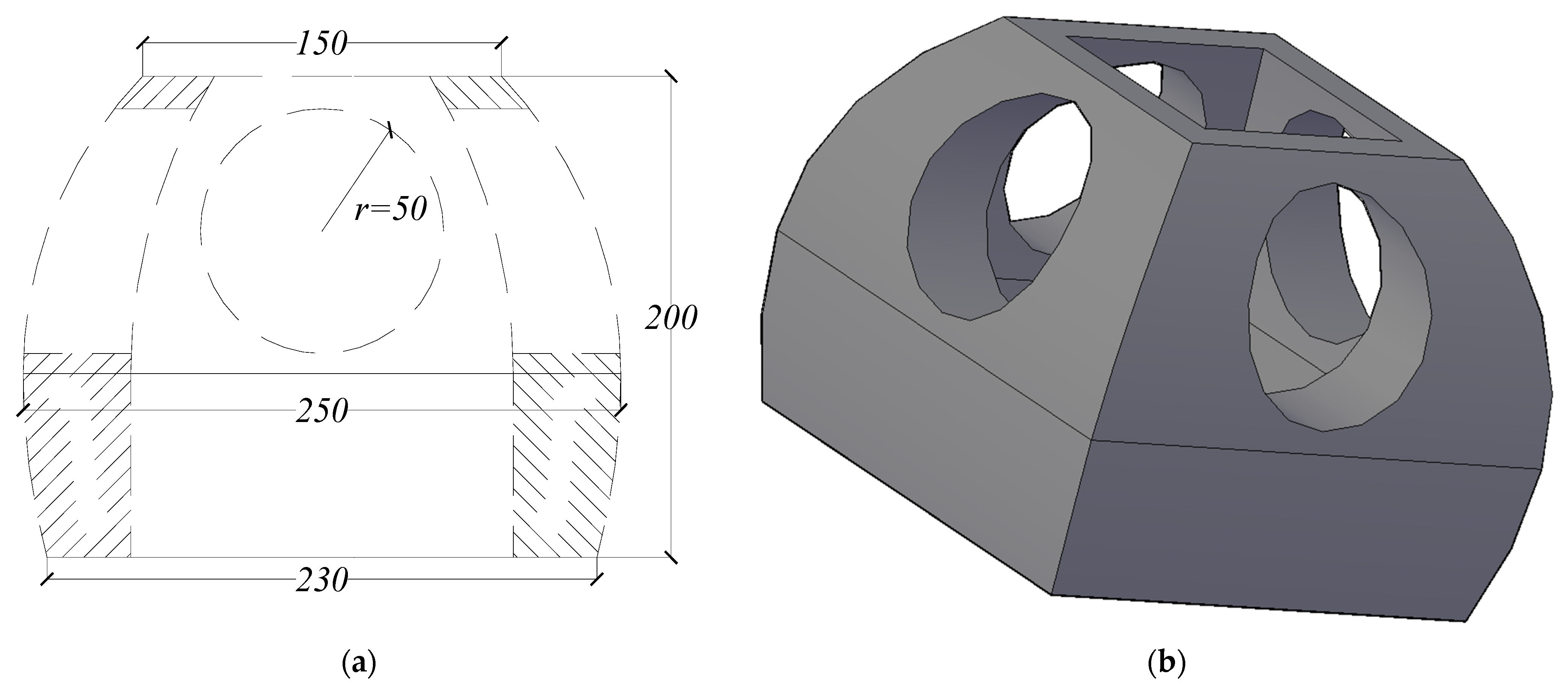
The idea behind designing the new bank protection structure proposed in this study is to smooth the flow, prevent bank slope erosion, provide a stable living environment for aquatic organisms, and promote energy, material, and information exchange. The structural dimensions are shown in Figure 1a. The bottom dimension of the ecological revetment block is 230 mm, the top dimension is 150 mm, and the height is 200 mm. The top is perforated, and the interior of the structure is designed as a cavity. The circular arc surface connects the upper and lower parts of the structure. The upper circular arc design ensures the smooth flow of water and a greater contact surface between the water flow and the outer wall of the structure. This increases the living space of aquatic organisms. The circular arc design at the bottom is arranged so that the revetment structure generates gaps that can be used as drainage channels. The inclusion of a side-wall circular opening enhances the material, information, and energy exchange between structures while improving the richness of flow characteristics, as shown in Figure 1b. In this study, we placed the new eco-revetment structure on both sides of a straight river section, mainly on the bank slope of the water-level fluctuation zone.

2.2. Method and Test

2.2.1. Flow Control Equation

The basic equation of the turbulence model is the classical Navier–Stokes equation. This chapter details the simulation of incompressible fluid, and the equations for which are as follows:
Continuity equation:
𝜕 u i 𝜕 x i = 0
Momentum equation:
𝜕 u i 𝜕 t + 𝜕 u i u j 𝜕 x j = 1 ρ t 𝜕 p 𝜕 x i + υ 𝜕 2 u i 𝜕 x j 𝜕 x j + f i
where u i represents the instantaneous velocity in x i (i represents x, y, and z).
f i represents the mass force component in the x i direction.
υ stands for viscosity coefficient.
p is the instantaneous pressure on the computational grid.
The filtered N-S equation is as follows:
Continuity equation:
𝜕 u i ¯ 𝜕 x i = 0
Momentum equation:
𝜕 u i ¯ 𝜕 t + 𝜕 u i ¯ u j ¯ 𝜕 x j = 1 ρ t 𝜕 p ¯ 𝜕 x i + υ 𝜕 2 u i ¯ 𝜕 x j 𝜕 x j 𝜕 τ i j S G S 𝜕 x j
where the subgrid stress is expressed as τ i j S G S = u i u j ¯ u i ¯ u j ¯ .

2.2.2. Subgrid Stress Model

In the LES simulation, the subgrid stress model affects the accuracy of the calculation results; therefore, selecting an appropriate subgrid stress model accurately simulates the energy transfer process between large and small scales. The research area is located at the ecological protection structure of the nearshore bank slope; therefore, the WMLES model based on the evolution of the Smagorinsky model is adopted.
The Smagorinsky has the advantages of simple form, good stability, and convenient calculation [16]. The Smagorinsky model is similar to viscous stress in laminar flow, and the subgrid stress term τ ij SGS is obtained by solving the strain rate tensor S ij ¯ and viscous coefficient υ t .
S ij = 1 2 ( 𝜕 u i ¯ 𝜕 x j + 𝜕 u j ¯ 𝜕 x i )   S - ij = S ij ¯   S ij ¯
υ t is not a unique property of fluids, but a parameter based on the modeled flow field.
υ t     lq
Here, l represents the mixing length, and q represents the flow velocity at the subgrid scale. Compared to the RANS model, the calculation of the mixing length in LES is relatively simple and requires the maximum scale to be modeled to a similar filtering scale.
l = C s
C s represents the Smagorinsky constant, and represents the grid scale. Based on the Prandtl mixing assumption, the flow velocity at the subgrid scale is as follows:
q   =   l S - ij   =   C s S - ij
Equations (7) and (8) can be substituted into Equation (6).
υ t = lq = l 2 S - ij = ( C s ) 2 S - ij
The Smagorinsky subgrid model includes irreversible transfer, which means that the subgrid model can only simulate the process of energy transfer from a large scale to a small scale. Meanwhile, in complex three-dimensional flows, the C s value varies with position, and the Smagorinsky subgrid model cannot accurately simulate it.
Based on the Smagorinsky subgrid stress model, Shur et al. proposed a large eddy simulation for wall modeling [17]. The WMLES model overcomes the scale limitation of the Reynolds number, allowing the simulation of high Reynolds number conditions.
υ t = min [ k d w 2 , C smag 2 ) ]   S   { 1   exp [ ( y + / 25 ) 3 ] }
In the formula, S is the strain rate; dw is the distance from the point to the wall; k is a constant, 0.41; and Csmag = 0.2. represents the subgrid scale size:   =   min ( max C w · d w ,   C w · h max ,   h uw ,     h max ) .

2.2.3. Experimental Design

  • Selection of grid size as well as initial and boundary conditions
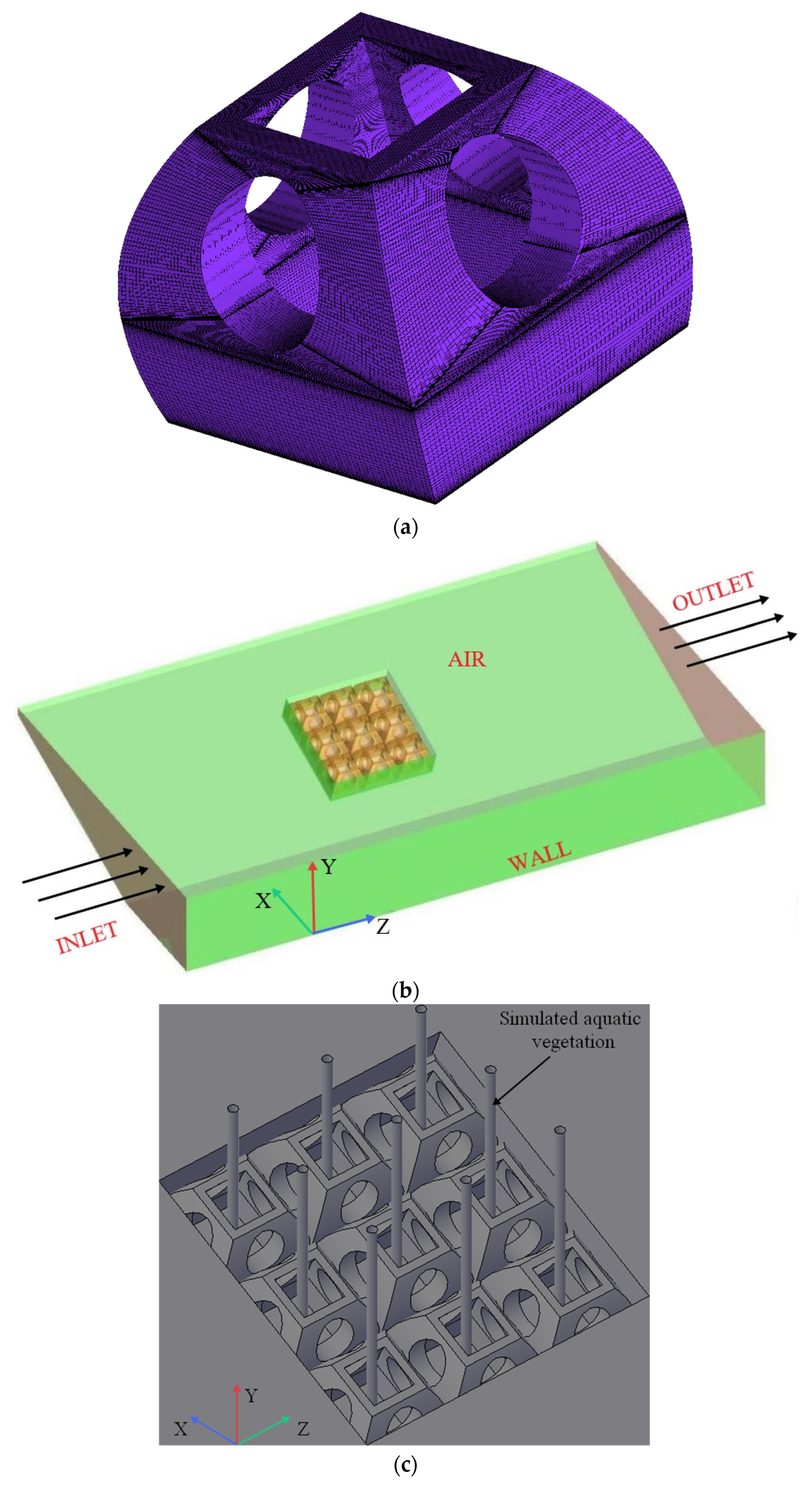
This study used large eddy simulation, and considering the cost of computing power and time, a model scale of 1:3 was selected. In the LES calculation process, selecting an appropriate grid can enhance the convergence and accuracy of numerical simulation. In this study, the computational domain was chosen as a structured grid with a regular hexahedral mesh. This has advantages such as high-quality generation, a simple data structure, and convenient information storage. To accurately reflect the hydraulic characteristics near the eco-revetment structure, the grid division near the structure is assessed, as shown in Figure 2a. The grid thickness near the wall is y+ = 1, or 2 × 10⁻⁵ m, with a paving thickness of 30 layers. The grid is densely paved in the area near the revetment structure, accounting for 70% of the total grid. Due to the stable boundary conditions at the far water end and transition section, the grid scale is appropriately increased.
The model boundary conditions are set as shown in Figure 2b. The water inlet is set as a velocity inlet boundary (velocity inlet). The water outlet is set as a pressure outlet boundary condition (pressure outlet). The water flow condition Fr < 1 in this study belongs to slow flow, and the top region of the computational domain, where the water surface fluctuates slightly, is set as a rigid lid boundary. Both the bottom and sides of the computational domain are set as wall boundary conditions (wall), satisfying the no-slip condition, and the WMLES model is used to set the wall function. The solution time is as follows: a time step length of 1 × 10⁻⁴ s.
Discrete format selection: For the momentum equation, the second-order upwind format was chosen for the convective term, and for the pressure discretization, the second-order format was chosen. The solver is selected as SIMPLC, which is a modification of the SIMPLE algorithm. The working principle of the SIMPLE algorithm is to assume that the initial pressure field is used to solve the velocity field and then modify the pressure field according to the continuity formula to determine whether the pressure field converges. The SIMPLC algorithm only differs in some coefficients of the pressure correction term to accelerate iterative convergence. The residual setting for this study is 1 × 10⁻⁶.
In this study, the length of the computational domain was shortened to 2 m in length, 1 m in width, and 0.2 m in height. The square platform hollow eco-revetment structure is placed on the inclined bank slope of the riverbank, with the top of the structure flush with the bank slope. In this study, tall grass cover plants were selected. Examples include miscanthus, a perennial reed-like herbaceous plant in the Poaceae family, with a stem height exceeding 50 cm and a diameter of over 2 mm. Due to the uniform morphology in the vertical direction of the vegetation studied, an equivalent representation of an equal diameter cylinder can be used, ignoring subtle morphological differences such as the sharp top and sparse bottom of the canopy, as shown in Figure 2c. Aquatic plants have a small diameter and are concentrated in the cavities of the revetment structure, with a concentrated planting area. Therefore, 3–5 small plants are summarized as one large plant for analysis.
  • Test conditions design
This chapter studies the flow characteristics and movement mechanism near the revetment structure. There are 6 groups of test schemes, including different side-wall hole sizes, inflow, and plant presence, as shown in Table 1.
Based on data analysis, the common bank slope gradient in the Jingjiang section of the Yangtze River Basin is generally between 15° and 40° [18]. Therefore, the experimental bank slope gradient in this article is selected to be around 20°, with a gradient of 1:3. According to hydrological data, the average flow velocity of water in the middle and lower reaches of the Yangtze River ranges from 0.5 to 3.0 m/s. The experiment simulated different conditions, with 0.7~1.0 m/s selected as the average speed for the experiment. According to the experimental conditions and the limitations of the model’s computing power, a water depth of 0.2 m was selected as the experimental water depth.
  • Physical model experiment design and inlet flow velocity UDF
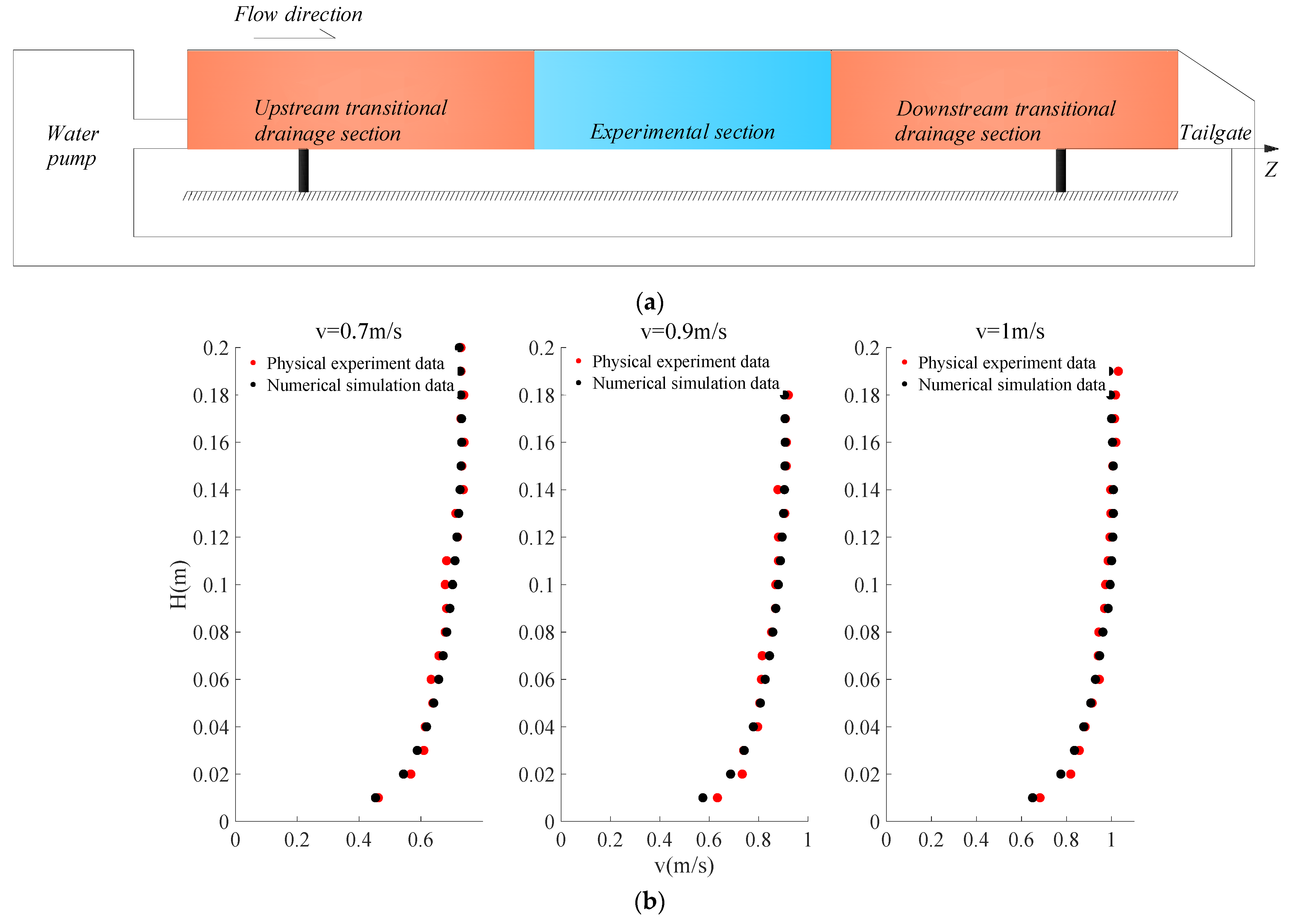
In this study, the data used to verify the feasibility of the numerical model came from physical model experiments. The experiment was conducted in a 30 m long and 1.5 m wide glass-wall recirculating water tank, and the distribution of the revetment structure and water flow cross-section in the calculation domain were consistent with the numerical simulation. The upstream and downstream experimental water flow transition sections were 16 m and 9 m, respectively, ensuring that the water flow in the experimental section was constant and fully developed open-channel turbulence, as shown in Figure 3a.
In order to save computational and time costs, the flow velocity distribution at the inlet of this numerical simulation adopts a fully developed flow velocity UDF file. As shown in Figure 3b, the flow velocity at the end of the upstream transition section in the physical model experiment is selected as the verification flow velocity, a mathematical model is established, reasonable and accurate boundary and initial conditions are set, and the consistency between the water flow field and the physical model experiment is ensured.

2.2.4. Grid-Independence Verification and Numerical Model Validation

LES has stringent requirements for grid size division. To ensure the accuracy of experimental results and prevent them from being influenced by grid division, appropriate grid sizes are selected through grid independence verification. This ensures experimental accuracy while saving computational costs. In this paper, three types of grids with various levels of accuracy were designed for the experiment; the parameters are shown in Table 2.
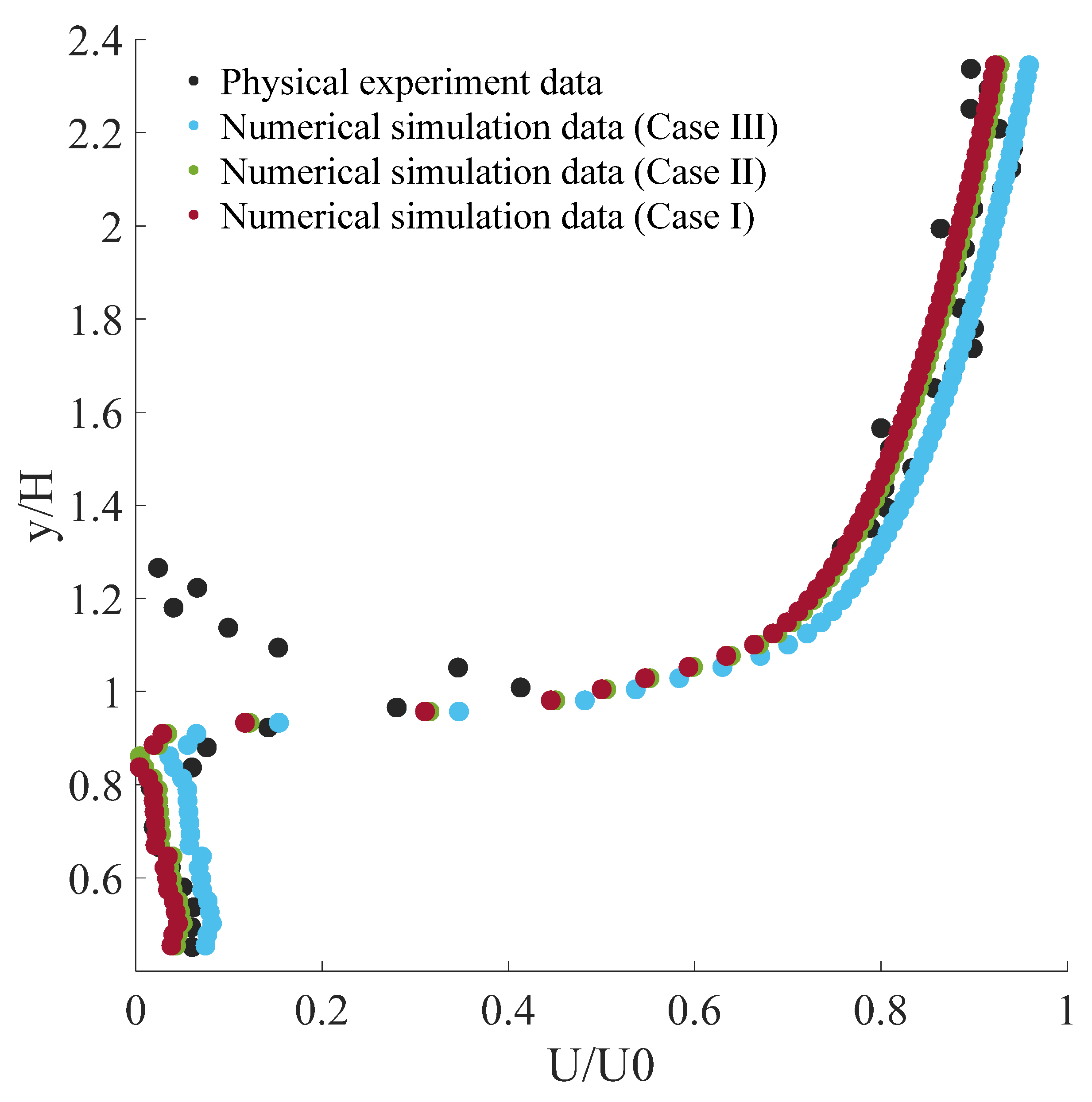
Three different grid spacing options were selected, with grid numbers of approximately 80 million, 55 million, and 30 million, respectively. By comparing the calculation results, the mesh size parameters of Case II were applied to actual cases.
Figure 4 illustrates the variation in flow velocity near the eco-revetment structure with water depth y/H (dimensionless). Through verification of the flow velocity distribution, the physical model and numerical simulation exhibited a high degree of data fitting. By verifying the flow velocity distribution, the fitting results of Case II and Case III both met the experimental requirements. Finally, the grid size parameters of Case II were applied to numerical simulation research. Overall, model construction is reasonable and can be used to study and analyze the water flow characteristics of ecological revetment structures.

3. Results

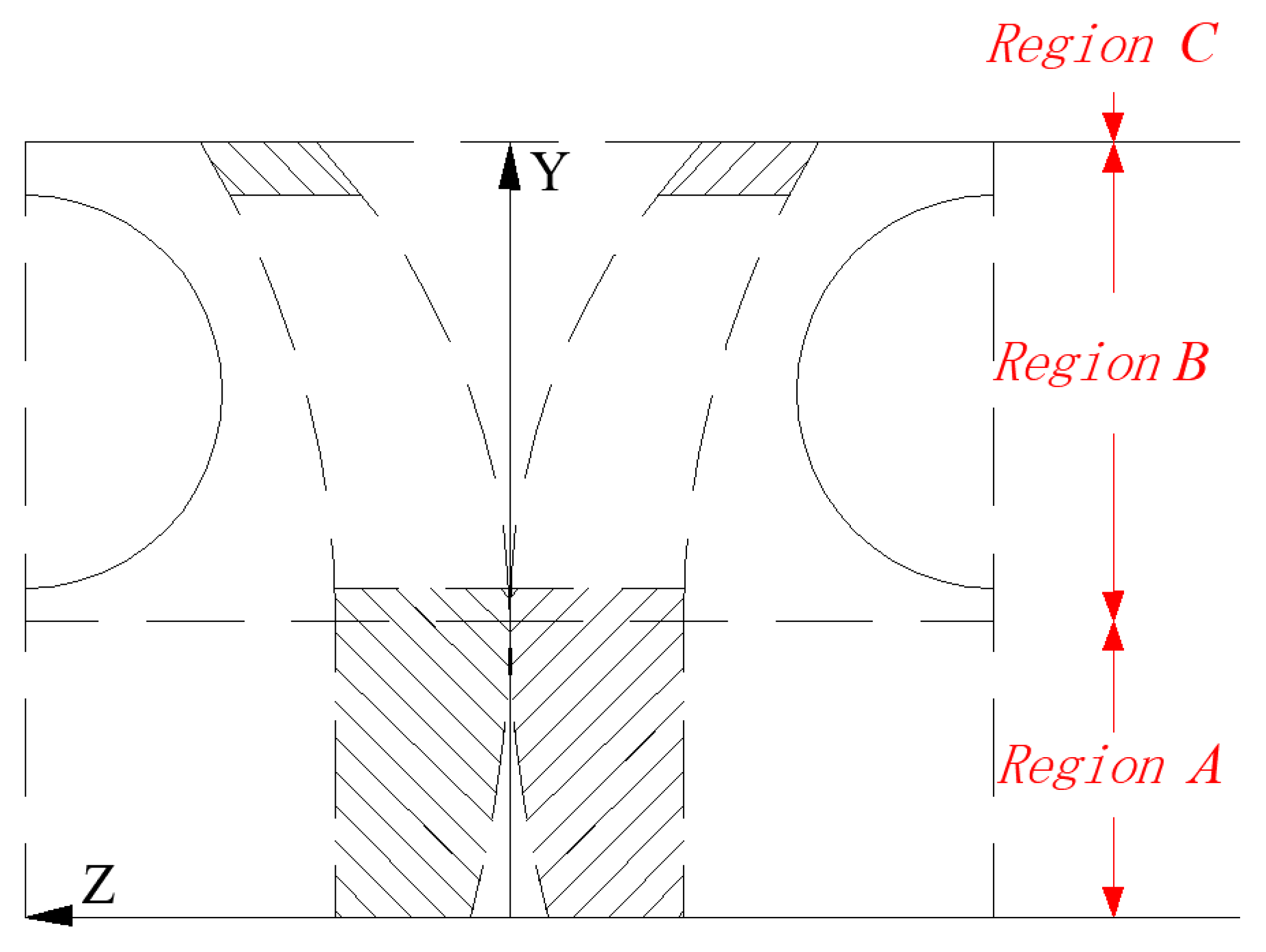
The area near the revetment structure is spatially divided into three parts: the fully enclosed side-wall region A (0 < y/H ≤ 0.43) from the bottom to the side-wall opening; the side-wall region B (0.43 < y/H ≤ 1) with the opening; and the top near wall region C (y/H > 1), where h represents the height of the revetment structure, as shown in Figure 5.

3.1. Time-Averaged Velocity Distribution

The flow is affected by the eco-revetment structure of the square platform hollow, and the hydraulic characteristics change. The data extraction point is perpendicular to the bank slope and located in the central area of the revetment structure.
The X-axis, Y-axis, and Z-axis represent the spanwise, vertical, and downstream directions of the calculation domain, respectively. u, v, and w represent the flow velocity in the X, Y, and Z directions, respectively.

3.1.1. Vertical Distribution Law of Time-Averaged Velocity in Revetment Structure

In this paper, we study the distribution law of velocity W in the direction of flow. The flow at the far end is less affected by the revetment structure, and the distribution of hydraulic characteristics is similar to that of fully developed open-channel flow. In the nearshore area, the coupling of an eco-revetment structure, flow, and plants leads to large fluctuations in hydraulic characteristics, which is unique to the key research area.
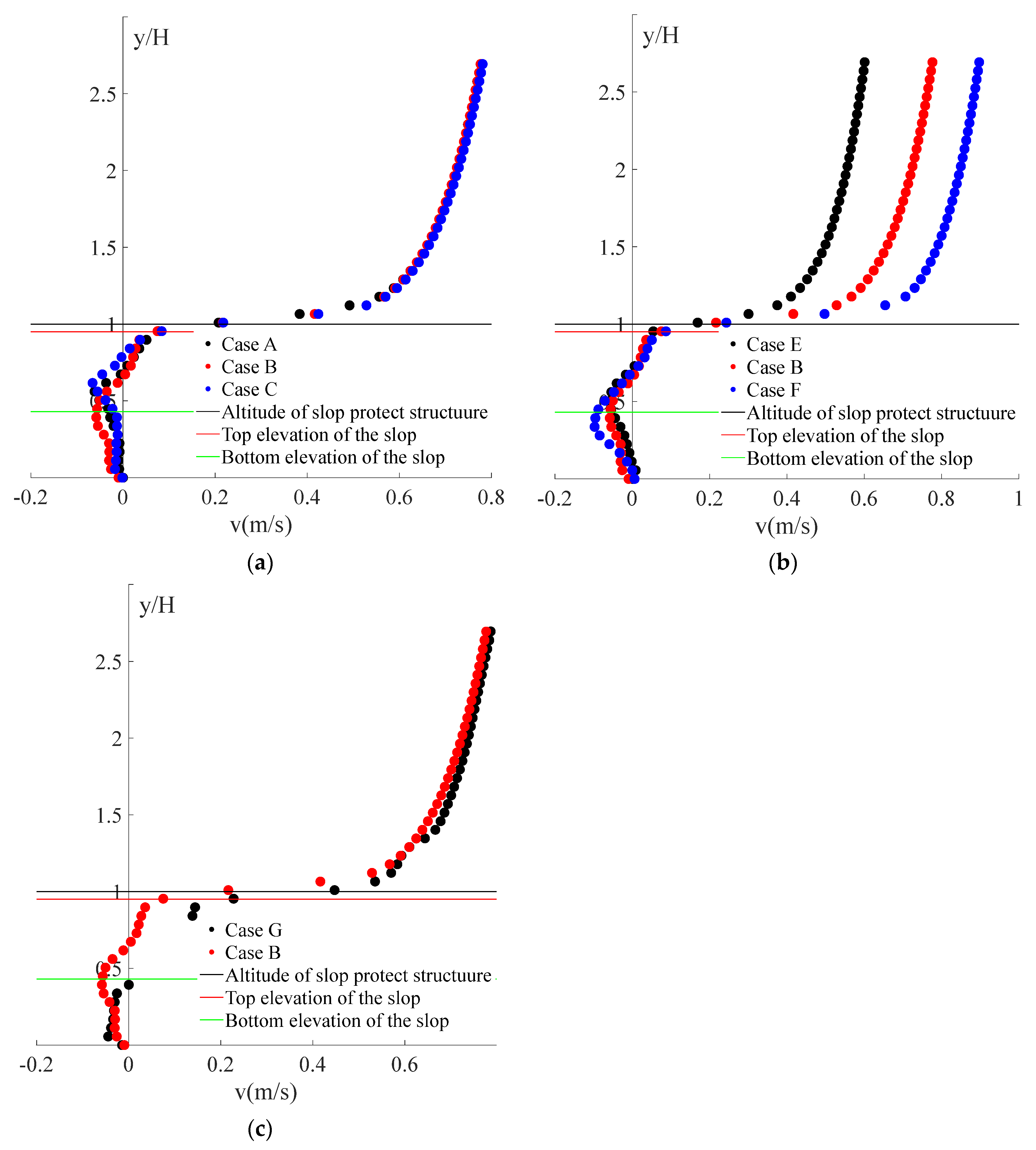
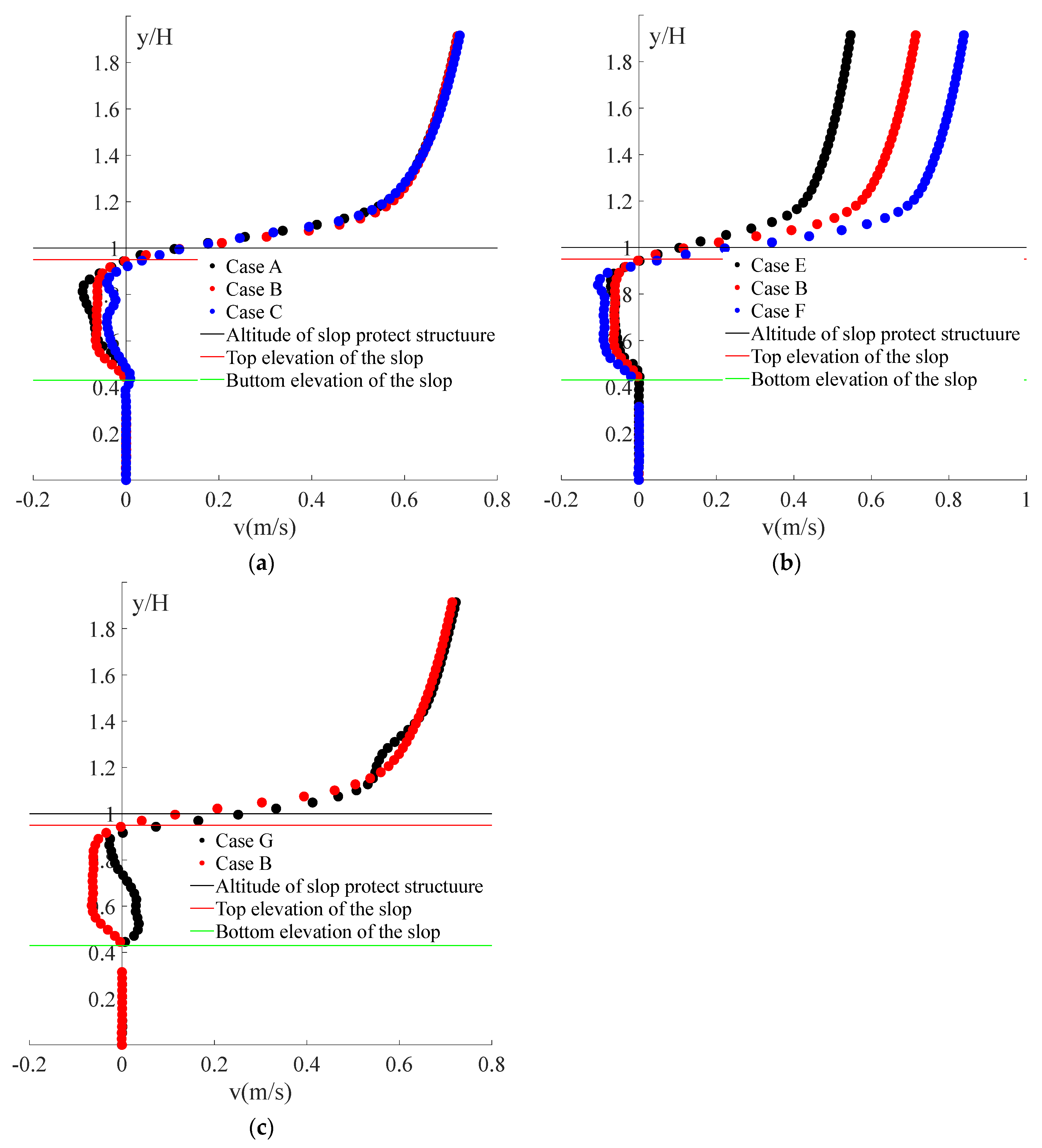
Under different conditions, the velocity distribution along the flow direction (with velocity being the same as below) is consistent, as shown in Figure 6. Within the revetment structure, there are differences in velocity distribution in different regions. In region A, the velocity, w, near the bottom, gradually increases, and the velocity gradient is small in the absence of plants. In region B, the side-wall opening increases the flow of water between structures, and two flow velocities with opposite directions are identified, indicating that the side-wall opening leads to the generation of large-scale vortex structures. In region C, the velocity near the top of the revetment structure surges, and the velocity distribution at the far end and the smooth fixed bed is similar. In the revetment structure with plants, the vertical distribution differs from that without plants, and the position of the vortex structure is low. The velocity distribution outside the structure is basically consistent.
As shown in Figure 6, there are differences in the velocity distribution in different regions. In region B, there is a correlation between velocity distribution and opening size, as shown in Figure 6a. There is a positive correlation between velocity distribution and incoming flow in region A, as shown in Figure 6b. In region C, there is a positive correlation between flow velocity and inflow near the top of the structure. The presence of plants has a significant impact on the size and distribution of the velocity flow inside the structure. As shown in Figure 6c, in region A, the flow velocity gradient decreases, and the flow velocity remains basically the same. According to the analysis of flow distribution trends, the flow velocity at regions B and C is mainly positive and relatively large.

3.1.2. Vertical Distribution Law of Time-Averaged Velocity Between Revetment Structures

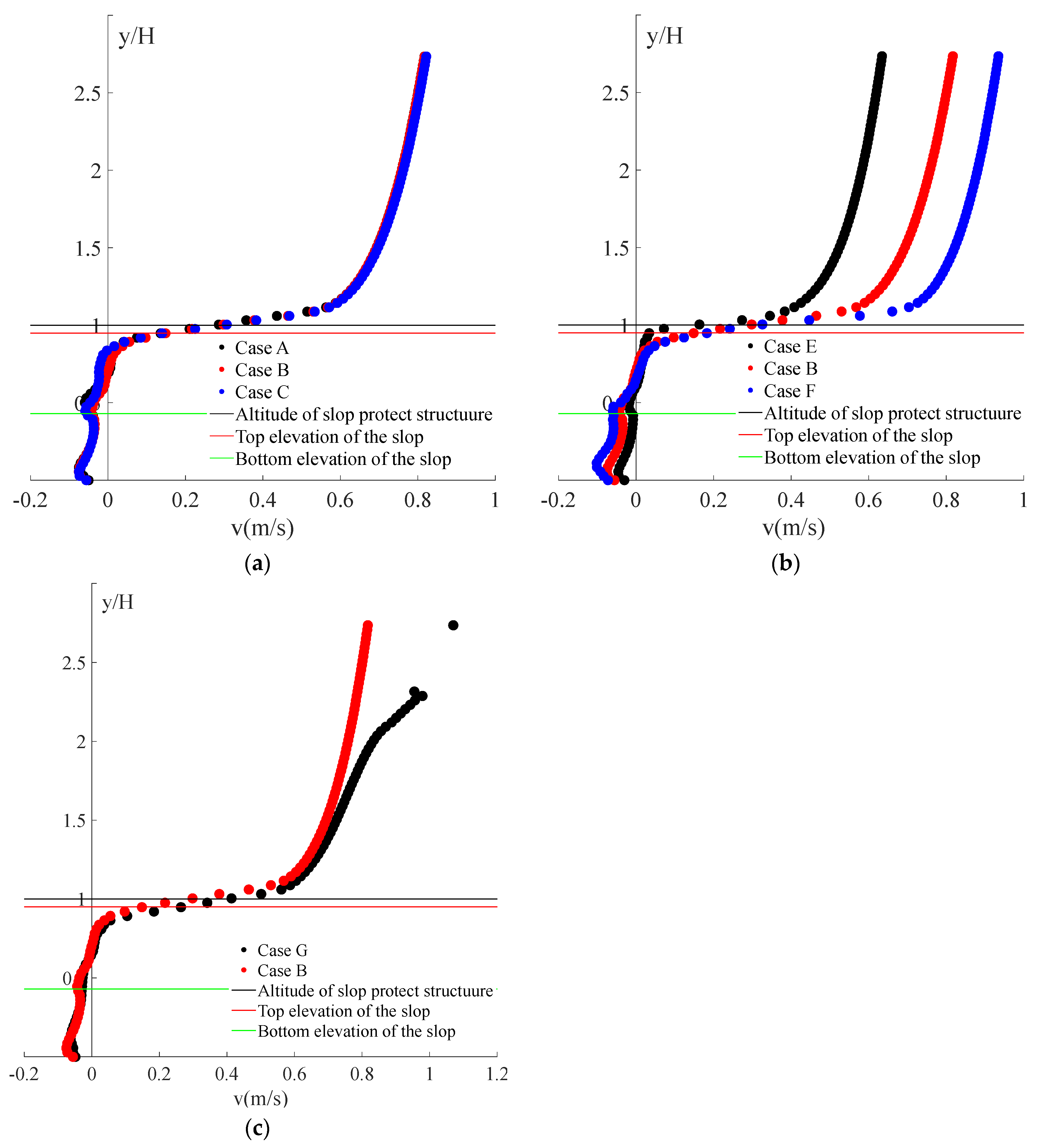
As shown in Figure 7a–c, the regional velocity distribution between structures in the Z direction has strong regularity. Near region A, the velocity is almost 0. In region B, the flow velocity W is negatively correlated with the size of the side-wall opening and positively correlated with the inflow. The change in velocity direction near region C indicates that there may be vortex structures in the area between structures, as shown in Figure 7a,b. Conditions for including plants, such as region B, and the direction of flow velocity have changed many times, indicating that the existence of plants has an impact on the downstream flow, increasing the flow turbulence, and there may be multiple vortex structures between the revetment structures, as shown in Figure 7c.
Among the structures in the X direction, there are no vegetation conditions, and the velocity distribution and size are basically the same, as shown in Figure 8a,b. In region A, the flow velocity and inflow are positively correlated. In region B, the correlation between flow velocity and research parameters is weak. The velocity distribution near the structure remains basically unchanged with the inclusion of plants, indicating that plants have a weak impact on the characteristics of spanwise flow, as shown in Figure 8c. Compared to the structures in the Z direction, the velocity direction changes and shifts downward along the Y-axis. The vortex structure is located in region B.

3.1.3. Time-Averaged Flow Field and Streamline Distribution

  • Analysis of the flow field and streamline without plants
This section primarily employs the vortex structure discrimination criterion, known as the Q criterion, to analyze the distribution of vortex structures near the revetment structure with and without plants, as well as to explore the underlying formation mechanisms.
The Q criterion defines the region where the second matrix invariant of the velocity gradient tensor in the flow field has a positive value, similar to the vortex structure. For incompressible flow, Q = ( Ω 2 S 2)/2, where Ω and S represent the symmetric and antisymmetric parts of the velocity gradient tensor, respectively [19].
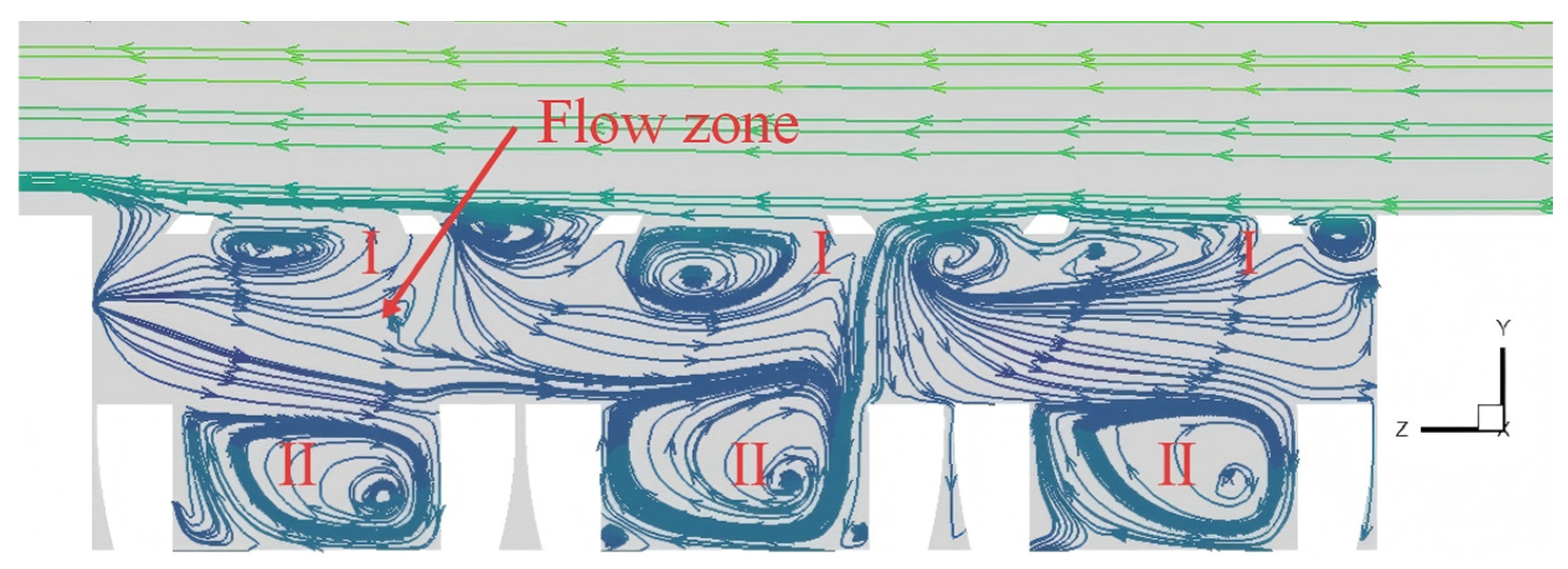
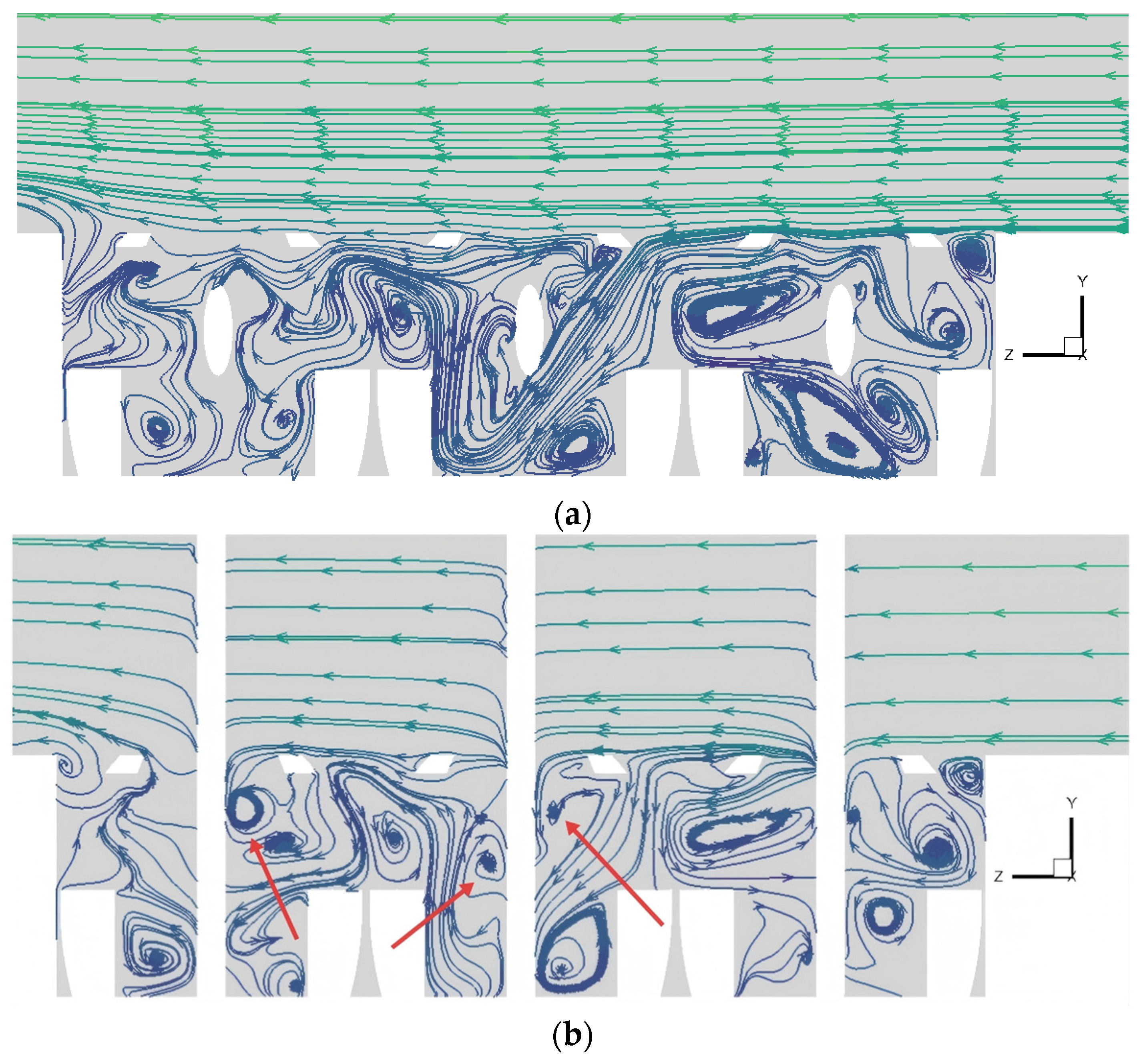
There are various eddy current structures with different sizes and strengths near the hollow eco-revetment structure of the square platform. According to the streamline observation, there are at least two large-scale vortices (vortex structures I and II) and several small-scale vortices in the absence of plants. When external water flows through the top of the revetment structure, a shear layer forms due to the difference in fluid velocity between the inner and outer sides. Water body separation occurs when the water meets the side wall, resulting in an increase in the velocity gradient. A negative pressure zone (reflux zone) is formed inside the revetment structure, and part of the water flows into the structure through the pores, forming a “flow zone” downstream to upstream between the revetment structures. The recirculation zone interacts with the “flow zone” to form a large-scale eddy current structure I, which is mainly located in region B, as shown in Figure 9.
Compared with eddy current I, the formation of eddy current II is affected by both eddy structure I and the eddy current. The design around area A is relatively closed, and the flow is mainly affected by the “flow zone”. It moves passively with slow flow velocity, resulting in the existence of only a single large-scale vortex structure II. There is a small eddy current structure between the revetment structures, and its formation mechanism is that the flow near the top is separated by shear flow. The downstream area is large in size and well developed, consistent with the above analysis.
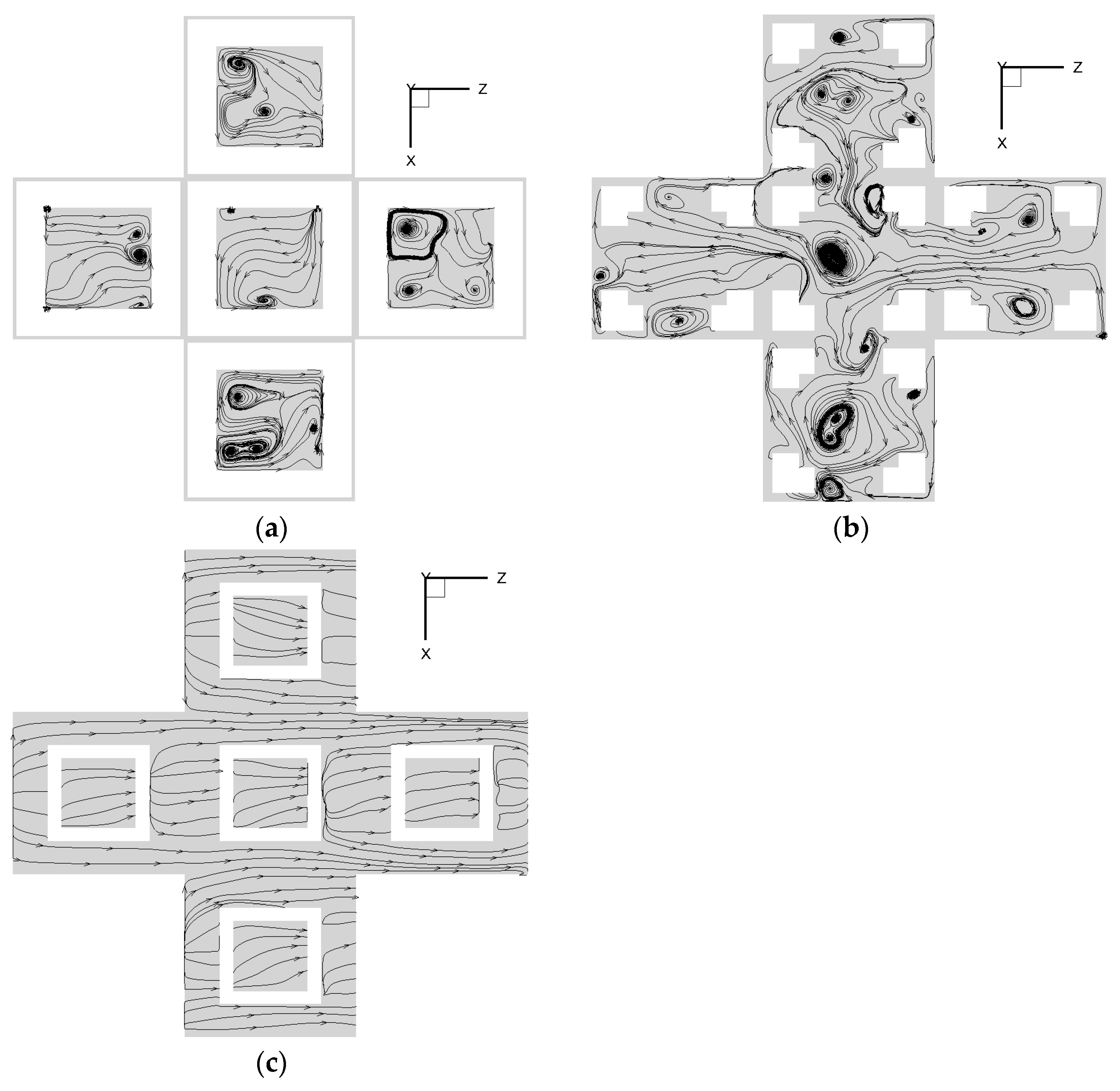
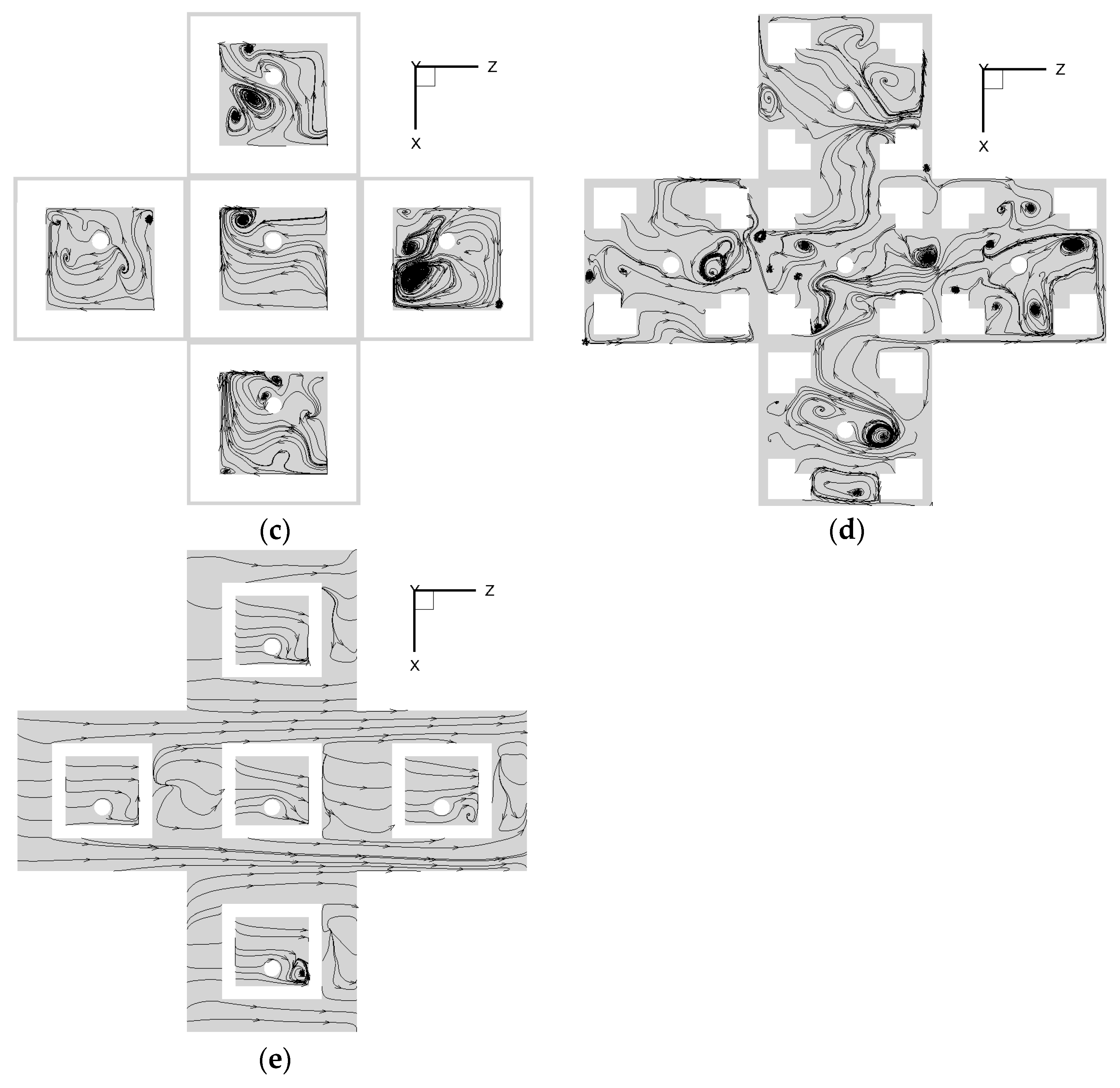
With vortex structures I and II, some small-scale vortex structures are distributed near the wall of the structure. In region A, the small-scale vortex structure is mainly affected by vortex structure II and formed by water separation, as shown in Figure 10a. In region B, the internal distribution of vortex structure is strongly symmetrical and is mainly distributed on both sides of the revetment structure. On the upstream surface, the eddy current is mainly generated by water separation. A recirculation zone is identified on the back surface, and the pressure difference generates multiple small-scale vortex structures, as shown in Figure 10b. In region C, near the top of the structure, the flow velocity along the flow direction is large, and it is not easy to produce small-scale vortex structures, as shown in Figure 10c. In different regions, the distribution of the flow field and streamline is symmetrical, the velocity at the deep-water position is relatively large, and the vortex structure is well-developed.
  • Influence of different hole sizes on the flow field
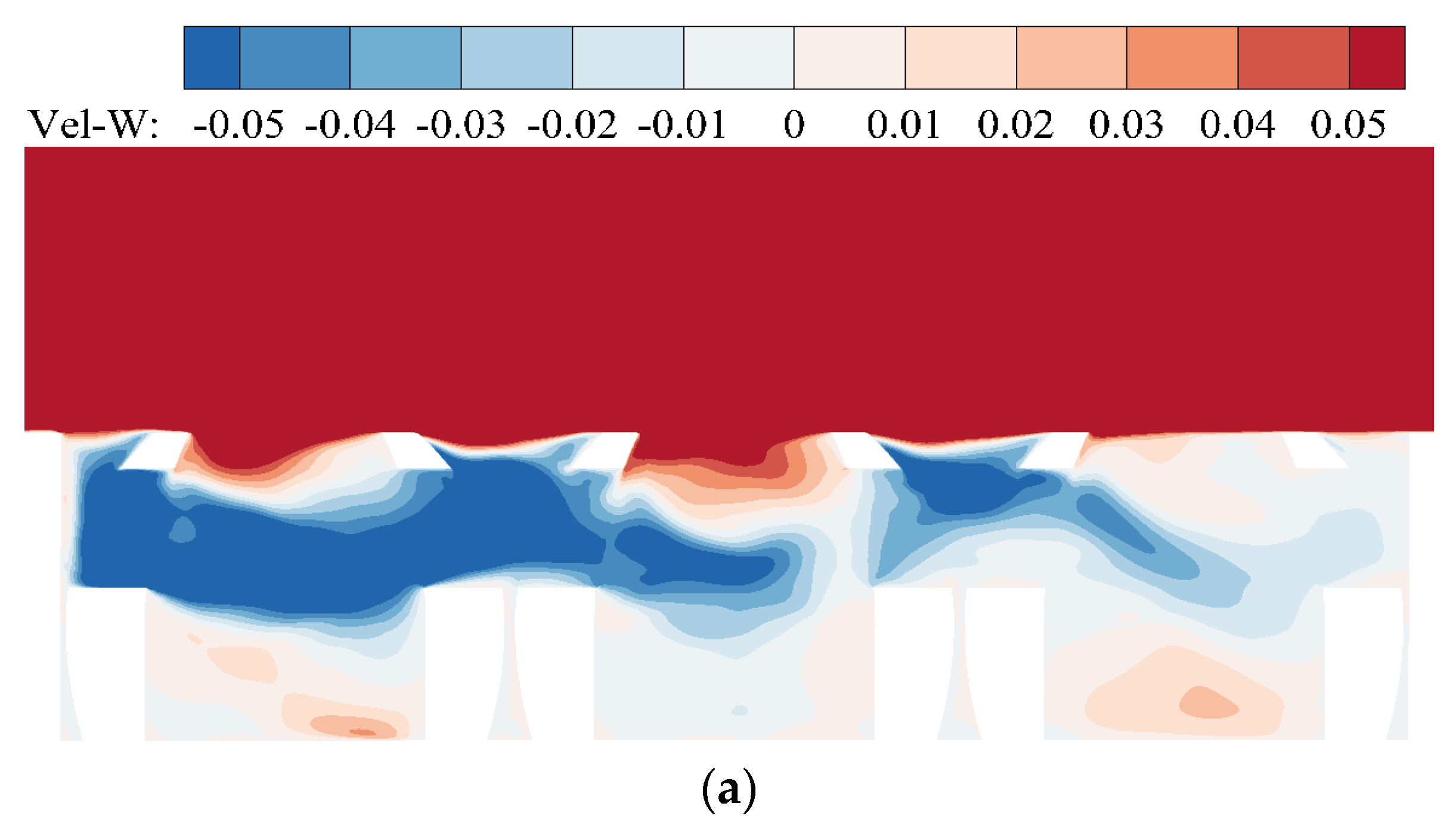
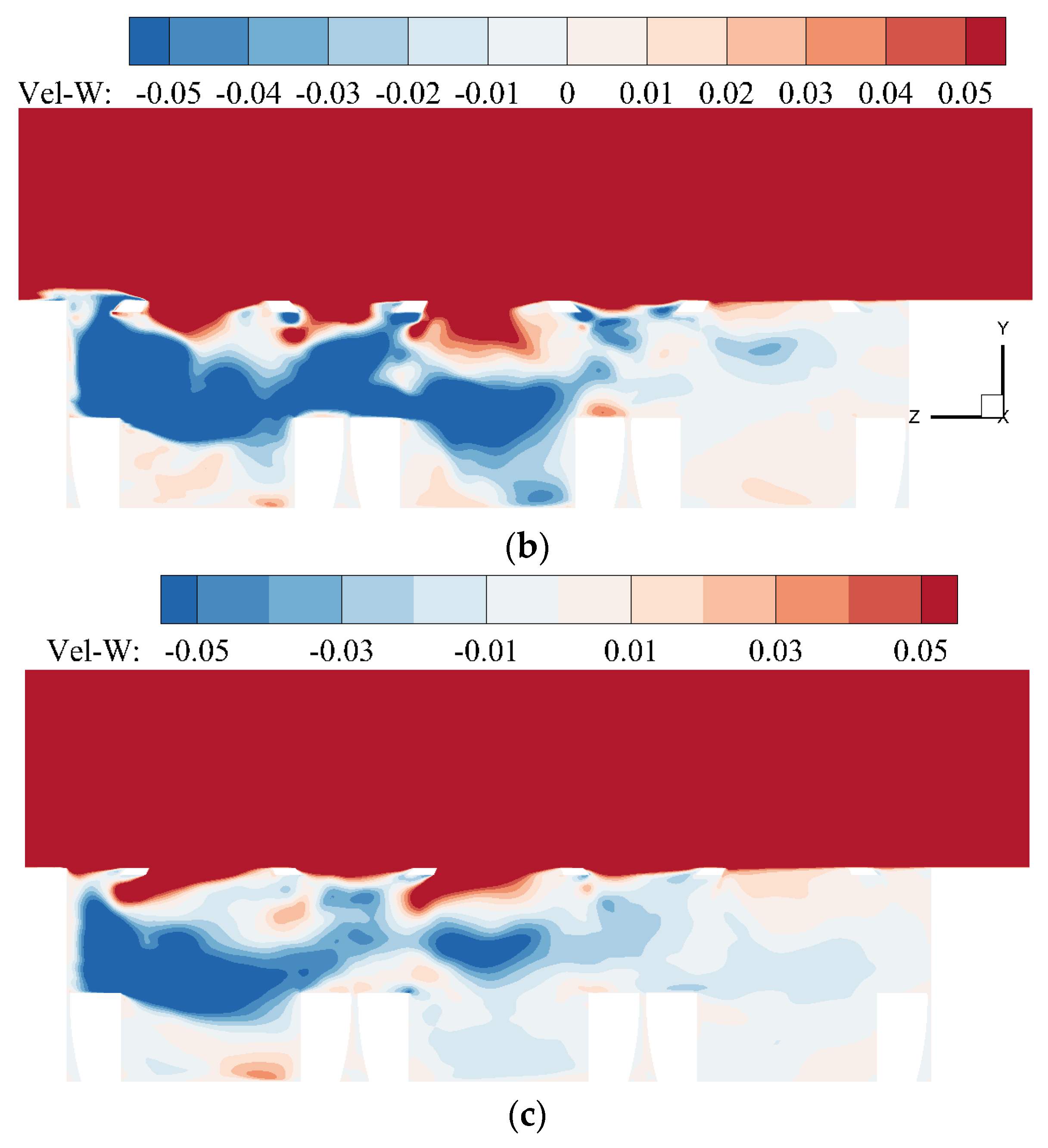
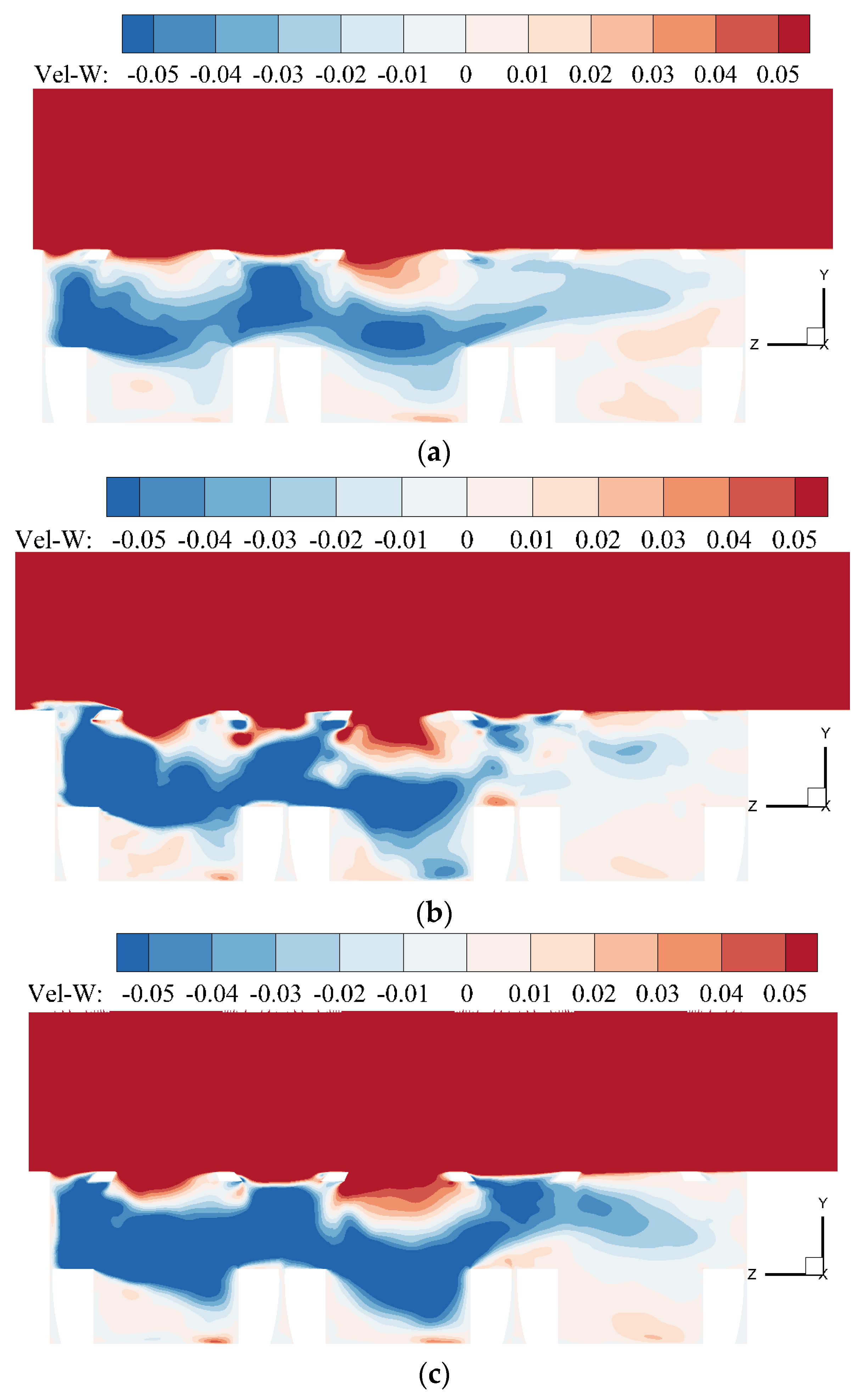
Figure 11 shows the average velocity and streamline distribution in different directions when the vertical bank slope section x/X = 0.7 passes through the center of the revetment structure. Due to the influence of the top shear layer, water separation occurs near the top of the structure, and the opening on the side wall leads to more complex flow conditions. There is a “flow zone” in the structure opposite to the direction of the main flow velocity, as well as positive and negative flow velocities. The revetment structure has a limited effect on the far water end, and the internal velocity, w, is significantly lower than that of the external.
Under the conditions of different hole sizes on the side wall, the time-averaged velocity of the observation section can be obtained as follows: the hole size has a limited effect on the internal velocity of the structure, and its velocity distribution is basically the same. When the porosity reaches 50%, the “flow zone” with a velocity value greater than 0.05 m/s has the widest range, accounting for around 30% of the internal calculation domain of the entire structure (y/Y < 1). Among the structures, a negative correlation exists between the flow velocity, the range of “flow zone,” and the opening size. This is demonstrated in Figure 11.
2.
Influence of different inflows on the flow field
For different incoming flows, the velocity distribution near the wall of the revetment structure is basically the same. There are two directions of velocity between the structures, where section x/X = 0.7. The range and velocity of the “flow zone” between the structures are positively correlated with the incoming flow. As the flow velocity increases, the proportions of areas with velocity values greater than 0.05 m/s are about 17%, 30%, and 36%, respectively, and they diffuse towards region A. Between the downstream structures, the velocity is greater than that of the upstream side, as shown in Figure 12a–c.
  • Analysis of the flow field and streamline distribution for the presence of plants
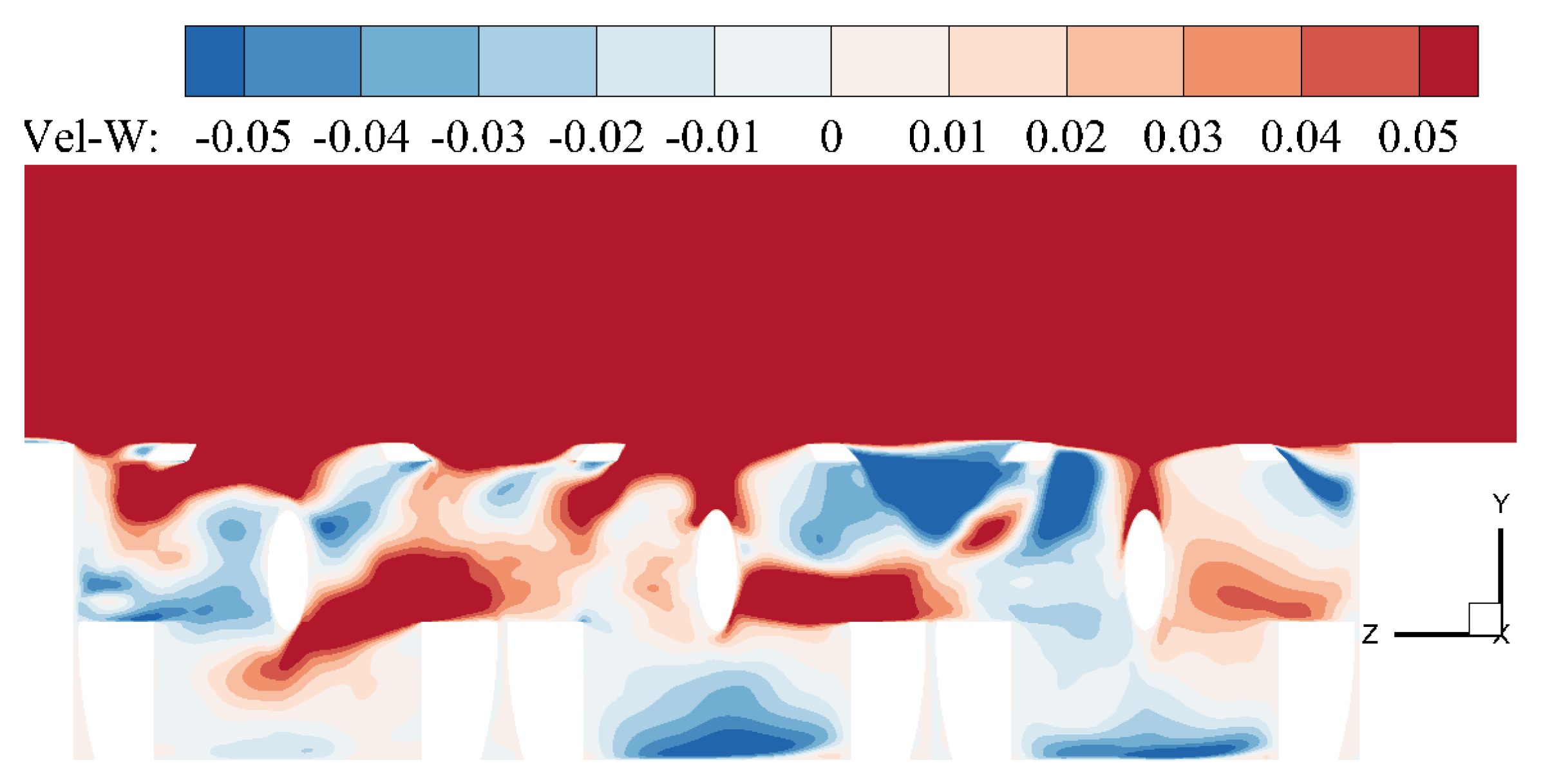
The presence of plants leads to changes in the flow pattern of internal and external water flow in the structure. Section x/X = 0.7, or the “flow zone” inside the structure, is damaged, and the flow velocity in region B maintains a mainly positive flow direction, as shown in Figure 13. Enhanced turbulence leads to the dissipation of water flow. Among the structures, the influence of plants on the velocity distribution is relatively weak, and the distribution law of plants is similar.
Compared to case B without plants, the flow conditions are more complex, and the presence of plants leads to the formation of a large number of vortex structures with different scales near the structure. In section x/X = 0.7, external water flows into the structure, the presence of plants increases the resistance to water flow, and the water flows around the columns, causing the wake effect to disrupt the “flow zone”. As a result, the water flow direction inside the structure is essentially consistent with that outside. Compared with Case B, the position in which vortex structure I in region B is formed shifts upstream, and its size is smaller, located near the side-wall opening. The turbulence of water flow is enhanced: part of the water flows into region A, and wall separation occurs when it comes into contact with the bank slope. Therefore, there are two large-scale vortex structures with opposite movement directions in this area, as shown in Figure 14a. The presence of plants makes the flow characteristics inside the structure more disordered. The flow around the cylinder dissipates, and several small vortex structures are formed near it, as shown in Figure 14b–e.

3.2. Time-Averaged Turbulence Intensity Distribution

3.2.1. Vertical Distribution Law of Time-Averaged Turbulence Intensity near Revetment Structure

  • Turbulence intensity distribution in the structure
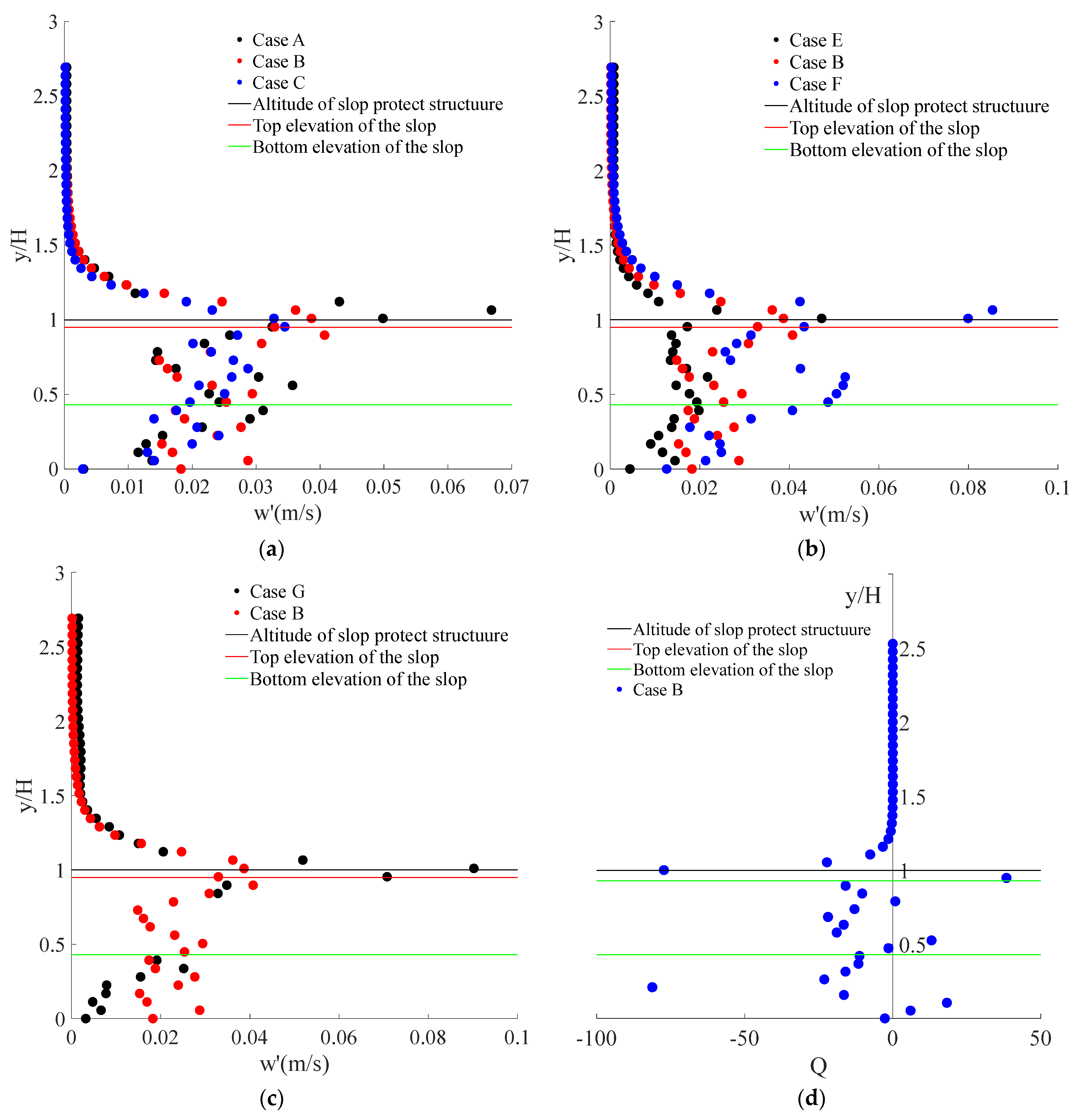
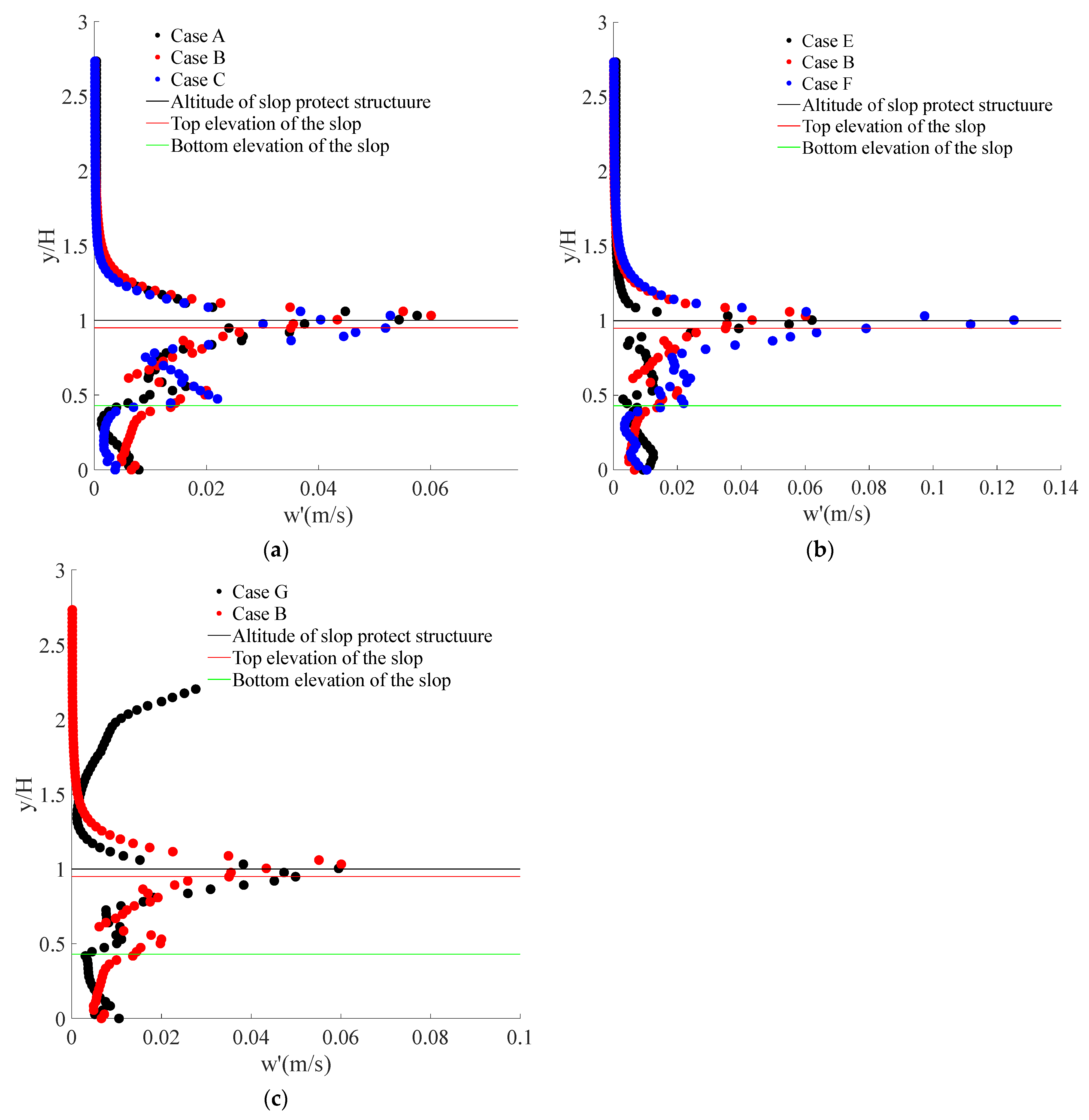
This paper chooses to study the distribution law of turbulence intensity, w. In the absence of vegetation cover, the overall distribution of turbulence intensity in zones A and B usually shows a decreasing trend followed by an increasing trend, forming a “w” shape along the flow path. Near the top of the revetment structure in region C, the turbulence intensity has a maximum value, which is also a “turning point”. It has a negative correlation with the opening size and a positive correlation with the inflow. With vegetation conditions, the turbulence intensity increases significantly, as shown in Figure 15a–c.
The internal turbulence intensity of the structure shows a “w” distribution, due to the correlation between turbulence intensity and the Q value. There are two large-scale vortex structures within the structure, with Q < 0 near the center of the vortex structures and Q values close to 0 at the junction of the two vortex structures, as shown in Figure 15d.
Inside the revetment structure, the size of side-wall openings has minimal effect on the distribution of turbulence intensity, which is maintained within a certain range, as shown in Figure 15a. There is a clear positive correlation between turbulence intensity and inflow, as shown in Figure 15b. In the revetment structure containing plants, the turbulence intensity is relatively small from the bottom to the side-wall opening, as shown in Figure 15c.
  • Distribution of turbulence intensity between structures
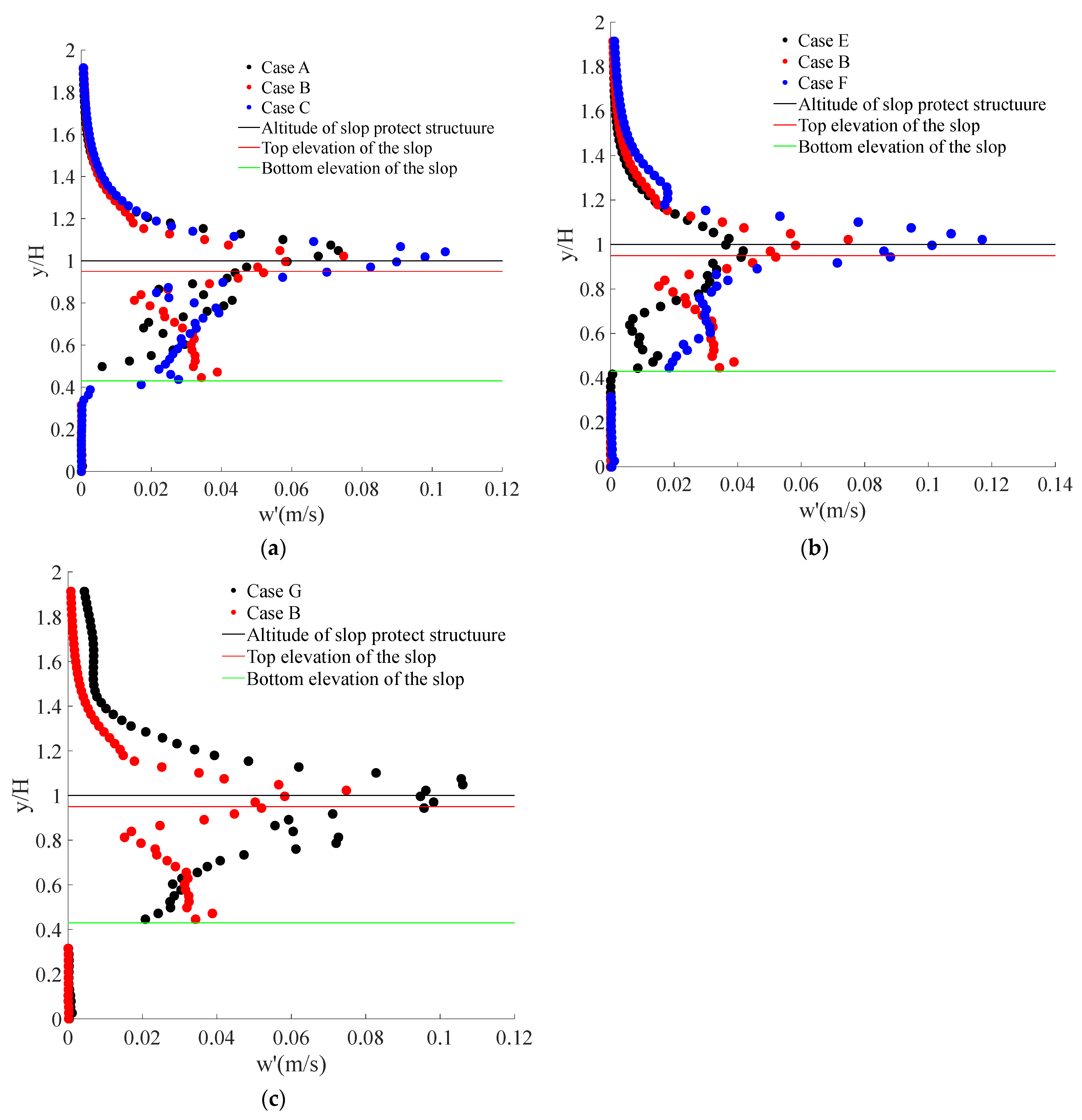
The turbulence intensity is basically the same between structures in the Z direction; however, there are differences near the top of the structure. At the top of the structure, the turbulence intensity positively correlated with the size of the opening and the incoming flow, and had a significant correlation with the incoming flow, as shown in Figure 16a–c. The presence of plants had a great impact on the flow characteristics between downstream structures, resulting in a significant increase in turbulence intensity, as shown in Figure 16c.
Among the structures in the X direction, the research parameters had a limited effect on the distribution of turbulence intensity, which mainly remained consistent throughout. Only under the condition of a large flow did the turbulence intensity in the top area increase. Likewise, the presence of plants had minimal effect on the turbulence intensity between the structures in the X direction, as shown in Figure 17a–c, indicating that the turbulence characteristics between the structures in the X direction are relatively stable and insensitive to parameter changes.

3.2.2. Distribution Law of Time-Averaged Turbulence Intensity Field

  • Analysis of time-averaged turbulence intensity without plants
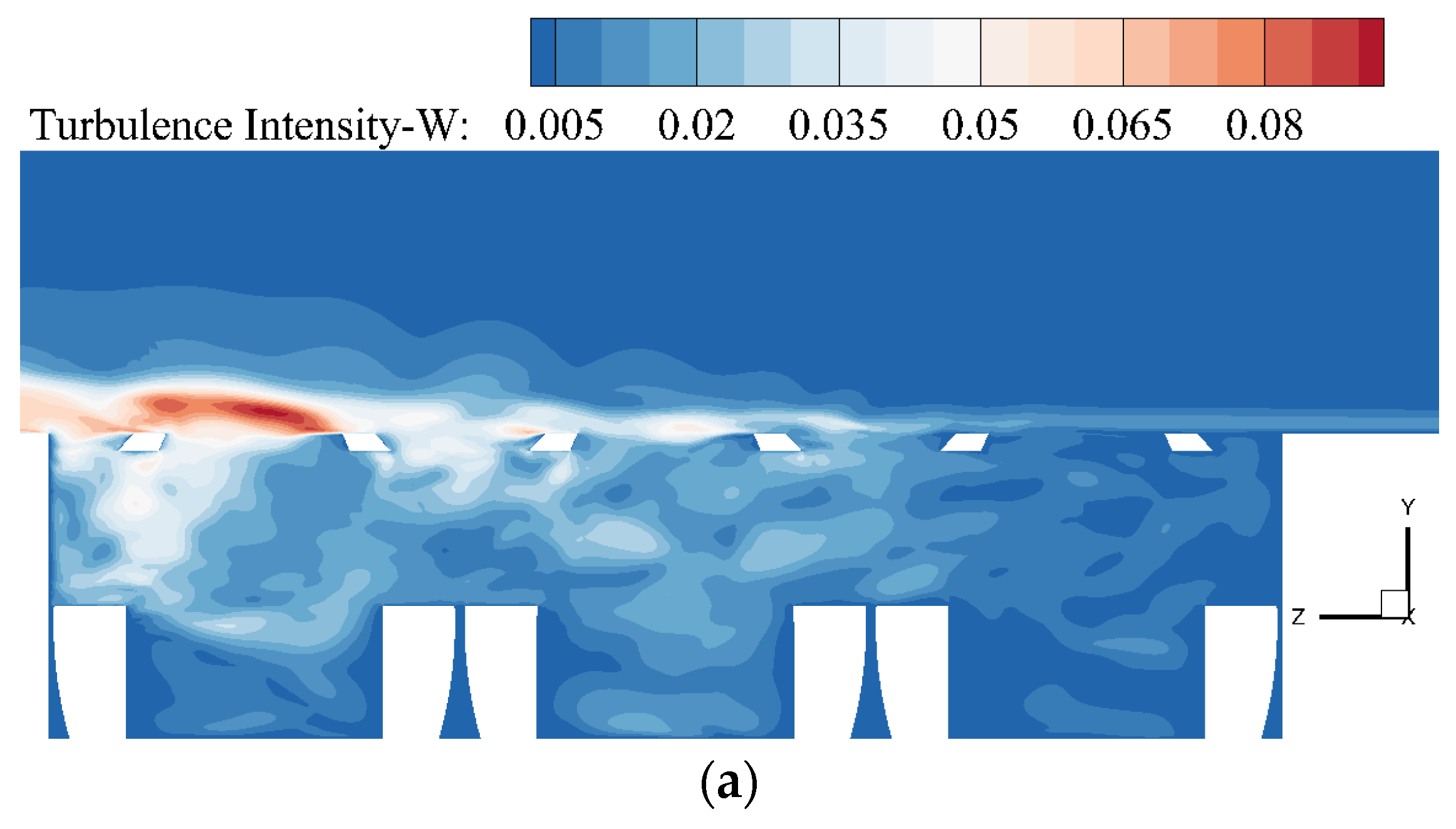
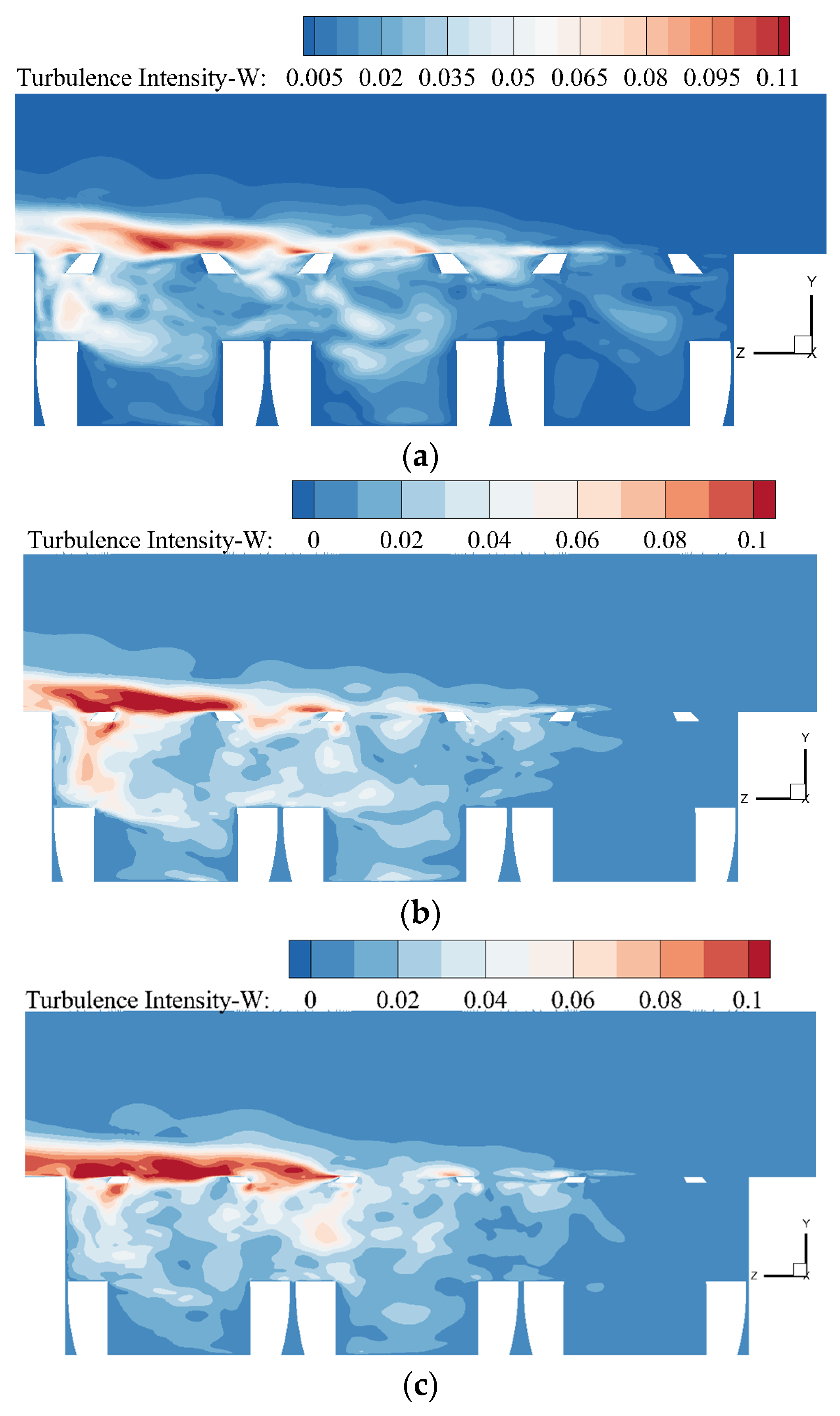
The results show that the distribution of the turbulence intensity field is the same with different hole sizes in the side-wall, and the maximum value is near the top area. For the cross-section x/X = 0.7, the turbulence intensity in the top region gradually increases along the way, and the value and range of turbulence intensity correlate positively with the size of the side-wall opening. As shown in Figure 18a–c, with the increase in the opening size, the high turbulence intensity region at the top of the structure moves backward.
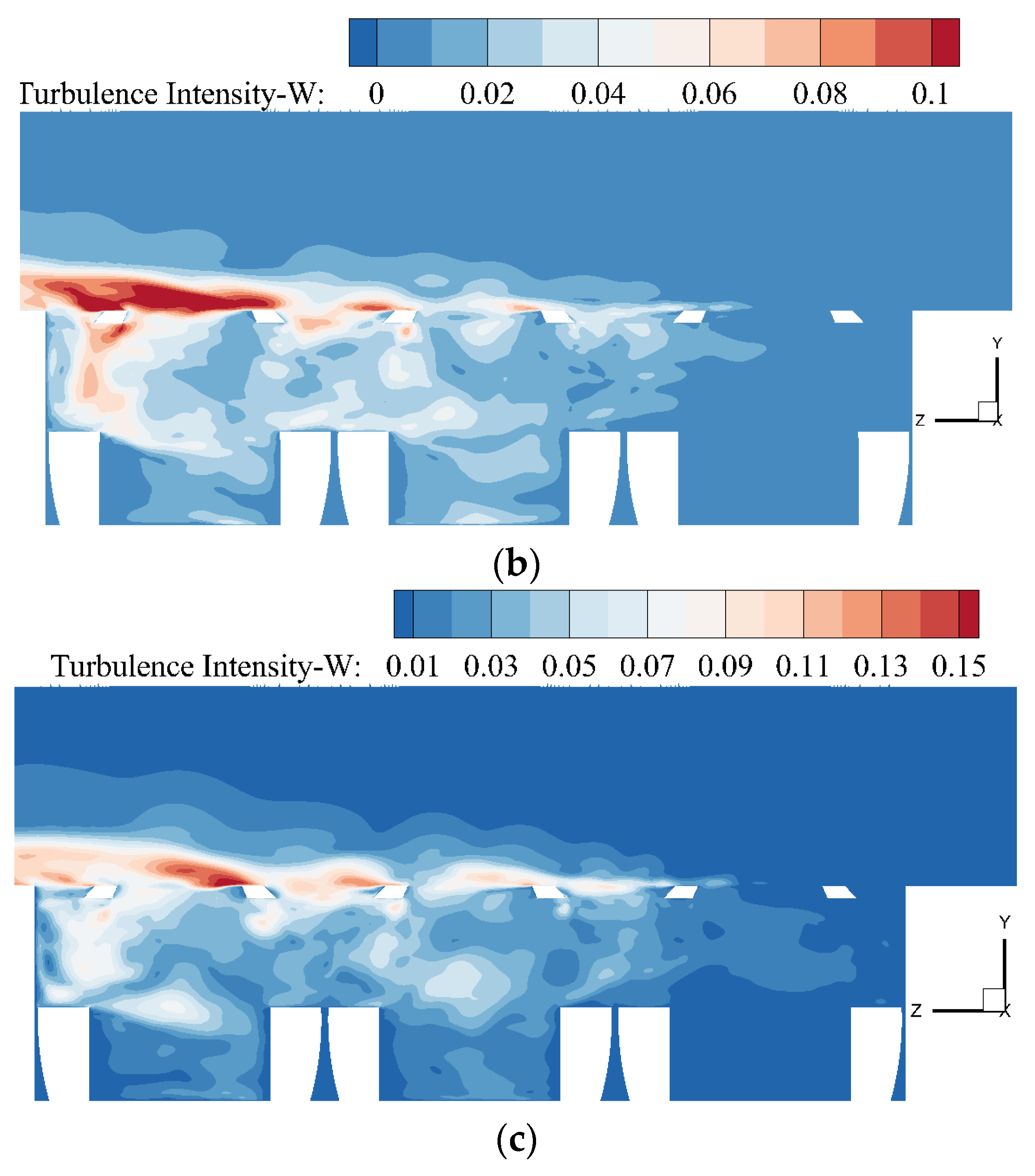
In section x/X = 0.7, the turbulence intensity at the top of the structure and the area between structures are positively correlated with the incoming flow, as shown in Figure 19a–c. In region y/H ≤ 1, under different conditions, the larger values of turbulence intensity are mainly concentrated near the side-wall openings and the junction between regions, and they are greatly affected by the flow environment. Finally, the turbulence intensity between structures is higher than that inside the structure.
  • Analysis of the turbulence intensity field containing plants
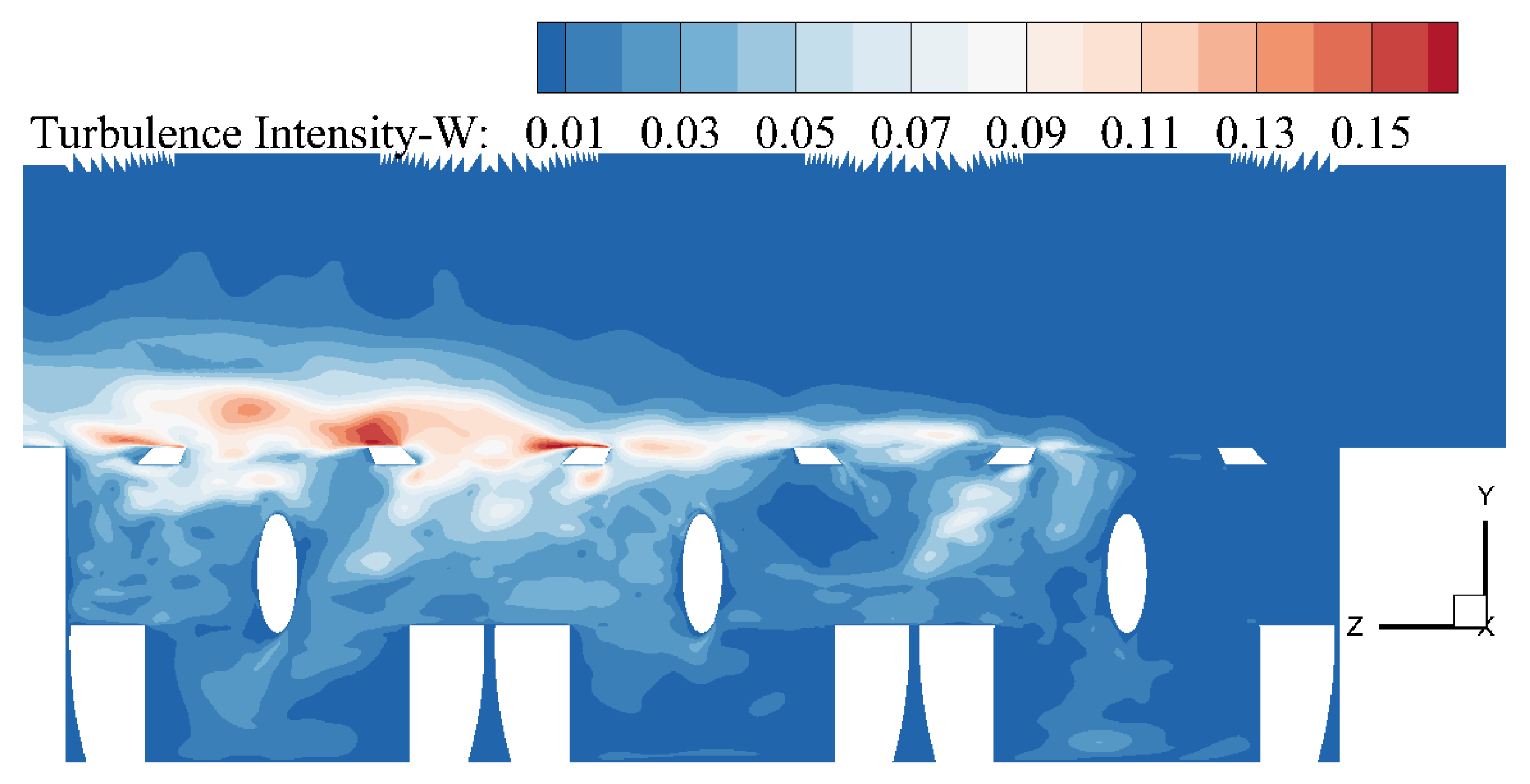
At section x/X = 0.7, the plants increase the flow disturbance; the turbulence intensity and range near the revetment structure are improved overall, as shown in Figure 20. The region with the maximum turbulence intensity at the top diffuses to the region with y/H < 1.

3.3. Time-Averaged Reynolds Stress Analysis

3.3.1. Vertical Distribution of Time-Averaged Reynolds Stress near Revetment Structure

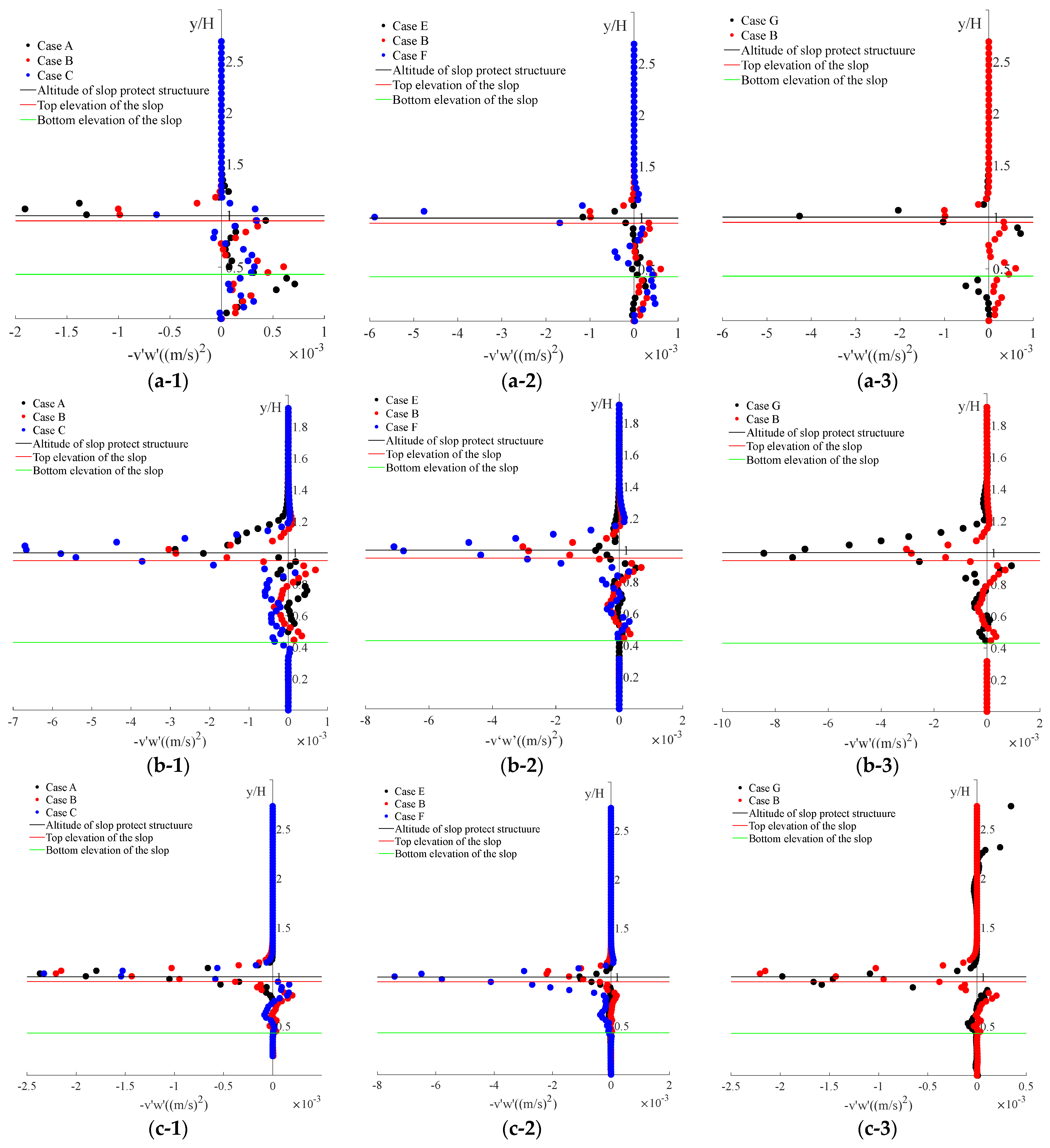
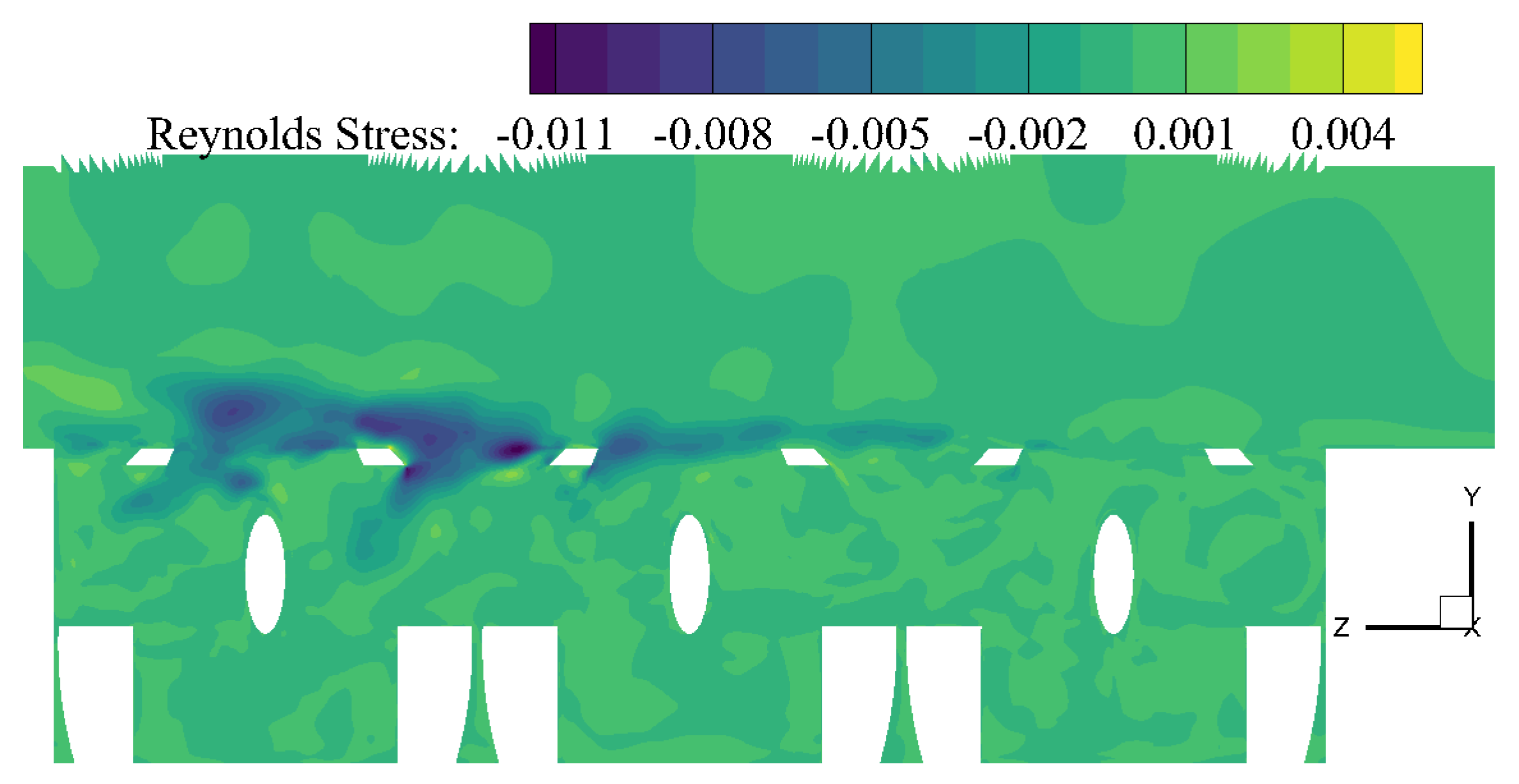
As shown in Figure 20, a Reynolds stress of − v w ¯ is selected to analyze the vertical distribution at different positions. This is different from the Reynolds stress distribution in Section 2: y/H ≤ 1. The opening on the side wall causes the Reynolds stress inside the structure to fluctuate throughout, but the fluctuation range is basically maintained between −1 × 10⁻³ and 1 × 10⁻³. In addition, the Reynolds stress value at the regional junction increases. Near the top of region C of the structure, the Reynolds stress value increases sharply and is negatively correlated with the size of the opening, as shown in Figure 21(a-1). Among the flow structures, the Reynolds stress value is positively correlated with the opening size, as shown in Figure 21(b-1). There is no clear correlation between the Reynolds stress and opening size among spanwise structures, as shown in Figure 21(c-1). Reynolds stress is positively correlated with inflow, as shown in Figure 21(a-2–c-2). The existence of plants leads to an increase in Reynolds stress at the top of internal and downstream structures, and the Reynolds stress between spanwise structures remains basically unchanged, indicating that plants have minimal effect on spanwise flow, as shown in Figure 21(a-3–c-3). The Reynolds stress value near the top of the structure is larger in the area between the structures along the flow compared to the interior and spanwise structures.

3.3.2. Distribution Law of Time-Averaged Reynolds Stress Field

  • Analysis of the Reynolds stress field with different hole sizes
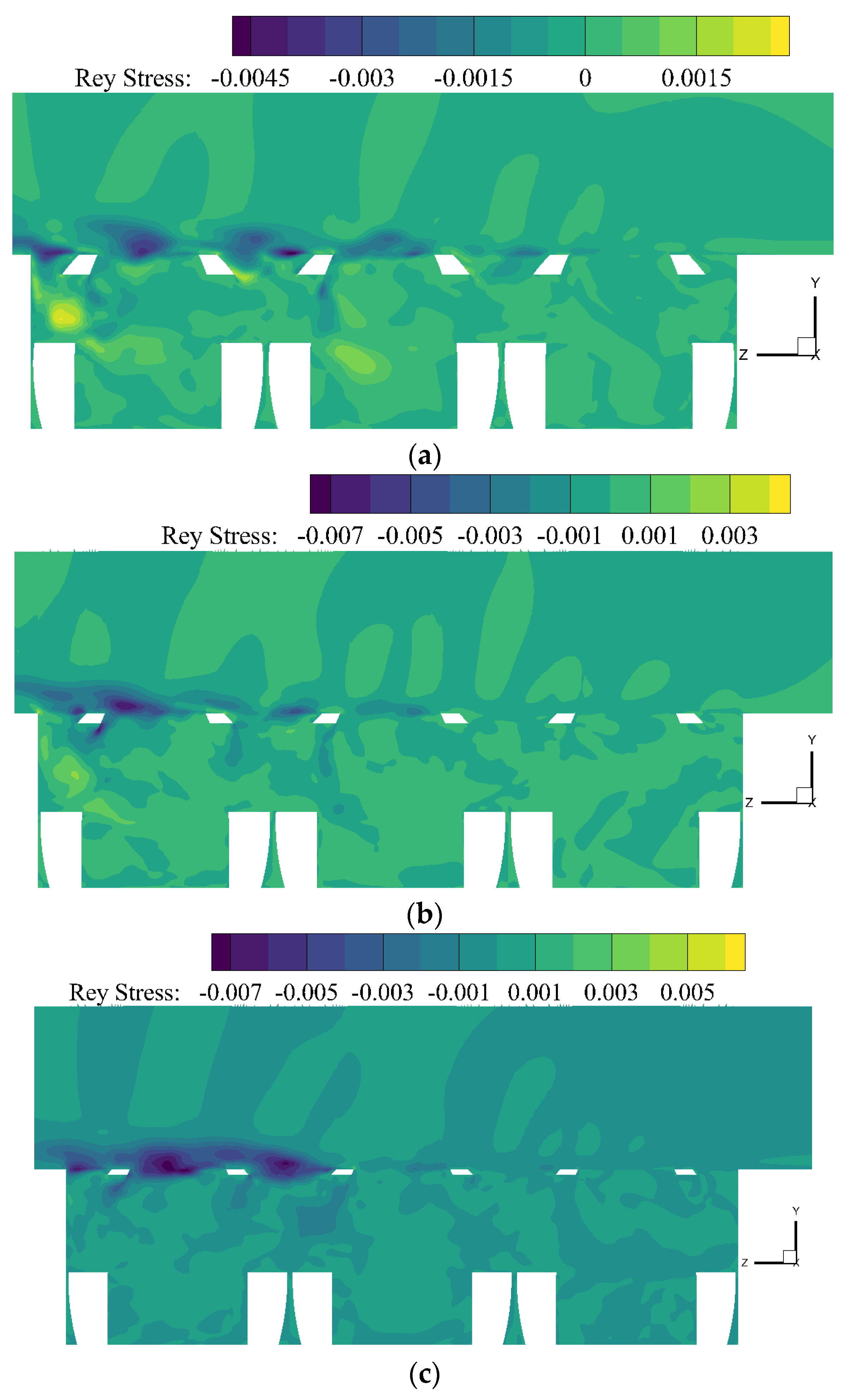
In the absence of vegetation, by observing the distribution of Reynolds stress in different regions, it can be seen that vortex structures are generated at the top of the revetment structure and near the wall between structures due to water separation. The flow in this region significantly fluctuates with high Reynolds stress values. The Reynolds shear stress value and range at the top of the structure increase gradually along the way, and the maximum value appears at the top of the end revetment structure. The Reynolds shear stress in the revetment structure is generally small, with an average value of 1/6 of the top. The larger value is mainly distributed near the side-wall opening, as shown in Figure 22.
The distribution of time-averaged Reynolds stress is roughly the same for different side-wall hole sizes, and the location of the high Reynolds stress region remains basically unchanged. Near the top, the high Reynolds stress value and radiation range are positively correlated with the size of the side-wall opening. The Reynolds stress inside the structure is small, but it is slightly larger near the wall. There is a positive correlation between the Reynolds stress value and the opening size among the flow structures, as shown in Figure 22a–c. With the increase in the opening size, the maximum Reynolds stress region moves backward.
  • Analysis of the Reynolds stress field under different flow rates
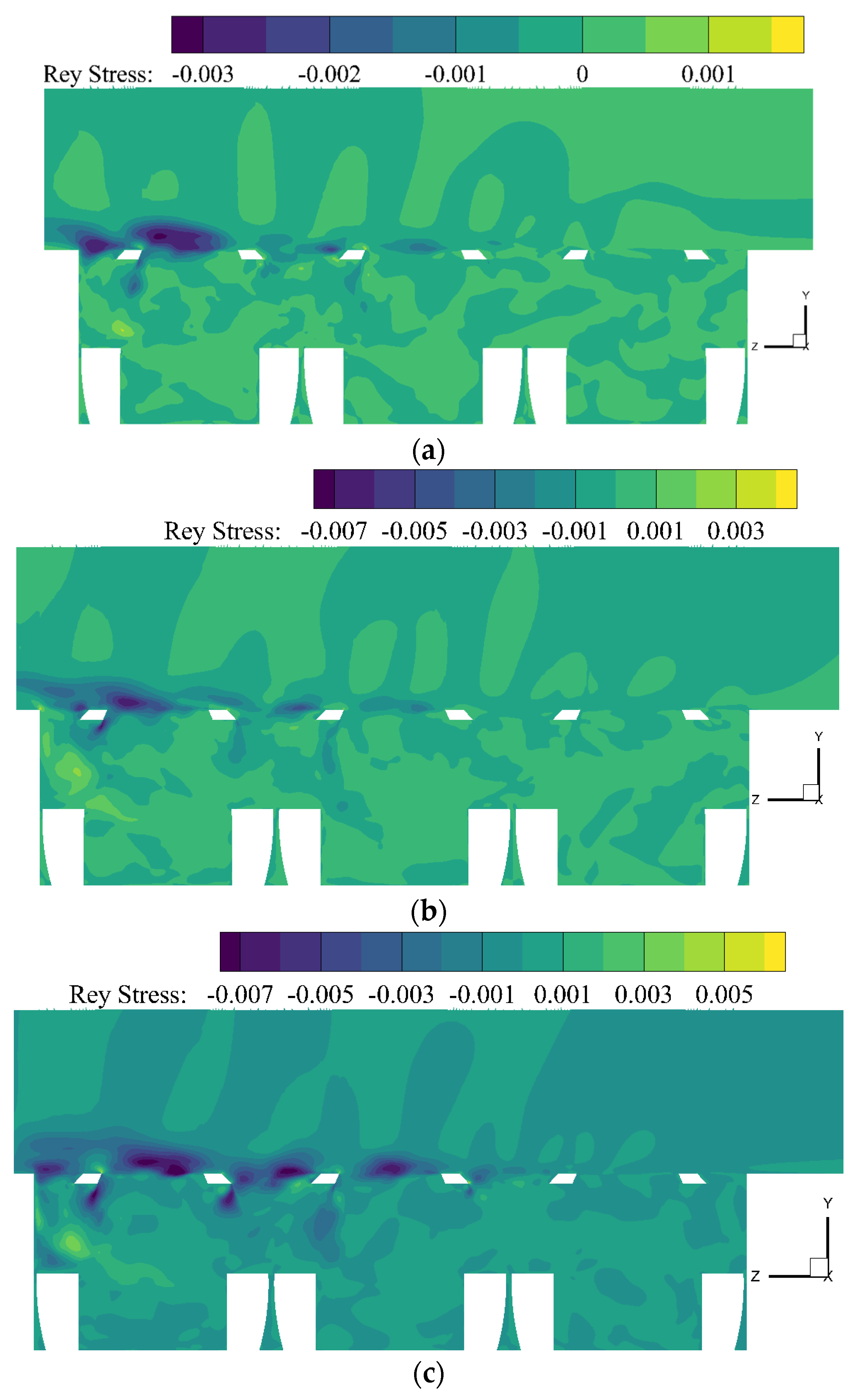
The time-averaged Reynolds stress distribution is approximately the same at different flow rates, and the location of the high Reynolds stress region remains basically unchanged. The high Reynolds number at the top of the structure, the range, and the inflow are positively correlated. There is a positive correlation between the Reynolds stress value and the inflow among the flow structures, as shown in Figure 23a–c.
  • Analysis of the Reynolds stress field with plants
In Case G, the Reynolds stress distribution characteristics are similar to Case B. Under the influence of plants, the value and range of high Reynolds stress increased and diffused to the region of y/H < 1. The downstream structures were clearly affected, and the Reynolds stress increased, as shown in Figure 24.
Based on the above analysis, the proposed new eco-revetment structure exhibits a regular distribution of external water flow along the water depth, and the structural water isolation effect significantly reduces the internal water flow velocity. The maximum turbulence in the water tunnel is primarily concentrated near the top of area C of the structure. The impact of bank slope erosion is reduced, indicating that this new eco-revetment structure enables smooth water flow and can maintain bank slope stability.

3.4. Momentum Thickness

One of the primary functions of the ecological revetment structure designed in this study is to provide a suitable living environment for fish. This study focuses on grass carp as the research object. Turbulent water flow can stimulate grass carp reproduction, enhance the mixing strength of fish eggs and sperm, improve the fertilization rate of fish eggs, expand the spatial distribution of fertilized eggs, and reduce the probability of predation.
Through systematic analysis of the distribution of water flow characteristics, it was found that the top of the revetment structure is the area with the strongest turbulence of water flow. Core water flow characteristics, such as turbulence intensity and flow velocity, directly determine the efficiency of material information energy transmission, which affects the stability of the water flow ecosystem.
Momentum thickness is the core length scale used in the boundary layer theory to quantify the momentum deficit caused by viscosity. The turbulence of water flow near eco-revetment structures is an important manifestation of water energy dissipation. Analyzing the thickness of momentum is of great significance for improving the survival rate of fish eggs.
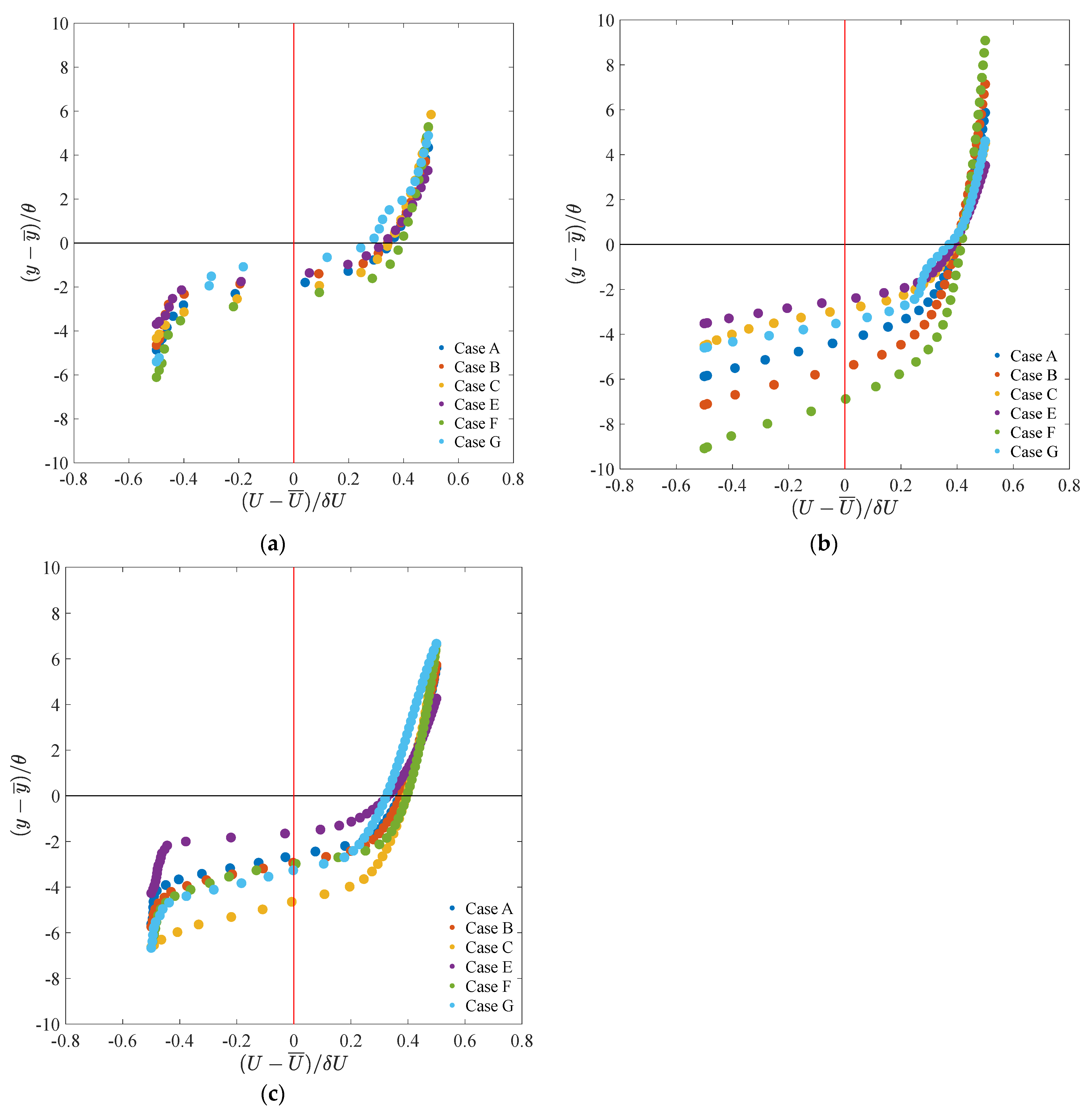
Raupach [20] and others found that there was an “inflection point” regarding the average velocity near the top of the vegetation. To analyze the flow near the top of the vegetation, the plane mixed-layer theory was employed to conduct in-depth research, which increased the development of research on vegetation water flow. The flow near the top of the structure was selected as the research object. Through the analysis of velocity, turbulence intensity, and Reynolds stress, it was clear that the distribution of hydraulic characteristics near the top of the structure changed significantly. The area near the top of the structure is a mixed-layer area, which is characterized by the existence of a velocity “inflection point”, turbulence intensity, and maximum Reynolds stress.
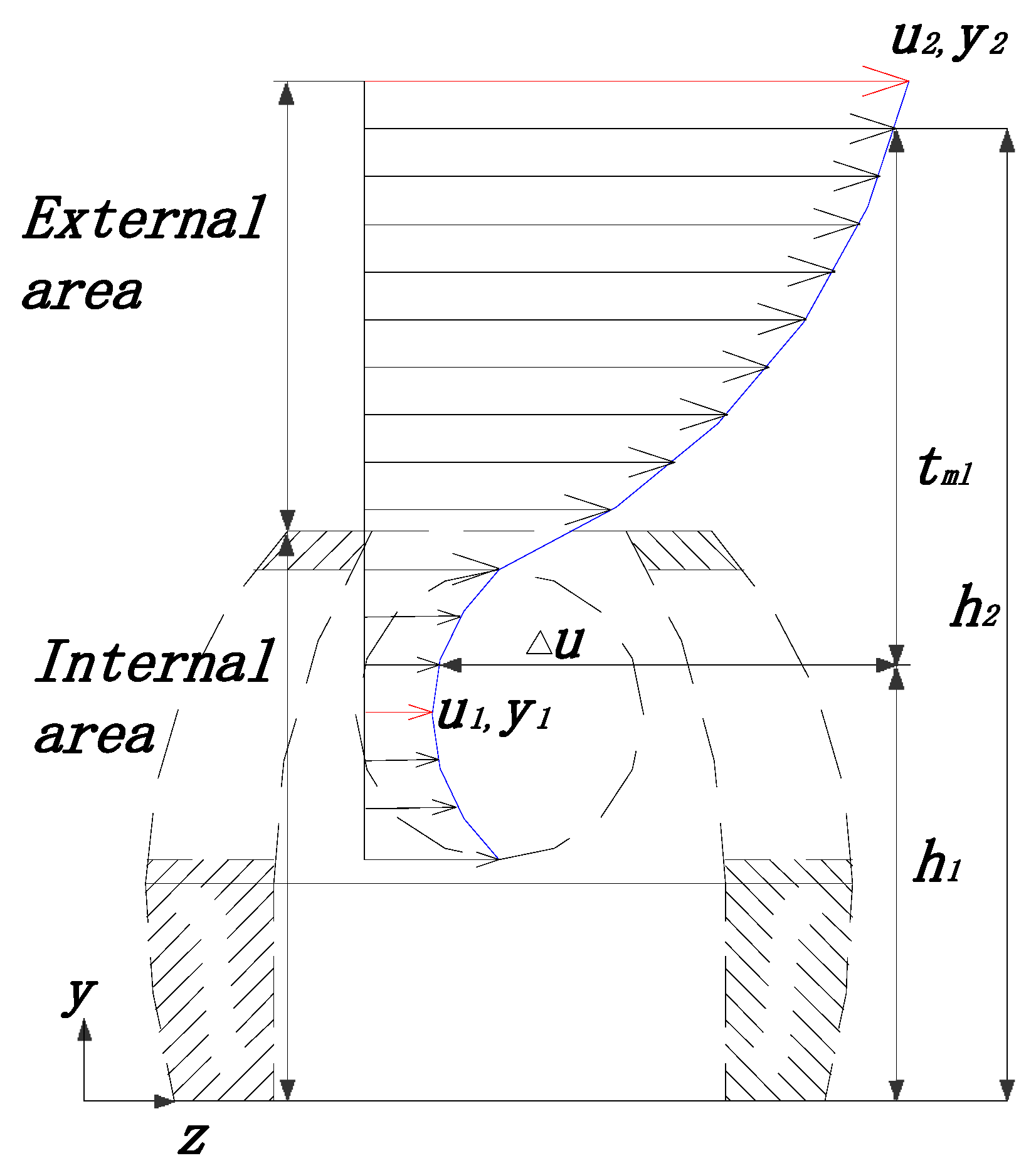
Figure 25 shows the velocity distribution near the square platform hollow eco-revetment structure. Combined with the definition of the submerged plant flow mixing layer, y1 and y2 are the boundary layer coordinates, and the mixing layer thickness tml is defined as the vertical height between ( U U 1 ) / U = 0.01 and ( U 2 U ) / U = 0.01 in the velocity distribution. h2 and h1 represent the thickness of the mixing layer through the upper and lower coordinates, tml = h2 − h1. Here, U1 is the minimum velocity in the area where y/H ≤ 1 of the revetment structure, and U2 refers to the flow velocity at the far end of the external area of the revetment structure. The momentum thickness is calculated as follows:
θ = y 1 y 2 [ 0.25 ( U U ¯ ) / U ] d z
where ∆U = U2 − U1 and U = 0.5 × (U2 + U1). y1 and y2 represent the y values of the minimum and maximum flow velocities near the top of the structure.
The velocity in the mixing layer meets the hyperbolic tangent distribution [21]. Through the analysis of the longitudinal velocity distribution near the top of the structure, the velocity distribution meets the hyperbolic tangent function distribution. As shown in Figure 26, a shear layer at the top of the structure verifies the previous statement.
The analysis shows that the ratio of mixing layer thickness to momentum thickness (tml/θ) is proportional to the inflow and correlates weakly with the size of the opening. The presence of plants leads to an increase in tml/θ, as shown in Table 3. Therefore, the change in flow environment near the structure leads to the formation of a shear layer, and the complexity of flow conditions is positively correlated with the thickness of the shear layer.

4. Discussion

The new eco-revetment protection structure proposed in this study has a close relationship between its hydrodynamic characteristics, ecological functions, and watershed sustainability. Combined with core results such as turbulence intensity and mixing characteristics obtained from numerical simulations, its ecological value and application potential can be further elucidated. Under the condition of no vegetation, the y/H ≤ 1 region constructed a diverse flow heterogeneity environment. This difference in flow field provides differentiated habitats for aquatic organisms with various habits. The intervention of vegetation causes the disappearance of large-scale “flow zones” and the formation of small-scale eddies, significantly optimizing the uniformity of flow velocity distribution and further reducing the risk of slope erosion. This is consistent with the deceleration and homogenization effects of vegetation on water flow, and aligns with the sustainable development goals of ecological slope protection.
There is a correlation between turbulence intensity and mixing characteristics in hydrodynamic and water flow ecosystems: under the action of vegetation, the maximum turbulence intensity at the top of the structure is further enhanced and diffuses inward, strengthening material exchange and energy transfer near the slope water flow ecosystem, which may provide a suitable hydrodynamic environment for fish habitats. The ratio of mixed-layer thickness to momentum thickness (tml/θ) varies with changes in incoming water and vegetation, reflecting differences in water mixing capacity. The increase in tml/θ caused by vegetation further optimizes the heterogeneity of the water environment and has the potential to improve the success rate of fish egg fertilization. This study achieved a synergistic effect between hydrodynamic characteristics and ecological protection, fully demonstrating the feasibility of this structure to improve habitat suitability by regulating hydrodynamic processes, optimizing environmental exchange, and providing strong support for the sustainable development of watershed ecosystems.

5. Conclusions

This study proposes a new type of eco-revetment structure. Through numerical simulation, the water flow characteristics and mechanisms near the eco-revetment structure are studied. Qualitative analysis was conducted to determine whether the revetment structure meets its ecological requirements. The following conclusions are drawn.
Under the condition of no plants, a “flow zone” exists opposite to the mainstream direction, as well as two large-scale vortex structures in the y/H ≤ 1 region, which are closely related to water flow movement and structural constraints. The water flow near the top of the structure is affected by the shear layer and enters the interior of the structure, forming vortex structure I; at the same time, some water flows into the interior through the pores between the structures, forming a “flow zone”. Under this disturbance, vortex structure II is formed in region A. The vortex structure between the revetment structures is consistent with the formation mechanism of vortex structure I, and each vortex structure is mutually constrained. The size range of the “flow zone” is positively correlated with the incoming flow rate. When plants are present, the “flow zone” disappears, and there are several small-scale vortex structures distributed inside the structure.
There are significant regional differences in the distribution of flow velocity near the revetment structure, and the presence of vegetation has a significant impact on it. Under the condition of no plants, the flow velocity near the bottom in region A shows a gradually increasing trend. In region B, the side-wall openings effectively enhance the water-flow exchange between structures, and the presence of opposite flow velocities intuitively confirms the existence of vortex structures in this region. In region C, there is a significant increase in flow velocity near the top of the revetment structure, and the flow velocity distribution at the far water end is basically consistent with the smooth bed condition. Within the structure containing plant revetments, the distribution of vortex structures is generally low, and the velocity distribution characteristics outside the structure remain relatively stable.
The overall distribution pattern of turbulence intensity near the revetment structure is consistent, with the area near the top of the structure having the maximum turbulence intensity. Under the condition of no plants, the numerical value and influence range of turbulence intensity near the top of the structure are directly proportional to the size of the side-wall openings and the inflow. From the perspective of spatial distribution, the turbulence intensity values between structures in the Z direction are higher than those inside the structures and between structures in the X direction. The presence of plants significantly enhances water flow disturbance, not only expanding the numerical value and influence range of turbulence intensity at the top of the structure but also promoting the diffusion of turbulence effects into the interior of the structure.
In the region of y/H ≤ 1, the Reynolds stress values inside the structure are relatively small, and the high Reynolds stress regions are mainly concentrated near the openings on the side walls between the structures. Among them, the Reynolds stress between the spanwise structures is affected less by relevant parameters. The overall high Reynolds stress is mainly distributed near the top of the structure, and its numerical value and influence range are positively correlated with the size of the opening and the inflow rate. The influence of plants on the distribution of Reynolds stress is significant, not only causing an overall increase in Reynolds stress values, but also leading to the diffusion of high Reynolds stress regions downstream and y/H ≤ 1 regions.
The qualitative explanation demonstrates that the ratio of mixed-layer thickness to momentum thickness (tml/θ) has an impact on the survival rate of grass carp fertilized eggs. At the top of the structure, the turbulence of the water flow is strong, and the tml/θ is proportional to the inflow flow rate, with weak correlation with the opening size. The presence of plants leads to a significant increase in the tml/θ ratio, which may increase the survival rate of fertilized eggs.
By analyzing the distribution pattern and movement mechanism of water flow near the ecological revetment structure, placing it on the bank slope can smooth the water flow near the slope, reduce slope erosion, and provide a stable and suitable environment for improving the survival rate of fish spawning. This study provides ideas and methods for designing eco-revetment structures and constructing ecological rivers in the future.

Author Contributions

Conceptualization, J.L. and P.W.; methodology, J.L. and P.W.; software, J.L. and P.W.; validation, J.L. and P.W.; formal analysis, J.L.; investigation, J.L. and P.W.; resources, J.L. and P.W.; data curation, J.L. and P.W.; writing—original draft preparation, J.L., P.W. and X.Z.; writing—review and editing, J.L., P.W., X.Z. and L.L.; visualization, J.L., P.W. and X.Z.; supervision, J.L., P.W. and X.Z.; project administration, J.L., P.W. and X.Z.; funding acquisition, P.W. and X.Z. All authors have read and agreed to the published version of the manuscript.

Funding

This research was funded by the Chongqing scientific research institutions’ performance incentive and guidance project, grant numbers CSTB2025JXJL-YFX0045, CSTB2024JXJL-YFX0075 and CSTB2023JXJL-YFX0054.

Data Availability Statement

The datasets presented in this article are not readily available because the data are part of an ongoing study. Requests to access the datasets should be directed to the corresponding author.

Conflicts of Interest

The authors declare no conflicts of interest.

References

  1. Li, J.; Wang, P.; Fu, Z.; Han, L.; Wang, M. Dynamic physical model trials of new ecological slope protection structure. Port Waterw. Eng. 2022, 2, 87–94. [Google Scholar] [CrossRef]
  2. Jian, L.; Wang, P.; Wang, M.; Han, L. Experimental study on hydraulic characteristics of new ecological slope protection structure. Mar. Georesources Geotechnol. 2022, 40, 1508–1519. [Google Scholar] [CrossRef]
  3. Nepf, H.M. Hydrodynamics of vegetated channels. Hydraul. Res. 2012, 50, 262–279. [Google Scholar] [CrossRef]
  4. Jrvel, J. Flow resistance of flexible and stiff vegetation: A flume study with natural plants. J. Hydrol. 2002, 269, 44–54. [Google Scholar] [CrossRef]
  5. Sand-Jensen, K. Drag and reconfiguration of freshwater macrophytes. Freshw. Biol. 2003, 48, 271–283. [Google Scholar] [CrossRef]
  6. Gurnell, A.M. Plants as river system engineers. Earth Surf. Process. Landf. 2014, 39, 4–25. [Google Scholar] [CrossRef]
  7. Nikora, V.I. Hydrodynamics of Aquatic Ecosystems: An Interface Between Ecology, Biomechanics and Environmental Fluid Mechanics. River Res. Appl. 2010, 26, 367–384. [Google Scholar] [CrossRef]
  8. Klopstra, D.; Barneveld, H.J.; van Noortwijk, J.M.; van Velzen, E.H. Analytical model for hydraulic roughness of submerged vegetation. In Proceedings of the 27th Congress of the International Association for Hydraulic Research, San Francisco, CA, USA, 10–15 August 1997; Managing Water: Coping with Scarcity and Abundance; ASCE: Reston, VA, USA, 1997. [Google Scholar]
  9. Poggi, D.; Porporato, A.; Ridolfi, L.; Albertson, J.D.; Katul, G.G. The effect of vegetation density on canopy sub-layer turbulence. Bound.-Layer Meteorol. 2004, 111, 565–587. [Google Scholar] [CrossRef]
  10. Zhao, F. Research on Hydraulic Characteristics of Open Channel Flows with Rigid Vegetation. Ph.D. Thesis, Wuhan University, Wuhan, China, 2017. [Google Scholar]
  11. Nehal, L.; Hamined, A.; Khaldi, A. Experimental study on the impact of emergent vegetation on flow. In Proceedings of the Seventeeth International Water Technology Conference Istanbul, Istanbul, Türkiye, 5–7 November 2013; International Water Technology Association: Alexandria, Egypt, 2013; pp. 1–6. [Google Scholar]
  12. Hui, E. Experimental Research on Hydraulic Character and Pollutant Diffusion Among the Vegetation Community. Ph.D. Thesis, Tsinghua University, Beijing, China, 2009. [Google Scholar]
  13. Yan, J. Experimental Study on Flow Resistance and Turbulence Characteristics in Open Channel with Plants. Ph.D. Thesis, Hohai University, Nanjing, China, 2008. [Google Scholar]
  14. Wu, F. Dynamic Characteristics of Open Channel Flow with Vegetation. Ph.D. Thesis, Nanjing Hydraulic Research Institute, Nanjing, China, 2009. [Google Scholar]
  15. Wang, X.; Guo, J.; Liu, S.; Chen, X. Study on hydraulic characteristics of ecological fish-nest brisk. Hydraul. Eng. 2007, 38, 1290–1295. [Google Scholar] [CrossRef]
  16. Smagorinsky, J. General circulation experiments with the primitive equations: I. The basic experiment. Mon. Weather Rev. 1962, 91, 99–164. [Google Scholar] [CrossRef]
  17. Shur, M.L.; Spalart, P.R.; Strelets, M.K.; Travin, A.K. A Hybrid Rans-les Approach With Delayed-des And Wall-modelled Les Capabilities. Int. Heat Fluid Flow 2008, 29, 1638–1649. [Google Scholar] [CrossRef]
  18. Li, Z. The distribution of vegetation at riparian zone and its screening for ecological riverbank in Jingjiang River. Agric. Technol. Serv. 2015, 32, 10–12. [Google Scholar]
  19. Xiao, Y. Investigation on Characteristics of Jets and Buoyant Jets Under the Effects of the Flowing Environment and Vegetation. Ph.D. Thesis, Wuhan University, Wuhan, China, 2019. [Google Scholar]
  20. Raupach, M.R.; Shaw, R.H. Averaging procedures for flow within vegetation canopies. Bound.-Layer Meteorol. 1982, 22, 79–90. [Google Scholar] [CrossRef]
  21. Holmes, P.; Lumley, J.L.; Berkooz, G. Turbulence, Coherent Structures, Dynamic Systems and Symmetry; Cambridge University Press: Cambridge, UK, 1998. [Google Scholar]
Figure 1. Design of the eco-revetment structure (unit: mm): (a) represents a two-dimensional front view of the structure; (b) represents a three-dimensional view of the structure.
Sustainability 18 05847 g001
Figure 2. Grid division and numerical model construction of a new eco-revetment structure: (a) represents the grid division near the eco-revetment structure; (b) represents the boundary conditions of the experiment; (c) represents the distribution of vegetation.
Sustainability 18 05847 g002
Figure 3. Physical model and flow velocity fitting under fully developed conditions at the import sites. (a) Physical model experiment. (b) Fitting results of the inlet flow velocity.
Sustainability 18 05847 g003
Figure 4. Numerical model validation diagram.
Sustainability 18 05847 g004
Figure 5. Zoning of the area near the revetment structure.
Sustainability 18 05847 g005
Figure 6. Time-averaged velocity distribution of flow velocity, w, inside the structure. (a) The influence of aperture size on flow velocity distribution. (b) The influence of flow rate on velocity distribution. (c) The influence of plants on flow velocity distribution.
Sustainability 18 05847 g006
Figure 7. Time-averaged velocity W distribution between structures (Z direction). (a) The influence of aperture size on flow velocity distribution. (b) The influence of flow rate on velocity distribution. (c) The influence of plants on flow velocity distribution.
Sustainability 18 05847 g007
Figure 8. Time-averaged velocity W distribution between structures (X direction). (a) The influence of aperture size on flow velocity distribution. (b) The influence of flow rate on velocity distribution. (c) The influence of plants on flow velocity distribution.
Sustainability 18 05847 g008
Figure 9. Streamline distribution of Case B’s vertical bank slope section x/X = 0.7 (vortex structures I and II are formed due to the influence of external water flow and flow zone).
Sustainability 18 05847 g009
Figure 10. Streamline distribution of sections in Case B. (ac) Sections y/H = 0.2, 0.76, and 1.
Sustainability 18 05847 g010
Figure 11. Average velocity distribution at different opening sizes (Unit: m/s). (ac) Case A~Case C.
Sustainability 18 05847 g011aSustainability 18 05847 g011b
Figure 12. Distribution diagram of the average flow rate at different incoming flows (Unit: m/s). (ac) Cases E, B, and F.
Sustainability 18 05847 g012
Figure 13. Time-averaged velocity distribution of Case G (Unit: m/s).
Sustainability 18 05847 g013
Figure 14. Streamline distribution of Case g. (a) shows the vertical and bank slope section x/X = 0.7. (b) shows section x/X = 0.7. (ce) shows sections y/F = 0.2, 0.76, and 1, respectively.
Sustainability 18 05847 g014aSustainability 18 05847 g014b
Figure 15. Time-averaged distribution of turbulence intensity inside the structure and Q-criterion data distribution within the structure. (ac) The distribution of turbulence intensity under different conditions. (d) The distribution of Q-criteria in Case B.
Sustainability 18 05847 g015
Figure 16. Vertical distribution of time-averaged turbulence intensity among downstream structures. (ac) The distribution of turbulence intensity under different conditions.
Sustainability 18 05847 g016
Figure 17. Vertical distribution of time-averaged turbulence intensity among spanwise structures. (ac) The distribution of turbulence intensity under different conditions.
Sustainability 18 05847 g017
Figure 18. Average turbulence intensity at different opening sizes (Unit: m/s). Figure (ac) show Case A~Case C.
Sustainability 18 05847 g018
Figure 19. Average turbulence intensity at different incoming flows (Unit: m/s). Figure (ac) show Case E, Case B, and Case F.
Sustainability 18 05847 g019aSustainability 18 05847 g019b
Figure 20. Time-averaged turbulence intensity field with plants (Unit: m/s).
Sustainability 18 05847 g020
Figure 21. Vertical distribution of time-averaged Reynolds stress. Figure (a-1a-3) shows the interior of the structure; Figure (b-1b-3) shows the downstream structures; and Figure (c-1c-3) shows the spanwise structures.
Sustainability 18 05847 g021
Figure 22. Average Reynolds stress distribution at different opening sizes (Unit: (m/s)2). (ac) show Case A~Case C.
Sustainability 18 05847 g022
Figure 23. Average Reynolds stress distribution at different incoming flow rates (Unit: (m/s)2). Figure (ac) show Case E, Case B, and Case F.
Sustainability 18 05847 g023
Figure 24. Distribution of mean Reynolds stress with plant conditions (Unit: (m/s)2).
Sustainability 18 05847 g024
Figure 25. Parameters of the mixed layer and boundary layer.
Sustainability 18 05847 g025
Figure 26. Velocity distribution in the mixing layer. Figure (ac) show the top of the structure, the structure along the flow, and the structure in the spanwise direction.
Sustainability 18 05847 g026
Table 1. Test scheme design.
Test
Conditions
Velocity (m/s)Froude NumberReynolds NumberSide-Wall Opening Rate (%)PlantsPlant
Diameter (mm)
Water Depth (m)River Length
(m)
Gradient
Case A0.90.64111,83030no plants/0.221:3
Case B0.90.64111,83050
Case C0.90.64111,83060
Case E0.70.585,68050
Case F10.71130,71050
Case G0.90.64111,83050Plants presence8
Case H0.90.64111,830///
Side-wall opening rate = (side-wall opening area/upper half area of the side wall of the revetment structure) × 100%. Case H is a physical model experiment used as a validation condition for the numerical model.
Table 2. Comparison of grid parameters.
Test
Conditions
Number of Grids in Each Direction
(X, Y, Z)
Maximum Dimensionless Grid Spacing ( Δ x + ,   Δ y + ,   Δ z )Total Number of Grids
Case I510 × 320 × 54030, 30, 2080,000,000
Case II420 × 270 × 45040, 40, 3055,000,000
Case III330 × 230 × 36050, 50, 3030,000,000
Table 3. Parameters of the mixed layer and boundary layer.
PositionTest Condition U (m/s) U ¯ (m/s) y ¯ (m)tml (m) θ (m)tml/ θ
InsideCase A0.6920.3550.1060.0620.0078.857
Downstream0.6710.3670.1150.0490.0059.8
Spanwise0.7540.3790.0990.0670.0079.571
InsideCase B0.6960.3530.1050.0650.0088.125
Downstream0.6600.3730.1150.0490.00412.25
Spanwise0.7540.3800.1000.0700.00710
InsideCase C0.6900.3600.1060.0560.0069.333
Downstream0.7020.3540.1130.0510.0068.5
Spanwise0.7440.3880.1040.0650.00513
InsideCase E0.5300.2700.1070.0630.0097
Downstream0.5340.2690.1140.0510.0086.375
Spanwise0.5790.2910.0960.0790.0107.9
InsideCase F0.8120.4220.1070.0610.00610.167
Downstream0.7820.4370.1140.0500.00316.667
Spanwise0.8760.4410.0980.0730.00612.166
InsideCase G0.719 0.360 0.0960.0830.00810.375
Downstream0.7080.3560.1130.0520.0068.667
Spanwise0.8230.4150.0980.0750.00612.5
Disclaimer/Publisher’s Note: The statements, opinions and data contained in all publications are solely those of the individual author(s) and contributor(s) and not of MDPI and/or the editor(s). MDPI and/or the editor(s) disclaim responsibility for any injury to people or property resulting from any ideas, methods, instructions or products referred to in the content.