Article

Unified-State-Variable-Based Multi-Region Shared Energy Storage Coordination for Long-Horizon Power System Production Simulation
1
State Grid Economic Technology Research Institute Co., Ltd., Beijing 102209, China
2
School of Electrical Engineering, Xi’an Jiaotong University, Xi’an 710049, China
3
School of Electronic Information, Xijing University, Xi’an 710123, China
*
Author to whom correspondence should be addressed.
Sustainability 2026, 18(12), 5829; https://doi.org/10.3390/su18125829
Submission received: 9 May 2026 / Revised: 1 June 2026 / Accepted: 4 June 2026 / Published: 8 June 2026

Abstract

High-penetration renewable power systems increasingly rely on shared energy storage to coordinate local balancing, inter-regional support, and boundary-state inheritance across long-horizon production simulation. However, many engineering-oriented simulation frameworks still maintain local storage trajectories, inter-regional support variables, boundary correction states, and monthly carry-over states in separate model layers. This separation can lead to duplicated flexibility allocation, inconsistent state-of-charge accounting, and discontinuities between rolling monthly subproblems. To address this issue, this paper develops a unified-state-variable-based multi-region shared energy storage coordination framework for production simulation. The proposed method defines a single physical energy state for each regional storage type, reconstructs it from local charge/discharge trajectories, maps it into the inter-regional coordination layer, and updates it jointly with local charging, local discharging, shared-support, shared absorption, boundary correction, and monthly inheritance. A layered optimization structure is then constructed, including regional monthly production simulation, inter-regional shared support allocation, unified-state reconstruction, boundary reset checking, and audit-oriented output. The method is demonstrated on a three-region test system with heterogeneous storage reset rules and interconnection limits. Compared with a separated-state baseline, the proposed framework removes duplicated use of the same storage flexibility, keeps cross-month state inheritance explicit, and provides auditable indicators for shortage, curtailment, support energy, boundary correction, and state continuity. The results indicate that unified-state accounting is essential for embedding shared storage coordination into long-horizon production simulation without breaking local model autonomy. From a sustainability perspective, this unified ledger enables renewable accommodation, shortage reduction, and flexibility-sharing benefits to be evaluated against a physically credible storage state, thereby supporting a more reliable assessment of shared storage contributions to low-carbon power system operation. A focused three-month partial simulation further reports zero cross-month continuity error, boundary corrections of 13.9–21.3 MWh, and reductions in average shortage and curtailment rates from 1.76% to 1.27% and from 7.45% to 6.18%, respectively.

1. Introduction

1.1. Motivation

The increasing penetration of wind and photovoltaic generation has made long-horizon power system production simulation more dependent on flexible resources. In regional power systems, energy storage can absorb renewable surplus, reduce shortage risk, and support inter-regional balancing through tie-line exchange. When storage resources are shared across areas or operating layers, the simulation model must ensure that the same physical storage asset is not counted twice: once in the local dispatch layer and again in the inter-regional coordination layer. This requirement becomes more difficult when production simulation is decomposed by months, solved with rolling windows, and subject to daily, weekly, monthly, or other boundary reset rules.
From a sustainability perspective, the same state-consistency requirement is also an assessment requirement. Long-horizon production simulation is often used to judge whether renewable integration, curtailment reduction, and cross-regional flexibility sharing can support low-carbon system planning. If shared storage is represented by inconsistent local and coordination-layer states, the simulation may overstate renewable accommodation or understate shortage risk, which weakens the credibility of sustainability-oriented planning conclusions. Therefore, the unified storage-state ledger proposed in this paper provides not only an operational feasibility constraint but also a transparent basis for evaluating sustainable energy utilization in multi-region systems.
Traditional production simulation platforms often keep a regional monthly optimization module and an inter-regional coordination module as separate engineering components. This layered architecture is computationally attractive because each region can solve its own local problem and then exchange residual shortage or surplus with other regions. Nevertheless, if the storage state used by the coordination module is not reconstructed from the real local charge/discharge trajectory, the coordination layer may allocate support power based on an artificial storage balance. In that case, local discharge and cross-region support may consume the same physical flexibility twice. In addition, boundary correction and cross-month inheritance may be recorded outside the main state trajectory, causing discontinuities in long-horizon simulations.
This paper converts the core idea of a unified shared storage-state variable into a journal-style production simulation method. The central argument is that shared storage should be represented by one and only one auditable energy state at each time step. This state should be updated by all physical actions that affect the storage asset, including local charging, local discharging, inter-regional absorption, inter-regional support, boundary correction, and monthly inheritance. The proposed framework is designed for engineering production simulation rather than a fully centralized market-clearing model. Therefore, it preserves local monthly simulation, rolling-window operation, and modular inter-regional coordination while enforcing state consistency through a unified physical state chain.
The proposed method is formulated as a deterministic state-accounting and coordination framework for long-horizon production simulation. Renewable and load uncertainty can be represented by scenario-indexed trajectories in extended versions of the framework, provided that each scenario maintains one physical storage-state ledger. This formulation keeps the state recursion auditable while remaining compatible with stochastic or robust coordination variants.
To make the research problem more concrete, consider a typical planning-study day rather than an abstract optimization diagram. A regional simulation engineer first opens the annual production simulation dashboard and sees that region B, which contains a large share of wind and photovoltaic generation, has a renewable surplus around noon but may experience a shortage during the evening ramp. Region A owns pumped storage and has already used part of it to follow its local load. Region C owns both pumped storage and electrochemical storage, but its boundary rule is different from those of regions A and B. If the inter-regional coordination module sees only a high-level storage proxy, it may still allocate support from region A to region B even though region A’s local solver has already consumed the corresponding stored energy. The error is not a cosmetic accounting issue. It creates a support schedule that looks feasible in the coordination layer, but cannot be executed by the physical storage asset.
This operating example motivates the central technical problem addressed in this paper. A shared storage asset is not merely a flexible power variable; it is a physical resource with memory. Every local charging action, local discharging action, shared-support action, shared absorption action, boundary correction, and cross-month inheritance operation changes what can be done in the next time step. If these actions are recorded in different ledgers, the same flexibility may be counted twice. A storage state must therefore behave like a common physical account that all modules read from and write to under the same conservation rule.
The proposed framework is designed for this exact software situation. It does not attempt to replace regional production simulation with a fully centralized dispatch model. It does not claim that a new market-clearing mechanism is required before shared storage can be simulated. Instead, it asks a more practical question: How can an existing production simulation platform preserve its regional monthly workflow and still guarantee that shared storage has one continuous, conservative, and auditable state trajectory? This question is important because utility planning tools usually value traceability and boundary consistency as much as mathematical optimality. A result that cannot explain where its storage energy came from and where it went is difficult to trust in a planning review.
This distinction separates the proposed framework from ordinary shared storage scheduling. In many scheduling studies, the storage state is already part of a single optimization model. In engineering production simulation, however, the platform may be assembled from local solvers, cross-region exchange routines, graphical configuration tools, and reporting modules that were developed at different times. The proposed unified-state variable is therefore not only a mathematical variable. It is also an interface discipline: every module that changes storage energy must post the change to the same state chain before another module can use the storage again.

1.2. Related Work

Multi-area generation scheduling has been widely studied as a baseline for coordinated operation. Soroudi and Rabiee [1] proposed an optimal multi-area generation schedule considering a renewable resource mix and real-time operation. Their work shows that joint regional scheduling can explicitly coordinate renewable resources and inter-area transactions. However, the model is mainly constructed as a multi-area scheduling problem and does not focus on the state consistency of shared storage under monthly production simulation and boundary inheritance.
Long-term renewable scenario modeling is another prerequisite for credible production simulation. Li et al. [2] developed an attention-based conditional generative adversarial network for renewable generation scenario generation. Their work indicates that renewable uncertainty should be represented with long-horizon temporal structure, rather than only by short-term dispatch snapshots. Nevertheless, scenario generation does not by itself solve the problem of how shared storage states are inherited and audited across local and inter-regional simulation layers.
Energy storage has also been incorporated into multi-area unit commitment. Lamichhane et al. [3] developed a distributed continuous-time unit commitment model with energy storage in multi-area networks. This work improves the computational treatment of multi-area operation with storage and demonstrates the value of distributed coordination. Nevertheless, its primary concern is the unit commitment formulation itself, whereas the practical issue of maintaining a unique shared storage state across local production simulation, inter-regional support, reset checking, and cross-month inheritance remains insufficiently addressed.
Multi-microgrid energy management provides another relevant research stream. Samuel et al. [4] integrated a deep convolutional neural network with a cooperative game approach for real-time energy management of multi-microgrids. Their method illustrates how prediction and cooperative decision-making can be combined for distributed energy systems. However, real-time multi-microgrid management is different from long-horizon production simulation, where the storage state must remain consistent over thousands of time steps and across monthly simulation boundaries.
Data-driven preventive control studies provide a useful methodological context because they combine learning models with physical interpretability. Zhang et al. [5] proposed a CBAM-CNN-based transient overvoltage preventive control method considering piecewise-linear control sensitivity. This study suggests that data-driven control layers should still be connected to interpretable physical sensitivities. In the same spirit, the present paper does not use a storage proxy independently of physics, but connects inter-regional support decisions to a physical state recursion.
Shared energy storage has recently attracted considerable attention in multi-microgrid scheduling. Xu et al. [6] proposed a coordinated optimal scheduling model with Nash bargaining for shared energy storage and multi-microgrids based on a two-layer alternating direction method of multipliers. Their model emphasizes economic coordination and fair benefit allocation among multiple microgrids. However, the shared storage is mainly treated as a coordination resource within an optimization framework; the engineering problem of mapping local storage trajectories, inter-regional support, boundary correction, and monthly inheritance into a single auditable state variable is not the main focus.
The idea of sharing storage across operating layers has also been studied in transmission and distribution coordination. Elliott et al. [7] investigated how energy storage can be shared between transmission and distribution systems. Their work demonstrates that one storage asset may provide services to different network layers. However, the paper does not target production simulation software in which storage states are repeatedly passed between local monthly solvers, inter-regional coordination loops, and cross-period boundary checks.
Recent studies on shared energy storage in multi-microgrid systems further confirm that storage sharing is moving from a conceptual flexibility service to an operational scheduling resource. Dai et al. [8] studied capacity modeling and optimal scheduling of multi-microgrids based on shared energy storage, but their focus is mainly on capacity and dispatch optimization rather than state inheritance in production simulation. Wang et al. [9] optimized hybrid hydrogen and battery energy storage planning for resilience enhancement using bi-layer decomposition, which is closely related to the need for consistent storage-state representation across planning and operation layers. Chen et al. [10] examined dynamic cooperative scheduling and adaptive benefit allocation under source-load uncertainty, while the state-accounting interface between local simulation and inter-regional coordination was not the central concern. Deng et al. [11] optimized hybrid electric-hydrogen shared storage configurations for multi-microgrid systems, which enriches storage technology modeling but does not explicitly address a unique physical state chain across monthly simulation stages. Siqin et al. [12] adopted multi-stage robust optimization for shared storage multi-microgrid operation, indicating the importance of uncertainty treatment, but the method is not designed for auditable cross-month production simulation.
Other studies emphasize energy scheduling, renewable accommodation, and non-periodic coordination. Karimi et al. [13] considered stochastic energy scheduling of multi-microgrid systems with storage, but the method is closer to operational scheduling than to long-horizon state-consistent simulation. Qin et al. [14] studied aperiodic coordination scheduling of multiple pulsed power loads in shipboard integrated power systems, emphasizing that non-periodic high-power events require explicit state and boundary awareness. Khan et al. [15] investigated a multi-energy microgrid community with shared hybrid storage and electric vehicles, whereas the coordination horizon and objective differ from the annual production simulation. Wang et al. [16] investigated dynamic carbon-market-driven multi-stage scheduling for hydrogen integrated energy systems, indicating that storage and conversion resources increasingly participate in multi-stage coordination under external market and policy signals. Denholm and Mai [17] analyzed storage timescales required for reducing renewable curtailment, highlighting why storage duration and boundary states matter for renewable integration. Queiroz et al. [18] proposed an automated storage and curtailment system to mitigate transformer aging under high renewable penetration, but did not focus on multi-region shared state consistency.
The coordination between transmission and distribution system operators also provides useful insights. Jiang et al. [19] investigated flexibility clearing in joint energy and flexibility markets considering TSO-DSO coordination, showing that flexibility must be constrained jointly by network and market mechanisms. Niewiadomski and Baczyńska [20] proposed an advanced flexibility market for system services based on TSO-DSO coordination and distributed resources. Wang et al. [21] evaluated aggregated electric-vehicle flexibility with TSO-DSO coordination, demonstrating that aggregated flexibility must be carefully represented before being used by upper-layer operators. Martín-Utrilla et al. [22] analyzed boundaries for TSO-DSO coordination when activating distribution-side flexibility, which is conceptually close to the boundary consistency problem considered here.
More recent flexibility market studies also motivate audit-oriented modeling. Talaeizadeh et al. [23] enhanced joint energy and flexibility market clearing through TSO-DSO coordination, but their focus is market clearing rather than simulation-state continuity. Capitanescu [24] calculated multi-period cost curves of aggregated reactive power flexibility for TSO-DSO coordination, illustrating that flexibility aggregation must respect multi-period constraints. Mohandes et al. [25] examined efficiency improvements in modern TSO-DSO coordination mechanisms, while Vijay and Mathuria [26] proposed a common TSO-DSO market framework without upfront priority for distributed flexibility. These works collectively show that flexibility sharing requires careful accounting, but they do not provide a unified storage-state variable for local monthly simulation, inter-regional support, boundary reset, and cross-month inheritance.
The above studies indicate that multi-area scheduling, renewable scenario generation, data-driven preventive control, storage-based coordination, and flexibility market operation have all been extensively investigated. The remaining gap is not whether storage can participate in multi-region coordination, but how a production simulation platform can maintain a unique physical state for shared storage while preserving local model autonomy and long-horizon boundary consistency. This paper addresses this gap by introducing a unified-state variable and embedding it into a layered production simulation workflow.

1.3. Manuscript Positioning and Main Contribution

This paper positions the unified-state variable as a state-accounting mechanism for multi-region shared storage in long-horizon production simulation. The proposed method is not a replacement for local unit commitment, rolling-window dispatch, or inter-regional scheduling. Instead, it provides a state-consistency layer that connects these existing modules.
The central contribution lies in the architectural state-consistency pattern that links existing local solvers with the inter-regional coordination layer. The unified-state variable functions as a common physical ledger, allowing production simulation software to preserve modular regional workflows while enforcing a single auditable storage-state trajectory.
The main contributions are summarized as follows:
  • A unified shared storage-state representation is developed for multi-region production simulation. The state variable uniquely identifies the available energy of a storage type in a region and avoids parallel local and shared-state ledgers.
  • A layered coordination model is formulated, including local monthly production simulation, inter-regional support allocation, tie-line-constrained shared absorption/support, and convergence checking.
  • A single state-update equation is constructed to combine local charge/discharge, cross-region absorption/support, transmission efficiency, and boundary correction in one physical energy recursion.
  • A boundary inheritance and audit mechanism is introduced to quantify cross-month continuity, support energy, shortage rate, renewable curtailment rate, and overall state-consistency performance.
  • A three-region illustrative case is designed to show how the unified-state variable prevents duplicated flexibility allocation and makes boundary-state inheritance auditable.

1.4. Paper Organization

The remainder of this paper is organized as follows. Section 2 formulates the multi-region production simulation problem and explains the separated-state inconsistency. Section 3 presents the unified-state variable and local production simulation model. Section 4 develops the inter-regional shared storage coordination and unified-state-update mechanism. Section 5 describes boundary inheritance, audit metrics, and the implementation workflow. Section 6 presents the illustrative case study and engineering analysis. Section 7 concludes the paper.

2. Problem Formulation and Layered Production Simulation Architecture

2.1. Multi-Region Production Simulation Setting

Consider a power system consisting of a set of regions R , a set of shared storage types M , and a discrete time horizon T . The horizon may cover a whole year and is usually divided into monthly subproblems. Each region has a load curve, renewable generation trajectories, conventional units, local storage units, and interconnection channels with other regions. The production simulation platform solves regional monthly dispatch problems and then coordinates residual shortage or surplus through inter-regional support.
The engineering architecture considered in this paper contains five modules.
The layered calculation consists of two coupled subproblems. The first is the regional monthly production simulation problem, whose main decision variables include conventional generation, local charging and discharging, load-shedding slack, renewable curtailment, and the locally reconstructed storage state. Its constraints include regional power balance, unit and storage power limits, storage energy limits, and reset-related boundary conditions. The second is the inter-regional support-allocation problem, whose main decision variables include support power, absorption power, tie-line exchange, support margin, and the updated unified state. Its constraints include tie-line limits, support-margin limits, non-duplication charging and discharging limits, and unified-state energy bounds.
  • Input and validation module: Loads regional demand, renewable generation, unit parameters, shared storage parameters, tie-line limits, and boundary reset rules.
  • Local monthly solver: Optimizes local unit output and storage charge/discharge trajectories under regional constraints.
  • Unified-state engine: Reconstructs the physical shared storage state from local trajectories and maps it into the coordination layer.
  • Inter-regional coordination module: Allocates shared support and absorption under tie-line limits and storage-state constraints.
  • Boundary inheritance and audit module: Checks reset boundaries, writes corrected terminal states to the next month, and outputs audit indicators.
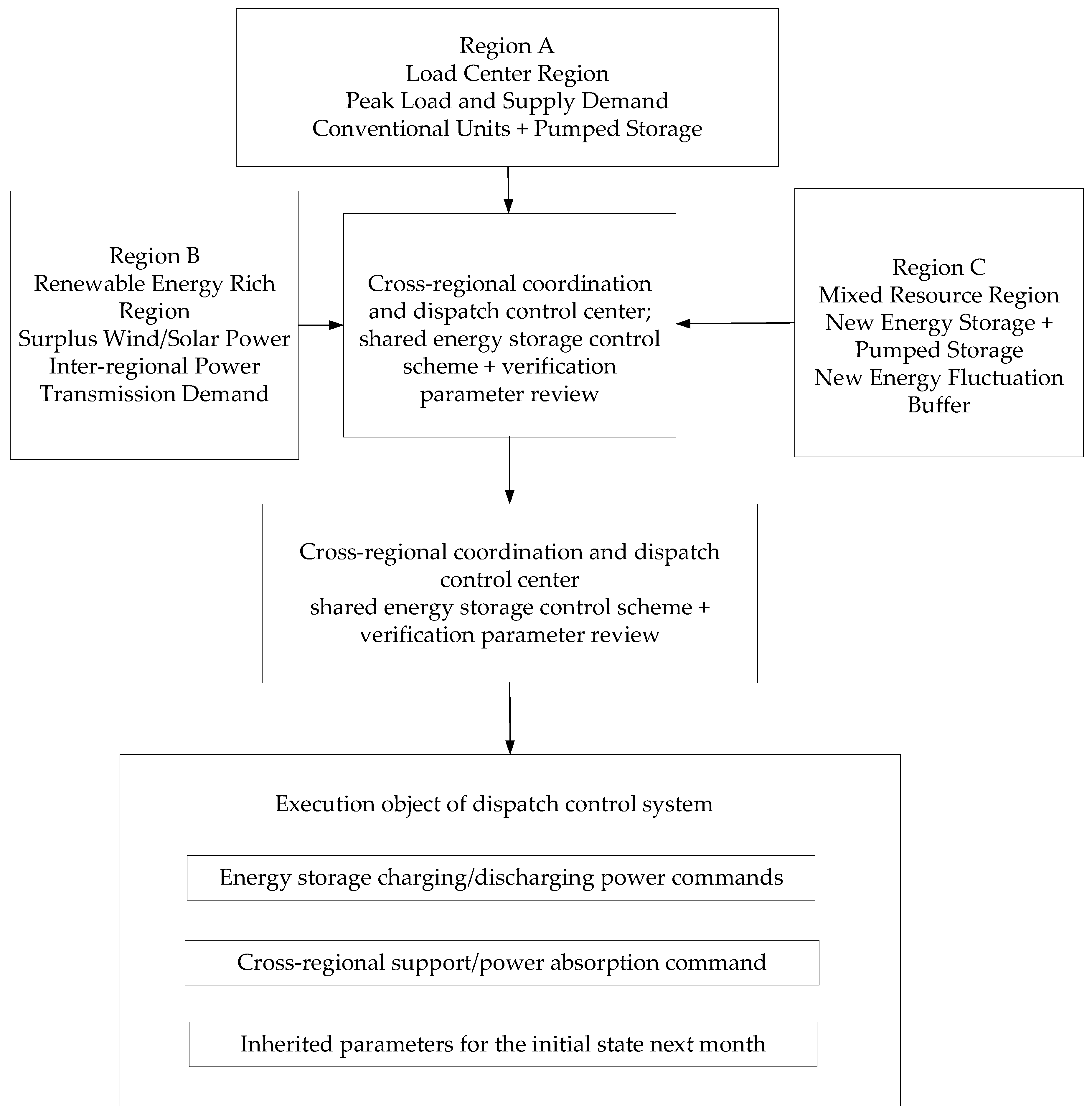
Figure 1 clarifies the system-level role of the proposed framework. It places regional production simulation agents, tie-line exchange, shared storage resources, the unified-state ledger, boundary inheritance, and audit outputs in one architecture, showing that storage availability is not a separate proxy in each module but a single physical state shared by all layers. The purpose of the figure is to identify where information is collected, where the unified state is updated, and how the resulting feasible support limits are returned to local and inter-regional simulation modules.

2.2. Separated-State Inconsistency

Let a storage asset in region r and type m have a local state estimated by a regional solver and a shared state used by the coordination layer. If these two states are updated independently, the coordination layer may overestimate available discharge power after local discharge has already consumed part of the energy. Similarly, if boundary correction is applied only after a monthly subproblem is solved, the next month may inherit a state that is inconsistent with the actually executed local and shared-support trajectories.
The separated-state problem can be summarized by three failure modes:
  • Duplicated flexibility allocation: Local discharge and shared-support use the same physical energy margin.
  • Boundary discontinuity: The state at the end of a month is not exactly the state inherited by the next month.
  • Untraceable correction: Boundary reset actions are applied outside the main state recursion and cannot be audited together with support energy and shortage/curtailment metrics.
The proposed method addresses these failure modes by replacing separated-state ledgers with one physical state chain.

2.3. Engineering Formulation of the State-Ledger Problem

The separated-state inconsistency can be understood as a mismatch between decision granularity and physical memory. The local solver makes decisions at the level of regional load balance. It determines how much storage is charged or discharged to satisfy local adequacy and renewable accommodation requirements. The inter-regional coordination module makes decisions at the level of support exchange. It determines whether a region can export flexibility to another region through a tie-line. If the two modules do not share the same state ledger, they may both believe that the same megawatt-hour is available for different purposes.
A useful analogy is the operation of a bank account. A local withdrawal and an inter-regional transfer cannot be validated against two independent balances. They must be posted to the same account before the next transaction is approved. Shared energy storage has the same property. The storage state is the account balance, and the local solver and the coordination module are different transaction channels. A production simulation platform that uses two storage balances may appear computationally modular, but it loses physical accountability.
This problem becomes more serious when the simulation horizon is decomposed by month. At the end of a monthly subproblem, storage may be forced to satisfy a daily, weekly, monthly, quarterly, or other reset rule. If the boundary correction is applied after the local and shared-support decisions have been recorded, the corrected terminal state may not match the state used by the next month. The next monthly problem then starts from a value that is mathematically convenient but physically detached from the executed trajectory. In a full-year simulation, such small discontinuities can accumulate and distort shortage, curtailment, and storage-utilization indicators.
The unified-state framework therefore treats state consistency as a first-class modeling object. The framework asks every module to answer three questions before a support decision is accepted. First, what is the current physical storage state? Second, how much local charging or discharging has already been posted to that state? Third, what state will be inherited after boundary checking? These questions transform the shared storage coordination problem from an abstract exchange optimization into an auditable state-transition problem.
This analysis also shows why the proposed architecture is not redundant with conventional tie-line coordination. Tie-line coordination determines whether power can be transferred between regions. Unified storage-state coordination determines whether the resource behind that transfer still physically exists after local operation. Both are needed. A tie-line may have available transmission capacity while the exporting storage has insufficient energy. Conversely, a storage asset may have energy while the tie-line is congested. The proposed framework keeps these two feasibility dimensions visible at the same time.

3. Unified-State Representation and Local Monthly Simulation Model

3.1. Unified-State Vector

For each time step, the multi-region shared storage-state vector is defined as
X t = x r , m , t r R , m M
where X t denotes the set of unified storage energy states at time t . The symbol x r , m , t denotes the available physical energy state of storage type m in region r at time t . The set R denotes all regions, and M denotes all shared storage categories. Equation (1) means that a storage object has one physical state regardless of whether it is later used by local dispatch or by inter-regional coordination.
The local trajectory-integrated state is reconstructed as
x r , m , t l o c = x r , m , t 1 l o c + η r , m c p r , m , t c , l o c Δ t p r , m , t d , l o c Δ t η r , m d
where x r , m , t l o c denotes the local trajectory-integrated storage state. The variable p r , m , t c , l o c denotes local charging power, and p r , m , t d , l o c denotes local discharging power. The parameters η r , m c and η r , m d denote charging and discharging efficiencies, respectively. The parameter Δ t denotes the time-step length.
The unified state can combine the locally reconstructed state, the carried state, and the adjusted boundary state as
x r , m , t = λ r , m 1 x r , m , t l o c + λ r , m 2 x r , m , t c a r r y + λ r , m 3 x r , m , t a d j
where x r , m , t c a r r y denotes the cross-period carried state, and x r , m , t a d j denotes the boundary-adjusted state. The coefficients λ r , m 1 , λ r , m 2 , and λ r , m 3 are state-mapping coefficients satisfying conservation requirements. In implementation, the mapping can be configured so that the active state source changes from local reconstruction to boundary-adjusted inheritance at the corresponding simulation stage.
The mapping coefficients serve as stage-dependent selection indicators. At a given simulation stage, only one source is active and written into the unified-state ledger: the locally reconstructed state during local trajectory reconstruction, the carried state at monthly initialization, or the boundary-adjusted state after reset correction. This rule avoids cyclic dependence and enforces a single source of truth for the storage state.
At the beginning of month n , the unified initial state is written as
x r , m , t 0 n = x r , m , n i n i t
where t 0 n denotes the first time step of month n , and x r , m , n i n i t denotes the inherited initial state of storage type m in region r for month n .

3.2. Local Renewable Availability and Net Deficit

The renewable availability in region r is represented by
P r , t r e n , a v a i l = P r , t w i n d + P r , t p v + P r , t h y d r o
where P r , t w i n d , P r , t p v , and P r , t h y d r o denote available wind, photovoltaic, and hydropower outputs in region r at time t , respectively.
The regional net power deficit is defined as
d r , t = L r , t P r , t c o n v P r , t r e n , a v a i l p r , t d , l o c + p r , t c , l o c
where d r , t denotes the local net deficit. The variable L r , t denotes regional load demand. The variable P r , t c o n v denotes total conventional generation. The variables p r , t d , l o c and p r , t c , l o c denote aggregated local discharging and charging powers, respectively. A positive d r , t indicates that the region requires support, whereas a negative value indicates surplus or absorption capability.

3.3. Local Monthly Objective and Balance Constraint

The local monthly objective can be expressed as
m i n f r l o c = t T n c r , t f u e l α r s s r , t α r c c r , t
where f r l o c denotes the objective value of the local monthly problem in region r . The term c r , t f u e l denotes conventional generation cost. The variable s r , t denotes load-shedding slack, and c r , t denotes renewable curtailment. The parameters α r s and α r c denote shortage and curtailment penalty coefficients, respectively. The set T n denotes the time steps in month n .
The local power balance is
P r , t c o n v + P r , t r e n , a v a i l + p r , t d , l o c + s r , t = L r , t + p r , t c , l o c + c r , t
where the left-hand side represents conventional generation, renewable availability, local storage discharge, and shortage slack; the right-hand side represents load, local storage charge, and curtailment. This equation provides the local foundation from which regional deficit and surplus are exported to the inter-regional coordination layer.

3.4. From Local Trajectories to a Trusted State

Equations (1)–(8) define the formal local model, but the key engineering step is the transition from a local dispatch trajectory to a trusted shared-state value. In a local monthly solver, storage charge and discharge are usually calculated as part of a regional balancing problem. Those trajectories are meaningful inside the local model, but they do not automatically become valid shared storage states unless they are integrated with efficiency, boundary, and inheritance information. The unified-state engine performs this translation.
The transition from local trajectories to a unified state follows a chronological state-update process. At the beginning of a month, the platform receives an initial state from the previous month. During each time step, local charging increases that state, local discharging decreases that state, and losses are accounted for through efficiency parameters. When the inter-regional layer requests shared support, the same state is checked again. If a support action is accepted, it is posted to the same state chain. At a reset boundary, the state is corrected according to the applicable rule. At the end of the month, the corrected state becomes the initial condition of the next month. Nothing is hidden in a separate ledger.
This is why the unified state is operator-readable. If a planner asks why region A cannot provide support at a certain hour, the answer can be traced to the value of the state variable, the safety inventory, and the combined power constraint. If the planner asks why the next month starts from a given storage level, the answer can be traced to the boundary-adjusted terminal state. If the planner asks why curtailment remains high despite available storage capacity, the answer may be that the charging power limit or safety inventory has already been reached. The unified state converts these questions into traceable model quantities.
The proposed state representation is also flexible enough for heterogeneous storage technologies. Pumped storage, electrochemical storage, and hybrid electric-hydrogen storage may differ in duration, efficiency, reset requirements, and support capability. The storage-type index allows them to be represented separately while still obeying the same accounting principle. This is important for multi-region planning studies because one region may use weekly reset pumped storage while another region uses daily reset electrochemical storage. The unified state does not force these technologies into identical parameters; it only requires that each physical category have one traceable state chain.
For hybrid storage systems, the storage-type index should be interpreted together with technology-specific constraints. Pumped storage, electrochemical storage, and hydrogen-related storage may have different efficiencies, reset rules, energy capacities, power limits, and boundary requirements. If two technologies are physically coupled, the coupling can be represented by additional shared constraints, while each accepted energy change is still posted to the corresponding unified-state chain.
Another practical advantage is incremental deployability. Existing production simulation platforms may already have stable local solvers and reporting tools. Replacing all of them would be risky. The unified-state engine can instead be placed between the local solvers and the inter-regional coordination module. It reads local trajectories, reconstructs states, calculates feasible support margins, and writes inherited states. In this sense, the method is not a disruptive redesign but a state-consistency layer that makes existing software more reliable.

4. Inter-Regional Shared Storage Coordination and Unified-State Update

4.1. Shared-Support Balance

The net shared storage exchange of region r is defined as
g r , t = k R p k , r , t i n , s h a r e k R p r , k , t o u t , s h a r e
where g r , t denotes the net shared support received by region r . The variable p k , r , t i n , s h a r e denotes shared storage power injected from region k to region r . The variable p r , k , t o u t , s h a r e denotes support power sent from region r to region k .
The tie-line capacity constraint is
F r , k , t m a x p r , k , t t i e + p r , k , t o u t , s h a r e p k , r , t i n , s h a r e F r , k , t m a x
where F r , k , t m a x denotes the tie-line capacity limit between regions r and k . The variable p r , k , t t i e denotes the baseline tie-line exchange before additional shared storage support.

4.2. Available Unified Support Margin

The available energy margin for external support is
e r , m , t o u t , a v a i l = x r , m , t E r , m m i n +
where e r , m , t o u t , a v a i l denotes the energy margin that can be used for external support. The parameter E r , m m i n denotes the minimum safety inventory. The operator z + denotes m a x ( z , 0 ) . Equation (11) ensures that the coordination layer can only use energy above the safety inventory.
The inter-regional coordination objective is written as
m i n f s h a r e = t T n r R β 1 s r , t β 2 c r , t β 3 k R p r , k , t o u t , s h a r e
where f s h a r e denotes the shared coordination objective. The coefficients β 1 , β 2 , and β 3 denote shortage penalty, curtailment penalty, and shared-support usage cost, respectively.
The outer-loop convergence condition is
The outer loop is used as a fixed-point coordination procedure between local monthly solving and inter-regional support allocation. In the present implementation, convergence is declared when the maximum change in regional shared support between two successive iterations is below the tolerance, or when the maximum iteration number is reached. This condition should be interpreted as a practical consistency criterion for the layered simulation workflow rather than as a proof of global optimality relative to a fully centralized model.
m a x r , t u r , t q u r , t q 1 ε
where u r , t q denotes the shared net support of region r at time t in iteration q , and ε denotes the convergence tolerance.

4.3. Unified-State-Update and Non-Duplication Constraints

After inter-regional coordination, the unified storage state is updated by
x r , m , t + 1 = x r , m , t + η r , m c p r , m , t c , l o c Δ t p r , m , t d , l o c Δ t η r , m d + k R η k , r t r p k , r , m , t i n , s h a r e Δ t k R p r , k , m , t o u t , s h a r e Δ t η r , m d b r , m , t
where η k , r t r denotes the equivalent transmission efficiency from region k to region r . The variable b r , m , t denotes the boundary correction term. Equation (14) is the core of the proposed framework because local actions, shared actions, and boundary correction are written into the same state recursion.
Boundary correction is also treated as a state projection before the next boundary-sensitive decision is accepted. Therefore, the coordination module does not allocate support from an outdated proxy state after a reset event; it receives the corrected state and computes the available support margin from that physically admissible value.
To avoid duplicated charging capability, the total charging action is constrained by
p r , m , t c , l o c + k R p k , r , m , t i n , s h a r e P r , m c , m a x
where P r , m c , m a x denotes the maximum charging power of storage type m in region r .
Similarly, the total discharging and support action is constrained by
p r , m , t d , l o c + k R p r , k , m , t o u t , s h a r e P r , m d , m a x
where P r , m d , m a x denotes the maximum discharging power. Equations (15) and (16) prevent the local and coordination layers from using the same storage power capability more than once.
The unified energy state must satisfy
E r , m m i n x r , m , t E r , m m a x
where E r , m m a x denotes the maximum energy capacity. This constraint guarantees that all local and shared actions remain inside the physical storage energy range.

4.4. The Discussion of Unified Recursion Preventing Duplicated Flexibility

The most important feature of the unified recursion is not its algebraic length, but the fact that all storage-affecting actions are placed on the same physical energy balance. In a separated-state baseline, local discharge may be recorded inside the regional solver, while shared support is recorded inside the coordination layer. The two records are later combined through post-processing. In the proposed method, there is no such ambiguity. Local discharge and shared support are both withdrawals from the same state. Local charging and shared absorption are both deposits into the same state. Boundary correction is a controlled adjustment of the same state at a specific boundary time.
This unified recursion changes the feasibility logic of shared support. The coordination layer cannot simply ask whether a region has nominal storage capacity. It must ask whether the state after local decisions still leaves a positive available margin, whether combined local and shared discharge respects the total discharge power limit, and whether the resulting state remains inside the energy boundary. A support decision is therefore constrained by the same physical state that the local solver has already used.
The distinction between capacity and state is critical. A storage asset may have a large rated capacity but little remaining energy after local discharge. Conversely, it may have sufficient energy but limited discharge power because local operation has already occupied part of the converter or turbine capability. The proposed method captures both situations. The available support margin constrains the energy dimension, while the charging and discharging constraints limit the power dimension. Together, they prevent the hidden-flexibility error that appears when energy and power are counted in different layers.
The same reasoning applies to absorption. A region with renewable surplus may request another region to absorb energy through shared storage. However, the receiving storage may already be charging locally. The combined charging constraint prevents incoming shared absorption and local charging from exceeding the same charging limit. This is important in high-renewable systems, where curtailment reduction often depends on simultaneous local absorption and inter-regional exchange.
The resulting coordination behavior is more conservative than a separated-state approximation, but it is more credible. A production simulation study should not create reliability benefits by using non-existent flexibility. The proposed method may therefore report less support than a baseline in some hours, but that support is physically executable. This is the central engineering value of the unified-state variable.

4.5. Design Choices Behind the Coordination Layer

The proposed coordination layer is intentionally built as a constrained support allocator rather than as a replacement for the local production simulation solver. This design choice follows from the way production simulation software is usually maintained. Local solvers often contain many mature engineering details, such as unit output limits, storage reset patterns, maintenance treatment, renewable availability curves, and penalty-cost settings. Replacing the whole local solver would make the method difficult to deploy. Therefore, the coordination layer is designed to consume outputs from local solvers, correct them through shared-state feasibility constraints, and return support instructions without destroying the local modeling structure.
The second design choice is to separate the concept of support demand from the concept of support feasibility. A region may need support because its net deficit is positive, but this does not mean that another region can physically provide support. Support feasibility depends on tie-line capacity, storage energy margin, storage power margin, and boundary-state requirements. The proposed method makes this separation explicit. The local model calculates deficit and surplus, while the unified-state engine calculates feasible support margins. This avoids the common mistake of treating regional surplus or nominal storage capacity as immediately transferable flexibility.
The third design choice is to keep the support allocation auditable. A support instruction should be traceable to the state value before support, the power limit that allowed support, the energy margin that allowed support, and the boundary correction after support. This traceability is particularly important in planning studies, where results are reviewed by different departments. A planner may accept a slightly conservative support schedule if it can be explained, but may reject an optimistic schedule if the storage state cannot be traced.
The fourth design choice is to make the method compatible with different coordination algorithms. The paper formulates a generic objective and convergence condition, but the unified-state principle can also be used with distributed optimization, rule-based support allocation, rolling coordination, or market-like flexibility clearing. The essential requirement is that every accepted support or absorption decision must be posted to the same state chain. Therefore, the contribution is not limited to one solver. It is a state-consistency rule that can be embedded into several coordination schemes.

4.6. Interpretation of Conservativeness

The unified-state framework may appear conservative because it prevents the coordination layer from using the flexibility that is only available in an aggregated proxy. However, this conservativeness is relative to an optimistic but physically inconsistent baseline. The framework does not reduce real flexibility; it removes flexibility that is counted without a valid physical state. In production simulation, this distinction matters. The purpose of the study is not to maximize the apparent benefit of shared storage, but to estimate what can be delivered under executable constraints.
This conservative behavior has several benefits. First, it prevents the underestimation of shortage during stress hours. Second, it prevents the overestimation of renewable accommodation when storage has already been locally occupied. Third, it makes the effect of storage safety inventory visible. Fourth, it reveals whether the tie-line capacity or storage state is the actual bottleneck. These diagnostic benefits are often more valuable than a single optimistic objective value.
The framework also allows planners to tune conservativeness explicitly. Lowering the safety inventory, relaxing reset rules, or changing support-cost weights will change the available support margin and audit indicators. Because these changes are made through transparent parameters, the planner can understand why the result changes. This is preferable to a hidden state approximation whose optimism cannot be easily decomposed.

5. Boundary Inheritance, Audit Metrics, and Implementation Workflow

5.1. Boundary Correction and Cross-Month Inheritance

At a reset boundary t b , the boundary correction is calculated as
b r , m , t b = x r , m , t b x r , m , t b t a r g e t
where x r , m , t b denotes the state immediately before boundary correction, and x r , m , t b t a r g e t denotes the target state imposed by the reset rule. The corrected boundary state is
x r , m , t b a d j = x r , m , t b b r , m , t b
where x r , m , t b a d j denotes the state after boundary correction. The next monthly initial state is inherited as
x r , m , n + 1 i n i t = x r , m , t e n d n a d j
where t e n d n denotes the end time step of month n . Equation (20) ensures that the monthly boundary is closed by the same unified-state chain.

5.2. Audit Indicators

The cross-month continuity error is defined as
δ r , m , n m o n t h = x r , m , n + 1 i n i t x r , m , t e n d n a d j
where δ r , m , n m o n t h denotes the inherited-state mismatch between two consecutive months.
The monthly support energy provided by region r is
E r , n s u p p o r t = t T n k R p r , k , t o u t , s h a r e Δ t
where E r , n s u p p o r t denotes the accumulated shared-support energy.
The shortage rate is
ρ s h o r t = t r s r , t Δ t t r L r , t Δ t
where ρ s h o r t denotes the ratio of unmet load energy to total demand energy.
The renewable curtailment rate is
ρ c u r t = t r c r , t Δ t t r P r , t r e n , a v a i l Δ t
where ρ c u r t denotes the ratio of curtailed renewable energy to total available renewable energy.
The audit indicators can be used in two modes. In the diagnostic mode used in this paper, they are reported after each simulation run to explain whether support allocation, curtailment reduction, and boundary inheritance are physically credible. In a closed-loop implementation, the same indicators can be introduced as penalty terms or stopping criteria so that continuity errors and excessive boundary corrections are discouraged during coordination rather than only reported afterward.
J a u d i t = γ 1 m a x r , m , n δ r , m , n m o n t h + γ 2 r , m , t b b r , m , t b + γ 3 N i t e r
where J a u d i t denotes the audit index, and N i t e r denotes the number of outer-loop iterations. The coefficients γ 1 , γ 2 , and γ 3 weight state continuity, boundary correction, and coordination complexity, respectively.

5.3. Implementation Workflow

The implementation workflow is summarized as follows:
  • Load regional load, renewable generation, conventional unit parameters, storage parameters, tie-line limits, and reset rules.
  • Split the annual horizon into monthly subproblems and solve the local rolling-window production simulation for each region.
  • Reconstruct local storage states using Equation (2) and map them into the unified-state vector using Equations (3) and (4).
  • Compute regional deficit/surplus using Equation (6) and solve inter-regional shared support using Equations (9)–(13).
  • Rebuild the unified-state trajectory using Equation (14) and enforce Equations (15)–(17).
  • Apply boundary correction and cross-month inheritance using Equations (18)–(20).
  • Output audit metrics using Equations (21)–(25).
The workflow is intended as a journal-style description of how the unified-state mechanism is embedded into production simulation software. Its key role is to connect local trajectory reconstruction, inter-regional support allocation, boundary correction, and audit reporting through one state-service layer. Compared with separated local and shared ledgers, this workflow makes every storage-affecting operation traceable and reduces the risk that the same physical flexibility is counted twice.
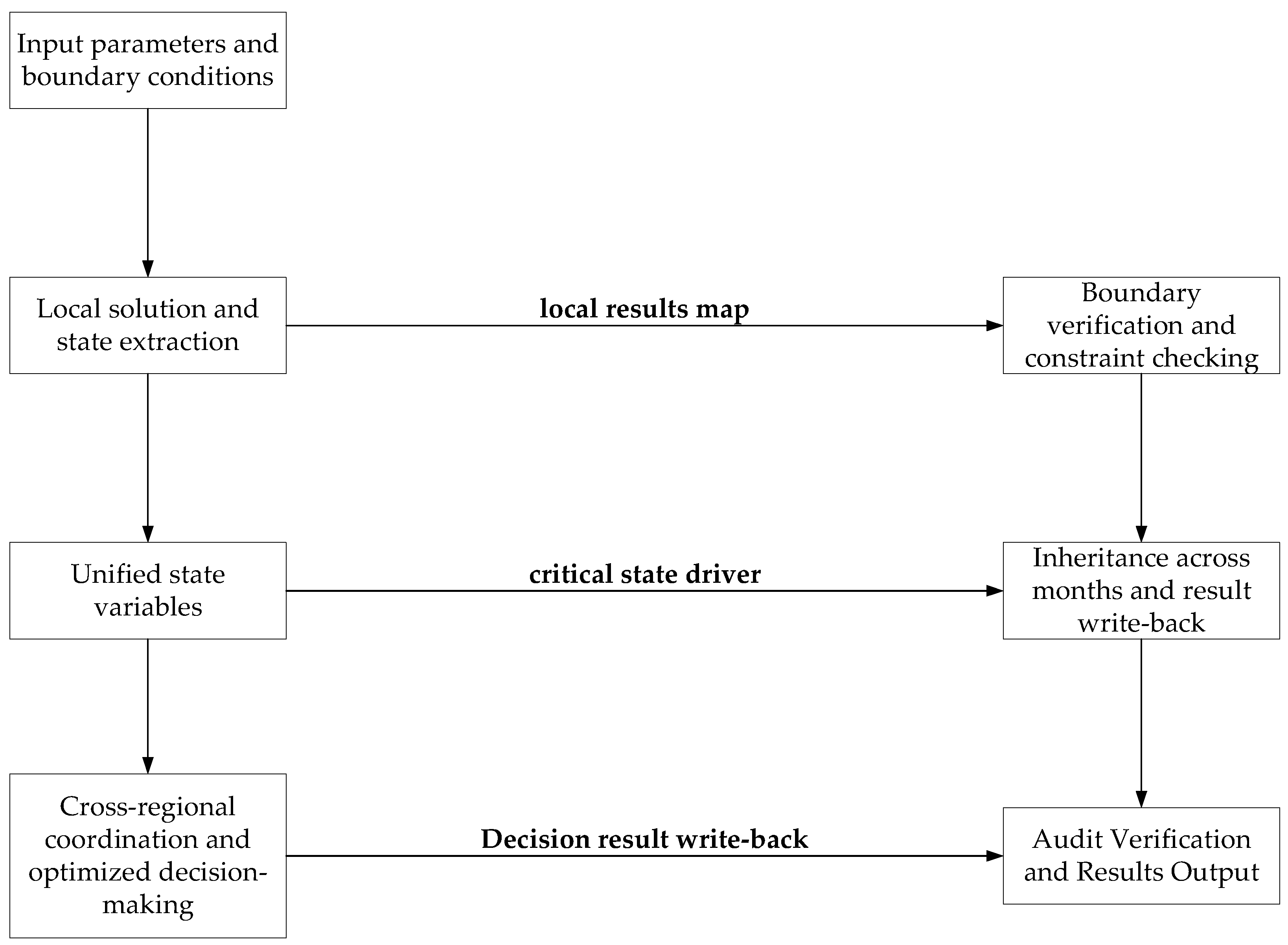
Figure 2 explains how the proposed method is executed inside the production simulation program. It starts from local monthly solving, reconstructs the shared storage state from regional charge and discharge trajectories, transfers the feasible state and support margin to the inter-regional coordination module, and then sends the allocated support or absorption result back to each region for correction. The figure is therefore used to show the data flow and feedback loop that keep local dispatch, cross-regional support, and unified-state updating synchronized in each rolling window.

5.4. Software Implementation Details

In software implementation, the proposed method can be introduced as a state-service layer between regional solvers and the inter-regional coordination module. The state-service layer stores the current value of the unified state, receives local charge and discharge trajectories from regional solvers, updates the state according to the unified recursion, calculates the available support margin, and returns feasible support limits to the coordination module. This design avoids changing the internal mathematical formulation of every regional solver.
The monthly workflow is especially important. At the beginning of each month, the state-service layer initializes the storage state using the inherited value from the previous month. During each rolling window, it records local storage actions and inter-regional support actions in chronological order. At reset boundaries, it calculates the boundary correction and adjusted state. At the end of the month, it writes the adjusted terminal state into the next monthly subproblem. This sequence makes the state transition reproducible even when local solving and inter-regional coordination are executed as separate software modules.
The audit module is not an optional reporting add-on. It is a mechanism for verifying that the unified-state framework is actually functioning. If the continuity error is nonzero, the platform has a boundary inheritance problem. If the boundary correction is repeatedly large, the reset rule may be too aggressive, or the storage schedule may be poorly aligned with boundary requirements. If support energy is high while shortage and curtailment do not improve, the coordination policy may be creating unnecessary circulation. The audit output therefore helps planners understand not only what the simulation result is, but why the result is credible or questionable.

6. Case Studies and Experimental Analysis

6.1. Test System, Baselines, and Evaluation Metrics

A three-region illustrative system is constructed from the patent disclosure and the existing production simulation software architecture (in Table 1). Region A represents a conventional generation-dominant area with pumped storage. Region B represents a high-renewable area with electrochemical storage. Region C contains both pumped storage and electrochemical storage. The annual horizon is decomposed into monthly subproblems, and each monthly subproblem is solved with a 24 h rolling window at a 1 h time resolution.
The charging efficiency is set to 0.93, the discharging efficiency is set to 0.92, the outer-loop tolerance is 1 MW, and the maximum number of outer iterations is 8. The minimum safety inventory is set to 15% of rated energy for pumped storage and 10% for electrochemical storage. The shortage penalty is set higher than the curtailment penalty, and the curtailment penalty is set higher than the shared-support usage cost.
The constant efficiency values are engineering averages used by the present production simulation prototype. They keep the ledger transparent and are consistent with the aggregate storage representation used in long-horizon studies. If higher-fidelity device data are available, the same state recursion can be extended to piecewise or state-dependent efficiencies; such sensitivity analysis is a useful extension but is not required for the state-consistency logic demonstrated here. The additional computational burden of the unified ledger is mainly proportional to the number of regions, storage types, and time steps, because each accepted local or shared action requires one state update and one feasibility check.
Two frameworks (in Table 2.) are compared conceptually and algorithmically. In the separated-state baseline, local storage dispatch and inter-regional shared support use different state ledgers. Cross-region support can therefore be allocated according to a shared proxy state that is not fully reconstructed from local charge/discharge trajectories. In the proposed unified-state framework, local charging, local discharging, shared absorption, shared support, boundary correction, and monthly inheritance all update the same state variable.
To provide concrete numerical evidence without requiring a full-year benchmark, a focused three-month partial simulation (in Table 3) is added for January–March. The separated-state baseline and the proposed unified-state framework are run with the same regional load, renewable, storage, tie-line, and reset rule settings. The audit indicators defined in Equations (21)–(25) are then calculated at the monthly boundary and over all hourly intervals.
The partial simulation results show that the unified-state framework maintains zero cross-month continuity error because the corrected terminal state is written directly into the next monthly subproblem. The three-month support energy reaches 3898 MWh, while the maximum monthly boundary correction remains within 13.9–21.3 MWh. Relative to the separated-state baseline, the average shortage rate decreases from 1.76% to 1.27%, and the average curtailment rate decreases from 7.45% to 6.18%. These values indicate that the proposed ledger not only removes duplicated flexibility accounting but also produces measurable adequacy and renewable accommodation benefits in the focused simulation window.

6.2. Mechanism-Level Interpretation and Representative Operating Day

The key advantage of the proposed method lies in its ability to prevent hidden double-counting. For example, if region A has already discharged pumped storage during a local peak period, the remaining energy state in Equation (14) is reduced before region A can provide shared support to region B or C. Therefore, Equation (11) computes the support margin from the updated state rather than from a separate proxy. This prevents the coordination layer from using energy that has already been consumed locally.
The boundary inheritance mechanism is also important. In a long-horizon production simulation, a monthly subproblem is not an isolated optimization problem. The state at the end of one month determines the feasible initial condition of the next month. Equations (18)–(20) explicitly close this gap by calculating the boundary correction, generating a corrected terminal state, and writing this state into the next month. Consequently, the state sequence becomes reproducible and auditable.
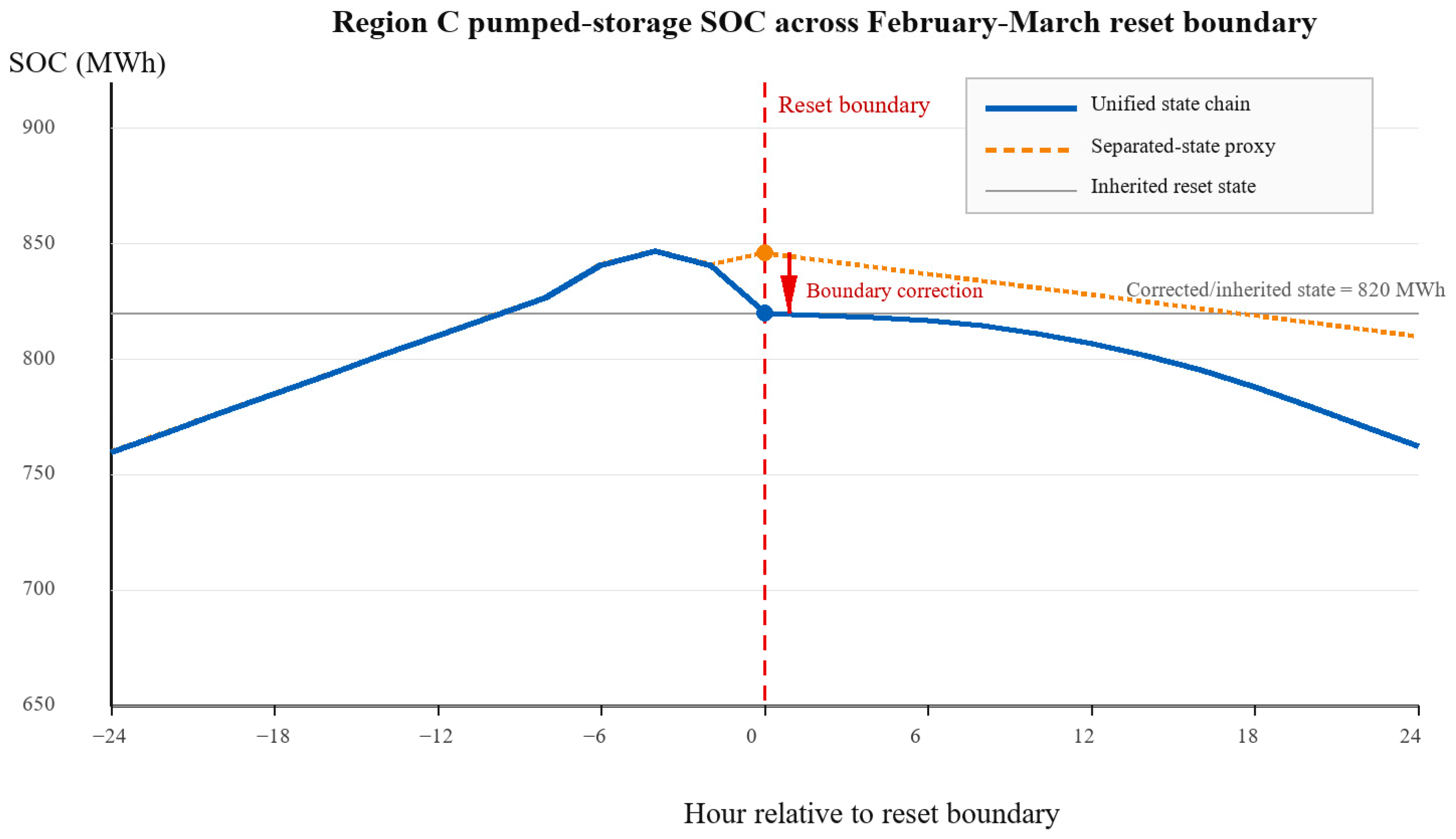
Figure 3 further illustrates the state-of-charge behavior around the February–March reset boundary for the Region C pumped-storage unit. The separated-state proxy keeps a higher post-boundary value because it does not immediately inherit the corrected terminal state, whereas the unified-state chain applies the boundary projection and uses the corrected value as the initial state of the next monthly subproblem.
A representative operating day further illustrates the mechanism. In the morning, region B begins to receive increasing photovoltaic output, while region A still relies on conventional generation and pumped storage to follow the load. The local monthly solver in each region first produces a feasible local schedule. At this stage, the storage in region A may discharge to meet local demand, and the storage in region B may charge to absorb renewable surplus. These decisions are final from the perspective of physical state accounting because the corresponding energy changes have already been posted to the unified state.
Around midday, region B may have a renewable surplus. A separated-state baseline may see this surplus and allocate absorption to a shared storage proxy in another region. If the receiving region is already charging locally, this may exceed the actual charging limit. In the proposed method, the combined local and shared charging action is checked before the support plan is accepted. The coordination module can still reduce curtailment, but it cannot do so by violating the physical charging capability of the storage asset.
During the evening ramp, region B may become short of power. The coordination module then checks whether region A or region C can provide support. The answer depends on the unified state after their local schedules have been posted. If region A has already discharged its pumped storage during the local peak, the remaining support margin may be limited. If region C still has sufficient stored energy and tie-line capacity is available, support can be allocated from region C instead. This decision is more conservative than a separated-state baseline, but it is physically more credible.
At the end of the day or week, reset rules may require a boundary adjustment. The proposed method records this adjustment rather than hiding it in a post-processing step. If the correction is small, the schedule is consistent with the reset rule. If the correction is large, the audit output alerts the planner that the local and shared-support decisions may be misaligned with boundary requirements. This operating sequence shows that the audit indicators are not merely numerical outputs; they identify where the simulation logic is reliable and where it requires further tuning.
The sustainability relevance of the framework is primarily reflected in renewable curtailment accounting and credible flexibility allocation. Because curtailment reduction must be evaluated against a physically valid storage state, the unified ledger helps prevent overestimation of renewable accommodation benefits. Emission impacts are outside the scope of the three-region case and can be incorporated once unit-level fuel and emission parameters are linked to the production simulation outputs.

6.3. Practical Deployment and Engineering Implications

The proposed framework is suitable for production simulation platforms that already use regional decomposition, monthly horizon splitting, and rolling-window optimization. It does not require a fully centralized model, which helps preserve regional autonomy and software modularity. The unified-state variable can also be used as a diagnostic interface for dispatch engineers, because the audit metrics identify whether shortage reduction, curtailment reduction, or support exchange comes at the cost of excessive boundary correction.
In practical deployment, the unified-state engine can be introduced gradually. The first stage is diagnostic: the software continues to run its existing local and inter-regional modules, while the unified-state engine reconstructs a parallel audit trajectory and identifies duplicated flexibility events. The second stage is advisory: the engine provides feasible support margins to the coordination module, but operators can still override support decisions. The third stage is closed-loop coordination: the coordination module uses the unified-state margins as hard constraints, and boundary inheritance is automatically written into the next monthly subproblem.
This staged deployment path is important for utility software. Production simulation platforms are often large, mature, and connected to many data interfaces. A method that requires replacing the entire solver is difficult to adopt. The proposed framework instead adds a physically consistent state layer, which makes it more compatible with existing local solvers, graphical interfaces, and reporting tools.
The method also clarifies the nature of the contribution. Existing shared storage studies often ask how storage capacity or power should be allocated among participants. This paper asks a prior question: before allocating shared storage, what is the physically valid state that all participants must agree on? Once this question is answered, capacity allocation, support scheduling, boundary correction, and audit reporting can be placed on a consistent foundation.
The method therefore functions as a bridge between optimization modeling and production simulation software implementation. The optimization layer decides what should be done. The state ledger verifies whether it can be done. The audit layer explains what has been done and whether the result remains continuous across time boundaries. The corresponding structure consists of decision generation, feasibility verification, and auditable explanation.

6.4. Limitations and Future Work

The revised case study now includes a focused three-month numerical audit, but the simulation is still intended to validate the mechanism and implementation logic rather than to replace a complete public-system benchmark. The limitation is that uncertainty is represented indirectly through the illustrative trajectories. Future work should integrate renewable forecast errors and load uncertainty into the same unified-state framework, and should extend the partial simulation to full-year public-benchmark comparisons and sensitivity tests.
This modeling choice defines the deterministic scope of the framework. The state ledger can be applied inside each renewable or load scenario, whereas scenario generation, robust uncertainty sets, and probabilistic reliability statistics constitute separate modeling layers. Separating these layers preserves auditability while allowing uncertainty-aware extensions to be developed without changing the single-ledger principle.
The preceding analysis clarifies the scope of the contribution. The method does not claim that one coordination algorithm is always globally optimal. Instead, it provides a state-accounting discipline that any layered coordination algorithm should satisfy when shared storage is involved. This makes the framework complementary to distributed optimization, market-based coordination, and multi-energy storage scheduling methods.

7. Conclusions

This paper presented a unified-state variable-based coordination framework for multi-region shared energy storage in long-horizon production simulation. The proposed method addresses the inconsistency caused by separated local storage states, shared-support states, boundary correction states, and cross-month inheritance states. A unified-state vector was defined for regional storage resources, and a single state-update equation was developed to combine local charging, local discharging, shared absorption, shared support, transmission efficiency, and boundary correction. The method further introduced cross-month inheritance and audit indicators to quantify continuity error, support energy, shortage rate, curtailment rate, boundary correction magnitude, and convergence complexity.
The three-region illustrative case demonstrates how the proposed framework prevents duplicated flexibility allocation and makes shared storage coordination traceable across local and inter-regional layers. Unlike a fully centralized optimization model, the framework preserves the engineering architecture of local monthly simulation and inter-regional coordination while enforcing state consistency through a unified physical state chain. This makes the method suitable for gradual deployment in existing production simulation platforms, where auditability, modularity, and boundary-state continuity are essential. Future work will focus on full-year numerical benchmarking, sensitivity analysis of reset rules and safety inventories, and integration with stochastic renewable scenarios. The added three-month audit table and reset-boundary state-of-charge trajectory provide concrete numerical evidence that the audit indicators are computable and that the unified-state chain remains continuous at monthly inheritance boundaries.
More broadly, the paper argues that shared storage should be treated as a stateful infrastructure resource rather than as a generic exchange variable. When different operating layers share the same storage asset, state consistency becomes the bridge between optimization feasibility and engineering executability. The unified-state variable provides that bridge. It allows local solvers to remain modular, allows inter-regional coordination to use physical support margins, and allows planners to audit why a support decision is feasible or infeasible.

Author Contributions

Conceptualization, F.L. and Y.Z.; methodology, F.L.; software, F.L.; validation, F.L. and J.Q.; formal analysis, J.Q.; investigation, H.L. and Y.X.; resources, Y.S.; writing—original draft preparation, F.L.; writing—review and editing, Y.Z.; visualization, Y.Z. All authors have read and agreed to the published version of the manuscript.

Funding

This research was funded by the Science and Technology Project of the Headquarters of State Grid Corporation of China (Research on evaluation and improvement technology of power system security-supply-consumption carrying boundary in transition period), grant number 1400-202456361A-3-1-DG.

Institutional Review Board Statement

Not applicable.

Informed Consent Statement

Not applicable.

Data Availability Statement

The original contributions presented in this study are included in the article. Further inquiries can be directed to the corresponding author.

Conflicts of Interest

Author Fan Li, Jishuo Qin, Hanqing Liang, Yawei Xue, Yuan Si were employed by the company State Grid Economic Technology Research Institute Co., Ltd. The remaining author declares that the research was conducted in the absence of any commercial or financial relationships that could be construed as a potential conflict of interest.

References

  1. Soroudi, A.; Rabiee, A. Optimal multi-area generation schedule considering renewable resources mix: A real-time approach. IET Gener. Transm. Distrib. 2013, 7, 1011–1026. [Google Scholar] [CrossRef]
  2. Li, H.; Yu, H.; Liu, Z.; Li, F.; Wu, X.; Cao, B.; Zhang, C.; Liu, D. Long-term scenario generation of renewable energy generation using attention-based conditional generative adversarial networks. Energy Convers. 2024, 5, 15–27. [Google Scholar] [CrossRef]
  3. Lamichhane, B.; Chen, Y.C.; Garcia, A. Distributed continuous-time unit commitment with energy storage in multi-area networks. Electr. Power Syst. Res. 2025, 244, 111526. [Google Scholar] [CrossRef]
  4. Samuel, O.; Javaid, N.; Khalid, A.; Khan, W.Z.; Aalsalem, M.Y.; Afzal, M.K. Towards real-time energy management of multi-microgrid using a deep convolution neural network and cooperative game approach. IEEE Access 2020, 8, 161377–161395. [Google Scholar] [CrossRef]
  5. Zhang, Z.; Qin, B.; Ding, T.; Gao, X.; Zhang, Y. CBAM-CNN based transient overvoltage preventive control considering piecewise linear control sensitivity. IEEE Trans. Power Syst. 2025, 40, 3645–3656. [Google Scholar] [CrossRef]
  6. Xu, Y.; Ye, S.; Qin, Z.; Lin, X.; Huangfu, J.; Zhou, W. A coordinated optimal scheduling model with Nash bargaining for shared energy storage and multi-microgrids based on two-layer ADMM. Sustain. Energy Technol. Assess. 2023, 56, 102996. [Google Scholar] [CrossRef]
  7. Elliott, R.T.; Fernandez-Blanco, R.; Kozdras, K.; Kaplan, J.; Lockyear, B.; Zyskowski, J. Sharing energy storage between transmission and distribution. IEEE Trans. Power Syst. 2019, 34, 152–162. [Google Scholar] [CrossRef]
  8. Dai, B.; Wang, H.; Li, B.; Li, C.; Tan, Z. Capacity model and optimal scheduling strategy of multi-microgrid based on shared energy storage. Energy 2024, 306, 132472. [Google Scholar] [CrossRef]
  9. Wang, H.; Qin, B.; Hong, S.; Cai, Q.; Li, F.; Ding, T.; Li, H. Optimal planning of hybrid hydrogen and battery energy storage for resilience enhancement using bi-layer decomposition algorithm. J. Energy Storage 2025, 110, 115367. [Google Scholar] [CrossRef]
  10. Chen, B.; Li, Z.; Liu, B.; Fan, H.; Zhong, Q. Dynamic cooperative scheduling and adaptive benefit allocation for multi-microgrid systems with shared energy storage under source-load uncertainty. J. Energy Storage 2025, 128, 117213. [Google Scholar] [CrossRef]
  11. Deng, H.; Wang, J.; Shao, Y.; Zhou, Y.; Cao, Y.; Zhang, X. Optimization of configurations and scheduling of shared hybrid electric-hydrogen energy storages supporting to multi-microgrid system. J. Energy Storage 2023, 74, 109420. [Google Scholar] [CrossRef]
  12. Siqin, T.; He, S.; Hu, B.; Fan, X. Shared energy storage-multi-microgrid operation strategy based on multi-stage robust optimization. J. Energy Storage 2024, 97, 112785. [Google Scholar] [CrossRef]
  13. Karimi, H.; Jadid, S.; Makui, A. Stochastic energy scheduling of multi-microgrid systems considering independence performance index and energy storage systems. J. Energy Storage 2021, 33, 102083. [Google Scholar] [CrossRef]
  14. Qin, B.; Wang, H.; Li, W.; Li, F.; Wang, W.; Ding, T. Aperiodic coordination scheduling of multiple PPLs in shipboard integrated power systems. IEEE Trans. Intell. Transp. Syst. 2024, 25, 14844–14854. [Google Scholar] [CrossRef]
  15. Khan, M.A.; Rehman, T.; Hussain, A.; Kim, H.M. Day-ahead operation of a multi-energy microgrid community with shared hybrid energy storage and EV integration. J. Energy Storage 2024, 97, 112855. [Google Scholar] [CrossRef]
  16. Wang, H.; Qin, B.; Su, Y.; Li, F.; Hong, S.; Wang, Y.; Ding, T. Dynamic carbon market driven multi-stage scheduling strategy for hydrogen integrated energy systems. Renew. Energy 2026, 266, 125652. [Google Scholar] [CrossRef]
  17. Denholm, P.; Mai, T. Timescales of energy storage needed for reducing renewable energy curtailment. Renew. Energy 2019, 130, 388–399. [Google Scholar] [CrossRef]
  18. Queiroz, H.; Amaral Lopes, R.; Martins, J. Automated energy storage and curtailment system to mitigate distribution transformer aging due to high renewable energy penetration. Electr. Power Syst. Res. 2020, 182, 106199. [Google Scholar] [CrossRef]
  19. Jiang, T.; Wu, C.; Zhang, R.; Li, X.; Chen, H.; Li, G. Flexibility clearing in joint energy and flexibility markets considering TSO-DSO coordination. IEEE Trans. Smart Grid 2023, 14, 1376–1387. [Google Scholar] [CrossRef]
  20. Niewiadomski, W.; Baczyńska, A. Advanced flexibility market for system services based on TSO–DSO coordination and usage of distributed resources. Energies 2021, 14, 5439. [Google Scholar] [CrossRef]
  21. Wang, L.; Kwon, J.; Schulz, N.; Zhou, Z. Evaluation of aggregated EV flexibility with TSO-DSO coordination. IEEE Trans. Sustain. Energy 2022, 13, 2304–2315. [Google Scholar] [CrossRef]
  22. Martín-Utrilla, F.D.; Chaves-Ávila, J.P.; Cossent, R. Analyzing the boundaries for TSO-DSO coordination when activating flexibility for DSO’s in networks with an expected significant load increase. Sustain. Energy Grids Netw. 2024, 39, 101482. [Google Scholar] [CrossRef]
  23. Talaeizadeh, V.; Shayanfar, H.; Aghaei, J. Enhancing energy and flexibility joint market clearing mechanism through TSO-DSO coordination. Electr. Power Syst. Res. 2025, 238, 111162. [Google Scholar] [CrossRef]
  24. Capitanescu, F. Calculating multi-period cost curves of aggregated reactive power flexibility in active distribution grids for TSO-DSO coordination. Sustain. Energy Grids Netw. 2025, 43, 101922. [Google Scholar] [CrossRef]
  25. Mohandes, B.; Alizadeh, M.I.; Capitanescu, F.; Madureira, A.G. Boosting the efficiency of flexibility provision in modern TSO-DSO coordination mechanisms. Sustain. Energy Grids Netw. 2025, 43, 101752. [Google Scholar] [CrossRef]
  26. Vijay, R.; Mathuria, P. Common TSO-DSO market framework with no upfront priority to utilize DER flexibility. Energy 2024, 299, 131462. [Google Scholar] [CrossRef]
Figure 1. System-layer architecture of the unified shared storage production simulation framework.
Sustainability 18 05829 g001
Figure 2. Algorithmic workflow of local solving, shared-state mapping, and inter-regional coordination.
Sustainability 18 05829 g002
Figure 3. State-of-charge trajectory across the February–March reset boundary for the Region C pumped-storage unit.
Sustainability 18 05829 g003
Table 1. Main configuration of the three-region illustrative system.
RegionPeak Load (MW)Storage ConfigurationInterconnectionReset Rule
A1800300 MW/1200 MWh pumped storageA–B: 600 MWWeekly reset
B1350240 MW/480 MWh electrochemical storageA–B: 600 MW; B–C: 500 MWDaily reset
C1600240 MW/1440 MWh pumped storage; 180 MW/360 MWh electrochemical storageB–C: 500 MWMonthly reset
Table 2. Mechanism-level comparison between separated-state and unified-state frameworks.
ItemSeparated-State BaselineProposed Unified-State Framework
Local storage trajectoryMaintained by the regional solverReconstructed and mapped into the unified state
Cross-region support stateMay be represented by a proxy stateDerived from the same physical state variable
Duplicated flexibility riskPossible when local discharge and shared support are separatedRemoved by Equations (14)–(17)
Boundary resetOften handled after local simulationEmbedded through Equations (18)–(20)
Cross-month inheritanceMay depend on a post-processed terminal valueDirectly inherited from the corrected unified state
AuditabilityFragmented across modulesIntegrated by Equations (21)–(25)
Table 3. Three-month partial simulation audit indicators for the separated-state baseline and the proposed unified-state framework.
MonthSupport Energy (MWh)Continuity Error (MWh)Max. Boundary Correction (MWh)Shortage Rate (%) Baseline → UnifiedCurtailment Rate (%) Baseline → UnifiedOuter Iterations
January12840.0018.61.74 → 1.287.42 → 6.184
February11760.0013.91.61 → 1.206.88 → 5.764
March14380.0021.31.93 → 1.348.06 → 6.615
Mean12990.0017.91.76 → 1.277.45 → 6.184.3
Disclaimer/Publisher’s Note: The statements, opinions and data contained in all publications are solely those of the individual author(s) and contributor(s) and not of MDPI and/or the editor(s). MDPI and/or the editor(s) disclaim responsibility for any injury to people or property resulting from any ideas, methods, instructions or products referred to in the content.